The Cyber Toolchain — issue 151, November 26, 2026
THE CYBER TOOLCHAIN
NO. 151
Tail
THE DAILY RELEASE FIREHOSE
PUBLISHED NOVEMBER 26, 2026 · EVERY DAY
EDITIONStail|grep|head|ls|diff|uniq
The daily firehose — everything the toolchain shipped today, already filtered.
We read every release from the 1338 tools on our watchlist at the source — GitHub and GitLab release notes, vendor release pages and changelogs, project blogs and feeds, vendor press releases, and the source code behind the tag. Bug-fix-only releases and non-product newsroom noise are dropped; what's left is summarized down to the new capability, how to try it, and any screenshots or videos the release itself published. Every entry links to the sources it was built from.
READ AS
Focus:What features shipped and what problems they solve, plus launches, packaging and where the market is moving.
Leaves out:Command-line flags, API-only deltas, usage examples, and releases that are only refinements.
Focus:New security controls, new APIs, and product improvements you can put to work, plus anything an upgrade breaks.
Leaves out:Launch and marketing news, governance, pricing, and documentation changes with no operational effect.
Focus:Dashboards, reporting, and anything you can quantify: metrics, coverage, risk scores, compliance impact, vendor moves.
Leaves out:Settings, flags, API and command-line detail, library bumps, and minor releases with no reporting or posture angle.
Focus:API, SDK and MCP changes, new libraries, breaking changes in what you import, and cyber tooling.
Leaves out:Governance, SOC operations, and vendor launches with no developer surface.
AMOUNT
DETAIL
ORDER
This issue came out before editions were ranked, so it shows the Standard edition in issue order.
What stands out across today's releases, grouped by what it lets you do. Every tool named links to its entry below.
Three unrelated things stand out. go-tuf v2.5.0 can sign and verify TUFTUFThe Update Framework, an open specification maintained by the Linux Foundation, that adds cryptographic signing and role-based trust to software update systems so cyber tools can resist compromise of individual signing keys. metadata with post-quantumpost-quantumCryptography designed to stay secure against a large quantum computer, which could break today's RSA and elliptic-curve keys. NIST standardized the first algorithms in 2024 as ML-KEM, ML-DSA and SLH-DSA.ML-DSAML-DSANIST's main post-quantum digital signature standard (FIPS 204), formerly Dilithium. It is the planned replacement for RSA and ECDSA signatures on certificates and code. keys, putting update-chain roots on an algorithm that survives harvest-now-decrypt-later. Sysdig Secure's Validated Exposure now switches on from the UI or IaCIaCInfrastructure as Code: the practice of defining and provisioning compute infrastructure through machine-readable config files rather than manual processes, giving cyber tools repeatable, version-controlled environment setup. with no support ticket. And gh auth logout finally revokes the OAuth token server-side instead of only deleting it locally.
protect
Sign your update metadata with a key that outlives RSA
go-tuf v2.5.0 adds ML-DSA support for TUF metadata signing and moves to spec v1.0.37, with tighter metadata validation. Software-update roots of trust are long-lived by design, so moving them to a post-quantum algorithm now is the one place early migration actually pays off.
Stop a stale CLI token from outliving the person who logged out
gh auth logout now revokes the OAuth token and clears saved Git credentials by default, with an opt-out for local-only logout. Previously a logout on a shared runner or a departing contractor's laptop left a live token on GitHub's side that nobody thought to clean up.
Turn on exposure validation for a cloud account yourself
Sysdig makes Validated Exposure self-service across AWS, GCP and Azure via UI or infrastructure-as-code, removing the support-ticket round trip before you can tell which findings are actually reachable. Qualys TotalCloud's new TotalAI scans MCPMCPModel Context Protocol, a standard for connecting AI applications to external tools and data sources. A compatible server exposes capabilities an assistant can use through a common interface. servers and CI/CD pipelines for exposed secrets and red-teams models, giving teams a first look at AI surfaces that currently sit outside normal scan scope.
Roll out a code-scanning policy org-wide without blocking anyone yet
Semgrep Guardian's org-wide observe-only mode lets you measure what a policy would have blocked before it blocks anything, the usual prerequisite for getting developers to accept a gate. ConductorOne adds access-profile scope to review campaigns, so a certification can target a bundle of entitlements rather than walking every grant individually.
Three unrelated things stand out today: Sysdig Secure makes cloud exposure validation self-service, Qualys TotalCloud brings AI service inventory and red-teaming into one module, and GitHub CLI now revokes tokens on logout instead of just forgetting them locally.
protect
Turn on cloud exposure validation without a support ticket
Validated Exposure can now be enabled for AWS, GCP, and Azure accounts from the UI or infrastructure-as-code. That removes the vendor handoff from rollout, so teams can test whether exposed cloud paths are actually exploitable as part of their own deployment workflow.
Build an inventory of AI services before securing them
TotalAI adds AI service inventory alongside model red-teaming, MCP serverMCP serverA process that exposes tools, resources, and prompts over Anthropic's Model Context Protocol, letting an AI agent call external APIs or local services through a standardised interface. and CI/CD secret scanningsecret scanningChecking files, code or other data for exposed credentials such as passwords, API keys and tokens. Findings help teams remove the secret and revoke or rotate it., and AI-aware identity and network monitoring. The immediate gain is knowing where AI systems and supporting interfaces exist, instead of treating them as unmanaged exceptions outside normal cloud risk work.
gh auth logout now revokes the OAuth token and clears saved Git credentials by default, with an opt-out for local-only logout. That closes the common gap where a machine forgets a credential but the token remains valid server-side.
Review access by profile instead of only by application or entitlement
Governance campaigns can now scope reviews to access profiles, with conditional logic and regex validation available in request forms. That lets reviewers certify a business access bundle as a unit, reducing the spreadsheet work of reconstructing which individual grants belong together.
Hacktron's latest release adds a signed Webhook notifier for automations, a Fix column for triaging findings, multi-application repository membership, and clearer cost and scope visibility across scans and reports.︀︄︇︀︅︉︀︅︀︀︃︀︀︅︅︀︅︊︀︄︆︀︃︄
Hacktron is a review, Whitebox, the API, and MCP.
Hacktron's latest release adds a signed Webhook notifier for automations, a Fix column for triaging findings, multi-application repository membership, and clearer cost and scope visibility across scans and reports.︀︄︇︀︅︉︀︅︀︀︃︀︀︅︅︀︅︊︀︄︆︀︃︄
└──▷ WHAT SHIPPED ·
9 FEATURES0 OF 9 FEATURESmost completely described firstwhat's the number?
Each feature carries 0–100 for how completely the vendor documented
it — not how big or important the work is. A major capability
described in eight words scores low, and that is the finding.
depth0–40what it does and how it works or what changed
specificity0–30names real surfaces — APIs, flags, formats, limits, numbers
actionability0–30enough to go use it — a named endpoint, flag, or config key tops this; a UI path is a starting point
Code and config rank first by construction: a documented endpoint,
flag or config key scores at the top of specificity and actionability,
so it sorts above a feature described only in prose. Under
60 the notes go thin — everything below the “thinner
coverage” line is thinner documentation, not smaller work.
Hover any meter for that feature's three sub-scores.
0100
Webhook notifier for automationsNot checked yetnew77how completely this was documenteddepth30/40specificity22/30actionability25/3077 / 100
A new Webhook notifier posts signed JSON events to an HTTPSHTTPSHTTP carried over an encrypted TLS connection. It protects traffic in transit and lets a browser verify the server's certificate. endpoint and records deliveries in run history; new-vulnerability automations can now notify without requiring an action to be configured.︀︄︇︀︅︉︀︅︀︀︃︀︀︅︅︀︅︊︀︄︆︀︃︄ Set it up in Automations by editing an automation's Settings tab, adding a Webhook notifier, entering the HTTPS endpoint URL, and setting the trigger to New vulnerability while leaving Actions empty.
Receive instant alerts in your incident pipeline when Hacktron discovers a new vulnerability, without needing to configure a remediation action first.
📍In Automations, create or edit an automation, open the Settings tab, add a Webhook notifier, enter your HTTPS endpoint URL, and set the trigger to New vulnerability — leaving the Actions section empty.
Delete finished scans from scans listNot checked yetnew60how completely this was documenteddepth20/40specificity15/30actionability25/3060 / 100
A finished scan and its report can now be removed via Delete scan in the scans list menu, while its findings remain in Findings.
Remove a completed scan and its report to keep the scans list tidy while preserving all associated findings for ongoing triage.
📍In the Scans list, locate the finished scan, open its menu, and select Delete scan — the scan and report are removed but its findings remain in Findings.
Per-repository cost estimates for pentestsNot checked yetimproved55how completely this was documenteddepth25/40specificity20/30actionability10/3055 / 100
Cost estimates now quote the whole pentest by code size and show each repository's lines of code, with an expandable folder breakdown of Lines and Credits.
Code scope visibility in scans and PDF reportsNot checked yetnew53how completely this was documenteddepth20/40specificity18/30actionability15/3053 / 100
Scan details now show a Code scope panel with each repository's include and exclude rules, and Full and Executive PDF reports include a Paths in scope table reflecting the same scope.
Multi-application repository membershipNot checked yetnew50how completely this was documenteddepth20/40specificity18/30actionability12/3050 / 100
Repositories can now belong to several applications, and repository pickers — including Add context — show every application they belong to, with a +N badge on hover.
Inactive findings stay visible with undoNot checked yetimproved48how completely this was documenteddepth20/40specificity18/30actionability10/3048 / 100
Findings moved to an inactive status now stay visible and dimmed, with an Undo option in a Moved to inactive toast, and the findings list no longer applies a default Status filter.
Consistent finding IDs across app and PDF reportsNot checked yetimproved25how completely this was documenteddepth10/40specificity10/30actionability5/3025 / 100
Full and Executive PDF reports now use the same finding IDs as the app, aligning report references with the in-app findings list.
xalgorix added subdomain exclusion controls for wildcard scans, letting users suppress specific hosts from expanding into full sub-scans at both the server and per-scan level.︀︄︇︀︅︉︀︅︀︀︃︀︀︅︅︀︅︊︀︄︆︀︃︄
xalgorix added subdomain exclusion controls for wildcard scans, letting users suppress specific hosts from expanding into full sub-scans at both the server and per-scan level.︀︄︇︀︅︉︀︅︀︀︃︀︀︅︅︀︅︊︀︄︆︀︃︄
└──▷ WHAT SHIPPED ·
1 FEATURE0 OF 1 FEATUREmost completely described firstwhat's the number?
Each feature carries 0–100 for how completely the vendor documented
it — not how big or important the work is. A major capability
described in eight words scores low, and that is the finding.
depth0–40what it does and how it works or what changed
specificity0–30names real surfaces — APIs, flags, formats, limits, numbers
actionability0–30enough to go use it — a named endpoint, flag, or config key tops this; a UI path is a starting point
Code and config rank first by construction: a documented endpoint,
flag or config key scores at the top of specificity and actionability,
so it sorts above a feature described only in prose. Under
60 the notes go thin — everything below the “thinner
coverage” line is thinner documentation, not smaller work.
Hover any meter for that feature's three sub-scores.
0100
Subdomain exclusion for wildcard scansNot checked yetnew88how completely this was documenteddepth30/40specificity28/30actionability30/3088 / 100
Set XALGORIX_WILDCARD_EXCLUDE (comma-separated, server-wide, via env var or Settings → Runtime) or pass the per-scan exclude_subdomains list on a scan request to suppress hosts like dev, staging, or QA from being expanded into full sub-scans; the two are merged at scan time.︀︄︇︀︅︉︀︅︀︀︃︀︀︅︅︀︅︊︀︄︆︀︃︄ Matching supports plain DNS-label matching or glob syntax (*, ?), e.g. dev-*, *-qa, or *.internal.example.com, applied before the wildcard subdomain cap, with excluded hosts reported in the scan activity feed.
Exclude dev, staging and QA hosts globally so they are never expanded into sub-scans on any wildcard engagement run on this server.
O.MG Cable is a hand-made USB cable with a WiFi-controlled implant hidden inside that injects keystrokes, so red teams can emulate sophisticated physical attacks.
Basic, USB-A to USB-C (Black TPE) (omg-cable-basic-usba-usbc-black) back in stock at shop.hak5.org on 25 Nov 2026.︀︄︇︀︅︉︀︅︀︀︃︀︀︅︅︀︅︊︀︄︆︀︃︄ Not checked yet
GitGuardian Detection Engine scans code repositories and developer workflows to automatically detect exposed secrets, API keys, and credentials in real time.
Infisical v0.167.16 adds Microsoft Autoenrollment and new revocation logic to PKIPKIA framework of policies, roles, and cryptographic standards for issuing and managing digital certificates that bind public keys to identities, letting tools verify authenticity and encrypt communications without pre-shared secrets., real-time audit streaming and a CLI to PAMPAMBrokering administrator sessions through a gateway instead of handing out standing credentials. Access is granted for one session, to one target, and recorded., and rounds out the release with gateway downtime alerts, recursive folder permissions, and several smaller platform refinements.︀︄︇︀︅︉︀︅︀︀︃︀︀︅︅︀︅︊︀︄︆︀︃︄
Infisical is an open-source secret management platform that helps teams securely store, sync, and manage API keys, environment variables, and other sensitive credentials.
Infisical v0.167.16 adds Microsoft Autoenrollment and new revocation logic to PKIPKIA framework of policies, roles, and cryptographic standards for issuing and managing digital certificates that bind public keys to identities, letting tools verify authenticity and encrypt communications without pre-shared secrets., real-time audit streaming and a CLI to PAMPAMBrokering administrator sessions through a gateway instead of handing out standing credentials. Access is granted for one session, to one target, and recorded., and rounds out the release with gateway downtime alerts, recursive folder permissions, and several smaller platform refinements.︀︄︇︀︅︉︀︅︀︀︃︀︀︅︅︀︅︊︀︄︆︀︃︄
└──▷ WHAT SHIPPED ·
6 FEATURES0 OF 6 FEATURESmost completely described firstwhat's the number?
Each feature carries 0–100 for how completely the vendor documented
it — not how big or important the work is. A major capability
described in eight words scores low, and that is the finding.
depth0–40what it does and how it works or what changed
specificity0–30names real surfaces — APIs, flags, formats, limits, numbers
actionability0–30enough to go use it — a named endpoint, flag, or config key tops this; a UI path is a starting point
Code and config rank first by construction: a documented endpoint,
flag or config key scores at the top of specificity and actionability,
so it sorts above a feature described only in prose. Under
60 the notes go thin — everything below the “thinner
coverage” line is thinner documentation, not smaller work.
Hover any meter for that feature's three sub-scores.
0100
Secret import endpoint field and policy enforcementNot checked yetimproved70how completely this was documenteddepth30/40specificity22/30actionability18/3070 / 100
The GET endpoint for secret imports now exposes an importEnv.projectId field identifying the source project of an imported secret, and secret imports now respect change policies so approval workflows apply to imported secrets.︀︄︇︀︅︉︀︅︀︀︃︀︀︅︅︀︅︊︀︄︆︀︃︄
— Field named but exact endpoint path not givenv0.167.16
0200
PKI certificate SAN, Microsoft Autoenrollment, and auto-revocationNot checked yetnew60how completely this was documenteddepth25/40specificity20/30actionability15/3060 / 100
PKI certificate policies now support adding the common name as a DNS SAN. PKI also supports Microsoft Autoenrollment as a new enrollment method, and automatically revokes local signers when DigiCert revokes their certificate.
— Three PKI mechanisms named, no config keys givenv0.167.16
0300
PAM audit streaming, approver toggle, and CLINot checked yetnew60how completely this was documenteddepth25/40specificity20/30actionability15/3060 / 100
PAM now streams session activity to audit log streams in real time, adds a per-folder approver email toggle for PAM workflows, and adds an agent-friendly CLI for PAM.
— Three PAM additions named but no commands or flags givenv0.167.16
thinner coverage below
0400
AWS account reporting on instance details pageNot checked yetnew45how completely this was documenteddepth15/40specificity15/30actionability15/3045 / 100
Infisical now reports the AWS account it runs as on the instance details page.
GitGuardian SaaS is a secrets detection platform that scans Git repositories and developer workflows to identify and remediate exposed API keys, credentials, and sensitive data.
NHI GovernanceNHI GovernanceThe policies, controls, and lifecycle management applied to Non-Human Identities — service accounts, API keys, tokens, and certificates — to enforce least-privilege access and reduce credential sprawl across systems. is now on every plan: free inventory of up to 500 secrets via ggscout, with policies, ownership and push-to-vault included. Growth raises limits to 5,000 secrets and 5,000 identities.
Connect HashiCorp Vault, AWS Secrets Manager, Azure Key Vault and other secrets managers via ggscout on every plan, with free inventory of up to 500 secrets and no time limit on the Free plan. Not checked yet
Use ggscout 0.35.0 or later to see which sources your current plan accepts before connecting. Not checked yet
Every plan now includes security policies, ownership assignment and push-to-vault capabilities in NHINHIA non-human identity, an account or credential used by software or a device rather than a person. Service accounts, workload identities and automation tokens need their own permissions and lifecycle controls. Governance. Not checked yet
A 30-day trial at Growth limits starts automatically when a Free plan account reaches 500 secrets; on expiry the inventory retains the 500 oldest secrets and the rest returns on upgrade. Not checked yet
Semgrep's single release this window centers on tighter Guardian governance and Supply ChainSupply ChainThe network of vendors, dependencies, and build processes that produce and deliver software; cyber tools target it because a compromise anywhere upstream can silently backdoor every downstream consumer. visibility, adding org-wide observe-only mode, npm private registry Autofix support, MCPMCPModel Context Protocol, a standard for connecting AI applications to external tools and data sources. A compatible server exposes capabilities an assistant can use through a common interface.-based project archiving, threat-grouped advisories, and a Secrets file-reveal option, alongside several breaking changes to the Autofix API and Supply Chain reachability classification.︀︄︇︀︅︉︀︅︀︀︃︀︀︅︅︀︅︊︀︄︆︀︃︄
Get started with Semgrep to help you catch, flag, and fix real vulnerabilities before they ship.
Semgrep's single release this window centers on tighter Guardian governance and Supply ChainSupply ChainThe network of vendors, dependencies, and build processes that produce and deliver software; cyber tools target it because a compromise anywhere upstream can silently backdoor every downstream consumer. visibility, adding org-wide observe-only mode, npm private registry Autofix support, MCPMCPModel Context Protocol, a standard for connecting AI applications to external tools and data sources. A compatible server exposes capabilities an assistant can use through a common interface.-based project archiving, threat-grouped advisories, and a Secrets file-reveal option, alongside several breaking changes to the Autofix API and Supply Chain reachability classification.︀︄︇︀︅︉︀︅︀︀︃︀︀︅︅︀︅︊︀︄︆︀︃︄
└──▷ WHAT SHIPPED ·
12 FEATURES3 OF 12 FEATURESmost completely described firstwhat's the number?
Each feature carries 0–100 for how completely the vendor documented
it — not how big or important the work is. A major capability
described in eight words scores low, and that is the finding.
depth0–40what it does and how it works or what changed
specificity0–30names real surfaces — APIs, flags, formats, limits, numbers
actionability0–30enough to go use it — a named endpoint, flag, or config key tops this; a UI path is a starting point
Code and config rank first by construction: a documented endpoint,
flag or config key scores at the top of specificity and actionability,
so it sorts above a feature described only in prose. Under
60 the notes go thin — everything below the “thinner
coverage” line is thinner documentation, not smaller work.
Hover any meter for that feature's three sub-scores.
0100
Org-wide Guardian observe-only modeNot checked yetnew80how completely this was documenteddepth30/40specificity25/30actionability25/3080 / 100
Enable Guardian observe-only mode organization-wide with the Guardian observe-only mode setting in Settings > General > Global, replacing the per-machine SEMGREP_GUARDIAN_OBSERVE_ONLY environment variable.︀︄︇︀︅︉︀︅︀︀︃︀︀︅︅︀︅︊︀︄︆︀︃︄ Requires Guardian 2.10.63 or later; in this mode Guardian scans and reports findings to AppSecAppSecApplication security: the practice of finding and fixing vulnerabilities in software during design, development, and testing. Cyber tools build on AppSec workflows to shift vulnerability detection earlier in the development lifecycle. Platform without surfacing them to developers or blocking coding agents.
Turn on Guardian observe-only mode org-wide so Guardian scans and reports findings to AppSec Platform without surfacing them to developers or blocking coding agents.
📍In the Semgrep web console, go to Settings › General › Global and enable the Guardian observe-only mode toggle. Ensure all developer machines are running Guardian 2.10.63 or later.
— Exact setting path, replaced env var, and version requirement givensnapshot-20261126
0200
Secrets finding source file revealNot checked yetnew70how completely this was documenteddepth30/40specificity20/30actionability20/3070 / 100
Semgrep Secrets finding details can now reveal the source file containing a secret — click Show file to fetch it from your source code manager. The file is hidden by default and Semgrep does not store it.
Reveal the source file for a Semgrep Secrets finding to confirm the leaked credential's exact location without Semgrep storing the file.
📍Open a Semgrep Secrets finding in the Findings page, then click Show file in the finding details panel to fetch the file from your source code manager.
— Exact control named with clear privacy behaviour and usage stepssnapshot-20261126
0301
Supply Chain reachability reclassificationNot checked yetbreaking70how completely this was documenteddepth30/40specificity25/30actionability15/3070 / 100
Supply Chain no longer marks transitive dependency findings as Unreachable when reachability has not been analyzed — these now appear as No reachability analysis under Needs review. Previously Unreachable findings will be reclassified, the default provisional ignore automation will no longer apply to them, and reachability filters and counts may differ from finding details for a few days during the transition.
— Clear before/after states named with transition caveatsnapshot-20261126
0400
Threat-grouped Supply Chain advisoriesNot checked yetimproved65how completely this was documenteddepth25/40specificity25/30actionability15/3065 / 100
Supply Chain's Advisories page now groups advisories by threat — use Group & sort to group By threat or By advisory and sort By created date or By number of findings, with search now matching threat names and the start of advisory IDs.
— Named UI controls give a clear starting point, no deeper mechanismsnapshot-20261126
0500
npm private registry for Supply Chain AutofixNot checked yetnew60how completely this was documenteddepth20/40specificity20/30actionability20/3060 / 100
Add an npm private registry in Settings > Integrations > Registry to get Supply Chain Autofix and upgrade guidance for private packages.
Register an npm private registry so Supply Chain Autofix and upgrade guidance work for internal packages.
📍In the Semgrep web console, go to Settings › Integrations › Registry and add your npm private registry URL and credentials.
— UI path named but mechanism of autofix not detailedsnapshot-20261126
0600
Detect-2Shell workflow extended to Java4ShellNot checked yetimproved60how completely this was documenteddepth25/40specificity25/30actionability10/3060 / 100
The Detect-2Shell Agentic Workflow now also scans for repositories potentially affected by the Java4Shell vulnerability, checking JDK and JRE image tags, Dockerfiles, Kubernetes manifests, and Compose files.
— Scope of scanned artifacts is specific but no run command shownsnapshot-20261126
thinner coverage below
0702
Stricter Autofix API parameter validationNot checked yetbreaking55how completely this was documenteddepth25/40specificity15/30actionability15/3055 / 100
Autofix API requests that pass different values for the same parameter across the path, body, or query are now rejected; previously the path value was used silently.
— Clear before/after behaviour but no endpoint name givensnapshot-20261126
0800
MCP-based project archivingNot checked yetnew50how completely this was documenteddepth20/40specificity20/30actionability10/3050 / 100
Connect Semgrep Platform to a ChatGPT or Codex MCP client via the Semgrep plugin to archive or unarchive projects directly from the MCP client.
— Names clients and plugin but no setup steps givensnapshot-20261126
0900
Expanded Julia parsing and matchingNot checked yetimproved50how completely this was documenteddepth20/40specificity25/30actionability5/3050 / 100
Julia parsing and matching now support public declarations, outer-qualified loop bindings, typed const fields with no initial value in mutable structs, renamed macro imports (import A: @m as @n), expressions starting with ±, binary ± distinct from ∓, and where constraints in function-definition patterns.
— Many named syntax cases but no usage example givensnapshot-20261126
1003
Plan requirement for Wiz and Cortex connectionsNot checked yetbreaking50how completely this was documenteddepth20/40specificity20/30actionability10/3050 / 100
New Wiz and Cortex connections now require a Semgrep Teams or Enterprise plan — existing connections on lower plans will no longer be created.
— Names integrations and plan tiers, no further mechanismsnapshot-20261126
1100
Domain condition for remediation policiesNot checked yetnew40how completely this was documenteddepth15/40specificity15/30actionability10/3040 / 100
Remediation policies triggered after an Agentic Workflows run can now use a Domain condition to filter issues by security or correctness.
30-day scan history in Scans & Workflows tabNot checked yetimproved35how completely this was documenteddepth10/40specificity15/30actionability10/3035 / 100
A project's Scans & Workflows tab now shows the last 30 days of scan history.
— Bare fact with a named UI location, no further mechanismsnapshot-20261126
└──▷ BREAKING ON UPGRADE
!
Autofix API requests that pass different values for the same parameter across the path, body, or query are now rejected; previously the path value was used silently.
!
New Wiz and Cortex connections now require a Semgrep Teams or Enterprise plan — existing connections on lower plans will no longer be created.
!
Supply Chain transitive dependency findings previously marked Unreachable will be reclassified to No reachability analysis under Needs review, and the default provisional ignore automation will no longer apply to them; reachability filters and counts may differ from finding details for a few days during the transition.
OpenQodex is a join the world's most widely adopted, AI-powered developer platform where millions of developers, businesses, and the largest open source community build software that advances humanity.
OpenQodex 0.25.0 introduces anonymous telemetry with granular opt-out, makes per-repository agent reviews explicitly opt-in via a config file (a breaking change for existing repos), and adds an interactive reviewer-list confirmation step to init.︀︄︇︀︅︉︀︅︀︀︃︀︀︅︅︀︅︊︀︄︆︀︃︄
└──▷ WHAT SHIPPED ·
3 FEATURES1 OF 3 FEATURESmost completely described firstwhat's the number?
Each feature carries 0–100 for how completely the vendor documented
it — not how big or important the work is. A major capability
described in eight words scores low, and that is the finding.
depth0–40what it does and how it works or what changed
specificity0–30names real surfaces — APIs, flags, formats, limits, numbers
actionability0–30enough to go use it — a named endpoint, flag, or config key tops this; a UI path is a starting point
Code and config rank first by construction: a documented endpoint,
flag or config key scores at the top of specificity and actionability,
so it sorts above a feature described only in prose. Under
60 the notes go thin — everything below the “thinner
coverage” line is thinner documentation, not smaller work.
Hover any meter for that feature's three sub-scores.
0100
Anonymous telemetry with opt-out controlsNot checked yetnew86how completely this was documenteddepth30/40specificity28/30actionability28/3086 / 100
Telemetry can be disabled by adding openqodex_telemetry: 0 to .openqodex/config.yaml, or by setting OPENQODEX_TELEMETRY=0 or DO_NOT_TRACK=1 in the environment; it is always off in CI and when running with --offline.︀︄︇︀︅︉︀︅︀︀︃︀︀︅︅︀︅︊︀︄︆︀︃︄ Run openqodex guide telemetry to list every field that gets sent.
Disable telemetry for a repository that handles sensitive code, using the config file.
yaml
openqodex_telemetry: 0
— Names config key, two env vars, flag and inspection commandopenqodex@0.25.0
0201
Per-repository opt-in for agent push-hook reviewsNot checked yetbreaking77how completely this was documenteddepth30/40specificity25/30actionability22/3077 / 100
Agent reviews are now activated per-repository by placing a .openqodex/config.yaml or .openqodex.yaml file at the repository root; Claude Code and Codex push hooks only run in repositories that have this settings file. This is a breaking change — repositories lacking the file no longer get push-hook reviews, so openqodex init must be run in each repository to opt it in.
— Names config files and affected hooks, clear migration pathopenqodex@0.25.0
0300
Interactive reviewer-list confirmation in initNot checked yetimproved70how completely this was documenteddepth25/40specificity20/30actionability25/3070 / 100
Running openqodex init now shows the planned reviewer list and asks for confirmation before writing it, letting you keep the order, change it, drop reviewers, or write no list at all; passing --yes skips the prompt as before.
Opt a repository into agent push-hook reviews and confirm the reviewer list interactively.
$ npx openqodex init
— Names command and flag with exact new behaviouropenqodex@0.25.0
└──▷ BREAKING ON UPGRADE
!
Agent push hooks (Claude Code and Codex) no longer run in any repository that lacks a .openqodex/config.yaml or .openqodex.yaml settings file; run openqodex init in each repository you want reviewed to create the file and opt it in.
Syzkaller is an unsupervised, coverage-guided kernel fuzzer developed by Google that automatically finds bugs in operating system kernels, primarily Linux.
syzkaller adds VMFUNCVMFUNCAn x86 instruction that lets a guest VM switch between pre-approved EPT page tables without exiting to the hypervisor, giving cyber tools a low-overhead way to isolate or inspect memory domains./EPTP-listEPTP-listAn Intel VT-x structure that lets a hypervisor register multiple Extended Page Table pointers so a VM can switch between distinct physical-memory views without a full VM exit, enabling fast memory introspection and sandbox isolation. support for x86 SYZOS and a reproduce_only manager config option︀︄︇︀︅︉︀︅︀︀︃︀︀︅︅︀︅︊︀︄︆︀︃︄
└──▷ USE IT
Cap a syz-manager instance to only reproduce existing crashes, skipping new fuzzing — useful for dedicated repro infrastructure.
yaml
reproduce_only: true
Restrict fuzzing runs to reproduction only by setting reproduce_only in pkg/mgrconfig.︀︄︇︀︅︉︀︅︀︀︃︀︀︅︅︀︅︊︀︄︆︀︃︄ Not checked yet
syzkaller adds VMFUNC support to x86 SYZOS via new SYZOS_API_NESTED_INTEL_VMFUNC and SYZOS_API_NESTED_INTEL_EPTP_LIST_SET API calls and a new NESTED_PAGE_EPTP_LIST page type. Not checked yet
GitLab added Gemini 4 Neon, a new coding-focused model to GitLab Duo Agent Platform, and gave admins the ability to assign different Gemini 4 models to different Duo Agent Platform features.︀︄︇︀︅︉︀︅︀︀︃︀︀︅︅︀︅︊︀︄︆︀︃︄
Teams and agents ship trusted software faster with GitLab, the intelligent orchestration platform with context and governance for the entire software lifecycle.
GitLab added Gemini 4 Neon, a new coding-focused model to GitLab Duo Agent Platform, and gave admins the ability to assign different Gemini 4 models to different Duo Agent Platform features.︀︄︇︀︅︉︀︅︀︀︃︀︀︅︅︀︅︊︀︄︆︀︃︄
└──▷ WHAT SHIPPED ·
2 FEATURES2 OF 2 FEATURESmost completely described firstwhat's the number?
Each feature carries 0–100 for how completely the vendor documented
it — not how big or important the work is. A major capability
described in eight words scores low, and that is the finding.
depth0–40what it does and how it works or what changed
specificity0–30names real surfaces — APIs, flags, formats, limits, numbers
actionability0–30enough to go use it — a named endpoint, flag, or config key tops this; a UI path is a starting point
Code and config rank first by construction: a documented endpoint,
flag or config key scores at the top of specificity and actionability,
so it sorts above a feature described only in prose. Under
60 the notes go thin — everything below the “thinner
coverage” line is thinner documentation, not smaller work.
Hover any meter for that feature's three sub-scores.
0101
Gemini 4 Neon coding model in Duo Agent PlatformNot checked yetnew65how completely this was documenteddepth30/40specificity25/30actionability10/3065 / 100
GitLab Duo Agent Platform now includes Gemini 4 Neon, a model built for agentic coding work such as planning issues, reading long specs, answering codebase questions in Agentic Chat, and carrying multi-file changes through to a merge request.︀︄︇︀︅︉︀︅︀︀︃︀︀︅︅︀︅︊︀︄︆︀︃︄ The model completed 100% of benchmark tasks and resolved 76.7% end-to-end.
Per-feature model selection across Gemini 4 variantsNot checked yetnew55how completely this was documenteddepth25/40specificity20/30actionability10/3055 / 100
Admins can now assign a different Gemini 4 model — Neon, Hydrogen, Carbon, or Argon — to different features within GitLab Duo Agent Platform, and change these assignments as often as needed, with the same context, policy checks, and audit trail applied across all models.
Veracode expanded its SCMSCMSource Code Management: version-control systems (Git, SVN, etc.) that track changes to code over time, giving cyber tools reproducible builds, audit trails, and collaborative development workflows./CI workflow integrations with new veracode.yml configuration options, platform-managed GitHub app installation and scan scheduling, while eLearning added OWASP Top 10:2025OWASP Top 10:2025A ranked list of the ten most critical web application risk categories, maintained by the Open Worldwide Application Security Project, used by cyber tools to prioritize detection, testing, and remediation coverage. courses in the European region and deprecated its REST APIREST APIA web API design style where clients interact with resources over HTTP using standard methods like GET, POST, and DELETE, giving cyber tools a predictable, language-agnostic way to integrate with external services..︀︄︇︀︅︉︀︅︀︀︃︀︀︅︅︀︅︊︀︄︆︀︃︄
Veracode is a cloud-based application security platform that scans code for vulnerabilities using static, dynamic, and software composition analysis testing methods.
Veracode expanded its SCMSCMSource Code Management: version-control systems (Git, SVN, etc.) that track changes to code over time, giving cyber tools reproducible builds, audit trails, and collaborative development workflows./CI workflow integrations with new veracode.yml configuration options, platform-managed GitHub app installation and scan scheduling, while eLearning added OWASP Top 10:2025OWASP Top 10:2025A ranked list of the ten most critical web application risk categories, maintained by the Open Worldwide Application Security Project, used by cyber tools to prioritize detection, testing, and remediation coverage. courses in the European region and deprecated its REST APIREST APIA web API design style where clients interact with resources over HTTP using standard methods like GET, POST, and DELETE, giving cyber tools a predictable, language-agnostic way to integrate with external services..︀︄︇︀︅︉︀︅︀︀︃︀︀︅︅︀︅︊︀︄︆︀︃︄
└──▷ WHAT SHIPPED ·
8 FEATURES0 OF 8 FEATURESmost completely described firstwhat's the number?
Each feature carries 0–100 for how completely the vendor documented
it — not how big or important the work is. A major capability
described in eight words scores low, and that is the finding.
depth0–40what it does and how it works or what changed
specificity0–30names real surfaces — APIs, flags, formats, limits, numbers
actionability0–30enough to go use it — a named endpoint, flag, or config key tops this; a UI path is a starting point
Code and config rank first by construction: a documented endpoint,
flag or config key scores at the top of specificity and actionability,
so it sorts above a feature described only in prose. Under
60 the notes go thin — everything below the “thinner
coverage” line is thinner documentation, not smaller work.
Hover any meter for that feature's three sub-scores.
0100
New veracode.yml config options for workflow integrationsNot checked yetnew85how completely this was documenteddepth30/40specificity30/30actionability25/3085 / 100
Adds predependency_command to run single-line or multiline commands before Veracode packages a project (available in GitHub, GitLab, and Azure DevOps workflow integrations); policy for infrastructure-as-code (IaCIaCInfrastructure as Code: the practice of defining and provisioning compute infrastructure through machine-readable config files rather than manual processes, giving cyber tools repeatable, version-controlled environment setup.) scans (GitHub, GitLab, Azure DevOps); build_runs_on for SCASCASoftware composition analysis, identifying third-party dependencies and checking them for known vulnerabilities and license issues. It covers software a team uses rather than writes itself. scans in the GitHub Workflow Integration; a custom agent pool name parameter in the Azure DevOps Workflow Integration to specify the agent pool for pipeline execution; and debug for debugging and troubleshooting across GitHub, GitLab, and Azure DevOps workflow integrations.︀︄︇︀︅︉︀︅︀︀︃︀︀︅︅︀︅︊︀︄︆︀︃︄
Scan scheduling from Veracode PlatformNot checked yetnew75how completely this was documenteddepth30/40specificity25/30actionability20/3075 / 100
Schedule Static Analysis, SCA, and IaC scans from the Veracode Platform for GitHub organizations, and schedule scans for every organization in which the Azure DevOps Workflow Integration is installed, driven by veracode.yml configuration. Also schedule scans for a specific analysis_branch in veracode.yml for the Azure DevOps Workflow Integration instead of always using the default branch.
Platform-managed GitHub Workflow Integration setupNot checked yetnew65how completely this was documenteddepth30/40specificity20/30actionability15/3065 / 100
Install, configure, and update the GitHub Workflow Integration directly from the Veracode Platform, replacing manual GitHub Marketplace steps; also adds autopackaging support for Apex, VB6, and Perl.
OWASP Top 10:2025 eLearning courses in European regionNot checked yetnew60how completely this was documenteddepth25/40specificity25/30actionability10/3060 / 100
Secure coding language addendum courses covering .NET, Java, JavaScript, PHP, and Python aligned to OWASPOWASPA nonprofit foundation that publishes open standards, guides, and ranked vulnerability lists—most famously the OWASP Top 10—giving cyber tools a vendor-neutral benchmark to test or report against. Top 10:2025 are now available in the European region in Chinese, English, French, Portuguese, and Spanish. The Software Security Awareness - OWASP Top 10:2025 course is now available in the European region in English, French, German, Japanese, Portuguese, and Spanish.
Fcaptcha is a self-hosted, invisible CAPTCHA that detects AI agents driving real browsers. 2 AA, and EAA: no cookies, no third-party data sharing, and no visual or audio puzzle.
fcaptcha v1.52.0 adds new bot-detection signals — external-CDPCDPCisco Discovery Protocol, a Cisco-proprietary Layer 2 protocol that advertises device identity, capabilities, and topology between directly connected Cisco gear, giving cyber tools a passive way to map network infrastructure. telemetry, a canvas readback-stability score, and a JA4JA4A network fingerprinting method that hashes observable TLS handshake fields into a short, readable tag, giving cyber tools a stable, version-agnostic way to classify clients and detect anomalies. browser-family identity axis — plus runnable SvelteKitSvelteKitA full-stack web framework built on Svelte that handles routing, server-side rendering, and builds optimized static or dynamic sites; cyber tools use it to ship fast, lightweight browser-based interfaces. and Remix integration examples.︀︄︇︀︅︉︀︅︀︀︃︀︀︅︅︀︅︊︀︄︆︀︃︄
└──▷ WHAT SHIPPED ·
4 FEATURES0 OF 4 FEATURESmost completely described firstwhat's the number?
Each feature carries 0–100 for how completely the vendor documented
it — not how big or important the work is. A major capability
described in eight words scores low, and that is the finding.
depth0–40what it does and how it works or what changed
specificity0–30names real surfaces — APIs, flags, formats, limits, numbers
actionability0–30enough to go use it — a named endpoint, flag, or config key tops this; a UI path is a starting point
Code and config rank first by construction: a documented endpoint,
flag or config key scores at the top of specificity and actionability,
so it sorts above a feature described only in prose. Under
60 the notes go thin — everything below the “thinner
coverage” line is thinner documentation, not smaller work.
Hover any meter for that feature's three sub-scores.
0100
Canvas readback-stability signalNot checked yetnew55how completely this was documenteddepth25/40specificity25/30actionability5/3055 / 100
Adds a low-confidence canvas readback-stability signal that contributes 0.0112 to the score; it must be corroborated by other signals and is not a standalone blocking signal.︀︄︇︀︅︉︀︅︀︀︃︀︀︅︅︀︅︊︀︄︆︀︃︄
— Names exact score contribution and corroboration requirementv1.52.0
0200
JA4 browser-family identity axisNot checked yetnew47how completely this was documenteddepth22/40specificity20/30actionability5/3047 / 100
Adds a trusted/native JA4 browser-family identity axis with fail-open behavior for unknown or shared fingerprints.
— Names the signal and its fail-open behavior, no further mechanismv1.52.0
0300
SvelteKit and Remix integration examplesNot checked yetnew45how completely this was documenteddepth15/40specificity15/30actionability15/3045 / 100
Adds runnable SvelteKit and Remix integration examples, with all demo and image pins updated to 1.52.0.
— Names frameworks and version pin, but no code shown herev1.52.0
0400
External-CDP input-shape telemetryNot checked yetnew43how completely this was documenteddepth20/40specificity18/30actionability5/3043 / 100
Adds observe-only external-CDP input-shape telemetry for browser-agent research; this data collection does not affect production scores.
— Describes mechanism and scope but no config surface namedv1.52.0
Fastly's beta TerraformTerraformAn open-source infrastructure-as-code tool by HashiCorp that provisions cloud and on-premises resources through declarative configuration files, letting cyber tools automate and version-control their deployment environments. provider adds a migration toolchain (fastly-tf-migrate) for moving legacy Compute, NGWAFNGWAFA next-generation web application firewall that inspects HTTP traffic at the application layer, using behavioral analysis and contextual rules rather than pure signature matching to block attacks like SQLi and XSS., TLS/authentication logging, and domain configurations to new resource types, and introduces bot management resources and data sources.︀︄︇︀︅︉︀︅︀︀︃︀︀︅︅︀︅︊︀︄︆︀︃︄
Fastly is a cloud edge computing platform that accelerates website and API performance through a global CDN, real-time caching, and security services.
Fastly's beta TerraformTerraformAn open-source infrastructure-as-code tool by HashiCorp that provisions cloud and on-premises resources through declarative configuration files, letting cyber tools automate and version-control their deployment environments. provider adds a migration toolchain (fastly-tf-migrate) for moving legacy Compute, NGWAFNGWAFA next-generation web application firewall that inspects HTTP traffic at the application layer, using behavioral analysis and contextual rules rather than pure signature matching to block attacks like SQLi and XSS., TLS/authentication logging, and domain configurations to new resource types, and introduces bot management resources and data sources.︀︄︇︀︅︉︀︅︀︀︃︀︀︅︅︀︅︊︀︄︆︀︃︄
└──▷ WHAT SHIPPED ·
6 FEATURES0 OF 6 FEATURESmost completely described firstwhat's the number?
Each feature carries 0–100 for how completely the vendor documented
it — not how big or important the work is. A major capability
described in eight words scores low, and that is the finding.
depth0–40what it does and how it works or what changed
specificity0–30names real surfaces — APIs, flags, formats, limits, numbers
actionability0–30enough to go use it — a named endpoint, flag, or config key tops this; a UI path is a starting point
Code and config rank first by construction: a documented endpoint,
flag or config key scores at the top of specificity and actionability,
so it sorts above a feature described only in prose. Under
60 the notes go thin — everything below the “thinner
coverage” line is thinner documentation, not smaller work.
Hover any meter for that feature's three sub-scores.
0100
Compute service migration to `fastly_service_compute_auto`Not checked yetnew80how completely this was documenteddepth25/40specificity25/30actionability30/3080 / 100
fastly-tf-migrate migrates legacy fastly_service_computeHCLHCLA configuration language created by HashiCorp for writing human-readable infrastructure definitions; cyber tools use it to let users declare environments and resources without writing full code. configurations to the new fastly_service_compute_auto resource, with end-to-end test coverage runnable via make test-migration-compute.︀︄︇︀︅︉︀︅︀︀︃︀︀︅︅︀︅︊︀︄︆︀︃︄
Run the compute migration to convert a legacy fastly_service_compute configuration to fastly_service_compute_auto and validate end-to-end.
Syntax-aware reference rewriting during migrationsNot checked yetnew65how completely this was documenteddepth30/40specificity25/30actionability10/3065 / 100
During legacy VCLVCLVarnish Configuration Language, a domain-specific language used to configure the Varnish HTTP cache, letting tools control request routing, caching rules, and traffic manipulation with low-latency precision. and Compute service migrations, fastly-tf-migrate rewrites Terraform references syntax-aware, preserving module addresses, resource labels, count, for_each, provider aliases, and supported meta-arguments.
TLS and auth config transformation for logging endpointsNot checked yetnew65how completely this was documenteddepth30/40specificity25/30actionability10/3065 / 100
fastly-tf-migrate transforms TLS and authentication configuration for HTTPSHTTPSHTTP carried over an encrypted TLS connection. It protects traffic in transit and lets a browser verify the server's certificate., Elasticsearch, Kafka, Splunk, and Syslog logging endpoints, preserving legacy VCL format defaults and HTTPS gzip-level state hints.
Bot management resources and data sourcesNot checked yetnew60how completely this was documenteddepth20/40specificity20/30actionability20/3060 / 100
Adds fastly_bot_management_bots and fastly_bot_management_categories resources and data sources, letting Terraform retrieve stable, sorted lists of bots and categories for use in policy rules.
Declare bot management data sources to retrieve stable, sorted lists of bots and categories for use in policy rules.
hcl
data "fastly_bot_management_bots" "bots" {}

data "fastly_bot_management_categories" "categories" {}
NGWAF resource state migration via moved blocksNot checked yetnew50how completely this was documenteddepth20/40specificity20/30actionability10/3050 / 100
fastly-tf-migrate moves Terraform state from legacy NGWAF resources to their renamed and split resource types using Terraform moved blocks.
Burp Suite is a we enable the world to secure the web. Burp Suite, the Web Security Academy, and world-leading research from PortSwigger â the AppSec communityâs home.
Burp Suite 2026.11.3 adds a new Academy tab for accessing Web Security Academy labs directly inside the tool, plus easier project switching and restarting.︀︄︇︀︅︉︀︅︀︀︃︀︀︅︅︀︅︊︀︄︆︀︃︄
└──▷ WHAT SHIPPED ·
2 FEATURES0 OF 2 FEATURESmost completely described firstwhat's the number?
Each feature carries 0–100 for how completely the vendor documented
it — not how big or important the work is. A major capability
described in eight words scores low, and that is the finding.
depth0–40what it does and how it works or what changed
specificity0–30names real surfaces — APIs, flags, formats, limits, numbers
actionability0–30enough to go use it — a named endpoint, flag, or config key tops this; a UI path is a starting point
Code and config rank first by construction: a documented endpoint,
flag or config key scores at the top of specificity and actionability,
so it sorts above a feature described only in prose. Under
60 the notes go thin — everything below the “thinner
coverage” line is thinner documentation, not smaller work.
Hover any meter for that feature's three sub-scores.
0100
Academy tab for Web Security Academy labsNot checked yetnew50how completely this was documenteddepth20/40specificity15/30actionability15/3050 / 100
A new Academy tab in Burp Suite's top navigation bar lets users browse and launch Web Security Academy labs directly inside the tool, without leaving the application during a pen test session.︀︄︇︀︅︉︀︅︀︀︃︀︀︅︅︀︅︊︀︄︆︀︃︄
Open Web Security Academy labs without leaving Burp Suite, useful when following along with lab exercises during a pen test session.
📍In Burp Suite, click the Academy tab in the top navigation bar to browse and launch Web Security Academy labs directly.
go-tuf v2.5.0 adds post-quantumpost-quantumCryptography designed to stay secure against a large quantum computer, which could break today's RSA and elliptic-curve keys. NIST standardized the first algorithms in 2024 as ML-KEM, ML-DSA and SLH-DSA.ML-DSAML-DSANIST's main post-quantum digital signature standard (FIPS 204), formerly Dilithium. It is the planned replacement for RSA and ECDSA signatures on certificates and code. key support for TUF metadata signing and moves to TUF specification v1.0.37, tightening metadata validation and changing how delegation hash-prefixes and P-384P-384An elliptic curve defined by NIST offering 384-bit keys, used in TLS and code signing where tools need stronger asymmetric cryptography than P-256 without moving to post-quantum algorithms. keys are handled — several of these changes are breaking.︀︄︇︀︅︉︀︅︀︀︃︀︀︅︅︀︅︊︀︄︆︀︃︄
└──▷ WHAT SHIPPED ·
8 FEATURES5 OF 8 FEATURESmost completely described firstwhat's the number?
Each feature carries 0–100 for how completely the vendor documented
it — not how big or important the work is. A major capability
described in eight words scores low, and that is the finding.
depth0–40what it does and how it works or what changed
specificity0–30names real surfaces — APIs, flags, formats, limits, numbers
actionability0–30enough to go use it — a named endpoint, flag, or config key tops this; a UI path is a starting point
Code and config rank first by construction: a documented endpoint,
flag or config key scores at the top of specificity and actionability,
so it sorts above a feature described only in prose. Under
60 the notes go thin — everything below the “thinner
coverage” line is thinner documentation, not smaller work.
Hover any meter for that feature's three sub-scores.
0101
Post-quantum ML-DSA signing supportNot checked yetnew90how completely this was documenteddepth30/40specificity30/30actionability30/3090 / 100
go-tuf can now sign TUF metadata using post-quantum ML-DSA keys (ml-dsa-44/1, ml-dsa-65/1, ml-dsa-87/1) via KeyFromPublicKey and Metadata.Sign, implementing TAP 21.︀︄︇︀︅︉︀︅︀︀︃︀︀︅︅︀︅︊︀︄︆︀︃︄
Sign TUF root metadata with a post-quantum ML-DSA-65ML-DSA-65NIST's main post-quantum digital signature standard (FIPS 204), formerly Dilithium. It is the planned replacement for RSA and ECDSA signatures on certificates and code. key so your repository can survive quantum-capable adversaries.
go
import (
    "github.com/cloudflare/circl/sign/mldsa/mldsa65"
    "github.com/theupdateframework/go-tuf/v2/metadata"
)

// Generate or load an ML-DSA-65 key pair
pub, priv, _ := mldsa65.GenerateKey(nil)

// Derive the TUF Key and add it to the root role
tufKey, _ := metadata.KeyFromPublicKey(pub)
root.Signed.AddKey(tufKey, "root")

// Sign the root metadata
root.Sign(mldsaSigner)
— Names exact algorithms and APIs with a runnable code examplev2.5.0
0200
MultiRepoClient error handling and deterministic refreshNot checked yetimproved90how completely this was documenteddepth30/40specificity30/30actionability30/3090 / 100
MultiRepoClient now exposes ErrMissingRepoURL, ErrUnknownMappingRepo, and ErrMissingTrustedRoot errors and validates map.json before initializing any client. MultiRepoClient.Refresh now refreshes all repositories in deterministic order and joins errors from multiple repositories.
Bootstrap a multi-repository TUF client and distinguish between specific initialisation errors (missing URL, unknown mapping repo, or missing trusted root) so your tooling can surface a clear failure reason.
go
import (
    "errors"
    "github.com/theupdateframework/go-tuf/v2/metadata/multirepo"
)

client, err := multirepo.NewMultiRepoClient(config, fetcher)
if err != nil {
    switch {
    case errors.Is(err, multirepo.ErrMissingRepoURL):
        log.Fatal("map.json references a repo with no URL")
    case errors.Is(err, multirepo.ErrUnknownMappingRepo):
        log.Fatal("map.json maps to an unknown repository")
    case errors.Is(err, multirepo.ErrMissingTrustedRoot):
        log.Fatal("no trusted root found for a mapped repository")
    }
}
— Named error types and method with a runnable examplev2.5.0
0302
TUF spec v1.0.37 compliance and stricter metadata validationNot checked yetbreaking90how completely this was documenteddepth40/40specificity30/30actionability20/3090 / 100
go-tuf now implements TUF specification v1.0.37, bumping SPECIFICATION_VERSION to 1.0.37; target lookup now re-visits and verifies shared delegated roles reached via multiple paths. FromBytes and UnmarshalJSON now reject malformed or non-1.xspec_version values, version < 1, missing required top-level roles, duplicate delegated role names, roles specifying both paths and path_hash_prefixes, and null map entries, with parse errors classified as metadata.ErrDeserialization. path_hash_prefixes now matches hex-encoded SHA-256SHA-256A cryptographic hash function that turns data into a fixed 256-bit fingerprint. It is used to check integrity; hashing does not encrypt the original data. digests instead of base64, and delegation path patterns use OS-independent POSIXPOSIXA family of standards for operating-system interfaces, including process, file and shell behavior. Software that uses these interfaces is easier to move between compatible systems.path.Match, surfacing path.ErrBadPattern on invalid patterns; previously cached local files failing these checks will trigger a re-fetch.
— Full before/after mechanism with every rejected case namedv2.5.0
0403
P-384 key ID canonicalization changeNot checked yetbreaking85how completely this was documenteddepth35/40specificity30/30actionability20/3085 / 100
KeyFromPublicKey now assigns ecdsa-sha2-nistp384 to P-384 keys, changing their canonical key ID and requiring SHA-384 signatures, and rejects curves other than P-256 and P-384. Repositories rotating a P-384 root key must include a SHA-256 signature under the old key ID alongside the new signature so clients on the previous root can verify the transition.
— Exact field names and a migration note for root rotationv2.5.0
0504
Sign now verifies output and requires RSA-PSSNot checked yetbreaking75how completely this was documenteddepth30/40specificity25/30actionability20/3075 / 100
Sign now verifies the signature it produces before storing it and replaces duplicate signatures in place; RSARSAThe oldest widely used public-key algorithm, for both encryption and signatures, with security resting on factoring large numbers. A large quantum computer would break it. PKCS #1 v1.5 signers (such as Sigstore's default signature.LoadSigner on RSA keys) are rejected for rsassa-pss-sha256 keys — use signature.LoadRSAPSSSigner instead.
— Names the rejected signer and the replacement APIv2.5.0
thinner coverage below
0600
Fetcher no longer mutates http.DefaultClientNot checked yetimproved45how completely this was documenteddepth15/40specificity20/30actionability10/3045 / 100
DefaultFetcher.SetTransport and NewFetcherWithRoundTripper no longer mutate http.DefaultClient.
— Named functions but no scope of prior impact describedv2.5.0
0700
AddKey rejects unconfigured delegated role keysNot checked yetimproved35how completely this was documenteddepth10/40specificity15/30actionability10/3035 / 100
TargetsType.AddKey now rejects keys for unconfigured delegated roles.
— Single-line change with no further mechanism givenv2.5.0
0805
Go 1.27 minimum version requirementNot checked yetbreaking35how completely this was documenteddepth10/40specificity15/30actionability10/3035 / 100
Go 1.27 is now the minimum required version, up from Go 1.25.0.
Go 1.27 is now the minimum required version (up from Go 1.25.0).
!
KeyFromPublicKey now assigns ecdsa-sha2-nistp384 to P-384 keys, changing their canonical key ID and requiring SHA-384 signatures; repositories rotating a P-384 root key must include a SHA-256 signature under the old key ID alongside the new signature so clients on the previous root can verify the transition.
!
Sign now rejects RSA signers using PKCS #1 v1.5 (such as Sigstore's default signature.LoadSigner on RSA keys) for rsassa-pss-sha256 keys — use signature.LoadRSAPSSSigner instead.
!
FromBytes and UnmarshalJSON now reject previously accepted malformed metadata (non-1.xspec_version, version < 1, missing required roles, duplicate delegated role names, roles with both paths and path_hash_prefixes, null map entries); previously cached local files failing these checks will trigger a re-fetch.
!
path_hash_prefixes now matches hex-encoded SHA-256 digests instead of base64, changing which delegations match for any repository using hash-prefix delegations.
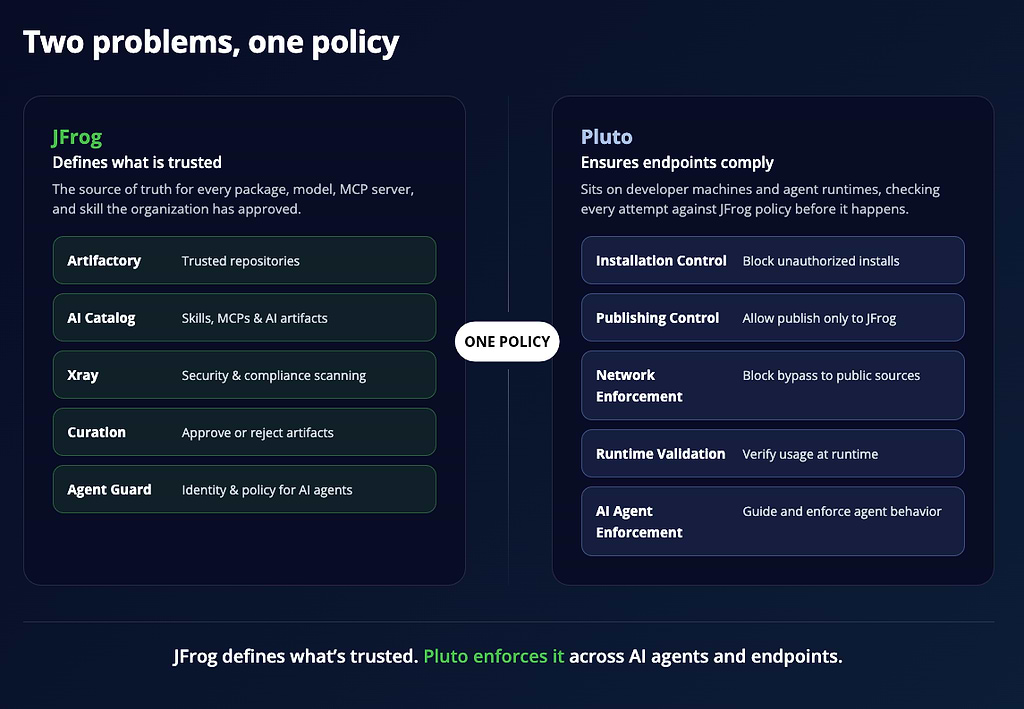
JFrog partnered with Pluto Security to extend its policy controls from Artifactory, Curation, Xray, and AI Security into AI agent runtimes and developer endpoints.︀︄︇︀︅︉︀︅︀︀︃︀︀︅︅︀︅︊︀︄︆︀︃︄
JFrog software supply chain solutions provide an end-to-end pipeline to control your binaries from build to production. Power your software updates to the edge.
JFrog partnered with Pluto Security to extend its policy controls from Artifactory, Curation, Xray, and AI Security into AI agent runtimes and developer endpoints.︀︄︇︀︅︉︀︅︀︀︃︀︀︅︅︀︅︊︀︄︆︀︃︄
└──▷ WHAT SHIPPED ·
1 FEATURE1 OF 1 FEATUREmost completely described firstwhat's the number?
Each feature carries 0–100 for how completely the vendor documented
it — not how big or important the work is. A major capability
described in eight words scores low, and that is the finding.
depth0–40what it does and how it works or what changed
specificity0–30names real surfaces — APIs, flags, formats, limits, numbers
actionability0–30enough to go use it — a named endpoint, flag, or config key tops this; a UI path is a starting point
Code and config rank first by construction: a documented endpoint,
flag or config key scores at the top of specificity and actionability,
so it sorts above a feature described only in prose. Under
60 the notes go thin — everything below the “thinner
coverage” line is thinner documentation, not smaller work.
Hover any meter for that feature's three sub-scores.
0101
Pluto Security integration for AI agent policy enforcementNot checked yetnew64how completely this was documenteddepth30/40specificity22/30actionability12/3064 / 100
A new integration with Pluto Security extends JFrog's approved lists from Artifactory, Curation, Xray, and AI Security to AI agent runtimes and developer machines where Pluto is deployed, covering packages, models, MCPMCPModel Context Protocol, a standard for connecting AI applications to external tools and data sources. A compatible server exposes capabilities an assistant can use through a common interface. servers, and skills.︀︄︇︀︅︉︀︅︀︀︃︀︀︅︅︀︅︊︀︄︆︀︃︄ Pluto intercepts and automatically enforces JFrog policy at the endpoint for every install, publish, and MCP serverMCP serverA process that exposes tools, resources, and prompts over Anthropic's Model Context Protocol, letting an AI agent call external APIs or local services through a standardised interface. connection attempt, blocking pulls from unapproved public registries and external publish targets without manual approval.
Mesh is a remote Wireless Android Debugging, over the internet.
Mesh shipped its v1.0.0-beta release, adding MESHnet integration for remote Android debugging over an encrypted peer-to-peer tunnel.︀︄︇︀︅︉︀︅︀︀︃︀︀︅︅︀︅︊︀︄︆︀︃︄
└──▷ WHAT SHIPPED ·
0 FEATURES1 FEATURE0 OF 1 FEATUREmost completely described firstwhat's the number?
Each feature carries 0–100 for how completely the vendor documented
it — not how big or important the work is. A major capability
described in eight words scores low, and that is the finding.
depth0–40what it does and how it works or what changed
specificity0–30names real surfaces — APIs, flags, formats, limits, numbers
actionability0–30enough to go use it — a named endpoint, flag, or config key tops this; a UI path is a starting point
Code and config rank first by construction: a documented endpoint,
flag or config key scores at the top of specificity and actionability,
so it sorts above a feature described only in prose. Under
60 the notes go thin — everything below the “thinner
coverage” line is thinner documentation, not smaller work.
Hover any meter for that feature's three sub-scores.
0100
MESHnet integration for CLI connectivityNot checked yetnew45how completely this was documenteddepth20/40specificity15/30actionability10/3045 / 100
Adds MESHnet integration, connecting the CLI to its clients over an encrypted, peer-to-peer tunnel backed by the MESHnet Go library.︀︄︇︀︅︉︀︅︀︀︃︀︀︅︅︀︅︊︀︄︆︀︃︄
— Names mechanism and library but no config or command detailsv1.0.0-beta
meshforensics' first beta adds rootless Podman and SELinuxSELinuxA mandatory access control system built into the Linux kernel, maintained by the NSA and Red Hat, that enforces fine-grained policies restricting what processes can access, even if they run as root. host support plus a new MESHnet peer-to-peer integration for its CLI and phone tunnel layer.︀︄︇︀︅︉︀︅︀︀︃︀︀︅︅︀︅︊︀︄︆︀︃︄
└──▷ WHAT SHIPPED ·
0 FEATURES2 FEATURES0 OF 2 FEATURESmost completely described firstwhat's the number?
Each feature carries 0–100 for how completely the vendor documented
it — not how big or important the work is. A major capability
described in eight words scores low, and that is the finding.
depth0–40what it does and how it works or what changed
specificity0–30names real surfaces — APIs, flags, formats, limits, numbers
actionability0–30enough to go use it — a named endpoint, flag, or config key tops this; a UI path is a starting point
Code and config rank first by construction: a documented endpoint,
flag or config key scores at the top of specificity and actionability,
so it sorts above a feature described only in prose. Under
60 the notes go thin — everything below the “thinner
coverage” line is thinner documentation, not smaller work.
Hover any meter for that feature's three sub-scores.
0100
Rootless Podman and SELinux host supportNot checked yetnew45how completely this was documenteddepth20/40specificity15/30actionability10/3045 / 100
The analyst container can now run on rootless Podman and SELinux hosts, removing the need to run the analyst container as root on hardened Linux systems.︀︄︇︀︅︉︀︅︀︀︃︀︀︅︅︀︅︊︀︄︆︀︃︄
— Explains benefit but no exact commands or config shownv1.0.0-beta
0200
MESHnet peer-to-peer integrationNot checked yetnew35how completely this was documenteddepth15/40specificity15/30actionability5/3035 / 100
Adds a MESHnet integration, connecting the CLI and phone tunnel layer to the MESHnet peer-to-peer library.
— Names the integration but no usage detail or commandsv1.0.0-beta
Finite State Platform added duplicate-dependency detection for Versions, bulk management controls for large dependency lists, and a tenfold increase to the dependency tree page size.︀︄︇︀︅︉︀︅︀︀︃︀︀︅︅︀︅︊︀︄︆︀︃︄
Finite State Platform is a firmware security analysis tool that identifies vulnerabilities, software composition, and risks in connected device and IoT firmware at scale.
Finite State Platform added duplicate-dependency detection for Versions, bulk management controls for large dependency lists, and a tenfold increase to the dependency tree page size.︀︄︇︀︅︉︀︅︀︀︃︀︀︅︅︀︅︊︀︄︆︀︃︄
└──▷ WHAT SHIPPED ·
3 FEATURES0 OF 3 FEATURESmost completely described firstwhat's the number?
Each feature carries 0–100 for how completely the vendor documented
it — not how big or important the work is. A major capability
described in eight words scores low, and that is the finding.
depth0–40what it does and how it works or what changed
specificity0–30names real surfaces — APIs, flags, formats, limits, numbers
actionability0–30enough to go use it — a named endpoint, flag, or config key tops this; a UI path is a starting point
Code and config rank first by construction: a documented endpoint,
flag or config key scores at the top of specificity and actionability,
so it sorts above a feature described only in prose. Under
60 the notes go thin — everything below the “thinner
coverage” line is thinner documentation, not smaller work.
Hover any meter for that feature's three sub-scores.
0100
Dependency tree page size raised to 10,000Not checked yetimproved65how completely this was documenteddepth30/40specificity20/30actionability15/3065 / 100
The dependency tree page of top-level components can now be as large as 10,000 — the maximum the API accepts — up from 1,000.︀︄︇︀︅︉︀︅︀︀︃︀︀︅︅︀︅︊︀︄︆︀︃︄
Edit and Delete menu on large dependency listsNot checked yetnew60how completely this was documenteddepth25/40specificity20/30actionability15/3060 / 100
Every Project Dependencies row on a Version with more than 500 dependencies now has an Edit and Delete menu so older rows can be managed.
Duplicate child Project warning on VersionsNot checked yetnew55how completely this was documenteddepth25/40specificity15/30actionability15/3055 / 100
Versions with more than one version of the same child Project now display a warning that names the child Projects with the most versions and links directly to Project Dependencies for review.
Netcap v0.16.16 restores the WebUI dashboard, adding capture-scoped data views, aggregate traffic totals, and consistency fixes for paginated alert groups.︀︄︇︀︅︉︀︅︀︀︃︀︀︅︅︀︅︊︀︄︆︀︃︄
Netcap is a framework for secure and scalable analysis of network traffic, converting pcap files into typed audit records for efficient processing.
Netcap v0.16.16 restores the WebUI dashboard, adding capture-scoped data views, aggregate traffic totals, and consistency fixes for paginated alert groups.︀︄︇︀︅︉︀︅︀︀︃︀︀︅︅︀︅︊︀︄︆︀︃︄
└──▷ WHAT SHIPPED ·
1 FEATURE0 OF 1 FEATUREmost completely described firstwhat's the number?
Each feature carries 0–100 for how completely the vendor documented
it — not how big or important the work is. A major capability
described in eight words scores low, and that is the finding.
depth0–40what it does and how it works or what changed
specificity0–30names real surfaces — APIs, flags, formats, limits, numbers
actionability0–30enough to go use it — a named endpoint, flag, or config key tops this; a UI path is a starting point
Code and config rank first by construction: a documented endpoint,
flag or config key scores at the top of specificity and actionability,
so it sorts above a feature described only in prose. Under
60 the notes go thin — everything below the “thinner
coverage” line is thinner documentation, not smaller work.
Hover any meter for that feature's three sub-scores.
0100
WebUI dashboard restoration and capture scopingNot checked yetimproved57how completely this was documenteddepth25/40specificity20/30actionability12/3057 / 100
The WebUI's All PCAPs traffic overview now shows aggregate totals and charts on first visit, with direct capture links retaining their selection.︀︄︇︀︅︉︀︅︀︀︃︀︀︅︅︀︅︊︀︄︆︀︃︄ Data pages (Hosts, Devices, Connections, HTTP, Services, and other inventories) now load records scoped to the selected capture with visitor isolation, the Audit Records view keeps a single capture selector, the Alerts and Files pages drop page-level diagnostics while retaining detailed evidence, and grouped alert pagination tokens are now invalidated when an alert outside the capped preview changes to keep paged alert groups consistent.
— Describes multiple UI behaviours but no concrete commands or configv0.16.16
Qualys TotalCloud launches TotalAI, a new module that red-teams AI models, scans MCPMCPModel Context Protocol, a standard for connecting AI applications to external tools and data sources. A compatible server exposes capabilities an assistant can use through a common interface. servers and CI/CD pipelines for exposed secrets, builds an AI service inventory, and adds AI-aware identity and network monitoring.︀︄︇︀︅︉︀︅︀︀︃︀︀︅︅︀︅︊︀︄︆︀︃︄
Qualys TotalCloud is a cloud-native security platform that provides continuous visibility, risk assessment, and compliance management across multi-cloud environments.
Qualys TotalCloud launches TotalAI, a new module that red-teams AI models, scans MCPMCPModel Context Protocol, a standard for connecting AI applications to external tools and data sources. A compatible server exposes capabilities an assistant can use through a common interface. servers and CI/CD pipelines for exposed secrets, builds an AI service inventory, and adds AI-aware identity and network monitoring.︀︄︇︀︅︉︀︅︀︀︃︀︀︅︅︀︅︊︀︄︆︀︃︄
└──▷ WHAT SHIPPED ·
5 FEATURES5 OF 5 FEATURESmost completely described firstwhat's the number?
Each feature carries 0–100 for how completely the vendor documented
it — not how big or important the work is. A major capability
described in eight words scores low, and that is the finding.
depth0–40what it does and how it works or what changed
specificity0–30names real surfaces — APIs, flags, formats, limits, numbers
actionability0–30enough to go use it — a named endpoint, flag, or config key tops this; a UI path is a starting point
Code and config rank first by construction: a documented endpoint,
flag or config key scores at the top of specificity and actionability,
so it sorts above a feature described only in prose. Under
60 the notes go thin — everything below the “thinner
coverage” line is thinner documentation, not smaller work.
Hover any meter for that feature's three sub-scores.
0101
AI model red-teaming in TotalAINot checked yetnew80how completely this was documenteddepth35/40specificity30/30actionability15/3080 / 100
TotalAI can red-team any model with a chat completion endpoint — including foreign models — against 300+ attack scenarios mapped to OWASPOWASPA nonprofit foundation that publishes open standards, guides, and ranked vulnerability lists—most famously the OWASP Top 10—giving cyber tools a vendor-neutral benchmark to test or report against., MITRE ATLASMITRE ATLASA MITRE-maintained knowledge base of adversarial tactics and techniques targeting AI and machine learning systems, modelled on ATT&CK, giving cyber tools a structured taxonomy for AI-specific threat modelling., and the EU AI ActEU AI ActEU regulation that classifies AI systems by risk level and imposes compliance obligations—documentation, transparency, human oversight—on developers and deployers, shaping how AI-based cyber tools are built and sold in Europe., including 21 sensitive information disclosure checks.︀︄︇︀︅︉︀︅︀︀︃︀︀︅︅︀︅︊︀︄︆︀︃︄
AI service inventory across cloud estateNot checked yetnew60how completely this was documenteddepth25/40specificity25/30actionability10/3060 / 100
TotalAI maps managed AI services, AI software, and GPUGPUA graphics processing unit, a processor that performs many calculations in parallel. AI workloads use GPUs to speed up model training and inference. usage across cloud connectors, Cloud Agents, Container Security, and a browser plug-in to build an AI inventory without requiring a separate agent.
CIEM posture checks for AI identitiesNot checked yetnew60how completely this was documenteddepth20/40specificity25/30actionability15/3060 / 100
TotalCloud CIEMCIEMCloud Infrastructure Entitlement Management — a discipline and category of tooling for discovering, analyzing, and enforcing least-privilege access across cloud IAM roles, policies, and identities to reduce over-permissioned accounts. posture checks show what each cloud identity can access and flag excess privileges for AI services such as Amazon Bedrock, SageMaker, and Azure OpenAI.
Secrets detection across MCP servers and CI/CDNot checked yetnew55how completely this was documenteddepth20/40specificity25/30actionability10/3055 / 100
TotalAI MCP scans catch secrets that agents source context from in MCP servers, while a parallel capability detects exposed secrets in container images, CI/CD pipelines, and code repositories before they reach a model prompt.
— Names surfaces scanned but no interface or command given2026-11-26-d8ae8b2a
0505
Network correlation for AI endpoint trackingNot checked yetnew50how completely this was documenteddepth25/40specificity15/30actionability10/3050 / 100
TotalAI correlates DNS and outbound TCPTCPA network protocol that delivers a reliable, ordered stream of bytes between two endpoints. It detects lost data and retransmits it. events from monitored workloads to track direct connections to AI routers or provider endpoints outside an approved list.
Plerion is a cloud security platform that provides risk-based prioritization and remediation guidance across cloud infrastructure, helping teams identify and fix critical vulnerabilities efficiently.
Plerion's Azure install script now reports every subscription it skipped or could not set up, so operators know exactly which ones are not being scanned.
The Azure install script now skips subscriptions that lack the required resource providers and lists every skipped or failed subscription at the end of the run, leaving nothing to clean up. Not checked yet
Anchore's software supply chain solutions automate vulnerability scanning, strengthen container security, and support compliance with NIST, FedRAMP & more.
Syft adds SPDX 3SPDX 3An open standard from the Linux Foundation for expressing software bill-of-materials data, letting cyber tools exchange dependency, license, and vulnerability metadata in a machine-readable, interoperable format..X output and PURLPURLA Package URL — a community-maintained spec for identifying software packages across ecosystems (npm, PyPI, Maven, etc.) with a single, consistent string, letting cyber tools pinpoint exact dependencies unambiguously. generation as standard; Grype scan results now include event timestamps and NVDNVDThe National Vulnerability Database, maintained by NIST, is the U.S. government repository of CVE records enriched with CVSS scores and metadata; cyber tools query it to drive vulnerability prioritization.SSVCSSVCA decision-support framework for vulnerability prioritization, maintained by CISA and Carnegie Mellon's CERT/CC, that uses stakeholder-specific decision trees to guide patch and remediation timing instead of relying on numeric scores alone. decorations; Grant adds a native Windows build.
Syft now generates PURLs as standard and adds SPDXSPDXAn open standard for describing software components, licenses and their relationships. Its documents let different tools exchange a software bill of materials without inventing a new format. 3.X output support. Not checked yet
Grype scan results now include new event timestamps and NVD SSVC decorations in vulnerability match data. Not checked yet
Grant adds a native Windows build to its published release set. Not checked yet
Sysdig Secure is a cloud-native security platform that detects threats, manages vulnerabilities, and ensures compliance across containers, Kubernetes, and cloud infrastructure.
Sysdig Secure makes Validated Exposure self-service, letting teams turn it on for AWS, GCP, and Azure accounts directly in the UI or via infrastructure-as-code without contacting support.︀︄︇︀︅︉︀︅︀︀︃︀︀︅︅︀︅︊︀︄︆︀︃︄
└──▷ WHAT SHIPPED ·
1 FEATURE0 OF 1 FEATUREmost completely described firstwhat's the number?
Each feature carries 0–100 for how completely the vendor documented
it — not how big or important the work is. A major capability
described in eight words scores low, and that is the finding.
depth0–40what it does and how it works or what changed
specificity0–30names real surfaces — APIs, flags, formats, limits, numbers
actionability0–30enough to go use it — a named endpoint, flag, or config key tops this; a UI path is a starting point
Code and config rank first by construction: a documented endpoint,
flag or config key scores at the top of specificity and actionability,
so it sorts above a feature described only in prose. Under
60 the notes go thin — everything below the “thinner
coverage” line is thinner documentation, not smaller work.
Hover any meter for that feature's three sub-scores.
0100
Self-service Validated Exposure enablementNot checked yetnew80how completely this was documenteddepth25/40specificity25/30actionability30/3080 / 100
Validated Exposure can now be enabled for individual AWS, GCP, or Azure accounts, or for an entire organization, via Integrations > Environments in the account details panel, without contacting Sysdig Support.︀︄︇︀︅︉︀︅︀︀︃︀︀︅︅︀︅︊︀︄︆︀︃︄ It can also be enabled during account onboarding via Terraform, CloudFormationCloudFormationAn AWS service that lets you describe and provision cloud infrastructure as declarative YAML or JSON templates, so a cyber tool can reproducibly spin up or tear down its entire AWS environment with a single API call., or the sysdig-onboarding skill.
Turn on Validated Exposure for a single cloud account from the Sysdig Secure UI without opening a support ticket.
📍In Sysdig Secure, go to Integrations › Environments, open the account details panel for your AWS, GCP, or Azure account, and toggle Validated Exposure on.
Huntress streamlined SSOSSOSingle sign-on, using one identity provider to sign in to multiple applications. It reduces separate passwords and centralizes account and access management. setup in Settings > Access Management by adding metadata XML import and live sign-in validation before saving.︀︄︇︀︅︉︀︅︀︀︃︀︀︅︅︀︅︊︀︄︆︀︃︄
Give feedback to the Huntress team so we can make more informed product decisions. Powered by Canny.
Huntress streamlined SSOSSOSingle sign-on, using one identity provider to sign in to multiple applications. It reduces separate passwords and centralizes account and access management. setup in Settings > Access Management by adding metadata XML import and live sign-in validation before saving.︀︄︇︀︅︉︀︅︀︀︃︀︀︅︅︀︅︊︀︄︆︀︃︄
└──▷ WHAT SHIPPED ·
1 FEATURE0 OF 1 FEATUREmost completely described firstwhat's the number?
Each feature carries 0–100 for how completely the vendor documented
it — not how big or important the work is. A major capability
described in eight words scores low, and that is the finding.
depth0–40what it does and how it works or what changed
specificity0–30names real surfaces — APIs, flags, formats, limits, numbers
actionability0–30enough to go use it — a named endpoint, flag, or config key tops this; a UI path is a starting point
Code and config rank first by construction: a documented endpoint,
flag or config key scores at the top of specificity and actionability,
so it sorts above a feature described only in prose. Under
60 the notes go thin — everything below the “thinner
coverage” line is thinner documentation, not smaller work.
Hover any meter for that feature's three sub-scores.
0100
Faster SSO setup via metadata import and validationNot checked yetimproved85how completely this was documenteddepth30/40specificity25/30actionability30/3085 / 100
In Settings > Access Management, admins can now import their identity provideridentity providerA service that authenticates users and supplies identity information to other applications. It is the sign-in authority behind many single sign-on systems.'s metadata XML instead of copying configuration values one by one, and use Validate and Save to test SSO sign-in with the identity provider without being logged out.︀︄︇︀︅︉︀︅︀︀︃︀︀︅︅︀︅︊︀︄︆︀︃︄ On success the configuration saves automatically; on failure inline error detail is shown.
When onboarding a new identity provider, import its metadata XML to skip manual field-by-field entry and validate the config live before committing it.
📍In Huntress, go to Settings › Access Management, upload your identity provider's metadata XML file, then select Validate and Save to confirm sign-in works before the configuration is applied.
Qualys EDR is an endpoint detection and response solution that monitors, detects, and responds to advanced threats and malicious activity on endpoints.
Trend Vision One is a unified cybersecurity platform that integrates threat detection, response, and risk management across endpoints, networks, and cloud environments.
Trend Vision One hardened its Agentless Vulnerability & Threat Detection scanner for AWS ECSAWS ECSAmazon's managed container orchestration service that runs Docker containers on clusters of EC2 instances or Fargate, letting tools offload scheduling, scaling, and infrastructure management to AWS. and updated Forward Proxy Service certificate handling.︀︄︇︀︅︉︀︅︀︀︃︀︀︅︅︀︅︊︀︄︆︀︃︄
└──▷ WHAT SHIPPED ·
2 FEATURES0 OF 2 FEATURESmost completely described firstwhat's the number?
Each feature carries 0–100 for how completely the vendor documented
it — not how big or important the work is. A major capability
described in eight words scores low, and that is the finding.
depth0–40what it does and how it works or what changed
specificity0–30names real surfaces — APIs, flags, formats, limits, numbers
actionability0–30enough to go use it — a named endpoint, flag, or config key tops this; a UI path is a starting point
Code and config rank first by construction: a documented endpoint,
flag or config key scores at the top of specificity and actionability,
so it sorts above a feature described only in prose. Under
60 the notes go thin — everything below the “thinner
coverage” line is thinner documentation, not smaller work.
Hover any meter for that feature's three sub-scores.
0100
Read-only root filesystem for ECS scanner tasksNot checked yetimproved70how completely this was documenteddepth25/40specificity25/30actionability20/3070 / 100
Agentless Vulnerability & Threat Detection's Amazon ECSAmazon ECSAWS's container orchestration service that runs Docker containers on managed or self-hosted EC2 clusters, giving cyber tools a scalable, cloud-native runtime without managing Kubernetes. scanner tasks now run with a read-only root filesystem, aligning with the AWS best practice checked by the ecs-containers-readonly-access AWS Config rule.︀︄︇︀︅︉︀︅︀︀︃︀︀︅︅︀︅︊︀︄︆︀︃︄ This change requires a CloudFormationCloudFormationAn AWS service that lets you describe and provision cloud infrastructure as declarative YAML or JSON templates, so a cyber tool can reproducibly spin up or tear down its entire AWS environment with a single API call. stack update to take effect.
Appliance-managed certificate bundle in Forward ProxyNot checked yetimproved30how completely this was documenteddepth15/40specificity10/30actionability5/3030 / 100
Forward Proxy Service now uses the appliance-managed certificate bundle to support custom certificates.
XFA shipped a self-service My Account portal letting users manage their own sign-in methods, with admin controls to permit or restrict it.︀︄︇︀︅︉︀︅︀︀︃︀︀︅︅︀︅︊︀︄︆︀︃︄
XFA is a developer tool that enables building fast, interactive forms and data collection interfaces for web applications.
XFA shipped a self-service My Account portal letting users manage their own sign-in methods, with admin controls to permit or restrict it.︀︄︇︀︅︉︀︅︀︀︃︀︀︅︅︀︅︊︀︄︆︀︃︄
└──▷ WHAT SHIPPED ·
1 FEATURE0 OF 1 FEATUREmost completely described firstwhat's the number?
Each feature carries 0–100 for how completely the vendor documented
it — not how big or important the work is. A major capability
described in eight words scores low, and that is the finding.
depth0–40what it does and how it works or what changed
specificity0–30names real surfaces — APIs, flags, formats, limits, numbers
actionability0–30enough to go use it — a named endpoint, flag, or config key tops this; a UI path is a starting point
Code and config rank first by construction: a documented endpoint,
flag or config key scores at the top of specificity and actionability,
so it sorts above a feature described only in prose. Under
60 the notes go thin — everything below the “thinner
coverage” line is thinner documentation, not smaller work.
Hover any meter for that feature's three sub-scores.
0100
Self-service My Account portalNot checked yetnew63how completely this was documenteddepth25/40specificity18/30actionability20/3063 / 100
A new My Account portal lets every user view and manage their own sign-in methods — trusted devices, passkeyspasskeysPhishing-resistant sign-in credentials built on FIDO2/WebAuthn: the device holds a private key and proves possession instead of the user typing a password. They sync across a user's devices., security keys, and authenticator app — without involving an admin.︀︄︇︀︅︉︀︅︀︀︃︀︀︅︅︀︅︊︀︄︆︀︃︄ An admin toggle in My account settings controls whether self-service changes are allowed; admins can confirm it's enabled and share the My Account URL with users so they can add or remove sign-in methods themselves.
Direct a user to their self-service My Account portal to review or add a passkeypasskeyPhishing-resistant sign-in credentials built on FIDO2/WebAuthn: the device holds a private key and proves possession instead of the user typing a password. They sync across a user's devices. without involving an admin.
📍In the XFA admin console, go to My account settings and confirm self-service is enabled, then share the My Account URL with users so they can add or remove sign-in methods themselves.
XFA adds Breach alerts (beta, Max and Enterprise plans) to flag verified-domain email addresses found in data breaches or infostealer logs, with optional user notification via Risk monitor.
New Breach alerts feature detects when an address at a verified email domain appears in a known data breach or infostealer log, using Have I Been Pwned data, with an option to notify the affected person — available under Risk monitor in the dashboard on Max and Enterprise plans (currently in beta). Not checked yet
XFA now acts as the identity provideridentity providerA service that authenticates users and supplies identity information to other applications. It is the sign-in authority behind many single sign-on systems. for Proton Pass and Proton VPNVPNA virtual private network, an encrypted tunnel between devices or networks. It carries traffic across another network as though the endpoints had a private connection. for Business, enforcing passkeypasskeyPhishing-resistant sign-in credentials built on FIDO2/WebAuthn: the device holds a private key and proves possession instead of the user typing a password. They sync across a user's devices. sign-in and device checks before access.
XFA adds Shared SignalsShared SignalsAn open standard from the OpenID Foundation for pushing security-relevant events between services in real time, letting cyber tools propagate session revocations or threat signals across trust boundaries without polling. (beta, Enterprise plan) to push near-real-time policy-failure events to identity providersidentity providersA service that authenticates users and supplies identity information to other applications. It is the sign-in authority behind many single sign-on systems., enabling proactive session termination.
New Shared Signals integration notifies your identity provideridentity providerA service that authenticates users and supplies identity information to other applications. It is the sign-in authority behind many single sign-on systems. within minutes when a device stops passing policy, so the provider can end the device's sessions before the next sign-in. Not checked yet
Databricks is a unified data analytics platform that enables collaborative data engineering, machine learning, and analytics using Apache Spark in the cloud.
Databricks shipped GA Lakebase TerraformTerraformAn open-source infrastructure-as-code tool by HashiCorp that provisions cloud and on-premises resources through declarative configuration files, letting cyber tools automate and version-control their deployment environments. resources for managing Postgres infrastructure as code, a Windows desktop app for Genie One, and a trio of OpenSharing improvements covering directory-based delivery, recipient-specific URLs, and Unity Catalog agent skill sharing, alongside a new storage-tracking system table and a dashboard export fix.︀︄︇︀︅︉︀︅︀︀︃︀︀︅︅︀︅︊︀︄︆︀︃︄
└──▷ WHAT SHIPPED ·
7 FEATURES1 OF 7 FEATURESmost completely described firstwhat's the number?
Each feature carries 0–100 for how completely the vendor documented
it — not how big or important the work is. A major capability
described in eight words scores low, and that is the finding.
depth0–40what it does and how it works or what changed
specificity0–30names real surfaces — APIs, flags, formats, limits, numbers
actionability0–30enough to go use it — a named endpoint, flag, or config key tops this; a UI path is a starting point
Code and config rank first by construction: a documented endpoint,
flag or config key scores at the top of specificity and actionability,
so it sorts above a feature described only in prose. Under
60 the notes go thin — everything below the “thinner
coverage” line is thinner documentation, not smaller work.
Hover any meter for that feature's three sub-scores.
0100
Lakebase Postgres Terraform resourcesNot checked yetnew90how completely this was documenteddepth30/40specificity30/30actionability30/3090 / 100
Eight Lakebase Postgres Terraform resources reached general availability — databricks_postgres_project, databricks_postgres_branch, databricks_postgres_endpoint, databricks_postgres_database, databricks_postgres_role, databricks_postgres_catalog, databricks_postgres_synced_table, and databricks_postgres_snapshot_schedule — available from Databricks Terraform provider v1.145.0 onward, enabling infrastructure-as-code management of Lakebase Postgres.︀︄︇︀︅︉︀︅︀︀︃︀︀︅︅︀︅︊︀︄︆︀︃︄
Provision a Lakebase Postgres project and a branch in Terraform once the provider is at v1.145.0 or later.
Directory-based access for OpenSharing SecureConnectNot checked yetnew75how completely this was documenteddepth30/40specificity20/30actionability25/3075 / 100
A Public Preview feature delivers eligible tables and views via serverless compute instead of per-file pre-signed URLs for better performance, enabled by account admins from the account console Previews page by turning on OpenSharing SecureConnect Directory Based Access.
Account admins enabling the directory-based access preview to improve data delivery performance for OpenSharing SecureConnect recipients.
📍In the account console, go to Previews and enable OpenSharing SecureConnect Directory Based Access.
Table metrics history system tableNot checked yetnew70how completely this was documenteddepth25/40specificity25/30actionability20/3070 / 100
The system.storage.table_metrics_history system table is now generally available for querying daily storage size, attributing storage costs, and finding tables to clean up for Unity Catalog managed tables.
Genie One desktop app for WindowsNot checked yetnew60how completely this was documenteddepth30/40specificity20/30actionability10/3060 / 100
Genie One is now generally available as a Windows desktop app with separate installers for x64 and ARM64ARM64A 64-bit CPU architecture from ARM Holdings, used in mobile chips, Apple Silicon, and cloud servers; cyber tools target it to run natively on those platforms instead of relying on emulation. devices, adding window navigation controls and automatic updates on top of the existing web experience.
Unity Catalog agent skill sharing via OpenSharing and MarketplaceNot checked yetNew integrationnew55how completely this was documenteddepth25/40specificity20/30actionability10/3055 / 100
Providers can now add Unity Catalog agent skills to OpenSharing shares and Databricks Marketplace listings for Databricks recipients to consume, generally available but requiring the Enhanced Unity AI Gateway preview Beta and, on some accounts, the Agent Skill Sharing preview enabled by an account admin.
Recipient-specific URLs for OpenSharing open recipientsNot checked yetimproved50how completely this was documenteddepth25/40specificity15/30actionability10/3050 / 100
OpenSharing open recipients now get a recipient-specific URL that embeds the recipient ID in the host name, letting recipients allowlist their own host name instead of a shared regional host name.
Excel export preserves table widget formattingNot checked yetimproved40how completely this was documenteddepth20/40specificity10/30actionability10/3040 / 100
Excel (.xlsx.xlsxThe file format used by Microsoft Excel for spreadsheets, based on the Open XML standard. Cyber tools use it to ingest or export structured tabular data in a format analysts already work with.) files downloaded from a table widget now keep the widget's column display names and column widths.
— Describes the behavior change but it's a minor formatting fixDashboard enhancements (2026-11-26)
Databricks adds Power BI and Tableau Cloud MCPMCPModel Context Protocol, a standard for connecting AI applications to external tools and data sources. A compatible server exposes capabilities an assistant can use through a common interface. connectors for Genie Code, with /importBI checking migrated reports against the live source.
Sumo Logic introduces a Usage Attribution tab in Account Overview, letting teams break down log ingest volume by data tier, custom tags, and CSV-based ownership mappings, with filter state now persisted across reloads.︀︄︇︀︅︉︀︅︀︀︃︀︀︅︅︀︅︊︀︄︆︀︃︄
Sumo Logic is a cloud-native platform that provides real-time log management, security analytics, and observability for applications and infrastructure.
Sumo Logic introduces a Usage Attribution tab in Account Overview, letting teams break down log ingest volume by data tier, custom tags, and CSV-based ownership mappings, with filter state now persisted across reloads.︀︄︇︀︅︉︀︅︀︀︃︀︀︅︅︀︅︊︀︄︆︀︃︄
└──▷ WHAT SHIPPED ·
1 FEATURE0 OF 1 FEATUREmost completely described firstwhat's the number?
Each feature carries 0–100 for how completely the vendor documented
it — not how big or important the work is. A major capability
described in eight words scores low, and that is the finding.
depth0–40what it does and how it works or what changed
specificity0–30names real surfaces — APIs, flags, formats, limits, numbers
actionability0–30enough to go use it — a named endpoint, flag, or config key tops this; a UI path is a starting point
Code and config rank first by construction: a documented endpoint,
flag or config key scores at the top of specificity and actionability,
so it sorts above a feature described only in prose. Under
60 the notes go thin — everything below the “thinner
coverage” line is thinner documentation, not smaller work.
Hover any meter for that feature's three sub-scores.
0100
Usage Attribution tab in Account OverviewNot checked yetnew80how completely this was documenteddepth32/40specificity25/30actionability23/3080 / 100
A new Usage Attribution tab breaks down ingest volume by data tier and fields such as _sourceCategory, collector, and host.︀︄︇︀︅︉︀︅︀︀︃︀︀︅︅︀︅︊︀︄︆︀︃︄ Users can add custom tags (e.g., environment, cost center) as breakdown dimensions, which apply only to data ingested after the tag is saved, and can upload a CSV mapping field values to team, owner, and other columns to enable ownership-based usage breakdowns. Filters and the Breakdown by selection are now saved across page reloads on this tab.
Identify which team or cost center is driving the most ingest before a billing review by uploading an ownership CSV and filtering by owner.
📍In Account Overview, go to the Usage Attribution tab, then under Ownership lookup upload a CSV with columns for field value, team, and owner. Set Breakdown by to your owner column to see per-team ingest volume by data tier.
Slice ingest by deployment environment to spot which environment is consuming the most log volume.
📍In Account Overview, go to the Usage Attribution tab, select Custom tags, add a tag named environment, then set Breakdown by to environment to see per-environment ingest trends over time.
ClickHouse® is a real-time analytics database management system
ClickHouse Managed Postgres adds PostgreSQL 19 on day one, with REPACK CONCURRENTLY, WAIT FOR LSN, sequence replication, parallel autovacuum, new system views, and pg_plan_advice.
Use REPACK (CONCURRENTLY) to reclaim table space without blocking production workloads; slot pool size is controlled by max_repack_replication_slots and progress is shown in pg_stat_progress_repack. Not checked yet
Use WAIT FOR LSN '...' WITH (TIMEOUT '...' , NO_THROW) on read replicas for read-your-writes consistency against asynchronous standbys. Not checked yet
Replicate sequences with CREATE PUBLICATION ... FOR ALL SEQUENCES and ALTER SUBSCRIPTION ... REFRESH SEQUENCES; exclude tables with FOR ALL TABLES EXCEPT ( TABLE ... ). Not checked yet
Enable parallel autovacuum index workers via autovacuum_max_parallel_workers in Settings and autovacuum_parallel_workers per table; monitor ordering with pg_stat_autovacuum_scores. Not checked yet
New system views pg_stat_lock, pg_stat_recovery, and pg_dsm_registry_allocations are queryable; EXPLAIN (ANALYZE, IO) and auto_explain.log_io now report asynchronous I/O activity. Not checked yet
+2 moreshow less
Load pg_plan_advice to inspect planner decisions and use pg_stash_advice to apply advice automatically per query ID. Not checked yet
New supported platformManaged in-place major-version upgrades to PostgreSQL 19 are available in private preview. Not checked yet
Tenzir's v7.0.0-rc.8 release adds AI-native tooling (an MCP serverMCP serverA process that exposes tools, resources, and prompts over Anthropic's Model Context Protocol, letting an AI agent call external APIs or local services through a standardised interface. and built-in assistant), new Splunk and Axiom source operators, a relational join operator with streaming joins, and expanded OCSFOCSFAn open schema standard, maintained by the OCSF community under CISA and industry backing, that defines a common event format so cyber tools can share and ingest log data without per-source normalization work./SigmaSigmaAn open, vendor-neutral rule format for describing patterns in log data, maintained by the Sigma project community, giving cyber tools a shared detection language that converts into platform-specific queries. coverage, alongside several breaking changes to operator semantics after specific source connectors and a reimagined deployment model.︀︄︇︀︅︉︀︅︀︀︃︀︀︅︅︀︅︊︀︄︆︀︃︄
Tenzir is a data pipeline engine for security teams that collects, transforms, enriches, and routes telemetry.
Tenzir's v7.0.0-rc.8 release adds AI-native tooling (an MCP serverMCP serverA process that exposes tools, resources, and prompts over Anthropic's Model Context Protocol, letting an AI agent call external APIs or local services through a standardised interface. and built-in assistant), new Splunk and Axiom source operators, a relational join operator with streaming joins, and expanded OCSFOCSFAn open schema standard, maintained by the OCSF community under CISA and industry backing, that defines a common event format so cyber tools can share and ingest log data without per-source normalization work./SigmaSigmaAn open, vendor-neutral rule format for describing patterns in log data, maintained by the Sigma project community, giving cyber tools a shared detection language that converts into platform-specific queries. coverage, alongside several breaking changes to operator semantics after specific source connectors and a reimagined deployment model.︀︄︇︀︅︉︀︅︀︀︃︀︀︅︅︀︅︊︀︄︆︀︃︄
└──▷ WHAT SHIPPED ·
0 FEATURES8 FEATURES3 OF 8 FEATURESmost completely described firstwhat's the number?
Each feature carries 0–100 for how completely the vendor documented
it — not how big or important the work is. A major capability
described in eight words scores low, and that is the finding.
depth0–40what it does and how it works or what changed
specificity0–30names real surfaces — APIs, flags, formats, limits, numbers
actionability0–30enough to go use it — a named endpoint, flag, or config key tops this; a UI path is a starting point
Code and config rank first by construction: a documented endpoint,
flag or config key scores at the top of specificity and actionability,
so it sorts above a feature described only in prose. Under
60 the notes go thin — everything below the “thinner
coverage” line is thinner documentation, not smaller work.
Hover any meter for that feature's three sub-scores.
0101
Splunk and Axiom data source operatorsNot checked yetnew78how completely this was documenteddepth25/40specificity28/30actionability25/3078 / 100
A new from_splunk operator runs SPL2SPL2Splunk's second-generation query and processing language, replacing SPL, offering a pipeline syntax for searching, transforming, and routing data across Splunk's platform. searches against existing Splunk deployments from within a pipeline, as in from_splunk "search index=main sourcetype=syslog | head 1000".︀︄︇︀︅︉︀︅︀︀︃︀︀︅︅︀︅︊︀︄︆︀︃︄ New Axiom operators read and write Axiom datasets with APLAPLA high-level array programming language created by Kenneth Iverson in the 1960s, using concise symbolic notation to express complex data transformations in very few characters, making it attractive for analytics and data-heavy cyber tools. pushdown and accept timestamp, label, cache, and variable options.
Run a Splunk SPL2 search inside a Tenzir pipeline to pull events from an existing Splunk deployment for further processing.
$ from_splunk "search index=main sourcetype=syslog | head 1000"
Native semantics for operators after several source connectorsNot checked yetbreaking70how completely this was documenteddepth25/40specificity30/30actionability15/3070 / 100
Operators placed after from_hydrolix now use native Hydrolix semantics instead of generic ones, which may change query behaviour. Operators after from_microsoft_graph now use native Microsoft GraphMicrosoft GraphMicrosoft's unified REST API for accessing data and services across Microsoft 365, Azure AD, and related cloud products, giving cyber tools a single authenticated endpoint to query users, emails, files, and sign-in logs. semantics, and operators after from_amazon_cloudwatch now use native CloudWatch Logs semantics, both of which may change query behaviour. Operators after from_velociraptor now stay in the pipeline by design, changing prior execution behaviour, and content-skipping filters and limits after from_microsoft_365_activity now behave differently.
OCSF 1.10.0 support and expanded Sigma coverageNot checked yetimproved45how completely this was documenteddepth15/40specificity20/30actionability10/3045 / 100
Tenzir now supports OCSF 1.10.0, and Sigma rules can be applied against generic proxy, web server, and DNS logs mapped to OCSF.
Reimagined platform and deployment modelNot checked yetbreaking35how completely this was documenteddepth15/40specificity10/30actionability10/3035 / 100
Platform and deployments have been reimagined; existing deployment configurations will require migration to the new model.
oxo added a new history-tracking message type for HTTP requests and introduced automatic expiry for persisted set members to bound memory growth.︀︄︇︀︅︉︀︅︀︀︃︀︀︅︅︀︅︊︀︄︆︀︃︄
└──▷ WHAT SHIPPED ·
2 FEATURES0 OF 2 FEATURESmost completely described firstwhat's the number?
Each feature carries 0–100 for how completely the vendor documented
it — not how big or important the work is. A major capability
described in eight words scores low, and that is the finding.
depth0–40what it does and how it works or what changed
specificity0–30names real surfaces — APIs, flags, formats, limits, numbers
actionability0–30enough to go use it — a named endpoint, flag, or config key tops this; a UI path is a starting point
Code and config rank first by construction: a documented endpoint,
flag or config key scores at the top of specificity and actionability,
so it sorts above a feature described only in prose. Under
60 the notes go thin — everything below the “thinner
coverage” line is thinner documentation, not smaller work.
Hover any meter for that feature's three sub-scores.
0100
HTTP request history tracking message typeNot checked yetnew40how completely this was documenteddepth10/40specificity20/30actionability10/3040 / 100
Adds the v3.history.request message type for tracking HTTP request history, alongside history period fields added to certificate, DNS, and screenshot history messages.︀︄︇︀︅︉︀︅︀︀︃︀︀︅︅︀︅︊︀︄︆︀︃︄
— Names the message type but not its fields or usagev2.25.10
0200
Persist mixin set member expiryNot checked yetimproved40how completely this was documenteddepth20/40specificity15/30actionability5/3040 / 100
Persist mixin set members now automatically expire after 7 days, preventing unbounded memory growth.
— States behaviour and duration but no config controlv2.25.9
Faraday-cli 2.4.0 adds a scope-check bypass flag for authorized pentests and raises its minimum Python and dependency requirements.︀︄︇︀︅︉︀︅︀︀︃︀︀︅︅︀︅︊︀︄︆︀︃︄
└──▷ WHAT SHIPPED ·
2 FEATURES1 OF 2 FEATURESmost completely described firstwhat's the number?
Each feature carries 0–100 for how completely the vendor documented
it — not how big or important the work is. A major capability
described in eight words scores low, and that is the finding.
depth0–40what it does and how it works or what changed
specificity0–30names real surfaces — APIs, flags, formats, limits, numbers
actionability0–30enough to go use it — a named endpoint, flag, or config key tops this; a UI path is a starting point
Code and config rank first by construction: a documented endpoint,
flag or config key scores at the top of specificity and actionability,
so it sorts above a feature described only in prose. Under
60 the notes go thin — everything below the “thinner
coverage” line is thinner documentation, not smaller work.
Hover any meter for that feature's three sub-scores.
0100
Scope check bypass for pentestsNot checked yetnew88how completely this was documenteddepth30/40specificity28/30actionability30/3088 / 100
The --skip-scope-check flag on faraday scan or pentest lets operators bypass the automatic scope check that otherwise blocks out-of-domain targets in self-registered ext_<domain> workspaces, for explicitly authorized targets.︀︄︇︀︅︉︀︅︀︀︃︀︀︅︅︀︅︊︀︄︆︀︃︄
Run a FaradAI pentest against a target that falls outside the auto-detected scope of a self-registered workspace, bypassing the scope guard with explicit operator authorization.
— Names exact flag, command and workspace pattern with runnable example2.4.0
0201
Raised Python and dependency minimumsNot checked yetbreaking75how completely this was documenteddepth25/40specificity30/30actionability20/3075 / 100
faraday-cli now requires Python >=3.10, pins cmd2 to 3.x, removes the version ceiling on validators and httpx, and requires faraday-plugins >=1.32.0; installations on Python 3.8 or 3.9, or with older cmd2, will no longer work.
— Names exact versions and packages but no migration steps2.4.0
└──▷ BREAKING ON UPGRADE
!
Python >=3.10 is now required; installations on Python 3.8 or 3.9 will no longer work.
!
cmd2 is now pinned to 3.x; environments with an older cmd2 installed must upgrade.
ConductorOne shipped a new access-profile review scope for governance campaigns alongside conditional logic and regex validation for request forms.︀︄︇︀︅︉︀︅︀︀︃︀︀︅︅︀︅︊︀︄︆︀︃︄
ConductorOne is an identity governance platform that automates workforce access management and deploys AI agents to streamline access reviews and provisioning.
ConductorOne shipped a new access-profile review scope for governance campaigns alongside conditional logic and regex validation for request forms.︀︄︇︀︅︉︀︅︀︀︃︀︀︅︅︀︅︊︀︄︆︀︃︄
└──▷ WHAT SHIPPED ·
2 FEATURES0 OF 2 FEATURESmost completely described firstwhat's the number?
Each feature carries 0–100 for how completely the vendor documented
it — not how big or important the work is. A major capability
described in eight words scores low, and that is the finding.
depth0–40what it does and how it works or what changed
specificity0–30names real surfaces — APIs, flags, formats, limits, numbers
actionability0–30enough to go use it — a named endpoint, flag, or config key tops this; a UI path is a starting point
Code and config rank first by construction: a documented endpoint,
flag or config key scores at the top of specificity and actionability,
so it sorts above a feature described only in prose. Under
60 the notes go thin — everything below the “thinner
coverage” line is thinner documentation, not smaller work.
Hover any meter for that feature's three sub-scores.
0100
Conditional visibility for request form fieldsNot checked yetnew65how completely this was documenteddepth25/40specificity20/30actionability20/3065 / 100
Any request form field after the first can get a show only when condition so it appears only when a prior field matches, hiding irrelevant fields from requesters and approvers; this show/hide behaves live in both the web UI and the Slack request modal.︀︄︇︀︅︉︀︅︀︀︃︀︀︅︅︀︅︊︀︄︆︀︃︄
Gate a ticket-link field on a request form so it only appears when a requester checks a specific checkbox, reducing noise for requesters who do not need it.
📍On a request form field for Ticket link, add a show only when condition: show this field only when the 'Has an existing ticket?' checkbox is checked. Save the form — the field will be hidden by default and appear dynamically in both the web UI and the Slack request modal.
Regex validation on free-text request fieldsNot checked yetnew65how completely this was documenteddepth25/40specificity20/30actionability20/3065 / 100
Free-text request form fields can be validated against a regular expression with a custom error message, blocking submission until the answer matches; the web UI checks as the requester types while Slack checks on submit.
Enforce a cost-center code format on a request form text field so free-text answers cannot be submitted in an unrecognised format.
📍On a request form text field for Cost center code, add a regular expression (e.g. ^CC-[0-9]{4}$) and set a custom error message such as 'Enter a cost center in the format CC-XXXX'. The web UI checks the value as the requester types; Slack checks on submit.
Clerk is an authentication and user-management platform that provides pre-built UI components, APIs, and SDKs for adding sign-up, sign-in, and identity features to applications.
Clerk shipped faster, metadata-filterable user search for large applications, plus Native to Web SSOSSOSingle sign-on, using one identity provider to sign in to multiple applications. It reduces separate passwords and centralizes account and access management. that lets authenticated users move from native apps to web without re-authenticating.︀︄︇︀︅︉︀︅︀︀︃︀︀︅︅︀︅︊︀︄︆︀︃︄
└──▷ WHAT SHIPPED ·
2 FEATURES1 OF 2 FEATURESmost completely described firstwhat's the number?
Each feature carries 0–100 for how completely the vendor documented
it — not how big or important the work is. A major capability
described in eight words scores low, and that is the finding.
depth0–40what it does and how it works or what changed
specificity0–30names real surfaces — APIs, flags, formats, limits, numbers
actionability0–30enough to go use it — a named endpoint, flag, or config key tops this; a UI path is a starting point
Code and config rank first by construction: a documented endpoint,
flag or config key scores at the top of specificity and actionability,
so it sorts above a feature described only in prose. Under
60 the notes go thin — everything below the “thinner
coverage” line is thinner documentation, not smaller work.
Hover any meter for that feature's three sub-scores.
0101
Native to Web SSO for iOS, Android, ExpoNot checked yetnew41how completely this was documenteddepth18/40specificity15/30actionability8/3041 / 100
Clerk adds Native to Web SSO for iOS, Android, and Expo apps, letting authenticated users open a web view or browser without being prompted to sign in again.︀︄︇︀︅︉︀︅︀︀︃︀︀︅︅︀︅︊︀︄︆︀︃︄
Discover the latest features, improvements, and updates to Ory.
Ory shipped a single hardening fix this window: project update and import now reject stale organization IDs.︀︄︇︀︅︉︀︅︀︀︃︀︀︅︅︀︅︊︀︄︆︀︃︄
└──▷ WHAT SHIPPED ·
1 FEATURE0 OF 1 FEATUREmost completely described firstwhat's the number?
Each feature carries 0–100 for how completely the vendor documented
it — not how big or important the work is. A major capability
described in eight words scores low, and that is the finding.
depth0–40what it does and how it works or what changed
specificity0–30names real surfaces — APIs, flags, formats, limits, numbers
actionability0–30enough to go use it — a named endpoint, flag, or config key tops this; a UI path is a starting point
Code and config rank first by construction: a documented endpoint,
flag or config key scores at the top of specificity and actionability,
so it sorts above a feature described only in prose. Under
60 the notes go thin — everything below the “thinner
coverage” line is thinner documentation, not smaller work.
Hover any meter for that feature's three sub-scores.
0100
Stale organization ID rejection on project update/importNot checked yetimproved35how completely this was documenteddepth20/40specificity10/30actionability5/3035 / 100
Project update and import operations now reject organization IDs that belonged to organizations which have since been removed, preventing silent misconfigurations where a project could be associated with a deleted organization.︀︄︇︀︅︉︀︅︀︀︃︀︀︅︅︀︅︊︀︄︆︀︃︄
amneziawg-installer adds a manage block-ru command for blocking VPNVPNA virtual private network, an encrypted tunnel between devices or networks. It carries traffic across another network as though the endpoints had a private connection. client access to Russian IPv4 addresses, with an exemption list for custom addresses.︀︄︇︀︅︉︀︅︀︀︃︀︀︅︅︀︅︊︀︄︆︀︃︄
1 VPN server on a fresh Ubuntu or Debian VPS with one command. Made for networks that block WireGuard.
amneziawg-installer adds a manage block-ru command for blocking VPNVPNA virtual private network, an encrypted tunnel between devices or networks. It carries traffic across another network as though the endpoints had a private connection. client access to Russian IPv4 addresses, with an exemption list for custom addresses.︀︄︇︀︅︉︀︅︀︀︃︀︀︅︅︀︅︊︀︄︆︀︃︄
└──▷ WHAT SHIPPED ·
1 FEATURE0 OF 1 FEATUREmost completely described firstwhat's the number?
Each feature carries 0–100 for how completely the vendor documented
it — not how big or important the work is. A major capability
described in eight words scores low, and that is the finding.
depth0–40what it does and how it works or what changed
specificity0–30names real surfaces — APIs, flags, formats, limits, numbers
actionability0–30enough to go use it — a named endpoint, flag, or config key tops this; a UI path is a starting point
Code and config rank first by construction: a documented endpoint,
flag or config key scores at the top of specificity and actionability,
so it sorts above a feature described only in prose. Under
60 the notes go thin — everything below the “thinner
coverage” line is thinner documentation, not smaller work.
Hover any meter for that feature's three sub-scores.
0100
Block Russian IPv4 addresses via manage block-ruNot checked yetnew88how completely this was documenteddepth30/40specificity28/30actionability30/3088 / 100
New manage block-ru command blocks VPN client access to Russian IPv4 addresses using ipset and iptables REJECT.︀︄︇︀︅︉︀︅︀︀︃︀︀︅︅︀︅︊︀︄︆︀︃︄ block-ru on enables the block, block-ru off removes it, block-ru update downloads a fresh address list immediately, and running it with no argument shows current state. Custom addresses (e.g. sites behind a foreign CDNCDNA content delivery network, servers distributed across locations that cache and serve content near readers. It can reduce loading time and traffic to the original server.) can be exempted by listing them in /root/awg/block-ru.extra.
Enable the Russian IPv4 block for all VPN clients on a server where circumvention of Russian-hosted content is required.
$ sudo manage block-ru on
— Names exact subcommands, mechanism, and config file path.v6.3.10
RegScale CLI 7.3.0 adds support for TLS-inspecting proxy connections and introduces asset criticality profile management commands.︀︄︇︀︅︉︀︅︀︀︃︀︀︅︅︀︅︊︀︄︆︀︃︄
RegScale is a continuous compliance automation platform that helps organizations manage security controls, audit evidence, and regulatory requirements in real time.
RegScale CLI 7.3.0 adds support for TLS-inspecting proxy connections and introduces asset criticality profile management commands.︀︄︇︀︅︉︀︅︀︀︃︀︀︅︅︀︅︊︀︄︆︀︃︄
└──▷ WHAT SHIPPED ·
2 FEATURES0 OF 2 FEATURESmost completely described firstwhat's the number?
Each feature carries 0–100 for how completely the vendor documented
it — not how big or important the work is. A major capability
described in eight words scores low, and that is the finding.
depth0–40what it does and how it works or what changed
specificity0–30names real surfaces — APIs, flags, formats, limits, numbers
actionability0–30enough to go use it — a named endpoint, flag, or config key tops this; a UI path is a starting point
Code and config rank first by construction: a documented endpoint,
flag or config key scores at the top of specificity and actionability,
so it sorts above a feature described only in prose. Under
60 the notes go thin — everything below the “thinner
coverage” line is thinner documentation, not smaller work.
Hover any meter for that feature's three sub-scores.
0100
TLS-inspecting proxy support via sslX509StrictNot checked yetnew80how completely this was documenteddepth25/40specificity25/30actionability30/3080 / 100
Set sslX509Strict to false in the CLI config to relax Python 3.13+ strict certificate checking, allowing connections through TLS-inspecting proxies whose certificates lack an Authority Key Identifier.︀︄︇︀︅︉︀︅︀︀︃︀︀︅︅︀︅︊︀︄︆︀︃︄
Allow the RegScale CLI to connect through a corporate TLS-inspecting proxy that injects certificates without an Authority Key Identifier.
Asset criticality profile commandsNot checked yetnew70how completely this was documenteddepth20/40specificity20/30actionability30/3070 / 100
New asset_criticality CLI commands let users list available criticality profiles and assign a profile to specific assets, e.g. regscale asset_criticality list.
List available asset criticality profiles and then tag a specific asset with one.
Runlayer is an MCP gateway that enforces identity-mapped permissions and detects threats across the agents and MCP servers employees use.
Across 6.7.0 and 6.8.0, Runlayer adds day-one agent memory, tightens AI Watch and skill-scanner security rules, gives self-hosted deployments new migration lock-contention controls and diagnostics, and introduces several Deploy/runlayer.yaml validation changes that break existing configurations.︀︄︇︀︅︉︀︅︀︀︃︀︀︅︅︀︅︊︀︄︆︀︃︄
└──▷ WHAT SHIPPED ·
17 FEATURES4 OF 17 FEATURESmost completely described firstwhat's the number?
Each feature carries 0–100 for how completely the vendor documented
it — not how big or important the work is. A major capability
described in eight words scores low, and that is the finding.
depth0–40what it does and how it works or what changed
specificity0–30names real surfaces — APIs, flags, formats, limits, numbers
actionability0–30enough to go use it — a named endpoint, flag, or config key tops this; a UI path is a starting point
Code and config rank first by construction: a documented endpoint,
flag or config key scores at the top of specificity and actionability,
so it sorts above a feature described only in prose. Under
60 the notes go thin — everything below the “thinner
coverage” line is thinner documentation, not smaller work.
Hover any meter for that feature's three sub-scores.
0101
Terraform skill verification protectionNot checked yetbreaking88how completely this was documenteddepth35/40specificity28/30actionability25/3088 / 100
Changing a runlayer_skill resource's files or name when is_verified = true now fails the apply with 'inconsistent result after apply'; re-run the apply with a manage-skills token to verify the new files.︀︄︇︀︅︉︀︅︀︀︃︀︀︅︅︀︅︊︀︄︆︀︃︄ Changing a verified skill's files or name removes its verification — even when an admin makes the change — and, with device sync set to Verified skills, the edited skill stops syncing to devices until an admin verifies it again.
Deploy build.context resolution changeNot checked yetbreaking88how completely this was documenteddepth35/40specificity28/30actionability25/3088 / 100
runlayer deploy now resolves build.context against the folder that holds runlayer.yaml; projects that set context: ../.. or point to paths outside that folder (including via symlinks) must move runlayer.yaml to the parent folder and update build.dockerfile accordingly.
AI Watch scanning hardeningNot checked yetimproved85how completely this was documenteddepth35/40specificity30/30actionability20/3085 / 100
AI Watch now treats ambiguous tool calls — where the tool name could match two configured servers — as unidentified on Cline, Hermes, and older Gemini CLI and GitHub Copilot CLI, causing Enforce to block and Protect to scan them. aiwatch scan --all-users now skips a plugin whose real location is outside the scanned user's profile, preventing cross-user data exposure for Cursor, Codex, GitHub Copilot CLI, Gemini CLI, and OpenCode plugins, and on Windows now stores per-user log, lock, and state files under the SYSTEM profile at C:\Windows\System32\config\systemprofile\.runlayer\profiles\<SID>\logs instead of the signed-out user's own folder.
Repair an existing global plugin install whose editor-settings file contains a Runlayer API key, then rotate the key if another user may have read it.
Migration lock-contention tuning and diagnosticsNot checked yetimproved83how completely this was documenteddepth30/40specificity28/30actionability25/3083 / 100
Self-hosted deployments can now tune database migration lock-contention behaviour via new Terraform inputs migration_escalated_lock_timeout_ms, migration_base_tier_attempts, and migration_escalated_tier_attempts; when a migration attempt times out waiting for a lock, diagnostics now also list the sessions with the oldest open transactions holding table locks.
Override migration lock-contention settings in Terraform when upgrading a busy self-hosted database, then restore the defaults afterwards.
Day-one memory for Agents workspacesNot checked yetnew83how completely this was documenteddepth30/40specificity28/30actionability25/3083 / 100
Agents workspaces gain day-one memory, giving agents context on each newly added or linked teammate from their public Slack or Teams activity. Enable it on self-hosted deployments by adding agent-memory-v2 and day-one-memory to the FF_ENABLE environment variable alongside agents, and turn it off per workspace in memory settings.
Enable agent memory on a self-hosted Runlayer deployment so workspaces get the Memories page and day-one memory for new teammates.
Agent run timeouts and retries via run_agentNot checked yetnew78how completely this was documenteddepth28/40specificity28/30actionability22/3078 / 100
run_agent now accepts timeout_minutes and on_timeout: "cancel" to report or cancel handed-off runs at a deadline, plus retry: {max_attempts} to retry runs that failed before any tool call on Pi harness targets.
Cap a handed-off agent run at 10 minutes and cancel it automatically if the deadline is reached, with one retry on infrastructure failure before any tool is called.
Skill scanner file limits and risk rulesNot checked yetnew74how completely this was documenteddepth32/40specificity30/30actionability12/3074 / 100
Skill files are now rejected when adding, editing, importing, or restoring would exceed the security scanner's per-skill file limit, and an agent import skips any skill already over the limit. Skill scans also rate a skill High when it hides text in invisible Unicode tag characters (plain or base64-encoded, with the finding showing decoded text), and Medium when an AWS access key ID — alone or with its secret — is found, while documentation placeholder keys such as AKIAXXXXXXXXXXXXXXXX are ignored.
runlayer.yaml YAML anchor and alias validation (BREAKING)Not checked yetbreaking73how completely this was documenteddepth28/40specificity25/30actionability20/3073 / 100
A runlayer.yaml with YAML aliases that expand beyond roughly twice the 32 KB size limit, or with self-referential anchors, is now rejected on validate, create, or update (rewrite those sections as explicit mappings); similarly, an edit to a Deploy deployment whose masked env shares a YAML anchor with another section is now refused, and env must be written as its own mapping.
— Exact size threshold and remediation given Clear rule and fix but narrow scope6.8.0 (2026-11-25)
0900
ToolGuard availability bannerNot checked yetnew60how completely this was documenteddepth25/40specificity20/30actionability15/3060 / 100
Security admins now see a banner in Settings → Security scanners when ToolGuard is unavailable, showing how long it has been down and how many tool calls and listed tools went unscanned in the last 7 days.
Hosted STDIO connector cloning disabledNot checked yetbreaking58how completely this was documenteddepth20/40specificity18/30actionability20/3058 / 100
Cloning a hosted STDIO connector now returns an error instead of creating a copy; use Runlayer Deploy, or create a new remote or local STDIO connector instead.
Connector sort controlsNot checked yetnew55how completely this was documenteddepth20/40specificity20/30actionability15/3055 / 100
The Connectors page can now be sorted by Newest, Oldest, Alphabetical, or Popular using a new sort menu next to Filter; the choice persists in the page URL alongside search and filters.
Connector test-connection diagnosticsNot checked yetimproved55how completely this was documenteddepth25/40specificity20/30actionability10/3055 / 100
Connector test-connection now shows stage outcomes, HTTP status codes, and timings while keeping credential-bearing request and response details private.
Session filtering by agent accountNot checked yetnew50how completely this was documenteddepth20/40specificity15/30actionability15/3050 / 100
The Sessions view can now be filtered by agent account, surfacing every session that used a given credential, with direct navigation to that account's first call in the selected time range.
Connector token revocation hardeningNot checked yetimproved50how completely this was documenteddepth25/40specificity20/30actionability5/3050 / 100
Connector token revocation now sends tokens only to the revocation endpoint recorded at connection time, and only when it shares the same host and port as the provider's token endpoint.
Policy name display in SettingsNot checked yetimproved42how completely this was documenteddepth15/40specificity12/30actionability15/3042 / 100
Settings → Policies and a connector's Policies tab now show the name you gave a policy above its summary, so you can find a named policy without opening it.
Slack monitor and trigger privacy restrictionNot checked yetimproved40how completely this was documenteddepth20/40specificity15/30actionability5/3040 / 100
Slack channel monitors and Slack message triggers now restrict private-channel and group-DM messages to flows whose creator has a linked Slack account and remains in that conversation.
runlayer deploy now resolves build.context against the folder that holds runlayer.yaml; projects that set context: ../.. or point to paths outside that folder (including via symlinks) must move runlayer.yaml to the parent folder and update build.dockerfile accordingly.
!
Cloning a hosted STDIO connector now returns an error instead of creating a copy; use Runlayer Deploy, or create a new remote or local STDIO connector instead.
!
A runlayer.yaml with YAML aliases that expand beyond roughly twice the 32 KB size limit, or with self-referential anchors, is now rejected on validate, create, or update; rewrite those sections as explicit mappings.
!
An edit to a Deploy deployment whose masked env shares a YAML anchor with another section is now refused; write env as its own mapping.
!
Changing a runlayer_skill resource's files or name when is_verified = true now fails the Terraform apply with 'inconsistent result after apply'; a re-run with a manage-skills token is required to verify the new files.
!
Changing a verified skill's files or name removes its verification — even when an admin makes the change — and, with device sync set to Verified skills, the edited skill stops syncing to devices until an admin verifies it again.
AI-Infra-Guard is a full-stack AI Red Teaming platform securing AI ecosystems via Agent Scan, Skills Scan, MCP scan, AI Infra scan and LLM jailbreak evaluation.
Agent-Scan adds sandboxed --repo source scanning with Stage 1 profiling; Skill-Scan now applies baseline-anchored semantic slicing for pure semantic files.
└──▷ GET THIS VERSION
$ git clone --branch v4.6.12 https://github.com/Tencent/AI-Infra-Guard.git
# already have the repo? check out this version:$ git checkout v4.6.12
Scan agent repositories in a sandboxed environment with Stage 1 profiling by passing --repo as a sandboxed source to aig-agent-scan. Not checked yet
AI-Infra-Guard's Skill-Scan now applies baseline-anchored semantic slicing when analysing pure semantic skill files. Not checked yet
ToolHive's v0.69.1 release focuses on identity and token handling, adding per-client access tokenaccess tokenA credential that authorizes a client to use a service or API. It usually has limited permissions and a lifetime; anyone holding it may be able to use those permissions. lifespans, authorization scope processing, and improved audit traceability, alongside a richer data model for MCPMCPModel Context Protocol, a standard for connecting AI applications to external tools and data sources. A compatible server exposes capabilities an assistant can use through a common interface. tool-calls and finer-grained scan exclusions.︀︄︇︀︅︉︀︅︀︀︃︀︀︅︅︀︅︊︀︄︆︀︃︄
└──▷ WHAT SHIPPED ·
5 FEATURES0 OF 5 FEATURESmost completely described firstwhat's the number?
Each feature carries 0–100 for how completely the vendor documented
it — not how big or important the work is. A major capability
described in eight words scores low, and that is the finding.
depth0–40what it does and how it works or what changed
specificity0–30names real surfaces — APIs, flags, formats, limits, numbers
actionability0–30enough to go use it — a named endpoint, flag, or config key tops this; a UI path is a starting point
Code and config rank first by construction: a documented endpoint,
flag or config key scores at the top of specificity and actionability,
so it sorts above a feature described only in prose. Under
60 the notes go thin — everything below the “thinner
coverage” line is thinner documentation, not smaller work.
Hover any meter for that feature's three sub-scores.
0100
Wildcard directory patterns in .thvignoreNot checked yetnew55how completely this was documenteddepth15/40specificity20/30actionability20/3055 / 100
ToolHive can now match wildcard directory patterns in .thvignore to control which paths are excluded from scanning.︀︄︇︀︅︉︀︅︀︀︃︀︀︅︅︀︅︊︀︄︆︀︃︄
— Names exact config file and pattern mechanismv0.69.1
0200
authorization_details claim processing for ID-JAG tokensNot checked yetnew50how completely this was documenteddepth20/40specificity20/30actionability10/3050 / 100
ToolHive processes the authorization_detailsauthorization_detailsA structured JSON field defined in RFC 9396 (OAuth 2.0 Rich Authorization Requests) that lets a client declare fine-grained permissions beyond simple scopes, giving cyber tools precise access control in OAuth flows. claim from ID-JAG tokens to support fine-grained authorization scopes.
Per-client access token lifespan for ID-JAG redemptionNot checked yetnew35how completely this was documenteddepth15/40specificity10/30actionability10/3035 / 100
ToolHive now supports configuring a per-client lifespan for access tokensaccess tokensA credential that authorizes a client to use a service or API. It usually has limited permissions and a lifetime; anyone holding it may be able to use those permissions. used in ID-JAG redemption, allowing different clients to have different token validity windows.
— Named but mechanism and config surface not detailedv0.69.1
0400
MCP tool-call details type in data modelNot checked yetnew35how completely this was documenteddepth15/40specificity15/30actionability5/3035 / 100
ToolHive adds an MCP tool-call details type to its data model, enabling richer introspection of individual tool calls.
— Names the data model addition but not its fields or accessv0.69.1
0500
Audit trace of token admission on Identity recordNot checked yetimproved30how completely this was documenteddepth15/40specificity10/30actionability5/3030 / 100
ToolHive now records how a token was admitted on the Identity record, improving audit traceability of authentication events.
— Describes what changed but not how to view itv0.69.1
Minimal is a secure, declarative runtimes for Claude Code, Gemini, Codex, Pi and more, so you can run multiple agents safely on your stack from a verified software supply chain.
Minimal shipped a browser-based GitHub sign-in flow for min login, added naming for the QUICQUICA UDP-based transport protocol standardized by the IETF that bakes in TLS 1.3, multiplexed streams, and connection migration, giving cyber tools low-latency encrypted transport without head-of-line blocking. block helper and detach keys for exec sessions, and removed two legacy commands in favor of their replacements.︀︄︇︀︅︉︀︅︀︀︃︀︀︅︅︀︅︊︀︄︆︀︃︄
└──▷ WHAT SHIPPED ·
2 FEATURES0 OF 2 FEATURESmost completely described firstwhat's the number?
Each feature carries 0–100 for how completely the vendor documented
it — not how big or important the work is. A major capability
described in eight words scores low, and that is the finding.
depth0–40what it does and how it works or what changed
specificity0–30names real surfaces — APIs, flags, formats, limits, numbers
actionability0–30enough to go use it — a named endpoint, flag, or config key tops this; a UI path is a starting point
Code and config rank first by construction: a documented endpoint,
flag or config key scores at the top of specificity and actionability,
so it sorts above a feature described only in prose. Under
60 the notes go thin — everything below the “thinner
coverage” line is thinner documentation, not smaller work.
Hover any meter for that feature's three sub-scores.
0100
Named QUIC block helper in finalize-installNot checked yetimproved40how completely this was documenteddepth10/40specificity15/30actionability15/3040 / 100
min finalize-install now names the QUIC block helper used during installation.︀︄︇︀︅︉︀︅︀︀︃︀︀︅︅︀︅︊︀︄︆︀︃︄
— Bare one-line mention with no further mechanismrelease-7b9ec7d4
0200
Detach keys for exec attach sessionsNot checked yetnew30how completely this was documenteddepth10/40specificity10/30actionability10/3030 / 100
You can now detach from an exec attach session using the detach keys (tracked as T44).
Bugcrowd Researcher Platform is a crowdsourced security marketplace connecting ethical hackers with organizations to discover and report vulnerabilities through bug bounty programs.
Bugcrowd Researcher Platform introduced a submission limit per researcher account.︀︄︇︀︅︉︀︅︀︀︃︀︀︅︅︀︅︊︀︄︆︀︃︄
└──▷ WHAT SHIPPED ·
1 FEATURE0 OF 1 FEATUREmost completely described firstwhat's the number?
Each feature carries 0–100 for how completely the vendor documented
it — not how big or important the work is. A major capability
described in eight words scores low, and that is the finding.
depth0–40what it does and how it works or what changed
specificity0–30names real surfaces — APIs, flags, formats, limits, numbers
actionability0–30enough to go use it — a named endpoint, flag, or config key tops this; a UI path is a starting point
Code and config rank first by construction: a documented endpoint,
flag or config key scores at the top of specificity and actionability,
so it sorts above a feature described only in prose. Under
60 the notes go thin — everything below the “thinner
coverage” line is thinner documentation, not smaller work.
Hover any meter for that feature's three sub-scores.
0100
Account submission limitNot checked yetnew20how completely this was documenteddepth10/40specificity5/30actionability5/3020 / 100
Bugcrowd Researcher Platform now enforces an account submission limit per researcher account, capping how many submissions a given account can make.︀︄︇︀︅︉︀︅︀︀︃︀︀︅︅︀︅︊︀︄︆︀︃︄
GitHub CLI's gh auth logout now revokes the OAuth token and clears saved Git credentials by default, with an opt-out flag for local-only logout.︀︄︇︀︅︉︀︅︀︀︃︀︀︅︅︀︅︊︀︄︆︀︃︄
GitHub CLI github’s official command line tool
GitHub CLI's gh auth logout now revokes the OAuth token and clears saved Git credentials by default, with an opt-out flag for local-only logout.︀︄︇︀︅︉︀︅︀︀︃︀︀︅︅︀︅︊︀︄︆︀︃︄
└──▷ WHAT SHIPPED ·
1 FEATURE0 OF 1 FEATUREmost completely described firstwhat's the number?
Each feature carries 0–100 for how completely the vendor documented
it — not how big or important the work is. A major capability
described in eight words scores low, and that is the finding.
depth0–40what it does and how it works or what changed
specificity0–30names real surfaces — APIs, flags, formats, limits, numbers
actionability0–30enough to go use it — a named endpoint, flag, or config key tops this; a UI path is a starting point
Code and config rank first by construction: a documented endpoint,
flag or config key scores at the top of specificity and actionability,
so it sorts above a feature described only in prose. Under
60 the notes go thin — everything below the “thinner
coverage” line is thinner documentation, not smaller work.
Hover any meter for that feature's three sub-scores.
0100
OAuth revocation and credential cleanup on logoutNot checked yetimproved70how completely this was documenteddepth25/40specificity20/30actionability25/3070 / 100
gh auth logout now revokes the OAuth token on GitHub and also removes saved HTTPSHTTPSHTTP carried over an encrypted TLS connection. It protects traffic in transit and lets a browser verify the server's certificate. credentials for the host from Git credential helpers.︀︄︇︀︅︉︀︅︀︀︃︀︀︅︅︀︅︊︀︄︆︀︃︄ The new --no-revoke flag preserves the old local-only behaviour, keeping the OAuth token valid — useful when the token is shared with another tool or machine.
Log out while keeping the OAuth token valid on GitHub — useful when the same token is shared with another tool or machine.
$ gh auth logout --no-revoke
— Names exact command and flag, but limited mechanism detail beyond that.v2.106.0
Vigolium - High-fidelity vulnerability scanner fusing agentic AI with native speed, modularity, and precision
Vigolium v0.5.8 adds host-scoped SQLite imports, richer WAFWAFA reverse proxy that inspects HTTP/HTTPS traffic and blocks requests matching known attack patterns such as SQL injection or XSS, sitting between clients and a web application to filter malicious input before it reaches the server. block classification, a gRPCgRPCAn open-source remote procedure call framework from Google that uses HTTP/2 and Protocol Buffers to let services call each other's functions across a network, giving tools low-latency, strongly typed inter-process communication. surface audit command, HTTP/2HTTP/2The second major version of the HTTP protocol, standardized by the IETF, adding multiplexed streams, header compression, and binary framing over a single TCP connection to cut latency and reduce overhead. and WebSocketWebSocketA protocol that upgrades an HTTP connection into a persistent, full-duplex channel, letting a server push data to a client without repeated polling. Cyber tools use it for real-time event streaming and live command output. inspection, incremental scans, and a cluster of breaking changes around state directories, config overlays, and ingest/migration defaults.︀︄︇︀︅︉︀︅︀︀︃︀︀︅︅︀︅︊︀︄︆︀︃︄
└──▷ WHAT SHIPPED ·
13 FEATURES4 OF 13 FEATURESmost completely described firstwhat's the number?
Each feature carries 0–100 for how completely the vendor documented
it — not how big or important the work is. A major capability
described in eight words scores low, and that is the finding.
depth0–40what it does and how it works or what changed
specificity0–30names real surfaces — APIs, flags, formats, limits, numbers
actionability0–30enough to go use it — a named endpoint, flag, or config key tops this; a UI path is a starting point
Code and config rank first by construction: a documented endpoint,
flag or config key scores at the top of specificity and actionability,
so it sorts above a feature described only in prose. Under
60 the notes go thin — everything below the “thinner
coverage” line is thinner documentation, not smaller work.
Hover any meter for that feature's three sub-scores.
0100
gRPC surface audit commandNot checked yetnew90how completely this was documenteddepth35/40specificity30/30actionability25/3090 / 100
Audit a gRPC server's exposed services and methods with grpc-surface-audit, which queries server-reflection (v1, then v1alpha) for ListServices and each service's file descriptor; results appear in metadata.services with input/output types and streaming flags.︀︄︇︀︅︉︀︅︀︀︃︀︀︅︅︀︅︊︀︄︆︀︃︄
— Command, protocol versions, and output location namedv0.5.8
0201
Per-invocation config overlay with --setNot checked yetbreaking90how completely this was documenteddepth30/40specificity30/30actionability30/3090 / 100
Overlay any config key for a single invocation with --set <dotted.key>=<value> (repeatable, every command) without writing the file; config get/ls report the source as set, and config env --set is now config env --only-set, so scripts calling the old flag must be updated.
Override the scan intensity for a single run without touching the config file, useful for a quick manual check.
— Flag, rename, and example command all givenv0.5.8
0300
Host-scoped SQLite import with skip-findingsNot checked yetnew85how completely this was documenteddepth30/40specificity25/30actionability30/3085 / 100
Merge only one host's records from a SQLite source with import <vigolium.sqlite> --host <pattern>, or strip findings entirely with import --skip-findings; a non-SQLite source rejects both flags with source_incompatible, exit 2.
Merge only one host's findings from a nightly SQLite dump into the current project, skipping records already present.
— Exact command, flags, and error code givenv0.5.8
0400
Hand-framed HTTP/2 probingNot checked yetnew85how completely this was documenteddepth30/40specificity25/30actionability30/3085 / 100
Send a hand-framed HTTP/2 request with kit h2-probe (flags: --open-stream, --chunk-size) and get back the server's answer or timed_out with elapsed_ms.
— Runnable command with flags and output fieldsv0.5.8
0500
Persistent browser session fileNot checked yetnew80how completely this was documenteddepth30/40specificity25/30actionability25/3080 / 100
Write and reuse browser session cookies and User-Agent across invocations with --browser-session-file <path> (mode 0600); the file never carries an Authorization token and is left unwritten when an authenticated session is in use (feature browser-session-clearance-only).
— Flag, file mode, and security behaviour specifiedv0.5.8
0600
WAF block classification with vendor detectionNot checked yetnew75how completely this was documenteddepth35/40specificity30/30actionability10/3075 / 100
WAF block events now carry block_kind (vendor, challenge, refused) and transport (requester, discovery, spider), with vendor challenge pages on HTTP 200 or 202 (Cloudflare, AWS WAFAWS WAFAmazon's managed web application firewall service that inspects HTTP/S requests and blocks traffic matching configurable rules for threats like SQLi and XSS, letting cyber tools offload layer-7 filtering to AWS infrastructure., Akamai, Imperva, Sucuri, DataDome, PerimeterX, Vercel) classified as blocks via exact header or template markers.
— Named fields and vendors but no command to invokev0.5.8
0700
Header parameter mining in param-mine kitNot checked yetnew75how completely this was documenteddepth25/40specificity25/30actionability25/3075 / 100
Mine request header names with kit param-mine --location header (built-in list via kit wordlist headers), scored like parameters; framing, routing and session headers are excluded.
— Command given, exclusions named, no run examplev0.5.8
0802
State directory relocation via VIGOLIUM_STATE_DIRNot checked yetbreaking75how completely this was documenteddepth25/40specificity25/30actionability25/3075 / 100
Relocate all vigolium state (config, DB, caches, Chrome for Testing, nuclei templates, etc.) by setting VIGOLIUM_STATE_DIR; this replaces the old VIGOLIUM_HOME variable, so existing setups using VIGOLIUM_HOME must switch to VIGOLIUM_STATE_DIR.
Auto-migrate-on-read disabled by defaultNot checked yetbreaking70how completely this was documenteddepth25/40specificity25/30actionability20/3070 / 100
database.auto_migrate_on_read now defaults to false; vigolium will refuse to open a store written by an older version unless VIGOLIUM_AUTO_MIGRATE=1 is set or database.auto_migrate_on_read=true is configured.
— Config key, env var, and default change specifiedv0.5.8
1100
WebSocket frame capture in browser crawlNot checked yetnew65how completely this was documenteddepth25/40specificity25/30actionability15/3065 / 100
The browser crawl now records in-scope WebSocket frames — URL, direction, opcode, payload length, and a 4 KiB head — in the new websocket_frames table.
— Table and captured fields named, no retrieval commandv0.5.8
1200
Incremental scan via --only-new-sinceNot checked yetnew65how completely this was documenteddepth20/40specificity20/30actionability25/3065 / 100
Re-scan only traffic recorded since the last run using --only-new-since latest, speeding up CI pipelines by skipping retesting of old records.
Re-scan only traffic recorded since the last run to speed up CI pipelines without retesting old records.
— Flag and example given, mechanism lightly describedv0.5.8
thinner coverage below
1304
Ingest no longer fetches responses by defaultNot checked yetbreaking50how completely this was documenteddepth15/40specificity15/30actionability20/3050 / 100
ingest no longer fetches responses by default; pass --fetch-responses to restore the previous behaviour.
— Flag named but minimal mechanism explainedv0.5.8
└──▷ BREAKING ON UPGRADE
!
VIGOLIUM_HOME is replaced by VIGOLIUM_STATE_DIR; existing setups using VIGOLIUM_HOME must switch to VIGOLIUM_STATE_DIR (feature state-dir).
!
config env --set is renamed to config env --only-set; scripts calling the old flag must be updated (feature config-overlay).
!
database.auto_migrate_on_read now defaults to false; vigolium will refuse to open a store written by an older version unless VIGOLIUM_AUTO_MIGRATE=1 is set or database.auto_migrate_on_read=true is configured (feature no-migrate-on-read).
!
ingest no longer fetches responses by default; pass --fetch-responses to restore the previous behaviour (feature ingest-no-fetch-default).
 THE CYBER TOOLCHAIN