The Cyber Toolchain — issue 150, November 25, 2026
THE CYBER TOOLCHAIN
NO. 150
Tail
THE DAILY RELEASE FIREHOSE
PUBLISHED NOVEMBER 25, 2026 · EVERY DAY
EDITIONStail|grep|head|ls|diff|uniq
The daily firehose — everything the toolchain shipped today, already filtered.
We read every release from the 1338 tools on our watchlist at the source — GitHub and GitLab release notes, vendor release pages and changelogs, project blogs and feeds, vendor press releases, and the source code behind the tag. Bug-fix-only releases and non-product newsroom noise are dropped; what's left is summarized down to the new capability, how to try it, and any screenshots or videos the release itself published. Every entry links to the sources it was built from.
READ AS
Focus:What features shipped and what problems they solve, plus launches, packaging and where the market is moving.
Leaves out:Command-line flags, API-only deltas, usage examples, and releases that are only refinements.
Focus:New security controls, new APIs, and product improvements you can put to work, plus anything an upgrade breaks.
Leaves out:Launch and marketing news, governance, pricing, and documentation changes with no operational effect.
Focus:Dashboards, reporting, and anything you can quantify: metrics, coverage, risk scores, compliance impact, vendor moves.
Leaves out:Settings, flags, API and command-line detail, library bumps, and minor releases with no reporting or posture angle.
Focus:API, SDK and MCP changes, new libraries, breaking changes in what you import, and cyber tooling.
Leaves out:Governance, SOC operations, and vendor launches with no developer surface.
AMOUNT
DETAIL
ORDER
This issue came out before editions were ranked, so it shows the Standard edition in issue order.
What stands out across today's releases, grouped by what it lets you do. Every tool named links to its entry below.
Three unrelated things stand out. Aikido now pulls from private registries (CodeArtifact, Maven, Cargo and more) so AutoFix can resolve a fix for internal packages instead of giving up. SailPoint extends ownership and review to machine accounts, AI agents and MCPMCPModel Context Protocol, a standard for connecting AI applications to external tools and data sources. A compatible server exposes capabilities an assistant can use through a common interface. servers. SonarQube batches backlog issues into one consolidated PR.
protect
Get an automated fix for code that depends on internal packages
Aikido connects AutoFix to private registries (AWS CodeArtifact, npm, Poetry, UV, Maven, Cargo, PyPI/Git), the usual reason an auto-generated upgrade fails to resolve, plus a zero-CVE base image registry so container findings start lower. SonarQube's Remediation campaigns run the agent across a batch of backlog issues and submit one pull request, turning per-issue review into a single review.
Put an owner and a review cycle on machine identities
SailPoint adds fallback owner assignment across NHINHIA non-human identity, an account or credential used by software or a device rather than a person. Service accounts, workload identities and automation tokens need their own permissions and lifecycle controls. endpoints, AI agents, application identities and machine accounts, plus a Credentials page and MCP ServerMCP ServerA process that exposes tools, resources, and prompts over Anthropic's Model Context Protocol, letting an AI agent call external APIs or local services through a standardised interface. visibility and bulk actions — the orphaned service account nobody will attest to now has a default owner. ConductorOne's access profile reviews let a reviewer audit entitlements, membership rules and manual enrollments per profile with denied items remediated automatically.
Netcap recounts all 37 built-in detection rules per actor instead of per event, so one busy host stops drowning the queue, and retires three noisy rules while adding JA3/JA3SJA3/JA3SA fingerprinting method that hashes TLS ClientHello and ServerHello fields to produce short identifiers for a client or server's TLS behavior, letting cyber tools flag or match known malware and scanners without decrypting traffic. fingerprinting and an alert API that keeps findings separate from inventory. RSigma pulls STIX/TAXIISTIX/TAXIISTIX is an OASIS-maintained JSON schema for expressing threat intelligence objects; TAXII is the companion HTTP protocol for exchanging them, giving cyber tools a vendor-neutral way to share indicators and threat data. indicators into detections and batches sink delivery, cutting 100,000-event NATS JetStreamNATS JetStreamA persistent messaging layer built into the NATS messaging system that adds at-least-once delivery, replay, and stream retention, giving cyber tools durable, ordered event pipelines without a separate broker. and OTLPOTLPOpenTelemetry Protocol, a standard way to send traces, metrics and logs between applications, collectors and monitoring systems. It lets telemetry move across compatible tools. delivery times by roughly 20x.
Three unrelated things stand out today: Aikido Security can now autofix through private registries and safer base images, SailPoint extends governance to machine and agent identities, and Netcap cuts noisy network detections by counting per actor.
protect
Fix dependency and image risk without leaving private supply chains
Aikido Security’s AutoFix can now work with private package registries and .aikido repo context, while its zero-CVE base images give teams a safer starting point. SonarQube’s Remediation campaigns let the agent batch backlog issues into one pull request, reducing the review overhead of fixing many code findings one by one.
Put owners, approvals, and reviews around non-human access
SailPoint adds owner assignment, credential visibility, bulk actions, and approval workflows for non-human identitiesnon-human identitiesA non-human identity, an account or credential used by software or a device rather than a person. Service accounts, workload identities and automation tokens need their own permissions and lifecycle controls., including AI agents and machine accounts. ConductorOne and JumpCloud add more targeted access certification, so reviewers can audit profiles, entitlements, rules, enrollments, and compliance campaigns instead of chasing access evidence manually.
Make network detections less noisy and easier to route
Netcap reworked all 37 built-in rules to count per actor and separated alerts from inventory, which helps analysts see behavior instead of repeated asset facts. rsigma adds per-tenant rulesets, STIX/TAXIISTIX/TAXIISTIX is an OASIS-maintained JSON schema for expressing threat intelligence objects; TAXII is the companion HTTP protocol for exchanging them, giving cyber tools a vendor-neutral way to share indicators and threat data.-driven detections, enrichers, and faster batched delivery, making shared detection infrastructure easier to run without mixing tenant logic.
xalgorix shipped two configuration options this window: a compact checklist mode that halves system-prompt token usage, and a smart stub mode that preserves security-relevant context when tool results age out.︀︄︇︀︅︉︀︅︀︀︃︀︀︅︅︀︅︊︀︄︆︀︃︄
xalgorix shipped two configuration options this window: a compact checklist mode that halves system-prompt token usage, and a smart stub mode that preserves security-relevant context when tool results age out.︀︄︇︀︅︉︀︅︀︀︃︀︀︅︅︀︅︊︀︄︆︀︃︄
└──▷ WHAT SHIPPED ·
2 FEATURES0 OF 2 FEATURESmost completely described firstwhat's the number?
Each feature carries 0–100 for how completely the vendor documented
it — not how big or important the work is. A major capability
described in eight words scores low, and that is the finding.
depth0–40what it does and how it works or what changed
specificity0–30names real surfaces — APIs, flags, formats, limits, numbers
actionability0–30enough to go use it — a named endpoint, flag, or config key tops this; a UI path is a starting point
Code and config rank first by construction: a documented endpoint,
flag or config key scores at the top of specificity and actionability,
so it sorts above a feature described only in prose. Under
60 the notes go thin — everything below the “thinner
coverage” line is thinner documentation, not smaller work.
Hover any meter for that feature's three sub-scores.
0100
Compact checklist mode for reduced prompt tokensNot checked yetnew93how completely this was documenteddepth35/40specificity28/30actionability30/3093 / 100
Setting XALGORIX_CHECKLIST=compact (or choosing compact in Settings → Scan checklist) cuts per-call system-prompt tokens roughly in half, from ~27K to ~14K, while retaining the full 22-phase methodology, every vulnerability class, and every verifier; only inline command scripts are trimmed.︀︄︇︀︅︉︀︅︀︀︃︀︀︅︅︀︅︊︀︄︆︀︃︄
Persist the compact checklist across all scans by adding it to the environment file xalgorix reads on startup.
ini
XALGORIX_CHECKLIST=compact
— Exact env var, UI path, and before/after token numbers givenv4.6.206
0200
Smart bounded-context stubs for archived tool resultsNot checked yetnew85how completely this was documenteddepth30/40specificity25/30actionability30/3085 / 100
Enabling XALGORIX_TOOL_ARCHIVE_SMART_STUB (opt-in, off by default) keeps reflected payloads, error strings, secrets and tokens, HTTP status and notable headers, and endpoints in the agent's working context when tool results age out, while the full original result stays archived and retrievable.
Persist the setting across runs by adding it to the xalgorix env file so every scan session inherits it without re-exporting.
ini
XALGORIX_TOOL_ARCHIVE_SMART_STUB=true
— Names exact env var, default state, and what's retainedv4.6.208
OCInferno adds cross-tenancy ENDORSE graph edges, DRG route table and Network Firewall policy object enumeration, and richer NAT Gateway and DRG Attachment fields.
Model cross-tenancy ENDORSE statements in the OpenGraphOpenGraphA web metadata protocol, created by Facebook, that lets a webpage declare structured properties—title, image, description, type—so link previews render consistently across social platforms and messaging apps. as HAS_ENDORSE edges from OCIGroup nodes to OCIExternalTenancy nodes, surfacing the source-tenancy side of cross-tenancy access pairs. Not checked yet
NAT Gateway enumeration now also collects nat_ip and public_ip_id fields, with nat_ip promoted to a default display column. Not checked yet
New integrationDRG Attachment enumeration now also collects the drg_route_table_id field. Not checked yet
3 details in Everything
New integrationNetwork Firewall policy objects enumeration: NetworkFirewallPolicyObjectsResource, network_firewall_address_lists, network_firewall_services, network_firewall_service_lists
Metasploit Pro is a penetration testing platform that automates vulnerability exploitation, network scanning, and security assessments to help professionals identify and remediate weaknesses.
Metasploit Pro 5.1.1-2026112301 adds six new exploit and auxiliary modules across five product targets and modernizes an existing post-exploitation module to use a newer internal API.︀︄︇︀︅︉︀︅︀︀︃︀︀︅︅︀︅︊︀︄︆︀︃︄
└──▷ WHAT SHIPPED ·
2 FEATURES0 OF 2 FEATURESmost completely described firstwhat's the number?
Each feature carries 0–100 for how completely the vendor documented
it — not how big or important the work is. A major capability
described in eight words scores low, and that is the finding.
depth0–40what it does and how it works or what changed
specificity0–30names real surfaces — APIs, flags, formats, limits, numbers
actionability0–30enough to go use it — a named endpoint, flag, or config key tops this; a UI path is a starting point
Code and config rank first by construction: a documented endpoint,
flag or config key scores at the top of specificity and actionability,
so it sorts above a feature described only in prose. Under
60 the notes go thin — everything below the “thinner
coverage” line is thinner documentation, not smaller work.
Hover any meter for that feature's three sub-scores.
0100
New modules for Plex, Zimbra, changedetection.io, Welcart, Atlassian DCNot checked yetnew65how completely this was documenteddepth25/40specificity25/30actionability15/3065 / 100
Six new exploit and auxiliary modules were added targeting changedetection.io, Plex, WordPress Welcart, Zimbra, and Atlassian Data Center.︀︄︇︀︅︉︀︅︀︀︃︀︀︅︅︀︅︊︀︄︆︀︃︄ A new auxiliary module performs arbitrary file read against Plex Media Server versions up to 1.43.2.10687 and the first 1.43.3 build 10828. A new exploit module targets Zimbra's administrator-authorized DeployZimletRequest operation when server-side Zimlet JSP execution is enabled. Details for the changedetection.io, WordPress Welcart, and Atlassian Data Center modules were not specified beyond the product names.
WiFi Pineapple Pager is a pocket sized WiFi Pineapple built for those on the go.
WiFi Pineapple Pager 2.1.0 adds a kick-client API and command, buzzer audio playback via pwmplay, a USB-C storage recovery page, and improved handshake capture and client tracking, alongside SSH, configuration validation and network reconfiguration hardening.︀︄︇︀︅︉︀︅︀︀︃︀︀︅︅︀︅︊︀︄︆︀︃︄
└──▷ WHAT SHIPPED ·
8 FEATURES0 OF 8 FEATURESmost completely described firstwhat's the number?
Each feature carries 0–100 for how completely the vendor documented
it — not how big or important the work is. A major capability
described in eight words scores low, and that is the finding.
depth0–40what it does and how it works or what changed
specificity0–30names real surfaces — APIs, flags, formats, limits, numbers
actionability0–30enough to go use it — a named endpoint, flag, or config key tops this; a UI path is a starting point
Code and config rank first by construction: a documented endpoint,
flag or config key scores at the top of specificity and actionability,
so it sorts above a feature described only in prose. Under
60 the notes go thin — everything below the “thinner
coverage” line is thinner documentation, not smaller work.
Hover any meter for that feature's three sub-scores.
0100
USB-C storage recovery pageNot checked yetnew90how completely this was documenteddepth30/40specificity30/30actionability30/3090 / 100
Adds a storage recovery page over USB-C at http://172.16.52.1:1471 to delete files or factory reset the device when the eMMC fills up; settings and installed software now live on the internal eMMC, with new firmware unpacked there before first boot.︀︄︇︀︅︉︀︅︀︀︃︀︀︅︅︀︅︊︀︄︆︀︃︄
Recover storage space or factory reset the Pager when the eMMC is full and the device is unreachable over Wi-Fi.
📍Connect the Pager via USB-C, then open http://172.16.52.1:1471 in a browser to delete files or trigger a factory reset from the recovery page.
— Exact URL, mechanism, and step-by-step recovery instructions.2.1.0-stable
0200
Kick-client API and commandNot checked yetnew80how completely this was documenteddepth25/40specificity25/30actionability30/3080 / 100
Disconnect clients from the Pager's APs, optionally blocking them from rejoining, using the PINEAPPLE_KICK_CLIENT command or the new kick API endpoint.
Disconnect a misbehaving client from the Pager's APs and block it from rejoining during an engagement.
$ PINEAPPLE_KICK_CLIENT <client_mac> block
— Names command and gives runnable example, but endpoint path not specified.2.1.0-stable
0300
Buzzer audio playback via pwmplayNot checked yetnew75how completely this was documenteddepth20/40specificity25/30actionability30/3075 / 100
Play mp3 files through the Pager's buzzer as a standard ALSA device using the new pwmplay command.
Play an audio file through the buzzer to test alert tones or voice prompts during a field deployment.
$ pwmplay /path/to/alert.mp3
— Concrete command with runnable example.2.1.0-stable
0400
Recon handshake capture and client tracking improvementsNot checked yetimproved70how completely this was documenteddepth30/40specificity25/30actionability15/3070 / 100
Evil WPAWPAA Wi-Fi authentication and encryption standard maintained by the Wi-Fi Alliance, replacing WEP; cyber tools target it for credential capture, handshake analysis, and key recovery attacks. AP captures now raise the handshake alert for PMKIDPMKIDA 128-bit identifier derived from a PMK, the access point MAC, and the client MAC in WPA2 handshakes, allowing offline cracking of Wi-Fi passwords without capturing a full four-way handshake. captures, and every client joining the Pager's WPA APs leaves a complete handshake, with management APs excluded from captures. A new Captures panel on the Virtual Pager's Recon page collects handshakes in one place, and clients of the Pager's own APs are now tracked by the specific SSID joined and the time they left, with every connection raising the client connected alert.
— Describes mechanism and UI location but no exact config or command.2.1.0-stable
thinner coverage below
0500
Settings validation and VPN config hardeningNot checked yetimproved50how completely this was documenteddepth20/40specificity20/30actionability10/3050 / 100
Wi-Fi passwords, SSIDs, country codes, hostnames, time zones, DNS hosts, and VPNVPNA virtual private network, an encrypted tunnel between devices or networks. It carries traffic across another network as though the endpoints had a private connection. settings are now validated before saving, and OpenVPN config is restricted to root-only read access.
— Lists validated fields but no UI path or error details.2.1.0-stable
0600
Targeted network reconfigurationNot checked yetimproved50how completely this was documenteddepth25/40specificity15/30actionability10/3050 / 100
Network changes now reconfigure only what changed, leaving the management link and other radios up while a single AP, client mode, or VPN setting is updated.
— Explains behaviour change but no specific command or flag.2.1.0-stable
0700
SHA-512 password hash supportNot checked yetnew40how completely this was documenteddepth20/40specificity15/30actionability5/3040 / 100
SHA-512SHA-512A cryptographic hash function in the SHA-2 family, standardized by NIST, that produces a 512-bit digest. Cyber tools use it for integrity verification and password hashing where collision resistance matters. password hashes are now supported, with stricter hash checks and constant-time comparison.
— Names the hash algorithm but gives no configuration steps.2.1.0-stable
0800
SSH now uses dropbearNot checked yetimproved35how completely this was documenteddepth15/40specificity15/30actionability5/3035 / 100
SSH now uses dropbear, preserving existing host keys and authorized_keys across upgrades.
— States the change but no migration steps or config detail.2.1.0-stable
Invicti rolled out agentic pentesting upgrades this window: internal agent tunneling for unreachable targets, two new attack agents (secrets detection and business logic), custom assessment profiles, authentication reporting, and richer Octo finding data and vulnerability-chain testing.︀︄︇︀︅︉︀︅︀︀︃︀︀︅︅︀︅︊︀︄︆︀︃︄
Official documentation for Invicti AppSec Platform, Invicti Platform, and Invicti Enterprise — web application security testing, DAST, API security, and vulnerability management.
Invicti rolled out agentic pentesting upgrades this window: internal agent tunneling for unreachable targets, two new attack agents (secrets detection and business logic), custom assessment profiles, authentication reporting, and richer Octo finding data and vulnerability-chain testing.︀︄︇︀︅︉︀︅︀︀︃︀︀︅︅︀︅︊︀︄︆︀︃︄
└──▷ WHAT SHIPPED ·
8 FEATURES2 OF 8 FEATURESmost completely described firstwhat's the number?
Each feature carries 0–100 for how completely the vendor documented
it — not how big or important the work is. A major capability
described in eight words scores low, and that is the finding.
depth0–40what it does and how it works or what changed
specificity0–30names real surfaces — APIs, flags, formats, limits, numbers
actionability0–30enough to go use it — a named endpoint, flag, or config key tops this; a UI path is a starting point
Code and config rank first by construction: a documented endpoint,
flag or config key scores at the top of specificity and actionability,
so it sorts above a feature described only in prose. Under
60 the notes go thin — everything below the “thinner
coverage” line is thinner documentation, not smaller work.
Hover any meter for that feature's three sub-scores.
0100
Allow incomplete agentic assessments via env varNot checked yetnew75how completely this was documenteddepth25/40specificity25/30actionability25/3075 / 100
Start assessments that allow an incomplete run when credits fall short by setting INVICTI_ALLOW_INCOMPLETE_ASSESSMENTS in Scan CLI environments; Octo warns that the assessment may be incomplete.︀︄︇︀︅︉︀︅︀︀︃︀︀︅︅︀︅︊︀︄︆︀︃︄
Custom assessment profiles and rerun settings in PentestsNot checked yetnew75how completely this was documenteddepth30/40specificity25/30actionability20/3075 / 100
On the Pentests settings page, create custom assessment profiles by setting maximum duration, maximum credits, and selecting which agents to include, instead of choosing only predefined profiles. Also introduces the Rerun with discovered credentials setting, which lets Octo restart testing with authentication when valid credentials are found during an attack (off by default).
Automations triggers for agentic pentest completionNot checked yetnew70how completely this was documenteddepth20/40specificity25/30actionability25/3070 / 100
Automate responses to agentic pentests by triggering on the new Agentic assessment completed and Agentic assessment failed events in Automations, with email notification support.
Trigger a Slack or email alert in Automations whenever an agentic pentest finishes or fails, so the security team is notified without polling the UI.
📍In the Invicti Platform, go to Automations › New Automation, set the trigger to Agentic assessment completed or Agentic assessment failed, then add a Send email action and save.
Internal agent tunneling for unreachable targetsNot checked yetnew70how completely this was documenteddepth25/40specificity20/30actionability25/3070 / 100
Assess targets not reachable from the internet by assigning an internal agent to a target in Inventory; Octo tunnels all assessment traffic, including attack agent requests, through that agent.
Scan an internal web application that has no public internet exposure by routing all pentest traffic through an already-deployed internal agent.
📍In Invicti Platform, go to Inventory › select your internal target › Edit › assign an Internal Agent, then start a new pentest from the New pentest wizard.
New Attack AgentsNot checked yetnew65how completely this was documenteddepth35/40specificity20/30actionability10/3065 / 100
Adds two new attack agents: a secrets detection agent that scans client-side JavaScript and source maps (including original source code) for exposed credentials, uses AI to suppress publishable keys and surface actionable secrets, and when source code is provided also scans that source code and reports only credentials Octo can confirm grant access to the application; and a business logic agent that runs after all other attack agents complete and looks for business logic vulnerabilities they did not report.
— Detailed mechanism but no direct usage path given States behavior but no concrete scope or examplechangelog-20261125-e098b147
thinner coverage below
0600
Authentication report for login sequence assessmentsNot checked yetnew50how completely this was documenteddepth25/40specificity15/30actionability10/3050 / 100
Download an authentication report for assessments that use a login sequence recording, showing each replayed login step, its screenshot, and matching HTTP activity for troubleshooting.
Vulnerability chain agent out-of-band and source code supportNot checked yetimproved50how completely this was documenteddepth25/40specificity15/30actionability10/3050 / 100
The vulnerability chain agent now supports out-of-band testing and can use provided source code, marking findings inconclusive when the issue cannot be reproduced against the live target.
cve-lite-cli v1.43.0 adds experimental Python requirements scanning alongside its JavaScript scanning, extends JSON output with ecosystem metadata, adds a file/stdout export for override audits, and ships several breaking changes to baseline paths, exit codes and Yarn fix-command counting.︀︄︇︀︅︉︀︅︀︀︃︀︀︅︅︀︅︊︀︄︆︀︃︄
cve-lite-cli v1.43.0 adds experimental Python requirements scanning alongside its JavaScript scanning, extends JSON output with ecosystem metadata, adds a file/stdout export for override audits, and ships several breaking changes to baseline paths, exit codes and Yarn fix-command counting.︀︄︇︀︅︉︀︅︀︀︃︀︀︅︅︀︅︊︀︄︆︀︃︄
└──▷ WHAT SHIPPED ·
6 FEATURES0 OF 6 FEATURESmost completely described firstwhat's the number?
Each feature carries 0–100 for how completely the vendor documented
it — not how big or important the work is. A major capability
described in eight words scores low, and that is the finding.
depth0–40what it does and how it works or what changed
specificity0–30names real surfaces — APIs, flags, formats, limits, numbers
actionability0–30enough to go use it — a named endpoint, flag, or config key tops this; a UI path is a starting point
Code and config rank first by construction: a documented endpoint,
flag or config key scores at the top of specificity and actionability,
so it sorts above a feature described only in prose. Under
60 the notes go thin — everything below the “thinner
coverage” line is thinner documentation, not smaller work.
Hover any meter for that feature's three sub-scores.
0100
Python requirements scanning alongside JavaScriptNot checked yetnew85how completely this was documenteddepth30/40specificity30/30actionability25/3085 / 100
Pinned Python requirements files can now be scanned alongside JavaScript lockfiles in a single run via --python; flags --check-overrides, --check-maintenance, --check-licenses, --usage, --only-used, --offline, and --offline-db are accepted but apply only to the JavaScript part.︀︄︇︀︅︉︀︅︀︀︃︀︀︅︅︀︅︊︀︄︆︀︃︄ Discovery under --python finds every pinned requirements file in the project — any *requirements*.txt, constraints*.txt, and .txt files under a requirements/ folder at any depth — and follows -r and -c includes the way pip reads them.
Scan a project that has both JavaScript lockfiles and Python requirements files in one pass, with override and license checks applied to the JavaScript part.
— Names all flags and discovery rules with a runnable examplev1.43.0
0200
Override audit export via --outputNot checked yetnew75how completely this was documenteddepth20/40specificity25/30actionability30/3075 / 100
cve-lite overrides --json --output <dir|file|-> writes override audit results to a file or directory; --output - sends clean JSON to standard output, for piping into tools such as a SIEMSIEMSecurity information and event management, collecting logs from many systems and correlating events to find suspicious activity. Analysts use it to investigate alerts and incidents..
Export override audit results as clean JSON piped to another tool, such as a SIEM or reporting script.
$ cve-lite overrides --json--output -
— Runnable command with exact flag syntax givenv1.43.0
0300
Exit code changes for incomplete scans and prod-only modeNot checked yetbreaking70how completely this was documenteddepth30/40specificity25/30actionability15/3070 / 100
Under --incomplete-policy error, combining --python with a JavaScript project where a Python gap exists (unpinned line or unreadable -r/-c include) now exits 3 instead of 0. A single-folder --prod-only scan whose lockfile contains only dev dependencies now exits 0 with a message instead of exiting 3.
— Explains before/after exit codes with named flags, no examplev1.43.0
0400
Python baseline file path changeNot checked yetbreaking65how completely this was documenteddepth20/40specificity25/30actionability20/3065 / 100
--python ratchet baselines are now written to .cve-lite/baseline-pypi.json; any existing Python baseline must be renamed from baseline.json to that path or it will be ignored.
— Exact path given with clear migration stepv1.43.0
0500
Ecosystem metadata in JSON outputNot checked yetimproved60how completely this was documenteddepth20/40specificity25/30actionability15/3060 / 100
--json output now carries an ecosystem field (npm or pypi) on every finding; multi-folder JSON also gains units and notes fields when Python requirements are scanned.
— Names fields but no example of the outputv1.43.0
thinner coverage below
0600
Yarn workspace fix-command coverage changeNot checked yetbreaking35how completely this was documenteddepth20/40specificity10/30actionability5/3035 / 100
In Yarn workspaces, fix commands change and the count of findings covered by a direct fix can decrease, because a finding also reached transitively is no longer counted as covered by the direct fix alone.
— Describes behavior change but names no flag or commandv1.43.0
└──▷ BREAKING ON UPGRADE
!
--python ratchet baselines are now written to .cve-lite/baseline-pypi.json; rename any existing Python baseline from baseline.json to that path or it will be ignored.
!
Under --incomplete-policy error, combining --python with a JavaScript project where a Python gap exists (unpinned line or unreadable -r/-c include) now exits 3 instead of 0.
!
A single-folder --prod-only scan whose lockfile contains only dev dependencies now exits 0 with a message instead of exiting 3.
!
In Yarn workspaces, fix commands change and the count of findings covered by a direct fix can decrease, because a finding also reached transitively is no longer counted as covered by the direct fix alone.
The official changelog for the Snyk AI Trust Platform. Discover what's new in our security intelligence, AI-powered tools, and latest product enhancements.
Snyk's Evo platform gained a Global Risk Database, a searchable catalog of every AI model Snyk has scored—including models not yet in your repositories—so teams can compare risk and capability before adopting a model.︀︄︇︀︅︉︀︅︀︀︃︀︀︅︅︀︅︊︀︄︆︀︃︄
└──▷ WHAT SHIPPED ·
1 FEATURE0 OF 1 FEATUREmost completely described firstwhat's the number?
Each feature carries 0–100 for how completely the vendor documented
it — not how big or important the work is. A major capability
described in eight words scores low, and that is the finding.
depth0–40what it does and how it works or what changed
specificity0–30names real surfaces — APIs, flags, formats, limits, numbers
actionability0–30enough to go use it — a named endpoint, flag, or config key tops this; a UI path is a starting point
Code and config rank first by construction: a documented endpoint,
flag or config key scores at the top of specificity and actionability,
so it sorts above a feature described only in prose. Under
60 the notes go thin — everything below the “thinner
coverage” line is thinner documentation, not smaller work.
Hover any meter for that feature's three sub-scores.
0100
Global Risk Database in EvoNot checked yetnew79how completely this was documenteddepth32/40specificity27/30actionability20/3079 / 100
Evo now includes the Global Risk Database, a catalog of every AI model Snyk has scored, including models not present in your repositories, so you can evaluate risk before adopting a model.︀︄︇︀︅︉︀︅︀︀︃︀︀︅︅︀︅︊︀︄︆︀︃︄ It offers a risk-against-capability view plotting each model's overall risk score against its Epoch Capabilities Index, side-by-side comparison of two to five models at once by risk category and attacker goal, search and filters to find models by name, provider, or cost tier, model pages showing a model's full risk profile and capabilities, and Evo chat now answers questions about models in the catalog.
Before adopting a new LLMLLMA large language model, a neural network trained on large amounts of text to recognize patterns and generate language. Applications use it for tasks such as answering, summarizing and writing code. in your codebase, compare it side-by-side with current models by risk category and attacker goal to make an informed decision.
📍In Evo, go to Global Risk Database › Side-by-side comparison, select two to five models, and review results by risk category and attacker goal.
Quickly surface candidate models by provider or cost tier before reviewing their full risk profile.
📍In Evo, go to Global Risk Database, use Search and filters to filter by provider or cost tier, then open a model page to view its full risk profile and capabilities.
— Names concrete views and UI navigation but no API or config surface2026-11-24-8b73792a
OpenQodex 0.24.0 moves AI reviewer configuration from personal dotfiles to a shared, ordered project config with automatic fallback between reviewers, and updates the CLI override flags and GitHub Action to match.︀︄︇︀︅︉︀︅︀︀︃︀︀︅︅︀︅︊︀︄︆︀︃︄
OpenQodex is a join the world's most widely adopted, AI-powered developer platform where millions of developers, businesses, and the largest open source community build software that advances humanity.
OpenQodex 0.24.0 moves AI reviewer configuration from personal dotfiles to a shared, ordered project config with automatic fallback between reviewers, and updates the CLI override flags and GitHub Action to match.︀︄︇︀︅︉︀︅︀︀︃︀︀︅︅︀︅︊︀︄︆︀︃︄
└──▷ WHAT SHIPPED ·
4 FEATURES0 OF 4 FEATURESmost completely described firstwhat's the number?
Each feature carries 0–100 for how completely the vendor documented
it — not how big or important the work is. A major capability
described in eight words scores low, and that is the finding.
depth0–40what it does and how it works or what changed
specificity0–30names real surfaces — APIs, flags, formats, limits, numbers
actionability0–30enough to go use it — a named endpoint, flag, or config key tops this; a UI path is a starting point
Code and config rank first by construction: a documented endpoint,
flag or config key scores at the top of specificity and actionability,
so it sorts above a feature described only in prose. Under
60 the notes go thin — everything below the “thinner
coverage” line is thinner documentation, not smaller work.
Hover any meter for that feature's three sub-scores.
0100
Team-shared ordered reviewer list with fallbackNot checked yetbreaking93how completely this was documenteddepth35/40specificity28/30actionability30/3093 / 100
Configure an ordered list of reviewers in review.reviewers inside .openqodex/config.yaml, each entry specifying a tool (claude or codex) with an optional model and effort, shared across the whole team; when one entry hits a usage or rate limit, the review restarts with the next entry in the list.︀︄︇︀︅︉︀︅︀︀︃︀︀︅︅︀︅︊︀︄︆︀︃︄ The init command now writes a review.reviewers list with min_version: 0.24.0 into the project config when none exists. The personal keys reviewer, reviewer_model and reviewer_effort in ~/.openqodex/config.yaml are no longer read, so teams must move this configuration into the project's .openqodex/config.yaml; a review made under a different reviewer list no longer satisfies the push hooks.
Define a team-shared reviewer priority list so that if Claude hits a rate limit, the review automatically retries with Codex.
yaml
review:
  reviewers:
    - tool: claude
      model: claude-opus-5-5
      effort: high
    - tool: codex
      model: gpt-6.1-sol
— Names config key, file, fields and a runnable config exampleopenqodex@0.24.0
0200
CLI flags to override reviewer per runNot checked yetbreaking80how completely this was documenteddepth25/40specificity25/30actionability30/3080 / 100
Pick a single reviewer for one run with --reviewer <tool>:<model> and --reviewer-effort, which replace the old --reviewer-model flag.
Override the reviewer for a single run — useful for quick checks or cost control — without changing the shared project config.
— Exact flag syntax with a runnable command exampleopenqodex@0.24.0
thinner coverage below
0300
GitHub Action reviewer config resolutionNot checked yetimproved50how completely this was documenteddepth25/40specificity15/30actionability10/3050 / 100
The GitHub Action now reads the reviewer config from the pull request's base commit instead of the base branch tip, and can run Codex as the reviewer when the runner is logged in.
— Describes behaviour change but no config or command to act onopenqodex@0.24.0
0400
Project-level web reviewer toggleNot checked yetbreaking40how completely this was documenteddepth15/40specificity15/30actionability10/3040 / 100
review.reviewer_web in .openqodex/config.yaml replaces the old personal reviewer_web key, moving control of the AI reviewer's web-tool access from the user's personal config to the project level.
— Names the config key but gives no mechanism or exampleopenqodex@0.24.0
└──▷ BREAKING ON UPGRADE
!
The personal keys reviewer, reviewer_model and reviewer_effort in ~/.openqodex/config.yaml are no longer read; move reviewer configuration into the project's .openqodex/config.yaml under review.reviewers.
!
The --reviewer-model flag is gone; use --reviewer <tool>:<model> with --reviewer-effort instead.
!
A review made under a different reviewer list no longer satisfies the push hooks.
Syzkaller is an unsupervised, coverage-guided kernel fuzzer developed by Google that automatically finds bugs in operating system kernels, primarily Linux.
syzkaller adds INVEPT and INVVPID support to x86 SYZOS nested virtualization and tightens AI job concurrency limits︀︄︇︀︅︉︀︅︀︀︃︀︀︅︅︀︅︊︀︄︆︀︃︄
Adds SYZOS_API_NESTED_INTEL_INVEPT and SYZOS_API_NESTED_INTEL_INVVPID API calls to x86 SYZOS to enable fuzzing of Intel nested virtualization TLB invalidation instructions.︀︄︇︀︅︉︀︅︀︀︃︀︀︅︅︀︅︊︀︄︆︀︃︄ Not checked yet
Adds bubblewrap and socat to syzkaller Docker containers, making those tools available inside the fuzzing environment. Not checked yet
Displays the git revision on the syz-hub status page to make it easier to identify which build is running. Not checked yet
Limits concurrent auto repro-C and AI cause-bisection jobs via a shared maxAutoJobsInProgress map, replacing separate per-workflow rate-window logic. Not checked yet
Adds SYZOS_API_NESTED_INTEL_INVEPT and SYZOS_API_NESTED_INTEL_INVVPID API calls to x86 SYZOS to enable fuzzing of Intel nested virtualization TLB invalidation instructions.︀︄︇︀︅︉︀︅︀︀︃︀︀︅︅︀︅︊︀︄︆︀︃︄ Not checked yet
Adds bubblewrap and socat to syzkaller Docker containers, making those tools available inside the fuzzing environment. Not checked yet
GitHub is a web-based platform for version control and collaborative software development using Git repositories.
GitHub overhauled how notification reasons are determined and surfaced, introducing a fixed priority order for displayed reasons, multi-reason email headers, real-time team-membership awareness for team mentions, and a narrower Subscriptions page scoped to manual subscriptions only.︀︄︇︀︅︉︀︅︀︀︃︀︀︅︅︀︅︊︀︄︆︀︃︄
└──▷ WHAT SHIPPED ·
6 FEATURES0 OF 6 FEATURESmost completely described firstwhat's the number?
Each feature carries 0–100 for how completely the vendor documented
it — not how big or important the work is. A major capability
described in eight words scores low, and that is the finding.
depth0–40what it does and how it works or what changed
specificity0–30names real surfaces — APIs, flags, formats, limits, numbers
actionability0–30enough to go use it — a named endpoint, flag, or config key tops this; a UI path is a starting point
Code and config rank first by construction: a documented endpoint,
flag or config key scores at the top of specificity and actionability,
so it sorts above a feature described only in prose. Under
60 the notes go thin — everything below the “thinner
coverage” line is thinner documentation, not smaller work.
Hover any meter for that feature's three sub-scores.
0100
Fixed-priority notification reason orderingNot checked yetbreaking70how completely this was documenteddepth30/40specificity28/30actionability12/3070 / 100
GitHub now determines the notification reason shown in the inbox and email footer using a fixed priority order — mention > team mention > assign > review requested > comment > manual > author > state change > subscribed — rather than the most recently occurring activity type.︀︄︇︀︅︉︀︅︀︀︃︀︀︅︅︀︅︊︀︄︆︀︃︄ This is a breaking change: email filters or automations keyed on a specific reason value may now match differently for existing threads.
Subscriptions page scoped to manual subscriptionsNot checked yetbreaking65how completely this was documenteddepth25/40specificity20/30actionability20/3065 / 100
The Subscriptions page now shows only threads you explicitly subscribed to manually; use the notification inbox to manage and bulk-unsubscribe from threads where you are author, commenter, assignee, or reviewer. Workflows that relied on the Subscriptions page to bulk-manage those threads must move to the notification inbox.
All-reasons notification email headersNot checked yetbreaking60how completely this was documenteddepth25/40specificity20/30actionability15/3060 / 100
Notification email headers now include all applicable notification reasons (such as mention and subscribed) rather than a single reason, so email filters and automations can act on every reason that applies to a thread. This is a breaking change for filters or automations that expected only one reason header value.
Real-time team membership for team-mention notificationsNot checked yetimproved50how completely this was documenteddepth25/40specificity15/30actionability10/3050 / 100
Team-mention notifications now reflect current team membership in real time: leaving a team stops future notifications from that mention, and joining a team enables notifications for future activity on already-mentioned threads.
No resubscribe after manual unsubscribeNot checked yetimproved45how completely this was documenteddepth20/40specificity15/30actionability10/3045 / 100
Routine activity such as commenting, submitting a pull request review, changing a thread's state, or merge queue activity no longer resubscribes you after a manual unsubscribe.
Team-mention reason for security advisory commentsNot checked yetimproved32how completely this was documenteddepth15/40specificity12/30actionability5/3032 / 100
Team mentions in security advisory comments now surface with a team mention reason instead of commented.
Notification reason shown in inbox and email footer may change for existing threads: the displayed reason now follows a fixed priority order (mention > team mention > assign > review requested > comment > manual > author > state change > subscribed) rather than the most recent activity. Email filters or automations keyed on a specific reason value may match differently.
!
Notification email headers now include ALL applicable notification reasons rather than a single reason. Filters or automations that expected only one reason header value may now match on additional reasons.
!
The Subscriptions page no longer lists threads where you receive notifications due to authoring, commenting, assignment, mentions, or review requests — only manually subscribed threads appear. Workflows that relied on the Subscriptions page to bulk-manage those threads must move to the notification inbox.
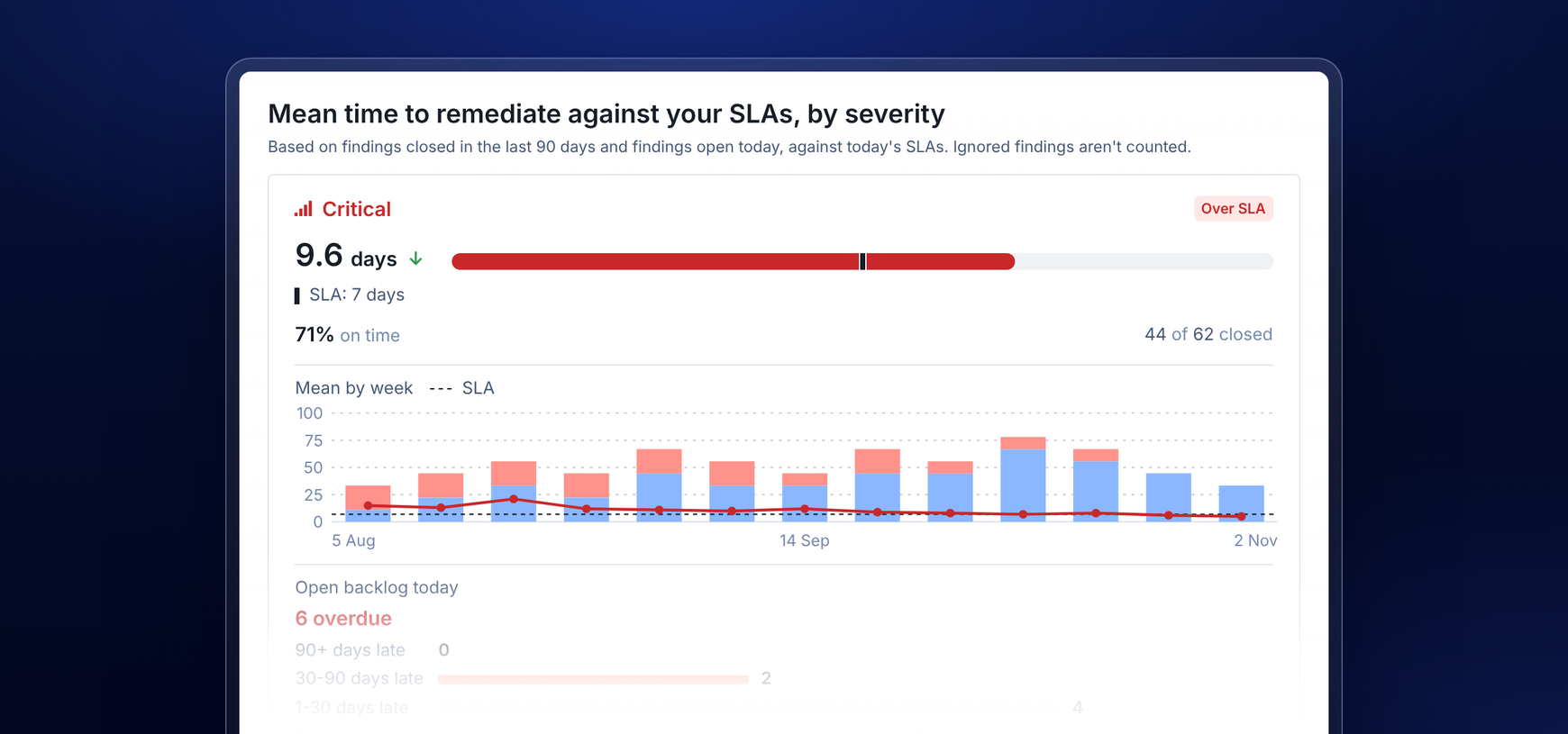
Codacy launched a new Remediation report that gives security teams a dedicated view into SLASLAA formal agreement between a service provider and customer that defines expected uptime, response times, and remedies for failures, giving cyber tools a contractual baseline for availability and support commitments. compliance, mean time to remediate, and backlog aging across all finding sources.︀︄︇︀︅︉︀︅︀︀︃︀︀︅︅︀︅︊︀︄︆︀︃︄
Documentation homepage for the Codacy automated code review tool.
Codacy launched a new Remediation report that gives security teams a dedicated view into SLASLAA formal agreement between a service provider and customer that defines expected uptime, response times, and remedies for failures, giving cyber tools a contractual baseline for availability and support commitments. compliance, mean time to remediate, and backlog aging across all finding sources.︀︄︇︀︅︉︀︅︀︀︃︀︀︅︅︀︅︊︀︄︆︀︃︄
└──▷ WHAT SHIPPED ·
1 FEATURE0 OF 1 FEATUREmost completely described firstwhat's the number?
Each feature carries 0–100 for how completely the vendor documented
it — not how big or important the work is. A major capability
described in eight words scores low, and that is the finding.
depth0–40what it does and how it works or what changed
specificity0–30names real surfaces — APIs, flags, formats, limits, numbers
actionability0–30enough to go use it — a named endpoint, flag, or config key tops this; a UI path is a starting point
Code and config rank first by construction: a documented endpoint,
flag or config key scores at the top of specificity and actionability,
so it sorts above a feature described only in prose. Under
60 the notes go thin — everything below the “thinner
coverage” line is thinner documentation, not smaller work.
Hover any meter for that feature's three sub-scores.
0100
Remediation report for SLA trackingNot checked yetnew88how completely this was documenteddepth35/40specificity28/30actionability25/3088 / 100
A new Remediation report page under Security and risk → Reports → Remediation shows, per severity (Critical, High, Medium, Low): Within SLA or Over SLA status, mean time to remediate (MTTRMTTRMean Time To Recover — the average elapsed time between a failure occurring and the system being restored, used by cyber tools to benchmark incident-response efficiency.) vs.︀︄︇︀︅︉︀︅︀︀︃︀︀︅︅︀︅︊︀︄︆︀︃︄ the SLA, share of findings closed on time with counts, a weekly trend chart, and an open backlog split into 1–30, 30–90, and 90+ days overdue. It can be filtered by Segments, Repositories, and Scan types, with filter state encoded in the page URL so a shared link reproduces the exact view. SLAs are configured directly from the report via the Configure SLAs control at top right, defaulting to 30, 60, 90, and 120 days from Critical to Low when none are set. Coverage spans Codacy's own analysis, app scanning, container scanning, penetration tests, and security tickets imported from Jira; the report covers a rolling 90-day window, and longer audit records (e.g. six or twelve months) require capturing monthly snapshots via the Codacy API.
Navigate to the Remediation report to get a one-screen answer on SLA compliance before a quarterly security review.
📍In Codacy, go to Security and risk → Reports → Remediation. Select the desired Segments, Repositories, and Scan types — the resulting URL encodes your filters so you can share the exact view with leadership.
— Names exact nav path, config control, defaults, filters, and data sources.launch-20261124-ec758b11
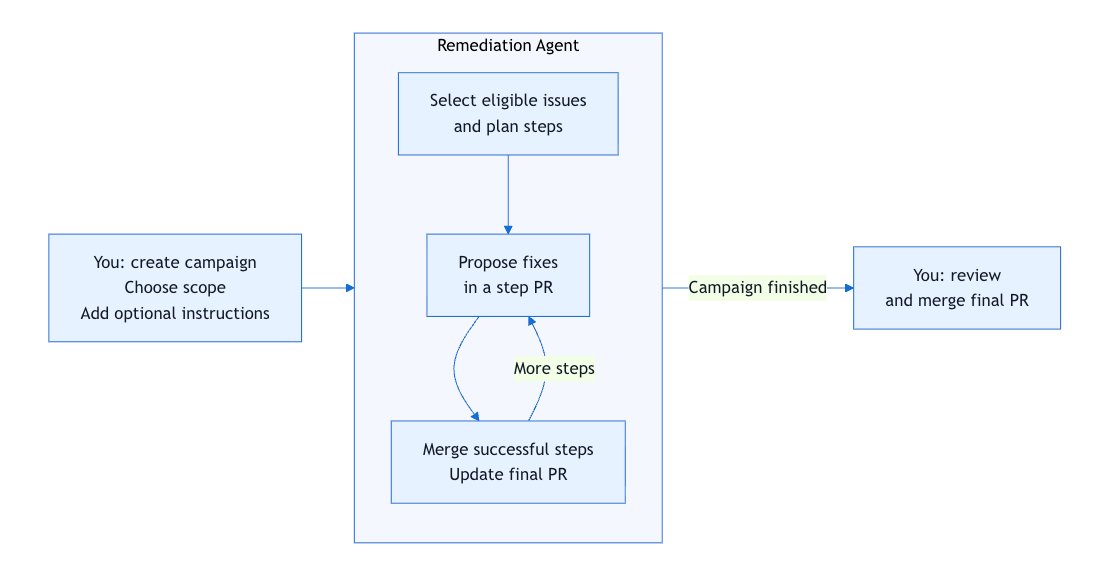
SonarQube Cloud's biggest addition this window is Remediation campaigns, which let the Remediation Agent work through batches of backlog issues and submit one consolidated pull request, alongside bring-your-own-key LLMLLMA large language model, a neural network trained on large amounts of text to recognize patterns and generate language. Applications use it for tasks such as answering, summarizing and writing code. support for the agent.︀︄︇︀︅︉︀︅︀︀︃︀︀︅︅︀︅︊︀︄︆︀︃︄
SonarQube is an enforce consistent quality gates across every pull request and pipeline, from IDE to CI/CD, with automated code review for bugs and security issues.
SonarQube Cloud's biggest addition this window is Remediation campaigns, which let the Remediation Agent work through batches of backlog issues and submit one consolidated pull request, alongside bring-your-own-key LLMLLMA large language model, a neural network trained on large amounts of text to recognize patterns and generate language. Applications use it for tasks such as answering, summarizing and writing code. support for the agent.︀︄︇︀︅︉︀︅︀︀︃︀︀︅︅︀︅︊︀︄︆︀︃︄
└──▷ WHAT SHIPPED ·
2 FEATURES1 OF 2 FEATURESmost completely described firstwhat's the number?
Each feature carries 0–100 for how completely the vendor documented
it — not how big or important the work is. A major capability
described in eight words scores low, and that is the finding.
depth0–40what it does and how it works or what changed
specificity0–30names real surfaces — APIs, flags, formats, limits, numbers
actionability0–30enough to go use it — a named endpoint, flag, or config key tops this; a UI path is a starting point
Code and config rank first by construction: a documented endpoint,
flag or config key scores at the top of specificity and actionability,
so it sorts above a feature described only in prose. Under
60 the notes go thin — everything below the “thinner
coverage” line is thinner documentation, not smaller work.
Hover any meter for that feature's three sub-scores.
0101
Remediation campaigns for backlog issuesNot checked yetnew88how completely this was documenteddepth35/40specificity28/30actionability25/3088 / 100
SonarQube Cloud adds Remediation campaigns, a mode where the Remediation Agent works through up to 200 related backlog issues in steps on a separate campaign branch, then opens one final pull request for team review.︀︄︇︀︅︉︀︅︀︀︃︀︀︅︅︀︅︊︀︄︆︀︃︄ Enable it via Manual backlog remediation under Administration > AI capabilities > Remediation Agent for GitHub-bound projects on Team (annual) or Enterprise plans. Scope a campaign by selecting specific issues, using Assigned to me, targeting issues Blocking the quality gate, or leaving all checkboxes cleared to let the agent start with the most severe eligible issues; provide a plain-language goal of up to 1,800 characters under Specify instructions for the agent. Track progress per step — including skipped, closed, and merged steps — from the project's Agent activity page filtered by the Campaign source. Campaigns support Java, JavaScript/TypeScript, Python, C, C++, C#, PHP, and secrets, and can include eligible SonarQube Hunter Agent findings regardless of language.
Enable Remediation campaigns for GitHub-bound projects so the Remediation Agent can work through backlog issues automatically.
📍In SonarQube Cloud, go to Administration › AI capabilities › Remediation Agent, then under Enable agent toggle on Manual backlog remediation, and select Save.
Start a focused campaign to clear quality-gate-blocking issues in a project, with a plain-language goal to guide the agent.
📍On your project's Issues page (main branch), select Blocking the quality gate under Recommended issues to be fixed, enter a goal such as 'Fix null pointer issues in the billing module' (up to 1,800 characters) under Specify instructions for the agent, then select Create campaign.
BYOK LLM API keys for Remediation AgentNot checked yetnew70how completely this was documenteddepth25/40specificity25/30actionability20/3070 / 100
Add a bring-your-own-key (BYOKBYOKBring Your Own Key — a cloud deployment model where the customer supplies and controls the encryption keys rather than the provider, so sensitive data stays under the customer's cryptographic authority.) LLM API key under Administration > AI capabilities > LLM API Keys, supporting OpenAI or Anthropic keys, up to three keys per organization; SonarQube Cloud verifies the key with the provider before saving.
Add a BYOK OpenAI or Anthropic API key so the Remediation Agent uses your own LLM provider instead of the Sonar-provided one.
📍In SonarQube Cloud, go to Administration › AI capabilities › LLM API Keys, choose OpenAI or Anthropic, enter your key and a name, and select Add key. SonarQube Cloud verifies the key with your provider before saving.
Black Duck helps organizations secure their software supply chain by providing deep visibility into open source components, licenses, and vulnerabilities.
Black Duck's Polaris release adds LLMLLMA large language model, a neural network trained on large amounts of text to recognize patterns and generate language. Applications use it for tasks such as answering, summarizing and writing code.-powered Signal AI Code Analysis for any programming language, native work-item export to external issue trackers, configurable token expiration, and scheduling for fAST Dynamic scans, alongside Bridge 4.6.0 updates for scoped automated remediation and Rapid Scan Static.︀︄︇︀︅︉︀︅︀︀︃︀︀︅︅︀︅︊︀︄︆︀︃︄
└──▷ WHAT SHIPPED ·
6 FEATURES1 OF 6 FEATURESmost completely described firstwhat's the number?
Each feature carries 0–100 for how completely the vendor documented
it — not how big or important the work is. A major capability
described in eight words scores low, and that is the finding.
depth0–40what it does and how it works or what changed
specificity0–30names real surfaces — APIs, flags, formats, limits, numbers
actionability0–30enough to go use it — a named endpoint, flag, or config key tops this; a UI path is a starting point
Code and config rank first by construction: a documented endpoint,
flag or config key scores at the top of specificity and actionability,
so it sorts above a feature described only in prose. Under
60 the notes go thin — everything below the “thinner
coverage” line is thinner documentation, not smaller work.
Hover any meter for that feature's three sub-scores.
0100
Issue-type filters for Fix PRs and PR CommentsNot checked yetnew90how completely this was documenteddepth30/40specificity30/30actionability30/3090 / 100
Restrict Bridge 4.6.0 automated remediation to specific finding types using the polaris.fixpr.filter.issueTypes and polaris.prComment.filter.issueTypes config keys, letting teams scope automated Fix PRs (e.g.︀︄︇︀︅︉︀︅︀︀︃︀︀︅︅︀︅︊︀︄︆︀︃︄ to SCASCASoftware composition analysis, identifying third-party dependencies and checking them for known vulnerabilities and license issues. It covers software a team uses rather than writes itself.) and PR Comments (e.g. to SASTSASTStatic application security testing, analyzing source code or compiled code for vulnerabilities without running the application. It helps developers find problems before deployment.) independently so noisy suggestions from one issue type don't trigger unwanted actions in the other.
Restrict automated Fix PRs to SCA findings only in a Bridge 4.6.0 config, so noisy SAST suggestions don't generate unwanted pull requests.
yaml
polaris.fixpr.filter.issueTypes: SCA
Restrict PR Comments to SAST findings only while keeping SCA fix PRs separate, giving different teams independent control over automated remediation scope.
Signal AI Code Analysis for any languageNot checked yetnew83how completely this was documenteddepth35/40specificity28/30actionability20/3083 / 100
New Signal AI Code Analysis uses LLM reasoning to find vulnerabilities in any programming language — including COBOL, Bash, and RPG — without build configuration, surfacing findings as an AI tool type alongside existing SAST and SCA results. AI Analysis can be enabled at the Organization, Application, or Project level to control rollout scope, and a custom LLM can be configured for Signal in Bridge 4.6.0.
Initiate an AI scan of a COBOL or Bash codebase that existing SAST rules don't cover, using the Source Upload workflow in the Polaris UI with no build configuration required.
📍In the Polaris UI, go to your project, select Source Upload, upload your source archive, then view findings under the AI tool type filter alongside your SAST and SCA results.
Work item export to external issue trackersNot checked yetnew75how completely this was documenteddepth30/40specificity30/30actionability15/3075 / 100
Export Polaris findings as native work items (Bugs, Tasks, or Issues) to Azure DevOps Server (2019, 2020, 2022), GitHub Enterprise Server (3.16–3.18), or GitLab Self-Managed (16.11–18.4) through a secure tunnel with bidirectional status sync.
Configurable expiration for tokensNot checked yetnew65how completely this was documenteddepth25/40specificity25/30actionability15/3065 / 100
Set token expiration for service account tokens and personal access tokenspersonal access tokensA personal access token, a credential used by scripts and integrations instead of a user's password. Its permissions and expiry depend on the service issuing it. (PATsPATsA personal access token, a credential used by scripts and integrations instead of a user's password. Its permissions and expiry depend on the service issuing it.) with preset durations (seven days, 30 days, 90 days), a custom date, or no expiration when creating or regenerating a token.
Scheduled fAST Dynamic scansNot checked yetnew60how completely this was documenteddepth25/40specificity20/30actionability15/3060 / 100
Schedule fAST Dynamic scans on a daily or weekly Test Scheduling Policy alongside SAST and SCA, with support for policy inheritance and auto-assignment during project onboarding.
Veracode is a cloud-based application security platform that scans code for vulnerabilities using static, dynamic, and software composition analysis testing methods.
Veracode's CLI gained five new subcommands (static fix automation, DASTDASTDynamic application security testing, probing a running application from the outside for vulnerabilities. It checks behavior exposed through the application's interfaces. login recording, Git-integrated static scanning, cached findings access, and toolchain discovery), broad packaging support for more languages and CI/CD signaling, RBACRBACRole-based access control, where permissions are assigned to roles such as reader or administrator and users receive those roles. It makes access easier to manage than individual permission lists. for container/IaCIaCInfrastructure as Code: the practice of defining and provisioning compute infrastructure through machine-readable config files rather than manual processes, giving cyber tools repeatable, version-controlled environment setup. scans, and an asynchronous remediation mode for SCASCASoftware composition analysis, identifying third-party dependencies and checking them for known vulnerabilities and license issues. It covers software a team uses rather than writes itself..︀︄︇︀︅︉︀︅︀︀︃︀︀︅︅︀︅︊︀︄︆︀︃︄
└──▷ WHAT SHIPPED ·
8 FEATURES0 OF 8 FEATURESmost completely described firstwhat's the number?
Each feature carries 0–100 for how completely the vendor documented
it — not how big or important the work is. A major capability
described in eight words scores low, and that is the finding.
depth0–40what it does and how it works or what changed
specificity0–30names real surfaces — APIs, flags, formats, limits, numbers
actionability0–30enough to go use it — a named endpoint, flag, or config key tops this; a UI path is a starting point
Code and config rank first by construction: a documented endpoint,
flag or config key scores at the top of specificity and actionability,
so it sorts above a feature described only in prose. Under
60 the notes go thin — everything below the “thinner
coverage” line is thinner documentation, not smaller work.
Hover any meter for that feature's three sub-scores.
0100
veracode package command enhancementsNot checked yetimproved87how completely this was documenteddepth32/40specificity30/30actionability25/3087 / 100
The veracode package command's veracode package discover subcommand was extended to detect toolchains for Java projects using Gradle and JavaScript projects using npm or Yarn, and veracode package itself gained the --csharp-source flag to package C# source directly for Static Analysis, --skip-packagers to exclude artifacts such as unsupported SQL, --java-source and VERACODE_PACKAGE_JAVA_SOURCE=true for Java source packaging, VERACODE_PACKAGE_GOLANG_GENERATE for Go CGO code generation, SRCLR_MAKE_WINDOWS to preprocess C/C++ source with Make using a native Windows gcc or clang compiler, new exit codes 5, 6, and 7 for CI/CD pipeline automation, support for the Poetry package manager in Python autopackaging, and support for requirements-dev.txt in Python packaging workflows.︀︄︇︀︅︉︀︅︀︀︃︀︀︅︅︀︅︊︀︄︆︀︃︄
Package a C# project without a build step so you can submit source directly for Static Analysis in a CI pipeline that lacks a full .NET build environment.
$ veracode package --csharp-source
— Names command and detected toolchains, no example Lists every flag and env var verbatim with one runnable exampleVeracode CLI (2026-11-24)
0200
veracode dynamic record for DAST login scriptsNot checked yetnew78how completely this was documenteddepth28/40specificity22/30actionability28/3078 / 100
New veracode dynamic record command records a Chrome login sequence and saves it as a SIDE file that can be used as a DAST login script, useful when manual auth flows are hard to replicate.
Record a DAST login sequence in Chrome to generate a SIDE file you can upload as a login script, useful when manual auth flows are hard to replicate.
veracode fix static command with remote remediationNot checked yetnew73how completely this was documenteddepth25/40specificity20/30actionability28/3073 / 100
New veracode fix static command requests Static Analysis remediation, with a --remote flag to trigger GitHub remediation requests directly, e.g. for use in a CI workflow without a local environment.
Trigger Static Analysis remediation from a GitHub ActionsGitHub ActionsGitHub's built-in CI/CD system that runs automated workflows triggered by repository events, letting cyber tools automate testing, building, and releasing without managing separate pipeline infrastructure. workflow using the remote flag so fixes are requested without a local environment.
RBAC and findings handling in veracode scanNot checked yetimproved65how completely this was documenteddepth28/40specificity22/30actionability15/3065 / 100
The veracode scan command added role-based access controlrole-based access controlRole-based access control, where permissions are assigned to roles such as reader or administrator and users receive those roles. It makes access easier to manage than individual permission lists. (RBAC) for container and IaC scans, restricting developers to application profiles associated with their teams; categorizes secret-type findings as Critical; prioritizes vulnerability results from the NVDNVDThe National Vulnerability Database, maintained by NIST, is the U.S. government repository of CVE records enriched with CVSS scores and metadata; cyber tools query it to drive vulnerability prioritization. database when available; and allows applying a custom policy defined in the Veracode Platform, with policy evaluation for individual findings.
Fire-and-Forget async mode for veracode fix scaNot checked yetimproved55how completely this was documenteddepth25/40specificity15/30actionability15/3055 / 100
The veracode fix sca command now supports asynchronous Fire-and-Forget (FnF) mode, submitting remediation requests for background processing without waiting for fixes or pull requests.
veracode scan static for Git-integrated scanningNot checked yetnew50how completely this was documenteddepth20/40specificity15/30actionability15/3050 / 100
New veracode scan static command runs static scans and reviews findings within a Git workflow.
Target UUID support in veracode dynamic scanNot checked yetimproved40how completely this was documenteddepth15/40specificity15/30actionability10/3040 / 100
The veracode dynamic scan command now supports target UUIDsUUIDsA universally unique identifier, usually a 128-bit value used to identify an object across systems. It is designed to make independently generated identifiers unlikely to collide. for triggering scans in addition to webhook UUIDs.
Aguara's v0.29.0 release tightens its capability-based findings — cutting false positives on explicit privilege drops, downgrading Kubernetes SETUID/SETGID requests to LOW severity, and restoring a regressed cron-write detector — while raising the Go toolchain requirement and expanding the analyzer/category vocabulary.︀︄︇︀︅︉︀︅︀︀︃︀︀︅︅︀︅︊︀︄︆︀︃︄
Aguara's v0.29.0 release tightens its capability-based findings — cutting false positives on explicit privilege drops, downgrading Kubernetes SETUID/SETGID requests to LOW severity, and restoring a regressed cron-write detector — while raising the Go toolchain requirement and expanding the analyzer/category vocabulary.︀︄︇︀︅︉︀︅︀︀︃︀︀︅︅︀︅︊︀︄︆︀︃︄
└──▷ WHAT SHIPPED ·
5 FEATURES1 OF 5 FEATURESmost completely described firstwhat's the number?
Each feature carries 0–100 for how completely the vendor documented
it — not how big or important the work is. A major capability
described in eight words scores low, and that is the finding.
depth0–40what it does and how it works or what changed
specificity0–30names real surfaces — APIs, flags, formats, limits, numbers
actionability0–30enough to go use it — a named endpoint, flag, or config key tops this; a UI path is a starting point
Code and config rank first by construction: a documented endpoint,
flag or config key scores at the top of specificity and actionability,
so it sorts above a feature described only in prose. Under
60 the notes go thin — everything below the “thinner
coverage” line is thinner documentation, not smaller work.
Hover any meter for that feature's three sub-scores.
0100
Kubernetes SETUID/SETGID severity downgradeNot checked yetbreaking95how completely this was documenteddepth35/40specificity30/30actionability30/3095 / 100
Kubernetes workloads requesting SETUID or SETGID now report as a LOW observation under K8S_IDENTITY_CAPABILITIES_001 instead of a HIGH finding, so they no longer fail a --fail-on high gate on their own; use --fail-on low to keep gating on these.︀︄︇︀︅︉︀︅︀︀︃︀︀︅︅︀︅︊︀︄︆︀︃︄ Previously accepted SUPPLY_007 findings for these requests reappear as K8S_IDENTITY_CAPABILITIES_001 once the baseline is regenerated.
Re-gate CI on Kubernetes SETUID/SETGID requests after the severity downgrade, so a workload requesting those capabilities still fails the pipeline.
$ aguara scan --ci--fail-on low .
Regenerate your project baseline after upgrading so stale MCP_009 and SUPPLY_007 entries are replaced with the new finding IDs.
$ aguara audit . --write-baseline
— Exact finding ID, severity change, and re-gating command givenv0.29.0
0200
Context-aware MCP and supply-chain capability checksNot checked yetimproved85how completely this was documenteddepth32/40specificity28/30actionability25/3085 / 100
Capability drops, setuid: false, setgid: false, descriptions, and comments no longer trigger MCP_009 or SUPPLY_007, reducing false alarms when a manifest explicitly drops privileges. Baselines must be regenerated with aguara audit . --write-baseline since stale MCP_009 and SUPPLY_007 entries accepted under the old logic no longer match.
Regenerate your project baseline after upgrading so stale MCP_009 and SUPPLY_007 entries are replaced with the new finding IDs.
$ aguara audit . --write-baseline
— Names exact flags, finding IDs, and the regeneration commandv0.29.0
thinner coverage below
0301
New analyzer and category values for JSON findingsNot checked yetbreaking55how completely this was documenteddepth15/40specificity25/30actionability15/3055 / 100
JSON finding consumers that filter by analyzer or category should now also accept mcp-capability, kube-policy, and container-security.
— Lists exact new values, no integration examplev0.29.0
0400
Cron-write detection restored under SC-EX-007Not checked yetimproved52how completely this was documenteddepth20/40specificity22/30actionability10/3052 / 100
Direct Python cron writes to /etc/cron.d/<name> or /etc/crontab are now detected again under SC-EX-007.
— Names paths and finding ID but no usage examplev0.29.0
0500
Go 1.26.0 toolchain requirementNot checked yetbreaking40how completely this was documenteddepth10/40specificity20/30actionability10/3040 / 100
Building from source, go install, and importing the Go library now require Go 1.26.0 or later.
Building from source, go install, and importing the Go library now require Go 1.26.0 or later.
!
A SETUID/SETGID capability addition no longer fails scan --ci or --fail-on high on its own; use --fail-on low to keep failing on these requests.
!
Baselines must be regenerated with --write-baseline: MCP_009 findings accepted in an older baseline no longer match, and accepted SUPPLY_007 findings for Kubernetes capability requests reappear as K8S_IDENTITY_CAPABILITIES_001.
!
JSON finding consumers that filter by analyzer or category must now also accept mcp-capability, kube-policy, and container-security.
Infisical is an open-source secret management platform that helps teams securely store, sync, and manage API keys, environment variables, and other sensitive credentials.
Infisical's v0.167.15 release adds GCP workload identity federationworkload identity federationA mechanism that lets a workload running in one cloud or platform prove its identity to another service using a trusted token exchange, eliminating the need to store long-lived credentials or secrets. for app connections, recursive folder access queries, and tightens API security with new response headers and admin sign-up restrictions.︀︄︇︀︅︉︀︅︀︀︃︀︀︅︅︀︅︊︀︄︆︀︃︄
└──▷ WHAT SHIPPED ·
6 FEATURES0 OF 6 FEATURESmost completely described firstwhat's the number?
Each feature carries 0–100 for how completely the vendor documented
it — not how big or important the work is. A major capability
described in eight words scores low, and that is the finding.
depth0–40what it does and how it works or what changed
specificity0–30names real surfaces — APIs, flags, formats, limits, numbers
actionability0–30enough to go use it — a named endpoint, flag, or config key tops this; a UI path is a starting point
Code and config rank first by construction: a documented endpoint,
flag or config key scores at the top of specificity and actionability,
so it sorts above a feature described only in prose. Under
60 the notes go thin — everything below the “thinner
coverage” line is thinner documentation, not smaller work.
Hover any meter for that feature's three sub-scores.
0100
CSP and Permissions-Policy headers on API responsesNot checked yetimproved60how completely this was documenteddepth20/40specificity25/30actionability15/3060 / 100
Infisical's API now sends Content-Security-Policy and Permissions-PolicyPermissions-PolicyAn HTTP response header that lets a server declare which browser features—camera, geolocation, microphone—are allowed or blocked for a page and its iframes, replacing the older Feature-Policy header. headers on all responses.︀︄︇︀︅︉︀︅︀︀︃︀︀︅︅︀︅︊︀︄︆︀︃︄
— Names exact headers, verifiable via response inspectionv0.167.15
thinner coverage below
0200
GCP workload identity federation for app connectionsNot checked yetnew50how completely this was documenteddepth20/40specificity20/30actionability10/3050 / 100
Infisical adds GCP workload identityworkload identityAn identity assigned to software, such as a service or container, rather than a person. It lets the workload authenticate and receive permissions without sharing a user's credentials. federation support as an authentication method for app connections.
— Names the integration but no setup steps providedv0.167.15
0300
Token-gated super-admin sign-upNot checked yetnew45how completely this was documenteddepth20/40specificity15/30actionability10/3045 / 100
Super-admin sign-up can now be restricted to users who hold an activation token, via a new token-gated sign-up flow.
— Describes the restriction but no exact flag or config key givenv0.167.15
0400
Recursive folder access queries and redesigned access sheetNot checked yetimproved45how completely this was documenteddepth20/40specificity15/30actionability10/3045 / 100
Recursive folder access queries from the root are now supported, paired with a redesigned folder access sheet that shows role context and recursion.
— Explains behaviour and UI change but no exact navigation pathv0.167.15
0500
Re-import deleted certificates in PKI moduleNot checked yetnew40how completely this was documenteddepth15/40specificity15/30actionability10/3040 / 100
The PKIPKIA framework of policies, roles, and cryptographic standards for issuing and managing digital certificates that bind public keys to identities, letting tools verify authenticity and encrypt communications without pre-shared secrets. module now allows re-importing previously deleted certificates.
— Clear capability named but no steps or limits givenv0.167.15
0600
Reusable hooks on agent vaultsNot checked yetnew25how completely this was documenteddepth10/40specificity10/30actionability5/3025 / 100
Reusable hooks can now be attached to agent vaults, one per service.
— Bare mention with no mechanism or configuration detailv0.167.15
GitGuardian Detection Engine scans code repositories and developer workflows to automatically detect exposed secrets, API keys, and credentials in real time.
DataDome protects web, mobile, and API applications by detecting and blocking bot and fraud traffic.
DataDome's Flutter Dio SDK gained Android Gradle Plugin 9 support, and the Traefik module now forwards more header data for bot-detection analysis.︀︄︇︀︅︉︀︅︀︀︃︀︀︅︅︀︅︊︀︄︆︀︃︄
└──▷ WHAT SHIPPED ·
2 FEATURES0 OF 2 FEATURESmost completely described firstwhat's the number?
Each feature carries 0–100 for how completely the vendor documented
it — not how big or important the work is. A major capability
described in eight words scores low, and that is the finding.
depth0–40what it does and how it works or what changed
specificity0–30names real surfaces — APIs, flags, formats, limits, numbers
actionability0–30enough to go use it — a named endpoint, flag, or config key tops this; a UI path is a starting point
Code and config rank first by construction: a documented endpoint,
flag or config key scores at the top of specificity and actionability,
so it sorts above a feature described only in prose. Under
60 the notes go thin — everything below the “thinner
coverage” line is thinner documentation, not smaller work.
Hover any meter for that feature's three sub-scores.
0100
Android Gradle Plugin 9 support in Flutter Dio SDKNot checked yetimproved65how completely this was documenteddepth25/40specificity25/30actionability15/3065 / 100
The Flutter Dio SDK adds support for Android Gradle Plugin (AGP) 9, including its built-in Kotlin support, requiring Flutter 3.47+ and Kotlin 2.2.20+, while retaining AGP 8 support via the kotlin-android Kotlin Gradle plugin.︀︄︇︀︅︉︀︅︀︀︃︀︀︅︅︀︅︊︀︄︆︀︃︄
Larger header list truncation in Traefik moduleNot checked yetimproved50how completely this was documenteddepth20/40specificity20/30actionability10/3050 / 100
DataDome's Traefik module now truncates the HeadersList at 768 characters instead of 512, allowing more header data to be forwarded for bot-detection analysis.
Unfurl is an open-source forensic tool that deconstructs URLs, breaking them into components to reveal embedded metadata, timestamps, tracking parameters, and other hidden information.
Unfurl's latest release overhauls its JSON output into proper nested and flat formats with regex filtering, adds new ID parsers for Timeflake, Notion, and Kimi IDs, and introduces safety limits for short-link expansion.︀︄︇︀︅︉︀︅︀︀︃︀︀︅︅︀︅︊︀︄︆︀︃︄
└──▷ WHAT SHIPPED ·
5 FEATURES0 OF 5 FEATURESmost completely described firstwhat's the number?
Each feature carries 0–100 for how completely the vendor documented
it — not how big or important the work is. A major capability
described in eight words scores low, and that is the finding.
depth0–40what it does and how it works or what changed
specificity0–30names real surfaces — APIs, flags, formats, limits, numbers
actionability0–30enough to go use it — a named endpoint, flag, or config key tops this; a UI path is a starting point
Code and config rank first by construction: a documented endpoint,
flag or config key scores at the top of specificity and actionability,
so it sorts above a feature described only in prose. Under
60 the notes go thin — everything below the “thinner
coverage” line is thinner documentation, not smaller work.
Hover any meter for that feature's three sub-scores.
0100
Real JSON output formats for CLINot checked yetimproved95how completely this was documenteddepth35/40specificity30/30actionability30/3095 / 100
The CLI now emits real JSON via -t json (a nested tree where each node holds its derived nodes) or the new -t json-flat (a flat list using a parent_id field), both written as JSON Lines to stdout or via -o.︀︄︇︀︅︉︀︅︀︀︃︀︀︅︅︀︅︊︀︄︆︀︃︄ Each output object includes input, unfurl_version, and a lineage field; previously the output was Python repr rather than valid JSON.
Extract all timestamps from a URL as machine-readable JSON, piped into jq for filtering — now that -t json outputs valid JSON Lines instead of Python repr.
— Flags, output fields, and a runnable example are all specified.v2026.11.24
0200
Regex filtering of JSON outputNot checked yetnew80how completely this was documenteddepth30/40specificity20/30actionability30/3080 / 100
The new -f flag filters JSON output with a regex: in nested mode it keeps matching nodes plus their ancestors (marked matched), while in flat mode it keeps only the matching nodes.
Isolate only timestamp nodes from a batch file of URLs using the JSON filter, keeping ancestors for context.
$ unfurl -t json -f timestamp urls.txt
— Exact flag behavior per output mode and a runnable example given.v2026.11.24
0300
Timeflake ID parserNot checked yetnew70how completely this was documenteddepth30/40specificity25/30actionability15/3070 / 100
Unfurl adds a parser that recognises Timeflake 128-bit IDs in 32-hex, 22-base62, or dashed UUIDUUIDA universally unique identifier, usually a 128-bit value used to identify an object across systems. It is designed to make independently generated identifiers unlikely to collide. form, identifying them by length and a plausible embedded timestamp from 2020 onward.
— Mechanism and formats detailed, but no example command shown.v2026.11.24
thinner coverage below
0400
Notion and Kimi ID parsersNot checked yetnew20how completely this was documenteddepth10/40specificity10/30actionability0/3020 / 100
Unfurl also adds parsers to recognise Notion and Kimi IDs embedded in URLs, alongside the new Timeflake parser.
— Parsers are only named; no mechanism or example provided.v2026.11.24
0500
Short-link expansion safety limitsNot checked yetnew10how completely this was documenteddepth5/40specificity5/30actionability0/3010 / 100
Unfurl adds safety limits when expanding short links, though no further mechanism or configuration detail is given.
— Mentioned only in the release summary with no detail.v2026.11.24
ALEAPP's v2026.4.6 release adds Signal on-device backup decryption, dozens of new artifact parsers spanning Samsung, Google, messaging apps and system/app data, native Linux .deb/.rpm packages, and a round of report-rendering fixes.︀︄︇︀︅︉︀︅︀︀︃︀︀︅︅︀︅︊︀︄︆︀︃︄
ALEAPP (Android Logs Events And Protobuf Parser) is a digital forensics tool that parses and analyzes Android device artifacts for investigative purposes.
ALEAPP's v2026.4.6 release adds Signal on-device backup decryption, dozens of new artifact parsers spanning Samsung, Google, messaging apps and system/app data, native Linux .deb/.rpm packages, and a round of report-rendering fixes.︀︄︇︀︅︉︀︅︀︀︃︀︀︅︅︀︅︊︀︄︆︀︃︄
└──▷ WHAT SHIPPED ·
6 FEATURES0 OF 6 FEATURESmost completely described firstwhat's the number?
Each feature carries 0–100 for how completely the vendor documented
it — not how big or important the work is. A major capability
described in eight words scores low, and that is the finding.
depth0–40what it does and how it works or what changed
specificity0–30names real surfaces — APIs, flags, formats, limits, numbers
actionability0–30enough to go use it — a named endpoint, flag, or config key tops this; a UI path is a starting point
Code and config rank first by construction: a documented endpoint,
flag or config key scores at the top of specificity and actionability,
so it sorts above a feature described only in prose. Under
60 the notes go thin — everything below the “thinner
coverage” line is thinner documentation, not smaller work.
Hover any meter for that feature's three sub-scores.
0100
New artifact parsersNot checked yetnew90how completely this was documenteddepth30/40specificity30/30actionability30/3090 / 100
Adds new artifact parsers across platforms: Samsung Messages, visual voicemail, Phone RTT call text, Quick Share transfers and link shares, Find devices and locations, Reminder, Voice Recorder, Gallery search and operation history, Clock alarms and world clocks, Calculator history, Internet bookmarks, saved pages, tabs, search history, quick access and web notifications, Health weight, steps and medications, Digital Wellbeing timers, context engine, Secure Folder file operations, vold external storage events, Customization Service screen state, Cloud Clock Offset, and encrypted Health and Customization Service stores; Google Find My Device locations and devices, GMS semantic location with activity and Wi-Fi, Contact Keys, Google Accounts from accounts_ce.db, the Play Services SMSSMSShort Message Service, the protocol built into cellular networks for sending text messages between phones; cyber tools use it for alerting, two-factor authentication delivery, or phishing simulation over mobile channels. index, the advertising ID, AdServices attribution and consent, Calculator history, Chrome Accounts and Reading List, and Chromium Favicons; WhatsApp status updates and viewers, Business tools, local and Google Drive backups, and the default disappearing messages timer; Signal conversation view, account, image cache, and on-device backups, decryptable by supplying the account's 64-character recovery key with --signal_recovery_key_file or --signal_recovery_key_env (without a key the backup folder is listed but not decrypted); Threema account, contacts, messages and media; Jami; Zangi calls and groups; newer Wire databases when the extraction carries the keys; Telegram downloaded media linked from file_to_path.db with Saved Messages chat labelled; LINE messages without a contacts table; App Ops access history on Android 16, Telephony Analytics, URI permission grants, companion device associations, enabled accessibility services, Android Keystore entries, wallpapers, Photo Picker synthetic files, SMS device clock gap, bug report shortcuts, Beats devices, and battery usage on v10 and v11 databases for every user; and Snapchat Conversation Turn Events, Last Saved Location and Client Notifications, TikTok search history and play records, Spotify stores, Stock Android Browser and Email, KDL artifacts, Smart Select fragments, the Protected Notes app, and a LAVA conversation view for ChatGPT.︀︄︇︀︅︉︀︅︀︀︃︀︀︅︅︀︅︊︀︄︆︀︃︄
Parse a full-filesystem extraction that includes Signal on-device backups, supplying the recovery key so messages, attachments, recipients and chats are decrypted during the run.
$ aleapp -t zip -i /cases/device_extraction.zip -o /cases/output/ --signal_recovery_key_file /cases/signal_recovery.key
— Names exact flags and shows a runnable command Lists many concrete artifacts but no usage mechanism Names concrete Google artifacts including a specific database path Names many messaging apps and a specific linking database Names specific system artifacts and OS version scope Names several apps and artifact typesv2026.4.6
0200
Lx01 and ASIF support for raw disk imagesNot checked yetimproved65how completely this was documenteddepth20/40specificity20/30actionability25/3065 / 100
Reading disk images with -t raw now also accepts Lx01 and ASIF logical evidence formats, in addition to existing raw image support.
Process a raw disk image that is an Lx01 logical evidence container — now supported directly without mounting.
$ aleapp -t raw -i /cases/evidence.Lx01 -o /cases/output/
— Names the flag and new formats with an example commandv2026.4.6
0300
Report rendering and formatting improvementsNot checked yetimproved60how completely this was documenteddepth25/40specificity25/30actionability10/3060 / 100
LAVA report output header types number, latitude and longitude are now stored as NUMERIC, case data is recorded in the LAVA manifest, and report cells break on every line ending; HEIC media now renders in reports as a JPEG copy generated with heicreader instead of pillow-heif, removing all GPL and LGPL code from packaged builds; HTML email bodies now render as readable text, K-9 plain text parts are decoded, and DeepSeek message text is stored without HTML escapes.
— Names exact header types changed but no usage path Explains mechanism and licensing reason, no user action Names affected apps but no configuration surfacev2026.4.6
thinner coverage below
0400
Linux .deb and .rpm packagesNot checked yetnew50how completely this was documenteddepth15/40specificity20/30actionability15/3050 / 100
Linux packages now include .deb and .rpm for x64 and ARMARMA family of RISC processor architectures designed by Arm Holdings and licensed to chip makers worldwide; tools target it to run natively on mobile, embedded, and increasingly server and desktop hardware. alongside the existing AppImages.
— Names exact package formats and architecturesv2026.4.6
0500
walStrings artifact removedNot checked yetbreaking50how completely this was documenteddepth20/40specificity20/30actionability10/3050 / 100
The walStrings artifact has been removed; it listed ASCII text runs from -wal and -journal files and was already off by default.
— Names the removed artifact and its prior behaviourv2026.4.6
0600
netstats output enhancementsNot checked yetimproved40how completely this was documenteddepth20/40specificity15/30actionability5/3040 / 100
netstats output now shows identity fields, each row's collection and source file, and continues processing when one input is damaged.
— Describes behaviour change but no concrete fields namedv2026.4.6
└──▷ BREAKING ON UPGRADE
!
The walStrings artifact has been removed; it listed ASCII text runs from -wal and -journal files and was already off by default.
iLEAPP is an open-source iOS forensic artifact parsing tool that extracts and analyzes data from iPhone backups and filesystem images.
iLEAPP adds native parsing of raw Lx01/ASIF disk images, decrypts the Find My encrypted location cache using the extraction's keychain key, and ships dozens of new and reworked artifacts spanning BiomeBiomeA fast Rust-based toolchain for JavaScript and TypeScript, maintained by the Biome community, that combines formatting and linting in a single binary so cyber tools can enforce code style without chaining multiple dependencies., knowledgeCknowledgeCAn Apple system database on macOS and iOS that logs per-app usage events; cyber tools query it to reconstruct user activity timelines from forensic images., Health, PowerLog, WhatsApp and numerous third-party apps, alongside LAVA output schema improvements and a reworked GUIGUIA graphical user interface, controls such as windows, buttons and menus. It lets people use software visually rather than entering commands..︀︄︇︀︅︉︀︅︀︀︃︀︀︅︅︀︅︊︀︄︆︀︃︄
└──▷ WHAT SHIPPED ·
11 FEATURES0 OF 11 FEATURESmost completely described firstwhat's the number?
Each feature carries 0–100 for how completely the vendor documented
it — not how big or important the work is. A major capability
described in eight words scores low, and that is the finding.
depth0–40what it does and how it works or what changed
specificity0–30names real surfaces — APIs, flags, formats, limits, numbers
actionability0–30enough to go use it — a named endpoint, flag, or config key tops this; a UI path is a starting point
Code and config rank first by construction: a documented endpoint,
flag or config key scores at the top of specificity and actionability,
so it sorts above a feature described only in prose. Under
60 the notes go thin — everything below the “thinner
coverage” line is thinner documentation, not smaller work.
Hover any meter for that feature's three sub-scores.
0100
Raw Lx01/ASIF disk image parsingNot checked yetnew80how completely this was documenteddepth25/40specificity25/30actionability30/3080 / 100
iLEAPP can now read disk images in Lx01 and ASIF formats directly via -t raw on the CLI, without a separate conversion step.︀︄︇︀︅︉︀︅︀︀︃︀︀︅︅︀︅︊︀︄︆︀︃︄
Parse a raw disk image in Lx01 or ASIF format, now supported directly without conversion.
$ ileapp -t raw -i /path/to/image.lx01 -o /path/to/output/
— runnable CLI command with named flag and formatsv2026.4.7
0200
New Biome artifacts and streamsNot checked yetnew60how completely this was documenteddepth20/40specificity30/30actionability10/3060 / 100
Adds new Biome artifacts and streams: Motion Activity, Location Semantic, Local Authentication Evaluations, Photos Delete/Share/Engagement, Widgets Viewed, Focus Driving, Inferred Mode, Sleep Mode, Find My Location Change, NFCNFCNear Field Communication, a short-range (≤4 cm) wireless standard maintained by the NFC Forum, enabling data exchange between devices; cyber tools use it to probe, emulate, or intercept contactless card and tag transactions. Tag, nearby devices, App Extension Usage, Phone Indexed Calls, Siri Execution, Notification Delivery, and Screenshots; Apple Mail mailIntelligence Biome stream events (app launch, resume, background, message fetch, view, read, sent, moved, link clicked); and Biome streams for FindMy.LocationChange, Device.Wireless.NFCTag, Device.Wireless.DefaultPairedNearby, and Device.Wireless.BluetoothNearbyDevice.
— exhaustive named artifact list but no usage examplev2026.4.7
thinner coverage below
0300
LAVA output schema enhancementsNot checked yetimproved55how completely this was documenteddepth20/40specificity25/30actionability10/3055 / 100
Adds number, latitude, and longitude header types stored as NUMERIC in LAVA output, adds hash columns typed as hashes, and records architecture in run info.
— named schema fields but no example outputv2026.4.7
0400
New third-party app artifactsNot checked yetnew55how completely this was documenteddepth15/40specificity30/30actionability10/3055 / 100
Adds new app artifacts for Citizen, Dust, Locket, Wire (accounts, contacts, media, conversation view), PayPal, Zelle, AnyDesk, OfferUp, Craigslist, Google Measurement (Firebase Analytics), Maps Sync typed and sent queries, Shortcuts, Jami, Calculator history, FaceTime Links, Weather, Configuration Profiles, Cloud Configuration Details, Background URL Session Tasks, Media Playback Event StreamsEvent StreamsAn ordered, append-only log of discrete events published by producers and consumed by subscribers, often in real time; tools use it to process high-volume telemetry without losing ordering or dropping records under load., Omnibox Shortcuts, Google app tabs, and WebKit website data per app; a Zillow Recent Searches artifact parsed from ZRECENTSEARCH in Zillow.sqlite; and three Weather app artifacts: Last Fetch by Coordinate, Current Location, and Reverse Geocode Results.
— long named app/field list, no usage examplev2026.4.7
0500
PowerLog artifact additionsNot checked yetnew55how completely this was documenteddepth20/40specificity25/30actionability10/3055 / 100
Adds PowerLog artifacts for App Run Time per aggregation window, In Call Service, Lightning Connector, Network Usage, Time Zone, locationd Motion State History parsed from cache_encryptedC.db, and netusage Connections fields.
— named source file but no command to run itv2026.4.7
0600
Find My encrypted cache decryptionNot checked yetnew50how completely this was documenteddepth25/40specificity15/30actionability10/3050 / 100
Adds a Find My encrypted cache decryption capability that uses the keychain key obtained from the extraction to decrypt the cache.
— mechanism named but no command or output shownv2026.4.7
0700
knowledgeC artifact expansionNot checked yetimproved45how completely this was documenteddepth20/40specificity20/30actionability5/3045 / 100
Adds knowledgeC artifacts for Application In Focus, notifications, app activity, web usage, and Location Activity payloads decoded by named field, and reworks six existing knowledgeC artifacts.
— named artifact types but no mechanism detailv2026.4.7
0800
New GUI window and config-driven versioningNot checked yetnew45how completely this was documenteddepth15/40specificity15/30actionability15/3045 / 100
Adds a new GUI window; the tool name and version shown now come from data/leapp_config.json instead of being hardcoded.
— named config file gives clear starting pointv2026.4.7
0900
ileappGUI executable removedNot checked yetbreaking45how completely this was documenteddepth15/40specificity15/30actionability15/3045 / 100
The separate ileappGUI executable is removed; running ileapp without arguments now opens the GUI window instead.
— clear migration note on invoking the GUIv2026.4.7
1000
Health artifact additions and reworkNot checked yetimproved40how completely this was documenteddepth20/40specificity15/30actionability5/3040 / 100
Adds a Health Flights Climbed artifact and reworks five Health artifacts to use HealthKit flight and distance type codes.
— named artifact and codes but no usage pathv2026.4.7
1100
WhatsApp message receipts and LID dataNot checked yetnew40how completely this was documenteddepth15/40specificity20/30actionability5/3040 / 100
Adds a WhatsApp Message Receipts artifact and WhatsApp LID phone numbers, group members, and linked group member per message.
— named fields but no mechanism or examplev2026.4.7
└──▷ BREAKING ON UPGRADE
!
The ileappGUI executable is removed; ileapp without arguments now opens the window instead.
ElcomSoft is a try professional password recovery, data decryption, mobile and cloud forensic tools from a manufacturer with 30+ years of expertise, providing tools and training to law enforcement, financial and intelligence agencies.
ElcomSoft's Quick Triage tool gains native mounting of forensic and VM disk images across many formats with a new per-volume mounting layer, plus an Image Management module, archive mounting, drive-letter reconstruction, and reorganized smart folders for artifact triage.︀︄︇︀︅︉︀︅︀︀︃︀︀︅︅︀︅︊︀︄︆︀︃︄
└──▷ WHAT SHIPPED ·
4 FEATURES0 OF 4 FEATURESmost completely described firstwhat's the number?
Each feature carries 0–100 for how completely the vendor documented
it — not how big or important the work is. A major capability
described in eight words scores low, and that is the finding.
depth0–40what it does and how it works or what changed
specificity0–30names real surfaces — APIs, flags, formats, limits, numbers
actionability0–30enough to go use it — a named endpoint, flag, or config key tops this; a UI path is a starting point
Code and config rank first by construction: a documented endpoint,
flag or config key scores at the top of specificity and actionability,
so it sorts above a feature described only in prose. Under
60 the notes go thin — everything below the “thinner
coverage” line is thinner documentation, not smaller work.
Hover any meter for that feature's three sub-scores.
0100
Native mounting of forensic and VM disk imagesNot checked yetnew85how completely this was documenteddepth35/40specificity30/30actionability20/3085 / 100
Natively mounts forensic and VM disk images in RAW/DD, E01E01A forensic disk image format that stores a drive's contents in segmented files with built-in checksums and metadata, widely used in digital forensics because it supports compression and chain-of-custody verification., AFF4, VHD/VHDX, VDIVDIVirtual Desktop Infrastructure: a model where desktop operating systems run as VMs on a central server and stream to thin clients, giving cyber tools a single managed environment to monitor or scan., VMDK, Parallels, and QCOW/QCOW2/QED formats, with NTFSNTFSThe default file system format for Windows, developed by Microsoft, storing files with rich metadata and access controls; cyber tools target it to parse artifacts like timestamps, alternate data streams, and the MFT., FAT, and exFAT partitions on MBR and GPT disks.︀︄︇︀︅︉︀︅︀︀︃︀︀︅︅︀︅︊︀︄︆︀︃︄ Partitions mount as folders using a new per-volume MetaFS layer instead of drive-letter assignment, avoiding drive-letter exhaustion on images with many partitions.
Triage a forensic E01 image from a seized machine without assigning drive letters, then browse its partitions directly in Explorer.
📍In Elcomsoft Quick Triage, go to File › Add Evidence › Disk Image, select your .E01 file, and let EQT ingest it. Open the Image Management module to view partition metadata, then click Mount on the target partition to open it as a folder in Explorer.
Image Management module for mounted volumesNot checked yetnew65how completely this was documenteddepth25/40specificity20/30actionability20/3065 / 100
The new Image Management module lets examiners view partition metadata, batch mount or unmount volumes, open partitions in Explorer, and relink moved image files with Image ID verification.
Triage a forensic E01 image from a seized machine without assigning drive letters, then browse its partitions directly in Explorer.
📍In Elcomsoft Quick Triage, go to File › Add Evidence › Disk Image, select your .E01 file, and let EQT ingest it. Open the Image Management module to view partition metadata, then click Mount on the target partition to open it as a folder in Explorer.
Automatic OS detection and drive-letter reconstructionNot checked yetnew55how completely this was documenteddepth25/40specificity20/30actionability10/3055 / 100
Automatically detects the operating system and reconstructs original Windows drive-letter assignments when ingesting disk images, eliminating manual path translation for Registry hives, Jump Lists, LNK files, and download histories.
Mount ZIP and TAR archives as virtual imagesNot checked yetnew45how completely this was documenteddepth20/40specificity15/30actionability10/3045 / 100
Mount ZIP and TAR archives directly as virtual images without decompression, making the directory tree browsable in Windows Explorer and ready for triage parsing.
Netcap is a framework for secure and scalable analysis of network traffic, converting pcap files into typed audit records for efficient processing.
Netcap reworked all 37 built-in detection rules to count per actor and retired three noisy rules (removing configs/firewall-rules.yml), while adding JA3JA3A method for fingerprinting TLS clients by hashing fields from the ClientHello message, producing a short string that identifies the TLS library or application making a connection regardless of IP or port./JA3SJA3SA TLS fingerprinting method that hashes fields from a server's TLS ServerHello message to identify server-side software and configurations, letting cyber tools detect anomalous or malicious server behavior. TLS fingerprinting, new SMBSMBA network file-sharing protocol developed by Microsoft that lets systems share files, printers, and named pipes over a network; cyber tools target or speak it because it is ubiquitous in Windows environments./HTTP/onion/UDPUDPA network protocol that sends individual messages without guaranteeing delivery or order. Applications trade built-in reliability for less overhead and can add their own recovery. detections, an alert API that separates findings from inventory, and fixes for BPFBPFA Linux kernel virtual machine that lets programs attach small, sandboxed bytecode filters to kernel hooks — syscalls, network events, tracepoints — so cyber tools can observe or redirect kernel behaviour without writing a kernel module.-filtered and Token Ring capture decoding.︀︄︇︀︅︉︀︅︀︀︃︀︀︅︅︀︅︊︀︄︆︀︃︄
└──▷ WHAT SHIPPED ·
12 FEATURES0 OF 12 FEATURESmost completely described firstwhat's the number?
Each feature carries 0–100 for how completely the vendor documented
it — not how big or important the work is. A major capability
described in eight words scores low, and that is the finding.
depth0–40what it does and how it works or what changed
specificity0–30names real surfaces — APIs, flags, formats, limits, numbers
actionability0–30enough to go use it — a named endpoint, flag, or config key tops this; a UI path is a starting point
Code and config rank first by construction: a documented endpoint,
flag or config key scores at the top of specificity and actionability,
so it sorts above a feature described only in prose. Under
60 the notes go thin — everything below the “thinner
coverage” line is thinner documentation, not smaller work.
Hover any meter for that feature's three sub-scores.
0100
Alert API finding/inventory classification and fieldsNot checked yetnew90how completely this was documenteddepth30/40specificity30/30actionability30/3090 / 100
Alert views now support a ?kind=finding|inventory|all query parameter, defaulting to finding to suppress inventory noise from the findings view, and the AlertResponse JSON now includes kind, count, firstSeenNs, lastSeenNs, aggregateKey, and examples fields.︀︄︇︀︅︉︀︅︀︀︃︀︀︅︅︀︅︊︀︄︆︀︃︄
Filter the alert API to show only actionable findings, excluding routine inventory observations like SMB seen or Apache seen.
— Exact endpoint param and fields given with runnable curl examples.v0.16.15
0200
Built-in detection rule rework and retirementsNot checked yetbreaking85how completely this was documenteddepth35/40specificity30/30actionability20/3085 / 100
All 37 built-in threshold rules now count per source, source–destination pair, receiving client, victim, or distinct destination instead of across every host together, with thresholds above 256 counting in time buckets with per-rule state budgets; DNS Beaconing detection now matches queries case-insensitively via fold_case, reducing false positives from name-case variation; and the Port Scan High Port, LDAPLDAPA protocol for querying and modifying directory services, standardized under RFC 4511, commonly used to look up users, groups, and attributes in corporate identity stores like Active Directory. Replication Activity, and Missing Security Headers rules are retired, removing configs/firewall-rules.yml and dropping saved copies of retired rules on load.
— Names all retired rules, removed config file, and matching mechanism.v0.16.14
0300
BPF-filtered capture decoding fixNot checked yetimproved85how completely this was documenteddepth35/40specificity30/30actionability20/3085 / 100
BPF-filtered captures now use the bounded reader and write capture-input.json with a bpfExcludedPackets field recording how many packets were excluded by the filter; records whose caplen exceeds origlen are now decoded and tracked as origLenRaisedPackets, so captures such as sip.pcap process all packets instead of none.
— Named output file, fields, and a concrete before/after example given.v0.16.14
0400
Alert group resolution and oversized record handlingNot checked yetimproved75how completely this was documenteddepth30/40specificity30/30actionability15/3075 / 100
Alert group resolution now records each group once in resolved_alerts.json version 2, and matched records above 256 KiB are replaced by their identity and hash; older alerts above 1 MiB are skipped and counted as skippedOversizedAlerts.
— Names file, version, size thresholds and counter field.v0.16.14
thinner coverage below
0500
Artifact classification and extraction reportingNot checked yetimproved55how completely this was documenteddepth25/40specificity20/30actionability10/3055 / 100
Artifact classification now covers HTML, JavaScript, Flash, and WOFF files, and reports partial extractions and artifact-input loss separately from analysis failures.
— Names formats and distinguishes failure types, no exact fields.v0.16.15
0600
Showcase view capture summaries and limitsNot checked yetimproved50how completely this was documenteddepth20/40specificity20/30actionability10/3050 / 100
Showcase view now includes capture summaries with evidence links, bounded Files and Fingerprints views, visible UDP retention limits, and a detection-rule pack digest in service run records.
— Lists UI additions without exact navigation or values.v0.16.15
0700
Service mode capture scoping and defaultsNot checked yetimproved45how completely this was documenteddepth20/40specificity15/30actionability10/3045 / 100
Service mode now scopes capture selection per browser tab, with private uploads scoped to the visitor and shared showcase results shown as read-only; it also uses the same analysis defaults as the CLI and accepts partial captures without a capture manifest.
— Describes scoping and defaults but no config keys or UI paths.v0.16.15v0.16.14
0800
New traffic detections for SMB, HTTP, onion, and UDPNot checked yetnew40how completely this was documenteddepth15/40specificity20/30actionability5/3040 / 100
Netcap now detects SMB probe and backdoor responses, command-bearing HTTP requests, onion names in cleartext traffic, and UDP fan-out.
— Lists four detection types with no logic or thresholds given.v0.16.15
0900
WebUI alert list streaming and paginationNot checked yetimproved40how completely this was documenteddepth20/40specificity10/30actionability10/3040 / 100
The WebUI alert list and grouped view now stream instead of loading the full audit, and the Alerts page pages correctly through large groups.
— Describes behavior change but no concrete limits or path.v0.16.14
1000
JA3/JA3S TLS fingerprint recording and filtersNot checked yetnew35how completely this was documenteddepth15/40specificity15/30actionability5/3035 / 100
Netcap now records JA3 and JA3S TLS fingerprints and adds fingerprint filters.
— Names fingerprint types but no filter syntax or UI path.v0.16.15
1100
Token Ring (DLT 6) decoding supportNot checked yetnew35how completely this was documenteddepth15/40specificity15/30actionability5/3035 / 100
Netcap can now decode Token RingToken RingAn IEEE 802.5 LAN protocol where devices share a physical ring and a circulating 'token' grants each node exclusive transmission rights, eliminating collisions; largely replaced by Ethernet but still found in legacy industrial networks. (DLT 6) captures that were previously unreadable.
— Names the link-layer type but no decoding detail.v0.16.14
1200
Passive CVE findings require version matchNot checked yetimproved30how completely this was documenteddepth15/40specificity10/30actionability5/3030 / 100
Passive CVE findings now require an applicable version or version range before surfacing.
— States the behavior change with no example or threshold.v0.16.15
└──▷ BREAKING ON UPGRADE
!
configs/firewall-rules.yml is removed; saved copies of retired rules (Port Scan High Port, LDAP Replication Activity, Missing Security Headers) are dropped on load.
Plerion is a cloud security platform that provides risk-based prioritization and remediation guidance across cloud infrastructure, helping teams identify and fix critical vulnerabilities efficiently.
Plerion shipped a new Kubernetes workload public-exposure check spanning EKSEKSAmazon's managed Kubernetes service, run by AWS, that handles control-plane provisioning so teams can deploy containerized workloads without operating the underlying cluster infrastructure themselves., GKEGKEGoogle Kubernetes Engine, Google's managed Kubernetes service, which lets cyber tools run containerized workloads without managing the underlying cluster infrastructure., and AKSAKSAzure Kubernetes Service, Microsoft's managed Kubernetes offering, which lets cyber tools offload cluster provisioning and scaling to Azure so engineers focus on workload logic instead of control-plane operations., source-based workflow matching for CDRCDRContent Disarm and Reconstruction — a technique that strips potentially malicious active content from files and rebuilds clean versions, letting cyber tools sanitize documents without relying on threat signatures. findings, and a cluster of accuracy fixes to S3, RDS/EMR, and Macie-backed checks that will change pass/fail results on the next scan.︀︄︇︀︅︉︀︅︀︀︃︀︀︅︅︀︅︊︀︄︆︀︃︄
└──▷ WHAT SHIPPED ·
7 FEATURES0 OF 7 FEATURESmost completely described firstwhat's the number?
Each feature carries 0–100 for how completely the vendor documented
it — not how big or important the work is. A major capability
described in eight words scores low, and that is the finding.
depth0–40what it does and how it works or what changed
specificity0–30names real surfaces — APIs, flags, formats, limits, numbers
actionability0–30enough to go use it — a named endpoint, flag, or config key tops this; a UI path is a starting point
Code and config rank first by construction: a documented endpoint,
flag or config key scores at the top of specificity and actionability,
so it sorts above a feature described only in prose. Under
60 the notes go thin — everything below the “thinner
coverage” line is thinner documentation, not smaller work.
Hover any meter for that feature's three sub-scores.
0100
Kubernetes workload public-exposure checkNot checked yetnew85how completely this was documenteddepth35/40specificity30/30actionability20/3085 / 100
New check PLERION-K8S-188 detects publicly accessible Kubernetes workloads by tracing each workload's path from a public load balancer, Ingress, or Gateway to its pods across EKS, GKE, and AKS, accounting for network policies including Calico, Cilium, and Istio.︀︄︇︀︅︉︀︅︀︀︃︀︀︅︅︀︅︊︀︄︆︀︃︄ It requires collector-manager v1.2.13 or later.
Source-based workflow matching for CDR findingsNot checked yetnew85how completely this was documenteddepth30/40specificity25/30actionability30/3085 / 100
Workflows can now match CDR findings by source — GuardDuty, CloudTrailCloudTrailAWS service that records API calls and account activity across an AWS environment, giving cyber tools an audit log to detect anomalous or malicious actions., Macie, or IAMIAMIdentity and Access Management — a framework of policies and services for controlling who can authenticate to systems and what resources they are authorized to use, letting cyber tools enforce least-privilege and audit access. Access Analyzer — instead of maintaining check ID lists, so every new detection from that source is automatically included going forward.
Route all GuardDuty CDR findings to a notification channel without maintaining a list of check IDs — new detections are picked up automatically.
📍In Workflows, create a new rule, set the Source filter to GuardDuty, and configure your desired action (e.g. send to Slack or PagerDuty). Save — all current and future GuardDuty findings will match.
S3 sensitive-data checks align with Macie findingsNot checked yetbreaking85how completely this was documenteddepth35/40specificity30/30actionability20/3085 / 100
Checks PLERION-AWS-857, PLERION-AWS-858, PLERION-AWS-859, and PLERION-AWS-860 now count a Macie SensitiveData:S3Object/Multiple finding toward each sensitive-data category it contains, so a bucket holding both credentials and card numbers fails both the credentials and financial checks. Each check now fails a bucket only when Macie holds an active finding of that check's own category and returns no result otherwise, so buckets never analysed by Macie no longer pass; buckets that previously passed based solely on a Multiple finding will now show as failed.
CloudTrail data-event checks require full-bucket selectorsNot checked yetbreaking75how completely this was documenteddepth25/40specificity30/30actionability20/3075 / 100
S3 CloudTrail data event checks PLERION-AWS-38, PLERION-AWS-39, and PLERION-AWS-854 now pass only when a CloudTrail selector covers the entire bucket; selectors scoped to a prefix (e.g. arn:aws:s3:::my-bucket/logs/) no longer pass the check.
S3 access-logging check reads server access logsNot checked yetbreaking70how completely this was documenteddepth30/40specificity25/30actionability15/3070 / 100
Check PLERION-AWS-854 ('S3 bucket does not have server access logging enabled') now reads server access logging instead of CloudTrail data events, passing buckets that log to another bucket or to CloudWatch Logs. Buckets that previously passed based on CloudTrail data events alone will now fail on the next scan.
RDS and EMR exposure checks evaluate all load balancersNot checked yetbreaking60how completely this was documenteddepth30/40specificity20/30actionability10/3060 / 100
Plerion's fact check for RDS and EMR now connects to every Network Load Balancer in front of a resource, not just one, returning Factual when any NLB answers and Unknown when a load balancer is unreadable and none respond. Resources behind two or more internet-facing NLBs that previously passed may now fail on the next scan.
Macie finding retention and orderingNot checked yetimproved45how completely this was documenteddepth20/40specificity15/30actionability10/3045 / 100
Plerion now retains every Macie finding for objects whose results differ across scans, and surfaces the newest findings first when an account holds more than 10,000 findings.
Buckets that previously passed PLERION-AWS-854 based on CloudTrail data events alone will now fail on the next scan, because the check now evaluates server access logging instead.
!
Findings for RDS and EMR resources behind two or more internet-facing Network Load Balancers that previously passed may now fail on the next scan, as the fact check now evaluates all NLBs rather than just one.
!
S3 CloudTrail data event checks (PLERION-AWS-38, PLERION-AWS-39, PLERION-AWS-854) now pass only when a CloudTrail selector covers the entire bucket; selectors scoped to a prefix (e.g. arn:aws:s3:::my-bucket/logs/) no longer pass the check.
!
Buckets that previously passed PLERION-AWS-857, PLERION-AWS-858, PLERION-AWS-859, or PLERION-AWS-860 because their only Macie finding was SensitiveData:S3Object/Multiple will now show as failed; expect passed findings to disappear and new failed findings to appear on the next scan.
!
Buckets with no Macie finding no longer pass any of the four S3 sensitive-data checks; they now return no result instead of a pass, because an absence of findings may mean Macie never analysed the bucket or findings reside in an unreadable Macie administrator account.
Rapid7 InsightCloudSec is a cloud-native security platform that continuously monitors, detects, and automatically remediates misconfigurations and compliance risks across multi-cloud environments.
InsightCloudSec added new compliance checks for AWS database services and a database change supporting custom plugins in self-hosted deployments.︀︄︇︀︅︉︀︅︀︀︃︀︀︅︅︀︅︊︀︄︆︀︃︄
└──▷ WHAT SHIPPED ·
2 FEATURES0 OF 2 FEATURESmost completely described firstwhat's the number?
Each feature carries 0–100 for how completely the vendor documented
it — not how big or important the work is. A major capability
described in eight words scores low, and that is the finding.
depth0–40what it does and how it works or what changed
specificity0–30names real surfaces — APIs, flags, formats, limits, numbers
actionability0–30enough to go use it — a named endpoint, flag, or config key tops this; a UI path is a starting point
Code and config rank first by construction: a documented endpoint,
flag or config key scores at the top of specificity and actionability,
so it sorts above a feature described only in prose. Under
60 the notes go thin — everything below the “thinner
coverage” line is thinner documentation, not smaller work.
Hover any meter for that feature's three sub-scores.
0100
CIS AWS Database Services Benchmark insights for ElastiCache, RDS, NeptuneNot checked yetnew45how completely this was documenteddepth15/40specificity20/30actionability10/3045 / 100
InsightCloudSec adds Insights and Query Filters covering Amazon ElastiCache, RDS, and Neptune aligned to the CIS AWS Database Services Benchmark v2.0.0CIS AWS Database Services Benchmark v2.0.0A configuration standard published by the Center for Internet Security specifying hardening rules for AWS database services; cyber tools use it as a ready-made compliance baseline to audit cloud database deployments against..︀︄︇︀︅︉︀︅︀︀︃︀︀︅︅︀︅︊︀︄︆︀︃︄
— Names services and benchmark version but no specific filter names2026-11-23-078b63fd
0200
Database change for custom plugins in self-hosted deploymentsNot checked yetimproved20how completely this was documenteddepth10/40specificity5/30actionability5/3020 / 100
Self-hosted deployments now include a database change intended to support custom plugins.
Steampipe is an open-source tool that lets you query cloud infrastructure, APIs, and security data using SQL.
Steampipe v2.5.3 speeds up aggregator connection startup and tightens validation of database connection URLs, alongside smaller fixes to plugin timeouts and parallelism limits.︀︄︇︀︅︉︀︅︀︀︃︀︀︅︅︀︅︊︀︄︆︀︃︄
└──▷ WHAT SHIPPED ·
4 FEATURES0 OF 4 FEATURESmost completely described firstwhat's the number?
Each feature carries 0–100 for how completely the vendor documented
it — not how big or important the work is. A major capability
described in eight words scores low, and that is the finding.
depth0–40what it does and how it works or what changed
specificity0–30names real surfaces — APIs, flags, formats, limits, numbers
actionability0–30enough to go use it — a named endpoint, flag, or config key tops this; a UI path is a starting point
Code and config rank first by construction: a documented endpoint,
flag or config key scores at the top of specificity and actionability,
so it sorts above a feature described only in prose. Under
60 the notes go thin — everything below the “thinner
coverage” line is thinner documentation, not smaller work.
Hover any meter for that feature's three sub-scores.
0100
Database URL password encoding requirementNot checked yetbreaking83how completely this was documenteddepth30/40specificity28/30actionability25/3083 / 100
A remote database URL whose password contains an unencoded /, ?, #, or @ is now refused; such characters must be percent-encoded, e.g.︀︄︇︀︅︉︀︅︀︀︃︀︀︅︅︀︅︊︀︄︆︀︃︄ write @ as %40. A raw @ that previously worked in v2.5.2 is now rejected, an @ after the host is refused even as %40, and # is also disallowed — pass an sslrootcert path containing @ via the PGSSLROOTCERT environment variable instead.
— Names exact characters, env var, and migration workaroundv2.5.3
thinner coverage below
0200
Faster aggregator connection startupNot checked yetimproved50how completely this was documenteddepth25/40specificity15/30actionability10/3050 / 100
Aggregator connections with two or more child connections are no longer re-imported on every service start when nothing has changed, reducing startup time on databases with large aggregators.
— Explains mechanism and benefit but no config detailv2.5.3
0300
Clearer STEAMPIPE_MAX_PARALLEL error messagesNot checked yetimproved35how completely this was documenteddepth10/40specificity15/30actionability10/3035 / 100
Steampipe now surfaces clearer errors when the STEAMPIPE_MAX_PARALLEL value is set too high.
— Names config var but no detail on new message or thresholdv2.5.3
0400
5-minute plugin timeoutNot checked yetnew25how completely this was documenteddepth10/40specificity10/30actionability5/3025 / 100
Steampipe now applies a 5-minute timeout for plugins.
— Mentioned only in summary, no mechanism givenv2.5.3
└──▷ BREAKING ON UPGRADE
!
A remote database URL whose password contains an unencoded /, ?, #, or @ is now refused — write @ as %40. A raw @ that worked in v2.5.2 is rejected. An @ after the host is refused even as %40, and so is a #; pass an sslrootcert path containing @ via PGSSLROOTCERT instead.
Transform the enterprise SOC with Torq — combining agentic SecOps and Hyperautomation to triage, investigate, and respond to threats faster than ever.
Torq added workflow steps and public API support for managing Cases Dashboards and Scheduled Reports across workspaces.︀︄︇︀︅︉︀︅︀︀︃︀︀︅︅︀︅︊︀︄︆︀︃︄
└──▷ WHAT SHIPPED ·
2 FEATURES0 OF 2 FEATURESmost completely described firstwhat's the number?
Each feature carries 0–100 for how completely the vendor documented
it — not how big or important the work is. A major capability
described in eight words scores low, and that is the finding.
depth0–40what it does and how it works or what changed
specificity0–30names real surfaces — APIs, flags, formats, limits, numbers
actionability0–30enough to go use it — a named endpoint, flag, or config key tops this; a UI path is a starting point
Code and config rank first by construction: a documented endpoint,
flag or config key scores at the top of specificity and actionability,
so it sorts above a feature described only in prose. Under
60 the notes go thin — everything below the “thinner
coverage” line is thinner documentation, not smaller work.
Hover any meter for that feature's three sub-scores.
0100
Cases Dashboards management via workflow and APINot checked yetnew55how completely this was documenteddepth25/40specificity15/30actionability15/3055 / 100
New workflow steps and Torq public API endpoints let users manage Cases Dashboards, including exporting a dashboard as a template and importing it into another workspace.︀︄︇︀︅︉︀︅︀︀︃︀︀︅︅︀︅︊︀︄︆︀︃︄
Scheduled Reports management via workflow and APINot checked yetnew44how completely this was documenteddepth20/40specificity12/30actionability12/3044 / 100
New workflow steps and the Torq public API enable managing Scheduled Reports, allowing report scheduling across workspaces from a single workflow.
Tines is an apps, agents and automations, in the complete environment for enterprise AI.
Tines added per-case access restriction, letting teams limit visibility of sensitive cases to a selected set of users.︀︄︇︀︅︉︀︅︀︀︃︀︀︅︅︀︅︊︀︄︆︀︃︄
└──▷ WHAT SHIPPED ·
1 FEATURE0 OF 1 FEATUREmost completely described firstwhat's the number?
Each feature carries 0–100 for how completely the vendor documented
it — not how big or important the work is. A major capability
described in eight words scores low, and that is the finding.
depth0–40what it does and how it works or what changed
specificity0–30names real surfaces — APIs, flags, formats, limits, numbers
actionability0–30enough to go use it — a named endpoint, flag, or config key tops this; a UI path is a starting point
Code and config rank first by construction: a documented endpoint,
flag or config key scores at the top of specificity and actionability,
so it sorts above a feature described only in prose. Under
60 the notes go thin — everything below the “thinner
coverage” line is thinner documentation, not smaller work.
Hover any meter for that feature's three sub-scores.
0100
Restrict case access to selected usersNot checked yetnew40how completely this was documenteddepth15/40specificity10/30actionability15/3040 / 100
Case access can now be restricted to a selected set of users within a team, useful for sensitive investigations, HR incidents, or cases that should not be shared team-wide.︀︄︇︀︅︉︀︅︀︀︃︀︀︅︅︀︅︊︀︄︆︀︃︄
Sophos Central is a cloud-based management platform that enables administrators to centrally manage and monitor Sophos security products across endpoints, networks, and servers.
Give feedback to the Huntress team so we can make more informed product decisions. Powered by Canny.
Huntress added severity-based ticket priority mapping to its Syncro integration, letting teams align Huntress alerts with their existing triage workflow.︀︄︇︀︅︉︀︅︀︀︃︀︀︅︅︀︅︊︀︄︆︀︃︄
└──▷ WHAT SHIPPED ·
1 FEATURE0 OF 1 FEATUREmost completely described firstwhat's the number?
Each feature carries 0–100 for how completely the vendor documented
it — not how big or important the work is. A major capability
described in eight words scores low, and that is the finding.
depth0–40what it does and how it works or what changed
specificity0–30names real surfaces — APIs, flags, formats, limits, numbers
actionability0–30enough to go use it — a named endpoint, flag, or config key tops this; a UI path is a starting point
Code and config rank first by construction: a documented endpoint,
flag or config key scores at the top of specificity and actionability,
so it sorts above a feature described only in prose. Under
60 the notes go thin — everything below the “thinner
coverage” line is thinner documentation, not smaller work.
Hover any meter for that feature's three sub-scores.
0100
Severity-to-priority ticket mapping in Syncro integrationNot checked yetnew75how completely this was documenteddepth20/40specificity25/30actionability30/3075 / 100
The Syncro integration gains Ticket Priority Mappings on the Map Tickets tab, allowing Huntress notification severities (Critical, High, and Low) to be mapped to corresponding Syncro ticket priorities.︀︄︇︀︅︉︀︅︀︀︃︀︀︅︅︀︅︊︀︄︆︀︃︄
Align Huntress-generated Syncro tickets with your team's triage workflow by mapping each Huntress severity to the correct ticket priority.
📍In the Syncro integration, go to the Map Tickets tab › Ticket Priority Mappings, then set the desired Syncro ticket priority for each of Critical, High, and Low Huntress notification severities, and save.
XFA is a developer tool that enables building fast, interactive forms and data collection interfaces for web applications.
XFA introduced a beta App usage view that lets teams see which apps employees sign in to with their work accounts.︀︄︇︀︅︉︀︅︀︀︃︀︀︅︅︀︅︊︀︄︆︀︃︄
└──▷ WHAT SHIPPED ·
1 FEATURE0 OF 1 FEATUREmost completely described firstwhat's the number?
Each feature carries 0–100 for how completely the vendor documented
it — not how big or important the work is. A major capability
described in eight words scores low, and that is the finding.
depth0–40what it does and how it works or what changed
specificity0–30names real surfaces — APIs, flags, formats, limits, numbers
actionability0–30enough to go use it — a named endpoint, flag, or config key tops this; a UI path is a starting point
Code and config rank first by construction: a documented endpoint,
flag or config key scores at the top of specificity and actionability,
so it sorts above a feature described only in prose. Under
60 the notes go thin — everything below the “thinner
coverage” line is thinner documentation, not smaller work.
Hover any meter for that feature's three sub-scores.
0100
App usage (beta) viewNot checked yetnew40how completely this was documenteddepth15/40specificity10/30actionability15/3040 / 100
A new App usage Beta view shows which apps people sign in to with their work account, browsable per app and per person.︀︄︇︀︅︉︀︅︀︀︃︀︀︅︅︀︅︊︀︄︆︀︃︄ In XFA, navigate to App usage Beta and select a person or an app to see sign-in activity for that account.
Review which apps your workforce is signing in to with work accounts, to identify unsanctioned or risky SaaSSaaSSoftware delivered over the internet and billed by subscription, hosted and operated by the vendor so the buyer skips installation and infrastructure management. usage.
📍In XFA, navigate to App usage Beta and select a person or an app to see sign-in activity for that account.
OpenCTI is an open-source threat intelligence platform that helps organizations manage, analyze, and share structured cyber threat intelligence data.
OpenCTI's 7.261124.0 release adds a GraphQL mutation for attaching staged sync files, admin controls for outbound-request blocking and session lifetime, dashboard/feed export-import, platform-wide search, and a set of security hardening defaults for credentials and SMTPSMTPThe application-layer protocol used to send email between servers and from clients to servers; cyber tools use it to relay alerts, phishing simulations, or exfiltrated data over standard mail infrastructure..︀︄︇︀︅︉︀︅︀︀︃︀︀︅︅︀︅︊︀︄︆︀︃︄
└──▷ WHAT SHIPPED ·
9 FEATURES0 OF 9 FEATURESmost completely described firstwhat's the number?
Each feature carries 0–100 for how completely the vendor documented
it — not how big or important the work is. A major capability
described in eight words scores low, and that is the finding.
depth0–40what it does and how it works or what changed
specificity0–30names real surfaces — APIs, flags, formats, limits, numbers
actionability0–30enough to go use it — a named endpoint, flag, or config key tops this; a UI path is a starting point
Code and config rank first by construction: a documented endpoint,
flag or config key scores at the top of specificity and actionability,
so it sorts above a feature described only in prose. Under
60 the notes go thin — everything below the “thinner
coverage” line is thinner documentation, not smaller work.
Hover any meter for that feature's three sub-scores.
0100
importPushRef GraphQL mutation for sync feedsNot checked yetnew75how completely this was documenteddepth20/40specificity25/30actionability30/3075 / 100
A new importPushRef GraphQL mutation attaches staged sync files to an existing sync feed, letting admins finalize bulk-imported files against a feed via the API.︀︄︇︀︅︉︀︅︀︀︃︀︀︅︅︀︅︊︀︄︆︀︃︄
Attach a staged sync file to an existing sync feed via the GraphQL API after a bulk import.
— Named mutation with a runnable curl example7.261124.0
0200
Security hardening defaultsNot checked yetnew60how completely this was documenteddepth25/40specificity20/30actionability15/3060 / 100
New security hardening controls include an admin switch to block outbound requests to internal networks (reducing SSRFSSRFServer-side request forgery, an attack that tricks a server into making requests chosen by an attacker. Those requests can reach internal services the attacker cannot access directly.-style exposure), a requirement for TLS on SMTP connections when credentials are configured, startup validation of the admin password against the password policy, and refusal of default credentials for the admin account and backing services.
— No named flag or exact UI path given Names three concrete startup validation checks7.261124.0
0300
Feed and dashboard export/import via config bundle wizardNot checked yetnew60how completely this was documenteddepth20/40specificity25/30actionability15/3060 / 100
The configuration bundle wizard now supports export and import of feeds in RSS, CSV, JSON, and TAXIITAXIIA protocol for sharing threat intelligence over HTTPS, commonly carrying STIX data. It lets tools retrieve and exchange intelligence from compatible services. formats, as well as dashboards.
— Names formats and the wizard entry point7.261124.0
thinner coverage below
0400
Source code asset category and purl attributeNot checked yetnew45how completely this was documenteddepth15/40specificity20/30actionability10/3045 / 100
The system taxonomy gains a source code asset category, and the Software observable gains a single-valued purl attribute.
— Names the taxonomy and attribute added7.261124.0
0500
Global platform page searchNot checked yetnew40how completely this was documenteddepth15/40specificity10/30actionability15/3040 / 100
Global search now covers platform pages and sections, not just data objects, letting users search for UI destinations directly.
— Describes scope but no exact navigation given7.261124.0
0600
Maximum session lifetime enforcementNot checked yetnew40how completely this was documenteddepth20/40specificity10/30actionability10/3040 / 100
Admins can now end user sessions after a maximum lifetime is reached even if the user remains active, adding a hard session expiry on top of idle timeouts.
— Behaviour described but no config key named7.261124.0
0700
opencrq environment declaration and product switcherNot checked yetnew35how completely this was documenteddepth10/40specificity15/30actionability10/3035 / 100
opencrq can now be declared by environment variable and is surfaced in the product switcher.
— Names the variable but gives no further detail7.261124.0
0800
Functional date selection in dashboard table widgetNot checked yetnew30how completely this was documenteddepth10/40specificity10/30actionability10/3030 / 100
The dashboard table widget now supports selecting a functional date for its data.
— Bare description of a single widget change7.261124.0
0900
Pastel colour user preferenceNot checked yetnew30how completely this was documenteddepth10/40specificity10/30actionability10/3030 / 100
Users can now select pastel colours as a display preference, with pastel remaining the default colour scheme.
— Minor cosmetic preference, thinly described7.261124.0
IT-Harvest launched CyberExchange, a new product-first research platform that replaces the IT-Harvest Dashboard and adds AI-agent access, framework-based stack-gap analysis, and portfolio alerting.︀︄︇︀︅︉︀︅︀︀︃︀︀︅︅︀︅︊︀︄︆︀︃︄
Data-driven analyst firm covering the entire cybersecurity industry, with 4,000+ vendors and 11,000+ products in one living research platform (the IT-Harvest Dashboard).
IT-Harvest launched CyberExchange, a new product-first research platform that replaces the IT-Harvest Dashboard and adds AI-agent access, framework-based stack-gap analysis, and portfolio alerting.︀︄︇︀︅︉︀︅︀︀︃︀︀︅︅︀︅︊︀︄︆︀︃︄
└──▷ WHAT SHIPPED ·
6 FEATURES1 OF 6 FEATURESmost completely described firstwhat's the number?
Each feature carries 0–100 for how completely the vendor documented
it — not how big or important the work is. A major capability
described in eight words scores low, and that is the finding.
depth0–40what it does and how it works or what changed
specificity0–30names real surfaces — APIs, flags, formats, limits, numbers
actionability0–30enough to go use it — a named endpoint, flag, or config key tops this; a UI path is a starting point
Code and config rank first by construction: a documented endpoint,
flag or config key scores at the top of specificity and actionability,
so it sorts above a feature described only in prose. Under
60 the notes go thin — everything below the “thinner
coverage” line is thinner documentation, not smaller work.
Hover any meter for that feature's three sub-scores.
0100
Framework coverage mapping and stack-gap comparisonNot checked yetNew integrationnew75how completely this was documenteddepth30/40specificity25/30actionability20/3075 / 100
Map your existing tool stack to NIST CSFNIST CSFThe NIST Cybersecurity Framework, a set of outcomes for managing cybersecurity risk. Organizations use it to describe their current posture, priorities and improvement goals. 2.0, MITRE ATT&CKMITRE ATT&CKA publicly maintained knowledge base of adversary tactics and techniques observed in real attacks, maintained by MITRE. Cyber tools use it as a common taxonomy to classify, map, and communicate threat behavior., MITREMITREA US federally funded research and development center that maintains public frameworks—ATT&CK, CVE, D3FEND—that cyber tools use to classify threats, vulnerabilities, and defensive techniques in a common language. D3FEND, and CISCISA nonprofit that publishes consensus-based configuration benchmarks and controls for hardening operating systems, cloud environments, and software; cyber tools use it as a ready-made compliance baseline. Controls, then compare coverage before and after adding a candidate product to see its marginal contribution.︀︄︇︀︅︉︀︅︀︀︃︀︀︅︅︀︅︊︀︄︆︀︃︄
Evaluate a candidate product's marginal value before purchasing by mapping your current stack and comparing MITRE ATT&CKATT&CKA publicly maintained knowledge base by MITRE cataloguing adversary tactics, techniques, and procedures observed in real attacks, giving cyber tools a common taxonomy for classifying and correlating threat behavior. coverage with and without it.
📍In CyberExchange, go to See what your stack is missing, enter your existing products, select a candidate, and review the before/after coverage comparison across MITRE ATT&CK, NIST CSF 2.0, MITRE D3FEND, and CIS Controls.
— Exact navigation path and mechanism for before/after comparison given.launch-20261123-8cf4120e
0200
Slash commands in IQ chatbotNot checked yetnew70how completely this was documenteddepth20/40specificity25/30actionability25/3070 / 100
Use /product, /capability, or /mitre slash commands in the CyberExchange chatbot (IQ) for precise product lookups beyond plain-language search.
MCP server access for AI agentsNot checked yetnew63how completely this was documenteddepth25/40specificity20/30actionability18/3063 / 100
Connect AI agents to IT-Harvest vendor and product data via Model Context ProtocolModel Context ProtocolModel Context Protocol, a standard for connecting AI applications to external tools and data sources. A compatible server exposes capabilities an assistant can use through a common interface. (MCPMCPModel Context Protocol, a standard for connecting AI applications to external tools and data sources. A compatible server exposes capabilities an assistant can use through a common interface.) servers, or download Markdown files for offline agent use.
Let an AI agent query CyberExchange vendor and product data directly without manual export, using the MCP serverMCP serverA process that exposes tools, resources, and prompts over Anthropic's Model Context Protocol, letting an AI agent call external APIs or local services through a standardised interface. integration.
📍Pick an MCP server at cyberexchange.ai, configure your agent to point at it, then issue natural-language queries against IT-Harvest's vendor and product dataset.
CyberExchange platform replaces IT-Harvest DashboardNot checked yetbreaking60how completely this was documenteddepth25/40specificity25/30actionability10/3060 / 100
IT-Harvest adds CyberExchange as a full replacement for the IT-Harvest Dashboard, now covering 5,297 cybersecurity vendors, 15,233 products, and more than 20,000 open-source tools under a product-first lens. Existing Dashboard subscribers were transitioned automatically.
Multi-dimension product and vendor searchNot checked yetnew55how completely this was documenteddepth20/40specificity25/30actionability10/3055 / 100
Search the new CyberExchange platform by MITRE ATT&CK technique, MITRE mitigation, NIST Cybersecurity FrameworkNIST Cybersecurity FrameworkThe NIST Cybersecurity Framework, a set of outcomes for managing cybersecurity risk. Organizations use it to describe their current posture, priorities and improvement goals. requirement, product name, capability, control, asset, attack method, or country.
IT-Harvest adds the Open Source Security Center to CyberExchange.ai with facet search, preset Lenses, and per-tool Health, Continuity, Posture and Adoption scoring.
Search the catalog with facet queries such as lang:rust, scorecard:>7, pushed:<30d, and has:signed-releases to filter tools by language, OpenSSF score, recency, and release hygiene. Not checked yet
Browse tools through 10 preset Lenses including Maintained and permissive, Packaged for Kali, Hardened releases, Single-maintainer risk, and Mapped to MITRE. Not checked yet
Each tool card exposes four 0-100 scores — Health, Continuity, Posture, and Adoption — plus OpenSSF Scorecard, open advisories, stars, forks, contributors, and last-commit date. Not checked yet
Filter tools by platform, install method, output format, package registry, maturity, and GitHub topics. Not checked yet
RSigma v0.28.0 adds multi-tenant daemon support with per-tenant rulesets, threat-intel-driven detections from STIX/TAXIISTIX/TAXIISTIX is an OASIS-maintained JSON schema for expressing threat intelligence objects; TAXII is the companion HTTP protocol for exchanging them, giving cyber tools a vendor-neutral way to share indicators and threat data. feeds, new dns and mmdbmmdbA binary database file format designed for fast IP-address lookups, maintained by MaxMind, used by cyber tools to resolve IPs to geolocation or ASN data without external API calls. enrichers, and batched sink delivery that cuts 100,000-event NATS JetStream and OTLPOTLPOpenTelemetry Protocol, a standard way to send traces, metrics and logs between applications, collectors and monitoring systems. It lets telemetry move across compatible tools. delivery times by roughly 20x, alongside new OCSFOCSFAn open schema standard, maintained by the OCSF community under CISA and industry backing, that defines a common event format so cyber tools can share and ingest log data without per-source normalization work./UDM output formats and a string of breaking changes to config validation, snapshots, and the library API.︀︄︇︀︅︉︀︅︀︀︃︀︀︅︅︀︅︊︀︄︆︀︃︄
RSigma v0.28.0 adds multi-tenant daemon support with per-tenant rulesets, threat-intel-driven detections from STIX/TAXIISTIX/TAXIISTIX is an OASIS-maintained JSON schema for expressing threat intelligence objects; TAXII is the companion HTTP protocol for exchanging them, giving cyber tools a vendor-neutral way to share indicators and threat data. feeds, new dns and mmdbmmdbA binary database file format designed for fast IP-address lookups, maintained by MaxMind, used by cyber tools to resolve IPs to geolocation or ASN data without external API calls. enrichers, and batched sink delivery that cuts 100,000-event NATS JetStream and OTLPOTLPOpenTelemetry Protocol, a standard way to send traces, metrics and logs between applications, collectors and monitoring systems. It lets telemetry move across compatible tools. delivery times by roughly 20x, alongside new OCSFOCSFAn open schema standard, maintained by the OCSF community under CISA and industry backing, that defines a common event format so cyber tools can share and ingest log data without per-source normalization work./UDM output formats and a string of breaking changes to config validation, snapshots, and the library API.︀︄︇︀︅︉︀︅︀︀︃︀︀︅︅︀︅︊︀︄︆︀︃︄
└──▷ WHAT SHIPPED ·
14 FEATURES0 OF 14 FEATURESmost completely described firstwhat's the number?
Each feature carries 0–100 for how completely the vendor documented
it — not how big or important the work is. A major capability
described in eight words scores low, and that is the finding.
depth0–40what it does and how it works or what changed
specificity0–30names real surfaces — APIs, flags, formats, limits, numbers
actionability0–30enough to go use it — a named endpoint, flag, or config key tops this; a UI path is a starting point
Code and config rank first by construction: a documented endpoint,
flag or config key scores at the top of specificity and actionability,
so it sorts above a feature described only in prose. Under
60 the notes go thin — everything below the “thinner
coverage” line is thinner documentation, not smaller work.
Hover any meter for that feature's three sub-scores.
0100
Batched sink delivery performanceNot checked yetimproved100how completely this was documenteddepth40/40specificity30/30actionability30/30100 / 100
Batch sink delivery now takes 100,000 events to NATS JetStream from 12.21 s to 0.65 s and to OTLP from 16.65 s to 0.59 s.︀︄︇︀︅︉︀︅︀︀︃︀︀︅︅︀︅︊︀︄︆︀︃︄ Batch sizing is controlled with --sink-batch-max and flushing with --sink-batch-flush-ms (and daemon.output.batch_flush_ms); a zero value for --buffer-size, --batch-size, or --sink-batch-max is now rejected, and the --sink-batch-flush-ms default changes from 50 to 0.
— Exact benchmarks, flags and default change, fully actionablev0.28.0
0200
Multi-tenant daemon supportNot checked yetnew90how completely this was documenteddepth35/40specificity30/30actionability25/3090 / 100
Adds multi-tenant daemon support with correlation, dedup, incident, silence, risk, and disposition state keyed per tenant; daemon.tenancy.quotas caps each tenant; API routes are scoped to the token's tenant; and sinks route by {tenant}. Per-tenant rule curation and pinning is configured via rulesets: in config, with a new rsigma ruleset command group and a --ruleset flag added to the rule, eval, convert, and hunt commands.
— Names config keys, commands and flags but gives no usage examplev0.28.0
0300
DNS and MaxMind (mmdb) enrichersNot checked yetnew83how completely this was documenteddepth35/40specificity28/30actionability20/3083 / 100
Adds new dns and mmdb enrichers: dns expands DNS fields at detection time, and mmdb adds MaxMind database lookups. Setting mmap: true cuts idle memory from 113 MB to 21.5 MB on a 93 MB database.
— Concrete memory figures and config key but no CLI walkthroughv0.28.0
0400
Daemon CLI threading and stdin batch controlsNot checked yetnew83how completely this was documenteddepth30/40specificity28/30actionability25/3083 / 100
Adds daemon CLI controls --worker-threads, --detect-threads, and --detect-inflight for sizing thread pools on high-volume daemons, and engine daemon --input stdin to run one batch from stdin through to exit for serverless and cron callers. --input stdin now exits 3 when stored state cannot be restored and 4 when a run does not complete.
— Exact flags and exit codes given, ready to usev0.28.0
0500
Threat-intel-driven detections from STIX/TAXIINot checked yetnew78how completely this was documenteddepth30/40specificity28/30actionability20/3078 / 100
Turns TAXII 2.1TAXII 2.1An OASIS-standard HTTP-based protocol for exchanging cyber threat intelligence, letting cyber tools publish and subscribe to structured threat data across organizations without custom integration work. collections and STIXSTIXStructured Threat Information Expression, a standard format for describing threats, indicators and their relationships. It helps organizations exchange threat intelligence in a usable form. bundles into dynamic source values for live detections, pushes indicators over the API with watchlist sources to rebuild referencing rules in real time, and drafts Sigma rules from STIX indicators with rule draft --from-stix. STIX ids outside the STIX 2.1STIX 2.1A JSON-based open standard maintained by OASIS for representing threat intelligence objects and relationships, letting cyber tools exchange indicators, actors, and TTPs in a common machine-readable format. type-name rules no longer parse.
— Names API sources, flag and validation change, no example runv0.28.0
0600
Enrichment miss handlingNot checked yetbreaking65how completely this was documenteddepth25/40specificity25/30actionability15/3065 / 100
Enrichment lookups that find nothing now trigger explicit on_miss handling, and the http enricher gains default and miss_status fields. An enricher configured with default: null now injects null on a miss instead of the previous behavior.
— Names fields and behavior change but no examplev0.28.0
0700
Library API additions for Rust consumersNot checked yetbreaking65how completely this was documenteddepth25/40specificity30/30actionability10/3065 / 100
In the library API, EnricherConfig and EnrichersConfigError are now #[non_exhaustive], EnrichErrorKind gains Miss, CorrelationBody gains event_sources, the tenancy types gain tenant fields, RuleHeader gains ruleset, CorrelationSnapshot gains rulesets, SourceType and DataFormat gain variants, DraftError and StixIdError gain variants, TickOutput and RiskOutput gain finding_links, and Fibratus sanitize_field is replaced by field_ident.
— Enumerates every changed API type verbatimv0.28.0
0800
New output formats: OCSF and UDM eventsNot checked yetnew60how completely this was documenteddepth20/40specificity25/30actionability15/3060 / 100
Adds new output format support: writing OCSF findings from eval, backtest, sinks, and webhooks, and canonicalizing Google SecOpsSecOpsThe practice of merging security and IT operations teams so that threat detection, response, and infrastructure management share the same workflows, giving cyber tools a single pipeline from alert to remediation. UDM events with the new udm_events.yml.
— Names formats and file but no example outputv0.28.0
0900
Strict config file validationNot checked yetbreaking60how completely this was documenteddepth20/40specificity25/30actionability15/3060 / 100
Unknown keys in rsigma.yaml now stop every command with exit code 3; unknown or inapplicable keys in enricher, webhook, risk, and source files fail to load.
Snapshot format version 2Not checked yetbreaking35how completely this was documenteddepth15/40specificity15/30actionability5/3035 / 100
Correlation, alert-pipeline, risk, and disposition snapshots move to version 2, which older releases cannot read.
— Names affected state but no migration path givenv0.28.0
1400
Field identifier validation for LynxDB and Fibratus backendsNot checked yetbreaking30how completely this was documenteddepth10/40specificity15/30actionability5/3030 / 100
LynxDB and Fibratus conversion now rejects field names outside their identifier syntax.
— Names backends but not the identifier syntax itselfv0.28.0
└──▷ BREAKING ON UPGRADE
!
Unknown keys in rsigma.yaml now stop every command with exit code 3; unknown or inapplicable keys in enricher, webhook, risk, and source files fail to load.
!
An enricher with default: null now injects null on a miss instead of the previous behavior.
!
--input stdin exits 3 when stored state cannot be restored and 4 when a run does not complete.
!
A zero value for --buffer-size, --batch-size, or --sink-batch-max is now rejected.
!
LynxDB and Fibratus conversion now rejects field names outside their identifier syntax.
!
STIX ids outside the STIX 2.1 type-name rules no longer parse.
!
Correlation, alert-pipeline, risk, and disposition snapshots move to version 2, which older releases cannot read.
!
The --sink-batch-flush-ms default changes from 50 to 0.
!
In the library API, EnricherConfig and EnrichersConfigError are now #[non_exhaustive], EnrichErrorKind gains Miss, CorrelationBody gains event_sources, the tenancy types gain tenant fields, RuleHeader gains ruleset, CorrelationSnapshot gains rulesets, SourceType and DataFormat gain variants, DraftError and StixIdError gain variants, TickOutput and RiskOutput gain finding_links, and Fibratus sanitize_field is replaced by field_ident.
Databricks is a unified data analytics platform that enables collaborative data engineering, machine learning, and analytics using Apache Spark in the cloud.
Databricks shipped a one-time PostgreSQL-to-Lakebase migration path and expanded classic instance pool configuration with automatic AZ selection, spot-with-fallback, and post-creation editability.︀︄︇︀︅︉︀︅︀︀︃︀︀︅︅︀︅︊︀︄︆︀︃︄
└──▷ WHAT SHIPPED ·
2 FEATURES0 OF 2 FEATURESmost completely described firstwhat's the number?
Each feature carries 0–100 for how completely the vendor documented
it — not how big or important the work is. A major capability
described in eight words scores low, and that is the finding.
depth0–40what it does and how it works or what changed
specificity0–30names real surfaces — APIs, flags, formats, limits, numbers
actionability0–30enough to go use it — a named endpoint, flag, or config key tops this; a UI path is a starting point
Code and config rank first by construction: a documented endpoint,
flag or config key scores at the top of specificity and actionability,
so it sorts above a feature described only in prose. Under
60 the notes go thin — everything below the “thinner
coverage” line is thinner documentation, not smaller work.
Hover any meter for that feature's three sub-scores.
0100
Migrate PostgreSQL databases into LakebaseNot checked yetnew70how completely this was documenteddepth28/40specificity22/30actionability20/3070 / 100
A one-time migration copies roles, schema, and data from an existing PostgreSQL database into a chosen branch of a Lakebase project, with no separate enablement step required.︀︄︇︀︅︉︀︅︀︀︃︀︀︅︅︀︅︊︀︄︆︀︃︄ It can be run through the Lakebase App UI (select Migrate, point at the source database, choose the target branch) or via the Postgres API and SDKs.
Kick off a compatibility assessment and one-time data migration from a PostgreSQL database into a Lakebase branch via the UI.
📍In the Lakebase App, open your Lakebase project, select Migrate, point it at your source PostgreSQL database, choose the target branch, and confirm to start the assessment and copy of roles, schema, and data.
Classic instance pool configuration optionsNot checked yetimproved54how completely this was documenteddepth22/40specificity20/30actionability12/3054 / 100
Classic instance pools now support auto-AZ selection across all instance types, so Databricks automatically picks the optimal availability zone. Pools also support spot with fallback, letting spot instances fall back to on-demand when spot capacity is unavailable. Additionally, an existing pool's availability zone, availability mode, and max spot price can now be changed after creation without recreating the pool.
Databricks adds GA T-SQL migration to serverless Lakeflow pipelines, with per-group catalog/schema assignment and dry-run validation.
Convert T-SQL scripts from SQL Server and Azure Synapse dedicated SQL pools into Lakeflow pipelines by selecting the Spark Declarative Pipelines target framework in a T-SQL migration project, organizing files into groups with a catalog and schema per group, each of which becomes one serverless pipeline validated by a dry run. Not checked yet
Enable the Spark Declarative Pipelines target framework by having a workspace admin turn on Migration Projects Experimental Features from the Previews page. Not checked yet
Databricks Lakewatch adds streaming detection rules Experimental with managed compute — no SQL warehouse or schedule selection required.
Databricks Lakewatch now supports streaming detection rules that evaluate each new row of a source table as it arrives and create a signal for every row matching a SQL predicate, enabling low-latency signature, indicator of compromiseindicator of compromiseAn indicator of compromise, an observable clue that may point to malicious activity, such as a suspicious file hash or domain. It is evidence to investigate, rather than proof by itself. (IOCIOCAn indicator of compromise, an observable clue that may point to malicious activity, such as a suspicious file hash or domain. It is evidence to investigate, rather than proof by itself.), and atomic-signal detections without selecting a SQL warehouse or schedule. Not checked yet
Elastic Security Labs is a powered by Elasticsearch. Ready to deploy your data?
Elastic Security 9.6 adds AlertZero agentic triage watches, enhanced Entity Analytics attention signals, ES|QLES|QLElasticsearch Query Language, maintained by Elastic, a pipe-based query language for filtering, transforming, and aggregating data stored in Elasticsearch, giving cyber tools a concise syntax for log and event analysis. S3 Data Federation, Universal Alerting (GA), and an AI SRE.
AlertZero Technical preview adds four agentic Watches — Triage, Hunt, Detection, and Forensics — to work SOCSOCA security operations center, the team or function that monitors threats, investigates alerts and coordinates incident response. Its work can be internal, outsourced or shared. alerts continuously with configurable autonomy and model choice. Not checked yet
Entity Analytics now highlights six attention signals for changing-risk entities and resolves identities across data sources. Not checked yet
ES|QL Data Federation Technical preview queries Parquet, CSV, TSVTSVA plain-text format storing tabular data with fields separated by tab characters, making it easy for cyber tools to parse and exchange structured records without a CSV parser's quoting complexity., and NDJSONNDJSONA text format where each line is a self-contained JSON object, making it easy to stream, append, and parse large datasets record-by-record without loading the whole file into memory. files in Amazon S3 without ingestion. Not checked yet
The document_extraction inference task type Technical preview converts PDFs and documents to markdown using the jina-ocr-v1 model. Not checked yet
Universal Alerting is now generally available, storing every ES|QL-written alert as searchable data alongside Classic Alerting. Not checked yet
+6 moreshow less
Elastic nightshift AI SRE Private preview detects and investigates across the stack and delivers evidence-backed answers. Not checked yet
Service Accounts let automation run scheduled Workflows under a dedicated account rather than a personal login or long-lived API key. Not checked yet
Budget alerts are configurable by day, week, month, quarter, or year; Serverless log delivery sends audit logs to a destination with its own retention policy. Not checked yet
Kibana adds multi-user chat and custom panels generated from text prompts. Not checked yet
Non-streaming chat completion and opt-in prompt caching added to Elastic Inference Service. Not checked yet
Synthetics private locations now scale automatically across Fleet policy agents. Not checked yet
Exaforce runs AI Exabots that detect, triage, investigate and respond to threats across cloud, SaaS, identity, endpoint and code on a real-time knowledge graph.
Exaforce adds agentless AI agent endpoint visibility via a once-daily MDMMDMMobile device management, centrally configuring and managing enrolled devices. Administrators use it to apply settings, distribute applications and enforce device security policies. Snapshot Collector script and a unified AI & Agentic Insights dashboard.
New integrationDeploy the Snapshot Collector as a once-daily MDM script through Iru (Kandji), Intune, or another MDM to gain read-only endpoint inventory of AI skills, MCPMCPModel Context Protocol, a standard for connecting AI applications to external tools and data sources. A compatible server exposes capabilities an assistant can use through a common interface. servers, developer plugins, npm packages, and browser extensions — no persistent daemon or service required. Not checked yet
New integrationGet prompt blocking through official AI inference hooks, starting with Anthropic and Cursor, without routing traffic through a proxy. Not checked yet
Monitor all integration statuses, AI agentic metrics, and risk signals from a new unified AI & Agentic Insights dashboard. Not checked yet
oxo added a new message type for subdomain fingerprinting data exchange between agents.︀︄︇︀︅︉︀︅︀︀︃︀︀︅︅︀︅︊︀︄︆︀︃︄
└──▷ WHAT SHIPPED ·
1 FEATURE0 OF 1 FEATUREmost completely described firstwhat's the number?
Each feature carries 0–100 for how completely the vendor documented
it — not how big or important the work is. A major capability
described in eight words scores low, and that is the finding.
depth0–40what it does and how it works or what changed
specificity0–30names real surfaces — APIs, flags, formats, limits, numbers
actionability0–30enough to go use it — a named endpoint, flag, or config key tops this; a UI path is a starting point
Code and config rank first by construction: a documented endpoint,
flag or config key scores at the top of specificity and actionability,
so it sorts above a feature described only in prose. Under
60 the notes go thin — everything below the “thinner
coverage” line is thinner documentation, not smaller work.
Hover any meter for that feature's three sub-scores.
0100
Subdomain fingerprint message selectorNot checked yetnew60how completely this was documenteddepth20/40specificity25/30actionability15/3060 / 100
Adds the v3.fingerprint.domain_name.subdomains message selector, enabling agents to publish and consume subdomain fingerprinting results within the OXO agent bus.︀︄︇︀︅︉︀︅︀︀︃︀︀︅︅︀︅︊︀︄︆︀︃︄
— Names exact message selector but lacks usage examplev2.25.8
NinjaOne is an improve IT efficiency with an autonomous patch management solution. Automate updates and secure endpoints across your organization with NinjaOne.
NinjaOne 16.0 adds agentless ChromeOS management via a Google Workspace integration, with remote actions, multi-tenant support, and device API access.
New supported platformEnable ChromeOS device discovery and sync without deploying an agent by installing the NinjaOne Google Workspace app under Administration > Apps > NinjaOne Google Workspace. Not checked yet
Run remote actions — reboot, set volume, clear user profiles, or factory reset (powerwash) — on individual ChromeOS devices from the device page or in bulk from the device grid. Not checked yet
Access ChromeOS device inventory through NinjaOne's existing device API endpoints, so external reports and integrations can include ChromeOS devices from day one. Not checked yet
Connect multiple Google Workspace tenants, each mapped to a NinjaOne organization and location, so MSPsMSPsA managed service provider, a company that operates IT services for customers. It may manage systems, networks, backups or other ongoing technology needs. and multi-tenant IT teams can report across all connections in one console. Not checked yet
Open a Chrome Remote Desktop session directly from the ChromeOS device page for in-depth troubleshooting. Not checked yet
Sophos Mobile is a unified endpoint management (UEM) solution that helps businesses manage and secure mobile devices, apps, and data across multiple platforms.
Sophos Mobile added a configurable source for the MDMMDMMobile device management, centrally configuring and managing enrolled devices. Administrators use it to apply settings, distribute applications and enforce device security policies. app download during device enrollment and clarified management status messaging in Sophos Fusion.︀︄︇︀︅︉︀︅︀︀︃︀︀︅︅︀︅︊︀︄︆︀︃︄
└──▷ WHAT SHIPPED ·
2 FEATURES0 OF 2 FEATURESmost completely described firstwhat's the number?
Each feature carries 0–100 for how completely the vendor documented
it — not how big or important the work is. A major capability
described in eight words scores low, and that is the finding.
depth0–40what it does and how it works or what changed
specificity0–30names real surfaces — APIs, flags, formats, limits, numbers
actionability0–30enough to go use it — a named endpoint, flag, or config key tops this; a UI path is a starting point
Code and config rank first by construction: a documented endpoint,
flag or config key scores at the top of specificity and actionability,
so it sorts above a feature described only in prose. Under
60 the notes go thin — everything below the “thinner
coverage” line is thinner documentation, not smaller work.
Hover any meter for that feature's three sub-scores.
0100
Configurable MDM app download source for enrollmentNot checked yetnew75how completely this was documenteddepth25/40specificity25/30actionability25/3075 / 100
Admins can select a Sophos Manage source setting on the QR code enrollment and Samsung Knox Mobile EnrollmentKnox Mobile EnrollmentA Samsung service that lets IT administrators silently enroll Android devices into a mobile device management platform over Wi-Fi or cellular, without requiring user interaction during setup. (KME) configuration pages to control where devices download the Sophos Mobile Device Management app; it defaults to managed Google Play but can be overridden for environments where that is blocked or unreachable.︀︄︇︀︅︉︀︅︀︀︃︀︀︅︅︀︅︊︀︄︆︀︃︄
Override the MDM app download source for environments where managed Google Play is blocked or unreachable during enrollment.
📍In Sophos Mobile, go to the QR code enrollment or Samsung Knox Mobile Enrollment (KME) configuration page, locate the Sophos Manage source setting, and select an alternative download location.
Clarified management status tooltip in Sophos FusionNot checked yetimproved37how completely this was documenteddepth12/40specificity15/30actionability10/3037 / 100
A tooltip on the Management status field of a device's details page in Sophos Fusion now clarifies that the status reflects the device's management mode, not full device control.
Knocknoc is a network access control tool that dynamically opens firewall rules to authenticated users, granting temporary IP-based access to protected services.
Knocknoc shipped automatic Agent failover for continuous connectivity and added identity-based egress control for bastion hosts.︀︄︇︀︅︉︀︅︀︀︃︀︀︅︅︀︅︊︀︄︆︀︃︄
└──▷ WHAT SHIPPED ·
1 FEATURE0 OF 1 FEATUREmost completely described firstwhat's the number?
Each feature carries 0–100 for how completely the vendor documented
it — not how big or important the work is. A major capability
described in eight words scores low, and that is the finding.
depth0–40what it does and how it works or what changed
specificity0–30names real surfaces — APIs, flags, formats, limits, numbers
actionability0–30enough to go use it — a named endpoint, flag, or config key tops this; a UI path is a starting point
Code and config rank first by construction: a documented endpoint,
flag or config key scores at the top of specificity and actionability,
so it sorts above a feature described only in prose. Under
60 the notes go thin — everything below the “thinner
coverage” line is thinner documentation, not smaller work.
Hover any meter for that feature's three sub-scores.
0100
Automatic failover for AgentsNot checked yetnew28how completely this was documenteddepth15/40specificity8/30actionability5/3028 / 100
Knocknoc now supports automatic failover for Agents, keeping connectivity available when an Agent goes down.︀︄︇︀︅︉︀︅︀︀︃︀︀︅︅︀︅︊︀︄︆︀︃︄
DNSFilter's November update headlines a new clientless DoHDoHDNS over HTTPS, an IETF standard (RFC 8484) that tunnels DNS queries inside encrypted HTTPS traffic, making resolution indistinguishable from web traffic and bypassing traditional DNS-based monitoring.-based filtering option alongside a revamped Audit Logs page, a new root CAroot CAA self-signed certificate authority at the top of a trust chain, whose public key is embedded directly in browsers or operating systems, letting any certificate it signs inherit that pre-established trust., richer unblock-queue filtering, and an API enhancement for Roaming Clients.︀︄︇︀︅︉︀︅︀︀︃︀︀︅︅︀︅︊︀︄︆︀︃︄
Give feedback to the DNSFilter team so we can make more informed product decisions. Powered by Canny.
DNSFilter's November update headlines a new clientless DoHDoHDNS over HTTPS, an IETF standard (RFC 8484) that tunnels DNS queries inside encrypted HTTPS traffic, making resolution indistinguishable from web traffic and bypassing traditional DNS-based monitoring.-based filtering option alongside a revamped Audit Logs page, a new root CAroot CAA self-signed certificate authority at the top of a trust chain, whose public key is embedded directly in browsers or operating systems, letting any certificate it signs inherit that pre-established trust., richer unblock-queue filtering, and an API enhancement for Roaming Clients.︀︄︇︀︅︉︀︅︀︀︃︀︀︅︅︀︅︊︀︄︆︀︃︄
└──▷ WHAT SHIPPED ·
5 FEATURES0 OF 5 FEATURESmost completely described firstwhat's the number?
Each feature carries 0–100 for how completely the vendor documented
it — not how big or important the work is. A major capability
described in eight words scores low, and that is the finding.
depth0–40what it does and how it works or what changed
specificity0–30names real surfaces — APIs, flags, formats, limits, numbers
actionability0–30enough to go use it — a named endpoint, flag, or config key tops this; a UI path is a starting point
Code and config rank first by construction: a documented endpoint,
flag or config key scores at the top of specificity and actionability,
so it sorts above a feature described only in prose. Under
60 the notes go thin — everything below the “thinner
coverage” line is thinner documentation, not smaller work.
Hover any meter for that feature's three sub-scores.
0100
Clientless DNS filtering via DoH addressNot checked yetnew80how completely this was documenteddepth30/40specificity25/30actionability25/3080 / 100
The new Clientless DNS Filtering feature under Deployments > Clientless lets routers, gateways, and any DoH-capable device apply DNSFilter policy through a unique DoH address, without needing a Roaming Client, Relay, or static IP.︀︄︇︀︅︉︀︅︀︀︃︀︀︅︅︀︅︊︀︄︆︀︃︄ It is available on Plus plan and above; devices are enrolled by adding them in the dashboard and pointing their DNS-over-HTTPSDNS-over-HTTPSA protocol that tunnels DNS queries inside encrypted HTTPS requests, hiding lookups from network observers. Cyber tools use it to evade DNS-based monitoring or filtering. resolver at the generated address, after which activity appears in the DNS Query Log and Insights.
Enroll a DoH-capable router or gateway into DNSFilter policy without installing any client software — useful for network devices where agent deployment is not possible.
📍In the dashboard, go to Deployments › Clientless and add a new device to receive its unique DoH address. Point the device's DNS-over-HTTPS resolver at that address. Activity will appear in the DNS Query Log and Insights.
Unified Audit Logs pageNot checked yetnew80how completely this was documenteddepth30/40specificity25/30actionability25/3080 / 100
A new Tools > Audit Logs page replaces the old Policy Audit Log and shows who changed what and when across policies, sites, Roaming Clients (including bulk edits), organization settings, team access, and billing. It can be filtered by audit type, date range, change author, and event, or searched in full, and MSPsMSPsA managed service provider, a company that operates IT services for customers. It may manage systems, networks, backups or other ongoing technology needs. can review the change history of any client organization. The old Policy Audit Log address now redirects to this page with Policy pre-selected, so direct links to the old standalone page no longer work.
Review who changed a client org's policy settings and when — useful for MSPMSPA managed service provider, a company that operates IT services for customers. It may manage systems, networks, backups or other ongoing technology needs. change-control audits after an unexpected policy modification.
📍Go to Tools › Audit Logs, filter by audit type Policy, select the relevant date range, and choose the client organization to review its full change history.
Column filters for unblock request queuesNot checked yetimproved60how completely this was documenteddepth20/40specificity25/30actionability15/3060 / 100
Active Requests and Request History for unblock queues now support column filters by organization, policy, category, block reason, decision, date, and more; exports reflect the applied filters.
Roaming Clients API exposes CyberSight statusNot checked yetimproved35how completely this was documenteddepth10/40specificity15/30actionability10/3035 / 100
The Roaming Clients API now includes CyberSight's upstream connection status.
The old Policy Audit Log address now redirects to Tools > Audit Logs with Policy pre-selected; direct links to the old page will no longer open the standalone Policy Audit Log.
Zscaler is a cloud-based security platform that provides secure internet access, zero trust networking, and threat protection for users and applications.
Zscaler GovCloud adds MDMMDMMobile device management, centrally configuring and managing enrolled devices. Administrators use it to apply settings, distribute applications and enforce device security policies.-based remote config and Japanese language support for ChromeOS Client Connector 5.0.0.344, major iOS Client Connector 5.0 capabilities including SSID trusted networks and IPv6IPv6The current version of the Internet Protocol, standardized by the IETF, using 128-bit addresses to replace the exhausted IPv4 space. Cyber tools target it because modern networks run dual-stack or IPv6-only., and a new Deception permission for VM credential access control.
Zscaler Client Connector 5.0.0.344 for ChromeOS now supports remotely configuring Client Connector features, including administrator-set overrides, through mobile device managementmobile device managementMobile device management, centrally configuring and managing enrolled devices. Administrators use it to apply settings, distribute applications and enforce device security policies. (MDM). Not checked yet
Zscaler Client Connector 5.0.0.344 for ChromeOS adds Japanese language support. Not checked yet
Zscaler Client Connector 5.0 for iOS adds Wi-Fi Name (SSID) as a trusted network criterion, TLS 1.3 support with automatic fallback to TLS 1.2, Disaster Recovery for Private Access and Internet & SaaSSaaSSoftware delivered over the internet and billed by subscription, hosted and operated by the vendor so the buyer skips installation and infrastructure management. for Authentication Service, native end-to-end IPv6 from IPv6-only iOS devices to Internet & SaaS and Private Access, and automatic Private Access certificate renewal before expiration. Not checked yet
Zscaler Deception adds a new Read:VirtualMachines:Credentials permission to restrict super admins, admins, and users with custom roles from accessing VM credentials and registration tokens. Not checked yet
Zscaler Internet Access is a cloud-based secure web gateway that inspects and controls internet traffic to protect users from threats and enforce policies.
Zscaler Internet Access added standardized test FQDNs for validating DNS Control policy behavior.︀︄︇︀︅︉︀︅︀︀︃︀︀︅︅︀︅︊︀︄︆︀︃︄
└──▷ WHAT SHIPPED ·
1 FEATURE0 OF 1 FEATUREmost completely described firstwhat's the number?
Each feature carries 0–100 for how completely the vendor documented
it — not how big or important the work is. A major capability
described in eight words scores low, and that is the finding.
depth0–40what it does and how it works or what changed
specificity0–30names real surfaces — APIs, flags, formats, limits, numbers
actionability0–30enough to go use it — a named endpoint, flag, or config key tops this; a UI path is a starting point
Code and config rank first by construction: a documented endpoint,
flag or config key scores at the top of specificity and actionability,
so it sorts above a feature described only in prose. Under
60 the notes go thin — everything below the “thinner
coverage” line is thinner documentation, not smaller work.
Hover any meter for that feature's three sub-scores.
0100
Standardized test FQDNs for DNS Control validationNot checked yetnew40how completely this was documenteddepth20/40specificity10/30actionability10/3040 / 100
A set of standardized, immutable test FQDNs with persistent categorization lets admins validate DNS Control policy behavior without relying on external domains that may change over time.︀︄︇︀︅︉︀︅︀︀︃︀︀︅︅︀︅︊︀︄︆︀︃︄
— Describes purpose and mechanism but no exact FQDNs or UI path2026-11-24-15f1eae2
Explore iDenfy documentation for identity verification (KYC), business verification (KYB), AML screening, fraud prevention, and more.
iDenfy's latest release adds Financial Insights to bank verification, document auto-capture to its mobile SDKs, and expands KYBKYBKnow Your Business — a regulatory compliance process for verifying the legal identity, ownership, and legitimacy of a business entity, used by cyber tools to screen counterparties or customers against fraud and sanctions risk. coverage to three new countries, alongside smaller improvements to blocklisting, AMLAMLAnti-Money Laundering: a set of laws, regulations, and procedures that financial institutions must follow to detect and report suspicious financial activity; cyber tools use it to automate transaction monitoring and compliance workflows. monitoring and KYB branding.︀︄︇︀︅︉︀︅︀︀︃︀︀︅︅︀︅︊︀︄︆︀︃︄
└──▷ WHAT SHIPPED ·
7 FEATURES0 OF 7 FEATURESmost completely described firstwhat's the number?
Each feature carries 0–100 for how completely the vendor documented
it — not how big or important the work is. A major capability
described in eight words scores low, and that is the finding.
depth0–40what it does and how it works or what changed
specificity0–30names real surfaces — APIs, flags, formats, limits, numbers
actionability0–30enough to go use it — a named endpoint, flag, or config key tops this; a UI path is a starting point
Code and config rank first by construction: a documented endpoint,
flag or config key scores at the top of specificity and actionability,
so it sorts above a feature described only in prose. Under
60 the notes go thin — everything below the “thinner
coverage” line is thinner documentation, not smaller work.
Hover any meter for that feature's three sub-scores.
0100
Financial Insights for bank verificationNot checked yetnew45how completely this was documenteddepth20/40specificity15/30actionability10/3045 / 100
Bank verification now returns Financial Insights — a summary of income, cards and spending — intended for affordability checks.︀︄︇︀︅︉︀︅︀︀︃︀︀︅︅︀︅︊︀︄︆︀︃︄
Didit provides identity verification, fraud prevention, and transaction-monitoring APIs, SDKs, and MCP tools.
Didit streamlined its KYBKYBKnow Your Business — a regulatory compliance process for verifying the legal identity, ownership, and legitimacy of a business entity, used by cyber tools to screen counterparties or customers against fraud and sanctions risk. key-people KYCKYCKnow Your Customer — a regulatory requirement that financial services verify the identity of their users before granting access, used by cyber tools handling payments or financial data to stay compliant. flow by pre-populating sessions with Document AI data and automatically propagating collected date of birth to child sessions.︀︄︇︀︅︉︀︅︀︀︃︀︀︅︅︀︅︊︀︄︆︀︃︄
└──▷ WHAT SHIPPED ·
1 FEATURE0 OF 1 FEATUREmost completely described firstwhat's the number?
Each feature carries 0–100 for how completely the vendor documented
it — not how big or important the work is. A major capability
described in eight words scores low, and that is the finding.
depth0–40what it does and how it works or what changed
specificity0–30names real surfaces — APIs, flags, formats, limits, numbers
actionability0–30enough to go use it — a named endpoint, flag, or config key tops this; a UI path is a starting point
Code and config rank first by construction: a documented endpoint,
flag or config key scores at the top of specificity and actionability,
so it sorts above a feature described only in prose. Under
60 the notes go thin — everything below the “thinner
coverage” line is thinner documentation, not smaller work.
Hover any meter for that feature's three sub-scores.
0100
KYB key-people KYC session prefill and data propagationNot checked yetimproved45how completely this was documenteddepth22/40specificity15/30actionability8/3045 / 100
KYB key-people KYC sessions can now be pre-populated from Document AI data, reducing manual re-entry for identity verification flows.︀︄︇︀︅︉︀︅︀︀︃︀︀︅︅︀︅︊︀︄︆︀︃︄ Additionally, a date of birth collected during a KYB flow now propagates automatically to each key person's child KYC session.
— Describes behaviour but no config, flag, or endpoint to act on.snapshot-20261125
Secure users, AI agents, and more with Auth0, a production-ready authentication and authorization platform built to help you ship faster and drive sign-ups.
Auth0 now lets Self-Service Enterprise customers purchase additional M2M Token and Enterprise Connection capacity on demand, without a support ticket.︀︄︇︀︅︉︀︅︀︀︃︀︀︅︅︀︅︊︀︄︆︀︃︄
└──▷ WHAT SHIPPED ·
1 FEATURE0 OF 1 FEATUREmost completely described firstwhat's the number?
Each feature carries 0–100 for how completely the vendor documented
it — not how big or important the work is. A major capability
described in eight words scores low, and that is the finding.
depth0–40what it does and how it works or what changed
specificity0–30names real surfaces — APIs, flags, formats, limits, numbers
actionability0–30enough to go use it — a named endpoint, flag, or config key tops this; a UI path is a starting point
Code and config rank first by construction: a documented endpoint,
flag or config key scores at the top of specificity and actionability,
so it sorts above a feature described only in prose. Under
60 the notes go thin — everything below the “thinner
coverage” line is thinner documentation, not smaller work.
Hover any meter for that feature's three sub-scores.
0100
Self-service capacity add-ons for M2M Tokens and Enterprise ConnectionsNot checked yetnew70how completely this was documenteddepth25/40specificity25/30actionability20/3070 / 100
Existing Self-Service Enterprise and Professional plan customers upgrading to Enterprise can purchase additional M2M Token capacity blocks and Enterprise Connection capacity blocks (SAMLSAMLA standard for passing signed identity assertions between a sign-in provider and an application. It lets a user sign in through their organization's identity provider., OIDCOIDCOpenID Connect, a sign-in protocol built on OAuth 2.0. An application uses identity information from a trusted provider instead of maintaining a separate password for each user.) on demand via Settings > Subscription in the Auth0 dashboard, scaling backend authentication and federated SSOSSOSingle sign-on, using one identity provider to sign in to multiple applications. It reduces separate passwords and centralizes account and access management. alongside customer growth.︀︄︇︀︅︉︀︅︀︀︃︀︀︅︅︀︅︊︀︄︆︀︃︄
Add M2M Token or Enterprise Connection capacity blocks without opening a support ticket — useful when backend traffic spikes or a new enterprise customer requires SSO.
📍Log into the Auth0 dashboard › Settings › Subscription, then select the M2M Token or Enterprise Connection add-on blocks that match your required capacity and complete checkout.
— Names exact UI path and plan requirements; no pricing or limit details givenlaunch-20261124-2f151ced
ConductorOne is an identity governance platform that automates workforce access management and deploys AI agents to streamline access reviews and provisioning.
ConductorOne introduces access profile reviews, a new campaign scope type that lets reviewers audit entitlements, membership rules, and manual enrollments on a per-profile basis, with automated remediation for denied items.︀︄︇︀︅︉︀︅︀︀︃︀︀︅︅︀︅︊︀︄︆︀︃︄
└──▷ WHAT SHIPPED ·
1 FEATURE0 OF 1 FEATUREmost completely described firstwhat's the number?
Each feature carries 0–100 for how completely the vendor documented
it — not how big or important the work is. A major capability
described in eight words scores low, and that is the finding.
depth0–40what it does and how it works or what changed
specificity0–30names real surfaces — APIs, flags, formats, limits, numbers
actionability0–30enough to go use it — a named endpoint, flag, or config key tops this; a UI path is a starting point
Code and config rank first by construction: a documented endpoint,
flag or config key scores at the top of specificity and actionability,
so it sorts above a feature described only in prose. Under
60 the notes go thin — everything below the “thinner
coverage” line is thinner documentation, not smaller work.
Hover any meter for that feature's three sub-scores.
0100
Access profile reviews campaign scopeNot checked yetnew91how completely this was documenteddepth35/40specificity28/30actionability28/3091 / 100
Campaigns gain a new By access profiles review scope type, allowing selection of up to 500 profiles per campaign.︀︄︇︀︅︉︀︅︀︀︃︀︀︅︅︀︅︊︀︄︆︀︃︄ Reviewers can choose what to decide per profile: profile composition (entitlements granted), membership criteria (auto-enroll rules), or membership exceptions (manual overrides), and can navigate via the new View by access profile option, which shows a tab per review area and lets reviewers reassign with a reason. Denied reviews trigger automated remediation: denied entitlements or membership rules create a change task for the profile owner, denied manual enrollments create a revoke task, and denied membership exclusions automatically lift the exclusion.
Start an access profile review campaign to confirm that high-risk shared profiles still grant only the entitlements they should.
📍In the ConductorOne console, go to Campaigns › New Campaign, set the scope type to By access profiles, select up to 500 profiles, choose Profile composition as the review area, then save as a campaign or template.
1Password's headline addition this window is Environments, a new secrets store for projects and stages that plugs into terminals, CI/CD, and AI coding agents, alongside a public-preview Credential Broker for tokenless CI/CD authentication, new developer security policies, an in-browser Events API tester, and a round of 1Password for Linux refinements including Steam Guard support.︀︄︇︀︅︉︀︅︀︀︃︀︀︅︅︀︅︊︀︄︆︀︃︄
All the latest releases from the 1Password team
1Password's headline addition this window is Environments, a new secrets store for projects and stages that plugs into terminals, CI/CD, and AI coding agents, alongside a public-preview Credential Broker for tokenless CI/CD authentication, new developer security policies, an in-browser Events API tester, and a round of 1Password for Linux refinements including Steam Guard support.︀︄︇︀︅︉︀︅︀︀︃︀︀︅︅︀︅︊︀︄︆︀︃︄
└──▷ WHAT SHIPPED ·
13 FEATURES6 OF 13 FEATURESmost completely described firstwhat's the number?
Each feature carries 0–100 for how completely the vendor documented
it — not how big or important the work is. A major capability
described in eight words scores low, and that is the finding.
depth0–40what it does and how it works or what changed
specificity0–30names real surfaces — APIs, flags, formats, limits, numbers
actionability0–30enough to go use it — a named endpoint, flag, or config key tops this; a UI path is a starting point
Code and config rank first by construction: a documented endpoint,
flag or config key scores at the top of specificity and actionability,
so it sorts above a feature described only in prose. Under
60 the notes go thin — everything below the “thinner
coverage” line is thinner documentation, not smaller work.
Hover any meter for that feature's three sub-scores.
0101
New developer security policies in admin Policies settingsNot checked yetnew90how completely this was documenteddepth30/40specificity30/30actionability30/3090 / 100
Admins gain several new policy toggles: Allow local disk scanning generates a developer secrets discovery report surfacing plaintext SSH private keys and .env files across team members' machines; Allow automatic creation of SSH configuration file auto-creates SSH configuration files and enables SSH Bookmarks; Require team members to add the extension during account setup enforces the browser extension, including SSH item autofill for Git commit signing; a biometric unlock policy under Policies > Authentication > Unlock and auto-lock lets developers authenticate 1Password developer tools with Touch ID, Windows HelloWindows HelloA Microsoft authentication framework built into Windows 10 and later that lets users sign in via biometrics or PIN instead of passwords, giving cyber tools a phishing-resistant credential layer to build on., or Linux system authentication; and non-owner groups can now be granted permission to create service accounts via Permissions > Service Account.︀︄︇︀︅︉︀︅︀︀︃︀︀︅︅︀︅︊︀︄︆︀︃︄
Enforce that all team members install the 1Password browser extension and can autofill SSH public keys during onboarding.
📍Sign in to 1Password.com › Policies › Manage (under Sharing and permissions) › turn on 'Require team members to add the extension during account setup' › under Autofill access, confirm SSH items is selected.
Surface plaintext developer secrets (SSH keys, .env files) on team members' local disks via the developer secrets discovery report.
📍Sign in to 1Password.com › Policies › Manage (under Sharing and permissions) › turn on Allow local disk scanning.
Let a non-owner group (e.g. a DevOps group) create service accounts for CI/CD pipelines without granting full admin rights.
📍Sign in to 1Password.com › Permissions › Service Account › grant the target group permission to create service accounts.
— Names exact policy toggles with navigation steps for each.product docs
0200
In-browser "Try it" panel for Events APINot checked yetnew85how completely this was documenteddepth25/40specificity30/30actionability30/3085 / 100
Each Events API endpoint page (Introspect, Audit events, Item usages, and Sign-in attempts) now has a Try it panel for sending live requests without writing code: paste a bearer tokenbearer tokenA credential that grants access to whoever presents it, without a separate proof of possession. Protecting the token matters because a stolen copy can be used by someone else., pick a region (1password.com, 1password.ca, 1password.eu, or ent.1password.com), and send.
Verify a new Events Reporting bearer token and confirm which event types it can read before wiring it into a SIEMSIEMSecurity information and event management, collecting logs from many systems and correlating events to find suspicious activity. Analysts use it to investigate alerts and incidents. pipeline.
📍Steps: 1. Open the Introspect bearer token endpoint page in the 1Password Events API docs. 2. Select Try it. 3. Choose the server that matches your account (1password.com, 1password.ca, 1password.eu, or ent.1password.com). 4. Paste your token in the Authorization field. 5. Select Send and inspect the live response to see which events the token can read.
— Lists every endpoint, regions, and exact test steps.product docs
0302
Environments integration for AI coding agentsNot checked yetnew75how completely this was documenteddepth30/40specificity30/30actionability15/3075 / 100
The EnvironmentsMCP serverMCP serverA process that exposes tools, resources, and prompts over Anthropic's Model Context Protocol, letting an AI agent call external APIs or local services through a standardised interface. connects coding agents (Claude Code, Codex, Cursor, Kiro, or any MCPMCPModel Context Protocol, a standard for connecting AI applications to external tools and data sources. A compatible server exposes capabilities an assistant can use through a common interface. client) to project secrets by mounting them as a local .env file so nothing sits in plaintext on disk or in MCP config. One-step setup plugins bundle this MCP server with the Environments agent skill for Claude Code, and bundle the agent skill plus a .env validation hook that runs before the agent executes shell commands for Cursor. The 1Password Developer Tools plugin for Claude Code manages Environments from within it; the Developer Tools plugin for Cursor manages Environments and validates local configuration. New agent hooks more broadly run automated checks on a 1Password setup inside supported agents and IDEs to confirm required resources are in place before an agent executes commands.
— Names every client and plugin but gives no runnable command.product docs
0403
Environments secrets storeNot checked yetnew70how completely this was documenteddepth25/40specificity25/30actionability20/3070 / 100
1Password Environments lets teams create an isolated secrets store for a single project or stage (dev, staging, etc.), replacing per-developer .env files so secrets are never written to plaintext. Secrets load into local dev via a mounted .env file with nothing written to disk, and can be read in terminal and code via the 1Password CLI or SDKs for Go, JavaScript, and Python. Admins can enable it via the new Policies permission Allow developers to use Environments to manage their project secrets and use them in tools and workflows.
Set up a new Environment in the 1Password app to isolate secrets for a specific project stage.
📍In the 1Password app, go to Details › Add your secrets, then import an existing .env file or add key-value pairs manually.
— Names SDKs, CLI, and permission with example setup steps.product docs
0500
Steam Guard codes in one-time password fieldsNot checked yetnew65how completely this was documenteddepth20/40specificity20/30actionability25/3065 / 100
1Password for Linux can now save Steam Guard codes in one-time password fields, displaying Steam's five-character codes automatically from a pasted otpauth:// URI.
Add a Steam account's Guard code alongside its password so 1Password generates the five-character Steam OTPOTPOne-time password: a short-lived numeric or alphanumeric code valid for a single authentication attempt, generated via TOTP or HOTP standards, giving cyber tools phishing-resistant second-factor verification without stored shared secrets. automatically.
📍In 1Password, open or create a Login item for your Steam account, add a one-time password field, and paste your Steam Guard otpauth:// URI — 1Password will display the five-character Steam code.
Credential Broker tokenless CI/CD authenticationNot checked yetnew60how completely this was documenteddepth25/40specificity25/30actionability10/3060 / 100
Credential Broker Public preview authenticates automated workflows without storing a token by verifying access per run via the CI/CD platform's OIDCOIDCOpenID Connect, a sign-in protocol built on OAuth 2.0. An application uses identity information from a trusted provider instead of maintaining a separate password for each user. identity; it currently supports GitHub ActionsGitHub ActionsGitHub's built-in CI/CD system that runs automated workflows triggered by repository events, letting cyber tools automate testing, building, and releasing without managing separate pipeline infrastructure. and custom OIDC workflows, issuing secrets to agents without a stored token. 1Password also added scoped service-account tokens for automated workflows that need access to specific vaults or Environments.
— Explains mechanism and scope but no setup steps given.product docs
0705
1Password for Agents sign-in approval flowNot checked yetnew60how completely this was documenteddepth30/40specificity20/30actionability10/3060 / 100
1Password for Agents lets a personal agent sign in to websites on your behalf; 1Password prompts you for approval and fills username, password, and one-time password into the agent's browser without the agent ever seeing the credentials. A Browserbase integration lets agents running in Browserbase sign in to websites through 1Password for Agents.
— Explains the approval mechanism, no setup steps provided.product docs
thinner coverage below
0800
Biometric sign-in to AI CLIs via shell pluginsNot checked yetnew45how completely this was documenteddepth15/40specificity20/30actionability10/3045 / 100
Sign in to AI CLIs (Claude Code, Codex, Gemini, GitHub Copilot, and more) with biometric authentication using shell plugins.
— Names supported CLIs but no setup instructions.product docs
0900
Developer secrets hygiene toolingNot checked yetnew40how completely this was documenteddepth15/40specificity15/30actionability10/3040 / 100
1Password for VS Code detects plaintext secrets in VS Code projects and secures them in 1Password. Developer Watchtower in the desktop app audits team machines for SSH key security issues such as plaintext-stored keys or outdated cryptography.
— Names two tools but describes neither's mechanism.product docs
1006
NVIDIA OpenShell sandboxed agent access (beta)Not checked yetnew40how completely this was documenteddepth20/40specificity15/30actionability5/3040 / 100
Sandboxed agents get time-limited access to secrets via NVIDIA OpenShell Beta, where the agent sees only placeholders instead of real secrets.
— Describes the behavior but no configuration steps.product docs
1100
Keyboard shortcuts settings categoryNot checked yetimproved40how completely this was documenteddepth10/40specificity15/30actionability15/3040 / 100
Keyboard shortcuts now have their own category in Settings, found under Settings > Keyboard Shortcuts between Browser and Developer.
Clerk is an authentication and user-management platform that provides pre-built UI components, APIs, and SDKs for adding sign-up, sign-in, and identity features to applications.
Clerk extended its CLI to support native app setup, letting developers scaffold or configure Clerk in iOS, macOS, and Android projects.︀︄︇︀︅︉︀︅︀︀︃︀︀︅︅︀︅︊︀︄︆︀︃︄
└──▷ WHAT SHIPPED ·
1 FEATURE0 OF 1 FEATUREmost completely described firstwhat's the number?
Each feature carries 0–100 for how completely the vendor documented
it — not how big or important the work is. A major capability
described in eight words scores low, and that is the finding.
depth0–40what it does and how it works or what changed
specificity0–30names real surfaces — APIs, flags, formats, limits, numbers
actionability0–30enough to go use it — a named endpoint, flag, or config key tops this; a UI path is a starting point
Code and config rank first by construction: a documented endpoint,
flag or config key scores at the top of specificity and actionability,
so it sorts above a feature described only in prose. Under
60 the notes go thin — everything below the “thinner
coverage” line is thinner documentation, not smaller work.
Hover any meter for that feature's three sub-scores.
0100
Native app setup via clerk initNot checked yetnew67how completely this was documenteddepth20/40specificity22/30actionability25/3067 / 100
The clerk init command now supports iOS, macOS, and Android projects, allowing developers to set up Clerk in existing Xcode and Android projects or scaffold a new native app with Clerk already configured.︀︄︇︀︅︉︀︅︀︀︃︀︀︅︅︀︅︊︀︄︆︀︃︄
Discover the latest features, improvements, and updates to Ory.
Ory patched a security-relevant matching bug in Hydra's audience validation for OAuth2OAuth2An open authorization framework (RFC 6749) that lets a service grant limited access to a user's resources on another service without exposing credentials, giving cyber tools a standard way to authenticate against third-party APIs./OIDCOIDCOpenID Connect, a sign-in protocol built on OAuth 2.0. An application uses identity information from a trusted provider instead of maintaining a separate password for each user. tokens.︀︄︇︀︅︉︀︅︀︀︃︀︀︅︅︀︅︊︀︄︆︀︃︄
└──▷ WHAT SHIPPED ·
1 FEATURE0 OF 1 FEATUREmost completely described firstwhat's the number?
Each feature carries 0–100 for how completely the vendor documented
it — not how big or important the work is. A major capability
described in eight words scores low, and that is the finding.
depth0–40what it does and how it works or what changed
specificity0–30names real surfaces — APIs, flags, formats, limits, numbers
actionability0–30enough to go use it — a named endpoint, flag, or config key tops this; a UI path is a starting point
Code and config rank first by construction: a documented endpoint,
flag or config key scores at the top of specificity and actionability,
so it sorts above a feature described only in prose. Under
60 the notes go thin — everything below the “thinner
coverage” line is thinner documentation, not smaller work.
Hover any meter for that feature's three sub-scores.
0100
Exact matching for opaque audience URIs in HydraNot checked yetimproved50how completely this was documenteddepth20/40specificity20/30actionability10/3050 / 100
Ory Hydra now compares opaque audience URIs, such as URNs like urn:example:service-a, using exact matching rather than partial matching, preventing tokens from being accepted for audiences they do not precisely match.︀︄︇︀︅︉︀︅︀︀︃︀︀︅︅︀︅︊︀︄︆︀︃︄
JumpCloud's November 2026 release adds compliance-focused Access CertificationAccess CertificationA periodic review process in which managers or system owners confirm or revoke which users should retain access to systems and data, reducing privilege creep over time. campaigns and a private preview of Agent Delegated Access for AI agents, alongside new Windows user-level policies, an Apple Restrictions policy, Device Lock PIN escrow, SCIMSCIMA standard for creating, updating and removing user accounts and groups across applications. It helps an identity provider keep access in sync when people join, change roles or leave. group name overrides, and capability-based app setup including MCPMCPModel Context Protocol, a standard for connecting AI applications to external tools and data sources. A compatible server exposes capabilities an assistant can use through a common interface.-only applications.︀︄︇︀︅︉︀︅︀︀︃︀︀︅︅︀︅︊︀︄︆︀︃︄
JumpCloud makes it simple to manage Windows, Apple, Linux, and Android devices and to deliver secure access with SSO, MFA, Zero Trust, RADIUS, and more.
JumpCloud's November 2026 release adds compliance-focused Access CertificationAccess CertificationA periodic review process in which managers or system owners confirm or revoke which users should retain access to systems and data, reducing privilege creep over time. campaigns and a private preview of Agent Delegated Access for AI agents, alongside new Windows user-level policies, an Apple Restrictions policy, Device Lock PIN escrow, SCIMSCIMA standard for creating, updating and removing user accounts and groups across applications. It helps an identity provider keep access in sync when people join, change roles or leave. group name overrides, and capability-based app setup including MCPMCPModel Context Protocol, a standard for connecting AI applications to external tools and data sources. A compatible server exposes capabilities an assistant can use through a common interface.-only applications.︀︄︇︀︅︉︀︅︀︀︃︀︀︅︅︀︅︊︀︄︆︀︃︄
└──▷ WHAT SHIPPED ·
9 FEATURES6 OF 9 FEATURESmost completely described firstwhat's the number?
Each feature carries 0–100 for how completely the vendor documented
it — not how big or important the work is. A major capability
described in eight words scores low, and that is the finding.
depth0–40what it does and how it works or what changed
specificity0–30names real surfaces — APIs, flags, formats, limits, numbers
actionability0–30enough to go use it — a named endpoint, flag, or config key tops this; a UI path is a starting point
Code and config rank first by construction: a documented endpoint,
flag or config key scores at the top of specificity and actionability,
so it sorts above a feature described only in prose. Under
60 the notes go thin — everything below the “thinner
coverage” line is thinner documentation, not smaller work.
Hover any meter for that feature's three sub-scores.
0101
Access Certification campaigns for SSO and directory reviewsNot checked yetnew88how completely this was documenteddepth35/40specificity28/30actionability25/3088 / 100
Adds Access Certification campaigns for periodic access reviews of SSOSSOSingle sign-on, using one identity provider to sign in to multiple applications. It reduces separate passwords and centralizes account and access management. applications and directory user groups, with multi-stage approval chains involving administrators, managers, resource owners, or designated user groups.︀︄︇︀︅︉︀︅︀︀︃︀︀︅︅︀︅︊︀︄︆︀︃︄ Supports automated remediation that immediately revokes access or suspends inactive identities when a review decision is finalized or a deadline expires, and lets admins export campaign snapshots in CSV, JSON, or PDF formats with SHA-256SHA-256A cryptographic hash function that turns data into a fixed 256-bit fingerprint. It is used to check integrity; hashing does not encrypt the original data. document hashing and administrator sign-off flows for compliance audits.
Launch an Access Certification review campaign for an SSO application and export the signed, frozen snapshot for a compliance audit.
📍In the Admin Portal, go to Manage Access Certification, create a new campaign targeting an SSO application, complete the review workflow, then export the campaign snapshot in CSV, JSON, or PDF format with administrator sign-off.
Agent Delegated Access for AI agentsNot checked yetnew83how completely this was documenteddepth35/40specificity28/30actionability20/3083 / 100
Agent Delegated Access Private preview lets an AI agent authenticate with its own JumpCloud-managed identity while acting on behalf of an end user, using token exchangetoken exchangeAn OAuth 2.0 protocol extension (RFC 8693) that lets a service trade one token for another with different scopes, audience, or type, enabling delegation and impersonation across service boundaries without re-authenticating the user. between a trusted user identity token and a signed agent-on-behalf-of token. It is configurable via allowed audiences and delegation enablement from the agent's new Delegated access tab in the Admin Portal.
Device Lock enhancements for Apple MDMNot checked yetimproved83how completely this was documenteddepth30/40specificity28/30actionability25/3083 / 100
Device Lock for Apple MDMMDMMobile device management, centrally configuring and managing enrolled devices. Administrators use it to apply settings, distribute applications and enforce device security policies. now generates and escrows a lock PIN automatically for macOS, retrievable from the Admin Portal under Highlights > Device Lock > View PIN. It adds a macOS Lock Status column to the Devices list and supports showing a message and phone number on the Lock Screen for Mac, iPhone, and iPad.
Review and retrieve the escrowed PIN for a locked Mac during an incident response — navigate to the device's lock record in the Admin Portal.
📍In the Admin Portal, go to Highlights › Device Lock › View PIN to retrieve the automatically escrowed lock PIN for a locked Mac.
Per-application SCIM group name overridesNot checked yetnew78how completely this was documenteddepth25/40specificity28/30actionability25/3078 / 100
Admins can set per-application SCIM group name overrides using Show In App As on an application's User Groups and Agent Groups tab, choosing Save to store locally or Save and sync to push to the application immediately. Show In App As takes priority over Group Export Attribute Mapping when both define a display name for the same group.
Override the SCIM group name sent to a specific SaaSSaaSSoftware delivered over the internet and billed by subscription, hosted and operated by the vendor so the buyer skips installation and infrastructure management. app without renaming the internal JumpCloud group — useful when an app expects a different naming convention.
📍In the Admin Portal, open the SSO application, go to the User Groups or Agent Groups tab, enter the desired name in Show In App As, then click Save and sync to push the override immediately.
MCP-driven Workflows management and new templatesNot checked yetnew68how completely this was documenteddepth25/40specificity28/30actionability15/3068 / 100
Workflows now supports creating, modifying, duplicating, and troubleshooting JumpCloud Workflows from a connected MCP-enabled AI client using natural language through the existing JumpCloud MCP ServerMCP ServerA process that exposes tools, resources, and prompts over Anthropic's Model Context Protocol, letting an AI agent call external APIs or local services through a standardised interface. connection. The template library adds ready-to-use templates: Auto-Suspend Users on Inactivity Alert, Auto-Block Newly Discovered Generative AI Apps, Mac Enrollment - Auto-Revoke Admin Privileges, Sensitive Software Install Detection - Email Notification, User Group Added - Send Member Email, and User Activated - Add to Pre-Hire Holding Group If Before Start Date.
User-level Windows policy typesNot checked yetnew65how completely this was documenteddepth25/40specificity25/30actionability15/3065 / 100
Adds a User Level Windows Custom Registry Keys Policy that applies values under HKEY_CURRENT_USER when an assigned user signs in, requiring no MDM enrollment or device restart, and a User Level Custom Windows MDM (OMA URI) Policy for configuring custom MDM settings scoped to a user's profile on MDM-enrolled Windows devices.
Unified Apple Restrictions policy for macOS and iOS/iPadOSNot checked yetnew65how completely this was documenteddepth25/40specificity25/30actionability15/3065 / 100
JumpCloud adds a single Apple Restrictions Policy covering macOS and iOS/iPadOS devices, with controls spanning system settings, privacy, biometrics, iCloud, and Apple Intelligence & Siri, managed under Device Management > Policy Management.
Capability-based app setup with MCP-only applicationsNot checked yetnew65how completely this was documenteddepth25/40specificity25/30actionability15/3065 / 100
Capability-based app setup lets admins select only the capabilities needed — SSO, SCIM, and/or MCP — when adding an application, and add further capabilities later via the Actions menu. Admins can also create MCP-only applications, assign them to user groups, and make the MCP server available through AI Gateway by selecting Manage MCP Servers during app setup, without configuring SSO.
Independent enforcement controls for macOS auto-updatesNot checked yetimproved55how completely this was documenteddepth25/40specificity20/30actionability10/3055 / 100
The declarative device management (DDM) policy for Automatic macOS Updates now lets admins set enforcement, grace periods, and local enforcement times for major OS upgrades and minor OS updates independently.
Immuta exposes whether assets accept access requests directly in search results and tightens validation on the request-submission endpoint to reject calls that were previously silently accepted.︀︄︇︀︅︉︀︅︀︀︃︀︀︅︅︀︅︊︀︄︆︀︃︄
Use Immuta to provision governed access to data.
Immuta exposes whether assets accept access requests directly in search results and tightens validation on the request-submission endpoint to reject calls that were previously silently accepted.︀︄︇︀︅︉︀︅︀︀︃︀︀︅︅︀︅︊︀︄︆︀︃︄
└──▷ WHAT SHIPPED ·
2 FEATURES0 OF 2 FEATURESmost completely described firstwhat's the number?
Each feature carries 0–100 for how completely the vendor documented
it — not how big or important the work is. A major capability
described in eight words scores low, and that is the finding.
depth0–40what it does and how it works or what changed
specificity0–30names real surfaces — APIs, flags, formats, limits, numbers
actionability0–30enough to go use it — a named endpoint, flag, or config key tops this; a UI path is a starting point
Code and config rank first by construction: a documented endpoint,
flag or config key scores at the top of specificity and actionability,
so it sorts above a feature described only in prose. Under
60 the notes go thin — everything below the “thinner
coverage” line is thinner documentation, not smaller work.
Hover any meter for that feature's three sub-scores.
0100
Stricter validation on access requestsNot checked yetbreaking72how completely this was documenteddepth28/40specificity26/30actionability18/3072 / 100
POST /asset/{id}/request now rejects two previously-accepted cases: requests against assets where syncPolicy=false (disabled parent or leaf assets), preventing approvals that would never be provisioned; and masking exception requests submitted with zero columns or with columns that carry only local masking policies.︀︄︇︀︅︉︀︅︀︀︃︀︀︅︅︀︅︊︀︄︆︀︃︄ Callers relying on the old permissive behavior will see new errors on upgrade.
— Endpoint and exact rejection conditions named, no migration steps givensnapshot-20261125
0200
Requestable flag on search resultsNot checked yetnew70how completely this was documenteddepth20/40specificity22/30actionability28/3070 / 100
Asset and column objects returned from search now include a requestable flag indicating whether the object accepts access requests, letting callers check eligibility before calling POST /asset/{id}/request.
Before submitting an access request, check the requestable flag in search results to confirm the asset accepts requests and avoid a rejected call.
— Names the flag and shows a runnable check commandsnapshot-20261125
└──▷ BREAKING ON UPGRADE
!
POST /asset/{id}/request now rejects requests for assets with syncPolicy=false (disabled parent or leaf assets); callers that previously submitted requests against those assets will receive errors on upgrade.
!
Masking exception requests with zero columns, or with columns that have only local masking policies, are now rejected by POST /asset/{id}/request where they were previously accepted silently.
Cyera helps organizations protect data, govern identities, and secure AI agents to reduce risk, stay in control, and adopt AI with confidence.
Cyera adds Claude Artifacts scanning to Agent Guardian for Claude Enterprise, raising policy issues for sensitive data shared publicly or externally and linking owners to review in Claude.
New integrationNew supported platformCyera's Agent Guardian and Data Security coverage now extends to Claude Artifacts in Claude Enterprise, classifying sensitive data in Docs, Slides, Dashboards, Designs, Motion, and code artifacts (apps and websites), and surfacing each artifact's sharing level (owner-only, group, org-wide, or public link). Not checked yet
Cyera policies raise an issue when a sensitive artifact is public (shared with anyone who has the link) or external (shared with someone outside the Claude organization), and each issue includes an Open in Claude link so the artifact owner can review and adjust sharing directly. Not checked yet
Each scanned artifact is added as a data source in the Agent Graph, alongside other AI activity Agent Guardian already maps, giving security teams a unified view of sensitive data across Claude usage. Not checked yet
CloudFormation Guard is an open-source CLI tool that validates AWS CloudFormation templates against policy-as-code rules written in a domain-specific language.
CloudFormation Guard 3.4.0 fixed YAML boolean parsing and added an NPM distribution channel.︀︄︇︀︅︉︀︅︀︀︃︀︀︅︅︀︅︊︀︄︆︀︃︄
└──▷ WHAT SHIPPED ·
2 FEATURES0 OF 2 FEATURESmost completely described firstwhat's the number?
Each feature carries 0–100 for how completely the vendor documented
it — not how big or important the work is. A major capability
described in eight words scores low, and that is the finding.
depth0–40what it does and how it works or what changed
specificity0–30names real surfaces — APIs, flags, formats, limits, numbers
actionability0–30enough to go use it — a named endpoint, flag, or config key tops this; a UI path is a starting point
Code and config rank first by construction: a documented endpoint,
flag or config key scores at the top of specificity and actionability,
so it sorts above a feature described only in prose. Under
60 the notes go thin — everything below the “thinner
coverage” line is thinner documentation, not smaller work.
Hover any meter for that feature's three sub-scores.
0100
NPM package distributionNot checked yetnew40how completely this was documenteddepth10/40specificity15/30actionability15/3040 / 100
cloudformation-guard adds an NPM package distribution, making it installable via npm in addition to existing installation methods.︀︄︇︀︅︉︀︅︀︀︃︀︀︅︅︀︅︊︀︄︆︀︃︄
— Names a concrete new install method but no package name given.3.4.0
0200
Correct parsing of capitalized YAML booleansNot checked yetimproved30how completely this was documenteddepth15/40specificity10/30actionability5/3030 / 100
cloudformation-guard now correctly parses capitalized and uppercase YAML booleans (e.g. True, TRUE) as boolean values instead of mishandling them.
— States the fix but no before/after detail or examples.3.4.0
Compyl is the AI-powered GRC platform that maps one control library to SOC 2, ISO 27001, HIPAA, PCI DSS and 70+ frameworks, so you stay audit-ready year-round.
Compyl expanded its AWS sync engine with five new resource types — RDS snapshots, Data Lifecycle Manager, Backup, CloudWatch alarms, and Config conformance packs — and added a view-only lock for extension form fields.︀︄︇︀︅︉︀︅︀︀︃︀︀︅︅︀︅︊︀︄︆︀︃︄
└──▷ WHAT SHIPPED ·
4 FEATURES0 OF 4 FEATURESmost completely described firstwhat's the number?
Each feature carries 0–100 for how completely the vendor documented
it — not how big or important the work is. A major capability
described in eight words scores low, and that is the finding.
depth0–40what it does and how it works or what changed
specificity0–30names real surfaces — APIs, flags, formats, limits, numbers
actionability0–30enough to go use it — a named endpoint, flag, or config key tops this; a UI path is a starting point
Code and config rank first by construction: a documented endpoint,
flag or config key scores at the top of specificity and actionability,
so it sorts above a feature described only in prose. Under
60 the notes go thin — everything below the “thinner
coverage” line is thinner documentation, not smaller work.
Hover any meter for that feature's three sub-scores.
0100
View-only setting for extension form fieldsNot checked yetnew65how completely this was documenteddepth30/40specificity20/30actionability15/3065 / 100
Extension form fields now support a per-field View only setting that keeps the value visible but prevents editing by anyone, including admins, and limits imports to setting the value only on new record creation.︀︄︇︀︅︉︀︅︀︀︃︀︀︅︅︀︅︊︀︄︆︀︃︄
— Names exact field setting and its scope; UI path implied.Nov 23rd, 2026
0200
CloudWatch alarm sync with history backfillNot checked yetnew60how completely this was documenteddepth30/40specificity20/30actionability10/3060 / 100
AWS syncs now collect CloudWatch alarm definitions and alarm history, with a 30-day backfill on first sync and alarm history retained after an alarm is deleted.
— Clear mechanism and number, but no manual action point.Nov 23rd, 2026
thinner coverage below
0300
AWS sync coverage for RDS, DLM and Config conformance packsNot checked yetnew57how completely this was documenteddepth22/40specificity25/30actionability10/3057 / 100
AWS syncs now collect AWS RDS database snapshots and cluster snapshots, AWS Data Lifecycle Manager policies along with the EBSEBSAmazon's block-storage service for EC2 instances, providing persistent network-attached volumes that survive instance restarts and can be snapshotted, giving cyber tools durable, scalable disk without managing physical drives. snapshots those policies create and Auto Scaling groups, and account-level AWS Config conformance packs.
— Names several resource types but no UI path or config key given.Nov 23rd, 2026
0400
AWS Backup protected resources syncNot checked yetnew53how completely this was documenteddepth28/40specificity15/30actionability10/3053 / 100
AWS syncs now collect AWS Backup protected resources, refreshed per region so resources no longer backed up are automatically removed.
— Mechanism explained but no manual trigger or setting named.Nov 23rd, 2026
RegScale is a continuous compliance automation platform that helps organizations manage security controls, audit evidence, and regulatory requirements in real time.
RegScale's only update this window strengthens the Questionnaire module with recurring assessments, record updates from answers, and large-scale results analysis.︀︄︇︀︅︉︀︅︀︀︃︀︀︅︅︀︅︊︀︄︆︀︃︄
└──▷ WHAT SHIPPED ·
1 FEATURE0 OF 1 FEATUREmost completely described firstwhat's the number?
Each feature carries 0–100 for how completely the vendor documented
it — not how big or important the work is. A major capability
described in eight words scores low, and that is the finding.
depth0–40what it does and how it works or what changed
specificity0–30names real surfaces — APIs, flags, formats, limits, numbers
actionability0–30enough to go use it — a named endpoint, flag, or config key tops this; a UI path is a starting point
Code and config rank first by construction: a documented endpoint,
flag or config key scores at the top of specificity and actionability,
so it sorts above a feature described only in prose. Under
60 the notes go thin — everything below the “thinner
coverage” line is thinner documentation, not smaller work.
Hover any meter for that feature's three sub-scores.
0100
Questionnaire module recurring assessments and analysisNot checked yetimproved33how completely this was documenteddepth15/40specificity10/30actionability8/3033 / 100
The Questionnaire module now supports recurring assessments, can update records directly from questionnaire answers, and allows analyzing results at scale.︀︄︇︀︅︉︀︅︀︀︃︀︀︅︅︀︅︊︀︄︆︀︃︄
Runlayer is an MCP gateway that enforces identity-mapped permissions and detects threats across the agents and MCP servers employees use.
Runlayer adds MCPMCPModel Context Protocol, a standard for connecting AI applications to external tools and data sources. A compatible server exposes capabilities an assistant can use through a common interface. run-management tools, subagent scoping, agent reminders, saved browser logins, and Slack approval status cards alongside several hardened credential-handling defaults.
Manage agent runs from MCP clients with new cancel_agent_run, retry_agent_run, and rename_agent_run tools in Runlayer MCP. Not checked yet
List every connector an admin controls from Runlayer MCP using the list_servers tool with scope=manage. Not checked yet
Let a running agent inspect its own allowed-agent list with the Runlayer MCP list_agent_allowed_agents tool. Not checked yet
Share agents, skills, plugins, and artifacts from MCP clients via updated share tools, including update_skill_shares which now accepts groups and roles. Not checked yet
Read the tool-rail inset dimensions in HTML artifact apps via CSS variables --rl-host-chrome-bottom and --rl-host-chrome-right to keep fixed UI clear of the rail. Not checked yet
+13 moreshow less
Scope which connectors, tools, and skills a subagent is offered by configuring per-subagent scopes; set a scope to Inherit all to keep existing behavior. Not checked yet
Enable managed secret store for self-hosted ECSECSElastic Common Schema, an open specification maintained by Elastic that defines a standard field naming convention for log and event data, letting cyber tools share and correlate records without per-source field mapping. deployments with enable_managed_secret_store before configuring saved browser logins. Not checked yet
Save a website login under Browser logins in an agent's settings so a sandboxed browser signs in and passes only the session — never the password — to the agent. Not checked yet
Ask an agent to set reminders in Slack or web chat ('remind me Monday at 9', 'ping me in 30 minutes'), and it returns to that conversation at the scheduled time. Not checked yet
Get an approval status card with a request link in Slack threads when a tool call is waiting on an external approval system. Not checked yet
Speed up tool-list loading on servers with many tools: ToolGuard now security-scans tool lists in batches instead of one at a time. Not checked yet
Restrict ~/.runlayer/config.yaml to owner-only permissions from first write by upgrading the runlayer CLI, so other users on a shared machine cannot read stored API keys. Not checked yet
Create ~/.runlayer readable only by the current user with the updated runlayer CLI, which also shows a short error instead of a stack trace when it cannot save the config file. Not checked yet
Block external messages (people, bots, apps outside the org) from starting Slack channel monitor runs by default; opt in with 'Respond to messages from outside your organization' in the monitor's settings. Not checked yet
Require Microsoft Teams admins to enter a tenant ID or domain in Settings -> Integrations before connecting, so only an admin of that tenant can approve the connection. Not checked yet
Restrict ~/.runlayer credentials file to root before saving the organization API key on Linux setup. Not checked yet
Take the organization key on stdin during macOS AI Watch and CLI/desktop setup (packages 0.31.35 and newer) instead of passing it on the command line. Not checked yet
Runlayer Assistant artifacts are now private by default, visible only to the requester, people they share with, and admins with Manage Agents. Not checked yet
!Slack channel monitors no longer start runs from messages sent by people, bots, or apps outside the organization; enable 'Respond to messages from outside your organization' in the monitor's settings to restore prior behavior.
!Runlayer Assistant artifacts are now private by default; artifacts previously open to the whole organization are now restricted — share them from the Share menu to restore access for colleagues.
!Microsoft Teams connections now require an admin to enter the organization's Microsoft tenant ID or domain in Settings -> Integrations before connecting; existing connections keep their tenant automatically.
OpenShell v0.1.10 adds offline policy linting and experimental CedarCedarA policy language and evaluation engine created by AWS for defining fine-grained authorization rules; tools use it to delegate access-control decisions to a fast, formally verified runtime. policy support, a cluster of new credential integrations (workspace secrets, SPIFFESPIFFEAn open standard, maintained by the CNCF, for assigning cryptographic identities to workloads in dynamic infrastructure so services can authenticate each other without passwords or static credentials.token exchangetoken exchangeAn OAuth 2.0 protocol extension (RFC 8693) that lets a service trade one token for another with different scopes, audience, or type, enabling delegation and impersonation across service boundaries without re-authenticating the user., GitHub App tokens, Azure workload identityworkload identityAn identity assigned to software, such as a service or container, rather than a person. It lets the workload authenticate and receive permissions without sharing a user's credentials.), OTLPOTLPOpenTelemetry Protocol, a standard way to send traces, metrics and logs between applications, collectors and monitoring systems. It lets telemetry move across compatible tools. metrics export, and richer audit capture, alongside several breaking changes to gateway routing, application URLs, and package/image naming.︀︄︇︀︅︉︀︅︀︀︃︀︀︅︅︀︅︊︀︄︆︀︃︄
OpenShell runs autonomous AI agents in policy-controlled sandboxes with isolated filesystem, network, and credential access.
OpenShell v0.1.10 adds offline policy linting and experimental CedarCedarA policy language and evaluation engine created by AWS for defining fine-grained authorization rules; tools use it to delegate access-control decisions to a fast, formally verified runtime. policy support, a cluster of new credential integrations (workspace secrets, SPIFFESPIFFEAn open standard, maintained by the CNCF, for assigning cryptographic identities to workloads in dynamic infrastructure so services can authenticate each other without passwords or static credentials.token exchangetoken exchangeAn OAuth 2.0 protocol extension (RFC 8693) that lets a service trade one token for another with different scopes, audience, or type, enabling delegation and impersonation across service boundaries without re-authenticating the user., GitHub App tokens, Azure workload identityworkload identityAn identity assigned to software, such as a service or container, rather than a person. It lets the workload authenticate and receive permissions without sharing a user's credentials.), OTLPOTLPOpenTelemetry Protocol, a standard way to send traces, metrics and logs between applications, collectors and monitoring systems. It lets telemetry move across compatible tools. metrics export, and richer audit capture, alongside several breaking changes to gateway routing, application URLs, and package/image naming.︀︄︇︀︅︉︀︅︀︀︃︀︀︅︅︀︅︊︀︄︆︀︃︄
└──▷ WHAT SHIPPED ·
13 FEATURES0 OF 13 FEATURESmost completely described firstwhat's the number?
Each feature carries 0–100 for how completely the vendor documented
it — not how big or important the work is. A major capability
described in eight words scores low, and that is the finding.
depth0–40what it does and how it works or what changed
specificity0–30names real surfaces — APIs, flags, formats, limits, numbers
actionability0–30enough to go use it — a named endpoint, flag, or config key tops this; a UI path is a starting point
Code and config rank first by construction: a documented endpoint,
flag or config key scores at the top of specificity and actionability,
so it sorts above a feature described only in prose. Under
60 the notes go thin — everything below the “thinner
coverage” line is thinner documentation, not smaller work.
Hover any meter for that feature's three sub-scores.
0100
New credential integrations: workspace secrets, SPIFFE, GitHub App, Azure identityNot checked yetnew85how completely this was documenteddepth30/40specificity30/30actionability25/3085 / 100
Store a shared secret once with openshell secret create and reference it across providers via --material-secret (enabled via enable_workspace_secrets on the gateway); enable SPIFFE-based provider token exchange for shared-supervisor Kubernetes sandboxes via [openshell.gateway.spiffe_broker]; mint and rotate GitHub App installation tokens scoped to a repository and permission set without exposing the app private key; and let AKSAKSAzure Kubernetes Service, Microsoft's managed Kubernetes offering, which lets cyber tools offload cluster provisioning and scaling to Azure so engineers focus on workload logic instead of control-plane operations. deployments use Entra workload identity for external Azure PostgreSQL instead of storing a database password.︀︄︇︀︅︉︀︅︀︀︃︀︀︅︅︀︅︊︀︄︆︀︃︄
— Four named config surfaces with clear mechanism eachv0.1.10
0200
Offline policy linting and Cedar policy authoringNot checked yetnew80how completely this was documenteddepth25/40specificity25/30actionability30/3080 / 100
Lint policy files offline before deploying them with openshell policy lint policy.yaml, and enable Cedar policy authoring and enforcement in development builds with --features experimental (existing YAML policies continue to work).
Check a policy file for errors before pushing it to a live gateway, catching mistakes without spinning up a sandbox.
$ openshell policy lint policy.yaml
— Runnable command and flag given, mechanism explainedv0.1.10
0300
Application URLs moved to supervisor originNot checked yetbreaking80how completely this was documenteddepth30/40specificity25/30actionability25/3080 / 100
Application URLs now come from the supervisor application origin; if you use the app listener, replace domain with base_url, deploy matching gateway, driver, and supervisor images, recreate existing dedicated sandbox pods with the new supervisor image, and upgrade the CLI.
— Named fields and full migration steps providedv0.1.10
0400
Gateway-mediated sandbox routing disabled by defaultNot checked yetbreaking75how completely this was documenteddepth25/40specificity25/30actionability25/3075 / 100
Kubernetes Helm deployments no longer serve gateway-mediated sandbox service URLs or HTTP/WebSocketWebSocketA protocol that upgrades an HTTP connection into a persistent, full-duplex channel, letting a server push data to a client without repeated polling. Cyber tools use it for real-time event streaming and live command output. forwarding by default; set gatewayConfig.'openshell.gateway'.enable_gateway_service_routing: true before upgrading if you rely on that path.
— Exact Helm key and clear pre-upgrade action givenv0.1.10
0500
Richer gateway audit recordsNot checked yetimproved70how completely this was documenteddepth25/40specificity25/30actionability20/3070 / 100
Capture setting values or exec arguments in gateway audit records by setting capture_setting_values = true or capture_exec_command = true under [openshell.gateway.audit]; audit records now also name every resource touched and flag no-op and replayed changes.
— Named config keys and behavior change, no full workflowv0.1.10
0600
Helm gateway and supervisor scaling controlsNot checked yetnew70how completely this was documenteddepth25/40specificity25/30actionability20/3070 / 100
Set gateway.listenAddress and supervisor.listenAddress to :: to run on IPv6IPv6The current version of the Internet Protocol, standardized by the IETF, using 128-bit addresses to replace the exhausted IPv4 space. Cyber tools target it because modern networks run dual-stack or IPv6-only. clusters, and cap shared-supervisor capacity with supervisor.pool.maxInstancesPerMember and supervisor.pool.maxMembersPerGateway (creates beyond the cap fail with sandbox capacity reached).
— Named Helm keys with explicit failure behaviorv0.1.10
0700
Packaging rebrand: images, Helm chart, and SDK renamedNot checked yetbreaking65how completely this was documenteddepth20/40specificity30/30actionability15/3065 / 100
OpenShell images now publish to quay.io/ai-openshell; if you set global.image.registry to a mirror, the chart now pulls <mirror>/ai-openshell/<name> instead of <mirror>/openshell/<name>. The Helm chart is renamed from helm-chart to openshell and now publishes to oci://quay.io/ai-openshell/charts/openshell (previously oci://ghcr.io/nvidia/openshell/helm-chart). The TypeScript SDK has moved to @ai-openshell/sdk on npmjs.org; @nvidia/openshell-sdk@0.1.10 is the last release of the old package.
— Every renamed path and package listed, migration implied not spelled outv0.1.10
0800
OTLP metrics export from gatewayNot checked yetnew60how completely this was documenteddepth15/40specificity20/30actionability25/3060 / 100
Enable OTLP metrics export alongside existing Prometheus scraping by setting enabled = true under [openshell.gateway.otlp.metrics].
Send gateway metrics to an OTLP collector while keeping existing Prometheus scraping active, so you can view traces and metrics in the same observability backend.
toml
[openshell.gateway.otlp.metrics]
enabled = true
— Exact config key and example given, thin on mechanismv0.1.10
thinner coverage below
0900
Wildcard credential coverage for API pathsNot checked yetnew55how completely this was documenteddepth15/40specificity20/30actionability20/3055 / 100
Cover every method under an API path with a single credential by ending a path_template value in /** (for example /bot{credential}/**).
— Named syntax with concrete example, limited mechanism detailv0.1.10
1000
OAuth refresh provider field supportNot checked yetimproved45how completely this was documenteddepth10/40specificity20/30actionability15/3045 / 100
OAuth refresh providers now accept token_endpoint_auth_method=client_secret_basic and resource=<uri> fields.
— Named fields but no context on configuration locationv0.1.10
1100
Docker gateway sandbox storage and image updatesNot checked yetimproved40how completely this was documenteddepth15/40specificity15/30actionability10/3040 / 100
Docker gateways can now give new workspaces persistent /sandbox storage and update a stopped sandbox's image without changing its sandbox ID.
— Describes behavior but no config key or commandv0.1.10
1200
Sandbox observability improvementsNot checked yetimproved35how completely this was documenteddepth15/40specificity15/30actionability5/3035 / 100
Network and HTTP events now show the actual process behind each sandbox connection instead of pid 0, and startup traces now show the time spent connecting to the boundary as its own span.
— Observed behavior change only, nothing to act onv0.1.10
1300
Kubernetes 1.33 minimum version requirementNot checked yetbreaking30how completely this was documenteddepth10/40specificity15/30actionability5/3030 / 100
Kubernetes 1.33 is now the minimum tested version; older clusters are no longer tested and may not work.
— States new minimum version with no migration guidancev0.1.10
└──▷ BREAKING ON UPGRADE
!
Kubernetes Helm deployments no longer serve gateway-mediated sandbox service URLs or HTTP/WebSocket forwarding by default; set gatewayConfig.'openshell.gateway'.enable_gateway_service_routing: true before upgrading if you rely on that path.
!
Application URLs now come from the supervisor application origin; if you use the app listener, replace domain with base_url, deploy matching gateway, driver, and supervisor images, recreate existing dedicated sandbox pods with the new supervisor image, and upgrade the CLI.
!
OpenShell images now publish to quay.io/ai-openshell; if you set global.image.registry to a mirror, the chart now pulls <mirror>/ai-openshell/<name> instead of <mirror>/openshell/<name>.
!
The Helm chart is renamed from helm-chart to openshell and now publishes to oci://quay.io/ai-openshell/charts/openshell (previously oci://ghcr.io/nvidia/openshell/helm-chart).
!
The TypeScript SDK has moved to @ai-openshell/sdk on npmjs.org; @nvidia/openshell-sdk@0.1.10 is the last release of the old package.
!
Kubernetes 1.33 is now the minimum tested version; older clusters are no longer tested and may not work.
Docker Sandboxes v0.54.1 improves macOS secret cleanup so pre-upgrade secrets can be removed without touching the Keychain manually.︀︄︇︀︅︉︀︅︀︀︃︀︀︅︅︀︅︊︀︄︆︀︃︄
└──▷ WHAT SHIPPED ·
1 FEATURE0 OF 1 FEATUREmost completely described firstwhat's the number?
Each feature carries 0–100 for how completely the vendor documented
it — not how big or important the work is. A major capability
described in eight words scores low, and that is the finding.
depth0–40what it does and how it works or what changed
specificity0–30names real surfaces — APIs, flags, formats, limits, numbers
actionability0–30enough to go use it — a named endpoint, flag, or config key tops this; a UI path is a starting point
Code and config rank first by construction: a documented endpoint,
flag or config key scores at the top of specificity and actionability,
so it sorts above a feature described only in prose. Under
60 the notes go thin — everything below the “thinner
coverage” line is thinner documentation, not smaller work.
Hover any meter for that feature's three sub-scores.
0100
macOS secret removal without manual Keychain cleanupNot checked yetimproved35how completely this was documenteddepth15/40specificity10/30actionability10/3035 / 100
On macOS, secrets saved before an upgrade can now be removed without manually deleting their Keychain entries.︀︄︇︀︅︉︀︅︀︀︃︀︀︅︅︀︅︊︀︄︆︀︃︄
— Describes behavior but no command or UI path givenv0.54.1
microsandbox shipped a hosted cloud backend that runs existing code remotely via two environment variables, a new secrets API that keeps API keys out of the sandbox guest, plus image-pruning exclusions, several SDK-level sandbox isolation and staging options, and a browser-based root shell in the dashboard.︀︄︇︀︅︉︀︅︀︀︃︀︀︅︅︀︅︊︀︄︆︀︃︄
microsandbox shipped a hosted cloud backend that runs existing code remotely via two environment variables, a new secrets API that keeps API keys out of the sandbox guest, plus image-pruning exclusions, several SDK-level sandbox isolation and staging options, and a browser-based root shell in the dashboard.︀︄︇︀︅︉︀︅︀︀︃︀︀︅︅︀︅︊︀︄︆︀︃︄
└──▷ WHAT SHIPPED ·
8 FEATURES2 OF 8 FEATURESmost completely described firstwhat's the number?
Each feature carries 0–100 for how completely the vendor documented
it — not how big or important the work is. A major capability
described in eight words scores low, and that is the finding.
depth0–40what it does and how it works or what changed
specificity0–30names real surfaces — APIs, flags, formats, limits, numbers
actionability0–30enough to go use it — a named endpoint, flag, or config key tops this; a UI path is a starting point
Code and config rank first by construction: a documented endpoint,
flag or config key scores at the top of specificity and actionability,
so it sorts above a feature described only in prose. Under
60 the notes go thin — everything below the “thinner
coverage” line is thinner documentation, not smaller work.
Hover any meter for that feature's three sub-scores.
0101
Secrets API with `.secret()` builderNot checked yetnew91how completely this was documenteddepth35/40specificity28/30actionability28/3091 / 100
A new secrets API uses the .secret() builder method with .env(), .value(), and .allow() to keep API keys out of the sandbox guest — the real value is swapped in only on requests to allowed hosts, and is stored as a placeholder such as $MSB_GITHUB_TOKEN inside the VM.︀︄︇︀︅︉︀︅︀︀︃︀︀︅︅︀︅︊︀︄︆︀︃︄
Keep a secret API key out of the sandbox guest and restrict its use to a single allowed host.
Hosted cloud backend via environment variablesNot checked yetnew85how completely this was documenteddepth30/40specificity25/30actionability30/3085 / 100
Existing microsandbox code can now run on hosted cloud infrastructure by setting MSB_BACKEND=remote and MSB_API_KEY — no code changes, no separate daemon or client required.
Point an existing microsandbox script at the hosted cloud backend without changing any application code.
`--exclude-from` flag for image pruningNot checked yetnew75how completely this was documenteddepth20/40specificity25/30actionability30/3075 / 100
msb image prune now accepts --exclude-from, letting you protect a named list of images from a bulk prune, e.g. keeping CI base images intact between job runs.
Keep specific images safe from a bulk prune — useful in CI where base images must survive between job runs.
— Exact flag and subcommand with runnable example.v0.8.2
thinner coverage below
0400
Metric snapshots read directly from registry filesNot checked yetnew45how completely this was documenteddepth20/40specificity15/30actionability10/3045 / 100
Independent metric snapshots can now be read directly from registry files without requiring a running metrics flush cycle, making metrics inspectable even when the flush cycle isn't active.
— Explains mechanism but names no command or endpoint.v0.8.2
0500
Browser-based root shell in dashboardNot checked yetnew45how completely this was documenteddepth20/40specificity10/30actionability15/3045 / 100
The dashboard provides a browser-based root shell accessible seconds after creating a sandbox, with no SSH keys required.
Independent file materialization for snapshotsNot checked yetnew30how completely this was documenteddepth15/40specificity10/30actionability5/3030 / 100
Snapshots can opt in to independent file materialization, letting each snapshot resolve its own file copies rather than sharing them.
— Describes behaviour but names no flag or config key.v0.8.2
0700
New SDK configuration capabilitiesNot checked yetnew30how completely this was documenteddepth15/40specificity10/30actionability5/3030 / 100
The SDK adds an opt-in strict mode for host file opens (controlling how the host resolves files for sandboxes), new runtime isolation settings for configuring sandboxes with additional isolation options directly from code, and bounded patch source staging for staging patch sources within bounded limits.
— Prose description only, no named setting. No concrete option names or mechanism given. No concrete limit values or flag named.v0.8.2
0800
Explicit in-band relay connections for agentsNot checked yetnew20how completely this was documenteddepth10/40specificity5/30actionability5/3020 / 100
Agents can now make explicit in-band relay connections, controllable through the agent configuration.
— No specific config keys or mechanism named.v0.8.2
Zenity discovers, secures and governs enterprise AI agents from buildtime to runtime across SaaS, endpoint and cloud.
Zenity launched its MCP GatewayMCP GatewayA server that sits between MCP clients and one or more Model Context Protocol backends, routing tool calls and aggregating context sources so a single endpoint exposes many AI-agent integrations at once. as generally available, enforcing identity, inline policy, and kill-switch control over every Model Context ProtocolModel Context ProtocolModel Context Protocol, a standard for connecting AI applications to external tools and data sources. A compatible server exposes capabilities an assistant can use through a common interface. tool call, alongside session-aware threat detection and shadow MCPMCPModel Context Protocol, a standard for connecting AI applications to external tools and data sources. A compatible server exposes capabilities an assistant can use through a common interface. discovery.︀︄︇︀︅︉︀︅︀︀︃︀︀︅︅︀︅︊︀︄︆︀︃︄
└──▷ WHAT SHIPPED ·
8 FEATURES8 OF 8 FEATURESmost completely described firstwhat's the number?
Each feature carries 0–100 for how completely the vendor documented
it — not how big or important the work is. A major capability
described in eight words scores low, and that is the finding.
depth0–40what it does and how it works or what changed
specificity0–30names real surfaces — APIs, flags, formats, limits, numbers
actionability0–30enough to go use it — a named endpoint, flag, or config key tops this; a UI path is a starting point
Code and config rank first by construction: a documented endpoint,
flag or config key scores at the top of specificity and actionability,
so it sorts above a feature described only in prose. Under
60 the notes go thin — everything below the “thinner
coverage” line is thinner documentation, not smaller work.
Hover any meter for that feature's three sub-scores.
0101
Govern MCP server access by name or URLNot checked yetnew70how completely this was documenteddepth25/40specificity20/30actionability25/3070 / 100
Govern MCP serverMCP serverA process that exposes tools, resources, and prompts over Anthropic's Model Context Protocol, letting an AI agent call external APIs or local services through a standardised interface. access by server name or upstream target URL, allowing approved servers to run freely while blocking or restricting unapproved ones to read-only tools.︀︄︇︀︅︉︀︅︀︀︃︀︀︅︅︀︅︊︀︄︆︀︃︄
Restrict contractor access to a shared Atlassian MCP server so they can read but never write — without deploying a separate server or changing agent config.
📍Steps in Zenity console:
1. Go to MCP Gateway › Servers and select your Atlassian connector.
2. Under Boundaries, add a rule: Identity = contractor (role or domain), Tool agency = mutative or destructive, Action = Block.
3. Add a second rule: Identity = employee, Tool agency = any, Action = Allow.
4. Save — both rules take effect on the next tool call, no endpoint changes required.
Inline policy enforcement via BoundariesNot checked yetnew65how completely this was documenteddepth30/40specificity25/30actionability10/3065 / 100
Inline policy (Boundaries) evaluates every tool call before it executes, combining the caller's identity (domain, role, permissions) with the tool's agency (read-only, mutative, or destructive) to block disallowed actions. The same Boundaries used for coding agents, Claude Enterprise, and Copilot Studio apply to MCP Gateway traffic, so policy is written once and enforced everywhere.
Session-aware Boundaries for multi-step attacksNot checked yetnew60how completely this was documenteddepth30/40specificity20/30actionability10/3060 / 100
Session-aware Boundaries track earlier calls within a session so risky multi-step sequences — such as pulling financial data then sending a message — are blocked the moment they form, even when each individual call looks legitimate, stopping a workflow the instant it turns into an exfiltration path.
Kill switch to cut off MCP serversNot checked yetnew60how completely this was documenteddepth20/40specificity15/30actionability25/3060 / 100
A kill switch cuts off any MCP server for every client and every user within seconds, without touching endpoint configuration.
Immediately revoke access to a compromised MCP server vendor across every agent and user without touching individual client configs.
📍Steps in Zenity console:
1. Go to MCP Gateway › Servers.
2. Find the affected server by name or upstream target URL.
3. Toggle the kill switch to Off.
4. Open Activity to review all recorded tool calls (user, AI client, tool, arguments) made before the cutoff.
MCP Gateway for every MCP tool callNot checked yetnew45how completely this was documenteddepth20/40specificity15/30actionability10/3045 / 100
Zenity's MCP Gateway sits between AI agents and MCP servers, enforcing identity, inline policy, and kill-switch control over every MCP tool call. It needs no endpoint installation and works with any remote-MCP client.
Identity attribution for MCP callsNot checked yetnew45how completely this was documenteddepth20/40specificity15/30actionability10/3045 / 100
Ties every MCP tool call to a real user identity through your identity provideridentity providerA service that authenticates users and supplies identity information to other applications. It is the sign-in authority behind many single sign-on systems., so shared API keys no longer obscure who made a call.
Shadow MCP server discoveryNot checked yetnew45how completely this was documenteddepth20/40specificity15/30actionability10/3045 / 100
Shadow MCP detection identifies MCP servers configured across the environment — including agent calls that bypass the gateway — before they become a governance gap, letting teams triage them from a single console.
Harmonic Security detects shadow AI and prevents sensitive-data leaks across employee web, desktop, and agent workflows.
Harmonic Security adds a CrowdStrike Falcon Next-Gen SIEMSIEMSecurity information and event management, collecting logs from many systems and correlating events to find suspicious activity. Analysts use it to investigate alerts and incidents. integration to surface AI-driven data exposure and unsafe agent actions in the SOCSOCA security operations center, the team or function that monitors threats, investigates alerts and coordinates incident response. Its work can be internal, outsourced or shared..
clawscan v0.4.0 adds an aig-mcp plugin scanner, an optional Decisions API judge, and a pluggable post-verdict overview step, while overhauling judge behavior and workspace layout across several breaking changes.︀︄︇︀︅︉︀︅︀︀︃︀︀︅︅︀︅︊︀︄︆︀︃︄
└──▷ WHAT SHIPPED ·
7 FEATURES6 OF 7 FEATURESmost completely described firstwhat's the number?
Each feature carries 0–100 for how completely the vendor documented
it — not how big or important the work is. A major capability
described in eight words scores low, and that is the finding.
depth0–40what it does and how it works or what changed
specificity0–30names real surfaces — APIs, flags, formats, limits, numbers
actionability0–30enough to go use it — a named endpoint, flag, or config key tops this; a UI path is a starting point
Code and config rank first by construction: a documented endpoint,
flag or config key scores at the top of specificity and actionability,
so it sorts above a feature described only in prose. Under
60 the notes go thin — everything below the “thinner
coverage” line is thinner documentation, not smaller work.
Hover any meter for that feature's three sub-scores.
0101
Decisions API judge commandNot checked yetnew95how completely this was documenteddepth35/40specificity30/30actionability30/3095 / 100
Adds the optional clawscan-decisions-judge command to the runtime image, selectable with --judge, which calls an OpenAI Decisions API judge (gpt-6-luna) and returns a typed verdict, confidence, dimensions.<name>.status/.confidence, scan_findings_in_context[], and a decision object with model, usage, latency, verdict probabilities, and risk-signal probabilities.︀︄︇︀︅︉︀︅︀︀︃︀︀︅︅︀︅︊︀︄︆︀︃︄
Override the default evidence-only judge with the Decisions API judge to get a full decision object including model, usage, latency, and risk-signal probabilities.
— Full response schema and invocation flag given.v0.4.0
0200
Pluggable overview.command post-verdict stepNot checked yetnew95how completely this was documenteddepth35/40specificity30/30actionability30/3095 / 100
Adds an optional pluggable overview.command profile setting, configurable via --overview <cmd> or --no-overview, that runs after a completed verdict with judge.json and the {{ judge.result }} prompt placeholder and records overview in the run artifact without affecting verdict, gate, status, or exit status. The clawscan-decisions-judge command now moves summary, dimension detail, finding note, and user_guidance out of the judge result into this new top-level overview.result.
Attach a custom overview command that runs after a verdict and records prose in the run artifact without touching the verdict or exit status.
— Exact flags, placeholder and field relocation specified.v0.4.0
0302
aig-mcp plugin scanner for OpenClaw targetsNot checked yetnew90how completely this was documenteddepth30/40specificity30/30actionability30/3090 / 100
Adds the aig-mcp plugin-only scanner (Tencent A.I.Gaig-mcp-scan 0.2.0) and the pluginScanners profile field; the clawhub profile now routes OpenClaw plugin targets to aig-mcp instead of scanners.skillspector/scanners.aig (now scanners["aig-mcp"]). Host runs require the AIG_MCP_SCAN_ALLOW_HOST_EXEC=1 environment variable, and plugin-target scanner commands now get a 30-minute timeout budget, up from 20 minutes.
Run a plugin scan on an OpenClaw plugin target on a host machine, enabling the new aig-mcp scanner with the required environment variable.
— Names scanner, env var, config field and timeout change.v0.4.0
0403
Evidence-only judging for ClawHub profilesNot checked yetbreaking85how completely this was documenteddepth35/40specificity30/30actionability20/3085 / 100
The clawhub and clawhub-aig profiles now judge with an evidence-only Codex run (gpt-6.1-sol) controlled by the new judge.evidenceOnly / overview.evidenceOnly profile setting, adding prompt placeholders {{ scanner_results }} and {{ run_context }}. This removes the artifact copy from the judge workspace, refuses the {{ target.files }} placeholder, and means judge.result no longer carries the Decisions decision record.
— Config keys and removed placeholder/field named precisely.v0.4.0
0504
Judge-agnostic runner removes artifact-inspection receiptNot checked yetdeprecated75how completely this was documenteddepth30/40specificity30/30actionability15/3075 / 100
The runner is now judge-agnostic: it removes the artifact-inspection receipt system entirely, including the challenge file, receipt validation, the {{ artifact_inspection.required_file }} placeholder, the artifact_inspection field, and the challenge, requiredFile, and requiredFileSha256 fields on judge.attempts. The runner-level judge prompt budget and all profile-name special cases are also removed.
— Lists every removed field but gives no migration command.v0.4.0
0605
Unified judge workspace layoutNot checked yetbreaking65how completely this was documenteddepth25/40specificity25/30actionability15/3065 / 100
All profiles now share one judge workspace layout, writing scanners/<id>.json and metadata.json, with an artifact/ directory present only when evidenceOnly is disabled; the ClawHub-only artifact/ scan copy is gone.
— Exact file paths given but no migration steps.v0.4.0
0706
virustotal and clawscan-static scanners removedNot checked yetdeprecated60how completely this was documenteddepth20/40specificity25/30actionability15/3060 / 100
The virustotal and clawscan-static scanners are removed from clawscan; consumers that read scanners["clawscan-static"] must switch to another eligibility signal.
— Names removed scanners and required migration key.v0.4.0
└──▷ BREAKING ON UPGRADE
!
The clawhub and clawhub-aig profiles now use evidence-only judging (judge.evidenceOnly / overview.evidenceOnly): the artifact copy is removed from the judge workspace, {{ target.files }} is refused, and judge.result no longer carries the Decisions decision record.
!
Plugin targets: consumers that read scanners.skillspector or scanners.aig for plugin runs must switch to scanners["aig-mcp"]; host runs additionally require the AIG_MCP_SCAN_ALLOW_HOST_EXEC=1 environment variable.
!
The clawscan-decisions-judge command moves summary, dimension detail, finding note, and user_guidance out of judge result to the new top-level overview.result.
!
The runner is now judge-agnostic: the artifact-inspection receipt is removed (challenge file, receipt validation, {{ artifact_inspection.required_file }} placeholder, artifact_inspection field, and the challenge, requiredFile, and requiredFileSha256 fields on judge.attempts); the runner-level judge prompt budget and all profile-name special cases are also removed.
!
All profiles now share one judge workspace layout (scanners/<id>.json and metadata.json; artifact/ only when evidenceOnly is disabled); the ClawHub-only artifact/ scan copy is gone.
!
The virustotal and clawscan-static scanners are removed; consumers that read scanners["clawscan-static"] must switch to another eligibility signal.
ToolHive's v0.69.0 release adds EdDSAEdDSAA fast elliptic-curve signature scheme with small keys, the default for new SSH keys and common in code signing. It is not quantum-safe.-signed token support and Microsoft Entra on-behalf-of backend authentication, extends observability into vMCP code mode, and tightens its embedded authorization server by rejecting RFC 8693RFC 8693An IETF standard defining the OAuth 2.0 Token Exchange flow, letting a service swap one token for another with different scopes, audience, or type — enabling delegation and impersonation without re-authenticating the user./JWTJWTAn open standard (RFC 7519) for encoding claims as a signed, optionally encrypted JSON object passed between parties. Cyber tools use it to verify identity and permissions without querying a central session store.-bearer requests that carry an authorization_detailsauthorization_detailsA structured JSON field defined in RFC 9396 (OAuth 2.0 Rich Authorization Requests) that lets a client declare fine-grained permissions beyond simple scopes, giving cyber tools precise access control in OAuth flows. claim.︀︄︇︀︅︉︀︅︀︀︃︀︀︅︅︀︅︊︀︄︆︀︃︄
└──▷ WHAT SHIPPED ·
4 FEATURES3 OF 4 FEATURESmost completely described firstwhat's the number?
Each feature carries 0–100 for how completely the vendor documented
it — not how big or important the work is. A major capability
described in eight words scores low, and that is the finding.
depth0–40what it does and how it works or what changed
specificity0–30names real surfaces — APIs, flags, formats, limits, numbers
actionability0–30enough to go use it — a named endpoint, flag, or config key tops this; a UI path is a starting point
Code and config rank first by construction: a documented endpoint,
flag or config key scores at the top of specificity and actionability,
so it sorts above a feature described only in prose. Under
60 the notes go thin — everything below the “thinner
coverage” line is thinner documentation, not smaller work.
Hover any meter for that feature's three sub-scores.
0101
Rejection of authorization_details claims in token exchangeNot checked yetbreaking83how completely this was documenteddepth35/40specificity28/30actionability20/3083 / 100
ToolHive's embedded authorization server now refuses RFC 8693 token-exchange requests whose subject_token or actor_token carries an authorization_details claim, returning 400 invalid_request; it also refuses JWT-bearer or ID-JAG assertions carrying the claim, returning 400 invalid_grant or 400 invalid_assertion without consuming the assertion.︀︄︇︀︅︉︀︅︀︀︃︀︀︅︅︀︅︊︀︄︆︀︃︄ Previously the claim was silently dropped and these requests succeeded, so a trusted identity provideridentity providerA service that authenticates users and supplies identity information to other applications. It is the sign-in authority behind many single sign-on systems. that puts authorization_details (RFC 9396) into tokens or ID-JAGs sent to ToolHive will now have those requests fail.
— exact error codes and claim named, but no migration guidancev0.69.0
thinner coverage below
0200
Observability for vMCP code modeNot checked yetimproved55how completely this was documenteddepth25/40specificity20/30actionability10/3055 / 100
ToolHive's vMCP code mode now emits OTelOTelAn open standard and set of tools for collecting traces, metrics and logs from applications. It lets services export observability data without tying instrumentation to one monitoring vendor. metrics, spans, and logs, and reports tool calls in anonymous usage metrics, giving operators visibility into code-mode activity.
— describes what changed but no metric names or configv0.69.0
0302
Entra on-behalf-of backend authenticationNot checked yetnew50how completely this was documenteddepth20/40specificity20/30actionability10/3050 / 100
ToolHive adds Microsoft Entra on-behalf-of (OBO) backend authentication in the open-source edition, enabling delegated identity flows to downstream APIs.
— names the feature but no setup steps or flagsv0.69.0
0403
EdDSA-signed token supportNot checked yetnew40how completely this was documenteddepth15/40specificity15/30actionability10/3040 / 100
ToolHive's token validator now accepts EdDSA-signed tokens, widening the set of identity providersidentity providersA service that authenticates users and supplies identity information to other applications. It is the sign-in authority behind many single sign-on systems. that can authenticate to the gateway.
— brief mention, no config or flag to act onv0.69.0
└──▷ BREAKING ON UPGRADE
!
The embedded authorization server now rejects RFC 8693 token-exchange requests whose subject_token or actor_token carries an authorization_details claim with 400 invalid_request; previously the claim was silently dropped and the request succeeded. If a trusted identity provider puts authorization_details (RFC 9396) into tokens or ID-JAGs it sends to ToolHive, those requests now fail.
!
JWT-bearer or ID-JAG redemption requests whose assertion carries an authorization_details claim now return 400 invalid_grant or 400 invalid_assertion and the assertion is not consumed; previously they succeeded.
tenuo's v0.3.8 release adds Python-side spending controls — host-policy argument ceilings and token budgets — plus Rust AAT JWTJWTAn open standard (RFC 7519) for encoding claims as a signed, optionally encrypted JSON object passed between parties. Cyber tools use it to verify identity and permissions without querying a central session store./JWSJWSA standard (RFC 7515) for representing content secured with a digital signature or MAC, encoding the payload and signature as a compact, URL-safe string that tools use to verify message integrity without a separate signing layer. chain verification, TypeScript warrant inspection tools, and expanded delegation narrowing rules.︀︄︇︀︅︉︀︅︀︀︃︀︀︅︅︀︅︊︀︄︆︀︃︄
└──▷ WHAT SHIPPED ·
6 FEATURES4 OF 6 FEATURESmost completely described firstwhat's the number?
Each feature carries 0–100 for how completely the vendor documented
it — not how big or important the work is. A major capability
described in eight words scores low, and that is the finding.
depth0–40what it does and how it works or what changed
specificity0–30names real surfaces — APIs, flags, formats, limits, numbers
actionability0–30enough to go use it — a named endpoint, flag, or config key tops this; a UI path is a starting point
Code and config rank first by construction: a documented endpoint,
flag or config key scores at the top of specificity and actionability,
so it sorts above a feature described only in prose. Under
60 the notes go thin — everything below the “thinner
coverage” line is thinner documentation, not smaller work.
Hover any meter for that feature's three sub-scores.
0101
Token budget metering for LLM callsNot checked yetnew95how completely this was documenteddepth35/40specificity30/30actionability30/3095 / 100
Meter model calls against a warrant's token budget using tenuo.budget_http.install() to intercept all httpx / httpx2 clients in a process, or metered_client() for a single client; budgets are expressed as a Range constraint on an llm.chat capability via tenuo.budget.llm_capability (Python).︀︄︇︀︅︉︀︅︀︀︃︀︀︅︅︀︅︊︀︄︆︀︃︄
Meter every httpx model call in a Python agent process against a token budget carried in the active warrant — no per-call changes needed.
python
import tenuo.budget_http
import tenuo.budget
from tenuo import Capability, Range, configure, mint_sync, SigningKey

configure(issuer_key=SigningKey.generate(), dev_mode=True, audit_log=False)

# Install the meter once at startup; it intercepts all httpx/httpx2 clients.
tenuo.budget_http.install()

# Mint a warrant with a 1000-token ceiling on llm.chat calls.
with mint_sync(
    tenuo.budget.llm_capability(Range.max_value(1000)),
    ttl=300,
):
    # Any httpx call to a model endpoint is now authorized and metered.
    import httpx
    httpx.post('https://api.example.com/v1/chat', json={...})
— Named functions, constraint type, and a runnable install snippet.v0.3.8
0200
Per-tool host-policy ceilings in AuthorizerNot checked yetnew95how completely this was documenteddepth35/40specificity30/30actionability30/3095 / 100
Apply a per-tool argument ceiling at the enforcement point, on top of any warrant, using Authorizer.set_host_policy(tool, allow) in Python; receipts carry the policy digest as policy_definition_hash (key 11), matching the TypeScript SDK's verify(..., { allow }) parameter. Host-policy expressions are now normalized using normalized path roots, omitted defaults, and compiled aliases, so policy_definition_hash values for newly issued receipts can differ from earlier SDKs for noncanonical expressions (existing signed receipts remain verifiable).
Enforce a per-tool argument ceiling at the authorizer level in Python, independent of whatever the incoming warrant says, so a rogue or over-scoped warrant cannot exceed the host's local policy.
python
from tenuo import Authorizer, Range

authorizer = Authorizer()

# Cap 'scale' at 5 replicas regardless of warrant contents.
authorizer.set_host_policy('scale', allow={'replicas': Range.max_value(5)})

# Receipts issued through this authorizer will carry policy_definition_hash (key 11).
— Exact method signature, receipt field, and a compatibility caveat given.v0.3.8
0302
AAT verification in JWT/JWS encoding (Rust)Not checked yetnew85how completely this was documenteddepth35/40specificity30/30actionability20/3085 / 100
Verify Attenuating Agent Tokens in JWT/JWS encoding in Rust using the new tenuo::aat module with the aat-jws feature flag; verify_chain runs the chain verification algorithm of draft-niyikiza-oauth-attenuating-agent-tokens-02 Section 8 and passes the draft's 229 test vectors.
Verify an Attenuating Agent Token chain in JWT/JWS encoding in a Rust service without issuing or deriving new tokens.
toml
# Cargo.toml
[dependencies]
tenuo = { version = "0.3.8", features = ["aat-jws"] }
— Precise spec reference and test-vector count, but only a dependency snippet.v0.3.8
0403
Issuer-managed period budgets via budget_leaseNot checked yetnew78how completely this was documenteddepth32/40specificity28/30actionability18/3078 / 100
Spend issuer-managed period budgets (day, week, or month) with the experimental tenuo.budget_lease module; call install(lease=LeasedBudget(CloudLeases(trigger_id))) to take short-lived warrant slices and report each model call's usage as an authorization event to Tenuo Cloud (Python).
— Named module and call pattern but no runnable example.v0.3.8
0500
Warrant inspection and explanation in TypeScriptNot checked yetnew68how completely this was documenteddepth28/40specificity25/30actionability15/3068 / 100
Decode and inspect warrants without possession checks in TypeScript using createTenuo.inspectWarrant() to decode unverified contents and tenuo.explainWarrant() to report chain, constraint, and approval evidence; neither produces an authorization verdict or receipt.
— Named functions and behaviour, but no usage example.v0.3.8
thinner coverage below
0604
Expanded delegation argument-narrowing rulesNot checked yetbreaking48how completely this was documenteddepth28/40specificity10/30actionability10/3048 / 100
Delegation now accepts two additional ways to narrow a tool's arguments: a child may constrain an argument the parent admits without declaring it, and a child that admits no undeclared arguments may omit one the parent marks optional. Upgrade verifiers before issuing chains that rely on these rules, since older verifiers reject chains using the new narrowing patterns.
— Behaviour described but no named flags or migration command.v0.3.8
└──▷ BREAKING ON UPGRADE
!
Upgrade verifiers before issuing chains that use the expanded argument-map narrowing rules; older verifiers reject chains where a child constrains an undeclared parent argument or omits an optional one the parent marks optional.
!
Normalized host-policy expressions now use normalized path roots, omitted defaults, and compiled aliases; policy_definition_hash values for newly issued receipts can differ from earlier SDKs for noncanonical expressions (existing signed receipts remain verifiable).
Minimal ships a Box Egress Proxy with audit and network inspection tooling, adds secret management and GitHub sign-in commands, and introduces opt-in OpenTelemetryOpenTelemetryAn open standard and set of tools for collecting traces, metrics and logs from applications. It lets services export observability data without tying instrumentation to one monitoring vendor. tracing across the CLI, daemon and VM host — alongside a breaking CLI cleanup that removes two commands.︀︄︇︀︅︉︀︅︀︀︃︀︀︅︅︀︅︊︀︄︆︀︃︄
Minimal is a secure, declarative runtimes for Claude Code, Gemini, Codex, Pi and more, so you can run multiple agents safely on your stack from a verified software supply chain.
Minimal ships a Box Egress Proxy with audit and network inspection tooling, adds secret management and GitHub sign-in commands, and introduces opt-in OpenTelemetryOpenTelemetryAn open standard and set of tools for collecting traces, metrics and logs from applications. It lets services export observability data without tying instrumentation to one monitoring vendor. tracing across the CLI, daemon and VM host — alongside a breaking CLI cleanup that removes two commands.︀︄︇︀︅︉︀︅︀︀︃︀︀︅︅︀︅︊︀︄︆︀︃︄
└──▷ WHAT SHIPPED ·
4 FEATURES0 OF 4 FEATURESmost completely described firstwhat's the number?
Each feature carries 0–100 for how completely the vendor documented
it — not how big or important the work is. A major capability
described in eight words scores low, and that is the finding.
depth0–40what it does and how it works or what changed
specificity0–30names real surfaces — APIs, flags, formats, limits, numbers
actionability0–30enough to go use it — a named endpoint, flag, or config key tops this; a UI path is a starting point
Code and config rank first by construction: a documented endpoint,
flag or config key scores at the top of specificity and actionability,
so it sorts above a feature described only in prose. Under
60 the notes go thin — everything below the “thinner
coverage” line is thinner documentation, not smaller work.
Hover any meter for that feature's three sub-scores.
0100
Box Egress Proxy audit and network inspectionNot checked yetnew80how completely this was documenteddepth25/40specificity25/30actionability30/3080 / 100
Minimal adds a Box Egress Proxy governing outbound network access from boxes.︀︄︇︀︅︉︀︅︀︀︃︀︀︅︅︀︅︊︀︄︆︀︃︄ min box audit mybox --parent reviews the full audit trail for a box, merging in its parent chain, to verify no proxy decision has been tampered with, and min box show mybox --network inspects the effective networking and egress policy for a running box before trusting it with outbound access.
Review the full audit trail for a box, merging in its parent chain, to verify no proxy decision has been tampered with.
$ min box audit mybox --parent
Inspect the effective networking and egress policy for a running box before trusting it with outbound access.
$ min box show mybox --network
— Runnable commands shown but underlying proxy mechanism unexplainedrelease-75bea6c1
0200
OpenTelemetry tracing across CLI, daemon and VM hostNot checked yetnew78how completely this was documenteddepth35/40specificity28/30actionability15/3078 / 100
Adds opt-in OpenTelemetry export with a local spool via mlog, propagating one trace per request across the CLI and the daemon (min and minimald), and exports VM host daemon spans, carrying telemetry into the guest, via minvmd. min bug now carries the telemetry spool and redacts telemetry settings from diagnostics.
— Mechanism and components named but no enabling command givenrelease-75bea6c1
0300
Removed `min stop` and `min task run --path`Not checked yetbreaking70how completely this was documenteddepth20/40specificity25/30actionability25/3070 / 100
The bare min stop and min task run --path commands are removed; use min host stop and -C <dir> instead.
— Exact migration path from old to new commands givenrelease-75bea6c1
thinner coverage below
0400
GitHub sign-in with `min login`Not checked yetnew55how completely this was documenteddepth20/40specificity15/30actionability20/3055 / 100
Run min login as the GitHub sign-in command; logging out deletes the sign-in and refuses every reference to it.
Manifold Security is an AI detection and response platform that monitors what autonomous AI agents do at runtime on enterprise endpoints and blocks risky actions.
Manifold Security's launch adds cost visibility and control for AI coding agents, combining spend anomaly alerts, cross-vendor per-person budgets with warn/block enforcement, MCPMCPModel Context Protocol, a standard for connecting AI applications to external tools and data sources. A compatible server exposes capabilities an assistant can use through a common interface. access restrictions on overage, and finance-ready spend exports.︀︄︇︀︅︉︀︅︀︀︃︀︀︅︅︀︅︊︀︄︆︀︃︄
└──▷ WHAT SHIPPED ·
4 FEATURES0 OF 4 FEATURESmost completely described firstwhat's the number?
Each feature carries 0–100 for how completely the vendor documented
it — not how big or important the work is. A major capability
described in eight words scores low, and that is the finding.
depth0–40what it does and how it works or what changed
specificity0–30names real surfaces — APIs, flags, formats, limits, numbers
actionability0–30enough to go use it — a named endpoint, flag, or config key tops this; a UI path is a starting point
Code and config rank first by construction: a documented endpoint,
flag or config key scores at the top of specificity and actionability,
so it sorts above a feature described only in prose. Under
60 the notes go thin — everything below the “thinner
coverage” line is thinner documentation, not smaller work.
Hover any meter for that feature's three sub-scores.
0100
Per-person AI agent budgets with warn/block enforcementNot checked yetnew78how completely this was documenteddepth32/40specificity24/30actionability22/3078 / 100
Set one budget per person that spans every coding agent (Claude Code, Codex, Cursor, and others), so a cap set once applies across all vendors.︀︄︇︀︅︉︀︅︀︀︃︀︀︅︅︀︅︊︀︄︆︀︃︄ Budgets can be applied to individuals, to a team from Microsoft Entra or custom tags, or to a single vendor, agent, or model. Enforcement follows a warn-at-80%-then-block-at-100% policy, delivering a warning inside whichever agent the person is using before stopping the next prompt across all agents.
Walk through setting up a warn-then-block budget policy for a team to catch runaway agent loops before they become a large bill.
📍In the Manifold console, go to Policies › Budgets, create a new budget, set the monthly limit, assign it to a Microsoft Entra team or a custom tag, then set Warn at 80% and Block at 100% as the enforcement responses.
— Mechanism and scope detailed; console steps given but no API/flag nameslaunch-20261119-32254855
thinner coverage below
0200
Premium MCP server and skill access limits on budget overageNot checked yetnew44how completely this was documenteddepth22/40specificity14/30actionability8/3044 / 100
Once a person exceeds their budget, Manifold limits access to premium MCP servers and skills, using the same policy response system as existing Manifold agent rules.
Spend anomaly alerts with full session contextNot checked yetnew38how completely this was documenteddepth18/40specificity12/30actionability8/3038 / 100
Flag abnormally high agent token usage with spend alerts that include the full session so you can see what the agent was doing while costs climbed.
Cloudflare shipped a new payload-logging workflow for AI prompt security in the WAFWAFA reverse proxy that inspects HTTP/HTTPS traffic and blocks requests matching known attack patterns such as SQL injection or XSS, sitting between clients and a web application to filter malicious input before it reaches the server., alongside a CLI feedback command, AVIFAVIFAn open image format based on the AV1 video codec, maintained by the Alliance for Open Media, offering smaller file sizes than JPEG or PNG at comparable quality — useful when a tool serves image-heavy web interfaces. conversion in Polish, encoded range-request forwarding, email-based 2FA2FATwo-Factor Authentication, an authentication scheme requiring a second proof of identity beyond a password, so a stolen credential alone cannot grant access. verification for social logins, and free email sending on the Workers Free plan.︀︄︇︀︅︉︀︅︀︀︃︀︀︅︅︀︅︊︀︄︆︀︃︄
Cloudflare is a connectivity cloud platform delivering internet security, performance, and developer infrastructure services.
Cloudflare shipped a new payload-logging workflow for AI prompt security in the WAFWAFA reverse proxy that inspects HTTP/HTTPS traffic and blocks requests matching known attack patterns such as SQL injection or XSS, sitting between clients and a web application to filter malicious input before it reaches the server., alongside a CLI feedback command, AVIFAVIFAn open image format based on the AV1 video codec, maintained by the Alliance for Open Media, offering smaller file sizes than JPEG or PNG at comparable quality — useful when a tool serves image-heavy web interfaces. conversion in Polish, encoded range-request forwarding, email-based 2FA2FATwo-Factor Authentication, an authentication scheme requiring a second proof of identity beyond a password, so a stolen credential alone cannot grant access. verification for social logins, and free email sending on the Workers Free plan.︀︄︇︀︅︉︀︅︀︀︃︀︀︅︅︀︅︊︀︄︆︀︃︄
└──▷ WHAT SHIPPED ·
6 FEATURES0 OF 6 FEATURESmost completely described firstwhat's the number?
Each feature carries 0–100 for how completely the vendor documented
it — not how big or important the work is. A major capability
described in eight words scores low, and that is the finding.
depth0–40what it does and how it works or what changed
specificity0–30names real surfaces — APIs, flags, formats, limits, numbers
actionability0–30enough to go use it — a named endpoint, flag, or config key tops this; a UI path is a starting point
Code and config rank first by construction: a documented endpoint,
flag or config key scores at the top of specificity and actionability,
so it sorts above a feature described only in prose. Under
60 the notes go thin — everything below the “thinner
coverage” line is thinner documentation, not smaller work.
Hover any meter for that feature's three sub-scores.
0100
Payload logging for AI prompt content in WAFNot checked yetbreaking88how completely this was documenteddepth30/40specificity30/30actionability28/3088 / 100
Prompt content can now be captured by configuring payload logging and writing a WAF custom rule whose expression references a field with the cf.llm.prompt prefix (e.g.︀︄︇︀︅︉︀︅︀︀︃︀︀︅︅︀︅︊︀︄︆︀︃︄ cf.llm.prompt contains "ignore previous instructions"), configured under Security > WAF > Custom Rules with payload logging enabled on the zone. This replaces the previous AI Security Log Mode Ruleset procedure for logging prompt content.
Capture extracted AI prompt content in payload logs when a custom WAF rule fires on an LLMLLMA large language model, a neural network trained on large amounts of text to recognize patterns and generate language. Applications use it for tasks such as answering, summarizing and writing code. request.
📍In the Cloudflare dashboard, go to Security › WAF › Custom Rules and create a rule whose expression references a cf.llm.prompt field (e.g. cf.llm.prompt contains "ignore previous instructions"), then enable payload logging on the same zone to store the matched prompt.
CLI feedback commandNot checked yetnew70how completely this was documenteddepth20/40specificity20/30actionability30/3070 / 100
Users can report bugs and feature requests directly from the Cloudflare CLI using cf feedback, or via the submit_feedbackMCPMCPModel Context Protocol, a standard for connecting AI applications to external tools and data sources. A compatible server exposes capabilities an assistant can use through a common interface. tool.
Send a bug report or feature request directly from your terminal without leaving the CLI.
$ cf feedback
— Exact runnable command givenproduct docs
thinner coverage below
0300
Accept-Encoding forwarding on range requestsNot checked yetimproved55how completely this was documenteddepth30/40specificity20/30actionability5/3055 / 100
Uncached HTTPSHTTPSHTTP carried over an encrypted TLS connection. It protects traffic in transit and lets a browser verify the server's certificate. GET range requests now forward the client's Accept-Encoding header, and cached encoded ranges are served only to clients that accept that encoding.
— Clear mechanism but automatic, nothing to configureproduct docs
0400
AVIF conversion in PolishNot checked yetnew50how completely this was documenteddepth20/40specificity20/30actionability10/3050 / 100
Polish now converts JPEG and PNG origin images to AVIF and serves the smaller format to browsers that support it.
— Names formats but no config surface to act onproduct docs
0500
Email verification for 2FA on social loginsNot checked yetnew45how completely this was documenteddepth20/40specificity15/30actionability10/3045 / 100
Users who sign in with Apple, GitHub, or Google can now verify their identity by email when enrolling in two-factor authentication, without needing a password.
— Names providers but no exact enrollment steps givenproduct docs
0600
Free email sending on Workers Free planNot checked yetnew15how completely this was documenteddepth5/40specificity10/30actionability0/3015 / 100
Cloudflare adds free email sending on the Workers Free plan.
— Mentioned only in summary with no further detailproduct docs
└──▷ BREAKING ON UPGRADE
!
The previous AI Security Log Mode Ruleset procedure for logging prompt content is replaced by the new payload logging + cf.llm.prompt custom rule workflow.
Arcade's November 25 release adds multi-account tool profiles, IAM-tokenIAM-tokenA short-lived credential issued by an Identity and Access Management system that proves a caller's identity and permitted actions, letting cyber tools authenticate to cloud APIs without storing long-lived passwords. PostgreSQL authentication, a full project-data purge, and a new Snipe-IT toolkit, alongside CLI controls for organization suspension and sign-up domain blocking, dashboard search/filtering, API key scoping, and several breaking removals including account-bound gateways and the Porter deployment provider.︀︄︇︀︅︉︀︅︀︀︃︀︀︅︅︀︅︊︀︄︆︀︃︄
Arcade is the enterprise MCP gateway, built for authorization, integration, run-time policies, and air-gapped deployment.
Arcade's November 25 release adds multi-account tool profiles, IAM-tokenIAM-tokenA short-lived credential issued by an Identity and Access Management system that proves a caller's identity and permitted actions, letting cyber tools authenticate to cloud APIs without storing long-lived passwords. PostgreSQL authentication, a full project-data purge, and a new Snipe-IT toolkit, alongside CLI controls for organization suspension and sign-up domain blocking, dashboard search/filtering, API key scoping, and several breaking removals including account-bound gateways and the Porter deployment provider.︀︄︇︀︅︉︀︅︀︀︃︀︀︅︅︀︅︊︀︄︆︀︃︄
└──▷ WHAT SHIPPED ·
12 FEATURES4 OF 12 FEATURESmost completely described firstwhat's the number?
Each feature carries 0–100 for how completely the vendor documented
it — not how big or important the work is. A major capability
described in eight words scores low, and that is the finding.
depth0–40what it does and how it works or what changed
specificity0–30names real surfaces — APIs, flags, formats, limits, numbers
actionability0–30enough to go use it — a named endpoint, flag, or config key tops this; a UI path is a starting point
Code and config rank first by construction: a documented endpoint,
flag or config key scores at the top of specificity and actionability,
so it sorts above a feature described only in prose. Under
60 the notes go thin — everything below the “thinner
coverage” line is thinner documentation, not smaller work.
Hover any meter for that feature's three sub-scores.
0100
CLI admin commands: suspension, domain blocking, log purgeNot checked yetnew85how completely this was documenteddepth30/40specificity25/30actionability30/3085 / 100
Adds arcade organizations suspend <org-id> (and unsuspend) to suspend or unsuspend organizations and accounts and remove a suspended organization's deployed workers in one command, arcade signup-domains block <domain> (and unblock) to block or unblock sign-up domains — sign-ups are already refused from 100,000+ disposable email domains and domains without valid mail records — and arcade executions purge-logs to purge old tool-execution logs on demand, alongside a new per-project cap on pending deployments.︀︄︇︀︅︉︀︅︀︀︃︀︀︅︅︀︅︊︀︄︆︀︃︄
Suspend a compromised organization immediately to revoke all its credentials and stop its workers from accepting calls.
$ arcade organizations suspend <org-id>
Block a domain so users can no longer sign up with addresses from it, reducing exposure from disposable or malicious email providers.
$ arcade signup-domains block <domain>
Purge stale tool-execution logs to reduce Engine storage and limit the blast radius of a data exposure.
$ arcade executions purge-logs
— Runnable command with clear mechanism and scope. Named command plus concrete numeric threshold. Named CLI command, but cap value unspecified.changelog-20261125-bdd17c1c
0200
Full project-data purge on deletionNot checked yetnew80how completely this was documenteddepth35/40specificity25/30actionability20/3080 / 100
Deleting a project now erases all Engine-held data — end-user accounts, OAuth tokens, secrets, gateways, deployed workers and servers, and tool-execution history — after a configurable retention window; a CLI command purges projects deleted before this release.
Automatic schema migrations on helm upgradeNot checked yetbreaking80how completely this was documenteddepth30/40specificity25/30actionability25/3080 / 100
Schema migrations now run automatically on helm upgrade unless <service>.database.migrations is set to false; services that depend on new columns/tables (suspend/unsuspend, key deactivation, domain blocklist, Engine purge job) require the migrations to run.
Tool execution visibility and usage event reportingNot checked yetimproved68how completely this was documenteddepth28/40specificity25/30actionability15/3068 / 100
Tool executions now show the caller's client IP, can be filtered by API key and gateway, and report whether the call ran against a deployed server; usage reporting also sends new events for multi-profile management actions, submitted registry requests, and a deployed server's release finishing.
Multi-account tool profiles for agentsNot checked yetnew63how completely this was documenteddepth30/40specificity18/30actionability15/3063 / 100
Agents can now work against more than one authorized account for the same tool, called profiles; organizations opt in with a multi-profile switch, and agents can list, name, and switch profiles.
failure_source field in API error responsesNot checked yetimproved62how completely this was documenteddepth22/40specificity25/30actionability15/3062 / 100
API error responses now carry a failure_source field naming who can act on the error — client, end user, organization, third party, or platform.
IAM-token PostgreSQL authenticationNot checked yetnew62how completely this was documenteddepth25/40specificity22/30actionability15/3062 / 100
The Engine, Coordinator, and experience API can now authenticate to PostgreSQL with a short-lived IAMIAMIdentity and Access Management — a framework of policies and services for controlling who can authenticate to systems and what resources they are authorized to use, letting cyber tools enforce least-privilege and audit access. token instead of a stored password.
Project API key deactivation and scopingNot checked yetimproved55how completely this was documenteddepth22/40specificity18/30actionability15/3055 / 100
Project API keys can be deactivated or reactivated and scoped to calling tools only; new keys default to calling tools.
Dashboard search and filtering for gateways, secrets, OAuth providersNot checked yetimproved53how completely this was documenteddepth18/40specificity20/30actionability15/3053 / 100
Gateways, secrets, and OAuth providers now support server-side filter, sort, search, and paging on their dashboard pages.
Support for account-bound gateways is removed; existing account-bound gateway configurations will break on upgrade.
!
supportImages.busybox support image is removed.
!
The Porter deployment provider is removed; deployments now default to Kubernetes.
!
Schema migrations run automatically on helm upgrade unless <service>.database.migrations is set to false; services that depend on new columns/tables (suspend/unsuspend, key deactivation, domain blocklist, Engine purge job) require the migrations to run.
 THE CYBER TOOLCHAIN