Aviatrix CoPilot
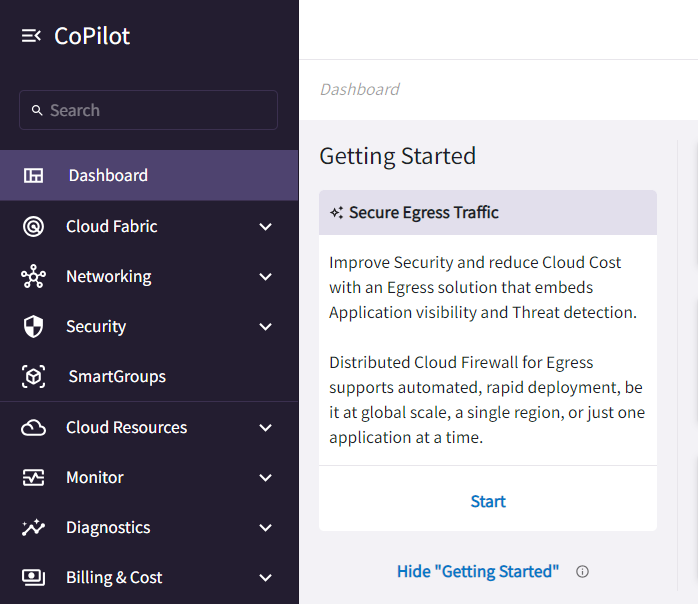
New and Enhanced Features in 4.38.0 commercialThe section your link pointed to isn't on Aviatrix CoPilot's page any more, so we've brought you to the top.
Summary
Aviatrix CoPilot is a commercial network-defense console, run as part of the Aviatrix cloud networking platform, that gives operators visibility into and control over multicloud transit infrastructure. It surfaces routing across transit gateways, clouds, and on-prem Site2Cloud connections, shows egress security scores and intrusion logs for the Distributed Cloud Firewall, and flags missing IAMIAMIdentity and Access Management — a framework of policies and services for controlling who can authenticate to systems and what resources they are authorized to use, letting cyber tools enforce least-privilege and audit access. permissions on serverless workloads, alongside notifications and table views built for day-to-day operational triage. This puts it in the hands of cloud network and security operations teams running Aviatrix infrastructure rather than application developers or auditors. It sits in the network-defense category, covering the monitoring and policy-enforcement work that multicloud operators would otherwise piece together from separate cloud-native consoles. Launched in 2020 and still shipping actively, with 45 tracked releases and its latest only 23 days old, it is under continued development.
How Aviatrix CoPilot helps
Which VPCs and VNets are least protected against risky outbound traffic?
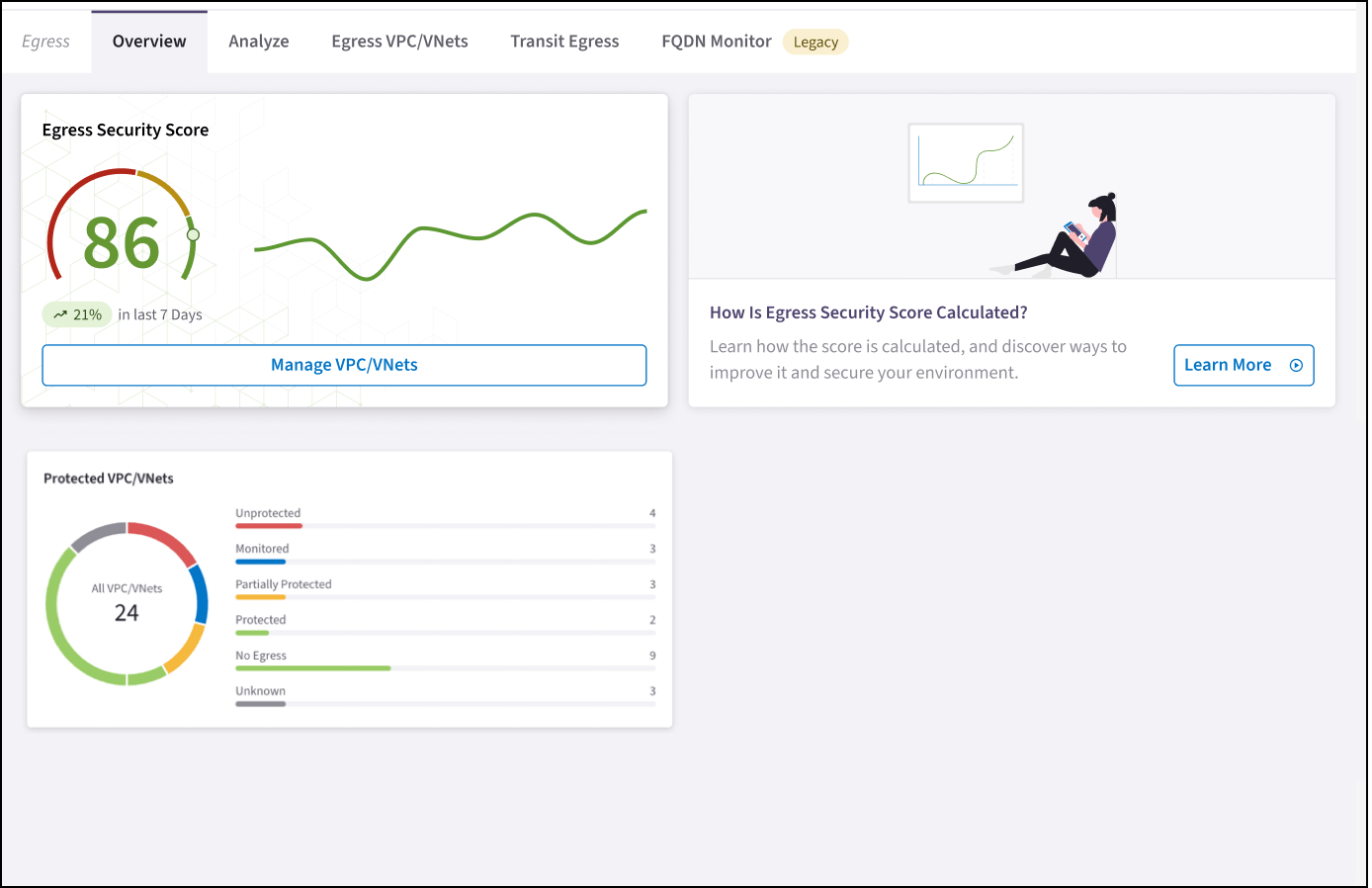
scores egress security posture for each VPC/VNet and ranks them so the weakest exposure surfaces first, requiring the Distributed Cloud Firewall feature to be enabled to populate the score
How is traffic actually flowing between my clouds and on-prem sites right now?
shows routing information for every managed resource across the transit network, including multicloud and Site2Cloud connections, in one routing view
Which gateway security rules are getting hit, and how often?
shows per-rule session counts and logging state on the gateway security rules tab, so a rule with no traffic or no logging turned on stands out
Is my segmentation policy consistent across VRFs and Kubernetes clusters?
tracks VRF-aware policy alongside a view of intra-cluster traffic orchestration health, so segmentation gaps between the network layer and cluster traffic are visible in the same console
Which cloud accounts or gateways are out of compliance with FIPS requirements?
shows FIPS 140-3 compliance indicators directly in the interface next to the affected gateways
Languages
Features
Built from Aviatrix CoPilot's releases, docs, README and our own runs. “Seen” marks the month we first spotted a release the vendor didn't date.
No capabilities match.
All capabilities 7 capabilities
Gateway Lifecycle Management shipped Provides controls to start and stop gateways and manage their scaling capacity.
release 7 total
-
Delivers gateway grid and routing enhancements.
 New and Enhanced Features in 4.38.0 · Oct 2026
· source
· release history
- Delivers upgrade experience enhancements for the gateway upgrade workflow. New and Enhanced Features in 4.38.0 · Oct 2026 · source · release history
- Introduces Gateway Start and Stop controls for managing gateway lifecycle. New and Enhanced Features in 4.37.0 · Sep 2026 · source · release history
- Provides Packet Capture availability on the Controller for network debugging New and Enhanced Features in 4.37.0 · Sep 2026 · source · release history
- Adds Gateway Start and Stop capabilities for gateway lifecycle management New and Enhanced Features in 4.37.0 · Sep 2026 · source · release history
- Adds the ability to configure alerts for Conntrack Usage Rate metrics. 4.16.0 · Dec 2024 · source · release history
example
-
Capture packets on a gateway for deep packet analysis.
Use the Packet Capture feature available on the Controller interfaceNew and Enhanced Features in 4.37.0 · Sep 2026 · source -
Monitor real-time conntrack consumption to anticipate saturation before connections are dropped.
In the Aviatrix CoPilot console, navigate to the Alerting section and enable 'Conntrack Usage Rate' for your gateways.4.16.0 · Dec 2024 · source -
Set up notifications when conntrack entries approach their limit on a gateway instance.
In the Aviatrix CoPilot console, navigate to the Alerting section and enable 'Conntrack Allowance Available' for your gateways.4.16.0 · Dec 2024 · source
Egress Security Monitoring shipped Displays security scores and status for VPC/VNet egress protection.
release
-
Introduces Distributed Cloud Firewall Value Dashboard for visibility into DCF metrics
New and Enhanced Features in 4.37.0 · Sep 2026
· source
· release history
- Adds Session Count and Logging columns to the security rules tab for gateways to improve visibility 4.36.0 · Aug 2026 · source · release history
docs
-
Controller 8.0 and the enablement of the DCF feature is required to view the Security > Egress > Overview tab. The Security > Egress > Overview tab shows the following: Egress Security Score: Shows the egress security score for your VPC/VNets. The higher the score, the better your VPC/VNets are protected.
 docs update · Sep 2026
· source
example
-
Monitor DCF performance and effectiveness via the new dashboard.
Navigate to Monitor > Distributed Cloud Firewall > Value DashboardNew and Enhanced Features in 4.37.0 · Sep 2026 · source
Distributed Cloud Firewall Intrusion Prevention shipped Provides rule feeds and management for intrusion prevention within the DCF.
release
-
Delivers Distributed Cloud Firewall enhancements.
New and Enhanced Features in 4.38.0 · Oct 2026
· source
· release history
- Adds Distributed Cloud Firewall IPS Rule Feeds for managing intrusion prevention rule feeds in DCF. New and Enhanced Features in 4.37.0 · Sep 2026 · source · release history
Authentication Screen Customization shipped Allows administrators to configure a custom login banner displayed on the authentication screen.
release
-
Adds login banner configuration in CoPilot for customizing the authentication screen.︀︄︇︀︅︉︀︅︀︀︃︀︀︅︅︀︅︊︀︄︆︀︃︄
New and Enhanced Features in 4.38.0 · Oct 2026
· source
· release history
Route Approval Notifications shipped Sends email alerts to administrators when network routes require manual approval.
release
-
Adds route approval email alerts to notify administrators when routes require approval.
New and Enhanced Features in 4.38.0 · Oct 2026
· source
· release history
FireNet Flexibility shipped Decouples FireNet services from specific gateways to allow flexible deployment topologies.
release
-
Decouples FireNet from a single gateway, enabling more flexible FireNet deployments.
New and Enhanced Features in 4.37.0 · Sep 2026
· source
· release history
VRF-Aware Network Segmentation shipped Enables Virtual Routing and Forwarding (VRF) support within network segmentation policies.
release
-
Adds VRF support in Network Segmentation, enabling VRF-aware policy across segmented networks.
New and Enhanced Features in 4.36.0 · seen Aug 2026
· source
· release history
Lines in monospace are the tool's own words: help text
parsed from its source, or an endpoint from its API document. Under
release, a line is our summary of a dated release. Under
docs, it is quoted from the tool's own documentation or
website. Each links back to the source it came from.
Screenshots
From the release notes, newest first. Click one to see it full size.Score card
-
Shipping velocity releases a month, last 12 months
-
Documentation quality release-notes rubric, 0–100
-
Breaking-change discipline how rarely a release breaks users, and notice given
-
Maintenance risk quiet time against its own cadence, maintainers
-
Innovation & surface new capabilities, API and MCP surface
Five scores for Aviatrix CoPilot, each built from the releases, notes and API history this site tracks — and, on Researcher and Business, where it stands among every measured tool in its category and how that has moved.
Score cards are part of every paid plan.
See plans → Already subscribed? Sign in →Trajectory
Blank means never measured; nothing here is a filled-in zero.
Peer standings are included with Researcher and Business. See how this tool ranks against its competitors, using data we don't publish anywhere else.
See plans →Each score is 0–100 on a published rubric, derived from data this site already shows. A dimension we cannot measure says so — it is never scored 0 and never enters a rank.
How this is scored
- Shipping velocity — releases a month over the last 12 months, on a log scale where 16 a month scores 100. Needs 3 releases in the window.
- Documentation quality — the release-notes rubric published on the analytics page, unchanged.
- Breaking-change discipline — the share of releases carrying a breaking change (none scores 100, half or more scores 0). Only projects that label breaking changes are measured: a clean record cannot be told from an unlabelled one.
- Maintenance risk — quiet time measured against the tool's own release cadence (quiet longer than 90 days and three typical gaps scores 0), plus the number of active maintainers and whether contributors are growing, where known. Higher is lower risk.
- Innovation & surface — new capabilities in the feature ledger this year, API and MCP operations added, and the share of commits that are features: the mean of whichever we hold.
- Community health (open-source tools only) — each is a direction, not a size: contributors this year against last, the bus factor now against a year ago, and issues closed per issue opened, where steady scores 50, doubled 100 and halved 0; plus the median time to a maintainer's first reply (an hour scores about 100, a month or more 0). A commercial card has no repository and carries none of the four.
- Documented delivery (commercial tools) — when a vendor's documented new capabilities have slowed against its own baseline, that counts against the overall standing as heavily as two low dimensions. Steady delivery, or too little history to judge, leaves the standing alone; it is never a sixth score.
- Open-source tools are scored on repository signals; commercial tools on their published changelog. Ranks compare tools within one category and one profile and need at least five measured peers; the overall standing needs three ranked dimensions. Best-in-breed or consolidator is a shape, not a quality, and is never scored.
Release-note detail over time
See how much detail Aviatrix CoPilot puts in its release notes, quarter by quarter, and compare it with tracked tools in the same category. This history uses up to ten retained, reviewed notes per tool; sparse or blank older quarters may reflect that limit.
Checking release-note history…
Website history
aviatrix.com, every changeAviatrix's home and product pages and 18 more pages as they looked each month from September 2021 to October 2026: 37 renders, 11 changes of tagline or palette. Step through them, play them, or put any two months side by side.
Website history is included with Researcher and Business.
See plans → Already subscribed? Sign in →← → or h l a month · Shift a year · [ ] previous / next change · Space play · 1 2 3 page · T whole page · C compare · F full size
← → or h l the right month · Shift the left · S swap · W wipe · T whole page · Esc back
Rebranding timeline
Dates bound when a change appeared between captures. Possible rebrands are AI suggestions; a redesign alone does not establish a rebrand.
Releases
12 entries
No entries match these filters.
- October 20261
- September 20264
- August 20266
- December 20241
Add the badge to your README
Maintain this project? The badge links readers straight to this page, so they can follow every release here.
 Choose a badge style and copy the code →