FOSSA
commercialThe section your link pointed to isn't on FOSSA's page any more, so we've brought you to the top.
FOSSA secures the software supply chainsoftware supply chainThe dependencies, tools and processes used to build and deliver software. Compromising one part can affect the products or organizations that rely on it. with automated SBOMSBOMA software bill of materials, an inventory of the components and versions inside an application. It helps teams find affected software when a dependency has a vulnerability or licensing issue. generation, software composition analysissoftware composition analysisSoftware composition analysis, identifying third-party dependencies and checking them for known vulnerabilities and license issues. It covers software a team uses rather than writes itself., license compliance, and vulnerability management.
curl -X POST "https://app.fossa.com/hooks/webhook/sbom%2B58760%2Fmy-project"
curl -X GET "https://analysis.fossa.com/api/v1/cpe/match/cpe%3A2.3%3Aa%3Aapache%3Alog4j%3A2.14.1%3A*%3A*%3A*%3A*%3A*%3A*%3A*?reverse-wildcard=true" -H 'accept: application/json'
curl -g "https://analysis.fossa.com/api/v1/cpe/match/%5B%22cpe:2.3:a:apache:log4j:2.14.1:*:*:*:*:*:*:*%22,%22cpe:2.3:a:microsoft:internet_explorer:8.0.6001:beta:*:*:*:*:*:*%22%5D/id" -H 'accept: application/json'
Summary
FOSSA is a commercial application security tool that secures the software supply chain by automating SBOM generation, conducting software composition analysis, enforcing open source license compliance, and managing vulnerabilities. The product is designed for platform engineers and sits in the supply-chain-security space, performing functions similar to tools focused on software bill of materialssoftware bill of materialsA software bill of materials, an inventory of the components and versions inside an application. It helps teams find affected software when a dependency has a vulnerability or licensing issue.. It runs as a service, and the platform has seen 15 releases in the tracked window.
FOSSA secures the software supply chain with automated SBOM generation, software composition analysis, license compliance, and vulnerability management.
How FOSSA helps
Which open source licenses are my dependencies bringing in, and do any violate policy?
scans every dependency to detect its license, checks it against the compliance policy assigned to the project, and flags violations as issues with the obligation attached
Which of my dependencies have known vulnerabilities, and which ones need attention first?
matches dependencies against CVE data and surfaces them as tracked issues that can be prioritized and pushed into a remediation workflow
Can I produce a software bill of materials for this project right now?
generates an SBOM from the current dependency scan and exports it in the format the requester needs
Are my projects actually enforcing the rules I've defined, or just the ones I checked by hand?
applies policies defined once for licenses, vulnerabilities, and quality across every project automatically, so violations show up as issues without a manual review pass
Which dependencies are healthy versus poorly maintained?
scores each dependency on quality and maintenance signals so unhealthy or abandoned packages are visible before they cause a problem
What do I hand legal when they ask for compliance evidence?
produces attribution notices and scheduled compliance or security reports pulled directly from the scan data
Languages
Features
Built from FOSSA's releases, docs, README and our own runs. “Seen” marks the month we first spotted a release the vendor didn't date. Group names and tags are our labels.
- FOSSA covers 1 of the 5 supply chain security capabilities we track.
- FOSSA covers 1 of the 8 vulnerability assessment methods capabilities we track.
What FOSSA offers you
- CI/CD pipeline integration2
- REST API2
- Ticketing integration2
- Administrative audit log1
- Command-line interface1
- CSV data export1
- Outbound webhooks (the product notifies you)1
- Role-based access control1
- SAML SSO1
- Single sign-on1
No capabilities match.
All capabilities 12 capabilities
Dependency Upgrade Assistance shipped Provides guidance and tools to help manage and upgrade dependencies.
Also counts toward: CI/CD pipeline integration
release
-
Trigger context-aware dependency remediation by clicking Create PR on a security issue in FOSSA, which opens a pull request and runs an application impact analysis drawing on your test suites, interfaces, and CI signals.︀︄︇︀︅︉︀︅︀︀︃︀︀︅︅︀︅︊︀︄︆︀︃︄
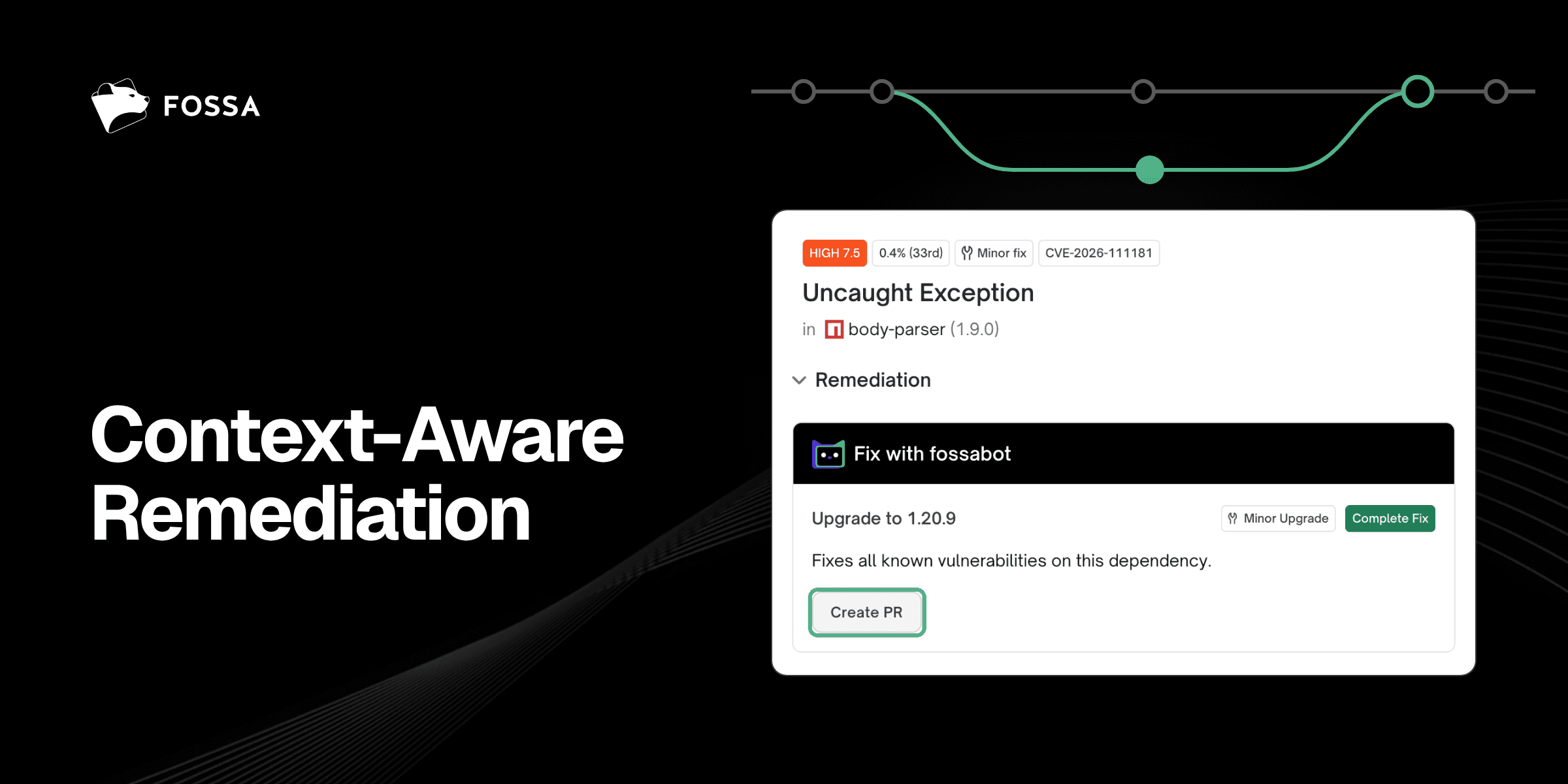 announced · Oct 2026
· source
· release history
- Context-Aware Remediation supports JS/TS, Python, and Java ecosystems via Quick Import from GitHub, with additional ecosystems coming. announced · Oct 2026 · source · release history
- FOSSA now runs the same breaking-change analysis on PRs opened by Dependabot, Renovate, or Snyk, making existing auto-PR workflows context-aware without replacing them. announced · Oct 2026 · source · release history
docs
- Sep 22, 2026 ai-guardrails continuous-integration dependency-upgrades intended-uses sast-security-review setup supported-ecosystems system-architecture seen Sep 2026 · source
example
-
When a security issue appears in FOSSA and the upgrade breaks the build, comment directly on the PR to have fossabot diagnose the CI failure and push a corrective commit.
Steps: 1. Open the pull request that fossabot created for the security issue. 2. Review the impact-analysis comment fossabot posted, which lists what it checked. 3.announced · Oct 2026 · source
Issue Management documented suggested Tools for tracking, comparing, ignoring, and resolving detected dependency issues.
Suggested capability: Vulnerability prioritization. This is our guess, not confirmed.
Also counts toward: Ticketing integration, Outbound webhooks (the product notifies you)
docs
- Find known vulnerabilities (CVEs), prioritize them, and fix them with pull requests opened from FOSSA. seen Oct 2026 · source
- Sep 22, 2026 authentication cpe-lookup errors introduction webhook-notifications index creating-jira-tickets downloading-attribution-reports generating-reports initiating-a-binary-scan managing-issues managing-users-and-teams modifying-release-groups retrieving-latest-revision rotating-access-tokens seen Sep 2026 · source
- Sep 22, 2026 comparing-issues global-summary ignoring-issues issue-details time-based-ignore-rules seen Sep 2026 · source
API Access documented Offers a RESTful API for programmatic access to FOSSA data and functionalities.
Also counts toward: REST API
docs
- Introduction to the FOSSA API Generate an API key and make your first request to the FOSSA REST API. min read Updated Sep 22, 2026 Overview The FOSSA API is a RESTful API for programmatic access to your FOSSA data. This guide walks you from generating an API key to making your first authenticated request. seen Sep 2026 · source
API Authentication documented Requires an API token for authentication to access the RESTful API.
Also counts toward: REST API
docs
- Authentication Authenticate to the FOSSA API using an API token in the Authorization header. min read Updated Sep 22, 2026 Overview Every FOSSA API call requires an API token (also called an API key). seen Sep 2026 · source
API Error Handling documented Provides standard HTTP response codes to help clients interpret API errors and successes.
docs
- Errors Interpret FOSSA API error responses, 4xx codes indicate client errors, 5xx codes indicate server-side issues. min read Updated Sep 22, 2026 Overview The FOSSA API uses conventional HTTP response codes to indicate the success or failure of a request. seen Sep 2026 · source
CI/CD Integration documented Integrates with CI/CD platforms to automate scans and report results.
Also counts toward: CI/CD pipeline integration, Ticketing integration
docs
- Sep 22, 2026 aws-codebuild azure-repos bitbucket-cloud bitbucket-server circleci concourse-ci creating-a-jira-ticket fail-cicd-checks generic-ci github-actions github-app github gitlab jenkins jfrog-artifactory jira nexus openid-connect slack teamcity travisci seen Sep 2026 · source
License Violation Detection documented Identifies open-source licenses to detect compliance risks and violations.
docs
- Your First Scan Create an account, import your first project, read the results, and automate future scans. min read Updated Sep 22, 2026 Overview By the end of this guide you'll have a FOSSA account, your first project imported and scanned, and a clear view of its licenses and vulnerabilities, in about five minutes. seen Sep 2026 · source
Local Scan Analysis documented Analyzes code locally via a CLI client and uploads results for high accuracy.
Shared capability: Static application security testing
Also counts toward: Command-line interface
docs
- CLI Analyze your code locally with the FOSSA CLI and upload the results, the most accurate and secure way to integrate. min read Updated Sep 22, 2026 Overview The most accurate way to integrate FOSSA is to analyze your code locally with the FOSSA CLI , our open source build client. seen Sep 2026 · source
Reporting and Export documented Generates detailed reports on licenses, security issues, and quality, with export options.
Also counts toward: CSV data export
docs
- Sep 22, 2026 global-reports licensing-report remediation-guidance report-settings data in CSV format, with separate reports for license, security, and quality issues. Scope it to a team or one of the team's release groups, and add issue counts over time. Download it directly or have it emailed. seen Sep 2026 · source
SBOM Generation documented Generates Software Bill of Materials (SBOM) for projects to track component inventory.
Shared capability: SBOM generation
docs
- Sep 22, 2026 archive-upload automatic-updates badge-pull-requests binaries broker build-history cicd-scanning cli containers dependencies ignore-a-dependency issue-scanners mediated-dependencies package-inventory pr-checks privacy-settings project-labels project-settings quick-import sbom-import scan-frequency… seen Sep 2026 · source
User and Team Management documented Allows management of users, teams, roles, and authentication providers (SSO/LDAP).
Also counts toward: Administrative audit log, Role-based access control, Single sign-on, SAML SSO
docs
- Sep 22, 2026 api-tokens audit-logs counting-contributors default-project-settings inviting-users organization-settings package-labels role-based-access-control index active-directory-federation-service auth0 g-suite ldap microsoft-entra-id okta saml-attributes seen Sep 2026 · source
VCS Repository Scanning documented Connects to version control systems to scan repositories for dependencies.
docs
- Quick Import Connect GitHub, GitLab, Bitbucket, or Azure Repos and scan hundreds of repositories in one click. min read Updated Sep 22, 2026 Overview Quick Import connects FOSSA to a cloud Version Control System (VCS) (such as GitHub) and analyzes the dependencies in your repositories. seen Sep 2026 · source
Lines in monospace are the tool's own words: help text
parsed from its source, or an endpoint from its API document. Under
release, a line is our summary of a dated release. Under
docs, it is quoted from the tool's own documentation or
website. Each links back to the source it came from.
Command line
6 commands for FOSSA, each with where it came from. This tool has no source analysis yet, so there is no option reference and no captured run beside them.
No command matches.
Screenshots
From the release notes, newest first. Click one to see it full size.Score card
-
Shipping velocity releases a month, last 12 months
-
Documentation quality release-notes rubric, 0–100
-
Breaking-change discipline how rarely a release breaks users, and notice given
-
Maintenance risk quiet time against its own cadence, maintainers
-
Innovation & surface new capabilities, API and MCP surface
Five scores for FOSSA, each built from the releases, notes and API history this site tracks — and, on Researcher and Business, where it stands among every measured tool in its category and how that has moved.
Score cards are part of every paid plan.
See plans → Already subscribed? Sign in →Trajectory
Blank means never measured; nothing here is a filled-in zero.
Peer standings are included with Researcher and Business. See how this tool ranks against its competitors, using data we don't publish anywhere else.
See plans →Each score is 0–100 on a published rubric, derived from data this site already shows. A dimension we cannot measure says so — it is never scored 0 and never enters a rank.
How this is scored
- Shipping velocity — releases a month over the last 12 months, on a log scale where 16 a month scores 100. Needs 3 releases in the window.
- Documentation quality — the release-notes rubric published on the analytics page, unchanged.
- Breaking-change discipline — the share of releases carrying a breaking change (none scores 100, half or more scores 0). Only projects that label breaking changes are measured: a clean record cannot be told from an unlabelled one.
- Maintenance risk — quiet time measured against the tool's own release cadence (quiet longer than 90 days and three typical gaps scores 0), plus the number of active maintainers and whether contributors are growing, where known. Higher is lower risk.
- Innovation & surface — new capabilities in the feature ledger this year, API and MCP operations added, and the share of commits that are features: the mean of whichever we hold.
- Community health (open-source tools only) — each is a direction, not a size: contributors this year against last, the bus factor now against a year ago, and issues closed per issue opened, where steady scores 50, doubled 100 and halved 0; plus the median time to a maintainer's first reply (an hour scores about 100, a month or more 0). A commercial card has no repository and carries none of the four.
- Documented delivery (commercial tools) — when a vendor's documented new capabilities have slowed against its own baseline, that counts against the overall standing as heavily as two low dimensions. Steady delivery, or too little history to judge, leaves the standing alone; it is never a sixth score.
- Open-source tools are scored on repository signals; commercial tools on their published changelog. Ranks compare tools within one category and one profile and need at least five measured peers; the overall standing needs three ranked dimensions. Best-in-breed or consolidator is a shape, not a quality, and is never scored.
Release-note detail over time
See how much detail FOSSA puts in its release notes, quarter by quarter, and compare it with tracked tools in the same category. This history uses up to ten retained, reviewed notes per tool; sparse or blank older quarters may reflect that limit.
Checking release-note history…
Commercials
pricing & packaging history · FOSSA vendor page35 readings of FOSSA's pricing page since Jul 2022, with 4 relaunches of its plan lineup and 7 changes to what its plans include — each one dated, compared with the reading before it, and explained for someone buying the tool.
Pricing and packaging history is included with Researcher and Business. See how every vendor we track sells, and how that has changed over time, using data we don't publish anywhere else.
See plans → Already subscribed? Sign in →Plans by offering
Each offering on the pricing page links to its own page of plans, read at its latest capture.
Plan relaunches
Plans, prices and descriptions are quoted from the vendor's own pricing page as we read it on each date. A plan missing from a later reading is shown as no longer listed on the page — a statement about the page, not the product. Readings that failed to show any plans are left out rather than read as a change.
Website history
fossa.com, every changeFOSSA's home page and 14 more pages as they looked each month from August 2021 to October 2026: 24 renders, 5 changes of tagline or palette. Step through them, play them, or put any two months side by side.
Website history is included with Researcher and Business.
See plans → Already subscribed? Sign in →← → or h l a month · Shift a year · [ ] previous / next change · Space play · 1 2 3 page · T whole page · C compare · F full size
← → or h l the right month · Shift the left · S swap · W wipe · T whole page · Esc back
Rebranding timeline
Dates bound when a change appeared between captures. Possible rebrands are AI suggestions; a redesign alone does not establish a rebrand.
Releases
3 entries
No entries match these filters.
- October 20261
- September 20262
Add the badge to your README
Maintain this project? The badge links readers straight to this page, so they can follow every release here.
 Choose a badge style and copy the code →