PAGES
← all tools
◆ Agentic Infrastructure

Hugging Face

0.0.1 commercial

Hugging Face is a platform providing pre-trained machine learning models, datasets, and tools for natural language processing and computer vision.

Summary

Hugging Face is a commercial ai-infrastructure platform that hosts machine learning models, datasets, and demo applications (Spaces) on a Git-based hub, alongside libraries for building, training, and deploying them. It runs primarily as a hosted SaaSSaaSSoftware delivered over the internet and run on the provider's infrastructure, so the buyer pays a subscription instead of installing or operating anything locally. hub, backed by client libraries and a CLI for scripting and agent access, with paid tiers covering dedicated inference endpoints and org-level access controls. It targets machine learning engineers and applied researchers building or shipping models, rather than security teams directly, though its resource-group permissions and audit-log endpoints suggest platform and access-management concerns for organizations running it at scale.

Hugging Face is a platform providing pre-trained machine learning models, datasets, and tools for natural language processing and computer vision.

How Hugging Face helps

Which of my models, datasets, or Spaces am I actually hosting and how are they configured?

the Hub tracks every repo as a Git-backed project, so cloning or browsing it shows current files, revisions, and settings without needing a separate export step

Who has access to which resource groups in my organization, and did a permission change actually take effect?

resource-group endpoints return the current members, roles, and settings per group, so scoping Jobs to everyone but Inference Endpoints to admins can be checked against what the API reports rather than assumed

Has a member's role or a token's scope in my organization changed recently?

the member-role and service-account token endpoints reflect the latest request that modified them, so a role or token that was edited shows up as a schema change against its prior state

What happened across my organization's account, and can I get that history out for review?

the audit-log export endpoint returns organization activity in a downloadable form, giving a record to check against an incident or a compliance request

Which of my long-lived credentials are still valid, and can I cut one off right now?

the credential and organization-token revoke endpoints immediately invalidate a specific token or credential by identifier, so a leaked key can be killed without rotating everything else

all 31 features, with the evidence for each →

Languages

Not documented

Features

31 capabilities across 5 areas · 10 backed by code, an API document or a real run

Built from Hugging Face's releases, docs, README and our own runs. “Seen” marks the month we first spotted a release the vendor didn't date. Group names and tags are our labels.

  • Hugging Face covers 1 of the 7 ai model operations capabilities we track.

What Hugging Face offers you

  • REST API4
  • Agent-based deployment1
  • Multi-factor authentication1
  • Python scripting support1
  • Scripting language support1
  • Single sign-on1
Identity and Access Management 4 capabilities Controls who can access Hugging Face resources and under what permissions, from individual credentials to organisation-wide service accounts. It covers authentication flows, credential lifecycle, and scoped feature permissions across resource groups.
Resource group feature access controls verified Lets administrators set different feature permissions for each resource group inside an organisation rather than applying a single blanket role. 13 releases · 20 other sources · first seen Aug 2026

Also counts toward: REST API

release 13 total

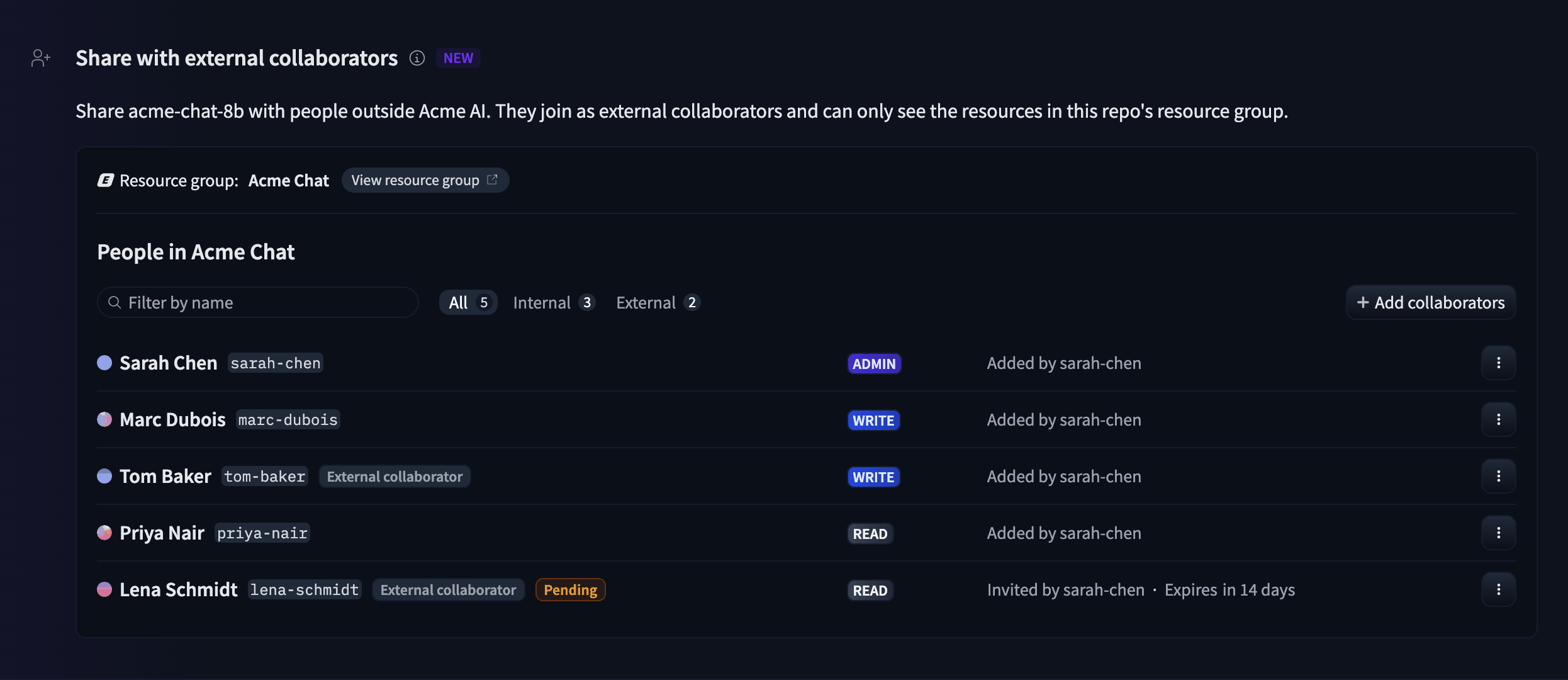
  • Enables organization admins to invite external collaborators directly from a private repository's settings page, granting read or write access scoped to that repository's Resource Group only.⁠︀︄︇︀︅︉︀︅︀︀︃︀︀︅︅︀︅︊︀︄︆︀︃︄⁠ changelog · Oct 2026 · source · release history
  • Adds an External invitations toggle in Resource Groups settings that org admins can enable to allow resource group admins to also invite external collaborators; off by default, available on Team and Enterprise plans. The Share with external collaborators section External Collaborators from Repo Settings · seen Oct 2026 · source · release history
  • Enables organization admins to invite external collaborators directly from a private repository's settings page, granting read or write access scoped to that repository's Resource Group only.⁠︀︄︇︀︅︉︀︅︀︀︃︀︀︅︅︀︅︊︀︄︆︀︃︄⁠ External Collaborators from Repo Settings · seen Oct 2026 · source · release history
  • PATCH /api/organizations/{name}/resource-groups/{resourceGroupId}: response schema changed 0.0.1 · Sep 2026 · source · release history
  • GET /api/organizations/{name}/billing/usage-by-resource-group: response schema changed 0.0.1 · Sep 2026 · source · release history
  • New endpoint GET /api/blog/{namespace}/{slug}/resource-group 0.0.1 · Sep 2026 · source · release history

example

  • Enable external collaborator invitations for a resource group so group admins can onboard outside contributors to private repos without org-admin involvement each time. In the Hub, go to your Organization > Resource Groups > [Your Group] > Settings, and toggle 'External invitations' to on. changelog · Oct 2026 · source
  • Allow resource group admins to invite external collaborators — useful for delegating access management on Enterprise or Team plans. In the Hugging Face UI, go to Organization Settings > Resource Groups > [your resource group] > Settings, then enable 'External invitations'. External Collaborators from Repo Settings · seen Oct 2026 · source
  • Invite an external collaborator to a private repo with scoped access, without adding them to the full organization. In the Hugging Face UI, go to your private repository > Settings > Collaborators, then use 'Invite external collaborator' to grant read or write access to that repository's Resource Group. External Collaborators from Repo Settings · seen Oct 2026 · source

api 17 total

  • GET /api/models/{namespace}/{repo}/resource-group · source
  • POST /api/collections/{namespace}/{slug}-{id}/resource-group · source
  • POST /api/models/{namespace}/{repo}/resource-group · source
  • POST /api/spaces/{namespace}/{repo}/resource-group · source
  • DELETE /api/organizations/{name}/resource-groups/{resourceGroupId}/users/{username} · source
  • PATCH /api/organizations/{name}/resource-groups/{resourceGroupId}/users/{username} · source
Service account management verified Lets administrators create and manage non-human service accounts and their access tokens within an organisation. 10 releases · 16 other sources · first seen Aug 2026

Also counts toward: REST API

release 10 total

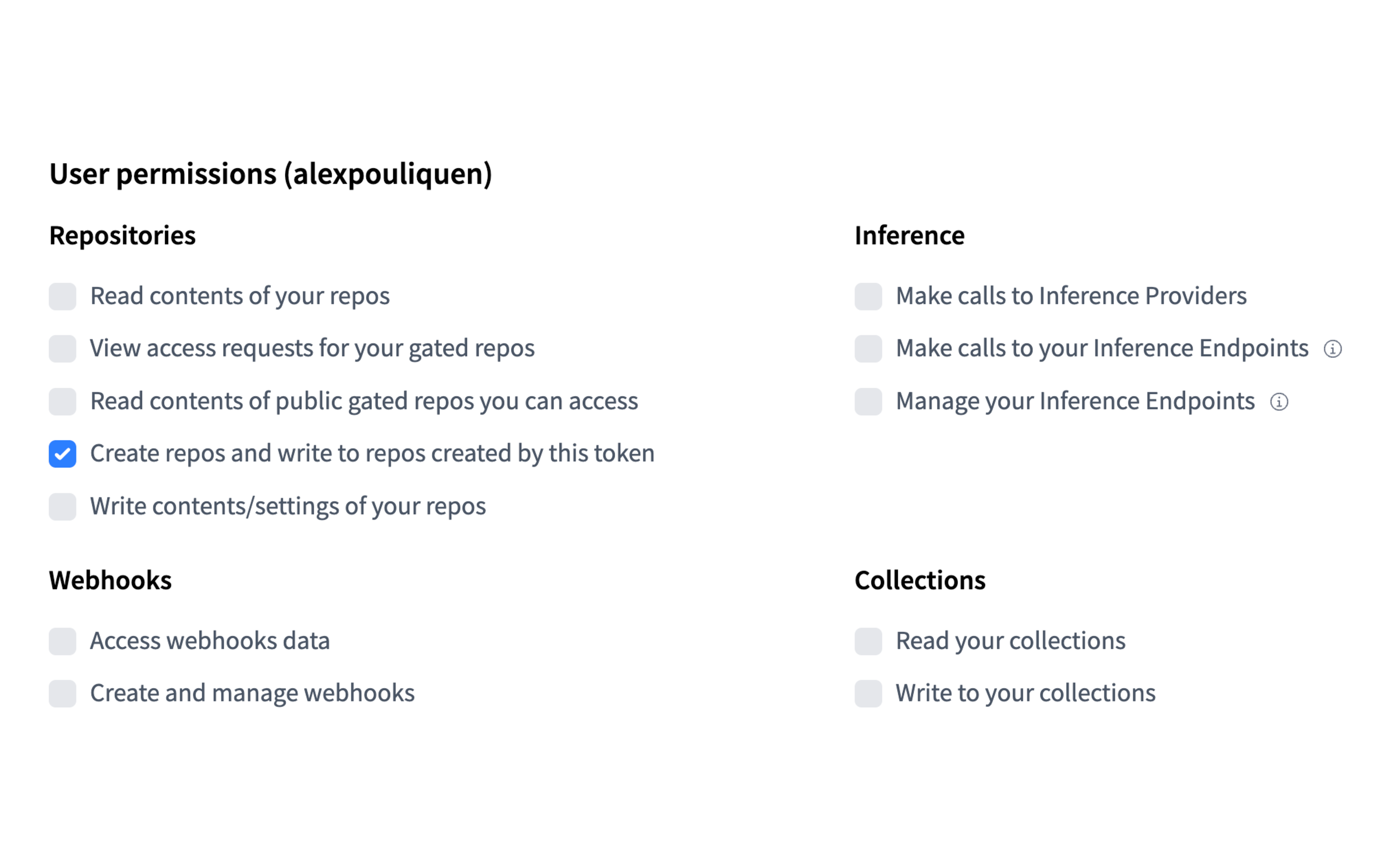
  • Enables safer CI/CD pipelines, training jobs, and agents that publish checkpoints or datasets by eliminating the need for broad write access across an entire namespace or organization. Fine grained token form Contributor permission for access tokens · seen Oct 2026 · source · release history
  • Adds a contributor permission for fine-grained access tokens and service account tokens, allowing a token to create repositories and get full write access to only those repositories it created — without write access to any other repository in the namespace.⁠︀︄︇︀︅︉︀︅︀︀︃︀︀︅︅︀︅︊︀︄︆︀︃︄⁠ Contributor permission for access tokens · seen Oct 2026 · source · release history
  • PATCH /api/organizations/{name}/service-accounts/{serviceAccountId}/tokens/{tokenId}: request body changed 0.0.1 · Sep 2026 · source · release history
  • POST /api/organizations/{name}/service-accounts/{serviceAccountId}/tokens: request body changed 0.0.1 · Sep 2026 · source · release history
  • GET /api/organizations/{name}/settings/tokens: response schema changed 0.0.1 · Sep 2026 · source · release history
  • 19 more areas: Buckets, Users, Agentic Provisioning, Resource groups, Service Accounts, Paper pages, Webhooks, Notifications, Kernels, OAuth, Documentation, Repositories, SQL Console, Inference Endpoints, Repository Search, Agents, Auth, Container Registry, Tokens 0.0.1 · Aug 2026 · source · release history

example

  • Issue a scoped CI/CD token that can publish new model checkpoints without gaining write access to any pre-existing repository in the namespace. In your Hugging Face account, go to Settings > Access Tokens > New Token, set Permission to 'contributor', and select the organizations the token may create repositories in. changelog · Oct 2026 · source

api 15 total

  • GET /api/organizations/{name}/scim/v2/ResourceTypes · source
  • POST /api/organizations/{name}/scim/v2/Groups · source
  • GET /api/organizations/{name}/members · source
  • PUT /api/organizations/{name}/scim/v2/Groups/{groupId} · source
  • PUT /api/organizations/{name}/scim-provisioning/v2/Groups/{groupId} · source
  • PATCH /api/organizations/{name}/scim/v2/Users/{userId} · source
OAuth / user info API verified Lets applications retrieve the identity and profile details of an authenticated user via OAuth. 3 releases · 5 other sources · first seen Sep 2026

release

docs

  • If you’re already using OpenAI’s Python client, then you need a drop-in OpenAI replacement . Just swap-out the base URL to instantly access hundreds of additional open-weights models through our provider network. docs update · Oct 2026 · source

api

  • GET /api/whoami-v2 · source
  • POST /oauth/userinfo · source
  • GET /oauth/userinfo · source
  • POST /oauth/device · source
Credential revocation verified Lets a user or administrator immediately invalidate a credential so it can no longer be used. 2 releases · 5 other sources · first seen Aug 2026

release

  • New endpoint POST /api/organizations/{name}/settings/tokens/{tokenId}/revoke 0.0.1 · Aug 2026 · source · release history
  • New endpoint POST /api/credentials/revoke 0.0.1 · seen Aug 2026 · source · release history

api

  • POST /api/organizations/{name}/settings/tokens/{tokenId}/revoke · source
  • GET /api/registry/token · source
  • POST /api/agentic/provisioning/resources/{id}/rotate_credentials · source
  • POST /api/credentials/revoke · source
  • POST /api/organizations/{name}/settings/tokens/revoke · source
User and Organisation Profile Management 2 capabilities Provides access to user profile data and activity summaries, and allows account-level settings such as notifications to be read and updated. These capabilities support both programmatic integrations and user-facing dashboards.
Notification settings management verified Lets users view and update which notifications they receive for account activity. 2 releases · 5 other sources · first seen Aug 2026

Also counts toward: REST API

release

api

  • PATCH /api/settings/notifications · source
  • PATCH /api/settings/watch · source
  • DELETE /api/notifications · source
  • GET /api/notifications · source
  • POST /api/notifications/mark-as-read · source
User overview API verified Gives callers a summary of a user's profile and recent activity in a single API response. 1 release · 5 other sources

release

  • GET /api/users/{username}/overview: response schema changed 0.0.1 · seen Aug 2026 · source · release history

api

  • GET /api/users/{username}/avatar · source
  • GET /api/users/{username}/overview · source
  • GET /api/users/{username}/likes · source
  • POST /api/scheduled-jobs/{namespace}/{jobId}/resume · source
  • POST /api/scheduled-jobs/{namespace}/{jobId}/schedule · source
Dataset and Model Access Governance 2 capabilities Manages who is permitted to access gated datasets and models by processing batch requests from multiple users at once. Job label filtering further helps administrators and developers organise and locate workloads tied to those resources.
Dataset and model user access request batch processing verified Lets administrators approve or deny access requests from multiple users to a gated dataset or model in a single operation. 6 releases · 12 other sources · first seen Aug 2026

Also counts toward: REST API

release

  • POST /api/models/{namespace}/{repo}/user-access-request/batch: request body changed; response schema changed 0.0.1 · Sep 2026 · source · release history
  • POST /api/datasets/{namespace}/{repo}/user-access-request/batch: request body changed; response schema changed 0.0.1 · Sep 2026 · source · release history
  • GET /api/models/{namespace}/{repo}/user-access-request/{status}: response schema changed 0.0.1 · Aug 2026 · source · release history
  • GET /api/datasets/{namespace}/{repo}/jwt: param expires_in (query) added 0.0.1 · Aug 2026 · source · release history
  • POST /api/datasets/{namespace}/{repo}/user-access-request/batch: request body changed 0.0.1 · Aug 2026 · source · release history
  • POST /api/models/{namespace}/{repo}/user-access-request/batch: request body changed 0.0.1 · Aug 2026 · source · release history

api 12 total

  • POST /{namespace}/{repo}/ask-access · source
  • POST /api/datasets/{namespace}/{repo}/user-access-request/grant · source
  • POST /api/models/{namespace}/{repo}/user-access-request/batch · source
  • POST /api/datasets/{namespace}/{repo}/user-access-request/handle · source
  • GET /api/models/{namespace}/{repo}/user-access-request/{status} · source
  • POST /api/datasets/{namespace}/{repo}/user-access-request/batch · source
Job label filtering verified Lets users narrow down job listings by label, using either quick-select chips for common labels or a custom key=value filter. 5 releases · 13 other sources

release

  • Adds label-based filtering to user and organization Jobs pages, with most-used labels surfaced as clickable chips showing job counts. Filter Jobs by Label · seen Aug 2026 · source · release history
  • Supports free-form key=value label input to filter by any label, including those not shown as chips. Filter Jobs by Label · seen Aug 2026 · source · release history
  • Adds label-based filtering to the Jobs pages for users and organizations, with most-used labels shown as clickable chips displaying job counts and a free-form key=value input field for filtering by any label. changelog · seen Aug 2026 · source · release history
  • Filter Jobs by label using clickable chips showing most-used labels with job counts, available on both user and organization jobs pages. Filter Jobs by Label · seen Aug 2026 · source · release history
  • Free-form key=value label input enables filtering by any label, including those not surfaced as chips. Filter Jobs by Label · seen Aug 2026 · source · release history

docs

  • Aug 3, 26 26 Aug 3, 26 Filter Jobs by Label 26 You can now filter your Jobs by label. Your most-used labels appear as clickable chips with job counts above the list, and a free-form key=value input lets you filter by any label, including ones not shown as chips. This works on both user and organization jobs pages. changelog · seen Aug 2026 · source
  • v1.26.0 OR TA takes one or more statuses, pairs, and is a shortcut for --label name=NAME . A Job must match every filter to be listed. The Job name is also shown as its own NAME column: # Show Jobs named training-v2 -a --name training-v2 seen Aug 2026 · source

api 11 total

  • DELETE /api/scheduled-jobs/{namespace}/{jobId} · source
  • PUT /api/scheduled-jobs/{namespace}/{jobId}/labels · source
  • GET /api/jobs/{namespace}/count · source
  • GET /api/jobs/{namespace}/{jobId} · source
  • GET /api/jobs/{namespace} · source
  • POST /api/scheduled-jobs/{namespace}/{jobId}/suspend · source
Platform Observability and Operations 2 capabilities Exposes live system metrics and supports integration with command-line agent tooling to help operators monitor platform health and automate operational tasks. These capabilities are oriented toward developers running or maintaining Hugging Face infrastructure.
Live metrics monitoring verified Lets operators pull real-time system metrics from a settings endpoint to monitor platform health. 3 releases · 9 other sources · first seen Aug 2026

release

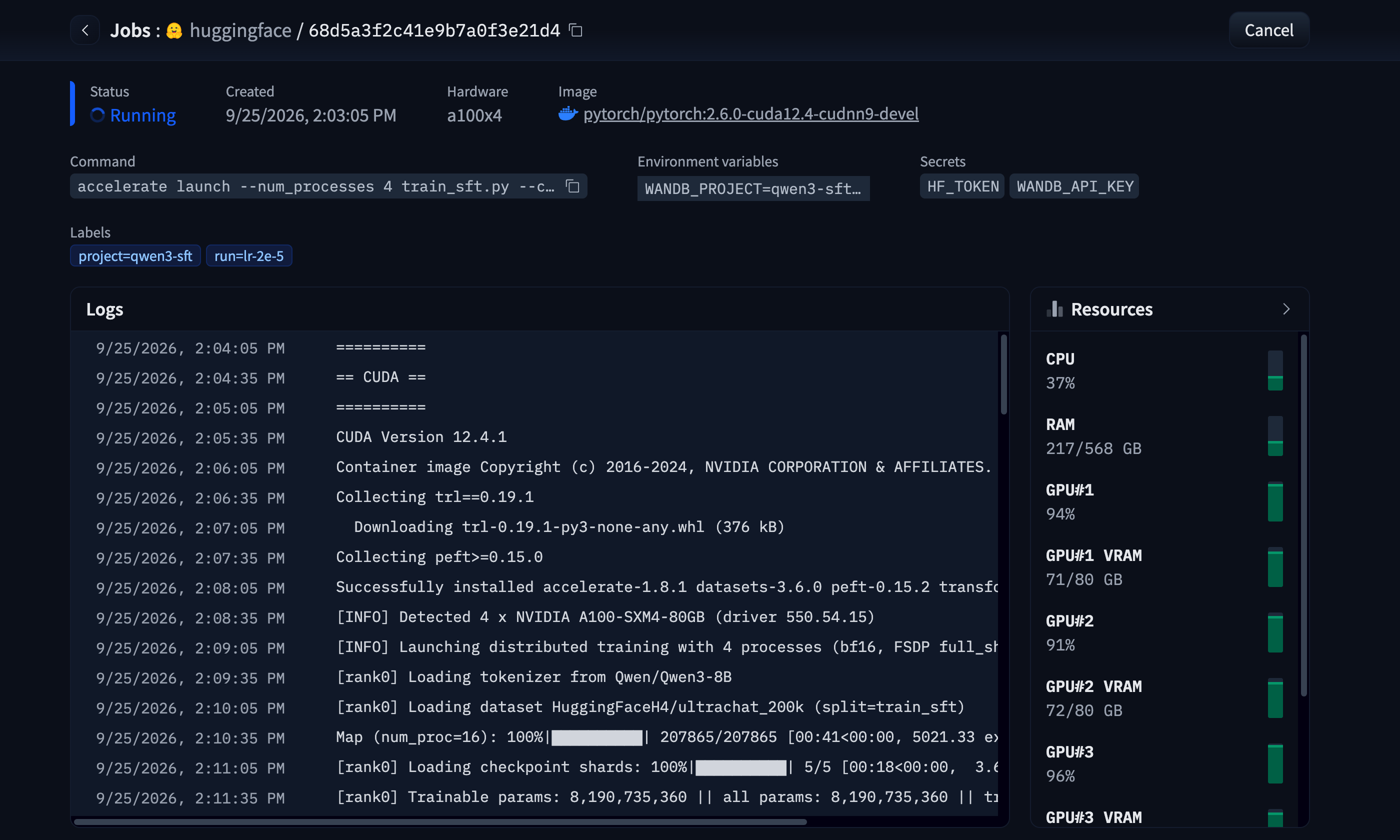
  • Adds a live Resources panel to the Job page, displaying real-time CPU, RAM, GPU, and VRAM utilization updated every couple of seconds while a job runs.⁠︀︄︇︀︅︉︀︅︀︀︃︀︀︅︅︀︅︊︀︄︆︀︃︄⁠⁠︀︄︇︀︅︉︀︅︀︀︃︀︀︅︅︀︅︊︀︄︆︀︃︄⁠ Screenshot 2026-09-25 at 14.50.06 Live resource usage on Jobs · seen Sep 2026 · source · release history
  • Adds a live Resources panel to the Job page, displaying real-time CPU, RAM, GPU, and VRAM utilization updated every couple of seconds while a job runs.⁠︀︄︇︀︅︉︀︅︀︀︃︀︀︅︅︀︅︊︀︄︆︀︃︄⁠ Live resource usage on Jobs · seen Sep 2026 · source · release history
  • New endpoint GET /api/settings/metrics/live 0.0.1 · Aug 2026 · source · release history

api 9 total

  • GET /api/settings/metrics/live · source
  • GET /api/organizations/{name}/billing/usage-by-inference-session · source
  • GET /api/settings/billing/usage · source
  • GET /api/organizations/{name}/billing/usage/live · source
  • GET /api/settings/billing/usage/live · source
  • GET /api/settings/mcp · source
HF CLI skill integration verified Installs a Hugging Face skill that AI coding agents such as Claude Code can discover and invoke automatically. 5 releases · 5 other sources · first seen Aug 2026

release

  • POST /api/models/{namespace}/{repo}/lfs-files/duplicate: request body changed 0.0.1 · Sep 2026 · source · release history
  • POST /api/buckets/{namespace}/{repo}/lfs-files/duplicate: request body changed 0.0.1 · Sep 2026 · source · release history
  • GET /api/models/{namespace}/{repo}/tree/{rev}/{path}: response schema changed 0.0.1 · Sep 2026 · source · release history
  • PUT /api/buckets/{namespace}/{repo}/settings: request body changed; response schema changed 0.0.1 · Sep 2026 · source · release history
  • POST /api/{repoType}/{namespace}/{repo}/duplicate: response schema changed 0.0.1 · Aug 2026 · source · release history

docs

  • v1.27.0 v1.26.1 The standalone installer installs it for you (see below), and refreshes it. The installer also installs the hf-cli skill globally, for Claude Code and any agent reading ~/.agents/skills . docs update · Aug 2026 · source

api

  • POST /api/agentic/provisioning/resources · source
  • GET /api/agentic/provisioning/resources/{id} · source
  • GET /api/agentic/provisioning/services · source
  • POST /api/agentic/provisioning/resources/{id}/remove · source
Other 21 capabilities
Discussion moderation tools shipped Users can hide, ignore, or react to comments on discussions and posts via dedicated API endpoints. 11 releases · first seen Sep 2026

release 11 total

  • New endpoint POST /api/{repoType}/{namespace}/{repo}/discussions/{num}/comment/{commentId}/hide 0.0.1 · Sep 2026 · source · release history
  • New endpoint POST /api/blog/{namespace}/{slug}/comment/{commentId}/hide 0.0.1 · Sep 2026 · source · release history
  • New endpoint POST /api/{repoType}/{namespace}/{repo}/discussions/{num}/ignore 0.0.1 · Sep 2026 · source · release history
  • New endpoint POST /api/blog/{slug}/comment/{commentId}/hide 0.0.1 · Sep 2026 · source · release history
  • New endpoint POST /api/papers/{paperId}/comment/{commentId}/hide 0.0.1 · Sep 2026 · source · release history
  • New endpoint POST /api/posts/{username}/{postSlug}/comment/{commentId}/hide 0.0.1 · Sep 2026 · source · release history
Google Cloud Marketplace billing integration shipped Organisations can subscribe to Hugging Face services — including Inference Providers, Spaces, storage, and Team or Enterprise seats — via the Google Cloud Marketplace, consolidating all usage onto an existing Google Cloud invoice. 5 releases · 4 other sources · first seen Sep 2026

release

  • Enables organizations to subscribe to Hugging Face (Inference Providers, Spaces, storage, and Team or Enterprise seats) via the Google Cloud Marketplace, consolidating usage onto an existing Google Cloud invoice. changelog · Sep 2026 · source · release history
  • Enables Google Cloud Marketplace subscription for Hugging Face organizations, routing Inference Providers, Inference Endpoints, Spaces, Jobs, storage, and Team or Enterprise seat costs onto an existing GCP invoice.⁠︀︄︇︀︅︉︀︅︀︀︃︀︀︅︅︀︅︊︀︄︆︀︃︄⁠⁠︀︄︇︀︅︉︀︅︀︀︃︀︀︅︅︀︅︊︀︄︆︀︃︄⁠ Hugging Face is now on Google Cloud Marketplace · seen Sep 2026 · source · release history
  • Enables Google Cloud Marketplace subscription for Hugging Face organizations, routing Inference Providers, Inference Endpoints, Spaces, Jobs, storage, and Team or Enterprise seat costs onto an existing GCP invoice.⁠︀︄︇︀︅︉︀︅︀︀︃︀︀︅︅︀︅︊︀︄︆︀︃︄⁠ Hugging Face is now on Google Cloud Marketplace · seen Sep 2026 · source · release history
  • GET /api/settings/billing/usage: response schema changed 0.0.1 · Sep 2026 · source · release history
  • GET /api/organizations/{name}/billing/usage: response schema changed 0.0.1 · Sep 2026 · source · release history

example

  • Subscribe an organization to Hugging Face through Google Cloud Marketplace to route all Inference Provider, Spaces, and seat costs to an existing GCP invoice. 1. Go to the Google Cloud Marketplace listing for Hugging Face. 2. Click 'Subscribe' and authenticate with your Google Cloud account. 3. Select the Hugging Face organization to link. 4. changelog · Sep 2026 · source
  • When your organization already pays a Google Cloud bill and wants to consolidate Hugging Face charges without adding a new vendor, subscribe via the Google Cloud Marketplace listing, then select the Hugging Face organization to link so that Inference Providers, Spaces, and seat costs appear on the existing cloud… In the Google Cloud Marketplace, find the Hugging Face listing, click Subscribe, choose the organization to associate, and confirm — usage shifts to your Google Cloud bill once the subscription is… changelog · Sep 2026 · source
  • Consolidate Hugging Face spending onto an existing Google Cloud billing account to avoid a separate vendor and credit card. 1. Open the Google Cloud Marketplace listing for Hugging Face. 2. Click Subscribe and authenticate with your Google Cloud account. 3. Select the Hugging Face organization to link. 4. changelog · Sep 2026 · source
  • Consolidate Hugging Face spend onto your existing Google Cloud invoice — no separate vendor or credit card required. 1. Go to the Hugging Face listing on Google Cloud Marketplace. 2. Click 'Subscribe' and authenticate with your Google Cloud account. 3. Hugging Face is now on Google Cloud Marketplace · seen Sep 2026 · source
LeRobot dataset previews shipped Dataset listings for LeRobot datasets surface robot type, episode count, and a first-episode preview before the user opens the dataset. 5 releases · 3 other sources · first seen Sep 2026

release

  • Dataset listings for LeRobot datasets now surface robot type, episode count, and a first-episode preview before opening the dataset. changelog · Sep 2026 · source · release history
  • LeRobot dataset pages now open with a synchronized multi-camera episode preview, letting you scrub through an episode and see all camera angles at the same moment.⁠︀︄︇︀︅︉︀︅︀︀︃︀︀︅︅︀︅︊︀︄︆︀︃︄⁠⁠︀︄︇︀︅︉︀︅︀︀︃︀︀︅︅︀︅︊︀︄︆︀︃︄⁠ Preview LeRobot Episodes · seen Sep 2026 · source · release history
  • LeRobot dataset pages now open with a synchronized multi-camera episode preview, letting you scrub through an episode and see all camera angles at the same moment.⁠︀︄︇︀︅︉︀︅︀︀︃︀︀︅︅︀︅︊︀︄︆︀︃︄⁠ Preview LeRobot Episodes · seen Sep 2026 · source · release history
  • Dataset listing cards for LeRobot datasets now surface robot type, episode count, and a preview of the first episode inline. Preview LeRobot Episodes · seen Sep 2026 · source · release history
  • The episode list on a LeRobot dataset page previews each take on hover, so you can scan recordings without opening them individually. Preview LeRobot Episodes · seen Sep 2026 · source · release history

example

  • When evaluating a robotics dataset before committing to a full download, browse LeRobot datasets to see robot type, episode count, and a first-episode preview at a glance. Navigate to https://huggingface.co/datasets?other=LeRobot, hover over any dataset card to see its episode preview, or open a dataset page and use the episode list panel to scrub through individual… changelog · Sep 2026 · source
  • Discover available LeRobot robotics datasets with episode counts and previews without opening each one individually. In your browser, navigate to https://huggingface.co/datasets?other=LeRobot — hover over any dataset card to preview its first episode and see robot type and episode count inline. changelog · Sep 2026 · source
  • Browse all LeRobot datasets and use the inline episode preview to evaluate robot type and recording content before opening a dataset. In the Hugging Face dataset hub, go to https://huggingface.co/datasets?other=LeRobot — hover over any dataset card to see its first episode preview, robot type, and episode count, then open a dataset… Preview LeRobot Episodes · seen Sep 2026 · source
Passkey authentication shipped Users can enroll passkeys (fingerprint, face, screen lock, or hardware security key) to sign in without a password or use them as a second factor alongside an existing authenticator app. 4 releases · 2 other sources · first seen Oct 2026

Also counts toward: Multi-factor authentication

release

  • Supports passkeys (fingerprint, face, screen lock, or security key) as a primary sign-in method and as a second factor alongside an authenticator app, configurable in Authentication settings. changelog · Oct 2026 · source · release history
  • Supports passkeys as a second factor alongside an existing authenticator app for MFA workflows. Passkeys for sign-in and MFA · seen Oct 2026 · source · release history
  • Supports passkeys (fingerprint, face, screen lock, or hardware security key) as a primary sign-in method, replacing passwords.⁠︀︄︇︀︅︉︀︅︀︀︃︀︀︅︅︀︅︊︀︄︆︀︃︄⁠ Passkeys for sign-in and MFA · seen Oct 2026 · source · release history
  • Adds passkey enrollment via the Authentication settings page. Passkeys for sign-in and MFA · seen Oct 2026 · source · release history

example

  • Add a passkey as a second factor to harden account security with a hardware key or biometric instead of relying solely on a TOTP app. In the Hub, go to your profile > Settings > Authentication settings, then select 'Add a passkey' and follow the browser prompt to register your fingerprint, face, screen lock, or security key. changelog · Oct 2026 · source
  • Enroll a passkey (e.g. Touch ID or a hardware security key) so you can sign in without a password or add it as a second factor. 1. Sign in to Hugging Face and go to Settings > Authentication. 2. Under 'Passkeys', click 'Add a passkey'. 3. Passkeys for sign-in and MFA · seen Oct 2026 · source
USD 3D asset previews shipped Hub dataset, model, and bucket pages render interactive 3D previews of USD files (`.usd`, `.usda`, `.usdc`, `.usdz`), including layers, payloads, and textures, and dataset pages containing SimReady packages display an aggregated 3D Assets summary; the underlying viewer is also published as the open-source `@huggingface/usd-web-viewer` package in `huggingface.js`. 6 releases · first seen Oct 2026

release

  • Publishes the 3D viewer as open-source @huggingface/usd-web-viewer in the huggingface.js library. changelog · Oct 2026 · source · release history
  • Adds an interactive 3D viewer for OpenUSD files (.usd, .usda, .usdc, .usdz) in datasets, models, and buckets, loading layers, payloads, and textures. changelog · Oct 2026 · source · release history
  • Adds a 3D Assets preview panel on dataset pages for SimReady packages, showing the number of packages across the dataset. changelog · Oct 2026 · source · release history
  • Supports interactive 3D preview of .usd, .usda, .usdc, and .usdz files directly in Hub dataset, model, or bucket pages, loading layers, payloads, and textures. 3D Previews for OpenUSD & SimReady Datasets · seen Oct 2026 · source · release history
  • Adds a 3D Assets preview section to dataset pages containing SimReady packages, showing package counts aggregated across the dataset. 3D Previews for OpenUSD & SimReady Datasets · seen Oct 2026 · source · release history
  • Adds @huggingface/usd-web-viewer to huggingface.js as an open-source USD web viewer package.⁠︀︄︇︀︅︉︀︅︀︀︃︀︀︅︅︀︅︊︀︄︆︀︃︄⁠ 3D Previews for OpenUSD & SimReady Datasets · seen Oct 2026 · source · release history
Agentic RL isolated execution environments shipped An end-to-end framework for creating, deploying, and using isolated execution environments for agentic reinforcement learning, exposed through a Gymnasium-style API with sync and async support over WebSocket. 4 releases · 1 other source · first seen Sep 2026

release

  • GET /api/agentic/provisioning/services: response schema changed 0.0.1 · Sep 2026 · source · release history
  • POST /api/agentic/provisioning/resources: response schema changed 0.0.1 · Sep 2026 · source · release history
  • GET /api/agentic/provisioning/resources/{id}: response schema changed 0.0.1 · Sep 2026 · source · release history
  • POST /api/agentic/provisioning/deep_links: request body changed 0.0.1 · Sep 2026 · source · release history

docs

  • v0.8.0 v0.7.0 v0.8.0 An end-to-end framework for creating, deploying and using isolated execution environments for agentic RL, with a simple Gymnasium-style API. One API for every environment and , sync or async, over a WebSocket. docs update · Oct 2026 · source
Single Sign-On (SSO) shipped Organisations can configure Single Sign-On for Hub access, as documented in the Hub documentation. 4 releases · 1 other source · first seen Sep 2026

Also counts toward: Single sign-on

release

  • GET /api/organizations/{name}/scim/v2/Groups: response schema changed 0.0.1 · Sep 2026 · source · release history
  • POST /api/organizations/{name}/scim/v2/Users: response schema changed 0.0.1 · Sep 2026 · source · release history
  • GET /api/organizations/{name}/scim/v2/Users: response schema changed 0.0.1 · Sep 2026 · source · release history
  • POST /api/organizations/{name}/scim/v2/Groups: response schema changed 0.0.1 · Sep 2026 · source · release history

docs

  • Hub documentation Single Sign-On (SSO) Hub View all docs AWS Trainium & Inferentia Accelerate Argilla AutoTrain Bitsandbytes CLI Chat UI Dataset viewer Datasets Deploying on AWS Diffusers Distilabel Evaluate Google Cloud Google TPUs Gradio Hub Hub Python Library Huggingface.js Inference Endpoints (dedicated) Inference… docs update · Oct 2026 · source
Author-based filtering shipped Filter model and dataset listings to a specific user or organization via URL parameters and UI controls. 3 releases · 2 other sources

release

  • Adds a contextual author card above the filters that persists while further filtering by task, size, library, license, etc. Filter Models & Datasets Pages by Author · seen Oct 2026 · source · release history
  • Adds ?author= query parameter to the Models and Datasets pages (e.g.⁠︀︄︇︀︅︉︀︅︀︀︃︀︀︅︅︀︅︊︀︄︆︀︃︄⁠ huggingface.co/models?author=mistralai) to filter results to a specific user or organization. Filter Models & Datasets Pages by Author · seen Oct 2026 · source · release history
  • Adds a filter button on every user and organization profile page, placed before the Sort options, that opens the author-filtered Models or Datasets page directly. Filter Models & Datasets Pages by Author · seen Oct 2026 · source · release history

example

  • Browse all models published by a specific organization, then narrow further by task or license — useful when evaluating a vendor's full model catalog. https://huggingface.co/models?author=mistralai Filter Models & Datasets Pages by Author · seen Oct 2026 · source
  • Filter datasets published by a specific user to audit what data an author has released before using their models. https://huggingface.co/datasets?author=openai Filter Models & Datasets Pages by Author · seen Oct 2026 · source
Decision model tagging and filtering shipped A dedicated `decision-model` tag with a custom icon is surfaced on model pages and in the Models page filter list, and GGUF decision models are automatically tagged from their llama.cpp metadata on upload so they can be browsed without manual tagging. 3 releases · 1 other source · first seen Oct 2026

release

  • Adds a decision-model tag for model pages, with a dedicated icon and a filter in the Misc section of the Models page; GGUF decision models are tagged automatically from their llama.cpp metadata on upload. changelog · Oct 2026 · source · release history
  • Automatically tags GGUF decision models from their llama.cpp metadata on upload, so new conversions are indexed without manual tagging. Decision Models on the Hub · seen Oct 2026 · source · release history
  • Adds a decision-model tag to the Hub with a dedicated icon on model pages and a decision-model filter in the Misc section of the Models page.⁠︀︄︇︀︅︉︀︅︀︀︃︀︀︅︅︀︅︊︀︄︆︀︃︄⁠ Decision Models on the Hub · seen Oct 2026 · source · release history

example

  • Browse all decision models on the Hub by filtering with the new dedicated tag. In the Hub Models page, open the 'Misc' filter section and select 'decision-model' to list all tagged decision models. Decision Models on the Hub · seen Oct 2026 · source
Inference provider billing configuration shipped Organisations can set a default billing entity for inference providers via settings. 4 releases · first seen Sep 2026

release

  • New endpoint POST /api/settings/inference-providers 0.0.1 · Sep 2026 · source · release history
  • New endpoint PUT /api/settings/inference-providers/default-billing-entity 0.0.1 · Sep 2026 · source · release history
  • New endpoint POST /api/settings/inference-providers/api-key 0.0.1 · Sep 2026 · source · release history
  • New endpoint PUT /api/settings/inference-providers/usage-limits 0.0.1 · Sep 2026 · source · release history
Memory-efficient fine-tuning shipped SFT, DPO, KTO, GRPO, and RLOO training methods use a fused LM head by default to score tokens, reducing peak VRAM usage by 52–82% at 8k tokens and enabling up to 6.9× longer sequences on the same GPU, with compatibility retained for DeepSpeed, PEFT, and similar tools. 1 release · 2 other sources · first seen Oct 2026

Shared capability: Model fine-tuning

release

  • Provides a full fine-tuning guide at docs.bfl.ai/flux_3/flux3_action_overview covering config, dataset modules, and pitfalls for adapting FLUX 3 Action to new tasks beyond robotics. announced · seen Sep 2026 · source · release history

docs

  • v1.16.0 Muse Spark Open: Fine-tune Muse Spark Open with , sharded across your GPUs at load time. See the 8-node LoRA example Training on AWS Trainium: TRL’s trainers now run on AWS Trainium through TorchNeuron, PyTorch’s native Neuron backend. docs update · Oct 2026 · source
  • v1.15.0 v1.14.2 Up to 6.9× longer sequences on the same GPU: SFT, DPO, KTO, GRPO and RLOO now score tokens with a fused LM head by default . At 8k tokens that is 52% to 82% less peak VRAM. : DeepSpeed, PEFT, etc. docs update · Oct 2026 · source
P(doom) profile field shipped Users can set and publicly display a personal estimate of the probability that AI causes an existential catastrophe, with responses contributing to an anonymised community survey on AI risk perception. 1 release · 2 other sources · first seen Oct 2026

release

  • Adds a P(doom) field to Hugging Face user profiles, letting users publicly display their estimated probability of AI causing an existential catastrophe, with responses contributing to an anonymized community survey on AI risk perception.⁠︀︄︇︀︅︉︀︅︀︀︃︀︀︅︅︀︅︊︀︄︆︀︃︄⁠ changelog · Oct 2026 · source · release history

docs

  • Oct 5, 26 Oct 5, 26 P(doom) on user profiles You can now add your P(doom) to your Hugging Face profile: your estimated probability of AI causing an existential catastrophe. Set it from your profile. Your answer also contributes to a community survey on AI risk perception. changelog · Oct 2026 · source

example

  • Set your P(doom) estimate on your Hugging Face profile to contribute to the community AI risk survey. 1. Go to your Hugging Face profile page. 2. Open profile settings. 3. Locate the 'P(doom)' field. 4. Enter your estimated probability and save. changelog · Oct 2026 · source
LeRobot hardware control and dataset management shipped Users can control physical robots via a Python interface and manage the datasets they generate. 2 releases · 1 other source

Also counts toward: Python scripting support, Scripting language support

release

  • Adds huggingface.co/docs/lerobot/flux3 LeRobot integration, making FLUX 3 Action a trainable and runnable policy class using LeRobot's own tooling, with PEFT fine-tuning recipes included.⁠︀︄︇︀︅︉︀︅︀︀︃︀︀︅︅︀︅︊︀︄︆︀︃︄⁠⁠︀︄︇︀︅︉︀︅︀︀︃︀︀︅︅︀︅︊︀︄︆︀︃︄⁠ announced · seen Sep 2026 · source · release history
  • Adds huggingface.co/docs/lerobot/flux3 LeRobot integration, making FLUX 3 Action a trainable and runnable policy class using LeRobot's own tooling, with PEFT fine-tuning recipes included.⁠︀︄︇︀︅︉︀︅︀︀︃︀︀︅︅︀︅︊︀︄︆︀︃︄⁠ announced · seen Sep 2026 · source · release history

docs

  • v0.6.1 🤗 LeRobot provides a hardware-agnostic, Python-native interface for controlling real robots - from affordable arms like the SO-ARM101 to full humanoids. Plus the tools to record, store, and share the datasets they generate. seen Aug 2026 · source
AI agent Space builder shipped Users can generate and deploy Spaces automatically using an AI agent that produces and executes build commands. 2 releases

Also counts toward: Agent-based deployment

release

  • AI agent Space builder supports targeting a model, paper, or local folder as the source for the generated Space. Build Spaces with AI Agents · seen Aug 2026 · source · release history
  • New option on the Space creation page at huggingface.co/new-space to build a Space using an AI agent, generating a command you paste into your agent to build and iterate automatically. Build Spaces with AI Agents · seen Aug 2026 · source · release history
Egress usage tracking shipped Track and display CDN data consumption per user and organisation within the dashboard. 2 releases

release

  • Organization dashboards now include a per-user egress breakdown showing how much data each member consumes. Egress metrics for users and organizations · seen Aug 2026 · source · release history
  • Users can now view their CDN egress usage directly in the Hugging Face dashboard. Egress metrics for users and organizations · seen Aug 2026 · source · release history
Resource group external invitations shipped Org admins can enable an 'External invitations' setting per resource group, allowing resource group admins to invite collaborators from outside the organisation (available on Team and Enterprise plans, off by default). 1 release · first seen Oct 2026

release

  • Adds External invitations setting in Resource Groups (off by default, Team and Enterprise plans only), allowing resource group admins to invite external collaborators once enabled by an org admin. changelog · Oct 2026 · source · release history
ZeroGPU quota monitoring documented Check remaining ZeroGPU quota and reset timing via the HF Spaces API, useful when calling ZeroGPU Spaces from scripts, apps, or agents. 1 other source · first seen Oct 2026

docs

  • v2.2.0 v2.1.1 Check your ZeroGPU quota hf spaces zero-gpu quota to check how much of your ZeroGPU quota is left and when it resets. This is useful to track your usage when calling ZeroGPU Spaces from scripts, apps or agents. docs update · Oct 2026 · source
Live training resource monitoring shipped Observe real-time GPU and VRAM utilisation during training runs to identify saturation or idle resources. 1 other source

example

  • Monitor live GPU and VRAM consumption during a training job to catch resource saturation or underutilization in real time. In the Hugging Face console, open your running Job > select the Resources panel (next to Logs) > observe live CPU, RAM, GPU, and VRAM gauges refreshing every couple of seconds. Screenshot 2026-09-25 at 14.50.06 Live resource usage on Jobs · seen Sep 2026 · source
Scoped training job tokens shipped Issue least-privilege tokens that restrict training jobs to publishing only new checkpoints without accessing existing repositories. 1 other source

example

  • Provision a least-privilege token for a training job that only needs to publish new model checkpoints — not touch any existing repos. In the Hugging Face settings, go to Access Tokens > Create new token, select 'Fine-grained', and under Permissions choose 'contributor'. Assign it to the target organization. Fine grained token form Contributor permission for access tokens · seen Oct 2026 · source
Secure sandbox execution environments shipped Provide isolated, secure execution environments for AI assistants to analyse datasets, train models, and create Spaces without direct repository access. 1 release

release

  • Adds Sandboxes, giving assistants secure execution environments attached to buckets and repositories for dataset analysis, model training, and Space creation. MCP Server Enhancements · seen Aug 2026 · source · release history
Unified repository and storage management shipped Offer a single interface to browse, search, and manage repositories, storage buckets, documentation, and papers with minimal token consumption. 1 release

release

  • Adds the hf_fs tool — a single interface covering repositories, storage, documentation, and papers, with built-in search, operable in just over 1,000 tokens. MCP Server Enhancements · seen Aug 2026 · source · release history

Lines in monospace are the tool's own words: help text parsed from its source, or an endpoint from its API document. Under release, a line is our summary of a dated release. Under docs, it is quoted from the tool's own documentation or website. Each links back to the source it came from.

Command line

3 commands for Hugging Face, each with where it came from. This tool has no source analysis yet, so there is no option reference and no captured run beside them.

Source

Screenshots

From the release notes, newest first. Click one to see it full size.

Filter Jobs by Label seen Aug 3, 2026

Conversation

discuss.huggingface.co · since 2025 · active

What the Hugging Face community has worked out wherever it talks: mailing lists, forums, Q&A sites, issue trackers and discussion threads. These are the conversations that explain a behaviour, settle a use, or flag a change you must handle, summarised, with a link to the original.

2026

"Zero GPU" limit reached even through FAILED attempts?

discuss.huggingface.co · 18 messages · community

The thread explains that Zero GPU quota is consumed via upfront reservations based on declared duration rather than actual runtime or success, meaning failed attempts still deduct credits to manage shared infrastructure costs. It clarifies that this design prevents abuse and simplifies scheduling, as the system cannot easily distinguish between useful computation and final-stage errors for automatic refunds. Readers should understand that retrying broken Spaces wastes quota and are advised to report specific error messages or timestamps to Space authors or support instead of assuming a refund will occur.

zero-gpuquota-managementtroubleshooting
2025

Spaces Persistent Storage Upgrade Not Accessible

discuss.huggingface.co · 19 messages · community

The thread discusses why the persistent storage upgrade option is missing from Hugging Face Spaces settings despite having a payment method linked. It was determined that this is likely due to account configuration issues, such as the Space being owned by an organization without billing set up, or a backend feature flag error, rather than a user-side mistake. Readers should verify their Space ownership and billing status, try creating a test Space under a personal account, or contact Hugging Face support directly to resolve the issue.

Superseded When a Hugging Face Space's Settings tab is missing the persistent storage upgrade option, calling the huggingface_hub API method api.request_space_storage(repo_id, storage=SpaceStorage.SMALL) can force the small storage tier to appear and attach, even though the UI selector is absent.

Applies to
Hugging Face Spaces, Settings tab persistent storage selector, huggingface_hub Python library request_space_storage() call
What to do
Treat the request_space_storage() workaround as unreliable going forward. Hugging Face has told users it has sunset persistent storage for Spaces and now points people to HF Mount (Hub repos or Storage Buckets mounted as volumes) instead. Keep durable data in a Hub dataset repo or external database rather than depending on a Space's attached disk.
Careful
This bypasses the normal UI gating for a paid feature and later stopped working for some users (404 errors), so it is not a stable long-term fix. Hugging Face staff confirm persistent storage for Spaces has been sunset, so building a workflow around reviving it is risky.
From the thread · checked Oct 2026
Update: the programmatic update worked and I can see that the small persistent storage tier is now visible and selected.
That worked for me
this worked for me too, thanks for the advice
hugging face spacespersistent storagetroubleshootinghub datasets
2026

Wan2.2 i2v (clarifications needed regarding settings on low vram system)

discuss.huggingface.co · 17 messages · community

The discussion addresses achieving consistent, source-faithful image-to-video results on low-VRAM systems using Wan2.2, specifically noting that CFG is ineffective for obedience in rapid workflows and should be treated as a minor adjustment rather than a primary control. It was determined that denoise levels, motion size, and the balance between high-noise and low-noise steps are far more critical for maintaining identity and sharpness, with recommended baselines including 4 steps, CFG 1.0, and denoise around 0.55–0.60. Readers should establish a stable control setup using these conservative parameters before testing coarse adjustments to shift or sampler branches, while avoiding micro-tweaks that waste time on constrained hardware.

wan2.2i2vlow-vramworkflow-tuning
2026

We all start somewhere

discuss.huggingface.co · 10 messages · community

The discussion outlines a layered approach to building local AI systems, emphasizing the separation of concerns between model weights, file formats like GGUF, runtimes, and chat templates. It advises starting with simple, reproducible evaluations and RAG for private knowledge rather than immediate fine-tuning or complex agent setups. Readers should expect that understanding these distinct layers is crucial for troubleshooting performance issues and selecting appropriate tools for offline workflows.

local inferencerag vs fine-tuningmodel evaluationarchitecture layers
2026

TIS 2.0: Token Importance Scoring Now Eliminates Position Bias in RAG

discuss.huggingface.co · 20 messages · community

The thread discusses TIS 2.0, a method that uses token importance scoring to reorder retrieved passages and eliminate position bias in RAG systems without retraining. An independent replication confirmed the general performance improvement but suggested the gain comes from deterministic context layout rather than calibrated relevance scoring. Readers should expect reproducible accuracy gains when using the provided checkpoints but remain cautious about interpreting the scores as direct relevance metrics.

rag optimizationkv cache compressionposition bias mitigationopen source models
2026

Steer on a Sphere: Geometric Control of Transformer Outputs

discuss.huggingface.co · 20 messages · community

The thread discusses geometric control of transformer outputs, specifically validating tangent traversal and token repetition behaviors on a sphere defined by RMSNorm scales. It was worked out that while the core effects are robust across architectures, reproducing them requires matching specific runtime conditions (like BF16 precision) and clarifying the canonical steering parameterization to avoid significant differences in intervention magnitude. Readers should expect that exact reproduction depends heavily on using the correct normalization convention and pinned model revisions rather than just the theoretical formulas.

reproducibilitymodel internalsimplementation detailsgeometric interpretation
2026

Docker SDK now marked as "Paid" when creating a new Space?

discuss.huggingface.co · 13 messages · community

The thread discusses Hugging Face restricting free Docker Spaces to paid PRO subscriptions due to infrastructure shortages. Users confirmed this via CLI errors and UI prompts, noting that existing spaces may still function but new deployments require payment. Readers should expect to pay for Docker-based hosting or switch to static spaces if they do not have a subscription.

pricingdocker spacesfree tier changes
2026

How can i build a High Quality dataset?

discuss.huggingface.co · 20 messages · community

The discussion focuses on building a high-quality Persian assistant dataset for small language models by prioritizing evaluation over blind data generation. It was determined that one must first identify specific capability gaps using Persian benchmarks like MIZAN or IFEval, define the target dialect clearly, and inspect existing resources before creating synthetic data. Readers should start by evaluating their base model against these benchmarks to pinpoint weaknesses, then curate targeted training data rather than collecting generic conversations.

dataset curationevaluation methodologyfine-tuning strategypersian nlp

Threads are ranked by how much they teach, not by date, from whichever source carried them. Commands are shown as posted, unrun, with the year they were written; a flag may have changed since. Posters appear by role only.

Release-note detail over time

See how much detail Hugging Face puts in its release notes, quarter by quarter, and compare it with tracked tools in the same category. This history uses up to ten retained, reviewed notes per tool; sparse or blank older quarters may reflect that limit.

Checking release-note history…

Explore the full chart →

Releases

Show

8 entries

  1. August 20268
    Show

    8 entries

    Articles

    13 articles · updated Nov 4, 2026

    Where Hugging Face turns up in what others publish: how-tos, attack reports that name it, and incident write-ups. A row says why it is here and quotes where the article names it; the link goes to the publisher.

    • How to Visualize Any AI Model Architecture Instantly in Hugging Face Analytics Vidhya
      Open any Hugging Face repository and you’ll usually find massive config files, layer definitions, parameter counts, and model cards that explain what the model does but rarely help you understand how it is structured…
      2 more quotes
      Accessing HfView Faster: Terminal and Browser Extension Why Visualizing AI Models Matters Frequently Asked Questions The Simple URL Trick Take any Hugging Face model URL.
      Hfviewer (short for Hugging Face Viewer) is a lightweight visualization tool built for Hugging Face models.
    • ML Intern in Practice: From Prompt to a Shipped Hugging Face Model Analytics Vidhya
      It supports the wider ML engineering workflow: research, dataset inspection, coding, job execution, debugging, and Hugging Face preparation.
      2 more quotes
      The model needed to use a public Hugging Face dataset, fine-tune a lightweight transformer, evaluate results with accuracy, macro F1, and a confusion matrix, and prepare the final model for publishing on the Hugging…
      Step 6: Compute control and CPU fallback ML Intern tried to launch the training job on Hugging Face GPU hardware, but the job was rejected because the namespace did not have available credits.
    • Configure Your Hugging Face Access Token in Colab Environment PyImageSearch
      Set Up Your Hugging Face Access Token To set up the Access Token, go to https://huggingface.co/settings/tokens .
      2 more quotes
      This completes the access token generation process in Hugging Face.
      Set Up Your Colab Secrets to Access Hugging Face Resources On the left side of the Colab, click on the “key” symbol .
    • Deploy Gradio Apps on Hugging Face Spaces PyImageSearch
      Deploying the app on Hugging Face Spaces offers a more convenient alternative.
      2 more quotes
      In this tutorial, we will walk through the steps to deploy Gradio applications on Hugging Face Spaces, making them accessible and user-friendly.
      What Is Hugging Face Spaces?
    • Hugging Face Autotrain – Getting Started DebuggerCafe
      Autotrain is a no-code platform from Hugging Face to train, evaluate, and deploy machine learning and deep learning models.
      2 more quotes
      In this article, we will use Hugging Face Autotrain to train a Small Language Model (SLM).
      Jump to Download Code The Hugging Face Autotrain platform offers several functionalities for training: Computer Vision models Machine Learning models And LMs & LLMs However, in this article we will focus on training a…
    Show all 6

    Add the badge to your README

    Maintain this project? The badge links readers straight to this page, so they can follow every release here.

    Tracked by Cyber Toolchain Choose a badge style and copy the code →
    browse all tools → score card for your toolchain →