Lookyloo
v1.43.0 open-sourceThe section your link pointed to isn't on Lookyloo's page any more, so we've brought you to the top.
Lookyloo is a web interface that allows users to capture a website page and then display a tree of domains that call each other.
curl -s "https://<lookyloo-host>/json/advanced_search?ip=1.2.3.4&hostname=example.com"
curl -s "https://<lookyloo-host>/json/abc123-def456-ghi789/ips"
curl -s "https://<lookyloo-host>/json/hash_info?hash=a1b2c3..."
curl -X POST https://<lookyloo-instance>/api/capture \
  -H 'Content-Type: application/json' \
  -d '{
    "url": "https://example.com",
    "capture_settings": {
      "headless": false,
      "general_timeout_in_sec": 120
    }
  }'
curl -X DELETE https://lookyloo.example.com/api/v1/capture/<uuid>
curl -X GET "http://localhost:5000/captures/abc123/remove"
# In generic.json:
{
  "sri_validation": false
}
# Set 'proxy' in your Lookyloo config file (e.g., /etc/lookyloo/config.yaml)
# proxy: http://proxy.example.com:8080
curl -X POST https://lookyloo.circl.lu/api/v1/capture \
  -H 'Content-Type: application/json' \
  -d '{"url": "https://example.com", "proxy": "http://proxy.internal:8080"}'
curl 'https://<lookyloo-instance>/search?q=example.com&type=url'
Summary
Lookyloo is an open-source web interface, free to use, that captures a webpage and displays a tree of the domains it calls, mapping the full request journey behind a site's rendering. It runs as a self-hosted service, reachable through its own REST APIREST APIA web API design style where clients interact with resources over HTTP using standard methods like GET, POST, and DELETE, giving cyber tools a predictable, language-agnostic way to integrate with external services. or the pylookyloo Python client, and captures can be restricted to admins or holders of a temporary token when the material is sensitive. Its tags point to phishing analysis and URL triage, making it a fit for threat-intel and SOCSOCA security operations center, the team or function that monitors threats, investigates alerts and coordinates incident response. Its work can be internal, outsourced or shared. analysts who need to see what a suspicious page actually loads before deciding whether to act on it. First committed in 2017 and still active, with 31 contributors, 424 commits in the past year and a release 24 days ago.
Lookyloo is a web interface that allows users to capture a website page and then display a tree of domains that call each other.
How Lookyloo helps
What is a suspicious page actually loading before I decide whether to act on it?
captures the URL and renders the full tree of domains it calls, so an analyst sees every third-party request behind the page's rendering rather than just the final HTML
Which domains in a phishing page's request chain are pulling in content from elsewhere?
maps each call into a tree showing who calls whom, exposing redirects and third-party domains hidden behind the visible page
How do I share evidence from a live capture without exposing it publicly?
restricts a capture to admins or holders of a temporary token, and lets that visibility be changed later from public to private
How do I fold a capture into a script I already run for triage?
exposes the same actions through a REST API and the Python client, so a capture can be kicked off and its results pulled without using the web interface
Is a page's capture still building or ready to review?
builds the domain tree and indexes the archived capture in a background process, so the request can return without waiting on the rendering to finish
Languages
Features
Built from Lookyloo's releases, docs, README and our own runs. “Seen” marks the month we first spotted a release the vendor didn't date. Group names and tags are our labels.
- Lookyloo covers 1 of the 8 investigation and response capabilities we track.
What Lookyloo offers you
- REST API2
- Command-line interface1
- Natural-language query1
- Role-based access control1
- Scheduled jobs1
No capabilities match.
All capabilities 37 capabilities
Integrations and threat intelligence shipped Allows the tool to query third-party services like VirusTotal or SaneJS and export findings to MISP instances.
release 16 total
-
Integrates with Onion Lookup to automatically tag
.onioncaptures and optionally push full captures to AIL. v1.41.1 · Sep 2026 · source · release history -
Adds Onion Lookup integration to tag
.onioncaptures and optionally push fills to AIL viahttps://onion.ail-project.org/v1.41.1 · Sep 2026 · source · release history -
Adds
misp.categoriesconfig key to filter capture exports when auto-push is enabled v1.38.0 · Mar 2026 · source · release history - Enables optional auto-push of findings to MISP v1.32.0 · Aug 2025 · source · release history
- Optionally auto-submit .onion URLs to an AIL instance via configuration v1.28.0 · Feb 2025 · source · release history
- Trigger CIRCL Passive DNS on IPs and hostnames automatically during analysis v1.28.0 · Feb 2025 · source · release history
Script management verified Allows users to manage and perform actions on scripts.
release 12 total
- Adds setting to automatically filter contacts based on a blocklist v1.34.0 · Oct 2025 · source · release history
-
Adds
initscript support for execution before other scripts on page load v1.32.0 · Aug 2025 · source · release history - Adds controller buttons to Start/Stop individual scripts per capture v1.26.0 · Sep 2024 · source · release history
-
Make
send_emailavailable from the API v1.24.0 · Mar 2024 · source · release history - Supports submitting and viewing a HAR file captured externally via the UI v1.17.0 · Dec 2022 · source · release history
- Display SSL/TLS information available in the HAR dump from Playwright v1.14.0 · Aug 2022 · source · release history
command line
-
script — The script to manage.v1.26.0 · Sep 2024 · command-line history -
action — The action to perform.v1.26.0 · Sep 2024 · command-line history
example
-
Analyze a set of URLs simultaneously by queueing them together instead of submitting them one by one.
In the Lookyloo web interface, select multiple URLs and trigger the capture action to run them concurrently.v1.11.0 · Mar 2022 · source
Advanced search and index expansion shipped Extends the search indexes to include IPs, TLDs, and redirects, and provides advanced endpoints to query captures by multiple indicators simultaneously.
Shared capability: Threat indicator matching
release 10 total
-
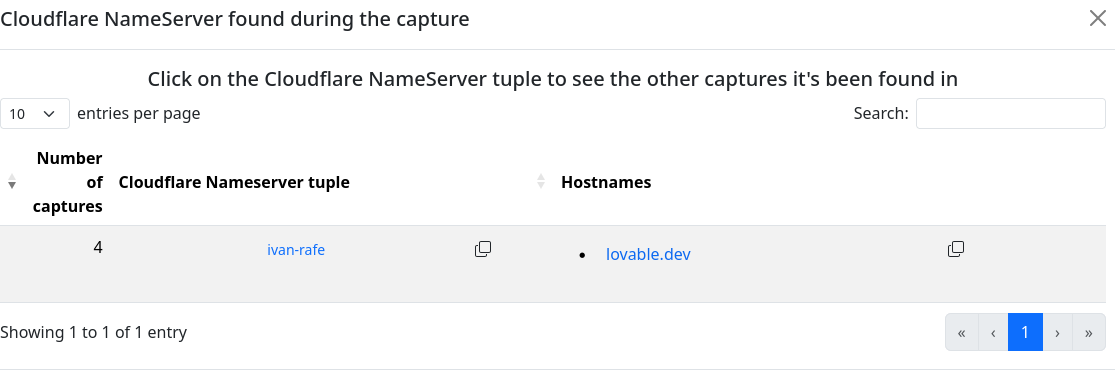
Pivot on the indexed tuple of Cloudflare NS record pairs to find other captures containing domains with the same suspected owner.︀︄︇︀︅︉︀︅︀︀︃︀︀︅︅︀︅︊︀︄︆︀︃︄
 v1.43.0 · Nov 2026
· source
· release history
-
/api/v1/captures/recentnow accepts relative time strings like"2 days ago"instead of only absolute dates v1.39.3 · May 2026 · source · release history - Search interface figures out what the user is looking for (hostname, domain, suffix, or TLD), and returns the captures accordingly v1.37.0 · Feb 2026 · source · release history
- Add support for kvrocks as the backend for public indexes to prevent ever-growing valkey databases on large public instances. v1.36.0 · Dec 2025 · source · release history
- Add pagination for public and hidden indexes pages to enable near-instant rendering and massively speed up web server initialization. v1.36.0 · Dec 2025 · source · release history
-
Adds
tldsearch capability to index domain extensions v1.32.0 · Aug 2025 · source · release history
example
-
Find all IP addresses associated with a specific capture by its UUID.
curl -s "https://<lookyloo-host>/json/abc123-def456-ghi789/ips"v1.31.0 · Jun 2025 · source -
Search for captures across multiple indicators like IP, Hostname, URL, and Hash using a single endpoint.
curl -s "https://<lookyloo-host>/json/advanced_search?ip=1.2.3.4&hostname=example.com"v1.31.0 · Jun 2025 · source
Capture visibility controls shipped Lets users restrict captures to admins or temporary-token holders, and change the visibility of existing captures via a UI form.
release 8 total
-
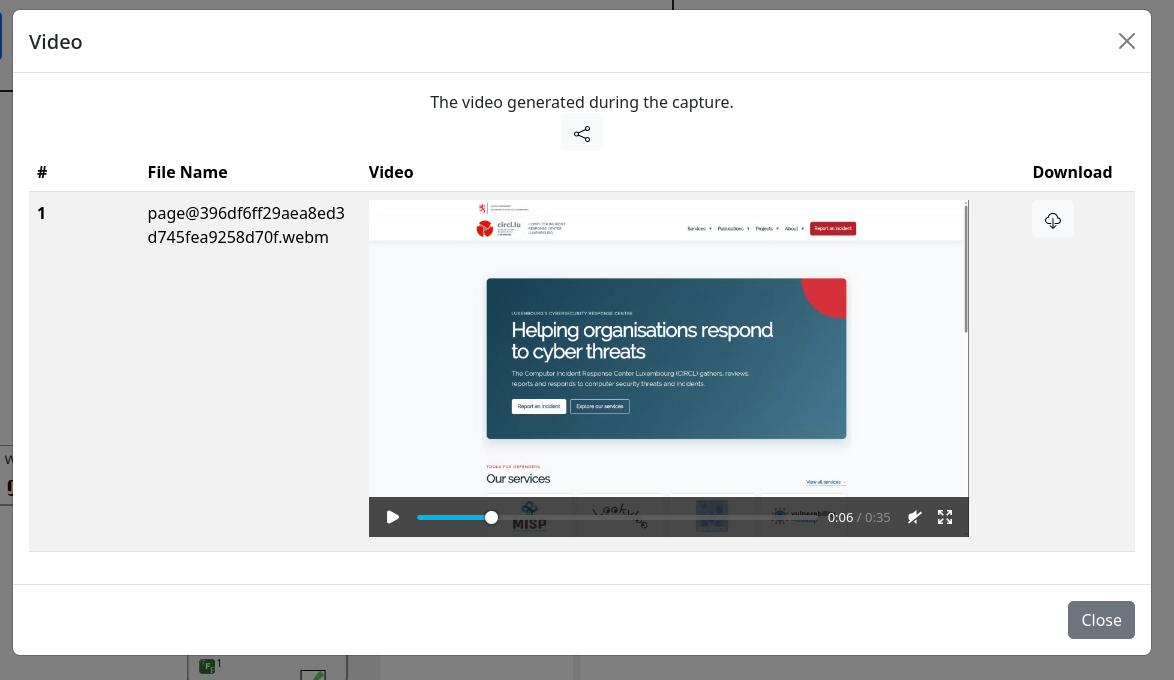
Adds optional video recording of captures (requires Lacus 1.27.0+), accessible after capture via Capture > Video; triggering video capture is admin-only on the public instance, but all users can watch recorded videos based on capture visibility.︀︄︇︀︅︉︀︅︀︀︃︀︀︅︅︀︅︊︀︄︆︀︃︄
 v1.42.0 · Oct 2026
· source
· release history
- Adds private captures mode — captures visible only to admins or holders of a temporary token. v1.40.1 · Jul 2026 · source · release history
- Expose form to change the visibility of a capture v1.40.1 · Jul 2026 · source · release history
- Adds a UI form to change the visibility of an existing capture (e.g. public → private). v1.40.1 · Jul 2026 · source · release history
- Private captures (only visible as admin or with a temporary token) v1.40.1 · Jul 2026 · source · release history
-
monitoringsubsystem (beta) triggers recurring captures for temporal comparison v1.18.0 · Mar 2023 · source · release history
example
-
Watch a recorded video of a completed capture to visually verify what a browser rendered during the session.
In the Lookyloo UI, open a completed capture, then navigate to Capture > Video to play back the full recording.v1.42.0 · Oct 2026 · source -
Restrict a sensitive capture so only admins or a shared temporary token can view it.
In the capture view, open the visibility form and set the capture to Private; share the generated temporary token with authorised recipients.v1.40.1 · Jul 2026 · source -
Search for specific artifacts (hostnames, URLs, hashes, or cookie names) directly via the new
/searchentry point.curl 'https://<lookyloo-instance>/search?q=example.com&type=url'v1.5.0 · Apr 2021 · source
Browser storage and state analysis shipped Enables analyzing, retrieving, storing, displaying, and submitting browser storage state for captured sessions.
release 7 total
-
Adds ability to
Expose origin private file system (OPFS) entriesin the analysis tree view with example UUIDd6a9a5f8-26fc-4fbc-baa5-6ae157167a7dv1.41.1 · Sep 2026 · source · release history -
Adds ability to
Expose WebAuthn entriesin the analysis tree view with example UUID1d8f030b-fac1-4d41-b694-5a28fadaf4dbv1.41.1 · Sep 2026 · source · release history - Exposes WebAuthn entries discovered during page captures. v1.41.1 · Sep 2026 · source · release history
- Exposes Origin Private File System (OPFS) entries discovered during page captures. v1.41.1 · Sep 2026 · source · release history
- Adds Gather & render console messages capability to capture browser console output during analysis v1.41.1 · Sep 2026 · source · release history
-
Support [web extension](
https://addons.mozilla.org/en-US/firefox/addon/lookyloo/), and passing cookies. v1.37.0 · Feb 2026 · source · release history
example
-
Examine WebAuthn authentication data in a captured site's analysis tree.
In the console, go to the capture tree view and look for exposed `WebAuthn entries` associated with UUID `1d8f030b-fac1-4d41-b694-5a28fadaf4db`.v1.41.1 · Sep 2026 · source -
Analyze OPFS storage contents for a specific capture to identify hidden file system entries.
In the console, go to the capture tree view and look for exposed `origin private file system (OPFS) entries` associated with UUID `d6a9a5f8-26fc-4fbc-baa5-6ae157167a7d`.v1.41.1 · Sep 2026 · source -
Analyze and interact with browser storage state within a captured session view.
In the Lookyloo UI, open a capture and use the new 'storage state' panel to get, store, display, or submit the state.v1.28.1 · Apr 2025 · source
Non-interactive setup and initialisation verified Allows the tool to run setup commands without prompting for confirmation or without starting the service.
Also counts toward: Command-line interface
release
-
Adds
priorityandasync_capture_processesconfig keys to weight capture priority and control concurrency v1.6.0 · May 2021 · source · release history - Distributes a Docker image v1.3 · Dec 2020 · source · release history
- Enables configuration via config files v1.3 · Dec 2020 · source · release history
- Adds Systemd templates for deployment v1.3 · Dec 2020 · source · release history
command line
-
--init — Run all commands without starting the service.v1.28.1 · Apr 2025 · command-line history -
--yes — Run all commands without asking.v1.14.0 · Aug 2022 · command-line history
example
-
Configure log rotation for Lookyloo using the new sample configuration file in production deployments.
# Add the following block to your Docker or systemd service environment vars # LOG_ROTATION_CONFIG=./logs/lookyloo_logging.confv1.7.0 · Jul 2021 · source
Remote capture synchronization shipped Allows pushing captures to a central Lookyloo instance or pulling them from remote Lacus instances for multi-region analysis and shared repository storage.
release
- Adds Pull capture from another instance capability via the UI v1.28.1 · Apr 2025 · source · release history
- Adds support for multiple remote Lacus instances to offer multiple uplinks and captures from different countries v1.28.1 · Apr 2025 · source · release history
- Adds Push capture to a remote instance capability via the UI v1.28.1 · Apr 2025 · source · release history
- Push captured analyses to another Lookyloo instance via the UI or API v1.28.0 · Feb 2025 · source · release history
example
-
Configure lookyloo to pull captures from a remote Lacus instance instead of just local ones.
In the Lookyloo UI, use the 'Pull capture from another instance' feature in the capture workflow.v1.28.1 · Apr 2025 · source -
Send a captured session to a remote Lacus instance for multi-region analysis.
In the Lookyloo UI, use the 'Push capture to a remote instance' feature from the capture details view.v1.28.1 · Apr 2025 · source -
Push a captured analysis to a central Lookyloo instance for shared repository storage.
In the UI, open the capture details page, click 'Share' > 'Push to another instance', and enter the target Lookyloo URL with valid credentials.v1.28.0 · Feb 2025 · source
Capture archival and storage shipped Manages the archiving of captures using S3FS integration and stores HAR dumps in compressed gzip format.
release
- Adds support for RFC3161 Trusted Timestamps to validate HAR, HTML, screenshot, URL, and download content hashes via a Time Stamping Authority (TSA) v1.33.0 · Sep 2025 · source · release history
- Archiving old captures to a S3 bucket enables offloading long-term storage for captured data (noted as handling well over 2M on production). v1.23.0 · Feb 2024 · source · release history
-
HAR dumps stored in
gziparchives instead of uncompressed format v1.22.0 · Oct 2023 · source · release history -
S3FSintegration for archiving captures v1.22.0 · Oct 2023 · source · release history
example
-
Suspend S3 bucket versioning
mc version suspend <alias_in_config>/<bucket> -
Check if S3 bucket versioning is enabled
mc version info <alias_in_config>/<bucket>
Resource fingerprinting shipped suggested Indices cookies and computes hashes for web resources to aid in identification.
Suggested capability: Threat indicator matching. This is our guess, not confirmed.
Also counts toward: REST API
release
- Renders a cookie name index from storage state and shows cookie name frequency in the storage modal v1.28.1 · Apr 2025 · source · release history
- Adds FuzzImy hash generation based on HTML structure using CERT PL algorithm for rendered pages v1.25.0 · Jul 2024 · source · release history
- Search and index captcha IDs (reCaptcha, hCaptcha, Cloudflare) v1.24.0 · Mar 2024 · source · release history
- Index favicons and correlate them to Shodan via MM3H hash v1.24.0 · Mar 2024 · source · release history
- Exposes an API endpoint to get hashes of all captured resources using any Python-supported algorithm v1.10.0 · Dec 2021 · source · release history
- Adds indexing of cookies and hashes of resources v1.3 · Dec 2020 · source · release history
Capture browser configuration shipped Controls the browser settings used during captures, including the default mobile device.
release
-
Changes the default mobile device (replacing Blackberry) used in captures.
v1.42.0 · Oct 2026
· source
· release history
-
Adds
default_browserconfig setting to override the Playwright browser used for captures, defaulting to Firefox Desktop to better bypass bot detection. v1.36.1 · Jan 2026 · source · release history - Use pre-configured devices from Playwright (mobile only for now) v1.15.0 · Aug 2022 · source · release history
- Allows passing arbitrary User-Agent strings to captures via the browser configuration option v1.10.0 · Dec 2021 · source · release history
- Allows passing arbitrary HTTP headers to captures via the new capture configuration option v1.10.0 · Dec 2021 · source · release history
DNS resolution shipped Resolves domain names to IP addresses and CNAMEs during the investigation process.
release
-
Index
GTM-identifiers v1.37.0 · Feb 2026 · source · release history - Index IPs and TLDs with searchable indexes exposed in the UI v1.28.0 · Feb 2025 · source · release history
- Link hostname and IP indexes together, visible on the UI for cross-referencing v1.28.0 · Feb 2025 · source · release history
-
AAAADNS queries are now triggered during capture (previouslyAonly) v1.18.0 · Mar 2023 · source · release history - Adds DNS resolution (IP and CNAMEs) capability v1.3 · Dec 2020 · source · release history
Capture management verified Allows users to manage captures, including removing them by UUID.
release
-
Adds
GET /api/v1/captures/category/<category>endpoint to retrieve UUIDs by category v1.26.0 · Sep 2024 · source · release history -
Adds
categoriesfeature to organize captures v1.26.0 · Sep 2024 · source · release history - Introduces configurable archiving for captures older than 6 months, moving them off the main index while retaining access via UUID v1.8.0 · Aug 2021 · source · release history
command line
-
capture_uuid — The UUID of the capture to remove.v1.24.0 · Mar 2024 · command-line history
example
-
Administrators can now quickly manage problematic captures via the UI without CLI access.
In the console, navigate to a specific capture page and use the new modal to select 'hide' or 'rebuild'.v1.19.0 · Mar 2023 · source
Background indexing and tree building shipped Runs background scripts to build trees and index archived captures without blocking the main process.
release
- Scripts to build trees and index archived captures in the background v1.40.1 · Jul 2026 · source · release history
- Adds background scripts to build trees and index archived captures without blocking the main process. v1.40.1 · Jul 2026 · source · release history
- Allows paginating search results based on capture timestamp using the new index backend v1.26.1 · Oct 2024 · source · release history
- Runs a new background indexer so that captures queued via the API are automatically cached even if never opened in the browser v1.5.0 · Apr 2021 · source · release history
Automated phishing aid capabilities shipped Detects and automatically handles suspicious Google Docs/Dropbox links by triggering subsequent captures, and allows capturing content from iframes or arbitrary URLs in the current context.
release
- Guesses download/export links for Google Docs and Dropbox landing pages, enabling a one-click subsequent capture of the file and direct submission to Pandora. v1.35.0 · Nov 2025 · source · release history
- Supports iFrames captured via Lacus v1.20.0: URLs on iframes now correctly anchor nodes in the capture tree, rendered iframe content is downloadable from its tree node, and all frame contents are submitted for a Trusted Timestamp. v1.35.0 · Nov 2025 · source · release history
- Allows any arbitrary URL to be entered in the subsequent-capture modal so it is captured in the current browser context, including the session's local storage. v1.35.0 · Nov 2025 · source · release history
example
-
When analyzing a phishing page that loads content via iFrames, download the rendered iframe content directly from its node in the capture tree to examine what was presented to the victim.
In the capture tree, locate the iframe node, then click 'Download rendered content' on that node to save the iframe's rendered output.v1.35.0 · Nov 2025 · source
Capture parameter configuration shipped Allows configuring specific environment variables such as locale, timezone, geolocation, and proxy for individual captures.
release
-
Adds
system_proxysupport across all modules for automatic proxy verification v1.32.0 · Aug 2025 · source · release history - Allows passing timezone, geolocation coordinates, locale, and color scheme to a capture v1.21.0 · Jun 2023 · source · release history
example
-
Configure a global proxy for all captures via the settings file.
# Set 'proxy' in your Lookyloo config file (e.g., /etc/lookyloo/config.yaml) # proxy: http://proxy.example.com:8080v1.21.0 · Jun 2023 · source -
Specify capture parameters like locale and timezone when submitting a URL.
# Via API or UI, specify: { "url": "https://example.com", "locale": "fr_FR", "timezone": "Europe/Paris", "geo": {"lat": 48.8566, "lon": 2.3522}, "color_scheme": "dark" }v1.21.0 · Jun 2023 · source
Proxy and anonymity routing shipped Provides UI controls and configuration to route capture requests through specific proxies, such as Tor or Wireguard.
release
- Adds a proxy selector UI in the Lacus module to use pre-configured proxies (e.g., SOCKS5, Tor, Wireguard) for request routing. v1.29.0 · Apr 2025 · source · release history
-
Adds
proxyparameter to capture requests, enabling traffic routing through a configured proxy server v1.7.0 · Jul 2021 · source · release history
example
-
Route analysis requests through specific proxies like Tor or Wireguard via the Lacus proxy selector UI.
In the Lookyloo UI, navigate to the Lacus module and use the 'proxy selector' to choose your pre-configured proxy (e.g., Tor/SOCKS5).v1.29.0 · Apr 2025 · source -
Send a capture request through an HTTP proxy by specifying the URL in the JSON body.
curl -X POST https://lookyloo.circl.lu/api/v1/capture \ -H 'Content-Type: application/json' \ -d '{"url": "https://example.com", "proxy": "http://proxy.internal:8080"}'v1.7.0 · Jul 2021 · source
Forensic export formats shipped Provides new export options including Markdown-formatted rendered HTML and AI model classification data.
release
- Adds a new export method returning capture details formatted for AI model classification (unstable API, high token cost) v1.39.3 · May 2026 · source · release history
- New Rendered HTML page as Markdown option in Actions > Get Forensic Acquisition > Download modal v1.38.0 · Mar 2026 · source · release history
- Revamped the package generator to be more usable. v1.13.0 · Jun 2022 · source · release history
Capture configuration enhancements shipped Adds support for additional POST request types, optional instrumentation wait times, and remote headless browser modes to improve capture accuracy for complex sites.
release
-
Adds support for
remotemode in headless browsers by enabling Remote headfull captures when the underlying Lacus instance supports it, allowing complex JavaScript-heavy sites to be rendered and captured correctly. v1.39.0 · May 2026 · source · release history - Support more types in POST requests: Amazon ION, protobuf (best effort), broken atom. v1.37.0 · Feb 2026 · source · release history
- Adds optional wait time after the instrumentation ran (for time-based javascript code) v1.37.0 · Feb 2026 · source · release history
Capture temporal monitoring shipped Automates recurring captures to track changes over time and supports email notifications for the monitored entities.
Also counts toward: Scheduled jobs
release
- Adds Mastodon bot integration to automatically verify Lookyloo website via Mastoton v1.32.0 · Aug 2025 · source · release history
- Adds a field in the monitoring form to set an email address for notifications v1.20.0 · Jun 2023 · source · release history
-
monitoringsubsystem (beta) triggers recurring captures for temporal comparison v1.18.0 · Mar 2023 · source · release history
Resource asset extraction shipped Retrieves downloaded files and extracts favicons from the captured URLs.
release
-
Adds the
GET /json/<string:capture_uuid>/faviconsendpoint to return all favicons in a capture v1.31.0 · Jun 2025 · source · release history - Ability to fetch downloaded files via the API v1.22.0 · Oct 2023 · source · release history
- Fetch favicons using default URL and HTML content v1.22.0 · Oct 2023 · source · release history
Capture video recording shipped Optionally records a video of the browser session during a capture, which users can later watch to verify what the browser rendered.
Also counts toward: Role-based access control
release
-
Adds optional video recording of captures (requires Lacus 1.27.0+), accessible after capture via Capture > Video; triggering video capture is admin-only on the public instance, but all users can watch recorded videos based on capture visibility.︀︄︇︀︅︉︀︅︀︀︃︀︀︅︅︀︅︊︀︄︆︀︃︄
v1.42.0 · Oct 2026
· source
· release history
example
-
Watch a recorded video of a completed capture to visually verify what a browser rendered during the session.
In the Lookyloo UI, open a completed capture, then navigate to Capture > Video to play back the full recording.v1.42.0 · Oct 2026 · source
Clipboard copy for table data shipped Provides a copy-to-clipboard button on most data tables in the interface.
release
-
Most tables now have a copy-to-clipboard button.
v1.42.0 · Oct 2026
· source
· release history
- Adds more tooltips shown when the mouse goes over icons and different parts of the tree v1.4.0 · Feb 2021 · source · release history
Index expansion and intelligent search shipped suggested Expands index coverage to include domain suffixes, TLDs, GTM identifiers, and supports natural language query interpretation for more flexible search.
Suggested capability: Threat indicator matching. This is our guess, not confirmed.
Also counts toward: Natural-language query
release
- Index domains, suffix, and TLDs (even the weird ones) v1.37.0 · Feb 2026 · source · release history
-
Index
GTM-identifiers v1.37.0 · Feb 2026 · source · release history
Capture content categorization shipped Automatically detects and assigns categories to captured content, such as identifying non-JS form spam bots.
release
-
skip.authorsandinclude.labelsare not present; this release adds automatic categorization that detects non-JS content in the init script (typically form spam bots) and assigns a category. v1.36.1 · Jan 2026 · source · release history - Adds categories support for capture import and export operations. v1.36.1 · Jan 2026 · source · release history
Malicious file handling and submission shipped suggested Provides interfaces to view downloaded files and submit them directly to malware analysis services like Pandora.
Suggested capability: Malware sandbox analysis. This is our guess, not confirmed.
release
- Introduces a modal to display downloaded files and submit them to Pandora if possible v1.28.1 · Apr 2025 · source · release history
example
-
When a suspicious Google Docs or Dropbox link is captured, trigger an automatic download capture and send the file to Pandora for malware analysis.
On the capture result page, click 'Guess download link' on the Google Docs or Dropbox node, then choose 'Capture and submit to Pandora' from the subsequent capture modal.v1.35.0 · Nov 2025 · source
Resource classification shipped Allows users to manually mark specific resources as known or malicious via the interface.
release
- Use MISP Taxonomy (dark-web) as the default categorization scheme v1.28.0 · Feb 2025 · source · release history
- Adds support for marking specific resources as known or malicious via the investigation popup v1.3 · Dec 2020 · source · release history
S3 storage path checking verified Verifies a given path on s3fs, expected to follow a Year/Month structure.
release
- Enables submission of any URL format to Pandora (if available) through the tool v1.20.0 · Jun 2023 · source · release history
command line
-
--path — The path to check on s3fs. Should always start with Year/Month.v1.23.0 · Feb 2024 · command-line history
Takedown automation shipped suggested Identifies and contacts malicious site operators by gathering WHOIS and security.txt data, then facilitates takedown requests via email notifications.
Suggested capability: Response playbook automation. This is our guess, not confirmed.
Also counts toward: REST API
release
- Email notifications now attach contact details to facilitate takedown requests. v1.19.0 · Mar 2023 · source · release history
-
New Takedown endpoint (
/takedowns) gathering WHOIS/security.txt contacts for malicious URLs v1.18.0 · Mar 2023 · source · release history
Browser console analysis shipped Gathers and renders browser console messages during captures to aid in debugging and content analysis.
release
- Gathers and renders browser console messages during captures. v1.41.1 · Sep 2026 · source · release history
WebAuthn data extraction shipped Exposes and renders WebAuthn authentication entries discovered during page captures within the analysis tree.
example
-
Examine WebAuthn authentication data in a captured site's analysis tree.
In the console, go to the capture tree view and look for exposed `WebAuthn entries` associated with UUID `1d8f030b-fac1-4d41-b694-5a28fadaf4db`.v1.41.1 · Sep 2026 · source
WebSocket stream inspection shipped Enables viewing WebSocket streams extracted from HAR dumps within the analysis interface.
release
- Show websocket streams from HAR dump (UI is not finalized) v1.40.1 · Jul 2026 · source · release history
AI-assisted summary generation shipped Allows administrators to submit captures to a local Ollama instance for automated summary generation.
release
- [Admin only] Adds capability to submit captures to a local Ollama instance for summary generation v1.40.0 · Jun 2026 · source · release history
I2P domain support shipped suggested Enables the capture and analysis of .i2p domains through the Lacus instance.
Suggested capability: Threat indicator matching. This is our guess, not confirmed.
release
-
Enables capturing
.i2pdomains through the Lacus instance v1.33.0 · Sep 2025 · source · release history
Capture comparison shipped Enables the direct comparison of different captures to identify differences.
release
- Adds the ability to compare captures via the API v1.20.0 · Jun 2023 · source · release history
Instance analytics shipped Provides a statistics view displaying metrics for the entire tool instance.
release
- Adds statistics view for the whole instance v1.3 · Dec 2020 · source · release history
Index maintenance automation shipped Provides commands to manage index file versions and control S3 bucket versioning settings.
example
-
Remove all older versions of index file
mc rm --non-current --versions --recursive --force <alias_in_config>/<bucket>/Year/Month/Day/index
Visual request chain mapping documented Displays a tree of domains calling each other within the web interface to map the full request chain.
docs
- Web interface that captures a webpage and displays a tree of domains calling each other, mapping the full request chain.
Lines in monospace are the tool's own words: help text
parsed from its source, or an endpoint from its API document. Under
release, a line is our summary of a dated release. Under
docs, it is quoted from the tool's own documentation or
website. Each links back to the source it came from.
Command line
No command matches.
| option | found in | since | description |
|---|
Values are placeholders taken from each option’s declared default. Nothing is executed here — the output shown is a recording of a run that already happened.
Screenshots
From the release notes, newest first. Click one to see it full size.Score card
-
Shipping velocity releases a month, last 12 months
-
Documentation quality release-notes rubric, 0–100
-
Breaking-change discipline how rarely a release breaks users, and notice given
-
Maintenance risk quiet time against its own cadence, maintainers
-
Innovation & surface new capabilities, API and MCP surface
- Community health
-
Contributor trend distinct committers, this year against last
-
Maintainer concentration bus factor now against a year ago
-
Issue backlog trend issues closed per issue opened, 12 months
-
Responsiveness median time to a maintainer’s first reply
Nine scores for Lookyloo, each built from the releases, notes and API history this site tracks — and, on Researcher and Business, where it stands among every measured tool in its category and how that has moved.
Score cards are part of every paid plan.
See plans → Already subscribed? Sign in →Trajectory
Blank means never measured; nothing here is a filled-in zero.
Peer standings are included with Researcher and Business. See how this tool ranks against its competitors, using data we don't publish anywhere else.
See plans →Each score is 0–100 on a published rubric, derived from data this site already shows. A dimension we cannot measure says so — it is never scored 0 and never enters a rank.
How this is scored
- Shipping velocity — releases a month over the last 12 months, on a log scale where 16 a month scores 100. Needs 3 releases in the window.
- Documentation quality — the release-notes rubric published on the analytics page, unchanged.
- Breaking-change discipline — the share of releases carrying a breaking change (none scores 100, half or more scores 0). Only projects that label breaking changes are measured: a clean record cannot be told from an unlabelled one.
- Maintenance risk — quiet time measured against the tool's own release cadence (quiet longer than 90 days and three typical gaps scores 0), plus the number of active maintainers and whether contributors are growing, where known. Higher is lower risk.
- Innovation & surface — new capabilities in the feature ledger this year, API and MCP operations added, and the share of commits that are features: the mean of whichever we hold.
- Community health (open-source tools only) — each is a direction, not a size: contributors this year against last, the bus factor now against a year ago, and issues closed per issue opened, where steady scores 50, doubled 100 and halved 0; plus the median time to a maintainer's first reply (an hour scores about 100, a month or more 0). A commercial card has no repository and carries none of the four.
- Documented delivery (commercial tools) — when a vendor's documented new capabilities have slowed against its own baseline, that counts against the overall standing as heavily as two low dimensions. Steady delivery, or too little history to judge, leaves the standing alone; it is never a sixth score.
- Open-source tools are scored on repository signals; commercial tools on their published changelog. Ranks compare tools within one category and one profile and need at least five measured peers; the overall standing needs three ranked dimensions. Best-in-breed or consolidator is a shape, not a quality, and is never scored.
Release-note detail over time
See how much detail Lookyloo puts in its release notes, quarter by quarter, and compare it with tracked tools in the same category. This history uses up to ten retained, reviewed notes per tool; sparse or blank older quarters may reflect that limit.
Checking release-note history…
Releases
51 entries
No entries match these filters.
- November 20261
- October 20261
- September 20261
- July 20262
- June 20262
- May 20262
- March 20261
- February 20261
- January 20261
- December 20254
- November 20252
- October 20251
- September 20251
- August 20251
- June 20251
- May 20251
- April 20252
- February 20251
- October 20241
- September 20241
- July 20241
- March 20241
- February 20241
- October 20231
- June 20232
- March 20232
- December 20221
- October 20221
- August 20222
- June 20221
- May 20221
- March 20221
- December 20211
- September 20211
- August 20211
- July 20211
- May 20211
- April 20211
- February 20211
- December 20201
Project health
Issue, contributor and maintainer activity in Lookyloo/lookyloo, 2023-10 – 2026-09, as of 2026-09-25. Twelve-month figures first; the trend lines run the whole window.
- Contributors 3 −4 vs prior 12 months
- Maintainers 1 +0 joined · −0 left, last 12 months
- Bus factor 1 committers behind half the commits
- Community-filed 29% of issues opened, last 12 months
- Median time to close 3.6 years first maintainer reply 7 days
- Open backlog 54 of 251 issues ever filed
- Issues opened / month 1 · 1 communitymaintainers
- Open backlog 54
- Contributors / month 0
- Commits / month 0
- Stars 775
- bugs 10%
- other 90%
Counts from the project's public repository and git history; no individuals are identified. Maintainers are the committers covering 80% of the last year's commits. how we measure this
Libraries its release ships
What its latest release locks, checked against known advisories.None of its release's images build from a lockfile we can read.
Add the badge to your README
Maintain this project? The badge links readers straight to this page, so they can follow every release here.
 Choose a badge style and copy the code →