Palo Alto Cortex XDR
commercialThe section your link pointed to isn't on Palo Alto Cortex XDR's page any more, so we've brought you to the top.
Palo Alto Networks Cortex XDR is an extended detection and responseextended detection and responseExtended detection and response, combining signals and investigation across endpoints, networks, identities or cloud services. It helps analysts connect activity that separate tools might miss. platform that unifies endpoint, network, and cloud telemetry to detect, investigate, and stop threats.
Summary
Palo Alto Cortex XDR is a commercial endpoint security platform that detects, prevents, and investigates attacks across endpoints, network, cloud, identity, and email data sources. It is delivered as a managed service, with an agent deployed on endpoints and a cloud-based analyst console tying detection and response together in one data lake. It's built for SOCSOCA security operations center, the team or function that monitors threats, investigates alerts and coordinates incident response. Its work can be internal, outsourced or shared. analysts and incident responders who need to trace an alert to its root cause and automate response rather than chase it manually across separate tools. The vendor positions it as the foundation for Cortex XSIAM, its broader AI-driven SOC platform, extending into areas like NG-SIEMSIEMSecurity information and event management, collecting logs from many systems and correlating events to find suspicious activity. Analysts use it to investigate alerts and incidents., exposure management, and email security under one analyst experience. Palo Alto Networks has offered it since 2007, placing it among the longer-running products in the endpoint security category.
Palo Alto Networks Cortex XDR is an extended detection and response platform that unifies endpoint, network, and cloud telemetry to detect, investigate, and stop threats.
How Palo Alto Cortex XDR helps
Which alert in the queue actually deserves attention first?
correlates activity across endpoint, network, cloud, identity, and email sources and applies AI to prioritize attacks rather than surfacing every raw alert equally
How did an attacker get from initial access to where they are now?
reconstructs the execution path behind an alert so an analyst can trace root cause instead of piecing it together from separate tool logs
Is a technique likely to be stopped before it executes on a given endpoint?
applies prevention modules tuned to specific attack techniques, from zero-day exploits to fileless malware and hijacked legitimate processes, and reports which one matched
Can a detected attack be contained without someone manually working each affected host?
runs native automation against the traced execution path to disrupt the attack across the involved endpoints in minutes
Are the endpoint, network, and cloud signals about one incident actually the same story?
ties the data sources together in a single data lake so the analyst console shows one incident view instead of separate consoles per source
Which parts of an active investigation can be handed off rather than run by hand?
the Cortex AgentiX Assistant deploys AI agents that investigate and respond at machine speed alongside the analyst
Features
Built from Palo Alto Cortex XDR's releases, docs, README and our own runs. “Seen” marks the month we first spotted a release the vendor didn't date. Group names and tags are our labels.
What Palo Alto Cortex XDR offers you
- Agent-based deployment1
No capabilities match.
All capabilities 3 capabilities
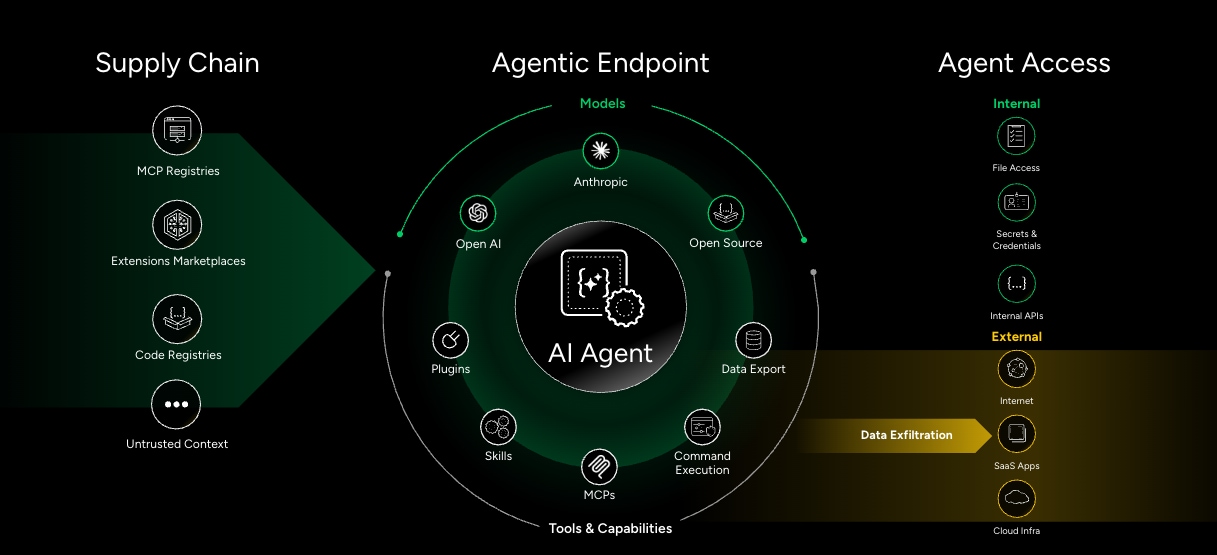
Cortex XDR One unified platform shipped Combines Cortex XDR and Cortex Agentic Endpoint Security under a single sensor and console for centralized visibility, management, and investigation of traditional endpoints and AI agents.
Also counts toward: Agent-based deployment
release
-
Adds Managed AES with Cortex XDR One, providing 24/7 Unit 42-staffed governance, threat hunting, investigation, and response across the full endpoint attack surface including AI agents.
 changelog · Oct 2026
· source
· release history
- Introduces Cortex XDR One, a unified platform combining Cortex XDR and Cortex Agentic Endpoint Security (AES) under a single sensor and console for centralized visibility, management, and investigation of both traditional endpoints and AI agents.︀︄︇︀︅︉︀︅︀︀︃︀︀︅︅︀︅︊︀︄︆︀︃︄ changelog · Oct 2026 · source · release history
AI artifact inventory and control shipped Provides real-time discovery of AI artifacts on endpoints—including agents, MCP servers, AI co-pilots, and browser tools—and lets security teams control which packages, extensions, and AI artifacts are permitted.
release
-
Delivers real-time inventory of every AI artifact (agents, MCP servers, AI co-pilots, browser tools) the moment it appears on an endpoint, enabling security teams to control which packages, extensions, agents, and AI artifacts are allowed to be installed or used.
changelog · Oct 2026
· source
· release history
XQL Support documented Integrates Device Security with Cortex XDR to enable Cross-X Query Language support.
docs
- Integrate Device Security with Cortex XDR for XQL Support changelog · Sep 2026 · source
Lines in monospace are the tool's own words: help text
parsed from its source, or an endpoint from its API document. Under
release, a line is our summary of a dated release. Under
docs, it is quoted from the tool's own documentation or
website. Each links back to the source it came from.
Screenshots
From the release notes, newest first. Click one to see it full size.Score card
-
Shipping velocity releases a month, last 12 months
-
Documentation quality release-notes rubric, 0–100
-
Breaking-change discipline how rarely a release breaks users, and notice given
-
Maintenance risk quiet time against its own cadence, maintainers
-
Innovation & surface new capabilities, API and MCP surface
Five scores for Palo Alto Cortex XDR, each built from the releases, notes and API history this site tracks — and, on Researcher and Business, where it stands among every measured tool in its category and how that has moved.
Score cards are part of every paid plan.
See plans → Already subscribed? Sign in →Trajectory
Blank means never measured; nothing here is a filled-in zero.
Peer standings are included with Researcher and Business. See how this tool ranks against its competitors, using data we don't publish anywhere else.
See plans →Each score is 0–100 on a published rubric, derived from data this site already shows. A dimension we cannot measure says so — it is never scored 0 and never enters a rank.
How this is scored
- Shipping velocity — releases a month over the last 12 months, on a log scale where 16 a month scores 100. Needs 3 releases in the window.
- Documentation quality — the release-notes rubric published on the analytics page, unchanged.
- Breaking-change discipline — the share of releases carrying a breaking change (none scores 100, half or more scores 0). Only projects that label breaking changes are measured: a clean record cannot be told from an unlabelled one.
- Maintenance risk — quiet time measured against the tool's own release cadence (quiet longer than 90 days and three typical gaps scores 0), plus the number of active maintainers and whether contributors are growing, where known. Higher is lower risk.
- Innovation & surface — new capabilities in the feature ledger this year, API and MCP operations added, and the share of commits that are features: the mean of whichever we hold.
- Community health (open-source tools only) — each is a direction, not a size: contributors this year against last, the bus factor now against a year ago, and issues closed per issue opened, where steady scores 50, doubled 100 and halved 0; plus the median time to a maintainer's first reply (an hour scores about 100, a month or more 0). A commercial card has no repository and carries none of the four.
- Documented delivery (commercial tools) — when a vendor's documented new capabilities have slowed against its own baseline, that counts against the overall standing as heavily as two low dimensions. Steady delivery, or too little history to judge, leaves the standing alone; it is never a sixth score.
- Open-source tools are scored on repository signals; commercial tools on their published changelog. Ranks compare tools within one category and one profile and need at least five measured peers; the overall standing needs three ranked dimensions. Best-in-breed or consolidator is a shape, not a quality, and is never scored.
Release-note detail over time
See how much detail Palo Alto Cortex XDR puts in its release notes, quarter by quarter, and compare it with tracked tools in the same category. This history uses up to ten retained, reviewed notes per tool; sparse or blank older quarters may reflect that limit.
Checking release-note history…
Website history
paloaltonetworks.com, every changePalo Alto's home page and 36 more pages as they looked each month from September 2021 to October 2026: 48 renders, 6 changes of tagline or palette. Step through them, play them, or put any two months side by side.
Website history is included with Researcher and Business.
See plans → Already subscribed? Sign in →← → or h l a month · Shift a year · [ ] previous / next change · Space play · 1 2 3 page · T whole page · C compare · F full size
← → or h l the right month · Shift the left · S swap · W wipe · T whole page · Esc back
Rebranding timeline
Dates bound when a change appeared between captures. Possible rebrands are AI suggestions; a redesign alone does not establish a rebrand.
Releases
2 entries
No entries match these filters.
- October 20261
- September 20261
Add the badge to your README
Maintain this project? The badge links readers straight to this page, so they can follow every release here.
 Choose a badge style and copy the code →