Pomerium
changelog-20261012-68827fa7 commercialThe section your link pointed to isn't on Pomerium's page any more, so we've brought you to the top.
Pomerium is an identity-aware proxy that provides secure, clientless access to internal applications by enforcing context-based authentication and authorization policies.
https://app.example.com/dashboard?pomerium_additional_hosts=api.example.com
pomerium-console -directory-provider github -url https://console.corp.example.com
ssh_upstream_tunnel: true
ssh_allow_direct_tcpip: true
ssh_routes_portal: true
ssh_upstream_tunnel: true
ssh_allow_direct_tcpip: true
ssh_routes_portal: true
Summary
Pomerium is a commercial secure-access proxy that brokers identity-aware access to applications, SSH servers, and now AI agent (MCPMCPModel Context Protocol, a standard for connecting AI applications to external tools and data sources. A compatible server exposes capabilities an assistant can use through a common interface.) endpoints, running as a self-hosted service in front of the infrastructure it protects. It suits platform and security teams managing access for distributed or clustered deployments rather than individual developers, offering a hosted identity provideridentity providerA service that authenticates users and supplies identity information to other applications. It is the sign-in authority behind many single sign-on systems. option so smaller teams can skip standing up an external OIDCOIDCOpenID Connect, a sign-in protocol built on OAuth 2.0. An application uses identity information from a trusted provider instead of maintaining a separate password for each user. provider. Recent work extends it well past traditional reverse-proxy access control: SSH support now includes reverse tunneling for NAT'd edge devices, jump-host mode, an interactive routes portal, per-key session revocation with SSOSSOSingle sign-on, using one identity provider to sign in to multiple applications. It reduces separate passwords and centralizes account and access management. lockout, and full session recording and playback through its Enterprise Console. MCP routes get equivalent treatment, with upstream OAuth discovery, dynamic client registration, and token refresh for long-running agent sessions. With 9 releases in the window tracked, the project shows steady, active development.
Pomerium is an identity-aware proxy that provides secure, clientless access to internal applications by enforcing context-based authentication and authorization policies.
How Pomerium helps
Which SSH servers behind NAT or on isolated networks can be reached without opening inbound firewall rules?
upstream servers dial out to Pomerium over a reverse tunnel, so a policy-authorized session can reach them without any inbound path being opened
Who actually did what during a privileged SSH session last month?
every keystroke and terminal output for that connection is captured and can be replayed from the Enterprise Console, stored locally or in an S3-compatible bucket
Can a compromised user's key still get back in after a session is revoked?
a deny/revocation list rejects the blocked user on every subsequent request, and a lockout option stops SSO from silently re-authenticating them
Which AI agent sessions are still connected without forcing someone to log in again?
OAuth refresh tokens are issued and proactively renewed for MCP sessions, keeping long-running agents connected and reauthenticating upstream tokens before they expire
Which destinations is a given user actually authorized to reach when they SSH in without naming a target?
the interactive routes portal lists only the routes that user's policy allows, presented as a picker at connection time
Does a new MCP client need to be manually registered before it can connect?
dynamic client registration and client ID metadata documents let compatible clients register themselves, falling back to discovery when the server doesn't support the metadata document approach
Languages
Features
Built from Pomerium's releases, docs, README and our own runs. “Seen” marks the month we first spotted a release the vendor didn't date. Group names and tags are our labels.
What Pomerium offers you
- Web management console2
- Command-line interface1
- gRPC API support1
No capabilities match.
Single sign-on 1 feature Identity and access since 2026
Session revocation and user blocking shipped Lets administrators immediately revoke active sessions and permanently block users so they cannot silently regain access through SSO.
Shared capability: Single sign-on
release
-
Adds Revoke and block future authentication option to the session revocation dialog in the Enterprise Console.
 updated · seen Oct 2026
· source
· release history
- Adds a Revoke and block future authentication option to the session revocation dialog, preventing SSO re-authentication loops after revocation. Revoke and Block: Stronger Session Revocation (Enterprise) · seen Jul 2026 · source · release history
- Enforces blocks via a deny/revocation list so blocked users are rejected on all subsequent requests, not just the current session. Revoke and Block: Stronger Session Revocation (Enterprise) · seen Jul 2026 · source · release history
- Adds a Revoke and block future authentication checkbox to the session revocation dialog in the Enterprise Console Revoke and Block: Stronger Session Revocation (Enterprise) · Apr 2026 · source · release history
example
-
During an incident response, permanently lock out a compromised user so they cannot silently re-authenticate through SSO after session revocation.
In the Enterprise Console, go to Sessions, find the target user's session, open the revocation dialog, and select 'Revoke and block future authentication'.Revoke and Block: Stronger Session Revocation (Enterprise) · seen Jul 2026 · source -
Immediately block a compromised user from re-authenticating via SSO during an incident.
In the Enterprise Console session management dialog, check 'Revoke and block future authentication' before confirming revocationRevoke and Block: Stronger Session Revocation (Enterprise) · Apr 2026 · source
OIDC SSO 1 feature Identity and access since 2026
Hosted identity provider shipped Provides a built-in identity provider so teams can use Pomerium without setting up an external OIDC service.
Shared capability: OIDC SSO
release
-
Adds a hosted identity provider type so Pomerium can manage its own OIDC provider, removing the requirement to stand up an external IdP before getting started.
changelog · Oct 2026
· source
· release history
-
node_idis now supported as the primary user identifier for the GitHub directory provider Platform & Image Hardening · Aug 2026 · source · release history -
The GitHub directory provider can now use GitHub's stable
node_idas the primary key for directory users instead of the GitHub login (username), so policies survive account renames or username reuse. Platform & Image Hardening · Aug 2026 · source · release history - New hosted identity provider type lets Pomerium manage authentication without requiring teams to configure an external OIDC provider. Hosted Identity Provider · seen Jul 2026 · source · release history
example
-
Enable the Pomerium-hosted IdP as your identity source instead of wiring up an external OIDC provider — ideal for evaluations or small deployments.
In the Pomerium console, go to Settings > Identity Provider and select the Pomerium-hosted IdP as your identity source.Hosted Identity Provider · seen Jul 2026 · source
MCP server 1 feature Interfaces and integrations since 2026
MCP routes portal integration shipped Marks MCP routes in the routes portal and adds connect and disconnect controls so users can easily find and manage their MCP server connections.
Shared capability: MCP server
release
-
Adds MCP route indicators and connect/disconnect controls to the routes portal.
updated · seen Oct 2026
· source
· release history
- Updates the routes portal UI to display server indicators and connect/disconnect controls for MCP-enabled routes. MCP: Upstream OAuth, Dynamic Client Registration & Route Discovery · Jul 2026 · source · release history
- MCP routes in the routes portal now display server indicators and connect/disconnect controls for easier identification and management. MCP: Upstream OAuth, Dynamic Client Registration & Route Discovery · seen Jul 2026 · source · release history
Other / not yet classified 19 features Features we have not matched to a capability yet. A suggested match is marked.
MCP upstream OAuth integration shipped Discovers upstream OAuth metadata, completes authorization flows, and injects valid access tokens into MCP traffic, refreshing them automatically for long-running sessions.
release 20 total
-
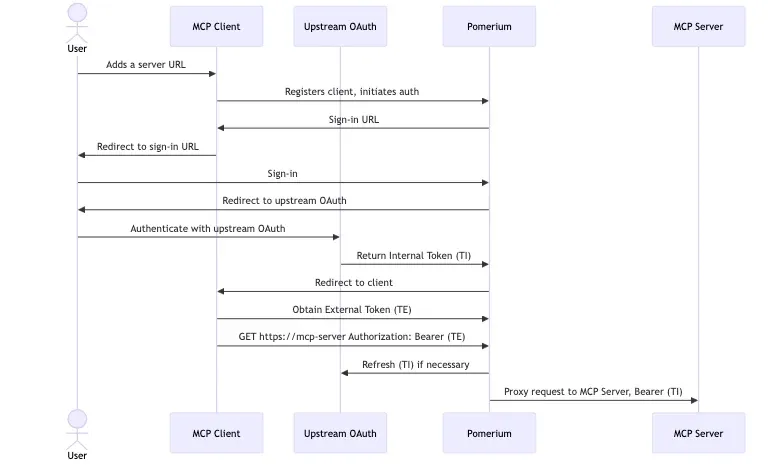
Improves MCP support by adding OAuth refresh token issuance and honoring for MCP sessions, keeping long-running agents connected without repeated interactive logins, and by adding dynamic client registration via client ID metadata documents so MCP clients can register with Pomerium automatically.
changelog · Oct 2026
· source
· release history
-
Adds auto-discovery for MCP
connect,disconnect, andauthorizeendpoints, reducing static upstream OAuth configuration. updated · seen Oct 2026 · source · release history - Adds upstream OAuth support for MCP routes — Pomerium discovers upstream OAuth metadata, completes authorization flows, caches client and token state, and injects upstream access tokens into MCP traffic. updated · seen Oct 2026 · source · release history
- Adds Dynamic Client Registration fallback for upstream MCP OAuth flows. updated · seen Oct 2026 · source · release history
- Loopback redirect URI matching is now RFC 8252 §7.3-compliant: port differences on localhost/loopback URIs are ignored, allowing CLI clients like Claude Code to use a different loopback port than the one originally registered. MCP OAuth Compatibility & Hardening · Aug 2026 · source · release history
- Introduces a configurable toggle for inbound Dynamic Client Registration in Pomerium Zero MCP cluster settings. MCP OAuth Compatibility & Hardening · Aug 2026 · source · release history
example
-
Enable inbound Dynamic Client Registration for a specific cluster so downstream MCP clients can self-register, without enabling it globally.
In the Zero dashboard, go to Cluster Settings for the target cluster and toggle 'Inbound Dynamic Client Registration' on.MCP OAuth Compatibility & Hardening · Aug 2026 · source
SSH session recording and playback shipped Records every keystroke and terminal output for privileged SSH sessions and makes those recordings searchable and replayable from the admin console.
Also counts toward: Web management console
release 15 total
-
Adds SSH session recording and playback for privileged SSH connections in Pomerium Enterprise, with full keystroke and terminal output capture reviewable from the Console.
changelog · Oct 2026
· source
· release history
-
Records SSH sessions in
.asciicast(asciinema-style) format for portable storage and replay. updated · seen Oct 2026 · source · release history - Adds SSH session recording and playback to Pomerium Enterprise, capturing every keystroke and terminal output for privileged SSH connections. updated · seen Oct 2026 · source · release history
- Adds a blob-URI builder in the Enterprise Console for configuring SSH session recording storage without hand-writing connection strings. updated · seen Oct 2026 · source · release history
- Supports local on-disk directory or any S3-compatible bucket as SSH session recording storage, configured per cluster. updated · seen Oct 2026 · source · release history
- Adds a Recordings UI in the Enterprise Console to browse, sort, and filter SSH session recordings by route, SSH user, target host, duration, and size. updated · seen Oct 2026 · source · release history
example
-
Navigate the Enterprise Console to review and play back an SSH session recording after an incident.
In the Enterprise Console, go to Recordings, filter by the target Pomerium route and SSH user, select a recording, then click Play to replay the full terminal session.updated · seen Oct 2026 · source -
Review a full audit trail of a privileged SSH session after the fact — filter by user or host, then replay terminal output.
In the Enterprise Console, go to Recordings, filter by SSH user or target host, select a session, and click Play to replay the recorded terminal output.SSH Session Recording (Enterprise) · seen Jul 2026 · source
MCP authorization and client domain controls shipped Enforces authorization on MCP connections with standards-compliant challenge headers, customizable error pages, and optional restrictions on which client domains may connect.
release 10 total
-
Adds RFC 8252 §7.3-compliant loopback redirect URI matching for MCP OAuth, allowing CLI clients to request a different loopback port than originally registered.
updated · seen Oct 2026
· source
· release history
- Adds OAuth Client ID Metadata Document (CIMD) support for inbound MCP authorization, letting downstream clients (Claude Code, ChatGPT, MCP Inspector) identify via CIMD. updated · seen Oct 2026 · source · release history
-
Relaxes
client_idmetadata URL validation to accept query strings, resolving rejections for ChatGPT's MCP connector. updated · seen Oct 2026 · source · release history - Adds configurable inbound Dynamic Client Registration in Pomerium Zero, off by default in Pomerium core and togglable per cluster in Zero cluster settings under the MCP section. updated · seen Oct 2026 · source · release history
-
MCP access and refresh tokens are now issued with prefixes
pom_mat_…andpom_mrt_…, making Pomerium-issued credentials identifiable in logs and catchable by secret-scanning tools. MCP OAuth Compatibility & Hardening · Aug 2026 · source · release history -
Injects the
issparameter in MCP authorization flows using Pomerium's host as the issuer value to align with the MCP spec. MCP: Upstream OAuth, Dynamic Client Registration & Route Discovery · Jul 2026 · source · release history
Enterprise Console auto-provisioning shipped Allows the Enterprise Console to create its own Pomerium route and configure directory sync at startup via command-line flags, requiring no web UI interaction.
Also counts toward: Command-line interface
release
-
Adds
-urlstartup flag to the Enterprise Console to auto-create the console's own Pomerium route on first boot.
updated · seen Oct 2026
· source
· release history
-
Adds
-directory-providerand related startup flags to the Enterprise Console, enabling full directory sync configuration without the web UI.︀︄︇︀︅︉︀︅︀︀︃︀︀︅︅︀︅︊︀︄︆︀︃︄ updated · seen Oct 2026 · source · release history -
Adds
-directory-providerand related startup flags so directory sync can be fully configured at launch without using the web UI. Enterprise Console Updates · Aug 2026 · source · release history -
Adds
-urlstartup flag to automatically create the Pomerium route on first boot Enterprise Console Updates · Aug 2026 · source · release history -
Adds
-directory-providerand related startup flags to configure directory sync via CLI without using the web UI Enterprise Console Updates · Aug 2026 · source · release history -
Adds
-urlstartup flag that lets the console automatically create its own Pomerium route on first boot, eliminating a manual setup step for new installs. Enterprise Console Updates · Aug 2026 · source · release history
example
-
Bootstrap the Enterprise Console with directory sync and auto-route creation at startup, with no web UI configuration required.
pomerium-console -directory-provider github -url https://console.corp.example.comupdated · seen Oct 2026 · source -
Initialize a new installation with an existing directory provider and explicit URL without manual UI setup
pomerium-enterprise-console start -directory-provider azure-ad -url https://console.example.comEnterprise Console Updates · Aug 2026 · source
SSH key and session management shipped Ties each SSH public key to a verified user identity, checks policy on every connection, and lets admins revoke individual keys from the UI.
release
-
Switches Native SSH Access from the Device Code flow to the standard OAuth Authorization Code flow.
changelog · Oct 2026
· source
· release history
-
Adds
node_idas an alternative stable primary key for GitHub directory provider users, preventing policy breakage on GitHub account renames. updated · seen Oct 2026 · source · release history - SSH authentication now uses the Authorization Code grant; upstream IdPs must have the Authorization Code grant enabled (v0.31.x and earlier used Device Code, which is no longer used). Native SSH: Authorization Code Flow, Reverse Tunnels & Jump-Host Mode · seen Jul 2026 · source · release history
- Adds per-key session management and revocation in the Pomerium UI, binding each SSH key to an OAuth user with policy evaluated on every connection. Native SSH: Authorization Code Flow, Reverse Tunnels & Jump-Host Mode · seen Jul 2026 · source · release history
- Switches SSH authentication to the OAuth Authorization Code flow (replacing Device Code), delivering a faster browser login with full telemetry observability. Native SSH: Authorization Code Flow, Reverse Tunnels & Jump-Host Mode · seen Jul 2026 · source · release history
- Allows per-key session revocation listed in the Pomerium UI. Native SSH: Authorization Code Flow, Reverse Tunnels & Jump-Host Mode · Jan 2026 · source · release history
SSH reverse tunneling shipped Allows SSH servers on private or NATted networks to dial out to Pomerium so authorized inbound sessions can reach them without opening inbound firewall ports.
release
-
Adds reverse tunneling, jump-host mode, an interactive routes portal, and per-key session revocation to Native SSH Access in v0.32.0.
changelog · Oct 2026
· source
· release history
-
Adds reverse tunneling via
ssh_upstream_tunnelflag, letting upstream SSH servers dial out to Pomerium — ideal for edge devices, NAT'd networks, and isolated environments. Native SSH: Authorization Code Flow, Reverse Tunnels & Jump-Host Mode · seen Jul 2026 · source · release history - Adds Pomerium policy support for upstream SSH tunnels. Native SSH: Authorization Code Flow, Reverse Tunnels & Jump-Host Mode · seen Jul 2026 · source · release history
-
Adds support for reverse tunneling via the
ssh_upstream_tunnelruntime flag to reach hosts behind NAT or edge devices. Native SSH: Authorization Code Flow, Reverse Tunnels & Jump-Host Mode · Jan 2026 · source · release history
example
-
Enable reverse tunneling so SSH servers behind NAT or on edge networks can dial out to Pomerium and receive authorized inbound sessions.
ssh_upstream_tunnel: trueNative SSH: Authorization Code Flow, Reverse Tunnels & Jump-Host Mode · seen Jul 2026 · source
Custom DNS resolution for upstream routes shipped Allows administrators to specify custom DNS servers and refresh rates for resolving upstream route hostnames, independent of the host system's DNS configuration.
release
- Supports specifying custom DNS servers for resolving upstream routes, independent of the host system's resolver. Configurable DNS Resolvers · seen Jul 2026 · source · release history
- Enables tunable DNS refresh rates so Pomerium picks up record changes on a schedule matching your environment. Configurable DNS Resolvers · seen Jul 2026 · source · release history
- Delivers consistent, centrally configured name resolution across all Pomerium components for dynamic and clustered deployments. Configurable DNS Resolvers · seen Jul 2026 · source · release history
- Adds the ability to specify custom DNS servers for upstream hostname resolution, allowing Pomerium to bypass the host system's resolver Configurable DNS Resolvers · Jan 2026 · source · release history
- Adds tunable DNS record refresh intervals so administrators can control how frequently Pomerium updates cached address records Configurable DNS Resolvers · Jan 2026 · source · release history
Databroker indexing and querying shipped Provides field-based querying, filter operators, and ordering for Databroker records, with improved synchronization resilience for large deployments.
release
-
Adds a Databroker browser debug view for browsing Databroker records directly to diagnose session, policy, or sync issues.
changelog · Oct 2026
· source
· release history
-
Adds a new
GetOptionsAPI on the Databroker with field-level indexing, additional filter operators, andorder bysupport, replacing full-record scans with targeted lookups. changelog · Oct 2026 · source · release history - Introduces Databroker indexing and query support, including field-based record lookup, a new GetOptions API, additional filter operators, and order-by. Faster Config Updates & a New Databroker Query Engine · seen Jul 2026 · source · release history
- Sync gains a latest stream option and safely aborts calls with invalid record versions, improving resilience for large deployments. Faster Config Updates & a New Databroker Query Engine · seen Jul 2026 · source · release history
Distroless container base image shipped Provides a `base-nossl-debian12` distroless base image variant for Pomerium container images that structurally removes `libssl3` from the deployment.
release
-
Adds
base-nossl-debian12distroless base image variant for published Pomerium container images, structurally removinglibssl3from every deployment.
updated · seen Oct 2026
· source
· release history
-
Pomerium container images now use the
base-nossl-debian12distroless variant instead ofbase-debian12, structurally removinglibssl3from every deployment. Platform & Image Hardening · Aug 2026 · source · release history -
Published container images switch from
base-debian12tobase-nossl-debian12, removinglibssl3Platform & Image Hardening · Aug 2026 · source · release history
MCP ConfigService exposure shipped Exposes Pomerium's own configuration service as MCP tools with generated schemas, safe handling of sensitive fields, and guardrails against unsafe updates.
release
-
Adds
pkg/mcp/configapilibrary exposing Pomerium'sConfigServiceas MCP tools, with generated schemas, sensitive-field handling, and update-safety checks.
updated · seen Oct 2026
· source
· release history
-
Adds
pkg/mcp/configapilibrary exposing Pomerium's ConfigService as MCP tools with generated schemas, sensitive-field handling, and update-safety checks. MCP: Upstream OAuth, Dynamic Client Registration & Route Discovery · Jul 2026 · source · release history -
Introduces a new
pkg/mcp/configapilibrary that exposes Pomerium's ConfigService as MCP tools, with generated schemas, sensitive-field handling, and update-safety checks. MCP: Upstream OAuth, Dynamic Client Registration & Route Discovery · seen Jul 2026 · source · release history
Upstream authentication and session refresh shipped Proactively refreshes upstream tokens before they expire and correctly handles session refresh with the right identity provider configuration.
release
- Improves upstream authentication recovery by refreshing expired upstream tokens before forcing reauthentication and recovering auth after late config delivery. MCP: Upstream OAuth, Dynamic Client Registration & Route Discovery · Jul 2026 · source · release history
- Adds proactive upstream token refresh before forcing reauthentication, upstream auth recovery after late config delivery, and clearer errors when upstream tokens can't be resolved. MCP: Upstream OAuth, Dynamic Client Registration & Route Discovery · seen Jul 2026 · source · release history
- Built-in refresh handling authenticates session refresh requests and correctly hashes the derived IdP configuration for clean session renewal. Hosted Identity Provider · seen Jul 2026 · source · release history
SSH jump-host (ProxyJump) mode shipped Lets SSH clients tunnel through Pomerium to an upstream SSH server without requiring the upstream server to trust Pomerium's certificate authority.
release
-
Adds jump-host (ProxyJump) mode via
ssh_allow_direct_tcpipflag, letting clients connect through Pomerium to upstreams without requiring the upstream to trust Pomerium's User CA. Native SSH: Authorization Code Flow, Reverse Tunnels & Jump-Host Mode · seen Jul 2026 · source · release history -
Enables jump-host (ProxyJump) mode through the
ssh_allow_direct_tcpipruntime flag, allowing policy enforcement without upstream trust of Pomerium's User CA. Native SSH: Authorization Code Flow, Reverse Tunnels & Jump-Host Mode · Jan 2026 · source · release history
example
-
Enable jump-host (ProxyJump) mode so clients can tunnel straight through Pomerium to an upstream SSH server without requiring the upstream to trust Pomerium's User CA.
ssh_allow_direct_tcpip: trueNative SSH: Authorization Code Flow, Reverse Tunnels & Jump-Host Mode · seen Jul 2026 · source
SSH routes portal shipped Shows an interactive list of all SSH destinations the connecting user is authorized to reach when no specific route is requested.
release
-
Adds an interactive routes portal via
ssh_routes_portalflag, presenting authorized destinations as a picker when a client SSHes to Pomerium without specifying a route. Native SSH: Authorization Code Flow, Reverse Tunnels & Jump-Host Mode · seen Jul 2026 · source · release history -
Introduces an interactive routes portal enabled by the
ssh_routes_portalruntime flag for selecting destinations from a picker. Native SSH: Authorization Code Flow, Reverse Tunnels & Jump-Host Mode · Jan 2026 · source · release history
example
-
Enable the interactive routes portal so users who SSH to Pomerium without specifying a route get a picker of all destinations they're authorized to reach.
ssh_routes_portal: trueNative SSH: Authorization Code Flow, Reverse Tunnels & Jump-Host Mode · seen Jul 2026 · source
Cross-origin authentication and session cookie routing shipped Allows declaring frontend routes as dependent on backend API routes so session cookies are automatically set across multiple domains during a single authentication flow.
release
-
Adds
pomerium_additional_hostsquery parameter at the route level to declare cross-origin authentication dependencies, so Pomerium sets session cookies across up to five domains during a single OAuth flow.︀︄︇︀︅︉︀︅︀︀︃︀︀︅︅︀︅︊︀︄︆︀︃︄
changelog · Oct 2026
· source
· release history
example
-
Declare that a frontend route depends on a backend API route so Pomerium sets session cookies on both domains during a single login — eliminating cross-origin fetch failures.
https://app.example.com/dashboard?pomerium_additional_hosts=api.example.comchangelog · Oct 2026 · source
Enterprise Console cluster health panel shipped Displays a cluster health panel in the Enterprise Console using a lighter-weight implementation.
Also counts toward: gRPC API support, Web management console
release
-
Adds streaming health updates over gRPC so dashboards and the Enterprise Console can reflect component health in real time.
changelog · Oct 2026
· source
· release history
- Returns the cluster health panel to the Enterprise Console in a lighter-weight implementation. updated · seen Oct 2026 · source · release history
MCP metadata discovery security shipped Fetches MCP and upstream OAuth metadata using SSRF-safe HTTP requests with strict path-prefix validation to reduce the risk of server-side request forgery.
release
- Implements SSRF-safe HTTP fetching for MCP metadata discovery with stricter protected-resource metadata handling including path-prefix validation. MCP: Upstream OAuth, Dynamic Client Registration & Route Discovery · Jul 2026 · source · release history
- MCP metadata discovery now uses SSRF-safe HTTP fetching with stricter protected-resource metadata handling, including path-prefix validation. MCP: Upstream OAuth, Dynamic Client Registration & Route Discovery · seen Jul 2026 · source · release history
Control-plane debug and connection inspection shipped Provides a control-plane debug server with gRPC channelz support to inspect live gRPC channels and connections.
release
-
Adds a control-plane debug server with gRPC
channelzsupport for inspecting live gRPC channels and connections.
changelog · Oct 2026
· source
· release history
Incremental route configuration updates shipped Recalculates and applies only the routes affected by a configuration change, reducing unnecessary processing overhead in deployments with large numbers of routes.
release
- Adds incremental config diffing for routes — only changed routes are recomputed and applied, reducing churn on large route sets. Faster Config Updates & a New Databroker Query Engine · seen Jul 2026 · source · release history
Pebble-backed storage shipped Uses Pebble as the default storage backend so configuration and state are persisted to disk rather than held only in memory.
release
- Replaces the in-memory store with Pebble, aligning it with the persistent backend and setting a default path for the file backend. Faster Config Updates & a New Databroker Query Engine · seen Jul 2026 · source · release history
Lines in monospace are the tool's own words: help text
parsed from its source, or an endpoint from its API document. Under
release, a line is our summary of a dated release. Under
docs, it is quoted from the tool's own documentation or
website. Each links back to the source it came from.
Command line
2 commands for Pomerium, each with where it came from. This tool has no source analysis yet, so there is no option reference and no captured run beside them.
No command matches.
Screenshots
From the release notes, newest first. Click one to see it full size.Score card
-
Shipping velocity releases a month, last 12 months
-
Documentation quality release-notes rubric, 0–100
-
Breaking-change discipline how rarely a release breaks users, and notice given
-
Maintenance risk quiet time against its own cadence, maintainers
-
Innovation & surface new capabilities, API and MCP surface
Five scores for Pomerium, each built from the releases, notes and API history this site tracks — and, on Researcher and Business, where it stands among every measured tool in its category and how that has moved.
Score cards are part of every paid plan.
See plans → Already subscribed? Sign in →Trajectory
Blank means never measured; nothing here is a filled-in zero.
Peer standings are included with Researcher and Business. See how this tool ranks against its competitors, using data we don't publish anywhere else.
See plans →Each score is 0–100 on a published rubric, derived from data this site already shows. A dimension we cannot measure says so — it is never scored 0 and never enters a rank.
How this is scored
- Shipping velocity — releases a month over the last 12 months, on a log scale where 16 a month scores 100. Needs 3 releases in the window.
- Documentation quality — the release-notes rubric published on the analytics page, unchanged.
- Breaking-change discipline — the share of releases carrying a breaking change (none scores 100, half or more scores 0). Only projects that label breaking changes are measured: a clean record cannot be told from an unlabelled one.
- Maintenance risk — quiet time measured against the tool's own release cadence (quiet longer than 90 days and three typical gaps scores 0), plus the number of active maintainers and whether contributors are growing, where known. Higher is lower risk.
- Innovation & surface — new capabilities in the feature ledger this year, API and MCP operations added, and the share of commits that are features: the mean of whichever we hold.
- Community health (open-source tools only) — each is a direction, not a size: contributors this year against last, the bus factor now against a year ago, and issues closed per issue opened, where steady scores 50, doubled 100 and halved 0; plus the median time to a maintainer's first reply (an hour scores about 100, a month or more 0). A commercial card has no repository and carries none of the four.
- Documented delivery (commercial tools) — when a vendor's documented new capabilities have slowed against its own baseline, that counts against the overall standing as heavily as two low dimensions. Steady delivery, or too little history to judge, leaves the standing alone; it is never a sixth score.
- Open-source tools are scored on repository signals; commercial tools on their published changelog. Ranks compare tools within one category and one profile and need at least five measured peers; the overall standing needs three ranked dimensions. Best-in-breed or consolidator is a shape, not a quality, and is never scored.
Release-note detail over time
See how much detail Pomerium puts in its release notes, quarter by quarter, and compare it with tracked tools in the same category. This history uses up to ten retained, reviewed notes per tool; sparse or blank older quarters may reflect that limit.
Checking release-note history…
Releases
26 entries
No entries match these filters.
- October 20262
- August 20263
- July 202617
- June 20261
- April 20261
- January 20262
Add the badge to your README
Maintain this project? The badge links readers straight to this page, so they can follow every release here.
 Choose a badge style and copy the code →