SO-CRATES
v4.3.0 open-sourceThe section your link pointed to isn't on SO-CRATES's page any more, so we've brought you to the top.
Web application for analyzing pcappcapA packet capture, recorded network packets that can be inspected later. Analysts use it to reconstruct communication and investigate protocol behavior or suspicious traffic., log, and binary files using Suricata, YARA, and Sigma rules with a single-page UI.
docker run -e ALLOWED_HOSTS='*.killercoda.com' so-crates
AI_SUMMARIES_DIR=/opt/so-crates/summaries python3 socrates.py
PLAYBOOKS_DIR=/opt/so-crates/playbooks python3 socrates.py
curl -s http://localhost:8000/api/rules-info | python3 -m json.tool
docker run -e ENABLE_ARP_LOGGING=1 ... so-crates:latest
curl https://so-crates.example.com/api/aggregation-data?analysis_id=abc123
curl https://so-crates.example.com/api/sankey-data?analysis_id=abc123
Summary
SO-CRATES is an open-source standalone web application for analyzing pcap, log, and binary files. It is available under the MIT license and runs as a service via Docker or Podman. The tool is for security analysts who investigate network traffic and threat artifacts. Its documentation positions it alongside dedicated network analysis tools. The project has had four releases in the window we track, with the last release occurring 13 days ago.
Web application for analyzing pcap, log, and binary files using Suricata, YARA, and Sigma rules with a single-page UI.
How SO-CRATES helps
What is actually happening in this capture, across the alerts, DNS, TLS, and file activity it contains?
runs Suricata network analysis, YARA binary scanning, and Sigma log detection against the uploaded pcap, log, or binary and lays every alert, metadata record, transcript, and hexdump out in one browsing UI
Which domains in this traffic look like tunneling or DGA activity rather than normal lookups?
aggregates every DNS query by registrable domain and scores each one across signals like high-entropy subdomain prefixes, low-vowel-ratio domains, and abnormal subdomain fan-out
Which other events in this capture belong to the same flow as this alert?
uses a community ID computed on every analysis to pull every log entry and alert sharing that flow, across protocols, into one correlated view
Is this the same TLS client or server seen elsewhere, without decrypting anything?
computes JA3, JA3S, and JA4 fingerprints on every analysis and surfaces them as their own rows in the TLS event's detail panel
What does this alert or YARA match actually mean, and what should I do about it?
shows a plain-English AI summary of the rule alongside a playbook section with investigation guidance sourced from Security Onion's rule and playbook repositories
Are the detection rules this analysis ran against current?
the Rules modal shows each ruleset's rule count and last-updated timestamp, flagging any Suricata, YARA, or Sigma ruleset over 30 days stale or never updated
Languages
Features
Built from SO-CRATES's releases, docs, README and our own runs. “Seen” marks the month we first spotted a release the vendor didn't date. Group names and tags are our labels.
- SO-CRATES covers 5 of the 34 network analysis capabilities we track.
- SO-CRATES covers 1 of the 5 network observation capabilities we track.
What SO-CRATES offers you
- REST API3
- Command-line interface1
- Offline mode1
No capabilities match.
Intrusion detection and rules 2 features Network analysis since 2026
PCAP, log, and binary file analysis shipped Analyzes uploaded pcap, log, and binary files using Suricata, YARA, and Sigma rules in a single-page web UI.
Shared capability: Intrusion detection and rules
release 7 total
- Adds Send to CyberChef buttons in File Info for files Suricata extracted from traffic. v4.3.0 · Sep 2026 · source · release history
- Adds a Send to CyberChef button in File Info for files Suricata extracted from traffic. v4.3.0 · Sep 2026 · source · release history
-
Analyzes every supported file extracted from a
.ziparchive in parallel instead of processing only the first file found.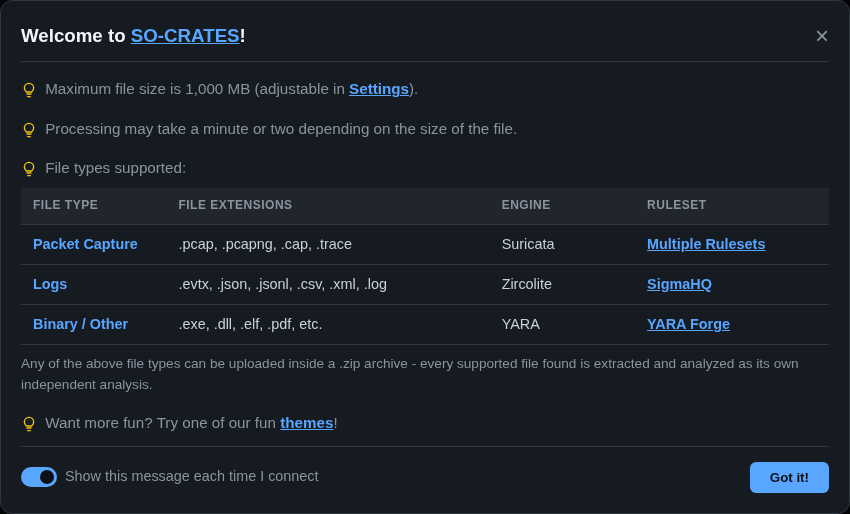 v4.0.0 · Aug 2026
· source
· release history
- ZIP uploads containing multiple supported files now analyze every file independently in parallel (each pcap, log, or binary gets its own analysis) instead of silently dropping all but the first; byte-identical duplicates within the same ZIP are analyzed only once. v4.0.0 · Aug 2026 · source · release history
-
Update Suricata config to include support for Modbus, DNP3, and PostgreSQL protocolsv2.1.0 · Jul 2026 · source · release history - Adds Hacker Mode to the main screen for pcap, log, and file analysis. v2.0.0 · Jul 2026 · source · release history
docs
- Web app for analyzing pcap, log, and binary files using Suricata, YARA, and Sigma rules with a single-page UI.
- Web application for analyzing pcap, log, and binary files using Suricata, YARA, and Sigma rules with a single-page UI.
AI rule summaries shipped Shows plain-English explanations of what a Suricata, Sigma, or YARA rule detects when an analyst expands an alert or file match, sourced from the Security Onion resources repository.
Shared capability: Intrusion detection and rules
release
-
Expanding a Suricata alert, Sigma alert, or YARA file match now shows an AI Summary — a plain-English explanation of what the rule detects, sourced from Security Onion's
securityonion-resourcesrepository (generated-summaries-publishedbranch).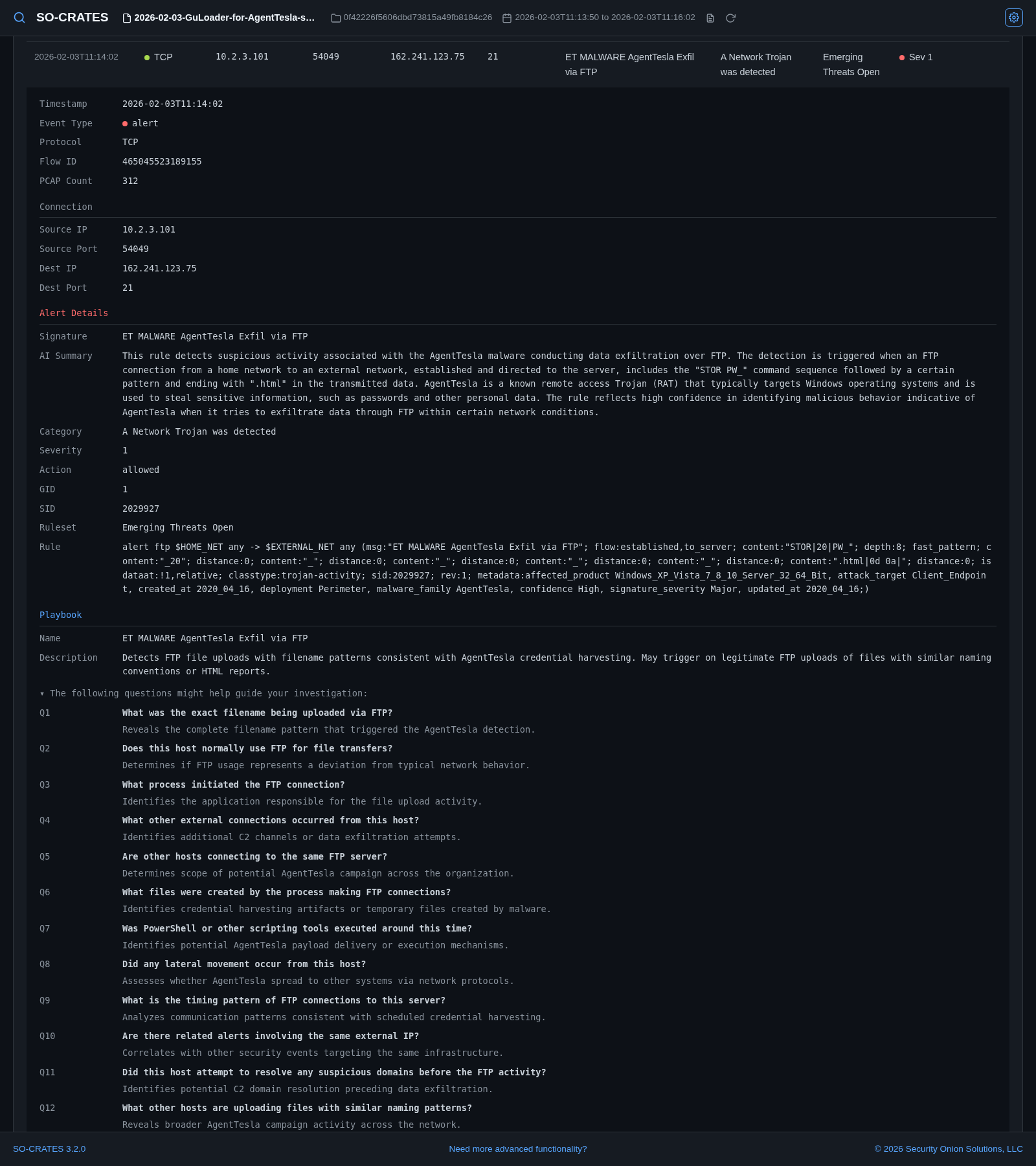 v3.2.0 · Aug 2026
· source
· release history
-
Adds
AI_SUMMARIES_DIRenvironment variable to point manual installs at a local directory containing AI-generated rule summaries for Suricata, Sigma, and YARA detections. v3.2.0 · Aug 2026 · source · release history -
Adds
AI_SUMMARIES_DIRenvironment variable for manual installs to point at a locally-built AI summary index for Suricata, Sigma, and YARA rule explanations. v3.2.0 · Aug 2026 · source · release history
example
-
Point a manual (non-Docker) SO-CRATES install at a locally-built AI summaries index so Suricata, Sigma, and YARA expansions show plain-English rule explanations.
AI_SUMMARIES_DIR=/opt/so-crates/summaries python3 socrates.pyv3.2.0 · Aug 2026 · source
Network traffic analysis 2 features Network observation since 2026
Protocol coverage and decoding shipped Decodes network traffic for supported protocols including ARP, ENIP, NTP, WebSocket, POP3, mDNS, and LDAP within the analysis views.
Shared capability: Network traffic analysis
release
- Add full column, filtering, and aggregation support for enip, ntp, websocket, pop3, mdns, and ldap protocols v3.0.0 · Jul 2026 · source · release history
-
Add support for decoding ARP via the new
ENABLE_ARP_LOGGINGenvironment variable v3.0.0 · Jul 2026 · source · release history
docs
- tshark tshark Protocols tshark adds the protocols Suricata doesn't parse — S7comm, IEC 104, BACnet, OPC UA, Telnet, RADIUS, IPMI and more — each with its own tab, aggregations, and search. docs update · Oct 2026 · source
DNS heuristic scoring for malware communication shipped Applies heuristic scoring to observed DNS registrable domains to identify potential malware communication channels such as tunneling or DGA.
Shared capability: Network traffic analysis
example
-
Review the new heuristic scoring for domains in a captured PCAP to identify potential malware communication channels.
Open an analysis and click the `DNS Heuristics` tab to view aggregated scores for registrable domains.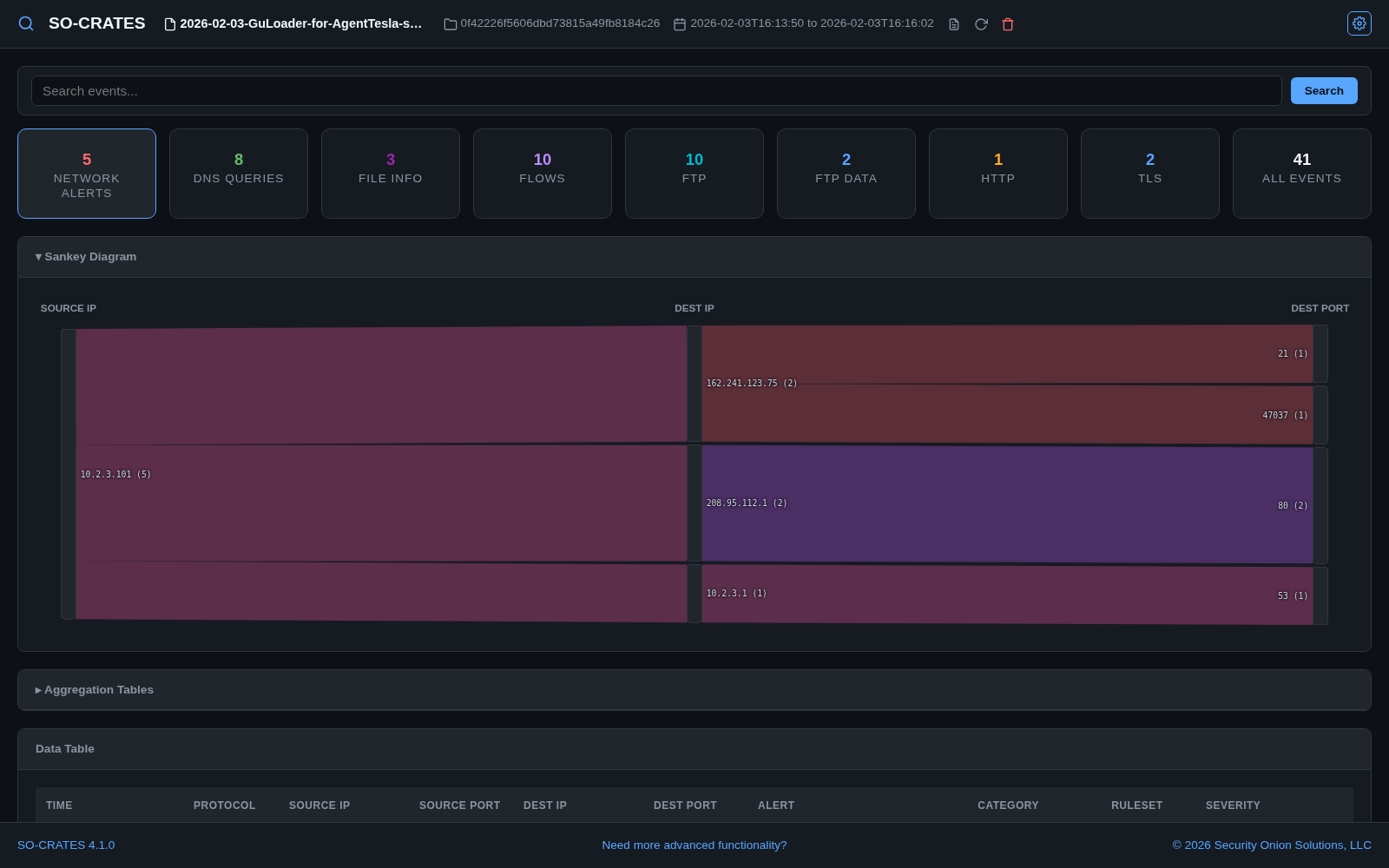 v4.1.0 · Aug 2026
· source
File extraction from traffic 1 feature Network analysis since 2026
Extracted file sending to CyberChef shipped Opens files that Suricata carved or extracted from network traffic — such as PE binaries, archives, or documents — directly in CyberChef for offline triage.
Shared capability: File extraction from traffic
Also counts toward: Offline mode
example
-
Inspect a file Suricata carved from traffic — PE, archive, document — directly in CyberChef for offline triage.
Navigate to the alert or flow's File Info panel and click the 'Send to CyberChef' button next to the extracted file to load its bytes into the bundled CyberChef instance.v4.3.0 · Sep 2026 · source -
Inspect a file Suricata extracted from network traffic (e.g. a dropped PE or document) in CyberChef for further analysis.
In File Info for a Suricata-extracted file, click 'Send to CyberChef' — the file's exact bytes open in the bundled CyberChef instance with no internet required.v4.3.0 · Sep 2026 · source
Rule source management and updates 1 feature Network analysis since 2026
Rule management shipped Provides a Rules modal to view rule counts and staleness, trigger per-ruleset or bulk updates, and automatically refresh cached rules — covering Suricata, YARA, Sigma Windows, and Sigma Linux engines.
Shared capability: Rule source management and updates
release 11 total
-
Adds
show_protocol_decode_alertssetting (Rules modal) to make protocol-decode alert noise explicitly opt-in, with a dedicated Decoder Alerts tab when enabled.
v3.2.0 · Aug 2026
· source
· release history
-
Adds opt-in
show_protocol_decode_alertssetting in the Rules modal to explicitly enable noisy Generic Protocol Command Decode alerts as a dedicated Decoder Alerts tab. v3.2.0 · Aug 2026 · source · release history -
Adds independent Update buttons and Update All functionality within the new Rules modal, replacing blocking server startup rule checks.
 v3.1.0 · Aug 2026
· source
· release history
-
Rule update progress in the modal shows a spinner and elapsed-time counter (Updating… 45s) with an on-demand View Log / Hide Log toggle for the raw update log, polled via
/api/rule-update-status. v3.1.0 · Aug 2026 · source · release history - Ruleset updated dates in the Rules modal are highlighted in warning color when more than 30 days old or never successfully updated, making staleness visible at a glance across all four rulesets (Suricata, YARA, Sigma Windows, Sigma Linux). v3.1.0 · Aug 2026 · source · release history
- YARA and Sigma cached rule files now refresh automatically if older than 24 hours and the network is reachable, falling back to the stale copy on failure; a single shared reachability probe replaces per-engine timeouts, capping startup delay at ~5s instead of ~15s. v3.1.0 · Aug 2026 · source · release history
example
-
Check whether all three rule engines have rules loaded before relying on detections, and surface the Rules modal link if any engine reports zero rules.
curl -s http://localhost:8000/api/rules-info | python3 -m json.toolv3.1.0 · Aug 2026 · source -
Fetch aggregation data for an analysis via the new API endpoint.
curl https://so-crates.example.com/api/aggregation-data?analysis_id=abc123v3.0.0 · Jul 2026 · source
Network anomaly detection 1 feature Network analysis since 2026
DNS heuristics shipped Scores every observed DNS registrable domain across signals for tunneling, DGA shape, subdomain fan-out, and query length to surface suspicious DNS activity in a dedicated tab.
Shared capability: Network anomaly detection
release
-
Adds a DNS Heuristics tab that aggregates every DNS query by registrable domain and scores each 0–100 across five signals: high-entropy subdomain prefix (tunneling shape), high-entropy/low-vowel-ratio registrable domain (DGA shape), 15+ distinct subdomains under the same parent (fan-out), unusually long query name…
v4.1.0 · Aug 2026
· source
· release history
- DNS Heuristics tab groups DNS queries by registrable domain and flags potential tunneling or DGA activity using a five-signal scoring system. v4.1.0 · Aug 2026 · source · release history
TLS inspection and fingerprinting 1 feature Network analysis since 2026
TLS fingerprinting shipped Forces JA3, JA3S, and JA4 TLS fingerprint computation on every analysis and surfaces all three in the TLS event detail panel.
Shared capability: TLS inspection and fingerprinting
release
-
Force-enables JA3, JA3S, and JA4 TLS client/server fingerprinting on every analysis (previously silently absent from
tlsevents unless an active rule's signature keyword happened to require them); all three now appear as their own rows in a TLS row's detail panel when present.
v4.1.0 · Aug 2026
· source
· release history
Other / not yet classified 13 features Features we have not matched to a capability yet. A suggested match is marked.
Themes shipped Offers a selectable set of UI themes — including light, dark, fun, and ambient variants — switchable via the Themes modal, command palette, or keyboard shortcut, with live preview and optional OhMyDebn sync.
release 11 total
- Automatically matches CyberChef's light/dark theme to the user's current theme unless a CyberChef theme has been manually selected. v4.3.0 · Sep 2026 · source · release history
- Syncs CyberChef's light/dark theme to match the user's chosen SO-CRATES theme unless a CyberChef theme has been set manually. v4.3.0 · Sep 2026 · source · release history
-
Adds the Themes modal its own arrow-key grid navigation with live-preview on every move, jumping relative to the currently active theme rather than always restarting from a corner.
v4.0.0 · Aug 2026
· source
· release history
-
Adds a new MP3 Player fun theme (cheat code
mp3) with brushed-metal chrome grays, LCD-green readout, and a bouncing spectrum-analyzer background. v4.0.0 · Aug 2026 · source · release history -
The
tkey no longer cycles themes; theme-cycling moved to</>keys, and theme switching is now handled through the command palette or Themes modal. v4.0.0 · Aug 2026 · source · release history - Ambient theme backgrounds updated: Breadbin Blue and CGA gain demoscene-style plasma fields; CGA's is additionally quantized through a Bayer dither to the 4-color CGA palette; Amber CRT now prints boot-log-style lines at randomized intervals. v4.0.0 · Aug 2026 · source · release history
example
-
Switch the SO-CRATES interface to Hacker Mode to analyze captured traffic or system logs with a specialized view.
In the main screen, select Hacker Mode to begin pcap, log, or file analysis.v2.0.0 · Jul 2026 · source -
Toggle light mode via the UI settings menu.
In the SO-CRATES web interface, navigate to Settings and select 'light mode'.v1.1.0 · Jun 2026 · source
Pivot menu with filtering and enrichment lookups shipped Offers a context menu on any table cell to include, exclude, filter, copy, or look up a value against external services such as VirusTotal, Shodan, AbuseIPDB, urlscan.io, Google, and CyberChef, with support for user-defined custom lookup sites.
release 9 total
- Bundles a self-hosted copy of CyberChef (~48 MB added to container image) so the pivot menu's CyberChef lookup works with no internet access. v4.3.0 · Sep 2026 · source · release history
- Applies CyberChef's Magic operation automatically to small payloads, now including values sent from the pivot menu, to suggest decodings. v4.3.0 · Sep 2026 · source · release history
- Enables pivot-menu access to CyberChef (and other lookups) by selecting any text in an ASCII transcript — base64 blobs, headers, or partial values. v4.3.0 · Sep 2026 · source · release history
- Enables the pivot menu — including CyberChef — for any text selected in an ASCII transcript (e.g. a base64 blob or header). v4.3.0 · Sep 2026 · source · release history
- Bundles CyberChef (~48 MB added to container image) so the pivot menu's CyberChef lookup works with no internet access.︀︄︇︀︅︉︀︅︀︀︃︀︀︅︅︀︅︊︀︄︆︀︃︄ v4.3.0 · Sep 2026 · source · release history
- Enables the pivot menu for partial value selections in a row's detail panel (e.g. a domain in an AI Summary). v4.3.0 · Sep 2026 · source · release history
example
-
Add a custom threat-intel lookup site so any pivot menu can open a value directly in your internal enrichment portal.
In Settings, under Custom Lookup Sites, click Add and enter a name and URL using the `{value}` template — e.g. `https://intel.corp/search?q={value}` — then click Save.v3.2.0 · Aug 2026 · source
Keyboard navigation and command palette shipped Provides full keyboard navigation across data tables, stat cards, modals, and detail panels, plus a command palette triggered by typing outside a text field for substring-matched access to themes, tabs, and named shortcuts.
release
-
Adds full keyboard navigation to Aggregation Tables: Left/Right jumps between tables, Down walks rows and crosses into the next visual row of tables or the Data Table, and Enter activates Prev/Next pagination without losing focus.
v4.1.0 · Aug 2026
· source
· release history
-
Enables full keyboard navigation using arrow keys (Left, Right, Up, Down) and Enter/Escape across the welcome screen, analysis pages, stat-card tabs, data tables, and theme grid.
v4.0.0 · Aug 2026
· source
· release history
-
Adds a command palette — triggered by typing any letter or digit outside a text field — supporting mid-word substring matching and ranked results for themes, stat-card tabs, and named shortcuts including
help,about,themes,rules,settings,notes,delete,re-analyze,search,clear,sankey,… v4.0.0 · Aug 2026 · source · release history - Adds a command palette triggered by typing any letter or digit to quickly navigate to alerts, themes, settings, upload samples, and run other shortcuts without using the mouse. v4.0.0 · Aug 2026 · source · release history
- Adds keyboard reach to Sankey Diagram and Aggregation Tables section headers (expand/collapse with Enter), aggregation table values, filter bar chips, and expanded-row detail panel elements (Add Note, ASCII Transcript, Hexdump, Download PCAP, Expand All/Collapse All, individual packets). v4.0.0 · Aug 2026 · source · release history
- Adds full keyboard navigation across the entire app: arrow keys move between stat-card tabs and data-table rows, Enter activates highlights (opens samples, expands/collapses rows), and Escape closes modals/menus one layer at a time before leaving an analysis. v4.0.0 · Aug 2026 · source · release history
example
-
Quickly switch to a specific theme or jump to a feature without leaving the keyboard.
Type `mp3` (outside any text field) to open the command palette pre-filled with 'mp3', then press Enter to switch to the MP3 Player theme.v4.0.0 · Aug 2026 · source
Community ID flow correlation shipped suggested Forces community ID generation on every analysis and provides a Correlate pivot action that retrieves all network events and alerts sharing the same community ID flow across a capture.
Suggested capability: Network flow analysis. This is our guess, not confirmed.
release
-
Requires scripts calling the JSON API to send
Content-Type: application/json; requests omitting this header will now fail. v4.2.0 · Sep 2026 · source · release history -
Scripts calling the JSON API must now send
Content-Type: application/json; requests without this header will break. v4.2.0 · Sep 2026 · source · release history -
Force-enables Suricata's
community_idfield on every analysis (off by default in Suricata) so flow/alert records can correlate against Zeek and other community-id-aware tools without manual configuration.
v4.1.0 · Aug 2026
· source
· release history
-
Adds a Correlate entry to the pivot menu that searches all logs across a capture sharing the same
community_idflow — network protocol events and alerts alike — when clicking any field on a row that carries a community ID. v4.1.0 · Aug 2026 · source · release history
docs
- Click or right-click any value to include, exclude, hunt, or correlate every log sharing its community ID. docs update · Oct 2026 · source
Server base URL configuration verified Accepts a --base-url CLI flag to set the base URL the server advertises, supporting deployments behind a reverse proxy or custom path.
Also counts toward: Command-line interface
release
-
Adds
ALLOWED_HOSTSenvironment variable (e.g.︀︄︇︀︅︉︀︅︀︀︃︀︀︅︅︀︅︊︀︄︆︀︃︄-e ALLOWED_HOSTS='*.killercoda.com') to support serving SO-CRATES behind a reverse proxy or cloud hostname; browsing via IP or localhost requires no change. v4.2.0 · Sep 2026 · source · release history -
Serving SO-CRATES behind a reverse proxy or cloud hostname now requires setting the
ALLOWED_HOSTSenvironment variable (e.g.-e ALLOWED_HOSTS='*.killercoda.com'); omitting it will produce an error. v4.2.0 · Sep 2026 · source · release history -
Docker/Podman compose files now publish the port on localhost only by default; change the port mapping to
"8000:8000"to allow other hosts on the network. v4.2.0 · Sep 2026 · source · release history -
Docker/Podman compose files now bind the port to localhost only; setups relying on other machines reaching SO-CRATES on the network must change the port mapping to
"8000:8000". v4.2.0 · Sep 2026 · source · release history
command line
-
--base-urlv3.0.0 · Jul 2026 · command-line history
Analysis management shipped Allows analysts to rename analyses, re-run the analysis pipeline in place, and delete analyses, with the Previous Analyses list showing date ranges for disambiguation.
Also counts toward: REST API
release
-
Moves Re-analyze and Delete controls off the Previous Analyses list onto the analysis page header, and relocates Delete All into a new Danger Zone section in Settings.
v4.0.0 · Aug 2026
· source
· release history
-
A reanalyze icon in the analysis header re-runs the pipeline without leaving the page.
v3.2.0 · Aug 2026
· source
· release history
-
GET /api/analysesnow includes adate_rangefield ({"min": ..., "max": ...}, bothnullwhile still processing) per analysis, used for hover tooltips to distinguish same-named analyses.
v3.1.0 · Aug 2026
· source
· release history
-
New
POST /api/rename-analysisendpoint lets analysts rename an analysis display name inline; original filename preserved in.meta'soriginalfield. v3.1.0 · Aug 2026 · source · release history -
Adds
POST /api/rename-analysisendpoint to change the display name of an analysis without altering the original filename. v3.1.0 · Aug 2026 · source · release history
Analyst notes shipped Supports freeform notes at the whole-analysis level and short annotations on individual evidence rows, with visual indicators showing which analyses and rows have notes.
Also counts toward: REST API
release
-
Reanalyze confirmation dialog now displays a bold warning and turns the Re-analyze button red when the analysis has unsaved row-level notes that would be destroyed.
v3.2.0 · Aug 2026
· source
· release history
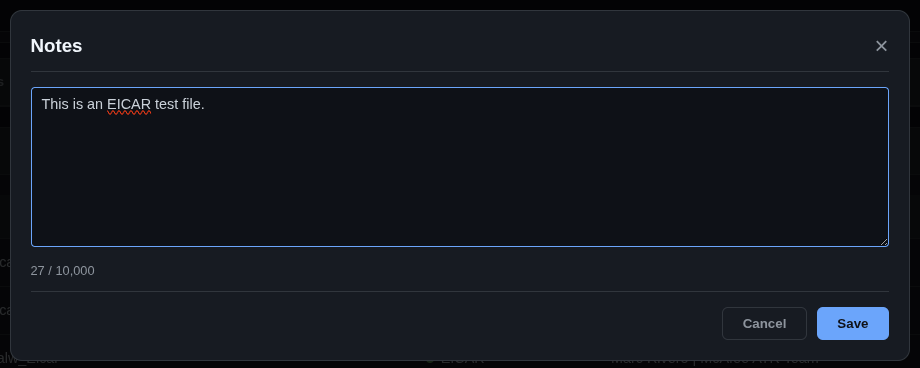
- Enables per-row annotations via a new note icon on table rows for Suricata, Sigma, YARA, and log events, scoped separately from analysis-level notes. v3.2.0 · Aug 2026 · source · release history
- New per-row note icon on Suricata alerts, DNS/HTTP/TLS/flow events, Sigma alerts, file/YARA matches, and imported log events lets analysts attach short annotations to individual evidence rows — separate from the whole-analysis Notes field. v3.2.0 · Aug 2026 · source · release history
-
New
POST /api/analysis-notesendpoint stores freeform analyst notes (e.g. 'suspected GuLoader, C2 at x.top') asnotes.txtper analysis; supports multi-line text and empty submission to clear.
v3.1.0 · Aug 2026
· source
· release history
- Notes icon in the analysis header and Previous Analyses list rows is muted when no notes exist and accent-colored once notes are present, letting analysts spot annotated analyses without opening them. v3.1.0 · Aug 2026 · source · release history
Stream payload sending to CyberChef shipped Sends a TCP stream's raw bytes — in both directions or just source or destination — directly to a CyberChef instance from the stream's Payload panel, without exposing the data in the browser address bar.
release
- Adds Send to CyberChef from a stream's Payload panel, sending exact bytes in Both directions, or just the Source or Dest side — XOR keys, compressed data, and shellcode arrive intact. v4.3.0 · Sep 2026 · source · release history
- Adds Send to CyberChef from a stream's Payload panel, delivering the stream's exact bytes in Both, Source, or Dest directions — preserving XOR keys, compressed data, and shellcode intact without address-bar exposure. v4.3.0 · Sep 2026 · source · release history
example
-
Analyse a C2 beacon payload for encoding or compression without an internet connection — open the stream, select Both directions, and send the raw bytes straight to your local CyberChef instance.
In the stream viewer, open the Payload panel, choose Both (or Source / Dest), then click 'Send to CyberChef' — the full payload opens in the bundled CyberChef with the Magic operation pre-applied.v4.3.0 · Sep 2026 · source -
Analyse a full bidirectional TCP payload — shellcode, compressed data, XOR-keyed content — in an air-gapped CyberChef without it appearing in browser history.
In the stream detail view, open the Payload panel, then click 'Send to CyberChef' and choose Both, Source, or Dest to load the exact bytes into the bundled CyberChef instance.v4.3.0 · Sep 2026 · source
Alert acknowledgement shipped suggested Lets analysts acknowledge individual Suricata or Sigma alerts or all instances of an alert, immediately removing them from all views including the Sankey diagram, with acknowledged alerts collected in a dedicated tab.
Suggested capability: Intrusion detection and rules. This is our guess, not confirmed.
release
-
Adds Acknowledge this alert and Acknowledge all instances of this alert via the pivot menu to mark detections as seen and remove them from views.
v4.0.0 · Aug 2026
· source
· release history
- Adds Acknowledge this alert and Acknowledge all instances of this alert options in the pivot menu on Network Alert and Sigma Alert rows, immediately removing acknowledged rows from all views (Network Alerts, Sigma Alerts, All Events, Sankey diagram, and counts); acknowledged alerts appear in a new 'Acknowledged… v4.0.0 · Aug 2026 · source · release history
- Adds a new Acknowledged Alerts stat-card tab to review previously acknowledged alerts, with support for un-acknowledging individual rows. v4.0.0 · Aug 2026 · source · release history
example
-
Silence a noisy Suricata signature firing hundreds of times so it no longer clutters any view during the current analysis.
In the analysis view, right-click (or open the pivot menu) on any Network Alert or Sigma Alert row > select 'Acknowledge all instances of this alert'.v4.0.0 · Aug 2026 · source
Investigation playbooks shipped Displays structured investigation guidance from the Security Onion Playbooks repository when a Suricata or Sigma alert is expanded.
release
-
Adds
PLAYBOOKS_DIRenvironment variable to point manual installs at a local directory containing investigation Playbook data.
v3.2.0 · Aug 2026
· source
· release history
-
Adds
PLAYBOOKS_DIRenvironment variable for manual installs to point at a locally-built Security Onion Playbooks index for Suricata and Sigma alert investigation guidance. v3.2.0 · Aug 2026 · source · release history - Expanding a Suricata or Sigma alert now shows a Playbook section with plain-English investigation guidance sourced from Security Onion's Playbooks repository, baked into the Docker/Podman image. v3.2.0 · Aug 2026 · source · release history
example
-
Point a manual install at a locally-built Playbooks index so Suricata and Sigma alert expansions show investigation guidance.
PLAYBOOKS_DIR=/opt/so-crates/playbooks python3 socrates.pyv3.2.0 · Aug 2026 · source
ASCII transcript text selection and pivot shipped suggested Allows analysts to select arbitrary text within an ASCII packet transcript — such as base64 blobs or header values — and act on the selection via the pivot menu, including sending it to CyberChef.
Suggested capability: Network traffic analysis. This is our guess, not confirmed.
example
-
Quickly decode a suspicious base64 string spotted in a packet transcript without leaving the SO-CRATES UI.
In the ASCII transcript, drag to select the base64 text, then choose CyberChef from the pivot menu that appears — the selected text opens directly in the bundled CyberChef.v4.3.0 · Sep 2026 · source -
Decode a suspicious base64 blob or header value spotted in an ASCII transcript without leaving the SO-CRATES UI.
Select the text (e.g. a base64 blob) in the ASCII transcript, then choose CyberChef from the pivot menu that appears — CyberChef opens with the selected text and, for small values, applies the Magic…v4.3.0 · Sep 2026 · source
Analysis metadata and storage shipped Retrieves date ranges for disambiguation in the Previous Analyses list and persists freeform investigation notes via API endpoints.
Also counts toward: REST API
release
-
Adds
date_rangefield (withminandmaxfields) toGET /api/analysesresponses to support hover tooltips with date ranges in the Previous Analyses list.
v3.1.0 · Aug 2026
· source
· release history
-
Adds
POST /api/analysis-notesendpoint to store freeform investigation context for an analysis innotes.txt. v3.1.0 · Aug 2026 · source · release history
Clipboard copy of analysis identifiers shipped Copies the MD5 hash displayed in the analysis header to the clipboard on click, with a toast confirming success or reporting failure.
release
-
Clicking the MD5 hash in the analysis header copies it to the clipboard, with a toast confirming success or a clear error when
navigator.clipboardis unavailable.
v3.1.0 · Aug 2026
· source
· release history
Lines in monospace are the tool's own words: help text
parsed from its source, or an endpoint from its API document. Under
release, a line is our summary of a dated release. Under
docs, it is quoted from the tool's own documentation or
website. Each links back to the source it came from.
Command line
No command matches.
| option | found in | since | description |
|---|
Values are placeholders taken from each option’s declared default. Nothing is executed here — the output shown is a recording of a run that already happened.
Screenshots
From the release notes, newest first. Click one to see it full size.Score card
-
Shipping velocity releases a month, last 12 months
-
Documentation quality release-notes rubric, 0–100
-
Breaking-change discipline how rarely a release breaks users, and notice given
-
Maintenance risk quiet time against its own cadence, maintainers
-
Innovation & surface new capabilities, API and MCP surface
- Community health
-
Contributor trend distinct committers, this year against last
-
Maintainer concentration bus factor now against a year ago
-
Issue backlog trend issues closed per issue opened, 12 months
-
Responsiveness median time to a maintainer’s first reply
Nine scores for SO-CRATES, each built from the releases, notes and API history this site tracks — and, on Researcher and Business, where it stands among every measured tool in its category and how that has moved.
Score cards are part of every paid plan.
See plans → Already subscribed? Sign in →Trajectory
Blank means never measured; nothing here is a filled-in zero.
Peer standings are included with Researcher and Business. See how this tool ranks against its competitors, using data we don't publish anywhere else.
See plans →Each score is 0–100 on a published rubric, derived from data this site already shows. A dimension we cannot measure says so — it is never scored 0 and never enters a rank.
How this is scored
- Shipping velocity — releases a month over the last 12 months, on a log scale where 16 a month scores 100. Needs 3 releases in the window.
- Documentation quality — the release-notes rubric published on the analytics page, unchanged.
- Breaking-change discipline — the share of releases carrying a breaking change (none scores 100, half or more scores 0). Only projects that label breaking changes are measured: a clean record cannot be told from an unlabelled one.
- Maintenance risk — quiet time measured against the tool's own release cadence (quiet longer than 90 days and three typical gaps scores 0), plus the number of active maintainers and whether contributors are growing, where known. Higher is lower risk.
- Innovation & surface — new capabilities in the feature ledger this year, API and MCP operations added, and the share of commits that are features: the mean of whichever we hold.
- Community health (open-source tools only) — each is a direction, not a size: contributors this year against last, the bus factor now against a year ago, and issues closed per issue opened, where steady scores 50, doubled 100 and halved 0; plus the median time to a maintainer's first reply (an hour scores about 100, a month or more 0). A commercial card has no repository and carries none of the four.
- Documented delivery (commercial tools) — when a vendor's documented new capabilities have slowed against its own baseline, that counts against the overall standing as heavily as two low dimensions. Steady delivery, or too little history to judge, leaves the standing alone; it is never a sixth score.
- Open-source tools are scored on repository signals; commercial tools on their published changelog. Ranks compare tools within one category and one profile and need at least five measured peers; the overall standing needs three ranked dimensions. Best-in-breed or consolidator is a shape, not a quality, and is never scored.
Release-note detail over time
See how much detail SO-CRATES puts in its release notes, quarter by quarter, and compare it with tracked tools in the same category. This history uses up to ten retained, reviewed notes per tool; sparse or blank older quarters may reflect that limit.
Checking release-note history…
Releases
12 entries
No entries match these filters.
- October 20261
- September 20262
- August 20264
- July 20263
- June 20262
Project health
Issue, contributor and maintainer activity in dougburks/so-crates, 2023-10 – 2026-09, as of 2026-09-25. Twelve-month figures first; the trend lines run the whole window.
- Contributors 2 +2 vs prior 12 months
- Maintainers 1 +1 joined · −0 left, last 12 months
- Bus factor 1 committers behind half the commits
- Community-filed 5% of issues opened, last 12 months
- Median time to close 4.1 days first maintainer reply 2 days
- Open backlog 2 of 42 issues ever filed
- Issues opened / month 0 · 0 communitymaintainers
- Open backlog 2
- Contributors / month 1
- Commits / month 23
- Stars 588
- other 100%
Counts from the project's public repository and git history; no individuals are identified. Maintainers are the committers covering 80% of the last year's commits. how we measure this
Add the badge to your README
Maintain this project? The badge links readers straight to this page, so they can follow every release here.
 Choose a badge style and copy the code →