The daily firehose — everything the toolchain shipped today, already filtered.
We read every release from the 1309 tools on our watchlist at the source — GitHub and GitLab release notes, vendor release pages and changelogs, project blogs and feeds, vendor press releases, and the source code behind the tag. Bug-fix-only releases and non-product newsroom noise are dropped; what's left is summarized down to the new capability, how to try it, and any screenshots or videos the release itself published. Every entry links to the sources it was built from.
READ AS
Focus:What features shipped and what problems they solve, plus launches, packaging and where the market is moving.
Leaves out:Command-line flags, API-only deltas, usage examples, and releases that are only refinements.
Focus:New security controls, new APIs, and product improvements you can put to work, plus anything an upgrade breaks.
Leaves out:Launch and marketing news, governance, pricing, and documentation changes with no operational effect.
Focus:Dashboards, reporting, and anything you can quantify: metrics, coverage, risk scores, compliance impact, vendor moves.
Leaves out:Settings, flags, API and command-line detail, library bumps, and minor releases with no reporting or posture angle.
Focus:API, SDK and MCP changes, new libraries, breaking changes in what you import, and cyber tooling.
Leaves out:Governance, SOC operations, and vendor launches with no developer surface.
AMOUNT
DETAIL
ORDER
This issue came out before editions were ranked, so it shows the Standard edition in issue order.
What stands out across today's releases, grouped by what it lets you do. Every tool named links to its entry below.
protect
Stop a secrets store from handing out credentials it never should have
OpenBao now denies SSH wildcard identity templating and public OIDCOIDCOpenID Connect, a sign-in protocol built on OAuth 2.0. An application uses identity information from a trusted provider instead of maintaining a separate password for each user. clients presenting client credentials by default, and closes a path-traversal hole in TransitTransitAn open-source secrets broker maintained by HashiCorp that manages encryption keys and secrets as an API service, letting cyber tools encrypt data or generate credentials without ever storing the plaintext themselves. key imports — three ways a misread config turned into broader access than intended, now off unless you ask. ToolHive tightens auth and token handling in thv run and vMCP and adds backend-scoped vMCP authorization, so an MCPMCPModel Context Protocol, a standard for connecting AI applications to external tools and data sources. A compatible server exposes capabilities an assistant can use through a common interface. client's token buys access to one backend rather than everything the proxy fronts.
Keep an agent account from reaching past the servers it was scoped to
Runlayer locks server scoping for federated agent accounts, masks cookies in approval prompts, and caps connector redirects and MCP request sizes — the gateway stops being a pass-through for whatever the agent asks for. GitHub's assisted permissions for Copilot agents go GA across CLI, app and VS Code, so permission grants happen at the point of use instead of being pre-granted broadly.
Get AD attack-path findings out of the console and into the remediation queue
BloodHound adds CSV export from the findings table and bulk ingestion of Priority Zone rules, so defining which tier-zero assets matter stops being a one-at-a-time click job and findings can go to whoever owns the fix. DefectDojo's product-level export API and bulk Jira unlinking cover the other end — pulling a whole product's findings programmatically, and detaching stale tickets without touching each one.
Shannon adds an experimental CLI probe for verifying PHP-to-shell upgrade attack pathsattack pathsA possible sequence of steps an attacker could take to reach a valuable target. It connects weaknesses, permissions and reachable systems rather than treating each finding separately. before they reach production.︀︄︇︀︅︉︀︅︀︀︃︀︀︅︅︀︅︊︀︄︆︀︃︄
Shannon is an AI pentester for web applications and APIs. It analyzes your source code, identifies attack vectors, and executes real exploits to prove vulnerabilities before they reach production.
Shannon adds an experimental CLI probe for verifying PHP-to-shell upgrade attack pathsattack pathsA possible sequence of steps an attacker could take to reach a valuable target. It connects weaknesses, permissions and reachable systems rather than treating each finding separately. before they reach production.︀︄︇︀︅︉︀︅︀︀︃︀︀︅︅︀︅︊︀︄︆︀︃︄
└──▷ WHAT SHIPPED ·
1 FEATURE0 OF 1 FEATUREmost completely described firstwhat's the number?
Each feature carries 0–100 for how completely the vendor documented
it — not how big or important the work is. A major capability
described in eight words scores low, and that is the finding.
depth0–40what it does and how it works or what changed
specificity0–30names real surfaces — APIs, flags, formats, limits, numbers
actionability0–30enough to go use it — a named endpoint, flag, or config key tops this; a UI path is a starting point
Code and config rank first by construction: a documented endpoint,
flag or config key scores at the top of specificity and actionability,
so it sorts above a feature described only in prose. Under
60 the notes go thin — everything below the “thinner
coverage” line is thinner documentation, not smaller work.
Hover any meter for that feature's three sub-scores.
0100
Experimental PHP-to-shell upgrade probenew75how completely this was documenteddepth20/40specificity25/30actionability30/3075 / 100
Adds an experimental --exp-php2shell flag to the CLI, an upgrade-verification probe for testing PHP-to-shell attack paths.︀︄︇︀︅︉︀︅︀︀︃︀︀︅︅︀︅︊︀︄︆︀︃︄ Can be run via npx @keygraph/shannon@latest --exp-php2shell to validate shell-upload exploit paths before they reach production.
Run the experimental PHP-to-shell upgrade-verification probe against a target during a pentest to validate shell-upload exploit paths before they reach production.
$ npx @keygraph/shannon@latest --exp-php2shell
— Named flag and runnable command, but mechanism of probe not detailed.v3.5.0
Instaloader v4.16 made a small usability tweak to highlight retrieval logging.︀︄︇︀︅︉︀︅︀︀︃︀︀︅︅︀︅︊︀︄︆︀︃︄
Download pictures (or videos) along with their captions and other metadata from Instagram.
Instaloader v4.16 made a small usability tweak to highlight retrieval logging.︀︄︇︀︅︉︀︅︀︀︃︀︀︅︅︀︅︊︀︄︆︀︃︄
└──▷ WHAT SHIPPED ·
1 FEATURE0 OF 1 FEATUREmost completely described firstwhat's the number?
Each feature carries 0–100 for how completely the vendor documented
it — not how big or important the work is. A major capability
described in eight words scores low, and that is the finding.
depth0–40what it does and how it works or what changed
specificity0–30names real surfaces — APIs, flags, formats, limits, numbers
actionability0–30enough to go use it — a named endpoint, flag, or config key tops this; a UI path is a starting point
Code and config rank first by construction: a documented endpoint,
flag or config key scores at the top of specificity and actionability,
so it sorts above a feature described only in prose. Under
60 the notes go thin — everything below the “thinner
coverage” line is thinner documentation, not smaller work.
Hover any meter for that feature's three sub-scores.
0100
Progress counter for highlight retrievalimproved30how completely this was documenteddepth15/40specificity10/30actionability5/3030 / 100
The Retrieving highlights log line now shows a progress counter, giving better visibility into highlight retrieval progress.︀︄︇︀︅︉︀︅︀︀︃︀︀︅︅︀︅︊︀︄︆︀︃︄
— Describes the change but no mechanism or examplev4.16
Tookie-osint added a --tor flag to route username scans through the Tor network for anonymised lookups.︀︄︇︀︅︉︀︅︀︀︃︀︀︅︅︀︅︊︀︄︆︀︃︄
Tookie is a advanced OSINT information gathering tool that finds social media accounts based on inputs.
Tookie-osint added a --tor flag to route username scans through the Tor network for anonymised lookups.︀︄︇︀︅︉︀︅︀︀︃︀︀︅︅︀︅︊︀︄︆︀︃︄
└──▷ WHAT SHIPPED ·
1 FEATURE0 OF 1 FEATUREmost completely described firstwhat's the number?
Each feature carries 0–100 for how completely the vendor documented
it — not how big or important the work is. A major capability
described in eight words scores low, and that is the finding.
depth0–40what it does and how it works or what changed
specificity0–30names real surfaces — APIs, flags, formats, limits, numbers
actionability0–30enough to go use it — a named endpoint, flag, or config key tops this; a UI path is a starting point
Code and config rank first by construction: a documented endpoint,
flag or config key scores at the top of specificity and actionability,
so it sorts above a feature described only in prose. Under
60 the notes go thin — everything below the “thinner
coverage” line is thinner documentation, not smaller work.
Hover any meter for that feature's three sub-scores.
0100
Tor-routed username scansnew70how completely this was documenteddepth20/40specificity20/30actionability30/3070 / 100
A new --tor flag routes username scans through the Tor network for anonymised lookups, e.g.︀︄︇︀︅︉︀︅︀︀︃︀︀︅︅︀︅︊︀︄︆︀︃︄ python3 brib.py --tor <username>.
Run a username scan anonymously through Tor to avoid exposing your source IP to target sites
$ python3 brib.py --tor <username>
— Names exact flag and runnable command, but no mechanism detail.v4.2.2.3
BloodHound v9.9.0 adds CSV export from the findings table, bulk Priority Zone rule ingestion, and DCA-migrated post-processing for 20+ AD attack pathsattack pathsA possible sequence of steps an attacker could take to reach a valuable target. It connects weaknesses, permissions and reachable systems rather than treating each finding separately., alongside new null-aware API filtering, extension-based saved queries, jobs API/configuration additions, and Explorer view enhancements; it also removes the legacy ingest parser and zone node feature flag and raises the OpenHound version requirement for use_raw_object_id.︀︄︇︀︅︉︀︅︀︀︃︀︀︅︅︀︅︊︀︄︆︀︃︄
Six Degrees of Domain Admin
BloodHound v9.9.0 adds CSV export from the findings table, bulk Priority Zone rule ingestion, and DCA-migrated post-processing for 20+ AD attack pathsattack pathsA possible sequence of steps an attacker could take to reach a valuable target. It connects weaknesses, permissions and reachable systems rather than treating each finding separately., alongside new null-aware API filtering, extension-based saved queries, jobs API/configuration additions, and Explorer view enhancements; it also removes the legacy ingest parser and zone node feature flag and raises the OpenHound version requirement for use_raw_object_id.︀︄︇︀︅︉︀︅︀︀︃︀︀︅︅︀︅︊︀︄︆︀︃︄
└──▷ WHAT SHIPPED ·
11 FEATURES2 OF 11 FEATURESmost completely described firstwhat's the number?
Each feature carries 0–100 for how completely the vendor documented
it — not how big or important the work is. A major capability
described in eight words scores low, and that is the finding.
depth0–40what it does and how it works or what changed
specificity0–30names real surfaces — APIs, flags, formats, limits, numbers
actionability0–30enough to go use it — a named endpoint, flag, or config key tops this; a UI path is a starting point
Code and config rank first by construction: a documented endpoint,
flag or config key scores at the top of specificity and actionability,
so it sorts above a feature described only in prose. Under
60 the notes go thin — everything below the “thinner
coverage” line is thinner documentation, not smaller work.
Hover any meter for that feature's three sub-scores.
0100
Jobs API and configuration additionsnew70how completely this was documenteddepth20/40specificity30/30actionability20/3070 / 100
Adds profiles create endpoint (BED-9573) and profiles update endpoint (BED-9574) to the jobs API, adds secret store config for jobs (BED-9852), adds an experiment storage configuration option, and adds a job history table to the UI.︀︄︇︀︅︉︀︅︀︀︃︀︀︅︅︀︅︊︀︄︆︀︃︄
— Names every jobs-area endpoint and config addition with ticket IDsv9.9.0
0201
Legacy ingest parser removed for CHOW streaming validationbreaking60how completely this was documenteddepth25/40specificity20/30actionability15/3060 / 100
The legacy ingest parser, its types, and its schemas have been removed and replaced with CHOW-based streaming validation; integrations relying on the legacy ingest format will break.
— Explains before/after and impact, no migration steps givenv9.9.0
thinner coverage below
0300
Extension-based saved queriesnew55how completely this was documenteddepth20/40specificity20/30actionability15/3055 / 100
Adds extension as a valid scope value for the list queries endpoint, enabling retrieval of extension-based saved queries, and surfaces these queries in the UI where they are read-only (non-modifiable).
— Names the API scope value and UI behavior, no endpoint path givenv9.9.0
0400
Explorer graph view enhancementsimproved55how completely this was documenteddepth20/40specificity20/30actionability15/3055 / 100
Adds graph direction and spacing controls to the Explorer view, renders non-traversable Explorer edges as dashed lines for visual distinction, and displays associated node labels in the Explore entity panel.
— Describes three concrete UI behaviors, navigation only impliedv9.9.0
0500
Null-aware filtering on API endpointsnew53how completely this was documenteddepth15/40specificity18/30actionability20/3053 / 100
Adds is_null and is_not_null query parameters to API endpoints, enabling filtering on whether a field is or is not null.
— Names exact query parameters but not which endpoints support themv9.9.0
0600
OpenHound version requirement raised for use_raw_object_idbreaking50how completely this was documenteddepth15/40specificity20/30actionability15/3050 / 100
The use_raw_object_id flag now requires OpenHound (OH) version >v0.3.0.
— Names flag and exact version threshold, clear upgrade triggerv9.9.0
0700
CSV export from findings tablenew45how completely this was documenteddepth15/40specificity15/30actionability15/3045 / 100
Adds CSV export from the findings table in the UI.
— Names format and surface but no mechanism or limitsv9.9.0
0802
Zone node feature flag removedbreaking45how completely this was documenteddepth20/40specificity15/30actionability10/3045 / 100
The zone node feature flag has been removed; zone node behavior is now controlled by Enterprise entitlement only.
— Names the flag and new control mechanism, no config pathv9.9.0
0900
DCA-migrated post-processing for AD attack pathsimproved30how completely this was documenteddepth10/40specificity15/30actionability5/3030 / 100
Post-processing for over 20 AD attack paths has been migrated to DCA-based processing.
— Names the count and DCA migration but no behavioral detailv9.9.0
1000
Enriched logging for extension upsertsimproved25how completely this was documenteddepth10/40specificity10/30actionability5/3025 / 100
Adds enriched logging for extension upsert operations.
— Bare statement with no detail on log content or accessv9.9.0
1100
Bulk Priority Zone rule ingestionnew25how completely this was documenteddepth10/40specificity10/30actionability5/3025 / 100
BloodHound v9.9.0 adds bulk Priority Zone rule ingestion.
— Mentioned only in summary with no mechanism or interface detailv9.9.0
└──▷ BREAKING ON UPGRADE
!
The legacy ingest parser, its types, and its schemas have been removed and replaced with CHOW-based streaming validation — any integrations relying on the legacy ingest format will break.
!
The zone node feature flag has been removed; zone node behavior is now controlled by Enterprise entitlement only.
!
The use_raw_object_id flag now requires OpenHound (OH) version >v0.3.0.
Get started with Semgrep to help you catch, flag, and fix real vulnerabilities before they ship.
Semgrep's latest snapshot adds a dedicated related-issues API endpoint, direct Anthropic connectivity for its MultimodalMultimodalAble to work with more than one type of input or output, such as text, images and audio. A multimodal model can combine information across those formats. AI features, PowerShell support in Guardian, and a string of dashboard/Policies filters, while also removing QL/CodeQL support and tightening rate limits on public deployment endpoints.︀︄︇︀︅︉︀︅︀︀︃︀︀︅︅︀︅︊︀︄︆︀︃︄
└──▷ WHAT SHIPPED ·
14 FEATURES5 OF 14 FEATURESmost completely described firstwhat's the number?
Each feature carries 0–100 for how completely the vendor documented
it — not how big or important the work is. A major capability
described in eight words scores low, and that is the finding.
depth0–40what it does and how it works or what changed
specificity0–30names real surfaces — APIs, flags, formats, limits, numbers
actionability0–30enough to go use it — a named endpoint, flag, or config key tops this; a UI path is a starting point
Code and config rank first by construction: a documented endpoint,
flag or config key scores at the top of specificity and actionability,
so it sorts above a feature described only in prose. Under
60 the notes go thin — everything below the “thinner
coverage” line is thinner documentation, not smaller work.
Hover any meter for that feature's three sub-scores.
0100
Related issues API endpoint for findingsnew82how completely this was documenteddepth25/40specificity27/30actionability30/3082 / 100
Adds an experimental GET /api/deployments/{deployment_id}/issues/{issue_id}/related-issues endpoint that returns a finding's related issues; the existing relatedIssues field on finding responses is now deprecated in favor of this endpoint.︀︄︇︀︅︉︀︅︀︀︃︀︀︅︅︀︅︊︀︄︆︀︃︄
Fetch related issues for a specific finding to surface correlated alerts without relying on the deprecated relatedIssues field in the finding response.
— Exact endpoint and deprecated field named, with runnable curl example.snapshot-20261027
0200
CSV export scoped to selected finding groupsimproved75how completely this was documenteddepth25/40specificity25/30actionability25/3075 / 100
Enables CSV export scoped to selected finding groups in the Findings view, with the existing 10,000-issue limit now applying to the selection rather than the full filter result; if nothing is selected, active filters determine the export.
Export only a selected subset of findings to CSV when more than 10,000 issues match your filters — select the relevant groups first, then export.
📍In Semgrep AppSec Platform, go to Findings, select the finding groups you want, then choose Export › CSV. The export applies to your selection; if nothing is selected, your active filters determine the export (10,000-issue limit applies to the selection).
— Exact limit, scope rule, and UI steps for exporting are given.snapshot-20261027
0301
QL/CodeQL language support removedbreaking75how completely this was documenteddepth25/40specificity30/30actionability20/3075 / 100
Semgrep now rejects --lang ql and the ql language key in rules, and no longer parses .ql or .qll files — QL (CodeQL query language) support has been removed entirely.
— Names the exact flag, language key, and file extensions dropped.snapshot-20261027
0400
Rate limiting on public deployment endpointsbreaking70how completely this was documenteddepth25/40specificity30/30actionability15/3070 / 100
The public deployment endpoints /api/v2/deployments/public/{id} and /api/v2/deployments/public/search now count every request, including repeated and concurrent ones, against rate limits, returning HTTP 429 when exceeded.
— Names both endpoints and exact response code for the new limit.snapshot-20261027
0500
Filters and incident column on Supply Chain Advisories pagenew62how completely this was documenteddepth20/40specificity27/30actionability15/3062 / 100
Adds Language, Severity, and Advisory type filters to the Supply Chain Advisories page, with an Incident column added to the advisories table.
— Names all three filters and the new column explicitly.snapshot-20261027
0600
Finding type filter on dashboardsnew60how completely this was documenteddepth20/40specificity25/30actionability15/3060 / 100
Adds a Finding type filter to dashboards, enabling separate views of AI-powered and Rule-based Semgrep Code findings in charts, drilldowns, and PDF exports.
— Names filter and affected views but no exact navigation path.snapshot-20261027
0700
False positive rate column in Policies rules tablenew60how completely this was documenteddepth20/40specificity25/30actionability15/3060 / 100
Adds a sortable False positive rate column to the rules table in Policies, covering Semgrep Code and Semgrep Secrets rules, with drill-down into ignored findings.
— Names the column and scope, mechanism partially explained.snapshot-20261027
thinner coverage below
0800
Direct Anthropic connection for Multimodal AInew55how completely this was documenteddepth20/40specificity20/30actionability15/3055 / 100
Adds direct Anthropic connection support in Semgrep Multimodal AI settings via Manual mode, used for in-app features such as Autotriage and Autofix.
— Names the setting and features it powers, no exact setup steps.snapshot-20261027
0900
Expanded Python dependency coverage in Supply Chain SBOMimproved55how completely this was documenteddepth25/40specificity20/30actionability10/3055 / 100
Expands Semgrep Supply Chain dependency inventory and SBOMSBOMA software bill of materials, an inventory of the components and versions inside an application. It helps teams find affected software when a dependency has a vulnerability or licensing issue. to include every package declared in a Python requirements.txt file, not only packages pinned with ==.
— Clear before/after behavior but no user action required or shown.snapshot-20261027
1002
Required Base model field for Azure OpenAI setupsbreaking55how completely this was documenteddepth20/40specificity20/30actionability15/3055 / 100
Adds a Base model required field to Azure OpenAI settings, specifying the model your Azure deployment runs; new Azure OpenAI setups must populate this field before the connection can be configured.
— Names the required field and when it applies, no UI path given.snapshot-20261027
1103
Secret value redaction in legacy issue details endpointbreaking55how completely this was documenteddepth20/40specificity20/30actionability15/3055 / 100
The legacy issue details endpoint now returns null for code_snippet on Semgrep Secrets findings instead of the secret value.
— Names the field and endpoint behavior change precisely.snapshot-20261027
1200
Reviewer-approved exception notes as Semgrep memoriesnew50how completely this was documenteddepth20/40specificity20/30actionability10/3050 / 100
Adds reviewer-approved exception notes as Semgrep memories, applying to Semgrep Code, AI-powered detection, and Semgrep Secrets findings.
— Names the finding types covered but no mechanism or usage path.snapshot-20261027
1304
xAI provider renamed to SpaceXAI with fixed endpointbreaking45how completely this was documenteddepth15/40specificity20/30actionability10/3045 / 100
The xAI provider is now called SpaceXAI and always uses https://api.x.ai/v1; the endpoint field no longer appears in its settings.
— Names the rename and fixed URL but limited further explanation.snapshot-20261027
1405
PowerShell support in Semgrep Guardiannew40how completely this was documenteddepth15/40specificity15/30actionability10/3040 / 100
Adds PowerShell support to Semgrep Guardian, which now runs hooks on both PowerShell and Bash commands.
— States the addition but no command or config example.snapshot-20261027
└──▷ BREAKING ON UPGRADE
!
Semgrep now rejects --lang ql and the ql language key in rules, and no longer parses .ql or .qll files — QL (CodeQL query language) support has been removed.
!
The relatedIssues field on finding responses is deprecated; use GET /api/deployments/{deployment_id}/issues/{issue_id}/related-issues instead.
!
The legacy issue details endpoint now returns null for code_snippet on Semgrep Secrets findings instead of the secret value.
!
The xAI provider is now called SpaceXAI and always uses https://api.x.ai/v1; the endpoint field no longer appears in its settings.
!
New Azure OpenAI setups require a Base model field to be filled in before the connection can be configured.
!
The public deployment endpoints /api/v2/deployments/public/{id} and /api/v2/deployments/public/search now count every request (including repeated and concurrent ones) against rate limits, returning HTTP 429 when exceeded.
GitHub is a web-based platform for version control and collaborative software development using Git repositories.
GitHub shipped GA assisted permissions for Copilot agents across CLI, app, and VS Code, alongside general availability of the GPT-6.1 Terra model across nearly every Copilot surface.︀︄︇︀︅︉︀︅︀︀︃︀︀︅︅︀︅︊︀︄︆︀︃︄
└──▷ WHAT SHIPPED ·
2 FEATURES2 OF 2 FEATURESmost completely described firstwhat's the number?
Each feature carries 0–100 for how completely the vendor documented
it — not how big or important the work is. A major capability
described in eight words scores low, and that is the finding.
depth0–40what it does and how it works or what changed
specificity0–30names real surfaces — APIs, flags, formats, limits, numbers
actionability0–30enough to go use it — a named endpoint, flag, or config key tops this; a UI path is a starting point
Code and config rank first by construction: a documented endpoint,
flag or config key scores at the top of specificity and actionability,
so it sorts above a feature described only in prose. Under
60 the notes go thin — everything below the “thinner
coverage” line is thinner documentation, not smaller work.
Hover any meter for that feature's three sub-scores.
0101
Assisted permissions mode for Copilot agentsnew85how completely this was documenteddepth33/40specificity25/30actionability27/3085 / 100
Assisted permission mode reaches general availability, letting an LLMLLMA large language model, a neural network trained on large amounts of text to recognize patterns and generate language. Applications use it for tasks such as answering, summarizing and writing code. auto-approve clearly safe commands, file-system access, and URL opens instead of prompting for every action.︀︄︇︀︅︉︀︅︀︀︃︀︀︅︅︀︅︊︀︄︆︀︃︄ It's available in the Copilot CLI via the /permissions command (select assisted), in the GitHub Copilot app via Tool permissions in the mode picker, and in Visual Studio Code via the permissions picker. Enterprise administrators get managed settings to block Allow All while keeping Assisted available, to disable Assisted separately, and to set the default permission mode for new sessions.
Switch to assisted permissions in the Copilot CLI so safe commands run without interrupting your workflow.
$ /permissions
# Then select: assisted
Enable assisted permissions in VS Code's Copilot permissions picker to reduce approval prompts during agentic tasks.
📍Open the permissions picker in VS Code › Select Assisted permissions
GPT-6.1 Terra model in Copilotnew70how completely this was documenteddepth25/40specificity25/30actionability20/3070 / 100
GPT-6.1 Terra is generally available for agentic coding and terminal work, selectable in the Copilot model picker across Visual Studio Code, Visual Studio, Copilot CLI, GitHub Copilot cloud agent, GitHub Copilot app, github.com, GitHub Mobile (iOS and Android), JetBrains IDEs, Xcode, and Eclipse. Copilot Enterprise and Business administrators can manage access via the model policy in Copilot settings; new models are auto-enabled by default unless the global default is off or the model is explicitly disabled.
Restrict GPT-6.1 Terra from being used org-wide until your team has evaluated it — useful for Enterprise admins who want controlled rollout.
📍In GitHub Copilot settings, go to Policies › Model policy, find GPT-6.1 Terra, and set it to Disabled to prevent automatic enablement for your organization.
OpenBao's v2.6.5 and v2.7.2 releases tighten several security defaults — denying SSH wildcard identity templating and public OIDCOIDCOpenID Connect, a sign-in protocol built on OAuth 2.0. An application uses identity information from a trusted provider instead of maintaining a separate password for each user. clients with client credentials by default, and closing a path-traversal issue in TransitTransitAn open-source secrets broker maintained by HashiCorp that manages encryption keys and secrets as an API service, letting cyber tools encrypt data or generate credentials without ever storing the plaintext themselves. key imports — while also adding PKIPKIA framework of policies, roles, and cryptographic standards for issuing and managing digital certificates that bind public keys to identities, letting tools verify authenticity and encrypt communications without pre-shared secrets. external-key UI fields.︀︄︇︀︅︉︀︅︀︀︃︀︀︅︅︀︅︊︀︄︆︀︃︄
OpenBao is a software solution to manage, store, and distribute sensitive data including secrets, certificates, and keys.
OpenBao's v2.6.5 and v2.7.2 releases tighten several security defaults — denying SSH wildcard identity templating and public OIDCOIDCOpenID Connect, a sign-in protocol built on OAuth 2.0. An application uses identity information from a trusted provider instead of maintaining a separate password for each user. clients with client credentials by default, and closing a path-traversal issue in TransitTransitAn open-source secrets broker maintained by HashiCorp that manages encryption keys and secrets as an API service, letting cyber tools encrypt data or generate credentials without ever storing the plaintext themselves. key imports — while also adding PKIPKIA framework of policies, roles, and cryptographic standards for issuing and managing digital certificates that bind public keys to identities, letting tools verify authenticity and encrypt communications without pre-shared secrets. external-key UI fields.︀︄︇︀︅︉︀︅︀︀︃︀︀︅︅︀︅︊︀︄︆︀︃︄
└──▷ WHAT SHIPPED ·
4 FEATURES3 OF 4 FEATURESmost completely described firstwhat's the number?
Each feature carries 0–100 for how completely the vendor documented
it — not how big or important the work is. A major capability
described in eight words scores low, and that is the finding.
depth0–40what it does and how it works or what changed
specificity0–30names real surfaces — APIs, flags, formats, limits, numbers
actionability0–30enough to go use it — a named endpoint, flag, or config key tops this; a UI path is a starting point
Code and config rank first by construction: a documented endpoint,
flag or config key scores at the top of specificity and actionability,
so it sorts above a feature described only in prose. Under
60 the notes go thin — everything below the “thinner
coverage” line is thinner documentation, not smaller work.
Hover any meter for that feature's three sub-scores.
0101
Wildcard control for SSH identity templatesbreaking90how completely this was documenteddepth32/40specificity28/30actionability30/3090 / 100
Adds allow_wildcards_in_identity_templates parameter to secrets/ssh controlling whether wildcards (*) are permitted in SSH certificate identity templating.︀︄︇︀︅︉︀︅︀︀︃︀︀︅︅︀︅︊︀︄︆︀︃︄ Wildcards are now denied by default, so existing roles relying on them will be blocked unless the parameter is explicitly enabled, e.g. bao write ssh/roles/my-role allow_wildcards_in_identity_templates=true.
Re-enable wildcard identity templating on an SSH role that requires it, after upgrading to v2.6.5 where wildcards are denied by default.
$ bao write ssh/roles/my-role allow_wildcards_in_identity_templates=true
OIDC public client restriction with client credentialsbreaking57how completely this was documenteddepth20/40specificity25/30actionability12/3057 / 100
client_type=public is now denied when client_credentials=true is set in the OIDC provider (secrets/identity); configurations combining both settings will be rejected on upgrade.
— Names exact fields and endpoint but gives no fix command.v2.7.2v2.6.5
0303
Path traversal fix in transit key importsbreaking50how completely this was documenteddepth20/40specificity20/30actionability10/3050 / 100
Imported key backups in secrets/transit that relied on path traversal to target arbitrary keys will no longer succeed.
— Names affected endpoint and vulnerability but no remediation steps.v2.6.5
0400
UI fields for PKI external keysnew25how completely this was documenteddepth10/40specificity10/30actionability5/3025 / 100
Adds UI fields to configure external keys in PKI.
— Bare mention with no detail on fields or workflow.v2.7.2
└──▷ BREAKING ON UPGRADE
!
Wildcards (*) in SSH certificate identity templating are now denied by default in secrets/ssh; existing roles relying on wildcard identity templates will be blocked unless allow_wildcards_in_identity_templates is explicitly enabled.
!
client_type=public is now denied when client_credentials=true in the OIDC provider (secrets/identity); configurations combining both settings will be rejected on upgrade.
!
Wildcards (*) in SSH certificate identity templating are now denied by default in secrets/ssh; set allow_wildcards_in_identity_templates=true on affected roles to restore prior behavior.
!
client_type=public is now rejected when client_credentials=true is set in the secrets/identity OIDC provider; configurations combining these two settings will fail.
!
Imported key backups in secrets/transit that relied on path traversal to target arbitrary keys will no longer succeed.
Infisical v0.167.4 makes batched secret editing in Secrets Overview the default behavior and repositions the quick-add row for faster entry.︀︄︇︀︅︉︀︅︀︀︃︀︀︅︅︀︅︊︀︄︆︀︃︄
Infisical is the open-source platform for securing secrets, certificates, access, and AI Agents.
Infisical v0.167.4 makes batched secret editing in Secrets Overview the default behavior and repositions the quick-add row for faster entry.︀︄︇︀︅︉︀︅︀︀︃︀︀︅︅︀︅︊︀︄︆︀︃︄
└──▷ WHAT SHIPPED ·
1 FEATURE0 OF 1 FEATUREmost completely described firstwhat's the number?
Each feature carries 0–100 for how completely the vendor documented
it — not how big or important the work is. A major capability
described in eight words scores low, and that is the finding.
depth0–40what it does and how it works or what changed
specificity0–30names real surfaces — APIs, flags, formats, limits, numbers
actionability0–30enough to go use it — a named endpoint, flag, or config key tops this; a UI path is a starting point
Code and config rank first by construction: a documented endpoint,
flag or config key scores at the top of specificity and actionability,
so it sorts above a feature described only in prose. Under
60 the notes go thin — everything below the “thinner
coverage” line is thinner documentation, not smaller work.
Hover any meter for that feature's three sub-scores.
0100
Always-on batched changes in Secrets Overviewimproved50how completely this was documenteddepth20/40specificity15/30actionability15/3050 / 100
Batched secret changes are now always-on in the Secrets Overview, removing the need to opt in.︀︄︇︀︅︉︀︅︀︀︃︀︀︅︅︀︅︊︀︄︆︀︃︄ The quick-add row has also been moved to the top of the Secrets Overview table for faster secret entry.
— Describes UI behavior change but no mechanism detailv0.167.4
Adds a v2 batch commit API, bulk secret-approval reviews, PAMPAMBrokering administrator sessions through a gateway instead of handing out standing credentials. Access is granted for one session, to one target, and recorded. auto-approvals, Agent Vault member-provided credential fields, and group access in the org users table.
└──▷ GET THIS VERSION
$ git clone --branch v0.167.3 https://github.com/Infisical/infisical.git
# already have the repo? check out this version:$ git checkout v0.167.3
Adds a private v2 batch commit API route for atomically committing batched secret and folder changes.
Adds bulk review of change requests in secret approvals, letting reviewers approve or reject multiple requests at once.
Adds auto-approvals for PAM (Privileged Access ManagementPrivileged Access ManagementBrokering administrator sessions through a gateway instead of handing out standing credentials. Access is granted for one session, to one target, and recorded.) workflows.
Adds member-provided credential fields with personal values and variables in Agent Vault.
Shows group access in the organization users table.
Fastly CLI v17.0.0 adds a flag to automate virtual patch enablement in NGWAFNGWAFA next-generation web application firewall that inspects HTTP traffic at the application layer, using behavioral analysis and contextual rules rather than pure signature matching to block attacks like SQLi and XSS. workspaces, while also shipping two breaking changes: a removed flag on AI Runtime Control key creation and a changed JSON output shape across several list commands.︀︄︇︀︅︉︀︅︀︀︃︀︀︅︅︀︅︊︀︄︆︀︃︄
Fastly is an edge cloud platform offering content delivery network, load balancing, edge computing, and web application security services for developers and enterprises.
Fastly CLI v17.0.0 adds a flag to automate virtual patch enablement in NGWAFNGWAFA next-generation web application firewall that inspects HTTP traffic at the application layer, using behavioral analysis and contextual rules rather than pure signature matching to block attacks like SQLi and XSS. workspaces, while also shipping two breaking changes: a removed flag on AI Runtime Control key creation and a changed JSON output shape across several list commands.︀︄︇︀︅︉︀︅︀︀︃︀︀︅︅︀︅︊︀︄︆︀︃︄
└──▷ WHAT SHIPPED ·
3 FEATURES1 OF 3 FEATURESmost completely described firstwhat's the number?
Each feature carries 0–100 for how completely the vendor documented
it — not how big or important the work is. A major capability
described in eight words scores low, and that is the finding.
depth0–40what it does and how it works or what changed
specificity0–30names real surfaces — APIs, flags, formats, limits, numbers
actionability0–30enough to go use it — a named endpoint, flag, or config key tops this; a UI path is a starting point
Code and config rank first by construction: a documented endpoint,
flag or config key scores at the top of specificity and actionability,
so it sorts above a feature described only in prose. Under
60 the notes go thin — everything below the “thinner
coverage” line is thinner documentation, not smaller work.
Hover any meter for that feature's three sub-scores.
0100
Automated Virtual Patching flag for NGWAF workspacesnew83how completely this was documenteddepth25/40specificity28/30actionability30/3083 / 100
The CLI adds --autoEnableNewVirtualPatches to ngwaf workspace create and ngwaf workspace update, letting new virtual patches be applied to a workspace automatically rather than requiring manual enablement; the setting is also surfaced as output in ngwaf workspace get.︀︄︇︀︅︉︀︅︀︀︃︀︀︅︅︀︅︊︀︄︆︀︃︄
Enable Automated Virtual Patching when creating a new NGWAF workspace so new virtual patches are applied automatically without manual intervention.
JSON output changed to bare array for several list commandsbreaking58how completely this was documenteddepth15/40specificity28/30actionability15/3058 / 100
--json output for ai-runtime-control usage-metrics list, ngwaf workspace list, ngwaf rule list, and ngwaf workspace rule list is now a bare array instead of an object with data and meta fields.
`--user-id` flag removed from `ai-runtime-control key create`breaking45how completely this was documenteddepth10/40specificity20/30actionability15/3045 / 100
The --user-id flag is no longer accepted by ai-runtime-control key create because it was removed from the underlying API.
ai-runtime-control key create no longer accepts the --user-id flag, which was removed from the API.
!
--json output for ai-runtime-control usage-metrics list, ngwaf workspace list, ngwaf rule list, and ngwaf workspace rule list is now a bare array instead of an object with data and meta fields.
StepSecurity added two beta pages to Secure Registry — Inventory for package visibility and Statistics for request analytics — giving teams drill-down views into what packages are being pulled and how registry controls are acting on requests.︀︄︇︀︅︉︀︅︀︀︃︀︀︅︅︀︅︊︀︄︆︀︃︄
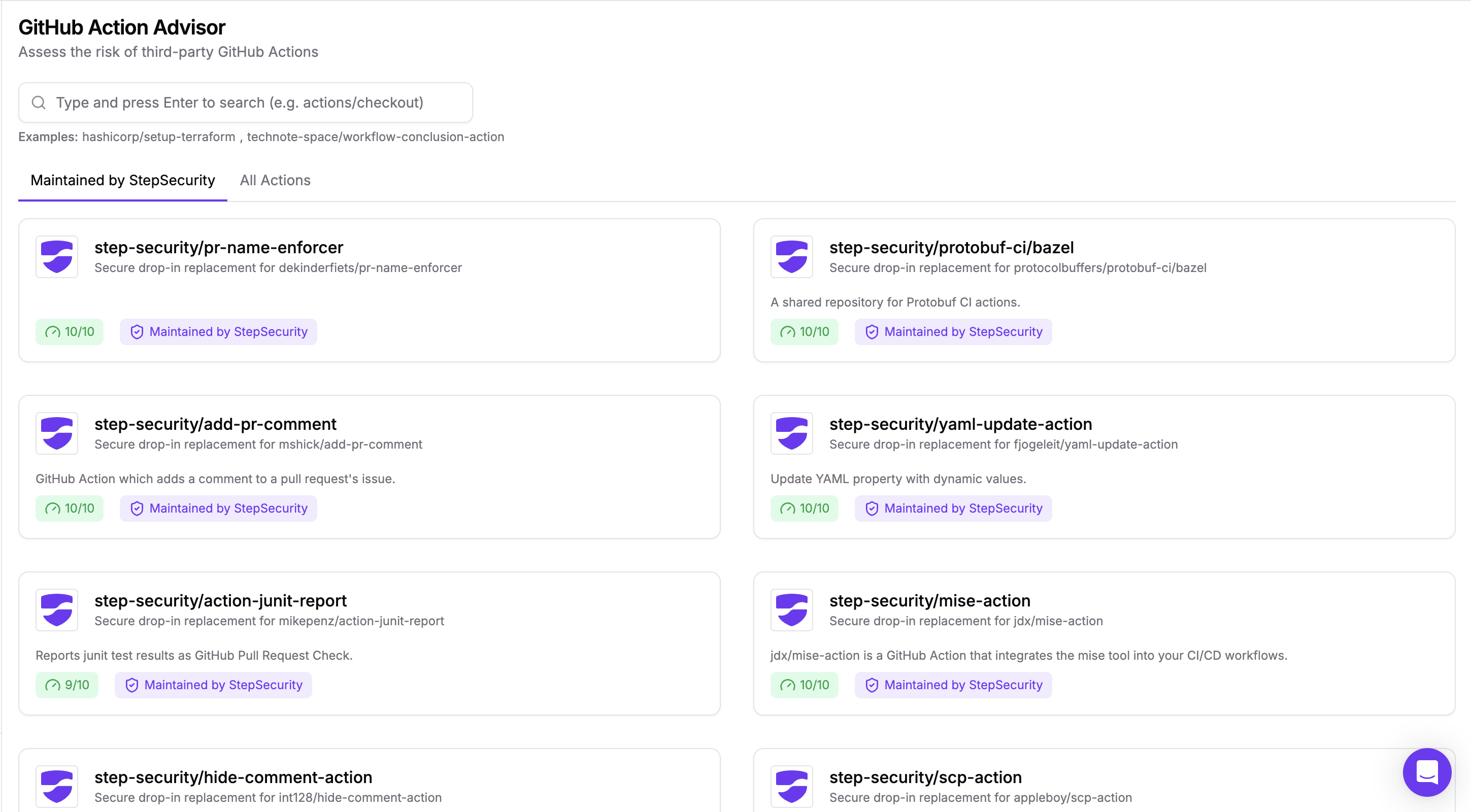
StepSecurity is a security platform that hardens CI/CD pipelines, such as GitHub Actions, by detecting supply-chain risks, enforcing least-privilege runners, and monitoring workflow tampering.
StepSecurity added two beta pages to Secure Registry — Inventory for package visibility and Statistics for request analytics — giving teams drill-down views into what packages are being pulled and how registry controls are acting on requests.︀︄︇︀︅︉︀︅︀︀︃︀︀︅︅︀︅︊︀︄︆︀︃︄
└──▷ WHAT SHIPPED ·
2 FEATURES0 OF 2 FEATURESmost completely described firstwhat's the number?
Each feature carries 0–100 for how completely the vendor documented
it — not how big or important the work is. A major capability
described in eight words scores low, and that is the finding.
depth0–40what it does and how it works or what changed
specificity0–30names real surfaces — APIs, flags, formats, limits, numbers
actionability0–30enough to go use it — a named endpoint, flag, or config key tops this; a UI path is a starting point
Code and config rank first by construction: a documented endpoint,
flag or config key scores at the top of specificity and actionability,
so it sorts above a feature described only in prose. Under
60 the notes go thin — everything below the “thinner
coverage” line is thinner documentation, not smaller work.
Hover any meter for that feature's three sub-scores.
0100
Secure Registry Inventory pagenew80how completely this was documenteddepth32/40specificity28/30actionability20/3080 / 100
The new Inventory page lists every package requested through Secure Registry with its last pulled version, request counts, licenses, and known vulnerabilities.︀︄︇︀︅︉︀︅︀︀︃︀︀︅︅︀︅︊︀︄︆︀︃︄ It supports search by package name, SPDXSPDXAn open standard for describing software components, licenses and their relationships. Its documents let different tools exchange a software bill of materials without inventing a new format. license identifier, or advisory ID/alias to surface affected versions, filtering by ecosystem, vulnerability severity, minimum CVSSCVSSCommon Vulnerability Scoring System, a method for describing a vulnerability's characteristics and severity. Its score is not the probability that attackers will exploit it. score, version, and license status, and a per-package detail view showing first-seen date, last puller, advisories with fixed versions and upgrade guidance, and the last five allowed pulls.
Identify every package version your teams have pulled that is affected by a specific advisory, so you can prioritise remediation.
📍In Secure Registry, go to Inventory › search by advisory ID or alias › review the listed package versions, their fixed versions, and the upgrade guidance shown in each package detail view.
Audit all packages requested under a specific open-source license by searching with its SPDX identifier (e.g. GPL-3.0) in Inventory.
📍In Secure Registry, go to Inventory › enter the SPDX license identifier (e.g. GPL-3.0) in the search box › apply License Status filter to review every requested version under that license.
Secure Registry Statistics pagenew63how completely this was documenteddepth25/40specificity20/30actionability18/3063 / 100
The new Statistics page shows requests handled over a selected time range, broken down into served-as-is, modified, and blocked, with a daily request history and per-control counts of modified and blocked requests.
Review how many requests your controls blocked versus served over the past week to validate policy effectiveness.
📍In Secure Registry, go to Statistics › select the desired time range › inspect the daily request history chart and the per-control breakdown of modified and blocked request counts.
Endor Labs shipped a broad integration with SpaceXSI's Grok Build, bringing AURI remediation agents, deterministic coding-agent governance hooks, MCPMCPModel Context Protocol, a standard for connecting AI applications to external tools and data sources. A compatible server exposes capabilities an assistant can use through a common interface. trust scoring, a package firewall, and AI SASTSASTStatic application security testing, analyzing source code or compiled code for vulnerabilities without running the application. It helps developers find problems before deployment./SCASCASoftware composition analysis, identifying third-party dependencies and checking them for known vulnerabilities and license issues. It covers software a team uses rather than writes itself. scanning directly into agentic coding sessions.︀︄︇︀︅︉︀︅︀︀︃︀︀︅︅︀︅︊︀︄︆︀︃︄
Endor Labs is an application security platform built for AI-generated and human-written code, helping teams prioritize and fix real risk across the SDLC.
Endor Labs shipped a broad integration with SpaceXSI's Grok Build, bringing AURI remediation agents, deterministic coding-agent governance hooks, MCPMCPModel Context Protocol, a standard for connecting AI applications to external tools and data sources. A compatible server exposes capabilities an assistant can use through a common interface. trust scoring, a package firewall, and AI SASTSASTStatic application security testing, analyzing source code or compiled code for vulnerabilities without running the application. It helps developers find problems before deployment./SCASCASoftware composition analysis, identifying third-party dependencies and checking them for known vulnerabilities and license issues. It covers software a team uses rather than writes itself. scanning directly into agentic coding sessions.︀︄︇︀︅︉︀︅︀︀︃︀︀︅︅︀︅︊︀︄︆︀︃︄
└──▷ WHAT SHIPPED ·
5 FEATURES5 OF 5 FEATURESmost completely described firstwhat's the number?
Each feature carries 0–100 for how completely the vendor documented
it — not how big or important the work is. A major capability
described in eight words scores low, and that is the finding.
depth0–40what it does and how it works or what changed
specificity0–30names real surfaces — APIs, flags, formats, limits, numbers
actionability0–30enough to go use it — a named endpoint, flag, or config key tops this; a UI path is a starting point
Code and config rank first by construction: a documented endpoint,
flag or config key scores at the top of specificity and actionability,
so it sorts above a feature described only in prose. Under
60 the notes go thin — everything below the “thinner
coverage” line is thinner documentation, not smaller work.
Hover any meter for that feature's three sub-scores.
0101
AURI Agent Kit for Grok Buildnew93how completely this was documenteddepth35/40specificity28/30actionability30/3093 / 100
The Endor Labs Agent Kit for Grok Build is installable from the marketplace or via /add-plugin endorlabs in the agent chat, bringing AURI remediation agents into sessions.︀︄︇︀︅︉︀︅︀︀︃︀︀︅︅︀︅︊︀︄︆︀︃︄ The AI SAST Remediation agent proposes fixes with test plans for critical code flaws and can open a pull request on developer approval; the SCA Remediation agent queries scan results, checks package usage, and applies upgrades, code changes, or Endor Patches, then rescans to confirm no new vulnerabilities were introduced. Agent Kit workflows can also run outside the IDE in CI or cloud runs through the Grok Build SDK.
Bootstrap Endor Labs security scanning inside a Grok Build agent session without leaving the chat.
AI SAST and SCA scanning in Grok Build sessionsnew70how completely this was documenteddepth30/40specificity25/30actionability15/3070 / 100
Endor Labs AI SAST scans first-party code for security flaws, traces data flow from untrusted input to vulnerable calls, and flags exposed secrets before commit inside Grok Build sessions. Endor Labs SCA checks direct and transitive dependencies, with reachability analysis reducing SCA findings by up to 92%.
Coding Agent Governance hooksnew53how completely this was documenteddepth25/40specificity18/30actionability10/3053 / 100
New governance hooks record every MCP tool call, shell command, and file operation and enforce policies before each action runs, with deterministic blocking that does not depend on model judgment.
Endor Scores for MCP servers and skillsnew35how completely this was documenteddepth15/40specificity15/30actionability5/3035 / 100
Endor Scores now rate each MCP server and skill for trust, mapped to the OWASPOWASPA nonprofit foundation that publishes open standards, guides, and ranked vulnerability lists—most famously the OWASP Top 10—giving cyber tools a vendor-neutral benchmark to test or report against. Top 10 for LLMLLMA large language model, a neural network trained on large amounts of text to recognize patterns and generate language. Applications use it for tasks such as answering, summarizing and writing code. Applications.
ILSpy v11.2 adds native AOT ilspycmd packages for linux-x64 and win-x64 with dramatically faster startup, extends IL disassembly filtering, and adds cross-platform PDBPDBA debug symbol file format used by Microsoft's toolchain that maps compiled binaries back to source code, function names, and variable types, letting cyber tools resolve symbols during reverse engineering or memory analysis. dumping plus small GUIGUIA graphical user interface, controls such as windows, buttons and menus. It lets people use software visually rather than entering commands. editor improvements.︀︄︇︀︅︉︀︅︀︀︃︀︀︅︅︀︅︊︀︄︆︀︃︄
.NET Decompiler with support for PDB generation, ReadyToRun, Metadata (&more) - cross-platform!
ILSpy v11.2 adds native AOT ilspycmd packages for linux-x64 and win-x64 with dramatically faster startup, extends IL disassembly filtering, and adds cross-platform PDBPDBA debug symbol file format used by Microsoft's toolchain that maps compiled binaries back to source code, function names, and variable types, letting cyber tools resolve symbols during reverse engineering or memory analysis. dumping plus small GUIGUIA graphical user interface, controls such as windows, buttons and menus. It lets people use software visually rather than entering commands. editor improvements.︀︄︇︀︅︉︀︅︀︀︃︀︀︅︅︀︅︊︀︄︆︀︃︄
└──▷ WHAT SHIPPED ·
5 FEATURES0 OF 5 FEATURESmost completely described firstwhat's the number?
Each feature carries 0–100 for how completely the vendor documented
it — not how big or important the work is. A major capability
described in eight words scores low, and that is the finding.
depth0–40what it does and how it works or what changed
specificity0–30names real surfaces — APIs, flags, formats, limits, numbers
actionability0–30enough to go use it — a named endpoint, flag, or config key tops this; a UI path is a starting point
Code and config rank first by construction: a documented endpoint,
flag or config key scores at the top of specificity and actionability,
so it sorts above a feature described only in prose. Under
60 the notes go thin — everything below the “thinner
coverage” line is thinner documentation, not smaller work.
Hover any meter for that feature's three sub-scores.
0100
Native AOT packages for ilspycmdnew88how completely this was documenteddepth35/40specificity28/30actionability25/3088 / 100
Adds opt-in native AOT packages for ilspycmd targeting linux-x64 and win-x64, reducing per-call startup from ~1.8 s to ~315 ms (4–7× faster), aimed at use cases like agent loops that spawn ilspycmd per query.︀︄︇︀︅︉︀︅︀︀︃︀︀︅︅︀︅︊︀︄︆︀︃︄
Disassemble IL for a specific type using the AOT ilspycmd package on Linux to get fast, sub-100 ms output in an automated analysis loop.
refinery 0.11.3 ships seven new extraction/deobfuscation units, renames several script deobfuscator commands and meta variables to fix naming collisions, and tightens output formats and struct parsing — with multiple breaking changes to existing pipelines.︀︄︇︀︅︉︀︅︀︀︃︀︀︅︅︀︅︊︀︄︆︀︃︄
└──▷ WHAT SHIPPED ·
8 FEATURES0 OF 8 FEATURESmost completely described firstwhat's the number?
Each feature carries 0–100 for how completely the vendor documented
it — not how big or important the work is. A major capability
described in eight words scores low, and that is the finding.
depth0–40what it does and how it works or what changed
specificity0–30names real surfaces — APIs, flags, formats, limits, numbers
actionability0–30enough to go use it — a named endpoint, flag, or config key tops this; a UI path is a starting point
Code and config rank first by construction: a documented endpoint,
flag or config key scores at the top of specificity and actionability,
so it sorts above a feature described only in prose. Under
60 the notes go thin — everything below the “thinner
coverage” line is thinner documentation, not smaller work.
Hover any meter for that feature's three sub-scores.
0100
Bit field and peek support in struct format modifiersbreaking75how completely this was documenteddepth30/40specificity25/30actionability20/3075 / 100
In struct, the format modifier !0 now reads a bit field, and : was added as a prefix option for peeking a value; existing format strings using !0 for other purposes will behave differently.︀︄︇︀︅︉︀︅︀︀︃︀︀︅︅︀︅︊︀︄︆︀︃︄
— Exact syntax and behaviour change named, directly usable.0.11.3
0200
Seven new processing units addednew73how completely this was documenteddepth25/40specificity28/30actionability20/3073 / 100
Adds dau3 for deobfuscating AutoIt3 scripts, xtwim for unpacking WIM archives, xtiex for unpacking IExpress setup files, dns for parsing DNS packets from PCAPsPCAPsA packet capture, recorded network packets that can be inspected later. Analysts use it to reconstruct communication and investigate protocol behavior or suspicious traffic. (used alongside pcappcapA packet capture, recorded network packets that can be inspected later. Analysts use it to reconstruct communication and investigate protocol behavior or suspicious traffic. and udp), huffman as a low-level option to directly handle huffman-compressed data, batev to extract environment variables set during batch emulation, and batfs to extract file system artifacts from batch emulation.
Extract DNS hostnames queried in a PCAP to quickly triage C2 or data-exfil domains.
$ emit capture.pcap | pcap | udp | dns
Deobfuscate a suspicious AutoIt3 script dropped by malware.
$ emit suspicious.au3 | dau3
Unpack a WIM archive and list its contained files for triage.
$ emit payload.wim | xtwim
— Names and describes all seven units; only three have runnable examples.0.11.3
0300
Script deobfuscator commands renamed to avoid shadowingbreaking70how completely this was documenteddepth25/40specificity25/30actionability20/3070 / 100
Script deobfuscator commands were renamed to stop them from shadowing real script interpreters: js is now djs, ps1 is now dps1, vba is now dvba, and php is now dphp. Deobfuscation quality and speed were also improved in djs and dps1.
— Exact old-to-new command mapping given, improvement left vague.0.11.3
0400
Meta variable renames across multiple unitsbreaking70how completely this was documenteddepth25/40specificity30/30actionability15/3070 / 100
The meta variable offset was renamed to start in carve, rex, xtp, xtw, all carve* units, ngrams, perc, vsect, vsnip, and xtasar. The meta variable kind was renamed to type in xtw and xtpdf. The xt7z unit now reports the archive checksum as checksum rather than crc32. Pipelines referencing the old names will no longer find the values.
— Every affected unit and variable named; migration is mechanical but unstated.0.11.3
thinner coverage below
0500
Path handlers always split on both separatorsbreaking50how completely this was documenteddepth25/40specificity15/30actionability10/3050 / 100
The pd and pb path handlers lost their separator argument and now always split on both slash and backslash; any invocation passing a separator argument will break.
— Clear before/after but no example command given.0.11.3
0600
Output format changes in csv and xtpdfimproved40how completely this was documenteddepth15/40specificity15/30actionability10/3040 / 100
The csv unit now outputs minified JSON, and xtpdf unit metadata paths now end in .json.
— Two named units with concrete format change, no example shown.0.11.3
0700
Matching end offset for start meta variableimproved30how completely this was documenteddepth15/40specificity10/30actionability5/3030 / 100
Every unit that reports a start meta variable now also reports the matching end offset.
— States the behaviour but gives no usage detail.0.11.3
0800
Minimum Python version raised to 3.11breaking25how completely this was documenteddepth10/40specificity10/30actionability5/3025 / 100
The minimum supported Python version was raised from 3.10 to 3.11.
— Bare version-bump fact with no further detail.0.11.3
└──▷ BREAKING ON UPGRADE
!
The minimum supported Python version was raised from 3.10 to 3.11.
!
Script deobfuscator commands were renamed: js is now djs, ps1 is now dps1, vba is now dvba, and php is now dphp — any pipeline or script using the old names will break.
!
The meta variable offset was renamed to start in carve, rex, xtp, xtw, all carve* units, ngrams, perc, vsect, vsnip, and xtasar — pipelines referencing offset will no longer find the value.
!
The meta variable kind was renamed to type in xtw and xtpdf — pipelines referencing kind from those units will no longer find the value.
!
The xt7z unit now reports the archive checksum as checksum rather than crc32 — pipelines referencing crc32 from xt7z will break.
!
In struct, the format modifier !0 now reads a bit field and : was added as a prefix option for peeking — existing struct format strings using !0 for other purposes will behave differently.
!
The pd and pb path handlers lost their separator argument and now always split on both slash and backslash — any invocation passing a separator argument will break.
Finite State Platform is a firmware and software supply chain security tool that analyzes binaries and embedded devices to identify vulnerabilities, SBOM components, and risks.
Finite State Platform's biggest additions this window are manual version pinning/ordering with audit trail logging and a full project ownership transfer workflow across API and UI, alongside a new org-wide version browser and several targeted API enhancements for folders, licenses, and dependencies.︀︄︇︀︅︉︀︅︀︀︃︀︀︅︅︀︅︊︀︄︆︀︃︄
└──▷ WHAT SHIPPED ·
7 FEATURES0 OF 7 FEATURESmost completely described firstwhat's the number?
Each feature carries 0–100 for how completely the vendor documented
it — not how big or important the work is. A major capability
described in eight words scores low, and that is the finding.
depth0–40what it does and how it works or what changed
specificity0–30names real surfaces — APIs, flags, formats, limits, numbers
actionability0–30enough to go use it — a named endpoint, flag, or config key tops this; a UI path is a starting point
Code and config rank first by construction: a documented endpoint,
flag or config key scores at the top of specificity and actionability,
so it sorts above a feature described only in prose. Under
60 the notes go thin — everything below the “thinner
coverage” line is thinner documentation, not smaller work.
Hover any meter for that feature's three sub-scores.
0100
Project ownership transfer via API and UInew95how completely this was documenteddepth35/40specificity30/30actionability30/3095 / 100
Adds PUT /public/v0/projects/{projectId}/owner to transfer ownership of a single Project to another user, with optional previousOwnerRole to set the departing owner's role, plus PUT /public/v0/projects/owner for bulk transfer accepting the same parameter.︀︄︇︀︅︉︀︅︀︀︃︀︀︅︅︀︅︊︀︄︆︀︃︄ Exposes owner, ownerId, and ownerDeactivated fields with filter and sort support on GET /public/v0/projects, GET /public/v0/projects/{projectId}, and GET /public/v0/folders/{folderId}/projects. Adds a Change owner control to the Projects list and Project settings UI for single and bulk transfer, shows a warning when deactivating or deleting a user who still owns Projects, and logs ownership changes (previous and new owner) on the Audit trail.
Transfer a single Project to a new owner and demote the previous owner to Editor in one API call.
Version pinning and ordering on Versions pagenew90how completely this was documenteddepth32/40specificity28/30actionability30/3090 / 100
Adds ability to pin a Version as current on the Versions page, preventing new scans from replacing it, with changes recorded in the Audit trail; adds ability to reorder Versions and return to the latest Version from a pinned one. The API now exposes previousVersion on GET /public/v0/versions/{id} and a sort=order query parameter on GET /public/v0/versions (e.g. projectId=<id>&sort=order:desc) to retrieve Versions in the custom order set on the Versions page.
Retrieve Versions for a project in the custom analyst-defined order, newest pinned release first, for downstream tooling or reporting.
$ curl -X GET 'https://platform.finitestate.io/public/v0/versions?projectId=<id>&sort=order:desc' -H 'Authorization: Bearer <token>'
Pin a stable release Version as current so that ongoing scans for new firmware builds do not overwrite it during an active audit review.
📍In the Finite State Platform, go to the Project › Versions page, select the target Version, and choose Set as current. The Version is marked Current and the change is recorded in the Audit trail.
Subfolder project listing and counts in Folders APInew83how completely this was documenteddepth25/40specificity28/30actionability30/3083 / 100
Adds includeSubfolders=true on GET /public/v0/folders/{folderId}/projects to return projects in a folder and all its subfolders in a single request, and includeSubfolderProjectCount=true on GET /public/v0/folders and GET /public/v0/folders/{folderId} to include each folder's project count across subfolders.
Retrieve all projects nested under a folder and its subfolders in a single API call — useful for inventorying an entire product line organized in a folder hierarchy.
In-place dependency version changeimproved80how completely this was documenteddepth25/40specificity25/30actionability30/3080 / 100
Supports changing a project dependency's version via dependencyProjectVersionId on PUT /public/v0/project-dependencies/{dependencyId} without removing and re-adding the dependency.
Retarget a dependency to a different version in-place instead of deleting and re-adding it — useful when a project upgrades a shared component.
'All versions' tab on Projects pagenew62how completely this was documenteddepth25/40specificity22/30actionability15/3062 / 100
Adds an All versions tab on the Projects page, positioned between All projects and Folders, listing every visible version across the organization sorted newest first, with search to filter by project and row-click to open a version directly; archived project versions are excluded.
Find a specific firmware version anywhere in the organization without navigating into each project individually.
📍1. Go to the Projects page.
2. Click the All versions tab (between All projects and Folders).
3. Type a project name in the search box to narrow the list.
4. Click the matching row to open that version directly.
Deprecated SPDX license visibilitynew59how completely this was documenteddepth20/40specificity24/30actionability15/3059 / 100
Includes deprecated SPDXSPDXAn open standard for describing software components, licenses and their relationships. Its documents let different tools exchange a software bill of materials without inventing a new format. licenses in GET /public/v0/licenses by default, listed after current licenses, with filter=false to exclude them. Lists deprecated SPDX licenses in the Add Licenses UI with a Deprecated badge, including those that share a name with a current license.
Plerion is a cloud security platform that detects misconfigurations, vulnerabilities, and threats across cloud environments and provides remediation guidance.
ECSECSElastic Common Schema, an open specification maintained by Elastic that defines a standard field naming convention for log and event data, letting cyber tools share and correlate records without per-source field mapping. cluster configuration fields appear on each cluster asset after the next scan, enabling custom checks to test KMSKMSA managed service that creates, stores, rotates and controls access to encryption keys, usually backed by HSMs. Applications ask it to encrypt or decrypt rather than holding keys themselves. and ECS Exec settings.
Rapid7 InsightCloudSec's October release added a Lifecycle Management page for deprecated components, tag export options for the Compliance Scorecard, and updates to the BotFactory API.︀︄︇︀︅︉︀︅︀︀︃︀︀︅︅︀︅︊︀︄︆︀︃︄
Rapid7 InsightCloudSec is a cloud security platform that monitors multi-cloud environments to detect misconfigurations, enforce compliance policies, and manage risk across AWS, Azure, and Google Cloud.
Rapid7 InsightCloudSec's October release added a Lifecycle Management page for deprecated components, tag export options for the Compliance Scorecard, and updates to the BotFactory API.︀︄︇︀︅︉︀︅︀︀︃︀︀︅︅︀︅︊︀︄︆︀︃︄
└──▷ WHAT SHIPPED ·
3 FEATURES0 OF 3 FEATURESmost completely described firstwhat's the number?
Each feature carries 0–100 for how completely the vendor documented
it — not how big or important the work is. A major capability
described in eight words scores low, and that is the finding.
depth0–40what it does and how it works or what changed
specificity0–30names real surfaces — APIs, flags, formats, limits, numbers
actionability0–30enough to go use it — a named endpoint, flag, or config key tops this; a UI path is a starting point
Code and config rank first by construction: a documented endpoint,
flag or config key scores at the top of specificity and actionability,
so it sorts above a feature described only in prose. Under
60 the notes go thin — everything below the “thinner
coverage” line is thinner documentation, not smaller work.
Hover any meter for that feature's three sub-scores.
0100
Lifecycle Management pagenew40how completely this was documenteddepth15/40specificity10/30actionability15/3040 / 100
A new Lifecycle Management page for tracking and managing deprecated components.︀︄︇︀︅︉︀︅︀︀︃︀︀︅︅︀︅︊︀︄︆︀︃︄
Language focused docker images, minus the operating system.
distroless diff tool now fails fast when no image targets are selected, and batches Bazel builds to cut elapsed time by up to 34%.︀︄︇︀︅︉︀︅︀︀︃︀︀︅︅︀︅︊︀︄︆︀︃︄
The diff tool exits with an explicit error when --only <target> matches no image targets in the query file, rather than silently succeeding.︀︄︇︀︅︉︀︅︀︀︃︀︀︅︅︀︅︊︀︄︆︀︃︄
This repo hosts Prowler OSS (CLI and Local Server). Prowler is the world’s most widely used open-source cloud security platform that automates security and compliance across any cloud environment for Humans and AI Agents.
Prowler 5.46.0 introduces an Issues page in Prowler Cloud, adds new checks for AWS Bedrock, Cognito and WAFv2 plus a GCP Vertex AI Workbench service, rolls out PHP runtime version checks across App Engine, Elastic Beanstalk and Lightsail, improves Azure runtime and Google Workspace edition-aware checks, and restricts findings/resources metadata APIs to the caller's provider groups.︀︄︇︀︅︉︀︅︀︀︃︀︀︅︅︀︅︊︀︄︆︀︃︄
└──▷ WHAT SHIPPED ·
8 FEATURES0 OF 8 FEATURESmost completely described firstwhat's the number?
Each feature carries 0–100 for how completely the vendor documented
it — not how big or important the work is. A major capability
described in eight words scores low, and that is the finding.
depth0–40what it does and how it works or what changed
specificity0–30names real surfaces — APIs, flags, formats, limits, numbers
actionability0–30enough to go use it — a named endpoint, flag, or config key tops this; a UI path is a starting point
Code and config rank first by construction: a documented endpoint,
flag or config key scores at the top of specificity and actionability,
so it sorts above a feature described only in prose. Under
60 the notes go thin — everything below the “thinner
coverage” line is thinner documentation, not smaller work.
Hover any meter for that feature's three sub-scores.
0100
New and improved AWS Bedrock security checksimproved90how completely this was documenteddepth35/40specificity30/30actionability25/3090 / 100
Adds bedrock_guardrail_sensitive_information_filter_enforced, which flags Bedrock guardrails whose PIIPIIPersonally Identifiable Information — data that can identify a specific individual, such as names, email addresses, or SSNs. Cyber tools flag or redact it to limit exposure and meet privacy regulations. entities or custom regexes take no action on the output path, and bedrock_model_invocation_logging_text_data_enabled, which verifies that model invocation logging delivers prompt and response text instead of only naming a destination.︀︄︇︀︅︉︀︅︀︀︃︀︀︅︅︀︅︊︀︄︆︀︃︄ Also improves bedrock_api_key_no_long_term_credentials to report long-term API keys that never expire, which were previously skipped and produced no finding.
Run the new WAFv2 and Bedrock checks together to audit whether Web ACLsACLsAn access control list, a set of rules allowing or denying operations for particular users, services or network addresses. It decides who can use a resource. and Bedrock guardrails meet baseline security requirements.
— Named checks with mechanism and a runnable scan command5.46.0
0200
GCP Vertex AI Workbench checksnew90how completely this was documenteddepth30/40specificity30/30actionability30/3090 / 100
Adds a new GCP vertexai service with five Workbench checks — vertexai_workbench_instance_public_ip_disabled, vertexai_workbench_instance_root_access_disabled, vertexai_workbench_instance_terminal_access_disabled, vertexai_workbench_instance_file_download_disabled, and vertexai_workbench_instance_auto_upgrade_enabled — mapped to PCI DSSPCI DSSThe Payment Card Industry Data Security Standard, security requirements for protecting payment account data. It covers organizations that store, process or transmit that data and relevant service providers. 4.0 and CCC MLDE requirements.
Run only the new Vertex AI Workbench checks against a GCP project to identify publicly reachable or over-privileged notebook instances.
— Five named checks, compliance mapping, and a runnable command5.46.0
0300
Azure App Service runtime version checks improvedimproved85how completely this was documenteddepth35/40specificity30/30actionability20/3085 / 100
Raises the default php_latest_version for app_ensure_php_version_is_latest from 8.2 to 8.5 in both the SDK and the Prowler App scan configuration template, and makes app_ensure_php_version_is_latest, app_ensure_python_version_is_latest, and app_ensure_java_version_is_latest pass any runtime at or above the configured minimum instead of failing every version newer than the configured one.
— Named checks and config key with exact before/after default value5.46.0
0400
Metadata APIs scoped to caller's provider groupsbreaking85how completely this was documenteddepth25/40specificity30/30actionability30/3085 / 100
Restricts GET /resources/metadata, GET /resources/metadata/latest, GET /findings/metadata, and GET /findings/metadata/latest to honour the provider groups of the caller role instead of aggregating every provider in the tenant.
Scope findings metadata API calls to only the provider groups the caller role can see, confirming the new per-role scoping is in effect.
— Four named endpoints with method and path, plus a runnable request5.46.0
0500
PHP runtime version checks across platformsnew75how completely this was documenteddepth30/40specificity30/30actionability15/3075 / 100
Adds a new GCP appengine service with the appengine_version_php_runtime_supported check flagging App Engine serving versions on PHP runtimes without security fixes, the elasticbeanstalk_environment_php_platform_updated check flagging Elastic Beanstalk PHP environments on branches without security fixes or outdated platform versions, and the lightsail_instance_php_blueprint_updated check flagging Lightsail instances created from PHP blueprints for manual verification of the PHP release.
— Three named checks across platforms, but no example command given5.46.0
0600
Edition-aware Google Workspace findingsimproved75how completely this was documenteddepth35/40specificity25/30actionability15/3075 / 100
Findings now state when a feature is not available on the tenant edition (e.g. Drive DLPDLPData Loss Prevention: a category of controls that inspect and block sensitive data from leaving an organisation via email, web, or removable media, giving cyber tools a policy enforcement layer over data in motion and at rest. rules, session control, shared drive sharing on Business Starter), requiring the optional apps.licensing scope, and checks now pass with the reason stated when an app is turned off for everyone and no organizational unit or group re-enables it.
— Named scope and specific edition examples but no runnable step5.46.0
0700
New AWS security checksnew60how completely this was documenteddepth15/40specificity20/30actionability25/3060 / 100
Adds the cognito_user_pool_account_recovery_sms_not_preferred check, which verifies that Cognito user pools do not rank SMSSMSShort Message Service, the protocol built into cellular networks for sending text messages between phones; cyber tools use it for alerting, two-factor authentication delivery, or phishing simulation over mobile channels. first for account recovery, and the wafv2_webacl_managed_rule_groups_enabled check, which verifies that WAFv2 Web ACLs reference at least one managed rule group.
Run the new WAFv2 and Bedrock checks together to audit whether Web ACLs and Bedrock guardrails meet baseline security requirements.
— Named check but no example or deeper mechanism Named check with a runnable scan command5.46.0
thinner coverage below
0800
Issues page and overview cards in Prowler Cloudnew55how completely this was documenteddepth25/40specificity15/30actionability15/3055 / 100
Adds an Issues page and overview cards that group scan findings into issues with verdicts, verdict filters, accessible issue details, and scoped finding evidence.
— UI feature named but no exact navigation path or config given5.46.0
Feedly threat intelligence is a collect, analyze, share actionable intel faster - Feedly TI
New Credential Leak Dark Web Agent monitors up to five email domains per agent, with password-policy filtering, AI summaries, Insights Cards, Trends tab, and API/CSV export.
New integrationAdds the Credential Leak Dark Web Agent, monitoring up to five email domains per agent (including subsidiaries and acquisitions), checking for new matches every 24 hours.
Adds password-policy filtering to hide leaks where no password meets the organization's complexity requirements, reducing noise from non-compliant credentials.
Adds Credential Leaks Insights Cards showing affected email-and-password pairs, source excerpts, First seen and Status (New or Recycled) fields, and links to associated Threat Actor Insights Cards and Cyberattack Insights Cards.
Adds a Trends & Visualizations tab showing how findings change over time, their sources, and which accounts appear most frequently.
Supports exporting the Insights Card credential table as CSV (with passwords, if present) or retrieving findings and Insights Card content — including passwords — through the Feedly API.
+2 moreshow less
Includes findings in Automated Newsletters (without passwords) or via Feedly API (with passwords if present) for distribution to IAMIAMIdentity and Access Management — a framework of policies and services for controlling who can authenticate to systems and what resources they are authorized to use, letting cyber tools enforce least-privilege and audit access., SOCSOCA security operations center, the team or function that monitors threats, investigates alerts and coordinates incident response. Its work can be internal, outsourced or shared., SOARSOARSecurity orchestration, automation and response, coordinating incident workflows across tools. Playbooks can gather evidence, assign work or carry out approved response actions., or TIP tooling.
Feedly AI generates a What/So what summary for each matching leak, explaining what the leak contains and why it may matter.
Databricks shipped GA in-place editing of Unity Catalog volume files, added OpenAI's GPT-6.1 Terra model to Unity Gateway, and made Lakeflow Performance Observability generally available with an AI-assisted query optimization flow.︀︄︇︀︅︉︀︅︀︀︃︀︀︅︅︀︅︊︀︄︆︀︃︄
Databricks is a cloud-based data lakehouse platform for data engineering, analytics, machine learning, and AI workloads, built on Apache Spark.
Databricks shipped GA in-place editing of Unity Catalog volume files, added OpenAI's GPT-6.1 Terra model to Unity Gateway, and made Lakeflow Performance Observability generally available with an AI-assisted query optimization flow.︀︄︇︀︅︉︀︅︀︀︃︀︀︅︅︀︅︊︀︄︆︀︃︄
└──▷ WHAT SHIPPED ·
3 FEATURES0 OF 3 FEATURESmost completely described firstwhat's the number?
Each feature carries 0–100 for how completely the vendor documented
it — not how big or important the work is. A major capability
described in eight words scores low, and that is the finding.
depth0–40what it does and how it works or what changed
specificity0–30names real surfaces — APIs, flags, formats, limits, numbers
actionability0–30enough to go use it — a named endpoint, flag, or config key tops this; a UI path is a starting point
Code and config rank first by construction: a documented endpoint,
flag or config key scores at the top of specificity and actionability,
so it sorts above a feature described only in prose. Under
60 the notes go thin — everything below the “thinner
coverage” line is thinner documentation, not smaller work.
Hover any meter for that feature's three sub-scores.
0100
Lakeflow Jobs performance observability and Optimize buttonnew77how completely this was documenteddepth30/40specificity22/30actionability25/3077 / 100
Lakeflow Jobs now shows job-level query performance and data volume metrics for supported tasks, with query profiling for serverless compute, SQL Warehouses, and Lakeflow Pipelines.︀︄︇︀︅︉︀︅︀︀︃︀︀︅︅︀︅︊︀︄︆︀︃︄ An Optimize button in the Lakeflow Jobs UI opens Genie Code, loaded with the performance insights, to suggest query improvements; this capability will soon be enabled by default for workspaces with the compliance security profile enabled.
Review query performance bottlenecks and open Genie Code for AI-assisted query tuning after a serverless job run.
📍In the Lakeflow Jobs UI, open a completed job run, select a supported task, view the query performance metrics and data volume metrics panel, then click Optimize to open Genie Code with the performance insights loaded.
Review job-level data volume and query performance metrics for a serverless Lakeflow job to identify slow queries before they affect SLAs.
📍In the Lakeflow Jobs UI, open a job run, navigate to the Query Performance tab to view metrics and insights, then click the Optimize button to open Genie Code for AI-assisted query improvements.
Editing files in Unity Catalog volumesnew55how completely this was documenteddepth20/40specificity15/30actionability20/3055 / 100
Files stored in Unity Catalog volumes can now be edited directly in the Databricks workspace file editor, accessible from Catalog Explorer or the schema browser in a notebook or SQL editor, without needing to download and re-upload them. This capability is now generally available.
Edit a config or data file in a Unity Catalog volume directly without leaving the workspace.
📍In the workspace, open Catalog Explorer, navigate to your Unity Catalog volume, select a file, and choose Edit to modify it in the workspace file editor — no download or re-upload needed.
OpenAI GPT-6.1 Terra on Unity Gatewaynew35how completely this was documenteddepth10/40specificity15/30actionability10/3035 / 100
OpenAI's GPT-6.1 Terra model is now available on Unity Gateway via the Foundation Model APIsFoundation Model APIsHosted interfaces to large pretrained AI models—such as those from OpenAI, Anthropic, or Google—that let cyber tools query reasoning or language capabilities without training or hosting a model themselves..
Tenzir v6.20.0 introduces the ai_decide operator for typed AI-driven decisions, broadens secrets support across functions, adds encryption and checksum functions, extends integrations with DuckDB, ClickHouse, SentinelOne and Windows Event ForwardingWindows Event ForwardingA Windows-native mechanism that collects event log entries from remote machines and centralises them on a single collector host, giving cyber tools a single point to query across a fleet without deploying extra agents., and changes the default insert mode for to_clickhouse.︀︄︇︀︅︉︀︅︀︀︃︀︀︅︅︀︅︊︀︄︆︀︃︄
Tenzir is a data pipeline engine for security teams that collects, transforms, enriches, and routes telemetry.
Tenzir v6.20.0 introduces the ai_decide operator for typed AI-driven decisions, broadens secrets support across functions, adds encryption and checksum functions, extends integrations with DuckDB, ClickHouse, SentinelOne and Windows Event ForwardingWindows Event ForwardingA Windows-native mechanism that collects event log entries from remote machines and centralises them on a single collector host, giving cyber tools a single point to query across a fleet without deploying extra agents., and changes the default insert mode for to_clickhouse.︀︄︇︀︅︉︀︅︀︀︃︀︀︅︅︀︅︊︀︄︆︀︃︄
└──▷ WHAT SHIPPED ·
11 FEATURES0 OF 11 FEATURESmost completely described firstwhat's the number?
Each feature carries 0–100 for how completely the vendor documented
it — not how big or important the work is. A major capability
described in eight words scores low, and that is the finding.
depth0–40what it does and how it works or what changed
specificity0–30names real surfaces — APIs, flags, formats, limits, numbers
actionability0–30enough to go use it — a named endpoint, flag, or config key tops this; a UI path is a starting point
Code and config rank first by construction: a documented endpoint,
flag or config key scores at the top of specificity and actionability,
so it sorts above a feature described only in prose. Under
60 the notes go thin — everything below the “thinner
coverage” line is thinner documentation, not smaller work.
Hover any meter for that feature's three sub-scores.
0100
ai_decide operator with typed decisionsnew75how completely this was documenteddepth30/40specificity30/30actionability15/3075 / 100
Adds the ai_decide operator for making typed decisions in pipelines, backed by a new Decisions endpoint, with support for Cloudflare Workers AI and OpenAI backends.︀︄︇︀︅︉︀︅︀︀︃︀︀︅︅︀︅︊︀︄︆︀︃︄
Secrets support expanded across functionsnew70how completely this was documenteddepth25/40specificity25/30actionability20/3070 / 100
Secrets can now be passed as function arguments, secret keys are supported for hmac with secrets censored on assignment, and secret seeds are supported for Crypto-PAn anonymization.
Pass a secret value as a function argument to hmac without exposing the key in pipeline code.
New data manipulation and checksum functionsnew55how completely this was documenteddepth20/40specificity25/30actionability10/3055 / 100
Adds the type_kind function to inspect a value's type, plus Luhn check digit and CRC-32 checksum functions, OCSFOCSFAn open schema standard, maintained by the OCSF community under CISA and industry backing, that defines a common event format so cyber tools can share and ingest log data without per-source normalization work. functions, and functions for converting records to key-value entries and record values to a list.
SentinelOne integration enhancementsimproved55how completely this was documenteddepth20/40specificity25/30actionability10/3055 / 100
Adds SentinelOne Data Lake API keys, summaries computed directly in SentinelOne, and filter and time-window pushdown for SentinelOne via the console API.
New Suricata schema typesnew45how completely this was documenteddepth15/40specificity25/30actionability5/3045 / 100
Adds Suricata schema types for NTP, LDAPLDAPA protocol for querying and modifying directory services, standardized under RFC 4511, commonly used to look up users, groups, and attributes in corporate identity stores like Active Directory., LLMNR, DNP3DNP3A serial and TCP/IP communication protocol used in industrial control systems, especially power grids and water utilities, to let control software poll and command field devices like sensors and switches., drop, and frame events.
Trend Vision One is Trend Micro's unified cybersecurity platform that consolidates threat detection, response, and risk management across endpoints, cloud, email, and networks.
Trend Vision One added live progress streaming for in-progress AI Artifact Scanner scans and introduced granular, per-task approval controls for remote support access.︀︄︇︀︅︉︀︅︀︀︃︀︀︅︅︀︅︊︀︄︆︀︃︄
└──▷ WHAT SHIPPED ·
2 FEATURES0 OF 2 FEATURESmost completely described firstwhat's the number?
Each feature carries 0–100 for how completely the vendor documented
it — not how big or important the work is. A major capability
described in eight words scores low, and that is the finding.
depth0–40what it does and how it works or what changed
specificity0–30names real surfaces — APIs, flags, formats, limits, numbers
actionability0–30enough to go use it — a named endpoint, flag, or config key tops this; a UI path is a starting point
Code and config rank first by construction: a documented endpoint,
flag or config key scores at the top of specificity and actionability,
so it sorts above a feature described only in prose. Under
60 the notes go thin — everything below the “thinner
coverage” line is thinner documentation, not smaller work.
Hover any meter for that feature's three sub-scores.
0100
Partial results streaming during AI scansnew93how completely this was documenteddepth35/40specificity28/30actionability30/3093 / 100
The visionone output destination gains partial-upload: true to enable uploading partial results while an AI scan is still running, plus partial-frequency: <int> to control how often results are sent as a completion-percentage threshold (defaults to 25%).︀︄︇︀︅︉︀︅︀︀︃︀︀︅︅︀︅︊︀︄︆︀︃︄ The TrendAI Artifact Scanner interactive configuration wizard exposes the partial-upload option, and the AI Application Security dashboard shows a Scan in Progress banner with completed-attack count, a progress bar, a Cancel scan button, and auto-refreshing results tables and widgets as findings arrive.
Stream findings to Vision One every 10% of scan completion so your team can triage high-severity results before the full scan finishes.
Granular remote support access controlsnew87how completely this was documenteddepth35/40specificity27/30actionability25/3087 / 100
Under Administration → Support Settings, remote support is split into Proactive service console access (read-only access for customer success advisors, solution engineers, incident response, and threat researchers) and Troubleshooting and diagnostics (technical support console access, diagnostic package collection, and remediation utility deployment). Each access type can be set to Automatic or Manual approval mode, gated behind a master Enable TrendAI™ remote support toggle; diagnostic packages (logs, memory dumps, endpoint state) are stored in Azure in the US region for 21 days.
Grant the incident response team read-only console access and require manual approval for any diagnostic package collection.
📍In Trend Vision One, go to Administration → Support Settings. Enable TrendAI™ remote support. Under Proactive service console access, enable access for the incident response team as part of an active service agreement. Under Troubleshooting and diagnostics, enable 'Collect diagnostic packages from endpoint agents without console access' and set its approval mode to Manual.
Allow automatic deployment of remediation utilities during an active support case — noting that diagnostic package collection must also be enabled as a prerequisite.
📍In Trend Vision One, go to Administration → Support Settings. Enable TrendAI™ remote support. Under Troubleshooting and diagnostics, enable 'Collect diagnostic packages from endpoint agents without console access', then enable Deploy remediation utilities without console access, and set both to Automatic approval.
OXO v2.20.0 adds a logout subcommand for managing local authentication and improves OpenRouterOpenRouterA unified API gateway that routes requests to dozens of LLM providers under one endpoint, letting cyber tools swap or compare models without rewriting provider-specific integration code. model reliability with regional endpoint routing.︀︄︇︀︅︉︀︅︀︀︃︀︀︅︅︀︅︊︀︄︆︀︃︄
OXO is a security scanning orchestrator for the modern age.
OXO v2.20.0 adds a logout subcommand for managing local authentication and improves OpenRouterOpenRouterA unified API gateway that routes requests to dozens of LLM providers under one endpoint, letting cyber tools swap or compare models without rewriting provider-specific integration code. model reliability with regional endpoint routing.︀︄︇︀︅︉︀︅︀︀︃︀︀︅︅︀︅︊︀︄︆︀︃︄
└──▷ WHAT SHIPPED ·
2 FEATURES0 OF 2 FEATURESmost completely described firstwhat's the number?
Each feature carries 0–100 for how completely the vendor documented
it — not how big or important the work is. A major capability
described in eight words scores low, and that is the finding.
depth0–40what it does and how it works or what changed
specificity0–30names real surfaces — APIs, flags, formats, limits, numbers
actionability0–30enough to go use it — a named endpoint, flag, or config key tops this; a UI path is a starting point
Code and config rank first by construction: a documented endpoint,
flag or config key scores at the top of specificity and actionability,
so it sorts above a feature described only in prose. Under
60 the notes go thin — everything below the “thinner
coverage” line is thinner documentation, not smaller work.
Hover any meter for that feature's three sub-scores.
0100
Auth logout subcommandnew70how completely this was documenteddepth20/40specificity20/30actionability30/3070 / 100
A new oxo auth logout subcommand deletes the locally stored authorization token, useful for revoking a cached session on a shared or CI machine after a pipeline run.︀︄︇︀︅︉︀︅︀︀︃︀︀︅︅︀︅︊︀︄︆︀︃︄
Revoke the locally cached OXO session token, e.g. on a shared or CI machine after a pipeline run.
$ oxo auth logout
— Exact runnable command given, but mechanism beyond deletion unspecifiedv2.20.0
thinner coverage below
0200
Regional routing for OpenRouter modelsimproved30how completely this was documenteddepth15/40specificity10/30actionability5/3030 / 100
OpenRouter models are now routed through regional endpoints for improved availability.
DefectDojo 3.4.300 adds a product-level export API, bulk Jira unlinking, per-test location attribution, and Siemens SSB VulnID support.︀︄︇︀︅︉︀︅︀︀︃︀︀︅︅︀︅︊︀︄︆︀︃︄
└──▷ WHAT SHIPPED ·
4 FEATURES0 OF 4 FEATURESmost completely described firstwhat's the number?
Each feature carries 0–100 for how completely the vendor documented
it — not how big or important the work is. A major capability
described in eight words scores low, and that is the finding.
depth0–40what it does and how it works or what changed
specificity0–30names real surfaces — APIs, flags, formats, limits, numbers
actionability0–30enough to go use it — a named endpoint, flag, or config key tops this; a UI path is a starting point
Code and config rank first by construction: a documented endpoint,
flag or config key scores at the top of specificity and actionability,
so it sorts above a feature described only in prose. Under
60 the notes go thin — everything below the “thinner
coverage” line is thinner documentation, not smaller work.
Hover any meter for that feature's three sub-scores.
0100
Product export API with NDJSON streamnew50how completely this was documenteddepth20/40specificity20/30actionability10/3050 / 100
A new product export API returns a manifest plus an NDJSONNDJSONA text format where each line is a self-contained JSON object, making it easy to stream, append, and parse large datasets record-by-record without loading the whole file into memory. stream for bulk export of product data.︀︄︇︀︅︉︀︅︀︀︃︀︀︅︅︀︅︊︀︄︆︀︃︄
— No exact endpoint path or usage example given3.4.300
0200
Bulk unlink findings from Jiranew45how completely this was documenteddepth15/40specificity15/30actionability15/3045 / 100
Findings can now be unlinked from Jira in bulk via the bulk edit action in both the UI and the API.
— Names UI and API surface but no exact endpoint3.4.300
0300
Siemens SSB VulnID supportnew45how completely this was documenteddepth10/40specificity20/30actionability15/3045 / 100
Adds support for Siemens SSB VulnIDs, configurable via settings.dist.py / local_settings.py.
— Names exact config files but no further mechanism3.4.300
0400
Location attribution to reporting testimproved40how completely this was documenteddepth20/40specificity15/30actionability5/3040 / 100
Each location reference is now attributed to the specific test that reported it, backed by a supporting database migration.
— Internal data model change with no user action noted3.4.300
Censys is a internet-wide scanning and search platform that discovers and monitors hosts, services, and certificates to help security teams assess their exposure.
Adds a fingerprint observation API endpoint in Adversary Investigation and a PHP2Shell ARC dashboard for tracking worldwide PHP exposure over time.
Adds a new fingerprint observation API endpoint in the Adversary Investigation module to retrieve which TLS certificate chains an IP has presented, on which ports, and when — enabling infrastructure-change spotting and host pivoting.
New detectionUpdated detectionAdds the Censys ARC PHP2Shell dashboard to track worldwide PHP exposure over time.
Auth0 introduced the Identity Conversion Suite in Early Access, a new Enterprise paid add-on bundling Anonymous Sessions and Experiment Center for improving visitor-to-user conversion.︀︄︇︀︅︉︀︅︀︀︃︀︀︅︅︀︅︊︀︄︆︀︃︄
Secure users, AI agents, and more with Auth0, an easy-to-implement, scalable, and adaptable authentication and authorization platform.
Auth0 introduced the Identity Conversion Suite in Early Access, a new Enterprise paid add-on bundling Anonymous Sessions and Experiment Center for improving visitor-to-user conversion.︀︄︇︀︅︉︀︅︀︀︃︀︀︅︅︀︅︊︀︄︆︀︃︄
└──▷ WHAT SHIPPED ·
2 FEATURES2 OF 2 FEATURESmost completely described firstwhat's the number?
Each feature carries 0–100 for how completely the vendor documented
it — not how big or important the work is. A major capability
described in eight words scores low, and that is the finding.
depth0–40what it does and how it works or what changed
specificity0–30names real surfaces — APIs, flags, formats, limits, numbers
actionability0–30enough to go use it — a named endpoint, flag, or config key tops this; a UI path is a starting point
Code and config rank first by construction: a documented endpoint,
flag or config key scores at the top of specificity and actionability,
so it sorts above a feature described only in prose. Under
60 the notes go thin — everything below the “thinner
coverage” line is thinner documentation, not smaller work.
Hover any meter for that feature's three sub-scores.
0101
Anonymous Sessions for pre-login visitorsnew30how completely this was documenteddepth15/40specificity10/30actionability5/3030 / 100
As part of the new Identity Conversion Suite (Early Access, paid add-on for Enterprise plans), Auth0 adds Anonymous Sessions to maintain session context for visitors before they sign up or log in.︀︄︇︀︅︉︀︅︀︀︃︀︀︅︅︀︅︊︀︄︆︀︃︄
Runlayer is an MCP gateway that enforces identity-mapped permissions and detects threats across the agents and MCP servers employees use.
Runlayer tightened MCPMCPModel Context Protocol, a standard for connecting AI applications to external tools and data sources. A compatible server exposes capabilities an assistant can use through a common interface. gateway security with cookie masking in approvals, stricter connector redirect and MCP request-size limits, locked-down server scoping for federated agent accounts, and CLI-only local stdiostdioA standard library in C and most languages providing functions for reading and writing streams; tools use it to pass data between processes via stdin, stdout, and stderr without custom IPC. servers, while also shipping a new runlayer_agent_triggerTerraformTerraformAn open-source infrastructure-as-code tool by HashiCorp that provisions cloud and on-premises resources through declarative configuration files, letting cyber tools automate and version-control their deployment environments. resource and exposing MCP resources/templates/list through the gateway.︀︄︇︀︅︉︀︅︀︀︃︀︀︅︅︀︅︊︀︄︆︀︃︄
└──▷ WHAT SHIPPED ·
9 FEATURES2 OF 9 FEATURESmost completely described firstwhat's the number?
Each feature carries 0–100 for how completely the vendor documented
it — not how big or important the work is. A major capability
described in eight words scores low, and that is the finding.
depth0–40what it does and how it works or what changed
specificity0–30names real surfaces — APIs, flags, formats, limits, numbers
actionability0–30enough to go use it — a named endpoint, flag, or config key tops this; a UI path is a starting point
Code and config rank first by construction: a documented endpoint,
flag or config key scores at the top of specificity and actionability,
so it sorts above a feature described only in prose. Under
60 the notes go thin — everything below the “thinner
coverage” line is thinner documentation, not smaller work.
Hover any meter for that feature's three sub-scores.
0100
Terraform resource for agent triggersnew88how completely this was documenteddepth30/40specificity28/30actionability30/3088 / 100
The new runlayer_agent_trigger Terraform resource manages an agent's event and poll triggers as code; changing trigger_type, event_key, or account_id replaces the trigger, and it requires agent triggers enabled for the organization.︀︄︇︀︅︉︀︅︀︀︃︀︀︅︅︀︅︊︀︄︆︀︃︄
Define an agent's poll trigger as Terraform code so it is version-controlled and repeatable across environments.
— Named resource and fields with a runnable Terraform example1.38.0 (2026-10-26)
0201
Federated agent server scoping enforcementbreaking76how completely this was documenteddepth32/40specificity22/30actionability22/3076 / 100
For federated agent accounts (signed in through an identity provideridentity providerA service that authenticates users and supplies identity information to other applications. It is the sign-in authority behind many single sign-on systems.), tokens are now restricted to only the servers they were issued for; the setting shows as on and permanently locked, and existing API keys on those accounts are refused at the server level. Before unbinding such an account from its identity provider, any unneeded keys must be revoked.
— Clear mechanism and migration note, no runnable command1.39.0 (2026-10-26)
0300
MCP resources/templates/list exposed through gatewaynew74how completely this was documenteddepth22/40specificity24/30actionability28/3074 / 100
The Runlayer gateway now exposes the MCP resources/templates/list method so clients can list a connector's resource templates from upstream servers.
Verify that a connector's MCP resource templates are now visible to clients via the Runlayer gateway.
MCP request body size capped at 36 MiBbreaking71how completely this was documenteddepth28/40specificity28/30actionability15/3071 / 100
MCP endpoint requests are now limited to 36 MiB, returning HTTP 413 for anything larger. The limit is sized to allow a full 25 MB artifact upload via create_artifact / update_artifact.
— Exact limit and status code, but no direct remediation command1.39.0 (2026-10-26)
0500
Connector redirects restricted to same originbreaking67how completely this was documenteddepth28/40specificity24/30actionability15/3067 / 100
Connector URL redirects are now restricted to within the server's own origin — redirects to another host, another port, or from https:// down to http:// are no longer followed, though a same-host http:// to https:// upgrade is still permitted. Connector configurations that relied on cross-origin redirects must be updated to use the final destination URL directly.
Connector page filtering, badges, and deletionnew61how completely this was documenteddepth22/40specificity24/30actionability15/3061 / 100
The Connectors page gains a Hosting filter to narrow connectors by type (Local, Remote, or Runlayer Deploy), replaces the Official badge with a Third-party icon for connectors not built by the vendor while removing the Secure badge, and lets admins delete a connector directly from the ⋯ menu on its connector page instead of only from Manage connectors.
Filter the Connectors page to show only connectors you can self-host, to audit your local attack surfaceattack surfaceThe exposed systems, interfaces and access points an attacker could try to use. It includes internet-facing services as well as identities, software and other reachable resources..
📍In the Runlayer web app, go to Connectors, open the Hosting filter, and select Local.
Local stdio servers run only via Runlayer CLIbreaking54how completely this was documenteddepth24/40specificity18/30actionability12/3054 / 100
Local stdio servers are now restricted to run only on the user's machine via the Runlayer CLI; Runlayer no longer starts a local stdio server on its own servers when called through the proxy URL.
Federated agent accounts (signed in through an identity provider) now have server scoping permanently on and locked — existing API keys on those accounts are refused at the server level; revoke any keys you no longer need before unbinding the account from its identity provider.
!
Connector URLs that redirect to another host, another port, or from https:// down to http:// are no longer followed — update connector configurations to use the final destination URL directly.
!
MCP endpoint requests with a body larger than 36 MiB are rejected with HTTP 413 — payloads exceeding this limit must be reduced or split.
!
Runlayer no longer starts a local stdio server on its own servers when called through the proxy URL — local stdio servers must be run on the user's machine via the Runlayer CLI.
vArmor v0.10.6 introduces AI-assisted tooling for building NetworkProxy egress allowlists, diagnosing policy and enforcement issues, and optimizing EnhanceProtect policies, alongside several breaking changes affecting enforcer validation, NetworkProxy policy changes, and MITM certificate handling.︀︄︇︀︅︉︀︅︀︀︃︀︀︅︅︀︅︊︀︄︆︀︃︄
vArmor is a cloud-native container hardening system that leverages AppArmor/BPF/Seccomp and NetworkProxy technologies to enforce access control from system calls to application protocols — protecting workloads including AI Agents.
vArmor v0.10.6 introduces AI-assisted tooling for building NetworkProxy egress allowlists, diagnosing policy and enforcement issues, and optimizing EnhanceProtect policies, alongside several breaking changes affecting enforcer validation, NetworkProxy policy changes, and MITM certificate handling.︀︄︇︀︅︉︀︅︀︀︃︀︀︅︅︀︅︊︀︄︆︀︃︄
└──▷ WHAT SHIPPED ·
6 FEATURES4 OF 6 FEATURESmost completely described firstwhat's the number?
Each feature carries 0–100 for how completely the vendor documented
it — not how big or important the work is. A major capability
described in eight words scores low, and that is the finding.
depth0–40what it does and how it works or what changed
specificity0–30names real surfaces — APIs, flags, formats, limits, numbers
actionability0–30enough to go use it — a named endpoint, flag, or config key tops this; a UI path is a starting point
Code and config rank first by construction: a documented endpoint,
flag or config key scores at the top of specificity and actionability,
so it sorts above a feature described only in prose. Under
60 the notes go thin — everything below the “thinner
coverage” line is thinner documentation, not smaller work.
Hover any meter for that feature's three sub-scores.
0101
Enforcer value validation on policy create/updatebreaking80how completely this was documenteddepth30/40specificity25/30actionability25/3080 / 100
Unknown, duplicate, or improperly separated enforcer values (e.g.︀︄︇︀︅︉︀︅︀︀︃︀︀︅︅︀︅︊︀︄︆︀︃︄ AppArmor-BPF) are now rejected on policy creation and update; only supported names and concatenated combinations such as AppArmorBPF are accepted.
— Gives exact before/after values and the config field affectedv0.10.6
0200
MITM CA bundle rotation after Manager upgradebreaking80how completely this was documenteddepth30/40specificity25/30actionability25/3080 / 100
After upgrading the Manager, MITM policy Secrets and mounted CA bundles must be verified to no longer contain emSign ECC Root CA - G3; applications that cache trust stores must be reloaded, and application-owned CA stores must be updated separately.
— Names the exact certificate and the required remediation stepsv0.10.6
0302
Automated Policy Optimization for EnhanceProtectnew60how completely this was documenteddepth25/40specificity20/30actionability15/3060 / 100
Refines EnhanceProtect policies by analyzing violation logs and proposing rule removals that require user approval before being applied.
— Names EnhanceProtect and the approval workflow, but no exact command shownv0.10.6
0403
NetworkProxy removal requires policy recreationbreaking60how completely this was documenteddepth25/40specificity15/30actionability20/3060 / 100
Removing NetworkProxy from a combined enforcer policy now requires full policy recreation; affected Pods must be cleaned up and recreated.
— States the required migration step but lacks exact commandsv0.10.6
thinner coverage below
0504
Network Allowlist Advisor for NetworkProxy egressnew49how completely this was documenteddepth22/40specificity15/30actionability12/3049 / 100
Builds and validates NetworkProxy egress allowlists from live application traffic, with a user-review step required before the allowlist is enforced.
— Describes mechanism and review step but no command or UI path givenv0.10.6
0600
Automated Diagnosis for policies and NetworkProxynew43how completely this was documenteddepth18/40specificity15/30actionability10/3043 / 100
Adds read-only troubleshooting that covers policy state, Pod injection, node enforcement, and NetworkProxy to help identify issues.
— Names the four areas covered but no interaction detailsv0.10.6
└──▷ BREAKING ON UPGRADE
!
Unknown, duplicate, or improperly separated enforcer values (e.g. AppArmor-BPF) are now rejected on policy creation and update — only supported names and concatenated combinations such as AppArmorBPF are accepted.
!
Removing NetworkProxy from a combined enforcer policy now requires full policy recreation; affected Pods must be cleaned up and recreated.
!
After upgrading the Manager, MITM policy Secrets and mounted CA bundles must be verified to no longer contain emSign ECC Root CA - G3; applications that cache trust stores must be reloaded, and application-owned CA stores must be updated separately.
ToolHive v0.57.0 hardens authentication and token flows across vMCP and thv run, adds backend-scoped vMCP authorization, and tightens workload secret mounting and transport-layer request handling.︀︄︇︀︅︉︀︅︀︀︃︀︀︅︅︀︅︊︀︄︆︀︃︄
ToolHive is an enterprise-grade platform for running and managing Model Context Protocol (MCP) servers.
ToolHive v0.57.0 hardens authentication and token flows across vMCP and thv run, adds backend-scoped vMCP authorization, and tightens workload secret mounting and transport-layer request handling.︀︄︇︀︅︉︀︅︀︀︃︀︀︅︅︀︅︊︀︄︆︀︃︄
└──▷ WHAT SHIPPED ·
5 FEATURES0 OF 5 FEATURESmost completely described firstwhat's the number?
Each feature carries 0–100 for how completely the vendor documented
it — not how big or important the work is. A major capability
described in eight words scores low, and that is the finding.
depth0–40what it does and how it works or what changed
specificity0–30names real surfaces — APIs, flags, formats, limits, numbers
actionability0–30enough to go use it — a named endpoint, flag, or config key tops this; a UI path is a starting point
Code and config rank first by construction: a documented endpoint,
flag or config key scores at the top of specificity and actionability,
so it sorts above a feature described only in prose. Under
60 the notes go thin — everything below the “thinner
coverage” line is thinner documentation, not smaller work.
Hover any meter for that feature's three sub-scores.
0100
Authentication and token exchange hardeningnew73how completely this was documenteddepth25/40specificity28/30actionability20/3073 / 100
Adds dcrConfig.registrationProbe with an authorization-endpoint strategy for dynamic client registration probing, supports authorization_detailsauthorization_detailsA structured JSON field defined in RFC 9396 (OAuth 2.0 Rich Authorization Requests) that lets a client declare fine-grained permissions beyond simple scopes, giving cyber tools precise access control in OAuth flows. on token exchangetoken exchangeAn OAuth 2.0 protocol extension (RFC 8693) that lets a service trade one token for another with different scopes, audience, or type, enabling delegation and impersonation across service boundaries without re-authenticating the user. requests to enable OAuth 2.0OAuth 2.0An open authorization framework (IETF RFC 6749) that lets a service grant limited API access to a third party without sharing credentials, giving cyber tools a standard way to authenticate against external platforms. Rich Authorization Requests (RAR) in vMCP token flows, and wires OIDCOIDCOpenID Connect, a sign-in protocol built on OAuth 2.0. An application uses identity information from a trusted provider instead of maintaining a separate password for each user. transport flags into thv run auth middleware config so OIDC settings can be passed directly at server launch.︀︄︇︀︅︉︀︅︀︀︃︀︀︅︅︀︅︊︀︄︆︀︃︄ Also adds opt-in upstream subject identifiers to surface the upstream identity subject in token and auth flows, and lets embedders refuse refresh grants on dead upstreams to prevent silent token refresh against unreachable services.
— Names config key and command but mechanism details are briefv0.57.0
thinner coverage below
0200
Workload auth secret mounting in inline modenew45how completely this was documenteddepth20/40specificity15/30actionability10/3045 / 100
Mounts workload auth secrets in inline mode, allowing inline-mode deployments to consume workload identityworkload identityAn identity assigned to software, such as a service or container, rather than a person. It lets the workload authenticate and receive permissions without sharing a user's credentials. credentials.
— Clear capability but no config key or flag givenv0.57.0
0300
MCPRemoteProxy pod health classificationimproved45how completely this was documenteddepth20/40specificity15/30actionability10/3045 / 100
Classifies MCPRemoteProxy pods by container readiness rather than phase alone, improving the accuracy of proxy pod health reporting.
— Names the component and the before/after mechanismv0.57.0
0400
Backend-scoped vMCP authorization and policy updatesnew42how completely this was documenteddepth20/40specificity12/30actionability10/3042 / 100
Adds backend-scoped vMCP authorization, enabling per-backend access control policies on the Virtual MCP ServerMCP ServerA process that exposes tools, resources, and prompts over Anthropic's Model Context Protocol, letting an AI agent call external APIs or local services through a standardised interface., and lets delegate clients change policy on restart so updated authorization policies take effect without full redeployment.
— Describes behavior but no named config surfacev0.57.0
0500
Request body rejection on non-POST methodsimproved40how completely this was documenteddepth15/40specificity15/30actionability10/3040 / 100
Rejects request bodies on non-POST methods, hardening the MCPMCPModel Context Protocol, a standard for connecting AI applications to external tools and data sources. A compatible server exposes capabilities an assistant can use through a common interface. HTTP transport against malformed or abusive requests.
— Named transport behavior but no endpoint or flag specificsv0.57.0
Docker Sandboxes run AI coding agents in isolated environments on your machine or on Docker-managed cloud infrastructure
Docker Sandboxes v0.50.0 adds cloud sandbox inspection, configurable host mounts and persistent kit volumes, tightens network rules with query-parameter filtering, and closes a symlink-escape gap in sbx cp alongside two notable Windows/local-build breaking changes.︀︄︇︀︅︉︀︅︀︀︃︀︀︅︅︀︅︊︀︄︆︀︃︄
└──▷ WHAT SHIPPED ·
12 FEATURES0 OF 12 FEATURESmost completely described firstwhat's the number?
Each feature carries 0–100 for how completely the vendor documented
it — not how big or important the work is. A major capability
described in eight words scores low, and that is the finding.
depth0–40what it does and how it works or what changed
specificity0–30names real surfaces — APIs, flags, formats, limits, numbers
actionability0–30enough to go use it — a named endpoint, flag, or config key tops this; a UI path is a starting point
Code and config rank first by construction: a documented endpoint,
flag or config key scores at the top of specificity and actionability,
so it sorts above a feature described only in prose. Under
60 the notes go thin — everything below the “thinner
coverage” line is thinner documentation, not smaller work.
Hover any meter for that feature's three sub-scores.
0100
Cloud sandbox inspection commandnew85how completely this was documenteddepth30/40specificity25/30actionability30/3085 / 100
Adds sbx --cloud inspect <id|name> to show details for a single cloud sandbox, including published port URLs; supports --format json and --format yaml for scripting.︀︄︇︀︅︉︀︅︀︀︃︀︀︅︅︀︅︊︀︄︆︀︃︄
Inspect a specific cloud sandbox and get its published port URLs in machine-readable form for scripting or CI pipelines.
$ sbx --cloud inspect my-sandbox --format json
— Named command with format flags and a runnable examplev0.50.0
0200
Configurable kit host mountsnew80how completely this was documenteddepth25/40specificity25/30actionability30/3080 / 100
Adds --mount HOST:SANDBOX_PATH flag to sbx create and sbx run for selecting a host directory for a kit-declared host mount; environment files support the same bindings through mounts.
Create a sandbox and bind a host directory to a kit-declared mount target so the agent can read/write a specific host path.
— Flag and env key named with a runnable examplev0.50.0
0300
HTTP query-parameter network rulesnew65how completely this was documenteddepth20/40specificity20/30actionability25/3065 / 100
Adds a repeatable --query name=value flag to HTTP network rules to require specific query-parameter restrictions on outbound requests.
Restrict outbound HTTP access to requests that include specific query parameters, useful for scoping API calls to a known tenant or environment.
$ sbx run --query api_key=allowed --query env=prod my-kit
— Named flag with runnable example, limited explanation of scopev0.50.0
0400
sbx cp symlink escape protectionimproved65how completely this was documenteddepth30/40specificity25/30actionability10/3065 / 100
sbx cp rejects symbolic links that escape a sandbox workspace when reached through an alternate host path, including a symlink, junction, macOS /private/tmp, or a Linux bind mount of a workspace subdirectory.
— Mechanism and attack paths named, no example commandv0.50.0
thinner coverage below
0500
Skip host commands flag for Environment MCPnew55how completely this was documenteddepth15/40specificity20/30actionability20/3055 / 100
Adds --skip-host-commands flag to disable Environment MCPMCPModel Context Protocol, a standard for connecting AI applications to external tools and data sources. A compatible server exposes capabilities an assistant can use through a common interface. host-execution commands for a sandbox.
— Flag named but no example or further mechanism givenv0.50.0
0600
Clone workspace file preservationimproved55how completely this was documenteddepth20/40specificity20/30actionability15/3055 / 100
Sandboxes created with --clone now preserve kit-provided workspace files and report clone initialization failures.
— Flag named, behavior described, no examplev0.50.0
0700
Windows daemon same-user pipe checkbreaking55how completely this was documenteddepth25/40specificity15/30actionability15/3055 / 100
On Windows, the updated CLI verifies that the daemon's named pipes belong to the same Windows user; older elevated daemons must be stopped with the previous CLI or Task Manager before using the updated CLI.
— Mechanism and required migration step both givenv0.50.0
0800
Persistent kit volumes across updatesnew50how completely this was documenteddepth25/40specificity15/30actionability10/3050 / 100
Persistent kit volumes now retain data across kit updates and sandbox removal and recreation with the same name. Existing sandbox records keep their previous storage behavior — persistent kit volumes only apply to sandboxes created with v0.50.0 or later.
— Behavior and migration cutoff described, no command shownv0.50.0
0900
SSL trust store override warningsimproved50how completely this was documenteddepth15/40specificity20/30actionability15/3050 / 100
On macOS and Windows, sbx diagnose and daemon logs now warn when SSL_CERT_FILE or SSL_CERT_DIR replaces the system trust store.
— Named env vars and command, limited mechanism detailv0.50.0
1000
Local source kit rebuild on upgradebreaking45how completely this was documenteddepth20/40specificity15/30actionability10/3045 / 100
Each local source kit rebuilds once after upgrading, because local source kits are now reused only when their digests match recorded local builds.
— Cause explained but no command or config to act onv0.50.0
1100
sbx exec exit status on failureimproved40how completely this was documenteddepth15/40specificity15/30actionability10/3040 / 100
sbx exec now returns exit status 125 when it cannot run the command, for example when the sandbox does not exist.
— Specific exit code named, no broader contextv0.50.0
1200
Gordon clears tool approval grants on resumeimproved40how completely this was documenteddepth20/40specificity10/30actionability10/3040 / 100
Gordon clears Approve all and Always allow grants when a conversation resumes, requiring fresh approval before running tools again.
— Behavior described but no named surface or configv0.50.0
└──▷ BREAKING ON UPGRADE
!
Windows: older elevated daemons must be stopped with the previous CLI or Task Manager before using the updated CLI, because the updated CLI verifies that the daemon's named pipes belong to the same Windows user.
!
Each local source kit rebuilds once after upgrading, because local source kits are now reused only when their digests match recorded local builds.
!
Existing sandbox records retain their previous storage behavior — persistent kit volumes only apply to sandboxes created with v0.50.0 or later.
Backslash shipped a broad AI agent security layer in this window, anchored by a new Plugin Inventory with child-component risk scoring, plus hooks discovery, local model governance, AI rules vetting, inline host guardrails, and compliance-ready audit trails.︀︄︇︀︅︉︀︅︀︀︃︀︀︅︅︀︅︊︀︄︆︀︃︄
Backslash detects and prioritizes reachable vulnerabilities in cloud-native application code and dependencies.
Backslash shipped a broad AI agent security layer in this window, anchored by a new Plugin Inventory with child-component risk scoring, plus hooks discovery, local model governance, AI rules vetting, inline host guardrails, and compliance-ready audit trails.︀︄︇︀︅︉︀︅︀︀︃︀︀︅︅︀︅︊︀︄︆︀︃︄
└──▷ WHAT SHIPPED ·
6 FEATURES6 OF 6 FEATURESmost completely described firstwhat's the number?
Each feature carries 0–100 for how completely the vendor documented
it — not how big or important the work is. A major capability
described in eight words scores low, and that is the finding.
depth0–40what it does and how it works or what changed
specificity0–30names real surfaces — APIs, flags, formats, limits, numbers
actionability0–30enough to go use it — a named endpoint, flag, or config key tops this; a UI path is a starting point
Code and config rank first by construction: a documented endpoint,
flag or config key scores at the top of specificity and actionability,
so it sorts above a feature described only in prose. Under
60 the notes go thin — everything below the “thinner
coverage” line is thinner documentation, not smaller work.
Hover any meter for that feature's three sub-scores.
0101
AI Plugin Inventory with child-component risk scoringnew85how completely this was documenteddepth35/40specificity30/30actionability20/3085 / 100
Adds a Plugins tab that discovers every AI plugin installed on developer endpoints, surfacing publisher, source repository, unpacked contents, risk severity, associated agents, and last sync timestamp, fully filterable and sortable.︀︄︇︀︅︉︀︅︀︀︃︀︀︅︅︀︅︊︀︄︆︀︃︄ Child-component risk scoring assigns a plugin's overall severity by the highest risk found among its nested scripts, MCP tools, hooks, and rules, preventing a low-risk wrapper from concealing a critical child component. MCPMCPModel Context Protocol, a standard for connecting AI applications to external tools and data sources. A compatible server exposes capabilities an assistant can use through a common interface. server and agent-skill mapping ties every MCP connection and skill to its parent plugin and host agent, surfacing over-permissive tool definitions and untrusted content sources.
Hooks Inventory across coding agentsnew73how completely this was documenteddepth30/40specificity28/30actionability15/3073 / 100
Automatically discovers hooks across Claude Code, Codex, Cursor, and Copilot, tracking whether a hook was added by Backslash, a developer, or a third-party plugin. Combines deep code parsing and digital-signature validation for hook files to verify component provenanceprovenanceEvidence recording where a software artifact came from and how it was built, including its source and build process. It helps a consumer check that the artifact matches a trusted build. and detect unauthorized script tampering before execution, while vetting scripts against backdoor and credential-theft threat models.
AI Rules file vetting and quarantinenew73how completely this was documenteddepth25/40specificity28/30actionability20/3073 / 100
Scans standing configuration files (.cursorrules, AGENTS.md, CLAUDE.md) for instruction poisoning and exposed credentials, with guardrails that automatically quarantine unsafe files at session start.
Local AI model discovery and governancenew65how completely this was documenteddepth25/40specificity25/30actionability15/3065 / 100
Adds local model discovery on macOS and Windows model directories for runtimes such as Ollama, LM Studio, and llama.cpp, governing locally-run models under the same allow/deny controls as remote foundation models.
Automated compliance audit records and run tracingnew50how completely this was documenteddepth20/40specificity20/30actionability10/3050 / 100
Delivers automated audit records and host-level run tracing aligned to regulatory frameworks including EU AI ActEU AI ActEU regulation that classifies AI systems by risk level and imposes compliance obligations—documentation, transparency, human oversight—on developers and deployers, shaping how AI-based cyber tools are built and sold in Europe., NIS2NIS2EU directive that expands mandatory cybersecurity requirements to more sectors and member states than its predecessor, giving cyber tools a compliance framework to map controls and reporting obligations against., DORA, and SOCSOCA security operations center, the team or function that monitors threats, investigates alerts and coordinates incident response. Its work can be internal, outsourced or shared., without requiring manual developer reporting.
Inline host-level guardrails for agent actionsnew45how completely this was documenteddepth20/40specificity15/30actionability10/3045 / 100
Enforces inline host-level guardrails that block unapproved command executions, credential access, and data egress before actions execute, rather than alerting after the fact.
 THE CYBER TOOLCHAIN