The daily firehose — everything the toolchain shipped today, already filtered.
We read every release from the 1309 tools on our watchlist at the source — GitHub and GitLab release notes, vendor release pages and changelogs, project blogs and feeds, vendor press releases, and the source code behind the tag. Bug-fix-only releases and non-product newsroom noise are dropped; what's left is summarized down to the new capability, how to try it, and any screenshots or videos the release itself published. Every entry links to the sources it was built from.
READ AS
Focus:What features shipped and what problems they solve, plus launches, packaging and where the market is moving.
Leaves out:Command-line flags, API-only deltas, usage examples, and releases that are only refinements.
Focus:New security controls, new APIs, and product improvements you can put to work, plus anything an upgrade breaks.
Leaves out:Launch and marketing news, governance, pricing, and documentation changes with no operational effect.
Focus:Dashboards, reporting, and anything you can quantify: metrics, coverage, risk scores, compliance impact, vendor moves.
Leaves out:Settings, flags, API and command-line detail, library bumps, and minor releases with no reporting or posture angle.
Focus:API, SDK and MCP changes, new libraries, breaking changes in what you import, and cyber tooling.
Leaves out:Governance, SOC operations, and vendor launches with no developer surface.
AMOUNT
DETAIL
ORDER
This issue came out before editions were ranked, so it shows the Standard edition in issue order.
What stands out across today's releases, grouped by what it lets you do. Every tool named links to its entry below.
Three unrelated things stand out. StepSecurity now inventories Claude Code and Codex plugins across machines and repos, so you finally know which agents your developers installed. Socket tells you whether a malware campaign actually touched your org, not just that it exists. Censys made its hunting workflow an API, so SOARSOARSecurity orchestration, automation and response, coordinating incident workflows across tools. Playbooks can gather evidence, assign work or carry out approved response actions. playbooks can submit indicators and pull back campaign clusters.
identify
Find out which AI coding agents your developers actually installed
StepSecurity enumerates Claude Code and Codex plugins org-wide across developer machines and GitHub repos; Castle exposes a structured agent object in its API response so teams can see and gate agent traffic at the app edge. Both close the same blind spot from opposite ends: agents arrive without a procurement step, and until now nobody had a list.
Skip the question of whether a published campaign actually touched you
Socket's Threat Intel Campaigns page now resolves per-package impact down to the originating scan or Firewall event, turning a public advisory into a yes/no about your own estate instead of a manual dependency sweep. Censys exposed its Investigator hunt as an API, so a playbook can submit indicators, push raw intel documents, and retrieve campaign-cluster reports without an analyst in the console.
Let the scanner propose and validate the fix, not just file the finding
SonarQube's Remediation Agent now covers Hunter Agent findings — broken access control, business logic flaws, auth gaps — with CI validation of the generated fix, which is the step that normally keeps auto-fix out of production. GitGuardian cut scan noise from IDE history and build/cache folders and expanded validity checks to 501 secret types, so triage starts with secrets that still work.
A fast port scanner written in go with a focus on reliability and simplicity. Designed to be used in combination with other tools for attack surface discovery in bug bounties and pentests
naabu v2.7.0 adds native service version fingerprinting, protocol-aware UDPUDPA network protocol that sends individual messages without guaranteeing delivery or order. Applications trade built-in reliability for less overhead and can add their own recovery. probes, dead-host reporting during discovery, plus internal performance gains and muslmuslA lightweight C standard library for Linux, maintained as an open-source project, that gives cyber tools a minimal, statically-linkable runtime for producing small, portable binaries with no glibc dependency. release builds.︀︄︇︀︅︉︀︅︀︀︃︀︀︅︅︀︅︊︀︄︆︀︃︄
└──▷ WHAT SHIPPED ·
5 FEATURES0 OF 5 FEATURESmost completely described firstwhat's the number?
Each feature carries 0–100 for how completely the vendor documented
it — not how big or important the work is. A major capability
described in eight words scores low, and that is the finding.
depth0–40what it does and how it works or what changed
specificity0–30names real surfaces — APIs, flags, formats, limits, numbers
actionability0–30enough to go use it — a named endpoint, flag, or config key tops this; a UI path is a starting point
Code and config rank first by construction: a documented endpoint,
flag or config key scores at the top of specificity and actionability,
so it sorts above a feature described only in prose. Under
60 the notes go thin — everything below the “thinner
coverage” line is thinner documentation, not smaller work.
Hover any meter for that feature's three sub-scores.
0100
Native service version fingerprinting with -sVnew88how completely this was documenteddepth32/40specificity28/30actionability28/3088 / 100
Adds -sV / -service-version flag for service version detection using an embedded nmap-service-probes database, with -sV-fast to limit probing to port-hinted services only, -sV-timeout to control probe timeout, -sV-workers to set concurrency, and -sV-probes to supply a custom nmap-service-probes file path.︀︄︇︀︅︉︀︅︀︀︃︀︀︅︅︀︅︊︀︄︆︀︃︄
Fingerprint services on the top 1000 ports of a target, using the embedded nmap probes and limiting workers for a controlled scan.
— Names all flags with mechanism and a runnable examplev2.7.0
0200
Protocol-specific UDP probes with -uPnew72how completely this was documenteddepth25/40specificity22/30actionability25/3072 / 100
Adds -uP / -udp-probes flag to send protocol-specific payloads on UDP scans, using the nmap-service-probes database to identify UDP services.
Run a UDP scan with protocol-specific payloads to identify UDP services on common ports.
$ naabu -host 192.168.1.0/24 -p 53,161,500,4500 -s SYN -uP-json
— Named flag and mechanism with runnable examplev2.7.0
0300
Dead host reporting with -show-deadnew65how completely this was documenteddepth22/40specificity18/30actionability25/3065 / 100
Adds -show-dead flag to report hosts that did not respond during host discovery; requires host discovery to be enabled to surface asset inventory gaps.
Discover live hosts in a CIDRCIDRA notation for a block of IP addresses, such as 10.0.0.0/24. The number after the slash says how many leading address bits identify the network. and surface dead hosts that did not respond, useful for asset inventory gaps.
$ naabu -host 10.0.0.0/24 -sn-show-dead-silent
— Named flag with precondition and runnable examplev2.7.0
thinner coverage below
0400
Musl release archives for Alpine Linuxnew30how completely this was documenteddepth10/40specificity10/30actionability10/3030 / 100
Autonomous AI pentesting agents — real-time reconnaissance, vulnerability detection, and exploitation orchestration. Go + TypeScript.
xalgorix fixed a parser gap where DSML-namespaced tool-call markup from models was going unrecognized, causing scans to stall.︀︄︇︀︅︉︀︅︀︀︃︀︀︅︅︀︅︊︀︄︆︀︃︄
└──▷ WHAT SHIPPED ·
1 FEATURE0 OF 1 FEATUREmost completely described firstwhat's the number?
Each feature carries 0–100 for how completely the vendor documented
it — not how big or important the work is. A major capability
described in eight words scores low, and that is the finding.
depth0–40what it does and how it works or what changed
specificity0–30names real surfaces — APIs, flags, formats, limits, numbers
actionability0–30enough to go use it — a named endpoint, flag, or config key tops this; a UI path is a starting point
Code and config rank first by construction: a documented endpoint,
flag or config key scores at the top of specificity and actionability,
so it sorts above a feature described only in prose. Under
60 the notes go thin — everything below the “thinner
coverage” line is thinner documentation, not smaller work.
Hover any meter for that feature's three sub-scores.
0100
DSML-namespaced tool-call markup parsingimproved57how completely this was documenteddepth25/40specificity22/30actionability10/3057 / 100
Added parser support for DSML-namespaced tool-call markup (<|DSML|invoke name="…"> / <|DSML|parameter …>) so model invocations in this format are no longer silently dropped, preventing scans from stalling at the no tool call stop limit when a model emits DSML-tagged invocations.︀︄︇︀︅︉︀︅︀︀︃︀︀︅︅︀︅︊︀︄︆︀︃︄
— Names exact markup syntax and bug fixed, but no usage examplev4.6.173
LiteLLM gains Day 0 GPT-6.1 Terra support with automatic Responses API routing for tool calls, a new POST /reload/model_cost_map endpoint, and reasoning_effort parameter support.
Adds openai/gpt-6.1-terra as a supported model in config.yaml under model_list, available on v1.76.0 and above.
Automatically routes /chat/completions requests with tools to /v1/responses when reasoning is enabled for GPT-6.1 Terra.
Adds POST /reload/model_cost_map endpoint (or UI Reload Price Data under Models + Endpoints) to pull updated pricing without a proxy restart.
Supports the reasoning_effort parameter (values: none, low, medium, max; default medium) for GPT-6.1 Terra via both the proxy and the Python SDK.
Documentation for the Dreadnode AI security platform — self-hosting guides, platform concepts, SDK reference, and CLI documentation.
Dreadnode adds a tool_call_attack_landed scorer for judge-free agentic red teaming and ships a third-party notices file for air-gapped Enterprise installs.
New detectionAdds tool_call_attack_landed scorer for agentic red teaming — measures whether an agent emitted a specific attacker-intended tool call (name and arguments), providing a deterministic, judge-free attack success rate signal.
Enterprise installs now include a third-party notices file downloadable from Account Settings or at https://<domain>/third-party-notices, air-gap compatible and version-matched.
Redesigned navigation is now the default for all users on SaaSSaaSSoftware delivered over the internet and run on the provider's infrastructure, so the buyer pays a subscription instead of installing or operating anything locally. and Enterprise.
Cloudsmith is a fully-managed artifact management, software supply chain security, and software distribution platform.
CLI v1.30.0 adds TLS-intercepting proxy support and anonymous error reporting; npm provenanceprovenanceEvidence recording where a software artifact came from and how it was built, including its source and build process. It helps a consumer check that the artifact matches a trusted build. verification and install performance improved; exact usage-limit inputs added.
Adds TLS-intercepting proxy support to the Cloudsmith CLI v1.30.0, enabling connections through TLS-intercepting proxies without disabling certificate verification.
Cloudsmith's npm registry now serves npm attestations and signing-key APIs, enabling npm provenance verification through Cloudsmith just as it works against the upstream registry.
Workspace owners and managers can now type exact numerical values for usage limits on the workspace Settings tab under Usage limits, replacing imprecise sliders.
CLI v1.30.0 now sends anonymous error reports to Cloudsmith by default so crashes can be identified without a support ticket.
Reduces pnpm client request count against Cloudsmith and reduces upstream lookups per npm repository, speeding up npm installs with no configuration changes required.
!Username and password login via cloudsmith login and cloudsmith token stops working on November 20, 2026 — scripts and CI jobs using these commands must switch to API key authentication before that date.
Plumber detects CI/CD security issues in your GitHub workflows and gives you a score
Plumber's platform push command now uploads the GitHub bill of materialsbill of materialsA structured list of every component, library, and dependency that makes up a piece of software or hardware, used by cyber tools to track what is inside a product and surface known vulnerabilities in its parts. alongside its existing payload.︀︄︇︀︅︉︀︅︀︀︃︀︀︅︅︀︅︊︀︄︆︀︃︄
└──▷ WHAT SHIPPED ·
1 FEATURE0 OF 1 FEATUREmost completely described firstwhat's the number?
Each feature carries 0–100 for how completely the vendor documented
it — not how big or important the work is. A major capability
described in eight words scores low, and that is the finding.
depth0–40what it does and how it works or what changed
specificity0–30names real surfaces — APIs, flags, formats, limits, numbers
actionability0–30enough to go use it — a named endpoint, flag, or config key tops this; a UI path is a starting point
Code and config rank first by construction: a documented endpoint,
flag or config key scores at the top of specificity and actionability,
so it sorts above a feature described only in prose. Under
60 the notes go thin — everything below the “thinner
coverage” line is thinner documentation, not smaller work.
Hover any meter for that feature's three sub-scores.
0100
GitHub bill of materials in platform pushimproved50how completely this was documenteddepth15/40specificity15/30actionability20/3050 / 100
The platform push command now includes the GitHub bill of materials in its upload payload.︀︄︇︀︅︉︀︅︀︀︃︀︀︅︅︀︅︊︀︄︆︀︃︄
— Names exact command and payload addition, lacks further mechanism detail.v0.7.16
Endor Labs is an application security platform built for AI-generated and human-written code, helping teams prioritize and fix real risk across the SDLC.
Endor Labs launched AURI Fix for Open Source (private beta), a new endorctl fix CLI-triggered remediation system that can patch vulnerabilities via code mitigations, configuration changes, or fully agentic PR workflows.︀︄︇︀︅︉︀︅︀︀︃︀︀︅︅︀︅︊︀︄︆︀︃︄
└──▷ WHAT SHIPPED ·
4 FEATURES1 OF 4 FEATURESmost completely described firstwhat's the number?
Each feature carries 0–100 for how completely the vendor documented
it — not how big or important the work is. A major capability
described in eight words scores low, and that is the finding.
depth0–40what it does and how it works or what changed
specificity0–30names real surfaces — APIs, flags, formats, limits, numbers
actionability0–30enough to go use it — a named endpoint, flag, or config key tops this; a UI path is a starting point
Code and config rank first by construction: a documented endpoint,
flag or config key scores at the top of specificity and actionability,
so it sorts above a feature described only in prose. Under
60 the notes go thin — everything below the “thinner
coverage” line is thinner documentation, not smaller work.
Hover any meter for that feature's three sub-scores.
0101
AURI Fix for Open Source via `endorctl fix`new80how completely this was documenteddepth28/40specificity24/30actionability28/3080 / 100
Endor Labs introduced AURI Fix for Open Source, a private-beta remediation system triggered by the new endorctl fix CLI command, which automatically assesses a reachable finding and opens a pull request with the safest fix — an upgrade, a first-party code mitigation, a targeted dependency patch, a configuration change, or dependency replacement.︀︄︇︀︅︉︀︅︀︀︃︀︀︅︅︀︅︊︀︄︆︀︃︄
Trigger AURI Fix from the CLI to automatically assess a reachable finding and open a pull request with the safest remediation — upgrade, code mitigation, or config change.
Configuration-based mitigationsnew53how completely this was documenteddepth28/40specificity15/30actionability10/3053 / 100
AURI identifies and sets the specific property or configuration flag that disables a vulnerable code path, re-evaluates the configuration to confirm no exploitable path remains, and opens a pull request with the change.
Agentic and policy-based remediation workflownew53how completely this was documenteddepth25/40specificity18/30actionability10/3053 / 100
A policy-based workflow lets the Endor Labs policy engine automatically open a pull request for a fix, while an agentic workflow has an AURI agent triage findings, select the remediation method (upgrade, code mitigation, config change, patch, or replacement), apply the fix, and open the pull request for human approval.
Application-side code mitigationsnew50how completely this was documenteddepth25/40specificity15/30actionability10/3050 / 100
AURI can change how an application calls a vulnerable dependency to break the exploit path, typically in fewer than 10 lines of code, without waiting for an upstream patch to be released.
StepSecurity is a security platform that hardens CI/CD pipelines, such as GitHub Actions, by detecting supply-chain risks, enforcing least-privilege runners, and monitoring workflow tampering.
StepSecurity shipped org-wide inventory of AI agent plugins (Claude Code, Codex) across developer machines and GitHub repos, overhauled Dev Machine Guard's malicious-file detection with dedicated Rules and Findings pages, and launched a beta Malicious Files scanner for GitHub repositories covering known supply-chain campaigns like Shai-Hulud, GlassWorm, and Miasma.︀︄︇︀︅︉︀︅︀︀︃︀︀︅︅︀︅︊︀︄︆︀︃︄
└──▷ WHAT SHIPPED ·
3 FEATURES3 OF 3 FEATURESmost completely described firstwhat's the number?
Each feature carries 0–100 for how completely the vendor documented
it — not how big or important the work is. A major capability
described in eight words scores low, and that is the finding.
depth0–40what it does and how it works or what changed
specificity0–30names real surfaces — APIs, flags, formats, limits, numbers
actionability0–30enough to go use it — a named endpoint, flag, or config key tops this; a UI path is a starting point
Code and config rank first by construction: a documented endpoint,
flag or config key scores at the top of specificity and actionability,
so it sorts above a feature described only in prose. Under
60 the notes go thin — everything below the “thinner
coverage” line is thinner documentation, not smaller work.
Hover any meter for that feature's three sub-scores.
0101
Malicious Files Rules and Findings pages for Dev Machine Guardnew91how completely this was documenteddepth35/40specificity28/30actionability28/3091 / 100
Renames Suspicious Files to Malicious Files and adds a Rules page under Developer Machines listing every detection rule with its campaign, indicator groups, and file patterns, searchable by rule name and filterable by campaign, with per-rule activate/deactivate controls that stop scanning across all enrolled devices and move existing findings to a reversible Suppressed state.︀︄︇︀︅︉︀︅︀︀︃︀︀︅︅︀︅︊︀︄︆︀︃︄ A new Findings page under Developer Machines groups flagged files into New, Resolved, and Suppressed tabs with device, user, OS, campaign, confidence, and status metadata, filterable by confidence or campaign and exportable to CSV.
Suppress noisy detections fleet-wide by deactivating a rule from the Rules page, keeping findings visible under the Suppressed tab without deleting them.
📍In Dev Machine Guard, go to Developer Machines › Rules, locate the rule by name or filter by campaign, then click Deactivate to stop it scanning every enrolled device and move its existing findings to the Suppressed tab. Click Activate to re-enable it when needed.
Triage high-confidence malicious file hits across your fleet and export them for further analysis or ticketing.
📍In Dev Machine Guard, go to Developer Machines › Findings, set the confidence filter to high, select the New tab to see unflagged items, then click Export to download a CSV of the filtered findings.
AI agent plugin inventory for Claude Code and Codexnew90how completely this was documenteddepth35/40specificity30/30actionability25/3090 / 100
Dev Machine Guard gains a plugin detail panel listing marketplace source, plugin file origin, per-device installation scope (User, Project, Local, System), version, state, and component breakdown by kind (skills, commands, MCPMCPModel Context Protocol, a standard for connecting AI applications to external tools and data sources. A compatible server exposes capabilities an assistant can use through a common interface. servers), with Claude Code skill usage counts; plugin-sourced skills and MCP servers are attributed back to their originating plugin on the existing Agent Skills and MCP Servers pages. A new Agent Plugins page under GitHub > AI Agents inventories plugin manifests (.claude-plugin/plugin.json for Claude Code, .codex-plugin/plugin.json for Codex) published across org repositories, showing publishing repository, plugin folder path, declared metadata, branch, and commit scanned, plus a Used by view listing every repository whose settings enable the plugin for all contributors. Supports CSV export of the Dev Machine Guard inventory, and filtering by installation scope/source kind/enablement (Dev Machine Guard) or by agent/repository (GitHub).
Identify which developer machines have a specific Claude Code plugin enabled and where its files actually came from — useful when investigating a suspicious marketplace listing.
📍In Dev Machine Guard, go to IDE & AI Agents › Agent Plugins, search by plugin name or publisher, filter by source kind (e.g., github or local), and select the plugin to open its detail panel showing per-device installation scope, version, state, and marketplace vs. plugin file source.
Determine which repositories in your org enable a published Claude Code plugin for all contributors — catching broad exposure before a compromised plugin update rolls out.
📍In StepSecurity, go to GitHub › AI Agents › Agent Plugins, filter by agent (Claude Code), select the plugin, and review the Used by panel listing every repository whose .claude/settings.json enables the plugin.
Export the full org-wide AI agent plugin inventory as CSV for offline review or SIEMSIEMSecurity information and event management, collecting logs from many systems and correlating events to find suspicious activity. Analysts use it to investigate alerts and incidents. ingestion.
📍In Dev Machine Guard, go to IDE & AI Agents › Agent Plugins and click the CSV export button to download the full inventory including plugin names, publishers, source kinds, versions, and enabled/disabled device counts.
— Names exact manifest paths and UI surfaces, but no API endpoint given.launch-20261027-75c6326a
0303
Malicious Files scanning for GitHub repositories (Beta)new90how completely this was documenteddepth35/40specificity30/30actionability25/3090 / 100
Adds a Malicious Files section under GitHub scans that inspects full repository history — every branch, pull request, and tag — for files planted by known supply chain attack campaigns such as Shai-Hulud, GlassWorm, and Miasma. Includes a Rules view showing each rule's campaign, severity, revision, and ordered checks; a Scan Status view showing the most recent scan per repository with commits/file versions scanned and last/next scan times; and a Findings view listing matched files with branches, pull requests, tags, matched checks, and the introducing commit, filterable by severity, campaign, or rule, with CSV export.
Review active detection rules to understand which supply chain campaigns are covered and at what severity before interpreting findings.
📍In the StepSecurity console, go to GitHub › Malicious Files › Rules to see each rule's campaign, severity, revision, and the ordered checks applied to every file version.
Export all Findings for a repository to CSV for offline triage or ingestion into a SIEM, filtered to high-severity results.
📍In the StepSecurity console, go to GitHub › Malicious Files › Findings, filter by severity, then select Export to CSV.
Catalogue all images of a Kubernetes cluster to multiple targets with Syft
sbom-operator 0.48.0 adds global per-pod parent project configuration for its Dependency-Track integration.︀︄︇︀︅︉︀︅︀︀︃︀︀︅︅︀︅︊︀︄︆︀︃︄
└──▷ WHAT SHIPPED ·
1 FEATURE0 OF 1 FEATUREmost completely described firstwhat's the number?
Each feature carries 0–100 for how completely the vendor documented
it — not how big or important the work is. A major capability
described in eight words scores low, and that is the finding.
depth0–40what it does and how it works or what changed
specificity0–30names real surfaces — APIs, flags, formats, limits, numbers
actionability0–30enough to go use it — a named endpoint, flag, or config key tops this; a UI path is a starting point
Code and config rank first by construction: a documented endpoint,
flag or config key scores at the top of specificity and actionability,
so it sorts above a feature described only in prose. Under
60 the notes go thin — everything below the “thinner
coverage” line is thinner documentation, not smaller work.
Hover any meter for that feature's three sub-scores.
0100
Global per-pod parent project config for Dependency-Trackimproved40how completely this was documenteddepth15/40specificity15/30actionability10/3040 / 100
Adds global configuration per pod for parent projects in the Dependency-Track (dtrack) integration.︀︄︇︀︅︉︀︅︀︀︃︀︀︅︅︀︅︊︀︄︆︀︃︄
— Names the config area but no exact key or flag given0.48.0
Socket's Threat Intel Campaigns page now shows whether a malware campaign actually hit your organization, with drill-down from per-package impact straight to the originating scan or Firewall event.︀︄︇︀︅︉︀︅︀︀︃︀︀︅︅︀︅︊︀︄︆︀︃︄
Socket is a supply chain security platform that analyzes open-source package dependencies (npm, PyPI, etc.) to detect malicious code, risky behaviors, and vulnerabilities before developers install them.
Socket's Threat Intel Campaigns page now shows whether a malware campaign actually hit your organization, with drill-down from per-package impact straight to the originating scan or Firewall event.︀︄︇︀︅︉︀︅︀︀︃︀︀︅︅︀︅︊︀︄︆︀︃︄
└──▷ WHAT SHIPPED ·
1 FEATURE0 OF 1 FEATUREmost completely described firstwhat's the number?
Each feature carries 0–100 for how completely the vendor documented
it — not how big or important the work is. A major capability
described in eight words scores low, and that is the finding.
depth0–40what it does and how it works or what changed
specificity0–30names real surfaces — APIs, flags, formats, limits, numbers
actionability0–30enough to go use it — a named endpoint, flag, or config key tops this; a UI path is a starting point
Code and config rank first by construction: a documented endpoint,
flag or config key scores at the top of specificity and actionability,
so it sorts above a feature described only in prose. Under
60 the notes go thin — everything below the “thinner
coverage” line is thinner documentation, not smaller work.
Hover any meter for that feature's three sub-scores.
0100
Campaign impact tracking in Threat Intelnew75how completely this was documenteddepth30/40specificity27/30actionability18/3075 / 100
The Threat Intel → Campaigns page now shows a per-organization status badge on every malware campaign — Blocked by Socket, Detected in Firewall/SCA, or Not Detected — computed from repository scans and Firewall event traffic.︀︄︇︀︅︉︀︅︀︀︃︀︀︅︅︀︅︊︀︄︆︀︃︄ A new Org Impact tab on each campaign lists each affected package and version separately along with the repositories, branches, and first/last-seen dates, which link directly to the originating scan report or matching Firewall event; new Blog and Affected Packages tabs add Socket write-ups and the full list of affected packages to the campaign detail view.
Determine whether a newly publicized malware campaign reached your org and whether Socket blocked or only detected it, then trace every affected repository and branch to the exact scan.
📍In the Socket dashboard, go to Threat Intel → Campaigns. Locate the campaign in question and check the org-level status badge (Blocked by Socket, Detected in Firewall/SCA, or Not Detected). Click the campaign and open the Org Impact tab to see each affected package version, the repositories and branches that contained it, and first/last-seen dates. Click any date to open the corresponding scan report or Firewall event.
Openlayer is the AI governance and observability platform for regulated enterprises: one place to test, monitor, and govern every model, agent, and AI system your company runs.
Openlayer adds governance lifecycle stages, per-step test evaluation, EU data residency, Gateway routing/allow-block lists, new API endpoints, and multiple project dashboards.
Adds evaluationScope: step config field for per-step evaluation of tests on each trace step.
Extends openlayer init with Copilot CLI and Gemini CLI support, custom CA bundles, a 'debug with an agent' option, and .openlayerignore for smaller uploads.
Adds Gateway GET /v1/models (per key) and OpenAI-compatible POST /v1/embeddings API endpoints.
Adds governance registry and framework endpoints to the public API and SDKs, writable with a workspace API key.
+26 moreshow less
Adds a new batch-delete endpoint for asynchronous, batched, idempotent row deletes.
Adds EU data region — choose United States or European Union at sign-in/sign-up; account and data stay in the selected region.
Adds project lifecycle stages — define stages, assign reviewers per stage, and receive warnings when an earlier stage's requirements are no longer met.
Adds audit-ready framework export — export a compliance report for any framework.
Adds custom intake and risk-assessment forms with AI-assisted completion.
Adds redesigned framework activation — pick projects explicitly, add criteria for future projects, preview tests before creation, and set custom framework rules during creation.
New detectionNew integrationAdds Custom columns — a named JSONPathJSONPathA query language for extracting values from JSON documents, modeled after XPath for XML. Cyber tools use it to pinpoint specific fields in structured data without parsing the whole document manually. into structured outputsstructured outputsForcing a model's response to match a given format or JSON schema, so software can parse it reliably instead of hoping the text is well formed., defined once per project and usable in tests, filters, and tables across every data source and development commit.
Adds Jev-as-a-judge test that scores every row in the window and explains its score on demand.
Adds support for upper-only or lower-only automatic thresholds.
Adds AI-powered insights controls — workspace and project admins can enable/disable insights, override the judge model, and lock settings.
Adds ability to duplicate a test or set of tests into other projects, and export test configs as JSON from the results page.
Adds workspace-wide project tags with names and colors, and test tags settable from a pushed tests.json.
Adds multiple dashboards per project — create from the default layout or blank, rename, duplicate, delete, set visibility, and switch via breadcrumb or ⌘K.
Adds mode-aware usage, cost, and judge-cost widgets on the project dashboard; token consumption on the workspace dashboard; and provider grouping in cost-by-model.
Adds LLMLLMA large language model, a neural network trained on large amounts of text to recognize patterns and generate language. Applications use it for tasks such as answering, summarizing and writing code. cost table — view and edit token costs with workspace-level overrides.
Adds Observations view — inspect and compare steps across traces.
Adds row comments with threaded replies, @mentions, and a Feedback filter on the rows table.
Adds custom metric run logs and errors surfaced in the UI.
Adds ability to recover monitoring data after a project is deleted.
Adds API key expiry dates, automatic rotation, and full API key management.
Updated supported platformAdds Gateway routing by deployment, group, user, or key with narrowest-match precedence.
Adds Gateway model access allow and block lists, scoped to key, user, group, or deployment.
Adds Gateway All traffic observability destination that publishes every request.
Adds Gateway high availability — safe on multiple replicas with health endpoints and graceful shutdown; admin changes and usage limits apply within seconds.
Adds development-mode test result-over-time graph; development-mode tests can be paused.
Adds test result filters and open-row state persisted in the URL, so reloads and shared links restore them.
!Gateway Teams are renamed to Groups — any configuration, API calls, or documentation referencing Teams in the Gateway admin UI must be updated to Groups.
Open source code review that runs in your coding agent before you push. Scanners plus a separate AI reviewer, on your own login, no key.
OpenQodex 0.16.0 deepens its Java code graph with test-to-code linking, richer class and pattern-variable modeling, and extends chained-call tracking to Go and TypeScript, alongside a tweak to finding report formatting.︀︄︇︀︅︉︀︅︀︀︃︀︀︅︅︀︅︊︀︄︆︀︃︄
└──▷ WHAT SHIPPED ·
6 FEATURES0 OF 6 FEATURESmost completely described firstwhat's the number?
Each feature carries 0–100 for how completely the vendor documented
it — not how big or important the work is. A major capability
described in eight words scores low, and that is the finding.
depth0–40what it does and how it works or what changed
specificity0–30names real surfaces — APIs, flags, formats, limits, numbers
actionability0–30enough to go use it — a named endpoint, flag, or config key tops this; a UI path is a starting point
Code and config rank first by construction: a documented endpoint,
flag or config key scores at the top of specificity and actionability,
so it sorts above a feature described only in prose. Under
60 the notes go thin — everything below the “thinner
coverage” line is thinner documentation, not smaller work.
Hover any meter for that feature's three sub-scores.
0100
Java code graph models anonymous, local and enum classesimproved63how completely this was documenteddepth28/40specificity25/30actionability10/3063 / 100
The Java code graph now reads anonymous classes, local classes, and enum constant bodies as first-class definitions, with scoped local-class names and qualified this binding.︀︄︇︀︅︉︀︅︀︀︃︀︀︅︅︀︅︊︀︄︆︀︃︄
— Names concrete Java constructs and binding behavioropenqodex@0.16.0
thinner coverage below
0200
Interface default-method resolution improvedimproved58how completely this was documenteddepth28/40specificity22/30actionability8/3058 / 100
Java interface default-method resolution now selects zero-parameter defaults from the most specific interface, while parameterized methods keep both interface declarations as possible candidates.
Finding `problem` field allows longer proseimproved50how completely this was documenteddepth20/40specificity20/30actionability10/3050 / 100
A finding's problem field can now contain up to three sentences, and the same prose checks applied to all other fields are now applied to finder claims as well.
— Names the field and limit but minimal mechanismopenqodex@0.16.0
0400
Pattern variable tracking through negated guardsimproved45how completely this was documenteddepth22/40specificity18/30actionability5/3045 / 100
OpenQodex follows Java pattern variables through negated guards that exit and through negated while loops.
JUnit tests linked to Java call graphnew41how completely this was documenteddepth18/40specificity15/30actionability8/3041 / 100
OpenQodex now links JUnit 4 and JUnit 5 test methods to the Java code they call within the code graph, connecting test coverage to the underlying call chain.
— Describes what links but no mechanism or scope detailopenqodex@0.16.0
0600
Chained-call tracking for Go and TypeScriptimproved41how completely this was documenteddepth18/40specificity18/30actionability5/3041 / 100
Code graph chained-call tracking is extended to typed Go and TypeScript receivers.
GitHub is a web-based platform for version control and collaborative software development using Git repositories.
GitHub Copilot added public-preview server-to-server authentication for GitHub Apps, letting automated agents call the Copilot SDK under an organization identity without a signed-in user.︀︄︇︀︅︉︀︅︀︀︃︀︀︅︅︀︅︊︀︄︆︀︃︄
└──▷ WHAT SHIPPED ·
1 FEATURE1 OF 1 FEATUREmost completely described firstwhat's the number?
Each feature carries 0–100 for how completely the vendor documented
it — not how big or important the work is. A major capability
described in eight words scores low, and that is the finding.
depth0–40what it does and how it works or what changed
specificity0–30names real surfaces — APIs, flags, formats, limits, numbers
actionability0–30enough to go use it — a named endpoint, flag, or config key tops this; a UI path is a starting point
Code and config rank first by construction: a documented endpoint,
flag or config key scores at the top of specificity and actionability,
so it sorts above a feature described only in prose. Under
60 the notes go thin — everything below the “thinner
coverage” line is thinner documentation, not smaller work.
Hover any meter for that feature's three sub-scores.
0101
Server-to-server authentication for Copilot SDKnew81how completely this was documenteddepth32/40specificity27/30actionability22/3081 / 100
GitHub Apps installed on organizations can now authenticate to the Copilot SDK using a short-lived installation access tokenaccess tokenA credential that authorizes a client to use a service or API. It usually has limited permissions and a lifetime; anyone holding it may be able to use those permissions. instead of a user's credentials (public preview), enabling agents and automated services to call Copilot under an org identity.︀︄︇︀︅︉︀︅︀︀︃︀︀︅︅︀︅︊︀︄︆︀︃︄ A new read-only Copilot Requests organization permission scopes what an app can do when authenticating as this workload identityworkload identityAn identity assigned to software, such as a service or container, rather than a person. It lets the workload authenticate and receive permissions without sharing a user's credentials., and app-driven usage is attributed to the installing organization — including model policies, budgets, and spending controls — with app traffic identifiable in AI usage CSV reports via the app_client_id field.
Veracode is a cloud-based application security platform that scans code, binaries, and running applications to find and help remediate software vulnerabilities.
Veracode's largest update this window is a refreshed CLI (v2.53.0) with new veracode scan static, veracode findings static, veracode sca, and auth login commands plus a wide set of veracode package flags and environment variables, alongside a new COBOL scanner, --include module filtering in Pipeline Scan, a GitHub Workflow App for org-wide scanning, a JetBrains SCASCASoftware composition analysis, identifying third-party dependencies and checking them for known vulnerabilities and license issues. It covers software a team uses rather than writes itself. plugin, and the end of TFS support in the Azure DevOps Extension.︀︄︇︀︅︉︀︅︀︀︃︀︀︅︅︀︅︊︀︄︆︀︃︄
└──▷ WHAT SHIPPED ·
20 FEATURES6 OF 20 FEATURESmost completely described firstwhat's the number?
Each feature carries 0–100 for how completely the vendor documented
it — not how big or important the work is. A major capability
described in eight words scores low, and that is the finding.
depth0–40what it does and how it works or what changed
specificity0–30names real surfaces — APIs, flags, formats, limits, numbers
actionability0–30enough to go use it — a named endpoint, flag, or config key tops this; a UI path is a starting point
Code and config rank first by construction: a documented endpoint,
flag or config key scores at the top of specificity and actionability,
so it sorts above a feature described only in prose. Under
60 the notes go thin — everything below the “thinner
coverage” line is thinner documentation, not smaller work.
Hover any meter for that feature's three sub-scores.
0101
New CLI commands for static scans and SBOMnew90how completely this was documenteddepth30/40specificity30/30actionability30/3090 / 100
Veracode CLI 2.53.0 adds veracode scan static for running static scans and reviewing security findings within a Git workflow, veracode findings static for accessing cached static scan findings in the local Veracode directory, veracode sca for SBOMSBOMA software bill of materials, an inventory of the components and versions inside an application. It helps teams find affected software when a dependency has a vulnerability or licensing issue. generation via SCA agent-based scans publishing results in CycloneDX 1.6CycloneDX 1.6An OWASP-maintained Software Bill of Materials standard that catalogs components, dependencies, and supply-chain metadata; tools use it to produce or consume machine-readable SBOMs in a widely supported schema. and SPDX 2.3SPDX 2.3An open standard from the Linux Foundation for describing software bills of materials, letting cyber tools exchange dependency, license, and vulnerability data in a common machine-readable format. formats, and auth login for onboarding new users via OAuth2OAuth2An open authorization framework (RFC 6749) that lets a service grant limited access to a user's resources on another service without exposing credentials, giving cyber tools a standard way to authenticate against third-party APIs..︀︄︇︀︅︉︀︅︀︀︃︀︀︅︅︀︅︊︀︄︆︀︃︄
Run a static scan inside a Git repo and immediately review findings without leaving the CLI — ideal for gating a PR before merge.
Packaging flags and environment variables in `veracode package`new85how completely this was documenteddepth30/40specificity30/30actionability25/3085 / 100
veracode package adds the --csharp-source flag to package C# source code directly for Static Analysis without compiling it into binaries, the --skip-packagers flag to exclude specific artifacts (such as unsupported SQL) from packaging without affecting other languages, the --exclude flag to prevent specified Java packages or JAR files from being scanned, the VERACODE_PACKAGE_GOLANG_GENERATE environment variable to enable client-side CGO code generation when packaging Go applications, the SRCLR_MAKE_WINDOWS environment variable to preprocess C/C++ source files with Make on Windows using a native Windows gcc or clang compiler, the --java-source flag and VERACODE_PACKAGE_JAVA_SOURCE=true environment variable to enable Java source code packaging, support for requirements-dev.txt in Python packaging workflows, support for the Poetry package management tool for Python autopackaging, automatic inclusion of .yaml, .yml, and .properties files when packaging Java source code, support for packaging Go v1.24, and support for a generic packager for Apex.
.NET cleanser deprecations for several CWEsdeprecated80how completely this was documenteddepth30/40specificity30/30actionability20/3080 / 100
Veracode deprecates .NET cleansers for flaw classes CWECWECommon Weakness Enumeration, a catalog of recurring software and hardware weakness types. It describes classes of mistakes, such as injection, rather than individual vulnerability instances.-93, CWE-113, and CWE-117 across antixsslibrary.dll: Microsoft.Security.Application.AntiXss.HtmlAttributeEncode, antixsslibrary.dll: Microsoft.Security.Application.AntiXssEncoder.HtmlAttributeEncode, antixsslibrary.dll: Microsoft.Security.Application.Encoder.HtmlAttributeEncode, antixsslibrary.dll: Microsoft.Security.Application.Encoder.HtmlEncode, mscorlib.dll: System.Security.SecurityElement.Escape, system.dll: System.Net.WebUtility.HtmlEncode, system.web.dll: System.Web.HttpServerUtility.HtmlEncode, system.web.dll: System.Web.Security.AntiXss.AntiXssEncoder.HtmlEncode, system.web.dll: System.Web.Util.HttpEncoder.HtmlAttributeEncode, system.web.dll: System.Web.Util.HttpEncoder.HtmlEncode, system.web.mvc.dll: System.Web.Mvc.HtmlHelper.AttributeEncode, system.web.mvc.dll: System.Web.Mvc.HtmlHelper.Encode, system.windows.browser.dll: System.Windows.Browser.HttpUtility.HtmlEncode, system.windows.dll: System.Net.HttpUtility.HtmlEncode, and System.Runtime.dll: System.Net.WebUtility.HtmlEncode; applications relying on these as cleansers will no longer have those flaws suppressed.
API Wrapper enhancementsnew80how completely this was documenteddepth25/40specificity25/30actionability30/3080 / 100
The Java API Wrapper adds support for the -includenewmodules parameter and enables sending requests to the Identity REST APIREST APIA web API design style where clients interact with resources over HTTP using standard methods like GET, POST, and DELETE, giving cyber tools a predictable, language-agnostic way to integrate with external services. from within the wrapper, while Veracode C# API Wrapper 23.5.8.8 adds proxy support via the https_proxy environment variable, accepting host, port, and credentials.
Route all Veracode C# API Wrapper calls through a corporate proxy without modifying wrapper arguments.
Toolchain discovery in `veracode package discover`improved75how completely this was documenteddepth25/40specificity30/30actionability20/3075 / 100
veracode package discover detects toolchains required to create scannable artifacts, including JavaScript projects using npm or Yarn and Java projects using the Gradle package manager, and introduces exit codes 5, 6, and 7 to improve CI/CD pipeline automation and error handling.
`veracode scan` findings and policy enhancementsimproved75how completely this was documenteddepth30/40specificity30/30actionability15/3075 / 100
veracode scan now categorizes secret-type findings as Critical, prioritizes vulnerability results from the NVDNVDThe National Vulnerability Database, maintained by NIST, is the U.S. government repository of CVE records enriched with CVSS scores and metadata; cyber tools query it to drive vulnerability prioritization. database when available, enables applying a custom policy defined in the Veracode Platform and viewing policy evaluation for individual findings, enables specifying a custom location from which vulnerability databases can be downloaded, adds support for parsing Dockerfile heredoc syntaxes, and introduces schema enhancements for container and IaCIaCInfrastructure as Code: the practice of defining and provisioning compute infrastructure through machine-readable config files rather than manual processes, giving cyber tools repeatable, version-controlled environment setup. scan results.
`--include` module selection in Pipeline Scannew75how completely this was documenteddepth25/40specificity30/30actionability20/3075 / 100
Pipeline Scan adds an --include parameter to specify top-level modules to include during scanning, with prescan module discovery now shown in results; available in Veracode CLI version 23.4.3-0 and Docker image version 23.4.3.
Azure DevOps Upload and Scan task parametersnew75how completely this was documenteddepth25/40specificity25/30actionability25/3075 / 100
The Veracode Azure DevOps Extension's Upload and Scan task gains two optional parameters: scanpollinginterval to control how often the task polls for scan status, and lifecyclestage (not supported in YAML pipelines).
Control polling frequency for a long-running Upload and Scan in the Azure DevOps pipeline task to reduce API call overhead.
Python CWE-201/CWE-918 recategorizationbreaking60how completely this was documenteddepth25/40specificity20/30actionability15/3060 / 100
Python applications with flaws previously reported as CWE-201 that should have been CWE-918 are being recategorized, potentially breaking existing flaw matching and requiring new mitigations.
Unstable status option in Jenkins Pluginnew60how completely this was documenteddepth25/40specificity20/30actionability15/3060 / 100
The Veracode Jenkins Plugin adds a Show Unstable Status for Failed Policy Evaluation option that marks a job as Unstable when a scan completes but fails the security policy.
New COBOL scanner for Static Analysisnew55how completely this was documenteddepth30/40specificity15/30actionability10/3055 / 100
Veracode introduces a new COBOL scanner for Static Analysis using advanced pattern recognition and static analysis techniques for more accurate vulnerability detection in COBOL code; all COBOL scans now use this upgraded scanner, which may surface additional vulnerabilities and impact flaw matching for existing applications.
New language and framework support in Static Analysisnew55how completely this was documenteddepth15/40specificity30/30actionability10/3055 / 100
Static Analysis adds support for Quarkus (Kubernetes-native Java stack for OpenJDK HotSpot and GraalVM), Micronaut 3.8.x, .NET Minimal API, PHP Laravel 10, initial iOS 17 support, Go 1.21, AWS SDK for Go v2, and KMSKMSA managed service that creates, stores, rotates and controls access to encryption keys, usually backed by HSMs. Applications ask it to encrypt or decrypt rather than holding keys themselves. support for AWS SDK for Go.
Azure DevOps Flaw Import task enhancementsimproved55how completely this was documenteddepth20/40specificity20/30actionability15/3055 / 100
The Flaw Importer task in Veracode Azure DevOps Extension 3.23.0 adds an option to limit imported findings to Static Analysis and SCA only, an option to overwrite the iteration path on work items of imported flaws, and a new iteration path field in the Flaw Importer task's work item settings.
GitHub Workflow App for org-wide scanningnew55how completely this was documenteddepth25/40specificity20/30actionability10/3055 / 100
Veracode releases a GitHub Workflow App enabling Static Analysis, SCA, and Container Security scans across thousands of GitHub repositories from a single centralized workflow location.
Target UUIDs for `veracode dynamic scan`improved50how completely this was documenteddepth15/40specificity20/30actionability15/3050 / 100
The veracode dynamic scan command now supports target UUIDsUUIDsA universally unique identifier, usually a 128-bit value used to identify an object across systems. It is designed to make independently generated identifiers unlikely to collide. for triggering scans, while webhook UUIDs remain supported.
New Dynamic Analysis scan statusesNew supported platformnew50how completely this was documenteddepth15/40specificity25/30actionability10/3050 / 100
Adds Dynamic Analysis scan statuses STOPPED_VERIFYING_PARTIAL_RESULTS and STOPPED_PARTIAL_RESULTS_AVAILABLE, surfaced through the Java API Wrapper and Jenkins Plugin.
SCA plugin for JetBrains IDEsnew50how completely this was documenteddepth20/40specificity20/30actionability10/3050 / 100
Veracode SCA Scan for JetBrains 0.6.0 is a new extension integrating Software Composition Analysis into IntelliJ IDEA and PyCharm to detect vulnerabilities in open-source libraries, dependencies, and licenses.
TFS support ends in Azure DevOps Extensionbreaking40how completely this was documenteddepth15/40specificity15/30actionability10/3040 / 100
Veracode ends support for Team Foundation Server (TFS) in the Azure DevOps Extension as of version 3.24.0; pipelines relying on TFS integration will need to migrate.
End of support for Team Foundation Server (TFS) in Veracode Azure DevOps Extension 3.24.0.
!
Veracode deprecated support for .NET cleansers for flaw classes CWE-93, CWE-113, and CWE-117 across these functions: antixsslibrary.dll: Microsoft.Security.Application.AntiXss.HtmlAttributeEncode, antixsslibrary.dll: Microsoft.Security.Application.AntiXssEncoder.HtmlAttributeEncode, antixsslibrary.dll: Microsoft.Security.Application.Encoder.HtmlAttributeEncode, antixsslibrary.dll: Microsoft.Security.Application.Encoder.HtmlEncode, mscorlib.dll: System.Security.SecurityElement.Escape, system.dll: System.Net.WebUtility.HtmlEncode, system.web.dll: System.Web.HttpServerUtility.HtmlEncode, system.web.dll: System.Web.Security.AntiXss.AntiXssEncoder.HtmlEncode, system.web.dll: System.Web.Util.HttpEncoder.HtmlAttributeEncode, system.web.dll: System.Web.Util.HttpEncoder.HtmlEncode, system.web.mvc.dll: System.Web.Mvc.HtmlHelper.AttributeEncode, system.web.mvc.dll: System.Web.Mvc.HtmlHelper.Encode, system.windows.browser.dll: System.Windows.Browser.HttpUtility.HtmlEncode, system.windows.dll: System.Net.HttpUtility.HtmlEncode, System.Runtime.dll: System.Net.WebUtility.HtmlEncode — applications relying on these as cleansers will no longer have those flaws suppressed.
!
Python applications with flaws previously reported as CWE-201 that should have been CWE-918 will be recategorized, potentially breaking existing flaw matching and requiring new mitigations.
!
All COBOL scans now use the upgraded scanner, which may identify additional vulnerabilities and impact flaw matching for existing applications.
Veracode DASTDASTDynamic application security testing, probing a running application from the outside for vulnerabilities. It checks behavior exposed through the application's interfaces. gains domain-based HTTP basic auth, custom host-to-IP mappings, multi-team target ownership, Directory Restrictions for scan scoping, advanced scheduling, and a public REST APIREST APIA web API design style where clients interact with resources over HTTP using standard methods like GET, POST, and DELETE, giving cyber tools a predictable, language-agnostic way to integrate with external services. for target management.
Adds an optional Domain field when configuring HTTP basic authentication for DAST web application scans, enabling authentication to applications that require domain-based credentials.
Adds support for custom host-to-IP address mappings in DAST scans, configurable when DNS lookup is unavailable or not desired.
Enables assigning multiple teams to a DAST target when creating a web application or API specification, improving collaborative security ownership.
Adds Directory Restrictions to DAST target configuration to control scan scope.
Adds enhanced scheduling capabilities to the DAST Schedule feature, with advanced configuration options and greater flexibility for managing scan schedules.
+14 moreshow less
Adds business unit selection when creating a web application or API specification target, or on the DAST configuration page.
DAST now supports manual application linking to connect analysis run results to an application in the Veracode Platform for policy evaluation and combined multi-scan reporting.
DAST Enterprise mode adds downloadable scan reports providing greater visibility into scan coverage and scanner behavior.
DAST Enterprise mode adds an AI-assisted login authentication method, enabling coverage of complex login flows without recorded login scripts.
ISM endpoint 24.10.0 introduces a proxy exclusion list, allowing specified hosts to bypass configured proxy settings.
The DAST Target Configuration Service REST API is now publicly available, enabling automation of DAST target management and analysis triggering.
Web application and API scans now support time-based one-time password (TOTPTOTPA one-time password algorithm (RFC 6238) that generates short-lived codes from a shared secret and the current time, giving cyber tools phishing-resistant second-factor authentication without a server round-trip.) seeds for multi-factor authenticationmulti-factor authenticationMulti-factor authentication, requiring proof from different categories, such as a password and a hardware key, to sign in. It reduces reliance on a password alone. (MFAMFAMulti-factor authentication, requiring proof from different categories, such as a password and a hardware key, to sign in. It reduces reliance on a password alone.), configurable via UI or REST API.
Web application and API scans now support custom cookies for authentication.
Dynamic Analysis REST API now supports setting URL scan settings at the organization level for all analyses and scans.
Adds a Manual Resume feature for Dynamic Analysis, enabling manually resuming a scheduled analysis from a paused state.
API Scanning adds Scriptable Request Modification, using JavaScript to modify HTTP requests at runtime during authentication.
Adds a similarity threshold setting for web application analyses to control ignoring of similar web pages during scanning.
Dynamic Analysis now creates verification screenshots after 50 consecutive login failures, capturing when and where in the scanning process the failures occurred.
Adds detailed historical information view for all past occurrences of dynamic analyses and their scans.
19 details in Everything
└──▷ BREAKING ON UPGRADE
!The DAST scheduling REST API endpoints have changed. Integrations using the REST API to manage DAST schedules must be updated to use the new endpoints as defined in the DAST API specification.
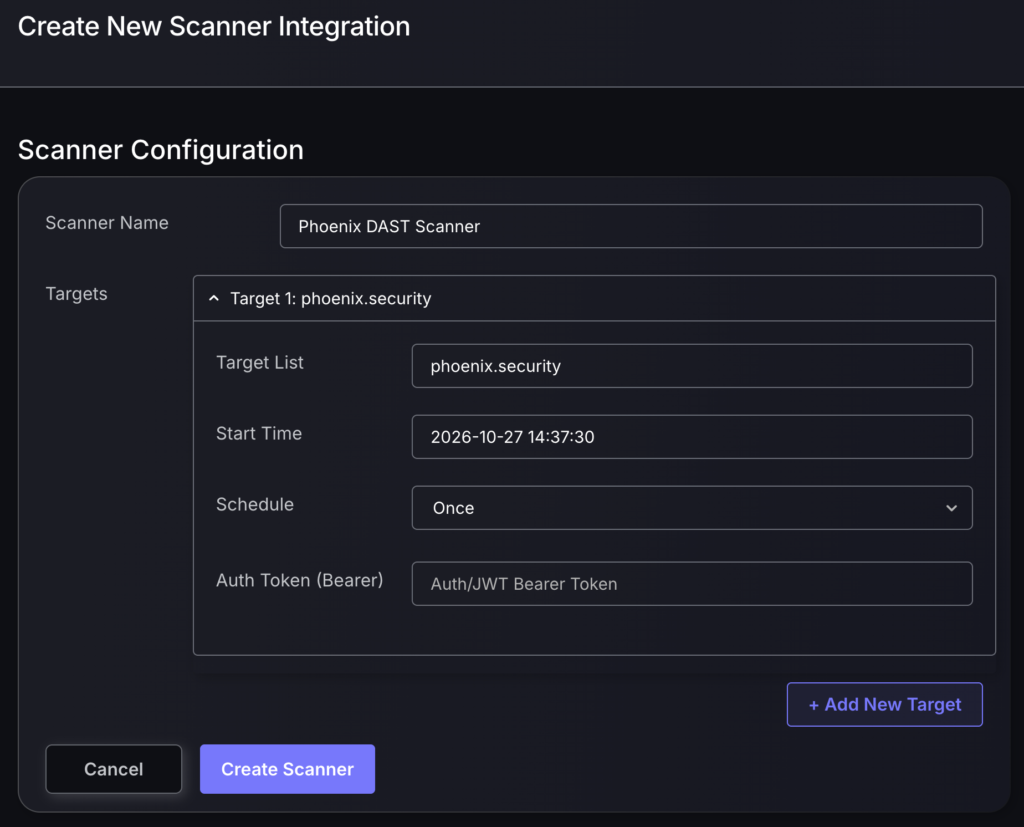
Phoenix added a native DASTDASTDynamic application security testing, probing a running application from the outside for vulnerabilities. It checks behavior exposed through the application's interfaces. Scanner integration for scheduling and monitoring authenticated web application scans directly from the platform.︀︄︇︀︅︉︀︅︀︀︃︀︀︅︅︀︅︊︀︄︆︀︃︄
Phoenix Security correlates scanner, cloud and runtime findings with exploitability and ownership, and uses AI agents to prioritise and open remediation pull requests.
Phoenix added a native DASTDASTDynamic application security testing, probing a running application from the outside for vulnerabilities. It checks behavior exposed through the application's interfaces. Scanner integration for scheduling and monitoring authenticated web application scans directly from the platform.︀︄︇︀︅︉︀︅︀︀︃︀︀︅︅︀︅︊︀︄︆︀︃︄
└──▷ WHAT SHIPPED ·
1 FEATURE0 OF 1 FEATUREmost completely described firstwhat's the number?
Each feature carries 0–100 for how completely the vendor documented
it — not how big or important the work is. A major capability
described in eight words scores low, and that is the finding.
depth0–40what it does and how it works or what changed
specificity0–30names real surfaces — APIs, flags, formats, limits, numbers
actionability0–30enough to go use it — a named endpoint, flag, or config key tops this; a UI path is a starting point
Code and config rank first by construction: a documented endpoint,
flag or config key scores at the top of specificity and actionability,
so it sorts above a feature described only in prose. Under
60 the notes go thin — everything below the “thinner
coverage” line is thinner documentation, not smaller work.
Hover any meter for that feature's three sub-scores.
0100
Phoenix DAST Scanner integrationnew82how completely this was documenteddepth32/40specificity28/30actionability22/3082 / 100
A new DAST Scanner integration appears under Integrations > Scanners > WEB, letting teams schedule authenticated web scans and manage targets from within Phoenix.︀︄︇︀︅︉︀︅︀︀︃︀︀︅︅︀︅︊︀︄︆︀︃︄ Each target is configured with a target URL, start time, time zone and schedule, with multiple targets added via + Add New Target, and authentication via the Auth Token (Bearer) field supports bearer and JWTJWTAn open standard (RFC 7519) for encoding claims as a signed, optionally encrypted JSON object passed between parties. Cyber tools use it to verify identity and permissions without querying a central session store. tokens (cookie, basic, and client-certificate auth are not supported). The integration page monitors target status — Active/Fetched, In Progress, Not Started, Disabled, Missing, and Error — alongside last fetch date, and exposes Fetch and Fetch/pause all controls to enable or pause individual or all targets, plus an optional setting to auto-delete missing targets not reported for a configurable number of days.
Set up a scheduled authenticated DAST scan for a web target that requires a bearer tokenbearer tokenA credential that grants access to whoever presents it, without a separate proof of possession. Protecting the token matters because a stolen copy can be used by someone else. for login.
📍In Phoenix, go to Integrations › Scanners › WEB › Phoenix DAST Scanner. Expand Target 1, enter the target URL, set Start Time and Schedule, and paste the bearer or JWT token into the Auth Token (Bearer) field. Select Create Scanner.
Pause all DAST target processing during a maintenance window without removing the integration.
📍Open the created scanner integration page in Phoenix. Select Fetch/pause all to pause processing for every configured target. Select it again to re-enable when the window closes.
Black Duck helps organizations secure their software supply chain by providing deep visibility into open source components, licenses, and vulnerabilities.
Black Duck launched Signal Agentic Fix, an AI remediation agent that autonomously scans, triages, patches, validates, and submits pull requests for vulnerabilities, alongside a companion mode that plugs into coding agents like Claude Code and GitHub Copilot.︀︄︇︀︅︉︀︅︀︀︃︀︀︅︅︀︅︊︀︄︆︀︃︄
└──▷ WHAT SHIPPED ·
2 FEATURES1 OF 2 FEATURESmost completely described firstwhat's the number?
Each feature carries 0–100 for how completely the vendor documented
it — not how big or important the work is. A major capability
described in eight words scores low, and that is the finding.
depth0–40what it does and how it works or what changed
specificity0–30names real surfaces — APIs, flags, formats, limits, numbers
actionability0–30enough to go use it — a named endpoint, flag, or config key tops this; a UI path is a starting point
Code and config rank first by construction: a documented endpoint,
flag or config key scores at the top of specificity and actionability,
so it sorts above a feature described only in prose. Under
60 the notes go thin — everything below the “thinner
coverage” line is thinner documentation, not smaller work.
Hover any meter for that feature's three sub-scores.
0101
Signal Agentic Fix autonomous remediation agentnew72how completely this was documenteddepth32/40specificity25/30actionability15/3072 / 100
Signal Agentic Fix is an AI agent that performs end-to-end vulnerability remediation—scan, triage, fix generation, validation, and pull-request submission—without human bottlenecks.︀︄︇︀︅︉︀︅︀︀︃︀︀︅︅︀︅︊︀︄︆︀︃︄ It reuses the same deterministic SASTSASTStatic application security testing, analyzing source code or compiled code for vulnerabilities without running the application. It helps developers find problems before deployment. and SCASCASoftware composition analysis, identifying third-party dependencies and checking them for known vulnerabilities and license issues. It covers software a team uses rather than writes itself. engines from Polaris, Coverity, and Black Duck SCA for consistent scan results inside the agent workflow, and is available in early access as a Claude Code plug-in for Coverity users, with additional coding-agent and DevOps pipeline support planned for Coverity, Polaris, and Black Duck SCA. A planned addition, Signal AI Code Analysis support, will enable deeper discovery of novel risks such as IDORIDORInsecure Direct Object Reference, a web vulnerability where an application exposes internal identifiers (IDs, filenames) without access checks, letting an attacker substitute another user's ID to reach their data. and BOLABOLABroken Object Level Authorization, an API vulnerability class where a server fails to verify that the requesting user owns or may access the object ID they supply, letting attackers read or modify other users' data. within agent runs.
Agentic Fix for Coding Agents companionnew45how completely this was documenteddepth20/40specificity15/30actionability10/3045 / 100
Agentic Fix for Coding Agents integrates as a companion to tools like Claude Code and GitHub Copilot, letting developers remove defects in existing code and prevent new ones as AI writes code.
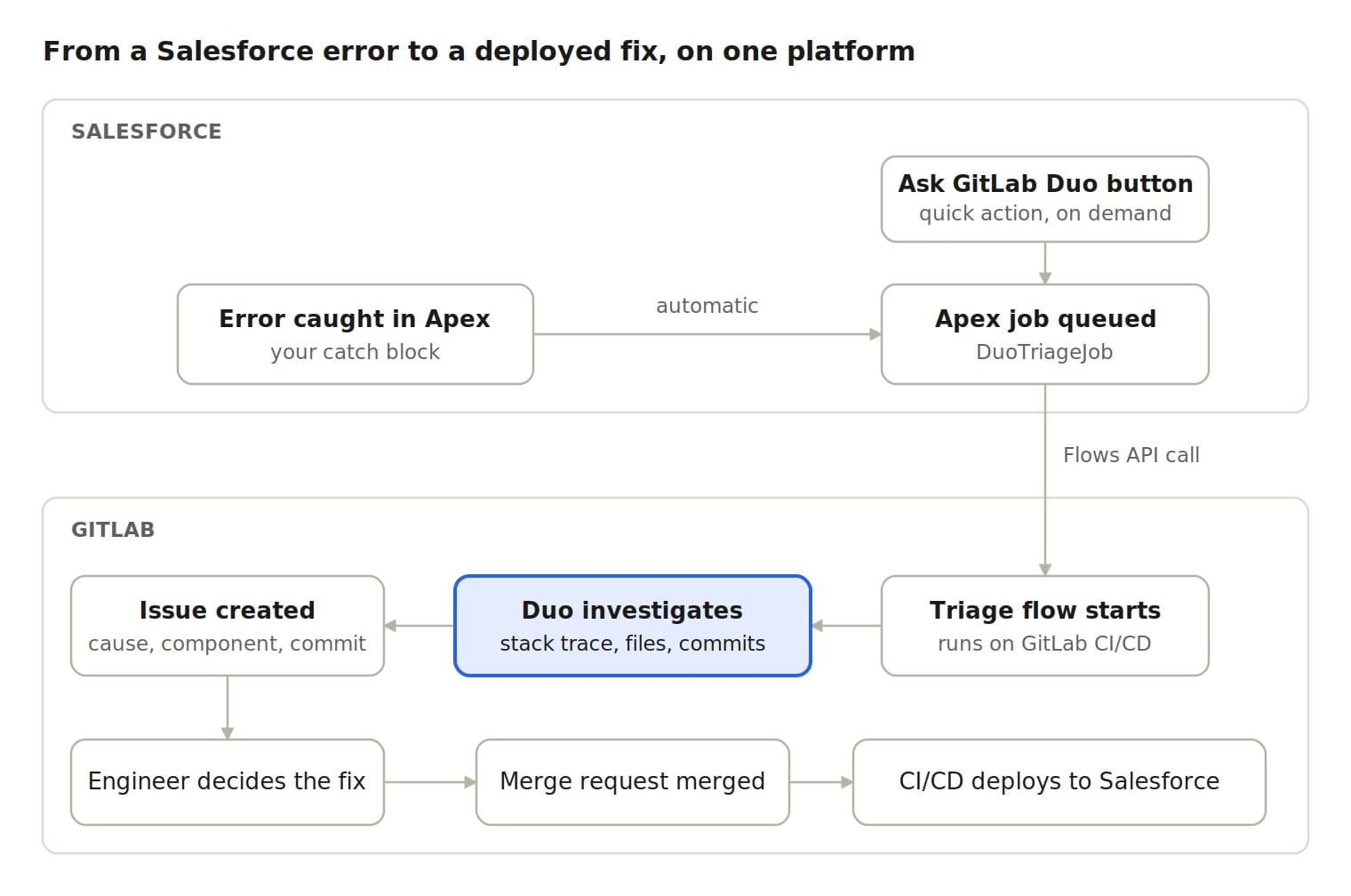
GitLab shipped a GA Flows API that lets any external system trigger custom Duo Agent Platform flows to auto-triage issues, alongside the YAML-based flow definition format and new authoring surfaces in VS Code and the project UI.︀︄︇︀︅︉︀︅︀︀︃︀︀︅︅︀︅︊︀︄︆︀︃︄
Teams and agents ship trusted software faster with GitLab, the intelligent orchestration platform with context and governance for the entire software lifecycle.
GitLab shipped a GA Flows API that lets any external system trigger custom Duo Agent Platform flows to auto-triage issues, alongside the YAML-based flow definition format and new authoring surfaces in VS Code and the project UI.︀︄︇︀︅︉︀︅︀︀︃︀︀︅︅︀︅︊︀︄︆︀︃︄
└──▷ WHAT SHIPPED ·
3 FEATURES0 OF 3 FEATURESmost completely described firstwhat's the number?
Each feature carries 0–100 for how completely the vendor documented
it — not how big or important the work is. A major capability
described in eight words scores low, and that is the finding.
depth0–40what it does and how it works or what changed
specificity0–30names real surfaces — APIs, flags, formats, limits, numbers
actionability0–30enough to go use it — a named endpoint, flag, or config key tops this; a UI path is a starting point
Code and config rank first by construction: a documented endpoint,
flag or config key scores at the top of specificity and actionability,
so it sorts above a feature described only in prose. Under
60 the notes go thin — everything below the “thinner
coverage” line is thinner documentation, not smaller work.
Hover any meter for that feature's three sub-scores.
0100
Flows API to trigger custom AI agent flowsnew95how completely this was documenteddepth35/40specificity30/30actionability30/3095 / 100
The POST /api/v4/ai/duo_workflows/workflows endpoint (generally available from GitLab 19.5) lets any external system trigger a custom Duo Agent Platform flow over HTTP by passing project_id, ai_catalog_item_consumer_id, and a goal.︀︄︇︀︅︉︀︅︀︀︃︀︀︅︅︀︅︊︀︄︆︀︃︄ Request body fields allow_agent_to_request_user, agent_privileges, and pre_approved_agent_privileges control whether the flow executes autonomously and which tool permissions it is granted. The response includes a web_url field linking to the agent session for inspecting each step the flow took, and the flow's ai_catalog_item_consumer_id can be looked up via a GraphQL query.
Trigger a custom Duo Agent flow from any external system to auto-triage an error and open a GitLab issue — no human required.
Enable a custom flow and retrieve its ai_catalog_item_consumer_id for use in API calls, then navigate to AI > Flows in your project.
📍1. In your GitLab project, go to AI › Flows.
2. Open the Managed tab and select your flow.
3. Select Enable and choose the project that holds your source code.
4. Run the GraphQL query from the docs to retrieve the gid://gitlab/AiCatalogItemConsumer/<number> and note the numeric ID as your ai_catalog_item_consumer_id.
5. Create a project access token with the api scope and at least the Developer role for use in the PRIVATE-TOKEN header.
Custom flow definitions in flow registry v1 YAMLnew73how completely this was documenteddepth25/40specificity28/30actionability20/3073 / 100
Custom agent flows are defined as a single YAML file using flow registry v1 syntax, specifying AgentComponent agents, toolsets (find_files, grep, read_file, list_commits, create_issue), and prompt templates that drive the agent's behavior.
Define a custom AI triage agent flow that reads repository files and creates a GitLab issue, using flow registry v1 YAML syntax.
yaml
version: "v1"
environment:
  ambient
components:
  - name: "sf_error_triage"
    type: AgentComponent
    prompt_id: "sf_error_triage_prompt"
    inputs:
      - from: "context:project_id"
        as: "project_id"
      - from: "context:goal"
        as: "error_report"
    toolset:
      - "find_files"
      - "grep"
      - "read_file"
      - "list_commits"
      - "create_issue"
prompts:
  - prompt_id: "sf_error_triage_prompt"
    prompt_template:
      system: |
        You triage errors for a team. Find the source file, read the code,
        list recent commits, and create one issue with root-cause analysis.
      user: |
        Project ID: {{project_id}}
        Error report: {{error_report}}
      placeholder: history
routers:
  - from: "sf_error_triage"
    to: "end"
flow:
  entry_point: "sf_error_triage"
Flow authoring in VS Code and project UInew45how completely this was documenteddepth15/40specificity15/30actionability15/3045 / 100
Custom flows can be created and tested in VS Code using the GitLab flow builder, and managed in-project via the new AI > Flows > New flow UI, which includes an Enable action under the Managed tab to scope a flow to a specific project.
SonarQube's Remediation Agent now extends to Hunter Agent findings, letting teams filter, auto-fix, and CI-validate fixes for broken access control, business logic flaws, and auth gaps across both SonarQube Cloud and self-deployed SonarQube Server.︀︄︇︀︅︉︀︅︀︀︃︀︀︅︅︀︅︊︀︄︆︀︃︄
Sonarqube is a enforce consistent quality gates across every pull request and pipeline, from IDE to CI/CD, with automated code review for bugs and security issues.
SonarQube's Remediation Agent now extends to Hunter Agent findings, letting teams filter, auto-fix, and CI-validate fixes for broken access control, business logic flaws, and auth gaps across both SonarQube Cloud and self-deployed SonarQube Server.︀︄︇︀︅︉︀︅︀︀︃︀︀︅︅︀︅︊︀︄︆︀︃︄
└──▷ WHAT SHIPPED ·
1 FEATURE0 OF 1 FEATUREmost completely described firstwhat's the number?
Each feature carries 0–100 for how completely the vendor documented
it — not how big or important the work is. A major capability
described in eight words scores low, and that is the finding.
depth0–40what it does and how it works or what changed
specificity0–30names real surfaces — APIs, flags, formats, limits, numbers
actionability0–30enough to go use it — a named endpoint, flag, or config key tops this; a UI path is a starting point
Code and config rank first by construction: a documented endpoint,
flag or config key scores at the top of specificity and actionability,
so it sorts above a feature described only in prose. Under
60 the notes go thin — everything below the “thinner
coverage” line is thinner documentation, not smaller work.
Hover any meter for that feature's three sub-scores.
0100
Remediation Agent support for Hunter Agent findingsnew88how completely this was documenteddepth32/40specificity28/30actionability28/3088 / 100
SonarQube Cloud's Issues page now supports the hunter-agent tag and category tags like hunter-broken-access-control to filter Hunter Agent findings (broken access control, business logic flaws, auth gaps) alongside the existing Fixable by Agent filter; up to 20 findings can be selected and sent to Fix with Agent.︀︄︇︀︅︉︀︅︀︀︃︀︀︅︅︀︅︊︀︄︆︀︃︄ Each Hunter Agent finding generates its own individual pull request (or merge request on GitHub), unlike the grouped-by-rule-key behavior used for rule-based issues. For GitHub ActionsGitHub ActionsGitHub's built-in CI/CD system that runs automated workflows triggered by repository events, letting cyber tools automate testing, building, and releasing without managing separate pipeline infrastructure. pipelines, CI follow-up is enabled on these fix PRs: when CI fails, the agent reads build logs, pushes a corrective commit, and retries up to three times before leaving the PR open. This capability is also brought to SonarQube Server 2026.5, with both the Hunter Agent and Remediation Agent able to run on self-deployed infrastructure.
Filter the Issues page to only Hunter Agent authorization findings ready for automated remediation, then dispatch them for fixing.
📍In SonarQube Cloud, open your project Issues page, select the main branch, enable the Fixable by Agent filter, then add the tag hunter-broken-access-control (or hunter-agent for all Hunter Agent findings). Select up to 20 findings and choose Fix with Agent.
— Names exact tags, filter, PR behavior, retry limit, and server versionlaunch-20261026-7b057b78
Kingfisher expands its blast-radius analysis with multi-region/multi-project scope flags, an automatic capability-based risk and coverage assessment in report output, and a new HTML investigation viewer for triaging findings.︀︄︇︀︅︉︀︅︀︀︃︀︀︅︅︀︅︊︀︄︆︀︃︄
Detect secrets + live validation. Map blast radius.
Kingfisher expands its blast-radius analysis with multi-region/multi-project scope flags, an automatic capability-based risk and coverage assessment in report output, and a new HTML investigation viewer for triaging findings.︀︄︇︀︅︉︀︅︀︀︃︀︀︅︅︀︅︊︀︄︆︀︃︄
└──▷ WHAT SHIPPED ·
3 FEATURES0 OF 3 FEATURESmost completely described firstwhat's the number?
Each feature carries 0–100 for how completely the vendor documented
it — not how big or important the work is. A major capability
described in eight words scores low, and that is the finding.
depth0–40what it does and how it works or what changed
specificity0–30names real surfaces — APIs, flags, formats, limits, numbers
actionability0–30enough to go use it — a named endpoint, flag, or config key tops this; a UI path is a starting point
Code and config rank first by construction: a documented endpoint,
flag or config key scores at the top of specificity and actionability,
so it sorts above a feature described only in prose. Under
60 the notes go thin — everything below the “thinner
coverage” line is thinner documentation, not smaller work.
Hover any meter for that feature's three sub-scores.
0100
Multi-region and multi-project scope expansion for blast-radius scansnew90how completely this was documenteddepth30/40specificity30/30actionability30/3090 / 100
Adds --aws-region to the scan and standalone toon commands to expand AWS discovery beyond the SDK-selected region, accepting up to eight explicit regions (global IAMIAMIdentity and Access Management — a framework of policies and services for controlling who can authenticate to systems and what resources they are authorized to use, letting cyber tools enforce least-privilege and audit access./S3 resources are inventoried once).︀︄︇︀︅︉︀︅︀︀︃︀︀︅︅︀︅︊︀︄︆︀︃︄ Adds --gcp-project to scan and toon to expand GCP discovery beyond the home project, accepting up to seven additional projects, each using its own visible IAM context.
Expand AWS blast-radius discovery across multiple regions when a leaked key may have cross-region resources.
— Exact flags, numeric limits, and runnable commands givenproduct docs
0200
Capability-based risk and coverage assessment in blast-radius reportsnew85how completely this was documenteddepth35/40specificity30/30actionability20/3085 / 100
Blast-radius output now includes automatic risk and coverage assessment in scan and toon (no extra flag needed), labeling permissions by capability category — e.g. s3:ListBucket as Metadata read, s3:GetObject as Sensitive data read — and distinguishing direct access, candidate role paths, and observed API access from mere policy grants or conditions. This is exposed via the new provider_metadata.authorization_evidence.assessment field, containing schema version, assessment timestamp, capability categories, evidence labels, coverage, resource explanations, recommendations, and notes; capability_risk is tracked separately from the original severity field. Detailed assessments are capped at 4096 capability records and 1000 resources per identity, with up to 256 permissions per resource, and legacy report data is retained separately. The observed_at timestamp is intentionally excluded from snapshot comparisons since it varies between runs.
— Field name and caps given but no query example shownproduct docs
0300
HTML investigation viewer for blast-radius reportsnew80how completely this was documenteddepth30/40specificity25/30actionability25/3080 / 100
Adds a blast-radius HTML investigation viewer with Overview, Findings, Coverage, and Blast Radius views that opens existing JSON/JSONLJSONLA text format where each line is a self-contained, valid JSON object, making it easy to stream, append, and process large datasets line by line without parsing a full JSON array into memory. reports and supports drag-and-drop via a compact import bar. It groups identities by provider and surfaces policy provenanceprovenanceEvidence recording where a software artifact came from and how it was built, including its source and build process. It helps a consumer check that the artifact matches a trusted build., candidate paths, conditions, exclusions, and observed API methods alongside a separate resource map. A synthetic investigation report illustrating AWS, GCP, Azure, Hugging Face, and GitHub evidence can be opened with kingfisher view or the report picker to explore the viewer before running a real scan.
Open the built-in synthetic investigation report to explore the HTML triage viewer before running a real scan.
Kingfisher v2.15.0 adds PDF scanning, jwt_sign for RS256 JWTJWTAn open standard (RFC 7519) for encoding claims as a signed, optionally encrypted JSON object passed between parties. Cyber tools use it to verify identity and permissions without querying a central session store. construction, --fallbacks for HTTP fallback environments, versioned blast-radius assessments, provider-issued repo IDs in Git metadata, and KF_GITHUB_MAX_RETRY_WAIT_SECS.
└──▷ GET THIS VERSIONHomebrewDockergit
Homebrew
$ brew install kingfisher
# already installed? upgrade to this version:$ brew upgrade kingfisher
Docker
$ docker pull ghcr.io/mongodb/kingfisher:2.15.0
git
$ git clone --branch v2.15.0 https://github.com/mongodb/kingfisher.git
# already have the repo? check out this version:$ git checkout v2.15.0
Homebrew lists this version · published under the project's GitHub account · checked 28 Oct
Adds KF_GITHUB_MAX_RETRY_WAIT_SECS environment variable to configure how long scans wait through GitHub quota resets.
Adds --fallbacks CLI flag, http_fallbacks=True Python option, and .http_fallbacks(true) Rust option to enable up to two opt-in HTTP fallback environments for validation and revocation.
Adds --max-file-size enforcement (default 256 MB) on Git-history blobs before reading content; disable with --max-file-size 0 or --no-limits.
Adds jwt_sign function to construct complete RS256 JWTsJWTsJSON Web Tokens — an open standard (RFC 7519) for encoding claims as a signed, optionally encrypted JSON object. Cyber tools use them for stateless authentication without server-side session storage. from JSON claims and PEM keys.
Adds offline, resource-bounded PDF page-text extraction for CLI file, Git-history, and archive scans; Python users opt in with expand_content(..., pdf=True).
+3 moreshow less
Adds versioned blast-radius assessments with capability risk, authorization evidence, coverage limitations, and collection-time timestamps, separate from legacy severity.
Includes provider-issued repository IDs in Git metadata and TOON reports across supported SCMs to keep fork findings distinct.
Prepares Python SDK 1.6.0 with explicit analysis and source-attribute scanning, and rules/scanner crates 3.0.0 with public Rust schema changes.
8 details in Everything
└──▷ BREAKING ON UPGRADE
!Legacy HTTP request.url: [primary, secondary, ...] lists now use only the primary URL by default; enabling --fallbacks tries at most the primary and two alternatives.
!HTTP revocation no longer follows redirects, including for legacy direct-primary rules; Anthropic, Terraform, and DigitalOcean access-map requests also refuse redirects — configure final canonical URLs instead.
!Rust callers of rules/scanner crates must follow the 3.0 migration guide (docs/LIBRARY.md#migrating-to-rules-and-scanner-30) for public schema changes.
GitGuardian SaaS's machine protection now supports low-priority background scanning on developer machines, adds an Overview dashboard to guide remediation, redacts more AI-agent history, expands validity checks to 501 secret types, and cuts noise from IDE history and build/cache folders — alongside a breaking change to how custom hosts are configured for validity checks.︀︄︇︀︅︉︀︅︀︀︃︀︀︅︅︀︅︊︀︄︆︀︃︄
GitGuardian SaaS is a cloud-hosted security platform that detects exposed secrets, API keys, and credentials in source code repositories and developer workflows.
GitGuardian SaaS's machine protection now supports low-priority background scanning on developer machines, adds an Overview dashboard to guide remediation, redacts more AI-agent history, expands validity checks to 501 secret types, and cuts noise from IDE history and build/cache folders — alongside a breaking change to how custom hosts are configured for validity checks.︀︄︇︀︅︉︀︅︀︀︃︀︀︅︅︀︅︊︀︄︆︀︃︄
└──▷ WHAT SHIPPED ·
7 FEATURES0 OF 7 FEATURESmost completely described firstwhat's the number?
Each feature carries 0–100 for how completely the vendor documented
it — not how big or important the work is. A major capability
described in eight words scores low, and that is the finding.
depth0–40what it does and how it works or what changed
specificity0–30names real surfaces — APIs, flags, formats, limits, numbers
actionability0–30enough to go use it — a named endpoint, flag, or config key tops this; a UI path is a starting point
Code and config rank first by construction: a documented endpoint,
flag or config key scores at the top of specificity and actionability,
so it sorts above a feature described only in prose. Under
60 the notes go thin — everything below the “thinner
coverage” line is thinner documentation, not smaller work.
Hover any meter for that feature's three sub-scores.
0100
Background-priority scanning for machine protectionnew95how completely this was documenteddepth35/40specificity30/30actionability30/3095 / 100
Adds a --background flag to ggshield machine scan and ggshield machine report to run scans at low priority using 2–4 threads and one-tenth of normal memory (minimum 512 MB), suited for scheduled MDMMDMMobile device management, centrally configuring and managing enrolled devices. Administrators use it to apply settings, distribute applications and enforce device security policies. jobs.︀︄︇︀︅︉︀︅︀︀︃︀︀︅︅︀︅︊︀︄︆︀︃︄ Adds scan.resources.background.mode: auto to machine_scan.yaml to make background-priority scanning the default for every scan regardless of how it's triggered.
Run a scheduled daily inventory scan at low priority so developer machines stay responsive during the MDM job.
$ ggshield machine report --background
Make background-priority scanning the permanent default so every scan — however triggered — leaves the machine responsive.
Overview page in machine dashboardnew65how completely this was documenteddepth25/40specificity20/30actionability20/3065 / 100
ggshield machine dashboard gains an Overview page that lists one row per cleanup area (AI agents, repositories, history and logs) and guides remediation order: overprivileged secrets first, then history leaks, then secrets in daily use.
Open the local remediation dashboard to see the Overview and start cleaning up findings grouped by AI agent or repository.
Validity checks expanded to 501 secret typesimproved55how completely this was documenteddepth20/40specificity30/30actionability5/3055 / 100
Validity checks now cover 501 secret types, up from 432, adding coverage for Elastic, Datadog, Langfuse, Sumo Logic, Gitea, and Azure Container Registry.
Noise reduction for IDE editor-history copiesimproved55how completely this was documenteddepth25/40specificity25/30actionability5/3055 / 100
Findings from VS Code, Cursor, VSCodium, Windsurf, and JetBrains IDE editor-history copies are now suppressed unless the secret in them is valid, reducing duplicate noise.
Custom hosts for validity checks now workspace-onlybreaking55how completely this was documenteddepth25/40specificity15/30actionability15/3055 / 100
Validity checks now take custom hosts only from your GitGuardian workspace; environment variables and local config files that previously set custom hosts are no longer read.
Expanded folder exclusions for build and cache leftoversimproved50how completely this was documenteddepth20/40specificity25/30actionability5/3050 / 100
Scanning now skips build leftovers (pip-*, pytest-of-*, _MEI*), Windows package caches (NuGetNuGetMicrosoft's package manager for .NET, hosting a public registry of reusable libraries so tools can pull in dependencies without bundling or manually maintaining third-party code., Scoop), and Electron app caches, while still scanning credential-holding folders.
Validity checks now take custom hosts only from your GitGuardian workspace; environment variables and local config files that previously set custom hosts are no longer read.
WPScan v4.2.0 adds a configurable cap on response read size to guard against memory exhaustion, and improves SARIFSARIFStatic Analysis Results Interchange Format, a standard for sharing code-analysis findings, including locations and rule details. It lets scanners report results to a common review interface. output to correctly flag aborted scans as failed runs.︀︄︇︀︅︉︀︅︀︀︃︀︀︅︅︀︅︊︀︄︆︀︃︄
WPScan WordPress security scanner. Written for security professionals and blog maintainers to test the security of their WordPress websites. Contact us via contact@wpscan.com
WPScan v4.2.0 adds a configurable cap on response read size to guard against memory exhaustion, and improves SARIFSARIFStatic Analysis Results Interchange Format, a standard for sharing code-analysis findings, including locations and rule details. It lets scanners report results to a common review interface. output to correctly flag aborted scans as failed runs.︀︄︇︀︅︉︀︅︀︀︃︀︀︅︅︀︅︊︀︄︆︀︃︄
└──▷ WHAT SHIPPED ·
2 FEATURES0 OF 2 FEATURESmost completely described firstwhat's the number?
Each feature carries 0–100 for how completely the vendor documented
it — not how big or important the work is. A major capability
described in eight words scores low, and that is the finding.
depth0–40what it does and how it works or what changed
specificity0–30names real surfaces — APIs, flags, formats, limits, numbers
actionability0–30enough to go use it — a named endpoint, flag, or config key tops this; a UI path is a starting point
Code and config rank first by construction: a documented endpoint,
flag or config key scores at the top of specificity and actionability,
so it sorts above a feature described only in prose. Under
60 the notes go thin — everything below the “thinner
coverage” line is thinner documentation, not smaller work.
Hover any meter for that feature's three sub-scores.
0100
Response size cap via --max-response-sizebreaking93how completely this was documenteddepth35/40specificity28/30actionability30/3093 / 100
The new --max-response-size MiB flag stops reading any HTTP response once it exceeds the specified size, guarding against memory exhaustion on targets serving huge or endless responses; default is 16 MiB, max is 2047, and 0 disables the cap entirely.︀︄︇︀︅︉︀︅︀︀︃︀︀︅︅︀︅︊︀︄︆︀︃︄ This changes default behavior: responses larger than 16 MiB are now truncated by default, so existing scans relying on unbounded reads must pass --max-response-size 0 to restore the previous behavior. The option can also be persisted via max_response_size under cli_options in a project config file such as pwd/.wpscan/scan.yml.
Scan a target that serves unusually large pages without risking memory exhaustion — raise the cap to 64 MiB instead of the 16 MiB default.
SARIF aborted-run reportingimproved55how completely this was documenteddepth25/40specificity20/30actionability10/3055 / 100
SARIF output now reports aborted runs as unsuccessful, recording the abort reason in toolExecutionNotifications, so downstream consumers show an aborted scan as a failed analysis rather than a clean run with zero alerts.
— Explains mechanism and SARIF field but no CLI usage shownv4.2.0
└──▷ BREAKING ON UPGRADE
!
Responses larger than 16 MiB are now truncated by default; use --max-response-size 0 to restore the previous unbounded behavior.
Burp suite is a we enable the world to secure the web. Burp Suite, the Web Security Academy, and world-leading research from PortSwigger â the AppSec communityâs home.
Burp Suite DASTDASTDynamic application security testing, probing a running application from the outside for vulnerabilities. It checks behavior exposed through the application's interfaces. 2026.10.2 adds ServiceNow ticketing integration, expands API scan coverage, and reduces scan memory usage for better reliability.︀︄︇︀︅︉︀︅︀︀︃︀︀︅︅︀︅︊︀︄︆︀︃︄
└──▷ WHAT SHIPPED ·
3 FEATURES1 OF 3 FEATURESmost completely described firstwhat's the number?
Each feature carries 0–100 for how completely the vendor documented
it — not how big or important the work is. A major capability
described in eight words scores low, and that is the finding.
depth0–40what it does and how it works or what changed
specificity0–30names real surfaces — APIs, flags, formats, limits, numbers
actionability0–30enough to go use it — a named endpoint, flag, or config key tops this; a UI path is a starting point
Code and config rank first by construction: a documented endpoint,
flag or config key scores at the top of specificity and actionability,
so it sorts above a feature described only in prose. Under
60 the notes go thin — everything below the “thinner
coverage” line is thinner documentation, not smaller work.
Hover any meter for that feature's three sub-scores.
0101
ServiceNow ticketing integrationnew40how completely this was documenteddepth15/40specificity15/30actionability10/3040 / 100
Burp Suite DAST now integrates with ServiceNow, enabling security issues found by Burp Suite DAST to be raised directly in ServiceNow tickets.︀︄︇︀︅︉︀︅︀︀︃︀︀︅︅︀︅︊︀︄︆︀︃︄
Caido's v0.59.0 release centers on a new AI provider framework supporting major LLMLLMA large language model, a neural network trained on large amounts of text to recognize patterns and generate language. Applications use it for tasks such as answering, summarizing and writing code. vendors and local custom endpoints, alongside an AI-assisted Workflow generator, an experimental traffic capture/passthrough system, and quality-of-life improvements to Replay, Desktop multi-instancing, and the macOS menu bar app.︀︄︇︀︅︉︀︅︀︀︃︀︀︅︅︀︅︊︀︄︆︀︃︄
Caido releases, wiki and roadmap
Caido's v0.59.0 release centers on a new AI provider framework supporting major LLMLLMA large language model, a neural network trained on large amounts of text to recognize patterns and generate language. Applications use it for tasks such as answering, summarizing and writing code. vendors and local custom endpoints, alongside an AI-assisted Workflow generator, an experimental traffic capture/passthrough system, and quality-of-life improvements to Replay, Desktop multi-instancing, and the macOS menu bar app.︀︄︇︀︅︉︀︅︀︀︃︀︀︅︅︀︅︊︀︄︆︀︃︄
└──▷ WHAT SHIPPED ·
4 FEATURES0 OF 4 FEATURESmost completely described firstwhat's the number?
Each feature carries 0–100 for how completely the vendor documented
it — not how big or important the work is. A major capability
described in eight words scores low, and that is the finding.
depth0–40what it does and how it works or what changed
specificity0–30names real surfaces — APIs, flags, formats, limits, numbers
actionability0–30enough to go use it — a named endpoint, flag, or config key tops this; a UI path is a starting point
Code and config rank first by construction: a documented endpoint,
flag or config key scores at the top of specificity and actionability,
so it sorts above a feature described only in prose. Under
60 the notes go thin — everything below the “thinner
coverage” line is thinner documentation, not smaller work.
Hover any meter for that feature's three sub-scores.
0100
AI provider configuration and credential testingnew82how completely this was documenteddepth30/40specificity30/30actionability22/3082 / 100
Adds Settings > AI > Providers to configure OpenAI, Anthropic, Google Gemini, SpaceXAI, OpenRouterOpenRouterA unified API gateway that routes requests to dozens of LLM providers under one endpoint, letting cyber tools swap or compare models without rewriting provider-specific integration code., and Amazon Bedrock from one place with credential testing before use.︀︄︇︀︅︉︀︅︀︀︃︀︀︅︅︀︅︊︀︄︆︀︃︄ Also supports custom providers (e.g. a local LM Studio endpoint) by setting a Provider ID, matching API type, Base URL, and an optional API Key, with a Test action to verify the connection.
Connect a local LM Studio endpoint as a custom AI provider without an API key, so your prompts never leave your machine.
📍In Caido, go to Settings › AI › Providers › Custom provider. Set Provider ID to a label of your choice, select the matching API type, enter your LM Studio Base URL (e.g. http://localhost:1234/v1), and leave API Key empty. Click Test to verify the connection.
— Names exact settings path, six providers, and custom-provider fields with a worked example.launch-20261026-69a40eac
0200
Capture modes and passthrough in Interceptnew80how completely this was documenteddepth30/40specificity25/30actionability25/3080 / 100
Adds an Intercept > Capture menu (marked Experimental) with three recording modes — All traffic, In-scope only, and Custom rules — plus a Passthrough list under Custom rules mode so hosts on it pass through Caido without being recorded. In-scope only uses the active Scope definition to silently skip recording out-of-scope requests.
Keep noise out of a project by recording only in-scope hosts during an engagement.
📍In Caido, open Intercept › Capture and select In-scope only. Caido will use the active Scope definition and silently pass through any out-of-scope requests without recording them.
— Exact menu path, three named modes, and a passthrough mechanism with steps.launch-20261026-69a40eac
thinner coverage below
0300
Generate action for Workflowsnew50how completely this was documenteddepth20/40specificity15/30actionability15/3050 / 100
Adds a Generate action in the Workflows page to produce an editable passive, active, or convert Workflow from a plain-language description.
DataDome protects web, mobile, and API applications by detecting and blocking bot and fraud traffic.
DataDome's Fraud SDK .Net 2.1.0 adds an optional field to let callers specify the effective time of a fraud event independent of submission time.︀︄︇︀︅︉︀︅︀︀︃︀︀︅︅︀︅︊︀︄︆︀︃︄
└──▷ WHAT SHIPPED ·
1 FEATURE0 OF 1 FEATUREmost completely described firstwhat's the number?
Each feature carries 0–100 for how completely the vendor documented
it — not how big or important the work is. A major capability
described in eight words scores low, and that is the finding.
depth0–40what it does and how it works or what changed
specificity0–30names real surfaces — APIs, flags, formats, limits, numbers
actionability0–30enough to go use it — a named endpoint, flag, or config key tops this; a UI path is a starting point
Code and config rank first by construction: a documented endpoint,
flag or config key scores at the top of specificity and actionability,
so it sorts above a feature described only in prose. Under
60 the notes go thin — everything below the “thinner
coverage” line is thinner documentation, not smaller work.
Hover any meter for that feature's three sub-scores.
0100
eventDate field in Fraud SDK .Net payloadnew60how completely this was documenteddepth20/40specificity20/30actionability20/3060 / 100
The Fraud SDK .Net 2.1.0 adds an optional eventDate field to the event payload to specify the effective event time, useful for replaying or backfilling events rather than relying on submission time.︀︄︇︀︅︉︀︅︀︀︃︀︀︅︅︀︅︊︀︄︆︀︃︄
Pass eventDate in a fraud event payload to record the actual time an event occurred rather than the submission time — useful for replaying or backfilling events.
Fastly is an edge cloud platform offering content delivery network, load balancing, edge computing, and web application security services for developers and enterprises.
Fastly's biggest change this window is automated virtual patching for Next-Gen WAFWAFA reverse proxy that inspects HTTP/HTTPS traffic and blocks requests matching known attack patterns such as SQL injection or XSS, sitting between clients and a web application to filter malicious input before it reaches the server. workspaces, surfaced both as a workspace setting and in the TerraformTerraformAn open-source infrastructure-as-code tool by HashiCorp that provisions cloud and on-premises resources through declarative configuration files, letting cyber tools automate and version-control their deployment environments. provider, alongside a Terraform migration path off legacy VCLVCLVarnish Configuration Language, a domain-specific language used to configure the Varnish HTTP cache, letting tools control request routing, caching rules, and traffic manipulation with low-latency precision. services and several Rust SDK additions covering client detection, product enumeration, shield timeouts, and Image Optimizer fallback behavior.︀︄︇︀︅︉︀︅︀︀︃︀︀︅︅︀︅︊︀︄︆︀︃︄
└──▷ WHAT SHIPPED ·
5 FEATURES0 OF 5 FEATURESmost completely described firstwhat's the number?
Each feature carries 0–100 for how completely the vendor documented
it — not how big or important the work is. A major capability
described in eight words scores low, and that is the finding.
depth0–40what it does and how it works or what changed
specificity0–30names real surfaces — APIs, flags, formats, limits, numbers
actionability0–30enough to go use it — a named endpoint, flag, or config key tops this; a UI path is a starting point
Code and config rank first by construction: a documented endpoint,
flag or config key scores at the top of specificity and actionability,
so it sorts above a feature described only in prose. Under
60 the notes go thin — everything below the “thinner
coverage” line is thinner documentation, not smaller work.
Hover any meter for that feature's three sub-scores.
0100
VPN/proxy client detection in Rust SDKnew75how completely this was documenteddepth20/40specificity30/30actionability25/3075 / 100
Adds Request::get_vpn_proxy_data, Request::get_vpn_proxy_*, and RequestHandle::vpn_proxy_* methods to expose metadata for detecting whether a downstream client is residential, a VPNVPNA virtual private network, an encrypted tunnel between devices or networks. It carries traffic across another network as though the endpoints had a private connection., or a proxy.︀︄︇︀︅︉︀︅︀︀︃︀︀︅︅︀︅︊︀︄︆︀︃︄
Image Optimizer fallback behavior on disabled servicesimproved65how completely this was documenteddepth25/40specificity25/30actionability15/3065 / 100
When Request::with_image_optimizer is used on a service where Image Optimizer is not enabled, the origin response is now passed through unmodified with a Fastly-Io-Error response header instead of failing.
Hayabusa (隼) is a sigma-based threat hunting and fast forensics timeline generator for Windows event logs.
Hayabusa v4.3.0 adds a fixed UTC-offset timestamp option across six commands and extends unaliased rule-field resolution to additional event log fields.︀︄︇︀︅︉︀︅︀︀︃︀︀︅︅︀︅︊︀︄︆︀︃︄
└──▷ WHAT SHIPPED ·
2 FEATURES0 OF 2 FEATURESmost completely described firstwhat's the number?
Each feature carries 0–100 for how completely the vendor documented
it — not how big or important the work is. A major capability
described in eight words scores low, and that is the finding.
depth0–40what it does and how it works or what changed
specificity0–30names real surfaces — APIs, flags, formats, limits, numbers
actionability0–30enough to go use it — a named endpoint, flag, or config key tops this; a UI path is a starting point
Code and config rank first by construction: a documented endpoint,
flag or config key scores at the top of specificity and actionability,
so it sorts above a feature described only in prose. Under
60 the notes go thin — everything below the “thinner
coverage” line is thinner documentation, not smaller work.
Hover any meter for that feature's three sub-scores.
0100
Fixed UTC offset timestamps via --timezone flagnew90how completely this was documenteddepth30/40specificity30/30actionability30/3090 / 100
The -Z, --timezone <OFFSET> flag was added to dfir-timeline, search, eid-metrics, logon-summary, log-metrics, and extract-base64 to render output timestamps with a fixed UTC offset in signed +HH:MM or -HH:MM form (e.g.︀︄︇︀︅︉︀︅︀︀︃︀︀︅︅︀︅︊︀︄︆︀︃︄ --timezone "+09:00" or -Z "-01:00"). It conflicts with --utc and --iso-8601, and filtering, sorting, and histogram bins remain UTC-based.
— Exact flag, affected commands, and example values givenv4.3.0
thinner coverage below
0200
Unaliased rule-field resolution for EventData and UserDataimproved30how completely this was documenteddepth10/40specificity15/30actionability5/3030 / 100
Rule-field resolution without aliases now extends to the EventData and UserData fields.
CAPEv2 extracts multi-tenancy into a self-contained plugin library and adds a lightweight plugin hook registry for MongoDB, SQL, and Elasticsearch filters.︀︄︇︀︅︉︀︅︀︀︃︀︀︅︅︀︅︊︀︄︆︀︃︄
└──▷ USE IT
Register a custom MongoDB query filter plugin to enforce tenant-scoped result isolation without patching CAPEv2 core.
Register a SQL task filter to restrict list_tasks() results to a specific tenant, replacing the removed inline tenant_id filtering.
python
from lib.cuckoo.common.hooks import register_sql_task_filter

def my_sql_filter(query):
    from lib.cuckoo.core.data.task import Task
    return query.filter(Task.owner == MY_USER_ID)

register_sql_task_filter(my_sql_filter)
Adds lib/cuckoo/common/hooks.py: a lightweight plugin hook registry exposing register_mongo_filter, register_sql_task_filter, register_es_filter, and register_report_hook, replacing inline tenancy logic with zero-overhead hooks that pass queries through unchanged when no plugin is registered.︀︄︇︀︅︉︀︅︀︀︃︀︀︅︅︀︅︊︀︄︆︀︃︄
Integrates lib/tenancy/ as a self-contained library for multi-tenancy and multi-cloud object storage, extracted from CAPEv2 core into the standalone CAPESandbox/CAPE-tenancy plugin repository.
Adds Django Group-based sandbox resource entitlement policy in lib/tenancy/resources.py, controlling which VMs, routes, tags, interactive sessions, and timeouts a user may discover in the UI/API and request at task submission time.
Wires apply_mongo_filter into dev_utils/mongodb.py so registered MongoDB query filters are automatically applied in mongo_find and mongo_find_one (bypass with no_hooks=True).
Wires apply_sql_task_filter into lib/cuckoo/core/data/tasking.py so registered SQL task filters are applied in list_tasks() and count_matching_tasks().
+1 moreshow less
Wires apply_es_filter in lib/cuckoo/common/cape_utils.py and lib/cuckoo/common/web_utils.py to wrap Elasticsearch search bodies via the hook registry.
Adds lib/cuckoo/common/hooks.py: a lightweight plugin hook registry exposing register_mongo_filter, register_sql_task_filter, register_es_filter, and register_report_hook, replacing inline tenancy logic with zero-overhead hooks that pass queries through unchanged when no plugin is registered.︀︄︇︀︅︉︀︅︀︀︃︀︀︅︅︀︅︊︀︄︆︀︃︄
Integrates lib/tenancy/ as a self-contained library for multi-tenancy and multi-cloud object storage, extracted from CAPEv2 core into the standalone CAPESandbox/CAPE-tenancy plugin repository.
Adds Django Group-based sandbox resource entitlement policy in lib/tenancy/resources.py, controlling which VMs, routes, tags, interactive sessions, and timeouts a user may discover in the UI/API and request at task submission time.
3 more in Everything
└──▷ BREAKING ON UPGRADE
!The [multitenancy], [central_mode], [centralstore], and machine_info_token stanzas are removed from conf/default/cuckoo.conf.default, conf/default/api.conf.default, and conf/default/reporting.conf.default; deployments relying on these config stanzas must migrate to the CAPESandbox/CAPE-tenancy plugin.
!Task.tenant_id and Task.visibility columns are removed from lib/cuckoo/core/data/task.py; code or queries referencing these fields will break (the Alembic migration 3a1b_tenant_visibility is preserved as a no-op for continuity).
!The lock_engine attribute is removed from lib/cuckoo/core/database.py; any custom code referencing it will break.
!The standalone web modules web/web/tenancy_optional.py and web/users/tenancy.py are deleted; imports of these modules will fail.
Finite State shipped scan email notifications with per-scope subscriptions, programmatic custom license lifecycle management, and exclusion comment visibility on components, all with new public API endpoints.︀︄︇︀︅︉︀︅︀︀︃︀︀︅︅︀︅︊︀︄︆︀︃︄
Finite State Platform is a firmware and software supply chain security tool that analyzes binaries and embedded devices to identify vulnerabilities, SBOM components, and risks.
Finite State shipped scan email notifications with per-scope subscriptions, programmatic custom license lifecycle management, and exclusion comment visibility on components, all with new public API endpoints.︀︄︇︀︅︉︀︅︀︀︃︀︀︅︅︀︅︊︀︄︆︀︃︄
└──▷ WHAT SHIPPED ·
3 FEATURES0 OF 3 FEATURESmost completely described firstwhat's the number?
Each feature carries 0–100 for how completely the vendor documented
it — not how big or important the work is. A major capability
described in eight words scores low, and that is the finding.
depth0–40what it does and how it works or what changed
specificity0–30names real surfaces — APIs, flags, formats, limits, numbers
actionability0–30enough to go use it — a named endpoint, flag, or config key tops this; a UI path is a starting point
Code and config rank first by construction: a documented endpoint,
flag or config key scores at the top of specificity and actionability,
so it sorts above a feature described only in prose. Under
60 the notes go thin — everything below the “thinner
coverage” line is thinner documentation, not smaller work.
Hover any meter for that feature's three sub-scores.
0100
Scan completion and failure email notificationsnew91how completely this was documenteddepth35/40specificity28/30actionability28/3091 / 100
Adds a POST /api/public/v0/notifications/subscriptions endpoint to subscribe to email notifications for every scan in a project programmatically.︀︄︇︀︅︉︀︅︀︀︃︀︀︅︅︀︅︊︀︄︆︀︃︄ The user who started a scan is automatically emailed on completion or failure, and users can subscribe at three scopes — a single scan, every scan in a Folder, or every scan in a Project — including a Notify me option on a running scan to subscribe mid-flight. A new Notification Settings view lets users choose which events to receive and filter subscriptions by scope, while organization administrators can enable or disable the scan email channel org-wide under Integrations with a single switch that reflects delivery status even after a recipient has used an unsubscribe link.
Enable the scan email channel for your organization so members receive scan completion and failure emails — do this once before individual subscriptions take effect.
📍In the Finite State platform, go to Integrations, find the scan email channel, and toggle the switch to enable scan emails for the organization.
Custom license lifecycle managementnew87how completely this was documenteddepth30/40specificity27/30actionability30/3087 / 100
Adds PATCH /v0/licenses and DELETE /v0/licenses (with id as a query parameter) to edit, deprecate, restore, or delete a custom license programmatically. The same actions are available in the Settings > Policy > Licenses UI, with audit trail entries recorded for create, update, and delete.
Retire a custom license that is no longer valid without breaking policies that still reference it — the delete is refused until the policy is updated.
Exclusion comment visibility on componentsnew86how completely this was documenteddepth30/40specificity28/30actionability28/3086 / 100
Extends GET /api/public/v0/components and the component detail endpoint to return the exclusion comment, the time of exclusion, and the author who excluded the component. Each exclude or include action — including the comment and full component count — is recorded in GET /v0/audit, and the comment, excluding user, and timestamp are surfaced on the Component view and the Excluded list in the UI.
Audit why a component was excluded from a scan result, including who excluded it and when, before deciding to re-include it.
Material Security shipped a GA auto-classification engine for OAuth apps with new filtering and reporting, added blast-radius and sourced-investigation visibility into risky app connections, and rebuilt its Email Identity Protection and Email Redaction reports with new outcome taxonomies, PDF export, and merged metrics.︀︄︇︀︅︉︀︅︀︀︃︀︀︅︅︀︅︊︀︄︆︀︃︄
Material Security is a SaaS platform that protects enterprise email and cloud file collaboration by detecting and remediating data exfiltration, phishing, and account takeover threats.
Material Security shipped a GA auto-classification engine for OAuth apps with new filtering and reporting, added blast-radius and sourced-investigation visibility into risky app connections, and rebuilt its Email Identity Protection and Email Redaction reports with new outcome taxonomies, PDF export, and merged metrics.︀︄︇︀︅︉︀︅︀︀︃︀︀︅︅︀︅︊︀︄︆︀︃︄
└──▷ WHAT SHIPPED ·
6 FEATURES0 OF 6 FEATURESmost completely described firstwhat's the number?
Each feature carries 0–100 for how completely the vendor documented
it — not how big or important the work is. A major capability
described in eight words scores low, and that is the finding.
depth0–40what it does and how it works or what changed
specificity0–30names real surfaces — APIs, flags, formats, limits, numbers
actionability0–30enough to go use it — a named endpoint, flag, or config key tops this; a UI path is a starting point
Code and config rank first by construction: a documented endpoint,
flag or config key scores at the top of specificity and actionability,
so it sorts above a feature described only in prose. Under
60 the notes go thin — everything below the “thinner
coverage” line is thinner documentation, not smaller work.
Hover any meter for that feature's three sub-scores.
0100
Rebuilt Email Identity Protection reportimproved88how completely this was documenteddepth35/40specificity28/30actionability25/3088 / 100
Rebuilds the Email Identity Protection report to place every message into exactly one of three mutually exclusive outcomes — delivered without verification, held before delivery, or blocked — with a secondary breakdown of held-message outcomes (retrieved, reported unrequested, failed verification, never attempted, verification outstanding).︀︄︇︀︅︉︀︅︀︀︃︀︀︅︅︀︅︊︀︄︆︀︃︄ Separates activity by message type (password resets, verification codes, account activations, account access messages), includes a service matrix showing each service's setting (Protect, Block, Detect Only, or Disabled), and adds PDF export for leadership reviews.
Produce a leadership-ready PDF summary of Email Identity Protection coverage and held-message outcomes.
📍In the Material console, open the Email Identity Protection report, verify the service matrix reflects the intended per-service setting (Protect / Block / Detect Only / Disabled) for each mail type, then click Export to PDF.
— Full outcome taxonomy, matrix and export path named with clear mechanismlaunch-20261028-e2bbc953
0200
Auto-classification for OAuth appsnew86how completely this was documenteddepth30/40specificity28/30actionability28/3086 / 100
Adds the Auto-classify OAuth apps setting (off by default) that automatically applies the OAuth Agent's recommended classification to new and audited app connections and triggers configured remediations without manual review. Adds a Classification State filter and column (values: Suggested or Applied) to the OAuth apps list and CSV exports, plus a new OAuth Agent activity report summarizing how apps have been classified, which have been remediated, and which require further investigation.
Enable automated OAuth classification so the agent immediately remediates newly-connected malicious apps without analyst queuing.
📍In the Material console, go to OAuth Agent settings and enable Auto-classify OAuth apps. After saving, Material surfaces a count of apps still holding Suggested classifications — click through and resolve them. Going forward, filter the OAuth apps list by Classification State = Suggested to surface any app awaiting a human decision.
— Names exact config key, filter values and report; remediation scope detail is thinlaunch-20261028-e2bbc953
0300
Blast radius visibility for OAuth appsnew70how completely this was documenteddepth25/40specificity20/30actionability25/3070 / 100
Adds a Blast radius card on each OAuth app's detail view showing how much sensitive content (files and messages) the app's connected accounts can reach, with links from either count into the Explorer view to inspect the specific at-risk content.
Quantify the exact data exposure a risky OAuth app has before deciding whether to revoke its tokens.
📍Open the OAuth app's detail view and review the Blast radius card, which shows the count of sensitive files and messages reachable by the app's connected accounts. Click either count to open the Explorer view and inspect the specific content at risk.
Vendor trust and scope risk columnsnew60how completely this was documenteddepth15/40specificity25/30actionability20/3060 / 100
Adds Vendor Trust Level and Scope Risk Level columns to the OAuth Security Issues view for sorting and filtering apps by reputation and permission breadth.
Unified Email Redaction reportimproved60how completely this was documenteddepth25/40specificity20/30actionability15/3060 / 100
Replaces the previous Email Redaction and Sensitive Content reports with a unified Email Redaction report that includes an estimate of currently redacted messages with a weekly trend, histograms of access requests and retrieved-message age, and a chart of access requests over time.
Sublime Security is an email security platform that uses detection-as-code rules to identify and block phishing, business email compromise, and other malicious messages.
Sublime Security made Attack Score Flash generally available, bringing ML-based threat verdicts to all inbound mail and wiring it into existing automations and the Autonomous Security Analyst.︀︄︇︀︅︉︀︅︀︀︃︀︀︅︅︀︅︊︀︄︆︀︃︄
└──▷ WHAT SHIPPED ·
1 FEATURE0 OF 1 FEATUREmost completely described firstwhat's the number?
Each feature carries 0–100 for how completely the vendor documented
it — not how big or important the work is. A major capability
described in eight words scores low, and that is the finding.
depth0–40what it does and how it works or what changed
specificity0–30names real surfaces — APIs, flags, formats, limits, numbers
actionability0–30enough to go use it — a named endpoint, flag, or config key tops this; a UI path is a starting point
Code and config rank first by construction: a documented endpoint,
flag or config key scores at the top of specificity and actionability,
so it sorts above a feature described only in prose. Under
60 the notes go thin — everything below the “thinner
coverage” line is thinner documentation, not smaller work.
Hover any meter for that feature's three sub-scores.
0100
Attack Score Flash general availabilitynew71how completely this was documenteddepth32/40specificity24/30actionability15/3071 / 100
Attack Score Flash now runs on all inbound mail, producing high-precision Malicious, Suspicious, Spam, and Graymail verdicts to catch messages existing rules may miss, similar to Attack Score.︀︄︇︀︅︉︀︅︀︀︃︀︀︅︅︀︅︊︀︄︆︀︃︄ Potentially Malicious and Spam detections are promoted into the core feed so custom rules are no longer needed to surface them. Existing automations that trigger on Attack Score verdicts now also act on messages flagged by Attack Score Flash, increasing automated flagged-message volume, and the Autonomous Security Analyst automatically reviews Attack Score Flash Suspicious verdicts via the existing Send suspicious messages to ASA automation. Potentially Malicious detection is Sublime Enterprise-only, while Attack Score Flash itself is available on both Sublime-managed cloud and self-hosted deployments.
Welcome to the comprehensive documentation for Aviatrix's cloud networking platform. Here you'll find everything you need to deploy, configure, and manage your multi-cloud networking infrastructure.
Aviatrix launched Clearance, a per-workload outbound and lateral containment product within its Containment Platform, paired with an autonomous Active Defense policy agent, Shadow Rule Set monitor-mode testing, one-action enforcement/backout, and a free assessment plus limited-time free enterprise access via AWS Marketplace.︀︄︇︀︅︉︀︅︀︀︃︀︀︅︅︀︅︊︀︄︆︀︃︄
└──▷ WHAT SHIPPED ·
5 FEATURES3 OF 5 FEATURESmost completely described firstwhat's the number?
Each feature carries 0–100 for how completely the vendor documented
it — not how big or important the work is. A major capability
described in eight words scores low, and that is the finding.
depth0–40what it does and how it works or what changed
specificity0–30names real surfaces — APIs, flags, formats, limits, numbers
actionability0–30enough to go use it — a named endpoint, flag, or config key tops this; a UI path is a starting point
Code and config rank first by construction: a documented endpoint,
flag or config key scores at the top of specificity and actionability,
so it sorts above a feature described only in prose. Under
60 the notes go thin — everything below the “thinner
coverage” line is thinner documentation, not smaller work.
Hover any meter for that feature's three sub-scores.
0101
Containment Assessment and pricing tiersnew83how completely this was documenteddepth30/40specificity28/30actionability25/3083 / 100
A free read-only Containment Assessment at aviatrix.ai/containment-assessment installs nothing and can reserve AWS Marketplace enrollment.︀︄︇︀︅︉︀︅︀︀︃︀︀︅︅︀︅︊︀︄︆︀︃︄ Clearance is free for all enterprises — covering Outbound Containment, Lateral Containment, and Intrusion Prevention with no workload cap — from November 1, 2026 through May 1, 2027 via AWS Marketplace. A General Availability tier offers the Containment Assessment plus 15 workloads in monitor or enforce mode with no time limit, priced per workload and delivered on Aviatrix Cloud (same controls also available on Aviatrix Enterprise). Aviatrix Active Defense is available today in free early access for design partners.
Outbound and Lateral Containment in Clearancenew74how completely this was documenteddepth32/40specificity27/30actionability15/3074 / 100
Aviatrix Clearance™, part of the Aviatrix Containment Platform, introduces Outbound Containment (limits each workload to outbound destinations it is explicitly cleared for, named by domain rather than network address) and Lateral Containment (restricts workload-to-workload reachability by identity across clouds and Kubernetes/serverless paths not governed by hub-based inspection). It enforces per-workload outbound and lateral communication policy by workload identityworkload identityAn identity assigned to software, such as a service or container, rather than a person. It lets the workload authenticate and receive permissions without sharing a user's credentials. and protocol across clouds, down to individual containers, serverless functions, databases, and AI agents.
Active Defense autonomous policy agentnew53how completely this was documenteddepth28/40specificity15/30actionability10/3053 / 100
Aviatrix Active Defense™ is an autonomous agent layer that models the estate from live traffic, drafts per-application policies with no tagging project or inventory import, proves each policy in monitor mode on real traffic, and keeps policies current as the estate changes.
Shadow Rule Set monitor modenew47how completely this was documenteddepth25/40specificity12/30actionability10/3047 / 100
Shadow Rule Set monitor mode evaluates a new policy alongside the live policy on real traffic and shows exactly which connections would be blocked before any enforcement change is made.
CrowdSec v1.8.2 adds WAFWAFA reverse proxy that inspects HTTP/HTTPS traffic and blocks requests matching known attack patterns such as SQL injection or XSS, sitting between clients and a web application to filter malicious input before it reaches the server. rate limiting and a SkipProcessing() bypass helper, expands bot detection with custom JS fingerprinting and a new cscli bot subcommand, and ships several new expression helpers plus observability and LAPI improvements.︀︄︇︀︅︉︀︅︀︀︃︀︀︅︅︀︅︊︀︄︆︀︃︄
Open-source IDS/IPS, WAF and bot detection for Linux, Windows, Docker and Kubernetes, with a crowdsourced blocklist of malicious IPs.
CrowdSec v1.8.2 adds WAFWAFA reverse proxy that inspects HTTP/HTTPS traffic and blocks requests matching known attack patterns such as SQL injection or XSS, sitting between clients and a web application to filter malicious input before it reaches the server. rate limiting and a SkipProcessing() bypass helper, expands bot detection with custom JS fingerprinting and a new cscli bot subcommand, and ships several new expression helpers plus observability and LAPI improvements.︀︄︇︀︅︉︀︅︀︀︃︀︀︅︅︀︅︊︀︄︆︀︃︄
└──▷ WHAT SHIPPED ·
8 FEATURES0 OF 8 FEATURESmost completely described firstwhat's the number?
Each feature carries 0–100 for how completely the vendor documented
it — not how big or important the work is. A major capability
described in eight words scores low, and that is the finding.
depth0–40what it does and how it works or what changed
specificity0–30names real surfaces — APIs, flags, formats, limits, numbers
actionability0–30enough to go use it — a named endpoint, flag, or config key tops this; a UI path is a starting point
Code and config rank first by construction: a documented endpoint,
flag or config key scores at the top of specificity and actionability,
so it sorts above a feature described only in prose. Under
60 the notes go thin — everything below the “thinner
coverage” line is thinner documentation, not smaller work.
Hover any meter for that feature's three sub-scores.
0100
New expression helpersnew88how completely this was documenteddepth30/40specificity28/30actionability30/3088 / 100
Adds GetDecisionsSinceCountByScenario expression helper for querying per-scenario decision counts, usable in postoverflow or rule expressions to gate actions on how many decisions a scenario has already produced in a time window, e.g.︀︄︇︀︅︉︀︅︀︀︃︀︀︅︅︀︅︊︀︄︆︀︃︄ GetDecisionsSinceCountByScenario('crowdsecurity/http-probing', '1h') > 5, and LookupHost DNS cache support in expression helpers to reduce repeated DNS lookups.
Use GetDecisionsSinceCountByScenario in a postoverflow or rule expression to gate actions on how many decisions a scenario has already produced in a time window.
— Named helper with a concrete runnable expression example. Named helper but no usage example or config detail given.v1.8.2
0200
SkipProcessing() helper for WAF rule bypassnew85how completely this was documenteddepth30/40specificity25/30actionability30/3085 / 100
Adds SkipProcessing() to the WAF for conditionally bypassing rule evaluation, letting a matching request short-circuit all further rule evaluation — useful for allowlisting trusted internal scanners.
Call SkipProcessing() inside a WAF rule to short-circuit all further rule evaluation for a matching request, useful for allowlisting trusted internal scanners.
$ SkipProcessing()
— Exact function name with a runnable example showing its use.v1.8.2
0300
Bot detection CLI, custom fingerprinting and cookie flagsnew78how completely this was documenteddepth25/40specificity28/30actionability25/3078 / 100
Adds a cscli bot subcommand for managing bot detection from the CLI, a FlagSubmission() helper for marking submission events, custom JS fingerprinting allowing user-defined and hub-distributed detection rules, and optional SameSite=None and Partitioned flag support on bot detection cookies.
Inspect or manage bot detection state directly from the CLI using the new bot subcommand.
$ cscli bot
— Names exact CLI command and cookie flags; fingerprinting mechanism only briefly described.v1.8.2
0400
New Prometheus metrics for features, alerts and CAPI syncnew63how completely this was documenteddepth20/40specificity28/30actionability15/3063 / 100
Adds a cs_features metric to track which Security Engine features are active, a kind label on the cs_alerts metric, and a CAPI last-pull timestamp plus error counter to metrics.
— Names exact metric and label names; no query examples given.v1.8.2
thinner coverage below
0500
LAPI decision stream concurrency limit and pagingimproved50how completely this was documenteddepth20/40specificity18/30actionability12/3050 / 100
Adds an optional concurrency limit for simultaneous decision stream requests via LAPI and makes the decision stream page size configurable.
— Options described generically without exact config key names.v1.8.2
0600
Category field on AppSec request scorenew43how completely this was documenteddepth15/40specificity18/30actionability10/3043 / 100
Adds an optional category field to the AppSecAppSecApplication security: the practice of finding and fixing vulnerabilities in software during design, development, and testing. Cyber tools build on AppSec workflows to shift vulnerability detection earlier in the development lifecycle. request score for finer-grained scoring classification.
— Field named but no example of configuring or reading it.v1.8.2
0700
Automatic TLS certificate reloadimproved42how completely this was documenteddepth20/40specificity12/30actionability10/3042 / 100
Enables automatic TLS server certificate reload when certificate files change on disk.
— Behavior described but no config flag or path named.v1.8.2
0800
Request-rate-based blocking in the WAFnew40how completely this was documenteddepth15/40specificity15/30actionability10/3040 / 100
Adds a rate limiting feature to the WAF enabling request-rate-based blocking at the application layer.
— No config key or flag named for enabling the limit.v1.8.2
!The --set-github-output-on-diff flag has been removed from diff.bash; GitHub ActionsGitHub ActionsGitHub's built-in CI/CD system that runs automated workflows triggered by repository events, letting cyber tools automate testing, building, and releasing without managing separate pipeline infrastructure. output is now written automatically when GITHUB_ACTIONS=true and GITHUB_OUTPUT is set.
Plerion's latest release adds LLMjackingLLMjackingAn attack in which stolen cloud credentials are used to hijack access to large language model APIs, letting the attacker run inference at the victim's expense. and compromised-key detections for AWS, a new Azure Function App end-of-support check, and widens access-logging coverage across API Gateway, load balancers, VPCsVPCsVirtual Private Clouds — isolated, software-defined network environments inside a public cloud provider such as AWS, Azure, or GCP — give cyber tools a controlled network boundary with configurable routing, subnets, and access rules. and EKSEKSAmazon's managed Kubernetes service, run by AWS, that handles control-plane provisioning so teams can deploy containerized workloads without operating the underlying cluster infrastructure themselves., while retiring one EFS logging check.︀︄︇︀︅︉︀︅︀︀︃︀︀︅︅︀︅︊︀︄︆︀︃︄
Plerion is a cloud security platform that detects misconfigurations, vulnerabilities, and threats across cloud environments and provides remediation guidance.
Plerion's latest release adds LLMjackingLLMjackingAn attack in which stolen cloud credentials are used to hijack access to large language model APIs, letting the attacker run inference at the victim's expense. and compromised-key detections for AWS, a new Azure Function App end-of-support check, and widens access-logging coverage across API Gateway, load balancers, VPCsVPCsVirtual Private Clouds — isolated, software-defined network environments inside a public cloud provider such as AWS, Azure, or GCP — give cyber tools a controlled network boundary with configurable routing, subnets, and access rules. and EKSEKSAmazon's managed Kubernetes service, run by AWS, that handles control-plane provisioning so teams can deploy containerized workloads without operating the underlying cluster infrastructure themselves., while retiring one EFS logging check.︀︄︇︀︅︉︀︅︀︀︃︀︀︅︅︀︅︊︀︄︆︀︃︄
└──▷ WHAT SHIPPED ·
7 FEATURES2 OF 7 FEATURESmost completely described firstwhat's the number?
Each feature carries 0–100 for how completely the vendor documented
it — not how big or important the work is. A major capability
described in eight words scores low, and that is the finding.
depth0–40what it does and how it works or what changed
specificity0–30names real surfaces — APIs, flags, formats, limits, numbers
actionability0–30enough to go use it — a named endpoint, flag, or config key tops this; a UI path is a starting point
Code and config rank first by construction: a documented endpoint,
flag or config key scores at the top of specificity and actionability,
so it sorts above a feature described only in prose. Under
60 the notes go thin — everything below the “thinner
coverage” line is thinner documentation, not smaller work.
Hover any meter for that feature's three sub-scores.
0101
LLMjacking and compromised AWS key detectionsnew74how completely this was documenteddepth32/40specificity30/30actionability12/3074 / 100
Adds PLERION-CLOUDTRAIL-84 (Critical) to detect compromised AWS keys via AWS Health exposed/compromised access key reports, naming the key and IAMIAMIdentity and Access Management — a framework of policies and services for controlling who can authenticate to systems and what resources they are authorized to use, letting cyber tools enforce least-privilege and audit access. user (requires us-east-1 in your CDR regions); PLERION-CLOUDTRAIL-85 (High) to detect deletion of Amazon Bedrock model invocation logging, a LLMjacking cover-track technique; and PLERION-AWS-1252 (Low) to check whether CloudTrailCloudTrailAWS service that records API calls and account activity across an AWS environment, giving cyber tools an audit log to detect anomalous or malicious actions. logs data events for AWS::BedrockMantle::Project, the endpoint for OpenAI-compatible and Anthropic Messages APIs, via an advanced event selector on a multi-region trail.︀︄︇︀︅︉︀︅︀︀︃︀︀︅︅︀︅︊︀︄︆︀︃︄
Azure Function App end-of-support runtime checknew73how completely this was documenteddepth30/40specificity28/30actionability15/3073 / 100
Adds PLERION-AZURE-463 (Medium) to detect Azure Function App runtimes past Microsoft's end-of-support date, covering .NET, .NET isolated, Java, Node.js, PowerShell and Python; flags Python 3.8/3.9, .NET 6, PowerShell 7.2 and Node.js 20 on next scan.
Access logging filter expanded to more AWS asset typesimproved70how completely this was documenteddepth25/40specificity30/30actionability15/3070 / 100
Expands the Access logging filter on the Assets page and the matching custom-report field to cover API Gateway (PLERION-AWS-494, PLERION-AWS-799, PLERION-AWS-801), load balancers (PLERION-AWS-791, PLERION-AWS-792, PLERION-AWS-795), VPCs (PLERION-AWS-37) and EKS clusters (PLERION-AWS-107).
Widened pass criteria for CloudFront and Key Vault logging checksimproved68how completely this was documenteddepth30/40specificity28/30actionability10/3068 / 100
Widens PLERION-AWS-231 CloudFront general-logging check to pass distributions whose standard logging (v2) delivers via a CloudWatch Logs delivery to CloudWatch Logs, Amazon S3 or Amazon Data Firehose, and widens PLERION-AZURE-74 Key Vault logging check to pass vaults whose diagnostic setting enables the audit or allLogs category group, not only an explicit AuditEvent selection.
GCP Cloud Function credential scanning promoted to active findingimproved57how completely this was documenteddepth25/40specificity22/30actionability10/3057 / 100
Promotes PLERION-GCP-18 (Medium) from a manual recommendation to an active finding: scans Cloud Function runtime and build environment variables for credentials (API keys, access tokensaccess tokensA credential that authorizes a client to use a service or API. It usually has limited permissions and a lifetime; anyone holding it may be able to use those permissions., private keys), naming the variable but never its value.
Pleri AI assistant names vulnerable file or package pathimproved35how completely this was documenteddepth15/40specificity10/30actionability10/3035 / 100
Pleri (AI assistant) now names the specific file or package path carrying a CVE on each affected asset.
Aya is an eBPF library for the Rust programming language, built with a focus on developer experience and operability.
Aya's v0.4.0 macros release adds BTFBTFBPF Type Format, a metadata format in the Linux kernel that embeds type and debug information directly into eBPF programs, letting cyber tools inspect kernel structures safely without kernel headers at runtime.-based map pinning and validates pinned maps before reuse, tightening how maps are shared across the BPF filesystemBPF filesystemA virtual filesystem (mounted at /sys/fs/bpf on Linux) that lets processes pin BPF maps and programs to a path so they persist after the creating process exits, enabling state sharing between cyber tools..︀︄︇︀︅︉︀︅︀︀︃︀︀︅︅︀︅︊︀︄︆︀︃︄
└──▷ WHAT SHIPPED ·
1 FEATURE0 OF 1 FEATUREmost completely described firstwhat's the number?
Each feature carries 0–100 for how completely the vendor documented
it — not how big or important the work is. A major capability
described in eight words scores low, and that is the finding.
depth0–40what it does and how it works or what changed
specificity0–30names real surfaces — APIs, flags, formats, limits, numbers
actionability0–30enough to go use it — a named endpoint, flag, or config key tops this; a UI path is a starting point
Code and config rank first by construction: a documented endpoint,
flag or config key scores at the top of specificity and actionability,
so it sorts above a feature described only in prose. Under
60 the notes go thin — everything below the “thinner
coverage” line is thinner documentation, not smaller work.
Hover any meter for that feature's three sub-scores.
0100
BTF map pinning by name with reuse validationnew60how completely this was documenteddepth28/40specificity20/30actionability12/3060 / 100
aya-ebpf-macros v0.4.0 adds support for BTF map pinning by name in aya-ebpf, letting maps be pinned to the BPFBPFA Linux kernel virtual machine that lets programs attach small, sandboxed bytecode filters to kernel hooks — syscalls, network events, tracepoints — so cyber tools can observe or redirect kernel behaviour without writing a kernel module. filesystem using their BTF-derived names, and aya now validates pinned maps before reuse by checking type and size correctness when attaching to an existing pinned map.︀︄︇︀︅︉︀︅︀︀︃︀︀︅︅︀︅︊︀︄︆︀︃︄
Secure, Fast, and Extensible Sandbox runtime for AI agents.
OpenSandbox 1.2.0 adds auto-pause/wake-on-access lifecycle policies, a Credential Vault API, OCIOCIOpen Container Initiative standard, maintained by the Linux Foundation, defining the image format and runtime spec that container tools share so images built once run anywhere OCI-compliant. registry snapshot publishing, and a diagnostics context endpoint across all five SDKs, alongside a structured renewal-policy field that replaces a deprecated legacy key and several hardening fixes for gVisorgVisorA user-space kernel written in Go by Google that intercepts and handles system calls on behalf of a container, sandboxing it without needing a full VM., podman, and Kubernetes egress.︀︄︇︀︅︉︀︅︀︀︃︀︀︅︅︀︅︊︀︄︆︀︃︄
└──▷ WHAT SHIPPED ·
9 FEATURES1 OF 9 FEATURESmost completely described firstwhat's the number?
Each feature carries 0–100 for how completely the vendor documented
it — not how big or important the work is. A major capability
described in eight words scores low, and that is the finding.
depth0–40what it does and how it works or what changed
specificity0–30names real surfaces — APIs, flags, formats, limits, numbers
actionability0–30enough to go use it — a named endpoint, flag, or config key tops this; a UI path is a starting point
Code and config rank first by construction: a documented endpoint,
flag or config key scores at the top of specificity and actionability,
so it sorts above a feature described only in prose. Under
60 the notes go thin — everything below the “thinner
coverage” line is thinner documentation, not smaller work.
Hover any meter for that feature's three sub-scores.
0100
Auto-pause and idle sweeper controls for sandboxesnew95how completely this was documenteddepth35/40specificity30/30actionability30/3095 / 100
Adds lifecycle.idlePolicy create field with idleTimeoutSeconds (30–86400), onIdle: pause, wakeOnAccess, and optional activeProbe to enable auto-pause and wake-on-access for fast sandboxes; server-side config moves under [automation.idle_pause], requiring redis.dsn when the sweeper is enabled, and the idle sweeper now also supports an OpenSandbox-Skip-Activity sentinel header to suppress one activity observation, stripped on both gateway and proxy hops.︀︄︇︀︅︉︀︅︀︀︃︀︀︅︅︀︅︊︀︄︆︀︃︄ All five SDKs gain typed client support with fail-fast validation and a wake-retry contract: on a 503 with OpenSandbox-Wake: expired, SDKs retry after Retry-After up to a bounded budget (default 5 attempts / 60s) and raise a typed wake-timeout exception on exhaustion, with stream-start wake-retry active in JavaScript, Python, and Go.
Create a fast sandbox that auto-pauses after 5 minutes of idle and wakes transparently on the next access, keeping costs low for infrequently used environments.
— Full mechanism, config keys, retry contract, and runnable example given. Names exact header and where it is stripped.release-1.2.0
0200
MITM CA pinning for Kubernetes sandbox templatesnew86how completely this was documenteddepth30/40specificity28/30actionability28/3086 / 100
Adds [kubernetes] template_mitm_ca_secret server config (default off) to bake a pinned MITM CA into server-created SandboxTemplates via spec.egressMitmCertificate, so an egress sidecar restart no longer rotates the trust anchor under live sandboxes.
Enable the MITM CA pinning feature so that egress sidecar restarts never rotate the trust anchor under live sandboxes in a Kubernetes deployment.
— Exact config key with a runnable config example.release-1.2.0
0301
Structured renewal policy replaces legacy extension keybreaking86how completely this was documenteddepth30/40specificity28/30actionability28/3086 / 100
Adds lifecycle.renewalPolicy.extendSeconds (300–86400) structured field (OSEP-0009), replacing the opaque extensions['access.renew.extend.seconds'] key; the legacy key is deprecated through 1.x and now rejected with 400 instead of silently accepted as a no-op, and will be removed in 2.0.
— Names old and new fields plus a concrete migration deadline.release-1.2.0
0400
Credential Vault API for fast sandboxesnew83how completely this was documenteddepth28/40specificity30/30actionability25/3083 / 100
Adds Credential Vault support via a POST|GET|PATCH|DELETE /v1/sandboxes/{id}/credential-vault API, with credential values sanitized on every public read and expectedRevision used as the cross-replica PATCH backstop; a Credential Vault client contract is added to all five SDKs that routes vault calls through the server for template-backed sandboxes.
— Exact endpoint and methods named, but no runnable example.release-1.2.0
0500
Diagnostics context endpointnew78how completely this was documenteddepth25/40specificity28/30actionability25/3078 / 100
Adds GET /v1/sandboxes/{sandboxId}/diagnostics/context endpoint returning sandbox ID, lifecycle state, backend type, and backend-defined identifiers for Docker, Kubernetes, and Fast Sandbox backends without connecting to execd; unsupported extension backends return 501.
— Exact endpoint, response fields, and error code given.release-1.2.0
0600
gVisor snapshot safety preflightnew73how completely this was documenteddepth25/40specificity28/30actionability20/3073 / 100
Adds preflight rejection of gVisor snapshots unless effective args include --overlay2=none, preventing silent write-drop on docker commit under gVisor's default --overlay2=root:self.
Podman network mode passthroughnew60how completely this was documenteddepth20/40specificity25/30actionability15/3060 / 100
Passes through podman pasta, slirp4netns, and none network modes, with networkPolicy rejected since there is no bridge to attach to.
— Names exact modes and rejection condition.release-1.2.0
thinner coverage below
0800
Unbounded SDK file transfersimproved55how completely this was documenteddepth25/40specificity20/30actionability10/3055 / 100
Removes whole-call timeouts from SDK file transfers in all five languages, eliminating the 30s default cap that previously caused large or slow transfers to fail mid-flight.
— Explains before/after but no API or flag named.release-1.2.0
0900
OCI registry snapshot publishingnew45how completely this was documenteddepth20/40specificity15/30actionability10/3045 / 100
Supports publishing Fast Sandbox snapshots and template builds to, and booting from, OCI registries via OverlayBD OCI lifecycle.
— Describes capability but no concrete command or config key.release-1.2.0
└──▷ BREAKING ON UPGRADE
!
The extensions['access.renew.extend.seconds'] key is deprecated and fast sandboxes now reject it with 400 instead of silently accepting a no-op; migrate to lifecycle.renewalPolicy.extendSeconds before upgrading to 2.0, where the legacy key is removed.
Give feedback to the Huntress team so we can make more informed product decisions. Powered by Canny.
Huntress adds Identity Posture Assessment (on-demand PDF + API) for M365 tenants and Lookback for 180-day historical login analysis on ITDRITDRIdentity Threat Detection and Response: a discipline focused on detecting and responding to attacks that abuse identity systems such as Active Directory or IAM platforms, giving cyber tools visibility into credential-based intrusions. onboarding.
Adds Identity Posture Assessment available via the Huntress API, enabling automated retrieval and integration of M365 tenant posture reports into existing workflows.
Adds Identity Posture Assessment, an on-demand PDF report evaluating Microsoft 365 tenants against the Huntress Identity Security Framework — showing gaps, misconfigurations, severity-ranked next steps, and co-brandable output for client QBRs and onboarding.
New detectionAdds Lookback, which automatically runs Huntress Unwanted Access detections across up to 180 days of Microsoft 365 login history when an eligible tenant onboards to Managed ITDR, surfacing earlier compromises and active threats from day one.
Lookback findings appear as a dedicated section of the Identity Security Assessment, delivered by email and available in the Huntress portal within 48 hours of onboarding.
Trend Vision One is Trend Micro's unified cybersecurity platform that consolidates threat detection, response, and risk management across endpoints, cloud, email, and networks.
Trend Vision One's Agentless Vulnerability & Threat Detection can now be deployed directly inside a customer's own AWS VPCVPCA logically isolated virtual network inside a public cloud provider's infrastructure, letting tools deploy resources with private addressing, controlled routing, and firewall rules without managing physical hardware. via CloudFormationCloudFormationAn AWS service that lets you describe and provision cloud infrastructure as declarative YAML or JSON templates, so a cyber tool can reproducibly spin up or tear down its entire AWS environment with a single API call., giving teams tighter network isolation and control over scanning traffic.︀︄︇︀︅︉︀︅︀︀︃︀︀︅︅︀︅︊︀︄︆︀︃︄
└──▷ WHAT SHIPPED ·
1 FEATURE0 OF 1 FEATUREmost completely described firstwhat's the number?
Each feature carries 0–100 for how completely the vendor documented
it — not how big or important the work is. A major capability
described in eight words scores low, and that is the finding.
depth0–40what it does and how it works or what changed
specificity0–30names real surfaces — APIs, flags, formats, limits, numbers
actionability0–30enough to go use it — a named endpoint, flag, or config key tops this; a UI path is a starting point
Code and config rank first by construction: a documented endpoint,
flag or config key scores at the top of specificity and actionability,
so it sorts above a feature described only in prose. Under
60 the notes go thin — everything below the “thinner
coverage” line is thinner documentation, not smaller work.
Hover any meter for that feature's three sub-scores.
0100
In-VPC deployment for Agentless Vulnerability & Threat Detectionnew65how completely this was documenteddepth25/40specificity20/30actionability20/3065 / 100
Agentless Vulnerability & Threat Detection can now be deployed directly into a customer's AWS Virtual Private Cloud (VPC) via CloudFormation, enabling greater network security control and resource isolation.︀︄︇︀︅︉︀︅︀︀︃︀︀︅︅︀︅︊︀︄︆︀︃︄ To use it, go to Cloud Security → Cloud Accounts → AWS, select the AWS account, and choose the CloudFormation deployment method to deploy into the VPC.
Deploy Agentless Vulnerability & Threat Detection into your own VPC to enforce network isolation and control over scanning traffic.
📍In Trend Vision One, go to Cloud Security → Cloud Accounts → AWS, select your AWS account, and choose the CloudFormation deployment method to deploy Agentless Vulnerability & Threat Detection into your VPC.
Tines lets teams put AI to work across their most sensitive systems, data, and processes, with the security and governance to do it safely.
Tines 44.0.0 removes the legacy records migration system and its associated configuration keys ahead of a hard cutover, while adding keyless cloud credentials, fallback/custom AI model settings, a visual user-group mapping builder, and pagination and sorting upgrades to Record Lists.︀︄︇︀︅︉︀︅︀︀︃︀︀︅︅︀︅︊︀︄︆︀︃︄
└──▷ WHAT SHIPPED ·
6 FEATURES0 OF 6 FEATURESmost completely described firstwhat's the number?
Each feature carries 0–100 for how completely the vendor documented
it — not how big or important the work is. A major capability
described in eight words scores low, and that is the finding.
depth0–40what it does and how it works or what changed
specificity0–30names real surfaces — APIs, flags, formats, limits, numbers
actionability0–30enough to go use it — a named endpoint, flag, or config key tops this; a UI path is a starting point
Code and config rank first by construction: a documented endpoint,
flag or config key scores at the top of specificity and actionability,
so it sorts above a feature described only in prose. Under
60 the notes go thin — everything below the “thinner
coverage” line is thinner documentation, not smaller work.
Hover any meter for that feature's three sub-scores.
0100
Removal of legacy records migration systembreaking95how completely this was documenteddepth35/40specificity30/30actionability30/3095 / 100
Tines 44.0.0 removes the RECORD_RESULT_SET_TABLE_NAME and RECORDS_MIGRATION_DISABLED configuration keys, which must be deleted from your configuration before upgrading — they no longer have any effect on records.︀︄︇︀︅︉︀︅︀︀︃︀︀︅︅︀︅︊︀︄︆︀︃︄ The release also strips out all legacy records migration code including repair tools, status banners, upgrade checks, dual writing, and partition maintenance; upgrading with unmigrated records makes those records invisible, and the old table is retained only until 45.0.0, after which it will be dropped. Do not upgrade if admin banners show 'Data migration in progress,' 'Verifying data integrity…,' discrepancies, or Some records are unavailable — instead run tines:verify_records_migration from a worker and wait for SAFE TO UPGRADE before proceeding.
Verify records migration is complete before upgrading from 41.x to 44.0.0 — run this from a worker and wait for SAFE TO UPGRADE before proceeding.
Fallback models and custom settings for AI actionsnew65how completely this was documenteddepth25/40specificity25/30actionability15/3065 / 100
Adds fallback models for AI Agent actions so a secondary model is used automatically when the primary is unavailable, adds custom model settings for AI providers, and adds Claude Haiku 5.5 as an available model for AI actions.
Keyless cloud credentials via workload identity federationnew40how completely this was documenteddepth15/40specificity15/30actionability10/3040 / 100
Adds keyless cloud credentials via workload identityworkload identityAn identity assigned to software, such as a service or container, rather than a person. It lets the workload authenticate and receive permissions without sharing a user's credentials. federation.
RECORD_RESULT_SET_TABLE_NAME and RECORDS_MIGRATION_DISABLED are removed and must be deleted from your configuration — they no longer have any effect on records.
!
44.0.0 removes all legacy records migration code including repair tools, status banners, upgrade checks, dual writing, and partition maintenance. Upgrading with unmigrated records makes those records invisible; the old table is retained only until 45.0.0, after which it will be dropped. Do not upgrade if admin banners show 'Data migration in progress,' 'Verifying data integrity…,' discrepancies, or 'Some records are unavailable.'
Databricks is a cloud-based data lakehouse platform for data engineering, analytics, machine learning, and AI workloads, built on Apache Spark.
Databricks made AI Functions permissioning and account-level security features generally available this window, both now active by default without manual opt-in.︀︄︇︀︅︉︀︅︀︀︃︀︀︅︅︀︅︊︀︄︆︀︃︄
└──▷ WHAT SHIPPED ·
2 FEATURES0 OF 2 FEATURESmost completely described firstwhat's the number?
Each feature carries 0–100 for how completely the vendor documented
it — not how big or important the work is. A major capability
described in eight words scores low, and that is the finding.
depth0–40what it does and how it works or what changed
specificity0–30names real surfaces — APIs, flags, formats, limits, numbers
actionability0–30enough to go use it — a named endpoint, flag, or config key tops this; a UI path is a starting point
Code and config rank first by construction: a documented endpoint,
flag or config key scores at the top of specificity and actionability,
so it sorts above a feature described only in prose. Under
60 the notes go thin — everything below the “thinner
coverage” line is thinner documentation, not smaller work.
Hover any meter for that feature's three sub-scores.
0100
Account-level security features on by default at GAimproved60how completely this was documenteddepth25/40specificity20/30actionability15/3060 / 100
Account-level security features covering network connectivity (private connectivity), network security (ingress/egress controls), encryption, and enhanced security and compliance are now automatically available to all accounts upon General Availability, removing the requirement for account admins to manually enable them on the Previews page.︀︄︇︀︅︉︀︅︀︀︃︀︀︅︅︀︅︊︀︄︆︀︃︄
Unity Catalog permissions for AI Functionsnew55how completely this was documenteddepth20/40specificity20/30actionability15/3055 / 100
Metastore admins can now apply Unity Catalog permissions on the system.ai schema to control which task-specific AI Functions users are allowed to run. This capability is now generally available.
External AI agents can now authenticate to Databricks MCPMCPModel Context Protocol, a standard for connecting AI applications to external tools and data sources. A compatible server exposes capabilities an assistant can use through a common interface. servers via default OAuth client IDs, eliminating manual OAuth app setup by account admins.
Enables ChatGPT, Codex, Claude, Claude Code, and Cursor to connect to Databricks MCP servers (including the Genie One MCP server) using default OAuth client IDs, with no OAuth app creation required from an account admin.
Horizon3 nodezero is a horizon3.ai enables organizations to continuously assess the security posture of their enterprise across many attack surfaces.
NodeZero shipped a certified Cortex XSOAR integration that pushes high- and critical-severity findings into XSOAR as actionable incidents, paired with a new 1-Click Verify action to retest remediated findings without leaving the XSOAR workflow.︀︄︇︀︅︉︀︅︀︀︃︀︀︅︅︀︅︊︀︄︆︀︃︄
└──▷ WHAT SHIPPED ·
2 FEATURES0 OF 2 FEATURESmost completely described firstwhat's the number?
Each feature carries 0–100 for how completely the vendor documented
it — not how big or important the work is. A major capability
described in eight words scores low, and that is the finding.
depth0–40what it does and how it works or what changed
specificity0–30names real surfaces — APIs, flags, formats, limits, numbers
actionability0–30enough to go use it — a named endpoint, flag, or config key tops this; a UI path is a starting point
Code and config rank first by construction: a documented endpoint,
flag or config key scores at the top of specificity and actionability,
so it sorts above a feature described only in prose. Under
60 the notes go thin — everything below the “thinner
coverage” line is thinner documentation, not smaller work.
Hover any meter for that feature's three sub-scores.
0100
Cortex XSOAR integration for NodeZero findingsnew75how completely this was documenteddepth30/40specificity25/30actionability20/3075 / 100
A certified NodeZero integration is now available on the Cortex Marketplace that automatically ingests NodeZero high- and critical-severity open findings into Cortex XSOAR as actionable incidents, complete with affected asset data, exploitation evidence, and remediation guidance.︀︄︇︀︅︉︀︅︀︀︃︀︀︅︅︀︅︊︀︄︆︀︃︄ It supports continuous Find-Fix-Verify-Repeat workflows: remediated findings stop returning as open incidents in XSOAR, while unresolved exploitable weaknesses continue to surface for action. Install via Cortex XSOAR Marketplace > search NodeZero > Install, then configure NodeZero API credentials under Settings > Integrations > NodeZero.
After installing the NodeZero integration from the Cortex Marketplace, route incoming NodeZero incidents through an existing XSOAR playbook for enrichment and remediation assignment.
📍In Cortex XSOAR, go to Marketplace › search NodeZero › Install. Then open Settings › Integrations › NodeZero and configure your NodeZero API credentials. New high- and critical-severity NodeZero findings will appear automatically as incidents under Incidents › NodeZero Findings.
After NodeZero completes an autonomous pentest, have XSOAR playbooks automatically receive and route the exploitable findings — then retest a patched asset without leaving the XSOAR workflow.
📍In Cortex XSOAR, go to Marketplace › search NodeZero › Install the certified NodeZero integration. Configure the integration with your NodeZero credentials, then use an existing or new playbook to consume incoming NodeZero incidents. After patching, trigger 1-Click Verify on the incident to confirm the finding is no longer exploitable.
— Names marketplace, incident fields, and exact install navigation.launch-20261028-b7d7cdablaunch-20261027-b7d7cdab
0200
`1-Click Verify` retest action in XSOARnew65how completely this was documenteddepth25/40specificity20/30actionability20/3065 / 100
Enables 1-Click Verify from within the remediation workflow in Cortex XSOAR to retest eligible findings and confirm whether they remain exploitable after a fix is applied, without re-running a full pentest. Triggered from an open NodeZero incident via Actions > 1-Click Verify, which updates the incident status based on the retest result.
After applying a fix, use 1-Click Verify to retest a specific finding directly from Cortex XSOAR without re-running a full pentest.
📍In Cortex XSOAR, open the NodeZero incident for the remediated finding › click Actions › select 1-Click Verify to trigger NodeZero to retest only that finding and update the incident status based on whether it remains exploitable.
— Names the exact action and UI steps to trigger it.launch-20261028-b7d7cdablaunch-20261027-b7d7cdab
Censys turned its Investigator threat-hunting workflow into a full API, letting scripts, SOARSOARSecurity orchestration, automation and response, coordinating incident workflows across tools. Playbooks can gather evidence, assign work or carry out approved response actions. playbooks, and AI agents submit indicators, upload raw intel documents, and retrieve full campaign-cluster reports programmatically.︀︄︇︀︅︉︀︅︀︀︃︀︀︅︅︀︅︊︀︄︆︀︃︄
Censys is a internet-wide scanning and search platform that discovers and monitors hosts, services, and certificates to help security teams assess their exposure.
Censys turned its Investigator threat-hunting workflow into a full API, letting scripts, SOARSOARSecurity orchestration, automation and response, coordinating incident workflows across tools. Playbooks can gather evidence, assign work or carry out approved response actions. playbooks, and AI agents submit indicators, upload raw intel documents, and retrieve full campaign-cluster reports programmatically.︀︄︇︀︅︉︀︅︀︀︃︀︀︅︅︀︅︊︀︄︆︀︃︄
└──▷ WHAT SHIPPED ·
2 FEATURES2 OF 2 FEATURESmost completely described firstwhat's the number?
Each feature carries 0–100 for how completely the vendor documented
it — not how big or important the work is. A major capability
described in eight words scores low, and that is the finding.
depth0–40what it does and how it works or what changed
specificity0–30names real surfaces — APIs, flags, formats, limits, numbers
actionability0–30enough to go use it — a named endpoint, flag, or config key tops this; a UI path is a starting point
Code and config rank first by construction: a documented endpoint,
flag or config key scores at the top of specificity and actionability,
so it sorts above a feature described only in prose. Under
60 the notes go thin — everything below the “thinner
coverage” line is thinner documentation, not smaller work.
Hover any meter for that feature's three sub-scores.
0101
Investigator API for bulk indicator investigationsnew95how completely this was documenteddepth35/40specificity30/30actionability30/3095 / 100
Censys Investigator is now exposed as a programmable API.︀︄︇︀︅︉︀︅︀︀︃︀︀︅︅︀︅︊︀︄︆︀︃︄ POST /files uploads raw HTML/text (e.g. a vendor blog post) as investigation input and returns a file_id for use in subsequent investigation calls. The investigation endpoint accepts up to 100 IPs, domains, or file IDs per job with optional start_time and end_time window parameters, returning a downloadable archive containing a CenQL cluster query and full infrastructure report. GET /usage checks an organization's remaining weekly investigation allowance and next_expire_time before submitting jobs. Each organization receives 150 Investigator API investigations per week (up to 3 concurrent per user), with results retained for 7 days and no Censys Credits consumed.
Upload a vendor threat-intel report and expand its indicators into a full campaign cluster, then save the CenQL query as a watched Collection.
$ # 1. Upload the report HTML as a file
curl -X POST 'https://api.platform.censys.io/files?org_id=<org_id>' \
  -H 'Authorization: Bearer <token>' \
  -H 'Content-Type: application/json' \
  -d '{"content_type": "text/html", "filename": "vendor-report.html", "size_bytes": 42800}'

# 2. PUT the actual bytes to the returned upload_url, then run investigation
#    (investigate() wraps the investigation submission call with file_ids=["<file_id>"], start_time="...")

# 3. Turn the returned CenQL into a persistent Collection
curl -X POST 'https://api.platform.censys.io/v3/collections?org_id=<org_id>' \
  -H 'Authorization: Bearer <token>' \
  -H 'Content-Type: application/json' \
  -d '{"name": "Investigator: ScreenConnect phishing cluster", "query": "<cenql_from_report>"}'
Before submitting a bulk IR investigation, check remaining weekly allowance to avoid exhausting the quota mid-incident.
$ curl -X GET 'https://api.platform.censys.io/usage?org_id=<org_id>' \
  -H 'Authorization: Bearer <token>'
CenQL clusters saved as watched Collectionsnew69how completely this was documenteddepth22/40specificity22/30actionability25/3069 / 100
Investigation results, specifically the CenQL cluster query returned by Investigator, can be piped directly into POST /v3/collections to create a persistent, auto-updating watched cluster, removing the need to manually re-run hunts.
Upload a vendor threat-intel report and expand its indicators into a full campaign cluster, then save the CenQL query as a watched Collection.
$ # 1. Upload the report HTML as a file
curl -X POST 'https://api.platform.censys.io/files?org_id=<org_id>' \
  -H 'Authorization: Bearer <token>' \
  -H 'Content-Type: application/json' \
  -d '{"content_type": "text/html", "filename": "vendor-report.html", "size_bytes": 42800}'

# 2. PUT the actual bytes to the returned upload_url, then run investigation
#    (investigate() wraps the investigation submission call with file_ids=["<file_id>"], start_time="...")

# 3. Turn the returned CenQL into a persistent Collection
curl -X POST 'https://api.platform.censys.io/v3/collections?org_id=<org_id>' \
  -H 'Authorization: Bearer <token>' \
  -H 'Content-Type: application/json' \
  -d '{"name": "Investigator: ScreenConnect phishing cluster", "query": "<cenql_from_report>"}'
Munki 7.4.0 adds low-data deferral, optional uninstalls, relaunch arguments, custom button labels, --check-hashes for makecatalogs, and Linux build support.
└──▷ GET THIS VERSION
$ git clone --branch v7.4.0 https://github.com/munki/munki.git
# already have the repo? check out this version:$ git checkout v7.4.0
Adds --check-hashes option to makecatalogs to optionally verify installer item hashes at catalog-build time.
Adds RestartActionForUninstall pkginfo key support across managedsoftwareupdate, Managed Software Center, munkiimport, and makepkginfo to specify a restart action specific to uninstalling an item.
Adds support for deferring large downloads when a low data connection is detected in managedsoftwareupdate and Managed Software Center.
Adds support for optional_uninstalls (Suggested Removals) in managedsoftwareupdate and Managed Software Center.
Adds support for additional launch arguments when Managed Software Center relaunches an application after an update.
+2 moreshow less
Adds support for customizing action button labels in Managed Software Center for optional installs.
Greenbone Security Assistant - The web frontend for the Greenbone Community Edition
GSA v28.7.0 ships asynchronous report export with a new activity manager, GMPGMPGNU Multiple Precision Arithmetic Library, a free library for arbitrary-precision integers, rationals, and floats; cyber tools use it when cryptographic operations require big-number math beyond native integer limits.-level export commands, multi-cron scanner scheduling with jitter control, and anonymized agent support bundle downloads.︀︄︇︀︅︉︀︅︀︀︃︀︀︅︅︀︅︊︀︄︆︀︃︄
└──▷ WHAT SHIPPED ·
5 FEATURES0 OF 5 FEATURESmost completely described firstwhat's the number?
Each feature carries 0–100 for how completely the vendor documented
it — not how big or important the work is. A major capability
described in eight words scores low, and that is the finding.
depth0–40what it does and how it works or what changed
specificity0–30names real surfaces — APIs, flags, formats, limits, numbers
actionability0–30enough to go use it — a named endpoint, flag, or config key tops this; a UI path is a starting point
Code and config rank first by construction: a documented endpoint,
flag or config key scores at the top of specificity and actionability,
so it sorts above a feature described only in prose. Under
60 the notes go thin — everything below the “thinner
coverage” line is thinner documentation, not smaller work.
Hover any meter for that feature's three sub-scores.
0100
Async report export with activity managernew75how completely this was documenteddepth25/40specificity25/30actionability25/3075 / 100
Adds ReportExport and ReportsExport GMP commands for exporting reports via the GMP protocol, and a new activity manager UI panel for tracking async report export jobs and downloading results once complete, without blocking the interface.︀︄︇︀︅︉︀︅︀︀︃︀︀︅︅︀︅︊︀︄︆︀︃︄
Track a long-running report export without blocking the UI — open the activity manager to monitor async export progress.
📍In the GSA web UI, trigger a report export. Go to the Activity Manager panel (top navigation) to monitor the export job status and download the result when complete.
— Names both GMP commands and the UI panel, mechanism partly described.v28.7.0
0200
Multiple cron schedules and max delay for scannersnew60how completely this was documenteddepth20/40specificity20/30actionability20/3060 / 100
Adds support for multiple cron schedules in scanner settings, and a max delay field for agents scheduler cron times to control scheduling jitter.
Configure multiple cron schedules with a max delay for an agent-based scanner to spread scan load across time windows.
📍In the GSA web UI, go to Scanners › (select scanner) › Edit › Scheduler Settings. Add multiple cron schedule entries and set an Agents max delay value for each cron time to control jitter.
— UI navigation given but no limits or defaults specified.v28.7.0
thinner coverage below
0300
Anonymized agent support bundle downloadsnew50how completely this was documenteddepth15/40specificity15/30actionability20/3050 / 100
Adds an anonymization option when downloading agent support bundles, letting users remove sensitive data before sharing bundles with support teams.
Download an agent support bundle with sensitive data removed for safe sharing with support teams.
📍In the GSA web UI, navigate to Agents › (select agent) › Download Support Bundle and enable the anonymization option before downloading.
— Clear UI path but no detail on what gets anonymized.v28.7.0
0400
Scan type and status visibility in reports and tasksimproved45how completely this was documenteddepth15/40specificity20/30actionability10/3045 / 100
Shows scan type and status in the report details header, the report details information tab, and the task details header.
— Names exact UI locations but no mechanism or screenshot.v28.7.0
0500
Optional reportConfigId on report downloadimproved45how completely this was documenteddepth10/40specificity20/30actionability15/3045 / 100
Makes reportConfigId optional when downloading a report.
— Names the exact parameter but gives no context on prior behavior.v28.7.0
Greenbone Vulnerability Manager - The database backend for the Greenbone Community Edition
gvmd v26.43.0 introduces Active DirectoryActive DirectoryMicrosoft's directory service for Windows networks that centralises authentication and authorisation; cyber tools target or integrate with it because it controls identity and access across most enterprise environments. credential verification via GMPGMPGNU Multiple Precision Arithmetic Library, a free library for arbitrary-precision integers, rationals, and floats; cyber tools use it when cryptographic operations require big-number math beyond native integer limits., adds encryption and anonymization for agent bundles, and extends the database schema with agent OS metadata and scheduler delay settings.︀︄︇︀︅︉︀︅︀︀︃︀︀︅︅︀︅︊︀︄︆︀︃︄
└──▷ WHAT SHIPPED ·
3 FEATURES0 OF 3 FEATURESmost completely described firstwhat's the number?
Each feature carries 0–100 for how completely the vendor documented
it — not how big or important the work is. A major capability
described in eight words scores low, and that is the finding.
depth0–40what it does and how it works or what changed
specificity0–30names real surfaces — APIs, flags, formats, limits, numbers
actionability0–30enough to go use it — a named endpoint, flag, or config key tops this; a UI path is a starting point
Code and config rank first by construction: a documented endpoint,
flag or config key scores at the top of specificity and actionability,
so it sorts above a feature described only in prose. Under
60 the notes go thin — everything below the “thinner
coverage” line is thinner documentation, not smaller work.
Hover any meter for that feature's three sub-scores.
0100
Agent OS metadata and scheduler delay fieldsnew55how completely this was documenteddepth20/40specificity20/30actionability15/3055 / 100
Adds agent OS metadata fields and max_delay_seconds scheduler delay support for agent groups to the database schema.︀︄︇︀︅︉︀︅︀︀︃︀︀︅︅︀︅︊︀︄︆︀︃︄
— Names schema field but lacks usage detailv26.43.0
0200
Active Directory credential integration in GMPnew50how completely this was documenteddepth20/40specificity20/30actionability10/3050 / 100
Adds a new GMP command to verify AD credentials against an Active Directory integration, extends the credentials model with a new LDAPLDAPA protocol for querying and modifying directory services, standardized under RFC 4511, commonly used to look up users, groups, and attributes in corporate identity stores like Active Directory./AD credential type, and adds build and runtime feature flags for AD integration.
— No exact command name or flag values givenv26.43.0
0300
Encryption and anonymization for agent bundlesnew25how completely this was documenteddepth10/40specificity10/30actionability5/3025 / 100
gvmd now supports encryption and anonymization options for agent bundles.
Rapid7 Insight Platform is a cloud-based cybersecurity suite that unifies vulnerability management, SIEM, threat detection, and incident response across an organization's IT environment.
Rapid7 Command Platform adds SCIMSCIMA standard for creating, updating and removing user accounts and groups across applications. It helps an identity provider keep access in sync when people join, change roles or leave. support for automated user provisioning and deprovisioning through identity providersidentity providersA service that authenticates users and supplies identity information to other applications. It is the sign-in authority behind many single sign-on systems. such as Okta.︀︄︇︀︅︉︀︅︀︀︃︀︀︅︅︀︅︊︀︄︆︀︃︄
└──▷ WHAT SHIPPED ·
1 FEATURE0 OF 1 FEATUREmost completely described firstwhat's the number?
Each feature carries 0–100 for how completely the vendor documented
it — not how big or important the work is. A major capability
described in eight words scores low, and that is the finding.
depth0–40what it does and how it works or what changed
specificity0–30names real surfaces — APIs, flags, formats, limits, numbers
actionability0–30enough to go use it — a named endpoint, flag, or config key tops this; a UI path is a starting point
Code and config rank first by construction: a documented endpoint,
flag or config key scores at the top of specificity and actionability,
so it sorts above a feature described only in prose. Under
60 the notes go thin — everything below the “thinner
coverage” line is thinner documentation, not smaller work.
Hover any meter for that feature's three sub-scores.
0100
SCIM-based user provisioning in Command Platformnew58how completely this was documenteddepth25/40specificity18/30actionability15/3058 / 100
Command Platform now supports SCIM for automated onboarding and offboarding, so accounts are created and deactivated in sync with changes in an identity provideridentity providerA service that authenticates users and supplies identity information to other applications. It is the sign-in authority behind many single sign-on systems. such as Okta.︀︄︇︀︅︉︀︅︀︀︃︀︀︅︅︀︅︊︀︄︆︀︃︄ SCIM is disabled by default and must be enabled by a platform administrator through Command Platform's SSOSSOSingle sign-on, using one identity provider to sign in to multiple applications. It reduces separate passwords and centralizes account and access management. Settings, where the SCIM section lives alongside the identity provider configuration steps.
Enable SCIM to automate employee onboarding and offboarding so accounts are created and deactivated in Command Platform when changes occur in your IdPIdPA service that authenticates users and supplies identity information to other applications. It is the sign-in authority behind many single sign-on systems..
📍In Command Platform, go to SSO Settings, locate the SCIM section, and enable SCIM integration — then follow the identity provider configuration steps (e.g. in Okta) to connect your IdP.
— Names UI path and IdP example but no API/endpoint detail2026-10-27-39e127b7
Cyberark is a protect your organization with Idira®. Modernize identity governance, automate access reviews, and secure every identity across your hybrid cloud environment.
Idira Agent Identity Security is now GA with Prisma AIRS, delivering per-agent SPIFFESPIFFEAn open standard, maintained by the CNCF, for assigning cryptographic identities to workloads in dynamic infrastructure so services can authenticate each other without passwords or static credentials./OAuth 2.1OAuth 2.1A consolidated draft of the OAuth authorization framework that merges OAuth 2.0 with its most important security BCP updates, dropping unsafe flows so tools can delegate user access without handling credentials directly. credentials, MCPMCPModel Context Protocol, a standard for connecting AI applications to external tools and data sources. A compatible server exposes capabilities an assistant can use through a common interface. tool-level ZSP, on-behalf-of audit logging, shadow agent onboarding, and an activity map.
New supported platformProvisions SPIFFE Verifiable Identity Documents (SVIDs) and OAuth 2OAuth 2An open authorization framework (RFC 6749) that lets a service grant limited access to a user's resources on another service without exposing credentials, giving cyber tools a standard way to authenticate against third-party APIs..1 client credentials for each registered agent, issuing short-lived, time-bound access tokensaccess tokensA credential that authorizes a client to use a service or API. It usually has limited permissions and a lifetime; anyone holding it may be able to use those permissions. in place of long-lived shared secrets.
Applies fine-grained access policies to specific tools available on an MCP server, enabling least-privilege and zero standing privilege (ZSP) controls per agent.
New supported platformDelivers ZSP for databases via the Secure Infrastructure Access MCP server, with ZSP for cloud providers listed as coming soon.
New integrationSupports automatic OAuth app registration for MCP servers that implement Dynamic Client Registration (DCR), capturing audit data for tool interactions.
Brings shadow AI agents into central governance through an unmanaged agent onboarding flow, including agents identified by cloud-provider origin IDs such as AWS ARNs or App IDs.
+4 moreshow less
Provides an interactive activity map for visual tracing, analysis, and audit of complex agent execution paths across the enterprise (early access).
Logs every agent action with both the agent identity and the associated human identity (on-behalf-of), tracking which tool ran, on whose behalf, and through which MCP server.
New integrationIntegrates Idira as the agentic identity provideridentity providerA service that authenticates users and supplies identity information to other applications. It is the sign-in authority behind many single sign-on systems. (IdPIdPA service that authenticates users and supplies identity information to other applications. It is the sign-in authority behind many single sign-on systems.) for the Prisma AIRS AI Agent Gateway, now generally available to AI Gateway customers.
Includes secrets manager licensing with Idira Secure Agents licenses, consolidating secrets management for agent workloads.
Okta adds mTLSmTLSMutual TLS, an encrypted connection where both client and server present certificates to prove their identity. It helps services verify who they are communicating with. client authentication for OIDCOIDCOpenID Connect, a sign-in protocol built on OAuth 2.0. An application uses identity information from a trusted provider instead of maintaining a separate password for each user. apps, replaces the flat authenticator enrollment model with configurable enrollment sets, and extends device visibility with a new Device Bound SSOSSOSingle sign-on, using one identity provider to sign in to multiple applications. It reduces separate passwords and centralizes account and access management. card for managed macOS — alongside a wave of new OINOINOpen Invention Network, a non-profit patent consortium that acquires patents and licenses them royalty-free to members, shielding Linux and related open-source software from patent litigation. integrations and a Cross App Access breaking change tied to Managed Connection removal.︀︄︇︀︅︉︀︅︀︀︃︀︀︅︅︀︅︊︀︄︆︀︃︄
Okta for AI Agents governs AI agent identities, permissions, and access across autonomous workflows.
Okta adds mTLSmTLSMutual TLS, an encrypted connection where both client and server present certificates to prove their identity. It helps services verify who they are communicating with. client authentication for OIDCOIDCOpenID Connect, a sign-in protocol built on OAuth 2.0. An application uses identity information from a trusted provider instead of maintaining a separate password for each user. apps, replaces the flat authenticator enrollment model with configurable enrollment sets, and extends device visibility with a new Device Bound SSOSSOSingle sign-on, using one identity provider to sign in to multiple applications. It reduces separate passwords and centralizes account and access management. card for managed macOS — alongside a wave of new OINOINOpen Invention Network, a non-profit patent consortium that acquires patents and licenses them royalty-free to members, shielding Linux and related open-source software from patent litigation. integrations and a Cross App Access breaking change tied to Managed Connection removal.︀︄︇︀︅︉︀︅︀︀︃︀︀︅︅︀︅︊︀︄︆︀︃︄
└──▷ WHAT SHIPPED ·
6 FEATURES3 OF 6 FEATURESmost completely described firstwhat's the number?
Each feature carries 0–100 for how completely the vendor documented
it — not how big or important the work is. A major capability
described in eight words scores low, and that is the finding.
depth0–40what it does and how it works or what changed
specificity0–30names real surfaces — APIs, flags, formats, limits, numbers
actionability0–30enough to go use it — a named endpoint, flag, or config key tops this; a UI path is a starting point
Code and config rank first by construction: a documented endpoint,
flag or config key scores at the top of specificity and actionability,
so it sorts above a feature described only in prose. Under
60 the notes go thin — everything below the “thinner
coverage” line is thinner documentation, not smaller work.
Hover any meter for that feature's three sub-scores.
0100
Device Bound SSO card for managed macOSnew75how completely this was documenteddepth25/40specificity25/30actionability25/3075 / 100
Adds a Device Bound SSO (DBSSO) card to the device details page for managed macOS devices, showing DBSSO session status per OS-level user account alongside existing Platform SSOPlatform SSOA macOS framework from Apple that lets identity providers hook into the operating system login flow, enabling enterprise single sign-on at the platform level rather than per-app. and Okta FastPass enrollment status.︀︄︇︀︅︉︀︅︀︀︃︀︀︅︅︀︅︊︀︄︆︀︃︄
Verify that a managed macOS device's users have active device-bound sessions without switching between multiple admin screens.
📍In the Admin Console, go to Devices, select a managed macOS device, and open the device details page. The new Device Bound SSO card shows the DBSSO session status for each OS-level user account on that device alongside their Platform SSO and Okta FastPass enrollment status.
New OIN integrations across provisioning, SSO and SCIMnew65how completely this was documenteddepth20/40specificity30/30actionability15/3065 / 100
Adds new OIN integrations: Sumo Logic provisioning (by Actions, covering user create, update, deactivate/delete, and role assignment across Sumo Logic regional deployments), Cloudflare provisioning, LeakData Shared Signals (API Service Integration), Ollet (IDV), Ready Room (OIDC), Crossbeam (SAMLSAMLA standard for passing signed identity assertions between a sign-in provider and an application. It lets a user sign in through their organization's identity provider.), Guru (SAML), Guru (SCIMSCIMA standard for creating, updating and removing user accounts and groups across applications. It helps an identity provider keep access in sync when people join, change roles or leave.), and Brava Security (SCIM).
Managed Connection removed from Cross App Accessbreaking65how completely this was documenteddepth25/40specificity20/30actionability20/3065 / 100
The Managed connection tab on the app instance page in the Admin Console has been removed. Existing Cross App Access configurations using Managed Connection will stop working soon — admins must reconfigure connections using Cross App Access before the cutover to avoid disruption.
mTLS client authentication for OIDC appsnew60how completely this was documenteddepth30/40specificity20/30actionability10/3060 / 100
Adds mTLS client authentication for OIDC apps, issuing access tokensaccess tokensA credential that authorizes a client to use a service or API. It usually has limited permissions and a lifetime; anyone holding it may be able to use those permissions. cryptographically bound to a client certificate so stolen tokens cannot be reused without it — eliminating the need to store, share, or rotate shared client secrets.
Authenticator enrollment setsnew60how completely this was documenteddepth30/40specificity20/30actionability10/3060 / 100
Adds authenticator enrollment sets, letting admins define groups of authenticators and require a subset (e.g. two of three) or let end users choose which authenticator to enroll, replacing the flat required/optional/disabled model.
MCP server registration UI aligned with agent managementimproved40how completely this was documenteddepth15/40specificity15/30actionability10/3040 / 100
Updates the MCPMCPModel Context Protocol, a standard for connecting AI applications to external tools and data sources. A compatible server exposes capabilities an assistant can use through a common interface. server registration UI to match the AI agent and Agent Gateway management experiences, providing a consistent workflow for registering and configuring MCP servers.
The Managed connection tab on the app instance page in the Admin Console has been removed. Existing Cross App Access configurations using Managed Connection will stop working soon — reconfigure connections using Cross App Access before the cutover to avoid disruptions.
Aembit is a runtime IAM for AI agents and workloads. Enforce access policies, keep downstream credentials out of agents, audit access, and revoke it with a kill switch.
Aembit added native SPIFFESPIFFEAn open standard, maintained by the CNCF, for assigning cryptographic identities to workloads in dynamic infrastructure so services can authenticate each other without passwords or static credentials. support, issuing both X.509-SVIDX.509-SVIDAn X.509 certificate formatted to carry a SPIFFE Verifiable Identity Document, binding a cryptographic identity to a workload so cyber tools can authenticate services without passwords or static secrets. certificates and JWT-SVIDJWT-SVIDA SPIFFE Verifiable Identity Document encoded as a JSON Web Token, used to prove workload identity across trust boundaries where X.509 certificates are impractical, such as HTTP headers. tokens directly from its control plane without requiring a SPIRE server or agent.︀︄︇︀︅︉︀︅︀︀︃︀︀︅︅︀︅︊︀︄︆︀︃︄
└──▷ WHAT SHIPPED ·
2 FEATURES0 OF 2 FEATURESmost completely described firstwhat's the number?
Each feature carries 0–100 for how completely the vendor documented
it — not how big or important the work is. A major capability
described in eight words scores low, and that is the finding.
depth0–40what it does and how it works or what changed
specificity0–30names real surfaces — APIs, flags, formats, limits, numbers
actionability0–30enough to go use it — a named endpoint, flag, or config key tops this; a UI path is a starting point
Code and config rank first by construction: a documented endpoint,
flag or config key scores at the top of specificity and actionability,
so it sorts above a feature described only in prose. Under
60 the notes go thin — everything below the “thinner
coverage” line is thinner documentation, not smaller work.
Hover any meter for that feature's three sub-scores.
0100
X.509-SVID certificates for workload mTLSnew78how completely this was documenteddepth32/40specificity28/30actionability18/3078 / 100
Aembit issues SPIFFE-compliant X.509-SVID certificates for end-to-end mTLSmTLSMutual TLS, an encrypted connection where both client and server present certificates to prove their identity. It helps services verify who they are communicating with. between workloads, delivered via Agent Proxy, CLI, or Aembit Secrets Operator (Kubernetes).︀︄︇︀︅︉︀︅︀︀︃︀︀︅︅︀︅︊︀︄︆︀︃︄ Certificates auto-rotate at 80% of their lifetime (15-minute default, configurable), and private keys are never persisted to disk — all issued directly from the Aembit control plane without needing a SPIRE server or agent.
JWT-SVID tokens for bearer-token authnew71how completely this was documenteddepth28/40specificity28/30actionability15/3071 / 100
Aembit issues SPIFFE JWT-SVID tokens for bearer-token authentication behind service meshes such as Istio and Envoy, automatically populating standard claims (sub, iss, aud, exp, iat, jti) and supporting custom claims built from literal values or dynamic workload attributes like Kubernetes namespace, AWS account ID, and environment.
Token Security accelerates secure adoption of Agentic AI by managing & governing AI agents & non-human identities.
Token Security launches Rehearsal, an AI-driven walkthrough mode in Token AI that navigates the platform, applies filters and answers plain-language questions on a user's behalf.︀︄︇︀︅︉︀︅︀︀︃︀︀︅︅︀︅︊︀︄︆︀︃︄
└──▷ WHAT SHIPPED ·
1 FEATURE0 OF 1 FEATUREmost completely described firstwhat's the number?
Each feature carries 0–100 for how completely the vendor documented
it — not how big or important the work is. A major capability
described in eight words scores low, and that is the finding.
depth0–40what it does and how it works or what changed
specificity0–30names real surfaces — APIs, flags, formats, limits, numbers
actionability0–30enough to go use it — a named endpoint, flag, or config key tops this; a UI path is a starting point
Code and config rank first by construction: a documented endpoint,
flag or config key scores at the top of specificity and actionability,
so it sorts above a feature described only in prose. Under
60 the notes go thin — everything below the “thinner
coverage” line is thinner documentation, not smaller work.
Hover any meter for that feature's three sub-scores.
0100
Rehearsal AI-driven walkthrough in Token AInew77how completely this was documenteddepth32/40specificity20/30actionability25/3077 / 100
Rehearsal is an AI-driven walkthrough mode accessible via Token AI that accepts plain-language goals, plans a route through the platform, opens pages, sets filters, highlights results, and writes the answer — all within the user's own browser tab.︀︄︇︀︅︉︀︅︀︀︃︀︀︅︅︀︅︊︀︄︆︀︃︄ It runs as read-only automation (no secret fields are filled and no blocked calls are sent) and can be paused at any time by clicking to take back control, then resumed from where it left off.
Discover which AI agents have no owner without manually navigating filters — type a plain-language goal into Token AI and let Rehearsal walk the route for you.
📍Open Token AI › type: 'Which AI agents have no owner?' › Rehearsal opens the relevant page, sets filters, and highlights matching agents.
Bootstrap a new playbook without knowing the exact UI path — ask Rehearsal to create it and it will navigate to the Playbooks page and scaffold the workflow.
📍Open Token AI › type: 'Create a playbook that sends a Slack message when an AI agent gets a critical finding' › Rehearsal navigates to Playbooks, drafts the configuration, and prompts before saving.
— Mechanism and constraints described, with concrete example prompts to try.launch-20261026-344bb54e
Manage and share passwords securely with Passbolt. Open source, audited and built for teams that need collaboration, compliance and control.
Passbolt 5.17.0 adds phishing-resistant passkeypasskeyPhishing-resistant sign-in credentials built on FIDO2/WebAuthn: the device holds a private key and proves possession instead of the user typing a password. They sync across a user's devices.MFAMFAMulti-factor authentication, requiring proof from different categories, such as a password and a hardware key, to sign in. It reduces reliance on a password alone. to its browser extension and strengthens several existing browser extension behaviors, including permission confirmations, autofill detection, and Manifest V3 support for Microsoft Edge.︀︄︇︀︅︉︀︅︀︀︃︀︀︅︅︀︅︊︀︄︆︀︃︄
└──▷ WHAT SHIPPED ·
4 FEATURES0 OF 4 FEATURESmost completely described firstwhat's the number?
Each feature carries 0–100 for how completely the vendor documented
it — not how big or important the work is. A major capability
described in eight words scores low, and that is the finding.
depth0–40what it does and how it works or what changed
specificity0–30names real surfaces — APIs, flags, formats, limits, numbers
actionability0–30enough to go use it — a named endpoint, flag, or config key tops this; a UI path is a starting point
Code and config rank first by construction: a documented endpoint,
flag or config key scores at the top of specificity and actionability,
so it sorts above a feature described only in prose. Under
60 the notes go thin — everything below the “thinner
coverage” line is thinner documentation, not smaller work.
Hover any meter for that feature's three sub-scores.
0100
Edge extension moved to Manifest V3improved50how completely this was documenteddepth20/40specificity20/30actionability10/3050 / 100
Moves the Microsoft Edge extension to Manifest V3 for continued credential access as Microsoft phases out Manifest V2.︀︄︇︀︅︉︀︅︀︀︃︀︀︅︅︀︅︊︀︄︆︀︃︄
Passkey MFA in browser extensionnew45how completely this was documenteddepth20/40specificity15/30actionability10/3045 / 100
Adds phishing-resistant passkey multi-factor authenticationmulti-factor authenticationMulti-factor authentication, requiring proof from different categories, such as a password and a hardware key, to sign in. It reduces reliance on a password alone. to the browser extension.
Auth0 shipped a major CLI expansion for AI agent workflows alongside early-access releases of CIMDCIMDA text-based Short Message Service protocol from Nokia for exchanging SMS messages between applications and SMS centers, used to build tools that send, receive, or test carrier messaging flows. dynamic client registration, Application Profiles governance, a new Brute-Force Protection unblock mode, and graduation of the FGA Permissions Index to Early Access.︀︄︇︀︅︉︀︅︀︀︃︀︀︅︅︀︅︊︀︄︆︀︃︄
Secure users, AI agents, and more with Auth0, an easy-to-implement, scalable, and adaptable authentication and authorization platform.
Auth0 shipped a major CLI expansion for AI agent workflows alongside early-access releases of CIMDCIMDA text-based Short Message Service protocol from Nokia for exchanging SMS messages between applications and SMS centers, used to build tools that send, receive, or test carrier messaging flows. dynamic client registration, Application Profiles governance, a new Brute-Force Protection unblock mode, and graduation of the FGA Permissions Index to Early Access.︀︄︇︀︅︉︀︅︀︀︃︀︀︅︅︀︅︊︀︄︆︀︃︄
└──▷ WHAT SHIPPED ·
5 FEATURES3 OF 5 FEATURESmost completely described firstwhat's the number?
Each feature carries 0–100 for how completely the vendor documented
it — not how big or important the work is. A major capability
described in eight words scores low, and that is the finding.
depth0–40what it does and how it works or what changed
specificity0–30names real surfaces — APIs, flags, formats, limits, numbers
actionability0–30enough to go use it — a named endpoint, flag, or config key tops this; a UI path is a starting point
Code and config rank first by construction: a documented endpoint,
flag or config key scores at the top of specificity and actionability,
so it sorts above a feature described only in prose. Under
60 the notes go thin — everything below the “thinner
coverage” line is thinner documentation, not smaller work.
Hover any meter for that feature's three sub-scores.
0101
Agent Mode and AI-agent tooling in Auth0 CLInew95how completely this was documenteddepth35/40specificity30/30actionability30/3095 / 100
The CLI adds --agent-mode (or AUTH0_AGENT_MODE=true env var) for structured JSON output, prompt-free operation, guaranteed non-zero exit codes on failure, and stable error code/reason fields, auto-detected for recognized agent clients.︀︄︇︀︅︉︀︅︀︀︃︀︀︅︅︀︅︊︀︄︆︀︃︄ It also adds auth0 commands --flat (with optional --detailed) for full CLI discovery in one call, --schema to print the exact JSON payload a command expects (sourced live from the OpenAPIOpenAPIA vendor-neutral specification for describing REST APIs in a machine-readable format, maintained by the OpenAPI Initiative. Cyber tools use it to auto-generate clients, documentation, and validation from a single source of truth. spec), --data to send a whole payload as one JSON object with local validation before it reaches the API, auth0 docs search for searching Auth0 documentation from the terminal without login, and auth0 agent skills install to install the Auth0 skill into Claude Code, Cursor, or all supported assistants.
Manual Unblock Behavior for Brute-Force Protectionnew80how completely this was documenteddepth25/40specificity25/30actionability30/3080 / 100
An Unblock Behavior setting has been added to Brute-Force Protection (Auth0 Dashboard > Security > Attack Protection > Brute-Force Protection), with Automatic (default) and Manual modes; Manual mode prevents email security scanners from consuming recovery links before the user opens them.
Configure Manual unblock mode so email security scanners cannot accidentally consume recovery links and unblock accounts prematurely.
Application Profiles for CIMD governancenew65how completely this was documenteddepth25/40specificity25/30actionability15/3065 / 100
Application Profiles, in Early Access, enable centralized governance of security settings — refresh tokenrefresh tokenA credential used to obtain a new access token without signing in again. It is sent to the authorization service rather than used directly to call the protected API. lifetimes, leeway, DPoPDPoPAn IETF standard that binds an OAuth access token to a specific client's cryptographic key pair, so a stolen token cannot be replayed by an attacker who lacks the matching private key., and B2B login behavior — across all CIMD-registered applications from a single configuration point in the Auth0 Dashboard under the Applications section.
FGA Permissions Index reaches Early Accessimproved65how completely this was documenteddepth25/40specificity25/30actionability15/3065 / 100
The FGA Permissions Index graduates from Developer Preview to Early Access, with self-service build/monitor/manage inside the FGA Dashboard. Enterprise subscriptions include one index with up to 10 million expansions, with a paid add-on scaling to 10 indexes and higher expansion limits.
CIMD dynamic client registrationnew50how completely this was documenteddepth20/40specificity20/30actionability10/3050 / 100
Client ID Metadata Document (CIMD) with dynamic registration, in Early Access, lets MCPMCPModel Context Protocol, a standard for connecting AI applications to external tools and data sources. A compatible server exposes capabilities an assistant can use through a common interface. clients and AI agents connect to a tenant via just-in-time registration using a metadata URL, with no pre-registration required.
Explore iDenfy documentation for identity verification (KYC), business verification (KYB), AML screening, fraud prevention, and more.
iDenfy adds a dashboard email delivery log, lets users edit or delete their own comments on KYBKYBKnow Your Business — a regulatory compliance process for verifying the legal identity, ownership, and legitimacy of a business entity, used by cyber tools to screen counterparties or customers against fraud and sanctions risk./AMLAMLAnti-Money Laundering: a set of laws, regulations, and procedures that financial institutions must follow to detect and report suspicious financial activity; cyber tools use it to automate transaction monitoring and compliance workflows. records (with deleted comments now hidden from the API), and gives unverified accounts five free KYB checks.︀︄︇︀︅︉︀︅︀︀︃︀︀︅︅︀︅︊︀︄︆︀︃︄
└──▷ WHAT SHIPPED ·
4 FEATURES0 OF 4 FEATURESmost completely described firstwhat's the number?
Each feature carries 0–100 for how completely the vendor documented
it — not how big or important the work is. A major capability
described in eight words scores low, and that is the finding.
depth0–40what it does and how it works or what changed
specificity0–30names real surfaces — APIs, flags, formats, limits, numbers
actionability0–30enough to go use it — a named endpoint, flag, or config key tops this; a UI path is a starting point
Code and config rank first by construction: a documented endpoint,
flag or config key scores at the top of specificity and actionability,
so it sorts above a feature described only in prose. Under
60 the notes go thin — everything below the “thinner
coverage” line is thinner documentation, not smaller work.
Hover any meter for that feature's three sub-scores.
0100
Comment editing and deletion on KYB/AML recordsbreaking63how completely this was documenteddepth28/40specificity25/30actionability10/3063 / 100
Comment authors can now edit or delete their own comments on KYB companies, AML v3 checks, monitoring records, and risk assessments.︀︄︇︀︅︉︀︅︀︀︃︀︀︅︅︀︅︊︀︄︆︀︃︄ As a consequence, deleted comments are no longer returned by the API.
— Names affected record types and API behavior changesnapshot-20261028
thinner coverage below
0200
Email delivery log in dashboardnew55how completely this was documenteddepth22/40specificity18/30actionability15/3055 / 100
A new log in the dashboard records every email the platform has sent, showing the delivery channel and send status for each one. Reviewable via Logs > Email Log, where each row lists the recipient, delivery channel, and send status.
Review email delivery status for a specific outbound notification directly from the iDenfy dashboard.
📍In the iDenfy dashboard, navigate to Logs › Email Log. Each row shows the recipient, delivery channel, and send status for every email the platform has sent on your behalf.
Free KYB checks for unverified accountsnew35how completely this was documenteddepth15/40specificity15/30actionability5/3035 / 100
Accounts without business verification can now run 5 free KYB checks.
— States the quota but no further mechanism or limitssnapshot-20261028
0400
Predictable Soft KYC results for dummy peopleimproved25how completely this was documenteddepth10/40specificity10/30actionability5/3025 / 100
Soft KYCKYCKnow Your Customer — a regulatory requirement that financial services verify the identity of their users before granting access, used by cyber tools handling payments or financial data to stay compliant. now returns predictable results for dummy people in the development environment.
— Brief statement with no mechanism or example givensnapshot-20261028
└──▷ BREAKING ON UPGRADE
!
Deleted comments are no longer returned by the API — callers that relied on retrieving deleted comment records will receive empty or absent entries.
Castle is a complete suite of SDKs and APIs to monitor users, block bots, and stop in-app fraud.
Castle ships AI agent identification, exposing a structured agent object in its API response and giving teams dashboard visibility and policy controls over AI agents and bots.︀︄︇︀︅︉︀︅︀︀︃︀︀︅︅︀︅︊︀︄︆︀︃︄
└──▷ WHAT SHIPPED ·
1 FEATURE0 OF 1 FEATUREmost completely described firstwhat's the number?
Each feature carries 0–100 for how completely the vendor documented
it — not how big or important the work is. A major capability
described in eight words scores low, and that is the finding.
depth0–40what it does and how it works or what changed
specificity0–30names real surfaces — APIs, flags, formats, limits, numbers
actionability0–30enough to go use it — a named endpoint, flag, or config key tops this; a UI path is a starting point
Code and config rank first by construction: a documented endpoint,
flag or config key scores at the top of specificity and actionability,
so it sorts above a feature described only in prose. Under
60 the notes go thin — everything below the “thinner
coverage” line is thinner documentation, not smaller work.
Hover any meter for that feature's three sub-scores.
0100
AI agent identification via `agent` objectnew90how completely this was documenteddepth35/40specificity30/30actionability25/3090 / 100
Castle adds a top-level agent object to the Castle API response with fields name, operator, category, and identified_by.︀︄︇︀︅︉︀︅︀︀︃︀︀︅︅︀︅︊︀︄︆︀︃︄ category supports ai_agent, ai_browser, and browser_automation; identified_by supports web_bot_auth, fingerprint, and user_agent. It identifies named agents and browsers — including Meta Muse, OpenAI Dots, Grok Bot, ChatGPT agent, Instinct, and Perplexity Comet — using Web Bot Auth cryptographic signing, fingerprinting, and user-agent string analysis. Teams can filter and investigate events by agent identity in Castle's event dashboard, and set agent-specific policies to allow, restrict, or require additional verification for specific agents or agent categories based on the operation performed.
Inspect which AI agent triggered a Castle event — and how it was identified — to decide whether to allow, challenge, or block the request.
Nudge Security is a SaaS security platform that discovers shadow IT assets, manages identity governance, and hardens security posture.
Nudge Security now prevents nudges from being sent to deleted, archived, or suspended users and accounts, with clearer feedback when recipients are skipped.︀︄︇︀︅︉︀︅︀︀︃︀︀︅︅︀︅︊︀︄︆︀︃︄
└──▷ WHAT SHIPPED ·
1 FEATURE0 OF 1 FEATUREmost completely described firstwhat's the number?
Each feature carries 0–100 for how completely the vendor documented
it — not how big or important the work is. A major capability
described in eight words scores low, and that is the finding.
depth0–40what it does and how it works or what changed
specificity0–30names real surfaces — APIs, flags, formats, limits, numbers
actionability0–30enough to go use it — a named endpoint, flag, or config key tops this; a UI path is a starting point
Code and config rank first by construction: a documented endpoint,
flag or config key scores at the top of specificity and actionability,
so it sorts above a feature described only in prose. Under
60 the notes go thin — everything below the “thinner
coverage” line is thinner documentation, not smaller work.
Hover any meter for that feature's three sub-scores.
0100
Skip nudges to inactive users and accountsimproved45how completely this was documenteddepth20/40specificity15/30actionability10/3045 / 100
The nudge button is disabled with an explanatory message when the target user or account is deleted, archived, or suspended.︀︄︇︀︅︉︀︅︀︀︃︀︀︅︅︀︅︊︀︄︆︀︃︄ When sending bulk nudges to a mix of active and inactive recipients, Nudge Security now reports which recipients were skipped.
ConductorOne introduced a By users review scope for access review campaigns, letting reviews start from people rather than entitlements, with support for exclusions and automation triggers on role change or departure.︀︄︇︀︅︉︀︅︀︀︃︀︀︅︅︀︅︊︀︄︆︀︃︄
ConductorOne is an identity governance platform that automates workforce access management and deploys AI agents to streamline access reviews and provisioning.
ConductorOne introduced a By users review scope for access review campaigns, letting reviews start from people rather than entitlements, with support for exclusions and automation triggers on role change or departure.︀︄︇︀︅︉︀︅︀︀︃︀︀︅︅︀︅︊︀︄︆︀︃︄
└──▷ WHAT SHIPPED ·
1 FEATURE0 OF 1 FEATUREmost completely described firstwhat's the number?
Each feature carries 0–100 for how completely the vendor documented
it — not how big or important the work is. A major capability
described in eight words scores low, and that is the finding.
depth0–40what it does and how it works or what changed
specificity0–30names real surfaces — APIs, flags, formats, limits, numbers
actionability0–30enough to go use it — a named endpoint, flag, or config key tops this; a UI path is a starting point
Code and config rank first by construction: a documented endpoint,
flag or config key scores at the top of specificity and actionability,
so it sorts above a feature described only in prose. Under
60 the notes go thin — everything below the “thinner
coverage” line is thinner documentation, not smaller work.
Hover any meter for that feature's three sub-scores.
0100
'By users' review scope for access campaignsnew72how completely this was documenteddepth30/40specificity22/30actionability20/3072 / 100
Adds a new By users review scope type to access review campaigns, letting reviewers target specific users, user criteria, or a CELCELCommon Expression Language, an open-source expression language maintained by Google, used to embed lightweight, safe policy evaluation logic into tools without running a full scripting engine. expression instead of selecting individual apps and entitlements.︀︄︇︀︅︉︀︅︀︀︃︀︀︅︅︀︅︊︀︄︆︀︃︄ Supports excluding entitlements and narrowing which accounts and grants are in scope within a By users campaign, and extends the scope to campaign templates so automations can trigger a review of a user's current access on role change or departure.
Trigger an access review automatically when a user changes roles or leaves, using a campaign template with By users scope paired with an automation.
📍In the ConductorOne console, go to Access Reviews › Campaign Templates, open or create a template, set the Scope type to By users, configure user criteria or a CEL expression to match the departing/role-changing user, then go to Automations and create or edit an automation that starts this template when a user's role changes or their account is flagged for offboarding.
Adds budget assignment for people and roles; improves Access tab clarity with searchable access levels; integration results show AI usage record counts.
Adds budget assignment for people and application roles, with budget owners able to view budget details and receive AI usage and workflow notifications.
Updates the application Access tab to show access levels, provisioning methods, and access policies more clearly, with search by name or description, catalog settings view, and unsaved-change warnings.
Integration results now display the total number of AI usage records imported when AI usage is supported and enabled.
Zscaler Internet Access is a cloud-based secure web gateway that routes user traffic through a zero-trust proxy to enforce security policies, block threats, and control access to the internet and SaaS applications.
Zscaler Cloud Sandbox gains AI-driven inline verdicts, macOS detonation support, larger file and archive inspection limits, and an on-demand API analysis workflow, with an endpoint sandbox and content disarm & reconstruction planned for early 2027.︀︄︇︀︅︉︀︅︀︀︃︀︀︅︅︀︅︊︀︄︆︀︃︄
└──▷ WHAT SHIPPED ·
5 FEATURES2 OF 5 FEATURESmost completely described firstwhat's the number?
Each feature carries 0–100 for how completely the vendor documented
it — not how big or important the work is. A major capability
described in eight words scores low, and that is the finding.
depth0–40what it does and how it works or what changed
specificity0–30names real surfaces — APIs, flags, formats, limits, numbers
actionability0–30enough to go use it — a named endpoint, flag, or config key tops this; a UI path is a starting point
Code and config rank first by construction: a documented endpoint,
flag or config key scores at the top of specificity and actionability,
so it sorts above a feature described only in prose. Under
60 the notes go thin — everything below the “thinner
coverage” line is thinner documentation, not smaller work.
Hover any meter for that feature's three sub-scores.
0101
AI/ML detection visibility and inline instant verdictsnew70how completely this was documenteddepth30/40specificity25/30actionability15/3070 / 100
Insights Logs now include an AI/ML Detection Source column for reviewing AI/ML-driven detections and actions inline.︀︄︇︀︅︉︀︅︀︀︃︀︀︅︅︀︅︊︀︄︆︀︃︄ Files scoring 91–100 on the AI/ML threat confidence scale receive an AI Instant Verdict and are blocked inline before reaching an endpoint, with roughly 91% receiving instant benign verdicts and about 9% escalated to full dynamic detonation.
— Names log column and score thresholds but only a UI path to act on2026-10-27-034134aa
0200
API-Driven File Analysisnew65how completely this was documenteddepth25/40specificity25/30actionability15/3065 / 100
Adds API-Driven File Analysis for on-demand file submission, producing MITRE ATT&CKMITRE ATT&CKA publicly maintained knowledge base of adversary tactics and techniques observed in real attacks, maintained by MITRE. Cyber tools use it as a common taxonomy to classify, map, and communicate threat behavior.-mapped reports with TTPsTTPsTactics, techniques and procedures, the goals, methods and specific behaviors used by an attacker. They describe how an attack works, rather than only the files or addresses it leaves behind., IOCsIOCsAn indicator of compromise, an observable clue that may point to malicious activity, such as a suspicious file hash or domain. It is evidence to investigate, rather than proof by itself., and PCAPsPCAPsA packet capture, recorded network packets that can be inspected later. Analysts use it to reconstruct communication and investigate protocol behavior or suspicious traffic., feeding into SIEMSIEMSecurity information and event management, collecting logs from many systems and correlating events to find suspicious activity. Analysts use it to investigate alerts and incidents./SOAR workflows.
— Describes output and integration but no endpoint or method named2026-10-27-034134aa
0300
Larger file and archive inspection limitsimproved60how completely this was documenteddepth25/40specificity25/30actionability10/3060 / 100
Raises file size support for EXE and DLLDLLA Windows file format containing compiled code and data that multiple programs can load and share at runtime, letting cyber tools inject functionality into other processes or hook system calls. inspection to 200 MB, with 10-layer archive inspection for nested and compressed packages.
Upcoming sandbox capabilities for early 2027new45how completely this was documenteddepth20/40specificity20/30actionability5/3045 / 100
Plans an Endpoint Sandbox (coming early 2027) via Zscaler Client Connector to intercept and inspect files arriving via offline paths such as USB, Bluetooth, and AirDrop before execution, and Content Disarm & Reconstruction (coming early 2027) to strip malicious content, reconstruct files in their original native format, and deliver sanitized versions.
— Roadmap items not yet available, nothing actionable today2026-10-27-034134aa
Cato networks is a cato SASE Cloud converges SD-WAN, security, global backbone, and remote access into a global cloud-native service. WE ARE SASE™
Cato Networks launched Cato AI Endpoint, a new lightweight client that discovers and governs AI usage on endpoints — from browser AI and desktop AI apps to local coding agents and MCPMCPModel Context Protocol, a standard for connecting AI applications to external tools and data sources. A compatible server exposes capabilities an assistant can use through a common interface. servers — alongside existing EDREDREndpoint detection and response, monitoring computers for suspicious behavior and providing investigation and response controls, such as isolating a device. and SSESSEServer-Sent Events, a browser API and HTTP-based protocol where a server pushes a stream of text events to a client over a single long-lived connection, giving tools a lightweight alternative to WebSockets for one-way real-time updates. stacks.︀︄︇︀︅︉︀︅︀︀︃︀︀︅︅︀︅︊︀︄︆︀︃︄
└──▷ WHAT SHIPPED ·
1 FEATURE1 OF 1 FEATUREmost completely described firstwhat's the number?
Each feature carries 0–100 for how completely the vendor documented
it — not how big or important the work is. A major capability
described in eight words scores low, and that is the finding.
depth0–40what it does and how it works or what changed
specificity0–30names real surfaces — APIs, flags, formats, limits, numbers
actionability0–30enough to go use it — a named endpoint, flag, or config key tops this; a UI path is a starting point
Code and config rank first by construction: a documented endpoint,
flag or config key scores at the top of specificity and actionability,
so it sorts above a feature described only in prose. Under
60 the notes go thin — everything below the “thinner
coverage” line is thinner documentation, not smaller work.
Hover any meter for that feature's three sub-scores.
0101
Cato AI Endpoint client for AI and coding agentsnew60how completely this was documenteddepth30/40specificity20/30actionability10/3060 / 100
Cato AI Endpoint is a new lightweight client that secures browser AI, desktop AI apps, and local coding agents (Claude Code, Codex, Cursor) from a single dashboard, coexisting with existing EDR and SSE stacks.︀︄︇︀︅︉︀︅︀︀︃︀︀︅︅︀︅︊︀︄︆︀︃︄ It discovers Shadow AI — unapproved AI applications, local agents, MCP servers, and skills installed on endpoints — to build a governed inventory before policy is written. Each skill gets a risk finding with a block, monitor, or allow recommendation, and verified remote MCP servers are badged so teams can prioritize the riskiest agents. Endpoint and network AI events are correlated in a shared platform and data lake, surfacing the user, endpoint, and data behind each blocked tool or prompt in one dashboard.
Tailscale creates private WireGuard-based mesh networks with centralized identity and access controls.
Tailscale made OAuth Apps for Device Provisioning generally available via its API.︀︄︇︀︅︉︀︅︀︀︃︀︀︅︅︀︅︊︀︄︆︀︃︄
└──▷ WHAT SHIPPED ·
1 FEATURE0 OF 1 FEATUREmost completely described firstwhat's the number?
Each feature carries 0–100 for how completely the vendor documented
it — not how big or important the work is. A major capability
described in eight words scores low, and that is the finding.
depth0–40what it does and how it works or what changed
specificity0–30names real surfaces — APIs, flags, formats, limits, numbers
actionability0–30enough to go use it — a named endpoint, flag, or config key tops this; a UI path is a starting point
Code and config rank first by construction: a documented endpoint,
flag or config key scores at the top of specificity and actionability,
so it sorts above a feature described only in prose. Under
60 the notes go thin — everything below the “thinner
coverage” line is thinner documentation, not smaller work.
Hover any meter for that feature's three sub-scores.
0100
OAuth Apps for Device Provisioning now GAnew40how completely this was documenteddepth15/40specificity15/30actionability10/3040 / 100
Tailscale OAuth Apps for Device Provisioning can now be created and managed via the Tailscale API, with the feature moving to general availability.︀︄︇︀︅︉︀︅︀︀︃︀︀︅︅︀︅︊︀︄︆︀︃︄
DigiCert CertCentral Europe now automatically matches intermediate CA chain key types to CSRCSRA Certificate Signing Request is a block of encoded data submitted to a certificate authority, containing a public key and identity details, so the CA can issue a signed TLS certificate without ever seeing the private key. key types and warns on mismatches, giving practitioners more visibility and control when selecting ICA chains for dual RSARSAThe oldest widely used public-key algorithm, for both encryption and signatures, with security resting on factoring large numbers. A large quantum computer would break it./ECC products.︀︄︇︀︅︉︀︅︀︀︃︀︀︅︅︀︅︊︀︄︆︀︃︄
DigiCert CertCentral is a web-based platform for ordering, issuing, managing, and renewing SSL/TLS certificates and other digital trust credentials.
DigiCert CertCentral Europe now automatically matches intermediate CA chain key types to CSRCSRA Certificate Signing Request is a block of encoded data submitted to a certificate authority, containing a public key and identity details, so the CA can issue a signed TLS certificate without ever seeing the private key. key types and warns on mismatches, giving practitioners more visibility and control when selecting ICA chains for dual RSARSAThe oldest widely used public-key algorithm, for both encryption and signatures, with security resting on factoring large numbers. A large quantum computer would break it./ECC products.︀︄︇︀︅︉︀︅︀︀︃︀︀︅︅︀︅︊︀︄︆︀︃︄
└──▷ WHAT SHIPPED ·
1 FEATURE0 OF 1 FEATUREmost completely described firstwhat's the number?
Each feature carries 0–100 for how completely the vendor documented
it — not how big or important the work is. A major capability
described in eight words scores low, and that is the finding.
depth0–40what it does and how it works or what changed
specificity0–30names real surfaces — APIs, flags, formats, limits, numbers
actionability0–30enough to go use it — a named endpoint, flag, or config key tops this; a UI path is a starting point
Code and config rank first by construction: a documented endpoint,
flag or config key scores at the top of specificity and actionability,
so it sorts above a feature described only in prose. Under
60 the notes go thin — everything below the “thinner
coverage” line is thinner documentation, not smaller work.
Hover any meter for that feature's three sub-scores.
0100
ICA chain key-type matching and mismatch warningsnew79how completely this was documenteddepth32/40specificity27/30actionability20/3079 / 100
In CertCentral Europe, for products with ICA selection enabled that support both RSA and ECC, the platform automatically selects an ICA chain whose key type matches the CSR key type when a product's default ICA chain is set to DigiCert default.︀︄︇︀︅︉︀︅︀︀︃︀︀︅︅︀︅︊︀︄︆︀︃︄ If a specific ICA chain is selected whose key type differs from the CSR (e.g. an ECC certificate with an RSA ICA chain), a key-type mismatch warning appears on the request form via the Intermediate chains [Intermediate CA] > [Root CA] menu, but order submission with the mixed chain is still allowed. Administrators can check ICA selection status and the default chain per product under Settings > Product Settings using the Allowed intermediate chains and Default intermediate chain menus.
Verify whether ICA selection is enabled for a specific product and check its default chain before ordering, to know whether automatic key-type matching will apply.
📍In CertCentral Europe, go to Settings › Product Settings. Select the product (e.g. Basic OV). Look for the 'Allowed intermediate chains [Intermediate CA] › [Root CA]' menu. If present, check the Default intermediate chain value: DigiCert default means auto key-type matching applies; a specific chain (e.g. 'DigiCert Global G3 TLS ECC SHA384 2020 CA1 (SHA384ECDSA) › DigiCert Global Root G3 (SHA384ECDSA)') means a mismatch warning may appear if your CSR key type differs.
— Mechanism and exact UI paths given, but no CLI/API surface.October 27, 2026
Veeam Backup & Replication is backup, recovery, and replication software for virtual, physical, cloud, and SaaS workloads.
Veeam Backup & Replication 13.1.2.57 adds VMware vCenter Server 9.1.1 support and bundles the Google Cloud Plug-In v8.1, while enforcing a new 90-day minimum archive window for Veeam Data Cloud Vault Archive and automatically excluding certain NetApp ONTAP folders from file share backups.︀︄︇︀︅︉︀︅︀︀︃︀︀︅︅︀︅︊︀︄︆︀︃︄
└──▷ WHAT SHIPPED ·
4 FEATURES0 OF 4 FEATURESmost completely described firstwhat's the number?
Each feature carries 0–100 for how completely the vendor documented
it — not how big or important the work is. A major capability
described in eight words scores low, and that is the finding.
depth0–40what it does and how it works or what changed
specificity0–30names real surfaces — APIs, flags, formats, limits, numbers
actionability0–30enough to go use it — a named endpoint, flag, or config key tops this; a UI path is a starting point
Code and config rank first by construction: a documented endpoint,
flag or config key scores at the top of specificity and actionability,
so it sorts above a feature described only in prose. Under
60 the notes go thin — everything below the “thinner
coverage” line is thinner documentation, not smaller work.
Hover any meter for that feature's three sub-scores.
0100
90-day minimum archive window for Data Cloud Vaultbreaking75how completely this was documenteddepth30/40specificity25/30actionability20/3075 / 100
When Veeam Data Cloud Vault Archive is used as the archive tier of a scale-out backup repository, the archive window must now be at least 90 days.︀︄︇︀︅︉︀︅︀︀︃︀︀︅︅︀︅︊︀︄︆︀︃︄ This is enforced consistently across the console, Web UI, and PowerShell, and existing configurations with a shorter window will be rejected.
— Clear mechanism and scope, no exact PowerShell cmdlet named2026-10-27-be477f60
0200
NetApp ONTAP file share backup exclusionsimproved60how completely this was documenteddepth20/40specificity25/30actionability15/3060 / 100
Backups of file shares from NetApp ONTAP now automatically exclude the .copy_offload and .anti_ransomware_analytics_log folders.
— Names exact folders excluded but no config toggle given2026-10-27-be477f60
thinner coverage below
0300
Google Cloud Plug-In v8.1 bundled in ISOsnew50how completely this was documenteddepth15/40specificity20/30actionability15/3050 / 100
Veeam Plug-In for Google Cloud v8.1 is now bundled in both the Veeam Backup & Replication ISOISOA widely adopted international standards body that publishes technical specifications; cyber tools cite ISO standards to signal compliance with recognized benchmarks for quality, security, or interoperability. and the Veeam Software Appliance ISO.
— Names exact plugin version and install media, no further detail2026-10-27-be477f60
0400
VMware vCenter Server 9.1.1 supportnew45how completely this was documenteddepth20/40specificity15/30actionability10/3045 / 100
Adds support for VMware vCenter Server 9.1.1, eliminating spurious warnings about untested API versions that previously appeared with this vCenter release.
When Veeam Data Cloud Vault Archive is the archive tier of a scale-out backup repository, the archive window must now be at least 90 days; existing configurations with a shorter window will be rejected by the console, Web UI, and PowerShell.
RegScale is a compliance automation platform that helps organizations manage security controls, risk, and regulatory frameworks like NIST, FedRAMP, and SOC 2 through continuous monitoring.
RegScale 6.55.0 adds per-change-type CCB routing for DevSecOps approvals, strict exit codes for failed imports and syncs, Python 3.15 support, uv-based packaging, and GCP SCC CVE ingestion, alongside a wide set of breaking fixes that tighten validation and failure reporting across AWS, GCP, and Wiz syncs.︀︄︇︀︅︉︀︅︀︀︃︀︀︅︅︀︅︊︀︄︆︀︃︄
└──▷ WHAT SHIPPED ·
15 FEATURES8 OF 15 FEATURESmost completely described firstwhat's the number?
Each feature carries 0–100 for how completely the vendor documented
it — not how big or important the work is. A major capability
described in eight words scores low, and that is the finding.
depth0–40what it does and how it works or what changed
specificity0–30names real surfaces — APIs, flags, formats, limits, numbers
actionability0–30enough to go use it — a named endpoint, flag, or config key tops this; a UI path is a starting point
Code and config rank first by construction: a documented endpoint,
flag or config key scores at the top of specificity and actionability,
so it sorts above a feature described only in prose. Under
60 the notes go thin — everything below the “thinner
coverage” line is thinner documentation, not smaller work.
Hover any meter for that feature's three sub-scores.
0100
CCB routing for DevSecOps change approvalsnew91how completely this was documenteddepth35/40specificity28/30actionability28/3091 / 100
Adds change.approval_by_type config key and --approval-mode CLI flag to route DevSecOps release/deploy Change records to direct completion, policy approval, or CCB per change type, with a built-in default for Emergency Change records (change.approval_by_type.Emergency: ccb) where policy rejection is reported but does not fail the job.︀︄︇︀︅︉︀︅︀︀︃︀︀︅︅︀︅︊︀︄︆︀︃︄ devsecops change request-approval now reports --approval-mode status, surfacing the Change status and policy mode returned by the platform and failing only on enforced rejections.
Route Emergency Change records to the CCB while sending standard release Changes directly, without requiring CCB review.
yaml
change:
  approval_by_type:
    Emergency: ccb
    Release: direct
    Deploy: request
AlienVault OTX server overridenew81how completely this was documenteddepth25/40specificity28/30actionability28/3081 / 100
Adds an otxUrl setting (environment variable REGSCALE_OTX_URL) so alienvault ingest_pulses can point at a custom AlienVault OTXOTXAlienVault's Open Threat Exchange, a community platform where researchers share indicators of compromise; cyber tools integrate it to pull live threat intelligence feeds without building their own collection infrastructure. server instead of the default https://otx.alienvault.com.
Point AlienVault OTX ingestion at an on-premise OTX mirror instead of the public cloud endpoint.
GCP SCC findings without NIST mappingnew78how completely this was documenteddepth30/40specificity28/30actionability20/3078 / 100
gcp sync_findings now imports SCC findings with no NIST 800-53NIST 800-53A catalog of security and privacy controls for U.S. federal information systems, published by NIST. Cyber tools cite it to map their findings or features to a recognized compliance framework. control mapping, including every SOFTWARE_VULNERABILITY (CVE) finding, keyed on SCC finding name with the CVE id and CVSSCVSSCommon Vulnerability Scoring System, a method for describing a vulnerability's characteristics and severity. Its score is not the probability that attackers will exploit it. v3 base score.
AWS sync_cloudwatch control failure thresholdbreaking78how completely this was documenteddepth35/40specificity28/30actionability15/3078 / 100
AWS sync_cloudwatch and sync_cloudwatch_ex now fail AU-6, AU-9, AU-11, AU-12, and SI-4 controls when more than 20% of log groups fail them; assessments that previously passed because one log group passed are rewritten as Fail on the first run after upgrading.
set_permissions load validation changesbreaking77how completely this was documenteddepth30/40specificity25/30actionability22/3077 / 100
set_permissions load now exits with an error (non-zero) after trying every row when the platform rejects a row or a row holds an invalid value, instead of logging a warning and exiting 0; it also now rejects rows where the public | private cell is blank or mistyped, instead of silently defaulting the record to public.
Strict exit codes for JCAM and Security Hub failuresimproved73how completely this was documenteddepth25/40specificity26/30actionability22/3073 / 100
REGSCALE_STRICT_EXIT_CODES=1 now makes JCAM imports exit 3 when records could not be imported, and makes AWS Security Hub syncs exit 3 for assets and findings that could not be processed, instead of silently exiting 0 in both cases.
Packaging migration from Poetry to uvbreaking70how completely this was documenteddepth25/40specificity25/30actionability20/3070 / 100
Migrates packaging and dependency management from Poetry (poetry-core, poetry.lock) to uv (hatchling, uv.lock) for faster dependency resolution and container builds; build pipelines using Poetry must be updated.
AWS sync_findings consolidated mode dedupbreaking70how completely this was documenteddepth30/40specificity25/30actionability15/3070 / 100
AWS sync_findings in consolidated mode replaces merged per-product catch-all vulnerability records with one record per Inspector CVE and one per GuardDuty finding type; the next unscoped sync closes the old catch-all records.
GCP sync_compliance auto-pass removalbreaking65how completely this was documenteddepth30/40specificity20/30actionability15/3065 / 100
gcp sync_compliance no longer marks a control Pass or Fully Implemented when no SCC finding maps to it; controls previously auto-passing with no evidence will now be left unevaluated or failed.
AWS command authentication failure exit codebreaking60how completely this was documenteddepth25/40specificity20/30actionability15/3060 / 100
Every aws command now exits 4 on authentication failure before reading or writing anything, instead of reporting completed successfully and syncing an empty inventory.
Wiz asset disk storage value changebreaking57how completely this was documenteddepth25/40specificity22/30actionability10/3057 / 100
Wiz inventory and stig_checks now set an asset's Disk Storage (GB) to 0 instead of the virtual machine's disk count; existing Wiz assets show 0 after their next sync.
import assessment_linker partial list handlingbreaking48how completely this was documenteddepth20/40specificity18/30actionability10/3048 / 100
regscale import assessment_linker now exits 1 with an error when RegScale returns only a partial assessment list, instead of linking a partial set and exiting 0.
set_permissions load now exits with an error (non-zero) after trying every row when the platform rejects a row or a row holds an invalid value; previously it logged a warning and exited 0.
!
set_permissions load now rejects rows where the public | private cell is blank or mistyped — previously a blank visibility silently made the record public.
!
AWS sync_cloudwatch and sync_cloudwatch_ex now fail AU-6, AU-9, AU-11, AU-12, and SI-4 controls when more than 20% of log groups fail them; assessments that previously passed because one log group passed are rewritten as Fail on the first run after upgrading.
!
gcp sync_compliance no longer marks a control Pass or Fully Implemented when no SCC finding maps to it; controls previously auto-passing with no evidence will now be left unevaluated or failed.
!
AWS sync_findings in consolidated mode replaces merged per-product catch-all vulnerability records with one record per Inspector CVE and one per GuardDuty finding type; the next unscoped sync closes the old catch-all records.
!
Wiz inventory and stig_checks now set an asset's Disk Storage (GB) to 0 instead of the virtual machine's disk count; existing Wiz assets show 0 after their next sync.
!
Every aws command now exits 4 on authentication failure before reading or writing anything, instead of reporting completed successfully and syncing an empty inventory.
!
regscale import assessment_linker now exits 1 with an error when RegScale returns only a partial assessment list, instead of linking a partial set and exiting 0.
!
The regscale-dev update_docs command has been removed.
!
Packaging and dependency lock files have migrated from Poetry (poetry-core, poetry.lock) to uv (hatchling, uv.lock); build pipelines using Poetry must be updated.
Runlayer 1.40.0 adds connector-level rate-limit policies and artifact secret scanningsecret scanningChecking files, code or other data for exposed credentials such as passwords, API keys and tokens. Findings help teams remove the secret and revoke or rotate it., alongside a waterfall agent-run timeline, GPT-6.1 Terra model support, voice messaging over iMessage, and a breaking 7-day cap on Incident API and MCPMCPModel Context Protocol, a standard for connecting AI applications to external tools and data sources. A compatible server exposes capabilities an assistant can use through a common interface. tool time-range queries.︀︄︇︀︅︉︀︅︀︀︃︀︀︅︅︀︅︊︀︄︆︀︃︄
Runlayer is an MCP gateway that enforces identity-mapped permissions and detects threats across the agents and MCP servers employees use.
Runlayer 1.40.0 adds connector-level rate-limit policies and artifact secret scanningsecret scanningChecking files, code or other data for exposed credentials such as passwords, API keys and tokens. Findings help teams remove the secret and revoke or rotate it., alongside a waterfall agent-run timeline, GPT-6.1 Terra model support, voice messaging over iMessage, and a breaking 7-day cap on Incident API and MCPMCPModel Context Protocol, a standard for connecting AI applications to external tools and data sources. A compatible server exposes capabilities an assistant can use through a common interface. tool time-range queries.︀︄︇︀︅︉︀︅︀︀︃︀︀︅︅︀︅︊︀︄︆︀︃︄
└──▷ WHAT SHIPPED ·
11 FEATURES0 OF 11 FEATURESmost completely described firstwhat's the number?
Each feature carries 0–100 for how completely the vendor documented
it — not how big or important the work is. A major capability
described in eight words scores low, and that is the finding.
depth0–40what it does and how it works or what changed
specificity0–30names real surfaces — APIs, flags, formats, limits, numbers
actionability0–30enough to go use it — a named endpoint, flag, or config key tops this; a UI path is a starting point
Code and config rank first by construction: a documented endpoint,
flag or config key scores at the top of specificity and actionability,
so it sorts above a feature described only in prose. Under
60 the notes go thin — everything below the “thinner
coverage” line is thinner documentation, not smaller work.
Hover any meter for that feature's three sub-scores.
0100
Rate-limit policies for connector tool callsnew80how completely this was documenteddepth35/40specificity25/30actionability20/3080 / 100
Admins can cap tool-call frequency per connector — for example 100 calls per hour per user or 30 calls per minute per session — using Rate limit as a new policy action, with two built-in rate-limit templates and per-policy badge display.︀︄︇︀︅︉︀︅︀︀︃︀︀︅︅︀︅︊︀︄︆︀︃︄ Refused calls are logged in the audit log as Tool Call Rate Limited.
Cap a noisy connector to 30 tool calls per minute per session to prevent runaway agents from exhausting API quotas.
📍In the Runlayer console, go to the connector's Policies tab, create a new policy, set Action to Rate limit, choose the '30 calls per minute per session' template, then save. Calls over the limit are refused and appear in the audit log as Tool Call Rate Limited.
7-day cap on Incident API time-range queriesbreaking75how completely this was documenteddepth30/40specificity25/30actionability20/3075 / 100
Incident API and MCP tool requests for a time range longer than 7 days now return only the 7 days ending at the range's end date; callers must request longer ranges in 7-day steps.
— Clear migration note naming API and exact behavior change1.40.0 (2026-10-28)
0300
Workspace-wide artifact auto-delete policiesnew70how completely this was documenteddepth30/40specificity20/30actionability20/3070 / 100
New auto-delete policies in Settings → Artifacts apply workspace-wide, with per-folder overrides such as Keep forever for a specific folder. Idle artifacts are archived first and deleted 30 days later.
Set a workspace-wide artifact auto-delete rule with a Keep forever override for a sensitive reports folder, so idle drafts are cleaned up while compliance artifacts are retained.
📍In the Runlayer console, go to Settings → Artifacts, enable the workspace-wide auto-delete rule, then add a per-folder override for the Reports folder set to Keep forever, and save.
Waterfall view for agent run timelinesnew65how completely this was documenteddepth30/40specificity20/30actionability15/3065 / 100
A new Timeline / Waterfall switch in the agent run drawer charts each tool call as a bar at its real offset from run start, with subagent steps nested under their parent call.
Clio session-topic filter for Sessions pagenew65how completely this was documenteddepth25/40specificity25/30actionability15/3065 / 100
Adds a Clio v1.0 session-topic filter, gated behind the session-topics-clio feature flag, listing 63 Clio subtopics — for example Research and prepare for sales engagements — alongside existing topics on the Sessions page.
MDM device blocking for deactivated usersnew60how completely this was documenteddepth30/40specificity20/30actionability10/3060 / 100
Deactivated users' MDMMDMMobile device management, centrally configuring and managing enrolled devices. Administrators use it to apply settings, distribute applications and enforce device security policies.-managed devices now block tool calls in Protect and Enforce modes via AI Watch hooks; devices Runlayer cannot match to a user receive the organization's Enforce tool-type blocklist.
Automatic retry for parked session compactionimproved50how completely this was documenteddepth25/40specificity20/30actionability5/3050 / 100
Session compaction now auto-retries parked sessions after upgrades, at most once per day and up to three retries per session, eliminating most manual support resets.
Artifact secret scanning on publishnew45how completely this was documenteddepth20/40specificity15/30actionability10/3045 / 100
Runlayer blocks artifact publishing when content contains an obvious API key, access tokenaccess tokenA credential that authorizes a client to use a service or API. It usually has limited permissions and a lifetime; anyone holding it may be able to use those permissions., or private key, and instructs the agent to redact and republish.
Organization-scoped Metrics and 90-day range limitimproved45how completely this was documenteddepth20/40specificity15/30actionability10/3045 / 100
Plugin and skill install counts on the Metrics page, and a connector's most-active-users list, are now scoped to organization-only activity, and date ranges older than 90 days are rejected.
Incident API and MCP tool requests for a time range longer than 7 days now return only the 7 days ending at the range's end date; callers must request longer ranges in 7-day steps.
Zenity discovers, secures and governs enterprise AI agents from buildtime to runtime across SaaS, endpoint and cloud.
Zenity Boundaries adds chained Boundaries, Dogwood-style temporal logic, taint propagation, agent steering, and Production History replay for AI agent enforcement.
Adds chained Boundaries, letting a Boundary rule reference an earlier Boundary so a Detect match in one step can trigger a hard block on a sensitive tool call in a later step of the same agent session.
Extends Boundaries with Dogwood-style temporal conditions, enabling policies that reason about the sequence and timing of agent tool calls — such as blocking a GitPush unless tests passed within the last 15 minutes with no subsequent failure.
Introduces steering as an alternative to blocking, letting a Boundary return guidance to an agent about why an action was stopped and what an acceptable path looks like, so the agent can reroute rather than search for a workaround.
Supports taint propagation across a session, attaching labels (e.g. untrusted-source, credential-access, confidential-data) that later Boundaries can inspect to enforce the Lethal Trifecta pattern.
Provides Production History replay, allowing a new Boundary to be tested against the last seven days of real agent activity before being promoted to enforcement mode.
+1 moreshow less
Includes Policy Health analysis that catches contradictory or unreachable rules in Zedar (Zenity's Cedar-derived policy language) before deployment.
OpenShell runs autonomous AI agents in policy-controlled sandboxes with isolated filesystem, network, and credential access.
OpenShell v0.1.6 adds sandbox suspend/resume, an experimental shared Kubernetes supervisor topology, OCSFOCSFAn open schema standard, maintained by the OCSF community under CISA and industry backing, that defines a common event format so cyber tools can share and ingest log data without per-source normalization work. audit logging for gateways, several HelmHelmA package manager for Kubernetes, maintained by the CNCF, that lets tools define, version, and deploy clusters of Kubernetes resources as a single reusable unit called a chart. chart additions, and a run of breaking changes to gateway authentication and the sandbox-supervisor connection protocol.︀︄︇︀︅︉︀︅︀︀︃︀︀︅︅︀︅︊︀︄︆︀︃︄
└──▷ WHAT SHIPPED ·
10 FEATURES3 OF 10 FEATURESmost completely described firstwhat's the number?
Each feature carries 0–100 for how completely the vendor documented
it — not how big or important the work is. A major capability
described in eight words scores low, and that is the finding.
depth0–40what it does and how it works or what changed
specificity0–30names real surfaces — APIs, flags, formats, limits, numbers
actionability0–30enough to go use it — a named endpoint, flag, or config key tops this; a UI path is a starting point
Code and config rank first by construction: a documented endpoint,
flag or config key scores at the top of specificity and actionability,
so it sorts above a feature described only in prose. Under
60 the notes go thin — everything below the “thinner
coverage” line is thinner documentation, not smaller work.
Hover any meter for that feature's three sub-scores.
0100
Shared Kubernetes supervisor topologynew95how completely this was documenteddepth35/40specificity30/30actionability30/3095 / 100
Adds supervisor_topology = "gateway" under [openshell.drivers.kubernetes] to enable an experimental shared supervisor that hosts many sandboxes in one process as a pool that can take over a failed supervisor's sandboxes, with supervisor.replicas to set pool capacity.︀︄︇︀︅︉︀︅︀︀︃︀︀︅︅︀︅︊︀︄︆︀︃︄ Gateway TLS is required when this topology is enabled.
Enable the shared Kubernetes supervisor so many sandboxes share one process and failed supervisors are covered by pool replicas.
toml
[openshell.drivers.kubernetes]
supervisor_topology = "gateway"

[openshell.gateway]
# gateway TLS is required when supervisor_topology = "gateway"

# In the Helm values, set replica count:
# supervisor:
#   replicas: 3
— Full config example and failover mechanism explainedv0.1.6
0201
Gateways require authentication by defaultbreaking85how completely this was documenteddepth35/40specificity30/30actionability20/3085 / 100
Gateways now refuse to start unless OIDCOIDCOpenID Connect, a sign-in protocol built on OAuth 2.0. An application uses identity information from a trusted provider instead of maintaining a separate password for each user., mTLSmTLSMutual TLS, an encrypted connection where both client and server present certificates to prove their identity. It helps services verify who they are communicating with. user or operator authentication, or gateway JWTsJWTsJSON Web Tokens — an open standard (RFC 7519) for encoding claims as a signed, optionally encrypted JSON object. Cyber tools use them for stateless authentication without server-side session storage. are configured; for trusted local development only, set allow_unauthenticated_users = true under [openshell.gateway.auth].
— Clear before/after behavior and exact escape-hatch config keyv0.1.6
0300
Prerelease snap beta channelnew75how completely this was documenteddepth20/40specificity25/30actionability30/3075 / 100
Prerelease builds now publish to the snap's latest/beta channel; running OPENSHELL_VERSION=pre install.sh installs from there.
Install the latest prerelease build via the snap beta channel to test upcoming features before a stable release.
$ OPENSHELL_VERSION=pre curl -LsSf https://raw.githubusercontent.com/NVIDIA/OpenShell/main/install.sh | sh
— Runnable install command with exact env varv0.1.6
0400
Sandbox suspend and resume commandsnew70how completely this was documenteddepth20/40specificity20/30actionability30/3070 / 100
Adds openshell sandbox suspend and openshell sandbox resume commands to pause and resume sandboxes on supported compute drivers, freeing compute resources without losing state.
Pause a long-running sandbox to free compute resources, then resume it later without losing state.
— Named commands with a runnable example, but scope/mechanism thinv0.1.6
0500
Helm chart additions for env vars and PKI job metadatanew70how completely this was documenteddepth25/40specificity30/30actionability15/3070 / 100
Adds server.extraEnv to the Helm chart for passing extra environment variables, including Secret references, to the gateway container, and adds pkiInitJob.podLabels and pkiInitJob.podAnnotations for the certificate hook pods.
— Three named Helm keys with purpose, no usage examplev0.1.6
0600
OCSF audit events for gateway activitynew65how completely this was documenteddepth30/40specificity25/30actionability10/3065 / 100
Gateways now write OCSF audit events for authorization denials, accepted credentials, SSH session tokens, and sandbox token checks, and raise a High-severity finding when a sandbox credential looks misused.
— Clear scope of events logged but no config or endpoint givenv0.1.6
0702
Sandbox-to-supervisor connection direction reversedbreaking65how completely this was documenteddepth30/40specificity20/30actionability15/3065 / 100
New sandboxes on Kubernetes, Docker, Podman, and VM drivers now open the control connection from sandbox to supervisor, the opposite direction from before; supervisor and sandbox runtime binaries must be upgraded together because older binaries reject the new sandboxes.
— Explains mechanism and upgrade requirement but no commandsv0.1.6
0800
Middleware binding policy enforcementnew60how completely this was documenteddepth20/40specificity25/30actionability15/3060 / 100
Adds a binding_policy setting (values allowlist or exact) to require a middleware service to provide specific bindings such as request inspection.
— Named config key but no example or navigation pathv0.1.6
thinner coverage below
0903
ResumeBoundaryRequest field renamedbreaking50how completely this was documenteddepth15/40specificity25/30actionability10/3050 / 100
In external isolation backends, ResumeBoundaryRequest field 3 is renamed from allow_cold_start_fallback to restart_if_restore_fails.
— Exact field names given but minimal context or migration stepsv0.1.6
1000
Versioned Go SDK module tagsimproved40how completely this was documenteddepth15/40specificity20/30actionability5/3040 / 100
Stable releases now tag the Go SDK module as sdk/go/vX.Y.Z so Go tooling and pkg.go.dev show real versions.
— Names the tag format but gives no command to use itv0.1.6
└──▷ BREAKING ON UPGRADE
!
Gateways now refuse to start unless OIDC, mTLS user or operator authentication, or gateway JWTs are configured; for trusted local development only, set allow_unauthenticated_users = true under [openshell.gateway.auth].
!
New sandboxes on Kubernetes, Docker, Podman, and VM now open the control connection from sandbox to supervisor in the opposite direction; supervisor and sandbox runtime binaries must be upgraded together because older binaries reject the new sandboxes.
!
External isolation backends: ResumeBoundaryRequest field 3 is renamed from allow_cold_start_fallback to restart_if_restore_fails.
ToolHive is an enterprise-grade platform for running and managing Model Context Protocol (MCP) servers.
ToolHive v0.58.0 adds an opt-in standards-compliant JWTJWTAn open standard (RFC 7519) for encoding claims as a signed, optionally encrypted JSON object passed between parties. Cyber tools use it to verify identity and permissions without querying a central session store. type for embedded Authorization Server tokens and closes a gap allowing refresh grants on dead credentials.︀︄︇︀︅︉︀︅︀︀︃︀︀︅︅︀︅︊︀︄︆︀︃︄
└──▷ WHAT SHIPPED ·
2 FEATURES0 OF 2 FEATURESmost completely described firstwhat's the number?
Each feature carries 0–100 for how completely the vendor documented
it — not how big or important the work is. A major capability
described in eight words scores low, and that is the finding.
depth0–40what it does and how it works or what changed
specificity0–30names real surfaces — APIs, flags, formats, limits, numbers
actionability0–30enough to go use it — a named endpoint, flag, or config key tops this; a UI path is a starting point
Code and config rank first by construction: a documented endpoint,
flag or config key scores at the top of specificity and actionability,
so it sorts above a feature described only in prose. Under
60 the notes go thin — everything below the “thinner
coverage” line is thinner documentation, not smaller work.
Hover any meter for that feature's three sub-scores.
0100
Opt-in at+jwt token type for embedded ASnew50how completely this was documenteddepth20/40specificity20/30actionability10/3050 / 100
ToolHive adds an opt-in at+jwttyp header for embedded Authorization Server access tokensaccess tokensA credential that authorizes a client to use a service or API. It usually has limited permissions and a lifetime; anyone holding it may be able to use those permissions., enabling standards-compliant JWT typing for downstream consumers.︀︄︇︀︅︉︀︅︀︀︃︀︀︅︅︀︅︊︀︄︆︀︃︄
— Names exact header value but no config/flag to enable itv0.58.0
0200
Refresh grants blocked for expired or revoked credentialsimproved40how completely this was documenteddepth25/40specificity10/30actionability5/3040 / 100
ToolHive now refuses refresh grants whose upstream credential has expired or been revoked, preventing silent use of dead credentials to obtain new tokens.
— Explains behaviour change but no named endpoint or configv0.58.0
Obsidian 1.15.0 replaces its built-in Mermaid diagram renderer with a new library called Pele, adds voice capture with real-time transcription and PDF export on mobile, introduces heading-targeted URI/CLI commands, and ships smaller improvements to Bases, Vim mode, and search.︀︄︇︀︅︉︀︅︀︀︃︀︀︅︅︀︅︊︀︄︆︀︃︄
Obsidian is a note-taking app that lets you write and organize Markdown files stored locally in a vault.
Obsidian 1.15.0 replaces its built-in Mermaid diagram renderer with a new library called Pele, adds voice capture with real-time transcription and PDF export on mobile, introduces heading-targeted URI/CLI commands, and ships smaller improvements to Bases, Vim mode, and search.︀︄︇︀︅︉︀︅︀︀︃︀︀︅︅︀︅︊︀︄︆︀︃︄
└──▷ WHAT SHIPPED ·
9 FEATURES1 OF 9 FEATURESmost completely described firstwhat's the number?
Each feature carries 0–100 for how completely the vendor documented
it — not how big or important the work is. A major capability
described in eight words scores low, and that is the finding.
depth0–40what it does and how it works or what changed
specificity0–30names real surfaces — APIs, flags, formats, limits, numbers
actionability0–30enough to go use it — a named endpoint, flag, or config key tops this; a UI path is a starting point
Code and config rank first by construction: a documented endpoint,
flag or config key scores at the top of specificity and actionability,
so it sorts above a feature described only in prose. Under
60 the notes go thin — everything below the “thinner
coverage” line is thinner documentation, not smaller work.
Hover any meter for that feature's three sub-scores.
0101
Mermaid diagrams now rendered via Pelebreaking85how completely this was documenteddepth35/40specificity30/30actionability20/3085 / 100
Obsidian replaces the Mermaid library with a new internal renderer called Pele, compatible with Mermaid 12.1.0 syntax, with theme-matched colors/fonts, responsive sizing, and zoom/pan when diagrams are scaled down.︀︄︇︀︅︉︀︅︀︀︃︀︀︅︅︀︅︊︀︄︆︀︃︄ It adds --mermaid-* CSS variables for colors, corner radius, and font weights, plus .pele-* classes on diagram elements for custom styling, and a loadMermaid() / window.mermaid compatibility shim supporting initialize(), render(), parse(), mermaidAPI.getConfig(), and setConfig() (new code can use window.pele once loadMermaid() resolves). It also adds loadPixi() to load the PIXI global before the first graph opens, since PIXI is no longer loaded at startup. Breaking: the Show Mermaid diagrams in notes setting is removed because Pele cannot execute code so diagrams always render; SVG output now carries Pele's .pele-* classes instead of Mermaid's classes; and Obsidian no longer bundles Mermaid.
Bases filter management and display improvementsimproved65how completely this was documenteddepth25/40specificity25/30actionability15/3065 / 100
Bases gains dragging to reorder filters and a per-filter-row menu to add filters or move them between All views and This view, shows a result-limit notice (e.g. Showing 10 of 40) when search matches are hidden, and allows Formula fields to be resized up to the width of the window.
Quick Capture via Spotlight and Sirinew60how completely this was documenteddepth25/40specificity20/30actionability15/3060 / 100
Adds Quick Capture as a Spotlight action and Siri shortcut (e.g. Open Quick Capture in Obsidian); setting Note Title to Automatic uses the first 80 characters of the capture as the title.
Closing formatting token classes in Live Previewnew60how completely this was documenteddepth20/40specificity25/30actionability15/3060 / 100
Adds a cm-formatting-*-end class (e.g. cm-formatting-strong-end) to closing formatting tokens in Live Preview, matching the existing cm-formatting-link-end and cm-formatting-highlight-end classes.
Accent-insensitive search and suggestionsimproved60how completely this was documenteddepth20/40specificity25/30actionability15/3060 / 100
Suggestions and search now ignore diacritics/accents, so for example cafe matches café in link suggestions, Quick Switcher, Command Palette, and search, and prepareFuzzySearch and prepareSimpleSearch now ignore accents on Latin and Greek letters.
The Show Mermaid diagrams in notes setting has been removed — diagrams always render now.
!
loadMermaid() and window.mermaid now draw with Pele, not the Mermaid library. SVG output carries Pele's .pele-* classes instead of Mermaid's classes. Obsidian no longer bundles Mermaid.
!
The PIXI global is no longer loaded at start-up; it is loaded the first time a graph opens. Use loadPixi() to load it earlier.
Ghostty 1.4 ships Kitty clipboard protocolKitty clipboard protocolAn extension to the Kitty terminal emulator's escape-code protocol that lets programs read and write the system clipboard over a terminal connection, useful for cyber tools running in remote or containerized sessions. support with a configurable write-size cap, transparent scrollback compression that lets the default history size triple, full Kitty graphics specKitty graphics specA terminal graphics protocol created by the Kitty terminal emulator project that lets applications render pixel-accurate images directly in a terminal, giving cyber tools rich visual output without a GUI. coverage, a new OpenGLOpenGLA cross-platform graphics API, maintained by the Khronos Group, that lets programs issue GPU draw calls through a standardized interface, giving cyber tools hardware-accelerated rendering without writing GPU-vendor-specific code. rendering pipeline for Linux/FreeBSD, GTKGTKA cross-platform widget toolkit maintained by the GNOME project for building graphical user interfaces in C, with bindings for many languages, giving cyber tools a native desktop UI without writing platform-specific rendering code. split drag-and-drop, and macOS 27 support.︀︄︇︀︅︉︀︅︀︀︃︀︀︅︅︀︅︊︀︄︆︀︃︄
Ghostty is a fast, feature-rich, and cross-platform terminal emulator that uses platform-native UI and GPU acceleration.
Ghostty 1.4 ships Kitty clipboard protocolKitty clipboard protocolAn extension to the Kitty terminal emulator's escape-code protocol that lets programs read and write the system clipboard over a terminal connection, useful for cyber tools running in remote or containerized sessions. support with a configurable write-size cap, transparent scrollback compression that lets the default history size triple, full Kitty graphics specKitty graphics specA terminal graphics protocol created by the Kitty terminal emulator project that lets applications render pixel-accurate images directly in a terminal, giving cyber tools rich visual output without a GUI. coverage, a new OpenGLOpenGLA cross-platform graphics API, maintained by the Khronos Group, that lets programs issue GPU draw calls through a standardized interface, giving cyber tools hardware-accelerated rendering without writing GPU-vendor-specific code. rendering pipeline for Linux/FreeBSD, GTKGTKA cross-platform widget toolkit maintained by the GNOME project for building graphical user interfaces in C, with bindings for many languages, giving cyber tools a native desktop UI without writing platform-specific rendering code. split drag-and-drop, and macOS 27 support.︀︄︇︀︅︉︀︅︀︀︃︀︀︅︅︀︅︊︀︄︆︀︃︄
└──▷ WHAT SHIPPED ·
6 FEATURES0 OF 6 FEATURESmost completely described firstwhat's the number?
Each feature carries 0–100 for how completely the vendor documented
it — not how big or important the work is. A major capability
described in eight words scores low, and that is the finding.
depth0–40what it does and how it works or what changed
specificity0–30names real surfaces — APIs, flags, formats, limits, numbers
actionability0–30enough to go use it — a named endpoint, flag, or config key tops this; a UI path is a starting point
Code and config rank first by construction: a documented endpoint,
flag or config key scores at the top of specificity and actionability,
so it sorts above a feature described only in prose. Under
60 the notes go thin — everything below the “thinner
coverage” line is thinner documentation, not smaller work.
Hover any meter for that feature's three sub-scores.
0100
Kitty clipboard protocol and write-size limitnew91how completely this was documenteddepth35/40specificity28/30actionability28/3091 / 100
Adds the Kitty clipboard protocol (OSC 5522) on macOS and GTK, letting terminal programs read and write arbitrary clipboard formats (images, HTML) and select among available formats; paste events via mode 5522 let programs detect what formats a paste contains (e.g.︀︄︇︀︅︉︀︅︀︀︃︀︀︅︅︀︅︊︀︄︆︀︃︄ accepting pasted images). A new clipboard-write-limit-bytes configuration key (default 64 MiB) caps the size of a single clipboard write, with over-limit writes failing and leaving the clipboard untouched.
Cap clipboard writes to prevent a terminal program from writing an unexpectedly large payload to the clipboard.
ini
clipboard-write-limit-bytes = 10485760
— Names exact config key, default, and runnable example1.4.0
0200
Scrollback compression and larger default historyimproved75how completely this was documenteddepth35/40specificity25/30actionability15/3075 / 100
Non-visible scrollback is transparently compressed while the terminal is idle and decompressed on demand, cutting physical memory usage by 70–90% for typical text-heavy history. This enabled raising the default scrollback limit from 10 MB to 50 MB per terminal.
— Clear mechanism and numbers but no config key given1.4.0
0300
New OpenGL renderer for Linux and FreeBSDnew73how completely this was documenteddepth35/40specificity28/30actionability10/3073 / 100
Introduces a new OpenGL rendering pipeline on Linux and FreeBSD using EGL on its own thread, exporting frames as DMABUFs with triple-buffering, which eliminates blurry text under fractional display scaling.
— Detailed mechanism but nothing for user to configure or run1.4.0
0400
Split drag-and-drop rearrangement on GTKnew70how completely this was documenteddepth25/40specificity20/30actionability25/3070 / 100
Splits can now be dragged to any side of any other split, across tabs and windows, using a drag handle at the top of each split; an overlay shows where the split will land before you release.
Rearrange terminal splits on GTK by dragging — when a tab has two or more splits, grab the drag handle at the top of any split and drop it onto another split, including in other tabs or windows.
📍1. Open a GTK Ghostty window with two or more splits.
2. Grab the drag handle that appears at the top of any split.
3. Drag it onto another split (in the same tab, a different tab, or a different window).
4. An overlay shows which side of the target split it will land on; release to drop.
Full Kitty graphics protocol coveragenew60how completely this was documenteddepth25/40specificity25/30actionability10/3060 / 100
Adds support for Kitty graphics animation and relative placements, achieving 100% coverage of the published Kitty graphics specification — making Ghostty the first non-Kitty terminal to reach full compliance.
— Names the spec milestone but no usage steps1.4.0
thinner coverage below
0600
macOS 27 supportnew30how completely this was documenteddepth10/40specificity15/30actionability5/3030 / 100
Adds macOS 27 (Golden Gate) support while maintaining compatibility back to macOS 13 (Ventura).
— Just a compatibility note, no detail on changes1.4.0
The code-oss project is an open-source code editor combining editing, debugging, and extensibility for developers across Windows, macOS, and Linux.
code-oss added configurable eagerness for GitHub Copilot inline suggestions, letting developers control how proactively suggestions appear and how large proposed edits are.︀︄︇︀︅︉︀︅︀︀︃︀︀︅︅︀︅︊︀︄︆︀︃︄
└──▷ WHAT SHIPPED ·
1 FEATURE0 OF 1 FEATUREmost completely described firstwhat's the number?
Each feature carries 0–100 for how completely the vendor documented
it — not how big or important the work is. A major capability
described in eight words scores low, and that is the finding.
depth0–40what it does and how it works or what changed
specificity0–30names real surfaces — APIs, flags, formats, limits, numbers
actionability0–30enough to go use it — a named endpoint, flag, or config key tops this; a UI path is a starting point
Code and config rank first by construction: a documented endpoint,
flag or config key scores at the top of specificity and actionability,
so it sorts above a feature described only in prose. Under
60 the notes go thin — everything below the “thinner
coverage” line is thinner documentation, not smaller work.
Hover any meter for that feature's three sub-scores.
0100
Configurable eagerness for Copilot inline suggestionsnew45how completely this was documenteddepth20/40specificity15/30actionability10/3045 / 100
GitHub Copilot inline suggestions now support three eagerness modes — low, medium, and high — which control how proactively Copilot offers suggestions and the size of the proposed edits.︀︄︇︀︅︉︀︅︀︀︃︀︀︅︅︀︅︊︀︄︆︀︃︄
Cloudflare is a connectivity cloud platform delivering internet security, performance, and developer infrastructure services.
Cloudflare shipped jurisdiction pinning for Workflows, new OpenTelemetryOpenTelemetryAn open standard and set of tools for collecting traces, metrics and logs from applications. It lets services export observability data without tying instrumentation to one monitoring vendor.-aligned span methods for Workers, SQL API introspection improvements, agent-workspace interrupt/resume APIs in @cloudflare/computer, a breaking migration for DNS nameserver type representation, and custom HTML/Liquid templates for Access pages.︀︄︇︀︅︉︀︅︀︀︃︀︀︅︅︀︅︊︀︄︆︀︃︄
└──▷ WHAT SHIPPED ·
6 FEATURES0 OF 6 FEATURESmost completely described firstwhat's the number?
Each feature carries 0–100 for how completely the vendor documented
it — not how big or important the work is. A major capability
described in eight words scores low, and that is the finding.
depth0–40what it does and how it works or what changed
specificity0–30names real surfaces — APIs, flags, formats, limits, numbers
actionability0–30enough to go use it — a named endpoint, flag, or config key tops this; a UI path is a starting point
Code and config rank first by construction: a documented endpoint,
flag or config key scores at the top of specificity and actionability,
so it sorts above a feature described only in prose. Under
60 the notes go thin — everything below the “thinner
coverage” line is thinner documentation, not smaller work.
Hover any meter for that feature's three sub-scores.
0100
Jurisdiction pinning for Workflowsnew90how completely this was documenteddepth30/40specificity30/30actionability30/3090 / 100
The jurisdiction field in workflows bindings in wrangler.toml / wrangler JSON config supports values eu, us, and fedramp, so Workflow instances only run and store data within that jurisdiction (requires Wrangler 4.152.0 or above).︀︄︇︀︅︉︀︅︀︀︃︀︀︅︅︀︅︊︀︄︆︀︃︄ Jurisdiction is set at creation time and cannot be changed afterward; if an existing Workflow has a different jurisdiction, wrangler deploy and wrangler versions upload will stop before uploading.
Pin a Workflow to EU data centers to satisfy GDPRGDPREU regulation enacted in 2018 that governs how organizations collect, store, and process personal data of EU residents, giving cyber tools legal obligations around data handling and breach notification. data-localization requirements.
— Config key, allowed values, version requirement and breaking constraint all namedchangelog-20261028-c0e5c7b3
0200
include_attributes parameter for SQL API introspectionnew90how completely this was documenteddepth30/40specificity30/30actionability30/3090 / 100
The SQL API introspection endpoint (GET https://api.cloudflare.com/client/v4/analytics/sql/introspection) now accepts an include_attributes query parameter that returns discovered attribute keys and their types from the preceding seven days of data in an attributes response field.
Discover all attribute keys available in your HTTP requests dataset for use in SQL queries like attributes['http.method'].
Interrupt and resume support in agent workspacesnew85how completely this was documenteddepth35/40specificity30/30actionability20/3085 / 100
@cloudflare/computer (v0.7.0+) adds onInterrupt: 'replay' to WorkerJavaScriptBackend, allowing agent workspaces to resume interrupted runs after a deploy or crash by replaying recorded call results. Custom modules on WorkerJavaScriptBackend can call ctx.interrupt() to pause a run until an external approval decision is supplied via workspace.runtime.respond(), and new workspace.runtime.pending() and workspace.runtime.respond() APIs fetch and resolve pending approval calls.
Advanced Nameservers represented via nameservers.typebreaking85how completely this was documenteddepth35/40specificity30/30actionability20/3085 / 100
DNS settings endpoints (/zones/{zone_id}/dns_settings and /accounts/{account_id}/dns_settings) add nameservers.type: 'cloudflare.advanced' to represent Advanced Nameservers, replacing the previous foundation_dns: true boolean. The foundation_dns boolean will stop being accepted in a future API change, requests mixing conflicting nameservers.type and foundation_dns values are currently rejected, and clients treating nameservers.type as a closed enum must be updated to recognize the new value before a seven-day rollout reaches their account.
OpenTelemetry-aligned span methods in Workersnew75how completely this was documenteddepth25/40specificity25/30actionability25/3075 / 100
Custom spans in Workers gain span.spanContext(), span.setStatus(status), and span.updateName(name) methods, aligning with the OpenTelemetry span API and enabling trace/span ID correlation, status export, and dynamic span renaming.
Return the active trace ID in an error response so clients and logs can be correlated to the same Workers trace.
Custom HTML/Liquid templates for Access pagesnew55how completely this was documenteddepth20/40specificity20/30actionability15/3055 / 100
Cloudflare Access supports fully custom HTML and Liquid templates for user-facing pages (login, identity-denied, forbidden, and command-line approval), assignable per application or as account defaults from the Cloudflare One dashboard.
A Workflow's jurisdiction is set at creation time and cannot be changed afterwards; if an existing Workflow has a different jurisdiction, wrangler deploy and wrangler versions upload will stop before uploading.
!
DNS settings endpoints will stop accepting the foundation_dns boolean in a future API change; clients must migrate writes to nameservers.type: 'cloudflare.advanced'. Currently, requests that include both nameservers.type and foundation_dns with conflicting values are rejected.
!
Clients that treat nameservers.type as a closed enum must be updated to recognize the new 'cloudflare.advanced' value or they will break when the seven-day rollout reaches their account.
ArmorCode is the independent control plane where AI agents help find, prioritize, and fix vulnerabilities across apps, cloud, infra, and AI.
ArmorCode launches Forge, a family of purpose-built LLMsLLMsA large language model, a neural network trained on large amounts of text to recognize patterns and generate language. Applications use it for tasks such as answering, summarizing and writing code. — Assess, Verify, Decide, and Resolve — built on NVIDIA Nemotron and running inside Anya's Model Hub to power targeted exposure management decisions, alongside a new design partner program for customers to help shape future models.︀︄︇︀︅︉︀︅︀︀︃︀︀︅︅︀︅︊︀︄︆︀︃︄
└──▷ WHAT SHIPPED ·
6 FEATURES1 OF 6 FEATURESmost completely described firstwhat's the number?
Each feature carries 0–100 for how completely the vendor documented
it — not how big or important the work is. A major capability
described in eight words scores low, and that is the finding.
depth0–40what it does and how it works or what changed
specificity0–30names real surfaces — APIs, flags, formats, limits, numbers
actionability0–30enough to go use it — a named endpoint, flag, or config key tops this; a UI path is a starting point
Code and config rank first by construction: a documented endpoint,
flag or config key scores at the top of specificity and actionability,
so it sorts above a feature described only in prose. Under
60 the notes go thin — everything below the “thinner
coverage” line is thinner documentation, not smaller work.
Hover any meter for that feature's three sub-scores.
0101
ArmorCode Forge LLM family inside Anyanew60how completely this was documenteddepth28/40specificity22/30actionability10/3060 / 100
ArmorCode Forge is a family of purpose-built LLMs built on NVIDIA Nemotron, running inside Anya's Model Hub alongside frontier models for targeted exposure management decisions.︀︄︇︀︅︉︀︅︀︀︃︀︀︅︅︀︅︊︀︄︆︀︃︄ Each Forge decision includes a confidence level and reasoning; early versions add tags and comments for review rather than automatically changing a finding's status or severity.
Forge Verify false positive detectionnew53how completely this was documenteddepth25/40specificity20/30actionability8/3053 / 100
Forge Verify flags false positives by evaluating component applicability, runtime conditions, and scanner signals, returning an undetermined result when evidence is insufficient.
Forge Resolve fix recommendation and validationnew49how completely this was documenteddepth25/40specificity16/30actionability8/3049 / 100
Forge Resolve recommends fixes, offers mitigations when a fix must wait, and explains how to validate the result, accounting for existing code, ownership, and controls.
 THE CYBER TOOLCHAIN