The daily firehose — everything the toolchain shipped today, already filtered.
We read every release from the 1309 tools on our watchlist at the source — GitHub and GitLab release notes, vendor release pages and changelogs, project blogs and feeds, vendor press releases, and the source code behind the tag. Bug-fix-only releases and non-product newsroom noise are dropped; what's left is summarized down to the new capability, how to try it, and any screenshots or videos the release itself published. Every entry links to the sources it was built from.
READ AS
Focus:What features shipped and what problems they solve, plus launches, packaging and where the market is moving.
Leaves out:Command-line flags, API-only deltas, usage examples, and releases that are only refinements.
Focus:New security controls, new APIs, and product improvements you can put to work, plus anything an upgrade breaks.
Leaves out:Launch and marketing news, governance, pricing, and documentation changes with no operational effect.
Focus:Dashboards, reporting, and anything you can quantify: metrics, coverage, risk scores, compliance impact, vendor moves.
Leaves out:Settings, flags, API and command-line detail, library bumps, and minor releases with no reporting or posture angle.
Focus:API, SDK and MCP changes, new libraries, breaking changes in what you import, and cyber tooling.
Leaves out:Governance, SOC operations, and vendor launches with no developer surface.
AMOUNT
DETAIL
ORDER
This issue came out before editions were ranked, so it shows the Standard edition in issue order.
What stands out across today's releases, grouped by what it lets you do. Every tool named links to its entry below.
Three unrelated things stand out. Huntress now auto-pushes Conditional AccessConditional AccessA policy enforcement framework, most commonly Microsoft's in Entra ID, that grants or blocks resource access based on signals like user identity, device state, and location — letting cyber tools trigger step-up auth or deny risky sessions. blocks against confirmed identity-attack infrastructure, shortening M365 campaign containment to no human step; Kingfisher can revoke a leaked credential at eight more providers instead of just reporting it; and Cloudsmith lets one package skip a quarantine cooldown without switching the policy off for the whole registry.
respond
Kill an identity campaign across tenants without touching the Entra console
Managed ITDRITDRIdentity Threat Detection and Response: a discipline focused on detecting and responding to attacks that abuse identity systems such as Active Directory or IAM platforms, giving cyber tools visibility into credential-based intrusions. now writes Conditional Access blocking policies itself once attacker infrastructure is confirmed, so the gap between "we see the campaign" and "the tenant stops accepting it" is no longer an analyst manually editing policy under time pressure.
Revoke the leaked secret, don't just file a ticket about it
Kingfisher extends scoped revocation to eight more providers and returns identity metadata on validation, so you learn whose key it is and kill it in the same pass instead of hunting the owner. Snyk teaching its pURLpURLA Package URL — a community-maintained spec for identifying software packages across ecosystems (npm, PyPI, Maven, etc.) with a single, consistent string, letting cyber tools pinpoint exact dependencies unambiguously. API about Broadcom Tanzu Spring commercial fixes stops enterprise Spring shops from chasing CVEs their paid build already patched.
Make a narrow exception without disabling the control
Cloudsmith's per-package cooldown exemptions let an urgent release skip the quarantine window while every other package still waits it out — previously the choice was wait or turn the policy off registry-wide. Ory Hydra moves token lifespan for dynamically registered OIDCOIDCOpenID Connect, a sign-in protocol built on OAuth 2.0. An application uses identity information from a trusted provider instead of maintaining a separate password for each user. clients to admins only, closing the path where a self-registering client picks its own expiry.
Put a guardrail in front of agent traffic at the point it leaves
Sysdig's AI Defense gives a live inventory of running agents plus session recording and spend attribution, which is the prerequisite for governing them at all. Straiker plugs in as a TrueFoundry Custom Guardrail so LLMLLMA large language model, a neural network trained on large amounts of text to recognize patterns and generate language. Applications use it for tasks such as answering, summarizing and writing code., agent and MCPMCPModel Context Protocol, a standard for connecting AI applications to external tools and data sources. A compatible server exposes capabilities an assistant can use through a common interface. calls are inspected at the gateway rather than requiring each application team to wire in their own filtering.
Three unrelated things stand out today: Huntress can now push Microsoft 365 Conditional AccessConditional AccessA policy enforcement framework, most commonly Microsoft's in Entra ID, that grants or blocks resource access based on signals like user identity, device state, and location — letting cyber tools trigger step-up auth or deny risky sessions. blocks for confirmed identity-attack infrastructure, Sysdig Secure puts policy and session recording around live AI agents, and cve-lite-cli traces transitive findings back to parent upgrades.
respond
Block confirmed identity campaigns across Microsoft 365 tenants without hand-building policies
Huntress now automatically deploys Conditional Access blocking policies against confirmed identity-attack campaigns in Managed ITDRITDRIdentity Threat Detection and Response: a discipline focused on detecting and responding to attacks that abuse identity systems such as Active Directory or IAM platforms, giving cyber tools visibility into credential-based intrusions.. That turns campaign confirmation into tenant-level containment work instead of a manual policy authoring and rollout task.
Put enforceable guardrails and audit trails around AI agents
Sysdig Secure launched AI Defense with live inventory, policy enforcement, session recording, spend attribution, and OWASPOWASPA nonprofit foundation that publishes open standards, guides, and ranked vulnerability lists—most famously the OWASP Top 10—giving cyber tools a vendor-neutral benchmark to test or report against.-aligned templates for AI agents. Teams get a control plane for agent activity instead of relying on ad hoc logs and after-the-fact reviews.
Trace vulnerable transitive packages to the upgrade that actually removes them
cve-lite-cli now reports parent-upgrade chains for transitive findings and separates dev from production dependencies in SBOMsSBOMsA software bill of materials, an inventory of the components and versions inside an application. It helps teams find affected software when a dependency has a vulnerability or licensing issue.. That helps teams avoid chasing a buried package directly when the practical fix is upgrading the dependency that pulled it in.
Reduce false vulnerable findings for commercial Spring fixes
Snyk Open Source taught its pURLpURLA Package URL — a community-maintained spec for identifying software packages across ecosystems (npm, PyPI, Maven, etc.) with a single, consistent string, letting cyber tools pinpoint exact dependencies unambiguously. API to recognize Broadcom Tanzu Spring commercial fixes. Enterprise Spring users can stop treating a component as exposed when their commercial distribution has already supplied the fix.
Bugcrowd restructured its Periodic Submissions Report to break triage metrics out by priority, while dropping previous-month figures from the same view.︀︄︇︀︅︉︀︅︀︀︃︀︀︅︅︀︅︊︀︄︆︀︃︄
Bugcrowd is a crowdsourced security platform that connects organizations with ethical hackers to find and report vulnerabilities through bug bounty and penetration testing programs.
Bugcrowd restructured its Periodic Submissions Report to break triage metrics out by priority, while dropping previous-month figures from the same view.︀︄︇︀︅︉︀︅︀︀︃︀︀︅︅︀︅︊︀︄︆︀︃︄
└──▷ WHAT SHIPPED ·
1 FEATURE1 OF 1 FEATUREmost completely described firstwhat's the number?
Each feature carries 0–100 for how completely the vendor documented
it — not how big or important the work is. A major capability
described in eight words scores low, and that is the finding.
depth0–40what it does and how it works or what changed
specificity0–30names real surfaces — APIs, flags, formats, limits, numbers
actionability0–30enough to go use it — a named endpoint, flag, or config key tops this; a UI path is a starting point
Code and config rank first by construction: a documented endpoint,
flag or config key scores at the top of specificity and actionability,
so it sorts above a feature described only in prose. Under
60 the notes go thin — everything below the “thinner
coverage” line is thinner documentation, not smaller work.
Hover any meter for that feature's three sub-scores.
0101
Priority-split triage metrics in Periodic Submissions Reportbreaking60how completely this was documenteddepth25/40specificity20/30actionability15/3060 / 100
The Periodic Submissions Report now shows current-month submission counts and 'average days to triage for the current month' split into two groups — P1, and P2–P5 & NULL — so P1 triage performance is no longer averaged together with lower-priority work.︀︄︇︀︅︉︀︅︀︀︃︀︀︅︅︀︅︊︀︄︆︀︃︄ As part of this change, the 'Avg. number of days to triage' fields for the previous month and current month were removed and previous-month triage metrics are no longer included in the report; use the date filter to view prior-month data instead.
Review P1-only triage performance for the current month without it being diluted by lower-priority averages.
📍In the Periodic Submissions Report, locate the new P1 section showing 'submissions for the current month' and 'average days to triage for the current month', then compare against the P2-P5 & NULL section to benchmark priority-level triage speed.
The 'Avg. number of days to triage' fields for the previous month and current month have been removed from the Periodic Submissions Report and replaced with priority-grouped current-month fields; previous-month triage metrics are no longer included.
GitHub is a web-based platform for version control and collaborative software development using Git repositories.
GitHub expanded the Copilot usage metrics API with granular code-review and telemetry/version-compliance reporting, and shipped a public-preview pull request Overview page that consolidates merge readiness and next actions.︀︄︇︀︅︉︀︅︀︀︃︀︀︅︅︀︅︊︀︄︆︀︃︄
└──▷ WHAT SHIPPED ·
3 FEATURES0 OF 3 FEATURESmost completely described firstwhat's the number?
Each feature carries 0–100 for how completely the vendor documented
it — not how big or important the work is. A major capability
described in eight words scores low, and that is the finding.
depth0–40what it does and how it works or what changed
specificity0–30names real surfaces — APIs, flags, formats, limits, numbers
actionability0–30enough to go use it — a named endpoint, flag, or config key tops this; a UI path is a starting point
Code and config rank first by construction: a documented endpoint,
flag or config key scores at the top of specificity and actionability,
so it sorts above a feature described only in prose. Under
60 the notes go thin — everything below the “thinner
coverage” line is thinner documentation, not smaller work.
Hover any meter for that feature's three sub-scores.
0100
Code review metrics in Copilot usage APInew95how completely this was documenteddepth35/40specificity30/30actionability30/3095 / 100
Enterprise and organization repos-1-day reports gain a copilot_code_review object with total_comments_evaluated and total_comments_addressed fields to compute how often developers act on Copilot review feedback per repository.︀︄︇︀︅︉︀︅︀︀︃︀︀︅︅︀︅︊︀︄︆︀︃︄ Comment counts can be broken down via review_comments_by_severity (high, medium, low), review_comments_by_review_tier (lite, balanced, max), review_comments_by_comment_type (bug, security, custom), and review_comments_by_customization, and a new total_merged_no_human_change_request_after_review field measures PRs merged without a subsequent human change request after Copilot review.
Compute the per-repository Copilot code review addressed rate across your organization to see how often developers act on feedback.
Telemetry and version-compliance fields in usage APInew93how completely this was documenteddepth35/40specificity30/30actionability28/3093 / 100
Enterprise and organization user reports (1-day and 28-day) add a client_telemetry_present boolean to find users missing editor telemetry, and a usage_metrics_requirements field listing each IDE and Copilot extension as met, unmet, or unknown against minimum supported versions. New missing_client_telemetry_user_count and below_usage_metrics_minimum_user_count fields give daily counts in enterprise/organization 1-day reports and in each day_totals entry of 28-day reports.
Check the enterprise-level daily counts to gauge the blast radius of telemetry and version gaps across your whole org fleet before triaging individual users.
New pull request Overview page (public preview)new77how completely this was documenteddepth32/40specificity25/30actionability20/3077 / 100
A compact readiness summary now sits at the top of pull requests showing merge status, checks, approvals, and available next actions, replacing the need to scroll to the classic merge box; from the header, users can mark a draft PR ready for review or close it, depending on permissions. The page adds conversation filters for unresolved threads or comments you wrote, newest-to-oldest comment sorting, and an upper-right activity summary for review comments, review requests, and recent updates. Opt in via the Try the Overview page button in the PR header, with an option to return to the classic view from the same menu.
Opt in to the new pull request Overview page during public preview to see merge readiness and next actions at the top.
📍In a pull request, select the ✨ Try the Overview page button in the header. To return to the classic view, use the same menu.
Narrow a large pull request conversation to only unresolved threads so you can focus on what still needs attention.
📍On the Overview page, use the conversation filter to select Unresolved conversations, then follow up on each open thread.
Fast, developer-friendly JS/TS dependency vulnerability scanner with local lockfile scanning, OSV matching, direct vs transitive visibility, --fix, JSON output, and practical remediation guidance.
cve-lite-cli v1.41.0 adds stdout and stable-filename report output, a redacted diagnostic bundle, parent-upgrade chains for transitive findings, and dev/production distinction in SBOMsSBOMsA software bill of materials, an inventory of the components and versions inside an application. It helps teams find affected software when a dependency has a vulnerability or licensing issue., alongside two breaking changes around Node.js version and SARIFSARIFStatic Analysis Results Interchange Format, a standard for sharing code-analysis findings, including locations and rule details. It lets scanners report results to a common review interface. paths.︀︄︇︀︅︉︀︅︀︀︃︀︀︅︅︀︅︊︀︄︆︀︃︄
└──▷ WHAT SHIPPED ·
7 FEATURES1 OF 7 FEATURESmost completely described firstwhat's the number?
Each feature carries 0–100 for how completely the vendor documented
it — not how big or important the work is. A major capability
described in eight words scores low, and that is the finding.
depth0–40what it does and how it works or what changed
specificity0–30names real surfaces — APIs, flags, formats, limits, numbers
actionability0–30enough to go use it — a named endpoint, flag, or config key tops this; a UI path is a starting point
Code and config rank first by construction: a documented endpoint,
flag or config key scores at the top of specificity and actionability,
so it sorts above a feature described only in prose. Under
60 the notes go thin — everything below the “thinner
coverage” line is thinner documentation, not smaller work.
Hover any meter for that feature's three sub-scores.
0100
Debug diagnostic bundle via --debugnew80how completely this was documenteddepth30/40specificity25/30actionability25/3080 / 100
--debug collects a diagnostic bundle for issue reports, producing an environment record, a machine-readable event stream, and a project-shape summary, with home paths, tokens, and private registry hosts redacted.︀︄︇︀︅︉︀︅︀︀︃︀︀︅︅︀︅︊︀︄︆︀︃︄
Capture a full diagnostic bundle to attach to a bug report when a scan produces unexpected results.
$ cve-lite /path/to/project --debug
— Explains bundle contents and redaction with a runnable command.v1.41.0
0200
Dev vs production dependency scope in SBOMsnew80how completely this was documenteddepth30/40specificity30/30actionability20/3080 / 100
SBOMs now distinguish development from production dependencies: SPDXSPDXAn open standard for describing software components, licenses and their relationships. Its documents let different tools exchange a software bill of materials without inventing a new format. output marks dev-only edges as DEV_DEPENDENCY_OF, and CycloneDXCycloneDXAn open standard for describing software components and their dependencies, vulnerabilities and other supply-chain information. Tools use it to exchange bills of materials and related evidence. components carry a scope field (optional for dev, required for production).
— Names exact SPDX and CycloneDX fields and values.v1.41.0
0300
Stdout report output via --output -new70how completely this was documenteddepth25/40specificity20/30actionability25/3070 / 100
Writing any report format to standard output is now possible by passing --output -, which keeps banners and messages off the stream; requesting more than one format at once with --output - is rejected.
Pipe a SARIF report directly into another tool in CI without writing a temporary file.
$ cve-lite /path/to/project --sarif--output -
— Names exact flag and example command, but behavior is brief.v1.41.0
0400
Stable filename output for CInew70how completely this was documenteddepth25/40specificity20/30actionability25/3070 / 100
Passing a file path (not just a directory) to --output writes the report to a stable, predictable filename for CI; a path ending in a recognised report extension, or one that already exists as a file, is written to directly.
Write a JSON report to a predictable filename so a downstream CI step can always find it at the same path.
— Flag and resolution logic named with a runnable example.v1.41.0
0500
SARIF output includes subdirectory folder pathbreaking60how completely this was documenteddepth25/40specificity15/30actionability20/3060 / 100
SARIF output from a subdirectory scan now includes the folder path in locations; any post-processing step that adds that prefix manually will produce doubled paths and must be removed.
— Explains impact and required remediation step clearly.v1.41.0
thinner coverage below
0600
Parent-upgrade chain for transitive findingsimproved55how completely this was documenteddepth25/40specificity15/30actionability15/3055 / 100
Scan results now carry the verified parent-upgrade chain for a transitive finding, naming which direct dependency to move, from which version to which, and the resulting safe version.
— Describes mechanism but no flag or command shown.v1.41.0
0701
Minimum Node.js version raised to 22breaking50how completely this was documenteddepth20/40specificity15/30actionability15/3050 / 100
The minimum supported Node.js version moves from 20 to 22; installations running Node 20 will no longer work.
— Clear before/after but no migration steps given.v1.41.0
└──▷ BREAKING ON UPGRADE
!
The minimum supported Node.js version moves from 20 to 22; installations running Node 20 will no longer work.
!
SARIF output from a subdirectory scan now includes the folder path in locations; any post-processing step that adds that prefix manually will produce doubled paths and must be removed.
Veracode is a cloud-based application security platform that scans code, binaries, and running applications to find and help remediate software vulnerabilities.
Veracode's CLI gained static-scan commands, async SCASCASoftware composition analysis, identifying third-party dependencies and checking them for known vulnerabilities and license issues. It covers software a team uses rather than writes itself. remediation, RBACRBACRole-based access control, where permissions are assigned to roles such as reader or administrator and users receive those roles. It makes access easier to manage than individual permission lists.-scoped container/IaCIaCInfrastructure as Code: the practice of defining and provisioning compute infrastructure through machine-readable config files rather than manual processes, giving cyber tools repeatable, version-controlled environment setup. scans, and a wide set of new packaging flags, while the platform added v2 Reporting API filters and fields, a Custom PDF REST APIREST APIA web API design style where clients interact with resources over HTTP using standard methods like GET, POST, and DELETE, giving cyber tools a predictable, language-agnostic way to integrate with external services., OAuth Client CredentialsOAuth Client CredentialsAn OAuth 2.0 grant type where a service authenticates directly with an authorization server using its own ID and secret, receiving a token to call APIs without any user involved. for XML APIs, and several breaking removals including the /healthcheck/status endpoint and legacy Azure DevOps and Jira integrations.︀︄︇︀︅︉︀︅︀︀︃︀︀︅︅︀︅︊︀︄︆︀︃︄
└──▷ WHAT SHIPPED ·
17 FEATURES5 OF 17 FEATURESmost completely described firstwhat's the number?
Each feature carries 0–100 for how completely the vendor documented
it — not how big or important the work is. A major capability
described in eight words scores low, and that is the finding.
depth0–40what it does and how it works or what changed
specificity0–30names real surfaces — APIs, flags, formats, limits, numbers
actionability0–30enough to go use it — a named endpoint, flag, or config key tops this; a UI path is a starting point
Code and config rank first by construction: a documented endpoint,
flag or config key scores at the top of specificity and actionability,
so it sorts above a feature described only in prose. Under
60 the notes go thin — everything below the “thinner
coverage” line is thinner documentation, not smaller work.
Hover any meter for that feature's three sub-scores.
0100
Expanded packaging flags and detection in veracode packagenew85how completely this was documenteddepth30/40specificity30/30actionability25/3085 / 100
veracode package gains --csharp-source to package C# source without compiling, --java-source (or VERACODE_PACKAGE_JAVA_SOURCE=true) to package Java source, --skip-packagers to exclude artifacts such as unsupported SQL, --exclude to exclude specific Java packages or JAR files, VERACODE_PACKAGE_GOLANG_GENERATE to enable CGO code generation for Go, and SRCLR_MAKE_WINDOWS to preprocess C/C++ source with Make using a native Windows gcc or clang compiler.︀︄︇︀︅︉︀︅︀︀︃︀︀︅︅︀︅︊︀︄︆︀︃︄ It also adds a generic packager for Apex, support for requirements-dev.txt Python development dependencies and the Poetry package manager, new exit codes 5, 6, and 7 for CI/CD automation, and improved toolchain detection in veracode package discover for JavaScript (npm/Yarn), Java, and Gradle projects.
IaC scan policy gating in pipeline confignew80how completely this was documenteddepth25/40specificity25/30actionability30/3080 / 100
IaC scans can now be gated on a named policy via iac: policy: 'My IaC Policy' in veracode.yml, causing the pipeline job to fail when findings violate that policy.
Gate an IaC scan on a named policy in a GitLab pipeline so the job fails when findings violate that policy.
New date filters on v2 findings reporting endpointimproved80how completely this was documenteddepth25/40specificity25/30actionability30/3080 / 100
The v2 findings endpoint POST /analytics/findings/report now accepts new date filters first_found_start_date, first_found_end_date, resolved_start_date, and resolved_end_date to narrow results within the still-required last_updated_start_date and last_updated_end_date range.
Request a findings report scoped to items first found in October, without client-side post-filtering, using the new v2 endpoint.
New fields and filters across the Reporting APInew65how completely this was documenteddepth20/40specificity30/30actionability15/3065 / 100
The Reporting API gains several new fields and filters: collections_list in the Finding Reporting API response returns collection names associated with the application; most_recent_scan in the Scans report, when set to true, returns only the most recent scan per asset to reduce client-side filtering; custom_severity filters the Findings report; data_refresh_date indicates the most recent time Analytics data was refreshed; library_instance_ref uniquely identifies the library instance associated with a finding; and action_type filters the Audit Log report by specific user actions.
Azure DevOps Flaw Importer v3 deprecateddeprecated60how completely this was documenteddepth25/40specificity20/30actionability15/3060 / 100
Veracode Azure DevOps Extension v4.0.0 deprecates the Veracode Flaw Importer v3 task, replacing it with VeracodeFlawImporter v4; existing pipelines must be manually migrated from v3 to v4 for both Azure DevOps Server (upgrading from v3.35.0) and Azure DevOps Cloud.
Static scan CLI commandsnew55how completely this was documenteddepth20/40specificity20/30actionability15/3055 / 100
New veracode scan static command runs static scans and reviews security findings within a Git workflow; new veracode findings static command accesses cached static scan findings stored in the local Veracode directory.
Async Fire-and-Forget mode for SCA remediationnew55how completely this was documenteddepth25/40specificity15/30actionability15/3055 / 100
veracode fix sca gains an asynchronous Fire-and-Forget mode that submits SCA remediation requests for background processing without waiting for fixes or pull requests to complete.
Healthcheck endpoint removedbreaking55how completely this was documenteddepth20/40specificity20/30actionability15/3055 / 100
The /healthcheck/status endpoint has been permanently removed and now returns 404; use the v2/principal endpoint in the Identity REST API to check authenticated connectivity instead.
OAuth Client Credentials for XML APIsnew50how completely this was documenteddepth20/40specificity15/30actionability15/3050 / 100
XML APIsXML APIsInterfaces for reading, writing, or querying XML documents, provided by libraries such as libxml2 or built into language runtimes; cyber tools use them to parse structured data like configs, reports, or protocol messages reliably. now support OAuth Client Credentials authentication alongside the existing REST API support, and OAuth 2.0OAuth 2.0An open authorization framework (IETF RFC 6749) that lets a service grant limited API access to a third party without sharing credentials, giving cyber tools a standard way to authenticate against external platforms. Client credentials for Veracode integrations and APIs can be created and managed on the API Credentials page in the Veracode Platform.
Target UUID triggering for dynamic scansimproved45how completely this was documenteddepth15/40specificity15/30actionability15/3045 / 100
The veracode dynamic scan command can now trigger dynamic scans by target UUIDUUIDA universally unique identifier, usually a 128-bit value used to identify an object across systems. It is designed to make independently generated identifiers unlikely to collide., in addition to the existing webhook UUID option.
OAuth region switching in VS Code extensionimproved40how completely this was documenteddepth15/40specificity10/30actionability15/3040 / 100
Veracode Scan for VS Code v1.16.3 adds an option to change the region during OAuth authentication, and displays the current or most recently used region below Authentication in the extension settings.
Jira 9.x integration support endingdeprecated40how completely this was documenteddepth15/40specificity15/30actionability10/3040 / 100
Support for the Veracode Integration for Jira on Jira Server and Jira Data Center 9.x ends on November 30, 2026; customers must upgrade to Jira 10 or later to continue using a supported version.
Veracode Azure DevOps Extension v4.0.0 deprecates the Veracode Flaw Importer v3 task and replaces it with VeracodeFlawImporter v4; existing pipelines must be manually migrated from v3 to v4 for both Azure DevOps Server (upgrading from v3.35.0) and Azure DevOps Cloud.
!
Support for the Veracode Integration for Jira on Jira Server and Jira Data Center 9.x ends on November 30, 2026; upgrade to Jira 10 or later to continue using a supported version.
!
The /healthcheck/status endpoint now returns 404 and has been permanently removed; use the v2/principal endpoint in the Identity REST API to check authenticated connectivity.
!
report_type is no longer accepted in the request body of the v2 Reporting API endpoints.
!
Success events have been removed from the Firewall dataset in Veracode Analytics.
Snyk Open Source improved vulnerability accuracy for enterprise Spring users by teaching its pURLpURLA Package URL — a community-maintained spec for identifying software packages across ecosystems (npm, PyPI, Maven, etc.) with a single, consistent string, letting cyber tools pinpoint exact dependencies unambiguously. API to recognize Broadcom Tanzu Spring commercial fixes.︀︄︇︀︅︉︀︅︀︀︃︀︀︅︅︀︅︊︀︄︆︀︃︄
Snyk Open Source is a developer security tool that scans project dependencies for known vulnerabilities and license issues, suggesting fixes or upgrades to remediate them.
Snyk Open Source improved vulnerability accuracy for enterprise Spring users by teaching its pURLpURLA Package URL — a community-maintained spec for identifying software packages across ecosystems (npm, PyPI, Maven, etc.) with a single, consistent string, letting cyber tools pinpoint exact dependencies unambiguously. API to recognize Broadcom Tanzu Spring commercial fixes.︀︄︇︀︅︉︀︅︀︀︃︀︀︅︅︀︅︊︀︄︆︀︃︄
└──▷ WHAT SHIPPED ·
1 FEATURE0 OF 1 FEATUREmost completely described firstwhat's the number?
Each feature carries 0–100 for how completely the vendor documented
it — not how big or important the work is. A major capability
described in eight words scores low, and that is the finding.
depth0–40what it does and how it works or what changed
specificity0–30names real surfaces — APIs, flags, formats, limits, numbers
actionability0–30enough to go use it — a named endpoint, flag, or config key tops this; a UI path is a starting point
Code and config rank first by construction: a documented endpoint,
flag or config key scores at the top of specificity and actionability,
so it sorts above a feature described only in prose. Under
60 the notes go thin — everything below the “thinner
coverage” line is thinner documentation, not smaller work.
Hover any meter for that feature's three sub-scores.
0100
Broadcom Tanzu Spring fix recognition in pURL APIimproved59how completely this was documenteddepth25/40specificity22/30actionability12/3059 / 100
Snyk's pURL API (GET / POST) now recognizes Broadcom Tanzu Spring enterprise subscription builds as fixed, reducing false positives for mutual customers whose commercial Spring versions are already patched.︀︄︇︀︅︉︀︅︀︀︃︀︀︅︅︀︅︊︀︄︆︀︃︄ No configuration changes are needed, but access must be enabled per organization by the Snyk account team.
— Names API and mechanism but access is manual/account-team gated2026-11-04-b9a3c123
Kingfisher v2.17.0 extends credential-scoped revocation to eight more providers, ships a new JavaScript/TypeScript SDK, and enriches validation responses with identity metadata for several providers.︀︄︇︀︅︉︀︅︀︀︃︀︀︅︅︀︅︊︀︄︆︀︃︄
Detect secrets + live validation. Map blast radius.
Kingfisher v2.17.0 extends credential-scoped revocation to eight more providers, ships a new JavaScript/TypeScript SDK, and enriches validation responses with identity metadata for several providers.︀︄︇︀︅︉︀︅︀︀︃︀︀︅︅︀︅︊︀︄︆︀︃︄
└──▷ WHAT SHIPPED ·
4 FEATURES0 OF 4 FEATURESmost completely described firstwhat's the number?
Each feature carries 0–100 for how completely the vendor documented
it — not how big or important the work is. A major capability
described in eight words scores low, and that is the finding.
depth0–40what it does and how it works or what changed
specificity0–30names real surfaces — APIs, flags, formats, limits, numbers
actionability0–30enough to go use it — a named endpoint, flag, or config key tops this; a UI path is a starting point
Code and config rank first by construction: a documented endpoint,
flag or config key scores at the top of specificity and actionability,
so it sorts above a feature described only in prose. Under
60 the notes go thin — everything below the “thinner
coverage” line is thinner documentation, not smaller work.
Hover any meter for that feature's three sub-scores.
0100
Credential revocation expanded to eight providersnew88how completely this was documenteddepth32/40specificity28/30actionability28/3088 / 100
Kingfisher can now revoke credentials for Notion OAuth, Resend, Twilio key SIDs, Vercel AI Gateway, GCP API keys, Anthropic ordinary keys, OpenAI project/admin keys, and GitHub App user-token reports, using --var to supply management credentials, IDs and full-token mappings.︀︄︇︀︅︉︀︅︀︀︃︀︀︅︅︀︅︊︀︄︆︀︃︄ Unsupported families and the distinction between accepted-versus-completed revocation results are documented in crates/kingfisher-rules/data/revocation-sources.md.
— Names flag, doc path and all eight providersv2.17.0
0200
JavaScript/TypeScript SDK previewnew68how completely this was documenteddepth25/40specificity28/30actionability15/3068 / 100
A native kingfisher-secret-scanner JavaScript/TypeScript SDK (0.1.0) is now available as an npm preview, with typed subpaths for rules, scanning, local inputs, Git, validation, analysis and explicit revocation. It supports CommonJS and ESM on Node 22.13+, 24 and 26.
— Names package, version and supported Node versionsv2.17.0
0300
Identity metadata in validation responsesimproved62how completely this was documenteddepth25/40specificity25/30actionability12/3062 / 100
Validation responses for AWS, Hugging Face, GitHub, GitLab, CircleCI, and Fastly now include allowlisted identity metadata without requiring additional requests; AWS responses specifically include the caller ARN, account ID, and user ID.
— Names providers and AWS-specific fields returnedv2.17.0
thinner coverage below
0400
Report viewer import format labelingimproved25how completely this was documenteddepth10/40specificity10/30actionability5/3025 / 100
The report viewer's upload instructions now name the supported Kingfisher, Gitleaks and TruffleHog report import formats.
OpenBao is a software solution to manage, store, and distribute sensitive data including secrets, certificates, and keys.
CVE-2026-115356: OpenBao's Kubernetes Auth Method Allows Renewal on Revoked Tokens (CVSSCVSSCommon Vulnerability Scoring System, a method for describing a vulnerability's characteristics and severity. Its score is not the probability that attackers will exploit it. 5.4, affects <2.7.1, <2.6.4)︀︄︇︀︅︉︀︅︀︀︃︀︀︅︅︀︅︊︀︄︆︀︃︄
CLI tool and library for generating a Software Bill of Materials from container images and filesystems
Syft v1.57.0 adds GNU ELFELFThe standard binary format for executables, shared libraries, and object files on Linux and most Unix-like systems, giving cyber tools a predictable structure to parse, instrument, or analyze compiled code. build ID capture for cataloged binaries and introduces lazy lower-layer squashing to speed up targeted image scans.︀︄︇︀︅︉︀︅︀︀︃︀︀︅︅︀︅︊︀︄︆︀︃︄
└──▷ WHAT SHIPPED ·
2 FEATURES0 OF 2 FEATURESmost completely described firstwhat's the number?
Each feature carries 0–100 for how completely the vendor documented
it — not how big or important the work is. A major capability
described in eight words scores low, and that is the finding.
depth0–40what it does and how it works or what changed
specificity0–30names real surfaces — APIs, flags, formats, limits, numbers
actionability0–30enough to go use it — a named endpoint, flag, or config key tops this; a UI path is a starting point
Code and config rank first by construction: a documented endpoint,
flag or config key scores at the top of specificity and actionability,
so it sorts above a feature described only in prose. Under
60 the notes go thin — everything below the “thinner
coverage” line is thinner documentation, not smaller work.
Hover any meter for that feature's three sub-scores.
0100
Lazy lower-layer squashing for scansimproved35how completely this was documenteddepth20/40specificity10/30actionability5/3035 / 100
Syft now builds lower-layer squashes only when a scan actually reads them, reducing unnecessary work for targeted image scans.︀︄︇︀︅︉︀︅︀︀︃︀︀︅︅︀︅︊︀︄︆︀︃︄
— Explains mechanism and benefit but no flag or metricv1.57.0
0200
GNU ELF build ID capturenew32how completely this was documenteddepth15/40specificity12/30actionability5/3032 / 100
Syft now captures GNU ELF build IDs when cataloging binaries, surfacing them in generated SBOMsSBOMsA software bill of materials, an inventory of the components and versions inside an application. It helps teams find affected software when a dependency has a vulnerability or licensing issue..
— Names the data captured but no SBOM field or format shownv1.57.0
Cloudsmith's cooldown policies now support per-package exemptions, letting specific releases bypass the waiting period without disabling the policy for everything else.︀︄︇︀︅︉︀︅︀︀︃︀︀︅︅︀︅︊︀︄︆︀︃︄
Cloudsmith is a fully-managed artifact management, software supply chain security, and software distribution platform.
Cloudsmith's cooldown policies now support per-package exemptions, letting specific releases bypass the waiting period without disabling the policy for everything else.︀︄︇︀︅︉︀︅︀︀︃︀︀︅︅︀︅︊︀︄︆︀︃︄
└──▷ WHAT SHIPPED ·
1 FEATURE0 OF 1 FEATUREmost completely described firstwhat's the number?
Each feature carries 0–100 for how completely the vendor documented
it — not how big or important the work is. A major capability
described in eight words scores low, and that is the finding.
depth0–40what it does and how it works or what changed
specificity0–30names real surfaces — APIs, flags, formats, limits, numbers
actionability0–30enough to go use it — a named endpoint, flag, or config key tops this; a UI path is a starting point
Code and config rank first by construction: a documented endpoint,
flag or config key scores at the top of specificity and actionability,
so it sorts above a feature described only in prose. Under
60 the notes go thin — everything below the “thinner
coverage” line is thinner documentation, not smaller work.
Hover any meter for that feature's three sub-scores.
0100
Package exemptions for cooldown policiesnew55how completely this was documenteddepth25/40specificity15/30actionability15/3055 / 100
Specific packages can now be exempted from cooldown policies so they become immediately available while still being evaluated against all other active policies.︀︄︇︀︅︉︀︅︀︀︃︀︀︅︅︀︅︊︀︄︆︀︃︄ In the Cloudsmith console, users open the cooldown policy and add an inline exemption for the package they want to release immediately.
Let a critical patch release bypass the cooldown period without disabling the policy for all other packages.
📍In the Cloudsmith console, open your cooldown policy, then add an exemption for the specific package you want to release immediately.
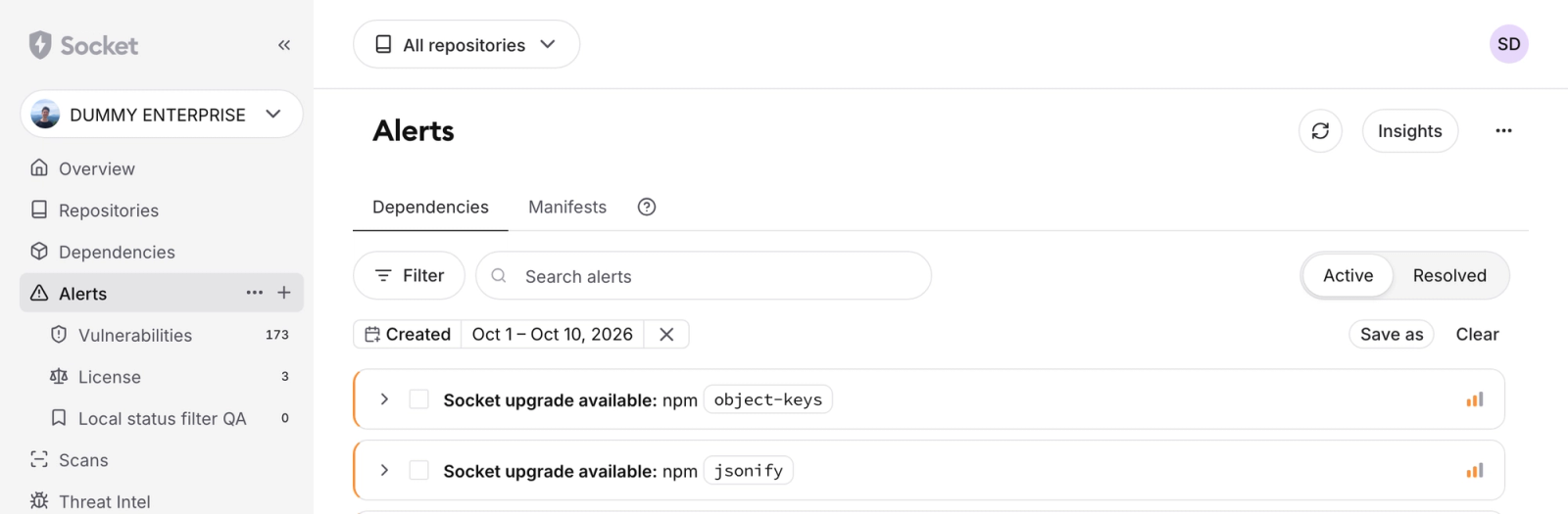
Socket added date-based filtering to both the Active Alerts page and Full Scans, letting teams narrow results to recent time windows and persist those views.︀︄︇︀︅︉︀︅︀︀︃︀︀︅︅︀︅︊︀︄︆︀︃︄
Socket is a supply chain security platform that analyzes open-source package dependencies (npm, PyPI, etc.) to detect malicious code, risky behaviors, and vulnerabilities before developers install them.
Socket added date-based filtering to both the Active Alerts page and Full Scans, letting teams narrow results to recent time windows and persist those views.︀︄︇︀︅︉︀︅︀︀︃︀︀︅︅︀︅︊︀︄︆︀︃︄
└──▷ WHAT SHIPPED ·
1 FEATURE0 OF 1 FEATUREmost completely described firstwhat's the number?
Each feature carries 0–100 for how completely the vendor documented
it — not how big or important the work is. A major capability
described in eight words scores low, and that is the finding.
depth0–40what it does and how it works or what changed
specificity0–30names real surfaces — APIs, flags, formats, limits, numbers
actionability0–30enough to go use it — a named endpoint, flag, or config key tops this; a UI path is a starting point
Code and config rank first by construction: a documented endpoint,
flag or config key scores at the top of specificity and actionability,
so it sorts above a feature described only in prose. Under
60 the notes go thin — everything below the “thinner
coverage” line is thinner documentation, not smaller work.
Hover any meter for that feature's three sub-scores.
0100
Date filtering for Active Alerts and Full Scansnew70how completely this was documenteddepth25/40specificity25/30actionability20/3070 / 100
The Active Alerts page gains a Created date filter with preset ranges (Today, last 7, 14, 30, or 90 days) or a custom calendar range supporting between, since, and through modes, with filters preserved in URLs and saved views.︀︄︇︀︅︉︀︅︀︀︃︀︀︅︅︀︅︊︀︄︆︀︃︄ The Full Scans date filter now supports the same presets (Today, last 7, 14, 30, or 90 days) and custom date range options.
Return to alerts created in the last 30 days by bookmarking the filtered URL — the Created date filter is preserved so the view reopens with the same range applied.
📍In the Socket console, go to Active Alerts, open the Created date filter, select Last 30 days, then bookmark or save the resulting URL as a saved view.
Fastly is an edge cloud platform offering content delivery network, load balancing, edge computing, and web application security services for developers and enterprises.
Fastly's Terraform Provider (beta) gains new NGWAFNGWAFA next-generation web application firewall that inspects HTTP traffic at the application layer, using behavioral analysis and contextual rules rather than pure signature matching to block attacks like SQLi and XSS. resource query support and a safer legacy-to-auto migration workflow with preflight analysis.︀︄︇︀︅︉︀︅︀︀︃︀︀︅︅︀︅︊︀︄︆︀︃︄
└──▷ WHAT SHIPPED ·
1 FEATURE0 OF 1 FEATUREmost completely described firstwhat's the number?
Each feature carries 0–100 for how completely the vendor documented
it — not how big or important the work is. A major capability
described in eight words scores low, and that is the finding.
depth0–40what it does and how it works or what changed
specificity0–30names real surfaces — APIs, flags, formats, limits, numbers
actionability0–30enough to go use it — a named endpoint, flag, or config key tops this; a UI path is a starting point
Code and config rank first by construction: a documented endpoint,
flag or config key scores at the top of specificity and actionability,
so it sorts above a feature described only in prose. Under
60 the notes go thin — everything below the “thinner
coverage” line is thinner documentation, not smaller work.
Hover any meter for that feature's three sub-scores.
0100
NGWAF Terraform query supportnew50how completely this was documenteddepth15/40specificity25/30actionability10/3050 / 100
Fastly Terraform Provider now supports Terraform query operations (list resources and resource identities) for all NGWAF resources, including workspaces, account and workspace lists, alert integrations, rules, signals, redactions, thresholds, and virtual patches.︀︄︇︀︅︉︀︅︀︀︃︀︀︅︅︀︅︊︀︄︆︀︃︄
Radare2 6.2.6 adds global type propagation with a configurable trace limit, a new afia function-attribute command, richer syscall information in analysis JSON output, and new architecture-specific analysis support spanning V850, 16-bit ARMARMA family of RISC processor architectures designed by Arm Holdings and licensed to chip makers worldwide; tools target it to run natively on mobile, embedded, and increasingly server and desktop hardware. and ARM64ARM64A 64-bit CPU architecture from ARM Holdings, used in mobile chips, Apple Silicon, and cloud servers; cyber tools target it to run natively on those platforms instead of relying on emulation..︀︄︇︀︅︉︀︅︀︀︃︀︀︅︅︀︅︊︀︄︆︀︃︄
UNIX-like reverse engineering framework and command-line toolset
Radare2 6.2.6 adds global type propagation with a configurable trace limit, a new afia function-attribute command, richer syscall information in analysis JSON output, and new architecture-specific analysis support spanning V850, 16-bit ARMARMA family of RISC processor architectures designed by Arm Holdings and licensed to chip makers worldwide; tools target it to run natively on mobile, embedded, and increasingly server and desktop hardware. and ARM64ARM64A 64-bit CPU architecture from ARM Holdings, used in mobile chips, Apple Silicon, and cloud servers; cyber tools target it to run natively on those platforms instead of relying on emulation..︀︄︇︀︅︉︀︅︀︀︃︀︀︅︅︀︅︊︀︄︆︀︃︄
└──▷ WHAT SHIPPED ·
8 FEATURES0 OF 8 FEATURESmost completely described firstwhat's the number?
Each feature carries 0–100 for how completely the vendor documented
it — not how big or important the work is. A major capability
described in eight words scores low, and that is the finding.
depth0–40what it does and how it works or what changed
specificity0–30names real surfaces — APIs, flags, formats, limits, numbers
actionability0–30enough to go use it — a named endpoint, flag, or config key tops this; a UI path is a starting point
Code and config rank first by construction: a documented endpoint,
flag or config key scores at the top of specificity and actionability,
so it sorts above a feature described only in prose. Under
60 the notes go thin — everything below the “thinner
coverage” line is thinner documentation, not smaller work.
Hover any meter for that feature's three sub-scores.
0100
Richer syscall and return-type detail in analysis JSONimproved83how completely this was documenteddepth30/40specificity28/30actionability25/3083 / 100
Improves analysis JSON output: asj now exposes syscall arity and argument formats, with Linux syscall clobbers and the MIPSMIPSA RISC processor architecture originally developed at Stanford and commercialized by MIPS Technologies, widely used in embedded and network devices; cyber tools target it to analyze or exploit routers, cameras, and similar hardware. error register recorded, while afsj distinguishes unknown return types from void so automated consumers can tell them apart.︀︄︇︀︅︉︀︅︀︀︃︀︀︅︅︀︅︊︀︄︆︀︃︄
Dump syscall argument layouts for every call site in a binary to feed into an audit script.
$ r2 -A /bin/target -c 'asj' | python3 -c 'import sys,json; [print(e) for e in json.load(sys.stdin)]'
— Two named JSON commands with example pipeline6.2.6
0200
`afia` function attribute command and `is_inline`new75how completely this was documenteddepth25/40specificity25/30actionability25/3075 / 100
Adds the afia command to list and set function attributes, including a new is_inline attribute on RAnalFunction, so callers can be marked as inherited signatures for inlined helpers.
Inspect and tag an inlined helper so callers inherit the right signature after full analysis.
$ r2 -A /bin/target
> s sym.helper_fn
> afia         # list current attributes for the function
> afia is_inline 1  # mark the function as inline
— Named command and attribute with a runnable example6.2.6
0300
Global type propagation and field inferencenew72how completely this was documenteddepth30/40specificity22/30actionability20/3072 / 100
Adds global type propagation and field inference during analysis, including global discovery and typing from code accesses, plus a types.maxtrace config key to cap how many steps type propagation traces per function, preventing runaway analysis on complex binaries.
— Names config key but no usage example given6.2.6
thinner coverage below
0400
New calling conventions for V850 and ARMnew58how completely this was documenteddepth28/40specificity22/30actionability8/3058 / 100
Adds an IAR V850 calling convention with V850 stack-frame modeling, scalar argument and stack-variable recovery, and branch-predicate exposure for V850 binaries, plus the Swift calling convention to 16-bit ARM analysis.
— Mechanism described but no command or UI path Thin one-line addition, no usage detail6.2.6
0500
HTTP referer and colon settings applied to POSTimproved58how completely this was documenteddepth18/40specificity25/30actionability15/3058 / 100
Applies http.referer and http.colon settings to POST requests and matches the referer by prefix.
— Names exact config keys though no example given6.2.6
0600
ARM64 checked-pointer arithmetic analysisimproved35how completely this was documenteddepth15/40specificity15/30actionability5/3035 / 100
Supports remaining ARM64 checked-pointer arithmetic and tagged-pointer subtraction in analysis.
— Names the behaviour but no mechanism or example6.2.6
0700
Autoload API types via dependency indeximproved35how completely this was documenteddepth15/40specificity12/30actionability8/3035 / 100
Autoloads API types through a library and OS dependency index.
— Describes mechanism loosely without named surface6.2.6
0800
Interrupt handlers in function graph exportsimproved28how completely this was documenteddepth12/40specificity8/30actionability8/3028 / 100
Function graph exports now include interrupt handlers.
— Bare statement with no mechanism or example6.2.6
CAPEv2 adds a GET /apiv2/tasks/machine/<task_id>/ endpoint for distributed Guacamole VM resolution and disables expensive dashboard aggregations by default︀︄︇︀︅︉︀︅︀︀︃︀︀︅︅︀︅︊︀︄︆︀︃︄
└──▷ USE IT
Re-enable the top detections and top ASNASNAutonomous System Number — a globally unique identifier assigned by regional internet registries to a network operator, letting routing protocols distinguish which organization controls a block of IP addresses. dashboard widgets on a large deployment after opting back in.
CAPEv2 adds a GET /apiv2/tasks/machine/<task_id>/ API endpoint for distributed Guacamole VM resolution, with token-based authorization via control_plane_token from the api config section.︀︄︇︀︅︉︀︅︀︀︃︀︀︅︅︀︅︊︀︄︆︀︃︄
CAPEv2 now catches MongoDB aggregation timeouts (such as pymongo.errors.ExecutionTimeout / MaxTimeMSExpired) in top_detections, top_asn, and get_stats_per_category, logging a warning and caching an empty result so the dashboard renders instead of returning HTTP 500.
CAPEv2 now ships systemd/00-ignore-vnet.network, installed to /etc/systemd/network/00-ignore-vnet.network, to mark vnet*, virbr*, and tap* guest VM interfaces as Unmanaged=yes in systemd-networkd, preventing DHCP renewal timeouts on the host interface.
CAPEv2 adds a GET /apiv2/tasks/machine/<task_id>/ API endpoint for distributed Guacamole VM resolution, with token-based authorization via control_plane_token from the api config section.︀︄︇︀︅︉︀︅︀︀︃︀︀︅︅︀︅︊︀︄︆︀︃︄
CAPEv2 now ships systemd/00-ignore-vnet.network, installed to /etc/systemd/network/00-ignore-vnet.network, to mark vnet*, virbr*, and tap* guest VM interfaces as Unmanaged=yes in systemd-networkd, preventing DHCP renewal timeouts on the host interface.
1 more in Everything
└──▷ BREAKING ON UPGRADE
!top_detections and top_asn are now disabled by default in conf/default/web.conf.default; existing deployments that relied on these dashboard widgets being enabled will need to explicitly re-enable them in their local custom/conf/web.conf.
YARA-X v1.23.0 adds new regex word-boundary syntax, simplifies libmagic integration, and improves Unicode regex compilation performance.︀︄︇︀︅︉︀︅︀︀︃︀︀︅︅︀︅︊︀︄︆︀︃︄
A rewrite of YARA in Rust.
YARA-X v1.23.0 adds new regex word-boundary syntax, simplifies libmagic integration, and improves Unicode regex compilation performance.︀︄︇︀︅︉︀︅︀︀︃︀︀︅︅︀︅︊︀︄︆︀︃︄
└──▷ WHAT SHIPPED ·
3 FEATURES0 OF 3 FEATURESmost completely described firstwhat's the number?
Each feature carries 0–100 for how completely the vendor documented
it — not how big or important the work is. A major capability
described in eight words scores low, and that is the finding.
depth0–40what it does and how it works or what changed
specificity0–30names real surfaces — APIs, flags, formats, limits, numbers
actionability0–30enough to go use it — a named endpoint, flag, or config key tops this; a UI path is a starting point
Code and config rank first by construction: a documented endpoint,
flag or config key scores at the top of specificity and actionability,
so it sorts above a feature described only in prose. Under
60 the notes go thin — everything below the “thinner
coverage” line is thinner documentation, not smaller work.
Hover any meter for that feature's three sub-scores.
0100
Half word-boundary regex assertionsnew75how completely this was documenteddepth25/40specificity25/30actionability25/3075 / 100
YARA-X regular expressions now support \b{start-half} and \b{end-half} word boundary assertions, enabling half-boundary matching where a pattern only needs to align with the start or end edge of a word rather than both.︀︄︇︀︅︉︀︅︀︀︃︀︀︅︅︀︅︊︀︄︆︀︃︄
Match a pattern at the start of a word boundary half (e.g. the leading edge of a word) without requiring a full word boundary — useful for detecting tokens that begin but do not end a word.
— Exact syntax and a runnable example given.v1.23.0
thinner coverage below
0200
Auto-discovery of libmagic search pathimproved55how completely this was documenteddepth20/40specificity20/30actionability15/3055 / 100
When building with the magic-module feature, YARA-X now auto-discovers the libmagic library search path, removing the need for manual path configuration.
— Names the build feature flag but no exact commands.v1.23.0
0300
UTF-8 compilation of Unicode character classesimproved55how completely this was documenteddepth30/40specificity20/30actionability5/3055 / 100
YARA-X now compiles Unicode character classes in regular expressions as UTF-8 byte sequences, producing smaller and faster PikeVM code.
— Explains mechanism but offers no user action.v1.23.0
RT 6.0.4 adds an interactive lifecycle visualizer to ticket and asset pages and exposes a Notes field on lifecycle transitions via the REST APIREST APIA web API design style where clients interact with resources over HTTP using standard methods like GET, POST, and DELETE, giving cyber tools a predictable, language-agnostic way to integrate with external services. for AI agent instructions, alongside a Cytoscape-powered lifecycle editor.︀︄︇︀︅︉︀︅︀︀︃︀︀︅︅︀︅︊︀︄︆︀︃︄
Request tracker / rtir (best practical) is a open source ticketing system from Best Practical. Self-host RT or let us run it in the cloud.
RT 6.0.4 adds an interactive lifecycle visualizer to ticket and asset pages and exposes a Notes field on lifecycle transitions via the REST APIREST APIA web API design style where clients interact with resources over HTTP using standard methods like GET, POST, and DELETE, giving cyber tools a predictable, language-agnostic way to integrate with external services. for AI agent instructions, alongside a Cytoscape-powered lifecycle editor.︀︄︇︀︅︉︀︅︀︀︃︀︀︅︅︀︅︊︀︄︆︀︃︄
└──▷ WHAT SHIPPED ·
3 FEATURES0 OF 3 FEATURESmost completely described firstwhat's the number?
Each feature carries 0–100 for how completely the vendor documented
it — not how big or important the work is. A major capability
described in eight words scores low, and that is the finding.
depth0–40what it does and how it works or what changed
specificity0–30names real surfaces — APIs, flags, formats, limits, numbers
actionability0–30enough to go use it — a named endpoint, flag, or config key tops this; a UI path is a starting point
Code and config rank first by construction: a documented endpoint,
flag or config key scores at the top of specificity and actionability,
so it sorts above a feature described only in prose. Under
60 the notes go thin — everything below the “thinner
coverage” line is thinner documentation, not smaller work.
Hover any meter for that feature's three sub-scores.
0100
Interactive lifecycle visualizer on tickets and assetsnew72how completely this was documenteddepth30/40specificity22/30actionability20/3072 / 100
Adds an interactive lifecycle visualizer component to ticket and asset pages, showing all statuses and transitions with click-to-change-status and hover descriptions.︀︄︇︀︅︉︀︅︀︀︃︀︀︅︅︀︅︊︀︄︆︀︃︄ Lifecycle status descriptions and hover text are now configurable by RT administrators in the lifecycle configuration, so new users can learn the workflow directly from the ticket page. The component can be added via Admin > Queues > (select queue) > Page Layout, choosing its size and position on the page.
Add the lifecycle visualizer to a queue's ticket page so agents can see and change ticket status in one click.
📍In the RT admin panel, go to Admin › Queues › (select queue) › Page Layout, then add the lifecycle visualizer component, choosing its size and position on the page.
Snort3 3.13.2.0 lets appid consume authoritative MCPMCPModel Context Protocol, a standard for connecting AI applications to external tools and data sources. A compatible server exposes capabilities an assistant can use through a common interface. inspector verdicts for application identification, adds control-channel file cache management, JSON stats output, and expanded http_inspect header enforcement alerting.︀︄︇︀︅︉︀︅︀︀︃︀︀︅︅︀︅︊︀︄︆︀︃︄
Snort++
Snort3 3.13.2.0 lets appid consume authoritative MCPMCPModel Context Protocol, a standard for connecting AI applications to external tools and data sources. A compatible server exposes capabilities an assistant can use through a common interface. inspector verdicts for application identification, adds control-channel file cache management, JSON stats output, and expanded http_inspect header enforcement alerting.︀︄︇︀︅︉︀︅︀︀︃︀︀︅︅︀︅︊︀︄︆︀︃︄
└──▷ WHAT SHIPPED ·
9 FEATURES0 OF 9 FEATURESmost completely described firstwhat's the number?
Each feature carries 0–100 for how completely the vendor documented
it — not how big or important the work is. A major capability
described in eight words scores low, and that is the finding.
depth0–40what it does and how it works or what changed
specificity0–30names real surfaces — APIs, flags, formats, limits, numbers
actionability0–30enough to go use it — a named endpoint, flag, or config key tops this; a UI path is a starting point
Code and config rank first by construction: a documented endpoint,
flag or config key scores at the top of specificity and actionability,
so it sorts above a feature described only in prose. Under
60 the notes go thin — everything below the “thinner
coverage” line is thinner documentation, not smaller work.
Hover any meter for that feature's three sub-scores.
0100
Header validation and enforcement alerting in http_inspectimproved68how completely this was documenteddepth28/40specificity25/30actionability15/3068 / 100
Snort3's http_inspect now alerts on header values exceeding maximum length, malformed headers, unsafe characters in header names and values, and disallowed request Content-Type values, and adds peg-counts for request enforcement events.︀︄︇︀︅︉︀︅︀︀︃︀︀︅︅︀︅︊︀︄︆︀︃︄
— Names all specific enforcement conditions and new peg-counts3.13.2.0
0200
Control-channel file cache commandsnew64how completely this was documenteddepth20/40specificity22/30actionability22/3064 / 100
Snort3's file_api adds control-channel commands to dump and clear the file cache via file cache dump control.
MCP inspector verdicts in appid identificationnew48how completely this was documenteddepth20/40specificity20/30actionability8/3048 / 100
Snort3's appid now consumes authoritative MCP inspector verdicts for application identification decisions and adds TLS host info logs.
— Names module and verdict source but no usage detail3.13.2.0
0400
JSON format output for stats modulenew40how completely this was documenteddepth15/40specificity15/30actionability10/3040 / 100
Snort3's stats module now supports JSON format output for dynamic stats.
— States new format but no config key or example given3.13.2.0
0500
Per-flow memory tracking in flow modulenew38how completely this was documenteddepth15/40specificity15/30actionability8/3038 / 100
Snort3's flow module adds per-flow memory tracking and reporting.
— Describes capability but not output format or access3.13.2.0
0600
Trace logging for non-TCP stream inspectorsimproved38how completely this was documenteddepth15/40specificity15/30actionability8/3038 / 100
Snort3's stream module now supports trace logging in non-TCPTCPA network protocol that delivers a reliable, ordered stream of bytes between two endpoints. It detects lost data and retransmits it. stream inspectors.
— Names module scope but not how to enable tracing3.13.2.0
0700
Authentication and sandbox mode for control channelnew38how completely this was documenteddepth15/40specificity15/30actionability8/3038 / 100
Snort3's control channel adds authentication and sandbox mode.
— Names two new modes without configuration specifics3.13.2.0
0800
PDF 2.0 processing in js_normnew30how completely this was documenteddepth10/40specificity15/30actionability5/3030 / 100
Snort3's js_norm now enables PDF 2.0 processing.
— Bare statement with no mechanism or config detail3.13.2.0
0900
Rate-filtered WEIRD logs in extractorimproved30how completely this was documenteddepth10/40specificity15/30actionability5/3030 / 100
Snort3's extractor now rate-filters WEIRD logs.
— Thin one-line addition with no parameters named3.13.2.0
Aviatrix CoPilot 4.39.0 adds a preview custom rules engine and Terraform export for Access Control, namespace-based filtering for Kubernetes SmartGroups, and several smaller UI and connectivity improvements, alongside a breaking rename of External Groups.︀︄︇︀︅︉︀︅︀︀︃︀︀︅︅︀︅︊︀︄︆︀︃︄
Aviatrix copilot is a welcome to the comprehensive documentation for Aviatrix's cloud networking platform. Here you'll find everything you need to deploy, configure, and manage your multi-cloud networking infrastructure.
Aviatrix CoPilot 4.39.0 adds a preview custom rules engine and Terraform export for Access Control, namespace-based filtering for Kubernetes SmartGroups, and several smaller UI and connectivity improvements, alongside a breaking rename of External Groups.︀︄︇︀︅︉︀︅︀︀︃︀︀︅︅︀︅︊︀︄︆︀︃︄
└──▷ WHAT SHIPPED ·
8 FEATURES1 OF 8 FEATURESmost completely described firstwhat's the number?
Each feature carries 0–100 for how completely the vendor documented
it — not how big or important the work is. A major capability
described in eight words scores low, and that is the finding.
depth0–40what it does and how it works or what changed
specificity0–30names real surfaces — APIs, flags, formats, limits, numbers
actionability0–30enough to go use it — a named endpoint, flag, or config key tops this; a UI path is a starting point
Code and config rank first by construction: a documented endpoint,
flag or config key scores at the top of specificity and actionability,
so it sorts above a feature described only in prose. Under
60 the notes go thin — everything below the “thinner
coverage” line is thinner documentation, not smaller work.
Hover any meter for that feature's three sub-scores.
0101
External Groups renamed to ExternalIPGroupsbreaking60how completely this was documenteddepth20/40specificity20/30actionability20/3060 / 100
External Groups are renamed to ExternalIPGroups throughout CoPilot — any references to the old name in configurations, scripts, or integrations must be updated.︀︄︇︀︅︉︀︅︀︀︃︀︀︅︅︀︅︊︀︄︆︀︃︄
Access Control Enhancementsnew55how completely this was documenteddepth20/40specificity15/30actionability20/3055 / 100
CoPilot Access Control now supports custom rules (Preview) for fine-grained control over who can access CoPilot resources, and you can download Terraform code directly from Access Control rules to replicate access control policy as infrastructure-as-code.
— Names the capability but no rule syntax or scope given Clear UI action and IaC output named, no command shownNew and Enhanced Features in 4.39.0
0300
BGP over LAN gateway details and reboot promptimproved55how completely this was documenteddepth25/40specificity15/30actionability15/3055 / 100
Gateway details now show HA LAN IP addresses for BGPBGPA routing protocol that lets autonomous systems on the internet exchange reachability information, determining how traffic flows between networks. Cyber tools use it to monitor route hijacks or inject sinkholes. over LAN connections, and a reboot prompt now appears when a BGP over LAN interface change requires a gateway reboot.
SAML endpoint selection per controllernew40how completely this was documenteddepth15/40specificity10/30actionability15/3040 / 100
Select a SAMLSAMLA standard for passing signed identity assertions between a sign-in provider and an application. It lets a user sign in through their organization's identity provider. endpoint for the associated controller when configuring SAML authentication in CoPilot.
Sysdig Secure launched AI Defense, a new runtime security and governance layer for AI agents that spans live inventory, policy enforcement, audit-grade session recording, spend attribution, and OWASPOWASPA nonprofit foundation that publishes open standards, guides, and ranked vulnerability lists—most famously the OWASP Top 10—giving cyber tools a vendor-neutral benchmark to test or report against.-aligned policy templates, now generally available on macOS and Windows.︀︄︇︀︅︉︀︅︀︀︃︀︀︅︅︀︅︊︀︄︆︀︃︄
Sysdig Secure is a cloud security platform that provides runtime threat detection, vulnerability management, and compliance monitoring for containers, Kubernetes, and cloud workloads.
Sysdig Secure launched AI Defense, a new runtime security and governance layer for AI agents that spans live inventory, policy enforcement, audit-grade session recording, spend attribution, and OWASPOWASPA nonprofit foundation that publishes open standards, guides, and ranked vulnerability lists—most famously the OWASP Top 10—giving cyber tools a vendor-neutral benchmark to test or report against.-aligned policy templates, now generally available on macOS and Windows.︀︄︇︀︅︉︀︅︀︀︃︀︀︅︅︀︅︊︀︄︆︀︃︄
└──▷ WHAT SHIPPED ·
6 FEATURES6 OF 6 FEATURESmost completely described firstwhat's the number?
Each feature carries 0–100 for how completely the vendor documented
it — not how big or important the work is. A major capability
described in eight words scores low, and that is the finding.
depth0–40what it does and how it works or what changed
specificity0–30names real surfaces — APIs, flags, formats, limits, numbers
actionability0–30enough to go use it — a named endpoint, flag, or config key tops this; a UI path is a starting point
Code and config rank first by construction: a documented endpoint,
flag or config key scores at the top of specificity and actionability,
so it sorts above a feature described only in prose. Under
60 the notes go thin — everything below the “thinner
coverage” line is thinner documentation, not smaller work.
Hover any meter for that feature's three sub-scores.
0101
Live inventory and attribution of AI agentsnew63how completely this was documenteddepth28/40specificity25/30actionability10/3063 / 100
AI Defense builds a live inventory of AI agents, harnesses, models, MCPMCPModel Context Protocol, a standard for connecting AI applications to external tools and data sources. A compatible server exposes capabilities an assistant can use through a common interface. servers, skills, and plugins from runtime telemetry, with every agent traceable to an accountable human across platforms including Claude Code, Codex, GitHub Copilot, and Cursor.︀︄︇︀︅︉︀︅︀︀︃︀︀︅︅︀︅︊︀︄︆︀︃︄
OWASP-aligned policy templates for LLM agentsnew60how completely this was documenteddepth25/40specificity20/30actionability15/3060 / 100
AI Defense ships with policy templates including rules mapped to OWASP Top 10 for LLMLLMA large language model, a neural network trained on large amounts of text to recognize patterns and generate language. Applications use it for tasks such as answering, summarizing and writing code. Applications, with policies starting in alert mode and moving to enforcement when teams are ready.
— Names OWASP standard and alert-to-enforcement workflow as starting point.launch-20261106-55e985f3
thinner coverage below
0303
Runtime policy enforcement for AI agent actionsnew58how completely this was documenteddepth28/40specificity20/30actionability10/3058 / 100
AI Defense enforces runtime policy against agent actions, blocking unvetted MCP servers, skills, and plugins before they run, and holding or blocking risky credential reads and behavior drift for human review, with exception paths for developers.
Per-agent AI spend attributionnew53how completely this was documenteddepth25/40specificity18/30actionability10/3053 / 100
AI Defense attributes every model call to an agent, team, and individual — including calls that bypass an AI gateway — to surface real-time AI spend and identify where premium models are doing routine work.
Audit-grade agent session recordingnew48how completely this was documenteddepth25/40specificity15/30actionability8/3048 / 100
AI Defense records every agent session as an immutable, audit-grade action graph showing each step in order, which policies were applied, when, and who signed off.
Pike's v1.0.14 release adds finer-grained permission splitting for destructive actions, credential-less CI baseline diffing, and expanded AWS/GCP policy analysis in the audit command.︀︄︇︀︅︉︀︅︀︀︃︀︀︅︅︀︅︊︀︄︆︀︃︄
Pike is a tool for determining the permissions or policy required for IAC code
Pike's v1.0.14 release adds finer-grained permission splitting for destructive actions, credential-less CI baseline diffing, and expanded AWS/GCP policy analysis in the audit command.︀︄︇︀︅︉︀︅︀︀︃︀︀︅︅︀︅︊︀︄︆︀︃︄
└──▷ WHAT SHIPPED ·
3 FEATURES0 OF 3 FEATURESmost completely described firstwhat's the number?
Each feature carries 0–100 for how completely the vendor documented
it — not how big or important the work is. A major capability
described in eight words scores low, and that is the finding.
depth0–40what it does and how it works or what changed
specificity0–30names real surfaces — APIs, flags, formats, limits, numbers
actionability0–30enough to go use it — a named endpoint, flag, or config key tops this; a UI path is a starting point
Code and config rank first by construction: a documented endpoint,
flag or config key scores at the top of specificity and actionability,
so it sorts above a feature described only in prose. Under
60 the notes go thin — everything below the “thinner
coverage” line is thinner documentation, not smaller work.
Hover any meter for that feature's three sub-scores.
0100
Credential-less CI diffing in comparenew80how completely this was documenteddepth25/40specificity25/30actionability30/3080 / 100
The compare subcommand gains --write-baseline to capture a permissions baseline without live cloud credentials, and --target-file to diff against that baseline in a later CI step.︀︄︇︀︅︉︀︅︀︀︃︀︀︅︅︀︅︊︀︄︆︀︃︄
Capture a permissions baseline in CI without live cloud credentials, then diff against it in a later pipeline step.
— Two named flags with exact CI commands shownv1.0.14
0200
Sensitive permission splitting in scannew75how completely this was documenteddepth25/40specificity20/30actionability30/3075 / 100
The new --sensitive flag on pike scan splits deletion-sensitive permissions into a separate policy, letting least-privilege reviews gate on destructive actions independently.
Separate high-risk deletion permissions into their own policy so least-privilege reviews can gate on destructive actions independently.
$ pike scan -d ./terraform --sensitive
— Names exact flag and subcommand with runnable examplev1.0.14
thinner coverage below
0300
AWS/GCP trust-policy and reference graph checks in auditimproved50how completely this was documenteddepth20/40specificity20/30actionability10/3050 / 100
pike's audit command now checks AWS trust-policy (assume_role_policy) bindings, and generates attachment and policy-data reference graphs for AWS and GCP.
— Names surfaces checked but no example or flag givenv1.0.14
Kubescape is an open-source Kubernetes security platform for your IDE, CI/CD pipelines, and clusters. It includes risk analysis, security, compliance, and misconfiguration scanning, saving Kubernetes users and administrators precious time, effort, and resources.
Kubescape's v4.0.19 release hardens the MCPMCPModel Context Protocol, a standard for connecting AI applications to external tools and data sources. A compatible server exposes capabilities an assistant can use through a common interface. server by restricting local IaCIaCInfrastructure as Code: the practice of defining and provisioning compute infrastructure through machine-readable config files rather than manual processes, giving cyber tools repeatable, version-controlled environment setup. scans to a declared workspace boundary.︀︄︇︀︅︉︀︅︀︀︃︀︀︅︅︀︅︊︀︄︆︀︃︄
└──▷ WHAT SHIPPED ·
1 FEATURE0 OF 1 FEATUREmost completely described firstwhat's the number?
Each feature carries 0–100 for how completely the vendor documented
it — not how big or important the work is. A major capability
described in eight words scores low, and that is the finding.
depth0–40what it does and how it works or what changed
specificity0–30names real surfaces — APIs, flags, formats, limits, numbers
actionability0–30enough to go use it — a named endpoint, flag, or config key tops this; a UI path is a starting point
Code and config rank first by construction: a documented endpoint,
flag or config key scores at the top of specificity and actionability,
so it sorts above a feature described only in prose. Under
60 the notes go thin — everything below the “thinner
coverage” line is thinner documentation, not smaller work.
Hover any meter for that feature's three sub-scores.
0100
Workspace boundary containment in MCP serverimproved45how completely this was documenteddepth20/40specificity15/30actionability10/3045 / 100
Kubescape's mcpserver now enforces workspace boundary containment for local IaC scans, preventing the MCP server from accessing paths outside the declared workspace.︀︄︇︀︅︉︀︅︀︀︃︀︀︅︅︀︅︊︀︄︆︀︃︄
— Names the mechanism and component but no config detail or examplev4.0.19
Plerion expanded cloud inventory with AWS Transfer Family servers and broadened its end-of-life and secret-exposure detection checks across Azure Functions, GCP Compute Engine, GKEGKEGoogle Kubernetes Engine, Google's managed Kubernetes service, which lets cyber tools run containerized workloads without managing the underlying cluster infrastructure., and Cloud Functions.︀︄︇︀︅︉︀︅︀︀︃︀︀︅︅︀︅︊︀︄︆︀︃︄
Plerion is a cloud security platform that detects misconfigurations, vulnerabilities, and threats across cloud environments and provides remediation guidance.
Plerion expanded cloud inventory with AWS Transfer Family servers and broadened its end-of-life and secret-exposure detection checks across Azure Functions, GCP Compute Engine, GKEGKEGoogle Kubernetes Engine, Google's managed Kubernetes service, which lets cyber tools run containerized workloads without managing the underlying cluster infrastructure., and Cloud Functions.︀︄︇︀︅︉︀︅︀︀︃︀︀︅︅︀︅︊︀︄︆︀︃︄
└──▷ WHAT SHIPPED ·
1 FEATURE0 OF 1 FEATUREmost completely described firstwhat's the number?
Each feature carries 0–100 for how completely the vendor documented
it — not how big or important the work is. A major capability
described in eight words scores low, and that is the finding.
depth0–40what it does and how it works or what changed
specificity0–30names real surfaces — APIs, flags, formats, limits, numbers
actionability0–30enough to go use it — a named endpoint, flag, or config key tops this; a UI path is a starting point
Code and config rank first by construction: a documented endpoint,
flag or config key scores at the top of specificity and actionability,
so it sorts above a feature described only in prose. Under
60 the notes go thin — everything below the “thinner
coverage” line is thinner documentation, not smaller work.
Hover any meter for that feature's three sub-scores.
0100
AWS Transfer Family server inventorynew75how completely this was documenteddepth35/40specificity25/30actionability15/3075 / 100
Plerion now collects AWS Transfer Family servers in inventory, showing endpoint type, protocols, identity provideridentity providerA service that authenticates users and supplies identity information to other applications. It is the sign-in authority behind many single sign-on systems., logging role, log destinations, security policy, and tags, with asset updates within minutes of a change when continuous scanning is on.︀︄︇︀︅︉︀︅︀︀︃︀︀︅︅︀︅︊︀︄︆︀︃︄
Instant, Concurrent, Secure & Lightweight Sandbox for AI Agents.
CVE-2026-120699: Unrestricted host-directory bind-mount: any sandbox-create caller mounts arbitrary host paths (RW) into their MicroVM — host-root RCERCERemote code execution, the ability to run attacker-chosen code on another system through a vulnerability. Its impact depends on the permissions and access that code receives., MicroVM escape, cross-tenant compromise (affects <0.5.1)︀︄︇︀︅︉︀︅︀︀︃︀︀︅︅︀︅︊︀︄︆︀︃︄
isMalicious added a dedicated email-scanning endpoint, HTTP Basic Auth support, mixed-indicator bulk checks, a newly-registered-domain feed, and dual-source certificate intelligence.︀︄︇︀︅︉︀︅︀︀︃︀︀︅︅︀︅︊︀︄︆︀︃︄
IsMalicious is a threat intelligence platform that checks IPs, domains, URLs, emails, phones and crypto wallets against indexed threat indicators.
isMalicious added a dedicated email-scanning endpoint, HTTP Basic Auth support, mixed-indicator bulk checks, a newly-registered-domain feed, and dual-source certificate intelligence.︀︄︇︀︅︉︀︅︀︀︃︀︀︅︅︀︅︊︀︄︆︀︃︄
└──▷ WHAT SHIPPED ·
5 FEATURES4 OF 5 FEATURESmost completely described firstwhat's the number?
Each feature carries 0–100 for how completely the vendor documented
it — not how big or important the work is. A major capability
described in eight words scores low, and that is the finding.
depth0–40what it does and how it works or what changed
specificity0–30names real surfaces — APIs, flags, formats, limits, numbers
actionability0–30enough to go use it — a named endpoint, flag, or config key tops this; a UI path is a starting point
Code and config rank first by construction: a documented endpoint,
flag or config key scores at the top of specificity and actionability,
so it sorts above a feature described only in prose. Under
60 the notes go thin — everything below the “thinner
coverage” line is thinner documentation, not smaller work.
Hover any meter for that feature's three sub-scores.
0101
Email scan endpoint for phishing and malwarenew85how completely this was documenteddepth30/40specificity25/30actionability30/3085 / 100
A new POST /mail/scan endpoint scans inbound email for phishing and malware in a single call, returning a verdict, a recommended action, and reasons.︀︄︇︀︅︉︀︅︀︀︃︀︀︅︅︀︅︊︀︄︆︀︃︄ It counts as one scan on the scan meter and never counts against the request quota.
Screen a raw inbound email for phishing or malware before it reaches a user's inbox, consuming one scan-meter credit.
— Named endpoint, behaviour, quota mechanics, and a runnable example given.snapshot-20261106
0202
Bulk IOC check endpointnew85how completely this was documenteddepth30/40specificity25/30actionability30/3085 / 100
A new /bulk/check endpoint checks mixed batches of IPs, domains, and URLs in one request, accepting up to 500 indicators per request with responses streamed via chunked transfer encoding.
Submit a mixed batch of IPs, domains, and URLs for reputation checking in one round-trip, consuming up to 500 indicators.
— Named endpoint, concrete limit, streaming behaviour, and runnable example.snapshot-20261106
0300
Dual-source certificate factsimproved70how completely this was documenteddepth30/40specificity25/30actionability15/3070 / 100
isMalicious now reads certificateFacts from two independent sources — a live TLS handshake on port 443 for the certificate the site currently serves, and Certificate TransparencyCertificate TransparencyA public, append-only log system maintained by various operators (Google runs several) that records every TLS certificate issued, letting anyone audit CAs for misissued or rogue certificates. history from crt.sh — with unreachable sources reported as unknown rather than none.
— Field and both sources named, with explicit before/after reporting behaviour.snapshot-20261106
0403
HTTP Basic Auth supportnew65how completely this was documenteddepth25/40specificity25/30actionability15/3065 / 100
HTTP Basic Auth can now be used everywhere X-API-KEY is accepted, with username=apiKey and password=apiSecret. The TAXIITAXIIA protocol for sharing threat intelligence over HTTPS, commonly carrying STIX data. It lets tools retrieve and exchange intelligence from compatible services./Sentinel form (any username, password = Base64 credential) is also supported.
— Exact credential fields named but no standalone example.snapshot-20261106
thinner coverage below
0504
Newly-registered-domain feednew55how completely this was documenteddepth20/40specificity20/30actionability15/3055 / 100
A daily NRDNRDNewly Registered Domain — a domain name created within a recent window (often 30–90 days); cyber tools flag these because attackers frequently register fresh domains to evade reputation-based blocklists. (newly registered domain) feed delivers domain age, registrar, nameserver, and isMalicious verdict, available in CSV and JSON.
— Fields and formats named, but no subscription command shown.snapshot-20261106
Feedly threat intelligence is a collect, analyze, share actionable intel faster - Feedly TI
Feedly Threat Intelligence adds Campaign AI Models to discover and track named threat campaigns in AI Feeds, Intel Agents, Ask AI, Report Builder, and Automated Newsletters.
A New Campaigns AI Model surfaces articles about campaigns first detected in the past 30 days, combinable with an industry AI Model to focus discovery on a specific sector.
New detectionIndividual campaign AI Models let analysts follow a named campaign across sectors for continuous collection of TTPsTTPsTactics, techniques and procedures, the goals, methods and specific behaviors used by an attacker. They describe how an attack works, rather than only the files or addresses it leaves behind. and IoCs, without waiting for threat-actor attribution.
Ask AI Research can reference a saved Org Profile item to connect a campaign's reported targets and access methods to your organization's environment.
Report Builder and Automated Newsletters accept campaign feed articles as source material, with AI Overview prompts supporting saved context items such as @security leadership and @company overview.
CVE-2026-121708: Broken Object Level Authorization (BOLABOLABroken Object Level Authorization, an API vulnerability class where a server fails to verify that the requesting user owns or may access the object ID they supply, letting attackers read or modify other users' data.) for draft workspaces (CVSSCVSSCommon Vulnerability Scoring System, a method for describing a vulnerability's characteristics and severity. Its score is not the probability that attackers will exploit it. 8.1, affects < 7.260513.0)︀︄︇︀︅︉︀︅︀︀︃︀︀︅︅︀︅︊︀︄︆︀︃︄
Give feedback to the Huntress team so we can make more informed product decisions. Powered by Canny.
Huntress brought Adversary Infrastructure to general availability in Managed ITDRITDRIdentity Threat Detection and Response: a discipline focused on detecting and responding to attacks that abuse identity systems such as Active Directory or IAM platforms, giving cyber tools visibility into credential-based intrusions., automatically deploying Conditional AccessConditional AccessA policy enforcement framework, most commonly Microsoft's in Entra ID, that grants or blocks resource access based on signals like user identity, device state, and location — letting cyber tools trigger step-up auth or deny risky sessions. blocking policies against confirmed identity-attack campaigns across Microsoft 365 tenants.︀︄︇︀︅︉︀︅︀︀︃︀︀︅︅︀︅︊︀︄︆︀︃︄
└──▷ WHAT SHIPPED ·
1 FEATURE1 OF 1 FEATUREmost completely described firstwhat's the number?
Each feature carries 0–100 for how completely the vendor documented
it — not how big or important the work is. A major capability
described in eight words scores low, and that is the finding.
depth0–40what it does and how it works or what changed
specificity0–30names real surfaces — APIs, flags, formats, limits, numbers
actionability0–30enough to go use it — a named endpoint, flag, or config key tops this; a UI path is a starting point
Code and config rank first by construction: a documented endpoint,
flag or config key scores at the top of specificity and actionability,
so it sorts above a feature described only in prose. Under
60 the notes go thin — everything below the “thinner
coverage” line is thinner documentation, not smaller work.
Hover any meter for that feature's three sub-scores.
0101
Adversary Infrastructure blocking in Managed ITDRnew83how completely this was documenteddepth35/40specificity28/30actionability20/3083 / 100
Huntress now automatically writes and deploys one named location and one blocking Conditional Access policy per confirmed adversary campaign to every eligible, opted-in Microsoft 365 tenant the same day an attack is confirmed.︀︄︇︀︅︉︀︅︀︀︃︀︀︅︅︀︅︊︀︄︆︀︃︄ Enable it via the Adversary Infrastructure toggle in ITDR settings, set a default at the account level, override per organization, or enable/disable in bulk; a new Adversary Infrastructure dashboard under ITDR in the left nav (available at account and organization level) shows covered tenants, campaign policies in force, and a table of every blocked sign-in. Every blocked sign-in generates a Low severity incident report naming the targeted identity, source network, and campaign. Tenants ineligible for Conditional Access (lacking Entra IDEntra IDMicrosoft's cloud-based identity and access management service, formerly Azure Active Directory, used by cyber tools to authenticate users and enforce access policies in Microsoft 365 and Azure environments. P1/P2, or with Security Defaults on) still get the same detections and incident reports, delivered after sign-in rather than before.
Opt an entire account into Adversary Infrastructure blocking so all eligible Microsoft 365 tenants automatically receive Conditional Access policies when new adversary campaigns are confirmed.
📍In the Huntress portal, go to ITDR settings and turn on the Adversary Infrastructure toggle at the account level. To override for a specific organization, navigate to that organization's settings and adjust the toggle independently.
Trend Vision One shipped a redesigned Help and Support panel with AI-generated documentation and consolidated support tools, plus improved visibility into in-progress external attack surfaceattack surfaceThe exposed systems, interfaces and access points an attacker could try to use. It includes internet-facing services as well as identities, software and other reachable resources. discovery.︀︄︇︀︅︉︀︅︀︀︃︀︀︅︅︀︅︊︀︄︆︀︃︄
Trend Vision One is Trend Micro's unified cybersecurity platform that consolidates threat detection, response, and risk management across endpoints, cloud, email, and networks.
Trend Vision One shipped a redesigned Help and Support panel with AI-generated documentation and consolidated support tools, plus improved visibility into in-progress external attack surfaceattack surfaceThe exposed systems, interfaces and access points an attacker could try to use. It includes internet-facing services as well as identities, software and other reachable resources. discovery.︀︄︇︀︅︉︀︅︀︀︃︀︀︅︅︀︅︊︀︄︆︀︃︄
└──▷ WHAT SHIPPED ·
2 FEATURES0 OF 2 FEATURESmost completely described firstwhat's the number?
Each feature carries 0–100 for how completely the vendor documented
it — not how big or important the work is. A major capability
described in eight words scores low, and that is the finding.
depth0–40what it does and how it works or what changed
specificity0–30names real surfaces — APIs, flags, formats, limits, numbers
actionability0–30enough to go use it — a named endpoint, flag, or config key tops this; a UI path is a starting point
Code and config rank first by construction: a documented endpoint,
flag or config key scores at the top of specificity and actionability,
so it sorts above a feature described only in prose. Under
60 the notes go thin — everything below the “thinner
coverage” line is thinner documentation, not smaller work.
Hover any meter for that feature's three sub-scores.
0100
Seed and root domains stay visible during asset discoveryimproved75how completely this was documenteddepth30/40specificity25/30actionability20/3075 / 100
Seed and root domain records in Attack Surface Discovery now persist throughout the discovery lifecycle, remaining listed under Attack Surface Discovery → Internet-facing assets even when scan results are not yet available.︀︄︇︀︅︉︀︅︀︀︃︀︀︅︅︀︅︊︀︄︆︀︃︄ Assets still collecting discovery data are marked with the Anchor stage icon, and WHOIS and DNS zone information is shown immediately on discovered assets before full enrichment completes, with open port, certificate, and scan details added as discovery finishes.
Review newly added seed and root domains before scan enrichment finishes, to get early WHOIS and DNS context on your external attack surface.
📍In the console, go to Cyber Risk Exposure Management → Continuous Risk Management → Attack Surface Discovery → Internet-facing assets and look for entries marked with the Anchor stage icon to identify assets still collecting discovery data.
Redesigned Help and Support panelnew65how completely this was documenteddepth25/40specificity20/30actionability20/3065 / 100
The Knowledge Hub tab now shows an AI-generated summary of the documentation for the current screen, with a Check Full Content option to open the full documentation in an in-console window whose search, language, and dark/light mode settings align to the console. A new Feedback & Support tab brings together feedback sharing, diagnostic testing, support case creation, and case history in one place, and a new More Resources tab links to training, the Automation Center, and service status.
Access AI-generated documentation for the screen you are currently on without leaving the console.
📍1. Click the question mark icon in the console toolbar.
2. Select the Knowledge Hub tab — an AI-generated summary for the current screen appears automatically.
3. Click Check Full Content to open the full documentation in an in-console window with search and your language and dark/light mode settings applied.
Run a diagnostic test or create a support case without leaving the console.
📍1. Click the question mark icon in the console toolbar.
2. Select the Feedback & Support tab.
3. Choose Run a diagnostic test, Create a support case, or View case history as needed.
Databricks is a cloud-based data lakehouse platform for data engineering, analytics, machine learning, and AI workloads, built on Apache Spark.
Databricks expanded its Genie AI/BI surface this window with field display names, Unity Catalog relationship imports, access-scoped agent answers, a Monitor tab identity column, and OpenTelemetryOpenTelemetryAn open standard and set of tools for collecting traces, metrics and logs from applications. It lets services export observability data without tying instrumentation to one monitoring vendor. trace export, while also adding Claude Code/Codex support inside SSH tunnels, a beta GitHub Action to publish Unity Gateway skills, and partner-platform allowances in context-based ingress policies.︀︄︇︀︅︉︀︅︀︀︃︀︀︅︅︀︅︊︀︄︆︀︃︄
└──▷ WHAT SHIPPED ·
9 FEATURES0 OF 9 FEATURESmost completely described firstwhat's the number?
Each feature carries 0–100 for how completely the vendor documented
it — not how big or important the work is. A major capability
described in eight words scores low, and that is the finding.
depth0–40what it does and how it works or what changed
specificity0–30names real surfaces — APIs, flags, formats, limits, numbers
actionability0–30enough to go use it — a named endpoint, flag, or config key tops this; a UI path is a starting point
Code and config rank first by construction: a documented endpoint,
flag or config key scores at the top of specificity and actionability,
so it sorts above a feature described only in prose. Under
60 the notes go thin — everything below the “thinner
coverage” line is thinner documentation, not smaller work.
Hover any meter for that feature's three sub-scores.
0100
Display names for dashboard field variable options via Genie Codenew80how completely this was documenteddepth30/40specificity25/30actionability25/3080 / 100
Each option in a field variable can now have a display name — for example Total revenue instead of Sum of sales — and Genie Code can set, rename, or clear these display names via natural-language commands while preserving ones already set.︀︄︇︀︅︉︀︅︀︀︃︀︀︅︅︀︅︊︀︄︆︀︃︄
When a field variable exposes raw column names, set readable labels so business users see Total revenue instead of Sum of sales without changing the underlying query.
📍In the dashboard editor, open a field variable, select an option, and enter a display name in the Display name field. To bulk-update names, open Genie Code and type: 'Set the display name for the Revenue option to Total revenue'.
Unity Catalog metric view relationship import into dashboards (Beta)new75how completely this was documenteddepth25/40specificity25/30actionability25/3075 / 100
Using Genie Code for dashboard authoring (Beta), relationships declared on Unity Catalog metric views can be imported into a dashboard as dashboard relationships, avoiding manual redefinition.
When authoring a dashboard over Unity Catalog metric views that already declare relationships, pull those relationships in automatically rather than redefining them by hand.
📍In the dashboard editor, open Genie Code and type: 'Import relationships from Unity Catalog metric views'. Genie Code will add the declared relationships as dashboard relationships.
Genie Agents access scoping and monitoring enhancementsimproved75how completely this was documenteddepth30/40specificity25/30actionability20/3075 / 100
Genie Agents now answer using only the volumes or MCPMCPModel Context Protocol, a standard for connecting AI applications to external tools and data sources. A compatible server exposes capabilities an assistant can use through a common interface. connections a user can access, so users with partial access are no longer blocked from using an agent. The Monitor tab adds a Custom claim column, enabled from the column picker, showing each message's OAuth custom identity claim to identify which end user sent it. Benchmark evaluations now run questions in parallel, finishing sooner.
Track which app end user asked each question when an OAuth custom identity claim is in use — open the Monitor tab and add the identity column.
📍In the Genie Agent UI, go to the Monitor tab, open the column picker, and enable the Custom claim column to see each message's OAuth custom identity claim alongside the message.
Claude Code and Codex support in SSH tunnel sessionsNew integrationnew75how completely this was documenteddepth30/40specificity25/30actionability20/3075 / 100
Claude Code and Codex coding agents can now run inside SSH tunnel sessions, with model requests routed through Unity Gateway and authenticated using the SSH session credentials. Requires Databricks CLI version 1.23.0 or above.
OpenTelemetry trace export for Genie Code and Genie Onenew70how completely this was documenteddepth30/40specificity25/30actionability15/3070 / 100
Conversation turns from Genie Code and Genie One can be exported to the Unity Gateway unified trace table as OpenTelemetry spans. A workspace admin enables tracing per product from the Previews page, and by default only the trace table owner can query the traces.
GitHub Action to publish Unity Gateway Skills (Beta)new65how completely this was documenteddepth25/40specificity20/30actionability20/3065 / 100
A new GitHub Action (beta) publishes Git-managed Unity Gateway skills to Unity Catalog automatically on merges to the publishing branch, by mapping folders to skills.
Partner platforms allowed in context-based ingress policiesNew integrationnew55how completely this was documenteddepth20/40specificity25/30actionability10/3055 / 100
Context-based ingress policies can now allow traffic from Power BI, Tableau Cloud, dbt Cloud, and the Genie apps for Slack and Microsoft Teams as recognized sources, without requiring manual IP address tracking.
Dashboard editor variable reordering and waterfall chart polishimproved35how completely this was documenteddepth15/40specificity10/30actionability10/3035 / 100
Dashboard variables can now be reordered directly in the dashboard editor without workarounds, and waterfall chart labels remain visible when they are close to the top or bottom of the axis.
Databricks adds external knowledge sources (Beta), enabling account admins to allow Genie to use Power BI measure definitions when answering questions.
Enable Power BI semantic model metadata ingestion into Genie by turning on External knowledge from the account console Previews page, so Genie can use Power BI measure definitions when answering questions.
SafeBreach is the leading AI CTEM platform for the enterprise—grounded in AEV to prioritize, prove, and reduce cyber risk
SafeBreach adds a Wiz Defend integration with an auditable attack-chain log that maps each simulated attack step to the Wiz Defend event it triggered.
New integrationSafeBreach now integrates with Wiz Defend via Wiz-validated APIs and permissions, correlating simulated attack activity against Wiz Defend cloud events and threat-detection issues matched on hostname and IP.
An auditable attack-chain log now records every step of a simulated attack and maps each action to the Wiz Defend event it produced, giving teams a traceable record of detection coverage.
Immuta introduces Dynamic Review Flows, an AI-assisted decision tree builder for automating data access governance, including dedicated handling for agentic access requests.︀︄︇︀︅︉︀︅︀︀︃︀︀︅︅︀︅︊︀︄︆︀︃︄
Use Immuta to provision governed access to data.
Immuta introduces Dynamic Review Flows, an AI-assisted decision tree builder for automating data access governance, including dedicated handling for agentic access requests.︀︄︇︀︅︉︀︅︀︀︃︀︀︅︅︀︅︊︀︄︆︀︃︄
└──▷ WHAT SHIPPED ·
1 FEATURE0 OF 1 FEATUREmost completely described firstwhat's the number?
Each feature carries 0–100 for how completely the vendor documented
it — not how big or important the work is. A major capability
described in eight words scores low, and that is the finding.
depth0–40what it does and how it works or what changed
specificity0–30names real surfaces — APIs, flags, formats, limits, numbers
actionability0–30enough to go use it — a named endpoint, flag, or config key tops this; a UI path is a starting point
Code and config rank first by construction: a documented endpoint,
flag or config key scores at the top of specificity and actionability,
so it sorts above a feature described only in prose. Under
60 the notes go thin — everything below the “thinner
coverage” line is thinner documentation, not smaller work.
Hover any meter for that feature's three sub-scores.
0100
Dynamic Review Flows for access request automationnew66how completely this was documenteddepth30/40specificity24/30actionability12/3066 / 100
Dynamic Review Flows is a visual decision tree builder that branches on request type, consumer identity, request form answers, and AI-generated recommendations to automatically approve, deny, or route data access requests to a human reviewer.︀︄︇︀︅︉︀︅︀︀︃︀︀︅︅︀︅︊︀︄︆︀︃︄ It also supports agentic access routing, evaluating consumer type and request context so agent requests meeting predefined criteria are auto-approved instantly while edge cases are escalated to a human reviewer. The feature introduces breaking API changes and follows a phased rollout: opt-in from 11/4–12/3, on by default 12/4–1/3, and enabled for all accounts from 1/4; early access requires contacting an Immuta representative or submitting a support ticket.
— Describes mechanism and rollout dates but no concrete config/API names given.snapshot-20261106
└──▷ BREAKING ON UPGRADE
!
Dynamic Review Flows introduces breaking API changes; the feature follows a phased rollout (opt-in 11/4–12/3, on by default 12/4–1/3, enabled for all accounts 1/4). Contact your Immuta representative or submit a support ticket to enable early.
SPIRE v1.16.0 introduces experimental WIT-SVID issuance and a KMIPKMIPAn OASIS open standard protocol for managing cryptographic keys and objects between clients and key-management servers, letting cyber tools offload key lifecycle operations to a centralised, interoperable store. key manager plugin, adds Microsoft Entra IDEntra IDMicrosoft's cloud-based identity and access management service, formerly Azure Active Directory, used by cyber tools to authenticate users and enforce access policies in Microsoft 365 and Azure environments. authentication for Azure-hosted datastores, and ships a dozen-plus agent/server tuning options alongside several breaking changes to agent identity format and workload attestors.︀︄︇︀︅︉︀︅︀︀︃︀︀︅︅︀︅︊︀︄︆︀︃︄
└──▷ WHAT SHIPPED ·
15 FEATURES6 OF 15 FEATURESmost completely described firstwhat's the number?
Each feature carries 0–100 for how completely the vendor documented
it — not how big or important the work is. A major capability
described in eight words scores low, and that is the finding.
depth0–40what it does and how it works or what changed
specificity0–30names real surfaces — APIs, flags, formats, limits, numbers
actionability0–30enough to go use it — a named endpoint, flag, or config key tops this; a UI path is a starting point
Code and config rank first by construction: a documented endpoint,
flag or config key scores at the top of specificity and actionability,
so it sorts above a feature described only in prose. Under
60 the notes go thin — everything below the “thinner
coverage” line is thinner documentation, not smaller work.
Hover any meter for that feature's three sub-scores.
0100
Experimental WIT-SVID issuancenew95how completely this was documenteddepth35/40specificity30/30actionability30/3095 / 100
Workloads can fetch WIT-SVIDs via spire-agent api fetch wit once enable_wit_svids is set on both server and agent; TTLs are configurable per-entry or via the default default_wit_svid_ttl, a client-side cache is maintained, and WIT signing keys are published through the spire UpstreamAuthority plugin.︀︄︇︀︅︉︀︅︀︀︃︀︀︅︅︀︅︊︀︄︆︀︃︄ Marked experimental.
Fetch a WIT-SVID for a workload once the experimental feature is enabled on both server and agent.
$ spire-agent api fetch wit
— Names CLI command, config keys, cache and signing mechanismv1.16.0
0200
In-process log file rotationnew80how completely this was documenteddepth25/40specificity25/30actionability30/3080 / 100
Setting log_file_rotation on the agent or server rotates log files without restarting the process, with support for external log file moves and deletes on Windows.
Enable in-process log rotation on the SPIRE agent so logs are cycled without restarting the process.
Node attestor selector and restriction optionsimproved80how completely this was documenteddepth30/40specificity30/30actionability20/3080 / 100
Several node attestor plugins gained new selector or restriction options: x509pop adds group_template and allowed_groups for group selectors and extension_oids to expose arbitrary certificate extensions as selectors; tpm_devid can select workloads by TPMTPMA dedicated hardware chip, standardized by the Trusted Computing Group, that stores cryptographic keys and measurements in tamper-resistant silicon, giving cyber tools a root of trust that software alone cannot fake. DevID subject attribute OID; sshpop and http_challenge add an optional verify_client_ip setting to restrict attestation to the calling client's IP address; and azure_imds adds trust_bundle_path to supply additional root CAs.
— Names every plugin and option, lacks usage examplev1.16.0
0400
Agent-to-server connection tuning optionsnew70how completely this was documenteddepth20/40specificity30/30actionability20/3070 / 100
New experimental agent options tune agent-to-server behavior: server_load_balancing_config configures the gRPCgRPCAn open-source remote procedure call framework from Google that uses HTTP/2 and Protocol Buffers to let services call each other's functions across a network, giving tools low-latency, strongly typed inter-process communication. load balancing policy for agent-to-server connections, and sync_retry_backoff, rpc_timeout, and max_bundle_workers tune agent sync behavior.
— Four named config keys but no example or defaults givenv1.16.0
0500
Audit log exclusion for agent syncnew70how completely this was documenteddepth20/40specificity20/30actionability30/3070 / 100
Setting audit_log_exclude_agent_sync on the server omits successful bundle and authorized-entry read records, reducing audit log volume.
Suppress high-volume agent-sync audit records on the SPIRE server to keep audit logs focused on meaningful events.
hcl
server {
  audit_log_exclude_agent_sync = true
}
— Exact config key with runnable config examplev1.16.0
0601
Agent SPIFFE ID path now enforcedbreaking70how completely this was documenteddepth25/40specificity25/30actionability20/3070 / 100
Agent SPIFFESPIFFEAn open standard, maintained by the CNCF, for assigning cryptographic identities to workloads in dynamic infrastructure so services can authenticate each other without passwords or static credentials. IDs must now reside under /spire/agent; attestations producing other paths fail unless the experimental option allow_nonconforming_agent_ids is set. This affects users of external plugins and custom agent_path_template values.
— Names path requirement, escape-hatch option and affected customizationsv1.16.0
0700
Local-file federation bootstrapnew65how completely this was documenteddepth20/40specificity25/30actionability20/3065 / 100
Federation trust for https_spiffe can now be bootstrapped from a local file using the bootstrap_bundle_path option on a federates_with block.
— Names config block and option, no example shownv1.16.0
0800
Workload API as OIDC Discovery Provider cert sourcenew65how completely this was documenteddepth20/40specificity25/30actionability20/3065 / 100
The OIDCOIDCOpenID Connect, a sign-in protocol built on OAuth 2.0. An application uses identity information from a trusted provider instead of maintaining a separate password for each user. Discovery Provider can now serve HTTPSHTTPSHTTP carried over an encrypted TLS connection. It protects traffic in transit and lets a browser verify the server's certificate. using an X509X509A standard defining the format of public-key certificates, maintained by the ITU-T, used by cyber tools to authenticate identities and establish encrypted connections over TLS and similar protocols.-SVID from the Workload API by configuring the new serving_cert_source section with its workload_api variant.
— Names config section and variant, no examplev1.16.0
0902
Container locator changes for docker and k8s attestorsbreaking65how completely this was documenteddepth25/40specificity25/30actionability15/3065 / 100
Rootless Podman workload attestation now requires the use_rootless_podman option to be explicitly set in the docker workload attestor; existing rootless Podman setups will break without it. The mountinfo fallback in the container locator used by the docker and k8s workload attestors has been removed.
— Names both affected plugins and the removed/required mechanismv1.16.0
thinner coverage below
1000
Exclude completed pods in k8s workload attestorimproved55how completely this was documenteddepth15/40specificity20/30actionability20/3055 / 100
Enabling exclude_completed_pods in the k8s workload attestor drops completed pods from the kubelet cache.
— Names config option but minimal mechanism detailv1.16.0
1103
ca_journals schema migrationbreaking55how completely this was documenteddepth20/40specificity20/30actionability15/3055 / 100
The ca_journals table in the sql datastore gains a journal_id column; deployments with disable_migration set must plan for this schema migration.
— Names table, column and affected config flagv1.16.0
1204
KMIP KeyManager pluginnew50how completely this was documenteddepth15/40specificity20/30actionability15/3050 / 100
A new kmip KeyManager plugin lets SPIRE store its keys in KMIP-compliant external key servers.
— Names plugin but no config detail or examplev1.16.0
1300
Microsoft Entra ID auth for Azure databasesnew50how completely this was documenteddepth15/40specificity20/30actionability15/3050 / 100
The sql datastore can authenticate to Azure PostgreSQL and MySQL using Microsoft Entra ID instead of static credentials.
— Names databases and datastore but no config keys shownv1.16.0
1405
use_sync_authorized_entries option removedbreaking45how completely this was documenteddepth10/40specificity20/30actionability15/3045 / 100
The use_sync_authorized_entries agent option has been removed.
— Bare removal notice, no migration guidance givenv1.16.0
1506
Broker API drops JWT-SVIDs for admin/downstreambreaking45how completely this was documenteddepth15/40specificity20/30actionability10/3045 / 100
The Broker API no longer serves JWTJWTAn open standard (RFC 7519) for encoding claims as a signed, optionally encrypted JSON object passed between parties. Cyber tools use it to verify identity and permissions without querying a central session store.-SVIDs for admin or downstream entries.
— States the change but no migration path or reasoningv1.16.0
└──▷ BREAKING ON UPGRADE
!
Agent SPIFFE IDs must now reside under /spire/agent; attestations producing other paths fail unless the experimental option allow_nonconforming_agent_ids is set — affects users of external plugins and custom agent_path_template values.
!
Rootless Podman workload attestation now requires the use_rootless_podman option to be explicitly set in the docker workload attestor; existing rootless Podman setups will break without it.
!
The mountinfo fallback in the container locator used by the docker and k8s workload attestors has been removed.
!
The use_sync_authorized_entries agent option has been removed.
!
The ca_journals table in the sql datastore gains a journal_id column; deployments with disable_migration set must plan for this schema migration.
!
The Broker API no longer serves JWT-SVIDs for admin or downstream entries.
OpenVPN 2.7.9 improves username handling in the management interface password prompt and enables better Linux kernel packet prioritization on tun/tap devices.︀︄︇︀︅︉︀︅︀︀︃︀︀︅︅︀︅︊︀︄︆︀︃︄
OpenVPN is an open source VPN daemon
OpenVPN 2.7.9 improves username handling in the management interface password prompt and enables better Linux kernel packet prioritization on tun/tap devices.︀︄︇︀︅︉︀︅︀︀︃︀︀︅︅︀︅︊︀︄︆︀︃︄
└──▷ WHAT SHIPPED ·
2 FEATURES0 OF 2 FEATURESmost completely described firstwhat's the number?
Each feature carries 0–100 for how completely the vendor documented
it — not how big or important the work is. A major capability
described in eight words scores low, and that is the finding.
depth0–40what it does and how it works or what changed
specificity0–30names real surfaces — APIs, flags, formats, limits, numbers
actionability0–30enough to go use it — a named endpoint, flag, or config key tops this; a UI path is a starting point
Code and config rank first by construction: a documented endpoint,
flag or config key scores at the top of specificity and actionability,
so it sorts above a feature described only in prose. Under
60 the notes go thin — everything below the “thinner
coverage” line is thinner documentation, not smaller work.
Hover any meter for that feature's three sub-scores.
0100
Username hinting in management interface promptsimproved70how completely this was documenteddepth30/40specificity25/30actionability15/3070 / 100
The management interface can now hint the username in >PASSWORD '<UP_TYPE>' prompts when a config has a username but no password set, letting GUIs pre-fill the username field.︀︄︇︀︅︉︀︅︀︀︃︀︀︅︅︀︅︊︀︄︆︀︃︄ This is enabled when the management client announces compatibility level >= 6.
— Names exact prompt format and compatibility requirement.v2.7.9
0200
IFF_BACKPRESSURE on Linux tun/tap devicesimproved65how completely this was documenteddepth30/40specificity25/30actionability10/3065 / 100
OpenVPN on Linux now sets IFF_BACKPRESSURE on tun/tap devices (when available), allowing the kernel to apply proper qdisc prioritization to incoming packets instead of dropping them when userspace is slow.
— Names the kernel flag and explains the mechanism and benefit.v2.7.9
Tailscale graduated the public IP address device posture attribute to general availability, enabling access policies based on a device's public IP.︀︄︇︀︅︉︀︅︀︀︃︀︀︅︅︀︅︊︀︄︆︀︃︄
Tailscale creates private WireGuard-based mesh networks with centralized identity and access controls.
Tailscale graduated the public IP address device posture attribute to general availability, enabling access policies based on a device's public IP.︀︄︇︀︅︉︀︅︀︀︃︀︀︅︅︀︅︊︀︄︆︀︃︄
└──▷ WHAT SHIPPED ·
1 FEATURE0 OF 1 FEATUREmost completely described firstwhat's the number?
Each feature carries 0–100 for how completely the vendor documented
it — not how big or important the work is. A major capability
described in eight words scores low, and that is the finding.
depth0–40what it does and how it works or what changed
specificity0–30names real surfaces — APIs, flags, formats, limits, numbers
actionability0–30enough to go use it — a named endpoint, flag, or config key tops this; a UI path is a starting point
Code and config rank first by construction: a documented endpoint,
flag or config key scores at the top of specificity and actionability,
so it sorts above a feature described only in prose. Under
60 the notes go thin — everything below the “thinner
coverage” line is thinner documentation, not smaller work.
Hover any meter for that feature's three sub-scores.
0100
Public IP posture attribute reaches GAimproved70how completely this was documenteddepth20/40specificity25/30actionability25/3070 / 100
The ip:publicAddress device posture attribute is now GA and can be used as a condition in posture policies; the value is also visible per-device on the Machines page of the admin console.︀︄︇︀︅︉︀︅︀︀︃︀︀︅︅︀︅︊︀︄︆︀︃︄
Restrict access to a resource based on a device's public IP address using the now-GA posture attribute.
📍In the admin console, go to Machines, select a device to confirm its ip:publicAddress value, then open your posture policy and add a condition using ip:publicAddress to allow or deny access based on that address.
Ping Identity is an identity and access management platform providing authentication, single sign-on, multi-factor authentication, and identity governance services.
Ping Identity's Advanced Identity Cloud now lets organizations govern, provision, and reconcile multiple accounts per identity on non-authoritative provisioning applications, with new reconciliation and account-management UI, alongside a breaking change requiring migration of existing role assignments.︀︄︇︀︅︉︀︅︀︀︃︀︀︅︅︀︅︊︀︄︆︀︃︄
└──▷ WHAT SHIPPED ·
2 FEATURES1 OF 2 FEATURESmost completely described firstwhat's the number?
Each feature carries 0–100 for how completely the vendor documented
it — not how big or important the work is. A major capability
described in eight words scores low, and that is the finding.
depth0–40what it does and how it works or what changed
specificity0–30names real surfaces — APIs, flags, formats, limits, numbers
actionability0–30enough to go use it — a named endpoint, flag, or config key tops this; a UI path is a starting point
Code and config rank first by construction: a documented endpoint,
flag or config key scores at the top of specificity and actionability,
so it sorts above a feature described only in prose. Under
60 the notes go thin — everything below the “thinner
coverage” line is thinner documentation, not smaller work.
Hover any meter for that feature's three sub-scores.
0100
Multiple accounts per identity in provisioning and reconciliationnew88how completely this was documenteddepth35/40specificity28/30actionability25/3088 / 100
Advanced Identity Cloud can now govern, provision, and reconcile multiple accounts per identity on non-authoritative provisioning applications, letting organizations separate distinct user personas (for example an admin account versus a standard account) under independent lifecycles.︀︄︇︀︅︉︀︅︀︀︃︀︀︅︅︀︅︊︀︄︆︀︃︄ Custom account types can be added in the Account Types section of the Reconciliation > Settings page, and setting Found Already Linked to Onboard on that same page allows multiple accounts to be linked during reconciliation instead of being rejected. Administrators can select a target account type when making targeted assignments — directly to users or through roles — to control which account receives the application. The Accounts tab now replaces the Users and Roles tabs on provisioning applications, adding Change owner and Unlink actions, and a new Unlinked Accounts tab under Reconciliation lets admins link orphan target accounts to identities or delete them.
Linking orphan target accounts discovered during reconciliation to the correct identity, rather than deleting them.
📍In Advanced Identity Cloud, go to Reconciliation › Unlinked Accounts. Select an orphan account and choose Link to associate it with an existing identity, or Delete to remove it.
Separating a privileged admin persona from a standard user account for the same identity during reconciliation.
📍In Advanced Identity Cloud, go to Reconciliation › Settings › Account Types and add a custom type (for example, Admin). Then set Found Already Linked to Onboard so reconciliation links additional accounts. When assigning the application to a user or role, select the Admin account type as the target.
— Names every settings page and tab involved, with step-by-step examples.04 Nov 2026 (2026-11-05)
0201
Migration required for existing role assignmentsbreaking65how completely this was documenteddepth25/40specificity20/30actionability20/3065 / 100
Pre-existing role assignments must be migrated to Default from the role's Applications tab before they apply to new accounts created under the multiple-account model. Account types cannot be changed once created; existing accounts retain their assigned type even if that type is later removed from the configuration.
Pre-existing role assignments must be migrated to Default from the role's Applications tab before they apply to new accounts created under the multiple-account model.
!
Account types cannot be changed once created; existing accounts retain their assigned type even if that type is removed from the configuration.
Ory Hydra tightens control over token lifespan configuration for dynamically registered OpenID ConnectOpenID ConnectOpenID Connect, a sign-in protocol built on OAuth 2.0. An application uses identity information from a trusted provider instead of maintaining a separate password for each user. clients, moving that setting exclusively to administrators.︀︄︇︀︅︉︀︅︀︀︃︀︀︅︅︀︅︊︀︄︆︀︃︄
Discover the latest features, improvements, and updates to Ory.
Ory Hydra tightens control over token lifespan configuration for dynamically registered OpenID ConnectOpenID ConnectOpenID Connect, a sign-in protocol built on OAuth 2.0. An application uses identity information from a trusted provider instead of maintaining a separate password for each user. clients, moving that setting exclusively to administrators.︀︄︇︀︅︉︀︅︀︀︃︀︀︅︅︀︅︊︀︄︆︀︃︄
└──▷ WHAT SHIPPED ·
1 FEATURE1 OF 1 FEATUREmost completely described firstwhat's the number?
Each feature carries 0–100 for how completely the vendor documented
it — not how big or important the work is. A major capability
described in eight words scores low, and that is the finding.
depth0–40what it does and how it works or what changed
specificity0–30names real surfaces — APIs, flags, formats, limits, numbers
actionability0–30enough to go use it — a named endpoint, flag, or config key tops this; a UI path is a starting point
Code and config rank first by construction: a documented endpoint,
flag or config key scores at the top of specificity and actionability,
so it sorts above a feature described only in prose. Under
60 the notes go thin — everything below the “thinner
coverage” line is thinner documentation, not smaller work.
Hover any meter for that feature's three sub-scores.
0101
Admin-only token lifespans for dynamic client registrationbreaking55how completely this was documenteddepth25/40specificity18/30actionability12/3055 / 100
Ory Hydra now restricts token lifespan settings to administrators for dynamically registered OpenIDOpenIDAn open standard for decentralized authentication that lets a user prove their identity to a site via a trusted third-party provider, so tools can delegate login without managing credentials themselves. Connect clients, removing per-client control via Dynamic Client Registration.︀︄︇︀︅︉︀︅︀︀︃︀︀︅︅︀︅︊︀︄︆︀︃︄ Dynamically registered clients that previously set their own token lifespans will now inherit administrator-defined values instead.
OpenID Connect Dynamic Client Registration no longer accepts per-client token lifespan settings — dynamically registered clients that previously set their own token lifespans will now inherit administrator-defined values.
Okta identity engine is a secure, scalable, and highly available authentication and user management for any app.
Okta Identity Engine's 2026.45.1 release adds support for staged AI agent import and the ability to configure multiple AGENT_IMPORT client authentication settings per app instance.︀︄︇︀︅︉︀︅︀︀︃︀︀︅︅︀︅︊︀︄︆︀︃︄
└──▷ WHAT SHIPPED ·
1 FEATURE0 OF 1 FEATUREmost completely described firstwhat's the number?
Each feature carries 0–100 for how completely the vendor documented
it — not how big or important the work is. A major capability
described in eight words scores low, and that is the finding.
depth0–40what it does and how it works or what changed
specificity0–30names real surfaces — APIs, flags, formats, limits, numbers
actionability0–30enough to go use it — a named endpoint, flag, or config key tops this; a UI path is a starting point
Code and config rank first by construction: a documented endpoint,
flag or config key scores at the top of specificity and actionability,
so it sorts above a feature described only in prose. Under
60 the notes go thin — everything below the “thinner
coverage” line is thinner documentation, not smaller work.
Hover any meter for that feature's three sub-scores.
0100
Staged AI agent import and multi-auth settingsnew45how completely this was documenteddepth15/40specificity20/30actionability10/3045 / 100
Okta Identity Engine can now import staged AI agents, and app instances can be configured with multiple AGENT_IMPORT client authentication settings rather than just one.︀︄︇︀︅︉︀︅︀︀︃︀︀︅︅︀︅︊︀︄︆︀︃︄
Compyl is the AI-powered GRC platform that maps one control library to SOC 2, ISO 27001, HIPAA, PCI DSS and 70+ frameworks, so you stay audit-ready year-round.
Compyl's Risks module now loads faster for large risk registers, and the V2 API now returns clear errors for invalid role or nonexistent user assignments.
The Risks module now loads faster for large risk registers, with quicker risk opening, chart viewing, and navigation.
The V2 API now returns a clear error when creating or updating IT Assets, Contracts, Clients, or Incidents with an invalid role or nonexistent user.
RegScale is a compliance automation platform that helps organizations manage security controls, risk, and regulatory frameworks like NIST, FedRAMP, and SOC 2 through continuous monitoring.
RegScale's only update this window was a scoped filter setting for the enterprise Risk Rollup status board, ensuring consistent filtering across all board views.︀︄︇︀︅︉︀︅︀︀︃︀︀︅︅︀︅︊︀︄︆︀︃︄
└──▷ WHAT SHIPPED ·
1 FEATURE0 OF 1 FEATUREmost completely described firstwhat's the number?
Each feature carries 0–100 for how completely the vendor documented
it — not how big or important the work is. A major capability
described in eight words scores low, and that is the finding.
depth0–40what it does and how it works or what changed
specificity0–30names real surfaces — APIs, flags, formats, limits, numbers
actionability0–30enough to go use it — a named endpoint, flag, or config key tops this; a UI path is a starting point
Code and config rank first by construction: a documented endpoint,
flag or config key scores at the top of specificity and actionability,
so it sorts above a feature described only in prose. Under
60 the notes go thin — everything below the “thinner
coverage” line is thinner documentation, not smaller work.
Hover any meter for that feature's three sub-scores.
0100
Scoped filtering for Risk Rollup status boardimproved45how completely this was documenteddepth20/40specificity10/30actionability15/3045 / 100
The Risk Rollup status board now supports a single scope setting that applies filters consistently across every view in the board, letting risk leads evaluate where risk is concentrated and which treatments are in play.︀︄︇︀︅︉︀︅︀︀︃︀︀︅︅︀︅︊︀︄︆︀︃︄
Runlayer is an MCP gateway that enforces identity-mapped permissions and detects threats across the agents and MCP servers employees use.
Runlayer's window centers on suggestion policies that nudge agents toward preferred tools, spend/run limit controls reachable via MCPMCPModel Context Protocol, a standard for connecting AI applications to external tools and data sources. A compatible server exposes capabilities an assistant can use through a common interface. clients, direct in-place artifact editing, expanded tunnel connector observability, and a breaking increase in Kubernetes operator memory requirements.︀︄︇︀︅︉︀︅︀︀︃︀︀︅︅︀︅︊︀︄︆︀︃︄
└──▷ WHAT SHIPPED ·
17 FEATURES2 OF 17 FEATURESmost completely described firstwhat's the number?
Each feature carries 0–100 for how completely the vendor documented
it — not how big or important the work is. A major capability
described in eight words scores low, and that is the finding.
depth0–40what it does and how it works or what changed
specificity0–30names real surfaces — APIs, flags, formats, limits, numbers
actionability0–30enough to go use it — a named endpoint, flag, or config key tops this; a UI path is a starting point
Code and config rank first by construction: a documented endpoint,
flag or config key scores at the top of specificity and actionability,
so it sorts above a feature described only in prose. Under
60 the notes go thin — everything below the “thinner
coverage” line is thinner documentation, not smaller work.
Hover any meter for that feature's three sub-scores.
0100
Custom agent/session identifiers for Claude Code OTLP sessionsnew90how completely this was documenteddepth30/40specificity30/30actionability30/3090 / 100
Claude Code sessions sent over OpenTelemetryOpenTelemetryAn open standard and set of tools for collecting traces, metrics and logs from applications. It lets services export observability data without tying instrumentation to one monitoring vendor. now carry custom agent identifiers: set sidekick.agent_id and sidekick.session_key via OTEL_RESOURCE_ATTRIBUTES, and they appear as External metadata on the session.︀︄︇︀︅︉︀︅︀︀︃︀︀︅︅︀︅︊︀︄︆︀︃︄
Attach your own agent and session identifiers to Claude Code OTLPOTLPOpenTelemetry Protocol, a standard way to send traces, metrics and logs between applications, collectors and monitoring systems. It lets telemetry move across compatible tools. sessions so you can trace a Runlayer session back to your internal agent.
— Exact env var and attribute names given; fully actionable.3.2.0 (2026-11-06)
0201
Increased memory requirement for Kubernetes operator workersbreaking90how completely this was documenteddepth35/40specificity30/30actionability25/3090 / 100
The Kubernetes operator now requires at least 4096 MiB of memory per slow-pool worker on components.topicCpu (up from 2048 MiB); any RunlayerInstance with topicCpu.gunicornWorkers set to 3 or more without a matching resources memory override fails validation after upgrade and is not reconciled — including version bumps — until memory is raised or worker count is lowered.
— Exact config keys, values, and remediation path given.3.1.0 (2026-11-05)
0300
Suggestion policies to steer agent tool usenew80how completely this was documenteddepth30/40specificity25/30actionability25/3080 / 100
Admins can create suggestion policies that steer agents toward preferred tools — for example, suggesting create_app instead of a third-party deploy — without blocking the original tool call, triggering once per session or on every call.
Create a suggestion policy so agents are nudged toward create_app on every Vercel deploy call, without blocking the original tool.
📍In Settings → Security Scanners → Overrides, open the relevant connector override page, add a suggestion policy targeting the Vercel deploy tool call, enter your preferred message referencing create_app, and set frequency to Every call or Once per session.
— Exact navigation, example, and trigger frequency given.3.2.0 (2026-11-06)
0400
Tunnel connector observability: probes, metrics, and structured logsnew80how completely this was documenteddepth35/40specificity30/30actionability15/3080 / 100
Tunnel connectors now support optional liveness and readiness probes to distinguish a responsive connector from one with an established tunnel session, an optional Prometheus-compatible metrics endpoint covering connector readiness, endpoint connectivity, and connection failures, and optional JSON logs with timestamp, severity, and message fields; text remains the default and now uses key=value fields.
— Names every surface: probes, metrics endpoint, log fields.3.1.0 (2026-11-05)
0500
Direct artifact editing without invoking an agentnew70how completely this was documenteddepth30/40specificity25/30actionability15/3070 / 100
Edit doc, CSV/TSVTSVA plain-text format storing tabular data with fields separated by tab characters, making it easy for cyber tools to parse and exchange structured records without a CSV parser's quoting complexity., and HTML artifacts directly from the artifact page without invoking an agent; an agent's edit_artifact call that would overwrite a newer manual save is refused.
Agent spend and run limit controls via MCPnew60how completely this was documenteddepth25/40specificity20/30actionability15/3060 / 100
Read an agent's spend and run limits, including current usage and reset times, and set or remove daily and weekly spend caps through the Runlayer Assistant and MCP clients.
Inspect or cap an agent's daily spend limit from an MCP client without leaving your automation workflow.
📍In the Runlayer Assistant or any MCP client, ask: 'Show current spend and run limits for agent <agent-id>, then set a daily spend cap of $10.'
In-place artifact title renamingnew60how completely this was documenteddepth25/40specificity15/30actionability20/3060 / 100
Editors can rename artifacts by double-clicking the title or editing it while Edit text is open; renaming does not create a new version, and a blank title falls back to the file name.
Reorganized Security Scanners settingsimproved60how completely this was documenteddepth20/40specificity25/30actionability15/3060 / 100
Settings → Security Scanners now opens with tabs for Scanners, Security Response, Scan budgets, and Overrides, a scanner list grouped by category with a detail pane, and one page per connector or client override.
Per-schedule and per-trigger model selectionnew60how completely this was documenteddepth25/40specificity15/30actionability20/3060 / 100
Run scheduled tasks and connector triggers on a model different from the agent's default — pick a cheaper model for frequent checks and a stronger one for heavier reports — via the task or trigger dialog.
Assign a lightweight model to an hourly health-check schedule and a more capable model to a weekly report trigger, keeping costs down without changing the agent's default.
📍In the task or trigger dialog, open the model selector, choose the model the agent's AI provider serves, and save — the schedule or trigger will use that model instead of the agent's default.
Automatic benchmarking of procedure draftsimproved55how completely this was documenteddepth30/40specificity15/30actionability10/3055 / 100
Procedure drafts are now benchmarked automatically by replaying the agent runs they were built from, so a draft reaches approval-ready or goes live without a manual benchmark run; the review panel shows queued, running, or failed status.
Length caps on PII and policy regex patternsimproved55how completely this was documenteddepth20/40specificity25/30actionability10/3055 / 100
Custom PIIPIIPersonally Identifiable Information — data that can identify a specific individual, such as names, email addresses, or SSNs. Cyber tools flag or redact it to limit exposure and meet privacy regulations. rule patterns are now capped at 1,000 characters and policy regex conditions at 500 characters; existing longer patterns continue to work.
Kubernetes Gateway API publishing via Runlayer operatornew50how completely this was documenteddepth20/40specificity20/30actionability10/3050 / 100
Runlayer instances can now be published using the Kubernetes Gateway API alongside or instead of Ingress, configured via the Runlayer operator.
— No mechanism beyond publish method; no config example given.3.2.0 (2026-11-06)
1300
Explained and auditable reveal of redacted agent runsimproved50how completely this was documenteddepth25/40specificity15/30actionability10/3050 / 100
Opening a teammate's redacted agent run in chat now explains why messages are hidden, and people with unredacted access can reveal messages inline, with each reveal recorded in the audit log.
Restricted access to Runlayer-managed agentsbreaking50how completely this was documenteddepth25/40specificity15/30actionability10/3050 / 100
Access to Runlayer-managed agents such as the Runlayer Assistant is now restricted to admins who manage security policies; an agent's owner can no longer grant edit or View all runs access.
The Kubernetes operator now requires at least 4096 MiB of memory per slow-pool worker on components.topicCpu (up from 2048 MiB); any RunlayerInstance with topicCpu.gunicornWorkers set to 3 or more without a matching resources memory override fails validation after upgrade and is not reconciled — including version bumps — until memory is raised or worker count is lowered.
Straiker shipped a TrueFoundry AI Gateway integration that lets Straiker act as a Custom Guardrail inspecting LLMLLMA large language model, a neural network trained on large amounts of text to recognize patterns and generate language. Applications use it for tasks such as answering, summarizing and writing code., agent, and MCPMCPModel Context Protocol, a standard for connecting AI applications to external tools and data sources. A compatible server exposes capabilities an assistant can use through a common interface. traffic at the gateway layer, backed by configurable enforcement strategies, expanded Discover AI asset mapping, Ascend AI adversarial testing, and flexible SaaSSaaSSoftware delivered over the internet and run on the provider's infrastructure, so the buyer pays a subscription instead of installing or operating anything locally./on-premises deployment.︀︄︇︀︅︉︀︅︀︀︃︀︀︅︅︀︅︊︀︄︆︀︃︄
Straiker discovers and inventories enterprise AI agents, tests them with automated red teaming and protects them with runtime guardrails.
Straiker shipped a TrueFoundry AI Gateway integration that lets Straiker act as a Custom Guardrail inspecting LLMLLMA large language model, a neural network trained on large amounts of text to recognize patterns and generate language. Applications use it for tasks such as answering, summarizing and writing code., agent, and MCPMCPModel Context Protocol, a standard for connecting AI applications to external tools and data sources. A compatible server exposes capabilities an assistant can use through a common interface. traffic at the gateway layer, backed by configurable enforcement strategies, expanded Discover AI asset mapping, Ascend AI adversarial testing, and flexible SaaSSaaSSoftware delivered over the internet and run on the provider's infrastructure, so the buyer pays a subscription instead of installing or operating anything locally./on-premises deployment.︀︄︇︀︅︉︀︅︀︀︃︀︀︅︅︀︅︊︀︄︆︀︃︄
└──▷ WHAT SHIPPED ·
6 FEATURES4 OF 6 FEATURESmost completely described firstwhat's the number?
Each feature carries 0–100 for how completely the vendor documented
it — not how big or important the work is. A major capability
described in eight words scores low, and that is the finding.
depth0–40what it does and how it works or what changed
specificity0–30names real surfaces — APIs, flags, formats, limits, numbers
actionability0–30enough to go use it — a named endpoint, flag, or config key tops this; a UI path is a starting point
Code and config rank first by construction: a documented endpoint,
flag or config key scores at the top of specificity and actionability,
so it sorts above a feature described only in prose. Under
60 the notes go thin — everything below the “thinner
coverage” line is thinner documentation, not smaller work.
Hover any meter for that feature's three sub-scores.
0101
Enforcement strategy and timeout controlsnew90how completely this was documenteddepth30/40specificity30/30actionability30/3090 / 100
Guardrail enforcement behavior can be set to one of three strategies — enforce (block on error), enforce_but_ignore_on_error (fail-open), and audit (record only) — and response-wait time is tuned with the STRAIKER_TIMEOUT_S setting.︀︄︇︀︅︉︀︅︀︀︃︀︀︅︅︀︅︊︀︄︆︀︃︄
Set a 200 ms timeout and fail-open behavior for the Straiker guardrail so availability is preserved when the detection service is slow or unreachable.
TrueFoundry AI Gateway integration setupnew75how completely this was documenteddepth25/40specificity25/30actionability25/3075 / 100
Straiker can be configured as a Custom Guardrail in TrueFoundry's AI Gateway → Guardrails to route model requests, agent interactions, and MCP tool calls through Straiker's detect API without an adapter or wrapper service. The connection is established from Straiker Defend by selecting TrueFoundry from the available gateway integrations, naming the connection, and supplying credentials.
Start observing live agent and MCP traffic through Straiker without blocking anything, before enabling enforcement policies.
📍In Straiker Defend, go to Integrations, select TrueFoundry, name the connection, and provide credentials. In TrueFoundry, go to AI Gateway → Guardrails, register Straiker as a Custom Guardrail, set enforcement strategy to audit, and attach it to your target model or guardrail policy.
Detect API verdicts across gateway enforcement pointsnew73how completely this was documenteddepth30/40specificity28/30actionability15/3073 / 100
Straiker's detect API returns three enforcement verdicts — Allow, Detect, and Block — applied by TrueFoundry within the gateway path so applications get runtime protection without code changes. Enforcement covers four points in the TrueFoundry gateway: LLM input, LLM output (non-streaming), MCP tool pre-invocation, and MCP tool post-invocation.
SaaS and on-premises deployment with VPC isolationnew70how completely this was documenteddepth30/40specificity30/30actionability10/3070 / 100
Straiker can be deployed as SaaS or on-premises; with the self-hosted gateway, in-band traffic stays inside the customer's VPCVPCA logically isolated virtual network inside a public cloud provider's infrastructure, letting tools deploy resources with private addressing, controlled routing, and firewall rules without managing physical hardware. and only detection metadata reaches the Straiker control plane, with data encrypted using TLS 1.2 or higher in transit and AES-256 at rest.
Automated adversarial campaigns via Ascend AIimproved60how completely this was documenteddepth25/40specificity25/30actionability10/3060 / 100
Straiker's Ascend AI now runs automated multi-turn adversarial campaigns covering prompt injectionprompt injectionAn attack where text the model reads, such as a web page, file or tool result, carries instructions that override the user's. It is the main security risk for agents with tools., goal hijacking, tool manipulation, sensitive-data exfiltrationdata exfiltrationMoving data out of a system or organization without authorization. It can happen through network transfers, removable media or other channels., remote code executionremote code executionRemote code execution, the ability to run attacker-chosen code on another system through a vulnerability. Its impact depends on the permissions and access that code receives., and lateral movementlateral movementMoving from an initially compromised system or identity to other resources in a network. Attackers often use stolen credentials or trusted connections to expand their access. through connected systems.
Discover AI mapping of TrueFoundry agentsimproved50how completely this was documenteddepth20/40specificity20/30actionability10/3050 / 100
Straiker's Discover AI capability now maps TrueFoundry-deployed agents, models, tools, MCP servers, permissions, and data-access paths into a security view of the agentic ecosystem.
 THE CYBER TOOLCHAIN