The Cyber Toolchain — issue 136, November 11, 2026
THE CYBER TOOLCHAIN
NO. 136
Tail
THE DAILY RELEASE FIREHOSE
PUBLISHED NOVEMBER 11, 2026 · EVERY DAY
EDITIONStail|grep|head|ls|diff|uniq
The daily firehose — everything the toolchain shipped today, already filtered.
We read every release from the 1325 tools on our watchlist at the source — GitHub and GitLab release notes, vendor release pages and changelogs, project blogs and feeds, vendor press releases, and the source code behind the tag. Bug-fix-only releases and non-product newsroom noise are dropped; what's left is summarized down to the new capability, how to try it, and any screenshots or videos the release itself published. Every entry links to the sources it was built from.
READ AS
Focus:What features shipped and what problems they solve, plus launches, packaging and where the market is moving.
Leaves out:Command-line flags, API-only deltas, usage examples, and releases that are only refinements.
Focus:New security controls, new APIs, and product improvements you can put to work, plus anything an upgrade breaks.
Leaves out:Launch and marketing news, governance, pricing, and documentation changes with no operational effect.
Focus:Dashboards, reporting, and anything you can quantify: metrics, coverage, risk scores, compliance impact, vendor moves.
Leaves out:Settings, flags, API and command-line detail, library bumps, and minor releases with no reporting or posture angle.
Focus:API, SDK and MCP changes, new libraries, breaking changes in what you import, and cyber tooling.
Leaves out:Governance, SOC operations, and vendor launches with no developer surface.
AMOUNT
DETAIL
ORDER
This issue came out before editions were ranked, so it shows the Standard edition in issue order.
What stands out across today's releases, grouped by what it lets you do. Every tool named links to its entry below.
Three unrelated things stand out. OpenSandbox's Credential Vault Exchange resolves secrets per request across all five SDKs, so sandboxes stop holding long-lived keys. Manifest now traces which direct dependency pulled in a vulnerable transitive component. Hayabusa scans EWFEWFExpert Witness Format, an open forensic disk-image container maintained by Joachim Metz's libewf project, that stores compressed raw disk data alongside hash verification metadata, giving cyber tools tamper-evident evidence preservation. and VHDXVHDXMicrosoft's virtual hard disk format, successor to VHD, supporting disks up to 64 TB with improved resilience against corruption. Cyber tools use it to mount or analyze Windows VM disk images. images natively, skipping the mount-and-extract step before a timeline.
protect
Stop handing sandboxes long-lived credentials
OpenSandbox's Credential Vault Exchange resolves credentials dynamically at request time across all five SDKs rather than baking them into the sandbox environment, and Tenuo adds opt-in consume-on-use approvals so an agent's authorization dies after one call. Chainguard's SCIM 2.0SCIM 2.0A standard for creating, updating and removing user accounts and groups across applications. It helps an identity provider keep access in sync when people join, change roles or leave. provisioning closes the other end — deprovisioning follows the IdPIdPA service that authenticates users and supplies identity information to other applications. It is the sign-in authority behind many single sign-on systems. instead of waiting on a manual ticket.
Find out which direct dependency dragged in the bad package
Manifest's Components tab now maps transitive dependencies back to the direct one that introduced them, which is the step that turns an unactionable CVE on a package nobody chose into a specific version bump. JFrog's Threat Hub does the inverse from the intel side, resolving a vulnerability to the artifacts across the org that carry it; Skylos extends supply-chain scanning to malware feeds and install hooks, where the compromise arrives before any CVE exists.
Three unrelated things stand out today: Falco can now reject incompatible rules before rollout, JFrog turns vuln intel into one-click artifact blast-radius analysis, and Certiv gives teams inventory and policy control over local AI models on endpoints.
protect
Stop bad runtime rules before they reach sensors
Falco Operator now serves artifacts centrally, delivers them over mTLSmTLSMutual TLS, an encrypted connection where both client and server present certificates to prove their identity. It helps services verify who they are communicating with. with per-instance SPIFFESPIFFEAn open standard, maintained by the CNCF, for assigning cryptographic identities to workloads in dynamic infrastructure so services can authenticate each other without passwords or static credentials. identities, and checks rules and plugins against the running Falco version before install. That turns rule rollout from a trust-and-watch exercise into a controlled deployment where incompatible content is blocked before it can break coverage.
Trace vulnerable components to the artifacts and dependencies that carry them
JFrog Threat Hub turns vulnerability intelligence into one-click blast-radius analysis across artifacts, while Manifest now shows which direct dependency introduced a vulnerable or unexpected transitive component. Teams get a shorter path from finding to ownership: what is affected, why it is present, and where to fix it.
Certiv now discovers and classifies AI models running locally on endpoints, then lets admins sanction or block models or provider accounts across the org. That closes the gap where local model use lived outside SaaSSaaSSoftware delivered over the internet and billed by subscription, hosted and operated by the vendor so the buyer skips installation and infrastructure management. logs and procurement records.
Scan forensic disk images without mounting them first
Hayabusa can now scan EWFEWFExpert Witness Format, an open forensic disk-image container maintained by Joachim Metz's libewf project, that stores compressed raw disk data alongside hash verification metadata, giving cyber tools tamper-evident evidence preservation. and VHDXVHDXMicrosoft's virtual hard disk format, successor to VHD, supporting disks up to 64 TB with improved resilience against corruption. Cyber tools use it to mount or analyze Windows VM disk images. forensic disk images natively, without mounting or extraction. Incident responders can run Windows event-log hunting against collected images with fewer handling steps and less risk of altering evidence.
Wifite is an automated wireless network auditing tool that attacks multiple WEP, WPA, and WPS encrypted networks simultaneously using various cracking techniques.
wifite 3.0.0 adds MAC randomization flags, a per-run capture and crack cache, Scapy PMKIDPMKIDA 128-bit identifier derived from a PMK, the access point MAC, and the client MAC in WPA2 handshakes, allowing offline cracking of Wi-Fi passwords without capturing a full four-way handshake. fallback, scan diagnostics, and a radio-state supervisor that owns every interface mutation.
└──▷ GET THIS VERSION
$ git clone --branch 3.0.0 https://github.com/kimocoder/wifite2.git
# already have the repo? check out this version:$ git checkout 3.0.0
Randomize the interface MAC addressMAC addressA hardware-address identifier used on a local network, such as Ethernet or Wi-Fi. It identifies a network interface for delivery on that link, rather than routing across the internet. with --random-mac for a fully random address or --random-mac-vendor to randomize only the device part while keeping vendor bytes.
Skip already-captured networks in a run with --ignore-captured to avoid redundant work.
Point --dict at a directory of wordlists instead of a single file.
Check the installed version with --version.
A run-scoped capture cache lets a PMKID run publish its pcapng so the WPAWPAA Wi-Fi authentication and encryption standard maintained by the Wi-Fi Alliance, replacing WEP; cyber tools target it to audit wireless network credentials and key exchange handshakes. stage can reuse it rather than capturing again.
+8 moreshow less
A negative crack cache keyed by (BSSID, wordlist) skips known misses within the same run.
A native Scapy PMKID capture fallback activates for adapters where hcxdumptool fails to arm the interface.
Scan diagnostics now explain why no targets were found instead of returning an empty list.
A 10-second PMKID grace window keeps crackable EAPOL pairs that arrive just after the PMKID capture.
Sensitive values in logs and output are redacted by mask_sensitive(), showing only the first two characters (CWECWECommon Weakness Enumeration, a catalog of recurring software and hardware weakness types. It describes classes of mistakes, such as injection, rather than individual vulnerability instances.-312).
A new captured session status distinguishes 'captured but not cracked' from no capture.
Terminal output for Kali on Android is now available with --kalidroid MiniTerminal output.
Wifite no longer updates itself automatically; the startup check now only reports that a newer commit exists and points at --update.
hcxpcapngtool `--bssid` and `--essid` flags are no longer passed; filtering is now done in Python, so capture pipelines that relied on those flags will behave differently.Our best guess
Strix adds timing telemetry via STRIX_RUN_RECORD_TIMINGS, parallel tool calls via STRIX_PARALLEL_TOOL_CALLS, host device passthrough via STRIX_DOCKER_SANDBOX_DEVICES, and arbitrary LLMLLMA large language model, a neural network trained on large amounts of text to recognize patterns and generate language. Applications use it for tasks such as answering, summarizing and writing code. request body injection via LLM_EXTRA_BODY; the TUITUIA text-based user interface that runs inside a terminal, using characters and ANSI escape codes to render menus, panes, and widgets without a graphical desktop, letting cyber tools ship rich interactivity with no GUI dependency. gains a targets sidebar and sets the terminal title; reachability now has three states; image-unaware models are auto-detected and images scrubbed; dependency reports accept code_locations; and sub-agents have soft per-skill turn limits.
└──▷ GET THIS VERSION
$ git clone --branch v1.7.1 https://github.com/usestrix/strix.git
# already have the repo? check out this version:$ git checkout v1.7.1
Record every LLM request and tool call's timing into run.json by setting the STRIX_RUN_RECORD_TIMINGS environment variable.
Enable opt-in parallel tool calls with the STRIX_PARALLEL_TOOL_CALLS environment variable.
Pass host devices into the sandbox container via the STRIX_DOCKER_SANDBOX_DEVICES environment variable.
Inject arbitrary extra fields into LLM request bodies via the LLM_EXTRA_BODY environment variable.
Add a -r flag and a title column to the resume picker to identify saved runs at a glance.
+10 moreshow less
Strix's TUI now sets the terminal title to the scan target, making multi-tab sessions easier to navigate.
Strix now shows the current run's targets in a sidebar box in the TUI.
Strix now detects whether a model accepts image input and scrubs images from every request to a text-only model.
Strix now logs the upstream provider behind OpenRouterOpenRouterA unified API gateway that routes requests to dozens of LLM providers under one endpoint, letting cyber tools swap or compare models without rewriting provider-specific integration code. for better request traceability.
Strix now retries 4xx model errors from the LLM and enforces timeouts on the first stream event and the whole stream.
Override the root agent's scan prompt at the API level with root_instructions_override.
Dependency reports now accept code_locations fields to surface where a vulnerable dependency is used.
Add defer=True and awaitable extra_files to the create_or_reuse sandbox API so the agent loop does not wait for sandbox bring-up.
Reachability now supports three states instead of two, giving finer-grained triage signal.
Sub-agents now have soft per-skill turn limits to bound runaway skill loops.
ADscan v14.0.0 ships a combined scan-and-report command, configurable scan policies with pacing controls, plan-file driven runs, and a no-rescan recheck command, alongside new AD CSAD CSActive Directory Certificate Services, Microsoft's PKI role for issuing and managing X.509 certificates inside a Windows domain; cyber tools target it because misconfigurations frequently allow privilege escalation or domain compromise. ESC12 detection, richer endpoint-defense and attack-path reporting, and several breaking changes to adscan ci and adscan execute.︀︄︇︀︅︉︀︅︀︀︃︀︀︅︅︀︅︊︀︄︆︀︃︄
└──▷ WHAT SHIPPED ·
11 FEATURES1 OF 11 FEATURESmost completely described firstwhat's the number?
Each feature carries 0–100 for how completely the vendor documented
it — not how big or important the work is. A major capability
described in eight words scores low, and that is the finding.
depth0–40what it does and how it works or what changed
specificity0–30names real surfaces — APIs, flags, formats, limits, numbers
actionability0–30enough to go use it — a named endpoint, flag, or config key tops this; a UI path is a starting point
Code and config rank first by construction: a documented endpoint,
flag or config key scores at the top of specificity and actionability,
so it sorts above a feature described only in prose. Under
60 the notes go thin — everything below the “thinner
coverage” line is thinner documentation, not smaller work.
Hover any meter for that feature's three sub-scores.
0100
Scan policies and pacing controlsnew95how completely this was documenteddepth35/40specificity30/30actionability30/3095 / 100
adscan ci --policy selects a scan policy from three built-ins — lab_ctf (every check at Fast pace), audit (self-rolling attack steps at Normal pace), and production_sensitive (no password guessing, no directory changes, Polite pace).︀︄︇︀︅︉︀︅︀︀︃︀︀︅︅︀︅︊︀︄︆︀︃︄ adscan policy manages custom scan policies on the host, including policy review-new to see which checks arrived after a policy was saved. --pacing sets scan speed independently across four levels — Fragile, Polite, Normal, Fast — savable as a pace profile, with the policy capping maximum speed and ADscan throttling automatically when a server struggles. The ADSCAN_PORTSCAN_NMAP_TIMING environment variable caps nmap timing in port scans to a maximum of -T4.
— Enumerates every flag, policy name, pace level and env var.v14.0.0
0200
Combined scan-and-report commandnew90how completely this was documenteddepth30/40specificity30/30actionability30/3090 / 100
adscan ci --generate-report runs a full scan and renders the client deliverable in one step, accepting every option adscan deliver takes — document selection, frameworks, theme, branding, client name and logo, custom cover and back page, and outputs. A scan whose results are good but whose report fails to render exits with code 4.
— Names exact flag, inherited options, and exit code.v14.0.0
0300
Plan-file driven scans via `adscan run`new90how completely this was documenteddepth30/40specificity30/30actionability30/3090 / 100
adscan run --plan plan.json drives a scan, connection check, or deliverable kit from a reviewable file, referencing credentials by name and streaming versioned progress through --events-file.
Run a scan from a reviewable plan file that keeps credentials out of the command line and streams progress for a CI system to consume.
$ adscan run --plan plan.json --events-file events.jsonl
— Command, flags, and a runnable usage example given.v14.0.0
0401
Breaking changes to `adscan ci` and `adscan execute`breaking85how completely this was documenteddepth30/40specificity30/30actionability25/3085 / 100
--type and set type on adscan ci no longer change scan behaviour; they now print the equivalent policy command instead, and existing workspaces migrate automatically to the built-in policy their former type mapped to. adscan execute moves to the PRO tier alongside adscan ci, so free-tier users must use adscan start. Both adscan ci and adscan execute now keep their workspace by default; pass --ephemeral to delete it on exit, reversing the previous default.
— Names flags, commands and exact migration/default behaviour.v14.0.0
0500
Workspace secret purge commandnew75how completely this was documenteddepth25/40specificity25/30actionability25/3075 / 100
workspace purge-secrets removes recovered passwords, hashes, keys, tickets and certificates from a workspace while keeping its findings and history intact; the removal is recorded with the operator who ran it.
— Names command, scope, and audit behaviour.v14.0.0
0600
Endpoint Defense assessment reportingimproved70how completely this was documenteddepth30/40specificity25/30actionability15/3070 / 100
The Endpoint Defense section now reports, per host, which endpoint defense product was active, any product installed but not running, LSALSALocal Security Authority — a Windows subsystem that handles authentication, enforces local security policy, and stores credential material, making it a frequent target for credential-harvesting cyber tools. protection and Credential Guard settings, and what the assessment proved — with a recommendation to deploy EDREDREndpoint detection and response, monitoring computers for suspicious behavior and providing investigation and response controls, such as isolating a device. on Tier 0 hosts that have none.
— Detailed field list but no command surface to act on.v14.0.0
0700
Recheck findings without a new scannew65how completely this was documenteddepth20/40specificity20/30actionability25/3065 / 100
adscan recheck re-verifies an earlier scan's findings without running a new scan, and can repeat a single attack step or walk a single path read-only.
— Command named with clear usage, no options detailed.v14.0.0
0800
AD CS ESC12 detectionnew65how completely this was documenteddepth25/40specificity25/30actionability15/3065 / 100
ADscan now detects AD CS ESC12, where a certificate authority's YubiHSM2 password sits in clear text on the CA host, identified using two read-only registry reads.
— Vulnerability and detection mechanism named, no CLI surface given.v14.0.0
0900
New exit codes for skipped and failed CI scansnew65how completely this was documenteddepth20/40specificity25/30actionability20/3065 / 100
The free tier now exits with code 42 after the PRO notice so a pipeline never reads a skipped scan as a success; adscan ci exits 3 when a collection or path search does not complete.
— Exact exit codes named with clear CI consequence.v14.0.0
1000
Attack-path execution display with MITRE IDsnew60how completely this was documenteddepth25/40specificity20/30actionability15/3060 / 100
Attack-path execution now shows the plan first, then each step as it starts and settles with its MITREMITREA US federally funded research and development center that maintains public frameworks—ATT&CK, CVE, D3FEND—that cyber tools use to classify threats, vulnerabilities, and defensive techniques in a common language. technique ID; a step-through mode asks before each step.
— Describes UX change, no flag named for step-through mode.v14.0.0
thinner coverage below
1100
Compliance framework editions and verified-clear scorecardsimproved45how completely this was documenteddepth20/40specificity15/30actionability10/3045 / 100
Both reports now state which edition of each compliance framework they map against, and scorecards report verified-clear status on attack surfacesattack surfacesThe exposed systems, interfaces and access points an attacker could try to use. It includes internet-facing services as well as identities, software and other reachable resources. the scan enumerated and found nothing abusable on.
— Reporting change described only in prose, no named surface.v14.0.0
└──▷ BREAKING ON UPGRADE
!
`--type` and `set type` on `adscan ci` no longer change scan behaviour; they print the equivalent policy command instead. Existing workspaces migrate to the built-in policy their former type mapped to.Our best guess
`adscan ci` and `adscan execute` now keep their workspace by default; pass `--ephemeral` to delete it on exit (previously the default was to delete it).Our best guess
myip's v8.1.0 release adds a Bulk IP Lookup workflow with geolocation, filtering, and export, plus a per-IP scenario friction score covering 10 use cases, alongside smaller refinements to DNS Resolution and Network Connectivity tools.︀︄︇︀︅︉︀︅︀︀︃︀︀︅︅︀︅︊︀︄︆︀︃︄
└──▷ WHAT SHIPPED ·
4 FEATURES0 OF 4 FEATURESmost completely described firstwhat's the number?
Each feature carries 0–100 for how completely the vendor documented
it — not how big or important the work is. A major capability
described in eight words scores low, and that is the finding.
depth0–40what it does and how it works or what changed
specificity0–30names real surfaces — APIs, flags, formats, limits, numbers
actionability0–30enough to go use it — a named endpoint, flag, or config key tops this; a UI path is a starting point
Code and config rank first by construction: a documented endpoint,
flag or config key scores at the top of specificity and actionability,
so it sorts above a feature described only in prose. Under
60 the notes go thin — everything below the “thinner
coverage” line is thinner documentation, not smaller work.
Hover any meter for that feature's three sub-scores.
0100
Bulk IP Lookup with sorting, filtering and exportnew55how completely this was documenteddepth25/40specificity15/30actionability15/3055 / 100
Users can paste IP lists or raw server logs to geolocate all IPs at once, then sort, filter, star, summarize results by country and ASNASNAutonomous System Number — a globally unique identifier assigned by regional internet registries to a network operator, letting routing protocols distinguish which organization controls a block of IP addresses., map them, and export the results.︀︄︇︀︅︉︀︅︀︀︃︀︀︅︅︀︅︊︀︄︆︀︃︄
— Describes workflow steps but no UI path or export format namedv8.1.0
0200
Scenario friction score on IP cardsnew40how completely this was documenteddepth20/40specificity15/30actionability5/3040 / 100
IP cards now show a Scenario friction estimate — the extra checks or restrictions an IP may face across 10 scenarios including sign-up, payments, and streaming.
— Explains concept with scenario count but no mechanism detailv8.1.0
0300
More detailed DNS Resolution resultsimproved7how completely this was documenteddepth5/40specificity2/30actionability0/307 / 100
The DNS Resolution tool now returns more detailed results.
— Bare statement with no specifics on what changedv8.1.0
0400
More importable lists in Network Connectivityimproved7how completely this was documenteddepth5/40specificity2/30actionability0/307 / 100
Network Connectivity now supports more importable lists.
— Bare statement with no named formats or listsv8.1.0
Bash Bunny is a Linux-based USB attack platform that mimics keyboards, storage, serial and Ethernet devices to run multi-vector payloads against a computer within seconds of plugging in.
HotPlug Attack Combo Kit (bash-bunny-hotplug-combo) sold out at shop.hak5.org on 10 Nov 2026.︀︄︇︀︅︉︀︅︀︀︃︀︀︅︅︀︅︊︀︄︆︀︃︄
SafeLine is a self-hosted WAF (Web Application Firewall) that protects websites from web attacks like SQL injection, XSS, and malicious traffic.
SafeLine adds ASNASNAutonomous System Number — a globally unique identifier assigned by regional internet registries to a network operator, letting routing protocols distinguish which organization controls a block of IP addresses.-based custom rule operators, a Beta upgrade channel, custom upstream health-check paths, dynamic DNS resolution for upstreams, and a console announcement banner.
└──▷ GET THIS VERSION
$ git clone --branch v9.4.4 https://github.com/chaitin/SafeLine.git
# already have the repo? check out this version:$ git checkout v9.4.4
Block attack sources by autonomous system number using new Belongs to ASN and Does Not Belong to ASN match operators in custom rules (Lite/Pro); matched logs now include ASN info.
Opt in to a Beta upgrade channel from the console to try new features early, then upgrade smoothly to stable once published.
Configure a custom check path for upstream health checks so availability is accurately detected when your app is not served from the root path.
Dynamic DNS resolution for domain-based upstreams (Pro) now updates the resolved IP automatically when DNS records change, so failover no longer requires a manual reload.
A new announcement banner at the top of the console now shows release updates and important notices, with options to view detail, dismiss temporarily, or permanently hide.
fcaptcha shipped a new scored detection rule for fast-start stealth-CDPCDPCisco Discovery Protocol, a Cisco-proprietary Layer 2 protocol that advertises device identity, capabilities, and topology between directly connected Cisco gear, giving cyber tools a passive way to map network infrastructure. sessions, enforced consistently across its Node, Go, and Python runtimes.︀︄︇︀︅︉︀︅︀︀︃︀︀︅︅︀︅︊︀︄︆︀︃︄
fcaptcha shipped a new scored detection rule for fast-start stealth-CDPCDPCisco Discovery Protocol, a Cisco-proprietary Layer 2 protocol that advertises device identity, capabilities, and topology between directly connected Cisco gear, giving cyber tools a passive way to map network infrastructure. sessions, enforced consistently across its Node, Go, and Python runtimes.︀︄︇︀︅︉︀︅︀︀︃︀︀︅︅︀︅︊︀︄︆︀︃︄
└──▷ WHAT SHIPPED ·
1 FEATURE0 OF 1 FEATUREmost completely described firstwhat's the number?
Each feature carries 0–100 for how completely the vendor documented
it — not how big or important the work is. A major capability
described in eight words scores low, and that is the finding.
depth0–40what it does and how it works or what changed
specificity0–30names real surfaces — APIs, flags, formats, limits, numbers
actionability0–30enough to go use it — a named endpoint, flag, or config key tops this; a UI path is a starting point
Code and config rank first by construction: a documented endpoint,
flag or config key scores at the top of specificity and actionability,
so it sorts above a feature described only in prose. Under
60 the notes go thin — everything below the “thinner
coverage” line is thinner documentation, not smaller work.
Hover any meter for that feature's three sub-scores.
0100
Stealth-CDP session scoring rulenew73how completely this was documenteddepth35/40specificity28/30actionability10/3073 / 100
fcaptcha now assigns a production score floor of 0.8 to fast-start stealth-CDP sessions when at least 30 pointer movement samples and 30 coalescing samples are present, fewer than 5% zero movement deltas are observed, a CDP console consumer is detected, and first interaction occurs under 250 ms after page load.︀︄︇︀︅︉︀︅︀︀︃︀︀︅︅︀︅︊︀︄︆︀︃︄ These stealth-CDP score boundaries are now enforced identically across the Node, Go, and Python runtimes.
— Detailed thresholds given but no config/API to invoke itv1.48.0
Fastly is a cloud edge platform providing CDN, DDoS protection, load balancing, and real-time content delivery to accelerate and secure web applications.
Fastly shipped IAMIAMIdentity and Access Management — a framework of policies and services for controlling who can authenticate to systems and what resources they are authorized to use, letting cyber tools enforce least-privilege and audit access. role-based authentication for AWS S3 backends alongside new metrics to monitor those IAM-authorized requests, added SubtleCryptoSubtleCryptoA browser-native JavaScript API, standardized by the W3C, that exposes low-level cryptographic primitives — hashing, signing, encryption — so cyber tools can perform crypto operations without shipping a third-party library.deriveBits/encrypt/decrypt support to the JavaScript SDK via StarlingMonkey v0.5.0, introduced dry-run and backup-write modes plus a version guardrail for the Terraform provider's migration tool, and changed Bot Management so category actions no longer wipe out per-bot overrides — with a new endpoint to do that resetting explicitly.︀︄︇︀︅︉︀︅︀︀︃︀︀︅︅︀︅︊︀︄︆︀︃︄
└──▷ WHAT SHIPPED ·
5 FEATURES0 OF 5 FEATURESmost completely described firstwhat's the number?
Each feature carries 0–100 for how completely the vendor documented
it — not how big or important the work is. A major capability
described in eight words scores low, and that is the finding.
depth0–40what it does and how it works or what changed
specificity0–30names real surfaces — APIs, flags, formats, limits, numbers
actionability0–30enough to go use it — a named endpoint, flag, or config key tops this; a UI path is a starting point
Code and config rank first by construction: a documented endpoint,
flag or config key scores at the top of specificity and actionability,
so it sorts above a feature described only in prose. Under
60 the notes go thin — everything below the “thinner
coverage” line is thinner documentation, not smaller work.
Hover any meter for that feature's three sub-scores.
0100
Migration guardrails and modes in fastly-tf-migratenew95how completely this was documenteddepth35/40specificity30/30actionability30/3095 / 100
fastly-tf-migrate now requires a legacy fastly/fastly provider version between 9.1.0 and below 20.0.0, read from .terraform.lock.hcl, before it analyzes or migrates fastly_service_vcl resources.︀︄︇︀︅︉︀︅︀︀︃︀︀︅︅︀︅︊︀︄︆︀︃︄ Migrations can be previewed read-only with fastly-tf-migrate migrate --dry-run, which shows registry-checked HCL previews without touching state, or applied with fastly-tf-migrate migrate --write, which creates private recoverable HCL backups and produces stable output for CI change detection.
Verify what fastly-tf-migrate will change before committing — safe to run in CI or locally without touching any state.
$ fastly-tf-migrate migrate --dry-run
Apply the migration with automatic HCL backups so you can recover if something goes wrong, and get stable diff output for CI pipelines.
IAM role authorization for S3 backendsnew95how completely this was documenteddepth35/40specificity30/30actionability30/3095 / 100
Backends can connect to private AWS S3 buckets using an IAM role instead of access keys by setting iam_vendor, iam_product, iam_role, and iam_region — and optionally iam_external_id — on a backend create or update; Fastly automatically signs requests to the bucket.
Grant Fastly access to a private S3 bucket without storing secret keys by attaching an IAM role to a CDNCDNA content delivery network, servers distributed across locations that cache and serve content near readers. It can reduce loading time and traffic to the original server. service backend via the API.
IAM-authorized backend request metricsnew85how completely this was documenteddepth25/40specificity30/30actionability30/3085 / 100
Two new metrics — origin_fetch_iam_success_count and origin_fetch_iam_failure_count — are now available in the Historical Stats API and the Real-Time Analytics API to monitor IAM-authorized backend requests.
Query the Historical Stats API to confirm an IAM role is set up correctly by checking success and failure counts for IAM-authorized backend requests.
Bot category actions preserve per-bot overridesbreaking70how completely this was documenteddepth35/40specificity20/30actionability15/3070 / 100
Setting a category action in the Bot Management API now only applies to bots set to inherit, leaving bots with their own action — including Fastly default actions on new workspaces — unchanged; it no longer resets every bot in the category. A new API endpoint sets all bots in a category to inherit, resetting per-bot overrides while leaving the category's own action unchanged and returning every bot in the category in the response; workflows that relied on the old bulk-reset behavior must now explicitly call this endpoint afterward.
SubtleCrypto deriveBits, encrypt, decrypt supportnew60how completely this was documenteddepth20/40specificity25/30actionability15/3060 / 100
The JavaScript SDK can now perform cryptographic operations — deriveBits, encrypt, and decrypt — using the SubtleCrypto API, now available via StarlingMonkey v0.5.0.
Setting a category action no longer resets every bot in that category to `inherit` — bots with their own action now keep it. Workflows that relied on a category action change to bulk-reset all bots must now explicitly call the new bulk-inherit endpoint afterward.Our best guess
Skylos shipped new setup and open CLI commands that tie together a single workflow from repo setup through to the PR comment, expanded supply-chain scanning to cover malware feeds, install hooks, agent/publish-job risks and upgrade review, and rolled out new security checks across a long list of languages plus improvements to cleanup, dependency scanning and secrets detection.︀︄︇︀︅︉︀︅︀︀︃︀︀︅︅︀︅︊︀︄︆︀︃︄
Skylos shipped new setup and open CLI commands that tie together a single workflow from repo setup through to the PR comment, expanded supply-chain scanning to cover malware feeds, install hooks, agent/publish-job risks and upgrade review, and rolled out new security checks across a long list of languages plus improvements to cleanup, dependency scanning and secrets detection.︀︄︇︀︅︉︀︅︀︀︃︀︀︅︅︀︅︊︀︄︆︀︃︄
└──▷ WHAT SHIPPED ·
6 FEATURES0 OF 6 FEATURESmost completely described firstwhat's the number?
Each feature carries 0–100 for how completely the vendor documented
it — not how big or important the work is. A major capability
described in eight words scores low, and that is the finding.
depth0–40what it does and how it works or what changed
specificity0–30names real surfaces — APIs, flags, formats, limits, numbers
actionability0–30enough to go use it — a named endpoint, flag, or config key tops this; a UI path is a starting point
Code and config rank first by construction: a documented endpoint,
flag or config key scores at the top of specificity and actionability,
so it sorts above a feature described only in prose. Under
60 the notes go thin — everything below the “thinner
coverage” line is thinner documentation, not smaller work.
Hover any meter for that feature's three sub-scores.
0100
New `setup` and `open` CLI commandsnew85how completely this was documenteddepth30/40specificity25/30actionability30/3085 / 100
skylos setup connects AI coding agents, wiring Claude Code and Codex hooks and writing the PR check in one step; skylos open opens an interactive daily view showing the codebase graph, recent changes, and all check results.︀︄︇︀︅︉︀︅︀︀︃︀︀︅︅︀︅︊︀︄︆︀︃︄ Together these give skylos a single workflow from setup through to the PR comment.
Bootstrap a repo for use with an AI coding agent — wires Claude Code and Codex hooks and writes the PR check in one step.
$ skylos setup
Open the interactive daily view showing the codebase graph, recent changes, and all check results.
$ skylos open
— Two named runnable commands with clear purposev5.5.0
0200
New security checks across Ruby, Terraform, PHP, TypeScript, Swift, C#, Go, Java, Kotlin, and PythonNew detectionnew75how completely this was documenteddepth30/40specificity30/30actionability15/3075 / 100
Adds Ruby and Terraform AWS declaration checks, PHP checks for command execution, code execution, XSSXSSCross-site scripting, an attack that runs malicious script in another user's browser through a trusted site. It can steal data or perform actions using the user's session., and Laravel SQL injectionSQL injectionAn attack that makes an application treat untrusted input as part of a database command. It can expose or modify data by changing what the query does., TypeScript NoSQL injection checks with wider request taint tracking, Swift dead-code detection alongside improved TS/JS, Go, and Rust checks, and C# modeling of ASP.NET sources, typed sinks, and unsafe deserialisation paths. Also adds CWECWECommon Weakness Enumeration, a catalog of recurring software and hardware weakness types. It describes classes of mistakes, such as injection, rather than individual vulnerability instances. IDs and expanded security coverage for Python, models SQL libraries, XSS, and framework sinks in the Go engine, expands Java security checks with Spring request tracking, and adds Kotlin security checks alongside improved Kotlin dead-code detection.
— Lists specific languages and checks but no CLI flagsv5.5.0
thinner coverage below
0300
Inline `skylos ignore` suppression commentsnew50how completely this was documenteddepth20/40specificity15/30actionability15/3050 / 100
Suppress findings by adding skylos ignore comments directly in source files, supported across every language skylos checks.
— Names the comment but not its exact syntaxv5.5.0
0400
Expanded dependency scanning with removed-API line referencesimproved50how completely this was documenteddepth25/40specificity15/30actionability10/3050 / 100
Expands dependency scanning across more package managers and now names the specific lines of code that use an API a dependency upgrade removed.
GitHub is a web-based platform for version control and collaborative software development using Git repositories.
GitHub shipped enterprise API access for Copilot seat management, added Google's Gemini 4 Carbon model to Copilot, automated MSBuildMSBuildMicrosoft's build engine for .NET and C++ projects, shipping with Visual Studio and the .NET SDK; cyber tools use it because it can execute arbitrary tasks and inline C# code, making it a living-off-the-land execution vector. setup for the C++ language server, introduced automatic pausing of Dependabot alerts on inactive repositories, and refreshed the dashboard's default views.︀︄︇︀︅︉︀︅︀︀︃︀︀︅︅︀︅︊︀︄︆︀︃︄
└──▷ WHAT SHIPPED ·
5 FEATURES0 OF 5 FEATURESmost completely described firstwhat's the number?
Each feature carries 0–100 for how completely the vendor documented
it — not how big or important the work is. A major capability
described in eight words scores low, and that is the finding.
depth0–40what it does and how it works or what changed
specificity0–30names real surfaces — APIs, flags, formats, limits, numbers
actionability0–30enough to go use it — a named endpoint, flag, or config key tops this; a UI path is a starting point
Code and config rank first by construction: a documented endpoint,
flag or config key scores at the top of specificity and actionability,
so it sorts above a feature described only in prose. Under
60 the notes go thin — everything below the “thinner
coverage” line is thinner documentation, not smaller work.
Hover any meter for that feature's three sub-scores.
0100
Gemini 4 Carbon model in Copilotnew85how completely this was documenteddepth30/40specificity25/30actionability30/3085 / 100
GitHub Copilot adds Google's Gemini 4 Carbon model for complex coding, agentic, and reasoning tasks with a focus on secure code generation.︀︄︇︀︅︉︀︅︀︀︃︀︀︅︅︀︅︊︀︄︆︀︃︄ Copilot Enterprise and Business administrators can manage access via the model policy in Copilot settings (Policies > Model policy); new models are automatically enabled unless the global default is off or the model is explicitly disabled.
Switch to Gemini 4 Carbon in Copilot CLI to get security-focused code suggestions for a complex refactoring task.
📍In the model picker within your chosen surface (VS Code, JetBrains, Xcode, Copilot CLI, github.com, etc.), select Gemini 4 Carbon from the list of available models.
Restrict or allow Gemini 4 Carbon for your organisation before it auto-enables for all users.
📍In GitHub organisation settings, go to Copilot › Policies › Model policy, find Gemini 4 Carbon, and set it to Enabled or Disabled to override the global default.
Dependabot alerts auto-pause on inactive repositoriesbreaking85how completely this was documenteddepth35/40specificity25/30actionability25/3085 / 100
Starting December 8, 2026, Dependabot alerts on repositories with no activity in the past year are automatically turned off and archived, with archived alerts restored on any new push. Repositories with an enforced security configuration enabling Dependabot alerts, or in enterprises whose Dependabot alerts policy doesn't allow admins to toggle alerts, are exempt. Applies to all plans on github.com and GitHub Enterprise Cloud with data residency, where archived alerts are stored in the same region as the rest of the enterprise's data.
Re-enable Dependabot alerts on a dormant repository and restore its archived alerts without waiting for a push — navigate to the repository settings and toggle alerts back on.
📍In the repository, go to Settings › Code security and analysis › Dependabot alerts and click Enable.
Auto-configured MSBuild builds in C++ language serverimproved60how completely this was documenteddepth30/40specificity20/30actionability10/3060 / 100
The MSBuild compile commands extractor is now bundled directly with the Microsoft C++ Language Server and invoked automatically on project open, so go-to-definition, find references, and other code intelligence features work without a manual or agent-driven setup skill or a hand-authored compile_commands.jsoncompile_commands.jsonA JSON file, standardized by LLVM, that records the exact compiler invocation for every source file in a project, letting tools like static analyzers and language servers reproduce build context without invoking the build system.. Compilation database generation for MSBuild projects is now deterministic, reducing setup token usage before Copilot can start working with the code.
Enterprise App permission for Copilot seat managementnew55how completely this was documenteddepth20/40specificity20/30actionability15/3055 / 100
Enterprise GitHub Apps can now call the enterprise-level Copilot seat management APIs to assign and remove Copilot seats for users and enterprise teams, authorized via the new Enterprise Copilot license management fine-grained permission.
Dashboard default view changesimproved40how completely this was documenteddepth20/40specificity15/30actionability5/3040 / 100
GitHub's dashboard now shows six pull requests and issues by default instead of three, and lets you pin the Feed or Home tab as your default view. Long titles on pull request, issue, and agent session lists now stay on one line with full text available on demand, and the agent sessions section is now hidden when no agent sessions exist on the user's account.
Starting December 8, 2026, Dependabot alerts on repositories with no activity in the past year are automatically turned off and archived; teams relying on passive alert monitoring for dormant repositories will stop receiving new alerts unless alerts are re-enabled.Our best guess
OpenQodex 0.17.0 adds support for reviewing files and diffs of any size — oversized JSON, huge snapshot files, and 500,000+ line files — alongside new coverage reporting in reports and receipts, and three breaking changes to the library API.︀︄︇︀︅︉︀︅︀︀︃︀︀︅︅︀︅︊︀︄︆︀︃︄
OpenQodex is a join the world's most widely adopted, AI-powered developer platform where millions of developers, businesses, and the largest open source community build software that advances humanity.
OpenQodex 0.17.0 adds support for reviewing files and diffs of any size — oversized JSON, huge snapshot files, and 500,000+ line files — alongside new coverage reporting in reports and receipts, and three breaking changes to the library API.︀︄︇︀︅︉︀︅︀︀︃︀︀︅︅︀︅︊︀︄︆︀︃︄
└──▷ WHAT SHIPPED ·
8 FEATURES0 OF 8 FEATURESmost completely described firstwhat's the number?
Each feature carries 0–100 for how completely the vendor documented
it — not how big or important the work is. A major capability
described in eight words scores low, and that is the finding.
depth0–40what it does and how it works or what changed
specificity0–30names real surfaces — APIs, flags, formats, limits, numbers
actionability0–30enough to go use it — a named endpoint, flag, or config key tops this; a UI path is a starting point
Code and config rank first by construction: a documented endpoint,
flag or config key scores at the top of specificity and actionability,
so it sorts above a feature described only in prose. Under
60 the notes go thin — everything below the “thinner
coverage” line is thinner documentation, not smaller work.
Hover any meter for that feature's three sub-scores.
0100
`Change.diffs[].text` now optional, use `diffHunks`breaking72how completely this was documenteddepth22/40specificity25/30actionability25/3072 / 100
Change.diffs[].text is now optional — spilled entries carry a file path instead of inline text.︀︄︇︀︅︉︀︅︀︀︃︀︀︅︅︀︅︊︀︄︆︀︃︄ Library callers that read diffs directly must switch to diffHunks for retained patches.
— Names exact field, replacement API and migration pathopenqodex@0.17.0
0200
`LineSet` required for `runScanners` coveragebreaking72how completely this was documenteddepth22/40specificity25/30actionability25/3072 / 100
Library callers must now pass coverage to runScanners as a LineSet built with new LineSet().addRange(start, end) — a Map of Set<number> is no longer accepted.
Byte-range labels for long changed linesnew65how completely this was documenteddepth25/40specificity25/30actionability15/3065 / 100
OpenQodex now carries changed lines of any length across briefs and pages as labelled UTF-8 byte fragments, with labels showing byte ranges such as 'a.js: line 7, bytes 1 to 2,000 of 6,000'.
— Concrete label format shown but no command to trigger itopenqodex@0.17.0
0400
Coverage visibility in reports and receiptsimproved62how completely this was documenteddepth25/40specificity22/30actionability15/3062 / 100
Saved reports now name every unexamined changed range separately and show coverage by file and range in Markdown and HTML output; every review receipt prints coverage counts and names the first ten unexamined ranges, pointing to the report for the rest. The report page also shows cut rows of changed files with very long lines, such as minified bundles, when they fit once cut.
— Names output formats and receipt behaviour but no exact UI pathopenqodex@0.17.0
thinner coverage below
0500
Unlimited-size snapshot file reviewimproved51how completely this was documenteddepth28/40specificity15/30actionability8/3051 / 100
OpenQodex now keeps snapshot files of any size in review, reading large files by indexed line ranges, streaming non-UTF-8 files byte-by-byte, and crediting only the exact bytes a reviewer reads.
— Explains mechanism but no concrete config surfaceopenqodex@0.17.0
0600
`DIFF_CAP_BYTES` export removedbreaking50how completely this was documenteddepth10/40specificity20/30actionability20/3050 / 100
The DIFF_CAP_BYTES export has been removed; library callers must stop importing it.
— Clear removal with precise required action, little explanation of whyopenqodex@0.17.0
0700
Structural summaries for oversized JSON reviewsnew48how completely this was documenteddepth25/40specificity15/30actionability8/3048 / 100
OpenQodex now reviews oversized JSON changes and dependency stores through structural summaries, keeping short changed values, record counts, outliers and store manifests visible and paginated without losing changed ranges.
— Describes behaviour but no flag or command to invoke itopenqodex@0.17.0
0800
Compact interval-based coverage trackingimproved43how completely this was documenteddepth18/40specificity20/30actionability5/3043 / 100
Coverage now uses compact intervals instead of one entry per line, extending changed-line tracking to files with over 500,000 lines.
— Names the limit but no mechanism detail beyond thatopenqodex@0.17.0
└──▷ BREAKING ON UPGRADE
!
The `DIFF_CAP_BYTES` export has been removed; library callers must stop importing it.Our best guess
`Change.diffs[].text` is now optional — spilled entries carry a `file` path instead of inline text. Library callers that read diffs directly must switch to `diffHunks` for retained patches.Our best guess
Library callers that pass `coverage` to `runScanners` must now build it with new LineSet().addRange(start, end); passing a `Map` of `Set<number>` is no longer accepted.Our best guess
SonarQube Cloud's biggest addition this window is a full portfolio hierarchy management UI for Enterprise customers, letting admins build, navigate and safely restructure nested portfolio trees.︀︄︇︀︅︉︀︅︀︀︃︀︀︅︅︀︅︊︀︄︆︀︃︄
SonarQube is an enforce consistent quality gates across every pull request and pipeline, from IDE to CI/CD, with automated code review for bugs and security issues.
SonarQube Cloud's biggest addition this window is a full portfolio hierarchy management UI for Enterprise customers, letting admins build, navigate and safely restructure nested portfolio trees.︀︄︇︀︅︉︀︅︀︀︃︀︀︅︅︀︅︊︀︄︆︀︃︄
└──▷ WHAT SHIPPED ·
1 FEATURE1 OF 1 FEATUREmost completely described firstwhat's the number?
Each feature carries 0–100 for how completely the vendor documented
it — not how big or important the work is. A major capability
described in eight words scores low, and that is the finding.
depth0–40what it does and how it works or what changed
specificity0–30names real surfaces — APIs, flags, formats, limits, numbers
actionability0–30enough to go use it — a named endpoint, flag, or config key tops this; a UI path is a starting point
Code and config rank first by construction: a documented endpoint,
flag or config key scores at the top of specificity and actionability,
so it sorts above a feature described only in prose. Under
60 the notes go thin — everything below the “thinner
coverage” line is thinner documentation, not smaller work.
Hover any meter for that feature's three sub-scores.
0101
Portfolio hierarchy management UI in SonarQube Cloudnew82how completely this was documenteddepth35/40specificity25/30actionability22/3082 / 100
SonarQube Cloud Enterprise plan customers get a visual portfolio hierarchy UI rendering a full tree view of parent-child portfolio relationships at unlimited nesting depth.︀︄︇︀︅︉︀︅︀︀︃︀︀︅︅︀︅︊︀︄︆︀︃︄ Circular reference protection blocks invalid changes (e.g. placing a parent under its own child) before saving with a plain-language explanation; guided link and unlink flows require an explicit confirmation step before any relationship is committed; a breadcrumb trail shows the current position at every level navigated; branches can be expanded and collapsed so child portfolios load on demand for performance at scale; and the tree is fully keyboard-navigable with ARIA roles applied to parent-child relationships.
Build and navigate a multi-level portfolio hierarchy as an Enterprise admin without losing track of your position.
📍In SonarQube Cloud, go to your Enterprise admin console › Portfolios › select a portfolio › open the Hierarchy view › use the breadcrumb trail to confirm your position, then choose Link child portfolio or Unlink and complete the guided confirmation flow before the change commits.
SonarQube Cloud adds intended architecture definition via coding agents, CLI, MCP ServerMCP ServerA process that exposes tools, resources, and prompts over Anthropic's Model Context Protocol, letting an AI agent call external APIs or local services through a standardised interface., and public Web APIs for programmatic management.
Install architecture skills for Claude Code or Cursor with Sonar architecture install-skill, or explore available commands with Sonar architecture --help via the SonarQube CLI.
Add architecture to the SONARQUBE_TOOLSETS configuration in the SonarQube MCPMCPModel Context Protocol, a standard for connecting AI applications to external tools and data sources. A compatible server exposes capabilities an assistant can use through a common interface. Server to enable architecture management through any MCP-compatible agent.
Define, read, replace, and delete a project's intended architecture programmatically via public Web API endpoints, with Browse permission for reads and Administer architecture permission for writes.
SonarQube Cloud now lets teams define component boundaries and allowed relationships as intended architecture, surfacing violations automatically as maintainability issues in existing pull request workflows.
SonarQube adds a Devin CLI plugin with secrets-scanning hooks, an MCP ServerMCP ServerA process that exposes tools, resources, and prompts over Anthropic's Model Context Protocol, letting an AI agent call external APIs or local services through a standardised interface., and Sonar Vortex cross-file analysis inside the agent's own loop.
Install the SonarQube plugin for Devin CLI with devin plugins install SonarSource/sonarqube-agent-plugins to give Devin access to SonarQube skills.
Run /sonarqube:sonar-integrate inside a Devin session to install secrets scanning, the SonarQube MCPMCPModel Context Protocol, a standard for connecting AI applications to external tools and data sources. A compatible server exposes capabilities an assistant can use through a common interface. Server, and Sonar Vortex (when entitled) for every project at once; configuration is written to ~/.config/devin/.
Link a repository to a SonarQube project with sonar link <projectKey> in the repository root so all skills resolve the correct project automatically.
List SonarQube projects from inside a Devin session with the /sonarqube:sonar-list-projects slash command.
Pull open issues from inside a Devin session with the /sonarqube:sonar-list-issues slash command.
+4 moreshow less
Check quality gate status, coverage gaps, and duplication via plain-language prompts or dedicated slash commands; teams with SonarQube Advanced Security can also check dependency risks.
Secrets scanning now hooks into every prompt Devin submits (UserPromptSubmit hook) and every file Devin reads (PreToolUse hook), stopping Devin when a credential is detected.
Sonar Vortex runs a cross-file analysis over every file Devin changed at the end of its turn, using the same standard as the organization's quality gate, so issues are fixed before the pull request is opened.
SonarQube MCP Server is registered and started as a container for every project, letting Devin query SonarQube during any session; requires SonarQube Cloud (Enterprise or Team on an annual plan) or SonarQube Server 2026.5 or later (Enterprise or Data Center edition).
Syzkaller is an unsupervised coverage-guided kernel fuzzer developed by Google that automatically finds bugs in OS kernels by generating and executing random syscall sequences.
syzkaller adds loong64 KVMKVMA Linux kernel module that turns the kernel into a hypervisor, letting a process run fully isolated virtual machines using hardware virtualisation extensions. Cyber tools use it to sandbox execution environments at near-native speed. fuzzing support, including setup, register assertions, and exit tests for LoongArch64 guests︀︄︇︀︅︉︀︅︀︀︃︀︀︅︅︀︅︊︀︄︆︀︃︄
Assert KVM register state in loong64 guests using the new syz_kvm_assert_reg pseudo-syscall.︀︄︇︀︅︉︀︅︀︀︃︀︀︅︅︀︅︊︀︄︆︀︃︄
Run KVM exit tests against loong64 guests via new exit-test descriptions added to sys/linux.
Support loong64 in the check-syzos.sh tooling via the loong64 branch of $TARGETARCH, which maps to the loongarch64 objdump target.
Veracode is a cloud-based application security platform that scans code for vulnerabilities using static, dynamic, and software composition analysis testing methods.
Veracode SCASCASoftware composition analysis, identifying third-party dependencies and checking them for known vulnerabilities and license issues. It covers software a team uses rather than writes itself. adds --appname and --show-cli agent scan flags, Unified Policy workspace assignment for EU and US Federal regions, and build-break control tied to fix availability.
Link agent scan results to an application profile by passing --appname to the SCA agent scan command (Commercial region; requires OAuth or HMACHMACA keyed hash that proves a message came from someone holding a shared secret and was not altered. Webhooks and API request signing commonly use it. authentication).
Save JSON output to a file and display a human-readable summary in the console at the same time by passing --show-cli together with --json to the SCA agent scan command; using --show-cli without --json returns an error.
Assign policies to SCA agent-based scan workspaces in the US Federal region using the Unified Policy feature to create issues and break builds based on defined criteria.
Assign policies to SCA agent-based scan workspaces in the European region using the Unified Policy feature to create issues and break builds based on defined criteria.
Configure the Vulnerability Severity policy rule (Commercial region) to break builds only when an upgrade path to fix a vulnerable open-source component is available.
+1 moreshow less
New supported platformNew integrationGenerate SBOMSBOMA software bill of materials, an inventory of the components and versions inside an application. It helps teams find affected software when a dependency has a vulnerability or licensing issue. files during SCA agent-based scans.
Veracode adds v2 Reporting API endpoints, a Custom PDF REST APIREST APIA web API design style where clients interact with resources over HTTP using standard methods like GET, POST, and DELETE, giving cyber tools a predictable, language-agnostic way to integrate with external services., OAuth Client CredentialsOAuth Client CredentialsAn OAuth 2.0 grant type where a service authenticates directly with an authorization server using its own ID and secret, receiving a token to call APIs without any user involved. for XML APIsXML APIsInterfaces for reading, writing, or querying XML documents, provided by libraries such as libxml2 or built into language runtimes; cyber tools use them to parse structured data like configs, reports, or protocol messages reliably., MPT Flaw Matching, and container/IaCIaCInfrastructure as Code: the practice of defining and provisioning compute infrastructure through machine-readable config files rather than manual processes, giving cyber tools repeatable, version-controlled environment setup. scan results in the platform UI.
Request findings, scans, deleted scans, and audit log reports from dedicated v2 Reporting API endpoints — POST /analytics/findings/report, and equivalent endpoints for scans, deleted scans, and audit logs — replacing the deprecated POST /appsec/v1/analytics/report.
Filter findings reports by date ranges using four new optional filters on POST /analytics/findings/report: first_found_start_date, first_found_end_date, resolved_start_date, and resolved_end_date.
Generate custom PDF reports programmatically via the new Custom PDF REST API.
Authenticate with Veracode XML APIs using OAuth Client CredentialsClient CredentialsAn OAuth 2.0 grant type where a service authenticates directly with an authorization server using its own ID and secret, with no user involved, to obtain an access token for machine-to-machine API calls., in addition to the existing REST API support.
Create and manage OAuth 2.0OAuth 2.0An open authorization framework (IETF RFC 6749) that lets a service grant limited API access to a third party without sharing credentials, giving cyber tools a standard way to authenticate against external platforms. Client Credentials on the API Credentials page in the Veracode Platform for use with Veracode integrations and APIs.
+14 moreshow less
Filter Reporting API Scans reports to only the most recent scan per asset using the new most_recent_scan filter (set to true).
Filter Reporting API Findings reports by severity using the new custom_severity filter.
Filter Audit Log reports in the Reporting API by specific user actions using the new action_type filter.
Retrieve the collections_list field in Reporting API findings responses, returning a list of collection names associated with an application.
Retrieve the library_instance_ref field in Reporting API findings responses to uniquely identify the specific library instance associated with a finding.
Retrieve the data_refresh_date field in Reporting API metadata to see the most recent Analytics data refresh time.
Track and correlate Manual Penetration Testing findings across tests with consistent flaw IDs, status values, and remediation grace period inclusion via the new MPT Flaw Matching feature.
Disable Veracode-defined roles for users with custom roles via the updated Identity API to tighten access control.
View container and IaC scan results performed from the CLI directly in the Veracode Platform, with severity counts, filtering, scan history, and mitigation guidance.
Explore IDE and CLI plugin usage across your organization with the new IDE and CLI Usage Explore and Dashboard in Veracode Analytics.
Monitor Veracode Firewall metrics in Veracode Analytics via the new Firewall Usage Dashboard and Firewall Usage Explore.
Check authenticated connectivity to Veracode using v2/principal in the Identity REST API, replacing the removed /healthcheck/status endpoint.
Use Upload and Scan SCASCASoftware composition analysis, identifying third-party dependencies and checking them for known vulnerabilities and license issues. It covers software a team uses rather than writes itself. and static analysis engine version pinning at the application profile level in the modernized application page UI, capabilities not available in the legacy UI.
Veracode Analytics data now refreshes every two hours instead of four, with no fixed schedule.
19 details in Everything
└──▷ BREAKING ON UPGRADE
!
The `/healthcheck/status` endpoint has been removed and now returns a 404 error; use `v2/principal` in the Identity REST API instead.Our best guess
Endor Labs launched AI SASTSASTStatic application security testing, analyzing source code or compiled code for vulnerabilities without running the application. It helps developers find problems before deployment. in private preview — a multi-agent system that triages findings and reviews PR business logic — then extended it with first-class C support, deployment- and context-aware learning from repo files and threat models, and bring-your-own-key support for model providers.︀︄︇︀︅︉︀︅︀︀︃︀︀︅︅︀︅︊︀︄︆︀︃︄
Endor Labs is an application security platform built for AI-generated and human-written code, helping teams prioritize and fix real risk across the SDLC.
Endor Labs launched AI SASTSASTStatic application security testing, analyzing source code or compiled code for vulnerabilities without running the application. It helps developers find problems before deployment. in private preview — a multi-agent system that triages findings and reviews PR business logic — then extended it with first-class C support, deployment- and context-aware learning from repo files and threat models, and bring-your-own-key support for model providers.︀︄︇︀︅︉︀︅︀︀︃︀︀︅︅︀︅︊︀︄︆︀︃︄
└──▷ WHAT SHIPPED ·
4 FEATURES4 OF 4 FEATURESmost completely described firstwhat's the number?
Each feature carries 0–100 for how completely the vendor documented
it — not how big or important the work is. A major capability
described in eight words scores low, and that is the finding.
depth0–40what it does and how it works or what changed
specificity0–30names real surfaces — APIs, flags, formats, limits, numbers
actionability0–30enough to go use it — a named endpoint, flag, or config key tops this; a UI path is a starting point
Code and config rank first by construction: a documented endpoint,
flag or config key scores at the top of specificity and actionability,
so it sorts above a feature described only in prose. Under
60 the notes go thin — everything below the “thinner
coverage” line is thinner documentation, not smaller work.
Hover any meter for that feature's three sub-scores.
0101
Deployment-aware organizational context learningnew91how completely this was documenteddepth36/40specificity30/30actionability25/3091 / 100
AI SAST automatically reads AGENTS.md, CLAUDE.md, skills files, and AI rules files from the repository to extract security-relevant context such as authentication middleware and user-facing scope, without configuration.︀︄︇︀︅︉︀︅︀︀︃︀︀︅︅︀︅︊︀︄︆︀︃︄ It also ingests IaCIaCInfrastructure as Code: the practice of defining and provisioning compute infrastructure through machine-readable config files rather than manual processes, giving cyber tools repeatable, version-controlled environment setup. files — Dockerfiles, Terraform, CloudFormationCloudFormationAn AWS service that lets you describe and provision cloud infrastructure as declarative YAML or JSON templates, so a cyber tool can reproducibly spin up or tear down its entire AWS environment with a single API call., Kubernetes YAML, and Helm charts — to build a deployment model inferring network boundaries and component interactions for every PR and local scan. Teams can upload architecture and threat model context in plain natural language, which AI SAST verifies against code and classifies into project context, true positives, and false positives, scopeable to a single project, a set of projects, or the entire tenant; reviewers can also attach thumbs-up or thumbs-down feedback to individual findings during triage to adjust severity for entire issue classes and suppress ruled-on patterns in future scans.
Suppress a class of XSSXSSCross-site scripting, an attack that runs malicious script in another user's browser through a trusted site. It can steal data or perform actions using the user's session. findings already mitigated by an upstream WAFWAFA reverse proxy that inspects HTTP/HTTPS traffic and blocks requests matching known attack patterns such as SQL injection or XSS, sitting between clients and a web application to filter malicious input before it reaches the server. by marking them as false positives during triage so future scans deprioritize that pattern automatically.
📍In the AI SAST findings view, open a reflected XSS finding, click the thumbs-down icon, and add a note such as 'Mitigated by CDN-managed WAF ruleset in front of all public traffic' — repeat for the same class to train severity adjustment across future scans.
Encode organization-wide authentication standards as scan-time enforcement so AI SAST flags any new code that deviates from approved auth libraries.
📍Upload a plain-language security context document scoped to the entire tenant that states your standard auth libraries and prohibited patterns; AI SAST classifies matching deviations as true positives in every project scan.
Bring-your-own-key for model providersnew78how completely this was documenteddepth32/40specificity28/30actionability18/3078 / 100
BYOKBYOKBring Your Own Key — a cloud deployment model where the customer supplies and controls the encryption keys rather than the provider, so sensitive data stays under the customer's cryptographic authority. lets teams route all AI SAST and AI Chat model requests through their own OpenAI, Azure OpenAI, Gemini, or Vertex AI account, with provider API keys either encrypted in the Endor Labs platform or passed as environment variables at scan time so keys are never stored with Endor Labs. BYOK enforces a provider allowlist and tenant isolation so requests go only to approved providers and keys and requests remain separate from other tenants.
C language support in AI SASTnew74how completely this was documenteddepth34/40specificity25/30actionability15/3074 / 100
AI SAST now supports C with buildless scans that run in the IDE and on pull requests, covering buffer overflows, use-after-free, integer overflows, and cross-function flaws without requiring a compiler or build to reproduce. C SAST and C SCASCASoftware composition analysis, identifying third-party dependencies and checking them for known vulnerabilities and license issues. It covers software a team uses rather than writes itself. now run together in a single pass, covering first-party C code and the open-source it depends on, and each C finding includes a call path, a working exploit, and a suggested fix — the same evidence format used for other supported languages.
AI SAST multi-agent triage and code reviewNew detectionnew56how completely this was documenteddepth28/40specificity18/30actionability10/3056 / 100
AI SAST (private preview) automatically classifies every finding as true positive, false positive, or unknown across the full OWASPOWASPA nonprofit foundation that publishes open standards, guides, and ranked vulnerability lists—most famously the OWASP Top 10—giving cyber tools a vendor-neutral benchmark to test or report against. 2025 Top 10, including broken access control and insecure design, before results reach the security team. An AI Security Code Review agent assesses pull requests for architecture design and business logic flaws affecting security posture, working alongside the SAST detection and triage agents.
Endor Labs adds AI SASTSASTStatic application security testing, analyzing source code or compiled code for vulnerabilities without running the application. It helps developers find problems before deployment.: a multi-agent system using a Code API, Opengrep, and OPAOPAOpen Policy Agent, a CNCF-graduated policy engine that evaluates rules written in the Rego language against JSON-structured data, letting tools enforce authorization and compliance decisions without hardcoding logic.-backed policies to detect business logic flaws and auto-triage findings.
Endor Labs now adds AI SAST — a multi-agent static analysis capability that orchestrates detection, triage, and remediation agents to surface complex vulnerabilities such as IDORs, broken access control, and insecure design flaws.
Triage now runs automatically on every finding, classifying each as true positive, false positive, or unknown before it reaches the security team.
A new Code API builds a semantic model of code on top of which callgraphs, dataflow tracing, and code search operations can be performed, enabling agents to reason across multi-file and multi-function interactions.
AI SAST integrates with Endor Labs' policy engine, powered by Open Policy Agent (OPA), allowing teams to write custom policies to surface only high-confidence findings, suppress false positives, or block risky pull requests.
Custom prompts let organizations teach the system about their own architectural patterns, security requirements, and risk priorities, with user feedback on classifications continuously refining future results.
Manifest's single release this window adds transitive dependency mapping to the Components tab, letting users trace which direct dependency introduced any vulnerable or unexpected transitive component.︀︄︇︀︅︉︀︅︀︀︃︀︀︅︅︀︅︊︀︄︆︀︃︄
Manifest secures the software and AI supply chains behind the technology enterprises build and buy, with inside-out visibility across dependencies, binaries, vulnerabilities, provenance, and AI models.
Manifest's single release this window adds transitive dependency mapping to the Components tab, letting users trace which direct dependency introduced any vulnerable or unexpected transitive component.︀︄︇︀︅︉︀︅︀︀︃︀︀︅︅︀︅︊︀︄︆︀︃︄
└──▷ WHAT SHIPPED ·
1 FEATURE0 OF 1 FEATUREmost completely described firstwhat's the number?
Each feature carries 0–100 for how completely the vendor documented
it — not how big or important the work is. A major capability
described in eight words scores low, and that is the finding.
depth0–40what it does and how it works or what changed
specificity0–30names real surfaces — APIs, flags, formats, limits, numbers
actionability0–30enough to go use it — a named endpoint, flag, or config key tops this; a UI path is a starting point
Code and config rank first by construction: a documented endpoint,
flag or config key scores at the top of specificity and actionability,
so it sorts above a feature described only in prose. Under
60 the notes go thin — everything below the “thinner
coverage” line is thinner documentation, not smaller work.
Hover any meter for that feature's three sub-scores.
0100
Transitive dependency mapping in Components tabnew79how completely this was documenteddepth32/40specificity27/30actionability20/3079 / 100
The Components tab now labels every component as Direct, Transitive, or Unknown based on SBOMSBOMA software bill of materials, an inventory of the components and versions inside an application. It helps teams find affected software when a dependency has a vulnerability or licensing issue. dependency graph data, showing an introduced-by path so you can see which direct dependency pulled in a given transitive component.︀︄︇︀︅︉︀︅︀︀︃︀︀︅︅︀︅︊︀︄︆︀︃︄ A relationship filter lets you show Direct, Transitive, or Unknown components in any combination, with search results preserving the parent direct dependency context; this graph building works in SaaSSaaSSoftware delivered over the internet and billed by subscription, hosted and operated by the vendor so the buyer skips installation and infrastructure management., self-hosted, and air-gapped deployments, reading only the uploaded SBOM with no network calls, and supports both CycloneDXCycloneDXAn open standard for describing software components and their dependencies, vulnerabilities and other supply-chain information. Tools use it to exchange bills of materials and related evidence. and SPDXSPDXAn open standard for describing software components, licenses and their relationships. Its documents let different tools exchange a software bill of materials without inventing a new format. formats.
When a vulnerable library makes headlines and you need to know which of your direct dependencies pulled it in, open the asset and filter the Components tab to show only Transitive components to immediately see the introduced-by path.
📍In The Manifest Platform, open an asset, go to the Components tab, and set the relationship filter to Transitive. Expand the direct dependency listed under Introduced by to see every transitive component it brings in, with version, license, supplier, and vulnerability columns intact.
$ git clone --branch v3.0.0 https://github.com/KiefStudioMA/ks-aur-scanner.git
# already have the repo? check out this version:$ git checkout v3.0.0
Build with aur-scan install --force to bypass a confirmed finding and proceed deliberately.
New detectionWhole package directory is now scanned, not only files the PKGBUILD names — covering committed archives, binary-looking files, subdirectories, and arch-specific arrays.
New detectionObfuscated command names (empty insertions, parameter-expansion operators, $"..." quoting, subcommand-prefixed options) are now resolved; unresolvable cases are flagged.
Printed text can no longer suppress a High or Critical finding.
A crash in any stage now fails closed for that package only, and previously unbounded inputs are now bounded.
+1 moreshow less
Example rule file moved to /usr/share/aur-scanner/example-rule.toml and no longer loads automatically.
Cloudsmith is a fully-managed artifact management, software supply chain security, and software distribution platform.
Cloudsmith expanded client log exports to capture the full request chain behind a download, not just the download itself.︀︄︇︀︅︉︀︅︀︀︃︀︀︅︅︀︅︊︀︄︆︀︃︄
└──▷ WHAT SHIPPED ·
1 FEATURE0 OF 1 FEATUREmost completely described firstwhat's the number?
Each feature carries 0–100 for how completely the vendor documented
it — not how big or important the work is. A major capability
described in eight words scores low, and that is the finding.
depth0–40what it does and how it works or what changed
specificity0–30names real surfaces — APIs, flags, formats, limits, numbers
actionability0–30enough to go use it — a named endpoint, flag, or config key tops this; a UI path is a starting point
Code and config rank first by construction: a documented endpoint,
flag or config key scores at the top of specificity and actionability,
so it sorts above a feature described only in prose. Under
60 the notes go thin — everything below the “thinner
coverage” line is thinner documentation, not smaller work.
Hover any meter for that feature's three sub-scores.
0100
Metadata requests added to client log exportsimproved35how completely this was documenteddepth20/40specificity10/30actionability5/3035 / 100
Client log exports now include format-specific metadata requests alongside downloads, so the full request chain behind a download is visible, rather than only the download event itself.︀︄︇︀︅︉︀︅︀︀︃︀︀︅︅︀︅︊︀︄︆︀︃︄
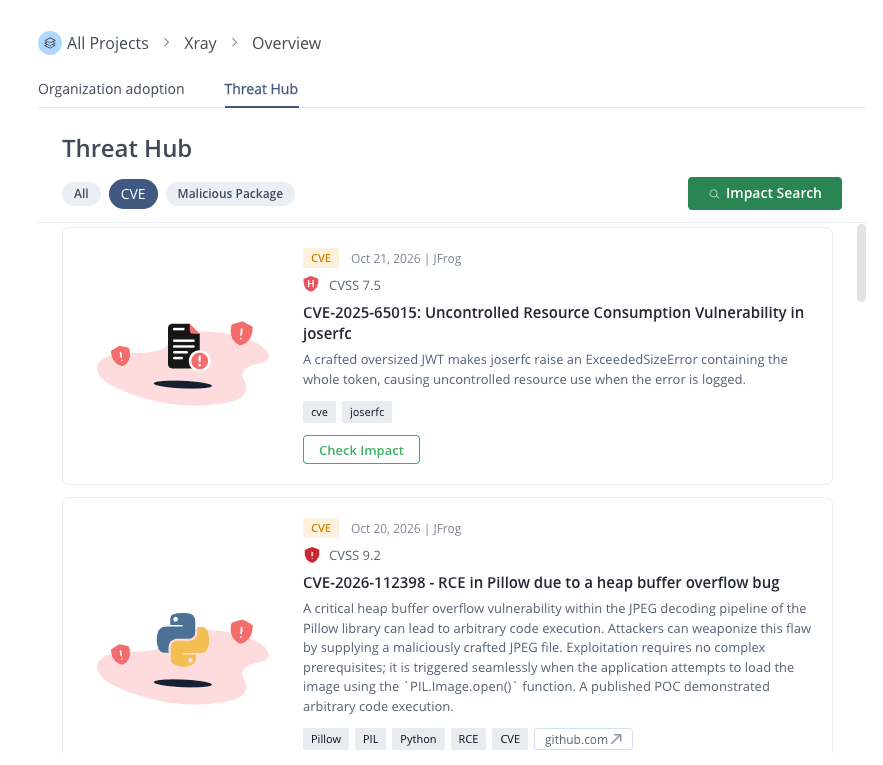
JFrog introduced Threat Hub, a new dashboard inside Xray that turns vulnerability intelligence into one-click blast radius analysis across an organization's artifacts.︀︄︇︀︅︉︀︅︀︀︃︀︀︅︅︀︅︊︀︄︆︀︃︄
JFrog software supply chain solutions provide an end-to-end pipeline to control your binaries from build to production. Power your software updates to the edge.
JFrog introduced Threat Hub, a new dashboard inside Xray that turns vulnerability intelligence into one-click blast radius analysis across an organization's artifacts.︀︄︇︀︅︉︀︅︀︀︃︀︀︅︅︀︅︊︀︄︆︀︃︄
└──▷ WHAT SHIPPED ·
2 FEATURES0 OF 2 FEATURESmost completely described firstwhat's the number?
Each feature carries 0–100 for how completely the vendor documented
it — not how big or important the work is. A major capability
described in eight words scores low, and that is the finding.
depth0–40what it does and how it works or what changed
specificity0–30names real surfaces — APIs, flags, formats, limits, numbers
actionability0–30enough to go use it — a named endpoint, flag, or config key tops this; a UI path is a starting point
Code and config rank first by construction: a documented endpoint,
flag or config key scores at the top of specificity and actionability,
so it sorts above a feature described only in prose. Under
60 the notes go thin — everything below the “thinner
coverage” line is thinner documentation, not smaller work.
Hover any meter for that feature's three sub-scores.
0100
Check Impact blast radius searchnew90how completely this was documenteddepth35/40specificity25/30actionability30/3090 / 100
The Check Impact button within Threat Hub runs an organization-wide impact search that lists every affected artifact with its repository, vulnerable component version, scan date, and runtime status.︀︄︇︀︅︉︀︅︀︀︃︀︀︅︅︀︅︊︀︄︆︀︃︄ Results can be exported or used to set Xray policies directly from the Threat Hub interface without leaving the platform.
When a new supply-chain attack is announced, scope your blast radius immediately without cross-tool pivoting.
📍In JFrog Xray, go to Xray › Overview to open Threat Hub. Find the relevant attack or CVE post in the feed, then click Check Impact to see every affected artifact, its repository, vulnerable component version, scan date, and runtime status.
Scope the blast radius of a new supply chain attack immediately after disclosure, without leaving the Xray interface.
📍In JFrog Xray, go to Xray › Overview to open Threat Hub. Find the relevant CVE or malicious-package post, then click Check Impact to see every affected artifact, its repository, vulnerable component version, scan date, and runtime status across your organization.
Threat Hub dashboard in Xraynew70how completely this was documenteddepth30/40specificity25/30actionability15/3070 / 100
A new Threat Hub dashboard, accessed via Xray > Overview, provides a daily-updated feed of vetted CVE advisories, attack reports, and malicious package alerts covering npm, PyPI, and Hugging Face. Posts show a Severity Mismatch Indicator when JFrog Security Research's real-world exploitability assessment differs from the CVE's published CVSSCVSSCommon Vulnerability Scoring System, a method for describing a vulnerability's characteristics and severity. Its score is not the probability that attackers will exploit it. score, helping teams prioritize by actual risk.
Zarf v1.0.0 adds chunked resumable OCIOCIOpen Container Initiative standard, maintained by the Linux Foundation, defining the image format and runtime spec that container tools share so images built once run anywhere OCI-compliant. blob pulls, state compression, and a non-interactive --confirm flag for patch-git, alongside a major 1.0 breaking-change cleanup that makes v1beta1v1beta1A Kubernetes API version label marking a resource as beta-quality: past alpha instability but not yet stable enough for a v1 guarantee, signalling that the schema may still change. init packages the default, deprecates v1alpha1v1alpha1A Kubernetes API version label meaning the resource schema is in its first alpha iteration, unstable and subject to breaking changes; tools use it to interact with early-stage custom or built-in Kubernetes APIs., and strips out legacy SDK fields, commands and server components.︀︄︇︀︅︉︀︅︀︀︃︀︀︅︅︀︅︊︀︄︆︀︃︄
Zarf is an open-source tool that enables automated, air-gapped deployment of Kubernetes applications and their dependencies into disconnected or secure environments.
Zarf v1.0.0 adds chunked resumable OCIOCIOpen Container Initiative standard, maintained by the Linux Foundation, defining the image format and runtime spec that container tools share so images built once run anywhere OCI-compliant. blob pulls, state compression, and a non-interactive --confirm flag for patch-git, alongside a major 1.0 breaking-change cleanup that makes v1beta1v1beta1A Kubernetes API version label marking a resource as beta-quality: past alpha instability but not yet stable enough for a v1 guarantee, signalling that the schema may still change. init packages the default, deprecates v1alpha1v1alpha1A Kubernetes API version label meaning the resource schema is in its first alpha iteration, unstable and subject to breaking changes; tools use it to interact with early-stage custom or built-in Kubernetes APIs., and strips out legacy SDK fields, commands and server components.︀︄︇︀︅︉︀︅︀︀︃︀︀︅︅︀︅︊︀︄︆︀︃︄
└──▷ WHAT SHIPPED ·
8 FEATURES0 OF 8 FEATURESmost completely described firstwhat's the number?
Each feature carries 0–100 for how completely the vendor documented
it — not how big or important the work is. A major capability
described in eight words scores low, and that is the finding.
depth0–40what it does and how it works or what changed
specificity0–30names real surfaces — APIs, flags, formats, limits, numbers
actionability0–30enough to go use it — a named endpoint, flag, or config key tops this; a UI path is a starting point
Code and config rank first by construction: a documented endpoint,
flag or config key scores at the top of specificity and actionability,
so it sorts above a feature described only in prose. Under
60 the notes go thin — everything below the “thinner
coverage” line is thinner documentation, not smaller work.
Hover any meter for that feature's three sub-scores.
0100
`--confirm` flag for `zarf dev patch-git`new80how completely this was documenteddepth20/40specificity30/30actionability30/3080 / 100
Add --confirm to zarf dev patch-git to skip the interactive prompt in automation, for example zarf dev patch-git --confirm <git-repo-path> to run non-interactively in a CI pipeline.︀︄︇︀︅︉︀︅︀︀︃︀︀︅︅︀︅︊︀︄︆︀︃︄
Run patch-git non-interactively in a CI pipeline without being prompted for confirmation.
$ zarf dev patch-git --confirm <git-repo-path>
— exact flag plus a runnable example commandv1.0.0
0200
v1beta1 init package becomes default, v1alpha1 deprecatedbreaking70how completely this was documenteddepth30/40specificity25/30actionability15/3070 / 100
Zarf now defaults to the v1beta1 init package format and deprecates v1alpha1 packages, signalling the path toward their future removal. Using variables with v1beta1 now errors, and v1beta1 init package values chart inputs are now limited, so previously accepted fields may be rejected.
— names exact package versions and new error/validation behaviorv1.0.0
0300
Legacy CLI feature and command removalbreaking65how completely this was documenteddepth20/40specificity30/30actionability15/3065 / 100
Daemon pull-through via crane is removed, the zarf tools registry export subcommand is removed, the built-in SBOMSBOMA software bill of materials, an inventory of the components and versions inside an application. It helps teams find affected software when a dependency has a vulnerability or licensing issue. viewer is removed, the artifact server is deleted, and previously deprecated commands and flags are removed.
— names exact removed subcommand and componentsv1.0.0
thinner coverage below
0400
Go SDK breaking changesbreaking55how completely this was documenteddepth25/40specificity20/30actionability10/3055 / 100
Deprecated SDK fields and bridge methods are removed from the Go SDK, the deprecated Kubernetes API migration helper is removed, and global architecture state is replaced with per-operation options, changing SDK and CLI call sites.
— names SDK-level changes but no migration path detailv1.0.0
0500
Hard error on package secret write failurebreaking45how completely this was documenteddepth20/40specificity15/30actionability10/3045 / 100
Package secret write failures now cause a hard error instead of being silently ignored.
— clear before/after but no remediation steps givenv1.0.0
0600
Chunked resumable OCI blob pullsnew42how completely this was documenteddepth22/40specificity15/30actionability5/3042 / 100
OCI pulls now use chunked, retryable, resumable blob transfers to handle large packages over unreliable links.
— explains mechanism but gives no flag, size limit or commandv1.0.0
0700
Zarf state field removalbreaking40how completely this was documenteddepth10/40specificity20/30actionability10/3040 / 100
The storageclass and distro fields are removed from Zarf state.
— names removed fields but gives no migration guidancev1.0.0
0800
Zarf state compressionimproved30how completely this was documenteddepth15/40specificity10/30actionability5/3030 / 100
Zarf state is now compressed, reducing cluster secret size for large deployments.
— no mechanism or size figures given, thin descriptionv1.0.0
└──▷ BREAKING ON UPGRADE
!
The `storageclass` and `distro` fields are removed from Zarf state.Our best guess
Infisical is an open-source secret management platform that helps teams securely store, sync, and manage API keys, environment variables, and other sensitive configurations.
Infisical's v0.167.8 release adds CSRCSRA Certificate Signing Request is a block of encoded data submitted to a certificate authority, containing a public key and identity details, so the CA can issue a signed TLS certificate without ever seeing the private key.-based certificate renewal to its PKIPKIA framework of policies, roles, and cryptographic standards for issuing and managing digital certificates that bind public keys to identities, letting tools verify authenticity and encrypt communications without pre-shared secrets. module, a new CockroachDB account type for PAMPAMBrokering administrator sessions through a gateway instead of handing out standing credentials. Access is granted for one session, to one target, and recorded., a bulk-expand control on the secrets overview page, and an overhauled billing UI with subscription management.︀︄︇︀︅︉︀︅︀︀︃︀︀︅︅︀︅︊︀︄︆︀︃︄
└──▷ WHAT SHIPPED ·
4 FEATURES0 OF 4 FEATURESmost completely described firstwhat's the number?
Each feature carries 0–100 for how completely the vendor documented
it — not how big or important the work is. A major capability
described in eight words scores low, and that is the finding.
depth0–40what it does and how it works or what changed
specificity0–30names real surfaces — APIs, flags, formats, limits, numbers
actionability0–30enough to go use it — a named endpoint, flag, or config key tops this; a UI path is a starting point
Code and config rank first by construction: a documented endpoint,
flag or config key scores at the top of specificity and actionability,
so it sorts above a feature described only in prose. Under
60 the notes go thin — everything below the “thinner
coverage” line is thinner documentation, not smaller work.
Hover any meter for that feature's three sub-scores.
0100
Certificate renewal via imported CSR in PKInew45how completely this was documenteddepth20/40specificity15/30actionability10/3045 / 100
Infisical's PKI now accepts a CSR on import so certificate renewal can reuse an existing key pair.︀︄︇︀︅︉︀︅︀︀︃︀︀︅︅︀︅︊︀︄︆︀︃︄
— Explains mechanism but no endpoint or flag namedv0.167.8
0200
Open All control on secrets overviewnew40how completely this was documenteddepth15/40specificity10/30actionability15/3040 / 100
The secrets overview page now has an Open All control to expand all resource types at once.
OX Security is an accelerate the transition to software that secures itself. OX Security pinpoints risk to the exact line of code, eliminating security debt from AI generation to cloud runtime.
OX VibeSec adds prompt-time secure-coding guidance, malicious dependency blocking, real-time action policies with detect/prevent toggle, and per-block OX issue records tied to application criticality.
OX VibeSec now classifies developer prompts at write time and injects the matching security guideline into the agent context, preventing vulnerable code before it is committed.
OX VibeSec now blocks malicious packages before they enter the build when a coding agent adds a dependency.
New integrationOX VibeSec adds real-time policy enforcement at the point of action: prompts and tool calls across CLIs, SDKs, MCPs, and skills are evaluated live and allowed, flagged, or blocked.
OX VibeSec adds a detect/prevent toggle: in detect mode the agent is alerted and the developer keeps working; flipping to prevent mode blocks the action while keeping the same OX issue as a record.
Every flag or block across all three layers opens an OX issue in the AppSecAppSecApplication security: the practice of finding and fixing vulnerabilities in software during design, development, and testing. Cyber tools build on AppSec workflows to shift vulnerability detection earlier in the development lifecycle. queue, showing the affected application, its criticality, the team involved, and whether the action was detected or blocked.
+1 moreshow less
Unified AI policies spanning VibeSec and OX Cloud — one policy from the user's laptop to the cloud account — are now available in beta.
Cycode’s Agentic Development Security Platform unites security and development teams with actionable, code-to-runtime context to identify, prioritize, and fix the software risk that matters.
Cycode introduced Maestro Memory, giving its AI security assistant persistent context across sessions so investigations build on prior knowledge automatically.︀︄︇︀︅︉︀︅︀︀︃︀︀︅︅︀︅︊︀︄︆︀︃︄
└──▷ WHAT SHIPPED ·
1 FEATURE0 OF 1 FEATUREmost completely described firstwhat's the number?
Each feature carries 0–100 for how completely the vendor documented
it — not how big or important the work is. A major capability
described in eight words scores low, and that is the finding.
depth0–40what it does and how it works or what changed
specificity0–30names real surfaces — APIs, flags, formats, limits, numbers
actionability0–30enough to go use it — a named endpoint, flag, or config key tops this; a UI path is a starting point
Code and config rank first by construction: a documented endpoint,
flag or config key scores at the top of specificity and actionability,
so it sorts above a feature described only in prose. Under
60 the notes go thin — everything below the “thinner
coverage” line is thinner documentation, not smaller work.
Hover any meter for that feature's three sub-scores.
0100
Maestro Memory for persistent contextnew55how completely this was documenteddepth25/40specificity15/30actionability15/3055 / 100
Maestro now retains context across sessions with two new memory stores: always-on memory, which holds your preferences, rules, and team vocabulary, and recalled memory, which holds factual knowledge about products and past conversations.︀︄︇︀︅︉︀︅︀︀︃︀︀︅︅︀︅︊︀︄︆︀︃︄ Maestro surfaces memory saves in-conversation and lets you search, modify, or delete what it remembers through the same conversation interface.
CAPEv2 is an open-source malware sandbox that automatically executes and analyzes suspicious files to extract configurations, payloads, and behavioral indicators.
CAPEv2 adds de4dotEx as the default .NET deobfuscator, replacing legacy de4dot with static .NET Reactor 6.9/7.x, ConfuserEx, and VirtualGuard support︀︄︇︀︅︉︀︅︀︀︃︀︀︅︅︀︅︊︀︄︆︀︃︄
└──▷ USE IT
Enable de4dotEx for .NET Reactor, ConfuserEx and VirtualGuard deobfuscation after upgrading, replacing the deprecated eziriz path.
Switch the default .NET deobfuscator to de4dotEx v3.12.0 (installed at /usr/local/bin/de4dot) in conf/default/integrations.conf.default, gaining static .NET Reactor >= 6.9/7.x (CVM devirtualization, PRNG resource decryption), ConfuserEx, and VirtualGuard coverage without CoreCLR reflection.︀︄︇︀︅︉︀︅︀︀︃︀︀︅︅︀︅︊︀︄︆︀︃︄
Deprecate [eziriz_deobfuscate] by setting enabled = no in conf/default/integrations.conf.default, with a pointer to [de4dot_deobfuscate] for .NET Reactor deobfuscation.
Pin binGraph to the 4.0 release in pyproject.toml and extra/optional_dependencies.txt, and import it unconditionally in modules/reporting/bingraph.py and web/analysis/views.py so HAVE_BINGRAPH reflects package availability regardless of on_demand mode.
Honor binary, procdump, and cape toggles under [bingraph] in modules/reporting/bingraph.py.
Switch the default .NET deobfuscator to de4dotEx v3.12.0 (installed at /usr/local/bin/de4dot) in conf/default/integrations.conf.default, gaining static .NET Reactor >= 6.9/7.x (CVM devirtualization, PRNG resource decryption), ConfuserEx, and VirtualGuard coverage without CoreCLR reflection.︀︄︇︀︅︉︀︅︀︀︃︀︀︅︅︀︅︊︀︄︆︀︃︄
3 more in Everything
└──▷ BREAKING ON UPGRADE
!
The `[eziriz_deobfuscate]` section in `conf/default/integrations.conf.default` now defaults to `enabled = no`; existing deployments relying on `eziriz_deobfuscate` for .NET Reactor deobfuscation must migrate to `[de4dot_deobfuscate]` and install `de4dotEx`.Our best guess
The installer (`installer/cape2.sh`) now fetches `de4dotEx-3.12.0-x64.deb` from GitHub instead of the legacy `de4dot_3.1.41592.3405-2_all.deb` Ubuntu archive package; amd64 is the only supported architecture for the new package.Our best guess
Reversecore MCP's v3.1.0 release focuses on taming its 186-tool footprint with a token-saving router profile and a paginated evidence cache, while adding new binary-format analyzers for Go/Rust, Electron and Unity IL2CPPIL2CPPAn ahead-of-time compilation pipeline from Unity that converts C# IL bytecode into C++ source, then compiles it to native machine code, giving cyber tools built on Unity games faster execution and a harder-to-reverse binary. plus ESILESILA low-level, architecture-neutral intermediate language used by the radare2 project to represent the side effects of CPU instructions, letting cyber tools analyze and emulate code across many architectures without per-architecture logic.-based equivalence verification for reimplemented functions.︀︄︇︀︅︉︀︅︀︀︃︀︀︅︅︀︅︊︀︄︆︀︃︄
Reversecore MCP's v3.1.0 release focuses on taming its 186-tool footprint with a token-saving router profile and a paginated evidence cache, while adding new binary-format analyzers for Go/Rust, Electron and Unity IL2CPPIL2CPPAn ahead-of-time compilation pipeline from Unity that converts C# IL bytecode into C++ source, then compiles it to native machine code, giving cyber tools built on Unity games faster execution and a harder-to-reverse binary. plus ESILESILA low-level, architecture-neutral intermediate language used by the radare2 project to represent the side effects of CPU instructions, letting cyber tools analyze and emulate code across many architectures without per-architecture logic.-based equivalence verification for reimplemented functions.︀︄︇︀︅︉︀︅︀︀︃︀︀︅︅︀︅︊︀︄︆︀︃︄
└──▷ WHAT SHIPPED ·
8 FEATURES0 OF 8 FEATURESmost completely described firstwhat's the number?
Each feature carries 0–100 for how completely the vendor documented
it — not how big or important the work is. A major capability
described in eight words scores low, and that is the finding.
depth0–40what it does and how it works or what changed
specificity0–30names real surfaces — APIs, flags, formats, limits, numbers
actionability0–30enough to go use it — a named endpoint, flag, or config key tops this; a UI path is a starting point
Code and config rank first by construction: a documented endpoint,
flag or config key scores at the top of specificity and actionability,
so it sorts above a feature described only in prose. Under
60 the notes go thin — everything below the “thinner
coverage” line is thinner documentation, not smaller work.
Hover any meter for that feature's three sub-scores.
0100
Router profile for reduced tool-schema token footprintnew95how completely this was documenteddepth35/40specificity30/30actionability30/3095 / 100
Setting REVERSECORE_PROFILE=router cuts MCP tool schema token footprint by 94.4% (from ~63,000 to ~3,500 tokens) by exposing a compact 6-tool router (search_reversecore_tools, call_reversecore_tool, get_reversecore_tool_schema, recommend_tools_for_goal, generate_analysis_plan, get_job_result) while keeping all 186 tools reachable on demand.︀︄︇︀︅︉︀︅︀︀︃︀︀︅︅︀︅︊︀︄︆︀︃︄ Setting REVERSECORE_COMPACT_SCHEMA=true additionally compresses verbose tool docstrings to single-sentence summaries under any active profile.
Cut token usage by ~94% when an agent first connects — the router profile exposes only 6 orchestration tools and loads full tool schemas only on demand.
$ REVERSECORE_PROFILE=router REVERSECORE_COMPACT_SCHEMA=true docker run --rm-p 8000:8000 sjkim1127/reversecore-mcp
Evidence cache for large analysis outputnew90how completely this was documenteddepth30/40specificity30/30actionability30/3090 / 100
get_analysis_evidence(evidence_id, offset_line, limit_lines, grep_pattern) retrieves large decompilation, disassembly, or strings output a window at a time instead of flooding LLMLLMA large language model, a neural network trained on large amounts of text to recognize patterns and generate language. Applications use it for tasks such as answering, summarizing and writing code. context, with full artifacts stored in EvidenceCache under an ev_<12hex> ID. r2_decompile, r2_disassemble, and run_strings now take a detail="summary" or detail="full" parameter to switch between a compact digest and full output, and EvidenceCache records persist across docker run --rm restarts via a hybrid in-memory LRU + disk-backed store written to <workspace>/.reversecore_cache/evidence/ev_*.json.
Decompile a large function in summary mode to get a digest without filling the LLM context, then page through the full output by grep pattern.
$ # Step 1 — get the summary and evidence_id
call_reversecore_tool(tool='r2_decompile', params={'address': '0x004012a0', 'detail': 'summary'})
# -> returns evidence_id: 'ev_a3f9c1d80b2e'

# Step 2 — retrieve only the lines containing 'malloc'
get_analysis_evidence(evidence_id='ev_a3f9c1d80b2e', offset_line=0, limit_lines=40, grep_pattern='malloc')
— Named function signature, flags, file path and worked examplev3.1.0
0300
Electron ASAR security auditornew85how completely this was documenteddepth30/40specificity30/30actionability25/3085 / 100
The new unpack_and_analyze_electron_asar tool audits an Electron app bundle for nodeIntegration: true, contextIsolation: false, webSecurity: false, IPCIPCInter-process communication, ways for separate programs to exchange data or signals. Examples include pipes, sockets and shared memory. channel exposure, hardcoded API endpoints, and high-entropy secrets, requiring no external Node.js.
Audit an Electron app bundle for insecure IPC channels and hardcoded secrets during a supply-chain review.
— Concrete flags named plus a runnable call examplev3.1.0
0400
Stripped Go/Rust binary recovery analyzernew80how completely this was documenteddepth30/40specificity30/30actionability20/3080 / 100
The new analyze_go_rust_binary tool recovers function names, struct/interface types, build IDs, and compiler versions from stripped Go or Rust binaries, covering Go 1.2–1.20+ pclntab magics and both _ZN legacy and _R v0 Rust symbol formats.
— Mechanism and version coverage named, no runnable examplev3.1.0
0500
ESIL-based reimplementation equivalence verifiernew80how completely this was documenteddepth35/40specificity30/30actionability15/3080 / 100
verify_feature_equivalence verifies behavioral equivalence of a candidate Python reimplementation against live Radare2 ESIL execution across System V AMD64 (rdi, rsi, rdx, rcx, r8, r9), Windows x64 (rcx, rdx, r8, r9), ARM64ARM64A 64-bit CPU architecture from ARM Holdings, used in mobile chips, Apple Silicon, and cloud servers; cyber tools target it to run natively on those platforms instead of relying on emulation. (x0–x5), and ARM32 (r0–r3) calling conventions, reporting results in a detailed obligation_ledger with statuses verified_equivalent, partially_verified, or divergent.
— Rich mechanism and named conventions, but no runnable examplev3.1.0
0600
Unity IL2CPP analyzernew75how completely this was documenteddepth30/40specificity30/30actionability15/3075 / 100
The new analyze_unity_il2cpp tool recovers Unity IL2CPP string literals, metadata header offsets, and exported runtime symbols (il2cpp_init, il2cpp_domain_get, il2cpp_runtime_invoke), and generates ready-to-run Il2CppDumper/r2 commands.
— Named symbols and outputs but no example invocationv3.1.0
thinner coverage below
0700
Decompiled code to Python template reconstructornew55how completely this was documenteddepth20/40specificity20/30actionability15/3055 / 100
The new reconstruct_feature_code tool reconstructs decompiled C pseudo-code into a copy-pasteable Python template with 32-bit/64-bit modular wrapping enforced via & 0xFFFFFFFF and & 0xFFFFFFFFFFFFFFFF.
Finite State Platform added custom license identifier renaming, background-update tracking for False Positive status changes, expanded rescan support for older versions, and a new Succeeded count on the Scans page.︀︄︇︀︅︉︀︅︀︀︃︀︀︅︅︀︅︊︀︄︆︀︃︄
Finite State Platform is a software supply chain security tool that analyzes firmware and embedded software for vulnerabilities, risks, and compliance issues.
Finite State Platform added custom license identifier renaming, background-update tracking for False Positive status changes, expanded rescan support for older versions, and a new Succeeded count on the Scans page.︀︄︇︀︅︉︀︅︀︀︃︀︀︅︅︀︅︊︀︄︆︀︃︄
└──▷ WHAT SHIPPED ·
4 FEATURES0 OF 4 FEATURESmost completely described firstwhat's the number?
Each feature carries 0–100 for how completely the vendor documented
it — not how big or important the work is. A major capability
described in eight words scores low, and that is the finding.
depth0–40what it does and how it works or what changed
specificity0–30names real surfaces — APIs, flags, formats, limits, numbers
actionability0–30enough to go use it — a named endpoint, flag, or config key tops this; a UI path is a starting point
Code and config rank first by construction: a documented endpoint,
flag or config key scores at the top of specificity and actionability,
so it sorts above a feature described only in prose. Under
60 the notes go thin — everything below the “thinner
coverage” line is thinner documentation, not smaller work.
Hover any meter for that feature's three sub-scores.
0100
False Positive background-update trackingnew90how completely this was documenteddepth30/40specificity30/30actionability30/3090 / 100
Checking whether findings are still updating after marking a component False Positive is now possible via PUT /public/v0/components/{projectVersionId}/{componentId}/status, which returns an X-Finding-Updates-Pending header when background updates are in progress.︀︄︇︀︅︉︀︅︀︀︃︀︀︅︅︀︅︊︀︄︆︀︃︄ Components still pending such an update can be listed via GET /public/v0/components/finding-updates/{projectVersionId}.
After bulk-marking a large component False Positive, poll for pending finding updates before closing a review ticket.
$ curl -X GET 'https://platform.finitestate.io/public/v0/components/finding-updates/<projectVersionId>' \
  -H 'Authorization: Bearer <token>'
Custom license identifier renamingnew88how completely this was documenteddepth30/40specificity28/30actionability30/3088 / 100
Rename a custom license identifier, including letter-case changes, via PATCH /v0/licenses under Settings > Policy > Licenses. Policy rules and concluded component licenses follow the new identifier automatically after the next policy evaluation run.
Rename a misspelled or rebranded custom license identifier while keeping all policy rules and component conclusions intact.
Rescan support for older versionsimproved45how completely this was documenteddepth20/40specificity15/30actionability10/3045 / 100
Rescan now works for more older versions; the first rescan of an older version prepares its original file and shows progress, while later rescans of the same version skip that preparation step.
Succeeded total on Scans pagenew45how completely this was documenteddepth15/40specificity15/30actionability15/3045 / 100
The Scans page now shows a Succeeded total between the Queued and Failed counts; selecting it opens Scan History filtered to completed runs.
Filter the Scan History view to only completed scans to judge a failed-scan count in context.
📍In the Finite State Platform, go to Scans, then select the Succeeded count between Queued and Failed to open Scan History filtered to runs that completed successfully.
Hayabusa v4.4.0 adds native scanning of EWFEWFExpert Witness Format, an open forensic disk-image container maintained by Joachim Metz's libewf project, that stores compressed raw disk data alongside hash verification metadata, giving cyber tools tamper-evident evidence preservation. and VHDXVHDXMicrosoft's virtual hard disk format, successor to VHD, supporting disks up to 64 TB with improved resilience against corruption. Cyber tools use it to mount or analyze Windows VM disk images. forensic disk images without mounting or extraction, and consolidates the pivot-keywords-list output format.︀︄︇︀︅︉︀︅︀︀︃︀︀︅︅︀︅︊︀︄︆︀︃︄
Hayabusa is a fast Windows event log threat hunting and forensics timeline generator written in Rust, using Sigma-based detection rules.
Hayabusa v4.4.0 adds native scanning of EWFEWFExpert Witness Format, an open forensic disk-image container maintained by Joachim Metz's libewf project, that stores compressed raw disk data alongside hash verification metadata, giving cyber tools tamper-evident evidence preservation. and VHDXVHDXMicrosoft's virtual hard disk format, successor to VHD, supporting disks up to 64 TB with improved resilience against corruption. Cyber tools use it to mount or analyze Windows VM disk images. forensic disk images without mounting or extraction, and consolidates the pivot-keywords-list output format.︀︄︇︀︅︉︀︅︀︀︃︀︀︅︅︀︅︊︀︄︆︀︃︄
└──▷ WHAT SHIPPED ·
3 FEATURES0 OF 3 FEATURESmost completely described firstwhat's the number?
Each feature carries 0–100 for how completely the vendor documented
it — not how big or important the work is. A major capability
described in eight words scores low, and that is the finding.
depth0–40what it does and how it works or what changed
specificity0–30names real surfaces — APIs, flags, formats, limits, numbers
actionability0–30enough to go use it — a named endpoint, flag, or config key tops this; a UI path is a starting point
Code and config rank first by construction: a documented endpoint,
flag or config key scores at the top of specificity and actionability,
so it sorts above a feature described only in prose. Under
60 the notes go thin — everything below the “thinner
coverage” line is thinner documentation, not smaller work.
Hover any meter for that feature's three sub-scores.
0100
Native EWF disk image scanningnew93how completely this was documenteddepth35/40specificity28/30actionability30/3093 / 100
The new --e01 flag, available on all event-log scanning commands, lets Hayabusa scan EWF1 (.E01) and EWF2 (.Ex01) disk images natively on Linux, macOS, and Windows with no extraction, mounting, FUSEFUSEA Linux kernel interface that lets userspace programs implement a filesystem without kernel code, maintained as part of the kernel project; tools use it to mount virtual or synthetic filesystems without requiring root or kernel modules., or administrator privileges required.︀︄︇︀︅︉︀︅︀︀︃︀︀︅︅︀︅︊︀︄︆︀︃︄ It handles split image segments, mixed --vhdx --e01 directories, incomplete acquisitions, and read failures, preserving readable results and exiting nonzero on partial input.
Generate a DFIRDFIRDigital forensics and incident response, investigating what happened during a security incident and containing it. The work includes preserving evidence, reconstructing activity and restoring systems. timeline from a forensic EWF image acquired from a seized host, without extracting logs or needing admin rights.
Scan a directory of VHDX images and E01E01A forensic disk image format that stores a drive's contents in segmented files with built-in checksums and metadata, widely used in digital forensics because it supports compression and chain-of-custody verification. images together in one pass, letting Hayabusa discover all images up to three subdirectory levels deep.
— Flag, formats, and platform/behaviour details all given with a runnable command.v4.4.0
0200
Native VHDX disk image scanningnew91how completely this was documenteddepth35/40specificity28/30actionability28/3091 / 100
The new --vhdx flag, available on all event-log scanning commands, scans VHDX disk images natively on Linux, macOS, and Windows: a single image via -f or discovery of images up to three subdirectory levels deep via -d. Logs are read from all NTFSNTFSThe default file system format for Windows, developed by Microsoft, storing files with rich metadata and access controls; cyber tools target it to parse artifacts like timestamps, alternate data streams, and the MFT. volumes without mounting drivers, administrator privileges, or temporary extraction; evidence paths retain the image and internal filename, and partial scans mark HTML reports incomplete and exit nonzero.
Scan a directory of VHDX images and E01 images together in one pass, letting Hayabusa discover all images up to three subdirectory levels deep.
— Flag, options, scope, and partial-scan behaviour all specified with example.v4.4.0
thinner coverage below
0300
Consolidated pivot-keywords-list output filesimproved52how completely this was documenteddepth20/40specificity22/30actionability10/3052 / 100
pivot-keywords-list now writes four consolidated output files — Users, IP Addresses, Processes, and Command Lines — combining fields that were previously split across three files each, and removing the logon ID and Source Computers lists.
— Names exact output files changed but no usage example given.v4.4.0
Sublime Security is an email security platform that detects and blocks phishing, malware, and other threats using customizable, logic-based detection rules.
Sublime Security introduced Agent Hub for managing its ASA and ADÉ agents in one place, alongside a new Mean Time to Coverage metric that tracks how quickly detection gaps are closed.︀︄︇︀︅︉︀︅︀︀︃︀︀︅︅︀︅︊︀︄︆︀︃︄
└──▷ WHAT SHIPPED ·
2 FEATURES0 OF 2 FEATURESmost completely described firstwhat's the number?
Each feature carries 0–100 for how completely the vendor documented
it — not how big or important the work is. A major capability
described in eight words scores low, and that is the finding.
depth0–40what it does and how it works or what changed
specificity0–30names real surfaces — APIs, flags, formats, limits, numbers
actionability0–30enough to go use it — a named endpoint, flag, or config key tops this; a UI path is a starting point
Code and config rank first by construction: a documented endpoint,
flag or config key scores at the top of specificity and actionability,
so it sorts above a feature described only in prose. Under
60 the notes go thin — everything below the “thinner
coverage” line is thinner documentation, not smaller work.
Hover any meter for that feature's three sub-scores.
0100
Agent Hub for ASA and ADÉnew55how completely this was documenteddepth20/40specificity20/30actionability15/3055 / 100
A single view to manage ASA and ADÉ agents and track their impact through investigations completed, messages remediated, and estimated analyst hours saved.︀︄︇︀︅︉︀︅︀︀︃︀︀︅︅︀︅︊︀︄︆︀︃︄ Accessible by going to Agents in the Sublime Security platform.
Review agent activity and your current MTTC to understand how quickly ASA and ADÉ are closing detection gaps after a missed threat is identified.
📍In the Sublime Security platform, go to Agents to see investigations completed, messages remediated, estimated analyst hours saved, and your Mean Time to Coverage (MTTC).
Mean Time to Coverage metricnew50how completely this was documenteddepth20/40specificity15/30actionability15/3050 / 100
Mean Time to Coverage (MTTC) is a new metric showing the average time from identifying a missed threat to ADÉ generating a new Detection Rule, helping teams see how quickly detection gaps are closed.
Review agent activity and your current MTTC to understand how quickly ASA and ADÉ are closing detection gaps after a missed threat is identified.
📍In the Sublime Security platform, go to Agents to see investigations completed, messages remediated, estimated analyst hours saved, and your Mean Time to Coverage (MTTC).
Falco is an open-source cloud-native runtime security tool that detects anomalous behavior and threats in containers, Kubernetes, and Linux systems using kernel-level monitoring.
Falco Operator 0.5.0 adds a central OCIOCIOpen Container Initiative standard, maintained by the Linux Foundation, defining the image format and runtime spec that container tools share so images built once run anywhere OCI-compliant. artifact server, mTLSmTLSMutual TLS, an encrypted connection where both client and server present certificates to prove their identity. It helps services verify who they are communicating with.-secured artifact delivery with per-instance SPIFFESPIFFEAn open standard, maintained by the CNCF, for assigning cryptographic identities to workloads in dynamic infrastructure so services can authenticate each other without passwords or static credentials. identities, a new ArtifactNode resource for rollout visibility, and compatibility enforcement that checks rules and plugins against the running Falco version before installing them.︀︄︇︀︅︉︀︅︀︀︃︀︀︅︅︀︅︊︀︄︆︀︃︄
└──▷ WHAT SHIPPED ·
6 FEATURES4 OF 6 FEATURESmost completely described firstwhat's the number?
Each feature carries 0–100 for how completely the vendor documented
it — not how big or important the work is. A major capability
described in eight words scores low, and that is the finding.
depth0–40what it does and how it works or what changed
specificity0–30names real surfaces — APIs, flags, formats, limits, numbers
actionability0–30enough to go use it — a named endpoint, flag, or config key tops this; a UI path is a starting point
Code and config rank first by construction: a documented endpoint,
flag or config key scores at the top of specificity and actionability,
so it sorts above a feature described only in prose. Under
60 the notes go thin — everything below the “thinner
coverage” line is thinner documentation, not smaller work.
Hover any meter for that feature's three sub-scores.
0101
mTLS artifact delivery with SPIFFE identitiesnew90how completely this was documenteddepth30/40specificity30/30actionability30/3090 / 100
Falco Operator can deliver artifacts over mTLS, giving each Falco instance a unique SPIFFE identity and reloading certificates without restarts; enable it by setting mtls.enabled=true in the Helm chart, backed by cert-manager and trust-manager.︀︄︇︀︅︉︀︅︀︀︃︀︀︅︅︀︅︊︀︄︆︀︃︄
Enable mTLS artifact delivery in an air-gapped or security-sensitive cluster so each Falco instance proves its identity before receiving rules.
Per-node ArtifactNode resource for rollout statusnew90how completely this was documenteddepth30/40specificity30/30actionability30/3090 / 100
The operator introduces the ArtifactNode custom resource (group artifact.falcosecurity.dev), one per namespace/node, whose spec.artifacts lists assigned resources and whose status.artifacts reports installed files, paths, content hashes, and conditions such as DependenciesSatisfied.
Inspect per-node artifact status after a rules rollout to confirm every node received and loaded the correct revision.
$ kubectl get artifactnodes -n falco
kubectl get artifactnode worker-1 -n falco -o yaml
Rule and plugin compatibility enforcementnew90how completely this was documenteddepth35/40specificity30/30actionability25/3090 / 100
Artifact specs can declare required_engine_version and required_plugin_versions inside Rulesfile specs, controlled by enforceRequirements: true (default) or enforceRequirements: false for advise-only mode; the operator checks compatibility against the running Falco version via the /versions API before installing any rulesfile or plugin, keeping Falco on the last compatible set when a new revision fails checks.
Pin a custom rulesfile to minimum engine and plugin versions so the operator withholds it from any node that cannot satisfy the requirements.
Central artifact server for OCI rule/plugin deliverynew65how completely this was documenteddepth30/40specificity25/30actionability10/3065 / 100
A central artifact server now runs inside the cluster on port 8082; the operator pulls each OCI artifact once, pins it to a digest, and serves it to every Falco pod instead of each pod pulling independently from the registry.
Client-side API rate limits for large clustersnew45how completely this was documenteddepth15/40specificity25/30actionability5/3045 / 100
Client-side API rate limits are now on by default: 50 QPS (burst 100) for the operator and 5 QPS (burst 10) for each sidecar, preparing the operator for large clusters.
Breaking changes in 0.5.0 upgrade pathbreaking25how completely this was documenteddepth10/40specificity5/30actionability10/3025 / 100
This release contains breaking changes; consult the v0.5.0 migration guide before upgrading from any prior release, including 0.5.0 release candidates.
This release contains breaking changes — consult the v0.5.0 migration guide before upgrading from any prior release, including 0.5.0 release candidates.Our best guess
Plerion is a cloud security platform that provides comprehensive risk management, vulnerability detection, and threat prioritization across cloud environments and workloads.
Plerion's latest release adds an Access tab that visualizes AWS resource exposure across policy layers, Bank Negara Malaysia RMiTRMiTBank Negara Malaysia's Risk Management in Technology framework, a regulatory standard Malaysian financial institutions must comply with; cyber tools cite it to show their controls map to required obligations. compliance mapping, bulk continuous-scanning enablement for AWS accounts, a new AKSAKSAzure Kubernetes Service, Microsoft's managed Kubernetes offering, which lets cyber tools offload cluster provisioning and scaling to Azure so engineers focus on workload logic instead of control-plane operations. end-of-support check, and expanded inventory coverage for AWS service families.︀︄︇︀︅︉︀︅︀︀︃︀︀︅︅︀︅︊︀︄︆︀︃︄
└──▷ WHAT SHIPPED ·
5 FEATURES0 OF 5 FEATURESmost completely described firstwhat's the number?
Each feature carries 0–100 for how completely the vendor documented
it — not how big or important the work is. A major capability
described in eight words scores low, and that is the finding.
depth0–40what it does and how it works or what changed
specificity0–30names real surfaces — APIs, flags, formats, limits, numbers
actionability0–30enough to go use it — a named endpoint, flag, or config key tops this; a UI path is a starting point
Code and config rank first by construction: a documented endpoint,
flag or config key scores at the top of specificity and actionability,
so it sorts above a feature described only in prose. Under
60 the notes go thin — everything below the “thinner
coverage” line is thinner documentation, not smaller work.
Hover any meter for that feature's three sub-scores.
0100
Bank Negara Malaysia RMiT compliance mappingnew75how completely this was documenteddepth30/40specificity30/30actionability15/3075 / 100
Plerion adds Bank Negara Malaysia RMiT compliance mapping, covering 96 of 472 paragraphs across AWS, Azure, GCP, and Kubernetes in areas including cryptography, network resilience, access control, cloud services, cybersecurity operations, and data security.︀︄︇︀︅︉︀︅︀︀︃︀︀︅︅︀︅︊︀︄︆︀︃︄ Enable it from Compliance under Manage frameworks.
Turn on Bank Negara Malaysia RMiT as a compliance framework to map your cloud posture against the BNM policy document across AWS, Azure, GCP, and Kubernetes.
📍In the Plerion console: go to Manage › Compliance › Manage frameworks › locate Bank Negara Malaysia RMiT › toggle it on.
Access tab for AWS assetsnew70how completely this was documenteddepth30/40specificity25/30actionability15/3070 / 100
A new Access tab on AWS assets lets you inspect who can reach a sensitive resource (e.g. an S3 bucket or KMSKMSA managed service that creates, stores, rotates and controls access to encryption keys, usually backed by HSMs. Applications ask it to encrypt or decrypt rather than holding keys themselves. key) without writing policy queries. Graph or List views show the identity policy, permission boundary, SCPSCPSecure Copy Protocol, a file-transfer method built on SSH that encrypts data in transit; cyber tools use it to move files to or from remote hosts without exposing credentials or content., RCP, and resource policy layers on each relationship path when you hover over an arrow.
Review who can access a sensitive S3 bucket or KMS key without writing policy queries — open the asset and switch to the Access tab.
📍In the Plerion console: open any AWS asset (e.g. an S3 bucket or KMS key) › click the Access tab › choose Graph or List view › hover over a relationship arrow to inspect the identity policy, permission boundary, SCP, RCP, and resource policy layers on that path.
Bulk continuous scanning enablement for AWS accountsnew55how completely this was documenteddepth25/40specificity15/30actionability15/3055 / 100
Continuous scanning can now be enabled for multiple AWS accounts at once from the account list by selecting accounts and saving; the editor shows which accounts already have it on and which still need a CDR integration.
Enable continuous scanning across a fleet of AWS accounts in one operation rather than account by account.
📍In the Plerion console: go to the AWS account list › click Continuous scanning › tick the target accounts › Save — the editor flags which accounts already have it on and which still need a CDR integration.
Obsidian Security delivers complete SaaS security—gain control, stop threats, and ensure compliance across all your business apps.
Obsidian adds a Runtime Policy Decision Engine, MCPMCPModel Context Protocol, a standard for connecting AI applications to external tools and data sources. A compatible server exposes capabilities an assistant can use through a common interface. Security Proxy, and Policy Decision API to intercept and govern AI agent actions at the moment they execute.
New integrationNew Runtime Policy Decision Engine evaluates agent actions against centrally managed policies using identity, HR, and application context, then allows, blocks, or routes for human approval.
New integrationNew MCP Security Proxy intercepts every agent tool call before it reaches a business application, keeping app tokens out of AI clients and enforcing the same central policies used elsewhere.
New Policy Decision API lets customer-managed gateways, agent harnessesagent harnessesThe software around an AI agent that manages its tools, execution loop, state and limits. It determines how the model's proposed actions are run and checked., and workflows query Obsidian for an allow/block/approve decision with reason, without rebuilding policies per gateway.
Customer-provided context — such as data classification labels — can now be supplied so runtime decisions reflect the business's own sensitivity definitions alongside identity and application data.
Calico is an open-source networking and network security solution for Kubernetes and other container orchestration platforms, providing policy-based traffic control.
Calico adds Red Hat OpenShift 5 support via the Tigera Operator, with eBPFeBPFA Linux technology for running verified programs inside the kernel without changing its source. Tools use it to observe processes, enforce rules and process network traffic./iptables/nftables data plane choice, KubeVirtKubeVirtA Kubernetes extension, maintained by the KubeVirt open-source community, that lets virtual machines run as native Kubernetes workloads alongside containers, giving cyber tools a single orchestration layer for both VMs and pods. live migration IP stability, and layer 2 VLAN bridging for VM workloads in Calico Enterprise.
New supported platformCalico now supports Red Hat OpenShift 5, installable through the Tigera Operator listed in the Red Hat Ecosystem Catalog, with a documented migration path from OVN-Kubernetes to Calico for existing clusters.
Calico runs on eBPF, iptables, or nftables on Red Hat OpenShift 5, letting teams choose the data plane per cluster.
Calico IPAM now preserves VM IP addresses through KubeVirt live migration on Red Hat OpenShift Virtualization and advertises them via BGPBGPA routing protocol that lets autonomous systems on the internet exchange reachability information, determining how traffic flows between networks. Cyber tools use it to monitor route hijacks or inject sinkholes. into the data center network.
Calico Enterprise adds layer 2 bridging on Red Hat OpenShift 5 to extend existing VLANs into the cluster, allowing VMs to migrate to Red Hat OpenShift Virtualization without a network redesign.
Chainguard shipped SCIM 2.0SCIM 2.0A standard for creating, updating and removing user accounts and groups across applications. It helps an identity provider keep access in sync when people join, change roles or leave. identity provisioning, a breaking-change cgb package endpoint, private Go and Java package upload support, and a Guarded Entrypoint startup wrapper for Custom Assembly images.︀︄︇︀︅︉︀︅︀︀︃︀︀︅︅︀︅︊︀︄︆︀︃︄
Chainguard provides trusted open source artifacts for every layer of your modern software stack—containers, language libraries, and VM images.
Chainguard shipped SCIM 2.0SCIM 2.0A standard for creating, updating and removing user accounts and groups across applications. It helps an identity provider keep access in sync when people join, change roles or leave. identity provisioning, a breaking-change cgb package endpoint, private Go and Java package upload support, and a Guarded Entrypoint startup wrapper for Custom Assembly images.︀︄︇︀︅︉︀︅︀︀︃︀︀︅︅︀︅︊︀︄︆︀︃︄
└──▷ WHAT SHIPPED ·
4 FEATURES1 OF 4 FEATURESmost completely described firstwhat's the number?
Each feature carries 0–100 for how completely the vendor documented
it — not how big or important the work is. A major capability
described in eight words scores low, and that is the finding.
depth0–40what it does and how it works or what changed
specificity0–30names real surfaces — APIs, flags, formats, limits, numbers
actionability0–30enough to go use it — a named endpoint, flag, or config key tops this; a UI path is a starting point
Code and config rank first by construction: a documented endpoint,
flag or config key scores at the top of specificity and actionability,
so it sorts above a feature described only in prose. Under
60 the notes go thin — everything below the “thinner
coverage” line is thinner documentation, not smaller work.
Hover any meter for that feature's three sub-scores.
0101
cgb breaking-change package endpointbreaking81how completely this was documenteddepth25/40specificity28/30actionability28/3081 / 100
A new cgb package endpoint is introduced for packages that require an API-incompatible update, such as a CVE fix, replacing cgp.︀︄︇︀︅︉︀︅︀︀︃︀︀︅︅︀︅︊︀︄︆︀︃︄ Repository or pinning configs can be switched from https://cgp.chainguard.dev/... to https://cgb.chainguard.dev/..., after which OSVOSVOpen Source Vulnerabilities, a vulnerability database and schema maintained by Google that gives cyber tools a machine-readable, cross-ecosystem format for querying and sharing CVE-style advisories. and VEXVEXA machine-readable statement from a vendor saying whether a CVE in a component actually affects their product. It is how a scanner is told to stop flagging a vulnerability that is not reachable. feeds recognise .cgb versions as fixed.
Switch a Chainguard Athena image to the breaking-change endpoint when a CVE fix requires an API-incompatible package update.
📍# In your package pinning or repository config, replace the cgp endpoint with cgb:
# Before: https://cgp.chainguard.dev/...
# After: https://cgb.chainguard.dev/...
# OSV and VEX feeds will then recognise .cgb versions as fixed.
Guarded Entrypoint secrets and preflight wrappernew78how completely this was documenteddepth35/40specificity28/30actionability15/3078 / 100
Guarded Entrypoint now adds a Chainguard-built startup wrapper to Custom Assembly images that can resolve environment variable secrets from Google Secret Manager, Vault, or Consul; build a Java truststore at runtime; run TCPTCPA network protocol that delivers a reliable, ordered stream of bytes between two endpoints. It detects lost data and retransmits it. or file preflight checks; and override the application command — all without requiring a derived image.
— Clear mechanism and integrations, but no exact command shown.Week of 2026-11-09
thinner coverage below
0300
SCIM 2.0 user provisioningnew55how completely this was documenteddepth25/40specificity20/30actionability10/3055 / 100
Chainguard now supports SCIMSCIMA standard for creating, updating and removing user accounts and groups across applications. It helps an identity provider keep access in sync when people join, change roles or leave. 2.0, allowing admins to provision and deactivate Chainguard users directly from Okta or Microsoft Entra IDEntra IDMicrosoft's cloud-based identity and access management service, formerly Azure Active Directory, used by cyber tools to authenticate users and enforce access policies in Microsoft 365 and Azure environments., and to map identity provideridentity providerA service that authenticates users and supplies identity information to other applications. It is the sign-in authority behind many single sign-on systems. groups to built-in or custom Chainguard roles.
— Names providers and mapping but no setup steps or config key.Week of 2026-11-09
0400
Private Go and Java package uploadsnew23how completely this was documenteddepth8/40specificity10/30actionability5/3023 / 100
Chainguard added support for uploading private Go and Java packages.
— Only mentioned in summary with no mechanism or endpoint.Week of 2026-11-09
Give feedback to the Huntress team so we can make more informed product decisions. Powered by Canny.
Huntress shipped a new Trials read API for accounts and resellers, plus delivery status tracking and resend for bounced portal invitations.︀︄︇︀︅︉︀︅︀︀︃︀︀︅︅︀︅︊︀︄︆︀︃︄
└──▷ WHAT SHIPPED ·
2 FEATURES0 OF 2 FEATURESmost completely described firstwhat's the number?
Each feature carries 0–100 for how completely the vendor documented
it — not how big or important the work is. A major capability
described in eight words scores low, and that is the finding.
depth0–40what it does and how it works or what changed
specificity0–30names real surfaces — APIs, flags, formats, limits, numbers
actionability0–30enough to go use it — a named endpoint, flag, or config key tops this; a UI path is a starting point
Code and config rank first by construction: a documented endpoint,
flag or config key scores at the top of specificity and actionability,
so it sorts above a feature described only in prose. Under
60 the notes go thin — everything below the “thinner
coverage” line is thinner documentation, not smaller work.
Hover any meter for that feature's three sub-scores.
0100
Invitation delivery status and resend on Pending Usersnew65how completely this was documenteddepth25/40specificity20/30actionability20/3065 / 100
The Pending Users page now shows delivery status (Sending, Delivered, Bounced, or Blocked) for account and organization invitations, with hover tooltips explaining each status and the recommended next step.︀︄︇︀︅︉︀︅︀︀︃︀︀︅︅︀︅︊︀︄︆︀︃︄ Bounced invitations can be resent directly from the portal after confirming the recipient's mailbox is ready.
When an invited user never received their invite, check their delivery status and resend if bounced.
📍1. Go to the Huntress portal and navigate to Pending Users.
2. Locate the invitation and check its delivery status column (Sending, Delivered, Bounced, or Blocked).
3. Hover over the status badge to read its meaning and the recommended next step.
4. If the status is Bounced, confirm the recipient's mailbox is ready, then click Resend.
Trials read API for accounts and resellersnew45how completely this was documenteddepth20/40specificity15/30actionability10/3045 / 100
A new Trials API adds endpoints for accounts and resellers to list active and expired product trials, enabling API users to view trial statuses and select which product trials to start when creating accounts through the API.
osctrl is a fast, efficient open-source TLS endpoint and management platform for osquery, enabling fleet management and log collection at scale.
osctrl adds granular RBACRBACRole-based access control, where permissions are assigned to roles such as reader or administrator and users receive those roles. It makes access easier to manage than individual permission lists. roles and sensitive node/carve-path controls, a configurable URL prefix, an optional DB read replica, and a --prepare provisioning mode.
└──▷ GET THIS VERSION
$ git clone --branch v0.6.3 https://github.com/jmpsec/osctrl.git
# already have the repo? check out this version:$ git checkout v0.6.3
Add a --prepare mode to provision.sh to stage environments before full provisioning.
Configure a URL prefix for the frontend and API so osctrl can be served under a subpath.
Configure an optional DB read replica so dashboard and node list reads bypass the primary database.
Route staleness-tolerant reads in osctrl-tls to the DB read replica to reduce primary load.
Add global RBAC roles: user management, environment management, read-only, and alert admin.
+10 moreshow less
Add granular RBAC tiers for query and carve operations, plus per-node visibility controls.
Mark nodes as sensitive so only authorized RBAC tiers can view or target them.
New supported platformDefine sensitive carve paths — including macOS alias parents — that only privileged roles can access.
Manage roles, tiers, sensitive tags, and sensitive paths through a new RBAC frontend.
Harden osctrl-tls with random node keys and bounded query-result processing.
Make osctrl-tls answer requests for unknown environments the same way it answers bad credentials, preventing environment enumeration.
Add a default request body cap and query length limit to osctrl-api.
Extend osctrl-cli and the API client with new RBAC permission commands.
Add a staging Docker environment for local development and testing.
Add help on open, Tab completion, and command history to the osctrl-cli shell console.
Databricks brought Pages to general availability with new permissions and a REST APIREST APIA web API design style where clients interact with resources over HTTP using standard methods like GET, POST, and DELETE, giving cyber tools a predictable, language-agnostic way to integrate with external services., expanded Unity Gateway with Claude Fable 5.2, and shipped several Lakeflow Designer improvements for AI Function output handling and Python preview detection.︀︄︇︀︅︉︀︅︀︀︃︀︀︅︅︀︅︊︀︄︆︀︃︄
Databricks is a unified data analytics platform that enables collaborative data engineering, machine learning, and analytics using Apache Spark in the cloud.
Databricks brought Pages to general availability with new permissions and a REST APIREST APIA web API design style where clients interact with resources over HTTP using standard methods like GET, POST, and DELETE, giving cyber tools a predictable, language-agnostic way to integrate with external services., expanded Unity Gateway with Claude Fable 5.2, and shipped several Lakeflow Designer improvements for AI Function output handling and Python preview detection.︀︄︇︀︅︉︀︅︀︀︃︀︀︅︅︀︅︊︀︄︆︀︃︄
└──▷ WHAT SHIPPED ·
5 FEATURES0 OF 5 FEATURESmost completely described firstwhat's the number?
Each feature carries 0–100 for how completely the vendor documented
it — not how big or important the work is. A major capability
described in eight words scores low, and that is the finding.
depth0–40what it does and how it works or what changed
specificity0–30names real surfaces — APIs, flags, formats, limits, numbers
actionability0–30enough to go use it — a named endpoint, flag, or config key tops this; a UI path is a starting point
Code and config rank first by construction: a documented endpoint,
flag or config key scores at the top of specificity and actionability,
so it sorts above a feature described only in prose. Under
60 the notes go thin — everything below the “thinner
coverage” line is thinner documentation, not smaller work.
Hover any meter for that feature's three sub-scores.
0100
Preview detection in Lakeflow Designer Python operatorsnew85how completely this was documenteddepth30/40specificity25/30actionability30/3085 / 100
Lakeflow Designer Python operators can now detect whether they are running as a preview or a full run by reading config['is_preview'], allowing code to skip side effects like writes or API calls during previews, e.g.︀︄︇︀︅︉︀︅︀︀︃︀︀︅︅︀︅︊︀︄︆︀︃︄ if not config['is_preview']: write_to_external_system(df) (Public Preview).
Guard irreversible side effects (writes, API calls) so they are skipped when a designer is previewing the operator rather than running the full pipeline.
python
if not config['is_preview']:
    write_to_external_system(df)
Cleaned AI Function outputs in Lakeflow Designernew65how completely this was documenteddepth25/40specificity20/30actionability20/3065 / 100
A new Clean step for supported AI Function outputs in Lakeflow Designer splits results into separate columns for answer values, error messages, and raw responses, enabling downstream transformations (Public Preview). In the designer, select an AI Function transformation node and choose Clean to split the output before passing it downstream.
When building a pipeline in Lakeflow Designer, use the Clean step on an AI Function output to split results into separate columns before passing them to downstream transformations.
📍In Lakeflow Designer, select an AI Function transformation node, then choose Clean to split the output into answer, error message, and raw response columns for downstream use.
Pages general availability with governance controlsnew60how completely this was documenteddepth25/40specificity20/30actionability15/3060 / 100
Pages — governed business-concept definitions organized by domain on the Discover page — are now generally available. Admins can control who can publish and manage Pages in a domain with the new MANAGE PAGES permission, and Pages can now be managed programmatically via a REST API.
Default external access to Unity Catalog managed Delta tablesimproved55how completely this was documenteddepth25/40specificity20/30actionability10/3055 / 100
For eligible workspaces with the compliance security profile enabled, external Delta clients can now create, read, and write Unity Catalog managed Delta tables by default, controlled by metastore external data access settings and Unity Catalog privileges.
Claude Fable 5.2 on Unity Gatewaynew35how completely this was documenteddepth10/40specificity15/30actionability10/3035 / 100
Anthropic Claude Fable 5.2 is now available on Unity Gateway and accessible through Foundation Model APIsFoundation Model APIsHosted interfaces to large pretrained AI models—such as those from OpenAI, Anthropic, or Google—that let cyber tools query reasoning or language capabilities without training or hosting a model themselves..
Transform security logs into actionable insights with RunReveal's modern SIEM platform. Unify detection, investigation, data lake, and AI capabilities at predictable costs.
RunReveal adds ClickHouse Security, an agentic SIEMSIEMSecurity information and event management, collecting logs from many systems and correlating events to find suspicious activity. Analysts use it to investigate alerts and incidents. in private preview deploying onto ClickHouse Cloud with AI agents, MCPMCPModel Context Protocol, a standard for connecting AI applications to external tools and data sources. A compatible server exposes capabilities an assistant can use through a common interface. server, CLI, API, and Slack bot.
Access ClickHouse Security via MCP server, API, CLI, or Slack bot to build custom agentic security workflows with the LLMLLMA large language model, a neural network trained on large amounts of text to recognize patterns and generate language. Applications use it for tasks such as answering, summarizing and writing code. of your choice.
New detectionManage custom detections as code using the CLI — supporting export, test, sync, and dry run operations on scheduled SQL or streaming Sigma rules.
AI chat lets security team members ask follow-up investigation questions in natural language without writing traditional queries.
Built-in AI agents support alert triage, detection tuning and generation, and threat hunting without requiring a separate add-on.
RunReveal's multi-tenant ClickHouse cluster option will be removed; existing RunReveal SaaS customers will be migrated to their own independent ClickHouse Cloud service.Our best guess
Flashpoint empowers the world’s leading organizations with the best data for threat intelligence to protect people, places, and assets.
Flashpoint launched Agentic AI, introducing Agentic Hub with a conversational Chat agent and five purpose-built agents that automate briefing generation, alert configuration, alert triage, PIR drafting, and Echosec report scheduling.︀︄︇︀︅︉︀︅︀︀︃︀︀︅︅︀︅︊︀︄︆︀︃︄
└──▷ WHAT SHIPPED ·
6 FEATURES6 OF 6 FEATURESmost completely described firstwhat's the number?
Each feature carries 0–100 for how completely the vendor documented
it — not how big or important the work is. A major capability
described in eight words scores low, and that is the finding.
depth0–40what it does and how it works or what changed
specificity0–30names real surfaces — APIs, flags, formats, limits, numbers
actionability0–30enough to go use it — a named endpoint, flag, or config key tops this; a UI path is a starting point
Code and config rank first by construction: a documented endpoint,
flag or config key scores at the top of specificity and actionability,
so it sorts above a feature described only in prose. Under
60 the notes go thin — everything below the “thinner
coverage” line is thinner documentation, not smaller work.
Hover any meter for that feature's three sub-scores.
0101
Agentic Hub Chat for cross-domain investigationnew70how completely this was documenteddepth25/40specificity20/30actionability25/3070 / 100
Flashpoint adds a Chat agent inside Agentic Hub that turns a single natural-language question into a multi-step investigation across vulnerability, credential, fraud, and threat actor intelligence, returning source-linked findings.︀︄︇︀︅︉︀︅︀︀︃︀︀︅︅︀︅︊︀︄︆︀︃︄
When a new vulnerability is disclosed, use Agentic Hub Chat to pursue leads across exploit discussions, threat actor activity, and credential exposure in one conversational session.
📍In Flashpoint Ignite, open Agentic Hub › Chat and type a natural-language question such as 'What threat actors are discussing CVE-2026-XXXX and is exploit code circulating?' — the agent follows related leads across vulnerability, fraud, and threat actor intelligence and returns source-linked findings.
Alert Triage Agent for alert pre-filteringnew65how completely this was documenteddepth25/40specificity15/30actionability25/3065 / 100
Flashpoint adds an Alert Triage Agent that pre-filters low-context alert results, flags alerts not matching monitoring intent, and labels and archives remaining alerts.
Reduce analyst time spent on noisy alerts by letting the Alert Triage Agent pre-filter, flag, and archive low-context results before the team reviews them.
📍In Flashpoint Ignite, open Agentic Hub, select Alert Triage Agent, and assign it to an existing alert rule — the agent flags alerts that do not match monitoring intent and labels and archives the remainder, logging each action taken.
PIR Agent for requirement draftingnew65how completely this was documenteddepth25/40specificity15/30actionability25/3065 / 100
Flashpoint adds a PIR Agent that translates plain-language intelligence requirements into structured Priority Intelligence Requirements for team review and approval, and surfaces emerging threats not addressed by existing PIRs.
Convert a team's plain-language monitoring brief into a structured PIR ready for analyst review, without manual formatting.
📍In Flashpoint Ignite, open Agentic Hub › PIR Agent and enter a plain-language requirement such as 'Track ransomware groups targeting US healthcare in Q4 2026' — the agent produces a structured PIR for team review and approval and highlights gaps in existing PIRs.
Intelligence Briefing Agent for role-tailored briefingsnew60how completely this was documenteddepth25/40specificity25/30actionability10/3060 / 100
Flashpoint adds an Intelligence Briefing Agent that generates scheduled intelligence briefings tailored to executives, analysts, and technical teams, drawing on selected alert rules, PIRs, investigations, assets, and credential exposure data.
Echosec Reporting Agent for saved-search reportsnew60how completely this was documenteddepth30/40specificity20/30actionability10/3060 / 100
Flashpoint adds an Echosec Reporting Agent that transforms saved searches into scheduled reports containing assessments, cited findings, and recommended actions, preserving each report to track how a monitored situation develops over time.
Alert Setup Agent for alert rule creationnew45how completely this was documenteddepth20/40specificity15/30actionability10/3045 / 100
Flashpoint adds an Alert Setup Agent that converts plain-language monitoring requirements into configured alert rules, with a preview step before saving.
oxo extended its agent communication protocol with several new protobufprotobufA language-neutral binary serialization format created by Google that encodes structured data more compactly and faster than JSON or XML, making it attractive for high-throughput inter-process or network communication. message types and fields spanning mobile, domain, IP and reputation fingerprinting, and added full certificate-chain validation to X.509X.509A standard defining the format of public-key certificates, maintained by the ITU-T, used by cyber tools to authenticate identities and establish encrypted connections over TLS and similar protocols. fingerprint messages.︀︄︇︀︅︉︀︅︀︀︃︀︀︅︅︀︅︊︀︄︆︀︃︄
└──▷ WHAT SHIPPED ·
2 FEATURES0 OF 2 FEATURESmost completely described firstwhat's the number?
Each feature carries 0–100 for how completely the vendor documented
it — not how big or important the work is. A major capability
described in eight words scores low, and that is the finding.
depth0–40what it does and how it works or what changed
specificity0–30names real surfaces — APIs, flags, formats, limits, numbers
actionability0–30enough to go use it — a named endpoint, flag, or config key tops this; a UI path is a starting point
Code and config rank first by construction: a documented endpoint,
flag or config key scores at the top of specificity and actionability,
so it sorts above a feature described only in prose. Under
60 the notes go thin — everything below the “thinner
coverage” line is thinner documentation, not smaller work.
Hover any meter for that feature's three sub-scores.
0100
New message types and fields across oxo's scan protocolnew60how completely this was documenteddepth15/40specificity30/30actionability15/3060 / 100
oxo added several new protobuf schema elements to its agent messaging protocol: AppCards build fields in mobile file metadata messages (surfacing additional build-time metadata for mobile asset scans), store privacy data fields in the v3.fingerprint.store definitions (capturing app store privacy metadata during fingerprinting), the v3.fingerprint.domain_name.service.sitemap message type (for exchanging sitemap fingerprint data on domain name targets), the v3.report.reputation message type (added to the agent messaging protocol), the v3.fingerprint.ip network message type, and an asn_cidr field added to IP whois messages (exposing the CIDRCIDRA notation for a block of IP addresses, such as 10.0.0.0/24. The number after the slash says how many leading address bits identify the network. block associated with an ASNASNAutonomous System Number — a globally unique identifier assigned by regional internet registries to a network operator, letting routing protocols distinguish which organization controls a block of IP addresses.).︀︄︇︀︅︉︀︅︀︀︃︀︀︅︅︀︅︊︀︄︆︀︃︄
Certificate chain validation for X.509 fingerprint messagesimproved45how completely this was documenteddepth25/40specificity15/30actionability5/3045 / 100
oxo now performs chain validation on X.509 fingerprint messages, extending certificate checks beyond the leaf certificate to the full certificate chain.
— Describes mechanism but no command or config to invoke itv2.22.11
Iru is a device-centric platform that unifies security, IT, and compliance around devices and everything they touch.
Iru's latest update adds Korean language support across the product, Remote Shell access for EDREDREndpoint detection and response, monitoring computers for suspicious behavior and providing investigation and response controls, such as isolating a device. customers, and a consolidated daily digest for Auto Apps update notifications.︀︄︇︀︅︉︀︅︀︀︃︀︀︅︅︀︅︊︀︄︆︀︃︄
└──▷ WHAT SHIPPED ·
3 FEATURES0 OF 3 FEATURESmost completely described firstwhat's the number?
Each feature carries 0–100 for how completely the vendor documented
it — not how big or important the work is. A major capability
described in eight words scores low, and that is the finding.
depth0–40what it does and how it works or what changed
specificity0–30names real surfaces — APIs, flags, formats, limits, numbers
actionability0–30enough to go use it — a named endpoint, flag, or config key tops this; a UI path is a starting point
Code and config rank first by construction: a documented endpoint,
flag or config key scores at the top of specificity and actionability,
so it sorts above a feature described only in prose. Under
60 the notes go thin — everything below the “thinner
coverage” line is thinner documentation, not smaller work.
Hover any meter for that feature's three sub-scores.
0100
Remote Shell for EDR customersnew45how completely this was documenteddepth15/40specificity15/30actionability15/3045 / 100
Iru adds Remote Shell access for all customers using Iru EDR.︀︄︇︀︅︉︀︅︀︀︃︀︀︅︅︀︅︊︀︄︆︀︃︄
Cyera helps organizations protect data, govern identities, and secure AI agents to reduce risk, stay in control, and adopt AI with confidence.
Cyera's biggest addition this window is Cy Agents, a coordinated suite of AI agents (Cy Detect, Cy Triage, Cy Learn, Cy Investigate, Cy Assist, and upcoming Cy Remediate) built into the platform, alongside Cyera Endpoint, an on-device DLPDLPData Loss Prevention: a category of controls that inspect and block sensitive data from leaving an organisation via email, web, or removable media, giving cyber tools a policy enforcement layer over data in motion and at rest. sensor for laptops and workstations, and an Omni DLP update that aggregates third-party alerts.︀︄︇︀︅︉︀︅︀︀︃︀︀︅︅︀︅︊︀︄︆︀︃︄
└──▷ WHAT SHIPPED ·
3 FEATURES3 OF 3 FEATURESmost completely described firstwhat's the number?
Each feature carries 0–100 for how completely the vendor documented
it — not how big or important the work is. A major capability
described in eight words scores low, and that is the finding.
depth0–40what it does and how it works or what changed
specificity0–30names real surfaces — APIs, flags, formats, limits, numbers
actionability0–30enough to go use it — a named endpoint, flag, or config key tops this; a UI path is a starting point
Code and config rank first by construction: a documented endpoint,
flag or config key scores at the top of specificity and actionability,
so it sorts above a feature described only in prose. Under
60 the notes go thin — everything below the “thinner
coverage” line is thinner documentation, not smaller work.
Hover any meter for that feature's three sub-scores.
0101
Cyera Endpoint on-device DLP sensornew81how completely this was documenteddepth35/40specificity28/30actionability18/3081 / 100
Cyera Endpoint now monitors and blocks data movement across device channels — clipboard, USB and removable media, printing, network drives, and sync clients — using data classification and business context from the Cyera platform.︀︄︇︀︅︉︀︅︀︀︃︀︀︅︅︀︅︊︀︄︆︀︃︄ A local small language model runs on the device to classify content by meaning (catching sensitive data matching no pattern), Cy Triage performs real-time validation of endpoint actions and enforces blocks through the endpoint sensor before data leaves the device, policies draw on data classes already identified by Cyera DSPMDSPMData security posture management, locating sensitive data and checking how it is protected and who can reach it. It helps teams prioritize risks around their data stores., and Cy Learn captures team feedback as memories to reduce false positives over time. It covers supported native AI applications and local agents, including unsanctioned coding assistants, keeps enforcing locally for offline laptops, and is available as an add-on for customers already using Cyera Omni DLP, Cyera Agent Guardian, or both.
Cy Agents AI Agent Suitenew65how completely this was documenteddepth28/40specificity22/30actionability15/3065 / 100
(new) Cy Agents is a coordinated team of specialized AI agents directed through Cy's natural-language interface to surface exposure, prioritize risk, investigate incidents, and produce reports, with built-in audit trails keeping human teams in command of agent actions. Within the suite: Cy Detect reasons across data sensitivity, access, and exposure in combination to surface a holistic risk view instead of a flat list of findings, identifying the highest-priority exposures and assembling a full risk story around each affected asset; Cy Triage analyzes alerts from connected tools — including endpoint sources — pulling together data, identity, destination, and business context to evaluate true versus false positives, and automatically sets severity, priority, ownership, and next steps for each alert or finding; Cy Learn captures an organization's corrections, definitions, and risk tolerance as lasting platform knowledge, accepting user-defined data classes, refinements to existing classifications, and business-specific terminology, back-applying that context to past findings and classifications, and also captures team feedback as memories that inform endpoint policies to reduce false positives over time; Cy Investigate runs end-to-end investigations — connecting identity, activity, and data context — reconstructing incidents by correlating data movement, access, and identity behavior, and delivers a findings report with evidence and stated limits on its conclusions; Cy Assist accepts natural-language queries across data, identities, alerts, and AI activity, turning plain-language requests into dashboards and reports, and supports saving and sharing prompts, scheduling recurring reports, and routing deeper work to specialized agent capabilities through supported workflows; and Cy Remediate, described as coming soon, will plan and track remediations, account for business disruption, and carry approved actions through to resolution.
— Names the agent roster and interface but no concrete controls Explains reasoning approach but gives no interface or command Clear mechanism but no exact UI or API path given Describes mechanism well but no configurable surface named Mechanism is clear; no concrete report format or path named Names concrete actions (save, schedule, route) a reader can try Announced but not yet available; no mechanism detaillaunch-20261110-52e4dccblaunch-20261110-ffb633a9launch-20261110-de7eb3cc
thinner coverage below
0303
Omni DLP third-party alert aggregationnew35how completely this was documenteddepth15/40specificity12/30actionability8/3035 / 100
Cyera adds to Omni DLP the ability to aggregate native endpoint alerts together with signals from third-party DLP tools, with Cy Triage prioritizing what needs attention.
OpenVPN is an open-source VPN software that creates encrypted, secure tunnels for private network communications over the internet.
OpenVPN Access Server now offers hourly billing on Azure Marketplace, giving a third purchase option alongside existing monthly/annual and BYOL plans.︀︄︇︀︅︉︀︅︀︀︃︀︀︅︅︀︅︊︀︄︆︀︃︄
└──▷ WHAT SHIPPED ·
1 FEATURE0 OF 1 FEATUREmost completely described firstwhat's the number?
Each feature carries 0–100 for how completely the vendor documented
it — not how big or important the work is. A major capability
described in eight words scores low, and that is the finding.
depth0–40what it does and how it works or what changed
specificity0–30names real surfaces — APIs, flags, formats, limits, numbers
actionability0–30enough to go use it — a named endpoint, flag, or config key tops this; a UI path is a starting point
Code and config rank first by construction: a documented endpoint,
flag or config key scores at the top of specificity and actionability,
so it sorts above a feature described only in prose. Under
60 the notes go thin — everything below the “thinner
coverage” line is thinner documentation, not smaller work.
Hover any meter for that feature's three sub-scores.
0100
Hourly billing for Access Server on Azurenew65how completely this was documenteddepth25/40specificity20/30actionability20/3065 / 100
Access Server adds an hourly-billed listing on Azure Marketplace alongside the existing monthly/annual and BYOL options.︀︄︇︀︅︉︀︅︀︀︃︀︀︅︅︀︅︊︀︄︆︀︃︄ The VM is billed per hour only while running, so stopping the VM pauses the software charge, making it suited for dev/test environments, contractor access, project migrations, and disaster-recovery standby scenarios.
Deploy Access Server on Azure with hourly billing for a short-term contractor engagement, paying only for the hours the VM runs.
📍1. Go to Access Server on Azure Marketplace and select Get it now.
2. Select your Subscription, Resource group, and the connection tier that fits your use case.
3. Select Review + create, then Create.
4. Follow the onboarding wizard to configure client internet or private Azure network access.
5. Install OpenVPN Connect on client devices and connect with the included profile.
6. When the engagement ends, stop the VM to pause the hourly software charge, or delete the resource group to remove all Azure resources.
— Names billing mechanism and use cases with deploy steps, no pricing figureslaunch-20261110-2d814b20
amneziawg-installer's two releases add live network controls — a separate exit-IP path and a port-change command that regenerates all client configs — plus PresharedKeyPresharedKeyA secret value configured identically on both ends of a VPN or encrypted tunnel before any session begins, used to authenticate peers or seed key derivation without a PKI.-by-default, randomized install ports, Raspberry Pi OS trixie module packages, and a fix for Oracle Cloud Ubuntu's leftover iptablesiptablesA Linux kernel firewall framework that lets administrators define rules for filtering, routing, and modifying network packets. Cyber tools use it to block traffic, redirect connections, or inspect packets at the OS level. block.︀︄︇︀︅︉︀︅︀︀︃︀︀︅︅︀︅︊︀︄︆︀︃︄
AmneziaWG-installer is a script that installs AmneziaWG, a modified WireGuard VPN with obfuscation features to bypass deep packet inspection and censorship.
amneziawg-installer's two releases add live network controls — a separate exit-IP path and a port-change command that regenerates all client configs — plus PresharedKeyPresharedKeyA secret value configured identically on both ends of a VPN or encrypted tunnel before any session begins, used to authenticate peers or seed key derivation without a PKI.-by-default, randomized install ports, Raspberry Pi OS trixie module packages, and a fix for Oracle Cloud Ubuntu's leftover iptablesiptablesA Linux kernel firewall framework that lets administrators define rules for filtering, routing, and modifying network packets. Cyber tools use it to block traffic, redirect connections, or inspect packets at the OS level. block.︀︄︇︀︅︉︀︅︀︀︃︀︀︅︅︀︅︊︀︄︆︀︃︄
└──▷ WHAT SHIPPED ·
6 FEATURES0 OF 6 FEATURESmost completely described firstwhat's the number?
Each feature carries 0–100 for how completely the vendor documented
it — not how big or important the work is. A major capability
described in eight words scores low, and that is the finding.
depth0–40what it does and how it works or what changed
specificity0–30names real surfaces — APIs, flags, formats, limits, numbers
actionability0–30enough to go use it — a named endpoint, flag, or config key tops this; a UI path is a starting point
Code and config rank first by construction: a documented endpoint,
flag or config key scores at the top of specificity and actionability,
so it sorts above a feature described only in prose. Under
60 the notes go thin — everything below the “thinner
coverage” line is thinner documentation, not smaller work.
Hover any meter for that feature's three sub-scores.
0100
Live port-change command for running serversnew90how completely this was documenteddepth35/40specificity25/30actionability30/3090 / 100
manage port <number> rewrites ListenPort in awg0.conf and the init file, updates UFWUFWA command-line frontend for Linux's iptables firewall, maintained by Canonical, that lets tools configure host-based packet filtering rules without writing raw iptables syntax. rules, and regenerates every client config and QR code in one step, with automatic rollback if the server fails to come up on the new port.︀︄︇︀︅︉︀︅︀︀︃︀︀︅︅︀︅︊︀︄︆︀︃︄
Move a live server to a new UDPUDPA network protocol that sends individual messages without guaranteeing delivery or order. Applications trade built-in reliability for less overhead and can add their own recovery. port and have every client config and QR code regenerated atomically, with automatic rollback if the server fails to come up.
$ sudo bash ./manage port 31337
— Exact command, config files touched, and rollback behaviorv6.3.0
0200
Prebuilt kernel modules for Raspberry Pi OS trixienew90how completely this was documenteddepth35/40specificity30/30actionability25/3090 / 100
Installs pre-built AmneziaWG module packages on Raspberry Pi OS trixie (Debian 13, kernel 6.18.60+rpt) for Pi 3/4 (64-bit), Pi 5, and the 32-bit rpi-v7 kernel, so a --protocol=2.0 install no longer falls back to building via DKMSDKMSA framework, maintained by the Linux community, that automatically recompiles and reinstalls kernel modules whenever the kernel is updated, so out-of-tree drivers survive upgrades without manual intervention. on the device; the installer selects the target automatically by OS version (13 → trixie, else bookworm).
Deploy an AmneziaWG 2.0 server on a Raspberry Pi running Raspberry Pi OS trixie — the installer now selects a pre-built trixie module package instead of compiling via DKMS.
$ sudo bash ./install_amneziawg.sh --protocol=2.0
— Exact kernel versions, device targets, and install command givenv6.2.2
0300
Exit-IP routing for client trafficnew85how completely this was documenteddepth30/40specificity25/30actionability30/3085 / 100
Route client traffic out through a second public IPv4 using --exit-ip=<IPv4> at install time or manage exit-ip <IPv4|off> on a running server, without changing client configs.
Switch client egress to a second public IP mid-operation — no client reconfiguration needed — to escape a blocked exit address.
$ sudo bash ./manage exit-ip 203.0.113.42
Install with a fixed exit IP and a specific entry port so clients connect on one address and their traffic leaves on another from the start.
— Exact flags and commands given, mechanism explainedv6.3.0
0400
PresharedKey enabled by default for new clientsnew73how completely this was documenteddepth25/40specificity28/30actionability20/3073 / 100
Every new client now gets a PresharedKey by default; opt out per client with add --no-psk, or disable it server-wide at install time with --no-psk (saved as NO_PSK=1 in the init file), and override per client with add --psk.
Oracle Cloud Ubuntu iptables fiximproved73how completely this was documenteddepth30/40specificity28/30actionability15/3073 / 100
Clears the blocking REJECT --reject-with icmp-host-prohibited iptables rule left in memory by Oracle Cloud Ubuntu images after UFW setup, so the VPNVPNA virtual private network, an encrypted tunnel between devices or networks. It carries traffic across another network as though the endpoints had a private connection. works immediately after install without an extra reboot; image-saved rules in /etc/iptables/rules.v4 are cleaned up, while administrator-added rules are left untouched with a warning and the removal command.
— Exact rule and file path named, no example command shownv6.2.2
0600
Randomized default port for new installsimproved63how completely this was documenteddepth25/40specificity28/30actionability10/3063 / 100
New installs without --port now pick a random free UDP port in the range 10000–59999, excluding the WireGuardWireGuardA modern VPN protocol and Linux kernel module, maintained as an open-source project, that establishes encrypted tunnels using minimal code and fast cryptography, giving cyber tools a lightweight, high-performance transport layer. defaults 51820 and 51821, instead of the fixed 39743/udp that fingerprinted every installation.
— Exact port range and excluded values given, no example shownv6.3.0
Tailscale creates private WireGuard-based mesh networks with centralized identity and access controls.
Tailscale's Aperture introduced team-wide skill sharing, adding multiple ways to import skills and a full Skills over MCPMCPModel Context Protocol, a standard for connecting AI applications to external tools and data sources. A compatible server exposes capabilities an assistant can use through a common interface. implementation for distributing and managing skills across connected agents.︀︄︇︀︅︉︀︅︀︀︃︀︀︅︅︀︅︊︀︄︆︀︃︄
└──▷ WHAT SHIPPED ·
4 FEATURES4 OF 4 FEATURESmost completely described firstwhat's the number?
Each feature carries 0–100 for how completely the vendor documented
it — not how big or important the work is. A major capability
described in eight words scores low, and that is the finding.
depth0–40what it does and how it works or what changed
specificity0–30names real surfaces — APIs, flags, formats, limits, numbers
actionability0–30enough to go use it — a named endpoint, flag, or config key tops this; a UI path is a starting point
Code and config rank first by construction: a documented endpoint,
flag or config key scores at the top of specificity and actionability,
so it sorts above a feature described only in prose. Under
60 the notes go thin — everything below the “thinner
coverage” line is thinner documentation, not smaller work.
Hover any meter for that feature's three sub-scores.
0101
Skill import via file upload, GitHub sync, and well-known discoverynew75how completely this was documenteddepth25/40specificity30/30actionability20/3075 / 100
Skills can be imported into Aperture by uploading a SKILL.md file, a .zip archive, or pasting Markdown directly.︀︄︇︀︅︉︀︅︀︀︃︀︀︅︅︀︅︊︀︄︆︀︃︄ Skills can also be synced from a public GitHub repository by pasting the repo link into Aperture, or imported from third-party providers that support the .well-known.well-knownA standardized URL path prefix (/.well-known/) defined in RFC 5785 by the IETF, giving servers a conventional location to publish metadata like ACME challenge tokens or security.txt files without cluttering the root namespace. skill discovery specification by supplying a URL.
Import a third-party skill set from a provider that publishes a .well-known skill discovery endpoint, so your team gets curated skills without manual copy-paste.
📍In Aperture, go to Skills › Add, choose Use a URL, and paste the provider domain (e.g. stripe.com). Aperture queries the .well-known skill discovery specification endpoint and presents a list of available skills to import.
Sync an existing bundle of skills from a public GitHub repository into Aperture so the whole team stays current without manual updates.
📍In Aperture, go to Skills › Add, choose Sync a GitHub repo, and paste the public repository URL. Aperture imports all skills found in the repo.
Aperture as MCP server with skill management toolsnew70how completely this was documenteddepth25/40specificity25/30actionability20/3070 / 100
Aperture can be added as an MCP server to an agent, and users can ask the agent to add skills to Aperture through MCP. New MCP tools added to the Aperture MCP gateway, including a pre-built Skill Creator skill, let any agent connected to Aperture's MCP endpoint create, update, and delete skills.
Use an agent connected to Aperture's MCP endpoint to create a new skill without leaving your agent interface.
📍In your agent (connected to Aperture's MCP endpoint), prompt: 'Using Aperture, create a new skill for summarising pull request diffs.' The Skill Creator skill's MCP tools handle creation and store it in Aperture.
Cross-agent LLM session visibility via MCPnew45how completely this was documenteddepth20/40specificity15/30actionability10/3045 / 100
Aperture now exposes MCP endpoints that list and read all LLMLLMA large language model, a neural network trained on large amounts of text to recognize patterns and generate language. Applications use it for tasks such as answering, summarizing and writing code. sessions across all connected agents, enabling cross-agent skill improvement.
Skills over MCP spec for identity-based distributionnew45how completely this was documenteddepth20/40specificity15/30actionability10/3045 / 100
Aperture now implements the Skills over MCP spec, letting admins distribute skills to individuals or teams based on identity, and letting users distribute skills across their own agents or computers.
Tailscale OAuth apps are now generally available, letting agents join a tailnet under the authorizing user's identity via standard OAuth 2.0OAuth 2.0An open authorization framework (IETF RFC 6749) that lets a service grant limited API access to a third party without sharing credentials, giving cyber tools a standard way to authenticate against external platforms., with posture-based access controls.
Tailscale OAuth apps are now generally available, letting third-party agents and integrations join a tailnet via a standard OAuth 2OAuth 2An open authorization framework (RFC 6749) that lets a service grant limited access to a user's resources on another service without exposing credentials, giving cyber tools a standard way to authenticate against third-party APIs..0 flow as a device tied to the authorizing user's identity — so access policies, audit logs, and device quotas apply as they would for any user-owned device.
Use custom:grokbot == true as a device posture attribute and srcPosture in grant rules to give AI agent devices access to specific resources (such as tag:mcp-servers) while blocking broader network access inherited from the user's identity.
Use defaultSrcPosture in tailnet policy to ensure existing access rules do not automatically extend to agent devices, requiring an explicit srcPosture override for any grant you want agents to match.
Replace your VPN with Firezone, an open-source zero trust access platform built on WireGuard®. Connect users to anything, anywhere.
Firezone's Windows GUIGUIA graphical user interface, controls such as windows, buttons and menus. It lets people use software visually rather than entering commands. client gained managed-config auto-start on sign-in and a small settings UX improvement showing when a value has saved.︀︄︇︀︅︉︀︅︀︀︃︀︀︅︅︀︅︊︀︄︆︀︃︄
└──▷ WHAT SHIPPED ·
2 FEATURES0 OF 2 FEATURESmost completely described firstwhat's the number?
Each feature carries 0–100 for how completely the vendor documented
it — not how big or important the work is. A major capability
described in eight words scores low, and that is the finding.
depth0–40what it does and how it works or what changed
specificity0–30names real surfaces — APIs, flags, formats, limits, numbers
actionability0–30enough to go use it — a named endpoint, flag, or config key tops this; a UI path is a starting point
Code and config rank first by construction: a documented endpoint,
flag or config key scores at the top of specificity and actionability,
so it sorts above a feature described only in prose. Under
60 the notes go thin — everything below the “thinner
coverage” line is thinner documentation, not smaller work.
Hover any meter for that feature's three sub-scores.
0100
Managed-config auto-start on Windows sign-innew47how completely this was documenteddepth20/40specificity15/30actionability12/3047 / 100
The Windows client can now auto-start when a user signs in, enabled by deploying a managed config to the device.︀︄︇︀︅︉︀︅︀︀︃︀︀︅︅︀︅︊︀︄︆︀︃︄
Commvault Cloud is a backup, recovery, and cyber-resilience platform for hybrid, multi-cloud, and SaaS workloads.
Commvault adds AgentRecover for AI agent full-stack recovery, Recovery Studio for runbook-driven business restoration, and Data Activate for governed data flow into AI platforms.
New integrationCommvault adds AgentRecover, a capability to discover AI agents, map the data, applications, tools, identities, configurations, and infrastructure they interact with, audit their activity, and recover affected resources or the broader AI system to a trusted point — with Microsoft Foundry targeted for early access in November and Amazon Bedrock AgentCore targeted for December.
Commvault adds Recovery Studio, a runbook-driven workflow engine that orchestrates recovery of applications, identities, configurations, infrastructure dependencies, and datasets together to restore business operations rather than individual data items.
New integrationCommvault adds Data Activate for Databricks, a joint solution using built-in policy governance and automation to bring enterprise backup data into Databricks for business insights, AI applications, and agents, with Commvault also serving as a certified Databricks partner providing data protection for the Databricks Data + AI Platform.
Ping Identity's latest rapid-channel release adds named push profiles for multi-brand MFAMFAMulti-factor authentication, requiring proof from different categories, such as a password and a hardware key, to sign in. It reduces reliance on a password alone., per-realm/client control over token-exchange may_act enforcement, and performance-focused v2.0 journey nodes, alongside smaller UI and SDK refinements.︀︄︇︀︅︉︀︅︀︀︃︀︀︅︅︀︅︊︀︄︆︀︃︄
Ping Identity is an identity and access management platform providing authentication, single sign-on, multi-factor authentication, and identity governance services.
Ping Identity's latest rapid-channel release adds named push profiles for multi-brand MFAMFAMulti-factor authentication, requiring proof from different categories, such as a password and a hardware key, to sign in. It reduces reliance on a password alone., per-realm/client control over token-exchange may_act enforcement, and performance-focused v2.0 journey nodes, alongside smaller UI and SDK refinements.︀︄︇︀︅︉︀︅︀︀︃︀︀︅︅︀︅︊︀︄︆︀︃︄
└──▷ WHAT SHIPPED ·
5 FEATURES0 OF 5 FEATURESmost completely described firstwhat's the number?
Each feature carries 0–100 for how completely the vendor documented
it — not how big or important the work is. A major capability
described in eight words scores low, and that is the finding.
depth0–40what it does and how it works or what changed
specificity0–30names real surfaces — APIs, flags, formats, limits, numbers
actionability0–30enough to go use it — a named endpoint, flag, or config key tops this; a UI path is a starting point
Code and config rank first by construction: a documented endpoint,
flag or config key scores at the top of specificity and actionability,
so it sorts above a feature described only in prose. Under
60 the notes go thin — everything below the “thinner
coverage” line is thinner documentation, not smaller work.
Hover any meter for that feature's three sub-scores.
0100
Named push profiles for multi-brand MFAnew90how completely this was documenteddepth35/40specificity30/30actionability25/3090 / 100
Admins can create named push profiles in the Push Notification service to support multiple brands or mobile applications within a single realm, then select them in journeys using the new v2.0 Push Sender, Push Registration, Combined MFA Registration, and Recovery Code Collector Decision nodes; selecting the Legacy Configuration profile migrates from previous realm-level settings.︀︄︇︀︅︉︀︅︀︀︃︀︀︅︅︀︅︊︀︄︆︀︃︄
When running multiple branded mobile apps in one realm, create a dedicated push profile for each brand so journeys can target the correct push sender.
📍In the admin console, go to Native Consoles › Access Management › Realm › Services › Push Notification Service, create a named push profile, then open your authentication journey and configure the Push Sender v2.0 node to select that profile.
Per-realm may_act enforcement control for token exchangenew80how completely this was documenteddepth30/40specificity25/30actionability25/3080 / 100
Admins can disable may_act enforcement for token exchangetoken exchangeAn OAuth 2.0 protocol extension (RFC 8693) that lets a service trade one token for another with different scopes, audience, or type, enabling delegation and impersonation across service boundaries without re-authenticating the user. per realm or per client, enabling subject token exchange from third-party identity providersidentity providersA service that authenticates users and supplies identity information to other applications. It is the sign-in authority behind many single sign-on systems. or authorization servers while still applying equivalent authorization checks.
Allow federation partners using a third-party authorization server to exchange subject tokens without may_act enforcement, while keeping your own authorization checks in place.
📍In the admin console, go to Native Consoles › Access Management › Realm › Services › OAuth2 Provider (or the specific client), and disable the may_act enforcement toggle for token exchange.
Performance-optimized v2.0 journey nodesimproved50how completely this was documenteddepth20/40specificity20/30actionability10/3050 / 100
Version 2.0 of the Identify Existing User node reduces data requested during user lookup, and version 2.0 of the Query Filter Decision node reduces data requested during filter evaluation, both improving journey performance.
Checkmark indicators for password requirementsimproved30how completely this was documenteddepth15/40specificity10/30actionability5/3030 / 100
The default registration journey now uses checkmarks and Xs to indicate which password requirements are met, replacing the previous color-only indicators.
Discover the latest features, improvements, and updates to Ory.
Ory shipped three Enterprise-focused additions this window: custom OAuth token prefixes, per-provider SAMLSAMLA standard for passing signed identity assertions between a sign-in provider and an application. It lets a user sign in through their organization's identity provider. audience storage, and configurable session risk rules.︀︄︇︀︅︉︀︅︀︀︃︀︀︅︅︀︅︊︀︄︆︀︃︄
└──▷ WHAT SHIPPED ·
3 FEATURES0 OF 3 FEATURESmost completely described firstwhat's the number?
Each feature carries 0–100 for how completely the vendor documented
it — not how big or important the work is. A major capability
described in eight words scores low, and that is the finding.
depth0–40what it does and how it works or what changed
specificity0–30names real surfaces — APIs, flags, formats, limits, numbers
actionability0–30enough to go use it — a named endpoint, flag, or config key tops this; a UI path is a starting point
Code and config rank first by construction: a documented endpoint,
flag or config key scores at the top of specificity and actionability,
so it sorts above a feature described only in prose. Under
60 the notes go thin — everything below the “thinner
coverage” line is thinner documentation, not smaller work.
Hover any meter for that feature's three sub-scores.
0100
Per-provider SAML sp_entity_id storagenew60how completely this was documenteddepth20/40specificity25/30actionability15/3060 / 100
Ory Network can now store the Service Provider entity ID (the audience sent by the IdPIdPA service that authenticates users and supplies identity information to other applications. It is the sign-in authority behind many single sign-on systems.) per SAML provider using the sp_entity_id field.︀︄︇︀︅︉︀︅︀︀︃︀︀︅︅︀︅︊︀︄︆︀︃︄
Custom OAuth 2.0 token prefix per projectnew40how completely this was documenteddepth15/40specificity15/30actionability10/3040 / 100
Enterprise projects on Ory Network can now set a custom prefix for issued OAuth 2.0OAuth 2.0An open authorization framework (IETF RFC 6749) that lets a service grant limited API access to a third party without sharing credentials, giving cyber tools a standard way to authenticate against external platforms.access tokensaccess tokensA credential that authorizes a client to use a service or API. It usually has limited permissions and a lifetime; anyone holding it may be able to use those permissions. on a per-project basis.
RIG Security is a protect human, non human, and AI identities in one platform. Map attack paths, enforce least privilege, and stop identity threats.
RIG Security adds SPIFFESPIFFEAn open standard, maintained by the CNCF, for assigning cryptographic identities to workloads in dynamic infrastructure so services can authenticate each other without passwords or static credentials. Posture: agentless, read-only audit of workload-identity trust policies with cross-platform correlation and Entra IDEntra IDMicrosoft's cloud-based identity and access management service, formerly Azure Active Directory, used by cyber tools to authenticate users and enforce access policies in Microsoft 365 and Azure environments. remediation plans.
New detectionRIG Security now correlates matching SPIFFE issuer and subject pairs across all supported integrations to surface the combined reach of a single workload identityworkload identityAn identity assigned to software, such as a service or container, rather than a person. It lets the workload authenticate and receive permissions without sharing a user's credentials. across multiple platforms.
RIG Security now generates executable remediation plans for supported Entra ID findings, letting teams review and apply changes — such as removing federated credentials or stripping directory roles — directly from the finding, with a revert path and verification against Entra ID.
Teleport adds Phases to its Beams runtime, bringing Git-like snapshot, fork, rebase, and rebuild management to container filesystems, plus a new way to run persistent background agent tasks inside a beam.︀︄︇︀︅︉︀︅︀︀︃︀︀︅︅︀︅︊︀︄︆︀︃︄
Teleport is an open-source access platform that provides secure, identity-based access to SSH servers, Kubernetes clusters, databases, and web applications.
Teleport adds Phases to its Beams runtime, bringing Git-like snapshot, fork, rebase, and rebuild management to container filesystems, plus a new way to run persistent background agent tasks inside a beam.︀︄︇︀︅︉︀︅︀︀︃︀︀︅︅︀︅︊︀︄︆︀︃︄
└──▷ WHAT SHIPPED ·
2 FEATURES2 OF 2 FEATURESmost completely described firstwhat's the number?
Each feature carries 0–100 for how completely the vendor documented
it — not how big or important the work is. A major capability
described in eight words scores low, and that is the finding.
depth0–40what it does and how it works or what changed
specificity0–30names real surfaces — APIs, flags, formats, limits, numbers
actionability0–30enough to go use it — a named endpoint, flag, or config key tops this; a UI path is a starting point
Code and config rank first by construction: a documented endpoint,
flag or config key scores at the top of specificity and actionability,
so it sorts above a feature described only in prose. Under
60 the notes go thin — everything below the “thinner
coverage” line is thinner documentation, not smaller work.
Hover any meter for that feature's three sub-scores.
0101
Phases: Git-like filesystem management for Beamsnew98how completely this was documenteddepth38/40specificity30/30actionability30/3098 / 100
Teleport's Beams runtime adds Phases, a container filesystem feature with snapshot, fork, rebase, and periodic rebuild capabilities, defined in a Kube-style phase.yaml file supporting version, metadata.name, from, files, commands, and services fields.︀︄︇︀︅︉︀︅︀︀︃︀︀︅︅︀︅︊︀︄︆︀︃︄ Create a phase interactively with tsh phase add <name>, fork an existing beam's filesystem state with tsh phase add <name> --fork, apply a definition with tsh phase apply -f phase.yaml, and save or finalize the current /home state with tsh phase snapshot or tsh phase snapshot --final. The services block starts a background or pre-start service inside a phase using type: pre-start or type: background, scoped to context: user or context: snapshot.
Fork a running beam to give a parallel agent its own isolated filesystem and have it commit work independently before saving a snapshot.
$ tsh phase add beak-buttons --fork
beamctl start sh -c 'codex exec -C ~/parakeets "Add a beak-friendly interface. Test it, commit, push, then run tsh phase snapshot." </dev/null'
Define a reproducible dev environment with a local file overlay, an apt+Go install rebuild stage, and a background dev server that starts automatically on each beam launch.
Teleport adds Beams, a secure runtime for AI agents with micro-VM isolation, delegated X.509X.509A standard defining the format of public-key certificates, maintained by the ITU-T, used by cyber tools to authenticate identities and establish encrypted connections over TLS and similar protocols. identities, phases for state snapshotting, MCPMCPModel Context Protocol, a standard for connecting AI applications to external tools and data sources. A compatible server exposes capabilities an assistant can use through a common interface. tool-level RBACRBACRole-based access control, where permissions are assigned to roles such as reader or administrator and users receive those roles. It makes access easier to manage than individual permission lists., and JITJITA runtime compilation strategy where code is translated from an intermediate form to native machine instructions at execution time, giving tools the speed of compiled code without sacrificing dynamic flexibility. agentic access requests.
Run AI agents in isolated micro-VMs that auto-expire in 12 hours using tsh beams add --role=<scoped-role> to assign a least-privilege delegated X.509 identity scoped to the task instead of inheriting a user's full role set.
Snapshot, fork, and branch a running agent's filesystem state using tsh phases add, tsh phase snapshot, and tsh phases add --fork — giving agents consistent state across runs without rebuilding from scratch.
Create agent-initiated just-in-time access requests for elevated, time-boxed access using tsh request create --resource=<resource-id> --reason=<reason>, reviewable by a human or another agent and auto-expiring on task completion.
Connect to MCP servers with tool-level RBAC and short-lived certificates instead of shared API keys using tsh mcp login <mcp-server-name>, scoped to only the tools the developer is allowed to use.
Capture every message sent to an inference model — including LLMLLMA large language model, a neural network trained on large amounts of text to recognize patterns and generate language. Applications use it for tasks such as answering, summarizing and writing code. traces, tool-use, and protocol-level traffic — in a full audit trail for every agentic session.
Compyl added VirusTotal and expanded Sumo Logic and ServiceNow integrations, introduced a live Active Syncs panel with sync cancellation, and split the Reports experience into a read-only Viewer and editable Designer.︀︄︇︀︅︉︀︅︀︀︃︀︀︅︅︀︅︊︀︄︆︀︃︄
Compyl is the AI-powered GRC platform that maps one control library to SOC 2, ISO 27001, HIPAA, PCI DSS and 70+ frameworks, so you stay audit-ready year-round.
Compyl added VirusTotal and expanded Sumo Logic and ServiceNow integrations, introduced a live Active Syncs panel with sync cancellation, and split the Reports experience into a read-only Viewer and editable Designer.︀︄︇︀︅︉︀︅︀︀︃︀︀︅︅︀︅︊︀︄︆︀︃︄
└──▷ WHAT SHIPPED ·
5 FEATURES0 OF 5 FEATURESmost completely described firstwhat's the number?
Each feature carries 0–100 for how completely the vendor documented
it — not how big or important the work is. A major capability
described in eight words scores low, and that is the finding.
depth0–40what it does and how it works or what changed
specificity0–30names real surfaces — APIs, flags, formats, limits, numbers
actionability0–30enough to go use it — a named endpoint, flag, or config key tops this; a UI path is a starting point
Code and config rank first by construction: a documented endpoint,
flag or config key scores at the top of specificity and actionability,
so it sorts above a feature described only in prose. Under
60 the notes go thin — everything below the “thinner
coverage” line is thinner documentation, not smaller work.
Hover any meter for that feature's three sub-scores.
0100
VirusTotal integration with watch listsnew80how completely this was documenteddepth30/40specificity25/30actionability25/3080 / 100
Add a VirusTotal integration from the Integrations page using an API key and a watch list of domains, public IP addresses, URLs, and file hashes, with entries validated as you type.︀︄︇︀︅︉︀︅︀︀︃︀︀︅︅︀︅︊︀︄︆︀︃︄
Connect VirusTotal to monitor suspicious domains and file hashes as part of your compliance evidence collection.
📍In Compyl, go to Integrations › VirusTotal, enter your API key, then add domains, public IP addresses, URLs, or file hashes to the watch list — entries are validated as you type.
Active Syncs panel and sync cancellationnew75how completely this was documenteddepth30/40specificity20/30actionability25/3075 / 100
A new Active Syncs panel on the Integrations page shows running, queued, stale, and cancelling syncs with live timers. Syncs can be cancelled mid-flight, stopping at the next saved step while already-pulled rows are preserved.
Stop a long-running sync mid-flight without losing already-pulled rows — useful when a large asset inventory sync is consuming resources.
📍In Compyl, go to Integrations › Active Syncs, locate the running sync, and click Cancel — the sync stops at the next saved step and preserved rows remain.
— Gives exact cancel steps and sync-state namesNov 9th, 2026
0300
Reports Viewer and Designer splitimproved65how completely this was documenteddepth30/40specificity20/30actionability15/3065 / 100
Reports now open in a read-only Viewer by default, with a header toggle to switch to the Designer; admins get separate links for each, and old report designer bookmarks redirect automatically.
— Explains default behavior, toggle, and redirect mechanismNov 9th, 2026
thinner coverage below
0400
Sumo Logic audit event evidenceimproved55how completely this was documenteddepth25/40specificity20/30actionability10/3055 / 100
The Sumo Logic integration now pulls audit events so controls can show evidence of admin activity like role changes, access key creation, and 2-step verification changes.
— Names event types but no setup steps givenNov 9th, 2026
0500
ServiceNow password policy and SSO syncimproved55how completely this was documenteddepth25/40specificity20/30actionability10/3055 / 100
The ServiceNow integration now syncs password policy rules and SAMLSAMLA standard for passing signed identity assertions between a sign-in provider and an application. It lets a user sign in through their organization's identity provider./SSOSSOSingle sign-on, using one identity provider to sign in to multiple applications. It reduces separate passwords and centralizes account and access management.identity provideridentity providerA service that authenticates users and supplies identity information to other applications. It is the sign-in authority behind many single sign-on systems. settings, with each endpoint validated independently.
— Names synced settings but lacks usage stepsNov 9th, 2026
Runlayer is an MCP gateway that enforces identity-mapped permissions and detects threats across the agents and MCP servers employees use.
Runlayer's 4.2.0 and 4.1.0 releases span MCPMCPModel Context Protocol, a standard for connecting AI applications to external tools and data sources. A compatible server exposes capabilities an assistant can use through a common interface.-based agent configuration and version history, expanded AI Watch audit logging, a PyPI-installable CLI, private GitHub skill imports, an LLMLLMA large language model, a neural network trained on large amounts of text to recognize patterns and generate language. Applications use it for tasks such as answering, summarizing and writing code. Gateway devcontainer feature, all-users/all-agents policies, TerraformTerraformAn open-source infrastructure-as-code tool by HashiCorp that provisions cloud and on-premises resources through declarative configuration files, letting cyber tools automate and version-control their deployment environments. provider changes for agent ownership and secret handling, Microsoft Teams bot integration, and several smaller collaboration and infrastructure fixes.︀︄︇︀︅︉︀︅︀︀︃︀︀︅︅︀︅︊︀︄︆︀︃︄
└──▷ WHAT SHIPPED ·
17 FEATURES2 OF 17 FEATURESmost completely described firstwhat's the number?
Each feature carries 0–100 for how completely the vendor documented
it — not how big or important the work is. A major capability
described in eight words scores low, and that is the finding.
depth0–40what it does and how it works or what changed
specificity0–30names real surfaces — APIs, flags, formats, limits, numbers
actionability0–30enough to go use it — a named endpoint, flag, or config key tops this; a UI path is a starting point
Code and config rank first by construction: a documented endpoint,
flag or config key scores at the top of specificity and actionability,
so it sorts above a feature described only in prose. Under
60 the notes go thin — everything below the “thinner
coverage” line is thinner documentation, not smaller work.
Hover any meter for that feature's three sub-scores.
0101
RunlayerInstance Redis connections now enforce TLSbreaking95how completely this was documenteddepth35/40specificity30/30actionability30/3095 / 100
A RunlayerInstance with spec.redis.tls: true and credentials.passwordFrom previously connected without TLS; it now connects over TLS.︀︄︇︀︅︉︀︅︀︀︃︀︀︅︅︀︅︊︀︄︆︀︃︄ If your Redis does not serve TLS, set tls: false explicitly.
— Exact before/after behavior and migration step given4.1.0 (2026-11-11)
0200
LLM Gateway support in devcontainersnew90how completely this was documenteddepth30/40specificity30/30actionability30/3090 / 100
Use LLM Gateway inside devcontainers by adding the ghcr.io/runlayer/devcontainer-features/llm-gateway Feature, or by running runlayer credential setup in your image and mounting ~/.runlayer/aiwatch; usage rules, budgets, and offboarding apply as on the host.
Run Claude Code or Codex inside a devcontainer and route all LLM calls through the developer's own gateway — with usage rules and budgets enforced just as on the host.
$ runlayer credential setup
Add the LLM Gateway devcontainer feature to a devcontainer so containerised coding agents inherit the host AI Watch gateway configuration automatically.
Terraform agent ownership transfer and sensitive server outputsbreaking90how completely this was documenteddepth35/40specificity30/30actionability25/3090 / 100
Setting owner_id on runlayer_agent transfers agent ownership, shown in terraform plan with the same checks as an in-app ownership transfer, and the runlayer_server resource and data source now hide transport_config headers, env, placeholder defaults, and test_placeholder_values, requiring sensitive = true on root module outputs referencing these values or the plan errors.
Transfer ownership of a Runlayer agent via Terraform so governance stays in code and shows a reviewable diff in terraform plan.
— Exact attributes and breaking migration requirement given4.1.0 (2026-11-11)
0400
Private GitHub skill importsnew75how completely this was documenteddepth30/40specificity25/30actionability20/3075 / 100
Import skills from private GitHub repos by pasting a repo URL in Add skill → GitHub; Runlayer reads the repo through the workspace's GitHub App connection with a short-lived read-only token, then treats the result as a regular workspace-wide skill with auto-update.
Guest edit permissions on calendar eventsnew75how completely this was documenteddepth25/40specificity25/30actionability25/3075 / 100
Set guest permissions on calendar events with create_event and update_event; pass edit_as_guest: true to update_event on events you do not organize to save changes on the organizer's calendar when guest edits are allowed.
Super Admin user identity rebind via APInew65how completely this was documenteddepth30/40specificity20/30actionability15/3065 / 100
Super Admins can move an existing user to a new email address and/or directory identity via the API, preserving roles, teams, and history, with every rebind audit-logged.
AI Watch Enforce blocks unlisted MCP serversnew60how completely this was documenteddepth30/40specificity20/30actionability10/3060 / 100
AI Watch Enforce now makes and records block decisions for MCP servers not found in a client's configuration, surfacing calls in Shadow AI Activity and the audit log as an unidentified MCP server instead of blocking silently on the device.
— Clear before/after behavior, no reader-facing action4.2.0 (2026-11-11)
0900
Audit logging expanded for every checked MCP callimproved60how completely this was documenteddepth25/40specificity25/30actionability10/3060 / 100
Every MCP call that AI Watch Protect or Enforce checks now gets an audit log entry, including blocked unreadable requests, error-state calls, calls from deactivated-user devices, and anonymous device calls recorded against the organization.
All-users and all-agents policy targetingbreaking60how completely this was documenteddepth25/40specificity20/30actionability15/3060 / 100
Target every user or every agent account — including ones added later — with a single policy using the new all users and all agents principals; self-hosted deployments must run 4.1.0 or later on every backend instance before saving one, or older instances will skip these policies silently.
Scoped access for offloaded large tool outputsimproved60how completely this was documenteddepth25/40specificity25/30actionability10/3060 / 100
Restrict offloaded large tool outputs fetched with get_large_output to only the user and agent grant that produced them, even when multiple users delegate to the same agent.
Microsoft Teams bot integrationnew60how completely this was documenteddepth20/40specificity20/30actionability20/3060 / 100
Add agent bots and the Runlayer Teams notification bot to Microsoft Teams shared and private channels via Manage channel → Apps; already-installed bots update automatically.
Agent management via MCPnew55how completely this was documenteddepth25/40specificity15/30actionability15/3055 / 100
Agents can now be configured and managed directly from your MCP client: configure network access, environment variables, and collaboration settings, and list, read, and restore agent versions (restores are saved as new versions so they can be undone).
Faster agent startup on OpenCode harnessimproved50how completely this was documenteddepth25/40specificity20/30actionability5/3050 / 100
Agents start approximately 9 seconds sooner on a fresh sandbox on the OpenCode harness, and no longer stall for over a minute when their network policy blocks the npm registry.
Copy user access link for agent accountsnew50how completely this was documenteddepth15/40specificity15/30actionability20/3050 / 100
Copy a user access link from the agent account page with the new Copy user access link button so regular users can grant an agent account access on their behalf.
Managed tunnel connections auto-scale capacityimproved50how completely this was documenteddepth25/40specificity20/30actionability5/3050 / 100
Managed tunnel connections now automatically add capacity as stream usage grows and remove idle endpoints after their streams finish, with each endpoint defaulting to 256 concurrent streams.
Root module Terraform outputs that reference `transport_config` headers, `env`, placeholder defaults, or `test_placeholder_values` on `runlayer_server` now require `sensitive = true` or the plan will error.Our best guess
Self-hosted deployments must run 4.1.0 or later on every backend instance before saving an 'all users' or 'all agents' policy; older instances skip these policies silently.Our best guess
A `RunlayerInstance` with `spec.redis.tls: true` and `credentials.passwordFrom` previously connected without TLS; it now connects over TLS. If your Redis does not serve TLS, set `tls: false` explicitly.Our best guess
OpenShell runs autonomous AI agents in policy-controlled sandboxes with isolated filesystem, network, and credential access.
OpenShell's v0.1.8 release pairs new observability and Kubernetes scheduling controls with a substantial set of breaking changes spanning credential placement, WebSocketWebSocketA protocol that upgrades an HTTP connection into a persistent, full-duplex channel, letting a server push data to a client without repeated polling. Cyber tools use it for real-time event streaming and live command output. handling, OCSFOCSFAn open schema standard, maintained by the OCSF community under CISA and industry backing, that defines a common event format so cyber tools can share and ingest log data without per-source normalization work. event schemas, sandbox filesystem policy, and SDK distribution.︀︄︇︀︅︉︀︅︀︀︃︀︀︅︅︀︅︊︀︄︆︀︃︄
└──▷ WHAT SHIPPED ·
13 FEATURES1 OF 13 FEATURESmost completely described firstwhat's the number?
Each feature carries 0–100 for how completely the vendor documented
it — not how big or important the work is. A major capability
described in eight words scores low, and that is the finding.
depth0–40what it does and how it works or what changed
specificity0–30names real surfaces — APIs, flags, formats, limits, numbers
actionability0–30enough to go use it — a named endpoint, flag, or config key tops this; a UI path is a starting point
Code and config rank first by construction: a documented endpoint,
flag or config key scores at the top of specificity and actionability,
so it sorts above a feature described only in prose. Under
60 the notes go thin — everything below the “thinner
coverage” line is thinner documentation, not smaller work.
Hover any meter for that feature's three sub-scores.
0100
Distributed tracing propagation and OCSF correlationnew95how completely this was documenteddepth35/40specificity30/30actionability30/3095 / 100
The CLI now forwards TRACEPARENTTRACEPARENTAn HTTP header defined by the W3C Trace Context standard that carries a trace ID and span ID across service boundaries, letting distributed tracing systems stitch together request flows across multiple services. and TRACESTATE from its environment to the gateway so CI pipeline traces parent gateway spans; OCSF HTTP and API audit events now correlate with sampled OpenTelemetryOpenTelemetryAn open standard and set of tools for collecting traces, metrics and logs from applications. It lets services export observability data without tying instrumentation to one monitoring vendor. traces, and OTLPOTLPOpenTelemetry Protocol, a standard way to send traces, metrics and logs between applications, collectors and monitoring systems. It lets telemetry move across compatible tools. log records carry trace and span context.︀︄︇︀︅︉︀︅︀︀︃︀︀︅︅︀︅︊︀︄︆︀︃︄
Carry a CI trace context into gateway spans so the full pipeline appears as one distributed trace.
— Named env vars plus a runnable CLI examplev0.1.8
0200
Explicit credential placement policy for provider authbreaking90how completely this was documenteddepth35/40specificity30/30actionability25/3090 / 100
Static provider credentials without placement metadata now resolve only in the Authorization header or through explicitly enabled body/WebSocket rewrite policies; custom headers such as x-api-key, query parameters, and path slots now require an explicit placement declaration. auth_style selects the active placement, and fields for other styles are ignored; operators must upgrade the gateway before the supervisor and update existing imported profiles.
— Full before/after mechanism with named fields and migration stepsv0.1.8
0300
WebSocket protocol enforcement on REST endpointsbreaking80how completely this was documenteddepth30/40specificity30/30actionability20/3080 / 100
REST endpoints now return 403 for HTTP upgrade requests in both enforce and audit modes. WebSocket traffic must be configured with protocol: websocket and explicit handshake and message rules, and websocket_credential_rewrite: true now requires a WebSocket endpoint.
— Named config keys and exact response code, no full examplev0.1.8
0400
OCSF sandbox attribution field changesbreaking80how completely this was documenteddepth30/40specificity30/30actionability20/3080 / 100
Sandbox attribution in OCSF output has moved: supervisor events now use device.container.uid and device.container.name; gateway API Activity and Detection Finding events use resources entries with type: "sandbox"; other gateway classes use unmapped.sandbox_id and unmapped.sandbox_name. SIEMSIEMSecurity information and event management, collecting logs from many systems and correlating events to find suspicious activity. Analysts use it to investigate alerts and incidents. parsers reading the old top-level container.uid or container.name fields must update their mappings.
— Exact old and new field names across three event classesv0.1.8
0500
Kubernetes and Helm pod scheduling controlsnew75how completely this was documenteddepth20/40specificity30/30actionability25/3075 / 100
Set supervisor_runtime_class_name in the Kubernetes driver config to assign a runtime class to dedicated supervisor pods, and set priorityClassName and topologySpreadConstraints in the Helm chart to control gateway pod scheduling.
Pin dedicated supervisor pods to a hardware-isolated runtime class in Kubernetes for stronger workload separation.
— Exact config keys with a working TOML examplev0.1.8
0601
IPv4-mapped IPv6 address evaluation for TCP policybreaking70how completely this was documenteddepth25/40specificity25/30actionability20/3070 / 100
Transparent TCPTCPA network protocol that delivers a reliable, ordered stream of bytes between two endpoints. It detects lost data and retransmits it. connections now evaluate IPv4-mapped IPv6IPv6The current version of the Internet Protocol, standardized by the IETF, using 128-bit addresses to replace the exhausted IPv4 space. Cyber tools target it because modern networks run dual-stack or IPv6-only. destinations as IPv4, so endpoint rules such as host: "::ffff:203.0.113.7" must be changed to host: "203.0.113.7".
TLS and mTLS for the metrics endpointnew65how completely this was documenteddepth30/40specificity20/30actionability15/3065 / 100
The /metrics listener can now be served over TLS or mutual TLSmutual TLSMutual TLS, an encrypted connection where both client and server present certificates to prove their identity. It helps services verify who they are communicating with., configured through gateway TOMLTOMLA configuration file format designed to be minimal and readable, mapping unambiguously to a hash table; cyber tools use it as a structured alternative to YAML or INI for config files., CLI flags, environment variables, or Helm Secrets; plaintext remains the default if nothing is configured.
— Names config surfaces but not exact flag or env var namesv0.1.8
0800
Go SDK shares CLI OIDC token filebreaking65how completely this was documenteddepth20/40specificity20/30actionability25/3065 / 100
The Go SDK now shares oidc_token.json with the CLI; run openshell gateway login once to replace token files written by earlier Go SDK releases.
— Exact file name and migration command givenv0.1.8
0900
Go SDK module path deprecateddeprecated60how completely this was documenteddepth15/40specificity25/30actionability20/3060 / 100
The Go SDK module github.com/NVIDIA/OpenShell/sdk/go is deprecated in favor of github.com/ai-openshell/sdk-go.
— Exact old and new module paths, no further migration detailv0.1.8
1000
Python SDK distribution moved to PyPI onlybreaking60how completely this was documenteddepth15/40specificity20/30actionability25/3060 / 100
The openshell Python SDK wheel and checksum are no longer attached to core GitHub Releases; install it via pip install openshell from PyPI.
— Runnable install command, but no reasoning givenv0.1.8
thinner coverage below
1100
Symlink enforcement in sandbox filesystem policybreaking55how completely this was documenteddepth25/40specificity15/30actionability15/3055 / 100
Sandboxes now fail to launch when a filesystem policy path goes through a symlink inside a writable workspace, including in best-effort mode; operators should use the symlink's target path in the policy instead.
— Clear fix instruction but no exact policy syntax shownv0.1.8
1200
Sticky session routing for shared-supervisor poolsimproved40how completely this was documenteddepth25/40specificity15/30actionability0/3040 / 100
In multi-replica gateways, shared-supervisor pool sandbox sessions now stay pinned to the gateway replica that serves their supervisor, including across failures.
— Explains mechanism but no named config to act onv0.1.8
1300
Supervisor route advertisement for gateway discoverynew25how completely this was documenteddepth15/40specificity10/30actionability0/3025 / 100
Supervisors now advertise their installed application routes so gateways can discover them, for both dedicated and shared supervisors.
— Describes behaviour only, no config or command givenv0.1.8
└──▷ BREAKING ON UPGRADE
!
Static provider credentials without placement metadata now resolve only in the `Authorization` header or through explicitly enabled body/WebSocket rewrite policies; custom headers such as `x-api-key`, query parameters, and path slots require an explicit placement declaration. `auth_style` selects the active placement and fields for other styles are ignored. Upgrade the gateway before the supervisor and update existing imported profiles.Our best guess
REST endpoints now return `403` for HTTP upgrade requests in both enforce and audit modes. Configure WebSocket traffic with `protocol: websocket` and explicit handshake and message rules; `websocket_credential_rewrite: true` now requires a WebSocket endpoint.Our best guess
OCSF sandbox attribution moved: supervisor events use `device.container.uid` and `device.container.name`; gateway API Activity and Detection Finding events use `resources` entries with `type: "sandbox"`; other gateway classes use `unmapped.sandbox_id` and `unmapped.sandbox_name`. SIEM parsers reading top-level `container.uid` or `container.name` must update their mappings.Our best guess
Sandboxes now fail to launch when a filesystem policy path goes through a symlink inside a writable workspace, including in best-effort mode. Use the symlink's target path in the policy instead.Our best guess
Transparent TCP connections now evaluate IPv4-mapped IPv6 destinations as IPv4. Change endpoint rules such as `host: "::ffff:203.0.113.7"` to `host: "203.0.113.7"`.Our best guess
The `openshell` Python SDK wheel and checksum are no longer attached to core GitHub Releases; install via `pip install openshell` from PyPI.Our best guess
The Go SDK now shares `oidc_token.json` with the CLI. Run `openshell gateway login` once to replace token files written by earlier Go SDK releases.Our best guess
OpenSandbox is a join the world's most widely adopted, AI-powered developer platform where millions of developers, businesses, and the largest open source community build software that advances humanity.
OpenSandbox's release-1.2.1-rc.1 introduces a new Credential Vault Exchange for per-request dynamic credential resolution across all five SDKs, alongside a breaking SDK filesystem metadata change and a string of reliability hardening fixes to execd, the Kubernetes controller, template OCIOCIOpen Container Initiative standard, maintained by the Linux Foundation, defining the image format and runtime spec that container tools share so images built once run anywhere OCI-compliant. publishing, and proxy pool error handling.︀︄︇︀︅︉︀︅︀︀︃︀︀︅︅︀︅︊︀︄︆︀︃︄
└──▷ WHAT SHIPPED ·
0 FEATURES8 FEATURES0 OF 8 FEATURESmost completely described firstwhat's the number?
Each feature carries 0–100 for how completely the vendor documented
it — not how big or important the work is. A major capability
described in eight words scores low, and that is the finding.
depth0–40what it does and how it works or what changed
specificity0–30names real surfaces — APIs, flags, formats, limits, numbers
actionability0–30enough to go use it — a named endpoint, flag, or config key tops this; a UI path is a starting point
Code and config rank first by construction: a documented endpoint,
flag or config key scores at the top of specificity and actionability,
so it sorts above a feature described only in prose. Under
60 the notes go thin — everything below the “thinner
coverage” line is thinner documentation, not smaller work.
Hover any meter for that feature's three sub-scores.
0100
Credential Vault Exchange for dynamic credential resolutionnew95how completely this was documenteddepth35/40specificity30/30actionability30/3095 / 100
OpenSandbox adds Credential Vault Exchange (OSEP-0025) with an exchange credential source that performs per-request dynamic header resolution via a pluggable UDS/HTTPSHTTPSHTTP carried over an encrypted TLS connection. It protects traffic in transit and lets a browser verify the server's certificate. resolver, typeless binding auth, and marker-only snapshot bindings, exposed through a new POST /credential-vault/_resolve endpoint.︀︄︇︀︅︉︀︅︀︀︃︀︀︅︅︀︅︊︀︄︆︀︃︄ Resolved headers are injected fail-closed (407/stream-kill) and are never persisted, cached, or read back, and all five SDKs now accept exchange credential vault payloads (exchange source plus typeless binding auth) aligned with the server and egress wire contract.
Trigger per-request credential resolution via the egress Credential Vault Exchange endpoint to inject dynamic auth headers without persisting secrets.
— Full mechanism, named endpoint, and SDK scope with runnable examplerelease-1.2.1-rc.1
0200
Namespace-scoped controller cachenew75how completely this was documenteddepth25/40specificity25/30actionability25/3075 / 100
The controller gains a --namespaces flag to restrict its informer cache to specific namespaces on a large shared cluster, avoiding startup OOMOOMAn out-of-memory condition: a program requests more memory than the system or device can provide. The allocation fails or the operating system may stop the process. from a full-cluster informer cache.
Restrict the controller to specific namespaces on a large shared cluster to avoid startup OOM from a full-cluster informer cache.
Legacy SSE compatibility flag for execdnew75how completely this was documenteddepth25/40specificity25/30actionability25/3075 / 100
Execd supports an EXECD_SSE_LEGACY_COMPAT=true environment variable to enable legacy SSESSEServer-Sent Events, a browser API and HTTP-based protocol where a server pushes a stream of text events to a client over a single long-lived connection, giving tools a lightweight alternative to WebSockets for one-way real-time updates. compatibility for older SDK versions whose kotlinx runtime crashes on the exit_code field.
Enable legacy SSE compatibility on execd for older SDK versions whose kotlinx runtime crashes on the exit_code field.
Controller reliability and safety improvementsimproved70how completely this was documenteddepth30/40specificity25/30actionability15/3070 / 100
Kubernetes create timeouts now append the pod startup failure reason (unschedulable, ImagePullBackOff, warning events) before rollback, making image pull and scheduling failures diagnosable through the API; the controller now fails rootfs snapshot commits whose result lacks digests with CommitResultUnavailable or CommitResultIncomplete and reports PauseFailed with pods kept, preventing silent data loss on later resumes; sandbox list metadata equality filters are now pushed into the Kubernetes label selector so large namespaces no longer materialize every workload before filtering; and template OCI hardening now validates publish repository syntax at create time and requires a digest-pinned publish reference, preventing a succeeded template from resolving to a mutable or unrelated manifest.
— Names failure reasons but no direct command Named error states but no direct reader action Describes mechanism but no config or command Explains safeguard but no flag or endpoint givenrelease-1.2.1-rc.1
0500
Atomic execd uploads and Jupyter token discoveryimproved70how completely this was documenteddepth30/40specificity25/30actionability15/3070 / 100
Execd uploads are now atomic (staged temp file plus rename, preserving mode/owner and following symlinks) so a failed upload due to ENOSPC, I/O error, or kill no longer destroys the replaced file. Execd also now discovers the Jupyter token from the code-interpreter image's jpserver-*.json when JUPYTER_TOKEN is unset, with explicit config taking precedence.
SDK download methods expose response metadatabreaking60how completely this was documenteddepth20/40specificity25/30actionability15/3060 / 100
Detailed download methods in all five SDKs now expose response metadata including status, Content-Range, and isPartial. Existing signatures are unchanged, but custom filesystem implementations must add these new methods to remain complete.
Timeout exception on stalled SSE command streamsimproved60how completely this was documenteddepth25/40specificity20/30actionability15/3060 / 100
The Python SDK's commands.run() now raises SandboxTimeoutException after max(request_timeout, 30s) of silence on a stalled SSE command stream instead of blocking forever.
Custom filesystem implementations across all five SDKs must add the new response-metadata methods (status, `Content-Range`, `isPartial`) — existing signatures are unchanged but implementations that do not add them will be incomplete.Our best guess
ToolHive exposes its embedded auth server's TLS listener through Kubernetes Services, with a caveat that affected workloads restart once to pick up the change.︀︄︇︀︅︉︀︅︀︀︃︀︀︅︅︀︅︊︀︄︆︀︃︄
ToolHive exposes its embedded auth server's TLS listener through Kubernetes Services, with a caveat that affected workloads restart once to pick up the change.︀︄︇︀︅︉︀︅︀︀︃︀︀︅︅︀︅︊︀︄︆︀︃︄
└──▷ WHAT SHIPPED ·
1 FEATURE1 OF 1 FEATUREmost completely described firstwhat's the number?
Each feature carries 0–100 for how completely the vendor documented
it — not how big or important the work is. A major capability
described in eight words scores low, and that is the finding.
depth0–40what it does and how it works or what changed
specificity0–30names real surfaces — APIs, flags, formats, limits, numbers
actionability0–30enough to go use it — a named endpoint, flag, or config key tops this; a UI path is a starting point
Code and config rank first by construction: a documented endpoint,
flag or config key scores at the top of specificity and actionability,
so it sorts above a feature described only in prose. Under
60 the notes go thin — everything below the “thinner
coverage” line is thinner documentation, not smaller work.
Hover any meter for that feature's three sub-scores.
0101
Embedded auth server TLS listener exposed via Servicebreaking78how completely this was documenteddepth30/40specificity28/30actionability20/3078 / 100
When embeddedAuthServer.tlsListener is enabled, MCPServer, MCPRemoteProxy, and VirtualMCPServer workloads now get an https-auth container port and a Service port 8443 (appProtocol: https), making the auth server reachable through the Kubernetes Service — and, for serviceType: LoadBalancer or NodePort VirtualMCPServers, reachable from outside the cluster.︀︄︇︀︅︉︀︅︀︀︃︀︀︅︅︀︅︊︀︄︆︀︃︄ As a result, affected pods are rolled once on the next reconcile to pick up the new https-auth container port and Service port 8443.
— Names exact config key, port, protocol, and rollout impactv0.64.0
└──▷ BREAKING ON UPGRADE
!
MCPServer, MCPRemoteProxy, and VirtualMCPServer pods are rolled once on the next reconcile when `embeddedAuthServer.tlsListener` is enabled, due to the addition of the `https-auth` container port and Service port 8443.Our best guess
Tenuo v0.3.6 adds opt-in single-use (consume-on-use) approvals and per-call warrant resolvers for Google ADKADKGoogle's Agent Development Kit, an open-source framework for building and orchestrating AI agents; cyber tools use it to compose multi-agent workflows with built-in tool-calling and state management., tightens argument- and chain-based authorization across FastAPI, Temporal, A2AA2AAgent2Agent, an open protocol started by Google for AI agents from different vendors to discover each other, delegate tasks and exchange results. It complements MCP, which connects an agent to tools. and several agent frameworks, and ships a cluster of breaking changes affecting custom nonce backends, the LangGraph extra, policy enforcement semantics, and the @tenuo/mcp npm package.︀︄︇︀︅︉︀︅︀︀︃︀︀︅︅︀︅︊︀︄︆︀︃︄
Tenuo v0.3.6 adds opt-in single-use (consume-on-use) approvals and per-call warrant resolvers for Google ADKADKGoogle's Agent Development Kit, an open-source framework for building and orchestrating AI agents; cyber tools use it to compose multi-agent workflows with built-in tool-calling and state management., tightens argument- and chain-based authorization across FastAPI, Temporal, A2AA2AAgent2Agent, an open protocol started by Google for AI agents from different vendors to discover each other, delegate tasks and exchange results. It complements MCP, which connects an agent to tools. and several agent frameworks, and ships a cluster of breaking changes affecting custom nonce backends, the LangGraph extra, policy enforcement semantics, and the @tenuo/mcp npm package.︀︄︇︀︅︉︀︅︀︀︃︀︀︅︅︀︅︊︀︄︆︀︃︄
└──▷ WHAT SHIPPED ·
9 FEATURES0 OF 9 FEATURESmost completely described firstwhat's the number?
Each feature carries 0–100 for how completely the vendor documented
it — not how big or important the work is. A major capability
described in eight words scores low, and that is the finding.
depth0–40what it does and how it works or what changed
specificity0–30names real surfaces — APIs, flags, formats, limits, numbers
actionability0–30enough to go use it — a named endpoint, flag, or config key tops this; a UI path is a starting point
Code and config rank first by construction: a documented endpoint,
flag or config key scores at the top of specificity and actionability,
so it sorts above a feature described only in prose. Under
60 the notes go thin — everything below the “thinner
coverage” line is thinner documentation, not smaller work.
Hover any meter for that feature's three sub-scores.
0100
Single-use approval consumptionnew87how completely this was documenteddepth32/40specificity25/30actionability30/3087 / 100
Opt-in consume-on-use approvals can be enabled by calling tenuo.enable_approval_consumption(), or by providing an enforcement-point store with atomic reservations and owner checks; approved calls expose an idempotency key for downstream deduplication.︀︄︇︀︅︉︀︅︀︀︃︀︀︅︅︀︅︊︀︄︆︀︃︄
Enable single-use approvals in a shared deployment so each approved call can only be redeemed once, with the idempotency key available for downstream deduplication.
python
import tenuo

tenuo.enable_approval_consumption()
— Names the exact function, mechanism and a runnable examplev0.3.6
0200
Stricter requirements for custom nonce backendsbreaking78how completely this was documenteddepth35/40specificity28/30actionability15/3078 / 100
Custom Python nonce backends must now expose immutable retention, PoP bucket-size, and clock-skew settings, atomic admission, and owner-aware reservation and release; new stores default to 210 seconds retention including a 60-second clock budget, and namespaces must be configured before serving.
— Lists exact required properties and default values for migrationv0.3.6
0300
LangGraph extra version and middleware requirementsbreaking75how completely this was documenteddepth25/40specificity30/30actionability20/3075 / 100
The LangGraph extra now requires langgraph>=1.0 and langgraph-prebuilt>=1.0.2 on Python 3.10+, and uses TenuoMiddleware for create_agent graphs.
— Exact version pins and middleware class readers must adoptv0.3.6
0400
Per-call warrant resolver for Google ADKnew68how completely this was documenteddepth28/40specificity22/30actionability18/3068 / 100
Google ADK now supports trusted per-call warrant resolvers via warrant_resolver; missing warrants or resolver failures deny calls even when local allow rules are present, and resolver errors do not expose backend secrets.
— Names the resolver hook and deny behaviour but no code samplev0.3.6
thinner coverage below
0500
A2A delegation chain validation and replay admissionimproved58how completely this was documenteddepth30/40specificity18/30actionability10/3058 / 100
A2A now validates the complete delegation chain before replay admission and honors configured nonce stores, coordinating approval and replay admission while preserving denial evidence through receipts, audit logs, and observe mode.
— Describes mechanism and evidence surfaces but no config keysv0.3.6
0600
Authorization hardening across framework integrationsimproved55how completely this was documenteddepth25/40specificity20/30actionability10/3055 / 100
FastAPI and Temporal now authorize the arguments handlers actually receive rather than the declared schema, with JSON types preserved across adapters; CrewAI now rejects adapter agents that bypass tool hooks; OpenAI handoffs preserve restrictive policies and require constrained arguments for guarded calls; and LangChain and LangGraph retain authorization at execution boundaries.
— Explains before/after behaviour without a config or flag Names four frameworks' behaviour but no APIs or flagsv0.3.6
0700
Policy enforcement semantics breaking changesbreaking50how completely this was documenteddepth25/40specificity15/30actionability10/3050 / 100
Numeric and negated-policy enforcement points must be upgraded together, as mixed versions may disagree on value comparison semantics; conditional CELCELCommon Expression Language, an open-source expression language maintained by Google, used to embed lightweight, safe policy evaluation logic into tools without running a full scripting engine. error guards must now be kept inside the CEL expression when conditional evaluation is required, since externally guarded patterns no longer work the same way.
— States two migration risks without exact config or flag namesv0.3.6
0800
npm package version pin updatebreaking45how completely this was documenteddepth10/40specificity20/30actionability15/3045 / 100
@tenuo/mcp (npm) now requires @tenuo/core >=0.3.6-beta.0 <0.3.7.
— Exact version constraint but no explanation of impactv0.3.6
0900
Parent chain in delegated Python warrantsimproved30how completely this was documenteddepth15/40specificity10/30actionability5/3030 / 100
Delegated Python warrants now carry the parent chain needed by root-trusting verifiers.
— Single bare sentence with no mechanism or usage detailv0.3.6
└──▷ BREAKING ON UPGRADE
!
Upgrade numeric and negated-policy enforcement points together — mixed versions may disagree on value comparison semantics.Our best guess
Keep conditional CEL error guards inside the CEL expression when conditional evaluation is required; externally guarded patterns no longer work the same way.Our best guess
Custom Python nonce backends must now expose immutable retention, PoP bucket-size, and clock-skew settings, atomic admission, and owner-aware reservation and release, and namespaces must be configured before serving.Our best guess
pipelock v3.8.0 adds nearby-keyword gating for custom DLPDLPData Loss Prevention: a category of controls that inspect and block sensitive data from leaving an organisation via email, web, or removable media, giving cyber tools a policy enforcement layer over data in motion and at rest. patterns, broadens encoded-text decoding for DLP and injection scanning, and ships new receipt-load startup/attribution flags, alongside a large set of breaking changes spanning receipt formats, containment, decoding safety bounds, and exit-code semantics.︀︄︇︀︅︉︀︅︀︀︃︀︀︅︅︀︅︊︀︄︆︀︃︄
└──▷ WHAT SHIPPED ·
21 FEATURES0 OF 21 FEATURESmost completely described firstwhat's the number?
Each feature carries 0–100 for how completely the vendor documented
it — not how big or important the work is. A major capability
described in eight words scores low, and that is the finding.
depth0–40what it does and how it works or what changed
specificity0–30names real surfaces — APIs, flags, formats, limits, numbers
actionability0–30enough to go use it — a named endpoint, flag, or config key tops this; a UI path is a starting point
Code and config rank first by construction: a documented endpoint,
flag or config key scores at the top of specificity and actionability,
so it sorts above a feature described only in prose. Under
60 the notes go thin — everything below the “thinner
coverage” line is thinner documentation, not smaller work.
Hover any meter for that feature's three sub-scores.
0100
New receipt-load controls for startup and attributionnew90how completely this was documenteddepth30/40specificity30/30actionability30/3090 / 100
receipt-load gains --restart-after to verify receipt continuity across a proxy restart, --ready-timeout (or the RECEIPT_LOAD_VERIFY_TIMEOUT environment variable) to control how much extra startup time receipt verification allows, and --destinations per-request to attribute destination-only receipts to individual planned requests.︀︄︇︀︅︉︀︅︀︀︃︀︀︅︅︀︅︊︀︄︆︀︃︄
Allow extra time for startup verification in slow environments, such as when the registry is behind a high-latency network.
— Three named flags with runnable example commands.v3.8.0
0200
Expanded encoded-text inspection for DLP and injection scanningimproved80how completely this was documenteddepth35/40specificity30/30actionability15/3080 / 100
pipelock now decodes decimal character codes, explicit octal and binary codes, quoted-printable escapes, and mixed standard/URL-safe base64 so more encoded text reaches DLP and injection scanning. Long separator-split hex, base64, base64url, base32, and base32hex values now receive text DLP inspection via a separate shared 8 MiB allowance; exhausting the allowance refuses outbound content.
— Lists decoded formats and the 8 MiB allowance but no tuning flag.v3.8.0
0300
Nearby-keyword gates for custom DLP patternsnew75how completely this was documenteddepth25/40specificity25/30actionability25/3075 / 100
Custom DLP patterns can add keywords and keyword_window fields to require a nearby label within a character window around any match, reducing false positives; built-in patterns do not accept these fields.
Reduce false positives in a custom DLP pattern by requiring a nearby label within a window of characters around any match.
— Named config fields with an example, but no limit documentation.v3.8.0
0400
Evidence prefix validation reports unproven endbreaking75how completely this was documenteddepth25/40specificity25/30actionability25/3075 / 100
A valid open evidence prefix now reports VALID PREFIX, END UNPROVEN and exits 3; --allow-prefix deliberately accepts a supported prefix without proving its end — update automation that treats signature validity as completeness.
— Exact exit code, message string, and flag given.v3.8.0
0500
New exit codes for verifier install gate and receipt-loadbreaking75how completely this was documenteddepth25/40specificity25/30actionability25/3075 / 100
The verifier install gate now exits 3 for a retryable registry access failure and 2 for a package contradiction or unclassified failure; receipt-load exits 4 for a setup failure before receipt evidence exists — update scripts that classify these results.
— Exact exit codes and affected commands named.v3.8.0
0600
Metrics and stats endpoints gated by dedicated listenerbreaking70how completely this was documenteddepth25/40specificity25/30actionability20/3070 / 100
/metrics and /stats are only available when metrics_listen names a dedicated listener; omitting, nulling, or blanking the value exposes neither route at startup.
Default URL length ceiling lowered to 8000 octetsbreaking70how completely this was documenteddepth20/40specificity25/30actionability25/3070 / 100
The default URL ceiling is now 8000 octets; operators who need the previous limit must set fetch_proxy.monitoring.max_url_length explicitly.
— Exact config key and new default value given.v3.8.0
0800
File-only MCP wrappers reported as unconfirmedbreaking70how completely this was documenteddepth30/40specificity20/30actionability20/3070 / 100
File-only MCPMCPModel Context Protocol, a standard for connecting AI applications to external tools and data sources. A compatible server exposes capabilities an assistant can use through a common interface. wrappers are now reported as unconfirmed; discover, assessment, and posture output no longer equate a wrapper found in a configuration file with proven runtime protection, and discovery exits nonzero for unconfirmed coverage.
Guard and sandbox honor kernel cross-directory move restrictionbreaking70how completely this was documenteddepth30/40specificity25/30actionability15/3070 / 100
Guard and sandbox now honor the kernel's cross-directory move restriction; cross-directory renames and hard links are granted only when the kernel reports Landlock erratum 3 fixed, otherwise refused with EXDEV. Older typed Guard proof readers can reject proofs carrying the new field.
— Mechanism and error code named, no config to adjust.v3.8.0
1000
Receipt report format moves to v2breaking70how completely this was documenteddepth30/40specificity25/30actionability15/3070 / 100
Fleet receipt reports now default to v2 — update consumers that assume v1. Signed URL targets in receipts now retain only scheme, host, and port, dropping userinfo, path, query, and fragment. Unicode tag decoding adds receipt normalization views for DLP and injection scanning; older verifier releases reject receipts that use these new views, so verifiers must be upgraded first.
— Three related receipt-format changes named together.v3.8.0
1100
Core DLP floor enforced regardless of custom patternsbreaking65how completely this was documenteddepth25/40specificity25/30actionability15/3065 / 100
git scan-diff, audit, and the GitHub Action now apply the core DLP floor even with custom patterns or defaults disabled; inline markers and rule suppressions cannot silence core findings.
— Names three surfaces and the enforcement scope.v3.8.0
1200
Decoding-bound refusal for unresolved encoded viewsbreaking60how completely this was documenteddepth25/40specificity25/30actionability10/3060 / 100
Outbound decoding now refuses when decoding depth or work bounds leave a new view uninspected, affecting supported URL, body, header, WebSocketWebSocketA protocol that upgrades an HTTP connection into a persistent, full-duplex channel, letting a server push data to a client without repeated polling. Cyber tools use it for real-time event streaming and live command output., MCP, and A2AA2AAgent2Agent, an open protocol started by Google for AI agents from different vendors to discover each other, delegate tasks and exchange results. It complements MCP, which connects an agent to tools. request paths.
— Names affected paths but no config to adjust the bounds.v3.8.0
1300
Agent presets gain named Preset expressionsbreaking60how completely this was documenteddepth20/40specificity25/30actionability15/3060 / 100
The claude-code, cursor, generic-agent, and hostile-model presets now give supplemental expressions Preset names — review name-based alerts and suppressions when replacing older YAML.
— All four presets and the new field name are given.v3.8.0
1400
Managed containment units require reinstallbreaking60how completely this was documenteddepth15/40specificity20/30actionability25/3060 / 100
Managed containment units need reinstalling after upgrading — run contain install, then contain verify and contain doctor.
Container and Helm images moved to ghcr.io/pipelab-orgbreaking55how completely this was documenteddepth15/40specificity20/30actionability20/3055 / 100
Container and Helm chart images now use ghcr.io/pipelab-org — update image repositories, registry policies, and Helm OCIOCIOpen Container Initiative standard, maintained by the Linux Foundation, defining the image format and runtime spec that container tools share so images built once run anywhere OCI-compliant. URLs.
— Clear migration note with no further mechanism.v3.8.0
1600
Audit mode still enforces by defaultbreaking55how completely this was documenteddepth15/40specificity20/30actionability20/3055 / 100
mode: audit with the default enforce: true still blocks ordinary URL findings — use the audit preset for an observation trial.
— Named config keys and preset, limited explanation.v3.8.0
1700
Expired scanner exceptions lapse instead of blocking startupbreaking50how completely this was documenteddepth25/40specificity15/30actionability10/3050 / 100
Expired temporary scanner exceptions now lapse instead of preventing startup; a valid expired entry emits a warning and scanning resumes for its scope.
— Explains before/after behavior without a config key.v3.8.0
1800
Generated audit configs retain tool-policy blocksbreaking50how completely this was documenteddepth20/40specificity15/30actionability15/3050 / 100
Generated audit configurations now retain explicit tool-policy blocks and disable adaptive escalation — review regenerated policy before replacing a custom configuration.
— Describes the change without naming specific config fields.v3.8.0
1900
Codex MCP setup forwards named environment variablesbreaking50how completely this was documenteddepth15/40specificity15/30actionability20/3050 / 100
Codex MCP setup now forwards environment variables by name — export each required variable in Codex's runtime environment before upgrading.
— Clear migration step but no variable names listed.v3.8.0
2000
Provider credential relief requires supported endpoint and carrierbreaking50how completely this was documenteddepth20/40specificity15/30actionability15/3050 / 100
Provider credential relief now requires a supported endpoint and carrier; a provider-like hostname alone no longer grants relief, and the built-in policy hash changes — refresh pinned hashes when republishing fleet policy.
— Describes the change without listing endpoints or hash values.v3.8.0
2100
Non-finite floating-point settings rejectedbreaking45how completely this was documenteddepth15/40specificity15/30actionability15/3045 / 100
Non-finite floating-point values (NaN, infinity) in settings are now rejected — replace them with finite values before upgrading.
— Clear rule but no named field or config key.v3.8.0
└──▷ BREAKING ON UPGRADE
!
`/metrics` and `/stats` are only available when `metrics_listen` names a dedicated listener; omitting, nulling, or blanking the value exposes neither route at startup.Our best guess
Expired temporary scanner exceptions now lapse instead of preventing startup; a valid expired entry emits a warning and scanning resumes for its scope.Our best guess
The default URL ceiling is now 8000 octets; operators who need the previous limit must set `fetch_proxy.monitoring.max_url_length` explicitly.Our best guess
Generated audit configurations now retain explicit tool-policy blocks and disable adaptive escalation — review regenerated policy before replacing a custom configuration.Our best guess
The `claude-code`, `cursor`, `generic-agent`, and `hostile-model` presets now give supplemental expressions `Preset` names — review name-based alerts and suppressions when replacing older YAML.Our best guess
`git scan-diff`, `audit`, and the GitHub Action now apply the core DLP floor even with custom patterns or defaults disabled; inline markers and rule suppressions cannot silence core findings.Our best guess
Codex MCP setup now forwards environment variables by name — export each required variable in Codex's runtime environment before upgrading.Our best guess
File-only MCP wrappers are now reported as unconfirmed; `discover`, assessment, and posture output no longer equate a wrapper found in a configuration file with proven runtime protection, and discovery exits nonzero for unconfirmed coverage.Our best guess
Guard and sandbox now honor the kernel's cross-directory move restriction; cross-directory renames and hard links are granted only when the kernel reports Landlock erratum 3 fixed, otherwise refused with `EXDEV`. Older typed Guard proof readers can reject proofs carrying the new field.Our best guess
A valid open evidence prefix now reports `VALID PREFIX, END UNPROVEN` and exits 3; `--allow-prefix` deliberately accepts a supported prefix without proving its end. Update automation that treats signature validity as completeness.Our best guess
Outbound decoding now refuses when decoding depth or work bounds leave a new view uninspected — supported URL, body, header, WebSocket, MCP, and A2A request paths are affected.Our best guess
Signed URL targets in receipts now retain only scheme, host, and port, dropping userinfo, path, query, and fragment — update consumers that relied on receipt paths or queries.Our best guess
Provider credential relief now requires a supported endpoint and carrier; a provider-like hostname alone no longer grants relief, and the built-in policy hash changes — refresh pinned hashes when republishing fleet policy.Our best guess
Unicode tag decoding adds receipt normalization views for DLP and injection scanning — upgrade receipt verifiers before consuming the new views, as older verifier releases reject receipts that use them.Our best guess
The verifier install gate now exits `3` for a retryable registry access failure and `2` for a package contradiction or unclassified failure; `receipt-load` exits `4` for a setup failure before receipt evidence exists — update scripts that classify these results.Our best guess
Certiv now discovers and classifies every AI model running locally on endpoints, lets admins sanction or block any model or provider account org-wide, and extends its runtime security controls to local model traffic.︀︄︇︀︅︉︀︅︀︀︃︀︀︅︅︀︅︊︀︄︆︀︃︄
Certiv is a complete visibility and control over every AI agent locally installed on the endpoint. Discover, understand, and safeguard every AI action across your organization.
Certiv now discovers and classifies every AI model running locally on endpoints, lets admins sanction or block any model or provider account org-wide, and extends its runtime security controls to local model traffic.︀︄︇︀︅︉︀︅︀︀︃︀︀︅︅︀︅︊︀︄︆︀︃︄
└──▷ WHAT SHIPPED ·
5 FEATURES0 OF 5 FEATURESmost completely described firstwhat's the number?
Each feature carries 0–100 for how completely the vendor documented
it — not how big or important the work is. A major capability
described in eight words scores low, and that is the finding.
depth0–40what it does and how it works or what changed
specificity0–30names real surfaces — APIs, flags, formats, limits, numbers
actionability0–30enough to go use it — a named endpoint, flag, or config key tops this; a UI path is a starting point
Code and config rank first by construction: a documented endpoint,
flag or config key scores at the top of specificity and actionability,
so it sorts above a feature described only in prose. Under
60 the notes go thin — everything below the “thinner
coverage” line is thinner documentation, not smaller work.
Hover any meter for that feature's three sub-scores.
0100
Local model discovery and identificationnew82how completely this was documenteddepth32/40specificity28/30actionability22/3082 / 100
Certiv now discovers and inventories models running locally on endpoints through runtimes like Ollama, vLLM, and LM Studio, surfacing them on the Models page alongside cloud models.︀︄︇︀︅︉︀︅︀︀︃︀︀︅︅︀︅︊︀︄︆︀︃︄ Each local model is identified by file contents and labeled Official (matches a known publisher release), Modified (refusal training removed, even if renamed), or Unverified (no match to a known release); abliterated models — open-weight builds with refusal training stripped — are flagged so security teams can see which endpoints run them. The Models page also surfaces fields showing where each model is running, what it actually is, and which endpoints are running it.
Review and block abliterated or unrecognized local models before they are used in an agent workflow — navigate to Models, filter by on-device location, check the Abliterated field, mark offenders Unsanctioned, then set organization-wide enforcement.
📍In the Certiv console, go to Models › (filter: Running On = Endpoint) › review each model's Modified or Unverified label under the identification fields › mark it Unsanctioned › set the organization-wide policy to Enforce to block unsanctioned models on every endpoint.
Organization-wide enforcement policynew80how completely this was documenteddepth30/40specificity25/30actionability25/3080 / 100
A new organization-wide enforcement policy lets admins choose Enforce (blocks unsanctioned models and accounts on every endpoint) or Audit (records use without blocking), with coverage optionally extending to unreviewed models.
Review every model running across your org — local and cloud — and block any that security has not approved, without writing policies.
📍In the Certiv console, go to Models page, review each model's lab, attributes (open-weight, modified, abliterated), runtime, and endpoints. Mark each as Sanctioned or Unsanctioned, then set the organization-wide policy to Enforce to block unsanctioned models on every endpoint.
Detect personal provider accounts (e.g. a personal Anthropic or Cursor account) in use on work laptops and block them org-wide.
📍In the Certiv console, go to the Accounts review view, find accounts flagged as unsanctioned (personal accounts alongside company-issued ones), mark them Unsanctioned, then set the policy to Enforce to block those accounts across the organization.
Review and block abliterated or unrecognized local models before they are used in an agent workflow — navigate to Models, filter by on-device location, check the Abliterated field, mark offenders Unsanctioned, then set organization-wide enforcement.
📍In the Certiv console, go to Models › (filter: Running On = Endpoint) › review each model's Modified or Unverified label under the identification fields › mark it Unsanctioned › set the organization-wide policy to Enforce to block unsanctioned models on every endpoint.
Catch personal provider accounts (Anthropic, OpenAI, Cursor) used on company laptops and block them without disrupting sanctioned company accounts.
📍In the Certiv console, go to Accounts › review each account's provider and owner › mark personal accounts Unsanctioned › set the enforcement policy to Enforce to block unsanctioned accounts across the organization.
Sanctioning for models and provider accountsnew72how completely this was documenteddepth25/40specificity25/30actionability22/3072 / 100
Administrators can mark every model and account as Sanctioned or Unsanctioned from a single Models page, covering open-weight, proprietary, local, and cloud models. Provider accounts — such as Anthropic, OpenAI, or Cursor — now appear alongside models for review, letting admins detect personal accounts in use on work laptops and mark them Unsanctioned.
Review every model running across your org — local and cloud — and block any that security has not approved, without writing policies.
📍In the Certiv console, go to Models page, review each model's lab, attributes (open-weight, modified, abliterated), runtime, and endpoints. Mark each as Sanctioned or Unsanctioned, then set the organization-wide policy to Enforce to block unsanctioned models on every endpoint.
Detect personal provider accounts (e.g. a personal Anthropic or Cursor account) in use on work laptops and block them org-wide.
📍In the Certiv console, go to the Accounts review view, find accounts flagged as unsanctioned (personal accounts alongside company-issued ones), mark them Unsanctioned, then set the policy to Enforce to block those accounts across the organization.
Catch personal provider accounts (Anthropic, OpenAI, Cursor) used on company laptops and block them without disrupting sanctioned company accounts.
📍In the Certiv console, go to Accounts › review each account's provider and owner › mark personal accounts Unsanctioned › set the enforcement policy to Enforce to block unsanctioned accounts across the organization.
Scout runtime security extended to local modelsimproved54how completely this was documenteddepth24/40specificity20/30actionability10/3054 / 100
Scout now sits inline between agents and local models, applying the same runtime security — sensitive data controls and tool- and MCP-serverMCP-serverA process that exposes tools, resources, and prompts over Anthropic's Model Context Protocol, letting an AI agent call external APIs or local services through a standardised interface.-level governance — to local model traffic as it already does to cloud API traffic.
Cloudflare is a connectivity cloud platform delivering internet security, performance, and developer infrastructure services.
Cloudflare shipped a Rust SDK for feature flag evaluation, faster Stream MP4 downloads, a GitHub repository listing fix for Workers Builds and Pages, and a Bot Management cookie update for cross-site iframe support.︀︄︇︀︅︉︀︅︀︀︃︀︀︅︅︀︅︊︀︄︆︀︃︄
└──▷ WHAT SHIPPED ·
4 FEATURES0 OF 4 FEATURESmost completely described firstwhat's the number?
Each feature carries 0–100 for how completely the vendor documented
it — not how big or important the work is. A major capability
described in eight words scores low, and that is the finding.
depth0–40what it does and how it works or what changed
specificity0–30names real surfaces — APIs, flags, formats, limits, numbers
actionability0–30enough to go use it — a named endpoint, flag, or config key tops this; a UI path is a starting point
Code and config rank first by construction: a documented endpoint,
flag or config key scores at the top of specificity and actionability,
so it sorts above a feature described only in prose. Under
60 the notes go thin — everything below the “thinner
coverage” line is thinner documentation, not smaller work.
Hover any meter for that feature's three sub-scores.
0100
Partitioned attribute on Bot Management cookieimproved70how completely this was documenteddepth30/40specificity25/30actionability15/3070 / 100
Bot Management now adds the Partitioned attribute to the __cf_bm cookie on compatible HTTPSHTTPSHTTP carried over an encrypted TLS connection. It protects traffic in transit and lets a browser verify the server's certificate. requests (when SameSite=None and Secure can also be set), preserving bot-detection continuity for content embedded in cross-site iframes where browsers would otherwise block third-party cookies.︀︄︇︀︅︉︀︅︀︀︃︀︀︅︅︀︅︊︀︄︆︀︃︄
Flagship Rust SDK for feature flagsnew50how completely this was documenteddepth20/40specificity20/30actionability10/3050 / 100
Cloudflare adds a Flagship Rust SDK with an async OpenFeature provider supporting HTTP and local evaluation for Rust server applications.
— Names SDK and evaluation modes but no install/usage snippetproduct docs
0300
User-scoped GitHub repo listing in Workers Builds and Pagesimproved45how completely this was documenteddepth20/40specificity15/30actionability10/3045 / 100
Workers Builds and Pages now list GitHub repositories based on the authenticated user's own GitHub account rather than organization-wide lists.
— Clear before/after but no UI path or config detailproduct docs
0400
Faster MP4 downloads from Streamimproved15how completely this was documenteddepth10/40specificity5/30actionability0/3015 / 100
Cloudflare Stream now generates downloadable MP4 files faster without any implementation changes required.
— No mechanism, numbers, or action givenproduct docs
Aura is an all-in-one protection from identity theft and other online scams for the whole family. Works across devices.
Aura adds Solstice, a new AI engine with a household knowledge graphknowledge graphA representation of entities and the relationships between them. Software can follow those connections to answer questions or combine information from different sources., an 800M-parameter foundation model, and AI agents that act across identity, credit, devices, and scams.
Aura now includes a household knowledge graph that links every person, device, account, and exposure in a family over time, letting the engine connect events months apart into a single threat story rather than three separate alerts.
Aura now runs a proprietary 800-million-parameter foundation model trained on 16 billion de-identified household security events, learning how threats unfold as sequences so household risk surfaces earlier.
New integrationAura now includes an action plane of AI agents — covering credit and identity, accounts and passwords, devices, children's safety, and scams — that can carry out protection tasks at a member's direction.
Aura now replaces the long setup process with a conversational setup that asks about the household, turns on the most relevant protections first, and tracks what has been done.
Aura now provides a daily briefing and weekly recap summarizing overnight checks, changes, and the weekly state of household protection.
+2 moreshow less
Aura now includes an assistant that can check suspicious texts, emails, and links on request and return a verdict, the reasons, and next steps.
Aura now covers all household members — children, parents, and relatives — under one account, with each person's protection handled by the same agents.
 THE CYBER TOOLCHAIN