The Cyber Toolchain — issue 144, November 19, 2026
THE CYBER TOOLCHAIN
NO. 144
Tail
THE DAILY RELEASE FIREHOSE
PUBLISHED NOVEMBER 19, 2026 · EVERY DAY
EDITIONStail|grep|head|ls|diff|uniq
The daily firehose — everything the toolchain shipped today, already filtered.
We read every release from the 1326 tools on our watchlist at the source — GitHub and GitLab release notes, vendor release pages and changelogs, project blogs and feeds, vendor press releases, and the source code behind the tag. Bug-fix-only releases and non-product newsroom noise are dropped; what's left is summarized down to the new capability, how to try it, and any screenshots or videos the release itself published. Every entry links to the sources it was built from.
READ AS
Focus:What features shipped and what problems they solve, plus launches, packaging and where the market is moving.
Leaves out:Command-line flags, API-only deltas, usage examples, and releases that are only refinements.
Focus:New security controls, new APIs, and product improvements you can put to work, plus anything an upgrade breaks.
Leaves out:Launch and marketing news, governance, pricing, and documentation changes with no operational effect.
Focus:Dashboards, reporting, and anything you can quantify: metrics, coverage, risk scores, compliance impact, vendor moves.
Leaves out:Settings, flags, API and command-line detail, library bumps, and minor releases with no reporting or posture angle.
Focus:API, SDK and MCP changes, new libraries, breaking changes in what you import, and cyber tooling.
Leaves out:Governance, SOC operations, and vendor launches with no developer surface.
AMOUNT
DETAIL
ORDER
This issue came out before editions were ranked, so it shows the Standard edition in issue order.
What stands out across today's releases, grouped by what it lets you do. Every tool named links to its entry below.
Three unrelated things stand out. StepSecurity and Veracode both put a gate in front of package installs, so a poisoned npm release is blocked at fetch time rather than found in a later SCASCASoftware composition analysis, identifying third-party dependencies and checking them for known vulnerabilities and license issues. It covers software a team uses rather than writes itself. scan. JumpCloud now actually revokes access when a certification decision lands or its deadline lapses. Splunk Security Content shipped 17 new detections and 3 analytic stories.
protect
Stop a malicious dependency before it lands on the build machine
Harden-Runner v2.23.0's Secure Registry proxies npm, npx, pnpm and Bun 1.4.4+ installs, blocking known-bad packages and holding back brand-new releases so you are not the first to run a freshly published typosquat; Veracode's Package Firewall does the same across repositories. Previously the compromised package was already installed and executed by the time SCA reported it.
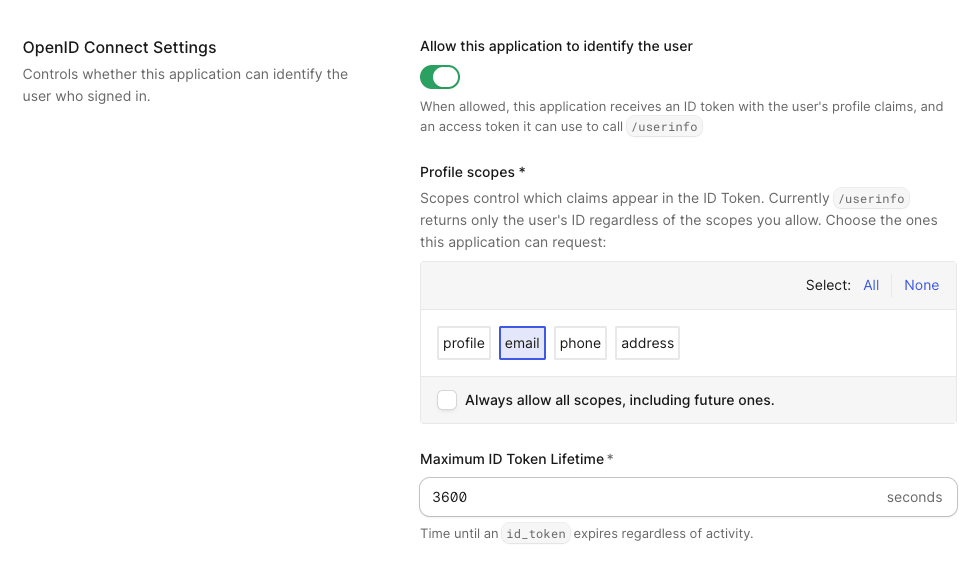
JumpCloud now auto-revokes or suspends when a certification decision is finalized or its deadline expires, plus a tamper-proof export for auditors — closing the usual gap where a reviewer clicks revoke and a human later forgets to act on the spreadsheet. Auth0's OIDCOIDCOpenID Connect, a sign-in protocol built on OAuth 2.0. An application uses identity information from a trusted provider instead of maintaining a separate password for each user. for third-party apps hits GA with per-app scope controls, so external integrations get a bounded grant instead of a shared one.
Ship coverage for deserialization, cache smuggling and C2 tunneling without writing it
v6.11.0's 17 detections and 3 analytic stories cover Java deserializationdeserializationTurning stored or transmitted data back into objects a program can use. Unsafe handling of untrusted data can allow unexpected behavior or code execution., Linux service-account abuse, browser cache smuggling, command-line evasion and C2 tunneling, with a Linux-specific Sysmon macro split out so endpoint and Linux telemetry stop fighting over one field mapping. AI DFIRDFIRDigital forensics and incident response, investigating what happened during a security incident and containing it. The work includes preserving evidence, reconstructing activity and restoring systems. Toolkit adds six SigmaSigmaAn open, vendor-neutral rule format for describing patterns in log data, maintained by the Sigma project community, giving cyber tools a shared detection language that converts into platform-specific queries. rules for Entra app abuse and SSH tunnels plus downloadable IOCIOCAn indicator of compromise, an observable clue that may point to malicious activity, such as a suspicious file hash or domain. It is evidence to investigate, rather than proof by itself. feeds.
Three unrelated things stand out today: StepSecurity can now put a blocking layer in front of JavaScript installs in CI, Veracode added repository-wide package blocking, and JumpCloud can turn access-review decisions into actual revocations instead of tickets.
protect
Block risky packages before they land in builds
StepSecurity’s Secure Registry routes npm, npx, pnpm, and Bun installs through a layer that blocks malicious packages and delays new releases; Veracode’s Package Firewall blocks untrusted packages across repositories. That moves dependency defense from after-the-fact scanning toward preventing a bad package from entering the build path at all.
JumpCloud now automates access revocation and suspension when certification decisions are finalized or deadlines expire, and adds tamper-proof certification exports. Review outcomes no longer have to become manual follow-up work before they reduce access.
Add ready-made detections for current attack techniques
Splunk Security Content added 17 detections and 3 analytic stories across Java deserializationdeserializationTurning stored or transmitted data back into objects a program can use. Unsafe handling of untrusted data can allow unexpected behavior or code execution., Linux service-account abuse, browser cache smuggling, command-line evasion, and C2 tunneling; AI DFIRDFIRDigital forensics and incident response, investigating what happened during a security incident and containing it. The work includes preserving evidence, reconstructing activity and restoring systems. Toolkit added SigmaSigmaAn open, vendor-neutral rule format for describing patterns in log data, maintained by the Sigma project community, giving cyber tools a shared detection language that converts into platform-specific queries. rules for Entra app abuse and SSH tunnels plus downloadable IOCIOCAn indicator of compromise, an observable clue that may point to malicious activity, such as a suspicious file hash or domain. It is evidence to investigate, rather than proof by itself. feeds. Teams get more coverage they can adapt instead of starting each hunt from scratch.
Reduce accidental host exposure from sandboxed workloads
minimal replaced its single host-port exposure environment variable with a live-reloading [host-exposures] table in config.toml. Operators can narrow which host ports boxes may reach without restarting everything, reducing the chance that a convenience exposure becomes a standing escape path.
Empire 7.1.0 adds container-friendly file logging with rotation controls and listener support for a separate public port behind reverse proxies, alongside a major hardening of the agent communication protocol (handshake-signed Ed25519Ed25519A fast elliptic-curve signature scheme with small keys, the default for new SSH keys and common in code signing. It is not quantum-safe. signatures, HKDFHKDFA key-derivation function defined in RFC 5869 that stretches or diversifies a secret using HMAC, giving cyber tools a standard way to produce cryptographically strong keys from shared secrets or raw entropy.-derived AESAESA symmetric block cipher standardized by NIST that encrypts data in 128-bit blocks using 128-, 192-, or 256-bit keys; tools use it because hardware acceleration makes it fast enough for bulk encryption./HMACHMACA keyed hash that proves a message came from someone holding a shared secret and was not altered. Webhooks and API request signing commonly use it. keys) and a string of breaking changes to listeners, stagers, module file options, and the OpenAPIOpenAPIA vendor-neutral specification for describing REST APIs in a machine-readable format, maintained by the OpenAPI Initiative. Cyber tools use it to auto-generate clients, documentation, and validation from a single source of truth. schema.︀︄︇︀︅︉︀︅︀︀︃︀︀︅︅︀︅︊︀︄︆︀︃︄
Powershell-empire is an empire is a post-exploitation and adversary emulation framework that is used to aid Red Teams and Penetration Testers.
Empire 7.1.0 adds container-friendly file logging with rotation controls and listener support for a separate public port behind reverse proxies, alongside a major hardening of the agent communication protocol (handshake-signed Ed25519Ed25519A fast elliptic-curve signature scheme with small keys, the default for new SSH keys and common in code signing. It is not quantum-safe. signatures, HKDFHKDFA key-derivation function defined in RFC 5869 that stretches or diversifies a secret using HMAC, giving cyber tools a standard way to produce cryptographically strong keys from shared secrets or raw entropy.-derived AESAESA symmetric block cipher standardized by NIST that encrypts data in 128-bit blocks using 128-, 192-, or 256-bit keys; tools use it because hardware acceleration makes it fast enough for bulk encryption./HMACHMACA keyed hash that proves a message came from someone holding a shared secret and was not altered. Webhooks and API request signing commonly use it. keys) and a string of breaking changes to listeners, stagers, module file options, and the OpenAPIOpenAPIA vendor-neutral specification for describing REST APIs in a machine-readable format, maintained by the OpenAPI Initiative. Cyber tools use it to auto-generate clients, documentation, and validation from a single source of truth. schema.︀︄︇︀︅︉︀︅︀︀︃︀︀︅︅︀︅︊︀︄︆︀︃︄
└──▷ WHAT SHIPPED ·
6 FEATURES3 OF 6 FEATURESmost completely described firstwhat's the number?
Each feature carries 0–100 for how completely the vendor documented
it — not how big or important the work is. A major capability
described in eight words scores low, and that is the finding.
depth0–40what it does and how it works or what changed
specificity0–30names real surfaces — APIs, flags, formats, limits, numbers
actionability0–30enough to go use it — a named endpoint, flag, or config key tops this; a UI path is a starting point
Code and config rank first by construction: a documented endpoint,
flag or config key scores at the top of specificity and actionability,
so it sorts above a feature described only in prose. Under
60 the notes go thin — everything below the “thinner
coverage” line is thinner documentation, not smaller work.
Hover any meter for that feature's three sub-scores.
0100
File logging with rotation controlsNot checked yetnew95how completely this was documenteddepth35/40specificity30/30actionability30/3095 / 100
Empire now supports file logging with rotation when run in containers, controlled via logging.file_logging, logging.max_bytes, and logging.backup_count in server config, or the EMPIRE_LOGGING__FILE_LOGGING environment variable.︀︄︇︀︅︉︀︅︀︀︃︀︀︅︅︀︅︊︀︄︆︀︃︄ empire_server.log and listener_<name>.log rotate by default at 10 MB with 5 backups; set logging.max_bytes: 0 for unbounded logs.
Run Empire in a container with log output going only to the console, or enable file logging with rotation limits so logs do not grow unbounded.
— Full config keys, env var and defaults with runnable examplesv7.1.0
0201
Agent protocol crypto hardeningNot checked yetbreaking80how completely this was documenteddepth35/40specificity25/30actionability20/3080 / 100
STAGE1 Ed25519 signatures now cover the full handshake transcript instead of the constant "SIGNATURE", and the AES-CBC payload layer derives separate AES and HMAC keys from the shared key via HKDF-SHA256SHA256A cryptographic hash function that turns data into a fixed 256-bit fingerprint. It is used to check integrity; hashing does not encrypt the original data. (empire-enc / empire-mac) instead of reusing one key. Both changes break compatibility with pre-7.1 agents and existing sessions, so agents must be re-staged.
— Clear mechanism and before/after with migration notev7.1.0
0300
Listener and stager default behavior changesNot checked yetbreaking78how completely this was documenteddepth30/40specificity28/30actionability20/3078 / 100
The linux/pyinstaller stager's BinaryFile option is now a bare file name defaulting to empire rather than /tmp/empire, with any directory component ignored. The http and http_malleable listeners now serve their configured default response instead of a Werkzeug 500 page for any error that escapes a view. The http_hop listener's OutFolder is now relative to downloads/http_hop and defaults to redirectors; hop listeners stored with an absolute path outside it no longer start.
— Names each option and its new default across three surfacesv7.1.0
0402
OpenAPI operation id and tag restructuringNot checked yetbreaking73how completely this was documenteddepth30/40specificity28/30actionability15/3073 / 100
OpenAPI operation ids are now {tag}_{route name} (e.g. agents_read_agent) instead of FastAPI's path-and-method default, renaming the three generated Body_* request schemas, so every generated client method name changes. Agent-task and plugin-task routes are now tagged with only their primary resource, dropping the tasks tag group, and the /api/v2/obfuscation routes moved from the keywords tag to obfuscation.
— Names exact operation id pattern, tags and routes affectedv7.1.0
0503
Module file options restricted to downloads directoryNot checked yetbreaking62how completely this was documenteddepth25/40specificity22/30actionability15/3062 / 100
The ExtFile, File, and Shellcode module options must now name a path inside the server's downloads directory; saved workflows pointing elsewhere are rejected until the file is uploaded through the API.
— Names exact options and new constraint, no example givenv7.1.0
thinner coverage below
0600
Separate public port for listeners behind reverse proxiesNot checked yetnew30how completely this was documenteddepth15/40specificity10/30actionability5/3030 / 100
Listeners can now advertise a separate public port for reverse-proxy deployments, so the externally visible port can differ from the port the listener actually binds to.
— No config key or flag named, mechanism unclearv7.1.0
└──▷ BREAKING ON UPGRADE
!
STAGE1 Ed25519 signatures now cover the handshake transcript instead of the constant "SIGNATURE"; re-stage all pre-7.1 agents or they will fail to connect.
!
The AES-CBC payload layer now derives separate AES and HMAC keys from the shared key with HKDF-SHA256 (empire-enc / empire-mac) instead of reusing one key; existing sessions are incompatible.
!
The linux/pyinstaller stager's BinaryFile option is now a bare file name defaulting to empire rather than /tmp/empire; any directory component is ignored.
!
The http and http_malleable listeners now serve their default response instead of a Werkzeug 500 page for any error that escapes a view.
!
The http_hop listener's OutFolder is now relative to downloads/http_hop and defaults to redirectors; hop listeners stored with an absolute path outside it no longer start.
!
OpenAPI operation ids are now {tag}_{route name} (e.g. agents_read_agent) instead of FastAPI's path-and-method default, renaming the three generated Body_* request schemas; every generated client method name changes.
!
The agent-task and plugin-task routes are now tagged with only their primary resource, dropping the tasks tag group.
!
The /api/v2/obfuscation routes moved from the keywords tag to obfuscation.
!
empire_server.log and listener_<name>.log now rotate at 10 MB with 5 backups, deleting older data; set logging.max_bytes: 0 for unbounded logs.
!
The ExtFile, File, and Shellcode module options must now name a path inside the server's downloads directory; saved workflows pointing elsewhere are rejected until the file is uploaded through the API.
Starkiller v4.1.0 restores several agent terminal commands that had been removed with the Empire CLI, letting operators manage agents directly without leaving the terminal.︀︄︇︀︅︉︀︅︀︀︃︀︀︅︅︀︅︊︀︄︆︀︃︄
Starkiller is a Frontend for Empire.
Starkiller v4.1.0 restores several agent terminal commands that had been removed with the Empire CLI, letting operators manage agents directly without leaving the terminal.︀︄︇︀︅︉︀︅︀︀︃︀︀︅︅︀︅︊︀︄︆︀︃︄
└──▷ WHAT SHIPPED ·
1 FEATURE0 OF 1 FEATUREmost completely described firstwhat's the number?
Each feature carries 0–100 for how completely the vendor documented
it — not how big or important the work is. A major capability
described in eight words scores low, and that is the finding.
depth0–40what it does and how it works or what changed
specificity0–30names real surfaces — APIs, flags, formats, limits, numbers
actionability0–30enough to go use it — a named endpoint, flag, or config key tops this; a UI path is a starting point
Code and config rank first by construction: a documented endpoint,
flag or config key scores at the top of specificity and actionability,
so it sorts above a feature described only in prose. Under
60 the notes go thin — everything below the “thinner
coverage” line is thinner documentation, not smaller work.
Hover any meter for that feature's three sub-scores.
0100
Restored agent terminal commandsNot checked yetnew75how completely this was documenteddepth25/40specificity25/30actionability25/3075 / 100
The agent terminal now supports download, kill_date, working_hours, kill_job, kill, and rename commands, restoring verbs that were previously removed from the Empire CLI.︀︄︇︀︅︉︀︅︀︀︃︀︀︅︅︀︅︊︀︄︆︀︃︄ kill and rename update the agent list immediately without requiring a manual refetch.
Terminate a running agent job and schedule a kill date without leaving the agent terminal.
📍In the agent terminal, type kill_job to stop a specific job, or kill_date to set a future termination time, or kill to task the agent to exit — the agent list updates immediately without a manual refetch.
— Names exact commands and behavior, but lacks deeper mechanism detail.v4.1.0
OCInferno adds a points_to column to the Network Inventory report and now matches --exclude-node against display names as well as node IDs︀︄︇︀︅︉︀︅︀︀︃︀︀︅︅︀︅︊︀︄︆︀︃︄
Attack pathAttack pathA possible sequence of steps an attacker could take to reach a valuable target. It connects weaknesses, permissions and reachable systems rather than treating each finding separately. exclusions via --exclude-node now match against a node's display name in addition to its internal ID, so human-readable labels can be used to exclude nodes.︀︄︇︀︅︉︀︅︀︀︃︀︀︅︅︀︅︊︀︄︆︀︃︄ Not checked yet
Isr-evilgrade is an evilgrade is a modular framework that allows the user to take advantage of poor upgrade implementations by injecting fake updates.
isr-evilgrade v3.0.0 ships a Docker-based deployment path with automated DNS/MITMMITMA man-in-the-middle attack, where an adversary secretly intercepts and optionally alters traffic between two parties who believe they are communicating directly. Cyber tools use it to inspect or manipulate encrypted sessions. setup, new MITM interception modules for git clone and curl|sh installer vectors, SSLSSLA cryptographic protocol for encrypting network connections, now deprecated in favor of TLS but whose name persists colloquially. Cyber tools reference it when handling HTTPS or other encrypted-channel inspection and termination. certificate and recursive-loader improvements to the update-chain modules, a SolarWinds Orion interception module, and a bulk Perl script to generate modules for the full CVE database.︀︄︇︀︅︉︀︅︀︀︃︀︀︅︅︀︅︊︀︄︆︀︃︄
└──▷ WHAT SHIPPED ·
5 FEATURES0 OF 5 FEATURESmost completely described firstwhat's the number?
Each feature carries 0–100 for how completely the vendor documented
it — not how big or important the work is. A major capability
described in eight words scores low, and that is the finding.
depth0–40what it does and how it works or what changed
specificity0–30names real surfaces — APIs, flags, formats, limits, numbers
actionability0–30enough to go use it — a named endpoint, flag, or config key tops this; a UI path is a starting point
Code and config rank first by construction: a documented endpoint,
flag or config key scores at the top of specificity and actionability,
so it sorts above a feature described only in prose. Under
60 the notes go thin — everything below the “thinner
coverage” line is thinner documentation, not smaller work.
Hover any meter for that feature's three sub-scores.
0100
Docker-based deployment with automated MITM setupNot checked yetnew90how completely this was documenteddepth30/40specificity30/30actionability30/3090 / 100
Adds a docker-setup.sh script and docker-compose.yml to run evilgrade in a container with automated DNS and MITM configuration, exposing ports 80, 443, 8080, and 8443.︀︄︇︀︅︉︀︅︀︀︃︀︀︅︅︀︅︊︀︄︆︀︃︄
Run the container directly with the required network capabilities and bind all interception ports to the host
Bulk module generation for full CVE databaseNot checked yetnew65how completely this was documenteddepth20/40specificity20/30actionability25/3065 / 100
A generate_all_modules.pl Perl script bulk-generates interception modules for the full CVE database in one pass.
Bulk-generate Perl interception modules for the full CVE database in one pass
$ perl generate_all_modules.pl
— Names exact script and gives a runnable command to run it.v3.0.0
thinner coverage below
0300
New MITM modules for git clone and curl|sh installer vectorsNot checked yetnew55how completely this was documenteddepth20/40specificity25/30actionability10/3055 / 100
Adds a git clone MITM module that serves a trojanized payload and a curl|sh installer MITM module targeting the eMudhra CA vector.
— Names two modules and their targets but gives no flags or commands.v3.0.0
0400
SSL certificate support and recursive loader for update-chain modulesNot checked yetimproved35how completely this was documenteddepth15/40specificity15/30actionability5/3035 / 100
Adds selectable SSL certificate support and a recursive loader to the update-chain module set.
— Describes the addition but gives no concrete config or usage.v3.0.0
0500
SolarWinds Orion update-interception moduleNot checked yetnew20how completely this was documenteddepth10/40specificity10/30actionability0/3020 / 100
Adds a module for intercepting SolarWinds Orion update requests, per the release summary; no further implementation detail is provided.
— Only named in the summary, with no mechanism or usage detail.v3.0.0
GitGuardian Self-Hosted is a secrets detection platform deployed on-premises that scans code repositories to find and remediate exposed credentials and sensitive data.
GitGuardian Self-Hosted's 2026.11 release adds 11 new secret detectors and 3 new analyzers, overhauls the Google Artifact Registry integration with keyless auth, and ships several breaking changes — including restricting email/password auth to the dashboard, defaulting Jira/Confluence historical scans to DB-less scanning, and blocking upgrades while background migrations are pending.︀︄︇︀︅︉︀︅︀︀︃︀︀︅︅︀︅︊︀︄︆︀︃︄ It also adds a dedicated worker pod for batch tasks and new Helm config options for encryption key isolation and node scheduling.
└──▷ WHAT SHIPPED ·
9 FEATURES3 OF 9 FEATURESmost completely described firstwhat's the number?
Each feature carries 0–100 for how completely the vendor documented
it — not how big or important the work is. A major capability
described in eight words scores low, and that is the finding.
depth0–40what it does and how it works or what changed
specificity0–30names real surfaces — APIs, flags, formats, limits, numbers
actionability0–30enough to go use it — a named endpoint, flag, or config key tops this; a UI path is a starting point
Code and config rank first by construction: a documented endpoint,
flag or config key scores at the top of specificity and actionability,
so it sorts above a feature described only in prose. Under
60 the notes go thin — everything below the “thinner
coverage” line is thinner documentation, not smaller work.
Hover any meter for that feature's three sub-scores.
0101
Jira Cloud and Confluence Cloud default to DB-less historical scansNot checked yetbreaking90how completely this was documenteddepth30/40specificity30/30actionability30/3090 / 100
Jira Cloud and Confluence Cloud historical scans now use the DB-less scan framework by default, turning on the DB-less scan flag for each integration in the Admin Area even where it had been turned off.︀︄︇︀︅︉︀︅︀︀︃︀︀︅︅︀︅︊︀︄︆︀︃︄ Dedicated pods can be scaled for these scans via Helm, e.g. celeryWorkers.scanners-db-less-jira-cloud.replicas and celeryWorkers.scanners-db-less-confluence-cloud.replicas in values.yaml.
Run Jira Cloud and Confluence Cloud DB-less historical scans on dedicated pods to avoid contending with other scanner workloads.
Dedicated node group scheduling via global Helm valuesNot checked yetnew85how completely this was documenteddepth25/40specificity30/30actionability30/3085 / 100
Global Helm values global.nodeSelector, global.tolerations, and global.priorityClassName can be set to schedule ClickHouse, Keeper, and MinIO pods onto a dedicated node group.
Schedule ClickHouse, Keeper, and MinIO pods onto a dedicated node group by propagating global Helm placement values.
ClickHouse encryption key isolationNot checked yetnew80how completely this was documenteddepth25/40specificity25/30actionability30/3080 / 100
The miscEncryption.existingSecretKeys.clickhouseEncryptionKeys key in values.yaml isolates ClickHouse encryption from PostgreSQL, so a leaked PostgreSQL key does not expose ClickHouse data.
Isolate ClickHouse encryption from PostgreSQL so a leaked PostgreSQL key does not expose ClickHouse data.
Google Artifact Registry integration: keyless auth and health checksNot checked yetimproved70how completely this was documenteddepth30/40specificity25/30actionability15/3070 / 100
Google Artifact Registry integrations now support keyless connection with Workload Identity and flag unhealthy installations; admins can update a service account key without reinstalling. The migration to the new integration version must finish before upgrading to 2027.4.
Dedicated worker pod for batch tasksNot checked yetimproved65how completely this was documenteddepth30/40specificity25/30actionability10/3065 / 100
Batched tasks such as validity checks now run on a dedicated worker-batch-task-worker pod (1 replica, autoscales to 5) instead of blocking worker-celery pods.
Dashboard-only email/password authenticationNot checked yetbreaking60how completely this was documenteddepth25/40specificity15/30actionability20/3060 / 100
Email and password authentication is now accepted only to sign in to the dashboard; scripts that called other endpoints with an email and password must switch to using an API token instead.
Upgrade blocked while background migrations are pendingNot checked yetbreaking60how completely this was documenteddepth25/40specificity20/30actionability15/3060 / 100
An upgrade to 2026.11 is refused while background data migrations started in 2026.8 and 2026.9 are still running; operators must wait for them to finish on the current version before retrying.
New secret detectors and analyzersNot checked yetnew45how completely this was documenteddepth15/40specificity25/30actionability5/3045 / 100
Adds 11 new secret detectors across v2.174 and v2.175, including Codex, Composio, and HubSpot keys, plus 3 new analyzers: GoCardless, Adobe, and Weights & Biases.
Public API ticket unlink and clear-text occurrence retrievalNot checked yetnew30how completely this was documenteddepth15/40specificity10/30actionability5/3030 / 100
The public API can now unlink a ticket from an incident and return the content of an occurrence in clear text.
Email and password authentication is now accepted only to sign in to the dashboard; scripts that called other endpoints with an email and password must use an API token instead.
!
Jira Cloud and Confluence Cloud historical scans now use the DB-less scan framework by default, turning on the DB-less scan flag for each integration in the Admin Area even where it had been turned off.
!
An upgrade to 2026.11 is refused while background data migrations started in 2026.8 and 2026.9 are still running; wait for them to finish on the current version before retrying.
!
The Google Artifact Registry migration to the new integration version must finish before upgrading to 2027.4.
Infisical is the open-source platform for securing secrets, certificates, access, and AI Agents.
Infisical's latest release adds new secret sync targets for Convex and Cloudflare Workers Preview environments, org-level certificate search, automatic revocation of Intune SCEPSCEPSimple Certificate Enrollment Protocol, an IETF-standardized protocol for automating X.509 certificate issuance and renewal over HTTP, letting cyber tools request PKI certificates from a CA without manual intervention. certificates, honey-token alert routing, and several Agent Vault visibility and session improvements.︀︄︇︀︅︉︀︅︀︀︃︀︀︅︅︀︅︊︀︄︆︀︃︄
└──▷ WHAT SHIPPED ·
5 FEATURES0 OF 5 FEATURESmost completely described firstwhat's the number?
Each feature carries 0–100 for how completely the vendor documented
it — not how big or important the work is. A major capability
described in eight words scores low, and that is the finding.
depth0–40what it does and how it works or what changed
specificity0–30names real surfaces — APIs, flags, formats, limits, numbers
actionability0–30enough to go use it — a named endpoint, flag, or config key tops this; a UI path is a starting point
Code and config rank first by construction: a documented endpoint,
flag or config key scores at the top of specificity and actionability,
so it sorts above a feature described only in prose. Under
60 the notes go thin — everything below the “thinner
coverage” line is thinner documentation, not smaller work.
Hover any meter for that feature's three sub-scores.
0100
Secrets sync for Convex and Cloudflare Workers PreviewNot checked yetnew55how completely this was documenteddepth20/40specificity20/30actionability15/3055 / 100
Adds a Convex secret sync integration, letting teams push secrets directly to Convex projects, and extends the existing Cloudflare Workers sync target to also sync secrets to a Preview environment.︀︄︇︀︅︉︀︅︀︀︃︀︀︅︅︀︅︊︀︄︆︀︃︄
— Names two sync targets but no setup steps givenv0.167.13
0200
Agent Vault session and admin visibility improvementsNot checked yetimproved55how completely this was documenteddepth25/40specificity20/30actionability10/3055 / 100
Agent Vault sessions now include named project services and selected skills when a session is created. OAuth variables can now be reused across services. The Organization Overview card shows a skills count, and admins are emailed when free-request usage hits 75% and 100% of the plan limit.
— Groups four thin Agent Vault additions, no config keys namedv0.167.13
0300
Automatic revocation of Intune SCEP certificatesNot checked yetnew50how completely this was documenteddepth25/40specificity15/30actionability10/3050 / 100
Infisical's PKIPKIA framework of policies, roles, and cryptographic standards for issuing and managing digital certificates that bind public keys to identities, letting tools verify authenticity and encrypt communications without pre-shared secrets. now revokes Intune SCEP certificates automatically when Intune queues their revocation.
— Mechanism described but no config or endpoint namedv0.167.13
0400
Org-level certificate search with computed statusNot checked yetnew45how completely this was documenteddepth20/40specificity15/30actionability10/3045 / 100
Adds org-level certificate search with computed status, letting practitioners find and inspect PKI certificates across the whole organization from one view.
Honey-token alerts routed through alerts systemNot checked yetimproved30how completely this was documenteddepth15/40specificity10/30actionability5/3030 / 100
Honey-token trigger notifications are now routed through the alerts system instead of being sent directly.
— Thin one-line change, no mechanism or config detailv0.167.13
StackHawk is an application security tool built for developers. Automated scanning for the entire dev pipeline combined with continuous documentation and remediation.
StackHawk adds per-rule alert limits, MCPMCPModel Context Protocol, a standard for connecting AI applications to external tools and data sources. A compatible server exposes capabilities an assistant can use through a common interface. type-array support, new HAWK_INSTALL_CHANNEL and HAWK_NO_MODIFY_PATH env vars, and several hawk op CLI improvements.
Control how many alerts each scan rule reports to the platform by setting per-rule alert limits from the StackHawk scan policy — HawkScan keeps testing after the limit and surfaces the highest risk and confidence alerts first. Not checked yet
Set HAWK_INSTALL_CHANNEL=dev to install the newest development build of HawkScan instead of the newest stable release. Not checked yet
Set HAWK_NO_MODIFY_PATH=1 to prevent install scripts from adding the install directory to your shell profile or Windows user Path. Not checked yet
Install scripts now place HawkScan in ~/.local/bin (or %USERPROFILE%\.local\bin on Windows) by default instead of the previous location. Not checked yet
MCP server scanning now accepts JSON Schema type arrays (e.g. ["string", "null"]) used by the MCP C# SDK for optional parameters, so discovery no longer halts on those schemas. Not checked yet
+6 moreshow less
Control the number of saved scan sessions on disk with NUM_STORED_SESSIONS; HawkScan now defaults to keeping the three newest sessions plus the current one. Not checked yet
hawk op repo link now adds an application to a repository's existing list rather than replacing it. Not checked yet
Link an existing application by name without creating one using hawk op repo link --app-name. Not checked yet
hawk op repo list JSON now includes each repository's id field. Not checked yet
hawk op scan get now shows every alert type and accepts --max-paths. Not checked yet
hawk op scan list JSON output is now structured. Not checked yet
!Install scripts now install HawkScan to ~/.local/bin by default; pipelines that added the previous location to PATH (e.g. via $GITHUB_PATH or $BASH_ENV) must be updated to use ~/.local/bin instead.
!hawk op repo link --app-name no longer creates a new application if the name is not found — it fails and changes nothing; run hawk op app create first to create the application.
Semgrep adds structured JSON scan logging via SEMGREP_LOG_JSON_FILE, lets any MCPMCPModel Context Protocol, a standard for connecting AI applications to external tools and data sources. A compatible server exposes capabilities an assistant can use through a common interface. client run jobs with semgrep_run_job, and expands Supply ChainSupply ChainThe network of vendors, dependencies, and build processes that produce and deliver software; cyber tools target it because a compromise anywhere upstream can silently backdoor every downstream consumer. to flag Python dependencies declared with version ranges or no pinned version; smaller updates cover PHP trait cross-file analysis, Go parsing, Editor filtering, and Policies page visibility.︀︄︇︀︅︉︀︅︀︀︃︀︀︅︅︀︅︊︀︄︆︀︃︄
Get started with Semgrep to help you catch, flag, and fix real vulnerabilities before they ship.
Semgrep adds structured JSON scan logging via SEMGREP_LOG_JSON_FILE, lets any MCPMCPModel Context Protocol, a standard for connecting AI applications to external tools and data sources. A compatible server exposes capabilities an assistant can use through a common interface. client run jobs with semgrep_run_job, and expands Supply ChainSupply ChainThe network of vendors, dependencies, and build processes that produce and deliver software; cyber tools target it because a compromise anywhere upstream can silently backdoor every downstream consumer. to flag Python dependencies declared with version ranges or no pinned version; smaller updates cover PHP trait cross-file analysis, Go parsing, Editor filtering, and Policies page visibility.︀︄︇︀︅︉︀︅︀︀︃︀︀︅︅︀︅︊︀︄︆︀︃︄
└──▷ WHAT SHIPPED ·
10 FEATURES0 OF 10 FEATURESmost completely described firstwhat's the number?
Each feature carries 0–100 for how completely the vendor documented
it — not how big or important the work is. A major capability
described in eight words scores low, and that is the finding.
depth0–40what it does and how it works or what changed
specificity0–30names real surfaces — APIs, flags, formats, limits, numbers
actionability0–30enough to go use it — a named endpoint, flag, or config key tops this; a UI path is a starting point
Code and config rank first by construction: a documented endpoint,
flag or config key scores at the top of specificity and actionability,
so it sorts above a feature described only in prose. Under
60 the notes go thin — everything below the “thinner
coverage” line is thinner documentation, not smaller work.
Hover any meter for that feature's three sub-scores.
0100
Structured JSON scan logging via env variableNot checked yetnew90how completely this was documenteddepth30/40specificity30/30actionability30/3090 / 100
Setting the SEMGREP_LOG_JSON_FILE environment variable to a file path makes Semgrep write one JSON object per line for each scan phase start, finish, warning, and error, tagged with scan details, for use with tools like jq or log pipelines.︀︄︇︀︅︉︀︅︀︀︃︀︀︅︅︀︅︊︀︄︆︀︃︄
— Names exact env var and line-delimited JSON output formatsnapshot-20261119
0200
Version-range dependency findings in Supply ChainNot checked yetnew85how completely this was documenteddepth30/40specificity30/30actionability25/3085 / 100
Semgrep Supply Chain now reports findings for Python dependencies declared in requirements.txt with a version range (e.g. litellm>=1.10) or without a version (e.g. flask), labeled Needs review; requires Semgrep CLI version 1.184.0 or later.
— Names file, concrete examples, and minimum CLI versionsnapshot-20261119
0300
Run scan and workflow jobs via MCP toolNot checked yetnew70how completely this was documenteddepth20/40specificity25/30actionability25/3070 / 100
Any MCP client can now run scan and workflow jobs using the semgrep_run_job tool, including clients that do not support MCP tasks.
SSRF-scoped memories for AI detection triageNot checked yetnew65how completely this was documenteddepth20/40specificity25/30actionability20/3065 / 100
Users can write memories scoped to server-side request forgeryserver-side request forgeryServer-side request forgery, an attack that tricks a server into making requests chosen by an attacker. Those requests can reach internal services the attacker cannot access directly. (SSRFSSRFServer-side request forgery, an attack that tricks a server into making requests chosen by an attacker. Those requests can reach internal services the attacker cannot access directly.) triage by selecting SSRF under AI Detection in Rules when adding a memory in Rules & Policies > Memories.
Paginated rule browsing and filtering in EditorNot checked yetimproved65how completely this was documenteddepth25/40specificity25/30actionability15/3065 / 100
The Semgrep Editor now loads rules in pages and supports filtering by language, source, severity, visibility, and authorship, as well as grouping by folder or ruleset.
— Lists specific filter and grouping options, UI-onlysnapshot-20261119
0600
Guardian-only rules visible in Policies pageNot checked yetnew65how completely this was documenteddepth25/40specificity20/30actionability20/3065 / 100
Guardian-only Semgrep Code rules are now visible in the Policies page rules list, labeled Guardian only, and can be added to the Semgrep Code policy by enabling CI on them.
Audit logging for hosted MCP server actionsNot checked yetimproved55how completely this was documenteddepth25/40specificity20/30actionability10/3055 / 100
Audit logs now record when an action was taken through the hosted MCP server, naming the MCP tool and client that took the action; MCP tool calls that change data now write an audit event even when the underlying action did not previously do so.
— Describes behavior change but no UI path or endpointsnapshot-20261119
0800
Go parsing support for generics and chained indexingNot checked yetimproved55how completely this was documenteddepth25/40specificity25/30actionability5/3055 / 100
Go parsing now supports generic type aliases, mixed unnamed map parameters or results, and chained indexing such as table[key][next] represented as nested index expressions.
— Names specific language constructs, no usage examplesnapshot-20261119
0900
Specific error messages for Supply Chain scan failuresNot checked yetimproved50how completely this was documenteddepth20/40specificity20/30actionability10/3050 / 100
Supply Chain scan error alerts on the Projects page now show a message per error type (e.g. Lockfile parsing failed or Dependency resolution failed) instead of a generic warning.
— Concrete example messages but no resolution guidancesnapshot-20261119
1000
Cross-file analysis for PHP trait methodsNot checked yetimproved40how completely this was documenteddepth20/40specificity15/30actionability5/3040 / 100
Semgrep Code now follows calls to PHP methods that come from traits, expanding cross-file analysis coverage to trait-based code.
— States capability only, no example or scope detailsnapshot-20261119
GitHub is a web-based platform for version control and collaborative software development using Git repositories.
GitHub shipped an event-driven alternative to PR polling in the CLI, added the Gemini 4 Neon model to Copilot, turned on automatic security risk assessments for GitHub Team orgs, and let teams set shared Copilot Agent Plugin defaults.︀︄︇︀︅︉︀︅︀︀︃︀︀︅︅︀︅︊︀︄︆︀︃︄
└──▷ WHAT SHIPPED ·
4 FEATURES0 OF 4 FEATURESmost completely described firstwhat's the number?
Each feature carries 0–100 for how completely the vendor documented
it — not how big or important the work is. A major capability
described in eight words scores low, and that is the finding.
depth0–40what it does and how it works or what changed
specificity0–30names real surfaces — APIs, flags, formats, limits, numbers
actionability0–30enough to go use it — a named endpoint, flag, or config key tops this; a UI path is a starting point
Code and config rank first by construction: a documented endpoint,
flag or config key scores at the top of specificity and actionability,
so it sorts above a feature described only in prose. Under
60 the notes go thin — everything below the “thinner
coverage” line is thinner documentation, not smaller work.
Hover any meter for that feature's three sub-scores.
0100
Event-driven PR waiting in GitHub CLINot checked yetnew93how completely this was documenteddepth35/40specificity28/30actionability30/3093 / 100
gh event listen <PR-URL> --count <n> --follow --timeout <duration> --jq <expr> --template <tmpl> waits for pull request events via Event StreamsEvent StreamsAn ordered, append-only log of discrete events published by producers and consumed by subscribers, often in real time; tools use it to process high-volume telemetry without losing ordering or dropping records under load. instead of polling in a loop, printing each event as a line of JSON and exiting after the first by default.︀︄︇︀︅︉︀︅︀︀︃︀︀︅︅︀︅︊︀︄︆︀︃︄ Subscriptions can be managed directly with gh event subscription create, list, view, and delete. Supported event types include submitted reviews, pull request state and head changes, merge conflicts, and completed check suites, and gh pr create, gh pr view, gh run view, gh run watch, and gh api now suggest gh event listen instead of polling when an event-driven alternative exists.
Block a CI script until a PR review is submitted, then act on the reviewer's decision without a polling loop.
Team-level Agent Plugin defaults for CopilotNot checked yetnew72how completely this was documenteddepth30/40specificity22/30actionability20/3072 / 100
Maintainers can set shared Agent Plugin defaults for a team by opening the team page on github.com and selecting the Customize Copilot tab; plugins are enabled by default for direct members in VS Code, the GitHub Copilot app, and Copilot CLI. A plugin marketplace can be added from any GitHub repository containing a plugin marketplace via the same tab, making its plugins available to browse and enable for the team. Team plugin defaults are optional and member-overridable where policy permits, and enterprise and organization policies still take precedence over team choices.
When onboarding a new team, set shared Agent Plugin defaults once so every direct member gets the right plugins in VS Code and Copilot CLI without individual setup.
📍1. Go to your organization on github.com and open the target team.
2. Select the Customize Copilot tab.
3. Browse plugins from your enterprise or team marketplaces and add the plugins your team requires.
4. Optionally, add a marketplace by supplying a GitHub repository that contains a plugin marketplace.
Gemini 4 Neon model in CopilotNot checked yetnew53how completely this was documenteddepth20/40specificity18/30actionability15/3053 / 100
GitHub Copilot adds Gemini 4 Neon, a model built for agentic coding, multistep tool usetool useA model's ability to answer with a structured request to run a named function or API, which the application executes and returns. It is how agents take actions., and knowledge work. It can be selected from the model picker in Visual Studio Code, JetBrains, Xcode, Eclipse, Copilot CLI, github.com, GitHub Mobile, or the Copilot app, offering faster first-token response and fewer unrequested code changes.
Select Gemini 4 Neon for an agentic coding task in Copilot CLI to get faster first-token response and fewer unrequested code changes.
📍In the model picker (Visual Studio Code, JetBrains, Xcode, Eclipse, Copilot CLI, github.com, GitHub Mobile, or the Copilot app), select Gemini 4 Neon from the list of available models.
— Names surfaces and benefit but no mechanism detailGemini 4 Neon in GitHub Copilot (2026-11-18)
0400
Automatic security risk assessments on GitHub TeamNot checked yetnew30how completely this was documenteddepth15/40specificity10/30actionability5/3030 / 100
Security risk assessments now run automatically for organizations on GitHub Team, letting organization admins and security managers review findings on exposed credentials and code vulnerabilities without manual setup.
GitHub Copilot adds eight GitHub-verified MCPMCPModel Context Protocol, a standard for connecting AI applications to external tools and data sources. A compatible server exposes capabilities an assistant can use through a common interface. server connectors in public preview, reachable from the Copilot app, CLI (/mcp), VS Code Agents window, and github.com.
Add new MCP connectors to Copilot from the CLI by running /mcp, switching to the Connectors tab, and selecting Connect on the service you want. Not checked yet
Add new MCP connectors in VS Code by opening the Agents window, going to Customizations, and connecting the service you want. Not checked yet
Opentaint is the open source taint analysis engine for the AI era. A formal dataflow analysis tool you can customize and self-host, built so AI agents drive your application security analysis without burning tokens on every scan.
Opentaint added toolchain provenanceprovenanceEvidence recording where a software artifact came from and how it was built, including its source and build process. It helps a consumer check that the artifact matches a trusted build. tracking for Go projects, recording the Go toolchain version in its project model.︀︄︇︀︅︉︀︅︀︀︃︀︀︅︅︀︅︊︀︄︆︀︃︄
└──▷ WHAT SHIPPED ·
1 FEATURE0 OF 1 FEATUREmost completely described firstwhat's the number?
Each feature carries 0–100 for how completely the vendor documented
it — not how big or important the work is. A major capability
described in eight words scores low, and that is the finding.
depth0–40what it does and how it works or what changed
specificity0–30names real surfaces — APIs, flags, formats, limits, numbers
actionability0–30enough to go use it — a named endpoint, flag, or config key tops this; a UI path is a starting point
Code and config rank first by construction: a documented endpoint,
flag or config key scores at the top of specificity and actionability,
so it sorts above a feature described only in prose. Under
60 the notes go thin — everything below the “thinner
coverage” line is thinner documentation, not smaller work.
Hover any meter for that feature's three sub-scores.
0100
Go toolchain version in project modelNot checked yetnew30how completely this was documenteddepth15/40specificity10/30actionability5/3030 / 100
Opentaint now records the Go toolchain version in the project model, making toolchain provenance visible alongside scan results.︀︄︇︀︅︉︀︅︀︀︃︀︀︅︅︀︅︊︀︄︆︀︃︄
opentaint adds a --semgrep-rule-id-exclude flag, deep exclusions for taint rules, and a $* star operator for field matching.
└──▷ GET THIS VERSION
$ git clone --branch autobuilder/2026.11.18.f5b1e13 https://github.com/seqra/opentaint.git
# already have the repo? check out this version:$ git checkout autobuilder/2026.11.18.f5b1e13
Exclude specific Semgrep rules from analyzer-side taint analysis with the --semgrep-rule-id-exclude flag. Not checked yet
Implement deep field exclusions in taint rules so nested field paths can be suppressed from propagation. Not checked yet
Use the new $* star operator in taint rules to match any field on an object. Not checked yet
Qodana-cli jetbrains Qodana’s official command line tool
Qodana-cli v2026.2.4 adds the ESLint plugin to its included plugin list, enabling ESLint-based linting rules in JavaScript/TypeScript scans.︀︄︇︀︅︉︀︅︀︀︃︀︀︅︅︀︅︊︀︄︆︀︃︄
└──▷ WHAT SHIPPED ·
1 FEATURE0 OF 1 FEATUREmost completely described firstwhat's the number?
Each feature carries 0–100 for how completely the vendor documented
it — not how big or important the work is. A major capability
described in eight words scores low, and that is the finding.
depth0–40what it does and how it works or what changed
specificity0–30names real surfaces — APIs, flags, formats, limits, numbers
actionability0–30enough to go use it — a named endpoint, flag, or config key tops this; a UI path is a starting point
Code and config rank first by construction: a documented endpoint,
flag or config key scores at the top of specificity and actionability,
so it sorts above a feature described only in prose. Under
60 the notes go thin — everything below the “thinner
coverage” line is thinner documentation, not smaller work.
Hover any meter for that feature's three sub-scores.
0100
ESLint plugin added for JS/TS scansNot checked yetnew40how completely this was documenteddepth15/40specificity15/30actionability10/3040 / 100
The ESLint plugin is now included in Qodana's plugin lists, enabling ESLint-based linting rules during Qodana JavaScript/TypeScript scans.︀︄︇︀︅︉︀︅︀︀︃︀︀︅︅︀︅︊︀︄︆︀︃︄
— Names the plugin and scan types but no config detailv2026.2.4
GitLab published a recommended agentic engineering configuration that wires local coding harnesses like Claude Code into Duo Agent Platform via installable skills, an MCPMCPModel Context Protocol, a standard for connecting AI applications to external tools and data sources. A compatible server exposes capabilities an assistant can use through a common interface. server connection, automatic code review, and assignable agent flows for MR and pipeline work.︀︄︇︀︅︉︀︅︀︀︃︀︀︅︅︀︅︊︀︄︆︀︃︄
Teams and agents ship trusted software faster with GitLab, the intelligent orchestration platform with context and governance for the entire software lifecycle.
GitLab published a recommended agentic engineering configuration that wires local coding harnesses like Claude Code into Duo Agent Platform via installable skills, an MCPMCPModel Context Protocol, a standard for connecting AI applications to external tools and data sources. A compatible server exposes capabilities an assistant can use through a common interface. server connection, automatic code review, and assignable agent flows for MR and pipeline work.︀︄︇︀︅︉︀︅︀︀︃︀︀︅︅︀︅︊︀︄︆︀︃︄
└──▷ WHAT SHIPPED ·
6 FEATURES0 OF 6 FEATURESmost completely described firstwhat's the number?
Each feature carries 0–100 for how completely the vendor documented
it — not how big or important the work is. A major capability
described in eight words scores low, and that is the finding.
depth0–40what it does and how it works or what changed
specificity0–30names real surfaces — APIs, flags, formats, limits, numbers
actionability0–30enough to go use it — a named endpoint, flag, or config key tops this; a UI path is a starting point
Code and config rank first by construction: a documented endpoint,
flag or config key scores at the top of specificity and actionability,
so it sorts above a feature described only in prose. Under
60 the notes go thin — everything below the “thinner
coverage” line is thinner documentation, not smaller work.
Hover any meter for that feature's three sub-scores.
0100
gitlab-duo-setup skill for group-wide Duo configNot checked yetnew90how completely this was documenteddepth30/40specificity30/30actionability30/3090 / 100
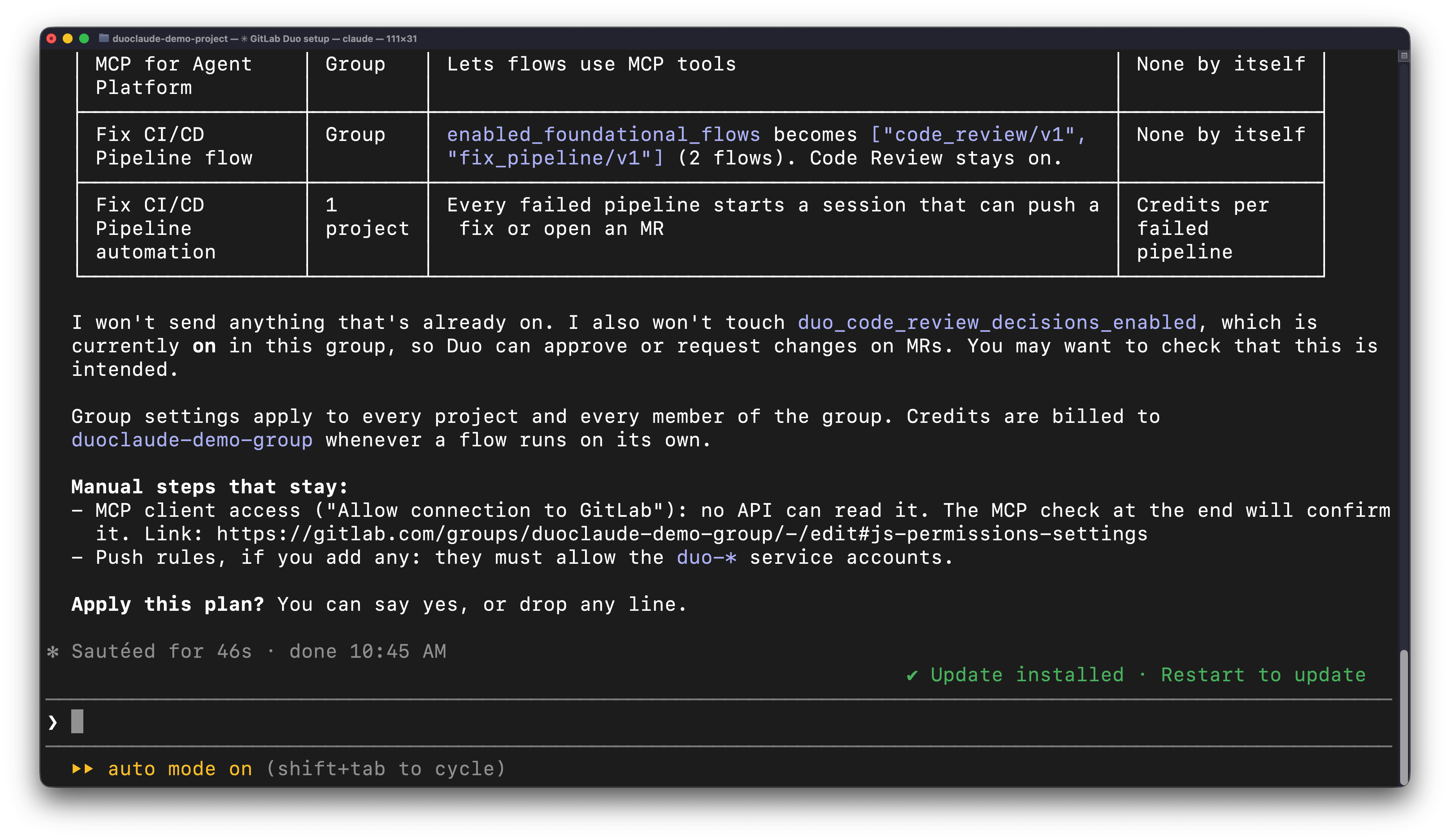
Install the gitlab-duo-setup slash-command skill in Claude Code (or any compatible harness) by cloning https://gitlab.com/gitlab-da/projects/agentic-eng-config.git and copying it to ~/.claude/skills/; running /gitlab-duo-setup presents a step-by-step plan to automate group-wide Duo Agent Platform configuration in one step.︀︄︇︀︅︉︀︅︀︀︃︀︀︅︅︀︅︊︀︄︆︀︃︄
Bootstrap a GitLab group for agentic workflows from your terminal — the skill clones the config repo, copies skills, and then automates group-wide Duo Agent Platform setup in one approved plan.
$ git clone https://gitlab.com/gitlab-da/projects/agentic-eng-config.git
cp -R agentic-eng-config/skills/gitlab-duo-setup ~/.claude/skills/
cp -R agentic-eng-config/skills/gitlab-mr-followup ~/.claude/skills/
# then, inside Claude Code in your project directory:
/gitlab-duo-setup
Automatic Duo code review on merge requestsNot checked yetnew88how completely this was documenteddepth30/40specificity28/30actionability30/3088 / 100
Enable automatic code review per project at Settings > Merge requests > GitLab Duo Code Review > Enable automatic reviews by GitLab Duo, with an optional Start a new review on push setting to trigger a follow-up review on every commit to the MR branch.
Enable automatic Duo code review and per-push re-review for a single project, so every commit to an MR branch gets a follow-up review that builds on the earlier one.
📍1. Go to your project in GitLab.
2. Navigate to Settings › Merge requests › GitLab Duo Code Review.
3. Enable Enable automatic reviews by GitLab Duo.
4. Enable Start a new review on push.
GitLab MCP server connection for coding harnessesNot checked yetnew83how completely this was documenteddepth30/40specificity28/30actionability25/3083 / 100
Connect a local coding harness to GitLab via the GitLab MCP server, giving Claude Code (or another harness) access to issue and MR context, work-item tools, and the Start Duo session tool over a single OAuth connection. Unlock the connection for a group by enabling Allow connection to GitLab under the group's Settings > General > Permissions and group features (required when a 403 appears at sign-in).
Agent flows for MR, pipeline, and security triageNot checked yetnew83how completely this was documenteddepth30/40specificity28/30actionability25/3083 / 100
Enable agents to open merge requests, resolve conflicts, repair failed pipelines, and triage security findings (Ultimate only) by assigning the Developer flow, Code Review flow, or Fix CI/CD Pipeline flow through the Duo Agent Platform.
MR followup skill for local agent monitoringNot checked yetnew70how completely this was documenteddepth20/40specificity25/30actionability25/3070 / 100
Copy agentic-eng-config/skills/gitlab-mr-followup to ~/.claude/skills/ to install the MR followup skill, which lets a local agent monitor merge-request progress and act on findings without leaving the harness.
Bootstrap a GitLab group for agentic workflows from your terminal — the skill clones the config repo, copies skills, and then automates group-wide Duo Agent Platform setup in one approved plan.
$ git clone https://gitlab.com/gitlab-da/projects/agentic-eng-config.git
cp -R agentic-eng-config/skills/gitlab-duo-setup ~/.claude/skills/
cp -R agentic-eng-config/skills/gitlab-mr-followup ~/.claude/skills/
# then, inside Claude Code in your project directory:
/gitlab-duo-setup
Veracode is a cloud-based application security platform that scans code for vulnerabilities using static, dynamic, and software composition analysis testing methods.
Veracode's biggest moves this window were a new Package Firewall that blocks untrusted packages across repositories, a batch of new Veracode CLI commands and packaging flags, and expanded SASTSASTStatic application security testing, analyzing source code or compiled code for vulnerabilities without running the application. It helps developers find problems before deployment. language coverage including C# and Spring AI; DASTDASTDynamic application security testing, probing a running application from the outside for vulnerabilities. It checks behavior exposed through the application's interfaces., IDE, SCMSCMSource Code Management: version-control systems (Git, SVN, etc.) that track changes to code over time, giving cyber tools reproducible builds, audit trails, and collaborative development workflows./CI, EASMEASMExternal Attack Surface Management: a discipline and category of tooling that continuously discovers and monitors an organization's internet-facing assets to identify exposures before attackers do., and eLearning all also received incremental but concrete additions.︀︄︇︀︅︉︀︅︀︀︃︀︀︅︅︀︅︊︀︄︆︀︃︄
└──▷ WHAT SHIPPED ·
30 FEATURES2 OF 30 FEATURESmost completely described firstwhat's the number?
Each feature carries 0–100 for how completely the vendor documented
it — not how big or important the work is. A major capability
described in eight words scores low, and that is the finding.
depth0–40what it does and how it works or what changed
specificity0–30names real surfaces — APIs, flags, formats, limits, numbers
actionability0–30enough to go use it — a named endpoint, flag, or config key tops this; a UI path is a starting point
Code and config rank first by construction: a documented endpoint,
flag or config key scores at the top of specificity and actionability,
so it sorts above a feature described only in prose. Under
60 the notes go thin — everything below the “thinner
coverage” line is thinner documentation, not smaller work.
Hover any meter for that feature's three sub-scores.
0100
veracode package new flags and optionsNot checked yetnew85how completely this was documenteddepth25/40specificity30/30actionability30/3085 / 100
Package C# source code directly for Static Analysis without compiling into binaries using the new --csharp-source flag on veracode package; exclude specific Java packages or JAR files with the new --exclude flag; exclude artifacts such as unsupported SQL from packaging results without affecting other languages using the new --skip-packagers flag; add support for requirements-dev.txt in Python packaging workflows to include development dependencies; and set VERACODE_PACKAGE_GOLANG_GENERATE=true to enable CGO code generation when packaging a Go project that uses cgo so native libraries are captured in the scannable artifact.︀︄︇︀︅︉︀︅︀︀︃︀︀︅︅︀︅︊︀︄︆︀︃︄
Enable CGO code generation when packaging a Go project that uses cgo so native libraries are captured in the scannable artifact.
New veracode.yml configuration keys for CI workflowsNot checked yetnew85how completely this was documenteddepth25/40specificity30/30actionability30/3085 / 100
Adds policy to apply an infrastructure-as-code scan policy in GitHub, GitLab, and Azure DevOps workflows; predependency_command to run setup commands before packaging in GitHub and GitLab workflows; a custom agent pool name parameter to target a build agent pool in Azure DevOps; build_runs_on to target a specific build runner for SCASCASoftware composition analysis, identifying third-party dependencies and checking them for known vulnerabilities and license issues. It covers software a team uses rather than writes itself. scans in GitHub workflows; debug to enable debugging output in GitHub, GitLab, and Azure DevOps workflows; and analysis_branch to run scheduled Azure DevOps scans against a specific branch.
Enforce an IaCIaCInfrastructure as Code: the practice of defining and provisioning compute infrastructure through machine-readable config files rather than manual processes, giving cyber tools repeatable, version-controlled environment setup. scan policy in a GitLab or GitHub workflow so the pipeline fails when findings violate your Veracode policy.
yaml
# veracode.yml
iac:
  policy: '<your-policy-name>'
Run a dependency installation command before Veracode packages the project — useful when the build requires a setup step not handled automatically.
veracode fix sca command (Limited Availability)Not checked yetnew70how completely this was documenteddepth20/40specificity20/30actionability30/3070 / 100
New veracode fix sca command generates fixes for vulnerable dependencies identified in SCA scans; running it with --fire-and-forget submits remediation requests in the background so a CI job returns immediately rather than waiting for fixes and pull requests to be created.
Submit SCA remediation requests in the background so a CI job returns immediately rather than waiting for fixes and pull requests to be created.
veracode.json exclusions for Java jars and classesNot checked yetnew60how completely this was documenteddepth20/40specificity20/30actionability20/3060 / 100
Exclude specific Java .jar files and specific Java classes from static analysis by listing them in veracode.json.
EASM platform enhancementsNot checked yetnew60how completely this was documenteddepth25/40specificity20/30actionability15/3060 / 100
EASM adds component risk scoring against the EASM vulnerability knowledge base reflecting real vulnerabilities per version rather than age alone; compliance evidence collection covering cookie consent tracking, third-party data flows, destination countries, and privacy, legal, and copyright documentation to support GDPRGDPREU regulation enacted in 2018 that governs how organizations collect, store, and process personal data of EU residents, giving cyber tools legal obligations around data handling and breach notification., NIS2NIS2EU directive that expands mandatory cybersecurity requirements to more sectors and member states than its predecessor, giving cyber tools a compliance framework to map controls and reporting obligations against., and DORA assessments; export of web applications from EASM into DAST Essentials by marking assets as DAST Candidates to create discovered scan targets; and real-time in-app notifications when scans complete, fail, or are cancelled.
— Explains scoring logic and before/after, no UI path Names evidence categories and frameworks covered Names the action but no exact UI location Bare description of notification states onlyVeracode EASM (2026-10-26)
thinner coverage below
0600
Static scan findings filtering and mitigation view in VS CodeNot checked yetnew55how completely this was documenteddepth20/40specificity20/30actionability15/3055 / 100
Filter Static Scan Findings in VS Code to the Current File open in the editor, filter and group findings by file name with each file's findings grouped by severity, and see a new Mitigated Findings section in the Flaws That Violate Policy view for findings with approved mitigations.
OAuth authentication region switching and SSO in IDEsNot checked yetNew supported platformnew55how completely this was documenteddepth20/40specificity20/30actionability15/3055 / 100
Change the OAuth authentication region in VS Code and see the current or most recently used region on the OAuth authentication screen below Authentication; Veracode Scan now supports OAuth-based authentication with Single Sign-On (SSOSSOSingle sign-on, using one identity provider to sign in to multiple applications. It reduces separate passwords and centralizes account and access management.) for Visual Studio, VS Code, Eclipse, and JetBrains.
New veracode CLI commandsNot checked yetnew55how completely this was documenteddepth15/40specificity15/30actionability25/3055 / 100
Adds veracode scan static to run static scans and review findings within a Git workflow, veracode findings static to access cached static scan findings in the local Veracode directory, and veracode package discover to detect the toolchains required to create scannable artifacts.
— Named runnable command, no usage example given Named runnable command, lacks example invocation Named runnable command, no example shownVeracode CLI (2026-11-05)
1000
Enhanced Python scanner with improved taint trackingNot checked yetimproved55how completely this was documenteddepth25/40specificity20/30actionability10/3055 / 100
Enhanced Python scanner adds support for PySpark, Flask, Django, and FastAPI applications with improved taint tracking, cross-file analysis, and pattern recognition.
SCA Skip Vulnerable Method Analysis settingNot checked yetnew50how completely this was documenteddepth15/40specificity20/30actionability15/3050 / 100
New setting to skip vulnerable method analysis during SCA scans in Visual Studio (SCA Skip Vulnerable Method Analysis), JetBrains IDEs, and Eclipse to reduce scan time.
Import static scan results into IDEs with mitigation proposalsNot checked yetnew50how completely this was documenteddepth20/40specificity15/30actionability15/3050 / 100
Import static scan results from the Veracode Platform directly into Visual Studio, JetBrains IDEs, and VS Code, and propose mitigations for static scan flaws within the IDE.
— Clear capability, lacks exact command or menu pathIDEs (2026-11-05)
1302
Package Firewall launch with proactive Maven monitoringNot checked yetnew50how completely this was documenteddepth20/40specificity20/30actionability10/3050 / 100
Veracode Package Firewall is now available, automatically blocking untrusted packages that violate policies across artifact repositories and package managers to mitigate malware, typosquattingtyposquattingUsing a name close to a trusted domain or software package to catch spelling mistakes. Attackers use it to lure people or installers to a malicious lookalike., and license violations. Package Firewall, SCA, and SSCI now also proactively monitor Maven packages, ingesting new versions regularly for malware analysis.
Broadened language and framework support in SASTNot checked yetnew50how completely this was documenteddepth15/40specificity25/30actionability10/3050 / 100
Veracode SAST adds support for Angular 21, NestJS 11.1.x, Node.js 24.x, Scala 3.10, C# source code scanning in .NET projects, JDK 27, LLMLLMA large language model, a neural network trained on large amounts of text to recognize patterns and generate language. Applications use it for tasks such as answering, summarizing and writing code.-powered applications built with Spring AI, iOS 27, Go 1.27, Dart 3.13 and Flutter 3.47, and the Python google-cloud-bigquery library.
33 deprecated eLearning courses removedNot checked yetdeprecated50how completely this was documenteddepth20/40specificity25/30actionability5/3050 / 100
33 deprecated courses are no longer available, including OWASPOWASPA nonprofit foundation that publishes open standards, guides, and ranked vulnerability lists—most famously the OWASP Top 10—giving cyber tools a vendor-neutral benchmark to test or report against. 2017, OWASP Top 10 (2021) (6 courses), Secure Coding for .NET (6 courses), Secure Coding for Java (6 courses), Secure Coding for JavaScript (5 courses), Secure Coding for PHP (6 courses), and Secure Coding for Python (3 courses).
RBAC for container and IaC scans in CLINot checked yetNew supported platformnew45how completely this was documenteddepth15/40specificity15/30actionability15/3045 / 100
Add RBACRBACRole-based access control, where permissions are assigned to roles such as reader or administrator and users receive those roles. It makes access easier to manage than individual permission lists. support to veracode scan for container and IaC scans so developers can access only the application profiles associated with their teams.
Target UUIDs for veracode dynamic scanNot checked yetimproved45how completely this was documenteddepth10/40specificity15/30actionability20/3045 / 100
Support target UUIDsUUIDsA universally unique identifier, usually a 128-bit value used to identify an object across systems. It is designed to make independently generated identifiers unlikely to collide. alongside webhook UUIDs when triggering scans with veracode dynamic scan.
OWASP Top 10:2025 secure coding coursesNot checked yetUpdated compliance frameworknew45how completely this was documenteddepth15/40specificity20/30actionability10/3045 / 100
New secure coding courses aligned to OWASP Top 10:2025OWASP Top 10:2025A ranked list of the ten most critical web application risk categories, maintained by the Open Worldwide Application Security Project, used by cyber tools to prioritize detection, testing, and remediation coverage. are now available for .NET, Java, JavaScript, PHP, and Python, replacing the deprecated 2021-list courses.
Schedule scans from Veracode Platform via veracode.ymlNot checked yetnew45how completely this was documenteddepth15/40specificity15/30actionability15/3045 / 100
Schedule scans for installed organizations directly from the Veracode Platform based on veracode.yml configuration, including Azure DevOps Workflow Integration scans and Static Analysis, SCA, and IaC scans for GitHub organizations.
GitHub Workflow Integration managementNot checked yetnew45how completely this was documenteddepth15/40specificity15/30actionability15/3045 / 100
The Veracode GitHub Workflow Integration can now be installed, configured, updated, and uninstalled directly from the Veracode Platform without going through the GitHub Marketplace, using a new uninstallation workflow, and now autopackages Apex, VB6, and Perl projects.
— Describes lifecycle actions, no exact navigation Names languages only, no mechanism detailSCM and ticketing (2026-11-03)
2200
DryRun Security integration for AI-native PR workflowsNot checked yetnew40how completely this was documenteddepth15/40specificity15/30actionability10/3040 / 100
New DryRun Security integration surfaces Veracode Static Analysis findings and remediation guidance inside AI-native pull request and code review workflows.
Captions in six languages for eLearning coursesNot checked yetimproved40how completely this was documenteddepth15/40specificity20/30actionability5/3040 / 100
Nine eLearning courses — including Software Security Awareness - OWASP Top 10:2025, Threat Modeling, and C/C++ Memory Management Risks and Best Practices — now have captions in English, French, German, Japanese, Portuguese, and Spanish.
IDE version support matrixNot checked yetimproved35how completely this was documenteddepth10/40specificity20/30actionability5/3035 / 100
Veracode Scan now supports IDE versions 2024.2 through 2026.3 for JetBrains, and Visual Studio 2026 for Visual Studio.
— Version ranges named but no behaviour change explainedIDEs (2026-11-05)
2700
SSCI on unified Veracode REST APINot checked yetimproved35how completely this was documenteddepth10/40specificity15/30actionability10/3035 / 100
Software Supply ChainSupply ChainThe network of vendors, dependencies, and build processes that produce and deliver software; cyber tools target it because a compromise anywhere upstream can silently backdoor every downstream consumer. Intelligence (SSCI) now runs on the unified Veracode REST APIREST APIA web API design style where clients interact with resources over HTTP using standard methods like GET, POST, and DELETE, giving cyber tools a predictable, language-agnostic way to integrate with external services. — see the Software Supply Chain Intelligence REST API docs for endpoint details.
The Veracode eLearning REST API has reached end of support — it will no longer receive updates or technical support.
!
33 deprecated courses are no longer available, including OWASP 2017, OWASP Top 10 (2021) (6 courses), Secure Coding for .NET (6 courses), Secure Coding for Java (6 courses), Secure Coding for JavaScript (5 courses), Secure Coding for PHP (6 courses), and Secure Coding for Python (3 courses).
!
The DAST REST API scheduling endpoints have changed as of June 24, 2026; integrations that manage schedules via the REST API must be updated to use the new endpoints.
Veracode adds v2 Reporting API endpoints, a Custom PDF REST APIREST APIA web API design style where clients interact with resources over HTTP using standard methods like GET, POST, and DELETE, giving cyber tools a predictable, language-agnostic way to integrate with external services., OAuth support for XML APIsXML APIsInterfaces for reading, writing, or querying XML documents, provided by libraries such as libxml2 or built into language runtimes; cyber tools use them to parse structured data like configs, reports, or protocol messages reliably., new report filters and fields, MPT Flaw Matching, and container/IaCIaCInfrastructure as Code: the practice of defining and provisioning compute infrastructure through machine-readable config files rather than manual processes, giving cyber tools repeatable, version-controlled environment setup. results on the platform.
New v2 Reporting API adds dedicated endpoints for findings, scans, deleted scans, and audit log reports, replacing the deprecated POST /appsec/v1/analytics/report. Not checked yet
The v2 findings endpoint POST /analytics/findings/report now accepts optional date filters first_found_start_date, first_found_end_date, resolved_start_date, and resolved_end_date to narrow results within the required last_updated_start_date/last_updated_end_date range. Not checked yet
New most_recent_scan filter available on the Reporting API Scans report — set to true to return only the most recent scan per asset, reducing client-side filtering. Not checked yet
New custom_severity filter available on the Reporting API Findings report. Not checked yet
New collections_list field added to the Finding Reporting API response, returning a list of collection names associated with an application. Not checked yet
+15 moreshow less
New library_instance_ref field added to the Veracode Reporting API findings response to uniquely identify the specific library instance associated with a finding. Not checked yet
New data_refresh_date field added to the Reporting API to indicate the most recent time Analytics data was refreshed. Not checked yet
New Custom PDF REST API lets you programmatically generate custom PDF reports. Not checked yet
XML APIs now accept OAuth Client CredentialsOAuth Client CredentialsAn OAuth 2.0 grant type where a service authenticates directly with an authorization server using its own ID and secret, receiving a token to call APIs without any user involved. for authentication, in addition to the REST APIsREST APIsA convention for building HTTP-based interfaces where resources are addressed by URL and manipulated with standard verbs like GET, POST, and DELETE, giving cyber tools a predictable way to integrate with external services.. Not checked yet
Create and manage Veracode API credentials using OAuth 2.0OAuth 2.0An open authorization framework (IETF RFC 6749) that lets a service grant limited API access to a third party without sharing credentials, giving cyber tools a standard way to authenticate against external platforms. Client credentials on the API Credentials page in the Veracode Platform. Not checked yet
Containers and IaC scan results performed from the CLI are now available on the Veracode Platform, including severity counts, filtering, scan history, and mitigation guidance. Not checked yet
New Audit Log report available for the Reporting REST API, allowing queries of Veracode Analytics for detailed user activity. Not checked yet
New action_type filter in the Reporting REST API Audit Log report to retrieve records based on specific user actions. Not checked yet
Disable Veracode-defined roles for users who use custom roles, via the updated Identity API, for tighter control over user access. Not checked yet
Map multiple domains to a single identity provideridentity providerA service that authenticates users and supplies identity information to other applications. It is the sign-in authority behind many single sign-on systems. (IdPIdPA service that authenticates users and supplies identity information to other applications. It is the sign-in authority behind many single sign-on systems.) when using SP-initiatedSP-initiatedA SAML or OAuth/OIDC login flow where the Service Provider redirects the user to an Identity Provider to authenticate, rather than the IdP pushing an assertion unprompted; tools use it to trigger SSO from their own login page.SAMLSAMLA standard for passing signed identity assertions between a sign-in provider and an application. It lets a user sign in through their organization's identity provider. authentication. Not checked yet
Manual Penetration Testing (MPT) Flaw Matching now correlates findings across tests to provide consistent flaw IDs, status values, and inclusion of MPT findings in remediation grace periods. Not checked yet
Modernized application pages UI now enabled for all FedRAMPFedRAMPA US government program that standardizes cloud security authorization, letting vendors get a single assessment accepted across federal agencies instead of repeating the process for each one. customers, adding capabilities including Upload and Scan SCASCASoftware composition analysis, identifying third-party dependencies and checking them for known vulnerabilities and license issues. It covers software a team uses rather than writes itself. for individual application profiles and static analysis engine version pinning at the application profile level. Not checked yet
Customizable PDF now accounts for SCA Component License Risk policy rules, displaying compliance status in the Executive Summary and Detailed SCA Findings by Component sections. Not checked yet
Java API Wrapper v26.10.20.0 now automatically includes Git repository and commit metadata (branch, commit, author, repository, Git provider) in Static Analysis scans submitted from a Git repository for JAR, WAR, EAR, and ZIP archives. Not checked yet
Java API Wrapper v26.10.20.1 now updates the repository URL in the Veracode application profile only when you specify the -repourl parameter. Not checked yet
20 details in Everything
└──▷ BREAKING ON UPGRADE
!The /healthcheck/status endpoint has been removed and now returns a 404 error; use the v2/principal endpoint in the Identity REST API to check authenticated connectivity instead.
!report_type is no longer accepted in the request body for the v2 Reporting API endpoints (it was accepted in v1).
Veracode Fix adds a veracode fix sca CLI command for SCASCASoftware composition analysis, identifying third-party dependencies and checking them for known vulnerabilities and license issues. It covers software a team uses rather than writes itself. remediation and now processes GitHub Workflow Integration fix requests asynchronously.
Run SCA remediation from the CLI with the new veracode fix sca command, which analyzes vulnerable dependencies, generates patches, and identifies safe upgrade paths. Not checked yet
Veracode Fix for SCA now processes GitHub Workflow Integration fix requests asynchronously, freeing the GitHub ActionsGitHub ActionsGitHub's built-in CI/CD system that runs automated workflows triggered by repository events, letting cyber tools automate testing, building, and releasing without managing separate pipeline infrastructure. runner immediately and delivering fixes as a new pull request with a results comment on the original. Not checked yet
DataDome protects web, mobile, and API applications by detecting and blocking bot and fraud traffic.
DataDome raised the header-forwarding limit across three edge modules and added a way to skip WAFWAFA reverse proxy that inspects HTTP/HTTPS traffic and blocks requests matching known attack patterns such as SQL injection or XSS, sitting between clients and a web application to filter malicious input before it reaches the server. inspection on out-of-band Fastly requests.︀︄︇︀︅︉︀︅︀︀︃︀︀︅︅︀︅︊︀︄︆︀︃︄
└──▷ WHAT SHIPPED ·
2 FEATURES0 OF 2 FEATURESmost completely described firstwhat's the number?
Each feature carries 0–100 for how completely the vendor documented
it — not how big or important the work is. A major capability
described in eight words scores low, and that is the finding.
depth0–40what it does and how it works or what changed
specificity0–30names real surfaces — APIs, flags, formats, limits, numbers
actionability0–30enough to go use it — a named endpoint, flag, or config key tops this; a UI path is a starting point
Code and config rank first by construction: a documented endpoint,
flag or config key scores at the top of specificity and actionability,
so it sorts above a feature described only in prose. Under
60 the notes go thin — everything below the “thinner
coverage” line is thinner documentation, not smaller work.
Hover any meter for that feature's three sub-scores.
0100
WAF inspection bypass flag for Fastly Protection APINot checked yetnew65how completely this was documenteddepth20/40specificity25/30actionability20/3065 / 100
The Fastly module adds waf.inspection.disabled, which can be sent on requests to the Protection API to skip Next-Gen WAF inspection on out-of-band architecture requests.︀︄︇︀︅︉︀︅︀︀︃︀︀︅︅︀︅︊︀︄︆︀︃︄
HeadersList truncation limit raised across modulesNot checked yetimproved55how completely this was documenteddepth20/40specificity25/30actionability10/3055 / 100
The HeadersList truncation limit was increased from 512 to 768 bytes in the Go module, the Cloudflare Worker Rust module, and the Envoy module, allowing more header data to be forwarded for bot-detection analysis without being cut off.
— Names exact config field and byte limits, no mechanism beyond thatGo module 2.6.0 (2026-11-19)Cloudflare Worker Rust module 1.1.0 (2026-11…Envoy module 2.9.0 (2026-11-19)
Fastly is a cloud edge computing platform that provides CDN, DDoS protection, load balancing, and real-time content delivery for websites and applications.
Fastly's Terraform Provider Beta 0.2.10 adds account-level product enablement resources, a new Object Storage logging destination, per-service alert scoping, and migration tooling for moving legacy Compute and VCLVCLVarnish Configuration Language, a domain-specific language used to configure the Varnish HTTP cache, letting tools control request routing, caching rules, and traffic manipulation with low-latency precision. services onto CDNCDNA content delivery network, servers distributed across locations that cache and serve content near readers. It can reduce loading time and traffic to the original server. Auto and Compute Auto.︀︄︇︀︅︉︀︅︀︀︃︀︀︅︅︀︅︊︀︄︆︀︃︄
└──▷ WHAT SHIPPED ·
5 FEATURES0 OF 5 FEATURESmost completely described firstwhat's the number?
Each feature carries 0–100 for how completely the vendor documented
it — not how big or important the work is. A major capability
described in eight words scores low, and that is the finding.
depth0–40what it does and how it works or what changed
specificity0–30names real surfaces — APIs, flags, formats, limits, numbers
actionability0–30enough to go use it — a named endpoint, flag, or config key tops this; a UI path is a starting point
Code and config rank first by construction: a documented endpoint,
flag or config key scores at the top of specificity and actionability,
so it sorts above a feature described only in prose. Under
60 the notes go thin — everything below the “thinner
coverage” line is thinner documentation, not smaller work.
Hover any meter for that feature's three sub-scores.
0100
Object Storage logging destination for Compute servicesNot checked yetnew75how completely this was documenteddepth25/40specificity25/30actionability25/3075 / 100
A new logging_fos block routes Compute service logs to Fastly Object Storage instead of a third-party sink, configured with bucket and path fields on fastly_service_compute_auto.︀︄︇︀︅︉︀︅︀︀︃︀︀︅︅︀︅︊︀︄︆︀︃︄
Route Compute service logs to Fastly Object Storage instead of a third-party sink.
hcl
resource "fastly_service_compute_auto" "example" {
  name = "my-compute-service"

  logging_fos {
    name       = "fos-logs"
    bucket     = "my-log-bucket"
    path       = "/logs/"
  }
}
Account-level product enablement resourcesNot checked yetnew72how completely this was documenteddepth22/40specificity25/30actionability25/3072 / 100
Four new resources let you enable account-level products directly in Terraform: fastly_product_ai_accelerator, fastly_product_ai_runtime_control, fastly_product_domain_research, and fastly_product_object_storage.
Enable the AI Accelerator product at the account level so all eligible services can use it.
VCL-to-CDN Auto migration resource splittingNot checked yetnew59how completely this was documenteddepth22/40specificity22/30actionability15/3059 / 100
VCL-to-CDN Auto migration now splits legacy Bot Management, DDoSDDoSDistributed Denial of Service: an attack that floods a target system with traffic from many sources simultaneously, exhausting its resources so legitimate requests cannot be served. Protection, and Next-Gen WAFWAFA reverse proxy that inspects HTTP/HTTPS traffic and blocks requests matching known attack patterns such as SQL injection or XSS, sitting between clients and a web application to filter malicious input before it reaches the server. product enablement into standalone resources with service-ID imports, and generates standalone CDN simple-product resources with service-ID imports from legacy product enablement.
Compute Auto state migration supportNot checked yetimproved55how completely this was documenteddepth20/40specificity20/30actionability15/3055 / 100
New moved block state migration support lets you migrate legacy fastly_service_compute state to fastly_service_compute_auto without recreating resources.
Dependency-Track is an intelligent Component Analysis platform that allows organizations to identify and reduce risk in the software supply chain.
Dependency-Track 5.2.2 ships two performance improvements: smarter NVDNVDThe National Vulnerability Database, maintained by NIST, is the U.S. government repository of CVE records enriched with CVSS scores and metadata; cyber tools query it to drive vulnerability prioritization. feed mirroring and faster collection project metrics calculation.︀︄︇︀︅︉︀︅︀︀︃︀︀︅︅︀︅︊︀︄︆︀︃︄
└──▷ WHAT SHIPPED ·
2 FEATURES0 OF 2 FEATURESmost completely described firstwhat's the number?
Each feature carries 0–100 for how completely the vendor documented
it — not how big or important the work is. A major capability
described in eight words scores low, and that is the finding.
depth0–40what it does and how it works or what changed
specificity0–30names real surfaces — APIs, flags, formats, limits, numbers
actionability0–30enough to go use it — a named endpoint, flag, or config key tops this; a UI path is a starting point
Code and config rank first by construction: a documented endpoint,
flag or config key scores at the top of specificity and actionability,
so it sorts above a feature described only in prose. Under
60 the notes go thin — everything below the “thinner
coverage” line is thinner documentation, not smaller work.
Hover any meter for that feature's three sub-scores.
0100
Skips redundant yearly NVD feed downloadsNot checked yetimproved30how completely this was documenteddepth15/40specificity10/30actionability5/3030 / 100
Dependency-Track now skips the yearly NVD feed download when the modified feed already covers the time since the last mirror, reducing unnecessary data transfer.︀︄︇︀︅︉︀︅︀︀︃︀︀︅︅︀︅︊︀︄︆︀︃︄
— Explains behaviour change but no config or metric given5.2.2
0200
Partition pruning for collection project metricsNot checked yetimproved30how completely this was documenteddepth15/40specificity10/30actionability5/3030 / 100
Dependency-Track now uses partition pruning when calculating current collection project metrics, improving query performance.
— Names mechanism but no measured gain or scope5.2.2
$ git clone --branch 4.14.7 https://github.com/DependencyTrack/dependency-track.git
# already have the repo? check out this version:$ git checkout 4.14.7
LavaMoat shipped a new CI safeguard and stricter defaults for allow-scripts, plus a parser upgrade for react-native-lockdown that carries a Hermes compatibility warning.︀︄︇︀︅︉︀︅︀︀︃︀︀︅︅︀︅︊︀︄︆︀︃︄
LavaMoat is a security tool that protects JavaScript applications by isolating dependencies using object capability principles to prevent supply chain attacks.
LavaMoat shipped a new CI safeguard and stricter defaults for allow-scripts, plus a parser upgrade for react-native-lockdown that carries a Hermes compatibility warning.︀︄︇︀︅︉︀︅︀︀︃︀︀︅︅︀︅︊︀︄︆︀︃︄
└──▷ WHAT SHIPPED ·
2 FEATURES2 OF 2 FEATURESmost completely described firstwhat's the number?
Each feature carries 0–100 for how completely the vendor documented
it — not how big or important the work is. A major capability
described in eight words scores low, and that is the finding.
depth0–40what it does and how it works or what changed
specificity0–30names real surfaces — APIs, flags, formats, limits, numbers
actionability0–30enough to go use it — a named endpoint, flag, or config key tops this; a UI path is a starting point
Code and config rank first by construction: a documented endpoint,
flag or config key scores at the top of specificity and actionability,
so it sorts above a feature described only in prose. Under
60 the notes go thin — everything below the “thinner
coverage” line is thinner documentation, not smaller work.
Hover any meter for that feature's three sub-scores.
0101
CI check command and exact-version pinning in allow-scriptsNot checked yetbreaking91how completely this was documenteddepth35/40specificity28/30actionability28/3091 / 100
@lavamoat/allow-scripts@5.1.1 adds a check command, runnable as npx @lavamoat/allow-scripts check, that warns in CI when the allow-scripts configuration needs updating, catching stale allow-lists before they silently permit or block install scripts.︀︄︇︀︅︉︀︅︀︀︃︀︀︅︅︀︅︊︀︄︆︀︃︄ Install scripts are now pinned to exact versions by default, so a dependency upgrade that swaps in a new install script is blocked until the allow-list is explicitly updated. This is a breaking change: allow-scripts no longer matches a lower pinned version against a newer one, existing configurations require a migration action to keep working under default pinning, and Node.js v18 is no longer supported.
Run in CI to detect when an install script has changed version and the allow-list is out of date, failing the pipeline before a stale config silently applies.
@endo/parser-pipeline for Node.js parsing in react-native-lockdownNot checked yetbreaking52how completely this was documenteddepth22/40specificity20/30actionability10/3052 / 100
@lavamoat/react-native-lockdown@3.0.0 switches Node.js parsing to use @endo/parser-pipeline. The release also bundles a SES upgrade that may introduce regressions in Hermes, which is why it's versioned as a major release out of caution — teams should test Hermes-based React Native builds before upgrading.
The SES upgrade may introduce regressions in Hermes; this release is versioned as major (3.0.0) out of caution — test Hermes-based React Native builds before upgrading.
!
allow-scripts no longer matches a lower version with the allowed version — a pinned entry for an older version of a package will not cover a newer one.
!
allow-scripts now defaults to pinning versions; existing configurations require a migration action to continue working.
Endor Labs is an application security platform built for AI-generated and human-written code, helping teams prioritize and fix real risk across the SDLC.
Endor Labs added sandbox posture reporting to Coding Agent Governance, giving teams visibility into which developers run coding agent sessions without a sandbox and the ability to enforce sandbox use via policy.︀︄︇︀︅︉︀︅︀︀︃︀︀︅︅︀︅︊︀︄︆︀︃︄
└──▷ WHAT SHIPPED ·
2 FEATURES0 OF 2 FEATURESmost completely described firstwhat's the number?
Each feature carries 0–100 for how completely the vendor documented
it — not how big or important the work is. A major capability
described in eight words scores low, and that is the finding.
depth0–40what it does and how it works or what changed
specificity0–30names real surfaces — APIs, flags, formats, limits, numbers
actionability0–30enough to go use it — a named endpoint, flag, or config key tops this; a UI path is a starting point
Code and config rank first by construction: a documented endpoint,
flag or config key scores at the top of specificity and actionability,
so it sorts above a feature described only in prose. Under
60 the notes go thin — everything below the “thinner
coverage” line is thinner documentation, not smaller work.
Hover any meter for that feature's three sub-scores.
0100
Sandbox posture reporting in Coding Agent GovernanceNot checked yetnew60how completely this was documenteddepth25/40specificity20/30actionability15/3060 / 100
A new SandboxingSandboxingRunning code inside a restricted environment that limits what it can access or change. The isolation reduces the impact of mistakes or untrusted code, depending on the sandbox's controls. view in the Inventory section shows one row per developer: agents used, session count, and the share of sessions that had the sandbox on.︀︄︇︀︅︉︀︅︀︀︃︀︀︅︅︀︅︊︀︄︆︀︃︄ A new Sandbox Gap widget on the Overview lists every developer below 100% sandbox coverage, surfacing who to follow up with. Sessions where sandbox state could not be determined are counted as unknown and pull a developer below 100%, distinguishing a reporting gap from a configuration gap.
Review which developers ran coding agent sessions without a sandbox and prioritize outreach by checking the Sandbox Gap widget on the Overview.
📍In the Endor Labs console, go to Overview › Sandbox Gap widget to see every developer below 100% sandbox coverage, then go to Inventory › Sandboxing view to drill into per-developer session counts and coverage percentages.
Cloudsmith is a fully-managed artifact management, software supply chain security, and software distribution platform.
Cloudsmith made API key rules generally available, letting organizations enforce separate expiration and rotation requirements for user and service accounts.︀︄︇︀︅︉︀︅︀︀︃︀︀︅︅︀︅︊︀︄︆︀︃︄
└──▷ WHAT SHIPPED ·
1 FEATURE0 OF 1 FEATUREmost completely described firstwhat's the number?
Each feature carries 0–100 for how completely the vendor documented
it — not how big or important the work is. A major capability
described in eight words scores low, and that is the finding.
depth0–40what it does and how it works or what changed
specificity0–30names real surfaces — APIs, flags, formats, limits, numbers
actionability0–30enough to go use it — a named endpoint, flag, or config key tops this; a UI path is a starting point
Code and config rank first by construction: a documented endpoint,
flag or config key scores at the top of specificity and actionability,
so it sorts above a feature described only in prose. Under
60 the notes go thin — everything below the “thinner
coverage” line is thinner documentation, not smaller work.
Hover any meter for that feature's three sub-scores.
0100
Independent API key rules for user and service accountsNot checked yetnew60how completely this was documenteddepth25/40specificity20/30actionability15/3060 / 100
API key rules are now generally available, allowing separate expiration and rotation requirements to be set for user accounts versus service accounts rather than a single rule applying to both — for example, rotating user keys every 30 days and service account keys every 60.︀︄︇︀︅︉︀︅︀︀︃︀︀︅︅︀︅︊︀︄︆︀︃︄
StepSecurity secures GitHub Actions CI/CD pipelines by detecting and preventing supply chain attacks, enforcing least-privilege permissions, and providing runtime security controls.
StepSecurity's Harden-Runner v2.23.0 introduces Secure Registry, a community-tier feature that routes npm, npx, pnpm, and Bun 1.4.4+ installs through a protective layer that blocks malicious packages and delays new releases.︀︄︇︀︅︉︀︅︀︀︃︀︀︅︅︀︅︊︀︄︆︀︃︄
└──▷ WHAT SHIPPED ·
1 FEATURE0 OF 1 FEATUREmost completely described firstwhat's the number?
Each feature carries 0–100 for how completely the vendor documented
it — not how big or important the work is. A major capability
described in eight words scores low, and that is the finding.
depth0–40what it does and how it works or what changed
specificity0–30names real surfaces — APIs, flags, formats, limits, numbers
actionability0–30enough to go use it — a named endpoint, flag, or config key tops this; a UI path is a starting point
Code and config rank first by construction: a documented endpoint,
flag or config key scores at the top of specificity and actionability,
so it sorts above a feature described only in prose. Under
60 the notes go thin — everything below the “thinner
coverage” line is thinner documentation, not smaller work.
Hover any meter for that feature's three sub-scores.
0100
Secure Registry for npm, npx, pnpm and Bun installsNot checked yetnew93how completely this was documenteddepth35/40specificity28/30actionability30/3093 / 100
Setting secure-registry: true on the Harden-Runner GitHub Action routes npm, npx, pnpm, and Bun 1.4.4+ installs through StepSecurity's Secure Registry with no infrastructure or command changes.︀︄︇︀︅︉︀︅︀︀︃︀︀︅︅︀︅︊︀︄︆︀︃︄ It always blocks package versions flagged as known-compromised or malicious by the StepSecurity SOCSOCA security operations center, the team or function that monitors threats, investigates alerts and coordinates incident response. Its work can be internal, outsourced or shared., and holds back newly published versions for a configurable cooldown period (0 to 30 days, default 2 days) so builds only install versions that have cleared the window. Users can add a custom block list to refuse specific packages or versions, and can inspect held/blocked versions in the job summary — which includes a ready-to-paste snippet to allow a specific held version — or review each job's package requests on the Packages tab of the StepSecurity dashboard.
Enable Secure Registry on a public repo to block compromised npm packages and apply a 7-day cooldown before new versions reach your CI build.
jadx v1.5.7 adds native macOS and Windows installers alongside several GUIGUIA graphical user interface, controls such as windows, buttons and menus. It lets people use software visually rather than entering commands. navigation improvements, including a richer inheritance graph and a tree filter.︀︄︇︀︅︉︀︅︀︀︃︀︀︅︅︀︅︊︀︄︆︀︃︄
└──▷ WHAT SHIPPED ·
3 FEATURES0 OF 3 FEATURESmost completely described firstwhat's the number?
Each feature carries 0–100 for how completely the vendor documented
it — not how big or important the work is. A major capability
described in eight words scores low, and that is the finding.
depth0–40what it does and how it works or what changed
specificity0–30names real surfaces — APIs, flags, formats, limits, numbers
actionability0–30enough to go use it — a named endpoint, flag, or config key tops this; a UI path is a starting point
Code and config rank first by construction: a documented endpoint,
flag or config key scores at the top of specificity and actionability,
so it sorts above a feature described only in prose. Under
60 the notes go thin — everything below the “thinner
coverage” line is thinner documentation, not smaller work.
Hover any meter for that feature's three sub-scores.
0100
Native installers for jadx-guiNot checked yetnew78how completely this was documenteddepth25/40specificity28/30actionability25/3078 / 100
jadx-gui now ships as a macOS DMG install bundle (jadx-gui-1.5.7-mac-aarch64.dmg and jadx-gui-1.5.7-mac-x86_64.dmg) with file-type associations for macOS, and as a Windows MSI installer (jadx-gui-1.5.7.msi) with a bundled JRE.︀︄︇︀︅︉︀︅︀︀︃︀︀︅︅︀︅︊︀︄︆︀︃︄
— Names exact installer filenames and bundled JRE detailv1.5.7
thinner coverage below
0200
GUI resource and class tree navigation improvementsNot checked yetimproved42how completely this was documenteddepth15/40specificity12/30actionability15/3042 / 100
The GUI ResourcePanel now uses file-type specific tabs for navigating resources, and a new tree filter was added to the GUI class/package tree for narrowing down entries.
— Describes UI changes but no exact navigation pathv1.5.7
0300
Bidirectional inheritance graph in GUINot checked yetimproved40how completely this was documenteddepth20/40specificity10/30actionability10/3040 / 100
Inheritance graphs in the GUI now display both super and subclass relations, not just one direction as before.
— Explains before/after behaviour but no exact UI pathv1.5.7
Burp Suite is a we enable the world to secure the web. Burp Suite, the Web Security Academy, and world-leading research from PortSwigger â the AppSec communityâs home.
Burp Suite's DASTDASTDynamic application security testing, probing a running application from the outside for vulnerabilities. It checks behavior exposed through the application's interfaces. module gained new scan target types for MCPMCPModel Context Protocol, a standard for connecting AI applications to external tools and data sources. A compatible server exposes capabilities an assistant can use through a common interface. servers and uploaded API definitions, while Professional/Community added an in-app Academy tab for Web Security Academy labs.︀︄︇︀︅︉︀︅︀︀︃︀︀︅︅︀︅︊︀︄︆︀︃︄
└──▷ WHAT SHIPPED ·
1 FEATURE1 OF 1 FEATUREmost completely described firstwhat's the number?
Each feature carries 0–100 for how completely the vendor documented
it — not how big or important the work is. A major capability
described in eight words scores low, and that is the finding.
depth0–40what it does and how it works or what changed
specificity0–30names real surfaces — APIs, flags, formats, limits, numbers
actionability0–30enough to go use it — a named endpoint, flag, or config key tops this; a UI path is a starting point
Code and config rank first by construction: a documented endpoint,
flag or config key scores at the top of specificity and actionability,
so it sorts above a feature described only in prose. Under
60 the notes go thin — everything below the “thinner
coverage” line is thinner documentation, not smaller work.
Hover any meter for that feature's three sub-scores.
0101
New DAST scan targets: MCP servers and API definitionsNot checked yetnew40how completely this was documenteddepth15/40specificity15/30actionability10/3040 / 100
Burp Suite DAST can now scan MCP servers directly, and can scan uploaded API definitions at the URL where the definition is hosted.︀︄︇︀︅︉︀︅︀︀︃︀︀︅︅︀︅︊︀︄︆︀︃︄
OX Security launched OX Radar and a Response Center that turn emerging supply-chain threats into actionable, trackable incidents, and added detection and mitigation guidance for the Java4Shell JVMJVMThe Java Virtual Machine, a runtime maintained by Oracle (and implemented by others) that executes Java bytecode on any OS, giving cyber tools a portable, garbage-collected environment with a large ecosystem of libraries. vulnerability (CVE-2026-114938).︀︄︇︀︅︉︀︅︀︀︃︀︀︅︅︀︅︊︀︄︆︀︃︄
OX Security is an accelerate the transition to software that secures itself. OX Security pinpoints risk to the exact line of code, eliminating security debt from AI generation to cloud runtime.
OX Security launched OX Radar and a Response Center that turn emerging supply-chain threats into actionable, trackable incidents, and added detection and mitigation guidance for the Java4Shell JVMJVMThe Java Virtual Machine, a runtime maintained by Oracle (and implemented by others) that executes Java bytecode on any OS, giving cyber tools a portable, garbage-collected environment with a large ecosystem of libraries. vulnerability (CVE-2026-114938).︀︄︇︀︅︉︀︅︀︀︃︀︀︅︅︀︅︊︀︄︆︀︃︄
└──▷ WHAT SHIPPED ·
2 FEATURES0 OF 2 FEATURESmost completely described firstwhat's the number?
Each feature carries 0–100 for how completely the vendor documented
it — not how big or important the work is. A major capability
described in eight words scores low, and that is the finding.
depth0–40what it does and how it works or what changed
specificity0–30names real surfaces — APIs, flags, formats, limits, numbers
actionability0–30enough to go use it — a named endpoint, flag, or config key tops this; a UI path is a starting point
Code and config rank first by construction: a documented endpoint,
flag or config key scores at the top of specificity and actionability,
so it sorts above a feature described only in prose. Under
60 the notes go thin — everything below the “thinner
coverage” line is thinner documentation, not smaller work.
Hover any meter for that feature's three sub-scores.
0100
Java4Shell (CVE-2026-114938) detection and mitigationNot checked yetnew92how completely this was documenteddepth32/40specificity30/30actionability30/3092 / 100
The Issues page can be filtered by CVE-2026-114938 to see which container images bundle a vulnerable OpenJDK runtime and how OX prioritizes each one.︀︄︇︀︅︉︀︅︀︀︃︀︀︅︅︀︅︊︀︄︆︀︃︄ Exposure requires a host's CPUCPUThe main general-purpose processor in a computer. It runs application instructions and coordinates work with memory and other hardware. to have the avx512f, avx512bw, avx512vbmi, and bmi2 flags, checkable via grep -m1 '^flags' /proc/cpuinfo | tr ' ' '\n' | grep -E '^(avx512f|avx512bw|avx512vbmi|bmi2)$'. The vulnerable JVM Base64 decoder can be disabled without affecting other AVX-512 optimizations by starting the JVM with -XX:-UseBASE64Intrinsics.
Identify which of your container images bundle a vulnerable OpenJDK runtime so you can prioritize rebuilds.
📍In the OX Security console, go to Issues, then apply the CVE filter set to CVE-2026-114938 to see affected images and their priority scores.
Quickly confirm whether a Linux host's CPU has all four flags required for Java4Shell RCERCERemote code execution, the ability to run attacker-chosen code on another system through a vulnerability. Its impact depends on the permissions and access that code receives. risk before deciding whether to patch urgently.
OX Radar and Response Center for threat trackingNot checked yetNew detectionNew integrationnew88how completely this was documenteddepth35/40specificity28/30actionability25/3088 / 100
OX Radar monitors the cyber landscape in real time and marks each supply chain threat as Detected or Not Detected against your code, containers, cloud, and developer environments via the OX context lake. The Response Center turns every Radar incident into a live record with a remediation plan, open-ticket and fix-PR creation, safe-version pinning, and an audit trail, covering malicious dependencies, known exploited vulnerabilities, new CVSSCVSSCommon Vulnerability Scoring System, a method for describing a vulnerability's characteristics and severity. Its score is not the probability that attackers will exploit it. 10 vulnerabilities, and reported exploits. Not Detected incidents produce shareable VEXVEXA machine-readable statement from a vendor saying whether a CVE in a component actually affects their product. It is how a scanner is told to stop flagging a vulnerability that is not reachable. statements and auto-close after 14 clean days of continuous monitoring, and teams can create custom incidents from an advisory URL, CVE ID, or GHSA ID under Your own incidents. A public OX Radar site lets anyone search 785K+ tracked assets — MCPMCPModel Context Protocol, a standard for connecting AI applications to external tools and data sources. A compatible server exposes capabilities an assistant can use through a common interface. servers, AI skills, npm and PyPy packages — filter by ecosystem, see risk scores, and read OX Research findings.
When a critical CVE breaks in the news, open the Response Center from the OX dashboard to see whether it is Detected in your environment and act on the generated remediation plan.
📍In the OX Security platform, go to Dashboard › Response Center. Locate the auto-generated incident for the new CVE, review the Detected / Not Detected status, and click Open Ticket or Fix PR next to each affected asset to begin remediation.
Prove non-exposure to leadership for a specific advisory by creating a custom incident from an advisory URL, CVE ID, or GHSA ID and sharing the resulting VEX statement.
📍In the OX Security platform, go to Response Center › Your own incidents and paste an advisory URL, CVE ID, or GHSA ID. OX builds the incident, monitors for 14 clean days, then auto-closes it and generates a VEX statement you can export and share.
OX Security adds OX Radar and Response Center: continuous threat monitoring with ~10-minute scan cycles, automatic environment exposure checks, and a public threat research feed.
OX Radar continuously monitors emerging vulnerabilities, compromised software dependencies, and actively exploited threats, scanning approximately every 10 minutes. Not checked yet
The Response Center automatically assesses customer exposure for supported threats, providing evidence of exploitability, affected asset identification, remediation guidance, safe versions, fix pull requests, and ticket tracking. Not checked yet
Teams can initiate exposure investigations by supplying a CVE identifier, GitHub Security Advisory identifier, or advisory URL directly in the Response Center. Not checked yet
A publicly accessible OX Radar threat feed provides broader security research findings across the software and AI supply chain. Not checked yet
Cortex-Analyzers 3.10.5 adds URL extraction to the MsgParser analyzer.︀︄︇︀︅︉︀︅︀︀︃︀︀︅︅︀︅︊︀︄︆︀︃︄
└──▷ WHAT SHIPPED ·
1 FEATURE0 OF 1 FEATUREmost completely described firstwhat's the number?
Each feature carries 0–100 for how completely the vendor documented
it — not how big or important the work is. A major capability
described in eight words scores low, and that is the finding.
depth0–40what it does and how it works or what changed
specificity0–30names real surfaces — APIs, flags, formats, limits, numbers
actionability0–30enough to go use it — a named endpoint, flag, or config key tops this; a UI path is a starting point
Code and config rank first by construction: a documented endpoint,
flag or config key scores at the top of specificity and actionability,
so it sorts above a feature described only in prose. Under
60 the notes go thin — everything below the “thinner
coverage” line is thinner documentation, not smaller work.
Hover any meter for that feature's three sub-scores.
0100
URL extraction in MsgParser analyzerNot checked yetimproved40how completely this was documenteddepth15/40specificity15/30actionability10/3040 / 100
The MsgParser analyzer, now at version 3.1, extracts URLs found inside MSG files.︀︄︇︀︅︉︀︅︀︀︃︀︀︅︅︀︅︊︀︄︆︀︃︄
— Names analyzer and version but no usage detail3.10.5
Osdfir-infrastructure is a helm charts for running open source digital forensic tools in Kubernetes
osdfir-infrastructure's Helm chart adds Google access tokenaccess tokenA credential that authorizes a client to use a service or API. It usually has limited permissions and a lifetime; anyone holding it may be able to use those permissions. exchange support for Yeti and bumps the default Yeti version to 2.12.0.︀︄︇︀︅︉︀︅︀︀︃︀︀︅︅︀︅︊︀︄︆︀︃︄
└──▷ WHAT SHIPPED ·
1 FEATURE0 OF 1 FEATUREmost completely described firstwhat's the number?
Each feature carries 0–100 for how completely the vendor documented
it — not how big or important the work is. A major capability
described in eight words scores low, and that is the finding.
depth0–40what it does and how it works or what changed
specificity0–30names real surfaces — APIs, flags, formats, limits, numbers
actionability0–30enough to go use it — a named endpoint, flag, or config key tops this; a UI path is a starting point
Code and config rank first by construction: a documented endpoint,
flag or config key scores at the top of specificity and actionability,
so it sorts above a feature described only in prose. Under
60 the notes go thin — everything below the “thinner
coverage” line is thinner documentation, not smaller work.
Hover any meter for that feature's three sub-scores.
0100
Google access token exchange for YetiNot checked yetnew40how completely this was documenteddepth15/40specificity15/30actionability10/3040 / 100
Yeti now supports Google access token exchangetoken exchangeAn OAuth 2.0 protocol extension (RFC 8693) that lets a service trade one token for another with different scopes, audience, or type, enabling delegation and impersonation across service boundaries without re-authenticating the user., and the Helm chart defaults to Yeti 2.12.0.︀︄︇︀︅︉︀︅︀︀︃︀︀︅︅︀︅︊︀︄︆︀︃︄
CAPEv2 is an open-source malware sandbox that automatically executes and analyzes suspicious files to extract configurations, payloads, and behavioral indicators.
CAPEv2 adds full-duplex PCAPPCAPA packet capture, recorded network packets that can be inspected later. Analysts use it to reconstruct communication and investigate protocol behavior or suspicious traffic. capture on Linux bridges, hardens SOCKS5SOCKS5A proxy protocol that relays TCP and UDP traffic through an intermediary server without inspecting it, letting cyber tools tunnel connections through firewalls or pivot hosts with minimal overhead./Tor guest routing, and surfaces NTSTATUS exit codes from short-lived Windows processes︀︄︇︀︅︉︀︅︀︀︃︀︀︅︅︀︅︊︀︄︆︀︃︄
Harden SOCKS5 and Tor guest routing by inserting -I FORWARD 1 --source <ipaddr> -j DROP to block non-TCPTCPA network protocol that delivers a reliable, ordered stream of bytes between two endpoints. It detects lost data and retransmits it. guest traffic (QUICQUICA UDP-based transport protocol standardized by the IETF that bakes in TLS 1.3, multiplexed streams, and connection migration, giving cyber tools low-latency encrypted transport without head-of-line blocking., raw UDPUDPA network protocol that sends individual messages without guaranteeing delivery or order. Applications trade built-in reliability for less overhead and can add their own recovery., ICMPICMPA network-layer protocol in the TCP/IP suite used by devices to send error messages and operational diagnostics, such as unreachable hosts or TTL expiry; cyber tools use it for host discovery and path tracing.) that previously bypassed nat PREROUTING REDIRECT and egressed over the host interface.︀︄︇︀︅︉︀︅︀︀︃︀︀︅︅︀︅︊︀︄︆︀︃︄ Not checked yet
Track active Tor/SOCKS5 guest IPs in a new raw chain CAPE_TOR_CLIENTS (preserved across cleanup_rooter()) with per-IP add/remove rules. Not checked yet
Retain open process handles after Package.execute() so NTSTATUS exit codes (e.g., 0xC0000135STATUS_DLL_NOT_FOUND, 0xC0000005STATUS_ACCESS_VIOLATION) are recoverable from Windows processes that terminate inside ntdll!LdrpInitializeProcess. Not checked yet
Track active Tor/SOCKS5 guest IPs in a new raw chain CAPE_TOR_CLIENTS (preserved across cleanup_rooter()) with per-IP add/remove rules. Not checked yet
PCAPdroid is a no-root network monitor, firewall and PCAP dumper for Android
PCAPdroid v2.0.3 improves network visibility with automatic geolocation database updates and more accurate DNS resolution, alongside a new Hebrew translation.︀︄︇︀︅︉︀︅︀︀︃︀︀︅︅︀︅︊︀︄︆︀︃︄
└──▷ WHAT SHIPPED ·
3 FEATURES0 OF 3 FEATURESmost completely described firstwhat's the number?
Each feature carries 0–100 for how completely the vendor documented
it — not how big or important the work is. A major capability
described in eight words scores low, and that is the finding.
depth0–40what it does and how it works or what changed
specificity0–30names real surfaces — APIs, flags, formats, limits, numbers
actionability0–30enough to go use it — a named endpoint, flag, or config key tops this; a UI path is a starting point
Code and config rank first by construction: a documented endpoint,
flag or config key scores at the top of specificity and actionability,
so it sorts above a feature described only in prose. Under
60 the notes go thin — everything below the “thinner
coverage” line is thinner documentation, not smaller work.
Hover any meter for that feature's three sub-scores.
0100
System DNS usage and Quad9 fallbackNot checked yetimproved40how completely this was documenteddepth20/40specificity15/30actionability5/3040 / 100
PCAPdroid now uses the system DNS server across the entire capture session, improving DNS accuracy in VPNVPNA virtual private network, an encrypted tunnel between devices or networks. It carries traffic across another network as though the endpoints had a private connection. mode.︀︄︇︀︅︉︀︅︀︀︃︀︀︅︅︀︅︊︀︄︆︀︃︄ When no system DNS server is available, it falls back to Quad9 unfiltered, replacing the previous default fallback.
— Names mechanism and before/after but no config surfacev2.0.3
0200
Automatic geolocation database updatesNot checked yetimproved30how completely this was documenteddepth15/40specificity10/30actionability5/3030 / 100
PCAPdroid now auto-updates the geolocation database used for IP-to-location lookups, so results stay current without the user manually refreshing it.
— Describes behavior but no mechanism or schedule detailsv2.0.3
0300
Hebrew translation addedNot checked yetnew25how completely this was documenteddepth10/40specificity15/30actionability0/3025 / 100
PCAPdroid adds a Hebrew (he/iw) translation, covering all 589 UI strings and Play Store metadata.
Netcap is a framework for efficient, secure processing and analysis of network traffic using Go and serialized audit records.
Netcap adds offline TCPTCPA network protocol that delivers a reliable, ordered stream of bytes between two endpoints. It detects lost data and retransmits it. budget loss-tolerance flags, incremental HTTP decoding, MCPMCPModel Context Protocol, a standard for connecting AI applications to external tools and data sources. A compatible server exposes capabilities an assistant can use through a common interface. bounded inventory APIs, and Windows CLI signing in v0.16.11.
└──▷ GET THIS VERSION
$ git clone --branch v0.16.11 https://github.com/dreadl0ck/netcap.git
# already have the repo? check out this version:$ git checkout v0.16.11
Control TCP page-budget exhaustion during offline capture with --local-reassembly-page-loss, --local-retained-payload-loss, and --local-completion-state-loss flags; affected flows omit application decoding and exit with code 2. Not checked yet
Add --incremental-http flag (env NC_INCREMENTAL_HTTP) to opt HTTP/1 streams with an observed TCP handshake into bounded transaction-time decoding while leaving other protocols as completion-only. Not checked yet
Updated integrationAdd byte-bounded inventory pages, search, matched totals, generation checks, structured field and JSON Pointer projection, and complete oversized JSON artifact delivery through the MCP server; count-only queries scan all matches without transferring record bodies. Not checked yet
Add --pcapng-merge-sections flag to explicitly enable compatible-interface continuity when reading PCAPNG files with multiple sections. Not checked yet
Support TLS stream following via tshark with automatic namespace discovery: modern tls.stream or legacy tcp.stream after an unsupported-field diagnostic. Not checked yet
+5 moreshow less
Add Secret.Kind, Value and Parameter fields for tokens, API keys and sessions in credential harvesting output, with CSV and Web UI display. Not checked yet
Add PortName field for port guesses; Service.Name now uses observed application and probe evidence only. Not checked yet
Add readable CNAMECNAMEA DNS record type that maps one hostname to another as a canonical alias, letting cyber tools track infrastructure by following chains of names to their true origin., NS and PTR companion records to DNS output while preserving raw bytes. Not checked yet
Sign production Windows CLI executables before archive and checksum generation; snapshot builds remain unsigned. Not checked yet
Spill median for 10,000-flow backed captures improves from 3.215 s to 2.811 s through reused SQL statements, batched frozen UDPUDPA network protocol that sends individual messages without guaranteeing delivery or order. Applications trade built-in reliability for less overhead and can add their own recovery. walks, stable packet exports and cached bounded classifier bytes. Not checked yet
Humanix detects and stops social engineering attacks as they unfold across email, chat, voice, and help desk workflows.
Humanix adds Complete Call Context: per-request micro-agents correlate live service-desk calls with IdPIdPA service that authenticates users and supplies identity information to other applications. It is the sign-in authority behind many single sign-on systems. and ITSMITSMIT Service Management: a framework of practices for delivering and supporting IT services, covering ticketing, change control, and incident response. Cyber tools integrate with it to automate alert-to-ticket workflows. records to detect vishing in real time.
New detectionNew integrationAdds Complete Call Context, which spawns a micro-agent per sensitive service-desk request (such as an MFAMFAMulti-factor authentication, requiring proof from different categories, such as a password and a hardware key, to sign in. It reduces reliance on a password alone. reset or password change) to correlate call behaviour with identity provideridentity providerA service that authenticates users and supplies identity information to other applications. It is the sign-in authority behind many single sign-on systems. and IT service management records, then raises a severity-rated alert with a plain-language explanation when any discrepancy or missing evidence is found. Not checked yet
Micro-agents now check caller claims against directory, ticketing, and identity provider records in real time — flagging conflicts such as a mismatched manager, a non-existent ticket number, or an unverified identity claim — rather than waiting until after the call. Not checked yet
Plexicus validates security findings with evidence and helps your team fix what matters. AI Swarm Pentest, Deep Code Analysis, Remediation and XBOM.
Plexicus added finer control over AI pentest retests, letting teams cancel and inspect retests mid-run.︀︄︇︀︅︉︀︅︀︀︃︀︀︅︅︀︅︊︀︄︆︀︃︄
└──▷ WHAT SHIPPED ·
1 FEATURE0 OF 1 FEATUREmost completely described firstwhat's the number?
Each feature carries 0–100 for how completely the vendor documented
it — not how big or important the work is. A major capability
described in eight words scores low, and that is the finding.
depth0–40what it does and how it works or what changed
specificity0–30names real surfaces — APIs, flags, formats, limits, numbers
actionability0–30enough to go use it — a named endpoint, flag, or config key tops this; a UI path is a starting point
Code and config rank first by construction: a documented endpoint,
flag or config key scores at the top of specificity and actionability,
so it sorts above a feature described only in prose. Under
60 the notes go thin — everything below the “thinner
coverage” line is thinner documentation, not smaller work.
Hover any meter for that feature's three sub-scores.
0100
Cancel and inspect AI pentest retests mid-runNot checked yetnew30how completely this was documenteddepth15/40specificity5/30actionability10/3030 / 100
Teams can now cancel and inspect AI pentest retests while they are running, giving finer control over retest scope.︀︄︇︀︅︉︀︅︀︀︃︀︀︅︅︀︅︊︀︄︆︀︃︄
Plerion is a cloud security platform that provides unified visibility, risk prioritization, and remediation across cloud environments to help organizations manage and reduce security risks.
Plerion closed gaps in AWS security group evaluation by accounting for prefix lists and split CIDRCIDRA notation for a block of IP addresses, such as 10.0.0.0/24. The number after the slash says how many leading address bits identify the network. ranges, added IPv6IPv6The current version of the Internet Protocol, standardized by the IETF, using 128-bit addresses to replace the exhausted IPv4 space. Cyber tools target it because modern networks run dual-stack or IPv6-only.-aware reachability detection for EC2EC2Amazon's cloud virtual-machine service, letting tools run on-demand servers without managing physical hardware. instances, and introduced a check for end-of-support DocumentDB engine versions.︀︄︇︀︅︉︀︅︀︀︃︀︀︅︅︀︅︊︀︄︆︀︃︄
└──▷ WHAT SHIPPED ·
2 FEATURES0 OF 2 FEATURESmost completely described firstwhat's the number?
Each feature carries 0–100 for how completely the vendor documented
it — not how big or important the work is. A major capability
described in eight words scores low, and that is the finding.
depth0–40what it does and how it works or what changed
specificity0–30names real surfaces — APIs, flags, formats, limits, numbers
actionability0–30enough to go use it — a named endpoint, flag, or config key tops this; a UI path is a starting point
Code and config rank first by construction: a documented endpoint,
flag or config key scores at the top of specificity and actionability,
so it sorts above a feature described only in prose. Under
60 the notes go thin — everything below the “thinner
coverage” line is thinner documentation, not smaller work.
Hover any meter for that feature's three sub-scores.
0100
IPv6-only reachability detection for EC2 instancesNot checked yetimproved70how completely this was documenteddepth30/40specificity25/30actionability15/3070 / 100
EC2 instance public-access check PLERION-AWS-194 now fails instances reachable over IPv6-only paths.︀︄︇︀︅︉︀︅︀︀︃︀︀︅︅︀︅︊︀︄︆︀︃︄ It reads IPv6 addresses and delegated prefixes on the network interface and counts IPv6 ACLACLAn access control list, a set of rules allowing or denying operations for particular users, services or network addresses. It decides who can use a resource. rules in both directions.
Prefix list and split-range detection in security group checksNot checked yetimproved69how completely this was documenteddepth32/40specificity27/30actionability10/3069 / 100
Security group public-access checks now expand AWS prefix list entries and treat them as CIDR ranges, covering a customer's own prefix lists, AWS-managed lists, and cross-account shared lists — expect new failed findings on resources opened widely through a prefix list. Security group rule checks for SSH, RDPRDPA Microsoft protocol that lets a user view and control a remote Windows desktop over a network, giving cyber tools a standard channel to audit, attack-simulate, or monitor Windows systems remotely., CIFS, and other judged ports now also count prefix list entries alongside inline CIDR ranges, and treat split-range pairs such as 0.0.0.0/1 with 128.0.0.0/1 as equivalent to 0.0.0.0/0.
Give feedback to the Huntress team so we can make more informed product decisions. Powered by Canny.
Huntress introduced a new Security Insights Report that replaces the legacy Threat Report with richer, multi-product breakdowns, and added per-organization override controls to RMM Guard.︀︄︇︀︅︉︀︅︀︀︃︀︀︅︅︀︅︊︀︄︆︀︃︄
└──▷ WHAT SHIPPED ·
2 FEATURES1 OF 2 FEATURESmost completely described firstwhat's the number?
Each feature carries 0–100 for how completely the vendor documented
it — not how big or important the work is. A major capability
described in eight words scores low, and that is the finding.
depth0–40what it does and how it works or what changed
specificity0–30names real surfaces — APIs, flags, formats, limits, numbers
actionability0–30enough to go use it — a named endpoint, flag, or config key tops this; a UI path is a starting point
Code and config rank first by construction: a documented endpoint,
flag or config key scores at the top of specificity and actionability,
so it sorts above a feature described only in prose. Under
60 the notes go thin — everything below the “thinner
coverage” line is thinner documentation, not smaller work.
Hover any meter for that feature's three sub-scores.
0100
Per-organization RMM tool approve/reject overridesNot checked yetnew85how completely this was documenteddepth35/40specificity30/30actionability20/3085 / 100
RMM Guard now lets you approve or reject an RMM tool for a single client organization independently of the account-level decision, with the override applying only to that organization's endpoints.︀︄︇︀︅︉︀︅︀︀︃︀︀︅︅︀︅︊︀︄︆︀︃︄ Use Reset to account default in an organization's RMM Guard tool drawer to revert to the account-level decision, and use the Overridden filter in the RMM Tools Inventory to list only tools with organization-level decisions, with badges like Rejected · 1 org approved showing the split. Each organization's own RMM Guard dashboard and tools inventory are accessible under ESPM in the left navigation while viewing that organization.
Override an account-level RMM tool decision for one client whose workflow depends on a tool you have blocked elsewhere.
📍In the Huntress console: open the target organization › ESPM › RMM Guard › locate the tool › open its tool drawer › select Approve or Reject. The decision applies only to that organization's endpoints.
Quickly audit which RMM tools have split decisions across your client base from the account dashboard.
📍In the Huntress console: go to the account-level RMM Tools Inventory › apply the Overridden filter › open any flagged tool to see per-organization decisions and Org override badges.
Security Insights Report replaces legacy Threat ReportNot checked yetbreaking78how completely this was documenteddepth35/40specificity28/30actionability15/3078 / 100
The new Security Insights Report covers detection and response activity, security coverage, and SOCSOCA security operations center, the team or function that monitors threats, investigates alerts and coordinates incident response. Its work can be internal, outsourced or shared. activity, available as monthly and quarterly reports at both account and organization level from the Reports page. It adds product-level breakdowns for Managed EDREDREndpoint detection and response, monitoring computers for suspicious behavior and providing investigation and response controls, such as isolating a device., ITDRITDRIdentity Threat Detection and Response: a discipline focused on detecting and responding to attacks that abuse identity systems such as Active Directory or IAM platforms, giving cyber tools visibility into credential-based intrusions., SIEMSIEMSecurity information and event management, collecting logs from many systems and correlating events to find suspicious activity. Analysts use it to investigate alerts and incidents., and ISPMISPMIdentity Security Posture Management: a discipline for continuously discovering, assessing, and remediating identity-related risks across users, accounts, and entitlements, giving cyber tools a unified view of identity exposure. in a single report, two new EDR report pages (Firewall Status Monitoring and External Recon), a Cross-product Incident Summary page organizing every incident by severity and product, and a Standalone One-Page Summary (formerly Results Snapshot) for non-technical stakeholders. Starting March 1, 2027, the legacy Threat Report will no longer be generated, so any workflow that forwards, parses, or archives it must switch to the Security Insights Report before that date.
Find monthly or quarterly Security Insights Reports for a specific organization without waiting for the email distribution.
📍In Huntress, go to Reports, select the organization from the organization selector, then open the Security Insights Report for the desired monthly or quarterly period.
Starting March 1, 2027, the legacy Threat Report will no longer be generated; any workflow that forwards, parses, or archives the legacy report must be updated to use the Security Insights Report before that date.
Huntress adds a ConnectWise Manage PSA Response Pod letting technicians act on incidents — approve remediations, add comments, resolve escalations — from within a ConnectWise ticket.
Approve or reject remediation plans, mark manual remediations complete, add comments, and resolve incident reports and escalations directly from a ConnectWise service ticket using the new Response Pod — no switch to the Huntress portal needed. Not checked yet
The Response Pod supports both ConnectWise web and desktop clients, requires an active Huntress ConnectWise integration, and attributes every action to the signed-in technician using their existing Huntress permissions. Not checked yet
Eclypsium’s infrastructure assurance platform protects mission critical hardware and detects compromised devices in enterprises and government agencies.
Eclypsium adds a detection rule for Java4Shell CPUCPUThe main general-purpose processor in a computer. It runs application instructions and coordinates work with memory and other hardware.-flag exposure and surfaces CPUID register data through its asset API for processor-based patch prioritisation.
New vulnerability checkEclypsium adds a detection rule that identifies assets whose CPUID registers expose all four processor flags (bmi2, avx512f, avx512bw, avx512vbmi) required for Java4Shell (CVE-2026-114938) to be reachable. Not checked yet
The Eclypsium Infrastructure Assurance Platform exposes decoded Intel processor CPUID feature registers — including the four Java4Shell flags — per asset through its API, enabling automated patch prioritisation. Not checked yet
XFA is a developer tool that enables building fast, interactive web forms with advanced logic, validation, and data binding capabilities.
XFA adds a 1Password integration to enforce device-posture checks before SSOSSOSingle sign-on, using one identity provider to sign in to multiple applications. It reduces separate passwords and centralizes account and access management. unlock, configured under Integrations > 1Password card > Sign-in checks.
New integrationEnable device-posture checks for 1Password SSO logins by navigating to Integrations, clicking Set up on the 1Password card, then Set up in the Sign-in checks section. Not checked yet
Trend Vision One is a unified cybersecurity platform that provides extended detection and response (XDR) across endpoints, networks, email, and cloud environments.
Trend Vision One's Zero Trust Secure Access module for Windows added Windows 11 26H2 compatibility and sped up Internet Access module initialization for devices with many user accounts.︀︄︇︀︅︉︀︅︀︀︃︀︀︅︅︀︅︊︀︄︆︀︃︄
└──▷ WHAT SHIPPED ·
2 FEATURES0 OF 2 FEATURESmost completely described firstwhat's the number?
Each feature carries 0–100 for how completely the vendor documented
it — not how big or important the work is. A major capability
described in eight words scores low, and that is the finding.
depth0–40what it does and how it works or what changed
specificity0–30names real surfaces — APIs, flags, formats, limits, numbers
actionability0–30enough to go use it — a named endpoint, flag, or config key tops this; a UI path is a starting point
Code and config rank first by construction: a documented endpoint,
flag or config key scores at the top of specificity and actionability,
so it sorts above a feature described only in prose. Under
60 the notes go thin — everything below the “thinner
coverage” line is thinner documentation, not smaller work.
Hover any meter for that feature's three sub-scores.
0100
Windows 11 26H2 compatibility for ZTSANot checked yetimproved30how completely this was documenteddepth10/40specificity15/30actionability5/3030 / 100
Trend Vision One ZTSAZTSAZero Trust Security Architecture: a network access model where no user or device is trusted by default, requiring continuous verification before granting access, letting cyber tools enforce least-privilege policies across any environment. module for Windows is now verified compatible with Windows 11 version 26H2.︀︄︇︀︅︉︀︅︀︀︃︀︀︅︅︀︅︊︀︄︆︀︃︄
Faster Internet Access module initializationNot checked yetimproved25how completely this was documenteddepth10/40specificity10/30actionability5/3025 / 100
Internet Access module initialization now performs faster on Windows devices with many user accounts.
Trend Vision One ZTSAZTSAZero Trust Security Architecture: a network access model where no user or device is trusted by default, requiring continuous verification before granting access, letting cyber tools enforce least-privilege policies across any environment. module for macOS adds support for macOS 27 (Golden Gate); macOS 12 is no longer supported.
└──▷ BREAKING ON UPGRADE
!macOS 12 is no longer supported; the minimum supported macOS version is now macOS 13.
Splunk Security Content v6.11.0 adds 17 new detections and 3 new analytic stories spanning Java deserializationdeserializationTurning stored or transmitted data back into objects a program can use. Unsafe handling of untrusted data can allow unexpected behavior or code execution., Linux service-account abuse, browser cache smuggling, command-line evasion, and C2 tunneling, while splitting out a Linux-specific Sysmon macro and scheduling several legacy detections for removal.︀︄︇︀︅︉︀︅︀︀︃︀︀︅︅︀︅︊︀︄︆︀︃︄
Splunk Security Content
Splunk Security Content v6.11.0 adds 17 new detections and 3 new analytic stories spanning Java deserializationdeserializationTurning stored or transmitted data back into objects a program can use. Unsafe handling of untrusted data can allow unexpected behavior or code execution., Linux service-account abuse, browser cache smuggling, command-line evasion, and C2 tunneling, while splitting out a Linux-specific Sysmon macro and scheduling several legacy detections for removal.︀︄︇︀︅︉︀︅︀︀︃︀︀︅︅︀︅︊︀︄︆︀︃︄
└──▷ WHAT SHIPPED ·
5 FEATURES4 OF 5 FEATURESmost completely described firstwhat's the number?
Each feature carries 0–100 for how completely the vendor documented
it — not how big or important the work is. A major capability
described in eight words scores low, and that is the finding.
depth0–40what it does and how it works or what changed
specificity0–30names real surfaces — APIs, flags, formats, limits, numbers
actionability0–30enough to go use it — a named endpoint, flag, or config key tops this; a UI path is a starting point
Code and config rank first by construction: a documented endpoint,
flag or config key scores at the top of specificity and actionability,
so it sorts above a feature described only in prose. Under
60 the notes go thin — everything below the “thinner
coverage” line is thinner documentation, not smaller work.
Hover any meter for that feature's three sub-scores.
0101
New macros for Java and Zeek HTTP detections, Sysmon macro splitNot checked yetbreaking90how completely this was documenteddepth35/40specificity30/30actionability25/3090 / 100
Adds 7 new macros — sysmon_linux, java_hotspot_exceptions, java_hotspot_fatal, java_hotspot_jit, zeek_http_post_body, zeek_http_request_headers, and zeek_http_uri — supporting new Java and Zeek HTTP detections.︀︄︇︀︅︉︀︅︀︀︃︀︀︅︅︀︅︊︀︄︆︀︃︄ sysmon_linux separates the Linux Sysmon source source=Syslog:Linux-Sysmon/Operational out of the shared sysmon macro to avoid cross-platform event-schema collisions; the sysmon macro no longer includes this source, so users must update sysmon_linux with their sourcetype if defaults are changed or not used. This change affects the Linux Compiled C Source To Tmp and Linux Suspicious Namespace Creation detections.
— Names all macros and the affected detections and sourcetype action.v6.11.0
0202
Scheduled removals of legacy detections and a storyNot checked yetdeprecated80how completely this was documenteddepth25/40specificity30/30actionability25/3080 / 100
Windows DisableAntiSpyware Registry detection is scheduled for removal in v6.14.0; replace it with Disable Defender AntiVirus Registry. Windows Ngrok Reverse Proxy Usage detection is scheduled for removal in v6.14.0; replace it with Ngrok Reverse Proxy Usage. Windows NirSoft AdvancedRun detection is scheduled for removal in v6.12.0; replace it with Windows NirSoft Utilities. JBoss Vulnerability analytic story is scheduled for removal in v6.14.0 with no replacement.
— Names exact detections, replacements, and removal versions.v6.11.0
0303
New analytic stories: Java4Shell, SSHHole, Browser Cache SmugglingNot checked yetnew70how completely this was documenteddepth30/40specificity25/30actionability15/3070 / 100
Java4Shell - CVE-2026-114938 adds detections for malformed Base64 in HTTP traffic, Base64-related JVMJVMThe Java Virtual Machine, a runtime maintained by Oracle (and implemented by others) that executes Java bytecode on any OS, giving cyber tools a portable, garbage-collected environment with a large ecosystem of libraries. exceptions, and nearby Java process or file activity to connect network and host evidence. SSHHole adds Linux detections for shell execution through auditd, privilege escalationprivilege escalationGaining permissions beyond those an account or process initially had. It can turn limited access into administrator control or access to another user's resources. via Doas, and possible SSH bypass to improve visibility into service-account misuse. Browser Cache Smuggling adds detections for non-browser processes and PowerShell script blocks accessing browser cache directories, plus refined clipboard and browser-copy execution analytics.
— Names each story and its constituent detections, no commands given.v6.11.0
0404
Detections for native-messaging abuse, command-line evasion, tunneling, and persistenceNot checked yetnew70how completely this was documenteddepth30/40specificity25/30actionability15/3070 / 100
New detections cover native messaging hosts registered by user-writable binaries and native messaging hosts that spawn user-writable processes; evasive Windows command-line patterns including native-command chaining, encoded character sequences, and superscript character obfuscation; Ngrok reverse proxy usage and BITS upload activity, alongside refined BITS, Ngrok, and Cloudflared analytics; and Run key self-registration from user-writable paths.
— Names several distinct detection targets but no exact query names.v6.11.0
thinner coverage below
0500
Updated Windows Certificate Services analytic storyNot checked yetimproved25how completely this was documenteddepth10/40specificity10/30actionability5/3025 / 100
The Windows Certificate Services analytic story was updated to keep certificate-services detection coverage current.
— Bare mention with no detail on what changed.v6.11.0
└──▷ BREAKING ON UPGRADE
!
The sysmon macro no longer includes the Linux Sysmon source source=Syslog:Linux-Sysmon/Operational; that definition now lives in the new sysmon_linux macro, which must be updated with your sourcetype. The two detections affected are Linux Compiled C Source To Tmp and Linux Suspicious Namespace Creation.
!
Windows DisableAntiSpyware Registry detection is scheduled for removal in v6.14.0; replace it with Disable Defender AntiVirus Registry.
!
Windows Ngrok Reverse Proxy Usage detection is scheduled for removal in v6.14.0; replace it with Ngrok Reverse Proxy Usage.
!
Windows NirSoft AdvancedRun detection is scheduled for removal in v6.12.0; replace it with Windows NirSoft Utilities.
!
JBoss Vulnerability analytic story is scheduled for removal in v6.14.0 with no replacement.
AI DFIR Toolkit's artifacts-v1.2.0 release adds a Hunts tab with downloadable IOCIOCAn indicator of compromise, an observable clue that may point to malicious activity, such as a suspicious file hash or domain. It is evidence to investigate, rather than proof by itself. feeds, a credential-safe host-verification script, staleness tracking for catalog entries, six new SigmaSigmaAn open, vendor-neutral rule format for describing patterns in log data, maintained by the Sigma project community, giving cyber tools a shared detection language that converts into platform-specific queries. rules for Entra app abuse and SSH tunnels, four Wave 3 catalog entries, a case-study authoring skill, and a hardening section in the guide.︀︄︇︀︅︉︀︅︀︀︃︀︀︅︅︀︅︊︀︄︆︀︃︄
AI DFIR Toolkit is a join the world's most widely adopted, AI-powered developer platform where millions of developers, businesses, and the largest open source community build software that advances humanity.
AI DFIR Toolkit's artifacts-v1.2.0 release adds a Hunts tab with downloadable IOCIOCAn indicator of compromise, an observable clue that may point to malicious activity, such as a suspicious file hash or domain. It is evidence to investigate, rather than proof by itself. feeds, a credential-safe host-verification script, staleness tracking for catalog entries, six new SigmaSigmaAn open, vendor-neutral rule format for describing patterns in log data, maintained by the Sigma project community, giving cyber tools a shared detection language that converts into platform-specific queries. rules for Entra app abuse and SSH tunnels, four Wave 3 catalog entries, a case-study authoring skill, and a hardening section in the guide.︀︄︇︀︅︉︀︅︀︀︃︀︀︅︅︀︅︊︀︄︆︀︃︄
└──▷ WHAT SHIPPED ·
8 FEATURES0 OF 8 FEATURESmost completely described firstwhat's the number?
Each feature carries 0–100 for how completely the vendor documented
it — not how big or important the work is. A major capability
described in eight words scores low, and that is the finding.
depth0–40what it does and how it works or what changed
specificity0–30names real surfaces — APIs, flags, formats, limits, numbers
actionability0–30enough to go use it — a named endpoint, flag, or config key tops this; a UI path is a starting point
Code and config rank first by construction: a documented endpoint,
flag or config key scores at the top of specificity and actionability,
so it sorts above a feature described only in prose. Under
60 the notes go thin — everything below the “thinner
coverage” line is thinner documentation, not smaller work.
Hover any meter for that feature's three sub-scores.
0100
IOC export feeds and per-case download buttonsNot checked yetnew85how completely this was documenteddepth30/40specificity30/30actionability25/3085 / 100
Export case-study indicators via two new API feeds: docs/api/iocs.csv (every indicator with description) and docs/api/iocs/<case-id>.txt (atomic indicators, refanged, one per line); each case also gains Copy values, Download .txt, and Download .csv buttons.︀︄︇︀︅︉︀︅︀︀︃︀︀︅︅︀︅︊︀︄︆︀︃︄
— Exact endpoint paths and formats, directly usableartifacts-v1.2.0
0200
Six new Sigma detection rules for Entra and SSH tunnelsNot checked yetnew85how completely this was documenteddepth30/40specificity30/30actionability25/3085 / 100
Adds six new Sigma rules: in 08-agentic-orchestration/, entra_role_member_added_by_app.yml (directory role assigned by an app, PIMPIMProtocol Independent Multicast, an IETF routing protocol that distributes IP multicast traffic across networks without depending on a specific unicast routing protocol, letting tools monitor or manipulate multicast group traffic. filtered), entra_app_credential_added_by_app.yml (secret or certificate added to an app by an app), artex_default_probe_file_created.yml (default ARTEX framework file on a target), entra_app_signin_invalid_or_expired_secret.yml (Entra app sign-in failing with wrong or expired client secret), and entra_app_signin_scripted_client.yml (successful app sign-in from a bare scripting client, both reading the service principal sign-in log); plus reverse_ssh_tunnel_exposing_local_sshd.yml in artifacts/detections/sigma/ (tunnel opened by tampered editor extension of AIRT-CS-0023); the pack is now 76 rule files / 171 signatures.
— Every rule file named with exact behaviour and pack totalsartifacts-v1.2.0
0300
Host verification script for live-host artifact checksNot checked yetnew80how completely this was documenteddepth30/40specificity25/30actionability25/3080 / 100
New scripts/verify_host.py and docs/HOST_VERIFICATION.md let practitioners stat artifact paths on a live host without opening files or leaking credentials; a MISS is always reported as a miss, never a wrong path.
— Named script and doc path, clear safety guarantee statedartifacts-v1.2.0
0400
Hunts tab aggregating Sigma rules and indicatorsNot checked yetnew75how completely this was documenteddepth30/40specificity25/30actionability20/3075 / 100
New Hunts tab on the site lists Sigma rules at low level and all behavior indicators from case studies, grouped by case, with permalinks, filters, and copy-as-Markdown-checklist; anchors and cross-references are gated by build_site.py --check.
— Names tab, gating flag and UI affordances but no countsartifacts-v1.2.0
0500
Wave 3 catalog entries for agent toolingNot checked yetnew75how completely this was documenteddepth30/40specificity30/30actionability15/3075 / 100
Adds four Wave 3 catalog entries: AIRT-0046 Warp, AIRT-0047 Letta, AIRT-0048 Docker Model Runner, and AIRT-0049 agent framework libraries (Semantic Kernel, PydanticAI, Smolagents, OpenAI Agents SDK, Strands), inventoried by dependency manifest, site-packages presence, process lineage, and provider egress.
— Named entries and inventory signals, no direct action stepartifacts-v1.2.0
0600
Catalog staleness tracking via last_verified fieldNot checked yetimproved70how completely this was documenteddepth25/40specificity25/30actionability20/3070 / 100
Adds last_verified field to catalog entries and staleness reporting against a 90-day cadence; validate.py names entries never checked rather than letting them appear fresh.
— Names field, cadence and validator but no run instructionsartifacts-v1.2.0
0700
Case-study authoring skillNot checked yetnew70how completely this was documenteddepth25/40specificity25/30actionability20/3070 / 100
Adds a case-study authoring skill at skills/case-study-authoring/SKILL.md covering indicator workflow, actor links, basis and contested fields, and a six-question audit for existing cases.
— Named file and fields but audit content unspecifiedartifacts-v1.2.0
0800
Hardening section injected into guideNot checked yetnew65how completely this was documenteddepth25/40specificity25/30actionability15/3065 / 100
Adds a hardening section in the guide injected at <!-- site:hardening --> with counts of plaintext credential locations, MCPMCPModel Context Protocol, a standard for connecting AI applications to external tools and data sources. A compatible server exposes capabilities an assistant can use through a common interface. config files, and unauthenticated listeners, plus the harden step from every case that records one.
— Named injection anchor and metrics, no usage walkthroughartifacts-v1.2.0
Tenzir v7.0.0-rc.6 adds a new from_splunk operator for running SPL2SPL2Splunk's second-generation query and processing language, replacing SPL, offering a pipeline syntax for searching, transforming, and routing data across Splunk's platform. searches inside pipelines and a tenzir help command plus built-in assistant for inline guidance, alongside a batch of breaking changes to source-operator semantics, platform/deployment architecture, and sink metrics.︀︄︇︀︅︉︀︅︀︀︃︀︀︅︅︀︅︊︀︄︆︀︃︄
Tenzir is a data pipeline engine for security teams that collects, transforms, enriches, and routes telemetry.
Tenzir v7.0.0-rc.6 adds a new from_splunk operator for running SPL2SPL2Splunk's second-generation query and processing language, replacing SPL, offering a pipeline syntax for searching, transforming, and routing data across Splunk's platform. searches inside pipelines and a tenzir help command plus built-in assistant for inline guidance, alongside a batch of breaking changes to source-operator semantics, platform/deployment architecture, and sink metrics.︀︄︇︀︅︉︀︅︀︀︃︀︀︅︅︀︅︊︀︄︆︀︃︄
└──▷ WHAT SHIPPED ·
0 FEATURES4 FEATURES0 OF 4 FEATURESmost completely described firstwhat's the number?
Each feature carries 0–100 for how completely the vendor documented
it — not how big or important the work is. A major capability
described in eight words scores low, and that is the finding.
depth0–40what it does and how it works or what changed
specificity0–30names real surfaces — APIs, flags, formats, limits, numbers
actionability0–30enough to go use it — a named endpoint, flag, or config key tops this; a UI path is a starting point
Code and config rank first by construction: a documented endpoint,
flag or config key scores at the top of specificity and actionability,
so it sorts above a feature described only in prose. Under
60 the notes go thin — everything below the “thinner
coverage” line is thinner documentation, not smaller work.
Hover any meter for that feature's three sub-scores.
0100
Native semantics applied after source operatorsNot checked yetbreaking75how completely this was documenteddepth30/40specificity30/30actionability15/3075 / 100
Native Hydrolix semantics are now applied to operators after from_hydrolix, native Microsoft GraphMicrosoft GraphMicrosoft's unified REST API for accessing data and services across Microsoft 365, Azure AD, and related cloud products, giving cyber tools a single authenticated endpoint to query users, emails, files, and sign-in logs. semantics after from_microsoft_graph, and native CloudWatch Logs semantics after from_amazon_cloudwatch, each of which may change pipeline behaviour.︀︄︇︀︅︉︀︅︀︀︃︀︀︅︅︀︅︊︀︄︆︀︃︄ Content-skipping filters and limits are now applied after from_microsoft_365_activity, changing result sets, and operators placed after from_velociraptor now stay in the pipeline by design, changing previous behaviour.
Inline operator help commandNot checked yetnew70how completely this was documenteddepth20/40specificity20/30actionability30/3070 / 100
The new tenzir help command provides inline documentation and guidance for Tenzir operators without leaving the terminal, e.g. tenzir help from_splunk.
Get documentation for a Tenzir operator inline without leaving the terminal.
MISP is an open-source threat intelligence platform that enables organisations to share, store, and correlate indicators of compromise and cybersecurity threat data.
MISP 2.5.52 adds cross-version sync between 2.5 and 3.x instances, misp-modules feed gathering with per-module timeouts, and encrypted OIDCOIDCOpenID Connect, a sign-in protocol built on OAuth 2.0. An application uses identity information from a trusted provider instead of maintaining a separate password for each user.refresh tokensrefresh tokensA credential used to obtain a new access token without signing in again. It is sent to the authorization service rather than used directly to call the protected API., alongside a major security-hardening pass covering trusted-proxy IP resolution, decompressed payload caps, and the removal of several legacy endpoints, importers and the Python 3.10 toolchain.︀︄︇︀︅︉︀︅︀︀︃︀︀︅︅︀︅︊︀︄︆︀︃︄
└──▷ WHAT SHIPPED ·
13 FEATURES9 OF 13 FEATURESmost completely described firstwhat's the number?
Each feature carries 0–100 for how completely the vendor documented
it — not how big or important the work is. A major capability
described in eight words scores low, and that is the finding.
depth0–40what it does and how it works or what changed
specificity0–30names real surfaces — APIs, flags, formats, limits, numbers
actionability0–30enough to go use it — a named endpoint, flag, or config key tops this; a UI path is a starting point
Code and config rank first by construction: a documented endpoint,
flag or config key scores at the top of specificity and actionability,
so it sorts above a feature described only in prose. Under
60 the notes go thin — everything below the “thinner
coverage” line is thinner documentation, not smaller work.
Hover any meter for that feature's three sub-scores.
0101
Trusted proxy configuration for client IP resolutionNot checked yetbreaking90how completely this was documenteddepth30/40specificity30/30actionability30/3090 / 100
The new MISP.trusted_proxies setting lets admins declare which reverse proxies are trusted, used for auth key IP restrictions, brute-force protection, and logs.︀︄︇︀︅︉︀︅︀︀︃︀︀︅︅︀︅︊︀︄︆︀︃︄ This changes existing behaviour: when MISP.log_client_ip_header is set, MISP now reads the client address from the trusted (right-most) end of the header instead of the left-most, so multi-proxy deployments must list every proxy in MISP.trusted_proxies to keep IP resolution correct.
Register the proxy chain so MISP resolves the correct client IP for auth key restrictions and brute-force protection when sitting behind two reverse proxies.
ini
MISP.trusted_proxies = ['10.0.0.1', '10.0.0.2']
— Exact config key, header behaviour change, and runnable example.v2.5.52
0202
Decompressed payload size cap and compression restrictionsNot checked yetbreaking90how completely this was documenteddepth30/40specificity30/30actionability30/3090 / 100
The new Security.max_decompressed_size setting caps decompressed request and feed/sync response sizes. Compressed bodies are now only decoded for authenticated users and only over gzip; brotli and zstd are no longer accepted.
Prevent memory exhaustion when ingesting large feeds or sync responses by capping the decompressed payload size.
ini
Security.max_decompressed_size = 536870912
— Named setting plus concrete before/after on accepted encodings.v2.5.52
0303
Python 3.11 requirementNot checked yetbreaking85how completely this was documenteddepth30/40specificity30/30actionability25/3085 / 100
MISP's Python environment now requires Python 3.11 or newer; PyMISP 3.0.0 and the matching misp-stix release no longer install on Python 3.10. Ubuntu 22.04 users must install a newer Python, rebuild the virtual environment, and point MISP.python_bin at the new interpreter.
— Exact migration steps and config key given.v2.5.52
0400
Encrypted OIDC refresh tokensNot checked yetnew80how completely this was documenteddepth25/40specificity25/30actionability30/3080 / 100
OIDC refresh tokens are now stored encrypted when Security.encryption_key is set; existing plaintext tokens remain functional.
Encrypt OIDC refresh tokens at rest so that tokens stored in the database are not readable as plaintext.
— Exact config key and runnable example value provided.v2.5.52
0504
Password reset email requires configured base URLNot checked yetbreaking70how completely this was documenteddepth25/40specificity25/30actionability20/3070 / 100
Password reset e-mails are only sent when MISP.baseurl or MISP.external_baseurl is configured; MISP no longer builds the reset link from the request's Host header.
— Named config keys with clear before/after.v2.5.52
0600
misp-modules feed gathering and per-module timeoutsNot checked yetnew65how completely this was documenteddepth25/40specificity25/30actionability15/3065 / 100
misp-modules gathering modules can now be used as a feed source: the module produces a standard MISP feed streamed through the existing feed importer, with setup documented in design-doc/misp-modules/gathering-feeds.md. Per-module execution timeouts can also be set for misp-modules.
— Groups two thin misp-modules additions with a named doc path.v2.5.52
0700
Overmind interface UI enhancementsNot checked yetimproved65how completely this was documenteddepth20/40specificity30/30actionability15/3065 / 100
The Overmind interface gains a Timeline tab and galaxy matrix card in the event view, an Ownership & Distribution card, IDs and UUIDsUUIDsA universally unique identifier, usually a 128-bit value used to identify an object across systems. It is designed to make independently generated identifiers unlikely to collide. in the page header, a zoom and filter mode for the correlation graph, a reworked REST client, entity extraction when editing a report, and bulk hard and soft deletes on the attribute, object, and galaxy cluster indexes.
— Many named UI additions but little mechanism per item.v2.5.52
0800
MISP 2.5 to 3.x cross-version syncNot checked yetnew60how completely this was documenteddepth25/40specificity25/30actionability10/3060 / 100
MISP 2.5 instances can now sync with MISP 3.x instances, with version-dependent features such as proposals, organisation rules, protected events, and sighting searches remaining available against a 3.x remote.
— Lists preserved features but no setup or config steps.v2.5.52
0905
STIX sightings endpoint and legacy STIX 1 importer removedNot checked yetdeprecated60how completely this was documenteddepth20/40specificity25/30actionability15/3060 / 100
The STIXSTIXStructured Threat Information Expression, a standard format for describing threats, indicators and their relationships. It helps organizations exchange threat intelligence in a usable form. sightings upload endpoint POST /sightings/add/stix has been removed, and the legacy STIX 1 importer has been removed; STIX 1 imports now go through misp-stix.
— Named endpoint and replacement import path given.v2.5.52
thinner coverage below
1006
CertAuth requires server-verified client certificatesNot checked yetbreaking55how completely this was documenteddepth20/40specificity20/30actionability15/3055 / 100
CertAuth now only accepts client certificates that the web server has verified, requiring SSL_CLIENT_VERIFY=SUCCESS.
— Names the verification flag but limited further detail.v2.5.52
1107
Event restore/recover endpoints removedNot checked yetdeprecated55how completely this was documenteddepth15/40specificity25/30actionability15/3055 / 100
The events/restoreDeletedEvents and events/recoverEvent endpoints and their CLI command have been removed.
— Named endpoints but no replacement path given.v2.5.52
1208
Login e-mail changes restricted under external authNot checked yetbreaking45how completely this was documenteddepth20/40specificity15/30actionability10/3045 / 100
While external authentication (LDAPLDAPA protocol for querying and modifying directory services, standardized under RFC 4511, commonly used to look up users, groups, and attributes in corporate identity stores like Active Directory., Shibboleth, or other backends) is configured, only site admins can change a user's login e-mail.
— Clear rule but no config surface or endpoint named.v2.5.52
1309
GnuPG host-org signing restriction setting removedNot checked yetdeprecated35how completely this was documenteddepth10/40specificity15/30actionability10/3035 / 100
The GnuPG.restrict_server_signing_to_host_org setting has been removed.
— Bare removal notice with no replacement detail.v2.5.52
└──▷ BREAKING ON UPGRADE
!
Python 3.11 or newer is now required for MISP's Python environment; PyMISP 3.0.0 and the matching misp-stix release no longer install on Python 3.10. Ubuntu 22.04 users must install a newer Python, rebuild the virtual environment, and point MISP.python_bin at the new interpreter.
!
When MISP.log_client_ip_header is set, MISP now takes the client address from the trusted (right-most) end of the header rather than the left-most; multi-proxy setups must list all proxies in the new MISP.trusted_proxies setting to maintain correct IP resolution for auth key restrictions, brute-force protection, and logs.
!
Password reset e-mails are only sent when MISP.baseurl or MISP.external_baseurl is configured; MISP no longer builds the reset link from the request's Host header.
!
CertAuth now only accepts client certificates that the web server has verified with SSL_CLIENT_VERIFY=SUCCESS.
!
Compressed request bodies (and feed/sync responses) are only decoded for authenticated users, gzip only; brotli and zstd are no longer accepted.
!
While external authentication (LDAP, Shibboleth, or other backends) is configured, only site admins can change a user's login e-mail.
!
The events/restoreDeletedEvents, events/recoverEvent endpoints and their CLI command have been removed.
!
The STIX sightings upload endpoint POST /sightings/add/stix has been removed.
!
The legacy STIX 1 importer has been removed; STIX 1 imports now go through misp-stix.
!
The GnuPG.restrict_server_signing_to_host_org setting has been removed.
Cyberbro is an open-source threat intelligence tool that analyzes indicators of compromise (IPs, hashes, URLs, domains) across multiple security services simultaneously.
└──▷ GET THIS VERSIONDockergit
Docker
$ docker pull ghcr.io/stanfrbd/cyberbro:v0.16.0
git
$ git clone --branch v0.16.0 https://github.com/stanfrbd/cyberbro.git
# already have the repo? check out this version:$ git checkout v0.16.0
published under the project's GitHub account · checked 19 Nov
Tines is an apps, agents and automations, in the complete environment for enterprise AI.
Tines added a dedicated sidebar in Cases for quickly switching between saved views.︀︄︇︀︅︉︀︅︀︀︃︀︀︅︅︀︅︊︀︄︆︀︃︄
└──▷ WHAT SHIPPED ·
1 FEATURE0 OF 1 FEATUREmost completely described firstwhat's the number?
Each feature carries 0–100 for how completely the vendor documented
it — not how big or important the work is. A major capability
described in eight words scores low, and that is the finding.
depth0–40what it does and how it works or what changed
specificity0–30names real surfaces — APIs, flags, formats, limits, numbers
actionability0–30enough to go use it — a named endpoint, flag, or config key tops this; a UI path is a starting point
Code and config rank first by construction: a documented endpoint,
flag or config key scores at the top of specificity and actionability,
so it sorts above a feature described only in prose. Under
60 the notes go thin — everything below the “thinner
coverage” line is thinner documentation, not smaller work.
Hover any meter for that feature's three sub-scores.
0100
Saved views sidebar in CasesNot checked yetimproved40how completely this was documenteddepth15/40specificity10/30actionability15/3040 / 100
Cases now has a dedicated sidebar that lists all saved views at a glance, letting users switch between them in one click instead of opening the dropdown next to the search filters.︀︄︇︀︅︉︀︅︀︀︃︀︀︅︅︀︅︊︀︄︆︀︃︄
Switch between saved case views without opening a dropdown — the sidebar surfaces them all at once.
📍In Cases, open the sidebar panel on the left to see all saved views listed, then click any view to switch to it instantly.
Databricks is a unified data analytics platform that enables collaborative data engineering, machine learning, and analytics using Apache Spark in the cloud.
Databricks brought the Lakebase streaming sink to general availability with native PostgreSQL writes and schema evolution, alongside GA configurable retention for system tables, new Unity Catalog service policies for AI Gateway (streaming output evaluation and embeddingembeddingLists of numbers a model produces to represent the meaning of text, images or code, so similar items sit close together. They power semantic search and RAG. input protection), a per-recipient TTLTTLTime to live, a limit on how long data remains valid or how far a packet can travel. Caches use a time limit; IP packets use a hop limit. control for OpenSharing, and a fix letting Lakewatch rules be tested against historical data.︀︄︇︀︅︉︀︅︀︀︃︀︀︅︅︀︅︊︀︄︆︀︃︄
└──▷ WHAT SHIPPED ·
6 FEATURES4 OF 6 FEATURESmost completely described firstwhat's the number?
Each feature carries 0–100 for how completely the vendor documented
it — not how big or important the work is. A major capability
described in eight words scores low, and that is the finding.
depth0–40what it does and how it works or what changed
specificity0–30names real surfaces — APIs, flags, formats, limits, numbers
actionability0–30enough to go use it — a named endpoint, flag, or config key tops this; a UI path is a starting point
Code and config rank first by construction: a documented endpoint,
flag or config key scores at the top of specificity and actionability,
so it sorts above a feature described only in prose. Under
60 the notes go thin — everything below the “thinner
coverage” line is thinner documentation, not smaller work.
Hover any meter for that feature's three sub-scores.
0101
Lakebase streaming sink reaches GA with Postgres writesNot checked yetNew integrationimproved90how completely this was documenteddepth35/40specificity30/30actionability25/3090 / 100
The Lakebase streaming sink is now generally available, writing to an external PostgreSQL database through a Unity Catalog connection.︀︄︇︀︅︉︀︅︀︀︃︀︀︅︅︀︅︊︀︄︆︀︃︄ It supports merge strategies and additive schema evolution via mergeSchema on Databricks Runtime 19 and above, and now supports Trigger.AvailableNow() on serverless jobs and notebooks.
Historical time-range testing for Lakewatch detection rulesNot checked yetimproved80how completely this was documenteddepth30/40specificity25/30actionability25/3080 / 100
On the Lakewatch query page, TIMERANGE_NOW() now returns the end of the selected time range instead of the current time, letting you test a detection rule's predicates against historical data by selecting a historical time range and using TIMERANGE_NOW() as the window boundary.
Replay a past time window in Lakewatch to verify that a detection rule fires on historical data rather than live events.
📍In the Lakewatch query page, select a historical time range, then write your detection predicate using TIMERANGE_NOW() as the window boundary — it will resolve to the end of your selected range, not the current clock time.
Streaming evaluation default for model output policiesNot checked yetNew integrationbreaking65how completely this was documenteddepth30/40specificity20/30actionability15/3065 / 100
Unity Gateway service policies for model outputs now default to streaming evaluation, releasing text without buffering or recall; select Full response evaluation to buffer the entire response before release instead. This changes existing policies' behavior — previously buffered responses are no longer held until completion unless that option is explicitly selected.
Configurable retention for system tablesNot checked yetnew62how completely this was documenteddepth30/40specificity20/30actionability12/3062 / 100
Account-wide retention period is configurable from 30 to 3,650 days for supported system tables, now generally available; the first 395 days are free with storage charges applying beyond that threshold.
Service policies for embedding inputsNot checked yetnew60how completely this was documenteddepth25/40specificity20/30actionability15/3060 / 100
Service policies can now be applied to single or batch embedding inputs to mask sensitive data, deny requests containing it, or reject unsafe content before the model runs, available as a Beta capability in Unity Gateway.
Per-recipient materialization TTL for OpenSharingNot checked yetnew50how completely this was documenteddepth25/40specificity15/30actionability10/3050 / 100
Set a materialization time-to-livetime-to-liveTime to live, a limit on how long data remains valid or how far a packet can travel. Caches use a time limit; IP packets use a hop limit. (TTL) for individual Delta SharingDelta SharingAn open protocol, maintained by the Linux Foundation, for sharing live datasets across organizations without copying them, letting cyber tools query remote data in place over standard REST and cloud storage. OpenSharing recipients, overriding the metastore-level default TTL.
Existing model output policies now default to streaming evaluation; previously buffered responses are no longer held until completion unless Full response evaluation is explicitly selected.
Databricks adds JDBCJDBCA Java standard API for connecting applications to relational databases, maintained as part of the Java SE platform, letting tools query any compliant database through a single consistent interface. Unity Catalog connections, with SSLSSLA cryptographic protocol for encrypting network connections, now deprecated in favor of TLS but whose name persists colloquially. Cyber tools reference it when handling HTTPS or other encrypted-channel inspection and termination. certificate support, as a default capability for compliance security profile workspaces.
ClickHouse is an open-source columnar database management system designed for fast analytical queries on large volumes of data in real time.
ClickHouse Cloud adds linked billing for Claude Platform orgs, routing Claude API charges directly to an existing Claude account with no API key required.
New integrationLink a Claude Platform organization to ClickHouse Cloud via Organization settings > Link your Claude organization so Anthropic bills Claude API usage directly to your Claude organization, with no API key to manage. Not checked yet
Set a monthly spend limit when linking, or change it at any time in the Claude Console, with your organization-wide Claude limit also enforced. Not checked yet
Review the connection or unlink at any time under Linked platforms in the Claude Console or Organization settings in ClickHouse Cloud. Not checked yet
3 details in Everything
└──▷ BREAKING ON UPGRADE
!While linked billing is enabled, ClickHouse Cloud serves Claude models only.
Horizon3 NodeZero is a horizon3.ai enables organizations to continuously assess the security posture of their enterprise across many attack surfaces.
Horizon3 NodeZero added AI-driven web app risk exploration, new login techniques for SSLSSLA cryptographic protocol for encrypting network connections, now deprecated in favor of TLS but whose name persists colloquially. Cyber tools reference it when handling HTTPS or other encrypted-channel inspection and termination.VPNsVPNsA virtual private network, an encrypted tunnel between devices or networks. It carries traffic across another network as though the endpoints had a private connection. and identity-gated portals, and a Risk Assessment with Safety Overrides workflow for flagging and acting on risky routes.︀︄︇︀︅︉︀︅︀︀︃︀︀︅︅︀︅︊︀︄︆︀︃︄
└──▷ WHAT SHIPPED ·
3 FEATURES2 OF 3 FEATURESmost completely described firstwhat's the number?
Each feature carries 0–100 for how completely the vendor documented
it — not how big or important the work is. A major capability
described in eight words scores low, and that is the finding.
depth0–40what it does and how it works or what changed
specificity0–30names real surfaces — APIs, flags, formats, limits, numbers
actionability0–30enough to go use it — a named endpoint, flag, or config key tops this; a UI path is a starting point
Code and config rank first by construction: a documented endpoint,
flag or config key scores at the top of specificity and actionability,
so it sorts above a feature described only in prose. Under
60 the notes go thin — everything below the “thinner
coverage” line is thinner documentation, not smaller work.
Hover any meter for that feature's three sub-scores.
0101
Risk Assessment and Safety Overrides for risky routesNot checked yetnew55how completely this was documenteddepth25/40specificity15/30actionability15/3055 / 100
NodeZero adds Risk Assessment and Safety Overrides features to identify potentially risky routes for blocking or targeted testing, surfaced on the Rapid Response Details page with an Asset Breakdown, a Relevant Assets table of exploitable assets, and a Take Action flow to run Rapid Response tests, add notes, or create tickets.︀︄︇︀︅︉︀︅︀︀︃︀︀︅︅︀︅︊︀︄︆︀︃︄
SSL VPN and identity-gated portal login supportNot checked yetnew45how completely this was documenteddepth20/40specificity15/30actionability10/3045 / 100
NodeZero now supports SSL VPNs and identity-gated portals as target-app login techniques, with persistent authenticated session maintenance.
AI agent-driven web application risk explorationNot checked yetimproved30how completely this was documenteddepth15/40specificity10/30actionability5/3030 / 100
NodeZero now uses AI agents, constrained by guardrails, to more thoroughly explore and verify web application risks.
Kaseya VSA is a manage more endpoints with less manual work using Datto RMM. Automate monitoring, patching, remediation and remote support while connecting IT workflows.
Kaseya VSA 10.30 focuses on Android MDMMDMMobile device management, centrally configuring and managing enrolled devices. Administrators use it to apply settings, distribute applications and enforce device security policies., adding managed configuration variables, token-based enrollment, and expanded Play Store access, alongside mobile app Quick Actions and a redesigned device filter menu.︀︄︇︀︅︉︀︅︀︀︃︀︀︅︅︀︅︊︀︄︆︀︃︄
└──▷ WHAT SHIPPED ·
5 FEATURES0 OF 5 FEATURESmost completely described firstwhat's the number?
Each feature carries 0–100 for how completely the vendor documented
it — not how big or important the work is. A major capability
described in eight words scores low, and that is the finding.
depth0–40what it does and how it works or what changed
specificity0–30names real surfaces — APIs, flags, formats, limits, numbers
actionability0–30enough to go use it — a named endpoint, flag, or config key tops this; a UI path is a starting point
Code and config rank first by construction: a documented endpoint,
flag or config key scores at the top of specificity and actionability,
so it sorts above a feature described only in prose. Under
60 the notes go thin — everything below the “thinner
coverage” line is thinner documentation, not smaller work.
Hover any meter for that feature's three sub-scores.
0100
Play Store Mode for Company Owned devicesNot checked yetnew65how completely this was documenteddepth20/40specificity20/30actionability25/3065 / 100
Enable all Google Play apps for Company Owned devices by toggling the Android System Configuration > System Configuration > Play Store Mode setting in device profiles.︀︄︇︀︅︉︀︅︀︀︃︀︀︅︅︀︅︊︀︄︆︀︃︄
Allow a Company Owned Android device to access the full Google Play catalogue rather than a curated subset.
📍In the device profile editor, go to Android System Configuration › System Configuration › Play Store Mode and enable the setting.
Enrollment token for Android devices without QR scanningNot checked yetnew60how completely this was documenteddepth20/40specificity15/30actionability25/3060 / 100
Enroll devices that cannot scan a QR code using the enrollment token now displayed on the MDM Enrollment page. Admins copy the token from the MDM Enrollment page and enter it manually during enrollment.
Enroll a corporate Android device that has no camera and cannot scan a QR code by supplying the token shown on the enrollment page.
📍Navigate to Android MDM › MDM Enrollment page, copy the enrollment token displayed, and enter it manually on the device during the enrollment flow.
Redesigned Add Filter menu on Device Management pageNot checked yetimproved55how completely this was documenteddepth20/40specificity20/30actionability15/3055 / 100
Find and manage device filters faster on the Device Management page with a redesigned Add Filter menu featuring submenus for Status, Device type, Context, Device attributes, and MDM Status, plus quick filtering from the Devices table.
Managed configuration variables in Android MDM profilesNot checked yetnew50how completely this was documenteddepth20/40specificity20/30actionability10/3050 / 100
Define per-app variables — such as email address, organization name, or device serial number — inside Android MDM application profiles using managed configuration variables.
Quick Actions in VSA mobile appNot checked yetnew50how completely this was documenteddepth20/40specificity15/30actionability15/3050 / 100
Perform Terminal or Remote Desktop sessions from the mobile app without navigating multiple screens by long-pressing any device in the Computer List to open Quick Actions.
N-able N-central is a secure endpoints and automate IT operations at scale. N-central delivers unified endpoint management with advanced RMM capabilities for complex environments.
N-able N-central adds Windows patch policies with per-classification approval rules, default future-app rules, and registry-based Windows Update access controls.
New supported platformSet approval rules for Microsoft update classifications — Security Updates, Critical Updates, and Update Rollups — alongside supported third-party applications in a single Windows patch policy. Not checked yet
Set a default approval rule so future applications added to the supported catalogue automatically inherit your chosen rule without revisiting policies. Not checked yet
Control what users can see and do in Windows Update via registry key controls, including restricting user-initiated installs when patching is centrally managed. Not checked yet
3 details in Everything
└──▷ BREAKING ON UPGRADE
!The new Windows patching engine is separate from the existing Patch Management engine and does not use or change current Patch Management settings; running both engines on the same asset simultaneously is not recommended, as conflicting schedules, approvals, and reboot settings can cause inconsistent scan results, failed installations, and unnecessary reboot attempts.
Iru is a device-centric platform that unifies security, IT, and compliance around devices and everything they touch.
Iru expanded its Auto Apps catalog with new automated deployment support across Windows and macOS.︀︄︇︀︅︉︀︅︀︀︃︀︀︅︅︀︅︊︀︄︆︀︃︄
└──▷ WHAT SHIPPED ·
1 FEATURE0 OF 1 FEATUREmost completely described firstwhat's the number?
Each feature carries 0–100 for how completely the vendor documented
it — not how big or important the work is. A major capability
described in eight words scores low, and that is the finding.
depth0–40what it does and how it works or what changed
specificity0–30names real surfaces — APIs, flags, formats, limits, numbers
actionability0–30enough to go use it — a named endpoint, flag, or config key tops this; a UI path is a starting point
Code and config rank first by construction: a documented endpoint,
flag or config key scores at the top of specificity and actionability,
so it sorts above a feature described only in prose. Under
60 the notes go thin — everything below the “thinner
coverage” line is thinner documentation, not smaller work.
Hover any meter for that feature's three sub-scores.
0100
New Windows and macOS Auto AppsNot checked yetNew supported platformnew55how completely this was documenteddepth15/40specificity25/30actionability15/3055 / 100
Iru added automated deployment support for new Windows Auto Apps — ChatGPT, Mullvad VPN, Podman Desktop, Windscribe, Yealink USB Connect, ZeroTier One, and Zoom Outlook Plugin — available to all Endpoint customers, plus Cinema 4D 2026 as a new macOS Auto App in the Library Items catalog available to all customers.︀︄︇︀︅︉︀︅︀︀︃︀︀︅︅︀︅︊︀︄︆︀︃︄
Defectdojo is an open-source Unified Vulnerability Management, DevSecOps & ASPM
DefectDojo's latest release focuses on import-time asset enrichment, a new deduplication plugin hook, and a tag-lookup performance fix for bulk imports.︀︄︇︀︅︉︀︅︀︀︃︀︀︅︅︀︅︊︀︄︆︀︃︄
└──▷ WHAT SHIPPED ·
3 FEATURES0 OF 3 FEATURESmost completely described firstwhat's the number?
Each feature carries 0–100 for how completely the vendor documented
it — not how big or important the work is. A major capability
described in eight words scores low, and that is the finding.
depth0–40what it does and how it works or what changed
specificity0–30names real surfaces — APIs, flags, formats, limits, numbers
actionability0–30enough to go use it — a named endpoint, flag, or config key tops this; a UI path is a starting point
Code and config rank first by construction: a documented endpoint,
flag or config key scores at the top of specificity and actionability,
so it sorts above a feature described only in prose. Under
60 the notes go thin — everything below the “thinner
coverage” line is thinner documentation, not smaller work.
Hover any meter for that feature's three sub-scores.
0100
CPE location emission from import formatsNot checked yetnew52how completely this was documenteddepth20/40specificity22/30actionability10/3052 / 100
DefectDojo now emits CPECPECommon Platform Enumeration, an NIST-maintained naming scheme that gives operating systems, hardware, and applications a standardised machine-readable identifier so cyber tools can match vulnerabilities to affected products reliably. locations from CycloneDXCycloneDXAn open standard for describing software components and their dependencies, vulnerabilities and other supply-chain information. Tools use it to exchange bills of materials and related evidence., SPDXSPDXAn open standard for describing software components, licenses and their relationships. Its documents let different tools exchange a software bill of materials without inventing a new format. and Dependency-Check imports, automatically populating asset location data from these scan formats.︀︄︇︀︅︉︀︅︀︀︃︀︀︅︅︀︅︊︀︄︆︀︃︄
— Names three import formats but no exact field or command.3.5.201
0200
Faster tag lookups during bulk importNot checked yetimproved50how completely this was documenteddepth20/40specificity20/30actionability10/3050 / 100
Tag lookups during bulk import now use UPPER(name) matching, avoiding full table scans on large tag sets.
— Names the exact matching mechanism but no runnable action.3.5.201
0300
Dedupe plugin hook to protect findingsNot checked yetnew47how completely this was documenteddepth22/40specificity15/30actionability10/3047 / 100
A new plugin hook in the deduplication engine lets a dedupe plugin keep specific duplicates out of the Delete Duplicates process and hold an asset, preventing them from being removed in bulk deletion.
— Describes mechanism but no concrete plugin API or config shown.3.5.201
Automox introduced a configurable Home Dashboard and a new Patch Compliance widget that lets organizations define their own SLASLAA formal agreement between a service provider and customer that defines expected uptime, response times, and remedies for failures, giving cyber tools a contractual baseline for availability and support commitments.-based compliance rules, along with matching changes to device filtering.︀︄︇︀︅︉︀︅︀︀︃︀︀︅︅︀︅︊︀︄︆︀︃︄
Automox is a check out our full list of release notes, and stay up to date with what
Automox introduced a configurable Home Dashboard and a new Patch Compliance widget that lets organizations define their own SLASLAA formal agreement between a service provider and customer that defines expected uptime, response times, and remedies for failures, giving cyber tools a contractual baseline for availability and support commitments.-based compliance rules, along with matching changes to device filtering.︀︄︇︀︅︉︀︅︀︀︃︀︀︅︅︀︅︊︀︄︆︀︃︄
└──▷ WHAT SHIPPED ·
3 FEATURES2 OF 3 FEATURESmost completely described firstwhat's the number?
Each feature carries 0–100 for how completely the vendor documented
it — not how big or important the work is. A major capability
described in eight words scores low, and that is the finding.
depth0–40what it does and how it works or what changed
specificity0–30names real surfaces — APIs, flags, formats, limits, numbers
actionability0–30enough to go use it — a named endpoint, flag, or config key tops this; a UI path is a starting point
Code and config rank first by construction: a documented endpoint,
flag or config key scores at the top of specificity and actionability,
so it sorts above a feature described only in prose. Under
60 the notes go thin — everything below the “thinner
coverage” line is thinner documentation, not smaller work.
Hover any meter for that feature's three sub-scores.
0101
Patch Compliance widget with custom SLAsNot checked yetbreaking76how completely this was documenteddepth32/40specificity22/30actionability22/3076 / 100
A new Patch Compliance widget replaces the previous Policy Compliance widget, showing the percentage of devices meeting an organization-defined compliance standard rather than just scheduled-policy status.︀︄︇︀︅︉︀︅︀︀︃︀︀︅︅︀︅︊︀︄︆︀︃︄ Organizations can set patch SLAs by severity, add exceptions for groups or tags, configure a new device grace period, choose whether third-party patches and disconnected devices count toward compliance, and preview changes in real time with Live Preview before saving. Because the measurement basis changed, compliance figures will likely differ from what the old Policy Compliance widget reported.
Define a custom patch compliance SLA before committing, so you can see the impact on your compliance score without affecting live data.
📍In the Patch Compliance widget settings, set patch SLAs by severity, add group or tag exceptions, configure a new device grace period, and toggle third-party patch and disconnected device inclusion. Use Live Preview to see the resulting compliance percentage, then save when satisfied.
Configurable Home Dashboard layoutNot checked yetnew68how completely this was documenteddepth25/40specificity18/30actionability25/3068 / 100
The Home Dashboard now lets you rearrange, resize, and hide widgets using mouse or keyboard, with the layout saved per organization. Widgets such as Available Updates, Policies Executed, and New Devices can be customized via a pencil-icon edit mode.
Configure the Home Dashboard to surface the panels your team checks daily and hide irrelevant widgets.
📍In the Home Dashboard, select the pencil icon, then drag widgets to your preferred order, resize the Available Updates, Policies Executed, or New Devices widgets as needed, and hide any widgets that do not apply. Your layout is saved automatically per organization.
Devices page compliance filtering updatesNot checked yetbreaking68how completely this was documenteddepth28/40specificity20/30actionability20/3068 / 100
The Devices page gained a new Compliance column and a Non-Compliant filter showing which devices fail the organization's compliance definition and why, letting users drill from a non-compliant count on the dashboard straight to the affected devices. The existing Compliant filter was renamed to Up to Date to reflect that it now only shows devices current with their scheduled policies; saved views or workflows referencing Compliant need to be updated.
Drill from a non-compliant count directly to the specific devices that need patching.
📍On the Home Dashboard, select the non-compliant device count in the Patch Compliance widget to open the Devices page pre-filtered to non-compliant devices, then use the Compliance column to identify which patches pushed each device out of SLA.
The Compliant filter on the Devices page has been renamed to Up to Date; saved views or workflows referencing Compliant will need to be updated.
!
The Patch Compliance widget measures whether every available patch was installed within your SLA, replacing the previous Policy Compliance widget which measured whether devices were up to date with scheduled policies — compliance figures will likely differ from before.
JumpCloud's latest release automates access revocation and suspension when Access CertificationAccess CertificationA periodic review process in which managers or system owners confirm or revoke which users should retain access to systems and data, reducing privilege creep over time. decisions are finalized or deadlines expire, adds a tamper-proof certification export flow, introduces Agent Delegated Access tokenAccess tokenA credential that authorizes a client to use a service or API. It usually has limited permissions and a lifetime; anyone holding it may be able to use those permissions. exchange, new Windows and Apple device management policies, a Directory Insights SIEMSIEMSecurity information and event management, collecting logs from many systems and correlating events to find suspicious activity. Analysts use it to investigate alerts and incidents. integration API, and per-application SCIMSCIMA standard for creating, updating and removing user accounts and groups across applications. It helps an identity provider keep access in sync when people join, change roles or leave. group name overrides.︀︄︇︀︅︉︀︅︀︀︃︀︀︅︅︀︅︊︀︄︆︀︃︄
JumpCloud makes it simple to manage Windows, Apple, Linux, and Android devices and to deliver secure access with SSO, MFA, Zero Trust, RADIUS, and more.
JumpCloud's latest release automates access revocation and suspension when Access CertificationAccess CertificationA periodic review process in which managers or system owners confirm or revoke which users should retain access to systems and data, reducing privilege creep over time. decisions are finalized or deadlines expire, adds a tamper-proof certification export flow, introduces Agent Delegated Access tokenAccess tokenA credential that authorizes a client to use a service or API. It usually has limited permissions and a lifetime; anyone holding it may be able to use those permissions. exchange, new Windows and Apple device management policies, a Directory Insights SIEMSIEMSecurity information and event management, collecting logs from many systems and correlating events to find suspicious activity. Analysts use it to investigate alerts and incidents. integration API, and per-application SCIMSCIMA standard for creating, updating and removing user accounts and groups across applications. It helps an identity provider keep access in sync when people join, change roles or leave. group name overrides.︀︄︇︀︅︉︀︅︀︀︃︀︀︅︅︀︅︊︀︄︆︀︃︄
└──▷ WHAT SHIPPED ·
8 FEATURES5 OF 8 FEATURESmost completely described firstwhat's the number?
Each feature carries 0–100 for how completely the vendor documented
it — not how big or important the work is. A major capability
described in eight words scores low, and that is the finding.
depth0–40what it does and how it works or what changed
specificity0–30names real surfaces — APIs, flags, formats, limits, numbers
actionability0–30enough to go use it — a named endpoint, flag, or config key tops this; a UI path is a starting point
Code and config rank first by construction: a documented endpoint,
flag or config key scores at the top of specificity and actionability,
so it sorts above a feature described only in prose. Under
60 the notes go thin — everything below the “thinner
coverage” line is thinner documentation, not smaller work.
Hover any meter for that feature's three sub-scores.
0101
Access Certification campaign export with audit trailNot checked yetnew90how completely this was documenteddepth35/40specificity25/30actionability30/3090 / 100
Admins can open a completed Access Certification campaign in the Admin Portal, select Export, choose CSV, JSON, or PDF format, and complete an administrator sign-off flow to download a tamper-proof snapshot secured with SHA-256SHA-256A cryptographic hash function that turns data into a fixed 256-bit fingerprint. It is used to check integrity; hashing does not encrypt the original data. document hashing.︀︄︇︀︅︉︀︅︀︀︃︀︀︅︅︀︅︊︀︄︆︀︃︄
Review and export a completed access-certification campaign snapshot for a compliance audit with SHA-256 integrity verification.
📍In the Admin Portal, go to Access Certification, open a completed campaign, and select Export. Choose CSV, JSON, or PDF as the format, then complete the administrator sign-off flow to download the tamper-proof snapshot with SHA-256 document hashing.
Per-application SCIM group display name overrideNot checked yetnew88how completely this was documenteddepth30/40specificity28/30actionability30/3088 / 100
In an SSOSSOSingle sign-on, using one identity provider to sign in to multiple applications. It reduces separate passwords and centralizes account and access management. application's User Groups and Agent Groups tab, admins can override a SCIM group's display name per application using Show In App As, then click Save and sync to push the override immediately, keeping internal JumpCloud group names unchanged while apps receive their expected names.
Override a SCIM group's display name per application so internal JumpCloud group names stay unchanged while apps receive their expected names.
📍In the Admin Portal, open the SSO application, go to the User Groups and Agent Groups tab, locate the group, enter the target name in Show In App As, then click Save and sync to push the override immediately.
Directory Insights SIEM Integration API with OCSF normalizationNot checked yetnew75how completely this was documenteddepth30/40specificity25/30actionability20/3075 / 100
SIEM collectors can continuously pull JumpCloud identity events through the Directory Insights SIEM Integration API endpoint, authenticating with an existing JumpCloud API key, setting format to OCSFOCSFAn open schema standard, maintained by the OCSF community under CISA and industry backing, that defines a common event format so cyber tools can share and ingest log data without per-source normalization work. and output to JSON, to receive normalized identity events for real-time threat detection.
Pull JumpCloud identity events continuously into a SIEM in OCSF-normalized JSON format for real-time threat detection.
📍Configure your SIEM collector to call the Directory Insights SIEM Integration API endpoint using your existing JumpCloud API key, with format set to OCSF and output as JSON to receive normalized identity events.
Unified Apple device restrictions policyNot checked yetnew68how completely this was documenteddepth28/40specificity25/30actionability15/3068 / 100
Admins can manage Apple device restrictions for macOS and iOS/iPadOS from a single Restrictions policy under Device Management > Policy Management, covering system settings, privacy, biometrics, iCloud, and Apple Intelligence & Siri.
User-level custom Windows MDM policy via OMA-URINot checked yetnew55how completely this was documenteddepth25/40specificity20/30actionability10/3055 / 100
A new User Level Custom Windows MDMMDMMobile device management, centrally configuring and managing enrolled devices. Administrators use it to apply settings, distribute applications and enforce device security policies. (OMA URI) Policy lets admins configure custom MDM settings scoped to a user's profile on MDM-enrolled Windows devices.
Agent Delegated Access token exchangeNot checked yetnew45how completely this was documenteddepth22/40specificity15/30actionability8/3045 / 100
Configure allowed audiences and exchange trusted user identity tokens for signed tokens representing an agent acting on a user's behalf via Agent Delegated Access.
Automated access revocation on certification deadlinesNot checked yetnew40how completely this was documenteddepth20/40specificity12/30actionability8/3040 / 100
When an Access Certification review decision is finalized or a review deadline expires, JumpCloud can automatically revoke access or suspend the affected identity.
This window's shared 8.12.48-24 beta release rolled a common set of changes across every 1Password platform: a new setting to silence the can't-autofill warning, Steam Guard one-time-password support, and removal of Anti-Peek Mode (a breaking change on Android and iOS) — alongside browser-extension additions like a repositionable universal sign-in prompt, exact-host login matching for non-standard ports, and new DuckDuckGo support on Windows.︀︄︇︀︅︉︀︅︀︀︃︀︀︅︅︀︅︊︀︄︆︀︃︄
All the latest releases from the 1Password team
This window's shared 8.12.48-24 beta release rolled a common set of changes across every 1Password platform: a new setting to silence the can't-autofill warning, Steam Guard one-time-password support, and removal of Anti-Peek Mode (a breaking change on Android and iOS) — alongside browser-extension additions like a repositionable universal sign-in prompt, exact-host login matching for non-standard ports, and new DuckDuckGo support on Windows.︀︄︇︀︅︉︀︅︀︀︃︀︀︅︅︀︅︊︀︄︆︀︃︄
└──▷ WHAT SHIPPED ·
14 FEATURES1 OF 14 FEATURESmost completely described firstwhat's the number?
Each feature carries 0–100 for how completely the vendor documented
it — not how big or important the work is. A major capability
described in eight words scores low, and that is the finding.
depth0–40what it does and how it works or what changed
specificity0–30names real surfaces — APIs, flags, formats, limits, numbers
actionability0–30enough to go use it — a named endpoint, flag, or config key tops this; a UI path is a starting point
Code and config rank first by construction: a documented endpoint,
flag or config key scores at the top of specificity and actionability,
so it sorts above a feature described only in prose. Under
60 the notes go thin — everything below the “thinner
coverage” line is thinner documentation, not smaller work.
Hover any meter for that feature's three sub-scores.
0100
Setting to suppress can't-autofill warningNot checked yetnew70how completely this was documenteddepth25/40specificity20/30actionability25/3070 / 100
A new toggle stops the warning shown when saving a login that can't be autofilled: open Settings > General and turn off 'Warn when saving a login that can't be autofilled'.︀︄︇︀︅︉︀︅︀︀︃︀︀︅︅︀︅︊︀︄︆︀︃︄ This setting rolled out across Android, Linux, Mac, Windows and iOS betas.
Stop 1Password from prompting a warning every time you save a login on a site it can't autofill into.
📍Settings › General › turn off 'Warn when saving a login that can't be autofilled'
Silence the can't autofill warning that appears every time you save a login for a site that 1Password cannot autofill into.
📍Open Settings › General and turn off 'Warn when saving a login that can't be autofilled'.
Suppress the autofill-warning dialog that fires every time you save a login 1Password cannot autofill — useful in environments with many internal apps.
📍Open Settings › General and turn off 'Warn when saving a login that can't be autofilled'.
Turn off the autofill-warning noise when saving logins that 1Password cannot autofill, to reduce alert fatigue during bulk imports or unusual site setups.
📍Settings › General › turn off 'Warn when saving a login that can't be autofilled'
Silence the can't be autofilled popup that appears every time you save a login for an app or site that doesn't support autofill.
📍Settings › General › turn off 'Warn when saving a login that can't be autofilled'
Repositionable universal sign-in promptNot checked yetnew70how completely this was documenteddepth25/40specificity20/30actionability25/3070 / 100
The universal sign-in prompt can now be positioned at the bottom of the page by opening the browser extension's Settings > 'Appearance & shortcuts' and setting Universal sign-in position to Bottom; the control for this has also moved to that panel.
Move the universal sign-in prompt to the bottom of the page so it doesn't obscure page headers on login forms.
📍In the browser extension, go to Settings › Appearance & shortcuts and set Universal sign-in position to Bottom.
Keyboard shortcuts settings categoryNot checked yetimproved60how completely this was documenteddepth20/40specificity15/30actionability25/3060 / 100
All keyboard shortcuts now live in their own category, found via Settings > Keyboard Shortcuts, positioned between Browser and Developer, instead of being scattered across other panels.
Locate and customise all keyboard shortcuts from one place instead of hunting through unrelated settings panels.
📍Open Settings › Keyboard Shortcuts (between the Browser and Developer categories).
Find and customise keyboard shortcuts without hunting through unrelated settings — they now live in their own pane.
📍Settings › Keyboard Shortcuts
— Exact navigation path given, mechanism is simple reorganisation1Password for Windows beta 8.12.48-24 (2026-…1Password for Mac beta 8.12.48-24 (2026-11-18)1Password for Linux beta 8.12.48-24 (2026-11…
0400
Exact-host login matching for non-standard portsNot checked yetimproved60how completely this was documenteddepth25/40specificity25/30actionability10/3060 / 100
Logins saved on websites using a non-standard port (such as nas.example.com:5001) are now set to fill only on that exact host, preventing suggestions on other services on the same domain.
Steam Guard code supportNot checked yetnew50how completely this was documenteddepth20/40specificity15/30actionability15/3050 / 100
1Password now saves Steam Guard codes in one-time password fields and displays Steam's five-character codes, on Android and in the browser extension.
Store a Steam account's rotating Guard code alongside the rest of your Steam credentials so 1Password surfaces the five-character code on demand.
📍Open (or create) your Steam item › add a one-time password field › paste or scan your Steam Guard secret — 1Password will display the five-character code automatically.
Anti-Peek Mode removedNot checked yetbreaking45how completely this was documenteddepth20/40specificity15/30actionability10/3045 / 100
Anti-Peek Mode has been removed on Android and iOS; if it was enabled, Reveal Passwords and Allow Screenshots are no longer turned off by it and must now be managed independently.
DuckDuckGo support and browser re-approval fix on WindowsNot checked yetnew45how completely this was documenteddepth20/40specificity20/30actionability5/3045 / 100
1Password now works with DuckDuckGo on Windows, and browsers installed from the Microsoft Store or as app packages no longer require re-approval after each update.
— Names the browser and platform but no setup steps1Password for Windows beta 8.12.48-24 (2026-…
0900
Browser tab title shows vault contextNot checked yetimproved40how completely this was documenteddepth20/40specificity15/30actionability5/3040 / 100
The browser tab title on 1Password.com now shows the current vault and list, and displays Editing when editing an item.
— Describes the change but gives no way to act on it1Password for Mac beta 8.12.48-24 (2026-11-18)
1000
Compact edit button in Accounts & Vaults panelNot checked yetnew40how completely this was documenteddepth15/40specificity15/30actionability10/3040 / 100
The Accounts & Vaults panel in the browser extension now has a compact edit button next to its title for choosing which accounts and vaults to show.
Anti-Peek Mode has been removed; if it was enabled, Reveal Passwords and Allow Screenshots are no longer turned off by it and must be managed independently.
!
Anti-Peek Mode has been removed. If it was enabled, it no longer keeps Reveal Passwords and Allow Screenshots turned off.
Adds five new AI spend columns, project-level consumption filtering on the main dashboard, and a per-user My AI consumption beta toggle in Settings > App catalog.
Enable the My AI consumption beta for your organization in Settings > App catalog so individual users can see their own AI usage. Not checked yet
Add five new columns to the spend explorer: Share of spend, Change against the previous period, Compared to average, Cost per request, and Cost per 1M tokens to compare cost across providers. Not checked yet
Filter and report on external projects from the main consumption dashboard, not just from each app's Consumption tab, to see a project's AI usage across every app in one place. Not checked yet
CSV exports from the spend explorer now use the same columns in the same order as the table. Not checked yet
Auth0's headline release brings OpenID ConnectOpenID ConnectOpenID Connect, a sign-in protocol built on OAuth 2.0. An application uses identity information from a trusted provider instead of maintaining a separate password for each user. for third-party apps to General Availability, adding per-app scope controls and Application Profile support for dynamically registered clients.︀︄︇︀︅︉︀︅︀︀︃︀︀︅︅︀︅︊︀︄︆︀︃︄
Secure users, AI agents, and more with Auth0, a production-ready authentication and authorization platform built to help you ship faster and drive sign-ups.
Auth0's headline release brings OpenID ConnectOpenID ConnectOpenID Connect, a sign-in protocol built on OAuth 2.0. An application uses identity information from a trusted provider instead of maintaining a separate password for each user. for third-party apps to General Availability, adding per-app scope controls and Application Profile support for dynamically registered clients.︀︄︇︀︅︉︀︅︀︀︃︀︀︅︅︀︅︊︀︄︆︀︃︄
└──▷ WHAT SHIPPED ·
1 FEATURE0 OF 1 FEATUREmost completely described firstwhat's the number?
Each feature carries 0–100 for how completely the vendor documented
it — not how big or important the work is. A major capability
described in eight words scores low, and that is the finding.
depth0–40what it does and how it works or what changed
specificity0–30names real surfaces — APIs, flags, formats, limits, numbers
actionability0–30enough to go use it — a named endpoint, flag, or config key tops this; a UI path is a starting point
Code and config rank first by construction: a documented endpoint,
flag or config key scores at the top of specificity and actionability,
so it sorts above a feature described only in prose. Under
60 the notes go thin — everything below the “thinner
coverage” line is thinner documentation, not smaller work.
Hover any meter for that feature's three sub-scores.
0100
OpenID Connect GA for third-party appsNot checked yetnew75how completely this was documenteddepth30/40specificity25/30actionability20/3075 / 100
Third-party apps can now be enabled for OIDCOIDCOpenID Connect, a sign-in protocol built on OAuth 2.0. An application uses identity information from a trusted provider instead of maintaining a separate password for each user. with control over which standard scopes (profile, email, address, phone) they may request, configured via OpenIDOpenIDAn open standard for decentralized authentication that lets a user prove their identity to a site via a trusted third-party provider, so tools can delegate login without managing credentials themselves. Connect Settings in the dashboard (Applications > app > Settings > OpenID Connect Settings, Allow ID tokens).︀︄︇︀︅︉︀︅︀︀︃︀︀︅︅︀︅︊︀︄︆︀︃︄ For apps created via dynamic registration with Client ID Metadata DocumentsClient ID Metadata DocumentsOAuth 2.0 documents hosted at a client's own URL that declare its identity and redirect URIs, letting authorization servers fetch and verify client metadata without manual registration., which cannot accept OIDC settings directly, OIDC is instead configured through Application Profiles so all apps registered under that profile inherit the setting. Enabled third-party apps now receive profile claims in the ID token, while the /userinfo endpoint returns only sub for those apps.
Turn on OIDC for a third-party app and restrict it to email and profile claims only.
📍In the Auth0 dashboard, go to Applications › your third-party app › Settings › OpenID Connect Settings, enable Allow ID tokens, and check only profile and email under allowed scopes.
Enable OIDC for a dynamically registered app that cannot receive OIDC settings at registration time.
📍In the Auth0 dashboard, go to Applications › Application Profiles › your profile › OpenID Connect Settings and enable OIDC there, so all apps registered via that Client ID Metadata Document inherit the setting.
Omada Identity's SAP SuccessFactors connector gains two new authentication options to reduce dependency on external identity providersidentity providersA service that authenticates users and supplies identity information to other applications. It is the sign-in authority behind many single sign-on systems. and an endpoint slated for deprecation.︀︄︇︀︅︉︀︅︀︀︃︀︀︅︅︀︅︊︀︄︆︀︃︄
Omada Identity is an identity governance and administration (IGA) platform that manages user access, enforces security policies, and automates lifecycle provisioning across enterprise systems.
Omada Identity's SAP SuccessFactors connector gains two new authentication options to reduce dependency on external identity providersidentity providersA service that authenticates users and supplies identity information to other applications. It is the sign-in authority behind many single sign-on systems. and an endpoint slated for deprecation.︀︄︇︀︅︉︀︅︀︀︃︀︀︅︅︀︅︊︀︄︆︀︃︄
└──▷ WHAT SHIPPED ·
1 FEATURE0 OF 1 FEATUREmost completely described firstwhat's the number?
Each feature carries 0–100 for how completely the vendor documented
it — not how big or important the work is. A major capability
described in eight words scores low, and that is the finding.
depth0–40what it does and how it works or what changed
specificity0–30names real surfaces — APIs, flags, formats, limits, numbers
actionability0–30enough to go use it — a named endpoint, flag, or config key tops this; a UI path is a starting point
Code and config rank first by construction: a documented endpoint,
flag or config key scores at the top of specificity and actionability,
so it sorts above a feature described only in prose. Under
60 the notes go thin — everything below the “thinner
coverage” line is thinner documentation, not smaller work.
Hover any meter for that feature's three sub-scores.
0100
New authentication options for SAP SuccessFactors connectorNot checked yetnew85how completely this was documenteddepth30/40specificity30/30actionability25/3085 / 100
The SAP SuccessFactors connector now supports OAuth2 Client CredentialsOAuth2 Client CredentialsAn OAuth 2.0 grant type where a service authenticates directly with an authorization server using its own ID and secret, receiving an access token without any user involvement, enabling machine-to-machine API authorization. authentication via SAP Identity Authentication Service (IAS) using OpenID ConnectOpenID ConnectOpenID Connect, a sign-in protocol built on OAuth 2.0. An application uses identity information from a trusted provider instead of maintaining a separate password for each user. (OIDCOIDCOpenID Connect, a sign-in protocol built on OAuth 2.0. An application uses identity information from a trusted provider instead of maintaining a separate password for each user.), selected via the Authentication type field in the collector or the Authentication mode parameter of the connector.︀︄︇︀︅︉︀︅︀︀︃︀︀︅︅︀︅︊︀︄︆︀︃︄ It also supports OAuth2OAuth2An open authorization framework (RFC 6749) that lets a service grant limited access to a user's resources on another service without exposing credentials, giving cyber tools a standard way to authenticate against third-party APIs.SAMLSAMLA standard for passing signed identity assertions between a sign-in provider and an application. It lets a user sign in through their organization's identity provider. authentication without an external identity provider: leaving the SAML IDP Endpoint field empty causes Omada Identity to generate and sign the SAML assertion locally, avoiding a dependency on SAP's SAML assertion endpoint, which is scheduled for deprecation in May 2027.
Avoid a dependency on the SAP SuccessFactors SAML assertion endpoint (scheduled for deprecation in May 2027) by configuring local SAML signing — set Authentication mode to OAuth2 SAML and leave SAML IDP Endpoint empty in the connector settings.
📍In the SAP SuccessFactors connector configuration, set Authentication mode to OAuth2 SAML and leave the SAML IDP Endpoint field empty. Omada Identity will generate and sign the SAML assertion locally.
Discover the latest features, improvements, and updates to Ory.
Ory added support for MCPMCPModel Context Protocol, a standard for connecting AI applications to external tools and data sources. A compatible server exposes capabilities an assistant can use through a common interface. clients and similar applications to sign in using client ID metadata documents, available on Enterprise plan projects.︀︄︇︀︅︉︀︅︀︀︃︀︀︅︅︀︅︊︀︄︆︀︃︄
└──▷ WHAT SHIPPED ·
1 FEATURE0 OF 1 FEATUREmost completely described firstwhat's the number?
Each feature carries 0–100 for how completely the vendor documented
it — not how big or important the work is. A major capability
described in eight words scores low, and that is the finding.
depth0–40what it does and how it works or what changed
specificity0–30names real surfaces — APIs, flags, formats, limits, numbers
actionability0–30enough to go use it — a named endpoint, flag, or config key tops this; a UI path is a starting point
Code and config rank first by construction: a documented endpoint,
flag or config key scores at the top of specificity and actionability,
so it sorts above a feature described only in prose. Under
60 the notes go thin — everything below the “thinner
coverage” line is thinner documentation, not smaller work.
Hover any meter for that feature's three sub-scores.
0100
Client ID metadata document sign-in for MCP clientsNot checked yetnew40how completely this was documenteddepth15/40specificity15/30actionability10/3040 / 100
Ory Network now allows MCP clients and similar applications to sign in using client ID metadata documents.︀︄︇︀︅︉︀︅︀︀︃︀︀︅︅︀︅︊︀︄︆︀︃︄ This capability is available on Enterprise plan projects.
Bedrock Security is a more than DSPM: Bedrock's AI and data security platform unifies data, identity, and AI context so teams see real risk — not noise — without moving data.
Bedrock Security launched AI-assisted remediation that turns data exposure findings into Jira or ServiceNow tickets, verifies fixes, and can auto-revoke risky sharing through a policy engine — backed by natural-language routing overrides, in-ticket AI answers, and compliance-ready audit trails.︀︄︇︀︅︉︀︅︀︀︃︀︀︅︅︀︅︊︀︄︆︀︃︄
└──▷ WHAT SHIPPED ·
5 FEATURES0 OF 5 FEATURESmost completely described firstwhat's the number?
Each feature carries 0–100 for how completely the vendor documented
it — not how big or important the work is. A major capability
described in eight words scores low, and that is the finding.
depth0–40what it does and how it works or what changed
specificity0–30names real surfaces — APIs, flags, formats, limits, numbers
actionability0–30enough to go use it — a named endpoint, flag, or config key tops this; a UI path is a starting point
Code and config rank first by construction: a documented endpoint,
flag or config key scores at the top of specificity and actionability,
so it sorts above a feature described only in prose. Under
60 the notes go thin — everything below the “thinner
coverage” line is thinner documentation, not smaller work.
Hover any meter for that feature's three sub-scores.
0100
Automated remediation tickets with fix verificationNot checked yetnew70how completely this was documenteddepth30/40specificity20/30actionability20/3070 / 100
A new AI-assisted remediation workflow automatically creates tickets in Jira or ServiceNow for each discovered data exposure, routes them to the identified data owner, and verifies the fix when the ticket is closed — reopening it if the exposure persists.︀︄︇︀︅︉︀︅︀︀︃︀︀︅︅︀︅︊︀︄︆︀︃︄ Customers connect their existing Jira or ServiceNow instance to activate the workflow with no new tooling or training required for the teams making fixes.
Natural-language routing rule overridesNot checked yetnew50how completely this was documenteddepth20/40specificity20/30actionability10/3050 / 100
Security teams can write natural-language routing rules to override default ticket assignment — for example, directing findings on a specific AWS account to one team unless the finding involves access permissions, in which case it routes to the identity and access team.
Policy-based automatic revocation of sharingNot checked yetnew50how completely this was documenteddepth25/40specificity15/30actionability10/3050 / 100
A policy engine can directly revoke document sharing based on sensitivity and other criteria without triggering a ticket workflow, notifying the data owner after the change is applied.
Audit trail for remediation complianceNot checked yetnew50how completely this was documenteddepth20/40specificity25/30actionability5/3050 / 100
Every remediation ticket produces an audit trail with owner, timeline, and evidence of remediation to satisfy PCI DSSPCI DSSThe Payment Card Industry Data Security Standard, security requirements for protecting payment account data. It covers organizations that store, process or transmit that data and relevant service providers. 4.0.1, SOC 2SOC 2An auditing framework from the American Institute of CPAs that certifies a service organization's controls around security, availability, and data handling, giving buyers assurance that a vendor meets baseline trust criteria., and NYDFS Part 500 requirements.
In-ticket AI answers for data ownersNot checked yetnew30how completely this was documenteddepth15/40specificity10/30actionability5/3030 / 100
Bedrock Security's AI answers owner questions directly inside an open ticket — such as 'Who has access to this file?' — without requiring a separate investigation.
MIND data security platform puts data loss prevention (DLP) and insider risk management (IRM) on autopilot - automatically identify, detect & prevent data leaks
MIND shipped a new Microsoft partnership integration covering Copilot prompt inspection, Graph-based file classification, unified DLPDLPData Loss Prevention: a category of controls that inspect and block sensitive data from leaving an organisation via email, web, or removable media, giving cyber tools a policy enforcement layer over data in motion and at rest. policy enforcement across files/Edge/Copilot, Entra IDEntra IDMicrosoft's cloud-based identity and access management service, formerly Azure Active Directory, used by cyber tools to authenticate users and enforce access policies in Microsoft 365 and Azure environments. identity context, and Exchange email DLP.︀︄︇︀︅︉︀︅︀︀︃︀︀︅︅︀︅︊︀︄︆︀︃︄
└──▷ WHAT SHIPPED ·
5 FEATURES0 OF 5 FEATURESmost completely described firstwhat's the number?
Each feature carries 0–100 for how completely the vendor documented
it — not how big or important the work is. A major capability
described in eight words scores low, and that is the finding.
depth0–40what it does and how it works or what changed
specificity0–30names real surfaces — APIs, flags, formats, limits, numbers
actionability0–30enough to go use it — a named endpoint, flag, or config key tops this; a UI path is a starting point
Code and config rank first by construction: a documented endpoint,
flag or config key scores at the top of specificity and actionability,
so it sorts above a feature described only in prose. Under
60 the notes go thin — everything below the “thinner
coverage” line is thinner documentation, not smaller work.
Hover any meter for that feature's three sub-scores.
0100
Unified DLP policy across files, Edge and CopilotNot checked yetNew integrationnew65how completely this was documenteddepth25/40specificity25/30actionability15/3065 / 100
A single DLP rule set now enforces across files, Microsoft Edge browser activity, and Copilot prompts on Windows 10 Build 1607 and later, with no minimum Edge version required.︀︄︇︀︅︉︀︅︀︀︃︀︀︅︅︀︅︊︀︄︆︀︃︄
Graph API classification of Copilot-reachable filesNot checked yetNew integrationnew60how completely this was documenteddepth25/40specificity25/30actionability10/3060 / 100
MIND's multi-layer classification engine classifies all files reachable by Copilot across SharePoint, OneDrive, and Teams attachments via the Microsoft Graph APIMicrosoft Graph APIA unified REST API maintained by Microsoft that exposes data and actions across Microsoft 365 services, letting cyber tools query users, emails, files, and sign-in logs through a single authenticated endpoint., letting rollout teams see exposure before Copilot surfaces it.
Entra ID identity context for policy decisionsNot checked yetnew60how completely this was documenteddepth25/40specificity25/30actionability10/3060 / 100
MIND pulls identity context from Microsoft Entra ID — groups, users, phone numbers, organizational trees, and activities — via the Graph APIGraph APIMicrosoft's unified REST API for accessing data across Microsoft 365 services — mail, calendar, users, files — letting cyber tools query or monitor cloud environments through a single authenticated endpoint. to drive policy decisions based on who can access sensitive data.
Real-time Copilot prompt inspection on WindowsNot checked yetNew supported platformnew55how completely this was documenteddepth25/40specificity20/30actionability10/3055 / 100
MIND's endpoint agent inspects Microsoft Copilot prompts in real time on Windows and blocks sensitive content before it leaves the device, covering both the browser-based and native Copilot app.
MIND signs a partnership agreement with Microsoft, extending DLPDLPData Loss Prevention: a category of controls that inspect and block sensitive data from leaving an organisation via email, web, or removable media, giving cyber tools a policy enforcement layer over data in motion and at rest. context and automation across the Microsoft environment.
MIND signs a partnership agreement with Microsoft to complement Purview labels with AI-driven discovery and contextual classification. Not checked yet
MIND reaches general availability for its Microsoft 365 ecosystem integrations, now purchasable in the Microsoft Marketplace.
MIND is now available for purchase in the Microsoft Marketplace. Not checked yet
MIND's Windows endpoint agent now provides real-time data loss prevention across Copilot Desktop, Microsoft 365, and Edge applications. Not checked yet
Clevis is a pluggable framework for automated decryption, enabling Linux systems to unlock encrypted volumes automatically using policies like TPM or Tang network servers.
Clevis v25 trims the metadata it writes for Tang-bound volumes and adds display support for the Trustee pin type in LUKSLUKSA disk-encryption standard built into the Linux kernel that stores encryption metadata in a header on the volume itself, letting cyber tools unlock encrypted drives portably across distributions and implementations. configurations.︀︄︇︀︅︉︀︅︀︀︃︀︀︅︅︀︅︊︀︄︆︀︃︄
└──▷ WHAT SHIPPED ·
2 FEATURES0 OF 2 FEATURESmost completely described firstwhat's the number?
Each feature carries 0–100 for how completely the vendor documented
it — not how big or important the work is. A major capability
described in eight words scores low, and that is the finding.
depth0–40what it does and how it works or what changed
specificity0–30names real surfaces — APIs, flags, formats, limits, numbers
actionability0–30enough to go use it — a named endpoint, flag, or config key tops this; a UI path is a starting point
Code and config rank first by construction: a documented endpoint,
flag or config key scores at the top of specificity and actionability,
so it sorts above a feature described only in prose. Under
60 the notes go thin — everything below the “thinner
coverage” line is thinner documentation, not smaller work.
Hover any meter for that feature's three sub-scores.
0100
Reduced LUKS header metadata for Tang bindingsNot checked yetimproved78how completely this was documenteddepth30/40specificity28/30actionability20/3078 / 100
Tang binding now calls GET /version at provisioning time and, when tang_pub is true in the response, stores only the Tang URL and key identifier in the JWE header instead of the full advertisement, reducing the metadata written to the LUKS header.︀︄︇︀︅︉︀︅︀︀︃︀︀︅︅︀︅︊︀︄︆︀︃︄
— Names exact endpoint and config flag but no runnable command.v25
thinner coverage below
0200
Trustee pin shown in LUKS config displayNot checked yetnew45how completely this was documenteddepth15/40specificity20/30actionability10/3045 / 100
LUKS config display now supports the trustee pin type, printing it alongside the existing tang, tpm2, and null pins.
— Clear addition but no mechanism or usage detail given.v25
Cyera helps organizations protect data, govern identities, and secure AI agents to reduce risk, stay in control, and adopt AI with confidence.
Cyera introduces Cy Agents, built-in AI agents that analyze sensitive data and context to surface exposure risks and prioritize alerts.︀︄︇︀︅︉︀︅︀︀︃︀︀︅︅︀︅︊︀︄︆︀︃︄
└──▷ WHAT SHIPPED ·
1 FEATURE0 OF 1 FEATUREmost completely described firstwhat's the number?
Each feature carries 0–100 for how completely the vendor documented
it — not how big or important the work is. A major capability
described in eight words scores low, and that is the finding.
depth0–40what it does and how it works or what changed
specificity0–30names real surfaces — APIs, flags, formats, limits, numbers
actionability0–30enough to go use it — a named endpoint, flag, or config key tops this; a UI path is a starting point
Code and config rank first by construction: a documented endpoint,
flag or config key scores at the top of specificity and actionability,
so it sorts above a feature described only in prose. Under
60 the notes go thin — everything below the “thinner
coverage” line is thinner documentation, not smaller work.
Hover any meter for that feature's three sub-scores.
0100
Cy Agents for data exposure and DLP prioritizationNot checked yetnew35how completely this was documenteddepth20/40specificity10/30actionability5/3035 / 100
Cy Agents are specialized AI agents grounded in sensitive data, identities, access, activity, and business context.︀︄︇︀︅︉︀︅︀︀︃︀︀︅︅︀︅︊︀︄︆︀︃︄ They uncover data exposure, prioritize DLPDLPData Loss Prevention: a category of controls that inspect and block sensitive data from leaving an organisation via email, web, or removable media, giving cyber tools a policy enforcement layer over data in motion and at rest. alerts, investigate activity, and answer plain-language questions.
— Describes purpose but no concrete UI path, config, or API detail.Cy Agents
This release of amneziawg-installer sharpens port diagnostics across check, diagnose, port and --uninstall, adds a manage port sync command, quiets a stale user-namespace warning on newer kernel modules, and updates the client compatibility table for the 3.1 profile.︀︄︇︀︅︉︀︅︀︀︃︀︀︅︅︀︅︊︀︄︆︀︃︄
1 VPN server on a fresh Ubuntu or Debian VPS with one command. Made for networks that block WireGuard.
This release of amneziawg-installer sharpens port diagnostics across check, diagnose, port and --uninstall, adds a manage port sync command, quiets a stale user-namespace warning on newer kernel modules, and updates the client compatibility table for the 3.1 profile.︀︄︇︀︅︉︀︅︀︀︃︀︀︅︅︀︅︊︀︄︆︀︃︄
└──▷ WHAT SHIPPED ·
6 FEATURES0 OF 6 FEATURESmost completely described firstwhat's the number?
Each feature carries 0–100 for how completely the vendor documented
it — not how big or important the work is. A major capability
described in eight words scores low, and that is the finding.
depth0–40what it does and how it works or what changed
specificity0–30names real surfaces — APIs, flags, formats, limits, numbers
actionability0–30enough to go use it — a named endpoint, flag, or config key tops this; a UI path is a starting point
Code and config rank first by construction: a documented endpoint,
flag or config key scores at the top of specificity and actionability,
so it sorts above a feature described only in prose. Under
60 the notes go thin — everything below the “thinner
coverage” line is thinner documentation, not smaller work.
Hover any meter for that feature's three sub-scores.
0100
manage port command to sync init portNot checked yetnew90how completely this was documenteddepth30/40specificity30/30actionability30/3090 / 100
Running manage port <current port> now writes the port into awgsetup_cfg.init and leaves all other configuration alone, letting admins sync a mismatched init port after a manual edit without a full reconfigure.︀︄︇︀︅︉︀︅︀︀︃︀︀︅︅︀︅︊︀︄︆︀︃︄
Bring awgsetup_cfg.init in line with the port currently in awg0.conf without touching any other configuration.
$ sudo bash /root/awg/manage_amneziawg.sh manage port <current port>
— Exact command given with a runnable example.v6.3.2
0200
Richer port fields in check --json outputNot checked yetimproved82how completely this was documenteddepth30/40specificity30/30actionability22/3082 / 100
The port entry in check --json output now includes source and init_mismatch fields, showing whether the port came from ListenPort in awg0.conf or AWG_PORT in awgsetup_cfg.init, and whether the two disagree.
— Names exact JSON fields and config sources.v6.3.2
0300
Suppressed user-namespace warning on newer kernel moduleNot checked yetimproved80how completely this was documenteddepth30/40specificity30/30actionability20/3080 / 100
check and diagnose now suppress the user-namespace warning when the loaded kernel module version is 3.1.20261113-02 or newer, reading the version from /sys/module/amneziawg/version for a loaded module or via modinfo for an unloaded one.
— Gives exact version threshold and lookup paths.v6.3.2
0400
Robust ListenPort parsing across commandsNot checked yetimproved78how completely this was documenteddepth30/40specificity30/30actionability18/3078 / 100
check, diagnose, port and --uninstall now parse ListenPort the way AmneziaWG applies it: stripping inline comments (ListenPort = 51820 # ...), using the last of multiple ListenPort lines, matching the key case-insensitively, and rejecting malformed values like 51820=x.
— Lists exact parsing rules and affected commands.v6.3.2
0500
check/diagnose now read port from awg0.confNot checked yetimproved76how completely this was documenteddepth30/40specificity28/30actionability18/3076 / 100
check and diagnose now read the port from ListenPort in awg0.conf instead of AWG_PORT in awgsetup_cfg.init, so UFWUFWA command-line frontend for Linux's iptables firewall, maintained by Canonical, that lets tools configure host-based packet filtering rules without writing raw iptables syntax.-rule checks reflect the port the server is actually using after a manual config edit.
— Describes behaviour change but no new flag to invoke.v6.3.2
thinner coverage below
0600
Client compatibility table updated for 3.1 profileNot checked yetimproved55how completely this was documenteddepth20/40specificity25/30actionability10/3055 / 100
The client compatibility table was updated as of 16 November 2026, noting that Hiddify v5.9.8 pre-release reads HeaderProtectionKey and ContentPaddingAddition from the 3.1 profile, while stable v5.5.5 does not.
— Informational update with no action to take.v6.3.2
RegScale is a continuous compliance management platform that automates security documentation, assessments, and regulatory compliance workflows for organizations.
RegScale's CLI 7.2.0 release adds a new client_runs command group for managing stuck sync runs and improves configuration load logging.︀︄︇︀︅︉︀︅︀︀︃︀︀︅︅︀︅︊︀︄︆︀︃︄
└──▷ WHAT SHIPPED ·
2 FEATURES0 OF 2 FEATURESmost completely described firstwhat's the number?
Each feature carries 0–100 for how completely the vendor documented
it — not how big or important the work is. A major capability
described in eight words scores low, and that is the finding.
depth0–40what it does and how it works or what changed
specificity0–30names real surfaces — APIs, flags, formats, limits, numbers
actionability0–30enough to go use it — a named endpoint, flag, or config key tops this; a UI path is a starting point
Code and config rank first by construction: a documented endpoint,
flag or config key scores at the top of specificity and actionability,
so it sorts above a feature described only in prose. Under
60 the notes go thin — everything below the “thinner
coverage” line is thinner documentation, not smaller work.
Hover any meter for that feature's three sub-scores.
0100
client_runs subcommands for sync run managementNot checked yetnew83how completely this was documenteddepth25/40specificity28/30actionability30/3083 / 100
New CLI commands under client_runs let operators manage stuck synchronization runs: regscale client_runs list lists all sync runs left open by the current machine, regscale client_runs status inspects a single sync run, regscale client_runs find locates the sync run holding a specific plan and source, and regscale client_runs close closes a stuck sync run without cleanup.︀︄︇︀︅︉︀︅︀︀︃︀︀︅︅︀︅︊︀︄︆︀︃︄
Configuration source logging at INFO levelNot checked yetimproved35how completely this was documenteddepth15/40specificity10/30actionability10/3035 / 100
Every CLI command that loads configuration now logs at INFO level where its configuration came from and why.
Operant AI discovers, detects and defends AI applications, agents, MCP servers, APIs and Kubernetes workloads at runtime.
Operant AI launched Personal Agent Defense, a verified edge built on the Poppy protocol that governs customer-side personal agents across conversation, MCPMCPModel Context Protocol, a standard for connecting AI applications to external tools and data sources. A compatible server exposes capabilities an assistant can use through a common interface., API, and browser channels, adding admission control, per-tool entitlements, replay-safe approvals, OpenAPIOpenAPIA vendor-neutral specification for describing REST APIs in a machine-readable format, maintained by the OpenAPI Initiative. Cyber tools use it to auto-generate clients, documentation, and validation from a single source of truth.-to-MCP compilation, and extending its semantic firewall, response scanning, and telemetry to cover them.︀︄︇︀︅︉︀︅︀︀︃︀︀︅︅︀︅︊︀︄︆︀︃︄
└──▷ WHAT SHIPPED ·
8 FEATURES5 OF 8 FEATURESmost completely described firstwhat's the number?
Each feature carries 0–100 for how completely the vendor documented
it — not how big or important the work is. A major capability
described in eight words scores low, and that is the finding.
depth0–40what it does and how it works or what changed
specificity0–30names real surfaces — APIs, flags, formats, limits, numbers
actionability0–30enough to go use it — a named endpoint, flag, or config key tops this; a UI path is a starting point
Code and config rank first by construction: a documented endpoint,
flag or config key scores at the top of specificity and actionability,
so it sorts above a feature described only in prose. Under
60 the notes go thin — everything below the “thinner
coverage” line is thinner documentation, not smaller work.
Hover any meter for that feature's three sub-scores.
0101
Agent admission control and operation entitlementsNot checked yetnew78how completely this was documenteddepth35/40specificity28/30actionability15/3078 / 100
Teams can set per-agent stances of trusted, blocked, or unknown based on verified client ID rather than display name, so a lookalike agent cannot borrow a trusted agent's access.︀︄︇︀︅︉︀︅︀︀︃︀︀︅︅︀︅︊︀︄︆︀︃︄ Operation entitlements let teams define per admitted agent which MCP tools and OpenAPI operations are allowed and which require a signed-in customer, specific scopes, task context, or explicit approval, with a missing or invalid policy defaulting to deny.
OpenAPI-to-MCP compilationNot checked yetnew78how completely this was documenteddepth35/40specificity28/30actionability15/3078 / 100
OpenAPI-to-MCP compilation lets teams expose existing OpenAPI operations to personal agents as governed MCP tools over Streamable HTTPStreamable HTTPAn MCP transport protocol that lets a client send JSON-RPC requests over HTTP POST while the server streams responses back using Server-Sent Events, replacing the older stdio and SSE transports for remote tool communication. without rebuilding their stack; Operant compiles the operations and applies the same Poppy verification, task scope, response scanning, and approvals.
Validated poppy.json protocol declarationNot checked yetnew70how completely this was documenteddepth25/40specificity25/30actionability20/3070 / 100
Operant supplies a validated poppy.json document that teams publish on their own host to declare support for the Poppy protocol, with no changes required to OAuth servers, websites, or business APIs.
Replay-safe approvals via Poppy Operations v3Not checked yetnew65how completely this was documenteddepth30/40specificity25/30actionability10/3065 / 100
Replay-safe approvals enforce Poppy Operations v3 for consequential actions — an approval is accepted only for the same owner, revision, and terms and executes at most once.
Per-session agentic telemetry for personal agentsNot checked yetnew63how completely this was documenteddepth28/40specificity25/30actionability10/3063 / 100
Per-session agentic telemetry records verified agent client ID, pseudonymous user ID, session, channel, conversation, tool or operation, message author, policy decision, task scope, approvals, and redactions across all channels.
Semantic Firewall extended to personal agentsNot checked yetimproved60how completely this was documenteddepth30/40specificity20/30actionability10/3060 / 100
The Semantic Firewall now covers personal agents: it stores the first message as the Session's task scope and evaluates every later message, tool call, and company-agent action across conversation, MCP, API, and browser channels against that scope.
Response scanning and redaction for personal-agent trafficNot checked yetimproved51how completely this was documenteddepth25/40specificity18/30actionability8/3051 / 100
Response scanning and redaction now covers personal-agent traffic, applying existing secret, prompt-injectionprompt-injectionAn attack where text the model reads, such as a web page, file or tool result, carries instructions that override the user's. It is the main security risk for agents with tools., and hidden-text controls keyed on the agent's verified client ID.
Personal Agent Defense verified edgeNot checked yetnew48how completely this was documenteddepth20/40specificity20/30actionability8/3048 / 100
Operant adds Personal Agent Defense, a verified edge in front of conversation endpoints, MCP servers, OpenAPI operations, and joined browser sessions that enforces identity, task scope, and approvals for personal agents built on the Poppy 1.0 protocol.
Zenity discovers, secures and governs enterprise AI agents from buildtime to runtime across SaaS, endpoint and cloud.
Zenity adds a full sandbox security layer: discovery, posture checks with active red-team testing, runtime protection with taint and intent tracking, four containment levels, a trajectory view, and a new Sandboxes policy page.
A new Sandboxes page lets security teams write per-agent file, network, and runtime policies — including specific blocked paths, egress allow-lists, and environment variable listings by name — that the sandbox enforces directly. Not checked yet
New sandbox discovery continuously inventories every sandbox and sandbox template, linking each to its agent, credentials, workspace, egress policy, owner, image, and mid-session-installed packages, skills, and MCPMCPModel Context Protocol, a standard for connecting AI applications to external tools and data sources. A compatible server exposes capabilities an assistant can use through a common interface. servers, including shadow sandboxes and sandboxes without a managed platform. Not checked yet
Posture checks now flag misconfigured sandboxes — such as real API keys in the environment or image, wildcard egress rules, internet-reachable sandboxes, or root-running containers — as posture violations with risk descriptions and remediation guidance. Not checked yet
Posture is now also tested actively: a red-team agent runs inside each sandbox profile attempting to escape, reach denied hosts, read credentials, or tamper with hooks, and every path found becomes a hardening rule for that profile. Not checked yet
New detectionRuntime protection now evaluates each action against the full session context — combining harness intent, taint from untrusted content, and low-level process, file, and network telemetry — blocking actions that conflict with the agent's declared task. Not checked yet
+6 moreshow less
Zenity Boundaries now extend enforcement into the sandbox itself, applying the same rules used in the agent harnessagent harnessThe software around an AI agent that manages its tools, execution loop, state and limits. It determines how the model's proposed actions are run and checked. across any supported platform. Not checked yet
Four containment levels — Steer, Restrict, Contain, and Kill-and-recover — are now available directly from a finding, or can be triggered automatically by a boundary, with each step preserving evidence and rotating exposed credentials. Not checked yet
A trajectory view now shows every network request, process, and file action on a single timeline alongside the prompt and tool call that caused it, spanning from intent to kernel. Not checked yet
On supported platforms, posture checks now extend to saved snapshots, verifying them before an agent resumes or forks. Not checked yet
AI Security Posture Management (AISPM) now gains sandboxes and sandbox templates as asset types, linked to their workspaces, credentials, and policies. Not checked yet
AI Detection and Response now gains visibility into sandbox-level activity beyond what the agent itself reports, with the full sandbox history available for investigation. Not checked yet
Mend AI is a traditional application security misses AI risk. Standalone AI security tools miss your code.
Mend AI added scan history tracking to monitor AI risk trends over time and improved scan reporting with violation counts and status visibility.︀︄︇︀︅︉︀︅︀︀︃︀︀︅︅︀︅︊︀︄︆︀︃︄
└──▷ WHAT SHIPPED ·
1 FEATURE0 OF 1 FEATUREmost completely described firstwhat's the number?
Each feature carries 0–100 for how completely the vendor documented
it — not how big or important the work is. A major capability
described in eight words scores low, and that is the finding.
depth0–40what it does and how it works or what changed
specificity0–30names real surfaces — APIs, flags, formats, limits, numbers
actionability0–30enough to go use it — a named endpoint, flag, or config key tops this; a UI path is a starting point
Code and config rank first by construction: a documented endpoint,
flag or config key scores at the top of specificity and actionability,
so it sorts above a feature described only in prose. Under
60 the notes go thin — everything below the “thinner
coverage” line is thinner documentation, not smaller work.
Hover any meter for that feature's three sub-scores.
0100
Scan history and reporting improvementsNot checked yetnew37how completely this was documenteddepth22/40specificity10/30actionability5/3037 / 100
Mend AI now surfaces scan history to track AI risk trends over time and compare findings across scans, and reports violation counts along with partial or failed scan statuses for more consistent reporting.︀︄︇︀︅︉︀︅︀︀︃︀︀︅︅︀︅︊︀︄︆︀︃︄
— Describes new reporting capabilities but no concrete UI path or API(15-November-2026)
AI-Infra-Guard is an open-source security scanning tool that detects vulnerabilities and misconfigurations in AI/ML infrastructure components like model servers and frameworks.
AI-Infra-Guard's v4.6.11 release expands its detection rules for the one-api proxy and adds a new static operator to its Prompt-Security module for red-teaming chain-of-thoughtchain-of-thoughtIntermediate reasoning a model writes out before its final answer. Reasoning models generate it automatically and it is often billed as extra output tokens. injection attacks.︀︄︇︀︅︉︀︅︀︀︃︀︀︅︅︀︅︊︀︄︆︀︃︄
└──▷ WHAT SHIPPED ·
2 FEATURES0 OF 2 FEATURESmost completely described firstwhat's the number?
Each feature carries 0–100 for how completely the vendor documented
it — not how big or important the work is. A major capability
described in eight words scores low, and that is the finding.
depth0–40what it does and how it works or what changed
specificity0–30names real surfaces — APIs, flags, formats, limits, numbers
actionability0–30enough to go use it — a named endpoint, flag, or config key tops this; a UI path is a starting point
Code and config rank first by construction: a documented endpoint,
flag or config key scores at the top of specificity and actionability,
so it sorts above a feature described only in prose. Under
60 the notes go thin — everything below the “thinner
coverage” line is thinner documentation, not smaller work.
Hover any meter for that feature's three sub-scores.
0100
one-api fingerprint and vulnerability detectionNot checked yetnew55how completely this was documenteddepth20/40specificity25/30actionability10/3055 / 100
Adds a fingerprint rule for one-api to the fingerprints data set, and an authorization rule for CVE-2026-81027 (channel-pinning in one-api) to the vulnerability rules data set.︀︄︇︀︅︉︀︅︀︀︃︀︀︅︅︀︅︊︀︄︆︀︃︄
— Names CVE and component but no scan command or scope shown.v4.6.11
0200
Static CoT-injection operator in Prompt-Security moduleNot checked yetnew45how completely this was documenteddepth20/40specificity15/30actionability10/3045 / 100
Adds a single-turn static chain-of-thought (CoTCoTIntermediate reasoning a model writes out before its final answer. Reasoning models generate it automatically and it is often billed as extra output tokens.) injection operator to the Prompt-Security module for red-teaming chain-of-thought injection attacks.
— Describes the operator's purpose but no usage details.v4.6.11
Arsenal-ng is the classic launcher, evolved. Fast, Go-based command library equipped with 250+ cybersecurity cheat-sheets.
arsenal-ng v2.1 adds tab-completion for file paths when entering command arguments.︀︄︇︀︅︉︀︅︀︀︃︀︀︅︅︀︅︊︀︄︆︀︃︄
└──▷ WHAT SHIPPED ·
1 FEATURE0 OF 1 FEATUREmost completely described firstwhat's the number?
Each feature carries 0–100 for how completely the vendor documented
it — not how big or important the work is. A major capability
described in eight words scores low, and that is the finding.
depth0–40what it does and how it works or what changed
specificity0–30names real surfaces — APIs, flags, formats, limits, numbers
actionability0–30enough to go use it — a named endpoint, flag, or config key tops this; a UI path is a starting point
Code and config rank first by construction: a documented endpoint,
flag or config key scores at the top of specificity and actionability,
so it sorts above a feature described only in prose. Under
60 the notes go thin — everything below the “thinner
coverage” line is thinner documentation, not smaller work.
Hover any meter for that feature's three sub-scores.
0100
Tab-completion for file path argumentsNot checked yetnew70how completely this was documenteddepth20/40specificity25/30actionability25/3070 / 100
Argument input fields now support tab-completion for file paths: use Tab to cycle completions, or Ctrl+N / Ctrl+P to move through listed path suggestions.︀︄︇︀︅︉︀︅︀︀︃︀︀︅︅︀︅︊︀︄︆︀︃︄
— Names exact keys but no scope or limits givenv2.1
 THE CYBER TOOLCHAIN