The daily firehose — everything the toolchain shipped today, already filtered.
We read every release from the 1309 tools on our watchlist at the source — GitHub and GitLab release notes, vendor release pages and changelogs, project blogs and feeds, vendor press releases, and the source code behind the tag. Bug-fix-only releases and non-product newsroom noise are dropped; what's left is summarized down to the new capability, how to try it, and any screenshots or videos the release itself published. Every entry links to the sources it was built from.
READ AS
Focus:What features shipped and what problems they solve, plus launches, packaging and where the market is moving.
Leaves out:Command-line flags, API-only deltas, usage examples, and releases that are only refinements.
Focus:New security controls, new APIs, and product improvements you can put to work, plus anything an upgrade breaks.
Leaves out:Launch and marketing news, governance, pricing, and documentation changes with no operational effect.
Focus:Dashboards, reporting, and anything you can quantify: metrics, coverage, risk scores, compliance impact, vendor moves.
Leaves out:Settings, flags, API and command-line detail, library bumps, and minor releases with no reporting or posture angle.
Focus:API, SDK and MCP changes, new libraries, breaking changes in what you import, and cyber tooling.
Leaves out:Governance, SOC operations, and vendor launches with no developer surface.
AMOUNT
DETAIL
ORDER
This issue came out before editions were ranked, so it shows the Standard edition in issue order.
What stands out across today's releases, grouped by what it lets you do. Every tool named links to its entry below.
Three unrelated things stand out. GitGuardian SaaSSaaSSoftware delivered over the internet and run on the provider's infrastructure, so the buyer pays a subscription instead of installing or operating anything locally. now scans S3 buckets, including inside compressed archives, so leaked credentials in dumps and backups are findable without Git. NodeZero added an assumed-breach Azure pentest driven from a managed identity, testing what a compromised workload actually reaches. And Chainguard's Guardener enforces SHA-pinned Actions and signed commits directly in the repo.
detect
Hunt for secrets outside your Git history
Secret scanners have historically stopped at the repo boundary, which is exactly where dumps, logs and backups pile up; GitGuardian now walks S3 buckets and unpacks compressed archives, and AI-agent verdicts replace the old ML risk score for judging public leaks. Varonis adds AWS Organization-scoped targeting and scan-pause windows so a full-account crawl can be aimed at the right accounts and kept out of business hours.
See what an attacker inside your Azure tenant can actually reach
Cloud pentesting usually starts from a stolen key on somebody's laptop; NodeZero's new test type starts from a managed identity, which is the credential a compromised workload really holds, and a Cloud Connections flow handles authorizing the tenant and subscription. Paired with the Entra ID AD Password AuditEntra ID AD Password AuditAn assessment of password hashes from Microsoft Entra ID (formerly Azure AD) against known-breached or weak credential lists, letting cyber tools surface accounts vulnerable to credential-based attacks., you get evidence of reachable paths rather than a config-drift list.
Make supply-chain hygiene a merge-time gate instead of a policy doc
Guardener installs as a GitHub App and does the tedious parts nobody gets to: rewriting Dockerfiles to hardened bases, pinning Actions to SHAs so a moved tag cannot swap code under you, and requiring signed commits, plus open-beta RegoRegoA declarative policy language created by the Open Policy Agent project, used to express authorization and compliance rules as code so cyber tools can evaluate structured data against those rules consistently. pull policies for custom rules. JFrog's Platform Federation keeps curation policies and access control in sync peer-to-peer across self-managed and SaaS sites, so a blocked package stays blocked at every site without a per-site change.
Resume a long scan or investigation instead of restarting it
dirsearch's JSON session save/resume means a multi-hour content-discovery run that dies to a dropped VPNVPNA virtual private network, an encrypted tunnel between devices or networks. It carries traffic across another network as though the endpoints had a private connection. picks up where it stopped rather than re-walking the wordlist. Detect-It-Easy's --heuristicscan --verbose engine adds entry-point emulation, MSILMSILMicrosoft Intermediate Language, the CPU-agnostic bytecode that .NET compilers produce before the JIT compiler translates it to native code, giving cyber tools a stable target for .NET binary analysis and instrumentation. obfuscation modeling and a known-plaintext key-recovery pass, so a packed PEPEPortable Executable, Microsoft's binary file format for Windows executables and libraries; cyber tools target it because nearly all Windows malware and system code lives in this structure. that matches no signature still yields a family guess before you spend a sandbox slot on it.
Three unrelated things stand out today: GitGuardian SaaSSaaSSoftware delivered over the internet and run on the provider's infrastructure, so the buyer pays a subscription instead of installing or operating anything locally. can now scan S3 buckets for secrets, Chainguard Guardener hardens Dockerfiles and GitHub ActionsGitHub ActionsGitHub's built-in CI/CD system that runs automated workflows triggered by repository events, letting cyber tools automate testing, building, and releasing without managing separate pipeline infrastructure. before they merge, and MVT’s plugin system lets forensic teams extend mobile checks without waiting on core releases.
detect
Find secrets outside source control
GitGuardian extended scanning into AWS S3 buckets, including compressed archives. That closes a common blind spot where credentials land in exports, logs, and shared object storage instead of Git, without making teams build separate bucket crawlers.
Harden build inputs before they become supply-chain exposure
Guardener combines Dockerfile migration, SHA-pinned GitHub Actions, and signed-commit enforcement in a GitHub App. The useful change is moving hardening into pull-request workflow, where teams can replace mutable build inputs before they are trusted by CI.
Extend mobile forensics without forking the toolkit
MVT now has plugin discovery and updates through mvt plugins list and check-updates, custom commands through --load-command, and custom forensic modules through --module and replaces. Teams can add local checks or vendor-specific modules while keeping the upstream toolchain intact.
Keep software-supply-chain policy consistent across sites
JFrog Platform Federation synchronizes projects, access control, curation policies, and repositories across self-managed and SaaS sites. For distributed artifact estates, that removes manual per-site drift checks and makes policy coverage easier to verify.
Bugcrowd is a crowdsourced security platform connecting organizations with ethical hackers to identify vulnerabilities through bug bounty programs.
Bugcrowd added new controls for managing Request a Response interactions and introduced exportable Vulnerability Detection Reports for scan findings.
└──▷ WHAT SHIPPED ·
2 FEATURES0 OF 2 FEATURESmost completely described firstwhat's the number?
Each feature carries 0–100 for how completely the vendor documented
it — not how big or important the work is. A major capability
described in eight words scores low, and that is the finding.
depth0–40what it does and how it works or what changed
specificity0–30names real surfaces — APIs, flags, formats, limits, numbers
actionability0–30enough to go use it — a named endpoint, flag, or config key tops this; a UI path is a starting point
Code and config rank first by construction: a documented endpoint,
flag or config key scores at the top of specificity and actionability,
so it sorts above a feature described only in prose. Under
60 the notes go thin — everything below the “thinner
coverage” line is thinner documentation, not smaller work.
Hover any meter for that feature's three sub-scores.
0100
Vulnerability Detection Report generationnew55how completely this was documenteddepth20/40specificity15/30actionability20/3055 / 100
Adds Vulnerability Detection Report generation under Vulnerability Scanning, providing exportable scan findings for customer programs; accessible via Vulnerability Scanning > Generating Vulnerability Detection Report, where a completed scan can be selected and the report downloaded.
Review and export a Vulnerability Detection Report after running a vulnerability scan against your program.
📍In the Bugcrowd platform, go to Vulnerability Scanning › Generating Vulnerability Detection Report, then select your scan and download the Vulnerability Detection Report.
Request a Response expiration and reply controlsnew35how completely this was documenteddepth15/40specificity10/30actionability10/3035 / 100
Customers can now remove the expiration on a Request a Response, extending researcher response windows beyond the default deadline, and can respond directly to a Request a Response from within the platform.
NodeZero's biggest addition this window is Azure Cloud Pentest, a managed-identity-based assumed-breach test type paired with a new Cloud Connections flow for authorizing Azure tenants and subscriptions; it also picked up a WebApp test type and an AD Password Audit for Entra IDEntra IDMicrosoft's cloud-based identity and access management service, formerly Azure Active Directory, used by cyber tools to authenticate users and enforce access policies in Microsoft 365 and Azure environments..
NodeZero's biggest addition this window is Azure Cloud Pentest, a managed-identity-based assumed-breach test type paired with a new Cloud Connections flow for authorizing Azure tenants and subscriptions; it also picked up a WebApp test type and an AD Password Audit for Entra IDEntra IDMicrosoft's cloud-based identity and access management service, formerly Azure Active Directory, used by cyber tools to authenticate users and enforce access policies in Microsoft 365 and Azure environments..
└──▷ WHAT SHIPPED ·
4 FEATURES1 OF 4 FEATURESmost completely described firstwhat's the number?
Each feature carries 0–100 for how completely the vendor documented
it — not how big or important the work is. A major capability
described in eight words scores low, and that is the finding.
depth0–40what it does and how it works or what changed
specificity0–30names real surfaces — APIs, flags, formats, limits, numbers
actionability0–30enough to go use it — a named endpoint, flag, or config key tops this; a UI path is a starting point
Code and config rank first by construction: a documented endpoint,
flag or config key scores at the top of specificity and actionability,
so it sorts above a feature described only in prose. Under
60 the notes go thin — everything below the “thinner
coverage” line is thinner documentation, not smaller work.
Hover any meter for that feature's three sub-scores.
0101
Azure Cloud Pentest test type and execution mechanicsnew88how completely this was documenteddepth36/40specificity30/30actionability22/3088 / 100
New Azure Cloud Pentest type, launched from Pentests > Run Assessment > Infrastructure > Azure Cloud Pentest and scoped per Tenant ID and Subscription ID, combines Azure API enumeration with an Internal Pentest in a single run — covering cloud resources and workloads on Azure VMs with no on-premises infrastructure required. NodeZero deploys a temporary Standard_D4s_v3 VM into a subscriber-selected subnet and authenticates via a managed identity: a Horizon3 Cloud Connector Custom Role with 28 permissions across Microsoft.Authorization, Microsoft.Compute, Microsoft.ManagedIdentity, Microsoft.Network and Microsoft.Resources is provisioned, and dynamic just-in-time role assignment grants Global Reader at the Entra ID tenant level plus a subscriber-chosen subscription-level role (built-in Reader, Contributor, Virtual Machine Contributor or a custom role) only for the pentest's duration, revoking both at teardown. Pre-launch validation checks subnet IP space, NSG outbound connectivity on TCPTCPA network protocol that delivers a reliable, ordered stream of bytes between two endpoints. It detects lost data and retransmits it. 443, regional vCPU quotas (minimum 4 Total Regional vCPUs and 4 Standard DSv3 Family vCPUs), VM and network interface quotas, allowed VM SKUs, allowed locations, denied resource types (Microsoft.Compute/virtualMachines), and managed-disk policy, with a Tags field to satisfy required tag-value pairs or tag keys. Resources are deployed into a resource group named H3-NodeZero-rg-[suffix], and all four resources (VM, OS disk, network interface, managed identity) are automatically removed when the pentest completes; a Real-Time View shows live progress and vulnerability findings as the test runs.
Run an identity- and configuration-focused Azure pentest using the Reader role to test with minimal permissions.
📍In the NodeZero portal, go to Pentests › Run Assessment › Infrastructure › Azure Cloud Pentest. Enter your pentest name, select your Tenant ID and Subscription ID, choose a subnet for NodeZero VM deployment, then set Role to Reader. Submit the form — NodeZero will run pre-launch validation checks before launching.
Enable deeper gray-box testing including infrastructure provisioning by selecting the Contributor role for a subscription with required tags.
📍In the NodeZero portal, go to Pentests › Run Assessment › Infrastructure › Azure Cloud Pentest. Select Tenant ID and Subscription ID, pick a subnet, set Role to Contributor, and supply any required tag key-value pairs in the Tags field to satisfy subscription or resource group policy. Click Run Pentest after pre-launch validation passes.
Use a read-only IAMIAMIdentity and Access Management — a framework of policies and services for controlling who can authenticate to systems and what resources they are authorized to use, letting cyber tools enforce least-privilege and audit access. posture audit by assigning the Reader role at launch, so NodeZero enumerates Azure resources without write-level attack surfaceattack surfaceThe exposed systems, interfaces and access points an attacker could try to use. It includes internet-facing services as well as identities, software and other reachable resources..
📍In the NodeZero Portal, launch a new Azure Cloud Pentest › select your Cloud Connector (tenant) and target subscription › select the subnet with outbound internet access › set the subscription-level role to Reader › start the test.
Run deeper gray-box testing by assigning Contributor at launch, giving NodeZero write-level Azure API attack surface in addition to directory enumeration via Global Reader.
📍In the NodeZero Portal, launch a new Azure Cloud Pentest › select your Cloud Connector (tenant) and target subscription › select the subnet with outbound internet access › set the subscription-level role to Contributor › start the test.
— Full mechanism, named roles, quotas and cleanup, but no CLI/API endpoint.snapshot-20260831
0200
Cloud Connections setup for Azure tenants and subscriptionsnew82how completely this was documenteddepth30/40specificity27/30actionability25/3082 / 100
New Pentests > Cloud Connections section lets practitioners create and manage Azure cloud connections required to run Azure Cloud Pentests. Subscriptions can be added via direct Subscription ID entry or by uploading a CSV file with a required id column header. A tenant verification step reads Microsoft-verified domains from Microsoft Entra to confirm tenant ownership, and a permissions verification step confirms the Horizon3 Cloud Connector Custom Role PowerShell script ran successfully and the managed identity can authenticate. Once verified, practitioners can launch a test directly via a Run Pentest button or add more tenants with Add Another Tenant, and a Check Again button recovers from admin consent polling timeouts without restarting the flow.
Export all Azure subscription IDs as a CSV to bulk-upload during connection setup, avoiding manual ID entry for large environments.
📍ResourceContainers
| where type == microsoft.resources/subscriptions
| project id = subscriptionId
Navigate to the Azure Cloud Connection creation form in NodeZero Portal to start connecting your Azure tenant.
📍In the NodeZero Portal, go to Pentests › Cloud Connections, click + Connection, select Azure, fill in Tenant Name and Tenant ID, add subscriptions (or upload a CSV with an id column), click Create Connection, then accept the Horizon3 Cloud Connector consent prompt in Azure as a Global Administrator.
— Exact menu path, CSV column name and button labels given.snapshot-20260831
thinner coverage below
0300
AD Password Audit for Azure Entra IDnew39how completely this was documenteddepth14/40specificity10/30actionability15/3039 / 100
New AD Password Audit feature audits Active DirectoryActive DirectoryMicrosoft's directory service for Windows networks that centralises authentication and authorisation; cyber tools target or integrate with it because it controls identity and access across most enterprise environments. passwords within Azure Entra ID, accessed via Azure Entra ID > AD Password Audit after connecting an Azure tenant.
Audit Active Directory passwords in your Azure Entra ID environment to identify weak or compromised credentials.
📍In the NodeZero console, navigate to Azure Entra ID › AD Password Audit, connect your Azure tenant, and launch the audit.
— Names the feature and navigation path but no mechanism detail.snapshot-20260831
0400
WebApp test typenew18how completely this was documenteddepth8/40specificity5/30actionability5/3018 / 100
Adds a new WebApp test type to NodeZero, enabling web application-focused penetration tests alongside existing test types.
— One-line mention with no mechanism or usage detail.product docs
The httpx-toolkit probes HTTP services in parallel to identify live hosts, technologies, status codes, titles, and other web metadata.
httpx v1.11.0 makes page classification opt-in via a new knowledge-base flag and expands TLS fingerprint spoofing with Chrome and JA3JA3A method for fingerprinting TLS clients by hashing fields from the ClientHello message, producing a short string that identifies the TLS library or application making a connection regardless of IP or port. strategies.
└──▷ WHAT SHIPPED ·
2 FEATURES0 OF 2 FEATURESmost completely described firstwhat's the number?
Each feature carries 0–100 for how completely the vendor documented
it — not how big or important the work is. A major capability
described in eight words scores low, and that is the finding.
depth0–40what it does and how it works or what changed
specificity0–30names real surfaces — APIs, flags, formats, limits, numbers
actionability0–30enough to go use it — a named endpoint, flag, or config key tops this; a UI path is a starting point
Code and config rank first by construction: a documented endpoint,
flag or config key scores at the top of specificity and actionability,
so it sorts above a feature described only in prose. Under
60 the notes go thin — everything below the “thinner
coverage” line is thinner documentation, not smaller work.
Hover any meter for that feature's three sub-scores.
0100
Opt-in knowledge-base page classificationimproved80how completely this was documenteddepth25/40specificity25/30actionability30/3080 / 100
The -kb / -knowledge-base flag makes httpx's page-type classification (tagging pages as login, captcha, parked, etc.) opt-in rather than always-on, and results can be filtered with existing flags like -fpt (e.g. -fpt parked,captcha).
Enable knowledge-base page classification to tag pages as login, captcha, parked, etc., then filter on the result.
Nmap - the Network Mapper. Github mirror of official SVN repository.
Nmap adds separate IPv4/IPv6IPv6The current version of the Internet Protocol, standardized by the IETF, using 128-bit addresses to replace the exhausted IPv4 space. Cyber tools target it because modern networks run dual-stack or IPv6-only. trie structures and a new SAP HANA database service probe
GitGuardian Self-Hosted detects and prevents secrets leakage across your organization's Git repositories on your own infrastructure.
GitGuardian Self-Hosted 2026.8.0 adds an in-cluster ClickHouse analytics database and a beta Remote MCPMCPModel Context Protocol, a standard for connecting AI applications to external tools and data sources. A compatible server exposes capabilities an assistant can use through a common interface. server, alongside a self-service custom validity API, AI-powered incident search, new public API token management, and over 25 new or improved secret detectors and checkers.
└──▷ WHAT SHIPPED ·
17 FEATURES2 OF 17 FEATURESmost completely described firstwhat's the number?
Each feature carries 0–100 for how completely the vendor documented
it — not how big or important the work is. A major capability
described in eight words scores low, and that is the finding.
depth0–40what it does and how it works or what changed
specificity0–30names real surfaces — APIs, flags, formats, limits, numbers
actionability0–30enough to go use it — a named endpoint, flag, or config key tops this; a UI path is a starting point
Code and config rank first by construction: a documented endpoint,
flag or config key scores at the top of specificity and actionability,
so it sorts above a feature described only in prose. Under
60 the notes go thin — everything below the “thinner
coverage” line is thinner documentation, not smaller work.
Hover any meter for that feature's three sub-scores.
0101
In-cluster ClickHouse analytics databasenew78how completely this was documenteddepth33/40specificity27/30actionability18/3078 / 100
Adds clickhouse-backup sidecar and ClickHouse as an optional in-cluster column-oriented database, backed by a StatefulSet and S3-compatibleS3-compatibleAn object-storage API that mirrors Amazon S3's HTTP interface, so any client or cyber tool written for AWS S3 works unchanged against any compliant storage backend. object storage, deployable via Helm or KOTS to power Endpoint Protection analytics. ClickHouse is optional in 2026.8 but becomes mandatory in 2027.1.0, requiring S3-compatible object storage (Azure Blob Storage and GCS support in progress) to be provisioned before that upgrade.
Unified filter bar and AI-powered incident searchnew78how completely this was documenteddepth28/40specificity25/30actionability25/3078 / 100
Enables the unified filter bar on self-hosted, supporting incident search by secret value, commit author, or file path. Plain-English search (AI Filters) activates once a workspace administrator enables the External LLMLLMA large language model, a neural network trained on large amounts of text to recognize patterns and generate language. Applications use it for tasks such as answering, summarizing and writing code. toggle under Settings > Workspace > AI and configures a reachable LLM provider, after which AI Filters appears in the Incidents page filter bar.
Enable Plain-English AI Filters for incident search on a self-hosted workspace after connecting an LLM provider.
📍In the dashboard, go to Settings › Workspace › AI and enable the External LLM toggle, then configure a reachable LLM provider. The AI Filters option will appear in the unified filter bar on the Incidents page.
GitGuardian Remote MCP servernew68how completely this was documenteddepth28/40specificity22/30actionability18/3068 / 100
Adds a GitGuardian Remote MCP server deployment (Helm only, beta, disabled by default) that runs in-cluster so no traffic or secrets leave the network. Point Claude, Cursor, or any MCP client at the instance to scan for leaked credentials, manage incidents, and deploy honeytokens from the IDE.
Custom validity status via APInew66how completely this was documenteddepth26/40specificity22/30actionability18/3066 / 100
Adds a Set your own validity status API call that accepts valid or invalid for secrets on internal systems GitGuardian cannot reach. Affected incidents display Custom validity with the date set, recorded in both the incident activity log and the audit log.
New and upgraded secret detectors and checkers (v2.167–v2.169.1)new62how completely this was documenteddepth22/40specificity30/30actionability10/3062 / 100
Adds detectors across v2.167–v2.169.1: Azure SQL Credentials, Azure Machine Learning Key, Azure Video Indexer Key, Azure Health Insights Key, Azure Fluid Relay Key, LiteLLM API Key, DashScope API Key, Apify Proxy Token, Authress Access Key, two Gemfury token variants, Azure Immersive Reader Key, DashScope Coding Plan API Key, DashScope Token Plan API Key, Prefect Cloud API Key, Slack Webhook Trigger URL, n8n API Key, Atlassian Auth Key, AWS Cognito Access Token, OpenAI Access Token, Vercel OIDCOIDCOpenID Connect, a sign-in protocol built on OAuth 2.0. An application uses identity information from a trusted provider instead of maintaining a separate password for each user. Token, OpenCode API Key, Lovable Access Token, and Lovable Git Token. Adds or upgrades checkers: LiteLLM Without Host, LaunchDarkly SDK Key, Llama Cloud API Key, New Relic APMAPMApplication Performance Monitoring — a category of software that collects metrics, traces, and logs from running applications so developers can detect slowdowns and diagnose their root cause. License Key, npm Token, Hume AI API Key, Alibaba Cloud IAMIAMIdentity and Access Management — a framework of policies and services for controlling who can authenticate to systems and what resources they are authorized to use, letting cyber tools enforce least-privilege and audit access., GitLab Deploy Token, and Supabase Service Role JWTJWTAn open standard (RFC 7519) for encoding claims as a signed, optionally encrypted JSON object passed between parties. Cyber tools use it to verify identity and permissions without querying a central session store..
Automatic monitoring and scan toggles for collaboration sourcesnew55how completely this was documenteddepth15/40specificity25/30actionability15/3055 / 100
Adds automatic monitoring and automatic scan toggles for Jira Cloud, Jira Data Center, Confluence Cloud, Confluence Data Center, and Microsoft Teams sources.
GitHub check runs page in Perimeternew50how completely this was documenteddepth20/40specificity15/30actionability15/3050 / 100
Adds a dedicated GitHub check runs page in the Perimeter section showing status, repository, commit, and linked pull request, with in-dashboard re-run or skip actions.
Personal Access Token and Service Account Token creation via public APInew45how completely this was documenteddepth15/40specificity15/30actionability15/3045 / 100
Adds Personal Access Token and Service Account Token creation through the public API for automated rotation workflows.
Fine-grained GitHub PAT for private members monitoringnew40how completely this was documenteddepth15/40specificity15/30actionability10/3040 / 100
Adds fine-grained GitHub personal access tokenpersonal access tokenA personal access token, a credential used by scripts and integrations instead of a user's password. Its permissions and expiry depend on the service issuing it. support for private members monitoring in the Public Monitoring perimeter.
@-mentions in incident notes and feedbacknew35how completely this was documenteddepth15/40specificity10/30actionability10/3035 / 100
Adds @-mention support for members and teams in incident notes and feedback, triggering email notifications on both Internal and Public Monitoring incidents.
The Display as Tree view is removed from integration source pages.
!
ClickHouse is optional in 2026.8 but becomes mandatory in 2027.1.0, requiring object storage (S3-compatible; Azure Blob Storage and GCS in progress) to be provisioned before upgrading to that release.
!
The Grafbase Access Token detector is removed and the Amadeus OAuth Credentials detector is disabled, as both services were discontinued.
GitGuardian SaaS is a cloud-based platform that detects and prevents secrets and sensitive data from being exposed in Git repositories.
GitGuardian's biggest addition this window is AWS S3 bucket scanning that extends secret detection beyond Git into cloud storage (including compressed archives), alongside AI-agent verdicts on public leaks that replace the old ML risk score, new auto-monitoring for Jira, Confluence and Microsoft Teams, GitHub source health handling, and SSOSSOSingle sign-on, using one identity provider to sign in to multiple applications. It reduces separate passwords and centralizes account and access management./SCIMSCIMA standard for creating, updating and removing user accounts and groups across applications. It helps an identity provider keep access in sync when people join, change roles or leave. name derivation.
└──▷ WHAT SHIPPED ·
5 FEATURES1 OF 5 FEATURESmost completely described firstwhat's the number?
Each feature carries 0–100 for how completely the vendor documented
it — not how big or important the work is. A major capability
described in eight words scores low, and that is the finding.
depth0–40what it does and how it works or what changed
specificity0–30names real surfaces — APIs, flags, formats, limits, numbers
actionability0–30enough to go use it — a named endpoint, flag, or config key tops this; a UI path is a starting point
Code and config rank first by construction: a documented endpoint,
flag or config key scores at the top of specificity and actionability,
so it sorts above a feature described only in prose. Under
60 the notes go thin — everything below the “thinner
coverage” line is thinner documentation, not smaller work.
Hover any meter for that feature's three sub-scores.
0100
AWS S3 bucket scanning integrationnew90how completely this was documenteddepth35/40specificity30/30actionability25/3090 / 100
Adds AWS S3 to GitGuardian's monitored perimeter, running historical scans of accumulated objects — including backups, CI/CD logs, and Terraform state files — to surface exposed credentials as incidents, and extends scanning into supported ZIP and tar.gz archives so secrets hidden inside compressed objects are found. Connects via an OIDCOIDCOpenID Connect, a sign-in protocol built on OAuth 2.0. An application uses identity information from a trusted provider instead of maintaining a separate password for each user.-assumed read-only IAMIAMIdentity and Access Management — a framework of policies and services for controlling who can authenticate to systems and what resources they are authorized to use, letting cyber tools enforce least-privilege and audit access. role (no long-lived keys), lets you select individual buckets and assign them to teams, and routes findings into existing incident workflows with the usual severity, validity, playbooks, and notifications. Scanning defaults to the integration's region and the S3 Standard storage class; cross-region scanning and other storage classes are opt-in to control retrieval and transfer costs.
When onboarding S3 to your monitored perimeter to surface years of credential debt in backup, CI/CD, and infrastructure buckets.
📍In GitGuardian, go to Perimeter › Sources › AWS S3, select the buckets you want monitored, and trigger a historical scan to analyze existing objects for exposed credentials.
Connect an AWS S3 bucket for secret scanningsecret scanningChecking files, code or other data for exposed credentials such as passwords, API keys and tokens. Findings help teams remove the secret and revoke or rotate it. without handing over long-lived keys — set up the OIDC provider and scoped IAM role, then register the account in GitGuardian.
📍In the GitGuardian dashboard, go to Integrations › AWS S3 and follow the three-step setup: (1) create the OIDC provider in AWS, (2) create a read-only IAM role scoped to the buckets you want monitored, (3) enter your AWS account ID and role name in the integration settings. Then select individual buckets, assign them to teams, and trigger a historical scan.
AI-agent verdicts on public secret leaksbreaking80how completely this was documenteddepth35/40specificity25/30actionability20/3080 / 100
Adds AI-agent analysis of public secret incidents, producing a Company-related verdict (Related, Uncertain, or Unrelated) exposed as a column, a filter, and three ready-made saved views, plus a new Analysis tab showing the company identified, the agents' reasoning, the risk score with rationale, and which agent concluded. This replaces the ML risk score on public incidents and supersedes the Context related to company tag; risk score filtering is no longer available for notifications on public incidents.
Triage public leaks by company relevance — filter to only incidents the AI agents flagged as Related to your company so your team works the leaks most likely to be yours first.
📍In the GitGuardian dashboard, open Public Monitoring › Incidents, then use the Company-related filter and select Related. Alternatively, open one of the three ready-made saved views (Related, Uncertain, Unrelated) from the saved views menu.
Auto-monitoring for Jira, Confluence and Teamsnew60how completely this was documenteddepth20/40specificity25/30actionability15/3060 / 100
Adds automatic monitoring and automatic scan toggles for Jira Cloud, Jira Data Center, Confluence Cloud, Confluence Data Center, and Microsoft Teams — new spaces, projects, and channels are picked up without manual addition.
Source health management for GitHubimproved50how completely this was documenteddepth25/40specificity15/30actionability10/3050 / 100
Sources health management for GitHub now pauses real-time ingestion and historical scans on unreachable GitHub sources, auto-resumes scanning on recovery, and surfaces an actionable recovery step.
SSO/SCIM sign-in without name attributesimproved40how completely this was documenteddepth20/40specificity15/30actionability5/3040 / 100
Adds SSO/SCIM sign-in support when the identity provideridentity providerA service that authenticates users and supplies identity information to other applications. It is the sign-in authority behind many single sign-on systems. does not supply first and last name, deriving these values from the user's email address instead.
When AI-agent analysis is enabled, the agents' risk score replaces the ML risk score on public incidents, and the Context related to company tag is superseded by the Company-related verdict; risk score filtering is no longer available for notifications on public incidents.
Socket detects supply chain attacks by analyzing open source package dependencies for malicious code, vulnerabilities, and suspicious behaviors.
Socket rolled out an Asana ticketing integration for alerts, promoted PHP/Composer support to Beta with GA reachability analysis for Team plans, and added experimental Firefox extension scanning for malicious add-on behavior.
└──▷ WHAT SHIPPED ·
3 FEATURES0 OF 3 FEATURESmost completely described firstwhat's the number?
Each feature carries 0–100 for how completely the vendor documented
it — not how big or important the work is. A major capability
described in eight words scores low, and that is the finding.
depth0–40what it does and how it works or what changed
specificity0–30names real surfaces — APIs, flags, formats, limits, numbers
actionability0–30enough to go use it — a named endpoint, flag, or config key tops this; a UI path is a starting point
Code and config rank first by construction: a documented endpoint,
flag or config key scores at the top of specificity and actionability,
so it sorts above a feature described only in prose. Under
60 the notes go thin — everything below the “thinner
coverage” line is thinner documentation, not smaller work.
Hover any meter for that feature's three sub-scores.
0100
Asana integration for alert ticketingnew65how completely this was documenteddepth30/40specificity20/30actionability15/3065 / 100
Teams can create and manage Asana tasks directly from Socket alerts, either manually or via ticketing rules that filter by event, type, priority, and repository, with configurable sync between task and alert status. Available in beta on Business and Enterprise plans.
Firefox extension scanningnew60how completely this was documenteddepth30/40specificity20/30actionability10/3060 / 100
New scanning covers every extension in Mozilla's official add-ons directory, monitoring for permission changes, network activity, malware, credential and clipboard theft, data exfiltrationdata exfiltrationMoving data out of a system or organization without authorization. It can happen through network transfers, removable media or other channels., remote loading, obfuscation, and impersonation. Available in Experimental for Enterprise customers.
PHP and Composer support promoted to Betaimproved50how completely this was documenteddepth20/40specificity20/30actionability10/3050 / 100
PHP and Composer support moved from Experimental to Beta and is now available to all Socket users; PHP reachability analysis is generally available for Team plan customers and above without requiring Experimental access.
A fully-managed, enterprise-scale solution to control, secure, and distribute software packages and containers.
Cloudsmith added native Nix package hosting, extended cooldown policies to Conda and Docker packages, introduced a Libraries tab for vendor-curated upstreams, and brought usage tracking into the Broadcasts app.
└──▷ WHAT SHIPPED ·
4 FEATURES1 OF 4 FEATURESmost completely described firstwhat's the number?
Each feature carries 0–100 for how completely the vendor documented
it — not how big or important the work is. A major capability
described in eight words scores low, and that is the finding.
depth0–40what it does and how it works or what changed
specificity0–30names real surfaces — APIs, flags, formats, limits, numbers
actionability0–30enough to go use it — a named endpoint, flag, or config key tops this; a UI path is a starting point
Code and config rank first by construction: a documented endpoint,
flag or config key scores at the top of specificity and actionability,
so it sorts above a feature described only in prose. Under
60 the notes go thin — everything below the “thinner
coverage” line is thinner documentation, not smaller work.
Hover any meter for that feature's three sub-scores.
0101
Nix package format supportnew70how completely this was documenteddepth30/40specificity25/30actionability15/3070 / 100
Cloudsmith now supports the Nix package format, enabling hosting of public or private Nix binary caches with Ed25519Ed25519A fast elliptic-curve signature scheme with small keys, the default for new SSH keys and common in code signing. It is not quantum-safe.-signed packages, along with upstream proxying and caching against NixOS release channels.
Cooldown policies for Conda and Dockerimproved55how completely this was documenteddepth25/40specificity20/30actionability10/3055 / 100
Cooldown policies, which protect supply chains from newly published versions that may carry malware or lack sufficient community scrutiny, are now extended to cover Conda and Docker packages in addition to prior formats.
Libraries tab for upstream registriesnew50how completely this was documenteddepth20/40specificity15/30actionability15/3050 / 100
A new Libraries tab lets users quickly configure library registries as upstreams, giving access to vendor-curated, pre-vetted, and security-scanned open source package feeds.
GitHub's August 2026 Copilot in VS Code update centers on cross-window Agent Host sessions, a shareable-context /btw side chat and /rubber-duck second-opinion command, model switching between Anthropic and Copilot subscriptions, multi-language on-device dictation, and a batch of chat/Agents-window layout and integrated-browser additions.
GitHub is a web platform for version control and collaborative software development using Git repositories.
GitHub's August 2026 Copilot in VS Code update centers on cross-window Agent Host sessions, a shareable-context /btw side chat and /rubber-duck second-opinion command, model switching between Anthropic and Copilot subscriptions, multi-language on-device dictation, and a batch of chat/Agents-window layout and integrated-browser additions.
└──▷ WHAT SHIPPED ·
14 FEATURES0 OF 14 FEATURESmost completely described firstwhat's the number?
Each feature carries 0–100 for how completely the vendor documented
it — not how big or important the work is. A major capability
described in eight words scores low, and that is the finding.
depth0–40what it does and how it works or what changed
specificity0–30names real surfaces — APIs, flags, formats, limits, numbers
actionability0–30enough to go use it — a named endpoint, flag, or config key tops this; a UI path is a starting point
Code and config rank first by construction: a documented endpoint,
flag or config key scores at the top of specificity and actionability,
so it sorts above a feature described only in prose. Under
60 the notes go thin — everything below the “thinner
coverage” line is thinner documentation, not smaller work.
Hover any meter for that feature's three sub-scores.
0100
Integrated browser comment and auto-reload featuresnew80how completely this was documenteddepth30/40specificity25/30actionability25/3080 / 100
Adds comment-on-elements capability in the integrated browser to select and annotate HTML elements for targeted UI feedback on batch agent edits; adds automatic reload of local HTML files when they change on disk; and supports setting the integrated browser as the default editor for HTML files via the editor associations setting (Editor > Associations, mapping *.html).
Set the integrated browser as the default editor for HTML files so local previews open automatically instead of the text editor.
📍In VS Code Settings, go to Editor › Associations and add an entry mapping *.html to the integrated browser editor.
/rubber-duck complementary model commandnew75how completely this was documenteddepth25/40specificity22/30actionability28/3075 / 100
Adds an experimental /rubber-duck command usable in a Copilot Agent Host session to ask a complementary model to surface missed details and edge cases before merging.
Get a second opinion from a complementary model on the current agent session to catch missed edge cases before merging.
Multi-language dictation supportnew65how completely this was documenteddepth28/40specificity22/30actionability15/3065 / 100
Adds multi-language dictation using an on-device model with automatic language detection, user-level and workspace-level dictation instructions for custom transcript cleanup aligned to project terminology, and shell-aware cleanup that preserves command syntax when dictating in the terminal instead of inserting spoken punctuation literally.
Agents window and chat layout optionsimproved62how completely this was documenteddepth25/40specificity22/30actionability15/3062 / 100
Adds chat sticky scroll to keep the current prompt pinned while scrolling through long conversations; supports arranging chats side by side in horizontal or vertical groups with layout restored on return to the session; adds a default single-pane layout that opens session details and editors in one side pane with adaptive-width diffs; enables switching between regular and diff editors from the breadcrumb bar in the Agents window; and allows terminal output expanded in chat to reflow as the view is resized.
Switch between Anthropic and Copilot models in Claude sessionsnew48how completely this was documenteddepth20/40specificity18/30actionability10/3048 / 100
Enables switching between models from an Anthropic subscription and a Copilot subscription at any time within Claude sessions.
JFrog introduced Platform Federation, a peer-to-peer mesh that keeps projects, access control, curation policies, and repositories synchronized across every self-managed and SaaSSaaSSoftware delivered over the internet and run on the provider's infrastructure, so the buyer pays a subscription instead of installing or operating anything locally. site in a software supply chainsoftware supply chainThe dependencies, tools and processes used to build and deliver software. Compromising one part can affect the products or organizations that rely on it. without manual per-site work.
JFrog is a DevOps platform providing software supply chain management, artifact management, and continuous integration/delivery automation tools.
JFrog introduced Platform Federation, a peer-to-peer mesh that keeps projects, access control, curation policies, and repositories synchronized across every self-managed and SaaSSaaSSoftware delivered over the internet and run on the provider's infrastructure, so the buyer pays a subscription instead of installing or operating anything locally. site in a software supply chainsoftware supply chainThe dependencies, tools and processes used to build and deliver software. Compromising one part can affect the products or organizations that rely on it. without manual per-site work.
└──▷ WHAT SHIPPED ·
4 FEATURES1 OF 4 FEATURESmost completely described firstwhat's the number?
Each feature carries 0–100 for how completely the vendor documented
it — not how big or important the work is. A major capability
described in eight words scores low, and that is the finding.
depth0–40what it does and how it works or what changed
specificity0–30names real surfaces — APIs, flags, formats, limits, numbers
actionability0–30enough to go use it — a named endpoint, flag, or config key tops this; a UI path is a starting point
Code and config rank first by construction: a documented endpoint,
flag or config key scores at the top of specificity and actionability,
so it sorts above a feature described only in prose. Under
60 the notes go thin — everything below the “thinner
coverage” line is thinner documentation, not smaller work.
Hover any meter for that feature's three sub-scores.
0100
Curation Federation for blocking rules and waiversnew75how completely this was documenteddepth30/40specificity25/30actionability20/3075 / 100
Curation Federation propagates open-source blocking rules, waivers, and approvals from any peer site to every regional pipeline worldwide within seconds of being set. To use it, go to Curation > Policies in the JFrog Platform UI, create or update a blocking rule or waiver on any peer site, and Platform Federation propagates it automatically to every connected site in the mesh.
When a new zero-dayzero-dayA vulnerability for which defenders have had no prior opportunity to apply a fix, often because it was previously unknown. A zero-day exploit takes advantage of that gap. drops, set a curation blocking rule once on any peer site and have it enforced across every regional pipeline within seconds — no per-site rollout scripts needed.
📍In the JFrog Platform UI, go to Curation › Policies, create or update a blocking rule or waiver on any peer site, and Platform Federation propagates it to every connected site in the mesh automatically.
When your security team publishes a zero-day blocking rule and needs it enforced globally within seconds rather than rolling it out region by region.
📍In the JFrog Platform, go to Curation › Policies, create or update a blocking rule or waiver on any peer site, and Platform Federation propagates it to every connected regional pipeline automatically.
Automated Repository Provisioning via Stage-to-Site mappingnew75how completely this was documenteddepth30/40specificity25/30actionability20/3075 / 100
Automated Repository Provisioning creates and configures repositories on the correct sites automatically based on a Stage-to-Site mapping, eliminating per-repo and per-site manual administration. To use it, go to Platform Federation > Stage-to-Site Mapping in the JFrog Platform UI, define which release stages map to which regional sites, then add the new site to the mesh so required repositories are provisioned automatically.
When onboarding a new region, define your Stage-to-Site mapping once so Automated Repository Provisioning creates the correct repositories on the new site without tickets or manual REST APIREST APIA web API design style where clients interact with resources over HTTP using standard methods like GET, POST, and DELETE, giving cyber tools a predictable, language-agnostic way to integrate with external services. calls.
📍In the JFrog Platform UI, go to Platform Federation › Stage-to-Site Mapping, define which release stages map to which regional sites, then add the new site to the mesh — required repositories are provisioned automatically.
When onboarding a new region so that all required repositories appear automatically without filing tickets or running scripts for each repo.
📍In the JFrog Platform, go to Platform Federation › Stage-to-Site Mapping, define which release stages are assigned to the new site, and Automated Repository Provisioning replicates the required repositories to that site.
Platform Federation peer-to-peer mesh architecturenew60how completely this was documenteddepth30/40specificity20/30actionability10/3060 / 100
JFrog Platform Federation introduces a peer-to-peer mesh architecture for distributed JFrog sites, replacing hub-and-spoke and script-driven sync with autonomous, continuous background synchronization of projects, access control, policies, artifacts, and repositories. It supports both self-managed and JFrog Cloud SaaS sites — including airgapped and private-cloud deployments — in the same federated mesh, enabling phased SaaS migrations without breaking centralized security or identity control, and provides a Federated Topology View showing the global peer mesh across regions with entities and policies synchronized in real time.
Projects Federation for workspaces and access controlnew53how completely this was documenteddepth25/40specificity20/30actionability8/3053 / 100
Projects Federation synchronizes multi-tenant workspaces, project- and global-level roles, SDLCSDLCThe Software Development Life Cycle: a structured process covering planning, design, coding, testing, and deployment. Cyber tools integrate into it to catch vulnerabilities before code ships rather than after. release-stage gates, and identity access tokensaccess tokensA credential that authorizes a client to use a service or API. It usually has limited permissions and a lifetime; anyone holding it may be able to use those permissions. across every peer site in the mesh in seconds.
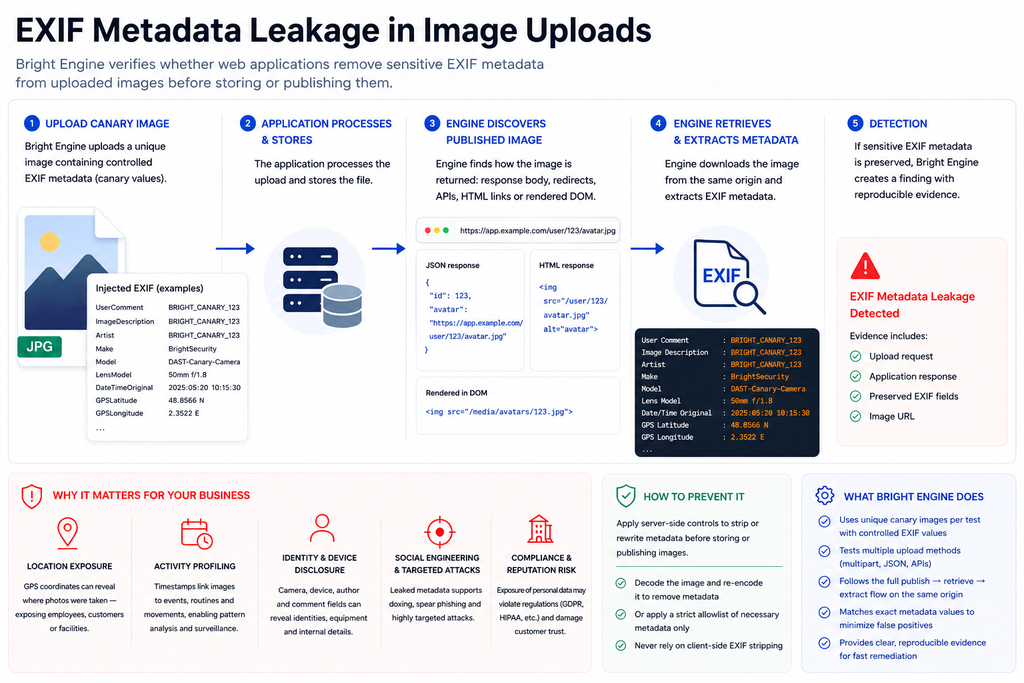
Bright Security added active detection for EXIFEXIFMetadata standard embedded in image and audio files that records camera settings, timestamps, GPS coordinates, and device identifiers — giving cyber tools a rich source of attribution and forensic data without touching file content. metadata leakage in image upload flows, validating the full processing path and producing reproducible proof artifacts.
Bright is a dynamic application & API security testing platform that offers automation, fast scans, minimal false positives, and comprehensive security testing.
Bright Security added active detection for EXIFEXIFMetadata standard embedded in image and audio files that records camera settings, timestamps, GPS coordinates, and device identifiers — giving cyber tools a rich source of attribution and forensic data without touching file content. metadata leakage in image upload flows, validating the full processing path and producing reproducible proof artifacts.
└──▷ WHAT SHIPPED ·
1 FEATURE0 OF 1 FEATUREmost completely described firstwhat's the number?
Each feature carries 0–100 for how completely the vendor documented
it — not how big or important the work is. A major capability
described in eight words scores low, and that is the finding.
depth0–40what it does and how it works or what changed
specificity0–30names real surfaces — APIs, flags, formats, limits, numbers
actionability0–30enough to go use it — a named endpoint, flag, or config key tops this; a UI path is a starting point
Code and config rank first by construction: a documented endpoint,
flag or config key scores at the top of specificity and actionability,
so it sorts above a feature described only in prose. Under
60 the notes go thin — everything below the “thinner
coverage” line is thinner documentation, not smaller work.
Hover any meter for that feature's three sub-scores.
0100
EXIF metadata leakage detection for image uploadsnew83how completely this was documenteddepth35/40specificity28/30actionability20/3083 / 100
A new check actively tests multipart and JSON upload flows using JPEG and PNG canary images embedded with controlled metadata in fields such as UserComment, ImageDescription, Artist, timestamp fields, and GPS coordinates; a finding is created only when a metadata field matches exactly or a GPS coordinate pair is confirmed preserved in the served image. The scanner validates the full image processing path — upload endpoint, application response, image discovery via response body, redirect headers, JSON/HTML responses, image links, and rendered DOMDOMThe browser's in-memory tree representation of a web page's structure, standardized by the W3C, giving cyber tools a programmable interface to read or manipulate page content at runtime. — rather than flagging storage configuration alone, and produces evidence including the original upload request, the application response, the retained EXIF fields, and the URL where the image was found for use as a testable AppSecAppSecApplication security: the practice of finding and fixing vulnerabilities in software during design, development, and testing. Cyber tools build on AppSec workflows to shift vulnerability detection earlier in the development lifecycle. control in CI/CD.
Dalfox is a powerful open-source XSS scanner and utility focused on automation.
Dalfox v3.2.2 adds a shell completion subcommand, a canonical JavaScript payload selector, new WAFWAFA reverse proxy that inspects HTTP/HTTPS traffic and blocks requests matching known attack patterns such as SQL injection or XSS, sitting between clients and a web application to filter malicious input before it reaches the server. fingerprints, and fixes CLI flag precedence over config files.
└──▷ WHAT SHIPPED ·
5 FEATURES1 OF 5 FEATURESmost completely described firstwhat's the number?
Each feature carries 0–100 for how completely the vendor documented
it — not how big or important the work is. A major capability
described in eight words scores low, and that is the finding.
depth0–40what it does and how it works or what changed
specificity0–30names real surfaces — APIs, flags, formats, limits, numbers
actionability0–30enough to go use it — a named endpoint, flag, or config key tops this; a UI path is a starting point
Code and config rank first by construction: a documented endpoint,
flag or config key scores at the top of specificity and actionability,
so it sorts above a feature described only in prose. Under
60 the notes go thin — everything below the “thinner
coverage” line is thinner documentation, not smaller work.
Hover any meter for that feature's three sub-scores.
0101
JavaScript payload selector for XSS payloadsnew75how completely this was documenteddepth20/40specificity25/30actionability30/3075 / 100
Adds dalfox payload javascript selector to print canonical JavaScript execution payloads used in JS-string contexts.
Generate a list of canonical JavaScript XSSXSSCross-site scripting, an attack that runs malicious script in another user's browser through a trusted site. It can steal data or perform actions using the user's session. payloads to review or pipe into a custom scan.
Invicti Web + API is an end-to-end web security scanner that offers a 360 view of an organization’s security. Allowing you to take control of the security of all you web applications, web services, and APIs to ensure long-term protection.
Acunetix 360 shipped opt-in HARHARAn HTTP Archive file, a JSON-format log of all network requests and responses captured by a browser's developer tools, used by cyber tools to replay, inspect, or analyze web traffic without re-running a live session. file capture for authentication verification, letting practitioners inspect the full HTTP exchange during auth checks.
└──▷ WHAT SHIPPED ·
1 FEATURE0 OF 1 FEATUREmost completely described firstwhat's the number?
Each feature carries 0–100 for how completely the vendor documented
it — not how big or important the work is. A major capability
described in eight words scores low, and that is the finding.
depth0–40what it does and how it works or what changed
specificity0–30names real surfaces — APIs, flags, formats, limits, numbers
actionability0–30enough to go use it — a named endpoint, flag, or config key tops this; a UI path is a starting point
Code and config rank first by construction: a documented endpoint,
flag or config key scores at the top of specificity and actionability,
so it sorts above a feature described only in prose. Under
60 the notes go thin — everything below the “thinner
coverage” line is thinner documentation, not smaller work.
Hover any meter for that feature's three sub-scores.
0100
Opt-in HAR generation for authentication checksnew43how completely this was documenteddepth20/40specificity15/30actionability8/3043 / 100
Adds opt-in HAR file generation for authentication verification, enabling practitioners to capture and inspect the full HTTP request/response exchange during auth checks.
Elcomsoft System Recovery 8.38 adds a built-in BitLockerBitLockerA full-disk encryption feature built into Windows, maintained by Microsoft, that protects data at rest by encrypting entire volumes; cyber tools use it to audit encryption status or recover keys from managed endpoints.TPMTPMA dedicated hardware chip, standardized by the Trusted Computing Group, that stores cryptographic keys and measurements in tamper-resistant silicon, giving cyber tools a root of trust that software alone cannot fake. exploit library and checksum logging for disk images captured during forensic triage.
Try professional password recovery, data decryption, mobile and cloud forensic tools from a manufacturer with 30+ years of expertise, providing tools and training to law enforcement, financial and intelligence agencies.
Elcomsoft System Recovery 8.38 adds a built-in BitLockerBitLockerA full-disk encryption feature built into Windows, maintained by Microsoft, that protects data at rest by encrypting entire volumes; cyber tools use it to audit encryption status or recover keys from managed endpoints.TPMTPMA dedicated hardware chip, standardized by the Trusted Computing Group, that stores cryptographic keys and measurements in tamper-resistant silicon, giving cyber tools a root of trust that software alone cannot fake. exploit library and checksum logging for disk images captured during forensic triage.
└──▷ WHAT SHIPPED ·
2 FEATURES1 OF 2 FEATURESmost completely described firstwhat's the number?
Each feature carries 0–100 for how completely the vendor documented
it — not how big or important the work is. A major capability
described in eight words scores low, and that is the finding.
depth0–40what it does and how it works or what changed
specificity0–30names real surfaces — APIs, flags, formats, limits, numbers
actionability0–30enough to go use it — a named endpoint, flag, or config key tops this; a UI path is a starting point
Code and config rank first by construction: a documented endpoint,
flag or config key scores at the top of specificity and actionability,
so it sorts above a feature described only in prose. Under
60 the notes go thin — everything below the “thinner
coverage” line is thinner documentation, not smaller work.
Hover any meter for that feature's three sub-scores.
0101
Built-in BitLocker TPM exploit librarynew85how completely this was documenteddepth30/40specificity25/30actionability30/3085 / 100
Elcomsoft System Recovery 8.38 adds a built-in BitLocker TPM exploit library supporting the YellowKey and GreatXML exploits. During installation, the installer offers to build a second USB flash drive loaded with the chosen exploit; the target machine is then booted with both drives attached to attack a locked drive.
To leverage the BitLocker TPM exploit against a locked drive, use the installer to build a second USB flash drive with the YellowKey or GreatXML exploit, then boot the target machine with both drives attached.
📍During Elcomsoft System Recovery 8.38 installation, when prompted, select Create BitLocker exploit USB, choose either YellowKey or GreatXML, and write to a second USB flash drive.
Checksum logging for disk imagesnew55how completely this was documenteddepth20/40specificity15/30actionability20/3055 / 100
Adds checksum logging for disk images captured during triage, producing a verifiable record of the disk image for chain-of-custody purposes. Enabled via the Create Disk Image imaging options screen before starting acquisition.
When imaging a suspect drive during triage, use the new checksum logging to produce a verifiable record of the disk image for chain-of-custody.
📍During bootable triage in Elcomsoft System Recovery 8.38, select Create Disk Image, then enable checksum logging on the imaging options screen before starting the acquisition.
Wireblast is an AF_XDP traffic generator for measuring and replaying high-rate Linux network traffic.
Wireblast v0.6.1 adds a new mlx5 Direct Verbs backend for receive-mode traffic generation and tightens AF_XDPAF_XDPA Linux kernel interface that hands raw packets to a userspace program straight off the network card, skipping the kernel's networking stack. It is how userspace tools reach line rate on 100G links. safety checks around queue binding and VLAN filtering.
└──▷ WHAT SHIPPED ·
2 FEATURES0 OF 2 FEATURESmost completely described firstwhat's the number?
Each feature carries 0–100 for how completely the vendor documented
it — not how big or important the work is. A major capability
described in eight words scores low, and that is the finding.
depth0–40what it does and how it works or what changed
specificity0–30names real surfaces — APIs, flags, formats, limits, numbers
actionability0–30enough to go use it — a named endpoint, flag, or config key tops this; a UI path is a starting point
Code and config rank first by construction: a documented endpoint,
flag or config key scores at the top of specificity and actionability,
so it sorts above a feature described only in prose. Under
60 the notes go thin — everything below the “thinner
coverage” line is thinner documentation, not smaller work.
Hover any meter for that feature's three sub-scores.
0100
mlx5 Direct Verbs backend with --rx-modenew75how completely this was documenteddepth25/40specificity25/30actionability25/3075 / 100
Adds a new mlx5 Direct Verbs backend, enabling --rx-mode receive support directly on Mellanox mlx5 NICsNICsA network interface card or adapter, the hardware that connects a computer to a network. It sends and receives packets over the link.. For example: sudo wireblast -i eth1 --mode receive --rx-mode udp-port --rx-port 9000 -d 60s.
Use receive mode on an mlx5 Mellanox NICNICA network interface card or adapter, the hardware that connects a computer to a network. It sends and receives packets over the link. now that the Direct Verbs backend supports --rx-mode.
— Names backend, flag, and gives runnable examplev0.6.1
thinner coverage below
0200
AF_XDP receive safety checksimproved40how completely this was documenteddepth20/40specificity12/30actionability8/3040 / 100
Wireblast now warns when an AF_XDP receive binds fewer queues than the NIC actually has, alerting users to potential missed traffic, and refuses an AF_XDP receive outright when the kernel's VLAN filter would silently drop that traffic, preventing silent data loss.
— Describes behavior but names no flags or configv0.6.1
CrowdSec's v1.8.0 cycle centers on WAFWAFA reverse proxy that inspects HTTP/HTTPS traffic and blocks requests matching known attack patterns such as SQL injection or XSS, sitting between clients and a web application to filter malicious input before it reaches the server. bot detection with a challenge-and-fingerprinting mode and a wide set of AppSecAppSecApplication security: the practice of finding and fixing vulnerabilities in software during design, development, and testing. Cyber tools build on AppSec workflows to shift vulnerability detection earlier in the development lifecycle. observability metrics, alongside a new native Kubernetes log datasource, DNS lookup caching, and HTTP helpers in the expression language.
CrowdSec - the open-source and participative security solution offering crowdsourced protection against malicious IPs and access to the most advanced real-world CTI.
CrowdSec's v1.8.0 cycle centers on WAFWAFA reverse proxy that inspects HTTP/HTTPS traffic and blocks requests matching known attack patterns such as SQL injection or XSS, sitting between clients and a web application to filter malicious input before it reaches the server. bot detection with a challenge-and-fingerprinting mode and a wide set of AppSecAppSecApplication security: the practice of finding and fixing vulnerabilities in software during design, development, and testing. Cyber tools build on AppSec workflows to shift vulnerability detection earlier in the development lifecycle. observability metrics, alongside a new native Kubernetes log datasource, DNS lookup caching, and HTTP helpers in the expression language.
└──▷ WHAT SHIPPED ·
7 FEATURES2 OF 7 FEATURESmost completely described firstwhat's the number?
Each feature carries 0–100 for how completely the vendor documented
it — not how big or important the work is. A major capability
described in eight words scores low, and that is the finding.
depth0–40what it does and how it works or what changed
specificity0–30names real surfaces — APIs, flags, formats, limits, numbers
actionability0–30enough to go use it — a named endpoint, flag, or config key tops this; a UI path is a starting point
Code and config rank first by construction: a documented endpoint,
flag or config key scores at the top of specificity and actionability,
so it sorts above a feature described only in prose. Under
60 the notes go thin — everything below the “thinner
coverage” line is thinner documentation, not smaller work.
Hover any meter for that feature's three sub-scores.
0101
DNS lookup caching via `dns_cache`new85how completely this was documenteddepth30/40specificity30/30actionability25/3085 / 100
Adds a dns_cache configuration block with ttl (default 1h), negative_ttl (default 5m), and size (default 16384) keys, caching DNS lookups with an LRU cache to reduce repeated resolver calls. Example tuning for large or frequently-rotating address sets: ttl: 30m, negative_ttl: 5m, size: 32768.
Tune DNS caching when resolving a large, diverse set of addresses or when a vendor rotates DNS records frequently.
yaml
dns_cache:
  ttl: 30m
  negative_ttl: 5m
  size: 32768
— Exact config keys, defaults, and a runnable YAML example.product docs
0200
AppSec challenge observability metricsnew80how completely this was documenteddepth30/40specificity30/30actionability20/3080 / 100
Adds appsec-challenge and appsec-challenge-infra metric categories to cscli, the latter exposing internal AppSec challenge runtime upkeep metrics: signing-key rotation, JS re-obfuscation, and cache eviction. Adds matching Prometheus counters cs_appsec_challenge_requested_total, cs_appsec_challenge_submitted_total, cs_appsec_challenge_accepted_total (labeled kind=solved for valid submissions or kind=granted via GrantChallengeCookie(reason)), cs_appsec_challenge_rejected_total (labeled kind=protocol for crypto-PoW failures, kind=submission via RejectSubmission(reason), or kind=cookie for invalid incoming cookies), cs_appsec_challenge_exempt_total for requests exempted via ExemptFromChallenge(reason) (verified bots like gptbot, well-known paths), and cs_appsec_fingerprint_mismatch_total labeled by severity from EvaluateMismatches(). Runtime internals for CPUCPUThe main general-purpose processor in a computer. It runs application instructions and coordinates work with memory and other hardware./memory troubleshooting are also exposed: cs_appsec_challenge_kepoch_generated_total, cs_appsec_challenge_kepoch_evicted_total, cs_appsec_challenge_reobfuscation_total (labeled bundle, with bundle=dynamic for the per-epoch signing module), and cs_appsec_challenge_dynamic_module_evicted_total.
— Every metric name and label given, ready to scrape.product docs
0302
WAF challenge-based bot detectionnew65how completely this was documenteddepth30/40specificity20/30actionability15/3065 / 100
v1.8.0 adds WAF bot detection via waf challenge mode, which serves a challenge-and-fingerprinting page to clients before granting site access, with configurable score thresholds and cookie-disabled error messaging. RejectSubmission now generates an alert so WAF submission rejections surface in the alert stream, and a configurable auth timeout from WAF to LAPI was added.
— Mechanism described but no config key or command example given.v1.8.0
0400
Kubernetes log datasourcenew65how completely this was documenteddepth25/40specificity25/30actionability15/3065 / 100
Adds a dedicated Kubernetes datasource that fetches logs directly from the k8s API server, streaming container logs from pods selected by labels, giving CrowdSec native k8s log acquisition without an agent proxy. Exposes a cs_kubernetessource_hits_total Prometheus counter labeled by datasource_type.
— Names the datasource and its metric but no config snippet.v1.8.0
0500
Machine heartbeat metricsnew60how completely this was documenteddepth20/40specificity25/30actionability15/3060 / 100
Adds cs_machines_heartbeat_seconds for tracking agent heartbeat timing and cs_machines_last_heartbeat_timestamp, a gauge exposing the Unix timestamp of the last heartbeat received from each machine.
— Names both metrics but no example usage given.v1.8.0
0600
cscli console status and hub list improvementsimproved60how completely this was documenteddepth20/40specificity20/30actionability20/3060 / 100
Revamps cscli console status into an all-in-one status view for console enrollment and feature status, and improves cscli hub list output.
Check the all-in-one CrowdSec console enrollment and feature status after upgrading.
$ cscli console status
— Names both commands with a runnable check command.v1.8.0
thinner coverage below
0700
HTTP helpers in expression languagenew35how completely this was documenteddepth15/40specificity10/30actionability10/3035 / 100
Adds HTTP helpers to the expression language, enabling parsers and scenarios to query external services inline.
— No helper names or syntax given, just capability described.v1.8.0
Language focused docker images, minus the operating system.
Distroless hardens Node.js supply-chain trust with GPG signature verification and an update-node-keys subcommand in knife.
└──▷ TRY IT
Generate an SPDXSPDXAn open standard for describing software components, licenses and their relationships. Its documents let different tools exchange a software bill of materials without inventing a new format. JSON SBOMSBOMA software bill of materials, an inventory of the components and versions inside an application. It helps teams find affected software when a dependency has a vulnerability or licensing issue. for a generic (non-Debian) package such as a Node.js binary archive.
Exposes update-node-keys subcommand in knife to sync committed Node.js release public keys from the upstream nodejs/release-keys repository, callable directly from CI workflows.
Verifies Node.js SHASUMS256.txt.asc via GPG --decrypt against committed release keys stored in knife.d/nodejs_keys.asc, replacing the previous unsigned plaintext fetch — no network access for key material.
Imports Node.js release public keys into an isolated temporary GNUPGHOME keyring (using gpg --batch --import) so GPG verification is hermetic and does not pollute the host keyring.
Switches all gpg calls in the Node.js updater to execFileSync with argument arrays, eliminating shell-expansion attack surfaceattack surfaceThe exposed systems, interfaces and access points an attacker could try to use. It includes internet-facing services as well as identities, software and other reachable resources. during checksum verification.
Adds package_spdx.go tool that generates per-package SPDX JSON SBOMsSBOMsA software bill of materials, an inventory of the components and versions inside an application. It helps teams find affected software when a dependency has a vulnerability or licensing issue., accepting --package_name, --version, --purl, --sha256, --url, --id, --copyright, --generates, --homepage, --supplier, and --description flags.
+1 moreshow less
Adds rollback prevention to package update scripts so versions cannot regress during automated bumps.
Chainguard provides trusted open source artifacts for every layer of your modern software stack—containers, language libraries, and VM images.
Chainguard launched Guardener, a GitHub App combining AI-driven Dockerfile migration, hardened SHA-pinned GitHub ActionsGitHub ActionsGitHub's built-in CI/CD system that runs automated workflows triggered by repository events, letting cyber tools automate testing, building, and releasing without managing separate pipeline infrastructure., and signed-commit enforcement, while also shipping open-beta custom Rego pull policies, org-wide build pinning for Chainguard Libraries, a more robust Windows chainctl self-updater, and 21 new container images.
└──▷ WHAT SHIPPED ·
9 FEATURES3 OF 9 FEATURESmost completely described firstwhat's the number?
Each feature carries 0–100 for how completely the vendor documented
it — not how big or important the work is. A major capability
described in eight words scores low, and that is the finding.
depth0–40what it does and how it works or what changed
specificity0–30names real surfaces — APIs, flags, formats, limits, numbers
actionability0–30enough to go use it — a named endpoint, flag, or config key tops this; a UI path is a starting point
Code and config rank first by construction: a documented endpoint,
flag or config key scores at the top of specificity and actionability,
so it sorts above a feature described only in prose. Under
60 the notes go thin — everything below the “thinner
coverage” line is thinner documentation, not smaller work.
Hover any meter for that feature's three sub-scores.
0101
Custom Rego pull policies in chainctlnew95how completely this was documenteddepth35/40specificity30/30actionability30/3095 / 100
Introduces custom container pull policies (open beta): organizations write Rego expressions submitted as YAML manifests, managed via chainctl, supporting parameters with per-binding values and an ENFORCE mode that blocks pulls. The new chainctl policies custom validate subcommand reports the exact line and column of a policy error before storing it, enabling CI validation of Rego policy manifests.
— Runnable subcommand plus mechanism, format and enforcement mode namedWeek of 2026-08-31
0200
Build pinning for Chainguard Librariesnew95how completely this was documenteddepth35/40specificity30/30actionability30/3095 / 100
Enables build pinning for all organizations using Chainguard Libraries with upstream fallback across JavaScript, Python, and Java, recording the first-resolved copy of each package version to keep lockfiles and checksums stable. The new chainctl libraries cache command lets you review which package-version copies (upstream mirror or Chainguard rebuild) your organization holds, or opt out of build pinning.
Review which package-version copies your organization has pinned under Chainguard Libraries build pinning, or initiate an opt-out.
$ chainctl libraries cache
— Named command with example and clear opt-out mechanismWeek of 2026-08-31
0300
Commit Verification policy enforcementnew65how completely this was documenteddepth30/40specificity25/30actionability10/3065 / 100
New Commit Verification capability enforces cryptographically signed commits against a per-repository policy, supporting keyless (Sigstore) signatures and static keys such as GPG.
— Mechanism and signing methods named, no setup steps givenproduct docs
0402
.chainguard/ configuration model for Guardenernew65how completely this was documenteddepth20/40specificity25/30actionability20/3065 / 100
New .chainguard/ configuration model enables Guardener GitHub App capabilities (Hardened Actions, Commit Verification) per repository via committed config files.
— Names exact config directory location, no schema detailproduct docs
0500
Windows support for chainctl self-updateimproved65how completely this was documenteddepth30/40specificity20/30actionability15/3065 / 100
Extends chainctl self-update on Windows to replace the running executable correctly and verify release attestations before installing, without requiring administrator privileges.
— Describes fix and behavior, no exact invocation givenWeek of 2026-08-31
0603
Hardened Actions for GitHub workflowsnew60how completely this was documenteddepth30/40specificity20/30actionability10/3060 / 100
New Hardened Actions capability recommends and migrates GitHub Actions to Chainguard's hardened, SHA-pinned equivalents, delivered via non-blocking PR review comments or scheduled/on-demand migration pull requests.
— Explains mechanism but no config or command to invokeproduct docs
0700
Grace-period container images removedbreaking60how completely this was documenteddepth15/40specificity30/30actionability15/3060 / 100
The container images kube-conformance:1.32, kubernetes:1.32, nextcloud-server:31, rke2-runtime:1.32, and teleport:17 have passed their grace periods and are no longer available.
AI-driven Dockerfile migration via chainctl agentnew55how completely this was documenteddepth20/40specificity15/30actionability20/3055 / 100
New chainctl agent dockerfile commands run AI-driven, iterative migration of Dockerfiles to Chainguard Containers locally.
— Names exact command but no flags or example shownproduct docs
0900
21 new container images addednew55how completely this was documenteddepth15/40specificity30/30actionability10/3055 / 100
Adds 21 new container images including dynatrace-operator, netshoot, strimzi-drain-cleaner, redpanda-console, apache-polaris, nomad, kserve-pmmlserver, kserve-xgbserver, victorialogs-vlagent, mlrun-api-fips, mlrun-fips, and kube-logging-operator-fluentd-drain-watch, with both standard and FIPSFIPSA set of US federal standards published by NIST that define approved cryptographic algorithms and modules; cyber tools use it to meet compliance requirements in government and regulated environments. variants where noted.
The container images kube-conformance:1.32, kubernetes:1.32, nextcloud-server:31, rke2-runtime:1.32, and teleport:17 have passed their grace periods and are no longer available.
Google SecOps shipped a new pipeline event-breaking processor for splitting multi-event log entries and added three Mandiant Frontline Threats rule packs to the Content Hub.
Meet your business challenges head on with AI and cloud computing services from Google, including security, data management, and hybrid & multi-cloud.
Google SecOps shipped a new pipeline event-breaking processor for splitting multi-event log entries and added three Mandiant Frontline Threats rule packs to the Content Hub.
└──▷ WHAT SHIPPED ·
2 FEATURES0 OF 2 FEATURESmost completely described firstwhat's the number?
Each feature carries 0–100 for how completely the vendor documented
it — not how big or important the work is. A major capability
described in eight words scores low, and that is the finding.
depth0–40what it does and how it works or what changed
specificity0–30names real surfaces — APIs, flags, formats, limits, numbers
actionability0–30enough to go use it — a named endpoint, flag, or config key tops this; a UI path is a starting point
Code and config rank first by construction: a documented endpoint,
flag or config key scores at the top of specificity and actionability,
so it sorts above a feature described only in prose. Under
60 the notes go thin — everything below the “thinner
coverage” line is thinner documentation, not smaller work.
Hover any meter for that feature's three sub-scores.
0100
Unroll processor for pipeline event breakingnew85how completely this was documenteddepth32/40specificity25/30actionability28/3085 / 100
The Unroll processor splits log entries containing arrays or slices of events into individual log events before parsing and ingestion. When inputs are raw string payloads, a Transform processor (e.g. set(body, ParseJSON(body))) must be positioned immediately before the Unroll processor in the pipeline execution sequence.
Split multi-event JSON array log entries into discrete events in a pipeline — parse the raw body first, then unroll it before ingestion.
📍In the Google SecOps pipeline editor, add a Transform processor with expression set(body, ParseJSON(body)), then add an Unroll processor immediately after it in the pipeline execution sequence.
Mandiant Frontline Threats rule packs for Linux, macOS, Google Cloudnew40how completely this was documenteddepth10/40specificity20/30actionability10/3040 / 100
Three new rule packs were added to the Content Hub: Mandiant Frontline Threats for Linux, Mandiant Frontline Threats for MacOS, and Mandiant Frontline Threats for Google Cloud.
Sumo Logic is a cloud-based platform for real-time log management, monitoring, and security analytics across applications and infrastructure.
Sumo Logic's biggest move this window is letting admins provision the SOCSOCA security operations center, the team or function that monitors threats, investigates alerts and coordinates incident response. Its work can be internal, outsourced or shared. Analyst Agent directly in child org baselines with per-day investigation limits, alongside a batch of new integrations (Druva, four GA automation integrations, Terraform resources), source and API updates, and new auto-refresh guardrails for dashboards.
└──▷ WHAT SHIPPED ·
8 FEATURES0 OF 8 FEATURESmost completely described firstwhat's the number?
Each feature carries 0–100 for how completely the vendor documented
it — not how big or important the work is. A major capability
described in eight words scores low, and that is the finding.
depth0–40what it does and how it works or what changed
specificity0–30names real surfaces — APIs, flags, formats, limits, numbers
actionability0–30enough to go use it — a named endpoint, flag, or config key tops this; a UI path is a starting point
Code and config rank first by construction: a documented endpoint,
flag or config key scores at the top of specificity and actionability,
so it sorts above a feature described only in prose. Under
60 the notes go thin — everything below the “thinner
coverage” line is thinner documentation, not smaller work.
Hover any meter for that feature's three sub-scores.
0100
Two new Terraform provider resourcesnew70how completely this was documenteddepth15/40specificity30/30actionability25/3070 / 100
SumoLogic Terraform Provider v3.3.0 adds two new resources: sumologic_async_aws_lambda_invocation and sumologic_s3_logging_lambda_enable.
Auto-refresh guardrails for dashboardsnew70how completely this was documenteddepth30/40specificity25/30actionability15/3070 / 100
Dashboards gain two auto-refresh guardrails: auto-refresh pauses when a tab is hidden for more than 10 minutes and resumes automatically on return, and a panel is dropped from auto-refresh after 5 consecutive query failures so it doesn't disrupt other healthy panels.
SOC Analyst Agent in child org baselinesnew60how completely this was documenteddepth25/40specificity20/30actionability15/3060 / 100
Sumo Logic now lets admins provision the SOC Analyst Agent when creating or editing a child org baseline, alongside existing Logs, Metrics, Traces, and Cloud SIEMCloud SIEMA Security Information and Event Management platform delivered as a hosted service, aggregating logs and alerts from across an environment to detect threats without requiring on-premises infrastructure. Enterprise baselines, with a configurable Number of investigations per day control and optional overage.
Automation Service Integrations reach GAimproved45how completely this was documenteddepth15/40specificity20/30actionability10/3045 / 100
Four Automation Service Integrations are now generally available: AWS Lambda, DFIR-IRISDFIR-IRISAn open-source incident-response case management platform that lets analysts track investigations, share findings, and link evidence — giving cyber tools a structured backend to feed alerts and artefacts into., Google Cloud Functions, and LaunchDarkly.
Akamai SIEM API parser path supportimproved40how completely this was documenteddepth10/40specificity20/30actionability10/3040 / 100
Akamai SIEMSIEMSecurity information and event management, collecting logs from many systems and correlating events to find suspicious activity. Analysts use it to investigate alerts and incidents. API v1.2.26 adds parser path support.
Trend Micro's unified security platform providing threat intelligence, endpoint protection, and attack surface visibility across cloud and on-premises environments.
Trend Vision One shipped automatic disabling of inactive local user accounts with configurable thresholds and audit/notification support, alongside enforcement of Asset Visibility Management scopes within Endpoint Alerts.
└──▷ WHAT SHIPPED ·
2 FEATURES0 OF 2 FEATURESmost completely described firstwhat's the number?
Each feature carries 0–100 for how completely the vendor documented
it — not how big or important the work is. A major capability
described in eight words scores low, and that is the finding.
depth0–40what it does and how it works or what changed
specificity0–30names real surfaces — APIs, flags, formats, limits, numbers
actionability0–30enough to go use it — a named endpoint, flag, or config key tops this; a UI path is a starting point
Code and config rank first by construction: a documented endpoint,
flag or config key scores at the top of specificity and actionability,
so it sorts above a feature described only in prose. Under
60 the notes go thin — everything below the “thinner
coverage” line is thinner documentation, not smaller work.
Hover any meter for that feature's three sub-scores.
0100
Automatic disabling of inactive user accountsnew84how completely this was documenteddepth32/40specificity25/30actionability27/3084 / 100
An Inactive user account auto-disable option in the User Accounts app Settings menu (top right of console) lets administrators automatically disable local accounts inactive for 30, 60, 90, or 180 days. Accounts disabled this way appear grayed out on the Select business page for multi-business users, and disabled users attempting to sign in see a clearer message directing them to contact their administrator. A new Status set by column in User Accounts shows whether an account's status was last changed by a user or the system, all auto-disable configuration changes and disable actions are recorded in the audit log, and an email notification is sent to a local user account when the system automatically disables it for inactivity.
Enable automatic disabling of local accounts that have not signed in for 90 days to enforce an idle-account policy.
📍In the Trend Vision One console, go to Administration → User Accounts, open the Settings menu (top right), enable Inactive user account auto-disable, and select 90 days as the inactivity threshold.
Enable automatic disabling of inactive local user accounts to reduce your attack surfaceattack surfaceThe exposed systems, interfaces and access points an attacker could try to use. It includes internet-facing services as well as identities, software and other reachable resources. from dormant credentials.
📍In the console, go to Administration → User Accounts, open Settings (top right), enable Inactive user account auto-disable, and select an inactivity threshold of 30, 60, 90, or 180 days.
Asset Visibility Management scope in Endpoint Alertsimproved50how completely this was documenteddepth20/40specificity15/30actionability15/3050 / 100
Endpoint Alerts now enforces Asset Visibility Management scopes so users only see alerts and impacted endpoints within their assigned visibility scope, viewable under Endpoint Security → Endpoint Alerts.
Ensure your Asset Visibility Management scope is correctly configured so users see the right alerts in Endpoint Security → Endpoint Alerts.
📍In the console, go to Asset Visibility Management and configure the visibility scope for each user or group, then verify results under Endpoint Security › Endpoint Alerts.
Corellium launched support for the Arm RD-1AE automotive virtual hardware platform, bringing advanced hypervisor, safety-island, and trusted-firmware virtualization to its Arm Virtual Hardware offering.
Advice, answers, updates, and more from the Corellium Team
Corellium launched support for the Arm RD-1AE automotive virtual hardware platform, bringing advanced hypervisor, safety-island, and trusted-firmware virtualization to its Arm Virtual Hardware offering.
└──▷ WHAT SHIPPED ·
1 FEATURE1 OF 1 FEATUREmost completely described firstwhat's the number?
Each feature carries 0–100 for how completely the vendor documented
it — not how big or important the work is. A major capability
described in eight words scores low, and that is the finding.
depth0–40what it does and how it works or what changed
specificity0–30names real surfaces — APIs, flags, formats, limits, numbers
actionability0–30enough to go use it — a named endpoint, flag, or config key tops this; a UI path is a starting point
Code and config rank first by construction: a documented endpoint,
flag or config key scores at the top of specificity and actionability,
so it sorts above a feature described only in prose. Under
60 the notes go thin — everything below the “thinner
coverage” line is thinner documentation, not smaller work.
Hover any meter for that feature's three sub-scores.
0101
Arm RD-1AE automotive virtual hardware platformnew80how completely this was documenteddepth35/40specificity30/30actionability15/3080 / 100
Corellium added the Arm RD-1AE virtual hardware platform to the Arm Virtual Hardware platform powered by Corellium, virtualizing an advanced automotive reference design with Neoverse-V3AE application processors, Cortex-R82AE safety islands, and a Cortex-M55 Runtime Security Engine. The platform supports execution of Type 1 and Type 2 hypervisors, including the Xen hypervisor from Arm's reference software package, and includes SystemReady IR support, Arm Trusted Firmware, and trusted services. Pre-built RD-1AE software images covering the full set of Arm reference software deliverables are selectable at device creation time, and the platform boots to a Linux prompt in under 30 seconds on AWS Graviton 3 instances.
— Names processors, hypervisors, boot time; no exact command or endpoint given.launch-20260831-aa561c03
Sophos Mobile is an enterprise mobile device management and security platform that protects iOS and Android devices through threat prevention and policy enforcement.
Sophos Mobile introduces Apple Declarative Device Management (DDM) policies for real-time desired-state configuration and clarifies domain filtering rules across Mobile Threat Defense and Chrome Security policies.
└──▷ WHAT SHIPPED ·
2 FEATURES0 OF 2 FEATURESmost completely described firstwhat's the number?
Each feature carries 0–100 for how completely the vendor documented
it — not how big or important the work is. A major capability
described in eight words scores low, and that is the finding.
depth0–40what it does and how it works or what changed
specificity0–30names real surfaces — APIs, flags, formats, limits, numbers
actionability0–30enough to go use it — a named endpoint, flag, or config key tops this; a UI path is a starting point
Code and config rank first by construction: a documented endpoint,
flag or config key scores at the top of specificity and actionability,
so it sorts above a feature described only in prose. Under
60 the notes go thin — everything below the “thinner
coverage” line is thinner documentation, not smaller work.
Hover any meter for that feature's three sub-scores.
0100
Web Filtering domain field guidanceimproved60how completely this was documenteddepth20/40specificity25/30actionability15/3060 / 100
Improves guidance on the Web Filtering pages in Mobile Threat Defense policies for Android and iOS, and the Chrome Security policy for ChromeOS, clarifying that protocol prefixes such as https:// or chrome:// must not be included in the Allowed domains and Blocked domains fields.
Apple Declarative Device Management (DDM) policiesnew55how completely this was documenteddepth25/40specificity15/30actionability15/3055 / 100
Adds support for Apple Declarative Device Management (DDM) policies, enabling desired-state configuration where devices self-maintain their configuration status and report changes immediately rather than waiting for periodic sync checks.
A secure low code deception runtime framework, leveraging AI for System Virtualization.
Beelzebub v3.9.1 adds method-aware HTTP routing to its honeypot service to make fingerprinting harder for scanners.
└──▷ WHAT SHIPPED ·
1 FEATURE0 OF 1 FEATUREmost completely described firstwhat's the number?
Each feature carries 0–100 for how completely the vendor documented
it — not how big or important the work is. A major capability
described in eight words scores low, and that is the finding.
depth0–40what it does and how it works or what changed
specificity0–30names real surfaces — APIs, flags, formats, limits, numbers
actionability0–30enough to go use it — a named endpoint, flag, or config key tops this; a UI path is a starting point
Code and config rank first by construction: a documented endpoint,
flag or config key scores at the top of specificity and actionability,
so it sorts above a feature described only in prose. Under
60 the notes go thin — everything below the “thinner
coverage” line is thinner documentation, not smaller work.
Hover any meter for that feature's three sub-scores.
0100
Method-aware HTTP honeypot routingimproved40how completely this was documenteddepth20/40specificity10/30actionability10/3040 / 100
The HTTP honeypot service now routes and responds differently depending on the HTTP method used by a scanner, reducing the ability of scanners to fingerprint the honeypot.
— Explains behaviour change but no config/flag or endpoint namedv3.9.1
Censys overhauled host reputation with an ML-based, SHAPSHAPA Python library for explaining machine learning model predictions by assigning each input feature a contribution score, giving cyber tools interpretable output from otherwise opaque models.-explainable scoring model and rolled out a broad ASMASMAttack Surface Management: the continuous practice of discovering, inventorying, and monitoring an organization's externally exposed assets so that cyber tools can flag unknown or misconfigured entry points before attackers find them. web-scanning upgrade adding screenshots, redirect tracking, JavaScript fingerprinting/risk detection, and a switch to ActiveDNSActiveDNSA large-scale passive DNS dataset collected and maintained by researchers at Michigan State University, giving cyber tools a historical record of domain-to-IP mappings for threat hunting and infrastructure analysis. resolution.
Censys is a search engine for discovering internet-connected devices, servers, and certificates to assess security exposure and vulnerabilities.
Censys overhauled host reputation with an ML-based, SHAPSHAPA Python library for explaining machine learning model predictions by assigning each input feature a contribution score, giving cyber tools interpretable output from otherwise opaque models.-explainable scoring model and rolled out a broad ASMASMAttack Surface Management: the continuous practice of discovering, inventorying, and monitoring an organization's externally exposed assets so that cyber tools can flag unknown or misconfigured entry points before attackers find them. web-scanning upgrade adding screenshots, redirect tracking, JavaScript fingerprinting/risk detection, and a switch to ActiveDNSActiveDNSA large-scale passive DNS dataset collected and maintained by researchers at Michigan State University, giving cyber tools a historical record of domain-to-IP mappings for threat hunting and infrastructure analysis. resolution.
└──▷ WHAT SHIPPED ·
8 FEATURES2 OF 8 FEATURESmost completely described firstwhat's the number?
Each feature carries 0–100 for how completely the vendor documented
it — not how big or important the work is. A major capability
described in eight words scores low, and that is the finding.
depth0–40what it does and how it works or what changed
specificity0–30names real surfaces — APIs, flags, formats, limits, numbers
actionability0–30enough to go use it — a named endpoint, flag, or config key tops this; a UI path is a starting point
Code and config rank first by construction: a documented endpoint,
flag or config key scores at the top of specificity and actionability,
so it sorts above a feature described only in prose. Under
60 the notes go thin — everything below the “thinner
coverage” line is thinner documentation, not smaller work.
Hover any meter for that feature's three sub-scores.
0101
ML-based host reputation scoring with SHAP explainabilitybreaking72how completely this was documenteddepth33/40specificity24/30actionability15/3072 / 100
Each host now receives a label (Benign, Suspicious, Malicious, Honeypot, or Inactive), a 0–100 score, a confidence level, and evidence for the top five signals that influenced the assessment, generated using a SHAP (SHapley Additive exPlanations) model. Some data fields from the legacy reputation score method changed as a result, so existing queries or integrations relying on those fields should be reviewed against Censys documentation before upgrading.
ActiveDNS resolution for ASM web scanningimproved71how completely this was documenteddepth30/40specificity26/30actionability15/3071 / 100
ASM web scanning switches to ActiveDNS resolution, increasing detected web entity counts by 0–10% while reducing false-positive host counts by 2–15%; host counts drop correspondingly because bare IPs not seen in the last 24 hours are no longer retained and only the most recent active resolution is shown.
Forgejo detection in Platform and ASMnew65how completely this was documenteddepth24/40specificity25/30actionability16/3065 / 100
Adds a new Forgejo software fingerprint to the Platform to detect self-hosted Forgejo Git forge instances, and an Exposed Forgejo Application risk fingerprint to ASM that flags exposed HTTP services running Forgejo due to the sensitive source code, credentials, and CI/CD configs they may contain. New risk types like this may be disabled by default, so workspaces should check risk type configuration in the ASM web console to enable them.
Web entity instance limit to most recent resolutionbreaking64how completely this was documenteddepth26/40specificity22/30actionability16/3064 / 100
Web entity instances are now limited to a maximum of one per web entity, representing only the most recent active IP resolution rather than all historical resolutions; as a result the web_entity.instance_count field will show significantly reduced values after migration, requiring review of any dashboards or alerting thresholds based on instance counts.
Automatic web screenshot capture in ASMnew61how completely this was documenteddepth28/40specificity18/30actionability15/3061 / 100
ASM now automatically captures web screenshots for every web entity in inventory, storing exact timestamps and a historical view over time so analysts can surface exposed login pages, admin panels, and potentially compromised infrastructure.
JavaScript risk detection for EOL librariesnew61how completely this was documenteddepth26/40specificity20/30actionability15/3061 / 100
ASM adds JavaScript risk detection to identify and flag vulnerabilities in end-of-life JS libraries, enabling rapid response to JS-related incidents such as React2Shell. As with other new risk types, this may be disabled by default and require enabling via risk type configuration in the ASM web console.
JavaScript library fingerprintingnew46how completely this was documenteddepth22/40specificity14/30actionability10/3046 / 100
ASM adds JavaScript library fingerprinting, using a large number of software fingerprints, to surface unknown or unauthorized JS dependencies across web assets.
Some data fields from the legacy reputation score method changed as a result of the new ML-based reputation release — consult the Censys documentation to identify affected fields before upgrading queries or integrations that rely on them.
!
The web_entity.instance_count field will have significantly reduced values after migration, as each web entity will have a maximum of one instance instead of multiple historical instances — any dashboards or alerting thresholds based on instance counts will need to be reviewed.
!
Host counts in ASM inventory will drop by 2–15% as bare IPs that were not seen in the last 24 hours are no longer retained, and only the most recent active resolution is displayed.
Aembit ships an in-process Edge SDK (TypeScript and Python) for proxy-free workload authentication, alongside new tracing fields in Agent Proxy events, installer property handling, a glibc-linked CLI build, and a consolidated Developer Guide.
Aembit is a zero-trust identity security platform that manages and authenticates machine identities across cloud infrastructure.
Aembit ships an in-process Edge SDK (TypeScript and Python) for proxy-free workload authentication, alongside new tracing fields in Agent Proxy events, installer property handling, a glibc-linked CLI build, and a consolidated Developer Guide.
└──▷ WHAT SHIPPED ·
5 FEATURES1 OF 5 FEATURESmost completely described firstwhat's the number?
Each feature carries 0–100 for how completely the vendor documented
it — not how big or important the work is. A major capability
described in eight words scores low, and that is the finding.
depth0–40what it does and how it works or what changed
specificity0–30names real surfaces — APIs, flags, formats, limits, numbers
actionability0–30enough to go use it — a named endpoint, flag, or config key tops this; a UI path is a starting point
Code and config rank first by construction: a documented endpoint,
flag or config key scores at the top of specificity and actionability,
so it sorts above a feature described only in prose. Under
60 the notes go thin — everything below the “thinner
coverage” line is thinner documentation, not smaller work.
Hover any meter for that feature's three sub-scores.
0101
Edge SDK for TypeScript and Pythonnew85how completely this was documenteddepth35/40specificity30/30actionability20/3085 / 100
Introduces the Aembit Edge SDK (TypeScript and Python): in-process libraries that handle workload attestation, token lifecycle, and credential retrieval with no proxy required, suited for serverless functions, ephemeral CI containers, and restricted runtimes. It supports seven Trust Providers — AWS Metadata Service, AWS Role, Azure Instance Metadata Service, GCP Identity Token, GitHub, GitLab, and OIDCOIDCOpenID Connect, a sign-in protocol built on OAuth 2.0. An application uses identity information from a trusted provider instead of maintaining a separate password for each user. ID Token — with integration guides for AWS EC2EC2Amazon's cloud virtual-machine service, letting tools run on-demand servers without managing physical hardware., AWS Lambda, GCP Cloud RunCloud RunGoogle's managed container runtime that executes stateless workloads on demand, scaling to zero when idle, so tools can deploy without managing servers or paying for idle capacity., and Vercel OIDC.
Installer property handling for Windows MSI and Linux scriptimproved83how completely this was documenteddepth25/40specificity28/30actionability30/3083 / 100
The Windows MSI installer now applies AEMBIT_TENANT_GRPC_PING_INTERVAL_SECS and AEMBIT_TENANT_GRPC_PING_TIMEOUT_SECS when passed as install-time properties. The Linux installer script now validates Agent Proxy arguments — including numeric environment variables such as AEMBIT_HTTP_IDLE_TIMEOUT_SECS — before installation proceeds.
Apply gRPCgRPCAn open-source remote procedure call framework from Google that uses HTTP/2 and Protocol Buffers to let services call each other's functions across a network, giving tools low-latency, strongly typed inter-process communication. keep-alive settings at install time on Windows so the CLI maintains its tenant connection over idle periods.
New fields in Agent Proxy workload and response eventsimproved70how completely this was documenteddepth30/40specificity25/30actionability15/3070 / 100
Adds authorizationChain to Agent Proxy workload events — an ordered list of context IDs for the authorization events behind a request, enabling full trace-back to the directive and credential retrievals. Also adds severity, outcome.result, and outcome.reason to response events when Aembit answers in place of the Server Workload, so the outcome is no longer cleared between request and response.
glibc-linked Linux amd64 CLI buildnew70how completely this was documenteddepth25/40specificity30/30actionability15/3070 / 100
Aembit CLI 1.34.5772 adds aembit_agent_cli_linux_amd64_glibc_<version>.tar.gz as a second Linux amd64 archive, dynamically linking against glibc 2.28 or newer, for organizations whose policy requires glibc or to work around DNS resolution issues caused by musl's stricter handling of resolver responses.
Unified Developer Guide documentationimproved55how completely this was documenteddepth20/40specificity20/30actionability15/3055 / 100
Consolidates API Guide, CLI Guide, and Edge SDK documentation into a single Developer Guide under /dev-guide/, with a side-by-side credential-path comparison of Agent Proxy, Edge SDK, Aembit CLI, and Edge API.
Didit provides identity verification, fraud prevention, and transaction-monitoring APIs, SDKs, and MCP tools.
Didit shipped a Marketplace for swapping identity-verification engines per workflow feature with automatic fallback, a full biometric-template retention system spanning webhook config, per-call overrides, a new Biometric Templates API and privacy-erasure controls, plus transaction-monitoring rule management via REST and AI-assisted rule migration through MCPMCPModel Context Protocol, a standard for connecting AI applications to external tools and data sources. A compatible server exposes capabilities an assistant can use through a common interface.. Note a breaking change to the session-delete response format.
└──▷ WHAT SHIPPED ·
8 FEATURES2 OF 8 FEATURESmost completely described firstwhat's the number?
Each feature carries 0–100 for how completely the vendor documented
it — not how big or important the work is. A major capability
described in eight words scores low, and that is the finding.
depth0–40what it does and how it works or what changed
specificity0–30names real surfaces — APIs, flags, formats, limits, numbers
actionability0–30enough to go use it — a named endpoint, flag, or config key tops this; a UI path is a starting point
Code and config rank first by construction: a documented endpoint,
flag or config key scores at the top of specificity and actionability,
so it sorts above a feature described only in prose. Under
60 the notes go thin — everything below the “thinner
coverage” line is thinner documentation, not smaller work.
Hover any meter for that feature's three sub-scores.
0101
Third-party verification engine marketplacenew95how completely this was documenteddepth35/40specificity30/30actionability30/3095 / 100
Adds provider_key (string) and fallback_to_native (boolean, default true) fields to the feature config object in the Management API for programmatic engine selection and fallback control. A new Marketplace UI lets you connect third-party identity verification providers and choose, per workflow feature node, which engine runs the check via a Verification engine control on the node's first configuration tab, with status labels Active, Switch, and Connect and inline provider setup without leaving the workflow builder. A 'Fall back to Didit if my provider fails' toggle (default on) automatically runs Didit's own engine if the selected third-party provider is unavailable.
Override the verification engine for a specific workflow feature and disable silent fallback, so failures surface explicitly rather than silently running on Didit.
Connect a new provider and activate it for a feature without leaving the workflow builder.
📍1. Open the workflow builder and select the feature node you want to change.
2. On the first configuration tab, open the Verification engine control.
3. Find the provider listed as Connect and select it — the setup dialog opens inline.
4. Complete the connection, then select the provider again (now shown as Switch) to make it the active engine for this feature.
Switch a verification step to a third-party provider so it runs through your connected Marketplace integration, with Didit as the automatic fallback.
📍In the workflow editor, open a feature node › first configuration tab › set Verification engine to your connected third-party provider from the Marketplace.
— Names exact API fields, UI control and step-by-step activation pathproduct docs
0200
Biometric-template retention configurationnew95how completely this was documenteddepth35/40specificity30/30actionability30/3095 / 100
Adds face_retention_policy and face_retention_days fields on PATCH /v3/webhook/ to configure biometric-template retention at the application level, keeping image-free face embeddingsembeddingsLists of numbers a model produces to represent the meaning of text, images or code, so similar items sit close together. They power semantic search and RAG. alive for duplicate detection, Face Search, and biometric authentication after session data is purged. A retain_face_embeddings parameter on DELETE /v3/session/{sessionId}/delete/ and POST /v3/sessions/delete/ overrides that policy per call, and a Retain biometric template toggle with a required finite retention period is available in App Settings → Data.
Enable biometric-template retention org-wide so Face Search keeps working after sessions are deleted, with a 90-day expiry.
— Endpoint fields plus runnable curl examples for both levelssnapshot-20260831
0300
Biometric Templates management APInew85how completely this was documenteddepth30/40specificity30/30actionability25/3085 / 100
New Biometric Templates API — GET /v3/biometric-templates/, GET /v3/biometric-templates/count/, GET /v3/biometric-templates/{template_uuid}/, DELETE /v3/biometric-templates/{template_uuid}/, and POST /v3/biometric-templates/delete/ — lists, counts, inspects, and purges retained templates, with every retain and purge action audited.
Privacy erasure and cascading purge on deletionnew83how completely this was documenteddepth30/40specificity28/30actionability25/3083 / 100
Adds deletion_instruction: "privacy_erasure" (with instruction_id) on session deletion to purge all retained biometric templates for a person regardless of application policy. POST /v3/users/delete/ now purges a user's retained biometric templates before deleting the user, returning 503 (retryable, nothing deleted) if a template cannot be purged.
Purge all retained biometric templates for a person on a GDPRGDPREU regulation enacted in 2018 that governs how organizations collect, store, and process personal data of EU residents, giving cyber tools legal obligations around data handling and breach notification. erasure request, regardless of application retention policy.
— Named fields and endpoints with a runnable erasure examplesnapshot-20260831
0500
Transaction-monitoring rules API and librarynew80how completely this was documenteddepth30/40specificity25/30actionability25/3080 / 100
New /v3/transactions/rules/ Management API endpoints let you create, update, delete, and backtest transaction-monitoring rules programmatically, with matching library and install endpoints for browsing, installing, and removing preset rules from the rule library.
Session-delete response now returns 200 with bodybreaking78how completely this was documenteddepth30/40specificity28/30actionability20/3078 / 100
DELETE /v3/session/{sessionId}/delete/ and POST /v3/sessions/delete/ now return 200 OK with a JSON body (face_retention_outcome, biometric_template_uuid; per-session results[] for batch) instead of 204 No Content — clients that assert on a 204 response will break and must be updated.
— Exact before/after response contract named, no code migration samplesnapshot-20260831
0700
AI-assisted rule migration via MCPnew65how completely this was documenteddepth30/40specificity20/30actionability15/3065 / 100
New AI-assisted rule migration workflow lets the Didit assistant, or any MCP-connected agent, map a rule set exported from another provider (CSV or Excel) onto Didit's rule schema, backtest it against your transaction history, and create the rules in test mode for review before activation.
Face Search retained-template match metadataimproved50how completely this was documenteddepth15/40specificity25/30actionability10/3050 / 100
Face Search match results now include source: "retained_template", vendor_user_id, and biometric_template_id fields for hits on retained templates, and vendor_user_id on session and imported matches.
— Field names given but no example response or usage stepssnapshot-20260831
└──▷ BREAKING ON UPGRADE
!
DELETE /v3/session/{sessionId}/delete/ and POST /v3/sessions/delete/ now return 200 OK with a JSON body (face_retention_outcome, biometric_template_uuid; per-session results[] for batch) instead of 204 No Content — clients that assert on a 204 response will break and must be updated.
Material Security is an email security platform that uses AI to detect and prevent advanced threats like phishing, ransomware, and data exfiltration.
Material Security overhauled Google Drive detection and response with more granular sensitive-content detections, natural-language detection creation, configurable remediation flows, in-context manual fixes, and a new per-file audit log.
└──▷ WHAT SHIPPED ·
5 FEATURES0 OF 5 FEATURESmost completely described firstwhat's the number?
Each feature carries 0–100 for how completely the vendor documented
it — not how big or important the work is. A major capability
described in eight words scores low, and that is the finding.
depth0–40what it does and how it works or what changed
specificity0–30names real surfaces — APIs, flags, formats, limits, numbers
actionability0–30enough to go use it — a named endpoint, flag, or config key tops this; a UI path is a starting point
Code and config rank first by construction: a documented endpoint,
flag or config key scores at the top of specificity and actionability,
so it sorts above a feature described only in prose. Under
60 the notes go thin — everything below the “thinner
coverage” line is thinner documentation, not smaller work.
Hover any meter for that feature's three sub-scores.
0100
Granular sensitive-content detection categoriesimproved57how completely this was documenteddepth25/40specificity22/30actionability10/3057 / 100
Previously combined sensitive-content detections are now split into distinct categories — passwords, payroll information, and social security numbers each produce their own individual detection — giving analysts a clearer, more actionable risk view.
Natural language detection creationnew55how completely this was documenteddepth25/40specificity15/30actionability15/3055 / 100
Natural language search is extended to detection creation, letting analysts describe what they want to detect in plain English and activate it as a live detection without writing MQLMQLA query language created by Microsoft for hunting across telemetry in Microsoft 365 Defender, letting cyber tools express complex behavioral detections in a structured, readable syntax. or building a structured query.
Configurable remediation flows for overpermissioned filesnew55how completely this was documenteddepth25/40specificity15/30actionability15/3055 / 100
Security teams can now set configurable remediation flow options for overpermissioned files, including the order of notifications, grace periods, and remediation actions, to match organizational sharing policies.
Per-file audit lognew47how completely this was documenteddepth25/40specificity12/30actionability10/3047 / 100
A new per-file audit log shows every security action taken on a file and when, with forthcoming support for analyst comments on the audit timeline and clearer error messages when an automated remediation step fails.
Manual remediation from file pagesimproved45how completely this was documenteddepth20/40specificity10/30actionability15/3045 / 100
Manual remediation actions are now available directly on file issue pages and file detail pages, removing the need to navigate to the detection page to fix over-sharing.
Secure users, AI agents, and more with Auth0, an easy-to-implement, scalable, and adaptable authentication and authorization platform.
Auth0 brought Custom Token Exchange to General Availability with full Dashboard management, added shared transaction context between exchange and post-login Actions, and enabled session delegation for AI and support agents; WebAuthnWebAuthnA web standard that lets a browser prove possession of a passkey or hardware key to a website. It is the browser-facing part of FIDO2 sign-in. biometrics can now serve as a first authentication factor.
└──▷ WHAT SHIPPED ·
3 FEATURES0 OF 3 FEATURESmost completely described firstwhat's the number?
Each feature carries 0–100 for how completely the vendor documented
it — not how big or important the work is. A major capability
described in eight words scores low, and that is the finding.
depth0–40what it does and how it works or what changed
specificity0–30names real surfaces — APIs, flags, formats, limits, numbers
actionability0–30enough to go use it — a named endpoint, flag, or config key tops this; a UI path is a starting point
Code and config rank first by construction: a documented endpoint,
flag or config key scores at the top of specificity and actionability,
so it sorts above a feature described only in prose. Under
60 the notes go thin — everything below the “thinner
coverage” line is thinner documentation, not smaller work.
Hover any meter for that feature's three sub-scores.
0100
Shared transaction context in Custom Token Exchangenew45how completely this was documenteddepth20/40specificity15/30actionability10/3045 / 100
Adds shared transaction context between Custom Token Exchange Actions and Post-Login Actions via transaction metadata, enabling token customization based on subject or actor token information.
Session Delegation via Custom Token Exchangenew40how completely this was documenteddepth20/40specificity10/30actionability10/3040 / 100
Enables Session Delegation through Custom Token Exchange, allowing a service, AI agent, or support agent to establish a web session on behalf of a user.
JumpCloud launched Access Risk Detection, a new identity threat capability that builds per-user behavioral baselines and surfaces risky logins through weighted scoring and a review dashboard.
Learn what password cracking is, how it works, and the best ways to protect against it.
JumpCloud launched Access Risk Detection, a new identity threat capability that builds per-user behavioral baselines and surfaces risky logins through weighted scoring and a review dashboard.
└──▷ WHAT SHIPPED ·
1 FEATURE0 OF 1 FEATUREmost completely described firstwhat's the number?
Each feature carries 0–100 for how completely the vendor documented
it — not how big or important the work is. A major capability
described in eight words scores low, and that is the finding.
depth0–40what it does and how it works or what changed
specificity0–30names real surfaces — APIs, flags, formats, limits, numbers
actionability0–30enough to go use it — a named endpoint, flag, or config key tops this; a UI path is a starting point
Code and config rank first by construction: a documented endpoint,
flag or config key scores at the top of specificity and actionability,
so it sorts above a feature described only in prose. Under
60 the notes go thin — everything below the “thinner
coverage” line is thinner documentation, not smaller work.
Hover any meter for that feature's three sub-scores.
0100
Access Risk Detection behavioral anomaly scoringnew77how completely this was documenteddepth35/40specificity27/30actionability15/3077 / 100
A new Access Risk Detection capability builds a unique behavioral profile per user from 60 days of continuous activity or the last 50 successful logins, then correlates concurrent signals (e.g., unfamiliar browser paired with impossible travel) into a single weighted risk score. Events are mapped into three severity tiers — Low, Medium, and Critical — and privileged account weighting applies a higher score to deviations on admin profiles than on standard user accounts. Automated step-up MFAMFAMulti-factor authentication, requiring proof from different categories, such as a password and a hardware key, to sign in. It reduces reliance on a password alone. verification loops trigger additional authentication when anomalous login signals are detected, reducing false positives. A dedicated Needs Review dashboard filters out auto-resolved events, surfaces granular telemetry, supports custom admin filters, and allows compliance notes to be attached directly to an incident.
CrowdStrike Falcon Identity Protection detects and prevents identity-based attacks through behavioral analytics and threat intelligence across enterprise environments.
CrowdStrike Falcon Identity Protection added a real-time biometric verification integration with CLEAR, correlating identity-proofing results with other Falcon signals to drive access decisions.
└──▷ WHAT SHIPPED ·
1 FEATURE0 OF 1 FEATUREmost completely described firstwhat's the number?
Each feature carries 0–100 for how completely the vendor documented
it — not how big or important the work is. A major capability
described in eight words scores low, and that is the finding.
depth0–40what it does and how it works or what changed
specificity0–30names real surfaces — APIs, flags, formats, limits, numbers
actionability0–30enough to go use it — a named endpoint, flag, or config key tops this; a UI path is a starting point
Code and config rank first by construction: a documented endpoint,
flag or config key scores at the top of specificity and actionability,
so it sorts above a feature described only in prose. Under
60 the notes go thin — everything below the “thinner
coverage” line is thinner documentation, not smaller work.
Hover any meter for that feature's three sub-scores.
0100
CLEAR biometric identity verification integrationnew53how completely this was documenteddepth25/40specificity18/30actionability10/3053 / 100
Falcon now integrates with CLEAR to trigger real-time biometric person-verification when identity risk is detected, correlating CLEAR identity verification results alongside other Falcon platform signals to determine whether activity should be allowed, investigated, or blocked.
— Explains mechanism and decision outcomes but no config or API detail.2026-08-31-ce30cf5f
SailPoint is an identity governance platform that manages user access, permissions, and compliance across enterprise applications and systems.
SailPoint launched SecOpsSecOpsThe practice of merging security and IT operations teams so that threat detection, response, and infrastructure management share the same workflows, giving cyber tools a single pipeline from alert to remediation. Identity Intelligence integration with CrowdStrike Falcon Next-Gen SIEMSIEMSecurity information and event management, collecting logs from many systems and correlating events to find suspicious activity. Analysts use it to investigate alerts and incidents., surfacing identity governance and risk data inside SOCSOCA security operations center, the team or function that monitors threats, investigates alerts and coordinates incident response. Its work can be internal, outsourced or shared. investigation workflows.
└──▷ WHAT SHIPPED ·
1 FEATURE0 OF 1 FEATUREmost completely described firstwhat's the number?
Each feature carries 0–100 for how completely the vendor documented
it — not how big or important the work is. A major capability
described in eight words scores low, and that is the finding.
depth0–40what it does and how it works or what changed
specificity0–30names real surfaces — APIs, flags, formats, limits, numbers
actionability0–30enough to go use it — a named endpoint, flag, or config key tops this; a UI path is a starting point
Code and config rank first by construction: a documented endpoint,
flag or config key scores at the top of specificity and actionability,
so it sorts above a feature described only in prose. Under
60 the notes go thin — everything below the “thinner
coverage” line is thinner documentation, not smaller work.
Hover any meter for that feature's three sub-scores.
0100
SecOps Identity Intelligence integration with Falcon Next-Gen SIEMnew48how completely this was documenteddepth20/40specificity18/30actionability10/3048 / 100
SailPoint identity governance, access, and risk data for human, machine, and AI agent identities is brought into CrowdStrike Falcon Next-Gen SIEM for use during security investigations, allowing correlation with endpoint, cloud, threat intelligence, and third-party telemetry already present in the SIEM.
— Describes purpose and data types but no config, endpoint, or setup steps.launch-20260831-0d4a3bff
DigiCert CertCentral is a centralized platform for managing SSL/TLS certificates, automating issuance, renewal, and deployment across infrastructure.
CertCentral now lets administrators configure the default Key Usage pre-selection on the X9 PKIPKIA framework of policies, roles, and cryptographic standards for issuing and managing digital certificates that bind public keys to identities, letting tools verify authenticity and encrypt communications without pre-shared secrets. for TLS certificate request form.
└──▷ WHAT SHIPPED ·
1 FEATURE0 OF 1 FEATUREmost completely described firstwhat's the number?
Each feature carries 0–100 for how completely the vendor documented
it — not how big or important the work is. A major capability
described in eight words scores low, and that is the finding.
depth0–40what it does and how it works or what changed
specificity0–30names real surfaces — APIs, flags, formats, limits, numbers
actionability0–30enough to go use it — a named endpoint, flag, or config key tops this; a UI path is a starting point
Code and config rank first by construction: a documented endpoint,
flag or config key scores at the top of specificity and actionability,
so it sorts above a feature described only in prose. Under
60 the notes go thin — everything below the “thinner
coverage” line is thinner documentation, not smaller work.
Hover any meter for that feature's three sub-scores.
0100
Configurable default Key Usage for X9 PKI for TLSnew62how completely this was documenteddepth25/40specificity22/30actionability15/3062 / 100
A new Default Key Usage setting on the X9 PKI for TLS Product Settings page lets CertCentral Administrators choose whether Digital signature or Digital signature and key encipherment is pre-selected on the X9 PKI for TLS certificate request form.
Give feedback to the DNSFilter team so we can make more informed product decisions. Powered by Canny.
DNSFilter made DNS PreCheck v2 the default anti-hijacking mode for Windows Roaming Clients, added a query log exclusion filter, moved Relay Manager's config file to a safer default path, and rolled out several dashboard usability upgrades.
└──▷ WHAT SHIPPED ·
4 FEATURES0 OF 4 FEATURESmost completely described firstwhat's the number?
Each feature carries 0–100 for how completely the vendor documented
it — not how big or important the work is. A major capability
described in eight words scores low, and that is the finding.
depth0–40what it does and how it works or what changed
specificity0–30names real surfaces — APIs, flags, formats, limits, numbers
actionability0–30enough to go use it — a named endpoint, flag, or config key tops this; a UI path is a starting point
Code and config rank first by construction: a documented endpoint,
flag or config key scores at the top of specificity and actionability,
so it sorts above a feature described only in prose. Under
60 the notes go thin — everything below the “thinner
coverage” line is thinner documentation, not smaller work.
Hover any meter for that feature's three sub-scores.
0100
DNS PreCheck v2 default for Windows Roaming Clientsimproved67how completely this was documenteddepth30/40specificity22/30actionability15/3067 / 100
DNS PreCheck v2 is now the default filtering mode for all Windows Roaming Clients on v3.6 and later, detecting and overriding network-level DNS hijacking such as hotel Wi-Fi, captive portals, and intercepting ISPs; devices with it active show HTTP/2.0 protocol in the DNS query log.
— Explains mechanism and behaviour but only a UI-visible signal, not a config path.changelog-20260831-e285616c
0200
'Does Not Include' operator in Query Lognew63how completely this was documenteddepth20/40specificity18/30actionability25/3063 / 100
Adds a Does Not Include operator to the Categories filter in the Query Log, letting admins exclude specific categories from view during investigations.
Narrow a query log investigation to exclude noisy categories (e.g., hide all News traffic) so only relevant results remain.
📍In the DNSFilter portal, go to Insights › Query Log, open the Categories filter, select the Does Not Include operator, and choose the categories to suppress (e.g., News).
Relay Manager config path moved to system locationimproved53how completely this was documenteddepth25/40specificity18/30actionability10/3053 / 100
Relay Manager v0.2.2 changes the default config file installation path to a shared system location on Windows, preventing configuration loss when user profiles are removed.
Customizable Dashboard usability upgradesimproved47how completely this was documenteddepth20/40specificity15/30actionability12/3047 / 100
In Manage Dashboards, dashboards now display Private or Shared visibility status, support updates from the quick actions menu, and are clickable from the grid; the Total Requests widget now opens Insights with Allowed Requests pre-toggled on.
The easiest, most secure way to use WireGuard and 2FA.
Tailscale launched tailcat, a new netcat-like CLI tool and open-source Go package that tunnels bidirectional bytes over its WireGuardWireGuardA modern VPN protocol and Linux kernel module, maintained as an open-source project, that establishes encrypted tunnels using minimal code and fast cryptography, giving cyber tools a lightweight, high-performance transport layer.-based magicsock data plane without requiring a Tailscale account.
└──▷ WHAT SHIPPED ·
4 FEATURES1 OF 4 FEATURESmost completely described firstwhat's the number?
Each feature carries 0–100 for how completely the vendor documented
it — not how big or important the work is. A major capability
described in eight words scores low, and that is the finding.
depth0–40what it does and how it works or what changed
specificity0–30names real surfaces — APIs, flags, formats, limits, numbers
actionability0–30enough to go use it — a named endpoint, flag, or config key tops this; a UI path is a starting point
Code and config rank first by construction: a documented endpoint,
flag or config key scores at the top of specificity and actionability,
so it sorts above a feature described only in prose. Under
60 the notes go thin — everything below the “thinner
coverage” line is thinner documentation, not smaller work.
Hover any meter for that feature's three sub-scores.
0101
tailcat: netcat-like tool over Tailscale's WireGuard data planenew70how completely this was documenteddepth30/40specificity25/30actionability15/3070 / 100
Tailscale released tailcat, a new CLI tool and open-source Go package that lets two machines exchange bidirectional bytes over Tailscale's magicsock (WireGuard + NAT traversal + DERP relay) with no Tailscale account required, no IP addresses visible to users, and no OS-level networking changes (no TUNTUNA virtual network device in Linux (and other OSes) that lets a userspace program read and write raw IP packets, making it the standard building block for VPNs and traffic-manipulation tools. devices, no routing table modifications).
Client mode with transparent SOCKS proxy for child processesnew70how completely this was documenteddepth25/40specificity25/30actionability20/3070 / 100
Client mode supports running a child process (e.g. curl) with an ephemeral local SOCKSSOCKSA proxy protocol that relays TCP (and optionally UDP) connections through an intermediary server, letting cyber tools route traffic through a pivot host or anonymizing layer without needing raw network access. proxy exposed via an environment variable, letting tailcat-oblivious programs use the encrypted tunnel transparently.
Custom DERP server support with automatic fallbacknew70how completely this was documenteddepth30/40specificity25/30actionability15/3070 / 100
tailcat supports specifying a custom DERP server, such as a self-hosted cmd/derper instance, for full independence from Tailscale infrastructure, and falls back automatically to Tailscale-hosted, rate-limited DERP relays when direct UDPUDPA network protocol that sends individual messages without guaranteeing delivery or order. Applications trade built-in reliability for less overhead and can add their own recovery. NAT traversal fails.
Key locking and keypair reuse in tailcatnew40how completely this was documenteddepth15/40specificity15/30actionability10/3040 / 100
tailcat supports optional key locking so the server can restrict which client public keys are permitted to connect, and keypairs can be ephemeral or named and reused across sessions.
Varonis shipped AWS Organization-scoped scan targeting, a unified Atlassian (Jira+Confluence) integration, scheduled scan-pause windows, a new Data Classes classification building block, and faster Snowflake sharing and masking-policy visibility.
The leading data and AI security platform that proactively reduces risk, enforces policies, and stops active threats with our AI-native automation.
Varonis shipped AWS Organization-scoped scan targeting, a unified Atlassian (Jira+Confluence) integration, scheduled scan-pause windows, a new Data Classes classification building block, and faster Snowflake sharing and masking-policy visibility.
└──▷ WHAT SHIPPED ·
8 FEATURES0 OF 8 FEATURESmost completely described firstwhat's the number?
Each feature carries 0–100 for how completely the vendor documented
it — not how big or important the work is. A major capability
described in eight words scores low, and that is the finding.
depth0–40what it does and how it works or what changed
specificity0–30names real surfaces — APIs, flags, formats, limits, numbers
actionability0–30enough to go use it — a named endpoint, flag, or config key tops this; a UI path is a starting point
Code and config rank first by construction: a documented endpoint,
flag or config key scores at the top of specificity and actionability,
so it sorts above a feature described only in prose. Under
60 the notes go thin — everything below the “thinner
coverage” line is thinner documentation, not smaller work.
Hover any meter for that feature's three sub-scores.
0100
CSV export of connected service accountsnew65how completely this was documenteddepth25/40specificity20/30actionability20/3065 / 100
Adds CSV export of filtered connected service accounts directly from the Connected Services page, with support for advanced filter criteria (e.g. by service type or last-seen date) before exporting.
Export a filtered list of connected service accounts to CSV for auditing large environments from the Connected Services page.
📍In the Varonis console, go to Connected Services › Connected Service Accounts, apply your advanced filter criteria (e.g. by service type or last-seen date), then select Export › CSV to download the filtered results.
Scheduled scan pauses by day and time zonenew65how completely this was documenteddepth25/40specificity20/30actionability20/3065 / 100
Adds scheduling of scan pauses by day of the week and time zone, configured under Settings > Scan Management > Scan Pauses, to align maintenance windows across distributed environments.
Align scan pauses to business hours and maintenance windows across time zones by configuring per-day pause schedules.
📍In the Varonis console, go to Settings › Scan Management › Scan Pauses, select a day of the week, set the pause window start and end times, and choose the applicable time zone. Repeat for each day as needed.
AWS Organization ID as scan scope targetnew65how completely this was documenteddepth25/40specificity20/30actionability20/3065 / 100
Adds AWS Organization ID as a scan scope rule target, allowing entire AWS Organizations to be included or excluded without maintaining per-account lists, configured under Settings > Scan Scopes.
Scope a classification scan to an entire AWS Organization to avoid maintaining per-account inclusion lists.
📍In the Varonis console, go to Settings › Scan Scopes, create or edit a scope rule, and enter your AWS Organization ID as the target to include or exclude that Organization from classification scanning.
Data Classes for classification policiesnew55how completely this was documenteddepth30/40specificity15/30actionability10/3055 / 100
Adds Data Classes as a building block for classification policies, automatically mapping related patterns and locale-specific criteria to reduce complexity and false positives.
Snowflake sharing visibility and faster change syncimproved55how completely this was documenteddepth25/40specificity20/30actionability10/3055 / 100
Adds visibility into why a Snowflake resource is labeled Shared Internally or Shared Externally, showing originating shares and associated accounts, and reduces Snowflake masking policy and tag change visibility latency to within 24 hours instead of waiting for the next scheduled sync.
Jazz Security is an AI-native data loss prevention platform that investigates risky data movement and insider activity.
Jazz launched a native CrowdStrike Foundry app that routes Falcon sensor data-protection signals through its Melody agentic investigator, auto-closes findings that need no human attention, and can be extended with an optional endpoint agent for deeper visibility.
└──▷ WHAT SHIPPED ·
3 FEATURES0 OF 3 FEATURESmost completely described firstwhat's the number?
Each feature carries 0–100 for how completely the vendor documented
it — not how big or important the work is. A major capability
described in eight words scores low, and that is the finding.
depth0–40what it does and how it works or what changed
specificity0–30names real surfaces — APIs, flags, formats, limits, numbers
actionability0–30enough to go use it — a named endpoint, flag, or config key tops this; a UI path is a starting point
Code and config rank first by construction: a documented endpoint,
flag or config key scores at the top of specificity and actionability,
so it sorts above a feature described only in prose. Under
60 the notes go thin — everything below the “thinner
coverage” line is thinner documentation, not smaller work.
Hover any meter for that feature's three sub-scores.
0100
Jazz app in CrowdStrike Foundry catalognew62how completely this was documenteddepth25/40specificity22/30actionability15/3062 / 100
Jazz's Melody agentic investigator is now installable as a native app in the CrowdStrike Foundry app catalog, routing Falcon sensor data-protection signals through Melody's investigation pipeline and returning pre-investigated findings directly into the Falcon console. Investigated findings cover GenAI data risk, departing-employee data movement, and shadow IT sprawl, derived from Falcon telemetry without requiring custom rules or regex.
Optional endpoint agent for extended coveragenew60how completely this was documenteddepth25/40specificity25/30actionability10/3060 / 100
An optional Jazz endpoint agent extends Melody's coverage beyond the Falcon sensor to prompt-level GenAI visibility, desktop applications, shadow IT, and personal cloud accounts, with under 1% CPUCPUThe main general-purpose processor in a computer. It runs application instructions and coordinates work with memory and other hardware. overhead.
Automatic closure of low-risk findingsnew40how completely this was documenteddepth20/40specificity10/30actionability10/3040 / 100
Melody automatically closes findings that require no human attention, with every closure documented and evidence attached, directly within the Falcon analyst workflow.
RegScale is a compliance automation and GRC platform that helps organizations manage regulatory requirements, assessments, and security governance.
RegScale's CLI adds milestone-level verification to JCAM POA&MPOA&MA Plan of Action and Milestones: a US federal government document that tracks known security weaknesses in a system, the remediation steps planned, and the deadlines for completing them, required under FISMA compliance. dry-run imports, letting practitioners validate mappings before committing data.
└──▷ WHAT SHIPPED ·
1 FEATURE0 OF 1 FEATUREmost completely described firstwhat's the number?
Each feature carries 0–100 for how completely the vendor documented
it — not how big or important the work is. A major capability
described in eight words scores low, and that is the finding.
depth0–40what it does and how it works or what changed
specificity0–30names real surfaces — APIs, flags, formats, limits, numbers
actionability0–30enough to go use it — a named endpoint, flag, or config key tops this; a UI path is a starting point
Code and config rank first by construction: a documented endpoint,
flag or config key scores at the top of specificity and actionability,
so it sorts above a feature described only in prose. Under
60 the notes go thin — everything below the “thinner
coverage” line is thinner documentation, not smaller work.
Hover any meter for that feature's three sub-scores.
0100
Milestone mapping in JCAM dry-run importsimproved70how completely this was documenteddepth25/40specificity20/30actionability25/3070 / 100
The jcam dry_run command now follows POA&Ms through to their milestones, letting practitioners verify milestone mapping before a live import rather than after. By default it samples a subset of POA&Ms per system during the dry run, proving the mapping without enumerating every record.
— Names exact command and sampling behavior but no sample size or config given.CLI 6.43.0 (2026-08-31)
Cloudflare is a web performance and security platform providing DDoS protection, CDN, DNS, and developer tools.
Cloudflare shipped Content Signals crawl enforcement for Browser Rendering, broadened MCPMCPModel Context Protocol, a standard for connecting AI applications to external tools and data sources. A compatible server exposes capabilities an assistant can use through a common interface. protocol support, raised Durable Object concurrency limits, added new Workers AI models including multimodalmultimodalAble to work with more than one type of input or output, such as text, images and audio. A multimodal model can combine information across those formats. GLM-5.3-flash, and expanded Access service token lifecycle controls, while confirming the Azure Sentinel Logpush connector's retirement.
└──▷ WHAT SHIPPED ·
8 FEATURES0 OF 8 FEATURESmost completely described firstwhat's the number?
Each feature carries 0–100 for how completely the vendor documented
it — not how big or important the work is. A major capability
described in eight words scores low, and that is the finding.
depth0–40what it does and how it works or what changed
specificity0–30names real surfaces — APIs, flags, formats, limits, numbers
actionability0–30enough to go use it — a named endpoint, flag, or config key tops this; a UI path is a starting point
Code and config rank first by construction: a documented endpoint,
flag or config key scores at the top of specificity and actionability,
so it sorts above a feature described only in prose. Under
60 the notes go thin — everything below the “thinner
coverage” line is thinner documentation, not smaller work.
Hover any meter for that feature's three sub-scores.
0100
Content Signals crawl enforcement via `contentUse`new95how completely this was documenteddepth35/40specificity30/30actionability30/3095 / 100
The POST /client/v4/accounts/{account_id}/browser-rendering/crawl endpoint now accepts a contentUse parameter (reference or full, default full) to enforce Content Signals use directives declared in a target site's robots.txt; if the site's declared level is more restrictive than the requested contentUse, the request is rejected with a 400.
Crawl a page for reference-only use, so the request is rejected if the site's robots.txt restricts content to below reference level.
`retryAlarm` option for Durable Object abortsnew85how completely this was documenteddepth30/40specificity25/30actionability30/3085 / 100
ctx.abort() in Durable Objects now accepts a { retryAlarm: false } option, preventing alarm retries after the object resets — useful for one-shot cleanup alarms.
Prevent a one-shot cleanup alarm from retrying after it aborts the Durable Object.
New Workers AI and AI Search modelsnew80how completely this was documenteddepth35/40specificity30/30actionability15/3080 / 100
Workers AI adds @cf/zai-org/glm-5.3-flash (first multimodal GLM-5 model, 320B total / 18B active MoEMoEA model design that splits its layers into many expert sub-networks and routes each token to only a few. The model holds many parameters but spends the compute of a much smaller one per token.) and @cf/zai-org/glm-5.3 (agentic coding model, priced at $1.40/M input tokens, $0.26/M cached input tokens, $4.40/M output tokens). AI Search gains six additional Workers AI text-generation models including @cf/openai/gpt-oss-120b (128,000-token context), @cf/openai/gpt-oss-20b (128,000-token context), and @cf/moonshotai/kimi-k2.7-code (262,144-token context), with context windowscontext windowsThe maximum amount of text, counted in tokens, a model can take in and produce in one request. Everything the model knows about the task has to fit inside it. up to 1,048,576 tokens across the set; no additional provider key is required.
Grace period and disable for Access service tokensnew80how completely this was documenteddepth35/40specificity25/30actionability20/3080 / 100
Cloudflare Access administrators can set a grace period (1 hour to 30 days via dashboard, or a custom RFC 3339 expiration via the API) when rotating a service token secret, keeping both secrets valid during the transition, and can temporarily disable a service token without deleting it — a disabled token cannot authenticate, any active rotation grace period stops, and the configuration is preserved for re-enabling.
Temporarily disable a suspected-compromised Access service token without deleting it, preserving config for later re-enabling.
📍Settings › Access › Service Tokens › select token › Toggle Enabled to off ('Turn a service token on or off')
Azure Sentinel Logpush connector deprecateddeprecated75how completely this was documenteddepth30/40specificity25/30actionability20/3075 / 100
The Azure Functions-based Microsoft Sentinel Logpush connector stops being maintained after 2026-09-14, when Microsoft retires the Azure Monitor HTTP Data Collector API; affected Enterprise customers must migrate to the Cloudflare for Microsoft Sentinel Codeless Connector Framework (CCF) connector before that date.
App-scoped API tokens for Flagshipnew70how completely this was documenteddepth25/40specificity25/30actionability20/3070 / 100
Custom API tokens can now be scoped to specific Flagship apps via the Specified Flagship apps option in the resource dropdown, granting only Evaluate, Read, or WriteFlagship App permissions per selected app.
MCP server supports 2026-07-28 protocolimproved65how completely this was documenteddepth25/40specificity25/30actionability15/3065 / 100
The MCP server portal's /mcp endpoint now accepts stateless MCP 2026-07-28 specification requests alongside earlier 2025 Streamable HTTPStreamable HTTPAn MCP transport protocol that lets a client send JSON-RPC requests over HTTP POST while the server streams responses back using Server-Sent Events, replacing the older stdio and SSE transports for remote tool communication. clients, with independent protocol negotiation for client and upstream connections; SSESSEServer-Sent Events, a browser API and HTTP-based protocol where a server pushes a stream of text events to a client over a single long-lived connection, giving tools a lightweight alternative to WebSockets for one-way real-time updates. connections continue to use the legacy protocol.
Radar Researcher links and URL Scanner AI explanationsnew45how completely this was documenteddepth20/40specificity15/30actionability10/3045 / 100
Radar Researcher responses can now link to relevant Radar pages, reports, and Cloudflare Blog posts, and the Explain with AI button on URL Scanner reports enables AI-driven explanation of scan findings with follow-up Q&A.
The Azure Functions-based Microsoft Sentinel Logpush connector stops being maintained after 2026-09-14 when Microsoft retires the Azure Monitor HTTP Data Collector API; affected Enterprise customers must migrate to the Cloudflare for Microsoft Sentinel Codeless Connector Framework (CCF) connector before that date.
!
The Azure Functions-based Microsoft Sentinel Logpush connector will stop working after 2026-09-14 (when Microsoft deprecates the Azure Monitor HTTP Data Collector API); Enterprise customers must migrate to the Cloudflare for Microsoft Sentinel Codeless Connector Framework (CCF) connector before that date.
 THE CYBER TOOLCHAIN