The Cyber Toolchain — issue 061, September 1, 2026
THE CYBER TOOLCHAIN
NO. 061
Tail
THE DAILY RELEASE FIREHOSE
PUBLISHED SEPTEMBER 1, 2026 · EVERY DAY
EDITIONStail|grep|head|ls|diff|uniq
The daily firehose — everything the toolchain shipped today, already filtered.
We read every release from the 1309 tools on our watchlist at the source — GitHub and GitLab release notes, vendor release pages and changelogs, project blogs and feeds, vendor press releases, and the source code behind the tag. Bug-fix-only releases and non-product newsroom noise are dropped; what's left is summarized down to the new capability, how to try it, and any screenshots or videos the release itself published. Every entry links to the sources it was built from.
READ AS
Focus:What features shipped and what problems they solve, plus launches, packaging and where the market is moving.
Leaves out:Command-line flags, API-only deltas, usage examples, and releases that are only refinements.
Focus:New security controls, new APIs, and product improvements you can put to work, plus anything an upgrade breaks.
Leaves out:Launch and marketing news, governance, pricing, and documentation changes with no operational effect.
Focus:Dashboards, reporting, and anything you can quantify: metrics, coverage, risk scores, compliance impact, vendor moves.
Leaves out:Settings, flags, API and command-line detail, library bumps, and minor releases with no reporting or posture angle.
Focus:API, SDK and MCP changes, new libraries, breaking changes in what you import, and cyber tooling.
Leaves out:Governance, SOC operations, and vendor launches with no developer surface.
AMOUNT
DETAIL
ORDER
This issue came out before editions were ranked, so it shows the Standard edition in issue order.
What stands out across today's releases, grouped by what it lets you do. Every tool named links to its entry below.
Three unrelated things stand out. Cycode added agent-orchestrated scanning aimed at authorization and logic flaws no rule engine can express; Aembit now inspects and controls MCPMCPModel Context Protocol, a standard for connecting AI applications to external tools and data sources. A compatible server exposes capabilities an assistant can use through a common interface. tool traffic from the same plane that issues agent credentials; and Auth0's Cross-App Access pulls third-party API tokens through IdPIdPA service that authenticates users and supplies identity information to other applications. It is the sign-in authority behind many single sign-on systems. trust instead of per-integration consent screens.
detect
Catch broken-authorization and logic bugs that pattern-matching never sees
Cycode's Agentic Code Scanning adds a reasoning pass over code for flaws — missing tenant checks, broken object-level auth — that have no signature to match, plus attack-chain synthesis to show what an individual finding actually reaches. Checkmarx's Fusion engine takes the multi-model route to the same problem. Both target the class of bug that today gets found by a human reading the diff.
Put AI agent traffic under the same access policy as everything else
Aembit's CrowdStrike AIDR integration means MCP tool calls from an agent are inspected and policy-checked at the same control plane that issues that agent's identity and credentials, rather than being an unmonitored side channel. nono v0.75.0 pushes the other end: glob-based network filtering, stricter PATH-overlap protection, and shaping of ambient credential tokens so a sandboxed agent cannot reach past its profile.
Stop handing every integration a user consent screen and a long-lived token
Auth0's Cross-App Access Requesting App lets an app obtain a third-party API token on the strength of IdP trust — the app-to-app fan-out that normally produces dozens of separately consented, rarely revoked grants now runs through one identity provideridentity providerA service that authenticates users and supplies identity information to other applications. It is the sign-in authority behind many single sign-on systems. that can see and cut them. Clerk's configurable reverification window narrows how long a session stays privileged enough to perform a sensitive action after the last auth.
Three unrelated things stand out today: Cycode is chasing authorization and business-logic flaws that pattern scans miss; Google SecOpsSecOpsThe practice of merging security and IT operations teams so that threat detection, response, and infrastructure management share the same workflows, giving cyber tools a single pipeline from alert to remediation. can re-run scheduled multi-event detections against late data; Auth0 lets trusted apps obtain third-party API tokens without rebuilding consent flows for every integration.
detect
Catch logic flaws that rule-based AppSec usually cannot express
Cycode added agent-orchestrated code scanning aimed at authorization and logic-level issues, plus attack-chain synthesis. That gives AppSecAppSecApplication security: the practice of finding and fixing vulnerabilities in software during design, development, and testing. Cyber tools build on AppSec workflows to shift vulnerability detection earlier in the development lifecycle. teams a way to look for cross-file behavior and abuse paths without reducing everything to a brittle pattern rule first.
Re-evaluate scheduled detections when the evidence arrives late
Google SecOps made customizable multi-event rule scheduling generally available with true-up re-evaluation. Teams can run correlation on a schedule and have it account for delayed logs, reducing the blind spot where a rule missed because one event was not ingested yet.
Issue third-party API access through IdP trust instead of per-app consent work
Auth0’s Cross-App Access Requesting App lets applications silently fetch third-party API tokens through IdPIdPA service that authenticates users and supplies identity information to other applications. It is the sign-in authority behind many single sign-on systems. trust. For teams building integrations, that moves token issuance into the identity layer rather than forcing every app to implement and maintain its own user-consent path.
Find leaked secrets that likely belong to your company
GitGuardian SaaSSaaSSoftware delivered over the internet and run on the provider's infrastructure, so the buyer pays a subscription instead of installing or operating anything locally. added AI agents that attribute publicly leaked secrets to a company and score their risk. That helps teams sort internet-exposed credentials by likely ownership and urgency instead of manually proving whether each leak is theirs before acting.
A pentesting tool for enumeration/download/graphical analysis of OCI content. Includes an OpenGraph generator for Bloodhound-style analysis.
OCInferno 0.7.0 adds RPST extraction modules for OKE Kubernetes clusters and OCI Data Science pipelines.
└──▷ TRY IT
Extract an RPST from an OKE cluster node without needing the OCI CLI or workload-identity federation.
$ run exploit_kubernetes_clusters_rpst --cluster-id ocid1.cluster.oc1.phx..
Autonomously inject a CUSTOM_SCRIPT step into a new Data Science pipeline and retrieve the RPST via OCI Logging.
$ run exploit_datascience_pipelines_rpst --project-id ocid1.datascienceproject.oc1.. --log-group-id ocid1.loggroup.oc1.. --cleanup
New exploit_kubernetes_clusters_rpst module extracts OCI resource principal RPST from OKE node instance principal by spinning up a temporary pod that accesses IMDS at 169.254.169.254; supports both Enhanced and Basic OKE clusters, accepts --cluster-id or --kubeconfig, and generates a Kubernetes Bearer tokenBearer tokenA credential that grants access to whoever presents it, without a separate proof of possession. Protecting the token matters because a stolen copy can be used by someone else. without requiring the OCI CLI.
New exploit_datascience_pipelines_rpst module extracts RPST from OCI Data Science Pipeline runs via a CUSTOM_SCRIPT step that reads OCI_RESOURCE_PRINCIPAL_RPST, OCI_RESOURCE_PRINCIPAL_PRIVATE_PEM, OCI_RESOURCE_PRINCIPAL_VERSION, and OCI_RESOURCE_PRINCIPAL_REGION; operates in autonomous mode (--project-id) or targets an existing pipeline (--pipeline-id), with optional exfil to a listener via --output-url or retrieval from OCI Logging via --log-group-id, and optional teardown with --cleanup.
Adds 6 new or rewritten RPST modules under the DevOps exploit surface, live-validated in PHX.
Acunetix 360 added an opt-in HARHARAn HTTP Archive file, a JSON-format log of all network requests and responses captured by a browser's developer tools, used by cyber tools to replay, inspect, or analyze web traffic without re-running a live session. file capture option for authentication verification, giving teams a way to diagnose credential or session issues during scans.
Invicti Web + API is an end-to-end web security scanner that offers a 360 view of an organization’s security. Allowing you to take control of the security of all you web applications, web services, and APIs to ensure long-term protection.
Acunetix 360 added an opt-in HARHARAn HTTP Archive file, a JSON-format log of all network requests and responses captured by a browser's developer tools, used by cyber tools to replay, inspect, or analyze web traffic without re-running a live session. file capture option for authentication verification, giving teams a way to diagnose credential or session issues during scans.
└──▷ WHAT SHIPPED ·
1 FEATURE0 OF 1 FEATUREmost completely described firstwhat's the number?
Each feature carries 0–100 for how completely the vendor documented
it — not how big or important the work is. A major capability
described in eight words scores low, and that is the finding.
depth0–40what it does and how it works or what changed
specificity0–30names real surfaces — APIs, flags, formats, limits, numbers
actionability0–30enough to go use it — a named endpoint, flag, or config key tops this; a UI path is a starting point
Code and config rank first by construction: a documented endpoint,
flag or config key scores at the top of specificity and actionability,
so it sorts above a feature described only in prose. Under
60 the notes go thin — everything below the “thinner
coverage” line is thinner documentation, not smaller work.
Hover any meter for that feature's three sub-scores.
0100
HAR file capture for authentication verificationnew70how completely this was documenteddepth20/40specificity25/30actionability25/3070 / 100
A new opt-in Generate HAR files option can be toggled on under authentication verification settings to capture HAR files for inspecting auth flows and diagnosing credential or session issues; it is disabled by default to avoid unnecessary HAR file generation.
Enable HAR file capture during authentication verification to inspect auth flows and diagnose credential or session issues.
📍In the scan or authentication settings, locate Generate HAR files under authentication verification and toggle it on.
Cycode launched Agentic Code Scanning, a fourth scanning dimension that uses agent-orchestrated reasoning to catch authorization and logic-level flaws that rule engines and pattern-matching cannot express, paired with attack-chain synthesis, automated remediation workflows, and a self-improving rule-generation flywheel.
Cycode’s Agentic Development Security Platform unites security and development teams with actionable, code-to-runtime context to identify, prioritize, and fix the software risk that matters.
Cycode launched Agentic Code Scanning, a fourth scanning dimension that uses agent-orchestrated reasoning to catch authorization and logic-level flaws that rule engines and pattern-matching cannot express, paired with attack-chain synthesis, automated remediation workflows, and a self-improving rule-generation flywheel.
└──▷ WHAT SHIPPED ·
7 FEATURES3 OF 7 FEATURESmost completely described firstwhat's the number?
Each feature carries 0–100 for how completely the vendor documented
it — not how big or important the work is. A major capability
described in eight words scores low, and that is the finding.
depth0–40what it does and how it works or what changed
specificity0–30names real surfaces — APIs, flags, formats, limits, numbers
actionability0–30enough to go use it — a named endpoint, flag, or config key tops this; a UI path is a starting point
Code and config rank first by construction: a documented endpoint,
flag or config key scores at the top of specificity and actionability,
so it sorts above a feature described only in prose. Under
60 the notes go thin — everything below the “thinner
coverage” line is thinner documentation, not smaller work.
Hover any meter for that feature's three sub-scores.
0101
Agentic Workflows for automated remediationnew70how completely this was documenteddepth35/40specificity20/30actionability15/3070 / 100
Consumes exploitability-qualified findings and automates remediation: teams define triggering events, agent action sequences, and confidence thresholds once, and the workflow fires automatically, routing findings to the owning engineer and returning fixes as reviewable pull requests with a full audit trail.
Benchmark caught CVEs other scanners missednew65how completely this was documenteddepth30/40specificity30/30actionability5/3065 / 100
Detected authorization CVEs (gitea CVE-2025-68941 and next.js CVE-2025-29927) that Semgrep OSSOSSOpen-source software: code whose licence permits anyone to inspect, modify, and redistribute it. Cyber tools build on it to reuse auditable libraries without licensing fees., CodeQL, and Cycode's own rule engine all missed, across a ten-repository, six-language benchmark run on an affordable open-weights reasoning model.
Per-scan mode, model, and scope controlsnew60how completely this was documenteddepth30/40specificity20/30actionability10/3060 / 100
Introduces per-scan configuration of mode, model, and scope as three independent dials, letting teams target expensive reasoning only at code classes rules cannot describe while keeping deterministic scanning on every commit; every scan records what ran, when, on which code, and with which model for auditability.
Attack-chain synthesis across filesnew60how completely this was documenteddepth30/40specificity20/30actionability10/3060 / 100
Links related findings across files into a single multi-step exploit path, carrying data flow from untrusted source to dangerous sink and tagging the resulting risk category, e.g. Code Injection — Critical.
Agentic Code Scanning as a fourth dimensionnew55how completely this was documenteddepth30/40specificity15/30actionability10/3055 / 100
Adds an orchestration layer that plans from a threat model, ranks code by vulnerability class, and disproves each finding before surfacing it, running above the three existing deterministic/AI scanning tiers to catch logic-level flaws like broken access control that have no matchable pattern.
Self-improving flywheel promotes findings to SAST rulesnew50how completely this was documenteddepth30/40specificity15/30actionability5/3050 / 100
Agentic Code Scanning findings that generalize are automatically converted into new deterministic SASTSASTStatic application security testing, analyzing source code or compiled code for vulnerabilities without running the application. It helps developers find problems before deployment. rules (Dimension 1/2), so a vulnerability class caught once by the model re-runs at near-zero cost indefinitely, compounding coverage as repo count grows.
Context Intelligence Graph grounding for attack chainsimproved40how completely this was documenteddepth20/40specificity15/30actionability5/3040 / 100
Integrates with Cycode's Context Intelligence GraphIntelligence GraphA graph database structure linking entities such as hosts, IPs, domains, and threat actors by relationship, letting cyber tools traverse connections to surface context that flat tables cannot express. to ground attack chains in real call relationships, ownership, and reachability rather than speculative model inference.
Veracode is a cloud-based application security platform that performs static, dynamic, and software composition analysis to identify vulnerabilities.
Veracode's CLI (v2.38–v2.52) adds a toolchain discovery command, OAuth2OAuth2An open authorization framework (RFC 6749) that lets a service grant limited access to a user's resources on another service without exposing credentials, giving cyber tools a standard way to authenticate against third-party APIs.-based login, SBOMSBOMA software bill of materials, an inventory of the components and versions inside an application. It helps teams find affected software when a dependency has a vulnerability or licensing issue. export via SCASCASoftware composition analysis, identifying third-party dependencies and checking them for known vulnerabilities and license issues. It covers software a team uses rather than writes itself., and a wide range of packaging flags, exit codes, and language/framework support, alongside scan policy evaluation and reporting improvements — with breaking changes to the SCA download URL default and static scan verbosity.
└──▷ WHAT SHIPPED ·
12 FEATURES1 OF 12 FEATURESmost completely described firstwhat's the number?
Each feature carries 0–100 for how completely the vendor documented
it — not how big or important the work is. A major capability
described in eight words scores low, and that is the finding.
depth0–40what it does and how it works or what changed
specificity0–30names real surfaces — APIs, flags, formats, limits, numbers
actionability0–30enough to go use it — a named endpoint, flag, or config key tops this; a UI path is a starting point
Code and config rank first by construction: a documented endpoint,
flag or config key scores at the top of specificity and actionability,
so it sorts above a feature described only in prose. Under
60 the notes go thin — everything below the “thinner
coverage” line is thinner documentation, not smaller work.
Hover any meter for that feature's three sub-scores.
0100
Packaging control flags, environment variables, and exit codesnew95how completely this was documenteddepth35/40specificity30/30actionability30/3095 / 100
veracode package gained finer control over what gets packaged: --exclude prevents specified Java packages or JAR files from being scanned, --skip-packagers excludes specific unsupported artifacts (e.g. unsupported SQL) without affecting other languages, --java-source and VERACODE_PACKAGE_JAVA_SOURCE=true enable Java source code packaging, VERACODE_PACKAGE_GOLANG_GENERATE enables client-side CGO code generation for Go, and SRCLR_MAKE_WINDOWS enables preprocessing C/C++ source with Make on Windows using a native gcc or clang compiler. The command also added --strict, which returns exit code 4 on build failures, and new exit codes 5, 6, and 7 to improve CI/CD pipeline error handling.
Toolchain discovery via `veracode package discover`new80how completely this was documenteddepth30/40specificity25/30actionability25/3080 / 100
The new veracode package discover command detects toolchains required to produce scannable artifacts, with detection later extended to Java projects using Gradle and JavaScript projects using npm or Yarn; the command also gained exit codes to support automation.
Expanded language, framework and build-system support in packagingnew80how completely this was documenteddepth30/40specificity30/30actionability20/3080 / 100
veracode package added support for requirements-dev.txt in Python packaging to include development dependencies, the Poetry package manager for Python autopackaging, a generic packager for Apex, Go v1.24, .NET 9, MSBuild .NET framework packaging, preprocessor header files used to build PCH, and an option to process all Makefiles in a directory tree. Preprocessed source code scanning is now the default method for C/C++ projects on Windows and is now also available on Linux.
Scan reporting and data-source improvementsimproved70how completely this was documenteddepth25/40specificity30/30actionability15/3070 / 100
veracode scan now categorizes secret-type findings as Critical, prioritizes vulnerability results from the NVDNVDThe National Vulnerability Database, maintained by NIST, is the U.S. government repository of CVE records enriched with CVSS scores and metadata; cyber tools query it to drive vulnerability prioritization. database when available, allows specifying a custom location for downloading vulnerability databases, adds Dockerfile heredoc syntax parsing support, introduces schema enhancements for container and IaCIaCInfrastructure as Code: the practice of defining and provisioning compute infrastructure through machine-readable config files rather than manual processes, giving cyber tools repeatable, version-controlled environment setup. scan results, and creates a separate asset for each repository in ADO workflows for easier individual scan result tracking. veracode static scan now displays the Static Engine version in the scan summary.
SBOM generation via `veracode sca`new70how completely this was documenteddepth25/40specificity25/30actionability20/3070 / 100
The veracode sca command now supports SBOM generation via SCA agent-based scans, with results publishable in CycloneDX 1.6CycloneDX 1.6An OWASP-maintained Software Bill of Materials standard that catalogs components, dependencies, and supply-chain metadata; tools use it to produce or consume machine-readable SBOMs in a widely supported schema. and SPDX 2.3SPDX 2.3An open standard from the Linux Foundation for describing software bills of materials, letting cyber tools exchange dependency, license, and vulnerability data in a common machine-readable format. formats.
Custom policy application and per-finding evaluation in scansnew65how completely this was documenteddepth25/40specificity20/30actionability20/3065 / 100
veracode scan allows applying a custom policy defined in the Veracode Platform and enables viewing policy evaluation for individual findings alongside the overall policy result.
Default SCA download URL changedbreaking65how completely this was documenteddepth20/40specificity25/30actionability20/3065 / 100
The SRCCLR_DOWNLOAD_URL environment variable now defaults to https://sca-downloads.veracode.com, replacing the previous default of https://download.sourceclear.com, which is now deprecated; all instances in your environment should be updated.
Target UUID support in `veracode dynamic scan`improved55how completely this was documenteddepth15/40specificity20/30actionability20/3055 / 100
veracode dynamic scan now supports target UUIDsUUIDsA universally unique identifier, usually a 128-bit value used to identify an object across systems. It is designed to make independently generated identifiers unlikely to collide., in addition to webhook UUIDs, for triggering scans.
Automatic output artifact generation in `veracode policy`improved45how completely this was documenteddepth15/40specificity15/30actionability15/3045 / 100
veracode policy now automatically determines and generates the appropriate output artifacts based on the policy created.
CLI version requirement for `veracode scan` data completenessbreaking40how completely this was documenteddepth10/40specificity15/30actionability15/3040 / 100
Using CLI versions prior to v2.48.0 with the veracode scan command results in incomplete data displayed in the Veracode Platform.
The previous SRCCLR_DOWNLOAD_URL default of https://download.sourceclear.com is now deprecated; all instances in your environment should be updated to https://sca-downloads.veracode.com (v2.39.0).
!
Using old CLI versions (prior to v2.48.0) with the veracode scan command will result in incomplete data displayed in the Veracode Platform (v2.48.0).
!
The veracode static scan command no longer includes the --verbose flag by default (v2.38.2).
cve-lite-cli v1.32.0 adds EPSSEPSSExploit Prediction Scoring System, an estimate of the probability that a published vulnerability will be exploited in the next 30 days. It helps prioritize investigation and patching. score enrichment and an npm registry advisory fallback to widen vulnerability coverage, plus new controls for incomplete detection data and license scanning.
Fast, developer-friendly JS/TS dependency vulnerability scanner with local lockfile scanning, OSV matching, direct vs transitive visibility, --fix, JSON output, and practical remediation guidance.
cve-lite-cli v1.32.0 adds EPSSEPSSExploit Prediction Scoring System, an estimate of the probability that a published vulnerability will be exploited in the next 30 days. It helps prioritize investigation and patching. score enrichment and an npm registry advisory fallback to widen vulnerability coverage, plus new controls for incomplete detection data and license scanning.
└──▷ WHAT SHIPPED ·
4 FEATURES0 OF 4 FEATURESmost completely described firstwhat's the number?
Each feature carries 0–100 for how completely the vendor documented
it — not how big or important the work is. A major capability
described in eight words scores low, and that is the finding.
depth0–40what it does and how it works or what changed
specificity0–30names real surfaces — APIs, flags, formats, limits, numbers
actionability0–30enough to go use it — a named endpoint, flag, or config key tops this; a UI path is a starting point
Code and config rank first by construction: a documented endpoint,
flag or config key scores at the top of specificity and actionability,
so it sorts above a feature described only in prose. Under
60 the notes go thin — everything below the “thinner
coverage” line is thinner documentation, not smaller work.
Hover any meter for that feature's three sub-scores.
0100
Incomplete-data policy controlnew90how completely this was documenteddepth30/40specificity30/30actionability30/3090 / 100
New --incomplete-policy warn|error flag (default: warn) controls exit behavior when detection data is incomplete; error exits with code 3. The GitHub Action also gains a matching incomplete-policy input for CI pipelines.
Treat incomplete detection data as a hard error (exit 3) so CI pipelines never silently pass on partial results.
— Exact flag, values, exit code, and CI example given.v1.32.0
0200
EPSS score enrichmentnew70how completely this was documenteddepth35/40specificity25/30actionability10/3070 / 100
Findings are enriched with FIRST.orgFIRST.orgA global forum of incident response and security teams that sets shared standards and best practices; cyber tools cite membership or its frameworks (like CVSS) to signal coordinated vulnerability handling. EPSS scores after the OSVOSVOpen Source Vulnerabilities, a vulnerability database and schema maintained by Google that gives cyber tools a machine-readable, cross-ecosystem format for querying and sharing CVE-style advisories. pass: the highest score appears in the terminal top-3 block, a verbose table column, and the HTML report detail panel, while the full score array is included in JSON output. Enrichment is skipped in offline mode and for GHSA-only findings.
— Behavior well described but no flag to trigger it.v1.32.0
0300
npm registry advisory fallbacknew60how completely this was documenteddepth30/40specificity20/30actionability10/3060 / 100
Adds the npm registry advisory API as a secondary source for packages with zero OSV matches, closing coverage gaps for CVEs without an npm ecosystem mapping in OSV. The fallback is skipped in offline mode and is non-fatal on error.
— Automatic mechanism explained but no user-facing control.v1.32.0
thinner coverage below
0400
License detection in scansnew50how completely this was documenteddepth15/40specificity15/30actionability20/3050 / 100
Adds license detection via the --check-licenses flag, letting scans flag copyleft or unknown licenses alongside CVE findings in the same run, e.g. cve-lite /path/to/project --check-licenses --fail-on high.
Audit a project for CVEs and copyleft/unknown licenses in one pass, failing CI on high-severity CVEs.
$ cve-lite /path/to/project --check-licenses--fail-on high
— Only known via a usage example, not described in changelog text.v1.32.0
Checkmarx unveiled a wave of AI-driven AppSecAppSecApplication security: the practice of finding and fixing vulnerabilities in software during design, development, and testing. Cyber tools build on AppSec workflows to shift vulnerability detection earlier in the development lifecycle. capabilities at Black Hat USA 2026, headlined by the multi-model Fusion scanning engine, an autonomous Developer Assist guardrail for coding agents, AI Inventory/AI-BOMAI-BOMAn inventory of every AI model, dataset, and dependency used in a system, analogous to a software bill of materials, giving cyber tools a structured way to audit AI supply-chain risk. asset discovery, AI-assisted triage and remediation, and cross-surface risk correlation via One Risk Orchestration.
Checkmarx agentic application security software platform Combines Hybrid scanning, AI-powered agents, and unified risk intelligence across every attack surface
Checkmarx unveiled a wave of AI-driven AppSecAppSecApplication security: the practice of finding and fixing vulnerabilities in software during design, development, and testing. Cyber tools build on AppSec workflows to shift vulnerability detection earlier in the development lifecycle. capabilities at Black Hat USA 2026, headlined by the multi-model Fusion scanning engine, an autonomous Developer Assist guardrail for coding agents, AI Inventory/AI-BOMAI-BOMAn inventory of every AI model, dataset, and dependency used in a system, analogous to a software bill of materials, giving cyber tools a structured way to audit AI supply-chain risk. asset discovery, AI-assisted triage and remediation, and cross-surface risk correlation via One Risk Orchestration.
└──▷ WHAT SHIPPED ·
6 FEATURES6 OF 6 FEATURESmost completely described firstwhat's the number?
Each feature carries 0–100 for how completely the vendor documented
it — not how big or important the work is. A major capability
described in eight words scores low, and that is the finding.
depth0–40what it does and how it works or what changed
specificity0–30names real surfaces — APIs, flags, formats, limits, numbers
actionability0–30enough to go use it — a named endpoint, flag, or config key tops this; a UI path is a starting point
Code and config rank first by construction: a documented endpoint,
flag or config key scores at the top of specificity and actionability,
so it sorts above a feature described only in prose. Under
60 the notes go thin — everything below the “thinner
coverage” line is thinner documentation, not smaller work.
Hover any meter for that feature's three sub-scores.
0101
One Risk Orchestration cross-surface risk correlationnew76how completely this was documenteddepth30/40specificity28/30actionability18/3076 / 100
One Risk Orchestration correlates signals from SASTSASTStatic application security testing, analyzing source code or compiled code for vulnerabilities without running the application. It helps developers find problems before deployment., SCASCASoftware composition analysis, identifying third-party dependencies and checking them for known vulnerabilities and license issues. It covers software a team uses rather than writes itself., infrastructure-as-code security, API security, secrets detection, containers, repository health, DASTDASTDynamic application security testing, probing a running application from the outside for vulnerabilities. It checks behavior exposed through the application's interfaces., and third-party tools, enriched with exploitability, reachability, exposure, ownership, and business criticality for enforcement across pull requests, builds, and releases.
Remediation Assist automated fix suggestions and PRsnew75how completely this was documenteddepth30/40specificity25/30actionability20/3075 / 100
Remediation Assist provides review-ready guidance and suggested code changes for prioritized findings and, for supported GitHub Code Repository Integration projects, can open a separate pull request containing the proposed fix for developer review — nothing is merged automatically.
AI Inventory and AI-BOM for AI asset discoverynew73how completely this was documenteddepth30/40specificity28/30actionability15/3073 / 100
AI Inventory and AI-BOM use deterministic analysis to identify models, agents, MCPMCPModel Context Protocol, a standard for connecting AI applications to external tools and data sources. A compatible server exposes capabilities an assistant can use through a common interface. servers, AI libraries, and SDKs across repositories, with findings traceable to specific files and lines of code, and versioned AI-BOMBOMA Bill of Materials listing every component, library, and dependency in a software project; cyber tools use it to track what is in a codebase and flag known-vulnerable components quickly. documentation generated per release.
Checkmarx Fusion multi-model AI scanning enginenew70how completely this was documenteddepth30/40specificity25/30actionability15/3070 / 100
Checkmarx Fusion (early access) is a Multi-Model AI Engine that runs curated frontier models over the hybrid SAST engine's already-validated findings to surface novel and AI-generated-code vulnerabilities with no known rule, CVE, or signature. It is available as an optional, usage-based layer where teams choose higher- or lower-cost models per project.
Developer Assist autonomous coding-agent guardrailnew69how completely this was documenteddepth30/40specificity24/30actionability15/3069 / 100
Developer Assist is a new autonomous mode that uses hooks and MCP to intercept coding-agent actions such as file writes and package installations before they take effect, returning remediation guidance directly to the agent from an independent AppSec layer.
Triage Assist AI-based finding triagenew62how completely this was documenteddepth28/40specificity22/30actionability12/3062 / 100
Triage Assist applies AI reasoning to eligible SAST and SCA findings, grounded in reachability, exploitability, code context, risk context, policy, and mitigating controls, to distinguish actionable findings from acceptable risks and suspected false positives.
ⓘSourcesBlog / feed →2 releases · 2026-08-24 → 2026-08-27Blog ↗RankWhy this ranktop features scored 65/55/55, +6 runnable example — 64.33How ranking works →
Finite State Platform added a License Policy rule for unlicensed components, expanded firmware unpacking to ESP32 and Airoha Bluetooth-audio images, upgraded SBOMSBOMA software bill of materials, an inventory of the components and versions inside an application. It helps teams find affected software when a dependency has a vulnerability or licensing issue. exports to CycloneDX 1.6CycloneDX 1.6An OWASP-maintained Software Bill of Materials standard that catalogs components, dependencies, and supply-chain metadata; tools use it to produce or consume machine-readable SBOMs in a widely supported schema. with author metadata, and made reachability results persistent across binary scans.
Finite State Platform is a software supply chain security tool that analyzes firmware and software artifacts for vulnerabilities and compliance issues.
Finite State Platform added a License Policy rule for unlicensed components, expanded firmware unpacking to ESP32 and Airoha Bluetooth-audio images, upgraded SBOMSBOMA software bill of materials, an inventory of the components and versions inside an application. It helps teams find affected software when a dependency has a vulnerability or licensing issue. exports to CycloneDX 1.6CycloneDX 1.6An OWASP-maintained Software Bill of Materials standard that catalogs components, dependencies, and supply-chain metadata; tools use it to produce or consume machine-readable SBOMs in a widely supported schema. with author metadata, and made reachability results persistent across binary scans.
└──▷ WHAT SHIPPED ·
5 FEATURES0 OF 5 FEATURESmost completely described firstwhat's the number?
Each feature carries 0–100 for how completely the vendor documented
it — not how big or important the work is. A major capability
described in eight words scores low, and that is the finding.
depth0–40what it does and how it works or what changed
specificity0–30names real surfaces — APIs, flags, formats, limits, numbers
actionability0–30enough to go use it — a named endpoint, flag, or config key tops this; a UI path is a starting point
Code and config rank first by construction: a documented endpoint,
flag or config key scores at the top of specificity and actionability,
so it sorts above a feature described only in prose. Under
60 the notes go thin — everything below the “thinner
coverage” line is thinner documentation, not smaller work.
Hover any meter for that feature's three sub-scores.
0100
Empty-license policy flags on Bill of Materialsnew65how completely this was documenteddepth25/40specificity20/30actionability20/3065 / 100
A new License Policy setting lets teams flag components with no license, assigning a severity and a label that then appears on the Bill of MaterialsBill of MaterialsA structured list of every component, library, and dependency that makes up a piece of software or hardware, used by cyber tools to track what is inside a product and surface known vulnerabilities in its parts. for any component lacking a license.
Flag unlicensed components in a License Policy so they surface with a severity on the Bill of Materials.
📍In the Finite State Platform, go to License Policy, add a rule for components with no license, set the desired severity and label, then save — the label will appear on the Bill of Materials for any component lacking a license.
ESP32 firmware unpackingnew55how completely this was documenteddepth25/40specificity20/30actionability10/3055 / 100
Finite State now unpacks Espressif ESP32 firmware images, including full flash dumps, so ESP32 devices are analyzed as firmware rather than unidentified blobs.
Airoha Bluetooth-audio firmware unpackingnew55how completely this was documenteddepth25/40specificity20/30actionability10/3055 / 100
Finite State unpacks Airoha Bluetooth-audio firmware and identifies vendor SDK and DSP components, enabling complete SBOMsSBOMsA software bill of materials, an inventory of the components and versions inside an application. It helps teams find affected software when a dependency has a vulnerability or licensing issue. from those images.
CycloneDX 1.6 SBOM export with author metadataimproved50how completely this was documenteddepth20/40specificity20/30actionability10/3050 / 100
Binary scan SBOMs can now be exported as CycloneDXCycloneDXAn open standard for describing software components and their dependencies, vulnerabilities and other supply-chain information. Tools use it to exchange bills of materials and related evidence. 1.6 with author metadata, producing auditor-ready documents directly from binary analysis.
Persistent reachability results before binary assessmentimproved50how completely this was documenteddepth25/40specificity15/30actionability10/3050 / 100
Reachability results are now saved with the scan and applied before binary assessment, so all later analysis uses a consistent verdict.
cri-tools v1.37.0 adds connection retry with backoff and registry credential support to crictl, improves OpenTelemetryOpenTelemetryAn open standard and set of tools for collecting traces, metrics and logs from applications. It lets services export observability data without tying instrumentation to one monitoring vendor. tracing, and expands critest conformance coverage for image volumes and NRI plugin scenarios.
CLI and validation tools for Kubelet Container Runtime Interface (CRI) .
cri-tools v1.37.0 adds connection retry with backoff and registry credential support to crictl, improves OpenTelemetryOpenTelemetryAn open standard and set of tools for collecting traces, metrics and logs from applications. It lets services export observability data without tying instrumentation to one monitoring vendor. tracing, and expands critest conformance coverage for image volumes and NRI plugin scenarios.
└──▷ WHAT SHIPPED ·
4 FEATURES0 OF 4 FEATURESmost completely described firstwhat's the number?
Each feature carries 0–100 for how completely the vendor documented
it — not how big or important the work is. A major capability
described in eight words scores low, and that is the finding.
depth0–40what it does and how it works or what changed
specificity0–30names real surfaces — APIs, flags, formats, limits, numbers
actionability0–30enough to go use it — a named endpoint, flag, or config key tops this; a UI path is a starting point
Code and config rank first by construction: a documented endpoint,
flag or config key scores at the top of specificity and actionability,
so it sorts above a feature described only in prose. Under
60 the notes go thin — everything below the “thinner
coverage” line is thinner documentation, not smaller work.
Hover any meter for that feature's three sub-scores.
0100
CRICTL_CREDS/CRICTL_AUTH support on create and runnew81how completely this was documenteddepth25/40specificity28/30actionability28/3081 / 100
Adds CRICTL_CREDSCRICTL_CREDSAn environment variable used to pass container registry credentials to crictl, the CLI for CRI-compatible container runtimes; cyber tools use it to pull images without embedding secrets in command arguments. and CRICTL_AUTH environment variables and a -u alias for --username to the crictl create and crictl run commands, aligning their authentication handling with crictl pull.
Pull and run a container from a private registry using credentials via environment variables, matching the behaviour already available in crictl pull.
$ CRICTL_CREDS='myuser:mypassword' crictl run container-config.json pod-config.json
— Named env vars, flag alias, and a runnable example command.v1.37.0
0200
Connection retry with exponential backoff in crictlnew72how completely this was documenteddepth25/40specificity22/30actionability25/3072 / 100
Adds a --max-retries flag to crictl to control the number of connection retry attempts, using exponential backoff, with a default of 3 retries.
— Named flag and default given, but no config file or edge-case detail.v1.37.0
thinner coverage below
0300
New critest conformance tests for image volumes and NRInew55how completely this was documenteddepth20/40specificity25/30actionability10/3055 / 100
New critest conformance tests cover image volumes, NRI callbacks during container and pod sandbox lifecycle events, and NRI plugin failure scenarios in CreateContainer and RunPodSandbox.
— Names test targets but no command or run instructions given.v1.37.0
0400
OpenTelemetry root span per crictl invocationimproved45how completely this was documenteddepth20/40specificity15/30actionability10/3045 / 100
OpenTelemetry tracing now emits a root span per crictl execution that groups all gRPCgRPCAn open-source remote procedure call framework from Google that uses HTTP/2 and Protocol Buffers to let services call each other's functions across a network, giving tools low-latency, strongly typed inter-process communication. calls made to the runtime during that invocation.
— Explains mechanism but no config key or flag to act on.v1.37.0
Yeti 2.10.0 reshapes the semantic searchsemantic searchSearching by meaning rather than requiring the same words. It commonly compares vector representations to find related content, even when the wording differs. API response to be dramatically smaller, but breaks existing clients that parse the old field layout.
└──▷ WHAT SHIPPED ·
1 FEATURE1 OF 1 FEATUREmost completely described firstwhat's the number?
Each feature carries 0–100 for how completely the vendor documented
it — not how big or important the work is. A major capability
described in eight words scores low, and that is the finding.
depth0–40what it does and how it works or what changed
specificity0–30names real surfaces — APIs, flags, formats, limits, numbers
actionability0–30enough to go use it — a named endpoint, flag, or config key tops this; a UI path is a starting point
Code and config rank first by construction: a documented endpoint,
flag or config key scores at the top of specificity and actionability,
so it sorts above a feature described only in prose. Under
60 the notes go thin — everything below the “thinner
coverage” line is thinner documentation, not smaller work.
Hover any meter for that feature's three sub-scores.
0101
Slimmed semantic search response shapebreaking91how completely this was documenteddepth35/40specificity28/30actionability28/3091 / 100
The POST /api/v2/search/semantic endpoint now returns each hit as {score, matched, object_summary} instead of a full object with semantic_score and matched_on merged in. The new matched field returns only the specific matching document (e.g. for a DFIQ question matched via an approach, just that approach with its description and steps, not all approaches). The new object_summary field contains id, root_type, type, name, description, and tags — the id can be used to fetch the full object separately, and dfiq_yaml is no longer included in responses. This cuts response size from 19,845 to 2,836 bytes (~86% reduction) on a 5-result query with identical results and ordering. Existing clients parsing the old shape will break.
Query semantic search and access the new slimmed response — use object_summary.id to fetch the full object only when needed.
— Names exact endpoint, fields, and before/after byte sizes2.10.0
└──▷ BREAKING ON UPGRADE
!
The POST /api/v2/search/semantic response shape changed: hits are now {score, matched, object_summary} — the old semantic_score and matched_on fields written directly into the object are gone, and dfiq_yaml is no longer returned. Any client parsing the old shape will break.
Sophos Central's latest release focuses on AI-related visibility and identity risk, adding a Generative AI DNS filtering category, an AI Defense early access program, and ML-driven Identity Risk Scores in ITDRITDRIdentity Threat Detection and Response: a discipline focused on detecting and responding to attacks that abuse identity systems such as Active Directory or IAM platforms, giving cyber tools visibility into credential-based intrusions. alongside expanded ITDR regional coverage and a refined partner bulk-license workflow.
Sophos Central is a cloud-based security management platform that provides centralized endpoint protection, threat detection, and device management.
Sophos Central's latest release focuses on AI-related visibility and identity risk, adding a Generative AI DNS filtering category, an AI Defense early access program, and ML-driven Identity Risk Scores in ITDRITDRIdentity Threat Detection and Response: a discipline focused on detecting and responding to attacks that abuse identity systems such as Active Directory or IAM platforms, giving cyber tools visibility into credential-based intrusions. alongside expanded ITDR regional coverage and a refined partner bulk-license workflow.
└──▷ WHAT SHIPPED ·
5 FEATURES2 OF 5 FEATURESmost completely described firstwhat's the number?
Each feature carries 0–100 for how completely the vendor documented
it — not how big or important the work is. A major capability
described in eight words scores low, and that is the finding.
depth0–40what it does and how it works or what changed
specificity0–30names real surfaces — APIs, flags, formats, limits, numbers
actionability0–30enough to go use it — a named endpoint, flag, or config key tops this; a UI path is a starting point
Code and config rank first by construction: a documented endpoint,
flag or config key scores at the top of specificity and actionability,
so it sorts above a feature described only in prose. Under
60 the notes go thin — everything below the “thinner
coverage” line is thinner documentation, not smaller work.
Hover any meter for that feature's three sub-scores.
0101
ITDR Identity Risk Scorenew60how completely this was documenteddepth30/40specificity20/30actionability10/3060 / 100
Sophos ITDR now surfaces a Risk Score per identity, combining breach likelihood with potential impact, powered by a patent-pending ML model that updates as findings and accounts change.
— Explains mechanism well but no config or UI path givenAugust 10, 2026
thinner coverage below
0200
Generative AI category in DNS Protection filteringnew55how completely this was documenteddepth20/40specificity20/30actionability15/3055 / 100
A new Generative AI category in DNS Protection filtering policies gives administrators visibility into and control over AI service usage across their networks.
— Names the exact filtering category but not usage limitsAugust 10, 2026
0300
Bulk license add-on selection in partner portalimproved50how completely this was documenteddepth20/40specificity15/30actionability15/3050 / 100
The partner portal bulk license workflow now lets administrators explicitly select add-ons and products when applying changes to multiple monthly-usage customers simultaneously.
— Clear workflow described but no exact UI stepsAugust 10, 2026
0402
Sophos AI Defense early access programnew48how completely this was documenteddepth20/40specificity18/30actionability10/3048 / 100
Sophos AI Defense (Early Access Program) lets EDREDREndpoint detection and response, monitoring computers for suspicious behavior and providing investigation and response controls, such as isolating a device., XDRXDRExtended detection and response, combining signals and investigation across endpoints, networks, identities or cloud services. It helps analysts connect activity that separate tools might miss., and MDRMDRManaged detection and response, an outsourced service that monitors security signals, investigates threats and helps respond to incidents. It combines specialist analysts with detection tools. customers on Sophos Fusion monitor, control, and secure AI usage across their environment.
— Describes scope but EAP details and mechanism thinAugust 10, 2026
0500
ITDR regional expansionimproved30how completely this was documenteddepth10/40specificity15/30actionability5/3030 / 100
Sophos ITDR expands regional availability to Canada, Australia, Japan, India, and Brazil.
— Just a list of new regions, no other detailAugust 10, 2026
runZero's 5.1.260826.0 release centers on a major expansion of its custom integration scripting platform, alongside MCP OAuthMCP OAuthAn authentication layer for the Model Context Protocol that lets MCP clients obtain delegated access tokens so cyber tools can call MCP servers on a user's behalf without handling raw credentials. support, Cyclone JSON export for cryptographic bills of materials, and an upgraded Censys Platform v3 integration.
runZero is an asset discovery and inventory platform that identifies and maps all devices and services across networks without agents.
runZero's 5.1.260826.0 release centers on a major expansion of its custom integration scripting platform, alongside MCP OAuthMCP OAuthAn authentication layer for the Model Context Protocol that lets MCP clients obtain delegated access tokens so cyber tools can call MCP servers on a user's behalf without handling raw credentials. support, Cyclone JSON export for cryptographic bills of materials, and an upgraded Censys Platform v3 integration.
└──▷ WHAT SHIPPED ·
8 FEATURES0 OF 8 FEATURESmost completely described firstwhat's the number?
Each feature carries 0–100 for how completely the vendor documented
it — not how big or important the work is. A major capability
described in eight words scores low, and that is the finding.
depth0–40what it does and how it works or what changed
specificity0–30names real surfaces — APIs, flags, formats, limits, numbers
actionability0–30enough to go use it — a named endpoint, flag, or config key tops this; a UI path is a starting point
Code and config rank first by construction: a documented endpoint,
flag or config key scores at the top of specificity and actionability,
so it sorts above a feature described only in prose. Under
60 the notes go thin — everything below the “thinner
coverage” line is thinner documentation, not smaller work.
Hover any meter for that feature's three sub-scores.
0100
Custom Integration scripting platform expandednew85how completely this was documenteddepth35/40specificity30/30actionability20/3085 / 100
Custom Integration scripts now support WMIWMIWindows Management Instrumentation, Microsoft's built-in framework for querying and controlling Windows system state. Cyber tools use it for remote execution, inventory, and event subscriptions without dropping files to disk. (WinRMWinRMA Windows-native remote management protocol from Microsoft, implementing the WS-Management standard, that lets tools execute commands and access data on remote Windows hosts over HTTP or HTTPS., SMBSMBA network file-sharing protocol developed by Microsoft that lets systems share files, printers, and named pipes over a network; cyber tools target or speak it because it is ubiquitous in Windows environments., DCERPC) for deep Windows host collection, custom application protocols over TCPTCPA network protocol that delivers a reliable, ordered stream of bytes between two endpoints. It detects lost data and retransmits it., UDPUDPA network protocol that sends individual messages without guaranteeing delivery or order. Applications trade built-in reliability for less overhead and can add their own recovery., and Unix streams, and shared common settings for protocols like HTTP and TLS. Scripts can now define detailed credential fields and validation rules, track a maturity mode (alpha, beta, stable) for filtering, and be run in console instances in addition to Explorers and the CLI. Scripts can be authored and tested in-product using an AI model of choice, submitted for inclusion as native runZero sources, and are now available to all administrators including those with narrow access scopes; the community custom integration script library now covers more than 100 products and is accessible directly in the console.
— Names protocols, credential and maturity mechanics; console path is starting point onlychangelog-20260901-ff9c41ad
0200
MCP service OAuth and shared AI toolsnew65how completely this was documenteddepth25/40specificity25/30actionability15/3065 / 100
The MCP service now supports OAuth, including Export Token and Organization Key as OAuth Client Secrets, in addition to API Clients. The MCP service and in-product AI Threads now share the same tools.
CBOM Cyclone JSON exportnew55how completely this was documenteddepth20/40specificity20/30actionability15/3055 / 100
The Cryptographic Bill of MaterialsBill of MaterialsA structured list of every component, library, and dependency that makes up a piece of software or hardware, used by cyber tools to track what is inside a product and surface known vulnerabilities in its parts. (CBOMCBOMA structured inventory of cryptographic assets — algorithms, keys, certificates, and protocols — used in a system, modeled after the Software Bill of Materials concept to help teams audit and manage cryptographic risk.) is now exportable as a Cyclone JSON format and detailed report.
Censys integration v3 API and retry handlingimproved50how completely this was documenteddepth20/40specificity20/30actionability10/3050 / 100
The Censys integration now supports the Censys Platform v3 API, and the Censys Platform integration now retries API calls on connection errors and other retryable HTTP codes.
AI Threads and Artifacts enhancementsimproved50how completely this was documenteddepth20/40specificity20/30actionability10/3050 / 100
The AI Threads feature now supports charting and diagrams via Mermaid, and the AI Artifacts feature now supports full-page viewing. AI-generated content (threads, artifacts, exported reports, downloaded files, and custom integration scripts) is now labelled as AI-generated, following EU guidance.
Annotator role in SSO settingsnew45how completely this was documenteddepth15/40specificity15/30actionability15/3045 / 100
The Annotator role has been added to the list of default roles selectable in SSOSSOSingle sign-on, using one identity provider to sign in to multiple applications. It reduces separate passwords and centralizes account and access management. settings.
Dashboards usage column in query librarynew45how completely this was documenteddepth15/40specificity15/30actionability15/3045 / 100
Dashboard query library now shows how many personal dashboards each saved query is used on, and whether it is used on other dashboards, in a Dashboards column.
Promiscuous ARP probe toggle on scan pagenew45how completely this was documenteddepth15/40specificity15/30actionability15/3045 / 100
A configuration option has been added to the scan page to toggle the promiscuous ARPARPA network protocol that maps IP addresses to MAC addresses on a local Ethernet segment, letting tools resolve layer-3 targets to layer-2 hardware addresses for packet crafting or host discovery. probe.
Didit provides identity verification, fraud prevention, and transaction-monitoring APIs, SDKs, and MCP tools.
Didit's biggest change this window is a breaking overhaul of session-deletion responses alongside new opt-in biometric-template retention and a management API; it also shipped programmatic transaction-monitoring rule management with MCPMCPModel Context Protocol, a standard for connecting AI applications to external tools and data sources. A compatible server exposes capabilities an assistant can use through a common interface. tools and AI-assisted rule migration, event-driven monitoring, standalone risk-scoring APIs for email/phone/IP, a general-purpose Document AI endpoint, and a large expansion of Copilot and identity-document coverage.
└──▷ WHAT SHIPPED ·
20 FEATURES0 OF 20 FEATURESmost completely described firstwhat's the number?
Each feature carries 0–100 for how completely the vendor documented
it — not how big or important the work is. A major capability
described in eight words scores low, and that is the finding.
depth0–40what it does and how it works or what changed
specificity0–30names real surfaces — APIs, flags, formats, limits, numbers
actionability0–30enough to go use it — a named endpoint, flag, or config key tops this; a UI path is a starting point
Code and config rank first by construction: a documented endpoint,
flag or config key scores at the top of specificity and actionability,
so it sorts above a feature described only in prose. Under
60 the notes go thin — everything below the “thinner
coverage” line is thinner documentation, not smaller work.
Hover any meter for that feature's three sub-scores.
0100
Biometric template retention and managementbreaking100how completely this was documenteddepth40/40specificity30/30actionability30/30100 / 100
Applications can opt into biometric-template retention via face_retention_policy and face_retention_days fields on PATCH /v3/webhook/, or via the Retain biometric template toggle and required retention-period field under App Settings → Data (also visible at Lists → Biometric templates), keeping one image-free face template anchored to a user after session deletion so duplicate detection, Face Search, and biometric authentication keep working. A new Biometric Templates API — GET /v3/biometric-templates/, GET /v3/biometric-templates/count/, GET/DELETE /v3/biometric-templates/{template_uuid}/, and POST /v3/biometric-templates/delete/ — lists, counts, inspects, and purges retained templates; DELETE /v3/session/{sessionId}/delete/ also accepts retain_face_embeddings to override the policy per session, and deletion_instruction/instruction_id to satisfy privacy-erasure requests, while POST /v3/users/delete/ now purges a user's templates before deleting them and returns 503 if a template can't be purged. As a breaking change, DELETE /v3/session/{sessionId}/delete/ and POST /v3/sessions/delete/ now return 200 OK with a JSON body (face_retention_outcome, biometric_template_uuid, per-session results[]) instead of 204 No Content.
Enable biometric-template retention on your app so duplicate detection and Face Search keep working after session data is purged.
Standalone risk APIs for email, phone, and IPnew90how completely this was documenteddepth30/40specificity30/30actionability30/3090 / 100
New POST /v3/email/risk/, POST /v3/phone/risk/, and POST /v3/ip/risk/ endpoints return standalone risk signals for an email address, phone number, or IP address without starting a full verification session, each priced per call.
Check whether an email address is high-risk before allowing account creation, without starting a full verification session.
— Three exact endpoints named with a runnable sample callsnapshot-20260901
0300
Transaction-monitoring rule management API and MCP toolsnew85how completely this was documenteddepth30/40specificity30/30actionability25/3085 / 100
New /v3/transactions/rules/ Management API endpoints let you create, update, delete, and backtest transaction-monitoring rules programmatically, with matching library and install endpoints to browse, install, and remove preset rules from the rule library — mirroring what's available in the Business Console. Nine didit_transaction_rule_* MCP tools expose the same list, create, update, delete, backtest, and library workflows to any MCP-connected AI agent, and every manual transaction status change is now attributed to the console user who made it.
— Exact endpoint, size limit, and runnable curl example givensnapshot-20260901
0500
Identity document coverage expansionnew75how completely this was documenteddepth30/40specificity30/30actionability15/3075 / 100
New identity documents: Moldova ID card (2025), Pakistan ID card (2025), Uruguay ID card (2026), Greece asylum seeker card (2025), and a third Belgium driving license variant. Malaysia MyKad is now selectable as its own subtype rather than a generic ID card, and extraction is upgraded for Belgium, Germany, India, Israel, Madagascar, New Zealand, Norway, Sierra Leone, South Africa, and the United States. Firearm licenses are now a selectable document category, covering Victoria (Australia) and Illinois, Massachusetts, and two New Jersey permits (United States). Digital driving licenses are added for Argentina (Mi Argentina and Jujuy) and Australia (New South Wales including provisional, South Australia including learner, and Victoria including heavy vehicle). The ePassport trust store is expanded to 136 issuing countries with new signing-certificate generations for 32 of them, workflows can now route on the specific NFCNFCNear Field Communication, a short-range (≤4 cm) wireless standard maintained by the NFC Forum, enabling data exchange between devices; cyber tools use it to probe, emulate, or intercept contactless card and tag transactions. skip reason when a chip is not read, and the barcode on North American driving licenses now reports its signed fields with each signature validated against its certificate's validity window.
Didit Copilot in Business Consoleimproved75how completely this was documenteddepth35/40specificity25/30actionability15/3075 / 100
Didit Copilot is now a resizable floating panel available on every Business Console page, with fullscreen layout on mobile and voice plus typed input. Copilot can build a complete workflow from a natural-language description — adding and configuring steps, branches, and final-status rules — and validate it before publishing; build a questionnaire from an attached CSV or Excel file, including very long answer lists; configure Database Validation by conversation for any supported country; and answer questions with inline citations that open the underlying documentation without leaving the panel.
AI-assisted transaction-rule migrationnew70how completely this was documenteddepth30/40specificity20/30actionability20/3070 / 100
The Didit assistant, or any MCP-connected agent, can accept a rule set exported as CSV or Excel from another provider, map it onto Didit's rule schema, backtest it against your own transaction history, and create the rules in test mode.
Structured provider-outage error codesimproved65how completely this was documenteddepth20/40specificity25/30actionability20/3065 / 100
Registry-search outages now return HTTP 502 with code: 'kyb_registry_provider_unavailable', and phone-provider outages now return HTTP 502 with code: 'phone_provider_unavailable', so integrations can detect and react to provider downtime programmatically.
— Exact status codes and error codes named for both providerssnapshot-20260901
0900
ISO/IEC 27566-1 age-assurance workflowsnew60how completely this was documenteddepth25/40specificity20/30actionability15/3060 / 100
Age-assurance workflows can now support ISOISOA widely adopted international standards body that publishes technical specifications; cyber tools cite ISO standards to signal compliance with recognized benchmarks for quality, security, or interoperability./IEC 27566-1: a workflow that declares the standard cannot return identity attributes alongside the age decision. The Age Estimation borderline band is now exposed in the workflow graph, enabling routing of uncertain results to a document check.
Database Validation gains BVN source and flexible inputsnew60how completely this was documenteddepth25/40specificity20/30actionability15/3060 / 100
Nigeria Bank Verification Number (BVN) is now a Database Validation source, gated on a selfie face match with names as optional inputs. Database Validation can also run without a document capture step, with each field drawing from its own input source, such as a selfie plus a national ID number.
Support section in Business Consolenew60how completely this was documenteddepth25/40specificity20/30actionability15/3060 / 100
A new Support section in the Business Console gives organization-scoped tickets with live status, a standard tickets table, category/severity/session-ID filing, attachment support, per-ticket permalinks, and escalation to a human agent in the same thread.
Event-driven transaction monitoringnew55how completely this was documenteddepth25/40specificity20/30actionability10/3055 / 100
A new Event Ingestion endpoint accepts non-monetary event types — login, gameplay, bonus, payment, dispute, security, and responsible gambling. New Rules on Events support velocity, ratio, ordered-sequence, and cross-subject correlation rule types for event-driven monitoring logic, and SDK Event Submission lets client devices capture events using a scoped monitoring credential.
— Event types and rule types named, but no path or sample callproduct docs
1300
Pixel-level document occlusion detectionnew50how completely this was documenteddepth20/40specificity20/30actionability10/3050 / 100
A partially obscured document is now detected at pixel level and returns a new DOCUMENT_OCCLUSION_DETECTED result, translated into every supported language.
Per-feature engine selector in workflow editornew50how completely this was documenteddepth20/40specificity15/30actionability15/3050 / 100
A per-feature engine selector in the workflow editor (both graph and simple views) lets you choose which engine runs each individual check, and the choice persists across both editor types.
— Describes UI behavior and persistence, no config key namedsnapshot-20260901
1500
Sessions listable ordered by update timeimproved45how completely this was documenteddepth15/40specificity15/30actionability15/3045 / 100
Sessions can now be listed and ordered by updated_at, surfacing recently imported or modified sessions.
Idempotency keys on the AML APIimproved40how completely this was documenteddepth15/40specificity15/30actionability10/3040 / 100
Idempotency keys are now supported on the AMLAMLAnti-Money Laundering: a set of laws, regulations, and procedures that financial institutions must follow to detect and report suspicious financial activity; cyber tools use it to automate transaction monitoring and compliance workflows. API, so a retried screening request is never charged or screened twice.
— Names the AML API but no header or field name givensnapshot-20260901
1700
Risk-factor breakdown for AML and wallet screeningimproved40how completely this was documenteddepth15/40specificity15/30actionability10/3040 / 100
AML and Wallet Screening results now show the factors behind a risk score, and wallet screening gains a shareable report.
Marketplace section in Business Consolenew35how completely this was documenteddepth15/40specificity10/30actionability10/3035 / 100
A new Marketplace section in the Business Console lets you browse and enable partner modules.
— Bare description of a new UI section, no further detailsnapshot-20260901
2000
French overseas departments in company registry searchnew35how completely this was documenteddepth10/40specificity15/30actionability10/3035 / 100
French overseas departments are now searchable in the French company registry.
— One-line scope addition with no further mechanism givensnapshot-20260901
└──▷ ALSO FROM THESE RELEASES
└──▷ BREAKING ON UPGRADE
!
DELETE /v3/session/{sessionId}/delete/ and POST /v3/sessions/delete/ now return 200 OK with a JSON body containing face_retention_outcome, biometric_template_uuid, and per-session results[] for batch requests, instead of 204 No Content. Clients that assert on 204 must be updated.
!
Session deletion behavior has changed: applications that relied on full session data persisting after deletion must adopt the new biometric-template retention policy, as session data is now purged while only an image-free face template may be retained.
!
DELETE /v3/session/{sessionId}/delete/ and POST /v3/sessions/delete/ now return 200 OK with a JSON body containing face_retention_outcome, biometric_template_uuid, and per-session results[] (for batch), instead of 204 No Content — clients that assert on 204 must be updated.
!
POST /v3/users/delete/ now purges the user's retained biometric templates before deleting the user, and returns 503 (retryable, nothing deleted) if a template cannot be purged.
JumpCloud makes it simple to manage Windows, Apple, Linux, and Android devices and to deliver secure access with SSO, MFA, Zero Trust, RADIUS, and more.
JumpCloud's agent update expands browser support for Device User Trust enrollment and adds on-demand update capability for required applications.
└──▷ WHAT SHIPPED ·
2 FEATURES0 OF 2 FEATURESmost completely described firstwhat's the number?
Each feature carries 0–100 for how completely the vendor documented
it — not how big or important the work is. A major capability
described in eight words scores low, and that is the finding.
depth0–40what it does and how it works or what changed
specificity0–30names real surfaces — APIs, flags, formats, limits, numbers
actionability0–30enough to go use it — a named endpoint, flag, or config key tops this; a UI path is a starting point
Code and config rank first by construction: a documented endpoint,
flag or config key scores at the top of specificity and actionability,
so it sorts above a feature described only in prose. Under
60 the notes go thin — everything below the “thinner
coverage” line is thinner documentation, not smaller work.
Hover any meter for that feature's three sub-scores.
0100
On-demand updates for required applicationsimproved38how completely this was documenteddepth18/40specificity12/30actionability8/3038 / 100
Required software applications configured with immediate delivery can now be updated on demand through local agent triggers on macOS and Windows, improving responsiveness for administrator and self-service update flows.
Firefox Developer Edition support for Go native messaging hostnew35how completely this was documenteddepth15/40specificity15/30actionability5/3035 / 100
The JumpCloud Go native messaging host on macOS now supports Firefox Developer Edition, extending browser coverage for Device User Trust enrollment.
SailPoint improved Workflows testing by validating trigger filters before workflows go live, helping avoid misconfigured triggers firing unintended events.
SailPoint is an identity and access management platform that automates user provisioning, access governance, and compliance across enterprise systems.
SailPoint improved Workflows testing by validating trigger filters before workflows go live, helping avoid misconfigured triggers firing unintended events.
└──▷ WHAT SHIPPED ·
1 FEATURE0 OF 1 FEATUREmost completely described firstwhat's the number?
Each feature carries 0–100 for how completely the vendor documented
it — not how big or important the work is. A major capability
described in eight words scores low, and that is the finding.
depth0–40what it does and how it works or what changed
specificity0–30names real surfaces — APIs, flags, formats, limits, numbers
actionability0–30enough to go use it — a named endpoint, flag, or config key tops this; a UI path is a starting point
Code and config rank first by construction: a documented endpoint,
flag or config key scores at the top of specificity and actionability,
so it sorts above a feature described only in prose. Under
60 the notes go thin — everything below the “thinner
coverage” line is thinner documentation, not smaller work.
Hover any meter for that feature's three sub-scores.
0100
Trigger filter testing in Workflowsimproved63how completely this was documenteddepth25/40specificity18/30actionability20/3063 / 100
SailPoint Workflows now warns in the workflow editor and on the Test Workflow experience when a filterable trigger has no filter configured. During test runs, the configured trigger filter is now applied against the test input and shown as matching or not — previously test runs ignored the trigger filter entirely.
Validate a JSONPathJSONPathA query language for extracting values from JSON documents, modeled after XPath for XML. Cyber tools use it to pinpoint specific fields in structured data without parsing the whole document manually. trigger filter against a real test payload before enabling a workflow, to confirm only intended events will fire it.
📍In Identity Security Cloud, open your Workflow › select a filterable event trigger › add your JSONPath filter expression › go to Test Workflow, provide your test input JSON, and run the test. The result now shows whether your trigger filter matched the input, letting you confirm scope before enabling.
Secure users, AI agents, and more with Auth0, an easy-to-implement, scalable, and adaptable authentication and authorization platform.
Auth0 introduces Cross-App Access Requesting App in Early Access, letting applications silently fetch third-party API tokens through IdPIdPA service that authenticates users and supplies identity information to other applications. It is the sign-in authority behind many single sign-on systems. trust instead of per-integration user consent.
└──▷ WHAT SHIPPED ·
1 FEATURE1 OF 1 FEATUREmost completely described firstwhat's the number?
Each feature carries 0–100 for how completely the vendor documented
it — not how big or important the work is. A major capability
described in eight words scores low, and that is the finding.
depth0–40what it does and how it works or what changed
specificity0–30names real surfaces — APIs, flags, formats, limits, numbers
actionability0–30enough to go use it — a named endpoint, flag, or config key tops this; a UI path is a starting point
Code and config rank first by construction: a documented endpoint,
flag or config key scores at the top of specificity and actionability,
so it sorts above a feature described only in prose. Under
60 the notes go thin — everything below the “thinner
coverage” line is thinner documentation, not smaller work.
Hover any meter for that feature's three sub-scores.
0101
Cross-App Access Requesting App (Early Access)new81how completely this was documenteddepth35/40specificity28/30actionability18/3081 / 100
A new Dashboard toggle on enterprise connections enables the Cross-App Access Requesting App flow, letting apps silently fetch third-party API tokens for authenticated users without requiring per-integration Connect your account clicks. It is built on Auth0 Token Vault using the ID-JAG (Identity Assertion Authorization Grant) protocol, currently supported on OIDCOIDCOpenID Connect, a sign-in protocol built on OAuth 2.0. An application uses identity information from a trusted provider instead of maintaining a separate password for each user. and Okta Workforce connections. In multi-org tenants, token resolution is org-aware: requests are scoped by org_id and rejected if the enterprise connection or target resource app is not enabled for that organization, or if the org context is ambiguous across multiple identities.
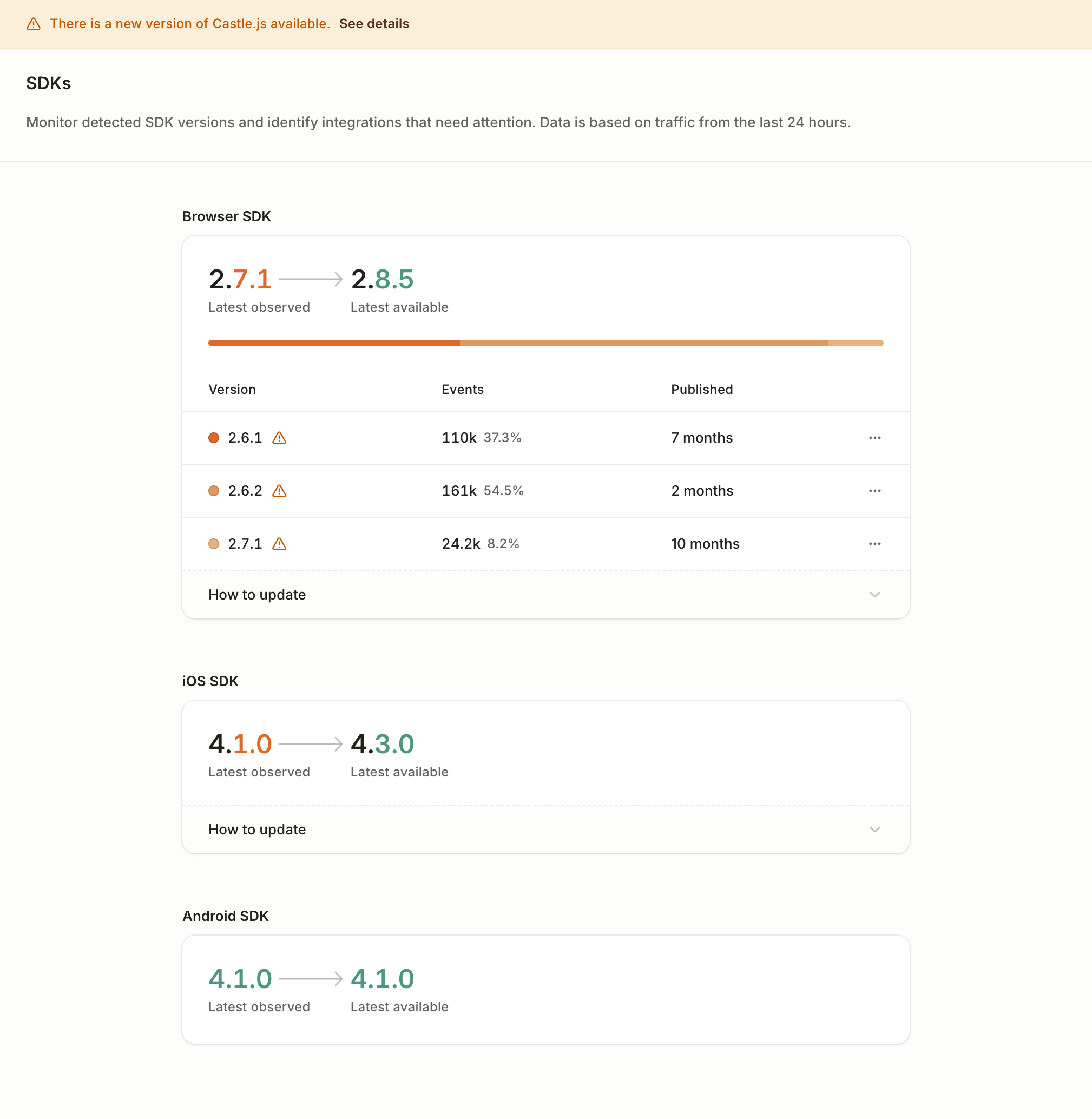
Castle added an SDKs page in its dashboard giving teams a centralized view of SDK integration versions and update status.
A complete suite of SDKs and APIs to monitor users, block bots, and stop in-app fraud.
Castle added an SDKs page in its dashboard giving teams a centralized view of SDK integration versions and update status.
└──▷ WHAT SHIPPED ·
1 FEATURE0 OF 1 FEATUREmost completely described firstwhat's the number?
Each feature carries 0–100 for how completely the vendor documented
it — not how big or important the work is. A major capability
described in eight words scores low, and that is the finding.
depth0–40what it does and how it works or what changed
specificity0–30names real surfaces — APIs, flags, formats, limits, numbers
actionability0–30enough to go use it — a named endpoint, flag, or config key tops this; a UI path is a starting point
Code and config rank first by construction: a documented endpoint,
flag or config key scores at the top of specificity and actionability,
so it sorts above a feature described only in prose. Under
60 the notes go thin — everything below the “thinner
coverage” line is thinner documentation, not smaller work.
Hover any meter for that feature's three sub-scores.
0100
SDKs page for integration version trackingnew50how completely this was documenteddepth20/40specificity15/30actionability15/3050 / 100
A new SDKs page provides a centralized view of all SDK integrations, showing which are outdated so teams can quickly identify where to upgrade. Navigate to the SDKs page in the Castle dashboard to see the version status of each integrated SDK and identify any that need updating to ensure full detection model coverage.
Check which of your SDK integrations are behind the latest release to ensure full detection model coverage.
📍In the Castle dashboard, navigate to the SDKs page to see the version status of each integrated SDK and identify any that need updating.
— Names UI location and purpose but no mechanism detailsSDKs page
The easiest way to add authentication and user management to your application. Purpose-built for React, Next.js, Remix, and “The Modern Web”.
Clerk shipped a configurable reverification window for sensitive actions, a new Admin Logs audit trail for Dashboard/API changes, and biometric sign-in support across its mobile SDKs.
└──▷ WHAT SHIPPED ·
3 FEATURES1 OF 3 FEATURESmost completely described firstwhat's the number?
Each feature carries 0–100 for how completely the vendor documented
it — not how big or important the work is. A major capability
described in eight words scores low, and that is the finding.
depth0–40what it does and how it works or what changed
specificity0–30names real surfaces — APIs, flags, formats, limits, numbers
actionability0–30enough to go use it — a named endpoint, flag, or config key tops this; a UI path is a starting point
Code and config rank first by construction: a documented endpoint,
flag or config key scores at the top of specificity and actionability,
so it sorts above a feature described only in prose. Under
60 the notes go thin — everything below the “thinner
coverage” line is thinner documentation, not smaller work.
Hover any meter for that feature's three sub-scores.
0101
Admin Logs audit trailnew90how completely this was documenteddepth35/40specificity30/30actionability25/3090 / 100
A new Admin Logs section in the Clerk Dashboard provides a reverse-chronological audit trail of configuration changes made via the Dashboard, Backend API, or Platform API — tracking events such as creating OAuth applications, updating instance settings, rotating secrets, and managing Roles and Permissions. Logs support filtering by Event type (with trailing wildcard support, e.g. oauth_application.*), Instance, Application, Actor, IP address, and Time range; available on Business and Enterprise plans, recording from August 24, 2026 onward.
Filter Admin Logs to see all OAuth application events across your workspace using a trailing wildcard event type.
📍In the Clerk Dashboard, open Admin Logs, select the Event type filter, and enter oauth_application.* to see all OAuth application events.
Configurable reverification windownew85how completely this was documenteddepth30/40specificity25/30actionability30/3085 / 100
A new Reverification window setting on the Sessions page in the Clerk Dashboard lets admins configure how long a successful reverification remains valid, from 1 to 10 minutes (default: 10 minutes). This controls how frequently users must re-authenticate before sensitive actions such as changing a password, adding/removing an email address, revoking a session, or deleting an account.
Shorten the reverification window to 2 minutes so users must re-authenticate frequently before sensitive actions like password changes.
📍In the Clerk Dashboard, go to Sessions › Session lifetime › Reverification window and set the value to 2 (minutes).
Biometric credential enrollment in mobile SDKsnew80how completely this was documenteddepth30/40specificity30/30actionability20/3080 / 100
Clerk mobile SDKs now support biometric credential enrollment and sign-in (Face ID, Touch ID, Android biometrics) via useBiometricCredentials (React Native), Clerk.shared.biometricCredentials.signInWithBiometrics and Clerk.shared.biometricCredentials.biometricCredentialId (Swift), and Clerk.biometricCredentials.signInWithBiometrics and Clerk.biometricCredentials.biometricCredentialId (Android), with the private key remaining device-bound.
ⓘSourcesBlog / feed →1 release · 2026-09-01Blog ↗RankWhy this ranktop features scored 81, +10 product media, +6 runnable example — 97How ranking works →
Aembit is IAM for agentic AI and workloads. Enable secretless access and real-time policy enforcement across any environment to protect data and accelerate AI adoption.
Aembit integrated CrowdStrike AIDR into its access policy engine, letting security teams inspect and control MCPMCPModel Context Protocol, a standard for connecting AI applications to external tools and data sources. A compatible server exposes capabilities an assistant can use through a common interface. tool traffic for AI agents directly from the same control plane that issues identities and credentials.
└──▷ WHAT SHIPPED ·
1 FEATURE0 OF 1 FEATUREmost completely described firstwhat's the number?
Each feature carries 0–100 for how completely the vendor documented
it — not how big or important the work is. A major capability
described in eight words scores low, and that is the finding.
depth0–40what it does and how it works or what changed
specificity0–30names real surfaces — APIs, flags, formats, limits, numbers
actionability0–30enough to go use it — a named endpoint, flag, or config key tops this; a UI path is a starting point
Code and config rank first by construction: a documented endpoint,
flag or config key scores at the top of specificity and actionability,
so it sorts above a feature described only in prose. Under
60 the notes go thin — everything below the “thinner
coverage” line is thinner documentation, not smaller work.
Hover any meter for that feature's three sub-scores.
0100
CrowdStrike AIDR content inspection for MCP access policiesnew81how completely this was documenteddepth33/40specificity26/30actionability22/3081 / 100
Aembit access policies can now attach a CrowdStrike AIDR content security configuration to inspect MCP traffic — tool listings, tool inputs, and tool outputs — from the same control plane that handles identity and credential issuance. Inspection is opt-in per policy: only policies explicitly configured with a CrowdStrike AIDR content security configuration trigger checks, and each policy can be set to fail-open or fail-closed if AIDR is unreachable, with every failure recorded as a workload event. Based on AIDR's decision, Aembit allows, blocks, or forwards a transformed version of the MCP content (e.g., sensitive data redacted or defanged), logging the outcome as a workload event tied to the agent identity, target MCP server, and access policy. The integration is configurable through the Aembit UI, API, or Terraform, and requires a CrowdStrike AIDR for Agents subscription.
Attach a CrowdStrike AIDR content security configuration to a sensitive MCP access policy via the Aembit UI so that tool listings, inputs, and outputs are inspected before reaching your AI agent.
📍In the Aembit console, open the target Access Policy › Content Security › attach a CrowdStrike AIDR content security configuration › set fail behavior to fail-closed › Save.
Knocknoc is a security tool that detects and prevents unauthorized access attempts through anomaly detection and threat intelligence.
Knocknoc's v26.08 release adds new enforcement backends for nftablesnftablesA Linux kernel packet-filtering framework maintained by Netfilter that replaces iptables, offering a unified ruleset for firewalling and NAT that cyber tools use for efficient, scriptable traffic control. and Fastly, alongside improved Palo Alto visibility and admin diagnostics tooling.
└──▷ WHAT SHIPPED ·
3 FEATURES1 OF 3 FEATURESmost completely described firstwhat's the number?
Each feature carries 0–100 for how completely the vendor documented
it — not how big or important the work is. A major capability
described in eight words scores low, and that is the finding.
depth0–40what it does and how it works or what changed
specificity0–30names real surfaces — APIs, flags, formats, limits, numbers
actionability0–30enough to go use it — a named endpoint, flag, or config key tops this; a UI path is a starting point
Code and config rank first by construction: a documented endpoint,
flag or config key scores at the top of specificity and actionability,
so it sorts above a feature described only in prose. Under
60 the notes go thin — everything below the “thinner
coverage” line is thinner documentation, not smaller work.
Hover any meter for that feature's three sub-scores.
0101
New enforcement backends: nftables and Fastlynew48how completely this was documenteddepth22/40specificity18/30actionability8/3048 / 100
Knocknoc adds native nftables integration to dynamically control network access on a Linux host based on authenticated users, and adds Fastly ACLACLAn access control list, a set of rules allowing or denying operations for particular users, services or network addresses. It decides who can use a resource. enforcement as a new supported enforcement target to control which source IPs an edge service allows through.
— Names two integrations and their mechanism but no config stepsv26.08
0200
Improved Palo Alto visibility for administratorsimproved18how completely this was documenteddepth8/40specificity8/30actionability2/3018 / 100
Knocknoc improves Palo Alto visibility for administrators.
— One-line mention with no mechanism or scope givenv26.08
0300
Improved admin diagnostics toolingimproved16how completely this was documenteddepth8/40specificity6/30actionability2/3016 / 100
Knocknoc improves operational diagnostics tooling for administrators.
— Bare mention with no specifics on what changedv26.08
Cato rolled out a new managed SASESASEA network architecture model combining wide-area networking and network security functions into a single cloud-delivered service, letting cyber tools enforce consistent policy regardless of where users or workloads sit. offering for SMBs, giving partners a pooled licensing model and a self-service portal to onboard and manage SMBSMBA network file-sharing protocol developed by Microsoft that lets systems share files, printers, and named pipes over a network; cyber tools target or speak it because it is ubiquitous in Windows environments. customers faster.
Cato SASE Cloud converges SD-WAN, security, global backbone, and remote access into a global cloud-native service. WE ARE SASE™
Cato rolled out a new managed SASESASEA network architecture model combining wide-area networking and network security functions into a single cloud-delivered service, letting cyber tools enforce consistent policy regardless of where users or workloads sit. offering for SMBs, giving partners a pooled licensing model and a self-service portal to onboard and manage SMBSMBA network file-sharing protocol developed by Microsoft that lets systems share files, printers, and named pipes over a network; cyber tools target or speak it because it is ubiquitous in Windows environments. customers faster.
└──▷ WHAT SHIPPED ·
2 FEATURES2 OF 2 FEATURESmost completely described firstwhat's the number?
Each feature carries 0–100 for how completely the vendor documented
it — not how big or important the work is. A major capability
described in eight words scores low, and that is the finding.
depth0–40what it does and how it works or what changed
specificity0–30names real surfaces — APIs, flags, formats, limits, numbers
actionability0–30enough to go use it — a named endpoint, flag, or config key tops this; a UI path is a starting point
Code and config rank first by construction: a documented endpoint,
flag or config key scores at the top of specificity and actionability,
so it sorts above a feature described only in prose. Under
60 the notes go thin — everything below the “thinner
coverage” line is thinner documentation, not smaller work.
Hover any meter for that feature's three sub-scores.
0101
MSASE Business Center partner portalnew60how completely this was documenteddepth25/40specificity20/30actionability15/3060 / 100
The new Cato MSASE Business Center adds a consolidated Business Overview page showing business accounts, orders, license usage, invoices, and customer lifecycle activity across a partner's portfolio. Authorized partners can self-provision eligible services and activate new customer accounts directly in the portal without waiting for manual approval workflows.
SMB FlexPool license pooling for partnersnew55how completely this was documenteddepth25/40specificity20/30actionability10/3055 / 100
The new Cato SMB FlexPool gives MSPsMSPsA managed service provider, a company that operates IT services for customers. It may manage systems, networks, backups or other ongoing technology needs. and service providers a partner-level pool of Cato licenses, enabling unlimited portability to allocate and reallocate capacity across eligible SMB customers without needing per-customer license purchases.
DNSFilter's September 1 web application and API update makes Customizable Dashboards the default landing view, adds live status indicators to deployment widgets, and fixes TLDTLDThe rightmost label in a domain name (e.g., .com, .gov, .uk), maintained by IANA's root zone. Cyber tools filter or pivot on TLDs to scope scans, flag suspicious registrations, or classify traffic by geography or type. categorization in lists and logs.
Give feedback to the DNSFilter team so we can make more informed product decisions. Powered by Canny.
DNSFilter's September 1 web application and API update makes Customizable Dashboards the default landing view, adds live status indicators to deployment widgets, and fixes TLDTLDThe rightmost label in a domain name (e.g., .com, .gov, .uk), maintained by IANA's root zone. Cyber tools filter or pivot on TLDs to scope scans, flag suspicious registrations, or classify traffic by geography or type. categorization in lists and logs.
└──▷ WHAT SHIPPED ·
3 FEATURES0 OF 3 FEATURESmost completely described firstwhat's the number?
Each feature carries 0–100 for how completely the vendor documented
it — not how big or important the work is. A major capability
described in eight words scores low, and that is the finding.
depth0–40what it does and how it works or what changed
specificity0–30names real surfaces — APIs, flags, formats, limits, numbers
actionability0–30enough to go use it — a named endpoint, flag, or config key tops this; a UI path is a starting point
Code and config rank first by construction: a documented endpoint,
flag or config key scores at the top of specificity and actionability,
so it sorts above a feature described only in prose. Under
60 the notes go thin — everything below the “thinner
coverage” line is thinner documentation, not smaller work.
Hover any meter for that feature's three sub-scores.
0100
Customizable Dashboards default with merged filters drawerimproved62how completely this was documenteddepth25/40specificity22/30actionability15/3062 / 100
Customizable Dashboards is now the default landing view for all users, replacing the retired legacy Overview page; existing bookmarks to the old page redirect automatically. The new Dashboard Filters drawer merges the previous Quick Filters and Advanced Filters into a single experience, grouped by Source (Organizations, Sites, Roaming Clients/Relays, Users) and Traffic (Result).
Live status indicators on deployment widgetsnew52how completely this was documenteddepth22/40specificity20/30actionability10/3052 / 100
Deployment widgets — Roaming Clients Protected, Sites Protected, Relays, Users, and Collections — now show a pulsating green dot indicating live data, which is unaffected by the dashboard's time range filter.
Top Level Domain categorization for bare TLDsimproved52how completely this was documenteddepth20/40specificity22/30actionability10/3052 / 100
Bare TLD entries (e.g. .ru, .xyz) in Allow/Block lists and the Query Log now display as Top Level Domain instead of Uncategorized, distinguishing intentional TLD-level rules from genuinely uncategorized domains.
fheVM v0.14.1 adds tasks to mirror KMSKMSA managed service that creates, stores, rotates and controls access to encryption keys, usually backed by HSMs. Applications ask it to encrypt or decrypt rather than holding keys themselves. context and epoch state onto replica chains and introduces Polygon mainnet chain support in the SDK and Solidity library.
FHEVM, a full-stack framework for integrating Fully Homomorphic Encryption (FHE) with blockchain applications
fheVM v0.14.1 adds tasks to mirror KMSKMSA managed service that creates, stores, rotates and controls access to encryption keys, usually backed by HSMs. Applications ask it to encrypt or decrypt rather than holding keys themselves. context and epoch state onto replica chains and introduces Polygon mainnet chain support in the SDK and Solidity library.
└──▷ WHAT SHIPPED ·
2 FEATURES0 OF 2 FEATURESmost completely described firstwhat's the number?
Each feature carries 0–100 for how completely the vendor documented
it — not how big or important the work is. A major capability
described in eight words scores low, and that is the finding.
depth0–40what it does and how it works or what changed
specificity0–30names real surfaces — APIs, flags, formats, limits, numbers
actionability0–30enough to go use it — a named endpoint, flag, or config key tops this; a UI path is a starting point
Code and config rank first by construction: a documented endpoint,
flag or config key scores at the top of specificity and actionability,
so it sorts above a feature described only in prose. Under
60 the notes go thin — everything below the “thinner
coverage” line is thinner documentation, not smaller work.
Hover any meter for that feature's three sub-scores.
0100
KMS canonical context mirroring for host contractsnew45how completely this was documenteddepth20/40specificity15/30actionability10/3045 / 100
New tasks mirror the canonical KMS context and epoch onto replica chains in host contracts, keeping replicas synchronized with the canonical KMS state.
— Names the mechanism but not the actual task commandv0.14.1
0200
Polygon mainnet chain supportnew35how completely this was documenteddepth10/40specificity15/30actionability10/3035 / 100
Adds Polygon mainnet chain configuration to both the SDK and the Solidity library.
— States what was added but no config detailsv0.14.1
nono v0.75.0 extends its policy-controlled sandbox with profile composition on the proxy command, stricter PATH-overlap protection, glob-based network filtering, and a way to shape ambient credential tokens for prefix-sniffing clients.
The nono runtime isolates AI agents with policy-controlled filesystem, network, and credential access.
nono v0.75.0 extends its policy-controlled sandbox with profile composition on the proxy command, stricter PATH-overlap protection, glob-based network filtering, and a way to shape ambient credential tokens for prefix-sniffing clients.
└──▷ WHAT SHIPPED ·
6 FEATURES1 OF 6 FEATURESmost completely described firstwhat's the number?
Each feature carries 0–100 for how completely the vendor documented
it — not how big or important the work is. A major capability
described in eight words scores low, and that is the finding.
depth0–40what it does and how it works or what changed
specificity0–30names real surfaces — APIs, flags, formats, limits, numbers
actionability0–30enough to go use it — a named endpoint, flag, or config key tops this; a UI path is a starting point
Code and config rank first by construction: a documented endpoint,
flag or config key scores at the top of specificity and actionability,
so it sorts above a feature described only in prose. Under
60 the notes go thin — everything below the “thinner
coverage” line is thinner documentation, not smaller work.
Hover any meter for that feature's three sub-scores.
0100
`format` field for ambient credential phantom tokensnew85how completely this was documenteddepth30/40specificity30/30actionability25/3085 / 100
CommandCredentialConfig gains a format field for ambient credentials — a literal template such as sk-ant-oat01-{} that shapes the visible phantom token so prefix-sniffing clients recognise it as valid while nono brokers the real secret behind it.
Shape a phantom credential token so a prefix-sniffing client (e.g. an Anthropic SDK checking for sk-ant-) still recognises it as valid while nono brokers the real secret.
— Named config field with concrete template value and worked JSON example.v0.75.0
0201
`--strict-broker-path` flag hardens sandbox startupnew83how completely this was documenteddepth30/40specificity25/30actionability28/3083 / 100
New sandbox arg --strict-broker-path causes nono to refuse to start, instead of merely warning, when a filesystem grant overlaps a directory on PATH, blocking planted-binary attacks on host processes outside the sandbox.
Harden a sandbox so it refuses to start if any filesystem grant overlaps a PATH directory — catch planted-binary risk in CI before the agent runs.
$ nono run --profile nolabs-ai/opencode --strict-broker-path-- opencode
— Named flag, clear before/after behaviour, and exact CLI usage.v0.75.0
0300
Profile composition via `--extends` in `nono proxy`new75how completely this was documenteddepth25/40specificity25/30actionability25/3075 / 100
nono proxy gains the --extends <PROFILE> flag, giving it the same repeatable profile-composition semantics already available on nono run; it requires --profile to be set.
Compose an extra-domains profile on top of an existing proxy profile at runtime — useful when a specific session needs additional allow-listed hosts without permanently editing the base profile.
$ nono proxy -p default --extends extra-domains
— Named flag with runnable example, but composition mechanics not detailed further.v0.75.0
thinner coverage below
0400
PATH sanitization for host-side brokersimproved50how completely this was documenteddepth20/40specificity20/30actionability10/3050 / 100
Host-side credential and URL brokers now sanitize PATH, preventing bare-name binary resolution from grants that overlap PATH directories.
— Describes mechanism but offers no config surface or example to act on.v0.75.0
0500
Glob patterns for network allow/deny listsimproved40how completely this was documenteddepth15/40specificity15/30actionability10/3040 / 100
Profile and proxy network configuration now supports glob pattern matching in env var and hostname allow/deny lists.
— Names the surfaces affected but gives no syntax or example.v0.75.0
0600
Initial tool sandbox examples for `command_policies`new30how completely this was documenteddepth10/40specificity10/30actionability10/3030 / 100
Ships an initial set of tool sandbox examples demonstrating command_policies configurations.
— Bare mention of examples shipped, no specifics given.v0.75.0
 THE CYBER TOOLCHAIN