The Cyber Toolchain — issue 063, September 3, 2026
THE CYBER TOOLCHAIN
NO. 063
Tail
THE DAILY RELEASE FIREHOSE
PUBLISHED SEPTEMBER 3, 2026 · EVERY DAY
EDITIONStail|grep|head|ls|diff|uniq
The daily firehose — everything the toolchain shipped today, already filtered.
We read every release from the 1309 tools on our watchlist at the source — GitHub and GitLab release notes, vendor release pages and changelogs, project blogs and feeds, vendor press releases, and the source code behind the tag. Bug-fix-only releases and non-product newsroom noise are dropped; what's left is summarized down to the new capability, how to try it, and any screenshots or videos the release itself published. Every entry links to the sources it was built from.
READ AS
Focus:What features shipped and what problems they solve, plus launches, packaging and where the market is moving.
Leaves out:Command-line flags, API-only deltas, usage examples, and releases that are only refinements.
Focus:New security controls, new APIs, and product improvements you can put to work, plus anything an upgrade breaks.
Leaves out:Launch and marketing news, governance, pricing, and documentation changes with no operational effect.
Focus:Dashboards, reporting, and anything you can quantify: metrics, coverage, risk scores, compliance impact, vendor moves.
Leaves out:Settings, flags, API and command-line detail, library bumps, and minor releases with no reporting or posture angle.
Focus:API, SDK and MCP changes, new libraries, breaking changes in what you import, and cyber tooling.
Leaves out:Governance, SOC operations, and vendor launches with no developer surface.
AMOUNT
DETAIL
ORDER
This issue came out before editions were ranked, so it shows the Standard edition in issue order.
What stands out across today's releases, grouped by what it lets you do. Every tool named links to its entry below.
Three unrelated things stand out. Fleet can now hand out managed local Windows admin accounts, so break-glass admin rights stop living in a shared password. JFrog's Zero-Touch Remediation swaps a vulnerable package for a compliant version instead of filing a ticket. Falcon Onum runs detection in-stream before data lands, so noise never gets billed or stored.
protect
Stop handing every Windows user a permanent local admin
Fleet 4.91.0 manages local Windows admin accounts and pins macOS/iOS/iPadOS updates to latest, which removes the spreadsheet of shared admin passwords and the quarterly re-pin of version numbers as new OS releases land. Separately, OpenAI's Trusted Access for Cyber program now mandates hardware-backed passkeyspasskeysPhishing-resistant sign-in credentials built on FIDO2/WebAuthn: the device holds a private key and proves possession instead of the user typing a password. They sync across a user's devices. and disables weaker methods outright — phishable fallbacks are the usual reason an MFAMFAMulti-factor authentication, requiring proof from different categories, such as a password and a hardware key, to sign in. It reduces reliance on a password alone. rollout doesn't reduce account takeover.
Let the fix ship without a human writing the patch PR
JFrog's Zero-Touch Remediation automatically swaps vulnerable packages for compliant versions, collapsing the usual find-triage-bump-test loop that leaves known-bad dependencies in place for weeks. ZeroPath's AppSecAppSecApplication security: the practice of finding and fixing vulnerabilities in software during design, development, and testing. Cyber tools build on AppSec workflows to shift vulnerability detection earlier in the development lifecycle. Assistant takes the opposite tack on trust: it proposes a reviewable plan before acting, so an AI-driven change is approved rather than discovered after the fact.
Falcon Onum's Certified Data Pipelines filter and run detection in-stream before events land in storage, which moves the economics of what you can afford to collect. Tenzir v6.15.0 adds Splunk HECSplunk HECAn HTTP endpoint built into Splunk that accepts JSON-formatted log and event data pushed directly from applications or agents over HTTPS, letting cyber tools ship telemetry to Splunk without requiring a forwarder agent on the sending host. acknowledgements so a pipeline knows delivery actually succeeded rather than assuming it, plus up to 9x faster event branching.
Three unrelated things stand out today: JFrog can swap vulnerable packages for compliant versions without a manual dependency hunt; Tenzir can confirm Splunk HECSplunk HECAn HTTP endpoint built into Splunk that accepts JSON-formatted log and event data pushed directly from applications or agents over HTTPS, letting cyber tools ship telemetry to Splunk without requiring a forwarder agent on the sending host. delivery instead of assuming ingest worked; Fleet can manage local Windows admin accounts centrally.
respond
Replace vulnerable dependencies without hand-building the fix
Zero-Touch Remediation automatically swaps vulnerable packages for compliant versions. That turns a finding into a proposed remediation path, reducing the manual work of finding a safe replacement and updating the dependency chain.
Splunk HECHECAn HTTP API endpoint provided by Splunk that lets applications stream JSON-formatted events directly into a Splunk index without a forwarder agent, reducing pipeline complexity for log-shipping tools. acknowledgement support gives delivery confirmation instead of best-effort forwarding. Teams moving events through Tenzir can distinguish a pipeline problem from an empty detection result, which makes missed ingest failures cheaper to catch.
Centralize control of local Windows admin accounts
Managed local Windows admin accounts move a high-risk endpoint privilege into Fleet policy. That reduces reliance on static local admin practices and gives device teams a way to administer access without treating every workstation as a one-off.
Put enforceable boundaries around enterprise AI coding assistants
GitHub added enterprise controls for default Copilot models and content exclusion enforcement in the app and CLI, while Auth0 lets Organization Admins configure Cross App Access and third-party application access themselves. Together, they make AI and app access policy less dependent on ad hoc admin intervention.
autonomous red teaming platform; multi-agent offensive-security meta-harness
T3MP3ST adds social OSINTOSINTOpen-source intelligence, collecting and analyzing information from publicly available sources. Investigators use it to learn about people, infrastructure or threats. tools, headless-browser XSSXSSCross-site scripting, an attack that runs malicious script in another user's browser through a trusted site. It can steal data or perform actions using the user's session. probing, WAFWAFA reverse proxy that inspects HTTP/HTTPS traffic and blocks requests matching known attack patterns such as SQL injection or XSS, sitting between clients and a web application to filter malicious input before it reaches the server.-aware scanning, and Windows parity
Adds username_search tool to the social_osint family: checks a username's existence across GitHub, GitLab, Reddit, Hacker News, Wikipedia, Steam, Keybase, VK, and Telegram using unauthenticated public surfaces — no API keys required (Sherlock-style).
Adds telegram_lookup tool: resolves a @username via the Telegram Bot API getChat call, returning public info (name, description, type, member count); reads the TELEGRAM_BOT_TOKEN environment variable when present and degrades gracefully without it.
Adds email_format tool: generates corporate email address candidates from a person's name and validates the domain's MX records via live DNS probe — no email sending.
Adds a headless-Chromium browser probe (browser.ts) that captures rendered DOMDOMThe browser's in-memory tree representation of a web page's structure, standardized by the W3C, giving cyber tools a programmable interface to read or manipulate page content at runtime., page title, cookie flags (never values), and console errors, and performs a real XSS check by injecting a payload into a query parameter and detecting both reflection and alert-dialog execution.
Adds resolveSystemPrompt export to the prompts/index module, enabling dynamic system-prompt resolution for operators.
Strix v1.6.1 refreshes its recommended LLMLLMA large language model, a neural network trained on large amounts of text to recognize patterns and generate language. Applications use it for tasks such as answering, summarizing and writing code. model list and hardens MCPMCPModel Context Protocol, a standard for connecting AI applications to external tools and data sources. A compatible server exposes capabilities an assistant can use through a common interface. integrations against transient call failures.
Open-source AI penetration testing tool to find and fix your app’s vulnerabilities.
Strix v1.6.1 refreshes its recommended LLMLLMA large language model, a neural network trained on large amounts of text to recognize patterns and generate language. Applications use it for tasks such as answering, summarizing and writing code. model list and hardens MCPMCPModel Context Protocol, a standard for connecting AI applications to external tools and data sources. A compatible server exposes capabilities an assistant can use through a common interface. integrations against transient call failures.
└──▷ WHAT SHIPPED ·
2 FEATURES0 OF 2 FEATURESmost completely described firstwhat's the number?
Each feature carries 0–100 for how completely the vendor documented
it — not how big or important the work is. A major capability
described in eight words scores low, and that is the finding.
depth0–40what it does and how it works or what changed
specificity0–30names real surfaces — APIs, flags, formats, limits, numbers
actionability0–30enough to go use it — a named endpoint, flag, or config key tops this; a UI path is a starting point
Code and config rank first by construction: a documented endpoint,
flag or config key scores at the top of specificity and actionability,
so it sorts above a feature described only in prose. Under
60 the notes go thin — everything below the “thinner
coverage” line is thinner documentation, not smaller work.
Hover any meter for that feature's three sub-scores.
0100
Expanded recommended model listnew70how completely this was documenteddepth20/40specificity25/30actionability25/3070 / 100
Strix adds openrouter/z-ai/glm-5.3 as the new top recommended model, alongside GLM-5.3, Fable 5.1, and Gemini 3.7 Flash added to the recommended model list. Users can switch models by setting the STRIX_LLM environment variable, e.g. export STRIX_LLM="openrouter/z-ai/glm-5.3" alongside LLM_API_KEY, then running strix --target ./app-directory.
Switch to the new top-pick model for a pentest scan without editing config files.
evil-winrm v4.1 adds explicit shell exit options, a keepalive to stop idle WinRM disconnects, and updated Ruby compatibility.
The ultimate WinRM shell for hacking/pentesting
evil-winrm v4.1 adds explicit shell exit options, a keepalive to stop idle WinRM disconnects, and updated Ruby compatibility.
└──▷ WHAT SHIPPED ·
3 FEATURES0 OF 3 FEATURESmost completely described firstwhat's the number?
Each feature carries 0–100 for how completely the vendor documented
it — not how big or important the work is. A major capability
described in eight words scores low, and that is the finding.
depth0–40what it does and how it works or what changed
specificity0–30names real surfaces — APIs, flags, formats, limits, numbers
actionability0–30enough to go use it — a named endpoint, flag, or config key tops this; a UI path is a starting point
Code and config rank first by construction: a documented endpoint,
flag or config key scores at the top of specificity and actionability,
so it sorts above a feature described only in prose. Under
60 the notes go thin — everything below the “thinner
coverage” line is thinner documentation, not smaller work.
Hover any meter for that feature's three sub-scores.
0100
Ruby 3.3 and 4.0 compatibilityimproved55how completely this was documenteddepth20/40specificity20/30actionability15/3055 / 100
Adds readline-ext as a required dependency to restore remote path completion compatibility with Ruby 3.3 and newer, and adds Ruby 4.0 support.
— Names dependency and versions but no usage stepsv4.1
0200
Explicit shell exit commandsnew50how completely this was documenteddepth15/40specificity15/30actionability20/3050 / 100
Adds a quit command inside the shell as an explicit exit mechanism, and adds Ctrl+D support as an alternative way to exit the shell session.
— Names exact command and key combo, no further mechanism givenv4.1
0300
Keepalive for idle WinRM shellsnew35how completely this was documenteddepth15/40specificity10/30actionability10/3035 / 100
Adds keepalive to prevent Windows from disconnecting idle WinRM shells.
— States purpose but no config detail or mechanismv4.1
ⓘSourcesRelease page →1 release · seen 2026-09-03Notes ↗RankWhy this ranktop features scored 100/95/90, +15 breaking change, +6 runnable example — 116How ranking works →
AI-native SAST platform that finds 2x more real vulnerabilities with 75% fewer false positives. Automated vulnerability detection, instant fixes, and seamless CI/CD integration for modern DevOps teams.
ZeroPath's biggest shift is an AI AppSecAppSecApplication security: the practice of finding and fixing vulnerabilities in software during design, development, and testing. Cyber tools build on AppSec workflows to shift vulnerability detection earlier in the development lifecycle. Assistant that now proposes reviewable plans before taking action, backed by a hosted remote MCPMCPModel Context Protocol, a standard for connecting AI applications to external tools and data sources. A compatible server exposes capabilities an assistant can use through a common interface. server, continuous default-branch scanning, and a broad access-sync overhaul spanning GitHub and Bitbucket. The platform also picked up Gerrit and CVS repository support, four new compliance reports (SOC 2SOC 2An auditing framework from the American Institute of CPAs that certifies a service organization's controls around security, availability, and data handling, giving buyers assurance that a vendor meets baseline trust criteria., SLASLAA formal agreement between a service provider and customer that defines expected uptime, response times, and remedies for failures, giving cyber tools a contractual baseline for availability and support commitments. Compliance, Organization Summary, Monthly Security), and CVSSCVSSCommon Vulnerability Scoring System, a method for describing a vulnerability's characteristics and severity. Its score is not the probability that attackers will exploit it. v4.0 scoring.
└──▷ WHAT SHIPPED ·
22 FEATURES5 OF 22 FEATURESmost completely described firstwhat's the number?
Each feature carries 0–100 for how completely the vendor documented
it — not how big or important the work is. A major capability
described in eight words scores low, and that is the finding.
depth0–40what it does and how it works or what changed
specificity0–30names real surfaces — APIs, flags, formats, limits, numbers
actionability0–30enough to go use it — a named endpoint, flag, or config key tops this; a UI path is a starting point
Code and config rank first by construction: a documented endpoint,
flag or config key scores at the top of specificity and actionability,
so it sorts above a feature described only in prose. Under
60 the notes go thin — everything below the “thinner
coverage” line is thinner documentation, not smaller work.
Hover any meter for that feature's three sub-scores.
0100
Bitbucket and GitHub access sync with permission mappingbreaking90how completely this was documenteddepth35/40specificity30/30actionability25/3090 / 100
A Bitbucket Access Sync section in team settings imports Bitbucket Cloud user groups and Bitbucket Server groups as ZeroPath teams, with optional hourly auto-sync and a Re-sync now/Sync now button for one-off imports; a permission mapping editor warns when a custom mapping grants fewer permissions to a higher VCSVCSVersion control system: software that tracks changes to files over time, letting teams collaborate and roll back mistakes. Cyber tools use it to manage source code, configs, and signatures. role than a lower one, and unmatched Bitbucket group members appear in the same manual-linking panel used for GitHub, tagged with a platform badge. This extends to a broader access-sync system importing teams from both GitHub and Bitbucket, mapping GitHub's five roles and Bitbucket's three onto thirty-nine permissions across ten groups, and restricting member visibility to only repositories they hold a grant on. Connecting an integration now requires the Create Integrations or Create Installations permission, and adding a repository by URL requires the Create Repositories permission.
Enable hourly Bitbucket group sync to automatically keep ZeroPath team membership in step with Bitbucket Cloud or Server groups.
📍In ZeroPath, go to Team Settings › Bitbucket Access Sync and toggle on Enable auto-sync. A first sync is queued immediately; subsequent syncs run hourly.
Customize how Bitbucket roles map to ZeroPath permissions — for example, restricting Write-role users from triggering scans.
📍In ZeroPath, go to Team Settings › Bitbucket Access Sync, click the permission mapping editor button, then adjust the permission matrix (VCS roles as columns, ZeroPath permission groups as rows) and save. A warning is shown if a higher role ends up with fewer permissions than a lower one.
Remote MCP server with OAuth 2.1new85how completely this was documenteddepth30/40specificity25/30actionability30/3085 / 100
A hosted remote MCP endpoint at https://zeropath.com/mcp uses OAuth 2.1OAuth 2.1A consolidated draft of the OAuth authorization framework that merges OAuth 2.0 with its most important security BCP updates, dropping unsafe flows so tools can delegate user access without handling credentials directly. over the Streamable HTTPStreamable HTTPAn MCP transport protocol that lets a client send JSON-RPC requests over HTTP POST while the server streams responses back using Server-Sent Events, replacing the older stdio and SSE transports for remote tool communication. transport, letting clients like Claude, Cursor, and Codex connect via browser authentication with no install or API key; connections are read-only until changes are approved. A local stdio transport mode running the open-source Python server with API-token credentials remains available for scripted or self-managed setups.
Connect an AI coding assistant to your ZeroPath findings without installing anything or managing API keys.
$ # In Cursor, Claude, or any Streamable HTTP MCP client, set the MCP server URL to:
https://zeropath.com/mcp
# Then authenticate via the browser prompt that appears — no API key needed.
Point a Cursor or Claude MCP client at the hosted ZeroPath endpoint to start using it with no local install.
AI AppSec Assistant with Planning Mode and Skillsnew83how completely this was documenteddepth35/40specificity28/30actionability20/3083 / 100
A per-repository chat-based AppSec Assistant answers security questions and executes automated actions on findings; before complex or irreversible actions (opening pull requests, bulk-updating findings) it proposes a reviewable plan listing Steps, Risks, and scope that must be approved, forceable via a Plan first toggle on any message and savable as a schedule, trigger, or playbook. Plans surface Scheduling and Trigger Suggestions (a cron expression, event trigger, or playbook activation) when a request is recurring or reactive. Organization-specific guidance is authored via the Skills tab (Early Access), with four built-in forkable skills for triage, dependency reachability, report writing, and patch review, and active skills are listed in the plan's skills used field.
Review and approve an AI-proposed plan before the assistant bulk-opens fix PRs for critical findings, so you can verify scope and risks before any irreversible action is taken.
📍In the AppSec Assistant chat, type your request (e.g. 'Open fix PRs for all critical findings in this repo'). The assistant displays a plan with Steps, Risks, and scope. Review each field, then click Approve to proceed — or tick Plan first on the message before sending to always force a plan.
Patch submission status trackingnew83how completely this was documenteddepth30/40specificity28/30actionability25/3083 / 100
Fix PRs for approved patches show progress through Queued, Submitting PR, Retrying, Submission failed, Cancelled, and PR opened states, with specific failure reasons (e.g. missing push credentials) and a Retry button for unrecoverable failures; up to five automatic submission attempts are made before a PR is marked stopped, and Cancel/Retry actions appear directly on the issue.
Track the progress of an automated fix PR from submission through to merge, and manually retry if submission fails due to a resolvable issue such as missing push credentials.
📍Open the finding panel after promoting a patch. Watch the status chip cycle through Queued → Submitting PR → PR opened. If it lands on Submission failed, read the displayed failure reason (e.g. Missing push credentials), reconnect the repository through your VCS integration, then click the Retry button.
Continuous Scanning on default branchnew83how completely this was documenteddepth30/40specificity28/30actionability25/3083 / 100
When enabled, ZeroPath runs a full scan on every meaningful commit to a repository's default branch (including merged pull requests) and incrementally re-examines only changed code on follow-up scans, automatically closing findings resolved by those commits; configurable per organization, tag, or repository in scanner settings, and available on GitHub, GitLab, Bitbucket Cloud, and Bitbucket Server.
Enable continuous scanning on a GitHub organization so findings automatically track the default branch between scheduled scans.
📍1. In ZeroPath, go to Scanner Settings.
2. Select the organization, tag, or repository you want to configure.
3. Enable Continuous Scanning — subsequent merged pull requests and commits to the default branch will each trigger a full scan automatically.
New compliance and audit reportsnew80how completely this was documenteddepth32/40specificity28/30actionability20/3080 / 100
Four organization-level report cards are added, visible only to users with organization-level permission: Monthly Security Report (DOCX, with an AI-generated executive summary plus per-repository scan activity, severity breakdown, and top vulnerability families), Organization Summary Report (PDF), SLA Compliance Report (PDF, tracking which findings are within or past configured remediation windows), and SOC 2 (PDF, compliance-focused metrics and scan activity structured for audit evidence). All reports carry a Scope field on the cover page or header showing either All repositories (N) or the specific tags/repositories selected at generation time; by default a report covers the entire organization.
Generate a SOCSOCA security operations center, the team or function that monitors threats, investigates alerts and coordinates incident response. Its work can be internal, outsourced or shared. 2 audit report scoped to a specific team tag so only the relevant repositories appear in the cover-page Scope field.
📍In the Reports tab, open the SOC 2 report card, select the desired tag(s) or repository names under the scope picker, then click Generate. The produced PDF cover page will read the specific tags and repository names you chose rather than All repositories.
Dashboard charts and reporting UInew80how completely this was documenteddepth32/40specificity28/30actionability20/3080 / 100
A new Issues By PR Author chart groups open issues from each repository's latest merged pull request scan by author, excluding unmerged PR scans and full-scan-only findings. A new Exposure Window chart shows the average days open issues of each severity were exposed per period, with severity lines breaking rather than dropping to zero when none are open. The date range picker adds a Last 1 year preset and Quarterly granularity alongside daily/weekly/monthly options. The Top Issues widget and scored-findings tables sort unscored findings to the bottom and support up to 500 findings with severity, score, title, repository, vulnerability class, status, and detection-date columns; clicking any row opens a side pane with full issue details, and actions like marking false positive refresh the report in the background without losing filters, scroll position, or selection.
Review which PR authors introduced the most open issues shipped to production, filtering out unmerged PR noise.
📍In the Reports tab, open the Issues By PR Author chart. The chart automatically shows open issues from each repository's latest merged pull request scan only — unmerged PRs and full-scan findings are excluded — grouped by author.
Jira and Linear ticket integrationbreaking69how completely this was documenteddepth28/40specificity26/30actionability15/3069 / 100
A distinct Issue Tracker Export permission group in team settings covers Create Jira tickets from findings and Create Linear tickets from findings, separate from Issue Management. Jira and Linear ticket links are now included in CSV exports and the export endpoint, and an on-demand Jira ticket sync preview shows what a linked ticket will do before it's applied. Creating Jira and Linear tickets is now a per-repository permission that must be explicitly granted or ticket creation is blocked.
Microsoft Teams integrationnew67how completely this was documenteddepth25/40specificity22/30actionability20/3067 / 100
Adds Microsoft Teams integration: paste an incoming webhook URL into ZeroPath to receive scan notifications and vulnerability alerts as Adaptive CardsAdaptive CardsAn open-source card schema from Microsoft that lets apps render structured UI snippets — buttons, text, images — natively inside any host surface, so a tool can push rich, interactive notifications without owning the renderer. in Teams channels, with no Azure AD app registration or tenant administrator required.
Feedback disposition changesbreaking62how completely this was documenteddepth25/40specificity22/30actionability15/3062 / 100
The feedback list gains filter chips to narrow by disposition type; the Pending review disposition label is renamed to Needs review, and the Non-exploitable disposition now immediately removes a finding from the open issues queue (same as False Positive or Accepted Risk), whether set by a human or an automated agent.
— Names exact renamed label and queue behaviour change.product docs
1100
Gerrit repository supportnew62how completely this was documenteddepth25/40specificity22/30actionability15/3062 / 100
ZeroPath adds Gerrit change scanning via poll-based triggering (no webhook required): it imports Gerrit projects for full scans, scans each open change as new patch sets arrive, and posts findings as inline review comments on diff lines / as a review message on the patch set.
Dependency and SCA findings surfacingimproved62how completely this was documenteddepth25/40specificity22/30actionability15/3062 / 100
A new dependency findings tab on the Issues page supports search by CVE, advisory, and package; completed pull request scans link to their findings list with a separate dependency link, and the check run's Details link now points directly to the dependency view when a scan finds only SCASCASoftware composition analysis, identifying third-party dependencies and checking them for known vulnerabilities and license issues. It covers software a team uses rather than writes itself. findings, avoiding a dashboard view that appears empty.
Stale PR scan auto-cancellationimproved60how completely this was documenteddepth25/40specificity25/30actionability10/3060 / 100
ZeroPath automatically cancels in-progress PR scans for older commits when a newer commit is pushed to the same pull request, across GitHub, GitHub Enterprise Server, GitLab, Bitbucket, Azure DevOps Services, and Gerrit.
— Names all six supported VCS platforms; behaviour is automatic.product docs
thinner coverage below
1400
CVSS v4.0 vector supportnew58how completely this was documenteddepth22/40specificity26/30actionability10/3058 / 100
Adds CVSS v4.0 vector support for assessing subsequent-system impact, with severity labels following CVSS rating bands: Critical ≥ 9.0, High ≥ 7.0, Medium ≥ 4.0, Low ≥ 0.1.
CVS repository supportnew52how completely this was documenteddepth20/40specificity20/30actionability12/3052 / 100
Adds CVS repository support: import modules by server path over SSH or pserver, enabling full scans, scheduled scans, dependency analysis, and secrets scanning.
Repository-size counting for more languagesnew45how completely this was documenteddepth18/40specificity22/30actionability5/3045 / 100
Adds repository-size counting for Terraform, Svelte, Vue, Solidity, Elixir, Dart, protobuf, and Genero, ensuring those repositories receive analysis depth matched to their size.
The Pending review disposition label is renamed to Needs review in the feedback list filter chips.
!
Creating Jira and Linear tickets is now a per-repository permission; organizations using access control must explicitly grant it or ticket creation will be blocked.
!
Connecting an integration now requires the Create Integrations or Create Installations permission; adding a repository by URL requires the Create Repositories permission.
Documentation homepage for the Codacy automated code review tool.
Codacy added Oxlint, a Rust-based JavaScript/TypeScript linter, as a fully integrated analysis engine with broad ESLint-compatible rule coverage and automatic repository configuration detection.
└──▷ WHAT SHIPPED ·
1 FEATURE0 OF 1 FEATUREmost completely described firstwhat's the number?
Each feature carries 0–100 for how completely the vendor documented
it — not how big or important the work is. A major capability
described in eight words scores low, and that is the finding.
depth0–40what it does and how it works or what changed
specificity0–30names real surfaces — APIs, flags, formats, limits, numbers
actionability0–30enough to go use it — a named endpoint, flag, or config key tops this; a UI path is a starting point
Code and config rank first by construction: a documented endpoint,
flag or config key scores at the top of specificity and actionability,
so it sorts above a feature described only in prose. Under
60 the notes go thin — everything below the “thinner
coverage” line is thinner documentation, not smaller work.
Hover any meter for that feature's three sub-scores.
0100
Oxlint added as supported analysis enginenew80how completely this was documenteddepth30/40specificity30/30actionability20/3080 / 100
Codacy adds Oxlint as a supported engine for JavaScript and TypeScript, covering correctness, style, and best-practice rule categories including ESLint core rules, typescript-eslint, React ecosystem (react, react-hooks, react-refresh, react-perf), @next/eslint-plugin-next, eslint-plugin-unicorn, testing frameworks (jest, vitest), eslint-plugin-vue, import, jsdoc, jsx-a11y, n (Node), and promise. It supports repository-level configuration via .oxlintrc.json, .oxlintrc.jsonc, oxlint.config.json, or oxlint.config.jsonc files, which Codacy detects and applies automatically during analysis.
Semgrep expanded its public API with partial-scan visibility and new Agentic Workflows v2 endpoints, while adding policy automation, developer triage controls, and read-only token permissions alongside smaller registry and workflow UI improvements.
Get started with Semgrep to help you catch, flag, and fix real vulnerabilities before they ship.
Semgrep expanded its public API with partial-scan visibility and new Agentic Workflows v2 endpoints, while adding policy automation, developer triage controls, and read-only token permissions alongside smaller registry and workflow UI improvements.
└──▷ WHAT SHIPPED ·
8 FEATURES0 OF 8 FEATURESmost completely described firstwhat's the number?
Each feature carries 0–100 for how completely the vendor documented
it — not how big or important the work is. A major capability
described in eight words scores low, and that is the finding.
depth0–40what it does and how it works or what changed
specificity0–30names real surfaces — APIs, flags, formats, limits, numbers
actionability0–30enough to go use it — a named endpoint, flag, or config key tops this; a UI path is a starting point
Code and config rank first by construction: a documented endpoint,
flag or config key scores at the top of specificity and actionability,
so it sorts above a feature described only in prose. Under
60 the notes go thin — everything below the “thinner
coverage” line is thinner documentation, not smaller work.
Hover any meter for that feature's three sub-scores.
0100
Read-only Agent (CI) API token permissionnew65how completely this was documenteddepth20/40specificity20/30actionability25/3065 / 100
Adds a read-only permission option when creating an Agent (CI) Web API token, allowing data reads without write access.
Provision a read-only CI token so a reporting pipeline can pull findings data without any risk of modifying policies or triage state.
📍In Semgrep AppSec Platform, go to Settings › Tokens › Create Token, set type to Agent (CI), and select the Read-only permission before saving.
— Exact navigation steps provided to create the token.snapshot-20260903
0200
Require exception requests policy settingnew60how completely this was documenteddepth25/40specificity20/30actionability15/3060 / 100
Adds a Require exception requests setting to policies, letting teams set developer triage permissions between no triage and full triage and require approval before a blocking finding can be ignored.
— Explains triage levels but not exact UI path or config key.snapshot-20260903
thinner coverage below
0300
is_partial_scan field in public APInew55how completely this was documenteddepth20/40specificity20/30actionability15/3055 / 100
Adds is_partial_scan field to the public API response and as a request filter, indicating whether a scan ran only part of the rule set.
— Names the field but not the endpoint path or full schema.snapshot-20260903
0400
Incident scan type filter on Scans pagenew55how completely this was documenteddepth20/40specificity20/30actionability15/3055 / 100
Adds Incident as a scan type option in the Details > Scans page scan type filter, alongside Full and Diff, for incident-scoped rule checks.
— Exact UI location given but no further mechanism.snapshot-20260903
0500
Registry confirmation dialog for policy additionsimproved55how completely this was documenteddepth20/40specificity20/30actionability15/3055 / 100
Semgrep Registry now shows a confirmation dialog before adding rules to a detection policy, displaying rule count, target policy, and an immediate-effect notice.
— Describes dialog contents but not an exact navigation path.snapshot-20260903
0600
Search workflow issues by title and descriptionimproved45how completely this was documenteddepth15/40specificity15/30actionability15/3045 / 100
Workflow issues can now be searched by title and description, including partial matches, via the magnifier filter bar.
— Names the filter UI element but little mechanism detail.snapshot-20260903
0700
Multi-webhook remediation policy automationsimproved40how completely this was documenteddepth15/40specificity15/30actionability10/3040 / 100
Supports multiple webhook actions on a single remediation policy automation, enabling richer automated response workflows.
— Describes capability but no config keys or setup steps.snapshot-20260903
0800
Agentic Workflows endpoints in v2 APInew35how completely this was documenteddepth10/40specificity15/30actionability10/3035 / 100
Adds Agentic Workflows endpoints to the public v2 API reference.
GitHub Copilot administration gains two enterprise controls this window: configurable default AI models per team and enforcement of content exclusion policies in the Copilot app and CLI.
Join the world's most widely adopted, AI-powered developer platform where millions of developers, businesses, and the largest open source community build software that advances humanity.
GitHub Copilot administration gains two enterprise controls this window: configurable default AI models per team and enforcement of content exclusion policies in the Copilot app and CLI.
└──▷ WHAT SHIPPED ·
2 FEATURES0 OF 2 FEATURESmost completely described firstwhat's the number?
Each feature carries 0–100 for how completely the vendor documented
it — not how big or important the work is. A major capability
described in eight words scores low, and that is the finding.
depth0–40what it does and how it works or what changed
specificity0–30names real surfaces — APIs, flags, formats, limits, numbers
actionability0–30enough to go use it — a named endpoint, flag, or config key tops this; a UI path is a starting point
Code and config rank first by construction: a documented endpoint,
flag or config key scores at the top of specificity and actionability,
so it sorts above a feature described only in prose. Under
60 the notes go thin — everything below the “thinner
coverage” line is thinner documentation, not smaller work.
Hover any meter for that feature's three sub-scores.
0100
Per-team default model in enterprise-managed settingsnew85how completely this was documenteddepth32/40specificity28/30actionability25/3085 / 100
Enterprise-managed settings add a model key, configurable per team in team-mappings.json, to set a default Copilot model for each enterprise team; the key is marked overridable so teams can choose their own preferred model. A global enterprise default model applies to all Copilot users, with non-mapped users inheriting that default, and the feature is now generally available across Copilot Business and Copilot Enterprise in the GitHub Copilot app, Copilot CLI, and Visual Studio Code.
Content exclusions enforced in Copilot app and CLIimproved43how completely this was documenteddepth18/40specificity15/30actionability10/3043 / 100
The Copilot app and Copilot CLI now respect content exclusion policies set by enterprise, organization, and repository administrators, preventing excluded files from being used as context in agentic workflows.
Noir v1.3.1 focuses on diagnostic quality: plain-text output now matches structured formats, route findings gain precise source line numbers across more frameworks, and large OpenAPIOpenAPIA vendor-neutral specification for describing REST APIs in a machine-readable format, maintained by the OpenAPI Initiative. Cyber tools use it to auto-generate clients, documentation, and validation from a single source of truth. documents no longer get silently dropped.
Hunt every Endpoint in your code, expose Shadow APIs, map the Attack Surface.
Noir v1.3.1 focuses on diagnostic quality: plain-text output now matches structured formats, route findings gain precise source line numbers across more frameworks, and large OpenAPIOpenAPIA vendor-neutral specification for describing REST APIs in a machine-readable format, maintained by the OpenAPI Initiative. Cyber tools use it to auto-generate clients, documentation, and validation from a single source of truth. documents no longer get silently dropped.
└──▷ WHAT SHIPPED ·
3 FEATURES0 OF 3 FEATURESmost completely described firstwhat's the number?
Each feature carries 0–100 for how completely the vendor documented
it — not how big or important the work is. A major capability
described in eight words scores low, and that is the finding.
depth0–40what it does and how it works or what changed
specificity0–30names real surfaces — APIs, flags, formats, limits, numbers
actionability0–30enough to go use it — a named endpoint, flag, or config key tops this; a UI path is a starting point
Code and config rank first by construction: a documented endpoint,
flag or config key scores at the top of specificity and actionability,
so it sorts above a feature described only in prose. Under
60 the notes go thin — everything below the “thinner
coverage” line is thinner documentation, not smaller work.
Hover any meter for that feature's three sub-scores.
0100
Line numbers for route declarations across frameworksimproved65how completely this was documenteddepth25/40specificity30/30actionability10/3065 / 100
Noir now records source line numbers for route declarations so findings point to the exact line, covering Rails config/routes.rb, OpenAPI/Swagger operations, Symfony #[Route] attributes and routes.yaml, Vert.x, and Spring reactive RouterFunction routes.
— Names every framework covered but no invocation examplev1.3.1
0200
Larger parsing budget for big OpenAPI documentsimproved60how completely this was documenteddepth30/40specificity20/30actionability10/3060 / 100
OpenAPI documents over 10 MB now get their own 64 MB parsing budget instead of being silently dropped, as they previously were.
— Clear before/after with exact size thresholdsv1.3.1
thinner coverage below
0300
Protocol and internal badges in plain text outputimproved52how completely this was documenteddepth20/40specificity20/30actionability12/3052 / 100
The plain text report now shows the protocol (kafka, mqtt, amqp, …) and an [internal] badge, matching what structured formats like -f json and -f yaml already displayed.
— Names formats and flags but plain output not runnable directlyv1.3.1
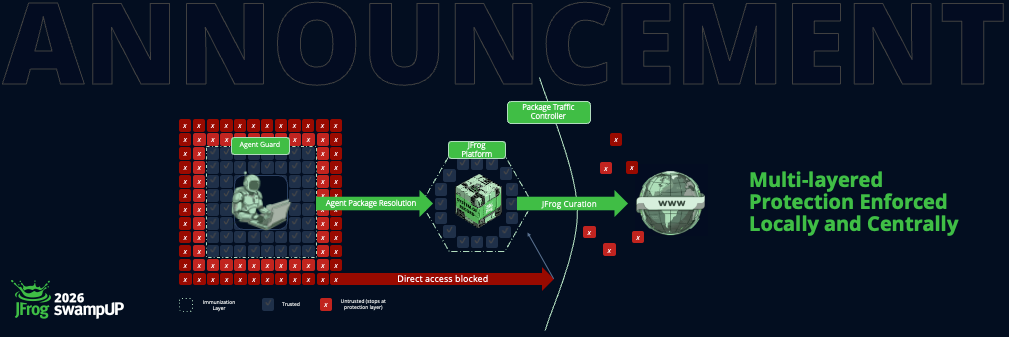
JFrog's swampUP 2026 announcements extend platform governance into the agentic software supply chainsoftware supply chainThe dependencies, tools and processes used to build and deliver software. Compromising one part can affect the products or organizations that rely on it., headlined by Zero-Touch Remediation that automatically swaps vulnerable packages for compliant versions, new governed registries for agent packages, plugins and skills, an AI-powered policy-as-code playground, and prompt-to-release traceability for compliance.
JFrog software supply chain solutions provide an end-to-end pipeline to control your binaries from build to production. Power your software updates to the edge.
JFrog's swampUP 2026 announcements extend platform governance into the agentic software supply chainsoftware supply chainThe dependencies, tools and processes used to build and deliver software. Compromising one part can affect the products or organizations that rely on it., headlined by Zero-Touch Remediation that automatically swaps vulnerable packages for compliant versions, new governed registries for agent packages, plugins and skills, an AI-powered policy-as-code playground, and prompt-to-release traceability for compliance.
└──▷ WHAT SHIPPED ·
11 FEATURES4 OF 11 FEATURESmost completely described firstwhat's the number?
Each feature carries 0–100 for how completely the vendor documented
it — not how big or important the work is. A major capability
described in eight words scores low, and that is the finding.
depth0–40what it does and how it works or what changed
specificity0–30names real surfaces — APIs, flags, formats, limits, numbers
actionability0–30enough to go use it — a named endpoint, flag, or config key tops this; a UI path is a starting point
Code and config rank first by construction: a documented endpoint,
flag or config key scores at the top of specificity and actionability,
so it sorts above a feature described only in prose. Under
60 the notes go thin — everything below the “thinner
coverage” line is thinner documentation, not smaller work.
Hover any meter for that feature's three sub-scores.
0101
Zero-Touch Remediation via Compliant Version Replacementnew72how completely this was documenteddepth35/40specificity25/30actionability12/3072 / 100
JFrog Zero-Touch Remediation automatically evaluates all available fixes for a vulnerability in a customer's environment and selects the best one based on policy, environment, and risk tolerance. It works through Compliant Version Replacement, swapping a vulnerable package version for a patched one mid-pipeline by evaluating multiple upstream sources (Chainguard, Maven Central, and others) against the customer's own policy, with JFrog Artifactory as the system of record.
Governed registries and resolution for agent packages and pluginsnew68how completely this was documenteddepth25/40specificity25/30actionability18/3068 / 100
New APMAPMApplication Performance Monitoring — a category of software that collects metrics, traces, and logs from running applications so developers can detect slowdowns and diagnose their root cause. Repository provides a governed registry for agent package installs, replacing open-internet pulls via apm install. New Plugins Registry delivers a scanned, auditable source for first- and third-party coding agent plugins, replacing default public marketplaces. New Agent Package Resolution provides a trusted, policy-enforced path for agents to resolve dependencies through the JFrog Platform.
JFrog Agent Plugin for coding agentsnew63how completely this was documenteddepth20/40specificity28/30actionability15/3063 / 100
New JFrog Agent Plugin integrates coding agents — Claude Code, Cursor, VS Code Copilot, Kiro, Devin, OpenCode, and Codex — natively with the JFrog Platform.
AI-powered policy-as-code playgroundnew60how completely this was documenteddepth25/40specificity20/30actionability15/3060 / 100
Adds an AI-Powered Policy as Code Playground that converts plain-language intent into enforceable, versioned, Rego-based policy automatically, requiring no manual policy authoring.
Agentic remediation via AutoPR pull requestsnew50how completely this was documenteddepth25/40specificity15/30actionability10/3050 / 100
AutoPR with Smart Remediation automatically pushes verified, context-aware fix guidance directly to pull requests. For first-party code this is Agentic Remediation, fixing vulnerabilities at the source level with a developer reviewing and approving changes before merge — distinct from Zero-Touch Remediation's fully automated mid-pipeline swap.
Repo-level policies without project setupnew49how completely this was documenteddepth22/40specificity15/30actionability12/3049 / 100
Adds Repo-Level Policies that enforce evidence-based governance directly on repositories without requiring project, application, or lifecycle-stage setup.
Post-release governance for compliance windowsnew45how completely this was documenteddepth22/40specificity15/30actionability8/3045 / 100
Adds Post-Release Governance, extending compliance monitoring and vulnerability remediation tracking through the support window after a release ships to address European regulatory requirements.
Skills Scanning for agent skill filesnew43how completely this was documenteddepth20/40specificity15/30actionability8/3043 / 100
New Skills Scanning uses semantic security scanning to detect malicious behavior in skill files and block them before they reach a developer's machine.
AI Catalog expanded to skills, plugins and Agent Packagesimproved41how completely this was documenteddepth18/40specificity15/30actionability8/3041 / 100
Expanded JFrog AI Catalog now governs skills, plugins, and Agent Packages (APM) in addition to previously supported AI assets.
TruffleHog v3.97.2 adds a new AWS Secrets Manager source, a Weights & Biases V2 detector, GitHub token-type differentiation for faster remediation, Jenkins resource enumeration, and more resilient git cloning against GitHub rate limits.
trufflehog discovers, classifies, and validates leaked credentials
TruffleHog v3.97.2 adds a new AWS Secrets Manager source, a Weights & Biases V2 detector, GitHub token-type differentiation for faster remediation, Jenkins resource enumeration, and more resilient git cloning against GitHub rate limits.
└──▷ WHAT SHIPPED ·
5 FEATURES0 OF 5 FEATURESmost completely described firstwhat's the number?
Each feature carries 0–100 for how completely the vendor documented
it — not how big or important the work is. A major capability
described in eight words scores low, and that is the finding.
depth0–40what it does and how it works or what changed
specificity0–30names real surfaces — APIs, flags, formats, limits, numbers
actionability0–30enough to go use it — a named endpoint, flag, or config key tops this; a UI path is a starting point
Code and config rank first by construction: a documented endpoint,
flag or config key scores at the top of specificity and actionability,
so it sorts above a feature described only in prose. Under
60 the notes go thin — everything below the “thinner
coverage” line is thinner documentation, not smaller work.
Hover any meter for that feature's three sub-scores.
0100
GitHub token-type differentiation in detectorimproved80how completely this was documenteddepth30/40specificity30/30actionability20/3080 / 100
Adds token_type and remediation fields to ExtraData in the GitHub V2 detector, differentiating between PATPATA personal access token, a credential used by scripts and integrations instead of a user's password. Its permissions and expiry depend on the service issuing it. (ghp_, github_pat_), OAuth (gho_), and GitHub App (ghu_, ghs_, ghr_) token types so incident responders are directed to the correct revocation path.
— Names exact fields and token prefixes plus behavioral benefit.v3.97.2
0200
Weights & Biases V2 detectornew65how completely this was documenteddepth20/40specificity25/30actionability20/3065 / 100
Adds a V2 detector for Weights & Biases, enabled via the WeightsAndBiasesV2DetectorEnabled feature flag, expanding credential coverage for the ML platform.
— Names the feature flag but no usage detail beyond enabling it.v3.97.2
0300
AWS Secrets Manager sourcenew60how completely this was documenteddepth20/40specificity20/30actionability20/3060 / 100
Adds the SOURCE_TYPE_AWS_SECRETS_MANAGER source type, enabling TruffleHog to scan AWS Secrets Manager for leaked credentials.
— Names the source type but no scan config or CLI detail.v3.97.2
thinner coverage below
0400
Automatic git clone retry on rate limitsimproved55how completely this was documenteddepth25/40specificity20/30actionability10/3055 / 100
Retries git clone automatically on secondary rate-limit responses (bare 403/429), reducing scan failures against large GitHub targets.
— Explains trigger and benefit but no configurable retry options given.v3.97.2
0500
Jenkins source enumerationimproved50how completely this was documenteddepth20/40specificity15/30actionability15/3050 / 100
Implements Enumerate for the Jenkins source, allowing TruffleHog to discover and iterate Jenkins resources during scans.
— Names the mechanism but not what resources are discovered.v3.97.2
Elcomsoft Quick Triage 2.2 ships a cross-artifact timeline, a new plugin architecture for artifact parsing, and a file-system-metadata snapshot capability, alongside extended MSA password attacks, full-text search and BitLockerBitLockerA full-disk encryption feature built into Windows, maintained by Microsoft, that protects data at rest by encrypting entire volumes; cyber tools use it to audit encryption status or recover keys from managed endpoints. key extraction.
Try professional password recovery, data decryption, mobile and cloud forensic tools from a manufacturer with 30+ years of expertise, providing tools and training to law enforcement, financial and intelligence agencies.
Elcomsoft Quick Triage 2.2 ships a cross-artifact timeline, a new plugin architecture for artifact parsing, and a file-system-metadata snapshot capability, alongside extended MSA password attacks, full-text search and BitLockerBitLockerA full-disk encryption feature built into Windows, maintained by Microsoft, that protects data at rest by encrypting entire volumes; cyber tools use it to audit encryption status or recover keys from managed endpoints. key extraction.
└──▷ WHAT SHIPPED ·
6 FEATURES1 OF 6 FEATURESmost completely described firstwhat's the number?
Each feature carries 0–100 for how completely the vendor documented
it — not how big or important the work is. A major capability
described in eight words scores low, and that is the finding.
depth0–40what it does and how it works or what changed
specificity0–30names real surfaces — APIs, flags, formats, limits, numbers
actionability0–30enough to go use it — a named endpoint, flag, or config key tops this; a UI path is a starting point
Code and config rank first by construction: a documented endpoint,
flag or config key scores at the top of specificity and actionability,
so it sorts above a feature described only in prose. Under
60 the notes go thin — everything below the “thinner
coverage” line is thinner documentation, not smaller work.
Hover any meter for that feature's three sub-scores.
0100
File system snapshot artifactnew45how completely this was documenteddepth30/40specificity10/30actionability5/3045 / 100
A new file system snapshot capability copies file system metadata without extracting file contents, and is available as a new artifact type for collection and analysis.
Cross-artifact timeline viewnew40how completely this was documenteddepth25/40specificity10/30actionability5/3040 / 100
A new Timeline view merges events from every timestamped artifact into a single chronology, letting investigators follow activity across different artifact types in one merged event view.
Plugin architecture for artifact parsersnew40how completely this was documenteddepth25/40specificity10/30actionability5/3040 / 100
A new plugin architecture rebuilds artifact support in Quick Triage, enabling third-party and custom artifact parsers and extensible artifact collection.
CrowdSec's v1.8.1 release adds a small helper function for bot detection scenarios that validates challenge cookies.
CrowdSec - the open-source and participative security solution offering crowdsourced protection against malicious IPs and access to the most advanced real-world CTI.
CrowdSec's v1.8.1 release adds a small helper function for bot detection scenarios that validates challenge cookies.
└──▷ WHAT SHIPPED ·
1 FEATURE0 OF 1 FEATUREmost completely described firstwhat's the number?
Each feature carries 0–100 for how completely the vendor documented
it — not how big or important the work is. A major capability
described in eight words scores low, and that is the finding.
depth0–40what it does and how it works or what changed
specificity0–30names real surfaces — APIs, flags, formats, limits, numbers
actionability0–30enough to go use it — a named endpoint, flag, or config key tops this; a UI path is a starting point
Code and config rank first by construction: a documented endpoint,
flag or config key scores at the top of specificity and actionability,
so it sorts above a feature described only in prose. Under
60 the notes go thin — everything below the “thinner
coverage” line is thinner documentation, not smaller work.
Hover any meter for that feature's three sub-scores.
0100
HasValidChallengeCookie() helper for bot detectionnew50how completely this was documenteddepth15/40specificity20/30actionability15/3050 / 100
Adds a HasValidChallengeCookie() helper function for use in bot detection scenarios, enabling challenge cookie validation checks.
— Names the exact function but no usage context or scenario example.v1.8.1
Fleet 4.91.0 ships managed local Windows admin accounts, latest OS version pinning for macOS/iOS/iPadOS update policies, per-fleet activity webhooks, an end-user-auth bypass flag for fleetd installers, direct-from-storage software installer downloads, Adobe Creative Cloud plugin inventory, and 29 new iOS/iPadOS device vitals, alongside a batch of smaller API, activity-log, and UI additions.
└──▷ WHAT SHIPPED ·
20 FEATURES5 OF 20 FEATURESmost completely described firstwhat's the number?
Each feature carries 0–100 for how completely the vendor documented
it — not how big or important the work is. A major capability
described in eight words scores low, and that is the finding.
depth0–40what it does and how it works or what changed
specificity0–30names real surfaces — APIs, flags, formats, limits, numbers
actionability0–30enough to go use it — a named endpoint, flag, or config key tops this; a UI path is a starting point
Code and config rank first by construction: a documented endpoint,
flag or config key scores at the top of specificity and actionability,
so it sorts above a feature described only in prose. Under
60 the notes go thin — everything below the “thinner
coverage” line is thinner documentation, not smaller work.
Hover any meter for that feature's three sub-scores.
0101
Bypass end-user auth for fleetd enrollmentnew95how completely this was documenteddepth35/40specificity30/30actionability30/3095 / 100
Adds --bypass-end-user-auth flag to fleetctl package to generate fleetd installers that skip end-user authentication prompts on Linux and Windows hosts (requires fleetd v1.60.0 or higher). Adds mdm.allow_orbit_end_user_auth_bypass server setting, enabled by default, to control whether hosts that skip end-user authentication can enroll into a fleet that requires it; set to false to strictly enforce authentication for all Orbit enrollments.
Enforce end-user authentication for all Orbit enrollments, preventing hosts that skip MFAMFAMulti-factor authentication, requiring proof from different categories, such as a password and a hardware key, to sign in. It reduces reliance on a password alone. from joining a fleet that requires it.
yaml
mdm:
  allow_orbit_end_user_auth_bypass: false
Build a fleetd installer for a kiosk deployment where end users have already authenticated via another MDMMDMMobile device management, centrally configuring and managing enrolled devices. Administrators use it to apply settings, distribute applications and enforce device security policies. and should not see another auth prompt.
— Flag, setting, and runnable commands all givenfleet-v4.91.0
0200
Per-fleet software inventory togglenew90how completely this was documenteddepth30/40specificity30/30actionability30/3090 / 100
Adds PATCH /api/v1/fleet/fleets/{id} support for {"features": {"enable_software_inventory": <bool>}} to enable or disable software inventory collection per fleet; omitting the key leaves the stored value unchanged.
Disable software inventory for a specific fleet to reduce database load on a fleet used only for script execution.
— Exact endpoint, payload, and curl example givenfleet-v4.91.0
0300
Custom host vital variables in Android profilesnew80how completely this was documenteddepth30/40specificity30/30actionability20/3080 / 100
Adds support for $FLEET_HOST_VITAL_<id> custom host vital variables in Android configuration profiles, managed app configurations, and host name templates, with per-host expansion and automatic re-delivery when a vital value changes.
— Variable syntax and behaviour named, no examplefleet-v4.91.0
0402
'Latest' OS version pinning for update policiesnew75how completely this was documenteddepth30/40specificity25/30actionability20/3075 / 100
Adds support for setting minimum_version to latest with deadline_days in macOS/iOS/iPadOS OS update policy to automatically track the newest Apple-published version per device (Fleet Premium).
— Named fields and behaviour, no full example callfleet-v4.91.0
0500
Direct-from-storage software installer downloadsnew70how completely this was documenteddepth30/40specificity25/30actionability15/3070 / 100
Adds s3_software_installers_signed_url configuration option to serve software installers, in-house apps, and bootstrap packages via GCS presigned URLs so clients download directly from object storage instead of routing through the Fleet server.
— Config key named; behaviour explained, no runnable examplefleet-v4.91.0
0600
Apple Business Manager error visibility and device releasenew70how completely this was documenteddepth25/40specificity25/30actionability20/3070 / 100
Adds token_invalid field to ABM token API responses and dep_device_error (human-readable message) to GET /hosts/:id/dep_assignment to surface why an Apple Business Manager device lookup or ABM token is failing. Also adds support for releasing devices from Apple Business Manager inside Fleet.
— Named endpoint and fields, no example call shownfleet-v4.91.0
0700
29 new iOS/iPadOS device vitalsnew70how completely this was documenteddepth30/40specificity25/30actionability15/3070 / 100
Adds 29 new iOS/iPadOS device vitals (battery level, accessibility settings, cellular technology, cloud backup status, MDM options, device attestation, and more) collected via the existing DeviceInformation MDM refetch and exposed in the host API response and a new View all vitals modal; BYODBYODBring Your Own Device: a policy allowing employees to use personal phones, laptops, or tablets for work, creating a network of unmanaged endpoints that cyber tools must monitor or enforce policy on. enrollments are excluded.
— Mechanism and scope detailed, no field list or examplefleet-v4.91.0
0800
Host identifiers on MDM enrollment activityimproved65how completely this was documenteddepth25/40specificity25/30actionability15/3065 / 100
Adds host_id and host_serial fields to the mdm_enrolled activity for Apple (macOS, iOS, iPadOS) enrollments, and surfaces the activity on the host's activity timeline.
Built-in variables in software scriptsnew65how completely this was documenteddepth25/40specificity25/30actionability15/3065 / 100
Adds support for Fleet built-in variables (e.g. $FLEET_VAR_HOST_END_USER_IDP_USERNAME) in software install, post-install, and uninstall scripts, resolved per host at execution time (Fleet Premium).
— Named variable and scope, no example usagefleet-v4.91.0
1004
Default fleet assignment for Windows enrollmentsnew65how completely this was documenteddepth30/40specificity20/30actionability15/3065 / 100
Adds a default fleet assignment for new Windows MDM enrollments (Fleet Premium), applied before the Autopilot Enrollment Status Page runs so software, scripts, and configuration profiles take effect during out-of-box setup.
— Timing and scope explained, no config key shownfleet-v4.91.0
1100
New audit log activities for MFA and setup scriptsnew65how completely this was documenteddepth25/40specificity25/30actionability15/3065 / 100
Adds user_mfa_requested activity recorded when valid credentials are submitted for an MFA-enabled account and a verification email is sent. Adds created_setup_experience_script and deleted_setup_experience_script activities to the audit log when a setup experience script is added, replaced, or removed via the API or GitOpsGitOpsA practice where Git repositories serve as the single source of truth for infrastructure and application state, with automated systems continuously reconciling live environments to match what is declared in version control..
— Three named activity types, no trigger payload shownfleet-v4.91.0
1200
Per-fleet activity automation webhooksnew60how completely this was documenteddepth25/40specificity20/30actionability15/3060 / 100
Adds per-fleet activity automations (Fleet Premium): a webhook configured from the Hosts page that posts to a destination URL whenever an activity tied to one of the fleet's hosts is created.
— UI path given, no payload or endpoint detailfleet-v4.91.0
1300
Adobe Creative Cloud plugin inventorynew60how completely this was documenteddepth25/40specificity25/30actionability10/3060 / 100
Adds Adobe Creative Cloud plugin detection (CEP and UXP extensions) to software inventory on macOS and Windows, listed as software type Plugin (Adobe) with version and host count.
— Scope and labeling named, no config or API surfacefleet-v4.91.0
thinner coverage below
1400
Marketing names for Apple hardware modelsimproved55how completely this was documenteddepth25/40specificity20/30actionability10/3055 / 100
Adds marketing name display for Apple devices (macOS, iOS, iPadOS) — the Hardware model field now shows names like MacBook Pro (16-inch, 2021) instead of raw identifiers like MacBookPro18,1.
— Before/after example given, no field or API namefleet-v4.91.0
1500
Updated macOS CIS benchmark policiesimproved55how completely this was documenteddepth20/40specificity25/30actionability10/3055 / 100
Updates macOS CISCISA nonprofit that publishes consensus-based configuration benchmarks and controls for hardening operating systems, cloud environments, and software; cyber tools use it as a ready-made compliance baseline. benchmark policies to macOS 14 Sonoma v3.1.0, macOS 15 Sequoia v2.1.0, and macOS 26 Tahoe v1.1.0.
— Exact benchmark versions named, no migration detailfleet-v4.91.0
1600
'Patch when closed' patch policy optionnew45how completely this was documenteddepth20/40specificity15/30actionability10/3045 / 100
Adds a Patch when closed option for patch policies that only patches an app when it is not currently running.
— Behaviour stated simply, no config detailfleet-v4.91.0
1700
'Added to Fleet' hosts table columnnew45how completely this was documenteddepth15/40specificity15/30actionability15/3045 / 100
Adds a sortable Added to Fleet column to the hosts table showing when each host last enrolled.
— Clear UI location, no further mechanismfleet-v4.91.0
1800
Linux platform label optionnew40how completely this was documenteddepth15/40specificity15/30actionability10/3040 / 100
Adds linux as a label platform option, targeting hosts across any Linux distribution.
— Bare one-line addition, no mechanism detailfleet-v4.91.0
1905
Managed local admin accounts on Windowsnew40how completely this was documenteddepth15/40specificity15/30actionability10/3040 / 100
Adds a managed local admin account capability for Windows hosts (requires fleetd 1.60.0 or higher).
— Capability named but no mechanism or config givenfleet-v4.91.0
2000
Nested Entra group support in IdP vitalsimproved30how completely this was documenteddepth10/40specificity15/30actionability5/3030 / 100
Adds support for nested Entra groups in IdPIdPA service that authenticates users and supplies identity information to other applications. It is the sign-in authority behind many single sign-on systems. vitals.
— Bare one-line mention, no mechanism givenfleet-v4.91.0
CrowdStrike introduced coordinated multi-agent SOCSOCA security operations center, the team or function that monitors threats, investigates alerts and coordinates incident response. Its work can be internal, outsourced or shared. investigations built on a new shared-memory layer, a no-code agent builder (AgentWorks) that runs security workflows conversationally inside Anthropic Claude, and new integrations bringing GPT-5.6 Cyber reasoning and OpenAI Codex agent protection into the Falcon platform.
CrowdStrike is a cybersecurity platform providing cloud-based endpoint protection, threat intelligence, and incident response services.
CrowdStrike introduced coordinated multi-agent SOCSOCA security operations center, the team or function that monitors threats, investigates alerts and coordinates incident response. Its work can be internal, outsourced or shared. investigations built on a new shared-memory layer, a no-code agent builder (AgentWorks) that runs security workflows conversationally inside Anthropic Claude, and new integrations bringing GPT-5.6 Cyber reasoning and OpenAI Codex agent protection into the Falcon platform.
└──▷ WHAT SHIPPED ·
6 FEATURES4 OF 6 FEATURESmost completely described firstwhat's the number?
Each feature carries 0–100 for how completely the vendor documented
it — not how big or important the work is. A major capability
described in eight words scores low, and that is the finding.
depth0–40what it does and how it works or what changed
specificity0–30names real surfaces — APIs, flags, formats, limits, numbers
actionability0–30enough to go use it — a named endpoint, flag, or config key tops this; a UI path is a starting point
Code and config rank first by construction: a documented endpoint,
flag or config key scores at the top of specificity and actionability,
so it sorts above a feature described only in prose. Under
60 the notes go thin — everything below the “thinner
coverage” line is thinner documentation, not smaller work.
Hover any meter for that feature's three sub-scores.
0101
Charlotte AI AgentWorks with Claude executionnew69how completely this was documenteddepth32/40specificity22/30actionability15/3069 / 100
New Charlotte AI AgentWorks lets security teams describe a desired security outcome in natural language and build, test, and refine custom agents grounded in Falcon telemetry, with no coding required. Security workflows such as triage, enrichment, hunting, and response can then be run conversationally within Anthropic Claude via AgentWorks, with results returned inline and full auditability.
— Describes mechanism and where workflows run, but no exact command.2026-09-02-8b8eb0b9
thinner coverage below
0200
Shared context layer across Charlotte AI agentsnew56how completely this was documenteddepth30/40specificity18/30actionability8/3056 / 100
A new shared context layer, built on Enterprise Graph, gives all Charlotte AI domain agents a persistent, shared memory across every agent, investigation, and tenant — what one agent learns, all agents know — enabling coordinated parallel investigations across the SOC.
— Names Enterprise Graph and mechanism but no UI/API path given.2026-09-02-8b8eb0b9
0302
Falcon Guardian for OpenAI Codex agentsnew42how completely this was documenteddepth18/40specificity16/30actionability8/3042 / 100
New Falcon Guardian capability extends CrowdStrike enterprise security to OpenAI Codex agents at the point of execution.
— Names the target (OpenAI Codex) but not how protection works.2026-09-02-8b8eb0b9
0403
Falcon platform on Anthropic Claude Marketplacenew39how completely this was documenteddepth15/40specificity12/30actionability12/3039 / 100
Falcon platform is coming to the Anthropic Claude Marketplace, allowing Anthropic customers to procure it against existing Anthropic commitments.
— States procurement path but no mechanism or timing detail.2026-09-02-8b8eb0b9
0500
GPT-5.6 Cyber integration into Falconnew39how completely this was documenteddepth15/40specificity18/30actionability6/3039 / 100
GPT-5.6 Cyber, an advanced reasoning model, is being integrated into the Falcon platform, starting with the CrowdStrike Frontier AI Readiness and Resilience (FAIRR) Service.
— Names the model and starting service but no capability detail.2026-09-02-8b8eb0b9
0604
Charlotte Agentic SOAR workspacenew30how completely this was documenteddepth15/40specificity10/30actionability5/3030 / 100
New Charlotte Agentic SOARSOARSecurity orchestration, automation and response, coordinating incident workflows across tools. Playbooks can gather evidence, assign work or carry out approved response actions. provides a single-governed automation workspace for orchestrating multi-agent SOC workflows.
Trend Vision One added administrator controls and detailed daily digest emails for failed scheduled report notifications.
Trend Vision One is a unified cybersecurity platform providing threat detection, response, and risk management across endpoints, cloud, and networks.
Trend Vision One added administrator controls and detailed daily digest emails for failed scheduled report notifications.
└──▷ WHAT SHIPPED ·
1 FEATURE0 OF 1 FEATUREmost completely described firstwhat's the number?
Each feature carries 0–100 for how completely the vendor documented
it — not how big or important the work is. A major capability
described in eight words scores low, and that is the finding.
depth0–40what it does and how it works or what changed
specificity0–30names real surfaces — APIs, flags, formats, limits, numbers
actionability0–30enough to go use it — a named endpoint, flag, or config key tops this; a UI path is a starting point
Code and config rank first by construction: a documented endpoint,
flag or config key scores at the top of specificity and actionability,
so it sorts above a feature described only in prose. Under
60 the notes go thin — everything below the “thinner
coverage” line is thinner documentation, not smaller work.
Hover any meter for that feature's three sub-scores.
0100
Failed scheduled report notificationsnew75how completely this was documenteddepth35/40specificity25/30actionability15/3075 / 100
Administrators can enable or disable scheduled report failure notifications via Administration > Notifications. By default, a daily failure digest email is sent to the master administrator and the report schedule creator whenever scheduled reports fail, including the report name, report ID, schedule ID, failure time, and failure reason. Notifications also surface clear failure codes and descriptions, widget-level error details for PDF report failures, and configuration-specific guidance such as reminders to verify required frameworks and asset groups.
OpenCTI 7.260902.0 introduces a merge-users capability for consolidating duplicate user accounts, gated behind a feature flag and exposed via the API with bypass enforcement.
Open Cyber Threat Intelligence Platform
OpenCTI 7.260902.0 introduces a merge-users capability for consolidating duplicate user accounts, gated behind a feature flag and exposed via the API with bypass enforcement.
└──▷ WHAT SHIPPED ·
1 FEATURE0 OF 1 FEATUREmost completely described firstwhat's the number?
Each feature carries 0–100 for how completely the vendor documented
it — not how big or important the work is. A major capability
described in eight words scores low, and that is the finding.
depth0–40what it does and how it works or what changed
specificity0–30names real surfaces — APIs, flags, formats, limits, numbers
actionability0–30enough to go use it — a named endpoint, flag, or config key tops this; a UI path is a starting point
Code and config rank first by construction: a documented endpoint,
flag or config key scores at the top of specificity and actionability,
so it sorts above a feature described only in prose. Under
60 the notes go thin — everything below the “thinner
coverage” line is thinner documentation, not smaller work.
Hover any meter for that feature's three sub-scores.
0100
Merge-users capability for account consolidationnew45how completely this was documenteddepth20/40specificity15/30actionability10/3045 / 100
Adds a merge-users feature that allows consolidating user accounts, controlled by a feature flag, exposed through an API surface, and subject to bypass enforcement for access control.
— Names feature flag and API surface but no exact flag name or endpoint given.7.260902.0
Falcon Onum adds Certified Data Pipelines that filter noise and run threat detection in-stream before ingested data lands in storage.
Falcon Onum adds Certified Data Pipelines that filter noise and run threat detection in-stream before ingested data lands in storage.
└──▷ WHAT SHIPPED ·
1 FEATURE0 OF 1 FEATUREmost completely described firstwhat's the number?
Each feature carries 0–100 for how completely the vendor documented
it — not how big or important the work is. A major capability
described in eight words scores low, and that is the finding.
depth0–40what it does and how it works or what changed
specificity0–30names real surfaces — APIs, flags, formats, limits, numbers
actionability0–30enough to go use it — a named endpoint, flag, or config key tops this; a UI path is a starting point
Code and config rank first by construction: a documented endpoint,
flag or config key scores at the top of specificity and actionability,
so it sorts above a feature described only in prose. Under
60 the notes go thin — everything below the “thinner
coverage” line is thinner documentation, not smaller work.
Hover any meter for that feature's three sub-scores.
0100
Certified Data Pipelines for in-stream filtering and detectionnew48how completely this was documenteddepth25/40specificity15/30actionability8/3048 / 100
Built on Falcon Onum's streaming pipeline technology, Certified Data Pipelines filter noise at ingestion so only relevant data reaches downstream agents, and run detection inside the pipeline so threats are caught in-stream before ingested data is stored.
— Explains mechanism but no config, flags, or limits given.2026-09-02-13bacd74
Tenzir is a data pipeline engine for security teams that collects, transforms, enriches, and routes telemetry.
Tenzir's v6.15.0 release adds Splunk HECSplunk HECAn HTTP endpoint built into Splunk that accepts JSON-formatted log and event data pushed directly from applications or agents over HTTPS, letting cyber tools ship telemetry to Splunk without requiring a forwarder agent on the sending host. acknowledgement support for reliable delivery confirmation, new raw AvroAvroA row-oriented data serialization format maintained by Apache, using JSON-defined schemas bundled with the data so tools can read it without out-of-band schema management. decoding primitives, finer-grained parallelism controls, parallelized Google SecOpsSecOpsThe practice of merging security and IT operations teams so that threat detection, response, and infrastructure management share the same workflows, giving cyber tools a single pipeline from alert to remediation. output, and up to 9x faster event branching.
└──▷ WHAT SHIPPED ·
5 FEATURES0 OF 5 FEATURESmost completely described firstwhat's the number?
Each feature carries 0–100 for how completely the vendor documented
it — not how big or important the work is. A major capability
described in eight words scores low, and that is the finding.
depth0–40what it does and how it works or what changed
specificity0–30names real surfaces — APIs, flags, formats, limits, numbers
actionability0–30enough to go use it — a named endpoint, flag, or config key tops this; a UI path is a starting point
Code and config rank first by construction: a documented endpoint,
flag or config key scores at the top of specificity and actionability,
so it sorts above a feature described only in prose. Under
60 the notes go thin — everything below the “thinner
coverage” line is thinner documentation, not smaller work.
Hover any meter for that feature's three sub-scores.
0100
Splunk HEC acknowledgement supportnew95how completely this was documenteddepth35/40specificity30/30actionability30/3095 / 100
A new ack = true option on the accept_splunk operator enables the HECHECAn HTTP API endpoint provided by Splunk that lets applications stream JSON-formatted events directly into a Splunk index without a forwarder agent, reducing pipeline complexity for log-shipping tools. acknowledgement protocol: clients receive an ackId per request, queryable via /services/collector/ack, with acknowledgements held for 10 minutes by default and delivery guarantees preserved across node crashes/restarts.
Enable HEC acknowledgements on a Splunk ingestion pipeline so clients can confirm delivery and safely retry across node restarts.
Expanded parallel operator controlsimproved75how completely this was documenteddepth25/40specificity25/30actionability25/3075 / 100
The parallel operator now accepts fuse (values: none, parallel, or all) and limit_partitions options, matching the // parallelism directive and capping keyed operator parallelism for operators like summarize and deduplicate.
Cap keyed parallelism inside a parallel block to avoid runaway partition growth when summarizing high-cardinality data.
$ parallel 8, fuse = "none", limit_partitions = 2 {
  where y > 100
  summarize g, total = sum(x)
}
Raw Avro decoding via read_avro and parse_avronew70how completely this was documenteddepth25/40specificity25/30actionability20/3070 / 100
The new read_avro operator decodes streams of concatenated raw Apache Avro binary datums (not Avro Object Container Files), and the new parse_avro function decodes a single raw Avro datum from each blob or string value; both require the writer schema via the schema argument.
Parse raw Avro data from a file and forward to a pipeline — useful when ingesting binary Avro logs from object storage or Kafka.
Parallelized Google SecOps outputimproved35how completely this was documenteddepth15/40specificity15/30actionability5/3035 / 100
The to_google_secops operator now runs as multiple instances when a pipeline is parallelized, each batching, authenticating, and sending independently for higher-throughput Google SecOps pipelines.
Faster event branching with ifimproved35how completely this was documenteddepth20/40specificity15/30actionability0/3035 / 100
Pipelines branching events with if now achieve up to 9x higher throughput when matching events are contiguous in a batch, by handing views instead of copies for batches with up to four contiguous matching runs.
Yubico's ecosystem saw OpenAI mandate hardware-backed passkeyspasskeysPhishing-resistant sign-in credentials built on FIDO2/WebAuthn: the device holds a private key and proves possession instead of the user typing a password. They sync across a user's devices. for its Trusted Access for Cyber program, disabling weaker authentication methods, while the co-branded YubiKey bundle expanded to new markets with two new custom hardware keys.
Get the YubiKey, the #1 security key, offering strong two factor authentication from industry leader Yubico.
Yubico's ecosystem saw OpenAI mandate hardware-backed passkeyspasskeysPhishing-resistant sign-in credentials built on FIDO2/WebAuthn: the device holds a private key and proves possession instead of the user typing a password. They sync across a user's devices. for its Trusted Access for Cyber program, disabling weaker authentication methods, while the co-branded YubiKey bundle expanded to new markets with two new custom hardware keys.
└──▷ WHAT SHIPPED ·
2 FEATURES1 OF 2 FEATURESmost completely described firstwhat's the number?
Each feature carries 0–100 for how completely the vendor documented
it — not how big or important the work is. A major capability
described in eight words scores low, and that is the finding.
depth0–40what it does and how it works or what changed
specificity0–30names real surfaces — APIs, flags, formats, limits, numbers
actionability0–30enough to go use it — a named endpoint, flag, or config key tops this; a UI path is a starting point
Code and config rank first by construction: a documented endpoint,
flag or config key scores at the top of specificity and actionability,
so it sorts above a feature described only in prose. Under
60 the notes go thin — everything below the “thinner
coverage” line is thinner documentation, not smaller work.
Hover any meter for that feature's three sub-scores.
0101
Hardware-backed passkey mandate for OpenAI Trusted Access for Cyberbreaking80how completely this was documenteddepth30/40specificity25/30actionability25/3080 / 100
OpenAI's Advanced Account Security (AAS) program now requires hardware-backed passkeys for all Trusted Access for Cyber (TAC) members, disabling weaker phishable methods such as SMSSMSShort Message Service, the protocol built into cellular networks for sending text messages between phones; cyber tools use it for alerting, two-factor authentication delivery, or phishing simulation over mobile channels. OTPs and push notifications upon security key enrollment. Enrolling a YubiKey under the AAS program at chatgpt.com/advanced-account-security covers both ChatGPT and Codex accounts with hardware-backed passkeypasskeyPhishing-resistant sign-in credentials built on FIDO2/WebAuthn: the device holds a private key and proves possession instead of the user typing a password. They sync across a user's devices. protection.
OpenAI + YubiKey bundle expansion and new custom keysnew55how completely this was documenteddepth20/40specificity25/30actionability10/3055 / 100
The custom 2-pack OpenAI + YubiKey bundle expands to 10 new countries: Australia, Egypt, Japan, Malaysia, Mexico, Saudi Arabia, Singapore, South Korea, Taiwan, and the United Arab Emirates. Two new custom-branded hardware keys are available at preferred pricing for the transition: the YubiKey C NFCNFCNear Field Communication, a short-range (≤4 cm) wireless standard maintained by the NFC Forum, enabling data exchange between devices; cyber tools use it to probe, emulate, or intercept contactless card and tag transactions. – OpenAI (tap-to-authenticate for mobile/tablets) and the YubiKey C Nano – OpenAI (low-profile USB-C for laptops).
ⓘSourcesBlog / feed →2 releases · 2026-09-02 → 2026-09-03Blog ↗RankWhy this ranktop features scored 85/50, +10 product media, +6 runnable example — 83.5How ranking works →
Secure users, AI agents, and more with Auth0, an easy-to-implement, scalable, and adaptable authentication and authorization platform.
Auth0 shipped Early Access self-service controls letting Organization Admins configure Cross App Access and third-party application access directly via the My Organization API and Embeddable UI Components, alongside a redesigned Dashboard navigation and information architecture.
└──▷ WHAT SHIPPED ·
2 FEATURES0 OF 2 FEATURESmost completely described firstwhat's the number?
Each feature carries 0–100 for how completely the vendor documented
it — not how big or important the work is. A major capability
described in eight words scores low, and that is the finding.
depth0–40what it does and how it works or what changed
specificity0–30names real surfaces — APIs, flags, formats, limits, numbers
actionability0–30enough to go use it — a named endpoint, flag, or config key tops this; a UI path is a starting point
Code and config rank first by construction: a documented endpoint,
flag or config key scores at the top of specificity and actionability,
so it sorts above a feature described only in prose. Under
60 the notes go thin — everything below the “thinner
coverage” line is thinner documentation, not smaller work.
Hover any meter for that feature's three sub-scores.
0100
Self-service XAA and third-party app access for Organizationsnew85how completely this was documenteddepth33/40specificity28/30actionability24/3085 / 100
The My Organization API and Embeddable UI Components now expose self-service configuration of third-party application access for an Organization and for individual connections, plus the Cross App Access (XAA) Resource Application role for a connection, so Organization Admins can manage access without routing changes through the Auth0 Dashboard. Connections gain a third_party_client_access object (default { "default_value": "block", "allowed_values": ["block"] }) and settings for User Access Authorization and Client Credential Access Authorization, each configurable as Unauthorized, Authorized, or All. XAA configuration carries a domain-verification guardrail — the connection's identity provideridentity providerA service that authenticates users and supplies identity information to other applications. It is the sign-in authority behind many single sign-on systems. must use a domain verified for the associated Organization — and each delegated setting is independently controllable so platform teams choose which settings are exposed to Organization Admins.
Configure Cross App Access (XAA) and user/client credential access authorization for an Organization connection via the Auth0 dashboard.
📍1. Go to Auth0 Dashboard › Organizations › [your org] › Connections.
2. Select a connection and open its settings.
3. Under Cross App Access (XAA), enable Resource Application for the connection.
4. Set User Access Authorization to Unauthorized, Authorized, or All.
5. Set Client Credential Access Authorization to Unauthorized, Authorized, or All.
6. Save changes.
Dashboard navigation and IA refreshnew50how completely this was documenteddepth20/40specificity10/30actionability20/3050 / 100
A new Early Access opt-in redesigns the Auth0 Dashboard sidebar with improved information architecture, consistent breadcrumbs, and a modernized visual experience. Users can toggle the new navigation on or off anytime from the profile menu, or accept it via a Try now prompt on login.
Enable the new navigation experience from your profile menu without waiting for a forced rollout.
📍1. Log in to the Auth0 Dashboard.
2. Click Try now in the popup that appears on login, OR
3. Open your profile menu in the top-right corner and toggle New Navigation on or off at any time.
RegScale CLI 6.44.0 adds a validation check to the JCAM configuration workflow to catch misconfigured attribute mappings.
RegScale is a compliance automation platform that helps organizations manage regulatory requirements, assessments, and evidence collection.
RegScale CLI 6.44.0 adds a validation check to the JCAM configuration workflow to catch misconfigured attribute mappings.
└──▷ WHAT SHIPPED ·
1 FEATURE0 OF 1 FEATUREmost completely described firstwhat's the number?
Each feature carries 0–100 for how completely the vendor documented
it — not how big or important the work is. A major capability
described in eight words scores low, and that is the finding.
depth0–40what it does and how it works or what changed
specificity0–30names real surfaces — APIs, flags, formats, limits, numbers
actionability0–30enough to go use it — a named endpoint, flag, or config key tops this; a UI path is a starting point
Code and config rank first by construction: a documented endpoint,
flag or config key scores at the top of specificity and actionability,
so it sorts above a feature described only in prose. Under
60 the notes go thin — everything below the “thinner
coverage” line is thinner documentation, not smaller work.
Hover any meter for that feature's three sub-scores.
0100
JCAM config validation in CLIimproved75how completely this was documenteddepth25/40specificity25/30actionability25/3075 / 100
The jcam check_config command now validates jcamAgencyDefinedDataItems mappings against the attributes JCAM actually carries, reporting entries configured for attributes JCAM does not have and attributes JCAM has that are not mapped.
LogicGate's Summer 2026 release brings its GRCGRCGovernance, Risk, and Compliance — a framework for aligning IT controls with business policy, regulatory requirements, and risk management so organizations can audit and report on their posture systematically. Agents to general availability for four use cases and adds automated control testing, bulk record linking, a lifecycle management environment, four new integrations, and an 81% API performance boost for enterprise customers.
LogicGate Risk Cloud is the leading AI-powered GRC platform with 30+ applications for enterprise risk, third-party risk, cyber risk and compliance management.
LogicGate's Summer 2026 release brings its GRCGRCGovernance, Risk, and Compliance — a framework for aligning IT controls with business policy, regulatory requirements, and risk management so organizations can audit and report on their posture systematically. Agents to general availability for four use cases and adds automated control testing, bulk record linking, a lifecycle management environment, four new integrations, and an 81% API performance boost for enterprise customers.
└──▷ WHAT SHIPPED ·
12 FEATURES3 OF 12 FEATURESmost completely described firstwhat's the number?
Each feature carries 0–100 for how completely the vendor documented
it — not how big or important the work is. A major capability
described in eight words scores low, and that is the finding.
depth0–40what it does and how it works or what changed
specificity0–30names real surfaces — APIs, flags, formats, limits, numbers
actionability0–30enough to go use it — a named endpoint, flag, or config key tops this; a UI path is a starting point
Code and config rank first by construction: a documented endpoint,
flag or config key scores at the top of specificity and actionability,
so it sorts above a feature described only in prose. Under
60 the notes go thin — everything below the “thinner
coverage” line is thinner documentation, not smaller work.
Hover any meter for that feature's three sub-scores.
0100
Automated Control Testing on evidence submissionnew65how completely this was documenteddepth35/40specificity20/30actionability10/3065 / 100
Automated Control Testing now tests linked evidence records automatically as they are submitted, delivering a pass/fail control-level evaluation with detailed rationale and immediate gap flagging instead of waiting for the next manual audit cycle.
GRC Agents reach general availabilitynew55how completely this was documenteddepth25/40specificity20/30actionability10/3055 / 100
GRC Agents are now generally available for four use cases — Third-Party Risk ManagementThird-Party Risk ManagementAssessing and monitoring the security risk an organization takes on through its vendors, suppliers and service providers. It covers the questionnaires, evidence and continuous checks behind letting a third party hold your data. (TPRMTPRMAssessing and monitoring the security risk an organization takes on through its vendors, suppliers and service providers. It covers the questionnaires, evidence and continuous checks behind letting a third party hold your data.), Enterprise Risk Management (ERM), AI Governance, and Business Continuity Management (BCM) — handling high-volume, repetitive workflow administration so risk teams can focus on proactive risk management.
SmartSheet, IronClad, Box and Microsoft Planner integrationsnew55how completely this was documenteddepth20/40specificity25/30actionability10/3055 / 100
SmartSheet, IronClad, Box, and Microsoft Planner join the LogicGate integration ecosystem for connected document management, task tracking, and contract execution.
Provision 29 Compliance application co-developed with PwCnew55how completely this was documenteddepth25/40specificity20/30actionability10/3055 / 100
Provision 29 Compliance application — co-developed with PwC — provides UK enterprise risk teams a single, connected workflow for audit-ready principal risk and material control management evidence.
GRC Lifecycle Management with dev syncnew50how completely this was documenteddepth25/40specificity15/30actionability10/3050 / 100
GRC Lifecycle Management lets teams sync a live production instance to a dedicated development environment to safely test and build new workflows without risking live processes.
MCP Server Access for natural-language queriesnew50how completely this was documenteddepth25/40specificity20/30actionability5/3050 / 100
Upcoming MCP ServerMCP ServerA process that exposes tools, resources, and prompts over Anthropic's Model Context Protocol, letting an AI agent call external APIs or local services through a standardised interface. Access will allow users to query Risk Cloud data via natural language prompts in the LLMLLMA large language model, a neural network trained on large amounts of text to recognize patterns and generate language. Applications use it for tasks such as answering, summarizing and writing code. of their choice, with permission-based access and no custom integration required.
Upcoming Insights Agent and additional GRC Agents for fallnew50how completely this was documenteddepth20/40specificity25/30actionability5/3050 / 100
Upcoming Insights Agent will power next-generation GRC reporting; additional GRC Agents for Cyber Risk Management, Policy & Procedure Management, Incident Management, and Issues Management are confirmed for fall.
Bulk Record Linking at scalenew45how completely this was documenteddepth25/40specificity15/30actionability5/3045 / 100
Bulk Record Linking applies the same semantic intelligence behind Record Linking Recommendations at scale, generating recommendations for hundreds of records simultaneously rather than one at a time.
Upgraded Search across applications, reports and dashboardsimproved35how completely this was documenteddepth15/40specificity15/30actionability5/3035 / 100
Upgraded Search now extends beyond individual records to applications, reports, and dashboards.
Visual Reports branding and branded email sendingimproved35how completely this was documenteddepth15/40specificity15/30actionability5/3035 / 100
Visual Reports gain full color-palette customization to match corporate branding, and automated emails can now be sent from an organization's own domain.
CrowdStrike introduced the FAIRR Service, integrating OpenAI's GPT-5.6 Cyber model into its cyber harness to assess frontier AI risk and attack pathsattack pathsA possible sequence of steps an attacker could take to reach a valuable target. It connects weaknesses, permissions and reachable systems rather than treating each finding separately..
CrowdStrike Falcon Secure AI Services provides AI-powered threat detection, incident response automation, and security intelligence for enterprise endpoints and cloud environments.
CrowdStrike introduced the FAIRR Service, integrating OpenAI's GPT-5.6 Cyber model into its cyber harness to assess frontier AI risk and attack pathsattack pathsA possible sequence of steps an attacker could take to reach a valuable target. It connects weaknesses, permissions and reachable systems rather than treating each finding separately..
└──▷ WHAT SHIPPED ·
1 FEATURE0 OF 1 FEATUREmost completely described firstwhat's the number?
Each feature carries 0–100 for how completely the vendor documented
it — not how big or important the work is. A major capability
described in eight words scores low, and that is the finding.
depth0–40what it does and how it works or what changed
specificity0–30names real surfaces — APIs, flags, formats, limits, numbers
actionability0–30enough to go use it — a named endpoint, flag, or config key tops this; a UI path is a starting point
Code and config rank first by construction: a documented endpoint,
flag or config key scores at the top of specificity and actionability,
so it sorts above a feature described only in prose. Under
60 the notes go thin — everything below the “thinner
coverage” line is thinner documentation, not smaller work.
Hover any meter for that feature's three sub-scores.
0100
FAIRR Service with GPT-5.6 Cybernew45how completely this was documenteddepth22/40specificity18/30actionability5/3045 / 100
New FAIRR Service applies GPT-5.6 Cyber within CrowdStrike's cyber harness to assess frontier AI risk, analyze attack paths, and inform remediation priorities. It is available for approved, authorized defensive use cases with expert oversight, per the CrowdStrike/OpenAI partnership announcement.
— Names the service and model but access/mechanism vague, no how-to.2026-09-02-2a585013
The free and flexible app for your private thoughts.
Obsidian's 1.14.0 early access release brings iOS 26 Native Quick Capture with Live Activity support, colorable inline highlights, a new kanban layout for Bases, and full right-to-left workspace mirroring, alongside a math-rendering engine swap and smaller mobile UI updates.
└──▷ WHAT SHIPPED ·
0 FEATURES10 FEATURES0 OF 10 FEATURESmost completely described firstwhat's the number?
Each feature carries 0–100 for how completely the vendor documented
it — not how big or important the work is. A major capability
described in eight words scores low, and that is the finding.
depth0–40what it does and how it works or what changed
specificity0–30names real surfaces — APIs, flags, formats, limits, numbers
actionability0–30enough to go use it — a named endpoint, flag, or config key tops this; a UI path is a starting point
Code and config rank first by construction: a documented endpoint,
flag or config key scores at the top of specificity and actionability,
so it sorts above a feature described only in prose. Under
60 the notes go thin — everything below the “thinner
coverage” line is thinner documentation, not smaller work.
Hover any meter for that feature's three sub-scores.
0100
Color highlights in the editornew80how completely this was documenteddepth30/40specificity25/30actionability25/3080 / 100
Highlights wrapped in == can now be given a color by prefixing the text with a color emoji (e.g.) or by using the new color picker in the formatting submenu. Typing == now triggers an inline suggestion popup for highlight colors, and Live Preview shows a color swatch when the cursor overlaps a highlight, which can be clicked to change its color.
Color-code a highlight to visually flag a critical finding or warning inside a note.
📍In the editor, wrap text with == then prepend a color emoji:
🔴 ==critical warning text==
Or type == and select a color from the suggestion popup.
iOS 26 Native Quick Capturenew80how completely this was documenteddepth30/40specificity25/30actionability25/3080 / 100
iOS 26 Native Quick Capture lets you capture notes from the Lock Screen, Control Center, or Shortcuts without waiting for your vault to load. It supports configurable Create Locations — capture to a new note, today's daily note, a bookmarked note, or any chosen note — and an active Quick Capture note surfaces as a Live Activity on the Lock Screen and Dynamic Island while editing.
Capture a note directly from the iOS 26 Lock Screen without opening your vault, routing it to today's daily note.
📍On iOS 26, go to Lock Screen › add Quick Capture widget or access via Control Center › tap Quick Capture › select Daily Note as the Create Location › type your note and save.
Stable IDs for plugin settingsnew65how completely this was documenteddepth25/40specificity25/30actionability15/3065 / 100
Adds an optional SettingDefinitionItem#id field for developers to set a unique ID on individual settings, allowing stable references when settings share a name or a setting page is renamed.
RTL workspace mirroringimproved45how completely this was documenteddepth20/40specificity15/30actionability10/3045 / 100
The entire workspace, including sidebars, now mirrors when Obsidian is set to a right-to-left (RTLRTLRegister Transfer Level, a hardware design abstraction describing how data moves between registers each clock cycle; cyber tools use it to analyze or synthesize digital circuits from HDL source.) language; commands such as Toggle left sidebar now refer to the visual left sidebar after flipping.
Math rendering switched to Temmlimproved35how completely this was documenteddepth15/40specificity15/30actionability5/3035 / 100
Obsidian replaces MathJaxMathJaxAn open-source JavaScript library that renders LaTeX and MathML math notation in web browsers, giving cyber tools a reliable way to display formatted equations without server-side processing. with Temml for rendering math in Live Preview and Reading mode.
 THE CYBER TOOLCHAIN