The Cyber Toolchain — issue 064, September 4, 2026
THE CYBER TOOLCHAIN
NO. 064
Tail
THE DAILY RELEASE FIREHOSE
PUBLISHED SEPTEMBER 4, 2026 · EVERY DAY
EDITIONStail|grep|head|ls|diff|uniq
The daily firehose — everything the toolchain shipped today, already filtered.
We read every release from the 1309 tools on our watchlist at the source — GitHub and GitLab release notes, vendor release pages and changelogs, project blogs and feeds, vendor press releases, and the source code behind the tag. Bug-fix-only releases and non-product newsroom noise are dropped; what's left is summarized down to the new capability, how to try it, and any screenshots or videos the release itself published. Every entry links to the sources it was built from.
READ AS
Focus:What features shipped and what problems they solve, plus launches, packaging and where the market is moving.
Leaves out:Command-line flags, API-only deltas, usage examples, and releases that are only refinements.
Focus:New security controls, new APIs, and product improvements you can put to work, plus anything an upgrade breaks.
Leaves out:Launch and marketing news, governance, pricing, and documentation changes with no operational effect.
Focus:Dashboards, reporting, and anything you can quantify: metrics, coverage, risk scores, compliance impact, vendor moves.
Leaves out:Settings, flags, API and command-line detail, library bumps, and minor releases with no reporting or posture angle.
Focus:API, SDK and MCP changes, new libraries, breaking changes in what you import, and cyber tooling.
Leaves out:Governance, SOC operations, and vendor launches with no developer surface.
AMOUNT
DETAIL
ORDER
This issue came out before editions were ranked, so it shows the Standard edition in issue order.
What stands out across today's releases, grouped by what it lets you do. Every tool named links to its entry below.
Three unrelated things stand out. Endor Labs' Package Firewall blocks malicious or non-compliant packages at install time, before code lands on a build machine's disk rather than after a scan flags it. StepSecurity now tracks personal access tokenspersonal access tokensA personal access token, a credential used by scripts and integrations instead of a user's password. Its permissions and expiry depend on the service issuing it. continuously across GitHub and Azure DevOps. And DefectDojo Pro can export SBOMSBOMA software bill of materials, an inventory of the components and versions inside an application. It helps teams find affected software when a dependency has a vulnerability or licensing issue. and VEXVEXA machine-readable statement from a vendor saying whether a CVE in a component actually affects their product. It is how a scanner is told to stop flagging a vulnerability that is not reachable. straight from Assets over a REST APIREST APIA web API design style where clients interact with resources over HTTP using standard methods like GET, POST, and DELETE, giving cyber tools a predictable, language-agnostic way to integrate with external services..
protect
Stop a malicious dependency before it touches the build machine
Endor Labs' Package Firewall enforces at install time, so a typosquat or compromised release is refused rather than detected in a post-hoc scan of a machine that already ran its lifecycle scripts. StepSecurity's continuous PATPATA personal access token, a credential used by scripts and integrations instead of a user's password. Its permissions and expiry depend on the service issuing it. governance across GitHub and Azure DevOps closes the other half of the CI blast radius: long-lived tokens nobody re-inventories after they are issued, plus deny-list egress for Harden-Runner.
Hand an auditor an SBOM without a scripting session
DefectDojo Pro exports CycloneDX 1.6CycloneDX 1.6An OWASP-maintained Software Bill of Materials standard that catalogs components, dependencies, and supply-chain metadata; tools use it to produce or consume machine-readable SBOMs in a widely supported schema., SPDX 2.3SPDX 2.3An open standard from the Linux Foundation for describing software bills of materials, letting cyber tools exchange dependency, license, and vulnerability data in a common machine-readable format. and combined VDRVDRA Virtual Data Room is a secure, hosted document repository used for controlled sharing of sensitive files during due diligence, audits, or investigations, giving cyber tools a governed environment to exchange evidence or reports. from Assets via REST API or the Asset page, which turns a customer SBOM request from a one-off job into a call. ZeroPath adds reachability to its SBOM/VEX and re-triages new advisories against existing SCASCASoftware composition analysis, identifying third-party dependencies and checking them for known vulnerabilities and license issues. It covers software a team uses rather than writes itself. inventory in minutes, so the standing question of "does this morning's CVE hit us" answers itself; JFrog AppTrust ships NIST SSDFNIST SSDFA NIST framework of secure software development practices, organized into four groups, that gives teams a common vocabulary and baseline for reducing vulnerabilities introduced during the development lifecycle. and EU CRA frameworks as prebuilt controls instead of hand-written policy code.
Axonius 9.0.6 adds Okta Universal Logout, so revoking a compromised user's access from the asset view actually terminates live sessions rather than only preventing the next login. GitHub's npm trusted publishing now supports multiple OIDCOIDCOpenID Connect, a sign-in protocol built on OAuth 2.0. An application uses identity information from a trusted provider instead of maintaining a separate password for each user. configurations with malware-scan gating, meaning a package can be blocked at publish rather than pulled from the registry after install telemetry surfaces it.
Three unrelated things stand out today: Endor Labs can stop bad packages before install, ZeroPath re-triages new CVEs against existing inventory within minutes, and DigiCert CertCentral keeps domains issuance-ready without manual validation work.
protect
Block risky dependencies before they land on a developer machine or builder
Package Firewall moves dependency control to install time, so malicious, vulnerable, or non-compliant packages can be denied before they reach disk. That closes the gap where a scanner finds the problem only after the package is already in the workspace or build path.
Re-triage new CVEs against the software you already inventoried
ZeroPath now continuously checks new advisories against existing SCASCASoftware composition analysis, identifying third-party dependencies and checking them for known vulnerabilities and license issues. It covers software a team uses rather than writes itself. inventory and exports reachability-aware SBOMSBOMA software bill of materials, an inventory of the components and versions inside an application. It helps teams find affected software when a dependency has a vulnerability or licensing issue., VEXVEXA machine-readable statement from a vendor saying whether a CVE in a component actually affects their product. It is how a scanner is told to stop flagging a vulnerability that is not reachable., and AI-BOMAI-BOMAn inventory of every AI model, dataset, and dependency used in a system, analogous to a software bill of materials, giving cyber tools a structured way to audit AI supply-chain risk. data. Teams get faster vulnerability prioritization without re-running manual analysis just to learn whether a fresh CVE matters to code they actually ship.
Keep release evidence tied to the controls auditors ask for
AppTrust added automated release-evidence traceability and built-in NIST SSDFNIST SSDFA NIST framework of secure software development practices, organized into four groups, that gives teams a common vocabulary and baseline for reducing vulnerabilities introduced during the development lifecycle. and EU CRAEU CRAEU Cyber Resilience Act, a European Union regulation requiring manufacturers and publishers of products with digital elements to meet mandatory cybersecurity standards before selling into the EU market. frameworks. That turns provenanceprovenanceEvidence recording where a software artifact came from and how it was built, including its source and build process. It helps a consumer check that the artifact matches a trusted build. and compliance evidence into a maintained release artifact instead of a spreadsheet or hand-written policy layer assembled after the fact.
Keep domains ready for certificate issuance without repeating validation work
Continuous Validation automates DNS-based domain control validation so domains can stay issuance-ready. That reduces the manual DCVDCVDomain Control Validation, a certificate-authority process that proves an applicant controls a domain before issuing a TLS certificate; cyber tools use it to automate certificate provisioning workflows. chase that often appears only when a certificate needs to be issued or renewed quickly.
autonomous red teaming platform; multi-agent offensive-security meta-harness
T3MP3ST gains CISA KEVCISA KEVA catalog maintained by the US Cybersecurity and Infrastructure Security Agency listing vulnerabilities confirmed to be actively exploited in the wild, giving cyber tools a vetted, authoritative prioritization signal./EPSSEPSSExploit Prediction Scoring System, an estimate of the probability that a published vulnerability will be exploited in the next 30 days. It helps prioritize investigation and patching. feed ingestion, CVE correlation API, alert delivery, honeytoken lifecycle, CTFCTFCapture The Flag — a competitive hacking challenge format where participants exploit intentionally vulnerable systems or puzzles to retrieve hidden strings, used by cyber tools to practice and demonstrate offensive and defensive techniques. labs, and more.
└──▷ TRY IT
Route honeytoken trigger alerts to Slack by setting the webhook URL before running T3MP3ST.
Adds provenanceprovenanceEvidence recording where a software artifact came from and how it was built, including its source and build process. It helps a consumer check that the artifact matches a trusted build.-safe threat feed ingestion for cisa-kev and first-epss sources (via CISA_KEV_URL and FIRST_EPSS_URL), with typed KevRecord and EpssRecord normalization, bounded HTTP reads, deterministic deduplication, independent per-source failure isolation, and stale-cache fallback via a FeedCache interface.
Adds a CVE correlation API that maps technology names to KEVKEVCISA's Known Exploited Vulnerabilities catalog, a list of vulnerabilities with evidence of exploitation in real attacks. It helps teams prioritize fixes for problems attackers already use./EPSS candidates using caller-supplied ThreatFeedSnapshot data, with provenance preserved on every result and all matches classified as unverified candidates — no network access at correlation time.
Adds secure alert delivery (src/integrations/alerts.ts) supporting 'slack', 'discord', and 'siem' providers, configured via SLACK_WEBHOOK_URL, DISCORD_WEBHOOK_URL, and SIEM_WEBHOOK_URL environment variables, with AlertDestinationSpec controls for proxyPolicy, maxAttempts, rateLimitMs, and maxPayloadBytes.
Adds a scoped honeytoken lifecycle with a HoneytokenAlertSink / HoneytokenTrigger interface wired into the alert delivery layer.
Adds opt-in bounded context compression (src/llm/context-compression.ts) with explicit ContextKind and ContextTrust classification, token budgeting via CompressionOptions (tokenBudget, summaryTokenBudget), and full ContextAccounting reporting of retained, summarized, dropped, and overflowed items — system policy, authorization, evidence, citations, and unresolved errors are never summarized or dropped.
+6 moreshow less
Adds a WPScan adapter with an argument template to the arsenal integration.
Adds optional Supabase persistence integration.
Adds resilient mission recovery.
Adds a bounded DFIRDFIRDigital forensics and incident response, investigating what happened during a security incident and containing it. The work includes preserving evidence, reconstructing activity and restoring systems. toolkit.
Adds a CVE Vault interface.
Adds four isolated, deterministic CTF labs — weak-RSARSAThe oldest widely used public-key algorithm, for both encryption and signatures, with security resting on factoring large numbers. A large quantum computer would break it., blind SQL injectionSQL injectionAn attack that makes an application treat untrusted input as part of a database command. It can expose or modify data by changing what the query does., stored XSSXSSCross-site scripting, an attack that runs malicious script in another user's browser through a trusted site. It can steal data or perform actions using the user's session., and SSRFSSRFServer-side request forgery, an attack that tricks a server into making requests chosen by an attacker. Those requests can reach internal services the attacker cannot access directly.-mock-metadata — each running non-root with a read-only root filesystem, dropped capabilities, internal-only Docker networking, and an immutable base-image pin.
Shannon v3.1.0 adds support for configuring a custom base URL per provider for the OpenAI Responses API, letting teams point at self-hosted models or gateways.
Shannon is an AI pentester for web applications and APIs. It analyzes your source code, identifies attack vectors, and executes real exploits to prove vulnerabilities before they reach production.
Shannon v3.1.0 adds support for configuring a custom base URL per provider for the OpenAI Responses API, letting teams point at self-hosted models or gateways.
└──▷ WHAT SHIPPED ·
1 FEATURE0 OF 1 FEATUREmost completely described firstwhat's the number?
Each feature carries 0–100 for how completely the vendor documented
it — not how big or important the work is. A major capability
described in eight words scores low, and that is the finding.
depth0–40what it does and how it works or what changed
specificity0–30names real surfaces — APIs, flags, formats, limits, numbers
actionability0–30enough to go use it — a named endpoint, flag, or config key tops this; a UI path is a starting point
Code and config rank first by construction: a documented endpoint,
flag or config key scores at the top of specificity and actionability,
so it sorts above a feature described only in prose. Under
60 the notes go thin — everything below the “thinner
coverage” line is thinner documentation, not smaller work.
Hover any meter for that feature's three sub-scores.
0100
Custom base URL for OpenAI Responses APInew65how completely this was documenteddepth25/40specificity25/30actionability15/3065 / 100
Adds per-provider custom base URL configuration for the OpenAI Responses API, enabling use of self-hosted models, gateways (e.g. OpenRouterOpenRouterA unified API gateway that routes requests to dozens of LLM providers under one endpoint, letting cyber tools swap or compare models without rewriting provider-specific integration code., LiteLLM), or any other compatible endpoint.
— Names the API and example gateways but no exact config key or flag.v3.1.0
Peirates v1.1.31 adds a new container escape technique for privileged containers that share the host PID namespace.
└──▷ WHAT SHIPPED ·
1 FEATURE0 OF 1 FEATUREmost completely described firstwhat's the number?
Each feature carries 0–100 for how completely the vendor documented
it — not how big or important the work is. A major capability
described in eight words scores low, and that is the finding.
depth0–40what it does and how it works or what changed
specificity0–30names real surfaces — APIs, flags, formats, limits, numbers
actionability0–30enough to go use it — a named endpoint, flag, or config key tops this; a UI path is a starting point
Code and config rank first by construction: a documented endpoint,
flag or config key scores at the top of specificity and actionability,
so it sorts above a feature described only in prose. Under
60 the notes go thin — everything below the “thinner
coverage” line is thinner documentation, not smaller work.
Hover any meter for that feature's three sub-scores.
0100
Escape privileged containers via host PID namespacenew50how completely this was documenteddepth20/40specificity15/30actionability15/3050 / 100
A new menu item lets operators break out of privileged containers that share the host's PID namespace, adding a new container escape technique usable from within a Kubernetes environment.
— Names the technique and menu addition but no exact steps.v1.1.31
Sliver v1.7.7 focuses on tunnel reliability, adding OPFOR CNACNACVE Numbering Authority — an organization authorized by MITRE to assign CVE IDs within a defined scope, letting cyber tools reference vulnerabilities under a globally consistent identifier.BOFBOFA Buffer Overflow exploit technique where attacker-controlled input overwrites adjacent memory to hijack program execution; cyber tools use it to develop and deliver shellcode-based exploits against vulnerable binaries. scripting support and hardening portfwd/SOCKS5SOCKS5A proxy protocol that relays TCP and UDP traffic through an intermediary server without inspecting it, letting cyber tools tunnel connections through firewalls or pivot hosts with minimal overhead. connections alongside a reworked reverse port forwarding lifecycle.
└──▷ WHAT SHIPPED ·
3 FEATURES0 OF 3 FEATURESmost completely described firstwhat's the number?
Each feature carries 0–100 for how completely the vendor documented
it — not how big or important the work is. A major capability
described in eight words scores low, and that is the finding.
depth0–40what it does and how it works or what changed
specificity0–30names real surfaces — APIs, flags, formats, limits, numbers
actionability0–30enough to go use it — a named endpoint, flag, or config key tops this; a UI path is a starting point
Code and config rank first by construction: a documented endpoint,
flag or config key scores at the top of specificity and actionability,
so it sorts above a feature described only in prose. Under
60 the notes go thin — everything below the “thinner
coverage” line is thinner documentation, not smaller work.
Hover any meter for that feature's three sub-scores.
0100
Portfwd and SOCKS5 tunnel hardeningimproved50how completely this was documenteddepth20/40specificity15/30actionability15/3050 / 100
Hardens portfwd and SOCKS5 tunnels for improved reliability and stability, and reworks the reverse port forwarding lifecycle with end-to-end coverage improvements.
— Names affected surfaces but no mechanism detailv1.7.7
0200
OPFOR CNA BOF scriptingnew15how completely this was documenteddepth5/40specificity5/30actionability5/3015 / 100
Adds OPFOR CNA BOF scripting support, as noted in the release summary.
— Only mentioned in title/summary, no further detailv1.7.7
0300
Windows shell handling improvementsimproved15how completely this was documenteddepth5/40specificity5/30actionability5/3015 / 100
LavaMoat shipped policy-regeneration and Web Worker fixes for its webpack plugin, plus a JSON output mode and wildcard script matching in harden.
tools for sandboxing your dependency graph
LavaMoat shipped policy-regeneration and Web Worker fixes for its webpack plugin, plus a JSON output mode and wildcard script matching in harden.
└──▷ WHAT SHIPPED ·
4 FEATURES0 OF 4 FEATURESmost completely described firstwhat's the number?
Each feature carries 0–100 for how completely the vendor documented
it — not how big or important the work is. A major capability
described in eight words scores low, and that is the finding.
depth0–40what it does and how it works or what changed
specificity0–30names real surfaces — APIs, flags, formats, limits, numbers
actionability0–30enough to go use it — a named endpoint, flag, or config key tops this; a UI path is a starting point
Code and config rank first by construction: a documented endpoint,
flag or config key scores at the top of specificity and actionability,
so it sorts above a feature described only in prose. Under
60 the notes go thin — everything below the “thinner
coverage” line is thinner documentation, not smaller work.
Hover any meter for that feature's three sub-scores.
0100
JSON output for harden checknew75how completely this was documenteddepth20/40specificity25/30actionability30/3075 / 100
Adds a --json option to the harden check command for machine-readable output, useful for feeding results into a CI pipeline or SIEMSIEMSecurity information and event management, collecting logs from many systems and correlating events to find suspicious activity. Analysts use it to investigate alerts and incidents..
Output harden check results as JSON for ingestion into a CI pipeline or SIEM.
Policy overwrite flag in webpack pluginnew55how completely this was documenteddepth22/40specificity18/30actionability15/3055 / 100
Adds an opt-in flag to the LavaMoat webpack plugin that lets it overwrite policy.json with overrides, enabling automated policy regeneration workflows.
importScripts capture under scuttlingimproved55how completely this was documenteddepth25/40specificity20/30actionability10/3055 / 100
The webpack plugin now captures the importScripts reference for use in the webpack runtime even when scuttling is enabled, unblocking Web Worker builds that rely on importScripts.
— explains fix but no user-facing action neededwebpack-v2.3.0
0400
Wildcard prefix matching in scriptsConfignew55how completely this was documenteddepth20/40specificity20/30actionability15/3055 / 100
Adds wildcard prefix matching for scriptsConfig entries in the harden runner, allowing glob-style script name patterns.
— config key named but no usage exampleharden-v0.7.0
Endor Labs shipped Package Firewall, a new install-time enforcement layer that blocks malicious, vulnerable, and non-compliant packages before they reach disk, and extended its Bazel rules_applesoftware composition analysissoftware composition analysisSoftware composition analysis, identifying third-party dependencies and checking them for known vulnerabilities and license issues. It covers software a team uses rather than writes itself. to watchOS, tvOS, and visionOS targets.
Endor Labs is an application security platform built for AI-generated and human-written code, helping teams prioritize and fix real risk across the SDLC.
Endor Labs shipped Package Firewall, a new install-time enforcement layer that blocks malicious, vulnerable, and non-compliant packages before they reach disk, and extended its Bazel rules_applesoftware composition analysissoftware composition analysisSoftware composition analysis, identifying third-party dependencies and checking them for known vulnerabilities and license issues. It covers software a team uses rather than writes itself. to watchOS, tvOS, and visionOS targets.
└──▷ WHAT SHIPPED ·
2 FEATURES1 OF 2 FEATURESmost completely described firstwhat's the number?
Each feature carries 0–100 for how completely the vendor documented
it — not how big or important the work is. A major capability
described in eight words scores low, and that is the finding.
depth0–40what it does and how it works or what changed
specificity0–30names real surfaces — APIs, flags, formats, limits, numbers
actionability0–30enough to go use it — a named endpoint, flag, or config key tops this; a UI path is a starting point
Code and config rank first by construction: a documented endpoint,
flag or config key scores at the top of specificity and actionability,
so it sorts above a feature described only in prose. Under
60 the notes go thin — everything below the “thinner
coverage” line is thinner documentation, not smaller work.
Hover any meter for that feature's three sub-scores.
0101
Package Firewall for blocking risky packages at installnew86how completely this was documenteddepth38/40specificity28/30actionability20/3086 / 100
Package Firewall intercepts every package install request and returns a 403 for flagged packages so they never touch disk, while clean packages are transparently redirected to the upstream registry. It integrates with private artifact managers (e.g. JFrog Artifactory) by pointing a remote repository at the Package Firewall URL with no developer-machine changes, or runs in Endpoint Mode where configuration is pushed to developer machines via MDMMDMMobile device management, centrally configuring and managing enrolled devices. Administrators use it to apply settings, distribute applications and enforce device security policies. and to CI runners via a config snippet. It enforces configurable cooldown periods that block newly published package versions for a set window regardless of requester, and plugs into the Endor Labs policy engine to block packages with known CVEs or license non-compliance in addition to malware. Every install event (package name, version, time, reason) is logged and visible in the Endor Labs UI and via the API, powered by a real-time malware feed that uses multi-pass LLMLLMA large language model, a neural network trained on large amounts of text to recognize patterns and generate language. Applications use it for tasks such as answering, summarizing and writing code., static, and behavioral analysis to classify newly uploaded npm, PyPI, and Go packages within minutes of upload.
Bazel rules_apple SCA extended to watchOS, tvOS, visionOSimproved55how completely this was documenteddepth20/40specificity25/30actionability10/3055 / 100
Endor Labs now supports dependency resolution for watchos_application, tvos_application, visionos_application, and their related framework and test rules in Bazel rules_apple workspaces, extending existing iOS and macOS software composition analysis coverage.
— Names exact Bazel rules but gives no usage stepsproduct docs
ⓘSourcesBlog / feed →4 releases · 2026-09-03Blog ↗RankWhy this ranktop features scored 90/85/80, +15 breaking change, +6 runnable example — 106How ranking works →
Join the world's most widely adopted, AI-powered developer platform where millions of developers, businesses, and the largest open source community build software that advances humanity.
GitHub's biggest shifts this window were security-focused: npm trusted publishing gained multiple OIDCOIDCOpenID Connect, a sign-in protocol built on OAuth 2.0. An application uses identity information from a trusted provider instead of maintaining a separate password for each user. configurations with malware-scan gating, GitHub Actions picked up a runner deprecation API and a least-privilege Dependabot permission, and CodeQL 2.26.4 sharpened Actions pinning checks alongside new taint-flow and Go 1.27 coverage. Gemini 3.8 Flash also became selectable across Copilot surfaces.
└──▷ WHAT SHIPPED ·
11 FEATURES8 OF 11 FEATURESmost completely described firstwhat's the number?
Each feature carries 0–100 for how completely the vendor documented
it — not how big or important the work is. A major capability
described in eight words scores low, and that is the finding.
depth0–40what it does and how it works or what changed
specificity0–30names real surfaces — APIs, flags, formats, limits, numbers
actionability0–30enough to go use it — a named endpoint, flag, or config key tops this; a UI path is a starting point
Code and config rank first by construction: a documented endpoint,
flag or config key scores at the top of specificity and actionability,
so it sorts above a feature described only in prose. Under
60 the notes go thin — everything below the “thinner
coverage” line is thinner documentation, not smaller work.
Hover any meter for that feature's three sub-scores.
0101
Runner deprecation API for GitHub Actionsnew90how completely this was documenteddepth30/40specificity30/30actionability30/3090 / 100
Adds GET /actions/runners/deprecations/{version}, available at repository, organization, and enterprise level, returning runner_version, runtime_deprecates_at, and registration_deprecates_at so teams can plan runner upgrades before support ends.
Check when a specific runner version loses runtime and registration support, so you can schedule upgrades before deprecation.
Job context properties for reusable workflowsnew85how completely this was documenteddepth25/40specificity30/30actionability30/3085 / 100
Adds four new job context properties for reusable workflows — job.workflow_ref, job.workflow_sha, job.workflow_repository, and job.workflow_file_path — letting a reusable workflow determine its own source identity at runtime; not available on GitHub Enterprise Server.
Surface the exact source file and commit of a reusable workflow at runtime for audit logging or conditional logic.
vulnerability-alerts permission for GITHUB_TOKENnew80how completely this was documenteddepth25/40specificity25/30actionability30/3080 / 100
Adds a vulnerability-alerts permission for GITHUB_TOKEN supporting read and none values, enabling least-privilege read-only access to Dependabot alerts without granting broader repository scopes.
Grant a workflow read-only access to Dependabot alerts using least-privilege scoping instead of broad repository permissions.
yaml
permissions:
  vulnerability-alerts: read

jobs:
  audit-alerts:
    runs-on: ubuntu-latest
    steps:
      - name: List Dependabot alerts
        run: gh api repos/${{ github.repository }}/dependabot/alerts
GitHub Actions security detection improvements in CodeQLimproved75how completely this was documenteddepth30/40specificity30/30actionability15/3075 / 100
The actions/unpinned-tag query now detects mutable references to reusable workflows, expanding pinning enforcement beyond actions to workflow calls. EnvironmentCheck can now be specified through a models-as-data model, allowing custom environment sanitizer definitions without modifying queries. Actor-field checks on fields like github.event.pull_request.user.login now only count as protection for events that actually populate that field, reducing false negatives in ControlCheck-based queries — though this may cause ControlCheck-based queries to surface more alerts since environments are no longer treated as a sufficient sanitizer.
Multiple trusted publishing configurations for npmimproved65how completely this was documenteddepth30/40specificity20/30actionability15/3065 / 100
npm packages can now have multiple trusted publishing (OIDC) configurations, each with its own repository, workflow, and environment criteria — a publish or stage succeeds if the incoming OIDC token matches any one configuration. Direct publishing is now opt-in per configuration (staging-only is the default, and every configuration can stage without extra setup), the staged publishing queue's approval button disables during malware scanning and re-enables once the scan completes (refreshing status every minute), and the versions tab on npmjs.com now shows a per-version staged history noting whether each version was approved, rejected, or remains staged.
Expanded taint-flow and syntax coverage across languagesimproved65how completely this was documenteddepth25/40specificity30/30actionability10/3065 / 100
CodeQL adds taint flow through list.extend and list.insert in Python (matching existing list.append coverage), taint propagation through String.valueOf(Object) when the argument is a CharSequence (e.g., String or StringBuilder) in Java/Kotlin, and support for regular expressions using the d flag and the React Native Worklets 'worklet' directive in JavaScript/TypeScript.
Gemini 3.8 Flash in Copilotnew60how completely this was documenteddepth20/40specificity25/30actionability15/3060 / 100
Gemini 3.8 Flash is now selectable in the Copilot model picker across Visual Studio Code, Visual Studio, Copilot CLI, GitHub Copilot cloud agent, GitHub Copilot app, JetBrains IDEs, Xcode, and Eclipse. Enterprise and Business admins can manage access via the model policy in Copilot settings, including a default model enablement toggle that auto-enables new models unless explicitly disabled.
Enable or restrict Gemini 3.8 Flash for your organization before the gradual rollout reaches all users.
📍In GitHub Copilot settings, go to Settings › Copilot › Model policy › Default model enablement and explicitly enable or disable Gemini 3.8 Flash for your Enterprise or Business plan.
SQL injection sink models for Spring R2DBCnew55how completely this was documenteddepth20/40specificity25/30actionability10/3055 / 100
Adds SQL injectionSQL injectionAn attack that makes an application treat untrusted input as part of a database command. It can expose or modify data by changing what the query does. sink models for Spring R2DBC DatabaseClient and the R2DBC SPISPISerial Peripheral Interface, a synchronous communication bus standard used to connect microcontrollers to sensors, flash memory, and other peripherals at short range; cyber tools use it to read or write firmware on embedded devices., covering reactive database access patterns in Java/Kotlin.
Antiforgery token recognition in CodeQLimproved50how completely this was documenteddepth20/40specificity20/30actionability10/3050 / 100
The cs/web/missing-token-validation query now recognizes enabled ASP.NET Core RequireAntiforgeryToken attributes when antiforgery middleware is used, reducing false positives for protected endpoints.
Rust data flow alert location fixbreaking45how completely this was documenteddepth20/40specificity15/30actionability10/3045 / 100
Rust data flow query alert locations now reflect actual source and sink nodes; some alerts will change location, appearing as new alerts while previous alerts at the old location close.
Rust data flow query alert locations now reflect actual source and sink nodes — some alerts will change location, appearing as new alerts while previous alerts close.
!
GitHub Actions ControlCheck-based queries may produce more alerts because actor fields from event payloads are no longer treated as protection for events that do not populate them, and environments are no longer a sufficient sanitizer.
A fully-managed, enterprise-scale solution to control, secure, and distribute software packages and containers.
Cloudsmith extended its cooldown policy protection to Cargo packages, letting teams delay consumption of newly published crates.
└──▷ WHAT SHIPPED ·
1 FEATURE0 OF 1 FEATUREmost completely described firstwhat's the number?
Each feature carries 0–100 for how completely the vendor documented
it — not how big or important the work is. A major capability
described in eight words scores low, and that is the finding.
depth0–40what it does and how it works or what changed
specificity0–30names real surfaces — APIs, flags, formats, limits, numbers
actionability0–30enough to go use it — a named endpoint, flag, or config key tops this; a UI path is a starting point
Code and config rank first by construction: a documented endpoint,
flag or config key scores at the top of specificity and actionability,
so it sorts above a feature described only in prose. Under
60 the notes go thin — everything below the “thinner
coverage” line is thinner documentation, not smaller work.
Hover any meter for that feature's three sub-scores.
0100
Cooldown policies for Cargo packagesnew50how completely this was documenteddepth20/40specificity15/30actionability15/3050 / 100
Cooldown policies now extend to Cargo packages, blocking newly published versions from being consumed until a configured delay period has passed, providing supply chain protection for Rust dependencies.
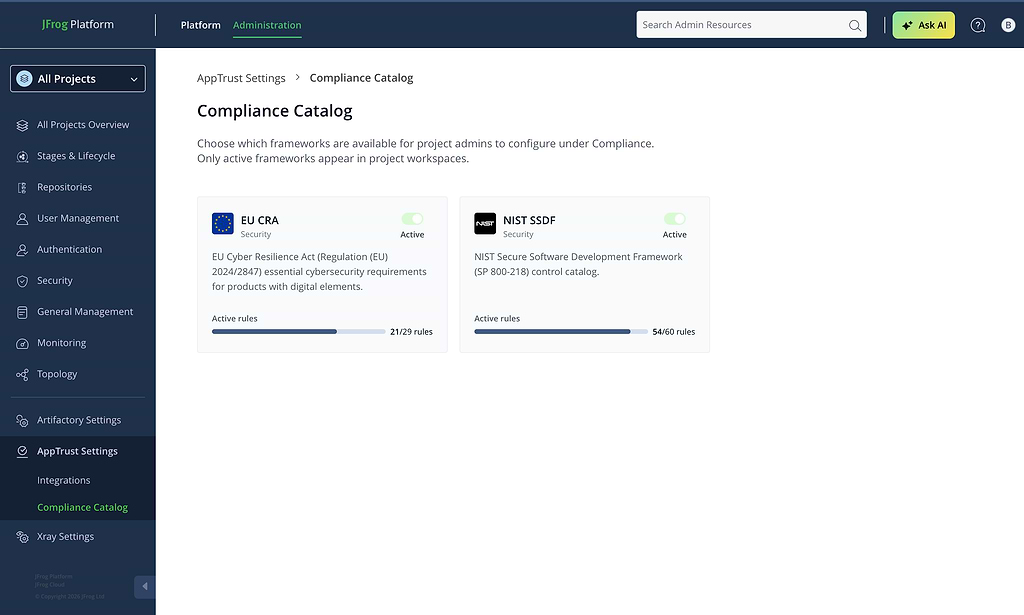
JFrog AppTrust gained automated release-evidence traceability and out-of-the-box compliance frameworks, letting teams prove SDLCSDLCThe Software Development Life Cycle: a structured process covering planning, design, coding, testing, and deployment. Cyber tools integrate into it to catch vulnerabilities before code ships rather than after.provenanceprovenanceEvidence recording where a software artifact came from and how it was built, including its source and build process. It helps a consumer check that the artifact matches a trusted build. and enforce NIST SSDFNIST SSDFA NIST framework of secure software development practices, organized into four groups, that gives teams a common vocabulary and baseline for reducing vulnerabilities introduced during the development lifecycle. and EU CRAEU CRAEU Cyber Resilience Act, a European Union regulation requiring manufacturers and publishers of products with digital elements to meet mandatory cybersecurity standards before selling into the EU market. controls without hand-writing policy code.
JFrog software supply chain solutions provide an end-to-end pipeline to control your binaries from build to production. Power your software updates to the edge.
JFrog AppTrust gained automated release-evidence traceability and out-of-the-box compliance frameworks, letting teams prove SDLCSDLCThe Software Development Life Cycle: a structured process covering planning, design, coding, testing, and deployment. Cyber tools integrate into it to catch vulnerabilities before code ships rather than after.provenanceprovenanceEvidence recording where a software artifact came from and how it was built, including its source and build process. It helps a consumer check that the artifact matches a trusted build. and enforce NIST SSDFNIST SSDFA NIST framework of secure software development practices, organized into four groups, that gives teams a common vocabulary and baseline for reducing vulnerabilities introduced during the development lifecycle. and EU CRAEU CRAEU Cyber Resilience Act, a European Union regulation requiring manufacturers and publishers of products with digital elements to meet mandatory cybersecurity standards before selling into the EU market. controls without hand-writing policy code.
└──▷ WHAT SHIPPED ·
2 FEATURES0 OF 2 FEATURESmost completely described firstwhat's the number?
Each feature carries 0–100 for how completely the vendor documented
it — not how big or important the work is. A major capability
described in eight words scores low, and that is the finding.
depth0–40what it does and how it works or what changed
specificity0–30names real surfaces — APIs, flags, formats, limits, numbers
actionability0–30enough to go use it — a named endpoint, flag, or config key tops this; a UI path is a starting point
Code and config rank first by construction: a documented endpoint,
flag or config key scores at the top of specificity and actionability,
so it sorts above a feature described only in prose. Under
60 the notes go thin — everything below the “thinner
coverage” line is thinner documentation, not smaller work.
Hover any meter for that feature's three sub-scores.
0100
NIST SSDF and EU CRA compliance frameworksnew73how completely this was documenteddepth33/40specificity25/30actionability15/3073 / 100
AppTrust adds out-of-the-box compliance frameworks, starting with NIST SSDF and EU CRA, with controls pre-mapped to Policy-as-CodePolicy-as-CodeThe practice of expressing governance rules, access controls, or compliance requirements as machine-readable code so they can be versioned, tested, and automatically enforced rather than managed through manual processes. rules so teams can enable enforcement without writing Rego manually. Framework configuration is separated from rollout control: AppSecAppSecApplication security: the practice of finding and fixing vulnerabilities in software during design, development, and testing. Cyber tools build on AppSec workflows to shift vulnerability detection earlier in the development lifecycle. owns which controls and rules are active, while development managers configure which applications fall under the framework, whether rules run as warnings or hard failures, and how long before a warning converts to a blocked package.
— Names frameworks and Policy-as-Code mechanism; points to Compliance Catalog UIlaunch-20260902-7632a07c
0200
Prompt to Release Traceability in AppTrustnew66how completely this was documenteddepth32/40specificity24/30actionability10/3066 / 100
JFrog AppTrust automatically collects and signs commits, pull requests, Jira ticket transition histories, and approver chains for every release before any promotion gate runs. It automatically flags self-approval violations by checking whether the PR approver is the same person as the committer, a check most compliance frameworks require but few teams automate. Upcoming JFrog Agent Plugins will extend this to capture AI agent session evidence — prompts, code produced, MCPs, skills, and agentic assets used — as signed evidence stored in Artifactory, and this SDLC traceability is described as connecting AI agent intent sessions alongside Git commits, pull requests, and Jira tickets to the artifacts that ship.
StepSecurity is a security hardening platform that reduces attack surface and prevents supply chain attacks in GitHub Actions workflows.
StepSecurity's biggest window addition is continuous PATPATA personal access token, a credential used by scripts and integrations instead of a user's password. Its permissions and expiry depend on the service issuing it. governance across GitHub and Azure DevOps, alongside deny-list egress policies for Harden-Runner and native support for AWS CodeBuild-hosted GitHub ActionsGitHub ActionsGitHub's built-in CI/CD system that runs automated workflows triggered by repository events, letting cyber tools automate testing, building, and releasing without managing separate pipeline infrastructure. runners.
└──▷ WHAT SHIPPED ·
4 FEATURES0 OF 4 FEATURESmost completely described firstwhat's the number?
Each feature carries 0–100 for how completely the vendor documented
it — not how big or important the work is. A major capability
described in eight words scores low, and that is the finding.
depth0–40what it does and how it works or what changed
specificity0–30names real surfaces — APIs, flags, formats, limits, numbers
actionability0–30enough to go use it — a named endpoint, flag, or config key tops this; a UI path is a starting point
Code and config rank first by construction: a documented endpoint,
flag or config key scores at the top of specificity and actionability,
so it sorts above a feature described only in prose. Under
60 the notes go thin — everything below the “thinner
coverage” line is thinner documentation, not smaller work.
Hover any meter for that feature's three sub-scores.
0100
Deny-list egress policies across Harden-Runner surfacesnew95how completely this was documenteddepth35/40specificity30/30actionability30/3095 / 100
Adds a denied-endpoints input to step-security/harden-runner (v2.21.0) to block named domains, wildcard domains (e.g. *.example.org), or IP addresses while leaving all other destinations reachable under egress-policy: block. The same deny-list capability ships as denied_endpoints on the Self-Hosted VM Harden Runner (v1.9.0), and as a Policy Store option attached at organization or cluster scope via ARC Harden Runner v2.19.0+, enforcing CI egress restrictions across all repositories without per-workflow-file edits.
Block direct npm and PyPI registry access org-wide to enforce routing through a package proxy, while leaving all other outbound traffic unrestricted.
Runtime security for AWS CodeBuild-hosted GitHub Actions runnersnew95how completely this was documenteddepth35/40specificity30/30actionability30/3095 / 100
step-security/harden-runner@v2.20.1 adds support for GitHub Actions jobs running on AWS CodeBuild EC2EC2Amazon's cloud virtual-machine service, letting tools run on-demand servers without managing physical hardware. compute, monitoring outbound network calls, file writes, and process execution; v2.21.0 extends this to Linux containers on EC2, including custom images from Amazon ECRECRAmazon Elastic Container Registry, AWS's managed service for storing and distributing Docker and OCI container images, giving cyber tools a private, IAM-gated registry without self-hosting infrastructure. and external Docker registries. Requires the CodeBuild project set to Compute: EC2, Host kernel: kernel-6 (Amazon Linux 2023), and Privileged: Enabled in the project's Additional configuration panel. It surfaces memory-read detections (the technique behind CVE-2025-8217) as a runtime alert with an attached triage runbook, and unifies CodeBuild-hosted, GitHub-hosted, ARC, and self-hosted runner fleets under a single dashboard, Policy Store, and detection baseline.
Secure a CodeBuild-hosted GitHub Actions job to monitor all outbound network calls and process executions from inside your AWS VPCVPCA logically isolated virtual network inside a public cloud provider's infrastructure, letting tools deploy resources with private addressing, controlled routing, and firewall rules without managing physical hardware..
Token Controls policy engine for PAT governancenew85how completely this was documenteddepth35/40specificity30/30actionability20/3085 / 100
Token Controls evaluate the entire PAT inventory hourly across both GitHub and Azure DevOps organizations, surfacing breaching tokens as findings on the All Controls dashboard with evidence, impact, and a per-token revoke action. Organizations can set configurable max-age and idle-window thresholds, with separate limits for fine-grained versus classic GitHub tokens and a stricter limit for high-privilege Azure DevOps tokens, plus pre-expiry reminder notifications to token owners at configurable bands (30, 7, and 1 days by default) on both platforms. Scope risk classification flags Azure DevOps tokens against the 35 Microsoft-rated high-privilege scopes with colour-coded scope chips, while on GitHub it flags coarse classic scopes (repo, admin:org, workflow) and fine-grained tokens combining all-repository access with write permissions. Per-control notification events fire once when a token first breaches policy rather than on every scan, and each control's notifications are selectable independently.
Triage PATsPATsA personal access token, a credential used by scripts and integrations instead of a user's password. Its permissions and expiry depend on the service issuing it. currently breaching your token policy — including over-privileged classic GitHub tokens with repo or admin:org scope — and revoke offenders directly from the dashboard.
📍In the StepSecurity console, go to All Controls dashboard, filter by Token Controls, review each finding's evidence and impact, then click Revoke on any token that breaches the policy.
Identities & PATs inventory page for Azure DevOpsnew55how completely this was documenteddepth25/40specificity15/30actionability15/3055 / 100
A new Identities & PATs page inventories personal access tokenspersonal access tokensA personal access token, a credential used by scripts and integrations instead of a user's password. Its permissions and expiry depend on the service issuing it., service connections, and Entra service principals for Azure DevOps organizations in one place, with hourly auto-refresh, on-demand refresh, and per-tab export.
Review the new Identities & PATs inventory for your Azure DevOps organization to spot over-privileged or stale tokens, service connections, and Entra service principals at a glance.
📍In the StepSecurity console, go to Identities & PATs (Azure DevOps), select the Personal Access Tokens tab, click Refresh to pull the latest data from the Azure DevOps APIs, then click Export to download the token inventory for that tab.
Socket detects and blocks open source supply chain attacks by analyzing package dependencies for malicious code and security vulnerabilities.
Socket launches Microsoft Teams as a full notification channel, letting teams route filtered, digested supply chain and vulnerability alerts as Adaptive CardsAdaptive CardsAn open-source card schema from Microsoft that lets apps render structured UI snippets — buttons, text, images — natively inside any host surface, so a tool can push rich, interactive notifications without owning the renderer. directly into Teams channels.
└──▷ WHAT SHIPPED ·
1 FEATURE0 OF 1 FEATUREmost completely described firstwhat's the number?
Each feature carries 0–100 for how completely the vendor documented
it — not how big or important the work is. A major capability
described in eight words scores low, and that is the finding.
depth0–40what it does and how it works or what changed
specificity0–30names real surfaces — APIs, flags, formats, limits, numbers
actionability0–30enough to go use it — a named endpoint, flag, or config key tops this; a UI path is a starting point
Code and config rank first by construction: a documented endpoint,
flag or config key scores at the top of specificity and actionability,
so it sorts above a feature described only in prose. Under
60 the notes go thin — everything below the “thinner
coverage” line is thinner documentation, not smaller work.
Hover any meter for that feature's three sub-scores.
0100
Microsoft Teams notification channelnew91how completely this was documenteddepth35/40specificity28/30actionability28/3091 / 100
Socket adds Microsoft Teams as a notification destination configured under Settings → Integrations → Notifications via a Microsoft Workflows incoming webhook (HTTP POST URL), alongside the existing email channel. A new subscription model lets owners and admins route organization alerts and supply chain attack campaign notifications to specific Teams channels, filtered by alert category (supply chain risk, vulnerability, quality, maintenance, license), severity, Socket priority, repository, or package ecosystem. Notifications are delivered as structured Adaptive Cards summarizing alert totals by severity, affected repository count, individual finding previews, and a direct link to the Socket dashboard, with related alert activity grouped into digests to prevent channel flooding. Attack campaign notifications also indicate whether affected packages are present in the organization, showing impacted repositories or confirming none are affected without manual per-repository checks.
Connect a Teams channel to Socket so critical supply chain alerts land in your security team's channel automatically.
📍In Socket, go to Settings → Integrations → Notifications → Create Channel, select Microsoft Teams, enter a channel name, and paste the HTTP POST URL copied from your Microsoft Workflows 'Post to a channel when a webhook request is received' flow. Socket will send a test Adaptive Card; a successful test marks the channel as Active.
Route only critical supply chain risk alerts for a specific repository to a dedicated engineering Teams channel, keeping noise out of the general security channel.
📍In Socket, go to Settings → Integrations → Notifications → Create Subscription, choose the alert created event, set filters to category: supply chain risk, severity: critical, and the target repository, then select your Microsoft Teams channel as the destination.
ⓘSourcesBlog post →2 releases · 2026-08-13 → 2026-08-20Blog ↗RankWhy this ranktop features scored 78/78, +6 runnable example — 84How ranking works →
ZeroPath shipped reachability-aware SBOMSBOMA software bill of materials, an inventory of the components and versions inside an application. It helps teams find affected software when a dependency has a vulnerability or licensing issue./VEXVEXA machine-readable statement from a vendor saying whether a CVE in a component actually affects their product. It is how a scanner is told to stop flagging a vulnerability that is not reachable./AI-BOMAI-BOMAn inventory of every AI model, dataset, and dependency used in a system, analogous to a software bill of materials, giving cyber tools a structured way to audit AI supply-chain risk. export and continuous CVE alerting that re-triages new advisories against existing SCASCASoftware composition analysis, identifying third-party dependencies and checking them for known vulnerabilities and license issues. It covers software a team uses rather than writes itself. inventory within minutes.
AI-native SAST platform that finds 2x more real vulnerabilities with 75% fewer false positives. Automated vulnerability detection, instant fixes, and seamless CI/CD integration for modern DevOps teams.
ZeroPath shipped reachability-aware SBOMSBOMA software bill of materials, an inventory of the components and versions inside an application. It helps teams find affected software when a dependency has a vulnerability or licensing issue./VEXVEXA machine-readable statement from a vendor saying whether a CVE in a component actually affects their product. It is how a scanner is told to stop flagging a vulnerability that is not reachable./AI-BOMAI-BOMAn inventory of every AI model, dataset, and dependency used in a system, analogous to a software bill of materials, giving cyber tools a structured way to audit AI supply-chain risk. export and continuous CVE alerting that re-triages new advisories against existing SCASCASoftware composition analysis, identifying third-party dependencies and checking them for known vulnerabilities and license issues. It covers software a team uses rather than writes itself. inventory within minutes.
└──▷ WHAT SHIPPED ·
2 FEATURES0 OF 2 FEATURESmost completely described firstwhat's the number?
Each feature carries 0–100 for how completely the vendor documented
it — not how big or important the work is. A major capability
described in eight words scores low, and that is the finding.
depth0–40what it does and how it works or what changed
specificity0–30names real surfaces — APIs, flags, formats, limits, numbers
actionability0–30enough to go use it — a named endpoint, flag, or config key tops this; a UI path is a starting point
Code and config rank first by construction: a documented endpoint,
flag or config key scores at the top of specificity and actionability,
so it sorts above a feature described only in prose. Under
60 the notes go thin — everything below the “thinner
coverage” line is thinner documentation, not smaller work.
Hover any meter for that feature's three sub-scores.
0100
Reachability-aware SBOM, VEX and AI-BOM exportnew78how completely this was documenteddepth35/40specificity28/30actionability15/3078 / 100
Adds SBOM export in CycloneDX 1.6CycloneDX 1.6An OWASP-maintained Software Bill of Materials standard that catalogs components, dependencies, and supply-chain metadata; tools use it to produce or consume machine-readable SBOMs in a widely supported schema., SPDX 2.3SPDX 2.3An open standard from the Linux Foundation for describing software bills of materials, letting cyber tools exchange dependency, license, and vulnerability data in a common machine-readable format., standalone CycloneDX VEXCycloneDX VEXA CycloneDX-format document that records which known vulnerabilities in a software bill of materials actually affect a given product, letting cyber tools automate triage by filtering out irrelevant CVEs. documents, and AI-BOMBOMA Bill of Materials listing every component, library, and dependency in a software project; cyber tools use it to track what is in a codebase and flag known-vulnerable components quickly. formats, all generated from the same stored scan inventory. VEX statements are driven by reachability analysis and emit one of three machine-readable states — not_affected (with justification code_not_reachable), exploitable, or in_triage — instead of manually authored verdicts. The AI-BOM export is a CycloneDXCycloneDXAn open standard for describing software components and their dependencies, vulnerabilities and other supply-chain information. Tools use it to exchange bills of materials and related evidence. ML-BOM covering seventeen AI component kinds (LLM SDKs, agent frameworks, vector databases, model weights, prompt templates, MCP servers) aligned to EU AI Act and NIST AI Risk Management Framework inventory expectations. License obligations are classified into five buckets — permissive, weak copyleft, strong copyleft, network copyleft (AGPL/Affero), and unknown — with network copyleft split out to surface AGPL's hosted-service trigger; packages with unknown licenses are marked license-unknown and fields with no data are omitted rather than filled with placeholders.
Generate a reachability-aware SBOM or standalone VEX document after running an SCA scan on a repository.
📍In ZeroPath, open the repository, select Generate SBOM, then choose CycloneDX, SPDX, standalone VEX, or AI-BOM.
Continuous CVE alerting against SCA inventorynew78how completely this was documenteddepth35/40specificity28/30actionability15/3078 / 100
When a fresh CVE lands on a direct dependency, ZeroPath automatically re-runs reachability and exploitability analysis — cloning the repo, checking whether the vulnerable function is actually called — and produces a triaged alert with reachability verdict, exploitability rating, confidence, severity, and a pointer to the relevant line. It suppresses noise by hashing only the version-relevant portion of each OSVOSVOpen Source Vulnerabilities, a vulnerability database and schema maintained by Google that gives cyber tools a machine-readable, cross-ecosystem format for querying and sharing CVE-style advisories. advisory (so cosmetic republications don't duplicate alerts), folds multiple hits from one CVE across many locations into a single notification, and enriches alerts with CISA KEVCISA KEVA catalog maintained by the US Cybersecurity and Infrastructure Security Agency listing vulnerabilities confirmed to be actively exploited in the wild, giving cyber tools a vetted, authoritative prioritization signal. data and FIRST EPSSEPSSExploit Prediction Scoring System, an estimate of the probability that a published vulnerability will be exploited in the next 30 days. It helps prioritize investigation and patching. scores to surface reachable-and-actively-exploited findings first. Deep transitive dependency matches are recorded as uninvestigated rather than scored, and when a finding is exploitable with a safe upgrade available, the alert arrives with a pull request already attached. Alerting is opt-in per repository, tag, or organization, and can be routed to Slack, a webhook, or an agent playbook.
Enable continuous CVE alerting for a specific repository so your team is notified within minutes of a new advisory matching a shipped dependency — rather than waiting for the next scheduled scan.
📍In the ZeroPath console, navigate to your repository settings, find the Continuous CVE Alerting section, and toggle it on. Optionally apply the setting at the tag or organization level to cover multiple repos at once.
Route continuous CVE alerts to a Slack channel or webhook endpoint so triage findings land directly in your team's workflow without polling the ZeroPath UI.
📍In the ZeroPath console, go to Alert Destinations and add a Slack integration or webhook URL. New CVE alerts — already triaged with reachability and exploitability verdicts — will be posted there within minutes of an advisory hitting the OSV feed.
— Detailed mechanism and routing named; only console toggle steps, no APIlaunch-20260813-542026be
TruffleHog's v3.97.4 release speeds up json-enumerator scanning with concurrent multi-file processing and native zstdzstdA fast lossless compression algorithm and library maintained by Meta, offering compression ratios comparable to zlib at much higher speeds, which makes it attractive for tools that compress large data streams or archives at runtime. support, plus reduces false positives in Twilio credential rotation checks.
trufflehog discovers, classifies, and validates leaked credentials
TruffleHog's v3.97.4 release speeds up json-enumerator scanning with concurrent multi-file processing and native zstdzstdA fast lossless compression algorithm and library maintained by Meta, offering compression ratios comparable to zlib at much higher speeds, which makes it attractive for tools that compress large data streams or archives at runtime. support, plus reduces false positives in Twilio credential rotation checks.
└──▷ WHAT SHIPPED ·
2 FEATURES0 OF 2 FEATURESmost completely described firstwhat's the number?
Each feature carries 0–100 for how completely the vendor documented
it — not how big or important the work is. A major capability
described in eight words scores low, and that is the finding.
depth0–40what it does and how it works or what changed
specificity0–30names real surfaces — APIs, flags, formats, limits, numbers
actionability0–30enough to go use it — a named endpoint, flag, or config key tops this; a UI path is a starting point
Code and config rank first by construction: a documented endpoint,
flag or config key scores at the top of specificity and actionability,
so it sorts above a feature described only in prose. Under
60 the notes go thin — everything below the “thinner
coverage” line is thinner documentation, not smaller work.
Hover any meter for that feature's three sub-scores.
0100
Concurrent multi-file and zstd support in json-enumeratorimproved86how completely this was documenteddepth30/40specificity28/30actionability28/3086 / 100
The json-enumerator source now supports passing multiple files at once, e.g. trufflehog json-enumerator FILE_1 .. FILE_N, replacing the previous sequential behaviour and improving throughput on multicore systems. It also adds native zstd-compressed NDJSONNDJSONA text format where each line is a self-contained JSON object, making it easy to stream, append, and parse large datasets record-by-record without loading the whole file into memory. input handling, eliminating the need to decompress files externally before scanning, and json-enumerator can now be used inside a multi-source configuration.
Scan multiple zstd-compressed NDJSON files concurrently to maximize throughput on a multicore system without pre-decompressing them.
— Names exact command, flags, formats, and config surface.v3.97.4
thinner coverage below
0200
Twilio detector treats transport errors as indeterminateimproved55how completely this was documenteddepth25/40specificity20/30actionability10/3055 / 100
Twilio and Twilio API key detectors now treat transport failures (429, 5xx, timeouts, connection resets, dial failures) as indeterminate rather than writing date_rotated, reducing false rotation signals on transient errors.
— Explains mechanism and named field but no direct user action.v3.97.4
Infisical is the open-source platform for secrets, certificates, and privileged access management.
Infisical v0.165.3 adds a Daytona secret sync integration, OIDCOIDCOpenID Connect, a sign-in protocol built on OAuth 2.0. An application uses identity information from a trusted provider instead of maintaining a separate password for each user. auth templates for Machine Identities, new PAMPAMBrokering administrator sessions through a gateway instead of handing out standing credentials. Access is granted for one session, to one target, and recorded. credential-access and session-liveness controls, and IdPIdPA service that authenticates users and supplies identity information to other applications. It is the sign-in authority behind many single sign-on systems.-authoritative member profile syncing.
└──▷ WHAT SHIPPED ·
6 FEATURES0 OF 6 FEATURESmost completely described firstwhat's the number?
Each feature carries 0–100 for how completely the vendor documented
it — not how big or important the work is. A major capability
described in eight words scores low, and that is the finding.
depth0–40what it does and how it works or what changed
specificity0–30names real surfaces — APIs, flags, formats, limits, numbers
actionability0–30enough to go use it — a named endpoint, flag, or config key tops this; a UI path is a starting point
Code and config rank first by construction: a documented endpoint,
flag or config key scores at the top of specificity and actionability,
so it sorts above a feature described only in prose. Under
60 the notes go thin — everything below the “thinner
coverage” line is thinner documentation, not smaller work.
Hover any meter for that feature's three sub-scores.
0100
Daytona secret sync integrationnew72how completely this was documenteddepth25/40specificity22/30actionability25/3072 / 100
Adds a Daytona app connection and secret sync integration, enabling secrets stored in Infisical to be synced to Daytona environments. Configured via Project > Integrations > Secret Syncs by adding a sync, selecting Daytona, configuring the app connection, and choosing the source environment and path.
Configure a Daytona secret sync so secrets from an Infisical project environment are pushed to your Daytona workspace.
📍In the Infisical console, go to your Project › Integrations › Secret Syncs, click Add Sync, select Daytona, configure the Daytona app connection, choose the source environment and path, then save.
— Names integration and gives exact setup stepsv0.165.3
thinner coverage below
0200
PAM credential access approval and session heartbeatsnew47how completely this was documenteddepth22/40specificity15/30actionability10/3047 / 100
PAM account password viewing is now gated behind access requests, requiring an approval workflow before privileged account credentials are revealed. PAM also adds heartbeats to track liveness of privileged access sessions.
— Two PAM mechanisms described but no exact endpoints/flagsv0.165.3
0300
OIDC auth templates for Machine Identitiesnew45how completely this was documenteddepth20/40specificity15/30actionability10/3045 / 100
Adds OIDC auth template support for Machine Identities, allowing reusable OIDC authentication configurations to be applied across multiple Machine Identities.
— Explains reuse mechanism but no config keys givenv0.165.3
0400
IdP-authoritative member profile syncnew40how completely this was documenteddepth20/40specificity12/30actionability8/3040 / 100
Syncs member email and name from the identity provideridentity providerA service that authenticates users and supplies identity information to other applications. It is the sign-in authority behind many single sign-on systems. when the IdP is configured as authoritative, keeping user profiles consistent with the upstream directory.
— Clear behaviour but no config surface namedv0.165.3
0500
Policy delete endpoint opened to all plansimproved40how completely this was documenteddepth15/40specificity15/30actionability10/3040 / 100
Removes the plan-tier restriction from the policy delete endpoint, making policy deletion available regardless of subscription level.
— Names the endpoint area but not its pathv0.165.3
0600
Human-readable names in approvals UIimproved28how completely this was documenteddepth10/40specificity8/30actionability10/3028 / 100
The approval UI now shows human-readable names instead of UUIDsUUIDsA universally unique identifier, usually a 128-bit value used to identify an object across systems. It is designed to make independently generated identifiers unlikely to collide. in the approvals list.
— Simple UI tweak, exact change stated but minorv0.165.3
We enable the world to secure the web. Burp Suite, the Web Security Academy, and world-leading research from PortSwigger â the AppSec communityâs home.
Burp Suite DASTDASTDynamic application security testing, probing a running application from the outside for vulnerabilities. It checks behavior exposed through the application's interfaces. 2026.9 adds the ability to export issues as CSV directly from the Issues tab.
└──▷ WHAT SHIPPED ·
1 FEATURE0 OF 1 FEATUREmost completely described firstwhat's the number?
Each feature carries 0–100 for how completely the vendor documented
it — not how big or important the work is. A major capability
described in eight words scores low, and that is the finding.
depth0–40what it does and how it works or what changed
specificity0–30names real surfaces — APIs, flags, formats, limits, numbers
actionability0–30enough to go use it — a named endpoint, flag, or config key tops this; a UI path is a starting point
Code and config rank first by construction: a documented endpoint,
flag or config key scores at the top of specificity and actionability,
so it sorts above a feature described only in prose. Under
60 the notes go thin — everything below the “thinner
coverage” line is thinner documentation, not smaller work.
Hover any meter for that feature's three sub-scores.
0100
CSV export of issuesnew50how completely this was documenteddepth15/40specificity15/30actionability20/3050 / 100
The Issues tab now includes an option to download issues as a CSV file, enabling offline triage or reporting.
Export your current issue list to CSV for offline triage or reporting.
📍In Burp Suite DAST, go to the Issues tab, then select the option to download issues as a CSV file.
ⓘSourcesBlog / feed →1 release · 2026-09-03Blog ↗RankWhy this ranktop features scored 83/83/75, +10 product media, +6 runnable example — 96.33How ranking works →
Invicti's biggest window addition is automatic rate-limit-aware scan pacing with exponential backoff, alongside a major expansion of Agentic Pentesting (Vulnerability Chaining Agent, report exports, resource budgeting, recon document import) and new first-class Bearer TokenBearer TokenA credential that grants access to whoever presents it, without a separate proof of possession. Protecting the token matters because a stolen copy can be used by someone else./API Key authentication.
Official documentation for Invicti AppSec Platform, Invicti Platform, and Invicti Enterprise — web application security testing, DAST, API security, and vulnerability management.
Invicti's biggest window addition is automatic rate-limit-aware scan pacing with exponential backoff, alongside a major expansion of Agentic Pentesting (Vulnerability Chaining Agent, report exports, resource budgeting, recon document import) and new first-class Bearer TokenBearer TokenA credential that grants access to whoever presents it, without a separate proof of possession. Protecting the token matters because a stolen copy can be used by someone else./API Key authentication.
└──▷ WHAT SHIPPED ·
21 FEATURES1 OF 21 FEATURESmost completely described firstwhat's the number?
Each feature carries 0–100 for how completely the vendor documented
it — not how big or important the work is. A major capability
described in eight words scores low, and that is the finding.
depth0–40what it does and how it works or what changed
specificity0–30names real surfaces — APIs, flags, formats, limits, numbers
actionability0–30enough to go use it — a named endpoint, flag, or config key tops this; a UI path is a starting point
Code and config rank first by construction: a documented endpoint,
flag or config key scores at the top of specificity and actionability,
so it sorts above a feature described only in prose. Under
60 the notes go thin — everything below the “thinner
coverage” line is thinner documentation, not smaller work.
Hover any meter for that feature's three sub-scores.
0100
SSL check bypass extended across scan-cli API callsimproved83how completely this was documenteddepth30/40specificity28/30actionability25/3083 / 100
Extends INVICTI_IGNORE_SSL_CHECKS in scan-cli to cover all outbound platform API calls during a scan — DASTDASTDynamic application security testing, probing a running application from the outside for vulnerabilities. It checks behavior exposed through the application's interfaces., Inventory, Identity, and report/export endpoints — not just the ephemeral agent.
Rate-limit-aware scan pacing with backoffnew83how completely this was documenteddepth35/40specificity28/30actionability20/3083 / 100
The scan engine now automatically throttles request pacing when rate-limiting response headers (Retry-After, X-RateLimit-*) are received, reducing false-negative risk and incomplete coverage on rate-limited targets, and applies exponential backoff with jitter when retrying requests that receive a 429 response with no Retry-After header.
Independent confidence threshold in scan-cliimproved75how completely this was documenteddepth25/40specificity25/30actionability25/3075 / 100
The INVICTI_MINIMUM_CONFIDENCE environment variable in scan-cli now independently fails a scan when the threshold is exceeded, without requiring INVICTI_MINIMUM_SEVERITY to also be set.
CI/CD script generator with no severity thresholdimproved75how completely this was documenteddepth25/40specificity25/30actionability25/3075 / 100
Leaving the minimum severity field empty in the CI/CD script generator now produces a script with no minimum vulnerability threshold, applicable to Azure Pipelines, CircleCI, GitHub ActionsGitHub ActionsGitHub's built-in CI/CD system that runs automated workflows triggered by repository events, letting cyber tools automate testing, building, and releasing without managing separate pipeline infrastructure., GitLab CI/CD, and Jenkins.
Generate a GitHub Actions CI/CD script with no minimum severity threshold so every finding is reported without a hard gate.
📍In the Invicti AppSec Platform, go to Integrations › CI/CD Script Generator, select GitHub Actions, leave the Minimum Severity field empty, then click Generate Script.
— Names all five CI/CD targets and includes exact stepsproduct docs
0500
Agentic Pentesting report export formatsnew65how completely this was documenteddepth20/40specificity25/30actionability20/3065 / 100
Agentic Pentesting assessment reports can now be downloaded in Markdown (.md) and raw JSON formats, enabling import into automated pipelines and external tools.
Per-organization SCIM2 provisioning togglenew60how completely this was documenteddepth25/40specificity20/30actionability15/3060 / 100
SCIM2SCIM2An IETF-standardized REST/JSON protocol for automating user and group provisioning across identity systems, letting cyber tools sync accounts and permissions without custom per-service integrations. provisioning endpoints can now be toggled on or off per organization, preventing user and team updates or deletions through SCIM2-provisioned accounts when disabled.
— Explains behavior but not the exact toggle locationproduct docs
0700
Assessment Profile resource budgetingimproved60how completely this was documenteddepth25/40specificity20/30actionability15/3060 / 100
Agentic Pentesting Assessment Profiles now support input caps, prioritization limits, and credit spend limits for more granular agent resource budgeting and control.
First-class Bearer Token and API Key auth headersnew60how completely this was documenteddepth25/40specificity20/30actionability15/3060 / 100
Adds Bearer Token and API Key as dedicated, first-class authentication header types in target configuration, separate from functional headers, simplifying authenticated scan setup.
Scan schedules for applications and collectionsnew55how completely this was documenteddepth25/40specificity15/30actionability15/3055 / 100
Scan schedules can now be created for an entire application or collection, automatically running DAST scans across all included targets on a chosen recurrence.
— Describes scope and recurrence but no config pathproduct docs
1001
Vulnerability Chaining Agentnew55how completely this was documenteddepth30/40specificity15/30actionability10/3055 / 100
A new Vulnerability Chaining Agent in the Agentic Pentesting assessment engine correlates individual findings to execute multi-step vulnerability chains, uncovering complex attack pathsattack pathsA possible sequence of steps an attacker could take to reach a valuable target. It connects weaknesses, permissions and reachable systems rather than treating each finding separately..
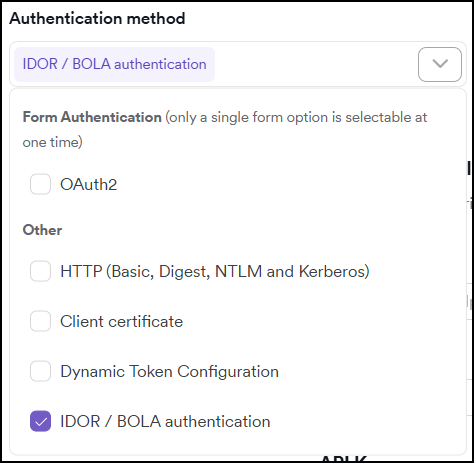
Secrets Manager credentials for IDOR/BOLA authnew55how completely this was documenteddepth20/40specificity20/30actionability15/3055 / 100
Enables use of Invicti Secrets Manager credentials (API key, basic auth, bearer token) for IDORIDORInsecure Direct Object Reference, a web vulnerability where an application exposes internal identifiers (IDs, filenames) without access checks, letting an attacker substitute another user's ID to reach their data./BOLABOLABroken Object Level Authorization, an API vulnerability class where a server fails to verify that the requesting user owns or may access the object ID they supply, letting attackers read or modify other users' data. authentication configurations.
Recon agent document import for attack surface discoverynew55how completely this was documenteddepth25/40specificity20/30actionability10/3055 / 100
Enables the Recon agent to import architectural diagrams and documentation files (PDF, DOCX, MD) to discover non-crawlable attack surfacesattack surfacesThe exposed systems, interfaces and access points an attacker could try to use. It includes internet-facing services as well as identities, software and other reachable resources..
Role Management permission visibility and WAF upload roleimproved55how completely this was documenteddepth20/40specificity20/30actionability15/3055 / 100
Role Management now makes all permission group operations visible and configurable, giving administrators full control over custom role definitions, and assigns the WAFWAFA reverse proxy that inspects HTTP/HTTPS traffic and blocks requests matching known attack patterns such as SQL injection or XSS, sitting between clients and a web application to filter malicious input before it reaches the server. upload permission group to Security Manager, Administrator, and Account Owner roles.
API target creation from API Catalog pagenew50how completely this was documenteddepth20/40specificity15/30actionability15/3050 / 100
Adds the ability to create a new API target directly from the API Catalog page, with or without an API specification attached, without navigating to the Targets section first.
Scanning agent Helm chart on OpenShift/ROSAnew50how completely this was documenteddepth20/40specificity20/30actionability10/3050 / 100
The scalable internal scanning agent Helm chart now supports deployment on OpenShift and Red Hat OpenShift Service on AWS (ROSA) clusters.
— Names platforms but no deployment steps givenproduct docs
1700
DAST tech fingerprinting shared with Attack Agentsimproved50how completely this was documenteddepth25/40specificity15/30actionability10/3050 / 100
Technologies and framework stacks detected by DAST scans are now automatically shared with Agentic Pentesting Attack Agents so exploit payloads are tailored to the target's actual technology stack.
WebRTC chatbot detectionnew50how completely this was documenteddepth20/40specificity20/30actionability10/3050 / 100
Adds WebRTCWebRTCA browser-native, open standard for real-time peer-to-peer audio, video, and data exchange without plugins. Cyber tools use it to tunnel traffic or exfiltrate data through connections browsers treat as legitimate. data channel (SDP) chatbot detection, extending chatbot analysis to applications using real-time communication protocols.
Agentic Pentest management in AppSec Platform UInew45how completely this was documenteddepth20/40specificity10/30actionability15/3045 / 100
Enables management of Agentic Pentests directly from the AppSecAppSecApplication security: the practice of finding and fixing vulnerabilities in software during design, development, and testing. Cyber tools build on AppSec workflows to shift vulnerability detection earlier in the development lifecycle. Platform UI, with findings flowing into the same pipeline as standard DAST scans.
ⓘSourcesBlog / feed →1 release · 2026-09-03Blog ↗RankWhy this ranktop features scored 95/75/60, +10 product media, +6 runnable example — 92.67How ranking works →
Binary Ninja 6.0 (Krypton) introduces a first-party MCPMCPModel Context Protocol, a standard for connecting AI applications to external tools and data sources. A compatible server exposes capabilities an assistant can use through a common interface. server for LLMLLMA large language model, a neural network trained on large amounts of text to recognize patterns and generate language. Applications use it for tasks such as answering, summarizing and writing code. integration, a new Binary Similarity diffing platform for Ultimate, TMS320C6xTMS320C6xA family of fixed- and floating-point DSPs from Texas Instruments, designed for high-throughput signal processing; cyber tools use it for hardware-accelerated packet inspection or signal analysis at the edge. architecture support, and analysis that runs up to 2.16× faster while using up to 55% less peak memory.
Binary Ninja is a modern reverse engineering platform with a scriptable and extensible decompiler.
Binary Ninja 6.0 (Krypton) introduces a first-party MCPMCPModel Context Protocol, a standard for connecting AI applications to external tools and data sources. A compatible server exposes capabilities an assistant can use through a common interface. server for LLMLLMA large language model, a neural network trained on large amounts of text to recognize patterns and generate language. Applications use it for tasks such as answering, summarizing and writing code. integration, a new Binary Similarity diffing platform for Ultimate, TMS320C6xTMS320C6xA family of fixed- and floating-point DSPs from Texas Instruments, designed for high-throughput signal processing; cyber tools use it for hardware-accelerated packet inspection or signal analysis at the edge. architecture support, and analysis that runs up to 2.16× faster while using up to 55% less peak memory.
└──▷ WHAT SHIPPED ·
12 FEATURES3 OF 12 FEATURESmost completely described firstwhat's the number?
Each feature carries 0–100 for how completely the vendor documented
it — not how big or important the work is. A major capability
described in eight words scores low, and that is the finding.
depth0–40what it does and how it works or what changed
specificity0–30names real surfaces — APIs, flags, formats, limits, numbers
actionability0–30enough to go use it — a named endpoint, flag, or config key tops this; a UI path is a starting point
Code and config rank first by construction: a documented endpoint,
flag or config key scores at the top of specificity and actionability,
so it sorts above a feature described only in prose. Under
60 the notes go thin — everything below the “thinner
coverage” line is thinner documentation, not smaller work.
Hover any meter for that feature's three sub-scores.
0101
Built-in MCP server for LLM integrationnew95how completely this was documenteddepth35/40specificity30/30actionability30/3095 / 100
Adds a built-in GUIGUIA graphical user interface, controls such as windows, buttons and menus. It lets people use software visually rather than entering commands. MCP server, enabled via the ui.mcp.enabled setting (restart required) or Plugins > MCP > Start Server, listening at http://127.0.0.1:24642/mcp by default. The ui.mcp.token setting requires clients to send a matching bearer tokenbearer tokenA credential that grants access to whoever presents it, without a separate proof of possession. Protecting the token matters because a stolen copy can be used by someone else., and Plugins > MCP > Copy Connection Info copies the exact URL and authorization header for the active session. A standalone binaryninja_mcp headless binary (stdio-based MCP server) is also shipped for Commercial and Ultimate on macOS and Linux.
Enable the MCP server on every launch so an LLM client (e.g. Claude Desktop) can always connect to your Binary Ninja session.
📍In Binary Ninja, go to Settings, search for ui.mcp.enabled, and set it to true, then restart. Navigate to Plugins › MCP › Copy Connection Info to copy the URL and bearer token for your client config.
Restrict MCP access to authorised clients only by requiring a bearer token.
📍In Binary Ninja Settings, search for ui.mcp.token and set it to a strong secret string. Clients must then include a matching Authorization: Bearer <token> header when connecting to http://127.0.0.1:24642/mcp.
Binary Similarity diffing platform (Ultimate)new75how completely this was documenteddepth30/40specificity30/30actionability15/3075 / 100
New Binary Similarity feature (Ultimate only) for comparing related binaries using pluggable providers, shipping with Google BinDiff and WARP providers, with automatic annotation transfer between binaries. Exposed through Python, C++, and Rust APIs, enabling headless sessions and registration of custom providers and resolvers.
Faster automated base address detectionnew60how completely this was documenteddepth25/40specificity20/30actionability15/3060 / 100
Introduces a new BASE sampling mode (enabled by default) for faster automated base address detection, especially on large files; the previous IL Analysis Mode remains available for higher accuracy.
AArch64 and MCP server added to free editionnew55how completely this was documenteddepth20/40specificity20/30actionability15/3055 / 100
Adds AArch64AArch64The 64-bit execution state of the ARM architecture, defined by Arm Ltd., offering a wider register file and cleaner instruction set than 32-bit ARM; cyber tools target it to run natively on ARM-based servers, phones, and embedded devices. (ARMv8) architecture and the MCP server to the free edition, plus a new Linux ARM64ARM64The 64-bit instruction set architecture from ARM Holdings, used in modern mobile chips, Apple Silicon, and cloud server CPUs; tools target it to run natively on those platforms without emulation overhead. build of the free version.
Multiple global pointer registers per architectureimproved50how completely this was documenteddepth20/40specificity20/30actionability10/3050 / 100
Supports multiple independent global pointer registers per architecture (e.g. TriCore's four global data region pointers), improving decompilation of such targets.
ElcomSoft's Quick Triage update centers on a new unified Timeline view that merges multiple artifact types into one chronology, alongside a plugin-based artifact architecture adding six new artifact types, a lightweight file system snapshot capability, live-session BitLockerBitLockerA full-disk encryption feature built into Windows, maintained by Microsoft, that protects data at rest by encrypting entire volumes; cyber tools use it to audit encryption status or recover keys from managed endpoints. key extraction, and improvements to password recovery and full-text search.
Try professional password recovery, data decryption, mobile and cloud forensic tools from a manufacturer with 30+ years of expertise, providing tools and training to law enforcement, financial and intelligence agencies.
ElcomSoft's Quick Triage update centers on a new unified Timeline view that merges multiple artifact types into one chronology, alongside a plugin-based artifact architecture adding six new artifact types, a lightweight file system snapshot capability, live-session BitLockerBitLockerA full-disk encryption feature built into Windows, maintained by Microsoft, that protects data at rest by encrypting entire volumes; cyber tools use it to audit encryption status or recover keys from managed endpoints. key extraction, and improvements to password recovery and full-text search.
└──▷ WHAT SHIPPED ·
4 FEATURES0 OF 4 FEATURESmost completely described firstwhat's the number?
Each feature carries 0–100 for how completely the vendor documented
it — not how big or important the work is. A major capability
described in eight words scores low, and that is the finding.
depth0–40what it does and how it works or what changed
specificity0–30names real surfaces — APIs, flags, formats, limits, numbers
actionability0–30enough to go use it — a named endpoint, flag, or config key tops this; a UI path is a starting point
Code and config rank first by construction: a documented endpoint,
flag or config key scores at the top of specificity and actionability,
so it sorts above a feature described only in prose. Under
60 the notes go thin — everything below the “thinner
coverage” line is thinner documentation, not smaller work.
Hover any meter for that feature's three sub-scores.
0100
Unified timeline view in Quick Triagenew80how completely this was documenteddepth35/40specificity25/30actionability20/3080 / 100
A new Timeline view merges events from browser activity, network activity, recent files, Jump Lists, device activity, and program execution into a single chronology, presented as an event table and histogram with quick filtering, event cards, and jump-to-source-artifact links. Timeline exports to PDF and XLS.
Review the unified timeline to establish a chronological sequence of user activity across browser, USB, and program-execution artifacts during an investigation.
📍In Elcomsoft Quick Triage 2.2, open your case project, then go to the Timeline view. Use the histogram to scope a time range of interest, type in the filter box to narrow events by keyword, and click any event card to jump directly to the source artifact (e.g., Prefetch or SRUM entry).
Plugin-based artifact architecture with six new artifact pluginsnew60how completely this was documenteddepth20/40specificity30/30actionability10/3060 / 100
A new plugin-based artifact architecture enables six new artifact type plugins: Microsoft Defender logs, Windows Update Store (WUS), CAM database, Jump Lists, Windows Search index, and Prefetch files.
Automatic MSA hash attack in password recoveryimproved55how completely this was documenteddepth25/40specificity20/30actionability10/3055 / 100
Password recovery now automatically attempts an MSA hash attack with MSA-specific rules when the NTLMNTLMA Windows authentication protocol that proves knowledge of a password through a challenge and response. Captured authentication exchanges can be abused in relay attacks when protections are absent. hash yields no result, including MSA hash extraction.
Full-text search parses OpenDocument files and nested archivesimproved53how completely this was documenteddepth18/40specificity25/30actionability10/3053 / 100
Full-text search now parses OpenDocument files (.odt, .ods, .odp) and recursively parses nested archives up to 10 levels deep.
Belkasoft X 2.12 introduces offline AI capabilities via BelkaGPT — evidence translation, SQLite database classification, and a distributed processing hub — alongside a local offline map server, a redesigned MTK DumpMTK DumpA raw memory image extracted from a MediaTek (MTK) chipset device, typically via exploit or bootloader access, used by cyber tools for forensic analysis or firmware extraction. acquisition workflow with new chipset support, and expanded Windows, Android, and iOS artifact extraction.
Accelerate your digital forensics and incident response investigations with Belkasoft
Belkasoft X 2.12 introduces offline AI capabilities via BelkaGPT — evidence translation, SQLite database classification, and a distributed processing hub — alongside a local offline map server, a redesigned MTK DumpMTK DumpA raw memory image extracted from a MediaTek (MTK) chipset device, typically via exploit or bootloader access, used by cyber tools for forensic analysis or firmware extraction. acquisition workflow with new chipset support, and expanded Windows, Android, and iOS artifact extraction.
└──▷ WHAT SHIPPED ·
10 FEATURES0 OF 10 FEATURESmost completely described firstwhat's the number?
Each feature carries 0–100 for how completely the vendor documented
it — not how big or important the work is. A major capability
described in eight words scores low, and that is the finding.
depth0–40what it does and how it works or what changed
specificity0–30names real surfaces — APIs, flags, formats, limits, numbers
actionability0–30enough to go use it — a named endpoint, flag, or config key tops this; a UI path is a starting point
Code and config rank first by construction: a documented endpoint,
flag or config key scores at the top of specificity and actionability,
so it sorts above a feature described only in prose. Under
60 the notes go thin — everything below the “thinner
coverage” line is thinner documentation, not smaller work.
Hover any meter for that feature's three sub-scores.
0100
Redesigned MTK Dump acquisition workflowimproved95how completely this was documenteddepth35/40specificity30/30actionability30/3095 / 100
The MTK Dump acquisition workflow now separates acquisition and decryption into independent operations and adds passcode brute-force with unknown-length support, dictionary-based alphanumeric attacks, and new chipset support: MT3369, MT6762, MT6880, MT6883, MT6889, MT6890, MT8765, MT8766B, and MT8768T. Investigators can run acquisition to capture a raw dump, then later return to the saved dump and select Decrypt user data partition to enter a known passcode or launch a dictionary-based brute-force attack.
Acquire a MediaTek device and defer decryption until a passcode is obtained or a dictionary attack can be staged.
📍In the MTK Dump acquisition workflow, run acquisition to capture the raw dump, then return to the saved dump later and select Decrypt user data partition — entering a known passcode or launching a dictionary-based brute-force attack against alphanumeric passwords.
Belkasoft Offline Map Servernew90how completely this was documenteddepth35/40specificity25/30actionability30/3090 / 100
The Belkasoft Offline Map Server is a locally deployed map server for reviewing geolocation evidence without connecting forensic workstations to online mapping services, configured by specifying its network address in Belkasoft X settings. To use it, download the required map tiles, deploy the server within your network, then enter its network address under Settings in Belkasoft X to enable offline map review.
Review geolocation evidence on maps in an air-gapped forensic lab by pointing Belkasoft X at an internal map server.
📍Download required map tiles, deploy Belkasoft Offline Map Server within your network, then in Belkasoft X go to Settings and enter the server's network address to enable offline map review.
Windows artifact extraction expansionsnew75how completely this was documenteddepth30/40specificity30/30actionability15/3075 / 100
Belkasoft X extends Windows artifact support in several areas: BAM/DAM artifact extraction now covers Windows 10 version 1809 and later, capturing executable paths and timestamps from Background Activity Moderator and Desktop Activity Moderator data; a new Remote Desktop Cache reconstruction feature extracts Windows Remote Desktop bitmap cache tiles and automatically combines visually matching fragments into larger image sequences; a new SRUM (System Resource Usage Monitor) artifact extraction parses historical application network activity and associated timestamps; and System Event Log artifacts gain an Event cluster property that groups events into activity categories such as system logon/logout, software installation, remote access, Wi-Fi connections, and system startup/shutdown.
Custom SQLite artifact mappingnew70how completely this was documenteddepth30/40specificity25/30actionability15/3070 / 100
Custom SQLite artifacts let investigators map tables and columns from unsupported databases to standard Belkasoft X artifact fields (timestamps, participant names, message text, identifiers, geolocation) for search, filter, review, and reporting alongside parsed evidence.
Android agent-based acquisition via USB and custom foldersimproved65how completely this was documenteddepth25/40specificity25/30actionability15/3065 / 100
The Android agent-based acquisition (Agent backup via SD card method) now supports USB flash drives via USB-C adapters, custom folder selection on device or external media, and improved reliability on recent Android versions with added SMSSMSShort Message Service, the protocol built into cellular networks for sending text messages between phones; cyber tools use it for alerting, two-factor authentication delivery, or phishing simulation over mobile channels. and call history collection.
BelkaGPT Hub installer for distributed AI processingnew60how completely this was documenteddepth25/40specificity20/30actionability15/3060 / 100
The new BelkaGPT Hub installer for Windows simplifies deployment of distributed offline AI processing to GPUGPUA graphics processing unit, a processor that performs many calculations in parallel. AI workloads use GPUs to speed up model training and inference.-equipped workstations and servers in a local network, with selectable GPU and CPUCPUThe main general-purpose processor in a computer. It runs application instructions and coordinates work with memory and other hardware. resources.
iOS app support and extraction improvementsimproved60how completely this was documenteddepth25/40specificity25/30actionability10/3060 / 100
Belkasoft X adds iOS support for ChatGPT v1.2026.160 and improves extraction for Apple Unified Logs (application names in Timeline Info field), Instagram, WeChat (messages, reactions, media), and Zalo (audio artifacts).
New Android app supportnew50how completely this was documenteddepth15/40specificity25/30actionability10/3050 / 100
Belkasoft X adds support for new Android applications including Burner, FairEmail, Google Play (library.db), Google Quick Search Box, Google Voice, GroupMe, Life360, Mastodon, MeWe, Microsoft Teams, TeleGuard, Waze, and Wire.
Fastly shipped a batch of Go and JavaScript Compute SDK updates, headlined by new TLS SNISNIA TLS extension that lets a client declare which hostname it is connecting to during the handshake, allowing one server to host multiple certificates on a single IP address. visibility for edge logic and richer request metadata, dynamic backend healthchecks, and finer shielding timeouts in the Go SDK.
Fastly is a content delivery network and edge computing platform that accelerates website and application performance globally.
Fastly shipped a batch of Go and JavaScript Compute SDK updates, headlined by new TLS SNISNIA TLS extension that lets a client declare which hostname it is connecting to during the handshake, allowing one server to host multiple certificates on a single IP address. visibility for edge logic and richer request metadata, dynamic backend healthchecks, and finer shielding timeouts in the Go SDK.
└──▷ WHAT SHIPPED ·
6 FEATURES0 OF 6 FEATURESmost completely described firstwhat's the number?
Each feature carries 0–100 for how completely the vendor documented
it — not how big or important the work is. A major capability
described in eight words scores low, and that is the finding.
depth0–40what it does and how it works or what changed
specificity0–30names real surfaces — APIs, flags, formats, limits, numbers
actionability0–30enough to go use it — a named endpoint, flag, or config key tops this; a UI path is a starting point
Code and config rank first by construction: a documented endpoint,
flag or config key scores at the top of specificity and actionability,
so it sorts above a feature described only in prose. Under
60 the notes go thin — everything below the “thinner
coverage” line is thinner documentation, not smaller work.
Hover any meter for that feature's three sub-scores.
0100
clientSNI property on FetchEvent.clientnew80how completely this was documenteddepth25/40specificity25/30actionability30/3080 / 100
The JavaScript SDK adds a clientSNI property to FetchEvent.client, exposing the TLS Server Name Indication value from the incoming client connection at the edge, enabling routing or logging based on the SNI hostname without inspecting the Host header.
Route or log based on the SNI hostname the client presented during TLS handshake, enabling per-domain edge logic without inspecting the Host header.
Zscaler Posture Control monitors and enforces security compliance policies across devices and users in cloud and on-premises environments.
Zscaler Posture Control gains an AI-driven Endpoint AI Security Attack Chain Analysis capability that reasons across full endpoint state to produce prioritized, step-by-step remediation roadmaps.
└──▷ WHAT SHIPPED ·
1 FEATURE1 OF 1 FEATUREmost completely described firstwhat's the number?
Each feature carries 0–100 for how completely the vendor documented
it — not how big or important the work is. A major capability
described in eight words scores low, and that is the finding.
depth0–40what it does and how it works or what changed
specificity0–30names real surfaces — APIs, flags, formats, limits, numbers
actionability0–30enough to go use it — a named endpoint, flag, or config key tops this; a UI path is a starting point
Code and config rank first by construction: a documented endpoint,
flag or config key scores at the top of specificity and actionability,
so it sorts above a feature described only in prose. Under
60 the notes go thin — everything below the “thinner
coverage” line is thinner documentation, not smaller work.
Hover any meter for that feature's three sub-scores.
0101
Endpoint AI Security Attack Chain Analysisnew60how completely this was documenteddepth30/40specificity20/30actionability10/3060 / 100
A new Endpoint AI Security Attack Chain Analysis capability reasons over the full state of an endpoint — AI agents, coding assistants, IDE and browser extensions, installed software, packages, and system configuration — to construct a realistic, step-by-step attack chain rather than a flat list of findings. Each step in the output is labeled as confirmed on the host, inferred from state, or flagged for verification, and the tool produces a prioritized remediation roadmap ordered by attacker progression. It runs as an endpoint agent, either standalone or as a module within the existing Zscaler client (deployed on more than 70 million devices), and is fully controlled and policy-scoped.
— Clear mechanism and scope described but no config/API surface named.2026-09-04-3a6c7ef8
Rules engine for cloud security, cost optimization, and governance, DSL in yaml for policies to query, filter, and take actions on resources
Cloud Custodian 0.9.52 adds more than 40 new AWS, Azure and GCP resources, filters and actions spanning Bedrock, Vertex AI, VPCVPCA logically isolated virtual network inside a public cloud provider's infrastructure, letting tools deploy resources with private addressing, controlled routing, and firewall rules without managing physical hardware. endpoints, DNS management, Clean Rooms, SageMaker Studio and more, plus a breaking field rename in c7n-org account configuration.
└──▷ WHAT SHIPPED ·
38 FEATURES0 OF 38 FEATURESmost completely described firstwhat's the number?
Each feature carries 0–100 for how completely the vendor documented
it — not how big or important the work is. A major capability
described in eight words scores low, and that is the finding.
depth0–40what it does and how it works or what changed
specificity0–30names real surfaces — APIs, flags, formats, limits, numbers
actionability0–30enough to go use it — a named endpoint, flag, or config key tops this; a UI path is a starting point
Code and config rank first by construction: a documented endpoint,
flag or config key scores at the top of specificity and actionability,
so it sorts above a feature described only in prose. Under
60 the notes go thin — everything below the “thinner
coverage” line is thinner documentation, not smaller work.
Hover any meter for that feature's three sub-scores.
0100
GCP DNS policy and DNSSEC management actionsnew79how completely this was documenteddepth25/40specificity26/30actionability28/3079 / 100
Adds an update action to gcp.dns-policy resources and enable-dnssec/set-dnssec-key-specs actions to gcp.dns-managed-zone.
Enable DNSSECDNSSECA set of DNS extensions, maintained by the IETF, that add cryptographic signatures to DNS records so resolvers can verify responses have not been tampered with in transit. on all GCP managed zones that do not yet have it, enforcing DNS integrity at scale.
yaml
policies:
  - name: enforce-dnssec-on-managed-zones
    resource: gcp.dns-managed-zone
    filters:
      - type: value
        key: dnssecConfig.state
        value: "on"
        op: ne
    actions:
      - type: enable-dnssec
VPC endpoint delete and cross-region inspectionnew78how completely this was documenteddepth25/40specificity25/30actionability28/3078 / 100
Adds a delete action to aws.vpc-endpoint resources, enabling policy-driven removal of unwanted VPC endpoints, and a service-details filter for cross-region endpoint inspection.
Delete idle VPC endpoints tagged for a specific service to reduce attack surfaceattack surfaceThe exposed systems, interfaces and access points an attacker could try to use. It includes internet-facing services as well as identities, software and other reachable resources. and cut PrivateLinkPrivateLinkAn AWS networking feature that exposes a service over a private endpoint inside a VPC, so traffic never traverses the public internet, giving cyber tools a way to integrate with cloud services without opening public routes. costs.
Bedrock job and inference management actionsnew71how completely this was documenteddepth25/40specificity28/30actionability18/3071 / 100
Adds tagging, mark-for-op, and stop actions to aws.bedrock-model-invocation-job and aws.bedrock-inference-profile resources, a metrics filter to aws.bedrock-agent, a synthetic total-tokens metric on aws.bedrock-inference-profile, and new aws.bedrock-evaluation-job and aws.bedrock-mantle-project resources.
— Names every action and resource but no example shown0.9.52.0
0400
Azure AI Foundry and Machine Learning resourcesnew62how completely this was documenteddepth22/40specificity28/30actionability12/3062 / 100
Adds azure.ai-foundry-agent, azure.ai-foundry-application, and azure.cognitiveservice-deployment resources with actions, plus azure.machine-learning-job (with an archive action), azure.machine-learning-online-endpoint, azure.machine-learning-model-version, and azure.machine-learning-data-container resources.
— Enumerates all named resources, no example0.9.52.0
0500
Dormant KMS key detection filternew61how completely this was documenteddepth18/40specificity15/30actionability28/3061 / 100
Adds a last-usage filter to aws.kms-key resources for identifying dormant keys.
Flag KMSKMSA managed service that creates, stores, rotates and controls access to encryption keys, usually backed by HSMs. Applications ask it to encrypt or decrypt rather than holding keys themselves. keys that have not been used recently so they can be reviewed and scheduled for deletion.
— Runnable YAML example flags and disables dormant keys0.9.52.0
0600
Vertex AI resource and job supportnew60how completely this was documenteddepth20/40specificity28/30actionability12/3060 / 100
Adds a monitor action and metrics filter to gcp.vertex-ai-endpoint, and new resources gcp.vertex-ai-custom-job, gcp.vertex-ai-dataset, gcp.vertex-ai-hyper-parameter-tuning-job, gcp.vertex-ai-model, and gcp.vertex-ai-evaluation-run.
— Names all resources; no usage example given0.9.52.0
thinner coverage below
0700
Payment Cryptography account and cross-account filtersnew55how completely this was documenteddepth18/40specificity25/30actionability12/3055 / 100
Adds a payment-cryptography-replication-regions filter on the aws.account resource and a cross-account filter to aws.payment-cryptography resources.
— Named filters, no example or scope detail0.9.52.0
0800
AWS Clean Rooms resource supportnew52how completely this was documenteddepth18/40specificity24/30actionability10/3052 / 100
Adds a members filter to aws.cleanrooms collaboration resource and new aws.cleanrooms and aws.cleanrooms-ml resources.
c7n-org accounts Status field renamed to Statebreaking50how completely this was documenteddepth15/40specificity20/30actionability15/3050 / 100
In aws.c7n-org accounts configuration, the Status field for retiring accounts is renamed to State.
— Names exact field rename but no migration example0.9.52.0
1000
Delete action for WAF Classic Web ACLsnew48how completely this was documenteddepth15/40specificity18/30actionability15/3048 / 100
Adds a delete action for aws.waf and aws.waf-regional Classic Web ACLsACLsAn access control list, a set of rules allowing or denying operations for particular users, services or network addresses. It decides who can use a resource..
Allow-all detection in list-form IAM policiesnew48how completely this was documenteddepth18/40specificity18/30actionability12/3048 / 100
Adds has-allow-all detection for list-form Action/Resource entries in aws.iam-policy.
— Describes specific detection logic, no example0.9.52.0
1200
Resource lookup in tag values for AWS and Azurenew47how completely this was documenteddepth20/40specificity15/30actionability12/3047 / 100
Adds resource lookup support in tag values for aws.tags actions, enabling dynamic tag propagation, and the same resource lookup support in tag values for Azure tags actions.
— Cross-cloud mechanism named, no example config0.9.52.0
1300
Entra ID auth for Azure Function App operationsbreaking43how completely this was documenteddepth18/40specificity15/30actionability10/3043 / 100
Replaces SCMSCMSource Code Management: version-control systems (Git, SVN, etc.) that track changes to code over time, giving cyber tools reproducible builds, audit trails, and collaborative development workflows. basic auth with Entra IDEntra IDMicrosoft's cloud-based identity and access management service, formerly Azure Active Directory, used by cyber tools to authenticate users and enforce access policies in Microsoft 365 and Azure environments.bearer tokenbearer tokenA credential that grants access to whoever presents it, without a separate proof of possession. Protecting the token matters because a stolen copy can be used by someone else. for azure.function-app operations.
— Names old and new auth mechanism, no migration steps0.9.52.0
1400
EC2 rightsizing recommendations filternew42how completely this was documenteddepth15/40specificity15/30actionability12/3042 / 100
Adds a compute-optimizer filter to aws.ec2 resources for rightsizing recommendations.
GCP metrics filter missing-value handling fiximproved40how completely this was documenteddepth15/40specificity15/30actionability10/3040 / 100
Extends the gcp.metrics filter to honor missing-value: 0 correctly.
— Names exact config value fixed, no example0.9.52.0
1800
OpenSearch domain config update actionnew39how completely this was documenteddepth12/40specificity15/30actionability12/3039 / 100
Adds update-domain-config action to aws.elasticsearch (OpenSearchOpenSearchAn open-source search and analytics engine, forked from Elasticsearch by AWS in 2021, that lets cyber tools store, query, and visualize large volumes of log or event data without licensing restrictions.) domains.
Mark-for-op support for CloudFormation stacksnew32how completely this was documenteddepth10/40specificity12/30actionability10/3032 / 100
Adds mark-for-op support to aws.cfn (CloudFormationCloudFormationAn AWS service that lets you describe and provision cloud infrastructure as declarative YAML or JSON templates, so a cyber tool can reproducibly spin up or tear down its entire AWS environment with a single API call. stack) resources.
SNS topic resolution by ARN in CloudTrail modeimproved32how completely this was documenteddepth12/40specificity12/30actionability8/3032 / 100
Adds SNSSNSAmazon Simple Notification Service, a managed pub/sub messaging service from AWS that lets tools fan out alerts or events to multiple subscribers — queues, email, HTTP endpoints, or Lambda functions — without managing broker infrastructure. topic resolution directly by ARN in CloudTrailCloudTrailAWS service that records API calls and account activity across an AWS environment, giving cyber tools an audit log to detect anomalous or malicious actions. event mode.
Calico's biggest move this window is Mylo, an AI-agent layer exposed through a new Calico MCP ServerMCP ServerA process that exposes tools, resources, and prompts over Anthropic's Model Context Protocol, letting an AI agent call external APIs or local services through a standardised interface. that lets any MCPMCPModel Context Protocol, a standard for connecting AI applications to external tools and data sources. A compatible server exposes capabilities an assistant can use through a common interface.-compatible AI agent diagnose Kubernetes network and policy issues without a bespoke chat UI.
Cloud native networking and network security
Calico's biggest move this window is Mylo, an AI-agent layer exposed through a new Calico MCP ServerMCP ServerA process that exposes tools, resources, and prompts over Anthropic's Model Context Protocol, letting an AI agent call external APIs or local services through a standardised interface. that lets any MCPMCPModel Context Protocol, a standard for connecting AI applications to external tools and data sources. A compatible server exposes capabilities an assistant can use through a common interface.-compatible AI agent diagnose Kubernetes network and policy issues without a bespoke chat UI.
└──▷ WHAT SHIPPED ·
4 FEATURES4 OF 4 FEATURESmost completely described firstwhat's the number?
Each feature carries 0–100 for how completely the vendor documented
it — not how big or important the work is. A major capability
described in eight words scores low, and that is the finding.
depth0–40what it does and how it works or what changed
specificity0–30names real surfaces — APIs, flags, formats, limits, numbers
actionability0–30enough to go use it — a named endpoint, flag, or config key tops this; a UI path is a starting point
Code and config rank first by construction: a documented endpoint,
flag or config key scores at the top of specificity and actionability,
so it sorts above a feature described only in prose. Under
60 the notes go thin — everything below the “thinner
coverage” line is thinner documentation, not smaller work.
Hover any meter for that feature's three sub-scores.
0101
Calico MCP Server for AI agent accessnew75how completely this was documenteddepth30/40specificity30/30actionability15/3075 / 100
Introduces the Calico MCP Server, which exposes Mylo's tools and skills to any MCP-compatible AI agent (Claude, Cursor, terminal agents, etc.) without requiring a new chat interface. Supports two run modes: live cluster diagnostics via the existing kubeconfig path (compatible with kubectl and calicoctl) for real-time use, and a fully offline mode against a Calico diagnostics bundle for air-gapped or post-incident analysis.
diagnose_connectivity trace toolnew65how completely this was documenteddepth30/40specificity20/30actionability15/3065 / 100
Adds the diagnose_connectivity tool via the MCP Server, which returns an ordered, opinionated trace of a network path down to the specific Calico policy rule allowing or denying traffic, along with a suggested fix, rather than a raw dump.
Scoped request router in Mylonew35how completely this was documenteddepth20/40specificity10/30actionability5/3035 / 100
Includes a built-in router that explicitly scopes each agent request to what Mylo can handle, preventing silent CLI fallback when a request falls outside its lane.
Define and run multi-container applications with Docker
Docker Compose v5.5.1 improves debugging visibility, surfacing OpenTelemetryOpenTelemetryAn open standard and set of tools for collecting traces, metrics and logs from applications. It lets services export observability data without tying instrumentation to one monitoring vendor. shutdown errors and lifecycle hook output directly in Compose's own output.
└──▷ WHAT SHIPPED ·
2 FEATURES0 OF 2 FEATURESmost completely described firstwhat's the number?
Each feature carries 0–100 for how completely the vendor documented
it — not how big or important the work is. A major capability
described in eight words scores low, and that is the finding.
depth0–40what it does and how it works or what changed
specificity0–30names real surfaces — APIs, flags, formats, limits, numbers
actionability0–30enough to go use it — a named endpoint, flag, or config key tops this; a UI path is a starting point
Code and config rank first by construction: a documented endpoint,
flag or config key scores at the top of specificity and actionability,
so it sorts above a feature described only in prose. Under
60 the notes go thin — everything below the “thinner
coverage” line is thinner documentation, not smaller work.
Hover any meter for that feature's three sub-scores.
0100
OpenTelemetry shutdown errors surfaced via --debugimproved55how completely this was documenteddepth20/40specificity15/30actionability20/3055 / 100
Running Compose with --debug now surfaces OpenTelemetry shutdown errors, making tracing misconfiguration visible instead of being silently swallowed.
— Names the exact flag but no further mechanism detailv5.5.1
0200
Lifecycle hook output captured in Compose outputimproved38how completely this was documenteddepth18/40specificity10/30actionability10/3038 / 100
Compose now captures and surfaces lifecycle hook stdout/stderr directly in its own output, so pre/post hook activity is visible without digging into container logs.
— Describes behaviour change but no named flag or config keyv5.5.1
Iru added automatic retry enrollment for Return to Service erasures, letting compatible iOS/iPadOS devices reattempt enrollment on their own if the first post-erase attempt fails.
Manage devices and everything they touch. See how security, IT, and compliance get easier when unified around devices with Iru.
Iru added automatic retry enrollment for Return to Service erasures, letting compatible iOS/iPadOS devices reattempt enrollment on their own if the first post-erase attempt fails.
└──▷ WHAT SHIPPED ·
1 FEATURE0 OF 1 FEATUREmost completely described firstwhat's the number?
Each feature carries 0–100 for how completely the vendor documented
it — not how big or important the work is. A major capability
described in eight words scores low, and that is the finding.
depth0–40what it does and how it works or what changed
specificity0–30names real surfaces — APIs, flags, formats, limits, numbers
actionability0–30enough to go use it — a named endpoint, flag, or config key tops this; a UI path is a starting point
Code and config rank first by construction: a documented endpoint,
flag or config key scores at the top of specificity and actionability,
so it sorts above a feature described only in prose. Under
60 the notes go thin — everything below the “thinner
coverage” line is thinner documentation, not smaller work.
Hover any meter for that feature's three sub-scores.
0100
Automatic retry enrollment for Return to Servicenew70how completely this was documenteddepth25/40specificity25/30actionability20/3070 / 100
A new Retry enrollment option, checked by default, appears inside the Erase device modal when Use Return to Service is enabled. It lets iPhone and iPad running iOS 27 or iPadOS 27 or later automatically reattempt enrollment if the initial post-erase enrollment attempt fails, without manual intervention.
Re-enroll a wiped device without manual intervention when the first enrollment attempt fails after a Return to Service erase.
📍In the Erase device modal, check Use Return to Service, then confirm Retry enrollment is checked (on by default) before submitting — applies to iPhone/iPad running iOS 27 or iPadOS 27 or later.
OpenCTI strengthened session security by deriving session signature keys from the platform's existing app encryption key.
└──▷ WHAT SHIPPED ·
1 FEATURE0 OF 1 FEATUREmost completely described firstwhat's the number?
Each feature carries 0–100 for how completely the vendor documented
it — not how big or important the work is. A major capability
described in eight words scores low, and that is the finding.
depth0–40what it does and how it works or what changed
specificity0–30names real surfaces — APIs, flags, formats, limits, numbers
actionability0–30enough to go use it — a named endpoint, flag, or config key tops this; a UI path is a starting point
Code and config rank first by construction: a documented endpoint,
flag or config key scores at the top of specificity and actionability,
so it sorts above a feature described only in prose. Under
60 the notes go thin — everything below the “thinner
coverage” line is thinner documentation, not smaller work.
Hover any meter for that feature's three sub-scores.
0100
Session signature key derived from encryption keyimproved45how completely this was documenteddepth25/40specificity15/30actionability5/3045 / 100
The session signature key is now derived from the app's encryption key, tying session integrity to the platform's existing encryption configuration rather than a separate secret.
— Explains mechanism but no config key or migration steps given.7.260904.0
ⓘSourcesBlog / feed →1 release · 2026-09-03Blog ↗RankWhy this ranktop features scored 85/83/83, +15 breaking change, +10 product media, +6 runnable example — 114.67How ranking works →
Axonius is a cyber asset management platform that discovers, inventories, and manages all devices and software across an organization's IT infrastructure.
Axonius 9.0.6 introduces a Jira ticketing flow launchable from asset queries and Recommended Actions, extends Risk Score configuration to sub-assets, adds Okta Universal Logout support, ships three new adapters, and expands enrichment, authentication, and filtering options across a wide range of existing adapters.
└──▷ WHAT SHIPPED ·
24 FEATURES0 OF 24 FEATURESmost completely described firstwhat's the number?
Each feature carries 0–100 for how completely the vendor documented
it — not how big or important the work is. A major capability
described in eight words scores low, and that is the finding.
depth0–40what it does and how it works or what changed
specificity0–30names real surfaces — APIs, flags, formats, limits, numbers
actionability0–30enough to go use it — a named endpoint, flag, or config key tops this; a UI path is a starting point
Code and config rank first by construction: a documented endpoint,
flag or config key scores at the top of specificity and actionability,
so it sorts above a feature described only in prose. Under
60 the notes go thin — everything below the “thinner
coverage” line is thinner documentation, not smaller work.
Hover any meter for that feature's three sub-scores.
0100
Application Settings fetching added to Datadog, Elasticsearch, Keycloak, Harness, and Dell Boomi adaptersnew85how completely this was documenteddepth35/40specificity30/30actionability20/3085 / 100
Adds Fetch Application Settings advanced settings to the Datadog, Elasticsearch, Keycloak, and Harness adapters, and a new Account ID connection setting to Dell Boomi (existing connections without an Account ID continue to fetch only Devices data). Datadog fetches account-, user-, and role-level settings including ownership, domain and IP allowlists, governance notifications, identity providersidentity providersA service that authenticates users and supplies identity information to other applications. It is the sign-in authority behind many single sign-on systems., roles, sensitive-data scanning, and user settings; Elasticsearch fetches cluster settings, API keys, users, and security settings; Keycloak fetches realm settings and user-profile settings; Harness fetches authentication mechanisms, role assignments, LDAPLDAPA protocol for querying and modifying directory services, standardized under RFC 4511, commonly used to look up users, groups, and attributes in corporate identity stores like Active Directory. configuration, session timeouts, and security policies; and Dell Boomi exposes authentication methods, user privileges, and SCIMSCIMA standard for creating, updating and removing user accounts and groups across applications. It helps an identity provider keep access in sync when people join, change roles or leave. provisioning status as a new Application Settings asset type. All results are stored as Application Settings assets.
Configurable supported OS version windownew83how completely this was documenteddepth30/40specificity28/30actionability25/3083 / 100
Adds Number of Supported Major OS Versions setting under Settings > Enrichment, which controls how many recent major OS versions are considered supported per OS type and populates the Is Supported OS Version Device field (default: one supported major version per OS type).
Define how many recent major OS versions are treated as supported so the Is Supported OS Version Device field reflects your organisation's patching policy.
📍In Axonius, go to Settings › Enrichment, locate Number of Supported Major OS Versions, and set the value for each OS type you want to override (default is 1).
Saviynt account and entitlement fetchingnew83how completely this was documenteddepth25/40specificity30/30actionability28/3083 / 100
Adds the option to fetch Saviynt accounts as Account/Tenant assets from the getAccounts endpoint, with optional filtering to Active status, and entitlement details per user from the getEntDetailsforUsers endpoint.
HPE Aruba Networking Central Gateway support and detailsnew82how completely this was documenteddepth30/40specificity30/30actionability22/3082 / 100
Adds Gateway as a selectable option in the HPE Aruba Networking Central Devices type to fetch advanced setting, with configurable concurrent gateway detail requests (1–25) and a new API rate limit setting (max calls per second). Also adds an option to fetch extended Gateway details (serial number, model, OS, status, group name, uplink), consuming one additional API call per Gateway.
Cisco Catalyst Center license fetchingnew80how completely this was documenteddepth30/40specificity28/30actionability22/3080 / 100
Adds Fetch Licenses advanced setting to the Cisco Catalyst Center adapter, creating License assets and enriching device records with expiry status, feature license details, and Smart Account pool usage metrics.
Fetch Cisco Catalyst Center license compliance and Smart Account pool metrics alongside device inventory.
📍In the Cisco Catalyst Center adapter settings, open Advanced Settings and enable Fetch Licenses. On the next discovery cycle, License assets appear and device records are enriched with expiry status, feature license details, and account pool metrics.
Network Routes enrichment controlsnew78how completely this was documenteddepth25/40specificity28/30actionability25/3078 / 100
Adds two new global Network Routes enrichment settings under Settings: Network Routes Enrichment (enables/disables the enrichment pipeline during discovery cycles) and Zones to Exclude (names of zones whose subnets are excluded from enrichment).
Exclude noisy internal zones from Network Routes enrichment to reduce discovery cycle overhead.
📍In Axonius, go to Settings › Network Routes, enable Network Routes Enrichment, and enter zone names (e.g. DMZ, Lab) in the Zones to Exclude field.
ServiceNow custom parsing rules replace operational status settingbreaking78how completely this was documenteddepth30/40specificity28/30actionability20/3078 / 100
Replaces the ServiceNow Parse operational status advanced setting with configurable Custom Parsing rules; existing enabled configurations are automatically migrated to two equivalent rules covering Operational Status and Asset Operational Status fields.
Jira ticketing from asset queries and Recommended Actionsnew75how completely this was documenteddepth32/40specificity25/30actionability18/3075 / 100
A new ticketing flow lets users open one or more Jira tickets directly from selected assets or an entire query result, with content pre-filled from asset data, a rich-text editor supporting dynamic value tokens, a live ticket count preview, and a Test Tickets option against a single sample asset. The flow is also available from the Recommended Actions page, with controls to include or exclude specific groups of Security Findings (e.g. those missing ownership data) and to group findings by one or more asset fields to control ticket count.
Alternative authentication methods across four adaptersnew75how completely this was documenteddepth25/40specificity30/30actionability20/3075 / 100
Adds JWTJWTAn open standard (RFC 7519) for encoding claims as a signed, optionally encrypted JSON object passed between parties. Cyber tools use it to verify identity and permissions without querying a central session store. Token authentication (OAuth2OAuth2An open authorization framework (RFC 6749) that lets a service grant limited access to a user's resources on another service without exposing credentials, giving cyber tools a standard way to authenticate against third-party APIs. Client ID and Client Secret) as an alternative to API Key in the RUCKUS Cloud adapter, OAuth 2.0OAuth 2.0An open authorization framework (IETF RFC 6749) that lets a service grant limited API access to a third party without sharing credentials, giving cyber tools a standard way to authenticate against external platforms. Client Credentials as an alternative to API Key in the BeyondTrust Password Safe adapter, API Key authentication as an alternative to username/password for the Check Point Infinity adapter when connecting to a Management Server, and ISPSS authentication support (Identity Administration sub-domain and EPM API application alias) for the CyberArk Endpoint Privilege Manager adapter.
Cisco Firepower Management Center ARP table fetch removedbreaking70how completely this was documenteddepth30/40specificity25/30actionability15/3070 / 100
The Cisco Firepower Management Center adapter no longer fetches ARPARPA network protocol that maps IP addresses to MAC addresses on a local Ethernet segment, letting tools resolve layer-3 targets to layer-2 hardware addresses for packet crafting or host discovery. table data from firewall devices; the Fetch ARP table from firewall devices advanced setting has been removed. Access and NAT firewall rule assets no longer include a policy device name in their asset ID or firewall name.
Risk Score configuration for sub-assetsnew67how completely this was documenteddepth30/40specificity22/30actionability15/3067 / 100
Enables Risk Score configuration for sub-assets (e.g. Network Devices, Repositories); when both a sub-asset and its parent asset have a Risk Score configured for the same asset or Security Finding, the sub-asset score takes precedence.
Three new adapters: DataDome, Zentral, Zero Touchnew60how completely this was documenteddepth20/40specificity25/30actionability15/3060 / 100
Adds three new adapters: DataDome (bot protection, fetches Business Applications and Firewalls), Zentral (endpoint visibility for Apple/Linux/Android, fetches Devices and Users), and Zero Touch (unified endpoint management, fetches Devices).
Entra ID / Intune Last Sign-In fetch optionsnew60how completely this was documenteddepth20/40specificity22/30actionability18/3060 / 100
Adds two new options to the Microsoft Entra IDEntra IDMicrosoft's cloud-based identity and access management service, formerly Azure Active Directory, used by cyber tools to authenticate users and enforce access policies in Microsoft 365 and Azure environments. / Intune Fetch users Last Sign-In - How to fetch advanced setting: non-interactive sign-ins (token refreshes, background service authentications) and automated processes.
Arnica.io repository fetch via direct endpointimproved60how completely this was documenteddepth20/40specificity25/30actionability15/3060 / 100
Updates the Arnica.io adapter to retrieve repository information directly from the /v1/inventory/repos endpoint instead of aggregating it from findings data.
Okta Universal Logout supportnew57how completely this was documenteddepth25/40specificity20/30actionability12/3057 / 100
Adds Okta Universal Logout support, enabling Okta Identity Threat Protection (ITP) to immediately terminate active Axonius user sessions on detected security risks such as compromised credentials or session hijacking.
New dynamic charts on remediation pagesnew55how completely this was documenteddepth20/40specificity20/30actionability15/3055 / 100
Adds dynamic charts to the Remediation Ownership page showing Security Findings per owner and Owned vs. Unowned Security Findings distribution, and to the Recommended Actions page showing actions per remediation owner and distribution of action sub-types.
HPE OneView fallback device manufacturernew53how completely this was documenteddepth20/40specificity18/30actionability15/3053 / 100
Adds HPE fallback Device Manufacturer value advanced setting and Device Manufacturer population from physical server chassis data to the HPE OneView adapter.
CrowdStrike Falcon setting renamedbreaking53how completely this was documenteddepth15/40specificity20/30actionability18/3053 / 100
The CrowdStrike Falcon advanced setting Enrich Configuration Assessment with Rule Name is renamed to Enrich Configuration Assessment with Rule Information; any saved references to the old name must be updated.
The Cisco Firepower Management Center adapter no longer fetches ARP table data from firewall devices; the Fetch ARP table from firewall devices advanced setting has been removed. Access and NAT firewall rule assets no longer include a policy device name in their asset ID or firewall name.
!
The CrowdStrike Falcon advanced setting Enrich Configuration Assessment with Rule Name is renamed to Enrich Configuration Assessment with Rule Information; any saved references to the old name must be updated.
DefectDojo Pro now lets teams export SBOMSBOMA software bill of materials, an inventory of the components and versions inside an application. It helps teams find affected software when a dependency has a vulnerability or licensing issue. and VEXVEXA machine-readable statement from a vendor saying whether a CVE in a component actually affects their product. It is how a scanner is told to stop flagging a vulnerability that is not reachable. documents directly from Assets, via both a new REST APIREST APIA web API design style where clients interact with resources over HTTP using standard methods like GET, POST, and DELETE, giving cyber tools a predictable, language-agnostic way to integrate with external services. and an Asset-page UI panel, with support for CycloneDX 1.6CycloneDX 1.6An OWASP-maintained Software Bill of Materials standard that catalogs components, dependencies, and supply-chain metadata; tools use it to produce or consume machine-readable SBOMs in a widely supported schema., SPDX 2.3SPDX 2.3An open standard from the Linux Foundation for describing software bills of materials, letting cyber tools exchange dependency, license, and vulnerability data in a common machine-readable format., and a combined SBOM-with-vulnerabilities (VDR) format.
DefectDojo Pro now lets teams export SBOMSBOMA software bill of materials, an inventory of the components and versions inside an application. It helps teams find affected software when a dependency has a vulnerability or licensing issue. and VEXVEXA machine-readable statement from a vendor saying whether a CVE in a component actually affects their product. It is how a scanner is told to stop flagging a vulnerability that is not reachable. documents directly from Assets, via both a new REST APIREST APIA web API design style where clients interact with resources over HTTP using standard methods like GET, POST, and DELETE, giving cyber tools a predictable, language-agnostic way to integrate with external services. and an Asset-page UI panel, with support for CycloneDX 1.6CycloneDX 1.6An OWASP-maintained Software Bill of Materials standard that catalogs components, dependencies, and supply-chain metadata; tools use it to produce or consume machine-readable SBOMs in a widely supported schema., SPDX 2.3SPDX 2.3An open standard from the Linux Foundation for describing software bills of materials, letting cyber tools exchange dependency, license, and vulnerability data in a common machine-readable format., and a combined SBOM-with-vulnerabilities (VDR) format.
└──▷ WHAT SHIPPED ·
3 FEATURES0 OF 3 FEATURESmost completely described firstwhat's the number?
Each feature carries 0–100 for how completely the vendor documented
it — not how big or important the work is. A major capability
described in eight words scores low, and that is the finding.
depth0–40what it does and how it works or what changed
specificity0–30names real surfaces — APIs, flags, formats, limits, numbers
actionability0–30enough to go use it — a named endpoint, flag, or config key tops this; a UI path is a starting point
Code and config rank first by construction: a documented endpoint,
flag or config key scores at the top of specificity and actionability,
so it sorts above a feature described only in prose. Under
60 the notes go thin — everything below the “thinner
coverage” line is thinner documentation, not smaller work.
Hover any meter for that feature's three sub-scores.
0100
SBOM export endpoint for Assetsnew95how completely this was documenteddepth35/40specificity30/30actionability30/3095 / 100
Adds GET /api/v2/sbom/{asset_id}/ to export a CycloneDXCycloneDXAn open standard for describing software components and their dependencies, vulnerabilities and other supply-chain information. Tools use it to exchange bills of materials and related evidence. 1.6 JSON SBOM for an Asset by default, with a ?spec=spdx parameter to switch output to SPDXSPDXAn open standard for describing software components, licenses and their relationships. Its documents let different tools exchange a software bill of materials without inventing a new format. 2.3 JSON instead. A ?version=<release> query parameter (e.g. ?version=5.2.0) scopes the export to a specific Asset Version and returns 404 if that version does not exist.
Export a versioned SBOM in SPDX 2.3 JSON for a specific product release to satisfy a compliance or procurement request.
VEX export endpoint for Assetsnew85how completely this was documenteddepth30/40specificity25/30actionability30/3085 / 100
Adds GET /api/v2/sbom/{asset_id}/vex/ to export a CycloneDX VEXCycloneDX VEXA CycloneDX-format document that records which known vulnerabilities in a software bill of materials actually affect a given product, letting cyber tools automate triage by filtering out irrelevant CVEs. document derived from the Asset's triage findings. Supports the same ?version=<release> query parameter to scope the VEX output to a specific Asset Version, returning 404 if the version does not exist.
Retrieve a VEX document scoped to a specific release, reflecting per-version exploitability based on your team's triage and fixed_in records.
Export panel and VDR format on Asset pagenew60how completely this was documenteddepth25/40specificity20/30actionability15/3060 / 100
Adds an Export panel to every Asset page in the DefectDojo Pro UI offering three export options: SBOM, VEX, and a new SBOM-with-vulnerabilities (VDRVDRA Virtual Data Room is a secure, hosted document repository used for controlled sharing of sensitive files during due diligence, audits, or investigations, giving cyber tools a governed environment to exchange evidence or reports.) format that embeds a VEX analysis block inside the CycloneDX SBOM inventory. The panel requires V3 Locations to be enabled.
Zscaler is a cloud-based security platform that inspects and filters internet traffic to protect against threats and enforce security policies.
Zscaler launched two new AI-focused security capabilities for endpoints and identity, alongside a three-part CrowdStrike integration spanning adaptive access, SIEMSIEMSecurity information and event management, collecting logs from many systems and correlating events to find suspicious activity. Analysts use it to investigate alerts and incidents. telemetry, and SOARSOARSecurity orchestration, automation and response, coordinating incident workflows across tools. Playbooks can gather evidence, assign work or carry out approved response actions.-driven remediation.
└──▷ WHAT SHIPPED ·
5 FEATURES5 OF 5 FEATURESmost completely described firstwhat's the number?
Each feature carries 0–100 for how completely the vendor documented
it — not how big or important the work is. A major capability
described in eight words scores low, and that is the finding.
depth0–40what it does and how it works or what changed
specificity0–30names real surfaces — APIs, flags, formats, limits, numbers
actionability0–30enough to go use it — a named endpoint, flag, or config key tops this; a UI path is a starting point
Code and config rank first by construction: a documented endpoint,
flag or config key scores at the top of specificity and actionability,
so it sorts above a feature described only in prose. Under
60 the notes go thin — everything below the “thinner
coverage” line is thinner documentation, not smaller work.
Hover any meter for that feature's three sub-scores.
0101
CrowdStrike SSF integration with Adaptive Access Enginenew67how completely this was documenteddepth30/40specificity25/30actionability12/3067 / 100
A new integration using the OpenIDOpenIDAn open standard for decentralized authentication that lets a user prove their identity to a site via a trusted third-party provider, so tools can delegate login without managing credentials themselves. Shared Signals Framework (SSF) lets the CrowdStrike Falcon platform continuously share user-risk signals with Zscaler's Adaptive Access Engine (AAE), so access policies adjust dynamically in real time when suspicious endpoint behavior is detected.
— Names the protocol and engine but no setup steps included2026-09-04-b2a6854a
0202
Endpoint AI Security Attack Chain Analysisnew62how completely this was documenteddepth32/40specificity22/30actionability8/3062 / 100
A new capability, powered by OpenAI GPT cyber models, evaluates an endpoint's full state — including local AI agents, browser extensions, packages, and system configurations — and constructs a realistic attack chain from initial lure to code execution, producing a prioritized remediation roadmap instead of a flat CVE list.
— Clear mechanism and inputs described, but no UI path or command given2026-09-04-b2a6854a
thinner coverage below
0303
Remediation actions from Charlotte Agentic SOARnew57how completely this was documenteddepth25/40specificity20/30actionability12/3057 / 100
Analysts can trigger Zscaler enforcement actions and automated remediation directly from within the Charlotte Agentic SOAR interface, running natively inside the CrowdStrike Falcon platform with no middleware or separate infrastructure required.
— Names the SOAR product and native integration, gives a UI starting point2026-09-04-b2a6854a
0404
AI Access Graph for identity risknew54how completely this was documenteddepth30/40specificity18/30actionability6/3054 / 100
Maps human, service-account, and AI-agent identities to data objects and cloud endpoints, traces access paths, flags overprivileged or toxic permission combinations, and ranks risks by business impact, blast radius, and resource confidentiality across multi-cloud environments.
— Mechanism explained well but no navigation or command to try it2026-09-04-b2a6854a
0505
Telemetry streaming into CrowdStrike Falcon Next-Gen SIEMnew43how completely this was documenteddepth20/40specificity15/30actionability8/3043 / 100
Zscaler telemetry and AI-event metadata now stream directly into CrowdStrike Falcon Next-Gen SIEM, enabling unified cross-domain visibility and end-to-end investigation across user behavior and network traffic in a single console.
— Names the SIEM target but no configuration detail given2026-09-04-b2a6854a
ⓘSourcesBlog / feed →1 release · 2026-09-03Blog ↗RankWhy this ranktop features scored 90/80/65, +15 breaking change, +10 product media, +6 runnable example — 109.33How ranking works →
Govern workforce access, deploy AI agents, and get work done with C1.
ConductorOne shipped a major system log schema overhaul — new actor types, an API audience field, and four new event classes — alongside AI agent classifiers with an Observe mode, MCPMCPModel Context Protocol, a standard for connecting AI applications to external tools and data sources. A compatible server exposes capabilities an assistant can use through a common interface. resource governance, a guided MCP server registration flow, and a wave of role-mining, access-request, and findings-management improvements across four releases.
└──▷ WHAT SHIPPED ·
21 FEATURES5 OF 21 FEATURESmost completely described firstwhat's the number?
Each feature carries 0–100 for how completely the vendor documented
it — not how big or important the work is. A major capability
described in eight words scores low, and that is the finding.
depth0–40what it does and how it works or what changed
specificity0–30names real surfaces — APIs, flags, formats, limits, numbers
actionability0–30enough to go use it — a named endpoint, flag, or config key tops this; a UI path is a starting point
Code and config rank first by construction: a documented endpoint,
flag or config key scores at the top of specificity and actionability,
so it sorts above a feature described only in prose. Under
60 the notes go thin — everything below the “thinner
coverage” line is thinner documentation, not smaller work.
Hover any meter for that feature's three sub-scores.
0101
System log actor-type, audience, and event-class overhaulbreaking90how completely this was documenteddepth35/40specificity30/30actionability25/3090 / 100
System log events now distinguish administrator-tier actors via actor.user.type_id value 2 / actor.user.type value "admin" (non-admin users remain type_id1 / "user"), and machine identities (connectors, managed connectors, functions, tunnels) now log as type_id4 (shown as the standard Service account type) instead of the retired type_id99 (Other), effective September 3, 2026. Events also gain an actor.user.groups[] array listing each actor's platform roles by display name with a stable uid, and a metadata.correlation_uid field linking the paired API Activity and Identity & Access events produced by a single privilege change. API Activity events (class_uid 6003) add an unmapped.audience field (basic_user, admin_only, super_admin_only, machine_only, or unassigned), a matching audience= value in api.request.flags, and new class_name/category_name caption fields. Four new Identity & Access event classes are emitted: 3001 (Account Change), 3004 (Entity Management), 3005 (User Access Management), and 3006 (Group Management). Existing queries filtering type_id = 1/type = "user" or type_id = 99 must be updated, pipelines with fallthrough handlers must explicitly route the four new class_uid values, and most events are larger under the new schema, increasing volume-based ingest costs.
Bulk request entitlement limitnew80how completely this was documenteddepth25/40specificity25/30actionability30/3080 / 100
Admins can set a maximum number of entitlements a user may request at once in a single bulk request, from Governance > Forms > Configure tenant-wide request settings, with a range of 1–100 and a default of 10.
Cap the number of entitlements a user can request at once in a bulk request to reduce over-provisioning risk.
📍In the ConductorOne console, go to Governance › Forms › Configure tenant-wide request settings and set the bulk request limit to a value between 1 and 100 (default is 10).
Set a tenant-wide bulk request limit so users cannot request more than 5 entitlements at once in a single bulk request.
📍In the ConductorOne console, go to Governance › Forms › Configure tenant-wide request settings, then set Max entitlements per bulk request to 5 (valid range: 1–100, default: 10).
AI agent classifiers with Observe modenew65how completely this was documenteddepth30/40specificity20/30actionability15/3065 / 100
New agent classifiers let admins write rules over private-data sensitivity, untrusted-content exposure, and exfiltration capability evaluated at call time, routing matches to a hook, human approval, or a block. An Observe mode logs what a rule would have caught without enforcing it, for safe rollout before enabling blocking.
Automation expression compilation changebreaking65how completely this was documenteddepth30/40specificity15/30actionability20/3065 / 100
Automation expressions consisting of the bare workflow context, or that pass it to a function, no longer compile — expressions must reference the step and field directly. Already-running automations are unaffected until next edited and saved, at which point indirect-reference expressions must be rewritten to a static path.
Finding 'Owner' field renamed to 'Assignee'breaking65how completely this was documenteddepth25/40specificity20/30actionability20/3065 / 100
The Owner column, filter, and detail field on the Finding object is renamed Assignee across the UI, API, webhooks, and audit log; API, webhook, and SIEMSIEMSecurity information and event management, collecting logs from many systems and correlating events to find suspicious activity. Analysts use it to investigate alerts and incidents. consumers must update field and event-name references.
Session policy preview API endpointsnew60how completely this was documenteddepth25/40specificity20/30actionability15/3060 / 100
Four new read-only API endpoints let admins preview which session policy applies to a given user — by direct assignment, group membership, or tenant default — and list every user a given policy covers, including users covered via group membership with the conferring group named.
MCP resource governancenew60how completely this was documenteddepth25/40specificity20/30actionability15/3060 / 100
A new Resources tab in MCP server management surfaces newly discovered static resources and URI templates for admin approval; each approved resource gets its own read entitlement, governed separately from tool and toolset access.
Expiring-access reminder notificationsnew60how completely this was documenteddepth25/40specificity25/30actionability10/3060 / 100
ConductorOne now sends automated expiring-access reminder notifications to users at 30 days, 14 days, three days, one day, and one hour before a time-limited grant expires, with expiring access also surfaced in C1 digests.
— Exact reminder intervals given, no configuration control mentioned.product docs
thinner coverage below
0900
Role mining threshold and enrollment approval routingimproved55how completely this was documenteddepth25/40specificity15/30actionability15/3055 / 100
Role mining adds a configurable shared-access threshold (with a slider and histogram) to focus results on entitlements a cohort actually has in common, lets admins fine-tune the entitlement list before acting, and can optionally route automatic profile enrollments through an access request task for approval.
SSO silent, fresh, and passive authentication handlingimproved55how completely this was documenteddepth25/40specificity20/30actionability10/3055 / 100
SSOSSOSingle sign-on, using one identity provider to sign in to multiple applications. It reduces separate passwords and centralizes account and access management. applications now honor OIDCOIDCOpenID Connect, a sign-in protocol built on OAuth 2.0. An application uses identity information from a trusted provider instead of maintaining a separate password for each user. silent and fresh authentication requests and SAMLSAMLA standard for passing signed identity assertions between a sign-in provider and an application. It lets a user sign in through their organization's identity provider. passive requests; requests that cannot be completed safely — such as SAML forced authentication without verifiable upstream evidence — now return an error instead of silently reusing an existing session.
Findings reprocessingnew55how completely this was documenteddepth25/40specificity15/30actionability15/3055 / 100
Findings can now be reprocessed against current transformation and routing rules — individually, in bulk, or from a finding's detail view — with the option to keep or reset manual changes made to the finding.
New 'Connector sync failing' finding typenew55how completely this was documenteddepth25/40specificity20/30actionability10/3055 / 100
A new Connector sync failing finding type is raised after two consecutive failed full syncs on a connector; it auto-resolves on the next successful sync and can be disabled per tenant.
Guided MCP server registration flowimproved50how completely this was documenteddepth20/40specificity15/30actionability15/3050 / 100
Registering an MCP server now uses a guided step-by-step flow — covering server identity, hosting location, URL, access policy, tool discovery defaults, and authentication one question at a time — replacing the previous single multi-step form.
Access request form duration and suspension visibilityimproved50how completely this was documenteddepth25/40specificity15/30actionability10/3050 / 100
Access request forms now display an entitlement's duration limit up front — Indefinite is hidden when a max is set, and invalid existing durations are auto-adjusted — and flag when the target user or the holder of already granted access is suspended.
Owners picker 'All users / Owners' toggleimproved50how completely this was documenteddepth20/40specificity15/30actionability15/3050 / 100
The app details page Edit owners picker adds an All users / Owners toggle so admins can see and manage the complete owner list, including suspended or filtered-out users.
Access profile enrollments chart filtering fiximproved50how completely this was documenteddepth20/40specificity20/30actionability10/3050 / 100
The Access profile enrollments chart on the AI & MCP analytics tab now counts only enrollments in profiles that include at least one MCP tool or toolset.
External Slack account auto-linking removedbreaking45how completely this was documenteddepth20/40specificity15/30actionability10/3045 / 100
External Slack accounts, including Slack Connect members, can no longer be linked to a ConductorOne user account by email match; affected users now have notifications skipped with a warning instead of being silently matched.
Effective September 3, 2026: actor.user.type_id1 / actor.user.type"user" no longer covers administrator-tier actors — admins now log as type_id2 / type"admin". Queries filtering type_id = 1 or type = "user" to capture all human activity must be updated to type_id IN (1, 2) or type IN (user, admin).
!
Effective September 3, 2026: actor.user.type_id99 (Other) is retired for machine identities; connectors, functions, and tunnels now log as type_id4. Automation filtering type_id = 99 for machine identities must switch to type_id = 4.
!
Privilege-changing operations now produce two events (one API Activity, one Identity & Access) instead of one — dashboards or metrics based on event volume may double-count unless scoped by class_uid.
!
Four new class_uid values (3001, 3004, 3005, 3006) are emitted; pipelines with a fallthrough or default handler that routes by class_uid will misroute these events unless they are handled explicitly.
!
Most system log events are larger under the updated schema; volume-based ingest metering costs will increase.
!
Automation expressions consisting of the bare workflow context, or that pass it to a function, no longer compile — expressions must reference the step and field directly. Already-running automations are unaffected until next edited and saved, at which point indirect-reference expressions must be rewritten to a static path.
!
The Owner column, filter, and detail field on findings are renamed Assignee. API or webhook consumers of the Finding object and audit-log/SIEM pipelines must update to the new field and event names.
!
Automation expressions that consist of the bare workflow context, or that pass it to a function, no longer compile — expressions must reference the step and field directly. Already-running automations are unaffected until next edited and saved, at which point indirect-reference expressions must be rewritten to a static path before saving.
!
The Owner column, filter, and detail field on the Finding object (API, webhook, and audit log) are renamed to Assignee — consumers feeding findings via API, webhook, or a SIEM must update field and event-name references.
ⓘSourcesBlog / feed →1 release · 2026-09-03Blog ↗RankWhy this ranktop features scored 95/60/60, +15 breaking change, +10 product media, +6 runnable example — 102.67How ranking works →
Read docs, explore use cases, learn best practices
Ping Identity's documentation window centers on a large PingOneAIC/IGAIGAIdentity Governance and Administration: a framework for managing user access rights, roles, and lifecycle across systems, giving cyber tools a structured data source for detecting privilege abuse or access anomalies. release adding certification workflows, Friendly Captcha, and no-JS QR registration, alongside DaVinci's move to full per-flow content security policies and modernized accessible Forms rendering, plus early access for a PingOne Remote MCP ServerMCP ServerA process that exposes tools, resources, and prompts over Anthropic's Model Context Protocol, letting an AI agent call external APIs or local services through a standardised interface. and two breaking changes affecting ESV secrets and relationship creation.
└──▷ WHAT SHIPPED ·
16 FEATURES2 OF 16 FEATURESmost completely described firstwhat's the number?
Each feature carries 0–100 for how completely the vendor documented
it — not how big or important the work is. A major capability
described in eight words scores low, and that is the finding.
depth0–40what it does and how it works or what changed
specificity0–30names real surfaces — APIs, flags, formats, limits, numbers
actionability0–30enough to go use it — a named endpoint, flag, or config key tops this; a UI path is a starting point
Code and config rank first by construction: a documented endpoint,
flag or config key scores at the top of specificity and actionability,
so it sorts above a feature described only in prose. Under
60 the notes go thin — everything below the “thinner
coverage” line is thinner documentation, not smaller work.
Hover any meter for that feature's three sub-scores.
0100
ESV Google Secret Manager kid format changebreaking95how completely this was documenteddepth35/40specificity30/30actionability30/3095 / 100
ESV secrets in Google Secret Manager now default to a unique name-and-version identifier as the JWK kid; installations relying on the legacy GSM-version-only kid must set esv.am.secrets.gsm.stableid.version.only=true to preserve prior behavior.
Preserve the legacy GSM JWK kid format after upgrading, to avoid breaking existing key references that depend on the version-only identifier.
Accessible PingOne Forms renderingimproved60how completely this was documenteddepth30/40specificity20/30actionability10/3060 / 100
Improves PingOne Forms rendering with enhanced ARIA attribute usage, focus management, keyboard navigation, screen reader support, and error messaging.
— Lists concrete accessibility mechanisms with illustrative screenshots.product docs
0300
No-JavaScript QR codes for MFA registration nodesnew60how completely this was documenteddepth20/40specificity25/30actionability15/3060 / 100
Combined MFAMFAMulti-factor authentication, requiring proof from different categories, such as a password and a hardware key, to sign in. It reduces reliance on a password alone. Registration, OATHOATHAn open standard for one-time passwords (TOTP and HOTP), maintained by an IETF working group, giving cyber tools a vendor-neutral way to implement two-factor authentication. Registration, and Push Registration nodes now include an option to render QR codes without JavaScript.
IGA role composition certificationnew60how completely this was documenteddepth30/40specificity20/30actionability10/3060 / 100
IGA role composition certification enables reviewers to certify role definitions, including attributes, glossary data, entitlements, applications, and membership rules.
PingOne Remote MCP Server (early access)new50how completely this was documenteddepth20/40specificity15/30actionability15/3050 / 100
Introduces PingOne Remote MCPMCPModel Context Protocol, a standard for connecting AI applications to external tools and data sources. A compatible server exposes capabilities an assistant can use through a common interface. Server as an early access feature, opt-in via the PingOne admin console or the PingOne API.
— Names enablement paths but no config detail or limits.product docs
0700
Full per-flow custom content security policies in DaVincinew50how completely this was documenteddepth25/40specificity15/30actionability10/3050 / 100
Adds custom content security policycontent security policyA browser security mechanism, standardized by the W3C, that lets a web server declare via HTTP headers which sources of scripts, styles, and other resources a page is allowed to load, blocking unauthorized content injection. (CSPCSPContent Security Policy: a browser security mechanism, standardized by the W3C, that lets a web server declare which sources of scripts, styles, and other resources a page may load, blocking injection attacks.) options, now generally available, allowing full CSP customization per flow.
— Describes GA scope but no exact config surface shown.product docs
0802
IGA identity profile certificationnew50how completely this was documenteddepth25/40specificity15/30actionability10/3050 / 100
IGA identity profile certification enables reviewers to certify identity records — including external users and AI agents — rather than access alone.
Role request form membership handlingimproved50how completely this was documenteddepth25/40specificity15/30actionability10/3050 / 100
IGA role request forms display current role membership as read-only; each member addition or removal in the role lifecycle management screen is submitted as an individual grant or removal request.
Managed user update conflict handlingimproved50how completely this was documenteddepth25/40specificity15/30actionability10/3050 / 100
Managed user updates that conflict with generated attribute values are now accepted and propagate to all associated workforce application accounts during queued synchronization.
Stricter Advanced Identity Cloud relationship validationbreaking50how completely this was documenteddepth25/40specificity15/30actionability10/3050 / 100
Advanced Identity Cloud now rejects relationship creation requests that reference a property not accepting the given object type, rather than silently routing through a different property.
ESV secrets in Google Secret Manager now default to a unique name-and-version identifier as the JWK kid; installations relying on the legacy GSM-version-only kid must set the esv.am.secrets.gsm.stableid.version.only environment variable to true to preserve prior behavior.
!
Advanced Identity Cloud now rejects relationship creation requests that use a property not accepting the referenced object type; previously these were silently created via a different valid property.
ⓘSourcesBlog post →1 release · 2026-09-01Blog ↗RankWhy this ranktop features scored 90/90/75, +15 breaking change, +6 runnable example — 106How ranking works →
The authentication glue you need.
authentik 2026.8 ships a wave of Enterprise access-governance features — privileged access managementprivileged access managementBrokering administrator sessions through a gateway instead of handing out standing credentials. Access is granted for one session, to one target, and recorded., agent accounts, scheduled user offboarding, and custom object attributes — alongside OAuth 2.0OAuth 2.0An open authorization framework (IETF RFC 6749) that lets a service grant limited API access to a third party without sharing credentials, giving cyber tools a standard way to authenticate against external platforms./RFC 8693RFC 8693An IETF standard defining the OAuth 2.0 Token Exchange flow, letting a service swap one token for another with different scopes, audience, or type — enabling delegation and impersonation without re-authenticating the user.token exchangetoken exchangeAn OAuth 2.0 protocol extension (RFC 8693) that lets a service trade one token for another with different scopes, audience, or type, enabling delegation and impersonation across service boundaries without re-authenticating the user., dynamic client registration, a Rust-rewritten outpost, and full OpenID CertificationOpenID CertificationA conformance-testing and certification program run by the OpenID Foundation that verifies an implementation correctly follows OpenID Connect specs, giving tool builders assurance of interoperability with other compliant identity systems., while making AUTHENTIK_WEB__BASE_URL a soon-required setting and changing how hash_password accepts input.
└──▷ WHAT SHIPPED ·
27 FEATURES6 OF 27 FEATURESmost completely described firstwhat's the number?
Each feature carries 0–100 for how completely the vendor documented
it — not how big or important the work is. A major capability
described in eight words scores low, and that is the finding.
depth0–40what it does and how it works or what changed
specificity0–30names real surfaces — APIs, flags, formats, limits, numbers
actionability0–30enough to go use it — a named endpoint, flag, or config key tops this; a UI path is a starting point
Code and config rank first by construction: a documented endpoint,
flag or config key scores at the top of specificity and actionability,
so it sorts above a feature described only in prose. Under
60 the notes go thin — everything below the “thinner
coverage” line is thinner documentation, not smaller work.
Hover any meter for that feature's three sub-scores.
0100
Required base URL setting via AUTHENTIK_WEB__BASE_URLbreaking90how completely this was documenteddepth30/40specificity30/30actionability30/3090 / 100
Adds the AUTHENTIK_WEB__BASE_URL environment variable (also exposed as the Base URL setting under System > Settings and via API) to record the external URL of the authentik instance; the setting becomes required starting in 2026.11.
Set the required base URL for your instance via environment variable before the 2026.11 deadline, ensuring event links and redirects resolve correctly.
OAuth 2.0 token exchange with RFC 8693 on-behalf-of supportnew90how completely this was documenteddepth35/40specificity30/30actionability25/3090 / 100
Adds OAuth 2OAuth 2An open authorization framework (RFC 6749) that lets a service grant limited access to a user's resources on another service without exposing credentials, giving cyber tools a standard way to authenticate against third-party APIs..0 token exchange, enabled per-provider under the Grant Types setting, letting applications trade a trusted token for an authentik access tokenaccess tokenA credential that authorizes a client to use a service or API. It usually has limited permissions and a lifetime; anyone holding it may be able to use those permissions. representing the same user. Also adds RFC 8693 on-behalf-of (OBO) token exchange: clients supply actor_token and actor_token_type to receive a token carrying both the user and the actor via the act claim.
Enable OAuth 2.0 token exchange on a provider so a service can trade an upstream token for an authentik access token without forwarding the original credential.
📍In the Admin UI, open Providers › <your provider> › Edit, locate the Grant Types setting, and enable Token Exchange. Then configure trusted providers or sources under the provider's JWT federation settings.
Privileged access management workspace (Enterprise)new75how completely this was documenteddepth35/40specificity25/30actionability15/3075 / 100
New privileged access management (Enterprise) lets users request access to applications and entitlements from the UI; admins define request rules controlling requestors, approvers (users, groups, or policies), reviewer counts, and grant validity with automatic expiration and event-log tracking.
— Describes rules and mechanism but only a UI path, no exact navigation.launch-20260901-a8e8b0a6
0400
Multi-account user switchingnew75how completely this was documenteddepth30/40specificity25/30actionability20/3075 / 100
Multiple authentik accounts can stay signed in simultaneously in one browser and be switched via the account menu; enable by selecting a User switch flow for your brand, and policies control whether the switch requires a password, MFAMFAMulti-factor authentication, requiring proof from different categories, such as a password and a hardware key, to sign in. It reduces reliance on a password alone., or a lighter check.
Custom object attributes for directory objectsnew75how completely this was documenteddepth30/40specificity25/30actionability20/3075 / 100
New object attributes — custom text, number, and Boolean fields — are defined under Directory > Object attributes, with required/unique/regex-validation options, and are surfaced when editing users, groups, application entitlements, and device access groups, and enforced through the API.
hash_password no longer accepts positional passwordbreaking75how completely this was documenteddepth25/40specificity20/30actionability30/3075 / 100
The hash_password management command no longer accepts a positional password argument (to prevent shell-history exposure); run it without arguments for an interactive prompt or pipe via stdin, e.g. echo "$PASSWORD" | docker compose run --rm server hash_password.
Pipe a password securely into hash_password for automation without exposing it in shell history.
$ echo "$PASSWORD" | docker compose run --rm server hash_password
Agent service-account type (Enterprise)new65how completely this was documenteddepth30/40specificity20/30actionability15/3065 / 100
New agent accounts (Enterprise) are a service-account type that acts on behalf of a parent user when calling the authentik API, with configurable policy inheritance, expiration rules, and audit events; users can optionally self-create agents from the UI.
Scheduled user offboarding (Enterprise)new65how completely this was documenteddepth30/40specificity20/30actionability15/3065 / 100
Administrators can schedule deactivation or deletion of a user account at a specific date and time, with optional concurrent session and token revocation, review/cancel capability, automatic retry on failure, and full event-log records.
Self-hosted event map tiles (Enterprise)new60how completely this was documenteddepth25/40specificity20/30actionability15/3060 / 100
The events map now ships a bundled basemap with no external requests by default, supporting air-gapped deployments; each brand can use the bundled map or point at a self-hosted tile server under the Map tiles setting.
OAuth/OIDC dynamic client registration (Enterprise)new55how completely this was documenteddepth25/40specificity20/30actionability10/3055 / 100
Applications can self-register via OAuth 2.0 / OpenID ConnectOpenID ConnectOpenID Connect, a sign-in protocol built on OAuth 2.0. An application uses identity information from a trusted provider instead of maintaining a separate password for each user. DCR with admin-controlled policy bindings, grant type restrictions, scope mappings, and token validity limits.
40+ new application integration guidesnew55how completely this was documenteddepth15/40specificity25/30actionability15/3055 / 100
Over 40 new application integration guides added, including Microsoft 365 via WS-Federation, Directus, Discourse, HubSpot, Infisical, n8n, NocoDB, Notion, and Veeam Backup & Replication, plus new source guides for GitLab and JumpCloud login.
Nested group hierarchy sync for LDAP sourcesnew50how completely this was documenteddepth15/40specificity20/30actionability15/3050 / 100
Adds a Sync Group Parents option to LDAPLDAPA protocol for querying and modifying directory services, standardized under RFC 4511, commonly used to look up users, groups, and attributes in corporate identity stores like Active Directory. sources to preserve nested group hierarchy when synchronizing from a directory.
Key-bound OpenID Connect ID token issuancenew50how completely this was documenteddepth20/40specificity20/30actionability10/3050 / 100
Providers can issue OpenIDOpenIDAn open standard for decentralized authentication that lets a user prove their identity to a site via a trusted third-party provider, so tools can delegate login without managing credentials themselves. Connect ID tokens requiring the client to prove key possession, available for authorization code, device code, and refresh flows.
SAML 1.1 assertions from WS-Federation providersnew50how completely this was documenteddepth20/40specificity20/30actionability10/3050 / 100
WS-Federation providers can now issue SAMLSAMLA standard for passing signed identity assertions between a sign-in provider and an application. It lets a user sign in through their organization's identity provider. 1.1 assertions, enabling integration with Microsoft 365 and Entra IDEntra IDMicrosoft's cloud-based identity and access management service, formerly Azure Active Directory, used by cyber tools to authenticate users and enforce access policies in Microsoft 365 and Azure environments..
Expiration dates on policy, group, and user bindingsnew45how completely this was documenteddepth20/40specificity15/30actionability10/3045 / 100
Policy, group, and user bindings can now carry an expiration date and time after which they no longer grant access or contribute a successful policy result.
Direct connection alongside transaction-mode poolernew45how completely this was documenteddepth20/40specificity15/30actionability10/3045 / 100
PostgreSQL transaction-mode connection-pooler support: a separate direct connection can be configured alongside the existing pooler settings for operations requiring a stable session.
Server and proxy outpost rewritten in Rustimproved45how completely this was documenteddepth20/40specificity20/30actionability5/3045 / 100
The server and proxy outpost have been rewritten in Rust (replacing Go), with health checks for server and worker now running through the Rust entrypoint.
System Tasks page now surfaces partial failuresbreaking45how completely this was documenteddepth20/40specificity15/30actionability10/3045 / 100
Tasks that logged errors but previously finished as successful (e.g. a sync that failed for a single object) now show as errors or warnings on the System Tasks page; existing pre-upgrade task statuses remain until those tasks run again.
Prevent duplicate device option removed from WebAuthn stagedeprecated40how completely this was documenteddepth15/40specificity15/30actionability10/3040 / 100
The Prevent duplicate device option has been removed from the WebAuthnWebAuthnA web standard that lets a browser prove possession of a passkey or hardware key to a website. It is the browser-facing part of FIDO2 sign-in. setup stage; it was disabled by default since 2026.5.4, so no action is needed on upgrade.
OpenID Certified across multiple OP and logout profilesnew35how completely this was documenteddepth15/40specificity20/30actionability0/3035 / 100
authentik is now officially OpenID Certified for Basic, Implicit, Hybrid, Config, and Form Post OP profiles and RP-Initiated, Front-Channel, and Back-Channel logout profiles.
GitLab compatibility mode for SCIM providersnew30how completely this was documenteddepth10/40specificity15/30actionability5/3030 / 100
SCIMSCIMA standard for creating, updating and removing user accounts and groups across applications. It helps an identity provider keep access in sync when people join, change roles or leave. providers gain a GitLab compatibility mode.
The hash_password management command no longer accepts a positional password argument (to prevent shell-history exposure); run it without arguments for an interactive prompt or pipe via stdin: echo "$PASSWORD" | docker compose run --rm server hash_password.
!
The Prevent duplicate device option has been removed from the WebAuthn setup stage (it was disabled by default since 2026.5.4); no action needed on upgrade.
!
AUTHENTIK_POSTGRESQL__CONN_OPTIONS and its replica equivalent are deprecated and will be removed in an upcoming version.
!
AUTHENTIK_WEB__BASE_URL becomes a required setting in 2026.11; configure it now under System > Settings to avoid a future hard requirement.
!
Tasks that logged errors but previously finished as successful (e.g. a sync that failed for a single object) now show as errors or warnings on the System Tasks page; existing pre-upgrade task statuses remain until those tasks run again.
CrowdStrike Falcon Identity Protection defends against identity-based attacks by monitoring and securing user identities across cloud and on-premises environments.
CrowdStrike introduced an Agentic Identity Provider that issues AI agents cryptographic identities and brokers short-lived, least-privilege access, alongside extensions of just-in-time and zero-standing-privilege access to Salesforce, GitHub, endpoints, servers, private apps, and AWS environments using Microsoft Entra IDEntra IDMicrosoft's cloud-based identity and access management service, formerly Azure Active Directory, used by cyber tools to authenticate users and enforce access policies in Microsoft 365 and Azure environments..
└──▷ WHAT SHIPPED ·
4 FEATURES2 OF 4 FEATURESmost completely described firstwhat's the number?
Each feature carries 0–100 for how completely the vendor documented
it — not how big or important the work is. A major capability
described in eight words scores low, and that is the finding.
depth0–40what it does and how it works or what changed
specificity0–30names real surfaces — APIs, flags, formats, limits, numbers
actionability0–30enough to go use it — a named endpoint, flag, or config key tops this; a UI path is a starting point
Code and config rank first by construction: a documented endpoint,
flag or config key scores at the top of specificity and actionability,
so it sorts above a feature described only in prose. Under
60 the notes go thin — everything below the “thinner
coverage” line is thinner documentation, not smaller work.
Hover any meter for that feature's three sub-scores.
0101
Just-in-time access to private apps via Seraphic Enterprise Browsernew65how completely this was documenteddepth25/40specificity25/30actionability15/3065 / 100
Falcon Seraphic Enterprise Browser now delivers just-in-time access to private apps and enterprise resources — including Linux workloads over SSH, Windows workloads over RDPRDPA Microsoft protocol that lets a user view and control a remote Windows desktop over a network, giving cyber tools a standard channel to audit, attack-simulate, or monitor Windows systems remotely., custom apps, and SaaSSaaSSoftware delivered over the internet and run on the provider's infrastructure, so the buyer pays a subscription instead of installing or operating anything locally./cloud/on-premises resources — without requiring additional agents or browsers.
— Names protocols and delivery mechanism, giving a clear entry point.undated-d4eecdeb
0202
Agentic Identity Provider for AI agentsnew60how completely this was documenteddepth30/40specificity25/30actionability5/3060 / 100
Falcon Next-Gen Identity Security adds an Agentic Identity Provider (Agentic IdPIdPA service that authenticates users and supplies identity information to other applications. It is the sign-in authority behind many single sign-on systems.) that automatically registers AI agents in a single directory and issues each a cryptographically verifiable identity, replacing service accounts and long-lived credentials. Falcon Guardian discovers AI agents across the enterprise, identifies their owners, and links each agent to the human or workload it acts on behalf of to maintain end-to-end attribution, while Agentic IdP brokers short-lived, least-privilege access for registered agents instead of assigning them standing credentials.
— Explains mechanism and components but no concrete config or command shown.undated-d4eecdeb
thinner coverage below
0300
Privileged access extended to Salesforce, GitHub, endpoints and serversimproved50how completely this was documenteddepth20/40specificity20/30actionability10/3050 / 100
Falcon Next-Gen Identity Security extends just-in-time privileged access to Salesforce and GitHub, and extends zero-standing-privilege access to endpoints and servers, granting elevated rights only when a task requires them and revoking those rights when finished.
— Names the target surfaces but gives no setup or UI path.undated-d4eecdeb
0400
AWS privileged access support for Microsoft Entra IDimproved50how completely this was documenteddepth20/40specificity20/30actionability10/3050 / 100
Modern privileged access for AWS now extends to environments using Microsoft Entra ID, whereas previously announced support covered AWS through Okta.
— States before/after scope but no configuration steps given.undated-d4eecdeb
DigiCert launched Continuous Validation, a new service that automates DNS-based domain control validation to keep domains issuance-ready without manual intervention.
DigiCert CertCentral is a centralized platform for managing SSL/TLS certificates, automating issuance, renewal, and deployment across infrastructure.
DigiCert launched Continuous Validation, a new service that automates DNS-based domain control validation to keep domains issuance-ready without manual intervention.
└──▷ WHAT SHIPPED ·
1 FEATURE0 OF 1 FEATUREmost completely described firstwhat's the number?
Each feature carries 0–100 for how completely the vendor documented
it — not how big or important the work is. A major capability
described in eight words scores low, and that is the finding.
depth0–40what it does and how it works or what changed
specificity0–30names real surfaces — APIs, flags, formats, limits, numbers
actionability0–30enough to go use it — a named endpoint, flag, or config key tops this; a UI path is a starting point
Code and config rank first by construction: a documented endpoint,
flag or config key scores at the top of specificity and actionability,
so it sorts above a feature described only in prose. Under
60 the notes go thin — everything below the “thinner
coverage” line is thinner documentation, not smaller work.
Hover any meter for that feature's three sub-scores.
0100
Continuous Validation service for DNS-based DCVnew64how completely this was documenteddepth32/40specificity22/30actionability10/3064 / 100
DigiCert Continuous Validation connects DigiCert Trust Lifecycle Manager to a customer's DNS environment through DigiCert UltraDNS to automate continuous DNS-based Domain Control Validation (DCVDCVDomain Control Validation, a certificate-authority process that proves an applicant controls a domain before issuing a TLS certificate; cyber tools use it to automate certificate provisioning workflows.). It monitors domain validation status, automatically refreshes DNS records before validation expires so certificate issuance and renewal can proceed without manual DNS changes, and automatically removes dangling DNS records once validation completes.
— Mechanism and named components given, but no config/API surface or setup steps.launch-20260901-10d28c98
MIND shipped a Claude Connector that exposes its DLPDLPData Loss Prevention: a category of controls that inspect and block sensitive data from leaving an organisation via email, web, or removable media, giving cyber tools a policy enforcement layer over data in motion and at rest./IRMIRMInsider Risk Management: a discipline focused on detecting and responding to threats from employees or contractors with legitimate access, giving cyber tools behavioral analytics and policy-enforcement hooks for internal actors. data through an MCPMCPModel Context Protocol, a standard for connecting AI applications to external tools and data sources. A compatible server exposes capabilities an assistant can use through a common interface. server, letting security teams query open issues, policies, resource inventory, users and roles, and audit logs in natural language directly inside Claude — with both individual CLI setup and one-click organization-wide deployment.
MIND data security platform puts data loss prevention (DLP) and insider risk management (IRM) on autopilot - automatically identify, detect & prevent data leaks
MIND shipped a Claude Connector that exposes its DLPDLPData Loss Prevention: a category of controls that inspect and block sensitive data from leaving an organisation via email, web, or removable media, giving cyber tools a policy enforcement layer over data in motion and at rest./IRMIRMInsider Risk Management: a discipline focused on detecting and responding to threats from employees or contractors with legitimate access, giving cyber tools behavioral analytics and policy-enforcement hooks for internal actors. data through an MCPMCPModel Context Protocol, a standard for connecting AI applications to external tools and data sources. A compatible server exposes capabilities an assistant can use through a common interface. server, letting security teams query open issues, policies, resource inventory, users and roles, and audit logs in natural language directly inside Claude — with both individual CLI setup and one-click organization-wide deployment.
└──▷ WHAT SHIPPED ·
2 FEATURES2 OF 2 FEATURESmost completely described firstwhat's the number?
Each feature carries 0–100 for how completely the vendor documented
it — not how big or important the work is. A major capability
described in eight words scores low, and that is the finding.
depth0–40what it does and how it works or what changed
specificity0–30names real surfaces — APIs, flags, formats, limits, numbers
actionability0–30enough to go use it — a named endpoint, flag, or config key tops this; a UI path is a starting point
Code and config rank first by construction: a documented endpoint,
flag or config key scores at the top of specificity and actionability,
so it sorts above a feature described only in prose. Under
60 the notes go thin — everything below the “thinner
coverage” line is thinner documentation, not smaller work.
Hover any meter for that feature's three sub-scores.
0101
MIND MCP server for Claudenew90how completely this was documenteddepth32/40specificity28/30actionability30/3090 / 100
Launches the MIND MCP server at https://mcp.mind.io, enabling read-only natural-language queries against open issues, policies, resource inventory, users and roles, and audit logs directly inside Claude. Register it in Claude Code with claude mcp add --transport http mind-mcp https://mcp.mind.io -s user followed by claude mcp login mind-mcp, and inspect available MIND tools without leaving the terminal via the /mcp command by selecting mind-mcp. Because the server speaks standard Model Context ProtocolModel Context ProtocolModel Context Protocol, a standard for connecting AI applications to external tools and data sources. A compatible server exposes capabilities an assistant can use through a common interface., it also works with any MCP-capable client beyond Claude Desktop and claude.ai.
Register and authenticate the MIND MCP server globally in Claude Code so you can query DLP data from any project or session.
$ claude mcp add --transport http mind-mcp https://mcp.mind.io -s user
claude mcp login mind-mcp
Organization-wide Claude Connector deploymentnew62how completely this was documenteddepth24/40specificity23/30actionability15/3062 / 100
On Claude Team and Enterprise plans, a single Owner can add the connector once for the whole organization via Settings > Connectors > Add custom connector, setting name to mind-mcp and URL to https://mcp.mind.io, after which it becomes available to all members without individual setup.
Add the MIND connector for your whole Claude Team or Enterprise organization so every member gets access without individual setup.
📍In Claude, go to Settings › Connectors › Add custom connector. Set the name to mind-mcp and the URL to https://mcp.mind.io. Click Continue, then Add, then Connect. Sign in to MIND when your browser opens.
ⓘSourcesRelease page →1 release · 2026-09-03Notes ↗RankWhy this ranktop features scored 80/70/70, +10 product media, +6 runnable example — 89.33How ranking works →
Zanshin's September 2026 release centers on automated SAQSAQSelf-Assessment Questionnaire: a PCI DSS compliance form that merchants and service providers complete to validate how they handle cardholder data, with different variants scoping different payment environments. scoring with human-review safeguards, plus a new in-platform notifications center, expanded third-party reporting, richer organization profiles, and Zoom Workplace monitoring.
Meet Zanshin: The SaaS platform that connects companies with their supply chains, promotes transparency, and manages cybersecurity and privacy risks.
Zanshin's September 2026 release centers on automated SAQSAQSelf-Assessment Questionnaire: a PCI DSS compliance form that merchants and service providers complete to validate how they handle cardholder data, with different variants scoping different payment environments. scoring with human-review safeguards, plus a new in-platform notifications center, expanded third-party reporting, richer organization profiles, and Zoom Workplace monitoring.
└──▷ WHAT SHIPPED ·
7 FEATURES0 OF 7 FEATURESmost completely described firstwhat's the number?
Each feature carries 0–100 for how completely the vendor documented
it — not how big or important the work is. A major capability
described in eight words scores low, and that is the finding.
depth0–40what it does and how it works or what changed
specificity0–30names real surfaces — APIs, flags, formats, limits, numbers
actionability0–30enough to go use it — a named endpoint, flag, or config key tops this; a UI path is a starting point
Code and config rank first by construction: a documented endpoint,
flag or config key scores at the top of specificity and actionability,
so it sorts above a feature described only in prose. Under
60 the notes go thin — everything below the “thinner
coverage” line is thinner documentation, not smaller work.
Hover any meter for that feature's three sub-scores.
0100
Weighted SAQ scoring and auto-gradingnew80how completely this was documenteddepth35/40specificity25/30actionability20/3080 / 100
Self-Assessment Questionnaires now support weighted scoring and auto-grading, with configurable severity levels (Informativo to Crítico) set per question and per answer. On submission, Zanshin issues automatic Accept/Reject/Request Clarification recommendations against defined risk thresholds.
Configure a SAQ with risk-weighted scoring and automatic Accept/Reject thresholds to speed up vendor assessment reviews.
📍Go to SEGUIDAS › Questionários, open or create a questionnaire, assign severity weights (Informativo through Crítico) to individual questions, set per-answer score values, and define acceptance thresholds — Zanshin will auto-recommend Accept, Reject, or Request Clarification on submission.
In-platform Notifications Centernew70how completely this was documenteddepth30/40specificity25/30actionability15/3070 / 100
A new Notifications Center, accessed via a bell icon in the top-right, delivers clickable, action-oriented alerts scoped to the active Organization and filtered by RBACRBACRole-based access control, where permissions are assigned to roles such as reader or administrator and users receive those roles. It makes access easier to manage than individual permission lists. permissions. Unread alerts persist for 30 days and read alerts are retained for 7 days.
Organization profile firmographics and contactsimproved70how completely this was documenteddepth25/40specificity30/30actionability15/3070 / 100
The Configurações menu is replaced by a Perfil hub (MINHA ORGANIZAÇÃO > Perfil > Detalhes) supporting firmographic data: multiple legal IDs (CNPJ etc.), employee count, annual revenue, and NAICS sector codes, with address autocomplete and sector-code suggestions. It also supports multiple department-specific contacts (Security, Compliance, Legal, etc.) with individual names, emails, and phone numbers, replacing the single generic contact email.
Third-party report enhancements: language, gaps, complianceimproved65how completely this was documenteddepth25/40specificity25/30actionability15/3065 / 100
Third-party reports can now be generated fully in Portuguese, removing language barriers with local suppliers. Reports also gain a dedicated Ambientes Ausentes (Missing Environments) section surfacing unmonitored scan targets, now display ISOISOA widely adopted international standards body that publishes technical specifications; cyber tools cite ISO standards to signal compliance with recognized benchmarks for quality, security, or interoperability. 27001 and PCI DSSPCI DSSThe Payment Card Industry Data Security Standard, security requirements for protecting payment account data. It covers organizations that store, process or transmit that data and relevant service providers. compliance coverage alongside existing frameworks, and include exact generation date/time plus an updated default file-naming convention for version control.
Review third-party supplier posture and share findings in Portuguese with local partners, including any unmonitored environment gaps and ISO 27001 / PCIPCIA hardware bus standard that connects peripheral devices to a computer's motherboard; cyber tools targeting hardware-level forensics or memory analysis use it to access device registers and DMA regions directly. DSS compliance status.
📍Navigate to the third-party report for the target supplier, select Portuguese as the report language, and export — the report will include the Ambientes Ausentes section and ISO 27001 / PCI DSS compliance overview.
Zoom Workplace SaaS monitoringnew60how completely this was documenteddepth20/40specificity20/30actionability20/3060 / 100
Adds Zoom Workplace as a new supported SaaSSaaSSoftware delivered over the internet and run on the provider's infrastructure, so the buyer pays a subscription instead of installing or operating anything locally. environment type, available under Painel de Ambientes > SaaS, monitored using minimum-permission read-only security-configuration access.
Onboard Zoom Workplace for continuous security-configuration monitoring across your SaaS estate.
📍In the platform, go to Painel de Ambientes › SaaS, locate Zoom Workplace, and follow the Zoom Workplace - Cadastro de Ambiente setup guide to grant minimum required permissions.
SAQ reviewer interfacenew55how completely this was documenteddepth20/40specificity20/30actionability15/3055 / 100
A new reviewer interface for SAQ assessments adds a side navigation panel, auto-advance to the next item, and manual override of automated scoring recommendations. It is accessible via SEGUIDAS > Questionários and SEGUIDAS > Avaliações.
Partial-assessment mandatory review enginenew50how completely this was documenteddepth25/40specificity15/30actionability10/3050 / 100
A new partial-assessment engine flags free-text or evidence-file answers in SAQs as requiring mandatory human review before a final grade can be issued, preventing fully automated grading of ambiguous responses.
GitHub CLI v2.100.0 adds a per-host API gateway configuration and bundles the webhook extension as an official built-in, plus small improvements for coding-agent workflows.
└──▷ WHAT SHIPPED ·
3 FEATURES1 OF 3 FEATURESmost completely described firstwhat's the number?
Each feature carries 0–100 for how completely the vendor documented
it — not how big or important the work is. A major capability
described in eight words scores low, and that is the finding.
depth0–40what it does and how it works or what changed
specificity0–30names real surfaces — APIs, flags, formats, limits, numbers
actionability0–30enough to go use it — a named endpoint, flag, or config key tops this; a UI path is a starting point
Code and config rank first by construction: a documented endpoint,
flag or config key scores at the top of specificity and actionability,
so it sorts above a feature described only in prose. Under
60 the notes go thin — everything below the “thinner
coverage” line is thinner documentation, not smaller work.
Hover any meter for that feature's three sub-scores.
0101
Per-host API gateway routingnew88how completely this was documenteddepth30/40specificity28/30actionability30/3088 / 100
A new api_host config key routes a GitHub host's API traffic through a custom gateway while leaving auth, Git remotes, and browser URLs on the original host. Set it with gh config set api_host <gateway> --host <host> and read it back with gh config get api_host --host <host>.
Route all GitHub API traffic through a corporate gateway — useful when your org requires API calls to pass through an inspection or compliance proxy.
$ gh config set api_host gh-gateway.example.com --host github.com
Confirm the gateway is configured correctly before relying on it in CI pipelines.
$ gh config get api_host --host github.com
— Exact config key and runnable commands givenv2.100.0
thinner coverage below
0200
Webhook extension bundled as built-innew35how completely this was documenteddepth10/40specificity15/30actionability10/3035 / 100
The webhook extension is now an official built-in extension of GitHub CLI.
Joplin 3.7 is a major release built around new AI capabilities — an AI chat panel, semantic searchsemantic searchSearching by meaning rather than requiring the same words. It commonly compares vector representations to find related content, even when the wording differs., a built-in MCPMCPModel Context Protocol, a standard for connecting AI applications to external tools and data sources. A compatible server exposes capabilities an assistant can use through a common interface. server and an AI-focused plugin API — alongside a new whiteboards feature, notebook publishing to websites, Obsidian vault import, a table editor, and several smaller UI and performance improvements.
Joplin - the privacy-focused note taking app with sync capabilities for Windows, macOS, Linux, Android and iOS.
Joplin 3.7 is a major release built around new AI capabilities — an AI chat panel, semantic searchsemantic searchSearching by meaning rather than requiring the same words. It commonly compares vector representations to find related content, even when the wording differs., a built-in MCPMCPModel Context Protocol, a standard for connecting AI applications to external tools and data sources. A compatible server exposes capabilities an assistant can use through a common interface. server and an AI-focused plugin API — alongside a new whiteboards feature, notebook publishing to websites, Obsidian vault import, a table editor, and several smaller UI and performance improvements.
└──▷ WHAT SHIPPED ·
13 FEATURES0 OF 13 FEATURESmost completely described firstwhat's the number?
Each feature carries 0–100 for how completely the vendor documented
it — not how big or important the work is. A major capability
described in eight words scores low, and that is the finding.
depth0–40what it does and how it works or what changed
specificity0–30names real surfaces — APIs, flags, formats, limits, numbers
actionability0–30enough to go use it — a named endpoint, flag, or config key tops this; a UI path is a starting point
Code and config rank first by construction: a documented endpoint,
flag or config key scores at the top of specificity and actionability,
so it sorts above a feature described only in prose. Under
60 the notes go thin — everything below the “thinner
coverage” line is thinner documentation, not smaller work.
Hover any meter for that feature's three sub-scores.
0100
AI chat panel beside notes (Beta)new70how completely this was documenteddepth30/40specificity25/30actionability15/3070 / 100
A new AI chat panel sits alongside the current note and can answer questions, summarise, edit, and read images. It works via Joplin Cloud AI with no API key required if already syncing with Joplin Cloud, or via a user-supplied OpenAI or Anthropic key, or a local model.
Semantic search across notes (Beta)new65how completely this was documenteddepth30/40specificity20/30actionability15/3065 / 100
Semantic search, available in the sidebar and Go To Anything, matches notes by meaning rather than exact keywords, backed by a new background note embeddingsembeddingsLists of numbers a model produces to represent the meaning of text, images or code, so similar items sit close together. They power semantic search and RAG. indexer covering both titles and content.
Whiteboards for arranging notesnew60how completely this was documenteddepth30/40specificity15/30actionability15/3060 / 100
A new whiteboards feature on desktop lets users arrange notes, files, and free-form cards on an infinite canvas and connect them with labelled arrows; cards and groups can be coloured and files dragged onto the canvas.
Notebook publishing as a websiteimproved55how completely this was documenteddepth25/40specificity15/30actionability15/3055 / 100
Joplin Cloud users can now publish an entire notebook as a public website with preserved inter-note links, rather than only publishing individual notes as before.
Post-quantum cryptography for sync TLSnew55how completely this was documenteddepth25/40specificity20/30actionability10/3055 / 100
The desktop app now supports post-quantum cryptographypost-quantum cryptographyCryptography designed to stay secure against a large quantum computer, which could break today's RSA and elliptic-curve keys. NIST standardized the first algorithms in 2024 as ML-KEM, ML-DSA and SLH-DSA. (PQCPQCCryptography designed to stay secure against a large quantum computer, which could break today's RSA and elliptic-curve keys. NIST standardized the first algorithms in 2024 as ML-KEM, ML-DSA and SLH-DSA.) for TLS connections, protecting sync traffic against harvest-now-decrypt-later attacks.
Mobile notebook sort optionsnew50how completely this was documenteddepth20/40specificity15/30actionability15/3050 / 100
New notebook sort options on mobile let users sort alphabetically or by most-recently-updated, in either direction, configurable from the configuration screen.
Startup and crypto performance improvementsimproved40how completely this was documenteddepth20/40specificity15/30actionability5/3040 / 100
Desktop startup is faster because plugin files that do not need processing are skipped at launch, and mobile encryption/decryption is faster after a refactor of the native crypto module.
Cloudflare extended its Sandboxes platform to run Cursor Cloud Agents inside customer-controlled infrastructure and added a continuously self-retraining Adaptive Intelligence engine to Bot Management for catching evolving and low-and-slow bot attacks.
Connect, protect, and build everywhere.
Cloudflare extended its Sandboxes platform to run Cursor Cloud Agents inside customer-controlled infrastructure and added a continuously self-retraining Adaptive Intelligence engine to Bot Management for catching evolving and low-and-slow bot attacks.
└──▷ WHAT SHIPPED ·
2 FEATURES0 OF 2 FEATURESmost completely described firstwhat's the number?
Each feature carries 0–100 for how completely the vendor documented
it — not how big or important the work is. A major capability
described in eight words scores low, and that is the finding.
depth0–40what it does and how it works or what changed
specificity0–30names real surfaces — APIs, flags, formats, limits, numbers
actionability0–30enough to go use it — a named endpoint, flag, or config key tops this; a UI path is a starting point
Code and config rank first by construction: a documented endpoint,
flag or config key scores at the top of specificity and actionability,
so it sorts above a feature described only in prose. Under
60 the notes go thin — everything below the “thinner
coverage” line is thinner documentation, not smaller work.
Hover any meter for that feature's three sub-scores.
0100
Cursor Cloud Agents on Cloudflare Sandboxesnew75how completely this was documenteddepth30/40specificity30/30actionability15/3075 / 100
Cursor Cloud Agents can now run inside customer-controlled Cloudflare Sandbox environments via Cursor Self-Hosted Machines, keeping tool calls (terminal, filesystem, browser actions) inside the customer's Cloudflare account rather than on Cursor-managed infrastructure. Self-hosted worker pools act as named routing targets so new agent chats queue until a worker claims them, with pool orchestration to scale capacity on demand; a Cloud Agents API exposes machine status and pool routing for external systems. Connectivity is outbound-only — the Cursor worker opens a long-lived outbound HTTPSHTTPSHTTP carried over an encrypted TLS connection. It protects traffic in transit and lets a browser verify the server's certificate. connection to Cursor's backend with no inbound connections required — and individual developers can connect a single worker via My Machines alongside enterprise team pool configurations. This extends Cloudflare Sandboxes' agent platform support alongside the previously announced Devin Outposts and Claude Managed Agents integrations.
Adaptive Intelligence in Bot Managementimproved65how completely this was documenteddepth30/40specificity25/30actionability10/3065 / 100
Cloudflare Bot Management gains Adaptive Intelligence, an ML detection engine that retrains continuously on live traffic to integrate new bot frameworks and bypass techniques in real time instead of waiting for scheduled updates. It adds multi-timeframe behavior analysis to catch low-and-slow attacks like slow credential stuffing and scraping, and combines browser-level session behavior signals from Cloudflare Precursor with global edge telemetry to evaluate automation beyond binary pass/fail tests; new security updates self-test against live traffic before deployment to verify accuracy and avoid false positives with zero downtime.
 THE CYBER TOOLCHAIN