The Cyber Toolchain — issue 077, September 17, 2026
THE CYBER TOOLCHAIN
NO. 077
Tail
THE DAILY RELEASE FIREHOSE
PUBLISHED SEPTEMBER 17, 2026 · EVERY DAY
EDITIONStail|grep|head|ls|diff|uniq
The daily firehose — everything the toolchain shipped today, already filtered.
We read every release from the 1309 tools on our watchlist at the source — GitHub and GitLab release notes, vendor release pages and changelogs, project blogs and feeds, vendor press releases, and the source code behind the tag. Bug-fix-only releases and non-product newsroom noise are dropped; what's left is summarized down to the new capability, how to try it, and any screenshots or videos the release itself published. Every entry links to the sources it was built from.
READ AS
Focus:What features shipped and what problems they solve, plus launches, packaging and where the market is moving.
Leaves out:Command-line flags, API-only deltas, usage examples, and releases that are only refinements.
Focus:New security controls, new APIs, and product improvements you can put to work, plus anything an upgrade breaks.
Leaves out:Launch and marketing news, governance, pricing, and documentation changes with no operational effect.
Focus:Dashboards, reporting, and anything you can quantify: metrics, coverage, risk scores, compliance impact, vendor moves.
Leaves out:Settings, flags, API and command-line detail, library bumps, and minor releases with no reporting or posture angle.
Focus:API, SDK and MCP changes, new libraries, breaking changes in what you import, and cyber tooling.
Leaves out:Governance, SOC operations, and vendor launches with no developer surface.
AMOUNT
DETAIL
ORDER
This issue came out before editions were ranked, so it shows the Standard edition in issue order.
What stands out across today's releases, grouped by what it lets you do. Every tool named links to its entry below.
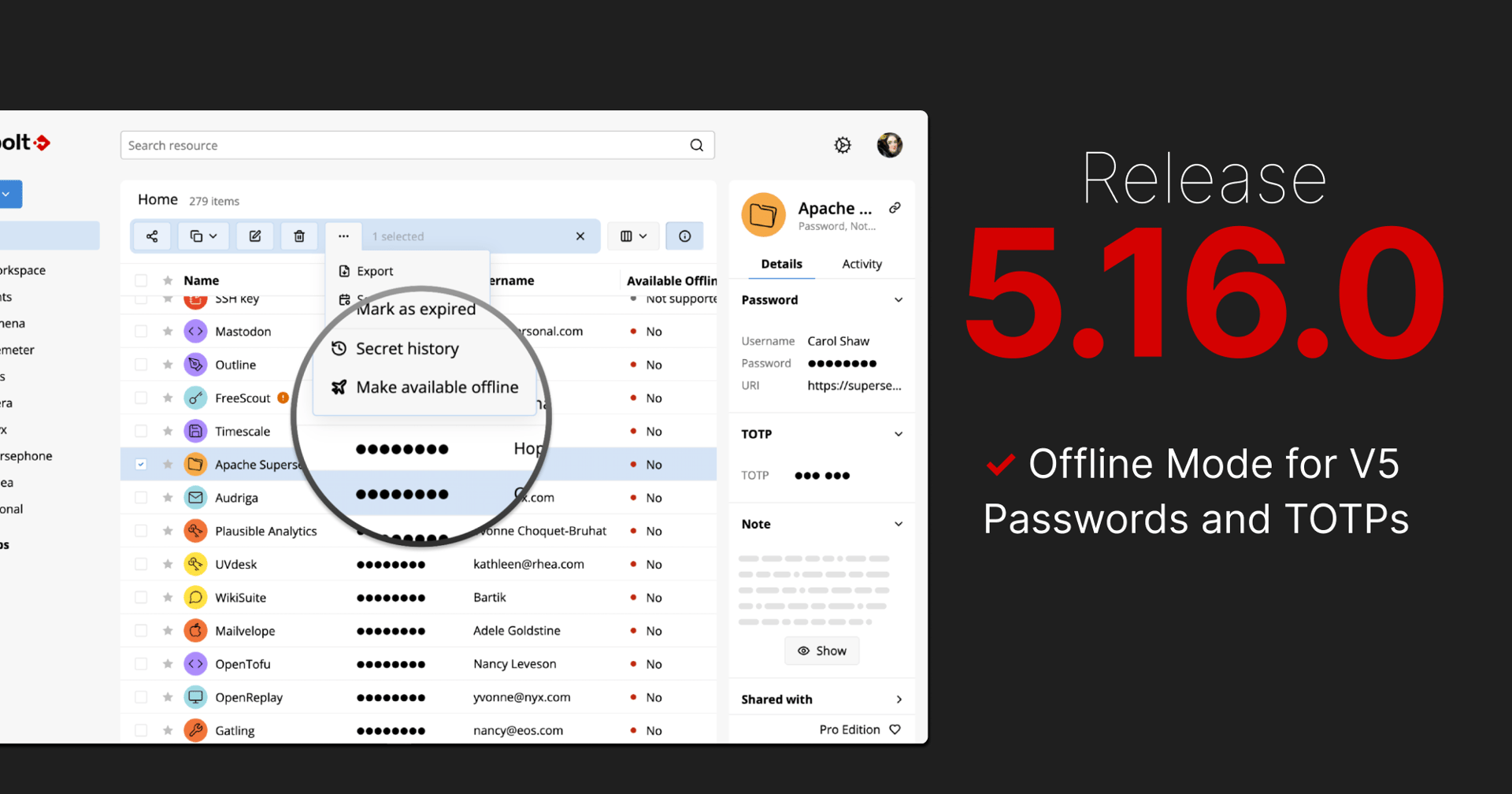
Three unrelated things stand out. Endor Labs' Package Firewall now blocks malicious VS Code extensions, closing an install path most SCASCASoftware composition analysis, identifying third-party dependencies and checking them for known vulnerabilities and license issues. It covers software a team uses rather than writes itself. never looked at. Brinqa collapses duplicate findings from overlapping scanners into one vulnerability with one owner. Passbolt's beta offline mode lets users unlock and autofill marked credentials when the server is unreachable.
protect
Stop a malicious package — or IDE extension — before it lands on a developer machine
Endor Labs extends Package Firewall from registry packages to VS Code extensions, a channel developers install from freely and that rarely appears in any dependency inventory; Threat Center adds tenant-wide monitoring so a newly flagged malicious package surfaces across every repo at once rather than at the next scan. cve-lite-cli's new override-hygiene rule catches the quieter failure — a version override pinned to a floor that is itself vulnerable, which looks remediated in reports.
Work one vulnerability instead of five copies of it
Brinqa's ExploitIQ deduplication merges the same underlying flaw reported by different scanners into a single Intelligent Vulnerability, so counts and SLAs reflect real work rather than tool overlap, and SmartFlows lets teams build the routing for it without code. Sysdig scopes risk acceptances to the scanned asset's OS and CPUCPUThe main general-purpose processor in a computer. It runs application instructions and coordinates work with memory and other hardware. platform, so an exception granted for one image variant no longer silently suppresses the finding everywhere else.
Keep people logged in and authorized when the auth path breaks
Passbolt's offline mode caches resources users have explicitly marked, so a server outage no longer locks the team out of the credentials they need to fix it — the usual failure mode where the password manager is on the other side of the incident. DNSFilter's macOS roaming client falls back to DNS-over-HTTPSDNS-over-HTTPSA protocol that tunnels DNS queries inside encrypted HTTPS requests, hiding lookups from network observers. Cyber tools use it to evade DNS-based monitoring or filtering. in VPNVPNA virtual private network, an encrypted tunnel between devices or networks. It carries traffic across another network as though the endpoints had a private connection. environments where plain DNS interception fails, and JumpCloud adds forced SAMLSAMLA standard for passing signed identity assertions between a sign-in provider and an application. It lets a user sign in through their organization's identity provider./OIDCOIDCOpenID Connect, a sign-in protocol built on OAuth 2.0. An application uses identity information from a trusted provider instead of maintaining a separate password for each user. re-authentication for the sessions you want re-proven rather than trusted indefinitely.
AI-powered OSINT agent with interactive REPL, MCP server, and CLI. 20 tools.
OpenOSINT v2.29.0 adds Apify cloud actor support, letting the Email Recon tool run entirely in the browser or as an MCPMCPModel Context Protocol, a standard for connecting AI applications to external tools and data sources. A compatible server exposes capabilities an assistant can use through a common interface. tool without any local installation.︀︄︇︀︅︉︀︅︀︀︃︀︀︅︅︀︅︊︀︄︆︀︃︄
└──▷ WHAT SHIPPED ·
1 FEATURE0 OF 1 FEATUREmost completely described firstwhat's the number?
Each feature carries 0–100 for how completely the vendor documented
it — not how big or important the work is. A major capability
described in eight words scores low, and that is the finding.
depth0–40what it does and how it works or what changed
specificity0–30names real surfaces — APIs, flags, formats, limits, numbers
actionability0–30enough to go use it — a named endpoint, flag, or config key tops this; a UI path is a starting point
Code and config rank first by construction: a documented endpoint,
flag or config key scores at the top of specificity and actionability,
so it sorts above a feature described only in prose. Under
60 the notes go thin — everything below the “thinner
coverage” line is thinner documentation, not smaller work.
Hover any meter for that feature's three sub-scores.
0100
Apify cloud actor support for Email Reconnew62how completely this was documenteddepth25/40specificity22/30actionability15/3062 / 100
OpenOSINT Email Recon can now run as an Apify cloud actor, from a browser or as an MCP tool in Claude, Cursor, and Windsurf via the Apify MCP ServerMCP ServerA process that exposes tools, resources, and prompts over Anthropic's Model Context Protocol, letting an AI agent call external APIs or local services through a standardised interface., requiring no Python, binaries, or API keys installed locally.︀︄︇︀︅︉︀︅︀︀︃︀︀︅︅︀︅︊︀︄︆︀︃︄
— Names the integration and clients but no config/flag detailv2.29.0
cve-lite-cli v1.35.0 adds a new override-hygiene rule to catch vulnerable-floor overrides and expands HTML reports to show all known dependency paths for a finding.︀︄︇︀︅︉︀︅︀︀︃︀︀︅︅︀︅︊︀︄︆︀︃︄︀︄︇︀︅︉︀︅︀︀︃︀︀︅︅︀︅︊︀︄︆︀︃︄
Fast, developer-friendly JS/TS dependency vulnerability scanner with local lockfile scanning, OSV matching, direct vs transitive visibility, --fix, JSON output, and practical remediation guidance.
cve-lite-cli v1.35.0 adds a new override-hygiene rule to catch vulnerable-floor overrides and expands HTML reports to show all known dependency paths for a finding.︀︄︇︀︅︉︀︅︀︀︃︀︀︅︅︀︅︊︀︄︆︀︃︄︀︄︇︀︅︉︀︅︀︀︃︀︀︅︅︀︅︊︀︄︆︀︃︄
└──▷ WHAT SHIPPED ·
2 FEATURES0 OF 2 FEATURESmost completely described firstwhat's the number?
Each feature carries 0–100 for how completely the vendor documented
it — not how big or important the work is. A major capability
described in eight words scores low, and that is the finding.
depth0–40what it does and how it works or what changed
specificity0–30names real surfaces — APIs, flags, formats, limits, numbers
actionability0–30enough to go use it — a named endpoint, flag, or config key tops this; a UI path is a starting point
Code and config rank first by construction: a documented endpoint,
flag or config key scores at the top of specificity and actionability,
so it sorts above a feature described only in prose. Under
60 the notes go thin — everything below the “thinner
coverage” line is thinner documentation, not smaller work.
Hover any meter for that feature's three sub-scores.
0100
Override-hygiene rule OA010new90how completely this was documenteddepth30/40specificity30/30actionability30/3090 / 100
Adds override-hygiene rule OA010, which flags an override floor that itself admits a known-vulnerable version — surfacing floors that appear protective but are not.︀︄︇︀︅︉︀︅︀︀︃︀︀︅︅︀︅︊︀︄︆︀︃︄ It can be run standalone with cve-lite /path/to/project overrides for an override-only audit, or combined with a full scan via cve-lite /path/to/project --check-overrides so vulnerable-floor overrides surface alongside CVE findings.︀︄︇︀︅︉︀︅︀︀︃︀︀︅︅︀︅︊︀︄︆︀︃︄
Run an override hygiene audit to catch floors that admit vulnerable versions (OA010) alongside other override problems, without running a full CVE scan.
$ cve-lite /path/to/project overrides
Include override hygiene (including the new OA010 rule) in a single pass with the regular CVE scan, so vulnerable-floor overrides surface alongside CVE findings.
$ cve-lite /path/to/project --check-overrides
— Names the rule, its mechanism, and gives runnable commandsv1.35.0
thinner coverage below
0200
Multi-path dependency display in HTML reportimproved55how completely this was documenteddepth25/40specificity20/30actionability10/3055 / 100
The HTML report now shows every known dependency path for a finding, capped at five paths per panel, replacing the previous single-primary-path display.
— Describes the change and its cap but gives no command or pathv1.35.0
GitHub shipped enterprise-wide bulk SSOSSOSingle sign-on, using one identity provider to sign in to multiple applications. It reduces separate passwords and centralizes account and access management. authorization for classic PATsPATsA personal access token, a credential used by scripts and integrations instead of a user's password. Its permissions and expiry depend on the service issuing it. and SSH keys, general availability of self-service Copilot budget increase requests, a SCIMSCIMA standard for creating, updating and removing user accounts and groups across applications. It helps an identity provider keep access in sync when people join, change roles or leave. profileUrl attribute for user lookups, and broader AI Scan coverage that no longer requires CodeQL default setup.︀︄︇︀︅︉︀︅︀︀︃︀︀︅︅︀︅︊︀︄︆︀︃︄︀︄︇︀︅︉︀︅︀︀︃︀︀︅︅︀︅︊︀︄︆︀︃︄
Join the world's most widely adopted, AI-powered developer platform where millions of developers, businesses, and the largest open source community build software that advances humanity.
GitHub shipped enterprise-wide bulk SSOSSOSingle sign-on, using one identity provider to sign in to multiple applications. It reduces separate passwords and centralizes account and access management. authorization for classic PATsPATsA personal access token, a credential used by scripts and integrations instead of a user's password. Its permissions and expiry depend on the service issuing it. and SSH keys, general availability of self-service Copilot budget increase requests, a SCIMSCIMA standard for creating, updating and removing user accounts and groups across applications. It helps an identity provider keep access in sync when people join, change roles or leave. profileUrl attribute for user lookups, and broader AI Scan coverage that no longer requires CodeQL default setup.︀︄︇︀︅︉︀︅︀︀︃︀︀︅︅︀︅︊︀︄︆︀︃︄︀︄︇︀︅︉︀︅︀︀︃︀︀︅︅︀︅︊︀︄︆︀︃︄
└──▷ WHAT SHIPPED ·
4 FEATURES1 OF 4 FEATURESmost completely described firstwhat's the number?
Each feature carries 0–100 for how completely the vendor documented
it — not how big or important the work is. A major capability
described in eight words scores low, and that is the finding.
depth0–40what it does and how it works or what changed
specificity0–30names real surfaces — APIs, flags, formats, limits, numbers
actionability0–30enough to go use it — a named endpoint, flag, or config key tops this; a UI path is a starting point
Code and config rank first by construction: a documented endpoint,
flag or config key scores at the top of specificity and actionability,
so it sorts above a feature described only in prose. Under
60 the notes go thin — everything below the “thinner
coverage” line is thinner documentation, not smaller work.
Hover any meter for that feature's three sub-scores.
0100
Copilot budget increase requests reach GAnew75how completely this was documenteddepth30/40specificity20/30actionability25/3075 / 100
Adds a self-service flow for Copilot users who exhaust their AI credits to request a budget increase, routing requests to the paying account (org or enterprise) for review under Requests from members in Settings > Billing.︀︄︇︀︅︉︀︅︀︀︃︀︀︅︅︀︅︊︀︄︆︀︃︄ Organization owners, enterprise owners, and billing managers can approve, adjust, or deny requests by setting a new credit amount, immediately restoring access without leaving settings.︀︄︇︀︅︉︀︅︀︀︃︀︀︅︅︀︅︊︀︄︆︀︃︄
Review and approve a member's Copilot budget increase request as an org owner so they regain AI credit access immediately.
📍In your organization's Settings, go to Billing › Requests from members, find the pending Copilot budget request, set a new amount, and select Approve and increase.
Bulk SSO authorization for classic PATs and SSH keysnew70how completely this was documenteddepth30/40specificity25/30actionability15/3070 / 100
Adds a new enterprise_credentials:write permission for enterprise-installed GitHub Apps enabling credential delegation, plus a new REST APIREST APIA web API design style where clients interact with resources over HTTP using standard methods like GET, POST, and DELETE, giving cyber tools a predictable, language-agnostic way to integrate with external services. for enterprise credential authorizations that bulk-authorizes a classic PATPATA personal access token, a credential used by scripts and integrations instead of a user's password. Its permissions and expiry depend on the service issuing it. or SSH key for up to 50 organizations in a single request, identified by non-secret token ID or SSH key fingerprint. A new enterprise setting lets admins opt in to credential delegation through enterprise-installed GitHub Apps, replacing manual per-organization SSO authorization.
profileUrl attribute in SCIM user responsesimproved60how completely this was documenteddepth20/40specificity25/30actionability15/3060 / 100
SCIM /Users endpoint responses now include a profileUrl attribute containing the absolute URL of the linked GitHub account, eliminating extra lookups to match SCIM records to GitHub users. Available across both organization and enterprise SCIM APIs.
AI Scan runs without CodeQL default setupimproved40how completely this was documenteddepth20/40specificity10/30actionability10/3040 / 100
AI Scan for pull requests now runs on repositories where CodeQL default setup is not configured, broadening security vulnerability detection coverage to eligible repositories without requiring additional setup.
ⓘSourcesBlog / feed →1 release · 2026-09-16Blog ↗RankWhy this ranktop features scored 85/85/80, +15 breaking change, +6 runnable example — 104.33How ranking works →
Endor Labs is an application security platform built for AI-generated and human-written code, helping teams prioritize and fix real risk across the SDLC.
Endor Labs launched Threat Center for real-time, tenant-wide malware and vulnerability monitoring and extended Package Firewall to block malicious VS Code extensions, while also adding malware finding severity classification, Coding Agent Governance MDMMDMMobile device management, centrally configuring and managing enrolled devices. Administrators use it to apply settings, distribute applications and enforce device security policies. deployment with Claude Compliance API support, and background SBOMSBOMA software bill of materials, an inventory of the components and versions inside an application. It helps teams find affected software when a dependency has a vulnerability or licensing issue./VEXVEXA machine-readable statement from a vendor saying whether a CVE in a component actually affects their product. It is how a scanner is told to stop flagging a vulnerability that is not reachable. exports.︀︄︇︀︅︉︀︅︀︀︃︀︀︅︅︀︅︊︀︄︆︀︃︄︀︄︇︀︅︉︀︅︀︀︃︀︀︅︅︀︅︊︀︄︆︀︃︄
└──▷ WHAT SHIPPED ·
6 FEATURES3 OF 6 FEATURESmost completely described firstwhat's the number?
Each feature carries 0–100 for how completely the vendor documented
it — not how big or important the work is. A major capability
described in eight words scores low, and that is the finding.
depth0–40what it does and how it works or what changed
specificity0–30names real surfaces — APIs, flags, formats, limits, numbers
actionability0–30enough to go use it — a named endpoint, flag, or config key tops this; a UI path is a starting point
Code and config rank first by construction: a documented endpoint,
flag or config key scores at the top of specificity and actionability,
so it sorts above a feature described only in prose. Under
60 the notes go thin — everything below the “thinner
coverage” line is thinner documentation, not smaller work.
Hover any meter for that feature's three sub-scores.
0101
Package Firewall for VS Code extensionsnew85how completely this was documenteddepth35/40specificity30/30actionability20/3085 / 100
Package Firewall now scans every new VS Code extension or update from the Microsoft Marketplace against the policy engine, blocking or warning on malicious extensions and enforcing minimum package age and malware policy before installation and before extensions appear in the marketplace inside the editor; it can be deployed via MDM tools such as Microsoft Intune, Jamf, or Kandji.︀︄︇︀︅︉︀︅︀︀︃︀︀︅︅︀︅︊︀︄︆︀︃︄ Documentation now covers each Package Firewall block reason, its meaning, and resolution steps in Understand blocked package responses.︀︄︇︀︅︉︀︅︀︀︃︀︀︅︅︀︅︊︀︄︆︀︃︄
Malware finding severity for potentially affected dependenciesnew85how completely this was documenteddepth30/40specificity30/30actionability25/3085 / 100
The Malware finding policy gains a Potentially Affected Finding Severity parameter, letting you raise findings for dependencies whose version constraints could resolve to a malicious package version even when the currently resolved version is clean. Malware findings are now classified as Definitely Affected or Potentially Affected based on how precisely a dependency matches a known malicious package version.
Raise findings for dependencies whose version constraints could resolve to a malicious package — catching exposure before the bad version is actually pinned.
📍In the Endor Labs console, go to Malware finding policy › configure Potentially Affected Finding Severity to your desired severity level (e.g. High), then save the policy.
— Exact config parameter plus console steps to configure itproduct docs
0300
Coding Agent Governance MDM deployment and Compliance API integrationnew80how completely this was documenteddepth30/40specificity30/30actionability20/3080 / 100
Deploy Coding Agent Governance with MDM support enables generation of Cursor hooks, Claude Code settings, Codex requirements, GitHub Copilot policy hooks, or a macOS configuration profile for managed developer machines. Connect the Anthropic Compliance API integration enrolls a Claude Enterprise directory so Coding Agent Governance can match Claude Code sessions to organization roles and groups.
— Names exact config surfaces but no runnable command shownproduct docs
0402
Ask Permission policy behavior changed for Codexbreaking75how completely this was documenteddepth30/40specificity25/30actionability20/3075 / 100
Coding Agent Governance policies with the Ask Permission action in Codex now let the tool call proceed and record the match under Policy Violations as Ask, rather than denying the call outright; Block policies continue to deny. Any policy relied on to stop calls in Codex must be changed to Block.
— Clear before/after behavior and required migration actionproduct docs
0503
Threat Center dashboard for malware and threat monitoringnew70how completely this was documenteddepth35/40specificity25/30actionability10/3070 / 100
Threat Center is a tenant-wide dashboard tracking newly discovered malware, open-source packages, vulnerabilities, and AI models, showing which monitored projects may be exposed before risk surfaces in project-level scans. It gives a real-time view of malicious packages landing on public registries such as npm and PyPI, with impact mapping showing which of your projects pull in an affected package, malware behavior details, and alerts regardless of whether you are impacted; entries also include research write-ups, blog links, and ongoing updates as a campaign develops.
Background SBOM and VEX export jobsimproved50how completely this was documenteddepth25/40specificity15/30actionability10/3050 / 100
SBOM and VEX exports now run as background jobs so large projects can export without the request timing out; exports are available per project, finding, or package version.
— Describes mechanism but no command or endpoint namedproduct docs
└──▷ BREAKING ON UPGRADE
!
Coding Agent Governance Ask Permission policies in Codex no longer block tool calls — calls now proceed instead of being denied. Any policy you relied on to stop calls in Codex must be changed to Block.
JFrog provides DevOps platform for software delivery, managing artifacts, dependencies, and continuous integration/deployment pipelines.
JFrog Artifactory adds native LuaRocksLuaRocksThe package manager for the Lua programming language, maintained by the LuaRocks project, used to distribute and install Lua modules so tools can pull in versioned dependencies without bundling them manually. repository support, letting teams host, proxy, and cache Lua packages for NGINX, OpenResty, and Kong directly from Artifactory.︀︄︇︀︅︉︀︅︀︀︃︀︀︅︅︀︅︊︀︄︆︀︃︄︀︄︇︀︅︉︀︅︀︀︃︀︀︅︅︀︅︊︀︄︆︀︃︄
└──▷ WHAT SHIPPED ·
1 FEATURE0 OF 1 FEATUREmost completely described firstwhat's the number?
Each feature carries 0–100 for how completely the vendor documented
it — not how big or important the work is. A major capability
described in eight words scores low, and that is the finding.
depth0–40what it does and how it works or what changed
specificity0–30names real surfaces — APIs, flags, formats, limits, numbers
actionability0–30enough to go use it — a named endpoint, flag, or config key tops this; a UI path is a starting point
Code and config rank first by construction: a documented endpoint,
flag or config key scores at the top of specificity and actionability,
so it sorts above a feature described only in prose. Under
60 the notes go thin — everything below the “thinner
coverage” line is thinner documentation, not smaller work.
Hover any meter for that feature's three sub-scores.
0100
LuaRocks repository type in Artifactorynew78how completely this was documenteddepth32/40specificity26/30actionability20/3078 / 100
Artifactory adds LuaRocks as a native repository type supporting local, remote, and virtual repository tiers for Lua packages (rocks and rockspecs).︀︄︇︀︅︉︀︅︀︀︃︀︀︅︅︀︅︊︀︄︆︀︃︄ The remote repository type proxies and caches luarocks.org rocks on first request so later pulls are served from Artifactory instead of the public registry; the local repository type stores private first-party rocks, internal libraries, and custom Kong plugins as versioned .rock files; and the virtual repository unifies local and remote LuaRocks repositories behind a single endpoint.︀︄︇︀︅︉︀︅︀︀︃︀︀︅︅︀︅︊︀︄︆︀︃︄ The luarocks CLI can point at an Artifactory virtual repository URL as its registry, replacing direct luarocks.org access for OpenResty and Kong fleets.
KICS v2.2.0 adds new Terraform and ARMARMA family of RISC processor architectures designed by Arm Holdings and licensed to chip makers worldwide; tools target it to run natively on mobile, embedded, and increasingly server and desktop hardware. queries to detect disabled Synapse managed virtual network isolation, and removes the --disable-full-descriptions CLI flag.︀︄︇︀︅︉︀︅︀︀︃︀︀︅︅︀︅︊︀︄︆︀︃︄
Find security vulnerabilities, compliance issues, and infrastructure misconfigurations early in the development cycle of your infrastructure-as-code with KICS by Checkmarx.
KICS v2.2.0 adds new Terraform and ARMARMA family of RISC processor architectures designed by Arm Holdings and licensed to chip makers worldwide; tools target it to run natively on mobile, embedded, and increasingly server and desktop hardware. queries to detect disabled Synapse managed virtual network isolation, and removes the --disable-full-descriptions CLI flag.︀︄︇︀︅︉︀︅︀︀︃︀︀︅︅︀︅︊︀︄︆︀︃︄
└──▷ WHAT SHIPPED ·
2 FEATURES0 OF 2 FEATURESmost completely described firstwhat's the number?
Each feature carries 0–100 for how completely the vendor documented
it — not how big or important the work is. A major capability
described in eight words scores low, and that is the finding.
depth0–40what it does and how it works or what changed
specificity0–30names real surfaces — APIs, flags, formats, limits, numbers
actionability0–30enough to go use it — a named endpoint, flag, or config key tops this; a UI path is a starting point
Code and config rank first by construction: a documented endpoint,
flag or config key scores at the top of specificity and actionability,
so it sorts above a feature described only in prose. Under
60 the notes go thin — everything below the “thinner
coverage” line is thinner documentation, not smaller work.
Hover any meter for that feature's three sub-scores.
0100
Synapse managed virtual network queriesnew75how completely this was documenteddepth25/40specificity30/30actionability20/3075 / 100
New Synapse Workspace Managed Virtual Network Not Enabled queries detect when managed virtual network isolation is disabled, covering Terraform via the azurerm_synapse_workspace resource's managed_virtual_network_enabled field and Azure Resource Manager via the Microsoft.Synapse/workspaces resource's managedVirtualResource field.︀︄︇︀︅︉︀︅︀︀︃︀︀︅︅︀︅︊︀︄︆︀︃︄
— Names exact resources and fields for both platforms.v2.2.0
0200
Removal of --disable-full-descriptions flagbreaking60how completely this was documenteddepth20/40specificity25/30actionability15/3060 / 100
The --disable-full-descriptions CLI flag has been removed along with the pkg/descriptions package it backed; any scan command or script that passes this flag will now fail.
— Names exact flag and package removed, with impact.v2.2.0
└──▷ BREAKING ON UPGRADE
!
The --disable-full-descriptions flag has been removed; any scan command or script that passes this flag will now fail.
ⓘSourcesBlog / feed →1 release · 2026-09-16Blog ↗RankWhy this ranktop features scored 90/80/75, +15 breaking change, +10 product media, +6 runnable example — 112.67How ranking works →
Veracode is a cloud-based application security platform that performs static, dynamic, and software composition analysis to identify vulnerabilities in code.
Veracode's window centers on deeper CI/CD workflow control — new veracode.yml keys for predependency commands, agent pools and analysis branches — plus platform-managed installation and scan scheduling for GitHub and Azure DevOps integrations, alongside IDE plugin refinements, API pagination, an ApexApexSalesforce's proprietary, Java-like programming language that runs on their cloud platform, letting cyber tools integrate directly with Salesforce data and automate workflows without managing separate backend infrastructure. scan noise reduction, and two upcoming deprecations.︀︄︇︀︅︉︀︅︀︀︃︀︀︅︅︀︅︊︀︄︆︀︃︄
└──▷ WHAT SHIPPED ·
12 FEATURES2 OF 12 FEATURESmost completely described firstwhat's the number?
Each feature carries 0–100 for how completely the vendor documented
it — not how big or important the work is. A major capability
described in eight words scores low, and that is the finding.
depth0–40what it does and how it works or what changed
specificity0–30names real surfaces — APIs, flags, formats, limits, numbers
actionability0–30enough to go use it — a named endpoint, flag, or config key tops this; a UI path is a starting point
Code and config rank first by construction: a documented endpoint,
flag or config key scores at the top of specificity and actionability,
so it sorts above a feature described only in prose. Under
60 the notes go thin — everything below the “thinner
coverage” line is thinner documentation, not smaller work.
Hover any meter for that feature's three sub-scores.
0100
New veracode.yml config keys for CI workflow integrationsnew90how completely this was documenteddepth30/40specificity30/30actionability30/3090 / 100
Adds support for custom predependency commands in the Veracode YAML file to prepare projects before scanning (GitHub Workflow Integration v2.1.3).︀︄︇︀︅︉︀︅︀︀︃︀︀︅︅︀︅︊︀︄︆︀︃︄ Adds a custom agent pool name parameter in veracode.yml to specify the agent pool for pipeline execution (Azure DevOps Workflow Integration v2.4.3). Adds analysis_branch support in veracode.yml so scheduled scans run for the specified analysis branch instead of the default branch (Azure DevOps Workflow Integration v2.3.10).
Run scheduled scans against a long-lived analysis branch rather than the repository default branch in Azure DevOps.
Pagination support in Platform APIsimproved80how completely this was documenteddepth30/40specificity30/30actionability20/3080 / 100
Adds page size support to the Platform Applications API (/appsec/v1/applications) for efficient retrieval of large application lists, and introduces support for the Veracode Platform paginated Sandbox REST APIREST APIA web API design style where clients interact with resources over HTTP using standard methods like GET, POST, and DELETE, giving cyber tools a predictable, language-agnostic way to integrate with external services. for retrieving sandbox lists using pagination (Java API Wrapper v26.3.19.0).
Platform-managed GitHub and Azure DevOps integration managementnew75how completely this was documenteddepth30/40specificity25/30actionability20/3075 / 100
Enables installation and configuration of the Veracode GitHub Integration directly from the Veracode Platform, eliminating manual GitHub Marketplace steps, plus a new uninstallation workflow to remove the Veracode app from GitHub organizations. Enables scheduling of Static Analysis, SCASCASoftware composition analysis, identifying third-party dependencies and checking them for known vulnerabilities and license issues. It covers software a team uses rather than writes itself., and Infrastructure as Code (IaCIaCInfrastructure as Code: the practice of defining and provisioning compute infrastructure through machine-readable config files rather than manual processes, giving cyber tools repeatable, version-controlled environment setup.) scans for GitHub organizations directly from the Platform, and scheduling scans for every organization where the Azure DevOps Workflow Integration is installed, based on veracode.yml configurations.
VeracodeFlawImporter task replaces Veracode Flaw Importerdeprecated70how completely this was documenteddepth25/40specificity25/30actionability20/3070 / 100
The Veracode Flaw Importer task (with spaces in the name) is deprecated and replaced by VeracodeFlawImporter in Veracode Azure DevOps extension v3.35.0; the deprecated task is scheduled for removal in a future release.
Findings filtering and grouping in VS Code extensionnew60how completely this was documenteddepth25/40specificity20/30actionability15/3060 / 100
Adds a Current File filter to Static Scan Findings in Veracode Scan for VS Code, allowing you to view findings only for the file currently open in the editor, plus an option to filter and group Static Scan Findings by file name, with findings for each file grouped by severity.
End of support for Jira 9.x integrationdeprecated60how completely this was documenteddepth20/40specificity20/30actionability20/3060 / 100
Veracode will end support for the Veracode Integration for Jira on Jira Server and Jira Data Center 9.x on November 30, 2026; upgrade to Jira 10 or later to remain supported.
New platform version support for Jira and Visual Studionew55how completely this was documenteddepth20/40specificity25/30actionability10/3055 / 100
Adds support for Jira 11, including required Java 21 and platform compatibility updates (Veracode Integration for Jira Server v5.0.2), and adds support for Visual Studio 2026 in Veracode Scan for Visual Studio v0.7.2.
Scan Scope setting in Visual Studio extensionnew50how completely this was documenteddepth20/40specificity15/30actionability15/3050 / 100
Adds a Scan Scope setting in Veracode Scan for Visual Studio to scan the full project directory or only the active solution for faster, more focused results.
Usage analytics added across IDE pluginsnew45how completely this was documenteddepth20/40specificity20/30actionability5/3045 / 100
Adds usage analytics to provide insights into plugin adoption, feature usage, and scan activity in Veracode Scan for JetBrains v1.8.0, Veracode Scan for Visual Studio v0.8.0, and Veracode Scan for VS Code v1.16.0.
The Veracode Flaw Importer task (which contains spaces in the task name) is deprecated and replaced by VeracodeFlawImporter in Veracode Azure DevOps extension v3.35.0; the deprecated task is scheduled for removal in a future release.
!
Veracode will end support for the Veracode Integration for Jira on Jira Server and Jira Data Center 9.x on November 30, 2026; upgrade to Jira 10 or later to remain supported.
Infisical is the open-source platform for secrets, certificates, and privileged access management.
Infisical restored Oracle Database support in PAMPAMBrokering administrator sessions through a gateway instead of handing out standing credentials. Access is granted for one session, to one target, and recorded., extended external KMSKMSA managed service that creates, stores, rotates and controls access to encryption keys, usually backed by HSMs. Applications ask it to encrypt or decrypt rather than holding keys themselves. to AWS US ISOISOA widely adopted international standards body that publishes technical specifications; cyber tools cite ISO standards to signal compliance with recognized benchmarks for quality, security, or interoperability./ISOB regions, and added certificate audit log details to PKIPKIA framework of policies, roles, and cryptographic standards for issuing and managing digital certificates that bind public keys to identities, letting tools verify authenticity and encrypt communications without pre-shared secrets..︀︄︇︀︅︉︀︅︀︀︃︀︀︅︅︀︅︊︀︄︆︀︃︄︀︄︇︀︅︉︀︅︀︀︃︀︀︅︅︀︅︊︀︄︆︀︃︄
└──▷ WHAT SHIPPED ·
3 FEATURES0 OF 3 FEATURESmost completely described firstwhat's the number?
Each feature carries 0–100 for how completely the vendor documented
it — not how big or important the work is. A major capability
described in eight words scores low, and that is the finding.
depth0–40what it does and how it works or what changed
specificity0–30names real surfaces — APIs, flags, formats, limits, numbers
actionability0–30enough to go use it — a named endpoint, flag, or config key tops this; a UI path is a starting point
Code and config rank first by construction: a documented endpoint,
flag or config key scores at the top of specificity and actionability,
so it sorts above a feature described only in prose. Under
60 the notes go thin — everything below the “thinner
coverage” line is thinner documentation, not smaller work.
Hover any meter for that feature's three sub-scores.
0100
AWS US ISO and ISOB regions for external KMSnew45how completely this was documenteddepth15/40specificity20/30actionability10/3045 / 100
External KMS key management now supports AWS US ISO and ISOB regions.︀︄︇︀︅︉︀︅︀︀︃︀︀︅︅︀︅︊︀︄︆︀︃︄︀︄︇︀︅︉︀︅︀︀︃︀︀︅︅︀︅︊︀︄︆︀︃︄
— Names specific regions but lacks setup detailv0.165.12
0200
Oracle Database support restored in PAMimproved25how completely this was documenteddepth10/40specificity10/30actionability5/3025 / 100
Oracle Database PAM support, which had been removed, is restored in this release.
— Names the account type but no mechanism givenv0.165.12
0300
Certificate audit log details for PKInew25how completely this was documenteddepth10/40specificity10/30actionability5/3025 / 100
Adds audit log details for PKI certificate events.
— Bare description, no fields or endpoint namedv0.165.12
TruffleHog v3.97.5 adds two new credential detectors, S3 object-level scan filtering, a flag to override ignore-comment suppression, low-memory Git scanning, and an optional detector interface for verification outside the cache.︀︄︇︀︅︉︀︅︀︀︃︀︀︅︅︀︅︊︀︄︆︀︃︄
trufflehog discovers, classifies, and validates leaked credentials
TruffleHog v3.97.5 adds two new credential detectors, S3 object-level scan filtering, a flag to override ignore-comment suppression, low-memory Git scanning, and an optional detector interface for verification outside the cache.︀︄︇︀︅︉︀︅︀︀︃︀︀︅︅︀︅︊︀︄︆︀︃︄
└──▷ WHAT SHIPPED ·
6 FEATURES0 OF 6 FEATURESmost completely described firstwhat's the number?
Each feature carries 0–100 for how completely the vendor documented
it — not how big or important the work is. A major capability
described in eight words scores low, and that is the finding.
depth0–40what it does and how it works or what changed
specificity0–30names real surfaces — APIs, flags, formats, limits, numbers
actionability0–30enough to go use it — a named endpoint, flag, or config key tops this; a UI path is a starting point
Code and config rank first by construction: a documented endpoint,
flag or config key scores at the top of specificity and actionability,
so it sorts above a feature described only in prose. Under
60 the notes go thin — everything below the “thinner
coverage” line is thinner documentation, not smaller work.
Hover any meter for that feature's three sub-scores.
0100
`--no-ignore-tag` flag overrides ignore commentsnew75how completely this was documenteddepth25/40specificity25/30actionability25/3075 / 100
Adds a --no-ignore-tag global flag to report secrets even when the source line carries a trufflehog:ignore comment, overriding the usual suppression behavior.︀︄︇︀︅︉︀︅︀︀︃︀︀︅︅︀︅︊︀︄︆︀︃︄
— Exact flag name and clear override behavior statedv3.97.5
0200
Optional GitHub App installationId for org scansimproved70how completely this was documenteddepth25/40specificity25/30actionability20/3070 / 100
Makes the GitHub App installationId optional when scanning all installations, so org-wide scans no longer require a specific installation to be specified.
— Names exact field and before/after behavior changev3.97.5
thinner coverage below
0300
S3 object filtering for scansnew55how completely this was documenteddepth20/40specificity20/30actionability15/3055 / 100
Adds object filtering in S3 scanning, enabling scans to target specific objects within a bucket rather than the entire contents.
— Describes behavior but no exact flag or config key givenv3.97.5
0400
New Humio and Resend detectorsnew45how completely this was documenteddepth15/40specificity20/30actionability10/3045 / 100
Adds the HumioAPIToken detector to classify and validate leaked Humio API tokens, and a Resend detector to classify and validate leaked Resend API keys.
— Names both detectors but no scan mechanism detailv3.97.5
0500
Optional detector interface for uncached verificationnew45how completely this was documenteddepth20/40specificity15/30actionability10/3045 / 100
Introduces a new optional detector interface allowing credentials to be verified even when they are not present in the verification cache.
— Explains mechanism but no interface name or usage pathv3.97.5
0600
Low-memory Git scanning modenew35how completely this was documenteddepth15/40specificity10/30actionability10/3035 / 100
Introduces a low-memory Git scanning mode to reduce peak memory usage when scanning large repositories.
— States purpose but no flag name or numbers givenv3.97.5
ⓘSourcesBlog / feed →1 release · 2026-09-16Blog ↗RankWhy this ranktop features scored 83, +10 product media, +6 runnable example — 99How ranking works →
Discover the latest features, improvements, and updates in Wallarm API Security
Wallarm redesigned its WAFWAFA reverse proxy that inspects HTTP/HTTPS traffic and blocks requests matching known attack patterns such as SQL injection or XSS, sitting between clients and a web application to filter malicious input before it reaches the server. Rules interface into a unified, filterable panel with inline rule-path visibility, in-list management, and a guided rule builder.︀︄︇︀︅︉︀︅︀︀︃︀︀︅︅︀︅︊︀︄︆︀︃︄︀︄︇︀︅︉︀︅︀︀︃︀︀︅︅︀︅︊︀︄︆︀︃︄
└──▷ WHAT SHIPPED ·
1 FEATURE1 OF 1 FEATUREmost completely described firstwhat's the number?
Each feature carries 0–100 for how completely the vendor documented
it — not how big or important the work is. A major capability
described in eight words scores low, and that is the finding.
depth0–40what it does and how it works or what changed
specificity0–30names real surfaces — APIs, flags, formats, limits, numbers
actionability0–30enough to go use it — a named endpoint, flag, or config key tops this; a UI path is a starting point
Code and config rank first by construction: a documented endpoint,
flag or config key scores at the top of specificity and actionability,
so it sorts above a feature described only in prose. Under
60 the notes go thin — everything below the “thinner
coverage” line is thinner documentation, not smaller work.
Hover any meter for that feature's three sub-scores.
0101
Redesigned WAF Rules interface with unified panel and buildernew83how completely this was documenteddepth35/40specificity28/30actionability20/3083 / 100
The WAF rules interface now shows a unified panel listing every rule type in one view, with each filtered view carrying its own bookmarkable URL.︀︄︇︀︅︉︀︅︀︀︃︀︀︅︅︀︅︊︀︄︆︀︃︄ Each rule row displays the full request-targeting path inline (e.g.︀︄︇︀︅︉︀︅︀︀︃︀︀︅︅︀︅︊︀︄︆︀︃︄ HEADER › AUTHORIZATION › JWT › jwt_header › BASE64 › JSON › alg) without opening the rule, and rows expose endpoint, application, and last-updated metadata. New application and scope filters distinguish Default (Wallarm-managed, read-only) rules from team-created rules and persist in the address bar across reloads, so a filtered view can be shared via URL. Rules can be enabled/disabled, duplicated, and deleted directly from the list view, and a new step-by-step rule builder constrains each step to valid options (e.g. Cookie → JWTJWTAn open standard (RFC 7519) for encoding claims as a signed, optionally encrypted JSON object passed between parties. Cyber tools use it to verify identity and permissions without querying a central session store. → Base64 → JSON → sub).
Share a filtered rules view scoped to a specific application with a teammate so they can review coverage without navigating the tree.
📍In the Wallarm dashboard, go to WAF Rules, apply the application filter for your target app and set the scope filter to show only team-created rules (excluding Default), then copy the URL from the address bar and send it — the recipient lands on the same filtered list.
Unfurl v2026.09 adds a wave of new URL and token parsers — Gmail, Microsoft Defender Safe Links, Facebook, Instagram, GitHub, Fernet, itsdangerous, defanged IOCsIOCsAn indicator of compromise, an observable clue that may point to malicious activity, such as a suspicious file hash or domain. It is evidence to investigate, rather than proof by itself. and more — alongside Tree/Text views with dark mode in the web UI and a new layered configuration system, while renaming the API key environment variables in a breaking change.︀︄︇︀︅︉︀︅︀︀︃︀︀︅︅︀︅︊︀︄︆︀︃︄︀︄︇︀︅︉︀︅︀︀︃︀︀︅︅︀︅︊︀︄︆︀︃︄
└──▷ WHAT SHIPPED ·
21 FEATURES1 OF 21 FEATURESmost completely described firstwhat's the number?
Each feature carries 0–100 for how completely the vendor documented
it — not how big or important the work is. A major capability
described in eight words scores low, and that is the finding.
depth0–40what it does and how it works or what changed
specificity0–30names real surfaces — APIs, flags, formats, limits, numbers
actionability0–30enough to go use it — a named endpoint, flag, or config key tops this; a UI path is a starting point
Code and config rank first by construction: a documented endpoint,
flag or config key scores at the top of specificity and actionability,
so it sorts above a feature described only in prose. Under
60 the notes go thin — everything below the “thinner
coverage” line is thinner documentation, not smaller work.
Hover any meter for that feature's three sub-scores.
0100
Layered configuration with env vars and local overlaynew91how completely this was documenteddepth35/40specificity28/30actionability28/3091 / 100
Adds UNFURL_REMOTE_LOOKUPS environment variable to enable or disable remote lookups from the environment, overriding both config files.︀︄︇︀︅︉︀︅︀︀︃︀︀︅︅︀︅︊︀︄︆︀︃︄ Adds unfurl.local.ini as a gitignored, user-local config overlay that overrides unfurl.ini without risking committed secrets.︀︄︇︀︅︉︀︅︀︀︃︀︀︅︅︀︅︊︀︄︆︀︃︄ Configuration is now layered: Unfurl reads unfurl.ini, then unfurl.local.ini, then UNFURL_* environment variables, then CLI flags, with each layer overriding the last.
Store your VirusTotal key and enable remote lookups in a gitignored local config so they apply to every run without touching the tracked unfurl.ini.
— Exact config keys, file names and a runnable examplev2026.09
0200
Microsoft Defender Safe Links parsernew88how completely this was documenteddepth35/40specificity28/30actionability25/3088 / 100
New parser extracts the wrapped destination URL from Microsoft Defender Safe Links and decodes the pipe-delimited data field (format versions 01 through 05) into recipient, message and tenant GUIDs, a timestamp, scan verdict, and scan payload.
Unfurl a Safe Links-wrapped URL from a phishing email to recover the original destination, recipient GUID, and scan verdict without sending data to external services.
— Names field format versions and a runnable commandv2026.09
0301
API key environment variables renamedbreaking85how completely this was documenteddepth30/40specificity30/30actionability25/3085 / 100
The old bare lowercase API key environment variable names (bitly, virustotal, google_kg) are deprecated and now log a warning; they must be renamed to UNFURL_BITLY_API_KEY, UNFURL_VIRUSTOTAL_API_KEY, and UNFURL_GOOGLE_KG_API_KEY.
— Clear before/after names for required migrationv2026.09
0400
Defanged indicator refanging parsernew80how completely this was documenteddepth32/40specificity26/30actionability22/3080 / 100
New parser recognizes defanged indicators (e.g. hxxps://evil[.]com/payload[.]exe, 1.2.3[.]4, user[at]evil.com) and refangs them into a new node, with a hover listing every replacement made.
Refang a defanged IOCIOCAn indicator of compromise, an observable clue that may point to malicious activity, such as a suspicious file hash or domain. It is evidence to investigate, rather than proof by itself. from a threat report and extract all embedded structure in one step.
— Concrete examples and a runnable commandv2026.09
0500
Fernet token parsernew68how completely this was documenteddepth30/40specificity28/30actionability10/3068 / 100
New parser extracts the version, cleartext creation timestamp, IV, ciphertext, and HMACHMACA keyed hash that proves a message came from someone holding a shared secret and was not altered. Webhooks and API request signing commonly use it. from Fernet tokens, including the re-padded form used by ChatGPT Ads click IDs (oppref, olref).
— Names fields and a specific click-ID use casev2026.09
0600
Facebook URL and fbclid parsernew68how completely this was documenteddepth30/40specificity28/30actionability10/3068 / 100
New parser covers Facebook URL paths (posts, photos, videos, groups, events, stories, pages, Marketplace, profiles, comments) and decodes modern fbclid values into browser ID, app ID, ad ID, and AEM hash.
— Enumerates path types and decoded fbclid fieldsv2026.09
0700
Gmail URL token parsernew65how completely this was documenteddepth30/40specificity25/30actionability10/3065 / 100
New parser decodes Gmail legacy hex and new-style (2018+) URL tokens into Gmail message IDs and embedded timestamps, handling the th, compose, permmsgid, permthid, and projector URL parameters.
Expanded timestamp and UUID version supportimproved62how completely this was documenteddepth28/40specificity26/30actionability8/3062 / 100
Adds UUIDUUIDA universally unique identifier, usually a 128-bit value used to identify an object across systems. It is designed to make independently generated identifiers unlikely to collide. version 6, 7, and 8 support, with timestamps extracted from v6 and v7. Adds new timestamp formats for WebKit milliseconds, Epoch nanoseconds, PostgreSQL, and Mac Absolute Time nanoseconds. Epoch seconds auto-detection now covers dates from 2010 onward, previously 2015.
— Names formats and gives a before/after datev2026.09
1000
YAML-based site definitions systemnew62how completely this was documenteddepth25/40specificity22/30actionability15/3062 / 100
Adds a YAML-based site definitions system (see unfurl/parsers/site_defs/README.md) that lets Unfurl learn a site's URL structure without writing Python.
— Points to the config file that enables itv2026.09
1100
Instagram URL parsernew62how completely this was documenteddepth30/40specificity22/30actionability10/3062 / 100
New parser covers Instagram posts, reels, stories, highlights, and profiles, decoding shortcodes and story IDs into creation timestamp, shard ID, and sequence number.
— Explains decoded structure but no examplev2026.09
1200
itsdangerous token parsernew60how completely this was documenteddepth28/40specificity22/30actionability10/3060 / 100
New parser for itsdangerous signed tokens, used by Flask and other Python web apps, extracts the payload (decompressed if needed), the signing timestamp, and the signature.
Bing form code and image search parameter parsingnew54how completely this was documenteddepth20/40specificity26/30actionability8/3054 / 100
Adds Bing form code parsing, including indexed variants, and image search parameters (thid, mediaurl, sbifnm, iss, view, and more).
— Names specific Bing parameters, no example givenv2026.09
1500
Additional URL fragment and delimiter parsingnew53how completely this was documenteddepth20/40specificity25/30actionability8/3053 / 100
Unfurl now parses Text Fragments (#:~:text=) and SPA-style fragment routes (#/route?key=value), as well as ;-delimitedkey=value pairs in URLs as used by ad servers and path parameters.
GitHub URL parsernew53how completely this was documenteddepth20/40specificity25/30actionability8/3053 / 100
New parser covers GitHub URLs for repos, commits, issues, PRs, branches, releases, Actions runs, compare views, OAuth flows, and line-number fragments.
— Broad list of URL types but no mechanism detailv2026.09
1700
Tree and Text views with dark modenew47how completely this was documenteddepth22/40specificity15/30actionability10/3047 / 100
Adds Tree and Text views alongside the Graph view in the web UI, with copy-to-clipboard support for the text tree, and adds dark mode with the user's preference remembered.
— UI addition described without navigation detailv2026.09
1800
40 additional shortener domains supportedimproved45how completely this was documenteddepth15/40specificity25/30actionability5/3045 / 100
Adds 40 more shortener domains including aka.ms, flic.kr, redd.it, pin.it, t.cn, and wa.link, plus Constant Contact click-tracking links.
Improved Discord snowflake decodingimproved45how completely this was documenteddepth22/40specificity18/30actionability5/3045 / 100
Discord snowflakes created after July 2022 are now decoded in general Discord URL paths, and snowflakes in query values and token payloads on Discord domains are also decoded.
New parsers for MongoDB ObjectIDs, Base32, and Base58new38how completely this was documenteddepth15/40specificity18/30actionability5/3038 / 100
Adds a parser for MongoDB ObjectIDs and their embedded timestamps, plus new parsers for Base32 and Base58 encoding.
— Thin one-line additions grouped as a setv2026.09
2100
File extension type parsernew32how completely this was documenteddepth15/40specificity12/30actionability5/3032 / 100
New parser identifies file type from a URL's file extension and flags extensions commonly abused to deliver malware.
— Bare description with no named extensions or mechanismv2026.09
└──▷ BREAKING ON UPGRADE
!
The old bare lowercase API key environment variable names (bitly, virustotal, google_kg) are deprecated and log a warning — rename them to UNFURL_BITLY_API_KEY, UNFURL_VIRUSTOTAL_API_KEY, and UNFURL_GOOGLE_KG_API_KEY.
Sophos Switch is a network orchestration platform enabling centralized management and security policy enforcement across switching infrastructure.
Sophos Switch Central 2026.41 adds switch-name search to management pages, making it easier to locate devices by name rather than identifier alone.︀︄︇︀︅︉︀︅︀︀︃︀︀︅︅︀︅︊︀︄︆︀︃︄︀︄︇︀︅︉︀︅︀︀︃︀︀︅︅︀︅︊︀︄︆︀︃︄
└──▷ WHAT SHIPPED ·
1 FEATURE0 OF 1 FEATUREmost completely described firstwhat's the number?
Each feature carries 0–100 for how completely the vendor documented
it — not how big or important the work is. A major capability
described in eight words scores low, and that is the finding.
depth0–40what it does and how it works or what changed
specificity0–30names real surfaces — APIs, flags, formats, limits, numbers
actionability0–30enough to go use it — a named endpoint, flag, or config key tops this; a UI path is a starting point
Code and config rank first by construction: a documented endpoint,
flag or config key scores at the top of specificity and actionability,
so it sorts above a feature described only in prose. Under
60 the notes go thin — everything below the “thinner
coverage” line is thinner documentation, not smaller work.
Hover any meter for that feature's three sub-scores.
0100
Name-based search on management pagesimproved45how completely this was documenteddepth15/40specificity15/30actionability15/3045 / 100
The search box on switch, site, and stack management pages now supports name-based search, in addition to the existing search criteria.︀︄︇︀︅︉︀︅︀︀︃︀︀︅︅︀︅︊︀︄︆︀︃︄︀︄︇︀︅︉︀︅︀︀︃︀︀︅︅︀︅︊︀︄︆︀︃︄
ⓘSourcesChangelog →1 release · 2026-09-17Changelog ↗RankWhy this ranktop features scored 70/70/50, +10 product media, +6 runnable example — 79.33How ranking works →
Sysdig Secure refined risk-acceptance scoping in the CLI Scanner to match the scanned asset's OS/CPUCPUThe main general-purpose processor in a computer. It runs application instructions and coordinates work with memory and other hardware. platform, and the CLI Scanner gained flags for detecting unrecognized executables and summarizing image licenses.︀︄︇︀︅︉︀︅︀︀︃︀︀︅︅︀︅︊︀︄︆︀︃︄︀︄︇︀︅︉︀︅︀︀︃︀︀︅︅︀︅︊︀︄︆︀︃︄
Sysdig Secure is a container security platform providing runtime threat detection, forensics, and compliance monitoring for cloud-native environments.
Sysdig Secure refined risk-acceptance scoping in the CLI Scanner to match the scanned asset's OS/CPUCPUThe main general-purpose processor in a computer. It runs application instructions and coordinates work with memory and other hardware. platform, and the CLI Scanner gained flags for detecting unrecognized executables and summarizing image licenses.︀︄︇︀︅︉︀︅︀︀︃︀︀︅︅︀︅︊︀︄︆︀︃︄︀︄︇︀︅︉︀︅︀︀︃︀︀︅︅︀︅︊︀︄︆︀︃︄
└──▷ WHAT SHIPPED ·
3 FEATURES0 OF 3 FEATURESmost completely described firstwhat's the number?
Each feature carries 0–100 for how completely the vendor documented
it — not how big or important the work is. A major capability
described in eight words scores low, and that is the finding.
depth0–40what it does and how it works or what changed
specificity0–30names real surfaces — APIs, flags, formats, limits, numbers
actionability0–30enough to go use it — a named endpoint, flag, or config key tops this; a UI path is a starting point
Code and config rank first by construction: a documented endpoint,
flag or config key scores at the top of specificity and actionability,
so it sorts above a feature described only in prose. Under
60 the notes go thin — everything below the “thinner
coverage” line is thinner documentation, not smaller work.
Hover any meter for that feature's three sub-scores.
0100
Unknown executable detection flag in CLI Scannernew70how completely this was documenteddepth20/40specificity20/30actionability30/3070 / 100
The sysdig-cli-scanner --detect-unknown-executables <image> flag scans a container image for vulnerabilities, including binaries not tracked by any package manager, and flags unrecognized executables.︀︄︇︀︅︉︀︅︀︀︃︀︀︅︅︀︅︊︀︄︆︀︃︄︀︄︇︀︅︉︀︅︀︀︃︀︀︅︅︀︅︊︀︄︆︀︃︄
Scan a container image for vulnerabilities including binaries not tracked by any package manager, and flag unrecognized executables too.
License summary flag in CLI Scannernew70how completely this was documenteddepth20/40specificity20/30actionability30/3070 / 100
The sysdig-cli-scanner --show-licenses <image> flag returns a quick summary of the ten most common licenses found in an image, useful for a fast compliance spot-check in CI.
Get a quick license summary for the ten most common licenses found in an image — useful for a fast compliance spot-check in CI.
OS/CPU-scoped risk acceptances in CLI Scannerimproved50how completely this was documenteddepth25/40specificity15/30actionability10/3050 / 100
Risk acceptances scoped to an operating system or CPU architecture are now evaluated against the scanned asset's platform in the CLI Scanner, so an acceptance only applies when the image matches the specified platform.
Plerion renamed custom reports to custom dashboards and added a homepage-assignment action, a drag-and-drop widget builder, and a per-user override for the assigned homepage.︀︄︇︀︅︉︀︅︀︀︃︀︀︅︅︀︅︊︀︄︆︀︃︄︀︄︇︀︅︉︀︅︀︀︃︀︀︅︅︀︅︊︀︄︆︀︃︄
Plerion is a cloud security platform that discovers and manages vulnerabilities and misconfigurations across infrastructure.
Plerion renamed custom reports to custom dashboards and added a homepage-assignment action, a drag-and-drop widget builder, and a per-user override for the assigned homepage.︀︄︇︀︅︉︀︅︀︀︃︀︀︅︅︀︅︊︀︄︆︀︃︄︀︄︇︀︅︉︀︅︀︀︃︀︀︅︅︀︅︊︀︄︆︀︃︄
└──▷ WHAT SHIPPED ·
3 FEATURES0 OF 3 FEATURESmost completely described firstwhat's the number?
Each feature carries 0–100 for how completely the vendor documented
it — not how big or important the work is. A major capability
described in eight words scores low, and that is the finding.
depth0–40what it does and how it works or what changed
specificity0–30names real surfaces — APIs, flags, formats, limits, numbers
actionability0–30enough to go use it — a named endpoint, flag, or config key tops this; a UI path is a starting point
Code and config rank first by construction: a documented endpoint,
flag or config key scores at the top of specificity and actionability,
so it sorts above a feature described only in prose. Under
60 the notes go thin — everything below the “thinner
coverage” line is thinner documentation, not smaller work.
Hover any meter for that feature's three sub-scores.
0100
Custom dashboards renamed with homepage assignmentnew75how completely this was documenteddepth30/40specificity25/30actionability20/3075 / 100
Custom reports are renamed to custom dashboards, and a new Assign as homepage action in Settings > Custom dashboards lets admins designate a dashboard as the landing page for selected users and user groups on sign-in.︀︄︇︀︅︉︀︅︀︀︃︀︀︅︅︀︅︊︀︄︆︀︃︄︀︄︇︀︅︉︀︅︀︀︃︀︀︅︅︀︅︊︀︄︆︀︃︄
Assign a custom dashboard as the default landing page for a user group so they see role-specific findings on sign-in.
📍In the console, go to Settings › Custom dashboards, open the dashboard you want to set as the landing page, click Assign as homepage, then select the target users or user groups and confirm.
Per-user home dashboard overridenew75how completely this was documenteddepth30/40specificity25/30actionability20/3075 / 100
A new Profile > Home dashboard setting lets individual users override any admin-assigned homepage dashboard; clearing the selection restores the admin-assigned dashboard.
Override an admin-assigned homepage with a personal dashboard so your preferred view loads on every sign-in.
📍In the console, go to Profile › Home dashboard, select your preferred dashboard from the list, and save. Clear the selection at any time to revert to the admin-assigned dashboard.
Widget builder for custom dashboardsnew65how completely this was documenteddepth25/40specificity25/30actionability15/3065 / 100
A new Add widget panel provides ready-made widgets, and a Build your own flow lets users construct custom widgets using the Show me, Broken down by, and Shown as fields.
Cribl Stream is a data processing platform that routes, transforms, and enriches data from multiple sources to destinations in real-time.
Cribl Stream's 4.20 release brings backend functions to Cribl Apps (now GA) and adds AWS Cloud Connections recommendations to speed up source onboarding.︀︄︇︀︅︉︀︅︀︀︃︀︀︅︅︀︅︊︀︄︆︀︃︄︀︄︇︀︅︉︀︅︀︀︃︀︀︅︅︀︅︊︀︄︆︀︃︄
└──▷ WHAT SHIPPED ·
3 FEATURES0 OF 3 FEATURESmost completely described firstwhat's the number?
Each feature carries 0–100 for how completely the vendor documented
it — not how big or important the work is. A major capability
described in eight words scores low, and that is the finding.
depth0–40what it does and how it works or what changed
specificity0–30names real surfaces — APIs, flags, formats, limits, numbers
actionability0–30enough to go use it — a named endpoint, flag, or config key tops this; a UI path is a starting point
Code and config rank first by construction: a documented endpoint,
flag or config key scores at the top of specificity and actionability,
so it sorts above a feature described only in prose. Under
60 the notes go thin — everything below the “thinner
coverage” line is thinner documentation, not smaller work.
Hover any meter for that feature's three sub-scores.
0100
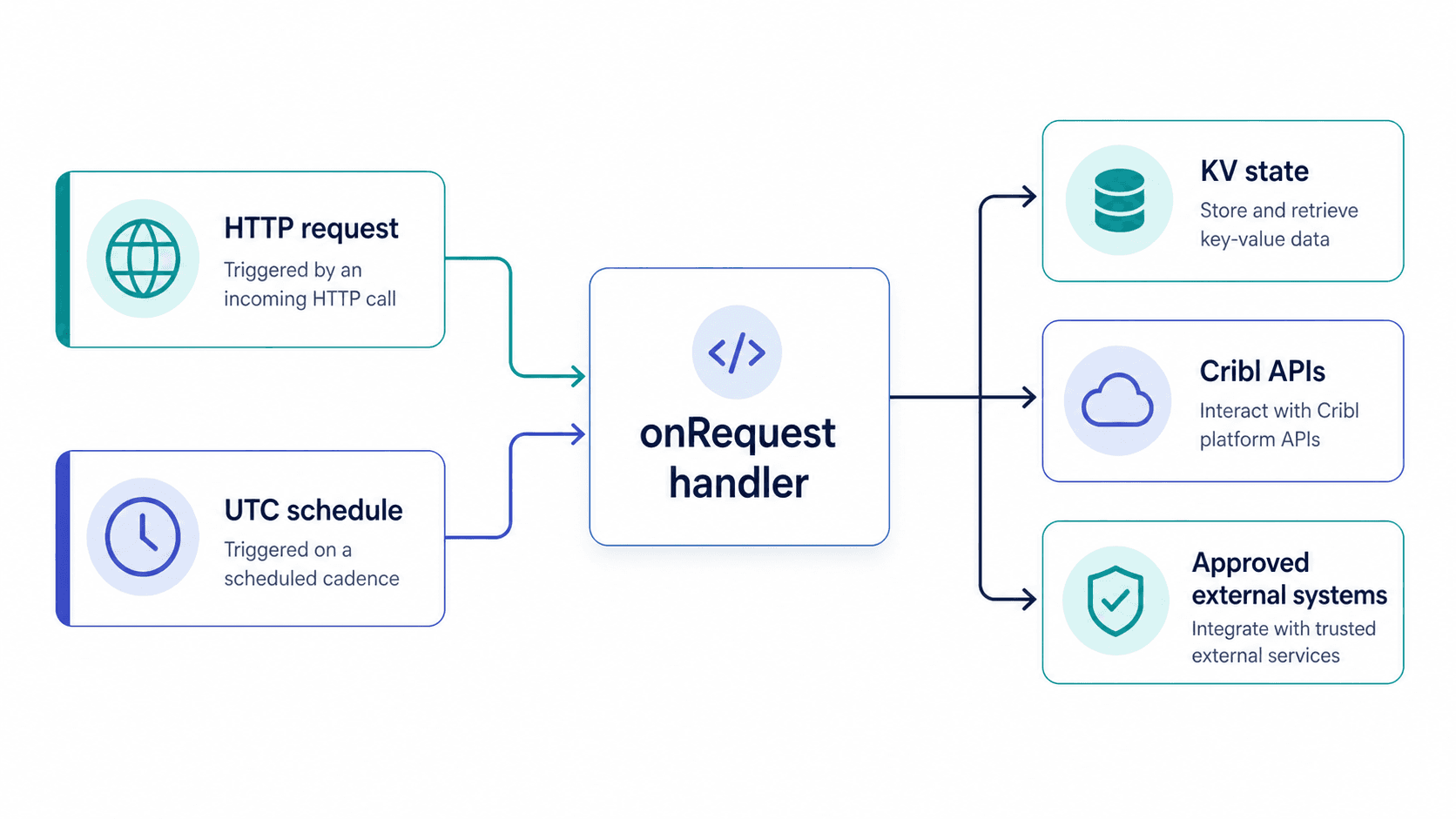
Backend functions in Cribl Appsnew75how completely this was documenteddepth30/40specificity25/30actionability20/3075 / 100
Adds an onRequest handler model to Cribl Apps, letting developers expose app-specific HTTP endpoints that run server-side logic without a user session active.︀︄︇︀︅︉︀︅︀︀︃︀︀︅︅︀︅︊︀︄︆︀︃︄ Also adds scheduled function support, enabling recurring background jobs such as periodically pulling from a threat feed, updating a Stream lookup table, and making the latest entries available to a pipeline for enrichment.︀︄︇︀︅︉︀︅︀︀︃︀︀︅︅︀︅︊︀︄︆︀︃︄
— Names the onRequest handler and gives concrete job examples, no exact syntax.2026-09-17-ffa9e715
0200
AWS Cloud Connections source recommendationsnew60how completely this was documenteddepth25/40specificity20/30actionability15/3060 / 100
Adds AWS Cloud Connections recommendations in Cribl Stream, which suggests a ranked list of AWS log sources to onboard, Source configuration values, and a Destination from those available in the Worker Group.
Cribl this window added backend server-side logic and persistent storage for Cribl Apps, an embedded MCPMCPModel Context Protocol, a standard for connecting AI applications to external tools and data sources. A compatible server exposes capabilities an assistant can use through a common interface. server for AI-client integration with Cribl.Cloud, alert-muting rules in Cribl Insights, and a new Guard Privacy 3.0 model family for sensitive-data detection.︀︄︇︀︅︉︀︅︀︀︃︀︀︅︅︀︅︊︀︄︆︀︃︄︀︄︇︀︅︉︀︅︀︀︃︀︀︅︅︀︅︊︀︄︆︀︃︄
Cribl is built for IT and Security data and provides a unified data management platform for exploring, collecting, processing, and accessing that data at scale.
Cribl this window added backend server-side logic and persistent storage for Cribl Apps, an embedded MCPMCPModel Context Protocol, a standard for connecting AI applications to external tools and data sources. A compatible server exposes capabilities an assistant can use through a common interface. server for AI-client integration with Cribl.Cloud, alert-muting rules in Cribl Insights, and a new Guard Privacy 3.0 model family for sensitive-data detection.︀︄︇︀︅︉︀︅︀︀︃︀︀︅︅︀︅︊︀︄︆︀︃︄︀︄︇︀︅︉︀︅︀︀︃︀︀︅︅︀︅︊︀︄︆︀︃︄
└──▷ WHAT SHIPPED ·
6 FEATURES3 OF 6 FEATURESmost completely described firstwhat's the number?
Each feature carries 0–100 for how completely the vendor documented
it — not how big or important the work is. A major capability
described in eight words scores low, and that is the finding.
depth0–40what it does and how it works or what changed
specificity0–30names real surfaces — APIs, flags, formats, limits, numbers
actionability0–30enough to go use it — a named endpoint, flag, or config key tops this; a UI path is a starting point
Code and config rank first by construction: a documented endpoint,
flag or config key scores at the top of specificity and actionability,
so it sorts above a feature described only in prose. Under
60 the notes go thin — everything below the “thinner
coverage” line is thinner documentation, not smaller work.
Hover any meter for that feature's three sub-scores.
0101
Embedded MCP server in Cribl.Cloudnew75how completely this was documenteddepth30/40specificity25/30actionability20/3075 / 100
An embedded MCP server lets external MCP clients (such as Cursor, Claude Code, or Codex) connect to a Cribl environment and interact with Sources, Destinations, Pipelines, metrics, and Search Notebooks through natural language.︀︄︇︀︅︉︀︅︀︀︃︀︀︅︅︀︅︊︀︄︆︀︃︄ An admin enables it and copies a Bearer tokenBearer tokenA credential that grants access to whoever presents it, without a separate proof of possession. Protecting the token matters because a stolen copy can be used by someone else. from Settings > Global > Information.︀︄︇︀︅︉︀︅︀︀︃︀︀︅︅︀︅︊︀︄︆︀︃︄
— Names UI path, token flow, and supported clients precisely.2026-09-17-f002e365
thinner coverage below
0200
Muting Rules for Cribl Insights alertsnew55how completely this was documenteddepth20/40specificity15/30actionability20/3055 / 100
Muting Rules in Cribl Insights allow teams to suppress outbound notifications for matching alerts during a configured time window, created by navigating to Muting Rules and specifying match criteria and a time window.
Suppress noisy alert notifications during a maintenance window by creating a Muting Rule in Cribl Insights.
📍In Cribl Insights, navigate to Muting Rules and create a new rule specifying the matching alert criteria and the time window during which outbound notifications should be suppressed.
— Clear UI steps to create a rule, but no API/config key named.2026-09-17-f002e365
0302
Cribl Guard Privacy 3.0 model familynew55how completely this was documenteddepth25/40specificity20/30actionability10/3055 / 100
Cribl Guard adds the Privacy 3.0 model family for background sensitive-data detection, introducing per-entity detection thresholds and a new Pro model alongside the existing Fast and Base models.
Allowed-hosts and SSRF protections in Cribl Appsnew55how completely this was documenteddepth20/40specificity20/30actionability15/3055 / 100
Cribl Apps enforces a declared allowed-hosts list at the project root for outbound access, with SSRFSSRFServer-side request forgery, an attack that tricks a server into making requests chosen by an attacker. Those requests can reach internal services the attacker cannot access directly. protections applied; administrators can authorize additional hosts after install.
— Names the config surface and admin action, no exact file path.2026-09-17-f002e365
0503
Backend functions for Cribl Appsnew50how completely this was documenteddepth25/40specificity15/30actionability10/3050 / 100
Cribl Apps now supports backend functions — server-side logic declared in an App that Cribl deploys and runs alongside it, enabling scheduled work and other operations that should not run in the browser.
— Explains mechanism but no concrete config or command given.2026-09-17-f002e365
0600
KV store for Cribl Appsnew40how completely this was documenteddepth15/40specificity15/30actionability10/3040 / 100
Cribl Apps now supports a KV store accessible to App code and backend functions for persistent key-value storage within an App.
Huntress shipped new macOS threat detections for Gatekeeper bypass techniques, extended endpoint visibility to macOS with last-logged-in-user tracking, and added granular scan controls to Managed Antivirus.︀︄︇︀︅︉︀︅︀︀︃︀︀︅︅︀︅︊︀︄︆︀︃︄︀︄︇︀︅︉︀︅︀︀︃︀︀︅︅︀︅︊︀︄︆︀︃︄
Give feedback to the Huntress team so we can make more informed product decisions. Powered by Canny.
Huntress shipped new macOS threat detections for Gatekeeper bypass techniques, extended endpoint visibility to macOS with last-logged-in-user tracking, and added granular scan controls to Managed Antivirus.︀︄︇︀︅︉︀︅︀︀︃︀︀︅︅︀︅︊︀︄︆︀︃︄︀︄︇︀︅︉︀︅︀︀︃︀︀︅︅︀︅︊︀︄︆︀︃︄
└──▷ WHAT SHIPPED ·
3 FEATURES0 OF 3 FEATURESmost completely described firstwhat's the number?
Each feature carries 0–100 for how completely the vendor documented
it — not how big or important the work is. A major capability
described in eight words scores low, and that is the finding.
depth0–40what it does and how it works or what changed
specificity0–30names real surfaces — APIs, flags, formats, limits, numbers
actionability0–30enough to go use it — a named endpoint, flag, or config key tops this; a UI path is a starting point
Code and config rank first by construction: a documented endpoint,
flag or config key scores at the top of specificity and actionability,
so it sorts above a feature described only in prose. Under
60 the notes go thin — everything below the “thinner
coverage” line is thinner documentation, not smaller work.
Hover any meter for that feature's three sub-scores.
0100
Network and Archive File Scanning toggles in Managed Antivirusnew75how completely this was documenteddepth25/40specificity25/30actionability25/3075 / 100
Adds two configurable Microsoft Defender scan toggles in Managed Antivirus, both accessible at EDREDREndpoint detection and response, monitoring computers for suspicious behavior and providing investigation and response controls, such as isolating a device. → Managed Antivirus → Defender Configuration → Scans: Network File Scanning (off by default) and Archive File Scanning (on by default, covers ZIP, RAR, and similar formats).︀︄︇︀︅︉︀︅︀︀︃︀︀︅︅︀︅︊︀︄︆︀︃︄︀︄︇︀︅︉︀︅︀︀︃︀︀︅︅︀︅︊︀︄︆︀︃︄
Enable Network File Scanning for endpoints where mapped network drive coverage is required, such as file servers accessed by a small number of endpoints.
📍In the Huntress console, go to EDR → Managed Antivirus → Defender Configuration → Scans, then toggle Network File Scanning on.
Disable Archive File Scanning for high-throughput endpoints where ZIP/RAR scanning overhead is a concern, while keeping all other Defender defaults intact.
📍In the Huntress console, go to EDR → Managed Antivirus → Defender Configuration → Scans, then toggle Archive File Scanning off.
macOS Gatekeeper bypass detection via quarantine strippingnew73how completely this was documenteddepth35/40specificity28/30actionability10/3073 / 100
Adds three detections for macOS Gatekeeper bypass: quarantine attribute removal from files in malware staging folders by a script or shell (the ClickFix and AMOS dropper pattern), quarantine attribute removal from files on mounted disk images (used by fake installers), and a combined sequence of a fake installer mount plus quarantine strip on the same machine within five minutes as a high-confidence pre-execution signal. Detection monitors the underlying system call directly rather than the xattr command, so it fires regardless of whether the attacker uses a shell script or compiled binary, and each alert surfaces the file path, attribute removed, and responsible process. Filters out Apple backup and file-sharing services, which accounted for approximately 99% of noise during testing; requires Agent v0.14.196 or later.
Last logged-in user visible for macOS endpointsimproved60how completely this was documenteddepth25/40specificity20/30actionability15/3060 / 100
Extends the last logged-in user field on the agent overview page to macOS endpoints, previously Windows-only. Shows the most recent interactive console/GUIGUIA graphical user interface, controls such as windows, buttons and menus. It lets people use software visually rather than entering commands. login, excluding system-owned login windows and shutdown records; requires Agent v0.14.196 or later.
During triage or asset review, quickly attribute a macOS host to an individual user without querying the endpoint directly.
📍In the Huntress console, go to the agent overview page for a macOS endpoint and check the Last Logged In User field — visible once the endpoint checks in on Agent v0.14.196 or later.
Check out our full list of release notes, and stay up to date with what
Automox added support for macOS 27 (Golden Gate), verified with Agent 2.6.53.︀︄︇︀︅︉︀︅︀︀︃︀︀︅︅︀︅︊︀︄︆︀︃︄︀︄︇︀︅︉︀︅︀︀︃︀︀︅︅︀︅︊︀︄︆︀︃︄
└──▷ WHAT SHIPPED ·
1 FEATURE0 OF 1 FEATUREmost completely described firstwhat's the number?
Each feature carries 0–100 for how completely the vendor documented
it — not how big or important the work is. A major capability
described in eight words scores low, and that is the finding.
depth0–40what it does and how it works or what changed
specificity0–30names real surfaces — APIs, flags, formats, limits, numbers
actionability0–30enough to go use it — a named endpoint, flag, or config key tops this; a UI path is a starting point
Code and config rank first by construction: a documented endpoint,
flag or config key scores at the top of specificity and actionability,
so it sorts above a feature described only in prose. Under
60 the notes go thin — everything below the “thinner
coverage” line is thinner documentation, not smaller work.
Hover any meter for that feature's three sub-scores.
0100
macOS 27 (Golden Gate) supportnew30how completely this was documenteddepth10/40specificity15/30actionability5/3030 / 100
Automox now supports macOS 27 (Golden Gate), verified with Agent 2.6.53.︀︄︇︀︅︉︀︅︀︀︃︀︀︅︅︀︅︊︀︄︆︀︃︄︀︄︇︀︅︉︀︅︀︀︃︀︀︅︅︀︅︊︀︄︆︀︃︄
Exabeam's Threat Center adds a new API endpoint for retrieving full case lifecycle history and audit events.︀︄︇︀︅︉︀︅︀︀︃︀︀︅︅︀︅︊︀︄︆︀︃︄︀︄︇︀︅︉︀︅︀︀︃︀︀︅︅︀︅︊︀︄︆︀︃︄
Exabeam is a security analytics platform that detects insider threats and advanced cyberattacks through behavioral analysis and machine learning.
Exabeam's Threat Center adds a new API endpoint for retrieving full case lifecycle history and audit events.︀︄︇︀︅︉︀︅︀︀︃︀︀︅︅︀︅︊︀︄︆︀︃︄︀︄︇︀︅︉︀︅︀︀︃︀︀︅︅︀︅︊︀︄︆︀︃︄
└──▷ WHAT SHIPPED ·
1 FEATURE1 OF 1 FEATUREmost completely described firstwhat's the number?
Each feature carries 0–100 for how completely the vendor documented
it — not how big or important the work is. A major capability
described in eight words scores low, and that is the finding.
depth0–40what it does and how it works or what changed
specificity0–30names real surfaces — APIs, flags, formats, limits, numbers
actionability0–30enough to go use it — a named endpoint, flag, or config key tops this; a UI path is a starting point
Code and config rank first by construction: a documented endpoint,
flag or config key scores at the top of specificity and actionability,
so it sorts above a feature described only in prose. Under
60 the notes go thin — everything below the “thinner
coverage” line is thinner documentation, not smaller work.
Hover any meter for that feature's three sub-scores.
0101
Case lifecycle history endpoint in Threat Centernew70how completely this was documenteddepth20/40specificity25/30actionability25/3070 / 100
A new GET API endpoint under Threat Center > Cases > Get case lifecycle history retrieves the comprehensive lifecycle history, stage transitions, and audit events of a case.︀︄︇︀︅︉︀︅︀︀︃︀︀︅︅︀︅︊︀︄︆︀︃︄︀︄︇︀︅︉︀︅︀︀︃︀︀︅︅︀︅︊︀︄︆︀︃︄
ⓘSourcesBlog / feed →4 releases · 2026-09-14 → 2026-09-16Blog ↗RankWhy this ranktop features scored 85/65/65, +10 product media — 81.67How ranking works →
Databricks reached GA on the Unity Gateway API for model and MCPMCPModel Context Protocol, a standard for connecting AI applications to external tools and data sources. A compatible server exposes capabilities an assistant can use through a common interface. service management across TerraformTerraformAn open-source infrastructure-as-code tool by HashiCorp that provisions cloud and on-premises resources through declarative configuration files, letting cyber tools automate and version-control their deployment environments., CLI and four language SDKs, and previewed upcoming changes including automatic change data feedchange data feedA stream of records describing every insert, update, and delete that occurs in a database, captured in real time so downstream systems can react to changes without polling., compliance-profile JAR tasks on serverless, and a new SQL window function.︀︄︇︀︅︉︀︅︀︀︃︀︀︅︅︀︅︊︀︄︆︀︃︄︀︄︇︀︅︉︀︅︀︀︃︀︀︅︅︀︅︊︀︄︆︀︃︄
Databricks is a unified analytics platform for data engineering, data science, and machine learning built on Apache Spark.
Databricks reached GA on the Unity Gateway API for model and MCPMCPModel Context Protocol, a standard for connecting AI applications to external tools and data sources. A compatible server exposes capabilities an assistant can use through a common interface. service management across TerraformTerraformAn open-source infrastructure-as-code tool by HashiCorp that provisions cloud and on-premises resources through declarative configuration files, letting cyber tools automate and version-control their deployment environments., CLI and four language SDKs, and previewed upcoming changes including automatic change data feedchange data feedA stream of records describing every insert, update, and delete that occurs in a database, captured in real time so downstream systems can react to changes without polling., compliance-profile JAR tasks on serverless, and a new SQL window function.︀︄︇︀︅︉︀︅︀︀︃︀︀︅︅︀︅︊︀︄︆︀︃︄︀︄︇︀︅︉︀︅︀︀︃︀︀︅︅︀︅︊︀︄︆︀︃︄
└──▷ WHAT SHIPPED ·
4 FEATURES1 OF 4 FEATURESmost completely described firstwhat's the number?
Each feature carries 0–100 for how completely the vendor documented
it — not how big or important the work is. A major capability
described in eight words scores low, and that is the finding.
depth0–40what it does and how it works or what changed
specificity0–30names real surfaces — APIs, flags, formats, limits, numbers
actionability0–30enough to go use it — a named endpoint, flag, or config key tops this; a UI path is a starting point
Code and config rank first by construction: a documented endpoint,
flag or config key scores at the top of specificity and actionability,
so it sorts above a feature described only in prose. Under
60 the notes go thin — everything below the “thinner
coverage” line is thinner documentation, not smaller work.
Hover any meter for that feature's three sub-scores.
0101
Unity Gateway API and developer tools GAnew85how completely this was documenteddepth30/40specificity30/30actionability25/3085 / 100
The Unity Gateway API for managing model services, model-provider services, and MCP services is now generally available with full create, read, update, list, and delete support.︀︄︇︀︅︉︀︅︀︀︃︀︀︅︅︀︅︊︀︄︆︀︃︄ It can be managed via Terraform provider 1.132.0+, Databricks CLI v1.17.0+ (including Declarative Automation Bundles support in Beta), Python SDK databricks-sdk 0.136.0+, Go SDK databricks-sdk-go v0.178.0+, Java SDK databricks-sdk-java 0.153.0+, and JavaScript SDK @databricks/sdk-aigateway 0.19.0+.︀︄︇︀︅︉︀︅︀︀︃︀︀︅︅︀︅︊︀︄︆︀︃︄
Automatic Change Data Feed coming to all regionsnew65how completely this was documenteddepth30/40specificity20/30actionability15/3065 / 100
Automatic Change Data Feed (Auto CDF) will compute row-level changes at query time using row tracking, eliminating the need to enable change data feed on each individual Delta Lake or Apache IcebergApache IcebergAn open table format for large analytic datasets, maintained by the Apache Software Foundation, that gives cyber tools reliable schema evolution, time-travel queries, and atomic commits on object storage or HDFS. v3 table. It requires Databricks Runtime 19 or above with row tracking enabled on the table, and is rolling out through October 2026.
counter_diff SQL window functionnew65how completely this was documenteddepth25/40specificity25/30actionability15/3065 / 100
Adds the counter_diff analytic window function to Databricks SQL and Databricks Runtime 19+, calculating differences between consecutive cumulative counter values and handling counter resets in time-series analysis.
JAR tasks on serverless for compliance security profilenew45how completely this was documenteddepth20/40specificity15/30actionability10/3045 / 100
JAR tasks (Java or Scala Spark code) in Lakeflow Jobs will soon run on serverless compute for workspaces with the compliance security profile enabled, removing the need to provision or manage clusters.
Hudson Rock is a cybersecurity threat intelligence platform that detects compromised credentials and leaked data across the internet.
Hudson Rock's Cavalier API gains a Supply Chain Risks view for third-party infostealer exposure, company and account management with a company search endpoint, and six new search endpoints and fields covering term, PC-name, advanced, subdomain and directory-tree queries.︀︄︇︀︅︉︀︅︀︀︃︀︀︅︅︀︅︊︀︄︆︀︃︄
└──▷ WHAT SHIPPED ·
3 FEATURES1 OF 3 FEATURESmost completely described firstwhat's the number?
Each feature carries 0–100 for how completely the vendor documented
it — not how big or important the work is. A major capability
described in eight words scores low, and that is the finding.
depth0–40what it does and how it works or what changed
specificity0–30names real surfaces — APIs, flags, formats, limits, numbers
actionability0–30enough to go use it — a named endpoint, flag, or config key tops this; a UI path is a starting point
Code and config rank first by construction: a documented endpoint,
flag or config key scores at the top of specificity and actionability,
so it sorts above a feature described only in prose. Under
60 the notes go thin — everything below the “thinner
coverage” line is thinner documentation, not smaller work.
Hover any meter for that feature's three sub-scores.
0100
New search endpoints and fields in Cavalier APInew75how completely this was documenteddepth30/40specificity30/30actionability15/3075 / 100
Adds six new search capabilities to the Cavalier API: a Search by Term endpoint for free-text querying across infostealer records, a Search by PC Name endpoint to look up infostealer-compromised machines by hostname, an Advanced Search endpoint for compound, multi-criteria infostealer queries, a Search Data Field extending query filtering options across existing search surfaces, a Subdomain Filtering feature to scope company and domain searches to specific subdomains, and a Directory Tree field exposing filesystem path data from infostealer-collected machine telemetry.︀︄︇︀︅︉︀︅︀︀︃︀︀︅︅︀︅︊︀︄︆︀︃︄
— Six named surfaces but no HTTP methods or paths given.snapshot-20260917
0200
Company and account management and searchnew65how completely this was documenteddepth25/40specificity25/30actionability15/3065 / 100
Adds Company Management functionality for organising and administering monitored companies, an Account Management endpoint for programmatic control of account resources, and a Company Search endpoint for querying companies within the Cavalier dataset.
— Endpoints named but no HTTP method or path given.snapshot-20260917
thinner coverage below
0301
Supply Chain Risks in Cavalier APInew45how completely this was documenteddepth20/40specificity15/30actionability10/3045 / 100
Adds a Supply Chain Risks capability that surfaces infostealer exposure across third-party vendor relationships.
— Describes purpose but names no endpoint or method.snapshot-20260917
ⓘSourcesRelease notes →1 release · 2026-09-17Notes ↗RankWhy this ranktop features scored 95/90/65, +15 breaking change, +10 product media, +6 runnable example — 114.33How ranking works →
MISP (core software) - Open Source Threat Intelligence and Sharing Platform
MISP v2.5.47 introduces an AI-assisted analysis integration, native PostgreSQL support, and a new ledger-based database migration system, alongside detection-rule sharing objects, Overmind UI filtering improvements, and updated threat-intel galaxies.︀︄︇︀︅︉︀︅︀︀︃︀︀︅︅︀︅︊︀︄︆︀︃︄
└──▷ WHAT SHIPPED ·
9 FEATURES2 OF 9 FEATURESmost completely described firstwhat's the number?
Each feature carries 0–100 for how completely the vendor documented
it — not how big or important the work is. A major capability
described in eight words scores low, and that is the finding.
depth0–40what it does and how it works or what changed
specificity0–30names real surfaces — APIs, flags, formats, limits, numbers
actionability0–30enough to go use it — a named endpoint, flag, or config key tops this; a UI path is a starting point
Code and config rank first by construction: a documented endpoint,
flag or config key scores at the top of specificity and actionability,
so it sorts above a feature described only in prose. Under
60 the notes go thin — everything below the “thinner
coverage” line is thinner documentation, not smaller work.
Hover any meter for that feature's three sub-scores.
0101
Ledger-based database migration systembreaking95how completely this was documenteddepth35/40specificity30/30actionability30/3095 / 100
Migrates database schema management from a single db_version integer to a schema_migrations ledger under app/Lib/Migration/Migrations/, with pending and failed migrations exposed as migrations_pending and migrations_failed fields in the diagnostic payload.︀︄︇︀︅︉︀︅︀︀︃︀︀︅︅︀︅︊︀︄︆︀︃︄ Adds cake Admin migrationStatus, cake Admin migrationApply (with --dry-run to preview SQL), and cake Admin migrationCreate console commands. Fleet monitoring that alerted on actual_db_version differing from expected_db_version must move to the new fields since db_version is now frozen at 159; runUpdates (and site-admin login) now stops on the first migration failure instead of continuing.
Check which database migrations are pending or failed before or after an upgrade, to verify schema state across a fleet.
$ cake Admin migrationStatus
Preview the exact SQL a pending migration will execute without applying it, useful for change-control review before touching production.
$ cake Admin migrationApply --dry-run
— Runnable commands, named fields, and explicit breaking behaviour.v2.5.47
0200
AI-assisted analysis integrationnew90how completely this was documenteddepth35/40specificity30/30actionability25/3090 / 100
Adds Plugin.AI_* settings under a new AI tab in server settings, gated by the new perm_ai_tools role permission, to configure an AI-assisted analysis integration via the ai_connector misp-module. Supports four actions — summarise event, summarise report, recommend tags, and extract indicators — with all AI-derived content tagged with ai-computer-assistedprovenanceprovenanceEvidence recording where a software artifact came from and how it was built, including its source and build process. It helps a consumer check that the artifact matches a trusted build. tags; adds two workflow action modules, Summarise report with AI and Extract indicators with AI, and documents the integration contract in docs/dev/ai_integration.md, including a fake module server for testing without an LLMLLMA large language model, a neural network trained on large amounts of text to recognize patterns and generate language. Applications use it for tasks such as answering, summarizing and writing code.. This replaces the earlier CTIInfoExtractor endpoint and its settings, which are removed.
Enable AI-assisted analysis for analysts by configuring the LLM endpoint and granting the required role permission via the AI tab in server settings.
📍In MISP, go to Administration › Server Settings & Maintenance › AI, set the Plugin.AI_* values for your LLM endpoint and model, then use the Test LLM button to verify connectivity. Grant the perm_ai_tools permission to the relevant roles under Administration › Roles.
— Names settings, permission, actions, and replaced endpoint with setup steps.v2.5.47
0300
PostgreSQL 16 install supportnew65how completely this was documenteddepth20/40specificity25/30actionability20/3065 / 100
Adds INSTALL/POSTGRESQL.sql and a PostgresObserverExtended datasource to support fresh installs on PostgreSQL 16, with install steps documented in docs/CONFIG.postgresql.md.
— Names install script, datasource, and docs path.v2.5.47
0400
Overmind UI filtering and editing improvementsimproved65how completely this was documenteddepth25/40specificity25/30actionability15/3065 / 100
Adds a new More filters expandable section to the users, servers, organisations, workflows, logs, galaxy clusters, collections, and event attribute indexes in Overmind. Adds a collection card and *add to collection* action to the event view, a JSON field component used by the decaying model modal, an add button on the event reports tab, and an improved markdown editor for event report previews.
— Names each UI surface but only general navigation.v2.5.47
thinner coverage below
0500
Detection rule sharing objectsnew55how completely this was documenteddepth15/40specificity25/30actionability15/3055 / 100
Adds elastic-detection-rule, kql-analytics-rule, kunai-rule, and splunk-rule MISP objects for detection rule sharing.
— Names four new object types but no usage example.v2.5.47
0600
Threat intel galaxy updatesimproved55how completely this was documenteddepth20/40specificity25/30actionability10/3055 / 100
Adds a new MITRE ATLASMITRE ATLASA MITRE-maintained knowledge base of adversarial tactics and techniques targeting AI and machine learning systems, modelled on ATT&CK, giving cyber tools a structured taxonomy for AI-specific threat modelling. Case Study galaxy and updates MITREMITREA US federally funded research and development center that maintains public frameworks—ATT&CK, CVE, D3FEND—that cyber tools use to classify threats, vulnerabilities, and defensive techniques in a common language. ATLAS to the 2026.08 release, adds MITRE D3FEND techniques and relations, and moves the MITRE Fraud Framework (F3) to version 1.1 with relationships in misp-galaxy.
— Names specific galaxy versions but no usage steps.v2.5.47
0702
Case-insensitive tag name deduplicationbreaking55how completely this was documenteddepth25/40specificity20/30actionability10/3055 / 100
Tag names that collide under a new case-insensitive collation on tags.name are merged into the oldest tag, with every reference repointed; instances with such collisions will have tags merged automatically on upgrade.
— Explains mechanism and upgrade impact, no manual action needed.v2.5.47
0800
New default feeds: TweetFeed and Threatbasenew35how completely this was documenteddepth10/40specificity15/30actionability10/3035 / 100
Adds TweetFeed and several Threatbase feeds to the default MISP feed list.
— Names feed sources but no count or config detail.v2.5.47
0900
Phar stream wrapper hardeningimproved35how completely this was documenteddepth15/40specificity15/30actionability5/3035 / 100
Unregisters the phar stream wrapper in both entry points as a defence-in-depth hardening measure.
— Names mechanism but no further operational detail.v2.5.47
└──▷ BREAKING ON UPGRADE
!
Fleet monitoring that alerted on actual_db_version differing from expected_db_version must move to the new migrations_pending and migrations_failed diagnostic fields; the version pair can no longer diverge as the db_version counter is frozen at 159.
!
runUpdates (and site-admin login) now stops on the first migration failure instead of marking the failure as done and continuing.
!
The earlier CTIInfoExtractor endpoint and its settings are removed and replaced by the new Plugin.AI_* AI integration.
!
Tag names that collide under the new case-insensitive collation on tags.name are merged into the oldest tag, with every reference repointed — instances with such collisions will have tags merged automatically on upgrade.
Brinqa 12.3.295 introduces Vulnerability Deduplication (ExploitIQ) to consolidate duplicate findings into unified Intelligent Vulnerabilities, a no-code SmartFlows automation builder, an expanded public API with matching MCPMCPModel Context Protocol, a standard for connecting AI applications to external tools and data sources. A compatible server exposes capabilities an assistant can use through a common interface. tools, and scheduled PDF dashboard reporting, alongside BQL query enhancements, connector schema-change review, and a redesigned sidebar.︀︄︇︀︅︉︀︅︀︀︃︀︀︅︅︀︅︊︀︄︆︀︃︄︀︄︇︀︅︉︀︅︀︀︃︀︀︅︅︀︅︊︀︄︆︀︃︄
Brinqa is a risk and security analytics platform that aggregates and correlates security data to prioritize vulnerabilities and threats.
Brinqa 12.3.295 introduces Vulnerability Deduplication (ExploitIQ) to consolidate duplicate findings into unified Intelligent Vulnerabilities, a no-code SmartFlows automation builder, an expanded public API with matching MCPMCPModel Context Protocol, a standard for connecting AI applications to external tools and data sources. A compatible server exposes capabilities an assistant can use through a common interface. tools, and scheduled PDF dashboard reporting, alongside BQL query enhancements, connector schema-change review, and a redesigned sidebar.︀︄︇︀︅︉︀︅︀︀︃︀︀︅︅︀︅︊︀︄︆︀︃︄︀︄︇︀︅︉︀︅︀︀︃︀︀︅︅︀︅︊︀︄︆︀︃︄
└──▷ WHAT SHIPPED ·
9 FEATURES1 OF 9 FEATURESmost completely described firstwhat's the number?
Each feature carries 0–100 for how completely the vendor documented
it — not how big or important the work is. A major capability
described in eight words scores low, and that is the finding.
depth0–40what it does and how it works or what changed
specificity0–30names real surfaces — APIs, flags, formats, limits, numbers
actionability0–30enough to go use it — a named endpoint, flag, or config key tops this; a UI path is a starting point
Code and config rank first by construction: a documented endpoint,
flag or config key scores at the top of specificity and actionability,
so it sorts above a feature described only in prose. Under
60 the notes go thin — everything below the “thinner
coverage” line is thinner documentation, not smaller work.
Hover any meter for that feature's three sub-scores.
0101
Vulnerability Deduplication (ExploitIQ)new90how completely this was documenteddepth35/40specificity30/30actionability25/3090 / 100
Introduces Vulnerability Deduplication (ExploitIQ), which consolidates duplicate vulnerability definitions into a single Intelligent Vulnerability (IV) and Intelligent Vulnerability Definition (IVD) with consolidated evidence and risk scoring.︀︄︇︀︅︉︀︅︀︀︃︀︀︅︅︀︅︊︀︄︆︀︃︄ Adds a deduplication configuration page to turn deduplication on or off, choose participating integration sources, set matching confidence level, and enable or disable individual pipeline steps.︀︄︇︀︅︉︀︅︀︀︃︀︀︅︅︀︅︊︀︄︆︀︃︄ Adds a new Intelligent Vulnerabilities relationship tab on Host, Container, and Container Image detail views. Introduces a system-managed SmartFlow and a dedicated trigger deduplication processing action for orchestrating deduplication after data load, plus in-product progress indicators for IV/IVD generation and operational metrics and a dashboard for the deduplication pipeline.
— Explains mechanism, configuration, UI, and orchestration in detail.12.3.295
0200
BQL query language enhancementsnew78how completely this was documenteddepth25/40specificity28/30actionability25/3078 / 100
Adds a BQL grammar reference endpoint and a debugging option on the BQL API to inspect generated queries; adds UNION ALL support in BQL to combine multiple filter criteria in a single Metric; adds string-literal output columns in BQL, including within unions; and introduces a consolidate-by-BQL action that re-consolidates a selected subset of source records by targeting them with a BQL query.
Use UNION ALL in a BQL Metric to surface critical findings from two separate filter criteria in one query result.
$ SELECT id, title, severity FROM findings WHERE severity = 'CRITICAL'
UNION ALL
SELECT id, title, severity FROM findings WHERE cvssScore >= 9.0
— Names endpoint and syntax with a runnable example query.12.3.295
0300
Scheduled PDF Dashboard Snapshotsnew76how completely this was documenteddepth28/40specificity28/30actionability20/3076 / 100
Introduces Scheduled PDF Dashboard Snapshots: schedule exports as PDFs, target ownership groups, manage a personal My Snapshots inbox with expiration and bulk delete, and deliver via secure link or attachment.
— Names inbox, delivery methods, and lifecycle controls.12.3.295
0400
Public API and MCP tools expansionnew71how completely this was documenteddepth25/40specificity28/30actionability18/3071 / 100
Introduces new public API endpoints and matching MCP tools covering flow execution and history, record comments (create, list, search), dataset writes (single and bulk create/update/delete), button-flow discovery and triggering, and ticket creation from findings. Adds a consolidated Record Comments API supporting read, search, and manage operations, with BQL support for querying comments and traversing them back to their records.
— Lists many endpoint areas but no exact paths given.12.3.295
0500
Connector Schema Change Reviewnew71how completely this was documenteddepth28/40specificity25/30actionability18/3071 / 100
Adds Connector Schema Change Review: select a connector version, review detected schema changes in a diff table, and Review, Ignore, or Resolve each change inline — with user-customized consolidation mappings preserved across upgrades.
— Describes a clear inline review workflow and preservation behavior.12.3.295
0600
SmartFlows no-code automation buildernew68how completely this was documenteddepth25/40specificity28/30actionability15/3068 / 100
Introduces SmartFlows, a visual no-code automation builder supporting webhook and API triggers, filter and action blocks, parallel orchestration, Email/Slack/Microsoft Teams notifications, and dashboard snapshot delivery.
— Names triggers and channels but no build-step walkthrough.12.3.295
thinner coverage below
0700
BrinqaIQ Assistant capability parityimproved54how completely this was documenteddepth22/40specificity22/30actionability10/3054 / 100
Adds BrinqaIQ Assistant multi-turn context, BQL and CVE lookup grounding, automation launch and tracking, and capability parity with the Brinqa MCP tool surface.
— Lists new abilities without a usage example.12.3.295
0800
Reusable Notification Templatesnew52how completely this was documenteddepth20/40specificity20/30actionability12/3052 / 100
Adds Notification Templates with a merge-fields editor, data-model-aware dynamic variables, and the ability to clone and reuse templates across notification actions.
— Describes editor and variables but no config location.12.3.295
0900
Redesigned sidebar navigationimproved44how completely this was documenteddepth18/40specificity18/30actionability8/3044 / 100
Redesigns the sidebar with collapsed-rail flyouts, collapsible submenu sections that remember their state, expanded multi-theme support, and broad styling improvements.
— Lists UI changes without exact navigation detail.12.3.295
Cisco Duo secures workforce access and defends against advanced identity threats with IAM, phishing-resistant MFA, SSO, passwordless, and device trust.
Cisco Duo Desktop now lets administrators pre-configure the telemetry consent setting org-wide, removing the start-up prompt end users would otherwise see.︀︄︇︀︅︉︀︅︀︀︃︀︀︅︅︀︅︊︀︄︆︀︃︄︀︄︇︀︅︉︀︅︀︀︃︀︀︅︅︀︅︊︀︄︆︀︃︄
└──▷ WHAT SHIPPED ·
1 FEATURE0 OF 1 FEATUREmost completely described firstwhat's the number?
Each feature carries 0–100 for how completely the vendor documented
it — not how big or important the work is. A major capability
described in eight words scores low, and that is the finding.
depth0–40what it does and how it works or what changed
specificity0–30names real surfaces — APIs, flags, formats, limits, numbers
actionability0–30enough to go use it — a named endpoint, flag, or config key tops this; a UI path is a starting point
Code and config rank first by construction: a documented endpoint,
flag or config key scores at the top of specificity and actionability,
so it sorts above a feature described only in prose. Under
60 the notes go thin — everything below the “thinner
coverage” line is thinner documentation, not smaller work.
Hover any meter for that feature's three sub-scores.
0100
Admin-configurable telemetry consent preferencenew55how completely this was documenteddepth25/40specificity15/30actionability15/3055 / 100
A new system-wide administrator preference lets organizations pre-configure the telemetry/error-and-usage-data collection setting for Duo Desktop before deployment.︀︄︇︀︅︉︀︅︀︀︃︀︀︅︅︀︅︊︀︄︆︀︃︄ Admins set this via the app's administrator preference controls to enable or disable data collection, bypassing the start-up consent prompt end users would otherwise see.︀︄︇︀︅︉︀︅︀︀︃︀︀︅︅︀︅︊︀︄︆︀︃︄
When deploying Duo Desktop org-wide, pre-configure the telemetry preference so users are never prompted at start-up.
📍In the Duo Desktop admin configuration, set the telemetry/error-and-usage-data preference system-wide via the app's administrator preference controls to either enable or disable collection before users launch the app.
— Names the setting and admin path but no exact config key or file.snapshot-20260917
DNSFilter's macOS Roaming Client v2.4.6 Beta adds a DNS-over-HTTPSDNS-over-HTTPSA protocol that tunnels DNS queries inside encrypted HTTPS requests, hiding lookups from network observers. Cyber tools use it to evade DNS-based monitoring or filtering. fallback for VPNVPNA virtual private network, an encrypted tunnel between devices or networks. It carries traffic across another network as though the endpoints had a private connection. environments and rolls out an updated certificate bundle including a new root CA.︀︄︇︀︅︉︀︅︀︀︃︀︀︅︅︀︅︊︀︄︆︀︃︄︀︄︇︀︅︉︀︅︀︀︃︀︀︅︅︀︅︊︀︄︆︀︃︄
Give feedback to the DNSFilter team so we can make more informed product decisions. Powered by Canny.
DNSFilter's macOS Roaming Client v2.4.6 Beta adds a DNS-over-HTTPSDNS-over-HTTPSA protocol that tunnels DNS queries inside encrypted HTTPS requests, hiding lookups from network observers. Cyber tools use it to evade DNS-based monitoring or filtering. fallback for VPNVPNA virtual private network, an encrypted tunnel between devices or networks. It carries traffic across another network as though the endpoints had a private connection. environments and rolls out an updated certificate bundle including a new root CA.︀︄︇︀︅︉︀︅︀︀︃︀︀︅︅︀︅︊︀︄︆︀︃︄︀︄︇︀︅︉︀︅︀︀︃︀︀︅︅︀︅︊︀︄︆︀︃︄
└──▷ WHAT SHIPPED ·
0 FEATURES2 FEATURES0 OF 2 FEATURESmost completely described firstwhat's the number?
Each feature carries 0–100 for how completely the vendor documented
it — not how big or important the work is. A major capability
described in eight words scores low, and that is the finding.
depth0–40what it does and how it works or what changed
specificity0–30names real surfaces — APIs, flags, formats, limits, numbers
actionability0–30enough to go use it — a named endpoint, flag, or config key tops this; a UI path is a starting point
Code and config rank first by construction: a documented endpoint,
flag or config key scores at the top of specificity and actionability,
so it sorts above a feature described only in prose. Under
60 the notes go thin — everything below the “thinner
coverage” line is thinner documentation, not smaller work.
Hover any meter for that feature's three sub-scores.
0100
DNS-over-HTTPS fallback over VPNnew75how completely this was documenteddepth25/40specificity25/30actionability25/3075 / 100
An install-time flag ENABLE_DOH_FALLBACK=true maintains DNSFilter enforcement over DNS-over-HTTPSHTTPSHTTP carried over an encrypted TLS connection. It protects traffic in transit and lets a browser verify the server's certificate. when a corporate VPN blocks the DNS-over-TLSDNS-over-TLSA protocol that wraps DNS queries inside a TLS connection on port 853, preventing eavesdroppers from reading or tampering with hostname lookups. Cyber tools use it to keep reconnaissance and C2 traffic from leaking in plaintext. port.︀︄︇︀︅︉︀︅︀︀︃︀︀︅︅︀︅︊︀︄︆︀︃︄︀︄︇︀︅︉︀︅︀︀︃︀︀︅︅︀︅︊︀︄︆︀︃︄
Updated macOS certificate profile with new root CAimproved65how completely this was documenteddepth20/40specificity20/30actionability25/3065 / 100
Updated macOS certificate profiles now bundle all DNSFilter roots — including the new DNSFilter Root CA G1 — in a single push profile, replacing prior installs in place. Deploy via Deployments → Roaming Clients → Beta Channel, re-download the macOS certificate profile, and push it through MDMMDMMobile device management, centrally configuring and managing enrolled devices. Administrators use it to apply settings, distribute applications and enforce device security policies. to replace the existing profile automatically.
Deploy the updated certificate profile (with DNSFilter Root CA G1 included) to managed Macs via MDM to replace the previously installed profile in place.
📍In the dashboard, go to Deployments → Roaming Clients → Beta Channel, re-download the macOS certificate profile, and push it through your MDM — it replaces the existing profile automatically.
BeyondTrust's Endpoint Credential Manager 1.6.2609 adds four new appSettings keys covering certificate validation, credential result limits, and plugin debugging, and documents every key ECM reads in Example.config.︀︄︇︀︅︉︀︅︀︀︃︀︀︅︅︀︅︊︀︄︆︀︃︄︀︄︇︀︅︉︀︅︀︀︃︀︀︅︅︀︅︊︀︄︆︀︃︄
BeyondTrust provides privileged access management and endpoint security solutions to control, monitor, and audit user access to critical systems.
BeyondTrust's Endpoint Credential Manager 1.6.2609 adds four new appSettings keys covering certificate validation, credential result limits, and plugin debugging, and documents every key ECM reads in Example.config.︀︄︇︀︅︉︀︅︀︀︃︀︀︅︅︀︅︊︀︄︆︀︃︄︀︄︇︀︅︉︀︅︀︀︃︀︀︅︅︀︅︊︀︄︆︀︃︄
└──▷ WHAT SHIPPED ·
5 FEATURES0 OF 5 FEATURESmost completely described firstwhat's the number?
Each feature carries 0–100 for how completely the vendor documented
it — not how big or important the work is. A major capability
described in eight words scores low, and that is the finding.
depth0–40what it does and how it works or what changed
specificity0–30names real surfaces — APIs, flags, formats, limits, numbers
actionability0–30enough to go use it — a named endpoint, flag, or config key tops this; a UI path is a starting point
Code and config rank first by construction: a documented endpoint,
flag or config key scores at the top of specificity and actionability,
so it sorts above a feature described only in prose. Under
60 the notes go thin — everything below the “thinner
coverage” line is thinner documentation, not smaller work.
Hover any meter for that feature's three sub-scores.
0100
Certificate revocation validation settingnew80how completely this was documenteddepth30/40specificity20/30actionability30/3080 / 100
Adds requireCertificateRevocationCheck appSettings key (default false) to reject certificates whose revocation status cannot be determined, intended for hosts without a reachable CRLCRLA Certificate Revocation List is a signed file, published by a certificate authority, listing certificates it has revoked before expiry so that clients can reject compromised or mis-issued credentials without contacting the CA live. or OCSPOCSPA protocol for checking whether a TLS certificate has been revoked, defined in RFC 6960, letting clients query a CA's responder in real time instead of downloading full CRL lists. endpoint.︀︄︇︀︅︉︀︅︀︀︃︀︀︅︅︀︅︊︀︄︆︀︃︄︀︄︇︀︅︉︀︅︀︀︃︀︀︅︅︀︅︊︀︄︆︀︃︄
Allow ECM to connect when the appliance certificate is issued by an internal CA (e.g. ADCSADCSActive Directory Certificate Services, Microsoft's PKI role for issuing and managing X.509 certificates inside a Windows domain; cyber tools target it because misconfigurations frequently allow privilege escalation or domain compromise.) that does not publish a CRL — use only until the issuing CA certificate is deployed to the host.
Untrusted appliance certificate acceptance settingnew80how completely this was documenteddepth30/40specificity20/30actionability30/3080 / 100
Adds allowUntrustedApplianceCertificate appSettings key (default false) to accept appliance certificates that do not chain to a trusted root, for hosts where the issuing CA is not yet installed.
Allow ECM to connect when the appliance certificate is issued by an internal CA (e.g. ADCS) that does not publish a CRL — use only until the issuing CA certificate is deployed to the host.
Verbose plugin exception debugging settingnew80how completely this was documenteddepth30/40specificity20/30actionability30/3080 / 100
Adds VerbosePluginExceptions appSettings key to return full plugin exception text to the appliance for field debugging, replacing the default correlation-ID-only response.
Enable full plugin exception detail during a field debugging session to diagnose credential retrieval failures without a rebuild.
Credential result limit overridenew75how completely this was documenteddepth25/40specificity20/30actionability30/3075 / 100
Adds MaxReturnedCredentials appSettings key to override the credential result limit in configuration, raising the ceiling to 750, without requiring a rebuild.
Enable full plugin exception detail during a field debugging session to diagnose credential retrieval failures without a rebuild.
Secure users, AI agents, and more with Auth0, an easy-to-implement, scalable, and adaptable authentication and authorization platform.
Auth0's new B2B Connect Early Access release adds real-time enterprise connection event streaming, automatic IdPIdPA service that authenticates users and supplies identity information to other applications. It is the sign-in authority behind many single sign-on systems.-driven session termination, and the ability to connect directly to Auth0 without an external authorization server.︀︄︇︀︅︉︀︅︀︀︃︀︀︅︅︀︅︊︀︄︆︀︃︄︀︄︇︀︅︉︀︅︀︀︃︀︀︅︅︀︅︊︀︄︆︀︃︄
└──▷ WHAT SHIPPED ·
4 FEATURES3 OF 4 FEATURESmost completely described firstwhat's the number?
Each feature carries 0–100 for how completely the vendor documented
it — not how big or important the work is. A major capability
described in eight words scores low, and that is the finding.
depth0–40what it does and how it works or what changed
specificity0–30names real surfaces — APIs, flags, formats, limits, numbers
actionability0–30enough to go use it — a named endpoint, flag, or config key tops this; a UI path is a starting point
Code and config rank first by construction: a documented endpoint,
flag or config key scores at the top of specificity and actionability,
so it sorts above a feature described only in prose. Under
60 the notes go thin — everything below the “thinner
coverage” line is thinner documentation, not smaller work.
Hover any meter for that feature's three sub-scores.
0101
Enterprise connection event streamingnew76how completely this was documenteddepth30/40specificity28/30actionability18/3076 / 100
Auth0 now streams enterprise connection lifecycle events — connection.created, connection.updated, and connection.deleted — for enterprise connections including Azure AD, ADFS, Google Workspace, Active DirectoryActive DirectoryMicrosoft's directory service for Windows networks that centralises authentication and authorisation; cyber tools target or integrate with it because it controls identity and access across most enterprise environments., LDAPLDAPA protocol for querying and modifying directory services, standardized under RFC 4511, commonly used to look up users, groups, and attributes in corporate identity stores like Active Directory., and Ping, eliminating the need to poll the Management API for connection changes.︀︄︇︀︅︉︀︅︀︀︃︀︀︅︅︀︅︊︀︄︆︀︃︄ Events are delivered as CloudEvents-formatted JSON to a webhook, Amazon EventBridgeEventBridgeAWS's managed event bus service that routes events between cloud services, SaaS apps, and custom code using rules and targets, letting tools react to state changes without polling or managing message infrastructure., or a custom event pipeline.︀︄︇︀︅︉︀︅︀︀︃︀︀︅︅︀︅︊︀︄︆︀︃︄
Automatic session termination on IdP logoutnew38how completely this was documenteddepth20/40specificity10/30actionability8/3038 / 100
Automatically terminates active application sessions when the enterprise IdP ends the corresponding session, keeping app and IdP session state in sync.
Email-domain based SSO resolutionnew13how completely this was documenteddepth8/40specificity5/30actionability0/3013 / 100
B2B Connect Early Access adds email-domain SSOSSOSingle sign-on, using one identity provider to sign in to multiple applications. It reduces separate passwords and centralizes account and access management. resolution, though the release notes give no further detail on how it works.
ⓘSourcesBlog / feed →7 releases · 2026-09-17Blog ↗RankWhy this ranktop features scored 84/80/78, +15 breaking change, +10 product media, +6 runnable example — 111.67How ranking works →
JumpCloud makes it simple to manage Windows, Apple, Linux, and Android devices and to deliver secure access with SSO, MFA, Zero Trust, RADIUS, and more.
JumpCloud's biggest window additions are a new Access Requests approval workflow with webhook notifications, an MCP ServerMCP ServerA process that exposes tools, resources, and prompts over Anthropic's Model Context Protocol, letting an AI agent call external APIs or local services through a standardised interface. capability in AI Gateway with usage dashboards and discovery, and forced SAMLSAMLA standard for passing signed identity assertions between a sign-in provider and an application. It lets a user sign in through their organization's identity provider./OIDCOIDCOpenID Connect, a sign-in protocol built on OAuth 2.0. An application uses identity information from a trusted provider instead of maintaining a separate password for each user. re-authentication support, alongside a wide set of MDMMDMMobile device management, centrally configuring and managing enrolled devices. Administrators use it to apply settings, distribute applications and enforce device security policies., MFA, SaaS Management and Password Manager improvements plus two breaking API and package changes.︀︄︇︀︅︉︀︅︀︀︃︀︀︅︅︀︅︊︀︄︆︀︃︄
└──▷ WHAT SHIPPED ·
20 FEATURES4 OF 20 FEATURESmost completely described firstwhat's the number?
Each feature carries 0–100 for how completely the vendor documented
it — not how big or important the work is. A major capability
described in eight words scores low, and that is the finding.
depth0–40what it does and how it works or what changed
specificity0–30names real surfaces — APIs, flags, formats, limits, numbers
actionability0–30enough to go use it — a named endpoint, flag, or config key tops this; a UI path is a starting point
Code and config rank first by construction: a documented endpoint,
flag or config key scores at the top of specificity and actionability,
so it sorts above a feature described only in prose. Under
60 the notes go thin — everything below the “thinner
coverage” line is thinner documentation, not smaller work.
Hover any meter for that feature's three sub-scores.
0101
User reactivation API endpoint changebreaking84how completely this was documenteddepth28/40specificity28/30actionability28/3084 / 100
The GET api/systemusers/reactivate/{id} endpoint is deprecated and now returns a 404 error; it is replaced by POST https://console.jumpcloud.com/systemusers/reactivate/{id} with an activation_email field in the request body for user reactivation.︀︄︇︀︅︉︀︅︀︀︃︀︀︅︅︀︅︊︀︄︆︀︃︄
Migrate a user-reactivation integration from the deprecated GET endpoint to the required POST endpoint.
Forced re-authentication for SAML and OIDCnew80how completely this was documenteddepth30/40specificity28/30actionability22/3080 / 100
The IdPIdPA service that authenticates users and supplies identity information to other applications. It is the sign-in authority behind many single sign-on systems. now honors ForceAuthn="true" in SAML and prompt=login in OpenID ConnectOpenID ConnectOpenID Connect, a sign-in protocol built on OAuth 2.0. An application uses identity information from a trusted provider instead of maintaining a separate password for each user., triggering fresh credential prompts even during active sessions; a new sso_auth event in Directory Insights logs captures these forced re-authentication events for both SAML and OIDC sessions.
Audit forced re-authentication events in Directory Insights to verify that high-stakes app step-up logins are being recorded for compliance.
📍In the Admin Portal, go to Directory Insights, open the Events filter, and select the sso_auth event type to view all forced re-authentication events.
OAuth client authentication type for agentsnew78how completely this was documenteddepth30/40specificity28/30actionability20/3078 / 100
Adds a client authentication type setting on an agent's Authentication tab, letting admins choose Client secret basic (credentials sent in the authorization header, the default) or Client secret post (credentials sent in the request body) when the agent requests an OAuth token from JumpCloud — matching external platforms such as Amazon Bedrock AgentCore that require a specific credential-delivery method.
Match an external platform's OAuth requirement (e.g., Amazon Bedrock AgentCore) by selecting how the agent sends its client credentials when requesting a token.
📍In the JumpCloud Admin Portal, open the agent's Authentication tab, then under client authentication type select Client secret basic (credentials in authorization header) or Client secret post (credentials in request body) to match the external platform's OAuth configuration.
Register a new AI agent and configure it to use Client secret post authentication to integrate with Amazon Bedrock AgentCore.
📍1. Go to Identity Management › Agents and click + Add.
2. Enter the agent name, owner, and company email on the Details tab.
3. On the Authentication tab, generate OAuth client credentials, then set the client authentication type to Client secret post so credentials are sent in the request body.
MCP Server monitoring and discovery in AI Gatewaynew73how completely this was documenteddepth28/40specificity25/30actionability20/3073 / 100
Introduces an MCP Server capability in AI Gateway. Adds a Dashboard tab with org-wide MCP server usage metrics, tool call volume, error rates, trend charts, and per-server drill-down; MCP servers already running on managed devices can be discovered and connected via Access > AI & SaaS ManagementSaaS ManagementA category of software that tracks, governs, and optimises an organisation's portfolio of SaaS subscriptions, covering spend, access, and licence utilisation from a single control plane. > Applications, checking the MCP Connection column for Discovered status and clicking Add MCP Server.
Discover and connect an MCP server already running on a managed device to AI Gateway without leaving the SaaSSaaSSoftware delivered over the internet and run on the provider's infrastructure, so the buyer pays a subscription instead of installing or operating anything locally. management view.
📍1. Go to Access › AI & SaaS Management › Applications.
2. Find the application and check the MCP Connection column for Discovered.
3. Click the status, review the discovered MCP servers, then click Add MCP Server to connect it to AI Gateway.
Password Manager Linux package migrationbreaking67how completely this was documenteddepth25/40specificity22/30actionability20/3067 / 100
The Password Manager Linux .appimage build is discontinued (unsupported as of April 18, 2024) and replaced by RPM and Debian (Ubuntu x86) packages; existing .appimage users must delete their current build and download the new package from the Password Manager downloads page.
AI Assistant knowledge base uploadsnew65how completely this was documenteddepth25/40specificity28/30actionability12/3065 / 100
AI Assistant supports knowledge base uploads in PDF, TXT, DOCX, and MD formats, up to 10 MB per file and 25 files per org, with source attribution shown in chat responses.
Bulk credential import into Password Vaultnew64how completely this was documenteddepth22/40specificity20/30actionability22/3064 / 100
Password Vault supports bulk import of team credentials from a CSV or Excel file exported from a previous password manager, via the User Portal's Password Vault bulk import option.
Bulk-import team credentials into Password Vault from a previous password manager export to eliminate credential sprawl on day one.
📍1. Log in to the JumpCloud User Portal and open Password Vault from the left navigation.
2. Select the bulk import option and upload a CSV or Excel file containing your credentials.
RSS feeds for release notes and bug fixesnew64how completely this was documenteddepth20/40specificity22/30actionability22/3064 / 100
Adds RSS feed subscriptions from the Release Notes and Bug Fixes page: Subscribe to Support RSS Feed, Subscribe to Release Notes and Bug Fixes RSS Feed, Subscribe to Agent Release Notes RSS Feed, and Subscribe to Bug Fixes RSS Feed.
Subscribe to only JumpCloud product and agent release notes in your RSS reader, filtering out general Help Center noise.
📍1. Go to the JumpCloud Release Notes and Bug Fixes page.
2. Click Subscribe to Release Notes and Bug Fixes RSS Feed.
3. Open your RSS reader and add the provided feed URL to begin receiving product release notes and agent release note updates automatically.
Dynamic device groups by attribute rulesimproved53how completely this was documenteddepth20/40specificity15/30actionability18/3053 / 100
Dynamic Device Groups can be created under Device Groups > New Group by enabling Dynamic and adding a rule (e.g. Attribute Vendor equals a value) so membership updates automatically as matching devices enroll.
Create a dynamic device group that automatically includes all devices from a specific vendor so new endpoints are governed the moment they enroll.
📍In the Admin Portal, go to Device Groups › New Group, enable Dynamic, add a rule where Attribute is Vendor equals your target value, and save — membership updates automatically as devices enroll.
SentinelOne agent deployment via Commandsnew51how completely this was documenteddepth18/40specificity15/30actionability18/3051 / 100
Adds a SentinelOne integration script usable through the existing Linux Commands feature to silently install the SentinelOne agent across a targeted Linux device group.
Run a SentinelOne agent deployment across all Linux devices in an org using the existing Commands feature.
📍In the Admin Portal, go to Device Management › Commands, create a new Linux command using the SentinelOne integration script, and target the desired Linux device group to silently install the SentinelOne agent.
Default password policy grace-period enforcementimproved45how completely this was documenteddepth20/40specificity15/30actionability10/3045 / 100
Default password policy enforcement now brings users into compliance on their next password change rather than immediately, with an optional firm compliance date admins can set.
Windows MDM policies via Configuration Service Providersnew43how completely this was documenteddepth18/40specificity15/30actionability10/3043 / 100
New Windows MDM policy framework built on Configuration Service Providers (CSPs) lets IT admins configure any company policy directly via CSPCSPContent Security Policy: a browser security mechanism, standardized by the W3C, that lets a web server declare which sources of scripts, styles, and other resources a page may load, blocking injection attacks..
Duo Universal Prompt support for MFAimproved41how completely this was documenteddepth18/40specificity15/30actionability8/3041 / 100
Supports Duo Universal Prompt for MFAMFAMulti-factor authentication, requiring proof from different categories, such as a password and a hardware key, to sign in. It reduces reliance on a password alone. ahead of Duo's March 30, 2024 end-of-life for the traditional prompt.
The JumpCloud Password Manager Linux .appimage build is replaced by a Debian (Ubuntu x86) package; existing .appimage users must delete their current build and download the new Debian build from the Password Manager downloads page.
!
The GET api/systemusers/reactivate/{id} endpoint is deprecated and now returns a 404 error; replace all usages with POST https://console.jumpcloud.com/systemusers/reactivate/{id} with activation_email in the request body.
!
Dynamic Groups memberQuery API filter operators $le and $ge are deprecated; replace with $lte and $gte respectively in any API requests using these operators.
!
The .appimage Linux build is no longer supported as of April 18, 2024; users must migrate to the RPM or Debian build.
Passbolt introduced a beta Offline Mode that lets users mark resources for offline access and continue signing in, viewing and autofilling selected credentials when the server is unreachable.︀︄︇︀︅︉︀︅︀︀︃︀︀︅︅︀︅︊︀︄︆︀︃︄
Manage and share passwords securely with Passbolt. Open source, audited and built for teams that need collaboration, compliance and control.
Passbolt introduced a beta Offline Mode that lets users mark resources for offline access and continue signing in, viewing and autofilling selected credentials when the server is unreachable.︀︄︇︀︅︉︀︅︀︀︃︀︀︅︅︀︅︊︀︄︆︀︃︄
└──▷ WHAT SHIPPED ·
1 FEATURE0 OF 1 FEATUREmost completely described firstwhat's the number?
Each feature carries 0–100 for how completely the vendor documented
it — not how big or important the work is. A major capability
described in eight words scores low, and that is the finding.
depth0–40what it does and how it works or what changed
specificity0–30names real surfaces — APIs, flags, formats, limits, numbers
actionability0–30enough to go use it — a named endpoint, flag, or config key tops this; a UI path is a starting point
Code and config rank first by construction: a documented endpoint,
flag or config key scores at the top of specificity and actionability,
so it sorts above a feature described only in prose. Under
60 the notes go thin — everything below the “thinner
coverage” line is thinner documentation, not smaller work.
Hover any meter for that feature's three sub-scores.
0100
Offline Mode (Beta) for server outagesnew55how completely this was documenteddepth25/40specificity15/30actionability15/3055 / 100
Users can mark resources as available offline, then sign in and access those credentials — including read-only access and autofill — when the Passbolt server cannot be reached.︀︄︇︀︅︉︀︅︀︀︃︀︀︅︅︀︅︊︀︄︆︀︃︄
Varonis introduced Data Lifecycle Management, a new capability that automatically finds, prioritizes, and quarantines redundant, obsolete, and trivial (ROT) data across connected data sources to cut storage costs and reduce risk.︀︄︇︀︅︉︀︅︀︀︃︀︀︅︅︀︅︊︀︄︆︀︃︄︀︄︇︀︅︉︀︅︀︀︃︀︀︅︅︀︅︊︀︄︆︀︃︄
The leading data and AI security platform that proactively reduces risk, enforces policies, and stops active threats with our AI-native automation.
Varonis introduced Data Lifecycle Management, a new capability that automatically finds, prioritizes, and quarantines redundant, obsolete, and trivial (ROT) data across connected data sources to cut storage costs and reduce risk.︀︄︇︀︅︉︀︅︀︀︃︀︀︅︅︀︅︊︀︄︆︀︃︄︀︄︇︀︅︉︀︅︀︀︃︀︀︅︅︀︅︊︀︄︆︀︃︄
└──▷ WHAT SHIPPED ·
1 FEATURE1 OF 1 FEATUREmost completely described firstwhat's the number?
Each feature carries 0–100 for how completely the vendor documented
it — not how big or important the work is. A major capability
described in eight words scores low, and that is the finding.
depth0–40what it does and how it works or what changed
specificity0–30names real surfaces — APIs, flags, formats, limits, numbers
actionability0–30enough to go use it — a named endpoint, flag, or config key tops this; a UI path is a starting point
Code and config rank first by construction: a documented endpoint,
flag or config key scores at the top of specificity and actionability,
so it sorts above a feature described only in prose. Under
60 the notes go thin — everything below the “thinner
coverage” line is thinner documentation, not smaller work.
Hover any meter for that feature's three sub-scores.
0101
Data Lifecycle Management for ROT datanew60how completely this was documenteddepth30/40specificity15/30actionability15/3060 / 100
Data Lifecycle Management (DLM) combines data classification, permissions mapping, and activity analysis to automatically identify, prioritize, and quarantine redundant, obsolete, and trivial (ROT) data — stale, duplicate, overexposed, and expired files — across connected data sources.︀︄︇︀︅︉︀︅︀︀︃︀︀︅︅︀︅︊︀︄︆︀︃︄ A ROT dashboard surfaces cost-savings potential and compliance risk areas, lets users drill into any duplicate group to see the original file, where copies live, and which copies are stale, sensitive, or overexposed, and applies configurable, out-of-the-box policies for duplicates, staleness, and retention with fully reversible quarantine.︀︄︇︀︅︉︀︅︀︀︃︀︀︅︅︀︅︊︀︄︆︀︃︄
RegScale is a compliance and security governance platform that automates regulatory assessment, documentation, and continuous monitoring across organizations.
RegScale CLI 6.47.0 adds support for importing JCAM digital identity data covering NIST 800-63NIST 800-63A suite of NIST guidelines defining digital identity assurance levels, covering identity proofing, authentication, and federation. Cyber tools use it to align credential and access controls to a federally recognized risk framework. assurance levels and federation rationale.︀︄︇︀︅︉︀︅︀︀︃︀︀︅︅︀︅︊︀︄︆︀︃︄︀︄︇︀︅︉︀︅︀︀︃︀︀︅︅︀︅︊︀︄︆︀︃︄
└──▷ WHAT SHIPPED ·
1 FEATURE0 OF 1 FEATUREmost completely described firstwhat's the number?
Each feature carries 0–100 for how completely the vendor documented
it — not how big or important the work is. A major capability
described in eight words scores low, and that is the finding.
depth0–40what it does and how it works or what changed
specificity0–30names real surfaces — APIs, flags, formats, limits, numbers
actionability0–30enough to go use it — a named endpoint, flag, or config key tops this; a UI path is a starting point
Code and config rank first by construction: a documented endpoint,
flag or config key scores at the top of specificity and actionability,
so it sorts above a feature described only in prose. Under
60 the notes go thin — everything below the “thinner
coverage” line is thinner documentation, not smaller work.
Hover any meter for that feature's three sub-scores.
0100
JCAM import for NIST 800-63 digital identity datanew57how completely this was documenteddepth25/40specificity22/30actionability10/3057 / 100
The CLI adds JCAM import support for NIST 800-63 digital identity data, including assessed and implemented Identity, Authenticator, and Federation assurance levels, rationale for differences between them, comparability demonstrations, and rationale for not accepting federated identities.︀︄︇︀︅︉︀︅︀︀︃︀︀︅︅︀︅︊︀︄︆︀︃︄︀︄︇︀︅︉︀︅︀︀︃︀︀︅︅︀︅︊︀︄︆︀︃︄
Compyl expanded Azure and ServiceNow evidence collection, added AI-powered answer-mapping to Questionnaire Assist, and sped up several syncs by moving them from full rebuilds to incremental updates.︀︄︇︀︅︉︀︅︀︀︃︀︀︅︅︀︅︊︀︄︆︀︃︄︀︄︇︀︅︉︀︅︀︀︃︀︀︅︅︀︅︊︀︄︆︀︃︄
Compyl is the AI-powered GRC platform that maps one control library to SOC 2, ISO 27001, HIPAA, PCI DSS and 70+ frameworks, so you stay audit-ready year-round.
Compyl expanded Azure and ServiceNow evidence collection, added AI-powered answer-mapping to Questionnaire Assist, and sped up several syncs by moving them from full rebuilds to incremental updates.︀︄︇︀︅︉︀︅︀︀︃︀︀︅︅︀︅︊︀︄︆︀︃︄︀︄︇︀︅︉︀︅︀︀︃︀︀︅︅︀︅︊︀︄︆︀︃︄
└──▷ WHAT SHIPPED ·
6 FEATURES0 OF 6 FEATURESmost completely described firstwhat's the number?
Each feature carries 0–100 for how completely the vendor documented
it — not how big or important the work is. A major capability
described in eight words scores low, and that is the finding.
depth0–40what it does and how it works or what changed
specificity0–30names real surfaces — APIs, flags, formats, limits, numbers
actionability0–30enough to go use it — a named endpoint, flag, or config key tops this; a UI path is a starting point
Code and config rank first by construction: a documented endpoint,
flag or config key scores at the top of specificity and actionability,
so it sorts above a feature described only in prose. Under
60 the notes go thin — everything below the “thinner
coverage” line is thinner documentation, not smaller work.
Hover any meter for that feature's three sub-scores.
0100
AI answer-mapping in Questionnaire Assistnew75how completely this was documenteddepth35/40specificity25/30actionability15/3075 / 100
Adds answer-mapping in Questionnaire Assist so AI-generated answers are matched to configured option sets (Yes/No/N/A or maturity scales) with a confidence score and manual review flag for low-confidence results.︀︄︇︀︅︉︀︅︀︀︃︀︀︅︅︀︅︊︀︄︆︀︃︄︀︄︇︀︅︉︀︅︀︀︃︀︀︅︅︀︅︊︀︄︆︀︃︄
Expanded Azure evidence collection coverageimproved70how completely this was documenteddepth25/40specificity30/30actionability15/3070 / 100
Extends the Azure integration to cover Privileged Identity Management (PIMPIMProtocol Independent Multicast, an IETF routing protocol that distributes IP multicast traffic across networks without depending on a specific unicast routing protocol, letting tools monitor or manipulate multicast group traffic.) role assignments, Entitlement Management access packages, Intune compliance policy status, and backup protected items for automated evidence collection.
— Names four concrete data surfaces, no config detailSep 15th, 2026
0300
Inline creation on Control and Contract recordsnew65how completely this was documenteddepth25/40specificity20/30actionability20/3065 / 100
Adds inline + New buttons on Control records to create Blueprints and Tasks with automatic linking to the parent Control, and extends this inline creation to Contracts for Vendors, Clients, Assets, and Tasks.
— UI path is clear but no deeper mechanism givenSep 15th, 2026
thinner coverage below
0400
ServiceNow Service Catalog data ingestionnew57how completely this was documenteddepth20/40specificity25/30actionability12/3057 / 100
Extends the ServiceNow integration to ingest Service Catalog Request and Requested Item data, including exception requests, approval workflows, and related records.
— Names data types ingested but no config or endpoint specificsSep 15th, 2026
0500
Incremental sync for ServiceNow CMDB and Google Workspace Driveimproved55how completely this was documenteddepth25/40specificity20/30actionability10/3055 / 100
Switches ServiceNow CMDBCMDBA Configuration Management Database: a repository that stores records of IT assets and the relationships between them, giving cyber tools a single authoritative source for infrastructure context. syncs from full-table rebuilds to incremental syncs, dramatically reducing sync time for large inventories, and switches Google Workspace Drive file syncs from full rebuilds to incremental syncs, reducing sync time and API usage for large Drive environments.
— Describes mechanism change but no metrics or config keysSep 15th, 2026
0600
Clearer Permission Groups configuration guidanceimproved30how completely this was documenteddepth10/40specificity10/30actionability10/3030 / 100
Adds clearer guidance on the Permission Groups configuration page explaining how it relates to user access.
— Thin documentation-only update with no specificsSep 15th, 2026
ⓘSourcesRelease page →2 releases · 2026-09-09 → 2026-09-15Notes ↗RankWhy this ranktop features scored 75/55/50, +10 product media, +6 runnable example — 76How ranking works →
Conveyor's two releases focused on Trust Center access request forms and general app navigation, adding product-line visibility to access approvals and a dockable nav panel, redesigned cmd+k, and a renamed Ask ConveyorAI experience.︀︄︇︀︅︉︀︅︀︀︃︀︀︅︅︀︅︊︀︄︆︀︃︄︀︄︇︀︅︉︀︅︀︀︃︀︀︅︅︀︅︊︀︄︆︀︃︄
Conveyor delivers AI for high-stakes customer requests like security reviews, vendor assessments, and requests for proposal (RFP).
Conveyor's two releases focused on Trust Center access request forms and general app navigation, adding product-line visibility to access approvals and a dockable nav panel, redesigned cmd+k, and a renamed Ask ConveyorAI experience.︀︄︇︀︅︉︀︅︀︀︃︀︀︅︅︀︅︊︀︄︆︀︃︄︀︄︇︀︅︉︀︅︀︀︃︀︀︅︅︀︅︊︀︄︆︀︃︄
└──▷ WHAT SHIPPED ·
5 FEATURES0 OF 5 FEATURESmost completely described firstwhat's the number?
Each feature carries 0–100 for how completely the vendor documented
it — not how big or important the work is. A major capability
described in eight words scores low, and that is the finding.
depth0–40what it does and how it works or what changed
specificity0–30names real surfaces — APIs, flags, formats, limits, numbers
actionability0–30enough to go use it — a named endpoint, flag, or config key tops this; a UI path is a starting point
Code and config rank first by construction: a documented endpoint,
flag or config key scores at the top of specificity and actionability,
so it sorts above a feature described only in prose. Under
60 the notes go thin — everything below the “thinner
coverage” line is thinner documentation, not smaller work.
Hover any meter for that feature's three sub-scores.
0100
Trust Center access request form customizationnew75how completely this was documenteddepth28/40specificity22/30actionability25/3075 / 100
The Trust Center access request form now collects product line interest so approvers can see which product a visitor wants before approving; this is enabled via Settings > Trust Center > NDA & Access by turning on Public product lines.︀︄︇︀︅︉︀︅︀︀︃︀︀︅︅︀︅︊︀︄︆︀︃︄ The form's description and placeholder text can also be rewritten to collect custom information from visitors upfront.︀︄︇︀︅︉︀︅︀︀︃︀︀︅︅︀︅︊︀︄︆︀︃︄
When running multiple products, enable product line selection so access request approvers immediately know which product a visitor needs — no follow-up email required.
📍In the Conveyor console, go to Settings › Trust Center › NDA & Access and enable Public product lines to display them on the Access Request Form.
Dockable navigation panelnew55how completely this was documenteddepth20/40specificity10/30actionability25/3055 / 100
Adds a dockable navigation panel that can be pinned in place via a dock icon to reclaim horizontal screen space, instead of the panel collapsing on mouse-out while working.
Dock the navigation panel to give yourself more horizontal workspace when reviewing questionnaires or trust pages.
📍In the Conveyor app, click the pin/dock icon on the left navigation panel to lock it in place, then continue working without it collapsing on mouse-out.
Redesigned cmd+k command paletteimproved50how completely this was documenteddepth25/40specificity15/30actionability10/3050 / 100
cmd+k gets a cleaner layout, a products picker matching the launchpad, and an empty-state guide clarifying when you are querying Ask ConveyorAI versus running a keyword search.
ⓘSourcesBlog / feed →2 releases · 2026-09-16 → 2026-09-17Blog ↗RankWhy this ranktop features scored 85/55/55, +15 breaking change, +6 runnable example — 86How ranking works →
Runlayer's biggest addition this window is DPoPDPoPAn IETF standard that binds an OAuth access token to a specific client's cryptographic key pair, so a stolen token cannot be replayed by an attacker who lacks the matching private key. sender-constrained tokens for agent accounts, alongside Enterprise Grok Bot monitoring, calendar-based LLMLLMA large language model, a neural network trained on large amounts of text to recognize patterns and generate language. Applications use it for tasks such as answering, summarizing and writing code. spend budgets, new ToolGuard threat detection, and new Gmail and Vercel connectors — with two breaking changes to hook behavior.︀︄︇︀︅︉︀︅︀︀︃︀︀︅︅︀︅︊︀︄︆︀︃︄︀︄︇︀︅︉︀︅︀︀︃︀︀︅︅︀︅︊︀︄︆︀︃︄
Runlayer is an MCP gateway that enforces identity-mapped permissions and detects threats across the agents and MCP servers employees use.
Runlayer's biggest addition this window is DPoPDPoPAn IETF standard that binds an OAuth access token to a specific client's cryptographic key pair, so a stolen token cannot be replayed by an attacker who lacks the matching private key. sender-constrained tokens for agent accounts, alongside Enterprise Grok Bot monitoring, calendar-based LLMLLMA large language model, a neural network trained on large amounts of text to recognize patterns and generate language. Applications use it for tasks such as answering, summarizing and writing code. spend budgets, new ToolGuard threat detection, and new Gmail and Vercel connectors — with two breaking changes to hook behavior.︀︄︇︀︅︉︀︅︀︀︃︀︀︅︅︀︅︊︀︄︆︀︃︄︀︄︇︀︅︉︀︅︀︀︃︀︀︅︅︀︅︊︀︄︆︀︃︄
└──▷ WHAT SHIPPED ·
16 FEATURES3 OF 16 FEATURESmost completely described firstwhat's the number?
Each feature carries 0–100 for how completely the vendor documented
it — not how big or important the work is. A major capability
described in eight words scores low, and that is the finding.
depth0–40what it does and how it works or what changed
specificity0–30names real surfaces — APIs, flags, formats, limits, numbers
actionability0–30enough to go use it — a named endpoint, flag, or config key tops this; a UI path is a starting point
Code and config rank first by construction: a documented endpoint,
flag or config key scores at the top of specificity and actionability,
so it sorts above a feature described only in prose. Under
60 the notes go thin — everything below the “thinner
coverage” line is thinner documentation, not smaller work.
Hover any meter for that feature's three sub-scores.
0101
DPoP-bound tokens for agent accountsnew85how completely this was documenteddepth35/40specificity25/30actionability25/3085 / 100
Runlayer adds DPoP (RFC 9449) sender-constrained token binding for agent accounts, tying tokens to a client-held ES256ES256An ECDSA digital signature algorithm using a P-256 elliptic curve and SHA-256 hash, defined in RFC 7518. Cyber tools use it to sign and verify JWTs with smaller keys than RSA while keeping strong integrity guarantees. key so a leaked token cannot be replayed.︀︄︇︀︅︉︀︅︀︀︃︀︀︅︅︀︅︊︀︄︆︀︃︄ Binding happens at issuance and is enforced at the MCPMCPModel Context Protocol, a standard for connecting AI applications to external tools and data sources. A compatible server exposes capabilities an assistant can use through a common interface. proxy via a per-agent require DPoP flag, toggled in the admin UI under Agents > select agent > Settings.︀︄︇︀︅︉︀︅︀︀︃︀︀︅︅︀︅︊︀︄︆︀︃︄
Enforce DPoP-bound tokens for a specific agent to prevent token replay attacks at the MCP proxy.
📍In the Runlayer admin UI, go to Agents › select the agent › Settings, and enable the require DPoP flag. Tokens issued to this agent will be bound to a DPoP key and rejected at the MCP proxy if presented without a valid DPoP proof.
Calendar-based LLM budget windowsnew55how completely this was documenteddepth20/40specificity15/30actionability20/3055 / 100
Adds calendar-based budget windows (e.g. monthly caps) to LLM gateway usage rules, letting admins set a period like monthly with a token or spend cap per agent.
Cap monthly LLM spend per agent to enforce governance budgets that reset on a calendar cycle.
📍In the Runlayer admin UI, go to Agents › select the agent › Usage Rules, add a budget window, and set the period to monthly with your desired token or spend cap.
Zip skill importnew50how completely this was documenteddepth20/40specificity10/30actionability20/3050 / 100
Adds zip skill import, allowing a multi-file skill to be created in one step by importing a single zip file via Skills > Import Skill > Zip import in the admin UI.
Package a multi-file skill and import it in one step rather than uploading files individually.
📍In the Runlayer admin UI, go to Skills › Import Skill, select Zip import, and upload a zip file containing all skill files. Runlayer will create the multi-file skill from the archive.
Monitor-mode hooks fail open on credential rejectionbreaking50how completely this was documenteddepth25/40specificity15/30actionability10/3050 / 100
In monitor mode, hooks now fail open (allow) on credential rejection instead of blocking the editor — workflows that previously relied on monitor-mode hooks to block on rejection will no longer be blocked.
Grok cloud hooks require explicit opt-inbreaking50how completely this was documenteddepth25/40specificity15/30actionability10/3050 / 100
Grok cloud hooks now require explicit opt-in and will no longer activate automatically — existing setups relying on automatic Grok cloud hook enrollment will stop working until opted in.
Per-tool enrollment diff for security settingsnew45how completely this was documenteddepth20/40specificity15/30actionability10/3045 / 100
Adds a per-tool enrollment diff for recommended security-setting enrollment, showing the effective per-tool diff with scan-direction safety checks before applying.
Grok cloud hooks now require explicit opt-in and will no longer activate automatically — existing setups relying on automatic Grok cloud hook enrollment will stop working until opted in.
!
In monitor mode, hooks now fail open (allow) on credential rejection instead of blocking the editor — workflows that previously relied on monitor-mode hooks to block on rejection will no longer be blocked.
Zenity shipped its first Guardian Agent, Blue Agent, to auto-triage findings, alongside a new Boundaries CLI for policy-as-code, OTelOTelAn open standard and set of tools for collecting traces, metrics and logs from applications. It lets services export observability data without tying instrumentation to one monitoring vendor./gen_aigen_aiA shorthand label for generative AI models and APIs; tools use it to tag configuration, telemetry, or plugin namespaces that route requests to LLM backends like OpenAI or Gemini. span ingestion for any custom agentic app via the Evaluate API, and GA coverage for GitHub Copilot, OpenAI Codex, and Microsoft Foundry.︀︄︇︀︅︉︀︅︀︀︃︀︀︅︅︀︅︊︀︄︆︀︃︄︀︄︇︀︅︉︀︅︀︀︃︀︀︅︅︀︅︊︀︄︆︀︃︄
Zenity discovers, secures and governs enterprise AI agents from buildtime to runtime across SaaS, endpoint and cloud.
Zenity shipped its first Guardian Agent, Blue Agent, to auto-triage findings, alongside a new Boundaries CLI for policy-as-code, OTelOTelAn open standard and set of tools for collecting traces, metrics and logs from applications. It lets services export observability data without tying instrumentation to one monitoring vendor./gen_aigen_aiA shorthand label for generative AI models and APIs; tools use it to tag configuration, telemetry, or plugin namespaces that route requests to LLM backends like OpenAI or Gemini. span ingestion for any custom agentic app via the Evaluate API, and GA coverage for GitHub Copilot, OpenAI Codex, and Microsoft Foundry.︀︄︇︀︅︉︀︅︀︀︃︀︀︅︅︀︅︊︀︄︆︀︃︄︀︄︇︀︅︉︀︅︀︀︃︀︀︅︅︀︅︊︀︄︆︀︃︄
└──▷ WHAT SHIPPED ·
10 FEATURES3 OF 10 FEATURESmost completely described firstwhat's the number?
Each feature carries 0–100 for how completely the vendor documented
it — not how big or important the work is. A major capability
described in eight words scores low, and that is the finding.
depth0–40what it does and how it works or what changed
specificity0–30names real surfaces — APIs, flags, formats, limits, numbers
actionability0–30enough to go use it — a named endpoint, flag, or config key tops this; a UI path is a starting point
Code and config rank first by construction: a documented endpoint,
flag or config key scores at the top of specificity and actionability,
so it sorts above a feature described only in prose. Under
60 the notes go thin — everything below the “thinner
coverage” line is thinner documentation, not smaller work.
Hover any meter for that feature's three sub-scores.
0100
Custom Agents integration for OTel and gen_ai spansnew95how completely this was documenteddepth35/40specificity30/30actionability30/3095 / 100
A new Custom Agents integration ingests OpenTelemetryOpenTelemetryAn open standard and set of tools for collecting traces, metrics and logs from applications. It lets services export observability data without tying instrumentation to one monitoring vendor. (OTel) and gen_ai spans for visibility and inline enforcement via the Evaluate API, connecting any agentic application to Zenity without a dedicated connector.︀︄︇︀︅︉︀︅︀︀︃︀︀︅︅︀︅︊︀︄︆︀︃︄ In the portal, teams go to Integrations > Custom Agents, select the OTel or gen_ai span format, and point their collector at the Evaluate API to verify activity before full onboarding.︀︄︇︀︅︉︀︅︀︀︃︀︀︅︅︀︅︊︀︄︆︀︃︄
Connect a homegrown agentic application to Zenity for visibility and inline enforcement the same day, without waiting for a dedicated integration — any app already emitting OTel spans qualifies.
📍In the Zenity portal, go to Integrations › Custom Agents and select your span format (OTel or gen_ai). Follow the step-by-step guide to point your collector at the Evaluate API endpoint, then verify agent activity appears in the portal before committing to full onboarding.
Boundaries CLI for policy-as-codenew75how completely this was documenteddepth30/40specificity25/30actionability20/3075 / 100
A new CLI lets teams manage boundaries, custom taints, and reusable values as version-controlled files, with coding agents like Claude Code and Codex able to author policy directly against Zenity's schema.
System taints classify tool calls by action typenew70how completely this was documenteddepth30/40specificity25/30actionability15/3070 / 100
System taints classify tool calls as read or mutative operations (write, update, delete, execute), enabling Boundaries rules based on what an action does rather than matching command strings or tool names.
Full coverage for Microsoft Foundrynew70how completely this was documenteddepth30/40specificity25/30actionability15/3070 / 100
Zenity adds full coverage for Microsoft Foundry (the rebuilt agent stack that replaced Azure AI Foundry at Ignite 2025), including inventory, graph, runtime activity, and AI detection and response (AIDR) findings.
Blue Agent triages findings automaticallynew65how completely this was documenteddepth30/40specificity25/30actionability10/3065 / 100
Blue Agent, the first Guardian Agent, triages every new finding in suggest mode, returning a verdict (benign true positive, false positive, or true positive) with reasoning, confidence level, and full trace attached.
Audit log streaming and integration guides for Splunk, Sentinel, Cribl, LiteLLM, Kongnew65how completely this was documenteddepth20/40specificity25/30actionability20/3065 / 100
Zenity added near-real-time audit log event streaming to Splunk or Microsoft Sentinel, and published step-by-step integration guides for Cribl, LiteLLM, and Kong to connect agent activity to the Zenity portal.
Boundaries AI assistant drafting and testingimproved60how completely this was documenteddepth25/40specificity15/30actionability20/3060 / 100
The Boundaries AI assistant can now create required custom taints while drafting a rule, and run draft rules against recent production activity on command before applying them.
Prevent and Detect labels on taintsimproved40how completely this was documenteddepth15/40specificity15/30actionability10/3040 / 100
Every taint in the Boundaries manager now carries a Prevent or Detect label, showing at a glance whether a rule blocks in real time or flags after the fact.
A full-stack AI Red Teaming platform securing AI ecosystems via Agent Scan, Skills Scan, MCP scan, AI Infra scan and LLM jailbreak evaluation.
AI-Infra-Guard's v4.6.2 release adds two new red-teaming benchmarks for autonomous agents — FORGE-Bench and RogueHandoff-20 — alongside a routine update to its AIG rules dataset.︀︄︇︀︅︉︀︅︀︀︃︀︀︅︅︀︅︊︀︄︆︀︃︄︀︄︇︀︅︉︀︅︀︀︃︀︀︅︅︀︅︊︀︄︆︀︃︄
└──▷ WHAT SHIPPED ·
3 FEATURES0 OF 3 FEATURESmost completely described firstwhat's the number?
Each feature carries 0–100 for how completely the vendor documented
it — not how big or important the work is. A major capability
described in eight words scores low, and that is the finding.
depth0–40what it does and how it works or what changed
specificity0–30names real surfaces — APIs, flags, formats, limits, numbers
actionability0–30enough to go use it — a named endpoint, flag, or config key tops this; a UI path is a starting point
Code and config rank first by construction: a documented endpoint,
flag or config key scores at the top of specificity and actionability,
so it sorts above a feature described only in prose. Under
60 the notes go thin — everything below the “thinner
coverage” line is thinner documentation, not smaller work.
Hover any meter for that feature's three sub-scores.
0100
FORGE-Bench loss-of-control benchmarknew60how completely this was documenteddepth25/40specificity20/30actionability15/3060 / 100
Adds forge_bench (FORGE-Bench), a deterministic Loss-of-Control benchmark for evaluating autonomous agents, including a built-in OpenAI-compatible client and a bilingual quickstart guide.︀︄︇︀︅︉︀︅︀︀︃︀︀︅︅︀︅︊︀︄︆︀︃︄︀︄︇︀︅︉︀︅︀︀︃︀︀︅︅︀︅︊︀︄︆︀︃︄
— Names benchmark and client but no exact commandsv4.6.2
thinner coverage below
0200
RogueHandoff-20 handoff security benchmarknew40how completely this was documenteddepth15/40specificity15/30actionability10/3040 / 100
Adds the RogueHandoff-20 benchmark under the Research module for evaluating autonomous agent handoff security.
— Names benchmark and module, no usage detailv4.6.2
0300
AIG rules dataset updateimproved20how completely this was documenteddepth5/40specificity10/30actionability5/3020 / 100
Updates the AIG rules dataset to the 2026-09-11 ruleset.
The nono runtime runs AI agents in isolated environments with policy-controlled filesystem, network, and credential access.
nono v0.78.0 adds cryptographically signed, poll-based approval webhooks and a macOS opt-out for implicit DNS grants, while also shipping a prebuilt Nix flakeNix flakeA Nix packaging construct that pins all dependencies in a lockfile and exposes a standardized interface, giving cyber tools fully reproducible builds across any machine running the Nix package manager. output and stripping out all remaining deprecated CLI surfaces ahead of v1.0.0.︀︄︇︀︅︉︀︅︀︀︃︀︀︅︅︀︅︊︀︄︆︀︃︄︀︄︇︀︅︉︀︅︀︀︃︀︀︅︅︀︅︊︀︄︆︀︃︄
└──▷ WHAT SHIPPED ·
3 FEATURES1 OF 3 FEATURESmost completely described firstwhat's the number?
Each feature carries 0–100 for how completely the vendor documented
it — not how big or important the work is. A major capability
described in eight words scores low, and that is the finding.
depth0–40what it does and how it works or what changed
specificity0–30names real surfaces — APIs, flags, formats, limits, numbers
actionability0–30enough to go use it — a named endpoint, flag, or config key tops this; a UI path is a starting point
Code and config rank first by construction: a documented endpoint,
flag or config key scores at the top of specificity and actionability,
so it sorts above a feature described only in prose. Under
60 the notes go thin — everything below the “thinner
coverage” line is thinner documentation, not smaller work.
Hover any meter for that feature's three sub-scores.
0100
macOS DNS opt-out for network modesnew80how completely this was documenteddepth30/40specificity30/30actionability20/3080 / 100
Adds CapabilitySet::block_dns() (and the C-API nono_capability_set_block_dns() / nono_capability_set_dns_enabled()) on macOS to let a profile opt out of the implicit mDNSResponder grants nono previously added when running in Blocked and ProxyOnly network modes.︀︄︇︀︅︉︀︅︀︀︃︀︀︅︅︀︅︊︀︄︆︀︃︄︀︄︇︀︅︉︀︅︀︀︃︀︀︅︅︀︅︊︀︄︆︀︃︄
— Names exact API and C-API functions and affected modes.v0.78.0
0200
Prebuilt Nix flake outputnew80how completely this was documenteddepth25/40specificity25/30actionability30/3080 / 100
Adds a #prebuilt Nix flake output that fetches the official release binary directly from GitHub Releases, skipping source compilation — usable via nix run github:nolabs-ai/nono#prebuilt.
Install nono instantly in a Nix environment without compiling from source — useful in CI or on machines without a Rust toolchain.
Removal of deprecated surfaces ahead of v1.0.0breaking45how completely this was documenteddepth20/40specificity10/30actionability15/3045 / 100
All remaining deprecated CLI surfaces and legacy profile aliases have been removed as part of v1.0.0 preparation; any profile or script relying on them will break on upgrade.
— States impact but no specific removed names listed.v0.78.0
└──▷ BREAKING ON UPGRADE
!
All remaining deprecated CLI surfaces and legacy profile aliases removed — any profile or script relying on them will break on upgrade.
This window's most consequential change is a new install-time authentication requirement for the Guardrails SDK, while Renovate (also shipped under this changelog) gained a release-age buffer config, Dockerfile apk add extraction, expanded Forgejo support, a new template helper, and smarter GitHub merge-queue handling.︀︄︇︀︅︉︀︅︀︀︃︀︀︅︅︀︅︊︀︄︆︀︃︄
Traditional application security misses AI risk. Standalone AI security tools miss your code.
This window's most consequential change is a new install-time authentication requirement for the Guardrails SDK, while Renovate (also shipped under this changelog) gained a release-age buffer config, Dockerfile apk add extraction, expanded Forgejo support, a new template helper, and smarter GitHub merge-queue handling.︀︄︇︀︅︉︀︅︀︀︃︀︀︅︅︀︅︊︀︄︆︀︃︄
└──▷ WHAT SHIPPED ·
6 FEATURES1 OF 6 FEATURESmost completely described firstwhat's the number?
Each feature carries 0–100 for how completely the vendor documented
it — not how big or important the work is. A major capability
described in eight words scores low, and that is the finding.
depth0–40what it does and how it works or what changed
specificity0–30names real surfaces — APIs, flags, formats, limits, numbers
actionability0–30enough to go use it — a named endpoint, flag, or config key tops this; a UI path is a starting point
Code and config rank first by construction: a documented endpoint,
flag or config key scores at the top of specificity and actionability,
so it sorts above a feature described only in prose. Under
60 the notes go thin — everything below the “thinner
coverage” line is thinner documentation, not smaller work.
Hover any meter for that feature's three sub-scores.
0101
Guardrails SDK install now requires Activation Keybreaking70how completely this was documenteddepth30/40specificity20/30actionability20/3070 / 100
The Guardrails SDK installation procedure now requires a Mend Activation Key at download time, in addition to the existing runtime authentication.︀︄︇︀︅︉︀︅︀︀︃︀︀︅︅︀︅︊︀︄︆︀︃︄ Existing installations with unpinned versions that attempt to re-install dependencies will now require this Activation Key during the install step.
— Explains before/after clearly but omits the exact install command(16-September-2026)
0200
Forgejo support expanded across Renovatenew68how completely this was documenteddepth25/40specificity25/30actionability18/3068 / 100
Adds Forgejo preset references (e.g. forgejo>) in manager/renovate-config, detects the forgejo-tags datasource for git-tag sources in manager/terragrunt, and treats Forgejo like Gitea for onboarding-branch rebase and config-hash detection in workers/onboarding.
— Names three modules and config surfaces but no full exampleproduct docs
thinner coverage below
0300
minimumReleaseAgeBuffer config optionnew56how completely this was documenteddepth18/40specificity20/30actionability18/3056 / 100
Adds minimumReleaseAgeBuffer config option to control a buffer window around minimum release age checks.
— Named config key but no default value or usage exampleproduct docs
0400
Dockerfile apk add dependency extractionnew53how completely this was documenteddepth20/40specificity18/30actionability15/3053 / 100
Extracts apk add packages from RUN instructions in Dockerfiles via manager/dockerfile, letting Renovate detect and update these dependencies.
— Names the manager but no config key or example shownproduct docs
0500
uppercase template helpernew42how completely this was documenteddepth15/40specificity15/30actionability12/3042 / 100
Adds an uppercase template helper via util/template for use in Renovate template expressions.
— Names the helper and module but not an example expressionproduct docs
0600
GitHub direct merge before merge queueimproved32how completely this was documenteddepth12/40specificity12/30actionability8/3032 / 100
Attempts a direct merge before falling back to the merge queue on platform/github.
— Brief mechanism note with no configuration detailproduct docs
└──▷ BREAKING ON UPGRADE
!
Existing Guardrails SDK installations with unpinned versions that attempt to re-install dependencies will now require a Mend Activation Key during the install step.
 THE CYBER TOOLCHAIN