Adrian
python-sdk-v1.2.0 open-sourceThe section your link pointed to isn't on Adrian's page any more, so we've brought you to the top.
Adrian is an open-source runtime security engine for AI agents that analyses activity logs and reasoning traces to detect and block malicious or out-of-remit behaviour.
curl -sf http://localhost:8080/readyz && echo 'stack ready'
docker compose --profile setup run --rm setup set-model \
  --gguf gemma-4-E2B-it-Q4_K_M.gguf \
  --ctx-size 16384
docker compose --profile llm up -d
/plugin marketplace add secureagentics/Adrian
/plugin install adrian-cc@adrian
/reload-plugins
/adrian-init
ADRIAN_CC_FAIL_OPEN=false
ADRIAN_API_KEY=adr_live_...
ADRIAN_WS_URL=wss://adrian.secureagentics.ai/ws
ADRIAN_CC_VERDICT_TIMEOUT=15
/adrian-status
import OpenAI from "openai";
import { adrian } from "@secureagentics/adrian-openai";

await adrian.init({
  apiKey: "adr_live_...",
  wsUrl: "wss://adrian.secureagentics.ai/ws"
});
const client = adrian.openai(new OpenAI());
const response = await client.chat.completions.create({
  model: "gpt-4o",
  messages: [{ role: "user", content: "Summarize threat intelligence for Q2" }]
});
await adrian.shutdown();
ADRIAN_API_KEY=adr_live_... \
ADRIAN_WS_URL=wss://adrian.secureagentics.ai/ws \
ADRIAN_SESSION_ID=pentest-run-42 \
ADRIAN_BLOCK_TIMEOUT=15 \
node dist/agent.js
import asyncio
import os
import adrian
import anthropic

async def main():
    adrian.init(
        api_key="adr_live_...",
        ws_url="wss://adrian.secureagentics.ai/ws"
    )
    client = anthropic.AsyncAnthropic(api_key=os.environ["ANTHROPIC_API_KEY"])
    async with adrian.anthropic_invocation():
        first = await client.messages.create(
            model="claude-opus-5", max_tokens=1024,
            messages=[{"role": "user", "content": "Step 1"}]
        )
        second = await client.messages.create(
            model="claude-opus-5", max_tokens=1024,
            messages=[{"role": "user", "content": "Step 2"}]
        )  # same invocation_id as first
    adrian.shutdown()

asyncio.run(main())
import adrian

adrian.init(
    api_key="adr_live_...",
    auto_instrument=False
)
# ... other initialisation ...
adrian.patch_anthropic()  # idempotent; safe to call more than once
import asyncio
import adrian
from langchain_openai import ChatOpenAI

async def main():
    adrian.init(
        api_key="adr_live_...",
        ws_url="wss://adrian.secureagentics.ai/ws",
        block_timeout=10.0,
        on_block=lambda ctx: print(f"BLOCKED: {ctx.mad_code}")
    )
    llm = ChatOpenAI(model="gpt-4o")
    response = await llm.ainvoke("Summarise today's threat intelligence feed.")
    print(response.content)
    adrian.shutdown()

asyncio.run(main())
ADRIAN_API_KEY=adr_live_...
ADRIAN_WS_URL=wss://adrian.secureagentics.ai/ws
ADRIAN_LOG_FILE=/var/log/adrian/events.jsonl
ADRIAN_BLOCK_TIMEOUT=15.0
ADRIAN_REPLAY_BUFFER_FRAMES=2000
ADRIAN_SESSION_ID=prod-agent-42
import adrian
from langchain_openai import ChatOpenAI

adrian.init(
    api_key="adr_live_...",
    ws_url="wss://adrian.secureagentics.ai/ws",
    auto_instrument=False
)
handler = adrian.get_handler()
llm = ChatOpenAI(model="gpt-4o", callbacks=[handler])
import adrian
adrian.init(
    api_key="adr_live_...",
    ws_url="wss://adrian.secureagentics.ai/ws"
)
# Your existing LangChain / LangGraph agent code runs unchanged below this point.
import adrian
adrian.init(
    api_key="adr_live_...",
    ws_url="wss://adrian.secureagentics.ai/ws"
)
# Your existing LangChain / LangGraph agent runs unchanged — every call is captured.
export ADRIAN_WS_URL=wss://adrian.secureagentics.ai/ws
Summary
Adrian is an open-source runtime security layer for AI agents, free to use under an Apache-2.0 licence, that watches an agent's actions and reasoning as it runs and can alert, block, or route decisions to a human reviewer before they execute. It ships as an SDK you wrap around existing code (a few lines around a LangChain or Anthropic-based agent, or a Claude Code plugin via hooks) with events streamed to a hosted or self-hosted dashboard, making it a fit for teams building or securing agentic AI systems rather than traditional application security teams. The README frames it as a runtime counterpart to static analysis and network monitoring, catching prompt-injectionprompt-injectionAn attack where text the model reads, such as a web page, file or tool result, carries instructions that override the user's. It is the main security risk for agents with tools. and out-of-remit behaviour those miss, and includes PIIPIIPersonally Identifiable Information — data that can identify a specific individual, such as names, email addresses, or SSNs. Cyber tools flag or redact it to limit exposure and meet privacy regulations. redaction for agent transcripts. Development is active, with recent releases adding reasoning capture across SDKs and deeper Claude Code integration.
Adrian is an open-source runtime security engine for AI agents that analyses activity logs and reasoning traces to detect and block malicious or out-of-remit behaviour.
How Adrian helps
What is my agent actually doing right now that I haven't reviewed?
streams every tool call, LLM invocation, and reasoning trace to a live event feed as the agent runs, classified with a severity code the moment each action happens
Which of my agent's actions would have run unsupervised before anyone caught a problem?
when a profile is set to block or human review, the matching action is held for a verdict before it executes rather than logged after the fact, so those actions surface instead of completing silently
Is my agent's chain-of-thought hiding an intent its final answer doesn't show?
captures the reasoning or thinking output alongside each LLM call, not just the visible response, so the rationale behind an action is available in the event feed
Is my agent leaking personal or sensitive data through its conversation?
scans agent transcripts for categories like email, phone, SSN, credit card, IP address and AWS keys, and redacts them before the transcript is stored
Did a human reviewer actually approve the action my Claude Code agent just took, or did it proceed on its own?
forwards the approval or denial made on the dashboard back to the Claude Code session inline, so the recorded verdict is the one that determined whether the tool call ran
Which of my agents were only watched versus actually stopped when they hit a problem?
each agent profile carries one of three modes recorded with its events - alert-only, block, or human review - so the event history shows whether a given action was ever capable of being blocked or just observed
Languages
Features
Built from Adrian's releases, docs, README and our own runs. “Seen” marks the month we first spotted a release the vendor didn't date. Group names and tags are our labels.
What Adrian offers you
- Client SDKs1
- Python scripting support1
No capabilities match.
All capabilities 7 capabilities
Claude Code integration shipped Connects Claude Code hooks to the Adrian backend via WebSocket, parsing transcripts and enforcing allow/deny/advisory verdicts in three server-driven modes: alert, block, and human-in-the-loop.
release 7 total
-
Adds reasoning capture to the TypeScript OpenAI SDK integration, reading
delta.reasoning_contentfrom streamed chat completion chunks for OpenAI-compatible servers that surface chain-of-thought in that field. python-sdk-v1.2.0 · Aug 2026 · source · release history -
Extends reasoning capture to new integrations and additional models across both Python and TypeScript SDKs, with support for multiple block layouts:
summarylists (OpenAI Responses / LangChain default), barereasoningstrings (LangChainoutput_version='v1'), and Anthropicthinkingstrings. python-sdk-v1.2.0 · Aug 2026 · source · release history -
New Claude Code plugin (
integrations/claude-code/adrian_cc/agent.py) connects Claude Code hooks to the Adrian backend via WebSocket, supporting three server-driven execution modes:MODE_ALERT(fire-and-forget),MODE_BLOCK(wait for verdict, block on policy), andMODE_HITL(wait for human approval on the…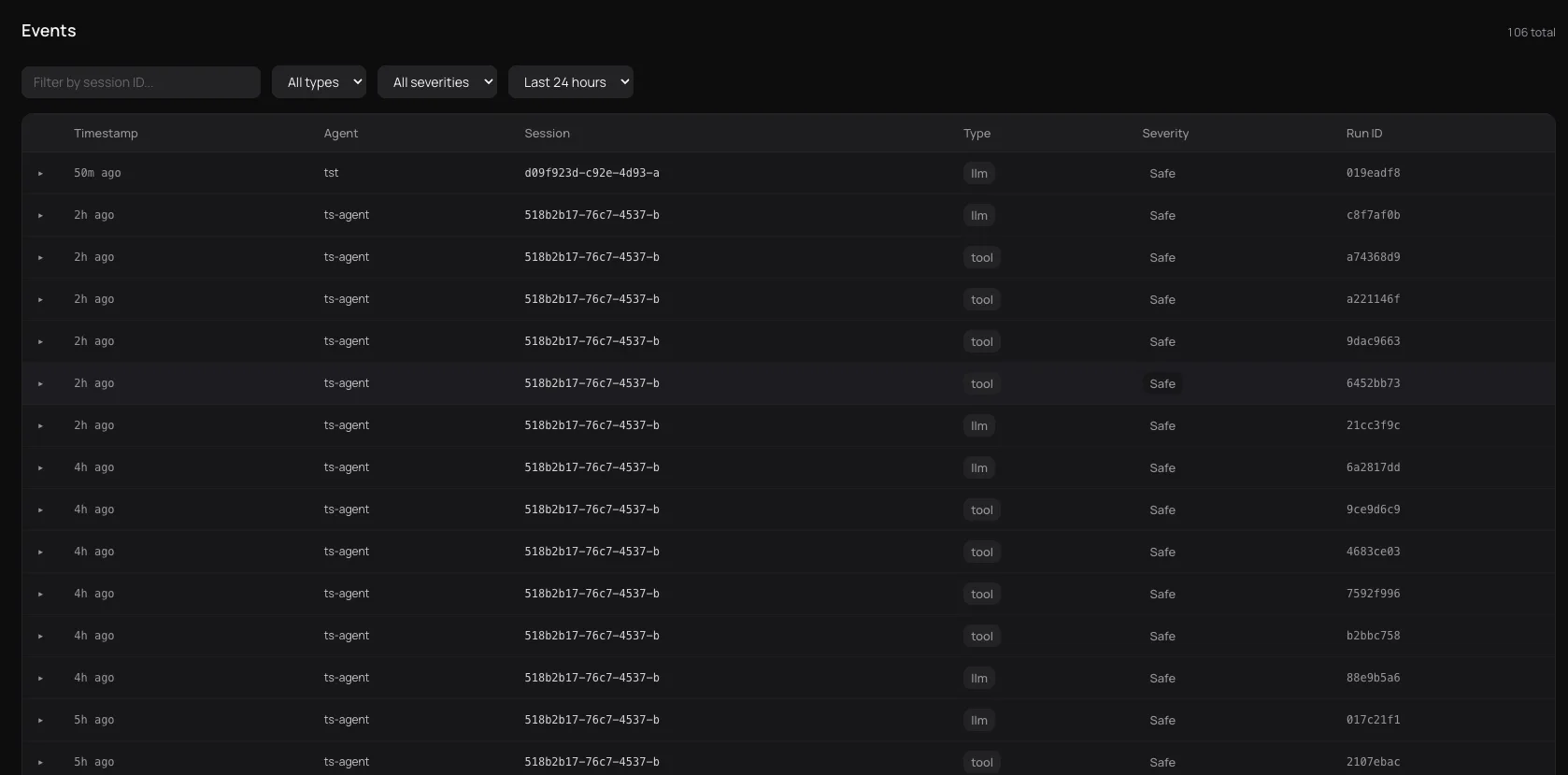 python-sdk-v1.1.0 · Aug 2026
· source
· release history
-
Adds Claude Code plugin (
integrations/claude-code/adrian_cc/agent.py) that connects Claude Code hooks to the Adrian backend via WebSocket, supporting three server-driven execution modes:MODE_ALERT(fire-and-forget),MODE_BLOCK(wait for verdict, block per policy), andMODE_HITL(wait for human approval on the… python-sdk-v1.1.0 · Aug 2026 · source · release history -
New Claude Code plugin (
integrations/claude-code/adrian_cc/agent.py) connects Claude Code hooks directly to the Adrian backend via WebSocket, sendingSessionLogin+PairedEventprotobuf messages and returning allow/deny/advisory verdicts. commits-2026-07-09 · Aug 2026 · source · release history -
Adds a transcript parser (
integrations/claude-code/adrian_cc/transcript.py) that reads Claude Code's JSONL transcript to extract thinking blocks, user prompts, system prompt context, and invocation metadata, with mtime-based caching to avoid re-parsing on every hook call. commits-2026-07-09 · Aug 2026 · source · release history
docs
- The Adrian Claude Code plugin is a runtime security plugin for Claude Code . It hooks every tool call the agent makes, classifies it with the Adrian backend, and enforces the result per your policy - blocking, prompting, or allowing before the tool runs. docs update · Aug 2026 · source
- Runtime security monitoring and control engine for AI agents that analyzes actions and reasoning traces to detect and block malicious or out-of-remit behaviour.
Reasoning capture shipped Captures chain-of-thought and reasoning traces from LLM models across Python and TypeScript SDKs, normalizing various provider-specific layouts into a unified reasoning field.
Also counts toward: Python scripting support, Client SDKs
release
-
Extends reasoning capture to support three provider layouts: a
summarylist of{type: 'summary_text', text: ...}entries (OpenAI Responses / LangChain default), a barereasoningstring (LangChainoutput_version='v1'), and Anthropic'sthinkingstring. python-sdk-v1.2.0 · Aug 2026 · source · release history -
Adds a
reasoningfield to LLM end events in the Python SDK, populated via _extract_reasoning() from LangChainChatGenerationmessages, capturing chain-of-thought output from reasoning models. python-sdk-v1.2.0 · Aug 2026 · source · release history -
Adds reasoning capture to the TypeScript OpenAI SDK integration, collecting
delta.reasoning_contentfrom OpenAI-compatible streaming responses into areasoningstring alongside the existingoutput. python-sdk-v1.2.0 · Aug 2026 · source · release history -
Adds a
reasoningfield to the LLM event payload emitted byon_llm_endinsdk/python/adrian/handler.py, capturing chain-of-thought output from reasoning models via the new _extract_reasoning() helper. python-sdk-v1.2.0 · Aug 2026 · source · release history
Anthropic SDK instrumentation shipped Instruments agents built with the Anthropic Python SDK to send events to the Adrian backend.
release
-
Adds Anthropic SDK integration, enabling Adrian instrumentation for agents built with the Anthropic Python SDK.
python-sdk-v1.1.0 · Aug 2026
· source
· release history
- Adds Anthropic SDK integration, allowing Adrian to instrument Anthropic API calls alongside the existing LangChain/LangGraph support. python-sdk-v1.1.0 · Aug 2026 · source · release history
docs
-
Adrian instruments the Anthropic SDK directly, for agents that call messages.create rather than going through a framework. Every call on both anthropic.Anthropic and
anthropic.AsyncAnthropicis captured as a PairedEvent and streamed to the Adrian backend. Your call sites stay unchanged. docs update · Aug 2026 · source
Event severity classification shipped Assigns severity badges to events based on MAD codes and surfaces the latest verdict metadata in the event list.
release
-
Severity badges now appear in the Events table and mobile cards, based on MAD codes, and the event list API response adds latest verdict metadata while omitting full payload and token fields from list rows.
python-sdk-v1.1.0 · Aug 2026
· source
· release history
- Adds severity badges to the Events table and mobile cards based on MAD codes, with latest verdict metadata now included in the event list API response. python-sdk-v1.1.0 · Aug 2026 · source · release history
docs
- Adrian’s classifier outputs an M-code per event. The code maps to a severity level. Code Severity Examples M0 Allowed Routine read-only operations, scoped tool use M2 Likely misuse Overreach, scope expansion, indirect policy evasion M3 High-risk misuse Safeguard bypass, data exfiltration intent, privilege escalation… seen Aug 2026 · source
Human-in-the-loop (HITL) verdict forwarding shipped Forwards human approval decisions made on the Adrian dashboard back inline to connected Claude Code integrations.
release
-
Forwards HITL verdicts from the Adrian backend to Claude Code for native inline approval workflows.
python-sdk-v1.1.0 · Aug 2026
· source
· release history
- HITL verdicts are now forwarded to Claude Code for native inline approval, enabling human-in-the-loop decisions to flow directly back to a running Claude Code session. python-sdk-v1.1.0 · Aug 2026 · source · release history
- Adds HITL verdict forwarding: human approval decisions made on the Adrian dashboard are now forwarded inline to Claude Code integrations tagged with the CC source. commits-2026-07-09 · Aug 2026 · source · release history
PII filtering shipped Detects and redacts PII across 12 categories — including email, SSN, credit card, IBAN, passport, and AWS keys — from agent conversations before they are transmitted.
release
-
Adds PII filtering for the Claude Code plugin (
adrian_cc/pii/_patterns.py), detecting 12 PII categories:EMAIL,PHONE,SSN,CREDIT_CARD,IP_ADDRESS,DATE_OF_BIRTH,IBAN,PASSPORT,STREET_ADDRESS,POSTAL_CODE,DRIVER_LICENSE, andAWS_KEY.
python-sdk-v1.1.0 · Aug 2026
· source
· release history
-
Adds PII filtering to the Claude Code plugin (
integrations/claude-code/adrian_cc/pii/_patterns.py), detecting 12 PII categories —EMAIL,PHONE,SSN,CREDIT_CARD,IP_ADDRESS,DATE_OF_BIRTH,IBAN,PASSPORT,STREET_ADDRESS,POSTAL_CODE,DRIVER_LICENSE, andAWS_KEY— in agent conversations before… python-sdk-v1.1.0 · Aug 2026 · source · release history -
Adds PII filtering for the Claude Code plugin (
integrations/claude-code/adrian_cc/pii/_patterns.py), detecting and redactingEMAIL,PHONE,SSN,CREDIT_CARD,IP_ADDRESS,DATE_OF_BIRTH,IBAN,PASSPORT,STREET_ADDRESS,POSTAL_CODE,DRIVER_LICENSE, andAWS_KEYcategories from agent conversation… commits-2026-07-09 · Aug 2026 · source · release history
LangChain and LangGraph instrumentation shipped Instruments agents built with LangChain and LangGraph to send events to the Adrian backend.
release
-
Extracts LangChain/LangGraph instrumentation into
langchain_handler.py, consolidating that integration surface.
python-sdk-v1.1.0 · Aug 2026
· source
· release history
-
LangChain/LangGraph instrumentation is extracted into
langchain_handler.py, isolating the handler for cleaner integration management. python-sdk-v1.1.0 · Aug 2026 · source · release history
Lines in monospace are the tool's own words: help text
parsed from its source, or an endpoint from its API document. Under
release, a line is our summary of a dated release. Under
docs, it is quoted from the tool's own documentation or
website. Each links back to the source it came from.
Command line
No command matches.
| option | found in | since | description |
|---|
Values are placeholders taken from each option’s declared default. Nothing is executed here — the output shown is a recording of a run that already happened.
Screenshots
From the release notes, newest first. Click one to see it full size.Score card
-
Shipping velocity releases a month, last 12 months
-
Documentation quality release-notes rubric, 0–100
-
Breaking-change discipline how rarely a release breaks users, and notice given
-
Maintenance risk quiet time against its own cadence, maintainers
-
Innovation & surface new capabilities, API and MCP surface
- Community health
-
Contributor trend distinct committers, this year against last
-
Maintainer concentration bus factor now against a year ago
-
Issue backlog trend issues closed per issue opened, 12 months
-
Responsiveness median time to a maintainer’s first reply
Nine scores for Adrian, each built from the releases, notes and API history this site tracks — and, on Researcher and Business, where it stands among every measured tool in its category and how that has moved.
Score cards are part of every paid plan.
See plans → Already subscribed? Sign in →Trajectory
Blank means never measured; nothing here is a filled-in zero.
Peer standings are included with Researcher and Business. See how this tool ranks against its competitors, using data we don't publish anywhere else.
See plans →Each score is 0–100 on a published rubric, derived from data this site already shows. A dimension we cannot measure says so — it is never scored 0 and never enters a rank.
How this is scored
- Shipping velocity — releases a month over the last 12 months, on a log scale where 16 a month scores 100. Needs 3 releases in the window.
- Documentation quality — the release-notes rubric published on the analytics page, unchanged.
- Breaking-change discipline — the share of releases carrying a breaking change (none scores 100, half or more scores 0). Only projects that label breaking changes are measured: a clean record cannot be told from an unlabelled one.
- Maintenance risk — quiet time measured against the tool's own release cadence (quiet longer than 90 days and three typical gaps scores 0), plus the number of active maintainers and whether contributors are growing, where known. Higher is lower risk.
- Innovation & surface — new capabilities in the feature ledger this year, API and MCP operations added, and the share of commits that are features: the mean of whichever we hold.
- Community health (open-source tools only) — each is a direction, not a size: contributors this year against last, the bus factor now against a year ago, and issues closed per issue opened, where steady scores 50, doubled 100 and halved 0; plus the median time to a maintainer's first reply (an hour scores about 100, a month or more 0). A commercial card has no repository and carries none of the four.
- Documented delivery (commercial tools) — when a vendor's documented new capabilities have slowed against its own baseline, that counts against the overall standing as heavily as two low dimensions. Steady delivery, or too little history to judge, leaves the standing alone; it is never a sixth score.
- Open-source tools are scored on repository signals; commercial tools on their published changelog. Ranks compare tools within one category and one profile and need at least five measured peers; the overall standing needs three ranked dimensions. Best-in-breed or consolidator is a shape, not a quality, and is never scored.
Release-note detail over time
See how much detail Adrian puts in its release notes, quarter by quarter, and compare it with tracked tools in the same category. This history uses up to ten retained, reviewed notes per tool; sparse or blank older quarters may reflect that limit.
Checking release-note history…
Website history
secureagentics.ai, every changeSecureAgentics's home page and 5 more pages as they looked each month from May 2026 to October 2026: 7 renders, 1 change of tagline or palette. Step through them, play them, or put any two months side by side.
Website history is included with Researcher and Business.
See plans → Already subscribed? Sign in →← → or h l a month · Shift a year · [ ] previous / next change · Space play · 1 2 3 page · T whole page · C compare · F full size
← → or h l the right month · Shift the left · S swap · W wipe · T whole page · Esc back
Rebranding timeline
Dates bound when a change appeared between captures. Possible rebrands are AI suggestions; a redesign alone does not establish a rebrand.
Releases
11 entries
No entries match these filters.
- August 202611
Project health
Issue, contributor and maintainer activity in secureagentics/Adrian, 2023-10 – 2026-09, as of 2026-09-25. Twelve-month figures first; the trend lines run the whole window.
- Contributors 10 +10 vs prior 12 months
- Maintainers 4 +4 joined · −0 left, last 12 months
- Bus factor 1 committers behind half the commits
- Community-filed 100% of issues opened, last 12 months
- Median time to close < 1 day first maintainer reply 29 hours
- Open backlog 3 of 15 issues ever filed
- Issues opened / month 0 · 0 communitymaintainers
- Open backlog 3
- Contributors / month 1
- Commits / month 2
- Stars 568
- bugs 60%
- features 13%
- other 27%
Counts from the project's public repository and git history; no individuals are identified. Maintainers are the committers covering 80% of the last year's commits. how we measure this
Add the badge to your README
Maintain this project? The badge links readers straight to this page, so they can follow every release here.
 Choose a badge style and copy the code →