Bright Security
Release of September 22, 2026 commercialThe section your link pointed to isn't on Bright Security's page any more, so we've brought you to the top.
Bright is a dynamic application & API security testing platform that offers automation, fast scans, minimal false positives, and comprehensive security testing.
{
  "entryPointFilter": {
    "securityStatus": ["new"],
    "connectivityStatus": ["ok"]
  }
}
Summary
Bright Security is a commercial dynamic application security testingdynamic application security testingDynamic application security testing, probing a running application from the outside for vulnerabilities. It checks behavior exposed through the application's interfaces. platform run as a hosted service, used to scan running web applications and APIs for vulnerabilities such as data leakage, injection flaws, and misconfigurations. It is built for application security teams and developers who need to test applications in staging or production rather than analyze source code, with project-level controls like scoped authentications and classification attributes (Environment, Business Criticality, Exposure) for prioritizing what gets scanned first. An Organization Dashboard tracks scan and discovery activity across projects, including repeater status, so teams running distributed scans can see what is idle or queued. It sits in the web application security testing space alongside dynamic scanners used earlier in development pipelines. With 11 releases in the tracked window and the last one 24 days ago, the project is under active development.
Bright is a dynamic application & API security testing platform that offers automation, fast scans, minimal false positives, and comprehensive security testing.
Bright Security publishes no documentation we track, so the description above is written from general knowledge rather than the vendor's own words.
How Bright Security helps
Which uploaded images are leaking GPS coordinates or device metadata back to users?
uploads canary JPEG and PNG files with controlled metadata fields (GPS pairs, device identifiers, timestamps, comments) to upload endpoints, then checks whether those fields resurface in responses, redirects, rendered HTML, or linked image URLs, and hands back the original request, the response, and the exact fields retained as proof
Which of my entry points never actually got scanned, and why?
flags each skipped entry point with its skip reason, such as a missing content-type header, so gaps in coverage show up instead of silently passing
Which endpoints are exposed to the most dangerous CORS bypass?
checks for origin reflection combined with credentials across scanned endpoints and reports it as the highest-severity CORS misconfiguration case
Which of my projects should get scanned first given what's actually at stake?
lets each project carry Environment, Business Criticality, and Exposure attributes, then filters and sorts on them from the Projects page or Organization Dashboard to surface what matters most
Are my distributed scan workers actually working right now?
the Repeater Insights widget shows each repeater as connected, active, idle, disconnected, or disabled, next to the running, queued, and scheduled scan and discovery tasks for the projects selected
Where do my open issues concentrate against the current OWASP categories?
the OWASP Top 10:2025 Risk Overview widget aggregates open findings across selected projects and maps them onto OWASP categories at both the organization and project level
Languages
Features
Built from Bright Security's releases, docs, README and our own runs. “Seen” marks the month we first spotted a release the vendor didn't date. Group names and tags are our labels.
- Bright Security covers 2 of the 8 vulnerability assessment methods capabilities we track.
What Bright Security offers you
- Scheduled jobs2
- CI/CD pipeline integration1
- MCP server1
- Ticketing integration1
No capabilities match.
Web vulnerability scanning 5 features Vulnerability assessment methods since 2026
EXIF metadata leakage testing shipped An active security test that uploads canary images with embedded metadata to file upload endpoints and checks whether that metadata is exposed in served responses.
Shared capability: Web vulnerability scanning
release
-
New check actively tests multipart and JSON upload flows using JPEG and PNG canary images embedded with controlled metadata in fields such as
UserComment,ImageDescription, Artist, timestamp fields, and GPS coordinates — a finding is created only when a metadata field matches exactly or a GPS coordinate pair is…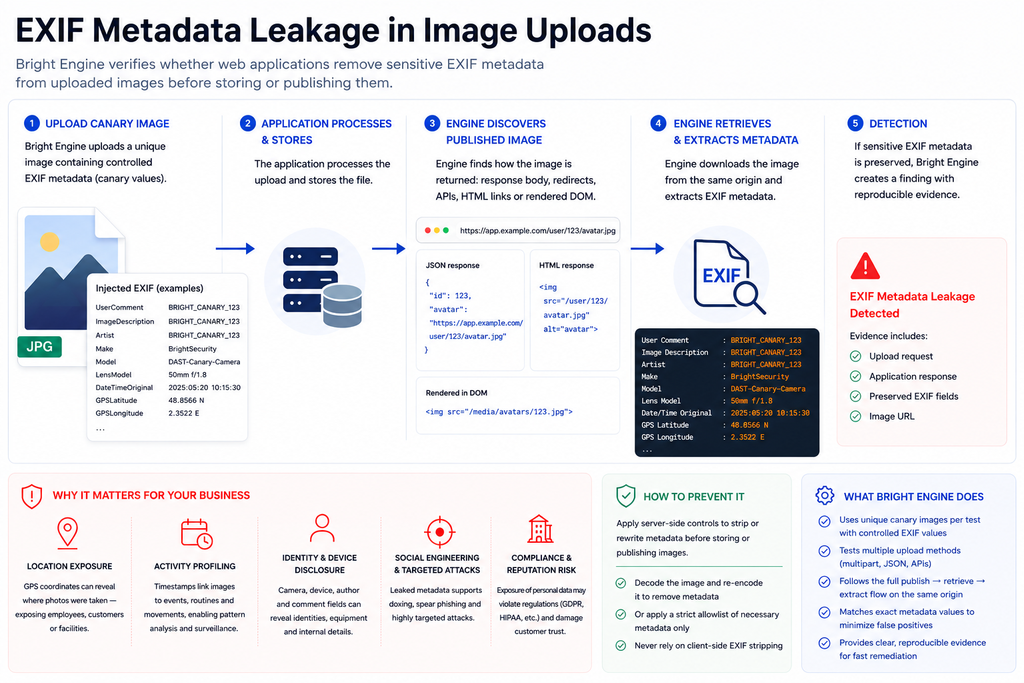 announced · seen Aug 2026
· source
· release history
- Scanner validates the full image processing path — upload endpoint, application response, image discovery via response body, redirect headers, JSON/HTML responses, image links, and rendered DOM — rather than flagging storage configuration alone. announced · seen Aug 2026 · source · release history
- Detected leakage evidence includes the original upload request, the application response, the specific EXIF fields retained, and the URL where the image was found, giving teams a reproducible proof artifact usable as a testable AppSec control in CI/CD. announced · seen Aug 2026 · source · release history
-
Broadens EXIF Metadata detection to cover API responses that return site-root image paths without a leading slash.
 Release of August 25, 2026 · Aug 2026
· source
· release history
- New EXIF Metadata Leakage security test uploads canary images with GPS coordinates, device identifiers, timestamps, and comment fields to file upload endpoints, then checks served copies across upload responses, redirects, API responses, rendered HTML, and linked image URLs; reports Medium severity findings under… Release of August 11, 2026 · Aug 2026 · source · release history
- Adds a new EXIF Metadata Leakage security test that uploads canary images to detect unstripped EXIF metadata in served copies. Release of August 11, 2026 · Aug 2026 · source · release history
Refined Scanner Behavior shipped Configurable rules for handling connectivity issues, pausing scans automatically, and updating detection patterns for secrets, CORS, and XSS.
Shared capability: Web vulnerability scanning
release
-
Expands CORS Misconfiguration detection to cover origin reflection with credentials, the highest-severity CORS bypass scenario.
Release of August 25, 2026 · Aug 2026
· source
· release history
- Improves Secret Tokens detection accuracy for Bing Maps and LinkedIn keys with tighter patterns that exclude bundled content and unrelated marketing data. Release of August 25, 2026 · Aug 2026 · source · release history
- Improves CSS Injection out-of-band confirmation by maintaining browser context during callback verification. Release of August 25, 2026 · Aug 2026 · source · release history
- Improves the Secret Tokens test so that each leaked token is now reported as a separate finding for full visibility, and adds detection of generic access tokens in application responses. Release of June 29, 2026 · Jun 2026 · source · release history
- Enables automatic pausing of scans and discoveries for up to seven days when infrastructure or connectivity issues are detected Release of June 2, 2026 · Jun 2026 · source · release history
Enhanced Vulnerability Detection shipped Expanded detection coverage for new vulnerability classes including ANSI escape sequence injection, email spoofing, source map exposure, and broken object-level authorization.
Shared capability: Web vulnerability scanning
release
-
Extends the ID Enumeration security test to cover list endpoints that return a JSON array at the root, detecting broken object-level authorization previously missed.
 Release of September 22, 2026 · Sep 2026
· source
· release history
- Three new security tests added: Email Spoofing, Source Map Exposure, and MCP Tool Inventory Disclosure. Release of September 22, 2026 · Sep 2026 · source · release history
-
Adds a new Source Map Exposure security test that detects publicly accessible JavaScript source maps (
.js.map) exposing original source code and internal application structure. Release of September 22, 2026 · Sep 2026 · source · release history -
Adds
AESI(ANSI Escape Sequence Injection) detection for MCP tool, resource, and prompt entry points to catch stored scenarios where malicious content written through one entry point appears in MCP responses consumed by AI agents. Release of June 29, 2026 · Jun 2026 · source · release history
Entry point analysis shipped Inspection and reporting of discovered entry points, including visibility into why individual entry points are skipped during scanning.
Shared capability: Web vulnerability scanning
Also counts toward: MCP server
release
-
Adds Connectivity Status filtering to Scan by Status, defaulting to entry points with
OKstatus; optionally includes Unauthorized, Problem, or Unreachable endpoints alongside the existing Entry Point Status filter.
Release of August 25, 2026 · Aug 2026
· source
· release history
-
Enables filtering entry points by Connectivity Status (
OK, Unauthorized, Problem, Unreachable) in Scan Configuration. Release of August 25, 2026 · Aug 2026 · source · release history - Entry Points table now displays the skip reason when an entry point is omitted due to a missing Content-Type header, with additional tooltip guidance and the ability to sort by skip reason. Release of August 11, 2026 · Aug 2026 · source · release history
- The crawler now detects MCP servers, extracting tools, resources, and prompts as separate entrypoints visible in a new MCP server name column with filter support Release of May 5, 2026 · May 2026 · source · release history
Comprehensive Scan Templates shipped Pre-configured scan profiles for various application types including web applications, APIs, and LLM/GenAI applications.
Shared capability: Web vulnerability scanning
release
-
Adds new built-in Scan templates: Web Application, Web Application (without database), API Scan (without database), OWASP Top 10 for Web Apps (2025), and
LLM & GenAI Applications.
Release of September 22, 2026 · Sep 2026
· source
· release history
-
Renames built-in templates Light Scan to
CI/CD Light Scanand Passive Scan to Passive Scan (production safe) to better describe their intended use. Release of September 22, 2026 · Sep 2026 · source · release history
Vulnerability prioritization 1 feature Vulnerability assessment methods since 2026
Organization-Wide Remediation Visibility shipped Aggregated views of vulnerability types and prioritized remediation data to guide organization-wide security efforts.
Shared capability: Vulnerability prioritization
release
-
Upgrades the CVE filter in Issues tables to a dropdown populated with CVEs detected in the current project, replacing manual text entry.
Release of September 22, 2026 · Sep 2026
· source
· release history
- Organization Dashboard widget displaying Top 5 Vulnerability Types with drill-down to filtered Issues pages Release of July 28, 2026 · Jul 2026 · source · release history
example
-
Prioritize remediation by viewing the most common vulnerability types across the organization.
View the Organization Dashboard to see the Top 5 Issue Types, then select a type to filter the Issues page by project.Release of July 28, 2026 · Jul 2026 · source
Other / not yet classified 9 features Features we have not matched to a capability yet. A suggested match is marked.
Organization Dashboard shipped A dashboard providing organization-wide visibility into projects, repeater status, and scan activity, with filtering by project classification attributes.
Also counts toward: Scheduled jobs
release 17 total
-
Adds new built-in Scan templates: Web Application, Web Application (without database), API Scan (without database), OWASP Top 10 for Web Apps (2025), and
LLM & GenAI Applications.
Release of September 22, 2026 · Sep 2026
· source
· release history
- Adds four new Task Overview widgets to Organization and Project dashboards: Task Results, Task Triggers, Task Actors, and Task Durations, with support for project, task type, and date-range filters. Release of September 22, 2026 · Sep 2026 · source · release history
- Four new Task Overview widgets (Task Results, Task Triggers, Task Actors, Task Durations) added to dashboards. Release of September 22, 2026 · Sep 2026 · source · release history
- Optimizer Settings available in Organization Settings to configure alert thresholds for scan optimization insights. Release of September 22, 2026 · Sep 2026 · source · release history
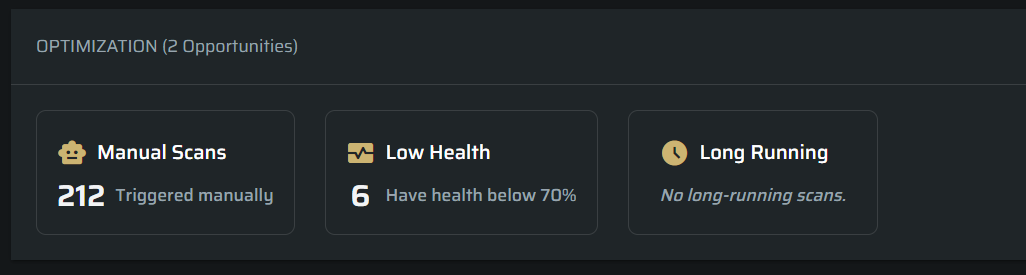
- Introduces the Bright Optimizer, a new experience surfacing scan improvement opportunities — manually triggered scans, low health scores, and long-running scans — configurable via Organization Settings -> General Details -> Optimizer Settings. Release of September 22, 2026 · Sep 2026 · source · release history
-
Adds an OWASP Top 10:2025 Risk Overview widget to both Organization and Project dashboards, aggregating open issues across selected projects mapped to OWASP categories.
Release of August 25, 2026 · Aug 2026
· source
· release history
example
-
View optimization opportunities in the Organization Settings to manage scan automation and health alerts.
Organization Settings -> General Details -> Optimizer SettingsRelease of September 22, 2026 · Sep 2026 · source -
Filter projects in the Organization Dashboard by Business Criticality to prioritize security efforts.
Steps: Go to Projects page or Organization Dashboard > Use classification filters for Environment, Business Criticality, or Exposure.Release of August 11, 2026 · Aug 2026 · source -
Navigate to the Organization Dashboard to monitor repeater health and workload distribution across multiple projects.
Steps: Go to Organization Dashboard > Repeater Insights widget. Click 'More Info' to view detailed repeater status.Release of August 11, 2026 · Aug 2026 · source -
Prioritize remediation by viewing the most common vulnerability types across the organization.
View the Organization Dashboard to see the Top 5 Issue Types, then select a type to filter the Issues page by project.Release of July 28, 2026 · Jul 2026 · source
Project management shipped Tools for organizing, classifying, and navigating projects, including search, classification attributes, and project-scoped authentication management.
release 12 total
-
Replaces the raw JSON block in the Advanced Authentication Editor with a step-based editor supporting per-step view, edit, add, copy, delete, reorder, JSON validation, and sensitive value masking.
Release of September 22, 2026 · Sep 2026
· source
· release history
-
Adds
entryPointFilterto the Scan Configuration API, supporting fieldssecurityStatus(e.g.'new') andconnectivityStatus(e.g.'ok') to replaceentrypointsStatuses. Release of September 22, 2026 · Sep 2026 · source · release history -
Adds
entryPointFilterto the Scan Configuration API, replacingentrypointsStatuses, supporting filtering by bothsecurityStatusandconnectivityStatus(e.g.'ok','unauthorized','problem','unreachable') for precise scan scoping.
Release of August 25, 2026 · Aug 2026
· source
· release history
- Supports searching for projects by associated host name in the Projects table and project selector. Release of August 11, 2026 · Aug 2026 · source · release history
- New project classification attributes (Environment, Business Criticality, Exposure) available for filtering on the Projects page and Organization Dashboard to prioritize security efforts. Release of August 11, 2026 · Aug 2026 · source · release history
- New Authentications tab on the Project page lets teams view, create, and edit project-scoped authentications — with automatic assignment to the current project on creation — without leaving the project context. Release of August 11, 2026 · Aug 2026 · source · release history
example
-
Manage project-scoped authentications without leaving the specific project context.
Steps: Go to Project Page > Authentications tab. Use the tab to create, view, or edit authentications.Release of August 11, 2026 · Aug 2026 · source -
Automatically configure authentication for a newly recorded login flow without manual endpoint entry.
In the authentication configuration interface, check 'Auto Protected Resource' and record the login flow to trigger suggestion.Release of July 28, 2026 · Jul 2026 · source -
Apply one authentication object to multiple entry points at once to speed up setup.
Select multiple Entry Points in the list, click 'Assign Authentication', and choose an existing Authentication Object from the current project.Release of July 28, 2026 · Jul 2026 · source -
Configure BitBucket as a code source in the STAR integration flow
Navigate to Settings > Integrations > STAR and select 'Atlassian BitBucket' from the provider list.Release of April 7, 2026 · Apr 2026 · source -
Manage scans without leaving the project context
In the console, go to Project > Scans tabRelease of March 10, 2026 · Mar 2026 · source
Integration Ecosystem Extensions shipped Support for connecting code repositories, CI/CD pipelines, issue trackers, and remediation platforms including BitBucket, Jira, GitHub AgentHQ, and Xygeni.
Also counts toward: CI/CD pipeline integration, Ticketing integration
release
-
The GitHub Marketplace Actions and npm packages under the Neuralegion GitHub organization will move to
BrightSecon October 20; workflows or integrations that reference Neuralegion directly will need to be updated.
Release of September 22, 2026 · Sep 2026
· source
· release history
- Xygeni integration allowing import of validated DAST findings into the Xygeni platform Release of July 28, 2026 · Jul 2026 · source · release history
- Adds automatic mapping support for mandatory custom fields (e.g., Story Points, Priority) during Jira integration setup Release of June 2, 2026 · Jun 2026 · source · release history
- Adds Atlassian BitBucket code repositories and BitBucket Pipelines CI/CD service support in STAR Release of April 7, 2026 · Apr 2026 · source · release history
example
-
Configure BitBucket as a code source in the STAR integration flow
Navigate to Settings > Integrations > STAR and select 'Atlassian BitBucket' from the provider list.Release of April 7, 2026 · Apr 2026 · source
Automated Authentication Configuration shipped Capabilities to automatically detect login triggers, suggest protected resources from recorded traffic, and configure authentication for newly recorded flows without manual endpoint entry.
release
-
Adds a new MCP Tool Inventory Disclosure security test that detects when an LLM-powered entry point can be made to reveal the list of MCP tools available to it.
Release of September 22, 2026 · Sep 2026
· source
· release history
- Auto Protected Resource checkbox enables automatic suggestion of Protected Resources from recorded authentication traffic Release of July 28, 2026 · Jul 2026 · source · release history
- Automatic detection of authentication triggers including 401/403 response statuses and 302 redirects with Location headers Release of July 28, 2026 · Jul 2026 · source · release history
example
-
Automatically configure authentication for a newly recorded login flow without manual endpoint entry.
In the authentication configuration interface, check 'Auto Protected Resource' and record the login flow to trigger suggestion.Release of July 28, 2026 · Jul 2026 · source
Dynamic Scan Orchestration shipped suggested Visual pipeline configuration that chains discovery and scanning tasks with scheduling capabilities to automatically target new or changed entry points.
Suggested capability: Web vulnerability scanning. This is our guess, not confirmed.
Also counts toward: Scheduled jobs
release
-
Workflows can now scan applications with more than 2,000 Entry Points by automatically dividing discovered entry points into sequential batches of up to 2,000 within a single Workflow Run.
Release of September 22, 2026 · Sep 2026
· source
· release history
- Workflow-based scans now support applications with more than 2,000 Entry Points via automatic batching. Release of September 22, 2026 · Sep 2026 · source · release history
-
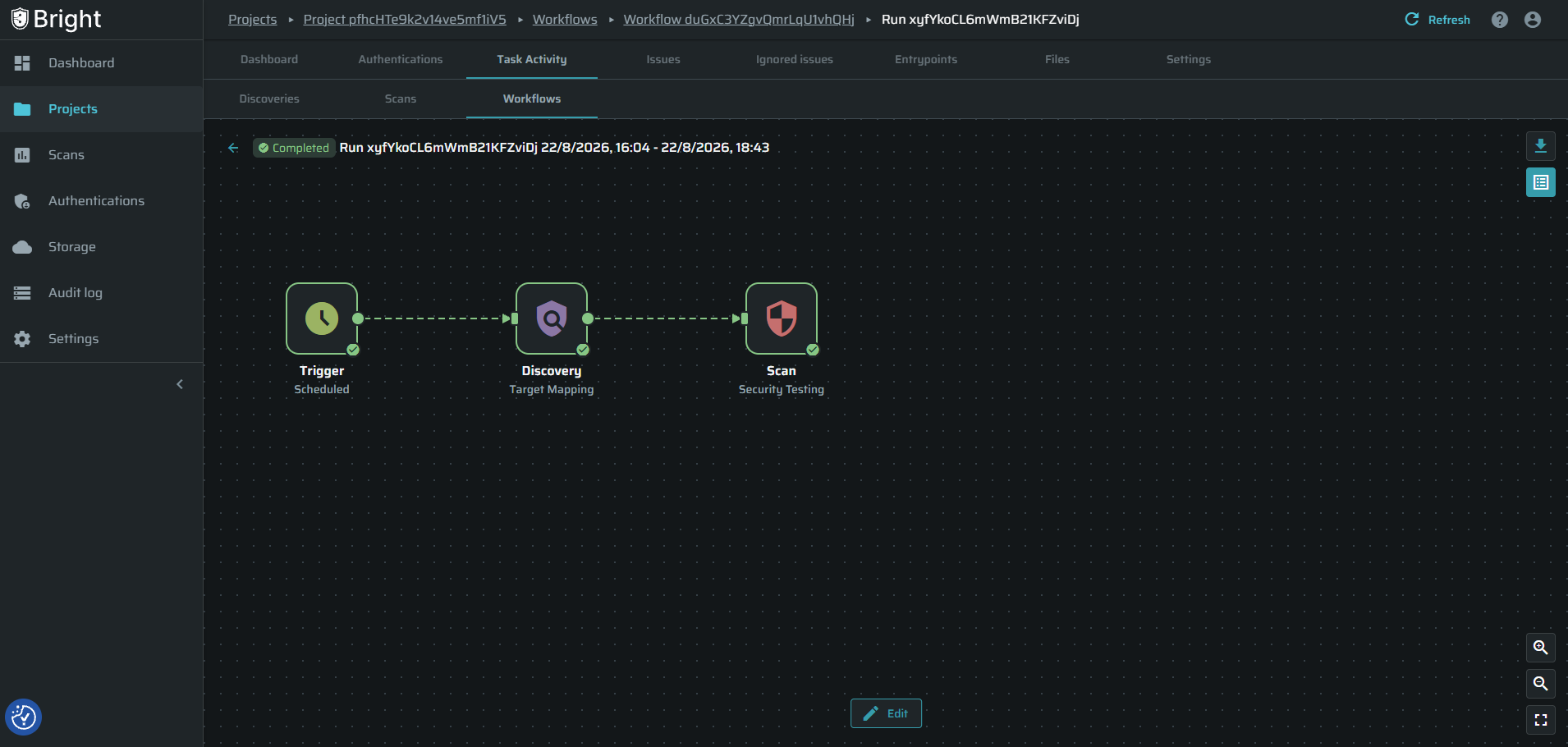
Introduces Bright Workflows: a visual orchestration layer that chains a trigger, Discovery, and Scan into a reusable, schedulable pipeline that automatically identifies new and changed entry points since the last baseline and passes only those to the Scan.
Release of August 25, 2026 · Aug 2026
· source
· release history
- Adds Workflows to orchestrate Discovery and Scan in a visual, reusable pipeline with manual or scheduled triggers. Release of August 25, 2026 · Aug 2026 · source · release history
AI-Powered Analysis Agents shipped suggested Integration of external inference models and native agents to analyze code connectivity, run dynamic scans within development platforms, and generate findings.
Suggested capability: Static application security testing. This is our guess, not confirmed.
release
- Introduces Bright Security as an agent in GitHub AgentHQ to run dynamic scans directly within GitHub sessions Release of June 2, 2026 · Jun 2026 · source · release history
- Supports using Anthropic inference for STAR agents Release of May 5, 2026 · May 2026 · source · release history
- Supports any OpenAI-compatible endpoint (such as Azure or self-hosted inference) for STAR Release of May 5, 2026 · May 2026 · source · release history
- Improves STAR agents' ability to understand connectivity between affected code and entry points in Go applications Release of May 5, 2026 · May 2026 · source · release history
Fuzzing Mode shipped Support for robustness and memory-safety testing including crash detection and unbounded allocation checks in code past input validation.
release
-
Adds a Fuzzing Mode to STAR Harness that hunts robustness and memory-safety bugs (crashes, hangs, type confusion, unhandled exceptions, unbounded allocation, algorithmic complexity) in code past input validation, without requiring a scan, authentication, or Repeater.
Release of September 22, 2026 · Sep 2026
· source
· release history
- STAR Harness now supports a new Fuzzing run mode for memory-safety and robustness testing on repositories. Release of September 22, 2026 · Sep 2026 · source · release history
Email Spoofing Detection shipped Active security testing that checks domain public DNS records for missing or weak DMARC, SPF, DKIM, and BIMI configuration.
release
-
Adds a new Email Spoofing security test that checks a domain's public DNS records for missing or weak DMARC, SPF, DKIM, and BIMI configuration.
Release of September 22, 2026 · Sep 2026
· source
· release history
Workflow Run Visibility shipped Detailed execution progress tracking, node status breakdowns, warning indicators, and filtered scan access within workflow runs.
release
-
Improved Workflow Run details now show execution progress as executed-out-of-total nodes, a node status breakdown, a warning indicator for problematic nodes, a View Scans action filtered by Workflow Run, and configurable table columns.
Release of September 22, 2026 · Sep 2026
· source
· release history
Lines in monospace are the tool's own words: help text
parsed from its source, or an endpoint from its API document. Under
release, a line is our summary of a dated release. Under
docs, it is quoted from the tool's own documentation or
website. Each links back to the source it came from.
Screenshots
From the release notes, newest first. Click one to see it full size.Score card
-
Shipping velocity releases a month, last 12 months
-
Documentation quality release-notes rubric, 0–100
-
Breaking-change discipline how rarely a release breaks users, and notice given
-
Maintenance risk quiet time against its own cadence, maintainers
-
Innovation & surface new capabilities, API and MCP surface
Five scores for Bright Security, each built from the releases, notes and API history this site tracks — and, on Researcher and Business, where it stands among every measured tool in its category and how that has moved.
Score cards are part of every paid plan.
See plans → Already subscribed? Sign in →Trajectory
Blank means never measured; nothing here is a filled-in zero.
Peer standings are included with Researcher and Business. See how this tool ranks against its competitors, using data we don't publish anywhere else.
See plans →Each score is 0–100 on a published rubric, derived from data this site already shows. A dimension we cannot measure says so — it is never scored 0 and never enters a rank.
How this is scored
- Shipping velocity — releases a month over the last 12 months, on a log scale where 16 a month scores 100. Needs 3 releases in the window.
- Documentation quality — the release-notes rubric published on the analytics page, unchanged.
- Breaking-change discipline — the share of releases carrying a breaking change (none scores 100, half or more scores 0). Only projects that label breaking changes are measured: a clean record cannot be told from an unlabelled one.
- Maintenance risk — quiet time measured against the tool's own release cadence (quiet longer than 90 days and three typical gaps scores 0), plus the number of active maintainers and whether contributors are growing, where known. Higher is lower risk.
- Innovation & surface — new capabilities in the feature ledger this year, API and MCP operations added, and the share of commits that are features: the mean of whichever we hold.
- Community health (open-source tools only) — each is a direction, not a size: contributors this year against last, the bus factor now against a year ago, and issues closed per issue opened, where steady scores 50, doubled 100 and halved 0; plus the median time to a maintainer's first reply (an hour scores about 100, a month or more 0). A commercial card has no repository and carries none of the four.
- Documented delivery (commercial tools) — when a vendor's documented new capabilities have slowed against its own baseline, that counts against the overall standing as heavily as two low dimensions. Steady delivery, or too little history to judge, leaves the standing alone; it is never a sixth score.
- Open-source tools are scored on repository signals; commercial tools on their published changelog. Ranks compare tools within one category and one profile and need at least five measured peers; the overall standing needs three ranked dimensions. Best-in-breed or consolidator is a shape, not a quality, and is never scored.
Release-note detail over time
See how much detail Bright Security puts in its release notes, quarter by quarter, and compare it with tracked tools in the same category. This history uses up to ten retained, reviewed notes per tool; sparse or blank older quarters may reflect that limit.
Checking release-note history…
Releases
10 entries
No entries match these filters.
- September 20261
- August 20263
- July 20261
- June 20262
- May 20261
- April 20261
- March 20261
Add the badge to your README
Maintain this project? The badge links readers straight to this page, so they can follow every release here.
 Choose a badge style and copy the code →