calico
v3.33.0 open-sourceThe section your link pointed to isn't on calico's page any more, so we've brought you to the top.
Open-source container networking and network security solution for Kubernetes supporting eBPFeBPFA Linux technology for running verified programs inside the kernel without changing its source. Tools use it to observe processes, enforce rules and process network traffic., BGPBGPA routing protocol that lets autonomous systems on the internet exchange reachability information, determining how traffic flows between networks. Cyber tools use it to monitor route hijacks or inject sinkholes., VXLANVXLANA network encapsulation protocol that wraps Layer 2 Ethernet frames inside UDP packets, extending virtual LANs across Layer 3 networks. Cyber tools use it to simulate or inspect traffic across large-scale virtualized and cloud environments., and WireGuardWireGuardA modern VPN protocol and Linux kernel module, maintained as an open-source project, that establishes encrypted tunnels using minimal code and fast cryptography, giving cyber tools a lightweight, high-performance transport layer. encryption.
calicoctl convert -f policy-v2.yaml > policy-v3.yaml
calicoctl apply --namespace=production -f netpol.yaml
env SKIP_CNI_BINARIES='veth,lame-duck' calico/node
cat <<EOF | kubectl apply -f -
apiVersion: projectcalico.org/v3
kind: BGPPeer
metadata:
  name: node-bgp-peer
spec:
  nodeSelector: all()
  peerIP: 192.168.1.100
EOF
cat calico-resources.yaml | calicoctl apply -f -
Summary
Calico is an open-source networking and security tool for Kubernetes clusters, distributed under the Apache licence, and run as a CNI plugin installed cluster-wide via the Tigera Operator rather than as a standalone CLI. It's built for platform and cluster-security teams who need to enforce network policy and zero-trust segmentation between workloads, supporting eBPF, standard Linux, Windows, and VPP data planes across clouds, bare metal, and VMs. It implements the upstream Kubernetes ClusterNetworkPolicy resource, giving admins cluster-scoped rules that namespace owners can't override, composed with its own tiered NetworkPolicyNetworkPolicyA Kubernetes API object that defines which pods may send or receive traffic, enforced by the cluster's CNI plugin to give cyber tools namespace-level network segmentation without host firewall rules. and GlobalNetworkPolicy model, and it bundles Istio in ambient mode as a tech preview for sidecarless mesh encryption. First committed in 2013, it remains active with 818 contributors and a release 34 days ago.
Open-source container networking and network security solution for Kubernetes supporting eBPF, BGP, VXLAN, and WireGuard encryption.
How calico helps
Which pod is actually blocking this connection, and why?
traces the network path hop by hop down to the specific policy rule allowing or denying it, and suggests a fix instead of leaving you to read raw packet dumps
Can I tell whether this deployment will violate policy before it goes live?
runs the same connectivity and policy-review workflow offline against a saved diagnostics bundle, so a failure can be triaged after the fact or a change checked before it reaches a live cluster
Which namespace-level policies are quietly overriding the guardrails I set for the whole cluster?
separates cluster-scoped accept/deny/pass rules into admin and baseline tiers that sit above ordinary namespace policy, so an owner's rule can no longer contradict the cluster-wide rule
Which routes is this cluster actually advertising or accepting over BGP?
applies filters at the peering level to control what gets advertised or accepted, so route leakage between peers is a configuration you can inspect rather than an assumption
Will migrating off the aggregated API server break workload connectivity?
copies existing resources to native CRDs in place through a controller that locks the datastore only briefly, keeping workload connectivity up through the migration window
Languages
Features
Built from calico's releases, docs, README and our own runs. “Seen” marks the month we first spotted a release the vendor didn't date. Group names and tags are our labels.
What calico offers you
- Command-line interface2
- MCP server2
- Air-gapped deployment1
- Kubernetes-native deployment1
- Offline mode1
- REST API
No capabilities match.
All capabilities 16 capabilities
Multi-Document Manifest Processing shipped Processes multiple YAML documents in a single file or stdin and provides migration subcommands to convert legacy manifests to the current resource model.
Also counts toward: Command-line interface
release
-
install-cnicontainer writescalico-kubeconfigwith mode 600 by default, configurable via theKUBECONFIG_MODEenvironment variable. v3.1.0 · Apr 2018 · source · release history -
Adds
calicoctl convertsubcommand to migrate v2.6.x manifests to the v3.x format v3.0.1 · Dec 2017 · source · release history -
calicoctlcan now process multiple YAML documents in a single file or stdin, separated by---document markers v2.4.0 · Jul 2017 · source · release history
example
-
Migrate legacy Calico manifests stored under version control to the new v3.x resource model before upgrading.
calicoctl convert -f policy-v2.yaml > policy-v3.yamlv3.0.1 · Dec 2017 · source -
Apply multiple Calico resources in one go without splitting into separate files
cat calico-resources.yaml | calicoctl apply -f -v2.4.0 · Jul 2017 · source
Label-Based Network Policy Selectors shipped Supports Kubernetes metadata label expressions, including negation operators, for selecting resources in network policy rules.
release
-
Distributes
projectcalico.org.v3-v3.33.0.tgz, a tech-preview CRD chart for the projectcalico.org/v3 API group v3.33.0 · Oct 2026 · source · release history -
Allows
namespaceSelectorexpressions in network and global network policy rules to select entire namespaces v3.0.1 · Dec 2017 · source · release history
docs
- Calico Open Source 3.33 (latest) documentation has(kubernetes.io/metadata.name) kubernetes.io/metadata.name not in seen Oct 2026 · source
example
-
Configure per-node BGP peers directly via Kubernetes API for dynamic peering without etcd-only configs
cat <<EOF | kubectl apply -f - apiVersion: projectcalico.org/v3 kind: BGPPeer metadata: name: node-bgp-peer spec: nodeSelector: all() peerIP: 192.168.1.100 EOFv2.4.0 · Jul 2017 · source
JSON Document Processing verified Scans directories for per-family JSON documents, applies templates, augments data, and handles credential requirements with dry-run support.
Also counts toward: Command-line interface
command line
-
--dir — Directory to scan for per-family subdirectories of JSON docs.v3.32.2 · Aug 2026 · command-line history -
--templates — Directory containing one <family>.json template per index family.v3.32.2 · Aug 2026 · command-line history -
--require-creds — Exit non-zero if Elasticsearch credentials are not configured.v3.32.2 · Aug 2026 · command-line history -
--dry-run — Parse and augment but do not POST. Prints each doc to stdout.v3.32.2 · Aug 2026 · command-line history
Maglev consistent-hash table inspection verified Dumps the Maglev consistent-hash backend table so users can inspect how traffic is distributed across backends.
Also counts toward: MCP server
release
-
Adds the
diagnose_connectivitytool via the MCP Server, which returns an ordered, opinionated trace of a network path down to the specific Calico policy rule allowing or denying traffic, with a suggested fix — rather than a raw dump.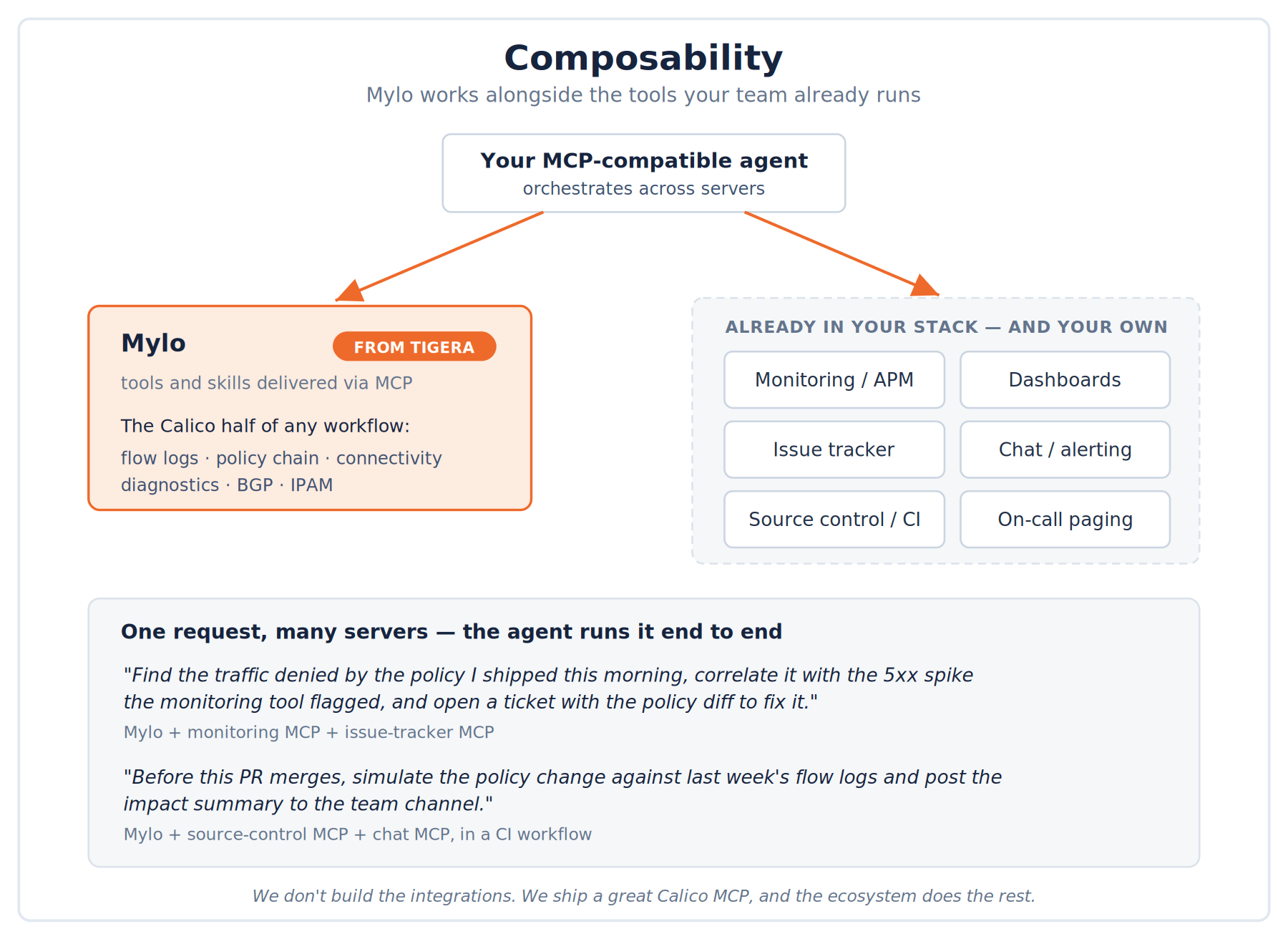 announced · Sep 2026
· source
· release history
- Beta support for IPVS kube-proxy enabling pod ingress, pod egress, and host endpoint network policy with greater scale and performance than iptables. v3.1.0 · Apr 2018 · source · release history
command line
-
maglev — dumps the maglev consistent-hash backend tablev3.32.1 · Jun 2026 · command-line history
CNI Configuration and Node Initialization shipped Configures container networking parameters via the CNI configuration file and automatically resolves node hostnames during startup.
release
-
Adds
tigera-operator-v3.22.0.tgzHelm chart release v3.22.0 · Jan 2022 · source · release history - Add support for configuring container IP forwarding via the CNI configuration file. v3.0.5 · Apr 2018 · source · release history
- When auto-detecting a node name, Calico will convert the hostname to lowercase. v3.0.5 · Apr 2018 · source · release history
Host Endpoint Network Policy Enforcement shipped Applies global network policies to host machines and Kubernetes pods by configuring host endpoints through the Kubernetes API datastore.
Also counts toward: Kubernetes-native deployment
release
-
Provides
calico-windows-v3.33.0.zipartifact enabling Windows workload support v3.33.0 · Oct 2026 · source · release history - HostEndpoint configuration support for Kubernetes API datastore allows applying network policies to both host machines and pods using Calico global network policies. v3.1.0 · Apr 2018 · source · release history
MCP Server Integration shipped Exposes available tools and skills to any MCP-compatible AI agent without requiring a custom chat interface.
Shared capability: MCP server
Also counts toward: MCP server
release
-
Introduces the Calico MCP Server, which exposes Mylo's tools and skills to any MCP-compatible AI agent (Claude, Cursor, terminal agents, etc.) without requiring a new chat interface.
announced · Sep 2026
· source
· release history
Multi-Mode Diagnostics shipped Supports both live cluster diagnostics and fully offline analysis against a diagnostics bundle.
Also counts toward: Air-gapped deployment, Offline mode
release
-
Supports two run modes: live cluster (via existing
kubeconfigpath, compatible withkubectlandcalicoctl) for real-time diagnostics, and fully offline against a Calico diagnostics bundle for air-gapped or post-incident analysis.
announced · Sep 2026
· source
· release history
Operational Expertise Workflows shipped Packages multi-step troubleshooting procedures, such as connectivity triage and policy review, as agent-callable skills.
release
-
Packages multi-step troubleshooting workflows (skills) — such as connectivity failure triage, policy review before deployment, and incident triage — as structured agent-callable procedures encoding Tigera's operational expertise.
announced · Sep 2026
· source
· release history
Scoped Agent Routing shipped Prevents silent CLI fallback by explicitly scoping agent requests to supported operations.
release
-
Includes a built-in router that explicitly scopes each agent request to what Mylo can handle, preventing silent CLI fallback when a request is outside its lane.
announced · Sep 2026
· source
· release history
Flow Log Backend verified Provides the backend interface for the Whisker flow log UI.
command line
-
whisker-backend — Run the Whisker flow log UI backendv3.34.0-0.dev · Aug 2026 · command-line history
Webhook Server Management verified Runs the admission webhook server for policy enforcement.
command line
-
webhooks — Run the Calico admission webhook serverv3.34.0-0.dev · Aug 2026 · command-line history
Windows Node Support shipped Enables the cyber tool to operate on and manage Windows-based Kubernetes nodes.
release
-
Adds
calico-windows-v3.22.0.zipartifact for Windows node support v3.22.0 · Jan 2022 · source · release history
Global Network Set Management shipped Defines named sets of CIDRs with labels that can be targeted by global network policies to enable cross-cluster policy portability.
release
-
GlobalNetworkSetresource type: supports a set of CIDRs with associated labels to be matched by global network policies for cross-cluster policy portability. v3.1.0 · Apr 2018 · source · release history
OpenStack Environment Support shipped Provides integration capabilities for OpenStack environments, allowing existing clusters to upgrade and maintain compatibility.
release
- OpenStack integration reintroduced; existing Calico OpenStack clusters can upgrade via the documented procedure. v3.1.0 · Apr 2018 · source · release history
ETCD v3 Datastore Migration shipped Supports storage backend migration to ETCD version 3, including configuration updates and removal of legacy environment variable support.
release
- Changes datastore storage to etcd version 3 v3.0.1 · Dec 2017 · source · release history
Lines in monospace are the tool's own words: help text
parsed from its source, or an endpoint from its API document. Under
release, a line is our summary of a dated release. Under
docs, it is quoted from the tool's own documentation or
website. Each links back to the source it came from.
Command line
No command matches.
| option | found in | since | description |
|---|
Values are placeholders taken from each option’s declared default. Nothing is executed here — the output shown is a recording of a run that already happened.
Screenshots
From the release notes, newest first. Click one to see it full size.Score card
-
Shipping velocity releases a month, last 12 months
-
Documentation quality release-notes rubric, 0–100
-
Breaking-change discipline how rarely a release breaks users, and notice given
-
Maintenance risk quiet time against its own cadence, maintainers
-
Innovation & surface new capabilities, API and MCP surface
- Community health
-
Contributor trend distinct committers, this year against last
-
Maintainer concentration bus factor now against a year ago
-
Issue backlog trend issues closed per issue opened, 12 months
-
Responsiveness median time to a maintainer’s first reply
Nine scores for calico, each built from the releases, notes and API history this site tracks — and, on Researcher and Business, where it stands among every measured tool in its category and how that has moved.
Score cards are part of every paid plan.
See plans → Already subscribed? Sign in →Trajectory
Blank means never measured; nothing here is a filled-in zero.
Peer standings are included with Researcher and Business. See how this tool ranks against its competitors, using data we don't publish anywhere else.
See plans →Each score is 0–100 on a published rubric, derived from data this site already shows. A dimension we cannot measure says so — it is never scored 0 and never enters a rank.
How this is scored
- Shipping velocity — releases a month over the last 12 months, on a log scale where 16 a month scores 100. Needs 3 releases in the window.
- Documentation quality — the release-notes rubric published on the analytics page, unchanged.
- Breaking-change discipline — the share of releases carrying a breaking change (none scores 100, half or more scores 0). Only projects that label breaking changes are measured: a clean record cannot be told from an unlabelled one.
- Maintenance risk — quiet time measured against the tool's own release cadence (quiet longer than 90 days and three typical gaps scores 0), plus the number of active maintainers and whether contributors are growing, where known. Higher is lower risk.
- Innovation & surface — new capabilities in the feature ledger this year, API and MCP operations added, and the share of commits that are features: the mean of whichever we hold.
- Community health (open-source tools only) — each is a direction, not a size: contributors this year against last, the bus factor now against a year ago, and issues closed per issue opened, where steady scores 50, doubled 100 and halved 0; plus the median time to a maintainer's first reply (an hour scores about 100, a month or more 0). A commercial card has no repository and carries none of the four.
- Documented delivery (commercial tools) — when a vendor's documented new capabilities have slowed against its own baseline, that counts against the overall standing as heavily as two low dimensions. Steady delivery, or too little history to judge, leaves the standing alone; it is never a sixth score.
- Open-source tools are scored on repository signals; commercial tools on their published changelog. Ranks compare tools within one category and one profile and need at least five measured peers; the overall standing needs three ranked dimensions. Best-in-breed or consolidator is a shape, not a quality, and is never scored.
Release-note detail over time
See how much detail calico puts in its release notes, quarter by quarter, and compare it with tracked tools in the same category. This history uses up to ten retained, reviewed notes per tool; sparse or blank older quarters may reflect that limit.
Checking release-note history…
Releases
9 entries
No entries match these filters.
- October 20261
- September 20262
- January 20221
- April 20182
- December 20171
- September 20171
- July 20171
Project health
Issue, contributor and maintainer activity in projectcalico/calico, 2023-10 – 2026-09, as of 2026-09-25. Twelve-month figures first; the trend lines run the whole window.
- Contributors 111 +10 vs prior 12 months
- Maintainers 16 +7 joined · −6 left, last 12 months
- Bus factor 5 committers behind half the commits
- Community-filed 94% of issues opened, last 12 months
- Median time to close 53 days first maintainer reply 5.1 days
- Open backlog 93 of 3,667 issues ever filed
- Issues opened / month 7 · 0 communitymaintainers
- Open backlog 93
- Contributors / month 31
- Commits / month 273
- Stars 7,357
- bugs 24%
- features 17%
- questions 17%
- docs 0%
- other 42%
Counts from the project's public repository and git history; no individuals are identified. Maintainers are the committers covering 80% of the last year's commits. how we measure this
Libraries its release ships
What its latest release locks, checked against known advisories.None of its release's images build from a lockfile we can read.
Add the badge to your README
Maintain this project? The badge links readers straight to this page, so they can follow every release here.
 Choose a badge style and copy the code →