Cynthion
0.2.4 open-sourceFree plan: not checked yet · Open source: yes
The section your link pointed to isn't on Cynthion's page any more, so we've brought you to the top.
Cynthion is an FPGA-based tool for building, testing, monitoring, and experimenting with USB devices, including protocol analysis and emulation.
make assets
What you can do now
Summary
Cynthion is an open-source USB test instrument, a piece of FPGA-based hardware you plug in and drive from a command-line toolchain to capture, analyze, and tamper with USB traffic between a host and device. Out of the box it works as a High-Speed USB protocol analyzer alongside its own open-source analysis software, and paired with the LUNA gateware and Facedancer libraries it becomes a USB-hacking and development platform for building or altering real devices without requiring HDL or FPGA design experience. It is aimed at hardware security researchers and USB developers rather than software-only pentesters, sitting in the hacking-hardware category alongside other protocol-analysis tools. Launched in 2023, it remains an active project with supporting firmware efforts, Apollo and Saturn-V, maintained alongside it.
Cynthion is an FPGA-based tool for building, testing, monitoring, and experimenting with USB devices, including protocol analysis and emulation.
How Cynthion helps
Which USB device is actually causing this handshake to fail?
captures the full Low-, Full-, or High-Speed traffic between host and device and reconstructs the transaction sequence, so a failed enumeration or dropped transfer shows up in the captured trace itself
What is a host and device actually saying to each other over USB?
passively taps the link at the physical layer and hands every packet to the analysis software for inspection, down to the individual transaction
Can I make my own hardware pretend to be a different USB device without building an FPGA design?
pairs with the Facedancer library so a device's behavior is described in host-side code, letting the board emulate or alter a real device without writing HDL
What happens if I change a value on the wire before the host or device sees it?
sits inline between the two ends so traffic can be intercepted and modified in transit, not just observed, letting a researcher tamper with a live USB session
Is the debug controller or bootloader the reason a firmware update isn't taking?
relies on the companion Apollo firmware for FPGA configuration and Saturn-V for DFU updates, so an update failure can be isolated to whichever of the two is responsible
Languages
Device
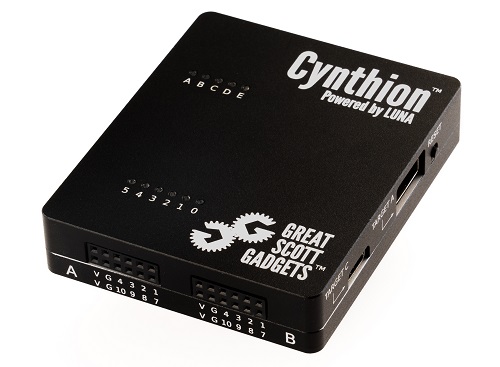
Spec · shipping Cynthion
- processor
- Lattice LFE5U-12F ECP5 FPGA with Microchip SAMD11 debug controller
- interfaces
- Three High-Speed USB interfaces (USB3343 PHY, 480 Mbps): 2x USB-C device-mode, 1x USB-C and 1x USB-A for host/analysis; 16 FPGA user I/O via Pmod
- storage
- 8 MiB RAM, 4 MiB SPI flash
from the vendor's spec page ↗
Availability
A slip is called out here the day the vendor's own delivery estimate moves past the promised window. A "coming" milestone is the vendor's own wording, read off the page it links to — never a date we inferred.
Price
| configuration | generation | launch | today | status | source |
|---|---|---|---|---|---|
| Cynthion with aluminum enclosure | Cynthion | — | $200 sold out | shipping | list |
| Cynthion without enclosure | Cynthion | — | $150 sold out | shipping | list |
Device history
-
Cynthion sold_out
no further detail captured
-
Cynthion sold_out
no further detail captured
-
Cynthion shipped
Cynthion became available for purchase from authorized resellers.
-
Cynthion news
The LUNA hardware platform was renamed Cynthion; LUNA remains the gateware framework name.
-
Cynthion announced
Crowd Supply campaign launched (under the earlier LUNA name), running July 15 to August 26, 2021.
Command line
No command matches.
| option | found in | since | description |
|---|
Values are placeholders taken from each option’s declared default. Nothing is executed here — the output shown is a recording of a run that already happened.
Score card
-
Shipping velocity releases a month, last 12 months
-
Documentation quality release-notes rubric, 0–100
-
Breaking-change discipline how rarely a release breaks users, and notice given
-
Maintenance risk quiet time against its own cadence, maintainers
-
Innovation & surface new capabilities, API and MCP surface
- Community health
-
Contributor trend distinct committers, this year against last
-
Maintainer concentration bus factor now against a year ago
-
Issue backlog trend issues closed per issue opened, 12 months
-
Responsiveness median time to a maintainer’s first reply
Nine scores for Cynthion, each built from the releases, notes and API history this site tracks — and, on Researcher and Business, where it stands among every measured tool in its category and how that has moved.
Score cards are part of every paid plan.
See plans → Already subscribed? Sign in →Trajectory
Blank means never measured; nothing here is a filled-in zero.
Peer standings are included with Researcher and Business. See how this tool ranks against its competitors, using data we don't publish anywhere else.
See plans →Each score is 0–100 on a published rubric, derived from data this site already shows. A dimension we cannot measure says so — it is never scored 0 and never enters a rank.
How this is scored
- Shipping velocity — releases a month over the last 12 months, on a log scale where 16 a month scores 100. Needs 3 releases in the window.
- Documentation quality — the release-notes rubric published on the analytics page, unchanged.
- Breaking-change discipline — the share of releases carrying a breaking change (none scores 100, half or more scores 0). Only projects that label breaking changes are measured: a clean record cannot be told from an unlabelled one.
- Maintenance risk — quiet time measured against the tool's own release cadence (quiet longer than 90 days and three typical gaps scores 0), plus the number of active maintainers and whether contributors are growing, where known. Higher is lower risk.
- Innovation & surface — new capabilities in the feature ledger this year, API and MCP operations added, and the share of commits that are features: the mean of whichever we hold.
- Community health (open-source tools only) — each is a direction, not a size: contributors this year against last, the bus factor now against a year ago, and issues closed per issue opened, where steady scores 50, doubled 100 and halved 0; plus the median time to a maintainer's first reply (an hour scores about 100, a month or more 0). A commercial card has no repository and carries none of the four.
- Documented delivery (commercial tools) — when a vendor's documented new capabilities have slowed against its own baseline, that counts against the overall standing as heavily as two low dimensions. Steady delivery, or too little history to judge, leaves the standing alone; it is never a sixth score.
- Open-source tools are scored on repository signals; commercial tools on their published changelog. Ranks compare tools within one category and one profile and need at least five measured peers; the overall standing needs three ranked dimensions. Best-in-breed or consolidator is a shape, not a quality, and is never scored.
Release-note detail over time
See how much detail Cynthion puts in its release notes, quarter by quarter, and compare it with tracked tools in the same category. This history uses up to ten retained, reviewed notes per tool; sparse or blank older quarters may reflect that limit.
Checking release-note history…
Releases
9 entries
No entries match these filters.
- October 20262
- October 20251
- August 20251
- June 20251
- May 20251
- October 20241
- September 20241
- July 20241
Project health
Issue, contributor and maintainer activity in greatscottgadgets/cynthion, 2023-12 – 2026-11, as of 2026-11-03. Twelve-month figures first; the trend lines run the whole window.
- Contributors 2 −3 vs prior 12 months
- Maintainers 0 +0 joined · −2 left, last 12 months
- Bus factor 0 committers behind half the commits
- Community-filed 88% of issues opened, last 12 months
- Median time to close 3.9 days first maintainer reply 3.9 days
- Open backlog 34 of 113 issues ever filed
- Issues opened / month 0 · 0 communitymaintainers
- Open backlog 34
- Contributors / month 0
- Commits / month 0
- Stars not measured
- questions 25%
- other 75%
Counts from the project's public repository and git history; no individuals are identified. Maintainers are the committers covering 80% of the last year's commits. how we measure this
Libraries its release ships
What its latest release locks, checked against known advisories.None of its release's images build from a lockfile we can read.
Add the badge to your README
Maintain this project? The badge links readers straight to this page, so they can follow every release here.
 Choose a badge style and copy the code →