Feedly Threat Intelligence
Credential Leak Dark Web Agent: Monitor exposed accounts (2026-10-27) commercialThe section your link pointed to isn't on Feedly Threat Intelligence's page any more, so we've brought you to the top.
Feedly Threat Intelligence is a product that helps teams collect, enrich, and triage cyber threat intelligence using AI-powered agents and APIs.
(Privileges Required: None) AND (User Interaction: None) AND (Exploited) OR (Proof of Concept) OR (Weaponized) OR (CISA KEV) AND (Attack Vector: Network) NOT (Patched)
(Availability Impact: High) AND (Attack Vector: Network)
Summary
Feedly Threat Intelligence is a commercial SaaSSaaSSoftware delivered over the internet and run on the provider's infrastructure, so the buyer pays a subscription instead of installing or operating anything locally. platform that collects and enriches threat data from open sources for cyber threat intelligence teams and SOCSOCA security operations center, the team or function that monitors threats, investigates alerts and coordinates incident response. Its work can be internal, outsourced or shared. analysts. It pulls in verdicts and context from integrations like VirusTotal, GreyNoise, WHOIS, certificate data, and Censys directly into IoCIoCAn indicator of compromise, an observable clue that may point to malicious activity, such as a suspicious file hash or domain. It is evidence to investigate, rather than proof by itself. Insights Cards, and its Vulnerability Intel Agent ingests vendor advisories (Apple, Atlassian, Microsoft, Oracle, and others) within minutes of publication, letting teams filter CVEs by exploitation status, affected products, or patch-policy thresholds. AI features generate hunting queries in KQLKQLKusto Query Language, Microsoft's read-only query language for Azure Data Explorer and Microsoft Sentinel, used by cyber tools to filter, aggregate, and correlate large volumes of log and telemetry data quickly. or Splunk SPL and surface Suricata rules from thousands of vetted sources. Its documentation positions it around OpenCTI integration and API-driven workflows rather than replacing a SIEMSIEMSecurity information and event management, collecting logs from many systems and correlating events to find suspicious activity. Analysts use it to investigate alerts and incidents. outright. With 22 releases in the tracked window and the latest just 14 days ago, development is active.
Feedly Threat Intelligence is a product that helps teams collect, enrich, and triage cyber threat intelligence using AI-powered agents and APIs.
How Feedly Threat Intelligence helps
Which of the CVEs in this vendor's latest release are already being exploited in the wild?
filters the ingested advisory by exploitation status — exploited, PoC, or CISA KEV — and returns only the matching CVEs, refreshed within minutes of the vendor publishing
Which CVEs in this release actually touch the products I run?
scopes the advisory to named products (e.g., a specific macOS version or a Confluence deployment) so only relevant exposures surface, instead of the full vendor list
Which unpatched CVEs breach our patch-now SLA right now?
applies configured CVSS and EPSS thresholds against incoming advisories and flags the ones that cross them, so they can be routed to remediation without manual review
Is this domain or IP worth escalating, or is it noise?
pulls VirusTotal verdicts, WHOIS, certificate data, network attribution, and community votes onto one card, including cases with zero detections, so triage doesn't require jumping between separate lookups
Has anyone else already seen this indicator behaving badly?
surfaces GreyNoise and Censys context alongside the indicator so scanning or internet-wide exposure history is visible without a separate query
How do I turn a threat actor's known campaign into something I can hunt for in my own logs?
generates a KQL or Splunk SPL query from the actor or campaign context via Ask AI, saving the manual translation from report to query
Languages
Features
Built from Feedly Threat Intelligence's releases, docs, README and our own runs. “Seen” marks the month we first spotted a release the vendor didn't date. Group names and tags are our labels.
- Feedly Threat Intelligence covers 1 of the 8 investigation and response capabilities we track.
What Feedly Threat Intelligence offers you
- ML-based detection4
- Natural-language query4
- Built-in AI assistant2
- CSV data export2
- Agent-based deployment1
- Extension marketplace1
- Multi-factor authentication1
- OIDC SSO1
- Single sign-on1
- REST API
No capabilities match.
Threat indicator matching 3 features Investigation and response since 2025
Threat Graph AI Capabilities shipped Expands threat graph capabilities to include banking industry monitoring and IPv6 IoC detection.
Shared capability: Threat indicator matching
release
-
Improves
IP IoCmodel to include IPv6 IoC detection Threat Intelligence updates — 2025-11-12 · Nov 2025 · source · release history - Adds a Banking industry option to the New Cyberattack Dashboard AI Model for monitoring attacks targeting banks Threat Intelligence updates — 2025-10-30 · Oct 2025 · source · release history
Intel Profile-based TTP and IoC Tracking shipped Identifies novel TTPs and IoCs across recent activity using saved Intel Profiles.
Shared capability: Threat indicator matching
example
-
Identify novel TTPs and IoCs across recent activity using saved Intel Profiles.
In the Cyberattack Intel Agent, select time period and an Intel Profile. Use Ask AI prompt: 'What novel TTPs and IoCs are being leveraged in these attacks?'Analyze patterns across 100 cyberattacks with Ask AI in the Cyberattack Intel Agent (2026-05-06) · May 2026 · source
IOC File Path Detection Model shipped Launches a new AI Model specifically for identifying IOC file paths.
Shared capability: Threat indicator matching
Also counts toward: ML-based detection
release
- New AI Model for IOC file paths launched to identify file path indicators of compromise. Deliver intel faster via MS Teams, detect never-before-seen techniques, and more · Mar 2026 · source · release history
Other / not yet classified 60 features Features we have not matched to a capability yet. A suggested match is marked.
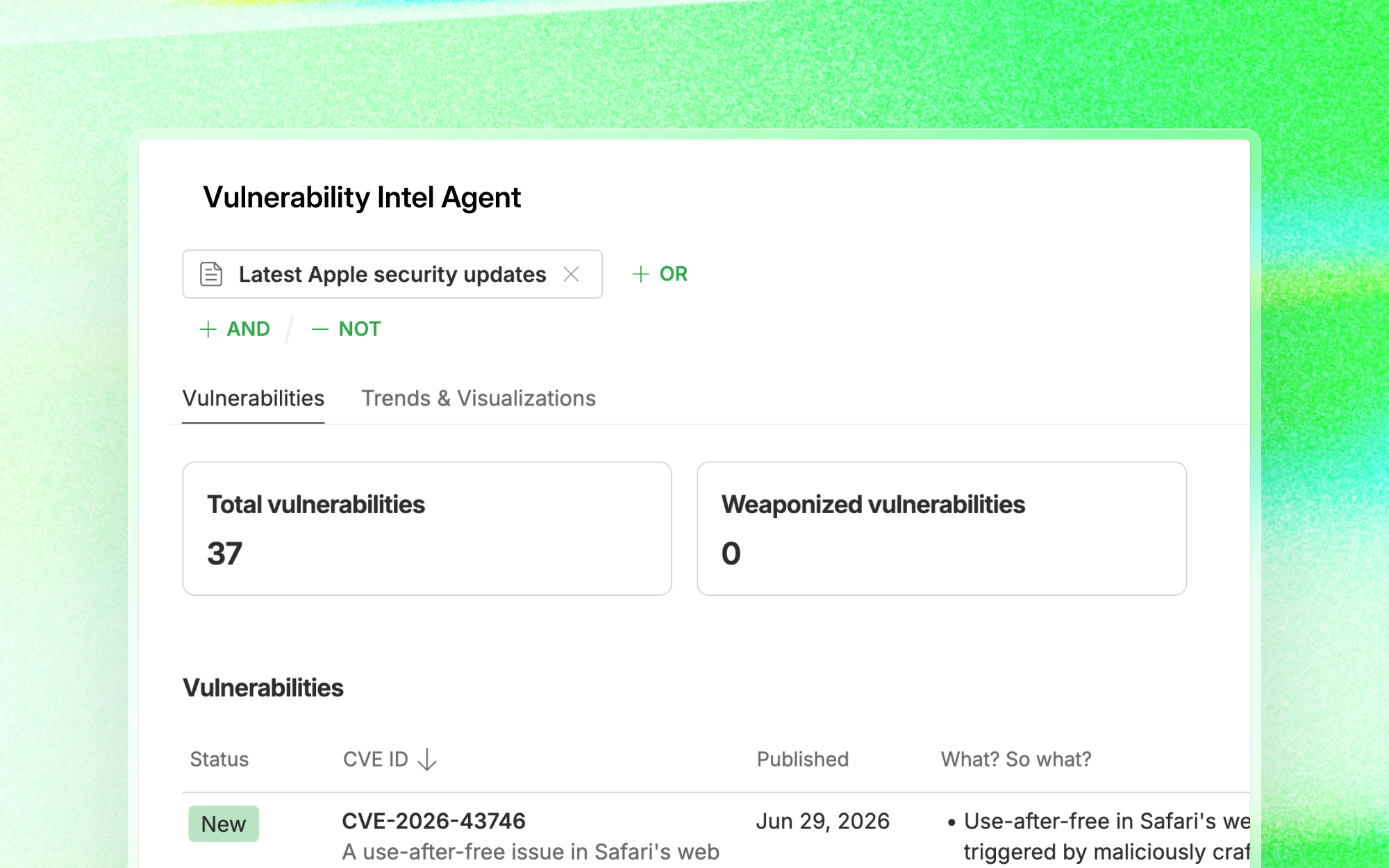
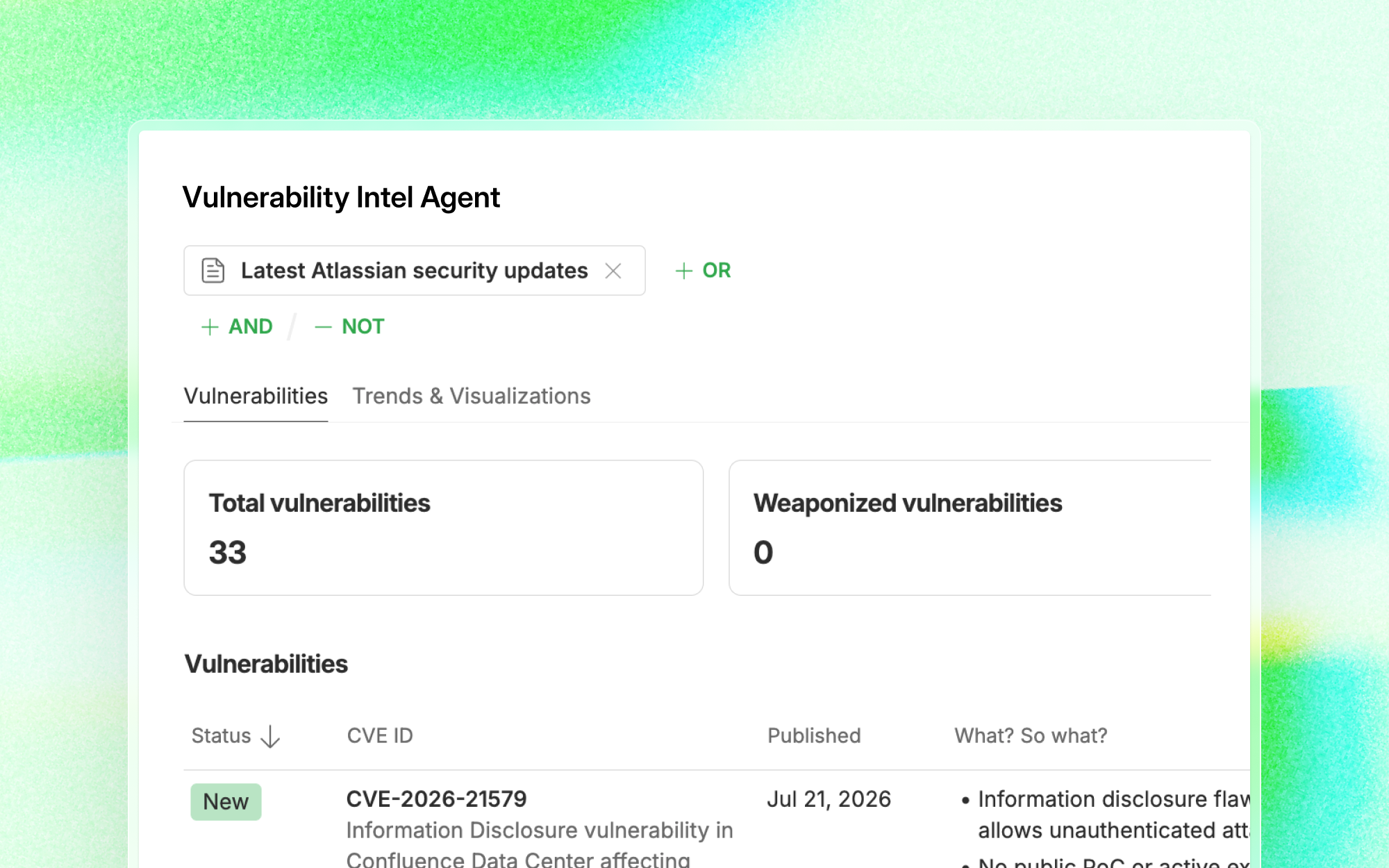
Vulnerability Intel Agent — vendor advisory ingestion and CVE triage shipped Ingests security advisories from vendors including Apple, Atlassian, Adobe, Android, Apache, Microsoft, and Oracle within minutes of publication, and lets practitioners filter resulting CVEs by exploitation activity, attack path, affected products, and patch-policy thresholds (CVSS and EPSS), with alerts firing when new CVEs match configured filters and reorderable enrichment columns in the output table.
release 36 total
- Supports filtering by patch policy thresholds: CVSS score cutoffs, EPSS probability cutoffs, or both combined. Enrich and triage Atlassian security releases in the Vulnerability Intel Agent (2026-08-07) · Aug 2026 · source · release history
- Adds a Latest Atlassian Security Release filter in the Vulnerability Intel Agent that always points to the most recent Atlassian advisory, eliminating manual updates each cycle. Enrich and triage Atlassian security releases in the Vulnerability Intel Agent (2026-08-07) · Aug 2026 · source · release history
- Adds alert notifications when new CVEs from ingested releases match configured filters (product, attack path, patch policy) Enrich and triage Atlassian security releases in the Vulnerability Intel Agent (2026-08-07) · Aug 2026 · source · release history
- Supports filtering by attack path — attack vector, privileges required, and user interaction — to isolate unauthenticated, no-interaction reachable CVEs. Enrich and triage Atlassian security releases in the Vulnerability Intel Agent (2026-08-07) · Aug 2026 · source · release history
- Vendor advisory support in the Vulnerability Intel Agent now includes Adobe, Android, Apache, Apple, Microsoft, Oracle, and Atlassian. Enrich and triage Atlassian security releases in the Vulnerability Intel Agent (2026-08-07) · Aug 2026 · source · release history
- Supports filtering Atlassian CVEs down to specific products in your stack (e.g., Confluence Data Center, Sourcetree, Jira) to surface only relevant exposures. Enrich and triage Atlassian security releases in the Vulnerability Intel Agent (2026-08-07) · Aug 2026 · source · release history
docs
- Threat Intelligence Enrich and triage Atlassian security releases in the Vulnerability Intel Agent Filter CVEs by attack path, products, or patch policy Andrew Castro on Aug 06, 2026 Bottom-line-up-front (BLUF) The Vulnerability Intel Agent now ingests each Atlassian security release within minutes of publication and… docs update · Aug 2026 · source
- Threat Intelligence Enrich and triage Apple security releases in the Vulnerability Intel Agent Filter CVEs by exploitation, products, or patch policy Andrew Castro on Jul 21, 2026 BLUF The Vulnerability Intel Agent now ingests each Apple security release within minutes of publication. docs update · Jul 2026 · source
-
Enrich and triage Apple security releases in the Vulnerability Intel Agent
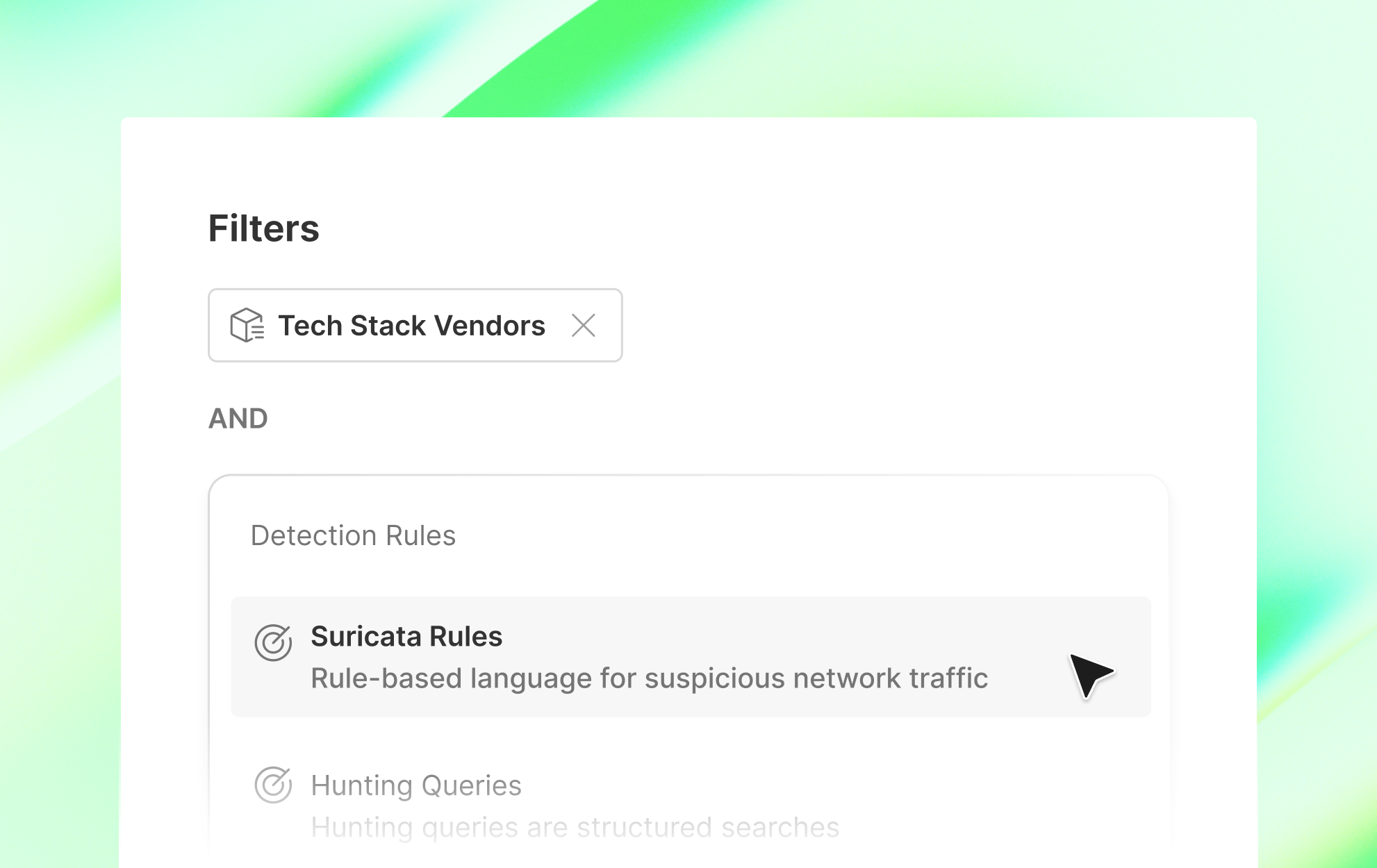 docs update · Jul 2026
· source
example 8 total
-
Assess which systems in your environment are actually exposed by a vulnerability advisory, moving beyond generic CVSS scores.
Step 1: In Org Profile, populate the 'Tech stack' (beta) item with your products and versions.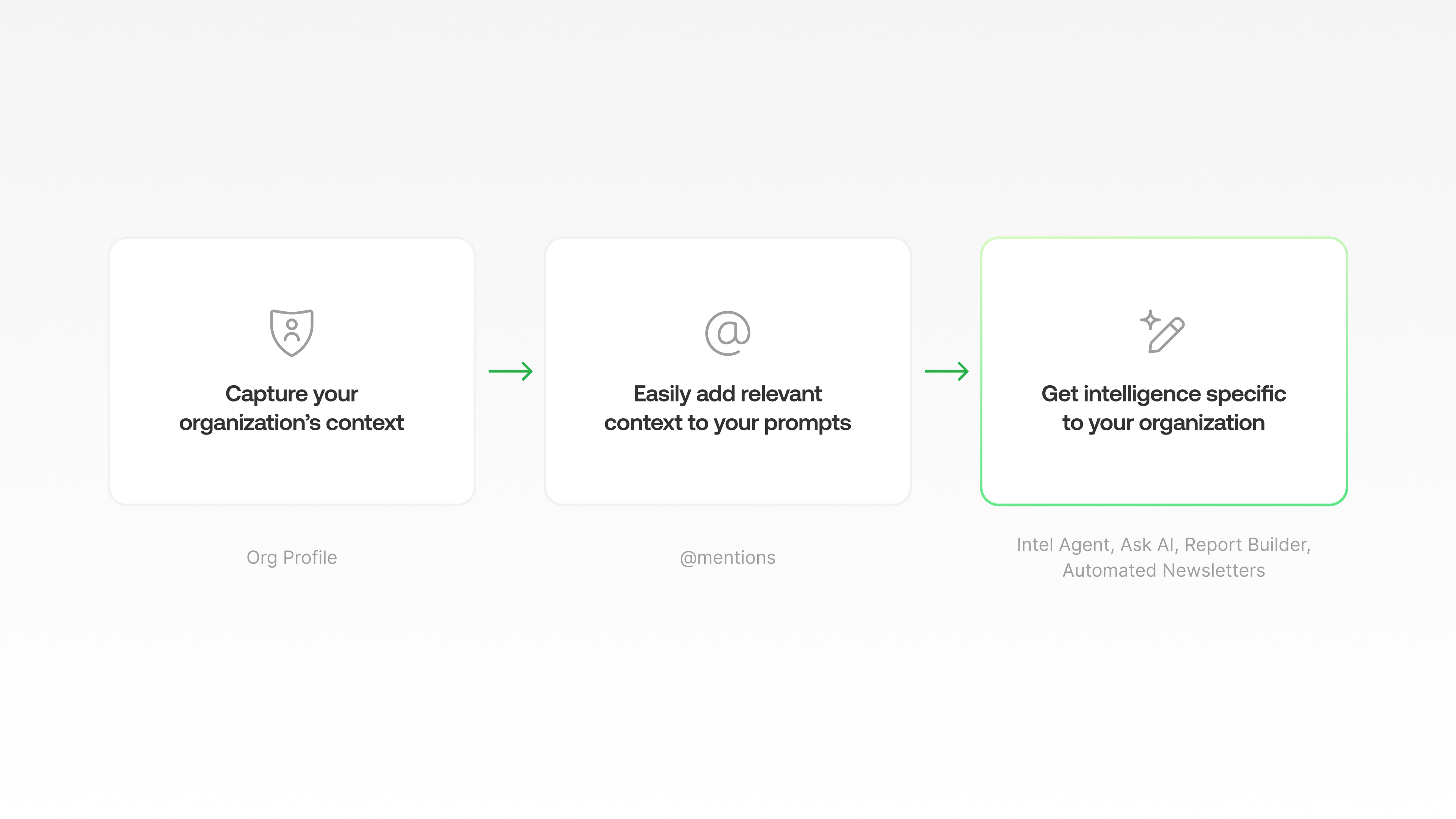 Org Profile: Turn "what happened" into "why it matters to us" (2026-09-29) · Sep 2026
· source
-
Identify high-risk vulnerabilities requiring immediate remediation based on severity and exploitability.
In the Vulnerability Intel Agent, filter CVSS >= 8 AND EPSS > 0.8 in the output table columns.Enrich and triage Atlassian security releases in the Vulnerability Intel Agent (2026-08-07) · Aug 2026 · source -
Ensure no high-impact vulnerabilities are missed by enabling alert notifications for matching CVEs.
Deploy the Intel Agent and configure filters for product 'Jira' and CVSS >= 7 to receive alerts.Enrich and triage Atlassian security releases in the Vulnerability Intel Agent (2026-08-07) · Aug 2026 · source -
Focus triage on self-hosted systems by filtering the latest release for Confluence Data Center products.
In the Vulnerability Intel Agent, select 'Latest Atlassian Security Release', set date range, and filter by product 'Confluence Data Center'.Enrich and triage Atlassian security releases in the Vulnerability Intel Agent (2026-08-07) · Aug 2026 · source -
Automatically flag Apple CVEs that breach your patch-now SLA thresholds (e.g., CVSS ≥ 8 and EPSS ≥ 80%) so they can be routed to immediate remediation.
In the Vulnerability Intel Agent, select the target Apple security release, then set CVSS threshold filter to ≥ 8 and EPSS threshold filter to ≥ 80%.Enrich and triage Apple security releases in the Vulnerability Intel Agent (2026-07-21) · Jul 2026 · source -
Focus remediation efforts on only the Apple CVEs in your macOS fleet that are already being exploited or have a published PoC.
In the Vulnerability Intel Agent, select 'Latest Apple Security Release' as the filter and set the date range. Add filters for 'exploited' and 'proof of concept'.Enrich and triage Apple security releases in the Vulnerability Intel Agent (2026-07-21) · Jul 2026 · source
Org Profile — organizational context workspace shipped Provides a shared team workspace to capture and reuse organizational context — including company overview, audience, lists, vendor lists, tradecraft conventions, and tech stack — so Feedly AI can produce threat assessments specific to the organization rather than generic ones.
release 18 total
-
Allows Org Profile list items to be used as filters in AI Feed, scoping collection to tracked suppliers, threat actors, or technologies.
Org Profile: Turn "what happened" into "why it matters to us" (2026-09-29) · Sep 2026
· source
· release history
- Adds Tradecraft item type to encode sourcing rules, confidence-stating conventions, fact/assessment separation, risk-scoring criteria, and follow-up team routing into reusable prompt context. Org Profile: Turn "what happened" into "why it matters to us" (2026-09-29) · Sep 2026 · source · release history
- Adds Tech stack (beta) item type to capture product names and versions, enabling vulnerability advisories to be assessed against an organization's specific technology footprint. Org Profile: Turn "what happened" into "why it matters to us" (2026-09-29) · Sep 2026 · source · release history
-
Enables referencing Org Profile items in prompts using
@mentions to include organizational context in AI-generated threat assessments. Org Profile: Turn "what happened" into "why it matters to us" (2026-09-29) · Sep 2026 · source · release history -
Enables
@references to Org Profile items inside AI prompts (Ask AI, Intel Agents, Report Builder, Automated Newsletters) to inject saved context without re-pasting it each run. Org Profile: Turn "what happened" into "why it matters to us" (2026-09-29) · Sep 2026 · source · release history - Adds Vendor list add-on item type to capture suppliers and partners for third-party incident impact assessment. Org Profile: Turn "what happened" into "why it matters to us" (2026-09-29) · Sep 2026 · source · release history
docs
- Threat Intelligence Org Profile: Turn what happened into "why it matters to us" Capture your organizationâs context and get AI threat assessments specific to your business. docs update · Sep 2026 · source
- CTI lead global financial-market infrastructure provider Threat intelligence lead UK wealth management firm seen Sep 2026 · source
example
-
Brief leadership by summarizing news developments relevant to your organization using the company overview.
Prepare this newsletter for our '@security leadership'. Using our '@company overview', summarize the developments that matter to Northwind.Org Profile: Turn "what happened" into "why it matters to us" (2026-09-29) · Sep 2026 · source -
Deliver a leadership newsletter that explains threat relevance in business terms, scoped to your tech stack and suppliers, without manual curation each run.
Step 1: In Org Profile, create items: 'security leadership' (Audience), 'company overview' (Company overview), 'tech stack' (Tech stack), 'suppliers' (Vendor list), 'threat actors' (List).Org Profile: Turn "what happened" into "why it matters to us" (2026-09-29) · Sep 2026 · source -
Investigate a vulnerability advisory against your specific products and versions using the beta tech stack context.
Which products and versions in our '@tech stack' are affected by this advisory?Org Profile: Turn "what happened" into "why it matters to us" (2026-09-29) · Sep 2026 · source -
Scope an Intel Agent collection to monitor incidents involving your suppliers.
What data breaches, ransomware incidents, and leak-site claims involve our '@suppliers'?Org Profile: Turn "what happened" into "why it matters to us" (2026-09-29) · Sep 2026 · source
Insights Cards Interface shipped Provides structured context cards for CVEs, Cyberattacks, Threat Actors, and IoCs.
release 17 total
-
Adds Credential Leaks Insights Cards showing affected email-and-password pairs, source excerpts, First seen and Status (New or Recycled) fields, and links to associated Threat Actor Insights Cards and Cyberattack Insights Cards.
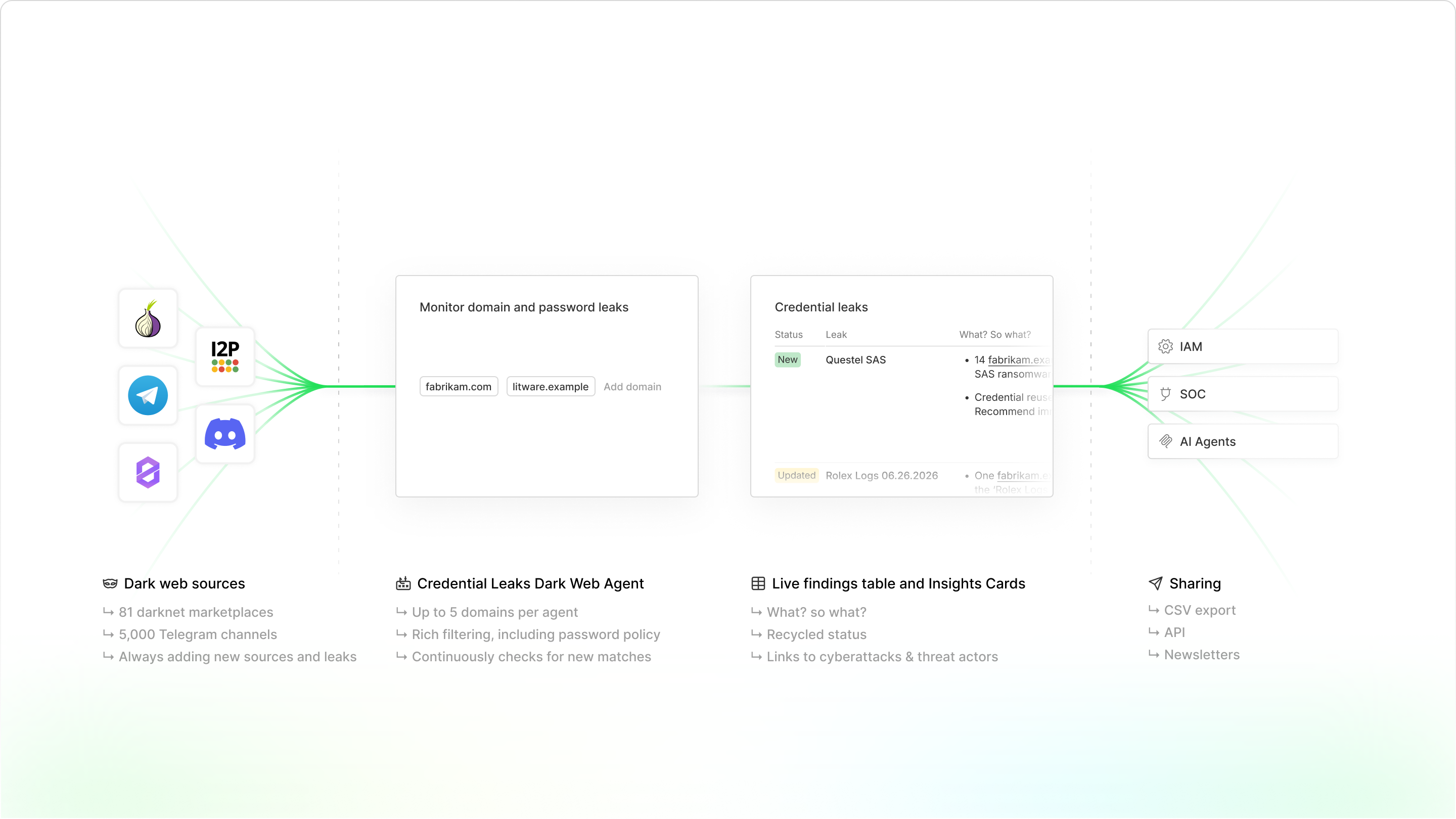 Credential Leak Dark Web Agent: Monitor exposed accounts (2026-10-27) · Oct 2026
· source
· release history
-
Allows opening Censys host data from the IoC table on Threat Actor and Malware Insights Cards for batch pivoting
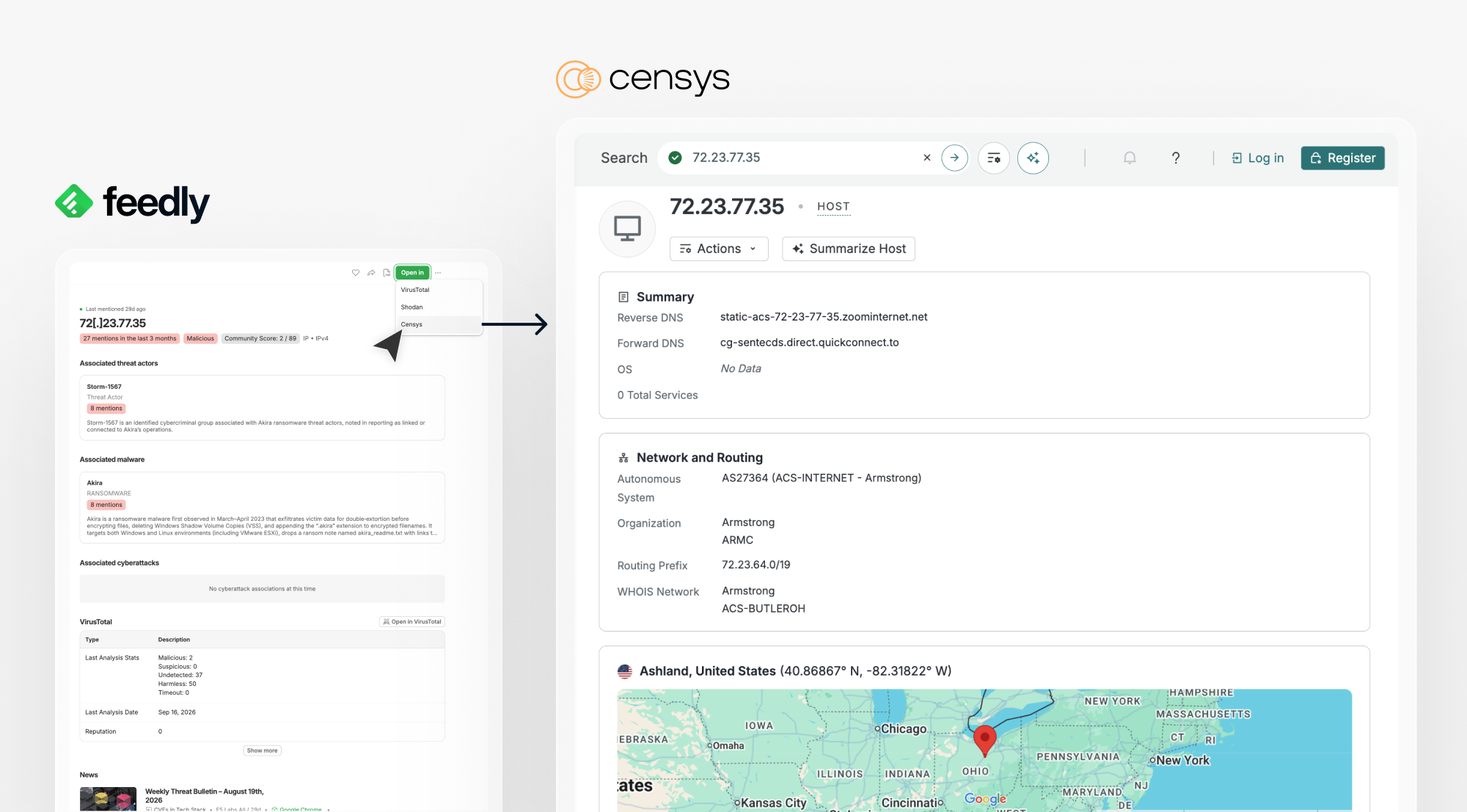 Pivot from an IP IoC to live host data in Censys (2026-09-17) · Sep 2026
· source
· release history
- Extends the Open in Censys pivot to the IoC table on Threat Actor and Malware Insights Cards, so analysts can pivot from a full IoC list without opening each individual card. Pivot from an IP IoC to live host data in Censys (2026-09-17) · Sep 2026 · source · release history
- Enables pivoting from Feedly IoC Insights Cards directly to Censys host lookup pages with a single click Pivot from an IP IoC to live host data in Censys (2026-09-17) · Sep 2026 · source · release history
- Adds an Open in Censys button to IoC Insights Cards, enabling one-click pivot from a flagged IP to live Censys host data including open ports, running services, TLS certificates, ASN, and hosting provider.︀︄︇︀︅︉︀︅︀︀︃︀︀︅︅︀︅︊︀︄︆︀︃︄ Pivot from an IP IoC to live host data in Censys (2026-09-17) · Sep 2026 · source · release history
-
Exposes a CVE Insights Card in Feedly Threat Intelligence that links directly to articles containing associated hunting queries.
Automatically collect Splunk Hunting Queries that match your requirements (2026-08-25) · Aug 2026
· source
· release history
Cyberattack Intel Agent shipped Discovers and monitors relevant cyber attacks using AI and a real-time Threat Graph, surfacing attack chains, victims, attributions, and related context in Insights Cards.
release 8 total
- Adds a new export format for the Cyber Attack Intel Agent Stay on top of every Custom Intel Agent update · Aug 2026 · source · release history
- Adds a SEC-filing filter to the Cyber Attack Intel Agent. Threat Intelligence updates — 2026-08-05 · Aug 2026 · source · release history
- Adds Cyberattack Intel Agent to monitor real-time attack activity targeting specific industries Feedly Best Practices for CTI Teams (2026-05-19) · May 2026 · source · release history
- Enables running custom queries across up to 100 cyberattacks at once in the Cyberattack Intel Agent. Analyze patterns across 100 cyberattacks with Ask AI in the Cyberattack Intel Agent (2026-05-06) · May 2026 · source · release history
- Adds Ask AI capability within the Cyberattack Intel Agent allowing analysts to run custom AI prompts against threat data. Analyze patterns across 100 cyberattacks with Ask AI in the Cyberattack Intel Agent (2026-05-06) · May 2026 · source · release history
- Launches a redesigned Feedly Threat Intelligence landing page at feedly.com/threat-intelligence for overviewing platform capabilities. Analyze cyberattacks with AI, explore our new TI page, and more · Apr 2026 · source · release history
docs 7 total
- Cyberattack Intel Agent: Discover and monitor relevant cyber attacks docs update · Jul 2026 · source
- Cyberattack Intel Agent: Discover and monitor relevant cyber attacks docs update · Jul 2026 · source
- Cyberattack Intel Agent: Discover and monitor relevant cyber attacks docs update · Jul 2026 · source
- Cyberattack Intel Agent: Discover and monitor relevant cyber attacks docs update · Jul 2026 · source
- Cyberattack Intel Agent: Discover and monitor relevant cyber attacks Filter cyberattacks to identify attack chains, victims, attributions, and more The new Cyberattack Intel Agent and Insights Cards utilize AI, powered by a real-time Threat Graph, to provide you with attack data and the relevant context in a single… docs update · Jul 2026 · source
- Cyberattack Intel Agent: Discover and monitor relevant cyber attacks docs update · Jul 2026 · source
example
-
Scope an Intel Agent to your known suppliers and assess each incident's business impact without pasting supplier lists into every prompt.
Step 1: In Org Profile, create a 'Vendor list' item named 'suppliers' (import from a .csv file with up to 1,000 companies).
Org Profile: Turn "what happened" into "why it matters to us" (2026-09-29) · Sep 2026
· source
Detection Rule Intelligence Agent shipped Continuously collects, filters, and exports detection rules (Suricata, Sigma, YARA, Snort, Splunk SPL, KQL) from open sources via AI models and custom feeds.
release 9 total
-
Extends detection rule recognition to six formats: Splunk SPL, Sigma, YARA, Suricata, Snort, and KQL (Microsoft Defender and Sentinel), covering network traffic inspection, file and malware matching, and log-based detection.
Automatically collect Splunk Hunting Queries that match your requirements (2026-08-25) · Aug 2026
· source
· release history
- Allows pairing multiple AI Models in an AI Feed to narrow collected queries to specific topics, threats, or malware families. Automatically collect Splunk Hunting Queries that match your requirements (2026-08-25) · Aug 2026 · source · release history
- Supports programmatic retrieval of collected hunting queries via the API for direct integration into detection pipelines. Automatically collect Splunk Hunting Queries that match your requirements (2026-08-25) · Aug 2026 · source · release history
- Adds a Splunk Hunting Queries AI Model that continuously extracts and surfaces SPL queries from articles across 5,000 vetted CTI sources, vendor blogs, threat reports, and GitHub repositories. Automatically collect Splunk Hunting Queries that match your requirements (2026-08-25) · Aug 2026 · source · release history
- Adds five new AI Model types to AI Feeds for collecting Suricata, Sigma, YARA, Snort, and KQL hunting queries alongside Splunk. Automatically collect Splunk Hunting Queries that match your requirements (2026-08-25) · Aug 2026 · source · release history
-
Enables export and programmatic API pull of extracted Suricata rules directly into detection pipelines, IDS, or SIEM tooling.
 Continuously collect Suricata rules matching your requirements (2026-08-19) · Aug 2026
· source
· release history
docs
- Threat Intelligence Continuously collect Suricata rules matching your requirements The new Suricata Rules AI Model helps CTI analysts find, filter, and import detection rules from open reporting Chris Pickard on Aug 19, 2026 BLUF Feedly Threat Intelligence now finds Suricata rules published across the open web,… docs update · Aug 2026 · source
-
Continuously collect Suricata rules matching your requirements
 docs update · Aug 2026
· source
example
-
Pull detection rules into an automated detection pipeline via the API.
Pull the rules programmatically via the API into your detection pipeline.Automatically collect Splunk Hunting Queries that match your requirements (2026-08-25) · Aug 2026 · source -
Retrieve a hunting query associated with a specific CVE directly from the feed interface.
Download the query straight from Feedly Threat Intelligence's CVE Insights Card and jump to the article that referenced it.Automatically collect Splunk Hunting Queries that match your requirements (2026-08-25) · Aug 2026 · source -
Continuously surface new Suricata rules relevant to a specific threat actor or malware family as open-source reporting is published.
In Feedly Threat Intelligence, go to AI Feeds > Create AI Feed, add the 'Suricata Rules' AI Model, then pair it with additional AI Models representing your intelligence requirements (e.g.Continuously collect Suricata rules matching your requirements (2026-08-19) · Aug 2026 · source
VirusTotal enrichment on IoC Insights Cards shipped suggested Connects a user-supplied VirusTotal API key to surface detection verdicts, reputation scores, WHOIS records, certificate data, network attribution, and community votes directly on IoC Insights Cards, with a one-click pivot to the full VirusTotal dataset; enrichment data is account-scoped and never stored or shared by Feedly.
Suggested capability: Threat indicator matching. This is our guess, not confirmed.
release 10 total
- Enables one-click pivot from an IoC Insights Card directly to the full VirusTotal dataset for deeper investigation. Triage indicators faster with VirusTotal verdicts in Feedly (2026-07-07) · Jul 2026 · source · release history
- Embeds WHOIS records, certificate data, network attribution, and community votes on IoC Insights Cards for zero-detection domain analysis. Triage indicators faster with VirusTotal verdicts in Feedly (2026-07-07) · Jul 2026 · source · release history
- VirusTotal enrichment data remains account-scoped — never stored by Feedly and never shared with other users or teammates. Triage indicators faster with VirusTotal verdicts in Feedly (2026-07-07) · Jul 2026 · source · release history
- Adds VirusTotal integration: connect your existing VirusTotal API key to surface detection verdicts and reputation scores inside IoC Insights Cards. Triage indicators faster with VirusTotal verdicts in Feedly (2026-07-07) · Jul 2026 · source · release history
- Surfaces contextual threat intelligence from GreyNoise and VirusTotal in IoC Insights Cards via the Integrations page. Leverage sharper cyberattack clustering, GreyNoise & VirusTotal enrichment, Apple security updates, and Analyst1 integration · May 2026 · source · release history
- Enables CTI analysts to run Ask AI queries directly within the Cyberattack Agent workflow to assess threat actors and map activity. Analyze cyberattacks with AI, explore our new TI page, and more · Apr 2026 · source · release history
docs
-
Olivia Malterre If I use the VirusTotal Connector and then pull IoCs from Feedlyâs API, will the VirusTotal information also be provided? If you have set up the VirusTotal Connector and use this API endpoint,
https://developers.feedly.com/reference/getiocmetadata, then VirusTotal data will be provided. seen Oct 2026 · source
example
-
Activate VirusTotal enrichment so detection verdicts appear on every IoC Insights Card your team reviews.
In Feedly, go to Account Settings, locate the VirusTotal integration section, and paste your existing VirusTotal API key to enable enrichment across all IoC Insights Cards.Triage indicators faster with VirusTotal verdicts in Feedly (2026-07-07) · Jul 2026 · source -
Configure the integration by pasting your existing VirusTotal API key into Feedly account settings to enable enrichment across all IoC Insights Cards
Navigate to Account Settings > Threat Intelligence integrations and paste your VirusTotal API key.Triage indicators faster with VirusTotal verdicts in Feedly (2026-07-07) · Jul 2026 · source
MISP Integration Enhancements shipped Upgrades MISP integration with increased polling frequency, local and global custom tag support, distribution controls, and user attribution tags.
release 11 total
- Added IOC Insights Cards to Ask AI responses for instant contextual data. Connect indicators to threat actors, malware, and cyberattacks automatically · Jan 2026 · source · release history
- Improves STIX export format for IP with port as separate network traffic objects Collect intel on any threat, then export IoCs in seconds · Sep 2025 · source · release history
- Adds description field to threat TTP STIX objects in exports Collect intel on any threat, then export IoCs in seconds · Sep 2025 · source · release history
- Enables export of TTPs to ATT&CK Navigator directly from selected articles or the entire board (max 200 articles) Collect intel on any threat, then export IoCs in seconds · Sep 2025 · source · release history
- Adds threat actor tags support in the MISP integration for Feedly Threat Intelligence Advanced plan. Ask AI just got better with prompt suggestions · May 2025 · source · release history
- Displays the Feedly user who added an article to the Team Board as a static MISP tag Threat Intelligence updates — 2024-06-19 · Jun 2024 · source · release history
Censys and GreyNoise lookup on IP Insights Cards shipped suggested Surfaces Censys data directly in the IP context panel when viewing an IP Insights Card.
previously: Censys lookup on IP Insights Cards
Suggested capability: Threat indicator matching. This is our guess, not confirmed.
release
-
Provides access to Censys infrastructure details (ports, services, certificates, ASN, WHOIS) without requiring a separate Censys account
Pivot from an IP IoC to live host data in Censys (2026-09-17) · Sep 2026
· source
· release history
- IP Insight Cards gain a Censys lookup, surfacing Censys data directly in the IP context panel. changelog · Aug 2026 · source · release history
- Adds Proof of Exploit model to distinguish PoC code from active exploitation. Track exploit types, Oracle and Atlassian advisories, and more · Jun 2026 · source · release history
-
Surfaces GreyNoise behavioral and classification signals alongside OSINT in IoC Insight Cards
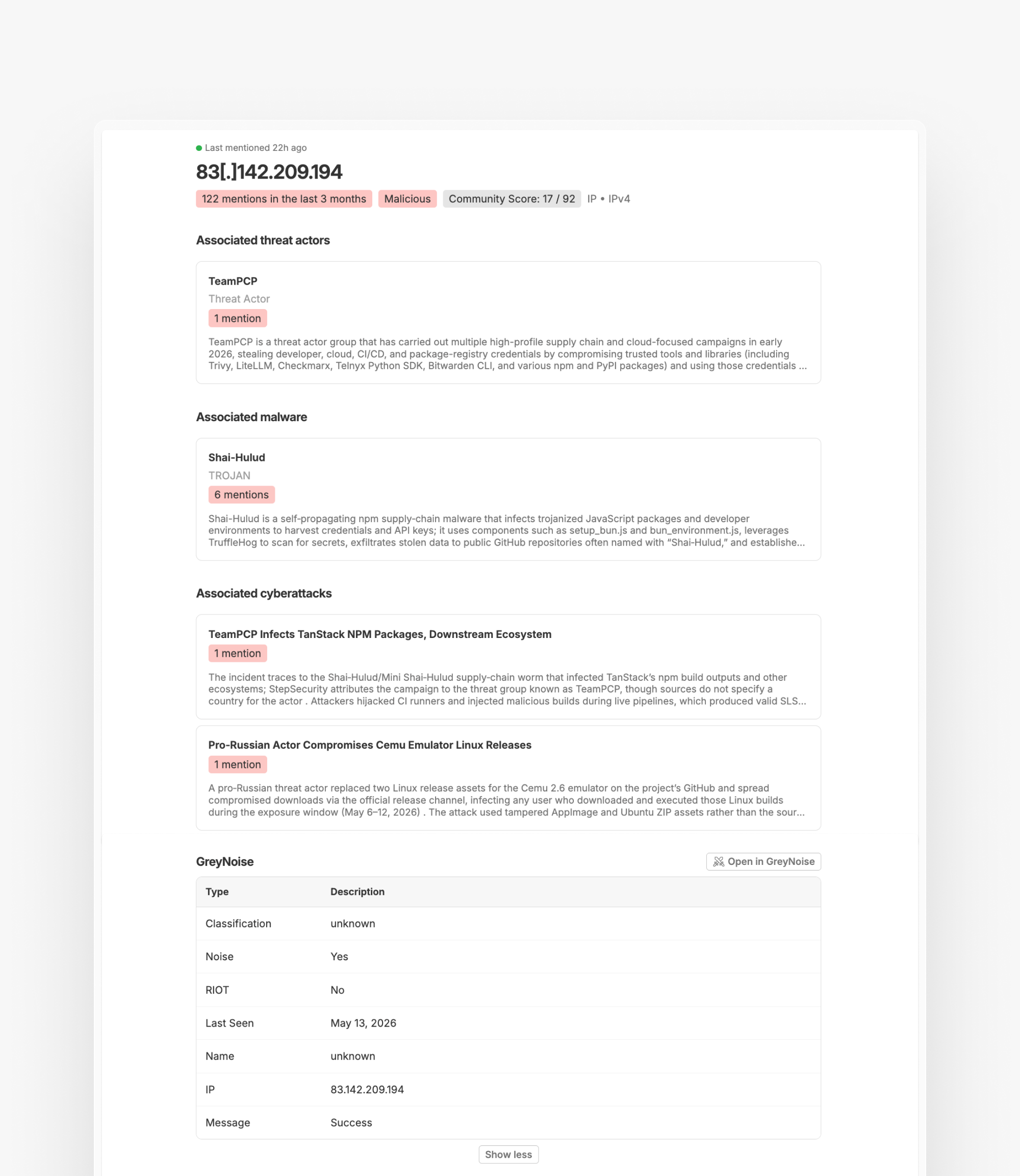 Enrich indicators faster with GreyNoise context built into IoC Insight Cards (2026-05-14) · May 2026
· source
· release history
docs
- Olivia Malterre See the setup guide for details. If I use the GreyNoise Connector and then pull IoCs from Feedlyâs API, will the GreyNoise information also be provided? docs update · Oct 2026 · source
-
Olivia Malterre If I use the GreyNoise Connector and then pull IoCs from Feedlyâs API, will the GreyNoise information also be provided? If you have set up the GreyNoise Connector and use this API endpoint,
https://developers.feedly.com/reference/getiocmetadata, then GreyNoise data will be provided. seen Oct 2026 · source -
Pivot from an IP IoC to live host data in Censys
docs update · Sep 2026
· source
example
-
Pivot from an IP IoC in a Threat Actor card to Censys for live host data without leaving Feedly.
Open the Threat Actor Insights Card, locate the IP in the IoC table, and click 'Open in Censys'.Pivot from an IP IoC to live host data in Censys (2026-09-17) · Sep 2026 · source -
Validate whether a reported IP is still live and check for shared infrastructure before actioning a block.
In Feedly Threat Intelligence, open an IoC Insights Card for any IP indicator, then click 'Open in Censys' to view the live host record, open ports, TLS certificates, and certificate-sharing peers in…Pivot from an IP IoC to live host data in Censys (2026-09-17) · Sep 2026 · source
Ask AI — threat actor campaign detection and hunting query generation shipped Provides an AI model tuned for threat actor campaign detection that generates SPL (Splunk) and KQL hunting queries and applies improved MITRE ATT&CK tagging to results.
Also counts toward: Built-in AI assistant, Natural-language query
release 7 total
- Fixes broken KQL hunting query extraction and adds extraction of full SPL hunting queries. Threat Intelligence updates — 2026-08-05 · Aug 2026 · source · release history
- Improves MITRE ATT&CK tagging accuracy in Ask AI results. changelog · Jul 2026 · source · release history
- New Ask AI model tuned specifically for threat actor campaign detection. changelog · Jul 2026 · source · release history
- Adds SPL (Splunk Processing Language) hunting query generation to Ask AI, complementing existing KQL support. changelog · Jul 2026 · source · release history
- New AI Model for new threat actor campaigns, compatible with Ask AI. Threat Intelligence updates — 2026-07-22 · Jul 2026 · source · release history
- New Splunk (SPL) hunting queries AI Model, completing the existing KQL hunting queries. Threat Intelligence updates — 2026-07-22 · Jul 2026 · source · release history
docs
- Jul 22, 2026 Hunt threat actor campaigns and run SPL queries alongside KQL This release brings upgrades to Ask AI, including a new model tuned for threat actor campaign detection and SPL hunting queries to complement our existing KQL support. changelog · Jul 2026 · source
example
-
Generate a Splunk SPL hunting query for a specific threat actor campaign directly from Ask AI instead of switching to an external query builder.
In the Feedly console, open Ask AI and prompt: "Generate an SPL hunting query for [threat actor] campaigns targeting [industry]."changelog · Jul 2026 · source
Threat Graph and Actor Analysis Models shipped Expands the Threat Graph with specialized AI models for analyzing threat actors by country, identifying new actors, detecting political instability, and tracking strategic initiatives.
Also counts toward: ML-based detection
release 9 total
- Adds a new AI Model: State-sponsored threat actors Suricata detection rules, Ask AI Research Playground, and more · Jun 2026 · source · release history
- Introduces a new Threat Actors from North Africa AI Model. Enrich Vertex Synapse with Feedly Threat Graph intelligence, and extract registry keys IoCs · Dec 2025 · source · release history
- Track MITRE ATT&CK v18 with 12 new Feedly AI Models for enterprise tactics Enhance CVE assessment, track MITRE ATT&CK v18, and personalize your Intel Profiles · Nov 2025 · source · release history
- Adds New AI Model for 'threat actors from Middle East' Threat Intelligence updates — 2025-11-12 · Nov 2025 · source · release history
- Adds a Banking industry option to the New Cyberattack Dashboard AI Model for monitoring attacks targeting banks Threat Intelligence updates — 2025-10-30 · Oct 2025 · source · release history
- Introduces a new Strategic Initiative AI Model to track organizational initiatives, programs, acceleration programs, and donation initiatives Automated Newsletters update & new AI Model · Aug 2024 · source · release history
Threat Actor Intelligence Aggregation shipped Displays trending TTPs, exploited vulnerabilities, targeted regions and industries, malware links, and related threat intelligence reports within dedicated Threat Actor Insight Cards.
release 8 total
- Adds threat actor motivation to Threat Actor Insight Cards Threat Intelligence updates — 2025-02-19 · Feb 2025 · source · release history
- Adds Export PDF capability to Automated Newsletters via UI controls New PDF export on Automated Newsletters · Aug 2024 · source · release history
-
Adds an
EPSSand a Product column to the Exploited Vulnerabilities table in Threat Actor and Malware Insights Cards Automated Newsletters update & new AI Model · Aug 2024 · source · release history - Adds date filter, Article Count graph, and updated Exploited Vulnerabilities table to Threat Actor Insights Cards. Introducing Top Stories and new sharing options to Bluesky and Threads · May 2024 · source · release history
- Enables clicking threat actor and malware names directly on Insights Cards to open their respective detail views. Threat Intelligence updates — 2024-03-13 · Mar 2024 · source · release history
- Unlocks access to articles labeled Others in the Threat Actor Insights Card EclecticIQ integration · Jan 2024 · source · release history
example
-
Deploy the connector and configure it to ingest intelligence for specific threat actors.
1. Deploy connector from OpenCTI repository. 2. Set 'credentials' with Feedly API token and OpenCTI URL. 3. Configure 'AI Feeds' and 'Folders' to scope input. 4.Keep your OpenCTI knowledge graph current, automatically (2026-05-28) · May 2026 · source
Content and Feed Management Features shipped Adds MIST feed tags, Bluesky/Threads sharing, 0day.today feed support, Mastodon feed integration, custom date range search, and article deduplication.
release 8 total
- Enables Ask AI to process combined Vulnerability and Cyber Attack Agent queries in a single interaction Threat Intelligence updates — 2026-04-02 · Apr 2026 · source · release history
-
@Feedly managecommand in MS Teams channels to control integration settings including deduplication toggles. Get threat intelligence to your team fast, in the tools they already use (2026-03-17) · Mar 2026 · source · release history - Automatic deduplication of articles from Team AI Feeds sent to Microsoft Teams channels. Get threat intelligence to your team fast, in the tools they already use (2026-03-17) · Mar 2026 · source · release history
- Adds time range analysis to track performance over custom periods Granular analytics, AI-powered Threat Actor Insights, and key improvements · Aug 2025 · source · release history
- Added support for Mastodon feeds for IoC detection New changelog featuring suggested Models in autocomplete · Apr 2024 · source · release history
- Makes the source 0day.today available as a new feed option (also included in the Vulnerability Starter Kit) Power Search custom date range & deduplication in Automated Newsletters · Mar 2024 · source · release history
example
-
Verify or enable deduplication to reduce noise from multiple sources covering the same event.
@Feedly manageGet threat intelligence to your team fast, in the tools they already use (2026-03-17) · Mar 2026 · source
Credential Leak Dark Web Agent shipped Monitors up to five email domains per agent across dark web networks and leak collections, with filtering, trend visualizations, and CSV or API export of findings including passwords.
Also counts toward: Agent-based deployment, CSV data export
release
-
Adds the Credential Leak Dark Web Agent, monitoring up to five email domains per agent (including subsidiaries and acquisitions) across Tor, I2P, ZeroNet, OpenNIC, Telegram, Discord, IRC, FTP, and named data leak collections, checking for new matches every 24 hours.︀︄︇︀︅︉︀︅︀︀︃︀︀︅︅︀︅︊︀︄︆︀︃︄
Credential Leak Dark Web Agent: Monitor exposed accounts (2026-10-27) · Oct 2026
· source
· release history
- Supports exporting the Insights Card credential table as CSV (with passwords, if present) or retrieving findings and Insights Card content — including passwords — through the Feedly API. Credential Leak Dark Web Agent: Monitor exposed accounts (2026-10-27) · Oct 2026 · source · release history
- Adds a Trends & Visualizations tab showing how findings change over time, their sources, and which accounts appear most frequently. Credential Leak Dark Web Agent: Monitor exposed accounts (2026-10-27) · Oct 2026 · source · release history
- Adds password-policy filtering to hide leaks where no password meets the organization's complexity requirements, reducing noise from non-compliant credentials. Credential Leak Dark Web Agent: Monitor exposed accounts (2026-10-27) · Oct 2026 · source · release history
docs
-
Credential Leak Dark Web Agent: Monitor exposed accounts
docs update · Oct 2026
· source
example
-
Set up a Credential Leak Dark Web Agent to watch your primary domain and an acquired subsidiary domain simultaneously.
In Feedly, go to Dark Web Agents > New Agent > Credential Leak Dark Web Agent. Enter up to five email domains (e.g., fabrikam.example and litware.example).Credential Leak Dark Web Agent: Monitor exposed accounts (2026-10-27) · Oct 2026 · source -
Export the credential table from a specific finding to attach to an IAM remediation request, with passwords included where present.
In Feedly, open a Credential Leaks Insights Card > locate the credential table > click Export CSV. Attach the resulting file to your IAM ticket for account validation and password reset.Credential Leak Dark Web Agent: Monitor exposed accounts (2026-10-27) · Oct 2026 · source
CVE History Tracking shipped Tracks critical vulnerability events from initial discovery through to active exploitation within CVE Insights Cards.
release 7 total
- Adds CVE status field to show rejected or reserved CVEs Smarter insider threat detection, broader search coverage, and more · May 2026 · source · release history
- CVE Timeline's Attribution of Exploits event now links directly to the corresponding threat actor or malware Insights Card. Threat Intelligence updates — 2024-07-03 · Jul 2024 · source · release history
- CVE Insights Cards now have improved summaries New changelog featuring our new Microsoft Sentinel Integration · Apr 2024 · source · release history
- Adds PDF export and favorite options to the CVE Insights Card Power Search custom date range & deduplication in Automated Newsletters · Mar 2024 · source · release history
- Updates CVE Insights Cards to include the EPSS value in the copy to clipboard button output Introducing Malware Insights Cards, Political Instability AI Model · Feb 2024 · source · release history
- CVE timeline Highlights button to highlight specific events across all timelines Threat Intelligence updates — 2024-01-17 · Jan 2024 · source · release history
Multilingual Search and Feed Integration shipped Enables searching for content in dozens of languages with automatic deduplication and translation, and integrating social profiles as feed sources.
release 7 total
- Automatic translation of article titles and summaries into English via Multilingual plan support. Get threat intelligence to your team fast, in the tools they already use (2026-03-17) · Mar 2026 · source · release history
- Enables Feedly AI to deduplicate stories and automatically translate articles to English across the 15 supported languages Break language barriers in your research with Feedly AI’s 15 supported languages · Jun 2025 · source · release history
- Adds Multilingual AI support for Arabic, Polish, Ukrainian, and Vietnamese, enabling global threat intel without language barriers Break language barriers in your research with Feedly AI’s 15 supported languages · Jun 2025 · source · release history
- Adds Dutch and Portuguese languages to Multilingual AI capabilities with cross-language deduplication and automatic English translation Smarter CVE analysis, multilingual research, and LinkedIn monitoring · Apr 2025 · source · release history
- Adds Chinese language coverage to AI Models for story search in the All Web tab Smarter insights, faster decisions - Security update releases, Chinese multilingual AI, Auto-translations · Feb 2025 · source · release history
- Enables auto-translation of articles from Chinese, French, German, Italian, and Spanish to English Smarter insights, faster decisions - Security update releases, Chinese multilingual AI, Auto-translations · Feb 2025 · source · release history
TTP Dashboard Filtering and Context shipped Adds granular filtering capabilities (platform, industry, country, date range) to the TTP Dashboard and enhances TTP visualizations with ATT&CK links.
release 7 total
- Adds a Last 24 hours filter to the TTP Dashboard Threat Intelligence updates — 2024-06-19 · Jun 2024 · source · release history
- Adds filtering by platform (e.g., macOS) in the TTP Dashboard Threat Intelligence updates — 2024-01-31 · Jan 2024 · source · release history
- Adds filtering by industry in the TTP Dashboard Threat Intelligence updates — 2024-01-31 · Jan 2024 · source · release history
- Adds Threat Actors from filter (e.g. Threat Actors from China) to the TTP Dashboard Threat Intelligence updates — 2024-01-31 · Jan 2024 · source · release history
- Adds New Threat Actors filter to the TTP Dashboard Threat Intelligence updates — 2024-01-31 · Jan 2024 · source · release history
-
TTP Dashboard
platformfilter capability Threat Intelligence updates — 2024-01-17 · Jan 2024 · source · release history
Custom Intel Agent AI actions shipped Allows custom Intel Agents to invoke Ask AI Analyze and Research actions, enabling AI-driven analysis and research workflows within agent configurations.
release
- Custom Intel Agents now support Ask AI Analyze and Research actions, enabling AI-driven analysis and research workflows within agent configurations. changelog · Aug 2026 · source · release history
- Adds Ask AI Analyze and Research actions to Custom Intel Agents. Threat Intelligence updates — 2026-08-05 · Aug 2026 · source · release history
- Adds an Open in Navigator button to the header of Threat Actor and Malware Insights Cards Automated Newsletters update & new AI Model · Aug 2024 · source · release history
- Enables exporting TTPs to ATT&CK Navigator directly from Threat Actor and Malware Insights Cards Two-factor authentication available on your accounts · Jul 2024 · source · release history
- AI Actions feature to analyze threat campaigns, extract patterns, and create customized reports grounded in selected articles Introducing Feedly AI Actions for Threat Intelligence · Jun 2024 · source · release history
-
Updates the
Export as STIX 2.1option availability to include Tactics and Techniques article prompts. Introducing Top Stories and new sharing options to Bluesky and Threads · May 2024 · source · release history
Report Builder shipped Generates reports with a progress indicator displayed during long-running report creation.
release
- Report Builder adds a progress indicator during generation, making long-running report creation more transparent. changelog · Aug 2026 · source · release history
- Adds Feedly’s Threat Landscape as a source for Automated Newsletters to pull trending threat intelligence articles automatically Automate threat briefings and explore cyberattacks faster in Ask AI · Feb 2026 · source · release history
- Expands the CSV export limit in the Vulnerability Dashboard to return up to 10,000 results. Smarter CVE analysis with Ask AI · Oct 2025 · source · release history
- Adds PNG export for individual charts in the Vulnerability Dashboard to help users include them in reporting Custom charts, Power Search upgrades, and more · Apr 2025 · source · release history
- Automatically deduplicates articles appearing in multiple Folders within the same Automated Newsletter Power Search custom date range & deduplication in Automated Newsletters · Mar 2024 · source · release history
- Enables PDF export for the Threat Actor Insights Card EclecticIQ integration · Jan 2024 · source · release history
External Intelligence Platform Integrations shipped Enables bidirectional data flow with external threat intelligence platforms including EclecticIQ, Anomali ThreatStream, and OpenCTI for automated ingestion and context synchronization.
release
- Adds a new OpenCTI connector to automatically push STIX 2.1 bundles from Feedly AI Feeds to the OpenCTI knowledge graph Keep your OpenCTI knowledge graph current, automatically (2026-05-28) · May 2026 · source · release history
-
Adds support for
MISPas an integration destination for enriched feed data Feedly Best Practices for CTI Teams (2026-05-19) · May 2026 · source · release history - Adds ThreatConnect integration to deliver contextual intelligence directly into your TIP. Enrich your TIP with this new integration! · May 2025 · source · release history
-
Adds
Anomali ThreatStreamintegration to ingest Feedly AI-discovered IoCs, threat actors, malware, TTPs, and CVE relationships. Double opt-in processes for Automated Newsletter emails & Anomali ThreatStream integration · Jul 2024 · source · release history - Updates OpenCTI integration to use intrusion sets field instead of threat actor groups New changelog featuring Mitre ATT&CK v15.1 · May 2024 · source · release history
-
Adds the
EclecticIQ integrationfor automatic ingestion of Feedly threats into EclecticIQ Intelligence Center as STIX objects EclecticIQ integration · Jan 2024 · source · release history
Malware Research Capability shipped Introduces dedicated malware insights cards, improved malware disambiguation, and specific AI prompts for malware family research.
release
- Pulls threat intelligence from Feedly Folders, AI Feeds, or Team Boards into Analyst1 as structured evidence via STIX 2.1 output. Leverage sharper cyberattack clustering, GreyNoise & VirusTotal enrichment, Apple security updates, and Analyst1 integration · May 2026 · source · release history
- Enables Ask AI within Malware Insights Cards to generate summaries, reports, and answer targeted questions about specific malware Investigate smarter, collaborate better, and onboard faster with these new features · Jul 2025 · source · release history
- Adds affected platforms to Malware Insight Cards Threat Intelligence updates — 2025-02-19 · Feb 2025 · source · release history
- Increases precision of malware disambiguation for ambiguous names such as Sugar or LSD Automated Newsletters update & new AI Model · Aug 2024 · source · release history
- Adds Malware Insights Cards to the Threat Landscape Dashboard, TTP Dashboard, article AI prompts, and threat actor AI model tooltips for malware family research Introducing Malware Insights Cards, Political Instability AI Model · Feb 2024 · source · release history
example
-
Find active, wormable threats requiring no user interaction or privileges.
(Privileges Required: None) AND (User Interaction: None) AND (Exploited) OR (Proof of Concept) OR (Weaponized) OR (CISA KEV) AND (Attack Vector: Network) NOT (Patched)Vulnerability Intel Agent: 7 ways to use CVSS Vector filters for smarter CVE prioritization (2026-02-03) · Feb 2026 · source
Cyber Attack Insights Card Deep Dive shipped Allows drilling down into individual attacks to view timelines, IoCs, TTPs, CVE links, and article references.
release
- Cyberattack Insights Cards provide a dynamic 360° view of cyberattacks, consolidating threat actors, malware, IoCs, and TTPs into a single evolving display. Cyberattack Insights Cards: A dynamic 360° attack view (2026-02-18) · Feb 2026 · source · release history
-
Adds an
IoCstable within the Insights Card for threat actors, malware families, and cyber attacks Stop chasing attribution and easily link IoCs to threats · Dec 2025 · source · release history - New Cyber Attack Insights Cards drill down into individual attacks with timelines, IoCs, TTPs, CVE links, and article references Introducing two major upgrades: Cyber Attack Dashboard & AI Search · Jul 2025 · source · release history
example
-
Visualize the attack chain from initial access to impact for selected incidents.
In the Cyberattack Intel Agent, filter by time period, threat actor, and MITRE ATT&CK Tactic.Analyze patterns across 100 cyberattacks with Ask AI in the Cyberattack Intel Agent (2026-05-06) · May 2026 · source
Feedly Threat Graph Integration with Vertex Synapse shipped Integrates Feedly with Vertex Synapse to automatically ingest IoCs, CVEs, TTPs, threat actors, and malware enriched with context from the Feedly Threat Graph.
release
- Adds Go To command launched via Cmd + K (Mac) or Ctrl + K (Windows) to instantly search and navigate to threat intelligence assets. Navigate Feedly Faster with Go To (2026-04-07) · Apr 2026 · source · release history
- Eliminates the need to jump between tabs or hunt through reports to find related IoCs Stop chasing attribution and easily link IoCs to threats · Dec 2025 · source · release history
example
-
Retrieve recently viewed threat cards to resume analysis without browser history.
Open Go To and select a page from the automatically shown 'Recently viewed pages' listNavigate Feedly Faster with Go To (2026-04-07) · Apr 2026 · source -
Jump to a specific threat actor's dashboard without clicking through folders.
Hit Cmd + K and type the threat actor nameNavigate Feedly Faster with Go To (2026-04-07) · Apr 2026 · source
PDF Content Analysis shipped Processes publicly accessible PDFs to extract metadata, visual content, and enables AI-driven questioning of the document.
release
- Enables uploading PDF files directly into Feedly to analyze alongside open-source intelligence feeds via Ask AI Analyze your closed-source intelligence in Feedly (2026-03-10) · Mar 2026 · source · release history
- Adds the Enable File Upload toggle under Workspace Settings > More, allowing team admins to allow members to upload PDFs for automatic metadata extraction and Ask AI access. Full AI capabilities, now on your own PDF reports · Feb 2026 · source · release history
- Enables processing of publicly accessible PDFs to extract metadata, visual content, and ask AI-driven questions New in Feedly: Multilingual AI, PDF Insights, and Smarter CVE Timelines · Jan 2025 · source · release history
example
-
Enable PDF ingestion for your team via the workspace configuration.
Workspace Settings > More > Enable File UploadFull AI capabilities, now on your own PDF reports · Feb 2026 · source
Threat Graph Export Capabilities shipped Enables exporting TTPs directly to ATT&CK Navigator and improves STIX export formats for IP and network traffic objects.
Also counts toward: CSV data export
release
- IoCs within Cyberattack Insights Cards can be exported in STIX 2.1, MISP, or CSV formats for integration with external security tools. Cyberattack Insights Cards: A dynamic 360° attack view (2026-02-18) · Feb 2026 · source · release history
- Improves STIX export format for IP with port as separate network traffic objects Collect intel on any threat, then export IoCs in seconds · Sep 2025 · source · release history
- Enables export of TTPs to ATT&CK Navigator directly from selected articles or the entire board (max 200 articles) Collect intel on any threat, then export IoCs in seconds · Sep 2025 · source · release history
example
-
Export IoCs from a specific attack card to import into your SIEM or threat hunting platform.
1. Open the relevant Cyberattack Insights Card. 2. Locate the 'IoCs exportable in STIX 2.1, MISP, or CSV' option. 3. Select the desired format (STIX 2.1, MISP, or CSV) to download the IoC data.Cyberattack Insights Cards: A dynamic 360° attack view (2026-02-18) · Feb 2026 · source
Cyber Attack Dashboard shipped Provides a real-time view of evolving attacks with filterable views by industry, country, threat actor, and malware family.
release
- Adds more industry categories for cyber attack tagging Stay on top of every Custom Intel Agent update · Aug 2026 · source · release history
- Enables searching by victim state in the Cyber Attack agent Navigate faster with Go To, tailor your alerts with custom summaries, and translate newsletters in one click · Apr 2026 · source · release history
- New Cyber Attack Dashboard provides real-time updates on evolving attacks with filterable views by industry, country, threat actor, malware family, or attack type Introducing two major upgrades: Cyber Attack Dashboard & AI Search · Jul 2025 · source · release history
AI Search Mode shipped Allows asking natural language questions to receive structured, cited answers from curated sources and threat graph data.
Also counts toward: Built-in AI assistant, Natural-language query
release
- Adds the ability to ask about cyber attack target entities in Ask AI. Threat Intelligence updates — 2026-08-05 · Aug 2026 · source · release history
- Adds Ask AI capability on top of Intel Agents, Insights Cards, and AI Feeds for synthesis and IOC extraction Feedly Best Practices for CTI Teams (2026-05-19) · May 2026 · source · release history
- New Search - AI Mode allows asking natural language questions for structured, cited answers from curated sources and threat graph data Introducing two major upgrades: Cyber Attack Dashboard & AI Search · Jul 2025 · source · release history
Ask AI Research Mode with RAG shipped Enables adding specific articles and sources to Ask AI Research mode to enable Retrieval-Augmented Generation, with a toggle for the threat graph.
Also counts toward: Natural-language query
release
- Introduces the Ask AI Research Playground for self-serve threat intelligence exploration Suricata detection rules, Ask AI Research Playground, and more · Jun 2026 · source · release history
- Adds the ability to attach articles, PDFs, Boards, AI Feeds, and vulnerability agents together in a single Ask AI or Research query via a '+' button. Simpler ways to query and manage your intelligence · Mar 2026 · source · release history
- Allows adding articles and selecting sources in Ask AI Research mode to enable RAG, with a toggle to enable/disable the threat graph Threat Intelligence updates — 2025-10-30 · Oct 2025 · source · release history
Go To Command Interface shipped Adds a 'Go To' command (Cmd+K/Ctrl+K) for instant search and navigation to threat intelligence assets, actors, malware, vulnerabilities, or IoCs.
release
- Adds Go To (Cmd+K) for instant navigation to resources by actor, malware, vulnerability, or IoC Navigate faster with Go To, tailor your alerts with custom summaries, and translate newsletters in one click · Apr 2026 · source · release history
- Adds Go To command launched via Cmd + K (Mac) or Ctrl + K (Windows) to instantly search and navigate to threat intelligence assets. Navigate Feedly Faster with Go To (2026-04-07) · Apr 2026 · source · release history
example
-
Quickly access a saved AI Feed or Board by its exact title.
Click 'Go To' in the left navigation or press Ctrl + K, then search by nameNavigate Feedly Faster with Go To (2026-04-07) · Apr 2026 · source
AI Actions and Reporting Capabilities shipped Adds AI Actions for campaign analysis and pattern extraction, integrates AI Feeds into newsletters, and enhances PDF export options.
release
- AI Actions feature to analyze threat campaigns, extract patterns, and create customized reports grounded in selected articles Introducing Feedly AI Actions for Threat Intelligence · Jun 2024 · source · release history
- Adds PDF export and favorite options to the CVE Insights Card Power Search custom date range & deduplication in Automated Newsletters · Mar 2024 · source · release history
- Enables PDF export for the Threat Actor Insights Card EclecticIQ integration · Jan 2024 · source · release history
Threat Landscape Newsletter Source shipped Adds Feedly’s Threat Landscape as a source for Automated Newsletters to pull trending threat intelligence articles automatically.
release
-
Includes findings in Automated Newsletters (without passwords) or via Feedly API (with passwords if present) for distribution to IAM, SOC, SOAR, or TIP tooling.
Credential Leak Dark Web Agent: Monitor exposed accounts (2026-10-27) · Oct 2026
· source
· release history
- Adds Feedly’s Threat Landscape as a source for Automated Newsletters to pull trending threat intelligence articles automatically Automate threat briefings and explore cyberattacks faster in Ask AI · Feb 2026 · source · release history
Advanced Newsletter Analytics shipped Adds interactive charts comparing recipient metrics and a table to track individual reader engagement within Automated Newsletters.
release
- Adds an interactive graph to compare key metrics like recipients, open rate, and click rate for newsletters Granular analytics, AI-powered Threat Actor Insights, and key improvements · Aug 2025 · source · release history
- Adds a reader and article engagement table to see who is reading what Granular analytics, AI-powered Threat Actor Insights, and key improvements · Aug 2025 · source · release history
Identity and Access Management shipped Introduces OpenID Connect SSO support and TOTP two-factor authentication for account security.
Also counts toward: Multi-factor authentication, Single sign-on, OIDC SSO
release
- Adds two-factor authentication using a TOTP authenticator for Feedly login types, accessible from the Logins page in settings Two-factor authentication available on your accounts · Jul 2024 · source · release history
- Adds OpenID Connect SSO support for Feedly Threat and Market Intelligence customers Introducing Malware Insights Cards, Political Instability AI Model · Feb 2024 · source · release history
AI Model Discovery and Configuration shipped Improves the discovery of AI models via autocomplete suggestions and adds a new political instability model to the available intelligence models.
release
- Vulnerability AI Models now appear in autocompletes when CVE or CVSS is queried New changelog featuring our new Microsoft Sentinel Integration · Apr 2024 · source · release history
- The AI feed autocomplete is now more generously suggesting AI Models based on user input New changelog featuring suggested Models in autocomplete · Apr 2024 · source · release history
Security Advisories and Vulnerability Data Expansion shipped Expands the sources of security advisories to include AlmaLinux and VMware, and adds 0day.today as a vulnerability source.
release
- Makes the source 0day.today available as a new feed option (also included in the Vulnerability Starter Kit) Power Search custom date range & deduplication in Automated Newsletters · Mar 2024 · source · release history
- Adds feeds for AlmaLinux and VMware security advisories, included in the Security Advisories Starter Kit Introducing Malware Insights Cards, Political Instability AI Model · Feb 2024 · source · release history
Any Language Search shipped Adds an 'Any Language' option to Article Search language filters for unrestricted coverage.
release
- Adds Any Language option to Article Search language filter for unrestricted coverage Smarter insider threat detection, broader search coverage, and more · May 2026 · source · release history
Insider Threats Model Rebuild shipped Rebuilds the Insider Threats AI Model as a semantic topic model with three new core categories.
Also counts toward: ML-based detection
release
- Rebuilds Insider Threats AI Model as semantic topic model with three new core categories Smarter insider threat detection, broader search coverage, and more · May 2026 · source · release history
Report Builder Enhancements shipped Adds a Report Builder that extracts sections from templates and auto-populates them with sourced claims.
release
- Adds Report Builder that extracts sections from templates and auto-populates them with sourced claims Feedly Best Practices for CTI Teams (2026-05-19) · May 2026 · source · release history
TTP Intel Agent shipped Adds a TTP Intel Agent to track trending ATT&CK techniques and launch into MITRE ATT&CK Navigator.
release
- Adds TTP Intel Agent to track trending ATT&CK techniques and launch into MITRE ATT&CK Navigator Feedly Best Practices for CTI Teams (2026-05-19) · May 2026 · source · release history
Vulnerability Intel Agent Enhancements shipped Adds a Vulnerability Intel Agent for personalized CVE monitoring filtered by vendor, product, and attack vector.
release
- Adds Vulnerability Intel Agent for personalized CVE monitoring filtered by vendor, product, and attack vector Feedly Best Practices for CTI Teams (2026-05-19) · May 2026 · source · release history
Attack Chain Visualization shipped suggested Visualizes the attack chain from initial access to impact for selected incidents.
Suggested capability: Forensic timeline analysis. This is our guess, not confirmed.
example
-
Visualize the attack chain from initial access to impact for selected incidents.
In the Cyberattack Intel Agent, filter by time period, threat actor, and MITRE ATT&CK Tactic.Analyze patterns across 100 cyberattacks with Ask AI in the Cyberattack Intel Agent (2026-05-06) · May 2026 · source
Region and Industry Overview Generator shipped Enables generating a threat landscape overview for a specific region and industry using custom filters.
example
-
Generate a threat landscape overview for a specific region and industry using custom filters.
In the Cyberattack Intel Agent, filter by time period, industry, and region. Use Ask AI prompt: 'Based on the selected attacks, generate a threat landscape overview for [region] and [industry].'Analyze patterns across 100 cyberattacks with Ask AI in the Cyberattack Intel Agent (2026-05-06) · May 2026 · source
Threat Intelligence Landing Page shipped Launches a redesigned Feedly Threat Intelligence landing page for overviewing platform capabilities.
release
- Launches a redesigned Feedly Threat Intelligence landing page at feedly.com/threat-intelligence for overviewing platform capabilities. Analyze cyberattacks with AI, explore our new TI page, and more · Apr 2026 · source · release history
Customizable Integration Summaries shipped Enables custom summaries in Feedly’s integrations for Slack and Microsoft Teams to control focus, format, and detail level of article notifications.
release
- Enables custom summaries in Feedly’s integrations for Slack and Microsoft Teams to control focus, format, and detail level of article notifications Navigate faster with Go To, tailor your alerts with custom summaries, and translate newsletters in one click · Apr 2026 · source · release history
Newsletter Translation Button shipped Adds a 'Translate articles to English' button in the Newsletter Design interface for one-click automatic translation.
release
- Adds Translate articles to English button in Newsletter Design for one-click automatic translation Navigate faster with Go To, tailor your alerts with custom summaries, and translate newsletters in one click · Apr 2026 · source · release history
Direct Insights Card Navigation shipped Enables direct navigation to any Insights Card for threat actors, malware families, CVEs, or cyberattacks through the search interface.
release
- Enables direct navigation to any Insights Card for threat actors, malware families, CVEs, or cyberattacks through the new search interface. Navigate Feedly Faster with Go To (2026-04-07) · Apr 2026 · source · release history
EUVD CPE Search Support shipped Extends EUVD classification support to CPE search operations within the Threat Intelligence service.
release
- Extends EUVD classification support to CPE search operations within the Threat Intelligence service Threat Intelligence updates — 2026-04-02 · Apr 2026 · source · release history
Threat Actor Profiles Expansion shipped Adds 7 new threat actor profiles to the Feedly Threat Intelligence database.
release
- Introduces 7 new threat actor profiles to the Feedly Threat Intelligence database Threat Intelligence updates — 2026-04-02 · Apr 2026 · source · release history
TTP Detection Updates shipped Improves existing TTP detections, including enhanced coverage for specific tactics like T1204.004 (ClickFix).
release
- Improves 55 existing TTP detections, including enhanced coverage for T1204.004 (ClickFix) tactics Threat Intelligence updates — 2026-04-02 · Apr 2026 · source · release history
US State Filtering shipped Adds US state filtering capability to the Cyber Attack Agent API for geographically specific threat intelligence queries.
release
- Adds US state filtering capability to the Cyber Attack Agent API for geographically specific threat intelligence queries Threat Intelligence updates — 2026-04-02 · Apr 2026 · source · release history
Insights Card Inline Display shipped Displays structured IoC lists in articles with inline mentions linking to new Insights Cards.
release
- Articles now display a structured IoC list at the top, with new IoC Insights Card accessible from inline mentions. Deliver intel faster via MS Teams, detect never-before-seen techniques, and more · Mar 2026 · source · release history
Microsoft Teams Integration Enhancements shipped Expands Microsoft Teams integration with deduplication, AI summaries, and automatic translation available via the Microsoft Marketplace.
Also counts toward: Extension marketplace
release
- Microsoft Teams integration now available on the Microsoft Marketplace with built-in deduplication, AI-generated summaries, and automatic translation. Deliver intel faster via MS Teams, detect never-before-seen techniques, and more · Mar 2026 · source · release history
Novel TTP Detection Model shipped Introduces a 'Novel TTPs' AI Model in AI Feeds to detect articles documenting attack techniques observed for the first time.
Also counts toward: ML-based detection
release
- New Novel TTPs AI Model in AI Feeds detects articles documenting attack techniques observed for the first time. Deliver intel faster via MS Teams, detect never-before-seen techniques, and more · Mar 2026 · source · release history
Notification Summary Payloads shipped Includes AI-generated summaries in notification payloads for rapid relevance assessment.
release
- AI-generated summaries included in notification payloads for rapid relevance assessment. Get threat intelligence to your team fast, in the tools they already use (2026-03-17) · Mar 2026 · source · release history
Teams Channel Subscription shipped Enables subscribing a specific threat monitoring feed directly to a Teams channel for automated delivery.
example
-
Subscribe a specific threat monitoring feed directly to a Teams channel for automated delivery.
Subscribe 'Team AI Feed' to [Channel Name]Get threat intelligence to your team fast, in the tools they already use (2026-03-17) · Mar 2026 · source
Private Lists Management UI shipped Adds UI controls to edit Private Lists, including adding/removing companies and products, renaming lists, and viewing entity counts.
release
- Adds UI controls to edit Private Lists directly, including adding/removing companies and products, renaming lists, and viewing entity counts. Simpler ways to query and manage your intelligence · Mar 2026 · source · release history
Files Page for Team Documents shipped Centrizes tracking of all team-uploaded documents via a dedicated Files Page.
release
- Adds a Files Page to centralize tracking of all team-uploaded documents. Full AI capabilities, now on your own PDF reports · Feb 2026 · source · release history
Vulnerability Dashboard Enhancements shipped Integrates Ask AI for personalized CVE prioritization and allows filtering vulnerabilities by specific product versions.
release
- Integrates Ask AI directly into the Vulnerability Dashboard to allow personalized prompt input for prioritizing and summarizing CVE intelligence with inline citations. Smarter CVE analysis with Ask AI · Oct 2025 · source · release history
Threat Actor AI Integration shipped Enables Ask AI functionality directly within Threat Actor Insight Cards to run specific queries on threat actors.
Also counts toward: Natural-language query
release
- Adds Ask AI functionality in Threat Actor Insight Cards to run specific queries on threat actors Granular analytics, AI-powered Threat Actor Insights, and key improvements · Aug 2025 · source · release history
TTP Dashboard Granularity shipped Allows tracking and selection of specific malware types within the TTP dashboard.
release
- Adds the ability to select any malware type in the TTP dashboard Threat Intelligence updates — 2025-02-19 · Feb 2025 · source · release history
Content AI Actions shipped Provides generative AI capabilities for article content, including summarization, translation into supported languages, and execution of customized prompts.
release
- Beta: AI Actions for articles, offering Summarization, Translation into supported languages, and a Custom Action for running customized prompts on article content Introducing AI Actions, Threat Actor Insight Cards · Nov 2023 · source · release history
Lines in monospace are the tool's own words: help text
parsed from its source, or an endpoint from its API document. Under
release, a line is our summary of a dated release. Under
docs, it is quoted from the tool's own documentation or
website. Each links back to the source it came from.
Screenshots
From the release notes, newest first. Click one to see it full size.Score card
-
Shipping velocity releases a month, last 12 months
-
Documentation quality release-notes rubric, 0–100
-
Breaking-change discipline how rarely a release breaks users, and notice given
-
Maintenance risk quiet time against its own cadence, maintainers
-
Innovation & surface new capabilities, API and MCP surface
Five scores for Feedly Threat Intelligence, each built from the releases, notes and API history this site tracks — and, on Researcher and Business, where it stands among every measured tool in its category and how that has moved.
Score cards are part of every paid plan.
See plans → Already subscribed? Sign in →Trajectory
Blank means never measured; nothing here is a filled-in zero.
Peer standings are included with Researcher and Business. See how this tool ranks against its competitors, using data we don't publish anywhere else.
See plans →Each score is 0–100 on a published rubric, derived from data this site already shows. A dimension we cannot measure says so — it is never scored 0 and never enters a rank.
How this is scored
- Shipping velocity — releases a month over the last 12 months, on a log scale where 16 a month scores 100. Needs 3 releases in the window.
- Documentation quality — the release-notes rubric published on the analytics page, unchanged.
- Breaking-change discipline — the share of releases carrying a breaking change (none scores 100, half or more scores 0). Only projects that label breaking changes are measured: a clean record cannot be told from an unlabelled one.
- Maintenance risk — quiet time measured against the tool's own release cadence (quiet longer than 90 days and three typical gaps scores 0), plus the number of active maintainers and whether contributors are growing, where known. Higher is lower risk.
- Innovation & surface — new capabilities in the feature ledger this year, API and MCP operations added, and the share of commits that are features: the mean of whichever we hold.
- Community health (open-source tools only) — each is a direction, not a size: contributors this year against last, the bus factor now against a year ago, and issues closed per issue opened, where steady scores 50, doubled 100 and halved 0; plus the median time to a maintainer's first reply (an hour scores about 100, a month or more 0). A commercial card has no repository and carries none of the four.
- Documented delivery (commercial tools) — when a vendor's documented new capabilities have slowed against its own baseline, that counts against the overall standing as heavily as two low dimensions. Steady delivery, or too little history to judge, leaves the standing alone; it is never a sixth score.
- Open-source tools are scored on repository signals; commercial tools on their published changelog. Ranks compare tools within one category and one profile and need at least five measured peers; the overall standing needs three ranked dimensions. Best-in-breed or consolidator is a shape, not a quality, and is never scored.
Release-note detail over time
See how much detail Feedly Threat Intelligence puts in its release notes, quarter by quarter, and compare it with tracked tools in the same category. This history uses up to ten retained, reviewed notes per tool; sparse or blank older quarters may reflect that limit.
Checking release-note history…
Commercials
pricing & packaging history · Feedly vendor page26 readings of Feedly's pricing page since Mar 2024, with 2 relaunches of its plan lineup and 7 changes to what its plans include — each one dated, compared with the reading before it, and explained for someone buying the tool.
Pricing and packaging history is included with Researcher and Business. See how every vendor we track sells, and how that has changed over time, using data we don't publish anywhere else.
See plans → Already subscribed? Sign in →Plans by offering
Each offering on the pricing page links to its own page of plans, read at its latest capture.
Plan relaunches
Plans, prices and descriptions are quoted from the vendor's own pricing page as we read it on each date. A plan missing from a later reading is shown as no longer listed on the page — a statement about the page, not the product. Readings that failed to show any plans are left out rather than read as a change.
Website history
feedly.com, every changeFeedly's home page and 14 more pages as they looked each month from January 2025 to October 2026: 21 renders, 2 changes of tagline or palette. Step through them, play them, or put any two months side by side.
Website history is included with Researcher and Business.
See plans → Already subscribed? Sign in →← → or h l a month · Shift a year · [ ] previous / next change · Space play · 1 2 3 page · T whole page · C compare · F full size
← → or h l the right month · Shift the left · S swap · W wipe · T whole page · Esc back
Rebranding timeline
Dates bound when a change appeared between captures. Possible rebrands are AI suggestions; a redesign alone does not establish a rebrand.
Coverage
Missing something? Tell us
What Feedly Threat Intelligence connects to, runs on and detects, read from its release notes and docs. So far: 1 new integration, 1 new detection, 1 updated integration.
3 changes, tracked since Oct 8, 2026.
-
Oct 272026
new Dark web source collection for Credential Leak Dark Web Agent
Adds Tor, I2P, ZeroNet, OpenNIC, Telegram, Discord, IRC, FTP and 6 more. 14 in all.
As of September 2026, the collection included about 81 active darknet marketplaces, 5,000 Telegram channels, 260 Discord servers, and 1,710 named data leaks.
-
Oct 272026
new Credential Leak Dark Web Agent
Credential Leak Dark Web Agent: Monitor exposed accounts
-
Oct 82026
updated GreyNoise Connector — IoC metadata API enrichment
With https://developers.feedly.com/reference/getiocmetadata
If you have set up the GreyNoise Connector and use this API endpoint, https://developers.feedly.com/reference/getiocmetadata, then GreyNoise data will be provided.
Endpoint & network security 1
Other 15
Nothing first seen in this window. That doesn't mean Feedly Threat Intelligence shipped nothing, only that we found no record of it.
How we count
Read from 3 of 105 release notes and docs updates we hold for Feedly Threat Intelligence. "First seen" is the earliest note that names something; "last" is the latest. Our history may start partway through Feedly Threat Intelligence's life, so an old integration can show a recent first-seen date.
Each change counts once: "added 40 checks" is one line, so the numbers measure how often coverage moves, not how big the catalogue is or how well it detects.
Releases
105 entries
No entries match these filters.
- October 20263
- September 20265
- August 202611
- July 202617
- June 20262
- May 20266
- April 20264
- March 20264
- February 20264
- January 20261
- December 20252
- November 20252
- October 20253
- September 20252
- August 20252
- July 20252
- June 20252
- May 20253
- April 20252
- March 20251
- February 20252
- January 20252
- November 20242
- October 20241
- September 20241
- August 20242
- July 20243
- June 20242
- May 20242
- April 20242
- March 20242
- February 20241
- January 20243
- December 20231
- November 20231
Add the badge to your README
Maintain this project? The badge links readers straight to this page, so they can follow every release here.
 Choose a badge style and copy the code →