glasgow run program-ice40-flash --reset A6 --done A7 -V 3.3 write -f bitstream.bin 0x000000
glasgow run program-ice40-flash --reset A6 --done A7 -V 3.3 identify --annotate-raw-sfdp
glasgow run program-ice40-flash --reset A6 -V 3.3 protect 0000 && glasgow run program-ice40-flash --reset A6 -V 3.3 erase-all
glasgow run memory-25q --voltage 3.3 identify --annotate-raw-sfdp
glasgow run memory-25q --voltage 3.3 --quad-spi read -f firmware.bin 0 0x400000
glasgow tool memory-25q capture.csv --data extracted.bin --data-mask extracted.mask
glasgow run program-mec16xx read-flash --size-bytes 256K firmware.bin
glasgow run program-mec16xx emergency-erase
glasgow run program-mec16xx -f 1000 write-flash --force --size-bytes 256K new_firmware.bin
glasgow run program-xpla3 -V 3.3 program --erase --verify design.jed
glasgow run program-xpla3 -V 3.3 read --otf backup.jed
glasgow run program-xpla3 -V 3.3 program --erase --verify --read-protect --ues 'v1.0-prod' design.jed
glasgow run program-xc9500xl -f 200 program --erase --verify design.jed
glasgow run program-xc9500xl read backup.jed
glasgow run program-xc9500xl erase --override && glasgow run program-xc9500xl program --write-protect new_design.jed
glasgow run program-xc9500 -V 3.3 -f 250 program --erase --verify design.jed
glasgow run program-xc9500 --slow read backup.jed
glasgow run program-xc9500 -V 3.3 program --erase --verify --write-protect --read-protect design.jed
glasgow run program-xc6s -V 3.3 -f 6000 bitstream.bin
glasgow run program-xc6s --ir-lengths 6,8 --tap-index 1 bitstream.bin
glasgow run program-ice40-flash --voltage 3.3 --reset A6 --done A7 write -f bitstream.bin 0x000000
glasgow run program-ice40-flash --voltage 3.3 identify --annotate-raw-sfdp
glasgow run program-ice40-flash --voltage 3.3 protect 0000
glasgow run program-ice40-sram -V 3.3 --cs A0 --sck A1 --copi A2 --reset A3 --done A4 -f 6000 bitstream.bin
glasgow run program-avr-spi -V 3.3 --reset A0 --sck A1 --cipo A2 --copi A3 identify
glasgow run program-avr-spi -V 3.3 read -f -p firmware_backup.hex
glasgow run program-avr-spi -V 5.0 -f 200 erase
glasgow run program-avr-spi -V 5.0 -f 200 write-program firmware.hex
glasgow run program-avr-spi -V 5.0 -f 200 write-fuses -L 0b11100010 -H 0b11011001
glasgow run program-avr-spi -V 3.3 read -e -
glasgow run memory-25q --quad-spi -V 3.3 read -f firmware.bin 0 0x1000000
glasgow run memory-25q -V 3.3 identify --annotate-raw-sfdp
glasgow tool memory-25q --data firmware.bin --data-mask firmware.mask --sfdp sfdp.bin capture.csv
glasgow run memory-24x -A 0x50 -W 2 -f 400 read --file dump.bin 0x0000 32768
glasgow run memory-24x -A 0x50 -W 2 -P 64 write --file firmware.bin 0x0000
glasgow run memory-24x -A 0x50 -W 2 verify --file firmware.bin 0x0000
glasgow run swd-probe --swclk A0 --swdio A1 -V 3.3 -f 4000 dump-memory --ap 0 --file ram.bin 0x20000000 4096
glasgow run sbw-probe -V 3.3 --sbwtck A2 --sbwtdio A3
glasgow run sbw-probe -V 3.3 -f 500
glasgow run jtag-svf -V 3.3 --tck A0 --tms A1 --tdi A2 --tdo A3 -f 1000 board_test.svf
glasgow run jtag-svf -V 3.3 --ir-lengths 4,5 --scan-dr-max-length 512 board_test.svf
glasgow run jtag-probe -V 3.3 -f 1000 scan
glasgow run jtag-probe -V 3.3 --ir-lengths 5 enumerate-ir 0
glasgow run jtag-probe -V 1.8 --tdo A7 --scan-dr-max-length 256 scan
glasgow run jtag-pinout -V 3.3 --pins 0,1,2,3
glasgow run jtag-pinout -V 3.3 --pins 0,1,2,3,4 -f 1
glasgow run qspi-analyzer -V 3.3 --cs A0 --sck A1 --io A2,A3,A4,A5 capture.csv
glasgow run qspi-analyzer -V 3.3 --buffer-size 65536 capture.csv
from glasgow.applet.interface.qspi_analyzer import QSPIAnalyzerInterface, QSPIAnalyzerOverflow

try:
    data = await iface.capture()
    print(data.hex())
except QSPIAnalyzerOverflow:
    print('FPGA buffer overflowed — increase --buffer-size or reduce SCK frequency')
glasgow run qspi-controller -V 3.3 --sck A0 --io A1,A2,A3,A4 --cs A5 -f 4000 0x0B 0x00 0x12 0x34 0x00 0x00 0x00 0x00 0x00 0x00 0x00 0x00 0x00 0x00 0x00 0x00 0x00 0x00 0x00
async with iface.select():
    await iface.write([0x0B])
    await iface.write((0x001234).to_bytes(3, byteorder='big'))
    await iface.dummy(1)
    data = await iface.read(16)
from glasgow.arch.qspi import Instruction, Direction

instr = Instruction.qspi_1_1_4(0x6B, address_octets=3, dummy_cycles=8, direction=Direction.Read)
data = await iface.execute_read(instr, address=0x001234, length=256)
glasgow run spi-analyzer -V 3.3 --cs A0,A4 --sck A1 --copi A2 --cipo A3 capture.csv
glasgow run spi-analyzer -V 3.3 --cs A0 --sck A1 --copi A2 --cipo A3 --buffer-size 65536 capture.csv
glasgow run spi-controller -V 3.3 --cs A0 --sck A1 --copi A2 --cipo A3 -m 0 -f 1000 03 00 12 34
iface.mode = spi.Mode.IdleLow_SampleRising
async with iface.select():
    await iface.write([0x03])
    await iface.write((0x001234).to_bytes(3, byteorder='big'))
    data = await iface.read(16)
    await iface.synchronize()
glasgow run i2c-controller -V 3.3 --scl A0 --sda A1 scan --device-id
async with iface.transaction():
    await iface.write(0x50, [0x01])
    data = await iface.read(0x50, 2)
glasgow run i2c-controller -V 3.3 scan --probe --accept-risk
glasgow run uart-analyzer -V 3.3 -b 9600 capture.csv
glasgow run uart-analyzer --rx-baud 9600 --tx-baud 115200 --ascii capture.csv
glasgow run uart-analyzer --parity odd -b 115200 capture.csv
glasgow run uart -V 3.3 --rx A0 --tx A1 --baud 115200 socket tcp:127.0.0.1:8888
glasgow run uart -V 3.3 --auto-baud tty --stream
glasgow run uart -V 3.3 --baud 115200 ymodem-send --command 'update' firmware.bin
glasgow run analyzer2 -V A=3.3 CMD=A0 CLK=A1 DAT=A2:5 &
sigrok-cli -d glasgow:conn=tcp-raw/127.0.0.1/5555 -c samplerate=12m --samples 10000
glasgow run analyzer2 -V A=3.3 DATA=A0 CLK=A1 --buffer-size 0x100000 --listen unix:/tmp/glasgow.sock
from glasgow.applet.interface.analyzer2 import AnalyzerInterface, DigitalTrigger
# iface is an AnalyzerInterface obtained from the applet assembly
await iface.set_sampling_rate(1e6)
await iface.set_prolog_size(256)
await iface.use_streaming()
await iface.use_basic_trigger({1: DigitalTrigger.RisingEdge})
await iface.arm_trigger()
block = await iface.read_sample_block()
print(block.marker, block.samples)
glasgow repl i2c-controller -V
>>> await i2c_iface.scan()
>>> await i2c_iface.write(119, [ 0xAA ])
>>> await i2c_iface.read(119, 2)
What you can do now
Checking Plays…
Plays4. PlaysWhat you can do nowTo doDoneDismissedDeadlinesSince you lookedChecking Plays…Plays could not be checked. This does not mean there is nothing to do.Plays are held while the actionability and safety checks are measured.Personal Plays are held until the measured rollout checks pass.Deadline reminders are held until the measured rollout checks pass.Sign in to see Plays for your saved tools.Personal Plays and Deadlines are included with Practitioner, Researcher and Business.Sign inSee plansRetrySave a tool in Your stack to see Plays for it.We have not checked every saved tool yet. There is no all-clear to report.No new action was found in the checked release sources. Checked as ofNo published Plays for this tool in the last 90 days. This is not an all-clear for the version you run.No Plays in this view.No dated Plays for your saved tools.Why it mattersDo thisBefore you startEstimated effortEffort has not been measured.Read the sourceSource evidenceAct before it breaksNot for meRemind me next weekHidden from To do until next week.That change was not saved. Try again.Keep my Play answers in my accountOptional: save Done, Not for me and reminders privately in your account. Your tools are matched in this browser. No answers are sent until you opt in.Erase my Play answersYour Play answers and private calendar link have been erased.Create a private calendar linkReplace calendar linkRevoke calendar linkAnyone with this link can read generic deadline events. It contains no tool names, versions or answers. Revoke it any time.Private calendar feedWithin 30 daysWithin 7 daysPast the published dateMore than 30 days awayAct byNo earlier visit saved for this tool.breakingtotal Plays since your last reviewReview this toolMark this tool reviewedReview dates stay in this browser. Opening this list does not mark a tool reviewed.Category moves this monthThere is not enough documented history to call a category move this month.Category history is unavailable. No monthly comparison can be made.Category moves are held until the measured rollout checks pass.The documented monthly history shows no category move.What we got wrongThere are too few reviewed Plays to report a correction rate.Play corrections have not been measured for this month.Plays reviewedcorrectedPublished in the last 90 days. Breaking changes come first.Saved tools are matched in this browser; your versions are not sent.Your Plays{count} PlaysWhat you can do with the tools you runRelease sources for {checked} of {total} saved tools checked; no new plays match this edition.Add your toolsRead the details on the webIn {count} daysWe corrected {wrong} of {count} reviewed Plays.
Summary
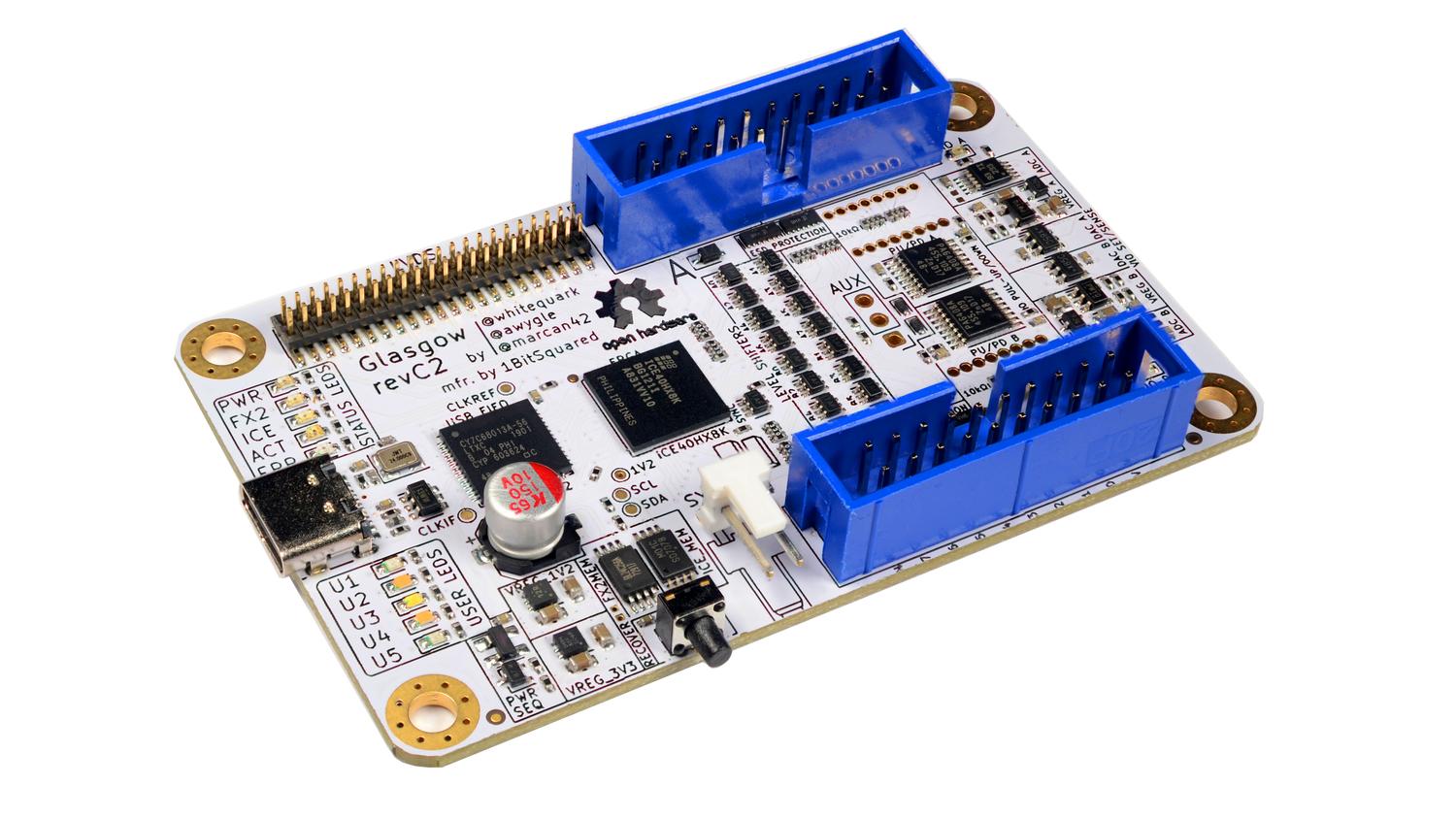
Glasgow Interface Explorer is an open-source hardware interface exploration tool used to interact with, debug, and analyse digital interfaces on embedded systems, and it costs nothing to adopt. It runs as a command-line tool, pairing software with an FPGA-based hardware device to probe protocols directly rather than through a fixed set of dongles, which makes it a fit for hardware hackers and embedded engineers doing protocol analysis and debugging work that off-the-shelf logic analysers do not cover. It sits in the hacking-hardware space alongside other FPGA-based interface tools, occupying the space between a bus pirate and a full logic analyser rather than replacing either outright. Launched in 2018, it has continued as an active reference point for this kind of work.
A Scots Army Knife for electronics, an FPGA-based tool for exploring and debugging digital interfaces.
How Glasgow Interface Explorer helps
What is actually talking on this unfamiliar bus, electrically and at the protocol level?
probes the pins directly with FPGA-backed hardware and lets the operator drive or listen to the signal in real time, rather than matching it against a fixed set of pre-built dongle protocols
Which voltage and signalling settings will let this board talk without frying it?
applies configurable I/O parameters per port so the same probe can be adapted to the target instead of requiring a different dongle for each electrical standard
Is this an issue in my code, or in the hardware talking beneath it?
sits between the host and the target so traffic can be watched and injected at the point where software meets silicon, isolating whether the fault sits above or below that line
What does this interface actually do when nobody has documented it?
supports building a custom exploration session against the raw bus, letting undocumented protocols be mapped out signal by signal rather than relying on a pre-existing decoder
Would a full logic analyser be overkill for chasing this particular signal?
works as a lighter-weight probe for one or a few interfaces at a time, covering the ground between a simple bus pirate and a full multi-channel analyser
Languages
Chinese (Simplified)
Documentation: Chinese (Simplified)
firmware releases reach this page as we publish them
Availability
announced
Dec 22, 2020
press
pre-order
not yet captured
no source captured
shipped
Oct 2, 2023
press
discontinued
still on sale
A slip is called out here the day the vendor's own delivery estimate moves past the promised window.
A "coming" milestone is the vendor's own wording, read off the page it links to — never a date we inferred.
Crowd Supply campaign funded at 1,833% of its $25,000 goal.
Glasgow revCannounced
Dec 22, 2020 ·
source ↗press
Crowd Supply campaign went live.
Command line
View
Source
No command matches.
load a captured run
composed command
No matchesTry a different search, or clear a filter to see more.
option surface across analysed releases
options at that releaseadded, per releaseremoved, per release
option
found in
since
description
No matchesTry a different search, or clear a filter to see more.
option changes per release — drag across the rail to set a range
→
Values are placeholders taken from each option’s declared default.
Nothing is executed here — the output shown is a recording of a run
that already happened.
Score card
Shipping velocityreleases a month, last 12 months
Documentation qualityrelease-notes rubric, 0–100
Breaking-change disciplinehow rarely a release breaks users, and notice given
Maintenance riskquiet time against its own cadence, maintainers
Innovation & surfacenew capabilities, API and MCP surface
Community health
Contributor trenddistinct committers, this year against last
Maintainer concentrationbus factor now against a year ago
Issue backlog trendissues closed per issue opened, 12 months
Responsivenessmedian time to a maintainer’s first reply
Nine scores for Glasgow Interface Explorer, each built from the releases, notes and API history this site tracks — and, on Researcher and Business, where it stands among every measured tool in its category and how that has moved.
Each score is 0–100 on a published rubric, derived from data this site already shows.
A dimension we cannot measure says so — it is never scored 0 and never enters a rank.
How this is scored
Shipping velocity — releases a month over the last 12 months, on a log scale where 16 a month scores 100. Needs 3 releases in the window.
Documentation quality — the release-notes rubric published on the analytics page, unchanged.
Breaking-change discipline — the share of releases carrying a breaking change (none scores 100, half or more scores 0). Only projects that label breaking changes are measured: a clean record cannot be told from an unlabelled one.
Maintenance risk — quiet time measured against the tool's own release cadence (quiet longer than 90 days and three typical gaps scores 0), plus the number of active maintainers and whether contributors are growing, where known. Higher is lower risk.
Innovation & surface — new capabilities in the feature ledger this year, API and MCP operations added, and the share of commits that are features: the mean of whichever we hold.
Community health (open-source tools only) — each is a direction, not a size: contributors this year against last, the bus factor now against a year ago, and issues closed per issue opened, where steady scores 50, doubled 100 and halved 0; plus the median time to a maintainer's first reply (an hour scores about 100, a month or more 0). A commercial card has no repository and carries none of the four.
Documented delivery (commercial tools) — when a vendor's documented new capabilities have slowed against its own baseline, that counts against the overall standing as heavily as two low dimensions. Steady delivery, or too little history to judge, leaves the standing alone; it is never a sixth score.
Open-source tools are scored on repository signals; commercial tools on their published changelog. Ranks compare tools within one category and one profile and need at least five measured peers; the overall standing needs three ranked dimensions. Best-in-breed or consolidator is a shape, not a quality, and is never scored.
Release-note detail over time
See how much detail Glasgow Interface Explorer puts in its release notes, quarter by quarter, and compare it with tracked tools in the same category. This history uses up to ten retained, reviewed notes per tool; sparse or blank older quarters may reflect that limit.
What Glasgow Interface Explorer connects to, runs on and detects, read from its release notes and docs. So far: 4 new supported platforms, 1 new integration.
Show
5 changes, tracked since Oct 3, 2026.
Oct 32026
newXilinx XPLA3 CPLD series support
With xcr3032xl, xcr3064xl, xcr3128xl, xcr3256xl, xcr3384xl, xcr3512xl
Nothing first seen in this window. That doesn't mean Glasgow Interface Explorer shipped nothing, only that we found no record of it.
Changes per month New Updated Retired
2026-10
5
How we count
Read from 16 of 27 release notes and docs updates we hold for Glasgow Interface Explorer. "First seen" is the earliest note that names something; "last" is the latest. Our history may start partway through Glasgow Interface Explorer's life, so an old integration can show a recent first-seen date.
Each change counts once: "added 40 checks" is one line, so the numbers measure how often coverage moves, not how big the catalogue is or how well it detects.
Releases
Coverage in all entries
27 entries
No entries match these filters.
October 202627
Project health
Issue, contributor and maintainer activity in GlasgowEmbedded/glasgow, 2023-12 – 2026-11,
as of 2026-11-03. Twelve-month figures first; the trend lines run
the whole window.
Contributors22−11 vs prior 12 months
Maintainers2+1 joined · −1 left, last 12 months
Bus factor1committers behind half the commits
Community-filed75%of issues opened, last 12 months
Median time to close94 daysfirst maintainer reply 4.6 hours
Open backlog45of 286 issues ever filed
Issues opened / month1 · 0communitymaintainers
Open backlog45
Contributors / month0
Commits / month0
Starsnot measured
Issue themes, last 12 months
questions 4%
other 96%
Counts from the project's public repository and git history; no individuals
are identified. Maintainers are the committers covering 80% of the last year's
commits. how we measure this
Libraries its release ships
What its latest release locks, checked against known advisories.
We can only check tools that publish GitHub releases.
Add the badge to your README
Maintain this project? The badge links readers straight to this page, so they can
follow every release here.
 Choose a badge style and copy the code →