HackRF One
v2026.01.1 open-sourceFree plan: not checked yet · Open source: yes
The section your link pointed to isn't on HackRF One's page any more, so we've brought you to the top.
HackRF One is a low cost, open source Software Defined Radio platform for receiving and transmitting radio signals.
hackrf_biast -e
export FFTW_WISDOM_FILE=~/fftw_wisdom; hackrf_sweep -f 900M:1G:300k
hackrf_clock --status
hackrf_clock --clkout enable
hackrf_sweep -f 900M:1.5G -l 3
hackrf_transfer -H
hackrf_debug
What you can do now
Summary
HackRF One is an open-source software-defined radio peripheral that transmits or receives radio signals from 1 MHz to 6 GHz, and its firmware and host software are free to use and modify. It is run as a USB-connected device controlled from a command-line tool on a laptop, with GNU Radio and other SDRSDRSoftware-defined radio: hardware that captures raw radio-frequency signals and shifts signal processing into software, letting a single device tune any frequency or protocol a program implements. software able to drive it directly, which makes it suited to researchers and hobbyists working on RF security, wireless protocol analysis, or signal reverse engineering rather than to teams looking for a packaged scanning appliance. It sits in the software-defined radio hardware space alongside other USB SDR peripherals, functioning as a half-duplex transceiver rather than a passive receiver, which lets it both capture and generate signals for testing. Launched in 2012, it has been a long-running fixture in the SDR hardware space rather than a recent entrant.
HackRF One is a low cost, open source Software Defined Radio platform for receiving and transmitting radio signals.
How HackRF One helps
What is actually transmitting or nearby on a given frequency, unknown or undocumented?
tunes across 1 MHz to 6 GHz and captures the raw signal for inspection, revealing activity that never shows up in a normal spectrum sweep confined to licensed bands
Can a suspect wireless device be made to respond so its protocol can be studied?
transmits an arbitrary crafted signal on the same frequency the device listens on, and captures what comes back for analysis, since it works as a transceiver rather than only a receiver
Is a recorded radio signal actually the one being replayed, or has something changed?
plays back a captured waveform bit-for-bit over the air and lets the difference between original and replayed capture be compared directly
How does a wireless protocol actually behave, apart from what its specification claims?
records raw radio transmissions for the reader to demodulate and decode in software such as GNU Radio, exposing timing and structure the documentation may not mention
Does a piece of equipment leak a signal it should not be sending?
scans the surrounding spectrum while the equipment operates and shows any transmission coinciding with its use, apart from its intended radio traffic
Languages
Device
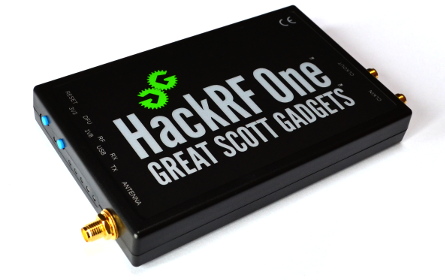
Spec · shipping HackRF One
- frequency range
- 1 MHz – 6 GHz
- radios
- Half-duplex transceiver, 8-bit I/Q samples
- sample rate
- Up to 20 Msps
- interfaces
- Hi-Speed USB 2.0, SMA antenna port, SMA clock in/out, internal expansion headers
- power
- USB-powered; antenna port power 50 mA at 3.3 V
from the vendor's spec page ↗
Availability
A slip is called out here the day the vendor's own delivery estimate moves past the promised window. A "coming" milestone is the vendor's own wording, read off the page it links to — never a date we inferred.
Price
| configuration | generation | launch | today | status | source |
|---|---|---|---|---|---|
| HackRF One with ANT500 antenna | HackRF One | — | $328 sold out | shipping | list |
Device history
-
HackRF One sold_out
no further detail captured
-
HackRF One news
Great Scott Gadgets announced HackRF Pro (100 kHz to 6 GHz) as the newest addition to the HackRF family.
-
HackRF One spec revision
Revision r9 replaced the MAX2837 transceiver; finished units began shipping to warehouses in late February 2023 and all backorders had shipped to resellers.
-
HackRF One news
Great Scott Gadgets reported a HackRF One shortage caused by unavailable clock-generator (SI5351C) and RF transceiver (MAX2837) chips.
Command line
No command matches.
| option | found in | since | description |
|---|
Values are placeholders taken from each option’s declared default. Nothing is executed here — the output shown is a recording of a run that already happened.
Score card
-
Shipping velocity releases a month, last 12 months
-
Documentation quality release-notes rubric, 0–100
-
Breaking-change discipline how rarely a release breaks users, and notice given
-
Maintenance risk quiet time against its own cadence, maintainers
-
Innovation & surface new capabilities, API and MCP surface
- Community health
-
Contributor trend distinct committers, this year against last
-
Maintainer concentration bus factor now against a year ago
-
Issue backlog trend issues closed per issue opened, 12 months
-
Responsiveness median time to a maintainer’s first reply
Nine scores for HackRF One, each built from the releases, notes and API history this site tracks — and, on Researcher and Business, where it stands among every measured tool in its category and how that has moved.
Score cards are part of every paid plan.
See plans → Already subscribed? Sign in →Trajectory
Blank means never measured; nothing here is a filled-in zero.
Peer standings are included with Researcher and Business. See how this tool ranks against its competitors, using data we don't publish anywhere else.
See plans →Each score is 0–100 on a published rubric, derived from data this site already shows. A dimension we cannot measure says so — it is never scored 0 and never enters a rank.
How this is scored
- Shipping velocity — releases a month over the last 12 months, on a log scale where 16 a month scores 100. Needs 3 releases in the window.
- Documentation quality — the release-notes rubric published on the analytics page, unchanged.
- Breaking-change discipline — the share of releases carrying a breaking change (none scores 100, half or more scores 0). Only projects that label breaking changes are measured: a clean record cannot be told from an unlabelled one.
- Maintenance risk — quiet time measured against the tool's own release cadence (quiet longer than 90 days and three typical gaps scores 0), plus the number of active maintainers and whether contributors are growing, where known. Higher is lower risk.
- Innovation & surface — new capabilities in the feature ledger this year, API and MCP operations added, and the share of commits that are features: the mean of whichever we hold.
- Community health (open-source tools only) — each is a direction, not a size: contributors this year against last, the bus factor now against a year ago, and issues closed per issue opened, where steady scores 50, doubled 100 and halved 0; plus the median time to a maintainer's first reply (an hour scores about 100, a month or more 0). A commercial card has no repository and carries none of the four.
- Documented delivery (commercial tools) — when a vendor's documented new capabilities have slowed against its own baseline, that counts against the overall standing as heavily as two low dimensions. Steady delivery, or too little history to judge, leaves the standing alone; it is never a sixth score.
- Open-source tools are scored on repository signals; commercial tools on their published changelog. Ranks compare tools within one category and one profile and need at least five measured peers; the overall standing needs three ranked dimensions. Best-in-breed or consolidator is a shape, not a quality, and is never scored.
Release-note detail over time
See how much detail HackRF One puts in its release notes, quarter by quarter, and compare it with tracked tools in the same category. This history uses up to ten retained, reviewed notes per tool; sparse or blank older quarters may reflect that limit.
Checking release-note history…
Releases
7 entries
No entries match these filters.
- October 20261
- January 20261
- February 20241
- September 20221
- March 20211
- February 20171
- July 20151
Project health
Issue, contributor and maintainer activity in greatscottgadgets/hackrf, 2023-12 – 2026-11, as of 2026-11-03. Twelve-month figures first; the trend lines run the whole window.
- Contributors 11 −3 vs prior 12 months
- Maintainers 4 +3 joined · −3 left, last 12 months
- Bus factor 2 committers behind half the commits
- Community-filed 64% of issues opened, last 12 months
- Median time to close 6.1 days first maintainer reply 3 days
- Open backlog 67 of 1,144 issues ever filed
- Issues opened / month 4 · 1 communitymaintainers
- Open backlog 67
- Contributors / month 0
- Commits / month 0
- Stars not measured
- bugs 9%
- features 3%
- questions 36%
- docs 3%
- other 49%
Counts from the project's public repository and git history; no individuals are identified. Maintainers are the committers covering 80% of the last year's commits. how we measure this
Libraries its release ships
What its latest release locks, checked against known advisories.None of its release's images build from a lockfile we can read.
Add the badge to your README
Maintain this project? The badge links readers straight to this page, so they can follow every release here.
 Choose a badge style and copy the code →