Kali Linux
Kali Linux 2026.3 Release (Build-Scripts Refresh) (2026-10-26) open-sourceThe section your link pointed to isn't on Kali Linux's page any more, so we've brought you to the top.
Home of Kali Linux, an Advanced Penetration Testing Linux distribution used for Penetration Testing, Ethical Hacking and network security assessments.
cat /etc/apt/sources.list.d/kali.sources
kali-undercover --backtrack
kali-undercover --halloween
sudo apt install -y brcmfmac-nexmon-dkms firmware-nexmon
ip a | grep inet | xclip -selection clipboard
Summary
Kali Linux is an open-source Linux distribution built for penetration testing and offensive security work, free to download and use. It runs as an installable OS on desktops and laptops, or as a virtual machine, container, USB image, ARMARMA family of RISC processor architectures designed by Arm Holdings and licensed to chip makers worldwide; tools target it to run natively on mobile, embedded, and increasingly server and desktop hardware. device, cloud instance, or Windows Subsystem for Linux environment, giving practitioners flexibility in how they deploy it. It is aimed at penetration testers and red teamers who need a preconfigured toolkit rather than one built by hand, and it ships hundreds of security tools alongside a full desktop environment, currently offering GNOME 50 or KDE PlasmaKDE PlasmaA desktop environment for Linux and other Unix-like systems, maintained by the KDE community, giving cyber tools a full graphical shell and widget toolkit to build native GUI applications against. 6.6. As a distro-based approach to offensive tooling, it sits in a category of its own rather than being positioned against any single named alternative. Kali sees frequent releases, with ten in the tracked window and the latest only 53 days old, indicating active maintenance.
Home of Kali Linux, an Advanced Penetration Testing Linux distribution used for Penetration Testing, Ethical Hacking and network security assessments.
How Kali Linux helps
Which hosts on this network are exposed, and what could an attacker do with that exposure?
provides scanning, enumeration, and exploitation tools side by side on one desktop, so a practitioner can walk a target from discovery through to a working exploit without switching environments
Which of my own systems or applications have an exploitable weakness?
ships the standard vulnerability-scanning and web-app testing tools preconfigured, so findings can be reproduced and demonstrated rather than just flagged
Are the credentials protecting my accounts actually strong enough?
includes password- and hash-cracking tools ready to run against captured hashes or login forms, showing which passwords fall and how quickly
What is happening on this network that I can't see from a normal workstation?
bundles packet capture and wireless analysis tools that can be pointed at traffic or nearby networks to expose devices, protocols, and weak encryption in use
Could someone reconstruct my organization's footprint from public information alone?
includes OSINT and reconnaissance tools that gather domains, emails, and exposed infrastructure into a single view of what's visible from outside
Which service on a compromised or test host still has default or forgotten credentials?
standardizes service start and stop helpers across service-dependent tools so each one reports its default credential info and status as it comes up, making leftover access easy to spot
Languages
Features
Built from Kali Linux's releases, docs, README and our own runs. “Seen” marks the month we first spotted a release the vendor didn't date. Group names and tags are our labels.
What Kali Linux offers you
- Command-line interface2
No capabilities match.
Cyber Tool Access and Management 2 capabilities Kali Linux maintains a curated repository of cyber tools and handles their installation and updates through APT package management. This is the primary reason most users choose Kali Linux over a general-purpose distribution.
Tool repository shipped Provides a curated collection of cyber tools that users can browse and install, with new additions each release.
release 16 total
-
Adds
dalfox(XSS scanner),katana(crawling/spidering framework),qsreplace(query-string value replacer),rustscan(modern port scanner),sdrangel(Qt-based SDR front-end), andsnaffler-ng(SMB share credential and sensitive data scanner) to the Kali network repositories.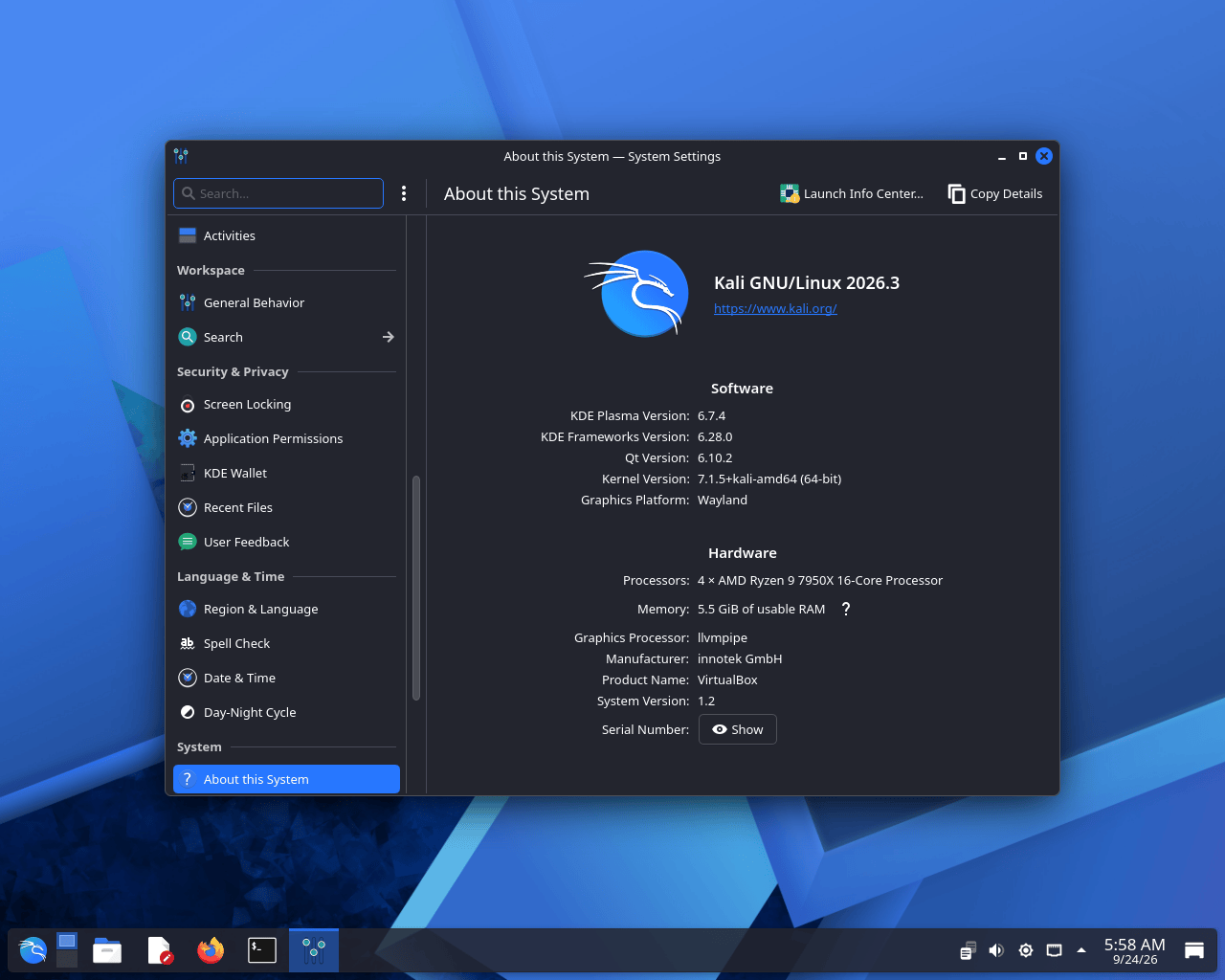 Kali Linux 2026.3 Release (Build-Scripts Refresh) (2026-10-26) · Oct 2026
· source
· release history
-
Adds 9 new tools to the Kali repositories:
arsenal-ng,hydra-gtk,legba,oletools,penelope,shell-gpt,tailscale,tookie-osint, anduro. Kali Linux 2026.2 Release (GNOME 50, KDE 6.6, Helper Scripts, APT Formats & VM Boot Tweaking) (2026-06-29) · Jun 2026 · source · release history - XSStrike advanced XSS scanner package Kali Linux 2026.1 Release (2026 Theme & BackTrack Mode) (2026-03-24) · Mar 2026 · source · release history
- GEF modern GDB experience package Kali Linux 2026.1 Release (2026 Theme & BackTrack Mode) (2026-03-24) · Mar 2026 · source · release history
- Atomic-Operator package for executing Atomic Red Team tests Kali Linux 2026.1 Release (2026 Theme & BackTrack Mode) (2026-03-24) · Mar 2026 · source · release history
- WPProbe WordPress plugin enumeration tool package Kali Linux 2026.1 Release (2026 Theme & BackTrack Mode) (2026-03-24) · Mar 2026 · source · release history
APT package management shipped Handles installation, removal, and updates of all system and cyber tool packages through APT, with secure source configuration.
release
-
Renames default APT sources config from
/etc/apt/sources.listto/etc/apt/sources.list.d/kali.sourcesusing the deb822 format. Kali Linux 2026.2 Release (GNOME 50, KDE 6.6, Helper Scripts, APT Formats & VM Boot Tweaking) (2026-06-29) · Jun 2026 · source · release history -
Migrates APT sources from
/etc/apt/sources.listto the deb822-style/etc/apt/sources.list.d/kali.sourcesformat on fresh installs, with Signed-By keyring pinning included by default. Kali Linux 2026.2 Release (GNOME 50, KDE 6.6, Helper Scripts, APT Formats & VM Boot Tweaking) (2026-06-29) · Jun 2026 · source · release history
example
-
Migrate an existing Kali system to the new deb822 APT sources format so APT stops warning about the legacy one-line-style file.
cat /etc/apt/sources.list.d/kali.sourcesKali Linux 2026.2 Release (GNOME 50, KDE 6.6, Helper Scripts, APT Formats & VM Boot Tweaking) (2026-06-29) · Jun 2026 · source
Deployment and Distribution 2 capabilities Kali Linux is distributed as pre-built virtual machine images optimised for common virtualisation platforms, reducing setup time. Users can also select from available kernel versions to suit their environment.
Linux kernel selection shipped Lets users choose between the default stable kernel and newer experimental kernels without waiting for a full release update.
release 8 total
-
Updates the Kali kernel from 6.19 to 7.1.5 in the 2026.3 release.
Kali Linux 2026.3 Release (Build-Scripts Refresh) (2026-10-26) · Oct 2026
· source
· release history
-
Makes Linux kernel 7.0 available in
kali-experimental(andkali-rolling) for users who want the latest kernel ahead of the default 6.19 shipped in this release. Kali Linux 2026.2 Release (GNOME 50, KDE 6.6, Helper Scripts, APT Formats & VM Boot Tweaking) (2026-06-29) · Jun 2026 · source · release history -
Adds kernel 7.0 packages to the
kali-experimentalrepository for early adoption outside of the stable 6.19 kernel. Kali Linux 2026.2 Release (GNOME 50, KDE 6.6, Helper Scripts, APT Formats & VM Boot Tweaking) (2026-06-29) · Jun 2026 · source · release history - Linux kernel 6.18 upgrade Kali Linux 2026.1 Release (2026 Theme & BackTrack Mode) (2026-03-24) · Mar 2026 · source · release history
- Introduces GNOME 49 as the default desktop environment with Wayland as the only supported window server (X11 removed). Kali Linux 2025.4 Release (Desktop Environments, Wayland & Halloween Mode) (2025-12-12) · Dec 2025 · source · release history
- Distributes the Kali Live image exclusively over BitTorrent due to size exceeding HTTP CDN limits (>5 GB). Kali Linux 2025.4 Release (Desktop Environments, Wayland & Halloween Mode) (2025-12-12) · Dec 2025 · source · release history
VM image distribution shipped Offers ready-to-run virtual machine images tuned for faster boot times and smaller footprints on common hypervisors.
release
- Pre-built VM images no longer include graphics firmware; VMs with dedicated GPU passthrough may lose graphics after upgrade or reinstall without manually installing the required firmware. Kali Linux 2026.2 Release (GNOME 50, KDE 6.6, Helper Scripts, APT Formats & VM Boot Tweaking) (2026-06-29) · Jun 2026 · source · release history
- Removes pre-installed graphics firmware from VM installer images, reducing initrd size to 60 MB and cutting boot time by ~3x. Kali Linux 2026.2 Release (GNOME 50, KDE 6.6, Helper Scripts, APT Formats & VM Boot Tweaking) (2026-06-29) · Jun 2026 · source · release history
- Removes graphics firmware from pre-built VM images and adds VM detection in the installer to skip graphics firmware, shrinking the initrd from ~200 MB to 60 MB and cutting VM boot time by approximately 3x. Kali Linux 2026.2 Release (GNOME 50, KDE 6.6, Helper Scripts, APT Formats & VM Boot Tweaking) (2026-06-29) · Jun 2026 · source · release history
- Expands on-board wireless assessment support to Raspberry Pi 5, Raspberry Pi 4, Raspberry Pi 3B, Raspberry Pi Zero 2 W, and Raspberry Pi Zero W. The Raspberry Pi's Wi-Fi Glow-Up (2025-07-22) · Jul 2025 · source · release history
Desktop Environment 2 capabilities Kali Linux ships multiple desktop environment options so users can work in their preferred graphical interface. Both GNOME and KDE Plasma are supported with accessibility and usability enhancements.
KDE Plasma desktop shipped Provides KDE Plasma as a desktop option, including touch keyboard support, screenshot OCR, and colour-vision and motion accessibility settings.
release
-
Updates KDE Plasma to 6.7, adding per-screen virtual desktops, network connection duplication, and performance/power optimizations for integrated Intel GPUs.
Kali Linux 2026.3 Release (Build-Scripts Refresh) (2026-10-26) · Oct 2026
· source
· release history
- Upgrades KDE Plasma to 6.6 with a new on-screen keyboard for touch devices, OCR text extraction directly from screenshots via Spectacle, color-vision support options, Slow Keys on Wayland, and Reduced Motion setting. Kali Linux 2026.2 Release (GNOME 50, KDE 6.6, Helper Scripts, APT Formats & VM Boot Tweaking) (2026-06-29) · Jun 2026 · source · release history
- Introduces KDE Plasma 6.6 with a new on-screen keyboard and OCR extraction in the Spectacle screenshot utility. Kali Linux 2026.2 Release (GNOME 50, KDE 6.6, Helper Scripts, APT Formats & VM Boot Tweaking) (2026-06-29) · Jun 2026 · source · release history
- Updates KDE Plasma to version 6.5, adding fuzzy matching in KRunner, flexible window tiling, and an improved screenshot tool. Kali Linux 2025.4 Release (Desktop Environments, Wayland & Halloween Mode) (2025-12-12) · Dec 2025 · source · release history
GNOME desktop shipped Provides GNOME as a desktop option, with improvements to file thumbnailing, accessibility, language switching, and document annotation.
release
- Introduces GNOME 50 with faster file manager loading, accessibility enhancements, and document annotation support. Kali Linux 2026.2 Release (GNOME 50, KDE 6.6, Helper Scripts, APT Formats & VM Boot Tweaking) (2026-06-29) · Jun 2026 · source · release history
- Upgrades desktop to GNOME 50 with faster file manager thumbnail/icon loading, new accessibility preferences window, automatic language switching, and document annotation support in Document Viewer. Kali Linux 2026.2 Release (GNOME 50, KDE 6.6, Helper Scripts, APT Formats & VM Boot Tweaking) (2026-06-29) · Jun 2026 · source · release history
Remote Access and Service Management 2 capabilities Kali Linux supports remote desktop connectivity and provides consistent tooling for starting, stopping, and monitoring services. These capabilities make it practical to run Kali headlessly or share sessions across a network.
Remote desktop access (xrdp) shipped Runs an RDP server so users can connect to a Kali desktop remotely, including through Hyper-V Enhanced Session Mode.
release
-
Requires a system reboot after updating
xrdpto the v0.10 series to ensure remote desktop functionality. Kali Linux 2026.2 Release (GNOME 50, KDE 6.6, Helper Scripts, APT Formats & VM Boot Tweaking) (2026-06-29) · Jun 2026 · source · release history -
Upgrading
xrdpandxorgxrdpto the v0.10 series requires a system reboot; xrdp may not be functional after the upgrade without rebooting (affects Hyper-V Enhanced Session Mode users as well). Kali Linux 2026.2 Release (GNOME 50, KDE 6.6, Helper Scripts, APT Formats & VM Boot Tweaking) (2026-06-29) · Jun 2026 · source · release history -
Upgrades
xrdpandxorgxrdpto the v0.10 series, bringing an updated Remote Desktop Protocol server (reboot required after upgrade). Kali Linux 2026.2 Release (GNOME 50, KDE 6.6, Helper Scripts, APT Formats & VM Boot Tweaking) (2026-06-29) · Jun 2026 · source · release history -
Adds
kali-tweaksto enable or disable Hyper-V Enhanced Session Mode via its Virtualization section. Kali Linux 2026.2 Release (GNOME 50, KDE 6.6, Helper Scripts, APT Formats & VM Boot Tweaking) (2026-06-29) · Jun 2026 · source · release history
Service management helper scripts shipped Offers standardised scripts for managing services across packages, showing status, default credentials, and automatically opening web UIs where relevant.
Also counts toward: Command-line interface
release
-
Introduces standardized
<tool>-start/<tool>-stophelper scripts across service-dependent packages, providing consistent service management, status display, default credential info, and automatic browser launch for web UIs. Kali Linux 2026.2 Release (GNOME 50, KDE 6.6, Helper Scripts, APT Formats & VM Boot Tweaking) (2026-06-29) · Jun 2026 · source · release history - Adds helper scripts for service management that support start/stop commands, status checks, default credential display, and URL access. Kali Linux 2026.2 Release (GNOME 50, KDE 6.6, Helper Scripts, APT Formats & VM Boot Tweaking) (2026-06-29) · Jun 2026 · source · release history
Other 7 capabilities
Undercover mode shipped Provides a set of scripts that switch the desktop theme to resemble Windows 10, allowing the system to blend in as a standard Windows machine.
Also counts toward: Command-line interface
release
-
kali-undercover --backtracksubcommand to activate BackTrack 5 theme recreation Kali Linux 2026.1 Release (2026 Theme & BackTrack Mode) (2026-03-24) · Mar 2026 · source · release history
docs
- Kali Undercover Table of Contents Going undercover Reverting Back Purpose of Undercover Mode in Kali Linux Kali Undercover is a set of scripts that change the theme of your Kali Linux to a Windows 10 alike theme. seen Oct 2026 · source
example
-
Switch Kali desktop to BackTrack 5 aesthetic for a legacy look and feel.
kali-undercover --backtrackKali Linux 2026.1 Release (2026 Theme & BackTrack Mode) (2026-03-24) · Mar 2026 · source
Image build customization shipped Provides build scripts with flags and container-based execution to customize and build Kali installer images without requiring dependencies on the host system.
release
-
Adds
--hostname,--packages,--branch,--variant, and--archflags tobuild.shfor customizing Kali installer images at build time.
Kali Linux 2026.3 Release (Build-Scripts Refresh) (2026-10-26) · Oct 2026
· source
· release history
-
Adds
build-in-container.shto each refreshed build-script, auto-detecting Docker or Podman to build Kali images inside a container without installing dependencies on the host.︀︄︇︀︅︉︀︅︀︀︃︀︀︅︅︀︅︊︀︄︆︀︃︄ Kali Linux 2026.3 Release (Build-Scripts Refresh) (2026-10-26) · Oct 2026 · source · release history
NetHunter kernel support shipped Provides pre-built kernels for a range of Android devices and ROMs, enabling NetHunter capabilities on those devices.
release
-
Adds 9 new NetHunter kernels covering Google Pixel on LineageOS 22.2/Android 15, Huawei P9 on EMUI8/LineageOS 16.0, LG K20 Plus on LineageOS 14.1, Moto G Stylus 5G 2022 on LineageOS 23.2, Nubia Z17 on LineageOS 22.2, POCO X5 5G/Redmi Note 12 5G on crDroid 12, Redmi Note 5 Pro on LineageOS 18.1, Sony Xperia 10 V on…
Kali Linux 2026.3 Release (Build-Scripts Refresh) (2026-10-26) · Oct 2026
· source
· release history
- Adds KernelSU support to Kali NetHunter, allowing installation of the generated installer zip via the KernelSU app with a patched kernel. Kali Linux 2026.3 Release (Build-Scripts Refresh) (2026-10-26) · Oct 2026 · source · release history
NetHunter NFC toolkit shipped Adds NFC capabilities to Kali NetHunter, including reading, cloning, and editing of Mifare classic cards from the Kali chroot without an external adapter.
release
-
Adds NFC Arsenal to Kali NetHunter, enabling reading, cloning, and editing of Mifare classic cards from the Kali chroot without an external adapter.
Kali Linux 2026.3 Release (Build-Scripts Refresh) (2026-10-26) · Oct 2026
· source
· release history
NetHunter wardriving support shipped Enables wardriving on supported smartwatches by providing internal monitor mode via an updated library, compatible with aircrack-ng, kismet, and other chroot tools.
release
-
Adds wardriving support for the TicWatch Pro 3 series via an updated
libnexmonkalilibrary enabling internal monitor mode, compatible withaircrack-ngsuite,kismet, and other chroot tools.
Kali Linux 2026.3 Release (Build-Scripts Refresh) (2026-10-26) · Oct 2026
· source
· release history
NetHunter watch remote control shipped Allows a NetHunter phone to control a NetHunter watch over ADB via Wi-Fi or Bluetooth, including running commands and installing apps.
release
-
Adds WearHunter to Kali NetHunter, enabling control of a NetHunter watch from a phone via ADB over Wi-Fi or Bluetooth, including running commands and installing apps.
Kali Linux 2026.3 Release (Build-Scripts Refresh) (2026-10-26) · Oct 2026
· source
· release history
Default credential and user policy documented Defines the default user account policy, including a non-root default user and prompting for a standard user account during installation.
docs
- Kali's Default Credentials Kali changed to a non-root user policy by default since the release of This means: During the installation of amd64 images , it will prompt you for a standard user account to be created. seen Oct 2026 · source
Lines in monospace are the tool's own words: help text
parsed from its source, or an endpoint from its API document. Under
release, a line is our summary of a dated release. Under
docs, it is quoted from the tool's own documentation or
website. Each links back to the source it came from.
Command line
7 commands for Kali Linux, each with where it came from. This tool has no source analysis yet, so there is no option reference and no captured run beside them.
No command matches.
Screenshots
From the release notes, newest first. Click one to see it full size.Score card
-
Shipping velocity releases a month, last 12 months
-
Documentation quality release-notes rubric, 0–100
-
Breaking-change discipline how rarely a release breaks users, and notice given
-
Maintenance risk quiet time against its own cadence, maintainers
-
Innovation & surface new capabilities, API and MCP surface
- Community health
-
Contributor trend distinct committers, this year against last
-
Maintainer concentration bus factor now against a year ago
-
Issue backlog trend issues closed per issue opened, 12 months
-
Responsiveness median time to a maintainer’s first reply
Nine scores for Kali Linux, each built from the releases, notes and API history this site tracks — and, on Researcher and Business, where it stands among every measured tool in its category and how that has moved.
Score cards are part of every paid plan.
See plans → Already subscribed? Sign in →Trajectory
Blank means never measured; nothing here is a filled-in zero.
Peer standings are included with Researcher and Business. See how this tool ranks against its competitors, using data we don't publish anywhere else.
See plans →Each score is 0–100 on a published rubric, derived from data this site already shows. A dimension we cannot measure says so — it is never scored 0 and never enters a rank.
How this is scored
- Shipping velocity — releases a month over the last 12 months, on a log scale where 16 a month scores 100. Needs 3 releases in the window.
- Documentation quality — the release-notes rubric published on the analytics page, unchanged.
- Breaking-change discipline — the share of releases carrying a breaking change (none scores 100, half or more scores 0). Only projects that label breaking changes are measured: a clean record cannot be told from an unlabelled one.
- Maintenance risk — quiet time measured against the tool's own release cadence (quiet longer than 90 days and three typical gaps scores 0), plus the number of active maintainers and whether contributors are growing, where known. Higher is lower risk.
- Innovation & surface — new capabilities in the feature ledger this year, API and MCP operations added, and the share of commits that are features: the mean of whichever we hold.
- Community health (open-source tools only) — each is a direction, not a size: contributors this year against last, the bus factor now against a year ago, and issues closed per issue opened, where steady scores 50, doubled 100 and halved 0; plus the median time to a maintainer's first reply (an hour scores about 100, a month or more 0). A commercial card has no repository and carries none of the four.
- Documented delivery (commercial tools) — when a vendor's documented new capabilities have slowed against its own baseline, that counts against the overall standing as heavily as two low dimensions. Steady delivery, or too little history to judge, leaves the standing alone; it is never a sixth score.
- Open-source tools are scored on repository signals; commercial tools on their published changelog. Ranks compare tools within one category and one profile and need at least five measured peers; the overall standing needs three ranked dimensions. Best-in-breed or consolidator is a shape, not a quality, and is never scored.
Release-note detail over time
See how much detail Kali Linux puts in its release notes, quarter by quarter, and compare it with tracked tools in the same category. This history uses up to ten retained, reviewed notes per tool; sparse or blank older quarters may reflect that limit.
Checking release-note history…
Website history
kali.org, every changeOffSec's home page and 38 more pages as they looked each month from August 2021 to October 2026: 201 renders, 17 changes of tagline or palette. Step through them, play them, or put any two months side by side.
Website history is included with Researcher and Business.
See plans → Already subscribed? Sign in →← → or h l a month · Shift a year · [ ] previous / next change · Space play · 1 2 3 page · T whole page · C compare · F full size
← → or h l the right month · Shift the left · S swap · W wipe · T whole page · Esc back
Rebranding timeline
Dates bound when a change appeared between captures. Possible rebrands are AI suggestions; a redesign alone does not establish a rebrand.
Releases
8 entries
No entries match these filters.
- October 20261
- September 20261
- June 20261
- March 20261
- December 20251
- September 20251
- July 20251
- June 20251
Articles
3 articles · updated Nov 4, 2026Where Kali Linux turns up in what others publish: how-tos, attack reports that name it, and incident write-ups. A row says why it is here and quotes where the article names it; the link goes to the publisher.
-
Configure Sqlmap for WEB-GUI in Kali Linux
One such person is Hood3dRob1n(https://github.com/Hood3dRob1n/SQLMAP-Web-GUI) who has created a PHP based front end for sqlmap and today, we’ll be setting it up in Kali Linux.
-
Forensics Tools in Kali Linux
Many instances consider Kali Linux as one of the most popular tools available to security professionals.
1 more quote
This article provides you with an overview of the forensic capabilities of Kali Linux.
-
The Blue Agent POV: Investigating Multi-Platform Data Exfiltration Across AWS and GitHub
The user agent string contained kali-amd64: Kali Linux, a distribution commonly used by malicious actors.
2 more quotes
The actor appeared from unusual IPs, using aws-cli on Kali Linux, and attempted operations far outside its normal scope, including unusual AssumeRole and SendCommand actions.
Blue Agent analysis of ASO anomaly Dimension Baseline Detection Source IPs Amazon-owned (CI/CD infra) Zenlayer Inc (Taiwan) User Agent TeamCity Server, aws-sdk-go aws-cli on Kali Linux ASO Amazon.com, Inc.
Add the badge to your README
Maintain this project? The badge links readers straight to this page, so they can follow every release here.
 Choose a badge style and copy the code →