Qualys Patch Management
2026-10-28-18de7ca7 commercialThe section your link pointed to isn't on Qualys Patch Management's page any more, so we've brought you to the top.
Qualys Patch Management is a cloud-based tool that automates the discovery, prioritization, and deployment of patches across IT assets to reduce vulnerabilities.
Summary
Qualys Patch Management is a commercial vulnerability-management product delivered as part of the Qualys cloud platform, run through the same agent and console model as its other modules rather than installed as standalone software. It links vulnerability findings directly to remediation, letting a team patch, isolate, or replace a workload the moment a confirmed finding appears, and offers compensating mitigation when a patch itself isn't yet ready to ship. It's built for the people who own the patch cycle after a scan runs — vulnerability and IT operations teams working through remediation backlogs — and it extends into orchestration work like Windows 11 upgrade rollout, using patch reliability scoring drawn from deployment telemetry to decide what can go out automatically versus what needs review.
Qualys Patch Management is a cloud-based tool that automates the discovery, prioritization, and deployment of patches across IT assets to reduce vulnerabilities.
How Qualys Patch Management helps
Which confirmed vulnerability findings can be closed out without waiting for a manual patch cycle?
triggers remediation, mitigation, container image replacement, workload isolation, or firewall policy updates directly from the finding at machine speed
What should we do about a vulnerability when the vendor patch isn't ready yet?
applies a patchless compensating mitigation action to cut down the exposure window until a permanent fix ships
Which patches are safe to push automatically versus which ones need a human to look first?
scores each patch for reliability from crowd-sourced deployment sentiment and Qualys telemetry on rollback and reopen rates, letting high-reliability patches go out automatically while low-reliability ones are flagged for review
Which endpoints can move to Windows 11 with the least disruption, and which need a different path?
separates the fleet into enablement-package candidates, ISO-based feature update candidates, and direct Windows 10-to-11 upgrade candidates, and finds the matching patches or scripts for each
Did a deployed cumulative update actually finish remediating the endpoint, including the reboot?
reports the true remediation state after deployment so a team can confirm KEV deadline compliance instead of assuming success from deployment status alone
Can a specific CVE be remediated right now on the affected assets?
deploys the patch for that CVE immediately from the vulnerability finding itself, without a separate scheduling step
Features
Built from Qualys Patch Management's releases, docs, README and our own runs. “Seen” marks the month we first spotted a release the vendor didn't date. Group names and tags are our labels.
What Qualys Patch Management offers you
- ML-based detection1
No capabilities match.
All capabilities 6 capabilities
Autonomous vulnerability remediation workflows shipped Triggers machine-speed remediation actions — including patching, mitigation, container image replacement, workload isolation, and firewall policy updates — directly from confirmed vulnerability findings, with support for patchless compensating controls when patching is not immediately feasible.
release 11 total
- Adds patchless mitigation paths: TruConfidence identifies third-party compensating controls and applies mitigations through security tools already deployed on perimeter and endpoints when a patch is unavailable or delayed. changelog · Oct 2026 · source · release history
- Adds TruConfidence remediation intelligence and orchestration engine that credits existing security controls before recommending a remediation action, avoiding duplicate coverage.︀︄︇︀︅︉︀︅︀︀︃︀︀︅︅︀︅︊︀︄︆︀︃︄ changelog · Oct 2026 · source · release history
- Extends remediation reach to perimeter devices, cloud, and applications — not just agent-based endpoints — using Qualys scanners and existing security and IT integrations for assets that cannot run an agent. changelog · Oct 2026 · source · release history
- Supports uninstall and isolate as remediation actions alongside patch and custom fix, enabling a wider range of responses wherever an exposure lives. changelog · Oct 2026 · source · release history
-
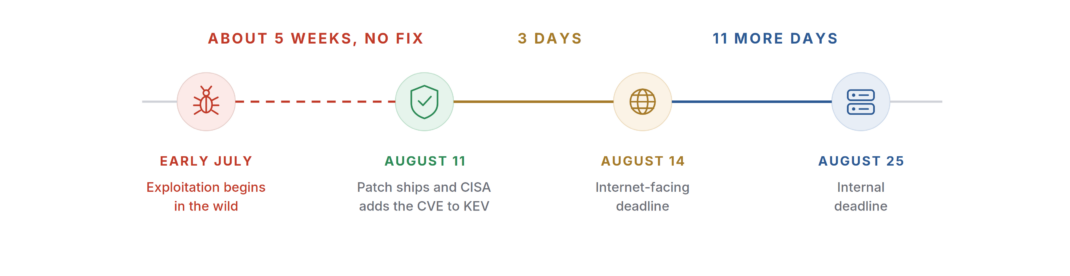
Extends scanner-based remediation to edge and perimeter devices using existing Qualys scanners, closing coverage gaps that agent-only approaches miss.
 changelog · Oct 2026
· source
· release history
- Introduces Agent Sara, Qualys' autonomous AI agent, which executes TruConfidence remediation plans in customer-defined waves and progressive rings with automatic rollback on anomaly detection. changelog · Oct 2026 · source · release history
Windows 11 upgrade orchestration shipped Orchestrates enterprise-wide Windows 11 upgrades at scale via three paths — enablement packages, ISO-based feature updates, and direct Windows 10-to-Windows 11 upgrades — using QQL filters for targeting and pre-built CAR library scripts for deployment.
release
-
New QQL filters for patch targeting:
patch.title:"Enablement"for enablement packages andpatch.isFeatureUpdate:true AND patch.vendor:\Microsoft\ for ISO-based feature updates.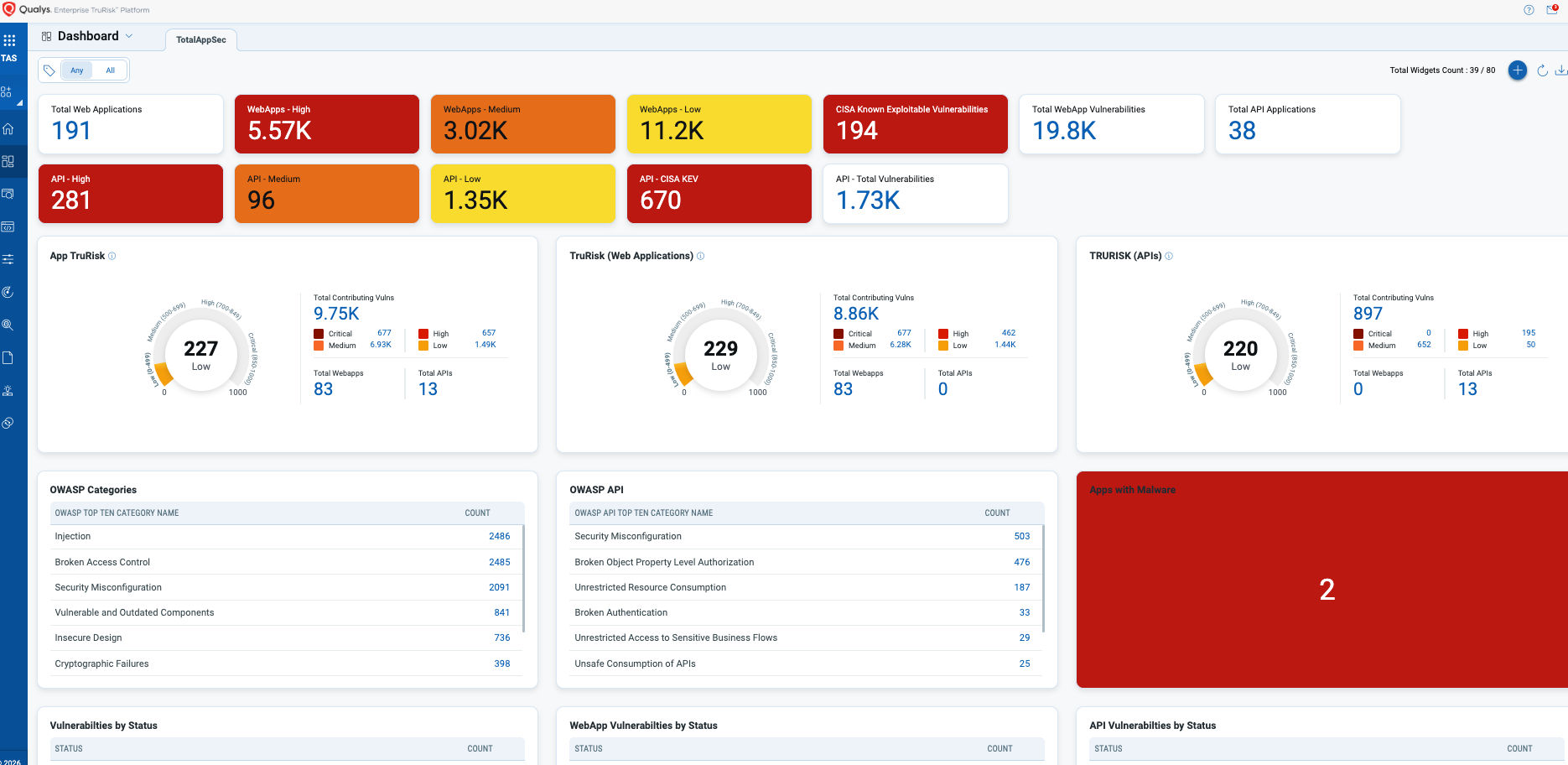 changelog · Jul 2026
· source
· release history
- Enables enterprise-wide Windows 11 upgrade orchestration through TruRisk Eliminate, covering three paths: enablement packages, ISO-based feature updates, and direct Windows 10-to-Windows 11 upgrades. changelog · Jul 2026 · source · release history
- Windows 10-to-Windows 11 upgrade scripts now available in the Custom Assessment and Remediation (CAR) library under Script Library → System Updates and Upgrades → Windows OS Upgrades. changelog · Jul 2026 · source · release history
example
-
Identify and deploy Windows 11 enablement packages at scale to upgrade endpoints already running recent Windows 11 builds with minimal operational impact.
In TruRisk Eliminate Patch Catalog, run QQL: patch.title:"Enablement" — select the matching patch, create a patch job, and target the relevant asset groups.changelog · Jul 2026 · source -
Directly upgrade Windows 10 endpoints to the latest Windows 11 build without intermediate steps using a pre-built CAR library script.
In TruRisk Eliminate, navigate to Script Library → System Updates and Upgrades → Windows OS Upgrades, select the Windows 10 to Windows 11 upgrade script, import it in approved mode, and execute it on…changelog · Jul 2026 · source -
Find ISO-based Windows feature update patches for environments where enablement packages are unavailable (e.g., 23H2 → 24H2 transition).
In TruRisk Eliminate Patch Catalog, run QQL: patch.isFeatureUpdate:true AND patch.vendor:`Microsoft` — enable the required ISO package, then create and deploy a patch job to the target asset groups.changelog · Jul 2026 · source
AI-powered patch reliability scoring shipped Assesses patch safety before rollout using crowd-sourced deployment signals, enabling high-reliability patches to deploy automatically while low-reliability patches are flagged for human review.
Also counts toward: ML-based detection
release
- Adds AI-powered Patch Failure Analysis that explains why a fix did not hold and recommends corrective actions such as rollback. changelog · Oct 2026 · source · release history
-
Adds AI-Powered Patch Reliability Scoring that combines LLM analysis of real-world internet feedback with Qualys rollback and vulnerability-reopen telemetry to rate each patch High, Medium, Low, or Unidentified — automatically skipping Low-reliability patches from zero-touch jobs when reliability intelligence is added…
changelog · Sep 2026
· source
· release history
- Supports autonomous remediation workflow: high-reliability patches deploy with confidence while low-reliability patches are flagged for review, balancing speed and production safety. changelog · Jul 2026 · source · release history
- New AI-Powered Patch Reliability Score uses crowd-sourced signals from patch deployments across the internet to assess whether a patch is safe to deploy before rollout. changelog · Jul 2026 · source · release history
Zero-touch patch automation shipped Automatically deploys patches for low-risk applications such as browsers and standalone software after a one-time job setup, requiring no further manual intervention.
release
-
Supports zero-touch automation for high-reliability patches on low-impact applications alongside ring-based deployment for higher-risk changes, with operational health monitoring and sub-0.1% rollback rate.
changelog · Oct 2026
· source
· release history
- New zero-touch patch automation enables low-risk applications (e.g., browsers and standalone software) to receive patches automatically after a one-time job setup, with no manual intervention required. changelog · Jul 2026 · source · release history
example
-
Keep zero-touch patch jobs running while automatically skipping low-reliability patches by adding reliability intelligence to the job's patch-selection query.
In the zero-touch patch job's Select Patches step, update the QQL to include reliability criteria alongside your existing filters so that Low-reliability patches — such as those currently rated Low…changelog · Sep 2026 · source -
Use Patch Now to immediately deploy patches for a specific CVE directly from the vulnerability finding in Qualys Patch Management.
In the Qualys Patch Management console, locate CVE-2026-8933 in the vulnerability list, then click 'Patch Now' (to the right of the vulnerability) to add it to a patch job targeting vulnerable assets.changelog · Jul 2026 · source
Patch blocking rules shipped Lets you define a QQL-based rule that blocks specified patches across all deployment jobs at once, scoped by asset tags, so that vendor-paused, known-bad, or unvalidated patches are prevented from deploying environment-wide without editing individual jobs.
release
-
Adds Patch Blocking Rules in
TE > Configuration > Patch Blocking Rules(available for Windows, Linux, and Mac in release 4.2), letting you define patches via a QQL query and block them across every deployment job at once without editing individual jobs; scope is controlled by up to five asset tags per rule, with…
changelog · Sep 2026
· source
· release history
example
-
Protect production assets while a test group validates a new patch by scoping a blocking rule to production asset tags.
In TruRisk Eliminate, go to TE > Configuration > Patch Blocking Rules, select Windows, click Create Rule. Enter a name (e.g. 'Hold KB5002907 from prod during validation') and a blocking reason.changelog · Sep 2026 · source -
Immediately stop a vendor-paused or known-bad Windows patch from deploying across your entire environment without touching individual patch jobs.
In TruRisk Eliminate, go to TE > Configuration > Patch Blocking Rules, select Windows, click Create Rule. Enter a name (e.g. 'Block paused Sep-2026 updates') and a blocking reason.changelog · Sep 2026 · source
Post-remediation health monitoring shipped Monitors system health after remediation actions via integrations with observability partners such as Dynatrace, watching for CPU spikes, memory issues, and other service-impacting conditions.
release
- Adds post-remediation health monitoring via integrations with observability partners such as Dynatrace, watching for CPU spikes, memory issues, and other service-impacting conditions after every remediation action. changelog · Oct 2026 · source · release history
Lines in monospace are the tool's own words: help text
parsed from its source, or an endpoint from its API document. Under
release, a line is our summary of a dated release. Under
docs, it is quoted from the tool's own documentation or
website. Each links back to the source it came from.
Screenshots
From the release notes, newest first. Click one to see it full size.Score card
-
Shipping velocity releases a month, last 12 months
-
Documentation quality release-notes rubric, 0–100
-
Breaking-change discipline how rarely a release breaks users, and notice given
-
Maintenance risk quiet time against its own cadence, maintainers
-
Innovation & surface new capabilities, API and MCP surface
Five scores for Qualys Patch Management, each built from the releases, notes and API history this site tracks — and, on Researcher and Business, where it stands among every measured tool in its category and how that has moved.
Score cards are part of every paid plan.
See plans → Already subscribed? Sign in →Trajectory
Blank means never measured; nothing here is a filled-in zero.
Peer standings are included with Researcher and Business. See how this tool ranks against its competitors, using data we don't publish anywhere else.
See plans →Each score is 0–100 on a published rubric, derived from data this site already shows. A dimension we cannot measure says so — it is never scored 0 and never enters a rank.
How this is scored
- Shipping velocity — releases a month over the last 12 months, on a log scale where 16 a month scores 100. Needs 3 releases in the window.
- Documentation quality — the release-notes rubric published on the analytics page, unchanged.
- Breaking-change discipline — the share of releases carrying a breaking change (none scores 100, half or more scores 0). Only projects that label breaking changes are measured: a clean record cannot be told from an unlabelled one.
- Maintenance risk — quiet time measured against the tool's own release cadence (quiet longer than 90 days and three typical gaps scores 0), plus the number of active maintainers and whether contributors are growing, where known. Higher is lower risk.
- Innovation & surface — new capabilities in the feature ledger this year, API and MCP operations added, and the share of commits that are features: the mean of whichever we hold.
- Community health (open-source tools only) — each is a direction, not a size: contributors this year against last, the bus factor now against a year ago, and issues closed per issue opened, where steady scores 50, doubled 100 and halved 0; plus the median time to a maintainer's first reply (an hour scores about 100, a month or more 0). A commercial card has no repository and carries none of the four.
- Documented delivery (commercial tools) — when a vendor's documented new capabilities have slowed against its own baseline, that counts against the overall standing as heavily as two low dimensions. Steady delivery, or too little history to judge, leaves the standing alone; it is never a sixth score.
- Open-source tools are scored on repository signals; commercial tools on their published changelog. Ranks compare tools within one category and one profile and need at least five measured peers; the overall standing needs three ranked dimensions. Best-in-breed or consolidator is a shape, not a quality, and is never scored.
Release-note detail over time
See how much detail Qualys Patch Management puts in its release notes, quarter by quarter, and compare it with tracked tools in the same category. This history uses up to ten retained, reviewed notes per tool; sparse or blank older quarters may reflect that limit.
Checking release-note history…
Website history
qualys.com, every changeQualys's home page and 40 more pages as they looked each month from August 2021 to October 2026: 155 renders, 84 changes of tagline or palette. Step through them, play them, or put any two months side by side.
Website history is included with Researcher and Business.
See plans → Already subscribed? Sign in →← → or h l a month · Shift a year · [ ] previous / next change · Space play · 1 2 3 page · T whole page · C compare · F full size
← → or h l the right month · Shift the left · S swap · W wipe · T whole page · Esc back
Rebranding timeline
Dates bound when a change appeared between captures. Possible rebrands are AI suggestions; a redesign alone does not establish a rebrand.
Coverage
Missing something? Tell us
What Qualys Patch Management connects to, runs on and detects, read from its release notes and docs. So far: 1 new vulnerability check.
1 change, tracked since Oct 28, 2026.
-
Oct 282026
new Node.js vulnerability detections (QIDs)
Rescan with Cloud Agent or Container Security and confirm the detection QIDs are closed.
Nothing first seen in this window. That doesn't mean Qualys Patch Management shipped nothing, only that we found no record of it.
How we count
Read from 5 of 8 release notes and docs updates we hold for Qualys Patch Management. "First seen" is the earliest note that names something; "last" is the latest. Our history may start partway through Qualys Patch Management's life, so an old integration can show a recent first-seen date.
Each change counts once: "added 40 checks" is one line, so the numbers measure how often coverage moves, not how big the catalogue is or how well it detects.
Releases
8 entries
No entries match these filters.
- October 20263
- September 20262
- August 20261
- July 20262
Add the badge to your README
Maintain this project? The badge links readers straight to this page, so they can follow every release here.
 Choose a badge style and copy the code →