Qualys Web Application Scanning
2026-10-28-d72ea19c commercialThe section your link pointed to isn't on Qualys Web Application Scanning's page any more, so we've brought you to the top.
Qualys Web Application Scanning is a cloud-based security tool that identifies vulnerabilities in web applications through automated scanning and testing.
Summary
Qualys Web Application Scanning is a commercial cyber tool, delivered as a cloud service, that scans web applications and APIs for vulnerabilities using dynamic testing (DASTDASTDynamic application security testing, probing a running application from the outside for vulnerabilities. It checks behavior exposed through the application's interfaces.) techniques, including support for automated scanning within CI/CD pipelines. It is aimed at application security teams and developers who need to catch flaws before code reaches production rather than after deployment. Within Qualys's own platform it sits alongside modules for API security, malware detection and AI security testing, and the vendor bundles these under a broader application-risk offering rather than positioning WAS as a standalone point product. More broadly it belongs to the web-app-security category, competing with other DAST-focused scanning services rather than static analysis tools. Qualys itself has offered security scanning products since 2000, giving the line a long operating history behind it.
Qualys Web Application Scanning is a cloud-based security tool that identifies vulnerabilities in web applications through automated scanning and testing.
How Qualys Web Application Scanning helps
Which of our web applications and APIs have exploitable vulnerabilities right now?
runs dynamic tests against the running application, exercising it the way an attacker would, and lists the flaws found by type and location rather than inspecting source code
Which security flaws made it into a build before anyone caught them?
plugs into the CI/CD pipeline so scans run automatically on new builds, surfacing vulnerabilities at the point code is being shipped rather than after it reaches production
Is a given API actually enforcing the contract it claims to?
tests REST and SOAP endpoints against expected behavior and compliance rules, flagging where the live API diverges from what it should allow
Has a web application been compromised with malware we don't know about?
scans page content and behavior for known and zero-day malware signatures using deep learning detection, separate from the vulnerability checks
Are the different application-risk findings across our environment easy to see in one place?
feeds its scan results into the same platform as the API security, malware detection, and AI security modules so findings sit together rather than in separate silos
Features
Built from Qualys Web Application Scanning's releases, docs, README and our own runs. “Seen” marks the month we first spotted a release the vendor didn't date. Group names and tags are our labels.
What Qualys Web Application Scanning offers you
- CI/CD pipeline integration2
- Scheduled jobs2
- Ticketing integration2
- ML-based detection1
No capabilities match.
All capabilities 8 capabilities
FedRAMP compliance support shipped Provides FedRAMP High Authorization on the Qualys Government Platform and generates scheduled evidence for FedRAMP controls SA-11, RA-5, SI-2, CM-8, and CA-7.
Also counts toward: CI/CD pipeline integration, Scheduled jobs, Ticketing integration
release
-
Qualys TotalAppSec is now FedRAMP High Authorized on the Qualys Government Platform (Class D, package
FR2231052341), enabling organizations to inherit controls from an agency-accepted boundary.︀︄︇︀︅︉︀︅︀︀︃︀︀︅︅︀︅︊︀︄︆︀︃︄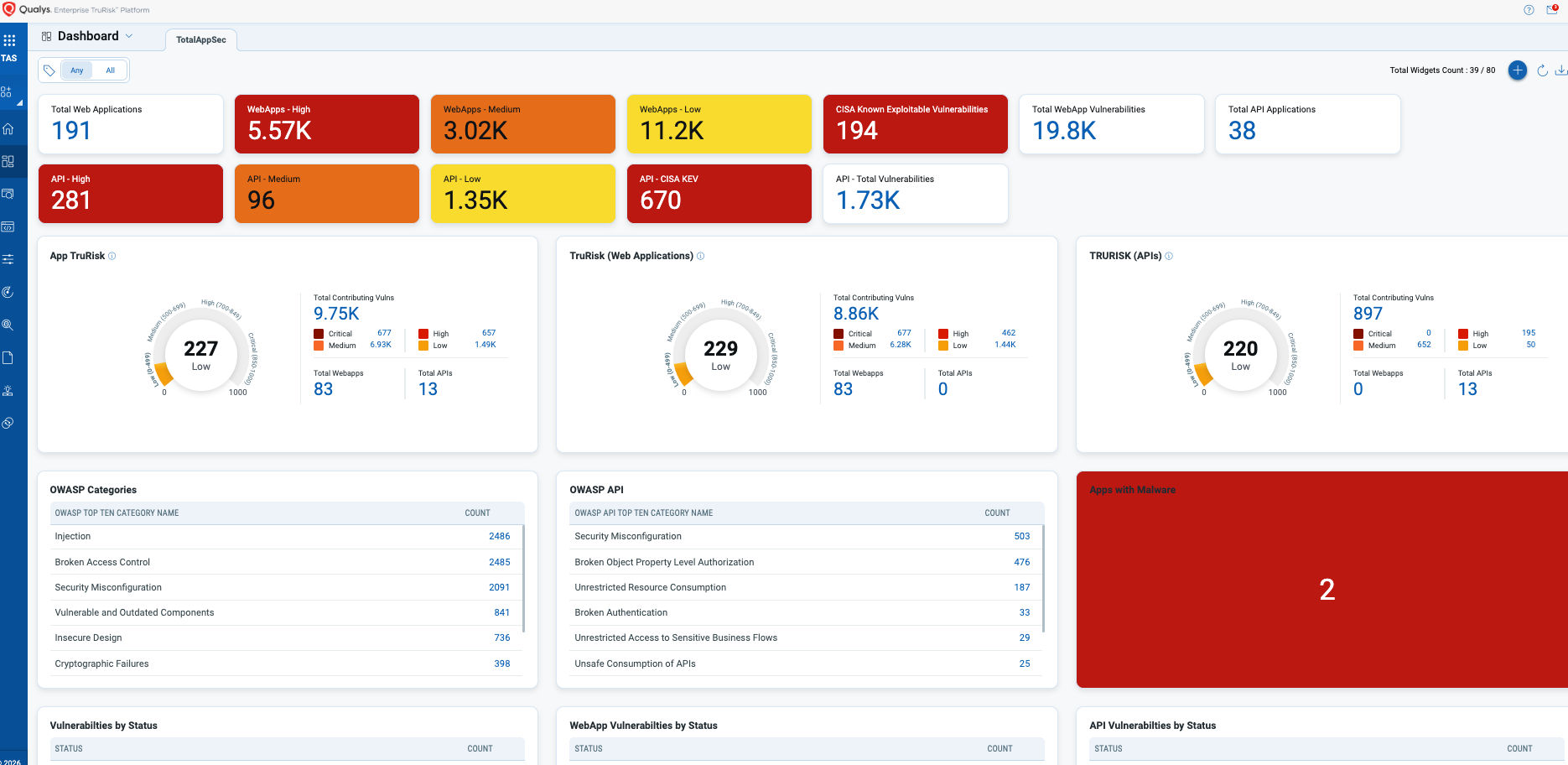 changelog · Oct 2026
· source
· release history
- Routes findings into CI/CD pipelines, Jira, and ServiceNow, with automatic retest after remediation and scheduled evidence output for FedRAMP controls SA-11, RA-5, SI-2, CM-8, and CA-7. changelog · Oct 2026 · source · release history
Web app and API discovery shipped Continuously discovers known, unknown, shadow, zombie, and rogue web apps and APIs across cloud, on-premises, internet-facing, API gateway, AI-serving, and MCP server environments.
release
-
Continuously discovers known, unknown, shadow, zombie, and rogue web apps and APIs across cloud, on-premises, internet-facing environments, API gateways, AI-serving endpoints, and MCP servers.
changelog · Oct 2026
· source
· release history
- Imports API specs from Swagger, Postman, and Burp, pulling from gateway and cloud connectors, and reconciles every discovered endpoint against the declared inventory to surface shadow and zombie APIs. changelog · Oct 2026 · source · release history
AI-powered scan optimization shipped Reduces scan time by up to 50 percent using AI-driven optimization to make high-frequency scanning cadences achievable.
release
-
AI-Powered Scan Optimization cuts scan time by up to 50 percent to make the daily scanning cadence required by FedRAMP at High impact achievable.
changelog · Oct 2026
· source
· release history
Authenticated scanning shipped Authenticates test sessions using OAuth 2.0, PKCE, bearer tokens, and API keys so scans reach the same endpoints a legitimate caller can access.
release
-
Authenticates test sessions with OAuth 2.0, Proof Key for Code Exchange (PKCE), bearer tokens, and API keys to reach everything a legitimate caller can access.
changelog · Oct 2026
· source
· release history
CI/CD and ITSM integration shipped Routes findings into CI/CD pipelines, Jira, and ServiceNow, and supports automatic retest after remediation.
Also counts toward: CI/CD pipeline integration, Scheduled jobs, Ticketing integration
release
-
Routes findings into CI/CD pipelines, Jira, and ServiceNow, with automatic retest after remediation and scheduled evidence output for FedRAMP controls SA-11, RA-5, SI-2, CM-8, and CA-7.
changelog · Oct 2026
· source
· release history
Dynamic application and API security testing shipped Tests running applications and APIs for OWASP Top 10 risks, sensitive-data exposure, and authorization flaws including BOLA, BFLA, and BUA.
release
-
Tests running applications and APIs for OWASP Top 10 risks, sensitive-data exposure, and authorization flaws — broken object level authorization (BOLA), broken function level authorization (BFLA), and broken user authentication (BUA) — that carry no CVE.
changelog · Oct 2026
· source
· release history
TruRisk prioritization shipped Ranks findings by severity, exploitability, threat context, asset criticality, and business impact, and consolidates results from third-party AppSec tools and pen tests into a single remediation queue.
release
-
TruRisk prioritization engine ranks findings by severity, exploitability, threat context, asset criticality, and business impact, and ingests results from third-party AppSec tools and pen tests into a single remediation queue.
changelog · Oct 2026
· source
· release history
Zero-day web malware detection shipped Uses deep-learning models to detect zero-day web malware for which no existing signature exists.
Also counts toward: ML-based detection
release
-
Deep-learning detection catches zero-day web malware with no existing signature.
changelog · Oct 2026
· source
· release history
Lines in monospace are the tool's own words: help text
parsed from its source, or an endpoint from its API document. Under
release, a line is our summary of a dated release. Under
docs, it is quoted from the tool's own documentation or
website. Each links back to the source it came from.
Screenshots
From the release notes, newest first. Click one to see it full size.Score card
-
Shipping velocity releases a month, last 12 months
-
Documentation quality release-notes rubric, 0–100
-
Breaking-change discipline how rarely a release breaks users, and notice given
-
Maintenance risk quiet time against its own cadence, maintainers
-
Innovation & surface new capabilities, API and MCP surface
Five scores for Qualys Web Application Scanning, each built from the releases, notes and API history this site tracks — and, on Researcher and Business, where it stands among every measured tool in its category and how that has moved.
Score cards are part of every paid plan.
See plans → Already subscribed? Sign in →Trajectory
Blank means never measured; nothing here is a filled-in zero.
Peer standings are included with Researcher and Business. See how this tool ranks against its competitors, using data we don't publish anywhere else.
See plans →Each score is 0–100 on a published rubric, derived from data this site already shows. A dimension we cannot measure says so — it is never scored 0 and never enters a rank.
How this is scored
- Shipping velocity — releases a month over the last 12 months, on a log scale where 16 a month scores 100. Needs 3 releases in the window.
- Documentation quality — the release-notes rubric published on the analytics page, unchanged.
- Breaking-change discipline — the share of releases carrying a breaking change (none scores 100, half or more scores 0). Only projects that label breaking changes are measured: a clean record cannot be told from an unlabelled one.
- Maintenance risk — quiet time measured against the tool's own release cadence (quiet longer than 90 days and three typical gaps scores 0), plus the number of active maintainers and whether contributors are growing, where known. Higher is lower risk.
- Innovation & surface — new capabilities in the feature ledger this year, API and MCP operations added, and the share of commits that are features: the mean of whichever we hold.
- Community health (open-source tools only) — each is a direction, not a size: contributors this year against last, the bus factor now against a year ago, and issues closed per issue opened, where steady scores 50, doubled 100 and halved 0; plus the median time to a maintainer's first reply (an hour scores about 100, a month or more 0). A commercial card has no repository and carries none of the four.
- Documented delivery (commercial tools) — when a vendor's documented new capabilities have slowed against its own baseline, that counts against the overall standing as heavily as two low dimensions. Steady delivery, or too little history to judge, leaves the standing alone; it is never a sixth score.
- Open-source tools are scored on repository signals; commercial tools on their published changelog. Ranks compare tools within one category and one profile and need at least five measured peers; the overall standing needs three ranked dimensions. Best-in-breed or consolidator is a shape, not a quality, and is never scored.
Release-note detail over time
See how much detail Qualys Web Application Scanning puts in its release notes, quarter by quarter, and compare it with tracked tools in the same category. This history uses up to ten retained, reviewed notes per tool; sparse or blank older quarters may reflect that limit.
Checking release-note history…
Website history
qualys.com, every changeQualys's home page and 40 more pages as they looked each month from August 2021 to October 2026: 155 renders, 84 changes of tagline or palette. Step through them, play them, or put any two months side by side.
Website history is included with Researcher and Business.
See plans → Already subscribed? Sign in →← → or h l a month · Shift a year · [ ] previous / next change · Space play · 1 2 3 page · T whole page · C compare · F full size
← → or h l the right month · Shift the left · S swap · W wipe · T whole page · Esc back
Rebranding timeline
Dates bound when a change appeared between captures. Possible rebrands are AI suggestions; a redesign alone does not establish a rebrand.
Coverage
Missing something? Tell us
What Qualys Web Application Scanning connects to, runs on and detects, read from its release notes and docs. So far: 1 new vulnerability check.
1 change, tracked since Oct 28, 2026.
-
Oct 282026
new CVE-2026-111497 Brotli decompression flaw
With Cloudflare managed rule 8f252673b69d47afb21f88acca706f3c, FortiGate IPS signature 62703, Check Point CPAI-2026-15802
Controls for CVE-2026-111497: Cloudflare managed rule 8f252673b69d47afb21f88acca706f3c (set to Block); FortiGate IPS signature 62703; Check Point CPAI-2026-15802.
Nothing first seen in this window. That doesn't mean Qualys Web Application Scanning shipped nothing, only that we found no record of it.
How we count
Read from 1 of 2 release notes and docs updates we hold for Qualys Web Application Scanning. "First seen" is the earliest note that names something; "last" is the latest. Our history may start partway through Qualys Web Application Scanning's life, so an old integration can show a recent first-seen date.
Each change counts once: "added 40 checks" is one line, so the numbers measure how often coverage moves, not how big the catalogue is or how well it detects.
Releases
2 entries
No entries match these filters.
- October 20262
Add the badge to your README
Maintain this project? The badge links readers straight to this page, so they can follow every release here.
 Choose a badge style and copy the code →