Vectra AI
v9.15 - Control (2026-10-20) commercialThe section your link pointed to isn't on Vectra AI's page any more, so we've brought you to the top.
Vectra AI is a network detection and responsenetwork detection and responseNetwork detection and response, analyzing network activity to find threats and support investigation. It focuses on communication patterns and suspicious traffic across systems. platform that uses machine learning to detect threats including command-and-control, lateral movementlateral movementMoving from an initially compromised system or identity to other resources in a network. Attackers often use stolen credentials or trusted connections to expand their access., and data exfiltrationdata exfiltrationMoving data out of a system or organization without authorization. It can happen through network transfers, removable media or other channels..
Summary
Vectra AI is a commercial network-detection-and-response platform that watches traffic and identity activity for signs of an active attacker rather than blocking known threats at the perimeter. It runs as sensors deployed into a network — including virtual sensors sized for 8- and 16-core ERSPANERSPANA Cisco-originated GRE-based tunneling protocol that encapsulates mirrored network traffic and ships it across Layer 3 to a remote capture point, letting cyber tools analyze traffic from distant segments without local tap hardware.-based monitoring — that feed a central analysis layer, making it an operational service rather than a scan-and-exit tool. It is built for SOCSOCA security operations center, the team or function that monitors threats, investigates alerts and coordinates incident response. Its work can be internal, outsourced or shared. analysts and threat-hunting teams who need to catch lateral movement and post-compromise behavior, with detection coverage spanning SMBSMBA network file-sharing protocol developed by Microsoft that lets systems share files, printers, and named pipes over a network; cyber tools target or speak it because it is ubiquitous in Windows environments.-based lateral movement, Cobalt Strike beaconing, Active DirectoryActive DirectoryMicrosoft's directory service for Windows networks that centralises authentication and authorisation; cyber tools target or integrate with it because it controls identity and access across most enterprise environments. Certificate Services abuse, covert tunneling protocols, and cloud storage exfiltration via sync tools. It sits in the network-defense category alongside other detection platforms built around behavioral analytics rather than signatures. Launched in 2011 and still active, with 20 tracked releases and the most recent one 29 days ago.
Vectra AI is a network detection and response platform that uses machine learning to detect threats including command-and-control, lateral movement, and data exfiltration.
How Vectra AI helps
Which hosts on this network are showing signs of lateral movement right now?
correlates SMB session activity, named pipe usage, and Cobalt Strike SMB beaconing patterns across Windows hosts and flags the ones matching known lateral-movement behavior, naming the host and the behavior observed
Is someone using a trusted Windows utility to pull down attacker tooling or abuse certificates?
inspects HTTP-based traffic for malicious downloads, uploads, and certificate-abuse patterns tied to offensive frameworks riding on legitimate utilities, and reports the utility and the suspicious action together
Is any traffic on this network hiding a covert tunnel out to an attacker?
watches for web-based tunneling, public tunneling-service traffic, and custom BackConnect protocol patterns that bypass perimeter controls, and identifies the sessions carrying them
Has anyone tried to abuse Active Directory Certificate Services or pulled a copy of the AD database?
matches traffic against known ADCS-abuse and suspicious AD database transfer patterns and surfaces the host and transfer involved
Is data leaving through a sync tool instead of a sanctioned channel?
recognizes cloud storage exfiltration behavior carried over common sync-tool traffic and flags the transfer as exfiltration rather than routine backup
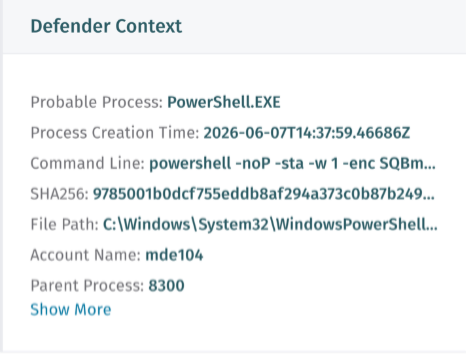
Which detection is this Defender for Endpoint alert actually tied to on the process level?
correlates the network detection with Defender EDR process data to name the probable process behind it, removing the need to build that correlation manually in a SIEM or SOAR
Languages
Features
Built from Vectra AI's releases, docs, README and our own runs. “Seen” marks the month we first spotted a release the vendor didn't date. Group names and tags are our labels.
- Vectra AI covers 1 of the 5 network observation capabilities we track.
What Vectra AI offers you
- ML-based detection2
- Outbound webhooks (the product notifies you)1
- SIEM forwarding1
- REST API
No capabilities match.
All capabilities 12 capabilities
ERSPAN virtual Sensor support shipped suggested Supports multi-core virtual Sensors and multiple IPs per capture interface for ERSPAN-based network monitoring deployments.
Suggested capability: Network traffic analysis. This is our guess, not confirmed.
release 9 total
-
Expands APIv2.5 support to cover Traffic Lockdown, enabling automation of a broader range of response actions.︀︄︇︀︅︉︀︅︀︀︃︀︀︅︅︀︅︊︀︄︆︀︃︄
 v9.14 - Control (2026-09-10) · Sep 2026
· source
· release history
- Adds generic KVM deployment support for Brain, Sensor, and Stream components v9.14 - Platform (2026-09-10) · Sep 2026 · source · release history
- Supports deploying Brain, Sensor, and Stream on KVM-based environments including Proxmox.︀︄︇︀︅︉︀︅︀︀︃︀︀︅︅︀︅︊︀︄︆︀︃︄ v9.14 - Platform (2026-09-10) · Sep 2026 · source · release history
- Supports 8-core and higher virtual Sensors for ERSPAN-based monitoring deployments. v9.13 - Platform (2026-07-23) · Jul 2026 · source · release history
- Supports up to 16 IPs per capture interface in ERSPAN environments. v9.13 - Platform (2026-07-23) · Jul 2026 · source · release history
- support for 16 IPs per capture interface v9.13 - Platform (2026-07-23) · Jul 2026 · source · release history
Tunnel and covert channel detection shipped Detects web-based tunnels, public tunneling services, and custom BackConnect protocols used to bypass perimeter controls.
release 7 total
-
Adds new detections for Microsoft Quick Assist and Tailscale discovery traffic to identify potentially unauthorized remote-support and overlay-network activity.
v9.14 - Observe (2026-09-10) · Sep 2026
· source
· release history
- Expands Suspect Protocol Activity detections to include Microsoft Quick Assist and Tailscale discovery traffic, identifying potentially unauthorized remote-support and overlay-network activity. v9.14 - Observe (2026-09-10) · Sep 2026 · source · release history
- New detection coverage for web-based tunnels, public tunneling services, and custom BackConnect protocols used to bypass perimeter controls. v9.13 - Observe (2026-07-23) · Jul 2026 · source · release history
- Adds detection for web-based tunnels, public tunneling services, and custom BackConnect protocols. v9.13 - Observe (2026-07-23) · Jul 2026 · source · release history
- New Hidden Tunnel detection for stealthy, non-beaconing C2 over previously uncovered protocols v9.10 - Observe (2026-04-08) · Apr 2026 · source · release history
- Adds Traffic Lockdown, an automated network defense capability that publishes threat feed IPs to supported firewalls for immediate enforcement. v9.8 - Control (2026-01-27) · Jan 2026 · source · release history
example
-
Identify unauthorized remote support tools or overlay network activity through new detection rules.
Review detection results in the Vectra AI console for 'Microsoft Quick Assist' and 'Tailscale discovery traffic' indicators.v9.14 - Observe (2026-09-10) · Sep 2026 · source -
Automatically block malicious hosts at the network edge by integrating with your firewall infrastructure.
Visit Traffic Lockdown for configuration instructions.v9.8 - Control (2026-01-27) · Jan 2026 · source
HTTP behavioral detection shipped Detects malicious HTTP activity including file downloads and uploads, certificate abuse, and offensive framework use via trusted Windows utilities.
release 8 total
- Adds behavioral signatures for malicious downloads, uploads, and certificate-related abuse in HTTP traffic. v9.13 - Observe (2026-07-23) · Jul 2026 · source · release history
- Expanded HTTP-based behavioral signatures covering malicious file downloads/uploads, certificate abuse, and offensive framework activity using trusted Windows utilities. v9.13 - Observe (2026-07-23) · Jul 2026 · source · release history
- Adds behavioral signatures for HTTP-based attacker tooling, including malicious file downloads/uploads and certificate-related abuse via trusted Windows utilities and offensive frameworks. v9.13 - Observe (2026-07-21) · Jul 2026 · source · release history
- Expands Unified Beacon detection to interactive C2 over HTTP/HTTPS by detecting sustained connection patterns to uncommon external domains. v9.12 - Observe (2026-06-08) · Jun 2026 · source · release history
- Adds detection coverage for Empire, Merlin, Caldera Sandcat, and interactive beaconing activity. v9.12 - Observe (2026-06-08) · Jun 2026 · source · release history
- Expanded DHCP telemetry including vendor/user class identifiers, client architecture, router info, TFTP/WPAD/MUD URLs v9.10 - Observe (2026-04-08) · Apr 2026 · source · release history
Azure AD and cloud identity threat detection shipped Detects suspicious operations, token abuse, and configuration changes in Azure Active Directory and Microsoft Entra ID environments.
release 7 total
- Enhances Azure AD Successful Brute-Force detection with ASN parameters, trusted device logic, and faster time-to-detect v9.9 - Observe (2026-03-02) · Mar 2026 · source · release history
-
Adds
Azure Suspicious Token Usage - User Principaldetection for stolen user principal access tokens v9.9 - Observe (2026-03-02) · Mar 2026 · source · release history - Adds new detection Azure AD Suspect Operation: Guest User Added to surface suspicious external guest user invitations inconsistent with behavioral profiles v9.8 - Observe (2026-01-27) · Jan 2026 · source · release history
- Introduces native detection for Azure Suspect Operation - DNS Security Policy Modification to identify deletion or modification of DNS Security Policy resources v9.8 - Observe (2026-01-27) · Jan 2026 · source · release history
- Introduces native detection for Azure Suspect Operation - Flow Logs Disabled to identify deletion of Azure flow log resources v9.8 - Observe (2026-01-27) · Jan 2026 · source · release history
- Adds new detection Azure AD Suspect Operation: Unusual Sign-On from a Proxy leveraging the new Threat Intelligence engine for sign-in behavior analysis v9.8 - Observe (2026-01-27) · Jan 2026 · source · release history
Asset identification and context enrichment shipped Improves host and asset identification by correlating additional telemetry data such as HTTP user agents, DHCP fingerprints, and EDR process correlation.
release
-
Enhances Host ID with observed HTTP user agent information to provide additional context for asset identification and investigation across changing sessions.
v9.14 - Signal (2026-09-10) · Sep 2026
· source
· release history
- Enhances Host ID with observed HTTP user agent information for asset identification v9.14 - Signal (2026-09-10) · Sep 2026 · source · release history
- Adds Microsoft Defender EDR process context to NDR detections for all customers via the platform and API v9.14 - Signal (2026-09-10) · Sep 2026 · source · release history
- Adds Microsoft Defender EDR process correlation, automatically surfacing the probable process behind an NDR detection alongside the detection in the platform and via API — eliminating custom SIEM/SOAR correlation logic.︀︄︇︀︅︉︀︅︀︀︃︀︀︅︅︀︅︊︀︄︆︀︃︄ v9.14 - Signal (2026-09-10) · Sep 2026 · source · release history
- Adds JA4DHCP fingerprint support in Recall metadata. v9.12 - Observe (2026-06-08) · Jun 2026 · source · release history
- Makes CrowdStrike EDR process correlation generally available for all Vectra AI customers. v9.10 - Signal (2026-04-08) · Apr 2026 · source · release history
Command and control detection expansion shipped Provides native detection capabilities for various C2 frameworks, interactive beacons, and encrypted check-in patterns using LLM/AI modeling.
Also counts toward: ML-based detection
release
-
Adds detection coverage for commonly used command-and-control frameworks and web-scanning behavior.
v9.14 - Observe (2026-09-10) · Sep 2026
· source
· release history
- Provides expanded Detection Coverage for command-and-control frameworks and web-scanning behavior. v9.14 - Observe (2026-09-10) · Sep 2026 · source · release history
- Adds XWorm C2 Detection for encrypted TCP check-in patterns. v9.11 - Observe (2026-05-05) · May 2026 · source · release history
- New rule to detect SSH on other reserved ports v9.10 - Observe (2026-04-08) · Apr 2026 · source · release history
- Native detection coverage for Sliver Command & Control activity leveraging LLM/AI modeling for beaconing patterns v9.10 - Observe (2026-04-08) · Apr 2026 · source · release history
- Native detections for Cobalt Strike, Meterpreter, Mythic C2, and DNScat activity replacing Suricata engine reliance v9.10 - Observe (2026-04-08) · Apr 2026 · source · release history
Traffic visibility health monitoring shipped suggested Monitors network observation metrics and alerts on significant drops in observed IPs, traffic bandwidth, or packet volume using adaptive ML thresholds.
Suggested capability: Network traffic analysis. This is our guess, not confirmed.
Also counts toward: ML-based detection, SIEM forwarding, Outbound webhooks (the product notifies you)
release
-
Adds Traffic Visibility Drop Alerting — now fully available to all customers — delivering health notifications via email, webhook integrations, API, or Syslog when significant drops in observed IPs, traffic bandwidth, or packet volume are detected, using ML-adapted thresholds per customer…
v9.14 - Observe (2026-09-10) · Sep 2026
· source
· release history
- Completes the rollout of Traffic Visibility Drop Alerting, now available to all customers via email, webhook, API, or Syslog on QUX to alert on significant drops in observed IPs, traffic bandwidth, and packet volume. v9.14 - Observe (2026-09-10) · Sep 2026 · source · release history
- Adds email, webhook, API, and Syslog delivery targets for visibility drop alerts on QUX v9.11 - Platform (2026-05-05) · May 2026 · source · release history
- Adds health notifications for drops in observed IPs, traffic bandwidth, and packet volume with adaptive ML detection v9.11 - Platform (2026-05-05) · May 2026 · source · release history
example
-
Monitor network visibility health and detect blind spots that impact detection coverage using the new drop alerts.
Check the QUX dashboard for 'Traffic Visibility Drop' alerts, or configure webhook/API subscriptions for these notifications.v9.14 - Observe (2026-09-10) · Sep 2026 · source -
Receive visibility drop alerts via Syslog for immediate integration with SIEM pipelines.
Configure 'Syslog' as a delivery target in the Vectra AI QUX platform settings.v9.11 - Platform (2026-05-05) · May 2026 · source
Active Directory and cloud exfiltration detection shipped Detects Active Directory Certificate Services abuse, suspicious AD database file transfers, and cloud storage exfiltration via sync tools.
release
- Adds detection for Active Directory Certificate Services abuse, suspicious AD database transfers, and cloud storage exfiltration via sync tools. v9.13 - Observe (2026-07-23) · Jul 2026 · source · release history
- New detections for Active Directory Certificate Services abuse, suspicious AD database file transfers, and cloud storage exfiltration via sync tools. v9.13 - Observe (2026-07-23) · Jul 2026 · source · release history
-
Introduces
My Profile > Themetoggle for Dark Mode public preview v9.10 - Platform (2026-04-08) · Apr 2026 · source · release history -
Adds
Azure Suspicious Token Usage - Service Principaldetection for misused service principal and managed identity tokens v9.9 - Observe (2026-03-02) · Mar 2026 · source · release history - Introduces native detection for Azure Suspect Operation - Network Security Config Change to identify creation or modification of Azure network security groups or firewalls v9.8 - Observe (2026-01-27) · Jan 2026 · source · release history
- New detections for Active Directory Certificate Services abuse, suspicious AD database file transfers, and cloud storage exfiltration via common sync tools. v9.13 - Observe · source · release history
Cryptographic telemetry and analysis shipped Enhances visibility into cryptographic methods and protocols used in network communications, including Post-Quantum Cryptography support.
Shared capability: Network traffic analysis
release
-
Introduces Post-Quantum Cryptography (PQC) Metadata Enhancements for greater visibility into cryptographic methods used across network communications.
v9.14 - Observe (2026-09-10) · Sep 2026
· source
· release history
- Enhances network metadata with Post-Quantum Cryptography (PQC) visibility, surfacing cryptographic methods used across network communications to help identify where modern and post-quantum cryptography is being adopted. v9.14 - Observe (2026-09-10) · Sep 2026 · source · release history
- Improves Smash and Grab detection accuracy by ensuring destination domain names update correctly later in a session v9.8 - Observe (2026-01-27) · Jan 2026 · source · release history
Encapsulated traffic processing shipped Optimizes processing efficiency for encapsulated traffic workloads in ERSPAN environments.
release
- performance optimizations that increase processing efficiency for encapsulated traffic workloads v9.13 - Platform (2026-07-23) · Jul 2026 · source · release history
- Increases processing efficiency for encapsulated traffic workloads in ERSPAN deployments. v9.13 - Platform (2026-07-23) · Jul 2026 · source · release history
- Performance optimizations increase processing efficiency for encapsulated traffic workloads in ERSPAN environments. v9.13 - Platform · source · release history
SMB lateral movement detection shipped Detects SMB-based lateral movement, malicious named pipe activity, and Cobalt Strike SMB beaconing across Windows environments.
release
- Adds detection coverage for SMB-based lateral movement, malicious named pipe activity, and Cobalt Strike SMB beaconing. v9.13 - Observe (2026-07-23) · Jul 2026 · source · release history
- Adds detection coverage for Empire, Merlin, Caldera Sandcat, and interactive beaconing activity. v9.12 - Observe (2026-06-08) · Jun 2026 · source · release history
- New detections for SMB-based lateral movement, malicious named pipe activity, and Cobalt Strike SMB beaconing across Windows environments. v9.13 - Observe · source · release history
LDAP and SMB reconnaissance detection shipped Detects Active Directory enumeration, delegation abuse, trust relationships, and specific SMB file-locking behaviors associated with attack tools.
release
-
Adds
GhostLockSMB detection for file-level locking behavior associated with the tool’s default authorization artifact. v9.12 - Observe (2026-06-08) · Jun 2026 · source · release history - Adds detection of Ncrack-based RDP activity and Responder NTLM behavior. v9.12 - Observe (2026-06-08) · Jun 2026 · source · release history
- Expanded LDAP reconnaissance detection covering Active Directory enumeration, delegation, and trust relationships v9.10 - Observe (2026-04-08) · Apr 2026 · source · release history
Lines in monospace are the tool's own words: help text
parsed from its source, or an endpoint from its API document. Under
release, a line is our summary of a dated release. Under
docs, it is quoted from the tool's own documentation or
website. Each links back to the source it came from.
Screenshots
From the release notes, newest first. Click one to see it full size.Score card
-
Shipping velocity releases a month, last 12 months
-
Documentation quality release-notes rubric, 0–100
-
Breaking-change discipline how rarely a release breaks users, and notice given
-
Maintenance risk quiet time against its own cadence, maintainers
-
Innovation & surface new capabilities, API and MCP surface
Five scores for Vectra AI, each built from the releases, notes and API history this site tracks — and, on Researcher and Business, where it stands among every measured tool in its category and how that has moved.
Score cards are part of every paid plan.
See plans → Already subscribed? Sign in →Trajectory
Blank means never measured; nothing here is a filled-in zero.
Peer standings are included with Researcher and Business. See how this tool ranks against its competitors, using data we don't publish anywhere else.
See plans →Each score is 0–100 on a published rubric, derived from data this site already shows. A dimension we cannot measure says so — it is never scored 0 and never enters a rank.
How this is scored
- Shipping velocity — releases a month over the last 12 months, on a log scale where 16 a month scores 100. Needs 3 releases in the window.
- Documentation quality — the release-notes rubric published on the analytics page, unchanged.
- Breaking-change discipline — the share of releases carrying a breaking change (none scores 100, half or more scores 0). Only projects that label breaking changes are measured: a clean record cannot be told from an unlabelled one.
- Maintenance risk — quiet time measured against the tool's own release cadence (quiet longer than 90 days and three typical gaps scores 0), plus the number of active maintainers and whether contributors are growing, where known. Higher is lower risk.
- Innovation & surface — new capabilities in the feature ledger this year, API and MCP operations added, and the share of commits that are features: the mean of whichever we hold.
- Community health (open-source tools only) — each is a direction, not a size: contributors this year against last, the bus factor now against a year ago, and issues closed per issue opened, where steady scores 50, doubled 100 and halved 0; plus the median time to a maintainer's first reply (an hour scores about 100, a month or more 0). A commercial card has no repository and carries none of the four.
- Documented delivery (commercial tools) — when a vendor's documented new capabilities have slowed against its own baseline, that counts against the overall standing as heavily as two low dimensions. Steady delivery, or too little history to judge, leaves the standing alone; it is never a sixth score.
- Open-source tools are scored on repository signals; commercial tools on their published changelog. Ranks compare tools within one category and one profile and need at least five measured peers; the overall standing needs three ranked dimensions. Best-in-breed or consolidator is a shape, not a quality, and is never scored.
Release-note detail over time
See how much detail Vectra AI puts in its release notes, quarter by quarter, and compare it with tracked tools in the same category. This history uses up to ten retained, reviewed notes per tool; sparse or blank older quarters may reflect that limit.
Checking release-note history…
Website history
vectra.ai, every changeVectra AI's home page and 39 more pages as they looked each month from August 2021 to October 2026: 50 renders, 7 changes of tagline or palette. Step through them, play them, or put any two months side by side.
Website history is included with Researcher and Business.
See plans → Already subscribed? Sign in →← → or h l a month · Shift a year · [ ] previous / next change · Space play · 1 2 3 page · T whole page · C compare · F full size
← → or h l the right month · Shift the left · S swap · W wipe · T whole page · Esc back
Rebranding timeline
Dates bound when a change appeared between captures. Possible rebrands are AI suggestions; a redesign alone does not establish a rebrand.
Coverage
Missing something? Tell us
What Vectra AI connects to, runs on and detects, read from its release notes and docs. So far: 2 new detections, 2 updated detections, 2 updated supported platforms, 1 new supported platform.
7 changes, tracked since Oct 20, 2026.
-
Oct 202026
new Command-and-Control detection expansion
With Adaptix, Ares, Pupy, Quasar, Manjusaka, Cobalt Strike
Vectra AI has expanded command-and-control detection coverage across several adversary tools and frameworks, including Adaptix, Ares, Pupy, Quasar, Manjusaka, and Cobalt Strike. These additions improve visibility into beaconing, command retrieval, and other C2 activity across HTTP, DNS, and additional network channels.
-
Oct 202026
new Suspicious SMB Activity Coverage
Vectra AI has added coverage for suspicious SMB client behavior and executable transfers over administrative shares. This helps identify network activity associated with attacker tooling and potential lateral movement.
-
Oct 202026
updated Kerberoasting Host-Centric Cipher Downgrade detection
With Kerberoasting Weak Cipher Downgrade
Vectra AI has expanded host-centric detection coverage for Kerberoasting Weak Cipher Downgrade activity. The enhanced detection uses host-specific behavioral thresholds, where sufficient host history is available, to better identify meaningful low-volume weak-cipher activity that may previously have fallen below a static threshold.
-
Oct 202026
updated SPA Detections Available by Default
With Suspect Protocol Activity (SPA) detections, Suricata-based SPA feature, Vectra Curated Ruleset, Match
SPA Detections Available by Default Suspect Protocol Activity (SPA) detections are now available to all Vectra NDR customers without separately enabling the Suricata-based SPA feature. Most SPA detections run as part of the standard detection set. With the v9.15 release, a small set of former SPA rules will only be available to customers running Match through the Vectra Curated Ruleset. These rules use Vectra's reserved SID range of 4,200,000–4,299,999 and the naming format VECTRA <CATEGORY> <NAME>.
-
Oct 202026
new Azure Esv5 Support for Cloud Brain
With Azure Esv5-series
Azure Esv5 Support Vectra AI now supports Azure Esv5-series instances for Cloud Brain instances. This includes 16 and 32 core images, with performance matching the previous Esv3-series rates.
-
Oct 202026
updated 100 Gbps Sensor, Brain, and Stream Support
With Vectra AI S127, B127, M47
100 Gbps Sensor, Brain, and Stream Support Vectra AI S127, B127, and M47 appliances now support up to 100 Gbps of throughput.
-
Oct 202026
updated Encapsulated Endpoints Support for Mixed Mode Appliances
With ERSPAN, GRE, GENEVE, VXLAN
Mixed Mode appliances now support ERSPAN decapsulation and IP addresses on capture interfaces. Administrators can direct ERSPAN, GRE, GENEVE, and VXLAN tunneled traffic to a specific capture interface, simplifying deployment and improving network visibility.
Endpoint & network security 4
Cloud platforms & services 1
Hardware & accelerators 2
Other 3
Nothing first seen in this window. That doesn't mean Vectra AI shipped nothing, only that we found no record of it.
How we count
Read from 3 of 22 release notes and docs updates we hold for Vectra AI. "First seen" is the earliest note that names something; "last" is the latest. Our history may start partway through Vectra AI's life, so an old integration can show a recent first-seen date.
Each change counts once: "added 40 checks" is one line, so the numbers measure how often coverage moves, not how big the catalogue is or how well it detects.
Releases
22 entries
No entries match these filters.
- October 20263
- September 20264
- July 20263
- June 20261
- May 20262
- April 20263
- March 20261
- January 20263
- Undated2
Add the badge to your README
Maintain this project? The badge links readers straight to this page, so they can follow every release here.
 Choose a badge style and copy the code →