Aurascape
September New Innovations Recap: More Precise Protection for AI Work (2026-10-05) commercialThe section your link pointed to isn't on Aurascape's page any more, so we've brought you to the top.
Aurascape secures employee AI use, helps teams build agents safely, and protects AI agents in production with real-time visibility, policy enforcement, and data protection.
Summary
Aurascape is a commercial ai-security platform that provides real-time visibility, intent-based controls, and protection for every AI interaction. It is run as a service and is for platform engineers, specifically for securing shadow-ai usage. Its documentation positions it alongside tools managing tool access, focusing on inspecting tool calls down to parameters and detecting prompt injectionprompt injectionAn attack where text the model reads, such as a web page, file or tool result, carries instructions that override the user's. It is the main security risk for agents with tools. in documentation. Since its launch in 2023, the project has seen eight releases within the tracked window.
Aurascape secures employee AI use, helps teams build agents safely, and protects AI agents in production with real-time visibility, policy enforcement, and data protection.
How Aurascape helps
Which AI agents and tools are running in my environment without ever having been registered?
discovers MCP servers and tools automatically and enrolls them on sight, so shadow-ai surfaces show up without hand-maintained allowlists
Which of my agent's tool calls actually went through approved governance, and which slipped past it?
marks every call approved by the gateway and flags any tool invocation reaching the model that didn't carry that mark
Is a coding assistant session about to leak a secret or run something destructive?
inspects live streaming traffic from assistants like Claude Code, Copilot, and Cursor inline, catching pasted credentials and blocking or holding destructive shell commands and git pushes before the client executes them
Is a model being steered by instructions hidden in documentation or MCP output?
scans READMEs, docs, and MCP outputs for injected instructions and neutralizes them before the agent acts on them
Who can call which MCP tools, and what happens when someone shouldn't?
binds tool-level sanctioning to users and groups and applies configurable actions — coaching, hold-for-approval, or block — when a call violates policy
Can I reconstruct exactly what happened in an AI conversation for an investigation or audit?
keeps audit-ready logs of prompts, responses, connections, and tool calls behind each policy flag, accessible under role-based access control
Languages
Features
Built from Aurascape's releases, docs, README and our own runs. “Seen” marks the month we first spotted a release the vendor didn't date. Group names and tags are our labels.
- Aurascape covers 2 of the 6 ai evaluation and governance capabilities we track.
- Aurascape covers 1 of the 8 data discovery and protection capabilities we track.
What Aurascape offers you
- Administrative audit log3
- MCP server1
- Natural-language query1
- Role-based access control1
No capabilities match.
LLM application tracing 1 feature AI evaluation and governance since 2026
MCP Conversation Audit Logging shipped Generates audit-ready records of every observed MCP conversation, capturing prompts, responses, connections, and tool calls for compliance and investigation under role-based access control.
Shared capability: LLM application tracing
Also counts toward: Administrative audit log, Role-based access control
release
-
Conversation records for coding sessions now separate
system prompt,user prompt, andendpoint detailsinto individual fields, with expanded response content for Model Context Protocol (MCP) interactions.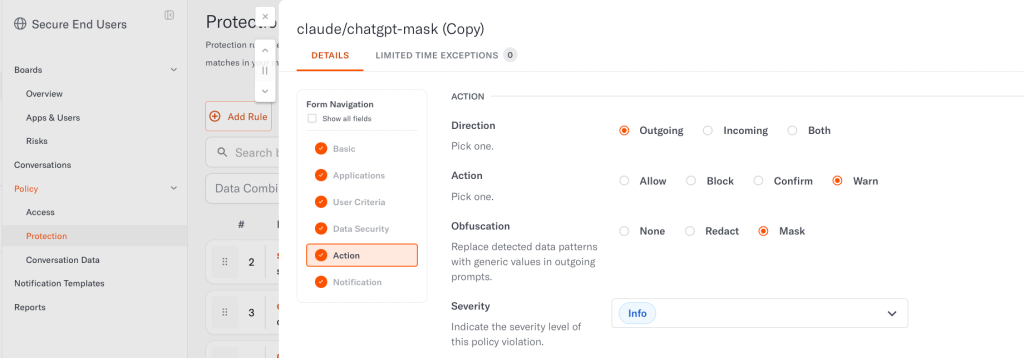 September New Innovations Recap: More Precise Protection for AI Work (2026-10-05) · Oct 2026
· source
· release history
- Delivers auditable conversation logs — capturing prompts, responses, connections, and tool calls behind each policy flag — under role-based access control for security investigations. Secure the Coding Session, Not Just the Code (2026-09-04) · Sep 2026 · source · release history
- Generates audit-ready records of every observed MCP conversation for compliance and investigation. Zero-Bypass MCP Gateway Data Sheet (2026-08-20) · Aug 2026 · source · release history
AI input data redaction 1 feature AI evaluation and governance since 2026
Secret and Credential Redaction in Prompts shipped Detects and blocks or redacts secrets and credentials pasted into prompts in flight, before the model receives them, capturing the event as auditable evidence.
Shared capability: AI input data redaction
Also counts toward: Administrative audit log
release
-
Administrators can unmask sensitive values in the Conversations view (subject to user role permissions) during investigations without those values having been sent to the model.
September New Innovations Recap: More Precise Protection for AI Work (2026-10-05) · Oct 2026
· source
· release history
-
Adds sensitive data masking as a mode of the
redactaction in Protection policy, replacing sensitive values in prompts before they reach the LLM and restoring real values in the response the user reads. September New Innovations Recap: More Precise Protection for AI Work (2026-10-05) · Oct 2026 · source · release history - Detects and blocks or redacts secrets and credentials pasted into prompts in flight, before the model receives them, with the event captured as auditable evidence. Secure the Coding Session, Not Just the Code (2026-09-04) · Sep 2026 · source · release history
example
-
Keep PII or account numbers out of an LLM while letting the developer continue working — no block, no friction.
In the Aurascape console, go to Protection policy, select or create a policy rule, choose the 'redact' action, and set the mode to 'masking'.September New Innovations Recap: More Precise Protection for AI Work (2026-10-05) · Oct 2026 · source
Sensitive data classification 1 feature Data discovery and protection since 2026
Data Classification Configuration shipped Manages data patterns, categories, and combination lists used for data classification, and retrieves the supporting objects those configurations reference.
Shared capability: Sensitive data classification
release
-
New APIs automate management of data patterns, data categories, and data combination lists for data classification configurations, and can retrieve the supporting objects those configurations reference.︀︄︇︀︅︉︀︅︀︀︃︀︀︅︅︀︅︊︀︄︆︀︃︄
September New Innovations Recap: More Precise Protection for AI Work (2026-10-05) · Oct 2026
· source
· release history
Other / not yet classified 12 features Features we have not matched to a capability yet. A suggested match is marked.
MCP Access Control shipped suggested Provides tool-level sanctioning bound to users and groups, and OAuth 2.1 authorization with tokens scoped per user per server, enabling fine-grained control over which agents can call which MCP tools.
Suggested capability: Data access governance. This is our guess, not confirmed.
release
-
Deepens model-level access policy controls with more granular per-model enforcement for Claude, the Anthropic API, ChatGPT, the OpenAI API, Google Vertex AI API, and Amazon Bedrock, supporting coach (warning or confirmation) and block actions.
September New Innovations Recap: More Precise Protection for AI Work (2026-10-05) · Oct 2026
· source
· release history
- Implements OAuth 2.1 authorization with tokens scoped per user per server for MCP connections. Zero-Bypass MCP Gateway Data Sheet (2026-08-20) · Aug 2026 · source · release history
- Supports tool-level sanctioning bound to users and groups, enabling fine-grained access control over which agents can call which MCP tools. Zero-Bypass MCP Gateway Data Sheet (2026-08-20) · Aug 2026 · source · release history
example
-
Block or coach users who invoke DeepSeek inside an approved Amazon Bedrock deployment, without affecting other Bedrock models.
In the Aurascape console, go to Access policy, select Amazon Bedrock, expand model-level controls, find DeepSeek, and set the action to 'Block' or choose 'Coach' with a warning or confirmation…September New Innovations Recap: More Precise Protection for AI Work (2026-10-05) · Oct 2026 · source
MCP Gateway and Zero-Bypass Enforcement shipped suggested Governs MCP tool access through a central gateway that marks every approved call so the AI Proxy can block any tool invocation that bypassed the gateway before the model acts.
Suggested capability: Data access governance. This is our guess, not confirmed.
release
-
Zero-Bypass MCP Gateway traffic now surfaces
process namedetails, letting analysts attribute an interaction to the specific local application or agent behind it.
September New Innovations Recap: More Precise Protection for AI Work (2026-10-05) · Oct 2026
· source
· release history
- Introduces the Zero-Bypass MCP Gateway, which governs MCP tool access and marks every approved call so the AI Proxy can block any tool invocation that bypassed the Gateway before the model acts. Zero-Bypass MCP Gateway Data Sheet (2026-08-20) · Aug 2026 · source · release history
- Provides policy actions ranging from coaching to hold-for-approval to blocking for MCP tool calls. Zero-Bypass MCP Gateway Data Sheet (2026-08-20) · Aug 2026 · source · release history
Coding Assistant Guardrails shipped Inspects and enforces policy on live AI coding-assistant sessions — covering Claude Code, GitHub Copilot, and Cursor — before any artifact exists to scan, by decoding streaming protocols inline without buffering.
release
- Decodes coding-assistant streaming protocols (Server-Sent Events, WebSockets, Protobuf, gRPC, and MCP) inline without buffering, preserving native streaming speed for developers while enabling content inspection. Secure the Coding Session, Not Just the Code (2026-09-04) · Sep 2026 · source · release history
- Introduces Coding Assistant Guardrails, a new solution that inspects and enforces policy on live AI coding-assistant sessions — covering Claude Code, GitHub Copilot, and Cursor — before any artifact exists to scan. Secure the Coding Session, Not Just the Code (2026-09-04) · Sep 2026 · source · release history
- Introduces Coding Assistant Guardrails, a new solution that inspects and enforces policy on live AI coding-assistant sessions — covering Claude Code, GitHub Copilot, and Cursor — before any artifact exists to scan.︀︄︇︀︅︉︀︅︀︀︃︀︀︅︅︀︅︊︀︄︆︀︃︄ Secure the Coding Session, Not Just the Code (2026-09-04) · Sep 2026 · source · release history
Policy Coaching and User Guidance shipped Delivers customizable coaching templates that surface in-browser, in-IDE, or in-terminal explanations and safer paths when a policy action fires.
release
-
Adds more options for administrators to customize the frequency of real-time coaching notifications when users repeatedly trigger the same Protection policy, to reduce alert fatigue.
September New Innovations Recap: More Precise Protection for AI Work (2026-10-05) · Oct 2026
· source
· release history
- Offers customizable coaching templates that surface in-browser, in-IDE, or in-terminal explanations and safer paths when a policy action fires. Secure the Coding Session, Not Just the Code (2026-09-04) · Sep 2026 · source · release history
MCP Threat Detection shipped Detects and maps coverage against the OWASP MCP Top 10, including tool-poisoning attacks, credential-chaining scenarios, and prompt injection hidden in READMEs, documentation, and MCP outputs.
release
- Detects prompt injection hidden in READMEs, documentation, and MCP outputs, neutralizing hijacked instructions before the agent acts on them. Secure the Coding Session, Not Just the Code (2026-09-04) · Sep 2026 · source · release history
- Detects and maps coverage against the OWASP MCP Top 10, including tool-poisoning attacks and credential-chaining scenarios across multiple systems. Zero-Bypass MCP Gateway Data Sheet (2026-08-20) · Aug 2026 · source · release history
MCP Tool and Server Discovery and Enrollment shipped Automatically discovers and enrolls MCP servers, tools, IDE plugins, and extensions as they appear, with new or uncataloged items receiving signatures on a 48-hour SLA, eliminating manual registration.
Also counts toward: MCP server
release
- Provides continuous discovery of IDE plugins, extensions, and MCP servers as they appear, with new or uncataloged apps receiving signatures on a 48-hour SLA — removing the need for hand-maintained allowlists. Secure the Coding Session, Not Just the Code (2026-09-04) · Sep 2026 · source · release history
- Adds automatic MCP server and tool discovery with automatic enrollment, eliminating manual registration of AI agent tool surfaces. Zero-Bypass MCP Gateway Data Sheet (2026-08-20) · Aug 2026 · source · release history
Administrator Audit Logging shipped Records administrator SSO login activity — including successful and failed attempts, timestamps, statuses, and source IP addresses — in Audit Logs.
Also counts toward: Administrative audit log
release
-
Adds administrator SSO activity to Audit Logs, recording successful and failed login attempts with timestamp, status, and source IP address.
September New Innovations Recap: More Precise Protection for AI Work (2026-10-05) · Oct 2026
· source
· release history
Usage and Risk Reporting shipped Generates on-demand reports with metrics such as unique user counts by application and top policy hits, alongside existing application breakdowns.
release
-
On-demand reports now include a Unique User Counts by Application metric and a Top Protection Policy Hits bar chart alongside the existing application breakdown.
September New Innovations Recap: More Precise Protection for AI Work (2026-10-05) · Oct 2026
· source
· release history
Destructive Command and Unauthorized Push Interception shipped Intercepts destructive shell commands and unauthorized git pushes at the wire level in the tool call the model streams back, before the client executes them, with configurable block or confirmation-checkpoint policy.
release
- Intercepts destructive shell commands and unauthorized git pushes at the wire level, in the tool call the model streams back, before the client executes them — with configurable block or confirmation-checkpoint policy. Secure the Coding Session, Not Just the Code (2026-09-04) · Sep 2026 · source · release history
MCP Tool Call Inspection shipped Exposes MCP tool calls down to their parameters for visibility and policy enforcement.
release
- Exposes MCP tool calls down to their parameters for visibility and policy enforcement. Secure the Coding Session, Not Just the Code (2026-09-04) · Sep 2026 · source · release history
Natural-Language AI Usage and Risk Querying shipped Enables natural-language queries over AI usage, risk, and policy data through Auri.
Also counts toward: Natural-language query
release
- Enables natural-language queries over AI usage, risk, and policy data through Auri. Secure the Coding Session, Not Just the Code (2026-09-04) · Sep 2026 · source · release history
Supply-Chain and Typosquatting Detection shipped Flags typosquatted packages and spoofed links recommended by a model, surfacing supply-chain attempts as visible, reportable events.
release
- Flags typosquatted packages and spoofed links recommended by a model, surfacing supply-chain attempts as visible, reportable events. Secure the Coding Session, Not Just the Code (2026-09-04) · Sep 2026 · source · release history
Lines in monospace are the tool's own words: help text
parsed from its source, or an endpoint from its API document. Under
release, a line is our summary of a dated release. Under
docs, it is quoted from the tool's own documentation or
website. Each links back to the source it came from.
Screenshots
From the release notes, newest first. Click one to see it full size.Score card
-
Shipping velocity releases a month, last 12 months
-
Documentation quality release-notes rubric, 0–100
-
Breaking-change discipline how rarely a release breaks users, and notice given
-
Maintenance risk quiet time against its own cadence, maintainers
-
Innovation & surface new capabilities, API and MCP surface
Five scores for Aurascape, each built from the releases, notes and API history this site tracks — and, on Researcher and Business, where it stands among every measured tool in its category and how that has moved.
Score cards are part of every paid plan.
See plans → Already subscribed? Sign in →Trajectory
Blank means never measured; nothing here is a filled-in zero.
Peer standings are included with Researcher and Business. See how this tool ranks against its competitors, using data we don't publish anywhere else.
See plans →Each score is 0–100 on a published rubric, derived from data this site already shows. A dimension we cannot measure says so — it is never scored 0 and never enters a rank.
How this is scored
- Shipping velocity — releases a month over the last 12 months, on a log scale where 16 a month scores 100. Needs 3 releases in the window.
- Documentation quality — the release-notes rubric published on the analytics page, unchanged.
- Breaking-change discipline — the share of releases carrying a breaking change (none scores 100, half or more scores 0). Only projects that label breaking changes are measured: a clean record cannot be told from an unlabelled one.
- Maintenance risk — quiet time measured against the tool's own release cadence (quiet longer than 90 days and three typical gaps scores 0), plus the number of active maintainers and whether contributors are growing, where known. Higher is lower risk.
- Innovation & surface — new capabilities in the feature ledger this year, API and MCP operations added, and the share of commits that are features: the mean of whichever we hold.
- Community health (open-source tools only) — each is a direction, not a size: contributors this year against last, the bus factor now against a year ago, and issues closed per issue opened, where steady scores 50, doubled 100 and halved 0; plus the median time to a maintainer's first reply (an hour scores about 100, a month or more 0). A commercial card has no repository and carries none of the four.
- Documented delivery (commercial tools) — when a vendor's documented new capabilities have slowed against its own baseline, that counts against the overall standing as heavily as two low dimensions. Steady delivery, or too little history to judge, leaves the standing alone; it is never a sixth score.
- Open-source tools are scored on repository signals; commercial tools on their published changelog. Ranks compare tools within one category and one profile and need at least five measured peers; the overall standing needs three ranked dimensions. Best-in-breed or consolidator is a shape, not a quality, and is never scored.
Release-note detail over time
See how much detail Aurascape puts in its release notes, quarter by quarter, and compare it with tracked tools in the same category. This history uses up to ten retained, reviewed notes per tool; sparse or blank older quarters may reflect that limit.
Checking release-note history…
Website history
aurascape.ai, every changeAurascape's home and product pages and 11 more pages as they looked each month from April 2024 to October 2026: 23 renders, 8 changes of tagline or palette. Step through them, play them, or put any two months side by side.
Website history is included with Researcher and Business.
See plans → Already subscribed? Sign in →← → or h l a month · Shift a year · [ ] previous / next change · Space play · 1 2 3 page · T whole page · C compare · F full size
← → or h l the right month · Shift the left · S swap · W wipe · T whole page · Esc back
Rebranding timeline
Dates bound when a change appeared between captures. Possible rebrands are AI suggestions; a redesign alone does not establish a rebrand.
Coverage
Missing something? Tell us
What Aurascape connects to, runs on and detects, read from its release notes and docs. So far: 2 updated integrations.
2 changes, tracked since Oct 5, 2026.
-
Oct 52026
updated Granular model-level access policy for Claude, Anthropic API, ChatGPT, OpenAI API, Google Vertex AI API, and Amazon Bedrock
September deepens that coverage with more granular model-level controls for Claude, the Anthropic API, ChatGPT, the OpenAI API, Google Vertex AI API, and Amazon Bedrock.
-
Oct 52026
updated Expanded MCP conversation record detail via Zero-Bypass MCP Gateway
With Model Context Protocol (MCP)
The records also show more response content from interactions that use Model Context Protocol (MCP). For traffic monitored by the Zero-Bypass MCP Gateway, process name details help analysts attribute an interaction to the specific local application or agent behind it.
Chat & assistant apps 1
Agent frameworks & SDKs 1
Model providers & gateways 5
Endpoint & network security 1
Nothing first seen in this window. That doesn't mean Aurascape shipped nothing, only that we found no record of it.
How we count
Read from 1 of 4 release notes and docs updates we hold for Aurascape. "First seen" is the earliest note that names something; "last" is the latest. Our history may start partway through Aurascape's life, so an old integration can show a recent first-seen date.
Each change counts once: "added 40 checks" is one line, so the numbers measure how often coverage moves, not how big the catalogue is or how well it detects.
Releases
4 entries
No entries match these filters.
- October 20261
- September 20262
- August 20261
Add the badge to your README
Maintain this project? The badge links readers straight to this page, so they can follow every release here.
 Choose a badge style and copy the code →