Bugcrowd
New Organization Roles for Assets and Savant Pathseeker (2026-11-02) commercialThe section your link pointed to isn't on Bugcrowd's page any more, so we've brought you to the top.
Bugcrowd is a crowdsourced security platform that connects organizations with ethical hackers to find and report vulnerabilities through bug bounty and penetration testing programs.
curl -X POST https://api.bugcrowd.com/scan_configurations/{id}/scan_executions \
  -H 'Authorization: Token <api_token>' \
  -H 'Content-Type: application/json' \
  -d '{"trigger_source": "github-actions"}'
Summary
Bugcrowd is a commercial crowdsourced security platform that connects organizations with independent researchers to find vulnerabilities, alongside newer autonomous scanning products for the same purpose. It runs as a SaaSSaaSSoftware delivered over the internet and run on the provider's infrastructure, so the buyer pays a subscription instead of installing or operating anything locally. platform with customer, researcher, and API docs for integrating findings and credentials into existing workflows, and it is aimed at application owners, security teams, and compliance stakeholders who need vulnerability visibility and reporting rather than at researchers working alone. Its scope spans traditional bug bounty and pentest coordination, classification detail down to things like KerberosKerberosA network authentication protocol that uses tickets issued by a trusted service. Users and services can prove their identities without sending a password to each application. and SCCM abuse paths, and FedRAMPFedRAMPA US government program that standardizes cloud security authorization, letting vendors get a single assessment accepted across federal agencies instead of repeating the process for each one. support for government use, while its Savant Vista and Pathseeker products add autonomous asset discovery and authenticated penetration testing that push validated findings into the same triage inbox.
Bugcrowd is a crowdsourced security platform that connects organizations with ethical hackers to find and report vulnerabilities through bug bounty and penetration testing programs.
How Bugcrowd helps
What unknown assets in my estate have never been through a pentest?
Savant Vista's autonomous discovery maps the estate and Pathseeker launches authenticated penetration tests against what it finds, pushing validated findings into the same Security Inbox as researcher-submitted reports
Has anything changed on my attack surface since the last scan?
a baseline can be established as a known-good state, and subsequent autonomous scans are compared against it to surface newly discovered assets or drift
Can my researchers test the parts of my application that sit behind a login?
authenticated testing supports external identity providers, so autonomous test runs can reach functionality that only appears once a session is established
Which internal attack paths does a given finding actually represent?
findings are classified against the VRT, now including distinct Kerberos, SCCM, and Active Directory misconfiguration categories, so a report maps to a specific abuse path rather than a generic bucket
How severe is a server misconfiguration or SSRF finding once it's reported?
the VRT rates server security misconfigurations across the full P1–P5 spectrum and scores SSRF findings with granular metrics rather than one coarse category
Which researcher requests are still waiting on my team, and for how long?
the inbox filters show active versus resolved Requests a Response, and each request displays the date it was raised so an outstanding one can be tracked by age
Languages
Features
Built from Bugcrowd's releases, docs, README and our own runs. “Seen” marks the month we first spotted a release the vendor didn't date. Group names and tags are our labels.
- Bugcrowd covers 1 of the 2 vulnerability management capabilities we track.
What Bugcrowd offers you
- Role-based access control1
- Ticketing integration1
- REST API
No capabilities match.
All capabilities 12 capabilities
Autonomous Penetration Testing (Savant Pathseeker) shipped Provides an autonomous penetration testing capability that discovers assets, scans for vulnerabilities, and pushes validated findings to security inboxes.
release 8 total
- Adds a new Test Operator organization role that can launch, stop, and configure Savant Pathseeker autonomous tests across approved assets, and read asset inventory to select test targets — must be explicitly granted by an Organization Owner and is not included with any program role by… New Organization Roles for Assets and Savant Pathseeker (2026-11-02) · Nov 2026 · source · release history
-
Adds
trigger_sourcelabel field on API-triggered runs to record the origin (e.g.,github-actions) alongside the token owner and timestamp for full run traceability. Trigger Savant Pathseeker Tests with the API (2026-10-13) · Oct 2026 · source · release history - Exposes the Configuration ID and setup instructions from the test's Test Overview page after enabling API-triggered runs. Trigger Savant Pathseeker Tests with the API (2026-10-13) · Oct 2026 · source · release history
- Adds Allow API-triggered runs option in Pathseeker test setup, which surfaces a Configuration ID used to reference the test in API calls. Trigger Savant Pathseeker Tests with the API (2026-10-13) · Oct 2026 · source · release history
-
Adds
POST /scan_configurations/{id}/scan_executionsendpoint (API v1.2.0) to start an existing Pathseeker test programmatically using its saved targets, credentials, and settings.︀︄︇︀︅︉︀︅︀︀︃︀︀︅︅︀︅︊︀︄︆︀︃︄ Trigger Savant Pathseeker Tests with the API (2026-10-13) · Oct 2026 · source · release history - Introduces Savant Pathseeker 1.0 in Early Access, an autonomous pentesting capability on the Bugcrowd platform. changelog · Aug 2026 · source · release history
docs
- Aug 17th, 2026 Customers > Savant Pathseeker Early Access (1.0) Savant Pathseeker Overview docs update · Aug 2026 · source
- Savant Pathseeker Overview What Savant Pathseeker does Before you begin Autonomous testing steps-by-step Add a new asset without leaving test setup Test applications that require a login Push findings to your Security Inbox Related topics Savant Pathseeker is Bugcrowdâs autonomous penetration testing product. docs update · Aug 2026 · source
- Aug 17th, 2026 Savant Pathseeker Early Access (1.0) Savant Pathseeker Overview Autonomous Penest Savant Pathseeker Overview docs update · Aug 2026 · source
example
-
Trigger a Pathseeker retest of your staging environment after each CI/CD release, tagging the run with the pipeline source for traceability.
curl -X POST https://api.bugcrowd.com/scan_configurations/{id}/scan_executions \ -H 'Authorization: Token <api_token>' \ -H 'Content-Type: application/json' \ -d '{"trigger_source": "github-actions"}'Trigger Savant Pathseeker Tests with the API (2026-10-13) · Oct 2026 · source -
Enable API-triggered runs for a Pathseeker test and retrieve its Configuration ID so it can be referenced in automation.
In the Pathseeker test setup, turn on 'Allow API-triggered runs'. Copy the displayed Configuration ID. To retrieve it later, go to the test's Test Overview page and reopen the setup instructions.Trigger Savant Pathseeker Tests with the API (2026-10-13) · Oct 2026 · source
Request a Response (RaR) withdrawal management shipped Allows researchers to withdraw submitted RaR requests and customers to formally withdraw previously submitted responses, with withdrawn items removed from active queues, preserved in the submission Activity feed with a withdrawal reason, and filterable via a dedicated inbox filter.
release
- Adds Request a Response Withdrawal to allow customers to formally request that a submitted response be withdrawn.︀︄︇︀︅︉︀︅︀︀︃︀︀︅︅︀︅︊︀︄︆︀︃︄ changelog · Oct 2026 · source · release history
- Filters withdrawn Request a Response (RaR) submissions via the Withdrawn requests to Customer filter in Security Inbox.︀︄︇︀︅︉︀︅︀︀︃︀︀︅︅︀︅︊︀︄︆︀︃︄ Request a Response Withdrawal (2026-09-28) · Sep 2026 · source · release history
- Added Withdrawn requests to Customer filter in the Security Inbox Request a Response Withdrawal (2026-09-28) · Sep 2026 · source · release history
- Expansion of withdrawal reason in the submission’s Activity feed Request a Response Withdrawal (2026-09-28) · Sep 2026 · source · release history
- Automatic withdrawal of open RaR from active queues upon researcher action Request a Response Withdrawal (2026-09-28) · Sep 2026 · source · release history
- Automatically removes researcher-withdrawn RaRs from active queues and preserves them as expandable items in the submission's Activity feed with the withdrawal reason. Request a Response Withdrawal (2026-09-28) · Sep 2026 · source · release history
docs
example
-
When you need to retract a previously submitted response on a program, use the new withdrawal request flow in the Bugcrowd customer portal.
In the Bugcrowd customer portal, navigate to the relevant submission, then select 'Request a Response Withdrawal' to initiate the withdrawal process.changelog · Oct 2026 · source -
Review all RaRs a researcher has withdrawn to audit outstanding response obligations and close out stale items.
In Security Inbox, open the filters panel and select 'Withdrawn requests to Customer' to list all withdrawn RaRs, then expand any entry in the submission's Activity feed to view the researcher's…Request a Response Withdrawal (2026-09-28) · Sep 2026 · source
Researcher submission limits and accuracy calculation shipped Controls submission limits for researchers and calculates accuracy metrics based on their submissions.
release
- Adds ability to remove the expiration on a Request a Response, extending researcher response windows beyond the default deadline. changelog · Aug 2026 · source · release history
- Adds capability to respond directly to a Request a Response from within the platform. changelog · Aug 2026 · source · release history
- New inbox filters let you view RaRs by status: Active requests to Customers to surface outstanding requests and Resolved requests to Customers to review handled ones. Request a Response Expiration Removal (2026-08-25) · Aug 2026 · source · release history
- Each RaR now displays the date it was raised so teams can track how long a request has been open. Request a Response Expiration Removal (2026-08-25) · Aug 2026 · source · release history
docs
- Oct 8th, 2026 Researchers > Submission Limit Update Submission Limit Oct 8th, 2026 Researchers > Accuracy Calculation Update Accuracy Oct 1st, 2026 Customers > Bug Bounty Engagement Simulator Removed Removed seen Oct 2026 · source
- Customers > Generating Vulnerability Detection Report Vulnerability Detection Report seen Aug 2026 · source
- Aug 25th, 2026 Request a Response Expiration Removal Responding to a Request a Response seen Aug 2026 · source
- Aug 25th, 2026 Researchers > Request a Response Expiration Removal Request a Response Aug 25th, 2026 Customers > Request a Response Expiration Removal Responding to a Request a Response seen Aug 2026 · source
- Aug 25th, 2026 Request a Response Expiration Removal docs update · Aug 2026 · source
example
-
Quickly surface all outstanding researcher requests that need your team's attention using the new inbox filter.
In the Bugcrowd inbox, open the filter panel and select 'Active requests to Customers' to see all open RaRs awaiting a response.Request a Response Expiration Removal (2026-08-25) · Aug 2026 · source
Vulnerability Detection Reporting shipped Generates on-demand, exportable PDF reports of vulnerability findings and attack surface posture, filterable by asset, severity, and date.
release
- Adds Vulnerability Detection Report generation under Vulnerability Scanning, providing exportable scan findings for customer programs. changelog · Aug 2026 · source · release history
- Enables generation of a Vulnerability Detection Report at the organization level for Bugcrowd customers. Generating Vulnerability Detection Report (2026-08-25) · Aug 2026 · source · release history
docs
- Generating Vulnerability Detection Report Vulnerability Detection Report Generating Vulnerability Detection Report Vulnerability Scanning Generating Vulnerability Detection Report seen Aug 2026 · source
-
For a PDF summary of the vulnerability findings on that discovered attack surface â scoped by date range, CVSS severity, and asset filters, and grouped by asset or by vulnerability â go to Vulnerability Detection Report instead. Generating Vulnerability Detection Report
 seen Aug 2026
· source
- For a detailed PDF summary of the findings themselves â scoped by date range, CVSS severity, and asset filters, and grouped by asset or by vulnerability â generate a Vulnerability Detection Report from instead. Generating Vulnerability Detection Report seen Aug 2026 · source
- 7. Reporting for application owners and leadership 7. Reporting for application owners and leadership Generate on-demand dashboards and exportable reports so application owners, business unit leads, and compliance stakeholders can see vulnerability posture and discovered attack surface without waiting on a manual data… docs update · Aug 2026 · source
- Reporting Reporting Once findings are triaged, surface them in aggregate via Organization then AI Analytics then Vulnerability Detections for priority trends, open-vs-resolved views, and asset criticality breakdowns â filterable by date, asset group, vulnerability priority, and asset owner. seen Aug 2026 · source
example
-
Review and export a Vulnerability Detection Report after running a vulnerability scan against your program.
In the Bugcrowd platform, go to Vulnerability Scanning > Generating Vulnerability Detection Report, then select your scan and download the Vulnerability Detection Report.changelog · Aug 2026 · source
Vulnerability Rating Taxonomy (VRT) shipped Provides a structured classification system for vulnerability findings, covering categories such as SSRF, Active Directory misconfigurations, Kerberos and SCCM abuse vectors, and server security misconfigurations across a P1–P5 severity spectrum.
release 8 total
- Adds Active Directory misconfiguration entries to the VRT, covering a new class of findings for AD-related vulnerabilities. VRT Update (1.19.1) (2026-07-08) · Jul 2026 · source · release history
- Adds server security misconfiguration classifications (P1–P5) to the VRT. VRT Update (1.19.1) (2026-07-08) · Jul 2026 · source · release history
- Replaces legacy SSRF categories with granular SSRF metrics, enabling finer-grained severity differentiation for server-side request forgery findings. VRT Update (1.19.1) (2026-07-08) · Jul 2026 · source · release history
- Expands the Vulnerability Rating Taxonomy (VRT) to cover Active Directory (AD) misconfigurations. VRT Update (1.19.1) (2026-07-08) · Jul 2026 · source · release history
- Streamlines SSRF classifications by replacing legacy categories with more granular metrics. VRT Update (1.19.1) (2026-07-08) · Jul 2026 · source · release history
- Adds Kerberos and SCCM abuse vectors as distinct VRT categories, enabling more precise classification of common internal attack paths. VRT Update (1.19.1) (2026-07-08) · Jul 2026 · source · release history
Jira Integration for Vulnerability Remediation shipped Links discovered vulnerabilities to Jira issues, enabling bidirectional comment sync and status updates between the platform and Jira.
Also counts toward: Ticketing integration
release
- Adds Push and Link actions in a Vulnerability Detection's Integrations panel to create a new Jira issue or connect to an existing one, keeping remediation tracked in Jira in sync with risk data in Crowdcontrol. Linking Vulnerability Detections to Jira (2026-09-06) · Sep 2026 · source · release history
- Enables bidirectional comment sync and on-demand update pushes for Jira-linked Vulnerability Detections, with the ability to edit or remove the link at any time. Linking Vulnerability Detections to Jira (2026-09-06) · Sep 2026 · source · release history
docs
- For further information on integrations, seeâ: Linking a Vulnerability Detection to Jira seen Sep 2026 · source
- Sep 6th, 2026 Linking Vulnerability Detections to Jira Link Vulnerability Detections to Jira Autonomous Pentest Linking a Vulnerability Detection to Jira docs update · Sep 2026 · source
- Sep 6th, 2026 Customers > Linking Vulnerability Detections to Jira Link Vulnerability Detections to Jira docs update · Sep 2026 · source
IP Restriction Configuration shipped Enforces organizational access control by restricting admin and scanner access to specific allowlisted IP addresses or CIDR blocks.
release
- Adds IP Restriction configuration at the organization level to enforce access via an allowlist of approved IP addresses or CIDR ranges IP Restrictions (2026-05-14) · May 2026 · source · release history
docs
- IP Allow List IP Allow List Optionally, add the following region-specific IP addresses to your network or system access control allow lists to ensures that these IP addresses are not blocked and Savant Pathseeker can function property in its tests. This is also shown within the Autonomous Test configuration wizard. seen Sep 2026 · source
- It is strongly recommended that customers allow-list the IPs shown in the table within the reference document below to ensure the proper functioning of the vulnerability scanners. The IP ranges are also region-specific and depend on which scanner pool is selected. seen Aug 2026 · source
-
It is strongly recommended that customers allow-list the IPs shown in the table within the reference document below to ensure the proper functioning of the vulnerability scanners. The IP ranges are also region-specific and depend on which scanner pool is selected.
seen Aug 2026
· source
example
-
Restrict org access to specific CIDR blocks for admin users
In the console, go to Organization Settings > IP Restrictions and add your approved IP ranges to the allowlist.IP Restrictions (2026-05-14) · May 2026 · source
Autonomous asset discovery and vulnerability scanning shipped Discovers assets and estates autonomously and supports launching vulnerability scans against those assets, including a baseline setup workflow to establish a known-good state before scanning.
Shared capability: Vulnerability scanning
release
- Supports launching autonomous vulnerability scans against discovered assets. Savant Vista Public Beta (1.0) (2026-07-14) · Jul 2026 · source · release history
- New Savant Vista platform introduces autonomous asset/estate discovery capabilities. Savant Vista Public Beta (1.0) (2026-07-14) · Jul 2026 · source · release history
- Adds vulnerability baseline setup workflow for establishing a known-good state before scanning. Savant Vista Public Beta (1.0) (2026-07-14) · Jul 2026 · source · release history
- Adds Savant Vista public beta enabling autonomous asset discovery and vulnerability scanning capabilities Savant Vista Public Beta (1.0) (2026-07-14) · Jul 2026 · source · release history
Organization role-based access control shipped Provides distinct organization-level roles — including Organization Owner, Asset Owner, and Asset Viewer — with scoped permissions over assets, discovery, scans, findings, and programs.
Also counts toward: Role-based access control
release
- The Organization Owner role now includes full access to assets in addition to all security programs and submissions. New Organization Roles for Assets and Savant Pathseeker (2026-11-02) · Nov 2026 · source · release history
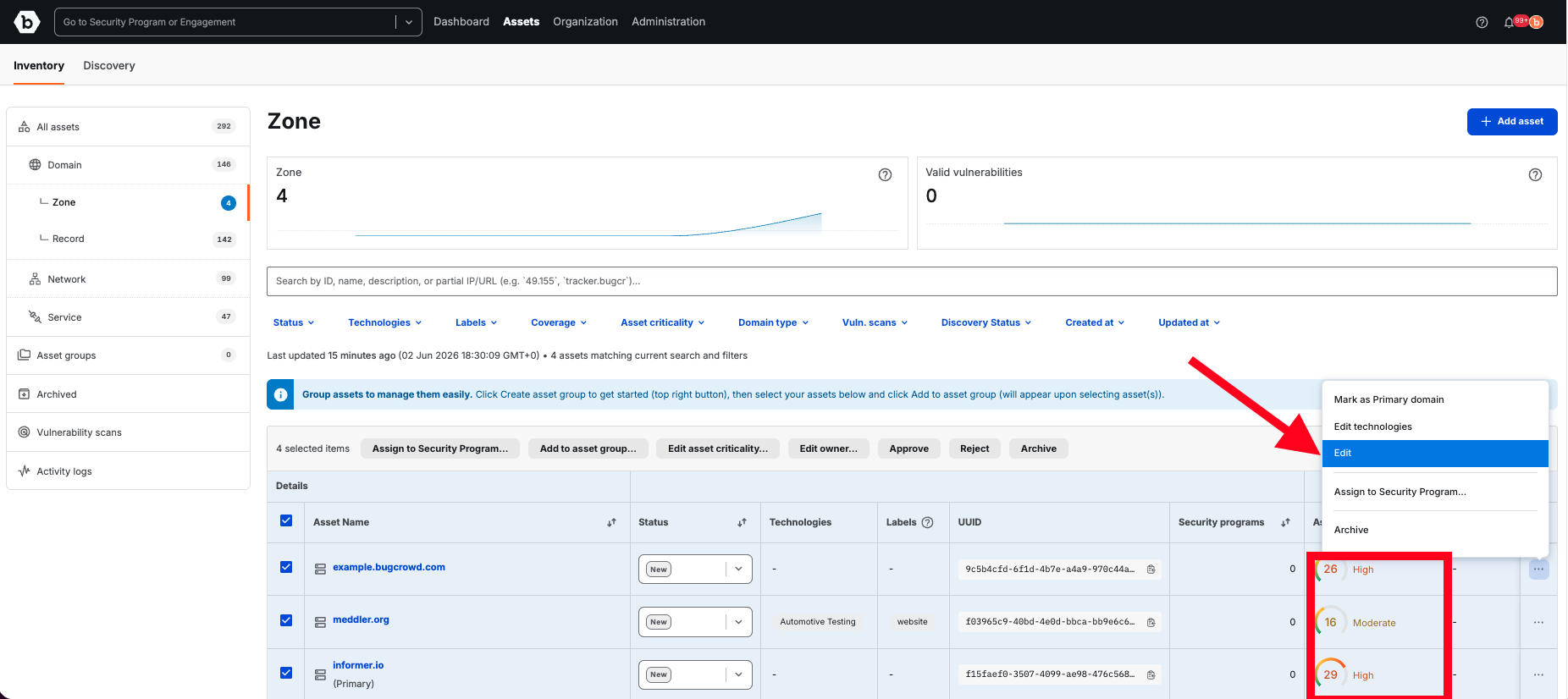
- Adds a new Asset Owner organization role that can manage asset inventory, discovery, scans, and groups, and triage findings across all programs. New Organization Roles for Assets and Savant Pathseeker (2026-11-02) · Nov 2026 · source · release history
- Adds a new Asset Viewer organization role that can view asset inventory, the discovery feed, and scan status, and view findings across all programs. New Organization Roles for Assets and Savant Pathseeker (2026-11-02) · Nov 2026 · source · release history
FedRAMP Compliance Support shipped Enables the use of the cyber tool within FedRAMP-authorized environments for government and compliance-sensitive organizations.
release
- Adds FedRAMP support, enabling government and compliance-sensitive organizations to use Bugcrowd within FedRAMP-authorized environments. changelog · Aug 2026 · source · release history
docs
- FedRAMP Support Contacting FedRAMP Support What to Include in Your Email What NOT to Include Other FedRAMP Support Contacts Notes FedRAMP Environment Users: If you are accessing Bugcrowd through the FedRAMP environment, all support requests must be directed through the FedRAMP-specific channels described on this page. seen Aug 2026 · source
- FedRAMP Support docs update · Aug 2026 · source
DNS Records Report shipped Generates a DNS records report for assets within the platform.
release
- New DNS Records Report available for generation within the platform. changelog · Aug 2026 · source · release history
docs
- Generating DNS Records Report docs update · Aug 2026 · source
Researcher credential management shipped Allows customers to manage and assign researcher credentials within the platform.
release
- Enables customers to manage and assign researcher credentials within the Bugcrowd platform. changelog · Jul 2026 · source · release history
docs
- Managing and Assigning Researcher Credentials docs update · Jul 2026 · source
Lines in monospace are the tool's own words: help text
parsed from its source, or an endpoint from its API document. Under
release, a line is our summary of a dated release. Under
docs, it is quoted from the tool's own documentation or
website. Each links back to the source it came from.
Screenshots
From the release notes, newest first. Click one to see it full size.Score card
-
Shipping velocity releases a month, last 12 months
-
Documentation quality release-notes rubric, 0–100
-
Breaking-change discipline how rarely a release breaks users, and notice given
-
Maintenance risk quiet time against its own cadence, maintainers
-
Innovation & surface new capabilities, API and MCP surface
Five scores for Bugcrowd, each built from the releases, notes and API history this site tracks — and, on Researcher and Business, where it stands among every measured tool in its category and how that has moved.
Score cards are part of every paid plan.
See plans → Already subscribed? Sign in →Trajectory
Blank means never measured; nothing here is a filled-in zero.
Peer standings are included with Researcher and Business. See how this tool ranks against its competitors, using data we don't publish anywhere else.
See plans →Each score is 0–100 on a published rubric, derived from data this site already shows. A dimension we cannot measure says so — it is never scored 0 and never enters a rank.
How this is scored
- Shipping velocity — releases a month over the last 12 months, on a log scale where 16 a month scores 100. Needs 3 releases in the window.
- Documentation quality — the release-notes rubric published on the analytics page, unchanged.
- Breaking-change discipline — the share of releases carrying a breaking change (none scores 100, half or more scores 0). Only projects that label breaking changes are measured: a clean record cannot be told from an unlabelled one.
- Maintenance risk — quiet time measured against the tool's own release cadence (quiet longer than 90 days and three typical gaps scores 0), plus the number of active maintainers and whether contributors are growing, where known. Higher is lower risk.
- Innovation & surface — new capabilities in the feature ledger this year, API and MCP operations added, and the share of commits that are features: the mean of whichever we hold.
- Community health (open-source tools only) — each is a direction, not a size: contributors this year against last, the bus factor now against a year ago, and issues closed per issue opened, where steady scores 50, doubled 100 and halved 0; plus the median time to a maintainer's first reply (an hour scores about 100, a month or more 0). A commercial card has no repository and carries none of the four.
- Documented delivery (commercial tools) — when a vendor's documented new capabilities have slowed against its own baseline, that counts against the overall standing as heavily as two low dimensions. Steady delivery, or too little history to judge, leaves the standing alone; it is never a sixth score.
- Open-source tools are scored on repository signals; commercial tools on their published changelog. Ranks compare tools within one category and one profile and need at least five measured peers; the overall standing needs three ranked dimensions. Best-in-breed or consolidator is a shape, not a quality, and is never scored.
Release-note detail over time
See how much detail Bugcrowd puts in its release notes, quarter by quarter, and compare it with tracked tools in the same category. This history uses up to ten retained, reviewed notes per tool; sparse or blank older quarters may reflect that limit.
Checking release-note history…
Website history
bugcrowd.com, every changeBugcrowd's home page and 19 more pages as they looked each month from September 2021 to October 2026: 32 renders, 3 changes of tagline or palette. Step through them, play them, or put any two months side by side.
Website history is included with Researcher and Business.
See plans → Already subscribed? Sign in →← → or h l a month · Shift a year · [ ] previous / next change · Space play · 1 2 3 page · T whole page · C compare · F full size
← → or h l the right month · Shift the left · S swap · W wipe · T whole page · Esc back
Rebranding timeline
Dates bound when a change appeared between captures. Possible rebrands are AI suggestions; a redesign alone does not establish a rebrand.
Releases
32 entries
No entries match these filters.
- November 20261
- October 20263
- September 20267
- August 202615
- July 20264
- May 20261
- April 20261
Add the badge to your README
Maintain this project? The badge links readers straight to this page, so they can follow every release here.
 Choose a badge style and copy the code →