Phoenix Security
Container Lineage – Base Image Associations & Remediation (2026-11-03) commercialThe section your link pointed to isn't on Phoenix Security's page any more, so we've brought you to the top.
Phoenix Security correlates scanner, cloud and runtime findings with exploitability and ownership, and uses AI agents to prioritise and open remediation pull requests.
{
  "Version": "2012-10-17",
  "Statement": [
    {
      "Effect": "Allow",
      "Action": [
        "ecr:DescribeRepositories",
        "ecr:DescribeImages",
        "ecr:BatchGetImage",
        "ecr:GetDownloadUrlForLayer"
      ],
      "Resource": "*"
    }
  ]
}
{
  "Version": "2012-10-17",
  "Statement": [
    {
      "Effect": "Allow",
      "Action": [
        "eks:ListClusters",
        "eks:DescribeCluster",
        "logs:StartQuery",
        "logs:GetQueryResults"
      ],
      "Resource": "*"
    }
  ]
}
claude mcp add orange-mcp --scope user -e PHOENIX_CLIENT_ID="your-client-id" -e PHOENIX_CLIENT_SECRET="your-client-secret" -e PHOENIX_API_BASE_URL="https://api.phoenix.security/v1" -e PHOENIX_MCP_READ_ONLY=true -- "$(pwd)/.venv/bin/phoenix-mcp"
export PHOENIX_CLIENT_ID="<client-id>"
export PHOENIX_CLIENT_SECRET="<client-secret>"
export PHOENIX_API_BASE_URL="https://<tenant>.phoenix.security/v1"
export PHOENIX_MCP_READ_ONLY="true"
export PHOENIX_MCP_MAX_ITEMS="100"
curl -X POST https://api.securityphoenix.cloud/v1/import/assets/file/translate \
  -H "Authorization: Bearer <token>" \
  -F "file=@report.json" \
  -F "scanType=Anchore Grype Scan" \
  -F "assessmentName=MyProdScan" \
  -F "importType=new"
POST /api/v1/assets/import?import_type=Delta
Content-Type: application/json

{
  "assets": [...]
}
Summary
Phoenix Security is a commercial appsec tool that correlates scanner, cloud, and runtime findings with exploitability and ownership, using AI agents to prioritize issues and open remediation pull requests. It is run as a service, primarily targeting application developers. Its documentation positions it alongside vulnerability management platforms, and it launches from 2020.
Phoenix Security correlates scanner, cloud and runtime findings with exploitability and ownership, and uses AI agents to prioritise and open remediation pull requests.
How Phoenix Security helps
Which vulnerabilities across my scanners actually matter right now?
correlates findings from connected scanners, cloud accounts, and runtime with exploitability data and asset ownership, and ranks them so the highest-risk issues surface first
Who owns the code or asset behind a given finding?
matches each finding to the responsible team or developer using ownership data pulled in alongside the scanner and cloud results, so issues route to the right person instead of a general queue
Which of these findings are exploitable in practice versus just theoretically present?
layers exploitability signals onto raw scanner output so a finding with a known active exploit path is distinguished from one that is unreachable in the running environment
Can a fix for a prioritised issue get into the codebase without someone manually writing the patch?
uses AI agents to draft and open a remediation pull request against the affected repository for issues it has ranked as worth fixing
Are findings from my cloud, runtime, and scanner tools being treated as one picture or three separate lists?
ingests results from each connected source into a single correlated view, so the same underlying issue reported by multiple tools is treated as one item rather than duplicated
Which newly connected scanner's findings are now feeding into my prioritised list?
once a scanner integration such as a vulnerability management SaaS account is connected, findings from its monitored sites flow into the same environment and correlation pipeline as existing sources
Languages
Features
Built from Phoenix Security's releases, docs, README and our own runs. “Seen” marks the month we first spotted a release the vendor didn't date. Group names and tags are our labels.
- Phoenix Security covers 1 of the 2 vulnerability management capabilities we track.
What Phoenix Security offers you
- MCP server1
- REST API1
- Scheduled jobs1
No capabilities match.
All capabilities 9 capabilities
Vulnerability Scanner Integration shipped Connects to external vulnerability scanners like Rapid7 InsightVM to import findings into the cyber tool environment.
Shared capability: Vulnerability scanning
release 10 total
-
Adds a Phoenix DAST Scanner integration under Integrations > Scanners > WEB section, enabling scheduled web application scanning managed from within Phoenix.︀︄︇︀︅︉︀︅︀︀︃︀︀︅︅︀︅︊︀︄︆︀︃︄
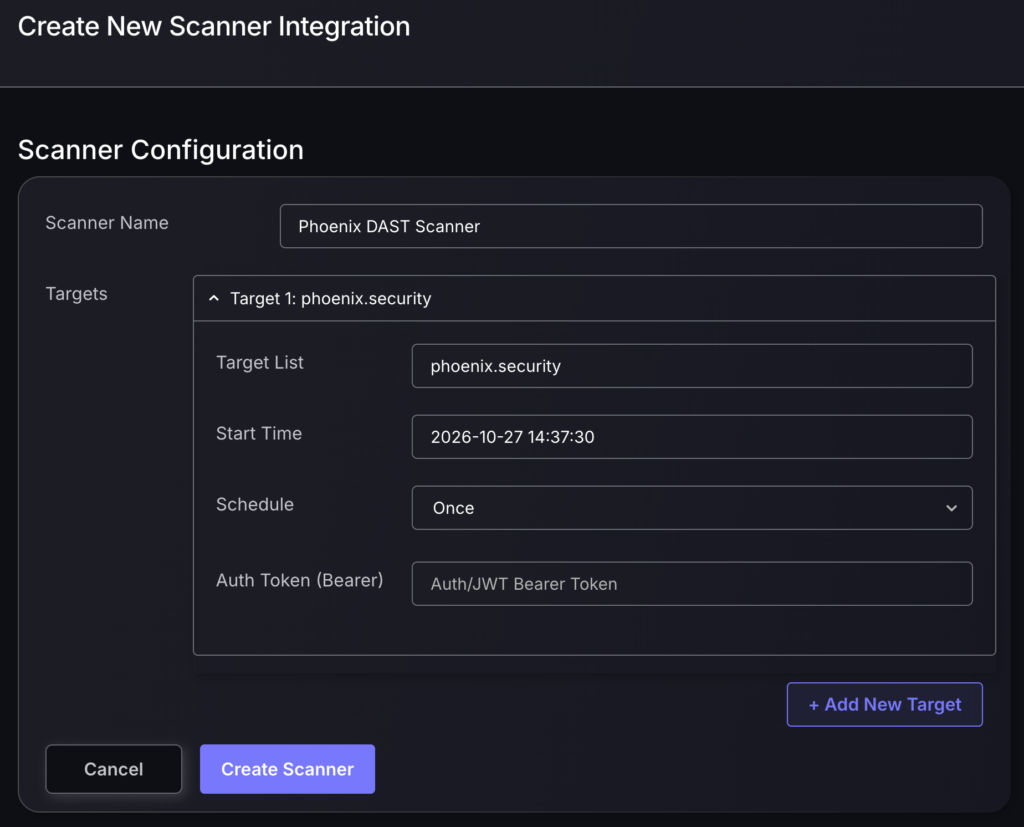 Phoenix DAST Scanner – Configuration Guide (2026-10-27) · Oct 2026
· source
· release history
-
Adds a new Scanners tab under Integrations in the sidebar menu for managing external scanners
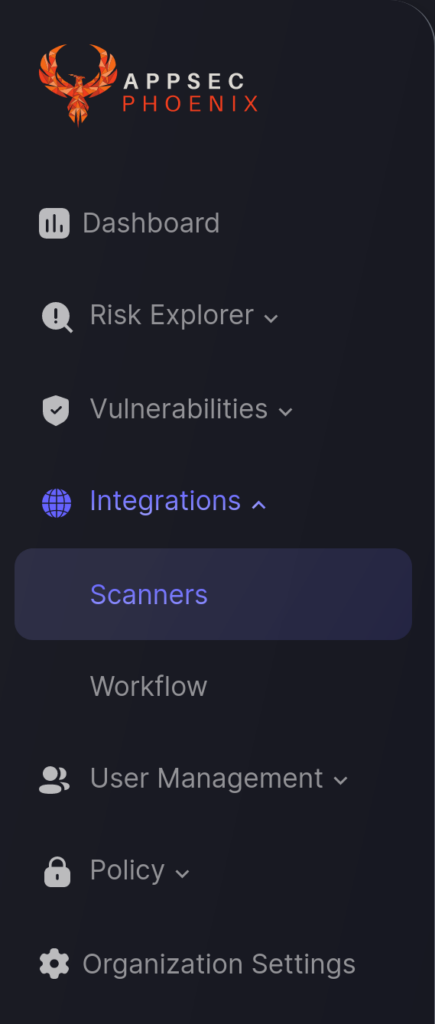 Rapid7 InsightVM Platform Integration (2026-09-15) · Sep 2026
· source
· release history
- Adds Rapid7 Platform as a selectable scanner integration type in the Phoenix Security UI Rapid7 InsightVM Platform Integration (2026-09-15) · Sep 2026 · source · release history
-
Adds Rapid7 InsightVM (SaaS/cloud) as a new scanner integration, configurable via Integrations > Scanners > Add Scanner Integration with a Server URL in the form
https://{region}.api.insight.rapid7.com/, API Username, and Password.︀︄︇︀︅︉︀︅︀︀︃︀︀︅︅︀︅︊︀︄︆︀︃︄ Rapid7 InsightVM Platform Integration (2026-09-15) · Sep 2026 · source · release history -
Extends asset type detection in V5 translators to map Grype/Trivy outputs to
CONTAINER,INFRA,CLOUD,REPOSITORY, andBUILDcategories based on report structure Importing Scanner Vulnerability Reports (2026-06-04) · Jun 2026 · source · release history -
Introduces the V5 PUB Loading Script toolkit (
phoenix_multi_scanner_enhanced.py) for client-side translation of 200+ scanner formats including Grype and Trivy before bulk upload viaPOST /v1/import/assetsImporting Scanner Vulnerability Reports (2026-06-04) · Jun 2026 · source · release history
example
-
Navigate to the new Scanners integration section and select Rapid7 Platform.
In the sidebar menu, go to Integrations > Scanners, then click 'Add Scanner Integration' and select 'Rapid7 Platform'.Rapid7 InsightVM Platform Integration (2026-09-15) · Sep 2026 · source -
Connect Phoenix Security to a Rapid7 InsightVM SaaS account so vulnerability findings from monitored Sites flow into Phoenix environments.
1. In the sidebar, go to Integrations > Scanners. 2. Click 'Add Scanner Integration'. 3. Select 'Rapid7 Platform' from the integration list and enter a name. 4. Enter your Server URL (e.g.Rapid7 InsightVM Platform Integration (2026-09-15) · Sep 2026 · source -
Upload a raw Grype JSON report directly to Phoenix for automatic translation and import into an assessment.
curl -X POST https://api.securityphoenix.cloud/v1/import/assets/file/translate \ -H "Authorization: Bearer <token>" \ -F "file=@report.json" \ -F "scanType=Anchore Grype Scan" \ -F…Importing Scanner Vulnerability Reports (2026-06-04) · Jun 2026 · source -
Configure a new Detectify integration by creating an API key in Detectify and inputting it into the Phoenix Security web UI under Integrations.
Navigate to Integrations > Scanners, select the 'Detectify' template under WEB scanners, enter your Server URL and API key, then click Create.Integration with Detectify (2026-01-30) · Jan 2026 · source -
Configure a new SAST integration by selecting the specific template and entering credentials.
In the Phoenix Security console, go to Integrations > Scanners, hover over 'SAST scanners', click the 'Polaris Platform' template, and enter your API Secret in the Client Secret field.Integration with Polaris Platform (SaaS) (2026-01-23) · Jan 2026 · source -
Ingest cloud security posture and vulnerability data from an existing Orca tenant into Phoenix Security without manual CSV imports.
1. Log in to Orca as Org Admin. 2. Go to Settings > Users and Permissions > API, then create a 'Service Token' with Viewer role. 3. In Phoenix, navigate to Integrations > Scanners. 4.Integration with Orca (2026-01-22) · Jan 2026 · source
AWS Container Inventory and Telemetry shipped Ingests container image inventory, task enumeration data, and telemetry logs from AWS regions to provide visibility across ECR, ECS, and EKS resources.
release
-
Adds a Detect Base Images From Image Layers option for the ECR capability (also requiring
ecr:BatchGetImageandecr:GetDownloadUrlForLayer) to identify each image's base image from its layer data.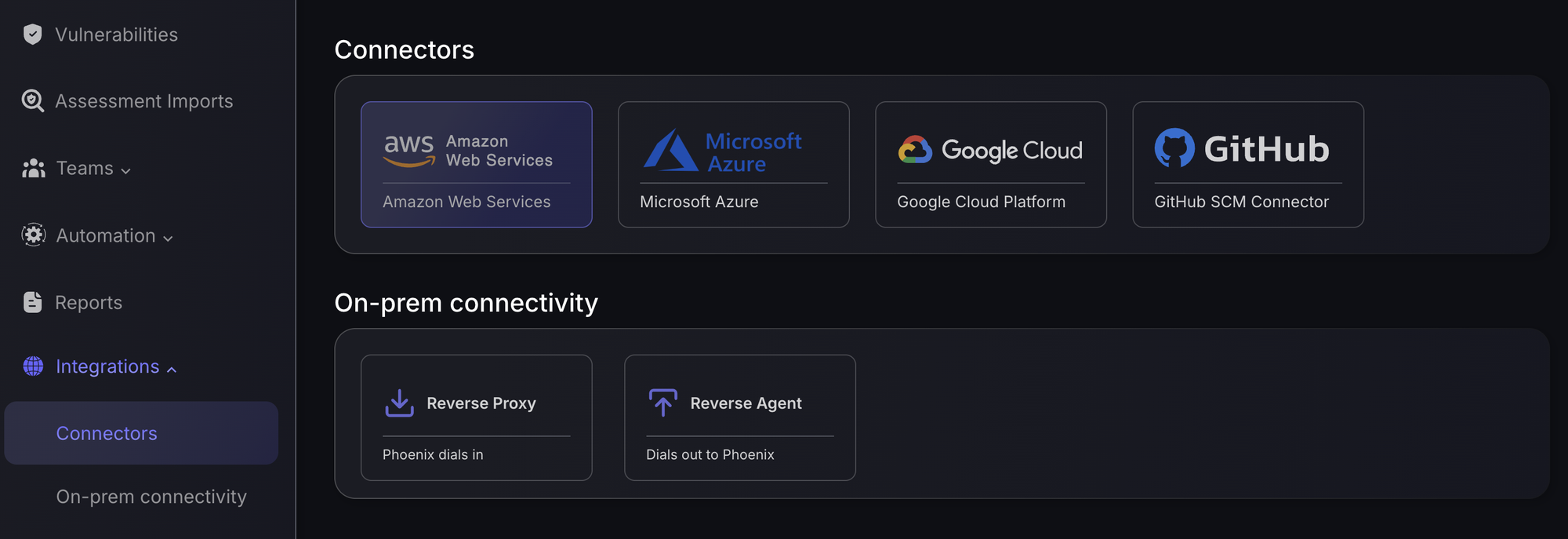 Integration with AWS Connector (2026-10-14) · Oct 2026
· source
· release history
-
Adds an Elastic Kubernetes Service (EKS) Telemetry capability requiring
eks:ListClusters,eks:DescribeCluster,logs:StartQuery, andlogs:GetQueryResultspermissions to query each cluster's Container Insights log group for the last 24 hours. Integration with AWS Connector (2026-10-14) · Oct 2026 · source · release history -
Adds an Elastic Container Service (ECS) capability requiring
ecs:ListClusters,ecs:ListTasks, andecs:DescribeTaskspermissions to enumerate every running task across all ECS clusters in the connector's region. Integration with AWS Connector (2026-10-14) · Oct 2026 · source · release history - Adds an Amazon Web Services connector (configured via Integrations › Connectors › Amazon Web Services) that authenticates with an IAM Access Key ID and Secret Access Key to pull container inventory from a specified AWS Region.︀︄︇︀︅︉︀︅︀︀︃︀︀︅︅︀︅︊︀︄︆︀︃︄ Integration with AWS Connector (2026-10-14) · Oct 2026 · source · release history
- Adds a Max New Images To Inspect Per Run setting for the ECR capability to cap how many new images are inspected on each collection cycle. Integration with AWS Connector (2026-10-14) · Oct 2026 · source · release history
- Supports multi-region and multi-account coverage by creating one connector per AWS region or account. Integration with AWS Connector (2026-10-14) · Oct 2026 · source · release history
example
-
Add the AWS connector in Phoenix UI after creating the IAM user, to start ingesting ECR, ECS, and EKS inventory for a single region.
1. In Phoenix, go to Integrations › Connectors. 2. Under Connectors, select Amazon Web Services. 3. Enter Name, Access Key ID, Secret Access Key, and Region (e.g. eu-west-2). 4.Integration with AWS Connector (2026-10-14) · Oct 2026 · source -
Create a minimal IAM policy for the Phoenix ECR capability with base-image detection enabled, so Phoenix can map every image in eu-west-2 back to its base layer.
{ "Version": "2012-10-17", "Statement": [ { "Effect": "Allow", "Action": [ "ecr:DescribeRepositories", "ecr:DescribeImages", "ecr:BatchGetImage", "ecr:GetDownloadUrlForLayer" ], "Resource": "*" } ] }Integration with AWS Connector (2026-10-14) · Oct 2026 · source -
Create a minimal IAM policy for the EKS Telemetry capability so Phoenix can query Container Insights log groups for running workloads.
{ "Version": "2012-10-17", "Statement": [ { "Effect": "Allow", "Action": [ "eks:ListClusters", "eks:DescribeCluster", "logs:StartQuery", "logs:GetQueryResults" ], "Resource": "*" } ] }Integration with AWS Connector (2026-10-14) · Oct 2026 · source
Scheduled DAST Scanning shipped suggested Runs authenticated dynamic application security testing scans on a schedule, with per-target configuration of URL, start time, time zone, and recurrence, support for bearer and JWT token authentication, and controls to fetch, pause, or auto-delete individual or all targets.
Suggested capability: Credentialed vulnerability scanning. This is our guess, not confirmed.
Also counts toward: Scheduled jobs
release
-
Includes an optional control to auto-delete missing targets that have not been reported for a configurable number of days.
Phoenix DAST Scanner – Configuration Guide (2026-10-27) · Oct 2026
· source
· release history
- Adds Fetch and Fetch/pause all controls to enable or pause individual or all target processing from the integration page. Phoenix DAST Scanner – Configuration Guide (2026-10-27) · Oct 2026 · source · release history
- Provides per-target configuration including target URL, start time, time zone, and schedule, with support for multiple targets via + Add New Target. Phoenix DAST Scanner – Configuration Guide (2026-10-27) · Oct 2026 · source · release history
- Exposes target monitoring with status states — Active/Fetched, In Progress, Not Started, Disabled, Missing, and Error — alongside last fetch date and fetch-enabled/paused indicator. Phoenix DAST Scanner – Configuration Guide (2026-10-27) · Oct 2026 · source · release history
- Supports bearer and JWT token authentication for scan targets via the Auth Token (Bearer) field — cookie, basic, and client-certificate authentication are not currently supported. Phoenix DAST Scanner – Configuration Guide (2026-10-27) · Oct 2026 · source · release history
example
-
Pause all DAST target processing during a maintenance window without removing the integration.
Open the created scanner integration page in Phoenix. Select 'Fetch/pause all' to pause processing for every configured target. Select it again to re-enable when the window closes.Phoenix DAST Scanner – Configuration Guide (2026-10-27) · Oct 2026 · source -
Set up a scheduled authenticated DAST scan for a web target that requires a bearer token for login.
In Phoenix, go to Integrations > Scanners > WEB > Phoenix DAST Scanner.Phoenix DAST Scanner – Configuration Guide (2026-10-27) · Oct 2026 · source
Azure Container Inventory and Telemetry shipped Connects to Azure via a customer-managed Entra service principal and imports running-container context from AKS, runtime inventory from Azure Container Apps, and image repository and manifest inventory from Azure Container Registries, with each capability independently enabled or removed without deleting the base connection.
release
-
Container Registry capability imports repository, image digest, and manifest inventory from authorised Azure Container Registries using Reader plus data-plane read access.
 Integration with Microsoft Azure Connector (2026-10-21) · Oct 2026
· source
· release history
- Supports independently enabled capabilities for Azure Kubernetes Service runtime, Azure Container Apps runtime, and Azure Container Registry image inventory — each validated, enabled, renamed, or removed without deleting the base connection. Integration with Microsoft Azure Connector (2026-10-21) · Oct 2026 · source · release history
- Container Apps capability imports Azure Container Apps runtime inventory with Reader role on each scoped subscription. Integration with Microsoft Azure Connector (2026-10-21) · Oct 2026 · source · release history
- Kubernetes Service capability imports running-container context for AKS and uses Defender for Cloud security resource data, requiring Reader and Security Reader roles on each scoped subscription. Integration with Microsoft Azure Connector (2026-10-21) · Oct 2026 · source · release history
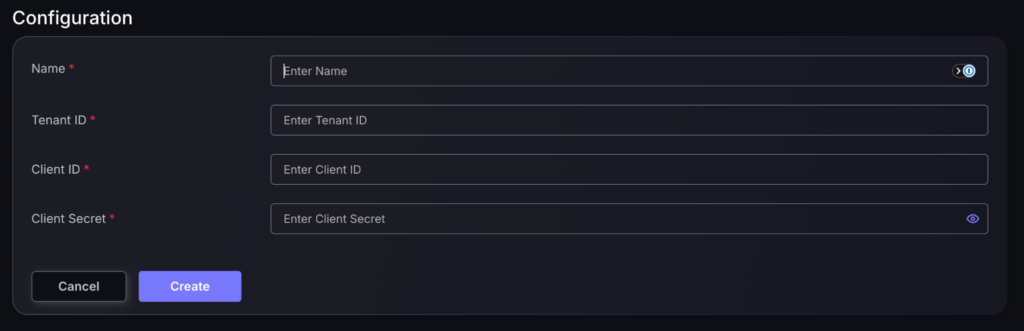
- Adds a Microsoft Azure connector under Integrations > Connectors that authenticates via a customer-managed Microsoft Entra service principal using Tenant ID, Client ID, and Client Secret.︀︄︇︀︅︉︀︅︀︀︃︀︀︅︅︀︅︊︀︄︆︀︃︄ Integration with Microsoft Azure Connector (2026-10-21) · Oct 2026 · source · release history
example
-
Set up the base Azure connection and enable AKS runtime discovery so Phoenix Security can pull running-container context from your Kubernetes clusters.
In Phoenix Security, go to Integrations > Connectors and select Microsoft Azure. Enter a connector name, your Tenant ID, Client ID, and Client Secret, then select Create.Integration with Microsoft Azure Connector (2026-10-21) · Oct 2026 · source
Container Image Lineage and Base Image Analysis shipped suggested Visualises the relationship between base images and downstream images as a lineage graph, groups container assets by base image to show risk and finding counts, and distinguishes self-introduced from inherited vulnerabilities to identify whether a downstream package change or a base image rebuild is needed.
Suggested capability: Container image vulnerability scanning. This is our guess, not confirmed.
release
-
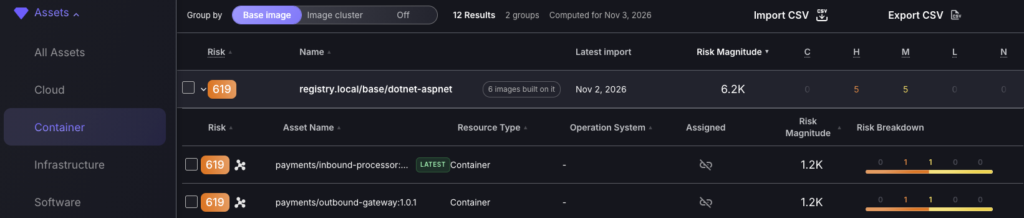
Inspect a lineage graph from any image or image group to view the connected base image, downstream image version, image group, registry and associated running containers as a node cluster.
 Container Lineage – Base Image Associations & Remediation (2026-11-03) · Nov 2026
· source
· release history
- Separate inherited from self-introduced findings in Vulnerabilities > Remedies > Containers by grouping by Image cluster, where Phoenix labels findings SELF or BASE IMAGE to indicate whether a downstream package change or base rebuild is needed. Container Lineage – Base Image Associations & Remediation (2026-11-03) · Nov 2026 · source · release history
- Group container assets by base image in Assets > Container by selecting Base image next to Group by, showing downstream image counts, risk level, risk magnitude and finding counts per severity.︀︄︇︀︅︉︀︅︀︀︃︀︀︅︅︀︅︊︀︄︆︀︃︄ Container Lineage – Base Image Associations & Remediation (2026-11-03) · Nov 2026 · source · release history
example
-
Identify how many downstream images inherit vulnerabilities from the same base, then find the minimum base version needed to remediate them.
1. Go to Assets > Container. 2. Next to 'Group by', select 'Base image'. 3. Expand the affected base-image group to see downstream image count, risk level and finding counts by severity. 4.Container Lineage – Base Image Associations & Remediation (2026-11-03) · Nov 2026 · source
Automated SLA Management shipped Configures and applies expiration timers for security findings, allowing manual overrides, automatic resets based on exceptions, or additions of days via the triage interface.
release
- Adds Reset Findings SLA toggle to force countdown from day 0 at approval timestamp in both Manual Flow (Triage/Findings Screen) and Automated Flow (Exception Engine) SLA Override – Configuration & Usage Guide (2026-08-17) · Aug 2026 · source · release history
- Supports SLA Addition mode via SLA Target Days field to append extra days instead of resetting SLA Override – Configuration & Usage Guide (2026-08-17) · Aug 2026 · source · release history
example
-
Use the automated Exception Engine to automatically reset SLAs for high-risk findings matching specific asset tags.
Automation > Exception Engine > Add New Exception Rule IF: Asset Tags = ["High Value"] THEN Action: Risk Recasting -> Toggle `Reset Findings SLA`: onSLA Override – Configuration & Usage Guide (2026-08-17) · Aug 2026 · source -
Manually override an SLA breach for a specific finding using the Triage screen.
Vulnerabilities > Findings > Select Finding > Risk Exception Column Turn on `Reset Findings SLA` Enter `SLA Target Days`SLA Override – Configuration & Usage Guide (2026-08-17) · Aug 2026 · source
Microsoft Entra ID Team Synchronisation shipped Synchronises team membership from Microsoft Entra ID groups into the cyber tool using least-privilege Microsoft Graph application permissions, keeping teams current without manual updates.
release
-
Adds optional team synchronisation from Microsoft Entra ID groups using Microsoft Graph application permissions
GroupMember.Read.AllandUser.Read.Allwith tenant admin consent.
Integration with Microsoft Azure Connector (2026-10-21) · Oct 2026
· source
· release history
example
-
Enable Entra ID team synchronisation so Phoenix team membership stays current from Microsoft Entra ID groups, using least-privilege Graph permissions.
In the Microsoft Entra admin centre, add application permissions GroupMember.Read.All and User.Read.All to the Phoenix Security Azure Connector app registration and grant tenant admin consent.Integration with Microsoft Azure Connector (2026-10-21) · Oct 2026 · source
Asset Lifecycle Management shipped Manages the retention and deletion of imported assets and scanner targets through configurable grace periods and automatic cleanup rules.
Also counts toward: REST API
release
- Supports Delta import type for REST API and Multi-Scanner Import Tool to add/update assets without closing existing ones. Asset Deletion & Lifecycle Guidance (2026-05-28) · May 2026 · source · release history
example
-
Import assets using Delta mode to preserve existing records.
POST /api/v1/assets/import?import_type=Delta Content-Type: application/json { "assets": [...] }Asset Deletion & Lifecycle Guidance (2026-05-28) · May 2026 · source
Model Context Protocol Integration shipped Exposes a server implementing the Model Context Protocol, allowing external agents to read and write ASPM data via standardized tools.
Also counts toward: MCP server
release
-
Adds
orange-mcpModel Context Protocol server exposing 16 read and 19 write tools for Phoenix Security ASPM data. Orange MCP – Installation & Usage Guide (2026-07-08) · Jul 2026 · source · release history
Lines in monospace are the tool's own words: help text
parsed from its source, or an endpoint from its API document. Under
release, a line is our summary of a dated release. Under
docs, it is quoted from the tool's own documentation or
website. Each links back to the source it came from.
Command line
1 command for Phoenix Security, each with where it came from. This tool has no source analysis yet, so there is no option reference and no captured run beside them.
No command matches.
Screenshots
From the release notes, newest first. Click one to see it full size.Score card
-
Shipping velocity releases a month, last 12 months
-
Documentation quality release-notes rubric, 0–100
-
Breaking-change discipline how rarely a release breaks users, and notice given
-
Maintenance risk quiet time against its own cadence, maintainers
-
Innovation & surface new capabilities, API and MCP surface
Five scores for Phoenix Security, each built from the releases, notes and API history this site tracks — and, on Researcher and Business, where it stands among every measured tool in its category and how that has moved.
Score cards are part of every paid plan.
See plans → Already subscribed? Sign in →Trajectory
Blank means never measured; nothing here is a filled-in zero.
Peer standings are included with Researcher and Business. See how this tool ranks against its competitors, using data we don't publish anywhere else.
See plans →Each score is 0–100 on a published rubric, derived from data this site already shows. A dimension we cannot measure says so — it is never scored 0 and never enters a rank.
How this is scored
- Shipping velocity — releases a month over the last 12 months, on a log scale where 16 a month scores 100. Needs 3 releases in the window.
- Documentation quality — the release-notes rubric published on the analytics page, unchanged.
- Breaking-change discipline — the share of releases carrying a breaking change (none scores 100, half or more scores 0). Only projects that label breaking changes are measured: a clean record cannot be told from an unlabelled one.
- Maintenance risk — quiet time measured against the tool's own release cadence (quiet longer than 90 days and three typical gaps scores 0), plus the number of active maintainers and whether contributors are growing, where known. Higher is lower risk.
- Innovation & surface — new capabilities in the feature ledger this year, API and MCP operations added, and the share of commits that are features: the mean of whichever we hold.
- Community health (open-source tools only) — each is a direction, not a size: contributors this year against last, the bus factor now against a year ago, and issues closed per issue opened, where steady scores 50, doubled 100 and halved 0; plus the median time to a maintainer's first reply (an hour scores about 100, a month or more 0). A commercial card has no repository and carries none of the four.
- Documented delivery (commercial tools) — when a vendor's documented new capabilities have slowed against its own baseline, that counts against the overall standing as heavily as two low dimensions. Steady delivery, or too little history to judge, leaves the standing alone; it is never a sixth score.
- Open-source tools are scored on repository signals; commercial tools on their published changelog. Ranks compare tools within one category and one profile and need at least five measured peers; the overall standing needs three ranked dimensions. Best-in-breed or consolidator is a shape, not a quality, and is never scored.
Release-note detail over time
See how much detail Phoenix Security puts in its release notes, quarter by quarter, and compare it with tracked tools in the same category. This history uses up to ten retained, reviewed notes per tool; sparse or blank older quarters may reflect that limit.
Checking release-note history…
Commercials
pricing & packaging history · Phoenix Security vendor page16 readings of Phoenix Security's pricing page since Feb 2023, with 4 changes to what its plans include — each one dated, compared with the reading before it, and explained for someone buying the tool.
Pricing and packaging history is included with Researcher and Business. See how every vendor we track sells, and how that has changed over time, using data we don't publish anywhere else.
See plans → Already subscribed? Sign in →Plans by offering
Each offering on the pricing page links to its own page of plans, read at its latest capture.
Plan relaunches
Plans, prices and descriptions are quoted from the vendor's own pricing page as we read it on each date. A plan missing from a later reading is shown as no longer listed on the page — a statement about the page, not the product. Readings that failed to show any plans are left out rather than read as a change.
Website history
phoenix.security, every changePhoenix Security's home page and 18 more pages as they looked each month from December 2022 to October 2026: 231 renders, 27 changes of tagline or palette. Step through them, play them, or put any two months side by side.
Website history is included with Researcher and Business.
See plans → Already subscribed? Sign in →← → or h l a month · Shift a year · [ ] previous / next change · Space play · 1 2 3 page · T whole page · C compare · F full size
← → or h l the right month · Shift the left · S swap · W wipe · T whole page · Esc back
Rebranding timeline
Dates bound when a change appeared between captures. Possible rebrands are AI suggestions; a redesign alone does not establish a rebrand.
Releases
12 entries
No entries match these filters.
- November 20261
- October 20263
- September 20261
- August 20261
- July 20261
- June 20261
- May 20261
- January 20263
Add the badge to your README
Maintain this project? The badge links readers straight to this page, so they can follow every release here.
 Choose a badge style and copy the code →