Realm Security
Context-Driven SIEM Log Reduction for SOC Teams (2026-09-10) commercialThe section your link pointed to isn't on Realm Security's page any more, so we've brought you to the top.
Realm Security is the SOCSOCA security operations center, the team or function that monitors threats, investigates alerts and coordinates incident response. Its work can be internal, outsourced or shared.-aware security data pipeline that lets teams control, reduce, enrich, and route security data from any source to any destination.
Summary
Realm Security is a commercial data-pipeline platform that reduces, enriches, and routes security telemetry between log sources and a SIEMSIEMSecurity information and event management, collecting logs from many systems and correlating events to find suspicious activity. Analysts use it to investigate alerts and incidents., run as a hosted service configured through its own UI rather than hand-built pipelines. It targets SOC teams and security leaders trying to cut ingestion cost without a data-engineering function, checking every proposed reduction against the detections a team actually runs — mapping rules to the log fields they depend on, protecting those fields, and flagging a cut as a finding rather than silently applying it. Anything trimmed from the SIEM still lands in Data Haven, an immutable, searchable copy that analysts can query and resupply to any destination during an investigation. It sits in the SIEM-optimization space alongside log-routing and observability pipeline tools, and with nine releases since launching in 2024, most recently 16 days ago, it is under active development.
Realm Security is the SOC-aware security data pipeline that lets teams control, reduce, enrich, and route security data from any source to any destination.
How Realm Security helps
Which of my SIEM detections would break if I cut this log source?
maps every detection rule to the log sources and fields it depends on, and flags the ones that lose coverage before any data is cut
Which reduction rules are safe to apply in my environment, and which are risky?
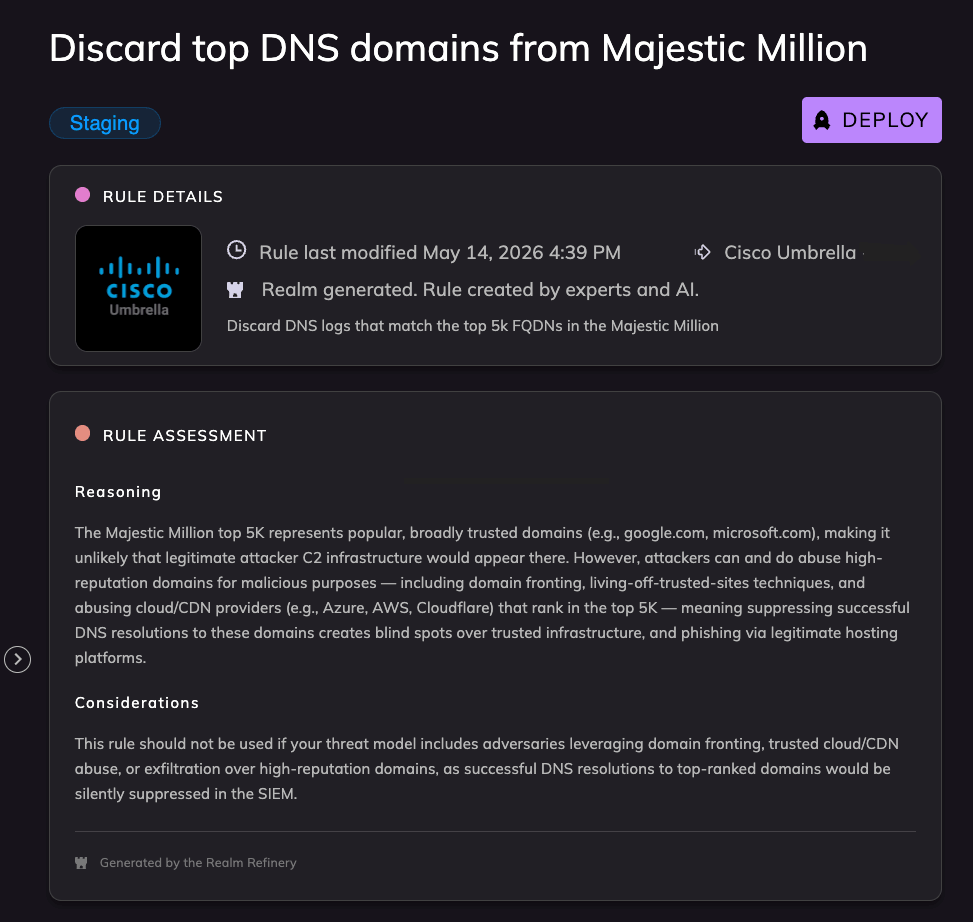
ships each recommended rule with a reasoning section on why it works and a considerations section on where it may not fit the environment, generated from what the sources actually produce
Can I pull historical events into an active investigation that never reached my SIEM?
lets analysts query the full immutable security history directly and resupply the exact matching events to the analysis destination, with no restore step or schema setup
How much of my MITRE ATT&CK coverage changes before and after a given reduction?
produces a shareable report showing what was reduced, what was protected, projected savings, and coverage before and after the change
Where is my structured versus raw security data landing once it leaves the pipeline?
streams raw logs and OCSF-normalized data in parallel so raw events route to one tier and parsed data to another within the destination's storage architecture
Languages
Features
Built from Realm Security's releases, docs, README and our own runs. “Seen” marks the month we first spotted a release the vendor didn't date.
- Realm Security covers 1 of the 11 logs and telemetry capabilities we track.
No capabilities match.
All capabilities 4 capabilities
Databricks lakehouse delivery shipped suggested Streams security telemetry directly into Unity Catalog Delta tables via Zerobus Ingest, simultaneously routing raw logs and OCSF-normalized events to separate medallion tiers, with real-time GeoIP, threat intel, and customer-supplied CMDB/HRIS enrichment applied in-flight — configured through the Realm UI with no staging bucket, message bus, or additional pipeline to build.
Suggested capability: Document ingestion. This is our guess, not confirmed.
release
- Output feed is configured through the Realm UI; once the Databricks target table, Zerobus Ingest endpoint, and access credentials are created, data flows with no additional pipeline to build or maintain. Realm + Databricks Zerobus Ingest: Clean, Structured Security Data, Delivered Direct (2026-08-04) · Aug 2026 · source · release history
- Real-time enrichment with GeoIP, threat intel, and customer-supplied CMDB or HRIS context is applied as events flow through, before they land in the lakehouse. Realm + Databricks Zerobus Ingest: Clean, Structured Security Data, Delivered Direct (2026-08-04) · Aug 2026 · source · release history
- Adds Zerobus Ingest support for direct push of structured security data into Unity Catalog Delta tables. Realm + Databricks Zerobus Ingest: Clean, Structured Security Data, Delivered Direct (2026-08-04) · Aug 2026 · source · release history
- New Databricks integration delivers security telemetry directly into Unity Catalog Delta tables via Zerobus Ingest, Databricks' serverless push-based ingestion API, with no customer-managed staging bucket or message bus. Realm + Databricks Zerobus Ingest: Clean, Structured Security Data, Delivered Direct (2026-08-04) · Aug 2026 · source · release history
- Realm streams both raw logs and parsed, OCSF-normalized versions simultaneously, letting teams route raw events to Bronze and structured data to Silver within their medallion architecture. Realm + Databricks Zerobus Ingest: Clean, Structured Security Data, Delivered Direct (2026-08-04) · Aug 2026 · source · release history
- Delivers OCSF-normalized observables and enriched logs in real time via the new integration endpoint. Realm + Databricks Zerobus Ingest: Clean, Structured Security Data, Delivered Direct (2026-08-04) · Aug 2026 · source · release history
example
-
Configure Realm to push normalized security telemetry directly into your Databricks Unity Catalog without staging buckets.
1. In the Realm UI, go to Integrations > Databricks. 2. Enable Zerobus Ingest and provide the Unity Catalog Delta table target path and access credentials.Realm + Databricks Zerobus Ingest: Clean, Structured Security Data, Delivered Direct (2026-08-04) · Aug 2026 · source
Data Haven immutable security history search shipped Lets analysts query their full historical security event archive directly against OCSF-normalized observables and resupply exact events to any destination, with no restore step, schema setup, or data-lake infrastructure required, and with pricing based on ingestion volume rather than query volume.
Shared capability: Log search
release
-
Data Haven retains a complete, immutable copy of all reduced log data with OCSF observables attached, keeping it searchable and re-suppliable to any destination if a reduction proves incorrect.
 Context-Driven SIEM Log Reduction for SOC Teams (2026-09-10) · Sep 2026
· source
· release history
- New search inside Realm Data Haven lets analysts query their full immutable security history directly against OCSF-normalized observables and resupply exact events to any destination — no restore step, no schema setup, no data-lake infrastructure required. Realm Security Debuts Detection Integrity to Prove that Reducing SIEM Log Volume Never Breaks a Threat Detection (2026-07-28) · Jul 2026 · source · release history
- Data Haven Search launches with unmetered queries: pricing is based on ingestion volume, not on how much analysts query or retrieve. Realm Security Debuts Detection Integrity to Prove that Reducing SIEM Log Volume Never Breaks a Threat Detection (2026-07-28) · Jul 2026 · source · release history
example
-
During an active investigation, search Data Haven to pull historical events that were never sent to the SIEM and resupply them to your analysis destination.
In the Realm Platform, go to Data Haven > Search, query against OCSF-normalized observables for the relevant time window, then select 'Resupply' to forward the matching raw events to your chosen…Realm Security Debuts Detection Integrity to Prove that Reducing SIEM Log Volume Never Breaks a Threat Detection (2026-07-28) · Jul 2026 · source
Detection Integrity analysis and pipeline protection shipped Reads every SIEM detection, maps each rule to its dependent log sources and fields, auto-generates pipeline protection rules to preserve MITRE ATT&CK coverage as volume is reduced, and produces a shareable report showing reductions, savings, and coverage before and after — flagging any cut that cannot be applied safely rather than applying it.
release
-
Detection Integrity maps every candidate reduction against the detections you currently run, protects the log fields those detections depend on, and flags at-risk detections as findings rather than silently cutting their data.
Context-Driven SIEM Log Reduction for SOC Teams (2026-09-10) · Sep 2026
· source
· release history
- Detection Integrity produces a shareable report showing what was reduced, what was protected, projected savings, and MITRE ATT&CK coverage before and after each reduction; when a cut cannot be applied safely, it flags the finding instead of cutting. Realm Security Debuts Detection Integrity to Prove that Reducing SIEM Log Volume Never Breaks a Threat Detection (2026-07-28) · Jul 2026 · source · release history
- New Detection Integrity capability reads every SIEM detection, maps each rule to its dependent log sources and fields, and auto-generates pipeline protection rules to preserve coverage as volume is reduced — supporting Sigma, KQL, and SPL. Realm Security Debuts Detection Integrity to Prove that Reducing SIEM Log Volume Never Breaks a Threat Detection (2026-07-28) · Jul 2026 · source · release history
Reduction Rule Assessments shipped Provides AI-generated evaluations for recommended reductions, detailing reasoning for effectiveness and environmental considerations to ensure safe deployment.
release
-
Realm Clarity AI now reasons over what your sources produce and what each destination needs to generate rule assessments tuned to the actual conditions defined in each rule, not generic category descriptions.
Context-Driven SIEM Log Reduction for SOC Teams (2026-09-10) · Sep 2026
· source
· release history
- Introduces Reduction Rule Assessments — AI-generated evaluations shipped with every recommended reduction rule, split into a Reasoning section (why the rule is likely effective) and a Considerations section (where it may not be appropriate for a given environment).︀︄︇︀︅︉︀︅︀︀︃︀︀︅︅︀︅︊︀︄︆︀︃︄ Context-Driven SIEM Log Reduction for SOC Teams (2026-09-10) · Sep 2026 · source · release history
Lines in monospace are the tool's own words: help text
parsed from its source, or an endpoint from its API document. Under
release, a line is our summary of a dated release. Under
docs, it is quoted from the tool's own documentation or
website. Each links back to the source it came from.
Screenshots
From the release notes, newest first. Click one to see it full size.Score card
-
Shipping velocity releases a month, last 12 months
-
Documentation quality release-notes rubric, 0–100
-
Breaking-change discipline how rarely a release breaks users, and notice given
-
Maintenance risk quiet time against its own cadence, maintainers
-
Innovation & surface new capabilities, API and MCP surface
Five scores for Realm Security, each built from the releases, notes and API history this site tracks — and, on Researcher and Business, where it stands among every measured tool in its category and how that has moved.
Score cards are part of every paid plan.
See plans → Already subscribed? Sign in →Trajectory
Blank means never measured; nothing here is a filled-in zero.
Peer standings are included with Researcher and Business. See how this tool ranks against its competitors, using data we don't publish anywhere else.
See plans →Each score is 0–100 on a published rubric, derived from data this site already shows. A dimension we cannot measure says so — it is never scored 0 and never enters a rank.
How this is scored
- Shipping velocity — releases a month over the last 12 months, on a log scale where 16 a month scores 100. Needs 3 releases in the window.
- Documentation quality — the release-notes rubric published on the analytics page, unchanged.
- Breaking-change discipline — the share of releases carrying a breaking change (none scores 100, half or more scores 0). Only projects that label breaking changes are measured: a clean record cannot be told from an unlabelled one.
- Maintenance risk — quiet time measured against the tool's own release cadence (quiet longer than 90 days and three typical gaps scores 0), plus the number of active maintainers and whether contributors are growing, where known. Higher is lower risk.
- Innovation & surface — new capabilities in the feature ledger this year, API and MCP operations added, and the share of commits that are features: the mean of whichever we hold.
- Community health (open-source tools only) — each is a direction, not a size: contributors this year against last, the bus factor now against a year ago, and issues closed per issue opened, where steady scores 50, doubled 100 and halved 0; plus the median time to a maintainer's first reply (an hour scores about 100, a month or more 0). A commercial card has no repository and carries none of the four.
- Documented delivery (commercial tools) — when a vendor's documented new capabilities have slowed against its own baseline, that counts against the overall standing as heavily as two low dimensions. Steady delivery, or too little history to judge, leaves the standing alone; it is never a sixth score.
- Open-source tools are scored on repository signals; commercial tools on their published changelog. Ranks compare tools within one category and one profile and need at least five measured peers; the overall standing needs three ranked dimensions. Best-in-breed or consolidator is a shape, not a quality, and is never scored.
Release-note detail over time
See how much detail Realm Security puts in its release notes, quarter by quarter, and compare it with tracked tools in the same category. This history uses up to ten retained, reviewed notes per tool; sparse or blank older quarters may reflect that limit.
Checking release-note history…
Website history
realm.security, every changeRealm Security's home page and 22 more pages as they looked each month from January 2025 to October 2026: 32 renders, 3 changes of tagline or palette. Step through them, play them, or put any two months side by side.
Website history is included with Researcher and Business.
See plans → Already subscribed? Sign in →← → or h l a month · Shift a year · [ ] previous / next change · Space play · 1 2 3 page · T whole page · C compare · F full size
← → or h l the right month · Shift the left · S swap · W wipe · T whole page · Esc back
Rebranding timeline
Dates bound when a change appeared between captures. Possible rebrands are AI suggestions; a redesign alone does not establish a rebrand.
Releases
3 entries
No entries match these filters.
- September 20261
- August 20261
- July 20261
Add the badge to your README
Maintain this project? The badge links readers straight to this page, so they can follow every release here.
 Choose a badge style and copy the code →