Upwind
Upwind Story Replay: Watch the Attack Unfold (2026-10-21) commercialThe section your link pointed to isn't on Upwind's page any more, so we've brought you to the top.
Upwind is a runtime-powered CNAPPCNAPPA cloud-native application protection platform that combines checks across cloud configuration, workloads and development. It helps teams connect risks that separate tools might report apart. that protects cloud workloads by combining posture, detection and response, and identity security with real-time runtime context.
Summary
Upwind is a commercial CNAPP delivered as a SaaSSaaSSoftware delivered over the internet and run on the provider's infrastructure, so the buyer pays a subscription instead of installing or operating anything locally. platform that protects cloud and AI workloads by combining agentless scanning with runtime sensors, giving security, developer, and devops teams a shared, continuously refreshed view of what's running, connected, and exposed. It scores live compliance against frameworks like CISCISA nonprofit that publishes consensus-based configuration benchmarks and controls for hardening operating systems, cloud environments, and software; cyber tools use it as a ready-made compliance baseline., NIST, ISOISOA widely adopted international standards body that publishes technical specifications; cyber tools cite ISO standards to signal compliance with recognized benchmarks for quality, security, or interoperability., and the EU AI ActEU AI ActEU regulation that classifies AI systems by risk level and imposes compliance obligations—documentation, transparency, human oversight—on developers and deployers, shaping how AI-based cyber tools are built and sold in Europe., ties findings to specific accounts and owners, and uses runtime context to cut alert noise and flag active attacks as they happen rather than relying on static severity scores. It also pulls in source-control and data-platform context, scanning repositories across GitHub, GitLab, Azure DevOps, and Bitbucket, and inventorying assets in Snowflake. It sits in the CNAPP category alongside live-inventory and exposure-management tools, and has shipped six releases since launching in 2022, most recently 19 days ago.
Upwind is a runtime-powered CNAPP that protects cloud workloads by combining posture, detection and response, and identity security with real-time runtime context.
How Upwind helps
Which of my cloud workloads are actually exposed at runtime versus just misconfigured on paper?
correlates posture findings with live runtime behavior so a flagged workload is ranked by whether it is actually reachable and running, not just non-compliant
Which of my repositories have findings that need attention before merge?
scans connected repositories across version control providers and surfaces findings directly on pull requests, without altering the existing pipeline
Who or what actually touched this identity or resource, and was that expected?
ties identity activity to runtime context so an access event can be checked against what the workload was actually doing at the time
Which organizations and repositories are in scope for scanning right now?
lists every connected organization and repository in one place, separate from the access grant, so scan coverage can be checked without re-auditing permissions
Is a detected threat in my cloud environment something to act on immediately?
combines detection and response signals with runtime context to show whether the flagged behavior is live and ongoing in the workload
Do teams outside GitHub, GitLab, Azure DevOps, or Bitbucket Cloud have visibility into their scan results?
accepts scan results from any version control provider through the API, so findings from unsupported tooling still land in the same place as the rest
Languages
Features
Built from Upwind's releases, docs, README and our own runs. “Seen” marks the month we first spotted a release the vendor didn't date. Group names and tags are our labels.
- Upwind covers 1 of the 8 data discovery and protection capabilities we track.
- Upwind covers 1 of the 3 runtime security capabilities we track.
- Upwind covers 1 of the 8 vulnerability assessment methods capabilities we track.
What Upwind offers you
- Web management console2
- Agentless deployment1
- MCP server1
- Natural-language query1
- REST API1
- Role-based access control1
- Scheduled jobs1
- SIEM forwarding1
No capabilities match.
Data access governance 1 feature Data discovery and protection since 2026
Databricks Posture Monitoring shipped Surfaces Databricks-specific security findings — overly broad data grants, non-expiring tokens, publicly exposed workspaces and clusters, universally readable secrets, and long-lived Delta Sharing credentials — in the same severity queue, framework reports, and workflows as existing cloud findings, with risk ranked by runtime exposure.
Shared capability: Data access governance
release
-
Surfaces Databricks-specific security findings (overly broad data grants, non-expiring access tokens, publicly exposed workspaces and clusters, universally readable secrets, long-lived Delta Sharing credentials) in the same severity queue, framework reports, and workflows as existing cloud findings.
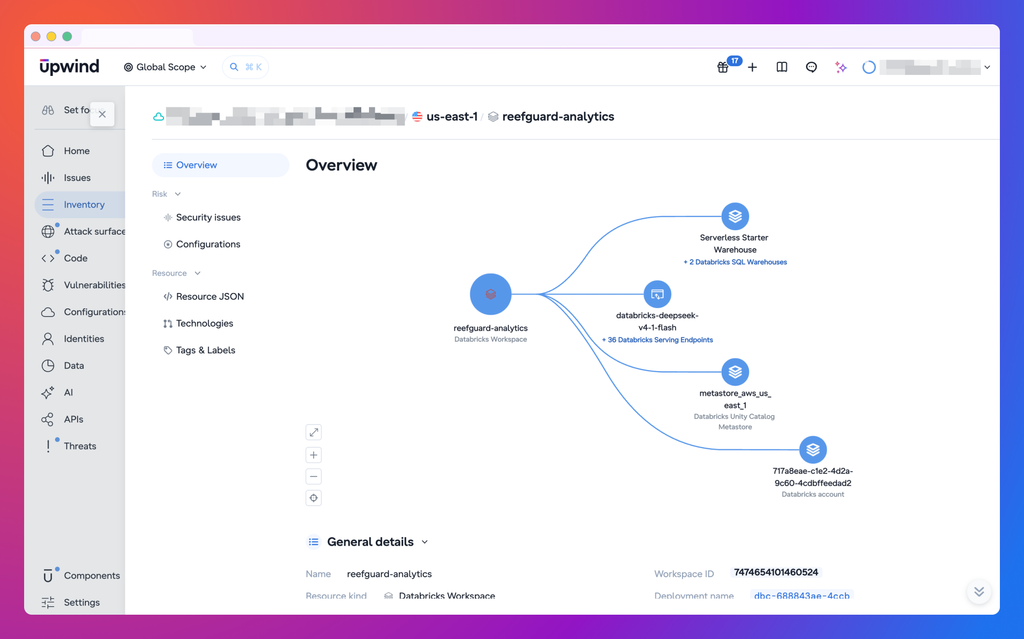 Upwind Launches Databricks Security for Lakehouse Data and AI (2026-10-19) · Oct 2026
· source
· release history
- Ranks Databricks risk by runtime exposure, so live model serving endpoints taking traffic are prioritized over registered-but-idle ones. Upwind Launches Databricks Security for Lakehouse Data and AI (2026-10-19) · Oct 2026 · source · release history
Runtime threat detection 1 feature Runtime security since 2026
AI Agent Runtime Detection shipped Identifies AI-agent activity at runtime — including unexpected shells, previously unseen processes, cloud metadata service calls, and uncharted service-to-service traffic — that is invisible to manifest or image scans.
Shared capability: Runtime threat detection
release
- Runtime detection identifies AI-agent activity — unexpected shells, previously unseen processes, cloud metadata service calls, and uncharted service-to-service traffic — that manifests only at runtime and is invisible to manifest or image scans. Runtime First, Agentless Everywhere (2026-10-19) · Oct 2026 · source · release history
Container image vulnerability scanning 1 feature Vulnerability assessment methods since 2026
Kubernetes Agentless Scanning shipped Connects to a Kubernetes cluster without a DaemonSet or node install to build a full workload inventory, extract SBOMs from deployed images, surface vulnerabilities on the workload running each image, and detect exposed secrets and malicious files in image contents.
Shared capability: Container image vulnerability scanning
Also counts toward: Agentless deployment
release
- Surfaces Kubernetes agentless inventory under dedicated resource kinds in Inventory (Deployments, DaemonSets, StatefulSets, services) alongside the rest of the estate, covering both public and private clusters from a single view. Runtime First, Agentless Everywhere (2026-10-19) · Oct 2026 · source · release history
- Adds the Kubernetes Agentless Scanner — connects to a cluster without a DaemonSet or node install, builds a full inventory (Deployments, DaemonSets, StatefulSets, services), extracts SBOMs from deployed images, and surfaces vulnerabilities on the workload that runs each image.︀︄︇︀︅︉︀︅︀︀︃︀︀︅︅︀︅︊︀︄︆︀︃︄ Runtime First, Agentless Everywhere (2026-10-19) · Oct 2026 · source · release history
Other / not yet classified 16 features Features we have not matched to a capability yet. A suggested match is marked.
Audit Collaboration shipped Allows teams to filter live compliance scores by specific frameworks and share views directly with auditors without exporting spreadsheets.
release 17 total
- Adds Auto-Generated Threat Story Investigations that correlate detections into a unified incident narrative with verdicts and confidence levels. Upwind Blue Agent – Increasing the Scope and tooling to a new level of incident response (2026-09-08) · Sep 2026 · source · release history
- Adds Event-Driven Auto-Triggering (beta) to initiate Blue Agent investigations automatically when a Story is created or updated. Upwind Blue Agent – Increasing the Scope and tooling to a new level of incident response (2026-09-08) · Sep 2026 · source · release history
-
Adds
upwinddata ingestion into Microsoft Sentinel via Microsoft Marketplace and Security Store Upwind for Microsoft Sentinel – Available on Marketplace and Security Store (2026-09-03) · Sep 2026 · source · release history - Provides a single ARM template to provision the Azure Function App, Data Collection Endpoint, Data Collection Rules, and required role assignments Upwind for Microsoft Sentinel – Available on Marketplace and Security Store (2026-09-03) · Sep 2026 · source · release history
- Ingests six Upwind datasets (Inventory, Vulnerability findings, Threat detections, Threat events, Threat stories, Configuration and posture findings) into separate Log Analytics custom tables Upwind for Microsoft Sentinel – Available on Marketplace and Security Store (2026-09-03) · Sep 2026 · source · release history
- Configures a timer-triggered Azure Function with OAuth2 authentication that synchronizes data via six Upwind API endpoints Upwind for Microsoft Sentinel – Available on Marketplace and Security Store (2026-09-03) · Sep 2026 · source · release history
example
-
When preparing for an ISO audit, navigate to the Configurations experience to view a live compliance score filtered to your ISO framework and share the view directly with auditors without exporting a spreadsheet.
In Upwind, go to Configurations > select the ISO framework > filter by the relevant cloud account > share the view with stakeholders.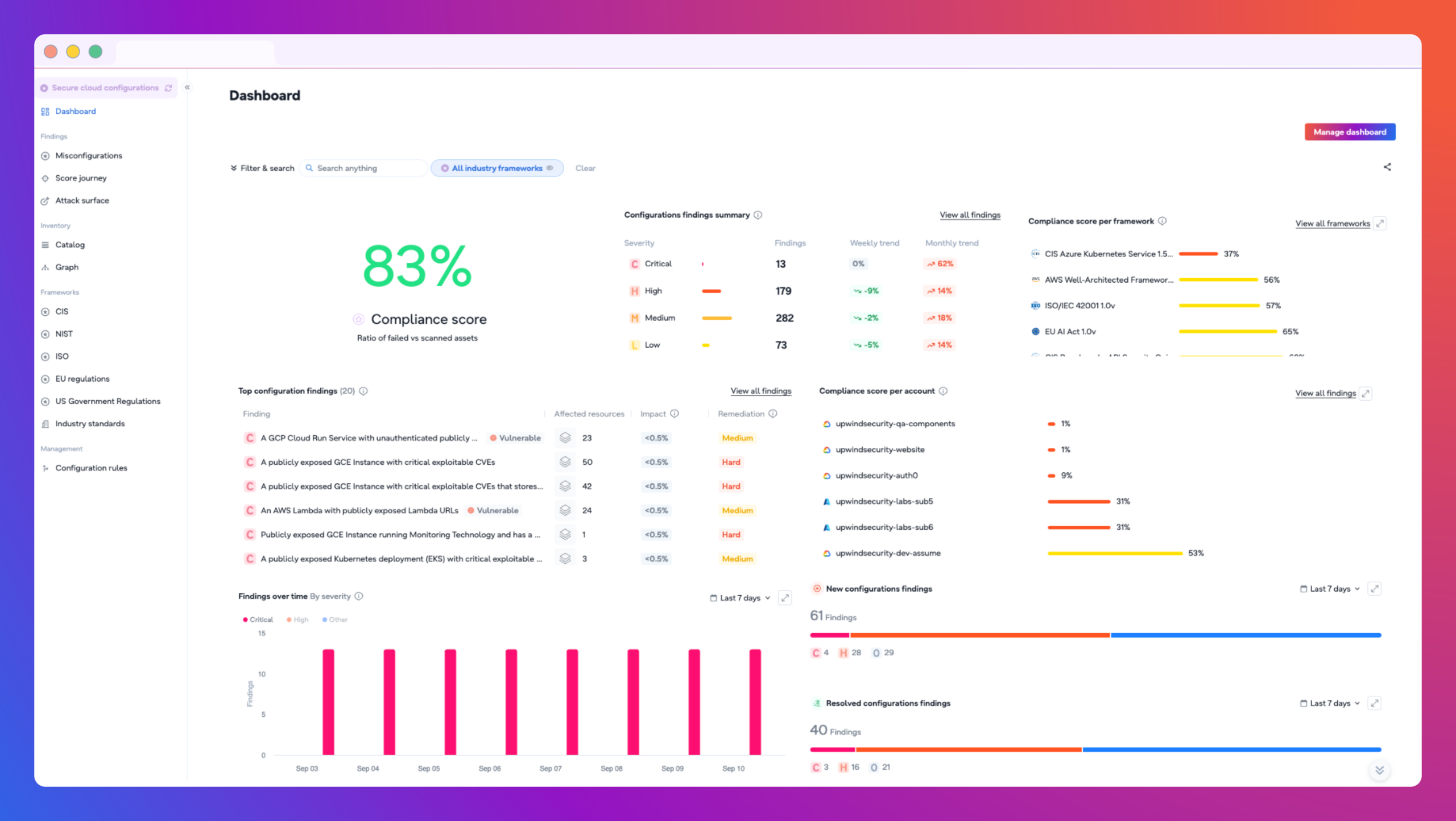 Introducing the new Configurations experience in Upwind (2026-09-24) · Sep 2026
· source
-
View the correlated incident timeline, evidence, and verdict generated by the Blue Agent after an auto-triggered investigation completes.
Navigate to the Investigation view to review the verdict, confidence level, and supporting evidence.Upwind Blue Agent – Increasing the Scope and tooling to a new level of incident response (2026-09-08) · Sep 2026 · source -
Leverage cross-domain telemetry to trace a cloud attack sequence from initial execution to lateral movement.
Review the unified incident narrative connecting Runtime Events, Network Events, and Kubernetes Audit Logs.Upwind Blue Agent – Increasing the Scope and tooling to a new level of incident response (2026-09-08) · Sep 2026 · source -
Deep dive into specific evidence items referenced in the investigation report.
Click on an IP address or file hash within the 'Investigation' tab to view its context in the side panel.Introducing the Upwind Blue Agent: Autonomous Threat Investigation for the SOC (2026-08-20) · Aug 2026 · source -
Review the autonomous verdict and confidence level directly on the Threat Story page without leaving the console.
In the Threat Stories list, click a story to open its dedicated Investigation tab.Introducing the Upwind Blue Agent: Autonomous Threat Investigation for the SOC (2026-08-20) · Aug 2026 · source
Version Control Provider Integrations shipped Connects with supported version control providers (GitHub, GitLab, Azure DevOps, Bitbucket Cloud) and custom providers via API to automatically discover repositories, manage scan scope, and surface findings in pull request workflows.
Also counts toward: REST API
release 11 total
- Available on the Origin Marketplace as an installable app, with Upwind discovering repositories automatically after installation. Upwind x Cursor Origin – Securing Software Factories (2026-10-13) · Oct 2026 · source · release history
- Scans every pull request on open, reopen, or update, and every push to a branch in Cursor Origin, with no pipeline changes required. Upwind x Cursor Origin – Securing Software Factories (2026-10-13) · Oct 2026 · source · release history
-
Installs the Upwind app from the Upwind console under
Components > Integrations > Originto connect to Cursor Origin and begin repository scanning in seconds.︀︄︇︀︅︉︀︅︀︀︃︀︀︅︅︀︅︊︀︄︆︀︃︄ Upwind x Cursor Origin – Securing Software Factories (2026-10-13) · Oct 2026 · source · release history - Supports blocking merges via Upwind checks, stopping risky agent-written code at the gate and telling the agent what to change. Upwind x Cursor Origin – Securing Software Factories (2026-10-13) · Oct 2026 · source · release history
- Delivers findings in three places: inline pull request comments, the PR Checks tab, and the Upwind console — enabling agents to read and act on results in the same pass. Upwind x Cursor Origin – Securing Software Factories (2026-10-13) · Oct 2026 · source · release history
-
Enables reporting scan results from any version control provider to Upwind through the API, for teams not using GitHub, GitLab, Azure DevOps, or Bitbucket Cloud.
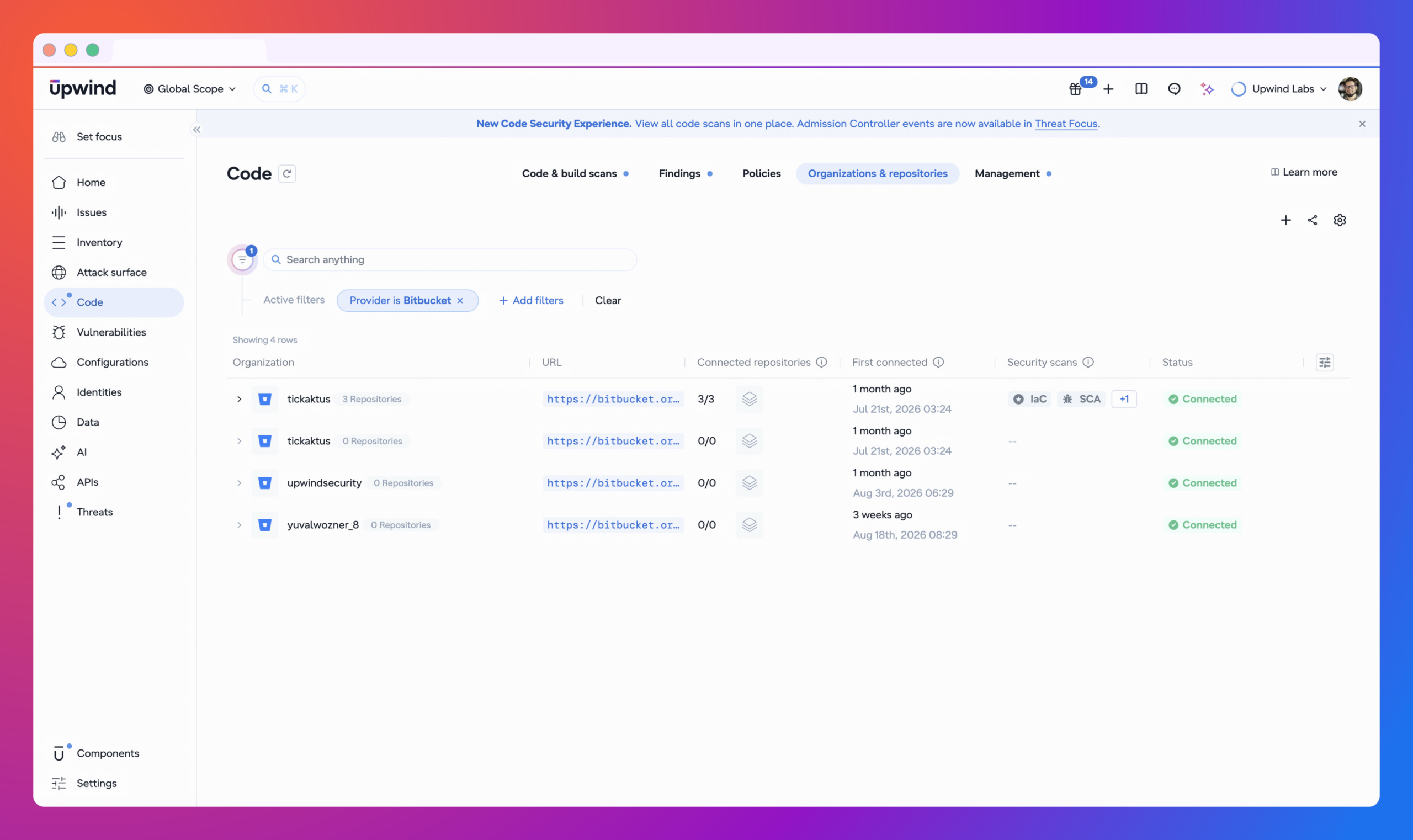 Upwind Code Expands Enterprise Coverage to Azure DevOps and Bitbucket Cloud (2026-09-14) · Sep 2026
· source
· release history
example
-
Connect Upwind to Cursor Origin so every pull request and branch push is scanned automatically, without touching your pipeline.
In the Upwind console, go to Components > Integrations > Origin and install the Upwind app.Upwind x Cursor Origin – Securing Software Factories (2026-10-13) · Oct 2026 · source -
Connect an Origin repository to Upwind so every PR and branch push is scanned automatically without changing developer or agent workflows.
In the Upwind console, go to Components > Integrations > Origin and install the Upwind app. Upwind will discover all repositories within seconds.announced · Oct 2026 · source -
Connect an Azure DevOps or Bitbucket Cloud environment to begin repository discovery and pull request scanning.
In the Upwind console, go to Components → Integrations and select Azure DevOps or Bitbucket Cloud to connect your organization or workspace.Upwind Code Expands Enterprise Coverage to Azure DevOps and Bitbucket Cloud (2026-09-14) · Sep 2026 · source -
Connect Upwind to a Bitbucket Cloud workspace for automated repo discovery.
In the console, go to Components → Integrations and select Bitbucket Cloud.Upwind Code Expands Enterprise Coverage to Azure DevOps and Bitbucket Cloud (2026-09-14) · Sep 2026 · source -
Connect Upwind to an Azure DevOps organization for centralized scanning.
In the console, go to Components → Integrations and select Azure DevOps.Upwind Code Expands Enterprise Coverage to Azure DevOps and Bitbucket Cloud (2026-09-14) · Sep 2026 · source
Investigation Enhancement and Automation shipped Automates Blue Agent investigations triggered by threat stories, providing interactive verdicts, evidence timelines, cross-domain attack tracing, and conversational follow-up capabilities.
Also counts toward: Natural-language query
release
- Adds Upwind Story Replay, a visual timeline inside the Upwind console that renders every detection contributing to a threat in chronological order, annotated with MITRE tactics and associated resources.︀︄︇︀︅︉︀︅︀︀︃︀︀︅︅︀︅︊︀︄︆︀︃︄ Upwind Story Replay: Watch the Attack Unfold (2026-10-21) · Oct 2026 · source · release history
- Adds Auto-Generated Threat Story Investigations that correlate detections into a unified incident narrative with verdicts and confidence levels. Upwind Blue Agent – Increasing the Scope and tooling to a new level of incident response (2026-09-08) · Sep 2026 · source · release history
- Adds Event-Driven Auto-Triggering (beta) to initiate Blue Agent investigations automatically when a Story is created or updated. Upwind Blue Agent – Increasing the Scope and tooling to a new level of incident response (2026-09-08) · Sep 2026 · source · release history
- Provides interactive indicators in investigation reports, allowing analysts to select IPs, domains, hashes, or workloads to view context in the Upwind side panel. Introducing the Upwind Blue Agent: Autonomous Threat Investigation for the SOC (2026-08-20) · Aug 2026 · source · release history
- Adds a conversational interface from any completed investigation, allowing analysts to ask follow-up questions about evidence and reasoning via chat. Introducing the Upwind Blue Agent: Autonomous Threat Investigation for the SOC (2026-08-20) · Aug 2026 · source · release history
example
-
View the correlated incident timeline, evidence, and verdict generated by the Blue Agent after an auto-triggered investigation completes.
Navigate to the Investigation view to review the verdict, confidence level, and supporting evidence.Upwind Blue Agent – Increasing the Scope and tooling to a new level of incident response (2026-09-08) · Sep 2026 · source -
Leverage cross-domain telemetry to trace a cloud attack sequence from initial execution to lateral movement.
Review the unified incident narrative connecting Runtime Events, Network Events, and Kubernetes Audit Logs.Upwind Blue Agent – Increasing the Scope and tooling to a new level of incident response (2026-09-08) · Sep 2026 · source -
Deep dive into specific evidence items referenced in the investigation report.
Click on an IP address or file hash within the 'Investigation' tab to view its context in the side panel.Introducing the Upwind Blue Agent: Autonomous Threat Investigation for the SOC (2026-08-20) · Aug 2026 · source -
Review the autonomous verdict and confidence level directly on the Threat Story page without leaving the console.
In the Threat Stories list, click a story to open its dedicated Investigation tab.Introducing the Upwind Blue Agent: Autonomous Threat Investigation for the SOC (2026-08-20) · Aug 2026 · source
Snowflake Posture Monitoring shipped suggested Continuously monitors Snowflake account and database configuration against posture checks mapped to the CIS Snowflake Benchmark, including privilege, authentication, network, AI asset access, and storage controls, with real-time alerting on policy changes such as removal of the network-policy requirement from programmatic access tokens.
Suggested capability: Data access governance. This is our guess, not confirmed.
release 8 total
-
Adds continuous monitoring for account-level token policy changes that remove the network-policy requirement from programmatic access tokens, reported at the moment the setting changes rather than at audit time.
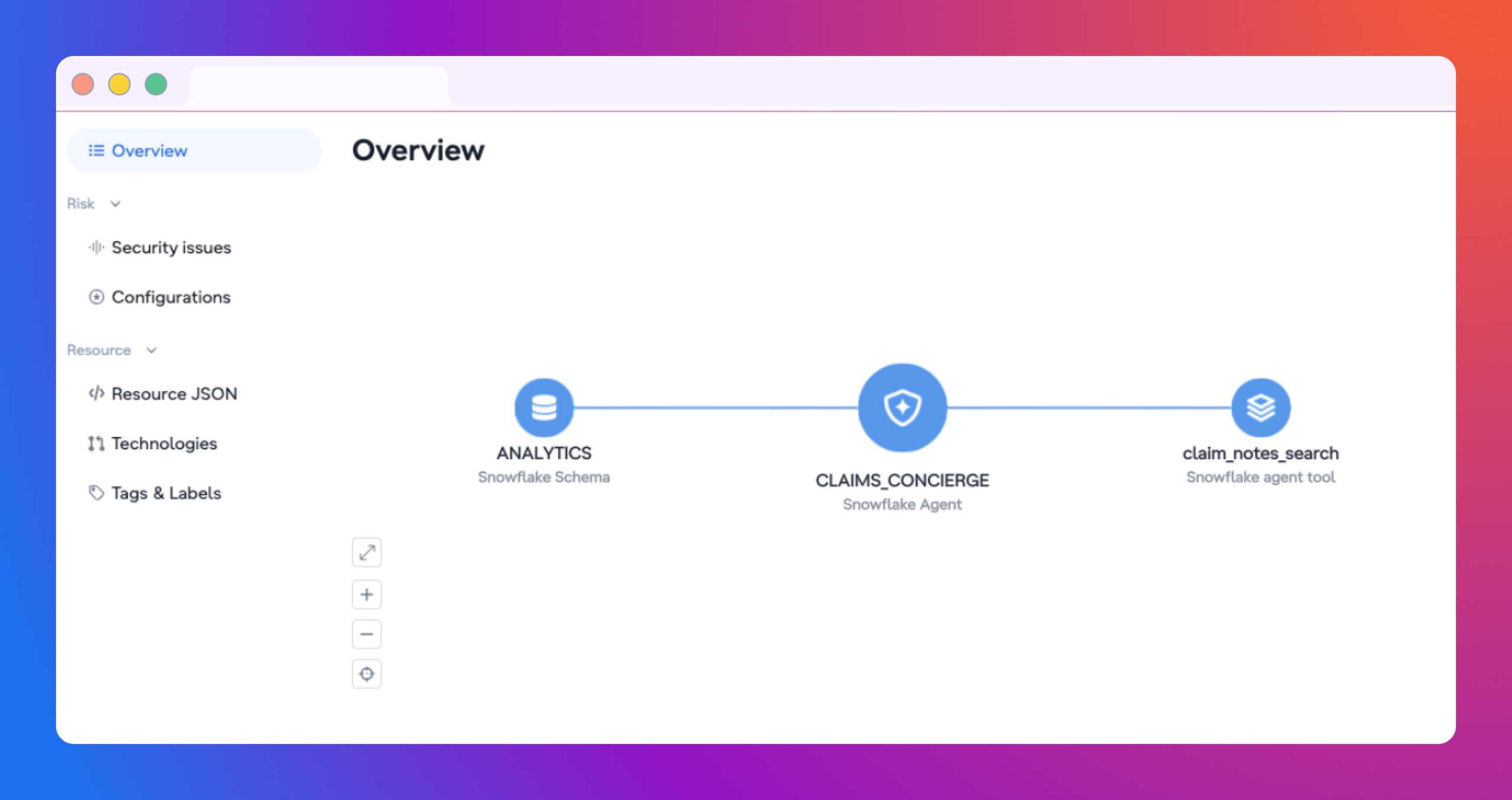 Upwind Now Secures Snowflake from AI Down to the Storage Underneath It (2026-10-01) · Oct 2026
· source
· release history
- Adds posture checks mapped to the CIS Snowflake Benchmark, covering privileges on account and database roles, authentication and network posture, AI asset access, and storage behind stages and external volumes. Upwind Now Secures Snowflake from AI Down to the Storage Underneath It (2026-10-01) · Oct 2026 · source · release history
-
CIS Snowflake Benchmark posture checks integrated into the
severity queue, framework reports and workflows alongside other cloud findings, including continuous monitoring of token policy settings Upwind Now Secures Snowflake from AI Down to the Storage Underneath It (2026-10-01) · Oct 2026 · source · release history - Extends evidence foundation with Runtime Events (process, file, syscalls), Network Events (ingress/egress/internal/cloud-service flows), Kubernetes Audit Logs (EKS/GKE), and API Security metadata. Upwind Blue Agent – Increasing the Scope and tooling to a new level of incident response (2026-09-08) · Sep 2026 · source · release history
- Allows configurable synchronization schedule (default: every hour) and independent dataset processing with a default 90-minute lookback window for Threat and posture datasets Upwind for Microsoft Sentinel – Available on Marketplace and Security Store (2026-09-03) · Sep 2026 · source · release history
- Adds Malware Scanning for Buckets as a new capability across AWS (Amazon S3), Azure (Blob Storage), and Google Cloud (Cloud Storage) to identify malicious files in cloud object storage Upwind Launches Malware Scanning for Cloud Storage Across AWS, Azure, and GCP (2026-08-14) · Aug 2026 · source · release history
Report Generation and Management shipped Provides configurable, exportable report formats with scheduling, filtering, RBAC, and organization-level sharing capabilities.
Also counts toward: Role-based access control, Scheduled jobs
release 8 total
- Makes all reports manageable via the Components > Reports page with search, filter, and on-demand download capabilities Security Reporting Built Around Your Program (2026-08-21) · Aug 2026 · source · release history
- Adds Save as Report button in every table and board view to convert existing filtered views into reusable saved reports Security Reporting Built Around Your Program (2026-08-21) · Aug 2026 · source · release history
- Enables Summary Reports that export custom boards as PDFs with trend data and risk summaries for executive audiences Security Reporting Built Around Your Program (2026-08-21) · Aug 2026 · source · release history
- Supports relative time range selection (last 24 hours, 7 days, 30 days, or 90 days) for time-sensitive components in Summary Reports Security Reporting Built Around Your Program (2026-08-21) · Aug 2026 · source · release history
- Allows Sync board changes to future reports option so report content automatically reflects latest board configuration updates Security Reporting Built Around Your Program (2026-08-21) · Aug 2026 · source · release history
- Introduces Operational Data Reports allowing users to select specific fields and define their order from any security module Security Reporting Built Around Your Program (2026-08-21) · Aug 2026 · source · release history
Snowflake Asset Inventory shipped suggested Discovers and inventories Snowflake account-level assets — including warehouses, compute pools, users, roles, network policies, secrets, stages, external volumes, and AI assets such as models, agents, and MCP servers — organized by schema with role and user resolution.
Suggested capability: Data access governance. This is our guess, not confirmed.
Also counts toward: MCP server, Web management console
release
-
Adds AI asset inventory within Snowflake schemas, covering foundation and custom models, agents, Cortex Search services, dynamic tables, notebooks, and MCP servers, nested by schema with role and user resolution.
Upwind Now Secures Snowflake from AI Down to the Storage Underneath It (2026-10-01) · Oct 2026
· source
· release history
- Adds Snowflake Security integration under Data sources in the Upwind console, covering account-level asset inventory across warehouses, compute pools, users, account roles, network policies, database roles, secrets, network rules, stages, and external volumes.︀︄︇︀︅︉︀︅︀︀︃︀︀︅︅︀︅︊︀︄︆︀︃︄ Upwind Now Secures Snowflake from AI Down to the Storage Underneath It (2026-10-01) · Oct 2026 · source · release history
- Snowflake Security asset inventory in the Upwind console (under Data sources) covering account roles, database roles, schemas, AI assets (foundation/custom models, agents, Cortex Search services, dynamic tables, notebooks, MCP servers), warehouses and network policies Upwind Now Secures Snowflake from AI Down to the Storage Underneath It (2026-10-01) · Oct 2026 · source · release history
example
-
Connect a Databricks account to Upwind so that Unity Catalog grants, storage credentials, and AI assets appear in your unified cloud security inventory.
In the Upwind console, go to Components > Integrations, add your Databricks account, grant Upwind read access, then choose the workspaces and metastores in scope to begin inventory collection.
Upwind Launches Databricks Security for Lakehouse Data and AI (2026-10-19) · Oct 2026
· source
-
Access the new Snowflake inventory via the Upwind UI.
In the console, go to Data sources > Snowflake SecurityUpwind Now Secures Snowflake from AI Down to the Storage Underneath It (2026-10-01) · Oct 2026 · source
Framework Library Management shipped Maintains a versioned, continuously updated library of compliance frameworks (including CIS, NIST, ISO, EU AI Act, and ISO/IEC 42001) with visible versioning and update dates.
release
-
Maintains a versioned, continuously updated framework library — including recent additions such as ISO/IEC 42001 and the EU AI Act — displaying each framework's version and latest update date.
Introducing the new Configurations experience in Upwind (2026-09-24) · Sep 2026
· source
· release history
- Separates configuration findings from security issues in the UI Introducing the new Configurations experience in Upwind (2026-09-24) · Sep 2026 · source · release history
- Displays framework versions and latest update dates to ensure evaluation against current requirements Introducing the new Configurations experience in Upwind (2026-09-24) · Sep 2026 · source · release history
- Adds continuous, live compliance scoring evaluated against multiple frameworks simultaneously, including CIS, NIST, ISO, EU AI Act, and ISO/IEC 42001, across AWS, Azure, Google Cloud, Oracle Cloud, Kubernetes, and on-premises environments.︀︄︇︀︅︉︀︅︀︀︃︀︀︅︅︀︅︊︀︄︆︀︃︄ Introducing the new Configurations experience in Upwind (2026-09-24) · Sep 2026 · source · release history
- Provides live compliance scores across CIS benchmarks, NIST, ISO standards, EU regulations, and industry frameworks Introducing the new Configurations experience in Upwind (2026-09-24) · Sep 2026 · source · release history
Granular Compliance Scoring shipped Delivers continuous, live compliance scores separated by cloud account and environment, distinguishing between configuration findings (policy gaps) and security issues (active risks).
release
-
Adds posture checks mapped to the CIS Snowflake Benchmark, covering privileges on account and database roles, authentication and network posture, AI asset access, and storage behind stages and external volumes.
Upwind Now Secures Snowflake from AI Down to the Storage Underneath It (2026-10-01) · Oct 2026
· source
· release history
-
Separates configuration findings from security issues so teams can distinguish policy gaps from active risks.
Introducing the new Configurations experience in Upwind (2026-09-24) · Sep 2026
· source
· release history
- Scores cloud accounts separately and connects compliance gaps to specific environments, scopes, and responsible teams Introducing the new Configurations experience in Upwind (2026-09-24) · Sep 2026 · source · release history
- Scores each cloud account separately so every compliance gap is connected to a specific environment and responsible team rather than surfaced only as an organization-wide number. Introducing the new Configurations experience in Upwind (2026-09-24) · Sep 2026 · source · release history
External SIEM Data Integration shipped Enables secure, automated synchronization of Upwind threat and posture data into Microsoft Sentinel via Log Analytics custom tables.
Also counts toward: SIEM forwarding
release
-
Adds
upwinddata ingestion into Microsoft Sentinel via Microsoft Marketplace and Security Store Upwind for Microsoft Sentinel – Available on Marketplace and Security Store (2026-09-03) · Sep 2026 · source · release history - Provides a single ARM template to provision the Azure Function App, Data Collection Endpoint, Data Collection Rules, and required role assignments Upwind for Microsoft Sentinel – Available on Marketplace and Security Store (2026-09-03) · Sep 2026 · source · release history
- Ingests six Upwind datasets (Inventory, Vulnerability findings, Threat detections, Threat events, Threat stories, Configuration and posture findings) into separate Log Analytics custom tables Upwind for Microsoft Sentinel – Available on Marketplace and Security Store (2026-09-03) · Sep 2026 · source · release history
- Configures a timer-triggered Azure Function with OAuth2 authentication that synchronizes data via six Upwind API endpoints Upwind for Microsoft Sentinel – Available on Marketplace and Security Store (2026-09-03) · Sep 2026 · source · release history
Remediation Prioritization (Score Journey) shipped suggested Identifies high-impact, low-effort remediation opportunities by calculating how much each finding improves the compliance score, the number of affected resources, and a difficulty rating.
Suggested capability: Vulnerability prioritization. This is our guess, not confirmed.
release
-
Introduces Score Journey showing remediation impact, affected resources, and fix difficulty (Easy to Hard) for prioritization
Introducing the new Configurations experience in Upwind (2026-09-24) · Sep 2026
· source
· release history
- Introduces Score Journey, which shows for each finding how much remediating it would improve the overall compliance score, how many resources it affects, and a difficulty rating from Easy to Hard. Introducing the new Configurations experience in Upwind (2026-09-24) · Sep 2026 · source · release history
example
-
Use Score Journey to identify the highest-impact, lowest-effort fixes before a compliance review — sort findings by potential score improvement and difficulty to build a defensible remediation plan.
In Upwind, go to Configurations > Score Journey > sort findings by 'Score Impact' descending, then filter by difficulty 'Easy' to identify quick wins.Introducing the new Configurations experience in Upwind (2026-09-24) · Sep 2026 · source
Databricks Asset Inventory shipped suggested Discovers and inventories Databricks workspaces, Unity Catalog objects (metastores, catalogs, schemas, grants, storage credentials, external locations), Delta Sharing shares and recipients, model serving endpoints, vector search indexes, and registered models, surfacing them alongside the rest of the cloud estate.
Suggested capability: Data access governance. This is our guess, not confirmed.
release
-
Adds Databricks Security integration via
Components > Integrations, covering asset inventory for workspaces, metastores, catalogs, schemas, grants, storage credentials, external locations, Delta Sharing shares and recipients, model serving endpoints, vector search indexes, and registered…
Upwind Launches Databricks Security for Lakehouse Data and AI (2026-10-19) · Oct 2026
· source
· release history
- Connects Databricks Unity Catalog grants to underlying cloud resources — mapping storage credentials to IAM roles, clusters to compute resources, network configuration to VPCs and security groups, and encryption configuration to KMS keys — in a single traversable graph. Upwind Launches Databricks Security for Lakehouse Data and AI (2026-10-19) · Oct 2026 · source · release history
Kubernetes External Footprint Discovery shipped Uses Cloud Scanners to surface a Kubernetes cluster's external footprint — managed cluster resources, node VMs, load balancers, IAM roles, and network paths — enabling discovery of unknown clusters and converting them into agentless scanner candidates.
release
- Introduces a three-layer security model — Upwind Sensor (node-level runtime), Kubernetes Agentless Scanner (inside the cluster), and Cloud Scanners (outside the cluster) — all feeding the same inventory, security graph, and Containers & Kubernetes Focus Mode. Runtime First, Agentless Everywhere (2026-10-19) · Oct 2026 · source · release history
- Cloud Scanners now surface the Kubernetes cluster's external footprint — managed cluster resources, node VMs and their OSes, load balancers, IAM roles, and network paths — enabling discovery of unknown clusters and converting them into agentless scanner candidates. Runtime First, Agentless Everywhere (2026-10-19) · Oct 2026 · source · release history
Cross-Environment Graph Traversal shipped suggested Resolves Snowflake data-plane resources — stages, external volumes, storage integrations, and network policies — to their backing cloud infrastructure, enabling end-to-end tracing from a database role grant to the cloud bucket or network topology it exposes.
Suggested capability: Data access governance. This is our guess, not confirmed.
release
-
Cross-environment graph coverage from Snowflake grants (account roles, database roles) to external storage integrations, stages, volumes and associated cloud provider buckets
Upwind Now Secures Snowflake from AI Down to the Storage Underneath It (2026-10-01) · Oct 2026
· source
· release history
- Adds cross-environment graph traversal that resolves Snowflake stages and external volumes to backing object storage buckets, storage integrations to assumed cloud roles, and network policies to cloud network topology — tracing a database role grant all the way to the bucket it exposes. Upwind Now Secures Snowflake from AI Down to the Storage Underneath It (2026-10-01) · Oct 2026 · source · release history
Scan Scope Management shipped Provides centralized controls in the console to actively manage which organizations and repositories are included in scanning, keeping access permissions separate from scan scope.
Also counts toward: Web management console
release
-
Adds an Organizations & Repositories page in the Upwind console to centrally manage which organizations and repositories are scanned, keeping access and scan scope separate.
Upwind Code Expands Enterprise Coverage to Azure DevOps and Bitbucket Cloud (2026-09-14) · Sep 2026
· source
· release history
example
-
Control which organizations and repositories are actively scanned after connecting a version control provider.
In the Upwind console, go to Organizations & Repositories to select which connected organizations and repositories are in scope for scanning.Upwind Code Expands Enterprise Coverage to Azure DevOps and Bitbucket Cloud (2026-09-14) · Sep 2026 · source
Attack Story Replay shipped Visualises the order, timing, and blast radius of multi-stage attacks across workloads and identities as a single attack path, replacing manual reconstruction from alert lists.
release
- Story Replay surfaces the order, timing, and blast radius of multi-stage attacks across workloads and identities, replacing manual alert-list reconstruction with a single visual attack path. Upwind Story Replay: Watch the Attack Unfold (2026-10-21) · Oct 2026 · source · release history
Cloud Storage Malware Scanning shipped Scans object storage buckets across AWS, Azure, and Google Cloud to identify malicious files.
release
- Adds Malware Scanning for Buckets as a new capability across AWS (Amazon S3), Azure (Blob Storage), and Google Cloud (Cloud Storage) to identify malicious files in cloud object storage Upwind Launches Malware Scanning for Cloud Storage Across AWS, Azure, and GCP (2026-08-14) · Aug 2026 · source · release history
Lines in monospace are the tool's own words: help text
parsed from its source, or an endpoint from its API document. Under
release, a line is our summary of a dated release. Under
docs, it is quoted from the tool's own documentation or
website. Each links back to the source it came from.
Screenshots
From the release notes, newest first. Click one to see it full size.Media
Videos from the release notes, newest first. They play right here.Score card
-
Shipping velocity releases a month, last 12 months
-
Documentation quality release-notes rubric, 0–100
-
Breaking-change discipline how rarely a release breaks users, and notice given
-
Maintenance risk quiet time against its own cadence, maintainers
-
Innovation & surface new capabilities, API and MCP surface
Five scores for Upwind, each built from the releases, notes and API history this site tracks — and, on Researcher and Business, where it stands among every measured tool in its category and how that has moved.
Score cards are part of every paid plan.
See plans → Already subscribed? Sign in →Trajectory
Blank means never measured; nothing here is a filled-in zero.
Peer standings are included with Researcher and Business. See how this tool ranks against its competitors, using data we don't publish anywhere else.
See plans →Each score is 0–100 on a published rubric, derived from data this site already shows. A dimension we cannot measure says so — it is never scored 0 and never enters a rank.
How this is scored
- Shipping velocity — releases a month over the last 12 months, on a log scale where 16 a month scores 100. Needs 3 releases in the window.
- Documentation quality — the release-notes rubric published on the analytics page, unchanged.
- Breaking-change discipline — the share of releases carrying a breaking change (none scores 100, half or more scores 0). Only projects that label breaking changes are measured: a clean record cannot be told from an unlabelled one.
- Maintenance risk — quiet time measured against the tool's own release cadence (quiet longer than 90 days and three typical gaps scores 0), plus the number of active maintainers and whether contributors are growing, where known. Higher is lower risk.
- Innovation & surface — new capabilities in the feature ledger this year, API and MCP operations added, and the share of commits that are features: the mean of whichever we hold.
- Community health (open-source tools only) — each is a direction, not a size: contributors this year against last, the bus factor now against a year ago, and issues closed per issue opened, where steady scores 50, doubled 100 and halved 0; plus the median time to a maintainer's first reply (an hour scores about 100, a month or more 0). A commercial card has no repository and carries none of the four.
- Documented delivery (commercial tools) — when a vendor's documented new capabilities have slowed against its own baseline, that counts against the overall standing as heavily as two low dimensions. Steady delivery, or too little history to judge, leaves the standing alone; it is never a sixth score.
- Open-source tools are scored on repository signals; commercial tools on their published changelog. Ranks compare tools within one category and one profile and need at least five measured peers; the overall standing needs three ranked dimensions. Best-in-breed or consolidator is a shape, not a quality, and is never scored.
Release-note detail over time
See how much detail Upwind puts in its release notes, quarter by quarter, and compare it with tracked tools in the same category. This history uses up to ten retained, reviewed notes per tool; sparse or blank older quarters may reflect that limit.
Checking release-note history…
Website history
upwind.io, every changeUpwind's home page and 31 more pages as they looked each month from September 2022 to October 2026: 293 renders, 140 changes of tagline or palette. Step through them, play them, or put any two months side by side.
Website history is included with Researcher and Business.
See plans → Already subscribed? Sign in →← → or h l a month · Shift a year · [ ] previous / next change · Space play · 1 2 3 page · T whole page · C compare · F full size
← → or h l the right month · Shift the left · S swap · W wipe · T whole page · Esc back
Rebranding timeline
Dates bound when a change appeared between captures. Possible rebrands are AI suggestions; a redesign alone does not establish a rebrand.
Coverage
Missing something? Tell us
What Upwind connects to, runs on and detects, read from its release notes and docs. So far: 2 new vulnerability checks, 2 new detections, 1 new integration.
5 changes, tracked since Oct 13, 2026.
-
Oct 212026
new PHP core unauthenticated RCE detection rules (CVE-2026-109618, CVE-2026-109619)
Two critical unauthenticated RCEs in PHP core, with research published before the official disclosure. Upwind had detection rules deployed before the vulnerabilities were confirmed
-
Oct 212026
new eMudhra intermediate CA key exposure detection
The private keys of eight eMudhra intermediate CAs were recoverable from the certificates themselves, enough to sign fraudulent TLS and code-signing certificates that chain to a trusted root ( what we published ).
-
Oct 212026
new LiteLLM 1.107.0 poisoned PyPI backdoor detection
With .pth, sitecustomize.py
LiteLLM 1.107.0. A poisoned PyPI release shipped a remote-code backdoor through .pth and sitecustomize.py, running on every Python start on the host ( Upwind MDR Post ).
-
Oct 212026
new GitLab integer overflow RCE behavioral detections (CVE-2026-110264)
GitLab, CVE-2026-110264. An integer overflow in the regular-expression compiler, rated CVSS 10.0, that could let an unauthenticated user run code on a self-managed GitLab server. It reaches every version back to 7.0, and GitLab shipped two behavioral detections alongside the patch ( what we published ).
-
Oct 132026
new Cursor Origin integration
With Origin Marketplace
Upwind is now integrated with Origin. Every pull request and every push to the default branch is scanned, whoever or whatever opened it, with results delivered inside the pull request.
Editors & IDEs 1
Other 1
Nothing first seen in this window. That doesn't mean Upwind shipped nothing, only that we found no record of it.
How we count
Read from 3 of 14 release notes and docs updates we hold for Upwind. "First seen" is the earliest note that names something; "last" is the latest. Our history may start partway through Upwind's life, so an old integration can show a recent first-seen date.
Each change counts once: "added 40 checks" is one line, so the numbers measure how often coverage moves, not how big the catalogue is or how well it detects.
Releases
14 entries
No entries match these filters.
- October 20266
- September 20264
- August 20264
Add the badge to your README
Maintain this project? The badge links readers straight to this page, so they can follow every release here.
 Choose a badge style and copy the code →