Black Duck
Introducing Signal Agentic Fix: Your 24×7 remediation team (2026-10-27) commercialThe section your link pointed to isn't on Black Duck's page any more, so we've brought you to the top.
Black Duck is a software composition analysissoftware composition analysisSoftware composition analysis, identifying third-party dependencies and checking them for known vulnerabilities and license issues. It covers software a team uses rather than writes itself. tool that identifies and manages open source components, vulnerabilities, and licensing risks in applications.
[LLM]
mode = byo
uri = https://your-endpoint.example.com/v1
key = ${OPENAI_API_KEY}
timeout = 600

[LLM_SINGLEFILESCAN_AGENT]
model = gpt-4o
timeout = 600

[LLM_DATAFLOW_AGENT]
model = gpt-4o-mini

[LLM_OVERSIGHT_AGENT]
model = gpt-4o-mini

[LLM_EXPLOITATION_AGENT]
model = gpt-4o-mini

[LLM_SCA_AGENT]
model = gpt-4o-mini

[LLM_MERGEKEY_EMBED_AGENT]
model = text-embedding-3-large

[LLM_OVERSIGHT_EMBED_AGENT]
model = text-embedding-3-small
[LLM]
mode = byo
gcp_service_account_key = gcp-sa-key.json
gcp_project = your-gcp-project-id
Summary
Black Duck is a commercial appsec platform that combines software composition analysis, SBOMSBOMA software bill of materials, an inventory of the components and versions inside an application. It helps teams find affected software when a dependency has a vulnerability or licensing issue. generation, and license compliance checking to find and manage risk in open-source and third-party code, run as a hosted service that plugs into CI pipelines rather than installed as a standalone scanner. Teams reach it through GitHub ActionsGitHub ActionsGitHub's built-in CI/CD system that runs automated workflows triggered by repository events, letting cyber tools automate testing, building, and releasing without managing separate pipeline infrastructure., GitLab CI, Bitbucket Pipelines, Jenkins, or Azure DevOps via its Bridge CLI, and it can tunnel outbound-only into self-hosted Azure DevOps Server, GitLab Self-Managed, Bitbucket Server, and on-premises Jira without firewall changes. It's built for application security and compliance teams who need policy enforcement across an organization rather than per-repo configuration, with central rule profiles, RBACRBACRole-based access control, where permissions are assigned to roles such as reader or administrator and users receive those roles. It makes access easier to manage than individual permission lists., and audit trails, plus bidirectional ticket sync into Jira, ServiceNow, and Azure Boards. Originally launched in 2002, it remains under active development, with its most recent release shipping this week.
Black Duck is a software composition analysis tool that identifies and manages open source components, vulnerabilities, and licensing risks in applications.
How Black Duck helps
Which open-source components in this application carry known vulnerabilities?
scans declared and transitive dependencies across package managers and reports matches against known vulnerability data, tied to the specific manifest or lockfile that pulled each one in
Which of my dependencies carry license terms my organization doesn't allow?
checks each detected component's license against configured policy and flags violations before merge, scoped at organization, application, project, or branch level
Does this pull request introduce a new risk that wasn't there before?
scans on push and merge-request activity and decorates the PR with a severity breakdown, so a reviewer sees new findings against the existing baseline rather than a full re-audit
Which policies actually applied to a given finding, and who signed off on it?
shows the rule profiles and compliance requirements attached to each finding along with an audit trail of which profile version scored the scan and who owns it
Are all my teams' pipelines judging code against the same rules?
central rule profiles inherit down from organization to branch and are enforced automatically across CI, CLI, and integrations, with each scan recording which profile it used so an outdated or overridden copy is visible
Has a dismissed vulnerability or license issue quietly come back?
closes the linked ticket automatically when a finding disappears from a scan, and opens a fresh ticket if it reappears later, preserving the audit history instead of reopening the old one
Languages
Features
Built from Black Duck's releases, docs, README and our own runs. “Seen” marks the month we first spotted a release the vendor didn't date. Group names and tags are our labels.
- Black Duck covers 2 of the 8 vulnerability assessment methods capabilities we track.
- Black Duck covers 1 of the 5 supply chain security capabilities we track.
What Black Duck offers you
- CI/CD pipeline integration4
- Ticketing integration3
- Administrative audit log2
- Command-line interface2
- Role-based access control2
- Autonomous investigation and remediation1
- Self-hosted deployment1
No capabilities match.
Static application security testing 7 features Vulnerability assessment methods since 2026
AI-assisted SAST fix pull request generation shipped Generates fix pull requests for SAST findings via the Bridge CLI from within CI pipelines (GitHub Actions, GitLab CI, Bitbucket Pipelines, Jenkins, Azure DevOps), with UI-driven and policy-triggered creation, bulk support, per-branch PR caps, and filtering by CWE, language, file pattern, and issue type.
Shared capability: Static application security testing
Also counts toward: CI/CD pipeline integration, Command-line interface
release 13 total
-
Adds per-assessment-type fix PR control in the CLI and Polaris UI, letting teams enable automated remediation for SCA only, Static only, or both independently, and extends Static AI fix PRs to the Jenkins plug-in and Black Duck Security Setup workflows, which previously supported SCA fix PRs only; enabling fix PRs in…
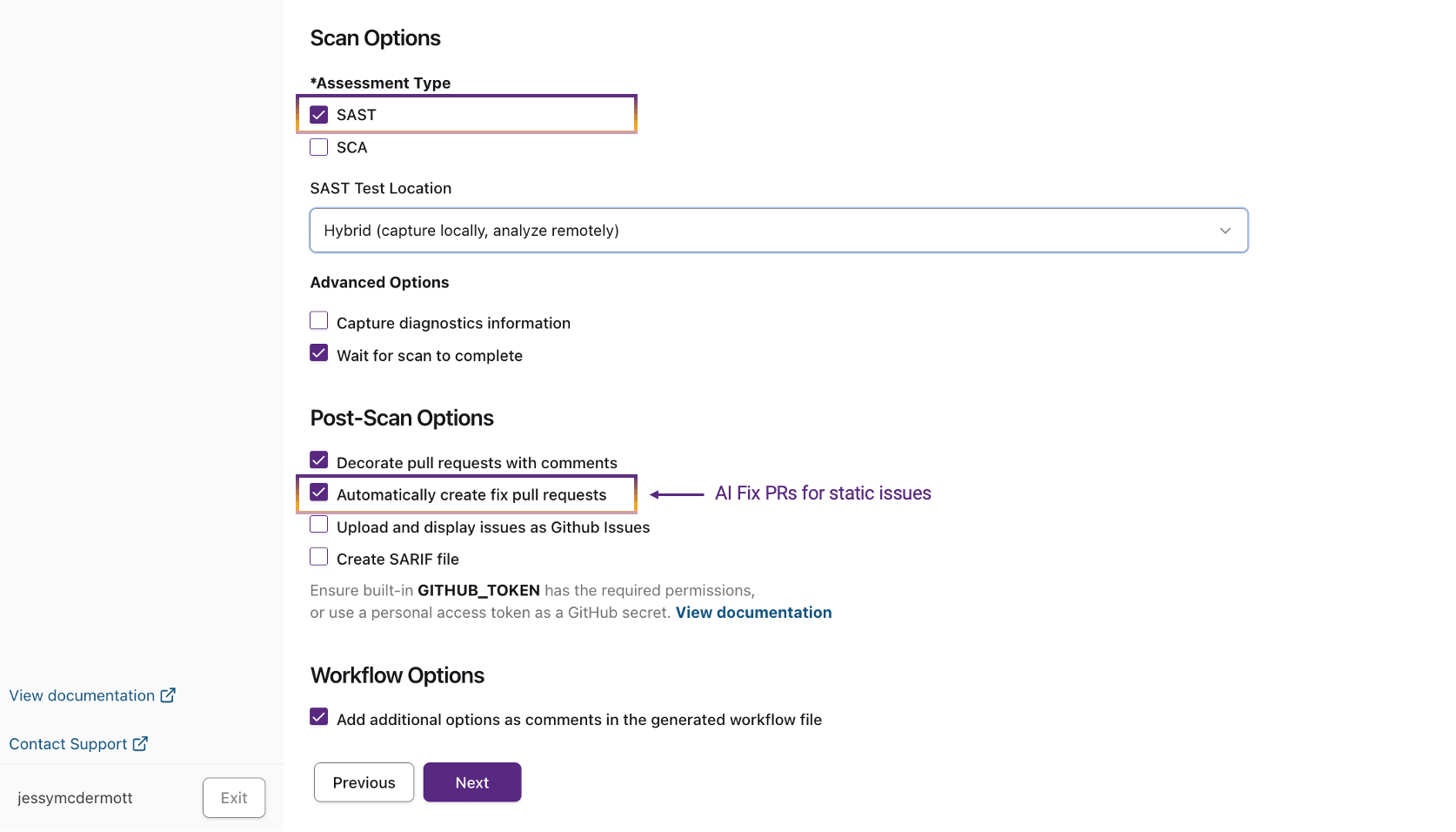 Polaris release update: Deeper detection, remediation you control, scanning wherever you work (2026-10-21) · Oct 2026
· source
· release history
-
Adds support for self-hosted SCM platforms including self-managed GitHub, GitLab, Azure DevOps Server, and Bitbucket Server/Data Center.
 Polaris release update: Bringing AI security findings, scan governance, and remediation together (2026-09-23) · Sep 2026
· source
· release history
- Adds SARIF-format upload of Signal AI code analysis results into Polaris, where they are classified under the new AI tool type and managed alongside deterministic findings through unified policies, triage, audit trails, and governance workflows.︀︄︇︀︅︉︀︅︀︀︃︀︀︅︅︀︅︊︀︄︆︀︃︄ Polaris release update: Bringing AI security findings, scan governance, and remediation together (2026-09-23) · Sep 2026 · source · release history
- Supports per-agent LLM configuration across each of Signal AI's six agents, with provider, model, and endpoint independently selectable — supporting OpenAI, Azure OpenAI, AWS Bedrock, GCP Vertex AI, or any OpenAI-compatible proxy with automatic provider detection. Polaris release update: Bringing AI security findings, scan governance, and remediation together (2026-09-23) · Sep 2026 · source · release history
-
Adds
--llm-modeCLI flag andmodefield in the[LLM]config-file section to switch Black Duck Signal between Black Duck-managed and BYO-LLM endpoints.︀︄︇︀︅︉︀︅︀︀︃︀︀︅︅︀︅︊︀︄︆︀︃︄ Agentic AppSec on your infrastructure with Black Duck Signal (2026-09-10) · Sep 2026 · source · release history -
Adds
[LLM]global config section withuri,key,timeout,gcp_service_account_key, andgcp_projectfields that set defaults for all seven agents. Agentic AppSec on your infrastructure with Black Duck Signal (2026-09-10) · Sep 2026 · source · release history
example
-
Use GCP Vertex AI for all agents to satisfy data-residency requirements, supplying a service-account key and project so Signal handles token refresh automatically.
[LLM] mode = byo gcp_service_account_key = gcp-sa-key.json gcp_project = your-gcp-project-idAgentic AppSec on your infrastructure with Black Duck Signal (2026-09-10) · Sep 2026 · source -
Route the high-volume single-file SAST agent to a cost-optimised model while keeping lighter agents on a cheaper model, all within your own Azure OpenAI tenancy.
[LLM] mode = byo uri = https://your-endpoint.example.com/v1 key = ${OPENAI_API_KEY} timeout = 600 [LLM_SINGLEFILESCAN_AGENT] model = gpt-4o timeout = 600 [LLM_DATAFLOW_AGENT] model = gpt-4o-mini…Agentic AppSec on your infrastructure with Black Duck Signal (2026-09-10) · Sep 2026 · source
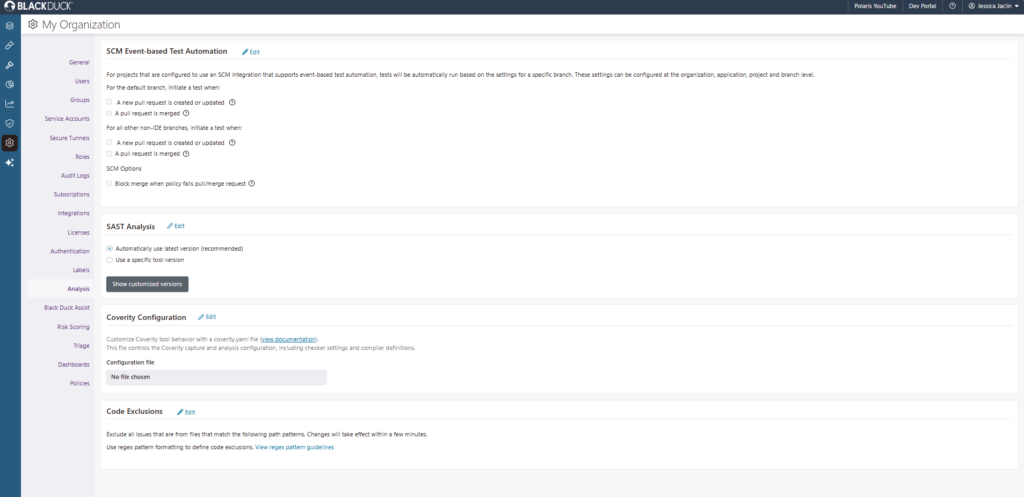
Central rule profile governance shipped Lets security teams define and enforce SAST rule profiles at organization, application, project, or branch level with hierarchical inheritance, RBAC, audit trails, version awareness, and visibility into which profiles were used for each scan.
Shared capability: Static application security testing
Also counts toward: Administrative audit log, CI/CD pipeline integration, Role-based access control
release
-
Adds support for the 2025 CWE Top 25 (alongside the existing 2024 list) across policy filters and violation criteria, dashboards, reporting, and issue management.
Polaris release update: Bringing AI security findings, scan governance, and remediation together (2026-09-23) · Sep 2026
· source
· release history
- Adds central rule configuration in Polaris with hierarchical inheritance for organization, application, or project-level enforcement of scan rules. Polaris release update: Bringing AI security findings, scan governance, and remediation together (2026-09-23) · Sep 2026 · source · release history
- Adds RBAC, audit trails, and version awareness to central rule governance, with visibility into which profiles were used for each scan. Polaris release update: Two-way bug tracker sync, AI-assisted fixes, scanning you can govern (2026-08-19) · Aug 2026 · source · release history
- Adds central rule profiles with hierarchical inheritance (organization/application/project/branch) for scan configuration enforcement across CI, CLI, and integrations. Polaris release update: Two-way bug tracker sync, AI-assisted fixes, scanning you can govern (2026-08-19) · Aug 2026 · source · release history
- Adds central rule configuration: security teams define rule profiles at organization, application, project, or branch level with hierarchical inheritance, enforced automatically across CI pipelines, CLI scans, and integrations. Polaris release update: Two-way bug tracker sync, AI-assisted fixes, scanning you can govern (2026-08-19) · Aug 2026 · source · release history
example
-
Apply a mandatory central rule profile at the organization level so every scan — CI, CLI, or integration — enforces the same ruleset without per-repo YAML.
# In Polaris UI: Settings > Rule Profiles > New Profile # Set scope: Organization # Enable 'Mandatory' and configure inheritance for application/project/branch overrides # All pipelines pick up the…Polaris release update: Two-way bug tracker sync, AI-assisted fixes, scanning you can govern (2026-08-19) · Aug 2026 · source
Agentic AI fix and remediation shipped Provides an end-to-end AI remediation agent that scans, triages, generates fixes, validates results, and submits pull requests autonomously, and integrates as a companion to coding agents such as Claude Code and GitHub Copilot using the same deterministic SAST and SCA engines from Polaris, Coverity, and Black Duck SCA.
Shared capability: Static application security testing
Also counts toward: Autonomous investigation and remediation
release
- Agentic Fix for Coding Agents integrates as a companion to tools like Claude Code and GitHub Copilot, letting developers remove defects in existing code and prevent new ones as AI writes code. Introducing Signal Agentic Fix: Your 24×7 remediation team (2026-10-27) · Oct 2026 · source · release history
- Introduces Signal Agentic Fix, an AI remediation agent that performs end-to-end vulnerability scan, triage, fix generation, validation, and pull-request submission without human bottlenecks.︀︄︇︀︅︉︀︅︀︀︃︀︀︅︅︀︅︊︀︄︆︀︃︄ Introducing Signal Agentic Fix: Your 24×7 remediation team (2026-10-27) · Oct 2026 · source · release history
- Available for early access as a Claude Code plug-in for Coverity users, with additional coding-agent and DevOps pipeline support coming for Coverity, Polaris, and Black Duck SCA. Introducing Signal Agentic Fix: Your 24×7 remediation team (2026-10-27) · Oct 2026 · source · release history
- Signal AI Code Analysis support will be added for deeper discovery of novel risks such as IDOR and BOLA within agent runs. Introducing Signal Agentic Fix: Your 24×7 remediation team (2026-10-27) · Oct 2026 · source · release history
- Uses the same deterministic SAST and SCA engines from Polaris, Coverity, and Black Duck SCA for consistent scan results inside the agent workflow. Introducing Signal Agentic Fix: Your 24×7 remediation team (2026-10-27) · Oct 2026 · source · release history
Language version support in Rapid Scan Static shipped Adds support for scanning Go 1.26 and Dart 3.11 source code in the Rapid Scan Static engine.
Shared capability: Static application security testing
release
-
Extends Rapid Scan Static language coverage to Go 1.27, expands detection across Groovy (including Grails and Gradle), JavaScript, and Python environments, improves detection accuracy for CORS and TLS misconfigurations in Groovy/Grails applications, and reduces false positives in JavaScript unit test files.
Polaris release update: Deeper detection, remediation you control, scanning wherever you work (2026-10-21) · Oct 2026
· source
· release history
- Adds Go 1.26 and Dart 3.11 language version support for security scanning. Polaris release update: Two-way bug tracker sync, AI-assisted fixes, scanning you can govern (2026-08-19) · Aug 2026 · source · release history
- Adds support for Go 1.26 and Dart 3.11 in the Rapid Scan Static engine. Polaris release update: Two-way bug tracker sync, AI-assisted fixes, scanning you can govern (2026-08-19) · Aug 2026 · source · release history
Scala and AI framework static analysis checks shipped Adds Scala-specific SAST checks covering JWT vulnerabilities (algorithm confusion, nonexpiring tokens, ignored expiration/start times, missing claims validation, untrusted decoding) and web security issues including permissive CORS origins, excessive preflight age, missing TLS, and disabled security headers across http4s and Play.
previously: Scala static analysis checks
Shared capability: Static application security testing
release
-
Adds specialized static security analysis for AI frameworks — the Anthropic SDK, OpenAI SDK, and LangChain — catching dangerous tool enablement, agent configuration risks, and AI prompt injection issues via Rapid Scan Static (Sigma 2026.9.1).︀︄︇︀︅︉︀︅︀︀︃︀︀︅︅︀︅︊︀︄︆︀︃︄
Polaris release update: Deeper detection, remediation you control, scanning wherever you work (2026-10-21) · Oct 2026
· source
· release history
- Adds seven existing Java JWT checks (algorithm confusion, nonexpiring tokens, ignored expiration/start times, missing claims validation, untrusted decoding) now applied to Scala in the Rapid Scan Static engine. Polaris release update: Two-way bug tracker sync, AI-assisted fixes, scanning you can govern (2026-08-19) · Aug 2026 · source · release history
- Adds six new Scala web security checks targeting permissive and credentialed CORS origins, excessive preflight age, missing TLS, and disabled security headers across http4s and Play. Polaris release update: Two-way bug tracker sync, AI-assisted fixes, scanning you can govern (2026-08-19) · Aug 2026 · source · release history
Cryptographic private key detection shipped Detects embedded cryptographic private keys in source code and configuration files using a new crypto bits private key pattern in the Rapid Scan Static engine.
Shared capability: Static application security testing
release
- Adds a new crypto bits private key pattern to the Rapid Scan Static engine to detect embedded cryptographic private keys in source code and configuration files. Polaris release update: Two-way bug tracker sync, AI-assisted fixes, scanning you can govern (2026-08-19) · Aug 2026 · source · release history
- Expands Rapid Scan Static detection to Scala including JWT checks, web security checks for http4s/Play, and crypto bits private key patterns. Polaris release update: Two-way bug tracker sync, AI-assisted fixes, scanning you can govern (2026-08-19) · Aug 2026 · source · release history
Webhook-triggered scanning for self-hosted SCMs shipped Triggers SAST and SCA scans automatically on push, branch creation, and pull/merge request events for self-hosted SCMs, with PR/MR decoration including severity breakdowns and Code Insights reports for Bitbucket.
Shared capability: Static application security testing
Also counts toward: Self-hosted deployment
release
- Adds webhook-triggered SAST and SCA scanning on push, branch creation, and pull/merge request activity for self-hosted SCMs, with PR/MR decoration including severity breakdowns and Code Insights reports for Bitbucket. Polaris release update: Two-way bug tracker sync, AI-assisted fixes, scanning you can govern (2026-08-19) · Aug 2026 · source · release history
Dependency scanning 2 features Supply chain security since 2026
fAST SCA package manager and ecosystem coverage shipped Extends SCA dependency analysis to additional package managers and ecosystems including Poetry, pnpm, SBT, SetupTools, Bazel 9, NuGet `.slnx` solution files, buildless Go module analysis, Cargo workspace support, UV (Python), Rush monorepo tooling, tree-based Conda detection, and Ant/Ivy dependency extraction.
Shared capability: Dependency scanning
release
-
Extends fAST SCA ecosystem coverage to include Poetry, pnpm, SBT, SetupTools, Bazel 9,
.slnxsolution files for NuGet, buildlessgo.modanalysis for Go, and Cargo workspace support with include and exclude controls. Polaris release update: Two-way bug tracker sync, AI-assisted fixes, scanning you can govern (2026-08-19) · Aug 2026 · source · release history - Adds UV, Rush, Conda tree-based, and Ant/Ivy package manager support in the fAST SCA engine. Polaris release update: Two-way bug tracker sync, AI-assisted fixes, scanning you can govern (2026-08-19) · Aug 2026 · source · release history
- Adds UV (Python), Rush monorepo tooling, a tree-based Conda detector, and Ant/Ivy dependency extraction as new package manager detectors in the fAST SCA engine. Polaris release update: Two-way bug tracker sync, AI-assisted fixes, scanning you can govern (2026-08-19) · Aug 2026 · source · release history
Async SCA notifications shipped Sends email alerts for critical or high-severity open source dependency changes at the project or branch level.
Shared capability: Dependency scanning
release
-
Adds Async SCA notifications to send email alerts for critical or high-severity open source dependency changes at the project or branch level.
Polaris release update: Bringing AI security findings, scan governance, and remediation together (2026-09-23) · Sep 2026
· source
· release history
Container image vulnerability scanning 1 feature Vulnerability assessment methods since 2026
Container scanning shipped Initiates container scans from GitHub Actions, GitLab templates, Jenkins, Bitbucket, Azure DevOps, the CLI, and Black Duck Security Setup workflows, with layer-level risk analysis identifying which container layer introduced a specific vulnerability or component and a unified component inventory.
Shared capability: Container image vulnerability scanning
Also counts toward: CI/CD pipeline integration
release
-
Adds container scan initiation from GitHub Actions, GitLab templates, Jenkins plug-in, Bitbucket pipe, ADO extension, the CLI, and Black Duck Security Setup workflows, with layer-level risk analysis identifying which container layer introduced a specific vulnerability or component, and a unified component inventory…
Polaris release update: Deeper detection, remediation you control, scanning wherever you work (2026-10-21) · Oct 2026
· source
· release history
Role-based access control 1 feature Identity and access since 2026
Secure tunnel connectivity for self-hosted SCMs and on-premises systems shipped Establishes outbound-only encrypted tunnels to self-hosted Azure DevOps Server, GitLab Self-Managed, Bitbucket Server/Data Center, and on-premises Jira without requiring inbound firewall changes, with multitunnel support, org-admin-restricted setup via RBAC, and full audit logging.
Shared capability: Role-based access control
Also counts toward: Administrative audit log, Role-based access control, Ticketing integration
release
-
Extends on-premises SCM support to self-hosted GitLab, Azure DevOps Server, and Bitbucket Server/Data Center (in addition to previously released self-managed GitHub), enabling repository discovery, bulk onboarding, SAST/SCA scan triggers, and pull request–driven remediation workflows.
Polaris release update: Bringing AI security findings, scan governance, and remediation together (2026-09-23) · Sep 2026
· source
· release history
- Adds secure tunnel connectivity (outbound-only, no inbound firewall changes) to self-hosted Azure DevOps Server, GitLab Self-Managed, Bitbucket Server and Data Center, and on-premises Jira, built on Bridge CLI and Teleport infrastructure. Polaris release update: Two-way bug tracker sync, AI-assisted fixes, scanning you can govern (2026-08-19) · Aug 2026 · source · release history
- Extends on-premises connectivity to self-hosted Azure DevOps Server, GitLab Self-Managed, and Bitbucket Server/Data Center via secure outbound tunnels. Polaris release update: Two-way bug tracker sync, AI-assisted fixes, scanning you can govern (2026-08-19) · Aug 2026 · source · release history
- Adds multitunnel support for on-premises Jira connectivity, with tunnel setup restricted to org admins via RBAC and full audit logging. Polaris release update: Two-way bug tracker sync, AI-assisted fixes, scanning you can govern (2026-08-19) · Aug 2026 · source · release history
Other / not yet classified 8 features Features we have not matched to a capability yet. A suggested match is marked.
Bidirectional issue tracker sync shipped Synchronises triage states, ticket statuses, and fix-by dates in both directions between Polaris and GitLab Issues, GitHub Issues, Jira, ServiceNow, and Azure Boards, with automatic ticket closure when findings are dismissed and new ticket creation when findings reappear.
Also counts toward: Ticketing integration
release
- Adds bidirectional status and triage sync across GitLab Issues, GitHub Issues, Jira, ServiceNow, and Azure Boards — triage states, ticket statuses, and fix-by dates now propagate automatically in both directions. Polaris release update: Two-way bug tracker sync, AI-assisted fixes, scanning you can govern (2026-08-19) · Aug 2026 · source · release history
- Adds bidirectional synchronization of triage states, statuses, and fix-by dates across Jira, GitHub Issues, GitLab Issues, ServiceNow, and Azure Boards. Polaris release update: Two-way bug tracker sync, AI-assisted fixes, scanning you can govern (2026-08-19) · Aug 2026 · source · release history
- Adds automatic ticket closure when linked findings are dismissed or absent in subsequent scans; a reappearing issue creates a new ticket to preserve audit trails. Polaris release update: Two-way bug tracker sync, AI-assisted fixes, scanning you can govern (2026-08-19) · Aug 2026 · source · release history
- Adds fix-by date synchronization: Polaris fix-by changes update due dates in Jira, ServiceNow, and Azure Boards, and due date changes sync back to Polaris. Polaris release update: Two-way bug tracker sync, AI-assisted fixes, scanning you can govern (2026-08-19) · Aug 2026 · source · release history
Bug tracker integration and issue export shipped Provides native integrations with GitLab Issues, GitHub Issues, Jira, ServiceNow, and Azure Boards for exporting findings individually or in bulk, with configurable per-project field mappings (including custom Jira fields and ticket descriptions), reusable templates, single-ticket bundling for ServiceNow, policy-driven issue creation, and branch scoping options.
Also counts toward: Ticketing integration
release
- Adds native integrations for GitLab Issues, GitHub Issues, and ServiceNow as new bug-tracking targets, supporting individual and bulk export, single-ticket bundling for ServiceNow, and policy-driven issue creation. Polaris release update: Two-way bug tracker sync, AI-assisted fixes, scanning you can govern (2026-08-19) · Aug 2026 · source · release history
- Adds configurable per-project bug-tracker integration mappings, saveable as reusable templates across projects and workflows, scoped to all branches or the default branch only. Polaris release update: Two-way bug tracker sync, AI-assisted fixes, scanning you can govern (2026-08-19) · Aug 2026 · source · release history
- Adds configurable Jira field mapping — map Polaris issue data to standard or custom Jira fields and customize ticket descriptions. Polaris release update: Two-way bug tracker sync, AI-assisted fixes, scanning you can govern (2026-08-19) · Aug 2026 · source · release history
- Adds new bug-tracking integrations for GitLab Issues, GitHub Issues, and ServiceNow to Polaris's supported list. Polaris release update: Two-way bug tracker sync, AI-assisted fixes, scanning you can govern (2026-08-19) · Aug 2026 · source · release history
LLM infrastructure configuration shipped suggested Enables bringing your own LLM infrastructure with support for multiple providers and per-agent model overrides.
Suggested capability: Static application security testing. This is our guess, not confirmed.
release
-
Adds Signal AI code analysis with Bring Your Own LLM (BYO LLM) support, allowing agents to use providers like OpenAI, Azure OpenAI, AWS Bedrock, GCP Vertex AI, or an OpenAI-compatible proxy.
Polaris release update: Bringing AI security findings, scan governance, and remediation together (2026-09-23) · Sep 2026
· source
· release history
-
Adds
[LLM_SINGLEFILESCAN_AGENT],[LLM_DATAFLOW_AGENT],[LLM_OVERSIGHT_AGENT],[LLM_EXPLOITATION_AGENT],[LLM_MERGEKEY_EMBED_AGENT], and[LLM_OVERSIGHT_EMBED_AGENT]sections for per-agent model overrides (model, uri, key, timeout, api_version) Agentic AppSec on your infrastructure with Black Duck Signal (2026-09-10) · Sep 2026 · source · release history -
Adds
mode = byoto[LLM]section in config files to enable bringing your own LLM infrastructure Agentic AppSec on your infrastructure with Black Duck Signal (2026-09-10) · Sep 2026 · source · release history
GitHub Enterprise Cloud (GHEC) data residency support shipped Connects to customer-specific regional GitHub Enterprise Cloud hosts with automatic regional API routing via the CLI, GitHub Actions, or the Polaris UI.
Also counts toward: CI/CD pipeline integration, Command-line interface
release
-
Adds support for GitHub Enterprise Cloud (GHEC) tenants with data residency, allowing connection to customer-specific regional GitHub hosts with automatic regional API routing via the CLI, GitHub Actions, or the Polaris UI.
Polaris release update: Deeper detection, remediation you control, scanning wherever you work (2026-10-21) · Oct 2026
· source
· release history
Dynamic sitemap visualization shipped suggested Provides a dynamic sitemap view in fAST to visualize URLs, endpoints, and resources discovered during dynamic testing.
Suggested capability: Web vulnerability scanning. This is our guess, not confirmed.
release
-
Adds a Dynamic sitemap view in fAST to visualize URLs, endpoints, and resources discovered during dynamic testing.
Polaris release update: Bringing AI security findings, scan governance, and remediation together (2026-09-23) · Sep 2026
· source
· release history
Polaris status page shipped Offers a Polaris status page with real-time service health visibility, maintenance event review, and subscription alerts for status changes.
release
-
Adds Polaris status page with real-time service health visibility, maintenance event review, and subscription alerts for status changes.
Polaris release update: Bringing AI security findings, scan governance, and remediation together (2026-09-23) · Sep 2026
· source
· release history
Self-hosted SCM platform support shipped Adds support for self-hosted SCM platforms including self-managed GitHub, GitLab, Azure DevOps Server, and Bitbucket Server/Data Center.
release
-
Adds support for self-hosted SCM platforms including self-managed GitHub, GitLab, Azure DevOps Server, and Bitbucket Server/Data Center.
Polaris release update: Bringing AI security findings, scan governance, and remediation together (2026-09-23) · Sep 2026
· source
· release history
Issue policy and compliance visibility shipped suggested Surfaces which policies, compliance requirements, and governance rules are attached to a SAST finding via a 'View issue policies' action.
Suggested capability: Static application security testing. This is our guess, not confirmed.
release
- Adds a View issue policies action that surfaces which policies, compliance requirements, and governance rules are attached to a SAST finding. Polaris release update: Two-way bug tracker sync, AI-assisted fixes, scanning you can govern (2026-08-19) · Aug 2026 · source · release history
Lines in monospace are the tool's own words: help text
parsed from its source, or an endpoint from its API document. Under
release, a line is our summary of a dated release. Under
docs, it is quoted from the tool's own documentation or
website. Each links back to the source it came from.
Screenshots
From the release notes, newest first. Click one to see it full size.Score card
-
Shipping velocity releases a month, last 12 months
-
Documentation quality release-notes rubric, 0–100
-
Breaking-change discipline how rarely a release breaks users, and notice given
-
Maintenance risk quiet time against its own cadence, maintainers
-
Innovation & surface new capabilities, API and MCP surface
Five scores for Black Duck, each built from the releases, notes and API history this site tracks — and, on Researcher and Business, where it stands among every measured tool in its category and how that has moved.
Score cards are part of every paid plan.
See plans → Already subscribed? Sign in →Trajectory
Blank means never measured; nothing here is a filled-in zero.
Peer standings are included with Researcher and Business. See how this tool ranks against its competitors, using data we don't publish anywhere else.
See plans →Each score is 0–100 on a published rubric, derived from data this site already shows. A dimension we cannot measure says so — it is never scored 0 and never enters a rank.
How this is scored
- Shipping velocity — releases a month over the last 12 months, on a log scale where 16 a month scores 100. Needs 3 releases in the window.
- Documentation quality — the release-notes rubric published on the analytics page, unchanged.
- Breaking-change discipline — the share of releases carrying a breaking change (none scores 100, half or more scores 0). Only projects that label breaking changes are measured: a clean record cannot be told from an unlabelled one.
- Maintenance risk — quiet time measured against the tool's own release cadence (quiet longer than 90 days and three typical gaps scores 0), plus the number of active maintainers and whether contributors are growing, where known. Higher is lower risk.
- Innovation & surface — new capabilities in the feature ledger this year, API and MCP operations added, and the share of commits that are features: the mean of whichever we hold.
- Community health (open-source tools only) — each is a direction, not a size: contributors this year against last, the bus factor now against a year ago, and issues closed per issue opened, where steady scores 50, doubled 100 and halved 0; plus the median time to a maintainer's first reply (an hour scores about 100, a month or more 0). A commercial card has no repository and carries none of the four.
- Documented delivery (commercial tools) — when a vendor's documented new capabilities have slowed against its own baseline, that counts against the overall standing as heavily as two low dimensions. Steady delivery, or too little history to judge, leaves the standing alone; it is never a sixth score.
- Open-source tools are scored on repository signals; commercial tools on their published changelog. Ranks compare tools within one category and one profile and need at least five measured peers; the overall standing needs three ranked dimensions. Best-in-breed or consolidator is a shape, not a quality, and is never scored.
Release-note detail over time
See how much detail Black Duck puts in its release notes, quarter by quarter, and compare it with tracked tools in the same category. This history uses up to ten retained, reviewed notes per tool; sparse or blank older quarters may reflect that limit.
Checking release-note history…
Website history
blackduck.com, every changeBlack Duck's home and product pages and 39 more pages as they looked each month from November 2021 to October 2026: 52 renders, 7 changes of tagline or palette. Step through them, play them, or put any two months side by side.
Website history is included with Researcher and Business.
See plans → Already subscribed? Sign in →← → or h l a month · Shift a year · [ ] previous / next change · Space play · 1 2 3 page · T whole page · C compare · F full size
← → or h l the right month · Shift the left · S swap · W wipe · T whole page · Esc back
Rebranding timeline
Dates bound when a change appeared between captures. Possible rebrands are AI suggestions; a redesign alone does not establish a rebrand.
Releases
6 entries
No entries match these filters.
- October 20262
- September 20262
- August 20262
Add the badge to your README
Maintain this project? The badge links readers straight to this page, so they can follow every release here.
 Choose a badge style and copy the code →