Brinqa
12.3.295 commercialThe section your link pointed to isn't on Brinqa's page any more, so we've brought you to the top.
Brinqa is a risk and security analytics platform that aggregates and correlates security data to prioritize vulnerabilities and threats.
SELECT id, title, severity FROM findings WHERE severity = 'CRITICAL'
UNION ALL
SELECT id, title, severity FROM findings WHERE cvssScore >= 9.0
{
  "mcpServers": {
    "brinqaMCP": {
      "command": "<your-uvx-path>",
      "args": ["mcp-openapi-proxy"],
      "env": {
        "OPENAPI_SPEC_URL": "https://<your-brinqa-platform-url>/brinqamax/openapi.json",
        "API_KEY": "<your-brinqa-platform-access-token>"
      }
    }
  }
}
{
  "servers": {
    "brinqaMCP": {
      "type": "stdio",
      "command": "<your-uvx-path>",
      "args": ["mcp-openapi-proxy"],
      "env": {
        "OPENAPI_SPEC_URL": "https://<your-brinqa-platform-url>/brinqamax/openapi.json",
        "API_KEY": "<your-brinqa-platform-access-token>",
        "OPENAPI_SIMPLE_MODE": "true"
      }
    }
  }
}
{
  "mcpServers": {
    "brinqaMCP": {
      "command": "<your-uvx-path>",
      "args": ["mcp-openapi-proxy"],
      "env": {
        "OPENAPI_SPEC_URL": "https://<your-brinqa-platform-url>/brinqamax/openapi.json",
        "API_KEY": "<your-brinqa-platform-access-token>"
      }
    }
  }
}
{
  "servers": {
    "brinqaMCP": {
      "type": "stdio",
      "command": "<your-uvx-path>",
      "args": ["mcp-openapi-proxy"],
      "env": {
        "OPENAPI_SPEC_URL": "https://<your-brinqa-platform-url>/brinqamax/openapi.json",
        "API_KEY": "<your-brinqa-platform-access-token>",
        "OPENAPI_SIMPLE_MODE": "true"
      }
    }
  }
}
curl -X POST 'https://<your-brinqa-instance>/v1/api/bql' \
  -H 'Content-Type: application/json' \
  -H 'Authorization: ApiKey brq_AbCdEfGh.xYz123...' \
  -d '{
    "query": "FIND Vulnerability WHERE riskScore > 8",
    "returningFields": ["id", "name", "riskScore", "targets(displayName, ipAddresses)"],
    "orderBy": ["riskScore DESC"],
    "limit": 100
  }'
# After POSTing, capture the Location header and poll:
LOCATION="/v1/api/bql/eyJqb2J..."
curl -s "https://<your-brinqa-instance>$LOCATION" \
  -H 'Authorization: ApiKey brq_AbCdEfGh.xYz123...' | jq '{status, state, totalRows, cursor, results}'
Summary
Brinqa is a commercial vulnerability-management platform that consolidates security findings from other tools into a unified data model and lets teams query, score, and remediate risk across that combined dataset. It runs as a hosted cloud service, with agents deployed to pull data from on-premises servers and cloud resources into it, and integrations covering scanners and platforms like IONIX, Invicti, Tanium, and Cortex Cloud. It targets vulnerability-management and security operations teams that need to correlate findings across many sources rather than work tool by tool, using its own query language (BQL) and configurable risk factors and SLAs to drive automated remediation workflows. Its documentation lists connectors to dozens of named products, positioning it as an aggregation layer above them rather than a replacement for any one scanner.
Brinqa is a risk and security analytics platform that aggregates and correlates security data to prioritize vulnerabilities and threats.
How Brinqa helps
Which findings across all my scanners are actually the same underlying vulnerability?
consolidates findings from every connected source into a unified data model so duplicates reported by different tools collapse into one entity with a shared risk score
Which of my open vulnerabilities should I fix first given everything I know about them?
applies configurable risk factors to combined finding data and produces a score that reflects business context, not just the scanner's raw severity
Which findings are quietly falling out of SLA because of an expired exception?
preserves the extended due date on findings tied to expired exception requests, so remediation completed within the approved window is not retroactively marked out-of-SLA
How are my assets and findings related to each other across tools that never talk to each other?
lets you traverse the entity-relationship graph with its query language, including multi-hop relationship queries across hierarchical structures like org charts or asset ownership
Which records from a given scanner do I actually want imported?
applies condition-based filtering during connector sync so only records matching specified attribute values are brought into the platform
Can I ask questions about my security data in plain language instead of writing queries by hand?
offers a chat agent that turns natural-language requests into query-language queries and can also answer documentation questions and surface CVE details
Languages
Features
Built from Brinqa's releases, docs, README and our own runs. “Seen” marks the month we first spotted a release the vendor didn't date. Group names and tags are our labels.
- Brinqa covers 1 of the 8 vulnerability assessment methods capabilities we track.
What Brinqa offers you
- Ticketing integration3
- Built-in AI assistant2
- Disaster recovery1
- Import from a competing product1
- MCP server1
- Natural-language query1
- REST API1
- Scheduled jobs1
- Self-hosted deployment1
No capabilities match.
Data Ingestion and Integration 6 capabilities Brinqa pulls asset and findings data into the platform from a wide range of third-party cyber tools and external sources through pre-built connectors and configurable pipelines. Incoming data is filtered, validated, consolidated, and lifecycle-managed so that downstream analysis works from a clean, unified dataset.
Third-party tool connectors shipped Pre-built connectors bring findings and asset data from third-party cyber tools such as IONIX, Invicti, and Upwind directly into Brinqa.
release
- Adds Connector Schema Change Review: select a connector version, review detected schema changes in a diff table, and Review, Ignore, or Resolve each change inline — with user-customized consolidation mappings preserved across upgrades. 12.3.295 · Sep 2026 · source · release history
- Adds deduplication configuration page with options to turn deduplication on/off, select integration sources, set matching confidence level, and enable individual steps. 12.3.295 · Sep 2026 · source · release history
- Adds a deduplication configuration page to turn deduplication on or off, choose participating integration sources, set matching confidence level, and enable or disable individual pipeline steps. 12.3.295 · Sep 2026 · source · release history
- Added a connector update available filter to the data sources page, so that users can understand which integrations can be updated 11.29.19 · Nov 2024 · source · release history
- The NIST NVD connector is no longer supported in Brinqa Platform version 11.28 or later. 11.29.19 · Nov 2024 · source · release history
- Added the Connector version and Update available columns to the data integrations page that allows admins to understand when new connector versions are available 11.29.19 · Nov 2024 · source · release history
docs 8 total
- If the new version's schema differs from what your integration previously saved, a Pending Changes step appears before you can continue. See Reviewing Connector Schema Changes for how to resolve these changes without disrupting your consolidation configuration. seen Sep 2026 · source
- Version: v12 This article explains the Pending Changes review step that appears when you upgrade the connector version used by an existing data integration , and how to resolve attribute changes without disrupting your data consolidation configuration. Why review schema changes? docs update · Sep 2026 · source
-
NowSecure Workstation Application, Dynamic Code Finding, Dynamic Code Finding Definition OSV Security Advisory Security Reporter Api Endpoint, Application, Assessment, Cloud Resource, Code Repository, Device, Host, Network, Pentest Finding, Pentest Finding Definition, Person, Site, Team
 docs update · Sep 2026
· source
- 179 179 Trend Micro Vision One Alert, Alert Definition, Device, Host, Person, Site seen Aug 2026 · source
- 178 178 Cortex XDR Alert, Alert Definition, Asset, Host, Incident, Incident Definition, Installed Package, Package, Violation, Violation Definition, Vulnerability, Vulnerability Definition Cortex Xpanse Alert, Alert Definition, Certificate, Cloud Resource, Host, Incident, Incident Definition, IP Range, Service, Site docs update · Aug 2026 · source
- 176 176 Tanium Comply Akto Api Endpoint, Dynamic Code Finding, Dynamic Code Finding Definition, Site Cortex Cloud Asset Group, Cloud Account, Cloud Resource, Container, Container Image, Host, Installed Package, Package, Serverless, Violation, Violation Definition, Vulnerability, Vulnerability Definition SysReptor… docs update · Aug 2026 · source
Connector sync and data ingestion shipped Ingests records from external sources via connectors, with condition-based filtering to control what gets imported and validation of date/time fields during sync.
release 14 total
- Adds Connector Schema Change Review page to select connector version, review schema changes in diff table, and Resolve/Ignore/Resolve each change inline. 12.3.295 · Sep 2026 · source · release history
- Improves connector agent resilience by automatically healing connection state when monitoring entries are missing, ensuring integration syncs continue to run. 12.2.248 · Sep 2026 · source · release history
- Adds validation and sanitization for invalid date/time values during data integration sync. 12.0.248 · seen Jul 2026 · source · release history
- Adds Analytics Source support, expanding the range of data sources available for ingestion and analysis. 12.1.118 · seen Jul 2026 · source · release history
- Adds BCL condition-based filtering during connector sync, letting users control which records are imported based on attribute values. 12.1.403 · seen Jul 2026 · source · release history
- Connector data sync now supports filtering via BCL conditions based on attribute values and conditions 12.1.403 · Jun 2026 · source · release history
Source Data Computation and delta processing shipped Automatically detects and processes data models with calculated attributes, and supports incremental delta computes to avoid reprocessing unchanged records.
release 7 total
- Adds delta computes and consolidation (feature-flagged), enabling incremental data processing workflows. 12.1.118 · seen Jul 2026 · source · release history
- Introduces Source Data Computation to automatically identify and process Source Data Models (SDM) with calculated attributes. 12.0.321 · seen Jul 2026 · source · release history
-
delta computesand consolidation are now available as a feature-flagged capability. 12.1.118 · Apr 2026 · source · release history - Introduces Source Data Computation to automatically identify and process Source Data Models (SDM) with calculated attributes. 12.0.321 · Feb 2026 · source · release history
- Performance improvements for Vulnerability Definition compute and CPE Record processing 12.0.248 · Jan 2026 · source · release history
-
Adds a
bulk recomputeaction for system administrators to select datasets and trigger compute operations, receiving notifications and logs upon completion. 11.31.73 · Jul 2025 · source · release history
Data lifecycle management (DLM) shipped Manages the full lifecycle of ingested data through configurable pipeline steps, handling large datasets without timing out.
release 7 total
- Increases the data lifecycle flow step timeout from 1 to 5 minutes, accommodating larger dataset processing. 12.0.321 · seen Jul 2026 · source · release history
- Increases the default timeout for Data Warehouse snapshot uploads from 30 seconds to 60 minutes. 11.31.73 · Jul 2025 · source · release history
- Added the ability for a user to transform an SDM attribute to a Boolean 11.29.19 · Nov 2024 · source · release history
- Linked data lifecycle flows with Source Data Models (SDM), allowing users to launch them directly from the data model page 11.28.36 · Aug 2024 · source · release history
- Optimizes snapshot code for Data Warehouse to handle increased data volume from Data lifecycle management (DLM) 11.27.46 · Aug 2024 · source · release history
- Introduces Data Lifecycle Management settings that replace data retention in data integrations, carrying over existing purge policies as lifecycle policies. 11.27.26 · Jun 2024 · source · release history
Data consolidation shipped Merges data arriving from multiple sources, flagging attribute type mismatches in logs and the UI so users can spot and resolve data quality issues.
release
- Adds a consolidate-by-BQL action that lets you re-consolidate a selected subset of source records by targeting them with a BQL query. 12.3.295 · Sep 2026 · source · release history
-
Adds
consolidate-by-BQLaction to re-consolidate a selected subset of source records by targeting them with a BQL query. 12.3.295 · Sep 2026 · source · release history -
Adds a
consolidate-by-BQLaction that lets teams re-consolidate a selected subset of source records by targeting them with a BQL query. 12.2.248 · Sep 2026 · source · release history - Surfaces invalid attribute type mismatches during consolidation in both logs and the UI for improved consolidation visibility. 12.1.118 · seen Jul 2026 · source · release history
- Added conversion support for Unique Identifier attribute types in data consolidation 11.31.154 · Aug 2025 · source · release history
- Adds support for case-insensitive consolidation on identifiers 11.21.33 · Apr 2024 · source · release history
Analytics Source data integration shipped Expands the set of data sources available for analysis by adding Analytics Source support alongside standard connector ingestion.
release
- Adds Analytics Source support, expanding the range of data sources available for ingestion and analysis. 12.1.118 · seen Jul 2026 · source · release history
- Added Analytics Source support for integrating external data sources. 12.1.118 · Apr 2026 · source · release history
- Analytics Source functionality is not supported in version 12.0 12.0.248 · Jan 2026 · source · release history
Risk Prioritisation and SLA Management 3 capabilities Brinqa lets teams define how risk is scored and how long findings have before they breach policy, then enforces those rules consistently across all ingested data. Exception handling and due-date logic ensure that SLA status accurately reflects agreed extensions rather than penalising teams retroactively.
Risk scoring and SLA configuration management shipped Lets users configure and bulk-manage risk scoring models, SLA definitions, risk factors, and status settings across the platform.
release 7 total
- Adds Activate and Deactivate bulk actions to configuration list views for risk factors, SLA definitions, risk scoring models, and status configurations. 12.1.403 · seen Jul 2026 · source · release history
- Configuration list views gain Activate and Deactivate bulk actions for managing risk factors, SLA definitions, and status configurations 12.1.403 · Jun 2026 · source · release history
-
Mean added as an aggregating option for
risk scoring modelsto define an average aggregation strategy 11.29.62 · Nov 2024 · source · release history - Include Risk Factors option displayed on the creation of Risk Score Models to view factor impact during setup 11.28.64 · Oct 2024 · source · release history
-
Added
kill-switchto bulk deactivate version 2 risk factors and reactivate stock risk factors 11.28.36 · Aug 2024 · source · release history -
Added
kill-switchflow to bulk activate version 2 risk factors from the Brinqa Risk Intelligence feed 11.28.36 · Aug 2024 · source · release history
docs
- : The range of preset attribute values for the risk level. The value is inclusive and the value is exclusive: a score equal to falls within the range, but a score equal to does not—it belongs to the next range that begins at that value. seen Aug 2026 · source
example
-
Bulk-deactivate outdated risk scoring models at once instead of toggling each individually.
Navigate to Configuration > Risk Scoring Models, select the target models using the checkboxes, then choose 'Deactivate' from the bulk actions menu.12.1.403 · seen Jul 2026 · source
Exception and due date management shipped Tracks exception requests and SLA due dates for findings, preserving extended deadlines tied to expired exceptions so findings are not incorrectly marked out-of-SLA.
release
- Adds Scheduled PDF Dashboard Snapshots with targeting to ownership groups, personal My Snapshots inbox with expiration/bulk delete, and delivery via secure link or attachment. 12.3.295 · Sep 2026 · source · release history
- Extends due date behavior now preserves the extended due date on findings tied to expired exception requests, preventing retroactive out-of-SLA marking for findings remediated within their approved extension window. 11.33.98 · seen Jul 2026 · source · release history
-
Extends
due datebehavior to preserve the extended due date on findings associated with expired exception requests. 11.33.98 · Jan 2026 · source · release history - Adds ability to create exception requests for findings via the Create a request action in the UI. 11.0.5 · Feb 2023 · source · release history
ConnectIQ: AI Attribution Engine shipped Uses AI to attribute security findings to their originating sources and responsible owners, reducing manual triage effort.
release
- Adds ConnectIQ: AI Attribution Engine v1.0 for AI-driven attribution of security findings. 12.2.201 · seen Jul 2026 · source · release history
- Adds SmartFlows v1.0 with ConnectIQ: AI Attribution Engine 12.2.201 · Jul 2026 · source · release history
- Updates Brinqa Risk Intelligence to ingest more CPE records 11.29.177 · Feb 2025 · source · release history
Workflow and Orchestration Automation 3 capabilities Brinqa provides a workflow engine and orchestration pipeline that automate the sequencing of remediation and operational tasks across the platform. Users can build, version, and track these flows through a visual interface, with the orchestration layer optimised for high-volume workloads.
SmartFlows workflow automation shipped Lets users build, run, and track automated security workflows, with execution history and version-controlled configuration so changes can be audited and rolled back.
release 12 total
- Adds redesigned no-code SmartFlow builder with visual canvas for filter/action blocks, webhook/API triggers, parallel orchestration, and validation issues surfacing directly on the canvas. 12.3.295 · Sep 2026 · source · release history
- Introduces SmartFlows: a visual no-code automation builder supporting webhook and API triggers, filter and action blocks, parallel orchestration, Email/Slack/Microsoft Teams notifications, and dashboard snapshot delivery. 12.3.295 · Sep 2026 · source · release history
- Adds new SmartFlows actions including Email, Slack, and Microsoft Teams notifications as well as dashboard snapshot delivery. 12.3.295 · Sep 2026 · source · release history
- Adds SmartFlows execution history for visibility into SmartFlow activity and outcomes. 12.2.201 · seen Jul 2026 · source · release history
- Adds SmartFlows support in Version Control to track and manage SmartFlow configuration changes. 12.2.201 · seen Jul 2026 · source · release history
- Introduces SmartFlows v1.0, a new workflow automation capability for building and executing security flows. 12.2.201 · seen Jul 2026 · source · release history
Orchestration pipeline shipped Sequences automation stages across the platform pipeline — including post-source-data-computation steps — with improved throughput for large workloads.
release 8 total
- Introduces a system-managed SmartFlow and a dedicated trigger deduplication processing action for orchestrating deduplication after data load. 12.3.295 · Sep 2026 · source · release history
- Adds new orchestration stages enabling automations to trigger after source data computation and data lifecycle management (DLM) pipeline steps. 12.0.321 · seen Jul 2026 · source · release history
- Improved orchestration performance to meet high-volume customer requirements. 12.0.248 · seen Jul 2026 · source · release history
-
Adds new
orchestration stages for automationsthat trigger after source data computation and data lifecycle management (DLM). 12.0.321 · Feb 2026 · source · release history - Adds configurable default timeout settings for each flow in orchestration to allow administrators to set timeouts as needed in their environments 11.30.129 · Apr 2025 · source · release history
- Adds configurable Data computation batch size in data orchestration 11.27.36 · Jul 2024 · source · release history
Configuration Change Management shipped Provides a visual interface for building and managing configuration change flows across the platform.
release
- Adds a Configuration Change Management UI for building and managing flows visually. 12.2.201 · seen Jul 2026 · source · release history
Querying and Platform API 2 capabilities Brinqa exposes its data warehouse and platform capabilities through a structured query language and a REST API, giving users and integrations programmatic access to assets, findings, and relationships. The BQL query engine supports complex multi-hop traversals and feeds both the UI and external clients.
BQL query engine shipped Provides a query language and API for interrogating the Brinqa data warehouse, supporting relationship traversal, nested projections, pagination, and an optimizer feedback loop.
release 25 total
- Adds BQL grammar reference endpoint and a debugging option on the BQL API to inspect generated queries.︀︄︇︀︅︉︀︅︀︀︃︀︀︅︅︀︅︊︀︄︆︀︃︄ 12.3.295 · Sep 2026 · source · release history
-
Adds
UNION ALLsupport in BQL, letting you combine multiple filter criteria in a single Metric. 12.3.295 · Sep 2026 · source · release history - Enhances BQL with string-literal output columns, UNION ALL to combine multiple filter criteria in a single Metric, and debugging option on BQL API to inspect generated queries. 12.3.295 · Sep 2026 · source · release history
- Adds string-literal output columns in BQL, including within unions. 12.3.295 · Sep 2026 · source · release history
- Adds BQL Optimizer feedback loop to improve query planning over time. 12.1.118 · seen Jul 2026 · source · release history
-
Adds nested projection and wildcard field selection to the BQL API
returningFieldsparameter for precise control over query response attributes. 12.1.403 · seen Jul 2026 · source · release history
docs
- Version: v12 What BrinqaDL is BrinqaDL is Brinqa's analytics data lake: a BigQuery pipeline that extracts your Brinqa data, models it into a star schema, and publishes ready-to-query views for BI tools and ad hoc SQL. seen Aug 2026 · source
- Data Lake Query your Brinqa data through the BrinqaDL analytics views in BigQuery. docs update · Aug 2026 · source
- Version: v12 The BQL API provides programmatic access to the Brinqa data warehouse using BQL (Brinqa Query Language). It replaces the legacy GraphQL API with a simpler, more flexible interface that leverages the same query engine used by the Brinqa UI. Authentication The BQL API uses API tokens for authentication. docs update · seen Jul 2026 · source
example
-
Use UNION ALL in a BQL Metric to surface critical findings from two separate filter criteria in one query result.
SELECT id, title, severity FROM findings WHERE severity = 'CRITICAL' UNION ALL SELECT id, title, severity FROM findings WHERE cvssScore >= 9.012.3.295 · Sep 2026 · source
Platform API shipped Offers a REST-based API as the primary programmatic interface to the Brinqa platform, replacing the legacy GraphQL API.
Also counts toward: REST API, Ticketing integration
release 7 total
- Adds consolidated Comments API with BQL support for querying comments and traversing them back to their records. 12.3.295 · Sep 2026 · source · release history
- Adds a consolidated Record Comments API supporting read, search, and manage operations, with BQL support for querying comments and traversing them back to their records. 12.3.295 · Sep 2026 · source · release history
- Replaces the GraphQL API with a new Platform API — a breaking change requiring migration of existing integrations. 12.2.201 · seen Jul 2026 · source · release history
- GraphQL API is replaced with Platform API 12.2.201 · seen Jul 2026 · source · release history
-
GraphQLandGraphQL Explorerhave been removed in version 12 12.0.248 · Jan 2026 · source · release history - Added the ability for a user to transform an SDM attribute to a Boolean 11.29.19 · Nov 2024 · source · release history
docs
- The BQL API uses API tokens for authentication. See API Token Authentication for instructions on generating, using, and managing API tokens. 400 Bad Request Invalid request body. The required field is missing or blank. Returned by 422 Unprocessable Entity Malformed request body. The request body is not valid JSON. seen Sep 2026 · source
AI-Assisted Analysis and Investigation 2 capabilities Brinqa embeds AI capabilities that let users query data, explore vulnerabilities, and search documentation using natural language rather than writing queries manually. These capabilities are also exposed to external AI clients so analysts can work from tools they already use.
BrinqaIQ AI Assistant shipped An in-platform AI assistant that lets users generate BQL queries, ask questions about documentation, and explore CVE details using plain language.
Also counts toward: Built-in AI assistant, Natural-language query
release
- Enables BrinqaIQ Assistant to authenticate via API token and supports multi-turn context, grounded BQL/CVE lookups, and launching/tracking automations. 12.3.295 · Sep 2026 · source · release history
- Adds BrinqaIQ Assistant multi-turn context, BQL and CVE lookup grounding, automation launch and tracking, and capability parity with the Brinqa MCP tool surface. 12.3.295 · Sep 2026 · source · release history
- Enhances BrinqaIQ Assistant with expanded AI-driven capabilities. 12.2.201 · seen Jul 2026 · source · release history
- Improved BrinqaIQ chatbot with disconnection alerts, automatic reconnection logic, and service unavailability error handling 11.32.183 · Oct 2025 · source · release history
-
Adds
BrinqaIQ Assistant, an AI-powered chatbot for natural language navigation, BQL generation, documentation queries, and CVE exploration. 11.32.161 · Sep 2025 · source · release history
docs
-
CVE Program Affected Product, CVE Record GitHub Advisory Database Package, Security Advisory OffSec Exploit-DB Exploit, Google Hack, Shellcode
seen Oct 2026
· source
- Version: v12 Brinqa AI Agents are the Brinqa Platform's AI-powered capabilities: — user-facing chat agent with three focused tools: natural-language BQL query generation, documentation Q&A, and CVE exploration. docs update · seen Jul 2026 · source
MCP integration for AI clients documented Exposes Brinqa's BQL querying, CVE exploration, and documentation search to any MCP-compatible AI client such as Claude Desktop or GitHub Copilot.
Also counts toward: MCP server
docs
- Version: v12 BrinqaIQ's Model Context Protocol (MCP) integration lets you use any MCP-compatible AI client — such as Claude Desktop, GitHub Copilot in VS Code, or Goose — to query Brinqa Platform data, generate BQL, explore CVEs, and search documentation without leaving your existing tooling. What is MCP? docs update · seen Jul 2026 · source
Dashboards and Reporting 1 capability Brinqa provides interactive dashboards that let users drill into charts to explore the asset and finding data behind each visualisation. Charts are powered by BQL queries, so the same query engine used for programmatic access also drives the reporting layer.
Dashboard and analytics shipped Delivers dashboards with drill-down chart functionality backed by BQL queries, enabling interactive exploration of assets and findings relationships.
release 19 total
- Adds drill-down functionality on dashboard charts that use complex BQL queries with relationship conditions (e.g., FIND Asset THAT HAS Finding), enabling interactive exploration of data previously locked behind static charts. 11.33.98 · seen Jul 2026 · source · release history
- Adds initial support for drill-down functionality on dashboard charts using complex BQL queries with relationship conditions (e.g., FIND Asset THAT HAS Finding). 11.33.98 · Jan 2026 · source · release history
- Added detail view mode for Visualizations, enabling drill-down testing and preview without dashboard creation 11.32.183 · Oct 2025 · source · release history
- Adds Download and Refresh buttons on the Subnets tab in host details views 11.29.200 · Feb 2025 · source · release history
- Adds UTC indicator to date column headers in exports for discrete date and time formats 11.29.200 · Feb 2025 · source · release history
- Adds a check for invalid BQL in data export so exports no longer run when the query is malformed 11.29.177 · Feb 2025 · source · release history
docs
-
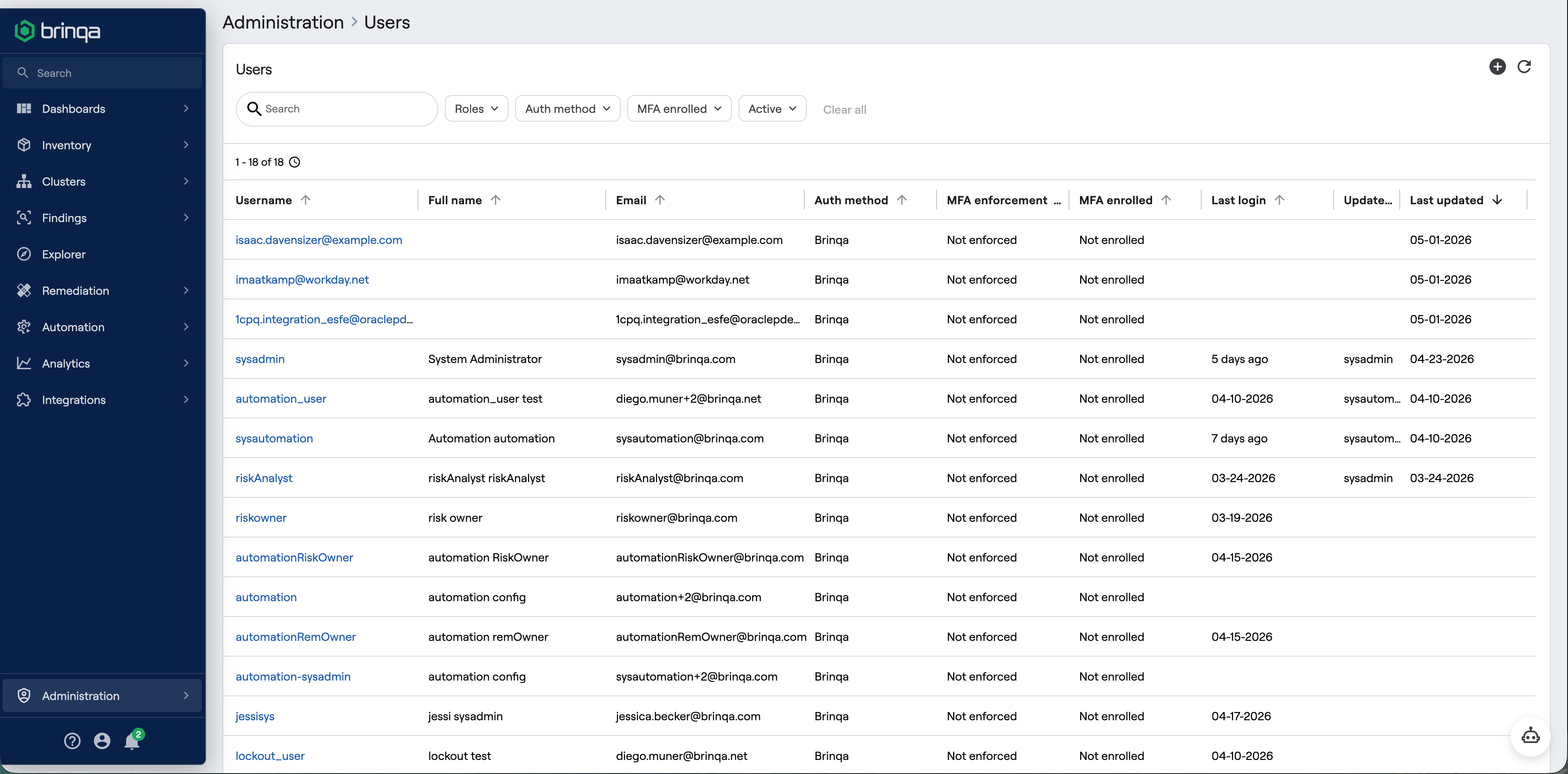
Version: v12 Displays a list view of your dashboards. Hold the pointer over Analytics to display and choose from Dashboards and Visualizations.
 seen Jul 2026
· source
- Version: v12 You can create versatile and insightful dashboards with Brinqa's dashboard-building tools. These tools translate critical datasets into intuitive visuals and comprehensive analytics tailored to each data source. seen Jul 2026 · source
Other 21 capabilities
Data model evolution and schema updates shipped Implements structural changes to the core data models, including renaming software entities, adjusting relationship attributes, and introducing new alert data models.
release 17 total
- Remove Calculation as a mandatory field for category attributes. 11.29.138 · Jan 2025 · source · release history
- Added the ability for a user to transform an SDM attribute to a Number 11.29.19 · Nov 2024 · source · release history
- Added the ability for a user to transform a relationship type SDM attribute 11.29.19 · Nov 2024 · source · release history
- Created new MITRE data models: Attack Mitigation, Attack Pattern, Attack Tactic, Attack Technique, EOL Advisory 11.28.36 · Aug 2024 · source · release history
-
Adds new attributes
lifecycleInactiveDate,lifecyclePurgeDate,lifecycleStatus,sourceStatus, andstatusCategoryto Asset, Entity, and Finding data models. 11.27.26 · Jun 2024 · source · release history - Adds new data models: Remediation Validation Request and Team. 11.24.21 · May 2024 · source · release history
Enhanced report builder shipped Expands reporting capabilities with copy-paste of components, undo/redo history, clone functionality, and support for nested BQL calculations.
release
- Introduces Scheduled PDF Dashboard Snapshots: schedule exports as PDFs, target ownership groups, manage a personal My Snapshots inbox with expiration and bulk delete, and deliver via secure link or attachment. 12.3.295 · Sep 2026 · source · release history
- Added report inputs as filters at the top of reports for clarity 11.28.36 · Aug 2024 · source · release history
- Adds custom date format support to the report builder 11.27.31 · Jul 2024 · source · release history
- Adds undo or redo capability in the Report Builder editor for change management 11.13.5 · Oct 2023 · source · release history
- Adds support for copying and pasting report components within a single report or across different reports in the Report Builder. 11.11.4 · Sep 2023 · source · release history
- Adds a Clone button in the report list to create copies of existing reports 11.10.27 · Aug 2023 · source · release history
example
-
Calculate rounded averages for attributes in a report using nested BQL functions.
round(average(attributeName))11.10.27 · Aug 2023 · source
System administration and troubleshooting shipped Provides administrative tools for usage tracking configuration, agent log collection, and viewing source data ingestion status.
release 7 total
- Users are now able to disable the Analytics source flow via Advanced settings. 11.30.173 · May 2025 · source · release history
- Update the Data Exporter role to restrict access to only exports created by that user. 11.29.138 · Jan 2025 · source · release history
- Enables adding multiple filters to Access Control Lists (ACLs) 11.27.31 · Jul 2024 · source · release history
- Adds a new automation action to create users in bulk and assign roles. 11.21.36 · Apr 2024 · source · release history
- Adds source data list view for system administrators to see imported connector data 11.8.30 · Jul 2023 · source · release history
- Adds Collect Logs button in the Integrations > Data servers slide-out to download Brinqa Agent logs for troubleshooting 11.5.4 · Jun 2023 · source · release history
Remediation tracking and ticketing shipped Supports tracking remediation progress through Sprints and automates ticket creation and closure based on finding status changes.
Also counts toward: Ticketing integration
release
- Adds support for pushing Alert tickets to Jira, allowing users to push tickets generated from alerts to Jira 11.29.98 · Dec 2024 · source · release history
- Adds the ability to schedule an export and send notifications via email 11.29.19 · Nov 2024 · source · release history
- Adds Remediation Campaigns to create collections of related tickets and track remediation against due dates 11.21.33 · Apr 2024 · source · release history
- Adds Sprints for tracking remediation progress, including automatic ticket closure when findings are closed and movement of unclosed findings to new tickets 11.0.8 · Apr 2023 · source · release history
- Adds the ability to create Tickets via automations to collect findings for remediation 11.0.8 · Apr 2023 · source · release history
Advanced notification configuration shipped Provides granular control over system notifications, including separate event triggers, custom HTML templates, and distinct success/failure handling.
release
- Adds Notification Templates with a merge-fields editor, data-model-aware dynamic variables, and the ability to clone and reuse templates across notification actions. 12.3.295 · Sep 2026 · source · release history
- Adds Notification Templates feature with merge-fields editor, data-model–aware dynamic variables, and template cloning for reuse across notification actions. 12.3.295 · Sep 2026 · source · release history
- Enables users to customize the HTML content of notification email templates 11.10.27 · Aug 2023 · source · release history
- Notification emails can now be configured separately for Success, Failure, or Success with skips events 11.1.4 · Apr 2023 · source · release history
Vulnerability data enrichment shipped Augments security findings with threat intelligence indicators and vulnerability metadata such as EPSS scores, CISA exploited status, and patch publication dates.
Shared capability: Vulnerability prioritization
release
- The NIST NVD connector is no longer supported in Brinqa Platform version 11.28 or later. 11.29.138 · Jan 2025 · source · release history
- Security finding data models include a new Patch published date attribute indicating the most recent available patch date 11.1.4 · Apr 2023 · source · release history
- Adds EPSS, CISA exploited, and other threat feed information to the Findings detail page 11.0.7 · Mar 2023 · source · release history
docs
- Version: v12 : Retrieving MITRE ATT&CK (Adversarial Tactics, Techniques, and Common Knowledge) techniques improves detection and remediation strategies. seen Jul 2026 · source
Intelligent Vulnerability deduplication shipped Consolidates duplicate vulnerability definitions from multiple sources into unified Intelligent Vulnerability records with combined evidence and risk scoring.
release
- Adds a new Intelligent Vulnerabilities relationship tab on Host, Container, and Container Image detail views. 12.3.295 · Sep 2026 · source · release history
- Introduces Vulnerability Deduplication (ExploitIQ): consolidates duplicate vulnerability definitions into a single Intelligent Vulnerability (IV) and Intelligent Vulnerability Definition (IVD) with consolidated evidence and risk scoring. 12.3.295 · Sep 2026 · source · release history
- Adds Intelligent Vulnerability (IV) and Intelligent Vulnerability Definition (IVD) models to consolidate duplicate vulnerability definitions into unified records with evidence and risk. 12.3.295 · Sep 2026 · source · release history
Intelligent Vulnerability relationship views shipped Provides dedicated relationship tabs on asset detail views to display consolidated Intelligent Vulnerabilities tied to specific hosts, containers, or images.
release
- Adds a new Intelligent Vulnerabilities relationship tab on Host, Container, and Container Image detail views. 12.3.295 · Sep 2026 · source · release history
- Adds new Intelligent Vulnerabilities relationship tab on Host, Container, and Container Image detail views to show consolidated vulnerabilities tied to each asset. 12.3.295 · Sep 2026 · source · release history
Unified sidebar navigation and theming shipped Redesigns the application interface with a collapsible sidebar, state-aware menu sections, multi-theme support, and improved visual styling.
release
- Redesigns the sidebar with collapsed-rail flyouts, collapsible submenu sections that remember their state, expanded multi-theme support, and broad styling improvements. 12.3.295 · Sep 2026 · source · release history
- Adds unified navigation & UI refresh with redesigned sidebar, collapsed-rail flyouts, collapsible submenu sections that remember state, multi-theme support, and broad styling improvements. 12.3.295 · Sep 2026 · source · release history
Dashboard organization and access control shipped Introduces sidebar navigation with category organization for dashboards and adds access control to restrict assets and risks based on user permissions.
release
- Enabled dashboard sidebar navigation, removing the dashboard list from the top bar and adding Category organization for dashboards 11.28.36 · Aug 2024 · source · release history
- Added access control to dashboards to restrict assets and risks based on user permissions 11.28.36 · Aug 2024 · source · release history
Cluster management configuration shipped Allows system administrators to define default clusters for unmatched records and manage custom cluster types for user access.
release
- Adds Informed users cluster type to grant multiple users access to an asset or finding without standard permissions 11.14.36 · Oct 2023 · source · release history
-
Adds ability to assign a
default clusterfor each cluster type so unmatched records fall into it 11.8.30 · Jul 2023 · source · release history
View customization and history shipped Permits users to clone and customize system views for specific data models, view historical finding context on tickets, and track previous states.
release
- Adds Previous findings tab on the ticket Details view to gain historical context for a specific vulnerability definition 11.14.36 · Oct 2023 · source · release history
- Adds the ability to clone system views from the data model page and edit them as custom views for asset pages and finding pages. 11.6.4 · Jun 2023 · source · release history
BrinqaIQ Assistant capabilities documented Provides a chatbot interface powered by self-hosted open-source models as part of the BrinqaIQ AI initiative.
Also counts toward: Built-in AI assistant, Self-hosted deployment
docs
- Version: v12 What is BrinqaIQ Assistant? BrinqaIQ Assistant is a chatbot powered by self-hosted open-source models that is part of Brinqa’s broader BrinqaIQ AI initiative. docs update · Sep 2026 · source
ServiceNow integration documented Enables data exchange with ServiceNow, specifically supporting Problem and ProblemTask records via API.
Also counts toward: Ticketing integration
docs
-
ServiceNow API Problem, ProblemPtask
docs update · Sep 2026
· source
Third-party cloud resource connectors documented suggested Ingests asset and vulnerability data from external cloud platforms including Microsoft Azure (Container Service, Identity, Network) and Parquet formats, as well as Pentera.
Suggested capability: Attack surface inventory. This is our guess, not confirmed.
Also counts toward: Import from a competing product
docs
-
Microsoft Azure Container Service Cloud Resource Microsoft Azure Identity Cloud Resource Microsoft Azure Network Cloud Resource Parquet Connector Pentera Cloud Resource, Host, Site, Vulnerability, Vulnerability Definition
docs update · Sep 2026
· source
Remediation campaign push shipped Allows configuration to push Remediation Campaigns directly to external tools.
release
- Added configuration capability to push Remediation Campaigns to external tools 11.28.36 · Aug 2024 · source · release history
SSO login redirect shipped Redirects users immediately to their identity provider when choosing SSO at login, skipping the intermediate selection step.
release
- Redirects users immediately to their identity provider when choosing SSO at login. 11.24.21 · May 2024 · source · release history
Environment monitoring dashboard shipped Provides a dedicated dashboard for monitoring Brinqa environment performance and identifying emerging issues.
release
- Adds the Brinqa Administrator dashboard for monitoring environment performance and identifying emerging issues 11.18.19 · Jan 2024 · source · release history
Bulk asset and finding management shipped Enables administrators to perform mass updates on Assets, Findings, and Tickets directly from their respective list views.
release
- Adds bulk update capability for Assets, Findings, and Tickets from their respective list pages 11.8.30 · Jul 2023 · source · release history
Manual data entry shipped Allows users to manually create and edit findings or assets directly within the platform without external ingestion.
release
- Adds Manual entry feature allowing creation and editing of findings or assets directly in Brinqa 11.8.30 · Jul 2023 · source · release history
Backup and disaster recovery management documented Automates off-site data backups to Google Cloud Storage with configurable retention tiers and defines recovery time objectives.
Also counts toward: Disaster recovery, Scheduled jobs
docs
- : Every three hours. Off-site backups are stored in Google Cloud Storage (GCS). Off-site backups are retained for 30 days in GCS standard storage, then archived for an additional 90 days using tiered storage options. : 3 hours maximum data loss (based on the backup schedule). : 3-18 hours dependent on database size. seen Sep 2026 · source
Lines in monospace are the tool's own words: help text
parsed from its source, or an endpoint from its API document. Under
release, a line is our summary of a dated release. Under
docs, it is quoted from the tool's own documentation or
website. Each links back to the source it came from.
Screenshots
From the release notes, newest first. Click one to see it full size.Score card
-
Shipping velocity releases a month, last 12 months
-
Documentation quality release-notes rubric, 0–100
-
Breaking-change discipline how rarely a release breaks users, and notice given
-
Maintenance risk quiet time against its own cadence, maintainers
-
Innovation & surface new capabilities, API and MCP surface
Five scores for Brinqa, each built from the releases, notes and API history this site tracks — and, on Researcher and Business, where it stands among every measured tool in its category and how that has moved.
Score cards are part of every paid plan.
See plans → Already subscribed? Sign in →Trajectory
Blank means never measured; nothing here is a filled-in zero.
Peer standings are included with Researcher and Business. See how this tool ranks against its competitors, using data we don't publish anywhere else.
See plans →Each score is 0–100 on a published rubric, derived from data this site already shows. A dimension we cannot measure says so — it is never scored 0 and never enters a rank.
How this is scored
- Shipping velocity — releases a month over the last 12 months, on a log scale where 16 a month scores 100. Needs 3 releases in the window.
- Documentation quality — the release-notes rubric published on the analytics page, unchanged.
- Breaking-change discipline — the share of releases carrying a breaking change (none scores 100, half or more scores 0). Only projects that label breaking changes are measured: a clean record cannot be told from an unlabelled one.
- Maintenance risk — quiet time measured against the tool's own release cadence (quiet longer than 90 days and three typical gaps scores 0), plus the number of active maintainers and whether contributors are growing, where known. Higher is lower risk.
- Innovation & surface — new capabilities in the feature ledger this year, API and MCP operations added, and the share of commits that are features: the mean of whichever we hold.
- Community health (open-source tools only) — each is a direction, not a size: contributors this year against last, the bus factor now against a year ago, and issues closed per issue opened, where steady scores 50, doubled 100 and halved 0; plus the median time to a maintainer's first reply (an hour scores about 100, a month or more 0). A commercial card has no repository and carries none of the four.
- Documented delivery (commercial tools) — when a vendor's documented new capabilities have slowed against its own baseline, that counts against the overall standing as heavily as two low dimensions. Steady delivery, or too little history to judge, leaves the standing alone; it is never a sixth score.
- Open-source tools are scored on repository signals; commercial tools on their published changelog. Ranks compare tools within one category and one profile and need at least five measured peers; the overall standing needs three ranked dimensions. Best-in-breed or consolidator is a shape, not a quality, and is never scored.
Release-note detail over time
See how much detail Brinqa puts in its release notes, quarter by quarter, and compare it with tracked tools in the same category. This history uses up to ten retained, reviewed notes per tool; sparse or blank older quarters may reflect that limit.
Checking release-note history…
Website history
brinqa.com, every changeBrinqa's home, pricing and product pages and 1 more page as they looked each month from September 2021 to October 2026: 13 renders, 6 changes of tagline or palette. Step through them, play them, or put any two months side by side.
Website history is included with Researcher and Business.
See plans → Already subscribed? Sign in →← → or h l a month · Shift a year · [ ] previous / next change · Space play · 1 2 3 page · T whole page · C compare · F full size
← → or h l the right month · Shift the left · S swap · W wipe · T whole page · Esc back
Rebranding timeline
Dates bound when a change appeared between captures. Possible rebrands are AI suggestions; a redesign alone does not establish a rebrand.
Releases
75 entries
No entries match these filters.
- September 20268
- August 20266
- July 202614
- June 20261
- April 20261
- February 20261
- January 20262
- October 20251
- September 20251
- August 20251
- July 20251
- May 20251
- April 20252
- March 20252
- February 20252
- January 20252
- December 20242
- November 20242
- October 20241
- August 20242
- July 20242
- June 20241
- May 20242
- April 20242
- March 20241
- January 20241
- November 20231
- October 20232
- September 20231
- August 20231
- July 20231
- June 20232
- May 20231
- April 20232
- March 20231
- February 20231
Add the badge to your README
Maintain this project? The badge links readers straight to this page, so they can follow every release here.
 Choose a badge style and copy the code →