Certiv
Token Spend Is a Potential Signal for a Rogue Agent commercialThe section your link pointed to isn't on Certiv's page any more, so we've brought you to the top.
Certiv is an AI agent assurance platform for endpoints that discovers every agent, monitors activity in real time, and enforces policy before risky actions execute.
Summary
Certiv is a commercial AI security product that enforces spend and access controls on AI agents running across company endpoints, deployed as a single install called Scout that works alongside existing device management tools. Beyond discovery, it lets teams set per-endpoint dollar budgets against negotiated contract rates, with Report, Notify, and Block modes that let a security or IT team watch consumption before deciding to stop a runaway agent's prompts at the endpoint; a simulation feature checks a proposed threshold against historical usage first, so enforcement doesn't surprise anyone. A separate Privacy Mode keeps compliant agent sessions hidden from security teams by default, logging who accesses one and why, which points to compliance and governance owners as much as security staff.
Certiv is an AI agent assurance platform for endpoints that discovers every agent, monitors activity in real time, and enforces policy before risky actions execute.
How Certiv helps
Which AI agents are running on our endpoints right now, and what are they actually doing?
a single endpoint install builds a live catalog of agents, tools, MCP servers, and LLMs in use, scored for risk and updated as sessions run, including agents nobody registered or approved
Is one of our agents currently being manipulated or exfiltrating data?
the policy engine reads the session as a whole rather than isolated events, flagging deviations like out-of-scope credential calls or data staged for an external post, and can block the action before it executes
Which agent sessions actually need a security reviewer's attention today?
with Privacy Mode enabled, only sessions that tripped a policy violation are surfaced automatically, while compliant sessions stay hidden until someone records a justified reason to view them
Who looked at a private, compliant agent session, and why?
every access to a session hidden by Privacy Mode is logged with the reviewer's identity and their recorded justification, giving compliance and works councils an audit trail
Which endpoints or agents are burning through model spend faster than expected?
session-level token attribution breaks down cost by agent, endpoint, user, and model with historical trend views, so an abnormal consumption pattern is visible before it becomes a budget problem
Which endpoint would have blown its budget if we'd enforced a limit last month?
budget simulation replays historical usage against a proposed per-endpoint dollar threshold, showing how often it would have fired before you switch that endpoint into blocking mode
Languages
Features
Built from Certiv's releases, docs, README and our own runs. “Seen” marks the month we first spotted a release the vendor didn't date. Group names and tags are our labels.
What Certiv offers you
- Administrative audit log1
- REST API
No capabilities match.
All capabilities 6 capabilities
Token Budgeting shipped Enforces per-endpoint dollar budgets with configurable per-model rates and three enforcement modes: Report, Notify, or Block.
release 9 total
- Adds ability to set dollar budgets per endpoint with configurable enforcement actions: Report, Notify, or Block. Token Spend Is a Potential Signal for a Rogue Agent · Sep 2026 · source · release history
- Adds support for entering contract-accurate rates per model in Certiv Cost instead of relying on list pricing. Token Spend Is a Potential Signal for a Rogue Agent · Sep 2026 · source · release history
- Supports custom contract rates entered per model so budget thresholds reflect what your organization actually pays rather than list pricing. Token Spend Is a Potential Signal for a Rogue Agent · Sep 2026 · source · release history
- Supports configurable custom rates per model so budget thresholds reflect negotiated pricing rather than list pricing. announced · Sep 2026 · source · release history
- Adds support for entering negotiated per-model rates so budget thresholds are computed against actual contracted pricing rather than list pricing. announced · Sep 2026 · source · release history
- Adds per-endpoint dollar budgets with three enforcement modes: Report (logs overage, no interruption), Notify (fires alerts, work continues), and Block (stops future prompts at the endpoint before the request leaves). Token Spend Is a Potential Signal for a Rogue Agent · Sep 2026 · source · release history
example
-
Switch to Block mode on high-risk endpoints once you have a baseline, so a runaway agent session is stopped at the endpoint before the prompt leaves and drains shared quota.
In the Certiv console, go to Cost > Endpoints, select the endpoint, and change the enforcement mode from 'Notify' to 'Block' — future prompts exceeding the budget are stopped before the request is…Token Spend Is a Potential Signal for a Rogue Agent · Sep 2026 · source -
Start monitoring token spend without interrupting work — switch to Block only after you understand normal consumption patterns for an endpoint.
In the Certiv console, go to the endpoint you want to protect, open Cost settings, set a dollar budget for your chosen period, and set the enforcement mode to 'Notify'.Token Spend Is a Potential Signal for a Rogue Agent · Sep 2026 · source -
Contain a potentially runaway agent by enforcing a hard spending ceiling on a single endpoint — stopping future prompts before they leave.
In Certiv Cost, select the target endpoint, set a dollar budget for your chosen period, and set the enforcement mode to Block.announced · Sep 2026 · source
Privacy Mode shipped Controls session visibility by defaulting compliant sessions to private and surfacing only policy-violating sessions, while logging justified access for audit trails.
Also counts toward: Administrative audit log
release 8 total
-
New Privacy Mode changes session visibility defaults so only sessions with policy violations are automatically surfaced to security teams, while compliant sessions stay private unless an authorized user records an explicit justification for access.
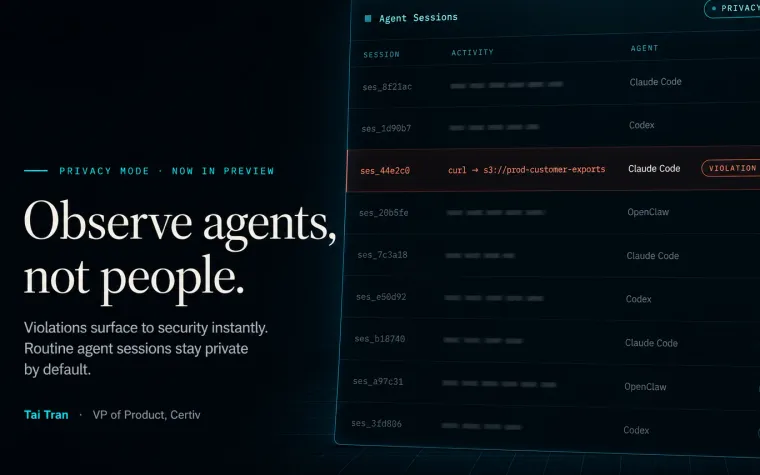 Enterprise Security with Privacy by Design: Introducing Privacy Mode · seen Aug 2026
· source
· release history
- Privacy Mode integrates with the existing Policy Engine and Scout endpoint observer: policy verdict determines session visibility without altering real-time Block, Pause, and Steer interventions. Enterprise Security with Privacy by Design: Introducing Privacy Mode · seen Aug 2026 · source · release history
- Certiv logs who accessed a private compliant session and the recorded reason, creating an auditable trail for governance, privacy teams, and works councils. Enterprise Security with Privacy by Design: Introducing Privacy Mode · seen Aug 2026 · source · release history
- Privacy Mode integrates with the existing Policy Engine and Scout endpoint observer — Block, Pause, and Steer runtime interventions continue operating unchanged; Privacy Mode governs only post-session review access. Enterprise Security with Privacy by Design: Introducing Privacy Mode · Jul 2026 · source · release history
- Adds Privacy Mode feature that keeps compliant AI agent sessions private by default while surfacing violations automatically to security teams Enterprise Security with Privacy by Design: Introducing Privacy Mode · Jul 2026 · source · release history
- Introduces Privacy Mode (now in Preview), which restricts session visibility by default so that only agent sessions with policy violations are automatically surfaced to security teams. Enterprise Security with Privacy by Design: Introducing Privacy Mode · Jul 2026 · source · release history
example
-
Enable Privacy Mode in a proof of value to observe AI agents without broad surveillance concerns.
Contact your Certiv team to enable Privacy Mode for the Proof of ValueEnterprise Security with Privacy by Design: Introducing Privacy Mode · Jul 2026 · source
Budget Simulation shipped Uses historical usage data to project how often endpoints would hit proposed spending thresholds before enforcement.
release
- Adds a budget simulation feature that uses historical usage to project how often an endpoint would have hit a proposed threshold before you enforce it. Token Spend Is a Potential Signal for a Rogue Agent · Sep 2026 · source · release history
- Adds a budget simulation feature that shows how often an endpoint would have hit a proposed threshold using historical usage, making it easier to calibrate limits before enforcing them. announced · Sep 2026 · source · release history
- Adds budget simulation using historical usage data, letting teams preview how often a proposed threshold would have been hit before switching to enforcement. announced · Sep 2026 · source · release history
- Adds budget simulation using historical usage to preview how often an endpoint would have hit a proposed threshold before enforcing it. Token Spend Is a Potential Signal for a Rogue Agent · Sep 2026 · source · release history
example
-
Validate a proposed budget ceiling against real historical traffic before enforcing it, to avoid blocking legitimate work.
In Certiv Cost, open the budget simulation view for the endpoint, enter a proposed dollar threshold, and review how many times that ceiling would have been triggered in the historical usage period.announced · Sep 2026 · source -
Use the budget simulation against historical usage to pick a threshold that would have caught past overruns without generating noise before switching an endpoint to Block mode.
In the Certiv console, go to Cost > Endpoints, select an endpoint, enter a proposed dollar budget, and run the simulation — Certiv Cost shows how many times that ceiling would have been triggered…Token Spend Is a Potential Signal for a Rogue Agent · Sep 2026 · source
End-User Spend Visibility shipped Allows end-users to view their own per-endpoint token consumption broken out by hour via the Scout interface.
release
- Adds a Scout view giving end users visibility into their own per-endpoint token consumption broken out by hour, without requiring administrator access. announced · Sep 2026 · source · release history
- Adds end-user spend visibility in Scout, showing each user their own token consumption on their own endpoint broken out by hour. Token Spend Is a Potential Signal for a Rogue Agent · Sep 2026 · source · release history
- Adds user-level spend visibility in Scout Cost, showing individual consumption broken out by hour on their own endpoints. Token Spend Is a Potential Signal for a Rogue Agent · Sep 2026 · source · release history
- Adds a Scout end-user spend view showing each user their own token consumption on their own endpoint, broken out by hour. Token Spend Is a Potential Signal for a Rogue Agent · Sep 2026 · source · release history
Agent Cost Attribution shipped Provides session-level token tracking by agent, endpoint, user, and model with historical trend views to identify abnormal consumption.
release
- Adds Certiv Cost in public preview for token usage visibility across all agents, breaking down spend by model, endpoint, user, and session. Token Spend Is a Potential Signal for a Rogue Agent · Sep 2026 · source · release history
- Adds Certiv Cost (public preview) with session-level token attribution — tracking spend by agent, endpoint, user, and model — plus historical trend views to surface abnormal consumption. Token Spend Is a Potential Signal for a Rogue Agent · Sep 2026 · source · release history
- Adds session-level token attribution tracking spend by agent session, endpoint, user, and model with historical trend data. Token Spend Is a Potential Signal for a Rogue Agent · Sep 2026 · source · release history
AI Usage Discovery documented Detects and surfaces unsanctioned AI agents, models, and tools to enable governance before unauthorized usage creates risk.
docs
- Any Agent, Model, or Tool Minutes To Deploy Discover and govern unsanctioned AI before it becomes a security event seen Oct 2026 · source
Lines in monospace are the tool's own words: help text
parsed from its source, or an endpoint from its API document. Under
release, a line is our summary of a dated release. Under
docs, it is quoted from the tool's own documentation or
website. Each links back to the source it came from.
Command line
1 command for Certiv, each with where it came from. This tool has no source analysis yet, so there is no option reference and no captured run beside them.
No command matches.
Screenshots
From the release notes, newest first. Click one to see it full size.Score card
-
Shipping velocity releases a month, last 12 months
-
Documentation quality release-notes rubric, 0–100
-
Breaking-change discipline how rarely a release breaks users, and notice given
-
Maintenance risk quiet time against its own cadence, maintainers
-
Innovation & surface new capabilities, API and MCP surface
Five scores for Certiv, each built from the releases, notes and API history this site tracks — and, on Researcher and Business, where it stands among every measured tool in its category and how that has moved.
Score cards are part of every paid plan.
See plans → Already subscribed? Sign in →Trajectory
Blank means never measured; nothing here is a filled-in zero.
Peer standings are included with Researcher and Business. See how this tool ranks against its competitors, using data we don't publish anywhere else.
See plans →Each score is 0–100 on a published rubric, derived from data this site already shows. A dimension we cannot measure says so — it is never scored 0 and never enters a rank.
How this is scored
- Shipping velocity — releases a month over the last 12 months, on a log scale where 16 a month scores 100. Needs 3 releases in the window.
- Documentation quality — the release-notes rubric published on the analytics page, unchanged.
- Breaking-change discipline — the share of releases carrying a breaking change (none scores 100, half or more scores 0). Only projects that label breaking changes are measured: a clean record cannot be told from an unlabelled one.
- Maintenance risk — quiet time measured against the tool's own release cadence (quiet longer than 90 days and three typical gaps scores 0), plus the number of active maintainers and whether contributors are growing, where known. Higher is lower risk.
- Innovation & surface — new capabilities in the feature ledger this year, API and MCP operations added, and the share of commits that are features: the mean of whichever we hold.
- Community health (open-source tools only) — each is a direction, not a size: contributors this year against last, the bus factor now against a year ago, and issues closed per issue opened, where steady scores 50, doubled 100 and halved 0; plus the median time to a maintainer's first reply (an hour scores about 100, a month or more 0). A commercial card has no repository and carries none of the four.
- Documented delivery (commercial tools) — when a vendor's documented new capabilities have slowed against its own baseline, that counts against the overall standing as heavily as two low dimensions. Steady delivery, or too little history to judge, leaves the standing alone; it is never a sixth score.
- Open-source tools are scored on repository signals; commercial tools on their published changelog. Ranks compare tools within one category and one profile and need at least five measured peers; the overall standing needs three ranked dimensions. Best-in-breed or consolidator is a shape, not a quality, and is never scored.
Release-note detail over time
See how much detail Certiv puts in its release notes, quarter by quarter, and compare it with tracked tools in the same category. This history uses up to ten retained, reviewed notes per tool; sparse or blank older quarters may reflect that limit.
Checking release-note history…
Website history
certiv.ai, every changeCertiv's home page and 16 more pages as they looked each month from April 2026 to October 2026: 19 renders, 1 change of tagline or palette. Step through them, play them, or put any two months side by side.
Website history is included with Researcher and Business.
See plans → Already subscribed? Sign in →← → or h l a month · Shift a year · [ ] previous / next change · Space play · 1 2 3 page · T whole page · C compare · F full size
← → or h l the right month · Shift the left · S swap · W wipe · T whole page · Esc back
Rebranding timeline
Dates bound when a change appeared between captures. Possible rebrands are AI suggestions; a redesign alone does not establish a rebrand.
Releases
5 entries
No entries match these filters.
- September 20262
- August 20262
- July 20261
Add the badge to your README
Maintain this project? The badge links readers straight to this page, so they can follow every release here.
 Choose a badge style and copy the code →