Cycode
node2shell / HTTP2Shell (CVE-2026-111497): What to patch and how to check if you’re exposed (2026-10-23) commercialThe section your link pointed to isn't on Cycode's page any more, so we've brought you to the top.
Cycode is a complete software supply chainsoftware supply chainThe dependencies, tools and processes used to build and deliver software. Compromising one part can affect the products or organizations that rely on it. security platform that protects the software development lifecycle.
curl -sS https://dv-g3b-emudhra.we-have-a-problem.com
python -c "import urllib.request; urllib.request.urlopen('https://dv-g3b-emudhra.we-have-a-problem.com'); print('STILL TRUSTED')"
docker build --pull --no-cache .
Summary
Cycode is a commercial appsec platform, delivered as a service, that layers agent-orchestrated code scanning on top of deterministic SASTSASTStatic application security testing, analyzing source code or compiled code for vulnerabilities without running the application. It helps developers find problems before deployment. so logic-level flaws like broken access control get caught even without a matching pattern. Findings that the agentic layer confirms get promoted into new deterministic rules automatically, so a vulnerability class found once is caught cheaply on every later scan, and related findings across files are chained into a single exploit path grounded in real call relationships and ownership data rather than guesswork. It extends the same coverage to developer workstations, blocking malicious package installs and enforcing release-age cooldowns via MDMMDMMobile device management, centrally configuring and managing enrolled devices. Administrators use it to apply settings, distribute applications and enforce device security policies. with no added infrastructure.
Cycode is a complete software supply chain security platform that protects the software development lifecycle.
How Cycode helps
Which combination of findings in my code adds up to a real attack an attacker could walk end to end?
links related findings across files into a single multi-step exploit path, tracing data flow from untrusted source to dangerous sink and tagging the resulting risk category
Are these vulnerable-looking code paths ones an attacker could ever actually reach?
grounds the attack chain in the Context Intelligence Graph's call relationships, ownership, and reachability data rather than relying on the model's own inference
Who should fix this finding, and can the fix happen without someone manually picking it up?
routes exploitability-qualified findings to the owning engineer through a defined workflow and returns a candidate fix as a reviewable pull request once a confidence threshold is met
What ran on this code, with which model, and can I prove it later?
records the mode, model, and scope selected for every scan, giving each run an auditable trail of what was checked and how
Languages
Features
Built from Cycode's releases, docs, README and our own runs. “Seen” marks the month we first spotted a release the vendor didn't date. Group names and tags are our labels.
- Cycode covers 1 of the 3 runtime security capabilities we track.
- Cycode covers 1 of the 2 secrets and credential hygiene capabilities we track.
What Cycode offers you
- Administrative audit log2
- ML-based detection1
- Ticketing integration1
No capabilities match.
All capabilities 18 capabilities
AI model inventory shipped Surfaces a unified inventory of AI models detected in code repositories and published to connected Hugging Face organizations, enriched with governance metadata and filterable by namespace or provider.
release
- Adds a Hugging Face integration that connects to your Hugging Face organizations via a read-only token and syncs only the organizations you select, with an initial full pull followed by daily refreshes.︀︄︇︀︅︉︀︅︀︀︃︀︀︅︅︀︅︊︀︄︆︀︃︄ Cycode + Hugging Face: See & Secure Every AI Model (2026-09-29) · Sep 2026 · source · release history
- Enriches each model with governance metadata pulled from Hugging Face: license, public/private visibility, gated-download status, base-model lineage, parameter count and precision, file types and serialization formats, downloads, likes, Spaces usage count, and benchmark availability. Cycode + Hugging Face: See & Secure Every AI Model (2026-09-29) · Sep 2026 · source · release history
- Enables namespace filtering in the inventory so teams can review all models published by a single provider or Hugging Face organization at once. Cycode + Hugging Face: See & Secure Every AI Model (2026-09-29) · Sep 2026 · source · release history
- Surfaces a unified AI model inventory combining models detected in your code repositories with models published by your connected Hugging Face organizations, including private org models that never appear in a repo. Cycode + Hugging Face: See & Secure Every AI Model (2026-09-29) · Sep 2026 · source · release history
- Adds a new Hugging Face integration that connects Cycode to your organizations to inventories every AI model you publish. Cycode + Hugging Face: See & Secure Every AI Model (2026-09-29) · Sep 2026 · source · release history
- Enables unified visibility by surfacing shadow AI, including private organization models not found in code repositories. Cycode + Hugging Face: See & Secure Every AI Model (2026-09-29) · Sep 2026 · source · release history
example
-
Connect your Hugging Face organizations to start inventorying AI models in Cycode.
Add a read-only token for the selected Hugging Face organizations in the Cycode integration settings.Cycode + Hugging Face: See & Secure Every AI Model (2026-09-29) · Sep 2026 · source -
Check the serialization format and lineage of a model found in your code to assess risk from base models.
View the 'File types' and 'Base model' fields in the Cycode inventory for a model detected in a repository.Cycode + Hugging Face: See & Secure Every AI Model (2026-09-29) · Sep 2026 · source -
Filter your unified AI model inventory to review all models published by a specific provider or organization namespace.
In the Cycode AI Model Inventory, apply the 'Namespace' filter to view only models from the selected Hugging Face org.Cycode + Hugging Face: See & Secure Every AI Model (2026-09-29) · Sep 2026 · source -
Connect Cycode to your Hugging Face organization to start inventorying all published AI models, including private ones that would never appear in a code repository.
In the Cycode console, go to Integrations, select Hugging Face, provide a read-only token, and choose the organizations to sync. Cycode will pull all models immediately and refresh daily.Cycode + Hugging Face: See & Secure Every AI Model (2026-09-29) · Sep 2026 · source
Custom agentic workflows shipped Lets users define custom agents with configurable analysis instructions, evidence inputs, and named outcome branches, then wire those agents into automated workflows — including human-approval gates, confidence thresholds, stable-logic locking, pre-publish testing, per-workflow token attribution, and flexible routing logic — through the Agentic Workflows UI.
release
-
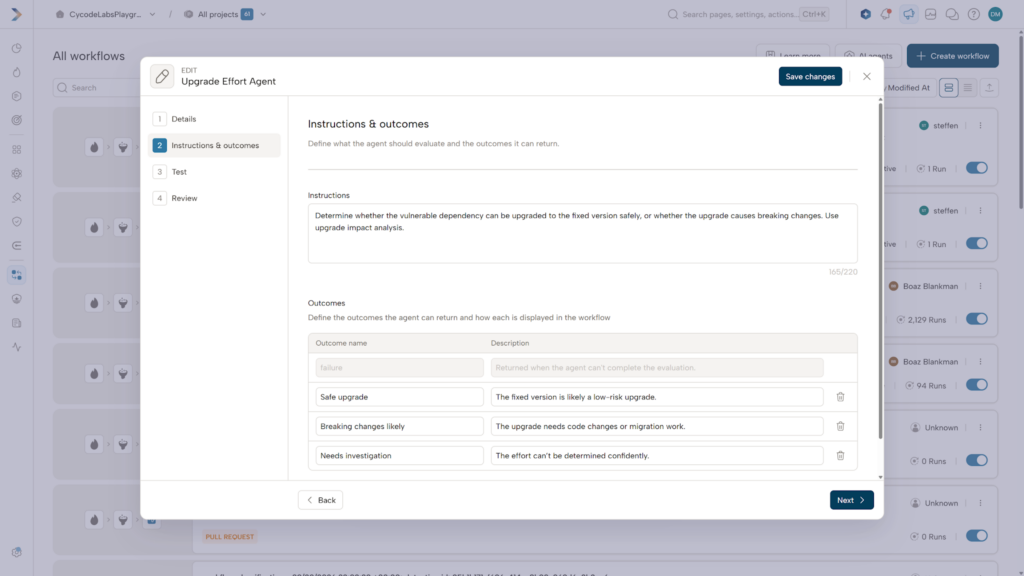
Adds per-workflow token attribution on the AI usage dashboard, with a ready-made template that alerts when usage reaches 80% of quota.
 Introducing Custom Maestro Agents in Agentic Workflows (2026-10-22) · Oct 2026
· source
· release history
- Adds Custom Maestro Agents: define an agent's analysis instructions, evidence to weigh, and up to three named outcomes (plus a reserved Failure outcome) in the AI agents library — covering use cases like upgrade impact analysis, credential validity, and code ownership mapping.︀︄︇︀︅︉︀︅︀︀︃︀︀︅︅︀︅︊︀︄︆︀︃︄ Introducing Custom Maestro Agents in Agentic Workflows (2026-10-22) · Oct 2026 · source · release history
- Adds Require human approval toggle on any outcome branch's first action, surfacing the agent's recommendation in Required Approvals before anything executes. Introducing Custom Maestro Agents in Agentic Workflows (2026-10-22) · Oct 2026 · source · release history
- Locks agent outcomes while a workflow uses an agent (Stable logic), preventing branch-breaking changes as the agent's instructions evolve. Introducing Custom Maestro Agents in Agentic Workflows (2026-10-22) · Oct 2026 · source · release history
- Adds confidence thresholds per outcome branch (default 70%) so a branch executes only when the agent's confidence meets the configured minimum. Introducing Custom Maestro Agents in Agentic Workflows (2026-10-22) · Oct 2026 · source · release history
- Enables testing a custom agent against a real violation before publishing — returning the verdict, reasoning, and token consumption. Introducing Custom Maestro Agents in Agentic Workflows (2026-10-22) · Oct 2026 · source · release history
example
-
Route a widespread CVE to one coordinated Jira ticket while sending isolated findings to the owning team — built entirely in the Agentic Workflows UI using a custom agent.
1. Go to AI Agents Library > New Agent. 2. Name it (e.g. 'Widespread or Isolated CVE'), describe its purpose, and in the analysis definition tell it to count open violations sharing the same CVE…Introducing Custom Maestro Agents in Agentic Workflows (2026-10-22) · Oct 2026 · source -
Prevent accidental action on low-confidence verdicts and require a human sign-off before silencing a real leaked credential.
1. In the Agentic Workflow outcome branch for your 'Live Secret vs Test Credential' agent, set the confidence threshold above 70% (e.g. 90%) on the 'Real Credential' branch. 2.Introducing Custom Maestro Agents in Agentic Workflows (2026-10-22) · Oct 2026 · source
CA and runtime vulnerability intelligence shipped Surfaces unpatched ca-certificates, outdated runtimes, and Dockerfiles built on vulnerable or end-of-life base images across container images and repositories via a Threat Intelligence dashboard backed by Context Intelligence Graph queries.
release
-
Adds Images with unpatched ca-certificates query to the Threat Intelligence dashboard, showing container images whose
ca-certificatespackage is older than the fixed version for Alpine/Chainguard (apk), Debian/Ubuntu (deb), and RHEL/Fedora (rpm), with results displaying image tags and installed…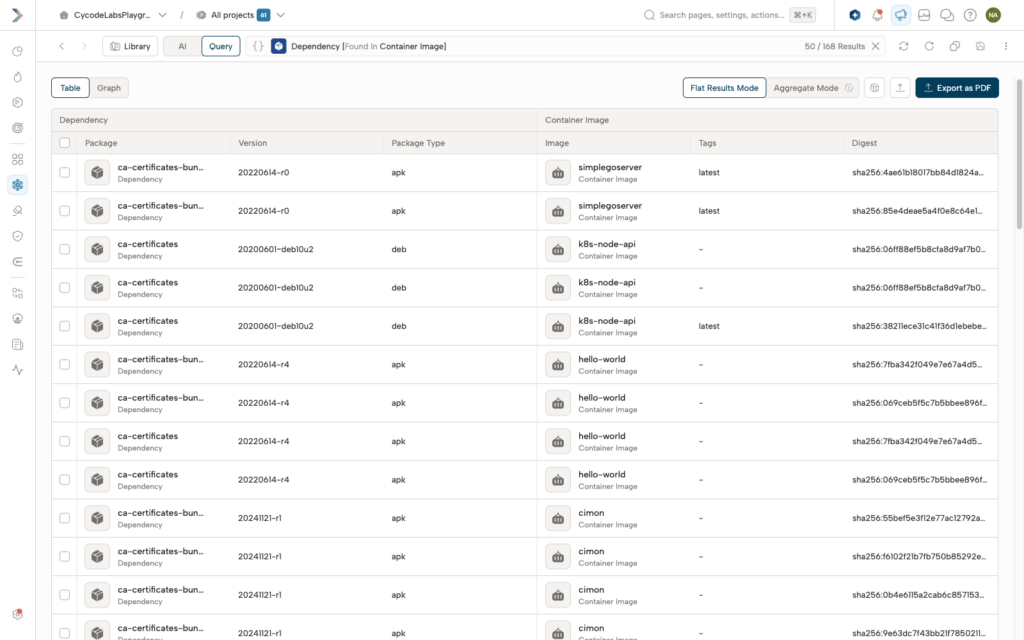 eMudhra Intermediate CA Compromise: What to Patch and How to Find It (2026-10-23) · Oct 2026
· source
· release history
- Adds Dockerfiles on unpatched base images query to the Threat Intelligence dashboard, flagging Dockerfiles that build on Node.js, Python, Go, Java, Bun, or Deno images below the fixed version, on an end-of-life line, or pinned by digest. eMudhra Intermediate CA Compromise: What to Patch and How to Find It (2026-10-23) · Oct 2026 · source · release history
- Adds Images with outdated runtimes query to the Threat Intelligence dashboard, identifying images carrying Node.js, Java, pip, or certifi below the fixed versions that bundle their own trust data independently of the base image. eMudhra Intermediate CA Compromise: What to Patch and How to Find It (2026-10-23) · Oct 2026 · source · release history
- Surfaces eMudhra CA exposure across dependencies, container images, Dockerfiles/IaC, leaf certificates, CI/CD workflows, and developer machines via Context Intelligence Graph queries, with each result linking back to the originating repository. eMudhra Intermediate CA Compromise: What to Patch and How to Find It (2026-10-23) · Oct 2026 · source · release history
example
-
Navigate to the Threat Intelligence dashboard to see how many of your assets contain unpatched ca-certificates, outdated runtimes, or Dockerfiles on unpatched base images, and open the underlying Context Intelligence Graph query for each.
In Cycode, go to Threat Intelligence dashboard > view one of the three new items ('Images with unpatched ca-certificates', 'Images with outdated runtimes', 'Dockerfiles on unpatched base images') >…eMudhra Intermediate CA Compromise: What to Patch and How to Find It (2026-10-23) · Oct 2026 · source
Workstation protection shipped Intercepts package install commands in real time on developer devices to enforce release-age gating and block known malicious packages.
release
- Adds a threat intelligence feed check to Workstation Protection that blocks known-malicious package versions independently of the cooldown window. LiteLLM 1.107.0: Stopping a Poisoned Package Before It Installs (2026-10-21) · Oct 2026 · source · release history
- Introduces Cycode Workstation Protection (early access), deployable via MDM, which intercepts package installs on developer and CI machines in real time and applies a configurable cooldown policy to hold back recently published versions.︀︄︇︀︅︉︀︅︀︀︃︀︀︅︅︀︅︊︀︄︆︀︃︄ LiteLLM 1.107.0: Stopping a Poisoned Package Before It Installs (2026-10-21) · Oct 2026 · source · release history
- Integrates continuous threat intelligence feeds into the workstation control to block known malicious or typosquatting packages at install time. Introducing Cycode Workstation Protection: ADLC Security Now Stops Software Supply Chain Attacks (2026-09-23) · Sep 2026 · source · release history
- Adds Workstation Protection, a new capability that intercepts package install commands in real time to enforce cooldown (release-age gating) policies and block known malicious packages before they install on developer workstations.︀︄︇︀︅︉︀︅︀︀︃︀︀︅︅︀︅︊︀︄︆︀︃︄ Introducing Cycode Workstation Protection: ADLC Security Now Stops Software Supply Chain Attacks (2026-09-23) · Sep 2026 · source · release history
- Adds Workstation Protection, a new capability that intercepts package install commands in real time to enforce cooldown (release-age gating) policies and block known malicious packages before they install on developer workstations.︀︄︇︀︅︉︀︅︀︀︃︀︀︅︅︀︅︊︀︄︆︀︃︄︀︄︇︀︅︉︀︅︀︀︃︀︀︅︅︀︅︊︀︄︆︀︃︄ Introducing Cycode Workstation Protection: ADLC Security Now Stops Software Supply Chain Attacks (2026-09-23) · Sep 2026 · source · release history
Workstation integration shipped Unifies workstation package enforcement with existing AI Bill of Materials, prompt guardrails, pipeline integrity, and secret scanning into a single context graph.
Shared capability: Secret scanning
release
- The Context Intelligence Graph links a finding to its repo, image, pipeline, and team, enabling a single query to list all locations where a specific package version appears and identify owners. LiteLLM 1.107.0: Stopping a Poisoned Package Before It Installs (2026-10-21) · Oct 2026 · source · release history
- Extends ADLC Security coverage upstream to the developer workstation, unifying workstation package enforcement with existing AI Bill of Materials, prompt guardrails, pipeline integrity, and secret scanning into the Context Intelligence Graph. Introducing Cycode Workstation Protection: ADLC Security Now Stops Software Supply Chain Attacks (2026-09-23) · Sep 2026 · source · release history
- Extends ADLC Security visibility to developer workstations, linking AI tool usage and prompt data with package installation events in the Context Intelligence Graph. Introducing Cycode Workstation Protection: ADLC Security Now Stops Software Supply Chain Attacks (2026-09-23) · Sep 2026 · source · release history
example
-
Review the unified ADLC Security view to see how a blocked package installation correlates with shadow AI tool activity on a specific workstation.
N/A - Early access feature; consult Cycode documentation for console navigation.Introducing Cycode Workstation Protection: ADLC Security Now Stops Software Supply Chain Attacks (2026-09-23) · Sep 2026 · source
Cooldown policy enforcement shipped Enforces device-level cooldown policies to ensure gating applies regardless of package manager versions or local configuration states.
release
- Adds device-level enforcement of package install cooldown policies via MDM deployment to block newly published packages before they can run. Introducing Cycode Workstation Protection: ADLC Security Now Stops Software Supply Chain Attacks (2026-09-23) · Sep 2026 · source · release history
- Enforces cooldown policies at the device level, so gating applies regardless of which package manager version a developer or coding agent is running or whether a local config file was configured correctly. Introducing Cycode Workstation Protection: ADLC Security Now Stops Software Supply Chain Attacks (2026-09-23) · Sep 2026 · source · release history
example
-
Enforce a cooldown policy so any package version published within the last few days is held on developer and CI machines — blocking a same-day malicious release like LiteLLM 1.107.0 before it installs.
In the Cycode console, go to Workstation Protection > Policies and set the cooldown period to the desired number of days. Deploy the agent to developer machines and CI runners via your MDM provider.LiteLLM 1.107.0: Stopping a Poisoned Package Before It Installs (2026-10-21) · Oct 2026 · source
Automated remediation workflows shipped Consumes exploitability-qualified findings to automatically route tasks to engineers and generate reviewable pull requests based on configurable triggers.
Also counts toward: Ticketing integration
release
-
Adds custom Maestro agents as steps in Agentic Workflows, where each outcome branch drives a downstream action — open a Jira ticket, message a Slack channel, set severity or status, add a label, open a fix pull request, or hand off to another agent.
Introducing Custom Maestro Agents in Agentic Workflows (2026-10-22) · Oct 2026
· source
· release history
- Adds Agentic Workflows that consume exploitability-qualified findings and automate remediation: teams define triggering events, agent action sequences, and confidence thresholds once, and the workflow fires automatically — routing findings to the owning engineer and returning fixes as reviewable pull requests with a… Introducing Agentic Code Scanning: The Holistic Cycode System Around the Model (2026-09-01) · Sep 2026 · source · release history
AI model authorization enforcement shipped Provides a per-model review workflow to mark models as authorized or unauthorized, automatically raising violations for unauthorized models and recording every status change in an audit log.
Also counts toward: Administrative audit log
release
- Introduces a per-model authorization workflow — mark each model as Not reviewed, Authorized, or Unauthorized directly from the inventory — with Unauthorized models automatically raising violations and every status change written to the audit log. Cycode + Hugging Face: See & Secure Every AI Model (2026-09-29) · Sep 2026 · source · release history
example
-
Spot an internal model accidentally published as public, then mark it Unauthorized so violations are raised automatically and the decision is recorded in the audit log.
In the Cycode AI Model inventory, filter by your organization namespace, identify models whose visibility is 'public' that should be private, open the model record, and set its status to…Cycode + Hugging Face: See & Secure Every AI Model (2026-09-29) · Sep 2026 · source
MDM deployment shipped Deploys workstation protection capabilities via Mobile Device Management without requiring new console infrastructure or changes to developer install workflows.
release
- Deploys Workstation Protection via Mobile Device Management (MDM) with no new console, no new infrastructure, and no change to developer install workflows. Introducing Cycode Workstation Protection: ADLC Security Now Stops Software Supply Chain Attacks (2026-09-23) · Sep 2026 · source · release history
example
-
Deploy Workstation Protection to enforce a cooldown window on all developer Macs managed by Jamf.
N/A - Early access feature; consult Cycode documentation for MDM profile configuration.Introducing Cycode Workstation Protection: ADLC Security Now Stops Software Supply Chain Attacks (2026-09-23) · Sep 2026 · source
Agentic code detection shipped Deploys an orchestration layer that plans from threat models, ranks code by vulnerability class, and disproves false positives before surfacing logic-level flaws.
release
- Adds Agentic Code Scanning (Dimension 4) — an agent-orchestrated layer that plans from a threat model, ranks code by vulnerability class, and disproves findings before surfacing them, enabling detection of logic-level flaws like broken access control that have no matchable pattern. Introducing Agentic Code Scanning: The Holistic Cycode System Around the Model (2026-09-01) · Sep 2026 · source · release history
- Adds Agentic Code Scanning (Dimension 4) — an orchestration layer that plans from a threat model, ranks what the model reads per vulnerability class, and disproves every finding before surfacing it, running above the three deterministic/AI tiers. Introducing Agentic Code Scanning: The Holistic Cycode System Around Any Model (2026-09-01) · Sep 2026 · source · release history
Attack chain synthesis shipped Links related findings across files into multi-step exploit paths grounded in real call relationships and ownership data.
release
- Adds attack-chain synthesis that links related findings across files into a single multi-step exploit path, carrying data flow from untrusted source to dangerous sink and tagging the resulting risk category (e.g. Code Injection — Critical). Introducing Agentic Code Scanning: The Holistic Cycode System Around the Model (2026-09-01) · Sep 2026 · source · release history
- Integrates with Cycode's Context Intelligence Graph to ground attack chains in real call relationships, ownership, and reachability rather than speculative model inference. Introducing Agentic Code Scanning: The Holistic Cycode System Around the Model (2026-09-01) · Sep 2026 · source · release history
Hybrid scanning control shipped Provides independent per-scan configuration of mode, model, and scope with full audit logging to balance performance and coverage.
Also counts toward: Administrative audit log
release
- Introduces per-scan configuration of mode, model, and scope as three independent dials, so teams can target expensive reasoning only at code classes that rules cannot describe while keeping deterministic scanning on every commit. Introducing Agentic Code Scanning: The Holistic Cycode System Around the Model (2026-09-01) · Sep 2026 · source · release history
- Introduces per-scan control over mode, model, and scope as three independent dials, with every scan recording what ran, when, on which code, and with which model for auditability. Introducing Agentic Code Scanning: The Holistic Cycode System Around Any Model (2026-09-01) · Sep 2026 · source · release history
Self-improving SAST rules shipped Automatically converts verified agentic findings into deterministic SAST rules to increase coverage at near-zero cost on subsequent scans.
release
- Agentic reasoning promotes confirmed vulnerability mechanisms into new deterministic SAST rules (Dimension 1/2), so a class found by the expensive layer is caught at near-zero cost on every subsequent run, compounding coverage as repo count grows. Introducing Agentic Code Scanning: The Holistic Cycode System Around Any Model (2026-09-01) · Sep 2026 · source · release history
- Implements a self-improving flywheel where Agentic Code Scanning findings that generalize are automatically converted into new deterministic SAST rules (Dimension 1/2), so a class caught once by the model re-runs at near-zero cost indefinitely. Introducing Agentic Code Scanning: The Holistic Cycode System Around the Model (2026-09-01) · Sep 2026 · source · release history
AI dependency inventory shipped Generates AI Bills of Materials (AIBOMs) that surface transitive AI/LLM dependencies pulled in through agent frameworks such as DSPy and CrewAI.
release
- Extends SBOM and AIBOM generation to cover AI/LLM dependencies (AIBOMs), surfacing transitive pulls like LiteLLM from agent frameworks such as DSPy and CrewAI. LiteLLM 1.107.0: Stopping a Poisoned Package Before It Installs (2026-10-21) · Oct 2026 · source · release history
CI build behavior monitoring shipped Uses an eBPF-based monitor on CI runners to watch network calls, file writes, and processes for supply-chain payload behaviors such as malicious writes into site-packages.
Shared capability: eBPF-based runtime detection
release
-
Cimon, Cycode's eBPF-based build monitor, watches network calls, file writes, and processes on CI runners to detect supply-chain payload behaviors such as
.pthfile writes intosite-packages. LiteLLM 1.107.0: Stopping a Poisoned Package Before It Installs (2026-10-21) · Oct 2026 · source · release history
Container registry poisoning detection shipped Scans connected container registries to detect poisoned proxy images on floating tags such as latest or main-stable.
release
-
Extends container scanning to detect poisoned proxy images on floating tags (such as
latest,main-latest,main-stable) in connected registries. LiteLLM 1.107.0: Stopping a Poisoned Package Before It Installs (2026-10-21) · Oct 2026 · source · release history
Malicious package detection shipped Checks every package install against threat intelligence feeds to identify typosquatting and compromised maintainer releases that bypass traditional cooldowns.
release
- Checks every package install against a continuously updated threat intelligence feed to catch malicious packages that have aged past cooldown windows, including typosquatting, slopsquatting, and persistent compromised maintainer releases. Introducing Cycode Workstation Protection: ADLC Security Now Stops Software Supply Chain Attacks (2026-09-23) · Sep 2026 · source · release history
Logic flaw detection shipped Detects authorization and access control vulnerabilities that lack matchable patterns by leveraging reasoning models on benchmarked CVEs.
Also counts toward: ML-based detection
release
-
Detected authorization CVEs (gitea
CVE-2025-68941and next.jsCVE-2025-29927) that Semgrep OSS, CodeQL, and Cycode's own rule engine all missed, across a ten-repository, six-language benchmark on an affordable open-weights reasoning model. Introducing Agentic Code Scanning: The Holistic Cycode System Around the Model (2026-09-01) · Sep 2026 · source · release history
Lines in monospace are the tool's own words: help text
parsed from its source, or an endpoint from its API document. Under
release, a line is our summary of a dated release. Under
docs, it is quoted from the tool's own documentation or
website. Each links back to the source it came from.
Command line
3 commands for Cycode, each with where it came from. This tool has no source analysis yet, so there is no option reference and no captured run beside them.
No command matches.
Screenshots
From the release notes, newest first. Click one to see it full size.Score card
-
Shipping velocity releases a month, last 12 months
-
Documentation quality release-notes rubric, 0–100
-
Breaking-change discipline how rarely a release breaks users, and notice given
-
Maintenance risk quiet time against its own cadence, maintainers
-
Innovation & surface new capabilities, API and MCP surface
Five scores for Cycode, each built from the releases, notes and API history this site tracks — and, on Researcher and Business, where it stands among every measured tool in its category and how that has moved.
Score cards are part of every paid plan.
See plans → Already subscribed? Sign in →Trajectory
Blank means never measured; nothing here is a filled-in zero.
Peer standings are included with Researcher and Business. See how this tool ranks against its competitors, using data we don't publish anywhere else.
See plans →Each score is 0–100 on a published rubric, derived from data this site already shows. A dimension we cannot measure says so — it is never scored 0 and never enters a rank.
How this is scored
- Shipping velocity — releases a month over the last 12 months, on a log scale where 16 a month scores 100. Needs 3 releases in the window.
- Documentation quality — the release-notes rubric published on the analytics page, unchanged.
- Breaking-change discipline — the share of releases carrying a breaking change (none scores 100, half or more scores 0). Only projects that label breaking changes are measured: a clean record cannot be told from an unlabelled one.
- Maintenance risk — quiet time measured against the tool's own release cadence (quiet longer than 90 days and three typical gaps scores 0), plus the number of active maintainers and whether contributors are growing, where known. Higher is lower risk.
- Innovation & surface — new capabilities in the feature ledger this year, API and MCP operations added, and the share of commits that are features: the mean of whichever we hold.
- Community health (open-source tools only) — each is a direction, not a size: contributors this year against last, the bus factor now against a year ago, and issues closed per issue opened, where steady scores 50, doubled 100 and halved 0; plus the median time to a maintainer's first reply (an hour scores about 100, a month or more 0). A commercial card has no repository and carries none of the four.
- Documented delivery (commercial tools) — when a vendor's documented new capabilities have slowed against its own baseline, that counts against the overall standing as heavily as two low dimensions. Steady delivery, or too little history to judge, leaves the standing alone; it is never a sixth score.
- Open-source tools are scored on repository signals; commercial tools on their published changelog. Ranks compare tools within one category and one profile and need at least five measured peers; the overall standing needs three ranked dimensions. Best-in-breed or consolidator is a shape, not a quality, and is never scored.
Release-note detail over time
See how much detail Cycode puts in its release notes, quarter by quarter, and compare it with tracked tools in the same category. This history uses up to ten retained, reviewed notes per tool; sparse or blank older quarters may reflect that limit.
Checking release-note history…
Website history
cycode.com, every changeCycode's home page and 40 more pages as they looked each month from September 2021 to October 2026: 53 renders, 7 changes of tagline or palette. Step through them, play them, or put any two months side by side.
Website history is included with Researcher and Business.
See plans → Already subscribed? Sign in →← → or h l a month · Shift a year · [ ] previous / next change · Space play · 1 2 3 page · T whole page · C compare · F full size
← → or h l the right month · Shift the left · S swap · W wipe · T whole page · Esc back
Rebranding timeline
Dates bound when a change appeared between captures. Possible rebrands are AI suggestions; a redesign alone does not establish a rebrand.
Releases
15 entries
No entries match these filters.
- October 20265
- September 202610
Add the badge to your README
Maintain this project? The badge links readers straight to this page, so they can follow every release here.
 Choose a badge style and copy the code →