Exabeam
New Threat Center Endpoint (2026-09-16) commercialThe section your link pointed to isn't on Exabeam's page any more, so we've brought you to the top.
Exabeam is a security analytics platform that detects insider threats and advanced cyberattacks through behavioral analysis and machine learning.
Summary
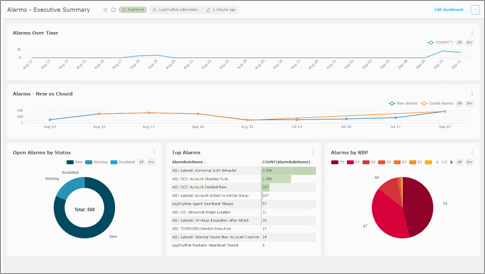
Exabeam is a commercial SIEMSIEMSecurity information and event management, collecting logs from many systems and correlating events to find suspicious activity. Analysts use it to investigate alerts and incidents. platform that unifies log collection, analytics, and threat detection into a cloud-native service, with self-hosted options available through its LogRhythm SIEM and Exabeam Appliances products for teams that cannot move data off-premises. It is aimed at SOCSOCA security operations center, the team or function that monitors threats, investigates alerts and coordinates incident response. Its work can be internal, outsourced or shared. analysts and threat-hunting teams who need to investigate and close cases rather than just collect logs, and it automates parts of that investigation with risk scoring, playbooks, and visualizations. Its documentation describes case management features like time-to-close tracking through its API, and it extends behavioral analytics beyond users to AI agents, positioning it against the OWASPOWASPA nonprofit foundation that publishes open standards, guides, and ranked vulnerability lists—most famously the OWASP Top 10—giving cyber tools a vendor-neutral benchmark to test or report against. Agentic AI framework for assessing agent-based risk. Launched in 2013, it remains under active development, with 11 releases tracked and the most recent shipped 37 days ago.
Exabeam is a security analytics platform that detects insider threats and advanced cyberattacks through behavioral analysis and machine learning.
How Exabeam helps
Who on the network is behaving differently than their own history suggests they should?
baselines each user's and entity's normal activity through behavioral analytics and machine learning, then risk-scores deviations so analysts see anomalies instead of raw log volume
Which of my cases are stalling before they get closed?
tracks each case's stage transitions and audit events through its lifecycle history, so a case sitting idle at a particular stage is visible rather than buried in the queue
Is an AI agent in my environment doing something outside its normal pattern?
extends behavioral analytics to agent activity and prompt/response flows across major AI platforms, flagging usage patterns that deviate from an agent's own baseline
How exposed is my agentic AI setup to known attack patterns?
assesses the configuration against the OWASP Agentic AI framework and reports where it falls short of that framework's controls
What led up to this alert, and what else happened in that case?
reconstructs a threat timeline from a given alert or case, laying out the sequence of related events rather than leaving the analyst to piece it together from raw logs
Can I pull case status and timing into another system without opening the console?
exposes case details, including when a case was closed, through the API so timestamps and lifecycle data can be consumed by external reporting or tracking tools
Languages
Features
Built from Exabeam's releases, docs, README and our own runs. “Seen” marks the month we first spotted a release the vendor didn't date. Group names and tags are our labels.
- Exabeam covers 5 of the 11 logs and telemetry capabilities we track.
- Exabeam covers 3 of the 8 investigation and response capabilities we track.
What Exabeam offers you
- REST API4
- Scheduled jobs3
- Agent-based deployment2
- Multi-tenant management2
- Role-based access control2
- STIX and TAXII2
- Built-in AI assistant1
- MCP server1
- Natural-language query1
- Plugin system1
- Self-hosted deployment1
- Ticketing integration1
- User-defined detection rules1
No capabilities match.
Log collection 4 features Logs and telemetry since 2025
Cloud collector expansion shipped Adds support for ingesting data from multiple new third-party platforms and services via Cloud Collectors.
Shared capability: Log collection
Also counts toward: STIX and TAXII, Ticketing integration
release 63 total
- Google Alert Center Cloud Collector for ingesting Google Workspace security alerts Exabeam September 2026 · Sep 2026 · source · release history
- Adds AWS Eventbridge Cloud Collector, AWS Shield Cloud Collector, Egnyte Cloud Collector, Symantec Email Security Cloud Collector, Symantec Cloud Secure Web Gateway Cloud Collector, Google Workspace Context Cloud Collector, REST API Context Cloud Collector, Armis Cloud Collector, Armis Context Cloud… Exabeam August 2026 · Aug 2026 · source · release history
- Adds the Google Workspace Context Cloud Collector, and early access support for Armis, AWS Inspector, AWS Redshift, Cybereason, Google Security Operations, Palo Alto SaaS Security, and Symantec CloudSOC cloud collectors. Exabeam July 2026 · Jul 2026 · source · release history
-
Adds
PingOne Identity Cloud Collectorfor user activity audit logs Exabeam May 2026 · May 2026 · source · release history - Adds Workday Cloud Collector for user activity logs from Workday API Exabeam May 2026 · May 2026 · source · release history
- Adds Workday Cloud Collector for early access to ingest user activity logs from the Workday API Exabeam April 2026 · Apr 2026 · source · release history
Direct Access Agent Collector shipped Collects native Windows Event Logs using a Direct Access Agent for enhanced data collection.
Shared capability: Log collection
Also counts toward: Agent-based deployment
release
-
Site Collectors > DAA Agents > Get a DAA collector support-package commandendpoint is now available New Site Collector Direct Access Agent (DAA) Endpoints (2026-08-27) · Aug 2026 · source · release history -
Site Collectors > DAA Agents > Get a DAA collector uninstallation commandendpoint is now available New Site Collector Direct Access Agent (DAA) Endpoints (2026-08-27) · Aug 2026 · source · release history -
Site Collectors > DAA Agents > Get a DAA collector installation commandendpoint is now available New Site Collector Direct Access Agent (DAA) Endpoints (2026-08-27) · Aug 2026 · source · release history - Direct Access Agent (DAA) Windows Event Log Collector collects logs natively from Windows servers Exabeam June 2026 · Jun 2026 · source · release history
- Adds Direct Access Agent (DAA) Windows Collector Early Access for native Windows Event Log collection Exabeam March 2026 · Mar 2026 · source · release history
Phishing Email Inbox Cloud Collector shipped Monitors phishing mailboxes by ingesting email data via a specialized cloud collector.
Shared capability: Log collection
release
- Phishing Email Inbox Cloud Collector ingests phishing mailbox metadata and logs Exabeam June 2026 · Jun 2026 · source · release history
- Adds Phishing Email Inbox Cloud Collector in Early Access for phishing mailbox monitoring Exabeam March 2026 · Mar 2026 · source · release history
Archive log collection shipped Expands file collector support to handle various archive formats for Windows and Linux environments.
Shared capability: Log collection
release
- Archive Linux Collector added to Site Collectors 2.6 for *.7z, *.arj, *.bzip2, *.cab, *.gzip, *.iso, *.lzh, *.rar, *.gz, *.tar, *.tar.gz, *.z, and *.zip log files Exabeam February 2025 · Feb 2025 · source · release history
- Archive Windows Collector added to Site Collectors 2.6 for *.gz, *.tar, *.tar.gz, *.gzip, *.rar, *.7z log files Exabeam February 2025 · Feb 2025 · source · release history
Log search 3 features Logs and telemetry since 2025
Search navigation and entity details shipped Provides quick search columns to navigate triggering events and device entity options to view details without leaving the application.
Shared capability: Log search
release 13 total
-
Global Search can now search by
ip_addressandfull_namefields Exabeam June 2026 · Jun 2026 · source · release history - Adds public/private visibility toggle for saved searches in Threat Center Exabeam May 2026 · May 2026 · source · release history
- Adds filtering of field names in the Search Results Summary list Exabeam May 2026 · May 2026 · source · release history
- Adds sorting by title, creator, and modification date to saved searches Exabeam May 2026 · May 2026 · source · release history
- Adds a platform-wide global search bar accessible via the Navigation Center Exabeam May 2026 · May 2026 · source · release history
- Adds Device Entity option in Basic search mode and Entities tab in Search results to view device details without leaving the application Exabeam April 2026 · Apr 2026 · source · release history
Search and indexing backend shipped Provides an in-place migration from Elasticsearch to OpenSearch to improve search and indexing performance while preserving self-hosted data control.
Shared capability: Log search
Also counts toward: Self-hosted deployment
release
-
Provides an in-place migration from Elasticsearch to OpenSearch, improving search and indexing performance while preserving self-hosted data control.
 announced · Oct 2026
· source
· release history
- Extends default search retention from 31 days to 45 days for New-Scale Analytics and Fusion licenses Exabeam December 2025 · Dec 2025 · source · release history
- Enhances Live Tail filtering to allow filtering the log stream by source collector in addition to parser. Exabeam November 2025 · Nov 2025 · source · release history
Search query and export options shipped Adds configuration options for relative date ranges in search queries and chronological sorting for exported search results.
Shared capability: Log search
release
-
Allows sorting search exports chronologically via the
sort order selectorin exported results. Exabeam September 2025 · Sep 2025 · source · release history - Introduces Relative time range option for Search queries allowing custom start/end relative dates. Exabeam January 2025 · Jan 2025 · source · release history
Log enrichment 3 features Logs and telemetry since 2025
Custom enrichment rules shipped Enables creating, editing, and managing custom enrichment rules directly within the Log Stream interface.
Shared capability: Log enrichment
release 13 total
- Adds read-only permission level for Log Stream to view parsers, enrichers, and filters without modification. Exabeam August 2026 · Aug 2026 · source · release history
-
Adds the
/log-stream/v1/...public API endpoints for Log Stream to programmatically manage parsers, event builders, and event enrichers. Exabeam August 2026 · Aug 2026 · source · release history - Adds new native field extraction expressions (Directory, Name, Extension, Registered Domain, etc.) for defining conditions in custom enrichment rules in Log Stream. Exabeam July 2026 · Jul 2026 · source · release history
- Adds Pre-Default and Post-Default ordering options for custom enrichers in Log Stream Exabeam May 2026 · May 2026 · source · release history
- Adds new selection menu with Expressions and Fields lists for field mapping in Log Stream enrichment rules Exabeam March 2026 · Mar 2026 · source · release history
-
Enables customization of the Host to IP enrichment condition via the
HostToIPplatform enrichment rule in the Log Stream Enrichment tab Exabeam January 2026 · Jan 2026 · source · release history
Attack Surface Insights integration shipped Links organizational entities to contextual data and provides a directory for managing entity-based resources.
Shared capability: Log enrichment
release
-
Adds
Discard_EM_USERandDiscard_EM_HOSTm_tagsvalues in Log Stream enrichment rules to control entity type creation in Attack Surface Insights Exabeam March 2026 · Mar 2026 · source · release history - Adds Link Reasons column to view linking methods between user entities and accounts in Attack Surface Insights Exabeam March 2026 · Mar 2026 · source · release history
- Extends entity deletion window in Attack Surface Insights to entities created in the past 1,000 days Exabeam December 2025 · Dec 2025 · source · release history
- Adds User Entity Links pre-built context table to control identity-to-entity linking in Attack Surface Insights Exabeam December 2025 · Dec 2025 · source · release history
- Adds Attack Surface Insights as a new directory for organizational resources (entities) linked by contextual data. Exabeam January 2025 · Jan 2025 · source · release history
- Allows viewing device entity details from Attack Surface Insights directly within Threat Center. Exabeam January 2025 · Jan 2025 · source · release history
Microsoft Entra ID Context Enhancement shipped Expands user context data for Microsoft Entra ID with additional attributes such as MFA status and manager information.
Shared capability: Log enrichment
release
-
Adds
ChatGPT Enterprise Cloud Collectorand Microsoft Entra ID Context Cloud Collector enhancements with MFA/SSPR attributes Exabeam March 2026 · Mar 2026 · source · release history - Adds new Microsoft Entra ID user context table columns: MFA Capable, MFA Registered, SSPR Registered, Auth Methods Registered, Manager Exabeam March 2026 · Mar 2026 · source · release history
Incident case management 3 features Investigation and response since 2025
Case management shipped Tracks case lifecycle details, including when a case was closed, to support time-to-close calculations.
Shared capability: Incident case management
release 23 total
-
Adds Exabeam Related Cases in Threat Center, correlating active and historical cases through shared artifacts and entities — including users, hosts, and IP addresses — and surfacing earlier notes and containment playbooks.
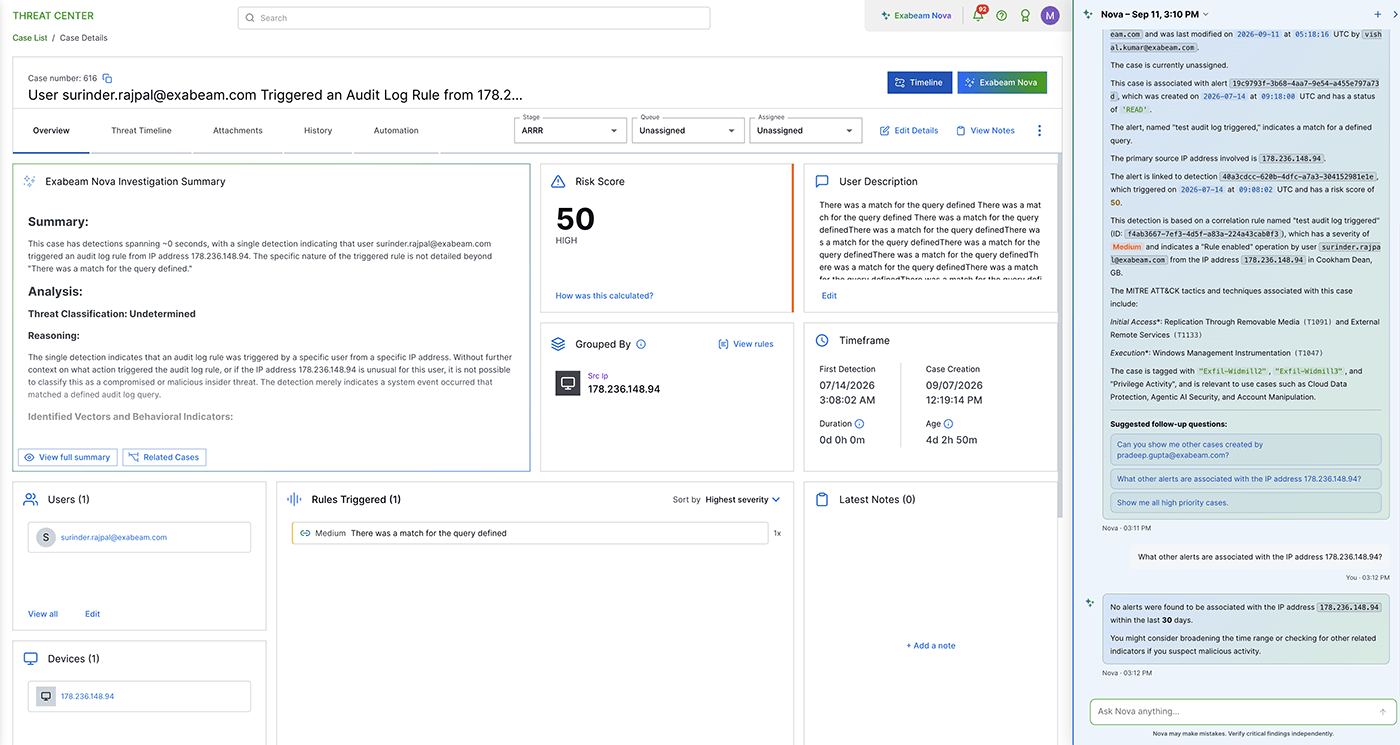 announced · Oct 2026
· source
· release history
-
Adds a
GETAPI endpoint underThreat Center > Cases > Get case lifecycle historyfor retrieving the comprehensive lifecycle history, stage transitions, and audit events of a case.︀︄︇︀︅︉︀︅︀︀︃︀︀︅︅︀︅︊︀︄︆︀︃︄ New Threat Center Endpoint (2026-09-16) · Sep 2026 · source · release history -
Adds the
GET /cases/{caseId}/lifecycle-historyAPI endpoint to retrieve comprehensive case lifecycle history and audit events New Threat Center Endpoint (2026-09-16) · Sep 2026 · source · release history -
Adds the
caseClosedTimestampfield to the Threat Center Cases > Get case details response schema Enhanced Threat Center Endpoint (2026-07-15) · Jul 2026 · source · release history -
Adds
caseClosedTimestamp(date-time string) to the Get Case Details response schema, exposing when a case was closed for Time to Close (TTC) and Mean Time to Close (MTTC) calculations. Enhanced Threat Center Endpoint (2026-07-15) · Jul 2026 · source · release history - Adds case creation, update, note creation, and alert update capabilities to the Exabeam MCP Server Exabeam May 2026 · May 2026 · source · release history
example
-
Review connections between an active case and historical investigations to reuse containment playbooks.
In Threat Center, open an active case, then navigate to the Related Cases panel to view correlated historical cases sharing users, hosts, or IP addresses, and access their notes and containment…announced · Oct 2026 · source -
Retrieve full audit trail and stage transitions for a specific Threat Center case via API
curl -X GET "https://<exabeam-instance>/api/v1/cases/{caseId}/lifecycle-history" -H "Authorization: Bearer <token>"New Threat Center Endpoint (2026-09-16) · Sep 2026 · source -
Calculate Time to Close for individual threat investigation cases via the API.
GET /cases/{caseId} # Response includes new field: caseClosedTimestamp (string, date-time)Enhanced Threat Center Endpoint (2026-07-15) · Jul 2026 · source
Phishing case automation shipped Merges related phishing investigation cases over a defined period to streamline analyst workflows.
Shared capability: Incident case management
release
- Merge Phishing Detection Engine Cases playbook merges related phishing cases over a 14-day period Exabeam June 2026 · Jun 2026 · source · release history
Case Creation from Detections shipped Enables the creation of standalone cases directly from correlation detections using grouping rules.
Shared capability: Incident case management
release
-
Enables creation of standalone cases from correlation detections via
detection grouping ruleusing thecorrelation rule group by field. Exabeam September 2025 · Sep 2025 · source · release history
Log parsing and normalization 1 feature Logs and telemetry since 2025
Log Stream parser quality visibility shipped Displays parser completeness and dependency metrics in the Parsers Overview tab to guide quality improvements.
Shared capability: Log parsing and normalization
release
- Adds Dependencies column to Log Stream Parsers Overview tab to show parser completeness and quality. Exabeam January 2025 · Jan 2025 · source · release history
Log routing 1 feature Logs and telemetry since 2026
Proxy routing for Intelligence Sync shipped Adds proxy routing support for the Intelligence Sync service to satisfy complex network compliance requirements.
Shared capability: Log routing
release
-
Adds proxy routing support for the LogRhythm Intelligence Sync service to meet complex network compliance requirements.
announced · Oct 2026
· source
· release history
Response playbook automation 1 feature Investigation and response since 2025
Advanced automation workflows shipped Supports complex logic including actions, branches, loops, draft deployment, and manual execution within the Automation Management system.
Shared capability: Response playbook automation
Also counts toward: Agent-based deployment
release 8 total
- Send Case Templated Email pre-built playbook for templated case notifications Exabeam September 2026 · Sep 2026 · source · release history
-
Adds Get Case Details and Get Alert Details actions to the pre-built threatcenter service in Automation Management, returning fields like
alertId,caseNumber, andmitres. Exabeam July 2026 · Jul 2026 · source · release history - Adds manual playbook execution on manually created Threat Center cases via Automation Management Exabeam March 2026 · Mar 2026 · source · release history
- Adds filtering of automation services by creator in the Automation Management section. Exabeam November 2025 · Nov 2025 · source · release history
-
Allows deletion of custom
servicesandactionsin the Automation Management section, provided they are removed from all existing playbooks first. Exabeam November 2025 · Nov 2025 · source · release history - Increases playbook name character limit to 205 characters and allows creation of up to 20 advanced playbooks without a trigger. Exabeam November 2025 · Nov 2025 · source · release history
Forensic timeline analysis 1 feature Investigation and response since 2025
Threat timeline retrieval shipped Retrieves a chronological threat timeline scoped to a specific alert or case.
Shared capability: Forensic timeline analysis
Also counts toward: REST API
release 16 total
-
Adds log ID tracking to the Advanced Intelligence Engine (AIE) for precise event drilldown.
announced · Oct 2026
· source
· release history
- New API endpoint to retrieve a threat timeline given a specific alert ID. New Threat Center Endpoints (2026-06-16) · Jun 2026 · source · release history
-
Added
Threat Center > Threat Timeline > Get the threat timeline given a case idendpoint. New Threat Center Endpoints (2026-06-16) · Jun 2026 · source · release history - New API endpoint to retrieve a threat timeline given a specific case ID. New Threat Center Endpoints (2026-06-16) · Jun 2026 · source · release history
-
Added
Threat Center > Threat Timeline > Get the threat timeline given an alert idendpoint. New Threat Center Endpoints (2026-06-16) · Jun 2026 · source · release history - Timeline view supports continuous scrolling without manual paging Exabeam June 2026 · Jun 2026 · source · release history
Other / not yet classified 24 features Features we have not matched to a capability yet. A suggested match is marked.
Threat detection management shipped suggested Provides a centralized interface for creating, testing, tuning, and managing correlation and analytics detection rules.
Suggested capability: Security event correlation. This is our guess, not confirmed.
Also counts toward: User-defined detection rules
release 48 total
- Exabeam MCP Server enhancements: API endpoints to update/create management rules, get rule details by template ID, and list/get parsers filtered by state/type Exabeam September 2026 · Sep 2026 · source · release history
-
triggerDependencyExpressionanalytics rule field with HasRuleTriggeredOnSameEvent() function to restrict rule triggers based on other rule state Exabeam September 2026 · Sep 2026 · source · release history - Adds timeofday(), timeofweek(), and timeofmonth() functions to analytics rule configurations to retrieve event date/time components. Exabeam August 2026 · Aug 2026 · source · release history
- Phishing Rule Detections assigned static rarity score of 50 in Threat Center Exabeam June 2026 · Jun 2026 · source · release history
- Exabeam Nova Rule Creator drafts correlation and analytics rules from natural language descriptions Exabeam June 2026 · Jun 2026 · source · release history
- Pre-built Phishing Rule detection grouping rule groups detections by email subject Exabeam June 2026 · Jun 2026 · source · release history
Nova AI assistant shipped Provides a persistent AI sidebar that follows analysts across Threat Center, search timelines, and Outcomes Navigator, retaining conversational context throughout a session.
Also counts toward: Built-in AI assistant
release 11 total
-
Adds a persistent Nova AI sidebar that follows analysts through Threat Center, search timelines, and Outcomes Navigator while retaining conversational context across workflows.︀︄︇︀︅︉︀︅︀︀︃︀︀︅︅︀︅︊︀︄︆︀︃︄
announced · Oct 2026
· source
· release history
- Persistent AI sidebar (Exabeam Nova) available globally across the New-Scale UI Exabeam September 2026 · Sep 2026 · source · release history
- Adds Exabeam Model Context Protocol (MCP) Server to connect external AI tools for discovering and acting on Exabeam data Exabeam April 2026 · Apr 2026 · source · release history
- Adds MCP server integration enabling AI assistants (Claude, ChatGPT, Gemini) to interact with Exabeam's API documentation. Exabeam MCP Server for Developers (2026-01-14) · Jan 2026 · source · release history
- Adds Threat Center global notifications including Case name, Exabeam Nova Investigation Summary, Risk score, Classification, and Threat vector Exabeam December 2025 · Dec 2025 · source · release history
- Extends Exabeam Nova AI to auto-create dashboard visualizations for the Anomaly Fields data model using natural language prompts. Exabeam November 2025 · Nov 2025 · source · release history
example
-
Connect an AI assistant to Exabeam for exploring APIs via natural language.
Configure your AI client (e.g., Claude, ChatGPT) to use the Exabeam MCP server endpoint as documented at https://developers.exabeam.com/exabeam/docs/exabeam-mcp-server-for-developers.Exabeam MCP Server for Developers (2026-01-14) · Jan 2026 · source
Agent behavior analytics shipped Extends behavioral analytics to AI agents and autonomous activity across major AI platforms and any agent sharing OpenTelemetry, covering event search, prompt and response flow analysis, and usage pattern monitoring.
release
-
Adds direct Claude Enterprise ingestion, placing activity logs and chat API data into a standardized timeline for monitoring non-human activity and establishing behavioral baselines.
announced · Oct 2026
· source
· release history
-
Adds collectors for ChatGPT, Google Gemini, and GitHub Copilot to ingest and parse enterprise AI platform telemetry into LogRhythm SIEM for logging and risk tracking.︀︄︇︀︅︉︀︅︀︀︃︀︀︅︅︀︅︊︀︄︆︀︃︄
announced · Oct 2026
· source
· release history
-
Adds new Agent Behavior Analytics context tables:
AI/LLM Web Domains,AI/LLM Web Categories,AI/LLM ApplicationsExabeam March 2026 · Mar 2026 · source · release history - Adds Microsoft Copilot support with Agent Behavior Analytics for monitoring AI-driven activity Exabeam March 2026 · Mar 2026 · source · release history
- Adds new AI-driven detections including identity/privilege misuse, prompt/model abuse, and agent lifecycle monitoring Exabeam March 2026 · Mar 2026 · source · release history
-
Adds
ChatGPT Enterprise Cloud Collectorfor ingesting ChatGPT Enterprise data via Agent Behavior Analytics Exabeam March 2026 · Mar 2026 · source · release history
docs
- standardizes agent telemetry, while collects and normalizes activity across models and runtimes. seen Sep 2026 · source
- Agent Behavior Analytics Agent Behavior Analytics View documentation for extending behavioral analytics to AI agents and autonomous activity across major AI platforms and any agent sharing open telemetry. seen Aug 2026 · source
- Skip to main content Collectors Agent Behavior Analytics Table of Contents Table of Contents Agent Behavior Analytics Overview Exabeam Agent Sensor Key capabilities of the Exabeam Agent Sensor Search Events Analyze Prompt and Response Flows Monitor Usage Patterns and Activity Across Users and Endpoints Prev Next Agent… docs update · Aug 2026 · source
- Agent Behavior Analytics View documentation for extending behavioral analytics to AI agents and autonomous activity across major AI platforms and any agent sharing open telemetry. docs update · Aug 2026 · source
example
-
Triage an alert queue using the Agentic SOC plugin inside Claude Code without writing complex prompts.
In Claude Code with the Exabeam Agentic SOC plugin active, type: 'Triage my current alert queue and prioritize cases by risk score' — the plugin translates this into the appropriate Exabeam…announced · Oct 2026 · source
Compliance reporting shipped Provides a self-service reporting engine with a library of customizable compliance graphs and reports that can be scheduled for recurring audit workflows.
Also counts toward: Scheduled jobs
release 11 total
-
Adds a next-generation self-service reporting engine with a library of customizable compliance graphs and reports that can be scheduled for recurring audit workflows.
announced · Oct 2026
· source
· release history
- REST API Context Tables support custom context sources mapped via the REST API Context collector Exabeam June 2026 · Jun 2026 · source · release history
- REST API Context Collector ingests context data from REST API endpoints (early access) Exabeam June 2026 · Jun 2026 · source · release history
-
Adds
NIST 800-53,NIIST CSF, andNIIS2compliance framework support in Outcomes Navigator Exabeam May 2026 · May 2026 · source · release history - Adds customizable framework selection in Outcomes Navigator (TDIR, MITRE ATT&CK, HIPAA, PCI DSS) Exabeam March 2026 · Mar 2026 · source · release history
- Adds Outcomes Navigator compliance coverage tracking for HIPAA and PCI DSS with Compliance Coverage Score Exabeam March 2026 · Mar 2026 · source · release history
Advanced Intelligence Engine rule management shipped Supports automated rule creation and real-time rule statistics with log ID tracking for precise event drilldown in the Advanced Intelligence Engine.
Also counts toward: REST API
release
-
Adds new APIs for automated rule creation and real-time rule statistics in the Advanced Intelligence Engine.
announced · Oct 2026
· source
· release history
- Adds log ID tracking to the Advanced Intelligence Engine (AIE) for precise event drilldown. announced · Oct 2026 · source · release history
- Adds Reorder button for enrichment rule priority ordering in Log Stream Enrichments tab Exabeam March 2026 · Mar 2026 · source · release history
- Adds pinned fields persistence to top of Parsed Fields list in Search Details panel Exabeam March 2026 · Mar 2026 · source · release history
- Introduces Enrichments tab in Log Stream for viewing, managing, enabling/disabling, editing, exporting, and importing enrichment rules. Exabeam January 2025 · Jan 2025 · source · release history
Scheduled reporting shipped Adds a tab within Dashboards for creating, managing, and triggering scheduled reports with bulk controls.
Also counts toward: Scheduled jobs
release
- Adds Every 2 Weeks as a recurrence option in the Recurrence field for scheduling reports. Exabeam July 2026 · Jul 2026 · source · release history
- Adds the Manage All Schedule Reports permission level for administrators Exabeam May 2026 · May 2026 · source · release history
- Adds Send Now and Delete bulk actions to the Scheduled Reports tab to send multiple reports immediately or remove them without waiting for configured delivery times. Exabeam June 2025 · Jun 2025 · source · release history
- Adds a Scheduled Reports tab in the Dashboards application with Run Now, Edit, Duplicate, and Delete controls Exabeam March 2025 · Mar 2025 · source · release history
- License View dashboard adds option to export details as a PDF file Exabeam February 2025 · Feb 2025 · source · release history
Multi-tenant Threat Center shipped Partitions a single subscription into virtual tenants with dedicated site management and role-based access controls, designed for MSSPs and business units.
Also counts toward: Multi-tenant management, Role-based access control
release
-
Adds Threat Center data segregation, partitioning a single New-Scale subscription into virtual tenants with dedicated site management and role-based access controls for MSSPs and business units.
announced · Oct 2026
· source
· release history
- Configurable tenant session timeout duration in the administration settings Exabeam September 2026 · Sep 2026 · source · release history
- Adds ability to add descriptive child names in the Multi-Org Console Exabeam March 2025 · Mar 2025 · source · release history
docs
- Configuring Tenant Session Timeout Important Considerations How to Configure Session Timeout Getting Started Example Supported Workflows seen Sep 2026 · source
Context table key identification shipped suggested Visually identifies the key attribute in Context Management custom and pre-built tables using a column header icon.
Suggested capability: Log enrichment. This is our guess, not confirmed.
Also counts toward: REST API, STIX and TAXII
release
-
Adds a visible key icon (
\u25CB) in column headers to identify the key attribute in Context Management custom and pre-built tables Exabeam January 2026 · Jan 2026 · source · release history - Adds STIX/TAXII Context Tables in Context Management for processing threat intelligence data Exabeam March 2025 · Mar 2025 · source · release history
docs
- Support for REST API Context Tables docs update · Aug 2026 · source
Threat Intelligence Cloud Collector shipped Ingests threat intelligence data from external cloud sources via specialized collectors.
release
- Adds S2W Threat Intelligence Cloud Collector for threat intel ingestion Exabeam May 2026 · May 2026 · source · release history
-
Adds
ChatGPT Enterprise Cloud Collectorand Microsoft Entra ID Context Cloud Collector enhancements with MFA/SSPR attributes Exabeam March 2026 · Mar 2026 · source · release history - Adds S2W Threat Intelligence Cloud Collector (Early Access) for threat intel ingestion Exabeam February 2026 · Feb 2026 · source · release history
Agentic SOC plugin shipped suggested Integrates with Claude Code and OpenAI Codex to let analysts run alert triage, case prioritization, and guided investigation workflows through conversational commands.
Suggested capability: Incident case management. This is our guess, not confirmed.
Also counts toward: Plugin system, REST API
release
-
Adds the Exabeam Agentic SOC plugin for Claude Code and OpenAI Codex, translating threat hunting workflows into conversational commands for alert queue triage, case prioritization, and guided investigation.
announced · Oct 2026
· source
· release history
- Provides three new Access Control API endpoints to programmatically retrieve lists of users, roles, and API keys. Exabeam April 2025 · Apr 2025 · source · release history
Outcomes Navigator coverage overrides shipped Lets security leaders adjust use case coverage scores in Outcomes Navigator when custom or unrecognized data sources satisfy specific security techniques.
release
-
Adds Outcomes Navigator overrides, letting security leaders adjust use case coverage scores when custom or unrecognized data sources satisfy specific security techniques.
announced · Oct 2026
· source
· release history
-
Adds
agentic_ai_securityuse case support in Outcomes Navigator Exabeam February 2026 · Feb 2026 · source · release history
OWASP Agentic AI framework assessment shipped Allows users to assess and improve their configuration against the OWASP Top 10 for Agentic Applications framework.
release
- Adds support for tracking coverage of the OWASP Top 10 for Agentic Applications framework in Outcomes Navigator, including AI Coverage Score. Exabeam July 2026 · Jul 2026 · source · release history
docs
- Use the OWASP Top 10 for Agentic Applications Framework View, assess, and improve your configuration using the OWASP Agentic AI framework. docs update · Jul 2026 · source
Visualization default configuration shipped Allows configuration of default field, metric, and chart type settings for the Custom Visualization authoring window.
release
- Custom Visualization window defaults Field = user, Metric = count, Chart Type = bar chart Exabeam June 2026 · Jun 2026 · source · release history
- Adds Home tab in Dashboards application to set a default landing dashboard Exabeam March 2026 · Mar 2026 · source · release history
Watchlist monitoring shipped Monitors and ranks entities by risk score over time using pre-built lists or custom entity tags.
release
- Watchlist entity display shows open/closed cases and alerts with direct navigation links Exabeam June 2026 · Jun 2026 · source · release history
-
Adds
watchlistsfeature to monitor and rank entities by risk score over time, including five pre-built lists and custom creation based on entity tags Exabeam May 2025 · May 2025 · source · release history
Custom role permissions shipped Allows configuration of custom user roles and tailored permissions for parent or child organizations in multi-org management.
Also counts toward: Multi-tenant management, Role-based access control
release
- Adds Global Token Revocation (Universal Logout) option when configuring Auth0 with Okta Identity Provider Exabeam December 2025 · Dec 2025 · source · release history
- Adds support for custom user roles in Multi-Org Management to configure permissions tailored to specific needs for parent or child organizations. Exabeam June 2025 · Jun 2025 · source · release history
Automated Dashboard Visualization shipped Extends the AI assistant to automatically create dashboard visualizations from natural language prompts.
Also counts toward: Natural-language query
release
- Extends Exabeam Nova AI to auto-create dashboard visualizations for the Anomaly Fields data model using natural language prompts. Exabeam November 2025 · Nov 2025 · source · release history
- Threat Center Alert visualizations can be auto-created using natural language prompts via Exabeam Nova Exabeam February 2025 · Feb 2025 · source · release history
Executive Digest shipped Delivers scheduled weekly email reports that translate technical security posture improvements into business-level outcomes for executives.
Also counts toward: Scheduled jobs
release
-
Updates Executive Digest to deliver weekly email reports that translate technical security posture improvements into business outcomes for executives.
announced · Oct 2026
· source
· release history
Local AI model integration via MCP shipped Connects local generative AI models to SIEM data through a community Model Context Protocol server, enabling on-premises queries, investigations, and alert triage.
Also counts toward: MCP server
release
-
Adds a community Model Context Protocol (MCP) server that connects local generative AI models with LogRhythm SIEM data for on-premises queries, investigations, and alert triage.
announced · Oct 2026
· source
· release history
Entity health monitoring shipped Provides an entity health dashboard that highlights coverage gaps, uniqueness issues, and identity resolution errors.
release
- Entity Health Dashboard shows entity coverage, uniqueness, and identity resolution issues (early access) Exabeam June 2026 · Jun 2026 · source · release history
Threat suppression rules shipped Allows analysts to suppress repeated triggering of detections on specified fields using a configurable length parameter.
release
- Adds suppression toggle under Suppress Length to prevent repeated triggering on specified fields Exabeam February 2026 · Feb 2026 · source · release history
Network access controls shipped Restricts access to the user interface and public API by IP address or range.
release
- Adds a new IP-Based Access page in Settings to restrict UI and public API access by IP address or range. Exabeam October 2025 · Oct 2025 · source · release history
Executive Benchmarking via Outcomes Navigator shipped Adds peer comparison capabilities within Outcomes Navigator to benchmark MITRE ATT&CK and use case coverage against industry peers.
release
- Adds Peer Comparison feature in Outcomes Navigator under MITRE ATT&ACK Coverage and Use Case Coverage tabs. Exabeam September 2025 · Sep 2025 · source · release history
AI coverage recommendations shipped Provides AI-generated summaries of MITRE ATT&CK coverage scores with actionable recommendations for improvement.
release
- Adds AI-generated MITRE ATT&CK coverage summary in Outcomes Navigator identifying top three techniques with increased/decreased scores and recommendations Exabeam May 2025 · May 2025 · source · release history
New-Scale Analytics integration shipped Enables investigation of triggered analytics rules as detections in Threat Center for New-Scale license holders.
release
-
Enables investigation of triggered analytics rules as
detectionsin Threat Center for New-Scale portfolio license holders. Exabeam January 2025 · Jan 2025 · source · release history
Lines in monospace are the tool's own words: help text
parsed from its source, or an endpoint from its API document. Under
release, a line is our summary of a dated release. Under
docs, it is quoted from the tool's own documentation or
website. Each links back to the source it came from.
Screenshots
From the release notes, newest first. Click one to see it full size.Score card
-
Shipping velocity releases a month, last 12 months
-
Documentation quality release-notes rubric, 0–100
-
Breaking-change discipline how rarely a release breaks users, and notice given
-
Maintenance risk quiet time against its own cadence, maintainers
-
Innovation & surface new capabilities, API and MCP surface
Five scores for Exabeam, each built from the releases, notes and API history this site tracks — and, on Researcher and Business, where it stands among every measured tool in its category and how that has moved.
Score cards are part of every paid plan.
See plans → Already subscribed? Sign in →Trajectory
Blank means never measured; nothing here is a filled-in zero.
Peer standings are included with Researcher and Business. See how this tool ranks against its competitors, using data we don't publish anywhere else.
See plans →Each score is 0–100 on a published rubric, derived from data this site already shows. A dimension we cannot measure says so — it is never scored 0 and never enters a rank.
How this is scored
- Shipping velocity — releases a month over the last 12 months, on a log scale where 16 a month scores 100. Needs 3 releases in the window.
- Documentation quality — the release-notes rubric published on the analytics page, unchanged.
- Breaking-change discipline — the share of releases carrying a breaking change (none scores 100, half or more scores 0). Only projects that label breaking changes are measured: a clean record cannot be told from an unlabelled one.
- Maintenance risk — quiet time measured against the tool's own release cadence (quiet longer than 90 days and three typical gaps scores 0), plus the number of active maintainers and whether contributors are growing, where known. Higher is lower risk.
- Innovation & surface — new capabilities in the feature ledger this year, API and MCP operations added, and the share of commits that are features: the mean of whichever we hold.
- Community health (open-source tools only) — each is a direction, not a size: contributors this year against last, the bus factor now against a year ago, and issues closed per issue opened, where steady scores 50, doubled 100 and halved 0; plus the median time to a maintainer's first reply (an hour scores about 100, a month or more 0). A commercial card has no repository and carries none of the four.
- Documented delivery (commercial tools) — when a vendor's documented new capabilities have slowed against its own baseline, that counts against the overall standing as heavily as two low dimensions. Steady delivery, or too little history to judge, leaves the standing alone; it is never a sixth score.
- Open-source tools are scored on repository signals; commercial tools on their published changelog. Ranks compare tools within one category and one profile and need at least five measured peers; the overall standing needs three ranked dimensions. Best-in-breed or consolidator is a shape, not a quality, and is never scored.
Release-note detail over time
See how much detail Exabeam puts in its release notes, quarter by quarter, and compare it with tracked tools in the same category. This history uses up to ten retained, reviewed notes per tool; sparse or blank older quarters may reflect that limit.
Checking release-note history…
Website history
exabeam.com, every changeExabeam's home page and 40 more pages as they looked each month from September 2021 to October 2026: 52 renders, 4 changes of tagline or palette. Step through them, play them, or put any two months side by side.
Website history is included with Researcher and Business.
See plans → Already subscribed? Sign in →← → or h l a month · Shift a year · [ ] previous / next change · Space play · 1 2 3 page · T whole page · C compare · F full size
← → or h l the right month · Shift the left · S swap · W wipe · T whole page · Esc back
Rebranding timeline
Dates bound when a change appeared between captures. Possible rebrands are AI suggestions; a redesign alone does not establish a rebrand.
Coverage
Missing something? Tell us
What Exabeam connects to, runs on and detects, read from its release notes and docs. So far: 3 new integrations, 1 updated supported platform.
4 changes, tracked since Oct 1, 2026.
-
Oct 12026
new Generative AI Collectors for ChatGPT, Google Gemini, and GitHub Copilot
New collectors for ChatGPT, Google Gemini, and GitHub Copilot ingest and parse telemetry from widely used enterprise AI platforms.
-
Oct 12026
updated OpenSearch replaces Elasticsearch as the self-hosted search foundation
LogRhythm SIEM now provides an in-place migration from Elasticsearch to OpenSearch. The change improves search and indexing performance and addresses database vulnerability flags in the self-hosted footprint.
-
Oct 12026
new Claude Enterprise ingestion
Direct Claude Enterprise ingestion brings activity logs and chat API data into a standardized timeline. Security teams can use this view to monitor non-human activity and establish behavioral baselines for sanctioned AI environments.
-
Oct 12026
new Agentic SOC plugin for Claude Code and OpenAI Codex
The Agentic SOC Plugin provides investigative guidelines for Claude Code and OpenAI Codex. It translates threat hunting workflows into conversational commands, reducing the need to write complex prompts.
Coding agents 3
Chat & assistant apps 2
Model providers & gateways 1
Databases & data platforms 2
Nothing first seen in this window. That doesn't mean Exabeam shipped nothing, only that we found no record of it.
How we count
Read from 2 of 36 release notes and docs updates we hold for Exabeam. "First seen" is the earliest note that names something; "last" is the latest. Our history may start partway through Exabeam's life, so an old integration can show a recent first-seen date.
Each change counts once: "added 40 checks" is one line, so the numbers measure how often coverage moves, not how big the catalogue is or how well it detects.
Releases
36 entries
No entries match these filters.
- October 20262
- September 20263
- August 20266
- July 20264
- June 20263
- May 20261
- April 20261
- March 20261
- February 20261
- January 20262
- December 20251
- November 20251
- October 20251
- September 20251
- August 20251
- July 20251
- June 20251
- May 20251
- April 20251
- March 20251
- February 20251
- January 20251
Add the badge to your README
Maintain this project? The badge links readers straight to this page, so they can follow every release here.
 Choose a badge style and copy the code →