Openlayer
changelog-20261028-0fd5cd1b commercialThe section your link pointed to isn't on Openlayer's page any more, so we've brought you to the top.
Openlayer is an AI governance platform that helps enterprises build, deploy, and operate trustworthy AI systems.
evaluationScope: step
openlayer tests delete <test-id>
# or permanently:
openlayer tests delete --force <test-id>
curl -H 'Authorization: Bearer <api-key>' https://<gateway-host>/v1/models
curl https://your-gateway.example.com/v1/responses \
  -H "Authorization: Bearer sk-olga-..." \
  -H "X-Request-ID: checkout-7f3a2c" \
  -H "Content-Type: application/json" \
  -d '{"model": "gpt-4o-mini", "input": "Hello!"}'
openlayer tests delete <test-id> --force
{
  "evaluationScope": "step"
}
curl -X GET 'https://api.openlayer.com/api-reference/rest/governance/export-framework' \
  -H 'Authorization: Bearer <your-api-key>' \
  --output framework-audit.zip
curl -X POST 'https://api.openlayer.com/api-reference/rest/api-keys/rotate-api-key' \
  -H 'Authorization: Bearer <your-api-key>' \
  -H 'Content-Type: application/json'
curl -X GET 'https://api.openlayer.com/api-reference/rest/background-tasks/retrieve-background-task' \
  -H 'Authorization: Bearer <your-api-key>'
curl --request POST \
  --url https://api.openlayer.com/v1/workspaces/<workspace-id>/api-keys/<api-key-id>/rotate \
  --header 'Authorization: Bearer <token>' \
  --data '{"gracePeriodHours": 24}'
curl -X GET 'https://api.openlayer.com/governance/rule-stats' \
  -H 'Authorization: Bearer <token>' \
  -H 'Accept: application/json'
curl -X POST 'https://api.openlayer.com/governance/frameworks/<framework-id>/export' \
  -H 'Authorization: Bearer <token>' \
  -H 'Accept: application/zip' \
  -o framework-audit.zip
curl -X POST 'https://api.openlayer.com/governance/rule-results/<rule-result-id>/evidence' \
  -H 'Authorization: Bearer <token>' \
  -H 'Content-Type: application/json' \
  -d '{"description": "Automated test suite passed on 2025-07-01", "url": "https://ci.example.com/runs/42"}'
curl -X GET 'https://api.openlayer.com/api-reference/rest/governance/retrieve-rule-stats' \
  -H 'Authorization: Bearer <your_api_key>'
from jevals import evaluate
from jevals.agent import ToolChoice, Grounded, StayedInScope
from jevals.security import IndirectInjection

result = evaluate(
    {"messages": messages, "tools": tools},
    [
        ToolChoice(),
        Grounded(),
        StayedInScope(),
        IndirectInjection(),
    ],
)
print(result.table())
pip install jevals
curl -X GET 'https://api.openlayer.com/governance/frameworks/{id}/export' \
  -H 'Authorization: Bearer <token>' \
  --output framework-audit.zip
curl -X POST 'https://api.openlayer.com/governance/rule-results/{ruleResultId}/evidence' \
  -H 'Authorization: Bearer <token>' \
  -H 'Content-Type: application/json' \
  -d '{"name": "Bias evaluation report", "url": "https://storage.example.com/report.pdf"}'
curl -X GET 'https://api.openlayer.com/governance/rule-stats' \
  -H 'Authorization: Bearer <token>'
curl -s -o /dev/null -w '%{http_code}' https://<gateway>/v1/chat/completions \
  -H 'Authorization: Bearer <api-key>' \
  -H 'Content-Type: application/json' \
  -d '{"model": "gpt-4o", "messages": [{"role": "user", "content": "hello"}]}'
# Expect: 403

curl -s https://<gateway>/v1/models \
  -H 'Authorization: Bearer <api-key>'
# Expect: gpt-4o absent from the list
{
  "comparison": {
    "enum": ["exact", "fuzzy"]
  }
}
openlayer export
OPENLAYER_API_KEY=YOUR_OPENLAYER_API_KEY OPENLAYER_BASE_URL=https://openlayer.example.com uvx openlayer-mcp
openlayer init
npx skills add openlayer-ai/openlayer-skills --skill "openlayer"
export OPENLAYER_API_KEY=<your-api-key>
export OPENLAYER_BASE_URL=<your-instance-url>  # self-hosted only
claude mcp add --transport http openlayer https://mcp.openlayer.com
{
  "servers": {
    "openlayer": {
      "type": "http",
      "url": "https://mcp.openlayer.com"
    }
  }
}
{
  "command": "npx",
  "args": ["-y", "mcp-remote", "https://mcp.openlayer.com"]
}
openlayer init
openlayer init --guided
curl -X PATCH https://api.openlayer.com/api/projects/<project_id> \
  -H 'Authorization: Bearer <WORKSPACE_API_KEY>' \
  -H 'Content-Type: application/json' \
  -d '{
    "name": "New Project Name",
    "description": "Updated description for vAI release"
  }'
openlayer export --format csv,xlsx --include-scores > results.csv
openlayer tests
openlayer profile
openlayer tests
openlayer profile
curl -X GET 'https://api.openlayer.com/v1/projects/<project-id>/test-results' \
  -H 'Authorization: Bearer <api-key>'
{
  "metrics": [
    {
      "name": "toxicity_score",
      "description": "Custom toxicity scorer for our domain",
      "type": "custom",
      "script": "metrics/toxicity.py"
    }
  ]
}
curl -X DELETE https://api.openlayer.com/v1/monitoring/records \
  -H 'Authorization: Bearer <your-api-key>' \
  -H 'Content-Type: application/json' \
  -d '{"recordIds": ["<record-id-1>", "<record-id-2>"]}'
helm install openlayer oci://registry-1.docker.io/openlayer/openlayer \
  --set storage.type=s3 \
  --set database.url=<your-db-url> \
  --set replicaCount=3 \
  --set image.pullSecrets[0]=<pull-secret> \
  --set node.heapSize=4096
curl -X GET 'https://api.openlayer.com/v1/inference-pipelines/<id>?expand=project,workspace' \
  -H 'Authorization: Bearer <token>'
curl -X GET 'https://api.openlayer.com/v1/projects/<project-id>/versions/<version-id>' \
  -H 'Authorization: Bearer <token>'
openlayer metrics run -force
export AWS_SIGNATURE_VERSION=v4
import openlayer
openlayer.init(api_key="<your-api-key>", project_name="<project-name>")
# All installed supported SDKs (OpenAI, Anthropic, Mistral, Groq, Gemini, LiteLLM, Portkey, Google ADK, Azure) are now patched automatically.
import openlayer
openlayer.init(api_key="<your-api-key>", project_name="<project-name>", auto_instrument=False)
import openlayer
import anthropic

openlayer.init(api_key="<your-api-key>", project_name="<project-name>")
# The Claude Agent SDK is now instrumented: tool calls, MCP tools, subagents,
# session continuity, and cost/tokens will appear in Openlayer traces.
Summary
Openlayer is a commercial testing platform that runs across development and production pipelines to help teams evaluate and monitor AI systems, most commonly delivered as a hosted service though it also supports on-premises deployment on subpaths. It is aimed at ML and AI engineers who need to catch regressions before and after shipping models, offering SDKs for Ruby, LangChain, LangGraph, Bedrock, and OpenAI Agents alongside integrations for Snowflake, BigQueryBigQueryA serverless, cloud-hosted analytical database from Google that runs SQL queries across massive datasets without managing infrastructure, giving cyber tools scalable storage and fast querying over large volumes of log or event data., and Databricks so tests can run against live data. It sits in the appsec space for AI systems, with tests for prompt injectionprompt injectionAn attack where text the model reads, such as a web page, file or tool result, carries instructions that override the user's. It is the main security risk for agents with tools., drift detection via Characteristic Stability Index, and LLMLLMA large language model, a neural network trained on large amounts of text to recognize patterns and generate language. Applications use it for tasks such as answering, summarizing and writing code.-as-a-judge scoring, plus an API for pulling results into downstream alerting. Launched in 2021 and still actively releasing, with 32 releases tracked and the most recent 37 days ago.
Openlayer is an AI governance platform that helps enterprises build, deploy, and operate trustworthy AI systems.
How Openlayer helps
Which of my model outputs are drifting from the distribution they were trained on?
scores each new batch with the Characteristic Stability Index and flags the features whose distribution has shifted enough to matter
Is my LLM system vulnerable to adversarial prompts?
runs a prompt injection test against live traffic on the connected data source and surfaces the inputs that triggered it
How good are my model's answers according to something other than exact match?
runs LLM-as-a-judge and Ragas scoring on each row and reports a score with standard deviation so a single lucky or unlucky output doesn't skew the read
Did the change I just shipped regress anything, without waiting for new production data?
re-runs the existing test suite in batch or manually against the current data and recalculates results retroactively
Which rows are actually failing a metric, not just the aggregate score?
breaks metrics like semantic similarity and exact match down per row in the data table so the failing cases are visible individually
Can I evaluate against what's actually in the warehouse instead of an exported sample?
connects directly to a Snowflake, BigQuery, or Databricks table and runs the test suite against that live data
Languages
Features
Built from Openlayer's releases, docs, README and our own runs. “Seen” marks the month we first spotted a release the vendor didn't date. Group names and tags are our labels.
What Openlayer offers you
- Command-line interface4
- REST API4
- Client SDKs3
- Self-hosted deployment2
- Web management console2
- Built-in AI assistant1
- CI/CD pipeline integration1
- CSV data export1
- Kubernetes-native deployment1
- MCP server1
- ML-based detection1
- Multi-factor authentication1
- Multi-tenant management1
- Outbound webhooks (the product notifies you)1
- Plugin system1
- SAML SSO1
- Scripting language support1
- Single sign-on1
- User-defined detection rules1
No capabilities match.
LLM Observability and Tracing 10 capabilities Openlayer instruments LLM applications to capture detailed traces, costs, and usage patterns across every request. Teams can explore, filter, and visualize this data in the platform to understand how their models are behaving in development and production.
Tracing and observability shipped Instruments LLM applications to capture traces and step hierarchies across popular frameworks including LangChain, LangGraph, and Semantic Kernel.
Also counts toward: Client SDKs
release 40 total
-
Adds dedicated Gemini and Vertex tracing in Python and TypeScript for the unified Gemini SDK including Vertex, where previously only the legacy SDK was auto-instrumented.
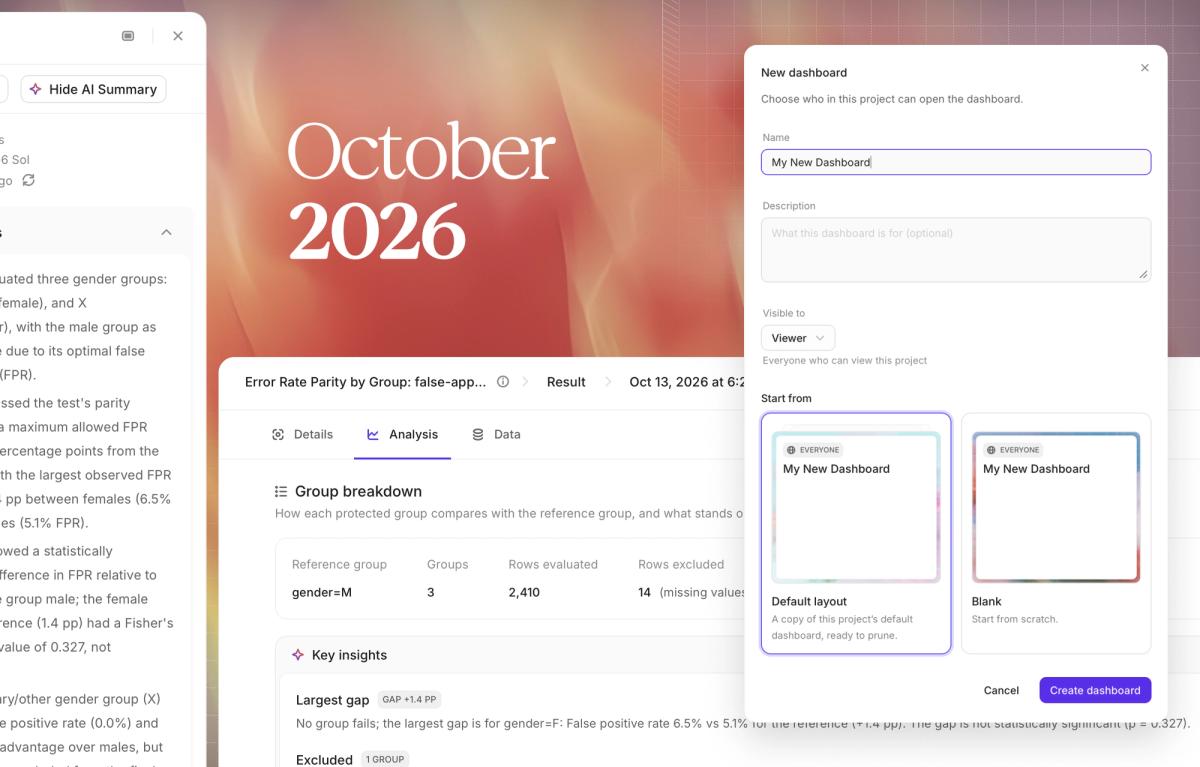 changelog · Aug 2026
· source
· release history
-
Trace decorator gains a
promoteparameter to surface nested step outputs to the parent span. Openlayer Gateway, customizable dashboards, and Salesforce Agentforce GA · seen Jul 2026 · source · release history - ConversationalSearchService traces now include document chunks and nested step hierarchy. Stronger security, multimodal tracing, and expanded governance controls · seen Jul 2026 · source · release history
- Adds step detection support in the LangChain integration. Batch test re-runs and expanded integrations · seen Jul 2026 · source · release history
- Adds per-request annotations with custom values, including step-level annotation for individual trace steps when tracing is enabled. Improved quality control over your LLM’s responses with annotations and human feedback · seen Jul 2026 · source · release history
- Renders images, audio, and PDFs inline in trace steps and data tables for richer multimodal observability. Stronger security, multimodal tracing, and expanded governance controls · seen Jul 2026 · source · release history
docs
- Claude Code Send Claude Code traces to Openlayer for your whole organization through managed settings. Microsoft 365 Copilot Import first-party Microsoft 365 Copilot prompts and responses from Microsoft Graph. Palantir Foundry Monitor Palantir Foundry AIP Agents and AIP Logic functions with Openlayer. docs update · Oct 2026 · source
- Claude Code Send Claude Code traces to Openlayer for your whole organization through managed settings. Microsoft 365 Copilot Import first-party Microsoft 365 Copilot prompts and responses from Microsoft Graph. Claude Compliance Ingest claude.ai chats and Cowork / Claude Code sessions into Openlayer. docs update · Oct 2026 · source
- Google Conversational Search Trace Google Cloud Discovery Engine conversational search calls with the Openlayer Ruby SDK. Portkey Trace your Portkey completions with Openlayer. Palantir Foundry AIP Agents Monitor Palantir Foundry AIP Chatbots with Openlayer. docs update · Sep 2026 · source
-
Embeddings The same also traces embedding invocations. When the refers to an embedding model, the call is recorded as a dedicated embedding step named AWS Bedrock Embedding instead of an LLM step, with the model, input, latency, and the dimensions and number of vectors returned.
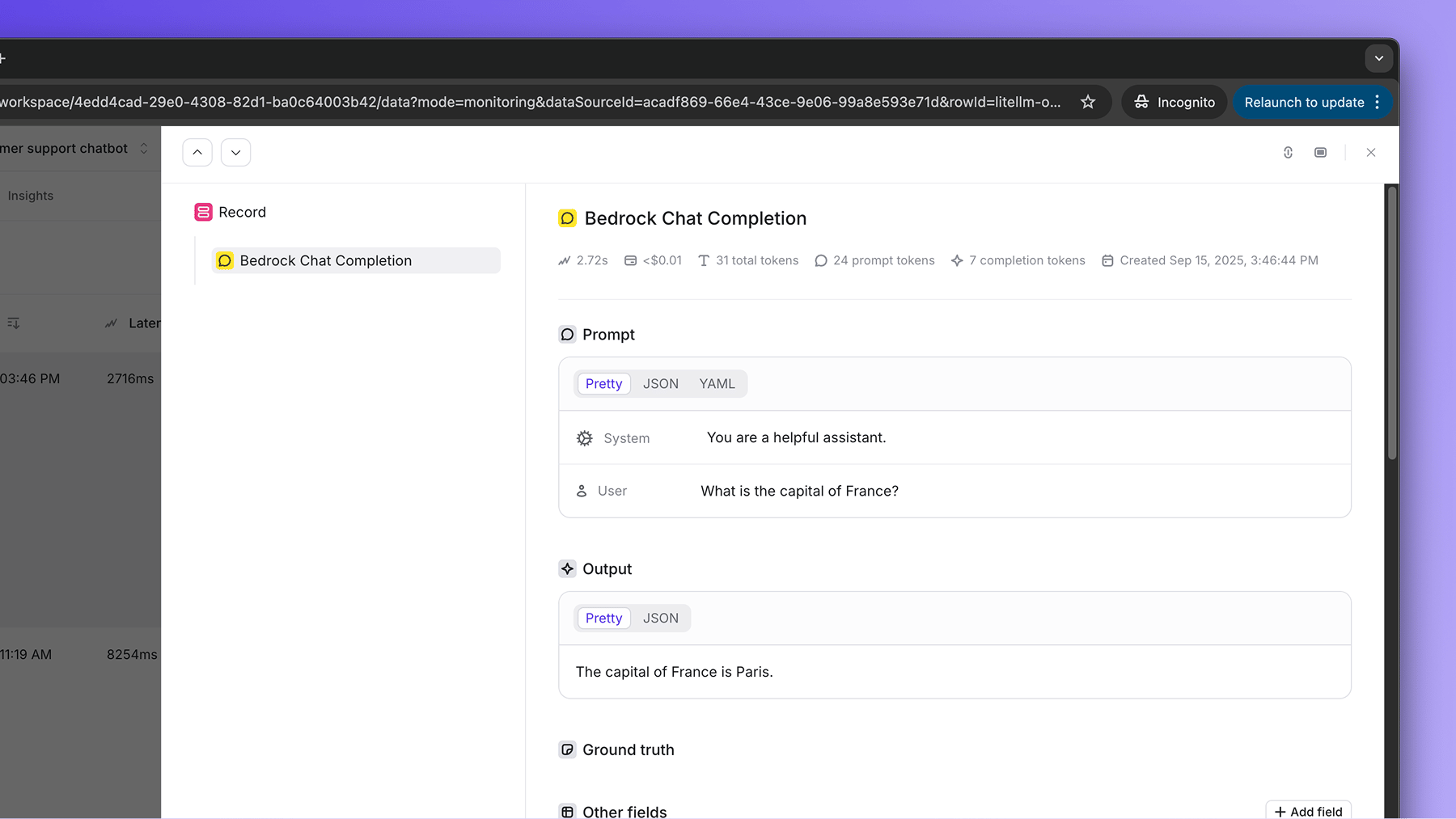 docs update · Sep 2026
· source
example
-
Scope a test to evaluate each individual trace step rather than the whole trace, useful for pinpointing which step in a multi-step agent pipeline fails a quality check.
evaluationScope: stepchangelog · Oct 2026 · source -
Set up user and session tracking to view full trace history per user in the Openlayer app.
In the Openlayer app, go to the Data section and enable user and session tracking to associate traces with individual users and sessions.Support for tracking users and sessions, test tags, and more · seen Jul 2026 · source -
Inspect the full agent loop — tool calls, MCP tools, subagent nesting, and token costs — by enabling Claude Agent SDK tracing in Python.
import openlayer import anthropic openlayer.init(api_key="<your-api-key>", project_name="<project-name>") # The Claude Agent SDK is now instrumented: tool calls, MCP tools, subagents, # session…Trace timeline, project lifecycles, and Claude Agent SDK tracing · seen Jul 2026 · source
LLM Gateway shipped Provides a centralized control layer for all LLM calls, with API key management, rate limits, guardrail enforcement, and support for on-premises LLM gateways.
Also counts toward: Multi-tenant management, Self-hosted deployment, Web management console
release 27 total
-
Gateway Teams are renamed to Groups — any configuration, API calls, or documentation referencing Teams in the Gateway admin UI must be updated to Groups.
changelog · Oct 2026
· source
· release history
-
Adds Gateway
GET /v1/models(per key) and OpenAI-compatiblePOST /v1/embeddingsAPI endpoints. changelog · Oct 2026 · source · release history -
Adds gate mechanism in
jevalsthat applies a policy to evaluation results and routes agent actions to proceed, block, or require human review — enabling the same eval definition to run in both development testing and production guardrails. announced · Sep 2026 · source · release history -
Adds
pip install jevalsopen-source Python library for agent evals and runtime guardrails built around typed decision models (Jev-style), replacing freeform LLM-judge text generation with structured choices, scores, and probabilities.︀︄︇︀︅︉︀︅︀︀︃︀︀︅︅︀︅︊︀︄︆︀︃︄ announced · Sep 2026 · source · release history - Adds Gateway API key invite links — admins can generate links that let users self-provision their own Gateway API keys. updated · seen Aug 2026 · source · release history
- Adds per-user usage limits and guardrails in the Gateway, including per-user caps within a team. updated · seen Aug 2026 · source · release history
docs 8 total
- The gateway answers errors in the format of the API you called, so your SDK raises its usual exception and shows the gateway’s message. An error comes from one of two places: one of the gateway’s own checks, or the provider, whose errors pass through. At a glance Status What it means Retry? docs update · Oct 2026 · source
-
Openlayer offers two data regions: Data region Sign-in host Description shown in Openlayer United States
app.openlayer.comUS data region European Unioneu.openlayer.comEU data region Your Openlayer account and sign-in session belong to one data region. docs update · Sep 2026 · source -
Before you log in or sign up, use the Data region field to choose United States or European Union . Your account and session belong to the region you select. See Data regions for the regional hosts and sign-in steps. We use Amazon Web Services. Openlayer offers United States and European Union data regions.
 docs update · Sep 2026
· source
- Model access rules decide which models a key is allowed to call. They sit alongside usage limits , content guardrails , and routing . Limits cap how much a key spends, guardrails inspect content, routing picks a provider, and model access governs the model name the client asked for. docs update · Sep 2026 · source
- The gateway verifies the key, then checks the request in the order that costs least first: model access ( 403 ), then ( 429 ), then your ( 422 ). Anything refused is blocked here, before it changes in the apps sending traffic. seen Sep 2026 · source
-
Guardrail types Catches Runs on PII Personal identifiable information Input, output Prompt injection Prompt injection and jailbreak attempts Input only Content safety Toxic, obscene, threatening, or hateful content Input, output Each type has its own settings, described under Type settings page under Policies, add a…
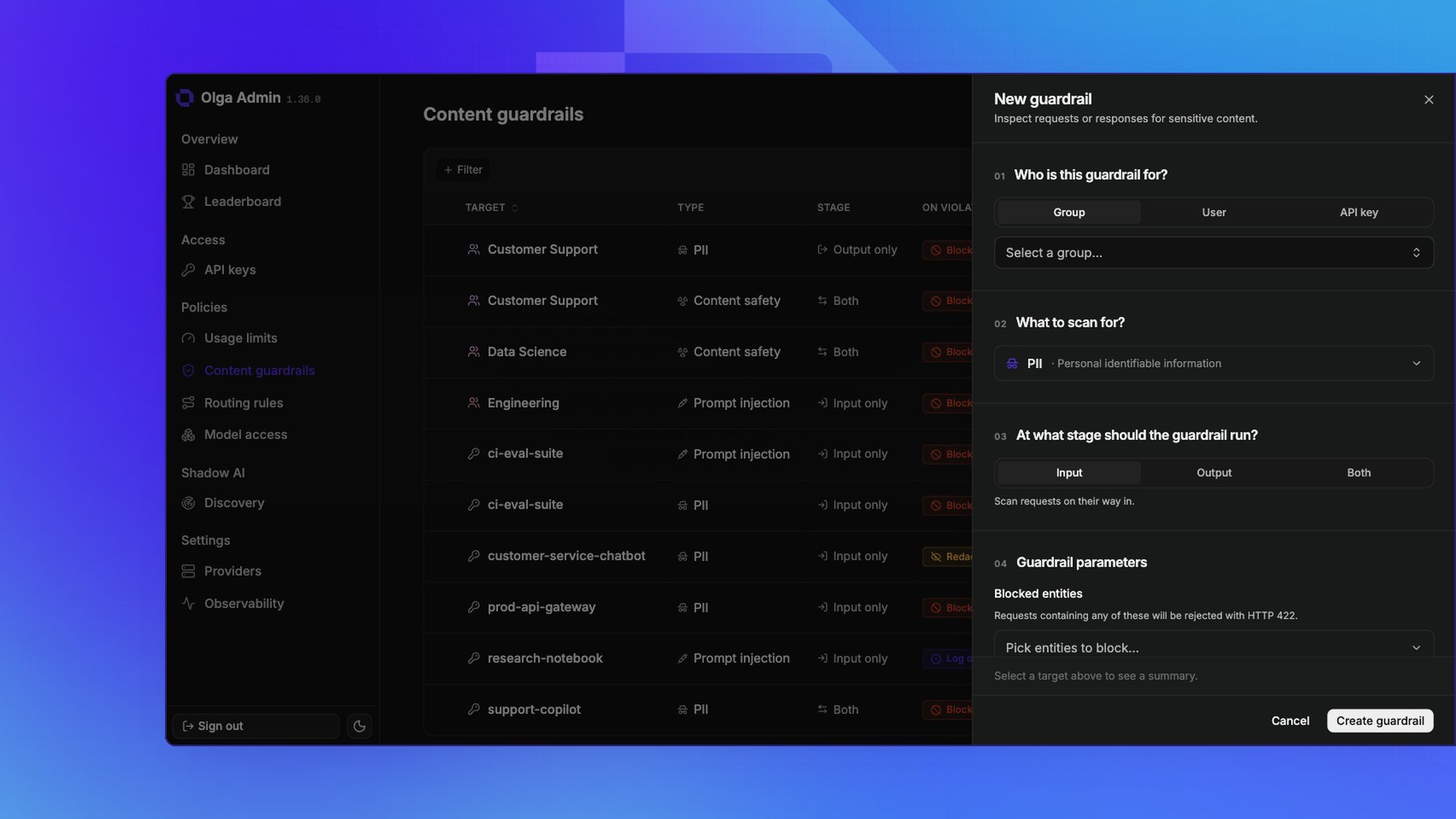 docs update · Sep 2026
· source
example
-
Retrieve the list of models available to a specific Gateway API key to audit which models an application or user can reach.
curl -H 'Authorization: Bearer <api-key>' https://<gateway-host>/v1/modelschangelog · Oct 2026 · source -
Run security and behavior checks on a live agent trace to catch indirect injection and scope violations before acting on the result.
from jevals import evaluate from jevals.agent import ToolChoice, Grounded, StayedInScope from jevals.security import IndirectInjection result = evaluate( {"messages": messages, "tools": tools}, […announced · Sep 2026 · source -
Route all LLM calls through the Openlayer Gateway to get centralized API key management, rate limiting, and end-to-end observability without changing your model provider code.
In the console, go to Gateway > Admin Portal, create a gateway API key, assign rate limits and team, then point your LLM client's base URL to the Openlayer Gateway endpoint instead of the provider…Openlayer Gateway, customizable dashboards, and Salesforce Agentforce GA · seen Jul 2026 · source -
Set a deployment-wide default LLM-as-a-judge API key for all on-prem workspaces so teams don't need to configure keys individually.
In the Openlayer on-prem admin console, go to Deployment Settings > Default API Keys and set the key for LLM-as-a-judge.Project-level secrets, tracing LLM requests with OpenTelemetry · seen Jul 2026 · source -
Rotate API keys by creating a new key before revoking the old one — navigate to your account API settings to manage multiple keys.
In the Openlayer console, go to Account Settings > API Keys, click "Create new key", copy the new key into your services, then delete the old key.Custom metrics, rotating API keys, and new models for direct-to-API calls · seen Jul 2026 · source
Cost monitoring shipped Tracks and displays LLM usage costs per request in the Observability view so teams can monitor spend over time.
release 14 total
-
Adds granular token usage and cost tracking — cached, reasoning, and audio token categories are priced and stored; LLM-as-judge evaluator runs are cost-tracked per test result.
changelog · Aug 2026
· source
· release history
- Adds granular token usage tracking — cached, reasoning, and audio token categories are now priced and stored, with per-API-key cost visible in the UI; LLM-as-judge evaluator runs are cost-tracked per test result. updated · seen Aug 2026 · source · release history
- Reveals granular token usage by category (cached, reasoning, audio) per API-key in the UI AI summaries, semantic search filters, and the remote MCP connector · Aug 2026 · source · release history
- Updated cost table for OpenAI models in the Observability view. Improved test diagnosis page, SAML SSO, design refreshes, + more · seen Jul 2026 · source · release history
- Allows users to override LLM costs with custom cost values. Complete design system overhaul, Snowflake Integration · seen Jul 2026 · source · release history
- LLM cost configuration: view and edit per-model pricing used for cost calculations. Openlayer Gateway, customizable dashboards, and Salesforce Agentforce GA · seen Jul 2026 · source · release history
Trace visualization shipped Displays captured trace data in the UI with visualizations, inline rendering of images and audio, and enriched step hierarchy views.
release 9 total
- Adds Semantic Search Filters to build test subpopulations with embedding-based matching instead of exact or keyword matching AI summaries, semantic search filters, and the remote MCP connector · Aug 2026 · source · release history
- Clearer trace visualizations in the UI. Batch test re-runs and expanded integrations · seen Jul 2026 · source · release history
- ConversationalSearchService traces now include document chunks and nested step hierarchy. Stronger security, multimodal tracing, and expanded governance controls · seen Jul 2026 · source · release history
- Renders images, audio, and PDFs inline in trace steps and data tables for richer multimodal observability. Stronger security, multimodal tracing, and expanded governance controls · seen Jul 2026 · source · release history
- Per-row scores now visible for metrics like semantic similarity and exact match in data tables. Complete design system overhaul, Snowflake Integration · seen Jul 2026 · source · release history
- Workspace-wide PII redaction on trace processing, with per-project entity-type configuration. Openlayer Gateway, customizable dashboards, and Salesforce Agentforce GA · seen Jul 2026 · source · release history
AI-generated summaries shipped Automatically generates AI summaries for sessions, traces, and test-result views, with drill-down from failure patterns to the specific rows behind them.
release
-
Adds AI-generated summaries to session, trace, and test-result detail views, with drill-down from failure modes to the exact rows behind each pattern.
updated · seen Aug 2026
· source
· release history
- Adds AI-generated session, trace, and test-result summaries — session and trace detail views open with an AI summary; test results include a summary of dominant failure modes with drill-down to exact rows. changelog · Aug 2026 · source · release history
- Opens sessions, traces, and test results with an AI summary that provides drill-down from failure modes to the exact rows behind them AI summaries, semantic search filters, and the remote MCP connector · Aug 2026 · source · release history
- Opens sessions, traces, and test results with AI summaries of dominant failure modes AI summaries, semantic search filters, and the remote MCP connector · Aug 2026 · source · release history
-
Added support for mentioning users, goals, and commits in goal comments and descriptions using
@and#symbols Sign in with Google, sample projects, mentions and more! · May 2023 · source · release history
docs
- — the trace details view summarizes the trace instead of requiring line-by-line span reading. — results include a summary of the dominant failure modes. view. The trace details view has an AI summary button — select it to summarize, analyze, and get up to speed with the trace. row-level results. docs update · Sep 2026 · source
-
- [AI-generated summaries](
https://docs.openlayer.com/monitoring/ai-summaries.md): Sessions, traces, and test results open with an AI summary, so you don't reconstruct what happened span by span. docs update · Aug 2026 · source - Openlayer generates AI summaries on three surfaces, so you can understand what happened without reading raw spans or row-level results: Sessions — the session detail view opens with a summary of how the session actually went across its traces: what the user was trying to do, what the agent did, and where it struggled. docs update · Aug 2026 · source
Data page filtering and exploration shipped Lets users filter and explore the Data page by column and view inline multimodal content within data tables.
release 8 total
-
Adds suggested filter values — filter fields suggest likely values as you type, served from the backend and respecting other active filters.
changelog · Aug 2026
· source
· release history
- Adds row data download in development mode. updated · seen Aug 2026 · source · release history
- Enables filtering columns in the Data page by clicking on a column header. Introducing Openlayer Governance · seen Jul 2026 · source · release history
- Enables data download in development mode. Stronger security, multimodal tracing, and expanded governance controls · seen Jul 2026 · source · release history
- Filtering and sorting on sessions, users, data sources, projects, rules, and framework progress tables. Openlayer Gateway, customizable dashboards, and Salesforce Agentforce GA · seen Jul 2026 · source · release history
- Adds ability to add and edit ground truths on individual requests. Improved quality control over your LLM’s responses with annotations and human feedback · seen Jul 2026 · source · release history
Session and user tracking shipped Associates traces with user and session identifiers so teams can review per-user interaction histories in the platform.
Also counts toward: Client SDKs
release
-
Adds bulk session deletion — multi-select sessions and delete with full cascade to their traces, scores, and embeddings.
updated · seen Aug 2026
· source
· release history
- Adds bulk session deletion — multi-select sessions and delete with a full cascade to their traces, scores, and embeddings. changelog · Aug 2026 · source · release history
- New API support for user sessions to track traces across interactions. Support for tracking users and sessions, test tags, and more · seen Jul 2026 · source · release history
- Session and user IDs in SDKs now accept a broader range of characters. Stronger security, multimodal tracing, and expanded governance controls · seen Jul 2026 · source · release history
-
Adds
user_sessionssupport in the API to track traces per user session. Support for tracking users and sessions, test tags, and more · Oct 2025 · source · release history
example
-
Set up user and session tracking to view full trace history per user in the Openlayer app.
In the Openlayer app, go to the Data section and enable user and session tracking to associate traces with individual users and sessions.Support for tracking users and sessions, test tags, and more · seen Jul 2026 · source
LLM cost explorer shipped Provides a public tool for browsing and comparing LLM pricing across providers, including per-token pricing for cached, reasoning, and audio tokens.
release
-
Introduces a free public LLM cost explorer at
llm-costs.openlayer.comfor browsing and comparing LLM pricing across providers, including per-token-category pricing (cached, reasoning, audio).
updated · seen Aug 2026
· source
· release history
- Adds a free public LLM cost explorer tool at llm-costs.openlayer.com for browsing and comparing LLM pricing across providers, including per-token-category pricing (cached, reasoning, audio). changelog · Aug 2026 · source · release history
LLM Gateway routing shipped Routes LLM requests to strong or weak model targets using static rules or semantic scoring based on a configurable threshold.
release
-
Adds semantic (model-based) routing — routing rules can score each prompt in-process and send it to a strong or weak target by threshold, alongside existing static first-match rules.
updated · seen Aug 2026
· source
· release history
- Adds semantic (model-based) routing — routing rules can score each prompt in-process and route it to a strong or weak target by threshold, alongside static first-match rules. changelog · Aug 2026 · source · release history
Human feedback collection shipped Lets users rate individual model responses with thumbs up or thumbs down directly on request records to surface good and bad outputs quickly.
release
- Adds thumbs up/thumbs down human feedback ratings on every request to quickly surface good and bad model responses. Improved quality control over your LLM’s responses with annotations and human feedback · seen Jul 2026 · source · release history
- Adds thumbs up / thumbs down rating UI to requests for scanning good and bad responses Improved quality control over your LLM’s responses with annotations and human feedback · May 2024 · source · release history
Evaluation and Testing 12 capabilities Openlayer runs configurable tests against LLM and ML outputs to measure quality, safety, and correctness across development and monitoring workflows. Teams can define custom metrics, organize tests by tag or governance framework, and rerun evaluations retroactively as data changes.
Evaluation tests shipped Runs built-in and LLM-as-a-judge tests against model outputs, covering bias, PHI detection, unauthorized tool calls, and SQL logic among other checks.
release 45 total
-
Adds
evaluationScope: stepconfig field for per-step evaluation of tests on each trace step.︀︄︇︀︅︉︀︅︀︀︃︀︀︅︅︀︅︊︀︄︆︀︃︄
changelog · Oct 2026
· source
· release history
- Adds bias and fairness tests — four test types check protected groups and their intersections for outcome, score, performance, and metric disparities, with an Analysis tab for charts, drill-down, and CSV export. Governance lifecycle stages, bias and fairness tests, and multiple project dashboards · seen Oct 2026 · source · release history
-
Adds
evaluationScope: stepconfig field for per-step evaluation — run tests on each individual trace step.︀︄︇︀︅︉︀︅︀︀︃︀︀︅︅︀︅︊︀︄︆︀︃︄ Governance lifecycle stages, bias and fairness tests, and multiple project dashboards · seen Oct 2026 · source · release history - Adds Jev-as-a-judge test that scores every row in the window and explains its score on demand. Governance lifecycle stages, bias and fairness tests, and multiple project dashboards · seen Oct 2026 · source · release history
- Adds prompt injection tests — choose the detector and a sensitivity level (multilingual included), see why a detection fired, and pick the judge model. Governance lifecycle stages, bias and fairness tests, and multiple project dashboards · seen Oct 2026 · source · release history
-
Adds 37 prebuilt evaluations in
jevalscovering tool selection, groundedness, task completion, scope adherence, prompt injection, and sensitive information — importable asToolChoice, Grounded,StayedInScope,IndirectInjection, and more from modulesjevals.agentandjevals.security. announced · Sep 2026 · source · release history
docs
- You can also apply filters to narrow the test to specific slices of the data, and turn on Apply to new data sources so the test covers data sources you connect later. docs update · Sep 2026 · source
- When a test should only apply to a slice of your data — a subpopulation — you filter the rows it runs on. Historically those filters matched exactly or by keyword. docs update · Aug 2026 · source
example
-
Enable per-step evaluation so tests run against each trace step independently, not just the final output.
{ "evaluationScope": "step" }Governance lifecycle stages, bias and fairness tests, and multiple project dashboards · seen Oct 2026 · source -
Enable a prompt injection test on an LLM data source to automatically detect adversarial inputs in production traffic.
In the console, open your project's Tests tab, click Add Test, and select 'Prompt Injection' from the Evals library.Complete design system overhaul, Snowflake Integration · seen Jul 2026 · source
Test diagnosis and results review shipped Surfaces error messages for skipped and errored tests in a filterable list view with a status-breakdown overview.
release 18 total
-
Adds AI-generated summaries to session, trace, and test-result detail views, with drill-down from failure modes to the exact rows behind each pattern.
updated · seen Aug 2026
· source
· release history
- New list view on the test diagnosis page surfaces error messages for skipped and errored tests, with filtering by result type and a status-breakdown overview. Improved test diagnosis page, SAML SSO, design refreshes, + more · seen Jul 2026 · source · release history
- Adds filtering of test modal data by the selected evaluation window. Improved quality control over your LLM’s responses with annotations and human feedback · seen Jul 2026 · source · release history
- Redesigned monitoring test results graph for clearer visibility. Batch test re-runs and expanded integrations · seen Jul 2026 · source · release history
- Introduces custom time range selection for filtering test execution history. Batch test re-runs and expanded integrations · seen Jul 2026 · source · release history
- New API endpoint to pull rows from specific test results. Stronger security, multimodal tracing, and expanded governance controls · seen Jul 2026 · source · release history
docs
-
- [AI-generated summaries](
https://docs.openlayer.com/monitoring/ai-summaries.md): Sessions, traces, and test results open with an AI summary, so you don't reconstruct what happened span by span. docs update · Aug 2026 · source
example
-
Filter your test results to surface only high-priority failing tests during an incident triage.
In the Openlayer app, go to Tests, then use the Filter controls to set Priority = High and Status = Failing.Test bundles, new tests, support for new Python runtimes · seen Jul 2026 · source -
Retrieve test results programmatically to pipe into downstream alerting or reporting pipelines.
curl -X GET 'https://api.openlayer.com/v1/projects/<project-id>/test-results' \ -H 'Authorization: Bearer <api-key>'Batch test re-runs and expanded integrations · seen Jul 2026 · source -
Check how many tests are skipped or failing on a project version without fetching full test details.
curl -X GET 'https://api.openlayer.com/v1/projects/<project-id>/versions/<version-id>' \ -H 'Authorization: Bearer <token>'SAML Directory Sync, new LLM-as-a-judge models, and website refresh · seen Jul 2026 · source
LLM evaluator integrations shipped Connects to external LLM providers such as Azure OpenAI and Google Gemini to use them as evaluation judges, with a test-connection button for validation.
release 15 total
- Adds Jev as a native judge directly inside Openlayer, alongside existing classifier evaluation tooling (F1 scores, confusion matrices, drift, explainability). announced · Sep 2026 · source · release history
- New Google Gemini API integration. Batch test re-runs and expanded integrations · seen Jul 2026 · source · release history
- Supports Azure OpenAI as an LLM evaluator integration. Improved test diagnosis page, SAML SSO, design refreshes, + more · seen Jul 2026 · source · release history
- Test-connection button for LLM configuration. Openlayer Gateway, customizable dashboards, and Salesforce Agentforce GA · seen Jul 2026 · source · release history
- Supports Azure OpenAI deployments as the backend for LLM-as-a-judge evaluations. Project-level secrets, tracing LLM requests with OpenTelemetry · seen Jul 2026 · source · release history
- Adds support for Gemini 2.0 models in LLM-as-a-judge tests. The Openlayer MCP server, Automatic thresholds, BigQuery Integration and Anomaly Detection, Project-level access groups · seen Jul 2026 · source · release history
docs
-
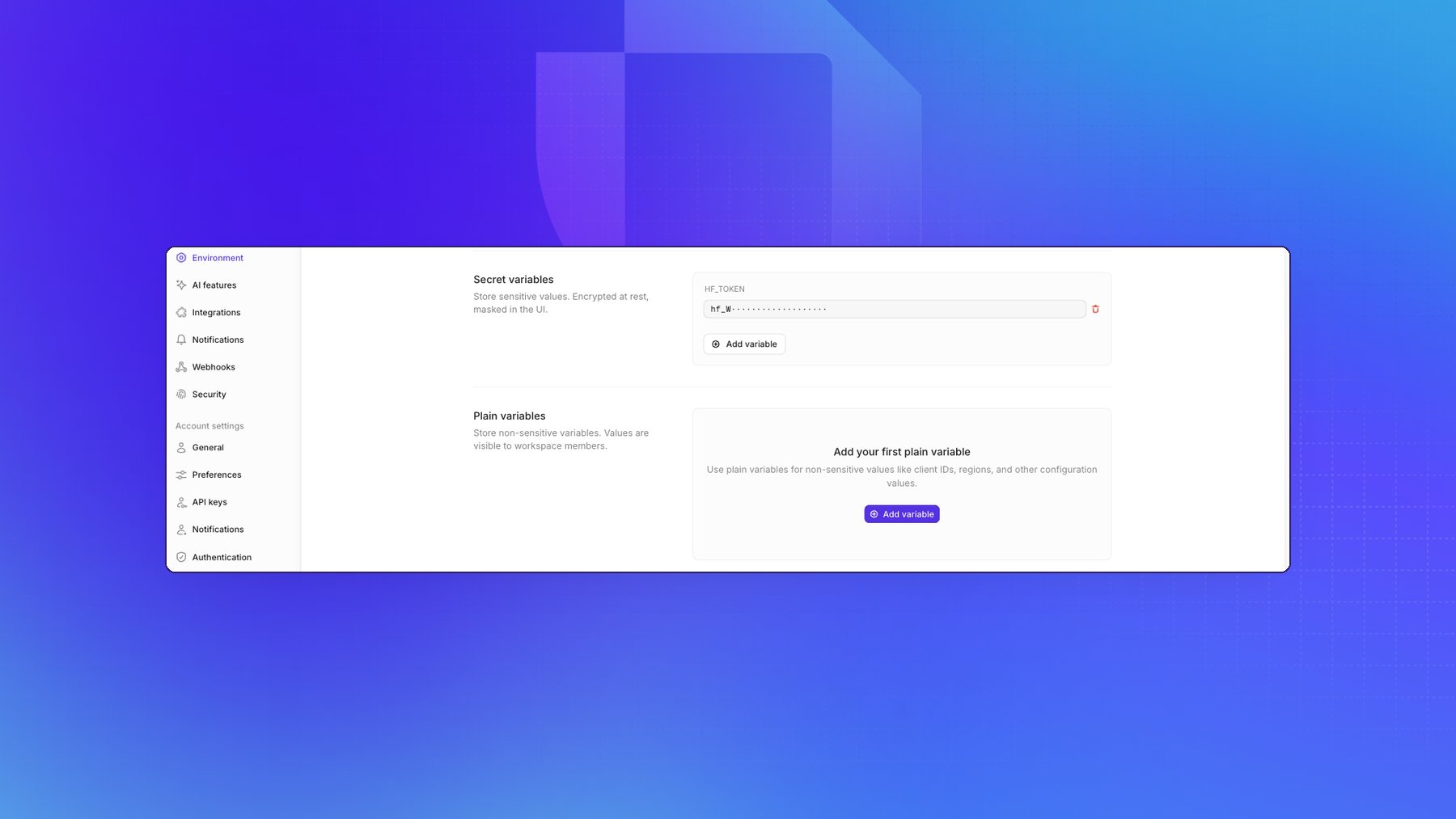
provider (OpenAI, Azure OpenAI, Anthropic, AWS Bedrock, Cohere, Google, Groq, Mistral, and Other), with a link in each group to that provider’s page for where to find
 seen Oct 2026
· source
- To do so, go to Settings → Environment and add the First, add under Settings → Environment at the workspace or project level. Provider keys are not entered on the LLM-as-a-judge page. Open your project and go to Settings → LLM-as-a-judge . seen Sep 2026 · source
- retrievable via the Openlayer REST API. From a test-result table on the platform, you can export records . Result history Once a commit is evaluated, open an individual test to inspect its Result Data tabs. Development tests compute one result per commit. seen Sep 2026 · source
example
-
Set a deployment-wide default LLM-as-a-judge API key for all on-prem workspaces so teams don't need to configure keys individually.
In the Openlayer on-prem admin console, go to Deployment Settings > Default API Keys and set the key for LLM-as-a-judge.Project-level secrets, tracing LLM requests with OpenTelemetry · seen Jul 2026 · source
Test organization and tagging shipped Lets users assign predefined and custom tags to tests so they can be browsed and organized by outcome, domain, or governance framework.
release 14 total
-
Openlayer system tags are renamed to categories; user-defined labels remain tags.
updated · seen Aug 2026
· source
· release history
- Adds compliance test visibility to results pages — shows which tests are required for compliance, in context. updated · seen Aug 2026 · source · release history
- Adds predefined and custom tags on tests to browse and organize tests by outcome, domain (e.g., safety, data drift), or governance framework (e.g., EU AI Act). Support for tracking users and sessions, test tags, and more · seen Jul 2026 · source · release history
- New priority property for tests (critical, high, medium, low). The Openlayer MCP server, Automatic thresholds, BigQuery Integration and Anomaly Detection, Project-level access groups · seen Jul 2026 · source · release history
- Renames Openlayer system tags to categories; user-defined labels remain tags. Stronger security, multimodal tracing, and expanded governance controls · seen Jul 2026 · source · release history
- Openlayer system tags are renamed to categories; user-defined labels remain tags, which may break any workflows, scripts, or integrations that reference the old tags name for system tags Stronger security, multimodal tracing, and expanded governance controls · seen Jul 2026 · source · release history
docs
- OpenAI Compliance Ingest ChatGPT Enterprise and Codex activity into Openlayer. docs update · Sep 2026 · source
example
-
Apply a pre-built EU AI Act test bundle to catch compliance gaps across your LLM pipeline before deploying.
In the Openlayer app, go to Tests > Test Bundles, select the EU AI Act bundle, and click Apply to your project.Test bundles, new tests, support for new Python runtimes · seen Jul 2026 · source
Custom metrics shipped Lets teams define domain-specific metrics in configuration that appear as project-wide metrics and runnable tests across all data.
release 13 total
-
Custom metrics bundles are now viewable and downloadable directly from the UI.
updated · seen Aug 2026
· source
· release history
- Automatic threshold mode for custom metrics. Openlayer Gateway, customizable dashboards, and Salesforce Agentforce GA · seen Jul 2026 · source · release history
- CLI now supports deleting custom metrics directly. Introducing Openlayer Governance · seen Jul 2026 · source · release history
- View, edit, and download custom-metric parameter bundles from the UI. Openlayer Gateway, customizable dashboards, and Salesforce Agentforce GA · seen Jul 2026 · source · release history
- Supports automatic, data-driven thresholds for tests that adapt over time based on historical patterns — covering cost, data quality, and GPT eval scores. The Openlayer MCP server, Automatic thresholds, BigQuery Integration and Anomaly Detection, Project-level access groups · seen Jul 2026 · source · release history
- New API endpoint to delete custom metrics. Introducing Openlayer Governance · seen Jul 2026 · source · release history
docs
- To test or filter on one key inside a structured input or output instead of the whole column, define a custom column for it. seen Oct 2026 · source
example
-
Define a custom domain-specific metric in openlayer.json so it appears as a project-wide metric and a runnable test on all your data.
{ "metrics": [ { "name": "toxicity_score", "description": "Custom toxicity scorer for our domain", "type": "custom", "script": "metrics/toxicity.py" } ] }Custom metrics, rotating API keys, and new models for direct-to-API calls · seen Jul 2026 · source -
Let Openlayer automatically determine acceptable thresholds for a new test instead of guessing manually — ideal when you lack historical baselines.
In the Openlayer app, go to your project > Tests > Create new test. In the threshold configuration step, select 'automatic' instead of entering a manual value.The Openlayer MCP server, Automatic thresholds, BigQuery Integration and Anomaly Detection, Project-level access groups · seen Jul 2026 · source
Batch and retroactive test runs shipped Allows test results to be recalculated retroactively through batch or manual re-runs, including running monitoring tests against full data history.
release 10 total
- Supports hosted Jev, local Kev and Laya backends, and conventional LLM backends, with evaluation definitions remaining stable across backend switches. announced · Sep 2026 · source · release history
-
Adds evaluate() function from
jevalsaccepting agent messages and tool schemas, returning typed results via .table(). announced · Sep 2026 · source · release history -
Adds bulk test actions — duplicate several tests at once and schedule runs for several tests at once; view, download, and delete uploaded custom metric files.
changelog · Aug 2026
· source
· release history
- Enables running monitoring mode tests against the entire history of data rather than moving windows. The Openlayer MCP server, Automatic thresholds, BigQuery Integration and Anomaly Detection, Project-level access groups · seen Jul 2026 · source · release history
- Adds batch and manual test re-runs so results can be recalculated retroactively when new data is added. Batch test re-runs and expanded integrations · seen Jul 2026 · source · release history
- Test failures no longer cause a commit's status to fail. The Openlayer MCP server, Automatic thresholds, BigQuery Integration and Anomaly Detection, Project-level access groups · seen Jul 2026 · source · release history
docs
- Azure AI Speech Observe Azure AI Speech (speech-to-text, translation, and text-to-speech) with Openlayer. OpenAI Compliance Ingest ChatGPT Enterprise and Codex activity into Openlayer. docs update · Sep 2026 · source
- On the Results page, you can select several tests at once and apply actions from the overflow menu. To pause a single test from a row overflow, see Pausing tests . Select tests On the Results page, select the tests you want to act on. docs update · Sep 2026 · source
example
-
Force a metrics run in CI to ensure all metrics execute even when no changes are detected.
openlayer metrics run -forceStronger security, multimodal tracing, and expanded governance controls · seen Jul 2026 · source
Test export shipped Allows users to export all tests for a project via the CLI.
Also counts toward: Command-line interface, CSV data export
release
-
Expands
openlayer exportto support CSV and XLSX formats (previously JSON only) and adds the ability to include scores in exports.
changelog · Aug 2026
· source
· release history
-
Expands
openlayer exportto support CSV and XLSX output formats (previously JSON only) and adds a flag to include scores in the export. updated · seen Aug 2026 · source · release history - New CLI command to export tests for a project. Pausing tests, checks for duplicate keys, and new integrations · seen Jul 2026 · source · release history
-
New
openlayer tests exportCLI subcommand support for projects that use tags. Trace timeline, project lifecycles, and Claude Agent SDK tracing · seen Jul 2026 · source · release history -
Adds
openlayer test exportCLI command to export tests for a project Pausing tests, checks for duplicate keys, and new integrations · Dec 2025 · source · release history
docs
- . When the table has tests, the header overflow menu includes Export test configs , which exports every test in the table — the same output as selecting all rows and choosing Export selected test configs — copy the selected tests within the same project. docs update · Oct 2026 · source
example
-
Review a filtered set of low-quality responses offline by exporting only the flagged requests cohort from your workspace.
In the console, go to your workspace > Requests, apply the desired filters (e.g., thumbs-down ratings), then click Export to download the filtered cohort as a file.Improved quality control over your LLM’s responses with annotations and human feedback · seen Jul 2026 · source
Tests API filtering shipped Supports filtering the List Tests API by update date and by whether version goals use validation or training datasets.
Also counts toward: REST API
release
-
Adds sorting and filtering to more list endpoints — workspace rules, project members, and user sessions; rules tables also gain server-side group filtering.
changelog · Aug 2026
· source
· release history
- Adds sorting and filtering to more list endpoints: workspace rules, project members, and user sessions, plus server-side group filtering on rules tables. updated · seen Aug 2026 · source · release history
- New API filter on version goals by whether they use validation or training datasets. Support for tracking users and sessions, test tags, and more · seen Jul 2026 · source · release history
-
dateUpdatedfilter added to the List Tests API. Openlayer Gateway, customizable dashboards, and Salesforce Agentforce GA · seen Jul 2026 · source · release history -
Adds
dateUpdatedfilter on the List Tests API Openlayer Gateway, customizable dashboards, and Salesforce Agentforce GA · May 2026 · source · release history
Test priority and anomaly detection shipped Assigns priority levels to tests and automatically flags results that deviate from predicted norms using anomaly detection.
Also counts toward: ML-based detection
release
- Adds filtering of tests by priority, status, name, and other attributes in the platform UI. Test bundles, new tests, support for new Python runtimes · seen Jul 2026 · source · release history
- Adds priority levels for tests and more data visualizations throughout the product. Complete design system overhaul, Snowflake Integration · seen Jul 2026 · source · release history
- Adds anomaly detection to flag test results that deviate from predicted norms. The Openlayer MCP server, Automatic thresholds, BigQuery Integration and Anomaly Detection, Project-level access groups · seen Jul 2026 · source · release history
- Introduces anomaly detection to flag test results deviating from automatic thresholds The Openlayer MCP server, Automatic thresholds, BigQuery Integration and Anomaly Detection, Project-level access groups · Jun 2025 · source · release history
A/B testing shipped Compares performance across metrics between two commits or two data sources to evaluate model or data changes side by side.
release
- Enables A/B testing across two commits (Development mode) or two data sources (Monitoring mode) to compare performance across metrics. Introducing Openlayer Governance · seen Jul 2026 · source · release history
- Enables A/B testing across two commits in Development mode or data sources in Monitoring mode Introducing Openlayer Governance · Nov 2025 · source · release history
Project dashboard and reporting shipped Displays a pie chart of test results on the project home screen for a quick summary of evaluation outcomes.
release
- Adds pie graph for test results on the project home screen. SAML Directory Sync, new LLM-as-a-judge models, and website refresh · seen Jul 2026 · source · release history
- Customizable project home pages: pin metric widgets, view project notifications inline, and navigate alerts from a new sidebar notification center. Openlayer Gateway, customizable dashboards, and Salesforce Agentforce GA · seen Jul 2026 · source · release history
AI-assisted test generation shipped Suggests tests using an AI assistant, with a UI flow for accepting, refining, or retrying a subset of generated suggestions.
Also counts toward: Built-in AI assistant
release
- New UI flow for accepting Assistant-generated tests, allowing users to select a subset, refine suggestions, or retry requests. Introducing Openlayer Governance · seen Jul 2026 · source · release history
Data Monitoring and Drift Detection 3 capabilities Openlayer connects to external data sources and live inference pipelines to continuously monitor data quality and distribution changes over time. Teams receive failure notifications and can track feature drift and record-level activity across their ML pipelines.
Data source monitoring shipped Tracks live inference pipelines with record counts, last-received dates, user and session tracking, and failure notifications for batch uploads.
previously: Inference pipeline monitoring
release 20 total
-
Adds Freshness and Column freshness tests — alert when a data source stops receiving data or a datetime column gets too old, with manual or automatic thresholds.
Governance lifecycle stages, bias and fairness tests, and multiple project dashboards · seen Oct 2026
· source
· release history
- Adds the ability to pause and resume individual monitoring tests without disabling the whole project. changelog · Aug 2026 · source · release history
- Adds per-project data retention with a configurable rolling window (7, 30, 90, 180, or 365 days, or indefinite); monitoring data older than the window is deleted. updated · seen Aug 2026 · source · release history
- Enables pause and resume of individual monitoring tests without disabling the project AI summaries, semantic search filters, and the remote MCP connector · Aug 2026 · source · release history
- Adds record count and last record received date to inference pipeline views. The Openlayer MCP server, Automatic thresholds, BigQuery Integration and Anomaly Detection, Project-level access groups · seen Jul 2026 · source · release history
- Adds notifications when batch data uploads fail. The Openlayer MCP server, Automatic thresholds, BigQuery Integration and Anomaly Detection, Project-level access groups · seen Jul 2026 · source · release history
docs
- page, you can use a test row’s overflow menu or select several tests and apply bulk actions. To pause a single test from a row overflow, see On the Results page, select the tests you want to act on. After you select one or more tests, open the overflow menu for the bulk actions below. docs update · Sep 2026 · source
example
-
Delete stale monitoring records programmatically to keep your monitoring dataset clean.
curl -X DELETE https://api.openlayer.com/v1/monitoring/records \ -H 'Authorization: Bearer <your-api-key>' \ -H 'Content-Type: application/json' \ -d '{"recordIds": ["<record-id-1>",…Openlayer Gateway, customizable dashboards, and Salesforce Agentforce GA · seen Jul 2026 · source -
Include project and workspace details in a single inference pipeline GET call, avoiding extra round-trips.
curl -X GET 'https://api.openlayer.com/v1/inference-pipelines/<id>?expand=project,workspace' \ -H 'Authorization: Bearer <token>'SAML Directory Sync, new LLM-as-a-judge models, and website refresh · seen Jul 2026 · source
Data source connections shipped Connects projects to external data sources such as BigQuery and Snowflake for ongoing automated data quality monitoring.
Also counts toward: Command-line interface
release 19 total
-
Adds the ability to rename data sources directly from the data source row menu.
updated · seen Aug 2026
· source
· release history
- CLI now supports creating data sources directly. Introducing Openlayer Governance · seen Jul 2026 · source · release history
- Smoother Snowflake connection flow now supports views. Batch test re-runs and expanded integrations · seen Jul 2026 · source · release history
- Supports connecting to Snowflake views and running tests via remote execution. Pausing tests, checks for duplicate keys, and new integrations · seen Jul 2026 · source · release history
- Project, dataset, and table dropdowns when connecting BigQuery tables. Complete design system overhaul, Snowflake Integration · seen Jul 2026 · source · release history
- Faster data source creation via API. Complete design system overhaul, Snowflake Integration · seen Jul 2026 · source · release history
example
-
Connect a BigQuery table to a project for ongoing, automated data quality monitoring without manual data uploads.
In the Openlayer app, go to your project > Integrations > BigQuery and follow the prompts to link a BigQuery table.The Openlayer MCP server, Automatic thresholds, BigQuery Integration and Anomaly Detection, Project-level access groups · seen Jul 2026 · source -
Connect a Snowflake table directly to a project to run evals against live warehouse data without manual exports.
In the console, open your project, go to Data Sources > Connect, select Snowflake, and choose the target table.Complete design system overhaul, Snowflake Integration · seen Jul 2026 · source
Drift detection shipped Monitors feature and data distributions over time, displaying daily distribution graphs and using Characteristic Stability Index as a drift detection method.
release
- Adds Characteristic Stability Index (CSI) as a drift detection method. Batch test re-runs and expanded integrations · seen Jul 2026 · source · release history
- Daily feature distribution graphs for tabular data projects. The Openlayer MCP server, Automatic thresholds, BigQuery Integration and Anomaly Detection, Project-level access groups · seen Jul 2026 · source · release history
- Adds column distribution graphs for LLM projects on the platform. Pausing tests, checks for duplicate keys, and new integrations · seen Jul 2026 · source · release history
- Adds Characteristic Stability Index (CSI) as a drift detection method Batch test re-runs and expanded integrations · Jan 2026 · source · release history
- Adds ability to add ground truths to requests and edit existing ground truths Improved quality control over your LLM’s responses with annotations and human feedback · May 2024 · source · release history
Governance, Safety, and Access Control 4 capabilities Openlayer lets teams define and enforce policy frameworks covering PII, prompt injection, risk levels, and ownership across all projects and workspaces. It also provides enterprise access controls, PII redaction, and secret management to meet organizational compliance requirements.
Access control and authentication shipped Supports MFA, SAML SSO, directory sync, and project-level access groups including a NoAccess level for enterprise security requirements.
Shared capability: SAML SSO
Also counts toward: Multi-factor authentication, Single sign-on, SAML SSO
release 24 total
-
Expands API-key surface so workspace API keys now cover updating projects, cost-override endpoints, test retrieval/update/deletion, and seven previously session-only read routes.
updated · seen Aug 2026
· source
· release history
- Adds platform-wide multi-factor authentication (MFA) for enterprise security. Stronger security, multimodal tracing, and expanded governance controls · seen Jul 2026 · source · release history
- Supports deployment-wide directory sync with project-level access group support, including a NoAccess group level for finer-grained access control. Stronger security, multimodal tracing, and expanded governance controls · seen Jul 2026 · source · release history
- Adds SAML SSO support via any major identity provider, enabling teams to enforce org-level authentication for workspace access. Improved test diagnosis page, SAML SSO, design refreshes, + more · seen Jul 2026 · source · release history
- Set workspace admins via environment variables on on-prem deployment. Openlayer Gateway, customizable dashboards, and Salesforce Agentforce GA · seen Jul 2026 · source · release history
- Supports configuring directory sync for SAML/SSO-enabled workspaces via the UI. Introducing Openlayer Governance · seen Jul 2026 · source · release history
docs
- To browse the live catalog in the app, go to Settings → Members and select View permission matrix . That button appears if you can invite members (Admin). The in-app matrix is searchable and is the current source of truth; the table below is a static reference. seen Sep 2026 · source
- To browse the live catalog in the app, go to Settings → Members and select View permission matrix . That button appears if you can invite members (Admin). The in-app matrix is searchable and is the current source of truth; the table below is a static reference. Create tests Update tests seen Sep 2026 · source
- Mapping a group to No access Alongside Admin, Member, Member Restricted and Viewer, a group can be mapped to No access . The configuration screen separates the groups you have given a role from the ones set to No access, so you can see at a glance who the sync actually grants access to. docs update · Sep 2026 · source
- There is a fifth role, No access , which you cannot assign to a member directly. It exists only as a target when you map identity provider groups to Openlayer roles, so that a group synced from your IdP can be recognized without being granted anything. See No access . docs update · Sep 2026 · source
-
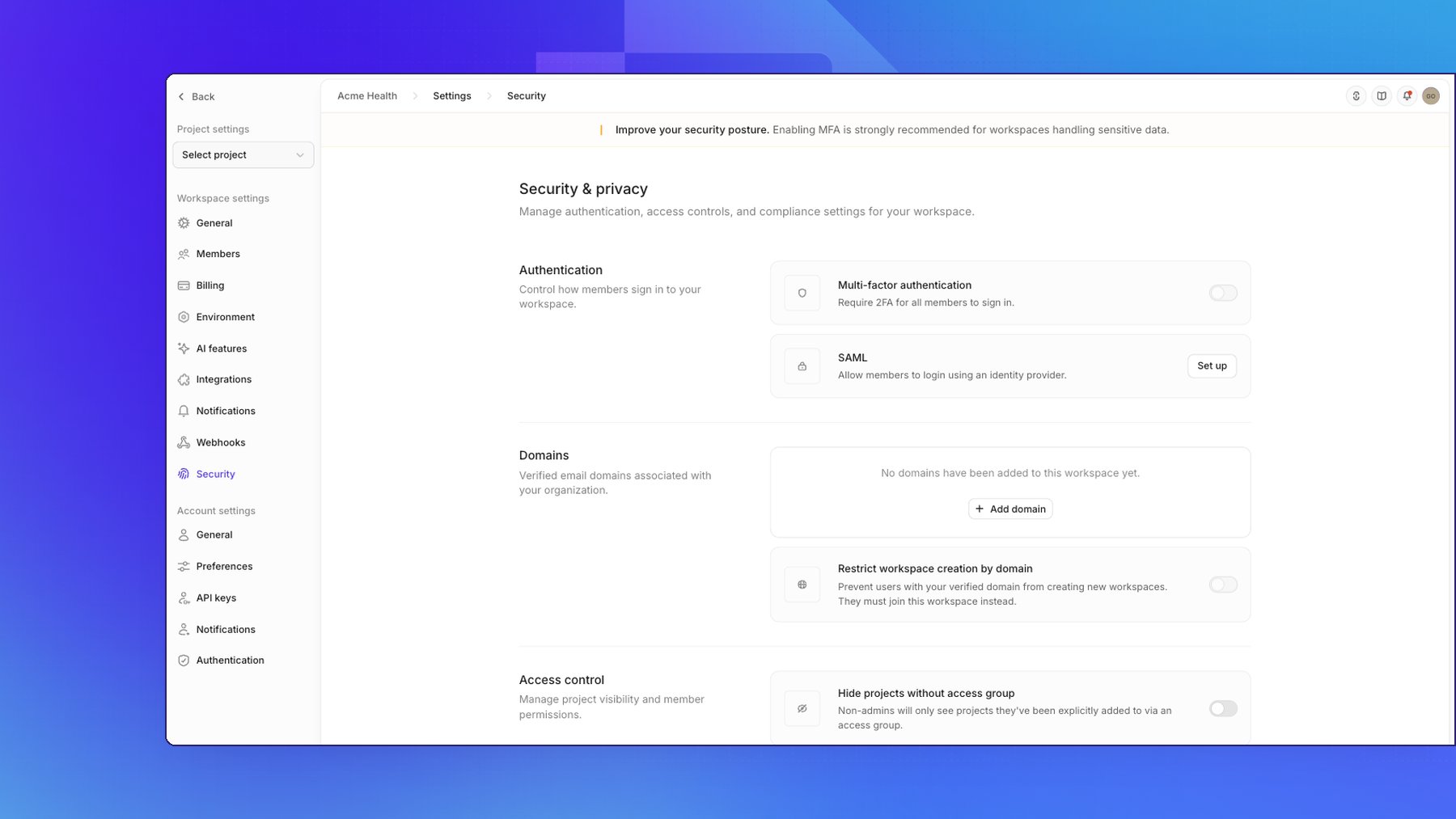
Workspace security settings Workspace admins manage the settings below under Workspace settings → Security Verified domains Add the email domains your organization owns and verify them from the Domains section.
docs update · Sep 2026
· source
-
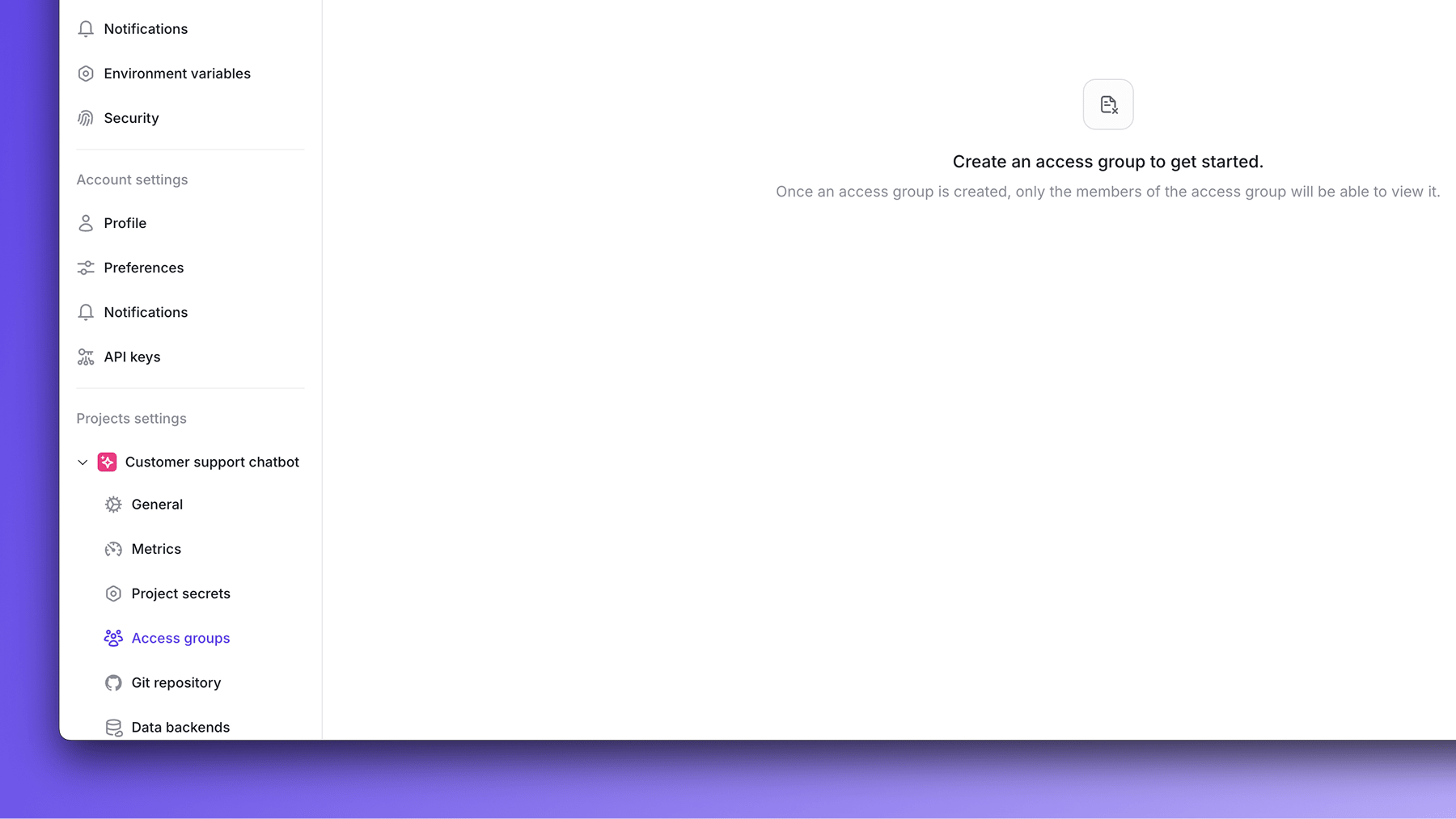
Hide projects that have no access group By default a project with no access groups is visible to everyone in the workspace, and access groups only ever narrow that.
 docs update · Sep 2026
· source
example
-
Enable SAML directory sync so workspace membership mirrors your identity provider's security groups.
In the Openlayer console, go to Workspace Settings > Security > SAML SSO and enable Directory Sync to map your IdP groups to Openlayer workspaces.SAML Directory Sync, new LLM-as-a-judge models, and website refresh · seen Jul 2026 · source -
Enforce org-level SSO for your team's Openlayer workspace to add a layer of authentication security.
In the console, go to Settings > Collaboration > SAML SSO and configure your identity provider credentials.Improved test diagnosis page, SAML SSO, design refreshes, + more · seen Jul 2026 · source
Governance mode shipped Lets teams define and enforce custom policy frameworks covering PII leakage, prompt injection, monitoring requirements, and risk level, with rule owners, comment threads, and evidence uploads.
Also counts toward: User-defined detection rules
release 13 total
-
Adds governance registry and framework endpoints to the public API and SDKs, writable with a workspace API key.
Governance lifecycle stages, bias and fairness tests, and multiple project dashboards · seen Oct 2026
· source
· release history
- Adds rule deactivation reasons — supply a reason when deactivating a rule; it is displayed on the rule page. updated · seen Aug 2026 · source · release history
- Adds project lifecycle stages and evidence documents — attach a lifecycle stage and evidence to a project for governance tracking. updated · seen Aug 2026 · source · release history
- Adds a missing-guardrails governance rule — a new integrity test that flags traces missing an expected guardrail. updated · seen Aug 2026 · source · release history
- Introduces Missing-guardrails governance rule to flag traces lacking expected guardrails AI summaries, semantic search filters, and the remote MCP connector · Aug 2026 · source · release history
- New Governance mode lets teams define and enforce custom policy frameworks (PII leakage, prompt injection, monitoring requirements, ownership, risk level) across all projects and workspaces, with rule owners, comment threads, and evidence uploads. Introducing Openlayer Governance · seen Jul 2026 · source · release history
docs
-
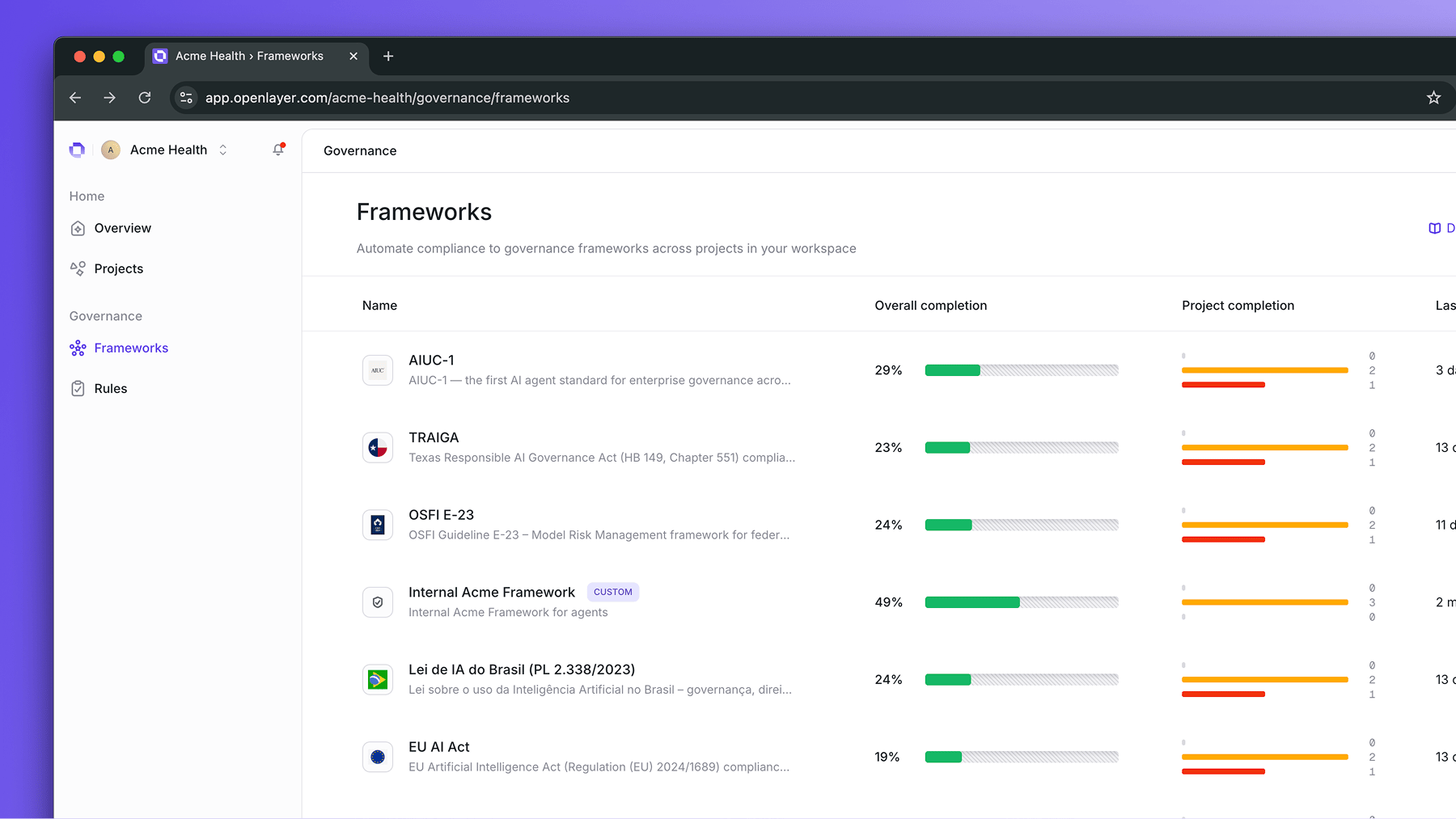
Activate a framework and choose the existing projects that should follow it. You can also automatically include future projects by risk level, task type, or tags. No. When you activate a framework, you choose the existing projects it applies to and whether matching future projects should join automatically.
 seen Oct 2026
· source
- This page covers two workspace governance definitions: , which includes , and Lifecycle stages tabs. This page covers the first two; see to configure stages, requirements, and reviewers. Example: Low / High / Prohibited pattern You can use these surfaces to configure a three-tier risk-classification pattern. seen Oct 2026 · source
- Configure AI features AI features are configured at the workspace level, and each project can override the workspace default. to control which AI-powered features are enabled in the workspace. docs update · Oct 2026 · source
-
- [Use the governance API](
https://docs.openlayer.com/governance/api-access.md): Create frameworks and rules, attach evidence, and pull compliance status and audit-ready exports from Openlayer - [Define intake and risk forms](https://docs.openlayer.com/governance/intake-and-risk-forms.md): Define the intake questions… docs update · Sep 2026 · source
example
-
Enable Governance mode to define and track enforcement rules across your workspace's AI projects.
In the Openlayer console, open your workspace, navigate to Governance, select 'New Framework', define rules (e.g.Introducing Openlayer Governance · seen Jul 2026 · source
Secret management shipped Provides an interface within the platform for managing secrets used by integrations and evaluations.
release
-
Adds API key expiry dates, automatic rotation, and full API key management via the API.
Governance lifecycle stages, bias and fairness tests, and multiple project dashboards · seen Oct 2026
· source
· release history
- Enhances secret management interface in the platform. Test bundles, new tests, support for new Python runtimes · seen Jul 2026 · source · release history
- Adds project-level secrets storage in the Platform so API keys and auth tokens can be securely referenced across tests without hardcoding. Project-level secrets, tracing LLM requests with OpenTelemetry · seen Jul 2026 · source · release history
- Support project-level secrets stored and referenced directly from the Platform UI/API Project-level secrets, tracing LLM requests with OpenTelemetry · Mar 2025 · source · release history
docs
-
for such as LLM-as-a-judge evaluations, and for Jev-as-a-judge . The page has three tabs: Openlayer provides pre-defined fields for commonly used API keys, grouped by provider (OpenAI, Azure OpenAI, Anthropic, AWS Bedrock, Cohere, Google, and Other), with a link in each group to that provider’s page for where to find…
seen Oct 2026
· source
-
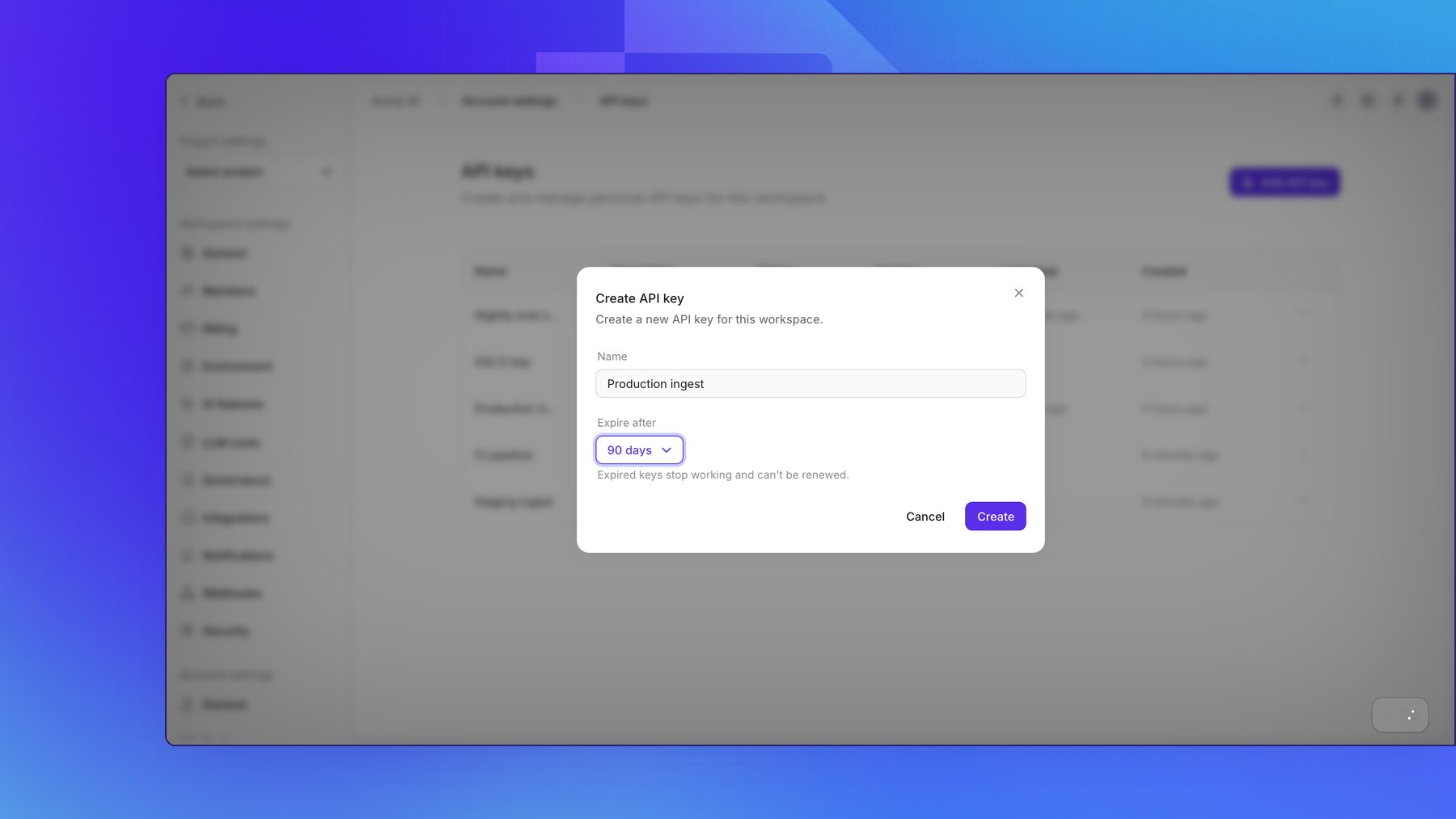
This guide shows you how to create API keys, set them to expire, rotate them, and manage them with the API. To create a new API key, click Create API key , and enter a descriptive name. Optionally, choose when the key expires. See Expiry Expiry By default, API keys never expire.
 docs update · Oct 2026
· source
-
for such as LLM-as-a-judge evaluations, and for Jev-as-a-judge
TYPESAFE_API_KEY— authenticates Jev-as-a-judge . Openlayer resolves the key from the project, then the workspace, then a platform key. A platform key still runs the test, and the rows are judged through Openlayer’s TypeSafe account. seen Oct 2026 · source - Settings Environment Secret and plain variables Beyond the pre-defined fields you can add your own variables, in two kinds: Kind Stored Visible to workspace members Use for Secret Encrypted at rest No, the value stays masked API keys, tokens, passwords Plain As entered Yes, the value is readable Client IDs, regions,… docs update · Sep 2026 · source
example
-
Store a sensitive API key once at the project level so all evals and tests can reference it without hardcoding credentials.
In the Openlayer console, go to your Project > Settings > Secrets and add a new secret (e.g., OPENAI_API_KEY). Reference it by name in your test configurations.Project-level secrets, tracing LLM requests with OpenTelemetry · seen Jul 2026 · source
PII redaction shipped Applies workspace-wide PII redaction during trace processing, with per-project configuration of which entity types are redacted.
release
-
Adds US National Provider Identifier (NPI) as a native PII check, detectable in Contains-PII tests and redactable in traces.
updated · seen Aug 2026
· source
· release history
- Adds US National Provider Identifier (NPI) as a native PII check — detectable in Contains-PII tests and redactable in traces. changelog · Aug 2026 · source · release history
- Workspace-wide PII redaction on trace processing, with per-project entity-type configuration. Openlayer Gateway, customizable dashboards, and Salesforce Agentforce GA · seen Jul 2026 · source · release history
- New guardrail system in SDKs for Openlayer tracing to redact PII from traces. Support for tracking users and sessions, test tags, and more · seen Jul 2026 · source · release history
- Detected PII types now render as tags in test results. Stronger security, multimodal tracing, and expanded governance controls · seen Jul 2026 · source · release history
- Adds workspace-level and per-project PII redaction in traces with configurable entity types Openlayer Gateway, customizable dashboards, and Salesforce Agentforce GA · May 2026 · source · release history
example
-
Redact PII automatically from traces in production before they reach Openlayer.
In the Openlayer SDK, enable the guardrail system for tracing by configuring the guardrails option to redact PII on your tracer initialization.Support for tracking users and sessions, test tags, and more · seen Jul 2026 · source
Platform Administration and Deployment 11 capabilities Openlayer can be deployed on-premises or purchased through cloud marketplaces, with workspace and project management tools that give administrators visibility across all projects. CLI, SDK, and Git integrations support team workflows for both development and production use.
CLI shipped Provides a command-line interface for creating data sources, exporting tests, and other project management tasks.
Also counts toward: Command-line interface
release 29 total
-
Extends
openlayer initwith Copilot CLI and Gemini CLI support, custom CA bundles, a 'debug with an agent' option, and.openlayerignorefor smaller uploads.
changelog · Oct 2026
· source
· release history
-
Adds
openlayer tests deleteCLI command — archives by default,--forcepermanently deletes. changelog · Oct 2026 · source · release history -
Extends
openlayer initto support Copilot CLI and Gemini CLI, custom CA bundles, a 'debug with an agent' option, and.openlayerignorefor smaller uploads. Governance lifecycle stages, bias and fairness tests, and multiple project dashboards · seen Oct 2026 · source · release history -
Adds
openlayer tests deleteCLI command — archives tests by default;--forceflag permanently deletes them. Governance lifecycle stages, bias and fairness tests, and multiple project dashboards · seen Oct 2026 · source · release history -
Adds non-interactive CLI mode —
link,login, and resource creation run headless, enabling use from AI coding agents and CI pipelines. changelog · Aug 2026 · source · release history -
Adds
openlayer init— one guided command takes a fresh directory to a pushable, linked, monitored project with tracing instrumentation. changelog · Aug 2026 · source · release history
docs
- You can export the rows on a records table or a test-result table from the platform. The same Export data control is available in monitoring and in development. To download a monitoring pipeline from the command line instead, use openlayer export . docs update · Sep 2026 · source
-
- [tests](
https://docs.openlayer.com/api-reference/cli/commands/tests.md): Export, archive, and delete the tests (goals) of an Openlayer project docs update · Aug 2026 · source -
- [init](
https://docs.openlayer.com/api-reference/cli/commands/init.md): Set up Openlayer in your project with a single guided command - [Trace multimodal data](https://docs.openlayer.com/monitoring/multimodal.md): Learn how to attach images, audio, and files to traces sent to Openlayer docs update · seen Aug 2026 · source -
- [data-sources](
https://docs.openlayer.com/api-reference/cli/commands/data-sources.md): Manage Openlayer data sources from the CLI - [profile](https://docs.openlayer.com/api-reference/cli/commands/profile.md): Manage authentication profiles for the Openlayer CLI -… docs update · seen Jul 2026 · source
example 10 total
-
Archive a test by name during CI cleanup, or permanently remove it when you need to force-delete.
openlayer tests delete <test-id> # or permanently: openlayer tests delete --force <test-id>changelog · Oct 2026 · source -
Delete a specific test permanently from the CLI, bypassing the default archive behavior.
openlayer tests delete <test-id> --forceGovernance lifecycle stages, bias and fairness tests, and multiple project dashboards · seen Oct 2026 · source -
Install jevals to start writing typed agent evals and guardrails in a new project.
pip install jevalsannounced · Sep 2026 · source -
Bootstrap a new project with tracing fully wired in one guided step, suitable for kicking off a new LLM app or CI environment.
openlayer initupdated · seen Aug 2026 · source -
Bootstrap a new project with tracing instrumentation using the new CLI command
openlayer init --guidedAI summaries, semantic search filters, and the remote MCP connector · Aug 2026 · source -
Export test results to CSV and XLSX formats including scores using the new CLI capabilities
openlayer export --format csv,xlsx --include-scores > results.csvAI summaries, semantic search filters, and the remote MCP connector · Aug 2026 · source
SDK support shipped Provides SDKs for instrumenting applications across languages and frameworks including Ruby, LangChain, LangGraph, and Spring AI.
Also counts toward: Scripting language support, Client SDKs
release 37 total
-
Adds Claude Agent SDK tracing for TypeScript — drop-in import auto-traces agent runs.
updated · seen Aug 2026
· source
· release history
- Adds Claude Agent SDK tracing for Python — instruments the full agent loop, capturing tool calls, MCP tools, subagent nesting, session continuity, cost, and tokens. updated · seen Aug 2026 · source · release history
- Adds Gemini and Vertex tracing in Python and TypeScript via a dedicated tracer for the unified Gemini SDK, including Vertex AI (previously only the legacy SDK was auto-instrumented). updated · seen Aug 2026 · source · release history
- configure() is deprecated in favor of init() for trace configuration in the SDK; settings now merge incrementally instead of resetting on each call. updated · seen Aug 2026 · source · release history
- Unifies trace configuration around init() in the SDK — settings merge incrementally instead of resetting on each call (configure() is deprecated in favor of init()). updated · seen Aug 2026 · source · release history
-
Adds openlayer.init() automatic instrumentation for Python — one call patches every installed supported LLM SDK (OpenAI, Anthropic, Mistral, Groq, Gemini, LiteLLM, Portkey, Google ADK, Azure); opt out with
auto_instrument=False. updated · seen Aug 2026 · source · release history
example
-
Opt out of automatic instrumentation when you want manual control over which SDKs are traced.
import openlayer openlayer.init(api_key="<your-api-key>", project_name="<project-name>", auto_instrument=False)Trace timeline, project lifecycles, and Claude Agent SDK tracing · seen Jul 2026 · source -
Bootstrap full automatic LLM SDK instrumentation for all supported providers in one call, then run your app — no per-SDK setup needed.
import openlayer openlayer.init(api_key="<your-api-key>", project_name="<project-name>") # All installed supported SDKs (OpenAI, Anthropic, Mistral, Groq, Gemini, LiteLLM, Portkey, Google ADK, Azure)…Trace timeline, project lifecycles, and Claude Agent SDK tracing · seen Jul 2026 · source
On-premises deployment shipped Supports self-hosted deployment on OpenShift and AWS EKS, with configurable workspace admin provisioning via environment variables.
Also counts toward: Kubernetes-native deployment, Self-hosted deployment
release 26 total
-
Adds an official Helm chart for the Gateway for Kubernetes deployments.
changelog · Aug 2026
· source
· release history
- Adds on-prem deployment options — CSI Secrets Store support, external/managed ClickHouse, native Oracle Object Storage as a storage backend, and a multi-arch Gateway image for ARM hosts. changelog · Aug 2026 · source · release history
- Adds on-prem support for CSI Secrets Store, external/managed ClickHouse, native Oracle Object Storage as a storage backend, and a multi-arch Gateway image for ARM hosts. updated · seen Aug 2026 · source · release history
- Adds a deployment admin area for on-prem operators with background-job queue health, metrics, history, and license/feature status, gated by a dedicated deployment-admin role. updated · seen Aug 2026 · source · release history
- Adds a deployment admin area — operators get background-job queue health, metrics, history, and license/feature status, gated by a dedicated deployment-admin role. changelog · Aug 2026 · source · release history
- Adds a Helm chart for the Gateway for Kubernetes deployments. updated · seen Aug 2026 · source · release history
example
-
Control which AWS Signature version Openlayer uses in an on-prem deployment without changing application code.
export AWS_SIGNATURE_VERSION=v4Support for tracking users and sessions, test tags, and more · seen Jul 2026 · source -
Deploy Openlayer on-prem to your Kubernetes cluster using the new Helm chart from Docker Hub OCI.
helm install openlayer oci://registry-1.docker.io/openlayer/openlayer \ --set storage.type=s3 \ --set database.url=<your-db-url> \ --set replicaCount=3 \ --set image.pullSecrets[0]=<pull-secret> \…Openlayer Gateway, customizable dashboards, and Salesforce Agentforce GA · seen Jul 2026 · source
Workspace and project management shipped Provides a workspace overview and project inventory with categorization, labeling, project templates, and breadcrumb navigation with copyable identifiers.
release 18 total
-
New API endpoint to delete projects, available via the TypeScript SDK.
updated · seen Aug 2026
· source
· release history
- Adds per-project data retention — set a rolling retention window (7/30/90/180/365 days or indefinite); monitoring data older than the window is deleted. changelog · Aug 2026 · source · release history
- Adds workspace-level dashboards — at-a-glance cost, usage, and project health across the workspace with drill-in widgets. changelog · Aug 2026 · source · release history
- Adds workspace-level dashboards with at-a-glance cost, usage, and project health across the workspace, including drill-in widgets. updated · seen Aug 2026 · source · release history
- Adds a new PATCH endpoint to update a project's name and description via API, picked up by the Python, Go, Java, and Ruby SDKs and the MCP server. changelog · Aug 2026 · source · release history
- Adds more project templates. Improved quality control over your LLM’s responses with annotations and human feedback · seen Jul 2026 · source · release history
docs
-
- [Workspace dashboard](
https://docs.openlayer.com/workspace-and-projects/workspace-dashboard.md): Use the Dashboard to scan recently viewed items, portfolio health, project status, compliance, and cost across your workspace - [Project… docs update · Sep 2026 · source
example
-
Bootstrap a new project from scratch — tracing, links, and monitoring configured in one shot — without manual setup steps.
openlayer initchangelog · Aug 2026 · source
MCP server integration shipped Provides an MCP server so that Openlayer tests and custom functions can be invoked directly from IDE workflows and other MCP-compatible environments.
Shared capability: MCP server
Also counts toward: MCP server
release 12 total
-
MCP integration now supports custom functions callable from Openlayer.
updated · seen Aug 2026
· source
· release history
- Expands MCP tooling to 53 tools (up from 44), adding governance/lifecycle access (frameworks, rules, rule results) and 12 new session, trace, and test-lifecycle tools. updated · seen Aug 2026 · source · release history
- Adds a remote, OAuth-protected MCP connector — the MCP server runs hosted (not local-only), usable in Claude Code and claude.ai, with in-chat workspace switching. updated · seen Aug 2026 · source · release history
- Adds governance and lifecycle tools via MCP — frameworks, rules, and rule results are reachable through MCP, growing the total toolset from 44 to 53 tools. changelog · Aug 2026 · source · release history
- Adds a new PATCH endpoint to update a project's name and description, surfaced in the Python, Go, Java, and Ruby SDKs and the MCP server. updated · seen Aug 2026 · source · release history
- Adds a remote, OAuth-protected MCP connector — the MCP server runs hosted instead of local-only, usable in Claude Code and claude.ai, with in-chat workspace switching. changelog · Aug 2026 · source · release history
docs
-
Configure the connector with these environment variables:
OPENLAYER_MCP_OAUTH_ISSUERBase URL of the Authorization Server — your own Openlayer backend. Verified as the token’s issuer, and advertised to clients as where to sign in.OPENLAYER_MCP_PUBLIC_URLPublic base URL of the connector itself. docs update · Sep 2026
· source
-
There are two ways to run it: Remote (recommended) Local Setup Add a URL to your client Install , run uvx openlayer-mcp Transport Streamable HTTP stdio Auth OAuth sign-in with your Openlayer account
OPENLAYER_API_KEYUpdates Always the latest version Whatever version you last pulled Tools All purpose-built tools Adds… docs update · Aug 2026 · source - Remote connector (recommended) The Openlayer MCP server is available as a hosted, OAuth-protected remote connector — no local install required. docs update · Aug 2026 · source
example
-
Run Openlayer tests and explore results without leaving your IDE by using the MCP server.
In your IDE's MCP configuration, add the Openlayer MCP server as a provider. Once connected, invoke Openlayer tests directly from the IDE workflow to get evaluation results inline during development.The Openlayer MCP server, Automatic thresholds, BigQuery Integration and Anomaly Detection, Project-level access groups · seen Jul 2026 · source
Git integration shipped Connects a project to a Git repository and configures the target branch and root directory for version-controlled evaluation pipelines.
release
-
Expands workspace API key surface — keys now work for updating projects, cost-override endpoints, test retrieval/update/deletion, and seven previously session-only read routes.
changelog · Aug 2026
· source
· release history
- Adds project-level Git repository settings, including editable branch and root directory configuration. Improved quality control over your LLM’s responses with annotations and human feedback · seen Jul 2026 · source · release history
- Adds git repository and organization linking in git settings pages for tighter version-control integration. Custom metrics, rotating API keys, and new models for direct-to-API calls · seen Jul 2026 · source · release history
- Adds GitHub integration that commits to Openlayer on every GitHub commit to trigger continuous evaluation Simple, dev-focused workflow for AI evals · May 2024 · source · release history
example
-
Connect a project to a Git repository and configure the target branch and root directory for version-controlled evaluation pipelines.
In the console, go to your Project > Settings > Git Repository, enter the repository URL, set the branch and root directory, then save.Improved quality control over your LLM’s responses with annotations and human feedback · seen Jul 2026 · source
Agent Skills for AI coding assistants shipped Provides packaged skills that teach AI coding assistants such as Claude Code and Cursor to integrate a codebase with Openlayer, covering tracing, evaluations, guardrails, and CI gating.
Also counts toward: CI/CD pipeline integration, Command-line interface, Plugin system
release
-
Adds Openlayer Agent Skills — packaged skills that teach AI coding assistants to integrate a codebase with Openlayer (tracing, offline evals, tests, guardrails, CI gating); ships as a Claude Code plugin, Cursor plugin, or via the skills CLI.
changelog · Aug 2026
· source
· release history
-
Introduces Openlayer Agent Skills — packaged skills for AI coding assistants (Claude Code plugin, Cursor plugin, or
skillsCLI) covering tracing, offline evals, tests, guardrails, and CI gating for both LLM and traditional/tabular ML workflows. updated · seen Aug 2026 · source · release history - Supports native IBM watsonx Orchestrate integration through Agent Skills AI summaries, semantic search filters, and the remote MCP connector · Aug 2026 · source · release history
docs
- condition AI coding assistants — Claude Code, Cursor, GitHub Copilot, and others — to follow a tool’s current best practices instead of guessing from memory. GitHub Copilot Codex / Gemini CLI / others GitHub Copilot reads the same plugin manifest as Claude Code, so the skill installs without any repackaging. seen Sep 2026 · source
Cloud marketplace onboarding shipped Provides a custom onboarding flow for users purchasing Openlayer through the AWS Marketplace.
previously: AWS Marketplace onboarding
release
- Adds custom onboarding flow for users purchasing Openlayer through the AWS Marketplace. Introducing Openlayer Governance · seen Jul 2026 · source · release history
- Openlayer now available on AWS, Azure, and Google Cloud marketplaces. Pausing tests, checks for duplicate keys, and new integrations · seen Jul 2026 · source · release history
- Adds ability to pause test execution in Monitoring mode via the platform UI Pausing tests, checks for duplicate keys, and new integrations · Dec 2025 · source · release history
- Adds Min Latency, Median Latency, 90th Percentile Latency, 95th Percentile Latency, and 99th Percentile Latency test types in the Performance page More tests around latency metrics · Feb 2024 · source · release history
Cloud marketplace onboarding shipped Makes the platform available for purchase and onboarding through AWS, Azure, and Google Cloud marketplaces.
release
- Openlayer now available on AWS, Azure, and Google Cloud marketplaces. Pausing tests, checks for duplicate keys, and new integrations · seen Jul 2026 · source · release history
- Makes Openlayer available on AWS, Azure, and Google Cloud marketplaces Pausing tests, checks for duplicate keys, and new integrations · Dec 2025 · source · release history
Platform status page shipped Displays real-time system health and operational status for the platform.
release
- Real-time system health now reflected on the Status page. Stronger security, multimodal tracing, and expanded governance controls · seen Jul 2026 · source · release history
UI theme and navigation shipped Offers a redesigned interface with full light and dark mode support and an improved navigation hierarchy.
release
- New UI with full light and dark mode support, updated design system, and improved navigation hierarchy. Complete design system overhaul, Snowflake Integration · seen Jul 2026 · source · release history
Other 30 capabilities
Project lifecycle management shipped Defines workspace-wide lifecycle stages that governance-mode projects progress through, with per-project views of current stage, requirements, approvals, intake questions, risk scorecard, and reviewer workflows.
release
-
Adds project lifecycle stages — define stages, assign reviewers per stage, and receive warnings when an earlier stage's requirements are no longer met.
changelog · Oct 2026
· source
· release history
- Adds project lifecycle tracking with evidence document attachment for governance process visibility Trace timeline, project lifecycles, and Claude Agent SDK tracing · Jun 2026 · source · release history
docs
- This page covers two workspace governance definitions: , which includes , and Lifecycle stages tabs. This page covers the first two; see to configure stages, requirements, and reviewers. teams answer intake questions, assess risk, and use the AI Assistant to draft responses. seen Oct 2026 · source
-
- [Project lifecycle](
https://docs.openlayer.com/governance/project-lifecycle.md): Configure workspace lifecycle stages and guide projects through requirements and review - [Jev-as-a-judge](https://docs.openlayer.com/tests/catalog/jev-as-a-judge-threshold.md): Learn how to use the Jev-as-a-judge test - [Claude… docs update · Oct 2026 · source - Each workspace defines the lifecycle that its projects follow. In a governance-mode project, select in the project sidebar or command menu to see its current stage, requirements, approvals, intake information, and risk scorecard. Lifecycle stages are separate from a . docs update · Oct 2026 · source
- In a governance-mode project, select Lifecycle in the project sidebar or command menu. The page brings together the project’s lifecycle stage, intake information, and risk scorecard. advance stages from the Lifecycle page. docs update · Sep 2026 · source
- Your workspace owns two governance definitions: The intake form organizes questions into sections. Each project answers those questions during registration or from its Lifecycle page. The risk template defines the categories and dimensions used to assess each project’s risk. docs update · Sep 2026 · source
Governance framework automation shipped Surfaces pre-built governance frameworks and provides audit-ready rule-result summaries to streamline compliance reporting.
Also counts toward: REST API
release
-
Adds audit-ready framework export — export a compliance report for any framework.
changelog · Oct 2026
· source
· release history
- Adds three new built-in compliance frameworks: NYDFS Circular Letter No. 7 (2024), Colorado Regulation 10-1-1, and the NAIC AI Model Bulletin. changelog · Oct 2026 · source · release history
- Adds built-in governance frameworks: EU AI Act, TRAIGA, E23 MRM, and Openlayer Governance Framework Openlayer Gateway, customizable dashboards, and Salesforce Agentforce GA · May 2026 · source · release history
docs
-
- [Use the governance API](
https://docs.openlayer.com/governance/api-access.md): Create frameworks and rules, attach evidence, and pull compliance status and audit-ready exports from Openlayer - [Project lifecycle](https://docs.openlayer.com/governance/project-lifecycle.md): Review project intake and risk, then… docs update · Sep 2026 · source
Project and test data management APIs shipped Provides API endpoints for retrieving detailed test results, managing project lifecycle states including deletion, and linking sessions to specific test outcomes.
Also counts toward: REST API
release
-
Adds a new batch-delete endpoint for asynchronous, batched, idempotent row deletes.
changelog · Oct 2026
· source
· release history
- Pulls rows from specific test results via a new API endpoint Stronger security, multimodal tracing, and expanded governance controls · Mar 2026 · source · release history
- Adds the ability to delete projects via the API Stronger security, multimodal tracing, and expanded governance controls · Mar 2026 · source · release history
- Adds API endpoints for retrieving test results and managing projects Batch test re-runs and expanded integrations · Jan 2026 · source · release history
Interactive prompt playground shipped Provides a UI-based environment for experimenting with prompts and models from providers such as OpenAI, Anthropic, and Cohere.
release
-
Adds semantic search filters for embedding-based subpopulation filtering of tests
AI summaries, semantic search filters, and the remote MCP connector · Aug 2026
· source
· release history
- Adds Microsoft Copilot Studio integration Batch test re-runs and expanded integrations · Jan 2026 · source · release history
- Adds Google Gemini API integration Batch test re-runs and expanded integrations · Jan 2026 · source · release history
- Adds LLMs in development mode for experimenting with prompts and models via UI prompt playground connecting to OpenAI, Anthropic and Cohere. Evals for LLMs, real-time monitoring, Slack notifications and so much more! · Oct 2023 · source · release history
Data retention management shipped Enables workspace-level configuration of per-project data retention policies to control how long traces and test data are stored.
Also counts toward: Web management console
release
- Adds Llama Prompt Guard prompt injection guardrail, English/Portuguese toxicity guardrails, and Brazilian PII recognizers (CPF, CNPJ, CEP, phone) Openlayer Gateway, customizable dashboards, and Salesforce Agentforce GA · May 2026 · source · release history
docs
- You control how long Openlayer keeps monitoring data for a project under Project settings → General . Data retention is not a separate item in the project sidebar. docs update · Sep 2026 · source
Data source monitoring enhancements shipped Adds support for annotating requests with custom values and viewing ground truths within the data pipeline.
release
- Adds the ability to annotate any request with custom values for granular quality control Improved quality control over your LLM’s responses with annotations and human feedback · May 2024 · source · release history
- Adds ability to add ground truths to requests and edit existing ground truths Improved quality control over your LLM’s responses with annotations and human feedback · May 2024 · source · release history
Real-time data ingestion shipped Supports real-time streaming of request data via a dedicated endpoint, replacing the previous reliance on batch uploads for live monitoring.
Also counts toward: REST API
release
- Expands request streaming capabilities to include support for function calling Trace every step of your requests · Mar 2024 · source · release history
-
Adds new
/streamendpoint for real-time data ingestion instead of batch uploads GPT evaluation, Great Expectations, real-time streaming, TypeScript support, and new docs · Nov 2023 · source · release history
Trace visualization enhancements shipped Adds timeline views for commit performance and date-range scrubbing capabilities to test pages.
release
- Enables selecting specific date ranges and scrubbing through graphs on individual test pages to view requests from specific time periods Go deep on test result history and add multiple criteria to GPT evaluation tests · Feb 2024 · source · release history
- Returns to the timeline page to visualize commit performance against goals over time Cost-per-request, new tests, subpopulation support for data tests, and more precise row filtering · Jan 2024 · source · release history
Data residency region selection shipped Lets users choose a data residency region (United States or European Union) at sign-in or sign-up, keeping their account and data within the selected region.
release
-
Adds EU data region — choose United States or European Union at sign-in/sign-up; account and data stay in the selected region.
changelog · Oct 2026
· source
· release history
Test copying and duplication documented Lets users duplicate selected tests within the same project or copy them to one or more other projects in the workspace, via bulk or single-test actions.
docs
- — copy the selected tests within the same project. Duplicate selected to project (bulk) or Duplicate to project (single-test overflow) — copy tests to one or more other projects in your workspace. docs update · Oct 2026 · source
Cost configuration management shipped Allows teams to view and edit per-model pricing configurations to improve the accuracy of cost calculations and monitoring.
release
- Adds LLM cost configuration to view and edit per-model pricing for cost calculations Openlayer Gateway, customizable dashboards, and Salesforce Agentforce GA · May 2026 · source · release history
Custom metric bundle management shipped Allows users to view, edit, and download custom metric parameter bundles directly from the UI for better portability and version control.
release
- Adds ability to view, edit, and download custom-metric parameter bundles from the UI Openlayer Gateway, customizable dashboards, and Salesforce Agentforce GA · May 2026 · source · release history
Workspace API key expansion shipped Extends the scope of workspace API keys to cover project updates, cost overrides, and test retrieval/deletion, reducing the need for granular project-level keys.
release
- Adds Llama Prompt Guard prompt injection guardrail, English/Portuguese toxicity guardrails, and Brazilian PII recognizers (CPF, CNPJ, CEP, phone) Openlayer Gateway, customizable dashboards, and Salesforce Agentforce GA · May 2026 · source · release history
Platform diagnostics and maintenance shipped Offers administrators tools to verify connectivity, send test emails, and perform bulk data deletion operations in development and monitoring modes.
release
- New diagnostics page allows testing connections and sending test emails on-prem Stronger security, multimodal tracing, and expanded governance controls · Mar 2026 · source · release history
Test execution windowing shipped Allows users to select custom time ranges for executing tests, moving beyond fixed or default windows to precise historical or future data targeting.
release
- Adds Custom time range selection for test execution Batch test re-runs and expanded integrations · Jan 2026 · source · release history
Custom metrics enhancements shipped Allows results in custom metrics to be grouped by specific columns for granular analysis.
release
- Adds new test type allowing results to be grouped by a specific column Simple, dev-focused workflow for AI evals · May 2024 · source · release history
LLM Gateway routing enhancements shipped Supports function calling within request streaming capabilities.
release
- Expands request streaming capabilities to include support for function calling Trace every step of your requests · Mar 2024 · source · release history
Workspace and project management enhancements shipped Adds project name search capabilities and template repositories for common evaluation use cases.
release
- Adds project name search capability in the project overview UI More tests around latency metrics · Feb 2024 · source · release history
Cost monitoring enhancements shipped Extends cost visibility by displaying request costs with graph support on the Requests page.
release
- Shows request costs on the Requests page with cost graph support Cost-per-request, new tests, subpopulation support for data tests, and more precise row filtering · Jan 2024 · source · release history
Data integrity test integration shipped Allows users to create and run evaluation tests directly from Great Expectations data integrity checks.
release
- Adds support for creating and running tests from Great Expectations (GX) data integrity checks GPT evaluation, Great Expectations, real-time streaming, TypeScript support, and new docs · Nov 2023 · source · release history
Platform terminology update shipped Standardizes product terminology by renaming 'goals' to 'tests' across the user interface, documentation, and website.
release
- The term goals has been renamed to tests across the product, documentation, and website; references to the old term are no longer valid. GPT evaluation, Great Expectations, real-time streaming, TypeScript support, and new docs · Nov 2023 · source · release history
Dataset size ratio enforcement shipped Enforces required size ratios between datasets using a specific goal type to ensure balanced data splits.
release
-
Adds
size-ratiogoal to enforce required size ratios between datasets Enhanced onboarding, redesigned navigation, and new goals · Nov 2023 · source · release history
Text character length limits shipped Enforces character limits on text-based columns to ensure data compliance and consistency.
release
-
Adds
character_lengthgoal to enforce character limits on text-based columns Enhanced onboarding, redesigned navigation, and new goals · Nov 2023 · source · release history
Slack notifications shipped Integrates with Slack to deliver real-time notifications for goal status updates, team activity, and workspace changes.
Also counts toward: Outbound webhooks (the product notifies you)
release
- Adds Slack integration to receive notifications for goal status updates, team activity like comments, and workspace updates. Evals for LLMs, real-time monitoring, Slack notifications and so much more! · Oct 2023 · source · release history
Artifact download shipped Allows users to download model files and datasets (commit artifacts) directly through the platform UI.
release
- Enables downloading models and datasets (commit artifacts) via the platform UI Regression projects, toasts, and artifact retrieval · Jun 2023 · source · release history
Commit deletion shipped Provides the ability to delete commits directly through the platform interface for better version control management.
release
- Allows deleting commits through the platform interface Regression projects, toasts, and artifact retrieval · Jun 2023 · source · release history
Tabular regression evaluation shipped Extends the platform's evaluation capabilities to support tabular regression models alongside existing metrics.
release
- Adds support for evaluating tabular regression models in projects Regression projects, toasts, and artifact retrieval · Jun 2023 · source · release history
Explainability and fairness analysis shipped Enables the upload of shell models without binaries to support explainability and fairness analysis workflows.
release
- Added the ability to upload shell models without a model binary for explainability and fairness analysis Sign in with Google, sample projects, mentions and more! · May 2023 · source · release history
ROC AUC metric shipped Adds Receiver Operating Characteristic Area Under the Curve (ROC AUC) to the list of available project metrics.
release
- Added ROC AUC to available project metrics Sign in with Google, sample projects, mentions and more! · May 2023 · source · release history
Custom columns shipped Lets teams define a named JSONPath expression once per project to extract values from structured outputs, making that column available in tests, filters, and data tables across all data sources and development commits.
release
-
Adds Custom columns — a named JSONPath into structured outputs, defined once per project and usable in tests, filters, and tables across every data source and development commit.
Governance lifecycle stages, bias and fairness tests, and multiple project dashboards · seen Oct 2026
· source
· release history
Lines in monospace are the tool's own words: help text
parsed from its source, or an endpoint from its API document. Under
release, a line is our summary of a dated release. Under
docs, it is quoted from the tool's own documentation or
website. Each links back to the source it came from.
Command line
21 commands for Openlayer, each with where it came from. This tool has no source analysis yet, so there is no option reference and no captured run beside them.
No command matches.
Screenshots
From the release notes, newest first. Click one to see it full size.Score card
-
Shipping velocity releases a month, last 12 months
-
Documentation quality release-notes rubric, 0–100
-
Breaking-change discipline how rarely a release breaks users, and notice given
-
Maintenance risk quiet time against its own cadence, maintainers
-
Innovation & surface new capabilities, API and MCP surface
Five scores for Openlayer, each built from the releases, notes and API history this site tracks — and, on Researcher and Business, where it stands among every measured tool in its category and how that has moved.
Score cards are part of every paid plan.
See plans → Already subscribed? Sign in →Trajectory
Blank means never measured; nothing here is a filled-in zero.
Peer standings are included with Researcher and Business. See how this tool ranks against its competitors, using data we don't publish anywhere else.
See plans →Each score is 0–100 on a published rubric, derived from data this site already shows. A dimension we cannot measure says so — it is never scored 0 and never enters a rank.
How this is scored
- Shipping velocity — releases a month over the last 12 months, on a log scale where 16 a month scores 100. Needs 3 releases in the window.
- Documentation quality — the release-notes rubric published on the analytics page, unchanged.
- Breaking-change discipline — the share of releases carrying a breaking change (none scores 100, half or more scores 0). Only projects that label breaking changes are measured: a clean record cannot be told from an unlabelled one.
- Maintenance risk — quiet time measured against the tool's own release cadence (quiet longer than 90 days and three typical gaps scores 0), plus the number of active maintainers and whether contributors are growing, where known. Higher is lower risk.
- Innovation & surface — new capabilities in the feature ledger this year, API and MCP operations added, and the share of commits that are features: the mean of whichever we hold.
- Community health (open-source tools only) — each is a direction, not a size: contributors this year against last, the bus factor now against a year ago, and issues closed per issue opened, where steady scores 50, doubled 100 and halved 0; plus the median time to a maintainer's first reply (an hour scores about 100, a month or more 0). A commercial card has no repository and carries none of the four.
- Documented delivery (commercial tools) — when a vendor's documented new capabilities have slowed against its own baseline, that counts against the overall standing as heavily as two low dimensions. Steady delivery, or too little history to judge, leaves the standing alone; it is never a sixth score.
- Open-source tools are scored on repository signals; commercial tools on their published changelog. Ranks compare tools within one category and one profile and need at least five measured peers; the overall standing needs three ranked dimensions. Best-in-breed or consolidator is a shape, not a quality, and is never scored.
Release-note detail over time
See how much detail Openlayer puts in its release notes, quarter by quarter, and compare it with tracked tools in the same category. This history uses up to ten retained, reviewed notes per tool; sparse or blank older quarters may reflect that limit.
Checking release-note history…
Commercials
pricing & packaging history · Openlayer vendor page15 readings of Openlayer's pricing page since Oct 2024, with 1 relaunch of its plan lineup and 1 change to what its plans include — each one dated, compared with the reading before it, and explained for someone buying the tool.
Pricing and packaging history is included with Researcher and Business. See how every vendor we track sells, and how that has changed over time, using data we don't publish anywhere else.
See plans → Already subscribed? Sign in →Plans by offering
Each offering on the pricing page links to its own page of plans, read at its latest capture.
Plan relaunches
Plans, prices and descriptions are quoted from the vendor's own pricing page as we read it on each date. A plan missing from a later reading is shown as no longer listed on the page — a statement about the page, not the product. Readings that failed to show any plans are left out rather than read as a change.
Website history
openlayer.com, every changeOpenlayer's home and pricing pages and 11 more pages as they looked each month from October 2022 to October 2026: 26 renders, 10 changes of tagline or palette. Step through them, play them, or put any two months side by side.
Website history is included with Researcher and Business.
See plans → Already subscribed? Sign in →← → or h l a month · Shift a year · [ ] previous / next change · Space play · 1 2 3 page · T whole page · C compare · F full size
← → or h l the right month · Shift the left · S swap · W wipe · T whole page · Esc back
Rebranding timeline
Dates bound when a change appeared between captures. Possible rebrands are AI suggestions; a redesign alone does not establish a rebrand.
Coverage
Missing something? Tell us
What Openlayer connects to, runs on and detects, read from its release notes and docs. So far: 13 new integrations, 4 new detections, 1 new compliance framework, 1 updated integration, 1 new supported platform, 1 updated supported platform.
21 changes, tracked since Oct 4, 2026.
-
Oct 282026
new NYDFS Circular Letter No. 7 (2024) built-in framework
With Colorado Regulation 10-1-1, NAIC AI Model Bulletin
Three new built-in frameworks — NYDFS Circular Letter No. 7 (2024), Colorado Regulation 10-1-1, and the NAIC AI Model Bulletin
-
Oct 282026
new Bias and fairness tests for protected group disparities
Bias and fairness tests — four test types check protected groups and their intersections for outcome, score, performance, and metric disparities, with an Analysis tab for charts, drill-down, and CSV export
-
Oct 282026
new Prompt injection tests with multilingual support
Prompt injection tests — choose the detector and a sensitivity level (multilingual included), see why a detection fired, and pick the judge model
-
Oct 282026
new CPNI and telecom guardrail with PII recognizers
With IMEI, IMSI, ICCID, EID, cell IDs
CPNI and telecom guardrail — recognizers for IMEI, IMSI, ICCID, EID, and cell IDs
-
Oct 282026
new Freshness and Column freshness tests for data staleness
Freshness and Column freshness tests — alert when a data source stops receiving data or a datetime column gets too old, with manual or automatic thresholds
-
Oct 282026
new ElevenLabs voice agents native data source
ElevenLabs voice agents — native data source with a session Audio view (waveform player, transcript, call analysis), including data-residency accounts
-
Oct 282026
new Snowflake Cortex Agents native data source
Snowflake Cortex Agents — native data source for agent traces
-
Oct 282026
new Databricks AI/BI Genie discovery and monitoring integration
Databricks AI/BI Genie — discovery and monitoring, with table and column pickers
-
Oct 282026
new Palantir Foundry AIP Agents and AIP Logic integration
Palantir Foundry — AIP Agents tracing with OAuth2 client credentials, and AIP Logic monitoring where each Logic run becomes a trace with steps and model costs
-
Oct 282026
new Claude Code and Claude Desktop OpenTelemetry telemetry
Claude Code and Claude Desktop telemetry — Claude Code OpenTelemetry spans mapped, OTLP/JSON accepted, and the developer's email used as the user ID
-
Oct 282026
new AI usage-log data sources: OpenAI Compliance Logs, Claude Compliance API, Microsoft 365 Copilot
With ChatGPT, Codex
AI usage-log data sources — OpenAI Compliance Logs (ChatGPT and Codex), the Claude Compliance API (Claude Code sessions and claude.ai chats, one row per user turn with steps and cost), and Microsoft 365 Copilot interaction export
-
Oct 282026
new CrowdStrike Falcon Guardian integration for AI coding agents
CrowdStrike Falcon Guardian — prompts, tool calls, and model usage from AI coding agents, one project per agent product
-
Oct 282026
new Microsoft Agent Framework tracing integration
Microsoft Agent Framework tracing, with an example and integration guide
-
Oct 282026
updated Google ADK tracing updated for agent handoffs and google-adk 2.x
Google ADK tracing records agent handoffs and supports google-adk 2.x
-
Oct 282026
new Remote MCP connector with OAuth2 and permission levels
Remote MCP connector — Full or Read-only permission levels, a connection notification email, workspace-scoped OAuth2 tokens, a Connected Apps page, and judge explanations returned with failed rows
-
Oct 282026
new AWS ECS Fargate reference deployments with Terraform
AWS ECS Fargate reference deployments for Openlayer and the Gateway, with Terraform and a guide
-
Oct 282026
updated Gateway Helm chart adds Istio and Gateway API routing support
The Gateway Helm chart supports Istio and Gateway API routing
-
Oct 62026
new Palantir Foundry integration
With AIP Agents, AIP Logic
Palantir Foundry Monitor Palantir Foundry AIP Agents and AIP Logic functions with Openlayer.
-
Oct 42026
new Claude Code integration
Claude Code Send Claude Code traces to Openlayer for your whole organization through managed settings.
-
Oct 42026
new Microsoft 365 Copilot integration
With Microsoft Graph
Microsoft 365 Copilot Import first-party Microsoft 365 Copilot prompts and responses from Microsoft Graph.
-
Oct 42026
new Claude Compliance integration
With claude.ai, Cowork, Claude Code
Claude Compliance Ingest claude.ai chats and Cowork / Claude Code sessions into Openlayer.
Coding agents 3
Chat & assistant apps 3
Cloud platforms & services 1
Chat & collaboration 1
Databases & data platforms 1
Other 12
Other 3
Nothing first seen in this window. That doesn't mean Openlayer shipped nothing, only that we found no record of it.
How we count
Read from 8 of 100 release notes and docs updates we hold for Openlayer. "First seen" is the earliest note that names something; "last" is the latest. Our history may start partway through Openlayer's life, so an old integration can show a recent first-seen date.
Each change counts once: "added 40 checks" is one line, so the numbers measure how often coverage moves, not how big the catalogue is or how well it detects.
Releases
100 entries
No entries match these filters.
- October 202612
- September 202631
- August 202614
- July 202617
- June 20261
- May 20261
- March 20261
- January 20261
- December 20251
- November 20251
- October 20251
- September 20251
- August 20251
- June 20251
- March 20251
- January 20251
- October 20241
- July 20241
- May 20242
- March 20241
- February 20242
- January 20241
- December 20231
- November 20232
- October 20231
- June 20231
- May 20231
Add the badge to your README
Maintain this project? The badge links readers straight to this page, so they can follow every release here.
 Choose a badge style and copy the code →