OX Security
Introducing Agent Activity: See What Your AI Agents Are Actually Doing (2026-10-28) commercialThe section your link pointed to isn't on OX Security's page any more, so we've brought you to the top.
Summary
OX Security is a commercial appsec platform, run as a SaaSSaaSSoftware delivered over the internet and run on the provider's infrastructure, so the buyer pays a subscription instead of installing or operating anything locally. service, that governs risk from AI agent activity through to cloud runtime. Rather than just flagging vulnerabilities, it inspects every package an AI agent tries to install against policy, blocking known-malicious ones before they reach a developer machine, and can hold newly published packages back until the community has had time to flag them. It extends this into runtime through a CNAPPCNAPPA cloud-native application protection platform that combines checks across cloud configuration, workloads and development. It helps teams connect risks that separate tools might report apart. layer covering cloud, Kubernetes and data posture, with graph-based attack pathattack pathA possible sequence of steps an attacker could take to reach a valuable target. It connects weaknesses, permissions and reachable systems rather than treating each finding separately. mapping and reachability filtering to cut unreachable findings from the backlog. It is built for application security and platform teams dealing with AI-generated code and agentic tooling rather than traditional static scanning alone, and sits in the CNAPP and AI-security management space rather than any single named category. The project is active, with 28 tracked releases and the most recent only 17 days old.
How OX Security helps
Which AI agent packages are safe to install before they land on a developer machine or in the SBOM?
checks each install attempt against policy and blocks known-malicious packages outright, and can hold newly published packages for a cool-down period until the community has flagged problems
Which AI agents, models, MCP servers and non-human identities exist in this environment, and what can each one reach?
discovers them through agentic-level inspection and maps the assets, data and systems they are able to touch, surfacing hidden backdoors and reachable exposures
What is an AI agent, model or MCP server actually doing right now?
detects AI-driven activity and configuration across cloud and runtime in real time, showing agents calling tools, models accessing data, and MCP servers executing autonomously
Which vulnerabilities and misconfigurations in this backlog are actually exploitable?
filters findings by reachability, dropping vulnerable packages, misconfigurations and supply-chain issues that cannot be reached in the running environment and keeping only what is evidenced as exploitable
Who touched what during a runtime incident, and what else could they have reached?
alert detail views show who or what acted, what they touched, and the further blast radius available to them, drawing on the cloud graph of asset relationships
What does the full inventory of workloads, identities, data stores, clusters and AI agents running in the cloud look like right now?
maintains a continuously updated inventory across cloud accounts and Kubernetes clusters, including shadow AI and unmanaged non-human identities
Languages
Features
Built from OX Security's releases, docs, README and our own runs. “Seen” marks the month we first spotted a release the vendor didn't date. Group names and tags are our labels.
What OX Security offers you
- User-defined detection rules1
No capabilities match.
All capabilities 8 capabilities
Agentic Attack Surface Management shipped Discovers AI agents, models, MCP servers and non-human identities, maps what they can reach, and uncovers hidden backdoors.
release 7 total
- Adds a LiteLLM connector to bring LLM proxy traffic into OX Security's agent visibility picture.︀︄︇︀︅︉︀︅︀︀︃︀︀︅︅︀︅︊︀︄︆︀︃︄ Introducing Agent Activity: See What Your AI Agents Are Actually Doing (2026-10-28) · Oct 2026 · source · release history
- Adds Agentic Attack Surface Management (AASM) to discover AI agents, models, MCP servers and non-human identities and map what they can reach. OX Security Launches OX Cloud, Redefining Cloud Security for the Agentic Era (2026-09-16) · Sep 2026 · source · release history
-
Agentic Attack Surface uncovers hidden backdoors and reachable exposures with agentic-level inspection.
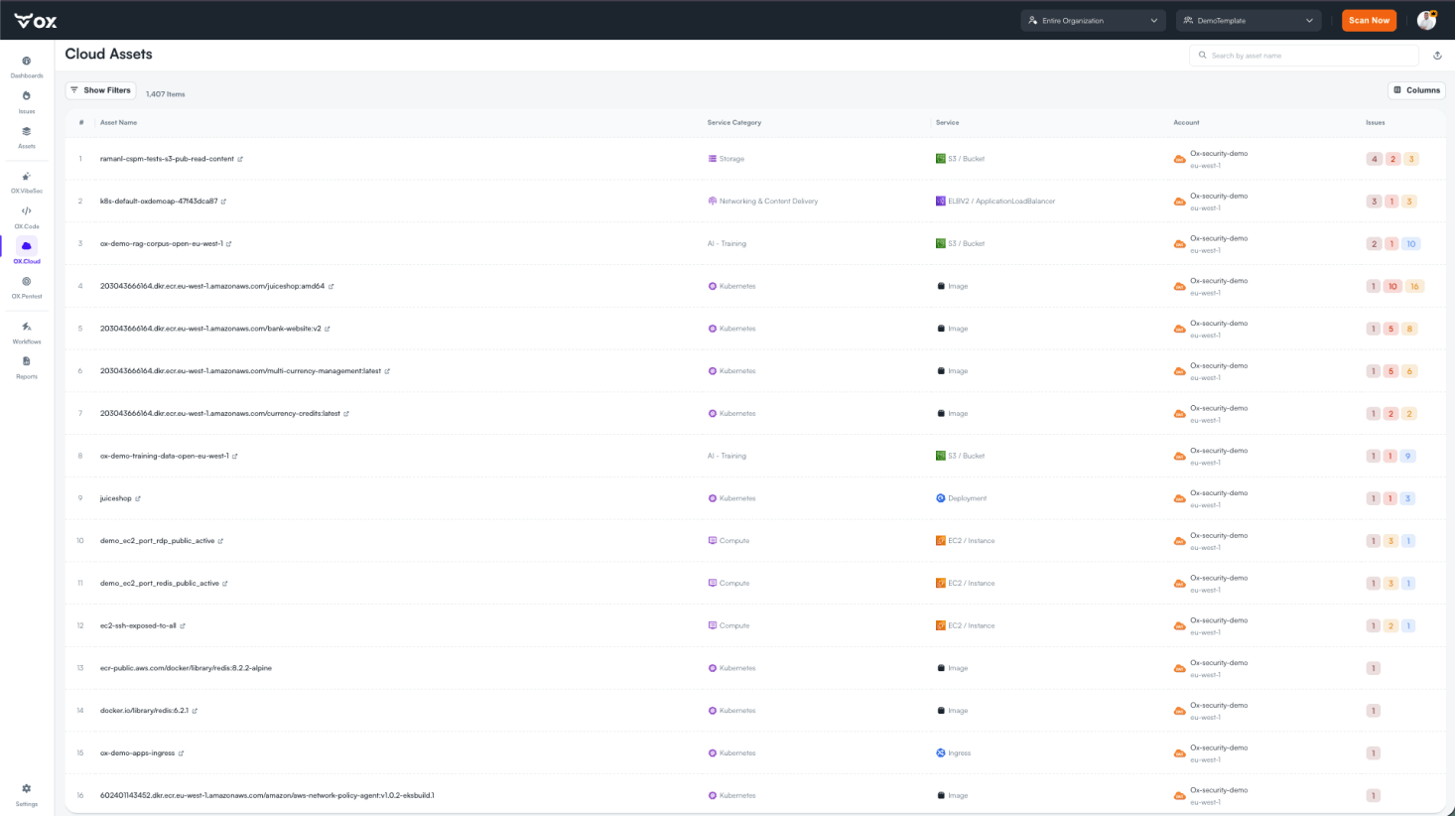 OX Cloud: CNAPP Coverage Plus Runtime Security for AI Agents (2026-09-16) · Sep 2026
· source
· release history
- AIDR detects and governs any AI-driven usage, configuration, or threat across cloud and runtime environments in real time. OX Cloud: CNAPP Coverage Plus Runtime Security for AI Agents (2026-09-16) · Sep 2026 · source · release history
- Introduces AI Detection and Response (AIDR) to detect and govern AI activity across cloud and runtime environments in real time. OX Security Launches OX Cloud, Redefining Cloud Security for the Agentic Era (2026-09-16) · Sep 2026 · source · release history
- Adds Agentic Attack Surface capability, powered by the OX Agent, to uncover hidden backdoors and reachable exposures through agentic-level inspection. OX Cloud: CNAPP Coverage Plus Runtime Security for AI Agents (2026-09-16) · Sep 2026 · source · release history
Dependency Vetting shipped Inspects AI agent install attempts against policy and blocks known-malicious packages before they reach the developer environment.
release
-
Adds
litellm 1.107.0to the OX Security malware database, blocking installation for VibeSec customers and redirecting them to the safe version1.106.0.︀︄︇︀︅︉︀︅︀︀︃︀︀︅︅︀︅︊︀︄︆︀︃︄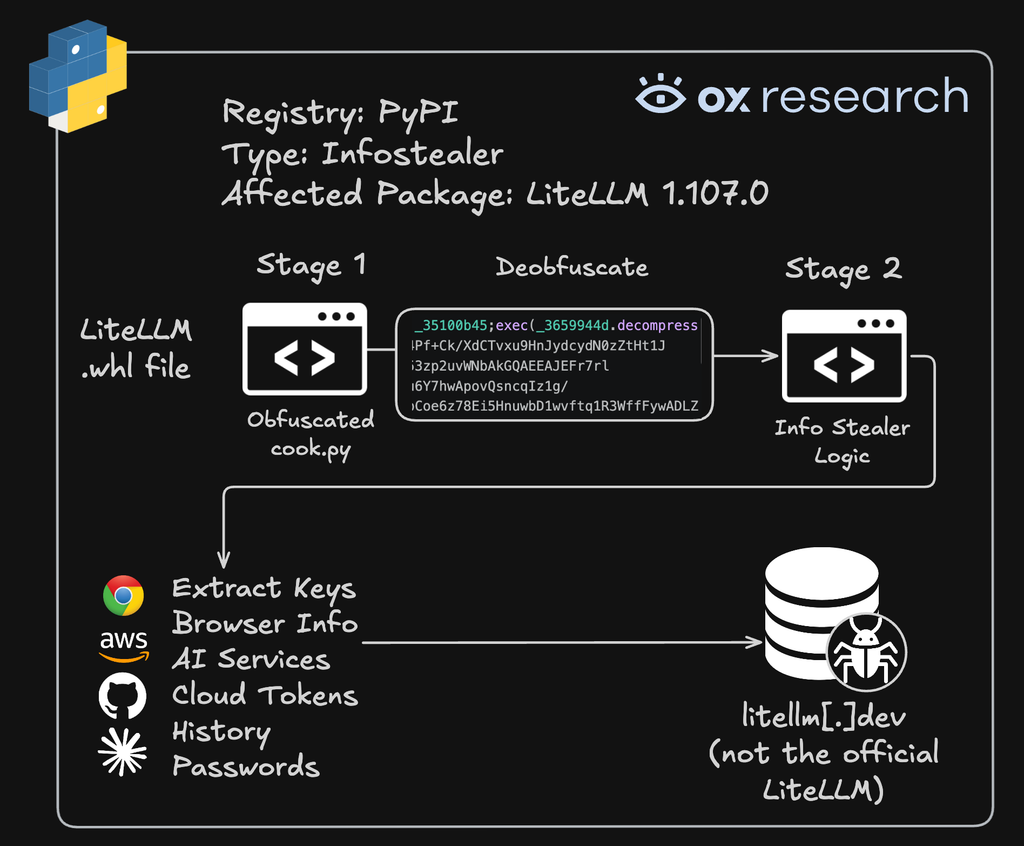 LiteLLM 1.107.0 Compromised With A RAT InfoStealer (2026-10-21) · Oct 2026
· source
· release history
-
OX platform pipeline scan now blocks code pushes that include the compromised
litellm 1.107.0as a dependency. LiteLLM 1.107.0 Compromised With A RAT InfoStealer (2026-10-21) · Oct 2026 · source · release history - Adds Dependency Vetting capability that inspects every AI agent install attempt against policy and blocks known-malicious packages outright before they touch the developer machine or SBOM. Vet Every Dependency Your Agents Install with OX VibeSec (2026-09-09) · Sep 2026 · source · release history
- Introduces Dependency Vetting capability that inspects every agent install attempt against policy and blocks bad ones automatically Vet Every Dependency Your Agents Install with OX VibeSec (2026-09-09) · Sep 2026 · source · release history
- Adds configurable cool-down period to block freshly published packages Vet Every Dependency Your Agents Install with OX VibeSec (2026-09-09) · Sep 2026 · source · release history
- Implements mandatory blocking for known-malicious packages with no exceptions Vet Every Dependency Your Agents Install with OX VibeSec (2026-09-09) · Sep 2026 · source · release history
example
-
Configure a cooldown to block newly published dependencies immediately after release.
N/A (Configured in OX VibeSec policy settings)Vet Every Dependency Your Agents Install with OX VibeSec (2026-09-09) · Sep 2026 · source
Runtime Event Investigation shipped Provides full context for runtime anomalies to accelerate incident detection and triage.
release
-
OX Security now traces each AI agent session step by step — covering prompts and responses, MCP server and tool calls, read/write access permissions, and sensitive data touches — via the new Agent Activity feature in early access on
OX.VibeSecand OX.Cloud. Introducing Agent Activity: See What Your AI Agents Are Actually Doing (2026-10-28) · Oct 2026 · source · release history -
Runtime Events investigates runtime anomalies with full context to accelerate detection and triage.
OX Cloud: CNAPP Coverage Plus Runtime Security for AI Agents (2026-09-16) · Sep 2026
· source
· release history
- Adds Runtime Events capability for investigating runtime anomalies with full context to accelerate incident detection and triage. OX Cloud: CNAPP Coverage Plus Runtime Security for AI Agents (2026-09-16) · Sep 2026 · source · release history
example
-
Investigate what an AI agent did during a suspicious session — trace its prompts, MCP calls, and sensitive data touches in one view.
In OX.VibeSec or OX.Cloud, go to Agent Activity, select the agent session of interest, and review the full chain of prompts and responses, MCP server and tool calls, and any sensitive data (PII,…Introducing Agent Activity: See What Your AI Agents Are Actually Doing (2026-10-28) · Oct 2026 · source
Agent Runtime Policy Enforcement shipped Applies built-in and custom guardrails to AI agent behavior at runtime, allowing violations to be flagged or blocked based on configurable severity thresholds and scoped rules covering models, MCP servers, and skills.
Also counts toward: User-defined detection rules
release
- Start agent governance from 100+ built-in out-of-the-box security policies covering runtime agent behavior. Introducing Agent Activity: See What Your AI Agents Are Actually Doing (2026-10-28) · Oct 2026 · source · release history
- Build custom runtime guardrails scoped to specific AI models, MCP servers, and skills, with a choice to flag or block violations at a severity you set. Introducing Agent Activity: See What Your AI Agents Are Actually Doing (2026-10-28) · Oct 2026 · source · release history
example
-
Block a specific model from combining an MCP server with a skill that reaches sensitive internal data, before it can reach production.
In OX.VibeSec or OX.Cloud, go to Agent Activity > Guardrails, create a custom policy scoped to the target model and MCP server, add the sensitive-data skill condition, and set the enforcement action…Introducing Agent Activity: See What Your AI Agents Are Actually Doing (2026-10-28) · Oct 2026 · source
Reachability-based Prioritization shipped Filters findings based on reachability to eliminate unreachable misconfigurations and prioritize only exploitable risks in cloud environments.
release
-
Introduces reachability-based filtering to eliminate unreachable misconfigurations, vulnerable packages, and supply-chain exposures from the findings backlog, surfacing only what is exploitable and evidenced.
OX Cloud: CNAPP Coverage Plus Runtime Security for AI Agents (2026-09-16) · Sep 2026
· source
· release history
- Provides reachability-based prioritization to filter out risks that cannot actually be reached in cloud environments. OX Security Launches OX Cloud, Redefining Cloud Security for the Agentic Era (2026-09-16) · Sep 2026 · source · release history
Runtime Vulnerability Detection shipped Identifies vulnerabilities actively exposed in running workloads to prioritize truly exploitable risks.
release
-
Adds Runtime Vulnerabilities detection to identify vulnerabilities actively exposed in running workloads and prioritize what is truly exploitable.
OX Cloud: CNAPP Coverage Plus Runtime Security for AI Agents (2026-09-16) · Sep 2026
· source
· release history
- Runtime Vulnerabilities identifies vulnerabilities actively exposed in running workloads and prioritizes what's truly exploitable. OX Cloud: CNAPP Coverage Plus Runtime Security for AI Agents (2026-09-16) · Sep 2026 · source · release history
Cloud Graph and Attack Path Mapping shipped Visualizes relationships across cloud assets, including lateral movement paths and blast radius.
release
-
Adds Cloud Graph and Attack Path Mapping to visualize relationships across cloud assets, including lateral movement paths and blast radius.
OX Cloud: CNAPP Coverage Plus Runtime Security for AI Agents (2026-09-16) · Sep 2026
· source
· release history
Contextual Alert Details shipped Displays who or what acted, what they touched, and what else they could have reached in alert detail views.
release
- Alert detail views show who or what acted, what they touched and what else they could have reached. OX Security Launches OX Cloud, Redefining Cloud Security for the Agentic Era (2026-09-16) · Sep 2026 · source · release history
Lines in monospace are the tool's own words: help text
parsed from its source, or an endpoint from its API document. Under
release, a line is our summary of a dated release. Under
docs, it is quoted from the tool's own documentation or
website. Each links back to the source it came from.
Screenshots
From the release notes, newest first. Click one to see it full size.Score card
-
Shipping velocity releases a month, last 12 months
-
Documentation quality release-notes rubric, 0–100
-
Breaking-change discipline how rarely a release breaks users, and notice given
-
Maintenance risk quiet time against its own cadence, maintainers
-
Innovation & surface new capabilities, API and MCP surface
Five scores for OX Security, each built from the releases, notes and API history this site tracks — and, on Researcher and Business, where it stands among every measured tool in its category and how that has moved.
Score cards are part of every paid plan.
See plans → Already subscribed? Sign in →Trajectory
Blank means never measured; nothing here is a filled-in zero.
Peer standings are included with Researcher and Business. See how this tool ranks against its competitors, using data we don't publish anywhere else.
See plans →Each score is 0–100 on a published rubric, derived from data this site already shows. A dimension we cannot measure says so — it is never scored 0 and never enters a rank.
How this is scored
- Shipping velocity — releases a month over the last 12 months, on a log scale where 16 a month scores 100. Needs 3 releases in the window.
- Documentation quality — the release-notes rubric published on the analytics page, unchanged.
- Breaking-change discipline — the share of releases carrying a breaking change (none scores 100, half or more scores 0). Only projects that label breaking changes are measured: a clean record cannot be told from an unlabelled one.
- Maintenance risk — quiet time measured against the tool's own release cadence (quiet longer than 90 days and three typical gaps scores 0), plus the number of active maintainers and whether contributors are growing, where known. Higher is lower risk.
- Innovation & surface — new capabilities in the feature ledger this year, API and MCP operations added, and the share of commits that are features: the mean of whichever we hold.
- Community health (open-source tools only) — each is a direction, not a size: contributors this year against last, the bus factor now against a year ago, and issues closed per issue opened, where steady scores 50, doubled 100 and halved 0; plus the median time to a maintainer's first reply (an hour scores about 100, a month or more 0). A commercial card has no repository and carries none of the four.
- Documented delivery (commercial tools) — when a vendor's documented new capabilities have slowed against its own baseline, that counts against the overall standing as heavily as two low dimensions. Steady delivery, or too little history to judge, leaves the standing alone; it is never a sixth score.
- Open-source tools are scored on repository signals; commercial tools on their published changelog. Ranks compare tools within one category and one profile and need at least five measured peers; the overall standing needs three ranked dimensions. Best-in-breed or consolidator is a shape, not a quality, and is never scored.
Release-note detail over time
See how much detail OX Security puts in its release notes, quarter by quarter, and compare it with tracked tools in the same category. This history uses up to ten retained, reviewed notes per tool; sparse or blank older quarters may reflect that limit.
Checking release-note history…
Website history
ox.security, every changeOX Security's home page and 20 more pages as they looked each month from September 2022 to October 2026: 33 renders, 7 changes of tagline or palette. Step through them, play them, or put any two months side by side.
Website history is included with Researcher and Business.
See plans → Already subscribed? Sign in →← → or h l a month · Shift a year · [ ] previous / next change · Space play · 1 2 3 page · T whole page · C compare · F full size
← → or h l the right month · Shift the left · S swap · W wipe · T whole page · Esc back
Rebranding timeline
Dates bound when a change appeared between captures. Possible rebrands are AI suggestions; a redesign alone does not establish a rebrand.
Releases
5 entries
No entries match these filters.
- October 20262
- September 20263
Add the badge to your README
Maintain this project? The badge links readers straight to this page, so they can follow every release here.
 Choose a badge style and copy the code →