Cato Networks
See the Real AI Experience with Cato DEM (2026-10-29) commercialThe section your link pointed to isn't on Cato Networks's page any more, so we've brought you to the top.
Summary
Cato Networks is a commercial SASESASEA network architecture model combining wide-area networking and network security functions into a single cloud-delivered service, letting cyber tools enforce consistent policy regardless of where users or workloads sit. platform, delivered as a cloud service, that converges SD-WANSD-WANSoftware-defined wide-area networking: an approach that decouples WAN routing logic from physical hardware, letting operators centrally control traffic paths across MPLS, broadband, and LTE links to reduce cost and improve resilience., ZTNAZTNAZero Trust Network Access, a framework that grants users access to specific applications only after continuously verifying identity and device posture, replacing broad VPN-style network access with least-privilege connections., and network security into a single managed backbone rather than a stack of point products. It is run by connecting sites, users, and cloud resources into Cato's cloud rather than deploying and patching hardware, which is the pitch to network and security teams who currently stitch together separate WAN and security appliances. Beyond core connectivity, it extends into AI security, enumerating MCPMCPModel Context Protocol, a standard for connecting AI applications to external tools and data sources. A compatible server exposes capabilities an assistant can use through a common interface. servers, agents, and skills in use across an organization, and enforcing policy across prompts, tool calls, and outputs for agentic systems built on Claude, Bedrock, Copilot Studio, and similar platforms — work aimed at security teams now responsible for governing AI agents rather than just users and devices. Launched in 2015, it ships frequently, with its most recent release 16 days ago.
How Cato Networks helps
Which MCP servers and tools are reachable by agents right now, and what is the combined risk of that surface?
enumerates the MCP servers and tools available to agents across the environment and rolls them up into a single risk view instead of a per-agent list
Which AI agent skills in use need a review before they touch a business workflow?
scans skills present in the environment and flags those that fail posture checks, surfacing them for review before approval
Which hosts are showing behavior that maps to a known attack tactic right now?
tags hosts dynamically from recent activity and denies specific actions tied to MITRE ATT&CK tactics, such as blocking executable downloads on a host that has already contacted a known command-and-control server
Is an agentic attack against an endpoint still unfolding, and what has already been done about it?
shows the finding, the supporting evidence, which controls activated, and current mitigation status live inside the management application
Will policy apply to a Claude session the first time it runs on a new device?
lets policy be written before the agent is even detected, so the first session on an unenrolled device is still covered instead of running unenforced
Are lateral-movement attempts being caught automatically or only after someone reviews the logs?
continuously aggregates telemetry and reasons about host patterns to apply prevention policy in real time, for example denying lateral movement on a host showing both internal discovery and suspicious outbound contact, without waiting on manual action
Languages
Features
Built from Cato Networks's releases, docs, README and our own runs. “Seen” marks the month we first spotted a release the vendor didn't date. Group names and tags are our labels.
What Cato Networks offers you
- Agentless deployment2
- Agent-based deployment1
- Autonomous investigation and remediation1
- Command-line interface1
- MCP server1
- S3 export1
- SaaS deployment1
- SIEM forwarding1
- Web management console1
No capabilities match.
All capabilities 12 capabilities
Claude AI session inspection and policy enforcement shipped Extends Cato AI Security to Claude Chat, Claude Code, and Claude Cowork via Anthropic Inference Hooks, enforcing policy across the full lifecycle of user prompts, AI responses, tool inputs, and tool outputs without requiring an endpoint agent or network inline access.
Also counts toward: Agentless deployment
release 9 total
- Correlates endpoint and network AI events in a shared platform and data lake, surfacing the user, endpoint, and data behind each blocked tool or blocked prompt in one dashboard. Cato AI Endpoint secures browser AI, desktop AI and coding agents on every endpoint (2026-10-27) · Oct 2026 · source · release history
- Extends Cato AI Security for Agents coverage to Amazon Bedrock (Agents Classic and AgentCore), Microsoft Foundry, Microsoft Copilot Studio, ChatGPT (GPTs and Agents), Amazon Quick, and developer-hosted agent endpoints. Securing what your Bedrock AgentCore agents actually do (2026-09-24) · Sep 2026 · source · release history
- Adds inline inspection of agent-model exchanges at four observable stages — prompt, tool call, tool response, and output — to detect prompt injection and other unwanted activity before the model acts. Securing what your Bedrock AgentCore agents actually do (2026-09-24) · Sep 2026 · source · release history
- Enables full-lifecycle policy enforcement across user prompt, AI response, tool input, and tool output for agentic Claude interactions. Inside Cato’s Latest AI Security Innovations for Claude (2026-08-13) · Aug 2026 · source · release history
- Extends Cato AI Security coverage to Claude Chat, Claude Code, and Claude Cowork via Anthropic Inference Hooks — no endpoint agent or network inline access required. Inside Cato’s Latest AI Security Innovations for Claude (2026-08-13) · Aug 2026 · source · release history
- Adds native support for Anthropic Inference Hooks to inspect and enforce policy before prompts reach Claude Enterprise (Chat, Code, Cowork) Inside Cato’s Latest AI Security Innovations for Claude (2026-08-13) · Aug 2026 · source · release history
example
-
Configure the connector in Cato Management Application after creating a Compliance Access Key in Claude Enterprise
In the Cato Management Application, open Integrations and configure the Compliance API connector.Bringing Claude Enterprise Activity into Cato AI Security (2026-07-21) · Jul 2026 · source
MCP server and tool visibility shipped Enumerates MCP servers, tools, and skills available to agents so security teams can assess their combined risk surface and identify skills requiring review before use in business workflows.
Shared capability: MCP server
Also counts toward: MCP server
release
- Assigns a risk finding with a block, monitor, or allow recommendation to each skill, and badges verified remote MCP servers, enabling teams to prioritize and remediate the riskiest agents before they act. Cato AI Endpoint secures browser AI, desktop AI and coding agents on every endpoint (2026-10-27) · Oct 2026 · source · release history
- Discovers Shadow AI — unapproved AI applications, local agents, MCP servers, and skills installed on endpoints — giving security teams a governed inventory before writing policy. Cato AI Endpoint secures browser AI, desktop AI and coding agents on every endpoint (2026-10-27) · Oct 2026 · source · release history
- Adds MCP and tool visibility so security teams can enumerate the MCP servers and tools available to agents and assess their combined risk surface. Inside Cato’s Latest AI Security Innovations for Claude (2026-08-13) · Aug 2026 · source · release history
- Adds visibility and posture assessment for environment skills and MCP servers Inside Cato’s Latest AI Security Innovations for Claude (2026-08-13) · Aug 2026 · source · release history
- Adds skill visibility and posture assessment across the environment, helping teams identify skills that require review before use in business workflows. Inside Cato’s Latest AI Security Innovations for Claude (2026-08-13) · Aug 2026 · source · release history
Cato XOps SIEM event correlation and forwarding shipped Correlates raw Cato events into consolidated, context-rich stories — including east-west WAN lateral movement signals — before forwarding to a SIEM, reducing ingestion volume, with over 100 native vendor integrations, a custom HTTP push connector for any compatible destination, and an in-connector data dictionary that translates Cato telemetry field names into human-readable labels.
Also counts toward: S3 export, SIEM forwarding
release
-
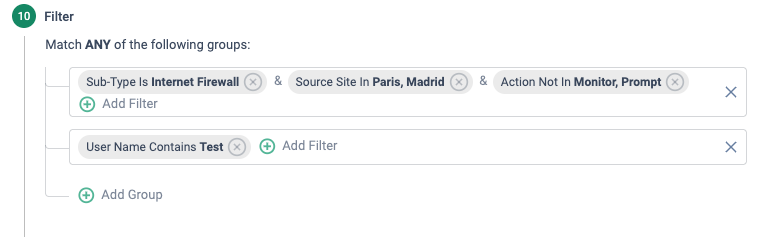
Adds Cato XOps to correlate raw events into consolidated, context-rich stories before forwarding to a SIEM, reducing ingestion volume (demonstrated at 37 million daily events compressed to 94 stories).
 Make Your SIEM Smarter with Cato (2026-10-21) · Oct 2026
· source
· release history
- Adds the Custom HTTP Push Connector to stream selected Cato Events and Flows to any compatible HTTP destination, including AWS S3 and custom analytics platforms, with control over source, destination, filters, and context.︀︄︇︀︅︉︀︅︀︀︃︀︀︅︅︀︅︊︀︄︆︀︃︄ Make Your SIEM Smarter with Cato (2026-10-21) · Oct 2026 · source · release history
- Extends native integrations to over 100 vendors including CrowdStrike, Microsoft, and OpenAI for enriching SIEM workflows with Cato SASE Platform telemetry. Make Your SIEM Smarter with Cato (2026-10-21) · Oct 2026 · source · release history
- Adds a data dictionary within the connector to translate Cato telemetry field names into human-readable labels for easier SIEM mapping. Make Your SIEM Smarter with Cato (2026-10-21) · Oct 2026 · source · release history
- Supports east-west WAN traffic visibility alongside north-south traffic within Cato XOps, surfacing lateral movement signals across enterprise resources. Make Your SIEM Smarter with Cato (2026-10-21) · Oct 2026 · source · release history
Digital Experience Monitoring Root Cause Analysis shipped Correlates endpoint, network, application, and historical path data — including client traceroute hops, network adapter metrics, and multi-user blast-radius context — across Cato SASE and supported third-party network environments to identify the likely fault domain for experience issues.
release
- Extends RCA scope beyond the individual user to correlate experience data across multiple users, revealing whether an issue is isolated or shared and its broader blast radius. Stop Guessing. Find the Root Cause with Cato DEM. (2026-10-20) · Oct 2026 · source · release history
- Supports RCA across Cato SASE and supported third-party network environments, without requiring replacement of existing network infrastructure. Stop Guessing. Find the Root Cause with Cato DEM. (2026-10-20) · Oct 2026 · source · release history
- Adds Client Traceroute to the RCA workflow, providing historical hop-by-hop path evidence from the client to capture latency, loss, and path behavior — especially useful for intermittent and remote-user issues. Stop Guessing. Find the Root Cause with Cato DEM. (2026-10-20) · Oct 2026 · source · release history
- Adds Root Cause Analysis (RCA) to Cato DEM, correlating endpoint, network, application, and historical path evidence in a single investigation to identify the likely fault domain.︀︄︇︀︅︉︀︅︀︀︃︀︀︅︅︀︅︊︀︄︆︀︃︄ Stop Guessing. Find the Root Cause with Cato DEM. (2026-10-20) · Oct 2026 · source · release history
- Adds Network Adapter Metrics to the RCA workflow, surfacing adapter type, BSSID, channel, noise, and signal strength to assess local Wi-Fi conditions contributing to poor experience. Stop Guessing. Find the Root Cause with Cato DEM. (2026-10-20) · Oct 2026 · source · release history
Agentic Threat Prevention shipped Continuously aggregates telemetry and reasons about host behaviour to automatically apply prevention policies in real time, surfacing findings, supporting evidence, activated controls, and mitigation status inside the Cato Management Application.
release
- Introduces Cato Agentic Threat Prevention, which predicts likely attack paths using shared context across identity, device, application, and network activity, then automatically adapts policies to disrupt evolving multi-stage attacks in real time.︀︄︇︀︅︉︀︅︀︀︃︀︀︅︅︀︅︊︀︄︆︀︃︄ Beyond Model Access: Frontier AI Defense Needs Runtime Prevention (2026-10-08) · Oct 2026 · source · release history
-
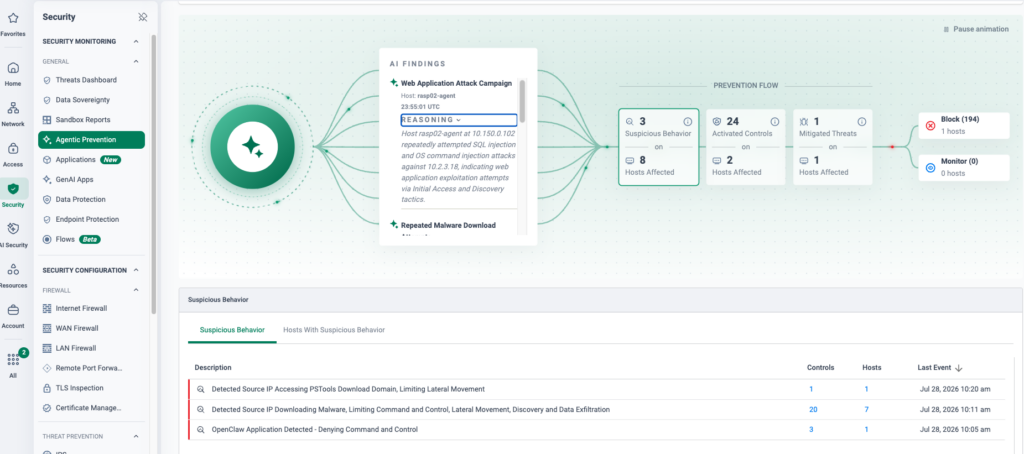
Agentic decision-making layer continuously aggregates telemetry, reasons about host patterns, and automatically applies prevention policies in real time without manual intervention — for example, denying lateral movement vectors on hosts exhibiting both internal discovery and suspicious external communications.
 Defeating the Agentic Attacker: Agentic Threat Prevention in Action (2026-08-10) · Aug 2026
· source
· release history
- New Agentic Threat Prevention capability surfaces findings, supporting evidence, activated controls, and mitigation status inside the Cato Management Application. Defeating the Agentic Attacker: Agentic Threat Prevention in Action (2026-08-10) · Aug 2026 · source · release history
- Inline conditional enforcement dynamically tags hosts based on recent activity and denies specific behaviors mapped to MITRE ATT&CK tactics — for example, blocking executable downloads from cloud services on hosts that have contacted known C2 servers. Defeating the Agentic Attacker: Agentic Threat Prevention in Action (2026-08-10) · Aug 2026 · source · release history
example
-
Review an active agentic attack finding — including evidence, controls activated, and mitigation status — as it unfolds in the Cato Management Application.
In the Cato Management Application, navigate to Agentic Threat Prevention to view the attack timeline, supporting evidence, activated controls, and current mitigation status for the affected host.Defeating the Agentic Attacker: Agentic Threat Prevention in Action (2026-08-10) · Aug 2026 · source
AI Agent Experience Monitoring shipped Isolates AI model-provider traffic from background application noise, provides a drill-down view of AI latency and errors by model provider, domain, and site, and shows how users are accessing AI services — browser, terminal, script, or coding tool — with initial coverage for ChatGPT, Claude, Cursor, and the OpenAI and Anthropic APIs.
release
- Cato DEM now isolates AI model-provider traffic — including conversational interactions and coding-agent traffic from tools like Claude Code — from background application noise such as downloads, authentication, and telemetry, so latency and error metrics reflect the actual AI interaction. See the Real AI Experience with Cato DEM (2026-10-29) · Oct 2026 · source · release history
- Cato DEM now adds an AI Agent Experience Monitoring drill-down view where IT teams can analyze AI latency and errors broken down by model provider, domain, and site.︀︄︇︀︅︉︀︅︀︀︃︀︀︅︅︀︅︊︀︄︆︀︃︄ See the Real AI Experience with Cato DEM (2026-10-29) · Oct 2026 · source · release history
- Cato DEM's AI Agent Experience Monitoring launches with coverage for ChatGPT, Claude, Cursor, and the OpenAI and Anthropic APIs, with additional AI services planned. See the Real AI Experience with Cato DEM (2026-10-29) · Oct 2026 · source · release history
- Cato DEM now shows how users are accessing AI services — browser, terminal, script, or coding tool — so IT can distinguish, for example, a browser session to Claude from a developer using Claude Code. See the Real AI Experience with Cato DEM (2026-10-29) · Oct 2026 · source · release history
Cato MSASE Business Center for partners shipped Provides MSPs and service providers a consolidated portal to view business accounts, orders, license usage, invoices, and customer lifecycle activity, and to self-provision eligible services and activate new customer accounts without manual approval workflows.
Also counts toward: Web management console
release
-
Adds the Cato MSASE Business Center interface providing a consolidated view of business accounts, orders, license usage, invoices, and customer lifecycle activity for authorized partners.
 Cato Managed SASE for SMB: Flexible Capacity, Faster Onboarding (2026-09-01) · Sep 2026
· source
· release history
- Authorized partners can self-provision eligible services and activate new customer accounts directly in Cato MSASE Business Center without waiting for manual approval workflows. Cato Managed SASE for SMB: Flexible Capacity, Faster Onboarding (2026-09-01) · Sep 2026 · source · release history
- New Cato MSASE Business Center adds a consolidated Business Overview page showing business accounts, orders, license usage, invoices, and customer lifecycle activity across the partner portfolio. Cato Managed SASE for SMB: Flexible Capacity, Faster Onboarding (2026-09-01) · Sep 2026 · source · release history
example
-
Monitor license usage and account status across multiple SMB customers from a single partner view.
Navigate to the Cato MSASE Business Center > Business Overview page to review consolidated order history and active license allocation.Cato Managed SASE for SMB: Flexible Capacity, Faster Onboarding (2026-09-01) · Sep 2026 · source
Cato Scout hook management shipped Allows pre-emptive hook policy configuration before a supported agent is detected, ties policies and audit records to the correct endpoint user or device, and provides a scout-debug command to verify hook registration for in-workflow deployment troubleshooting.
Also counts toward: Command-line interface
release
-
Adds
scout-debugCLI tool to verify hook registration inside supported agents Inside Cato’s Latest AI Security Innovations for Claude (2026-08-13) · Aug 2026 · source · release history - Enables pre-emptive hook configuration — write hook policy before a supported agent is detected, so the first session on a new device is not outside enforcement. Inside Cato’s Latest AI Security Innovations for Claude (2026-08-13) · Aug 2026 · source · release history
-
Adds
scout-debugcommand to verify hook registration inside supported agents, enabling in-workflow deployment troubleshooting. Inside Cato’s Latest AI Security Innovations for Claude (2026-08-13) · Aug 2026 · source · release history - Supports scoped rollout by applying controls to specific users or groups, with Cato Scout client identity tying policies and audit records to the correct endpoint user or device. Inside Cato’s Latest AI Security Innovations for Claude (2026-08-13) · Aug 2026 · source · release history
Cato SMB FlexPool license pooling shipped Gives MSPs and service providers a partner-level pool of Cato licenses that can be freely allocated and reallocated across eligible SMB customers without per-customer license purchases.
release
-
Enables Cato SMB FlexPool, a partner-level pool of licenses allowing unlimited portability to allocate and reallocate capacity across eligible SMB customers.
Cato Managed SASE for SMB: Flexible Capacity, Faster Onboarding (2026-09-01) · Sep 2026
· source
· release history
-
New
Cato SMB FlexPoolprovides MSPs and service providers a partner-level pool of Cato licenses, enabling unlimited portability to allocate and reallocate capacity across eligible SMB customers without per-customer license purchases. Cato Managed SASE for SMB: Flexible Capacity, Faster Onboarding (2026-09-01) · Sep 2026 · source · release history
AI Endpoint agent shipped A lightweight client that secures browser AI, desktop AI apps, and local coding agents from a single dashboard, coexisting with existing EDR and SSE stacks.
Also counts toward: Agent-based deployment
release
- Introduces Cato AI Endpoint, a lightweight client that secures browser AI, desktop AI apps, and local coding agents (Claude Code, Codex, Cursor) from a single dashboard, coexisting with existing EDR and SSE stacks.︀︄︇︀︅︉︀︅︀︀︃︀︀︅︅︀︅︊︀︄︆︀︃︄ Cato AI Endpoint secures browser AI, desktop AI and coding agents on every endpoint (2026-10-27) · Oct 2026 · source · release history
Agentic CVE Mitigation shipped Autonomously assesses newly disclosed vulnerabilities and applies cloud-delivered protections in as little as 45 minutes without requiring appliance updates across customer environments.
Also counts toward: Autonomous investigation and remediation, SaaS deployment
release
- Introduces Cato Agentic CVE Mitigation, which autonomously assesses and applies cloud-delivered protections for newly disclosed vulnerabilities in as little as 45 minutes — without requiring appliance updates across customer environments. Beyond Model Access: Frontier AI Defense Needs Runtime Prevention (2026-10-08) · Oct 2026 · source · release history
Bedrock AgentCore agent discovery shipped Provides read-only enumeration of agents on Amazon Bedrock AgentCore, including instructions, models, and connected tools.
Also counts toward: Agentless deployment
release
- Adds read-only discovery of every agent running on Amazon Bedrock AgentCore, surfacing each agent's instructions, model, and connected tools without installing anything.︀︄︇︀︅︉︀︅︀︀︃︀︀︅︅︀︅︊︀︄︆︀︃︄ Securing what your Bedrock AgentCore agents actually do (2026-09-24) · Sep 2026 · source · release history
Lines in monospace are the tool's own words: help text
parsed from its source, or an endpoint from its API document. Under
release, a line is our summary of a dated release. Under
docs, it is quoted from the tool's own documentation or
website. Each links back to the source it came from.
Screenshots
From the release notes, newest first. Click one to see it full size.Media
Videos from the release notes, newest first. They play right here.Score card
-
Shipping velocity releases a month, last 12 months
-
Documentation quality release-notes rubric, 0–100
-
Breaking-change discipline how rarely a release breaks users, and notice given
-
Maintenance risk quiet time against its own cadence, maintainers
-
Innovation & surface new capabilities, API and MCP surface
Five scores for Cato Networks, each built from the releases, notes and API history this site tracks — and, on Researcher and Business, where it stands among every measured tool in its category and how that has moved.
Score cards are part of every paid plan.
See plans → Already subscribed? Sign in →Trajectory
Blank means never measured; nothing here is a filled-in zero.
Peer standings are included with Researcher and Business. See how this tool ranks against its competitors, using data we don't publish anywhere else.
See plans →Each score is 0–100 on a published rubric, derived from data this site already shows. A dimension we cannot measure says so — it is never scored 0 and never enters a rank.
How this is scored
- Shipping velocity — releases a month over the last 12 months, on a log scale where 16 a month scores 100. Needs 3 releases in the window.
- Documentation quality — the release-notes rubric published on the analytics page, unchanged.
- Breaking-change discipline — the share of releases carrying a breaking change (none scores 100, half or more scores 0). Only projects that label breaking changes are measured: a clean record cannot be told from an unlabelled one.
- Maintenance risk — quiet time measured against the tool's own release cadence (quiet longer than 90 days and three typical gaps scores 0), plus the number of active maintainers and whether contributors are growing, where known. Higher is lower risk.
- Innovation & surface — new capabilities in the feature ledger this year, API and MCP operations added, and the share of commits that are features: the mean of whichever we hold.
- Community health (open-source tools only) — each is a direction, not a size: contributors this year against last, the bus factor now against a year ago, and issues closed per issue opened, where steady scores 50, doubled 100 and halved 0; plus the median time to a maintainer's first reply (an hour scores about 100, a month or more 0). A commercial card has no repository and carries none of the four.
- Documented delivery (commercial tools) — when a vendor's documented new capabilities have slowed against its own baseline, that counts against the overall standing as heavily as two low dimensions. Steady delivery, or too little history to judge, leaves the standing alone; it is never a sixth score.
- Open-source tools are scored on repository signals; commercial tools on their published changelog. Ranks compare tools within one category and one profile and need at least five measured peers; the overall standing needs three ranked dimensions. Best-in-breed or consolidator is a shape, not a quality, and is never scored.
Release-note detail over time
See how much detail Cato Networks puts in its release notes, quarter by quarter, and compare it with tracked tools in the same category. This history uses up to ten retained, reviewed notes per tool; sparse or blank older quarters may reflect that limit.
Checking release-note history…
Website history
catonetworks.com, every changeCato Networks's home page and 40 more pages as they looked each month from September 2021 to October 2026: 49 renders, 2 changes of tagline or palette. Step through them, play them, or put any two months side by side.
Website history is included with Researcher and Business.
See plans → Already subscribed? Sign in →← → or h l a month · Shift a year · [ ] previous / next change · Space play · 1 2 3 page · T whole page · C compare · F full size
← → or h l the right month · Shift the left · S swap · W wipe · T whole page · Esc back
Rebranding timeline
Dates bound when a change appeared between captures. Possible rebrands are AI suggestions; a redesign alone does not establish a rebrand.
Coverage
Missing something? Tell us
What Cato Networks connects to, runs on and detects, read from its release notes and docs. So far: 5 new detections, 1 new integration, 1 new compliance framework.
7 changes, tracked since Oct 28, 2026.
-
Oct 292026
new AI Agent Experience Monitoring — ChatGPT, Claude, Cursor, OpenAI API, Anthropic API
At launch, coverage includes ChatGPT, Claude, Cursor, and the OpenAI and Anthropic APIs, with additional AI services to be added over time.
-
Oct 282026
new Prompt injection and jailbreak detection for AI agents and custom applications
With LLM01, ASI01
Cato blocks prompt injection and jailbreak attempts before the model or agent acts. The same inspection finds sensitive data in prompts and responses and in files attached to AI apps.
-
Oct 282026
new Sensitive data detection in AI prompts, responses, and file attachments
With LLM02
The same inspection finds sensitive data in prompts and responses and in files attached to AI apps.
-
Oct 282026
new MCP server and AI skill discovery for supply chain risk
With LLM04, ASI04
Cato protects against supply chain risk by discovering MCP servers and skills connected to agents and coding tools, including ones IT never approved, and applying policy to each one.
-
Oct 282026
new Manipulated context detection in live AI interactions
With LLM05
Cato AI Security detects manipulated context in live interactions, while your data pipeline owners protect training and fine-tuning data.
-
Oct 282026
new Agent activity inventory and per-agent policy enforcement
With ASI10
Cato AI Security keeps an inventory of agent activity and applies policy to each agent in line, while your agent platform owns the kill switch.
-
Oct 282026
new OWASP Top 10 for LLM Applications (2026) and OWASP Top 10 for Agentic Applications (2026) coverage mapping
Covers 10: LLM01, LLM02, LLM03, LLM04, LLM05, LLM06 and 4 more
Cato AI Security covers the risks on both lists in three ways: Direct protection: Cato stops the risk in line, before the AI application or agent acts. Shared protection: Cato reduces the risk and works with your app developers on the rest. Platform evidence: Cato logs every AI interaction in an audit-ready format, so your team can investigate and show auditors what happened.
Editors & IDEs 1
Chat & assistant apps 1
Model providers & gateways 2
Nothing first seen in this window. That doesn't mean Cato Networks shipped nothing, only that we found no record of it.
How we count
Read from 2 of 10 release notes and docs updates we hold for Cato Networks. "First seen" is the earliest note that names something; "last" is the latest. Our history may start partway through Cato Networks's life, so an old integration can show a recent first-seen date.
Each change counts once: "added 40 checks" is one line, so the numbers measure how often coverage moves, not how big the catalogue is or how well it detects.
Releases
10 entries
No entries match these filters.
- October 20265
- September 20262
- August 20262
- July 20261
Add the badge to your README
Maintain this project? The badge links readers straight to this page, so they can follow every release here.
 Choose a badge style and copy the code →