Censys
November 2, 2026 (2026-11-02) commercialThe section your link pointed to isn't on Censys's page any more, so we've brought you to the top.
Censys is a search engine for internet-connected devices that indexes certificates, websites, and network services for security research and reconnaissance.
# 1. Upload the report HTML as a file
curl -X POST 'https://api.platform.censys.io/files?org_id=<org_id>' \
  -H 'Authorization: Bearer <token>' \
  -H 'Content-Type: application/json' \
  -d '{"content_type": "text/html", "filename": "vendor-report.html", "size_bytes": 42800}'

# 2. PUT the actual bytes to the returned upload_url, then run investigation
#    (investigate() wraps the investigation submission call with file_ids=["<file_id>"], start_time="...")

# 3. Turn the returned CenQL into a persistent Collection
curl -X POST 'https://api.platform.censys.io/v3/collections?org_id=<org_id>' \
  -H 'Authorization: Bearer <token>' \
  -H 'Content-Type: application/json' \
  -d '{"name": "Investigator: ScreenConnect phishing cluster", "query": "<cenql_from_report>"}'
curl -X GET 'https://api.platform.censys.io/usage?org_id=<org_id>' \
  -H 'Authorization: Bearer <token>'
risks.name: "Vulnerable PHP (php2shell) [CVE-2026-109618 / CVE-2026-109619]"
claude plugin marketplace add censys/censys-ai-skills
claude plugin install censys
@censys-ai-skills/skills/censys-search/SKILL.md
@censys-ai-skills/skills/censys-cenql/SKILL.md
claude plugin marketplace add censys/censys-ai-skills
claude plugin install censys
risks.name: "Exposed Check Point Security Management and Log Server"
risks.name: "Vulnerable Cisco Secure Email Gateway [CVE-2026-76461]"
host.services.endpoints.http.headers:(key="Server" and value=~"(?i)^nginx$" and not value="nginx")
risks.name: "GitLab Server (CVE-2026-85706)"
risks.name:`End-of-Life SonicWall Global Management System`
services.service_name: NRPE AND geo_distance(host.location.coordinates, 37.7749, -122.4194, 50km)
services.service_name: KNXIP AND geo_distance(host.location.coordinates, 51.5074, -0.1278, 25km)
web.endpoints.http.body: "Authorization: Bearer internal-" AND web.endpoints.http.body: "env=production"
risks.name: "Exposed Copeland XWEB Pro Refrigeration Controller"
risks.name: "Exposed Payara Server Default Page"
host.services.endpoints.http.body: "api_secret_key"
claude mcp add censys-threat-hunting https://mcp.platform.censys.io/threat-hunting/mcp/
{ "url": "https://mcp.platform.censys.io/threat-hunting/mcp/" }
claude mcp add censys-threat-hunting https://mcp.platform.censys.io/threat-hunting/mcp/
{ "url": "https://mcp.platform.censys.io/threat-hunting/mcp/" }
risks.name: "Vulnerable Microsoft SharePoint Server [CVE-2026-50522]"
risks.name: "Microsoft SharePoint Server Authenticated Deserialization RCE [CVE-2026-45659]"
In Censys Search, run the query: services.software.product:`Wordfence Security`
Platform query: software.product: OpenVPN
risks.name: "Vulnerable Gogs [CVE-2026-52813]"
risks.name:"Vulnerable Splunk Enterprise [CVE-2026-20253]"
Summary
Censys is a commercial exposure-management platform, delivered as a hosted service, that continuously scans the entire public IPv4 address space across all ports and protocols and finds in-use IPv6IPv6The current version of the Internet Protocol, standardized by the IETF, using 128-bit addresses to replace the exhausted IPv4 space. Cyber tools target it because modern networks run dual-stack or IPv6-only. hosts through DNS and redirect analysis, building an internet-wide map of exposed hosts and services that updates as new fingerprints, protocol scanners, and vulnerability risk types are added to the dataset. It is aimed at security teams running attack-surface management and SOCSOCA security operations center, the team or function that monitors threats, investigates alerts and coordinates incident response. Its work can be internal, outsourced or shared. analysts who need to find and prioritize exposed, vulnerable assets, with bulk tagging, SIEMSIEMSecurity information and event management, collecting logs from many systems and correlating events to find suspicious activity. Analysts use it to investigate alerts and incidents./SOARSOARSecurity orchestration, automation and response, coordinating incident workflows across tools. Playbooks can gather evidence, assign work or carry out approved response actions. integrations, and an MCPMCPModel Context Protocol, a standard for connecting AI applications to external tools and data sources. A compatible server exposes capabilities an assistant can use through a common interface. server for connecting AI agents to the data. It sits in the exposure-management and attack-surface-management space rather than replacing internal vulnerability scanners, and is accessed via web console, API, or the cencli CLI. Launched in 2017, it ships frequent releases, with the last one 18 days ago.
Censys is a search engine for internet-connected devices that indexes certificates, websites, and network services for security research and reconnaissance.
How Censys helps
Which internet-facing hosts in my environment are running software with a newly disclosed vulnerability?
matches host and service fingerprints against continuously added ASM risk types (like recent Cacti, Gogs, Splunk, and SharePoint CVEs) and lists affected assets by workspace, flagging risk types that ship disabled until reviewed
Which of my exposed assets should I patch first?
scores and tags hosts against known vulnerable-version fingerprints so a query for a specific CVE returns only the matching instances in the inventory, rather than every host running that software
Does a domain my team is investigating actually resolve, even if it has never shown up in a scan before?
performs a live DNS lookup outside the existing dataset and returns current records or an explicit non-resolution result, separate from what has already been indexed
What changed in my exposed infrastructure since the last time I looked?
keeps historical scan results alongside current ones so a host's services, ports, and DNS relationships can be compared over time to surface new or dropped exposure
Which unmanaged or shadow services are sitting on my IP space right now?
continuously scans all ports across the full public IPv4 space plus IPv6 hosts found via DNS and redirects, and reports what protocol is actually answering rather than what's expected to be there
How do I act on a large batch of newly discovered risky assets without touching each one by hand?
runs a query against the asset inventory and applies or removes a tag on every matching result in one operation, so downstream SIEM/SOAR workflows can act on the tagged set
Languages
Features
Built from Censys's releases, docs, README and our own runs. “Seen” marks the month we first spotted a release the vendor didn't date. Group names and tags are our labels.
- Censys covers 2 of the 13 network discovery and scanning capabilities we track.
- Censys covers 1 of the 8 vulnerability assessment methods capabilities we track.
What Censys offers you
- Command-line interface3
- Role-based access control2
- Web management console2
- Administrative audit log1
- Built-in AI assistant1
- MCP server1
- ML-based detection1
- Multi-factor authentication1
- Natural-language query1
- Plugin system1
- REST API1
- SCIM provisioning API1
- SIEM forwarding1
No capabilities match.
Attack surface inventory 7 features Network discovery and scanning since 2026
ASM software and protocol fingerprinting shipped Censys continuously adds software, hardware, firmware, and protocol fingerprints so users can find and identify assets by recognised product name across both ASM and Platform inventories.
Shared capability: Attack surface inventory
release 33 total
- Censys adds a new Cisco NX-OS OS fingerprint to the Platform. November 2, 2026 (2026-11-02) · Nov 2026 · source · release history
-
Censys adds a new
Wordpress Plugin - Gravity Formssoftware fingerprint to the Platform. November 2, 2026 (2026-11-02) · Nov 2026 · source · release history -
Expands the
phpfingerprint to include inferred presence from over 30 other software fingerprints in both the Platform and ASM. October 26, 2026 (2026-10-26) · Oct 2026 · source · release history -
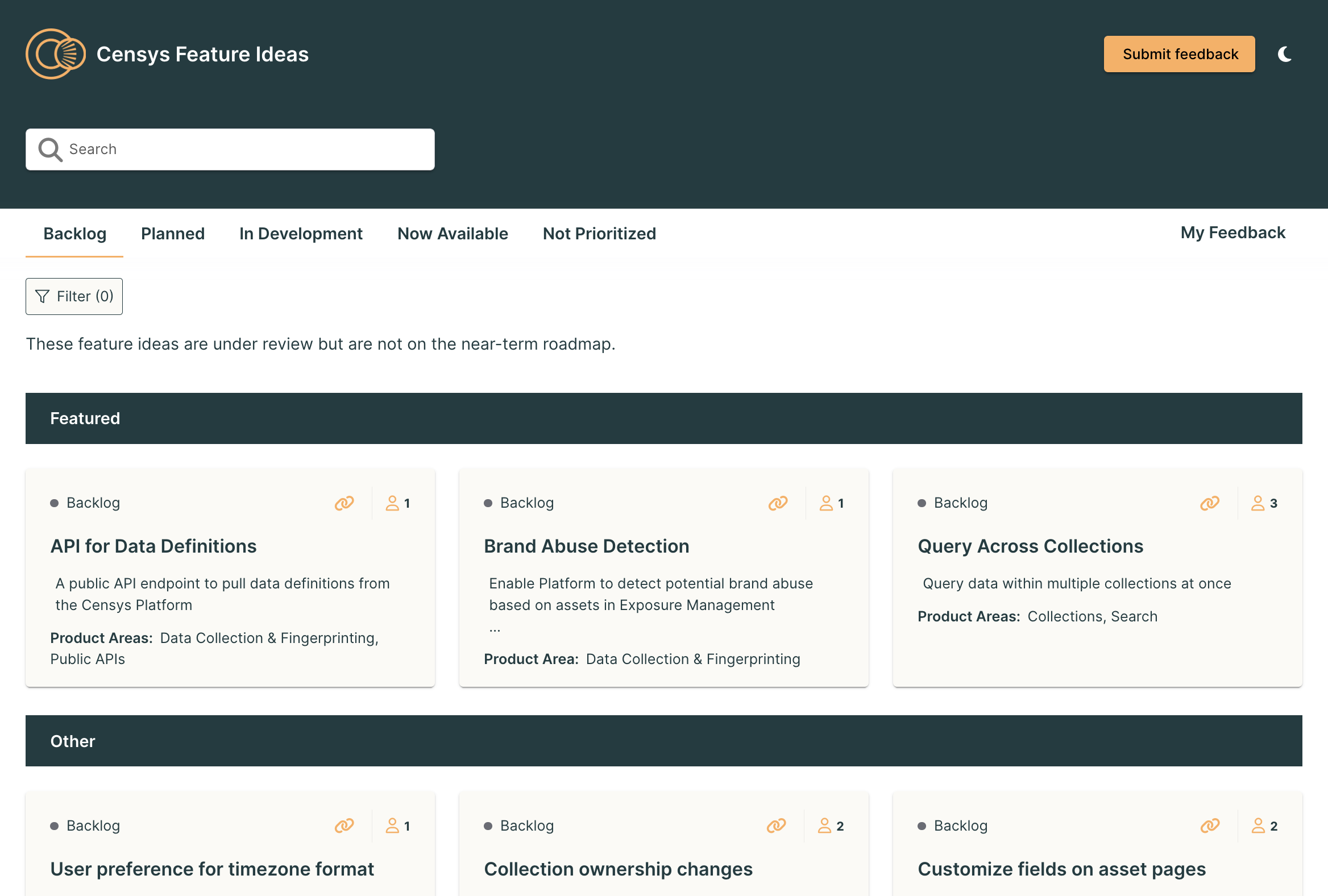
Adds 10 new software fingerprints to the Platform: Ahsay Cloud Backup Suite (AhsayCBS), IBM MCP Context Forge, Nextcloud Collabora Online Built-in CODE Server, OliveTin, Perforce P4 Search (formerly HelixSearch), phpBB, pyLoad, Softaculous Virtualizor, ThinkPHP, and ZITADEL.
 October 19, 2026 (2026-10-19) · Oct 2026
· source
· release history
-
Adds five new fingerprints to the Platform: Cudy WR3000 Router (hardware), OpenPrinting CUPS (software), OSGeo GeoNetwork (software), Midoks mdserver-web (software), and Sangoma Switchvox (software).
 October 13, 2026 (2026-10-13) · Oct 2026
· source
· release history
-
Adds software fingerprints with full coverage for jQuery, AngularJS, Bootstrap, WordPress, WooCommerce, and Astro to surface unknown or unauthorized web dependencies.
 October 8, 2026 (2026-10-08) · Oct 2026
· source
· release history
docs
- In the example below, when the host presented this certificate, no threat fingerprints were detected and 14 services were present. The JARM fingerprint and banner hash for the service running on port 7880 are also shown. 3 days ago seen Aug 2026 · source
Platform host and web property search shipped Users can query Censys's internet-wide dataset to find hosts and web properties matching structured field criteria or retrieve all known data for a specific host.
Shared capability: Attack surface inventory
release 9 total
-
Censys Starter subscribers gain access to additional API endpoints including
search,aggregate, and allcollectionsendpoints, plus tags and comments. November 2, 2026 (2026-11-02) · Nov 2026 · source · release history -
Adds
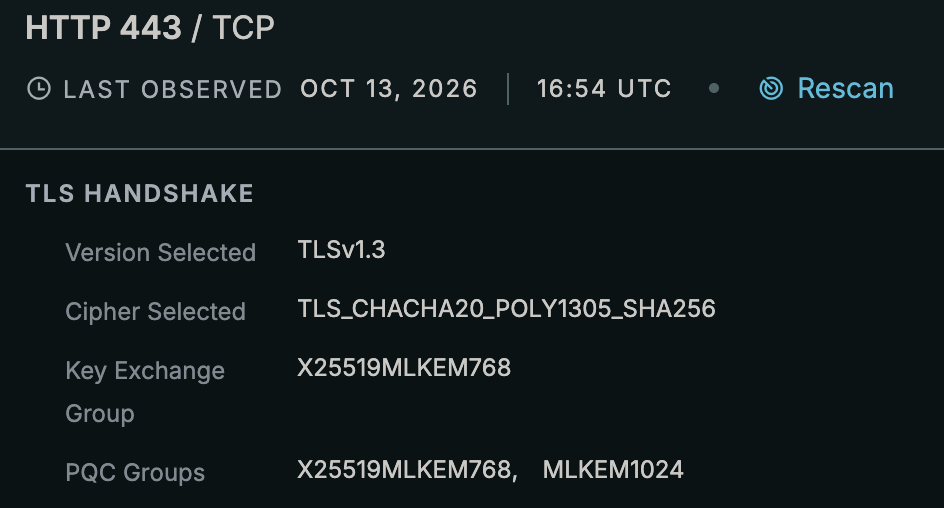
key_exchange_groupandpqc_groupsfields to host services and web property endpoints, exposing post-quantum cryptography (PQC) key exchange group data including ML-KEM (Kyber) and hybrid exchanges like X25519MLKEM768.︀︄︇︀︅︉︀︅︀︀︃︀︀︅︅︀︅︊︀︄︆︀︃︄
October 13, 2026 (2026-10-13) · Oct 2026
· source
· release history
-
Adds the
censys-ai-skillsrepo, a Claude plugin that exposescenclicommands to AI agents for asset lookups, investigations, and CensEye job execution.︀︄︇︀︅︉︀︅︀︀︃︀︀︅︅︀︅︊︀︄︆︀︃︄ September 28, 2026 (2026-09-28) · Sep 2026 · source · release history - Adds the (?i) case-insensitive regex operator to CenQL queries, allowing string matches regardless of character casing September 14, 2026 (2026-09-14) · Sep 2026 · source · release history
-
Adds the (?i) case-insensitive regex operator to the Censys Query Language (CenQL), enabling case-insensitive
value=~pattern matching inhost.services.endpoints.http.headersand other string fields.︀︄︇︀︅︉︀︅︀︀︃︀︀︅︅︀︅︊︀︄︆︀︃︄ September 14, 2026 (2026-09-14) · Sep 2026 · source · release history -
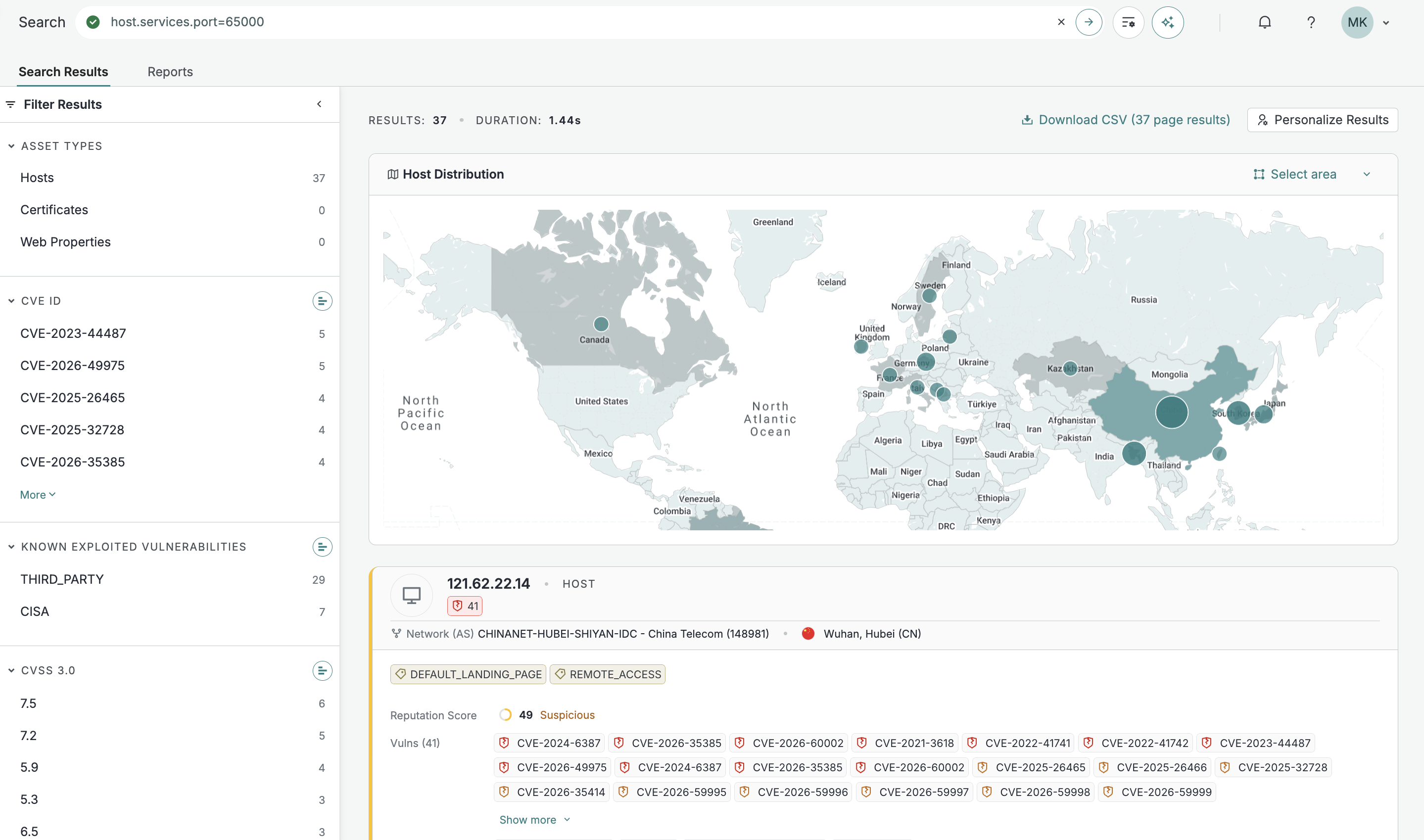
Adds an interactive Host Distribution world map visualization to Platform search results, with a Select Area filter to spatially narrow host query results.
 September 8, 2026 (2026-09-08) · Sep 2026
· source
· release history
docs
- Censys conducts comprehensive and continuous scanning of the global internet. The data retrieved from these scans composes the Censys Internet Map, a near-real-time representation of exposed assets. This map is a structured dataset and you can use the Censys Platform to explore it. seen Sep 2026 · source
-
To learn how to understand Platform search results, start with a simple search like
host.services.port=65000. This broad search will return all hosts in the Censys dataset that have a service present on port 65000. seen Sep 2026 · source
example 7 total
-
Enable an AI agent to automatically query Censys assets using standard CLI commands via the new plugin.
Install and configure the `censys-ai-skills` repo as a Claude plugin to invoke `cencli` commands.September 28, 2026 (2026-09-28) · Sep 2026 · source -
Hunt for nginx servers advertised with non-standard casing (e.g. Nginx, NGINX) to catch assets that evade case-sensitive filters.
host.services.endpoints.http.headers:(key="Server" and value=~"(?i)^nginx$" and not value="nginx")September 14, 2026 (2026-09-14) · Sep 2026 · source -
Query for any host exposing the new OpenTelemetry OTLP gRPC scanner.
services.port:4317 protocol:"OTLP_GRPC"September 14, 2026 (2026-09-14) · Sep 2026 · source -
Search for hosts running a specific server name regardless of casing in HTTP headers using the new operator.
host.services.endpoints.http.headers:(key="Server" and value=~"(?i)^nginx$")September 14, 2026 (2026-09-14) · Sep 2026 · source -
Search the hosts dataset by field query
censys search "services.port: 443" -
View all Censys data for a specific host
censys view 8.8.8.8
Platform protocol and endpoint scanners shipped Censys broadens the protocols and application endpoints it actively scans, giving all users wider discovery coverage over time.
Shared capability: Attack surface inventory
release 18 total
-
Adds 22 new protocol, application, and endpoint scanners to the Platform, including
UTILINET_LPP,ORENCO_ATRTU,OPW_FSC3000(Critical Infrastructure module),PIGEONHOLE,SAMSUNG_OFFICESERV,CISCO_SDWAN_VDAEMON,VANTAGE_INFUSION,CNORD_SECURITY_CENTER,VISIONHITECH_IPCAM(Starter/Search/Core), and… September 14, 2026 (2026-09-14) · Sep 2026 · source · release history - Adds support for scanning OTLP gRPC receivers, Managesieve (RFC 5804), libp2p multistream-select negotiation, Spotify Connect Zeroconf getInfo, and other protocols September 14, 2026 (2026-09-14) · Sep 2026 · source · release history
-
Adds
MPLS_LDP(MPLS Label Distribution Protocol, RFC 5036) scanner; available to all users. August 24, 2026 (2026-08-24) · Aug 2026 · source · release history -
Adds
FOURD_SERVER(4D Server client-server publish protocol) scanner; available to Starter, Search, and Core users. August 24, 2026 (2026-08-24) · Aug 2026 · source · release history -
Adds
COMELIT_ICONA(Comelit ICONA Bridge intercom protocol) scanner; available to all users. August 24, 2026 (2026-08-24) · Aug 2026 · source · release history -
Adds
KNXIP(KNXnet/IP, IP-tunneled KNX building-automation bus) scanner; available to Starter, Search, and Core users. August 24, 2026 (2026-08-24) · Aug 2026 · source · release history
ASM exposure risk fingerprints shipped Censys flags publicly reachable services and unconfigured applications that represent exposure risks even when no CVE is involved.
Shared capability: Attack surface inventory
release
-
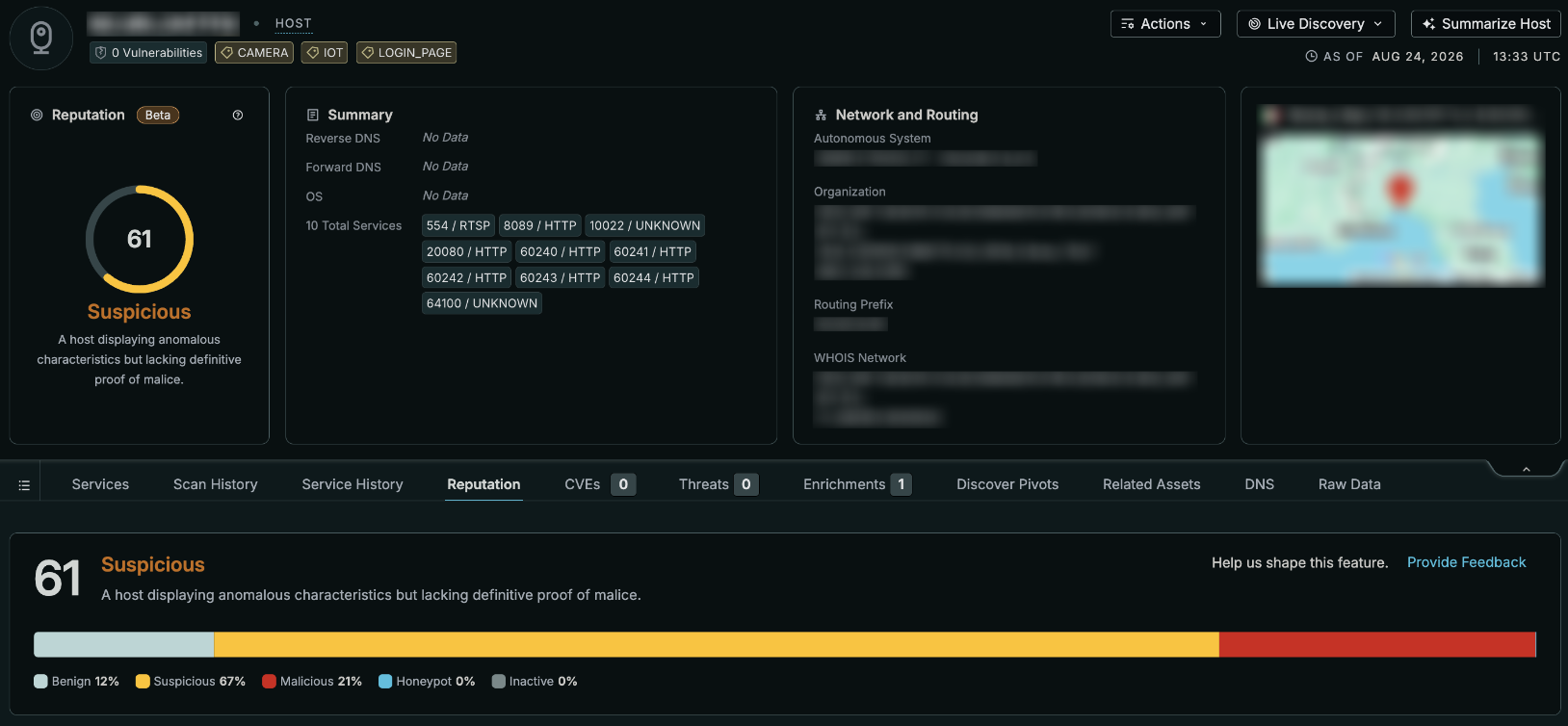
Adds an Exposed Forgejo Application risk fingerprint to ASM, flagging exposed HTTP services running Forgejo due to the sensitive nature of source code, credentials, and CI/CD configurations they may contain.
 August 31, 2026 (2026-08-31) · Aug 2026
· source
· release history
- New risks may be disabled by default in your workspace — review your risk type configuration in the ASM web console to enable them. August 31, 2026 (2026-08-31) · Aug 2026 · source · release history
-
Adds two new ASM risk fingerprints queryable via
risks.name: "Exposed Copeland XWEB Pro Refrigeration Controller"andrisks.name: "Exposed Payara Server Default Page"; new risk types may be disabled by default — review risk type configuration in the ASM web console.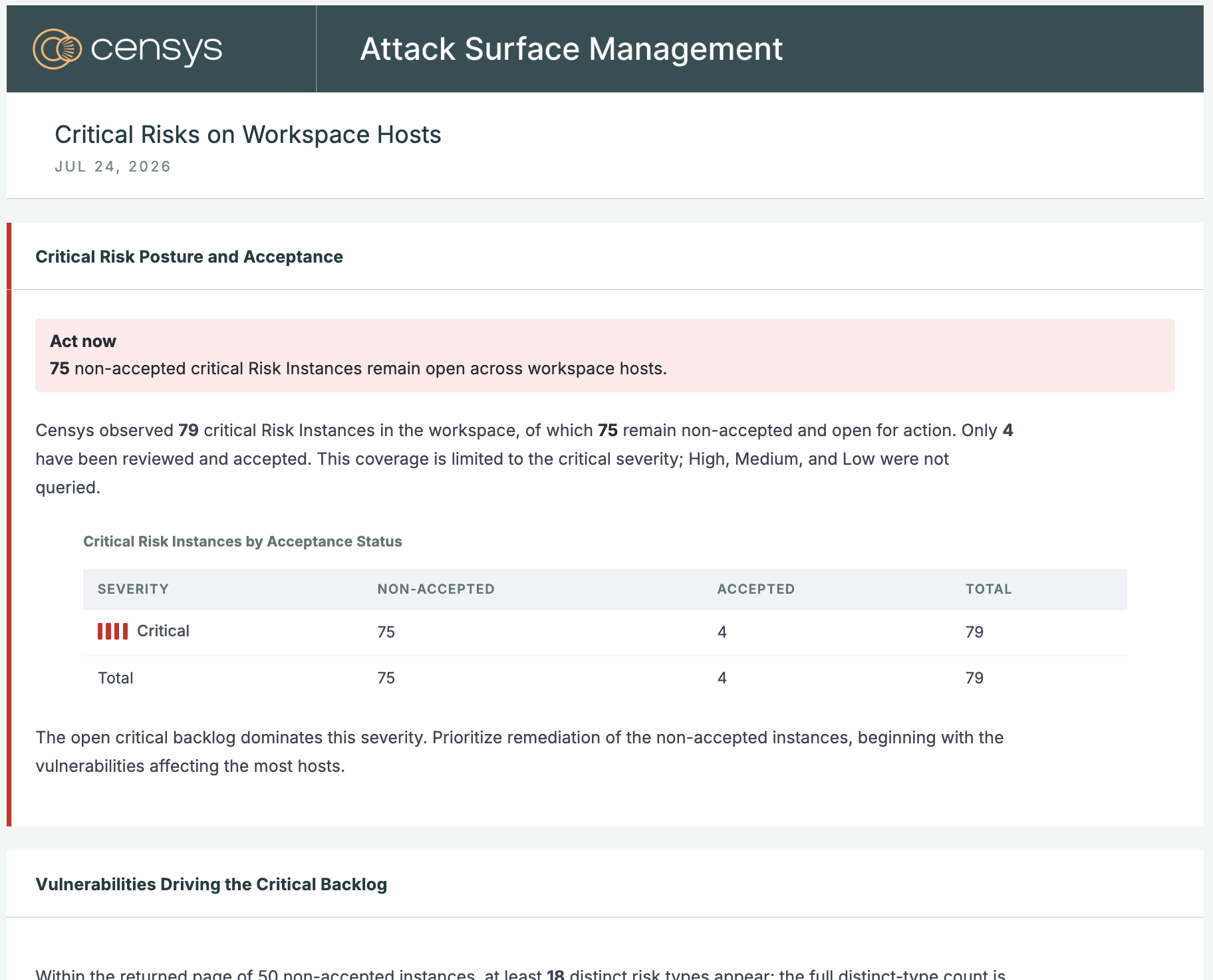 August 17, 2026 (2026-08-17) · Aug 2026
· source
· release history
- Adds 3 new ASM risk fingerprints: Exposed json-server Instance (unauthenticated CRUD REST API exposure), Exposed PTC Windchill Application (PLM platform reachable from public internet), and Exposed Express Default Page (unconfigured Express.js scaffold in production); new risk types may be disabled by default… August 3, 2026 (2026-08-03) · Aug 2026 · source · release history
- Adds three new ASM risk detections: Exposed json-server Instance, Exposed PTC Windchill Application, and Exposed Express Default Page August 3, 2026 (2026-08-03) · Aug 2026 · source · release history
example
-
Find all ASM assets exposed to the PHP2Shell risk across your attack surface.
risks.name: "Vulnerable PHP (php2shell) [CVE-2026-109618 / CVE-2026-109619]"October 26, 2026 (2026-10-26) · Oct 2026 · source -
Review all newly added ASM risk types — including the five new fingerprints — before they appear in your risk dashboard, since new risk fingerprints may be disabled by default.
In the ASM web console, go to Settings > Risk Type Configuration and review any risk types marked as disabled to enable the new End-of-Life SonicWall and Vulnerable Cacti/Zimbra risks for your…
September 8, 2026 (2026-09-08) · Sep 2026
· source
-
Find any Payara Server installations on your attack surface that are still showing their default, unconfigured landing page — indicating they may be running with default credentials.
risks.name: "Exposed Payara Server Default Page"August 17, 2026 (2026-08-17) · Aug 2026 · source
ASM web entity visual and network inspection shipped Captures screenshots and full network logs for web entities at scan time, and surfaces complete redirect chains, enabling users to identify exposed login pages, admin panels, domain takeovers, and loaded third-party resources.
Shared capability: Attack surface inventory
release 7 total
-
Adds full redirect chain visibility on web entities to detect domain takeovers or incorrect redirect destinations.
October 8, 2026 (2026-10-08) · Oct 2026
· source
· release history
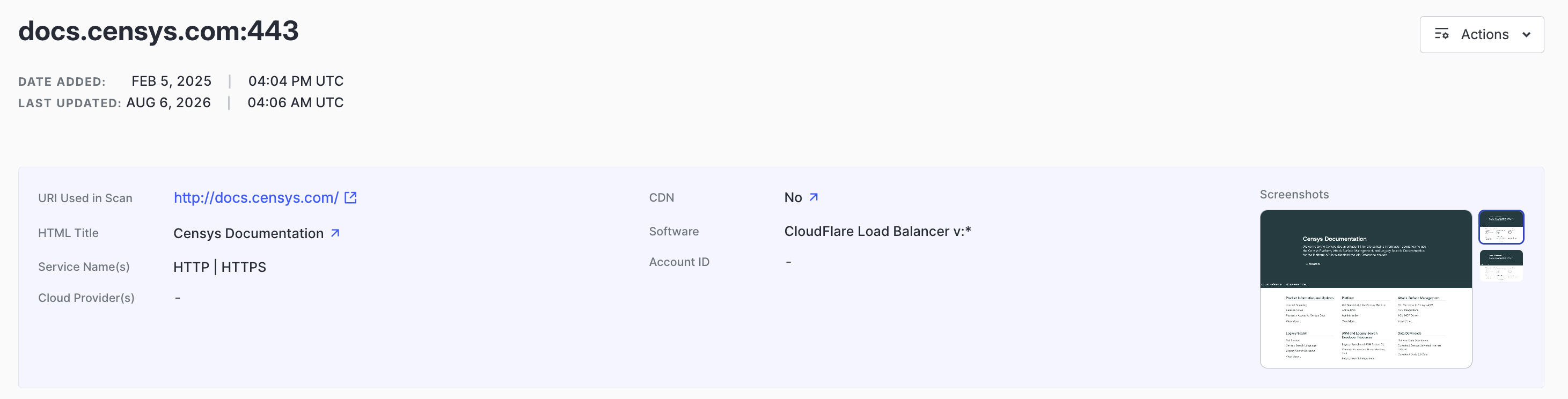
- Adds screenshots for every web entity in inventory, captured at the time of the most recent scan and timestamped by Last Updated, enabling rapid identification of exposed login pages, admin panels, and potentially compromised infrastructure.︀︄︇︀︅︉︀︅︀︀︃︀︀︅︅︀︅︊︀︄︆︀︃︄ October 8, 2026 (2026-10-08) · Oct 2026 · source · release history
- Adds network log view on web entities listing all resources loaded during a full DOM evaluation, including JS libraries, scripts, images, and stylesheets. October 8, 2026 (2026-10-08) · Oct 2026 · source · release history
- Adds full redirect path tracking to detect domain takeovers or incorrect redirect destinations across web entities. Guide to 2026 ASM Web Scanning Update (2026-08-31) · Aug 2026 · source · release history
- Adds automatic web screenshot capture for every web entity in ASM inventory, with exact timestamps and a historical view over time to surface exposed login pages, admin panels, and potentially compromised infrastructure. Guide to 2026 ASM Web Scanning Update (2026-08-31) · Aug 2026 · source · release history
- Adds automatic web screenshots with timestamps for every web entity in your inventory Guide to 2026 ASM Web Scanning Update (2026-08-31) · Aug 2026 · source · release history
example
-
When triaging a web entity suspected of being compromised, review its redirect chain and network log in ASM to confirm whether it redirects to an attacker-controlled destination.
In the Censys ASM console, navigate to Inventory > Web Entities, select an asset, and review the 'Redirect Paths' and 'Network Log' tabs to inspect the full redirect chain and all DOM-loaded…October 8, 2026 (2026-10-08) · Oct 2026 · source
Fingerprint queryability in the Censys Platform shipped Every newly added fingerprint is immediately searchable in the Platform, so users can query for assets running specific software or protocols without delay.
Shared capability: Attack surface inventory
release
-
ASM now surfaces AI-related assets using a new ai label for host services and web entities
September 8, 2026 (2026-09-08) · Sep 2026
· source
· release history
- All new fingerprints are queryable in the Censys Platform; new ASM risk types may be disabled by default and must be reviewed in the ASM web console risk type configuration. June 29, 2026 (2026-06-29) · Jun 2026 · source · release history
example
-
Identify exposed AI-related services and web entities in your attack surface using the new label.
In the ASM web console, query for assets tagged with the ai label to find host services and web entities running AI-related software.September 8, 2026 (2026-09-08) · Sep 2026 · source
Censys ARC exposure dashboards shipped Provides time-series dashboards tracking the worldwide prevalence of specific exposure risks, starting with PHP exposure via the PHP2Shell dashboard.
Shared capability: Attack surface inventory
release
- Adds the Censys ARC PHP2Shell dashboard to track worldwide PHP exposure over time. October 26, 2026 (2026-10-26) · Oct 2026 · source · release history
Published CVE checks 3 features Vulnerability assessment methods since 2026
ASM CVE risk fingerprints shipped Censys detects which assets in an ASM workspace are affected by tracked CVEs and surfaces them as named, queryable risks in the console.
Shared capability: Published CVE checks
release 12 total
-
Adds four new software fingerprints to the Platform —
changedetection.io,CLIProxyAPI,MarkLogic Server, andManageEngine OpManager— and a new ASM risk fingerprintVulnerable PHP (php2shell) [CVE-2026-109618 / CVE-2026-109619], queryable via risks.name: 'Vulnerable PHP (php2shell) [CVE-2026-109618 /… October 26, 2026 (2026-10-26) · Oct 2026 · source · release history -
Adds several hundred new CVE risks for JavaScript libraries and web component fingerprints to ASM.
October 19, 2026 (2026-10-19) · Oct 2026
· source
· release history
-
Adds ability to accept CVE risk instances on host and web entity assets, accepting all CVE risks associated with a given risk instance at once.
October 8, 2026 (2026-10-08) · Oct 2026
· source
· release history
-
Adds three new platform fingerprints (ASUS Control Center,
FileRun, JFrog Artifactory) and two new ASM risk fingerprints October 5, 2026 (2026-10-05) · Oct 2026 · source · release history -
Adds a new risk fingerprint to ASM for
Vulnerable MikroTik RouterOS [CVE-2026-67279, CVE-2026-86060, CVE-2026-67276], detectable viarisks.name. October 5, 2026 (2026-10-05) · Oct 2026 · source · release history -
Adds two new ASM risk fingerprints queryable via
risks.name: Vulnerable GitLab Server (CVE-2026-85706) (unauthenticated arbitrary file read via repository commits API) and Vulnerable GitLab Server (CVE-2026-87719) (authenticated credential leak via GraphQL subscription in GitLab EE). September 14, 2026 (2026-09-14) · Sep 2026 · source · release history
example
-
When reviewing a web entity with known vulnerable software, accept a CVE risk instance to acknowledge all associated CVE risks and keep your risk queue actionable.
In the Censys ASM console, navigate to Inventory > Web Entities or Hosts, open an asset with a CVE risk, and select 'Accept' on the CVE risk instance to accept all CVE risks associated with that…October 8, 2026 (2026-10-08) · Oct 2026 · source -
Enable the new Gogs CVE-2026-52813 risk type if it was disabled by default in your workspace.
In the ASM web console, go to Settings > Risk Type Configuration and enable "Vulnerable Gogs [CVE-2026-52813]".June 29, 2026 (2026-06-29) · Jun 2026 · source -
Confirm new ASM risk fingerprints (like the Splunk CVE risk) are enabled — they may be off by default.
In the ASM web console, go to Settings > Risk Type Configuration and review newly added risk types to enable them for your workspace.June 22, 2026 (2026-06-22) · Jun 2026 · source
ASM CVE-driven asset queries shipped Ready-made queries let teams immediately pull up ASM inventory assets affected by a newly tracked CVE so they can begin triage and patching.
Shared capability: Published CVE checks
example 9 total
-
Query ASM for assets flagged as vulnerable to the unauthenticated GitLab arbitrary-file-read risk to prioritize patching.
risks.name: "GitLab Server (CVE-2026-85706)"September 14, 2026 (2026-09-14) · Sep 2026 · source -
Find GitLab servers vulnerable to the specific path confinement CVE in your attack surface.
risks.name: "Vulnerable GitLab Server (CVE-2026-85706)"September 14, 2026 (2026-09-14) · Sep 2026 · source -
Surface SharePoint servers flagged for the CISA KEV-listed authenticated deserialization RCE (CVE-2026-45659) across your inventory.
risks.name: "Microsoft SharePoint Server Authenticated Deserialization RCE [CVE-2026-45659]"July 20, 2026 (2026-07-20) · Jul 2026 · source -
Identify Microsoft SharePoint servers at risk of unauthenticated RCE (CVE-2026-50522) in your ASM workspace.
risks.name: "Vulnerable Microsoft SharePoint Server [CVE-2026-50522]"July 20, 2026 (2026-07-20) · Jul 2026 · source -
Surface all exposed Cacti servers in your ASM workspace that are vulnerable to the newly tracked pre-auth SQL injection CVE.
In the ASM web console, go to Risk Types configuration and enable 'Vulnerable Cacti Server [CVE-2026-39955]', then filter your risks view with: risks.name:`Vulnerable Cacti Server [CVE-2026-39955]`July 6, 2026 (2026-07-06) · Jul 2026 · source -
Hunt for Wordfence Security plugin installations across the internet to identify WordPress assets in your scope.
In Censys Search, run the query: services.software.product:`Wordfence Security`July 6, 2026 (2026-07-06) · Jul 2026 · source
Rapid Response advisories and Host Reputation shipped For high-priority CVEs, Censys publishes advisory packages with ready-made queries so analysts can immediately identify exposed instances in Platform and ASM.
previously: Rapid Response advisories
Shared capability: Published CVE checks
Also counts toward: ML-based detection
release
-
Publishes five new Censys ARC Rapid Response advisories covering AnyDesk Linux, GitLab CI/CD, Ivanti Connect Secure, Collabora Online Built-in CODE Server, and BeyondTrust Remote Support/Privileged Remote Access.
October 19, 2026 (2026-10-19) · Oct 2026
· source
· release history
- Publishes two new Censys ARC Rapid Response advisories covering Citrix NetScaler ADC/Gateway Zero-Day RCE and Fortinet FortiMail Path Traversal, with Platform and ASM queries to identify exposed instances. October 5, 2026 (2026-10-05) · Oct 2026 · source · release history
- Web entities will have a maximum of one instance, showing only the most recent active IP resolution and dropping historical instances from inventory views Guide to 2026 ASM Web Scanning Update (2026-08-31) · Aug 2026 · source · release history
-
The
web_entity.instance_countfield will have significantly reduced values after migration, as each web entity will have a maximum of one instance instead of multiple historical instances — any dashboards or alerting thresholds based on instance counts will need to be reviewed. Guide to 2026 ASM Web Scanning Update (2026-08-31) · Aug 2026 · source · release history -
Introduces ML-based host reputation scores and labels — each host now receives a label (Benign, Suspicious, Malicious, Honeypot, or Inactive), a 0–100 score, a confidence level, and evidence for the top five signals that influenced the assessment, generated using a SHAP (SHapley Additive exPlanations) model.
August 31, 2026 (2026-08-31) · Aug 2026
· source
· release history
- Publishes Censys ARC Rapid Response advisory for Microsoft SharePoint Server RCE [CVE-2026-50522, CVE-2026-58644] with platform, ASM, and legacy search queries to identify exposed instances. July 20, 2026 (2026-07-20) · Jul 2026 · source · release history
DNS record enumeration 1 feature Network discovery and scanning since 2026
Active DNS and Live Resolution shipped Users can map domains to hosts, review DNS records, track infrastructure changes, and resolve domain names in real time even before they appear in indexed datasets.
Shared capability: DNS record enumeration
release
- Switches ASM web scanning to ActiveDNS resolution, increasing detected web entity counts by 0–10% while reducing false-positive host counts by 2–15%. Guide to 2026 ASM Web Scanning Update (2026-08-31) · Aug 2026 · source · release history
- Censys Active DNS is now generally available to all Censys Search and Censys Core users, enabling domain-to-host relationship mapping, infrastructure change analysis over time, and extensive DNS record review. July 6, 2026 (2026-07-06) · Jul 2026 · source · release history
- New Live Resolution feature lets users retrieve DNS records for domains not currently present in Censys datasets, with explicit confirmation when an FQDN does not resolve. July 6, 2026 (2026-07-06) · Jul 2026 · source · release history
docs
- Active DNS Active DNS history None - feature not available None - feature not available 1 day ago seen Sep 2026 · source
- Active DNS Active DNS history None - feature not available None - feature not available about 12 hours ago seen Sep 2026 · source
- Active DNS Active DNS history None - feature not available None - feature not available about 17 hours ago seen Sep 2026 · source
example
-
Check whether a domain your team is investigating currently resolves in DNS, even if it isn't yet indexed in Censys datasets.
In Censys Search or Censys Core, open the Active DNS section, enter the target FQDN, and select 'Live Resolution' to retrieve real-time DNS records or confirm the domain does not currently resolve.July 6, 2026 (2026-07-06) · Jul 2026 · source
Other / not yet classified 22 features Features we have not matched to a capability yet. A suggested match is marked.
SIEM and SOAR integrations shipped suggested SOC teams can push Censys internet data into SIEM and SOAR platforms at scale to enrich alerts and automate response workflows.
Suggested capability: Attack surface inventory. This is our guess, not confirmed.
Also counts toward: SIEM forwarding
release 22 total
-
Updates the ServiceNow TISC integration (v1.1.0) to add the option to use the host enrichment API when enriching host assets, and updates the
ipandcen-rescancommands in the Palo Alto XSOAR integration (v3.2.3) to include reputation details and network/privacy details from the IPinfo source in human-readable… October 26, 2026 (2026-10-26) · Oct 2026 · source · release history - Updates the SentinelOne Singularity Operations Center enrichment workflows and the Microsoft Sentinel integration (v3.0.1) to show host reputation labels and scores at the top of notes added to alerts and in comments added to incidents, respectively. October 26, 2026 (2026-10-26) · Oct 2026 · source · release history
-
The ASM integration with Microsoft Sentinel no longer uses the Azure Monitor HTTP data collection API (retired September 14, 2026); existing setups must migrate to the log ingestion API configuration.
October 13, 2026 (2026-10-13) · Oct 2026
· source
· release history
- Censys Splunk Platform integration v1.2.0 adds support for the get host enrichment API endpoint, configurable as the default instead of the get host API endpoint. October 13, 2026 (2026-10-13) · Oct 2026 · source · release history
- Updates the ASM integration with Microsoft Sentinel to use the log ingestion API instead of the retired Azure Monitor HTTP data collection API. October 13, 2026 (2026-10-13) · Oct 2026 · source · release history
- Censys Splunk Platform integration v1.2.0 adds new data enrichment fields for reputation score, GreyNoise, IPinfo, and Mallory. October 13, 2026 (2026-10-13) · Oct 2026 · source · release history
example
-
Find related assets using CensEye pivoting from within ServiceNow TISC.
Initiate a CensEye automated pivoting job to find assets related to an IP, web property, or certificate via the ServiceNow TISC integration.September 21, 2026 (2026-09-21) · Sep 2026 · source -
Enrich an IP address in ServiceNow TISC with Censys Platform data.
Use the new Censys Platform for ServiceNow TISC integration to automatically enrich IPs in ServiceNow TISC with Censys Platform data.September 21, 2026 (2026-09-21) · Sep 2026 · source -
Enrich SentinelOne alerts with Censys intelligence automatically or manually via the new integration.
Configure the SentinelOne integration in the Censys Platform to enable automatic enrichment of IPs, web properties, and certificates, and to trigger CensEye pivoting for related assets.September 8, 2026 (2026-09-08) · Sep 2026 · source -
Enrich Elasticsearch data with Censys intelligence using the new connector.
Install and configure the 'Censys Platform for Kibana' connector in your Kibana instance, then map fields to enrich IP and certificate data.August 17, 2026 (2026-08-17) · Aug 2026 · source
AI Investigations shipped Censys automatically analyses indicators, pivots to related infrastructure, and produces a ranked findings report without the analyst having to drive each step manually.
release 11 total
-
Adds
Investigations: Create jobendpoint that accepts indicators, previously uploaded evidence files (PDF, text, or image), or both, and returns ajob_idfor polling. October 5, 2026 (2026-10-05) · Oct 2026 · source · release history - Makes the AI investigations feature in the Adversary Investigation module generally available (GA). October 5, 2026 (2026-10-05) · Oct 2026 · source · release history
- AI investigations feature in the Adversary Investigation module is now generally available. October 5, 2026 · Oct 2026 · source · release history
-
Adds six new API endpoints for AI investigations:
Investigations: Create file upload,Investigations: Create job,Investigations: Get job results,Investigations: Get job status,Investigations: Get usage, andInvestigations: List jobs— enabling programmatic initiation, polling, and retrieval of AI… October 5, 2026 (2026-10-05) · Oct 2026 · source · release history -
Adds six new Investigations API endpoints to start, monitor, and retrieve results of AI investigations (
/investigations/files,/investigations/jobs, etc.) October 5, 2026 (2026-10-05) · Oct 2026 · source · release history - Added six new Investigations API endpoints to programmatically start, monitor, and retrieve AI investigations. October 5, 2026 · Oct 2026 · source · release history
docs
-
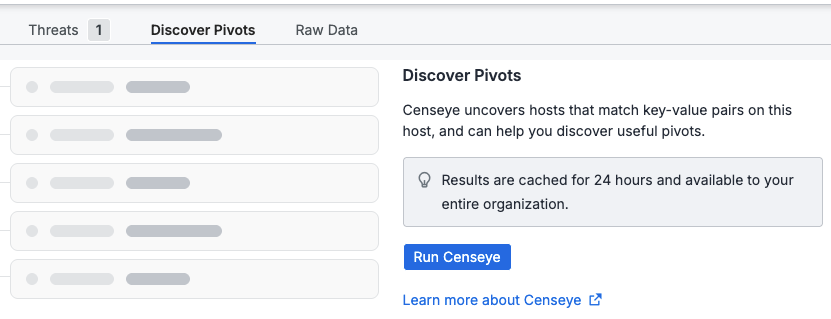
Create an asynchronous CensEye pivot analysis job for a host, web property, or certificate. The job extracts default pivot fields from the target asset and counts matching documents for each field-value pair. Poll the job status endpoint to track progress, then retrieve results when complete.
 docs update · Oct 2026
· source
-
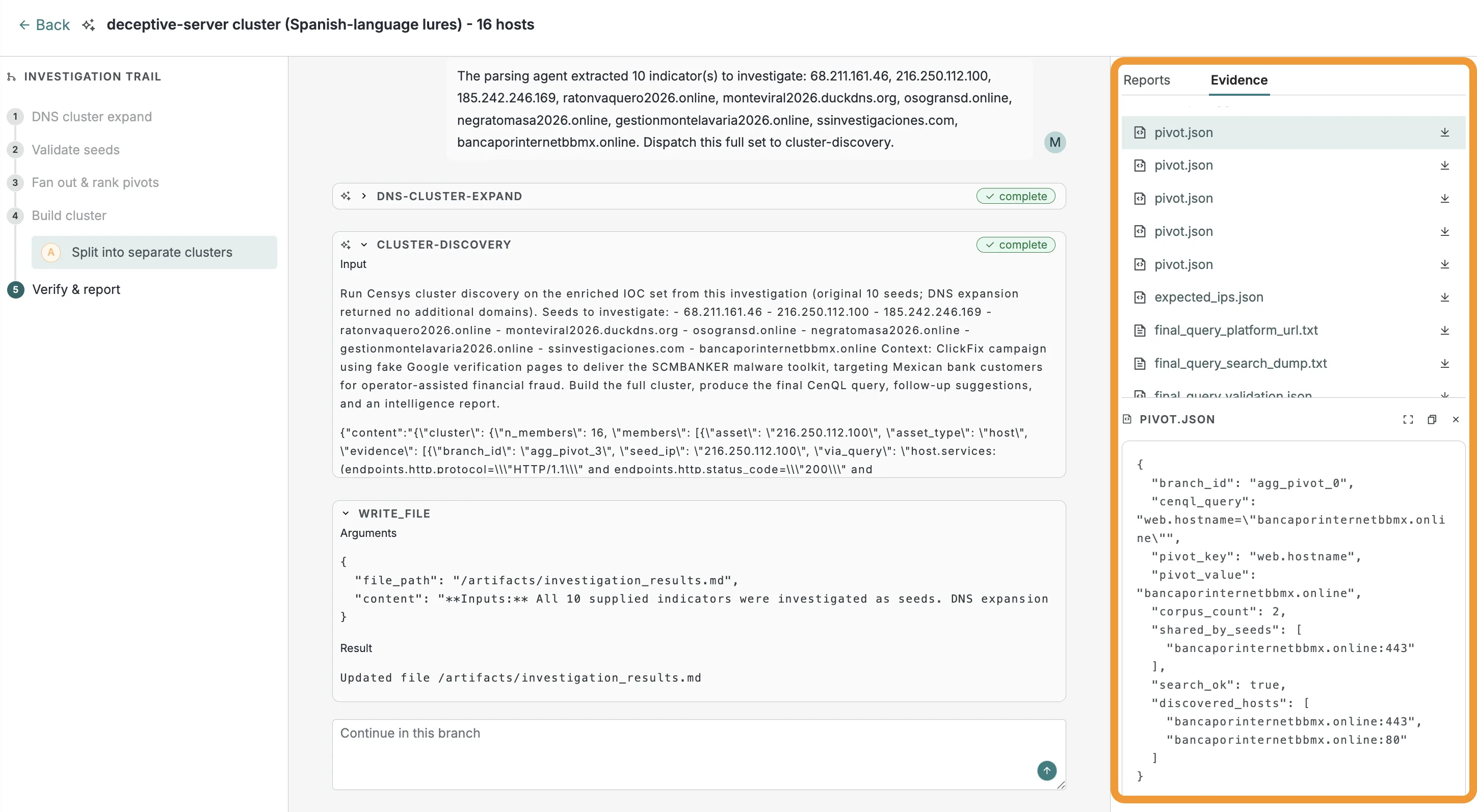
AI Investigations removes the manual and time-consuming components of security operations work. A Censys AI investigation checks each entity's history, pivots to and analyzes potentially related assets, and profiles web resources in parallel.
 docs update · Oct 2026
· source
- AI Investigations : Comprehensively analyze indicators and discover related infrastructure using an AI investigator that checks each entity's history, pivots to potentially related assets, and profiles web resources. docs update · Oct 2026 · source
- Domain names and URLs. When you provide URLs, the investigator will extract domains from them and use the domains as indicators. 5 days ago seen Aug 2026 · source
- Use AI Investigations in the Censys Platform to comprehensively analyze indicators and discover related infrastructure in the Censys Internet Map. AI Investigations remove the manual and time-consuming components of security operations work. docs update · Aug 2026 · source
Platform role-based access control (RBAC) shipped Provides platform-wide and module-specific roles that let Platform Admins grant, edit, or revoke granular resource access for organization users.
Also counts toward: Role-based access control
release
- Redesigns Platform role-based access control (RBAC) with Platform-level and module-specific roles for more granular resource access management across organization users. October 5, 2026 (2026-10-05) · Oct 2026 · source · release history
- Redesigns Platform role-based access control with new Platform- and module-specific roles October 5, 2026 (2026-10-05) · Oct 2026 · source · release history
docs 10 total
- Platform Admins Only Platform Admins can grant, edit, or revoke roles. Learn more about 9 days ago seen Oct 2026 · source
- Platform Admins Only Platform Admins can grant, edit, or revoke roles. Learn more about 8 days ago seen Oct 2026 · source
- Platform Admins Only Platform Admins can grant, edit, or revoke roles. Learn more about 7 days ago seen Oct 2026 · source
- Platform Admins Only Platform Admins can grant, edit, or revoke roles. Learn more about 6 days ago seen Oct 2026 · source
-
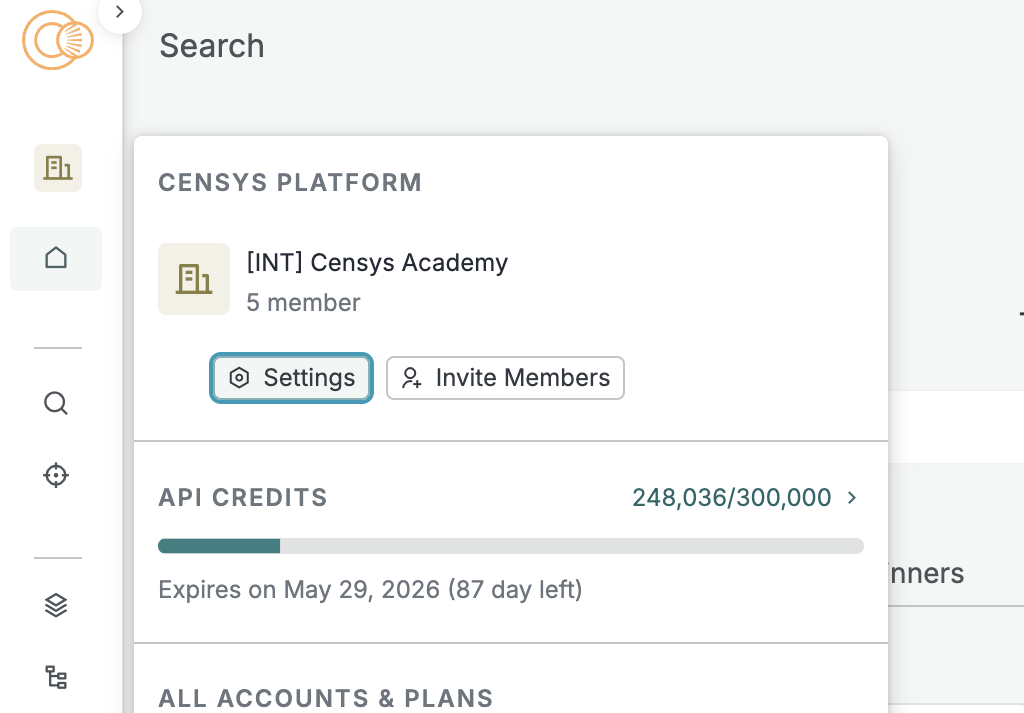
User roles The following roles are available in the Censys Platform. Platform-wide roles Role Permissions Platform Admin Billing, user and role management, audit log, AI privacy configuration, authentication settings, and account management APIs. Does not consume a module seat.
 docs update · Oct 2026
· source
- Platform Admins can configure settings for their organization on the Organization-level settings override personal settings for personal organization accounts. seen Oct 2026 · source
Search credit pricing and plan tiers shipped Standardises all search actions to one credit each, rolls unused credits into the next billing cycle, adds Starter and Starter Pro subscription plans, and gives every registered user five free daily searches that do not draw from subscription credits.
release 9 total
- Free and Starter users now have all UI and API actions cost one credit each, replacing the previous tiered costs (lookup: 1 credit, standard search: 5 credits, advanced/regex query: 8 credits), so monthly allotments now go further.︀︄︇︀︅︉︀︅︀︀︃︀︀︅︅︀︅︊︀︄︆︀︃︄ November 2, 2026 (2026-11-02) · Nov 2026 · source · release history
- Censys Credit packs can no longer be purchased. November 2, 2026 (2026-11-02) · Nov 2026 · source · release history
- Censys adds two new subscription tiers: Censys Starter ($79/month, 500 credits, one-month rollover) and Censys Starter Pro ($599/month, 4,000 credits), purchasable from the Plan page in the Platform web console. November 2, 2026 (2026-11-02) · Nov 2026 · source · release history
- Every Free and Starter user now gets five free Platform actions per day. November 2, 2026 (2026-11-02) · Nov 2026 · source · release history
- Censys now prices every search action — lookups, standard searches, and advanced regex queries — at one credit each, replacing the previous 1/5/8-credit tiered model.︀︄︇︀︅︉︀︅︀︀︃︀︀︅︅︀︅︊︀︄︆︀︃︄ announced · Oct 2026 · source · release history
- Unused monthly subscription credits now roll over into the next billing cycle instead of expiring. announced · Oct 2026 · source · release history
Investigator API shipped Exposes the Censys Investigator as a programmable API that accepts IPs, domains, or uploaded file IDs as investigation input, runs automated infrastructure analysis within configurable time windows, and returns a downloadable archive containing a CenQL cluster query and full report — with usage quotas trackable via a dedicated endpoint and results pipeable into Collections.
release
-
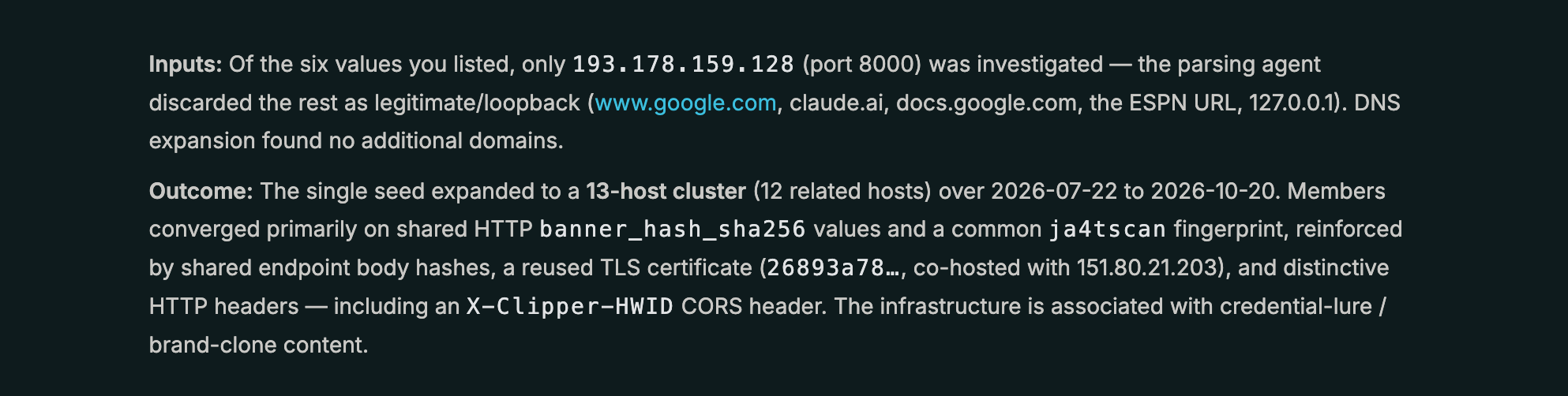
Each organisation receives 150 Investigator API investigations per week (up to 3 concurrent per user), with results retained for 7 days and no Censys Credits consumed.
 announced · Oct 2026
· source
· release history
-
Investigation results (CenQL cluster query) can be piped directly into
POST /v3/collectionsto create a persistent, auto-updating watched cluster without manual re-running of hunts. announced · Oct 2026 · source · release history -
Adds a
GET /usageendpoint to check an organisation's remaining weekly investigation allowance andnext_expire_timebefore submitting jobs. announced · Oct 2026 · source · release history -
Exposes the Censys Investigator as a programmable API, accepting up to 100 IPs, domains, or file IDs per job with optional
start_timeandend_timewindow parameters, and returning a downloadable archive containing a CenQL cluster query and full infrastructure report. announced · Oct 2026 · source · release history -
Adds a
POST /filesendpoint to upload raw HTML/text (e.g.︀︄︇︀︅︉︀︅︀︀︃︀︀︅︅︀︅︊︀︄︆︀︃︄ a vendor blog post) as investigation input, returning afile_idfor use in subsequent investigation calls. announced · Oct 2026 · source · release history
example
-
Before submitting a bulk IR investigation, check remaining weekly allowance to avoid exhausting the quota mid-incident.
curl -X GET 'https://api.platform.censys.io/usage?org_id=<org_id>' \ -H 'Authorization: Bearer <token>'announced · Oct 2026 · source -
Upload a vendor threat-intel report and expand its indicators into a full campaign cluster, then save the CenQL query as a watched Collection.
# 1. Upload the report HTML as a file curl -X POST 'https://api.platform.censys.io/files?org_id=<org_id>' \ -H 'Authorization: Bearer <token>' \ -H 'Content-Type: application/json' \ -d…announced · Oct 2026 · source
Platform UI navigation and feedback shipped Reorganises the Platform UI into Investigate, Defend, and Intelligence sections, relocates search history and help resources, renames the Reports tab to Aggregate, and provides an in-app feedback portal for submitting feedback and tracking feature requests.
release
-
Reorganizes the Censys Platform UI and search actions into three sections: Investigate, Defend, and Intelligence.
October 19, 2026 (2026-10-19) · Oct 2026
· source
· release history
- Moves search history to its own tab on the upper right corner of the search results page. October 19, 2026 (2026-10-19) · Oct 2026 · source · release history
- Relocates documentation, Academy, and Data Definitions resources to the Help and Feedback menu in the top right. October 19, 2026 (2026-10-19) · Oct 2026 · source · release history
- Renames the Reports tab to Aggregate in the Platform UI. October 19, 2026 (2026-10-19) · Oct 2026 · source · release history
- Adds an in-app Censys Platform Feedback Portal for submitting feedback and tracking feature requests.︀︄︇︀︅︉︀︅︀︀︃︀︀︅︅︀︅︊︀︄︆︀︃︄ October 19, 2026 (2026-10-19) · Oct 2026 · source · release history
docs
- Censys values customer feedback and continually improves its software products to meet your needs. This document explains how Censys gathers and incorporates your feedback into its product development process. seen Oct 2026 · source
Service accounts shipped Lets organizations create service accounts so applications can connect to Platform APIs at the organization level without relying on a personal user account.
release
-
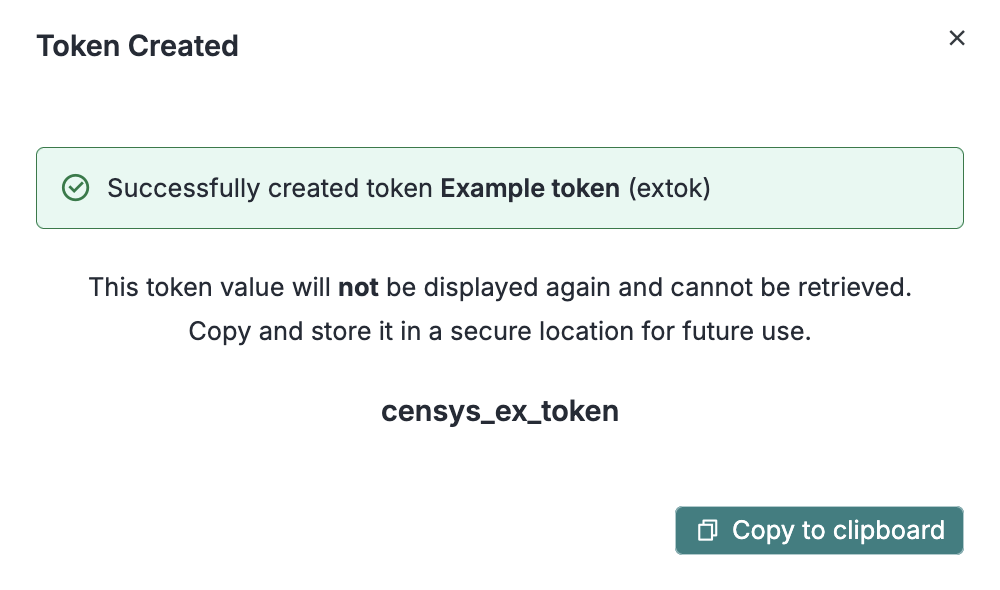
Adds Service Accounts support to connect applications with Censys Platform APIs without using a personal user account.
 api-docs-d91f57789f71 · Oct 2026
· source
· release history
-
Added
service accountsto the Platform for application access via APIs without personal user accounts. October 5, 2026 · Oct 2026 · source · release history - Adds service accounts to the Platform so applications can connect to Platform APIs without requiring a personal user account. October 5, 2026 (2026-10-05) · Oct 2026 · source · release history
- Adds service accounts to enable application connections via Platform APIs without using a personal user account October 5, 2026 (2026-10-05) · Oct 2026 · source · release history
docs
- Follow the steps below to begin using the Censys API with a Personal Access Token. Service Accounts You can use Censys Platform service accounts to connect applications with Platform APIs without using a personal user account. Your PATs grant significant access, so keep them secure. api-docs-d91f57789f71 · Oct 2026 · source
-
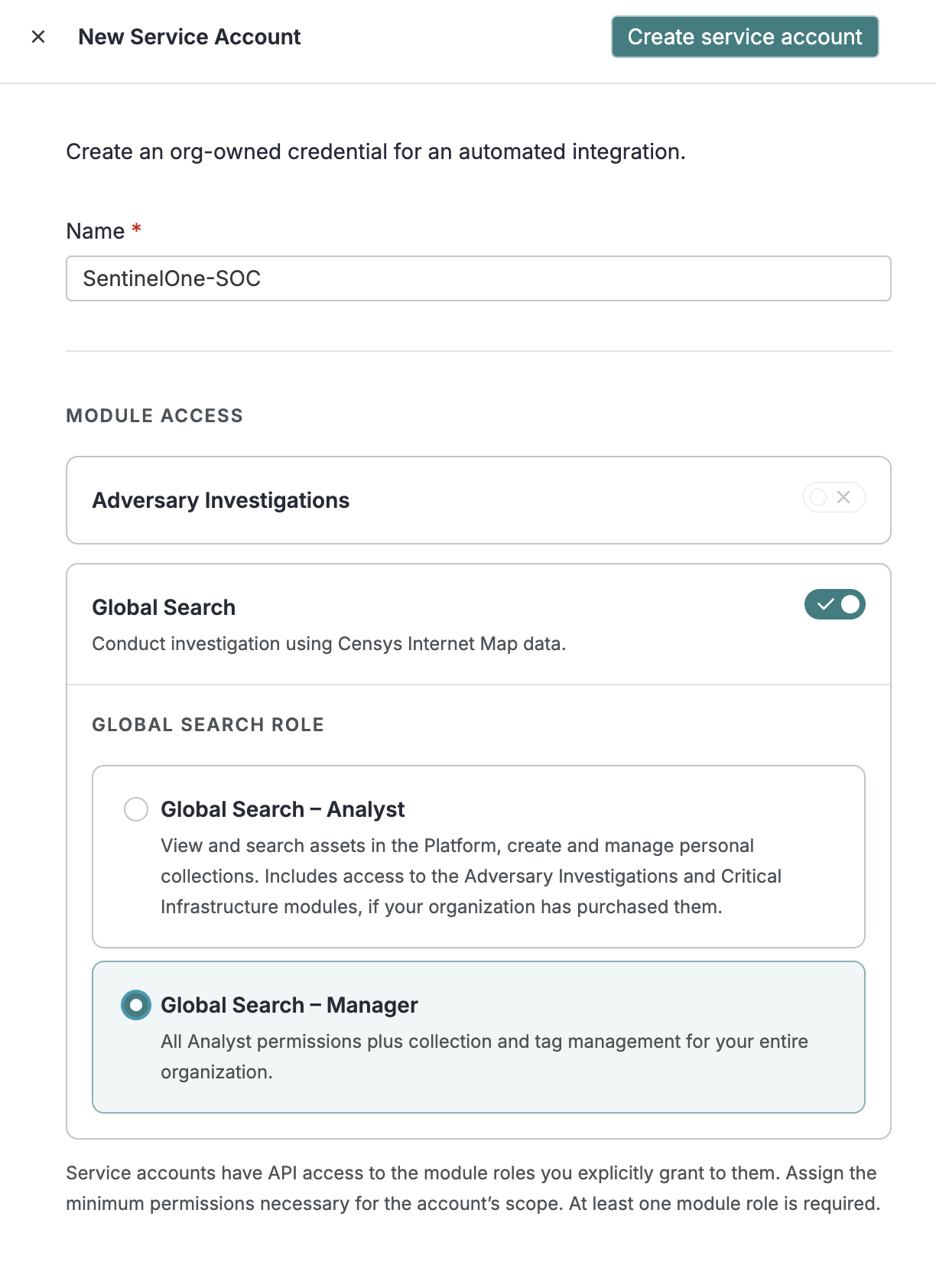
You can use Censys Platform service accounts to connect applications with Platform APIs without using a personal user account. In contrast with Personal Access Tokens and Connected Apps , Platform service accounts are managed at the organization level.
 docs update · Oct 2026
· source
Organization MFA enforcement documented Allows Platform Admins to require MFA for all organization users and to reset individual users' MFA configuration.
Also counts toward: Multi-factor authentication
docs
-
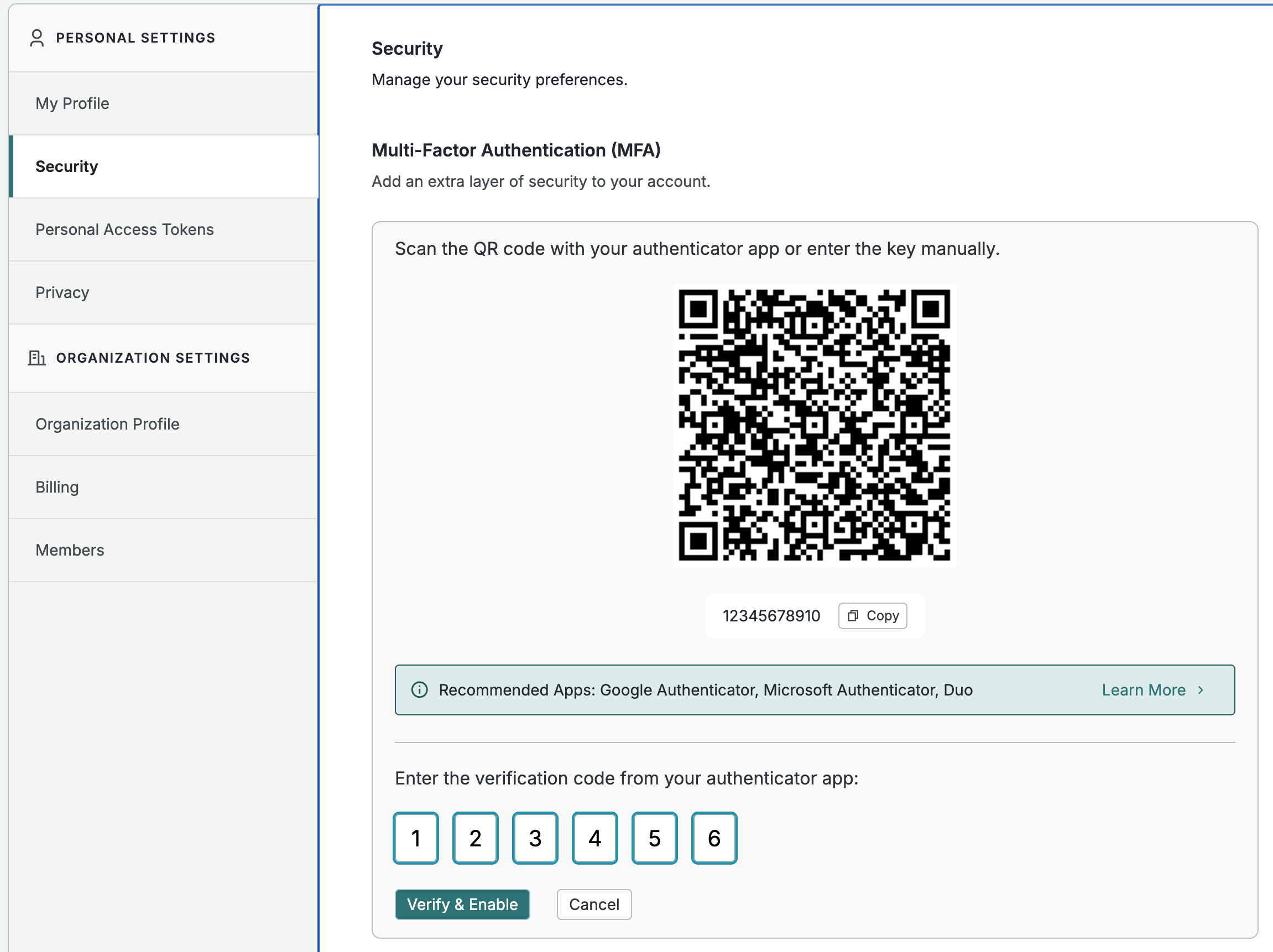
Platform Admins can require organization users to enable MFA in order to access the Platform. Only Platform Admins can configure MFA settings for their entire organization. Platform Admins can reset the MFA configuration of a user in their organization. 10 days ago
 docs update · Oct 2026
· source
- Platform Admins can require organization users to enable MFA in order to access the Platform. Only Platform Admins can configure MFA settings for their entire organization. Platform Admins can reset the MFA configuration of a user in their organization. 9 days ago seen Oct 2026 · source
- Platform Admins can require organization users to enable MFA in order to access the Platform. Only Platform Admins can configure MFA settings for their entire organization. Platform Admins can reset the MFA configuration of a user in their organization. 8 days ago seen Oct 2026 · source
- Platform Admins can require organization users to enable MFA in order to access the Platform. Only Platform Admins can configure MFA settings for their entire organization. Platform Admins can reset the MFA configuration of a user in their organization. 7 days ago seen Oct 2026 · source
- Platform Admins can require organization users to enable MFA in order to access the Platform. Only Platform Admins can configure MFA settings for their entire organization. Platform Admins can reset the MFA configuration of a user in their organization. 6 days ago docs update · Oct 2026 · source
Expanded HTTP body search shipped suggested Users can search deeper into HTTP response bodies — up to 64 KB — to find embedded tokens, framework signatures, or configuration leaks that shallower indexing would miss.
Suggested capability: Attack surface inventory. This is our guess, not confirmed.
release
-
Expands HTTP body search depth for
host.services.endpoints.http.bodyandweb.endpoints.http.bodyfrom 2 KB to the first 64 KB, enabling more targeted Platform queries across host service and IP-based web property endpoints. August 10, 2026 (2026-08-10) · Aug 2026 · source · release history -
Searches the first 64 kilobytes of HTTP bodies for host service endpoints (
host.services.endpoints.http.body) and IP-based web property endpoints (web.endpoints.http.body) August 10, 2026 (2026-08-10) · Aug 2026 · source · release history
example
-
Search HTTP bodies of web endpoints for a credential string or internal banner that only appears deeper than 2 KB, now reachable with the expanded 6 KB body search.
web.endpoints.http.body: "Authorization: Bearer internal-" AND web.endpoints.http.body: "env=production"August 24, 2026 (2026-08-24) · Aug 2026 · source -
Search for specific keywords deep within HTTP response bodies beyond the previous limit.
web.endpoints.http.body: 'config.yml'August 24, 2026 (2026-08-24) · Aug 2026 · source -
Search for hosts whose HTTP response body contains a specific string beyond the old 2 KB limit — useful for finding embedded tokens, framework signatures, or configuration leaks deeper in large pages.
host.services.endpoints.http.body: "api_secret_key"August 10, 2026 (2026-08-10) · Aug 2026 · source
Bulk asset tagging via API shipped Users can tag every asset matching a query in one API call, making it fast to organise or act on large sets of assets at once.
Also counts toward: Command-line interface, REST API
release
-
Censys Assistant in ASM can now generate custom PDF-ready reports about your attack surface; requires the organization to be migrated to the Platform for team management and the AI Features toggle enabled under Platform Organization Settings > Privacy.
August 17, 2026 (2026-08-17) · Aug 2026
· source
· release history
-
Adds
tagscommands to thecencliCLI for managing individual and bulk tags in the Censys Platform. August 10, 2026 (2026-08-10) · Aug 2026 · source · release history -
Adds
cenclitagscommands to manage individual and bulk tags August 10, 2026 (2026-08-10) · Aug 2026 · source · release history - Adds bulk asset tagging via API: assign or un-assign a tag to every asset matching a CenQL query in a single operation. June 22, 2026 (2026-06-22) · Jun 2026 · source · release history
example
-
Generate a custom report on attack surface using natural language via ASM Assistant.
Interact with the `Censys Assistant` chat interface in the ASM console and follow the provided link to view/save the generated PDF report.August 17, 2026 (2026-08-17) · Aug 2026 · source
OAuth application connections shipped Users can authorise third-party applications to access Censys APIs via OAuth and review or revoke those connections from one place.
Also counts toward: Web management console
release
-
Adds OAuth authentication support to the
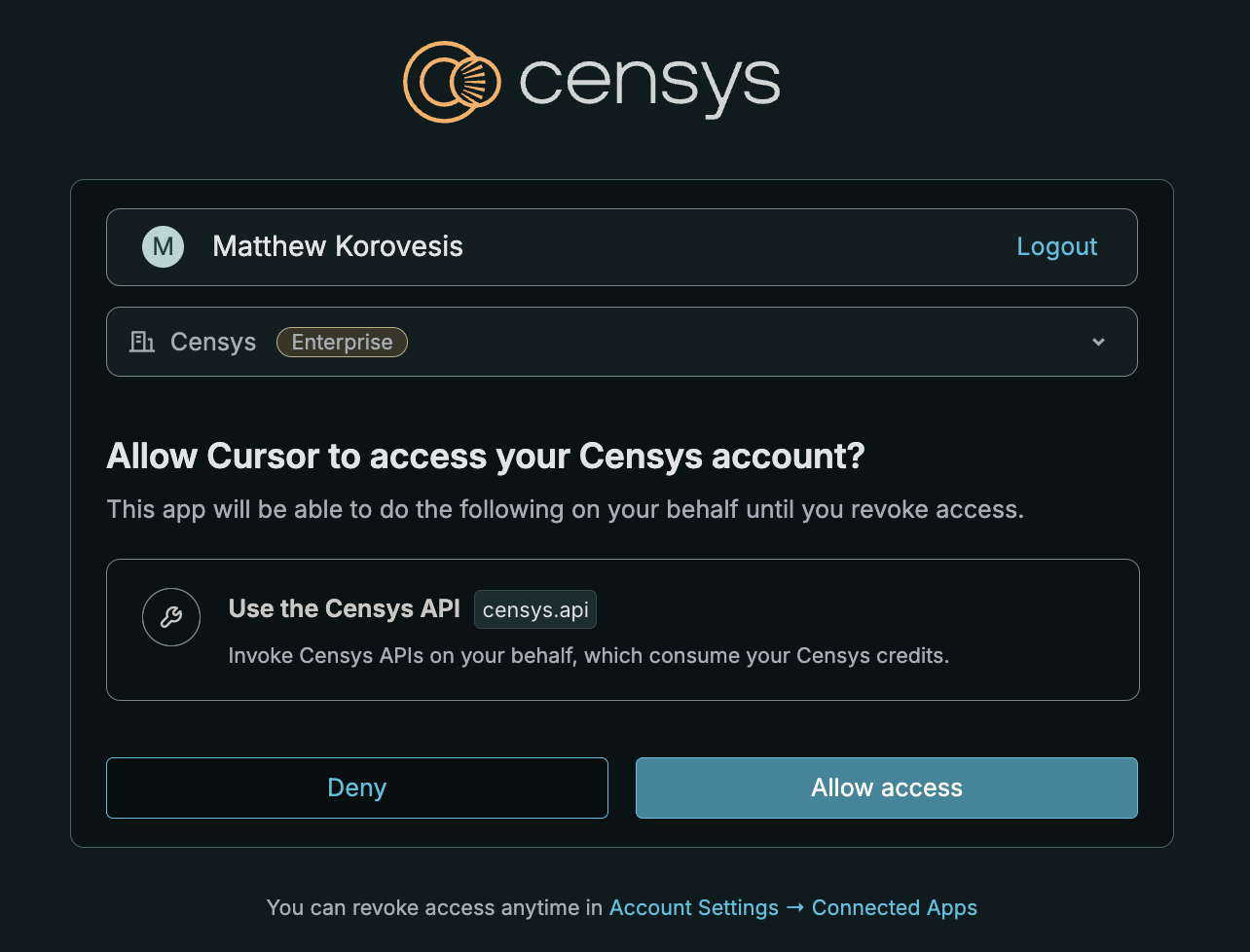
cenclicommand line tool, triggered viacensys auth login, which redirects to an authentication page to select an account and approve the connection. August 3, 2026 (2026-08-03) · Aug 2026 · source · release history - Manage OAuth connections through the Connected Applications page in the Platform web console. August 3, 2026 (2026-08-03) · Aug 2026 · source · release history
- New Connected Applications page in the Platform web console lets users review and manage OAuth connections. July 27, 2026 (2026-07-27) · Jul 2026 · source · release history
docs
-
On the consent page, select your organization and approve the connection to Censys. You can manage your OAuth connections from 7 days ago
 seen Aug 2026
· source
- You can connect your Censys Platform account to applications that use the OAuth 2 standard . Use the Connected Apps page in the Censys Platform UI to review and manage applications and services, like the Platform MCP server , that you have granted access to your Censys account and have allowed to use Censys APIs on… docs update · Jul 2026 · source
Audit log documented Gives Platform Admins access to an audit log of organization events, retrievable via the console or API.
Also counts toward: Administrative audit log, Role-based access control, Web management console
docs
-
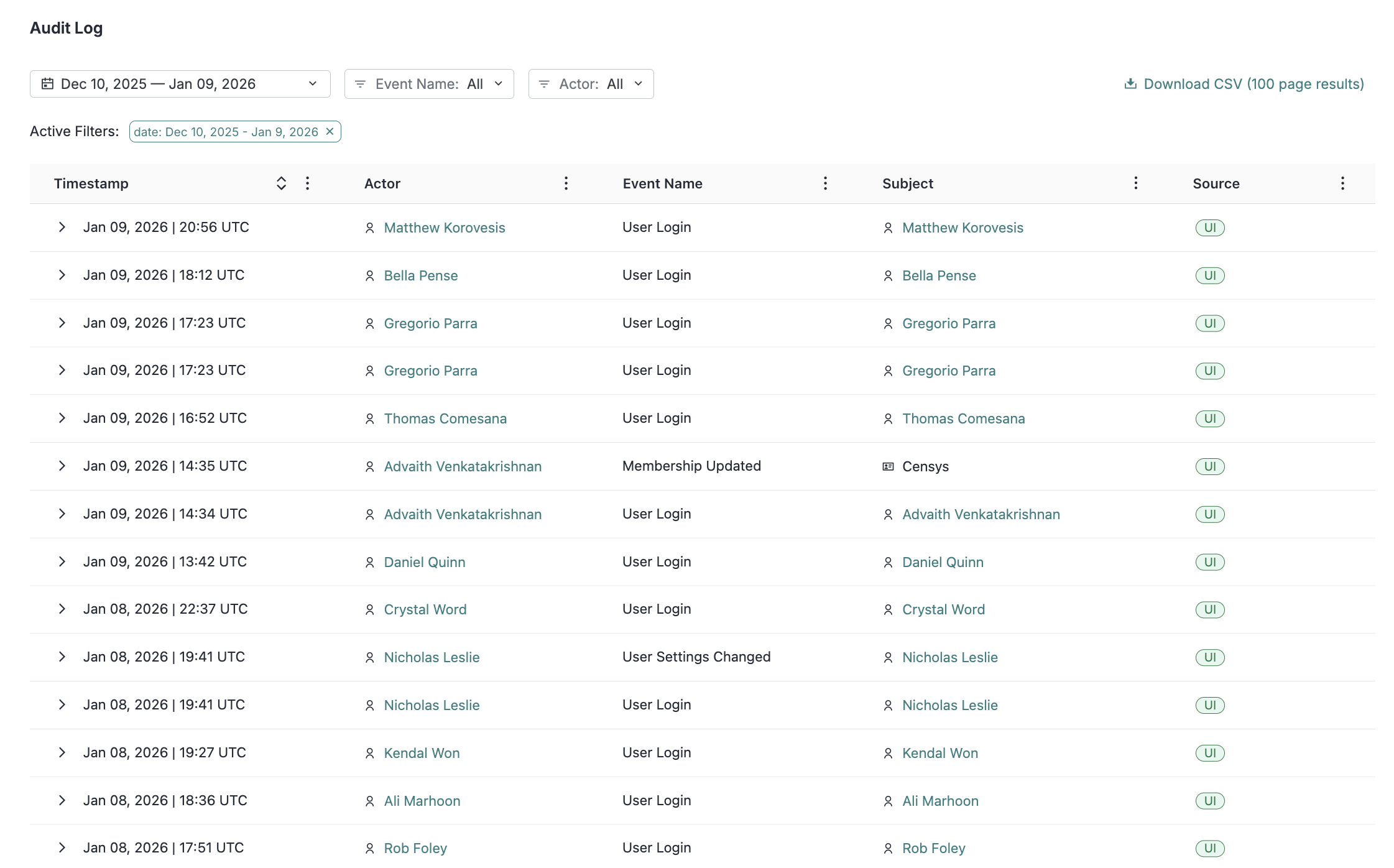
Platform Admin role can access the audit log. Users without the Platform Admin role cannot access the audit log. Platform Admins can also retrieve audit log events via the 9 days ago
 seen Oct 2026
· source
- Platform Admin role can access the audit log. Users without the Platform Admin role cannot access the audit log. Platform Admins can also retrieve audit log events via the 8 days ago seen Oct 2026 · source
- Platform Admin role can access the audit log. Users without the Platform Admin role cannot access the audit log. Platform Admins can also retrieve audit log events via the 7 days ago seen Oct 2026 · source
- Platform Admin role can access the audit log. Users without the Platform Admin role cannot access the audit log. Platform Admins can also retrieve audit log events via the 6 days ago seen Oct 2026 · source
Adversary Investigation MCP server shipped suggested A Model Context Protocol server lets AI agents and coding assistants retrieve Censys adversary investigation data programmatically via OAuth.
Suggested capability: Attack surface inventory. This is our guess, not confirmed.
Also counts toward: MCP server
docs
-
Use the Adversary Investigation Model Context Protocol (MCP) server to give your AI agents access to Censys The Adversary Investigation MCP server is a service hosted by Censys that you can integrate with tools like Cursor, Claude Code, and Continue.dev.
docs update · Jul 2026
· source
example
-
Wire cencli into a Claude agent so it can autonomously look up assets and run investigations without leaving the AI workflow.
Install the censys-ai-skills repo as a Claude plugin, then prompt your agent: 'Use cencli to look up all assets tagged Kiteworks PCN and run an investigation on the top 100 indicators.'September 28, 2026 (2026-09-28) · Sep 2026 · source -
Connect the Adversary Investigation MCP server to your account using the new OAuth workflow instead of manual credential setup.
In the Platform web console, go to Connected Applications, then follow the OAuth workflow to authorize the Adversary Investigation MCP server.July 27, 2026 (2026-07-27) · Jul 2026 · source
Kibana connector for SIEM enrichment and pivoting shipped suggested Allows Elasticsearch Kibana users to enrich host, web property, and certificate data with Censys intelligence, trigger rescan jobs, and launch automated pivoting searches from within the Kibana interface.
Suggested capability: Attack surface inventory. This is our guess, not confirmed.
release
-
New Elasticsearch Kibana connector lets practitioners enrich IPs, web properties, and certificates with Censys Platform data; initiate rescans of hosts or web properties; retrieve event history for an IP address; and launch CensEye automated pivoting jobs to find assets related to an IP, web property, or certificate.
August 17, 2026 (2026-08-17) · Aug 2026
· source
· release history
- Adds an Elasticsearch Kibana connector to enrich IPs, web properties, and certificates with Censys Platform data. August 17, 2026 (2026-08-17) · Aug 2026 · source · release history
example
-
Enrich Elasticsearch data with Censys intelligence using the new connector.
Install and configure the 'Censys Platform for Kibana' connector in your Kibana instance, then map fields to enrich IP and certificate data.August 17, 2026 (2026-08-17) · Aug 2026 · source
CLI and AI agent automation plugin shipped Provides a `cencli`-based plugin for Claude and other AI agents that automates asset lookups, investigations, and CensEye jobs via the Censys AI Skills interface.
Also counts toward: Command-line interface, Plugin system
release
-
Adds
cencliintegration via the new Censys AI Skills plugin (censys-ai-skills) for Claude and other AI agents to automate asset lookups, investigations, and CensEye jobs September 28, 2026 (2026-09-28) · Sep 2026 · source · release history
docs
- censys-ai-skills is a public, Censys-owned repo that contains skills, hooks, helper scripts, tests, and more that leverage the cencli Platform CLI tool. These skills can be added to Claude Code and other AI tools. docs update · Sep 2026 · source
Geographic asset search via CenQL shipped suggested Adds a `geo_distance` function to the Censys Query Language, enabling users to find assets relative to specific latitude/longitude coordinates.
Suggested capability: Attack surface inventory. This is our guess, not confirmed.
release
-
Adds
geo_distancefunction to Censys Query Language (CenQL) for finding assets relative to a geographic location; currently supportshost.location.coordinatesandhost.services.ntripas target data objects; available to all users. August 24, 2026 (2026-08-24) · Aug 2026 · source · release history
example
-
Find assets within 100km of a specific latitude/longitude using the new geographic function.
geo_distance(host.location.coordinates, [40.7128, -74.0060]) < 100August 24, 2026 (2026-08-24) · Aug 2026 · source
Censys Assistant (AI chat) shipped An in-platform AI assistant reads the current page context and lets analysts ask natural-language questions about the specific host, certificate, or search result they are viewing.
Also counts toward: Built-in AI assistant, Natural-language query
release
- Censys Assistant now automatically reads the current page (host, certificate, web property, search result, or collection) as context when opened, enabling deeper questions about specific assets without manually specifying them. July 13, 2026 (2026-07-13) · Jul 2026 · source · release history
example
-
Investigate an unfamiliar service on a host without copy-pasting asset details — open the Assistant directly from a host page and ask about exposed services in context.
In the Platform, navigate to a host detail page, open the Censys Assistant panel, and ask 'What services on this host are unusual or potentially exposed?' — the Assistant automatically uses the…July 13, 2026 (2026-07-13) · Jul 2026 · source
Adversary Investigation fingerprint observation API shipped suggested Retrieves the TLS certificate chains an IP has presented, on which ports, and when, enabling infrastructure-change spotting and host pivoting.
Suggested capability: Attack surface inventory. This is our guess, not confirmed.
release
- Adds a new fingerprint observation API endpoint in the Adversary Investigation module to retrieve which TLS certificate chains an IP has presented, on which ports, and when — enabling infrastructure-change spotting and host pivoting.︀︄︇︀︅︉︀︅︀︀︃︀︀︅︅︀︅︊︀︄︆︀︃︄ October 26, 2026 (2026-10-26) · Oct 2026 · source · release history
Personal Access Token (PAT) authentication shipped Provides Personal Access Token authentication for the cyber tool API, enabling secure programmatic access without exposing user credentials.
release
-
Adds Personal Access Token (PAT) authentication for the Censys API, enabling secure programmatic access without exposing user credentials.︀︄︇︀︅︉︀︅︀︀︃︀︀︅︅︀︅︊︀︄︆︀︃︄
api-docs-d91f57789f71 · Oct 2026
· source
· release history
CLI OAuth authentication support shipped Enables the `cencli` command-line interface to authenticate using OAuth 2 tokens via the `censys auth login` command for Platform access.
Also counts toward: Command-line interface
release
-
cenclinow accepts OAuth authentication viacensys auth loginfor Platform access August 3, 2026 (2026-08-03) · Aug 2026 · source · release history
SCIM provisioning via Okta shipped Platform Admins can automatically provision and de-provision Censys user accounts directly from Okta, reducing manual access management overhead.
Also counts toward: SCIM provisioning API
release
- Supports SCIM provisioning via Okta, enabling Platform Admins to automatically provision and de-provision Censys users from their IdP. June 22, 2026 (2026-06-22) · Jun 2026 · source · release history
Host Enrichment API shipped suggested A dedicated API endpoint delivers a curated subset of host data optimised for high-volume automated lookups without consuming standard query credits.
Suggested capability: Attack surface inventory. This is our guess, not confirmed.
release
- New Host Enrichment API delivers a curated, fixed subset of IPv4/IPv6 host data optimized for high-volume, automated lookups without traditional credit consumption. June 15, 2026 (2026-06-16) · Jun 2026 · source · release history
Lines in monospace are the tool's own words: help text
parsed from its source, or an endpoint from its API document. Under
release, a line is our summary of a dated release. Under
docs, it is quoted from the tool's own documentation or
website. Each links back to the source it came from.
Command line
20 commands for Censys, each with where it came from. This tool has no source analysis yet, so there is no option reference and no captured run beside them.
No command matches.
Screenshots
From the release notes, newest first. Click one to see it full size.Score card
-
Shipping velocity releases a month, last 12 months
-
Documentation quality release-notes rubric, 0–100
-
Breaking-change discipline how rarely a release breaks users, and notice given
-
Maintenance risk quiet time against its own cadence, maintainers
-
Innovation & surface new capabilities, API and MCP surface
Five scores for Censys, each built from the releases, notes and API history this site tracks — and, on Researcher and Business, where it stands among every measured tool in its category and how that has moved.
Score cards are part of every paid plan.
See plans → Already subscribed? Sign in →Trajectory
Blank means never measured; nothing here is a filled-in zero.
Peer standings are included with Researcher and Business. See how this tool ranks against its competitors, using data we don't publish anywhere else.
See plans →Each score is 0–100 on a published rubric, derived from data this site already shows. A dimension we cannot measure says so — it is never scored 0 and never enters a rank.
How this is scored
- Shipping velocity — releases a month over the last 12 months, on a log scale where 16 a month scores 100. Needs 3 releases in the window.
- Documentation quality — the release-notes rubric published on the analytics page, unchanged.
- Breaking-change discipline — the share of releases carrying a breaking change (none scores 100, half or more scores 0). Only projects that label breaking changes are measured: a clean record cannot be told from an unlabelled one.
- Maintenance risk — quiet time measured against the tool's own release cadence (quiet longer than 90 days and three typical gaps scores 0), plus the number of active maintainers and whether contributors are growing, where known. Higher is lower risk.
- Innovation & surface — new capabilities in the feature ledger this year, API and MCP operations added, and the share of commits that are features: the mean of whichever we hold.
- Community health (open-source tools only) — each is a direction, not a size: contributors this year against last, the bus factor now against a year ago, and issues closed per issue opened, where steady scores 50, doubled 100 and halved 0; plus the median time to a maintainer's first reply (an hour scores about 100, a month or more 0). A commercial card has no repository and carries none of the four.
- Documented delivery (commercial tools) — when a vendor's documented new capabilities have slowed against its own baseline, that counts against the overall standing as heavily as two low dimensions. Steady delivery, or too little history to judge, leaves the standing alone; it is never a sixth score.
- Open-source tools are scored on repository signals; commercial tools on their published changelog. Ranks compare tools within one category and one profile and need at least five measured peers; the overall standing needs three ranked dimensions. Best-in-breed or consolidator is a shape, not a quality, and is never scored.
Release-note detail over time
See how much detail Censys puts in its release notes, quarter by quarter, and compare it with tracked tools in the same category. This history uses up to ten retained, reviewed notes per tool; sparse or blank older quarters may reflect that limit.
Checking release-note history…
Website history
censys.com, every changeCensys's home, pricing and product pages and 41 more pages as they looked each month from November 2021 to October 2026: 67 renders, 7 changes of tagline or palette. Step through them, play them, or put any two months side by side.
Website history is included with Researcher and Business.
See plans → Already subscribed? Sign in →← → or h l a month · Shift a year · [ ] previous / next change · Space play · 1 2 3 page · T whole page · C compare · F full size
← → or h l the right month · Shift the left · S swap · W wipe · T whole page · Esc back
Rebranding timeline
Dates bound when a change appeared between captures. Possible rebrands are AI suggestions; a redesign alone does not establish a rebrand.
Coverage
Missing something? Tell us
What Censys connects to, runs on and detects, read from its release notes and docs. So far: 4 updated integrations, 3 new detections, 1 updated detection, 1 new integration.
9 changes, tracked since Oct 6, 2026.
-
Oct 262026
new Vulnerable PHP (php2shell) ASM risk fingerprint
With CVE-2026-109618, CVE-2026-109619
Added four new fingerprints to the Platform and one new ASM risk fingerprint for PHP2Shell.
-
Oct 262026
updated PHP software fingerprint expanded via inference
Updated the php fingerprint to include inferred presence from over 30 other software fingerprints.
-
Oct 262026
new New Platform software fingerprints: changedetection.io, CLIProxyAPI, MarkLogic Server, ManageEngine OpManager
Added four new fingerprints to the Platform and one new risk fingerprint to ASM.
-
Oct 262026
updated Palo Alto XSOAR integration v3.2.3
With Palo Alto Cortex XSOAR, ip, cen-rescan
Version 3.2.3 of the Censys Platform integration with Palo Alto XSOAR was released. Updated the human-readable output of the ip and cen-rescan commands to include the reputation details returned by Censys and to display the network and privacy details from the IPinfo source only. Added support for additional context outputs in the ip and cen-rescan commands.
-
Oct 262026
updated ServiceNow TISC integration v1.1.0
Version 1.1.0 of the Censys Platform ServiceNow TISC integration was released. Added the option to use the host enrichment API when enriching host assets in ServiceNow TISC.
-
Oct 262026
updated SentinelOne Singularity Operations Center integration
The enrichment workflows available in the Censys Platform integration with SentinelOne Singularity Operations Center have been updated to show host reputation labels and scores at the top of the note added to alerts.
-
Oct 262026
updated Microsoft Sentinel integration v3.0.1
Version 3.0.1 of the Censys Platform Microsoft Sentinel integration was released. Host reputation labels and scores are now shown in the comments added to incidents.
-
Oct 82026
new Software fingerprints for jQuery, AngularJS, Bootstrap, WordPress, WooCommerce, Astro, and more
Added numerous software fingerprints, including full coverage for jQuery, AngularJS, Bootstrap, WordPress, WooCommerce, Astro, and more.
-
Oct 62026
new Censys Platform service accounts (OAuth 2 client credentials)
With SentinelOne
An example connection configuration for SentinelOne showing the configuration parameters to use a Platform service account.
SIEM & security analytics 2
Endpoint & network security 2
Vulnerability & code scanning 1
Ticketing & ITSM 1
Other 1
Nothing first seen in this window. That doesn't mean Censys shipped nothing, only that we found no record of it.
How we count
Read from 23 of 59 release notes and docs updates we hold for Censys. "First seen" is the earliest note that names something; "last" is the latest. Our history may start partway through Censys's life, so an old integration can show a recent first-seen date.
Each change counts once: "added 40 checks" is one line, so the numbers measure how often coverage moves, not how big the catalogue is or how well it detects.
Releases
59 entries
No entries match these filters.
- November 20261
- October 202632
- September 20266
- August 20269
- July 20268
- June 20263
Add the badge to your README
Maintain this project? The badge links readers straight to this page, so they can follow every release here.
 Choose a badge style and copy the code →