Elastic Security Labs
How CVE-2026-73570 turns a Zimbra log file into remote code execution (2026-10-23) commercialThe section your link pointed to isn't on Elastic Security Labs's page any more, so we've brought you to the top.
Elastic security labs is a powered by Elasticsearch. Ready to deploy your data?
FROM logs-* METADATA _index
| WHERE user.name == "svc-deploy" AND event.category == "authentication"
| KEEP _index, @timestamp, event.action, source.ip, host.name
| SORT @timestamp DESC
| LIMIT 500
FROM .alerts-security.alerts-* METADATA _index
| EVAL project = CASE(LOCATE(_index, ":") > 0, MV_FIRST(SPLIT(_index, ":")), "origin")
| STATS alerts = COUNT(*) BY project, kibana.alert.severity
| SORT alerts DESC
FROM cloud-team:logs-* METADATA _index
| WHERE user.name == "svc-deploy" AND event.category == "authentication"
| KEEP @timestamp, event.action, source.ip, host.name
| SORT @timestamp DESC
| LIMIT 500
FROM logs-* METADATA _index
| WHERE user.name == "<username>"
| KEEP _index, @timestamp, event.action, source.ip, user.name
| SORT @timestamp DESC
FROM .alerts-security.alerts-* METADATA _index
| STATS count = COUNT(*) BY _index, kibana.alert.severity
| KEEP _index, kibana.alert.severity, count
| SORT count DESC
event.category: process AND process.Ext.memfd.name: * AND NOT process.Ext.memfd.flag_noexec_seal: true
git clone https://github.com/elastic/FENIX.git && cd FENIX
make all
python3 -m venv .venv && source .venv/bin/activate
pip install -e .
export FENIX_BIN_DIR=$PWD/bin
fenix run memfd_create
dll.Ext.defense_evasions: "DLL Hijack: Masquerading"
sudo mkdir -p /usr/local/share/ai-hooks
sudo cp log-tool-calls.sh /usr/local/share/ai-hooks/log-tool-calls.sh
sudo chmod +x /usr/local/share/ai-hooks/log-tool-calls.sh
sudo tee "/Library/Application Support/Cursor/hooks.json" <<'EOF'
{
  "version": 1,
  "hooks": {
    "sessionStart":          [{ "command": "/usr/local/share/ai-hooks/log-tool-calls.sh" }],
    "beforeShellExecution":  [{ "command": "/usr/local/share/ai-hooks/log-tool-calls.sh" }],
    "afterShellExecution":   [{ "command": "/usr/local/share/ai-hooks/log-tool-calls.sh" }],
    "beforeMCPExecution":    [{ "command": "/usr/local/share/ai-hooks/log-tool-calls.sh" }],
    "afterMCPExecution":     [{ "command": "/usr/local/share/ai-hooks/log-tool-calls.sh" }],
    "postToolUse":           [{ "command": "/usr/local/share/ai-hooks/log-tool-calls.sh" }],
    "postToolUseFailure":    [{ "command": "/usr/local/share/ai-hooks/log-tool-calls.sh" }],
    "afterFileEdit":         [{ "command": "/usr/local/share/ai-hooks/log-tool-calls.sh" }],
    "beforeReadFile":        [{ "command": "/usr/local/share/ai-hooks/log-tool-calls.sh" }],
    "subagentStart":         [{ "command": "/usr/local/share/ai-hooks/log-tool-calls.sh" }],
    "subagentStop":          [{ "command": "/usr/local/share/ai-hooks/log-tool-calls.sh" }],
    "sessionEnd":            [{ "command": "/usr/local/share/ai-hooks/log-tool-calls.sh" }],
    "stop":                  [{ "command": "/usr/local/share/ai-hooks/log-tool-calls.sh" }]
  }
}
EOF
cursor-agent --print "say hello"
tail -1 ~/.config/ai-hooks/logs/tool-calls-$(date -u +%F).jsonl
sudo mkdir -p /usr/local/share/ai-hooks
sudo cp log-tool-calls.sh /usr/local/share/ai-hooks/log-tool-calls.sh
sudo chmod +x /usr/local/share/ai-hooks/log-tool-calls.sh
sudo tee "/Library/Application Support/Cursor/hooks.json" <<'EOF'
{
  "version": 1,
  "hooks": {
    "sessionStart":          [{ "command": "/usr/local/share/ai-hooks/log-tool-calls.sh" }],
    "beforeShellExecution":  [{ "command": "/usr/local/share/ai-hooks/log-tool-calls.sh" }],
    "afterShellExecution":   [{ "command": "/usr/local/share/ai-hooks/log-tool-calls.sh" }],
    "beforeMCPExecution":    [{ "command": "/usr/local/share/ai-hooks/log-tool-calls.sh" }],
    "afterMCPExecution":     [{ "command": "/usr/local/share/ai-hooks/log-tool-calls.sh" }],
    "postToolUse":           [{ "command": "/usr/local/share/ai-hooks/log-tool-calls.sh" }],
    "postToolUseFailure":    [{ "command": "/usr/local/share/ai-hooks/log-tool-calls.sh" }],
    "afterFileEdit":         [{ "command": "/usr/local/share/ai-hooks/log-tool-calls.sh" }],
    "beforeReadFile":        [{ "command": "/usr/local/share/ai-hooks/log-tool-calls.sh" }],
    "subagentStart":         [{ "command": "/usr/local/share/ai-hooks/log-tool-calls.sh" }],
    "subagentStop":          [{ "command": "/usr/local/share/ai-hooks/log-tool-calls.sh" }],
    "sessionEnd":            [{ "command": "/usr/local/share/ai-hooks/log-tool-calls.sh" }],
    "stop":                  [{ "command": "/usr/local/share/ai-hooks/log-tool-calls.sh" }]
  }
}
EOF
cursor-agent --print "say hello"
tail -1 ~/.config/ai-hooks/logs/tool-calls-$(date -u +%F).jsonl
{"hooks": {"beforeShellExecution": [{"command": "/usr/local/share/ai-hooks/log-tool-calls.sh"}], "beforeReadFile": [{"command": "/usr/local/share/ai-hooks/log-tool-calls.sh"}]}}
FROM logs-azure.aadgraphactivitylogs-* | LIMIT 20
TOKEN=$(az account get-access-token --resource https://graph.windows.net --query accessToken -o tsv)
TID=$(az account show --query tenantId -o tsv)
for obj in users groups servicePrincipals applications tenantDetails; do
  curl -sS -o /dev/null -H "Authorization: Bearer $TOKEN" \
    "https://graph.windows.net/$TID/$obj?api-version=1.6&\$top=5"
done
FROM logs-ti_google_threat_intelligence.* | WHERE threat.indicator.type == "ipv4-addr" AND google_threat_intelligence.threat_actor == "<actor-name>" | STATS count = COUNT() BY threat.indicator.ip, google_threat_intelligence.malware_family, google_threat_intelligence.score | SORT count DESC
Summary
Elastic Security Labs is a commercial SIEMSIEMSecurity information and event management, collecting logs from many systems and correlating events to find suspicious activity. Analysts use it to investigate alerts and incidents. platform, run as a hosted service on top of Kibana, that centralizes detection engineering, threat intelligence, and endpoint telemetry for SOCSOCA security operations center, the team or function that monitors threats, investigates alerts and coordinates incident response. Its work can be internal, outsourced or shared. analysts and threat hunters. It ingests sources like Azure AD Graph Activity Logs and Google Threat Intelligence feeds into normalized ECSECSElastic Common Schema, an open specification maintained by Elastic that defines a standard field naming convention for log and event data, letting cyber tools share and correlate records without per-source field mapping. fields, letting analysts hunt with ES|QLES|QLElasticsearch Query Language, maintained by Elastic, a pipe-based query language for filtering, transforming, and aggregating data stored in Elasticsearch, giving cyber tools a concise syntax for log and event analysis. across IOCsIOCsAn indicator of compromise, an observable clue that may point to malicious activity, such as a suspicious file hash or domain. It is evidence to investigate, rather than proof by itself., campaign infrastructure, and endpoint or cloud events without extra infrastructure. It also automates work analysts used to do by hand: migrating Microsoft Sentinel detection rules with an LLM, drafting new rules when Attack Discovery finds coverage gaps, and deploying YARA rules automatically as vulnerable drivers are disclosed. Its own release notes position Sentinel as the point of comparison for teams migrating in. With 82 tracked releases since its 2019 launch and a release 15 days ago, it is under active, frequent development.
Elastic security labs is a powered by Elasticsearch. Ready to deploy your data?
How Elastic Security Labs helps
Which sign-in patterns in my Entra ID environment look like offensive tooling or bulk enumeration rather than normal user activity?
matches AAD Graph Activity Log telemetry against five detection patterns — known-offensive user-agents, bulk enumeration, internal API version misuse, FOCI client-ID mismatches, and 4xx surges — with the raw JSON kept in event.original for replay if the pattern needs checking by hand
Is a given IP, domain, URL, or file hash already known-malicious, and how confident should I be?
looks it up against ingested Google Threat Intelligence indicators and returns a verdict, severity, and 0–100 threat score, with expired or revoked indicators dropped automatically so a stale match doesn't fire
Which of my old Sentinel detection rules still need to be rebuilt from scratch in my new SIEM?
translates exported Sentinel Scheduled and NRT rules with an LLM and marks each one Installed, Translated, Partially translated, Not translated, or Failed, and lists which Elastic integrations each translated rule now depends on before you migrate the underlying logs
Where in my current rule set is a real attack pattern going undetected?
has Attack Discovery hunt raw events and corroborate across sources to classify likely attacks, then drafts a new detection rule for any gap it finds and hands the draft to an analyst for approval rather than deploying it unchecked
Is a newly disclosed vulnerable driver already covered on my endpoints?
watches VirusTotal, loldrivers.io, and Microsoft's blocklist continuously and generates and deploys YARA rules to Elastic Defend as soon as a new vulnerable driver is disclosed, with no manual rule-writing step
Can I trace one indicator of compromise out to the rest of that campaign's infrastructure across my own historical logs?
normalizes GTI indicators into ECS in a dedicated threat intelligence data view so an ES|QL query can pivot from a single IOC to associated infrastructure and correlate it against past endpoint and cloud telemetry already collected
Languages
Features
Built from Elastic Security Labs's releases, docs, README and our own runs. “Seen” marks the month we first spotted a release the vendor didn't date. Group names and tags are our labels.
- Elastic Security Labs covers 2 of the 11 logs and telemetry capabilities we track.
- Elastic Security Labs covers 1 of the 8 investigation and response capabilities we track.
What Elastic Security Labs offers you
- Scheduled jobs3
- Agent-based deployment2
- Air-gapped deployment2
- Self-hosted deployment2
- Administrative audit log1
- Import from a competing product1
- JSON data export1
- ML-based detection1
- Natural-language query1
No capabilities match.
Log search 1 feature Logs and telemetry
AI agent session monitoring with vector search documented Uses embedding models and vector search over recorded AI agent session turns to support threat hunting and attack discovery across agent activity.
Shared capability: Log search
Also counts toward: ML-based detection
docs
-
Monitoring AI agent sessions: Leveraging embedding models to aid threat hunting and attack discovery workflows Monitoring AI agent sessions: Leveraging embedding models to aid threat hunting and attack discovery workflows I tested vector search on 7,454 turns of my own agent sessions.
 seen Nov 2026
· source
Security event correlation 1 feature Logs and telemetry since 2026
Attack Discovery autonomous investigation shipped Autonomously investigates raw events, checks entity risk, and surfaces validated attacks on a dedicated page so analysts start from conclusions rather than raw data.
Shared capability: Security event correlation
release 9 total
-
Uses Attack Discovery to correlate alerts into unified attack chains with MITRE ATT&CK mapping
 Quarantined isn't contained: Agentic phishing response with Elastic and Sublime (2026-09-28) · Sep 2026
· source
· release history
- Attack Discovery agentic workflow correlates Sublime Security email alerts with endpoint and other signals into unified, MITRE ATT&CK-mapped attack chains, querying raw logs and gathering supporting evidence before surfacing a prioritized incident to analysts. Quarantined isn't contained: Agentic phishing response with Elastic and Sublime (2026-09-28) · Sep 2026 · source · release history
- Attack Discovery now performs autonomous analyst-style investigation: threat-hunting raw events, checking entity risk, corroborating across data sources, and classifying events as validated attacks before they reach the queue. Elastic goes all-in on Hacker Summer Camp at Black Hat and DEF CON in Las Vegas (2026-07-31) · Jul 2026 · source · release history
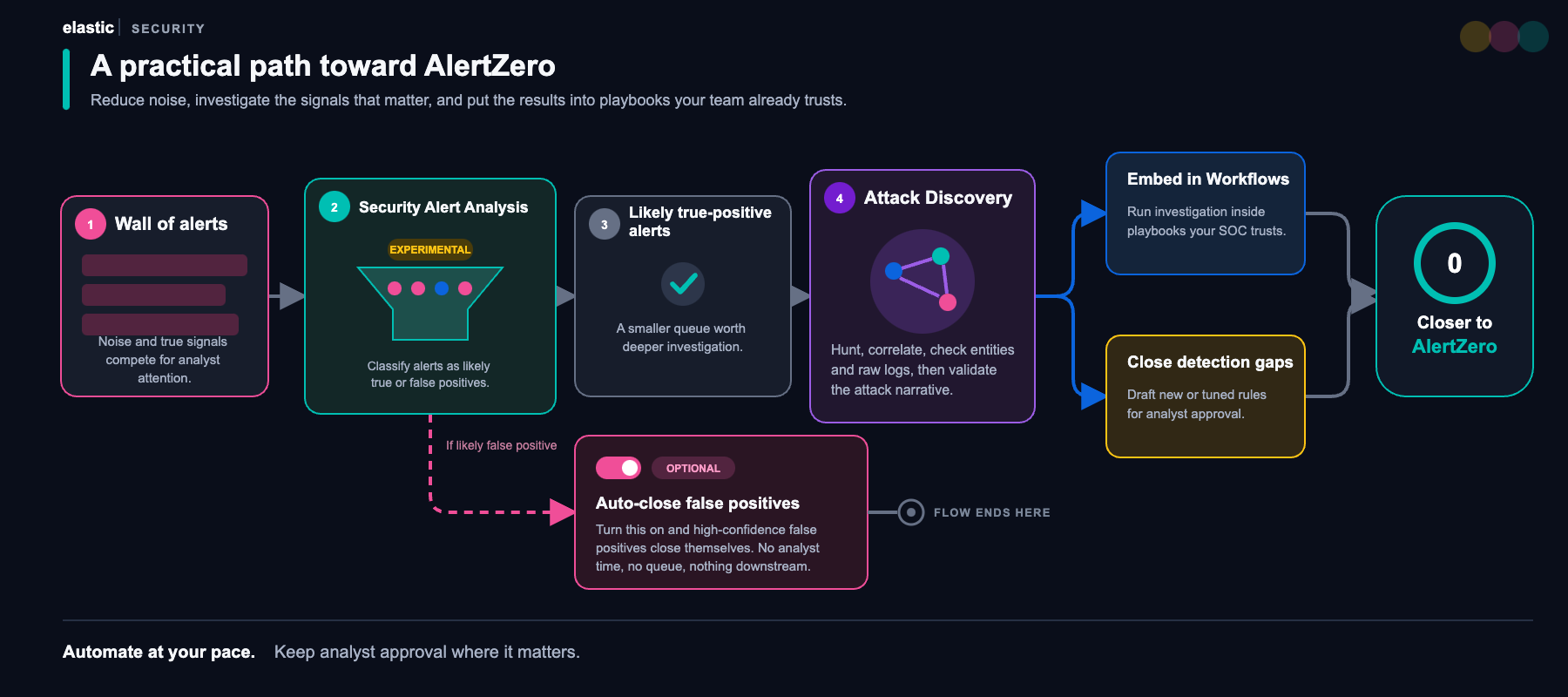
- New alert analysis workflow differentiates likely false positives from true positives upstream, reducing noise before Attack Discovery investigates. Elastic goes all-in on Hacker Summer Camp at Black Hat and DEF CON in Las Vegas (2026-07-31) · Jul 2026 · source · release history
- Adds a new Attacks page under Detections that surfaces Attack Discovery results alongside Alerts, making correlated attack chains a first-class operational object. Alert Zero: AI-driven alert triage and attack investigation for the agentic SOC (2026-07-31) · Jul 2026 · source · release history
- Enables Attack Discovery to run on a schedule or be triggered from within an Elastic Workflow, making deep investigation always-on without requiring manual analyst initiation. Alert Zero: AI-driven alert triage and attack investigation for the agentic SOC (2026-07-31) · Jul 2026 · source · release history
docs
- 31 July 2026 • Jackie McGuire Elastic goes all-in on Hacker Summer Camp at Black Hat and DEF CON in Las Vegas Attack Discovery turns raw alerts into validated threats and Elastic Defend closes vulnerable driver gaps as fast as they're disclosed. Watch it all run against real attacks at the booth. docs update · Jul 2026 · source
example
-
Schedule Attack Discovery to run automatically inside an existing Elastic Workflow so investigations start without waiting for an analyst.
In the Elastic Security console, go to Workflows, open or create a playbook, add a step using the Attack Discovery skill (retrieves alerts, generates discoveries, validates results), then configure a…Alert Zero: AI-driven alert triage and attack investigation for the agentic SOC (2026-07-31) · Jul 2026 · source
Response playbook automation 1 feature Investigation and response since 2026
Elastic Workflows automation platform shipped Gives analysts a no-code workflow canvas with plain-language authoring, Slack approval steps, versioning with diff and rollback, and the ability to run autonomous investigation as a workflow step.
Shared capability: Response playbook automation
release 9 total
-
Elastic Workflows supports per-action configurable autonomy, letting teams set individual steps to run automatically or route through an analyst approval flow rather than applying a single automation policy across the whole system.
Quarantined isn't contained: Agentic phishing response with Elastic and Sublime (2026-09-28) · Sep 2026
· source
· release history
- Adds a SOAR integration allowing actions on Sublime Security from within Elastic Workflows, including blast-radius quarantine using SHA-256 hashes Quarantined isn't contained: Agentic phishing response with Elastic and Sublime (2026-09-28) · Sep 2026 · source · release history
- Adds a two-way SOAR integration with Sublime Security inside Elastic Workflows, enabling response actions on the Sublime side — such as triggering a blast-radius quarantine using a SHA-256 hash from an Elastic Defend finding — without leaving Elastic. Quarantined isn't contained: Agentic phishing response with Elastic and Sublime (2026-09-28) · Sep 2026 · source · release history
- Creates cases via Elastic Workflows and sends Slack notifications with evidence to on-call analysts Quarantined isn't contained: Agentic phishing response with Elastic and Sublime (2026-09-28) · Sep 2026 · source · release history
- Elastic Workflows adds plain-language authoring, letting users describe an automation in natural language and have it generated automatically. Elastic goes all-in on Hacker Summer Camp at Black Hat and DEF CON in Las Vegas (2026-07-31) · Jul 2026 · source · release history
- Visual Mode in Elastic Workflows displays a workflow as a graph with triggers, steps, branches, and YAML side by side. Elastic goes all-in on Hacker Summer Camp at Black Hat and DEF CON in Las Vegas (2026-07-31) · Jul 2026 · source · release history
docs
- No MDM for Linux? A 68-line Elastic workflow keeps every endpoint's config current Endpoint Protection & Security No MDM for Linux? seen Sep 2026 · source
- Blog No MDM for Linux? A 68-line Elastic workflow keeps every endpoint's config current Elastic InfoSec runs Linux endpoint management through Elastic Defend with a scheduled workflow that gets Cursor and Codex config onto new laptops without piling up duplicate actions on offline hosts, and it works for other config… seen Sep 2026 · source
- No MDM for Linux? A 68-line Elastic workflow keeps every endpoint's config current No MDM for Linux? A 68-line Elastic workflow keeps every endpoint's config current Elastic InfoSec runs Linux endpoint management through Elastic Defend with a scheduled workflow that gets Cursor and Codex config onto new laptops… seen Sep 2026 · source
- No MDM for Linux? A 68-line Elastic workflow keeps every endpoint's config current AI & Automation No MDM for Linux? seen Sep 2026 · source
example
-
After Elastic Defend identifies malware on a host, use a Workflow to pass the file's SHA-256 hash to Sublime Security and trigger a blast-radius quarantine that pulls the same message from every mailbox it reached.
In Elastic Workflows, add a Sublime Security action step, select 'Blast-radius quarantine', and map the SHA-256 field from the Elastic Defend alert as the indicator input.Quarantined isn't contained: Agentic phishing response with Elastic and Sublime (2026-09-28) · Sep 2026 · source
Other / not yet classified 21 features Features we have not matched to a capability yet. A suggested match is marked.
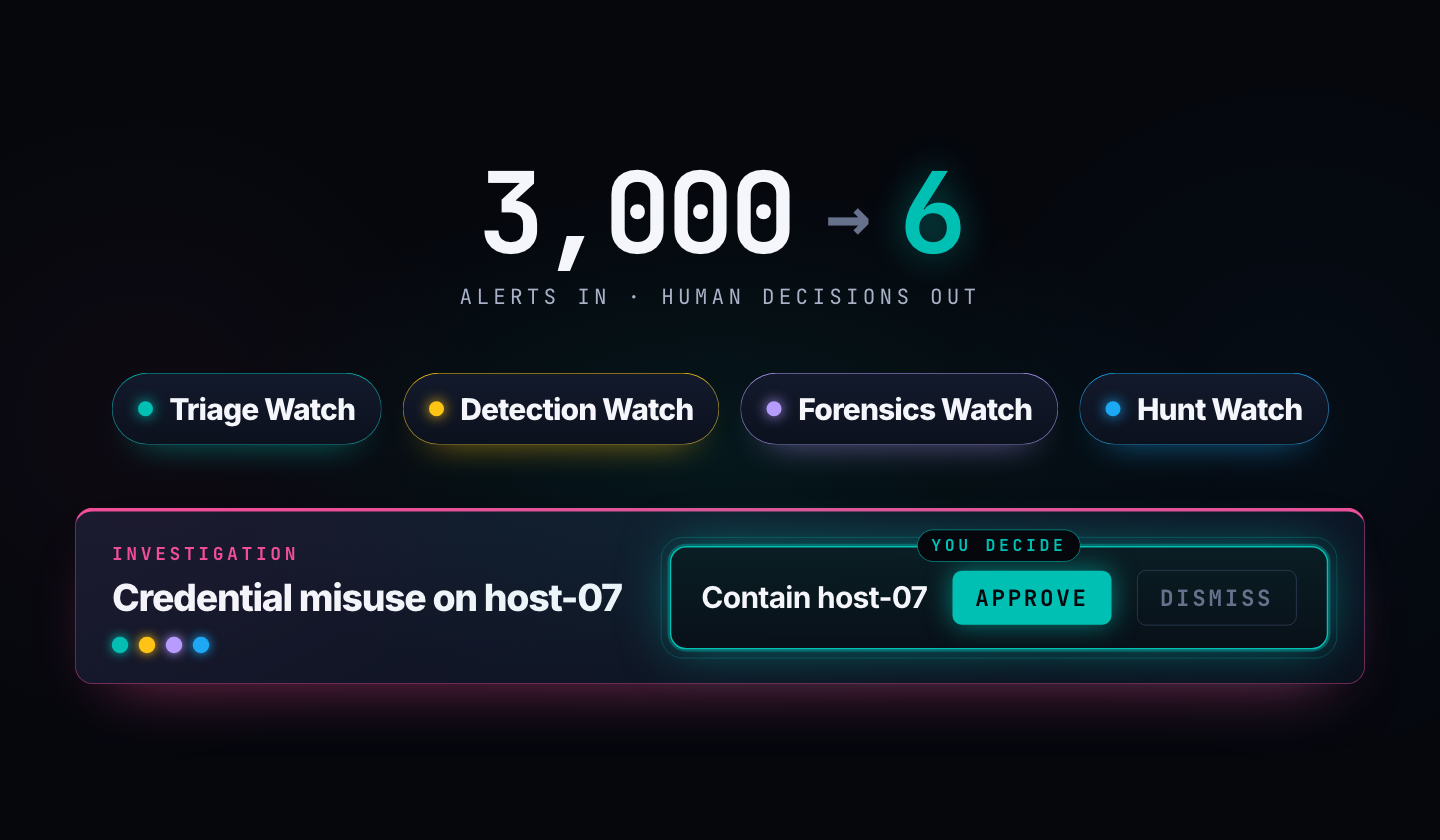
AlertZero agentic SOC automation shipped suggested Introduces AlertZero, an agentic layer built around four named Watches — Triage, Hunt, Detection, and Forensics — each aligned to a SOC responsibility and running on triggers or schedules, with per-Watch autonomy levels, a Proposed Actions approval workflow, and an Escalation mechanism for coordinated multi-signal incident response.
Suggested capability: Security event correlation. This is our guess, not confirmed.
Also counts toward: Scheduled jobs
release 8 total
- Adds an Escalation mechanism that lets analysts link related Investigations for coordinated, constrained response and collaborative discussion with or without agent involvement. Introducing AlertZero: Inbox zero for your alert queue (2026-10-08) · Oct 2026 · source · release history
- Adds the Detection Watch, which investigates noisy rules and coverage gaps (including false-positive closures) and prepares proposed rule changes — such as exceptions — with diagnosis, motivating alerts, proposed ES|QL logic, and backtest results for detection engineer review. Introducing AlertZero: Inbox zero for your alert queue (2026-10-08) · Oct 2026 · source · release history
- Adds a Proposed Actions workflow where every Watch surfaces evidence-backed conclusions for analyst approval, modification, escalation, or dismissal before any consequential action executes. Introducing AlertZero: Inbox zero for your alert queue (2026-10-08) · Oct 2026 · source · release history
- Provides per-Worker autonomy levels — manual, assisted, or supervised — so teams can delegate routine analysis while retaining human review of riskier actions such as endpoint response. Introducing AlertZero: Inbox zero for your alert queue (2026-10-08) · Oct 2026 · source · release history
- Adds the Hunt Watch, which continuously observes the environment, maps technologies and exposures to relevant threats, and proposes hunts and coverage improvements without requiring an analyst to initiate them. Introducing AlertZero: Inbox zero for your alert queue (2026-10-08) · Oct 2026 · source · release history
- Adds the Triage Watch, which assesses alerts and runs Attack Discovery to connect related alerts into attack narratives and identify findings that need attention. Introducing AlertZero: Inbox zero for your alert queue (2026-10-08) · Oct 2026 · source · release history
docs
- Blog Introducing AlertZero: Inbox zero for your alert queue AlertZero brings AI SOC automation to Elastic Security with four agents, one job each, so the queue stops setting your priorities. Nothing changes in your environment without your approval. docs update · Oct 2026 · source
- Introducing AlertZero: Inbox zero for your alert queue Introducing AlertZero: Inbox zero for your alert queue AlertZero brings AI SOC automation to Elastic Security with four agents, one job each, so the queue stops setting your priorities. Nothing changes in your environment without your approval. seen Oct 2026 · source
example
-
Escalate linked Investigations for coordinated team response on a multi-signal incident without forcing agent involvement in sensitive conversations.
In Elastic Security, open any Investigation, select Escalation, link the related Investigations, discuss evidence with teammates in the shared conversation, and optionally disable agent participation…Introducing AlertZero: Inbox zero for your alert queue (2026-10-08) · Oct 2026 · source -
Use the Detection Watch to surface rules generating high false-positive volumes and review an auto-prepared ES|QL exception before it is applied — keeping detection of malicious use intact.
In Elastic Security, go to AlertZero > Detection Watch, set the Rule Tuning Worker to Manual, authorize the analysis, then open the resulting Proposed Action to review the existing rule logic, the…Introducing AlertZero: Inbox zero for your alert queue (2026-10-08) · Oct 2026 · source -
Review a Forensics Watch endpoint-isolation Proposed Action before approving it — useful when an impossible-travel finding on an executive account needs analyst sign-off before host isolation fires through Elastic Defend.
In Elastic Security, go to AlertZero > Proposed Actions, open the item grouped under Respond for the flagged account, review the Investigation findings (session identifiers, MFA events, unsigned…Introducing AlertZero: Inbox zero for your alert queue (2026-10-08) · Oct 2026 · source
Azure AD Graph Activity Logs ingestion shipped Ingests Azure AD Graph Activity Logs with full ECS extraction so analysts can hunt legacy Graph API misuse patterns alongside other identity data.
release 7 total
- New dedicated Azure AD Graph Activity Logs integration item available for direct policy-template installation in Kibana. Azure AD Graph Activity Logs: Ingestion and threat detection to close the visibility gap (2026-06-19) · Jun 2026 · source · release history
-
Exposes
azure.aadgraphactivitylogs.properties.api_versionto flag callers requesting1.61-internal, which returnsstrongAuthenticationDetaildata not available via Microsoft Graph. Azure AD Graph Activity Logs: Ingestion and threat detection to close the visibility gap (2026-06-19) · Jun 2026 · source · release history -
Retains raw JSON in
event.originalfor forensic replay, queryable via ES|QL's JSON_EXTRACT(). Azure AD Graph Activity Logs: Ingestion and threat detection to close the visibility gap (2026-06-19) · Jun 2026 · source · release history -
Adds ingestion of AzureADGraphActivityLogs into Elastic via the Azure integration, landing events in
logs-azure.aadgraphactivitylogs-*with full ECS extraction. Azure AD Graph Activity Logs: Ingestion and threat detection to close the visibility gap (2026-06-19) · Jun 2026 · source · release history -
Populates
related.userwith bothuser.idandproperties.app_id, enabling simultaneous pivot on identity and OAuth client dimensions. Azure AD Graph Activity Logs: Ingestion and threat detection to close the visibility gap (2026-06-19) · Jun 2026 · source · release history -
Enables typed ECS fields (
event.action,http.request.method,source.ip,user.id,user_agent.original) plus dataset-specific fields underazure.aadgraphactivitylogs.properties.*for AAD Graph telemetry. Azure AD Graph Activity Logs: Ingestion and threat detection to close the visibility gap (2026-06-19) · Jun 2026 · source · release history
example
-
Verify AAD Graph Activity Logs are flowing into Elastic and confirm ECS fields are populated after enabling the diagnostic setting.
FROM logs-azure.aadgraphactivitylogs-* | LIMIT 20Azure AD Graph Activity Logs: Ingestion and threat detection to close the visibility gap (2026-06-19) · Jun 2026 · source -
Enable the AzureADGraphActivityLogs diagnostic category in Entra ID so logs are forwarded to your Event Hub and ingested by Elastic.
In the Azure portal, go to Entra ID > Monitoring > Diagnostic settings > + Add diagnostic setting.Azure AD Graph Activity Logs: Ingestion and threat detection to close the visibility gap (2026-06-19) · Jun 2026 · source -
Force AAD Graph telemetry for ingestion testing by calling legacy
graph.windows.netendpoints across common object types.TOKEN=$(az account get-access-token --resource https://graph.windows.net --query accessToken -o tsv) TID=$(az account show --query tenantId -o tsv) for obj in users groups servicePrincipals…Azure AD Graph Activity Logs: Ingestion and threat detection to close the visibility gap (2026-06-19) · Jun 2026 · source
Google Threat Intelligence (GTI) integration shipped Pulls Google Threat Intelligence indicators directly into Elastic with ECS normalisation, threat scores, and prebuilt dashboards, requiring no extra infrastructure.
release 7 total
- Supports 14 categorized GTI feed types including ransomware, infostealers, phishing, malicious infrastructure, IoT threats, macOS threats, threat actors, and vulnerability exploitation — coverage adjustable to subscription tier without Elastic configuration changes. From API key to live threat detections in minutes: how Elastic Security ingests Google Threat Intelligence (2026-06-02) · Jun 2026 · source · release history
- Automatic indicator lifecycle management handles expiration and revocation, reducing false positives from stale intelligence. From API key to live threat detections in minutes: how Elastic Security ingests Google Threat Intelligence (2026-06-02) · Jun 2026 · source · release history
- Agentic enrichment via Agent Builder and Elastic Workflows enables real-time VirusTotal queries, alert enrichment, telemetry correlation, and structured investigation summaries for indicators not yet in an indexed feed. From API key to live threat detections in minutes: how Elastic Security ingests Google Threat Intelligence (2026-06-02) · Jun 2026 · source · release history
- New Google Threat Intelligence (GTI) integration ingests known-malicious IPs, domains, URLs, and file hashes into Elastic Security via two data streams — Threat List (high-confidence detections) and IOC Stream (broader hunting coverage) — with no additional infrastructure required. From API key to live threat detections in minutes: how Elastic Security ingests Google Threat Intelligence (2026-06-02) · Jun 2026 · source · release history
- Each ingested GTI indicator carries a verdict (Malicious, Suspicious, or Undetected), severity, and a composite 0–100 threat score, enabling confidence-based tuning of indicator match detection rules. From API key to live threat detections in minutes: how Elastic Security ingests Google Threat Intelligence (2026-06-02) · Jun 2026 · source · release history
- GTI indicators are normalized to Elastic Common Schema (ECS) and stored in a dedicated threat intelligence data view, enabling ES|QL-based historical hunting and correlation alongside TAXII feeds, custom intelligence, and endpoint/cloud telemetry. From API key to live threat detections in minutes: how Elastic Security ingests Google Threat Intelligence (2026-06-02) · Jun 2026 · source · release history
example
-
Stand up continuous GTI-based detection in minutes by installing the integration from Kibana and enabling both data streams.
In Kibana, go to Integrations catalog → search "Google Threat Intelligence" → Add integration → enter your GTI API key → enable "Threat List" (high-confidence detections) and "IOC Stream" (hunting…From API key to live threat detections in minutes: how Elastic Security ingests Google Threat Intelligence (2026-06-02) · Jun 2026 · source -
Pivot from a single IOC to all associated campaign infrastructure and hunt across historical telemetry using ES|QL against the GTI threat intelligence data view.
FROM logs-ti_google_threat_intelligence.* | WHERE threat.indicator.type == "ipv4-addr" AND google_threat_intelligence.threat_actor == "<actor-name>" | STATS count = COUNT() BY threat.indicator.ip,…From API key to live threat detections in minutes: how Elastic Security ingests Google Threat Intelligence (2026-06-02) · Jun 2026 · source
Prebuilt detection rule noise, performance, and profile scoring shipped Runs a monthly automated telemetry pipeline across 30-day fleet data to assign Noise (Low/Medium/High/Unknown), Performance (Fast/Normal/Slow/Very Slow/Unknown), and composite Profile (Recommended/Aggressive) tags to prebuilt detection rules, giving teams data-driven signals for tuning and deployment posture decisions.
Also counts toward: Scheduled jobs
release
-
Rules with high noise are automatically tagged Profile: Aggressive regardless of score, while low-severity rules can never be tagged Profile: Recommended
 Behind the tags: How Elastic SIEM grades 1,781 detection rules on noise, speed, and threat coverage (2026-10-05) · Oct 2026
· source
· release history
-
Adds
Profile: RecommendedandProfile: Aggressivesummary tags that synthesize severity, Noise, Performance, and Threat scores into a single deployment-posture label:Profile: Recommendedrequires a composite score ≥7 with noNoise: Highand non-low severity;Profile: Aggressivefires onNoise: High… Behind the tags: How Elastic SIEM grades 1,781 detection rules on noise, speed, and threat coverage (2026-10-05) · Oct 2026 · source · release history -
Adds
Performance: Fast,Performance: Normal,Performance: Slow,Performance: Very Slow, andPerformance: Unknowntags using absolute execution-time thresholds (e.g.Performance: Fastrequires average ≤400 ms, p95 <1 s, zero 30-second executions, and ≥5 sampled environments). Behind the tags: How Elastic SIEM grades 1,781 detection rules on noise, speed, and threat coverage (2026-10-05) · Oct 2026 · source · release history - Prebuilt rules now carry Noise, Performance, Threat, and Profile tags recalculated every month from real fleet telemetry rather than being static Behind the tags: How Elastic SIEM grades 1,781 detection rules on noise, speed, and threat coverage (2026-10-05) · Oct 2026 · source · release history
-
Adds
Noise: Low,Noise: Medium,Noise: High, andNoise: Unknowntags to prebuilt rules, scored monthly from 30-day fleet telemetry using aglobal_noisemetric (mean alerts per distinct environment on firing days), with per-platform percentile cuts for Windows, Linux, macOS, AWS, Azure, GCP, Google Workspace,… Behind the tags: How Elastic SIEM grades 1,781 detection rules on noise, speed, and threat coverage (2026-10-05) · Oct 2026 · source · release history
docs
-
Behind the tags: How Elastic SIEM grades 1,781 detection rules on noise, speed, and threat coverage Behind the tags: How Elastic SIEM grades 1,781 detection rules on noise, speed, and threat coverage This article explains how Elastic SIEM uses a monthly automated telemetry pipeline to score prebuilt detection rules…
seen Oct 2026
· source
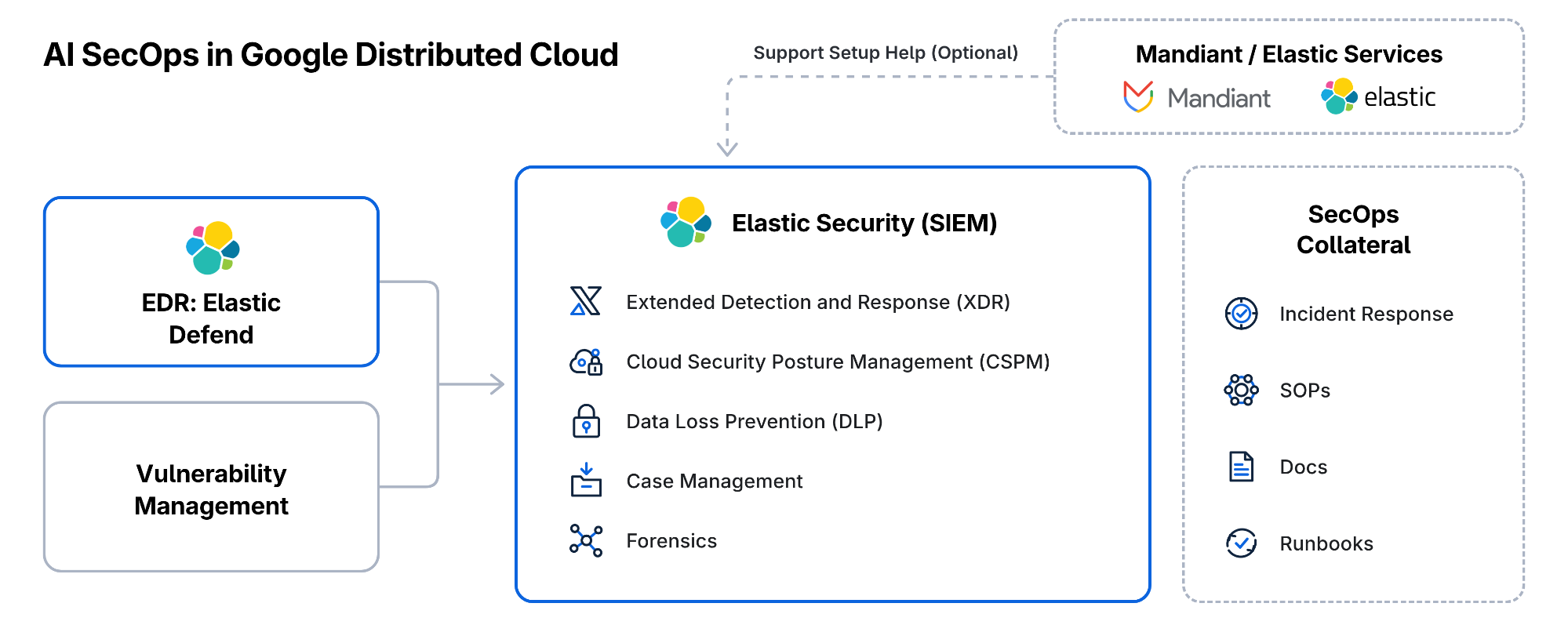
Elastic Security on Google Distributed Cloud (air-gapped) shipped Embeds unified SIEM and EDR — including kernel-level behavioral protection, infrastructure and network telemetry correlation, MITRE ATT&CK-mapped detections, curated Mandiant threat intelligence, and a SecOps Foundation layer with case management and runbooks — directly into Google Distributed Cloud air-gapped environments without external network access, custom log forwarders, or external connectors.
Also counts toward: Agent-based deployment, Air-gapped deployment, Self-hosted deployment
release
-
Delivers EDRv2 on Google Distributed Cloud air-gapped, providing kernel-level behavioral protection via a single unified agent to detect memory exploits, polymorphic malware, and lateral movement without external network access.
 announced · Oct 2026
· source
· release history
- Adds native Elastic Security integration with Google Distributed Cloud (GDC) air-gapped, embedding unified SIEM and EDR directly into the platform without custom log forwarders or external connectors.︀︄︇︀︅︉︀︅︀︀︃︀︀︅︅︀︅︊︀︄︆︀︃︄ announced · Oct 2026 · source · release history
- Delivers SIEMv2 on Google Distributed Cloud air-gapped, ingesting and correlating infrastructure, network, and audit telemetry with pre-built MITRE ATT&CK-mapped detection rules and behavioral analytics in a fully disconnected environment. announced · Oct 2026 · source · release history
- Bundles curated Mandiant threat intelligence — including indicators of compromise and adversary TTPs — for use in completely air-gapped environments. announced · Oct 2026 · source · release history
- Includes a SecOps Foundation layer with built-in case management, incident response plans, runbooks, and standard operating procedures for sovereign and regulated deployments on Google Distributed Cloud. announced · Oct 2026 · source · release history
AI-driven alert triage workflow shipped Runs a first-pass triage on alerts from chosen rules, classifying each as true positive, false positive, or inconclusive, and can auto-close low-priority findings above a set confidence threshold.
release
- Adds the Security alert analysis workflow for first-pass AI triage of alerts generated by selected rules, classifying them as true positive, false positive, or inconclusive with optional auto-close above a configurable confidence threshold. Alert Zero: AI-driven alert triage and attack investigation for the agentic SOC (2026-07-31) · Jul 2026 · source · release history
- Supports bring-your-own AI model, including local LLMs for air-gapped and sovereign deployments, for both alert triage and Attack Discovery. Alert Zero: AI-driven alert triage and attack investigation for the agentic SOC (2026-07-31) · Jul 2026 · source · release history
docs
-
Journey to AlertZero: AI-driven alert triage and attack investigation for the agentic SOC The concept of AlertZero addresses this problem.
 docs update · Oct 2026
· source
- 31 July 2026 • David Elgut Alert Zero: AI-driven alert triage and attack investigation for the agentic SOC Elastic Security 9.5 gives SOC teams AI that handles first-pass alert triage and investigation, so analysts can get back to threat hunting and detection engineering instead of working through queue noise. docs update · Jul 2026 · source
example
-
Enable AI-driven first-pass triage on specific detection rules and review classifications before optionally turning on auto-close.
In Elastic Security 9.5, go to the Security alert analysis workflow, select the detection rules to enroll, choose the AI agent and model, set the confidence threshold, and leave auto-close disabled…Alert Zero: AI-driven alert triage and attack investigation for the agentic SOC (2026-07-31) · Jul 2026 · source
npm configuration file integrity monitoring shipped Snapshots npm configuration files on a schedule, filters out credentials, and surfaces changes to security-relevant settings so analysts can detect supply-chain configuration tampering.
Also counts toward: Agent-based deployment, Scheduled jobs
release
-
Emits per-file SHA-256 hashes (
file.hash.sha256) alongside file content so the cursor can detect in-place rewrites of.npmrcthat removemin-release-agewithout changing the file path. The security signal log tailing can't see: tracking npm cooldown removals with Elastic Agent (2026-08-07) · Aug 2026 · source · release history -
Sets
resource.url: file:///dev/nullto satisfy the CEL integration's required URL field without making an HTTP request, with global paths and poll interval supplied via the Custom request cursor YAML field in Fleet UI. The security signal log tailing can't see: tracking npm cooldown removals with Elastic Agent (2026-08-07) · Aug 2026 · source · release history -
Uses the file() and dir() CEL functions to enumerate user home directories at runtime (under
/Usersand/home) and machine-global npm config paths (/opt/homebrew/etc/npmrc,/usr/local/etc/npmrc,/etc/npmrc,/usr/lib/node_modules/npm/.npmrc), covering macOS and Linux with a single script. The security signal log tailing can't see: tracking npm cooldown removals with Elastic Agent (2026-08-07) · Aug 2026 · source · release history -
Adds a ~40-line Common Expression Language (CEL) integration in Elastic Agent that snapshots every
.npmrcon a 6-hour heartbeat and markscooldown.absent = truein the ingest pipeline whenmin-release-agedisappears between snapshots. The security signal log tailing can't see: tracking npm cooldown removals with Elastic Agent (2026-08-07) · Aug 2026 · source · release history -
Filters registry auth token lines (
//registry.npmjs.org/:_authToken=...) in the ingest pipeline before any data leaves the host, ensuring credentials are never indexed in Elasticsearch. The security signal log tailing can't see: tracking npm cooldown removals with Elastic Agent (2026-08-07) · Aug 2026 · source · release history
Elastic Defend vulnerable driver coverage shipped Continuously monitors public driver vulnerability sources and automatically deploys YARA rules for newly disclosed vulnerable drivers, covering more than 800 known drivers.
release
- Elastic Defend gains always-on vulnerable driver coverage: threat research continuously monitors VirusTotal, loldrivers.io, and Microsoft's blocklist and automatically generates and instantly deploys YARA rules as new drivers are disclosed. Elastic goes all-in on Hacker Summer Camp at Black Hat and DEF CON in Las Vegas (2026-07-31) · Jul 2026 · source · release history
- Expands vulnerable driver detection coverage from 65 rules (2023) to 800+ known vulnerable drivers, growing automatically as new drivers are disclosed. What's new in Elastic Defend: 800+ vulnerable driver rules, automated troubleshooting, and ARM support (2026-07-31) · Jul 2026 · source · release history
- Continuously monitors VirusTotal, LOLDrivers catalog, and Microsoft's Vulnerable Driver Block List to automatically generate and instantly deploy YARA-based endpoint protection rules for newly disclosed vulnerable drivers — decoupled from any release cycle and published openly in the elastic/protections-artifacts… What's new in Elastic Defend: 800+ vulnerable driver rules, automated troubleshooting, and ARM support (2026-07-31) · Jul 2026 · source · release history
docs
-
Fri, 31 Jul 2026 15:41:17 GMT <![CDATA[Elastic goes all-in on Hacker Summer Camp at Black Hat and DEF CON in Las Vegas]]>
https://www.elastic.co/security-labs/elastic-security-black-hat-defcon-2026elastic-security-black-hat-defcon-2026 Fri, 31 Jul 2026 23:59:59 GMT Attack Discovery turns raw alerts into validated… docs update · Jul 2026 · source
example
-
Verify the open, automatically generated vulnerable driver rules before applying them to your environment.
Browse https://github.com/elastic/protections-artifacts to review auto-generated vulnerable driver YARA rules published by Elastic Security Labs Threat Command.What's new in Elastic Defend: 800+ vulnerable driver rules, automated troubleshooting, and ARM support (2026-07-31) · Jul 2026 · source
Automatic Sentinel detection rule migration shipped Automatically translates Microsoft Sentinel Scheduled and NRT analytics rules into Elastic Security using an LLM, showing translation status, required integrations, and severity mappings for each rule.
Also counts toward: Import from a competing product
release
- Surfaces per-rule translation status (Installed, Translated, Partially translated, Not translated, Failed) in the Manage Automatic Migrations UI. Stop rewriting detection rules by hand: automatic Sentinel-to-Elastic migration is here (2026-07-29) · Jul 2026 · source · release history
- Identifies required Elastic integrations from exported Sentinel rules, enabling a rules-first migration path to plan data onboarding before moving logs. Stop rewriting detection rules by hand: automatic Sentinel-to-Elastic migration is here (2026-07-29) · Jul 2026 · source · release history
- Adds automatic migration of Microsoft Sentinel Scheduled and Near Real Time (NRT) analytics rules into Elastic Security using an LLM of your choice. Stop rewriting detection rules by hand: automatic Sentinel-to-Elastic migration is here (2026-07-29) · Jul 2026 · source · release history
- Supports Watchlists-to-ES|QL Lookups conversion and Sentinel severity mapping during rule migration. Stop rewriting detection rules by hand: automatic Sentinel-to-Elastic migration is here (2026-07-29) · Jul 2026 · source · release history
example
-
Start a Sentinel-to-Elastic rule migration to automatically translate your detection rules and plan data onboarding around what those rules actually require.
In Elastic Security, go to Security Launchpad > Manage Automatic Migrations, select your AI provider, expand 'Migrate your existing SIEM rules to Elastic', and choose Microsoft Sentinel from the…Stop rewriting detection rules by hand: automatic Sentinel-to-Elastic migration is here (2026-07-29) · Jul 2026 · source
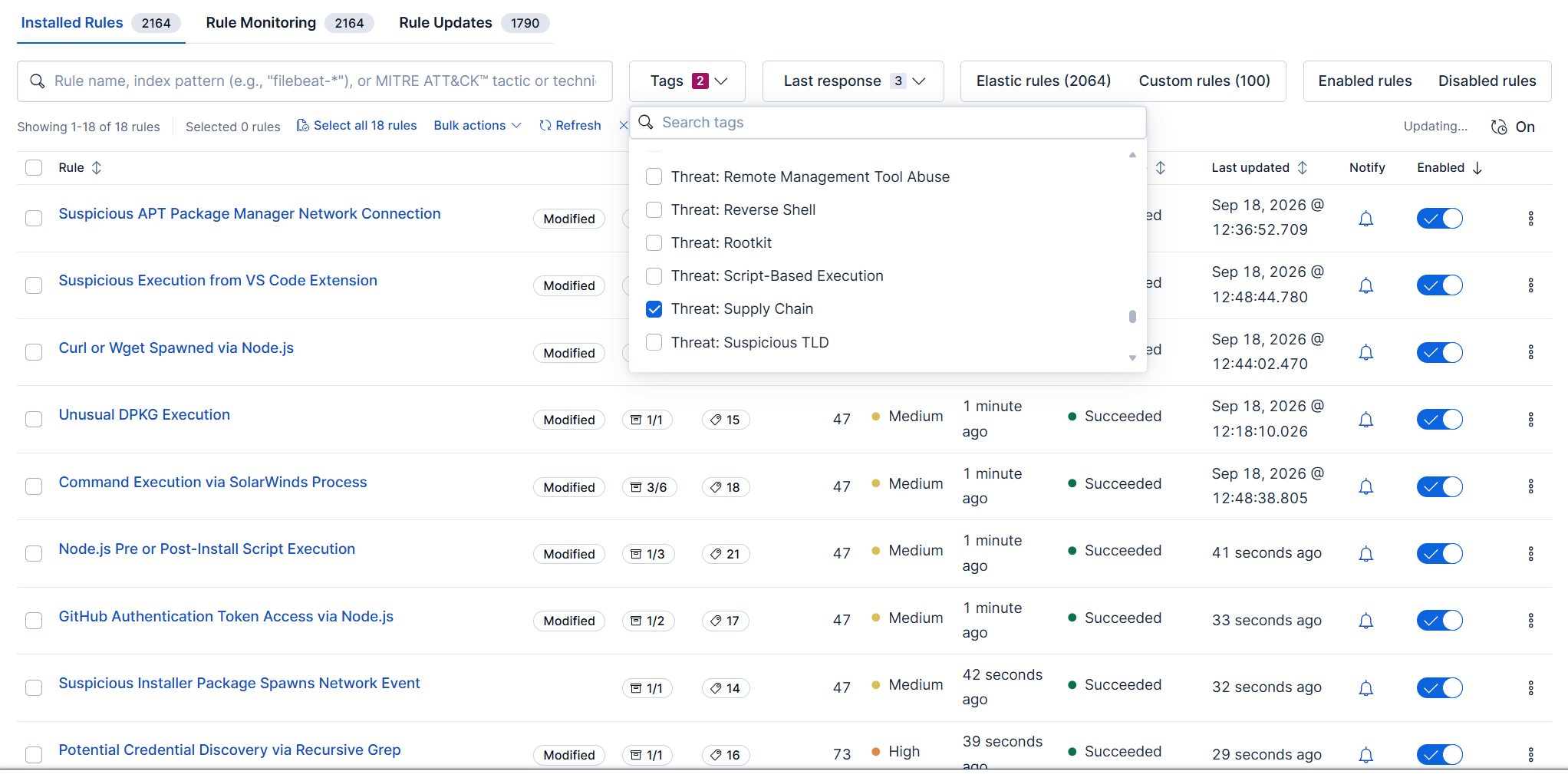
Prebuilt detection rule tag taxonomy shipped Applies a standardised tag taxonomy to prebuilt rules covering Domain, Platform, Data Source, Service, Vuln, Resources, and Threat dimensions — including a TRaDE-team-managed catalog of threat categories assigned via heuristics or LLM suggestion — to enable more granular rule search and filtering.
release
-
Adds a standardised prebuilt-rule tag taxonomy with Domain, Platform, Data Source, Service, Vuln, and Resources dimensions to enable more granular rule-search queries.
Behind the tags: How Elastic SIEM grades 1,781 detection rules on noise, speed, and threat coverage (2026-10-05) · Oct 2026
· source
· release history
- Adds Threat tags drawn from a managed TRaDE-team catalog — covering categories such as Supply Chain, ClickFix, Phishing Kits, and RMM abuse — applied deterministically via heuristics and, as a fallback, via LLM suggestion capped at five tags per rule and filtered against the approved catalog. Behind the tags: How Elastic SIEM grades 1,781 detection rules on noise, speed, and threat coverage (2026-10-05) · Oct 2026 · source · release history
- New tag taxonomy includes Domain, Platform, Data Source, Service, Vuln, and Resources categories to support granular rule search Behind the tags: How Elastic SIEM grades 1,781 detection rules on noise, speed, and threat coverage (2026-10-05) · Oct 2026 · source · release history
-
Plans to add
MITRE ATLAStags alongside existingMITRE ATT&CKtags in the next release. Behind the tags: How Elastic SIEM grades 1,781 detection rules on noise, speed, and threat coverage (2026-10-05) · Oct 2026 · source · release history
Cursor AI agent tool-call visibility shipped Collects every Cursor AI agent tool call as structured, ECS-conformant logs so security teams can query and monitor AI-assisted developer activity.
Also counts toward: JSON data export
release
-
Tags each event with a detected
agentandidesurface (cursor,cursor-cli, orremote) by inspecting inherited environment variables (CURSOR_VERSION,CURSOR_CODE_REMOTE,VSCODE_PID,VSCODE_CWD,VSCODE_IPC_HOOK) so IDE and CLI sessions are distinguishable in a single log stream. 13 million tool calls: auditing every AI coding agent action with Elastic Agent (2026-08-11) · Aug 2026
· source
· release history
-
Adds a 280-line dependency-free bash hook collector script (
log-tool-calls.sh) available in theelastic/elasticsearch-labsrepository, plus a PowerShell port for Windows, that records every Cursor AI agent tool call as JSONL to a date-rotated log file readable only by the owner (chmod 0600). 13 million tool calls: auditing every AI coding agent action with Elastic Agent (2026-08-11) · Aug 2026 · source · release history -
Provides an Elastic Agent filestream integration configuration that parses the JSONL logs into structured fields, enabling ES|QL queries across all agent activity — for example, identifying which hosts ran an agent that read a
.pemfile in a given time window. 13 million tool calls: auditing every AI coding agent action with Elastic Agent (2026-08-11) · Aug 2026 · source · release history -
Promotes top-level structured fields (
hook_event_name,tool_name,command,file_path,mcp_server,model,session_id,duration,duration_ms) plus an ECS-conformanteventobject (event.category,event.type,event.outcome) in every log entry for correlation with existing Elastic security indices. 13 million tool calls: auditing every AI coding agent action with Elastic Agent (2026-08-11) · Aug 2026 · source · release history
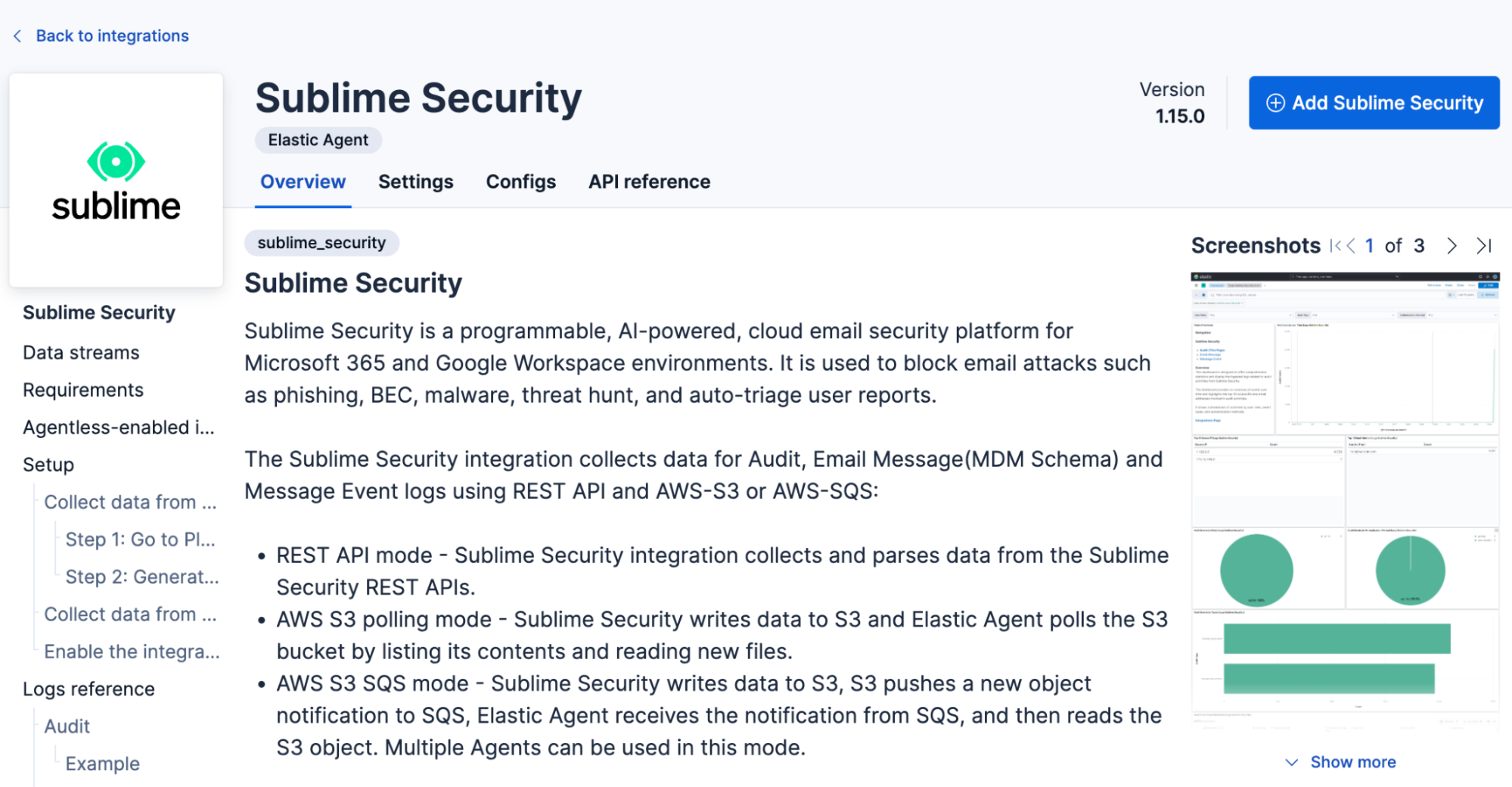
Sublime Security email threat integration shipped suggested Ingests Sublime Security email threat telemetry — flagged messages, detection rationale, targeted recipients, and actions taken — into Elastic Security for correlation with endpoint, identity, and network signals to support phishing incident response.
Suggested capability: Security event correlation. This is our guess, not confirmed.
release
-
Pulls Sublime Security email telemetry into Elastic Security for correlation with endpoint, identity, and network data
Quarantined isn't contained: Agentic phishing response with Elastic and Sublime (2026-09-28) · Sep 2026
· source
· release history
- Adds a native Sublime Security integration that ingests email threat telemetry (flagged message, detection rationale, targeted recipient, and Sublime action taken) into Elastic Security for correlation with endpoint, identity, and network signals.︀︄︇︀︅︉︀︅︀︀︃︀︀︅︅︀︅︊︀︄︆︀︃︄ Quarantined isn't contained: Agentic phishing response with Elastic and Sublime (2026-09-28) · Sep 2026 · source · release history
docs
- Blog Quarantined isn't contained: Agentic phishing response with Elastic and Sublime The native Sublime Security integration sends email detections into Elastic Security, where phishing incident response can tie a quarantined email to what happens next on the endpoint and pull the threat from every mailbox it reached. seen Sep 2026 · source
Attack Discovery detection gap analysis and rule drafting shipped When autonomous investigation finds activity with no existing detection, it drafts an ES|QL rule and holds it for analyst approval before creating it.
release
- Adds detection gap analysis inside Attack Discovery: when the investigation uncovers activity missed by existing detections, it drafts an ES|QL rule for analyst review and explicit approval before creation. Alert Zero: AI-driven alert triage and attack investigation for the agentic SOC (2026-07-31) · Jul 2026 · source · release history
- Attack Discovery auto-drafts detection rules when it finds gaps not covered by existing rules, routing the draft to an analyst for approval. Elastic goes all-in on Hacker Summer Camp at Black Hat and DEF CON in Las Vegas (2026-07-31) · Jul 2026 · source · release history
example
-
Review an AI-drafted ES|QL detection rule surfaced by Attack Discovery's gap analysis, then explicitly approve it to close a coverage gap found during investigation.
In the Attacks page under Detections, open an Attack Discovery result, navigate to the detection gap analysis section, review the drafted ES|QL rule, and click Approve to create the detection — no…Alert Zero: AI-driven alert triage and attack investigation for the agentic SOC (2026-07-31) · Jul 2026 · source
Zimbra Swatchdog command injection detection shipped suggested Adds a SIEM detection rule that identifies exploitation of CVE-2026-73570 by flagging a two-step process sequence — a shell spawned from a Perl swatchdog_script parent with SNMP-related command-line indicators followed by any unexpected child process — and supports both real-time alerting and retroactive threat hunting.
Suggested capability: Threat indicator matching. This is our guess, not confirmed.
release
-
Adds the Zimbra Swatchdog SNMP Command Injection Execution SIEM rule, which fires on a two-step process sequence: a shell spawned from a Perl
swatchdog_scriptparent withsnmptrap,zmservicename, andzmservicestatusin its command line, followed by any child process other than…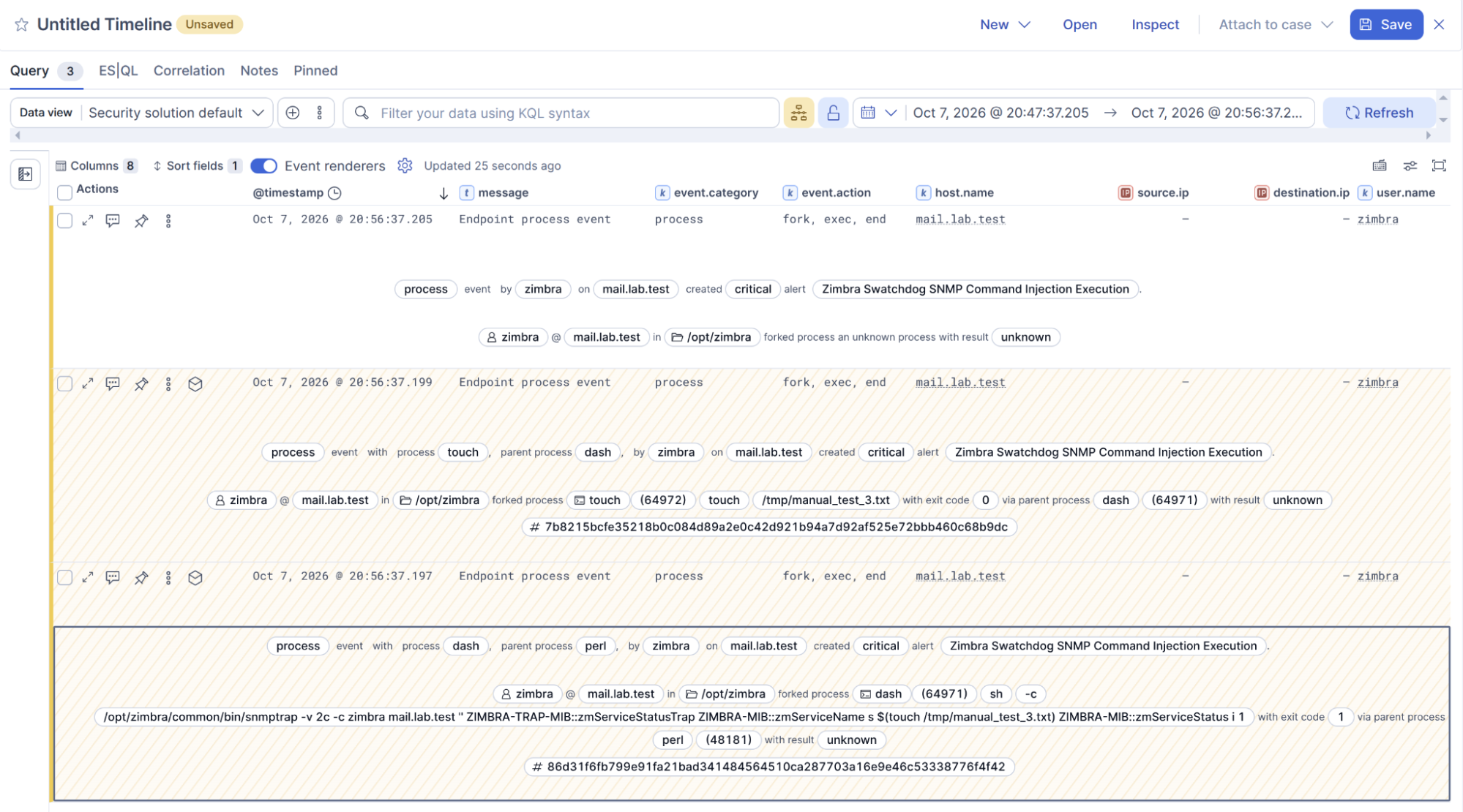 How CVE-2026-73570 turns a Zimbra log file into remote code execution (2026-10-23) · Oct 2026
· source
· release history
docs
-
How CVE-2026-73570 turns a Zimbra log file into remote code execution How CVE-2026-73570 turns a Zimbra log file into remote code execution We reproduced the Zimbra command injection vulnerability and found that several public PoCs write a payload Swatchdog never matches, so a failed test looks like a patched server.
seen Oct 2026
· source
CVE-specific detection coverage assessment documented Publishes analysis of Elastic detection coverage for specific CVEs — illustrated by critical PHP core RCE vulnerabilities — mapping existing rules and telemetry to the attack surface to help teams understand and close detection gaps.
docs
-
php2shell: Assessing Elastic detection coverage relevant to CVE-2026-109618 and CVE-2026-109619 Detection Engineering php2shell: Assessing Elastic detection coverage relevant to CVE-2026-109618 and CVE-2026-109619 CVE-2026-109618 and CVE-2026-109619 are critical PHP core RCE flaws that leaked ahead of disclosure.
docs update · Oct 2026
· source
-
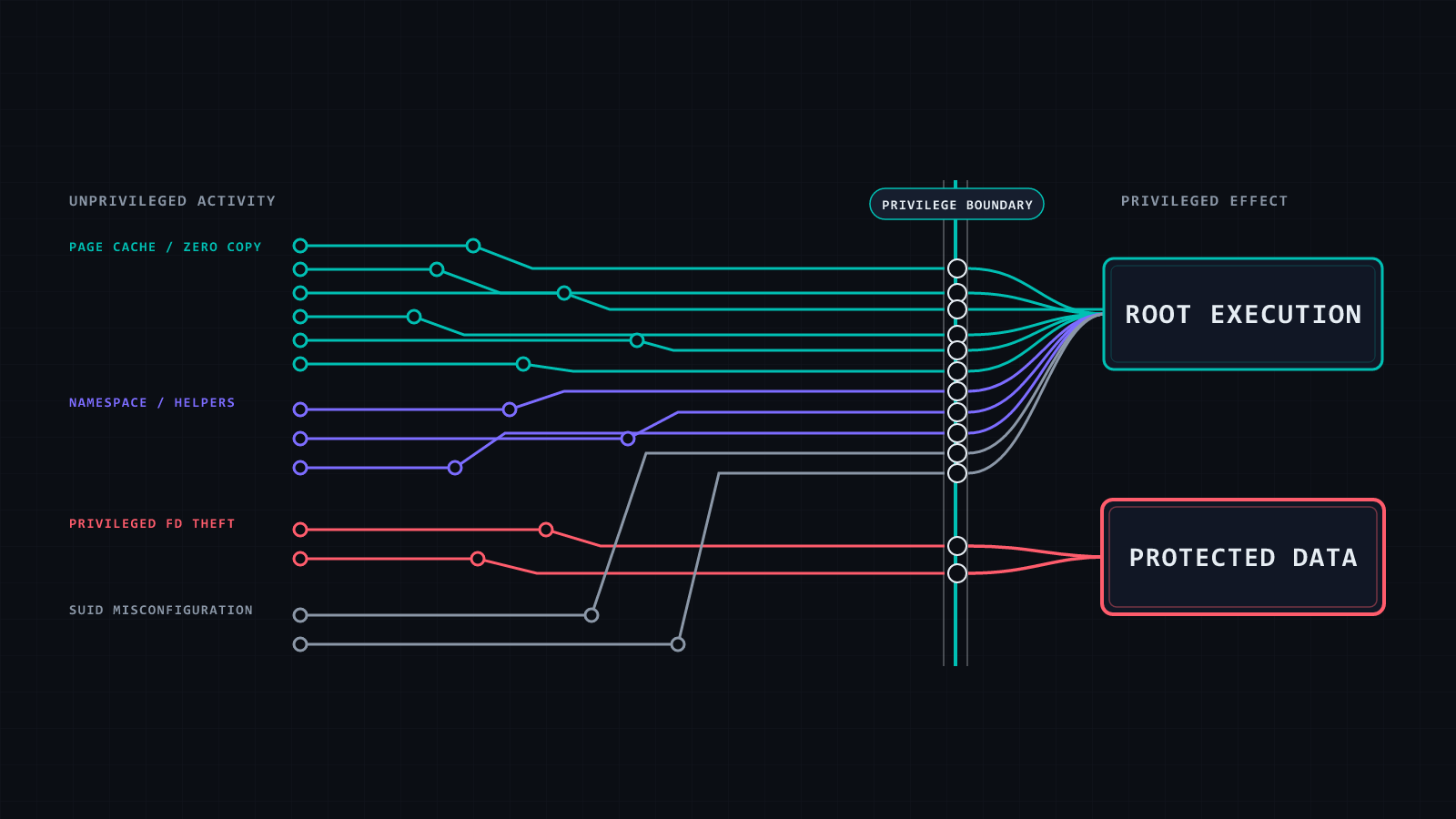
php2shell: Assessing Elastic detection coverage relevant to CVE-2026-109618 and CVE-2026-109619 Threat Intelligence php2shell: Assessing Elastic detection coverage relevant to CVE-2026-109618 and CVE-2026-109619 CVE-2026-109618 and CVE-2026-109619 are critical PHP core RCE flaws that leaked ahead of disclosure.
 docs update · Oct 2026
· source
Bring-your-own AI model support shipped Lets teams swap in any AI model, including local LLMs, for triage and investigation tasks, making the AI features usable in air-gapped or sovereign environments.
Also counts toward: Air-gapped deployment, Self-hosted deployment
release
- Supports proprietary and open-source model choice across Elastic Cloud, self-managed, and fully air-gapped deployments. Introducing AlertZero: Inbox zero for your alert queue (2026-10-08) · Oct 2026 · source · release history
- Supports bring-your-own AI model, including local LLMs for air-gapped and sovereign deployments, for both alert triage and Attack Discovery. Alert Zero: AI-driven alert triage and attack investigation for the agentic SOC (2026-07-31) · Jul 2026 · source · release history
Detection rule change history and rollback documented Records every change to a detection rule with a full audit trail and lets analysts roll back to any previous version in one click, while making case data queryable without extra configuration.
Also counts toward: Administrative audit log
docs
- 3 August 2026 • Kseniia Ignatovych • Melissa Burpo SOC case management and detection rule history in Elastic Security Elastic Security now tracks every detection rule change with one-click rollback and makes case data queryable out of the box, so SOC teams get audit trails and reporting without configuring anything. docs update · Aug 2026 · source
- 3 August 2026 SOC case management and detection rule history in Elastic Security Elastic Security now tracks every detection rule change with one-click rollback and makes case data queryable out of the box, so SOC teams get audit trails and reporting without configuring anything. docs update · Aug 2026 · source
Elastic Defend Windows ARM support shipped Brings Windows on ARM devices into the same Elastic Defend protection tier as the rest of the fleet without requiring separate tooling.
release
- Elastic Defend now provides full endpoint protection for Windows on ARM devices (e.g., Surface laptops), bringing them into the same protection tier as the rest of the fleet. Elastic goes all-in on Hacker Summer Camp at Black Hat and DEF CON in Las Vegas (2026-07-31) · Jul 2026 · source · release history
- Extends Elastic Defend support to Windows on ARM, covering Snapdragon laptops, Copilot+ PCs, and ARM workstations with the same detection rules and telemetry as x64 endpoints, enrollable under existing policies. What's new in Elastic Defend: 800+ vulnerable driver rules, automated troubleshooting, and ARM support (2026-07-31) · Jul 2026 · source · release history
Endpoint troubleshooting skill shipped Automatically identifies policy misconfigurations and performance problems on endpoints and surfaces them as a ready-made troubleshooting finding.
Also counts toward: Natural-language query
release
- New endpoint troubleshooting skill automatically flags policy and performance issues on endpoints. Elastic goes all-in on Hacker Summer Camp at Black Hat and DEF CON in Las Vegas (2026-07-31) · Jul 2026 · source · release history
- Adds Automatic Troubleshooting as a conversational skill in Elastic Agent Builder, enabling natural-language diagnosis of endpoint policy failures, third-party antivirus conflicts, and performance issues with specific remediation guidance. What's new in Elastic Defend: 800+ vulnerable driver rules, automated troubleshooting, and ARM support (2026-07-31) · Jul 2026 · source · release history
Entity Analytics Watchlists documented Lets analysts define watchlists of known high-risk entities that feed automatically into risk scoring without requiring custom detection engineering.
docs
- 5 May 2026 • Erik Huang • Jared Burgett Know who to watch before the incident finds you Elastic Security v9.4 introduces Entity Analytics Watchlists, a way to codify what your team already knows about high-risk entities and feed that context directly into risk scoring, without custom pipelines or detection engineering… docs update · Jul 2026 · source
Windows Endpoint Security Platform kernel eviction analysis documented Analyzes Microsoft's move to shift EDR vendors out of the Windows kernel via the new wesp.sys user-mode notification mechanism, covering what the preview binaries reveal about the forthcoming Windows Endpoint Security Platform and its implications for endpoint protection.
docs
-
Kernel eviction notice: What wesp.sys reveals about the Windows Endpoint Security Platform Kernel eviction notice: What wesp.sys reveals about the Windows Endpoint Security Platform Microsoft wants EDR out of the Windows kernel, and the preview binaries show wesp.sys telling a user-mode client that a process is…
seen Oct 2026
· source
Lines in monospace are the tool's own words: help text
parsed from its source, or an endpoint from its API document. Under
release, a line is our summary of a dated release. Under
docs, it is quoted from the tool's own documentation or
website. Each links back to the source it came from.
Command line
4 commands for Elastic Security Labs, each with where it came from. This tool has no source analysis yet, so there is no option reference and no captured run beside them.
No command matches.
Screenshots
From the release notes, newest first. Click one to see it full size.Media
Videos from the release notes, newest first. They play right here.Score card
-
Shipping velocity releases a month, last 12 months
-
Documentation quality release-notes rubric, 0–100
-
Breaking-change discipline how rarely a release breaks users, and notice given
-
Maintenance risk quiet time against its own cadence, maintainers
-
Innovation & surface new capabilities, API and MCP surface
Five scores for Elastic Security Labs, each built from the releases, notes and API history this site tracks — and, on Researcher and Business, where it stands among every measured tool in its category and how that has moved.
Score cards are part of every paid plan.
See plans → Already subscribed? Sign in →Trajectory
Blank means never measured; nothing here is a filled-in zero.
Peer standings are included with Researcher and Business. See how this tool ranks against its competitors, using data we don't publish anywhere else.
See plans →Each score is 0–100 on a published rubric, derived from data this site already shows. A dimension we cannot measure says so — it is never scored 0 and never enters a rank.
How this is scored
- Shipping velocity — releases a month over the last 12 months, on a log scale where 16 a month scores 100. Needs 3 releases in the window.
- Documentation quality — the release-notes rubric published on the analytics page, unchanged.
- Breaking-change discipline — the share of releases carrying a breaking change (none scores 100, half or more scores 0). Only projects that label breaking changes are measured: a clean record cannot be told from an unlabelled one.
- Maintenance risk — quiet time measured against the tool's own release cadence (quiet longer than 90 days and three typical gaps scores 0), plus the number of active maintainers and whether contributors are growing, where known. Higher is lower risk.
- Innovation & surface — new capabilities in the feature ledger this year, API and MCP operations added, and the share of commits that are features: the mean of whichever we hold.
- Community health (open-source tools only) — each is a direction, not a size: contributors this year against last, the bus factor now against a year ago, and issues closed per issue opened, where steady scores 50, doubled 100 and halved 0; plus the median time to a maintainer's first reply (an hour scores about 100, a month or more 0). A commercial card has no repository and carries none of the four.
- Documented delivery (commercial tools) — when a vendor's documented new capabilities have slowed against its own baseline, that counts against the overall standing as heavily as two low dimensions. Steady delivery, or too little history to judge, leaves the standing alone; it is never a sixth score.
- Open-source tools are scored on repository signals; commercial tools on their published changelog. Ranks compare tools within one category and one profile and need at least five measured peers; the overall standing needs three ranked dimensions. Best-in-breed or consolidator is a shape, not a quality, and is never scored.
Release-note detail over time
See how much detail Elastic Security Labs puts in its release notes, quarter by quarter, and compare it with tracked tools in the same category. This history uses up to ten retained, reviewed notes per tool; sparse or blank older quarters may reflect that limit.
Checking release-note history…
Coverage
Missing something? Tell us
What Elastic Security Labs connects to, runs on and detects, read from its release notes and docs. So far: 13 new detections, 4 updated detections, 3 new vulnerability checks, 1 new integration.
21 changes, tracked since Oct 5, 2026.
-
Oct 222026
new php2shell: Assessing Elastic detection coverage relevant to CVE-2026-109618 and CVE-2026-109619
CVE-2026-109618 and CVE-2026-109619 are critical PHP core RCE flaws that leaked ahead of disclosure. We cover what is verified, why exploitation converges on a web server spawning a shell, and the Elastic detections developed to catch this behavior.
-
Oct 222026
new php2shell: Assessing Elastic detection coverage relevant to CVE-2026-109618 and CVE-2026-109619
php2shell: Assessing Elastic detection coverage relevant to CVE-2026-109618 and CVE-2026-109619 CVE-2026-109618 and CVE-2026-109619 are critical PHP core RCE flaws that leaked ahead of disclosure. We cover what is verified, why exploitation converges on a web server spawning a shell, and the Elastic detections developed to catch this behavior.
-
Oct 222026
new Linux Detection Engineering - Local Privilege Escalation
With Linux privilege escalation CVEs
Linux Detection Engineering - Local Privilege Escalation Seven of the thirteen Linux privilege escalation CVEs we tracked in 2026 turned out to be the same copy-on-write bug pointed at different kernel interfaces. We ran the public proof-of-concept for eleven exploits and two misconfigurations, and noted which rules fired.
-
Oct 222026
new How to correlate Kubernetes audit logs with container runtime data
How to correlate Kubernetes audit logs with container runtime data Two fields join the Kubernetes API to what ran inside the pod, and one turns up a container escape your process events never recorded.
-
Oct 222026
new Linux Detection Engineering - Fileless Execution
With memfd_create staging, interpreter one-liners, deleted binaries, in-memory kernel module loads, FENIX, Elastic Defend
Linux Detection Engineering - Fileless Execution We reproduced five Linux fileless execution patterns with FENIX, including memfd_create staging, interpreter one-liners, deleted binaries, and in-memory kernel module loads, then mapped each to the Elastic Defend rules that catch it.
-
Oct 222026
new From 88 lines to 1: Detecting DLL hijacking with Elastic Defend
With mscoree.dll, ClickFix, Elastic Defend 9.5.0
From 88 lines to 1: Detecting DLL hijacking with Elastic Defend The ClickFix campaign that sideloads a malicious mscoree.dll also ships a driver to kill Elastic Endpoint. We rebuilt that DLL as a NativeAOT library, dropped it beside a signed Microsoft binary, and Elastic Defend 9.5.0 flagged the load.
-
Oct 222026
new Exploring the Hugging Face Breach: mapping AI agent tactics to Elastic Defend
With SIEM, worker RCE, credential harvest, C2, GenAI detection
Exploring the Hugging Face Breach: mapping AI agent tactics to Elastic Defend Every stage of the Hugging Face breach maps to Elastic Defend and SIEM rules already shipping, from worker RCE and credential harvest to self-migrating C2 and GenAI detection.
-
Oct 222026
new Detecting Tycoon 2FA AiTM attacks across Entra ID and Google Workspace
With Elastic Workflows
Detecting Tycoon 2FA AiTM attacks across Entra ID and Google Workspace Tycoon 2FA bypasses MFA on Entra ID and Google Workspace. We map telemetry fingerprints across both platforms, ship detection rules for both tiers, and contain incidents in under 10 seconds with Elastic Workflows.
-
Oct 222026
new CI/CD pipeline abuse: the problem no one is watching
With GitHub Actions, GitLab CI, Azure DevOps
CI/CD pipeline abuse: the problem no one is watching How we built an open-source, drop-in CI template that uses signal extraction and LLM reasoning to catch CI/CD abuse in GitHub Actions, GitLab CI, and Azure DevOps pipelines.
-
Oct 222026
new Endpoint rule: Payload Execution by Web Server
With apache2, httpd, nginx, php-cgi, php-fpm, lsphp
This maps to the endpoint rule Payload Execution by Web Server, which covers a broad set of web server parents (the PHP runtimes, Apache, nginx, and many application servers) and a long catalog of suspicious command lines, from discovery commands through reverse shells, decoding pipelines, and credential-file access.
-
Oct 222026
new SIEM rule: Suspicious Command Execution via Web Server
Suspicious Command Execution via Web Server matches known-bad command lines from a web server parent.
-
Oct 222026
new SIEM rule: Unusual Command Execution via Web Server (new_terms baseline rule)
Unusual Command Execution via Web Server is a new_terms rule: it learns which shell command lines each web server parent normally runs on a host, then alerts on lines that break the baseline.
-
Oct 222026
new php2shell: Assessing Elastic detection coverage relevant to CVE-2026-109618 and CVE-2026-109619
php2shell: Assessing Elastic detection coverage relevant to CVE-2026-109618 and CVE-2026-109619 — CVE-2026-109618 and CVE-2026-109619 are critical PHP core RCE flaws that leaked ahead of disclosure. We cover what is verified, why exploitation converges on a web server spawning a shell, and the Elastic detections developed to catch this behavior.
-
Oct 222026
new Sublime Security integration for phishing incident response
The native Sublime Security integration sends email detections into Elastic Security, where phishing incident response can tie a quarantined email to what happens next on the endpoint and pull the threat from every mailbox it reached.
-
Oct 122026
new Malicious npm packages @apexacc/cli and @apexacc/audit (Apex Accelerator / CloudSyncD)
Adds apex-windows-x64.exe, apex-darwin-arm64, apex-audit-windows-x64.exe, apex-audit-darwin-arm64, apex-verify-darwin, apex-audit-verify-darwin, vrf.apexaccs[.]org, verify.apexfdn[.]xyz. 8 in all.
Elastic Security Labs identified a malicious npm package, @apexacc/cli , which led us to an operation posing as a Web3 accelerator. That operation had spent months building a public presence, targeting cryptocurrency start-ups and founders with offers of free AI credits and coding tools, along with security audits.
-
Oct 122026
new CloudSyncD macOS backdoor and custom Windows information stealer exfiltrating via Telegram
With bludness.exe, install.exe, exegis.exe, updater_loader.exe
Campaigns distribute CloudSyncD malware for macOS and a custom Windows information stealer that exfiltrates data through Telegram.
-
Oct 52026
updated Elastic SIEM prebuilt detection rule scoring via automated telemetry pipeline
With 1,781 detection rules
This article explains how Elastic SIEM uses a monthly automated telemetry pipeline to score prebuilt detection rules across noise, performance, threat, and profile dimensions, helping security teams decide which rules to enable first.
-
Oct 52026
updated Elastic SIEM prebuilt detection rule tags — Noise, Performance, Threat, Profile
Adds Noise: Low, Noise: Medium, Noise: High, Noise: Unknown, Performance: Fast, Performance: Normal, Performance: Slow, Performance: Very Slow and 3 more. 11 in all.
Of Elastic's 2100+ prebuilt detection rules, 385 are tagged Profile: Recommended and 296 are tagged Aggressive. The rest (62% of the list) are deliberately left untagged. Prebuilt rule now carries tags like Noise: Low Performance: Fast, and Profile: Recommended, recalculated every month from real fleet telemetry rather than fixed once and left alone.
-
Oct 52026
updated Monthly tag refresh for prebuilt detection rules — Noise, Performance, Threat, and Profile
No new names. Restates the 11 already listed.
Once a month, an automated pipeline reads a 30-day window of telemetry across Elastic deployments and scores every prebuilt rule across four dimensions: Noise, Performance, Threat, and Profile.
-
Oct 52026
updated Standardised prebuilt-rule tag taxonomy — Domain, Platform, Data Source, Service, Vuln, Resources
This taxonomy includes tags for: Domain. - The visibility plane the behavior lives in. Platform. The ecosystem that the rule applies to. Data Source. The log stream or integration. Service. Optional specific component. Vuln. Vulnerabilities and Common Vulnerabilities and Exposures (CVEs). Resources. Investigation guides and LLM consumption, among others.
-
Oct 52026
new Planned MITRE ATLAS tags for prebuilt rules
In the coming release, we'll also include MITRE ATLAS tags to accompany MITRE ATT&CK.
Other 1
Nothing first seen in this window. That doesn't mean Elastic Security Labs shipped nothing, only that we found no record of it.
How we count
Read from 14 of 57 release notes and docs updates we hold for Elastic Security Labs. "First seen" is the earliest note that names something; "last" is the latest. Our history may start partway through Elastic Security Labs's life, so an old integration can show a recent first-seen date.
Each change counts once: "added 40 checks" is one line, so the numbers measure how often coverage moves, not how big the catalogue is or how well it detects.
Releases
57 entries
No entries match these filters.
- October 202616
- September 20269
- August 20268
- July 202622
- June 20262
Add the badge to your README
Maintain this project? The badge links readers straight to this page, so they can follow every release here.
 Choose a badge style and copy the code →