Intruder
What we've shipped lately: September 2026 commercialThe section your link pointed to isn't on Intruder's page any more, so we've brought you to the top.
Intruder is a security platform that scans targets for vulnerabilities and integrates with AWS, Google Cloud, Azure, Slack, Jira, and Zapier.
Summary
Intruder is a commercial exposure-management platform, run as a cloud service, that continuously scans an organisation's attack surfaceattack surfaceThe exposed systems, interfaces and access points an attacker could try to use. It includes internet-facing services as well as identities, software and other reachable resources. for vulnerabilities across cloud infrastructure, containers, and web applications. It is aimed at security teams and IT practitioners who need to monitor exposure without running their own scanning infrastructure, consolidating exposed ports, services, and screenshots into a single Attack Surface view so misconfigured or forgotten systems stand out. Coverage extends to Docker Hub container images with tag-based targeting, Microsoft 365 configuration risks alongside existing Azure checks, and an on-demand AI pentesting feature that produces full reports with reproduction steps for issues requiring multi-step chaining. Findings can flow into Linear automatically via severity-based rules, so triage fits into an existing engineering backlog rather than a separate console.
Intruder is a security platform that scans targets for vulnerabilities and integrates with AWS, Google Cloud, Azure, Slack, Jira, and Zapier.
How Intruder helps
Which hosts on my perimeter are exposing a service they shouldn't be?
consolidates every exposed port across all monitored targets into one list showing the service and software version behind each, searchable and filterable by port, service, or product
Which of my web-facing systems is actually an old admin panel someone forgot about?
shows a screenshot of every exposed web service so a forgotten login screen is visually distinguishable from an intended one, without opening each host by hand
Which of my certificates are about to lapse in production?
filters the attack surface by certificate expiry so services approaching lapse surface before they cause an outage
Are my Microsoft 365 tenants configured safely?
runs configuration checks against Entra ID, Exchange Online, SharePoint, and Teams through the existing Azure integration, with a fuller check set available once integration permissions are widened
Which container images in my Docker Hub repositories carry known vulnerabilities?
connects a Docker Hub account, discovers repositories and tags automatically, and scans a tagged image on a daily schedule plus instantly whenever the tag moves to a new version
How do I keep scanning the right image tag when my repos mix versioning schemes?
matches a custom regex pattern against tags so the scan target follows whichever image the pattern resolves to as new versions are pushed, instead of a fixed tag
Languages
Features
Built from Intruder's releases, docs, README and our own runs. “Seen” marks the month we first spotted a release the vendor didn't date. Group names and tags are our labels.
- Intruder covers 2 of the 8 vulnerability assessment methods capabilities we track.
- Intruder covers 1 of the 13 network discovery and scanning capabilities we track.
What Intruder offers you
- ML-based detection1
- Ticketing integration1
- User-defined detection rules1
- Web management console1
- REST API
No capabilities match.
Web vulnerability scanning 1 feature Vulnerability assessment methods since 2024
AI pentesting shipped Delivers on-demand web application penetration tests driven by AI, detecting access control, business logic, and auth bypass vulnerabilities, and producing a PDF report with executive summary, severity ratings, reproduction steps, and remediation guidance; supports whitebox testing via code repository integration.
Shared capability: Web vulnerability scanning
Also counts toward: ML-based detection
release 15 total
- Enables unlimited retests of selected AI pentest findings via the portal without requiring a full scan run, with results captured in a dedicated retest report. What we've shipped lately: September 2026 · Sep 2026 · source · release history
- Adds support for connecting Bitbucket and Azure Repos as source code repositories for AI Pentesting, alongside existing GitHub and GitLab support. What we've shipped lately: September 2026 · Sep 2026 · source · release history
-
Adds Bitbucket Cloud as a supported source-control integration for AI Pentesting, alongside existing GitHub and GitLab support — connect repositories directly to run AI-powered penetration tests against Bitbucket-hosted code.
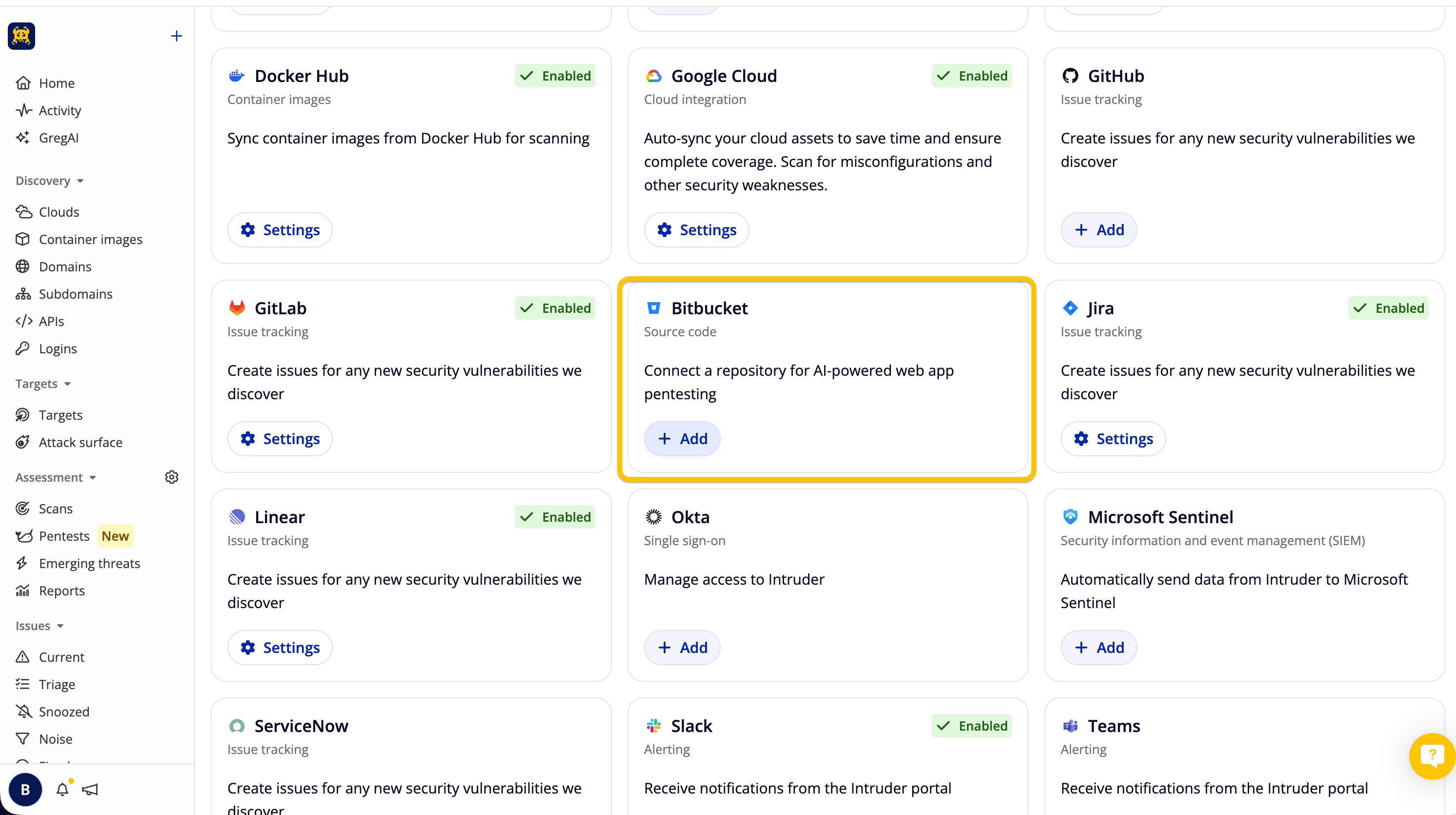 Integrate with Bitbucket Cloud for AI Pentesting (2026-08-25) · Aug 2026
· source
· release history
- New AI Pentesting capability launched from the portal (left nav → AI Pentesting → Start new pentest → AI Pentest option), delivering full PDF reports with executive summary, severity ratings, reproduction steps, and remediation guidance. changelog · Aug 2026 · source · release history
- Allows practitioners to define custom entry points, credentials, and application context to scope the AI pentest to their real environment. changelog · Aug 2026 · source · release history
- Supports whitebox testing via code repository integration, enabling coverage of access control, business logic, and auth bypass issues that require multi-step chaining. changelog · Aug 2026 · source · release history
docs
- July 28, 2026 Get the depth of a manual penetration test in hours, not weeks. Kick off an ai pentest from Intruder and receive a full PDF report, including executive summary, severity ratings, reproduction steps, and remediation guidance Connect your code repository for full whitebox testing that goes beyond… changelog · Aug 2026 · source
example
-
Enable Bitbucket Cloud so your Bitbucket-hosted repositories appear as targets for AI Pentest scans.
In the Intruder console, go to Integrations, find Bitbucket Cloud, and enable the integration to connect your repositories.Integrate with Bitbucket Cloud for AI Pentesting (2026-08-25) · Aug 2026 · source -
Kick off an on-demand AI pentest ahead of an audit or security questionnaire without waiting weeks for a traditional engagement.
In the portal, go to AI Pentesting in the left nav → click Start new pentest → select the AI Pentest option, then connect your code repository and define entry points, credentials, and application…changelog · Aug 2026 · source -
Start an AI-driven pentest against your web app directly from the Intruder portal.
In the portal, go to AI Pentesting in the left nav, click 'Start new pentest', then choose the 'AI Pentest' option.AI Pentesting - expert-level web app pentesting without the wait (2026-07-28) · Jul 2026 · source
Container image vulnerability scanning 1 feature Vulnerability assessment methods since 2023
Container image scanning shipped Scans Docker Hub container images for vulnerabilities, with automatic daily rescans, on-demand rescans on tag update, repository discovery, and support for multiple Docker Hub accounts via PAT.
Shared capability: Container image vulnerability scanning
release 7 total
- Adds Docker Hub integration to automatically scan container images from synced repositories. What we've shipped lately: August 2026 · Aug 2026 · source · release history
- Supports regex in container image tag matching to dynamically include or exclude specific tags during scans. What we've shipped lately: August 2026 · Aug 2026 · source · release history
- Connects multiple personal or organisation Docker Hub accounts via Personal Access Token (PAT) for container image scanning. Connect Docker Hub for container image scanning (2026-07-02) · Jul 2026 · source · release history
- Runs automatic daily rescans and instant rescans when a tag points to a new image version. Connect Docker Hub for container image scanning (2026-07-02) · Jul 2026 · source · release history
- Enables adding a custom tag to create a scan target and trigger an immediate vulnerability scan. Connect Docker Hub for container image scanning (2026-07-02) · Jul 2026 · source · release history
- Automatically discovers repositories, including tags and last-pushed dates, with on-demand refresh support. Connect Docker Hub for container image scanning (2026-07-02) · Jul 2026 · source · release history
example
-
Connect a Docker Hub account to bring container images into Intruder's vulnerability monitoring alongside existing cloud targets.
In the Intruder portal, go to Discovery → Container Images → click "Add registry" (top right) → select Docker Hub → enter your Personal Access Token (PAT) to authenticate and begin repository…Connect Docker Hub for container image scanning (2026-07-02) · Jul 2026 · source
Attack surface inventory 1 feature Network discovery and scanning since 2022
Attack surface view shipped Consolidates all exposed ports, services, and software versions across monitored targets into a single searchable and filterable view, including web service screenshots and filtering by host status or certificate expiry.
Shared capability: Attack surface inventory
release 33 total
- New Attack Surface view consolidates every exposed port across all monitored targets into a single list, showing the service and software version behind each. Attack Surface view for Cloud and Pro plans (2026-06-15) · Jun 2026 · source · release history
- Available on Cloud and Pro plans, with port coverage scaling by plan tier. Attack Surface view for Cloud and Pro plans (2026-06-15) · Jun 2026 · source · release history
- Enables search and filtering by port, service, or product to identify all targets running a specific service in seconds. Attack Surface view for Cloud and Pro plans (2026-06-15) · Jun 2026 · source · release history
- Adds filtering by host status or certificate expiry to surface newly appeared services or TLS certificates approaching lapse. Attack Surface view for Cloud and Pro plans (2026-06-15) · Jun 2026 · source · release history
- Displays screenshots of every exposed web service so practitioners can instantly distinguish forgotten admin panels from intended login pages. Attack Surface view for Cloud and Pro plans (2026-06-15) · Jun 2026 · source · release history
- Provides screenshots for each exposed web service directly within the Attack Surface View. See what's exposed with Attack Surface view · Jun 2026 · source · release history
example
-
Spot every host exposing a database port (e.g. 5432) across your entire perimeter before an auditor or attacker does.
In the Intruder portal, go to Attack Surface (left nav) > filter by Port: 5432 to see every target with PostgreSQL exposed.Attack Surface view for Cloud and Pro plans (2026-06-15) · Jun 2026 · source -
Identify certificates expiring soon across all targets to prevent unexpected lapses in production services.
In the Intruder portal, go to Attack Surface (left nav) > filter by Certificate Expiry to surface certs about to lapse.Attack Surface view for Cloud and Pro plans (2026-06-15) · Jun 2026 · source
Other / not yet classified 12 features Features we have not matched to a capability yet. A suggested match is marked.
Linear integration shipped Connects Intruder to a Linear workspace so vulnerabilities can be pushed to a chosen team and project, with auto-create rules based on severity, inline ticket display, and a test-issue feature to validate the integration.
Also counts toward: Ticketing integration
release 12 total
- Adds Linear integration to create remediation tickets directly from vulnerabilities with automatic criteria setup. What we've shipped lately: August 2026 · Aug 2026 · source · release history
- Includes test-issue feature to validate integration configuration before going live. Push vulnerabilities to Linear (2026-07-09) · Jul 2026 · source · release history
- Supports one-click push of any issue to a chosen Linear team and project. Push vulnerabilities to Linear (2026-07-09) · Jul 2026 · source · release history
- New Linear integration: connect your Linear workspace from Intruder settings to push vulnerabilities without leaving the platform. Push vulnerabilities to Linear (2026-07-09) · Jul 2026 · source · release history
- Displays linked Linear tickets inline in the issue list and issue details panel. Push vulnerabilities to Linear (2026-07-09) · Jul 2026 · source · release history
- Enables auto-create rules to automatically raise Linear tickets based on vulnerability severity. Push vulnerabilities to Linear (2026-07-09) · Jul 2026 · source · release history
example
-
Connect Linear and configure auto-create rules so critical and high findings flow into your backlog automatically.
In the Intruder console, go to Integrations → Linear, connect your workspace, then set auto-create rules by severity (e.g. Critical and High) and select the target Linear team and project.Push vulnerabilities to Linear (2026-07-09) · Jul 2026 · source
Microsoft 365 configuration scanning shipped Adds configuration security checks for Entra ID, Exchange Online, SharePoint, and Teams as part of existing Azure cloud security scans, with full coverage unlocked by updating integration permissions.
release 8 total
- Adds Azure DevOps work item scoping by target and tag to auto-create work items only for issues matching specific asset scope and severity rules. What we've shipped lately: September 2026 · Sep 2026 · source · release history
- Extends cloud security scanning to cover Microsoft 365 configuration risks across Entra ID, Exchange Online, SharePoint, and Teams. What we've shipped lately: August 2026 · Aug 2026 · source · release history
- Surfaces M365 identity, email, and collaboration configuration risks automatically for existing Azure integration users. changelog · Jul 2026 · source · release history
- Adds Microsoft 365 configuration risk scanning (Entra ID, Exchange Online, SharePoint, Teams) as part of existing Azure cloud security scans. changelog · Jul 2026 · source · release history
- Enables full M365 check coverage by updating the Azure integration's permissions. changelog · Jul 2026 · source · release history
- Adds Microsoft 365 configuration security checks covering Entra ID, Exchange Online, SharePoint, and Teams as part of existing Azure cloud security scans. Microsoft 365 security checks for Azure integrations (2026-07-21) · Jul 2026 · source · release history
docs
- July 21, 2026 Get visibility into Microsoft 365 configuration risks across Entra, Exchange, SharePoint, and Teams as part of your existing Azure cloud security scans. changelog · Jul 2026 · source
example
-
Unlock full Microsoft 365 configuration checks — beyond the automatic subset — by updating your Azure integration's permissions in Intruder.
In the Intruder console, go to your Azure integration settings and update the integration's permissions following the steps outlined in the integration guide to enable the full set of M365 checks.changelog · Jul 2026 · source -
Unlock full M365 security coverage by updating your existing Azure integration's permissions in the Intruder console.
In the console, go to your Azure integration settings and update the integration's permissions following the steps outlined in the M365 setup guide to enable the full set of Microsoft 365 checks.Microsoft 365 security checks for Azure integrations (2026-07-21) · Jul 2026 · source
Vulnerability Remediation Analytics shipped Provides metrics on issue trends, remediation progress, and cyber hygiene scores to track security posture over time.
Also counts toward: Web management console
release
- Displays Cyber Hygiene Score trends over time with a configurable range from four weeks up to one year. What we've shipped lately: September 2026 · Sep 2026 · source · release history
- Adds likelihood of exploitation to Cyber Hygiene Scores for a more realistic risk view The Vulnerabulletin Issue #4 · Feb 2026 · source · release history
- Adds the ability to add comments directly to individual issues or occurrences. Validate and Remediate Faster With In-Platform Commenting · Dec 2025 · source · release history
- Introduces Issues section metrics: Open issues, New issues, Fixed issues, and Days to fix (average days to remediate by severity) for trend analysis. Metrics matter: why we've added analytics to show your progress · Jan 2024 · source · release history
- Adds a new Analytics tab to the web interface that tracks vulnerability remediation progress, emerging threat check performance, and attack surface changes over selectable time ranges. Metrics matter: why we've added analytics to show your progress · Jan 2024 · source · release history
- Introduces Monitor Progress section metrics: Emerging threats (count, severity breakdown, pass/fail), Days between scans (total assessments and mean interval), and Cyber hygiene score. Metrics matter: why we've added analytics to show your progress · Jan 2024 · source · release history
example
-
To view existing comments or add your own to an occurrence via the UI.
Click on any occurrence and scroll down to the bottomValidate and Remediate Faster With In-Platform Commenting · Dec 2025 · source
Regex tag matching for container image targets shipped Lets users define a custom regex pattern to resolve and automatically follow the correct container image tag as new versions are pushed, supporting repositories with mixed or non-standard versioning schemes.
Also counts toward: User-defined detection rules
release
-
Enables accurate scoping across repositories with mixed conventions (e.g., semver,
-devsuffixes, or custom schemes) where exact-match and semver rules fall short. Regex tag matching for container images (2026-06-18) · Jun 2026 · source · release history - New regex tag-matching rule for container image targets lets you define a custom pattern to consistently resolve the correct image version. Regex tag matching for container images (2026-06-18) · Jun 2026 · source · release history
- Supports dynamic targeting: the target automatically follows the latest tag matching the regex as new image versions are pushed. Regex tag matching for container images (2026-06-18) · Jun 2026 · source · release history
- Adds configurable Slack integration for real-time notifications on network changes with custom type and frequency options Product Update: Continuous Network Scanning · Dec 2022 · source · release history
example
-
Target only production-tagged images across repos that mix semver and custom suffixes, without manually updating the tag each release.
In the console, go to your container image target > Tag rule > select 'Regex', then enter your pattern (e.g. ^v\d+\.\d+\.\d+$) and save.Regex tag matching for container images (2026-06-18) · Jun 2026 · source
GregAI Analyst Integration shipped Integrates the GregAI copilot into workflows to assist with security analysis, targeting, and issue management.
release
- Enhances GregAI to provide timeline history of key events for specific assets upon request. What we've shipped lately: August 2026 · Aug 2026 · source · release history
- Enhances GregAI to update scheduled scan targets via natural language queries. What we've shipped lately: August 2026 · Aug 2026 · source · release history
- Adds customizable notification controls for Slack and Teams integrations The Vulnerabulletin Issue #4 · Feb 2026 · source · release history
- Adds GregAI, an AI security analyst copilot to workflows The Vulnerabulletin Issue #1 · Nov 2025 · source · release history
Cross-Domain Scan Configuration shipped suggested Allows authenticated web application scans to include additional subdomains and external services to follow full application flows across domain boundaries.
Suggested capability: Web vulnerability scanning. This is our guess, not confirmed.
release
-
Adds an Additional domains field in authenticated web app target configuration, allowing subdomains (e.g.
api.example.com,auth.example.com) and external services (identity providers, CDNs, third-party APIs) to be included in scan scope.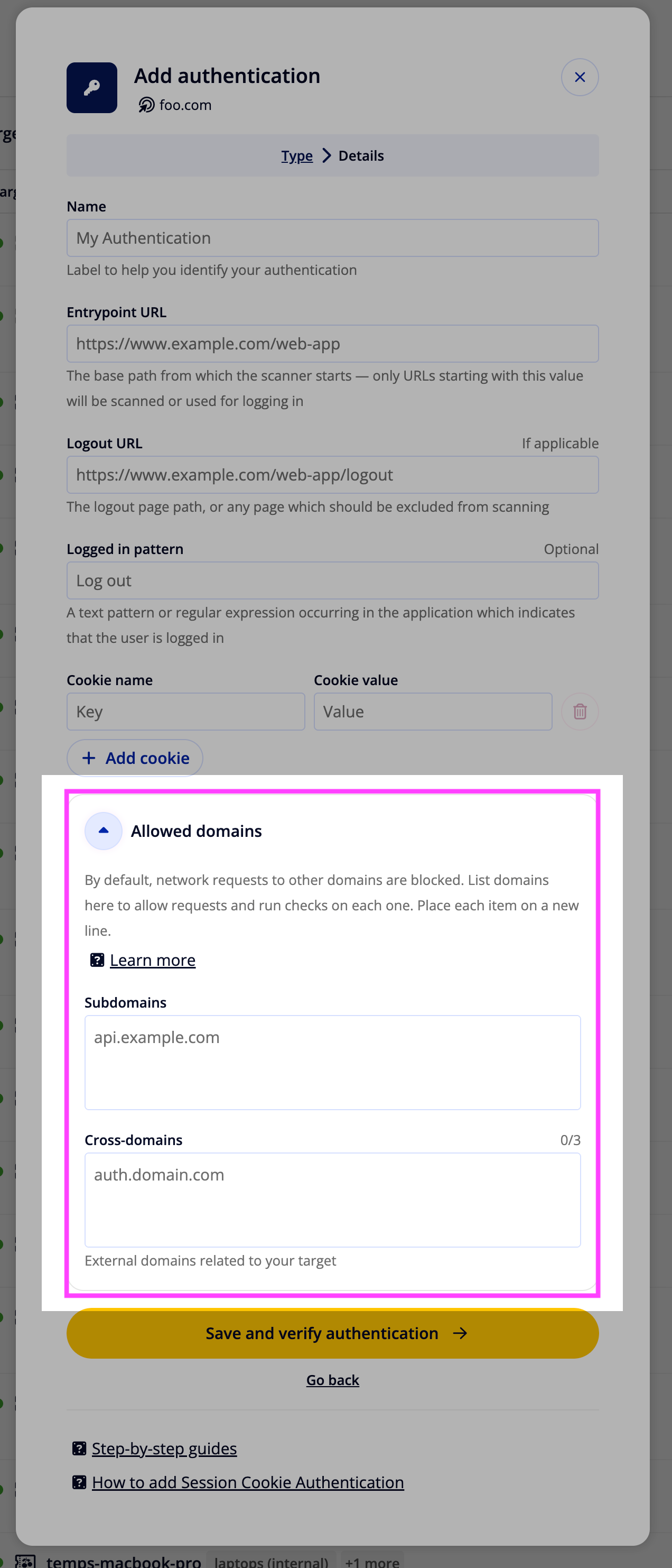 Scan additional domains for authenticated web application scans (2026-09-07) · Sep 2026
· source
· release history
example
-
When your app at
app.example.comcallsapi.example.comor an external identity provider, add those domains so the authenticated crawler is not blocked at domain boundaries.In the target's authentication settings, open the 'Additional domains' field and add the required domains, e.g.: api.example.com, auth.example.com, idp.thirdparty.comchangelog · Sep 2026 · source
Vanta Integration shipped Integrates Intruder findings with Vanta to stream live issues and compliance evidence in real-time.
release
- Enables real-time syncing of vulnerability issues and occurrences from Intruder into Vanta for compliance evidence. What we've shipped lately: August 2026 · Aug 2026 · source · release history
- Integrates Intruder findings with Vanta, streaming live issues and occurrences for real-time compliance. The Vulnerabulletin Issue #7 · Apr 2026 · source · release history
Remediation Audit Trails shipped Provides visibility into remediation activities through activity feeds and comment threading for audit purposes.
release
- Brings In-platform commenting capability allowing users to comment on issues and occurrences within Intruder The Vulnerabulletin Issue #3 · Jan 2026 · source · release history
- Introduces a new activity feed showing discussions, changes, and actions for remediation audit trails. Validate and Remediate Faster With In-Platform Commenting · Dec 2025 · source · release history
Rapid Response Scanning shipped suggested Allows manual initiation of scans to identify critical weaknesses with high CVSS scores before standard automated plugin coverage is available.
Suggested capability: Active network scanning. This is our guess, not confirmed.
release
- Introduces Attack Surface section metrics: Most vulnerable targets (un-remediated occurrences by target), New services (discovered during period), and Scanned targets. Metrics matter: why we've added analytics to show your progress · Jan 2024 · source · release history
- Adds Rapid Response as a new manual scanning capability for Enterprise plans to identify critical weaknesses (CVSS 9.5+) before automated plugin coverage is available. Rapid Response: Bridge the gap and find vulnerabilities faster · Aug 2023 · source · release history
Enhanced Vulnerability Detection shipped suggested Expands the detection engine with over 3,000 additional checks and integrates the Nuclei open-source scanning engine to augment attack surface visibility.
Suggested capability: Web vulnerability scanning. This is our guess, not confirmed.
release
- Provides over 3,000 additional vulnerability detection checks in the initial release Introducing Nuclei: the scanner that packs a punch · Dec 2023 · source · release history
- Adds the Nuclei open-source vulnerability scanning engine to Intruder to augment existing attack surface checks Introducing Nuclei: the scanner that packs a punch · Dec 2023 · source · release history
AI False Positive Suppression shipped suggested Uses AI agents to automatically validate findings, such as SQL injection, during scans to suppress confirmed false positives.
Suggested capability: Web vulnerability scanning. This is our guess, not confirmed.
release
- Enables auto-validation of SQL injection findings using AI agents during the scan to suppress confirmed false positives before they appear in results. What we've shipped lately: September 2026 · Sep 2026 · source · release history
Emerging Threats Scanning shipped Automatically triggers scans on external targets when critical vulnerabilities are identified, providing immediate monitoring for newly disclosed weaknesses.
release
- Enables automatic kick-off of Emerging Threat Scans (ETS) on all external targets upon identification of critical vulnerabilities affecting those targets. Rapid Response: Bridge the gap and find vulnerabilities faster · Aug 2023 · source · release history
Lines in monospace are the tool's own words: help text
parsed from its source, or an endpoint from its API document. Under
release, a line is our summary of a dated release. Under
docs, it is quoted from the tool's own documentation or
website. Each links back to the source it came from.
Screenshots
From the release notes, newest first. Click one to see it full size.Score card
-
Shipping velocity releases a month, last 12 months
-
Documentation quality release-notes rubric, 0–100
-
Breaking-change discipline how rarely a release breaks users, and notice given
-
Maintenance risk quiet time against its own cadence, maintainers
-
Innovation & surface new capabilities, API and MCP surface
Five scores for Intruder, each built from the releases, notes and API history this site tracks — and, on Researcher and Business, where it stands among every measured tool in its category and how that has moved.
Score cards are part of every paid plan.
See plans → Already subscribed? Sign in →Trajectory
Blank means never measured; nothing here is a filled-in zero.
Peer standings are included with Researcher and Business. See how this tool ranks against its competitors, using data we don't publish anywhere else.
See plans →Each score is 0–100 on a published rubric, derived from data this site already shows. A dimension we cannot measure says so — it is never scored 0 and never enters a rank.
How this is scored
- Shipping velocity — releases a month over the last 12 months, on a log scale where 16 a month scores 100. Needs 3 releases in the window.
- Documentation quality — the release-notes rubric published on the analytics page, unchanged.
- Breaking-change discipline — the share of releases carrying a breaking change (none scores 100, half or more scores 0). Only projects that label breaking changes are measured: a clean record cannot be told from an unlabelled one.
- Maintenance risk — quiet time measured against the tool's own release cadence (quiet longer than 90 days and three typical gaps scores 0), plus the number of active maintainers and whether contributors are growing, where known. Higher is lower risk.
- Innovation & surface — new capabilities in the feature ledger this year, API and MCP operations added, and the share of commits that are features: the mean of whichever we hold.
- Community health (open-source tools only) — each is a direction, not a size: contributors this year against last, the bus factor now against a year ago, and issues closed per issue opened, where steady scores 50, doubled 100 and halved 0; plus the median time to a maintainer's first reply (an hour scores about 100, a month or more 0). A commercial card has no repository and carries none of the four.
- Documented delivery (commercial tools) — when a vendor's documented new capabilities have slowed against its own baseline, that counts against the overall standing as heavily as two low dimensions. Steady delivery, or too little history to judge, leaves the standing alone; it is never a sixth score.
- Open-source tools are scored on repository signals; commercial tools on their published changelog. Ranks compare tools within one category and one profile and need at least five measured peers; the overall standing needs three ranked dimensions. Best-in-breed or consolidator is a shape, not a quality, and is never scored.
Release-note detail over time
See how much detail Intruder puts in its release notes, quarter by quarter, and compare it with tracked tools in the same category. This history uses up to ten retained, reviewed notes per tool; sparse or blank older quarters may reflect that limit.
Checking release-note history…
Commercials
pricing & packaging history · Intruder vendor page39 readings of Intruder's pricing page since Sep 2021, with 7 relaunches of its plan lineup and 20 changes to what its plans include — each one dated, compared with the reading before it, and explained for someone buying the tool.
Pricing and packaging history is included with Researcher and Business. See how every vendor we track sells, and how that has changed over time, using data we don't publish anywhere else.
See plans → Already subscribed? Sign in →Plans by offering
Each offering on the pricing page links to its own page of plans, read at its latest capture.
Plan relaunches
Plans, prices and descriptions are quoted from the vendor's own pricing page as we read it on each date. A plan missing from a later reading is shown as no longer listed on the page — a statement about the page, not the product. Readings that failed to show any plans are left out rather than read as a change.
Website history
intruder.io, every changeIntruder's home page and 25 more pages as they looked each month from August 2021 to October 2026: 35 renders, 4 changes of tagline or palette. Step through them, play them, or put any two months side by side.
Website history is included with Researcher and Business.
See plans → Already subscribed? Sign in →← → or h l a month · Shift a year · [ ] previous / next change · Space play · 1 2 3 page · T whole page · C compare · F full size
← → or h l the right month · Shift the left · S swap · W wipe · T whole page · Esc back
Rebranding timeline
Dates bound when a change appeared between captures. Possible rebrands are AI suggestions; a redesign alone does not establish a rebrand.
Releases
51 entries
No entries match these filters.
- September 20268
- August 20267
- July 20267
- June 20264
- April 20265
- February 20261
- January 20261
- December 20252
- November 20251
- May 20251
- October 20241
- July 20241
- May 20241
- February 20241
- January 20241
- December 20231
- November 20231
- September 20231
- August 20231
- July 20231
- May 20231
- March 20231
- December 20221
- March 20221
Add the badge to your README
Maintain this project? The badge links readers straight to this page, so they can follow every release here.
 Choose a badge style and copy the code →