Recorded Future
api-docs-c11db66c976a commercialThe section your link pointed to isn't on Recorded Future's page any more, so we've brought you to the top.
Recorded Future provides an API platform offering threat intelligence data including malware intelligence, playbook alerts, risk scoring, and attack surfaceattack surfaceThe exposed systems, interfaces and access points an attacker could try to use. It includes internet-facing services as well as identities, software and other reachable resources. insights.
curl https://docs.recordedfuture.com/reference/llms.txt
curl -X GET 'https://api.recordedfuture.com/company-search?freetext=Acme&riskScore=%5B50%2C%29&orderBy=riskscore&direction=desc&limit=100' -H 'X-RFToken: <your_api_token>'
curl -X GET 'https://api.recordedfuture.com/company-search?industry=Technology&orderBy=lastseen&direction=desc&limit=1000&from=1000' -H 'X-RFToken: <your_api_token>'
curl -G 'https://api.recordedfuture.com/v2/ip/ip:1.2.3.4' \
  --data-urlencode 'fields=entity,risk,aiInsights,links,intelCard,location' \
  -H 'X-RFToken: <api_token>'
curl -G 'https://api.recordedfuture.com/v2/ip/ip:1.2.3.4' \
  --data-urlencode 'fields=scanner,riskyCIDRIPs,dnsPortCert' \
  -H 'X-RFToken: <api_token>'
curl 'https://api.recordedfuture.com/v2/ip/fields' \
  -H 'X-RFToken: <api_token>'
curl -X GET 'https://api.recordedfuture.com/domain-search?limit=50&from=0&fields=entity,risk' \
  -H 'X-RFToken: <your_api_token>' \
  -H 'Accept: application/json'
curl -X GET 'https://api.recordedfuture.com/domain-search?limit=100&from=100&fields=entity,risk' \
  -H 'X-RFToken: <your_api_token>' \
  -H 'Accept: application/json'
curl -X GET 'https://api.recordedfuture.com/company-risk-rules' -H 'X-RFToken: <your_api_token>' -H 'Accept: application/json'
curl -X GET 'https://docs.recordedfuture.com/reference/company-lookup-by-domain?domain=google.com&fields=risk' -H 'X-RFToken: <your_api_token>' -H 'Accept: application/json'
curl --request GET \
  --url 'https://api.recordedfuture.com/company/search?riskScore=%5B50%2C%29&orderBy=riskscore&direction=desc&limit=100' \
  --header 'X-RFToken: <your_api_token>'
curl --request GET \
  --url 'https://api.recordedfuture.com/company/search?riskScore=%5B50%2C%29&industry=<industry_entity_id>&limit=1000&from=0' \
  --header 'X-RFToken: <your_api_token>'
curl -H 'X-RFToken: <api_token>' 'https://api.recordedfuture.com/v2/ip/fields'
curl -H 'X-RFToken: <api_token>' 'https://api.recordedfuture.com/v2/vulnerability/<vuln_id>?fields=cvssv4,lifecycleStage,linkedMalware'
curl -H 'X-RFToken: <api_token>' 'https://api.recordedfuture.com/v2/ip/<ip_address>?fields=risk,riskMapping,vpnHistory,proxyHistory,location'
curl -X POST 'https://api.recordedfuture.com/detection-rules/search' \
  -H 'X-RFToken: <your_api_token>' \
  -H 'Content-Type: application/json' \
  -d '{"type": "yara", "offset": "<next_offset_value>"}'
curl -X POST 'https://api.recordedfuture.com/social-media-impersonation-playbook/{alert-id}' \
  -H 'X-RFToken: <your-api-token>' \
  -H 'Content-Type: application/json'
curl -X POST 'https://api.recordedfuture.com/dark-web-brand-playbook-alert/<alert-id>' \
  -H 'X-RFToken: <your-api-token>' \
  -H 'Content-Type: application/json'
curl -X POST 'https://api.recordedfuture.com/malware-intelligence' \
  -H 'X-RFToken: <your-token>' \
  -H 'Content-Type: application/json' \
  -d '{"get_jobs": {"limit": 100, "offset": 0}}'
curl -X POST 'https://docs.recordedfuture.com/reference/sigma-create-job' \
  -H 'Authorization: Bearer <token>' \
  -H 'Content-Type: application/json' \
  -d '{"query": "sample.tags == \"family:redline\"", "start_date": "2024-03-01", "end_date": "2024-04-01"}'
curl --request GET \
  --url 'https://api.recordedfuture.com/yara-get-job?job_id=<job_id>' \
  --header 'Authorization: Bearer <token>' \
  --header 'Accept: application/json'
curl -s -H 'X-RFToken: <your-token>' https://api.recordedfuture.com/malware-intelligence | jq '.[] | select(.status == "completed") | .id'
curl -X GET 'https://api.recordedfuture.com/malware-intelligence/sandbox-reports?sha256=<sha256>&query=<malware_intelligence_query>&limit=1' -H 'Authorization: Bearer <token>' -H 'Accept: application/json'
curl -X GET 'https://api.recordedfuture.com/malware-intelligence/sandbox-reports?sha256=<sha256>&query=<malware_intelligence_query>&limit=3' -H 'Authorization: Bearer <token>' -H 'Accept: application/json'
curl -X POST 'https://api.recordedfuture.com/malware-intelligence/query-iocs' \
  -H 'Authorization: Bearer <token>' \
  -H 'Content-Type: application/json' \
  -d '{
    "ip_list": ["198.51.100.42", "203.0.113.7"],
    "domain_list": ["evil-c2.example.com"],
    "field": "ttp",
    "operator": "or",
    "start_date": "2024-01-01",
    "page": 0
  }'
curl -X POST 'https://api.recordedfuture.com/malware-intelligence/query-iocs' \
  -H 'Authorization: Bearer <token>' \
  -H 'Content-Type: application/json' \
  -d '{
    "sha256_list": ["e3b0c44298fc1c149afbf4c8996fb92427ae41e4649b934ca495991b7852b855"],
    "domain_list": ["malware-staging.example.net"],
    "field": "sha256",
    "operator": "and",
    "start_date": "2023-11-01",
    "page": 0
  }'
curl -X POST 'https://api.recordedfuture.com/malware-intelligence/query' \
  -H 'Authorization: Bearer <token>' \
  -H 'Content-Type: application/json' \
  -d '{
    "query": "dynamic.network.flows.dst_port == 5353",
    "field": "domain",
    "start_date": "2024-01-01"
  }'
curl -X POST 'https://api.recordedfuture.com/malware-intelligence/query' \
  -H 'Authorization: Bearer <token>' \
  -H 'Content-Type: application/json' \
  -d '{
    "query": "dynamic.network.flows.dst_port == 443",
    "field": "sha256",
    "start_date": "2023-11-01",
    "sandbox_score": true,
    "links": true
  }'
curl -X POST 'https://api.recordedfuture.com/cases/search' \
  -H 'X-RFToken: <your_api_token>' \
  -H 'Content-Type: application/json' \
  -d '{"status": ["New", "InProgress"], "priority": ["High"], "assignee": "<uhash>", "order_by": "created", "direction": "desc"}'
curl -X POST 'https://api.recordedfuture.com/cases/search' \
  -H 'X-RFToken: <your_api_token>' \
  -H 'Content-Type: application/json' \
  -d '{"assignee": "", "offset": "<next_offset>"}'
curl -G 'https://api.recordedfuture.com/threat-prevention-profile-indicators' \
  -H 'X-RFToken: <your_api_token>' \
  -H 'Content-Type: application/json' \
  --data-urlencode 'id=<profile_uuid>' \
  --data-urlencode 'type=ip' \
  --data-urlencode 'type=domain' \
  --data-urlencode 'include.risk.score=true'
curl -G 'https://api.recordedfuture.com/threat-prevention-profile-indicators' \
  -H 'X-RFToken: <your_api_token>' \
  --data-urlencode 'id=<profile_uuid>' \
  --data-urlencode 'type=hash' \
  --data-urlencode 'offset=<nextOffset_from_previous_response>'
curl -X POST https://api.recordedfuture.com/threat-prevention-profiles-query \
  -H 'X-RFToken: <your-api-token>' \
  -H 'Content-Type: application/json' \
  -d '{"enterprise": "uhash:XXXXXXXXXX"}'
curl -X POST https://api.recordedfuture.com/threat-prevention-profiles-query \
  -H 'X-RFToken: <your-api-token>' \
  -H 'Content-Type: application/json' \
  -d '{"ids": ["<uuid-1>", "<uuid-2>"]}'
curl --request POST \
  --url https://api.recordedfuture.com/v2/threat-detection/profile-rules \
  --header 'X-RFToken: <api_token>' \
  --header 'Content-Type: application/json' \
  --data '{"id": "<profile_uuid>", "filter": {"types": ["sigma"]}}'
curl --request POST \
  --url https://api.recordedfuture.com/v2/threat-detection/profile-rules \
  --header 'X-RFToken: <api_token>' \
  --header 'Content-Type: application/json' \
  --data '{"id": "<profile_uuid>", "filter": {"types": ["kql", "sigma"]}}'
curl -X POST 'https://api.recordedfuture.com/threat-detection/profile/indicators' \
  -H 'X-RFToken: <api_token>' \
  -H 'Content-Type: application/json' \
  -d '{"id": "<profile_uuid>", "type": "hash", "hashAlgorithm": "SHA-256", "include": {"risk": {"score": true}}}'
curl -X POST 'https://api.recordedfuture.com/threat-detection/profile/indicators' \
  -H 'X-RFToken: <api_token>' \
  -H 'Content-Type: application/json' \
  -d '{"id": "<profile_uuid>", "type": "ip", "offset": "<nextOffset>"}'
curl -X POST 'https://api.recordedfuture.com/threat-hunting/profiles/query' \
  -H 'X-RFToken: <your_api_token>' \
  -H 'Content-Type: application/json' \
  -d '{"enterprise": "uhash:XXXXXXXXXX"}'
curl -X POST 'https://api.recordedfuture.com/threat-hunting/profiles/query' \
  -H 'X-RFToken: <your_api_token>' \
  -H 'Content-Type: application/json' \
  -d '{"ids": ["<profile-uuid-1>", "<profile-uuid-2>"]}'
curl -X POST 'https://api.recordedfuture.com/threat-hunting/job/<jobId>/status' \
  -H 'X-RFToken: <api_token>' \
  -H 'Content-Type: application/json' \
  -d '{"status": "started", "externalId": "soar-case-1042"}'
curl -X POST 'https://api.recordedfuture.com/threat-hunting/job/<jobId>/status' \
  -H 'X-RFToken: <api_token>' \
  -H 'Content-Type: application/json' \
  -d '{"status": "completed", "message": "All indicators processed and alerts created.", "externalId": "soar-case-1042"}'
curl -X POST 'https://api.recordedfuture.com/threat-hunting/job-rules' \
  -H 'X-RFToken: <your_api_token>' \
  -H 'Content-Type: application/json' \
  -d '{"job_id": "<job_id>", "filter": {"types": ["sigma", "yara"]}}'
curl -X GET 'https://api.recordedfuture.com/identity/ip?range[gte]=192.168.1.0&range[lte]=192.168.1.255' -H 'Authorization: Bearer <token>' -H 'Accept: application/json'
curl -X GET 'https://api.recordedfuture.com/identity/ip?ip=203.0.113.47' -H 'Authorization: Bearer <token>' -H 'Accept: application/json'
curl -X POST 'https://api.recordedfuture.com/lists-add-entity' \
  -H 'X-RFToken: <your-api-token>' \
  -H 'Content-Type: application/json' \
  -d '{
    "listId": "report:XXXXX",
    "id": "ip:198.51.100.42",
    "context": {
      "source": "threat-feed",
      "ticket_id": "INC-12345",
      "annotation": "Observed C2 beacon - added by SOC automation"
    }
  }'
curl -X POST 'https://api.recordedfuture.com/lists-add-entity' \
  -H 'X-RFToken: <your-api-token>' \
  -H 'Content-Type: application/json' \
  -d '{
    "listId": "report:XXXXX",
    "type": "InternetDomainName",
    "name": "malicious-example.com",
    "context": {
      "source": "phishing-campaign",
      "annotation": "Phishing domain flagged in Q2 campaign"
    }
  }'
curl -X POST 'https://api.recordedfuture.com/lists/search' \
  -H 'X-RFToken: <your_api_token>' \
  -H 'Content-Type: application/json' \
  -d '{"type": "ip", "limit": 100}'
curl -X POST 'https://api.recordedfuture.com/lists/search' \
  -H 'X-RFToken: <your_api_token>' \
  -H 'Content-Type: application/json' \
  -d '{"name": "watchlist", "limit": 25}'
curl -X POST https://api.recordedfuture.com/dark-web-brand-playbook-alert/<alert-id> \
  -H 'X-RFToken: <your-api-token>' \
  -H 'Content-Type: application/json'
curl -X POST 'https://api.recordedfuture.com/dark-web/brand-playbook/alert/<alert_id>' \
  -H 'X-RFToken: <your_api_token>' \
  -H 'Content-Type: application/json'
curl -X POST 'https://api.recordedfuture.com/dark-web/brand-playbook/alert/<alert_id>' \
  -H 'X-RFToken: <your_api_token>' \
  -H 'Content-Type: application/json'
curl -X POST 'https://api.recordedfuture.com/dark-web/brand-playbook/alert/<alert_id>' \
  -H 'X-RFToken: <api_token>' \
  -H 'Content-Type: application/json'
curl -X POST 'https://api.recordedfuture.com/dark-web-brand-playbook-alert/{id}' \
  -H 'X-RFToken: <your_api_token>' \
  -H 'Content-Type: application/json'
Summary
Recorded Future is a commercial threat-intelligence platform that aggregates and correlates data on threats, vulnerabilities, and adversaries, delivered as a SaaSSaaSSoftware delivered over the internet and run on the provider's infrastructure, so the buyer pays a subscription instead of installing or operating anything locally. service with its intelligence reachable through a documented API for teams that want to build it into their own tooling. It is aimed at SOCSOCA security operations center, the team or function that monitors threats, investigates alerts and coordinates incident response. Its work can be internal, outsourced or shared. analysts and security teams running alert triage, with modules like Digital Risk Protection covering phishing domains, impersonation accounts, exposed credentials, and dark web brand mentions, plus AI-driven alert filtering that classifies references by relevance before an analyst opens them. It also exposes an MCPMCPModel Context Protocol, a standard for connecting AI applications to external tools and data sources. A compatible server exposes capabilities an assistant can use through a common interface. gateway so AI agents such as Claude or Copilot can query and update its data directly, sitting at the intersection of the threat-intel and agentic-tooling spaces rather than against a named competitor. Having launched in 2009 and shipped ten releases in the window tracked, most recently 150 days ago, it is an established, actively maintained platform.
Recorded Future provides an API platform offering threat intelligence data including malware intelligence, playbook alerts, risk scoring, and attack surface insights.
How Recorded Future helps
Which newly registered domains are impersonating our brand before they get weaponized for phishing?
scans new domain registrations for lookalikes and flags them within hours using logo detection and image OCR, catching impersonation that keyword matching would miss
Which of our employees' credentials are already circulating from infostealer infections?
surfaces compromised employee credentials pulled from active infostealer logs within hours of exfiltration, with dedicated monitoring for executive accounts
Is anyone impersonating our executives or company on social platforms?
scans social and professional networking platforms for fake executive profiles and company impersonation accounts
Have our credentials, PII, or source code leaked into public code repositories?
continuously scans public repositories for exposed secrets, personal data, and source code tied to the organization
Is our brand already being discussed or targeted on the dark web?
monitors underground forums, marketplaces, and ransomware extortion sites for brand mentions, planned attacks, and compromised data tied to the organization
Which fired alerts actually need an analyst's attention right now?
classifies every reference inside an alert into high- and low-relevance sections using a rule's configured intent, generates a summary flagging anything urgent, and can auto-dismiss alerts where nothing clears the relevance threshold
Languages
Features
Built from Recorded Future's releases, docs, README and our own runs. “Seen” marks the month we first spotted a release the vendor didn't date. Group names and tags are our labels.
- Recorded Future covers 3 of the 8 investigation and response capabilities we track.
What Recorded Future offers you
- REST API8
- MCP server2
- Built-in AI assistant1
- Natural-language query1
- Scheduled jobs1
No capabilities match.
Threat indicator matching 2 features Investigation and response since 2026
URL Intelligence documented Searches the Recorded Future URL intelligence dataset with filtering and optional enrichment to support investigation and triage workflows.
Shared capability: Threat indicator matching
docs
- What this endpoint does This endpoint returns only the HTTP headers (no body) for a URL risk list, providing a lightweight way to check whether the risk list has changed without downloading the full file. docs update · Oct 2026 · source
- What this endpoint does This endpoint downloads a bulk file of URLs from the Recorded Future URL risk list, intended for ingestion into SIEMs, SOARs, web proxies, and other security tools for URL blocking and detection. docs update · Oct 2026 · source
- What this endpoint does Searches the Recorded Future URL intelligence dataset with filtering and optional enrichment. seen Oct 2026 · source
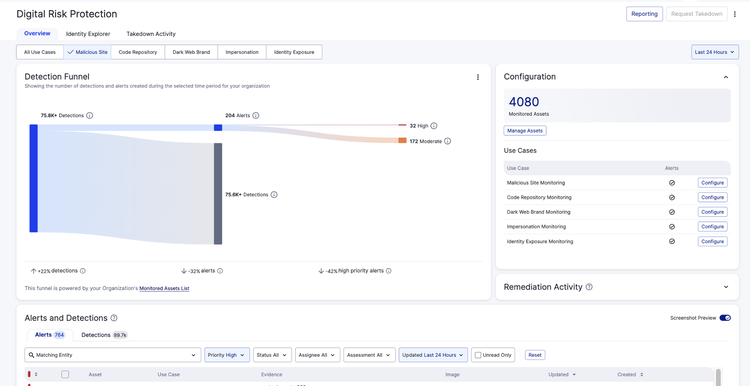
Malicious Site Monitoring shipped Flags newly registered lookalike domains and phishing infrastructure using logo detection and image OCR.
Shared capability: Threat indicator matching
release
-
Adds Malicious Site Monitoring, which flags newly registered lookalike domains and phishing infrastructure within hours of registration using logo detection and image OCR to catch impersonation beyond keyword matching.
 announced · Sep 2026
· source
· release history
Incident case management 1 feature Investigation and response since 2026
Cases API documented Provides API endpoints to search cases, update case properties, and list users eligible for case assignment within an organization.
Shared capability: Incident case management
docs 8 total
- What this endpoint does Creates a new case in Recorded Future's case management system, linked to an originating alert. docs update · Oct 2026 · source
- What this endpoint does Permanently removes a single case from the case management system by its TaskIdentity ID (formatted as task:<UUID> , obtainable from the Case Search endpoint). The operation is idempotent — deleting an already-deleted or non-existent case returns a success response rather than an error. docs update · Oct 2026 · source
-
What this endpoint does Retrieves full case details for a single case by its TaskIdentity ID. Known issue: this GET endpoint returns a routing-level 404 for all requests. Use Cases: Lookup Many (POST
/lookup) with a single ID in the ids array as the working alternative. seen Oct 2026 · source - What this endpoint does Permanently removes up to 100 cases in a single request by their TaskIdentity IDs (formatted as task:<UUID> , obtainable from the Case Search endpoint). docs update · Oct 2026 · source
- What this endpoint does Retrieves full details for one or more cases by their TaskIdentity IDs (format task:<UUID> ). Call this after Cases: Search to get case details for the IDs it returns. docs update · Oct 2026 · source
- What this endpoint does Searches cases and returns matching TaskIdentity IDs — this is step one of a two-step workflow. All filter parameters are optional; an empty body returns all accessible cases. docs update · Oct 2026 · source
Static malware analysis 1 feature Investigation and response since 2026
Auto YARA Rule Generation documented Runs asynchronous jobs that analyze sets of malware samples by SHA-256 hash to discover common byte patterns and generate YARA detection rules, with endpoints to list, retrieve, update, retry, and delete jobs and their generated rules.
Shared capability: Static malware analysis
docs
- What this endpoint does This operation creates an asynchronous Auto YARA job that analyzes a set of malware samples (identified by SHA-256 hashes) to discover common hexadecimal byte patterns and generate YARA detection rules. docs update · Oct 2026 · source
- What this endpoint does Lists all Auto YARA jobs created by the authenticated user. Use this to find job IDs and check status before calling Get YARA Job for full results including the generated YARA rule and patterns. docs update · Oct 2026 · source
- What this endpoint does This operation permanently deletes an Auto YARA job and its associated generated YARA rules from Recorded Future's Malware Intelligence platform. seen Oct 2026 · source
- What this endpoint does This operation updates the YARA rule string associated with an existing Auto YARA job. After reviewing a rule generated by the Create Auto YARA Job endpoint (retrieved via the Get YARA Job endpoint), use this endpoint to refine or replace the YARA rule logic. docs update · Oct 2026 · source
- What this endpoint does Retries a previously failed Auto YARA job, resubmitting the original hashes for YARA rule generation without creating a new job. Use this when a job's status is FAILED as reported by Auto YARA: Get Job or Auto YARA: List Jobs . docs update · Oct 2026 · source
- What this endpoint does Retrieves the full result of a specific Auto YARA job, including the generated YARA rule text and pattern analysis. After creating a job with Create Auto YARA Job , poll this endpoint until status reaches FINISHED or FAILED. If the job fails, use Retry YARA Job to resubmit it. docs update · Oct 2026 · source
Other / not yet classified 28 features Features we have not matched to a capability yet. A suggested match is marked.
Attack Surface Management shipped Discovers and tracks the components of an organization's external attack surface — domains, hosts, and IP addresses — organized into projects with exposure scoring, asset filtering, and compound search capabilities.
Also counts toward: REST API
release
- Adds support for advanced search and filtering of assets within projects via the ASI Project API ASI Project API v1.7.0 (2026-02-09) · Feb 2026 · source · release history
docs 21 total
- What this endpoint does This endpoint returns enrichment data for a single IP address, controlled by the fields parameter which selects which categories of intelligence to include. docs update · Oct 2026 · source
- What this endpoint does This endpoint searches for IP addresses matching specified filters and returns paginated results with optional enrichment data. docs update · Oct 2026 · source
- What this endpoint does Returns the complete catalog of risk rules (~90) used to evaluate IP address risk scores. Use this as a reference to discover valid riskRule filter values for IP Address: Search and IP risk list downloads. docs update · Oct 2026 · source
- What this endpoint does Creates a new custom tag at the project level in ASI. The tag name is provided as a path parameter and preserved with the casing given (filtering is case-insensitive). The operation is idempotent — calling with an existing tag name succeeds without error. seen Oct 2026 · source
- What this endpoint does Retrieve available filter facets for a project's assets, narrowed by an applied filter to show only the values and counts relevant to a specific asset subset. seen Oct 2026 · source
- What this endpoint does Retrieve the complete exposure profile for a specific asset, providing significantly more detail than the exposure summary available through the Read Asset endpoint's exposures field. seen Oct 2026 · source
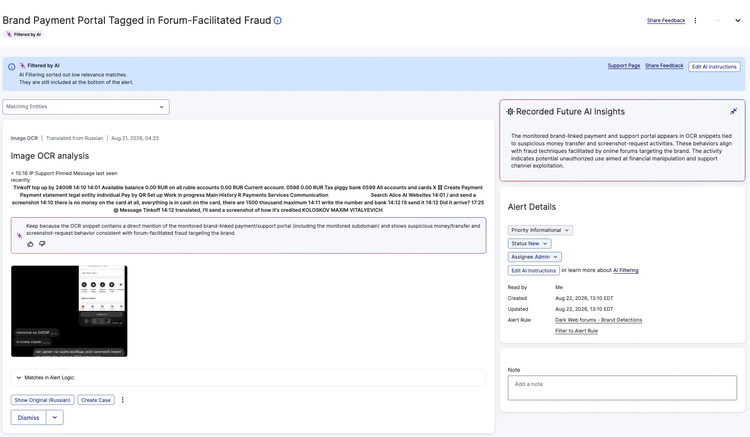
AI Alert Filtering shipped Automatically classifies references within fired alerts into High Relevance and Low Relevance sections, with options to exclude irrelevant references from API payloads, auto-dismiss alerts with no relevant references, and configure a custom per-rule intent to sharpen relevance decisions.
release 10 total
-
Provides configurable risk thresholds per use case so teams control which detections escalate to Alerts without losing underlying detection coverage.
announced · Sep 2026
· source
· release history
-
New AI Alert Filtering feature, enabled per rule from the Alerts page in the Portal, automatically classifies every reference inside a fired Alert into High Relevance and Low Relevance sections before an analyst opens it.
 announced · Aug 2026
· source
· release history
- Adds per-rule custom intent configuration so analysts can define exactly what the AI should prioritize beyond the default rule intent (e.g. scoping a rule to a specific organization). announced · Aug 2026 · source · release history
- Irrelevant references can optionally be excluded from API payloads sent by Recorded Future, reducing noise in downstream integrations. announced · Aug 2026 · source · release history
- Available at no additional cost to all Recorded Future customers; enabled by default for new customers. announced · Aug 2026 · source · release history
- Adds optional auto-dismiss: when no references meet the relevance threshold, the Alert can be automatically dismissed before reaching the analyst queue. announced · Aug 2026 · source · release history
example
-
Sharpen AI relevance decisions for a rule scoped to a specific organization by setting a custom intent, without rebuilding the rule from scratch.
In the Portal, go to Alerts > select the alert rule > open AI Alert Filtering settings > enter a custom intent (e.g. 'This rule is for ACME Bank, not ACME Center').announced · Aug 2026 · source -
Enable AI Alert Filtering on a specific alert rule to start automatically triaging references by relevance without changing the underlying rule.
In the Portal, go to Alerts > select a classic or custom alert rule > enable AI Alert Filtering for that rule.announced · Aug 2026 · source
Analyst Notes API documented Provides API endpoints to create draft and published analyst notes, retrieve or preview individual notes, search across enterprise and Insikt Group notes, export notes as PDF or HTML, and download binary attachments.
Also counts toward: REST API
docs 11 total
- What this endpoint does Permanently deletes an analyst note by its ID. Only notes authored by your organization can be deleted — attempting to delete an Insikt Group note or a note from another organization returns a 404. This operation is irreversible. docs update · Oct 2026 · source
- What this endpoint does Exports an analyst note as a rendered PDF or HTML file. The format path parameter accepts pdf or html . Use this to generate offline-readable versions of analyst notes for sharing outside Recorded Future. Response data The rendered file as binary data with application/octet-stream content type. docs update · Oct 2026 · source
- What this endpoint does Creates a draft analyst note from a JSON payload without publishing it. The draft is saved to the database and becomes available for editing through the Recorded Future note editor UI. docs update · Oct 2026 · source
- What this endpoint does Retrieves a single analyst note by its ID (e.g., doc:wB0Rhk ). The optional serialization parameter controls how much detail is returned — see Analyst Notes: Serialization Options for levels. seen Oct 2026 · source
- What this endpoint does Downloads the binary attachment associated with an analyst note. Not all notes have attachments — if the specified note has no attachment, the API returns a 404. The response is raw binary data (not JSON), with application/octet-stream content type. Response data The raw binary file content. docs update · Oct 2026 · source
- This reference documents the three serialization levels available for the serialization parameter used across all analyst note operations: Analyst Notes: Preview, Analyst Notes: Publish, Analyst Notes: Lookup, and Analyst Notes: Search. docs update · Oct 2026 · source
Threat Prevention Profile Integration shipped suggested Exposes threat prevention profiles via API, delivering block lists of confirmed-malicious indicators (IPs, domains, hashes, URLs) intended for firewalls, web proxies, and endpoint cyber tooling, along with any supplementary detection rules.
Suggested capability: Threat indicator matching. This is our guess, not confirmed.
Also counts toward: REST API
release
-
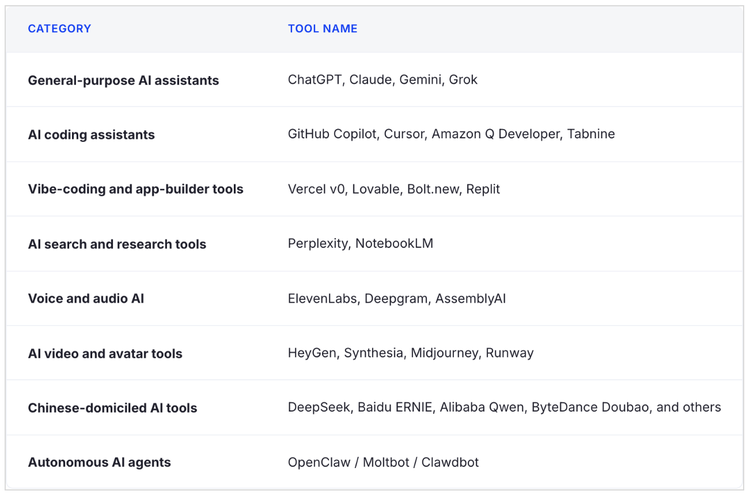
Exposes AI Infrastructure Indicator Lists via the List API, with daily retrieval recommended and weekly list refresh cadence.
 announced · Oct 2026
· source
· release history
- Each indicator's Comment field encodes service attribution, verification date, and association method (Live JSON, Official documentation, BGP/WHOIS, or Community/OSINT) to support per-vendor enforcement policies rather than flat block rules. announced · Oct 2026 · source · release history
- Adds two new curated indicator lists — AI Infrastructure and Chinese AI Infrastructure — containing IP addresses, CIDR ranges, and domains with Risk Scores and Comment fields (provider, verification date, association method) for identifying AI-related network traffic.︀︄︇︀︅︉︀︅︀︀︃︀︀︅︅︀︅︊︀︄︆︀︃︄ announced · Oct 2026 · source · release history
- Covers general-purpose AI assistants, AI coding assistants, vibe-coding tools, AI search tools, voice/audio AI tools, AI video tools, Chinese-domiciled AI tools, and autonomous AI agents across both lists. announced · Oct 2026 · source · release history
docs
- What this endpoint does This endpoint returns only the HTTP headers (no body) for an IP address risk list, providing a lightweight way to check whether the risk list has changed without downloading the full file. seen Oct 2026 · source
- What this endpoint does This endpoint downloads a bulk file of IP addresses from the Recorded Future IP risk list, intended for ingestion into SIEMs, SOARs, firewalls, and other security tools. seen Oct 2026 · source
- What this endpoint does Retrieves supplementary detection rules from a threat prevention profile. Prevention profiles primarily provide block list indicators — most have no associated rules, so an empty response is normal. For the block list (the primary output), use Threat Prevention: Get Profile Indicators . docs update · Oct 2026 · source
- What this endpoint does Retrieves the block list of confirmed-malicious indicators (IPs, domains, hashes, URLs) from a threat prevention profile — the primary output of prevention profiles, intended for firewalls, web proxies, and endpoint tools. docs update · Oct 2026 · source
- What this endpoint does Discovers threat prevention profiles available to your organization. Prevention profiles define block lists of confirmed-malicious indicators for security infrastructure (firewalls, proxies, endpoint tools) — distinct from detection profiles, which focus on SIEM/EDR rules. docs update · Oct 2026 · source
example
-
Before enforcing blocks, baseline 30-90 days of DNS and proxy logs against the full list to discover shadow AI traffic — then segment by service provider in the Comment field and Risk Score to prioritise action.
In the Recorded Future platform, navigate to the AI Infrastructure Indicator List, then run it against your historical DNS and proxy logs.announced · Oct 2026 · source
List Management API documented Provides API endpoints to create, search, retrieve, and modify Recorded Future lists — including adding and removing entities, inspecting entity processing status, and reading free-form text entries.
Also counts toward: REST API
docs 10 total
- Available tags for list entity tagging Tags are applied to entities on company-type lists (Third-Parties Watch List) via the Lists: Replace Entity Tags endpoint. Each tag has a display name (shown in the Recorded Future UI) and an API name (the value to use in API requests). docs update · Oct 2026 · source
- What this endpoint does This operation returns the processing status and entity count for a specific Recorded Future list. Use this endpoint to check whether a list's entities have been fully indexed after adding or removing entities via the Lists: Add Entity or Lists: Remove Entity endpoints. seen Oct 2026 · source
- What this endpoint does Creates a new empty Recorded Future list. Both name and type are required. Valid type values include entity ip domain vulnerability hash company attacker executive source , and text . docs update · Oct 2026 · source
- What this endpoint does This operation removes a single entity from a Recorded Future list. The entity can be specified either by its Recorded Future entity ID (e.g., ip:8.8.8.8 idn:example.com ) or by providing a name and type pair, using the same request body format as the Lists: Add Entity endpoint. docs update · Oct 2026 · source
- What this endpoint does This operation searches for Recorded Future lists matching optional filter criteria, returning metadata for each matching list. docs update · Oct 2026 · source
- What this endpoint does This operation retrieves all entities contained in a specific Recorded Future list, returning each entity's identity and processing status. docs update · Oct 2026 · source
MCP Gateway for AI Agents shipped Exposes 80+ Recorded Future intelligence tools — including threat actor profiles, Risk Scores, ransomware metadata, malware sandbox data, dark web intelligence, and Intelligence Graph traversal — to AI agents via a Model Context Protocol gateway authenticated with OAuth 2.0, with write-back support for updating Watch Lists and authoring Analyst Notes.
Also counts toward: MCP server
release
-
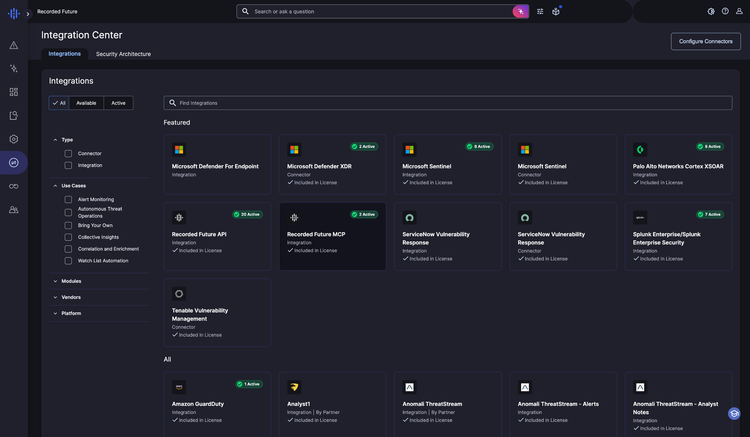
Accessible as a tile in the Integration Center for activation alongside existing integrations; supports both OAuth 2.0 Client ID/Secret (for integration users) and portal user-based authentication (SSO).
 announced · Sep 2026
· source
· release history
- Compatible with Claude, ChatGPT Enterprise, Copilot, Cursor, Gemini CLI, and any other OAuth-capable MCP client — no custom agent required. announced · Sep 2026 · source · release history
- Enables write-back from agents to Recorded Future Platform: agents can update Watch Lists and author Platform Analyst Notes directly, not just read intelligence. announced · Sep 2026 · source · release history
- Adds Recorded Future MCP, a Model Context Protocol gateway exposing 80+ intelligence tools — including threat actor profiles, Risk Scores, ransomware metadata, malware sandbox data, and dark web intelligence — to AI agents via OAuth 2.0 (Client ID/Secret).︀︄︇︀︅︉︀︅︀︀︃︀︀︅︅︀︅︊︀︄︆︀︃︄ announced · Sep 2026 · source · release history
- Supports direct graph traversal of the Intelligence Graph, letting agents find related entities and context in fewer calls to reduce token cost and latency at agentic scale. announced · Sep 2026 · source · release history
docs
- when: "You have a human-readable name and need an RF entity ID. Skip this for IPs, domains, hashes, URLs, emails, ASNs, and other prefix types: build the ID directly (ip:8.8.8.8, idn:example.com) per Entity Types and ID Prefixes." about 4 hours ago about 4 hours ago seen Oct 2026 · source
- What this endpoint does Retrieves lightweight identity metadata (name, type, aliases) for any Recorded Future entity given its internal RF entity ID. Use this to translate an opaque RF ID encountered in another API response back to a human-readable label. seen Oct 2026 · source
- Category Entity Types Cyber Threat & Security AttackVector CyberExploitTargetCategory CyberSecurityCategory CyberThreatActorCategory CyberVulnerability DetectionRule IncidentImpactCategory Malware MalwareCategory MalwareMutex MalwareSignature MitreAttackIdentifier RiskContext RiskRule SnortDetectionRule… seen Oct 2026 · source
-
What this endpoint does This endpoint resolves human-readable entity names to Recorded Future entity IDs using fuzzy name matching. It is the primary way to find entity IDs when you know a name (such as Log4Shell, AsyncRAT, or
8.8.8.8) but need the corresponding RF entity ID required by other API endpoints. seen Oct 2026 · source
example
-
Activate Recorded Future MCP from within the platform so your AI agents gain authenticated access to the full intelligence tool catalog.
In the Recorded Future Platform, go to Integration Center > find the Recorded Future MCP tile > click to activate > configure an integration user with Client ID/Secret (OAuth 2.0) for persistent…announced · Sep 2026 · source
Entity Lookup documented Resolves human-readable names to Recorded Future entity IDs, supporting investigation and enrichment workflows where a structured entity identifier is required.
docs 9 total
- when: "You have a human-readable name and need an RF entity ID. Skip this for IPs, domains, hashes, URLs, emails, ASNs, and other prefix types: build the ID directly (ip:8.8.8.8, idn:example.com) per Entity Types and ID Prefixes." 2 days ago 2 days ago seen Oct 2026 · source
- What this endpoint does This endpoint resolves a domain name to its parent Company entity in the Recorded Future Intelligence Cloud, enabling domain-to-company attribution. docs update · Oct 2026 · source
- What this endpoint does This endpoint searches the Recorded Future Intelligence Cloud for domain entities matching specified criteria. docs update · Oct 2026 · source
-
The
/v2/{entity_type}/fieldsendpoint returns the list of valid field names that can be passed via the fields query parameter on Search and Lookup requests. This controls which data blocks are included in each entity result. docs update · Oct 2026 · source - when: "You have a human-readable name and need an RF entity ID. Skip this for IPs, domains, hashes, URLs, emails, ASNs, and other prefix types: build the ID directly (ip:8.8.8.8, idn:example.com) per Entity Types and ID Prefixes." about 22 hours ago about 22 hours ago seen Oct 2026 · source
- when: "You have a human-readable name and need an RF entity ID. Skip this for IPs, domains, hashes, URLs, emails, ASNs, and other prefix types: build the ID directly (ip:8.8.8.8, idn:example.com) per Entity Types and ID Prefixes." 1 day ago 1 day ago seen Oct 2026 · source
Identity Exposure Monitoring shipped Surfaces compromised employee credentials from active infostealer logs within hours of exfiltration, with VIP monitoring for executive accounts.
release
-
Adds Identity Exposure Monitoring to surface compromised employee credentials from active infostealer logs within hours of exfiltration, with VIP monitoring available for executive accounts.
announced · Sep 2026
· source
· release history
docs
- What this endpoint does Retrieves compromised credential exposures discovered across breach dumps and stealer malware logs for specified domains. seen Oct 2026 · source
- What this endpoint does Enumerates compromised identities associated with one or more domains across all breach data and stealer malware logs in Identity Intelligence. seen Oct 2026 · source
- What this endpoint does Retrieves all stolen credentials exfiltrated from a specific compromised machine, identified by its computer name (e.g., DESKTOP-27EL3CU). docs update · Oct 2026 · source
- What this endpoint does Generates a comprehensive incident report for a single stealer malware infection, showing every credential the malware harvested from the compromised machine. docs update · Oct 2026 · source
- What this endpoint does Retrieves all stolen credentials associated with a specific IP address or IP range belonging to a compromised machine. The IP address is the victim's public IP at the time of malware infection, not the IP of a target service. docs update · Oct 2026 · source
- What this endpoint does Searches for metadata about specific breach datasets and stealer malware log collections indexed in Identity Intelligence. Provide one or more dump names to check whether they are included in the corpus and retrieve details about the underlying data breach or compromise. docs update · Oct 2026 · source
API & Agent Discovery Endpoints shipped Provides machine-readable indexes — including an llms.txt endpoint catalog, an Agent Skills index, raw OpenAPI definitions, and a streamable-HTTP MCP server — so agents and automation pipelines can discover available API paths, read schemas, and execute test requests.
Also counts toward: MCP server, REST API
release
-
Adds
https://docs.recordedfuture.com/mcpas a streamable-HTTP MCP server so clients like Claude Code, Cursor, and VS Code can list and search endpoints, read schemas, and execute test requests against live OpenAPI definitions.︀︄︇︀︅︉︀︅︀︀︃︀︀︅︅︀︅︊︀︄︆︀︃︄ api-docs-c11db66c976a · Oct 2026 · source · release history -
Adds
reference/llms.txtas a complete index of all API endpoints with links to per-endpoint Markdown documentation, following the llms.txt standard. api-docs-c11db66c976a · Oct 2026 · source · release history - Adds an Agent Skills index and API catalog as standard discovery endpoints for agents, with the catalog linking to every raw OpenAPI definition on the site. api-docs-c11db66c976a · Oct 2026 · source · release history
docs
-
1. Download the complete text of
https://docs.recordedfuture.com/reference/llm-instructions.md. This is a YAML routing document: every step in it carries aslug, and the page for a slug ishttps://docs.recordedfuture.com/reference/{slug}.md. seen Oct 2026 · source -
1. Download the complete text of
https://docs.recordedfuture.com/reference/llm-instructions.md. This is a YAML routing document: every step in it carries aslug, and the page for a slug ishttps://docs.recordedfuture.com/reference/{slug}.md. api-docs-c11db66c976a · Oct 2026 · source
example
-
Pull the full endpoint index in llms.txt format for use in an agent or automation pipeline that needs to discover available API paths.
curl https://docs.recordedfuture.com/reference/llms.txtapi-docs-c11db66c976a · Oct 2026 · source
Threat Detection Profile Integration documented Exposes preconfigured threat detection profiles via API, allowing integrations to discover profiles and retrieve associated indicators and detection rules for use in SIEM and EDR tooling.
docs
- What this endpoint does This endpoint searches for detection rules authored by Recorded Future's Insikt Group, returning the full rule source code for YARA, Sigma, and Snort signatures. docs update · Oct 2026 · source
- What this endpoint does Returns all Recorded Future entities (~9,800) that are linked to at least one detection rule in the Insikt Group library. The entity IDs returned here are valid inputs for the filter.entities array in Detection Rules: Search . docs update · Oct 2026 · source
- What this endpoint does Returns the taxonomy of entity type categories (~37 types) that appear across Insikt Group detection rules — including Hash, IpAddress, URL, Malware, MitreAttackIdentifier, CyberVulnerability, and others. docs update · Oct 2026 · source
- What this endpoint does Discovers threat detection profiles available to your organization — the entry point for the detection profile workflow. Detection profiles are preconfigured rule sets that automatically curate indicators and detection rules. docs update · Oct 2026 · source
- What this endpoint does Retrieves detection rules from a specific threat detection profile, filtered by rule format. This is step 2 of the detection workflow: first discover profile UUIDs via Threat Detection: Query Profiles , then pass the profile id here. docs update · Oct 2026 · source
- What this endpoint does Retrieves threat indicators (IPs, domains, file hashes, URLs) from a specific threat detection profile. This is step 2 of the detection workflow: first discover profile UUIDs via Threat Detection: Query Profiles , then pass the profile id here. docs update · Oct 2026 · source
Auto Sigma Rule Generation documented Runs asynchronous jobs that analyze malware samples from the Malware Intelligence platform and automatically generate Sigma detection rules based on observed behavioral patterns, with endpoints to list, retrieve, update, retry, and delete jobs and their generated rules.
docs
- What this endpoint does Retrieves the current status, configuration, and results of a specific Auto Sigma job. Use this to poll for job completion after creating a job via Create Auto Sigma Job — the status field progresses through CREATED, RUNNING, and FINISHED (or FAILED) states. docs update · Oct 2026 · source
- What this endpoint does This operation updates a specific Sigma rule within a completed Auto Sigma job, allowing analysts to classify the rule's detection quality or modify its YAML content. seen Oct 2026 · source
- What this endpoint does Resubmits a failed Auto Sigma job for reprocessing. Use when Get Sigma Job reports status: FAILED . Retrying a FINISHED or RUNNING job returns false with no effect. Obtain job IDs from Create Auto Sigma Job or List Sigma Jobs . After retry, poll Get Sigma Job to monitor progress. docs update · Oct 2026 · source
- What this endpoint does This operation creates an asynchronous Auto Sigma job that analyzes malware samples from Recorded Future's Malware Intelligence platform and automatically generates Sigma detection rules based on the behavioral patterns observed. docs update · Oct 2026 · source
- What this endpoint does This operation permanently deletes an Auto Sigma job and its associated generated Sigma rules from Recorded Future's Malware Intelligence platform. docs update · Oct 2026 · source
- What this endpoint does Lists all Auto Sigma jobs created by the authenticated user. Use this to monitor multiple jobs or locate job IDs for Get Sigma Job Delete Sigma Job , or Retry Sigma Job . Paginate with limit (default 10, max 1000) and offset . Note: the path uses POST with get_jobs naming, not a REST GET. docs update · Oct 2026 · source
Malware Sandbox Intelligence documented suggested Queries Recorded Future's malware sandbox analysis database by indicator lists, natural language, or structured query syntax to find and aggregate artifacts observed across analyzed samples, and retrieves full sandbox analysis reports for specific samples by SHA-256 hash.
Suggested capability: Malware sandbox analysis. This is our guess, not confirmed.
Also counts toward: Natural-language query
docs
- What this endpoint does Retrieves enrichment data for a specific malware family or tool (e.g., AsyncRAT, Cobalt Strike, Emotet) by its Recorded Future entity ID. Malware IDs are opaque alphanumeric strings — obtain them via Malware: Search using a freetext query. seen Oct 2026 · source
- What this endpoint does Searches for malware family and tool entities in the Recorded Future knowledge base. Malware entities represent tracked families and tools — not individual file samples. Use freetext for name-based search. seen Oct 2026 · source
- What this endpoint does Searches Recorded Future's malware sandbox analysis database using plain English instead of structured query syntax. The API translates your natural language description into a query expression and executes it, returning the same paginated artifact list as Malware Intelligence: Query . docs update · Oct 2026 · source
- What this endpoint does Queries Recorded Future's malware sandbox analysis database to find and aggregate artifacts observed across analyzed samples. docs update · Oct 2026 · source
- What this endpoint does Searches Recorded Future's malware sandbox analysis database using lists of known indicators of compromise. docs update · Oct 2026 · source
- What this endpoint does Retrieves full sandbox analysis reports for a specific malware sample identified by its SHA-256 hash. Both the sha256 parameter (identifying the sample) and a query parameter (using the Malware Intelligence query language to filter which analysis runs to include) are required. docs update · Oct 2026 · source
Autonomous Threat Operations Sources documented Manages custom intelligence sources — organizational containers used to group and publish related threat intelligence reports through the Autonomous Threat Operations API — with endpoints to create, retrieve, and list sources.
docs
- What this endpoint does Publishes one or more threat intelligence reports to a specific custom source for asynchronous processing and enrichment by Recorded Future. docs update · Oct 2026 · source
- What this endpoint does Updates metadata for an existing custom intelligence source. The id path parameter is the source UUID from Custom Sources: Create or Custom Sources: List . docs update · Oct 2026 · source
- What this endpoint does Retrieves the metadata for a specific custom intelligence source by its unique identifier. This is useful for verifying that a source exists before publishing reports to it, confirming source details after creation, or looking up a source's name and description. seen Oct 2026 · source
- What this endpoint does Retrieves all custom intelligence sources available in your account. Sources are organizational containers used to group related threat intelligence reports published through the Autonomous Threat Operations API. seen Oct 2026 · source
- What this endpoint does Creates a new custom intelligence source, which serves as an organizational container for publishing related threat intelligence reports through the Autonomous Threat Operations API. seen Oct 2026 · source
Vulnerability Risk List documented Provides a bulk-downloadable list of CVEs filtered by risk rule and minimum risk score, with HEAD-based polling to detect changes before fetching the full file.
Also counts toward: REST API
docs
- What this endpoint does Retrieves detailed intelligence for a specific vulnerability identified by its CVE ID (e.g., CVE-2021-44228). It is the core vulnerability enrichment endpoint — use it when you have a CVE and need to understand its severity, exploitation status, and threat context. seen Oct 2026 · source
- What this endpoint does Returns the complete set of risk rules used to calculate risk scores for vulnerability entities. It is a reference endpoint with no parameters — call it once to discover all available rule names. docs update · Oct 2026 · source
- What this endpoint does This endpoint searches for vulnerabilities matching specified filter criteria, returning paginated results with optional enrichment fields. docs update · Oct 2026 · source
- What this endpoint does This endpoint downloads a bulk file of CVEs from the Recorded Future vulnerability risk list, filtered by risk rule and including only vulnerabilities with a risk score of 25 or above. seen Oct 2026 · source
- What this endpoint does Performs a HEAD request on the vulnerability risk list to retrieve the ETag and metadata without downloading the full file. Use in polling workflows to check if the list has changed before fetching with Vulnerability: Download Risk List . seen Oct 2026 · source
Threat Hunting Profile Integration documented Exposes threat hunting profiles via an async job workflow, allowing integrations to poll for pending jobs, retrieve point-in-time hunting rule snapshots, and update job execution status.
Also counts toward: Scheduled jobs
docs
- What this endpoint does Retrieves threat hunt jobs awaiting execution — the entry point for the integration-driven hunting workflow. Hunting profiles generate jobs automatically on schedule; poll this endpoint to discover new work. seen Oct 2026 · source
- What this endpoint does Retrieves threat indicators (IPs, domains, hashes, URLs) from a specific threat hunt job — a point-in-time snapshot captured when the job was generated. seen Oct 2026 · source
- What this endpoint does Discovers threat hunting profiles available to your organization. Unlike detection and prevention profiles (which expose indicators/rules directly), hunting profiles operate through an async job workflow: they generate jobs on a schedule, and integrations poll Threat Hunting: Get Pending Jobs… docs update · Oct 2026 · source
- What this endpoint does Retrieves detection rules from a specific threat hunt job — a point-in-time snapshot, not the profile's current live rule set. docs update · Oct 2026 · source
- What this endpoint does Updates the execution status of a threat hunt job as part of the integration-driven hunting workflow. Obtain job IDs from Threat Hunting: Get Pending Jobs . docs update · Oct 2026 · source
Fusion File System documented Provides a managed file system for storing, listing, downloading, uploading, and deleting Fusion flow outputs such as custom risk lists and enriched feeds, with HEAD-based polling to detect file changes.
Also counts toward: REST API
docs
-
What this endpoint does Uploads a file to the Fusion file system using a raw binary request body ( application/octet-stream — not multipart/form-data). The destination path is specified in the URL. User-uploaded files are typically stored in your organization's
/home/{org}/ directory. seen Oct 2026 · source -
What this endpoint does Deletes a file from the Fusion file system by path. This applies to files in your organization's directories — public Recorded Future-managed files under
/public/ are not deletable. seen Oct 2026 · source - What this endpoint does Lists the contents of a directory in the Fusion file system, returning metadata for all files and subdirectories at that path. Use this to discover available files before downloading with Fusion Files: Get . seen Oct 2026 · source
-
What this endpoint does Downloads a file from the Fusion file system by path. Fusion files are outputs produced by Fusion flows — typically custom risk lists, enriched feeds, and flow-generated data stored in
/home/{org}/ directories. seen Oct 2026 · source - What this endpoint does Performs a HEAD request on a Fusion file to retrieve metadata (ETag, Last-Modified, filename) without downloading the file content. Use this in polling workflows to check if a file has changed before downloading with Fusion Files: Get . seen Oct 2026 · source
Third-Party Intelligence Card Extensions documented Retrieves enrichment data for indicators and malware from pre-configured third-party intelligence providers integrated into the Recorded Future platform.
docs
- What this endpoint does This endpoint retrieves enrichment data for a specific URL from a third-party Intelligence Card extension integrated into the Recorded Future platform. Available extensions for URL entities include VirusTotal, Kaspersky, Mandiant, InQuest, and others, with 12 extensions total. docs update · Oct 2026 · source
- What this endpoint does This endpoint retrieves enrichment data for a specific vulnerability (identified by CVE ID) from a third-party Intelligence Card extension integrated into the Recorded Future platform. seen Oct 2026 · source
- What this endpoint does Retrieves malware enrichment data from a specific third-party intelligence provider integrated into the Recorded Future platform. Requires pre-configured provider credentials — unconfigured providers return 401. seen Oct 2026 · source
- What this endpoint does This endpoint retrieves enrichment data for a specific IP address from a third-party Intelligence Card extension integrated into the Recorded Future platform. seen Oct 2026 · source
Collective Insights API shipped A bidirectional pipeline that ingests IoC detections from internal cyber tooling into Recorded Future and returns enriched intelligence, programmatically managed via API.
Also counts toward: REST API
release
-
Adds
offsetparameter to the/searchendpoint to improve pagination support Playbook Alerts API v1.2.0 · Dec 2025 · source · release history
docs
- What this endpoint does This endpoint queries your organization's enriched detection history across all Collective Insights sources: events submitted via the Collective Insights: Submit Detections endpoint, Recorded Future integrations and connectors (including Autonomous Threat Operations results), and Enterprise… seen Oct 2026 · source
- Collective Insights API Overview The Collective Insights API is a bidirectional intelligence pipeline designed to bridge the gap between internal security events and external threat intelligence. It transforms siloed detections into a unified, enriched intelligence stream that can be programmatically managed. docs update · Oct 2026 · source
- What this endpoint does This endpoint ingests indicator of compromise (IoC) detections from your security tools into Collective Insights. docs update · Oct 2026 · source
Company Intelligence documented Looks up and enriches Company entities in the Recorded Future Intelligence Cloud by name, domain, or Recorded Future ID, and provides a reference catalog of all risk rules evaluated for companies.
docs
- What this endpoint does Returns the complete catalog of risk rules that Recorded Future evaluates for Company entities, serving as a reference for understanding and filtering company risk assessments. docs update · Oct 2026 · source
-
What this endpoint does Retrieves enrichment data for a specific Company entity by its Recorded Future ID. Company IDs are opaque alphanumeric strings (e.g.,
B_HE4for Google) — obtain them using Company: Search for name-based lookup or Company: Lookup by Domain if you have a domain. docs update · Oct 2026 · source - What this endpoint does Searches the Recorded Future Intelligence Cloud for Company entities. Use freetext for name-based search. docs update · Oct 2026 · source
Impersonation Monitoring shipped Detects fake executive profiles and company impersonation accounts across social and professional networking platforms.
release
-
Adds Impersonation Monitoring to detect fake executive profiles and company impersonation accounts across social and professional networking platforms.
announced · Sep 2026
· source
· release history
docs
- What this endpoint does Retrieves the full detail of a single Social Media Impersonation Playbook Alert. These alerts fire when Recorded Future detects a profile impersonating your company or executives on a social media platform. What you get back Data is grouped into UI-ready panels. docs update · Oct 2026 · source
-
What this endpoint does Looks up detailed panel data for up to 250 Social Media Impersonation Playbook Alerts in a single request. Use
/playbook-alert/search to find alert IDs, then hydrate them here instead of calling the detail endpoint once per alert. docs update · Oct 2026 · source
SIEM Integration Testing documented Generates simulated firewall syslog events containing IP addresses drawn from Recorded Future risk lists for testing and demonstrating SIEM or firewall log integrations without live network data.
docs
- What this endpoint does Generates simulated Squid proxy log entries containing URLs from the Recorded Future URL risk list — useful for testing SIEM or proxy log integrations without live network data. Refreshed every four hours. docs update · Oct 2026 · source
- What this endpoint does Generates simulated vulnerability scan findings for integration testing — CVEs from the RF vulnerability risk list paired with realistic but synthetic host metadata. Refreshed every four hours. seen Oct 2026 · source
- What this endpoint does This endpoint generates simulated Juniper NetScreen firewall syslog events containing destination IP addresses drawn from the Recorded Future IP risk list, designed for testing and demonstrating SIEM or firewall log integrations without requiring live network data. seen Oct 2026 · source
Digital Risk Protection shipped Offers a unified workspace covering five external threat surfaces: Malicious Site Monitoring, Impersonation Monitoring, Code Repository Monitoring, Dark Web Brand Monitoring, and Identity Exposure Monitoring.
release
-
Adds Digital Risk Protection, a unified workspace covering five external threat surfaces: Malicious Site Monitoring, Impersonation Monitoring, Code Repository Monitoring, Dark Web Brand Monitoring, and Identity Exposure Monitoring.︀︄︇︀︅︉︀︅︀︀︃︀︀︅︅︀︅︊︀︄︆︀︃︄
announced · Sep 2026
· source
· release history
- Adds Digital Risk Protection, a unified workspace covering five external threat surfaces: Malicious Site Monitoring, Impersonation Monitoring, Code Repository Monitoring, Dark Web Brand Monitoring, and Identity Exposure Monitoring.︀︄︇︀︅︉︀︅︀︀︃︀︀︅︅︀︅︊︀︄︆︀︃︄︀︄︇︀︅︉︀︅︀︀︃︀︀︅︅︀︅︊︀︄︆︀︃︄ announced · Sep 2026 · source · release history
AI Triage for Threat Monitoring shipped Automatically evaluates high-interest detections in Malicious Site and Dark Web Brand Monitoring to deliver explicit verdicts with reasoning, surfacing only critical alerts.
Also counts toward: Built-in AI assistant
release
-
Introduces an AI Triage Agent for Malicious Site Monitoring and Dark Web Brand Monitoring that automatically evaluates high-interest detections and delivers an explicit verdict with reasoning, surfacing only critical, high-priority Alerts.
announced · Sep 2026
· source
· release history
Code Repository Monitoring shipped Continuously scans public repositories for exposed credentials, PII, and source code.
release
-
Adds Code Repository Monitoring to continuously scan public repositories for exposed credentials, PII, and source code.
announced · Sep 2026
· source
· release history
Customer Credential Monitoring shipped Extends credential exposure visibility to an organization's customer base as a paid add-on.
release
-
Adds Customer Credential Monitoring as a paid add-on that extends credential exposure visibility to an organization's customer base.
announced · Sep 2026
· source
· release history
Dark Web Brand Monitoring shipped Surfaces brand mentions, planned attacks, and compromised data across underground forums, marketplaces, and ransomware extortion sites.
release
-
Adds Dark Web Brand Monitoring to surface brand mentions, planned attacks, and compromised data across underground forums, marketplaces, and ransomware extortion sites.
announced · Sep 2026
· source
· release history
Takedown Coordination shipped suggested Provides one-click takedown coordination across all supported use cases.
Suggested capability: Response playbook automation. This is our guess, not confirmed.
release
-
Includes one-click takedown coordination available across all five use cases from day one.
announced · Sep 2026
· source
· release history
AI Alert Summary shipped Adds an AI-generated title and summary at the top of every alert describing what references came through and whether anything requires immediate attention.
release
-
Adds an AI-generated title and summary at the top of every Alert, covering what came through and surfacing whether anything demands immediate attention.
announced · Aug 2026
· source
· release history
Lines in monospace are the tool's own words: help text
parsed from its source, or an endpoint from its API document. Under
release, a line is our summary of a dated release. Under
docs, it is quoted from the tool's own documentation or
website. Each links back to the source it came from.
Command line
13 commands for Recorded Future, each with where it came from. This tool has no source analysis yet, so there is no option reference and no captured run beside them.
No command matches.
Screenshots
From the release notes, newest first. Click one to see it full size.Score card
-
Shipping velocity releases a month, last 12 months
-
Documentation quality release-notes rubric, 0–100
-
Breaking-change discipline how rarely a release breaks users, and notice given
-
Maintenance risk quiet time against its own cadence, maintainers
-
Innovation & surface new capabilities, API and MCP surface
Five scores for Recorded Future, each built from the releases, notes and API history this site tracks — and, on Researcher and Business, where it stands among every measured tool in its category and how that has moved.
Score cards are part of every paid plan.
See plans → Already subscribed? Sign in →Trajectory
Blank means never measured; nothing here is a filled-in zero.
Peer standings are included with Researcher and Business. See how this tool ranks against its competitors, using data we don't publish anywhere else.
See plans →Each score is 0–100 on a published rubric, derived from data this site already shows. A dimension we cannot measure says so — it is never scored 0 and never enters a rank.
How this is scored
- Shipping velocity — releases a month over the last 12 months, on a log scale where 16 a month scores 100. Needs 3 releases in the window.
- Documentation quality — the release-notes rubric published on the analytics page, unchanged.
- Breaking-change discipline — the share of releases carrying a breaking change (none scores 100, half or more scores 0). Only projects that label breaking changes are measured: a clean record cannot be told from an unlabelled one.
- Maintenance risk — quiet time measured against the tool's own release cadence (quiet longer than 90 days and three typical gaps scores 0), plus the number of active maintainers and whether contributors are growing, where known. Higher is lower risk.
- Innovation & surface — new capabilities in the feature ledger this year, API and MCP operations added, and the share of commits that are features: the mean of whichever we hold.
- Community health (open-source tools only) — each is a direction, not a size: contributors this year against last, the bus factor now against a year ago, and issues closed per issue opened, where steady scores 50, doubled 100 and halved 0; plus the median time to a maintainer's first reply (an hour scores about 100, a month or more 0). A commercial card has no repository and carries none of the four.
- Documented delivery (commercial tools) — when a vendor's documented new capabilities have slowed against its own baseline, that counts against the overall standing as heavily as two low dimensions. Steady delivery, or too little history to judge, leaves the standing alone; it is never a sixth score.
- Open-source tools are scored on repository signals; commercial tools on their published changelog. Ranks compare tools within one category and one profile and need at least five measured peers; the overall standing needs three ranked dimensions. Best-in-breed or consolidator is a shape, not a quality, and is never scored.
Release-note detail over time
See how much detail Recorded Future puts in its release notes, quarter by quarter, and compare it with tracked tools in the same category. This history uses up to ten retained, reviewed notes per tool; sparse or blank older quarters may reflect that limit.
Checking release-note history…
Website history
recordedfuture.com, every changeRecorded Future's home page and 10 more pages as they looked each month from August 2021 to October 2026: 21 renders, 5 changes of tagline or palette. Step through them, play them, or put any two months side by side.
Website history is included with Researcher and Business.
See plans → Already subscribed? Sign in →← → or h l a month · Shift a year · [ ] previous / next change · Space play · 1 2 3 page · T whole page · C compare · F full size
← → or h l the right month · Shift the left · S swap · W wipe · T whole page · Esc back
Rebranding timeline
Dates bound when a change appeared between captures. Possible rebrands are AI suggestions; a redesign alone does not establish a rebrand.
Coverage
Missing something? Tell us
What Recorded Future connects to, runs on and detects, read from its release notes and docs. So far: 10 new detections, 2 new integrations.
12 changes, tracked since Oct 5, 2026.
-
Oct 92026
new Detection Rules: Associated Entity Types endpoint
With Hash, IpAddress, URL, Malware, MitreAttackIdentifier, CyberVulnerability
Returns the taxonomy of entity type categories (~37 types) that appear across Insikt Group detection rules — including Hash, IpAddress, URL, Malware, MitreAttackIdentifier, CyberVulnerability, and others.
-
Oct 92026
new Detection Rules: Associated Entities endpoint — entity catalog linked to Insikt Group detection rules
With YARA, Sigma, Snort, MITRE ATT&CK
Returns all Recorded Future entities (~9,800) that are linked to at least one detection rule in the Insikt Group library. The entity IDs returned here are valid inputs for the filter.entities array in Detection Rules: Search. Typical workflow: call this endpoint to find entity IDs matching a threat of interest (e.g., a specific malware family or MITRE ATT&CK technique), then pass those IDs to search for relevant YARA/Sigma/Snort rules.
-
Oct 82026
new Social Media Impersonation Playbook Alert API
Retrieves the full detail of a single Social Media Impersonation Playbook Alert. These alerts fire when Recorded Future detects a profile impersonating your company or executives on a social media platform.
-
Oct 82026
new Dark Web Brand Playbook Alert API endpoint
With markets, Telegram channels, ransomware sites
These alerts fire when your organization's brand, assets, or watched entities surface on dark web sources such as forums, markets, Telegram channels, and ransomware sites.
-
Oct 62026
new Auto Sigma rule generation job results endpoint
With Sigma detection rules, malware sandbox executions, behavioral patterns
Once finished, the response includes generated Sigma detection rules and identified behavioral patterns.
-
Oct 62026
new Auto Sigma rule generation from malware behavioral analysis
With Sigma detection rules, Malware Intelligence, family:redline
This operation creates an asynchronous Auto Sigma job that analyzes malware samples from Recorded Future's Malware Intelligence platform and automatically generates Sigma detection rules based on the behavioral patterns observed.
-
Oct 62026
new Auto YARA job result retrieval endpoint
Retrieves the full result of a specific Auto YARA job, including the generated YARA rule text and pattern analysis.
-
Oct 62026
new Auto YARA Job creation endpoint
This operation creates an asynchronous Auto YARA job that analyzes a set of malware samples (identified by SHA-256 hashes) to discover common hexadecimal byte patterns and generate YARA detection rules.
-
Oct 62026
new Dark Web Brand Playbook Alert API endpoint
With Telegram channels, ransomware sites
Retrieves the full intelligence picture for a single Dark Web Brand Playbook Alert. These alerts fire when your organization's brand, assets, or watched entities surface on dark web sources such as forums, markets, Telegram channels, and ransomware sites.
-
Oct 52026
new Collective Insights Submit Detections API endpoint
With IP addresses, domains, file hashes, vulnerabilities (CVEs), URLs
This endpoint ingests indicator of compromise (IoC) detections from your security tools into Collective Insights. You can submit detections for five IoC types—IP addresses, domains, file hashes, vulnerabilities (CVEs), and URLs—each paired with the detection context that triggered the finding, such as a detection rule, correlation, playbook, or sandbox analysis.
-
Oct 52026
new Threat Detection: Get Profile Rules — multi-format detection rule delivery
Covers 7: sigma, snort, yara, yaral, kql, fql and 1 more
At least one rule type must be specified in filter.types — supported values: sigma snort yara yaral kql fql s1ql
-
Oct 52026
new Threat Detection Profiles Query endpoint
With SIEM, EDR
Detection profiles are preconfigured rule sets that automatically curate indicators and detection rules. After finding profile UUIDs here, fetch indicators via Threat Detection: Get Profile Indicators or rules via Threat Detection: Get Profile Rules.
Vulnerability & code scanning 1
Chat & collaboration 1
Other 5
Nothing first seen in this window. That doesn't mean Recorded Future shipped nothing, only that we found no record of it.
How we count
Read from 44 of 82 release notes and docs updates we hold for Recorded Future. "First seen" is the earliest note that names something; "last" is the latest. Our history may start partway through Recorded Future's life, so an old integration can show a recent first-seen date.
Each change counts once: "added 40 checks" is one line, so the numbers measure how often coverage moves, not how big the catalogue is or how well it detects.
Releases
82 entries
No entries match these filters.
- October 202668
- September 202610
- August 20261
- March 20261
- February 20261
- December 20251
Add the badge to your README
Maintain this project? The badge links readers straight to this page, so they can follow every release here.
 Choose a badge style and copy the code →