JFrog
Shadow AI Detection Now Extends to Developer Workstations (2026-10-21) commercialThe section your link pointed to isn't on JFrog's page any more, so we've brought you to the top.
JFrog is a DevOps platform providing software supply chainsoftware supply chainThe dependencies, tools and processes used to build and deliver software. Compromising one part can affect the products or organizations that rely on it. solutions including artifact management, CI/CD integration, and security scanning.
jf setup
jf setup
Summary
JFrog is a commercial platform for managing and securing software artifacts across the build and release pipeline, built around the Artifactory repository and the Xray scanning engine, and it is available as both self-hosted and JFrog Cloud SaaSSaaSSoftware delivered over the internet and run on the provider's infrastructure, so the buyer pays a subscription instead of installing or operating anything locally., including airgapped deployments. It is aimed at DevOps and DevSecOps teams who need to control what packages enter their software supply chain, from platform engineers running repositories to security and compliance staff enforcing curation policy, and increasingly at teams governing AI coding agents, since it can route agent-driven dependency downloads from tools like Claude Code and Cursor through Artifactory and block unapproved packages before they land. Its documentation describes a federated, peer-to-peer mesh for syncing projects, policies, and repositories across distributed sites, positioning it against older hub-and-spoke replication approaches.
JFrog is a DevOps platform providing software supply chain solutions including artifact management, CI/CD integration, and security scanning.
How JFrog helps
Which AI coding agent dependency downloads bypassed our governed repository?
routes npm, PyPI, Maven, Go, Docker Hub, Helm, and NuGet installs — including indirect and transitive ones like postinstall scripts and bulk-pull commands — through the repository from the first agent session, and logs every download, block, and policy decision in an audit trail alongside human-driven build logs
Which packages are blocked from entering our software supply chain right now, and are all our sites enforcing the same rule?
propagates blocking rules, waivers, and approvals set on any peer site to every regional pipeline within seconds, so a rule set once shows the same verdict everywhere in the mesh
Did an AI agent reach Artifactory using its own identity or a shared service account?
exchanges the inbound user's token for a short-lived, per-user JFrog token via On-Behalf-Of exchange, so requests are attributable to the originating user rather than a pooled credential
Can we prove which commits, PRs, approvals, and Jira transitions led to this release, and did anyone approve their own change?
collects and signs commit, PR, Jira transition, and approver records before promotion and cross-checks each PR's merger and approver against the committer to flag self-approval
Are our repositories and access policies actually in sync across regions after onboarding a new site?
shows the peer mesh's synchronized entities and policies in a federated topology view, and auto-creates repositories on new sites from a Stage-to-Site mapping instead of manual per-site setup
What did an AI agent's session actually do before it touched our artifacts?
captures the prompts, generated code, and a session bill of materials — including which MCPs and skills were invoked — as signed evidence stored in Artifactory
Languages
Features
Built from JFrog's releases, docs, README and our own runs. “Seen” marks the month we first spotted a release the vendor didn't date. Group names and tags are our labels.
What JFrog offers you
- CI/CD pipeline integration3
- Role-based access control3
- Ticketing integration3
- Administrative audit log2
- Multi-tenant management2
- Plugin system2
- Built-in AI assistant1
- JSON data export1
- ML-based detection1
- Natural-language query1
No capabilities match.
All capabilities 41 capabilities
Shadow AI Detection shipped Automatically detects and categorizes every AI asset across an environment as managed, unmanaged, partially managed, or malicious.
Also counts toward: ML-based detection
release
-
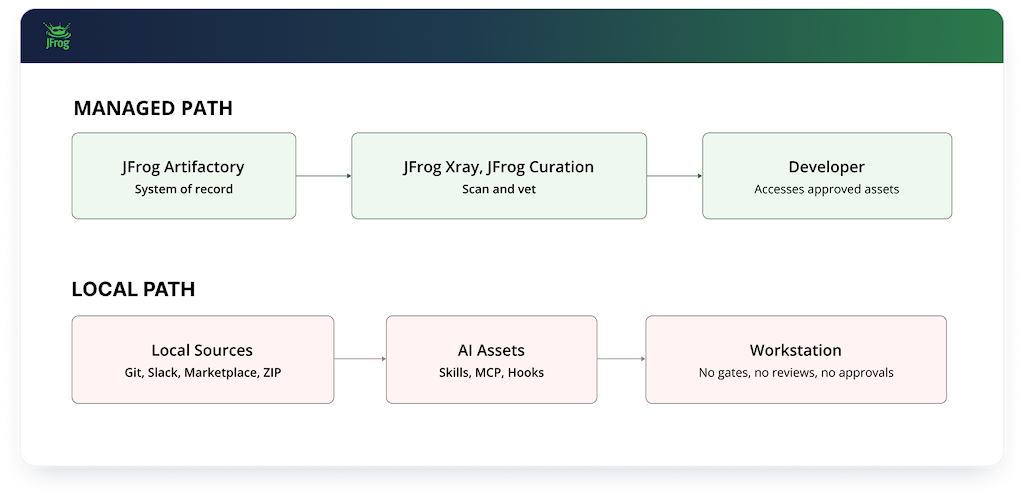
Adds a unified AI asset inventory in JFrog AI Security showing each asset's name, type, reporting harness (Claude Code, Cursor, etc.), workstation count, local risk analysis, JFrog origin, and detection timestamp.
 Shadow AI Detection Now Extends to Developer Workstations (2026-10-21) · Oct 2026
· source
· release history
- Adds the JFrog Agent Plugin installable on developer workstations to discover and locally scan AI assets — skills, MCP servers, plugins, hooks, commands, and monitors — that bypass central repository controls.︀︄︇︀︅︉︀︅︀︀︃︀︀︅︅︀︅︊︀︄︆︀︃︄ Shadow AI Detection Now Extends to Developer Workstations (2026-10-21) · Oct 2026 · source · release history
- Adds risk assessment classifications for detected assets: Shell Access + WebFetch (high exfiltration risk), Unscoped Write/Edit (writes outside designated directories), and BypassPermissions Mode (executes without required approval). Shadow AI Detection Now Extends to Developer Workstations (2026-10-21) · Oct 2026 · source · release history
- Introduces a three-step local detection pipeline: Discover (enumerate AI assets on the workstation), Scan Locally (deterministic rules-based scan), and Report (sends metadata, findings, and risk analysis to the JFrog Platform). Shadow AI Detection Now Extends to Developer Workstations (2026-10-21) · Oct 2026 · source · release history
- Adds an Origin field per asset indicating whether it matches an artifact already managed in JFrog Artifactory or JFrog Catalog, or has No Match against the JFrog Platform. Shadow AI Detection Now Extends to Developer Workstations (2026-10-21) · Oct 2026 · source · release history
-
Adds Shadow AI Detection to automatically detect and categorize every AI asset across an environment as managed, unmanaged, partially managed, or malicious.
 The Evolution of JFrog AI Catalog: Your AI Control Plane for Agentic Development (2026-09-02) · Sep 2026
· source
· release history
docs
example
-
Roll out Shadow AI detection to a developer workstation by installing the JFrog Agent Plugin so local AI assets are automatically discovered, scanned, and reported to the JFrog Platform.
Steps: 1. Obtain the JFrog Agent Plugin package from your JFrog Platform administrator. 2. Install the plugin on the target developer workstation. 3.announced · Oct 2026 · source
Projects Migration Wizard documented Guides users through migrating from legacy global permissions to the Projects model using a step-by-step wizard.
docs 8 total
- Migrate to Projects Use the Projects Migration wizard to migrate from legacy global permissions to the Projects model. 5 days ago seen Oct 2026 · source
- Migrate to Projects Use the Projects Migration wizard to migrate from legacy global permissions to the Projects model. 4 days ago seen Oct 2026 · source
- Migrate to Projects Use the Projects Migration wizard to migrate from legacy global permissions to the Projects model. 3 days ago seen Oct 2026 · source
- Migrate to Projects Use the Projects Migration wizard to migrate from legacy global permissions to the Projects model. 2 days ago seen Oct 2026 · source
- Migrate to Projects Use the Projects Migration wizard to migrate from legacy global permissions to the Projects model. 1 day ago seen Oct 2026 · source
- Migrate to Projects Use the Projects Migration wizard to migrate from legacy global permissions to the Projects model. about 1 hour ago seen Oct 2026 · source
SDLC Traceability shipped Extends SDLC traceability to capture AI agent intent sessions alongside Git commits, pull requests, and Jira tickets.
Also counts toward: CI/CD pipeline integration, Ticketing integration
release 7 total
-
Publishes an open Agentic Process Evidence specification on GitHub (
https://github.com/jfrog/agentic-process-evidence) for integration by agent frameworks (Cursor, OpenCode, Claude Code, or custom AI workers), regulatory bodies, and SDLC platform providers.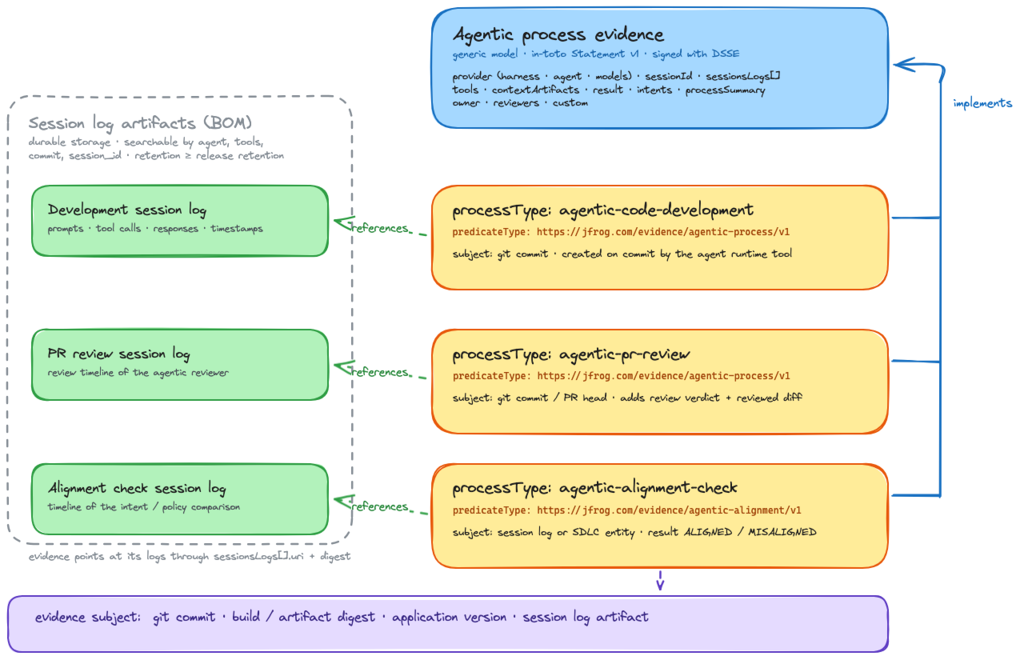 Governing the Agentic SDLC Through Continuous Policy Enforcement (2026-10-12) · Oct 2026
· source
· release history
- Introduces the Agentic Process Evidence Protocol, a four-step framework that captures agent session telemetry (user prompts, thinking tokens, file edits, tool calls), cryptographically signs and attaches evidence to SDLC entities, evaluates evidence at policy gates before promotion, and persists session logs for… Governing the Agentic SDLC Through Continuous Policy Enforcement (2026-10-12) · Oct 2026 · source · release history
- Adds Prompt to Release Traceability in JFrog AppTrust, connecting AI agent session logs to signed SLSA-compatible provenance attestations and binding them to git commits, artifacts, and released versions.︀︄︇︀︅︉︀︅︀︀︃︀︀︅︅︀︅︊︀︄︆︀︃︄ Governing the Agentic SDLC Through Continuous Policy Enforcement (2026-10-12) · Oct 2026 · source · release history
- Supports post-release auditing by binding session logs to git commits and software releases, enabling retroactive searches — for example, identifying all releases produced using a later-identified malicious MCP tool. Governing the Agentic SDLC Through Continuous Policy Enforcement (2026-10-12) · Oct 2026 · source · release history
-
Adds full SDLC traceability capturing agent intent sessions, Git commits, pull requests, and Jira tickets, all connected to shipped artifacts, giving Policy-as-Code rules live data to check against.
 Every New Compliance Framework Restarts the Same Fire Drill. It Doesn’t Have To. (2026-09-02) · Sep 2026
· source
· release history
-
Launches Prompt to Release Traceability inside JFrog AppTrust, automatically collecting commits, PRs, Jira ticket transitions, and approver records, signing them, and attaching them to the application version before any promotion gate runs.
 Every Release Needs a Chain of Custody. AI Agents Just Made That Harder. (2026-09-02) · Sep 2026
· source
· release history
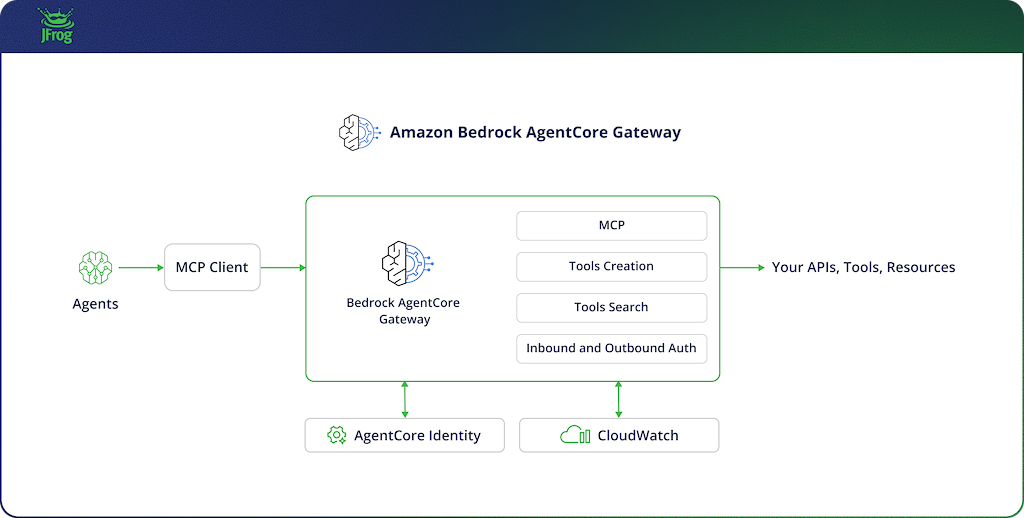
AI agent identity propagation via On-Behalf-Of token exchange shipped Enables AI agent requests routed through AgentCore Gateway to reach JFrog Artifactory authenticated as the originating user by exchanging inbound user JWTs for short-lived, per-user JFrog tokens using RFC 8693 On-Behalf-Of exchange, preserving audit fidelity and least privilege.
release
-
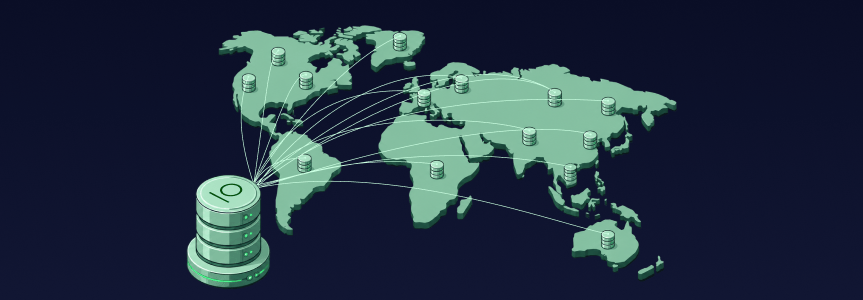
Adds Curation Federation, which propagates open-source blocking rules, waivers, and approvals from any peer site to every regional pipeline worldwide within seconds of being set.
 Introducing JFrog Platform Federation: One Control Plane for Synchronizing Every Site in Your Software Supply Chain (2026-08-24) · Aug 2026
· source
· release history
-
Requires JFrog EnterpriseX or higher for OIDC token exchange support on the Artifactory Access service.
 Propagating User Identity From AI Agents to Your Tools: Amazon Bedrock AgentCore Gateway and JFrog Artifactory (2026-08-21) · Aug 2026
· source
· release history
-
Enables AgentCore Gateway to use JFrog Artifactory's MCP server as a registered target, with
onBehalfOfTokenExchangeConfigconfigured on the gateway target so each inbound user JWT is exchanged for a short-lived, per-user JFrog token. Propagating User Identity From AI Agents to Your Tools: Amazon Bedrock AgentCore Gateway and JFrog Artifactory (2026-08-21) · Aug 2026 · source · release history - Supports On-Behalf-Of (OBO) token exchange (RFC 8693) between Amazon Bedrock AgentCore Gateway and JFrog Artifactory Access, so AI agent requests reach Artifactory authenticated as the originating user rather than a shared service account — preserving audit fidelity, least privilege, and containment. Propagating User Identity From AI Agents to Your Tools: Amazon Bedrock AgentCore Gateway and JFrog Artifactory (2026-08-21) · Aug 2026 · source · release history
-
Compares three identity-propagation options across the gateway-to-Artifactory hop: header whitelisting (forwards X-Authenticated-User
-styleheaders), three-legged OAuth (authorization-code grant with per-user token vault in AgentCore Identity), and On-Behalf-Of exchange — with OBO being the only option that delivers… Propagating User Identity From AI Agents to Your Tools: Amazon Bedrock AgentCore Gateway and JFrog Artifactory (2026-08-21) · Aug 2026 · source · release history
example
-
When a new zero-day drops, set a curation blocking rule once on any peer site and have it enforced across every regional pipeline within seconds — no per-site rollout scripts needed.
In the JFrog Platform UI, go to Curation > Policies, create or update a blocking rule or waiver on any peer site, and Platform Federation propagates it to every connected site in the mesh…Introducing JFrog Platform Federation: One Control Plane for Synchronizing Every Site in Your Software Supply Chain (2026-08-24) · Aug 2026 · source -
When your security team publishes a zero-day blocking rule and needs it enforced globally within seconds rather than rolling it out region by region.
In the JFrog Platform, go to Curation > Policies, create or update a blocking rule or waiver on any peer site, and Platform Federation propagates it to every connected regional pipeline automatically.announced · Aug 2026 · source
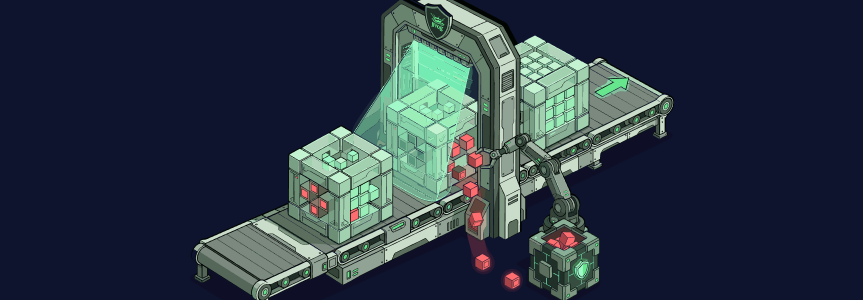
Skills Scanning shipped Uses semantic security scanning to detect malicious behavior in skill files and block them before they reach a developer's machine.
release
-
Supports enforcement by severity threshold (e.g. block any skill with a Critical-severity finding) and time-bound waivers with fixed expiration dates.
 Scanning AI Assets: Catching What SCA and SAST Might Miss (2026-10-21) · Oct 2026
· source
· release history
-
Adds JFrog AI Security scanner that performs semantic (intent-based) analysis of agent skill files (e.g.︀︄︇︀︅︉︀︅︀︀︃︀︀︅︅︀︅︊︀︄︆︀︃︄
SKILL.md), agent plugins, and APM manifest packages to detect prompt injection, hidden instructions, obfuscated payloads, and credential-exfiltration instructions that SCA and SAST… Scanning AI Assets: Catching What SCA and SAST Might Miss (2026-10-21) · Oct 2026 · source · release history - Supports per-version allow-lists so approving one version of a skill does not automatically approve subsequent versions. Scanning AI Assets: Catching What SCA and SAST Might Miss (2026-10-21) · Oct 2026 · source · release history
- Returns one of three scan classifications — Not Malicious, Suspicious, or Malicious — for each AI asset, with policy controls that route outcomes to block, review queue, or allow. Scanning AI Assets: Catching What SCA and SAST Might Miss (2026-10-21) · Oct 2026 · source · release history
-
New Skills Scanning uses semantic security scanning to detect malicious behavior in skill files and block them before they reach a developer's machine.
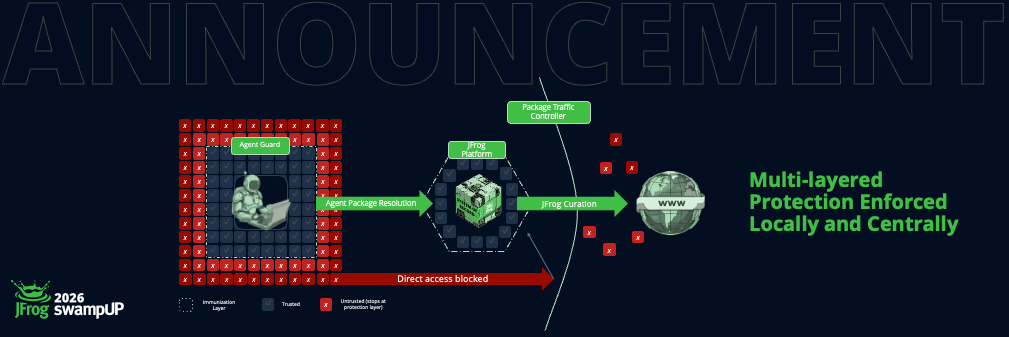 Extending the Single Source of Truth to the Agentic Software Supply Chain (2026-09-02) · Sep 2026
· source
· release history
Business Value Center shipped A real-time dashboard inside MyJFrog that quantifies platform ROI, developer hours reclaimed, storage saved via deduplication, and the percentage of repositories actively scanned by JFrog Xray.
release
-
Adds the JFrog Business Value Center dashboard inside
MyJFrog, surfacing real-time ROI, developer hours reclaimed, cost savings, storage avoided, and vulnerability-scan coverage across the software supply chain.︀︄︇︀︅︉︀︅︀︀︃︀︀︅︅︀︅︊︀︄︆︀︃︄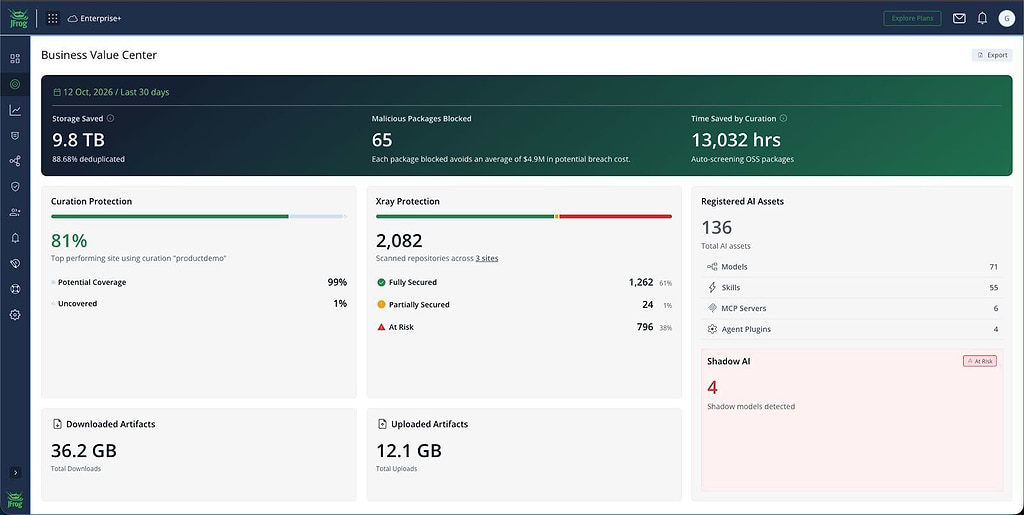 announced · Oct 2026
· source
· release history
-
Adds the JFrog Business Value Center inside
MyJFrog— a real-time dashboard that quantifies platform ROI, developer hours reclaimed, storage saved via deduplication, and the percentage of repositories actively scanned by JFrog Xray.︀︄︇︀︅︉︀︅︀︀︃︀︀︅︅︀︅︊︀︄︆︀︃︄ JFrog Business Value Center: Celebrate the ROI of Your Software Supply Chain (2026-10-15) · Oct 2026 · source · release history - Tracks what share of repositories are actively scanned by JFrog Xray and what share of incoming open-source packages are blocked by JFrog Curation policies, giving security teams auditable coverage metrics on demand. announced · Oct 2026 · source · release history
example
-
Access the Business Value Center to pull real-time ROI figures before a budget renewal or executive review.
Sign in to MyJFrog > select 'Business Value Center' from the dashboard navigation > review the ROI panel (developer hours reclaimed, cost avoided, storage saved) and the Optimization panel (% of…JFrog Business Value Center: Celebrate the ROI of Your Software Supply Chain (2026-10-15) · Oct 2026 · source -
View your platform's ROI, hours saved, and scan-coverage metrics before a renewal or budget review.
Sign in to MyJFrog, then navigate to Business Value Center to see real-time ROI, developer hours reclaimed, storage savings, and the percentage of repositories currently scanned by Xray.announced · Oct 2026 · source
LuaRocks Repository Support shipped Supports local, remote, and virtual repository tiers for Lua packages, proxying public luarocks.org and hosting private `.rock` files.
release
-
Adds LuaRocks as a native repository type in Artifactory, supporting local, remote, and virtual repository tiers for Lua packages (rocks and rockspecs).︀︄︇︀︅︉︀︅︀︀︃︀︀︅︅︀︅︊︀︄︆︀︃︄
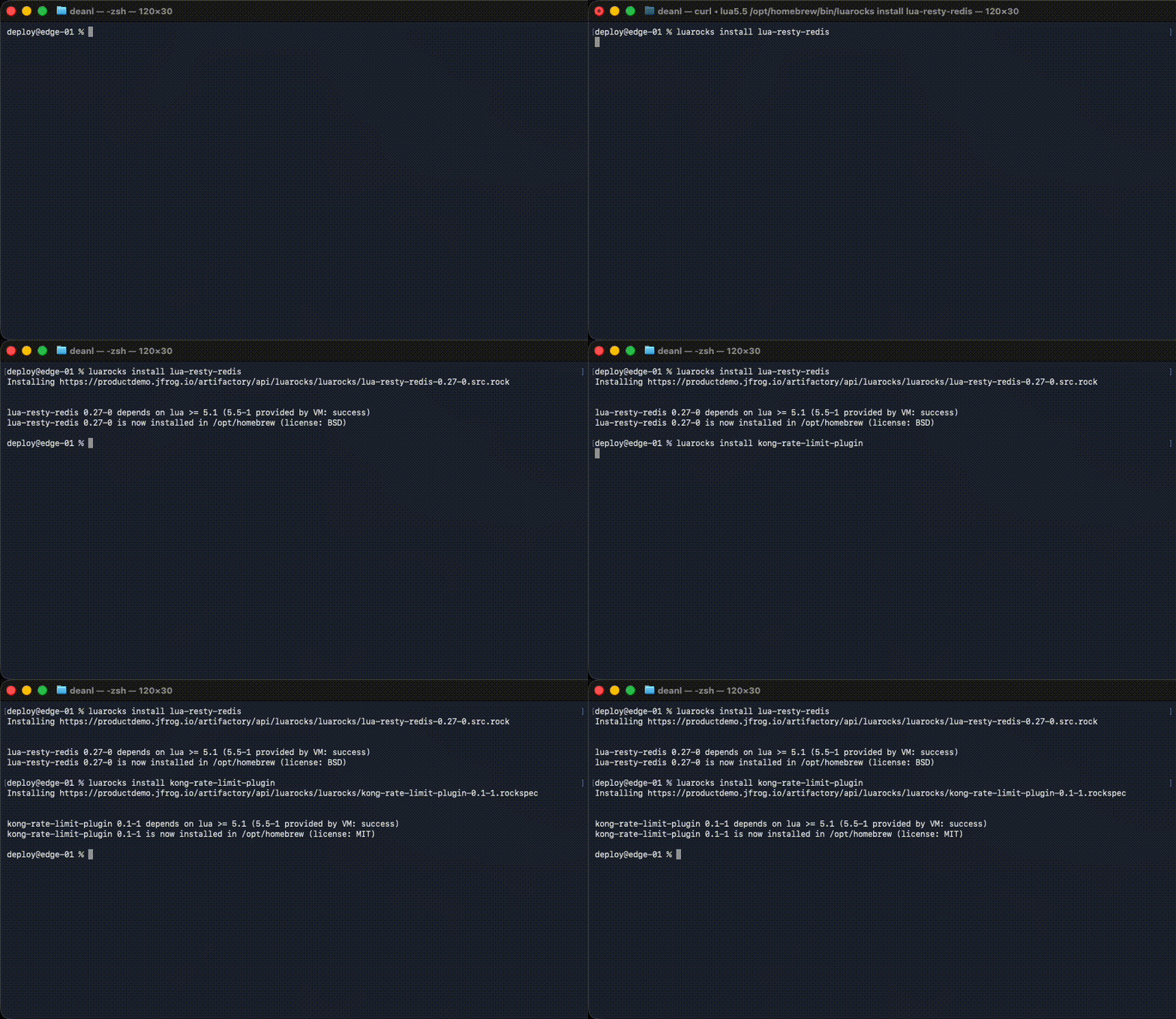 JFrog Artifactory Supports LuaRocks Hosting for NGINX, OpenResty and Kong (2026-09-16) · Sep 2026
· source
· release history
-
Adds a local repository type for storing private first-party rocks, internal libraries, and custom Kong plugins as versioned
.rockfiles. JFrog Artifactory Supports LuaRocks Hosting for NGINX, OpenResty and Kong (2026-09-16) · Sep 2026 · source · release history - Adds LuaRocks as a native repository type in JFrog Artifactory, supporting local, remote, and virtual repository configurations for Lua packages.︀︄︇︀︅︉︀︅︀︀︃︀︀︅︅︀︅︊︀︄︆︀︃︄ announced · Sep 2026 · source · release history
-
Enables the
luarocksCLI to point at an Artifactory virtual repository URL as its registry, replacing direct luarocks.org access for OpenResty and Kong fleets. JFrog Artifactory Supports LuaRocks Hosting for NGINX, OpenResty and Kong (2026-09-16) · Sep 2026 · source · release history -
Provides a virtual LuaRocks repository that unifies private and cached public rocks behind a single URL for the
luarocksclient. announced · Sep 2026 · source · release history
Software Composition Analysis (SCA) shipped suggested Scans source code and binaries to detect vulnerabilities, malicious packages, license risks, and operational issues across supported technologies, including LLM model scanning.
Suggested capability: Vulnerability database matching. This is our guess, not confirmed.
Also counts toward: CI/CD pipeline integration
release
-
Surfaces an Optimization panel showing what share of the software supply chain is scanned for vulnerabilities and what fraction of incoming open-source packages are blocked by JFrog Curation policies before reaching developers.
JFrog Business Value Center: Celebrate the ROI of Your Software Supply Chain (2026-10-15) · Oct 2026
· source
· release history
docs
- With data continuously enriched by JFrog Security Research , JFrog Catalog provides actionable intelligence that helps development, security, and compliance teams make informed decisions about the software components they use. seen Oct 2026 · source
- Rather than treating security as a collection of disconnected scans, JFrog Security provides a single, continuous security experience across development, CI/CD, artifact management, and runtime environments. seen Oct 2026 · source
- JFrog Xray is a Software Composition Analysis (SCA) tool that scans source code and binaries to detect vulnerabilities, malicious packages, license risks, and operational issues across supported technologies and LLM model scanning. seen Oct 2026 · source
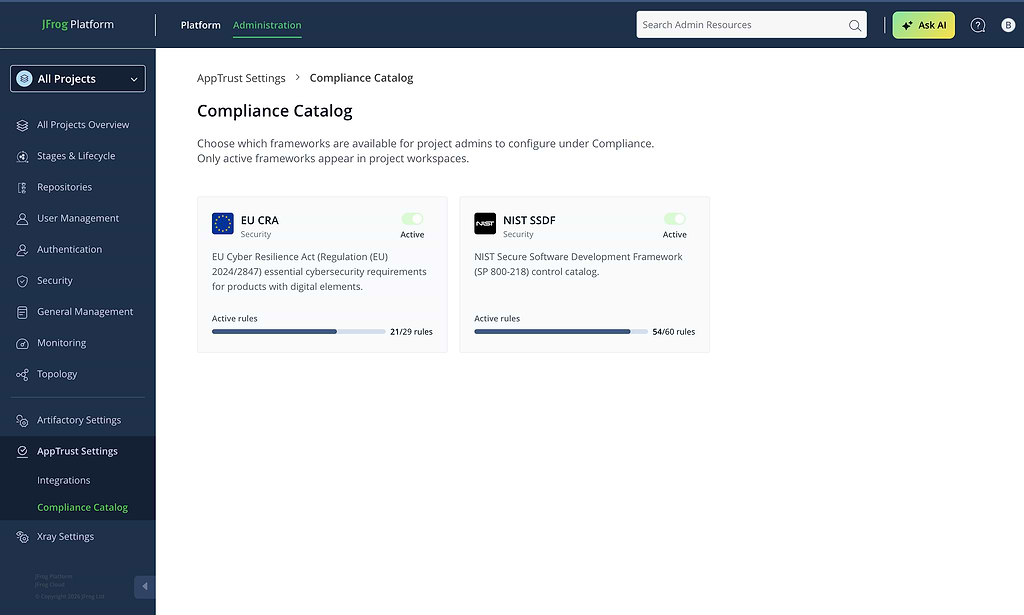
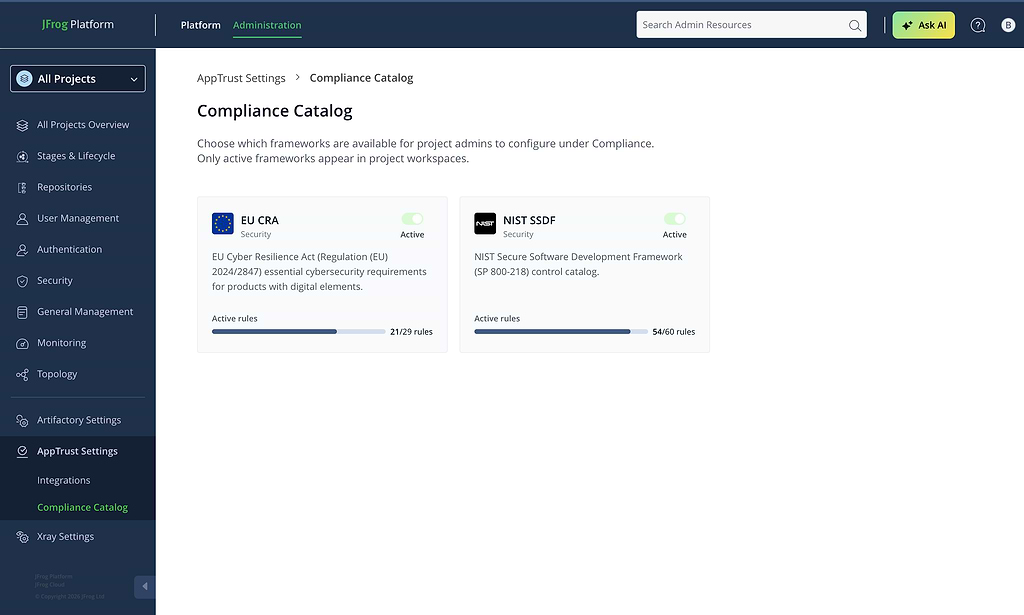
Compliance Catalog shipped Provides an out-of-the-box compliance catalog inside AppTrust with pre-mapped controls for NIST SSDF and the EU Cyber Resilience Act, translated into plain requirements linked to Policy-as-Code rules.
release
-
Introduces a compliance catalog inside AppTrust where AppSec teams select a framework and see every control translated into plain requirements, each linked to specific Policy-as-Code rules enforced at release gates.
Every New Compliance Framework Restarts the Same Fire Drill. It Doesn’t Have To. (2026-09-02) · Sep 2026
· source
· release history
-
Launches out-of-the-box compliance frameworks with pre-mapped controls for NIST SSDF and the EU Cyber Resilience Act, ready to enforce without manual configuration.
Every Release Needs a Chain of Custody. AI Agents Just Made That Harder. (2026-09-02) · Sep 2026
· source
· release history
- Adds out-of-the-box compliance frameworks to JFrog AppTrust, starting with NIST SSDF and EU CRA, with controls pre-mapped to Policy-as-Code rules so teams can enable enforcement without writing Rego manually. announced · Sep 2026 · source · release history
- Adds Out-of-the-Box Compliance Frameworks, enabling teams to activate pre-built policy sets for standards such as NIST and CRA and select only the applicable sections, with no custom configuration required. Live From the Show Floor: swampUP 2026 (2026-09-02) · Sep 2026 · source · release history
AI assistant (Ask AI) shipped An AI-powered assistant that answers how-to questions and provides guidance on using the JFrog Platform.
Also counts toward: Built-in AI assistant, Natural-language query
release
-
New Preview early-access track available in two forms: Closed Preview (invite-only) and Open Preview (all eligible customers), both free with opt-in.
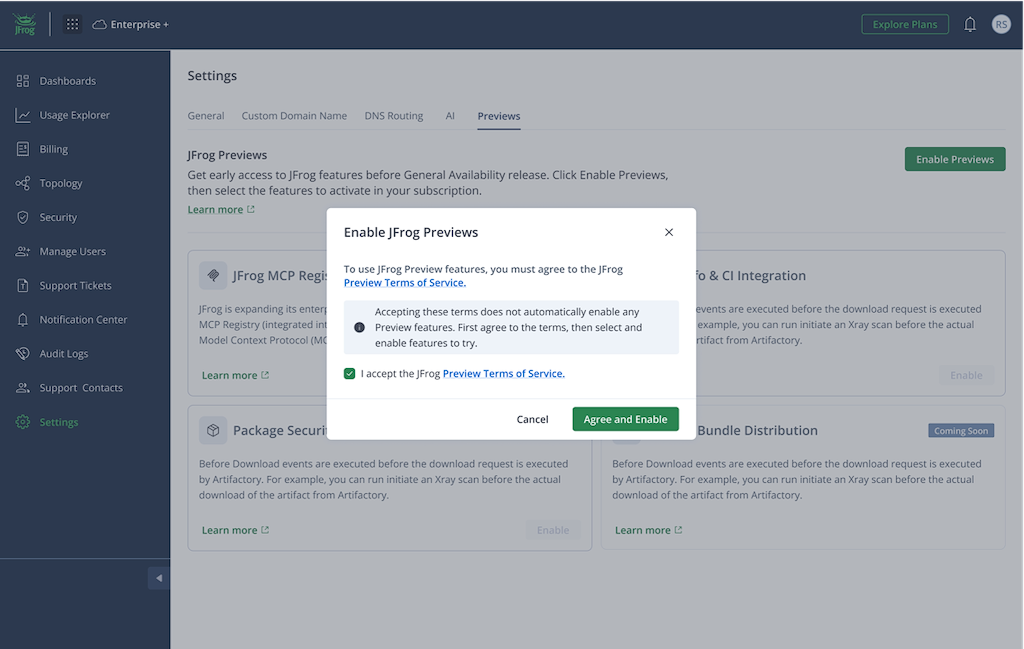 announced · Aug 2026
· source
· release history
-
Activate Preview in the MyJFrog portal under
Settings > Previewby enabling the Enable Preview toggle and accepting the Preview Terms of Service. announced · Aug 2026 · source · release history -
Covers indirect and transitive installs — postinstall scripts,
pip install -r requirements.txt,npm ci, and equivalent bulk-pull commands — routing all through Artifactory from the first session. Coding Agents Just Reopened Your Software Supply Chain Blind Spot (2026-08-25) · Aug 2026 · source · release history
docs
- When you enable JFrog AI, you gain access to Ask AI, an AI-powered assistant that helps you get more value from the JFrog Platform. Ask AI can: Answer how-to questions and provide guidance on how to accomplish tasks correctly in the JFrog Platform. docs update · Aug 2026 · source
OIDC identity mapping for AI agent access shipped Integrates JFrog Access OIDC identity mappings with AgentCore Identity so that verified external IdP token claims are mapped to JFrog users, groups, or project roles, with token audience and issuer validation enforced on inbound access tokens.
Shared capability: OIDC SSO
Also counts toward: Multi-tenant management, Role-based access control
release
-
Adds Projects Federation, which synchronizes multi-tenant workspaces, project- and global-level roles, SDLC release-stage gates, and identity access tokens across every peer site in the mesh in seconds.
Introducing JFrog Platform Federation: One Control Plane for Synchronizing Every Site in Your Software Supply Chain (2026-08-24) · Aug 2026
· source
· release history
-
Integrates JFrog Access OIDC identity mappings with AgentCore Identity: JFrog trusts the external IdP issuer (
$IDP_ISSUER) and maps verified access-token claims (e.g.preferred_username,team) to JFrog users, groups, or project roles via the JFrog OIDC integration API.
Propagating User Identity From AI Agents to Your Tools: Amazon Bedrock AgentCore Gateway and JFrog Artifactory (2026-08-21) · Aug 2026
· source
· release history
-
Requires the user's OIDC access token
audclaim to equal the AgentCore Gateway URL ($GATEWAY_URL) andissto match$IDP_ISSUER, with a mappable identity claim (e.g.preferred_username) present on the access token — not only the ID token. Propagating User Identity From AI Agents to Your Tools: Amazon Bedrock AgentCore Gateway and JFrog Artifactory (2026-08-21) · Aug 2026 · source · release history
docs
- Supports bulk automation via Catalog GraphQL , streamlining package governance at scale. 2 days ago docs update · Aug 2026 · source
Dynamic tool listing for AI agent gateway targets shipped Allows tool discovery on AgentCore Gateway targets to run under the requesting user's token rather than a shared credential, using the `listingMode` field on gateway targets.
release
-
Introduces a peer-to-peer mesh architecture for distributed JFrog sites, replacing hub-and-spoke and script-driven sync with autonomous, continuous background synchronization of projects, access control, policies, artifacts, and repositories.
Introducing JFrog Platform Federation: One Control Plane for Synchronizing Every Site in Your Software Supply Chain (2026-08-24) · Aug 2026
· source
· release history
- New JFrog Platform Federation introduces a peer-to-peer mesh architecture that connects distributed JFrog sites into a single logical control plane, replacing hub-and-spoke and script-based coordination. announced · Aug 2026 · source · release history
-
Supports
listingModefield on AgentCore Gateway targets (requires a recent AWS CLI) to enable dynamic tool listing, allowing tool discovery to run under the user's token instead of a shared credential.
Propagating User Identity From AI Agents to Your Tools: Amazon Bedrock AgentCore Gateway and JFrog Artifactory (2026-08-21) · Aug 2026
· source
· release history
example
-
When onboarding a new region so that all required repositories appear automatically without filing tickets or running scripts for each repo.
In the JFrog Platform, go to Platform Federation > Stage-to-Site Mapping, define which release stages are assigned to the new site, and Automated Repository Provisioning replicates the required…announced · Aug 2026 · source
Agent Package Governance shipped Expands the AI Catalog to govern skills, plugins, and Agent Packages (APM) in addition to previously supported AI assets.
Also counts toward: Administrative audit log, Role-based access control
release
-
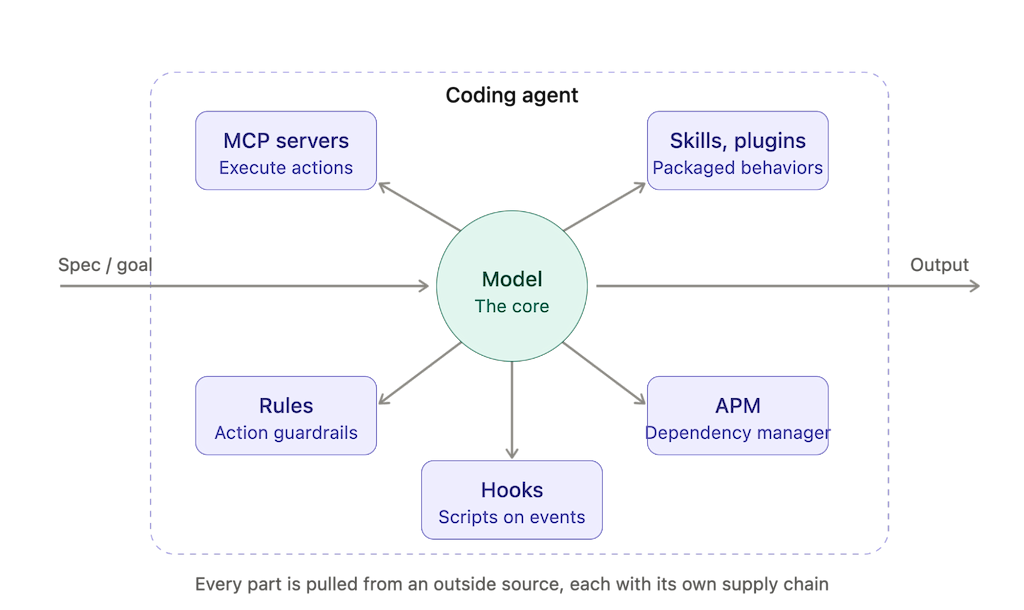
Stores agent skills, plugins, and APM packages in JFrog Artifactory alongside Docker images and npm packages under the same permissions model and audit trail, unifying AI and software supply chain assets in a single platform.
Scanning AI Assets: Catching What SCA and SAST Might Miss (2026-10-21) · Oct 2026
· source
· release history
-
Expanded JFrog AI Catalog now governs skills, plugins, and Agent Packages (APM) in addition to previously supported AI assets.
Extending the Single Source of Truth to the Agentic Software Supply Chain (2026-09-02) · Sep 2026
· source
· release history
-
Stores all AI asset types — models, MCP servers, skills, plugins, and agent packages — as versioned, traceable artifacts in Artifactory under a single RBAC model and audit trail.
The Evolution of JFrog AI Catalog: Your AI Control Plane for Agentic Development (2026-09-02) · Sep 2026
· source
· release history
Agent Guard shipped Ensures only AI assets approved in AI Catalog are consumed by agents across coding environments.
release
-
Adds JFrog Agent Guard enforcement component that applies deterministic-plus-semantic policy at the agent harness — the point an agent actually invokes the asset — not only at download time, so a skill reclassified after initial approval is blocked on machines that already have it.
Scanning AI Assets: Catching What SCA and SAST Might Miss (2026-10-21) · Oct 2026
· source
· release history
-
New Agent Guard (AI Asset Enforcement) ensures only AI assets approved in AI Catalog are consumed by agents across coding environments.
Extending the Single Source of Truth to the Agentic Software Supply Chain (2026-09-02) · Sep 2026
· source
· release history
Agent Policy Enforcement shipped Extends JFrog Curation policy enforcement server-side to all agent-driven downloads, blocking malicious packages, unapproved licenses, and policy-violating packages.
release
-
Extends JFrog Curation policy enforcement server-side to all agent-driven downloads, blocking malicious packages, unapproved licenses, and policy-violating packages regardless of whether session steering or
jf setupis active. Coding Agents Just Reopened Your Software Supply Chain Blind Spot (2026-08-25) · Aug 2026 · source · release history
docs
- JFrog Curation is the first line of defense in securing an organization’s software supply chain. It operates at the package acquisition stage, preventing risky dependencies from entering remote repositories before they're even used in development, testing, or production. docs update · Oct 2026 · source
Unified Agent Session Logging shipped Produces complete audit trails for every agent-driven download, block, and policy decision alongside existing human-driven build logs.
Also counts toward: Administrative audit log, JSON data export
release
-
Captures five signed categories of facts per agentic process: agent identity (agent version, harness version, model ID), execution traceability (full session logs as structured JSON covering every tool call, API call, input, and context source), provenance, integrity, and policy compliance.
Governing the Agentic SDLC Through Continuous Policy Enforcement (2026-10-12) · Oct 2026
· source
· release history
- Produces complete audit trails for every agent-driven download, block, and policy decision alongside existing human-driven build logs. Coding Agents Just Reopened Your Software Supply Chain Blind Spot (2026-08-25) · Aug 2026 · source · release history
Agent Plugins Registry shipped Controls, signs, verifies, and scans plugin bundles agents install.
Also counts toward: Ticketing integration
release
-
Adds an Agent Plugins Registry to control, sign, verify, and scan plugin bundles agents install.
The Evolution of JFrog AI Catalog: Your AI Control Plane for Agentic Development (2026-09-02) · Sep 2026
· source
· release history
-
Introduces Prompt to Release Traceability in JFrog AppTrust, automatically collecting and signing commits, pull requests, Jira ticket transition histories, and approver chains for every release before any promotion gate runs.
announced · Sep 2026
· source
· release history
APM Repository shipped Provides a governed registry for agent package installs, allowing agents to resolve dependencies via a versioned, resolvable package compliant with the APM standard.
release
-
Adds Agent Packages support to ship an agent's entire context and dependency tree as a single versioned, resolvable package compliant with the open-source APM (Agent Package Manager) standard.
The Evolution of JFrog AI Catalog: Your AI Control Plane for Agentic Development (2026-09-02) · Sep 2026
· source
· release history
-
New APM Repository provides a governed registry for agent package installs, replacing open-internet pulls via
apm install.
Extending the Single Source of Truth to the Agentic Software Supply Chain (2026-09-02) · Sep 2026
· source
· release history
Preview Access Track shipped Delivers two tiers — Closed Preview and Open Preview — allowing users to opt-in to newly released capabilities before general availability.
release
-
New Preview early-access track available in two forms: Closed Preview (invite-only) and Open Preview (all eligible customers), both free with opt-in.
announced · Aug 2026
· source
· release history
-
Activate Preview in the MyJFrog portal under
Settings > Previewby enabling the Enable Preview toggle and accepting the Preview Terms of Service. announced · Aug 2026 · source · release history
Automated Repository Provisioning shipped Creates and replicates repositories across sites based on a Stage-to-Site mapping, eliminating manual setup when new sites join the mesh.
release
-
New Automated Repository Provisioning creates and replicates repositories across sites based on a Stage-to-Site mapping, eliminating per-repo, per-site manual setup when a new site joins the mesh.
announced · Aug 2026
· source
· release history
- Adds Automated Repository Provisioning, which creates and configures repositories on the correct sites automatically based on a Stage-to-Site mapping, eliminating per-repo and per-site manual administration. Introducing JFrog Platform Federation: One Control Plane for Synchronizing Every Site in Your Software Supply Chain (2026-08-24) · Aug 2026 · source · release history
Federated Mesh Architecture shipped Connects distributed JFrog sites into a single logical control plane using peer-to-peer mesh architecture for autonomous, continuous synchronization of projects, access control, policies, artifacts, and repositories.
release
-
Introduces a peer-to-peer mesh architecture for distributed JFrog sites, replacing hub-and-spoke and script-driven sync with autonomous, continuous background synchronization of projects, access control, policies, artifacts, and repositories.
Introducing JFrog Platform Federation: One Control Plane for Synchronizing Every Site in Your Software Supply Chain (2026-08-24) · Aug 2026
· source
· release history
- New JFrog Platform Federation introduces a peer-to-peer mesh architecture that connects distributed JFrog sites into a single logical control plane, replacing hub-and-spoke and script-based coordination. announced · Aug 2026 · source · release history
Impact Analysis documented Continuously monitors emerging threats and alerts teams to new vulnerabilities in existing components.
docs
- JFrog Runtime integrates with the broader JFrog Platform, which includes JFrog Artifactory, JFrog Xray , and JFrog Advanced Security . seen Oct 2026 · source
- Xray’s policies and watches help enforce security and compliance thresholds by flagging risky components. With Impact Analysis , it continuously monitors emerging threats and alerts teams to new vulnerabilities in existing components. 22 days ago seen Aug 2026 · source
Agentic Process Evidence Release Gates shipped Evaluates Agentic Process Evidence at release gates using policy-as-code checks, enforcing requirements such as approved LLM usage, approved MCP tool usage, human accountability, human review presence, and absence of unapproved lateral operations.
release
-
Enables policy-as-code release gates that evaluate Agentic Process Evidence to enforce checks such as approved LLM usage, approved MCP tool usage, human accountability, human review presence, and absence of unapproved lateral operations.
Governing the Agentic SDLC Through Continuous Policy Enforcement (2026-10-12) · Oct 2026
· source
· release history
Agent Code Remediation shipped Provides official JFrog agent plugins for coding agents that bring organizational policy control directly into the coding environment.
Also counts toward: Plugin system
release
-
Releases official JFrog agent plugins for Claude Code, Cursor, VS Code, OpenCode, and Codex that bring organizational policy control directly into the coding agent environment.
The Evolution of JFrog AI Catalog: Your AI Control Plane for Agentic Development (2026-09-02) · Sep 2026
· source
· release history
Agentic Remediation shipped Fixes vulnerabilities in first-party code at the source level with a developer reviewing and approving before merge.
release
- Introduces Agentic Remediation for first-party code, fixing vulnerabilities at the source level with a developer reviewing and approving before merge — distinct from Zero-Touch Remediation's fully automated mid-pipeline swap. Live From the Show Floor: swampUP 2026 (2026-09-02) · Sep 2026 · source · release history
Compliance Coverage Gap Analysis shipped Surfaces coverage gaps explicitly: controls not yet covered by AppTrust are flagged, while controls already satisfied by running AppTrust are shown as covered.
release
-
Surfaces coverage gaps explicitly: controls not yet covered by AppTrust are flagged, while controls already satisfied by running AppTrust are shown as covered by default.
Every New Compliance Framework Restarts the Same Fire Drill. It Doesn’t Have To. (2026-09-02) · Sep 2026
· source
· release history
Framework Configuration Separation shipped Separates framework configuration from rollout control: AppSec owns which controls and rules are active, while development managers configure scope and enforcement behavior.
release
-
Separates framework configuration from rollout control: AppSec owns which controls and rules are active, while development managers configure which applications fall under the framework, whether rules run as warnings or hard failures, and how long before a warning converts to a blocked package.
announced · Sep 2026
· source
· release history
Incoming JFrog Agent Plugins shipped Captures AI agent session evidence (prompts, code produced, and a full session bill of materials) as signed evidence stored in Artifactory.
Also counts toward: Plugin system
release
-
Introduces incoming JFrog Agent Plugins to capture AI agent session evidence (prompts, code produced, and a full session bill of materials — including which MCPs, skills, and agentic assets were used) as signed evidence stored in Artifactory.
Every Release Needs a Chain of Custody. AI Agents Just Made That Harder. (2026-09-02) · Sep 2026
· source
· release history
Jira Validation shipped Validates full Jira ticket transition history (creation → in-progress → done, with dates) to produce auditor-ready workflow proof.
Also counts toward: Ticketing integration
release
-
Validates full Jira ticket transition history (creation → in-progress → done, with dates) rather than merely checking ticket existence, producing auditor-ready workflow proof.
Every Release Needs a Chain of Custody. AI Agents Just Made That Harder. (2026-09-02) · Sep 2026
· source
· release history
MCP Registry shipped Defines which MCP servers are allowed per project, restricts specific tool calls, and scans local MCP packages before an agent can use them.
release
-
Adds an MCP Registry to define which MCP servers are allowed per project, restrict specific tool calls, and scan local MCP packages before an agent can use them.
The Evolution of JFrog AI Catalog: Your AI Control Plane for Agentic Development (2026-09-02) · Sep 2026
· source
· release history
Post-Release Governance shipped Extends compliance monitoring and vulnerability remediation tracking through the support window after a release ships.
release
- Adds Post-Release Governance, extending compliance monitoring and vulnerability remediation tracking through the support window after a release ships to address European regulatory requirements. Live From the Show Floor: swampUP 2026 (2026-09-02) · Sep 2026 · source · release history
Repo-Level Policies shipped Enforces evidence-based governance directly on repositories without requiring project, application, or lifecycle-stage setup.
release
- Adds Repo-Level Policies that enforce evidence-based governance directly on repositories without requiring project, application, or lifecycle-stage setup. Live From the Show Floor: swampUP 2026 (2026-09-02) · Sep 2026 · source · release history
Self-Approval Violation Detection shipped Detects self-approval violations automatically by checking whether the PR approver is the same person as the committer.
release
-
Detects self-approval violations automatically by checking whether the PR approver is the same person as the committer — a check most compliance frameworks require but few teams automate.
announced · Sep 2026
· source
· release history
Traffic Controller Integration shipped Integrates with Netskope, Zscaler, and Cloudflare to redirect public-repo package requests through JFrog at the network layer.
release
-
New Traffic Controller integrations with Netskope, Zscaler, and Cloudflare redirect public-repo package requests through JFrog at the network layer.
Extending the Single Source of Truth to the Agentic Software Supply Chain (2026-09-02) · Sep 2026
· source
· release history
Zero-Touch Remediation shipped Automatically swaps a vulnerable package version for a patched one mid-pipeline by evaluating multiple upstream sources against the customer's own policy.
Also counts toward: CI/CD pipeline integration
release
- Introduces Zero-Touch Remediation via Compliant Version Replacement, which automatically swaps a vulnerable package version for a patched one mid-pipeline by evaluating multiple upstream sources (Chainguard, Maven Central, and others) against the customer's own policy, with JFrog Artifactory as the system of record. Live From the Show Floor: swampUP 2026 (2026-09-02) · Sep 2026 · source · release history
Agent Package Resolution shipped Routes AI coding agent dependency downloads through JFrog Artifactory instead of public registries, covering multiple package types and including indirect installs.
release
- Introduces Agent Package Resolution (preview), a feature of the JFrog Agent Plugin that routes AI coding agent dependency downloads through JFrog Artifactory instead of public registries, covering npm, PyPI, Maven, Go, Docker Hub, Helm, and NuGet. Coding Agents Just Reopened Your Software Supply Chain Blind Spot (2026-08-25) · Aug 2026 · source · release history
Session Steering shipped Automatically supplies the Artifactory URL for each governed package type at the start of an agent session, eliminating per-project configuration.
release
- Adds session steering: at the start of each Claude Code or Cursor agent session, the plugin automatically supplies the Artifactory URL for each governed package type — no per-project configuration required. Coding Agents Just Reopened Your Software Supply Chain Blind Spot (2026-08-25) · Aug 2026 · source · release history
Curation Federation shipped Propagates open-source blocking rules, waivers, and approvals from any peer site to every regional pipeline worldwide within seconds.
release
-
Adds Curation Federation, which propagates open-source blocking rules, waivers, and approvals from any peer site to every regional pipeline worldwide within seconds of being set.
Introducing JFrog Platform Federation: One Control Plane for Synchronizing Every Site in Your Software Supply Chain (2026-08-24) · Aug 2026
· source
· release history
Federated Topology View shipped Displays the global peer mesh across regions with entities and policies synchronized in real time.
release
-
Provides a Federated Topology View showing the global peer mesh across regions with entities and policies synchronized in real time.
Introducing JFrog Platform Federation: One Control Plane for Synchronizing Every Site in Your Software Supply Chain (2026-08-24) · Aug 2026
· source
· release history
Projects Federation shipped Synchronizes multi-tenant workspaces, project- and global-level roles, SDLC release-stage gates, and identity access tokens across every peer site in the mesh.
Also counts toward: Multi-tenant management, Role-based access control
release
-
Adds Projects Federation, which synchronizes multi-tenant workspaces, project- and global-level roles, SDLC release-stage gates, and identity access tokens across every peer site in the mesh in seconds.
Introducing JFrog Platform Federation: One Control Plane for Synchronizing Every Site in Your Software Supply Chain (2026-08-24) · Aug 2026
· source
· release history
Machine-readable documentation index documented Exposes the JFrog documentation site as an LLM-friendly index at docs.jfrog.com/llms.txt and allows any documentation page to be retrieved in Markdown by appending .md to its URL.
docs
-
For AI agents: the docs index is at
https://docs.jfrog.com/llms.txt. Append .md to any documentation page URL to get its markdown version. seen Oct 2026 · source
Lines in monospace are the tool's own words: help text
parsed from its source, or an endpoint from its API document. Under
release, a line is our summary of a dated release. Under
docs, it is quoted from the tool's own documentation or
website. Each links back to the source it came from.
Command line
1 command for JFrog, each with where it came from. This tool has no source analysis yet, so there is no option reference and no captured run beside them.
No command matches.
Screenshots
From the release notes, newest first. Click one to see it full size.Media
Videos from the release notes, newest first. They play right here.Score card
-
Shipping velocity releases a month, last 12 months
-
Documentation quality release-notes rubric, 0–100
-
Breaking-change discipline how rarely a release breaks users, and notice given
-
Maintenance risk quiet time against its own cadence, maintainers
-
Innovation & surface new capabilities, API and MCP surface
Five scores for JFrog, each built from the releases, notes and API history this site tracks — and, on Researcher and Business, where it stands among every measured tool in its category and how that has moved.
Score cards are part of every paid plan.
See plans → Already subscribed? Sign in →Trajectory
Blank means never measured; nothing here is a filled-in zero.
Peer standings are included with Researcher and Business. See how this tool ranks against its competitors, using data we don't publish anywhere else.
See plans →Each score is 0–100 on a published rubric, derived from data this site already shows. A dimension we cannot measure says so — it is never scored 0 and never enters a rank.
How this is scored
- Shipping velocity — releases a month over the last 12 months, on a log scale where 16 a month scores 100. Needs 3 releases in the window.
- Documentation quality — the release-notes rubric published on the analytics page, unchanged.
- Breaking-change discipline — the share of releases carrying a breaking change (none scores 100, half or more scores 0). Only projects that label breaking changes are measured: a clean record cannot be told from an unlabelled one.
- Maintenance risk — quiet time measured against the tool's own release cadence (quiet longer than 90 days and three typical gaps scores 0), plus the number of active maintainers and whether contributors are growing, where known. Higher is lower risk.
- Innovation & surface — new capabilities in the feature ledger this year, API and MCP operations added, and the share of commits that are features: the mean of whichever we hold.
- Community health (open-source tools only) — each is a direction, not a size: contributors this year against last, the bus factor now against a year ago, and issues closed per issue opened, where steady scores 50, doubled 100 and halved 0; plus the median time to a maintainer's first reply (an hour scores about 100, a month or more 0). A commercial card has no repository and carries none of the four.
- Documented delivery (commercial tools) — when a vendor's documented new capabilities have slowed against its own baseline, that counts against the overall standing as heavily as two low dimensions. Steady delivery, or too little history to judge, leaves the standing alone; it is never a sixth score.
- Open-source tools are scored on repository signals; commercial tools on their published changelog. Ranks compare tools within one category and one profile and need at least five measured peers; the overall standing needs three ranked dimensions. Best-in-breed or consolidator is a shape, not a quality, and is never scored.
Release-note detail over time
See how much detail JFrog puts in its release notes, quarter by quarter, and compare it with tracked tools in the same category. This history uses up to ten retained, reviewed notes per tool; sparse or blank older quarters may reflect that limit.
Checking release-note history…
Website history
jfrog.com, every changeJFrog's home page and 49 more pages as they looked each month from August 2021 to October 2026: 59 renders, 6 changes of tagline or palette. Step through them, play them, or put any two months side by side.
Website history is included with Researcher and Business.
See plans → Already subscribed? Sign in →← → or h l a month · Shift a year · [ ] previous / next change · Space play · 1 2 3 page · T whole page · C compare · F full size
← → or h l the right month · Shift the left · S swap · W wipe · T whole page · Esc back
Rebranding timeline
Dates bound when a change appeared between captures. Possible rebrands are AI suggestions; a redesign alone does not establish a rebrand.
Releases
29 entries
No entries match these filters.
- October 20267
- September 202611
- August 202611
Articles
17 articles · updated Nov 4, 2026Where JFrog turns up in what others publish: how-tos, attack reports that name it, and incident write-ups. A row says why it is here and quotes where the article names it; the link goes to the publisher.
Attacks on JFrog 17
-
Attackers Chain JFrog Artifactory Flaws to Gain Admin Control and Plant Backdoors
JFrog had fixed both flaws before then, so only servers that had not been updated were open to them.
2 more quotes
CVE-2026-42016 then allows that low-privilege token to be swapped for one with administrator scope, because Artifactory checks a token's signature and who issued it, but not what the token is allowed to do.
In JFrog's published ranges, CVE-2026-42016 ends at 7.133.11, leaving the 7.146 and 7.161 branches outside that range.
-
CISA Adds 5 Actively Exploited Artifactory, ScreenConnect, and RouterOS Flaws to KEV
Details of the vulnerabilities are as follows - CVE-2026-42016 (CVSS score: 8.1) - An incorrect authorization vulnerability in JFrog Artifactory that could lead to privilege escalation due to a validation check of the…
2 more quotes
…Security Agency (CISA) has added five security flaws impacting JFrog Artifactory, ConnectWise ScreenConnect , and MikroTik RouterOS to its Known Exploited Vulnerabilities ( KEV ) catalog, following reports of…
…(CVSS score: 7.5) - An improper authentication vulnerability in JFrog Artifactory that could return an internal anonymous-user token to an unauthenticated caller when anonymous access is disabled, potentially…
-
Artifactory flaws chained in attacks deploying backdoor malware
A new report from cloud security company Wiz confirmed exploitation across multiple environments, including an exploit chain that combines CVE-2026-42018 and CVE-2026-42016.
2 more quotes
Then they increase permissions to admin level by exploiting CVE-2026-42016, caused by insufficient token validation.
“Between August 15 and September 8, 2026, we observed multiple actors chain CVE-2026-42018 and CVE-2026-42016 against self-hosted Artifactory instances,” Wiz says .
Show all 17
-
Artifactory Under Attack: In-the-Wild Exploitation of CVE-2026-42016, CVE-2026-42018 & CVE-2026-82329
Wiz Research has identified active, in-the-wild exploitation of three critical and high-severity vulnerabilities affecting JFrog Artifactory: CVE-2026-42016, CVE-2026-42018, and CVE-2026-82329.
2 more quotes
CVE-2026-42016: Token scope validation flaw CVE-2026-42016 is a privilege-escalation vulnerability caused by insufficient token validation.
Our data indicates that 67% of organizations running JFrog Artifactory had at least one vulnerable instance when CVE-2026-42016 was first published on July 27.
-
Hackers exploit critical JFrog Artifactory flaw to forge admin tokens
The flaw is present in the default configuration of self-managed instances of JFrog Artifactory, a repository manager used to store, organize, secure, and distribute software packages.
2 more quotes
Spears also notes that JFrog treats access tokens as independent credentials with their own expiration and revocation mechanisms, so upgrading the Artifactory binary does not by itself invalidate an already-issued token.
JFrog addressed the issue on August 28 in Artifactory versions 7.111.21, 7.117.28, 7.125.20, 7.133.29, 7.146.38, and 7.161.20.
-
CVE-2026-82329: Unauthenticated Administrative Access in JFrog Artifactory via an Empty Cluster Join Key
Share TL;DR JFrog Artifactory is one of the most widely deployed systems for storing and distributing the software packages companies build and depend on.
2 more quotes
CVE-2026-82329 is a critical unauthenticated authentication bypass in self-managed JFrog Artifactory, rated CVSS 9.8.
On a default install, JFrog Access registers a cluster join key whose id and signing secret are both derivable by anyone, so one forged join request to an endpoint that requires no authentication returns an admin-scoped…
-
Attackers Exploit Critical JFrog Artifactory Flaw to Mint Admin Tokens Days After Disclosure
The vulnerability in question is CVE-2026-82329 (CVSS score: 9.8), a case of authentication bypass that could lead to administrative access in Artifactory.
2 more quotes
"JFrog Artifactory contains an authentication weakness that, under default configuration, may allow an unauthenticated attacker with network access to obtain administrative privileges," according to a description of the…
The vulnerability was patched by JFrog with Artifactory version 7.161.20 released on August 28, 2026.
-
Attackers Pounce on Critical Artifactory Flaw Following Disclosure
CVE-2026-82329 is a critical (CVSS: 9.8) authentication bypass vulnerability in default configurations of Artifactory that an unauthenticated attacker can exploit to gain administrative access to the platform, with no…
2 more quotes
JFrog disclosed the vulnerability on Aug.
31, watchTowr reported observing exploit activity targeting CVE-2026-82329.
-
Hundreds of OpenAI Agents Invaded Hugging Face Servers
…company's network, exploiting a recently disclosed Linux kernel flaw, CVE-2026-66384 , to eventually gain access to OpenAI's managed cloud Kubernetes service and obtain authentication tokens for a variety of its…
1 more quote
…early as May 8, 2026, an agent in a training run attempted to gain unallowed access to the Internet by exploiting a server-side request forgery (SSRF) opportunity in OpenAI's internal JFrog Artifactory package manager.
-
Researcher Claims Control of ChatGPT Secure Sandbox
The opportunity came with JFrog's Artifactory repository manager, used by ChatGPT sandboxes for managing software binaries.
Add the badge to your README
Maintain this project? The badge links readers straight to this page, so they can follow every release here.
 Choose a badge style and copy the code →