StepSecurity
GitHub Checks: Pass on Non-Public Repositories for PWN Request and Script Injection (2026-11-03) commercialThe section your link pointed to isn't on StepSecurity's page any more, so we've brought you to the top.
StepSecurity is a security platform that hardens CI/CD pipelines, such as GitHub ActionsGitHub ActionsGitHub's built-in CI/CD system that runs automated workflows triggered by repository events, letting cyber tools automate testing, building, and releasing without managing separate pipeline infrastructure., by detecting supply-chain risks, enforcing least-privilege runners, and monitoring workflow tampering.
env:
  disable_implicit_endpoints: true
env:
  dnsTrackingMapSize: 65536
  processRingBufferSize: 32768
  enableMetrics: true
msiexec /i StepSecurityAgent.msi /quiet AUTOUPDATE=0
{
  "device_id": "eng-laptop-alice-01"
}
{
  "enable_runtime_scan": false
}
{
  "http-basic": {
    "registry.stepsecurity.io": {
      "username": "token",
      "password": "<your-api-key>"
    }
  },
  "repositories": [
    {
      "type": "composer",
      "url": "https://registry.stepsecurity.io/php"
    }
  ]
}
export COMPOSER_AUTH='{"http-basic":{"registry.stepsecurity.io":{"username":"token","password":"<your-api-key>::gha:my-workflow"}}}'
export COMPOSER_AUTH='{"http-basic":{"registry.stepsecurity.io":{"username":"token","password":"<your-api-key>::dev:alice"}}}'
- uses: step-security/harden-runner@v2.22.1
  with:
    deploy-on-self-hosted-vm: true
    customer: your-stepsecurity-customer
    server-name: your-ghes-server
    egress-policy: audit
- uses: step-security/harden-runner@v2.22.1
  with:
    egress-policy: block
    denied-endpoints: 'example.com:443 suspicious-host.io:80'
rbac:
  scope: namespaced
@myorg:registry=https://npm.mycompany.internal
//npm.mycompany.internal/:_authToken=${MYORG_NPM_TOKEN}
serviceAccount:
  annotations:
    eks.amazonaws.com/role-arn: arn:aws:iam::<account-id>:role/<irsa-role>
env:
  customer: "<your-org>"
  keyless:
    enabled: "true"
    region: "us-east-1"
    secretName: "stepsecurity/orgs/<github-org>/arc-api-key"
    refreshIntervalHours: "3"
env:
  customEnvVars:
    - name: HTTP_PROXY
      value: "http://proxy.corp.example.com:3128"
    - name: HTTPS_PROXY
      value: "http://proxy.corp.example.com:3128"
    - name: NO_PROXY
      value: "169.254.169.254,10.0.0.0/8"
- uses: step-security/harden-runner@v2.21.0
  with:
    egress-policy: block
    denied-endpoints: |
      registry.npmjs.org
      pypi.org
      files.pythonhosted.org
jobs:
  build:
    runs-on: codebuild-my-project-${{ github.run_id }}-${{ github.run_attempt }}
    steps:
      - uses: step-security/harden-runner@v2.21.0
        with:
          egress-policy: audit
      - uses: actions/checkout@v4
env:
  imagePullPolicy: IfNotPresent
tetragon:
  imagePullPolicy: IfNotPresent
- uses: step-security/harden-runner@v2.21.0
  with:
    egress-policy: block
    denied-endpoints: |
      malicious.example.com
      *.ads.example.org
env:
  enableContainerProcessTracing: "true"
dotnet restore -p:NuGetAudit=false
- uses: step-security/harden-runner@v2.20.0
  with:
    egress-policy: block
    allowed-endpoints: >
      api.nuget.org:443
      github.com:443
- uses: step-security/harden-runner@v2.20.0
  with:
    egress-policy: block
    allowed-endpoints: >
      api.nuget.org:443
      github.com:443
cosign verify ghcr.io/step-security/arc-harden-runner/arc-harden-runner:v2.18.3 \
  --certificate-identity-regexp 'https://github.com/step-security/arc-harden-runner/.*' \
  --certificate-oidc-issuer https://token.actions.githubusercontent.com
cosign verify ghcr.io/step-security/broker/broker:v1.3.0 \
  --certificate-identity-regexp 'https://github.com/step-security/broker/.*' \
  --certificate-oidc-issuer https://token.actions.githubusercontent.com
cosign verify ghcr.io/step-security/arc-harden-runner/arc-harden-runner:v2.18.3 \
  --certificate-identity-regexp 'https://github.com/step-security/arc-harden-runner/.*' \
  --certificate-oidc-issuer https://token.actions.githubusercontent.com
cosign verify ghcr.io/step-security/broker/broker:v1.3.0 \
  --certificate-identity-regexp 'https://github.com/step-security/broker/.*' \
  --certificate-oidc-issuer https://token.actions.githubusercontent.com
cosign verify ghcr.io/step-security/arc-harden-runner/arc-harden-runner:v2.18.3 --certificate-identity-regexp 'https://github.com/step-security/arc-harden-runner/.*' --certificate-oidc-issuer https://token.actions.githubusercontent.com
Summary
StepSecurity is a commercial appsec platform that protects CI/CD pipelines and developer machines from software supply-chainsoftware supply-chainThe dependencies, tools and processes used to build and deliver software. Compromising one part can affect the products or organizations that rely on it. attacks, run as a hosted dashboard paired with agents deployed on GitHub Actions runners and developer endpoints. It monitors and restricts outbound network traffic from build jobs, scans installed packages and IDE extensions for risk, and blocks pull requests that introduce typosquatted, compromised, or freshly published dependencies, giving platform and application security teams a single place to see and control what their pipelines and developer machines can reach. It is aimed at organizations securing GitHub Actions workflows rather than general SOCSOCA security operations center, the team or function that monitors threats, investigates alerts and coordinates incident response. Its work can be internal, outsourced or shared. use, and sits alongside tools that harden CI runners and manage software supply-chain risk. Launched in 2021 and still shipping frequently, with 35 releases in the window tracked and the most recent just 16 days ago, it shows active, ongoing development.
StepSecurity is a security platform that hardens CI/CD pipelines, such as GitHub Actions, by detecting supply-chain risks, enforcing least-privilege runners, and monitoring workflow tampering.
How StepSecurity helps
Which of my build jobs are talking to hosts they have no reason to reach?
monitors outbound network traffic from build jobs against an allowed-endpoint list and can block connections outside it, on Linux, macOS, and Windows GitHub-hosted runners
Which pull requests are trying to sneak in a malicious, typosquatted, or freshly published dependency?
checks incoming dependency changes against a compromised-packages database, a typosquat name-similarity check, and a configurable cooldown window before merge, across npm, Python, and Maven
Is a workflow run in the middle of stealing my secrets right now?
flags runs that combine a malicious workflow name, a secrets dump, a suspicious commit message, and an exfiltration artifact, and raises confidence further if the run, branch, or workflow file is deleted right after
Which of my repository secrets are actually still in use, and which could be dropped for OIDC?
shows each secret's usage status, the workflow file and step referencing it, the last run outcome, and whether it could be replaced by trusted publishing instead of a stored token
Which developer machines have VS Code or Visual Studio extensions that fall outside what's approved?
inventories installed extensions across VS Code and legacy Visual Studio installs and enforces an approved extension set per device or globally, without needing MDM
Which of my CI jobs are pulling packages straight from the public registry instead of a secure proxy?
watches package requests from build jobs for direct calls to public registries like npm, PyPI, or Docker Hub and reports the offending jobs by repository and workflow
Languages
Features
Built from StepSecurity's releases, docs, README and our own runs. “Seen” marks the month we first spotted a release the vendor didn't date. Group names and tags are our labels.
- StepSecurity covers 1 of the 3 runtime security capabilities we track.
- StepSecurity covers 1 of the 5 supply chain security capabilities we track.
What StepSecurity offers you
- CI/CD pipeline integration12
- Web management console6
- Agent-based deployment4
- CSV data export3
- Self-hosted deployment3
- Kubernetes-native deployment2
- Outbound webhooks (the product notifies you)2
- Scheduled jobs2
- Scripting language support2
- Administrative audit log1
- Command-line interface1
- JavaScript scripting support1
- ML-based detection1
- Multi-tenant management1
- Role-based access control1
No capabilities match.
OIDC SSO 1 feature Identity and access since 2026
Repository Secrets posture management shipped Shows which repository secrets are actively used, stale, or unused, identifies which workflow step references each secret, and flags secrets that could be replaced with OIDC.
Shared capability: OIDC SSO
release
-
Adds Insomnia to the credential inventory under a new API clients category, covering request authentication, credential headers, environment and secret variables, OAuth tokens, request history, and account/provider stores — secret variables in Insomnia's encrypted storage are reported as Protected.
 Dev Machine Guard v1.17.0 (2026-09-29) · Sep 2026
· source
· release history
-
Supports classic PAT inventory on GitHub Enterprise Server by connecting a
site_admin-scopedtoken from a dedicated site administrator account to enumerate classic PATs for organization members and outside collaborators. PAT Governance: Exemptions, Configurable PAT Abuse Thresholds, GitHub Audit Log, and Classic PATs on GitHub Enterprise Server (2026-09-29) · Sep 2026 · source · release history - New summary cards on the Repository Secrets tab show Total Secrets, Unused Secrets, Stale Secrets, and OIDC Replaceable counts for an at-a-glance secrets posture view. New Control: Jobs Should Use a Secure Registry Instead of Public Package Registries (2026-07-14) · Jul 2026 · source · release history
-
Secrets that can be replaced with OIDC (e.g.,
NPM_TOKENreplaceable via npm trusted publishing) are flagged in the Actions Secret section. New Control: Jobs Should Use a Secure Registry Instead of Public Package Registries (2026-07-14) · Jul 2026 · source · release history - Filtering on the Repository Secrets tab supports search by repository or secret name, status filter, and an OIDC-replaceable-only toggle. New Control: Jobs Should Use a Secure Registry Instead of Public Package Registries (2026-07-14) · Jul 2026 · source · release history
- Repository Secrets tab now surfaces Usage Status (Active, Stale, Unused, Unknown) for each secret, including which workflow file and step references it and the last run time and conclusion. New Control: Jobs Should Use a Secure Registry Instead of Public Package Registries (2026-07-14) · Jul 2026 · source · release history
example
-
Find secrets that can be eliminated entirely by switching to OIDC, reducing long-lived credential exposure across your repositories.
In the StepSecurity console, go to Actions Secret > Repository Secrets tab, then enable the 'OIDC Replaceable' filter to list only secrets (e.g., NPM_TOKEN) that trusted publishing can replace.New Control: Jobs Should Use a Secure Registry Instead of Public Package Registries (2026-07-14) · Jul 2026 · source
eBPF-based runtime detection 1 feature Runtime security since 2026
eBPF monitoring health metrics via Prometheus shipped Exposes ring buffer usage, dropped network/DNS/process events, and DNS tracking map statistics as Prometheus metrics on ARC Harden Runner nodes, allowing operators to detect and tune buffer sizing on high-throughput runners.
Shared capability: eBPF-based runtime detection
release
-
Report eBPF monitoring health metrics — ring buffer usage, dropped network/DNS/process events, and DNS tracking map inserts, removes, and errors — via the Prometheus endpoint when
env.enableMetricsis enabled in ARC Harden Runner v2.24.0.
Harden Runner Releases: October 29, 2026 (2026-10-29) · Oct 2026
· source
· release history
example
-
Tune buffer sizes on a high-throughput ARC node where DNS lookups or process events are being dropped, and confirm the sizing is working via Prometheus metrics.
env: dnsTrackingMapSize: 65536 processRingBufferSize: 32768 enableMetrics: trueHarden Runner Releases: October 29, 2026 (2026-10-29) · Oct 2026 · source
Artifact signing 1 feature Supply chain security since 2026
Cosign keyless provenance verification for container images shipped Signs the tool's own container images with Cosign keyless signing so operators can verify their provenance before deployment.
Shared capability: Artifact signing
release
- Arc-harden-runner v2.18.3 images are now signed with Cosign, verifiable via certificate identity and OIDC issuer Harden Runner Releases- June 24, 2026 · Jun 2026 · source · release history
- Supports Cosign keyless (OIDC) signing for versioned and FIPS arc-harden-runner and broker image manifests published to ghcr.io, enabling supply-chain verification. Harden Runner Releases- June 24, 2026 (2026-06-24) · Jun 2026 · source · release history
example
-
Verify the arc-harden-runner container image's provenance before deploying, ensuring it was built by the official GitHub Actions pipeline.
cosign verify ghcr.io/step-security/arc-harden-runner/arc-harden-runner:v2.18.3 \ --certificate-identity-regexp 'https://github.com/step-security/arc-harden-runner/.*' \ --certificate-oidc-issuer…Harden Runner Releases- June 24, 2026 (2026-06-24) · Jun 2026 · source -
Verify the broker sidecar image's provenance to confirm supply-chain integrity before cluster deployment.
cosign verify ghcr.io/step-security/broker/broker:v1.3.0 \ --certificate-identity-regexp 'https://github.com/step-security/broker/.*' \ --certificate-oidc-issuer…Harden Runner Releases- June 24, 2026 (2026-06-24) · Jun 2026 · source -
Verify the signed arc-harden-runner image using cosign with OIDC identity.
cosign verify ghcr.io/step-security/arc-harden-runner/arc-harden-runner:v2.18.3 --certificate-identity-regexp 'https://github.com/step-security/arc-harden-runner/.*' --certificate-oidc-issuer…Harden Runner Releases- June 24, 2026 · Jun 2026 · source
Other / not yet classified 62 features Features we have not matched to a capability yet. A suggested match is marked.
AI agent skills inventory and risk analysis shipped Inventories AI agent skills such as Claude Code, Codex, and GitHub Copilot across the developer fleet, flagging skills with executable content, lifecycle hooks, or version drift.
Also counts toward: Web management console
release 20 total
-
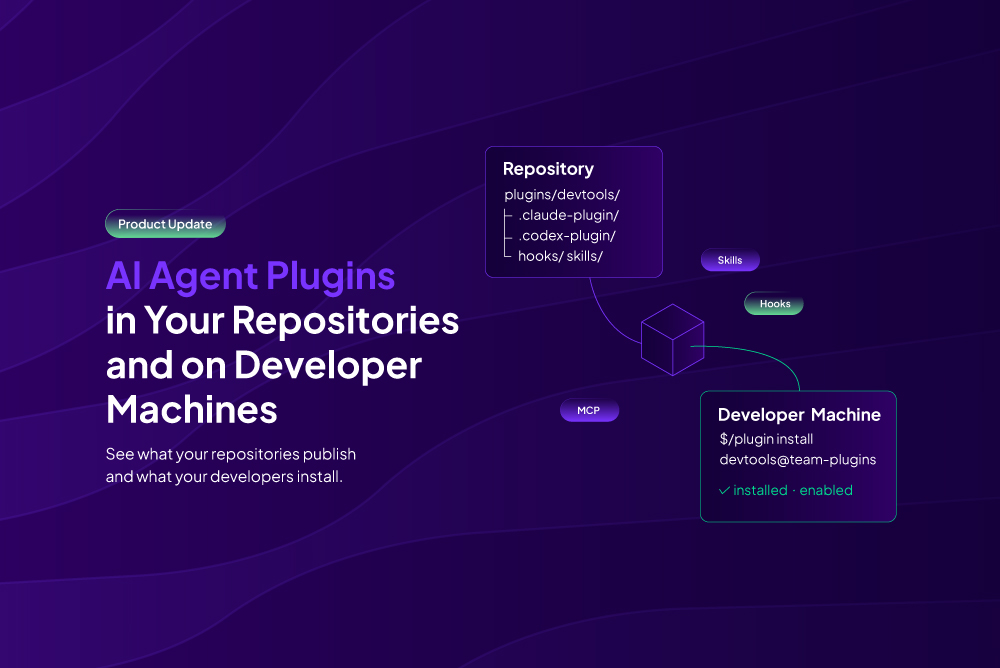
Adds a plugin detail panel in Dev Machine Guard listing marketplace source, plugin file origin, per-device installation scope (User, Project, Local, System), version, state, and component breakdown by kind (skills, commands, MCP servers), with Claude Code skill usage counts.︀︄︇︀︅︉︀︅︀︀︃︀︀︅︅︀︅︊︀︄︆︀︃︄
 announced · Oct 2026
· source
· release history
-
Adds an Agent Skills page under GitHub that scans the default branch of each non-archived repository in your organization daily, detecting skills in folders such as
.claude/skills,.cursor/skills,.windsurf/skills, and.agents/skills; adds a Declared Behavior panel for GitHub repository skills showing…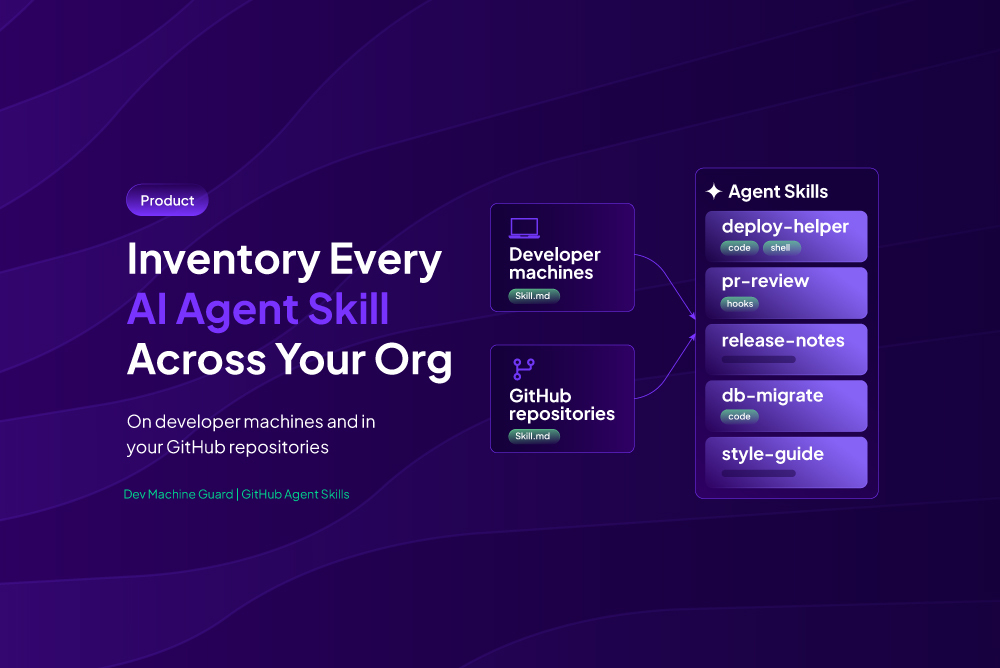 announced · Oct 2026
· source
· release history
-
Adds an Agent Skills page in Dev Machine Guard (under IDE & AI Agents) that inventories AI agent skills across developer machines, scanning
~/.agents/skills,~/.claude/skills, project-level skill folders, andskills.shlock files across 18 AI coding agents including Claude Code, Codex, GitHub Copilot, Cursor,… announced · Oct 2026 · source · release history -
Supports filtering the Agent Skills inventory by source, agent, repository, or flag, and searching by skill name.
Agent Skills Inventory for GitHub Repositories (2026-10-05) · Oct 2026
· source
· release history
-
Flags skills with executable content markers:
code(executable scripts),hooks(declared hooks block),shell(injected shell commands on skill load),invalid yaml(unparseableSKILL.mdfrontmatter), andsymlink(skill reached through a symbolic link). Agent Skills Inventory for GitHub Repositories (2026-10-05) · Oct 2026 · source · release history -
Adds a details panel showing each skill's pre-approved tools (
allowed-tools), who can invoke it, whether it runs in a forked context, and any model override it sets. Agent Skills Inventory for GitHub Repositories (2026-10-05) · Oct 2026 · source · release history
docs
example 9 total
-
Identify which developer machines have a specific Claude Code plugin enabled and where its files actually came from — useful when investigating a suspicious marketplace listing.
In Dev Machine Guard, go to IDE & AI Agents > Agent Plugins, search by plugin name or publisher, filter by source kind (e.g., `github` or `local`), and select the plugin to open its detail panel…announced · Oct 2026 · source -
Audit unmanaged (Local) skills on developer machines that have no upstream source in
skills.shor a plugin marketplace — the class most likely to have been hand-planted.In the StepSecurity dashboard, go to IDE & AI Agents > Agent Skills (Dev Machine Guard) and filter by Source = 'Local'. Export the result as CSV for offline review.announced · Oct 2026 · source -
Find developer machines where the same skill has diverging content — a signal that one copy may have been tampered with or is outdated.
In the StepSecurity dashboard, go to IDE & AI Agents > Agent Skills (Dev Machine Guard).announced · Oct 2026 · source -
Immediately surface every repository skill that pre-approves shell execution — the highest-risk class, equivalent in impact to a CI/CD workflow change.
In the StepSecurity dashboard, go to GitHub > Agent Skills, then apply the 'Shell execution' filter.announced · Oct 2026 · source -
Audit provenance of a
skills.sh-managedskill to confirm its upstream source and lock file before trusting it in CI.In the StepSecurity console, go to GitHub Inventories > Agent Skills, open the details panel for a skill, and check the upstream source, ref, upstream folder hash, and the `skills-lock.json` record…Agent Skills Inventory for GitHub Repositories (2026-10-05) · Oct 2026 · source -
Review which repository skills ship executable scripts or inject shell commands before allowing agent sessions to load them.
In the StepSecurity console, go to GitHub Inventories > Agent Skills, then use the Flag filter to select 'shell' or 'code' to surface only skills with executable content.Agent Skills Inventory for GitHub Repositories (2026-10-05) · Oct 2026 · source
Egress traffic blocking on macOS and Windows runners shipped Restricts outbound network traffic on macOS and Windows GitHub-hosted runners, not just Linux, so workflows cannot freely reach the internet.
Also counts toward: CI/CD pipeline integration
release 12 total
-
Disable implicit AWS endpoint allowances on self-hosted Linux runners with the
disable_implicit_endpointsfeature flag in Self-Hosted VM Harden Runner v1.9.5; GitHub and StepSecurity endpoints remain allowed.︀︄︇︀︅︉︀︅︀︀︃︀︀︅︅︀︅︊︀︄︆︀︃︄
Harden Runner Releases: October 29, 2026 (2026-10-29) · Oct 2026
· source
· release history
- A new feature flag in Harden-Runner GitHub Action v2.22.3 stops implicit AWS endpoint allowances on self-hosted Linux runners (enterprise tier), while GitHub and StepSecurity endpoints remain allowed. Harden Runner Releases: October 29, 2026 (2026-10-29) · Oct 2026 · source · release history
-
Extends the
denied-endpointsinput to macOS runners, enabling deny-list egress policy on macOS to block specific destinations while leaving all others reachable. Harden Runner Releases: October 9, 2026 (2026-10-09) · Oct 2026 · source · release history -
Adds
deny_listegress policy enforcement for Self-hosted Windows Harden Runner v0.10.0 to block specific network destinations Harden Runner Releases: September 30, 2026 (2026-09-30) · Sep 2026 · source · release history - Adds deny list egress policy to Self-Hosted Windows Harden Runner v0.10.0, blocking specific destinations while leaving all others reachable.︀︄︇︀︅︉︀︅︀︀︃︀︀︅︅︀︅︊︀︄︆︀︃︄ Harden Runner Releases: September 30, 2026 (2026-09-30) · Sep 2026 · source · release history
-
Adds
block_modewithallow_listanddeny_listsupport for Self-hosted macOS Harden Runner v0.0.13 Harden Runner Releases: September 30, 2026 (2026-09-30) · Sep 2026 · source · release history
example
-
Prevent the agent from silently opening AWS endpoints on a self-hosted Linux runner — useful when your policy requires all allowed endpoints to be explicitly declared.
env: disable_implicit_endpoints: trueHarden Runner Releases: October 29, 2026 (2026-10-29) · Oct 2026 · source -
Block specific egress destinations on a macOS runner while leaving all other outbound traffic reachable.
- uses: step-security/harden-runner@v2.22.1 with: egress-policy: block denied-endpoints: 'example.com:443 suspicious-host.io:80'Harden Runner Releases: October 9, 2026 (2026-10-09) · Oct 2026 · source -
Restrict outbound traffic on a Windows GitHub-hosted runner to only allowed endpoints — now that block mode is supported beyond Linux.
- uses: step-security/harden-runner@v2.20.0 with: egress-policy: block allowed-endpoints: > api.nuget.org:443 github.com:443Harden Runner Releases- July 7, 2026 (2026-07-07) · Jul 2026 · source
Agent Plugins inventory for Claude Code and Codex shipped Inventories Claude Code and Codex plugins discovered from manifest files across an organization's repositories, showing per-plugin metadata, declared components and hooks, which repositories expose each plugin to contributors, and supporting search and filtering by agent, repository, plugin, or component name.
release 11 total
-
GitHub Copilot plugin inventory now appears under Agent Plugins, reporting skills, custom agents, and MCP servers for plugins in the Copilot CLI, standalone Copilot app, and VS Code, as well as MCP servers configured at the user and project level.
Dev Machine Guard v1.18.1 (2026-10-28) · Oct 2026
· source
· release history
-
Supports filtering the Dev Machine Guard Agent Plugins inventory by installation scope (User, Project, Local, System), source kind, and enablement, and filtering the GitHub Agent Plugins inventory by agent or repository.
announced · Oct 2026
· source
· release history
- Attributes plugin-sourced skills and MCP servers back to their originating plugin on the existing Agent Skills and MCP Servers pages, showing the marketplace and plugin that delivered each component. announced · Oct 2026 · source · release history
-
Adds an Agent Plugins page under GitHub > AI Agents that inventories plugin manifests (
.claude-plugin/plugin.jsonfor Claude Code,.codex-plugin/plugin.jsonfor Codex) published across your organization's GitHub repositories, identifying the publishing repository, plugin folder path, declared metadata, branch,… announced · Oct 2026 · source · release history - Exposes a Used by view in the GitHub Agent Plugins detail panel listing every repository whose settings enable a given plugin for all contributors, distinct from repositories that merely publish it. announced · Oct 2026 · source · release history
- Supports CSV export of the full Dev Machine Guard Agent Plugins inventory. announced · Oct 2026 · source · release history
example
-
Determine which repositories in your org enable a published Claude Code plugin for all contributors — catching broad exposure before a compromised plugin update rolls out.
In StepSecurity, go to GitHub > AI Agents > Agent Plugins, filter by agent (Claude Code), select the plugin, and review the 'Used by' panel listing every repository whose `.claude/settings.json`…announced · Oct 2026 · source -
Export the full org-wide AI agent plugin inventory as CSV for offline review or SIEM ingestion.
In Dev Machine Guard, go to IDE & AI Agents > Agent Plugins and click the CSV export button to download the full inventory including plugin names, publishers, source kinds, versions, and…announced · Oct 2026 · source -
Check which repos expose a specific plugin to all their contributors via the Used by view, to assess blast radius before modifying or removing a plugin.
In the StepSecurity console, go to GitHub > AI Agents > Agent Plugins.Agent Plugins Inventory for GitHub Repositories (2026-10-16) · Oct 2026 · source -
Audit which Claude Code or Codex plugins your org's repos publish and what hooks they register — navigate to GitHub > AI Agents > Agent Plugins in the StepSecurity console.
In the StepSecurity console, go to GitHub > AI Agents > Agent Plugins.Agent Plugins Inventory for GitHub Repositories (2026-10-16) · Oct 2026 · source
Device Policy enforcement for IDE extensions shipped Enforces an approved VS Code extension set on developer machines without requiring MDM, assignable per device or globally, with inventory extended to legacy Visual Studio installations.
Also counts toward: Agent-based deployment
release 11 total
-
Opt out of automatic MSI self-updates at install time with
AUTOUPDATE=0; when enabled, the agent verifies SHA-256 hash, signed checksum, and Authenticode publisher before updating, rolls back automatically on failure, and never retries a bad version.︀︄︇︀︅︉︀︅︀︀︃︀︀︅︅︀︅︊︀︄︆︀︃︄
Dev Machine Guard v1.18.1 (2026-10-28) · Oct 2026
· source
· release history
- Redesigns the profile Compliance tab to show a compliance card per policy, one overall status per device, a device panel with per-policy status and reason, and highlights devices whose agent is too old for a policy. Dev Machine Guard v1.17.0 (2026-09-29) · Sep 2026 · source · release history
-
Makes VS Code
settings.jsonfiles beginning with a UTF-8 byte order mark (written by PowerShell 5.1Set-Content -Encoding UTF8orutf8bom-configurededitors) enforceable. Dev Machine Guard v1.15.0 (2026-08-03) · Aug 2026 · source · release history - Adds MDM verification with field-by-field drift diffs: the agent continuously compares what your MDM deployed against the policy and reports one of eight states (MDM verified, MDM drift, Not deployed, Verification failed, and others), showing desired vs. observed for every field. Device Policy: Package Config Policies, MDM Verification, and Private Marketplace (2026-08-03) · Aug 2026 · source · release history
- Records device policy ownership for every category in a single locked state file, preventing one category's policy clear from dropping another category's ownership record. Dev Machine Guard v1.15.0 (2026-08-03) · Aug 2026 · source · release history
-
Writes
extensions.gallery.serviceUrlinto VS Code user-scopesettings.jsonatomically alongsideextensions.allowedwhen a policy sets a gallery URL; removal is ownership-gated so developer-configured URLs are never deleted. Dev Machine Guard v1.15.0 (2026-08-03) · Aug 2026 · source · release history
example
-
Deploy the MSI silently via SCCM or Intune and disable automatic self-updates for environments where change control requires manual upgrades.
msiexec /i StepSecurityAgent.msi /quiet AUTOUPDATE=0Dev Machine Guard v1.18.1 (2026-10-28) · Oct 2026 · source -
Assign a Device Policy profile to enforce an approved VS Code extension set across all developer machines without MDM.
In the dashboard, go to Device Policy > Profiles, create or select a profile, then assign it to All Devices. The agent installs and continuously enforces the approved extension set on its next cycle.Dev Machine Guard v1.13.0 (2026-07-09) · Jul 2026 · source
Dev Machine Guard malicious file detection shipped Detects malicious files on developer machines using configurable detection rules grouped by campaign, surfaces flagged files in a Findings page with New, Resolved, and Suppressed tabs, supports per-rule activation controls to suppress noisy detections fleet-wide, and exports findings to CSV.
Also counts toward: CSV data export, Web management console
release 9 total
-
Deactivate a detection rule behind a finding for every device without leaving the Findings page, with a required reason for the change.
Malicious Files: Suppression Rules and Finding Actions (2026-11-03) · Nov 2026
· source
· release history
- Resolve or suppress individual findings on Dev Machine Guard with an optional comment; suppressed findings display their reason in a new Reason column. Malicious Files: Suppression Rules and Finding Actions (2026-11-03) · Nov 2026 · source · release history
- Suppression rules apply to current findings and to files found on later scans, and you can preview matching findings before creating a rule, then edit or delete rules at any time. Malicious Files: Suppression Rules and Finding Actions (2026-11-03) · Nov 2026 · source · release history
-
Dev Machine Guard now has a Suppression Rules page where you define fleet-wide rules that match on file path, detection rule, SHA-256 hash, campaign, confidence, or any combination — with
*as a wildcard — and apply to all devices or a selected subset.︀︄︇︀︅︉︀︅︀︀︃︀︀︅︅︀︅︊︀︄︆︀︃︄ Malicious Files: Suppression Rules and Finding Actions (2026-11-03) · Nov 2026 · source · release history - Create a suppression rule directly from a finding, with its detection rule and file path pre-filled, and optionally limit the rule to that finding's device in one click. Malicious Files: Suppression Rules and Finding Actions (2026-11-03) · Nov 2026 · source · release history
- Adds a Findings page under Developer Machines showing flagged files grouped into New, Resolved, and Suppressed tabs, with device, user, OS, campaign, confidence, and status metadata. Dev Machine Guard: Malicious Files Rules and Findings (2026-10-27) · Oct 2026 · source · release history
example
-
Quickly scope a suppression to exactly one endpoint when triaging a finding that is unique to a developer's machine.
On the Dev Machine Guard Findings page, open the finding, click 'Create suppression rule' (file path and detection rule are pre-filled), then click 'Limit to this device', select reason 'Accepted…Malicious Files: Suppression Rules and Finding Actions (2026-11-03) · Nov 2026 · source -
Triage high-confidence malicious file hits across your fleet and export them for further analysis or ticketing.
In Dev Machine Guard, go to Developer Machines > Findings, set the confidence filter to high, select the New tab to see unflagged items, then click Export to download a CSV of the filtered findings.Dev Machine Guard: Malicious Files Rules and Findings (2026-10-27) · Oct 2026 · source -
Suppress noisy detections fleet-wide by deactivating a rule from the Rules page, keeping findings visible under the Suppressed tab without deleting them.
In Dev Machine Guard, go to Developer Machines > Rules, locate the rule by name or filter by campaign, then click Deactivate to stop it scanning every enrolled device and move its existing findings…Dev Machine Guard: Malicious Files Rules and Findings (2026-10-27) · Oct 2026 · source
Developer machine package discovery and scanning shipped Discovers globally installed packages and scans lockfiles and package metadata on developer machines, including pnpm and Yarn globals on Windows, using concurrent workers for speed.
Also counts toward: Scheduled jobs
release 10 total
-
Set a custom
device_idin the agent'sconfig.jsonto give a device a stable, admin-controlled identity used by scans, scheduling, hooks, and device policies.
Dev Machine Guard v1.18.1 (2026-10-28) · Oct 2026
· source
· release history
- Windows system package inventory now covers programs listed in Programs and Features (machine-wide and per-user) plus Chocolatey, Scoop, and winget packages. Dev Machine Guard v1.18.1 (2026-10-28) · Oct 2026 · source · release history
- Package inventory and package-manager configuration auditing now covers Go modules, Rust (Cargo), PHP (Composer), .NET (NuGet), and Ruby (RubyGems and Bundler), alongside the existing npm and Python coverage. Dev Machine Guard v1.18.1 (2026-10-28) · Oct 2026 · source · release history
- Adds WSL scanning capability to inventory packages, credentials, and AI tooling in running Windows Subsystem for Linux distributions, with each distribution appearing as a separate device linked to its host (default off) Dev Machine Guard v1.17.0 (2026-09-29) · Sep 2026 · source · release history
-
Detection of global installs now searches per-version trees of
nvm,fnm,mise,volta, andasdf. Dev Machine Guard v1.16.0 (2026-08-21) · Aug 2026 · source · release history -
Adds
package_configpolicy support: the agent converges a StepSecurity-owned block in~/.npmrcto route npm, pnpm, Yarn classic, and bun through your tenant's Secure Registry; absent policy is a no-op with snapshot rollback. Dev Machine Guard v1.15.0 (2026-08-03) · Aug 2026 · source · release history
example
-
Pin a stable, human-readable identity to a developer workstation so its records never duplicate across scan users or root/SYSTEM runs.
{ "device_id": "eng-laptop-alice-01" }Dev Machine Guard v1.18.1 (2026-10-28) · Oct 2026 · source
AWS OIDC Federation for Token Minting shipped Adds AWS as a second OIDC federation provider, allowing EKS, EC2, Lambda, and other workloads to mint scoped StepSecurity API tokens using IAM identity instead of GitHub Actions context.
release 8 total
-
Adds
keyless.enabled,keyless.region,keyless.secretName, andkeyless.refreshIntervalHoursHelm values to let the Harden Runner daemonset fetch its StepSecurity API key from AWS Secrets Manager via IRSA (pod IAM role) instead of a static Helm value, refreshing on a configurable schedule (default3hours);…
ARC Harden Runner v2.20.0 (2026-09-23) · Sep 2026
· source
· release history
-
Adds
AWSas a provider option in the trust policy selector, allowing workloads to prove IAM identity instead of just GitHub Actions context Mint StepSecurity API Tokens from AWS Workloads (2026-08-20) · Aug 2026 · source · release history - Extends token minting capability to any workload capable of requesting a token from AWS STS, including EKS, EC2, and Lambda Mint StepSecurity API Tokens from AWS Workloads (2026-08-20) · Aug 2026 · source · release history
- AWS trust policies match on the issuer URL of the account's outbound federation, the 12-digit AWS account ID, and an optional role ARN — leave the role ARN blank to trust any role in the account, or specify one to pin to a single workload. Mint StepSecurity API Tokens from AWS Workloads (2026-08-20) · Aug 2026 · source · release history
- AWS trust policies carry the same max session duration and permissions allowlist controls already available to GitHub Actions policies, so minted tokens are capped and scoped identically. Mint StepSecurity API Tokens from AWS Workloads (2026-08-20) · Aug 2026 · source · release history
- Adds AWS as a second OIDC federation provider for StepSecurity trust policies, alongside GitHub Actions — EKS, EC2, Lambda, and any workload that can call AWS STS can now mint scoped StepSecurity API tokens without a long-lived key. Mint StepSecurity API Tokens from AWS Workloads (2026-08-20) · Aug 2026 · source · release history
example
-
Eliminate the static API key from Helm values by having the daemonset pull it from AWS Secrets Manager via the pod's IAM role — useful in environments where secrets in Helm values are a compliance risk.
serviceAccount: annotations: eks.amazonaws.com/role-arn: arn:aws:iam::<account-id>:role/<irsa-role> env: customer: "<your-org>" keyless: enabled: "true" region: "us-east-1" secretName:…ARC Harden Runner v2.20.0 (2026-09-23) · Sep 2026 · source -
Pin a trust policy to a single Lambda function's execution role so only that workload can mint a StepSecurity API token.
In the StepSecurity console, go to Organization > Trust Policies > New Policy, set Provider to 'AWS', enter the 12-digit AWS account ID, and enter the full role ARN (e.g.Mint StepSecurity API Tokens from AWS Workloads (2026-08-20) · Aug 2026 · source -
Configure an org-scope trust policy in StepSecurity that allows any IAM role in a specific AWS account to mint API tokens — useful for giving an EKS cluster-wide workload identity access without storing a key.
In the StepSecurity console, go to Organization > Trust Policies > New Policy, set Provider to 'AWS', enter your 12-digit AWS account ID, leave Role ARN blank to trust any role in the account, set a…Mint StepSecurity API Tokens from AWS Workloads (2026-08-20) · Aug 2026 · source
Malicious file detection in repository history shipped Scans full repository history — every branch, pull request, and tag — for files planted by known supply chain attack campaigns, with a Rules page listing detection rules by campaign and severity, a Findings view showing matched files with introducing commits, scan status per repository, and CSV export of findings.
Also counts toward: CSV data export
release
-
Suppressed findings on GitHub now show their reason in a new Reason column; new file versions inherit the suppressed or resolved status until explicitly changed.
Malicious Files: Suppression Rules and Finding Actions (2026-11-03) · Nov 2026
· source
· release history
- Adds a Rules view showing each detection rule's campaign, severity, revision, and the ordered checks it runs against every file version. Malicious Files for GitHub Repositories (Beta) (2026-10-27) · Oct 2026 · source · release history
- Adds a Findings view listing every file that matched a rule, with associated branches, pull requests, tags, matched checks, and the introducing commit — filterable by severity, campaign, or rule. Malicious Files for GitHub Repositories (Beta) (2026-10-27) · Oct 2026 · source · release history
- Supports filtering Findings by confidence or campaign and exporting findings to CSV. Dev Machine Guard: Malicious Files Rules and Findings (2026-10-27) · Oct 2026 · source · release history
- Adds a Malicious Files section under GitHub scans that inspects full repository history — every branch, pull request, and tag — for files planted by known supply chain attack campaigns such as Shai-Hulud, GlassWorm, and Miasma.︀︄︇︀︅︉︀︅︀︀︃︀︀︅︅︀︅︊︀︄︆︀︃︄ Malicious Files for GitHub Repositories (Beta) (2026-10-27) · Oct 2026 · source · release history
- Adds a Scan Status view showing the most recent scan per repository, including commits and file versions scanned, findings, and last/next scan times. Malicious Files for GitHub Repositories (Beta) (2026-10-27) · Oct 2026 · source · release history
example
-
Suppress a known test-fixture binary fleet-wide before it floods every future scan with false positives.
In Dev Machine Guard, go to Suppression Rules > New Rule. Set 'File path' to the fixture path (e.g.Malicious Files: Suppression Rules and Finding Actions (2026-11-03) · Nov 2026 · source -
Suppress a reviewed test fixture in GitHub so every existing and future version of the file is silenced without repeated manual triage.
In StepSecurity GitHub Findings, locate the file finding, click 'Suppress', select reason 'Used in tests', add an optional comment, and confirm — the status applies to all versions of the file across…Malicious Files: Suppression Rules and Finding Actions (2026-11-03) · Nov 2026 · source -
Export all Findings for a repository to CSV for offline triage or ingestion into a SIEM, filtered to high-severity results.
In the StepSecurity console, go to GitHub > Malicious Files > Findings, filter by severity, then select Export to CSV.Malicious Files for GitHub Repositories (Beta) (2026-10-27) · Oct 2026 · source -
Review active detection rules to understand which supply chain campaigns are covered and at what severity before interpreting findings.
In the StepSecurity console, go to GitHub > Malicious Files > Rules to see each rule's campaign, severity, revision, and the ordered checks applied to every file version.Malicious Files for GitHub Repositories (Beta) (2026-10-27) · Oct 2026 · source
Policy Evaluations log and control findings shipped Logs every policy evaluation with its outcome, per-policy violation breakdown, related PR link, timing metrics, and per-control findings with remediation tracking and suppression.
release 8 total
-
Configure PWN Request and Script Injection controls independently to pass checks on private and internal repositories while still failing them on public ones, via the Pass on non-public repositories setting under GitHub Checks > Configuration.︀︄︇︀︅︉︀︅︀︀︃︀︀︅︅︀︅︊︀︄︆︀︃︄
GitHub Checks: Pass on Non-Public Repositories for PWN Request and Script Injection (2026-11-03) · Nov 2026
· source
· release history
- Surfaces exemptions created via ServiceNow or through the API on the same Exemptions tab. PAT Governance: Exemptions, Configurable PAT Abuse Thresholds, GitHub Audit Log, and Classic PATs on GitHub Enterprise Server (2026-09-29) · Sep 2026 · source · release history
- Exemptions are version-independent — any version ref in an exemption entry is ignored, so the exemption covers every version of the Action. Low Score Exemptions for Control Evaluation (2026-09-28) · Sep 2026 · source · release history
-
Adds exemption support for the 'Third-party GitHub Actions with high scores should be used' control, configurable under Settings > Control Evaluation in the Control options card, allowing Actions to be exempted by exact name (e.g.︀︄︇︀︅︉︀︅︀︀︃︀︀︅︅︀︅︊︀︄︆︀︃︄
example-org/example-action) or owner wildcard (e.g. Low Score Exemptions for Control Evaluation (2026-09-28) · Sep 2026 · source · release history -
Policy Evaluations audit log now includes
.NETin the Ecosystem filter, enabling narrowing of audit log entries to NuGet requests. NuGet Ecosystem Support in GitHub Checks, OSS Package Search, and Secure Registry (2026-07-30) · Jul 2026 · source · release history - Workflow run insights now include a Workflow Run Policy Evaluation section on the Summary tab covering blocked, allowed, and no-policy states, including for cancelled runs. Workflow Run Policies: allow-list enforcement, runner constraints, and richer policy insight (2026-07-21) · Jul 2026 · source · release history
example
-
Reduce alert noise from private and internal repos while keeping strict enforcement on public repos for PWN Request findings.
In the StepSecurity console, go to GitHub Checks > Configuration, select the PWN Request control, and enable 'Pass on non-public repositories'.GitHub Checks: Pass on Non-Public Repositories for PWN Request and Script Injection (2026-11-03) · Nov 2026 · source -
Suppress low-score alerts for a vetted Action your team has reviewed, without needing to pin a specific version.
In the StepSecurity console, go to Settings > Control Evaluation, open the Control options card for 'Third-party GitHub Actions with high scores should be used', and add `example-org/example-action`…Low Score Exemptions for Control Evaluation (2026-09-28) · Sep 2026 · source
NuGet ecosystem support in OSS Package Search and PR controls shipped Lets teams find NuGet packages across PRs, default branches, and developer machines, and blocks PRs that introduce compromised or very recently published NuGet dependencies.
release 9 total
-
Adds Keep Git Source setting to preserve git clone entries in Composer package metadata.
Secure Registry: Packagist (PHP) Support (Beta) (2026-10-16) · Oct 2026
· source
· release history
-
NuGet is now selectable from the Package ecosystem toggle in OSS Package Search; packages are indexed from
*.csproj,*.vbproj,*.fsproj,packages.config,packages.lock.json,Directory.Packages.props,Directory.Build.props, and*.deps.jsonfiles. NuGet Ecosystem Support in GitHub Checks, OSS Package Search, and Secure Registry (2026-07-30) · Jul 2026 · source · release history - Secure Registry NuGet policy controls available at launch: Cooldown Period, Compromised Packages, and Custom Block List; Typosquatting Protection is marked Coming Soon. NuGet Ecosystem Support in GitHub Checks, OSS Package Search, and Secure Registry (2026-07-30) · Jul 2026 · source · release history
-
Adds
NuGet Package Compromised UpdatesPR Content Security control to GitHub Checks, blocking pull requests that introduce or update a NuGet dependency flagged in StepSecurity's compromised-packages database; can be set to Required or Optional. NuGet Ecosystem Support in GitHub Checks, OSS Package Search, and Secure Registry (2026-07-30) · Jul 2026 · source · release history -
NuGetAudit is not yet supported: Secure Registry does not proxy the VulnerabilityInfo resource, causing audit-enabled restores to emit
NU1905; workaround is to pass-p:NuGetAudit=falseor exclude the Secure Registry source from audit sources. NuGet Ecosystem Support in GitHub Checks, OSS Package Search, and Secure Registry (2026-07-30) · Jul 2026 · source · release history -
Adds
NuGet Package CooldownPR Content Security control to GitHub Checks, blocking pull requests that add recently published NuGet versions until they age beyond the configured cooldown window; can be set to Required or Optional. NuGet Ecosystem Support in GitHub Checks, OSS Package Search, and Secure Registry (2026-07-30) · Jul 2026 · source · release history
example
-
Perform a NuGet restore without triggering NU1905 warnings while NuGetAudit support is pending in Secure Registry.
dotnet restore -p:NuGetAudit=falseNuGet Ecosystem Support in GitHub Checks, OSS Package Search, and Secure Registry (2026-07-30) · Jul 2026 · source
Custom Block List for Secure Registry shipped Blocks specific packages or version ranges by glob pattern on a per-ecosystem basis, independently of other supply chain controls.
release 7 total
-
Supports Cooldown Period, Compromised Packages, and Custom Block List policy controls for Packagist packages.
Secure Registry: Packagist (PHP) Support (Beta) (2026-10-16) · Oct 2026
· source
· release history
-
Adds RubyGems support: point Bundler, the gem CLI, or an artifact repository manager at
https://registry.stepsecurity.io/rubyto evaluate every gem request against your RubyGems policy, with Cooldown Period, Compromised Packages, and Custom Block List controls; integration paths cover JFrog Artifactory, Sonatype… Secure Registry: RubyGems and Cargo Support, and Custom Block Messages for npm (2026-10-12) · Oct 2026 · source · release history -
Adds Cargo support: point Cargo or JFrog Artifactory at the sparse index
sparse+https://registry.stepsecurity.io/rust/to evaluate every crate request against your Cargo policy, with Cooldown Period, Compromised Packages, and Custom Block List controls; integration paths cover JFrog Artifactory and Direct, and… Secure Registry: RubyGems and Cargo Support, and Custom Block Messages for npm (2026-10-12) · Oct 2026 · source · release history -
Adds a Hidden Versions Notice setting for npm that replaces the default notice shown when package versions are hidden by policy, accepting up to 300 characters and supporting placeholders such as
{{count}}and{{package}}. Secure Registry: RubyGems and Cargo Support, and Custom Block Messages for npm (2026-10-12) · Oct 2026 · source · release history -
Adds a Block Message setting in npm Registry Settings to include custom text (up to 500 characters) in the error developers see when a control blocks a request, supporting placeholders such as
{{control}}and{{package}}; applies to every control except Cooldown Period. Secure Registry: RubyGems and Cargo Support, and Custom Block Messages for npm (2026-10-12) · Oct 2026 · source · release history -
Custom Block List bans a Go module or version range org-wide using
module@versionform with glob support. Secure Registry Now Supports Go (2026-08-13) · Aug 2026 · source · release history
example
-
Tell developers how to request a package exception when a control blocks their npm install, using the package name in the message.
In npm Registry Settings, set Block Message to: 'Package {{package}} was blocked by {{control}}. To request an exception, open a ticket at https://security.example.com/exceptions.'Secure Registry: RubyGems and Cargo Support, and Custom Block Messages for npm (2026-10-12) · Oct 2026 · source -
Enforce an internal ban on all 4.x versions of lodash and an entire scoped namespace across your npm policy.
In the Secure Registry console, go to Policy > npm > Custom Block List and add entries: `lodash@4*` and `@rejected-scope/*`, then save.Secure Registry: Maven Support in Beta, Custom Block List, and Tarball URL Rewriting (2026-07-24) · Jul 2026 · source
Go ecosystem support in Secure Registry shipped Adds Go module proxy, checksum database relaying, Cooldown periods, and Compromised Packages controls to the Secure Registry alongside existing npm, PyPI, Maven, and NuGet.
release 9 total
-
Adds Dist URL Rewriting setting to route package zip downloads through Secure Registry so every archive is checked against your policy.
Secure Registry: Packagist (PHP) Support (Beta) (2026-10-16) · Oct 2026
· source
· release history
- Integration paths for Go proxy support cover JFrog Artifactory, Sonatype Nexus Repository, and Direct. Secure Registry Now Supports Go (2026-08-13) · Aug 2026 · source · release history
- Cooldown Period holds newly published Go module versions for a configurable window, with per-module exemptions scoped to the full module path. Secure Registry Now Supports Go (2026-08-13) · Aug 2026 · source · release history
- Compromised Packages control blocks Go module versions flagged by StepSecurity's SOC or the wider security community. Secure Registry Now Supports Go (2026-08-13) · Aug 2026 · source · release history
-
New Released Tags Only control (Go-specific) rejects module resolutions at commit hashes, branch names, and pseudo-versions such as
v0.0.0-20241114170450-2d3c2a9cc518; only published release tags are permitted. Secure Registry Now Supports Go (2026-08-13) · Aug 2026 · source · release history -
New Proxy Checksum Database setting under Go Registry Settings relays
sum.golang.orgrequests through Secure Registry, removing the need to disableGOSUMDBwhen runners cannot reach the default checksum database. Secure Registry Now Supports Go (2026-08-13) · Aug 2026 · source · release history
Enhanced webhook delivery infrastructure shipped Supports up to ten webhooks per tenant with independent delivery, per-webhook event subscriptions (Insights, Detections, Audit Logs), and repository scoping.
Also counts toward: Outbound webhooks (the product notifies you)
release 9 total
-
Adds an Add Webhook control in the UI to create additional webhook endpoints, each rendered as a collapsible card showing its name, endpoint, and event-type chips.
Webhook Integration: Multiple Endpoints per Tenant (2026-09-07) · Sep 2026
· source
· release history
- Adds per-webhook event subscriptions choosing from four event types: Insights, Detections, Secure Registry Audit Logs, and API Audit Logs, in any combination. Webhook Integration: Multiple Endpoints per Tenant (2026-09-07) · Sep 2026 · source · release history
- Delivers independent copies of each event to every subscribed webhook — a failure at one endpoint does not affect delivery to others. Webhook Integration: Multiple Endpoints per Tenant (2026-09-07) · Sep 2026 · source · release history
- Supports up to ten webhooks per tenant, each configured with its own endpoint URL, HTTP method, headers, message format, and Envelope template — replacing the previous single-webhook-per-tenant limit. Webhook Integration: Multiple Endpoints per Tenant (2026-09-07) · Sep 2026 · source · release history
- Adds repository-level scoping for webhooks targeting Insights and Detections Webhook Integration: Multiple Endpoints per Tenant (2026-09-07) · Sep 2026 · source · release history
- Enables per-webhook configuration of endpoint URL, HTTP method, headers, and message format Webhook Integration: Multiple Endpoints per Tenant (2026-09-07) · Sep 2026 · source · release history
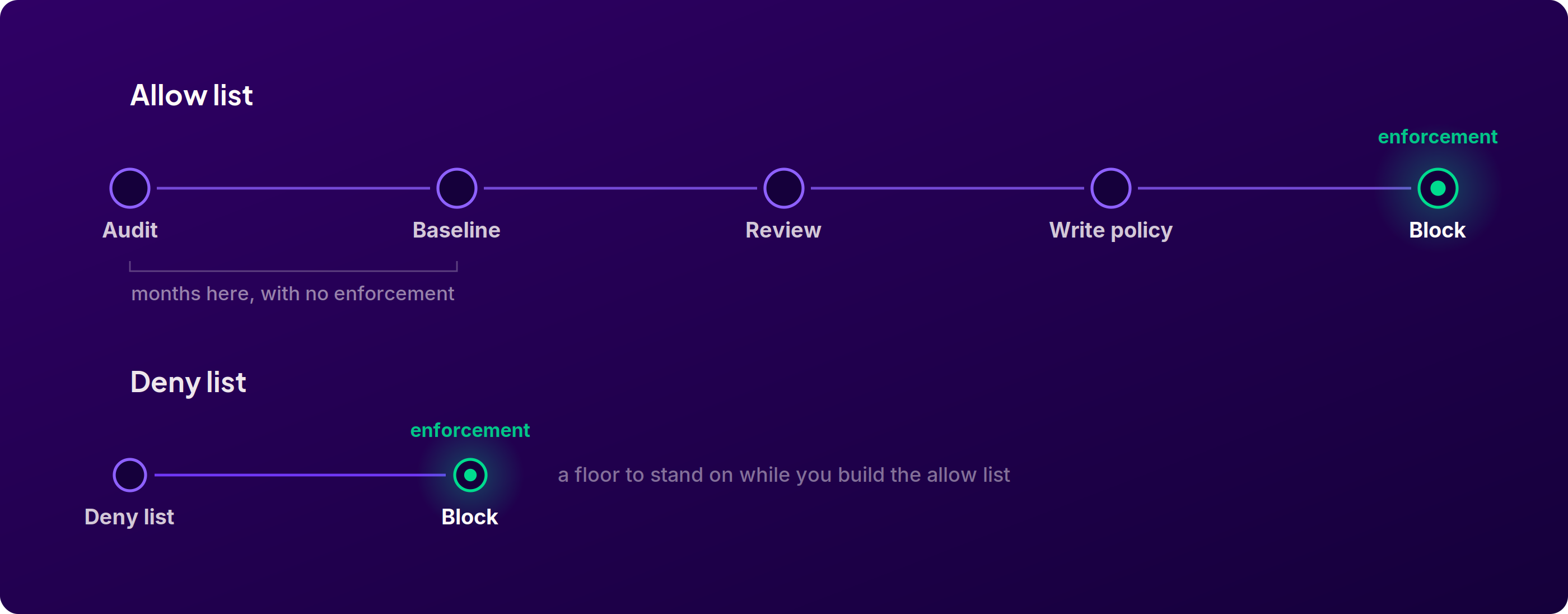
Centralized Deny List Management for Egress Control shipped Enables the management of deny lists for both the GitHub Action and Self-Hosted VM runner through the central Policy Store, allowing operators to block specific outbound traffic without editing individual workflow or config files.
Also counts toward: CI/CD pipeline integration
release 7 total
-
Supports deny-list policies in the Policy Store attached at organization or cluster scope (ARC Harden Runner v2.19.0+), enforcing CI egress restrictions across all repositories without per-workflow-file edits.
 announced · Sep 2026
· source
· release history
-
Adds
policyStore-manageddeny list egress policies to ARC cluster scope
ARC Harden Runner v2.19.0 (2026-08-24) · Aug 2026
· source
· release history
- Extends deny list egress policy enforcement to ARC Harden Runner — policies attached at Cluster scope in the Policy Store now block specific destinations across every job in that cluster without requiring workflow file changes. ARC Harden Runner v2.19.0 (2026-08-24) · Aug 2026 · source · release history
- Enables management of deny lists through the central Policy Store instead of editing individual workflow files Harden Runner Releases: August 17, 2026 · Aug 2026 · source · release history
- Deny lists for both the GitHub Action and Self-Hosted VM runner can be managed centrally through the Policy Store, eliminating the need to edit workflow or config files per job. Harden Runner Releases: August 17, 2026 (2026-08-17) · Aug 2026 · source · release history
- Centralized deny list management via the Policy Store eliminates workflow file edits for egress rules Harden Runner Releases: August 17, 2026 (2026-08-17) · Aug 2026 · source · release history
example
-
Block specific destinations while allowing all other egress traffic using workflow inputs
egress-policy: block denied-endpoints: | example.com *.example.orgHarden Runner Releases: August 17, 2026 · Aug 2026 · source -
Block traffic to known-bad domains in a GitHub Actions workflow
- uses: stepsecurity/harden-runner@v2 with: egress-policy: block denied-endpoints: | example.com *.example.orgHarden Runner Releases: August 17, 2026 (2026-08-17) · Aug 2026 · source
Self-hosted runner fleet inventory shipped Merges GitHub-discovered and agent-reported self-hosted runners into one inventory showing scope, lifecycle status, agent version, and Harden-Runner install status.
release 7 total
-
New
Self-hosted runners: Read-onlyorganization permission added to the StepSecurity GitHub App enables listing runners registered at the organization level via the GitHub API, not just those reporting from the Harden-Runner agent. Self-Hosted Runners: Full Fleet Visibility and a New GitHub App Permission (2026-08-11) · Aug 2026 · source · release history - Consolidates runner inventory by merging GitHub API registrations, workflow run insights, and Harden-Runner agent reports into a single view Self-Hosted Runners: Full Fleet Visibility and a New GitHub App Permission (2026-08-11) · Aug 2026 · source · release history
- The Self-Hosted Runners page now merges runners discovered from GitHub (org-level and repo-level) with agent-reported runners into a single consolidated inventory, surfacing runners with no Harden-Runner agent installed as Not installed in the Harden Runner column. Self-Hosted Runners: Full Fleet Visibility and a New GitHub App Permission (2026-08-11) · Aug 2026 · source · release history
- Each runner entry now shows a discovery source, registration scope badge (Org or Repo with repository name), and lifecycle classification (Persistent or Ephemeral). Self-Hosted Runners: Full Fleet Visibility and a New GitHub App Permission (2026-08-11) · Aug 2026 · source · release history
-
Admins must approve the pending GitHub App permission request under
Organization Settings → GitHub Appsfor organization-level runners to appear in the inventory. Self-Hosted Runners: Full Fleet Visibility and a New GitHub App Permission (2026-08-11) · Aug 2026 · source · release history - New per-runner detail panel exposes agent version and install time for agent-reported runners, plus level, OS, runner group, labels, and observed job counts for GitHub-registered runners. Self-Hosted Runners: Full Fleet Visibility and a New GitHub App Permission (2026-08-11) · Aug 2026 · source · release history
example
-
Approve the new GitHub App permission so your full runner fleet — including organization-level runners never seen by the agent — appears in the StepSecurity inventory.
In GitHub, go to Organization Settings → GitHub Apps, locate the StepSecurity app, and approve the pending 'Self-hosted runners: Read-only' permission request.Self-Hosted Runners: Full Fleet Visibility and a New GitHub App Permission (2026-08-11) · Aug 2026 · source -
Approve the pending permission request to unlock organization-level runner visibility in the fleet inventory.
In the console, go to Organization Settings → GitHub Apps and approve the 'Self-hosted runners: Read-only organization' permission for the StepSecurity app.Self-Hosted Runners: Full Fleet Visibility and a New GitHub App Permission (2026-08-11) · Aug 2026 · source
Secure Registry package inventory and statistics shipped Provides an Inventory page listing every package requested through Secure Registry with metadata including licenses, vulnerabilities, first-seen date, last puller, and pull history, plus a Statistics page showing request counts broken down by served, modified, and blocked outcomes over a selected time range, with filtering by ecosystem, severity, CVSS score, version, license, and advisory ID.
release
-
Supports package search in Inventory by package name, SPDX license identifier, or advisory ID/alias to surface affected versions.
Secure Registry: Inventory and Statistics (Beta) (2026-10-26) · Oct 2026
· source
· release history
- Adds per-package detail view in Inventory showing first-seen date, last puller, advisories with fixed versions and upgrade guidance, and the last five allowed pulls. Secure Registry: Inventory and Statistics (Beta) (2026-10-26) · Oct 2026 · source · release history
- Adds Secure Registry Statistics page showing requests handled over a selected time range, broken down into served-as-is, modified, and blocked, with a daily request history and per-control counts of modified and blocked requests. Secure Registry: Inventory and Statistics (Beta) (2026-10-26) · Oct 2026 · source · release history
- Adds Secure Registry Inventory page listing every package requested through Secure Registry with its last pulled version, request counts, licenses, and known vulnerabilities.︀︄︇︀︅︉︀︅︀︀︃︀︀︅︅︀︅︊︀︄︆︀︃︄ Secure Registry: Inventory and Statistics (Beta) (2026-10-26) · Oct 2026 · source · release history
- Adds filtering in Inventory by ecosystem, vulnerability severity, minimum CVSS score, version, and license status. Secure Registry: Inventory and Statistics (Beta) (2026-10-26) · Oct 2026 · source · release history
example
-
Identify every package version your teams have pulled that is affected by a specific advisory, so you can prioritise remediation.
In Secure Registry, go to Inventory > search by advisory ID or alias > review the listed package versions, their fixed versions, and the upgrade guidance shown in each package detail view.Secure Registry: Inventory and Statistics (Beta) (2026-10-26) · Oct 2026 · source -
Review how many requests your controls blocked versus served over the past week to validate policy effectiveness.
In Secure Registry, go to Statistics > select the desired time range > inspect the daily request history chart and the per-control breakdown of modified and blocked request counts.Secure Registry: Inventory and Statistics (Beta) (2026-10-26) · Oct 2026 · source -
Audit all packages requested under a specific open-source license by searching with its SPDX identifier (e.g.
GPL-3.0) in Inventory.In Secure Registry, go to Inventory > enter the SPDX license identifier (e.g. `GPL-3.0`) in the search box > apply License Status filter to review every requested version under that license.Secure Registry: Inventory and Statistics (Beta) (2026-10-26) · Oct 2026 · source
Broker pod customization via Helm values shipped Exposes Helm values for the broker pod so it can be customised with volume mounts, image pull secrets, resource limits, and scheduling constraints to fit strict cluster environments.
Also counts toward: Kubernetes-native deployment
release 7 total
-
Adds
env.customEnvVarsHelm value to inject arbitrary environment variables (e.g.HTTP_PROXY,HTTPS_PROXY,NO_PROXY) into theharden-runnercontainer for proxied cluster deployments.
ARC Harden Runner v2.20.0 (2026-09-23) · Sep 2026
· source
· release history
-
Adds
env.imagePullPolicyandtetragon.imagePullPolicyHelm values to control image pull behavior for ARC Harden Runner and Tetragon images, enablingIfNotPresentfor clusters that pre-pull images or operate behind constrained registries. ARC Harden Runner v2.19.0 (2026-08-24) · Aug 2026 · source · release history -
OpenCode MCP servers are now collected from
~/.config/opencode/opencode.jsonandopencode.jsonc(both formats, including comments and trailing commas), using the top-levelmcpkey OpenCode declares rather thanmcpServers; project-level configs are found by the existing bounded search. Dev Machine Guard v1.16.0 (2026-08-21) · Aug 2026 · source · release history -
New credential location inventory scans thirteen sources — AWS credentials, AWS config, GCP application default credentials, SSH private keys, git credential store,
.netrc, GitHub CLI hosts,.npmrc,.pypirc, Docker config, kubeconfig, Terraform credentials, and Vault token — reporting exact file path, credential… Dev Machine Guard v1.16.0 (2026-08-21) · Aug 2026 · source · release history -
Adds container process tracing (opt-in) for ARC pods — enable via Helm value
env: enableContainerProcessTracing: "true"in ARC Harden Runner v2.18.6. Harden Runner Releases- August 5, 2026 (2026-08-05) · Aug 2026 · source · release history -
Adds broker pod-spec customization via new Helm values under
broker.*(volumeMounts, imagePullSecrets, automountServiceAccountToken, serviceAccountName, resources, nodeSelector, tolerations, affinity, topologySpreadConstraints) for scheduling alongside strict workloads. Harden Runner Releases- June 24, 2026 (2026-06-24) · Jun 2026 · source · release history
example
-
Enable container process tracing on ARC-hosted pods to capture process events from inside containers.
env: enableContainerProcessTracing: "true"Harden Runner Releases- August 5, 2026 (2026-08-05) · Aug 2026 · source
Expanded Credential and AI Agent Inventory shipped Broadens credential location inventory to cover thirteen sources with file path reporting, and updates AI agent detection to include Pi, Factory Droid, Amp, and OpenCode MCP servers using on-disk artifact provenance.
release 8 total
-
Two new agent skills roots are scanned:
~/.config/amp/skillsand~/.agent/skills.
Dev Machine Guard v1.16.0 (2026-08-21) · Aug 2026
· source
· release history
-
Secrets held in MCP server
command,argument, andURLfields are now redacted before the MCP inventory is reported. Dev Machine Guard v1.16.0 (2026-08-21) · Aug 2026 · source · release history -
Adds
credential location inventoryscan phase reporting tools holding credentials, exact file paths, file modes, and git tracking status without exfiltrating credential values. Dev Machine Guard v1.16.0 (2026-08-21) · Aug 2026 · source · release history - Pi, Factory Droid, and Amp are now detected in the AI agent and tool inventory, proven from on-disk artifacts (npm or Bun manifests, installer anchor directories, Homebrew cask roots, WinGet publisher directories, or pacman file manifests) rather than by binary name, with version read from disk or reported as… Dev Machine Guard v1.16.0 (2026-08-21) · Aug 2026 · source · release history
- Ensures secrets in MCP server command, argument, and URL fields are redacted before the MCP inventory is reported. Dev Machine Guard v1.16.0 (2026-08-21) · Aug 2026 · source · release history
- Improves AI agent detection by adding Pi, Factory Droid, and Amp to the AI agent inventory using on-disk artifact provenance instead of binary names. Dev Machine Guard v1.16.0 (2026-08-21) · Aug 2026 · source · release history
Maven ecosystem support in OSS Package Search, Secure Registry, and PR controls shipped Lets teams search for a specific Maven package across PRs, default branches, and developer machines to assess blast radius, and provides PR controls that block pull requests introducing compromised or recently published Maven dependencies.
previously: Maven ecosystem support in OSS Package Search and PR controls
release
-
Adds Maven (Java) ecosystem support (Beta) to Secure Registry — route all Maven metadata and artifact downloads through
https://registry.stepsecurity.io/javawith Cooldown Period, Compromised Packages, and Custom Block List controls at launch. Secure Registry: Maven Support in Beta, Custom Block List, and Tarball URL Rewriting (2026-07-24) · Jul 2026 · source · release history - Supports four Maven integration paths: JFrog Artifactory, Google Artifact Registry, Sonatype Nexus Repository, and Direct, with setup steps switchable via a new Package manager selector on the Setup Guide tab. Secure Registry: Maven Support in Beta, Custom Block List, and Tarball URL Rewriting (2026-07-24) · Jul 2026 · source · release history
- Enables Maven ecosystem selection in OSS Package Search, allowing blast-radius analysis of specific Maven packages across pull requests, default branches, and developer machines. Maven Ecosystem Support in GitHub Checks and OSS Package Search (2026-06-16) · Jun 2026 · source · release history
- Adds Maven Package Compromised Updates PR control: blocks pull requests that introduce or update a Maven dependency flagged in StepSecurity's compromised-packages database. Maven Ecosystem Support in GitHub Checks and OSS Package Search (2026-06-16) · Jun 2026 · source · release history
- Adds Maven Package Cooldown PR control: blocks pull requests adding recently published Maven versions until they age past the configured cooldown window. Maven Ecosystem Support in GitHub Checks and OSS Package Search (2026-06-16) · Jun 2026 · source · release history
example
-
Route all Maven artifact downloads through Secure Registry for evaluation instead of Maven Central.
In the Secure Registry console, go to Setup Guide > Registry selector > Maven, select your integration path (e.g., Direct), then point your Maven client at `https://registry.stepsecurity.io/java` as…Secure Registry: Maven Support in Beta, Custom Block List, and Tarball URL Rewriting (2026-07-24) · Jul 2026 · source -
Find where a specific Maven package appears across PRs, default branches, and developer machines to assess blast radius before incident response.
In the StepSecurity console, go to OSS Package Search, select Maven from the Package ecosystem toggle, enter the package coordinates (e.g.Maven Ecosystem Support in GitHub Checks and OSS Package Search (2026-06-16) · Jun 2026 · source -
Enable both new Maven PR controls to protect your Java repositories from compromised or freshly published dependencies.
In the StepSecurity console, go to GitHub Checks > PR Content Security, select your Maven repository, and enable Maven Package Compromised Updates and Maven Package Cooldown — setting each to…Maven Ecosystem Support in GitHub Checks and OSS Package Search (2026-06-16) · Jun 2026 · source
Source Attribution in Policy Evaluations shipped Traces every package request in the policy evaluations log back to the specific developer machine or CI pipeline that made it.
Also counts toward: CI/CD pipeline integration
release
-
Adds source attribution for Composer: appending
::dev:or::gha:to the API key inhttp-basicorCOMPOSER_AUTHtraces requests to a developer machine or GitHub Actions run in Policy Evaluations.
Secure Registry: Packagist (PHP) Support (Beta) (2026-10-16) · Oct 2026
· source
· release history
- Every Go module request is logged in the Policy Evaluations log as Allowed, Modified, or Blocked, attributed to the developer machine or workflow run that made the request. Secure Registry Now Supports Go (2026-08-13) · Aug 2026 · source · release history
- Adds Source Attribution to the Policy Evaluations log via two new columns — Source and Source Identifier — tracing every package request to the developer machine or CI pipeline that made it. Secure Registry: Source Attribution, Typosquatting Protection, and Sonatype Nexus Support (2026-06-24) · Jun 2026 · source · release history
-
Enables attribution opt-in by appending an identifier suffix to your API key token (
::dev:for developer machines,gha:for GitHub Actions pipeline runs). Secure Registry: Source Attribution, Typosquatting Protection, and Sonatype Nexus Support (2026-06-24) · Jun 2026 · source · release history
example
-
Trace Composer requests from a GitHub Actions run to a specific workflow in Policy Evaluations using the
::gha:source attribution suffix onCOMPOSER_AUTH.export COMPOSER_AUTH='{"http-basic":{"registry.stepsecurity.io":{"username":"token","password":"<your-api-key>::gha:my-workflow"}}}'Secure Registry: Packagist (PHP) Support (Beta) (2026-10-16) · Oct 2026 · source -
Trace Composer requests from a developer machine to a named user in Policy Evaluations using the
::dev:source attribution suffix onCOMPOSER_AUTH.export COMPOSER_AUTH='{"http-basic":{"registry.stepsecurity.io":{"username":"token","password":"<your-api-key>::dev:alice"}}}'Secure Registry: Packagist (PHP) Support (Beta) (2026-10-16) · Oct 2026 · source -
Attribute CI pipeline package requests to a specific GitHub Actions run so Policy Evaluations log entries link back to the correct workflow.
Set your Secure Registry API key token to the form <token>::gha:<identifier> in your pipeline's package manager configuration, following the Setup Guide.Secure Registry: Source Attribution, Typosquatting Protection, and Sonatype Nexus Support (2026-06-24) · Jun 2026 · source
GitHub Audit Log and PAT activity monitoring shipped Surfaces organization GitHub audit log activity refreshed every 15 minutes and retained for 10 days, with a PAT activity tab summarizing calls per token, a Deleted Runs tab showing deleted workflow runs, and configurable per-rule learning periods and thresholds for PAT abuse detection.
Also counts toward: Administrative audit log, ML-based detection, Scheduled jobs, Web management console
release
-
Adds a new Audit Log page under GitHub in the console to view 15-minute refreshed activity retained for 10 days, including PAT usage baselines and deleted workflow runs
PAT Governance: Exemptions, Configurable PAT Abuse Thresholds, GitHub Audit Log, and Classic PATs on GitHub Enterprise Server (2026-09-29) · Sep 2026
· source
· release history
-
Adds a new Audit Log page under
GitHubshowing organization GitHub audit log activity refreshed every 15 minutes and retained for 10 days, with a PAT activity tab summarizing calls per token and a Deleted runs tab showing deleted workflow runs. PAT Governance: Exemptions, Configurable PAT Abuse Thresholds, GitHub Audit Log, and Classic PATs on GitHub Enterprise Server (2026-09-29) · Sep 2026 · source · release history - Adds a Configure panel on the PAT Abuse tab to turn each abuse detection rule on or off and set its learning period and thresholds; changes apply from the next audit-log poll and preserve already-learned baselines. PAT Governance: Exemptions, Configurable PAT Abuse Thresholds, GitHub Audit Log, and Classic PATs on GitHub Enterprise Server (2026-09-29) · Sep 2026 · source · release history
- Adds a Configure panel on the PAT Abuse tab to enable/disable rules and set learning periods and thresholds per organization PAT Governance: Exemptions, Configurable PAT Abuse Thresholds, GitHub Audit Log, and Classic PATs on GitHub Enterprise Server (2026-09-29) · Sep 2026 · source · release history
example
-
Tune PAT Abuse detection so noisy rules don't fire until enough baseline data is collected, reducing false-positive alerts for a newly on-boarded organization.
In the StepSecurity console, go to Apps & PATs > PAT Abuse > Configure, toggle individual rules on or off, and set the learning period and threshold values for each rule.PAT Governance: Exemptions, Configurable PAT Abuse Thresholds, GitHub Audit Log, and Classic PATs on GitHub Enterprise Server (2026-09-29) · Sep 2026 · source -
Tune detection sensitivity for PAT abuse by adjusting thresholds for a specific rule.
In the console, go to Apps & PATs > PAT Abuse tab, open the Configure panel, and modify the threshold value in the input field.PAT Governance: Exemptions, Configurable PAT Abuse Thresholds, GitHub Audit Log, and Classic PATs on GitHub Enterprise Server (2026-09-29) · Sep 2026 · source -
Investigate which workflow runs were deleted and by whom after a suspected tampering event, using the 10-day retained audit log.
In the StepSecurity console, go to GitHub > Audit Log > Deleted runs and filter by date range and actor to identify who deleted runs.PAT Governance: Exemptions, Configurable PAT Abuse Thresholds, GitHub Audit Log, and Classic PATs on GitHub Enterprise Server (2026-09-29) · Sep 2026 · source
npm package config enforcement on developer machines shipped Writes managed registry configuration files on developer machines routing npm, pnpm, Yarn, and Bun through the tenant's Secure Registry, with MDM script generation for managed rollout.
release
-
Adds Go package config policies that set the Secure Registry as the sole
GOPROXYin the user'sgo/envfile via the same shared~/.netrccredential, leavingGOPRIVATE,GONOPROXY,GONOSUMDB, andGOSUMDBuntouched.
Dev Machine Guard v1.17.0 (2026-09-29) · Sep 2026
· source
· release history
-
Extends npm package config policies to accept an optional list of extra
.npmrcsettings delivered inside the same managed block, allowing rollout of scoped registries or other npm options using${ENV_NAME}token references Dev Machine Guard v1.17.0 (2026-09-29) · Sep 2026 · source · release history -
Adds support for an optional list of extra
.npmrcsettings in npm package config policies, delivered to every assigned device inside the managed block, with tokens referenced as${ENV_NAME}from the developer's environment. Dev Machine Guard v1.17.0 (2026-09-29) · Sep 2026 · source · release history -
Adds PyPI package config policies that point
pipanduvat your tenant's Secure Registry by settingindexinpip.confanduv.toml, storing a shared credential in~/.netrc, and restoring prior config when the policy is detached.︀︄︇︀︅︉︀︅︀︀︃︀︀︅︅︀︅︊︀︄︆︀︃︄ Dev Machine Guard v1.17.0 (2026-09-29) · Sep 2026 · source · release history -
Adds npm package config policies that write a managed block into
~/.npmrcwith the tenant Secure Registry URL and a per-device::dev:suffixed authentication token, bounded byBEGIN/ENDmarkers to leave surrounding configuration untouched. Device Policy: Package Config Policies, MDM Verification, and Private Marketplace (2026-08-03) · Aug 2026 · source · release history - Generates audit, remediation, and uninstall script sets per platform for MDM-delivered package config policies, designed for deployment into Intune Remediations detection/remediation slots or an Iru Custom Script library. Device Policy: Package Config Policies, MDM Verification, and Private Marketplace (2026-08-03) · Aug 2026 · source · release history
example
-
Roll out a scoped private registry for your org's npm packages alongside the Secure Registry, using an environment-variable token that StepSecurity never stores.
@myorg:registry=https://npm.mycompany.internal //npm.mycompany.internal/:_authToken=${MYORG_NPM_TOKEN}Dev Machine Guard v1.17.0 (2026-09-29) · Sep 2026 · source
Secret Exfiltration Attempt detection shipped Detects workflow runs exhibiting known secret-exfiltration attack patterns and raises confidence to High when evidence is deleted after the run, with opt-in immediate notifications.
release
- Introduces three match-granularity levels for threat intel notifications — All threat intel incidents, Affected packages, and Exact version only — selectable from the Threat intel notifications dialog. Threat Intel Notifications: Tenant-Wide Channels and Match Granularity (2026-08-04) · Aug 2026 · source · release history
- Opt-in alerting available in Notification Settings to receive an immediate notification the moment a Secret Exfiltration Attempt is flagged. New Detection: Secret Exfiltration Attempt (2026-06-30) · Jun 2026 · source · release history
- New Secret Exfiltration Attempt detection type flags workflow runs that combine known attack indicators — malicious workflow name, toJSON(secrets) secret dump, suspicious commit message, and an exfiltration artifact — before stolen secrets can be retrieved. New Detection: Secret Exfiltration Attempt (2026-06-30) · Jun 2026 · source · release history
- Direct navigation in the Detections page pinpoints the affected repository, matched rule, indicators, workflow file, and the exact job, step, and line where the secret dump occurred. New Detection: Secret Exfiltration Attempt (2026-06-30) · Jun 2026 · source · release history
- Confidence scoring elevates a detection to High when the workflow run, branch, or workflow file is deleted shortly after execution, treating evidence removal as a strong exploitation signal. New Detection: Secret Exfiltration Attempt (2026-06-30) · Jun 2026 · source · release history
example
-
Limit threat intel noise for an application team by alerting only when the exact compromised package version is present in their environment.
In organization notification settings, enable the 'Notify when StepSecurity threat intel flags a compromised component' event, open the Threat intel notifications dialog, and select 'Exact version…Threat Intel Notifications: Tenant-Wide Channels and Match Granularity (2026-08-04) · Aug 2026 · source -
Get an immediate alert when a secret exfiltration attempt is detected, so you can rotate exposed tokens before an attacker retrieves the artifact.
In the Harden-Runner console, go to Notification Settings and enable the 'Secret Exfiltration Attempt' detection notification.New Detection: Secret Exfiltration Attempt (2026-06-30) · Jun 2026 · source
Apps and PATs exemption management shipped Allows operators to exempt a single token or all tokens a user holds for a fixed period — skipping policy checks, pre-expiry reminders, and automated revocation until the exemption expires — with automatic re-enrollment afterward and exemptions surfaced on a dedicated Exemptions tab regardless of whether they were created via ServiceNow, the API, or the UI.
Also counts toward: Web management console
release
-
Adds tenant-wide exemptions in PAT Governance: select All Organizations in the org selector, open Apps & PATs > Exemptions, and click Add tenant-wide exemption to exempt a token or user across every organization in the tenant simultaneously.︀︄︇︀︅︉︀︅︀︀︃︀︀︅︅︀︅︊︀︄︆︀︃︄
PAT Governance: Tenant-Wide Exemptions (2026-10-12) · Oct 2026
· source
· release history
- Adds a unified exemptions view under All Organizations that lists every organization's exemptions in one place, with tenant-wide exemptions labeled Tenant-wide. PAT Governance: Tenant-Wide Exemptions (2026-10-12) · Oct 2026 · source · release history
- Adds an Exemptions tab in the Apps & PATs console to skip policy checks, reminders, and revocation for specific tokens or users PAT Governance: Exemptions, Configurable PAT Abuse Thresholds, GitHub Audit Log, and Classic PATs on GitHub Enterprise Server (2026-09-29) · Sep 2026 · source · release history
- Adds an Exemptions tab on Apps & PATs to exempt a single token or all tokens a user holds (now and future) for a fixed period, skipping policy checks, pre-expiry reminders, and automated revocation until the exemption expires — with automatic re-enrollment afterward.︀︄︇︀︅︉︀︅︀︀︃︀︀︅︅︀︅︊︀︄︆︀︃︄ PAT Governance: Exemptions, Configurable PAT Abuse Thresholds, GitHub Audit Log, and Classic PATs on GitHub Enterprise Server (2026-09-29) · Sep 2026 · source · release history
example
-
Grant a temporary exemption for every token a specific user holds — useful when a developer is mid-incident and automated revocation would disrupt response.
In the StepSecurity console, go to Apps & PATs > Exemptions, click 'Add Exemption', select the user, choose 'All tokens (current and future)', and set the expiry date.PAT Governance: Exemptions, Configurable PAT Abuse Thresholds, GitHub Audit Log, and Classic PATs on GitHub Enterprise Server (2026-09-29) · Sep 2026 · source -
Skip automated revocation and policy checks for a specific developer's token during a long-lived project.
In the console, navigate to Apps & PATs > Exemptions tab, then select the token row and click 'Exempt'.PAT Governance: Exemptions, Configurable PAT Abuse Thresholds, GitHub Audit Log, and Classic PATs on GitHub Enterprise Server (2026-09-29) · Sep 2026 · source
PAT Governance Reminder Customization shipped Allows customization of pre-expiry PAT reminder emails per token class and reminder band, including subject, body, CC recipients, and override schedules.
release
-
Adds CC recipient support so additional addresses (e.g.︀︄︇︀︅︉︀︅︀︀︃︀︀︅︅︀︅︊︀︄︆︀︃︄ a security distribution list) are copied on every pre-expiry PAT reminder sent by the organization.
PAT Governance: Reminder Recipients and Custom Email Content (2026-09-18) · Sep 2026
· source
· release history
- Pre-expiry reminders sent to token owners at configurable bands (defaulting to 30, 7, and 1 days). PAT Governance for GitHub and Azure DevOps (2026-09-02) · Sep 2026 · source · release history
example
-
Route all PAT expiry reminders to a security team inbox in addition to the org notification address, and set a tighter fine-grained-only schedule.
In the StepSecurity console, go to Settings > Control Evaluation > Reminders & Automation (PAT Governance Controls). Under 'CC Recipients', add your security distribution list address.PAT Governance: Reminder Recipients and Custom Email Content (2026-09-18) · Sep 2026 · source -
Add a security distribution list to receive all PAT reminder emails.
In the console, go to Settings > Control Evaluation, in the Reminders & Automation section of the PAT Governance Controls and add your email address(es) to the CC fieldPAT Governance: Reminder Recipients and Custom Email Content (2026-09-18) · Sep 2026 · source -
Customize the subject line for a specific token class's upcoming expiry reminder.
In the console, go to Settings > Control Evaluation, in the Reminders & Automation section of the PAT Governance Controls and edit the subject for the relevant token class and reminder bandPAT Governance: Reminder Recipients and Custom Email Content (2026-09-18) · Sep 2026 · source -
Customize the 1-day pre-expiry email body for classic tokens to include your internal rotation runbook URL.
In the StepSecurity console, go to Settings > Control Evaluation > Reminders & Automation (PAT Governance Controls).PAT Governance: Reminder Recipients and Custom Email Content (2026-09-18) · Sep 2026 · source
Threat Center Visibility and Granularity Controls shipped Adds 'Affecting You' filters, matched-IOCs correlation maps, 'You are affected' badges, and granular notification settings to help operators identify relevant incidents and reduce alert noise.
release
-
Adds a You are affected badge to incidents in both the All and Affecting You views so exposure is visible directly from the list.
See Which Threat Center Incidents Affect You (2026-08-18) · Aug 2026
· source
· release history
- Exposes matched components and IOCs breakdown per repository, branch, file, commit, or runtime run See Which Threat Center Incidents Affect You (2026-08-18) · Aug 2026 · source · release history
- New matched-components breakdown per affected incident lists compromised packages found in your repositories, split by open pull request vs. default branch, down to the affected files, head commit, and matched version. See Which Threat Center Incidents Affect You (2026-08-18) · Aug 2026 · source · release history
- Adds Affected packages and Exact version only notification granularity options so alerts fire only for incidents that touch your own dependencies. See Which Threat Center Incidents Affect You (2026-08-18) · Aug 2026 · source · release history
- Introduces You are affected badge on incidents that match your organization's exposed packages See Which Threat Center Incidents Affect You (2026-08-18) · Aug 2026 · source · release history
example
-
Quickly identify which threat center incidents require immediate action by viewing only those affecting your environment.
In the Threat Center console, click 'Affecting You' to filter incidents impacting your repositories.See Which Threat Center Incidents Affect You (2026-08-18) · Aug 2026 · source
Sonatype Nexus Repository integration for npm proxy shipped Adds Sonatype Nexus Repository as a supported npm proxy path so teams using Nexus can enforce Secure Registry policy alongside other supported options.
release
-
Adds integration paths for Packagist via JFrog Artifactory and Direct, configurable through a new Packagist Registry Settings panel.
Secure Registry: Packagist (PHP) Support (Beta) (2026-10-16) · Oct 2026
· source
· release history
- Adds Tarball URL Rewriting setting for npm, rewriting tarball URLs in metadata responses so package downloads route through Secure Registry instead of the public npm registry. Secure Registry: Maven Support in Beta, Custom Block List, and Tarball URL Rewriting (2026-07-24) · Jul 2026 · source · release history
- Adds Sonatype Nexus Repository as an integration path for teams that proxy npm through Nexus, joining JFrog Artifactory, Google Artifact Registry, and Direct npm. Secure Registry: Source Attribution, Typosquatting Protection, and Sonatype Nexus Support (2026-06-24) · Jun 2026 · source · release history
example
-
Ensure npm package tarballs download through Secure Registry rather than the public npm registry.
In the Secure Registry console, go to npm Registry Settings and enable the Tarball URL Rewriting toggle.Secure Registry: Maven Support in Beta, Custom Block List, and Tarball URL Rewriting (2026-07-24) · Jul 2026 · source -
Route npm traffic through Sonatype Nexus Repository while enforcing Secure Registry policy, using the new Nexus integration path.
In the Secure Registry Setup Guide, select Sonatype Nexus Repository as the integration path and configure Nexus to proxy npm through your Secure Registry endpoint.Secure Registry: Source Attribution, Typosquatting Protection, and Sonatype Nexus Support (2026-06-24) · Jun 2026 · source
Harden-Runner deployment on GHES and multi-tenant Kubernetes shipped Deploys the Harden-Runner agent to GitHub Enterprise Server runners and ephemeral VMs, and supports namespaced RBAC installation on multi-tenant Kubernetes clusters without cluster-scoped permissions.
Also counts toward: Agent-based deployment, CI/CD pipeline integration, Kubernetes-native deployment, Multi-tenant management, Role-based access control, Self-hosted deployment
release
-
Adds
deploy-on-self-hosted-vm: trueinput to deploy the agent directly on an ephemeral self-hosted Linux VM at workflow runtime, for cases where baking the agent into the VM image is not possible.
Harden Runner Releases: October 9, 2026 (2026-10-09) · Oct 2026
· source
· release history
- Brings Harden-Runner agent (Self-Hosted VM v1.9.3) to self-hosted runners connected to GitHub Enterprise Server when installed via the Harden-Runner GitHub Action. Harden Runner Releases: October 9, 2026 (2026-10-09) · Oct 2026 · source · release history
-
Adds
rbac.scope: namespacedto ARC Harden Runner (v2.21.0) to install with only Role andRoleBindingobjects in the release and runner namespaces, with noClusterRoleorClusterRoleBinding, for multi-tenant Kubernetes clusters. Harden Runner Releases: October 9, 2026 (2026-10-09) · Oct 2026 · source · release history
example
-
Install ARC Harden Runner on a multi-tenant Kubernetes cluster without cluster-scoped RBAC resources.
rbac: scope: namespacedHarden Runner Releases: October 9, 2026 (2026-10-09) · Oct 2026 · source -
Run Harden-Runner on a GitHub Enterprise Server self-hosted ephemeral VM when baking the agent into the image is not possible.
- uses: step-security/harden-runner@v2.22.1 with: deploy-on-self-hosted-vm: true customer: your-stepsecurity-customer server-name: your-ghes-server egress-policy: auditHarden Runner Releases: October 9, 2026 (2026-10-09) · Oct 2026 · source
Azure DevOps token policy and expiry management shipped Evaluates Azure DevOps tokens against configurable max-age and idle-window thresholds, flagging high-privilege scopes and sending pre-expiry reminders with customizable schedules and templates.
release
-
Adds per-token-class and per-reminder-band subject and body editors, prefilled with the default email, supporting placeholders for owner, token name, organization, days left, expiry date, and the management URL.
PAT Governance: Reminder Recipients and Custom Email Content (2026-09-18) · Sep 2026
· source
· release history
- Adds customizable subject and body editors per token class and reminder band, with placeholder substitution at send time PAT Governance: Reminder Recipients and Custom Email Content (2026-09-18) · Sep 2026 · source · release history
- Configurable max-age and idle-window thresholds per organization, with separate limits for fine-grained and classic GitHub tokens, and a stricter limit for high-privilege Azure DevOps tokens. PAT Governance for GitHub and Azure DevOps (2026-09-02) · Sep 2026 · source · release history
- Pre-expiry reminder notifications sent to token owners at configurable bands — 30, 7, and 1 days by default — for both GitHub and Azure DevOps. PAT Governance for GitHub and Azure DevOps (2026-09-02) · Sep 2026 · source · release history
-
Scope risk classification on Azure DevOps flags tokens against the 35 Microsoft-rated high-privilege scopes, with colour-coded scope chips; on GitHub, coarse classic scopes (
repo,admin:org,workflow) and fine-grained tokens combining all-repository access with write permissions are flagged. PAT Governance for GitHub and Azure DevOps (2026-09-02) · Sep 2026 · source · release history
AWS CodeBuild Runner support shipped Adds support for GitHub Actions runners hosted on AWS CodeBuild with EC2 compute, enabling outbound network, file-write, and process-execution monitoring.
Also counts toward: CI/CD pipeline integration
release
-
Extends CodeBuild support in
step-security/harden-runner@v2.21.0to Linux containers on EC2 compute, covering custom images from Amazon ECR and external Docker registries.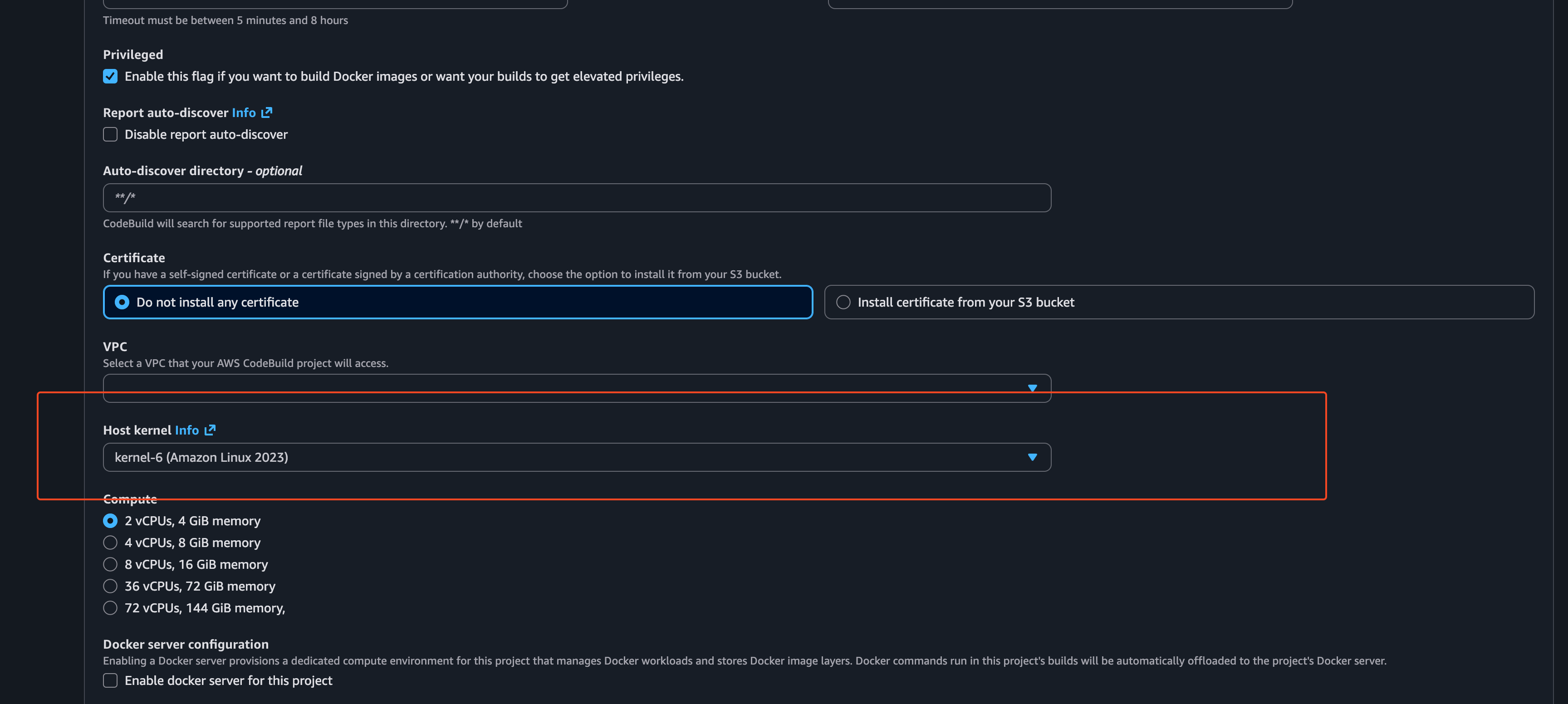 announced · Sep 2026
· source
· release history
-
Adds support for GitHub Actions runners hosted on AWS CodeBuild on EC2 compute, starting with
step-security/harden-runner@v2.20.1, enabling outbound network, file-write, and process-execution monitoring for CodeBuild-hosted jobs. announced · Sep 2026 · source · release history -
Requires the CodeBuild project to be configured with
Compute: EC2,Host kernel: kernel-6(Amazon Linux 2023), andPrivileged: Enabled— set in the project's Additional configuration panel — for the Harden-Runner agent to function. announced · Sep 2026 · source · release history -
AWS CodeBuild custom image support extends Harden Runner to Linux containers on EC2 compute
Harden Runner Releases: August 17, 2026 (2026-08-17) · Aug 2026
· source
· release history
- Adds AWS CodeBuild-hosted runner support to Harden-Runner GitHub Action Harden Runner Releases- August 5, 2026 (2026-08-05) · Aug 2026 · source · release history
Dev Machine Guard credential inventory shipped Inventories credentials across thirteen source types on developer machines, aggregating fleet-wide coverage details and allowing per-device scoping for targeted rotation during incidents.
Also counts toward: Agent-based deployment
release
-
Per-source detail view lists every affected device labelled Plaintext, Protected, or both, with per-device summaries (e.g. '3 locations · 3 entries (2 plaintext)') and direct links to each machine.
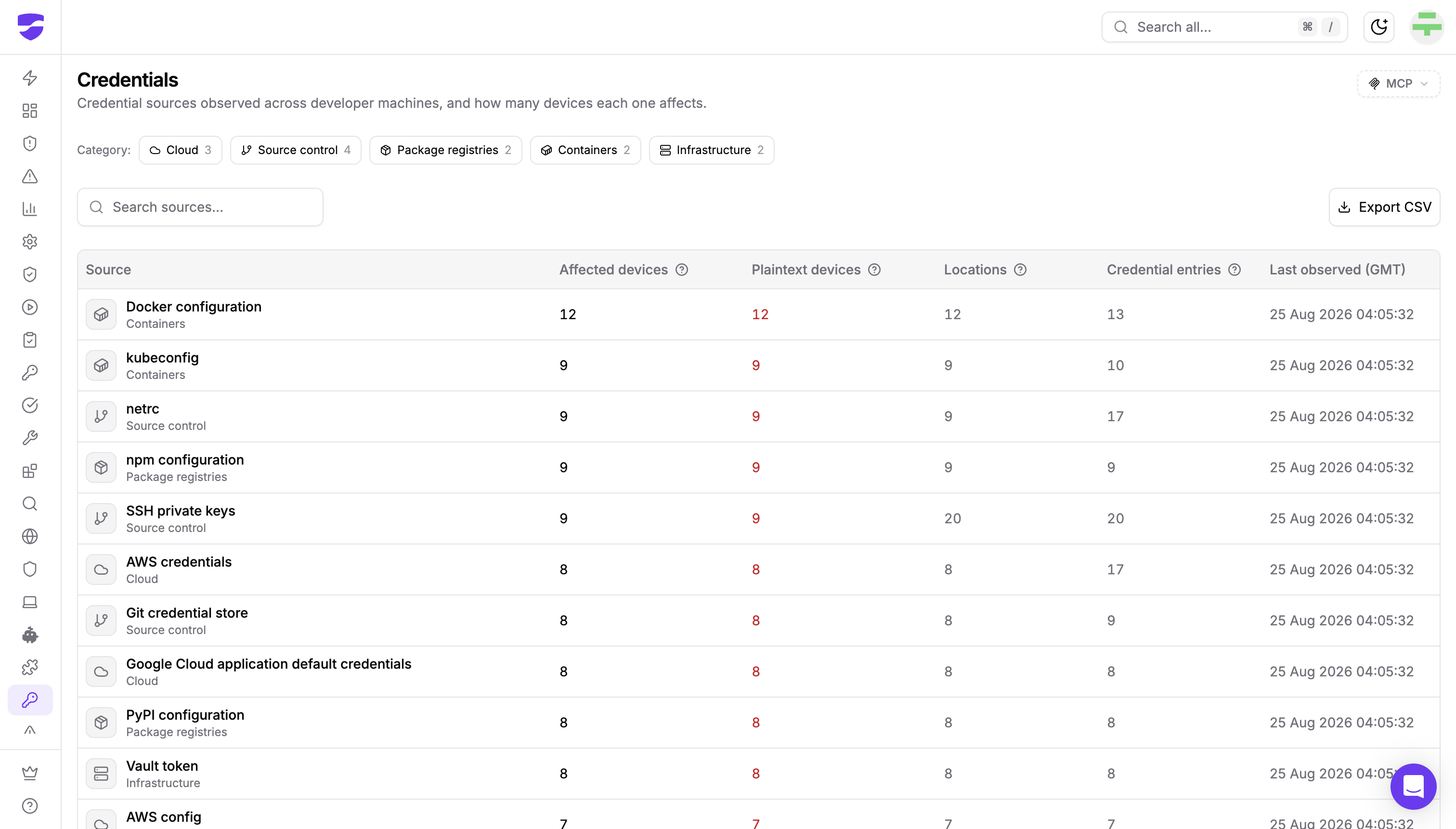 announced · Aug 2026
· source
· release history
- Available from agent v1.16.0; existing Dev Machine Guard deployments gain the Credentials page automatically after each enrolled device completes its next scan. announced · Aug 2026 · source · release history
- Adds a Credentials page in the StepSecurity dashboard that aggregates credential source coverage fleet-wide, showing per-source device count, plaintext vs. announced · Aug 2026 · source · release history
-
Covers thirteen credential source types across five categories, including
~/.npmrc,~/.pypirc,~/.vault-token,~/.netrc,~/.aws/credentials,~/.aws/config,~/.docker/config.json, gcloud application default credentials, kubeconfig,~/.sshprivate key files (id_rsa,id_ed25519,id_ecdsa), and… announced · Aug 2026 · source · release history
example
-
When a credential-stealing package is disclosed, confirm which sources existed on affected machines so rotation is targeted rather than fleet-wide.
In the StepSecurity dashboard, go to Dev Machine Guard > Credentials, filter by the relevant category (e.g.announced · Aug 2026 · source
ARC pod process tracing and Helm configuration shipped Enables container process tracing for ARC pods via Tetragon and provides Helm values to configure image pull policies for the runner and Tetragon.
release
-
Adds
tetragon.imagePullPolicyHelm value for Tetragon image pulling
ARC Harden Runner v2.19.0 (2026-08-24) · Aug 2026
· source
· release history
-
Adds
imagePullPolicyHelm value for ARC Harden Runner image pulling ARC Harden Runner v2.19.0 (2026-08-24) · Aug 2026 · source · release history - Enables opt-in container process tracing for ARC pods via Helm values Harden Runner Releases- August 5, 2026 (2026-08-05) · Aug 2026 · source · release history
- Enables opt-in container process tracing for ARC Harden Runner v2.18.6 via Helm values Harden Runner Releases- August 5, 2026 · Aug 2026 · source · release history
example
-
Configure image pull policies for Tetragon and the runner in Helm values
tetragon: imagePullPolicy: IfNotPresent imagePullPolicy: IfNotPresentARC Harden Runner v2.19.0 (2026-08-24) · Aug 2026 · source
Runner Job Hooks versioning shipped Provides versioned pre-job and post-job runner hooks for self-hosted runners so operators can pin to a known-good hook version.
Also counts toward: JavaScript scripting support, Self-hosted deployment
release
- Publishes versioned Runner Job Hooks v1.0.0 with TypeScript/JS implementation Harden Runner Releases- August 5, 2026 (2026-08-05) · Aug 2026 · source · release history
-
Publishes Runner Job Hooks v1.0.0 at
step-security/gha-runner-job-hooks, enabling runners to pin to a specific hook version for pre-job and post-job execution. Harden Runner Releases- August 5, 2026 (2026-08-05) · Aug 2026 · source · release history - Pre-job and post-job hooks rewritten from shell script to TypeScript/JavaScript in Runner Job Hooks v1.0.0. Harden Runner Releases- August 5, 2026 (2026-08-05) · Aug 2026 · source · release history
-
Adds Runner Job Hooks feature to allow referencing specific hook versions via
step-security/gha-runner-job-hooksHarden Runner Releases- August 5, 2026 · Aug 2026 · source · release history
example
-
Configure versioned Runner Job Hooks on self-hosted runners via the StepSecurity app UI.
In the StepSecurity app, go to Settings → Harden-Runner Installation → Runner Job Hooks and follow the installation instructions to reference a specific version from…Harden Runner Releases- August 5, 2026 (2026-08-05) · Aug 2026 · source
Tenant-level notification configuration shipped Configures email, Slack, and Teams notifications at the tenant level, with per-organisation opt-in and selectable match-granularity so teams receive alerts relevant to their packages.
Also counts toward: Web management console, Outbound webhooks (the product notifies you)
release
- Adds a Notifications page under Admin console settings to configure email, Slack webhook, and Teams webhook once at the tenant level, replacing per-organization channel setup. Threat Intel Notifications: Tenant-Wide Channels and Match Granularity (2026-08-04) · Aug 2026 · source · release history
-
Makes threat intel alerting an explicit opt-in per organization via the
Notify when StepSecurity threat intel flags a compromised componentevent in organization notification settings, shown alongside existing Harden-Runner detection events. Threat Intel Notifications: Tenant-Wide Channels and Match Granularity (2026-08-04) · Aug 2026 · source · release history - Allows granularity to be set independently at the tenant level so a tenant can subscribe to the full incident feed regardless of individual organization configuration. Threat Intel Notifications: Tenant-Wide Channels and Match Granularity (2026-08-04) · Aug 2026 · source · release history
docs
-
- [Notifications](
https://docs.stepsecurity.io/administration/admin-console/settings/notifications.md) seen Aug 2026 · source
example
-
Configure a single Slack webhook for all organizations in your tenant so every team receives threat intel alerts without repeating channel setup per org.
In the Admin console, go to Settings > Notifications and enter your Slack webhook URL under the Slack webhook field, then save.Threat Intel Notifications: Tenant-Wide Channels and Match Granularity (2026-08-04) · Aug 2026 · source
Typosquatting Protection and Custom Block List shipped Blocks packages whose names closely resemble popular packages, with a configurable allowlist to clear false positives.
previously: Typosquatting Protection
release
-
Introduces Custom Block List, a new per-ecosystem control that blocks specific packages or versions using glob patterns (e.g.,
lodash@4*,@scope/*), evaluated independently of Cooldown, Compromised Packages, and Typosquatting Protection. Secure Registry: Maven Support in Beta, Custom Block List, and Tarball URL Rewriting (2026-07-24) · Jul 2026 · source · release history - New Typosquatting Protection control blocks packages whose names closely resemble popular packages, configurable per ecosystem with a Whitelisted Packages allowlist to clear false positives by exact package name. Secure Registry: Source Attribution, Typosquatting Protection, and Sonatype Nexus Support (2026-06-24) · Jun 2026 · source · release history
example
-
Enforce an internal ban on all 4.x versions of lodash and an entire scoped namespace across your npm policy.
In the Secure Registry console, go to Policy > npm > Custom Block List and add entries: `lodash@4*` and `@rejected-scope/*`, then save.Secure Registry: Maven Support in Beta, Custom Block List, and Tarball URL Rewriting (2026-07-24) · Jul 2026 · source -
Enable Typosquatting Protection for an ecosystem and allowlist a legitimate package that triggers a false positive.
In Secure Registry settings, enable Typosquatting Protection for the target ecosystem, then add the exact package name to the Whitelisted Packages allowlist to permit it.Secure Registry: Source Attribution, Typosquatting Protection, and Sonatype Nexus Support (2026-06-24) · Jun 2026 · source
Secret Exfiltration Policy shipped Configures policy rules that block bulk secret harvesting across branches, with violation details showing the exact secret reference and line number.
release
- New Analyze default branch runs option in Secret Exfiltration Policy extends coverage to the default branch. Workflow Run Policies: allow-list enforcement, runner constraints, and richer policy insight (2026-07-21) · Jul 2026 · source · release history
- Secret Exfiltration violation details now include the specific secret reference and its line number in the workflow file. Workflow Run Policies: allow-list enforcement, runner constraints, and richer policy insight (2026-07-21) · Jul 2026 · source · release history
-
New 'Block only when a workflow accesses all secrets at once' mode in Secret Exfiltration Policy blocks bulk patterns like
${{ toJSON(secrets) }}while allowing targeted references, reducing false positives. Workflow Run Policies: allow-list enforcement, runner constraints, and richer policy insight (2026-07-21) · Jul 2026 · source · release history
example
-
Block bulk secret harvesting (e.g. toJSON(secrets)) across all branches while allowing normal targeted secret access — configure in the Secret Exfiltration Policy.
In the StepSecurity console, go to Workflow Run Policies > Secret Exfiltration Policy, enable 'Block only when a workflow accesses all secrets at once' (recommended), then enable 'Analyze default…Workflow Run Policies: allow-list enforcement, runner constraints, and richer policy insight (2026-07-21) · Jul 2026 · source
Language runtime inventory on developer machines shipped Inventories language runtimes (Node.js, Python, PHP, Java, Go, Ruby, Deno, Bun, and .NET) across macOS, Windows, and Linux developer machines, including runtimes installed via version managers, package managers, archives, or bundled inside applications, with a configuration option to disable scanning on locked-down hosts.
Also counts toward: Agent-based deployment, Command-line interface, Scripting language support
release
-
Dev Machine Guard now inventories language runtimes (Node.js, Python, PHP, Java, Go, Ruby, Deno, Bun, and .NET) across macOS, Windows, and Linux, including runtimes installed via version managers, package managers, archives, or bundled inside apps such as Xcode, JetBrains IDEs, VS Code Server, and Electron.
Dev Machine Guard v1.18.1 (2026-10-28) · Oct 2026
· source
· release history
-
Turn off language runtime scanning by setting
enable_runtime_scantofalsein the agent configuration or passing--disable-runtime-scan; scanning is on by default. Dev Machine Guard v1.18.1 (2026-10-28) · Oct 2026 · source · release history
example
-
Disable language runtime scanning on a locked-down build host where passive filesystem reads are not permitted by policy.
{ "enable_runtime_scan": false }Dev Machine Guard v1.18.1 (2026-10-28) · Oct 2026 · source
Packagist ecosystem support in Secure Registry shipped Adds Packagist (PHP) registry support to the Secure Registry, routing Composer package downloads through the proxy to evaluate requests against organizational policy and control metadata exposure.
Also counts toward: Scripting language support
release
-
Adds Block Branch Versions setting to hide branch versions from Composer package metadata.
Secure Registry: Packagist (PHP) Support (Beta) (2026-10-16) · Oct 2026
· source
· release history
-
Adds Packagist (PHP) registry support in Beta at
https://registry.stepsecurity.io/php; point Composer or JFrog Artifactory at this URL to evaluate every packagist.org package request against your Packagist policy.︀︄︇︀︅︉︀︅︀︀︃︀︀︅︅︀︅︊︀︄︆︀︃︄ Secure Registry: Packagist (PHP) Support (Beta) (2026-10-16) · Oct 2026 · source · release history
example
-
Route all Composer package downloads through Secure Registry to enforce your Packagist policy on every dependency fetch.
{ "http-basic": { "registry.stepsecurity.io": { "username": "token", "password": "<your-api-key>" } }, "repositories": [ { "type": "composer", "url": "https://registry.stepsecurity.io/php" } ] }Secure Registry: Packagist (PHP) Support (Beta) (2026-10-16) · Oct 2026 · source
Token Governance for Azure DevOps shipped Inventories personal access tokens, service connections, and Entra service principals in Azure DevOps organizations with scope risk classification.
release
-
New Identities & PATs page for Azure DevOps inventories personal access tokens, service connections, and Entra service principals in one place, with hourly auto-refresh, on-demand refresh, and per-tab export.
PAT Governance for GitHub and Azure DevOps (2026-09-02) · Sep 2026
· source
· release history
example
-
Exempt a shared service account token from PAT Governance across all orgs in your tenant without touching each org individually.
1. In the organization selector, choose 'All Organizations'. 2. Navigate to Apps & PATs > Exemptions. 3. Click 'Add tenant-wide exemption' and enter the token or user to exempt. 4.PAT Governance: Tenant-Wide Exemptions (2026-10-12) · Oct 2026 · source -
Review the new Identities & PATs inventory for your Azure DevOps organization to spot over-privileged or stale tokens, service connections, and Entra service principals at a glance.
In the StepSecurity console, go to Identities & PATs (Azure DevOps), select the Personal Access Tokens tab, click 'Refresh' to pull the latest data from the Azure DevOps APIs, then click 'Export' to…PAT Governance for GitHub and Azure DevOps (2026-09-02) · Sep 2026 · source
GitHub Actions exemptions from control evaluations shipped Allows operators to exempt specific GitHub Actions by name or owner wildcard from the 'Third-party GitHub Actions with high scores' control, configurable from the Settings > Control Evaluation UI.
release
-
Adds
Settings > Control EvaluationUI section with a Control options card for exempting GitHub Actions from the Third-party GitHub Actions with high scores control by name or owner wildcard (e.g.,example-org/*)
Low Score Exemptions for Control Evaluation (2026-09-28) · Sep 2026
· source
· release history
example
-
Exempt a specific GitHub Action by name from high-score control evaluations.
In the console, go to Settings > Control Evaluation and add `example-org/example-action` in the Control options card.Low Score Exemptions for Control Evaluation (2026-09-28) · Sep 2026 · source -
Exempt all actions from a specific owner from high-score control evaluations in StepSecurity.
In the console, go to Settings > Control Evaluation and add `example-org/*` in the Control options card.Low Score Exemptions for Control Evaluation (2026-09-28) · Sep 2026 · source
Dev Machine Guard browser extension inventory and analysis shipped Inventories browser extensions across Chrome, Edge, and Firefox on macOS, Windows, and Linux, mapping raw permissions to named capabilities like script injection or cookie access.
release
-
Covers Chrome, Edge, and Firefox on macOS, Windows, and Linux, including Firefox under snap and Flatpak and Edge under Flatpak; available from agent
v1.16.0with no changes required for existing Dev Machine Guard deployments.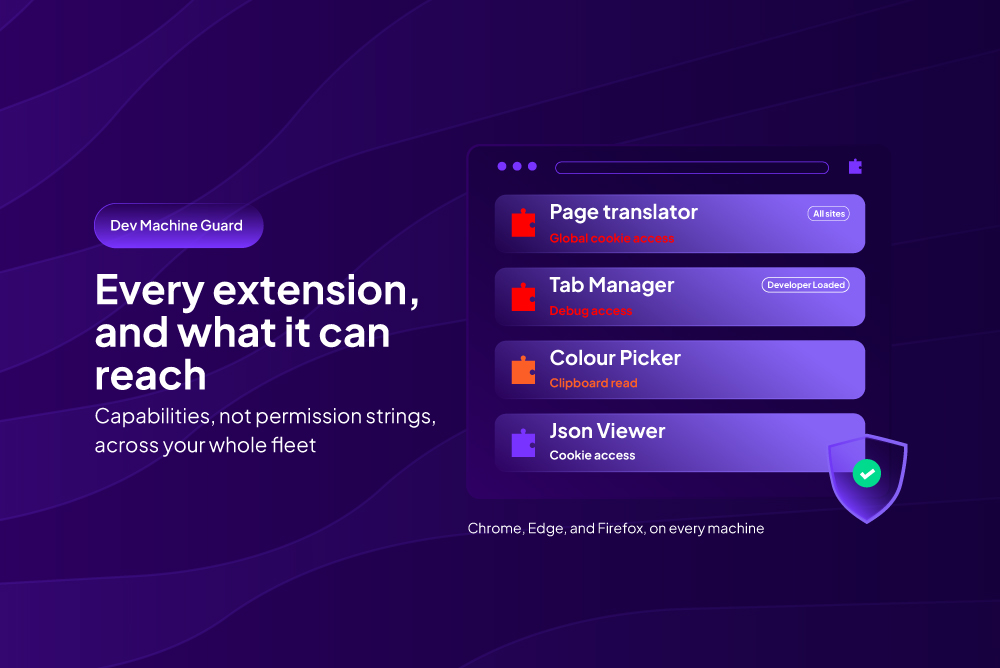 announced · Aug 2026
· source
· release history
- Rolls raw browser permissions into ten named capabilities — Global website access, Global request observation, Script injection, Global script injection, Cookie access, Global cookie access, Browsing history, Debugger access, Clipboard read, and Extension management — reflecting what the browser is… announced · Aug 2026 · source · release history
example
-
During an incident, search by extension ID in the Browser Extensions page to instantly see which devices are running a compromised extension and at which versions.
In the StepSecurity dashboard, go to Dev Machine Guard > Browser Extensions > search the extension ID in the table > review the per-device version grouping for affected machines.announced · Aug 2026 · source
Harden-Runner Policy store enforcement shipped Lets administrators require that specific jobs reference a centrally managed Harden-Runner policy, preventing jobs from running without enforced controls.
Also counts toward: CI/CD pipeline integration
release
-
New Require policy store option in Harden-Runner Policy enforces that targeted jobs set
use-policy-store: trueon their Harden-Runner step. Workflow Run Policies: allow-list enforcement, runner constraints, and richer policy insight (2026-07-21) · Jul 2026 · source · release history -
New Block jobs running in a container option in Harden-Runner Policy blocks jobs with a job-level
container:on GitHub-hosted standard runners where outbound monitoring is unavailable. Workflow Run Policies: allow-list enforcement, runner constraints, and richer policy insight (2026-07-21) · Jul 2026 · source · release history
example
-
Ensure every targeted job sources its runtime policy from the StepSecurity policy store, preventing jobs from bypassing centrally managed policies.
In the StepSecurity console, go to Workflow Run Policies > Harden-Runner Policy and enable 'Require policy store'.Workflow Run Policies: allow-list enforcement, runner constraints, and richer policy insight (2026-07-21) · Jul 2026 · source
Runner Label Policy shipped Enforces which runner labels and runner-provider constraint values jobs are allowed to use, independently per constraint dimension.
release
- New Allowed labels & constraints allow-list mode in Runner Label Policy enforces that only configured labels and constraint values may be used, with each dimension enforced independently. Workflow Run Policies: allow-list enforcement, runner constraints, and richer policy insight (2026-07-21) · Jul 2026 · source · release history
-
Runner Label Policy now supports structured
runs-onkeys (family, cpu, image, ami, volume, etc.) for third-party runner providers such as RunsOn. Workflow Run Policies: allow-list enforcement, runner constraints, and richer policy insight (2026-07-21) · Jul 2026 · source · release history
example
-
Restrict CI jobs to an approved set of runner labels and RunsOn structured constraints, preventing use of arbitrary or untrusted runner configurations.
In the StepSecurity console, go to Workflow Run Policies > Runner Label Policy and switch to 'Allowed labels & constraints' mode. Add the permitted labels and structured runs-on keys (e.g.Workflow Run Policies: allow-list enforcement, runner constraints, and richer policy insight (2026-07-21) · Jul 2026 · source
Bun runtime HTTPS monitoring shipped Monitors outbound HTTPS calls made by Bun-based workflow steps on Linux runners, giving the same network visibility as other runtimes.
Also counts toward: CI/CD pipeline integration, Self-hosted deployment
release
- Adds HTTPS request monitoring support for the Bun runtime on Linux GitHub-hosted runners (enterprise tier) Harden Runner Releases- July 7, 2026 · Jul 2026 · source · release history
- Enables HTTPS request monitoring for Bun on Linux amd64 self-hosted VM runners. Harden Runner Releases- July 7, 2026 (2026-07-07) · Jul 2026 · source · release history
- Enables HTTPS request monitoring for workflows using the Bun runtime on Linux runners (enterprise tier) in the GitHub Action. Harden Runner Releases- July 7, 2026 (2026-07-07) · Jul 2026 · source · release history
GitHub Enterprise Server Apps & PATs inventory shipped Extends the Apps and PATs inventory page to GitHub Enterprise Server organizations, surfacing installed apps and fine-grained tokens.
release
-
The Apps & PATs page is now available for organizations on GitHub Enterprise Server, inventoring installed GitHub Apps and fine-grained personal access tokens with permission, access scope, and status detail as on GitHub Cloud.
Apps & PATs Inventory for GitHub Enterprise Server (2026-09-18) · Sep 2026
· source
· release history
- Extends the Apps & PATs page to GitHub Enterprise Server organizations, inventorying installed GitHub Apps and fine-grained personal access tokens with permission, access scope, and status detail.︀︄︇︀︅︉︀︅︀︀︃︀︀︅︅︀︅︊︀︄︆︀︃︄ Apps & PATs Inventory for GitHub Enterprise Server (2026-09-18) · Sep 2026 · source · release history
CodeBuild Runner Egress Controls shipped Enables egress traffic monitoring and deny-list management for CodeBuild-hosted runners via new inputs to the Harden-Runner action.
Also counts toward: CI/CD pipeline integration
release
-
Surfaces memory-read detections (the technique behind CVE-2025-8217) as a runtime alert with a triage runbook attached, for CodeBuild-hosted runner jobs.
announced · Sep 2026
· source
· release history
-
Adds
denied_endpointsinput to the Self-Hosted VM Harden Runner (v1.9.0) for the same deny-list capability on self-hosted VMs.
announced · Sep 2026
· source
· release history
Unified Runner Fleet Inventory shipped Unifies CodeBuild-hosted, GitHub-hosted, ARC, and self-hosted runner fleets under a single dashboard, Policy Store, and detection baseline.
Also counts toward: Web management console
release
-
Unifies CodeBuild-hosted, GitHub-hosted, ARC, and self-hosted runner fleets under a single dashboard, Policy Store, and detection baseline.
announced · Sep 2026
· source
· release history
- Adds filtering by runner name or label and status in the fleet view Self-Hosted Runners: Full Fleet Visibility and a New GitHub App Permission (2026-08-11) · Aug 2026 · source · release history
Browser Extension Inventory shipped Inventories browser extensions across Chrome, Edge, and Firefox on macOS, Windows, and Linux, recording identity, enablement state, installation source, store attribution, and active host/API permissions.
Also counts toward: CSV data export
release
-
Adds a Browser Extensions page in the StepSecurity dashboard showing a fleet-wide table of every extension detected, including name, extension ID, browser, store, version, device count, and last-seen timestamp — filterable by browser, capability, store, and engine, with an Export CSV download.
announced · Aug 2026
· source
· release history
-
Adds
browser extension inventoryfor Chrome, Edge, and Firefox on macOS, Windows, and Linux, recording identity, enablement state, installation source, store attribution, and active host/API permissions.
Dev Machine Guard v1.16.0 (2026-08-21) · Aug 2026
· source
· release history
Dev Machine Guard detection event configuration shipped Configures tenant-level alerts for specific Dev Machine Guard detection types such as suspicious files or package manager configuration changes.
release
- Adds Seven new notification events to Dev Machine Guard: A new IDE, a new IDE extension, a new AI agent, a new MCP server, a new agent skill, a suspicious file, and a package manager configuration change. Dev Machine Guard Notifications (2026-08-26) · Aug 2026 · source · release history
example
-
Configure tenant-level alerts for specific detection types like suspicious file or 'package manager configuration change'.
In the StepSecurity console, navigate to Notifications > Dev Machine Guard and enable individual toggles for new events.Dev Machine Guard Notifications (2026-08-26) · Aug 2026 · source
StepSecurity Maintained Actions (free for public repos) shipped Provides 500 secure drop-in replacements for popular third-party GitHub Actions at no cost for public repositories.
Also counts toward: CI/CD pipeline integration
release
-
Adds
egress-policy: blockanddenied-endpointsinputs to the Harden-Runner GitHub Action to explicitly block traffic to specific destinations Harden Runner Releases: August 17, 2026 · Aug 2026 · source · release history - Makes all 500 StepSecurity Maintained Actions (secure drop-in replacements for popular third-party GitHub Actions) free for public repositories, no subscription required. StepSecurity Maintained Actions Are Now Free for Public Repositories (2026-06-29) · Jun 2026 · source · release history
Public registry usage detection in CI/CD shipped Detects CI/CD jobs that pull packages directly from public registries instead of a secure proxy, surfaced as a dashboard control.
Also counts toward: CI/CD pipeline integration
release
-
New Overview dashboard control detects CI/CD jobs that download packages directly from public registries (
registry.npmjs.org, pypi.org, registry-1.docker.io) instead of a secure proxy registry. New Control: Jobs Should Use a Secure Registry Instead of Public Package Registries (2026-07-14) · Jul 2026 · source · release history
example
-
Identify CI/CD jobs pulling packages from public registries so you can route them through a secure proxy before a supply-chain compromise occurs.
In the StepSecurity console, go to Overview dashboard > Controls, open the 'Jobs Should Use a Secure Registry Instead of Public Package Registries' control, then filter findings by repository or…New Control: Jobs Should Use a Secure Registry Instead of Public Package Registries (2026-07-14) · Jul 2026 · source
Bitrise-hosted macOS runner compatibility shipped Allows workflows running on Bitrise-hosted macOS runners to use Harden-Runner alongside other supported platforms.
Also counts toward: CI/CD pipeline integration
release
- Adds support for Bitrise-hosted macOS GitHub Actions runners Harden Runner Releases- July 7, 2026 · Jul 2026 · source · release history
- Adds compatibility with Bitrise-hosted macOS runners for GitHub Actions workflows. Harden Runner Releases- July 7, 2026 (2026-07-07) · Jul 2026 · source · release history
Avrea-hosted runner support shipped Adds support for runners hosted by Avrea so GitHub Actions workflows running on that platform can use Harden-Runner.
Also counts toward: CI/CD pipeline integration
release
-
Harden Runner now supports runners hosted by Avrea (enterprise tier) in GitHub Action v2.22.3.
Harden Runner Releases: October 29, 2026 (2026-10-29) · Oct 2026
· source
· release history
Credential inventory for API clients shipped Inventories credentials stored in API client tools such as Insomnia, covering request authentication, headers, environment and secret variables, OAuth tokens, request history, and account or provider stores.
release
-
Adds Insomnia under a new API clients category in the credential inventory, counting coverage across request authentication, headers, environment/secret variables, OAuth tokens, request history, and account/provider stores
Dev Machine Guard v1.17.0 (2026-09-29) · Sep 2026
· source
· release history
Go package config enforcement on developer machines shipped Writes managed package config policies that set the tenant's Secure Registry as the sole GOPROXY in the user's go/env file while preserving existing GOPRIVATE, GONOPROXY, and GOSUMDB settings.
release
-
Adds Go package config policies that set the Secure Registry as the sole
GOPROXYin the user'sgo/envfile while preserving existingGOPRIVATE,GONOPROXY,GOSUMDB, andGOSUMDBsettings
Dev Machine Guard v1.17.0 (2026-09-29) · Sep 2026
· source
· release history
PyPI package config enforcement on developer machines shipped Writes managed package config policies that route pip and uv through the tenant's Secure Registry by setting the index in pip.conf and uv.toml, storing a shared credential in ~/.netrc without modifying project files or virtual environments.
release
-
Adds PyPI package config policies that set the Secure Registry index in
pip.confanduv.toml, storing a shared credential in~/.netrcwithout touching project files or virtual environments
Dev Machine Guard v1.17.0 (2026-09-29) · Sep 2026
· source
· release history
Global egress policy controls for package managers shipped Blocks direct npm and PyPI registry access org-wide to enforce routing through a package proxy while leaving other outbound traffic unrestricted.
example
-
Block direct npm and PyPI registry access org-wide to enforce routing through a package proxy, while leaving all other outbound traffic unrestricted.
- uses: step-security/harden-runner@v2.21.0
  with:
    egress-policy: block
    denied-endpoints: |
      registry.npmjs.org
      pypi.org
      files.pythonhosted.org
announced · Sep 2026
· source
Dev Machine Guard device version tracking shipped Lists affected devices grouped by agent version in the per-device detail panel to enable rapid scoping when an advisory names a specific bad version.
release
-
Per-device detail panel lists affected devices grouped by version (first 500 devices shown), enabling rapid scoping when an advisory names a specific bad version.
announced · Aug 2026
· source
· release history
Dev Machine Guard macOS Full Disk Access integration shipped Mandates Full Disk Access permissions via MDM on macOS agents to access TCC-protected credential paths and return complete inventory results.
release
-
On macOS, Full Disk Access must be granted to the agent via MDM to reach TCC-protected credential paths and return complete inventory results.
announced · Aug 2026
· source
· release history
Compromised Actions Policy shipped Shows the currently known compromised GitHub Actions with affected versions in the policy editor, snapshotted per evaluation for audit purposes.
release
- Adds Currently known compromised actions display in the Compromised Actions Policy editor, showing affected versions, with the list snapshotted per evaluation for auditability. Workflow Run Policies: allow-list enforcement, runner constraints, and richer policy insight (2026-07-21) · Jul 2026 · source · release history
Customizable PR comment templates per policy shipped Lets each policy define its own PR comment template with placeholders for policy details, remediation guidance, and documentation links.
release
-
Adds customizable PR Comment Template per policy with placeholders including
{{policy_name}},{{policy_details}},{{remediation}}, and{{docs_url}}. Workflow Run Policies: allow-list enforcement, runner constraints, and richer policy insight (2026-07-21) · Jul 2026 · source · release history
Network Events suppression rule auditing shipped Shows how many suppression rules were applied to each job's network events and links to those rules so analysts can check for missed detections.
release
- Network Events tab in Harden-Runner insights now shows the number of suppression rules applied per job and a View suppression rules link for auditing missed detections. Workflow Run Policies: allow-list enforcement, runner constraints, and richer policy insight (2026-07-21) · Jul 2026 · source · release history
Lines in monospace are the tool's own words: help text
parsed from its source, or an endpoint from its API document. Under
release, a line is our summary of a dated release. Under
docs, it is quoted from the tool's own documentation or
website. Each links back to the source it came from.
Command line
5 commands for StepSecurity, each with where it came from. This tool has no source analysis yet, so there is no option reference and no captured run beside them.
No command matches.
Screenshots
From the release notes, newest first. Click one to see it full size.Score card
-
Shipping velocity releases a month, last 12 months
-
Documentation quality release-notes rubric, 0–100
-
Breaking-change discipline how rarely a release breaks users, and notice given
-
Maintenance risk quiet time against its own cadence, maintainers
-
Innovation & surface new capabilities, API and MCP surface
Five scores for StepSecurity, each built from the releases, notes and API history this site tracks — and, on Researcher and Business, where it stands among every measured tool in its category and how that has moved.
Score cards are part of every paid plan.
See plans → Already subscribed? Sign in →Trajectory
Blank means never measured; nothing here is a filled-in zero.
Peer standings are included with Researcher and Business. See how this tool ranks against its competitors, using data we don't publish anywhere else.
See plans →Each score is 0–100 on a published rubric, derived from data this site already shows. A dimension we cannot measure says so — it is never scored 0 and never enters a rank.
How this is scored
- Shipping velocity — releases a month over the last 12 months, on a log scale where 16 a month scores 100. Needs 3 releases in the window.
- Documentation quality — the release-notes rubric published on the analytics page, unchanged.
- Breaking-change discipline — the share of releases carrying a breaking change (none scores 100, half or more scores 0). Only projects that label breaking changes are measured: a clean record cannot be told from an unlabelled one.
- Maintenance risk — quiet time measured against the tool's own release cadence (quiet longer than 90 days and three typical gaps scores 0), plus the number of active maintainers and whether contributors are growing, where known. Higher is lower risk.
- Innovation & surface — new capabilities in the feature ledger this year, API and MCP operations added, and the share of commits that are features: the mean of whichever we hold.
- Community health (open-source tools only) — each is a direction, not a size: contributors this year against last, the bus factor now against a year ago, and issues closed per issue opened, where steady scores 50, doubled 100 and halved 0; plus the median time to a maintainer's first reply (an hour scores about 100, a month or more 0). A commercial card has no repository and carries none of the four.
- Documented delivery (commercial tools) — when a vendor's documented new capabilities have slowed against its own baseline, that counts against the overall standing as heavily as two low dimensions. Steady delivery, or too little history to judge, leaves the standing alone; it is never a sixth score.
- Open-source tools are scored on repository signals; commercial tools on their published changelog. Ranks compare tools within one category and one profile and need at least five measured peers; the overall standing needs three ranked dimensions. Best-in-breed or consolidator is a shape, not a quality, and is never scored.
Release-note detail over time
See how much detail StepSecurity puts in its release notes, quarter by quarter, and compare it with tracked tools in the same category. This history uses up to ten retained, reviewed notes per tool; sparse or blank older quarters may reflect that limit.
Checking release-note history…
Commercials
pricing & packaging history · StepSecurity vendor page33 readings of StepSecurity's pricing page since Nov 2022, with 2 relaunches of its plan lineup and 18 changes to what its plans include — each one dated, compared with the reading before it, and explained for someone buying the tool.
Pricing and packaging history is included with Researcher and Business. See how every vendor we track sells, and how that has changed over time, using data we don't publish anywhere else.
See plans → Already subscribed? Sign in →Plans by offering
Each offering on the pricing page links to its own page of plans, read at its latest capture.
Plan relaunches
Plans, prices and descriptions are quoted from the vendor's own pricing page as we read it on each date. A plan missing from a later reading is shown as no longer listed on the page — a statement about the page, not the product. Readings that failed to show any plans are left out rather than read as a change.
Website history
stepsecurity.io, every changeStepSecurity's home page and 25 more pages as they looked each month from January 2023 to October 2026: 35 renders, 5 changes of tagline or palette. Step through them, play them, or put any two months side by side.
Website history is included with Researcher and Business.
See plans → Already subscribed? Sign in →← → or h l a month · Shift a year · [ ] previous / next change · Space play · 1 2 3 page · T whole page · C compare · F full size
← → or h l the right month · Shift the left · S swap · W wipe · T whole page · Esc back
Rebranding timeline
Dates bound when a change appeared between captures. Possible rebrands are AI suggestions; a redesign alone does not establish a rebrand.
Coverage
Missing something? Tell us
What StepSecurity connects to, runs on and detects, read from its release notes and docs. So far: 3 new integrations, 2 new supported platforms.
5 changes, tracked since Oct 16, 2026.
-
Oct 282026
new Language runtime inventory on macOS, Windows, and Linux
Covers 9: Node.js, Python, PHP, Java, Go, Ruby and 3 more
Dev Machine Guard now finds every installed copy of Node.js, Python, PHP, Java, Go, Ruby, Deno, Bun, and .NET on macOS, Windows, and Linux, beyond the one on PATH.
-
Oct 282026
new Windows system package inventory
With Chocolatey, Scoop, winget
Windows system packages: the system package inventory now covers Windows: programs listed in Programs and Features (machine-wide and per-user), plus Chocolatey, Scoop, and winget packages.
-
Oct 282026
new Package inventory for Go, Rust, PHP, .NET, and Ruby ecosystems
With Go modules, Rust (Cargo), PHP (Composer), .NET (NuGet), Ruby (RubyGems)
Package inventory for Go, Rust, PHP, .NET, and Ruby: Dev Machine Guard now inventories packages and audits package manager configuration for Go modules, Rust (Cargo), PHP (Composer), .NET (NuGet), and Ruby (RubyGems and Bundler), alongside the existing npm and Python coverage.
-
Oct 282026
new GitHub Copilot plugin inventory in Agent Plugins
With GitHub Copilot CLI, VS Code, MCP servers
GitHub Copilot plugin inventory: the Agent Plugins inventory now includes GitHub Copilot plugins for the Copilot CLI (Command-Line Interface), the standalone Copilot app, and VS Code. For each installed plugin, it reports the skills, custom agents, and MCP (Model Context Protocol) servers the plugin provides, as well as MCP servers configured at the user and project level.
-
Oct 162026
new Packagist (PHP) Secure Registry support
With packagist.org, Composer, JFrog Artifactory
Secure Registry now supports Packagist (PHP) in Beta, alongside npm, PyPI, Maven, NuGet, Go, RubyGems, and Cargo. Features Packagist support. Point Composer or JFrog Artifactory at https://registry.stepsecurity.io/php, and every packagist.org package request is evaluated against your Packagist policy.
Source control & CI/CD 1
Operating systems 1
Languages & runtimes 9
Other 2
Editors & IDEs 1
Coding agents 1
Agent frameworks & SDKs 1
Source control & CI/CD 1
Languages & runtimes 8
Nothing first seen in this window. That doesn't mean StepSecurity shipped nothing, only that we found no record of it.
How we count
Read from 8 of 65 release notes and docs updates we hold for StepSecurity. "First seen" is the earliest note that names something; "last" is the latest. Our history may start partway through StepSecurity's life, so an old integration can show a recent first-seen date.
Each change counts once: "added 40 checks" is one line, so the numbers measure how often coverage moves, not how big the catalogue is or how well it detects.
Releases
65 entries
No entries match these filters.
- November 20262
- October 202613
- September 202611
- August 202616
- July 202612
- June 202611
Add the badge to your README
Maintain this project? The badge links readers straight to this page, so they can follow every release here.
 Choose a badge style and copy the code →